Tok Pisin-A Sign Of The Times
pp. 35-36 · Read in the full issue
In The Solomons And Png
By Denis Fisk
Pidgin as a national language is now receiving the same impetus in the Solomon Islands as it did in Papua New Guinea in the late 19605, through its informal adoption as the language of the legislature.
In both places the change has come about with the confidence aris ing out of decolonisation, with the feeling of the local politicians that they are taking over power from the colonial motherland and the actual, announced progression to self government with independence pro mised soon after.
Papua New Guinea is still to actually achieve its official indepen dence five or six years after pidgin— with a little Motu, the other lingua franca, thrown in for Papuan pride —overcame the English that had been used officially in the House for so long.
I remember well the despairing efforts of people like Tei Abal from the Highlands, who was later to be come Leader of the United Party, to learn this English that appeared to be the key to communication in government. His ability in pidgin was undoubted, yet he was supposed to speak in English so it could be trans lated back to pidgin and Motu through the earphones all the mem bers could wear.
Such was the power the Aus tralian administrators used, probably, not so much because of the sectional belief that pidgin was a “bastard” language but because not all the Australians in the House and serving it could speak or understand pidgin well enough. Since they were still making the big decisions, they had 0 know what was going on as well is they could.
Then the weight of numbers of he Highland members especially, who spoke pidgin to a man, over vhelmed the attempts to teach them he impossibly difficult English they vere coached in at Konedobu.
Quite suddenly, pidgin became 3 idgin. It stood up and was proud, >ecause it was recognised as the only uccessful means of communication, 1 language which was reasonably ■asy to learn even if you did come rom non-Pidgin speaking Papua. \s well, it became a political wea )on of those illiterate in English who vere fed up with being underdogs.
Members such as the Western
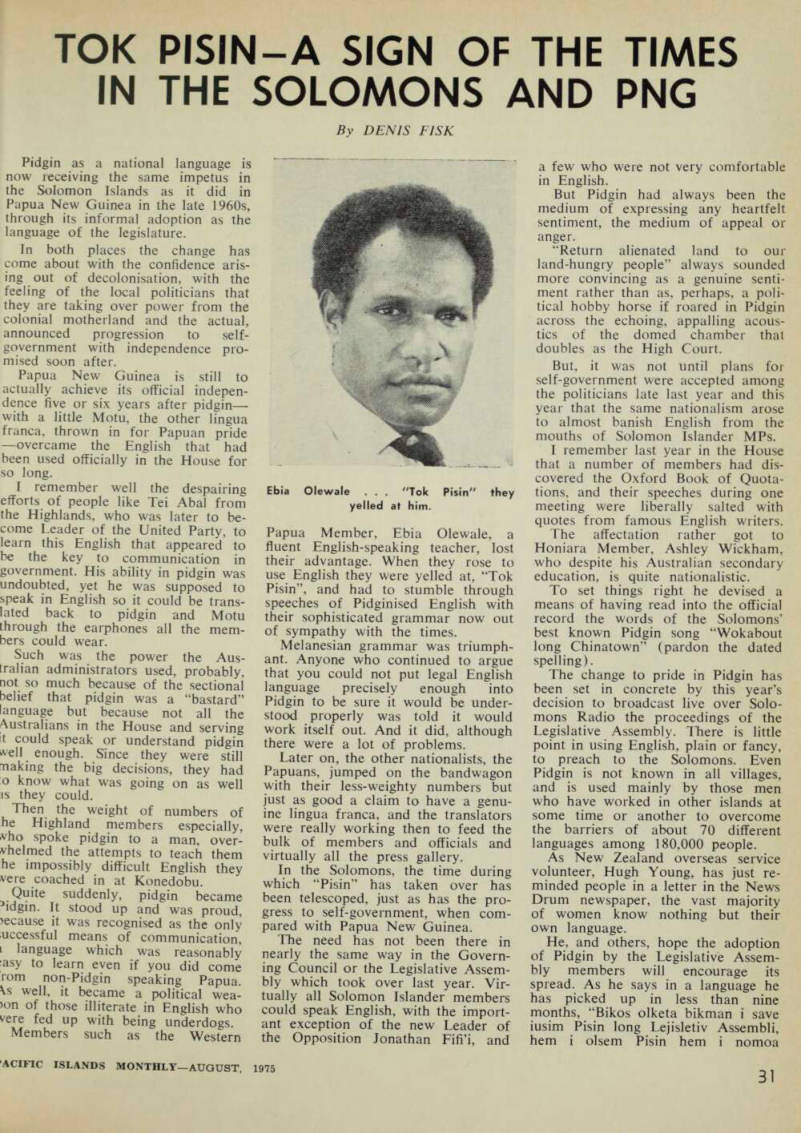
Papua Member, Ebia Olewale, a fluent English-speaking teacher, lost their advantage. When they rose to use English they were yelled at, “Tok Pisin”, and had to stumble through speeches of Pidginised English with their sophisticated grammar now out of sympathy with the times.
Melanesian grammar was triumph ant. Anyone who continued to argue that you could not put legal English language precisely enough into Pidgin to be sure it would be under stood properly was told it would work itself out. And it did, although there were a lot of problems.
Later on, the other nationalists, the Papuans, jumped on the bandwagon with their less-weighty numbers but just as good a claim to have a genu ine lingua franca, and the translators were really working then to feed the bulk of members and officials and virtually all the press gallery.
In the Solomons, the time during which “Pisin” has taken over has been telescoped, just as has the pro gress to self-government, when com pared with Papua New Guinea.
The need has not been there in nearly the same way in the Govern ing Council or the Legislative Assem bly which took over last year. Vir tually all Solomon Islander members could speak English, with the import ant exception of the new Leader of the Opposition Jonathan Fifi’i, and
a few who were not very comfortable in English.
But Pidgin had always been the medium of expressing any heartfelt sentiment, the medium of appeal or anger.
“Return alienated land to our land-hungry people” always sounded more convincing as a genuine senti ment rather than as, perhaps, a poli tical hobby horse if roared in Pidgin across the echoing, appalling acous tics of the domed chamber that doubles as the High Court.
But, it was not until plans for self-government were accepted among the politicians late last year and this year that the same nationalism arose to almost banish English from the mouths of Solomon Islander MPs.
I remember last year in the House that a number of members had dis covered the Oxford Book of Quota tions, and their speeches during one meeting were liberally salted with quotes from famous English writers.
The affectation rather got to Honiara Member, Ashley Wickham, who despite his Australian secondary education, is quite nationalistic.
To set things right he devised a means of having read into the official record the words of the Solomons’ best known Pidgin song “Wokabout long Chinatown” (pardon the dated spelling).
The change to pride in Pidgin has been set in concrete by this year’s decision to broadcast live over Solo mons Radio the proceedings of the Legislative Assembly. There is little point in using English, plain or fancy, to preach to the Solomons. Even Pidgin is not known in all villages, and is used mainly by those men who have worked in other islands at some time or another to overcome the barriers of about 70 different languages among 180,000 people.
As New Zealand overseas service volunteer, Hugh Young, has just re minded people in a letter in the News Drum newspaper, the vast majority of women know nothing but their own language.
He, and others, hope the adoption of Pidgin by the Legislative Assem bly members will encourage its spread. As he says in a language he has picked up in less than nine months, “Bikos olketa bikman i save iusim Pisin long Lejisletiv Assembli, hem i olsem Pisin hem i nomoa
Ebia Olewale . . . "Tok Pisin" they yelled at him.
rabish lanuisi nao”—Now that the big men are using Pidgin, it is no longer denigrated.
He thinks they want Pidgin to spread, for the important reason that women should learn it to learn in turn to improve health and prevent illness, to make better food, and “plande samting moa”.
It is not even two years since the first real effort was made to standardise the writing of a language which is spoken in a variety of ways according to local language variations.
It was the Christian Churches which got together a committee
which evolved a modest spelling book initially, and from that came various bible tracts, prayers and stories which have begun to spread the stan dard spelling, although not without some wayward examples, The reasons for the use of English in the legislature in the Solomons were much as in Papua New Guinea —there were too many expatriates involved to allow Pidgin, despite some of them being expert speakers, Certainly, though, the secretaries to departmental directors and other high officials who doubled as Han sard reporters during the legislature meetings could not cope with Pidgin.
Which leaves me wondering how the official report of debates is being kept now? The Solomons has not the money to spend as Papua New Guinea had to establish translation channels. Do the secretaries now take the Pidgin in shortland? If they do, who translates it into an English book as it has traditionally been?
On the same subject, GUS SMALES writes from Fort Moresby: Melanesian Pidgin (or, if you like, pidgin English, neo-Melanesian or Tok Pisin) is on the up and up in Papua New Guinea. It’s fast acquir ing a new sort of status symbol, dictated largely by the growing spirit of nationalism.
English remains the official langu age of PNG by default rather than by edict, but the status of Pidgin is paradoxically rising despite the grow ing sophistication of politics and pub lic life.
The Transport Minister, Mr lambakey Okuk, bluntly told a white interviewer on radio that “If you want to discuss something properly with me, you had better learn Pidgin”. That was from a man who speaks English, but who pointedly prefers Pidgin if he is not using his home language.
The three recognised languages of the House of Assembly are English, Pidgin and the widely-spread Motu.
But during the June debate on a Constitution for PNG, and despite the operation of a translation service, there have been several interjections of “Talk in Pidgin” when ministers attempted to explain points in English.
Of the 100 members in the House, 35 speak only Pidgin apart from their home languages. Most of the others are fluent in Pidgin and Eng lish, but the records show that the use of Pidgin in the House is in creasing.
This has particularly followed the withdrawal from the House of Aus tralia’s officially-appointed represent atives, with its overtones of territorial control.
A special society in Port Moresby —the Tok Pisin Society—exists to keep the language alive and current.
Appalled by the efforts of some whites, who try to write Pidgin advertisements or public notices, it has offered its help free of charge.
On present indications the increas ing use of Pidgin in high places is a side issue in the nationalism which is accompanying PNG’s approach to independence.
In the next few years its use will probably tend to drop off again, but it still has a long, long life ahead of it as a link between far-flung com munities in PNG.