Self-help and festival
p. 33 · Read in the full issue
festival in the Trobriands
From Kirsty Powell
in Port Moresby Kabisawali is a self-help movement in the Trobriand Islands, founded by Chief Nalubutau, but given new impetus when his nephew, John Kasaipwalova, returned home in 1972. Since then, a remarkable num ber of young, educated Trobriand Islanders have followed suit, throw ing up university courses and other occupations in the cities, to return home and help the movement.
At the outset, Kabisawali activities were focused mainly on tourism and the sale of artefacts. These are still the prime money-making activities, but the movement has expanded in other directions, political, social, and cultural. It has largely taken over the functions of the Kiriwina Local Government Council; has helped stimulate something of a cul tural revival, one sign of which is the new Sopi Arts Centre for the encouragement of carving and other arts.
And it has plans to improve water supply, sanitation, and health in the villages—tourists who have searched for water for a drink or a wash could vouch for the need for im provement.
Recently, plans to set up a Kabisa wah Bank, were announced. The opening—on Sunday, June I—of the headquarters in which the bank is to be located, was an occasion for festival.
From early morning, people started streaming along the flat, coral roads of the island to the festival ground near Yalumugwa village, bearing food—yams up to five feet long car ried in wooden frames; live pigs slung upside down on poles; tall, feathery clumps of sugar cane; big,’ bulbous taro; bunches of betel nuts, green and yellow.
Not even the fickle Trobriand rain, or the übiquitous mud and slush could extinguish the excitement and fascination of the occasion. The food was displayed in tall racks at
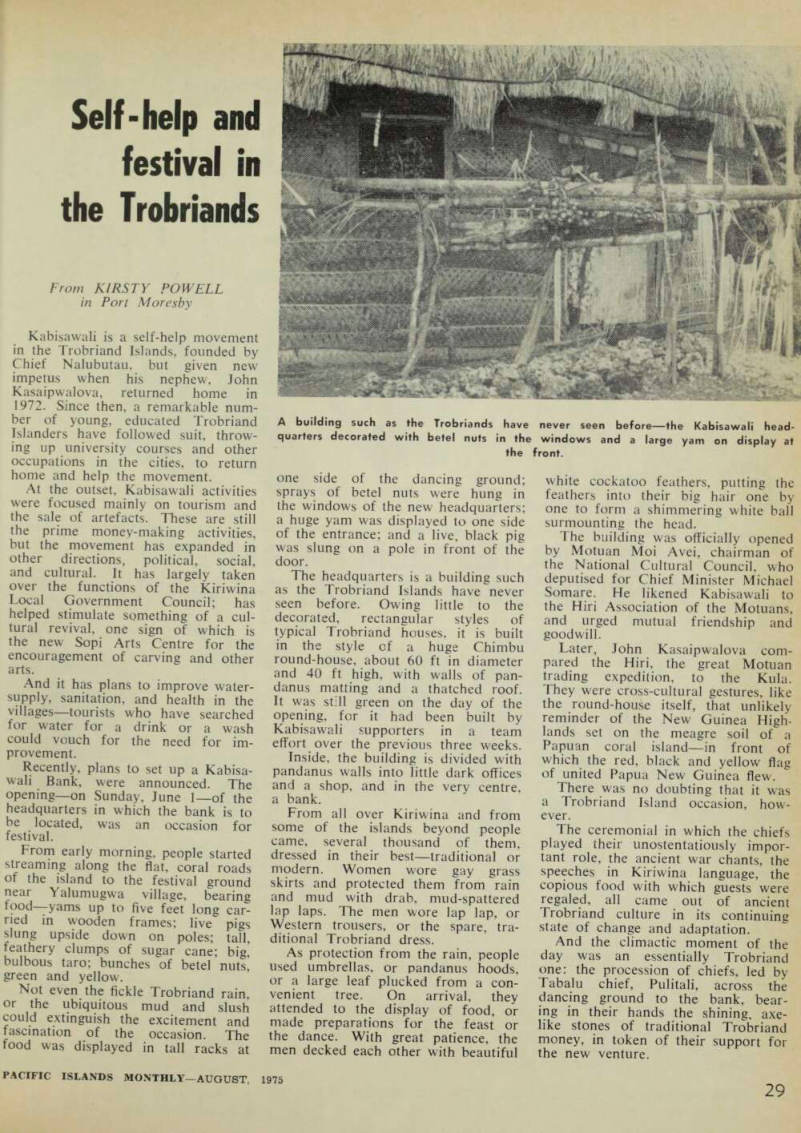
one side of the dancing ground; sprays of betel nuts were hung in the windows of the new headquarters; a huge yam was displayed to one side of the entrance; and a live, black pig was slung on a pole in front of the door.
The headquarters is a building such as the Trobriand Islands have never seen before. Owing little to the decorated, rectangular styles of typical Trobriand houses, it is built in the style of a huge Chimbu round-house, about 60 ft in diameter and 40 ft high, with walls of pan danus matting and a thatched roof.
It was still green on the day of the opening, for it had been built by Kabisawali supporters in a team effort over the previous three weeks.
Inside, the building is divided with pandanus walls into little dark offices and a shop, and in the very centre, a bank.
From all over Kiriwina and from some of the islands beyond people came, several thousand of them, dressed in their best—traditional or modern. Women wore gay grass skirts and protected them from rain and mud with drab, mud-spattered lap laps. The men wore lap lap, or Western trousers, or the spare, tra ditional Trobriand dress.
As protection from the rain, people used umbrellas, or pandanus hoods, or a large leaf plucked from a con venient tree. On arrival, they attended to the display of food, or made preparations for the feast or the dance. With great patience, the men decked each other with beautiful
white cockatoo feathers, putting the feathers into their big hair one by one to form a shimmering white ball surmounting the head.
The building was officially opened by Motuan Moi Avei, chairman of the National Cultural Council, who deputised for Chief Minister Michael Somare. He likened Kabisawali to the Hiri Association of the Motuans, and urged mutual friendship and goodwill.
Later, John Kasaipwalova com pared the Hiri, the great Motuan trading expedition, to the Kula.
They were cross-cultural gestures, like the round-house itself, that unlikely reminder of the New Guinea High lands set on the meagre soil of a Papuan coral island—in front of which the red, black and yellow flag of united Papua New Guinea flew.
There was no doubting that it was a Trobriand Island occasion, how ever.
The ceremonial in which the chiefs played their unostentatiously impor tant role, the ancient war chants, the speeches in Kiriwina language, the copious food with which guests were regaled, all came out of ancient Trobriand culture in its continuing state of change and adaptation.
And the climactic moment of the day was an essentially Trobriand one: the procession of chiefs, led by Tabalu chief, Pulitali, across the dancing ground to the bank, bear ing in their hands the shining, axe like stones of traditional Trobriand money, in token of their support for the new venture.
A building such as the Trobriands have never seen before —the Kabisawali head quarters decorated with betel nuts in the windows and a large yam on display at the front.