Tropicalities
pp. 27-31 · Read in the full issue

Innocents
abroad
New South Wales poker machines and “King’s Cross hospitality” are a rap for young New Guineans train ng in Australia, Australian govern uent officials believe.
So Australia has issued a book ex flaining the dangers of poker machi nes, expatiating, too, in somewhat oundabout terms, on what is de cribed as “relations with the other ex” in Australia.
Two officials touring Papua New juinea told of Australia’s concern it the ever-present possibility that ncidents could occur involving rainees from overseas.
The comments were made by the leputy head of students in the Aus r a I i a n Development Assistance Agency, Mr Fred Lussick, and the irst secretary of development assist nce in the Australian Government >ffice. Port Moresby, Mr Bill hippley.
Mr Lussick, visiting PNG to ecommend ways in which the Aus ralian Office in Port Moresby could rief New Guinean trainees on their /ay to Australia, said Australia was nxious to develop an effective system f pre-training briefings. Many tudents arrived in Australia with Jeas which were “not completely salistic”.
This meant they were not always roperly equipped to cope with situ tions which could arise, and there ere many ways in which they could □me to grief.
For instance they can’t go any where without coming face to face ith poker machines,” Mr Lussick ud.
He explained that some trainees □uld easily be “conned”.
It can happen in King’s Cross, )r example—and not just by men,” e said.
The booklet, which Australia is istnbuting to trainees, says, “In >rmality is the keynote in relations
between young men and women in Australia.
“Friendships exist which need not be based on love or the intention to marry.”
Mr Lussick said that racist inci dents were not common, but, when they were alleged to have occurred, they were taken very seriously by the government.
If an incident occurred it was taken up by the Prime Minister’s office, and also taken to the State Premier concerned.
Mr Lussick said, “But it doesn’t happen often. Most Australians think of New Guineans as a bit special”.
Our father at
the White House
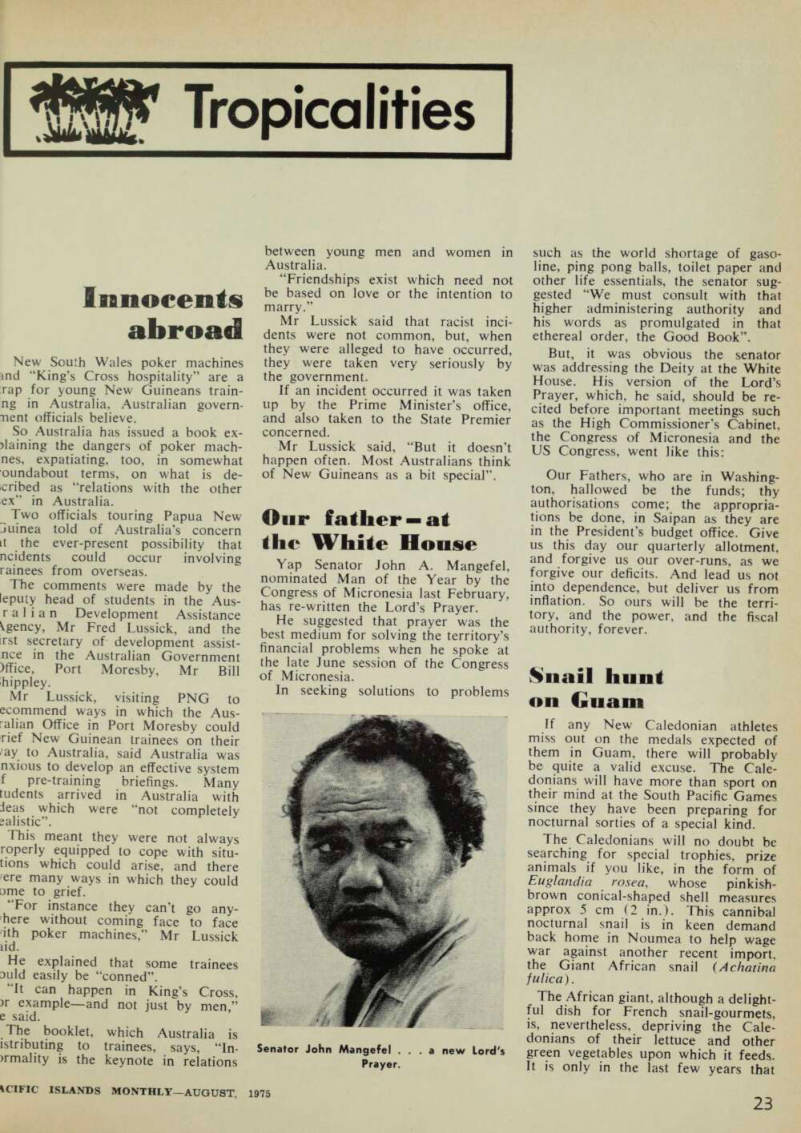
Yap Senator John A. Mangefel, nominated Man of the Year by the Congress of Micronesia last February, has re-written the Lord’s Prayer.
He suggested that prayer was the best medium for solving the territory’s financial problems when he spoke at the late June session of the Congress of Micronesia.
In seeking solutions to problems
such as the world shortage of gaso line, ping pong balls, toilet paper and other life essentials, the senator sug gested “We must consult with that higher administering authority and his words as promulgated in that ethereal order, the Good Book”.
But, it was obvious the senator was addressing the Deity at the White House. His version of the Lord’s Prayer, which, he said, should be re cited before important meetings such as the High Commissioner’s Cabinet, the Congress of Micronesia and the US Congress, went like this: Our Fathers, who are in Washing ton, hallowed be the funds; thy authorisations come; the appropria tions be done, in Saipan as they are in the President’s budget office. Give us this day our quarterly allotment, and forgive us our over-runs, as we forgive our deficits. And lead us not into dependence, but deliver us from inflation. So ours will be the terri tory, and the power, and the fiscal authority, forever.
Snail hunt
on Guam
If any New Caledonian athletes miss out on the medals expected of them in Guam, there will probably be quite a valid excuse. The Cale donians will have more than sport on their mind at the South Pacific Games since they have been preparing for nocturnal sorties of a special kind.
The Caledonians will no doubt be searching for special trophies, prize animals if you like, in the form of Euglandia rosea, whose pinkish brown conical-shaped shell measures approx 5 cm (2 in.). This cannibal nocturnal snail is in keen demand back home in Noumea to help wage war against another recent import, the Giant African snail (Achatina fulica ).
The African giant, although a delight ful dish for French snail-gourmets, is, nevertheless, depriving the Cale donians of their lettuce and other green vegetables upon which it feeds.
It is only in the last few years that
Senator John Mangefel ... a new Lord's Prayer.
lis pest has been introduced to Tench Polynesia, New Caledonia and few Hebrides, after reaching Papua few Guinea. Before that it was eliberately imported into Japan to s reared for the dinner table.
The snail thrives in subtropical editions, spreading easily through mm-diameter eggs laid in clusters : about 100.
The Noumea press has suggested iat Caledonian athletes in Guam ight collect the local specimens of ic cannibal snail, which is also •und in Hawaii. Carefully wrapped paper to avoid breaking the shell, e snails should be popped into a )x to be handed over to quarantine ithorities at Tontouta airport on eir return home.
Other territories sharing the Cale mian problem might be interested join the snail-hunting in Guam, fact, if only the Games Council d been sufficiently prepared, extra edals could perhaps have been allo ted for this novel sport.
Crong colour
j right colour
A Fiji twopenny stamp, printed be een 1878 and 1900 in the wrong lour, was sold recently in London r $3,850. It was an unused stamp, d part of a collection owned by Sir con Threlford, an accountant.
Sir Lacon has a collection of Fiji d Tongan stamps, said to be one of : most comprehensive in the world, d worth about $40,000. The stamp s printed in a faded blue colour ;tead of the proper yellow-green d blue-green combinations.
A leading London dealer said there re not many rare Fiji stamps about.
Id treasures
»r museum The United Church in Papua New dnea has given a large collection Trobriand Island artefacts on loan the PNG Art Gallery and iseum.
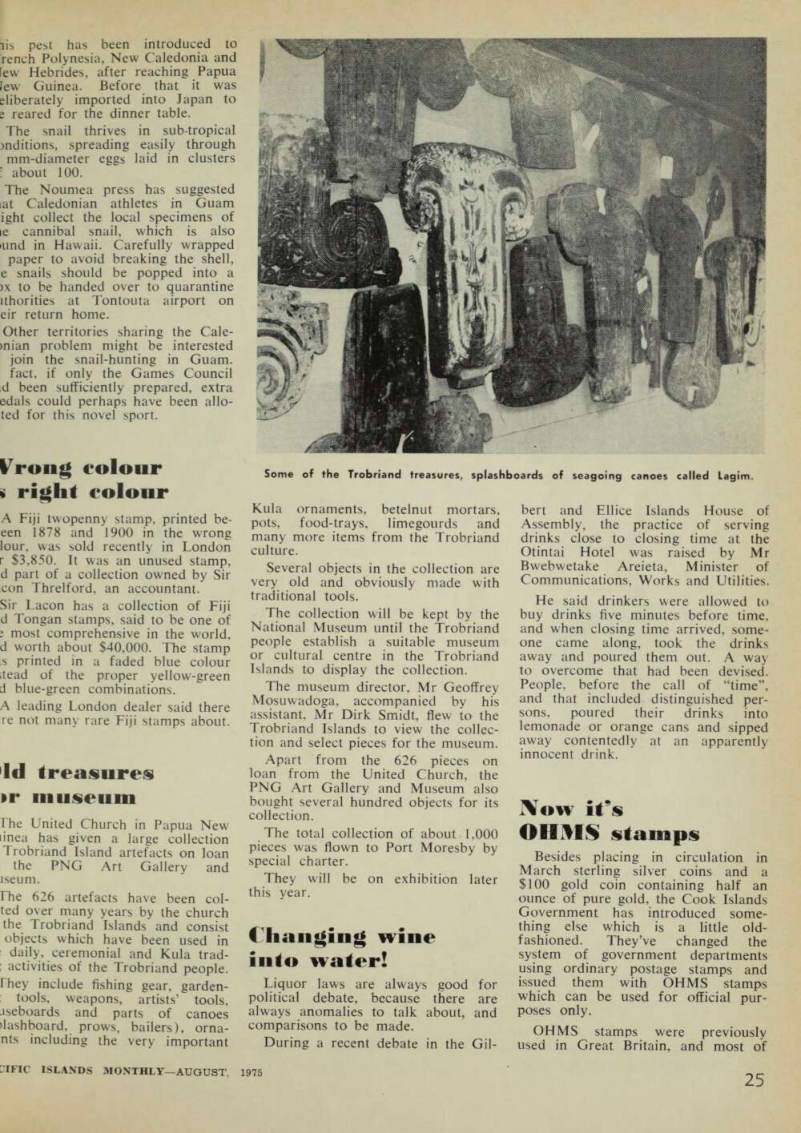
Fhe 626 artefacts have been coi led over many years by the church the Trobriand Islands and consist objects which have been used in daily, ceremonial and Kula trad : activities of the Trobriand people.
Ehey include fishing gear, garden tools, weapons, artists’ tools, jseboards and parts of canoes dashboard, prows, bailers), orna nts including the very important
Kula ornaments, betelnut mortars, pots, food-trays, limegourds and many more items from the Trobriand culture.
Several objects in the collection are very old and obviously made with traditional tools.
The collection will be kept by the National Museum until the Trobriand people establish a suitable museum or cultural centre in the Trobriand Islands to display the collection.
The museum director, Mr Geoffrey Mosuwadoga, accompanied by his assistant, Mr Dirk Smidt, flew to the Trobriand Islands to view the collec tion and select pieces for the museum.
Apart from the 626 pieces on loan from the United Church, the PNG Art Gallery and Museum also bought several hundred objects for its collection.
The total collection of about 1,000 pieces was flown to Port Moresby by special charter.
They will be on exhibition later this year.
Changing wine
into water!
Liquor laws are always good for political debate, because there are always anomalies to talk about, and comparisons to be made.
During a recent debate in the Gil
bert and Ellice Islands House of Assembly, the practice of serving drinks close to closing time at the Otintai Hotel was raised by Mr Bwebwetake Areieta, Minister of Communications, Works and Utilities.
He said drinkers were allowed to buy drinks five minutes before time, and when closing time arrived, some one came along, took the drinks away and poured them out. A way to overcome that had been devised.
People, before the call of “time”, and that included distinguished per sons, poured their drinks into lemonade or orange cans and sipped away contentedly at an apparently innocent drink.
Now it’s
OHMS stamps
Besides placing in circulation in March sterling silver coins and a SIOO gold coin containing half an ounce of pure gold, the Cook Islands Government has introduced some thing else which is a little old fashioned. They’ve changed the system of government departments using ordinary postage stamps and issued them with OHMS stamps which can be used for official pur poses only.
OHMS stamps were previously used in Great Britain, and most of
Some of the Trobriand treasures, splashboards of seagoing canoes called Lagim.
he empire, and “official” stamps vere used in the United States and nany other countries, but were ;radually replaced when meter mail ame into use, and the usage of mail ould be controlled.
In the US, officials use an envelope diich bears the legend “For Official Jse Only” and a warning that if sed on private matters it subjects tie user to a penalty of several undred dollars.
The Cooks OHMS stamps can’t be sed for private mail and their intro uction means the tightening of fiscal ontrols. They are issued under strict ontrols to government departments nd are not sold by the post office i mint condition.
Overseas philatelists, however, were [lowed to buy them in sets but only i cancelled condition. When news f these stamps reached the inter alional stamp market it attracted a emendous amount of interest among hilatelists —as did the gold coin mong numismatists—and the num sr of orders sent in for the cancelled amps was so large that the philatelic jreau had to ration them lest sup ies were exhausted.
ilow ships,
ast shells
Fiji’s new naval squadron’s de mamissioned United States Navy inesweepers may only have a aximum speed of about 12 knots, it that will not help faster ships, igaged in illegal activities in Fiji aters, to get away.
The Fiji Prime Minister, Ratu Sir amisese Mara, remarked recently at he was quite unconcerned about e apparent slow speed—the missiles 3m the minesweepers would travel uch faster than the 12 knots.
Ratu Sir Kamisese, no doubt, >pes such situations will never ;e. He said the squadron would Ip to police territorial waters, sist customs, fisheries and immigra »n officials, and engage in a wide nge of other work. It will work thin the overall framework of the ji Royal Military Forces. Captain an Brown, former commander of ; old Fiji Royal Naval Volunteer :serve, and Colonel Paul Manueli, mmander of the RFMF, were in ; United States in June, investigat ? crew training and refuelling the nesweepers.
There was no lack of volunteers serve in the ships. There were ndreds of applicants, and only 62 :re required. They included former
sailors, members of the Marine De partment, school-leavers and students.
Interviewers were unable to cope, and had to turn many away.
Captain Brown said the 62 men selected would go to Seattle for 2i months of training, which would cover radar, electronics, sonar, gun nery and engineering. He was highly pleased with the standard of the applicants, and considered they would make excellent naval men.
Fishermen
in the soup
Two Micronesian fishermen, fishing with Japanese-type long lines from a canoe off Parem Reef in Ponape District in late June, caught a large Leatherback turtle, the largest ever recorded in the area.
There were visions of almost un limited supplies of turtle soup—until the fishermen discovered they’d broken the law. Leatherbacks, threatened with extinction—this one certainly was—are listed in the United States and in the Trust Terri tory as an “endangered species”.
What’s more, the Trust Territory code prohibits the taking of any kind of turtle between June 1 and August 31 and between December 1 and January 31.
This one was over seven feet overall, with a carapace (the shell, for those who don’t know) measur ing 5J feet and weighing 978 lb.
Burying the
liatehet in PNG
They’ve got long memories in Papua New Guinea! Fifty years ago a villager from the Kumai clan in the Western Highlands was killed in a dispute over potatoes growing in a Niniga clan garden.
The Niniga people claimed that the man was caught stealing potatoes but, obviously, the Kumai people didn’t think the potatoes were as valuable as a man’s life and de manded compensation. The Niniga people paid compensation—soo pigs and traditional riches, but the Kumais weren’t satisfied. They wanted more, and for half a century they’ve asked for more.
Now, there’s a good chance that the Kumais have buried the hatchet, but it was a dear burial.
In June, more than 4,000 warriors, resplendent in traditional costume, met in a payment ceremony and the Ninigans handed over 200 pigs, four cassowaries and 2,000 kina.