Charley’S Store
pp. 52-54 · Read in the full issue
By Satish Chandra
CHARLEY’S Store is like any other small village store found throughout Fiji. Situated at the inter section of King’s Road and Waini koro feeder road it is a concrete and iron construction. The shop is divided into three distinct sections.
The large front room is for business, the shelves are always full of canned goods.
Parallel to the shelves is a long masonite board counter, and under neath this are kept bags of sharps, rice, dhal and all the other para phernalia associated with a village dry goods store. Near the entrance are two huge built-in show cases dis playing items ranging from breakfast crackers to flip-flops.
Sandwiched between the store and the living room is the bulk room which is always in partial darkness.
This section is stacked with stock which cannot be accommodated in the front room. Apart from these there are bottles and even 44-gallon drums strewn all over the place. It has a very suffocating atmosphere.
I once entered the room to serve myself a gallon of kerosene and I couldn’t stay there even for a minute.
The smell of kerosene and oil mingled with rotten potato odour can be very nauseating, particularly on a hot day. 1 once pointed this out to Charley, the owner. He gave his protruding belly a rhythmic pat and laughed and told me it was a good deterrent for undesirables.
The third and the last section of the structure is Charley’s private quarters. An air of mystery hangs about this room. Very few people have been inside it. Once, while buy ing a couple of bottles of beer from the back entrance, I managed to peep inside the partially-open door.
I could glimpse only a pair of shape! legs before the door banged shut i my face. I was puzzled, for Charle; is a bachelor.
The store sees hardly any busines during the day. It is usually lockei and if someone wants to buy some thing he has to knock on one of th windows. Charley works as a hote barman during the day so his father Bhutto, his brother, Choro, 100 l after the shop during his absence Sometimes one has to wait for quit! a long time before one of then comes to serve you. Choro does quit< a bit of other chores around the farn and old Bhutto sleeps under th( mango tree, behind the store, mos of the time. To wake him from hi; siesta is an eternal sin. If some in considerate person happens to wak< him, he had better buy a lot of good! or else he has to put up with a vol ley of invectives. For this reasor many village youngsters think twic< before venturing to buy a few cents worth of sweets. So the day passei on.
THE evenings, on the other hand are very busy. The business is very brisk, and the store is full ol hustling and bustling people. Thougl it is an Indian-owned shop it get!
Fijian customers as well. The reason I suppose, is that there are three koros not too far away from the store. From five to seven the shoi is so crowded that the father and the two sons have to work hurriedly to restore some semblance of order Probably the most interesting fea ture of the place is its grog drinking sessions. Many motorists, who have stopped for refreshments, have claimed these sessions to be some ol the most fantastic they have ever
le across. I agree with them, m five o’clock people start stream into the place. Fijians and In is. Old and young. The interior the shop verandah is not enough, ks drag out big pieces of sacks n together and spread them on big lawn. Then they grab a basin get into groups of six to ten. ;-wise, profession-wise, gossip-wise sometimes kin-wise. It is a sugar e farming area, and, after a hard ’s work, the farmers always seek drown their tiredness in yaqona. s their only means of recreation, e they discuss their common blem, current events, international tics, and religion. Whatever they uss, whether amiably or heatedly, lives them great satisfaction and :es them experience a sense of stherness. he boys, on the contrary, seek confines of the shop for a dif nt reason. Though some also go irink grog, their main idea is to away from nagging mothers isionally from hard work), and ic to listen to yarns spun by the :r men. These boys are usually ents or village youths doing ling. Since most of them often not smoke in front of their :nts or relatives they sit some re in darkness so that they can away at their cigarettes, surrep usly, huge crowd had already iered when I reached the shop, ee groups of elderly men were ed outside. As I passed them e of them stopped talking and -d at me. One old-timer looked uy long hair and then diverted gaze towards my new Levi’s. He )k his head slowly.
“Thinks this is bloody Suva”, someone stated.
“Looks like no barber in Suva”, the old man said.
“There used to be many, but this modern fashion has led them to bankruptcy”, a skinny middle-aged man remarked.
FEELING uncomfortable I hurried on. I threw a last glance over my shoulder and in the process nearly put my right foot in a basin of grog.
Someone swore under his breath.
I swore back. Before I could get a suitable reply I was inside the shop.
“Come in, fallah! Have a bowl”, one of my friends welcomed me.
“Yeah. How’s life?” said another, offering a bowl.
“Thanks”, I replied. I took a long pull and settled comfortably in a corner.
There were about a dozen youths in that group except Fatty. Though he is well over forty he is always welcome in the younger group. I suppose its his bawdy stories that attract the boys.
“. . . This Punjabi was new to modern toilets”, Fatty was saying, “and he had eaten quite a lot. He went inside the toilet and stared at the sparkling water inside the pan.
Feeling thirsty he helped himself to a few palmful of gulps”. Laughter.
THAT was when Che entered. He could hardly walk. Nearly thirty he already had kanikani or yaqona scales all over his skin. He swayed drunkenly and then seated himself on the shop’s only piece of furniture, a rickety wooden bench. He glanced at the gathering. His gaze fell on Fatty. After blinking twice he grinned.
“Hey, Fatty, you paying for the grog?
You, parasite!” he called.
“I am not a five-cent fallah like you, you bull!” Fatty replied.
Silence had descended in the room.
“Bull, your father, you thief!” Che yelled.
“Don’t bring in my dead father, “Fatty replied.
“You stole my rope”.
“You got any proof?”
“Don’t need any proof. Everyone know you a thief”, Che replied.
“You going too far”.
“What you gonna do about it?”
“Well, I’ve drunk my mother’s milk and I have got blood in my veins!” said Fatty. He got up and challenged, “Let’s see if you have any guts”.
I thought things were going too far so before Fatty could get up I chipped in: “Look, Che, take it easy, cool down”.
“No, I am going to straighten out this thief”, Che replied.
Since he was weak from drink I managed to make him sit down. Still they kept on arguing and exchanging insults. Most of the boys were enjoy ing this tirade and did their best to add fuel to the fire. I found this rather strange. They should be try ing to pacify them, I thought.
“Your father was also a thief and . . .”
Before Che could say anything else, Fatty was on his feet and yell ing, “I’m gonna kill this insulting pig!” Somebody managed to seat the inflamed Fatty. I was getting sick of the whole affair.
For nearly an hour they swore at each other. During this time many basins of grog took its toll. At eight thirty, after a fresh bout of insults, both of them got up and angrily faced each other. Hands on their hips, they bared their chins at each other. The crowd looked at them expectantly. A couple of broken jaws were imminent, I decided.
“You try it!” dared Fatty.
“You try it!” shouted Che.
“Let’s see how brave you are!”
But nothing happened. They just stood there and glared at each other.
“Come on Ali and Frazier, have it out!” someone encouraged them.
Still nothing happened.
“Oso, oso!” chorused the crowd.
AT this stage Papa, a veteran of many yaqona brawls, got up. He was a tall and dark young man, who was noted for his jokes. He stepped between the two and held them by the shoulders.
“Look, you two. You have already wasted a lot of time. If you bastards have to fight, why not start now?
I’m sick of you two”. Papa addressed the crowd. “You know what these two need? They should be hoisted
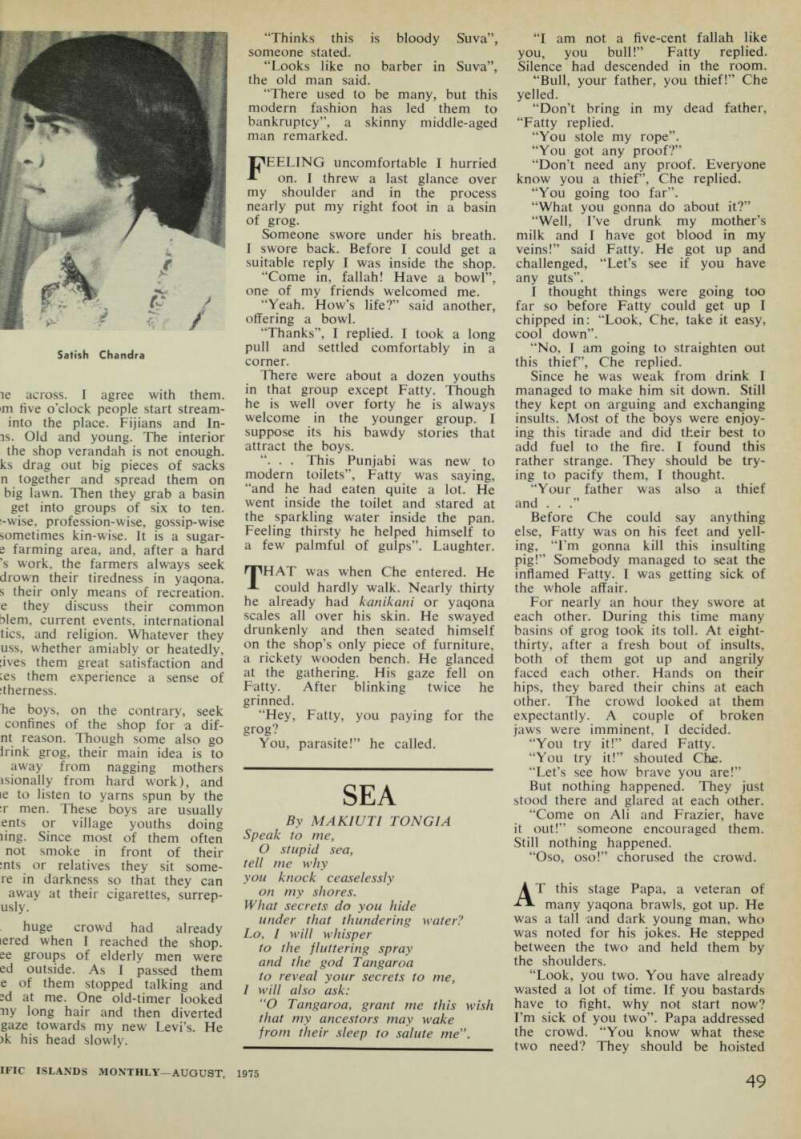
Satish Chandra
up-side down, stripped off their pants, arse soaked with benzine, and then lit. Only then will they get any sense.
Probably their arses have more sense than their brains”. This was greeted with howls of laughter.
“You have no manners and ab solutely no sense of values. You should be setting an example to the younger generation instead of squab bling like two old women having nothing better to do!”
“I was just joking”, said Che lamely.
“Me too”, added Fatty, now that the crisis was over.
“Bloody funny kind of joke!”
Papa replied. “Swearing your heads off. Insulting the dead. Funny, my arse!”
Things returned to normal. Che and Fatty were made to forget their quarrel. They sat in a comer and talked amiably.
That’s when Charley appeared out of the backroom. He puffed out his chest and glowered at the crowd.
“Who were fighting?” He demanded.
“No one was fighting”, replied Papa.
“No one? Eh? You, fallahs, think this is a boxing ring? If you have to fight when these people were arguing? Underneath the bed, I sup pose”, asked Papa.
“Push you fallahs out next time”.
“Ha! Ha! Ha! you almost frighten me”, mocked Papa. “Go and get you”. This time both Che and Fatty get wild once again—this time with you”. This time both, Che and Fatty, joined the crowd in the laughter.