Revolution
pp. 8-9 · Read in the full issue
of the reluctant nationalists
Papua New Guinea’s painless de cision to declare independence from Australia on September 16 sets the seal on one of the most extraordinary revolutions of national outlook in modern history.
The reluctant nationalism, which so puzzled the United Nations year after year, has suddenly been thrown aside in a matter of two or three years.
Five major ingredients have led to the change itself and to the quality of what has happened, not the least of which has been the skilful politics of the Chief Minister, Mr Michael Somare. There will be a temptation now to suggest that PNG has been struggling for independence for years, suppressed by colonialism and Aus tralian policies.
But, whatever Australia may be guilty of, this simply isn’t so. It was not until three years ago that any practical concerted move towards independence became effective in PNG, and general acceptance of the move did not come until even later.
It is true that much of the reluctant nationalism sprang from ignorance, and that Australia could be held to blame for not doing anything to encourage nationalism.
But the failure to want and to accept nationalism, which has been so much a part of the PNG scene, has been real enough, Ihe chamber and the public gal lery in the House of Assembly broke into spontaneous applause on June 18 when September 16 was adopted as Independence Day following a surprise motion from Mr Somare.
The reaction itself typifies the changed outlook. A mere five years ago, Mr Somare was a dangerous radical for daring to suggest home rule, let alone full independence.
Even in 1970, when the second Select Committee on Constitutional Deve lopment bravely produced a national flag and a programme for self government, the chairman, the late Mr Paulus Arek, stressed that the
mass of the people—and the poli ticians—did not want self-government But since then, the proposed flag has been replaced by one already nationally familiar, self-governmeni has come and gone without trauma in December 1973, and independence will be attained on September 16.
For all the criticism which was thrown at him over the Territories portfolio which he held in Canberra into the 1960 s Sir Paul Hasluck, later Australian Governor-General provided one of the ingredients which has led to the non-violent assump tion of a rational independence.
His reluctance to believe that nationalism could be close at hand or should be encouraged for its own sake was more a symptom of the times rather than a judgment of the man. Where he contributed to the future was in his basic acceptance that PNG was a trust and not simply a colony for exploitation.
His time scale may have been wrong but his policies prevented the degree of repression or dangerous elitism which have so often led to violence in other colonial situations.
The United Nations General Assembly provided another ingredient on December 21, 1965, when it first took Australia to task for not think ing in terms of PNG independence.
There was much that was provocative and politically-inspired in the General Assembly’s resolution, but the first spur of the new era had been applied.
Australia, UK, USA and 19 other countries abstained from voting on the resolution which criticised Aus tralia for not laying down a specific timetable for independence in PNG.
The third and most significant in gredient in the new change was the emergence of the first true national ist movement in the formation of the Pangu Party. In the late 1960 s the party dedicated itself to a policy of
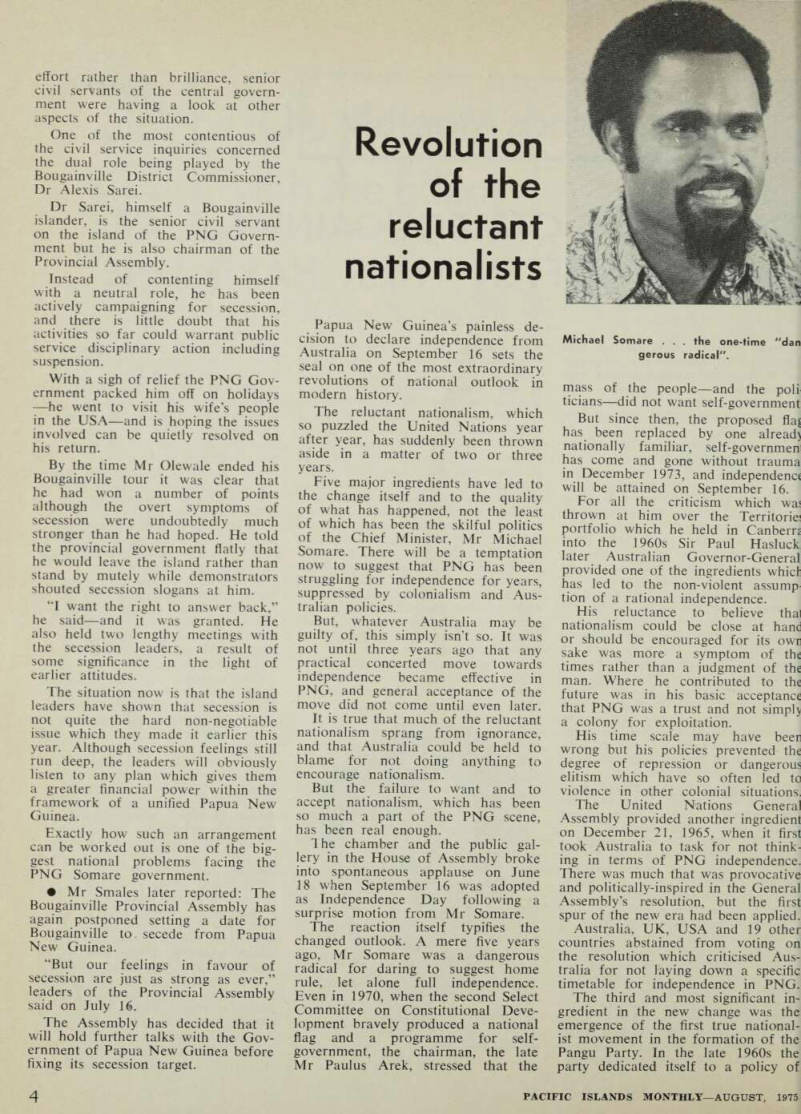
Michael Somare . . . the one-time "dan gerous radical".
immediate home rule” in PNG, affering extraordinary criticism at ome and in Australia.
“Blunt”, “rude”, “radical” and dangerous” were some of the epi lets.
Mr Somare’s skilful policies in itting rid of this label and guiding le party to coalition government in ?72 and to respectability and effec veness, is probably the greatest ngle story of the independence story.
A fourth ingredient was the climate eated by Mr Andrew Peacock when ‘ took over the External Territories )rtfolio in the final stages of the beral-Country Party coalition in anberra. His shift-of-power arrange ents negotiated with Mr Somare tween May and September, 1972, t the final stage.
The fifth ingredient has been the traordinarily-good working relation ip established, after some early tshes, between PNG and the Whit n government.
Mr Whitlam’s early disengagement licies nearly upset the boat at a ie when Mr Somare was still feel l his way. Any attempt at that stage force independence on PNG from tside would have wrecked Mr mare’s plans for a peaceful and tctical transition.
Eventually, however, the relation p developed into an extremely ictical one with Australia treating JG as a sovereign state but with iding all pressures to translate the ognition into reality.
Fhe outcome is that, not only is IG going peacefully and freely d independence, but most of the >er work is completed.