Pacific Islands Monthly
pp. 7-8 · Read in the full issue
The Heat's Off Bougainville As
Eaders Soften Their Hard Line
From GLJS SMALES in Port Moresby
Hopes were brighter mid-July that e island of Bougainville, although • doubt still grumbling and still will at least stay with ipua New Guinea when indepen nce is declared from Australia on ptember 16.
This doesn’t mean that the bid by e island district to secede is all nff and hot air, but it does mean at the leaders there have aban ned the hard and uncompromising e of their earlier attitudes. They w seem prepared to confer about eir relationships with the PNG Dvernment, even if they continue wield the economic power of sir island as a big stick.
Bougainville, with an estimated pulation of just under 90,000, is ; site of one of the world’s biggest pper mines, and is the most easterly ?ion of PNG. But it’s also an and group which by history, ethnic ckground, culture and even geo aphic position has had a certain ;parateness” from the rest of PNG.
The islanders, whose nearest neigh urs and closest ethnic relatives live the close-at-hand Solomon Islands, 5 proud of their black skin and fir own brand of culture.
“Redskins” they say, almost as a m of dismissal, of the lighter nned people of the PNG mainland d the PNG northern islands.
On September 16, Bougainville is icduled to merge once and for all th the “Redskins” in the birth of ; new independent nation of PNG, t secession issues have been rock ’ the boat. One of the biggest irces of unintentional disruption is : operation since 1972 of Bougain le Copper Limited—a multi tional corporation owned 20 per \t by the PNG Government, and lich has poured unprecedented jfits into the PNG economy.
The mine didn’t create the seces n atmosphere on the island, but it 1 enable secession to be viewed a viable and practical possibility.
The Bougainville people, who felt they had been forgotten for years, suddenly realised when they looked at the copper balance sheet that Bougainville now means more to the rest of PNG than the rest of PNG ever meant to Bougainville. In an effort to placate increasing agitation on the island for at least some degree of autonomy, the PNG Government created the Bougainville Provincial Assembly and invited the islanders to shape their future how they wanted it—but within the revenue alloca tions made by the PNG Government.
To date, the Provincial Assembly is only an interim body with its mem bers appointed rather than elected, but it got down to its task with a will and over the past months it has been in a state of continual on-and off-again confrontation with the PNG Government.
The situation deteriorated into a direct secession threat when the islanders broke off all negotiations after complaining that they were
“financing” the rest of PNG from their copper mine and were not get ting back a fair share.
The PNG Justice Minister, Mr Ebia Olewale, returned in mid-July from a meet - the - people campaign on Bougainville where he attempted to promote the central government’s unity platform.
Mr Olewale, who is the newly appointed Special Minister for Pro vincial Affairs in addition to his Justice portfolio, tried to explain that the islanders were getting special attention anyway—including the re turn of all export levies on copper consignments.
If Mr Olewale expected to find that the secession moves were confined to a few provincial government hot heads, he was sadly disappointed.
With a few significant exceptions, meeting after meeting included strong support for secession.
But, perhaps, the most important immediate point which emerged from Mr Olewale’s tour was that there was a lot more to the issue than a simple secession versus unity argu ment.
Two factors were evident. One was that the secessionist leaders were far better organised than the non secessionists. The other was the high degree of good old-fashioned con fusion which existed.
Some of the rank-and-file missed the point of secession altogether and saw the argument as an attempt to decide what country should control Bougainville in the future.
Australia? Papua New Guinea?
“Why not America?” asked one man with vivid memories of the material wealth which USA showered on the South Pacific during World War 11.
Mr Olewale refused to take any for or against votes at his meetings, and he was shadowed for most of the time by members of the Provincial Assembly who made pro-secession talks. While he barnstormed round the country, working by sheer dogged
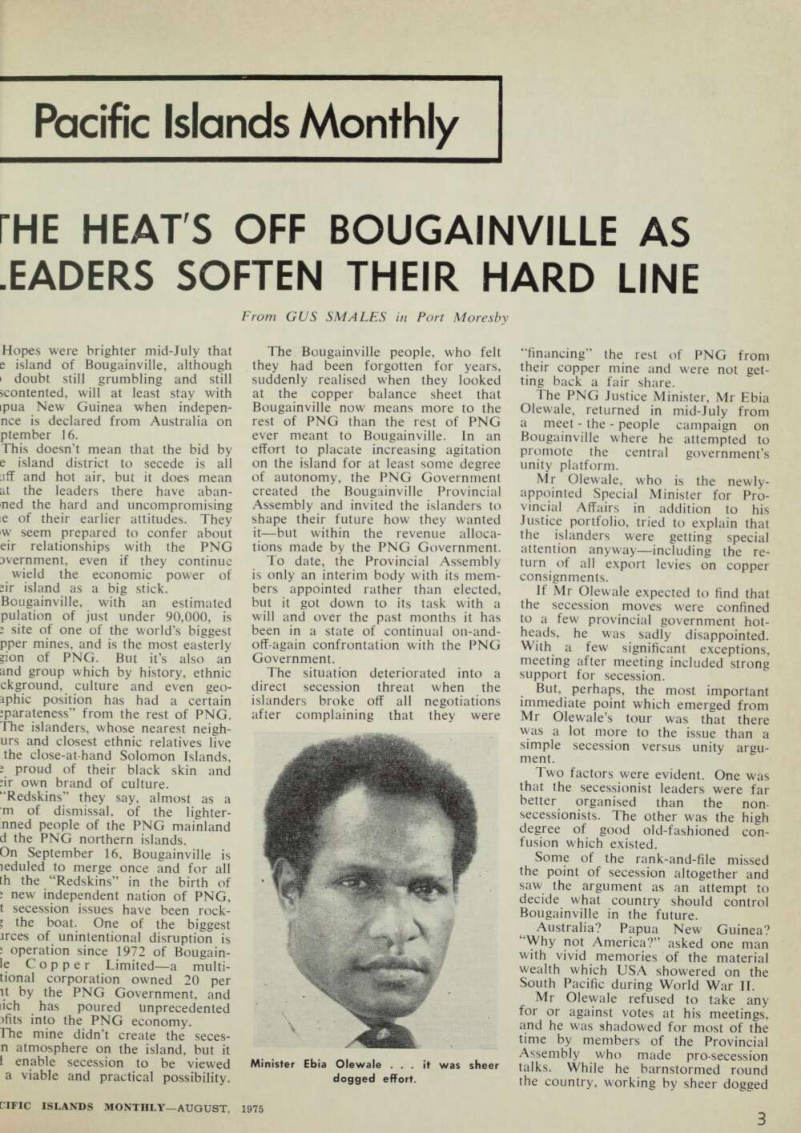
Minister Ebia Olewale ... it was sheer dogged effort.
effort rather than brilliance, senior civil servants of the central govern ment were having a look at other aspects of the situation.
One of the most contentious of the civil service inquiries concerned the dual role being played by the Bougainville District Commissioner, Dr Alexis Sarei.
Dr Sarei, himself a Bougainville islander, is the senior civil servant on the island of the PNG Govern ment but he is also chairman of the Provincial Assembly.
Instead of contenting himself with a neutral role, he has been actively campaigning for secession, and there is little doubt that his activities so far could warrant public service disciplinary action including suspension.
With a sigh of relief the PNG Gov ernment packed him off on holidays —he went to visit his wife’s people in the USA—and is hoping the issues involved can be quietly resolved on his return.
By the time Mr Olewale ended his Bougainville tour it was clear that he had won a number of points although the overt symptoms of secession were undoubtedly much stronger than he had hoped. He told the provincial government flatly that he would leave the island rather than stand by mutely while demonstrators shouted secession slogans at him.
“I want the right to answer back,” he said—and it was granted. He also held two lengthy meetings with the secession leaders, a result of some significance in the light of earlier attitudes.
The situation now is that the island leaders have shown that secession is not quite the hard non-negotiable issue which they made it earlier this year. Although secession feelings still run deep, the leaders will obviously listen to any plan which gives them a greater financial power within the framework of a unified Papua New Guinea.
Exactly how such an arrangement can be worked out is one of the big gest national problems facing the PNG Somare government. • Mr Smales later reported: The Bougainville Provincial Assembly has again postponed setting a date for Bougainville to secede from Papua New Guinea.
“But our feelings in favour of secession are just as strong as ever,” leaders of the Provincial Assembly said on July 16.
The Assembly has decided that it will hold further talks with the Gov ernment of Papua New Guinea before fixing its secession target.