the pikinini kiap
pp. 9-10 · Read in the full issue
PNG’s thanks to Toni the pikinini kiap
By Harry Jackman
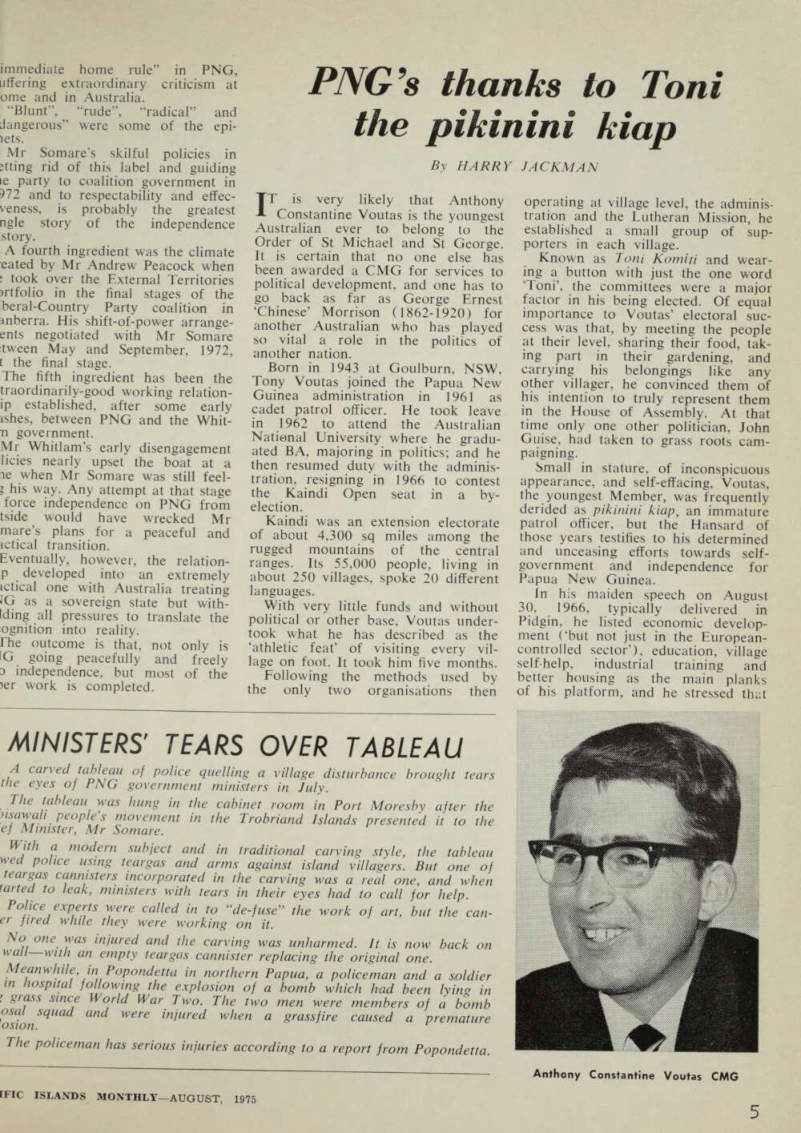
IT is very likely that Anthony Constantine Voutas is the youngest Australian ever to belong to the Order of St Michael and St George, It is certain that no one else has been awarded a CMG for services to political development, and one has to go back as far as George Ernest ‘Chinese’ Morrison (1862-1920) for another Australian who has played so vital a role in the politics of another nation.
Born in 1943 at Goulburn, NSW, Tony Voutas joined the Papua New Guinea administration in 1961 as cadet patrol officer. He took leave in 1962 to attend the Australian National University where he gradu ated BA, majoring in politics; and he then resumed duty with the adminis tration, resigning in 1966 to contest the Kaindi Open seat in a by election.
Kaindi was an extension electorate of about 4,300 sq miles among the rugged mountains of the central ranges. Its 55,000 people, living in about 250 villages, spoke 20 different languages.
With very little funds and without political or other base, Voutas under took what he has described as the ‘athletic feat’ of visiting every vil lage on foot. It took him five months.
Following the methods used by the only two organisations then
operating at village level, the adminis tration and the Lutheran Mission, he established a small group of sup porters in each village.
Known as Toni Komiti and wear ing a button with just the one word Toni’, the committees were a major factor in his being elected. Of equal importance to Voutas’ electoral suc cess was that, by meeting the people at their level, sharing their food, tak ing part in their gardening, and carrying his belongings like any other villager, he convinced them of his intention to truly represent them in the House of Assembly. At that time only one other politician, John Guise, had taken to grass roots cam paigning.
Small in stature, of inconspicuous appearance, and self-effacing, Voutas, the youngest Member, was frequently derided as pikinini kiap, an immature patrol officer, but the Hansard of those years testifies to his determined and unceasing efforts towards self government and independence for Papua New Guinea.
In his maiden speech on August 30, 1966, typically delivered in Pidgin, he listed economic develop ment (‘but not just in the European controlled sector’), education, village self-help, industrial training and better housing as the main planks of his platform, and he stressed that
the House of Assembly needed to be given more power.
From then on he continued to press for constitutional development and rural improvement. It almost seems a lifetime ago when, asked by Voutas what plans the administra tion had for training a Papua New Guinean diplomatic corps, the Ad ministrator replied, “None at pre sent”. Rural improvement became one of the National Coalition Gov ernment’s main aims when it took office in 1972. Hansard is full of other early-birding by the then Mem ber for Kaindi Open.
In the 1968 elections, Voutas de feated a sitting Member, a former district commissioner, for the Morobe Regional Electorate, and it was in that Second House that he did much to help the Pangu Pati to dominate.
Among his fellow founders of Pangu were Michael Somare, now Chief Minister, Maori Kiki, John
Guise and Paul Lapun, all in the present Cabinet and knighted, Barry Holloway, Speaker of the current House, and Oala Oala-Rarua, who represents Papua New Guinea in Canberra. They had a hard row to hoe during the Sixties.
After the Second House had run its term in 1972, Voutas briefly worked in the University of Papua New Guinea and then became a re search officer for Mr Somare. A tireless and persistent worker, Voutas was the ideas man during the new government’s first months of office, particularly on economic and con stitutional policy issues. He was, in effect, the senior political adviser.
Tony Voutas resigned from his job with the Chief Minister in 1974, for the same reason that caused him not to nominate for the Third House in 1974: because he believed it opportune for a Papua New Guinean to take over. If only certain other
‘expatriates’ had had the same sense of timing ...
What the Somare government thinks of Voutas is clear from its recom mendation to the Queen. Only two other Australians have been admitted to the Order of St Michael and Si George for services to Papua New Guinea —Sir Hubert Murray, KCMG. who governed Papua for 34 years, and John Thompson Gunther, who received the CMG while Assistant Administrator, later became first chancellor of the University ol Papua New Guinea, and has jusl been created a Knight Bachelor along with fellow campaigner Sit John Guise.
Does all this sound a bit like an obituary? Well, fair enough, because Australian colonialism in the Islands will end on September 16, and, after all, the honours for Voutas and Gunther were recommended by £ government of Papua New Guinea.