Tropicalities
pp. 31-34 · Read in the full issue
Ufos over
Elarotonga
Two strange flying objects were sighted near the Arorangi district of Rarotonga early on April 24 by Mr Rena Jonassen and his wife who were at their home in Vaiokura, They watched the phenomenon for about m hour, writes Don Percival.
At first, they saw an object of a ahosphorescent sea-blue colour, either foating on the ocean or hovering just above the surface. It was a clear noonlit night and the sea was very :alm.
After about 30 minutes it was oined by a second one. Later, they ook off together and flew out to sea, Jimbing rapidly. As they flew away heir blue light changed to a very jowerful, bright white and they apidly diminished in size.
Between 7.30 and 7.40 pm on darch 3, two members of the Raro onga Golf Club Bill Quinn and .arry Price watched an unidentified lying object pass over the clubhouse nd disappear over Black Rock [uarry and towards Arorangi, They aw it emerge from a bank of black loud and, as it passed over them, the jound around the clubhouse was rightly illuminated by the object’s ights. It appeared to be at a very 3w altitude, and seemed to have a evolving circle of lights and long ail like a comet.
But it was in controlled flight and in view for about 25 seconds.
Whatever it was, it was certainly ot a meteorological balloon, al fough it had appeared from the irection of Rarotonga Airport.
Taese balloons are released twice aily, at 12 noon or 12.30 pm and t 12 midnight. The night balloons re illuminated by a small, low owered electric battery—and they on’t fly on straight and level courses.
Io balloon had been released by the let. station that night between 7.30 nd 7.40.
The first reported sighting of flying aucers over Rarotonga was made to
me by my son William, aged 15.
About 7 pm on December 4, last year William and four other boys were walking through Te Puka village which is adjacent to the airport. The sun was sinking and the evening shadows were closing in.
All the boys saw four flying ob jects emerge from a bank of black cloud to the north; circular in shape and flying in line abreast. They flew in a straight line for several seconds and each had a revolving circle of blue-green lights underneath. Then they flew into an area of blue sky.
About six seconds later the objects broke formation and shot upwards in different directions and at fantastic speeds. They left two trails of white vapour—or something that looked like it, in their wake.
On January 21, William was about to go to bed in his home in Te Puka village. He was looking through the window at the stars around midnight.
The sky was bright and clear. He saw one of the “stars” suddenly move towards the mountains, zig zagging through the air as if out of control. It was orange-coloured. Sud denly, the light changed to sparkling white, then back to orange, then sparkling white again.
When it neared the mountain it climbed, and then became stationary.
After a while William gave up watch ing it and went to bed.
PXG wants; a
national costume
Does Papua New Guinea have a “national costume”?
Port Moresby YWCA intends to find out. It has opened a national costume competition, seeking entries from villagers as well as city resi dents, with KlOO first prize in male and female sections.
On a recent overseas trip, YWCA president Mrs Nerrie Tololo could only describe a variety of traditional dress fashions when asked if PNG had a national costume.
These fashions include, for women, a lap-lap and meri blouse, tapa cloth and bare top, grass skirts and beads, or mini-skirts or frocks for city resi
dents. Men wear either the shorts and shirt combination introduced by expatriates, tapa cloth or cotton lap laps and beads, or a lap-lap and Afro shirt.
Chief Minister Mr Michael Somare and some of his ministers prefer a sulu (Melanesian style lap-lap) and Afro shirt.
Final judging of entries will be at a rnuvii at Konedobu Cultural Centre, Port Moresby, early in August.
Chairman of the judging panel is Minister for Culture and Recreation, Mr Moses Sasakila.
]V« licences for
Solomons* harlots
Licensing of prostitutes in the Solomon Islands is out, unless pre sent circumstances change, and it is what the people want.
The BSIP Attorney-General, Mr G. Nazareth, said in the Legislative Assembly recently the government had no plans to license prostitution.
Prostitution itself was not an offence, but living off immoral earnings and similar activities were offences. The government was aware there was a certain amount of prostitution in the Solomons.
Mr Nazareth’s remarks were in reply to a question by Mr Moffat Bonunga, who had asked whether the government would consider legalising the oldest profession.
Some lieaudes
foe albums
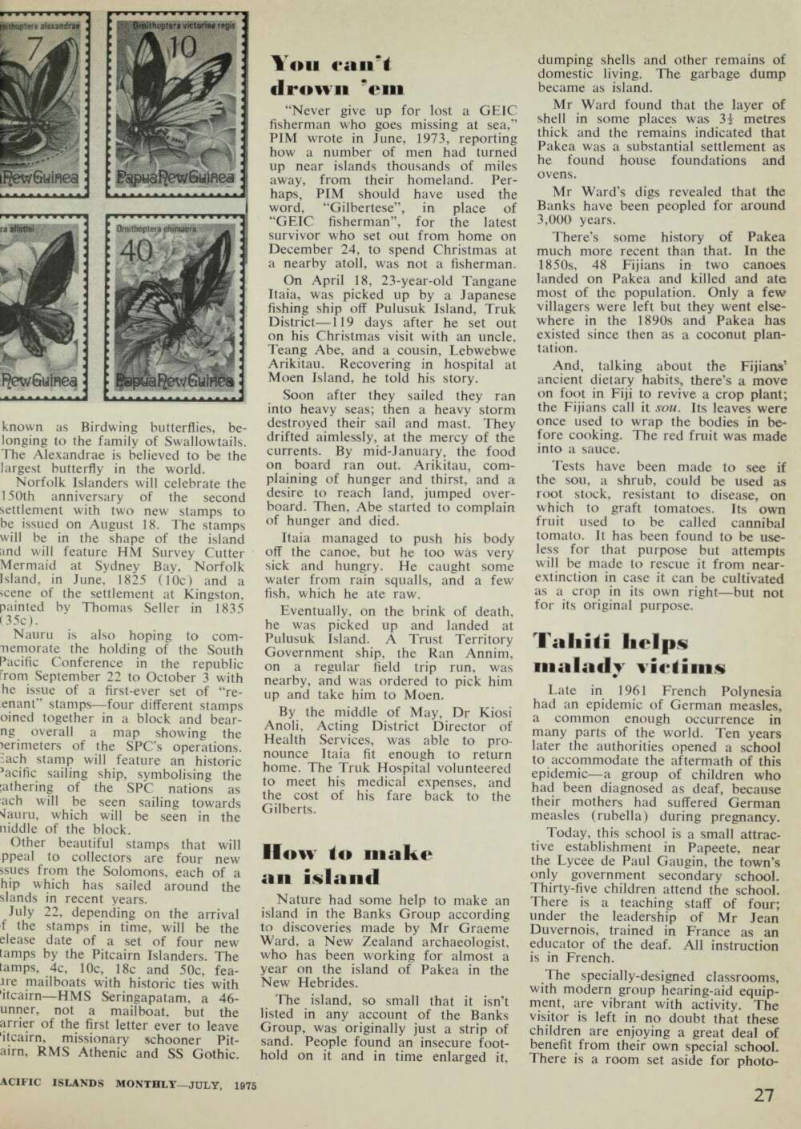
Papua New Guinea is earning a. reputation among stamp collectors for the very attractive stamps which have made their appearance in the last few years as a medium for cul tural expression or to underline the uniqueness and beauty of its flora and fauna.
Latest in the series is this set of four (over page) issued on June 11, featuring four protected butter flies found in Papua New Guinea and so much coveted by collectors that it is now an offence to kill, collect or export them. They are
known as Birdwing butterflies, be longing to the family of Swallowtails.
The Alexandrae is believed to be the largest butterfly in the world.
Norfolk Islanders will celebrate the 150th anniversary of the second settlement with two new stamps to be issued on August 18. The stamps will be in the shape of the island and will feature HM Survey Cutter Mermaid at Sydney Bay, Norfolk Island, in June, 1825 (10c) and a >cene of the settlement at Kingston, painted by Thomas Seller in 1835 (35c).
Nauru is also hoping to com memorate the holding of the South Pacific Conference in the republic from September 22 to October 3 with he issue of a first-ever set of “re enant” stamps—four different stamps oined together in a block and bear ng overall a map showing the perimeters of the SPC’s operations, stamp will feature an historic J acific sailing ship, symbolising the lathering of the SPC nations as ach will be seen sailing towards "Jauru, which will be seen in the niddle of the block.
Other beautiful stamps that will ppeal to collectors are four new ssues from the Solomons, each of a hip which has sailed around the slands in recent years.
July 22, depending on the arrival f the stamps in time, will be the elease date of a set of four new tamps by the Pitcairn Islanders. The tamps, 4c, 10c, 18c and 50c, fea ire mailboats with historic ties with 'itcairn —HMS Seringapatam, a 46unner, not a mailboat, but the arrier of the first letter ever to leave
'itcairn, missionary schooner Pit
airn, RMS Athenic and SS Gothic.
Voii eairt
drown ’em
“Never give up for lost a GEIC fisherman who goes missing at sea,”
PIM wrote in June, 1973, reporting how a number of men had turned up near islands thousands of miles away, from their homeland. Per haps, PIM should have used the word, “Gilbertese”, in place of “GEIC fisherman”, for the latest survivor who set out from home on December 24, to spend Christmas at a nearby atoll, was not a fisherman.
On April 18, 23-year-old Tangane Itaia, was picked up by a Japanese fishing ship off Pulusuk Island, Truk District—ll 9 days after he set out on his Christmas visit with an uncle, Teang Abe, and a cousin, Lebwebwe Arikitau. Recovering in hospital at Moen Island, he told his story.
Soon after they sailed they ran into heavy seas; then a heavy storm destroyed their sail and mast. They drifted aimlessly, at the mercy of the currents. By mid-January, the food on board ran out. Arikitau, com plaining of hunger and thirst, and a desire to reach land, jumped over board. Then, Abe started to complain of hunger and died.
Itaia managed to push his body off the canoe, but he too was very sick and hungry. He caught some water from rain squalls, and a few fish, which he ate raw.
Eventually, on the brink of death, he was picked up and landed at Pulusuk Island. A Trust Territory Government ship, the Ran Annim, on a regular field trip run, was nearby, and was ordered to pick him up and take him to Moen.
By the middle of May, Dr Kiosi Anoli, Acting District Director of Health Services, was able to pro nounce Itaia fit enough to return home. The Truk Hospital volunteered to meet his medical expenses, and the cost of his fare back to the Gilberts.
Hon io make
an island
Nature had some help to make an island in the Banks Group according to discoveries made by Mr Graeme Ward, a New Zealand archaeologist, who has been working for almost a year on the island of Pakea in the New Hebrides.
The island, so small that it isn’t listed in any account of the Banks Group, was originally just a strip of sand. People found an insecure foot hold on it and in time enlarged it,
dumping shells and other remains of domestic living. The garbage dump became as island.
Mr Ward found that the layer of shell in some places was 3\ metres thick and the remains indicated that Pakea was a substantial settlement as he found house foundations and ovens.
Mr Ward’s digs revealed that the Banks have been peopled for around 3,000 years.
There’s some history of Pakea much more recent than that. In the 1850 s, 48 Fijians in two canoes landed on Pakea and killed and ate most of the population. Only a few villagers were left but they went else where in the 1890 s and Pakea has existed since then as a coconut plan tation.
And, talking about the Fijians’ ancient dietary habits, there’s a move on foot in Fiji to revive a crop plant; the Fijians call it sou. Its leaves were once used to wrap the bodies in be fore cooking. The red fruit was made into a sauce.
Tests have been made to see if the sou, a shrub, could be used as root stock, resistant to disease, on which to graft tomatoes. Its own fruit used to be called cannibal tomato. It has been found to be use less for that purpose but attempts will be made to rescue it from near extinction in case it can be cultivated as a crop in its own right—but not for its original purpose.
Tahiti help*
inaladv victims
Late in 1961 French Polynesia had an epidemic of German measles, a common enough occurrence in many parts of the world. Ten years later the authorities opened a school to accommodate the aftermath of this epidemic—a group of children who had been diagnosed as deaf, because their mothers had suffered German measles (rubella) during pregnancy.
Today, this school is a small attrac tive establishment in Papeete, near the Lycee de Paul Gaugin, the town’s only government secondary school.
Thirty-five children attend the school.
There is a teaching staff of four; under the leadership of Mr Jean Duvernois, trained in France as an educator of the deaf. All instruction is in French.
The specially-designed classrooms, with modern group hearing-aid equip ment, are vibrant with activity. The visitor is left in no doubt that these children are enjoying a great deal of benefit from their own special school.
There is a room set aside for photo
graphy work, complete with dark room and the latest in photographic equipment. Next door is the girls’ craft room where they learn sewing.
Displayed recently were some of the fine pandanus hats and baskets they had made.
Just as impressive is the boys’ craft room where woodwork is taught, including wood-carving, Poly nesian style. Mr Duvemois is justifi ably proud of the work in this room which he personally supervises. On a trip to France last year he bought and freighted to Papeete some of the equipment for this room.
Four of these deaf children come from the neighbouring island of Moorea and two come from the more distant Tuamotus.
Apart from children whose deaf ness is caused by meningitis, a family history of deafness, or an undiag nosed cause, these children are all deaf because of maternal rubella.
Because it took 10 years before action was taken to educate them, they must try to condense their schooling into four short years. (In French Polynesia compulsory school attendance is from six to 14 years.) In this brief time they must learn the rudiments of the three Rs, a difficult process for any deaf child even when deafness is diagnosed and speech and language teaching and auditory training begun in the first year of life. Mr Duvemois is also rightly concerned with preparing them for life and work after they leave school, hence the stress laid on craft work. A lot to do in a short time and one can only wish them well, both teachers and children, and hope that such “pressure cooker” type education succeeds.
Cook's compass
that Hasn’t
PIM reported in Tropicalities in April that an unnamed collector had bought Captain Cook’s compass and sundial at an auction in New South Wales, paying $4,050 for it. The deal created a fuss in government circles, and the day before the sale it slapped a ban on the instrument’s export.
The buyer was more than satisfied with his purchase, saying that he would have given almost twice as much for it.
Now it turns out, that buyer and government were on the wrong track.
The compass isn’t a compass and, what’s more, it couldn’t possibly have belonged to Captain Cook, who, ac cording to much more reliable evi dence than that attached to the instrument at the sale, had been dead about 70 years when the thing was made.
Along with the instrument was a picture of Lord Kelvin, who was supposed to have received it from Captain Cook, and a card with faded handwriting saying that it once be longed to the great navigator.
The buyer, now identified as Mr W. J. Blundell, a Coogee (NSW) art collector, checked his purchase with the London Royal Society and the Maritime Museum at Greenwich.
The Royal Society pointed out that the maker, Pizzala, worked between 1838 and 1860. Captain Cook died in 1779. The Maritime Museum said is wasn’t even a compass. It was a sundial.
Tale of
a clog lag
When US Army Sergeant Pat Hayes lost his dog tag on Guadal canal in 1942, he gave it little thought. In fact, he did not think about it again till last April when he got it back after an unusual train of events.
Former US Navy man Dick McGehee, returning to the Solomons for a visit in January, 1975, to look at some of the old battlefields, saw a 12-year-old boy wearing the dog tag round his neck. The boy said he found it in bush on Guadalcanal.
McGehee induced the boy to part with it for 60c.
From the tag he was able to dis cover that it belonged to Patrick C.
Hayes, that Hayes had been drafted, his last tetanus shot was in 1942, he had B type blood and that he was a Catholic. The next-of-kin was listed as living in Cleveland. McGehee re garded the dog tag as a souvenir, but back home in the States, friends ad vised him to try to get in touch with the next-of-kin, as he considered Hayes was long dead.
Inquiries led to Evansville, and the discovery that Hayes was alive and well, and working for a plastics firm.
McGehee did not go to Evansville himself, but telephoned Hayes, then wrote to him and sent him the dog tag. Light-heartedly, he wrote, “Leave it to the Navy to pick up after the Army. Next time please ‘police the area’ before you move out. Forget the 60c you owe me.
It’s great to learn that Patrick C.
Hayes is alive and well and living in Evansville, Indiana”.
Hayes, in reply said he lost his dog tag the first time he was hurt.
“I don’t remember it too clearly,” he wrote. “I think I cut my chin on a ‘C’ ration can sliding into a fox hole. The army had a bunch of Purple Hearts made up and needed someone to give them to.”