Letters
p. 29 · Read in the full issue
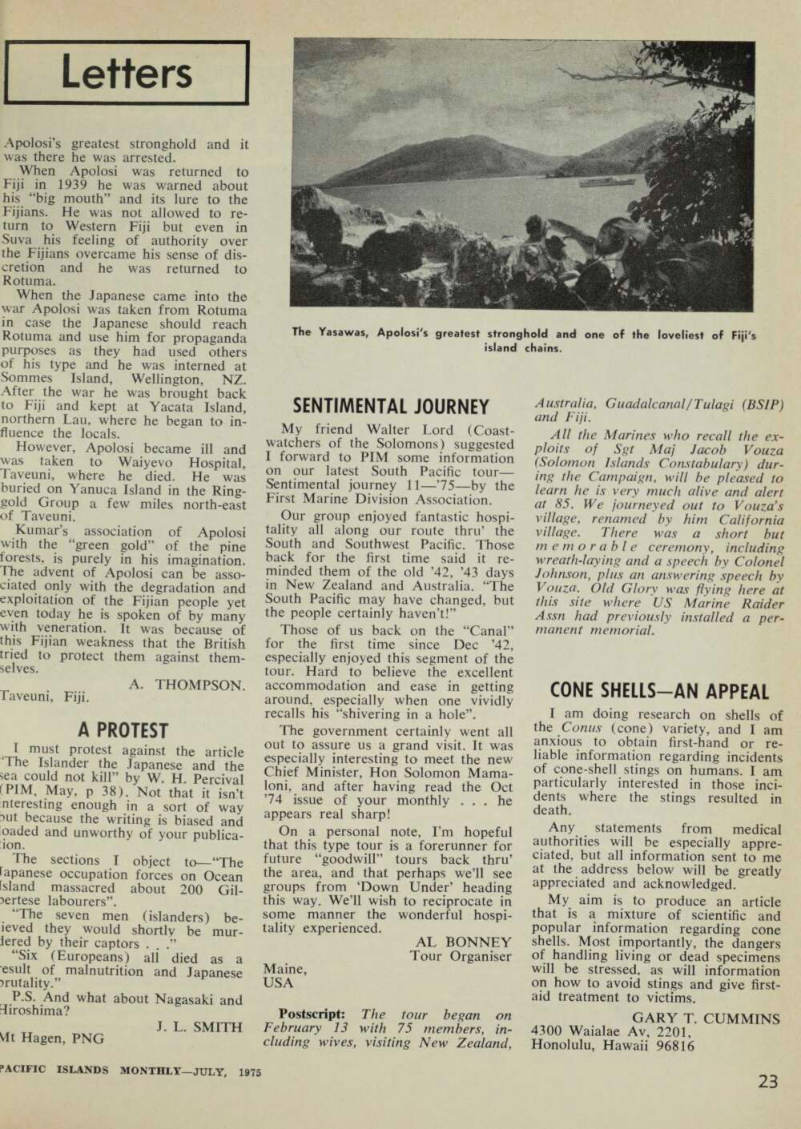
Apolosi’s greatest stronghold and it was there he was arrested.
When Apolosi was returned to Fiji in 1939 he was warned about his “big mouth” and its lure to the Fijians. He was not allowed to re turn to Western Fiji but even in Suva his feeling of authority over the Fijians overcame his sense of dis cretion and he was returned to Rotuma.
When the Japanese came into the war Apolosi was taken from Rotuma in case the Japanese should reach Rotuma and use him for propaganda purposes as they had used others of his type and he was interned at Sommes Island, Wellington, NZ.
After the war he was brought back to Fiji and kept at Yacata Island, northern Lau, where he began to in fluence the locals.
However, Apolosi became ill and was taken to Waiyevo Hospital, Taveuni, where he died. He was buried on Yanuca Island in the Ring gold Group a few miles north-east of Taveuni.
Kumar’s association of Apolosi with the “green gold” of the pine forests, is purely in his imagination.
The advent of Apolosi can be asso ciated only with the degradation and exploitation of the Fijian people yet even today he is spoken of by many with veneration. It was because of this Fijian weakness that the British tried to protect them against them selves.
A. Thompson.
Taveuni, Fiji.
A Protest
I must protest against the article ‘The Islander the Japanese and the sea could not kill” by W. H. Percival (PIM, May, p 38). Not that it isn’t nteresting enough in a sort of way 3Ut because the writing is biased and oaded and unworthy of your publica ion.
The sections I object to—“ The Japanese occupation forces on Ocean fsland massacred about 200 Gil- Tertese labourers”.
“The seven men (islanders) be icved they would shortly be mur lered by their captors . . .”
“Six (Europeans) ali died as a esult of malnutrition and Japanese brutality.”
P.S. And what about Nagasaki and Hiroshima?
J. L. Smith
Vft Hagen, PNG
Sentimental Journey
My friend Walter Lord (Coast watchers of the Solomons) suggested 1 forward to PIM some information on our latest South Pacific tour — Sentimental journey 11—’75—by the First Marine Division Association.
Our group enjoyed fantastic hospi tality all along our route thru’ the South and Southwest Pacific. Those back for the first time said it re minded them of the old ’42, ’43 days in New Zealand and Australia. “The South Pacific may have changed, but the people certainly haven’t!”
Those of us back on the “Canal” for the first time since Dec ’42, especially enjoyed this segment of the tour. Hard to believe the excellent accommodation and ease in getting around, especially when one vividly recalls his “shivering in a hole”.
The government certainly went all out to assure us a grand visit. It was especially interesting to meet the new Chief Minister, Hon Solomon Mama loni, and after having read the Oct ’74 issue of your monthly ... he appears real sharp!
On a personal note, Tm hopeful that this type tour is a forerunner for future “goodwill” tours back thru’ the area, and that perhaps we’ll see groups from ‘Down Under’ heading this way. We’ll wish to reciprocate in some manner the wonderful hospi tality experienced.
Al Bonney
Tour Organiser Maine,
Usa
Postscript: The tour began on February 13 with 75 members, in cluding wives, visiting New Zealand,
Australia, Guadalcanal/Tulagi (BS1P) and Fiji.
All the Marines who recall the ex ploits of Sgt Maj Jacob Vouza (Solomon Islands Constabulary) dur ing the Campaign, will be pleased to learn he is very much alive and alert at 85. We journeyed out to Vouza’s village, renamed by him California village. There was a short but memorable ceremony, including wreath-laying and a speech by Colonel Johnson, plus an answering speech by Vouza. Old Glory was flying here at this site where US Marine Raider Assn had previously installed a per manent memorial.
Cone Shells-An Appeal
I am doing research on shells of the Conus (cone) variety, and I am anxious to obtain first-hand or re liable information regarding incidents of cone-shell stings on humans. I am particularly interested in those inci dents where the stings resulted in death.
Any statements from medical authorities will be especially appre ciated, but all information sent to me at the address below will be greatly appreciated and acknowledged.
My aim is to produce an article that is a mixture of scientific and popular information regarding cone shells. Most importantly, the dangers of handling living or dead specimens will be stressed, as will information on how to avoid stings and give first aid treatment to victims.
Gary T. Cummins
4300 Waialae Av, 2201, Honolulu, Hawaii 96816
The Yasawas, Apolosi's greatest stronghold and one of the loveliest of Fiji's island chains.