Officialdom's
pp. 35-37 · Read in the full issue
cold-shoulder for Islands' craft workers
By Denis Fisk
The lack of encouragement of crafts by numerous Pacific govern ments is a classic case of ignoring an exceptionally low capital investment industry, with the widest involvement of village or towns people, often in favour of expensive industries difficult to establish, such as cattle.
Crafts’ and craftsmen’s low stand ing in those Pacific countries is re flected in the lack of interest by governments and regional bodies.
Now the plight of these currently poor but potentially good earners has been exposed through a meeting in Sydney University in May of the Asian Assembly of the World Crafts Council.
For the first time, representatives of eight Pacific countries and colonies were able to join those from 17 Asian, Middle East and Australasian countries, to tell a few success stories but mainly to speak of struggle and disinterest.
Among the eight, four had relative success stories—the Cook Islands, New Hebrides, Papua New Guinea and Western Samoa—while Fiji, New Caledonia, the Solomons and Tonga were weighed down with the prob lems of sponsorship, organisation and marketing as well as the struggle to retain craft cultures and standards, or to revive them and provide an opportunity for income earning.
This is at best a crude breakdown of the situation, but in a short visit to the assembly it was a matter of gaining impressions, gathering up reports and speaking to as many Pacific delegates as possible.
It was difficult to get delegates to openly criticise their home govern ments.
Yet careful reading of reports and listening to Pacific delegates showed
how disturbed some were at their governments’ lack of interest, understanding and action.
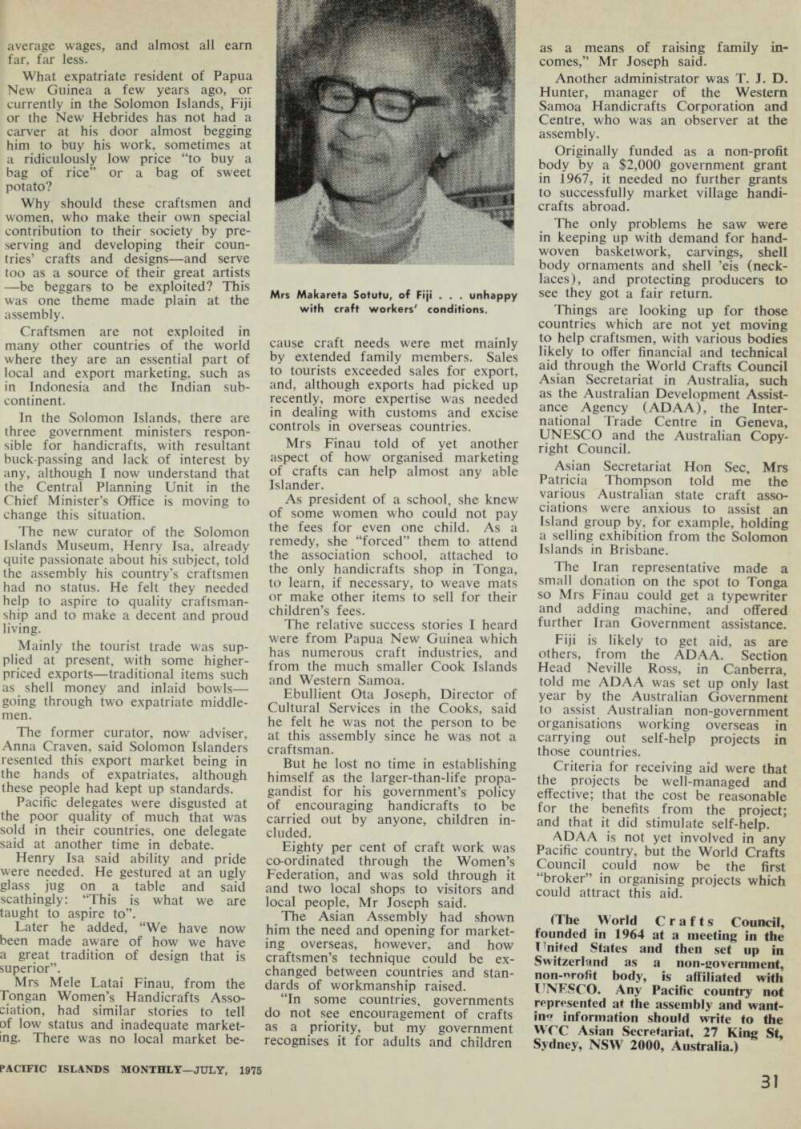
Emotion came through over matters such as involving “dropouts” from academic education systems, in ftm u !!i 8 v utilising unique and still little known craft cultures which e m b7v ar^.a^ ogniSe H er S mbly -J elegateS ’ and i.' m ff a fu S m nl d l ei? ? l u Wer |/? kmB ° ff the /5S anC {f beuefit from exports fna Plt « ben f fb ts s .uch as keepalf qua lty tbey mi ght incident- Ir'UftuJ* u * i * Gentle, but positive Mrs Makareta Sotutu moved the emotions of the assembly when she could not hide her deep feeling for her 135 girls in her Methodist crafts school in Fiji.
The poverty of government encouragement for crafts—rather than the fine arts—in Fiji can be judged from the school’s total grant from government of $3OO.
“If I did not take my girls where would they go?” Mrs Sotutu said, “Would you like them to be on the street I wouldn t. I would rather die. I spend my own money, I go without food and clothing to help to buy things for the girls.”
An organisation of Fijian women has failed so far to organise village women to bring crafts together to sell because of lack of finance and know how, Mrs Sotutu’s own school needs ex tending, staffing and providing with raw materials, but she has been un able to S £t hel P 50 far - She has be en encouraged recently by secondary schoGl teachers now coming to the sc hool for short craft courses, which j s a change from the former com piete attention she said had been directed in schools towards passing academic subjects.
Young people learned crafts by the compulsion of having, somehow, to earn a llvm 8> Mrs Sotutu said, al though once involved these “drop °uts” became very interested. Howf ver > craft-workers remained in lower income brackets, This last comment applies generally to those countries where marketing of crafts is not well organised on be half of the craft workers, and where they depend on their products for their livelihood, and also even when there is effective marketing in many cases. For example, in Australia, almost no craftsmen earn better than
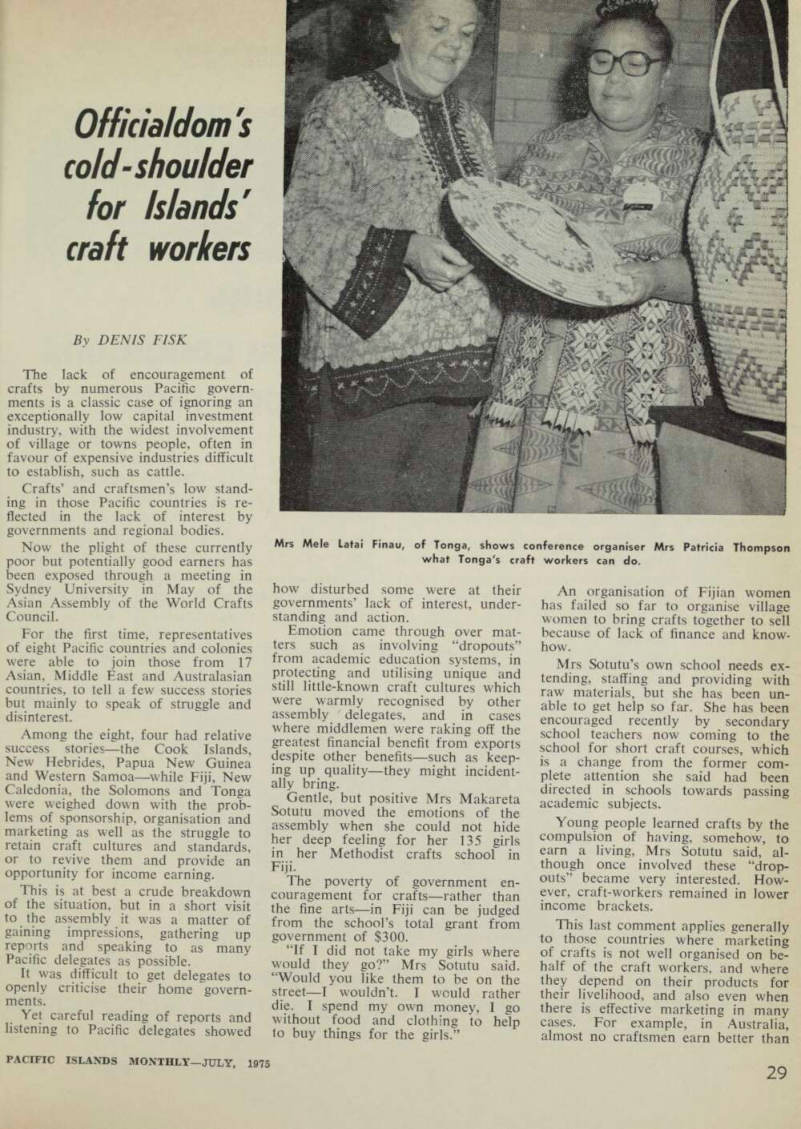
Mrs Mele Latai Finau, of Tonga, shows conference organiser Mrs Patricia Thompson what Tonga's craft workers can do.
average wages, and almost all earn far, far less.
What expatriate resident of Papua New Guinea a few years ago, or currently in the Solomon Islands, Fiji or the New Hebrides has not had a carver at his door almost begging him to buy his work, sometimes at a ridiculously low price “to buy a bag of rice” or a bag of sweet potato?
Why should these craftsmen and women, who make their own special contribution to their society by pre serving and developing their coun tries’ crafts and designs—and serve too as a source of their great artists —be beggars to be exploited? This was one theme made plain at the assembly.
Craftsmen are not exploited in many other countries of the world where they are an essential part of local and export marketing, such as in Indonesia and the Indian sub continent.
In the Solomon Islands, there are three government ministers respon sible for handicrafts, with resultant buck-passing and lack of interest by any, although I now understand that the Central Planning Unit in the Chief Minister’s Office is moving to change this situation.
The new curator of the Solomon Islands Museum, Henry Isa, already quite passionate about his subject, told the assembly his country’s craftsmen had no status. He felt they needed help to aspire to quality craftsman ship and to make a decent and proud living.
Mainly the tourist trade was sup plied at present, with some higher priced exports—traditional items such as shell money and inlaid bowls— going through two expatriate middle men.
The former curator, now adviser, Anna Craven, said Solomon Islanders resented this export market being in the hands of expatriates, although these people had kept up standards.
Pacific delegates were disgusted at the poor quality of much that was sold in their countries, one delegate said at another time in debate.
Henry Isa said ability and pride were needed. He gestured at an ugly glass jug on a table and said scathingly: “This is what we are taught to aspire to”.
Later he added, “We have now been made aware of how we have a great tradition of design that is superior”.
Mrs Mele Latai Finau, from the Tongan Women’s Handicrafts Asso ciation, had similar stories to tell of low status and inadequate market ing. There was no local market be-
cause craft needs were met mainly by extended family members. Sales to tourists exceeded sales for export, and, although exports had picked up recently, more expertise was needed in dealing with customs and excise controls in overseas countries.
Mrs Finau told of yet another aspect of how organised marketing of crafts can help almost any able Islander.
As president of a school, she knew of some women who could not pay the fees for even one child. As a remedy, she “forced” them to attend the association school, attached to the only handicrafts shop in Tonga, to learn, if necessary, to weave mats or make other items to sell for their children’s fees.
The relative success stories I heard were from Papua New Guinea which has numerous craft industries, and from the much smaller Cook Islands and Western Samoa.
Ebullient Ota Joseph, Director of Cultural Services in the Cooks, said he felt he was not the person to be at this assembly since he was not a craftsman.
But he lost no time in establishing himself as the larger-than-life propa gandist for his government’s policy of encouraging handicrafts to be carried out by anyone, children in cluded.
Eighty per cent of craft work was co-ordinated through the Women’s Federation, and was sold through it and two local shops to visitors and local people, Mr Joseph said.
The Asian Assembly had shown him the need and opening for market ing overseas, however, and how craftsmen’s technique could be ex changed between countries and stan dards of workmanship raised.
“In some countries, governments do not see encouragement of crafts as a priority, but my government recognises it for adults and children
as a means of raising family in comes,” Mr Joseph said.
Another administrator was T. J. D.
Hunter, manager of the Western Samoa Handicrafts Corporation and Centre, who was an observer at the assembly.
Originally funded as a non-profit body by a $2,000 government grant in 1967, it needed no further grants to successfully market village handi crafts abroad.
The only problems he saw were in keeping up with demand for hand woven basketwork, carvings, shell body ornaments and shell ’eis (neck laces), and protecting producers to see they got a fair return.
Things are looking up for those countries which are not yet moving to help craftsmen, with various bodies likely to offer financial and technical aid through the World Crafts Council Asian Secretariat in Australia, such as the Australian Development Assist ance Agency (ADAA), the Inter national Trade Centre in Geneva, UNESCO and the Australian Copy right Council.
Asian Secretariat Hon Sec, Mrs Patricia Thompson told me the various Australian state craft asso ciations were anxious to assist an Island group by, for example, holding a selling exhibition from the Solomon Islands in Brisbane.
The Iran representative made a small donation on the spot to Tonga so Mrs Finau could get a typewriter and adding machine, and offered further Iran Government assistance.
Fiji is likely to get aid, as are others, from the ADAA. Section Head Neville Ross, in Canberra, told me ADAA was set up only last year by the Australian Government to assist Australian non-government organisations working overseas in carrying out self-help projects in those countries.
Criteria for receiving aid were that the projects be well-managed and effective; that the cost be reasonable for the benefits from the project; and that it did stimulate self-help.
ADAA is not yet involved in any Pacific country, but the World Crafts Council could now be the first “broker” in organising projects which could attract this aid. (The VVorld Crafts Council, founded in 1964 at a meeting in the United States and then set up in Switzerland as a non-government, non-profit body, is affiliated with UNESCO. Any Pacific country not represented at the assembly and want ing information should write to the wcc Asian Secretariat, 27 King St, Sydney, NSW 2000, Australia.)
Mrs Makareta Sotutu, of Fiji . . . unhappy with craft workers' conditions.