Bobby' still
p. 42 · Read in the full issue
flies over Ontong Java
From WADE DOAK in New Zealand “They buried him near our village.
Bobby from the big American plane.
That’s why we still call the white tern the bobby bird. Because of the white flier who died here in the war.”
Three hundred miles north of Guadalcanal, the Polynesians on the remote atoll of Ontong Java saw very little of the war. When the American research vessel El Torito visited there recently, making a film, The Unknown Polynesians, the in habitants explained how the bobby bird came to have an English name.
Here is the story they told us.
Over their village of Luaniua one day in 1942 a giant PBY Catalina flying-boat roared, chased by three Japanese planes. It flew off in the direction of Pelau village, 40 miles away on the west side of the atoll.
Over there a furious air battle took place. One plane was shot down.
Another went off in flames, but the third gunned the PBY, riddling it with bullets and setting one engine on fire. When it came back over Luaniua it was looking for some where to land. It circled and came down on the ocean side of the atoll, taxiing right up on to the reef top, near the village.
“When it landed, no people came out. They stayed inside. Then one man, the captain or pilot, climbed out and asked if we had any priest here who can say prayers. We said ‘Yes, there’s a mission here’. He asked if there were any Europeans on the atoll but we told him they had all left. The pilot went back in side and brought his men out. Six of them. They took all their gear out and buried it on the island.
“The dead man and the wounded man were still in the plane. The
pilot asked our chief if the dead man could be buried so we brought Bobby over and dug his grave near the
village.
“Next day they poured petrol over their plane and burnt it to hide it from the enemy. It was mostly destroyed and hidden at high tide.
The whole crew came to Luaniua and lived with us. The co-pilot was wounded in the shoulder. A few of the crew were New Zealanders.
“One day an American was cross ing the lagoon in a canoe. A Japanese plane passed over very low. He lay down in the canoe.
When it was right overhead he fired his rifle at it. That plane crashed into the ocean outside the lagoon.
“A month later, another flying-boat flew up from the Solomons and rescued the airmen. After this, from time to time, American planes would fly over the village and drop food parcels to us. When the war ended Bobby’s body was taken back to America but we always remember him when we see the bobby bird.”
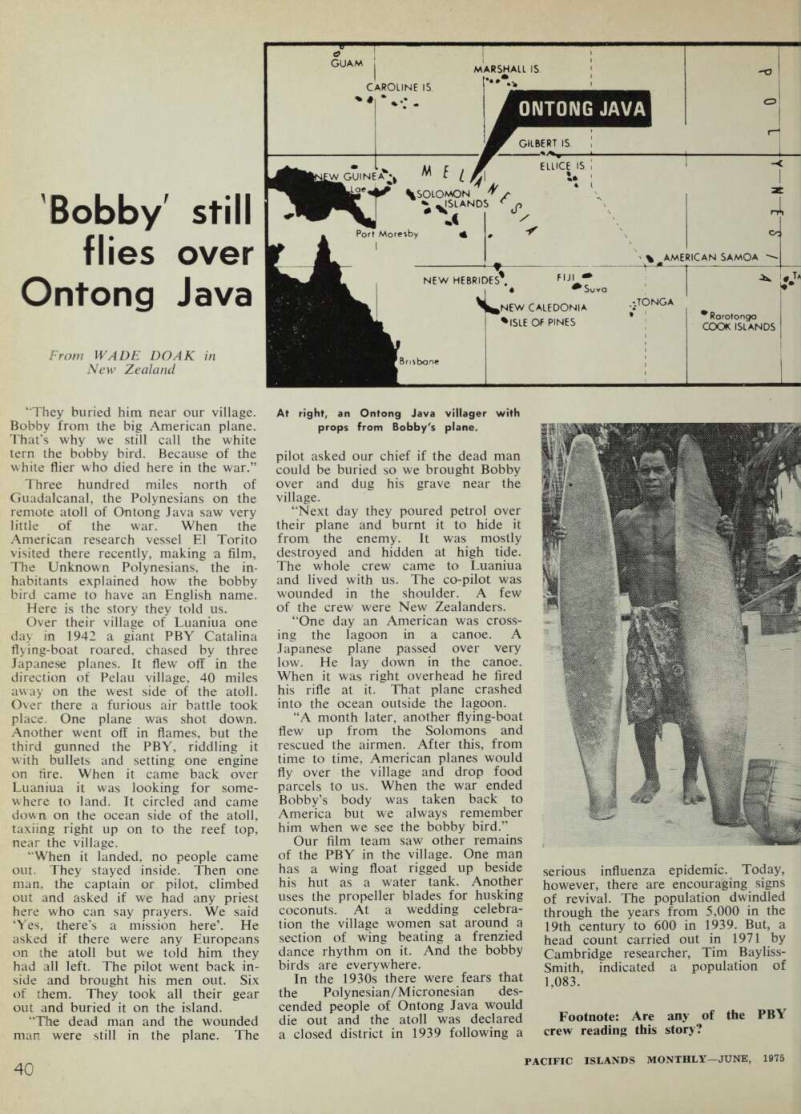
Our film team saw other remains of the PBY in the village. One man has a wing float rigged up beside his hut as a water tank. Another uses the propeller blades for husking coconuts. At a wedding celebra tion the village women sat around a section of wing beating a frenzied dance rhythm on it. And the bobby birds are everywhere.
In the 1930 s there were fears that the Polynesian/Micronesian des cended people of Ontong Java would die out and the atoll was declared a closed district in 1939 following a
serious influenza epidemic. Today, however, there are encouraging signs of revival. The population dwindled through the years from 5,000 in the 19th century to 600 in 1939. But, a head count carried out in 1971 by Cambridge researcher, Tim Bayliss- Smith, indicated a population of 1,083.
Footnote: Are any of the PBY crew reading this story?
At right, an Ontong Java villager with props from Bobby's plane.