Yesterday
p. 51 · Read in the full issue
It has often been pointed out that if the United States had used the same tactics in Vietnam that Britain used in Malaya 20 years ago when the communist terrorists caused an "emergency", there would have been no debacle like the present one. Which brings us to an article in PIM of June, 1955, when a Fiji battalion was in its third year of service in Malaya. PlM's founder, and then editor, Mr R. W. Robson, visited the battalion during a world trip and came to the conclusion that Fiji's good men were wasted in the Malayan jungle. The battalion's task called For great "intestinal fortitude" in both ihysical and moral sense. But the hing which really broke the hearts of ifficers and men was not a jungle :ondition. It was political—and Chinese.
Fhey were constantly held back by the icliticians and "defeated" by the Chinese who, although not taking part n the fighting, were the channel hrough which the terrorists got most >f their supplies and all their information.
Jow, 20 years on, it looks as if another
'emergency" is likely in Malaysia.
'aluable documents relating to the lassacre of the Rev James Chalmers, the ev Oliver Tomkins, and a number of fission students at Goaribari Island in 901, were found at Daru. The papers ■ eluded the original report of a atement made to the Resident lagistrate, Mr C. G. Murray, at Daru, >on after the murders, by one of the atives arrested for complicity in the •ime. There was also part of the riginal correspondence between ueensland officials at Thursday Island id the Daru magistrate about sending S officers and men of the Royal ustralian Artillery from Thursday Island > help the British New Guinea jthorities in the arrest of the murderers. ew Caledonia expected soon to have s own internal air service, known "ifeAy as TRANSPAC, and at greater ngth as Societe Caledonienne de ansports Ariens. Plans were to operate e service from Magenta airfield, oumea, to points around New Caledonia, »d to Lifu Island in the Loyalties. lere was, 20 years ago, a legislative idy which respected the views of jsinessmen when new tax scales were msidered! This was the Western Samoa Assembly which held up I August 1955 consideration of new tes of taxation, PIM reported. Moving r a deferment, Mr A. M. Gurau iid taxpayers needed more time to udy the proposed rates. The Acting
Financial Secretary, Mr A. J. Neill, agreed that the views of businessmen should be respected because they would pay 90 per cent of the taxation under the new ordinance.
Queen Salote of Tonga opened a new £T30,000 70-bed hospital at Neiafu, Vavau. The name, Sione Gnu, was the "given" name of the Minister of Health, Prince Tuipelehake, who is now Prime Minister. The hospital was equipped with a well-appointed theatre, X-ray plant, dental clinic, outpatients' department and spacious laboratory.
The old hospital building was converted into a nurses' home and a TB ward.
After June 1, the New Hebrides was without an air connection with Australia.
Qantas stopped operating flying-boats on its South Pacific service and converted to Skymasters (DC4s) for services between Sydney and New Caledonia, and the branch-line service to Fiji. The Fiji service ended at Nadi, which meant that Suva was without a direct air connection with Australia.
But it gave Fiji Airways extra traffic, ferrying passengers between Nadi and Suva (or Nausori, the location of Suva's airport).
Mr J, W. Miller, chief hospital engineer in Papua New Guinea did the most un-public-servant-like thing while on annual leave in Australia, PIM reported in June, 1955. He spent his leave crusading for an inquiry into alleged
territory bungling, and received a flattering amount of notice in the Press. He claimed millions were being wasted in inefficient administration.
The Hon P. L. Morgan, Western Samoa MLA, who went to New Zealand to address the House of Representatives on the question of self-government, was working on the Wellington waterfront.
He had not, up till then, had the chance to address Parliament, and his funds had run out. Mr Morgan, who was born in New Zealand, had lived and worked in Western Samoa for most of his 55 years.
The graceful Chilean naval training schooner, Esmerelda, on her maiden voyage to the Pacific Islands, met the Shaw Saviil liner, Southern Cross, also on a maiden voyage, at Papeete. From Papeete, the Esmerelda sailed to Apia, Guam and Yokohama. The Southern Cross's route took it to Suva, Wellington and Sydney.
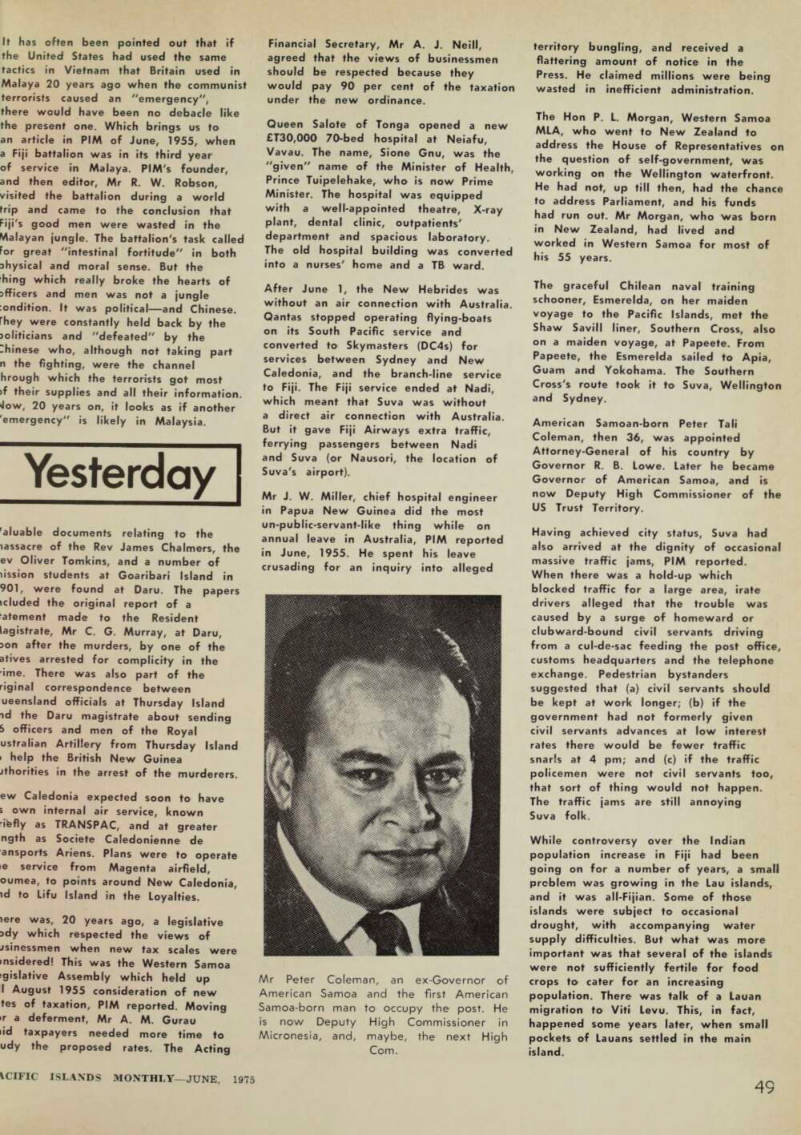
American Samoan-born Peter Tali Coleman, then 36, was appointed Attorney-General of his country by Governor R. B. Lowe. Later he became Governor of American Samoa, and is now Deputy High Commissioner of the US Trust Territory.
Having achieved city status, Suva had also arrived at the dignity of occasional massive traffic jams, PIM reported.
When there was a hold-up which blocked traffic for a large area, irate drivers alleged that the trouble was caused by a surge of homeward or clubward-bound civil servants driving from a cul-de-sac feeding the post office, customs headquarters and the telephone exchange. Pedestrian bystanders suggested that (a) civil servants should be kept at work longer; (b) if the government had not formerly given civil servants advances at low interest rates there would be fewer traffic snarls at 4 pm; and (c) if the traffic policemen were not civil servants too, that sort of thing would not happen.
The traffic jams are still annoying Suva folk.
While controversy over the Indian population increase in Fiji had been going on for a number of years, a small problem was growing in the Lau islands, and it was all-Fijian. Some of those islands were subject to occasional drought, with accompanying water supply difficulties. But what was more important was that several of the islands were not sufficiently fertile for food crops to cater for an increasing population. There was talk of a Lauan migration to Viti Levu. This, in fact, happened some years later, when small pockets of Lauans settled in the main island.
Mr Peter Coleman, an ex-Governor of American Samoa and the first American Samoa-born man to occupy the post. He is now Deputy High Commissioner in Micronesia, and, maybe, the next High Com.