Magazine Section
pp. 39-41 · Read in the full issue
A NOW AND THEN STORY OF THE
Cooks' Money-Spinning Stamps
By W. G. Coppell
The history of the postage stamps issued in the Cook Islands serves to illustrate several points about philately. Many philatelists and others are critical about the philatelic opportunism displayed by many gov ernments within the Pacific Basin, and elsewhere. They say that govern ments are overplaying the stamp market and using the interests of philatelists to further their own ends.
But don’t let us be too critical on this score; history shows that playing the philatelic market has been an on going operation since the first col lector put a value upon the piece of coloured paper used to denote that a fee had been paid to ensure the safe delivery of an article of mail.
Using the philatelist as a revenue source is no better, no worse than all manner of other schemes which spawn upon the “squirrel syndrome” which so many humans display. The Crown Jewels of England, the trade objects of the Kula Ring of the Trobriand Islands, the puka beads which are the current rage in Hono lulu, the autographs of leaders and entertainers have a manifest value placed upon them by the collector.
In today’s world it is not only a case of caveat emptor , but also caveat the collector. Quite obviously, present-day governments must look to all sorts of sources for much needed revenue and the prices that collectors are prepared to pay for stamps, coins and other items of little or no intrinsic value are of little con sequence.
Today, tourists are prepared to pay Lvo, three or more dollars for the Cook Islands $1 coin— attracted by its size and by the phallic symbol on the Tangaroa god on the coin.
I even heard that $7.50 has been obtained at times! The coins that the collectors take away will undoubtedly find their way into collections, bottom drawers or trash bins. The Cook Islands Government, at the very least.
has made the best part of a dollar profit. Perhaps better this way than extracting sales tax from the porno graphic mannikins which form such a feature of the displays in many Waikiki shops.
The philatelic history of the Cook Islands has had a recurrent pattern Before 1892, the despatch of mails to and from the Cook Islands was dependent on the goodwill of the ships which called at the islands, although the British Vice-Consul at Rarotonga performed some postal duties. R. E. Exham, who was acting Vice-Consul before the establishment of the British Protectorate in 1888, was confirmed in his postal duties for a time by Frederick J. Moss, the British Resident. Moss issued a public notice that Exham’s office in Donald and Edenborough’s store was to continue to be used as a Post Office.
Later, Moss appointed J. H. Gar mer as Postmaster and, initially, use was made of either New Zealand or British stamps, as had apparently been the practice from as early as 1874. In January, 1892, Moss wrote to the Colonial Secretary in New Zealand for permission to have stamps issued within the Group In the same year, he visited Wellington where, together with Mr Rogers, of the Government Printing Office he was responsible for the design of the first Cook Islands Federation stamps.
These were based upon the federation which incorporated seven stars, repre
seating the seven islands constituting the federation.
At this stage. Cook Islands stamps were valid for postal purposes in New Zealand, India, Germany and USA and mail for other countries had to carry franked New Zealand stamps. Although some stamps were cancelled on April 19, 1892, when they arrived at Rarotonga, the first official issue was made on May 7, 1892.
Moss must have early recognised that the sale of stamps for non-postal purposes would provide a source of revenue for the federation, since as early as May 30, 1892, he had re ceived a letter from the Cardiff stamp dealer, H. G. Hanson, asking for a supply of the stamps and inquiring whether the nominal face-value only or a commission must be paid.
In August, 1892, Moss received a letter from the NZ General Post Office which said,“ I am pleased to hear that you are doing so well with the stamps among collectors. It is rather cruel of you, after having dis posed of a large number to the col lectors, that you should determine to have a new issue altogether”.
In 1893, arrangements were made for a new issue, which incorporated two designs, the Torea or wrybill (a native bird) and the portrait of Makea Takau Ariki of Rarotonga.
Although there had been a tendency in some quarters to refer to Makea Ariki of Rarotonga as Queen of Rarotonga, this did not find favour
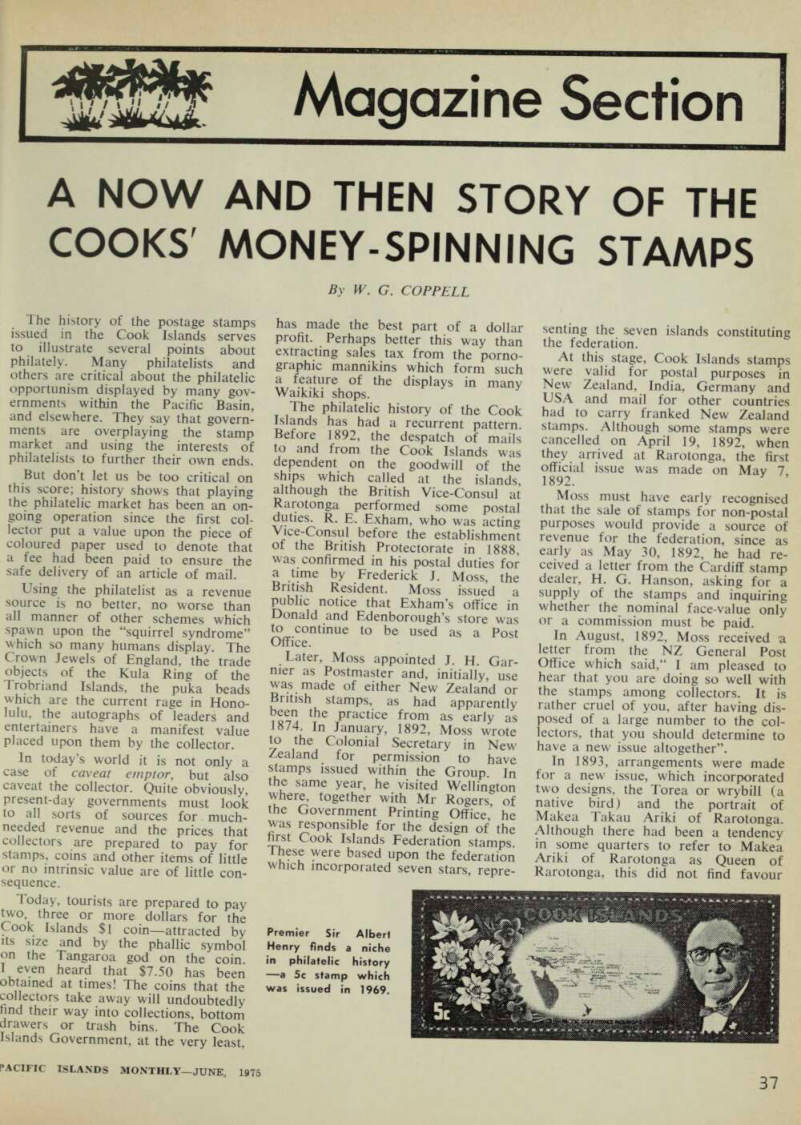
Premier Sir Albert Henry finds a niche in philatelic history —a 5c stamp which was issued in 1969.
with the ariki, or paramount chiefs.
In October, 1893, the two ariki of Mangaia wrote to Moss, “We don’t like this trouble about the putting of Makea on the stamps. We don’t want that stamp for Mangaia. The stamp we want is a stamp with the heads of our two kings on it. We do not wish the stamp with Makea head on it”.
To ensure the success of the new issue, all the remaining stocks of the first issue were burnt in the engine house of Donald and Edenborough.
The scale of business at the time may be gauged from the account presented to the federation on September 24, 1894, of £l/18/- for printing 24,000 stamps of four denominations with a face value of £320/16/8.
The 1893 designs, with some colour changes, were to remain in circulation until 1919. As has hap pened quite often, the overprint was used to denote specific issues and often variations created rarities. In 1899, the penny Makea blue was overprinted with an additional half penny and there are some instances of an inverted overprint.
In 1901, when annexation to New Zealand took place, it was decided in Rarotonga to mark the occasion philatelically and the penny brown Makea was overprinted locally with a crown, but local printing resources were not up to the task and only a limited number of these stamps were issued, with some bearing two, and a few even three, crowns. In 1902, one sheet of the twopence Torea stamp was sold which had no values imprinted on it.
Over the years of the NZ adminis tration, the sale of stamps to philate lists continued to be a fruitful source of revenue. One way of capitalising on this market was to issue separate stamps for Rarotonga, Aitutaki and Penrhyn. This practice either by overprinting New Zealand stamps, or by issuing stamps inscribed Raro tonga, Aitutaki or Penrhyn, con tinued until 1932, when stamps in-
scribed Cook Islands appeared again.
The controlling interest that the New Zealand Government had exer cised over the postal service of the Cook Islands ended with internal self government in 1965. In November, 1965, Mr Albert Henry, Premier of the Cook Islands, announced the in troduction of an old-age pension of $1 per week and said that this would be financed principally by the sale of postage stamps to philatelists.
He advocated the need to advertise Cook Islands stamps, but went on to state “too many issues could be re garded as unethical. At this stage, our aim should be to gain a world wide philatelic reputation, with the object of gaining a very rewarding source of income for years to come”.
The Premier estimated that the promotion of Cook Islands stamps by the NZ Government would net an annual income of $40,000; if they were handled by De La Rue and Company, of London, the income would be $140,000 and there would be an income of $200,000 if a New York philatelic agency assumed con trol. The overall direction of the sale of Cook Islands stamps to philatelists then passed into American hands.
In its June, 1966 edition, PIM re ported that philatelic journals in Australia and New Zealand had ex pressed concern over the Cook Islands Government’s expressed policy of deliberately exploiting world stamp collectors. This criticism must be questioned as there has been a continuing demand for Cook Islands stamps.
In May, 1967, it was reported that H million stamps had been de spatched from the Cook Islands Philatelic Bureau in the preceding three months.
History has repeated itself. In the early issues since internal self government came, existing issues were overprinted and surcharged and the inevitable reversed overprints, variations and omissions occurred.
There have been interesting errors,
such as the 1967 four cent “Water Lily”, which appeared inscribed “Walter Lily”. The issues have ap peared at frequent and regular inter vals. In the period from 1892 to 1965, there were 20 issues for the Cook Islands; of these, 12 were specifically designed for Rarotonga, Aitutaki and Penrhyn, four were sur charged issues and the remainder were overprints of New Zealand issues.
From August 1965, to the end of 1971, there were 27 issues of Cook Islands stamps, with four issues as overprints, four as overprinted issues, four as surcharged issues and two as back overprinted and surcharged issues.
The Cook Islands Philatelic Bureau has made great use of current events when producing new issues and over prints. New issues have dealt with Christmas, Easter, the Olympic Games, the Commonwealth Games, the South Pacific Games and the bi centenary of Captain Cook’s first voyage.
In 1970, six values of the 1967 flowers issue were overprinted Kia or ana Apollo 13 Astronauts Te Atui to Tatou Irinakianga and. in 1971, the postal strike in the United King dom resulted in the printing of the overprint Plus 20c United Kingdom Special Mail Service on the 30c and 50c flower denominations.
Then 1974 saw the return to an earlier marketing concept when sepa rate stamps were issued for Aitutaki.
This all goes to show that there’s nothing new under the philatelic sun.
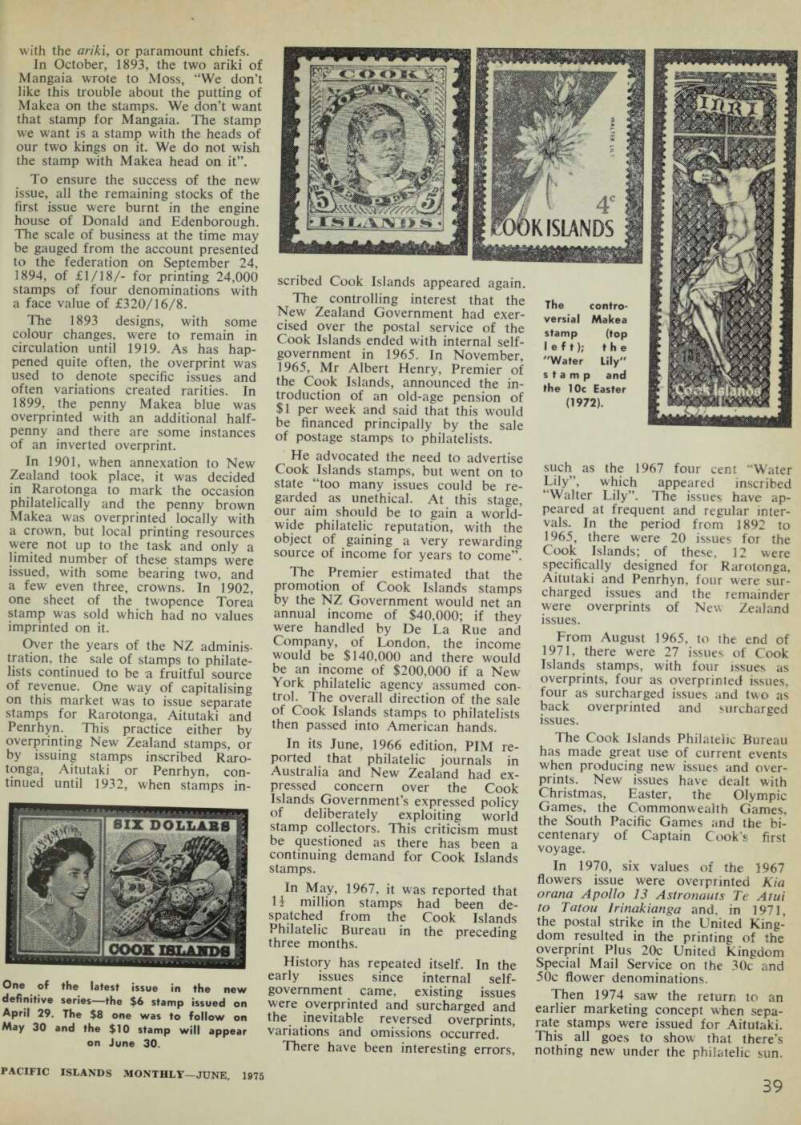
One of the latest issue in the new definitive series—the $6 stamp issued on April 29. The $8 one was to follow on May 30 and the $lO stamp will appear on June 30.
The contro versial Makea stamp (top left); the "Water Lily" stamp and the 10c Easter (1972).