The Editor's Mailbag
pp. 28-33 · Read in the full issue
International Date Line
You report Mr Hughes, a Seventh day Adventist in Tonga (PIM, March p 18) as wanting to know by what authority the International Date Line bends round Tonga; he doesn’t feel right going to church on Sunday.
In the first half of the last cen tury, when circumnavigating the world had become commonplace, a Date Line became essential to avoid a well-known anomaly; common usage placed it on the 180th meri dian, half the world away from the Greenwich meridian, a base line for accurate nautical tables. It is interest ing to speculate what would have been the effect if Tokyo rather than Greenwich had been the origin of this information; presumably the Date Line could have been placed down the centre of the Atlantic Ocean, discommoding only Green landers.
Four governments took steps to eliminate inconvenience caused by the 180th meridian being the Date Line. The Russian Government moved the Date Line east to avoid Siberia; the US Government moved it west to avoid the Aleutians; the UK Government moved it east so that all Fiji and New Zealand islands kept the same date. The Tongan Government was the last to act and decided, on the recommendation of its Prime Minister, to keep the same date as Fiji because of close religious and commercial ties with the then Colony.
Since both the 180th meridian and the International Date Line are made by Man for Man’s convenience, I find it difficult to appreciate Mr Hughes’ basic problem. His church prefers to standardise its Sabbath according to the 180th meridian when in Tonga, although not I be lieve in the Chatham Islands which are on a similar line of longitude. In Tonga this reduces the inconvenience to members of his Church, in that they observe Sabbatarian restrictions once each week only, from sunset Saturday to midnight Sunday. Mr Hughes would seem to favour fol lowing his Church’s restrictions from sunset Friday to sunset Saturday and being restricted by Tongan law from midnight Saturday to midnight
Sunday. The present arrangement seems more satisfactory to everyone except Mr Hughes,
T. G. Hawley,
(formerly Principal, Fiji School of Medicine and previously Chief Medi cal Officer, Tonga.) Auckland, NZ.
Wake Up Enterprise!
“Halcyon days of the tourist trade are over”—why? (PIM, April p 79).
I don’t wonder that so many hotels in the Islands are half-empty. What chance does the ordinary Australian have of reaching the Islands, almost his nearest neighbours, when even “Economy” or “Excursion” air fares are beyond the average pocket.
Air fares and package tours (with the exception of UTA New Caledonia deals) bear no comparison with the excursion fares to Europe and pack age tours to SE Asia. The Pacific Area Travel Association seems to cater for tourists in the millionaire class from the USA only, so that the only way the ordinary Australian can catch a glimpse of the Islands is by an “expenses paid” business trip or a crowded cruise.
Could not enterprising airlines and hotels get together on package tour weekly departures at attractive prices, thereby guaranteeing each other full seats and beds respectively. Wake up enterprise!
D. C. Wright, A.C.I.I., A.I.L.
Watsonia, Vic.
France's 'Quiet' Threats
The news in PIM (March, p 80) that the opposition of the New Zealand Government to French nuclear testing in the Pacific is being moderated is very disturbing.
It indicates clearly that the French Government intends to use whatever methods it can to maintain its hold over the French colonies in the Pacific. The quiet threats which France has used in order to compro mise New Zealand are by no means unique. Recently the French have launched diplomatic initiatives in Papua New Guinea for precisely these same reasons. The French Government is hoping that by offer ing material comforts to Pacific
countries it will turn their attention away from France’s Pacific empire.
No less disturbing than the French Government’s policy, however, is the failure of Pacific governments to take up the challenge. Thankfully, some critical voices have been heard, such as those of the recent ATOM con ference, but the governments them selves seem strangely ambivalent.
New Zealand wants France to allow Kiwi dairy products into the EEC, and Papua New Guinea is ap parently accepting the educational assistance which France has offered.
It seems unlikely, while links such as these remain, that Pacific govern ments will take a strong stand against French imperialism.
Until the Pacific governments realise the contradictions inherent in their present friendly policies towards the French government, there is little chance that either French nuclear testing, or its basis, the French colonial system, will disappear from the Pacific scene.
P. H. Grocott,
(Lecturer in political studies).
University of Papua New Guinea.
Johnny Young
John Pasquarelli’s seemingly in ordinate preoccupation with Johnny Young’s trigger finger (made ap parent in his tribute to that gentle man in your February issue p 75) could conceivably have as its origin an incident that allegedly took place in Angoram when both men were still residents there.
As related to me, it seems that Mr Pasquarelli was tank-testing one of his outboards in the Sepik River, and in so doing was making re peated passes up and down the shore line, each time passing by Johnny Young’s boat.
Now Mr Young, who lived on board and who was on that parti :ular afternoon trying to relax and -njoy a quiet drop with a couple of friends, became increasingly aggra vated by the continual rocking and bumping caused by Pasquarelli’s -ndless passes. No sooner had the motion subsided somewhat, when Zoom! there went “Guess who?” again.
According to my source, Johnny VTuing controlled himself admirably for quite some time, if one does not :ount the occasional reference to a certain individual’s lineage. However, t finally reached a stage where he :ould no longer restrain his emo tions. Whereupon he broke out that amous .22 riffle of his, and when lohn Pasquarelli whipped past on
his next and, as it turned out, last run, Johnny neatly plunked a slug clean through the engine cover, just behind and slightly to the left of Pasquarelli’s ear.
Pasquarelli, not particularly re knowned for his prudent ways, nevertheless, on this one occasion, all things being duly considered, and upon closer inspection, decided the motor had reached its optimum performance and retired to other activities.
As a postscript, I might add that, although Johnny Young’s expert marksmanship was indeed generally acclaimed by most people who knew him, there did subsequently arise a school of thought, based admittedly upon, solely, this one alleged in cident, and perpetrated no doubt by certain individuals sadly lacking in, among other things, charity, that Johnny Young was in point of fact a bloody lousy shot, or at the very least—and giving him the benefit of the doubt—had every now and then, like the rest of us mere mortals, an off-day.
James L. Koeser.
Wisconsin, USA.
Niue's Burial Caves
I wish to protest over interference with Niue Island burial caves by Canterbury Museum archaeologist Michael Trotter and his two USP assistants. (PIM, March, p 35.) Pacific pre-history is important and it’s doubtful if anyone could object to controlled field research, something very much different, however, from the suggestion of mere idle curiosity
reflected in the photograph accom panying the Niue Island article.
I believe a people have a right to protection of burial places; they should remain sacred and not inter fered with. There is, anyway, virtually nothing that can be learned, archaeologically, from human re mains today in the Western Pacific.
Earlier field work has given us all the answers to Niue, Tonga and Samoa origin through the study of human remains in this area. And I am, consequently, certain that Trotter will have nothing to add to the record —most probably will not even men tion in his field report the burial caves other than to refer, in passing, to their existence.
Imagine the response if I. as a Niuean, was to enter a vault in a Canterbury churchyard and have friends photograph me playing around with human bones. I’d get six months in prison. And I’d damn well deserve it.
Fetaulaku Stale.
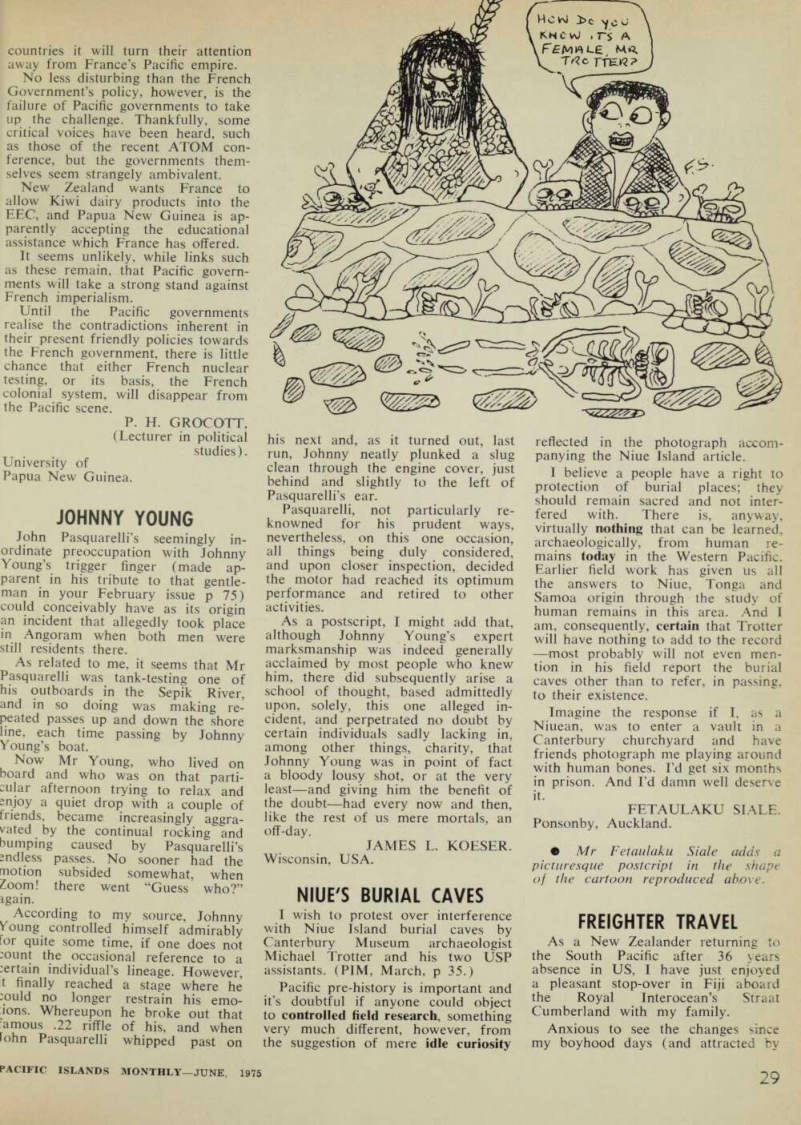
Ponsonby, Auckland. • Mr Fetaulaku Siale adds a picturesque postcript in the shape of the cartoon reproduced above.
Freighter Travel
As a New Zealander returning to the South Pacific after 36 years absence in US, I have just enjoyed a pleasant stop-over in Fiji aboard the Royal Interocean’s Straat Cumberland with my family.
Anxious to see the changes since my boyhood days (and attracted by
Letters
the" delightful cover . . . what a change from the old PIMs!) I bought a copy of your March issue and was particularly interested in the article an Fiji’s rise in port dues (p 63).
Although I am sure this is an in :vitable innovation probably to be Followed by other Pacific Island sorts, it is sad to learn that it may seriously impede passenger ships stopping over, or at least cut the ength of time they stop in Fiji.
One way around this for the south Pacific traveller, however, is he passenger-carrying freighters with service and cuisine we rated equal to ;or better than) the luxury SS France we took from New York to London . . . another short-lived sleasure with an end not as imminent is the port dues problem.
Indeed, like so many freight corn sanies, Royal Interocean will sell our straat Cumberland and other passen ger-carrying freighters within the Text 10 years and are building no nore of that type. Containerised
shipping is the new freighter economy.
But who knows whether or not an increased demand for these ser vices, often enabling one to island hop around the South Pacific, might not delay the axe? The Fiji Visitors Bureau might even be interested in promoting tourist travel in favour of those companies maintaining passen ger service!
Lincoln V. Adair.
Christchurch, NZ.
Guise, The Trader
Mr Nigel Oram (PIM, April, p 23) has succeeded in turning what he calls a “myth” into a “mythtery”.
He reaches his conclusions, as I have done in many matters, by research, but my information came from the mouth of the Bishop, who, as mission priest at Taupota, knew Guise and married him to his wife.
Those who knew Bishop Newton could never consider him gullible, nor irresponsible, and he told his story on various occasions. I could get support of this from the captain of our yacht at the time he gave me his version, who, now retired, a Devonian, lives within a few miles of me here.
My purpose in writing originally was due to my disgust at the sniping that went on about soi-disant petty French counts and “traders”, used
derogatively.
Between us, whoever is correct, it is established that John Guise, whether it be from a de Guise (rhyming with ‘bees’) in the Almanac de Gotha or from the beef eating Guise (rhyming with ‘guys’) of Burke’s Peerage, has a lineage that many a European in the Pacific would envy, not to be belittled.
I feel that Dr John Guise has given a splendid sense of leadership in Papua-New Guinea’s move to wards independence that will be written large in history. Good luck to him.
The Ven. C. W. Whonsbon
Aston.
Castle Hill, NSW. • Correspondents are asked to leave sufficient space between the lines in their letters for the sake of clarity and to enable easy insertion of corrections or alterations. A signed letter has a better chance of publica tion although a nom-de-plume may be used if publication of the name would be embarrassing. A signature must ac company a letter, though not neces sarily for publication.