Towards A Nuclear-Free Pacific
p. 27 · Read in the full issue
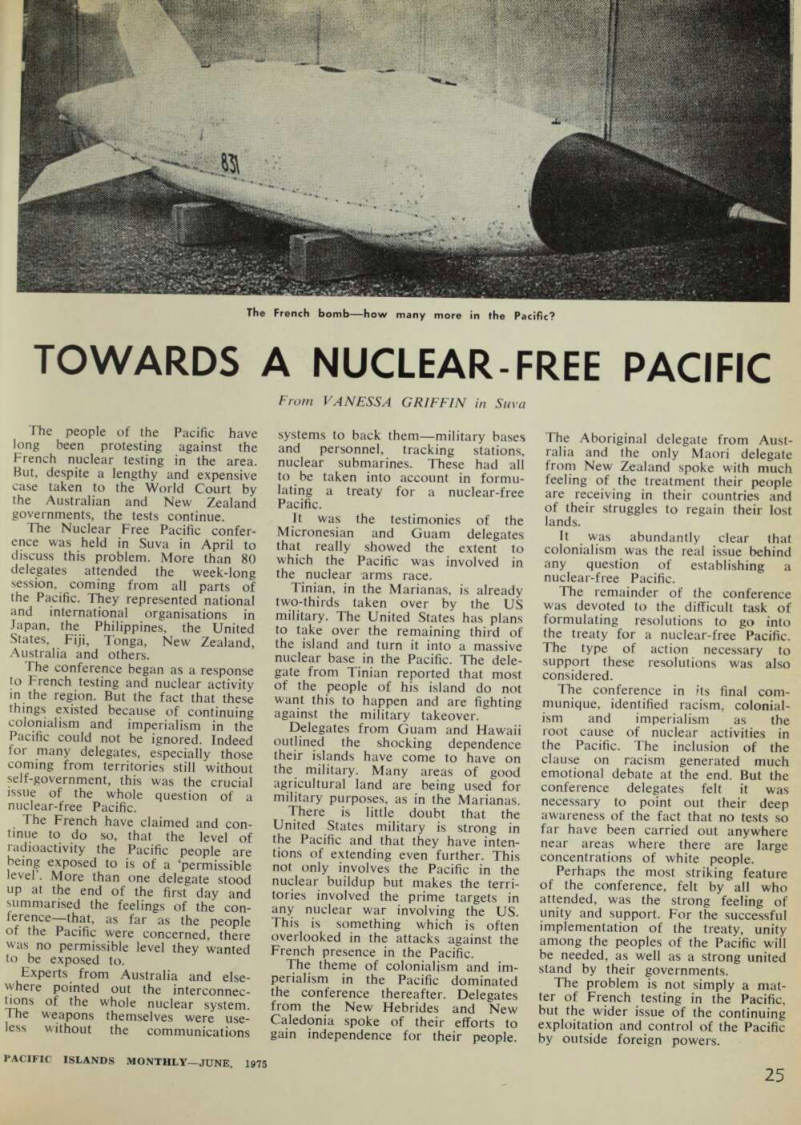
From VANESSA GRIFFIN in Suva
,™ e JL e ° ple °/ !- he Paci ? c ha u e Frpnnh b( ™ i prot . est . l . ng a gai n st the d h esnhe T r ipl e ath ng *”« he case taken to S m r* P .he Australian Zealand gcvernments, the tests continue. ine Nuclear Free Pacific conference was held in Suva m April to discuss this Problem. More than 80
delegates attended the week-long
session, coming from all parts of the Pacific. They represented national
Japan
States' Fiji Ton? New
Australia and others NewZealand ’
The conference beean as a frk b I f res Pou se n the r fT ty
things existed continnfna
® x,stea because of continuing Pacific co™ld a not for manv In.!™*, b lgnor ? d ; Inde « d man r dele B a tes, especially those renr^ n was S, ;he W cr hOU i “sue of the who e TfesHnn T nudear free Pacific ° f a THf* Fnsnoti l i , tinue to do\o tha Tbif radioactivity the Pacific being exposed to is of a C? P ? ui level’ More than onH up at the end of the fi fl l ference—that as far § as the neon?c of the Pacific were concerned P ?£fj! was no permissible level thev d wantPß to be ex P poSd to Experts from Australia anri ~i The 5 lx .ess wiLu. the
systems t 0 back them—military bases
and personnel, tracking stations, nuc [ ear submarines. These had all , f - be take " into account in formu- Pacify trea ‘ y ** 3 nUdear - free It was the testimonies of the Micronesian and Guam delegates that really showed the extent to which the Pacific was involved in the nuclear arms race.
Tinian, in the Marianas, is already two-thirds taken over by the US milltar y* The United St .ates has plans lu ° ver re ™ amm g third . of the island and turn it into a massive nucle ar base m the Pacific. 'Uie delegate from Tinian reported that most ° f the pCOpI u of his island do not Waa ha P pen an ? are fighting against the military takeover. !?? le § ate l fro "? Gl,anl and Hawaii outlined the shocking dependence their islands have come to have on I™ ° f «°° d agricultural land are being used for md i‘ ary P“ r P°, s . es ; as in the Marianas, There is little doubt that the strol ?8 in ? e Pacific and that they have mten- T°f e ? tendlng e L ven farther. This !A VZ° W *l ! he Pacific u in the ? bu ! ldup u Ut makes the tern * involved the prime targets in Thl n . Uclear invol . v . m 8 f he US.
Th , v . somet bmg w h lch is often £ verl ° oked m the a “ acks against the "“f “ / he - ?- aclfic - . • b r tber P e colonialism and im- P h enal,sm f in th " Pac i fic d ominated “ «
The Aboriginal delegate from Aust ralia and the only ß Maori delegate from New Zealand spoke with much feeling of the treatment their people
foft
lands.
It was abundantly clear that colonialism was the real issue behind any question of establishing a nuclear free Pacific eStam,smng a The remainder of the conference was devoted to the task of formulating resolutions to go into the tre aty for a nuclear-free Pacific.
The type of action necessary to support these resolutions was also considered.
The conference in its final com identified racism, colonial ism and imnerialism as the root cause of nuclear activities in the Pacific. The inclusion of the clause on racism generated much
emotionaT debatTa. fhe" the
conference delegates felt it was necessary to point out their deep awareness of the fact that no tests so far have been carried out anywhere near areas where there are large concentrations of white people.
Perhaps the most striki "g Mature of the conference, felt by all who attended, was the strong feeling of unity and support. For the successful implementation of the treaty, unity among the peoples of the Pacific will be needed ’ as well as a strong united stand by their governments, The problem is not simply a mat
iS W £?& t th co„S
The French bomb—how many more in the Pacific?