Tropicalities
pp. 22-25 · Read in the full issue

Many kinas
for the bride
The first bride price to be calcu lated in Papua New Guinea’s new currency was paid a few days after the introduction of the new currency.
Mr and Mrs Morea Rakani of Elavala village, near Port Moresby, used bamboo poles to support strings of two-kina notes worth more than $2,000 in Australian currency. But Australian two-dollar notes slipped into the act, too, because the official currency changeover is still in pro gress.
The total amount of money in volved in the bride price was paid in both currencies and was the equiva lent of $A3,245, to which was added 67 bags of rice, 14 hands of bananas, 836 ceremonial arm shells and 31 bags of sugar.
Meanwhile, reports from all parts of PNG indicated a generally trouble free acceptance of the new currency.
The one-kina coin, which has a hole in the centre and replaces the Aus tralian one-dollar note, has been par ticularly well received.
Some village people in the Sepik River area are so anxious to get the one-kina coins that they have refused to accept payment in Australian dollars for carvings they sell to tourists—although the coin and the note are both legal tender at present.
Some of the carvers have been pre pared to drop their prices consider ably provided all payment is in the new one-kina coin.
In one village visitors were offered carvings worth S 3 for a single one kina coin.
But, near Saidor, on the central north coast of the PNG mainland, a special currency education campaign was going ahead at April’s end to dispel the preaching of cultists there who claim the new money has no
“power”.
About 40 cult leaders and 250 followers said that one of their elders, Yali, whom they described as “the
King of Australia”, was angered by the new money because it did not depict his portrait.
The cultists said that no money had any power unless it showed the picture of an ancestor or a leader.
They claimed, too, that the animal pictures shown on the coins would make outsiders believe the people of PNG were “crocodiles, turtles, birds and butterflies”.
Yali was in the news 25 years ago when he clashed with Australian authorities over a cargo cult. He preached that magic ceremonies, some involving the Australian flag, would bring material wealth to the people.
Nauru’s new
phosphatie stamps
Nauru plans to issue a series of new stamps over the next five years.
Sylvia and Michael Goaman, were to visit the republic from the UK in May to take pictures and prepare drawings of all aspects of life on the island to form the basis of future issues.
Meanwhile, they have completed designs for the first Nauruan issue of four stamps which will mark im portant anniversaries connected with phosphate mining. The 5c stamp portrays Albert Ellis, who recog nised in his office that a piece of rock, used as a doorstop, was crude phosphate. This stamp marks the 75th anniversary of the discovery of phosphate.
The 70th anniversary of the signing of the Pacific Phosphate Co mining agreement is recalled in the 7c stamp, which shows a coolie of the time carrying phosphate in a basket, as other workers dig, and an aerial ropeway carrying the phosphate.
The topic of the 15c stamp is the formation of the British Phosphate Commission in 1920, and shows the contemporary electric railway and tugs towing launches of phosphate to a ship outside the reef. The 25c stamp shows a dumper and excavator at work, while in the background a vast cantilever bears phosphate to a
ship. This stamp marks the fifth anniversary of the transfer of authority to the Nauru Phosphate Commission in 1970.
Five - day fast
as a protest A Marist Brother from New Zea land, now teaching at the Marist Brothers High School, Suva, made his own form of protest the day after a young Fijian boxer, welterweight Waisea Tavusa, 22, died from severe brain damage suffered in a fight eight days earlier. He went on a five-day
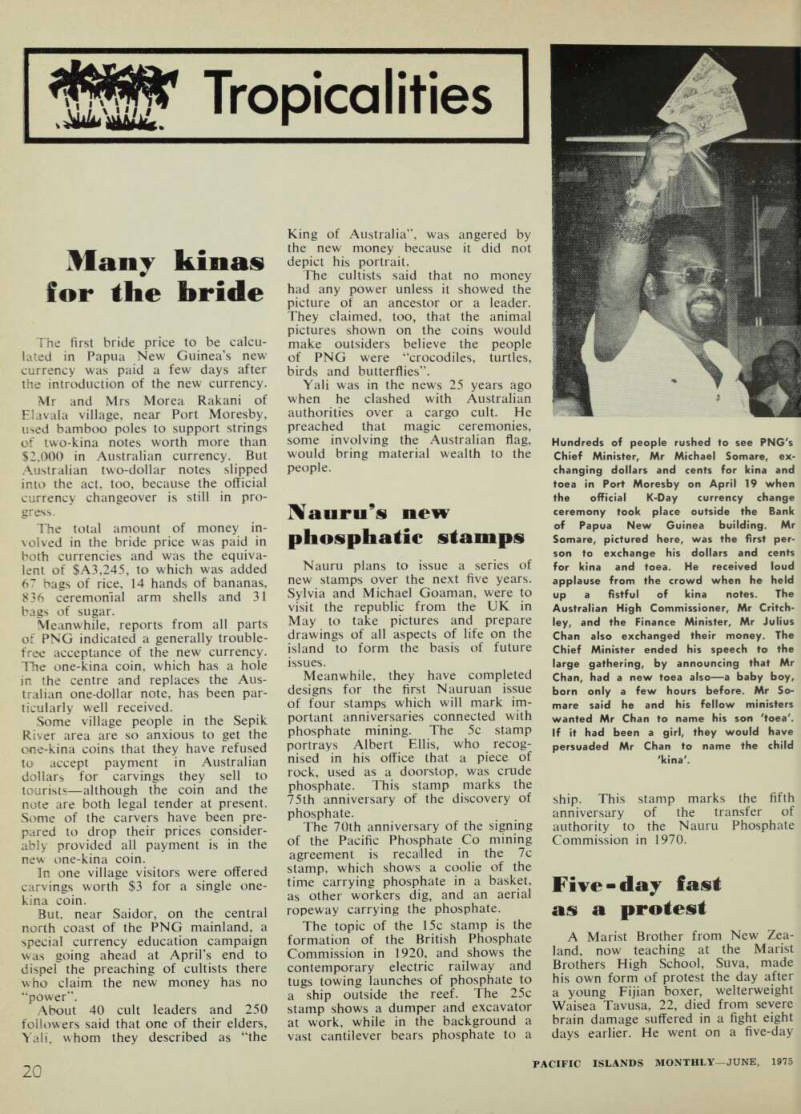
Hundreds of people rushed to see PNG's Chief Minister, Mr Michael Somare, ex changing dollars and cents for kina and toea in Port Moresby on April 19 when the official K-Day currency change ceremony took place outside the Bank of Papua New Guinea building. Mr Somare, pictured here, was the first per son to exchange his dollars and cents for kina and toea. He received loud applause from the crowd when he held up a fistful of kina notes. The Australian High Commissioner, Mr Critch ley, and the Finance Minister, Mr Julius Chan also exchanged their money. The Chief Minister ended his speech to the large gathering, by announcing that Mr Chan, had a new toea also—a baby boy, born only a few hours before. Mr So mare said he and his fellow ministers wanted Mr Chan to name his son 'toea'.
If it had been a girl, they would have persuaded Mr Chan to name the child 'kina'.
fast to protest against the “brutal and bloody sport of boxing”.
The brother, Brother Fergis Carrett, 40, said he hoped people would not see his fast as “just an other gimmick”. He did it because he had not heard of anyone coming out and saying the brutal sport should be stopped. He hoped other people felt as he did.
Brother Fergis had the answer for those who said there was more dan ger in football. In football, it was not the aim to knock an opponent senseless, as it was in boxing.
“Boxing is a blood sport and the young should be discouraged from taking it up”, he said.
The 'Coconut
Lady 9 leaves
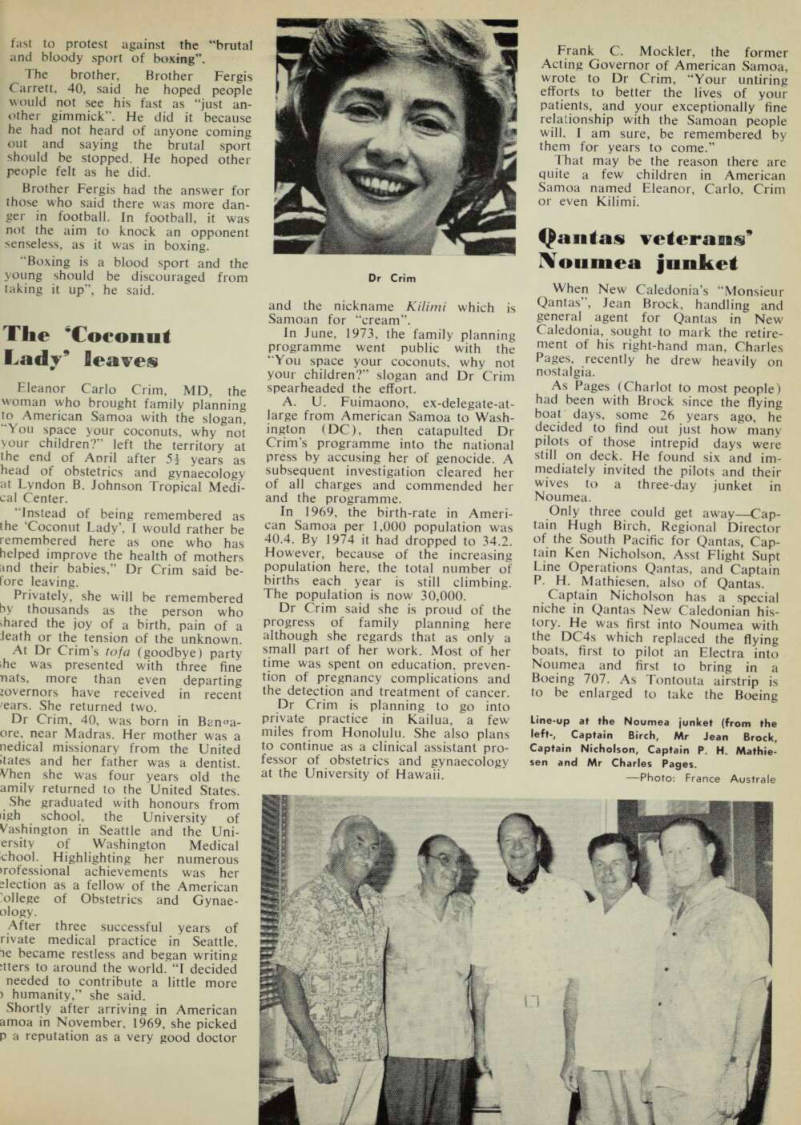
Eleanor Carlo Crim, MD, the woman who brought family planning to American Samoa with the slogan, “You space your coconuts, why not your children?” left the territory at the end of Aoril after years as head of obstetrics and gynaecology at Lyndon B. Johnson Tropical Medi cal Center.
“Instead of being remembered as the ‘Coconut Lady’, I would rather be remembered here as one who has helped improve the health of mothers and their babies,” Dr Crim said be fore leaving.
Privately, she will be remembered by thousands as the person who shared the joy of a birth, pain of a Jeath or the tension of the unknown.
At Dr Crim’s to fa (goodbye) party she was presented with three fine nats, more than even departing governors have received in recent 'ears. She returned two.
Dr Crim, 40, was born in Band ore, near Madras. Her mother was a nedical missionary from the United states and her father was a dentist.
Vhen she was four years old the amily returned to the United States.
She graduated with honours from ligh school, the University of Vashinglon in Seattle and the Uni ersity of Washington Medical chool. Highlighting her numerous orofessional achievements was her election as a fellow of the American College of Obstetrics and Gynae cology.
After three successful years of rivate medical practice in Seattle. ie became restless and began writing ;tters to around the world. “I decided needed to contribute a little more ) humanity,” she said.
Shortly after arriving in American amoa in November, 1969, she picked p a reputation as a very good doctor
and the nickname Kilimi which is Samoan for “cream”.
In June, 1973, the family planning programme went public with the “You space your coconuts, why not your children?” slogan and Dr Crim spearheaded the effort.
A. U. Fuimaono, ex-delegate-at large from American Samoa to Wash ington (DC), then catapulted Dr Crim’s programme into the national press by accusing her of genocide. A subsequent investigation cleared her of all charges and commended her and the programme.
In 1969, the birth-rate in Ameri can Samoa per 1,000 population was 40.4. By 1974 it had dropped to 34.2.
However, because of the increasing population here, the total number of births each year is still climbing.
The population is now 30,000.
Dr Crim said she is proud of the progress of family planning here although she regards that as only a small part of her work. Most of her time was spent on education, preven tion of pregnancy complications and the detection and treatment of cancer.
Dr Crim is planning to go into private practice in Kailua, a few miles from Honolulu. She also plans to continue as a clinical assistant pro fessor of obstetrics and gynaecology at the University of Hawaii.
Frank C. Mockler, the former Acting Governor of American Samoa, wrote to Dr Crim, “Your untiring efforts to better the lives of your patients, and your exceptionally fine relationship with the Samoan people will, I am sure, be remembered by them for years to come.”
That may be the reason there are quite a few children in American Samoa named Eleanor, Carlo, Crim or even Kilimi.
Qantas veterans’
Noumea Junket
When New Caledonia’s “Monsieur Qantas’’, Jean Brock, handling and general agent for Qantas in New Caledonia, sought to mark the retire ment of his right-hand man, Charles Pages, recently he drew heavily on nostalgia.
As Pages (Chariot to most people) had been with Brock since the flying boat days, some 26 years ago, he decided to find out just how many pilots of those intrepid days were still on deck. He found six and im mediately invited the pilots and their wives to a three-day junket in Noumea.
Only three could get away—Cap tain Hugh Birch, Regional Director of the South Pacific for Qantas, Cap tain Ken Nicholson, Asst Flight Supt Line Operations Qantas, and Captain P. H. Mathiesen, also of Qantas.
Captain Nicholson has a special niche in Qantas New Caledonian his tory. He was first into Noumea with the DC4s which replaced the flying boats, first to pilot an Electra into Noumea and first to bring in a Boeing 707. As Tontouta airstrip is to be enlarged to take the Boeing
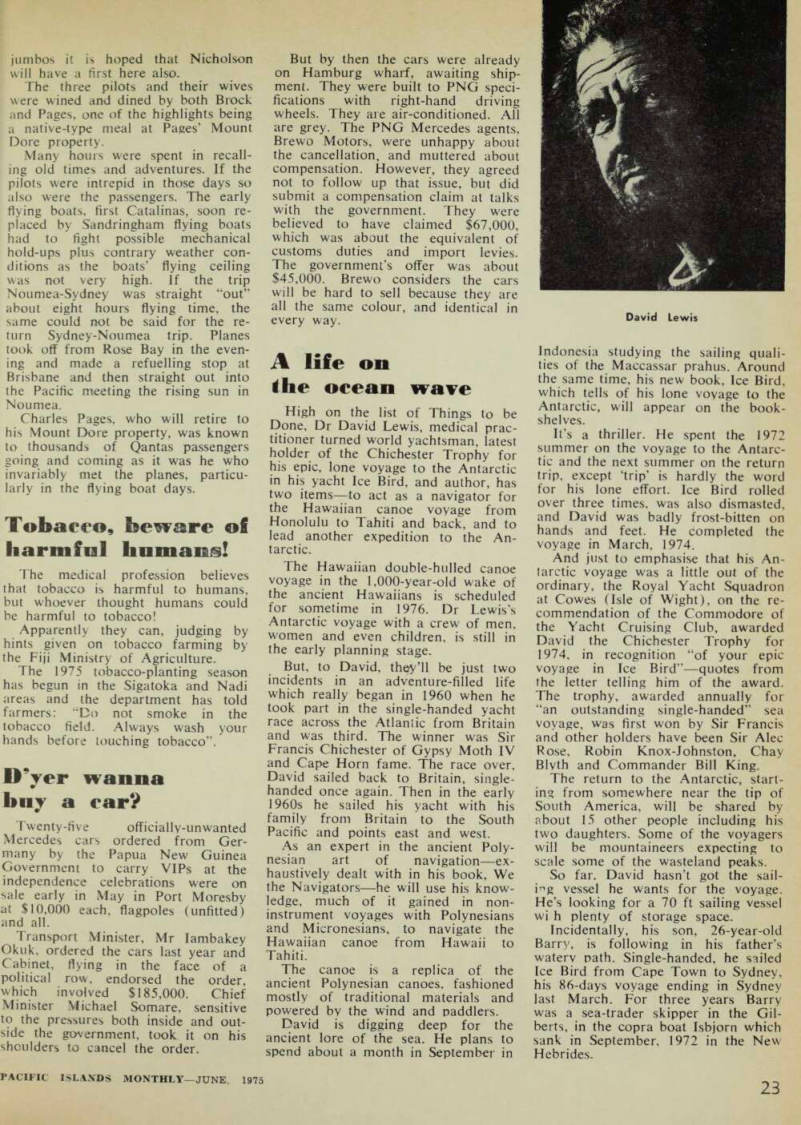
Line-up at the Noumea junket (from the left-. Captain Birch, Mr Jean Brock, Captain Nicholson, Captain P. H. Mathie sen and Mr Charles Pages.
Photo: France Australe
Dr Crim
jumbos it is hoped that Nicholson will have a first here also.
The three pilots and their wives were wined ami dined by both Brock and Pages, one of the highlights being a native-type meal at Pages’ Mount Dore property.
Many hours were spent in recall ing old times and adventures. If the pilots were intrepid in those days so also were the passengers. The early flying boats, first Catalinas, soon re placed by Sandringham flying boats had to fight possible mechanical hold-ups plus contrary weather con ditions as the boats’ flying ceiling was not very high. If the trip Noumea-Sydney was straight “out” about eight hours flying time, the same could not be said for the re turn Sydney-Noumea trip. Planes took off from Rose Bay in the even ing and made a refuelling stop at Brisbane and then straight out into the Pacific meeting the rising sun in Noumea.
Charles Pages, who will retire to his Mount Dore property, was known to thousands of Qantas passengers going and coming as it was he who invariably met the planes, particu larly in the flying boat days.
Tobacco, beware of
harmful human§!
The medical profession believes that tobacco is harmful to humans, but whoever thought humans could be harmful to tobacco!
Apparently they can, judging by hints given on tobacco farming by the Fiji Ministry of Agriculture.
The 1975 tobacco-planting season has begun in the Sigatoka and Nadi areas and the department has told farmers: “Do not smoke in the tobacco field. Always wash your hands before touching tobacco”.
HVcr wanna
buy a car?
Twenty-five officially-unwanted Mercedes cars ordered from Ger many by the Papua New Guinea Government to carry VIPs at the independence celebrations were on sale early in May in Port Moresby at $lO,OOO each, flagpoles (unfitted) and all.
Transport Minister, Mr lambakey Okuk, ordered the cars last year and Cabinet, flying in the face of a political row, endorsed the order, which involved $185,000. Chief Minister Michael Somare, sensitive to the pressures both inside and out side the government, took it on his shoulders to cancel the order.
But by then the cars were already on Hamburg wharf, awaiting ship ment. They were built to PNG speci fications with right-hand driving wheels. They are air-conditioned. All are grey. The PNG Mercedes agents, Brewo Motors, were unhappy about the cancellation, and muttered about compensation. However, they agreed not to follow up that issue, but did submit a compensation claim at talks with the government. They were believed to have claimed $67,000, which was about the equivalent of customs duties and import levies.
The government’s offer was about $45,000. Brewo considers the cars will be hard to sell because they are all the same colour, and identical in every way.
A life on
the ocean wave High on the list of Things to be Done, Dr David Lewis, medical prac titioner turned world yachtsman, latest holder of the Chichester Trophy for his epic, lone voyage to the Antarctic in his yacht Ice Bird, and author, has two items—to act as a navigator for the Hawaiian canoe voyage from Honolulu to Tahiti and back, and to lead another expedition to the An tarctic.
The Hawaiian double-hulled canoe voyage in the 1,000-year-old wake of the ancient Hawaiians is scheduled for sometime in 1976. Dr Lewis’s Antarctic voyage with a crew of men. women and even children, is still in the early planning stage.
But, to David, thqy’ll be just two incidents in an adventure-filled life which really began in 1960 when he took part in the single-handed yacht race across the Atlantic from Britain and was third. The winner was Sir Francis Chichester of Gypsy Moth IV and Cape Horn fame. The race over, David sailed back to Britain, single handed once again. Then in the early 1960 s he sailed his yacht with his family from Britain to the South Pacific and points east and west.
As an expert in the ancient Poly nesian art of navigation—ex haustively dealt with in his book. We the Navigators—he will use his know ledge, much of it gained in non instrument voyages with Polynesians and Micronesians, to navigate the Hawaiian canoe from Hawaii to Tahiti.
The canoe is a replica of the ancient Polynesian canoes, fashioned mostly of traditional materials and powered by the wind and paddlers.
David is digging deep for the ancient lore of the sea. He plans to spend about a month in September in
Indonesia studying the sailing quali ties of the Maccassar prahus. Around the same time, his new book. Ice Bird, which tells of his lone voyage to the Antarctic, will appear on the book shelves.
It’s a thriller. He spent the 1972 summer on the voyage to the Antarc tic and the next summer on the return trip, except ‘trip’ is hardly the word for his lone effort. Ice Bird rolled over three times, was also dismasted, and David was badly frost-bitten on hands and feet. He completed the voyage in March, 1974.
And just to emphasise that his An tarctic voyage was a little out of the ordinary, the Royal Yacht Squadron at Cowes (Isle of Wight), on the re commendation of the Commodore of the Yacht Cruising Club, awarded David the Chichester Trophy for 1974, in recognition “of your epic voyage in Ice Bird”—quotes from the letter telling him of the award.
The trophy, awarded annually for “an outstanding single-handed” sea voyage, was first won by Sir Francis and other holders have been Sir Alec Rose, Robin Knox-Johnston, Chay Blyth and Commander Bill King.
The return to the Antarctic, start ing from somewhere near the tip of South America, will be shared by about 15 other people including his two daughters. Some of the voyagers will be mountaineers expecting to scale some of the wasteland peaks.
So far. David hasn’t got the sail ing vessel he wants for the voyage.
He’s looking for a 70 ft sailing vessel wi h plenty of storage space.
Incidentally, his son, 26-year-old Barry, is following in his father’s waterv path. Single-handed, he sailed Ice Bird from Cape Town to Sydney, his 86-days voyage ending in Sydney last March. For three years Barry was a sea-trader skipper in the Gil berts, in the copra boat Isbjorn which sank in September. 1972 in the New Hebrides.
David Lewis