the homeland
pp. 19-21 · Read in the full issue

Banabans take their fight to the homeland
By JOHN GARRETT, who went with the Banabans from Rabi in Fiji, home to Ocean Island.
Ocean Island phosphate, after three-quarters of a century of crop and herd enrichment in Australia and New Zealand, is now producing food for thought at an alarming rate.
When the Fiji inter-island vessel Ai Sokula, 399 tons, under Captain Frank Mitchell, landed 36 labourers from the Banaban community of Rabi, Fiji, on Ocean Island in March, tension between the Ocean Islanders and the GEIC zoomed from medium to high.
On the way to Ocean Island, via Nauru, we heard on the ship’s radio that British minister Joan Lestor, re sponsible for Pacific territories, had characterised the trip as a political manoeuvre and that an official party was coming over from Tarawa to cope.
Ocean had been declared a closed district in early March, so all on board were given a licence to land.
The GEIC’s small white ship Nareau was riding the waves ahead jf us. Officials and police clambered iboard and walkie-talkies dotted the >cene ashore throughout the four-day /isit. On Nareau was Mr Colin Red iton, deputy secretary to the GEIC -hief Minister and ex-District Officer it Funafuti in the Ellice.
He had been sent to “back up” the >cean Island DO Kamuta Latasi, a ivil servant who will “secede” later his year when his islands, the Ellice, >ecome the Tuvalus. With him came i team of information men from farawa’s radio station and official lews publication The Atoll Pioneer.
But the most intriguing aspect of be Tarawa supervisory mission, /hich also said it was assisting the ianabans to settle-in their pilgrim ather work-force, was its abortive dld-goose chase for Fiji opposition arliamentarian and mercurial union rganiser Apisai Tora.
Captain Mitchell of the Ai Sokula 'as piqued when his passenger list 'as challenged. He told the GEIC olice officer that Mr Tora was not n board. Colin Redston “reserved Dmment” as to whether he would ave been refused landing rights, but ie police told Captain Mitchell that
their superiors had instructed that he was not to land.
Later conversations ashore revealed extreme official sensitivity about Mr Tora’s coming to Ocean to cause “big trouble” on the labour scene. The scares and rumours seem to have been based on wild speculation, originating somewhere in Fiji, that Mr Tora might come along. He is an acquaintance and sometime-business associate of Tekoti Rotan, the leader of the Rabi Banabans on the trip.
In the event, Mr Tora, who was amused by the report, reaped un solicited international publicity. The Tarawa officials, who knew very little about his record, were surprised to hear that he was an MF.
The episode showed the patchy intelligence about Fiji, a neighbour nation, where the Banaban landing party held citizenship to a man.
Possibly, the sequel will be more serious reflection in the Gilberts about future intra-regional relation ships. The sensation of being still tied to Britannia’s petticoats is un mistakable in dealing with the Tarawa government as of now. This in itself is a psychological irritant in contacts with Fiji and Nauru. The outgoing colonial power might well do more to encourage policy formation by re ference to the Pacific rather than London.
In a stance of free contact and dialogue with its already independent Pacific neighbours, the GEIC might be better able to find some of the chinks in the armour of its rich and active Ocean Island assailant.
Many impartial observers doubt the Banaban claim to be a “distinct race”, quite apart from the emotive quality of the inaccurate word race when used in the United Nations.
Linguistically, and to a large ex tent culturally, the present indivisi bility of Ocean Island and the rest of the GEIC becomes more obvious as the Banabans become better known. No political solution of the Banaban claim for separate status can ignore the truth that now, and for a long future, intermarriage and the pay-cheques of phosphate workers are going to accentuate the liaison.
Therefore, say friendly observers, why not a properly-convened inter national round-table meeting, or series of meetings, for all parties to the current disputes, under neutral auspices?
The proviso would now rule out neighbouring Nauru as sponsor.
Although the Gilbertese and Bana bans met on Nauru for cagey and not unfriendly talks earlier this year, Nauru has always had an axe to grind because of its own long struggle to get out from under Australia. On April 25 the Nauruan Government presented $lO,OOO to a party of Bana ban dancers and announced its full support for the Banaban claim to independent status.
Assuming the round tablecloth is laid “somewhere in the Pacific", who should be there?
The British, following the report of two British parliamentarians. Sir Bernard Braine and Mr John Lee,
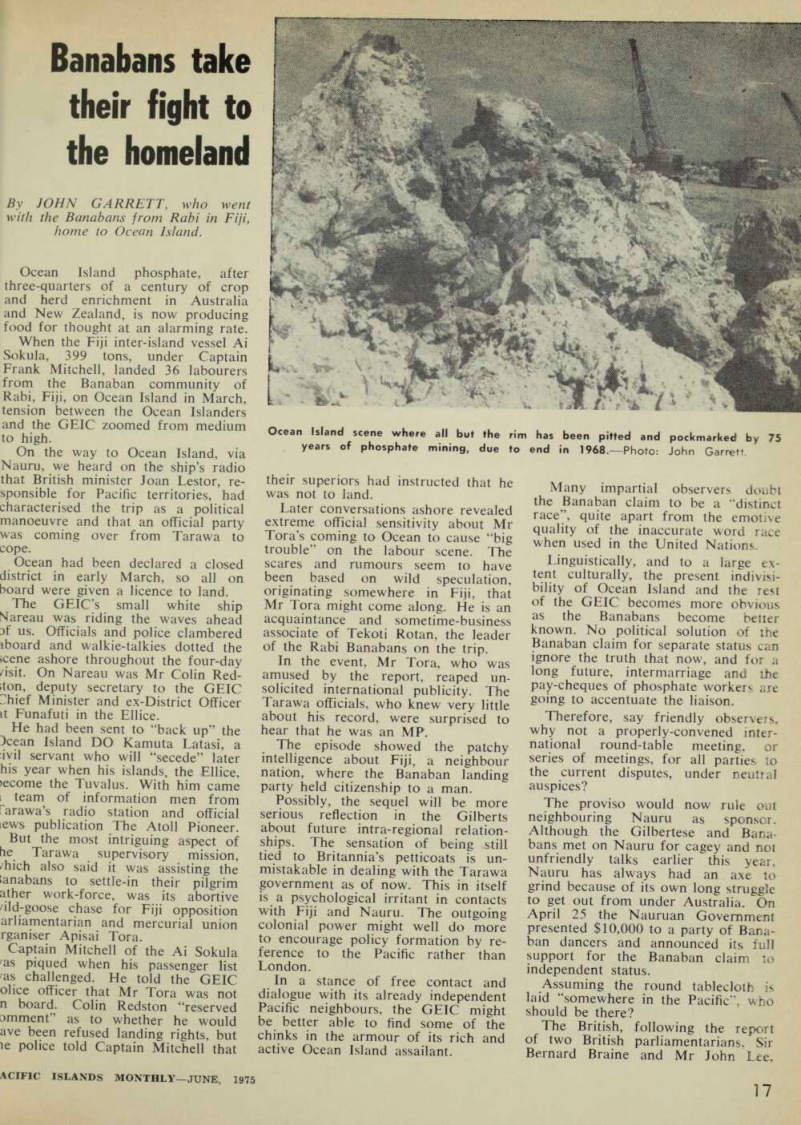
Ocean Island scene where all but the rim has been pitted and pockmarked by 75 years of phosphate mining, due to end in 1968. Photo: John Garrett.
who recently visited Ocean Island, Tarawa, Nauru, and Suva, on the invitation and at the expense of the Banabans, must be there. Current Banaban action in the Chancery Courts in London, seeking retrospec tive compensation for alienation of their land, and for low phosphate royalties, is at present sub judice, so the agenda could stick to the political plea.
Observers, with right to ask ques tions or seek clarification, could come from the UN Committee of 24 on Decolonialisation and from Fiji, where the Banabans want associate status in addition to their indepen dence from the Gilberts. Both the Gilbertese delegates and Fiji ob servers could then ask the Banabans “Why not a future official relation ship with both the Gilberts and Fiji, for the benefit of all three, and mutual acceptance of trade and cul tural ties?”
The role of Australia and New Zealand, not much mentioned as yet in international reporting, is murkier.
Since the Nauru Agreement after World War I, both countries have had the benefit of cut-rate Ocean phosphate. Although the British Phosphate Commissioners operate autonomously, once appointed, in fact both Australia and New Zealand are responsible for their nominees and, by implication, for the just functioning of the industry.
Why should the British Govern ment have to face alone a court case for damages, when Australia and New Zealand have reaped handsome economic benefits from the arrange ments now being questioned at the Old Bailey in London?
Neither the Gilbertese nor the Banabans have yet trained any guns on either Australia or New Zealand.
Yet Sir Albert Ellis, the discoverer of the phosphate, who conspired with Lord Stanmore (Gordon of Fiji), his chairman of directors in London, to procure a hard financial deal in 1901, with the political annexation of Ocean Island to the Gilberts, was a New Zealander.
The present Ocean Island phos phate manager, Mr E. B. Chapman, is an Australian, like many members of his executive staff. When we sought a press interview with him he asked for written questions.
On our arrival in his outer office (along with the information officials over from Tarawa) he brusquely told us: “No cameras; no tape-recorders”.
He was extremely sensitive about labour relations, which he dismissed by saying his concern held to ILO requirements and the labour regula tions of the Colony.
More revealing was his reply to
a question about whether traces of bone-damaging cadmium were pre sent in Ocean Island phosphate.
Traces have been found at Nauru, which is installing a new calcination treatment and cadmium-extraction plant at an estimated S 2 million.
Mr Chapman, again defensively, said that at Ocean “the question hasn’t come up”. Asked if there had been an analysis, he obliquely re ferred to the sales of phosphate to Japan (at the higher world price) by asserting that “only the Japanese are cadmium-conscious”. It seemed to us that this was a reply that would intrigue the young and crusade-bent lobbies of Australian environmental ists Mr Chapman’s frontal meeting with us gave pause to our Gilbertese media colleagues, who, as Pacific Islanders, are accustomed to receiving unpalatable information in the pack aging of “the politeness expected by custom”. When they shared their ex perience with Ai Sokula’s passengers from Fiji they were told: “It sounds like the old hands in CSR (the
Colonial Sugar Refining Company)”.
Mr Apisai Tora has many friends in the Australian and New Zealand unions, particularly on the Australian waterfront, where Ocean Island’s precious supply vessels carrying water and supplies are turned round. In late April vocal workers on Ocean Island, who are not happy with the management, said they would like to have him come along and form a union.
At a round-table meeting to face all the issues many questions could be asked about the Phosphate Com mission and its future policy before it winds up on Ocean in late 1978.
The issues are bound up with longer-range posers about whether Ocean and Nauru can be economic ally mined well beyond the present anticipated packing-up dates.
No secret is made in either place of the fact that North American Hawaii-based investigators consider that with modern vacuum-suction equipment, an enormous fortune of phosphate - rich rubble and dust, hitherto unreachable in the interstices between limestone pinnacles, can be salvaged and sold.
Intelligent collaboration between Nauru, Ocean, the Gilberts and Fiji, could harness this fortune, at higher world phosphate prices, to continuing international demand, with advice from the EEC and exploitable Asian outlets.
This would not be the only entic ing aspect of a free economic future for the Gilberts, where brine shrimp in great quantity has been surveyed in the lagoon at Christmas Island.
Found only in one or two other places in the world in similar con centration, the shrimp can be fished, dried, and sold as food for pet fish, to keepers of home aquaria in the high-rise housing of Europe and America, where dogs and cals are banned, but ornamental fish axe not.
Hawaiian advisers predict a multi million dollar industry for the Gil berts from this source.
A consortium of independent Pacific nations would also be in a better bargaining position to ensure many forms of multilateral aid through the UN and other inter national bodies.
Perhaps, in June and July, the Banabans might consider laying aside their Public Relations mortar and artillery in favour of the green beige table-cloth. Moreover, many believe in the Pacific that the Banabans have now spent enough on hospitality and porters.
Why not suggest to independent Pacific Island governments that they take the initiative in calling an inter national round-table meeting within kindness for their potential sup the Pacific—and that many friendly governments around and beyond the region pay the bills for it and stand by to assist in carrying out the con clusions reached?
• MPs’ report on p 87.
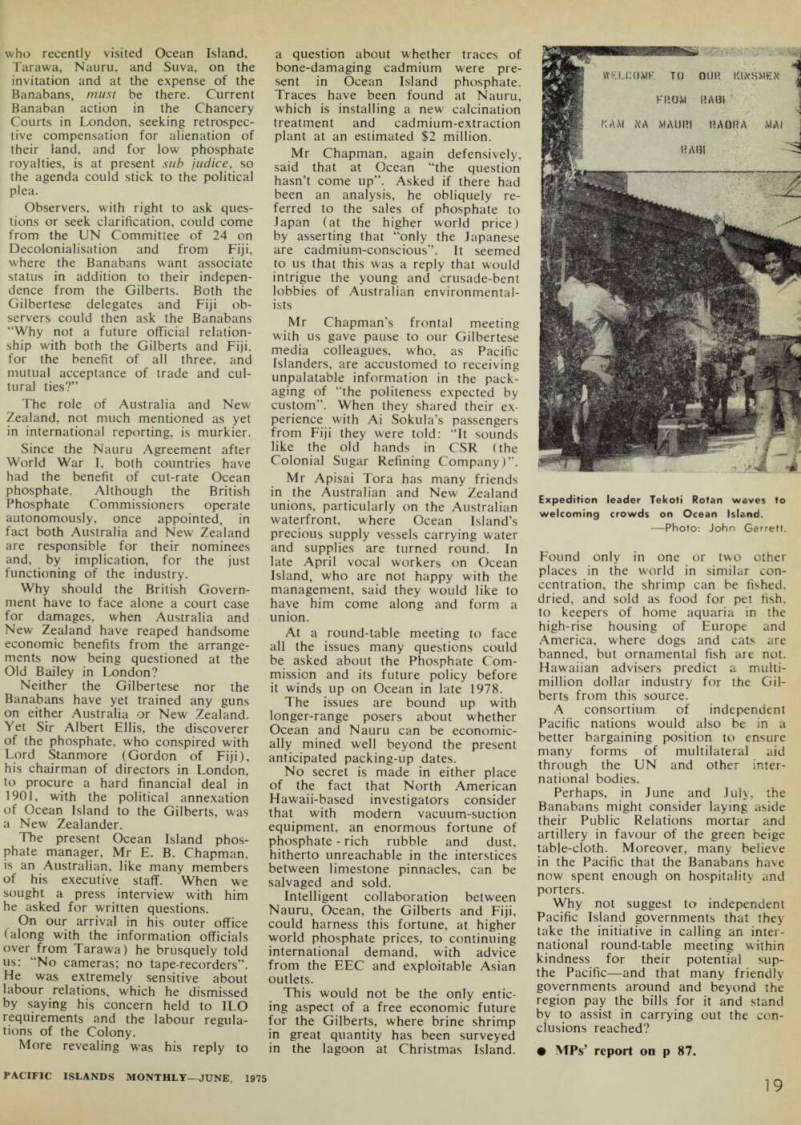
Expedition leader Tekoti Rotan waves to welcoming crowds on Ocean Island.
Photo: John Garrett.