Sophistication in the underworld:
p. 34 · Read in the full issue
a dark side to Fiji’s development
From VI JEN DR A KUMAR in Emit oka
A N unprecedented crime wave is sweeping over Fiji. While cases involving burglaries and violent robberies cram the courts, a large percentage of crimes con nected with theft go undetected.
The government, alarmed at the rocketing crime rate, has set up a high-powered parliamentary select committee to study in depth the causes of increased criminal activity.
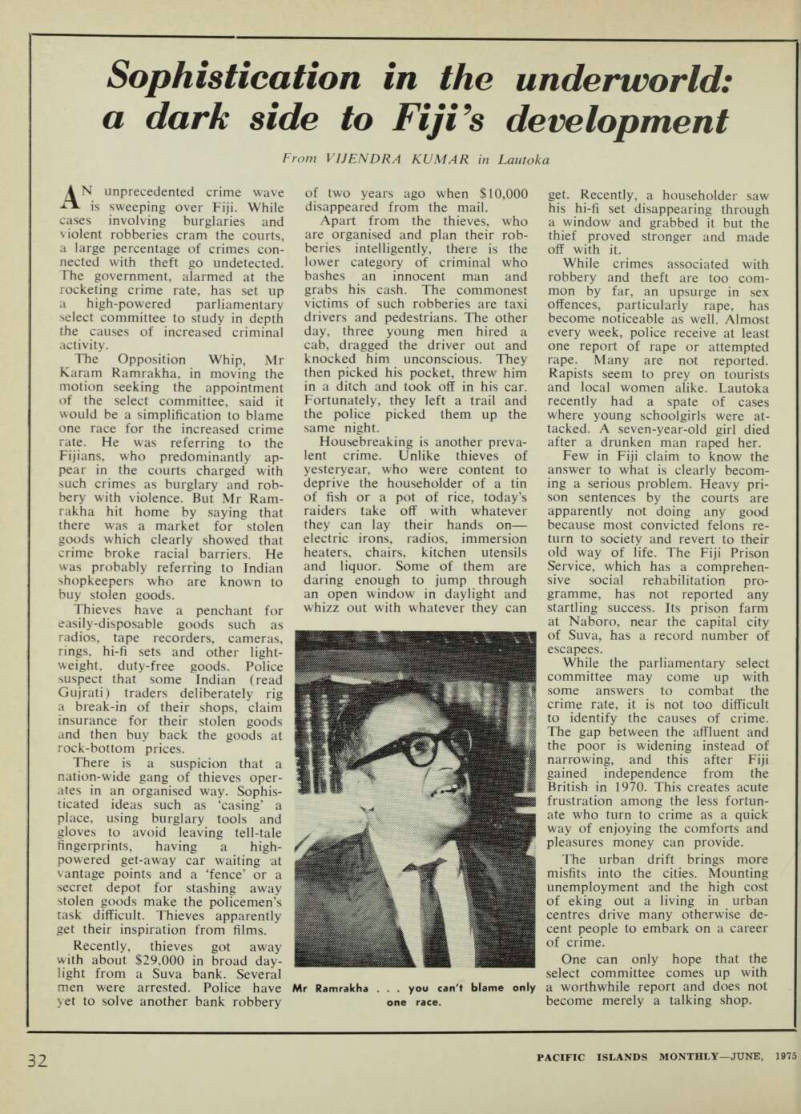
The Opposition Whip, Mr Karam Ramrakha, in moving the motion seeking the appointment of the select committee, said it would be a simplification to blame one race for the increased crime rate. He was referring to the Fijians, who predominantly ap pear in the courts charged with such crimes as burglary and rob bery with violence. But Mr Ram rakha hit home by saying that there was a market for stolen goods which clearly showed that crime broke racial barriers. He was probably referring to Indian shopkeepers who are known to buy stolen goods.
Thieves have a penchant for easily-disposable goods such as radios, tape recorders, cameras, rings, hi-fi sets and other light weight, duty-free goods. Police suspect that some Indian (read Gujrati) traders deliberately rig a break-in of their shops, claim insurance for their stolen goods and then buy back the goods at rock-bottom prices.
There is a suspicion that a nation-wide gang of thieves oper ates in an organised way. Sophis ticated ideas such as ‘casing’ a place, using burglary tools and gloves to avoid leaving tell-tale fingerprints, having a high powered get-away car waiting at vantage points and a ‘fence’ or a secret depot for stashing away stolen goods make the policemen’s task difficult. Thieves apparently get their inspiration from films.
Recently, thieves got away with about $29,000 in broad day light from a Suva bank. Several men were arrested. Police have yet to solve another bank robbery
of two years ago when $lO,OOO disappeared from the mail.
Apart from the thieves, who are organised and plan their rob beries intelligently, there is the lower category of criminal who bashes an innocent man and grabs his cash. The commonest victims of such robberies are taxi drivers and pedestrians. The other day, three young men hired a cab, dragged the driver out and knocked him unconscious. They then picked his pocket, threw him in a ditch and took off in his car.
Fortunately, they left a trail and the police picked them up the same night.
Housebreaking is another preva lent crime. Unlike thieves of yesteryear, who were content to deprive the householder of a tin of fish or a pot of rice, today’s raiders take off with whatever they can lay their hands on— electric irons, radios, immersion heaters, chairs, kitchen utensils and liquor. Some of them are daring enough to jump through an open window in daylight and whizz out with whatever they can
get. Recently, a householder saw his hi-fi set disappearing through a window and grabbed it but the thief proved stronger and made off with it.
While crimes associated with robbery and theft are too com mon by far, an upsurge in sex offences, particularly rape, has become noticeable as well. Almost every week, police receive at least one report of rape or attempted rape. Many are not reported.
Rapists seem to prey on tourists and local women alike. Lautoka recently had a spate of cases where young schoolgirls were at tacked. A seven-year-old girl died after a drunken man raped her.
Few in Fiji claim to know the answer to what is clearly becom ing a serious problem. Heavy pri son sentences by the courts are apparently not doing any good because most convicted felons re turn to society and revert to their old way of life. The Fiji Prison Service, which has a comprehen sive social rehabilitation pro gramme, has not reported any startling success. Its prison farm at Naboro, near the capital city of Suva, has a record number of escapees.
While the parliamentary select committee may come up with some answers to combat the crime rate, it is not too difficult to identify the causes of crime.
The gap between the affluent and the poor is widening instead of narrowing, and this after Fiji gained independence from the British in 1970. This creates acute frustration among the less fortun ate who turn to crime as a quick way of enjoying the comforts and pleasures money can provide.
The urban drift brings more misfits into the cities. Mounting unemployment and the high cost of eking out a living in urban centres drive many otherwise de cent people to embark on a career of crime.
One can only hope that the select committee comes up with a worthwhile report and does not become merely a talking shop.
Mr Ramrakha . . . you can't blame only one race.