Niue Govt In Cattle Business
pp. 79-83 · Read in the full issue
From STAFFORD L. K. GUEST on Niue
Development of a cattle herd to meet Niue Island’s increasing demands for a domestic meat supply could eventually lead to the establishment of a South Pacific artificial breeding station.
Niue’s isolation—an inhibiting factor in previous attempts to build up agricultural-based industries to strengthen the tiny island’s economy —is proving, in this case, to be an asset. The present herd of 820 animals, grazing on 1,200 acres of village pasture is almost disease free.
There is little evidence of internal parasites, ticks, and ill thrift in young stock.
Two TB tests run on all cattle last year were negative and all breeding stock, blood-tested for brucellosis returned negative reactions.
All cattle on Niue is owned by the government which recently stopped the importation of further animals to prevent disease.
“We are now bringing in supplies of semen from Australia and New Zealand and concentrating on an artificial insemination scheme which
was commenced last year”, the agri cultural officer in charge of develop ment, New Zealander Danny O’Brien, told me.
He considers that the island is an ideal breeding station to raise cattle for Fiji, Samoa and the Cook Islands, With shipping becoming more regu lar from Niue to Fiji and Rarotonga he considers transport will not prove a major problem, “A well-bred animal can fetch up to $l,OOO and if we could eventually breed up to 20 beasts a year, the returns would play a large part in supporting the local economy”, said Danny.
Niue’s existing herd consists of 382 breeding cows, including two-year heifers, 89 one-yearling heifers, 28 two-year steers, 90 yearling steers, 14 yearling bulls, 18 mixed-aged bulls and 206 calves. The breed is basic Friesian and Santa Gertrudis.
Last year the Agriculture Depart ment, now headed by the first Niuean director, Morris Tafatu, successfully reared 31 calves conceived by arti ficial insemination. Four breeds of
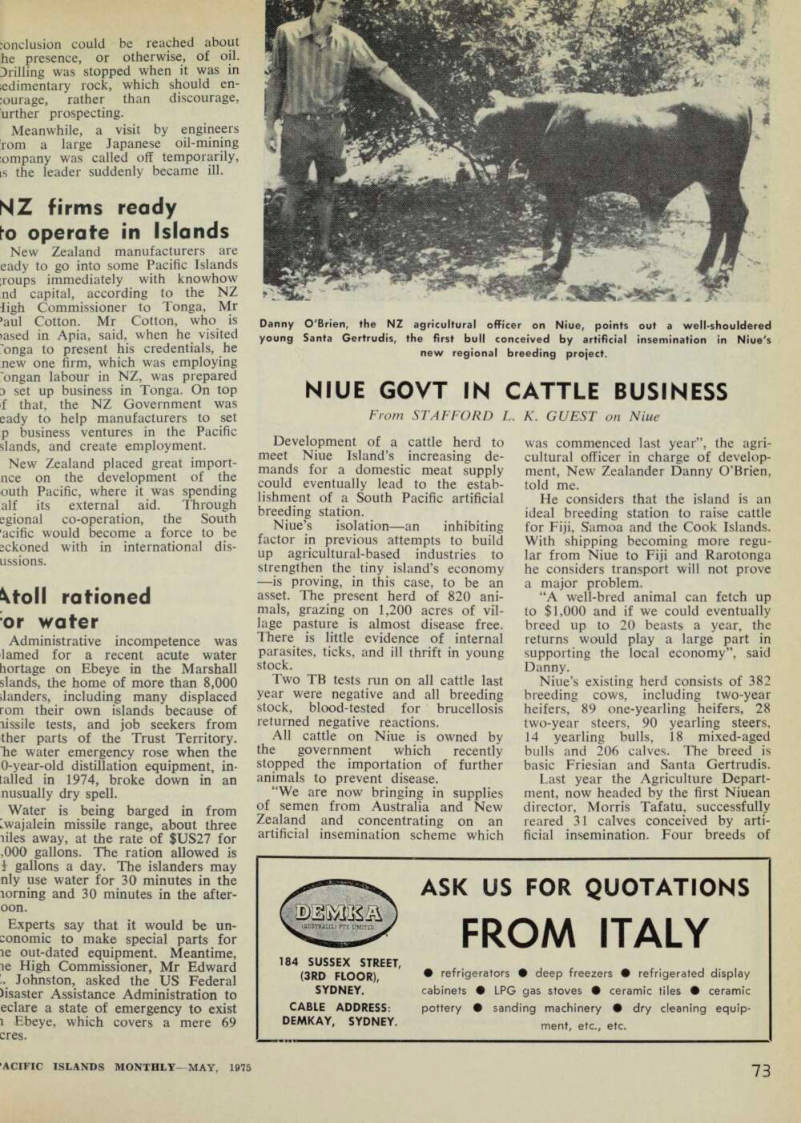
Danny O'Brien, the NZ agricultural officer on Niue, points out a well-shouldered young Santa Gertrudis, the first bull conceived by artificial insemination in Niue's new regional breeding project.
Friesian, Santa Gertrudis, Hereford and Angus were established.
Next year it is hoped to put about 460 heifers from the existing herd with a locally-reared bull. About 90 will be artificially inseminated.
It is intended to introduce Brah min blood into Friesian stock to produce a breed which can with stand tropical conditions.
A Niuean veterinary officer, Mr H. Jackson, has been in NZ study ing artificial insemination techniques and will soon travel to Australia.
The first artificial insemination was carried out by Mr Gary Cooper, a qualified AI technician, who heads a construction company here.
At present Niue can only meet
about 25 per cent of demands on its domestic meat market. Steers are killed at two years and average about 420 lb weight. Killing and packag ing is carried out at the Develop ment Board’s new food processing factory at Fonuakula.
Original cattle imports were made into Niue in the late 1950 s mainly from Friesian stock. A small number of Friesian, Santa Gertrudis and Herefords were introduced from Fiji in 1966.
How soon could the island produce stock for export and undertake breed ing for other Pacific regions?
“I am confident that we could meet a client’s order immediately”, said Danny O’Brien.
Rubber companies
losing money
Three Papua rubber companies showed net losses in the latest financial terms, two of them drop ping from a profit situation and the third suffering an even heavier loss.
The directors of the three companies said in their reports that excessive wage increases over the last nine months and the continued low prices for rubber had had the effect of plac ing them in loss situations, which were certain to continue. Every en deavour was being made to cut costs.
Low yielding areas had been taken out of production.
Mariboi in the December half-year had a loss of $40,176, compared with a profit of $13,916 in the pre vious corresponding term. The aver age sale price was 50.81 c a kg, com pared with 54.03 c, and production was 212,550 kg against 260,520 kg.
Kerema for a full year had a loss of $31,807, against a previous profit of $5,139. Kerema lifted the average sale price from 50.08 c a kg to 58.89 c, but production dropped from 291,090 kg to 282,350 kg.
Rubberland had a loss of $19,957, compared with $12,262 for a full year. The average sales price was 59.49 c a kg, compared with 50.41 c in the previous year. Production, however, dropped from 160,536 kg to 146,758 kg.
None of the companies is paying a dividend.
Making money
out of rock
Tonga may soon have a new in dustry—processing volcanic rock from Niuafoou into building materials or for interior decoration. An Italian visitor to the country, Mr Tina Biancini, took a piece of rock home with him for cutting and testing. It was shipped by stonemasons and sent back to King Taufa’ahau Tupou with the comment that, in sufficient quantity, it could be marketable. “We have the raw materials,” the king commented. “It is now a question of importing the machinery to process it.”
More land
for smokers
More land for growing tobacco is being opened in Fiji. The general manager of the South Development Co, Mr Murray Charters, said re cently his company would plant 600 acres this year, compared with 499 acres in 1974. One hundred and five acres of the new planting will be in
the Sigatoka Valley (30 acres in a new area at Keiyasi), and the rest at Nadi.
The company, preparing to handle the expected bigger crop, will spend about $200,000 on buildings and alant.
In 1974, the company paid out £201,000 to farmers for their to aacco leaf. This year it expects to aay $300,000 to about 800 farmers.
New motor centre
opened in Cooks
Two hundred guests attended the •pening of the Cook Islands Motor Centre’s new showroom and work hop at Panama, Rarotonga, in darch. Construction of the large uilding (covered area 6,600 sq ft) egan in October 1973, and 12i tons f steel, imported from Fiji, were sed by a local firm to construct the rames and roof trusses. The show aom faces the main coastal road, nd new models of Japanese motor ycles are now lined up behind the 0 ft plate glass frontage and side alls.
A workshop of 1,800 sq ft is at le rear of the building, and a two :orey section in the centre corn rises 1,000 sq ft of office space and 2,000 sq ft spare parts section.
: iji Govt wants
lirline's shares
The Fiji Government is trying to aild up its shares in Fiji Air Scr ees, which operates charter and hedule services within the country, has offered 75c a share for 54,165 lares held by Bilo Ltd, one of the ggest single shareholders in the rline. If it secured these shares it ould hold 75,165 shares, about >.4 per cent of the issued capital, le government became a share )lder in the airline earlier this year tien it acquired 21,000 shares.
Bilo Ltd is controlled by Mr Colin flip, a Suva businessman. Bilo Ltd id offered the shares to other share >lders at 80c each. The government Fer is worth $40,623.75. The ajority shareholder in Fiji Air rvices is the Hawker de Havilland oup, in Australia, which provides 2 management for the airline. • Cocoa farmers at Nasau in the ainibuka valley in Fiji hope to ve 450 acres in full production on. They have formed an asse rtion and plan to dry their own ans in their own drier. In the past sy have had to send wet beans out 40 miles to the Naduruloulou coa station to be processed by the inistry of Agriculture.
New man tor
Burns Philp in Fiji
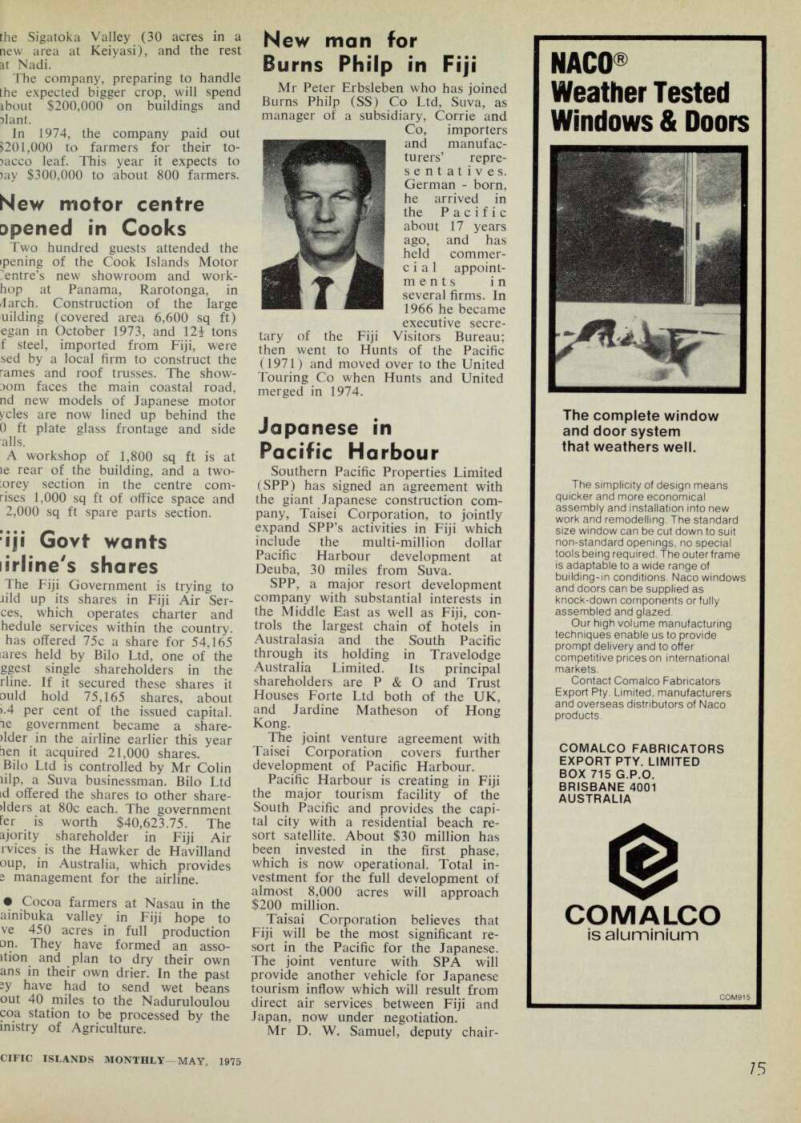
Mr Peter Erbsleben who has joined Burns Philp (SS) Co Ltd, Suva, as manager of a subsidiary, Corrie and
Co, importers and manufac turers’ repre sentatives.
German - born, he arrived in the Pacific about 17 years ago, and has held commer cial appoint m e n t s in several firms. In 1966 he became executive secre
tary of the Fiji Visitors Bureau; then went to Hunts of the Pacific (1971) and moved over to the United Touring Co when Hunts and United merged in 1974.
Japanese in
Pacific Harbour
Southern Pacific Properties Limited (SPP) has signed an agreement with the giant Japanese construction com pany, Taisei Corporation, to jointly expand SPP’s activities in Fiji which include the multi-million dollar Pacific Harbour development at Deuba, 30 miles from Suva.
SPP, a major resort development company with substantial interests in the Middle East as well as Fiji, con trols the largest chain of hotels in Australasia and the South Pacific through its holding in Travelodge Australia Limited. Its principal shareholders are P & O and Trust Houses Forte Ltd both of the UK, and Jardine Matheson of Hong Kong.
The joint venture agreement with Taisei Corporation covers further development of Pacific Harbour.
Pacific Harbour is creating in Fiji the major tourism facility of the South Pacific and provides the capi tal city with a residential beach re sort satellite. About $3O million has been invested in the first phase, which is now operational. Total in vestment for the full development of almost 8,000 acres will approach $2OO million.
Taisai Corporation believes that Fiji will be the most significant re sort in the Pacific for the Japanese.
The joint venture with SPA will provide another vehicle for Japanese tourism inflow which will result from direct air services between Fiji and Japan, now under negotiation.
Mr D, W. Samuel, deputy chair
man of SPP and resident director of the new SPP Sydney office said the agreement follows several visits by Taisei executives to Pacific Harbour and meetings between the Fiji Government and Taisei.
A Regent Hotel
for Norfolk Is.
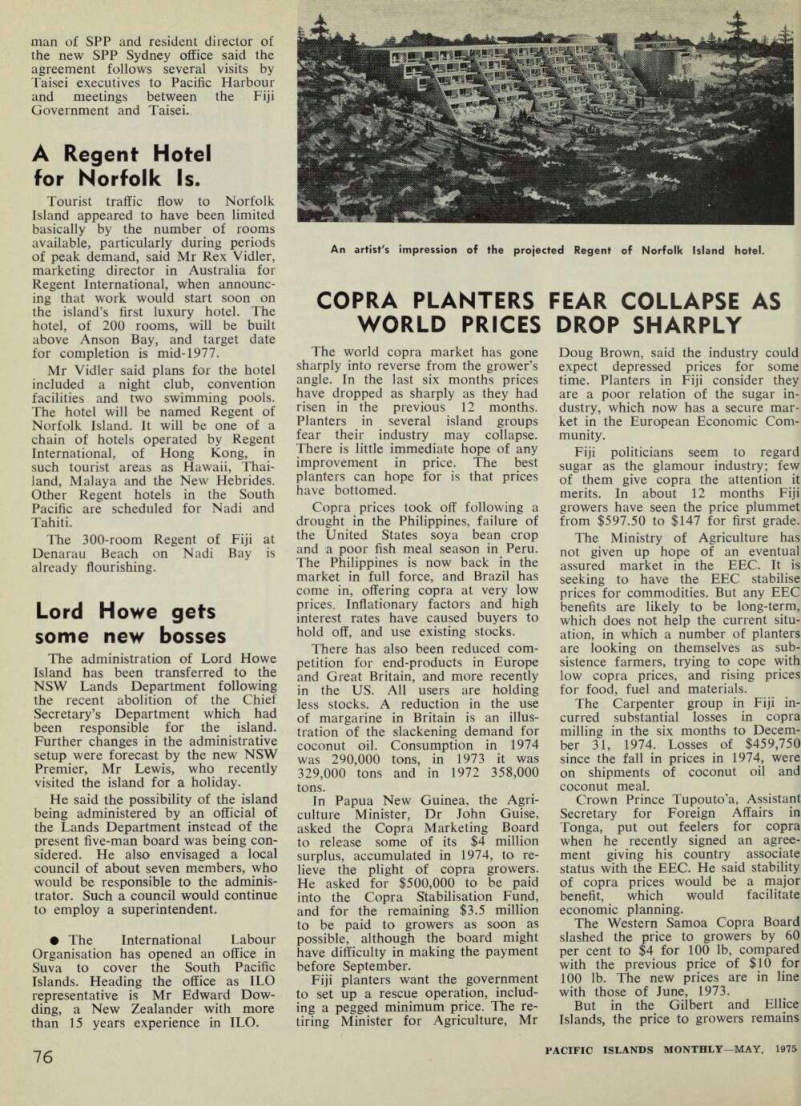
Tourist traffic flow to Norfolk Island appeared to have been limited basically by the number of rooms available, particularly during periods of peak demand, said Mr Rex Vidler, marketing director in Australia for Regent International, when announc ing that work would start soon on the island’s first luxury hotel. The hotel, of 200 rooms, will be built above Anson Bay, and target date for completion is mid-1977.
Mr Vidler said plans for the hotel included a night club, convention facilities and two swimming pools.
The hotel will be named Regent of Norfolk Island. It will be one of a chain of hotels operated by Regent International, of Hong Kong, in such tourist areas as Hawaii, Thai land, Malaya and the New Hebrides.
Other Regent hotels in the South Pacific are scheduled for Nadi and Tahiti.
The 300-room Regent of Fiji at Denarau Beach on Nadi Bay is already flourishing.
Lord Howe gefs
some new bosses The administration of Lord Howe Island has been transferred to the NSW Lands Department following the recent abolition of the Chief Secretary’s Department which had been responsible for the island.
Further changes in the administrative setup were forecast by the new NSW Premier, Mr Lewis, who recently visited the island for a holiday.
He said the possibility of the island being administered by an official of the Lands Department instead of the present five-man board was being con sidered. He also envisaged a local council of about seven members, who would be responsible to the adminis trator. Such a council would continue to employ a superintendent. • The International Labour Organisation has opened an office in Suva to cover the South Pacific Islands. Heading the office as ILO representative is Mr Edward Dow ding, a New Zealander with more than 15 years experience in ILO.
Fijians form
new companies
A group of Fijians is aiming at making the province of Namosi something more than a vegetable growing area supplying towns along the south-east coast of Viti Levu.
Namosi is the least developed of the 14 provinces in Fiji.
A new public company, Namosi Holdings Ltd, formed by leaders of the province will supply gravel, and a timber milling partnership is being negotiated with an overseas business man. Two thousand people of the province have been invited to take shares in the holding company, which is operating through sub sidiaries, Namosi Gravel Ltd and Namosi Timber Ltd.