Copra Planters Fear Collapse As
pp. 82-83 · Read in the full issue
World Prices Drop Sharply
The world copra market has gone sharply into reverse from the grower’s angle. In the last six months prices have dropped as sharply as they had risen in the previous 12 months.
Planters in several island groups fear their industry may collapse.
There is little immediate hope of any improvement in price. The best planters can hope for is that prices have bottomed.
Copra prices took off following a drought in the Philippines, failure of the United States soya bean crop and a poor fish meal season in Peru.
The Philippines is now back in the market in full force, and Brazil has come in, offering copra at very low prices. Inflationary factors and high interest rates have caused buyers to hold off, and use existing stocks.
There has also been reduced com petition for end-products in Europe and Great Britain, and more recently in the US. All users are holding less stocks. A reduction in the use of margarine in Britain is an illus tration of the slackening demand for coconut oil. Consumption in 1974 was 290,000 tons, in 1973 it was 329,000 tons and in 1972 358,000 tons.
In Papua New Guinea, the Agri culture Minister, Dr John Guise, asked the Copra Marketing Board to release some of its $4 million surplus, accumulated in 1974, to re lieve the plight of copra growers.
He asked for $500,000 to be paid into the Copra Stabilisation Fund, and for the remaining $3.5 million to be paid to growers as soon as possible, although the board might have difficulty in making the payment before September.
Fiji planters want the government to set up a rescue operation, includ ing a pegged minimum price. The re tiring Minister for Agriculture, Mr
Doug Brown, said the industry could expect depressed prices for some time. Planters in Fiji consider they are a poor relation of the sugar in dustry, which now has a secure mar ket in the European Economic Com munity.
Fiji politicians seem to regard sugar as the glamour industry; few of them give copra the attention it merits. In about 12 months Fiji growers have seen the price plummet from $597.50 to $147 for first grade.
The Ministry of Agriculture has not given up hope of an eventual assured market in the EEC. It is seeking to have the EEC stabilise prices for commodities. But any EEC benefits are likely to be long-term, which does not help the current situ ation, in which a number of planters are looking on themselves as sub sistence farmers, trying to cope with low copra prices, and rising prices for food, fuel and materials.
The Carpenter group in Fiji in curred substantial losses in copra milling in the six months to Decem ber 31, 1974. Losses of $459,750 since the fall in prices in 1974, were on shipments of coconut oil and coconut meal.
Crown Prince Tupouto’a, Assistant Secretary for Foreign Affairs in Tonga, put out feelers for copra when he recently signed an agree ment giving his country associate status with the EEC. He said stability of copra prices would be a major benefit, which would facilitate economic planning.
The Western Samoa Copra Board slashed the price to growers by 60 per cent to $4 for 100 lb, compared with the previous price of $lO for 100 lb. The new prices are in line with those of June, 1973.
But in the Gilbert and Ellice Islands, the price to growers remains
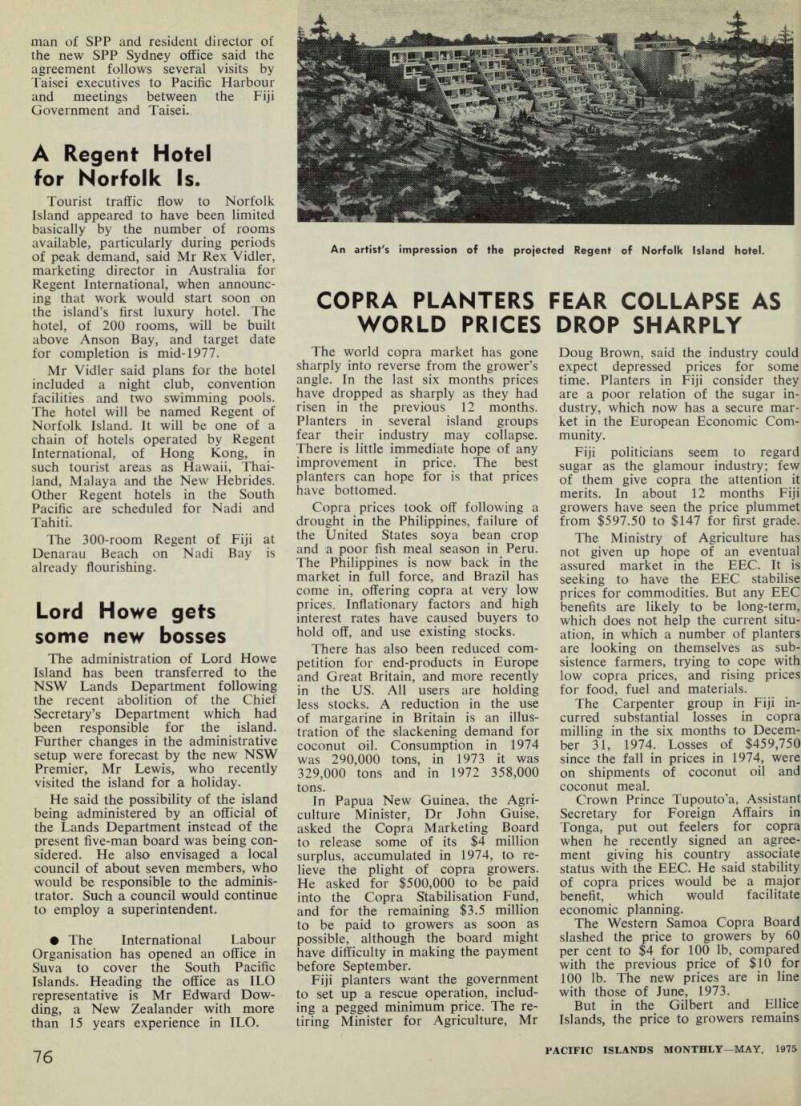
An artist's impression of the projected Regent of Norfolk Island hotel.
unchanged. The GEIC Copra Board decided to draw on its reserves, built up in 1974 when prices were high, to maintain the price.
The high prices for copra for most of 1974 were reflected in Tonga’s rade figures for February when the country recorded a visible trade sur olus of about $600,000. It was the irst time since July, 1974, when nonthly trade figures first became ivailable, that Tonga had a surplus )f exports over imports.