to Japan's big push
pp. 77-79 · Read in the full issue
PNG's car market falls to Japan's big push
From GUS SMALES in Port Moresby
Until about 12 years ago the cars and trucks which shook and rattled themselves to pieces on Papua New Guinea’s apologies for roads reflected the Australian motoring scene closely, with a few exceptions.
One of the exceptions was the large number of Peugeots on the road— Peugeot was the sales leader in Papua for several years running— and there was also a higher pro portion of the exotic.
For instance, there was a rash of Volvos on the northern mainland of New Guinea, and you couldn’t knock back the Mercedes with a stick in Rabaul.
But, by and large, the roads were full of International trucks; Holdens held the sales leadership for Papua and New Guinea combined, and Volkswagens led the field in New Guinea.
There were any amount of Fords, and Austin and Morris were also high on the list.
The first Japanese vehicle into PNG after the Japanese wartime occupation was a Nissan utility, allo cated by a Japanese marine salvage group to its Rabaul liaison officer, Mr Jack Childs, in 1959.
So strong was the real or induced feeling against Japanese products that Mr Childs took to hiding the vehicle when he went his rounds.
“I didn’t want it smashed by stones”, he said.
But it was not until less than 10 years ago that the big Japanese vehicle sales push began. This, too, was parallel to what happened in Australia, but the market takeover in PNG has been of far greater proportions.
Recent figures from the PNG Statistics Bureau show that Japan has as good as captured the market.
After maintaining better than an 80 per cent share of the new vehicle registrations for some time, the latest monthly figures show that Japan has now moved into the 90 per cent league.
Although the latest available, the figures date back to August last year, and dealers believe that, if anything, Japan has probably improved its share since then. Its share last August, including motorcycles, was
a shade over 91 per cent made up of 712 vehicles in a total new vehicle registration of 788.
Toyotas topped the list with 151 cars, station wagons and utilities and with 60 light trucks and buses.
Ford, with 25 vehicles—mainly trucks and commercials—provided the highest total of any non-Japanese make.
Holden, the PNG sales leader 12 years ago, was down to 11 vehicles, Volkswagen was down to four and Peugeot didn’t appear on the list at all.
Interest in the pattern of vehicle sales in PNG is high at present be cause of the government’s intention to rationalise the vehicle import trade. The multiplicity of makes and types in a comparatively small mar ket, although not an insignificant one, has been creating spare parts problems. This is what the govern ment believes, anyway.
The extent of the problem might not be as great in real terms as some witnesses have told a govern ment committee which is examining the industry. A high accident and wear rate, an often unsophisticated consumer market, shipping delays and often communication blocks be tween consumer and supplier have all contributed to frustrations.
The tacit government plan, although not formally announced, is to standardise the country’s im ports on a limited number of makes
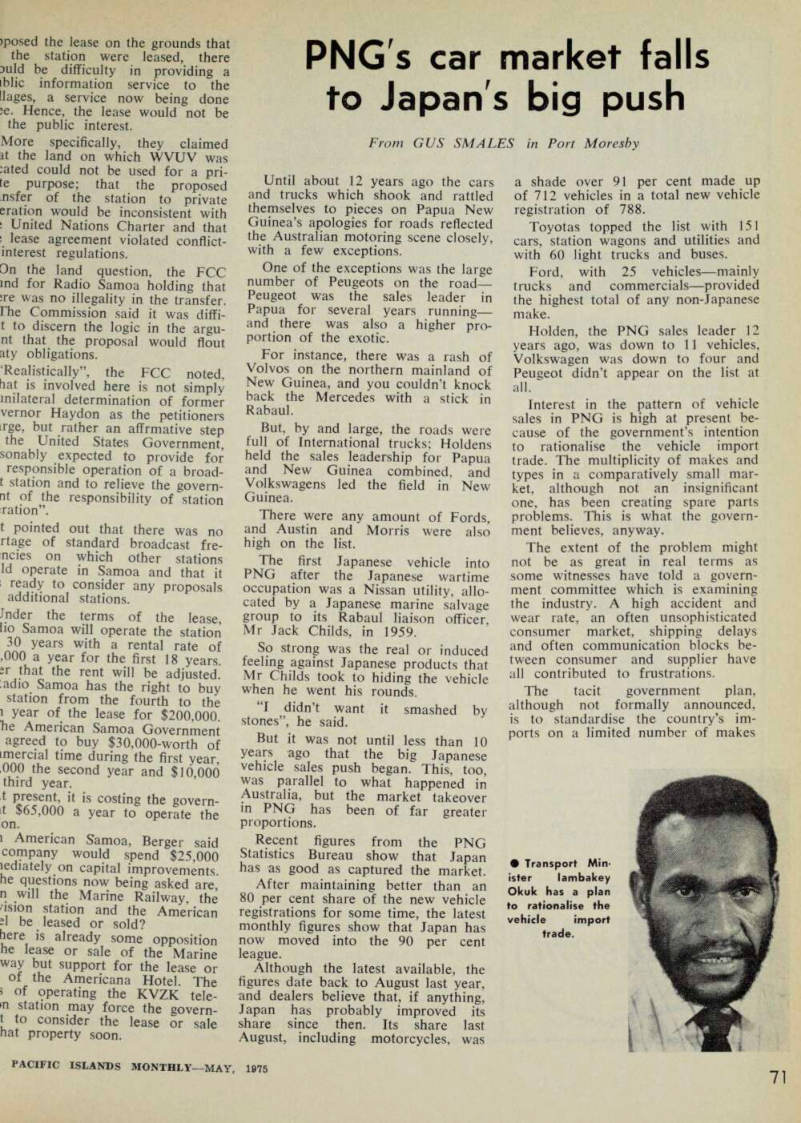
• Transport Min ister lambakey Okuk has a plan to rationalise the vehicle import trade.
and types—possibly a mere five or six.
This would be achieved by apply ing nominal import duties to the chosen makes, and prohibitive import duties to others.
But the big question, still to be resolved, is who gets the low import duties and who gets the high ones?
The Transport Minister, Mr lambakey Okuk, has told parliament that sales lists are not necessarily the yardsticks by which the makes will be measured.
The degree to which existing agents have carried spares and sup plied service will be a big factor, although this will be difficult to assess without a lot of political dynamite. The big sales lists are ob viously going to have some effect on the situation, too, which would fur ther entrench at least some of the major Japanese suppliers.
Some commercial lobbies fear the government might stultify the indus try to the detriment of the long-term national economy. They say that although duplication and high costs may exist in some degree, the vehicle supply and maintenance trade is be coming a major source of skilled local employment and involvement.
They also see the industry as one of major potential to satisfy the government’s aim of phasing in PNG shareholding—but only if the indus try is allowed to remain competitive.
Japan has lion's
share in Fiji
Japan has also captured a lion’s share of the car market in Fiji. The country in 1974 imported 1,535 vehicles for private use and as taxis.
The value was $2,885,000. Japan supplied 1,119 of those vehicles, worth $1,836,000. Next on the list was Britain with 270, valued at $514,856, followed by Australia with 141, valued at $517,000. Hardly affecting the market were Germany with two, and Italy, New Zealand and Sweden with one each.
Imports of vehicles, less than two tons totalled 90 with Japan supply ing 86 valued at $189,623, and Britain three. Japan supplied nine of 37 buses imported, and Britain 27.
The value of bus imports was $76,625. • Negotiations for a new sugar agreement between Fiji and New Zealand started in April. New Zea land, which has enjoyed low prices for Fiji sugar for many years, ex pects to pay a much higher price in future.
Fiji's 1974 trade
in the red
Fiji had a visible trade deficit of: $94.3 million in 1974, according to provisional figures issued by the: country’s statistics office. Imports; were valued at $217.8 million, while: exports earned $123.5 million. Sugar exports were valued at $67 million,, coconut oil $10.7 million and gold! $8.6 million. Other significant exports; were molasses $1,263 million, sawn timber $973,000, veneer sheets $Bll,OOO, biscuits $621,000, ginger $548,000 and cement $500,000.
Petroleum, miscellaneous manu factured goods, foodstuffs and duty free goods accounted for most of the import bill. Australia had 30.4 per cent of the market ($66.3 mil lion), Japan 18 per cent ($39.3 mil lion), New Zealand 11.2 per cent ($24.4 million) and Britain 9.8 per cent ($21.5 million).
Britain was the country’s best cus tomer, taking 26 per cent of the ex ports, worth $37.1 million. Other big customers were Australia 13.3 per cent ($15.3 million), New Zealand 6.6 per cent ($B.l million) and Malaysia and Singapore 3.6 per cenl ($4.4 million).
Natural gas
search in PNG
A search for natural gas in Papus is expected to cost about $2O million PNG Petroleum will soon drill th« first hole at Kanau, about 70 mile; north-west of Kikori. Contractor; have cleared a mountain top for the first drilling. As there are no roac communications all equipment ha; to be flown in by helicopter.
Other pinnacles will be cleared a Darai and Orie. The three sites are spread out over 60 miles along ; limestone plateau which geologist: have recommended as a likely ga; area. Each test hole is expected t< cost more than $3 million.
Still hopes of
oil in Tonga!
There is still hope that Tonga ma; find off-shore oil, according to D Rudi Katz, the chief petroleun geologist in New Zealand. He visite< Tonga recently to make a report oi exploration so far conducted. Th nature of the 5,500 ft holes alread; drilled indicated favourable pros pects, he said.
Dr Katz said that in previous ex ploration the holes had not been du deep enough. Drilling should hav gone to at least 10,000 ft before
inclusion could be reached about he presence, or otherwise, of oil.
Drilling was stopped when it was in ledimentary rock, which should en :ourage, rather than discourage, urther prospecting.
Meanwhile, a visit by engineers fom a large Japanese oil-mining ;ompany was called off temporarily, is the leader suddenly became ill.
NZ firms ready
Fo operate in Islands
New Zealand manufacturers are eady to go into some Pacific Islands ;roups immediately with knowhow nd capital, according to the NZ ligh Commissioner to Tonga, Mr *aul Cotton. Mr Cotton, who is >ased in Apia, said, when he visited "onga to present his credentials, he new one firm, which was employing 'ongan labour in NZ, was prepared 3 set up business in Tonga. On top f that, the NZ Government was eady to help manufacturers to set p business ventures in the Pacific slands, and create employment.
New Zealand placed great import nce on the development of the outh Pacific, where it was spending alf its external aid. Through egional co-operation, the South acific would become a force to be with in international dis ussions.
\toll rationed
or water
Administrative incompetence was lamed for a recent acute water hortage on Ebeye in the Marshall slands, the home of more than 8,000 danders, including many displaced rom their own islands because of fissile tests, and job seekers from ther parts of the Trust Territory, die water emergency rose when the 0-year-old distillation equipment, to talled in 1974, broke down in an nusually dry spell.
Water is being barged in from iwajalein missile range, about three files away, at the rate of SUS 27 for ,000 gallons. The ration allowed is i gallons a day. The islanders may nly use water for 30 minutes in the lorntog and 30 minutes in the after oon.
Experts say that it would be un conomic to make special parts for le out-dated equipment. Meantime, le High Commissioner, Mr Edward . Johnston, asked the US Federal lisaster Assistance Administration to eclare a state of emergency to exist i Ebeye, which covers a mere 69 cres.