Selling a radio station
pp. 76-77 · Read in the full issue
to raise the wind
As a result of the 30 per cent cut in expenditure during the last six months of the current financial year to June, the American Samoa Government is frantically looking for ways and means of raising extra revenues. Top on the list is the sale
or lease of government facilities like the Marine Railway, the KVZK tele vision station and the Americana Hotel, which is largely government owned.
Already, the government has leased Radio Station WVUV to Radio Samoa Ltd, a company owned by Lawrence S. Berger, who reputedly owns a number of radio stations in Honolulu, Robert M. Newgard, a Los Angeles motion picture distri butor, and Ronald E. Pritchard, a local businessman.
Negotiations between the govern ment and Radio Samoa began more than two years ago, but it was not until April, 1973, that a lease agree ment was formally drawn up. Then followed another two years while the lease was being considered by the Federal Communications Commission (FCC) and it was not until Feb ruary 20 this year that FCC approval for the agreement was finally given.
But it was an uphill fight all the way for Radio Samoa for there was much opposition to the lease or sale of WVUV. Radio Samoa’s antagon ists were chiefly the legislature of American Samoa, and the former delegate-at-large in Washington DC, Fuimaono Asuemu.
Both the Fono and Fuimaono
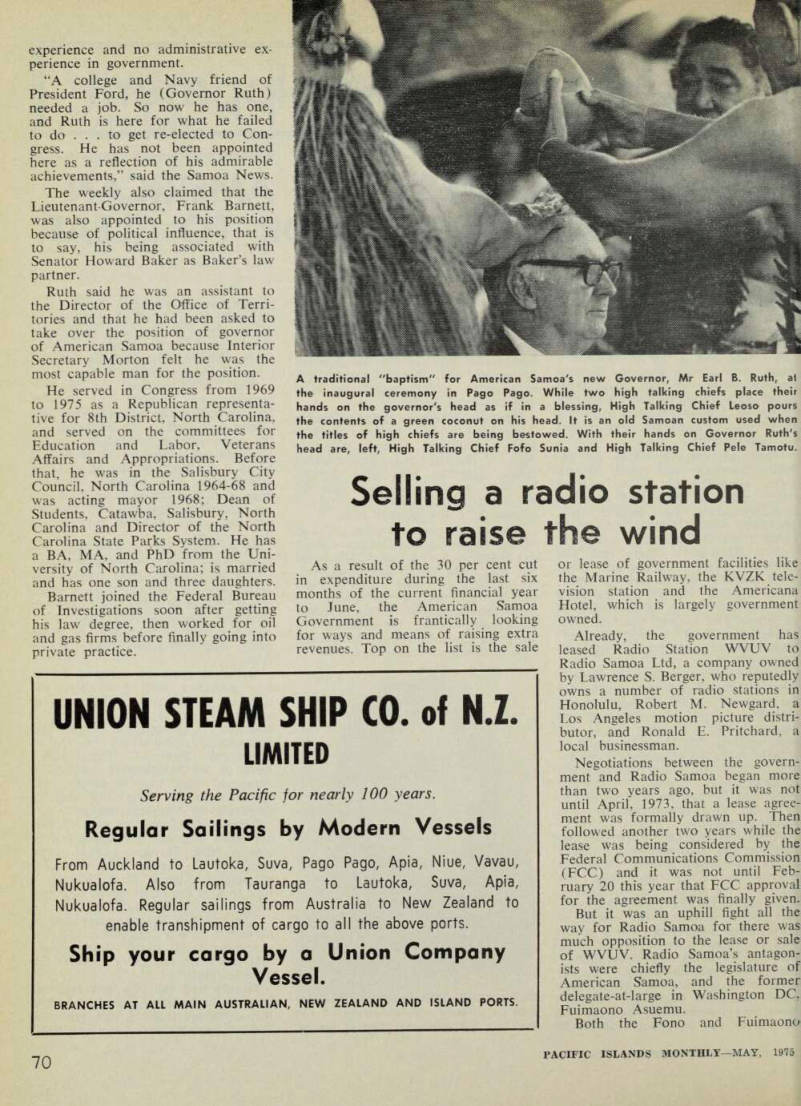
A traditional "baptism" for American Samoa's new Governor, Mr Earl B. Ruth, at the inaugural ceremony in Pago Pago. While two high talking chiefs place their hands on the governor's head as if in a blessing, High Talking Chief Leoso pours the contents of a green coconut on his head. It is an old Samoan custom used when the titles of high chiefs are being bestowed. With their hands on Governor Ruth's head are, left, High Talking Chief Fofo Sunia and High Talking Chief Pele Tamotu.
)posed the lease on the grounds that the station were leased, there Duld be difficulty in providing a iblic information service to the llages, a service now being done ;e. Hence, the lease would not be the public interest.
More specifically, they claimed it the land on which WVUV was :ated could not be used for a pri te purpose; that the proposed nsfer of the station to private eration would be inconsistent with : United Nations Charter and that : lease agreement violated conflict interest regulations.
On the land question, the FCC ind for Radio Samoa holding that :re was no illegality in the transfer.
Fhe Commission said it was diffi t to discern the logic in the argu nt that the proposal would flout aty obligations. ‘Realistically”, the FCC noted, fiat is involved here is not simply inilateral determination of former vernor Haydon as the petitioners irge, but rather an affrmative step the United States Government, sonably expected to provide for responsible operation of a broad t station and to relieve the govern nt of the responsibility of station ration”. t pointed out that there was no rtage of standard broadcast fre ncies on which other stations Id operate in Samoa and that it ready to consider any proposals additional stations.
Jnder the terms of the lease, ho Samoa will operate the station 30 years with a rental rate of ,000 a year for the first 18 years, sr that the rent will be adjusted, .adio Samoa has the right to buy station from the fourth to the i year of the lease for $200,000. he American Samoa Government agreed to buy $30,000-worth of imercial time during the first year, ,000 the second year and $lO,OOO third year. * present, is costing the govern t $65,000 a year to operate the on. i American Samoa, Berger said company would spend $25,000 jediately on capital improvements he questions now being asked are, n will the Marine Railway, the vision station and the American -I be leased or sold? here is already some opposition he lease or sale of the Marine way but support for the lease or of the Americana Hotel. The 5 of operating the KVZK tele ►n station may force the govern t to consider the lease or sale hat property soon.