Business and Development
pp. 75-76 · Read in the full issue
There's A Big Mess For American
Samoa's New Governor To Clear
From FELISE VA’A in Pago Pago
Quite a few people in American Samoa feel that former Governor lohn M. Haydon, who resigned last August after serving five years, has left behind him a big administrative mess. Few doubt that the present inancial crisis, whereby government expenditure during the last six months Df the 1975 fiscal year had to be cut ?y at least SlO million, was in part lis responsibility.
The main areas in which the un lucky governor had been blamed vere, allegedly, his hiring of too nany contract employees and his iverdependence on federal pro p-ammes which required matching unds from the territory’s coffers.
But Haydon is gone and the \merican Samoan people now focus heir attention on the new governor, narl B. Ruth. Will he get the tern ary extricated from its present woes •f water and power shortage, un mployment and underemployment aused by the government’s expendi jre cuts?
A recent directive from the Depart nent of Interior ordering a further 10 er cent cut (to the 20 per cent cut Iready in effect) in government ex enditure and a warning that it was lost unlikely that Congress would be ble to make an emergency grant-in id to help the ailing government’s nances, have convinced Governor uth that he had no alternative but i order all departments to save Jierever possible.
An expenditure ceiling for each de artment has been set but the means f saving money and of remaining elow the ceiling have been left irgely to the departments themselves, uth said at his first press conference, ie said he regretted the layoffs of overnment employees but if there r as no other way of saving, then lis was inevitable. For most depart lents, this was inevitable. At the itest count, at least 226 government mployees have been laid off; 183 ave been put on short furlough; 43 ave been put on a year’s furlough;
and 762 are working on reduced hours.
If measures were not done to save some money now, there would be no money left to pay for government operations and salaries in the 1976 fiscal year, which begins in July, said Governor Ruth.
The new governor’s policy is, there fore, set to freeze and cut govern ment expenditure. There is no other way. At the same time, new ways of raising revenues are being devised but these are rather uncertain and will not be sufficiently effective within the allotted time, that is, until June 30.
Under the circumstances, it can hardly be denied that Governor Ruth has inherited a situation which could not have been solved any other way.
As Delegate-At-Large Lutali Lauvao said in a letter to the people of American Samoa, Ruth has inherited a gigantic problem. He is confronted with “the Herculean task of repairing a badly-damaged economy, ineffective
administrative policies in the past and a confused populace”. Lauvao urged the people of the territory to support their new governor and to refrain from criticising him until he has had a chance to work things out.
The press reaction to the new governor was mixed. The Samoan Sun welcomed the new governor, his family and staff in an editorial. At the same time it pointed out to the governor the various problems he was likely to encounter during his ad ministration, for instance, the in fluence of jaaSamoa on political and administrative decisions, and also the pros and cons of being governor of the territory.
“You have far more power, on paper, here than a US Congressman has in his district but in the exercise of that power you will find it much more difficult to make your decisions work on the grass roots level . . .
And you will be the centre of much gossip and petty politicking,” the Sun said.
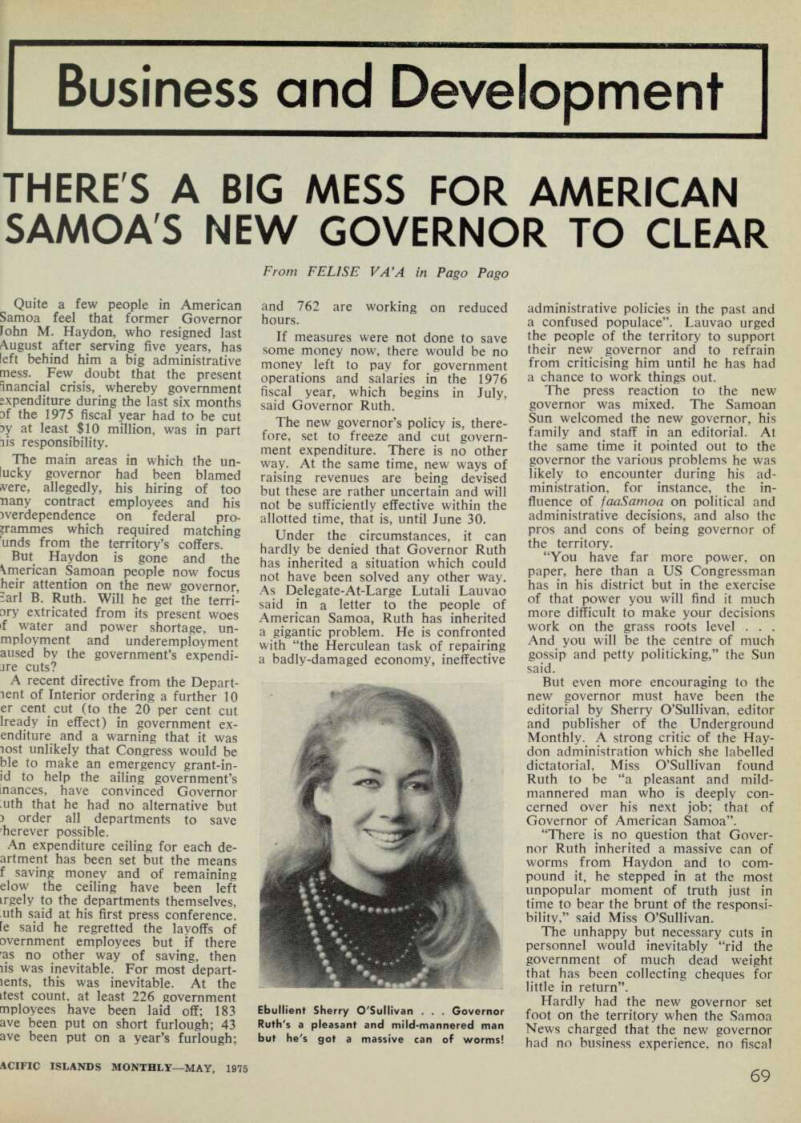
But even more encouraging to the new governor must have been the editorial by Sherry O’Sullivan, editor and publisher of the Underground Monthly. A strong critic of the Hay don administration which she labelled dictatorial. Miss O’Sullivan found Ruth to be “a pleasant and mild mannered man who is deeply con cerned over his next job; that of Governor of American Samoa”.
“There is no question that Gover nor Ruth inherited a massive can of worms from Haydon and to com pound it, he stepped in at the most unpopular moment of truth just in time to bear the brunt of the responsi bility,” said Miss O’Sullivan.
The unhappy but necessary cuts in personnel would inevitably “rid the government of much dead weight that has been collecting cheques for little in return”.
Hardly had the new governor set foot on the territory when the Samoa News charged that the new governor had no business experience, no fiscal
Ebullient Sherry O'Sullivan . . . Governor Ruth's a pleasant and mild-mannered man but he's got a massive can of worms!
experience and no administrative ex perience in government.
“A college and Navy friend of President Ford, he (Governor Ruth) needed a job. So now he has one, and Ruth is here for what he failed to do ... to get re-elected to Con gress. He has not been appointed here as a reflection of his admirable achievements,” said the Samoa News.
The weekly also claimed that the Lieutenant-Governor, Frank Barnett, was also appointed to his position because of political influence, that is to say, his being associated with Senator Howard Baker as Baker’s law partner.
Ruth said he was an assistant to the Director of the Office of Terri tories and that he had been asked to take over the position of governor of American Samoa because Interior Secretary Morton felt he was the most capable man for the position.
He served in Congress from 1969 to 1975 as a Republican representa tive for Bth District, North Carolina, and served on the committees for Education and Labor, Veterans Affairs and Appropriations. Before that, he was in the Salisbury City Council, North Carolina 1964-68 and was acting mayor 1968; Dean of Students, Catawba, Salisbury, North Carolina and Director of the North Carolina State Parks System. He has a BA, MA, and PhD from the Uni versity of North Carolina; is married and has one son and three daughters.
Barnett joined the Federal Bureau of Investigations soon after getting his law degree, then worked for oil and gas firms before finally going into private practice.