Banabans add drama to their fight
p. 13 · Read in the full issue
their fight for home
From Bertram Jones
Events involving the Banabans 'ere gathering momentum as March tided.
A ship carrying the vanguard of 00 Banabans who are to re-settle on •cean Island had sailed from Fiji in blaze of publicity about what had een variously called “a Banaban in ision” and “a move to establish a anaban presence” in their old home md.
And a judge’s ruling in London had at fresh heart into the Banaban com innity as protracted and expensive reparations for their High Court :tion neared their climax.
The Banabans have waited for -ars to have their say in court and • redress—as they see it—some of le wrongs they have suffered during le 75-year history of phosphate ining on Ocean Island.
An application by the British Gov nment had looked like delaying the :tion even more. They had asked that irtain matters be dealt with as a eliminary to the main suit, due to ien early in April.
Mr Justice Walton, after hearing gal arguments, had taken about ree weeks to go into them. Then, a 15,000-word reserved judgement, ' dismissed the British move.
Reports from London quoted him saying: “It could not, I think, fail appear to the Banabans as a wyers’ trick, designed to prevent eir case being heard, and in their ew so designed because if it was :ard the whole world might acknow dge the justice of their cause.”
The judge observed that the Crown ared that the practical effect of lowing Banaban witnesses to use e witness-box might be to provoke wide-ranging attack” upon the nduct of the Crown in relation to ;ean Island and the Banabans nerally.
But, he said, he was content to cept the assurance of the Banabans’ unsel that they did not intend to ake such an attack.
While the 399-ton Ai Sokula—a maban ship—was preparing in Suva r the long voyage to Ocean Island th the first party of re-settlers from
Rabi Island (the Banabans’ present home in the Fiji group) two govern ment ministers and a senior civil servant from GEIC passed through Nadi airport on their way to New York to resist the Banaban indepen dence move in the United Nations.
They issued a press statement claiming that Ocean Island was an integral part of the colony and that the Gilbertese and the Banabans were the same people because they were all descended from the same Micro nesian settlers in the Pacific.
The GEIC Minister for Communi cations, Work and Utilities, Mr Bwebwetake Arieta, went even further. He alleged that the Banaban claim for sovereignty over Ocean Island was a family matter not sought by all the Banabans.
That brought a sharp retort from Mr Tekoti Rotan, managing director of Rabi Holdings Ltd (the Banabans’ commercial enterprise), who, in the absence in London of his brother, manager to the Rabi Council of Leaders, is spokesman in Suva for the Banaban community.
He dismissed Mr Arieta’s claim as nonsense and said it showed how hard-put the Gilbertese were to find arguments against the Banaban case.
“If Mr Arieta thinks that the Bana bans as a community are not fully in support of independence for Ocean Island he should visit Rabi Island to talk to our people,” Mr Rotan said.
“In fact, we invite him to do so.”
Mr Rotan’s brother, the Rev Tebuke Rotan, was just as decisive in answers to the other Gilbertese asser tions.
Speaking on the telephone from London to Suva, he said that to claim that the Banabans and the Gilbertese were one people because they were descended from common Micronesian settlers made about as much sense as saying that, because the early American settlers came from Britain, present-day Americans were British.
The Micronesian settlement took place more than 3,000 years ago, the Rev Tebuke said, quoting authorities.
Over the centuries they had split up
and established separate and indepen dent communities. “The Banabans were independent for centuries,’ he said.
The Banabans rejected Gilbertese claims that Ocean Island is an in tegral part of the GEIC. Both the Rotan brothers—sons of 75-year-old Mr Rotan Tito, the Banaban leader for more than 40 years—pointed out its distance from the nearest island in the Gilberts Group and how geo logically different it was from them.
They said: “There is strong evidence that before the British came the Gilbertese did not even know that Ocean Island or the Banabans were there, “Any Gilbertese who fled in canoes from their own island and were lucky enough to find refuge among the Banabans could not get back because of strong ocean currents, so how could there have been any link be tween the Gilbertese and us?
“There was no Gilbertese unity until the British came, and even then Ocean Island was left out until it was found to contain enormous phosphate wealth.”
The move to re-establish a Bana ban presence on Ocean Island stems from their uneasiness about their rights with independence for the colony approaching. It is an asser tion of Banaban ownership as well as of their belief that sovereignty should be theirs.
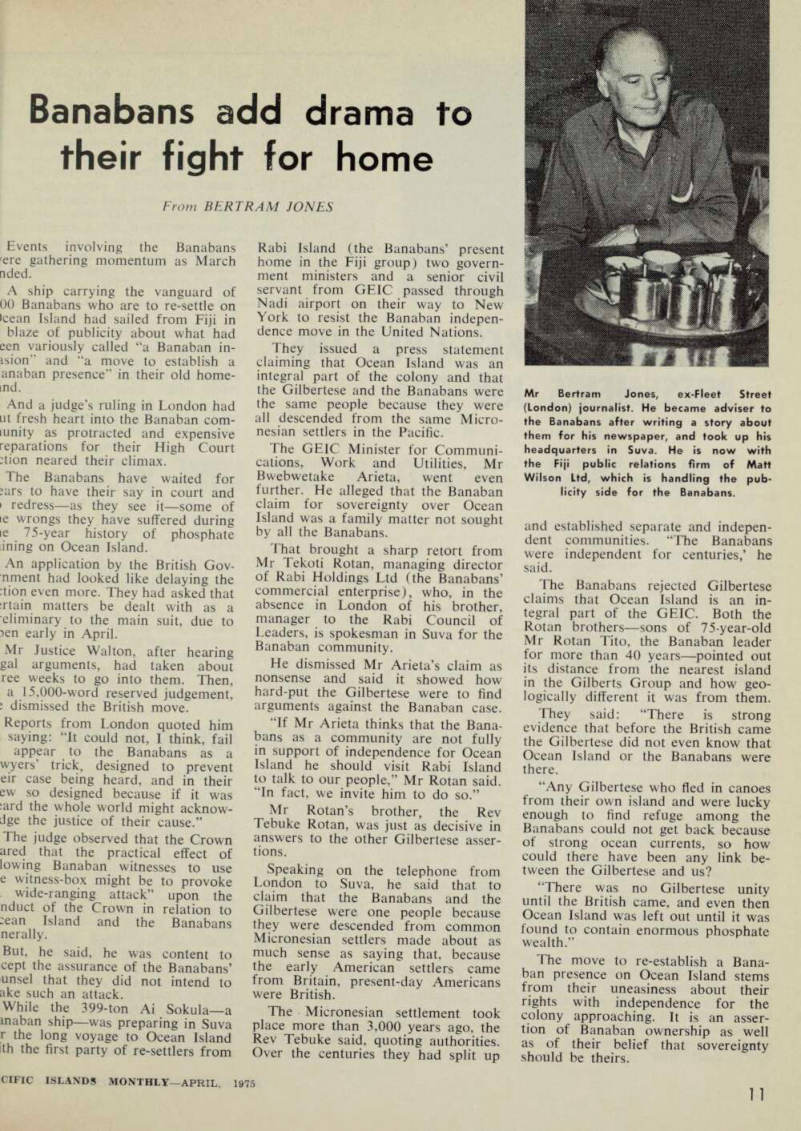
Mr Bertram Jones, ex-Fleet Street (London) journalist. He became adviser to the Banabans after writing a story about them for his newspaper, and took up his headquarters in Suva. He is now with the Fiji public relations firm of Matt Wilson Ltd, which is handling the pub licity side for the Banabans.