Png Govt Takes Over The
pp. 14-15 · Read in the full issue
Pressmen's Job But . . .
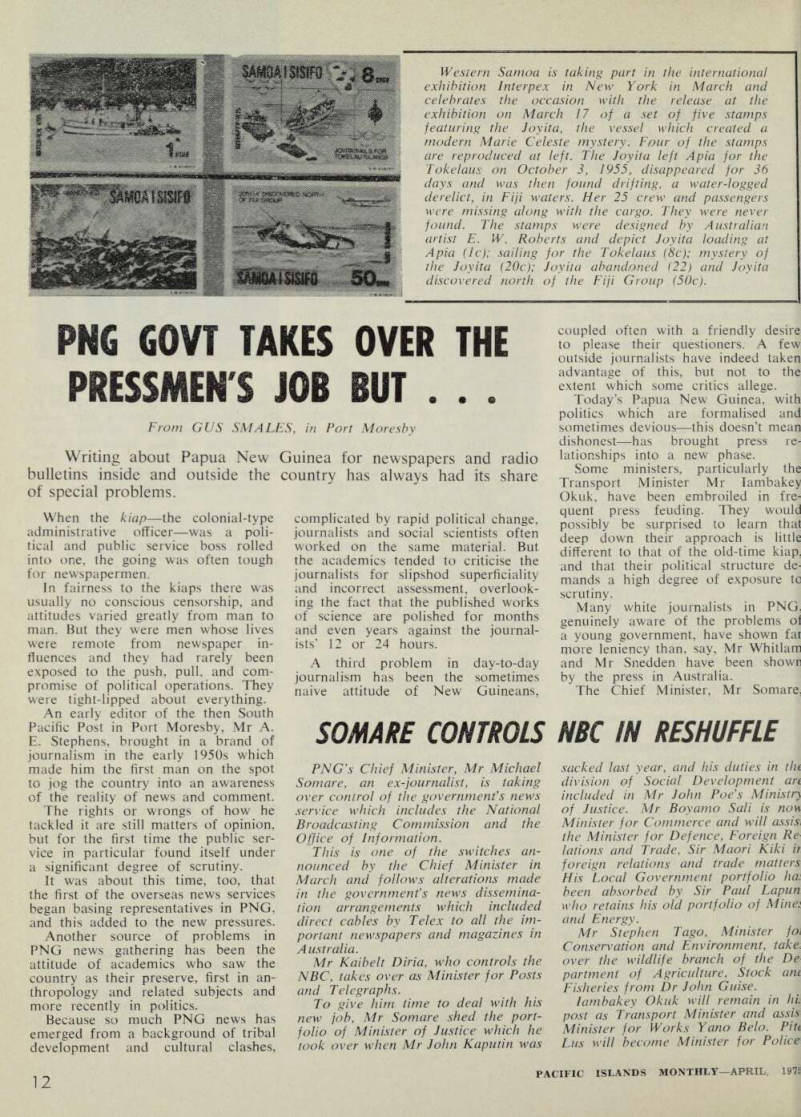
Western Samoa is taking part in the international exhibition Interpex in New York in March and celebrates the occasion with the release at the exhibition on March 17 of a set of five stamps featuring the Joyita, the vessel which created a modern Marie Celeste mystery. Four of the stamps are reproduced at left. The Joyita left Apia for the Tokelaus on October 3, 1955, disappeared for 36 days and was then found drifting, a water-logged derelict, in Fiji waters. Her 25 crew and passengers were missing along with the cargo. They were never found. The stamps were designed by Australian artist E. W. Roberts and depict Joyita loading at Apia (1c); sailing for the Tokelaus (8c); mystery of the Joyita (20c); Joyita abandoned (22) and Joyita discovered north of the Fiji Group (50c).
From GUS SMALES, in Port Moresby Writing about Papua New Guinea for newspapers and radio bulletins inside and outside the country has always had its share of special problems.
When the kiap —the colonial-type administrative officer—was a political and public service boss rolled into one, the going was often tough for newspapermen.
In fairness to the kiaps there was usually no conscious censorship, and attitudes varied greatly from man to man. But they were men whose lives were remote from newspaper influences and they had rarely been exposed to the push, pull, and compromise of political operations. They were tight-lipped about everything.
An early editor of the then South Pacific Post in Port Moresby, Mr A.
E. Stephens, brought in a brand of journalism in the early 1950 s which made him the first man on the spot to jog the country into an awareness of the reality of news and comment.
The rights or wrongs of how he tackled it are still matters of opinion. but for the first time the public service in particular found itself under a significant degree of scrutiny.
It was about this time, too, that the first of the overseas news services began basing representatives in PNG, and this added to the new pressures.
Another source of problems in PNG news gathering has been the attitude of academics who saw the country as their preserve, first in anthropology and related subjects and more recently in politics.
Because so much PNG news has emerged from a background of tribal development and cultural clashes,
complicated by rapid political change, journalists and social scientists often worked on the same material. But the academics tended to criticise the journalists for slipshod superficiality and incorrect assessment, overlook ing the fact that the published works of science are polished for months and even years against the journal ists’ 12 or 24 hours, A , hird pro blem in day-to-day journa , ism has been the som etimes najve attitude of New Guineans,
coupled often with a friendly desire to please their questioners. A few outside journalists have indeed taken advantage of this, but not to the extent which some critics allege.
Today’s Papua New Guinea, with politics which are formalised and sometimes devious—this doesn’t mean dishonest—has brought press re lationships into a new phase.
Some ministers, particularly the Transport Minister Mr lambakey Okuk, have been embroiled in fre quent press feuding. They would possibly be surprised to learn that deep down their approach is little different to that of the old-time kiap, and that their political structure de mands a high degree of exposure to scrutiny.
Many white journalists in PNG, genuinely aware of the problems ol a young government, have shown far more leniency than, say, Mr Whitlam and Mr Snedden have been shown by the press in Australia.
The Chief Minister, Mr Somare,
las been more understanding of press elationships partly because of his )wn background in journalism and >artly because he appreciates human ssues deeply.
But now his own machine seems o be getting away from him.
His personal press office has be ome increasingly aloof, and his de trimental press office in February mbarked on a new campaign of its iwn. At huge communications ex pense the Government Information )ffice has begun telexing a daily news srvices into the offices of newspapers, gencies and radio stations in Aust alia and other parts of the Pacific.
The operation is being carried out ver the heads of some seven mrnalists whose overseas principals, lainly Australian, base them in NG. It has also involved the trans lission of some information before 3rmal release to the locally-based mrnalists.
The operation—advertised in ccurately as PNG’s “first cable news
service”—has been dubbed outside the Information Office as the “G. G.
Bulletin”. This doesn’t stand for the time-honoured phrase “the good guts”, but is derived from the initials of the two New Zealanders employed by the Information Office who have apparently sold the idea to the Chief Minister. They are John Geddes, a public relations man formerly with the PNG Electricity Commission, and Ray Goodey, once editor of a paper sponsored by the Roman Catholic archbishops of PNG.
Officially, quoting Mr Somare in a statement over the initials of John Geddes, the service gives the world “a wider picture of PNG”. Un officially, quoting private attitudes in the Office of Information, the ser vice counteracts “the hysteria gener ated by locally-based journalists”.
A particularly sore point in recent weeks, apparently, was overseas newspaper coverage of the emergence of the so-called Papuan Republic Fighters Army with its goal of Papuan separation from New Guinea.
But wanted or unwanted, telex machines in many parts of the Pacific are now reeling out the G. G. Bulle tin every day. A surprised AAP- Reuter’s office in Sydney received back one morning two Australian items affecting PNG which it had originated the day before for news outlets in Port Moresby.
Where this government incursion on news outlets will end is anybody’s guess, and its initial impact on out side publications is hard to assess.
It could well become today’s equiva lent of “Indian Press”—that massive flow of unwanted words which the Indian Government unleashed over international morse telegraphic cir cuits more than 20 years ago.
Seasoned telegraphic operators groaned as Indian Press flowed through their headphones at special low rates in the middle of the night watches, and wastepaper baskets overflowed in newspaper offices. It’s easier today with telex machines in every office—and you don’t need an operator to receive it, either.