Ocean Island;
pp. 11-12 · Read in the full issue
the case for the Gilberts
If the Banabans, now living on Rabi Island in Fiji, gain possession of their former home of Ocean Island in the Gilbert and Ellice Islands Colony, and what remains of its wealth in phosphate rock —estimated at around $6O million—the Gilbertese might have to postpone their independence date.
Interviewed by Mr R. Murray of jhlC radio, Chief Minister Naboua 'atieta said the loss of the phosphate avenue could well delay, appre- :iab y, the day of our independence .
Almost at the last minute, the Gil- 3ertese aij wakening up to the fact hat the Banabans, who have a Fiji °^. PUb,l T C J elatl T Vlatt Wilson Ltd, working for them, ire winning the propaganda war over heir claim to independence for Jcean island. c J°hL/ eW m ° nt ? S M B °’f the S 1 “ ertese had remamed silent, so far l u_ tEe ° u * B,d( : t orld was concerned, K S i de iu° f x the - a Hitnr Pf Timai Te A* n )i >• °? tbe i t 9 E t C S T- K pa p er , A r° r r to The Australian ’ 8 . e Gilbertese side of the argu- VC , . . ti he 9 1 £ e f tese are T Beekl ,ng a or “ to their 8lde ; J n a ! etter lw M^ b p h - com P an - d tEe . ,nt f.report, Mr Roniti Teiwaki, f ° r Educatloa : Tra l nm f> and uimre, wrote regarding the Banaprior P TpK° n .F nit t d Nat10 ? 8 t, v v P k A. 1 d h6 u Was m It 6 Ba .^ abans a P’
“r d K tbe Committee of 24. l believed that the majority of e members or the Committee of • . . ere inherent, if not altogether ~ti nt i.r eSted m ♦ Bai ? aban P e ]} tlon ut they were too polite or diplof IC Ti? re f u . s ® ° r r ®l® ct ff. Just th irvp aid tbat tbe EIJI Mlss i° n ; tn k e encouragement to the tan f a F*® u I f t to meddling -.t« ff ey r '§ b^ ud y consider an ?}fi™ «nH ir p?r the r ! errd ?, ry of the jilbert and Ellice Islands .
Fiji had said that if Britain agreed to separate status for Ocean Island, Fiji would be willing to consider favourably a Banaban proposal that Ocean Island be associated with Fiji.
Below is the report of the interview with Mr Ratieta and a resume of a report of a radio interview with Governor John Smith. chief Minister: To us, the phosphate revenue is the difference between a degree of economic independence and our becoming a natlon of beggars. With it, we can meet our day to day expenses— without it, we simply become an inheav V burden on the United Kingdom taxpayer. And the loss could well delay, appreciably, the day of our independence.
Murray: In their submission to the United Nations the Banabans have claimed that 75 years ago (before becoming part of the colony) they lived Peacefully on Banaba—an independent people, with their own culture, skills and traditions, not connected in any way with any other island or peoples!
Chief Minister: Well yes! I don’t think that’s in dispute; because so did the other 16 islands in the Gilberts live in peace and without much interference. There were the odd warring parties travelling from one island to invade another in large canoes. There was inter-marriage too, between islands and some trading.
Banaba was no different; in fact our history shows that some of these large canoes drifted and landed accidentally on Ocean Island and the people travelling in these canoes were Gilbertese who thus became the
first Banabans. Banaba, indeed, is the Gilbertese word meaning land of rock and that's what the island is one big rock—which turned out to be phosphate rock.
Murray: What you’ve said seems to disagree radically with the Bana ban view as expressed in a letter to the London Times on February 20.
In that letter, the Rabi Council of Leaders quoted H. E. Maude as an authority who wrote that ‘it may be doubted if a single Gilbert Islander was aware of the existence of the Banabans at the time of their first contact with Europeans’. And the letter goes on (still quoting Maude) ‘Much of their (Banaban) social organisation has, however, been re corded and this indicates that the structure was essentially different from that of the Gilbertese . .
Chief Minister: Well, I can quote two authorities who indicate other wise. Sir Albert Ellis, for instance, writing before Banaba was annexed by the British as part of the Gilbert and Ellice Islands Protectorate wrote, ‘Their Micronesian ancestors un doubtedly came from the Gilbert group, many family connections being traced without much difficulty’— and Sir Arthur Grimble in his book ‘Migrations, Myths and Magic from the Gilbert Islands’ wrote that ‘The original inhabitants of Banaba and the other Gilbert Islands were of Melanesian type—small, crinkly haired, large-eared and black-skinned’ and these people are called the ‘Nareau’ people; Nareau is a god we share with the Banabans.
Later on, as Grimble wrote ‘other invaders came from Indonesia and
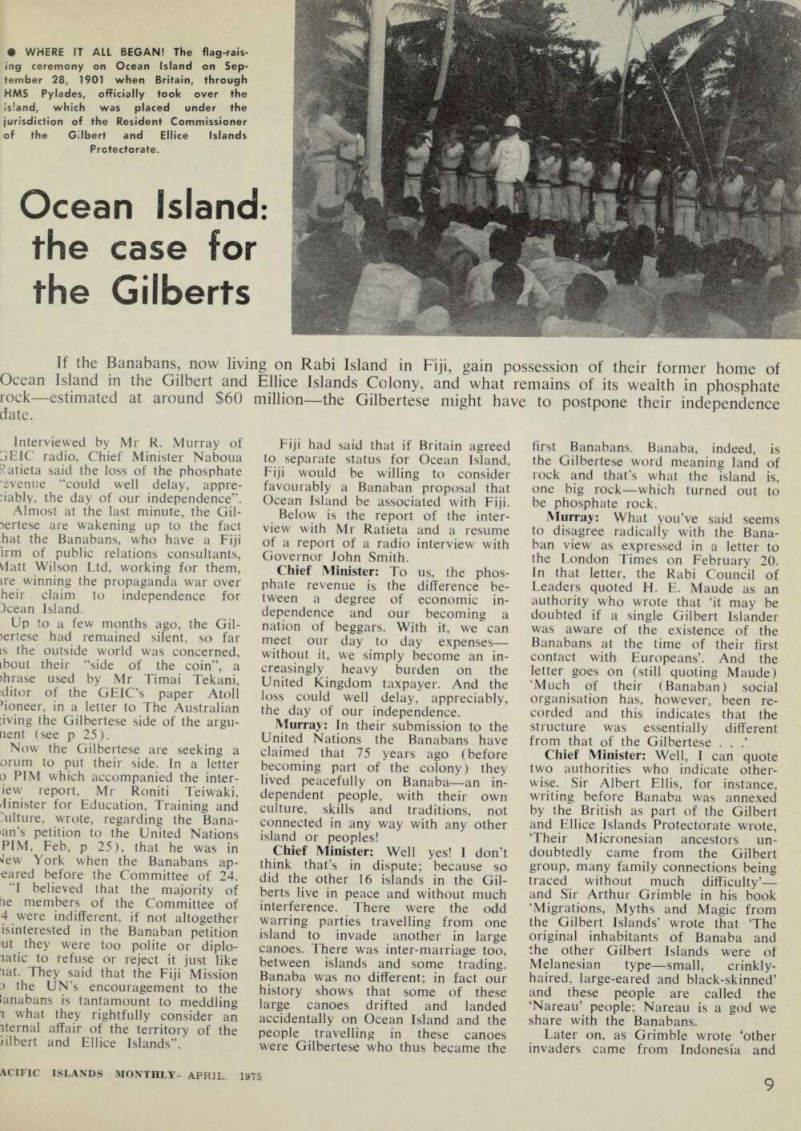
• WHERE IT ALL BEGAN! The flag-rais ing ceremony on Ocean Island on Sep tember 28, 1901 when Britain, through HMS Pylades, officially took over the island, which was placed under the jurisdiction of the Resident Commissioner of the Gilbert and Ellice Islands Protectorate.
The Gilberts' Case
swept through Ocean Island and the whole Gilbertese chain right down to Samoa and back again and from that time, there was much inter travel between Ocean Island and other Gilbert Islands, especially Bern. ‘At one time’, as Grimble pointed out, ‘a chief from Banaba married a Bern girl and took a lot of her relations to Banaba, where they lived ever after’.
Murray: And all this was, I sup pose, well before the beginning of this century?
Chief Minister: Oh yes! As Arthur Grimble said, this was about 1400 AD—and incidentally, even H. E.
Maude has referred to ‘The Bana bans and their kinsmen, the Gil bertese’.
Murray: Coming back to the pre sent day—do the Banabans living on Rabi Island and the Gilbert Islands generally, have much in common?
Chief Minister: Yes, with the Banabans we have the same myths and legends and we share the same gods; we also speak the same langu age, we play the same traditional games, we dance the same traditional dances; and we sing just abut the same songs and chants; and I don’t think there are people alive today who can call themselves pure Bana bans —maybe one or two, but like all the other Gilbertese people they are related with other Gilbert islanders; like the people from Bu taritari are related with people from Makin so Ocean Islanders or Bana bans are related to people in Arorae, people in Tamana, Tarawa, Abaiang and so forth.
Murray: The Banabans, (and again I am referring to the Rabi Council of Leaders’ letter to The Times) claim that their case is similar to the Ellice islanders whose separation from the Gilberts has been approved by your Council of Ministers!
Chief Minister: How can this be true? The Banabans and all of us Gilbert islanders are the same, we are Micronesian; but the Ellice peo ple are Polynesian. They have differ ent gods: they have different cul tural traditions; they have a different language, and they are a different people altogether. They dance and fish differently from us; they have different canoes even. We think that, even though we are very sorry to see them go because we have been associated with them for so long, we can understand their feelings in that they are a totally different people, and if they so wish, they should run
their own affairs. You just have to look at the map and the distance of most Ellice islands from our head quarters on Tarawa to see the sense of their decision. Banaba (or Ocean Island) is, by comparison, very close to us.
Murray: The Banabans, who of course, now live on the Fiji island of Rabi, say they want themselves and Ocean Island to become in dependent in associated status with Fiji, among whose people they have lived for the past 30 years. But Fiji is of course a lot further away from Ocean Island (and Tarawa) than even the Ellice Islands?
Chief Minister: Yes! Fiji is about 1,500 miles from Banaba and Ta rawa, while Banaba itself is only 250 miles from Tarawa, and I don’t think there is any connection between Banabans and Fijians except that in 1947, the British Government bought Rabi, an island in Fiji, for the Bana bans as their home, and the Bana bans have now, ever since Fiji be came independent, chosen to become Fiji citizens and now travel on Fiji passports. Because of this they’d like Banaba, which is part of the Gilbert Islands, to become an associated state with Fiji. How would the peo ple of Fiji, if the people of one small island there migrated to Australia and, on oil being found on that small island, said ‘now we will make our island in Fiji that is rich in oil, a part of Australia, so that we can be rich and not share our wealth with the rest of the people in Fiji.’ The rest of the Fiji people wouldn’t like it, would they?
Murray: Do you consider that the Banabans, as landowners on Ocean Island, are now getting a fair share of the phosphate royalties in relation to the country as a whole?
Chief Minister: Well, I think they have been very generously treated by the Gilbert and Ellice Islands Government. For example, in the old leases, for every million dollars of phosphate tax, the Banabans each receive $65.83 while the rest of the Gilbert and Ellice islanders receive only $14.17 each. In the new leases, signed in 1973, the Banabans receive 50 per cent of phosphate royalties accruing from these lands, or $208.33 per head for every million dollars as against $86.20 per head for other Gilbert and Ellice islanders. There is no doubt in my mind that the Banabans were exploited in the past through arrangements made with the British Phosphate Commissioners for the mining of Ocean Island, but it wasn’t only the Banabans. The whole territory was exploited and
it is only quite recently that we; have been getting our fair share; from our national asset.
Murray; As part of the Gilbert! and Ellice Islands, are the people ofi Banaba (or Ocean Island) repre sented in the House of Assembly, the; government of the country.
Chief Minister: On Ocean Island! now there are a lot of people whoc are Gilbertese working for the phos phate industry. There are also othen British Commonwealth subjects andl foreigners like Chinese and some: Taiwanese. The law at the moment,, is that, if you are a British subject) and have been living for more tharu 18 months continuously in any of] the Gilbert Islands (including Oceam Island) you can vote and so people; on Ocean Island now, including! some Banabans, can vote, and Bana ba, together with Betio, returns one: member to our House of Assembly..
Murray: So if the Banabans returni to live on Ocean Island once the: phosphate mining comes to an end — they will all have a vote in the: Government of the Gilbert Islands?' Chief Minister: Oh yes certainly;; they will be fully represented in the: House of Assembly like any other island in our territory.
In his interview, the Governor, Mr John Smith, said it was as difficult: for the Banabans to argue that they’ were ethnically different to the Gil bertese as it would be for him toi argue whether he was a Norman, ai Jute or a Saxon. Banaba was, per haps, like Cornwall. The Cornish ini the past had a language all their own;; they were a part of Britain that: could be regarded as somewhat dis tinct but, certainly today, not as dis tinct as, for example, Scotland andl Wales.
If Cornish tin were suddenly to< find new life and the Cornish people; decided to separate from the rest of: Britain and become independent, they 1 would have a similar situation as: that on Ocean Island.
Explaining that, with the current;
extremely high price of phosphate,,
income in the last three years of the operation would be very much greater than that obtained throughout the previous years, Mr Smith said the money was being set aside as a re serve to try to equalise the revenue the country would lose when mining finished. It was hoped that the in terest from it would be a reasonable yearly income for the government.
If the government lost the money 1 due in the next three years, it would: not be able to face independence; with the ease it could do if it knew 1 it had that money well invested.