Tips are out, says Mr Rea
pp. 75-77 · Read in the full issue
Tipping in Papua New Guinea should be strongly discouraged the country’s National Development Minister, Mr Gavera Rea, said when he opened, near the end of January, Port Moresby’s newest hotel, The Islander, one of the salvaged pro jects from the collapse in Australia of Cambridge Credit Corporation.
Mr Rea said he had seen the “unfortunate results of tipping” in some overseas countries. He was personally opposed to the practice, and he would strongly discourage it in Papua New Guinea.
He said the new hotel had adopted a policy of not allowing tipping, and he hoped other accommodation and service industries in PNG would do the same.
“There’s a natural friendliness and a ready courtesy in Papua New Guineans,” Mr Rea said, “and tip ping or anything else which interferes with these attributes should be out lawed.”
The Islander, which is the biggest hotel in PNG, was a partly completed Cambridge Credit Corpo ration project when the company collapsed last year. The work was completed without interruption when funds were provided by lAC’s PNG subsidiary, LAC (NG).
There is speculation in PNG that lAC wants to sell its interest and that the government is a potential buyer.
However, Mr Rea made no reference to the speculation in his address.
He said the government wanted more control over the growth of tourism to prevent lopsided develop
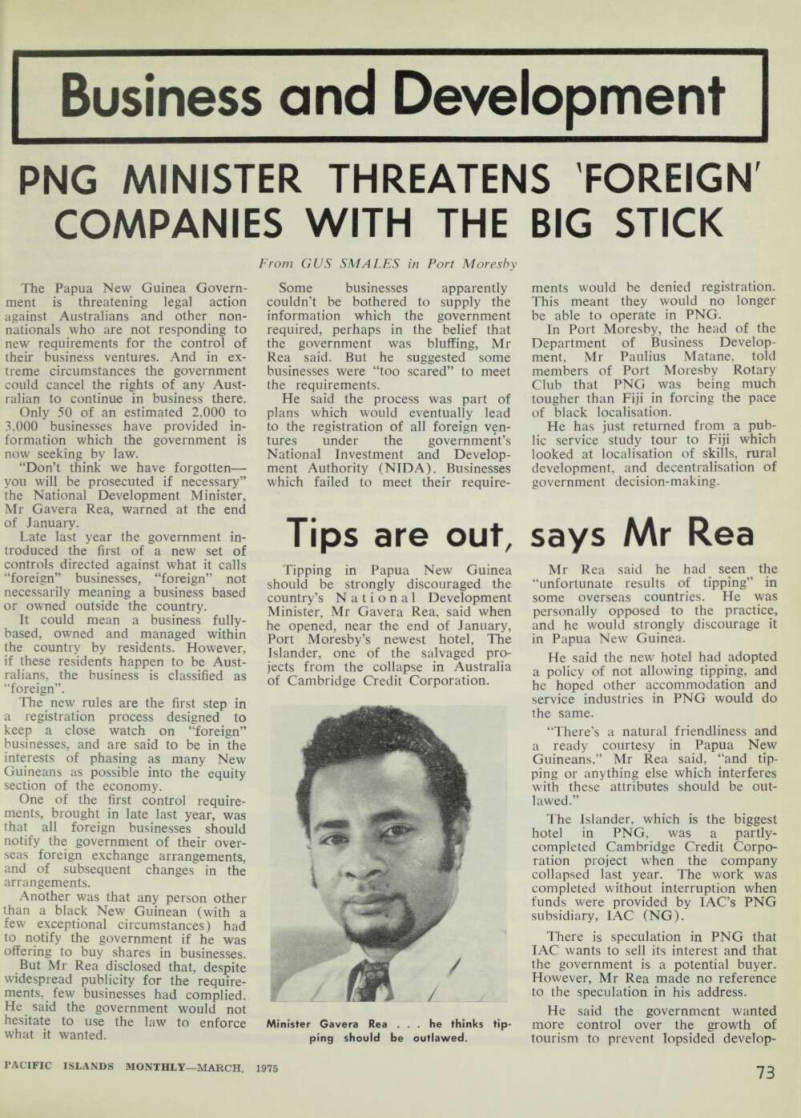
Minister Gavera Rea . . . he thinks tip ping should be outlawed.
ment which could damage the economy as a whole. A tourist ad visory council and a government office of tourism would be established soon to implement this policy.
Mr Rea said hasty hotel develop ment could lead to some undesirable aspects of tourism. He believed PNG needed a greater number of medium standard lower-cost hotels than it had at present.
The Post-Courier commended Mr Rea for his outspoken comments on tipping, and drew attention to aspects of what it called an extortion racket in some overseas countries. For example, there was the real VIP treatment in America and Europe for “big tippers”, who were known to head porters and head waiters before they stepped inside a hotel door.
Their bags were marked, or a tele phone call preceded their arrival.
They got the treatment.
But those who were known as careful tippers, or those who did not tip at all, were likely to have to wait for service. As a charge for service was built in to hotel costs, a waiter or porter should not be entitled to anything extra, as he received his wages.
The system, unfortunately, was already operating in other parts of the Pacific, chiefly Tahiti. The Post- Courier described the Tahiti system
as a “scandalous rip-off”. There was confusion about it in Fiji—in some places it was accepted, in others it was frowned on. Papua New Guineans were known for natural courtesy and a ready friendliness.
Preservation of that reputation was beyond price, and to encourage tip ping would be one way of destroying it, said the Post-Courier.
Minister's eye
on tax dodgers
Papua New Guinea’s Finance Minister, Mr Julius Chan, is con cerned at rumours that some Aus tralian businessmen in the country were deliberately withholding tax returns.
Information put to Mr Chan sug gested that returns were being with held by some operators who intended to leave the country shortly. They hoped in this way to avoid paying tax on the final one or two years of their PNG operations.
Mr Chan said the extent to which delays were being caused by in efficient or deliberate action was not known. But any “monkey business” would be stopped immediately.
He had instructed the tax office to take legal action against firms which had not lodged tax returns for
which they were liable. He had also instructed the tax office to levy its own penalty fines, as provided for in the law, against businesses lodging late returns.
Bringing home the
bacon in the Cooks
Two enterprising Cook Islanders, Ta Tukaroa of Atiu Island, and his cousin, Vaine Tairea of Mauke, re turned to Rarotonga recently after 20 years in New Zealand and set up a meat curing business—the first ven ture of its kind in the Cooks.
Their small Coral Meat Company makes corned beef from meat im ported from New Zealand, and sausages, bacon and ham from local pigs. The two partners have de veloped a special curing process which makes silverside and other meat much more palatable in sub tropical climates than the imported, frozen varieties.
They plan to sell to the Rarotonga public and to export to the outer Cooks where meat is extremely scarce.
The company’s premises were opened in January by Premier Sir Albert Henry, at Marairenga, on the outskirts of Avarua. Cabinet ministers, their wives, and about 40
businessmen and planters were among the guests.
Sir Albert said he saw the new enterprise as one way of fighting in !ation which is passed on from NZ n the form of food and other im ported goods. He added that his government’s policy was to encourage I'ook Islanders to take part in local ndustries.
The two directors, who learned heir trade in NZ, gave a demon itration of meat curing and provided asty samples of their products for heir guests.
Mr Vaine Tairea said he hoped hat, in its small way, their company yould provide employment, give local ivestock breeders a reasonable re urn for their efforts, and provide the )eople with fresh food they could ifford.
tonga plans
jn oyster project . . .
A new fisheries station will soon •e set up on the Tonga island of favau, near the Vavau Rest Home.
Tie station, in the early stages at sast, will concentrate on research ato growing shellfish. Mr Scott lennessey, a Peace Corps marine liologist, and Mr Alipate Mapu’aho, fisheries assistant, will start grow ng oysters.
Later, research will include mus els. The object of the project is to se more locally-grown oysters and aiissels as a source of protein. There /ill also be a survey of local fish pecies and the number of fishing oats used in the area. A shipment f about 2,000 oysters from the US, about $5O is expected to rrive in Tonga soon. Most of these /ill be sent to Vavau for exped ients, along with some oysters from r angauta lagoon.
. . and its coconuts
jam record income
Tonga’s desiccated coconut in ustry earned a record $T427,666 in xports in 1974. In the previous year ic earnings were 5T336.010. How ver, the 1974 output at 808 tons, was own on the 1973 figure of 1,348.
'he industry started about 10 years go.
The best market in 1974 was New ealand, which took 313 tons, fol ded bv Australia with 266 tons and •ritain 216 tons. In the previous year iritain bought 694 tons. Australia 323 ms and New Zealand 316 tons. An ther good vear is expected in 1975, Ithough prices, in line with copra, /ill probably be lower.