Business and Development
p. 75 · Read in the full issue
Png Minister Threatens 'Foreign'
Companies With The Big Stick
From GUS SMALES in Port Moresby
The Papua New Guinea Govern ment is threatening legal action against Australians and other non nationals who are not responding to new requirements for the control of their business ventures. And in ex treme circumstances the government could cancel the rights of any Aust ralian to continue in business there.
Only 50 of an estimated 2,000 to 3.000 businesses have provided in formation which the government is now seeking by law.
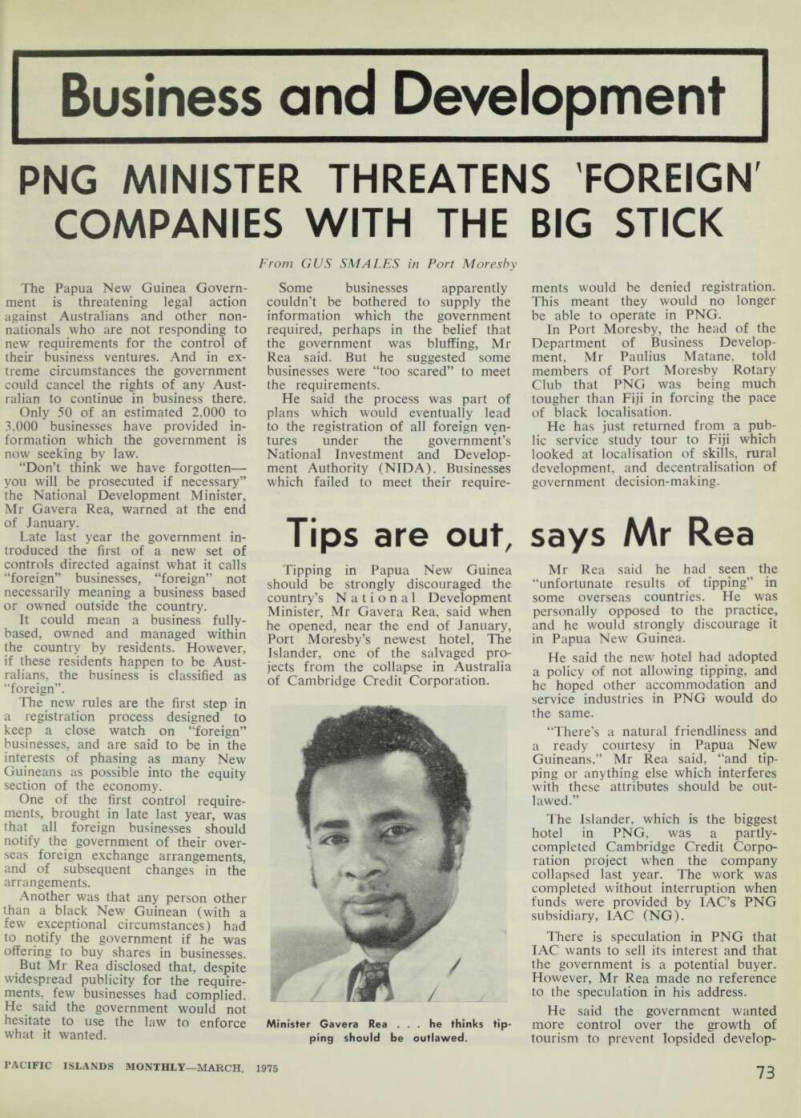
“Don’t think we have forgotten— you will be prosecuted if necessary” the National Development Minister, Mr Gavera Rea, warned at the end of January.
Late last year the government in troduced the first of a new set of controls directed against what it calls “foreign” businesses, “foreign” not necessarily meaning a business based or owned outside the country.
It could mean a business fully based, owned and managed within the country by residents. However, if these residents happen to be Aust ralians, the business is classified as “foreign”.
The new rules are the first step in a registration process designed to keep a close watch on “foreign” businesses, and are said to be in the interests of phasing as many New Guineans as possible into the equity section of the economy.
One of the first control require ments, brought in late last year, was that all foreign businesses should notify the government of their over seas foreign exchange arrangements, and of subsequent changes in the arrangements.
Another was that any person other than a black New Guinean (with a few exceptional circumstances) had to notify the government if he was offering to buy shares in businesses.
But Mr Rea disclosed that, despite widespread publicity for the require ments, few businesses had complied.
He said the government would not hesitate to use the law to enforce what it wanted.
Some businesses apparently couldn’t be bothered to supply the information which the government required, perhaps in the belief that the government was bluffing, Mr Rea said. But he suggested some businesses were “too scared” to meet the requirements.
He said the process was part of plans which would eventually lead to the registration of all foreign ven tures under the government’s National Investment and Develop ment Authority (NIDA). Businesses which failed to meet their require
ments would be denied registration.
This meant they would no longer be able to operate in PNG.
In Port Moresby, the head of the Department of Business Develop ment, Mr Paulius Matane, told members of Port Moresby Rotary Club that PNG was being much tougher than Fiji in forcing the pace of black localisation.
He has just returned from a pub lic service study tour to Fiji which looked at localisation of skills, rural development, and decentralisation of government decision-making.