The Islands Agent Who Bought
pp. 77-78 · Read in the full issue
A Hoodoo Ship
The old established Sydney-based islands trading firm of Nelson and Robertson was 80 years old on February 18, set up with a capital of £5O. Ivan Nelson, the founder, was a resourceful individual, born in Sweden, who had arrived in Australia six years earlier. He tried his hand at several callings—surveying, a bank teller and an “Ivan-of-all-trades” for Gibson and Co, Sydney shipbrokers and chandlers.
He became so proficient at carrying out many and varied tasks for this company that he was commissioned in 1893 by the New Australian Cooperatives Settlement Association to buy the Royal Tar, a 597-ton barque, then the largest sailing ship built in Australia. In his later years, Ivan Nelson, who died on July 31, 1941, may have reflected on this assignment without a great deal of pleasure.
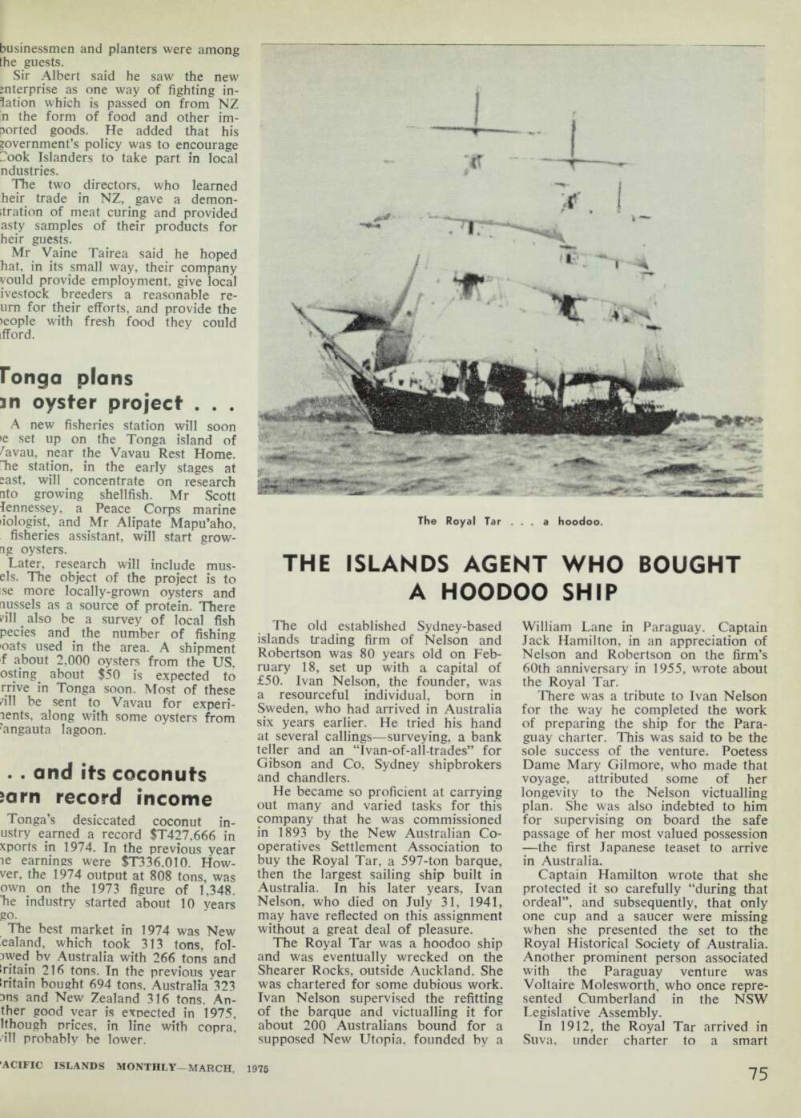
The Royal Tar was a hoodoo ship and was eventually wrecked on the Shearer Rocks, outside Auckland. She was chartered for some dubious work.
Ivan Nelson supervised the refitting of the barque and victualling it for about 200 Australians bound for a supposed New Utopia, founded by a
William Lane in Paraguay. Captain Jack Hamilton, in an appreciation of Nelson and Robertson on the firm’s 60th anniversary in 1955, wrote about the Royal Tar.
There was a tribute to Ivan Nelson for the way he completed the work of preparing the ship for the Para guay charter. This was said to be the sole success of the venture. Poetess Dame Mary Gilmore, who made that voyage, attributed some of her longevity to the Nelson victualling plan. She was also indebted to him for supervising on board the safe passage of her most valued possession —the first Japanese teaset to arrive in Australia.
Captain Hamilton wrote that she protected it so carefully “during that ordeal”, and subsequently, that only one cup and a saucer were missing when she presented the set to the Royal Historical Society of Australia, Another prominent person associated with the Paraguay venture was Voltaire Molesworth, who once repre sented Cumberland in the NSW Legislative Assembly, In 1912, the Royal Tar arrived in Suva, under charter to a smart
The Royal Tar . . . a hoodoo.
operator, who was recruiting settlers from Indian labourers, who had completed their indentures in Fiji, for a highly-coloured rich Eldorado in Argentina. This charter did not come off—its fraudulence was ex posed before the Royal Tar sailed.
Captain Hamilton recorded that the promoter of the venture died soon after and was buried at sea “at the dead of night” from a small boat commissioned to counteract a threat from some of his dupes of “splitting his heart in twain, alive or dead”.
That marine funeral provided the only requiem of the Eldorado, erected on vague promises, money for nothing and ending in thin air.
There was another unfortunate chapter in the life of the Royal Tar, apparently before Ivan Nelson bought it for the co-op association. She had discharged coal in New Guinea be fore carrying out a charter to load timber in the US for Sydney. The officers and crew, or at least some of them, went on a shooting expe dition in New Guinea, and were bitten by the anopheles mosquito.
This caused an epidemic of malignant malaria.
The captain died, the chief mate and the second mate went down, along with many others, leaving only
the third mate and two weakened seamen to carry on. The Royal Tar made San Francisco, with the sur vivors suffering many privations. The US authorities wanted to scuttle the ship to prevent the epidemic spread ing through the country. This pro posal was quashed by the third mate, and the Royal Tar survived for other ill-fated ventures.