Magazine Section
pp. 39-42 · Read in the full issue
Never A Dull Moment In The
Islands For Cooks' John Webb
By W. H. Percival
A last-minute check-up on John Webb brought this from Don Percival in Rarotonga: John Henry Webb is still sprightly and cheerful at the age of 89, except for oc casional bouts of neuralgia of the face. Until recently, he used to drive his own car, but the car has worn out before he has, and he can't get spares for it. So now he hitches rides into town, where he can be seen walking around most days of the week.
John Henry Webb, aged 89, is one of the Cook Islands’ grand old men. During his long and adven turous career he has been an engineer, whaler, chief supercargo on trading schooners, accountant, man ager of a large copra plantation, and owner of a citrus plantation.
Bom in Bridgewater, Victoria, Australia, on November 23, 1885, he landed in the Cook Islands in January, 1910. After matriculating and winning two scholarships, he studied accountancy at Ballarat but his studies were cut short by his father’s death. He spent the next two years cycling over most of Victoria and New South Wales and also reached parts of Queensland and the Northern Territory, and Broome and Perth in Western Australia.
After taking part in the Tarna gulla gold rush, without any marked success, he went to Sydney and be came a supercargo for a small Syd ney syndicate, a job which took him to the Solomons, the New Hebrides, Tonga, Samoa, Fiji and New Guinea.
“They were pretty wild and woolly places in those days”, Mr Webb re called, “but I managed to keep my head”. His firm had several depots in New Guinea, where head-hunting was the favourite local pastime.
After New Guinea, he island hopped on different ships, calling at Borneo and the Dutch East Indies.
“The Javanese were very simple minded and did everything the Dutch told them to do”, Mr Webb said.
“They trusted and respected Euro peans and I got on well with them.
But the Dutch were a different mat ter. They were developing recently discovered oil fields, and were very suspicious of foreigners. They fol lowed me about and harried me with questions, placing obstacles in my path when I wanted to visit certain areas.
“Several times I predicted that, eventually, the Dutch would be
driven out of the country. Events proved me right, but this didn’t occur until shortly after World War 11. By that time, however, the Indo nesians developed a hatred of all Europeans”.
John Webb then travelled to Japan and the China Coast in 1906, using a British passport. In those distant days people could travel anywhere in the world without a passport. But a passport helped because it showed that the holder was a person of sound financial and social standing.
After leaving Japan, John Webb went to Tasmania and worked there in the silver mines in Mount Magnet.
While there he obtained his second class stationary steam certificate.
Then he went to Bluff, in the South Island of New Zealand, later work ing his way through NZ to Whanga mumu, near the Bay of Islands.
He became a shore engineer at the Whangamumu whaling station and looked after the boilers and winches.
Sometimes he was required to go out with the whalers.
Bert Cook, who owned and ran the station, was a big, powerful, half caste Maori. He could out-work and out-fight any of the men there, and often did so although some of them
were also big, tough men. Cook was also something of an inventor. He invented a method of netting whales, and killing them with a device Mr Webb called a “bomb-gun”.
There were some pinnacle rocks off-shore, and a deep and narrow passage. The whales went through the passages to rub the barnacles off their huge bodies. Bert Cook had strong rope nets hung across the en trance to the passage, but they all burst when the whales crashed into them. Then Cook had the idea of replacing the rope nets with steel nets—and these worked.
His later nets were made of i in. diameter steel wire rope with meshes 5 ft square that were shackled to gether. Each end of the net was made fast to the rocks with new manilla rope, one inch in diameter.
When a whale swam into the steel nets, the rope dragged the net firmly over the mammal’s head before the ropes snapped. As the whale rolled helplessly on the surface, the boats rushed in and the whale was lanced and killed. Then a steam launch made fast and towed the whale, net and all, into the station for pro cessing.
The wire meshes bit a foot deep into the whales’ bodies when they rolled over; then the net was pulled out, unshackled, and then re shackled to form a new net.
Bert Cook’s bomb-gun was mounted on a swivel on his big steam launch. Originally, it was a military weapon with an inch or U in. bore.
Cook enlarged the bore and de signed special projectiles, about 18 in. long and guided in flight by leather vanes. He used charges of black gunpowder, and the projectiles were designed to enter the whale’s body and explode near the heart. If well aimed, they caused instantane ous death.
John Webb worked at the whaling station for six months in 1908 dur ing which time Bert Cook and his
men killed 14 whales, using nets, five with the “bomb-gun” and one loose whale was harpooned from a boat.
The whale meat was canned in New Zealand and sold in Tahiti.
Mr Webb recalled that Bert Cook’s older brother, whose name he had forgotten, settled in Tonga and set up a whaling business there. When I visited Tonga about 12 years ago, members of the Cook family were still active whalers, using an open boat and hand harpoons.
While on holiday in Tahiti John Webb joined the firm of Maxwells in Papeete, as supercargo on the schooner Tom Fisher, a sturdy 80ton vessel of Australian hardwood.
He sailed in her to many of the Tuamotus and other islands of the Society Group and the Marquesas.
In 1912, he met Elizabeth Keane in Papeete and married her there in October of that year. They had two children, Evelyn and John. In the same year, Maxwells sent him, as supercargo in their schooner Ma kemo, to the northern Cook Islands of Penrhyn, Manihiki, Rakahanga and Pukapuka to uplift a cargo of copra and pearl shell. They owned Suwarrow atoll and sent him there on another voyage.
“At Suwarrow we uplifted over 20 tons of hybrid shell and 25 tons of copra. We stripped the lagoon of mother-of-pearl shell, and it was just as well we did, because later two hurricanes devastated the atoll, sweeping away much of the land and burying the pearl shell beds under 10 ft of sand and debris”.
The hybrid shell was a mixture of black-lipped and gold-lipped shell that had mated to produce a cross bred variety. The 1914 hurricane spoiled the lagoon for pearl shell
cultivation and greatly damaged Home Island and the adjacent island which had been extensively planted in coconut palms for copra produc tion. Mr Webb recalled that on Home Island there were two small cannon near the flagstaff from which the Union Jack was flown. After the 1914 hurricane, Maxwells sold their Suwarrow interests to A. B. Donald Ltd.
When John Webb returned to Ta hiti, Maxwells promoted him to head supercargo and sent him to the Tuamotus and the Marquesas. In 1916 they sent him to Flint Island to manage their big copra plantation there, a position he held for three years.
Maxwells had planted 30,000 co conut palms on Flint, which is in the Line Islands, and is an atoll with guano deposits. Under John Webb’s management the plantation produced a record figure of 250 tons of copra a year. “Some may say I’m exagger ating”, he said, “but I kept careful records and the trade figures will bear me out”.
He said that each tree bore pro fusely because the soil was rich in guano, and he kept the plantation clear of weeds and made sure that no burning-off was done. He also made war on the coconut crabs and his workers killed 6,000 of them in one month. About 25,000 of the 30,000 coconut palms bore at the same time. The island had a tram way and he improved the flat-tops by having wooden sides put on them, enabling each to carry up to 800 nuts.
His workers came mostly from the Tuamotus—people used to the hard atoll life. He employed a gang of 10 men and also 10 women to avoid the trouble that can be ex pected if either sex outnumbers the other.
“Even then, trouble sometimes broke out”, he recalled, “but I let my foreman settle those disputes. He was a very tough man and could lick any man on the island. Some times workers would turn up with black eyes or torn faces, but they had to produce their daily quota just the same”.
The copra was sun-dried and he had a method to beat the rain which could quickly spoil it. Galvanized iron covers were placed over the drying racks, and at the first sign of rain, the women would dash along and slam the covers down, hardly breaking their stride when doing it.
The women were better than the men at cutting copra and used specially shaped knives made from old saw blades. When he wanted the workers to increase their output Mr Webb
offered them a bonus in the form of food.
“If you’re living on a diet of tin ned meat, rice and fish, you’d wel come an extra can of pears or apri cots wouldn’t you?” he said. “All right, so the system worked and the workers were happy. They used to say: ‘Not only do we get regular meals, but we get paid as well’ ”.
John Webb was in Papeete in September, 1914, when units of the German Imperial Fleet bombarded the port. He recalled that they sank the French ship, Zelee, and the Val kerie, a German vessel the Allies had captured. Both vessels were in port.
On Flint Island they hardly knew there was a world war on until Count Felix von Luckner called in to check the chronometer and compasses of his sea raider, Seeadler. Von Luckner had sunk an impressive tonnage of Allied shipping in the Pacific, but John Webb knew nothing of this at the time. To him, the Seeadler ap peared to be a merchant vessel which would probably welcome some fresh provisions. He had a boat loaded with coconuts and took them off to the ship. When he got on board, Count von Luckner introduced him self.
“Don’t you know that Germany and Britain are at war?” he asked.
“No”, John Webb replied. “And I hope that we're not at war”.
“I don’t see why we should be”,
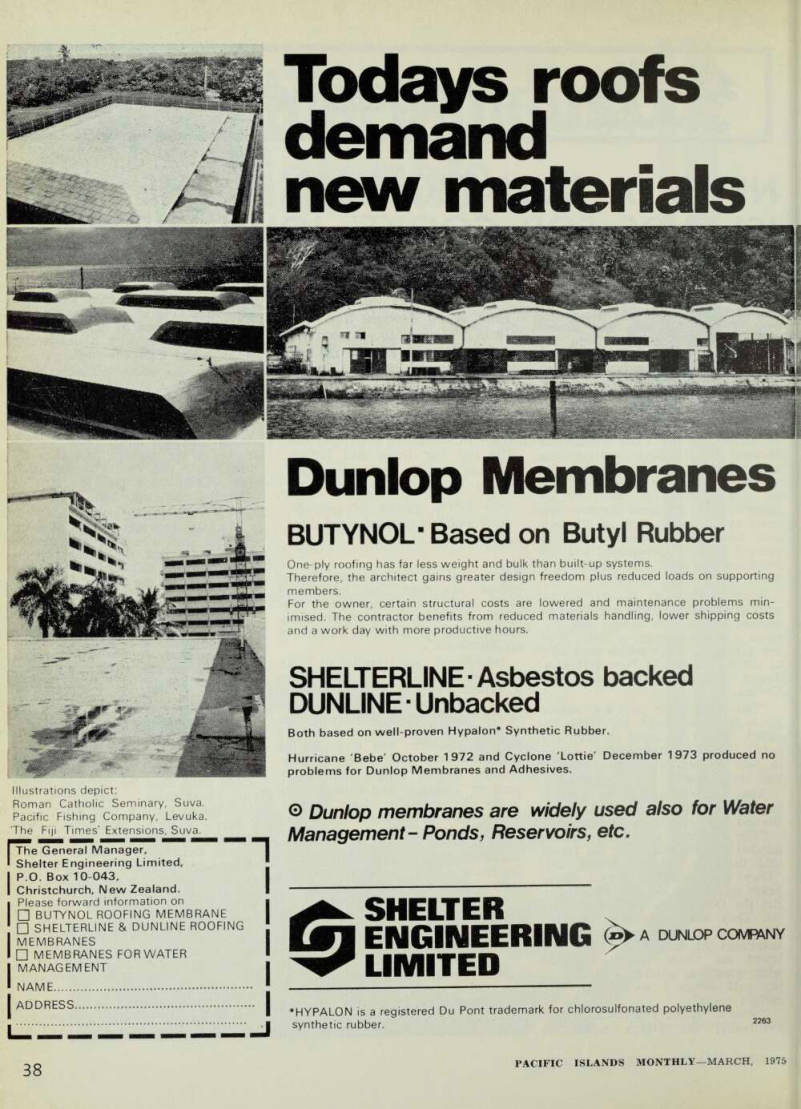
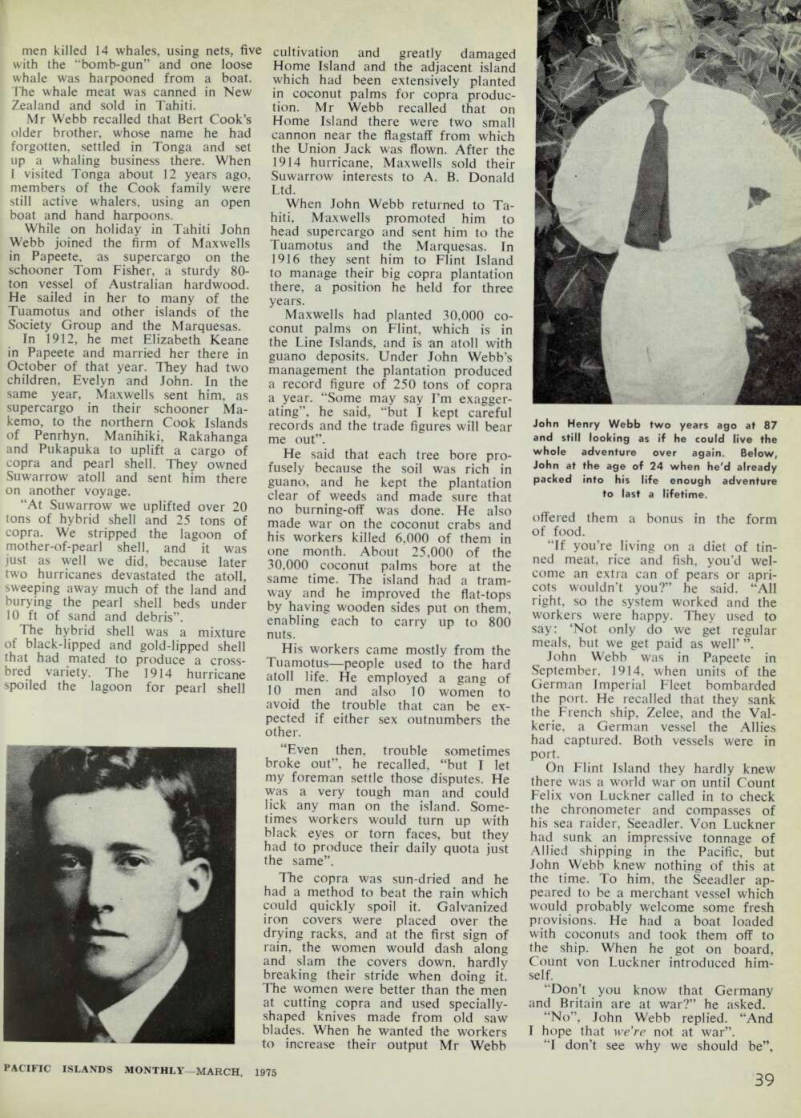
John Henry Webb two years ago at 87 and still looking as if he could live the whole adventure over again. Below, John at the age of 24 when he'd already packed into his life enough adventure to last a lifetime.
von Luckner smiled. Then he invited the Australian to his cabin for a few drinks and, sometime later, gave him a generous supply of potatoes, onions and other food.
Back in Tahiti in 1919, John Webb met Robert (Boss) McKegg of the Cook Islands Trading Company. He had met McKegg in Rarotonga in 1912 and 1914, and when McKegg offered him a job with his Rarotonga based trading firm, John Webb ac cepted.
“At the end of 1919, Bob McKegg sent me off to Mangaia Island to manage his branch store there”, Mr Webb recollected. “After a year there I returned to Rarotonga where McKegg employed me as his yard man. Later, he put me in charge of merchandise and after that made me his accountant. From there, I be came his branch auditor and tra velled round the Cook Islands, stock taking and hiring and firing staff”.
As the years in Rarotonga passed, John Webb became involved in com munity affairs. In 1920 he became one of the founders of the first Euro pean school there. The six founders paid the teacher’s salary of £25 a month from their own pockets. In 1926, he became a founder and original member of the Sports Asso ciation, with Judge Ayson, Makea
Tinirau, Fairlie Bonar, Ted Reid and Willie Brown. He was also a founder and original member of Rarotonga’s cricket, bowling, sailing, jockey and boxing clubs.
His wife died and, in 1935, he married Matangaro Cummings in
Rarotonga. There were seven child ren from this marriage. During the same year he left the Cook Islands Trading Company and was self employed for the next seven years; then he joined the Cook Islands Administration as the Chief Clerk at Public Works. His next job was with A. B. Donald (Cook Islands) Ltd in Rarotonga where he did mer chandising, costing and accounting until he retired in 1962.
During his retirement he ran his own citrus plantation on Rarotonga, but could not make it pay. He ran heavily into debt and in the end “gave it away” to the Agriculture Department which, in spite of its financial backing and expertise only succeeded in running the plantation into further debt.
In May, 1972, John Webb senior, with his son John, and five others, were presented with their certificates as permanent residents of the Cook Islands by the Premier, then Mr Albert Henry, during an official ceremony in the Premier’s office.
“It was an historic and happy occasion and one I won’t forget”, said old Mr Webb.
More magazine on p 49.
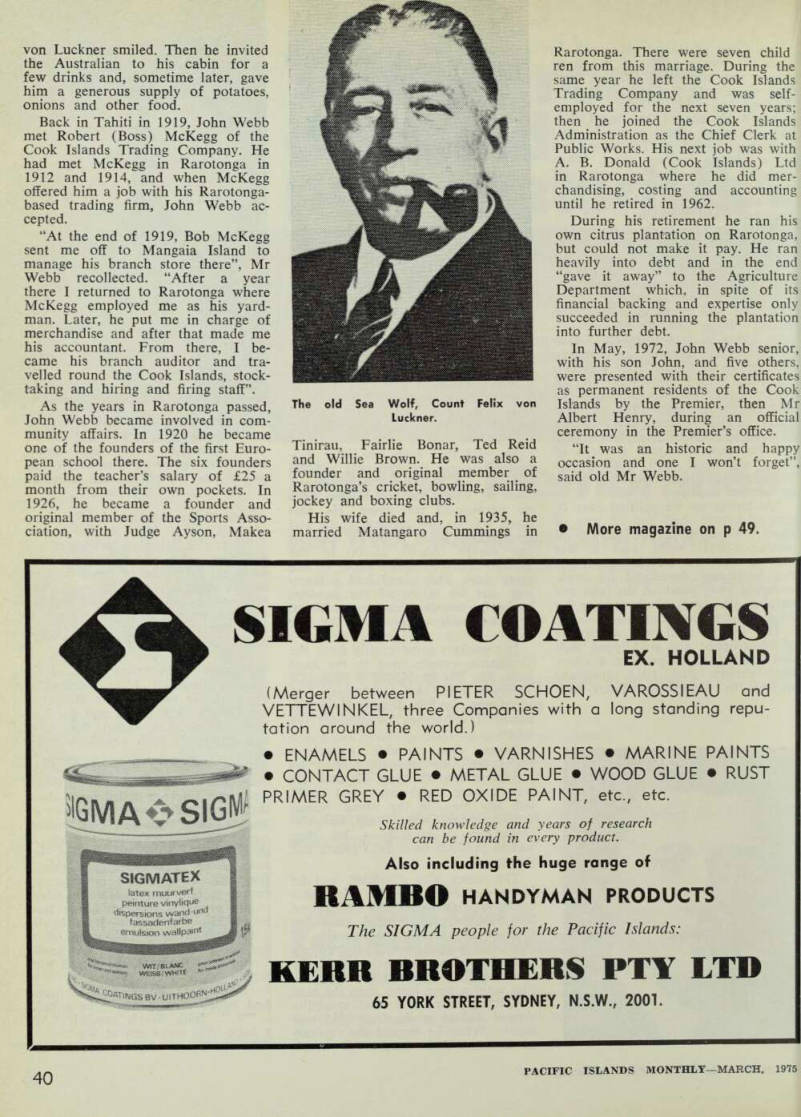
The old Sea Wolf, Count Felix von Luckner.