Digging up
p. 37 · Read in the full issue
a Niuean mystery . . .
. . . AND SOME POLYNESIAN PAST
From Stafford L. K. Guest
on Niue
When a Niuean mystery was re cently solved by a visiting New Zea land archaeologist, an equally strange one, likely to remain unsolved for ever, was unearthed.
Mystery number one: For gener ations the people of Niue, a raised, high, rocky island 350 miles south east of Samoa, have speculated on the use of strange, hollow boat shaped mounds. Some have said their forefathers were unable to make canoes out of wood so they built them out of stone; others have re garded them as “just another heap of rocks” and have planted taro over the mounds.
Along comes Canterbury Museum archaeologist, Michael Trotter, who carefully examines the strange shapes and pronounces them to be hut foundations.
Mystery number two: After sur veying the location of the hollow nounds, Michael discovers they are dl nearly 30 metres long and aligned o 11 degrees north. Bearing in mind hese could be more than 1,000 years )ld the method of achieving align nent is a mystery. Michael has irnved at several conclusions, “but hey are purely personal—your guess vould be as good as mine”.
Beneath low stone platforms lea red around old village sites there ? evidence that they were used as ut platforms. Large mounds mea unng 30 metres by 25 metres and wo metres high could have been sed for ceremonial purposes.
“The boat-shaped mounds have a to the NZ Maori raised m-pit house”, says Michael who an expert in pre-history South iland of New Zealand and who has arned out archaeological studies n Atiu and Aitutaki in the Cooks.
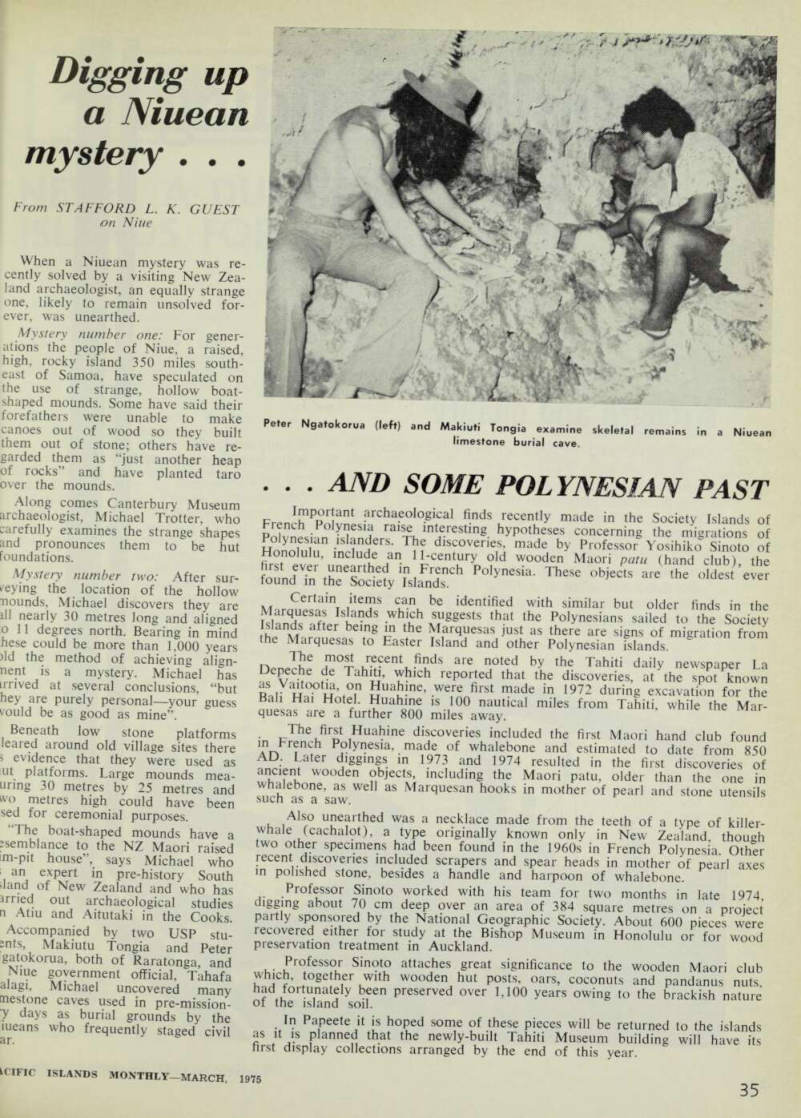
Accompanied by two USP stu nts, Makiutu Tongia and Peter gatokorua, both of Raratonga, and Niue government official, Tahafa alagi, Michael uncovered many tnestone caves used in pre-mission 7 da y s as burial grounds by the means who frequently staged civil ar.
Frpn^h lP p^i ant archa . eolo .B lcal finds recently made in the Society Islands of Polynesian ! n £ restm «. h yP°‘heses concerning the migrations of areffsaijs* Th Vf.,r„ ( ;,oo tairi T r‘ te T S c . a . n . be ident 'fi ed with similar but older finds in the Mands fflr ht" - Wh m h „ S ,, ugges,s lhat the Polynesians sailed to the Society fh. vr ft b 8 J- n the Marquesas just as there are signs of migration from he Marquesas to Easter Island and other Polynesian islands. JSf , mo 2J , r «? ent . fi? ds are noted by the Tahiti daily newspaper La Depeche de Tahrn, which reported that the discoveries, at the spot known Ha?V?AteT n 5 Ua v ne ’ • We , r L first ITlade in 1972 duri "B excavation for the Bah Hat Hotel. Huahme is 100 nautical miles from Tahiti, while the Mar quesas are a further 800 miles away. • c , The Huahine discoveries included the first Maori hand club found t 4 Ppjyncsm, made of whalebone and estimated to date from 850 AD. Later diggings in 1973 and 1974 resulted in the first discoveries of wooden objects, including the Maori patu, older than the one in whalebone, as well as Marquesan hooks in mother of pearl and stone utensils sucn as a saw.
Also unearthed was a necklace made from the teeth of a type of killer whale (cachalot), a type originally known only in New Zealand though two other specimens had been found in the 1960 s in French Polynesia Other recent discoveries included scrapers and spear heads in mother of pearl axes m polished stone, besides a handle and harpoon of whalebone.
Professor Sinoto worked with his team for two months in late 1974 digging about 70 cm deep over an area of 384 square metres on a project partly sponsored by the National Geographic Society. About 600 pieces were recovered either for study at the Bishop Museum in Honolulu or for wood preservation treatment in Auckland.
Professor Sinoto attaches great significance to the wooden Maori club which, together with wooden hut posts, oars, coconuts and pandanus nuts had fortunately been preserved over 1,100 years owing to the brackish nature of the island soil.
In Papeete it is hoped some of these pieces will be returned to the islands as it is planned that the newly-built Tahiti Museum building will have its first display collections arranged by the end of this year.
Peter Ngatokorua (left) and Makiuti Tongia examine skeletal remains in a Niuean limestone burial cave.