Haydon fights
p. 35 · Read in the full issue
another 'hatchet job'
Prom a Pago Pago correspondent
Former American Samoa Governor John M. Haydon has continued to be the centre of controversy following his departure from Pago Pago last October.
Haydon, now living in his native Seattle, Washington, has gone to battle with the National Broadcasting Company over a documentary film which was produced while he was still governor. The film, which was shown in the United States as part of NBC’s “Weekend” news series, was titled Everything You Always Wanted to Know About American Samoa, But Were Afraid to Ask and blasted both the Department of the Interior’s run ning of the territory and Haydon’s administration in particular.
The film segment, produced by Bob Rogers of NBC News in Wash ington (DC) accused the department of colonialism and pictured Haydon as an all-powerful colonial governor.
One segment of the film showed young Samoan men enlisting in the United States Army while the narrator stated that the “colonies” had always provided “cannon-fodder” for the motherland.
And it attempted to link Haydon with the Watergate controversy by alleging that the former governor* was a “close friend” of convicted Watergate conspirator John Ehrlich man. Both Haydon and Ehrlichman are from Seattle.
The controversy widened its field in December when former Nixon speech-writer Patrick Buchanan at tacked the NBC presentation in an article in TV Guide magazine.
Buchanan defended both the Depart ment of the Interior and Haydon and called the NBC film a “network hatchet job”.
Meanwhile, Haydon has taken his case to the National News Council— an independent organisation set up to examine charges of inaccuracy and unfairness in national news reporting.
Executive Director William B. Arthur has said that the NNC is looking into the Haydon-NBC controversy and
undertaking an investigation of Hay don’s accusations of unfairness.
Even Haydon’s critics have felt that the film was an unbalanced presenta tion of American Samoa and the American Samoan people. One scene shows a group of Samoans drinking in a local Pago Pago bar and focused on one completely-drunken Samoan.
The narrator pointed out that Samoans consume an excessive amount of liquor per person.
Most American Samoa viewers felt this to be an unfair presentation which would damage the image of the American Samoan people. On top of that, the prestigious National Geo graphic Magazine, in a special article on the South Pacific, carried a photo graph of a Samoan taxi driver with a built-in bar inside his vehicle.
The NBC film also brought up the Hatch Act violation charges brought against Haydon in 1973. Haydon had been accused of using the government media in Pago Pago to influence an election. He was cleared of all charges. NBC failed to point this out.
The network condemned Haydon for his action in the Born Innocent affair which occurred shortly before he left American Samoa last October. The movie Born Innocent was produced by NBC and concerned a young girl in a reformatory. It contained several graphic sex scenes.
Haydon ordered Pago Pago tele vision station KVZK to cut the film, stating that it was not fit for com munity viewing (PIM, Dec, p 15).
NBC accused Haydon of blacking-out television programming, without ex plaining his reasons. Nor did NBC point out that the film had caused a great deal of controversy in the United States and had not been screened by many mainland stations.
The battle between Haydon and NBC continues and it is not expected to end satisfactorily for either side.
At the time of writing the National News Council has yet to reach a decision on the investigation of Hay don’s complaint.
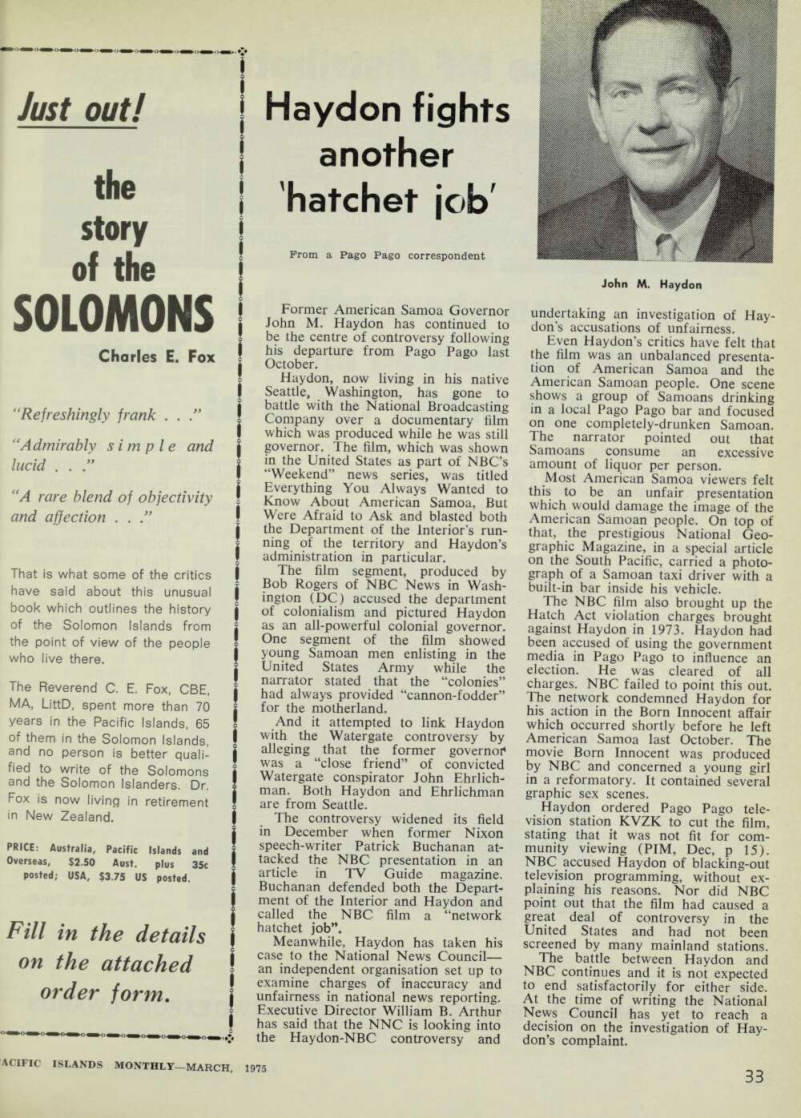
John M. Haydon