Yesterday
p. 51 · Read in the full issue
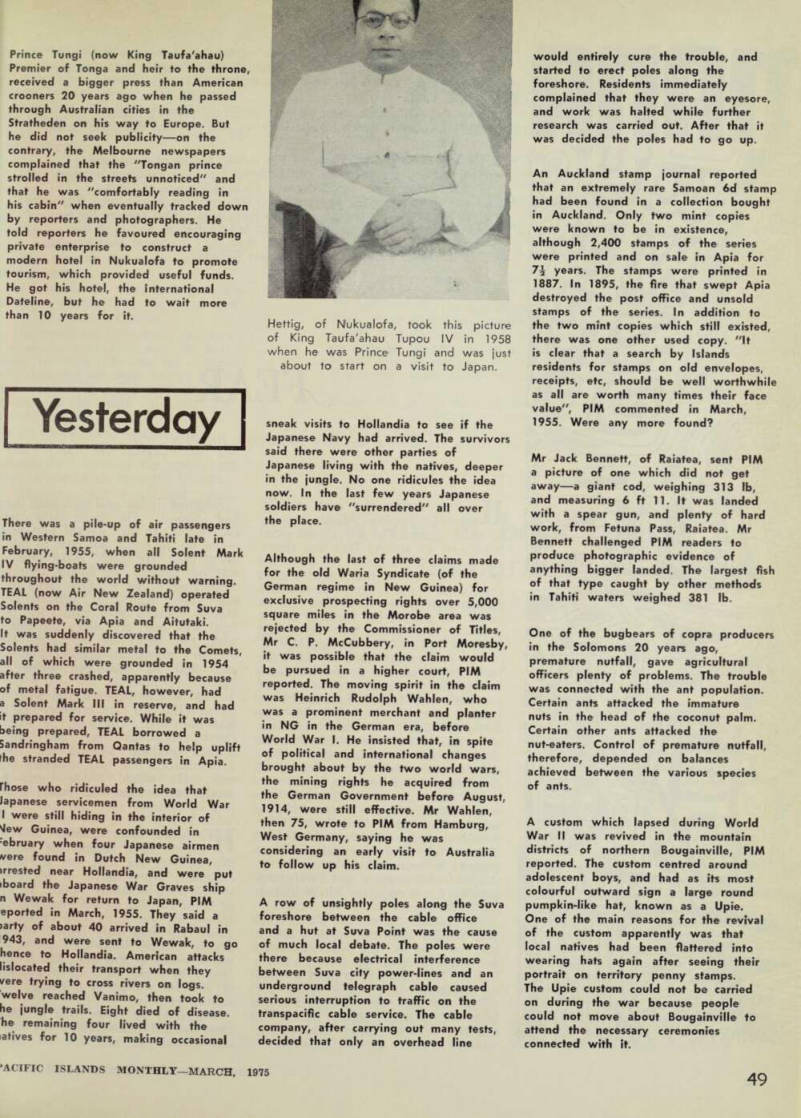
Prince Tungi (now King Taufa'ahau) Premier of Tonga and heir to the throne, received a bigger press than American crooners 20 years ago when he passed through Australian cities in the Stratheden on his way to Europe. But he did not seek publicity—on the contrary, the Melbourne newspapers complained that the "Tongan prince strolled in the streets unnoticed" and that he was "comfortably reading in his cabin" when eventually tracked down by reporters and photographers. He told reporters he favoured encouraging private enterprise to construct a modern hotel in Nukualofa to promote tourism, which provided useful funds.
He got his hotel, the International Dateline, but he had to wait more than 10 years for it.
There was a pile-up of air passengers in Western Samoa and Tahiti late in February, 1955, when all Solent Mark IV flying-boats were grounded throughout the world without warning.
TEAL (now Air New Zealand) operated Solents on the Coral Route from Suva to Papeete, via Apia and Aitutaki.
It was suddenly discovered that the Solents had similar metal to the Comets, ail of which were grounded in 1954 after three crashed, apparently because of metal fatigue. TEAL, however, had a Solent Mark 111 in reserve, and had it prepared for service. While it was being prepared, TEAL borrowed a Sandringham from Qantas to help uplift fhe stranded TEAL passengers in Apia. fhose who ridiculed the idea that Japanese servicemen from World War I were still hiding in the interior of Mew Guinea, were confounded in ■ebruary when four Japanese airmen vere found in Dutch New Guinea, irrested near Hollandia, and were put iboard the Japanese War Graves ship n Wewak for return to Japan, PIM eported in March, 1955. They said a >arty of about 40 arrived in Rabaul in 943, and were sent to Wewak, to go hence to Hollandia. American attacks lislocated their transport when they vere trying to cross rivers on logs, welve reached Vanimo, then took to he jungle trails. Eight died of disease, he remaining four lived with the natives for 10 years, making occasional
sneak visits to Hollandia to see if the Japanese Navy had arrived. The survivors said there were other parties of Japanese living with the natives, deeper in the jungle. No one ridicules the idea now. In the last few years Japanese soldiers have "surrendered" all over the place.
Although the last of three claims made for the old Waria Syndicate (of the German regime in New Guinea) for exclusive prospecting rights over 5,000 square miles in the Morobe area was rejected by the Commissioner of Titles, Mr C. P. McCubbery, in Port Moresby, it was possible that the claim would be pursued in a higher court, PIM reported. The moving spirit in the claim was Heinrich Rudolph Wahlen, who was a prominent merchant and planter in NG in the German era, before World War I. He insisted that, in spite of political and international changes brought about by the two world wars, the mining rights he acquired from the German Government before August, 1914, were still effective. Mr Wahlen, then 75, wrote to PIM from Hamburg, West Germany, saying he was considering an early visit to Australia to follow up his claim.
A row of unsightly poles along the Suva foreshore between the cable office and a hut at Suva Point was the cause of much local debate. The poles were there because electrical interference between Suva city power-lines and an underground telegraph cable caused serious interruption to traffic on the transpacific cable service. The cable company, after carrying out many tests, decided that only an overhead line
would entirely cure the trouble, and started to erect poles along the foreshore. Residents immediately complained that they were an eyesore, and work was halted while further research was carried out. After that it was decided the poles had to go up.
An Auckland stamp journal reported that an extremely rare Samoan 6d stamp had been found in a collection bought in Auckland. Only two mint copies were known to be in existence, although 2,400 stamps of the series were printed and on sale in Apia for years. The stamps were printed in 1887. In 1895, the fire that swept Apia destroyed the post office and unsold stamps of the series. In addition to the two mint copies which still existed, there was one other used copy. "It is clear that a search by Islands residents for stamps on old envelopes, receipts, etc, should be well worthwhile as all are worth many times their face value", PIM commented in March, 1955. Were any more found?
Mr Jack Bennett, of Raiatea, sent PIM a picture of one which did not get away—a giant cod, weighing 313 lb, and measuring 6 ft 11. It was landed with a spear gun, and plenty of hard work, from Fetuna Pass, Raiatea. Mr Bennett challenged PIM readers to
produce photographic evidence of
anything bigger landed. The largest fish of that type caught by other methods in Tahiti waters weighed 381 lb.
One of the bugbears of copra producers in the Solomons 20 years ago, premature nutfall, gave agricultural officers plenty of problems. The trouble was connected with the ant population.
Certain ants attacked the immature nuts in the head of the coconut palm.
Certain other ants attacked the nut-eaters. Control of premature nutfall, therefore, depended on balances achieved between the various species of ants.
A custom which lapsed during World War II was revived in the mountain districts of northern Bougainville, PIM reported. The custom centred around adolescent boys, and had as its most colourful outward sign a large round pumpkin-like hat, known as a Upie.
One of the main reasons for the revival of the custom apparently was that local natives had been flattered into wearing hats again after seeing their portrait on territory penny stamps.
The Upie custom could not be carried on during the war because people could not move about Bougainville to attend the necessary ceremonies connected with it.
Hettig, of Nukualofa, took this picture of King Taufa'ahau Tupou IV in 1958 when he was Prince Tungi and was just about to start on a visit to Japan.