Papua home-rulers
pp. 12-84 · Read in the full issue
A noisy time for the Papua home-rulers
From correspondents in Port Moresby
Commentators who wrote about Panin New Guinea affairs a few years' ago always made a point of callins the country Niugini. It was their way of demonstrating that the Papuans to the south and the New Guineans to the north were brothers nnH cictprc under the skin divided only by a worthless line which unfashionable white colonialists had drawn nn the man drawn on the map.
A few diehards still talk about Niugini, and the country s national airline, Air Niugini, manages to carry the label with some authority But today the problem of creating a single national name would appear to have become secondary to the problem of creating a single national country.
The point is that it doesn’t matter how much the white man is to blame for a line on the map—he can’t make subconscious atonement today simply by pretending that the line is meaningless.
The border has become part of history, it has superimposed its own differing patterns on its two sides, and in any event certain cultural and ethnic differences do in fact exist between Papuans on one side and New Guineans on the other.
Papua, population about one million, has been an Australian territorial possession since the turn of the century. New Guinea, population about two million, was formerly a German territorial possession and has been administered by Australia under trust since 1921.
Legally the differing status still exists, but the long-standing plan has been for the emergence of a single unified nation at independence. Unity at independence is the official policy of the legal Government of Papua New Guinea, a government drawn from both sides of the border.
Australia supports this policy. So does the United Nations.
But now, in the dying hours of
political dependence, a vocal group of Papuan activists has established what it calls the first interim govern ment of Papua.
The r6 p el govern^ en i d g^ dent proclaim Papua as an republic free from w a G d u a Ji ’ head says it will do so on a date ahead of the official J^F^New 6 Guinea the combined Papua New Guinea, expected this year.
Its political weapons are a moun tain £ legal argument to indicate p s is an ent ity a nd cannot bg forced into union with any other country unless the people decide otherwise by referendum. Its argu based he avily on cultura i differenceS; and on economic dif ferences which it daims Australia created between the Papuans and the ew Guineans, xh e re bel republic has a flag—six stars j n an arc? a cross, a bird of para dise and the word “Papua” in ver tical lettering. It has an anthem too—the song “Papua”, which a Hanuabadan villager wrote in 1936 on t h e occasion of a missionary cele bration. The flag and the song have j n f ad been used for some time by one G f t b e activist groups, the Papua Besena.
And there has also emerged an “ a rmy”—a barefoot brigade which par ades with sticks for rifles and which in January took possession of a white-owned plantation, The movement also has its ex tremist mouthpieces, men who are trying to intimidate whites and New Guineans living in Papua, and who are P romising bloodshed, commando warfare and guerilla tactics, The Papua republican movement j s an amalgamation of five main groups; who call themselves the “first interim government of Papua”. • The strongest and longest established is Miss Josephine Abaijah’s Papua Besena. Miss Abaijah, PNG’s only woman member
of the House of Assembly, has ; rallied, protested, demonstrated, cam- ■ paigned and cajoled with machine- like efficiency. Her home in the Port i Moresby suburb of Hohola flies the i Papua flag and she claims tacit sup- port, or potential support, from welll over half the population of Papua. • The other major partner in thei republic movement is Mr Simon i Kaumi’s Eriwo Development Asso ciation and its so-called military wing,< the Papua Republic Fighters Army..
Mr Kaumi, a gentlemanly, balding' senior civil servant and a contempo rary of several of PNG’s political! leaders, went overboard on thes separation movement last year and is now under public service suspensiom for his anti-government stand. Ho hints at a ready supply of weapons and equipment for his “army”, butj so far there is little evidence oh supply channels to support his claims* Mr Kaumi’s base is in Northern!
Papua where he was born and he claims strong support there, all though local politicians deny hisi claims. He is at present attempting to establish branches of his movemenr in about six other Papuan centres. • Three smaller groups make ujr : the other factions in the republic movement. They are the Papua Black Power Movement led by its governn nor, Mr Leo Kavaua, the Papuan Liberation Movement led by its pres* dent, Mr James Mopio, and thr Socialist Workers’ Party led by itti president. Mr Luki Oiwaya.
All three organisations are ven much a product of urban Poik Moresby, with the Black Power anr Socialist groups taking up extremis! minority positions.
Mr Kavaua in January proclaimea his own state of national emergency; telling whites and New Guineans tt get out of Papua or face the conse< quences.
And on February 5, Mr Kaunri
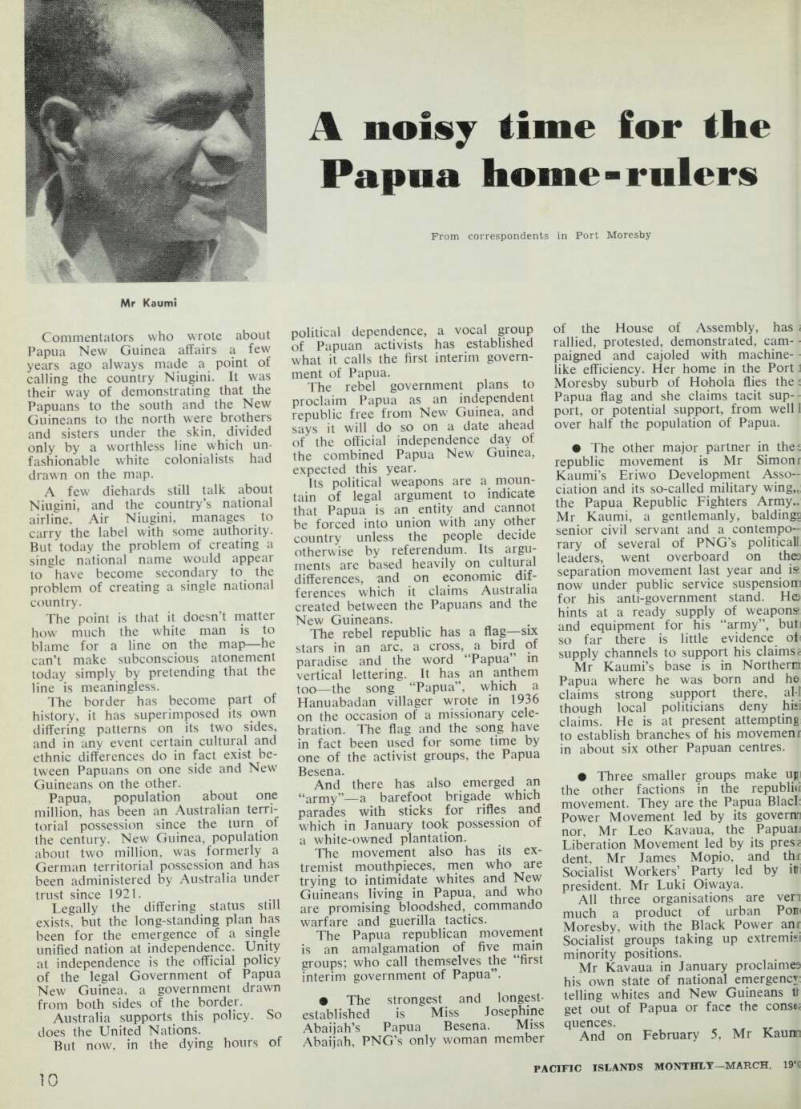
Mr Kaumi
and Miss Abaijah issued a joint state ment announcing Mr Kaumi’s nomi nation as “President” of the so-called Government of the Republic of Papua, when it comes. The statement also attacked Australian Prime Minister Gough Whitlam for having recently criticised the breakaway movement, and said Mr Whitlam’s attitude “made the future of Aus tralians and their property in Papua very gloomy indeed”.
The statement said that Papua and Papuan land were for the Papuan people only and that the new republic vould free Papua “from black and vhite colonialism”. It described both :hief Minister Michael Somare and he Leader of the Opposition, Mr fei Abal (both New Guineans) as colonialists”.
Mr Somare during the month •randed the activities of Mr Kaumi nd Miss Abaijah as “disloyal”, and aid Mr Kaumi’s “army” was an ttempt by “a small group of frus rated and manipulated people to stir isunity among the Papua New minean people”. He said stories of
the “army”, particularly in the Aus tralian press, had been blown up out of all proportion.
The Chief Minister also replied to the Black Power statement threaten ing expulsion of New Guineans and whites. “All good citizens will be protected against ratbags and irre sponsible fools,” he said. The gov ernment would take a firm stand against lawlessness or attempts at in timidation by “troublemakers” such as Mr Kavaua.
The position in mid-February is that despite talks of rebels, armies, secret weapon supplies, guerilla war fare, bloodshed, and unilateral inde pendence there is far more talk than action.
Miss Abaijah’s gool old-fashioned campaigning with its street marches and demonstrations is still a far more potent force than quasi-military threats—although on several oc casions Miss Abaijah has conceded that bloodshed could occur. The real
Continued on p 82
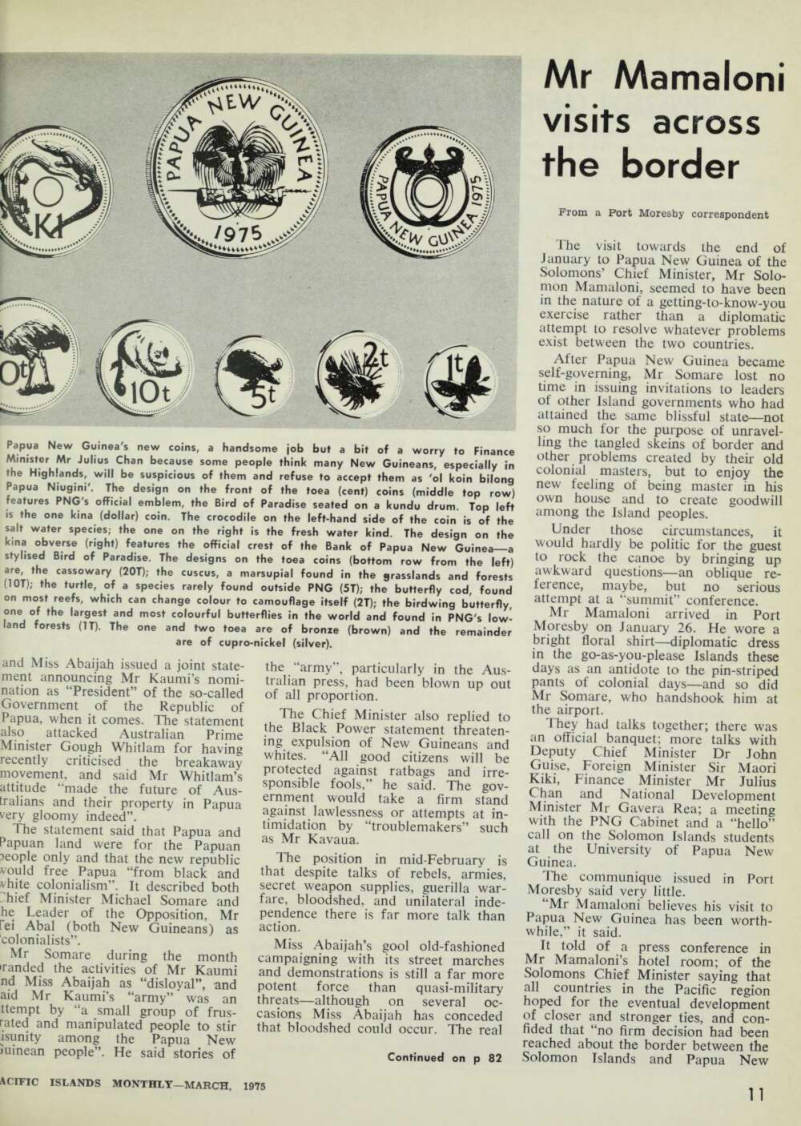
Papua New Guinea's new coins, a handsome job but a bit of a worry to Finance Minister Mr Julios Chan because some people think many New Guineans, especially in the Highlands, will be suspicious of them and refuse to accept them as 'ol koin bilong Papua Niugini'. The design on the front of the toea (cent) coins (middle top row) features PNG's official emblem, the Bird of Paradise seated on a kundu drum. Top left is the one kina (dollar) coin. The crocodile on the left-hand side of the coin is of the salt water species; the one on the right is the fresh water kind. The design on the kina obverse (right) features the official crest of the Bank of Papua New Guinea- a stylised Bird of Paradise. The designs on the toea coins (bottom row from the left) are, the cassowary (20T); the cuscus, a marsupial found in the grasslands and forests (10T); the turtle, of a species rarely found outside PNG (5T); the butterfly cod found on most reefs, which can change colour to camouflage itself (2T); the birdwing butterfly, one of the largest and most colourful butterflies in the world and found in PNG's low and forests (IT). The one and two toea are of bronze (brown) and the remainder are of cupro-nickel (silver).
danger lies in under-estimating the potential which exists for emotional support.
It’s safe to say that a real appreci ation of the Papua versus Papua New Guinea issue simply doesn’t exist in the average rural village. Political ignorance is still extensive. But the desire to join in with an emotional issue with a bit of action is ever present.
The evidence suggests that Mr Somare was unable to get all his Papuan ministers to sign a Papuan unity pledge for public circulation.
This doesn’t mean that some of his Papuan ministers oppose unity, or are on the rebel side. But it does suggest that they don’t want to upset their electors on a delicate issue.
Miss Abaijah has claimed that about 40 leading public servants have signed support for Papuan indepen dence aims.
Simon Kaumi’s “army” consists of about 160 ex-policemen, some mal contents, and villagers looking for a bit of excitement. It’s no trained or disciplined force, but a political activist group. Mr Kaumi says it has general support of the local people in the Popondetta area of Panua where it is operating, but Mr Edric Eupu, th chairman of the Northern District Area Authority, which is a form of regional government co ordinating the work of local councils in the area, denies this.
There is also some disagreement as to whether the army really has
emerged from the Eriwo Develop ment Association, which is an organi sation of Papuan nationalists opposed to anybody but Papuans in Papua.
Some association members condemn the so-called army.
The plantation which the activists took over is Jiropa, between Popon detta and Buna, owned by Gilbert Renton, 54, a blinded ex-serviceman who is well known. He moved from the plantation more than a year ago because of harassment by Papuans in the area and ekes out an existence running a trade store at Girua air port, about 20 miles from the pro perty. He was thus not on the pro perty when the activists moved in and squatted. Mr Renton’s wife was killed in a car accident in 1973.
He had already been negotiating with the government to sell the pro perty, but the offer received, about $12,000, was too low. Mr Renton owes more than this to the bank which financed him, according to a PNG Government statement, and the government is considering paying the amount direct to the bank, acquiring the plantation and selling it to Mr Kaumi’s followers.
White land holders throughout PNG are following these develop ments closely.
Mr Kaumi has said he wants to develop the plantation as a tourist resort.
Mr Kaumi, the man behind it all, has been a public servant for more than 20 years. Up until his recent rise to notoriety his main energies seemed to go into his steady rise through public service ranks. He became PNG’s Chief Electoral Officer and then Secretary of the Department of the Interior—which put him in the top bracket of the public service. His gentle politeness was renowned.
The first public indication of change came in the middle of last year when Mr Kaumi clashed with his minister, Mr John Poe.
But fellow-workers say now that a change in Mr Kaumi’s outlook and personality began more than 18 months earlier during the time he organised the relief appeal for a famine in the PNG Highlands.
They said he became touchy and frus trated in a manner most unlike him self.
The clash with Mr Poe was smoothed over quickly. But soon afterwards Mr Kaumi became in volved in matters which went far deeper than day-to-day criticism of government policies.
He became a “Papuan supreme”, with increasing intolerance towards New Guineans in power or Aus tralians. His participation in a rally which called for the downfall of the government, by force if necessary, led
to his suspension from the public service.
Until the end of January he was still being paid as a public servant, but now his pay has been stopped, he has been moved from head-of department status to a subordinate position in the Department of Chief Minister, and he has been recharged with disciplinary charges of disgrace ful and improper conduct related to his more recent activities.
Meanwhile Mr Tony Voutas, former member of the House of Assembly, adviser to the Chief Minister and one of the strongest white influences in the emergence of Mr Somare’s Pangu Party, believes the political future for PNG is “quite heartening”.
Mr Voutas has decided to leave PNG after 14 years because he says the day of the white liberal fighting PNG causes in PNG is over. He said in a farewell radio interview in February that although there might be a lot of noise it was not likely there would be counter-insurgency in PNG because this was “just not an acceptable way of gaining power in this country”.
The country’s resources were rich and there did not seem to be a ten dency towards violence in the com munity. The basic problem facing the central government was establish ment of its own legitimacy in the eyes of the rank and file. The villagers did not understand the rules of the political game.