Val, the Lauans' unwelcome guest
p. 11 · Read in the full issue
Lauans' unwelcome guest
Hurricane Val, which passed through the east and south of Fiji on January 31 and February 1, was more intense than Hurricane Bebe of October, 1972 but it did not leave a comparable trail of destruction.
Val hit a number of the Lau islands, Moala, Totoya and Matuku, and edged past Kadavu before spending itself somewhere on the way to Nor folk Island. Bebe, by contrast, de vastated the Ellice Islands on the way south, and then on hitting Fiji, followed the classical hurricane trail down the Wainibuka Valley to cause a lot of damage to Viti Levu.
Villagers in Lau were Val’s chief victims, many of them losing their homes. For them it was not a new experience, just a case of grinning and bearing it, and setting about to rebuild. Some copra plantations took a severe buffeting, and it will be several years before they are back in full production, Tubou village in Lakeba, at pre sent the holder of the Dewar Shield, symbol of district cricket supremacy in Fiji, seemed to suffer the most damage from Val, with gusts esti mated at 120 knots. The Fiji Deputy Prime Minister, Ratu Sir Penaia Ganilau, who was acting as Prime Minister while Ratu Sir Kamisese Mara was at EEC sugar talks in Brussels, flew to the disaster areas to discuss aid programmes.
Soon after, two government ships, the Degei and the Vuniwai, left Suva for Lau with relief supplies. They :arned rice, milk, sugar, canned meat, fresh water and tents. Carpen
ters went along with building mater ials to repair damaged buildings and help provide some temporary shelter for those who lost their homes.
The rest of Fiji, with memories of Bebe fresh in mind, battened down soon after first word of ap proaching hurricane was received. As is usual with violent “blows”, there were strong winds and heavy rain many miles away from the centre of the hurricane capable of doing a lot of damage. There was some tempo rary interruption of power supplies and a few telephone services were cut. There was little damage in Suva —there were some cases of trees falling on to houses and across parked cars.
Nadi airport remained open throughout the storm. One inter national flight overflew the airport, otherwise flights were practically normal. High winds at Nausori air port, near Suva, led to a cancellation of Air Pacific flights. Fiji Air Ser vices cancelled some services to Levuka because of strong cross winds.
Fortunately Val was not like
Lottie of December 10, 1973, which claimed more than 80 lives when two ships—the 212-ton Uluilakeba and Makogai sank in southern Lau Doll . Tl . to C OSt $250 000 eXPeC ‘ e<l to cost 5250,000.
One of the first benefits for Fiji of associate membership with the European Common Market could be hurricane relief. Although Fiji is not yet formally associated with the EEC, EEC headquarters in Brussels is be lieved to have indicated an ap- Pioach for help will be sympathetic ally considered. Two types of EEC help are available—one is direct disaster relief from the European Development Fund and the other is a to cover copra production losses caused b y the hurricane, • , , ... 5 ! • s , ™bo . v t sit ® d the ?°3 h Pacific in 1974 said the EEC had a . d, ? a . ste L r fllnd for associate cou P tnes l hlt by such catastrophes as earthc l uakes > hurricanes and drought.
Though hurricane Val kept clear of Western Samoa, she created a bad-weather zone in the area and strong winds and floods wreaked havoc in Apia and some of the villages.
Severe damage by flooding to Aggie Grey’s Hotel and other pro perty is expected to run into many thousands of dollars. Gale-force winds uprooted coconut and other trees and scores of people lost their homes. The Vaisigano and Vaimoso rivers in the Apia area burst their banks, flooding large tracts of land, and at Leone, houses, trees and a large section of the river bank were washed away.
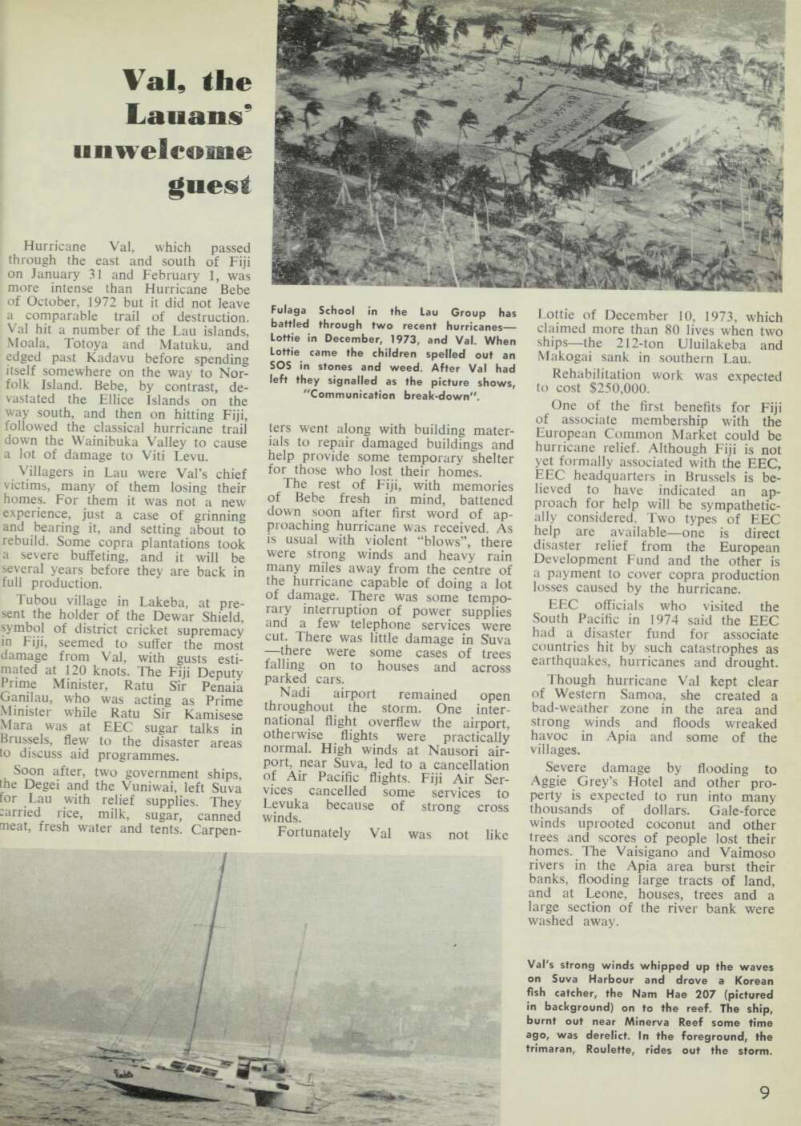
Fulaga School in the Lau Group has battled through two recent hurricanes— Lottie in December, 1973, and Val. When Lottie came the children spelled out an SOS in stones and weed. After Val had left they signalled as the picture shows, "Communication break-down".
Val's strong winds whipped up the waves on Suva Harbour and drove a Korean fish catcher, the Nam Hae 207 (pictured in background) on to the reef. The ship, burnt out near Minerva Reef some time ago, was derelict. In the foreground, the trimaran, Roulette, rides out the storm.