the border
pp. 13-14 · Read in the full issue
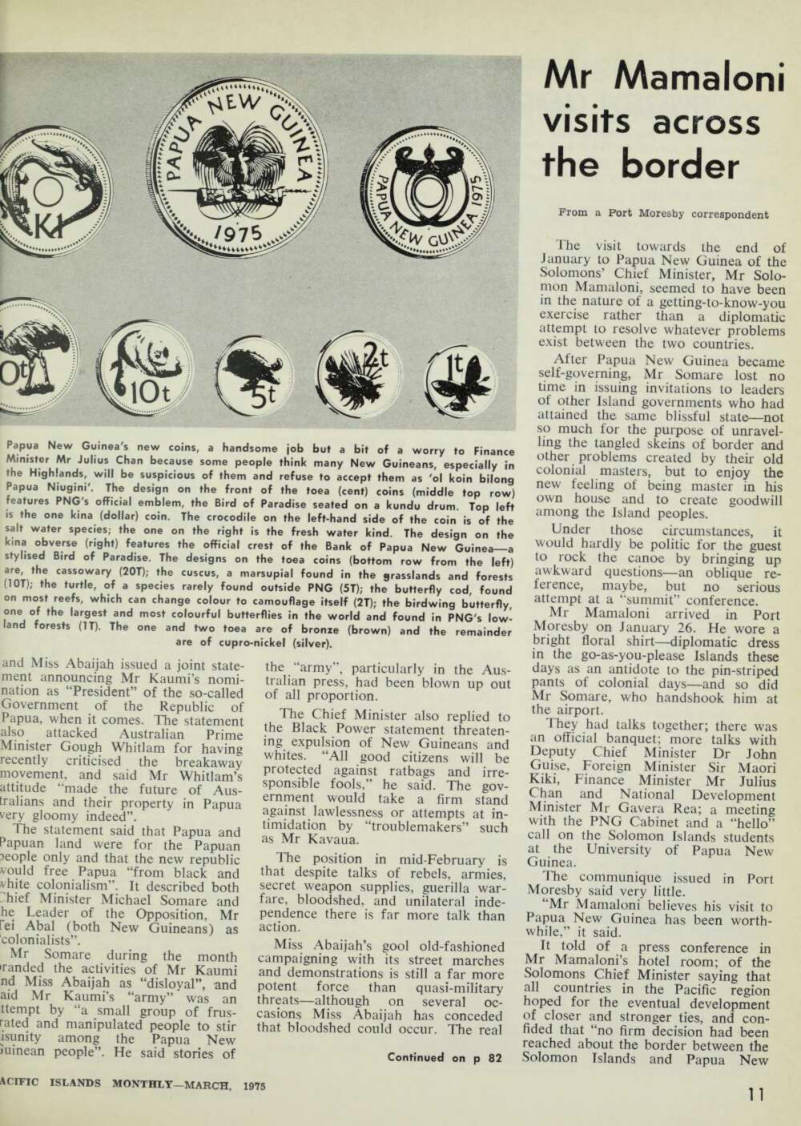
Mr Mamaloni visits across the border
From a Port Moresby correspondent The visit towards the end of January to Papua New Guinea of the Solomons’ Chief Minister, Mr Solo mon Mamaloni, seemed to have been in the nature of a getting-to-know-you exercise rather than a diplomatic attempt to resolve whatever problems exist between the two countries.
After Papua New Guinea became self-governing, Mr Somare lost no time in issuing invitations to leaders of other Island governments who had attained the same blissful state—not so much for the purpose of unravel ling the tangled skeins of border and other problems created by their old colonial masters, but to enjoy the new feeling of being master in his own house and to create goodwill among the Island peoples.
Under those circumstances, it would hardly be politic for the guest to rock the canoe by bringing up awkward questions—an oblique re ference, maybe, but no serious attempt at a “summit” conference.
Mr Mamaloni arrived in Port Moresby on January 26. He wore a bright floral shirt—diplomatic dress in the go-as-you-please Islands these days as an antidote to the pin-striped pants of colonial days—and so did Mr Somare, who handshook him at the airport.
They had talks together; there was an official banquet; more talks with Deputy Chief Minister Dr John Guise, Foreign Minister Sir Maori Kiki, Finance Minister Mr Julius Chan and National Development Minister Mr Gavera Rea; a meeting with the PNG Cabinet and a “hello” call on the Solomon Islands students at the University of Papua New Guinea.
The communique issued in Port Moresby said very little.
“Mr Mamaloni believes his visit to Papua New Guinea has been worth while,” it said.
It told of a press conference in Mr Mamaloni’s hotel room; of the Solomons Chief Minister saying that all countries in the Pacific region hoped for the eventual development of closer and stronger ties, and con fided that “no firm decision had been reached about the border between the Solomon Islands and Papua New
Guinea”, which was what everyone had wanted to know about. (PIM, Feb, p 7).
Mr Mamaloni completed his tour by visiting other PNG centres and then left for Hong Kong.
Gus Smales reported from Port Moresby: Papua New Guinea and the British Solomon Islands should establish diplomatic offices in each other’s country, Mr Mamaloni said in Port Moresby.
He also suggested that customs duties could be eased between the two countries.
Mr Mamaloni was commenting on the result of talks he held with Mr Somare and Foreign Minister Sir Maori Kiki.
Mr Mamaloni said that because of PNG’s greater wealth and greater size close relations between the two countries could lead to accusations that the Solomon Islands was inter ested only in selfish gains.
This was not so, however, as he believed that the Island countries of the Pacific had much to contribute to each other despite disparities in size.
He did not comment on the border which separates Papua New Guinea from the Solomons in a narrow strait between the Shortland Islands and Bougainville Island.
There have been some complaints from islanders living in the border area that they resent having to go through international border-crossing procedures merely to meet other islanders who are tribally linked to them.
By and large, however, the border between Papua New Guinea and the Solomons has always been one of the least-contentious of Papua New Guinea’s international boundaries.
The others are with Indonesia and Australia. Indonesian border arrange ments have been formalised after several years of problems, but legal arguments still exist over the Torres Strait border with Australia.
The talks with the Cabinet are ex pected to make tentative arrange ments for some form of diplomatic representation between the two coun tries and for greater recognition of the links existing between islanders in the border area.
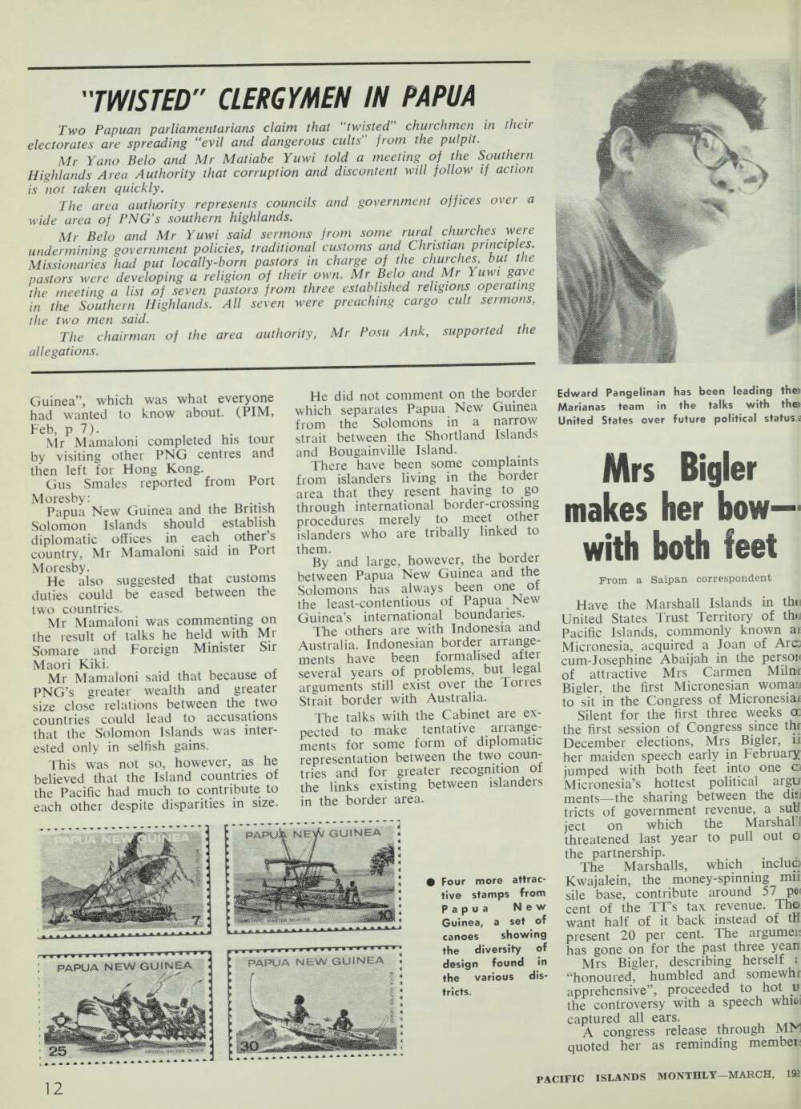
Four more attrac tive stamps from Papua New Guinea, a set of canoes showing the diversity of design found in the various dis tricts.