Magazine Section
pp. 47-48 · Read in the full issue
The onece-mighty Manus defence base passes to New Guinea
From GUS SMALES in Port Moresby.
HMAS Tarangau in PNG’s Admiralty Islands, once seen as Australia’s key defence post in the on rt November°l4 of AUStral ‘ an handS Tarangau was de-commissioned at a ceremony attended by representatives of the Australia and PNG governments and their defence representatives. Immediately afterwards it was recommissioned as the PNG Defence Force patrol boat base, the mam maritime defence installation of the soon-to-be-mdependent PNG.
As one ensign came down and the other went up, Australia was represented by the minister responsible for PNG affairs, Mr Bill Morrison, and PNG by its Chief Minister, Mr Somare. The ceremony marked the end of a major part of Australian
military history in a group of islands where relics of the Pacific War still abound.
Salvage workers still dig up shell cases and miles of copper cable from under the ground there. Army-style prefabricated buildings still exist and grass grows through hundreds of concrete blocks which once were the foundations of wartime buildings.
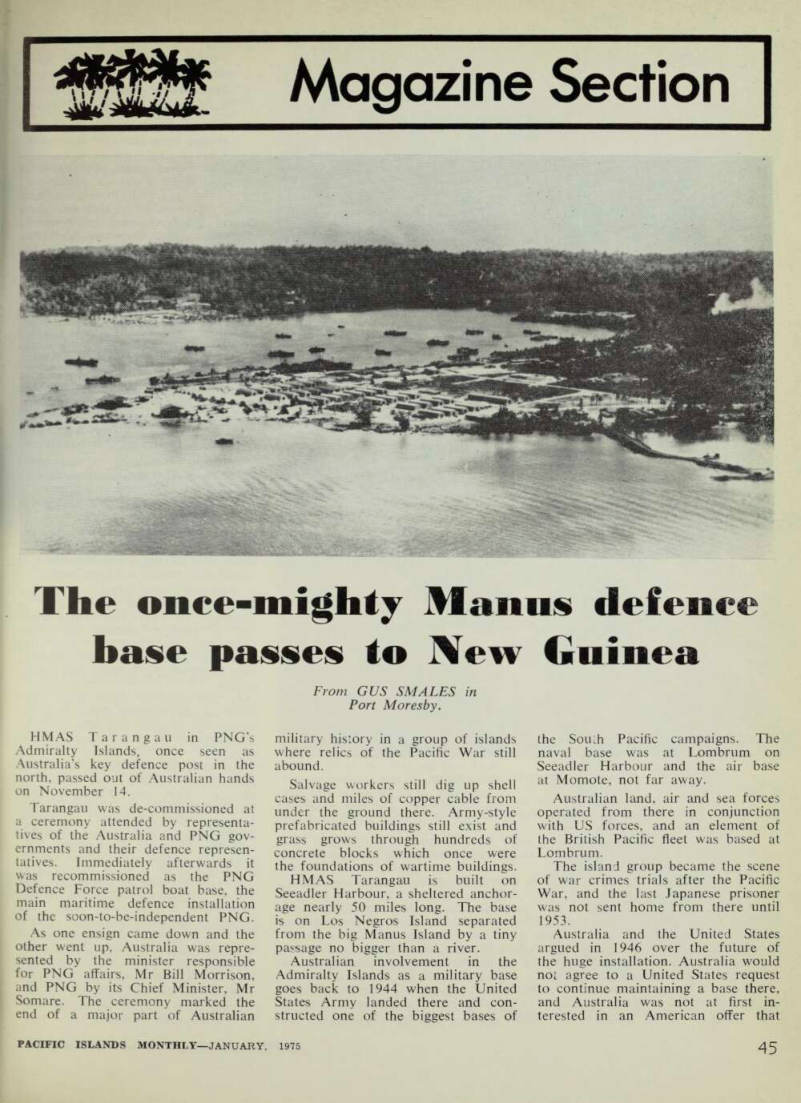
HMAS Tarangau is built on Seeadler Harbour, a sheltered anchora g e nearly 50 miles long. The base j s 0 n Los Negros Island separated from the big Manus Island by a tiny passage no bigger than a river.
Australian involvement in the Admiralty Islands as a military base goes back to 1944 when the United States Army landed there and constructed one of the biggest bases of
the South Pacific campaigns. The naval base was at Lombrum on Seeadler Harbour and the air base at Momote - not far away , Australian land, air and sea forces operated from there in conjunction with US forces, and an element of the British Pacific fleet was based at Lombrum.
The island group became the scene of war crimes trials after the Pacific War, and the last Japanese prisoner was not sent home from there until 1953.
Australia and the United States argued in 1946 over the future of the huge installation. Australia would not agree to a United States request to continue maintaining a base there, and Australia was not at first in terested in an American offer that
At a ceremony in Port Moresby in late November, Australia presented the Papua New Guinea Defence Force with the two heavy landing ships, Buna and Salamaua.
The two ships, worth a total of more than $3 million, are named after coastal areas on the PNG mainland which were famous for military actions in the Pacific War.
They were commissioned into the Royal Australian Navy less than a year ago, but were handed over to PNG as part of a series of gifts which Australia is making to help establish the nucleus of PNG’s own Defence Force. They follow the handing over of the Australian naval base at Manus. Four DC3 aircraft are also to be presented shortly.
The PNG Defence Minister, Mr Albert Maori Kiki. told the handing-over ceremony that the two ships would help his country’s national development in addition to their defence value.
He said the government had embarked on an extensive policy to share the wealth of the country as equally as possible between all areas. The new ships could use PNG waterways to supply places without ports.
an Australian base should be operated there.
In the years following, auction sales of surplus equipment drew buyers from all parts of Australia and the Pacific, while the Americans ran a shuttle service of ships and aircraft taking out the equipment they still required.
The Americans abandoned the base by 1947. Trucks, tractors and jeeps from the base were sold at bedrock prices and buildings were transferred to new settlements throughout the New Guinea islands. Aircraft were melted down and shipped away in ingots. The RSL in Rabaul built its first clubhouse out of a military building which members brought from Lombrum. Fortunes were made and lost over the surplus equipment.
Australia eventually commissioned its own naval base there as HMAS Seeadler in 1950, recommissioning it and building it up soon afterwards as HMAS Tarangau.
Tarangau, a Tolai word from the Rabaul area, means a big hawk or eagle and on the PNG mainland, it specifically means a happy eagle.
Australia established a special PNG Division of the Navy at Tarangau in 1951 and began train ing a limited number of New Guineans. By 1960, the base had dwindled in size and had become little more than a fuelling and signals station.
It was built up again from 1965 as a coastal security force base de signed to provide a nucleus of an independent navy for Papua New Guinea.
As part of the handover, PNG gets five fast patrol boats already in service. They are PNGS (Papua New Guinea Ships) Aitape, Lae.
Madang, Samarai and Ladava. A landing craft base in Port Moresby, with two new heavy landing ships is also included.
The main work of the PNG fleet will be fisheries surveillance, search and rescue and disaster relief. The present strength of the Naval Division of the PNG Defence Force is 12 officers and nearly 300 sailors.
Australian personnel will be involved for several years yet but are being gradually phased out. Some of the patrol ships are already operated entirely by New Guineans.
From a Port Moresby correspondent
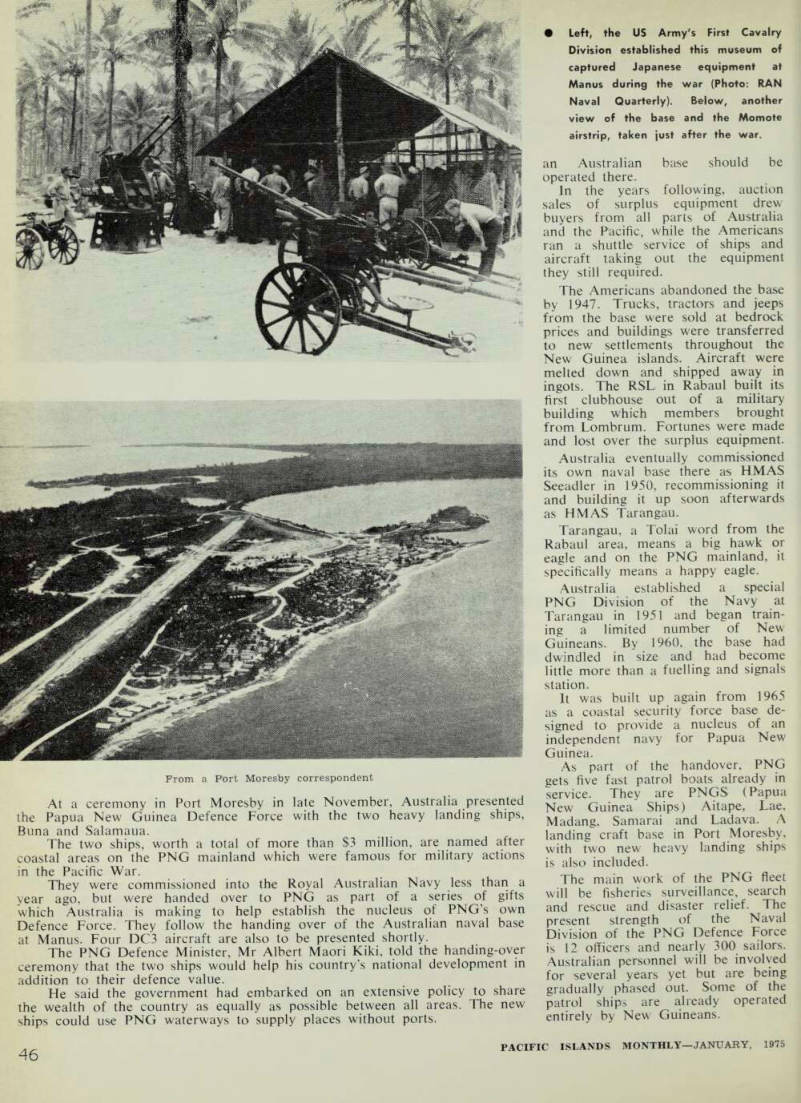
Left, the US Army's First Cavalry Division established this museum of captured Japanese equipment at Manus during the war (Photo: RAN Naval Quarterly). Below, another view of the base and the Momote airstrip, taken just after the war.