Yesterday
p. 49 · Read in the full issue
Practically the whole of the non-official population of Norfolk Island was in rebellion against Australia 20 years ago so there's nothing new about today's arguments. The first steps were taken to demand independence, or at least secure some measure of self-government.
Main cause of the trouble was an increase in customs duties and a proposal for a landing tax of £1 each on visitors. Protests to Canberra got nowhere.
Tasman Empire Airways (now Air New Zealand) finalised the sale of all but two of the company's Solent flying-boats to Aquila Airways, of Southampton. The aircraft retained will continue to operate the Suva- Apia-Aitutaki-Papeete Coral Route. There were persistent rumours that the Solents would be withdrawn in 1955 and replaced by DC6s, which would operate from Auckland to Bora Bora.
What finally happend was that TEAL kept one Solent on the run till 1960, when Electras took over, flying direct from Nadi to Papeete.
Without any prior discussion, both the United States and New Zealand apparently reached the same conclusion at the same time—that the Samoans had reached a stage of development where they might begin to assume increasing responsibility for their own government. PIM asked, in January, 1955, if it was unreasonable to suggest that the time had come for the unification of Samoa. Why should a well-known and competent Polynesian people remain divided, PIM queried. Since when no-one has bothered to find out!
For the first time in history the Fiji Legislative Council was to have a Speaker. A Fijian, Ratu Sir Lala Sukuna, was chosen to fill the office. Before taking up the office, late in 1956, Ratu Sir Lala made a trip to England to gain experience by watching the House of Commons in session.
Private enterprise would be welcome in the Solomon Islands, the High Commissioner for the Western Pacific, Sir Robert Stanley, told PIM in Sydney after a flying visit to London. He said it was high time that the notion that the government had placarded the BSIP with "keep out" signs was
firmly scotched. Proposals he made to the Secretary of State for the Colonies for the development of the BSIP were sympathetically received.
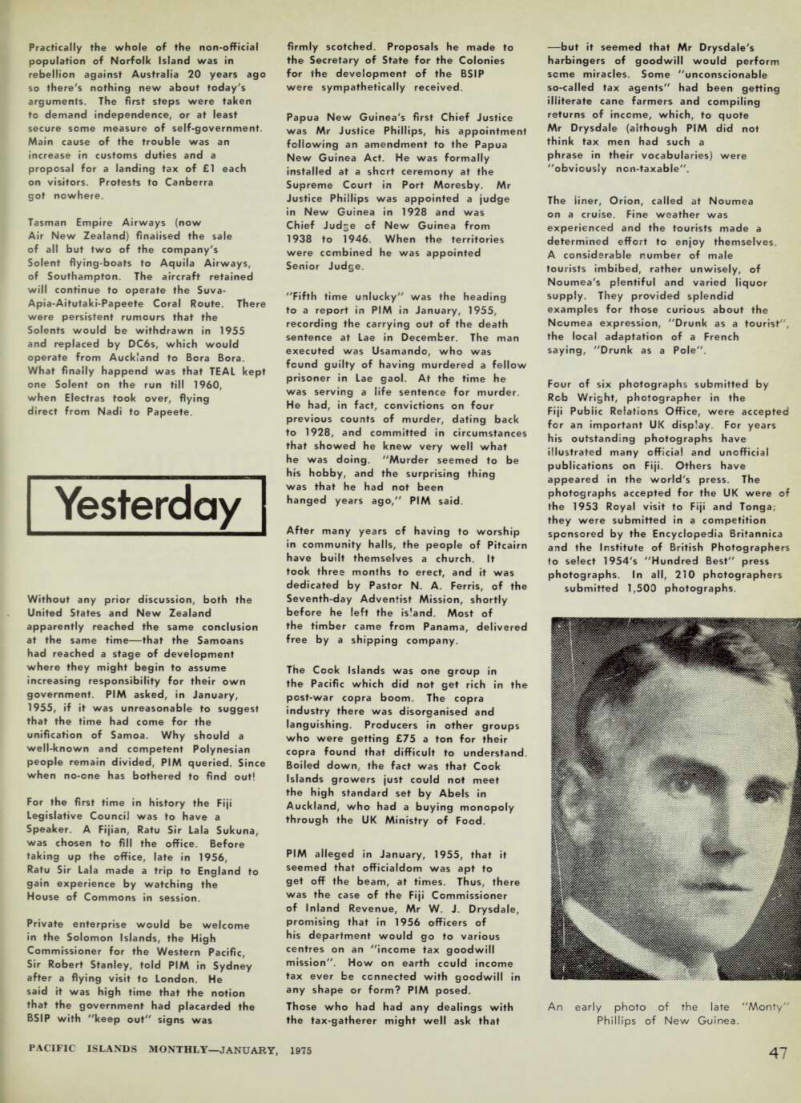
Papua New Guinea's first Chief Justice was Mr Justice Phillips, his appointment following an amendment to the Papua New Guinea Act. He was formally installed at a short ceremony at the Supreme Court in Port Moresby. Mr
Justice Phillips was appointed a judge
in New Guinea in 1928 and was Chief Judge of New Guinea from 1938 to 1946. When the territories were combined he was appointed
Senior Judge.
"Fifth time unlucky" was the heading to a report in PIM in January, 1955, recording the carrying out of the death sentence at Lae in December. The man executed was Usamando, who was found guilty of having murdered a fellow prisoner in Lae gaol. At the time he was serving a life sentence for murder.
He had, in fact, convictions on four previous counts of murder, dating back to 1928, and committed in circumstances that showed he knew very well what he was doing. "Murder seemed to be his hobby, and the surprising thing was that he had not been hanged years ago," PIM said.
After many years cf having to worship in community halls, the people of Pitcairn have built themselves a church. It took three months to erect, and it was dedicated by Pastor N. A. Ferris, of the
Seventh-day Adventist Mission, shortly
before he left the island. Most of the timber came from Panama, delivered free by a shipping company.
The Cook Islands was one group in the Pacific which did not get rich in the post-war copra boom. The copra industry there was disorganised and languishing. Producers in other groups who were getting £75 a ton for their copra found that difficult to understand.
Boiled down, the fact was that Cook Islands growers just could not meet the high standard set by Abels in Auckland, who had a buying monopoly through the UK Ministry of Food.
PIM alleged in January, 1955, that it seemed that officialdom was apt to get off the beam, at times. Thus, there was the case of the Fiji Commissioner of Inland Revenue, Mr W. J. Drysdale, promising that in 1956 officers of his department would go to various centres on an "income tax goodwill mission". How on earth could income tax ever be connected with goodwill in any shape or form? PIM posed.
Those who had had any dealings with the tax-gatherer might well ask that
—but it seemed that Mr Drysdale's harbingers of goodwill would perform some miracles. Some "unconscionable so-called tax agents" had been getting illiterate cane farmers and compiling returns of income, which, to quote Mr Drysdale (although PIM did not think tax men had such a phrase in their vocabularies) were
"obviously non-taxable".
The liner, Orion, called at Noumea on a cruise. Fine weather was experienced and the tourists made a determined effort to enjoy themselves.
A considerable number of male tourists imbibed, rather unwisely, of Noumea's plentiful and varied liquor supply. They provided splendid examples for those curious about the Noumea expression, "Drunk as a tourist", the local adaptation of a French saying, "Drunk as a Pole".
Four of six photographs submitted by Rob Wright, photographer in the Fiji Public Relations Office, were accepted for an important UK display. For years his outstanding photographs have illustrated many official and unofficial publications on Fiji. Others have appeared in the world's press. The photographs accepted for the UK were of the 1953 Royal visit to Fiji and Tonga; they were submitted in a competition sponsored by the Encyclopedia Britannica and the Institute of British Photographers to select 1954's "Hundred Best" press photographs. In all, 210 photographers submitted 1,500 photographs.
An early photo of the late "Monty"
Phillips of New Guinea.