Pacific Islands Monthly
News Magazine Of The South Pacific
January, 1975
AUSTRALIA, N.Z., P.N.G., FIJI, N. HEBRIDES, TONGA 75c W. SAMOA, G.E.1.C., COOKS, NORFOLK, NIUE, NAURU 75c
Solomons 85C
Am. Samoa, Hawaii, Micronesia, Guam $1.25
NEW CALEDONIA AND FRENCH POLYNESIA 125 CFP
Advertisements & other items, p. 2 (1 item)
The natural Choice.
It’s Honda. Anywhere there’s action. A job to be done.
Fun to be had. Safely and economically.
The snappy line-up is studded with star performers.
Easy-to-handle motorbikes that possess a big-hearted spirit.
Engineered for breezing through traffic or escaping to the country. Rugged reliability that lets you go, go, go.
Little wonder so many people around I the world ride Honda.
It’s the all-round natural choice. ■
ii m
: MANUFACTURER
m 1 ■T,.- : ■ i ' re ‘J PAPUA NEW GUINEA: Steamships Trading Co.. Ltd. P.O. Box 74, Papua / U.S. TRUST TERRITORY: J.C. Tenorio Enterprise P.O. Box 137. Saipan / FIJI ISLANDS: Coral Island Motors; Walu Bay Suva Fiji Island. P.O. Box 3179 Lami / TARAWA: The Gilbert & Ellice Islands Development Authority Gilbert & Ellice Islands / WESTERN SAMOA: Motor Distributors (Samoa) Ltd. P.O. Box 576, Apia / AMERICAN SAMOA: Max Haleck Inc. P.O. Box 99, Pago Pago / TONGA: E.M. Jones Ltd. P.O. Box 34, Nukualofa / SOLOMON ISLANDS: British Solomons Trading Co.. Ltd. P.O. Box 114, Honiara / NEW CALEDONIA: Establissements Ballande, Noumea / TAHITI: Ets. COMIMPEX P.O. Box 200, Papeete /COOK ISLANDS: Cook Islands Motor Centre Ltd. P.O. Box 74, Rarotonga / NAURU ISLAND: Nauru Cooperative Society 14th Floor, Wales Corner, 227 Collins Street Melbourne Victoria 3000
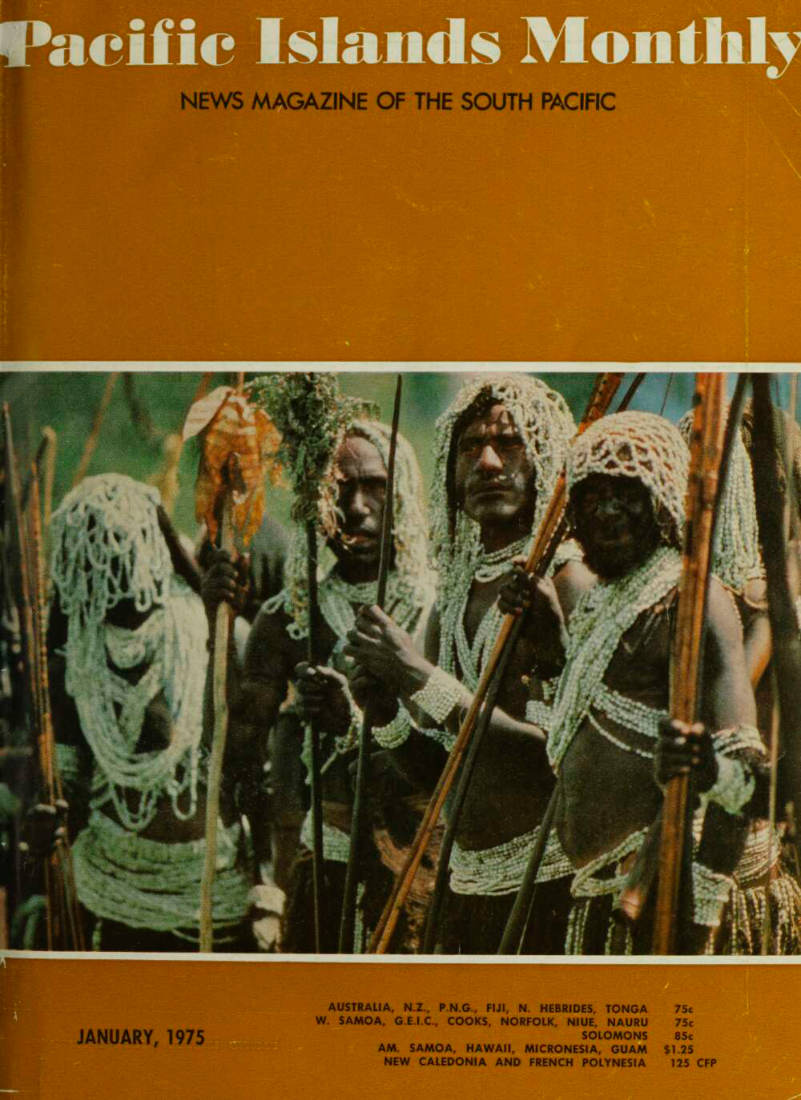
Our Cover
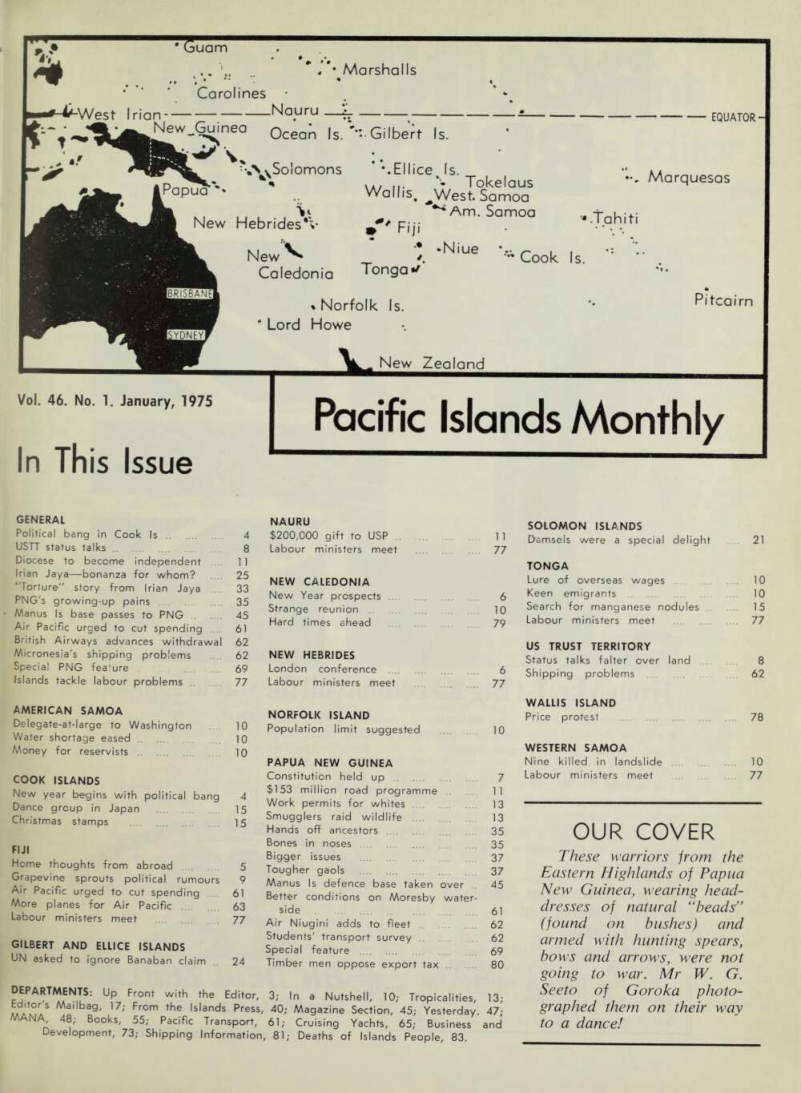
These warriors from the Eastern Highlands of Papua New Guinea, wearing head dresses of natural “beads” (found on bushes) and armed with hunting spears, bows and arrows, were not going to war. Mr W. G.
Seeto of Goroka photo graphed them on their way to a dance!
In This Issue
General
Political bang in Cook Is 4 USTT status talks 8 Diocese to become independent 11 Irian Jaya—bonanza for whom? ... 25 "Torture" story from Irian Jaya 33 PNG's growing-up pains 35 Manus Is base passes to PNG 45 Air Pacific urged to cut spending ... 61 British Airways advances withdrawal 62 Micronesia's shipping problems 62 Special PNG feature 69 Islands tackle labour problems 77
American Samoa
Delegate-at-large to Washington 10 Water shortage eased 10 Money for reservists 10
Cook Islands
New year begins with political bang 4 Dance group in Japan 15 Christmas stamps 15
Fiji
Home thoughts from abroad 5 Grapevine sprouts political rumours 9 Air Pacific urged to cut spending 61 More planes for Air Pacific 63 Labour ministers meet 77
Gilbert And Ellice Islands
UN asked to ignore Banaban claim . 24
Nauru
$200,000 gift to USP 11 Labour ministers meet 77
New Caledonia
New Year prospects 6 Strange reunion 10 Hard times ahead 79
New Hebrides
London conference 6 Labour ministers meet 77
Norfolk Island
Population limit suggested 10
Papua New Guinea
Constitution held up 7 $153 million road programme 11 Work permits for whites 13 Smugglers raid wildlife 13 Hands off ancestors 35 Bones in noses 35 Bigger issues 37 Tougher gaols 37 Manus Is defence base taken over .. 45 Better conditions on Moresby water side 61 Air Niugini adds to fleet 62 Students' transport survey 62 Special feature 69 Timber men oppose export tax 80
DEPARTMENTS: Up Front with the Editor, 3; In a Nutshell, 10; Tropicalities, 13; aaana 5 Mailbag ' 17; From the lslands Press, 40; Magazine Section, 45; Yesterday. 47; A 48; Books, 55; Pacific Transport, 61; Cruising Yachts, 65; Business and Development, 73; Shipping Information, 81; Deaths of Islands People, 83.
Solomon Islands
Damsels were a special delight 21
Tonga
Lure of overseas wages 10 Keen emigrants 10 Search for manganese nodules 15 Labour ministers meet 77
Us Trust Territory
Status talks falter over land 8
Shipping problems 62
Wallis Island
Price protest 78
Western Samoa
Nine killed in landslide 10 Labour ministers meet 77
Advertisements & other items, p. 4 (1 item)
Britain?
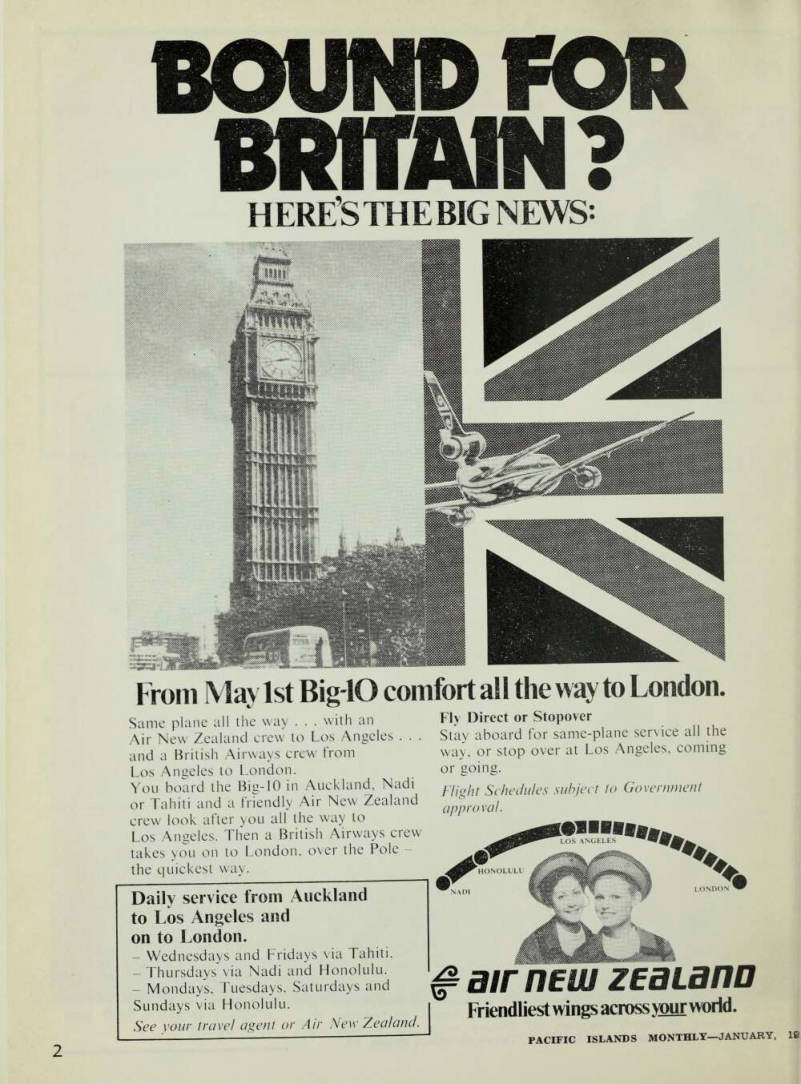
BOUND FOR
HERE’S THEBIG NEWS:
•Sill £ 9 s From May Ist Big-lO comfort all the way to London.
Same plane all the way . . . with an Air New Zealand crew to Los Angeles . . . and a British Airways crew from Los Angeles to London.
You board the Big-10 in Auckland, Nadi or Tahiti and a friendly Air New Zealand crew look after you all the way to Los Angeles. Then a British Airways crew takes you on to London, over the Pole the quickest way.
Fly Direct or Stopover Stay aboard for same-plane service all the way, or stop over at Los Angeles, coming or going.
Flight Schedules subject to Government
approval.
itlHllb,
LOS ANGELES
Daily service from Auckland to Los Angeles and on to London. - Wednesdays and Fridays via Tahiti. - Thursdays via Nadi and Honolulu. - Mondays, Tuesdays, Saturdays and Sundays via Honolulu.
See your travel agent or Air New Zealand. y
air new zeatano
I Friendliestwingsacrossyourworld.
n « nturr ICI A\TTIS TV!ONTHLY—JANXJA
Pacific Islands
Monthly
FOUNDED BY R. W. ROBSON IN 1930
Published Monthly By
Pacific Publications (Aust.) Pty. Ltd.,
29 Alberta St., Sydney, N.S.W., 2000.
Postal Address: G.P.O. BOX 3408, SYDNEY,
N.S.W., 2001.
Telegraphic Address: PACPUB, Sydney.
Telex 25168.
Telephones: 61-9197, 61-7101, 61-4369.
Consulting Directors: R. W. Robson, Judy Tudor.
Chief Executives: Manager: Selwyn Hughes.
Publisher: Stuart Inder.
Director of Advertising: W. A. Gasnier.
Pacific Islands Monthly
Editor: Stuart Inder.
Assistant Editor; John Carter.
Advertising Manager: W. A. Gasnier.
Circulation Manager: Jill Garland.
Subscription Rates:
"Pacific Islands Monthly" is airfreighted to the majority of subscribers and agents in the Pacific Islands and the U.S.A.; copies to the Cook Islands, Nauru, Niue, Micronesia and Guam go by surface mail.
Australia (including Lord Howe and Thursday Islands), New Zealand, Papua New Guinea, Fiji, New Hebrides, Tonga, Cook Islands, Western Samoa, Gilbert & Ellice Islands. Norfolk Island, Niue and Nauru: $9.00 (local currency); Solomon Islands: $lO.OO Aust., American Samoa, Micronesia and Guam: $12.00 US; Hawaii and US Mainland: $15.00 US; New Caledonia and French Polynesia: 1,500 CFP; United Kingdom: £6.50; Japan: 4,000 Yen.
Elsewhere $11.50 Aust.
Representatives
Fiji: Advertising and Distribution—Fiji Times & Herald Ltd., 20 Gordon St., Suva. Telephone -25-601. Telex.: FJ 2124.
Papua New Guinea: PORT MORESBY, PNG Print ing Co. Pty. Ltd., P.O. Box 633; LAE, P.O. Box 227; RABAUL, Mr. David Simpson, P.O. Box 164 (c/- Rabaul Photographic. Tel.: 2677.) French Polynesia. Distribution—Hachette Paci rique, 10 Ave Bruat, Papeete.
New Zealand: Pacific Publications, C.P.O. Box 2229, Auckland. 379-494. Representative: Mr A. Breckell, Breckell Publishing, Kingdon House, Kingdon Street, Newmarket, Auckland. Tel.: 54-6834. Telex.: NZ 2727.
United Kingdom: Advertising—Overseas Publicity Ltd., 214 Oxford Street, London, WIN OEA.
Phone.- 01-636 8296/7. Subscriptions—T. B.
Graham, Park House, 22 Park Street, Croydon,
Cr9 3Np. Tel.: 01-6884177.
Japan: Advertising—Universal Media Corpora tion, C.P.O. Box 46, Tokyo. Tel.: 666-3036.
Victoria: Advertising Pacific Publications (Aust.) Pty. Ltd., 2nd Floor, 61 Flinders Lane, Melbourne, 3000. Telephone.- 652-1565.
Queensland: Advertising—Beale Media Services, 232 St. Paul's Terrace, Fortitude Valley, Qld., 4006. Tel.: 52-5827.
Hawaii and U.S. Mainland only: N. Grogan 3354 Hayden Street, Honolulu, 96815. (Send change of address notices. Form 3579 and new subscriptions to P.O. Box 2193 Honolulu, Hawaii, U.S.A. 96805).
Second class postage paid at Honolulu, Hawaii.
Copyright ©, 1975,
Pacific Publications (Aust) Pty. Ltd.
January, 1975 Vol. 46, No. 1
Up Front
with the Editor
According to Governor Eriau of New Caledonia there are hard times ahead for Caledonia in 1975. And he’s talking for only one Pacific territory. Whether they have said it or not (and some of them have) other Islands leaders will be thinking the same thing. Myself, I don’t like the smell of 1975.
Economically, all Islands groups are suffering from inflation and a down-turn in the economy. Some high prices for produce help mask the situation in some places in 1974, but there are no guarantees for 1975.
Inflation is, unfortunately, not Islands-made, and therefore the Islands groups have less opportunity to control it than has say, Australia, which is strong in production and has some economic independence.
Not so the Islands, which import somebody else’s inflation every time a ship arrives with foodstuffs and household goods.
The effects are as serious on the small islands as on the large. For an example you need only to turn to p 78 and read how irate Wallis Island ers removed their French adminis trator and demanded the withdrawal of a shipping line in protest at the soaring price of imported goods.
The Wallis Islanders achieved something—a 20 per cent cut in freight rates and a 20 per cent cut in grocery prices on the shelves. But they were extraordinarily lucky. It is not happening anywhere else.
The effect of government wage and price restraints is never as suc cessful as governments hope. What usually happens, as in Fiji, is that wages are repressed but prices con tinue upwards uncontrolled since most goods have to be imported. To overcome their wage restraints skilled Fiji workers are changing jobs, be cause wage restrictions don’t apply to new positions. But what happens then is that job competition becomes keener and wages go up as firms compete with each other to buy and sell the trained people available, all adding to the inflationary spiral. No body benefits.
Politically, 1975 will be confused.
New Hebrides has finally won for itself some political progress, although it has to be made to work.
In the Gilbert and Ellice Islands Colony this is the year when the
Ellice Islanders learn whether they really can break away from the Gil berts; in Micronesia this is the year when the Marianas break away from the rest of the Trust Territory. In Papua New Guinea this is the year when the nation gains independence —but what it will look like with so many districts already talking about their own independence, I can’t try to predict so early in the new year.
In French Polynesia and New Caledonia there will be greater pressures for more self-government, and Paris will be kidding itself if it believes otherwise. In the Cooks, Sir Albert Henry has got back into power and is talking openly about being a dictator—and he’s capable of being one. In Western Samoa it is election year with some growing confusion about who is capable of leading the country out of the econ omic doldrums.
In the British Solomons the first Chief Minister, Solomon Mamaloni, has been appointed after many months of behind-the-scenes efforts to get some political unanimity, the result being that the Chief Minister has not got the political support any body in his position should have, and thus 1975 is a difficult year for the Solomons too. There are also some unpleasant reactions in the Solomons oyer the Chief Minister’s attack on his own Information and Radio ser vices, which has resulted in censor ship and the loss of his principal in formation officer, allegedly accused of bias. Denis Fisk, the information officer, in a piece which he is writing for PlM’s February issue, claims that the only bias the Sblomons in formation services have indulged in is the bias of attempting to provide balanced news, and that freedom of the Press and freedom of speech is in danger in the Solomons.
Anyway, let’s all give a big hand to 1975! The year, after all, is inevitable.
Stuart Inder
Pacific Islands Monthly
New Year Begins With A
Political Bang In The Cooks
From Rarotonga and NZ correspondents
Cook Islands Premier Sir Albert Henry won his fourth parliamentary election on December 3. But he lost his two-thirds majority which would have enabled him to change the con stitution; lost face, some popularity, his temper and his urbanity when, five days after his Cook Islands Party won 14 of the 22 Legislative Assembly seats, with the remaining eight 'a gain of one) going to the Democratic Party, he threatened that he would become a dictator and would call to account Democratic Party supporters in the civil service.
Before leaving Rarotonga for New Zealand, Sir Albert declared at an official farewell at the airport that the Public Service had no place for supporters of a party working to overthrow the government.
“When I come back you will know what that really means,” he said, and added, after attacking “Beach combers who have come with nothing and been given wives and money”, that he was speaking “not as the Albert Henry you knew; this is a different Albert Henry”.
He charged Dr Tom Davis, leader of the Opposition Democratic Party, and his party with using underhand tactics in the election.
It was while he was attacking the New Zealand Press which, he said, had already soiled his name, calling him a communist and a dictator— although in some cases a benevolent one—that he threatened that he would be a dictator.
The Cook Islanders are now won dering whether he will carry out his threats. Some, who know him, be lieve that when his temper cools and he gets over his disappointment at his failure to crush the Democratic Party and the realisation that some islanders in New Zealand were will ing to spend their savings to beat him in the election, reason will prevail.
Anything smacking of dictatorship in the Cooks wouldn’t go down well with the New Zealand Government which has the power to put the screws on Sir Albert and his govern ment, especially when his reduced
parliamentary majority precludes him
from changing the constitution.
Was there a veiled threat in the comments by the NZ Deputy Prime Minister, Mr Robert Tizard, on the eve of talks between Sir Albert and NZ ministers on the Cooks’ political status now that responsibility for the Cooks has been transferred from Island Affairs to Foreign Affairs?
Mr Tizard said in Wellington that New Zealand reserved the right to review its association with the Cook Islands in the light of any changes in the relationship between the two nations.
If people wanted to be associated with New Zealand and to enjoy the rights and privileges of NZ citizen ship, then New Zealand expected them to conform to the way things were done in New Zealand.
“At the moment the Cook Islands has the best of both worlds,” Mr Tizard said. “It has full indepen dence in the South Pacific—but with the advantages of very close links with New Zealand; the rights to come to New Zealand and enjoy job oppor tunities, social security, and every thing else.”
New Zealand would not oppose independence but the islands’ gov ernment would also have to get a two-thirds support in a referendum, he said.
Later, on arriving in Auckland, Sir Albert stood on the balcony of his hotel and exchanged words with Democratic Party demonstrators in the street.
The flower-bedecked demonstrators carried placards bearing such messages as “How many demos will lose their jobs over this election?”— “Henry, last of the big spenders—
with NZ taxpayers’ money”—“Henry,
NZ taxpayers need a rest from you”.
Sir Albert’s reaction was a broad smile and the words “Beautiful, beautiful”, no doubt commenting on their appearance.
Dr Davis said Sir Albert would find it hard to prove corruption against the Democratic Party and,
particularly, against himself, and added, “There are laws to protect civil servants and we will use them to the fullest to protect our people”.
The election was the most bitterly contested one the Cooks have ever had, and, for those Cook Islanders who flew from New Zealand to re cord their votes, it was probably the most expensive one—at $2OO a vote.
In the most densely-populated area of Rarotonga, Te-Au-O-Tonga, Sir Albert retained his seat with 1,084 votes, but Dr Davis was only 36 votes behind with 1,048.
The other successful candidates for Te-Au-O-Tonga’s four seats were Eric (Man) Browne CIP (1,024), and Teanua (Dan) Kamana CIP (1,021). The other Rarotonga CIP sitting members returned were Tamataia Pera (409), Apenera Short (482), Tiakana Numanga (474) and Taramai Tetonga (464). The only other successful DP candidate on Rarotonga was William Heather (408) for Puaikura.
There was a surprise when sitting CIP candidate Tamarua Joseph Browne (1,008) lost his seat, while his brother, Man Browne, who only recently joined the CIP, was success ful with 1,024 votes.
In Aitutaki Island, a CIP strong hold, CIP candidates William Estall, Geoffrey Henry and Dr Joseph Williams, easily beat their DP op ponents. Tupui Henry, CIP, retained his Mauke Island seat with a wide majority. Newcomer to the political arena George Ellis, CIP, won the Manihiki seat, and Raui Pokoati, CIP Mitiaro Island, and Inatio Akaruru, CIP Pukapuka Island, comfortably retained their seats.
The sitting DP members for Atiu Island, Vainerere Tangatapoto and Pomani Tangata, had no trouble keeping their seats, nor did the sitting DP candidates for Mangaia Island, Pokino Aberahama and Ngatupuna Matepi. Dr Pupuke Robati and Tangaroa Tangaroa, sitting DP candidates for Rakahanga and Penrhyn Islands respectively, re tained their seats with ease.
Home Thoughts From Abroad
By SUE WENDT, lately arrived in Sydney from Fiji
One of the most fascinating things about Fiji is its magical ability to bind together people who have once lived there, whether as “sons of the soil" or expatriates.
Sydney is no village settlement, with everybody knowing every body else. This crowded im personal metropolis often strikes the Fiji newcomer as overwhelm ingly confusing and indifferent to the individual’s problems. Yet, amid the skyscrapers and among the home-unit-with-a-view set, the old coconut telegraph thrives.
Within one day of returning to Australia to live in December, I had heard news of numerous Fiji friends, been grilled about the local Fiji scene—and even been invited to a lovo. I was astonished at the interest shown in Fiji affairs by former expatriates long-gone from the islands. Russ Gribble, popular Fiji Visitors Bureau manager for Australia, welcomes a constant stream of Fiji people to his office, many of them there simply for a chat about familiar things and a quiet read of the Fiji Times. Islanders never lose their love for home . . . and it seems that outsiders who’ve lived and worked in Fiji never forget either.
News prior to leaving Fiji was the extension to March 31 of the government’s prices and incomes policy. This was because the select committee on counter inflation had not, in early Decem ber, reported to Parliament.
Prime Minister Ratu Sir Kami sese Mara announced that the only pay increases allowed in the dominion until the end of March would be negotiated cost-of-living adjustments. There would be no loopholes, no special cases, he declared. The government intro duced its prices and incomes policy in April, 1973, and the third phase began last February.
It was due to expire at the end of December.
The Prime Minister said the counter-inflation committee report was not ready because of the complexities of the committee’s task and pressures of parlia mentary business.
Former Fiji residents, although
accustomed to rising prices in Sydney, find it difficult to believe that costs in Fiji have risen as high and as quickly as they have in recent months. They take some convincing that top-class cuts of meat in Sydney actually cost con siderably less than inferior cuts in Suva, Nadi and other centres.
Tinned food is predictably much less than in Fiji. As Ratu Sir Kamisese reiterated in December, about 55 per cent of Fiji’s inflation problems are due to external pressures—and a very important part of the answer lies in pro ducing more food and goods locally.
Food prices in Fiji rose by 40 per cent between mid-1971 and mid-1974. During the second half of the year they seemed to be jumping even faster than that.
Salaries and wages increased by 84.6 per cent in the same period.
The question of a common name for Fiji people cropped up again in early December, with Minister Without Portfolio, Ratu David Toganivalu, suggesting the name “Feejeans” (Fiji-ahns). He agreed that to use “Fijians" would not be acceptable to all—and asked whether it mightn’t be an idea to change the name of the country, as Ceylon had done.
He said that so long as people travelling overseas had a common name, no-one cared if they were “black, blue or yellow".
Commenting on the issue, a Fiji Times editorial said Ratu David’s suggestion for finding a common identity and common name wouldn’t win easy acceptance “from those people who believe that Fiji’s problems will be solved only when one part of the com munity dominates the other".
It went on to say that Ratu David’s thinking “was the kind of thinking which recognises that in a world riven bloodily by racial tension, Fiji is unique in achieving a peaceful transition from colonial ism to independence, and the creation of a truly multiracial society without resort to terror, oppression and bloodshed”.
Despite all the good and justi fied thinking on the subject how
ever, there’s little indication that people will come to agree on a common name just now—and certainly, there’s not much likeli hood of the name of the country being changed . . .
Among the hardest-hit industries in Fiji is the once-booming build ing industry, with architects com plaining that an estimated $l5 million-worth of building projects has been cancelled. Their future was grim, they said. Some have cut their staff substantially and others are considering working a four-day week or cutting salaries.
Most blame the situation on world-wide recession trends and the tightening of credit and feel that things won't pick up in Fiji until the building industry smooths out its problems in Australasia.
The crash of big companies like Mainline Construction and Cam bridge Credit has left a big gap.
Construction of the permanent headquarters in Suva for the South Pacific Bureau for Economic Co-operation (Spec) is months be hind schedule because of in creased costs. Building construc tion was due to begin in Septem ber but to date, only roadworks have taken place on the six-acre site. Quotations for construction have exceeded considerably the original estimates of $600,000 for buildings and $86,000 for roads and siteworks to be financed from Spec’s regular budget.
Recent trade figures paint a de pressing picture. By the end of June the gap between import and export value figures was 20 per cent wider than at the same time last year. Imports during the first half of the year cost $94.23 million, while exports and re exports brought in only $23.26 million.
Fiji then, like everywhere else, is in the grip of hard times, with worse to come. Strangely enough though, while people talk about the rising costs and how much they’re having to cut down, there’s still an innate sense of optimism that things WILL improve some time soon. At least, say Fiji people, if the worst comes to the worst, we can’t starve and we won’t be cold. In today’s world, that in itself is paradise . . .
Worthwhile Christmas gift
for the New Hebrides . . ..
By Stuart Inder
The decisions made at the Minis terial conference in London in No vember to discuss the political future of the New Hebrides have turned out to be a real Christmas present.
It looks now as if the London deci sions were the most important taken since the Condominium came into existence in 1914. The decisions have removed the likelihood of violence in the New Hebrides—for the situ ation had been explosive up to the time of the London conference.
The meeting was between British and French ministers responsible for the New Hebrides (it is in London and Paris where the control lies) and was the first ministerial conference in eight years. This is itself a com mentary on the persistence of past high level neglect of New Hebrides problems, and in the circumstances it’s a matter of grateful surprise that so much agreement was reached so quickly after so many years of stag nation.
The decisions were no doubt made as a result of some of the internal clamour for reform by many New Hebrideans who earlier in 1974 took their plight to the United Nations. Also they are the result of a sympathetic approach to London and Paris by the current British and French Resident Commissioners, Mr Roger du Boulay and Mr R. Lang lois, who are two competent and in telligent men.
The New Hebrides has a popu lation of 90,000, and is neither British nor French. Britain and France have separate administrations, and there is a condominium govern ment—an administration in name only—with no vital responsibility.
The most important of the Lon don decisions was the decision to establish a legislative assembly.
Elections for it will be held by Sep tember 30, with the first meeting scheduled to take place in Decem ber 1975.
The parliament will have 38 mem bers, all elected, plus the two resi dent commissioners, who will have no vote. There will be no official members.
Of the 38 elected, 24 will be New Hebrideans, The composition will be 17 rural members, six members representing Vila town (two British, two French, two New Hebridean), three repre
senting Santo town (one British, one French, one New Hebridean), eight representing the Chamber of Com merce (four British, four French) and four representing the Co- Operative Federation. Elections will be by universal suffrage, with Fiji pattem cross-voting on the special seats.
The assembly will have authority to allocate the New Hebrides budget and to raise its own funds. It will be able to introduce private members bills. It won’t be able to control de fence or foreign affairs.
Work on establishing electoral rolls and other machinery will begin right away.
Meanwhile, work will go ahead on plans to establish local government; there will be a streamlining of the departments built up by the two residencies with the aim of handing more authority to a condominium government; the criminal law will be unified along the lines of the French system (in civil law it will probably be the British system); there will be a detailed study of currency with the aim of establishing a separate New Hebrides currency tied to the franc; and all-important land re forms have been promised, without which there can be no real progress in the New Hebrides.
It was agreed in London that land reform was fundamental. The plan is for the land provisions in the protocol, to be scrapped and be re placed with joint regulations on New Hebridean land concepts. Much work
has already been done on a uniform land scheme by a British adviser working in the New Hebrides, Mr J. T. Fleming, and this work has been accepted in principle by the British and French ministers.
An important development to flow from London is that both parties agreed with the principle that a con dominium government should be strengthened and developed rather than the separate administrations.
This more than any one thing should unify the New Hebrides, and allow overall planned development instead of the kind of piecemeal, sometimes wasteful, development which has re sulted from the system of separate administrations and their national rivalries. Britain and France will develop a joint development plan for the New Hebrides.
There was a discussion on New Hebrides citizenship. New Hebrideans are currently people without real citizenship, who are protected by Britain and France inside and outside the condominium and who are issued
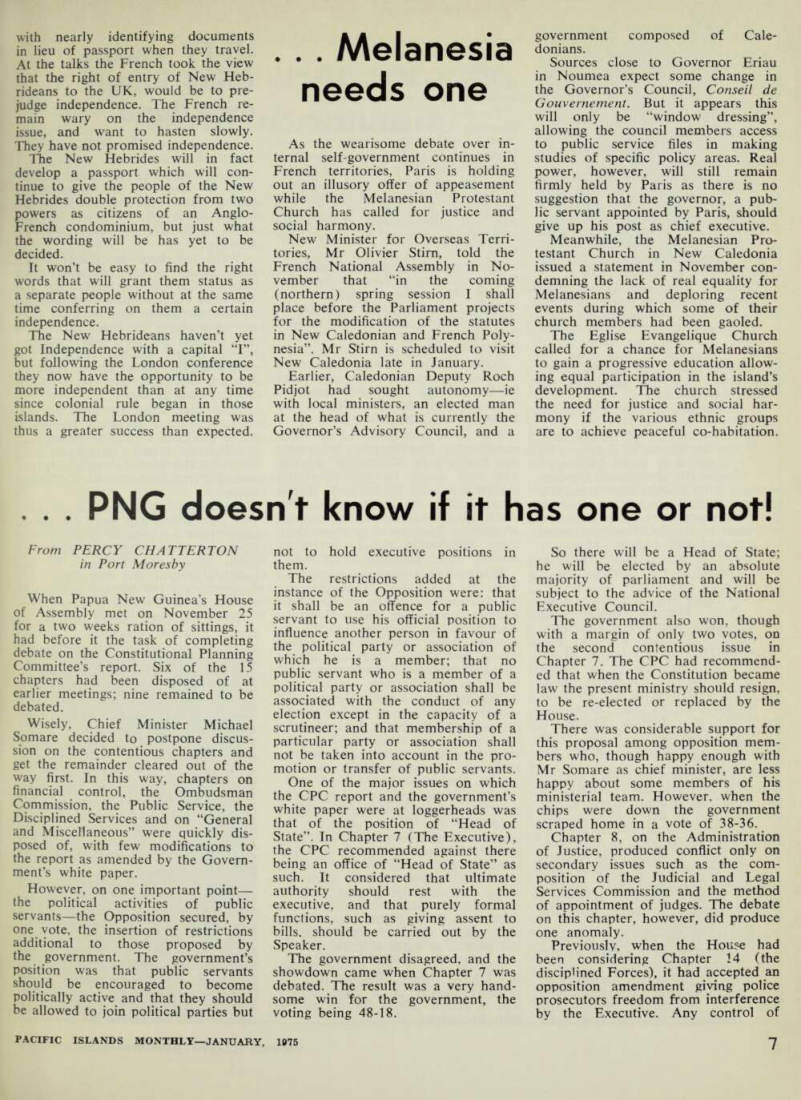
British Resident Commissioner Roger du Boulay attended the London conference with French Resident Commissioner R.
Langlois.
with nearly identifying documents in lieu of passport when they travel.
At the talks the French took the view that the right of entry of New Heb rideans to the UK, would be to pre judge independence. The French re main wary on the independence issue, and want to hasten slowly.
They have not promised independence.
TTie New Hebrides will in fact develop a passport which will con tinue to give the people of the New Hebrides double protection from two powers as citizens of an Anglo- French condominium, but just what the wording will be has yet to be decided.
It won’t be easy to find the right words that will grant them status as a separate people without at the same time conferring on them a certain
independence.
The New Hebrideans haven’t yet got Independence with a capital “I”, but following the London conference they now have the opportunity to be more independent than at any time since colonial rule began in those islands. The London meeting was thus a greater success than expected.
Birds, baccarat and bijin
The New Year opens with tempting prospects for New Caledonians to share at least three exciting diversions — birds, baccarat and bijtn.
For those who love shooting and French cuisine, the Diane Hunting Club operating out of La Foa last year released into the bush 1,200 pheasants, 1,100 quail and 1,500 partridge to join local deer herds.
For those who prefer their sport amid the comfort and luxury of the seaside Chateau Royal hotel, the Pacific islands first casino—Casino Royal— was scheduled to open its doors on December 26, with roulette, chemin-de fer, baccarat, not to forget 30 Australian poker machines.
The Noumea Christmas tourist season was given an early debut with the inaugural flight on November 29 of UTA’s new link, Tokyo — Noumea.
Japanese television crews and amateur photographers have thus begun to traverse a new passage into the South Pacific and are delighted with Noumea’s third attraction —what the Japanese call bijin, or beautiful girls.
needs one
. . . Melanesia needs one
As the wearisome debate over in ternal self-government continues in French territories, Paris is holding out an illusory offer of appeasement while the Melanesian Protestant Church has called for justice and social harmony.
New Minister for Overseas Terri tories, Mr Olivier Stirn, told the French National Assembly in No vember that “in the coming (northern) spring session I shall place before the Parliament projects for the modification of the statutes in New Caledonian and French Poly nesia”. Mr Stirn is scheduled to visit New Caledonia late in January.
Earlier, Caledonian Deputy Roch Pidjot had sought autonomy—ie with local ministers, an elected man at the head of what is currently the Governor’s Advisory Council, and a
government composed of Cale donians.
Sources close to Governor Eriau in Noumea expect some change in the Governor’s Council, Conseil de Gouvernement. But it appears this will only be “window dressing”, allowing the council members access to public service files in making studies of specific policy areas. Real power, however, will still remain firmly held by Paris as there is no suggestion that the governor, a pub lic servant appointed by Paris, should give up his post as chief executive.
Meanwhile, the Melanesian Pro testant Church in New Caledonia issued a statement in November con demning the lack of real equality for Melanesians and deploring recent events during which some of their church members had been gaoled.
The Eglise Evangelique Church called for a chance for Melanesians to gain a progressive education allow ing equal participation in the island’s development. The church stressed the need for justice and social har mony if the various ethnic groups are to achieve peaceful co-habitation.
... PNG doesn't know if it has one or not!
From Percy Chatterton
in Port Moresby When Panna New Guinea’* Hrmce
nf J
for a two weeks ration of sittings it had before it the task of comnletlng debate on the Consti utional Sain nf
Committee's Si? of
chapters had been disnosed of at earher meetings* nine remained to be debated remamed to be 1 r • w . , , Wisely, Chief Minister Michael bomare decided to postpone discus- S 1( f n +i? n tbe 9°^ tentlous chapters and get the remainder cleared out of the way nrst. In this way, chapters on financial control, the Ombudsman commission, the Public Service, the ervic 9, s and on . G en cr a l and Miscellaneous were quickly disposed of, with few modifications to he report as amended by the Government s wmte paper.
However, on one important point— the political activities of public servants—the Opposition secured, by one vote, the insertion of restrictions additional to those proposed by the government. The government’s position was that public servants should be encouraged to become politically active and that they should be allowed to join political parties but
not to hold executive positions in them.
The restrictions added at the instanc e of the Opposition were: that il shall be an offence for a P ublic ? e^ vant to use his official position to mfl uence another person m favour of the political party or relation of which he is a member ’ that no publlc servant who is a member of a pol,tlcal P art V or a ssociation shall be associated with the conduct of any election except in the capacity of a scrutineer; and that membership of a particular party or association shall not be taken into account in the promotion or transfer of public servants.
One of the major issues on which the CPC report and the government’s white paper were at loggerheads was that of the position of “Head of State”. In Chapter 7 (The Executive), the CPC recommended against there being an office of “Head of State” as such. It considered that ultimate authority should rest with the executive, and that purely formal functions, such as giving assent to bills, should be carried out by the Speaker.
The government disagreed, and the showdown came when Chapter 7 was debated. The result was a very handsome win for the government, the voting being 48-18.
So there will be a Head of State; he will be elected by an absolute majority of parliament and will be subject to the advice of the National Executive Council, The government also won, though with a margin of only two votes, on the second contentious issue in Chapter 7. The CPC had recommend ed that when the Constitution became law the present ministry should resign, to be re-elected or replaced by the House.
There was considerable support for this proposal among opposition mem bers who, though happy enough with Mr Somare as chief minister, are less happy about some members of his ministerial team. However, when the chips were down the government scraped home in a vote of 38-36.
Chapter 8, on the Administration of Justice, produced conflict only on secondary issues such as the com position of the Judicial and Legal Services Commission and the method of appointment of judges. The debate on this chapter, however, did produce one anomaly.
Previously, when the House had been considering Chapter 14 (the disciplined Forces), it had accepted an opposition amendment giving police prosecutors freedom from interference by the Executive. Any control of
prosecutions by the Executive might,
felt some members, be used to protect summons-prone ministers from pro secution. However, when, during the debate on Chapter 8, an identical amendment was proposed to protect the Public Prosecutor from Executive interference, the opposition trumpet sounded an uncertain note and the amendment was defeated.
This anomaly, if nothing is done to correct it, could give rise to a situation in which a police prosecutor initiated a prosecution in a lower court and later, when the case went to a higher court, the Public Pro secutor could be ordered by the Executive not to proceed with it.
Moreover, the conditions under which the Executive could interfere are wide open, including not only national security but also “public welfare”. It would be easy for a touchy Executive to feel that the prosecution of one of its own mem bers would not be conducive to “public welfare”.
With only one chapter to go, time ran out.
On the afternoon of December 6 the House adjourned “to a date to be fixed” (expected to be in February) with Chapter 10 (Provincial Govern ment) still undebated. Ironically enough, this is the chapter which many Paguineans regard as the most important of the lot. For “provincial government” has become almost a cargo cult in many of our districts.
It is viewed as the panacea which will cure all our ills.
A few hours after the House rose, the Chief Minister spoke over national radio expressing his disap pointment and anger at what had happened. He blamed members of the House for their failure to attend properly to their parliamentary duties and their eagerness to get away as the sittings drew to their close. And reasonably so: division figures of 32-31 in a 100 member House on an important constitutional issue tell their own story.
Mr Somare went on to say that in spite of the setback, the Constitutional Bill would be brought down at the next meeting of the House, leaving the provisions for provincial govern ment to be added later. In the mean time, he said, he would press forward with the conversion of existing area authorities into provincial govern ments under interim legislation alreadv enacted to cope with the Boueainville situation.
While the House had been occupied during its two weeks of sittings mainly with constitutional matters, a quantity of routine parliamentary business had also been transacted: statements had been made and tabled, renorts had been presented, motions had been
carried or rejected, and new legisla tion had been enacted.
From this mass of business 1 choose two items which seem to me to be the most worthy of notice.
The first is a report tabled by the Standing Committee on Public Ac counts, which dots the “i”s and crosses the “t”s of an earlier Auditor- General’s report on ministerial spend ing. The new report says that pre scribed procedures for authorising expenditures have been widely ignored and that “the amount of improper expenditure appears to have been quite large”.
“Disregard for regulation and cor rect procedures which have been ex hibited by certain ministers has already seriously damaged public service morale and parliamentary prestige in the eyes of the public”, the report alleges.
Some of this disregard for rules and regulations has been attributed to the alleged inappropriateness of these Australian-made rules in the Papua New Guinea situation.
This is, of course, one of the stock excuses for law-breaking in present day Papua New Guinea. It is quite true that some of the laws and regulations now in force in Papua New Guinea are inappropriate. But surely the remedy for this is to amend or replace them so as to make them more appropriate, not to ignore or disobey them. That way chaos lies.
Which brings me to my second item. At long last the government has introduced a bill to set up a Law Reform Commission, charged with the mammoth task of reviewing all the present laws and recommending where and how they should be changed to make them “appropriate” to Papua New Guinea.
This is a step which everyone will welcome and, having regard to the present embryo state of the indigenous legal profession, it is probably wise to ensure that professional lawyers shall be the commission’s servants, not its masters.
But I must confess to feeling a faint tinge of apprehension when I read that one of the aims of the exercise is to ensure that “our legal system assists in achieving our national goals”. In many parts of the world today national goals are being pursued with a great deal of ruthlessness, and there are not wanting those in Papua New Guinea who openly advocate ruthlessness in the pursuit of national goals.
Perhaps I’m a bit old-fashioned, but I have always supposed that the proper function of a legal system was to secure justice for the people who live under it!
USTT status
talks falter over land
From a Saipan correspondent
Land remains as one of the hardest nuts to crack in the negotiations between the Micronesians and the United States over the future political status of the United States Trust Ter ritory.
What has been described as the final round of the separate talks between the United States and the Marianas Political Status Commission opened on Saipan on December 5 in an atmosphere of optimism tinged with anxiety over the highly contro versial subject of the return to the people of the public lands, much of which is held or coveted by the United States armed forces.
Only days before the talks opened, members of the Marianas Territorial Partv produced a petition asking that the Political Status Commission con sult with the Marianas people before reaching an agreement with the United States.
The party made three demands— that people who had asked for home stead land be granted entry to the land and given title; that all public lands should be returned to the people’s control and that claims for compensation for damage suffered in the Pacific War should be completed.
When the talks opened on Decem ber 5, Edward Pangelinan, chairman of the Status Commission, emphasised the importance of the demands made in the petition. One key issue remain ing to be settled before agreement was reached on future political status was how the United States would acquire the land it needed.
The talks are expected to last about two weeks. The US President’s Per sonal Ambassador Franklin Haydn Williams is heading the US team.
Also in December were talks in Honolulu between the United States Department of the Interior and the Trust Territory Government on the transfer of public lands. The United Stages has proposed that the land be returned by an executive order rather than bv a decision of the US Con gress. With the exception of Palau, all the Districts of Micronesia are opposed to return by executive order, preferring an act of congress which, they believe, would contain more safeguards for the Micronesians and better regulation of the United States moves to acquire some of the land, notably that on Tinian.
political rumours
Fiji’s grapevine sprouts political rumours
From Vuendra Kumar
in Lautoka THE idea of a coalition govern ment has again surfaced in Fiji. This time it has come from a member of the opposition National Federation Party, Mr Apisai Tora, who generally has the ear of the Opposition Leader, Mr Siddiq Koya.
The Prime Minister, Ratu Sir Kamisese Mara, first put forward the idea himself during the general election in April 1972. It was a trial balloon which the op position was quick to puncture.
Mr Koya, who was not altogether averse to the idea, wanted it de bated at a party convention but found himself in turbulent waters.
Mr R. D. Patel, the younger brother of the late Mr A. D.
Patel, founder of the NFP, was its bitterest opponent. Mr Patel has since become Speaker of the House and has gradually with drawn from active party politics.
Opposition to Ratu Sir Kami sese’s suggestion came from within his ranks as well. It is doubtful whether he would be able to persuade his Alliance Party to accept it now, despite
his considerable influence within the party.
Mr Koya has not made any public stand on the issue but is believed to be in favour. His view is that it would unify the people and give his party a chance to participate in the government and win concessions from the ruling Alliance in implementing some of his party’s policies.
Feeling among the Indian people, who constitute the bulk of NFP’s support, is generally in favour of a coalition. It would remove some of the insecurity they now feel. Many Indians are resigned to the fact that the NFP is doomed to a role of perpetual opposition in parliament. They feel that a coalition would give their representatives an opportun ity to become part of the govern ment machinery.
Mr Tora’s call for a coalition came in the face of what he des cribed as the “economic crisis now gripping Fiji”. He said a united effort was necessary to “fight the war” against inflation.
Some people have expressed doubts about the concept because they say it would effectively kill opposition. But others are quick to point out that coalition has proved successful in many coun tries, notably in Switzerland.
The present Fiji Parliament is bi-cameral, consisting of a 52member House of Representatives and a 22-member Senate. The Alliance has comfortable majori ties in both houses.
Fiji has a complicated voting system which is a mixture of communal and national rolls. The national roll gives a person three votes—one each for an Indian, Fijian and General (Europeans, part-Europeans and Chinese) can didates. This was a compromise solution to NFP’s demand for a common electoral roll on the one man one-vote concept.
A Royal Commission is ex pected to review the electoral system some time in 1975. The Prime Minister and the Leader of the Opposition have suggested a panel of names for the com mission and a formal announce ment will be made soon.
Although the life of the present parliament does not expire until April 1977, it is possible that an early election may be called fol lowing recommendations of the Royal Commission. Whether the NFP succeeds in obtaining a mea sure of common roll elections remains to be seen. The party has lately muted its call for com mon roll but when officials are questioned, they deny they have abandoned the idea.
Apart from talk of a coalition, the local grape vine was sprout ing rumours of a coalition of another sort. Fiji’s trade unions, who are now split into two groups, were reported to be in volved in delicate negotiations to form a Labour Party. The newly formed Fiji Council of Trade Unions, led by Mr Tora, and the Fiji Trade Union Congress, led by Mr James Raman, may bury their differences and unite to form the party.
The unions have lately become powerful and militant. Employers often have no choice but to buckle under their demands. If they con vert their industrial power into political power, the country could find itself in the throes of radical change.
If a Labour Party does emerge, it would make serious inroads into both the Alliance and the NFP.
One trade union leader told me that the Australian Labour Party had offered help to launch it. This may well be so because Mr Tora is on excellent personal terms with ALP leaders, including Mr Bob Hawke and Dr Jim Cairns.
One thing is certain: 1975 will not be an uneventful year in Fiji.
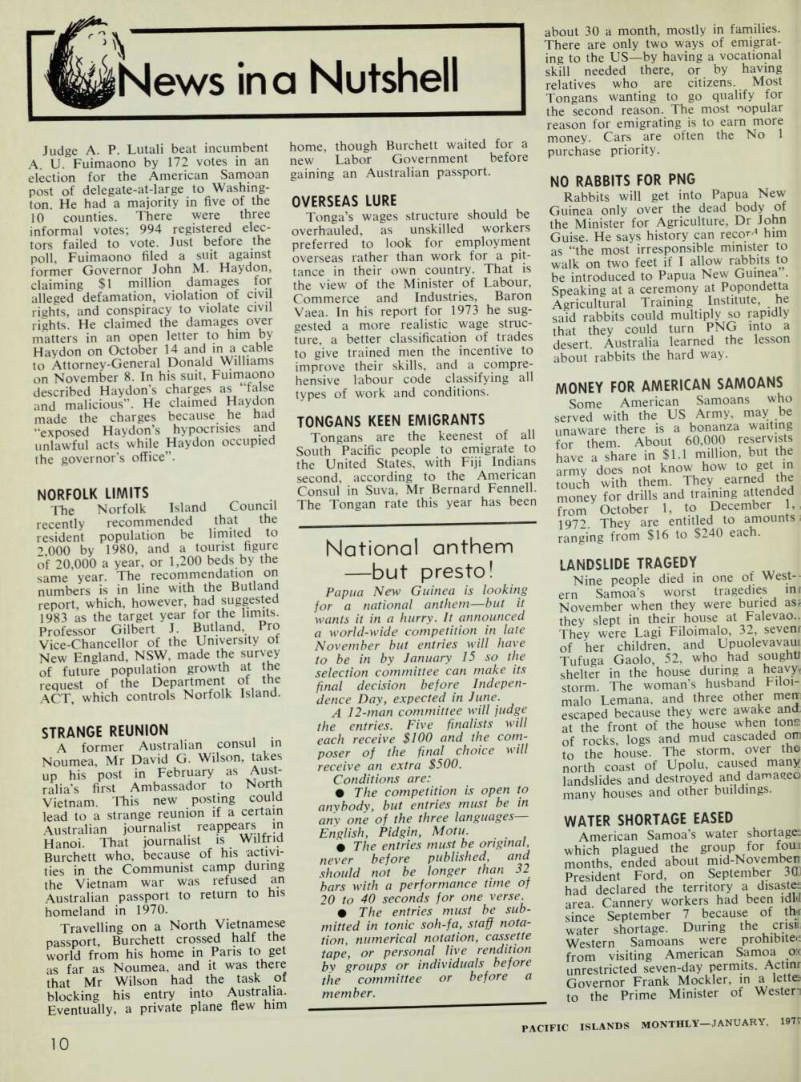
Mr Apisai Tora, member of the NFP Opposition ... is he whispering about coalition in the ear of his leader, Mr Siddiq Koya (below)?
News in a Nutshell
Judge A. P. Lutali beat incumbent A. U. Fuimaono by 172 votes in an election for the American Samoan post of delegate-at-large to Washing ton. He had a majority in five of the 10 counties. There were three informal votes; 994 registered elec tors failed to vote. Just before the poll, Fuimaono filed a suit against former Governor John M. Haydon, claiming $1 million damages for alleged defamation, violation of civil rights, and conspiracy to violate civil rights. He claimed the damages over matters in an open letter to him by Haydon on October 14 and in a cable to Attorney-General Donald Williams on November 8. In his suit, Fuimaono described Haydon’s charges as false and malicious”. He claimed Haydon made the charges because he had “exposed Haydon’s hypocrisies and unlawful acts while Haydon occupied the governor’s office”.
Norfolk Limits
The Norfolk Island Council recently recommended that the resident population be limited to 2 000 by 1980, and a tourist figure of 20,000 a year, or 1,200 beds by the same year. The recommendation on numbers is in line with the Butland report, which, however, had suggested 1983 as the target year for the limits.
Professor Gilbert J. Butland, Pro Vice-Chancellor of the University of New England, NSW, made the survey of future population growth at the request of the Department of the ACT, which controls Norfolk Island.
Strange Reunion
A former Australian consul in Noumea, Mr David G. Wilson, takes up his post in February as Aust ralia’s first Ambassador to North Vietnam. This new posting could lead to a strange reunion if a certain Australian journalist reappears m Hanoi. That journalist is Wilfrid Burchett who, because of his activi ties in the Communist camp during the Vietnam war was refused an Australian passport to return to his homeland in 1970.
Travelling on a North Vietnamese passport, Burchett crossed half the world from his home in Pans to get as far as Noumea, and it was there that Mr Wilson had the task of blocking his entry into Australia.
Eventually, a private plane flew him
home, though Burchett waited for a new Labor Government before gaining an Australian passport,
Overseas Lure
Tonga’s wages structure should be overhauled, as unskilled workers preferred to look for employment overseas rather than work for a pit tance in their own country. That is v j ew Q f the Minister of Labour, Commerce and Industries, Baron Vaea In his repo rt for 1973 he sug gested a mo re realistic wage struc ture, a better classification of trades tQ gj ve trained men the incentive to i mprove t h e ir skills, and a compre tensive labour code classifying all tvpes G f work and conditions, ™
Jqngans Keen Emigrants
jp&n* r.5.,1 s
the United states, with Fiji Indians second, according to the American Consul in Suva, Mr Bernard Fennell.
The Tongan rate this year has been
about 30 a month, mostly in families.
There are only two ways of emigrat ing to the US —by having a vocational skill needed there, or by having relatives who are citizens. Most Tongans wanting to go qualify for the second reason. The most nopular reason for emigrating is to earn more money. Cars are often the No 1 purchase priority.
No Rabbits For Png
Rabbits will get into Papua New Guinea only over the dead body of the Minister for Agriculture, Dr John Guise. He says history can record him as “the most irresponsible minister to walk on two feet if I allow rabbits to be introduced to Papua New Guinea .
Speaking at a ceremony at P9pondetta Agricultural Training Institute, he said rabbits could multiply so rapidly that they could turn PNG into a desert. Australia learned the lesson about rabbits the hard way.
Money For American Samoans
Some American Samoans who served with the US Army, may be unaware there is a bonanza waiting for them. About 60,000 reservists have a share in SI.I million, but the army does not know how to B et * n touch with them. They earned the money for drills and training attended from October 1, to December 1,, 1972. They are entitled to amounts, ranging from $l6 to $240 each.
Landslide Tragedy
Nine people died in one of West ern Samoa’s worst tragedies mi November when they were buried as? they slept in their house at Falevao..
They were Lagi Filoimalo, 32, sevenr of her children, and Upuolevavaiu Tufuga Gaolo, 52, who had sought} shelter in the house during a heavyv storm. The woman’s husband riloi malo Lemana, and three other mem escaped because they were awake and: at the front of the house when tons of rocks, logs and mud cascaded om to the house. The storm, oyer the north coast of Upolu, caused many landslides and destroyed and damageo many houses and other buildings.
Water Shortage Eased
American Samoa’s water shortages which plagued the group for foui months, ended about mid-Novemben President Ford, on September 30j had declared the territory a Pastes area. Cannery workers had been idld since September 7 because of thr water shortage. During the cnsit, Western Samoans were prohibited from visiting American Samoa ok unrestricted seven-day permits. Actmr Governor Frank Mockler, in a lette to the Prime Minister of Western
Samoa, Fiame Mataafa, said that because of the water shortage Ameri can Samoa was suffering economic decline. Another side-effect of the drought was the refusal of Mr Mockler to issue a business licence to Bumble Bee Samoa Inc. Only when water supplies were assured would a licence for another tuna com pany be considered. Bumble Bee, seeking a licence for a tuna canning plant, said the plant would use 200,000 gallons of fresh water a day, and if fresh water was used to thaw the frozen fish another 75,000 gallons would be needed.
Not Faa Samoa
The first visit by a Western Samoan to an Auckland hotel was a disaster.
In addition to a sentence of four months’ imprisonment imposed in November he faces further punish ment in Western Samoa for the dis grace he brought to his family. The man, Enelagi Tofa, admitted having tried to hit Detective Superintendent E. G. Perry with a full bottle of beer. The incident occurred when Perry tried to stop Tofa pushing an elderly man.
The magistrate said the blows Tofa aimed at Perry could have caused serious injury. Tofa’s counsel, Mr G. C. Gotlieb, said his client’s appearance in court would probably be a lesson to other Samoans to treat alcohol with respect. Tofa’s father was a fairly senior chief, and Tofa would face further punishment for the shame he brought on his family.
Church Independence
The Diocese of Melanesia will be come an independent province on January 26, with inauguration cele brations to be held in Honiara to mark independence after 125 years as part of the Anglican Province of New Zealand. The new province will be known as the Province of Melanesiae.
The head of the province, Bishop John Chisholm, will be created archbishop during an inauguration service on January 26. Three assistant bishops, the Rt Revs Derek Rawcliff, Dudley Tuti and Leonard Alufurai, will be installed as diocesan bishops for the four new dioceses of the New Hebrides, Malaita, Santa Ysabel and Eastern Outer Islands in the BSIP.
Parking Fees For Png
The PNG cabinet has given local government councils the “go-ahead” to introduce parking zones and fees.
The Port Moresby City Council has already drawn up proposals for the introduction of fees—lo cents for one or two hours in different parts of the city. Fines of $lO for parking
infringements and $5 for non-payment of fees will be imposed. Instead of using parking meters the council proposes a system of dated and coloured tickets which will be issued
k\P. a . m 8 attendants.
Minister for Local Government.
Mr Boyamo Sah, said the government welcomed the scheme which, at little cost to the public, “would make traffic movement more orderly and provide the council with a good source of revenue.”
Vaiiiarif Apprfriation
Valuable Arrktuaiiun
Nauru has given the University of the South Pacific at Suva $200,000 to be spent as the university council decides. The cheque was handed over in October by Nauru s President Hammer Deßoburt, who is Chancellor of the University. The gift was to mark Nauru’s appreciation of the university’s work and to indicate the republic's support for it, the president said adding that the council would be the best judge of how the money should be spent.
BnAn wnmMMt
Road Programme
The PNG cabinet has approved a $153 million five-year national road programme starting in July 1975.
Minister for Transport and Civil Aviation, Mr lambakey Okuk says it is the first stage in a PNG transport plan for integrated development of road, sea and air transport. The plan covers 25 road projects.
To be started or developed in the plan are: The upgrading and sealing of the Highlands Highway from Lae to Togoba, and the construction of the
Hiritano Highway to the Purari pro ject.
Major expenditure on the Southern Highlands, Gulf and Bomai (Kundiawa-Wabo) Highway, and the £ n g a Highway from Togoba to Wapeil amanda. „ .. , , TI . .
Expenditure on the Western High *ay from Oriomo to Weam; the National Highway fjom Keiema through Murua Kamtiba, Menyama ’ se *’ to Bulolo and Lae.
The Goilala Highway from Aro pokina through Tapini and Garaina to Wau and Bulolo; the Papuan Highway from Port Moresby to Alotau; the Northern Highway from Ganai through Musa and Oro Bay to p op ondetta and Kokoda.
The Coastal Highway from Lae a i ong t he north coast to Vanimo; the Sepik Highway from Wewak through Maprik Dreikikir and Lumi to Aitape The Bewani Highway from Vani to Green Rive * , he y Ramu High from Wa(erai ’ s to Aiome; f he Ch fmb u Highway f. ■om Madang to Kundiawa.
The simbai Hl * hwa V from B °B ia to Tabibuga and Kimil; the Western Highway from Kiunga to Frieda; the Okapa Highway from Kainantu to Wabo.
The Milne Highway from Alotau to Musa; the Manus Highway from Lorengau to Kali Bay.
Th e New Britain Highway from Gloucester to Rabaul; the Pomio Highway from Rabaul to Powell Harbour.
The Bulominski Highway from Kavieng to Mallium; the West New Ireland Highway from Lemacot to Mallium.
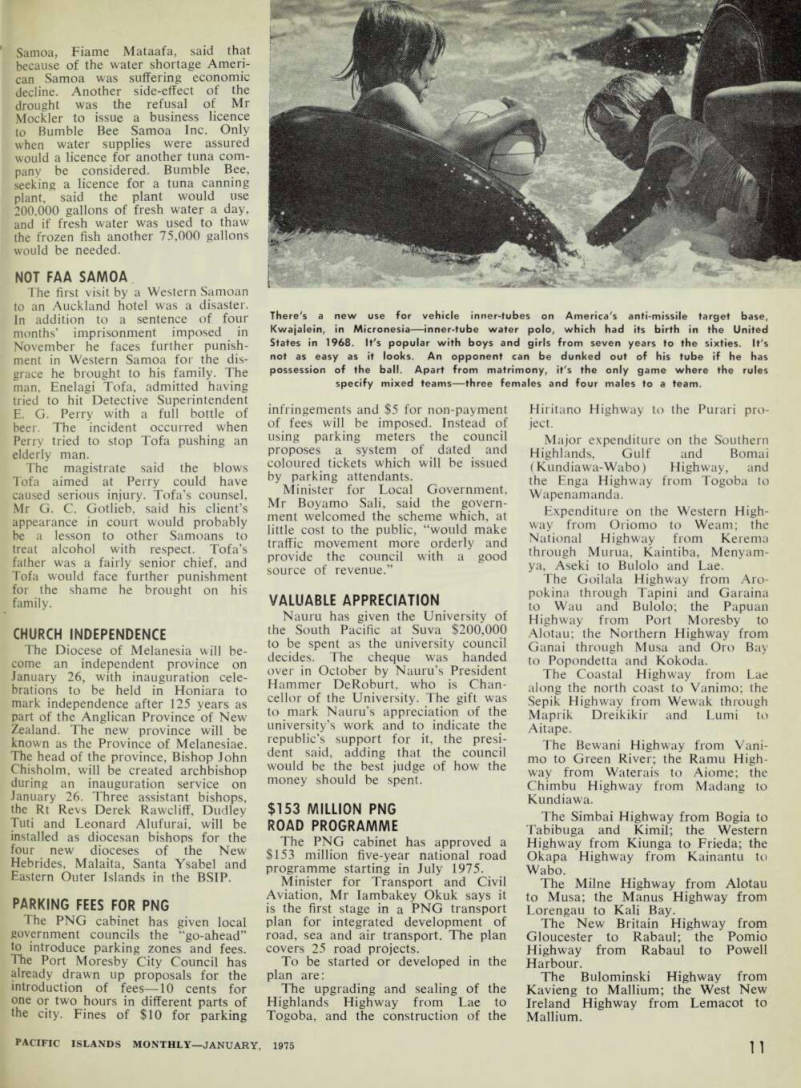
There's a new use for vehicle inner-tubes on America's anti-missile target base, Kwajalein, in Micronesia —inner-tube water polo, which had its birth in the United States in 1968. It's popular with boys and girls from seven years to the sixties. It's not as easy as it looks. An opponent can be dunked out of his tube if he has possession of the ball. Apart from matrimony, it's the only game where the rules specify mixed teams—three females and four males to a team.
—but presto!
National anthem —but presto!
Papua New Guinea is looking for a national anthem —but it wants it in a hurry. It announced a world-wide competition in late November but entries will have to be in by January 15 so the selection committee can make its final decision before Indepen dence Day, expected in June.
A 12-man committee will judge the entries. Five finalists will each receive $lOO and the com poser of the final choice will receive an extra $5OO.
Conditions are: • The competition is open to anybody, but entries must be in any one of the three languages — English, Pidgin, Motu • The entries must be original, never before published, and should not be longer than 32 bars with a performance time of 20 to 40 seconds for one verse. • The entries must be sub mitted in tonic soh-fa, staff nota tion, numerical notation, cassette tape, or personal live rendition by groups or individuals before the committee or before a member.
Advertisements & other items, p. 14 (1 item)
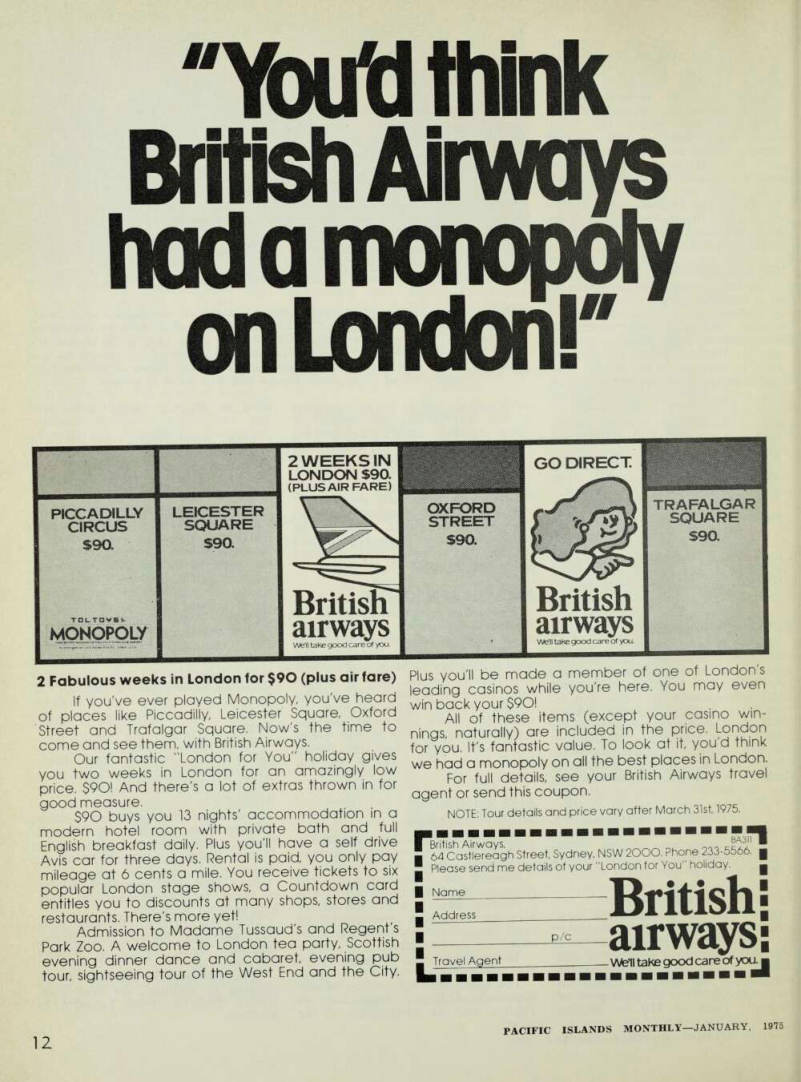
hadamonopoly
"Ybutl think
British Airways
on London!"
2 Fabulous weeks in London for $9O (plus air fare) If you've ever played Monopoly, you've heard of places like Piccadilly, Leicester Square, Oxford Street and Trafalgar Square. Now's the time to come and see them, with British Airways.
Our fantastic "London for You" holiday gives you two weeks in London for an amazingly low price. $9O! And there's a lot of extras thrown in for good measure. $9O buys you 13 nights' accommodation in a modern hotel room with private bath and full English breakfast daily. Plus you'll have a self drive Avis car for three days. Rental is paid, you only pay mileage at 6 cents a mile. You receive tickets to six popular London stage shows, a Countdown card entitles you to discounts at many shops, stores and restaurants. There's more yet!
Admission to Madame Tussaud's and Regent s Park Zoo. A welcome to London tea party, Scottish evening dinner dance and cabaret, evening pub tour, sightseeing tour of the West End and the City.
Plus you'll be made a member of one of London's leading casinos while you're here. You may even win back your $9O!
All of these items (except your casino winnings, naturally) are included in the price. London for you. It's fantastic value. To look at it, you d think we had a monopoly on all the best places in London.
For full details, see your British Airways travel agent or send this coupon.
NOTE; Tour details and price vary after March 31st, 1975.
Castlereagh Street, Sydney, NSW 2000. Phone 233-5566, g Please send me details of your "London for You" holiday. ■ p/c Travel Agent We’ll take good care of you. I
Tropicalities

Per mi is
for
whites?
Whites living in Papua New Guinea after independence may have to carry work permits. The Minister for Labour, Mr Gavera Rea, fore cast this in the House of Assembly recently.
Mr Rea said one of the biggest problems facing PNG was the need to train its own nationals to skilled jobs, and to protect their rights to hold those jobs.
He believed that the right to em ployment in an independent Papua New Guinea should be a right of citizenship, not a right of long-term residents. Existing legislation restricts some classes of employment to New Guineans, but whites who have lived in the country since before the legis lation was enacted are exempt from the restriction.
Mr Rea said he did not believe this form of protection, based merely on period of residence, would fit the needs of a truly national and inde pendent Papua New Guinea.
He believed that non-citizens should be required to carry work permits setting out the special skills or attributes which entitled them to employment. He said that research was already being carried out into the type of legislation envisaged.
Was your dad
a mummy?
Hieroglyphics found in caves in West Irian have attracted the interest of a New Zealander, Professor H. B.
Bell, who is at Harvard University, Boston. He plans to have them photo graphed and exhibited. He says that research he has conducted on photo graphs and reports by German anthropologists suggest that NZ Maoris and other Polynesians des cended from an Egyptian-Libyan fleet which sailed into the South Pacific about 250 to 230 BC, and passed through West Irian.
Dr R. C. Green, professor of
anthropology at Auckland University, doubts Professor Bell’s claim. He says there is no scientific evidence that the hieroglyphics ever existed. In ad dition, Polynesian culture contrasted markedly with that of Egypt.
Money IVom
Isis studies
A forger used a photograph of a $lO note appearing in a school text book to make a forged note which turned up at a Honiara bank re cently.
The note was included in a large sum paid into the bank and was detected by a bank officer as he was checking the pile of notes. Two pic tures of the $lO note, the same size as the original, had been cut from a mathematics textbook pasted to gether and then coloured with crayons to resemble the real note.
All textbooks carrying the picture will be called in and the words “specimen copy” overprinted on the picture.
Toget luTiiess
on ilie road
Motor sport organisers in Aust ralia, New Zealand and New Cale donia officially agreed in October to co-operate in a joint South Pacific Rally Series to link three motor trials held in their respective countries.
The series will begin in 1975 to combine performances in the New Zealand Heatway Rally in July, the Southern Cross Rally in Australia in October and the Safari Caledonien trial out of Noumea in November.
The sponsorship and prizes for the series have not yet been worked out, but it is expected the agreement will result in a greater exchange of teams competing in the three South Pacific rallies.
PIM really
gets a round
Wages packet apart, the richest reward in working for PIM is the knowledge that our bon mots are
read all over the world. The proof of that is in the mail which we get on the rare occasions that the Sydney postal workers are not on strike.
F’rinstance, a few days ago, we opened a letter from Alfred Berg lund, self-described “self-learned linguist and amateurish writer, born near the Arctic Circle in the pro vince Lapland” from Forslov in Sweden. He asked us to publish an article by him on Sweden’s neglect of the Lappic nomads. Unfortunately, we can’t oblige as our parish is the Pacific only, but maybe the United Nations’ Committee of 24, who we know read PIM, can help.
We get letters from many far away places but we haven’t bragged about our world-wide readership since the time years ago when we told of the village chief in the middle of SE-Asia who gave PIM covers as rewards to villagers.
Smugglers raid
PNG’s wildlife
PNG Government rangers are mounting a huge campaign against wildlife smugglers. They want to catch operators who are smuggling out of the country rare protected butterflies, birds and their feathers and crocodile skins.
Rare plumes from some jungle birds and the colourful wings of some protected butterflies are bring ing big prices on world markets.
Patrols are going into collection areas in a search for smugglers who may be operating in a big way. They are also making spot checks of con signments through airways offices, at wharves and in post offices.
The Agriculture Minister, Dr John Guise, warned “I will do everything in my power to deport unscrupulous people who are exploiting our birds and butterflies.”
He said there was evidence that smuggling of wildlife specimens had increased during the past few months despite repeated warnings from his office.
Some overseas dealers were offer ing up to $6OO for a good specimen of some butterflies. Detection of illegal export was difficult because
packets were small enough to be sent through the mails.
Seamen calling at coastal villages were also placing orders with local people for birds and butterflies, Dr Guise said. Detection of this sort of smuggling was not so difficult, and a close watch was being kept on the activity of ships’ crews.
Agricultural inspectors believe that bigger consignments of wildlife speci mens were being smuggled out of the country labelled as personal effects.
Dr Guise said his officers had re cently confiscated 18 Birds of Para dise, and a large number of rare bird-wing butterflies collected by “so called scientists who failed to pro duce permits”.
The value of recent confiscations of butterflies and Birds of Paradise was estimated at $6,000. They in cluded seven butterfly species which entomologists believe are facing ex tinction.
■lusting guts
fur nothing
Agricultural shows—Australian style—may be on the way out in Papua New Guinea no matter how much they are adapted to the local community.
In Lae recently a New Guinean politician reflected increasing cri ticism when he described the Morobe District show there as “a place for white planters and gamblers”.
The politician, Mr Amenao Okono, called for the banning of the annual show until such time as the New Guineans of the district wanted
to run it for themselves. He claimed some people were tricked into attend ing this year’s show and that they were robbed of their money at gam bling stalls and by “those white planters on the gates”.
But Mr Okono’s attitude has dis appointed planters and businessmen who, for years, have unsuccessfully been trying to encourage greater control by New Guineans in agricul tural shows.
“Too many of them are just not interested” a member of the Papuan Agricultural Society in Port Moresby said.
He denied that the shows were the preserve of the white man, and said that agricultural shows could well be on the way out because many New Guineans were not even in terested in adapting the shows to their own requirements.
“We seem to be busting our guts for nothing these days”, he said.
About 10 major agricultural shows are held each year in Papua New Guinea. The Morobe Show in Lae has always been one of the biggest.
Mr Okono’s criticism, contained in a public statement, suggested that the $lB,OOO gate money from this year’s Morobe Show might be a “profit” for someone. “Where will the money go”, he asked.
The show society’s business coun cillor, Mr Bill Leonard, said in Lae that the statement reflected some general misunderstandings about how shows were operated voluntarily. He said $15,000 of the money was paid in prizes and awards, and the rest helped to pay off mortgages on show ground buildings.
Cook Islanders
dance in Japan
Visitors to the Namegawa Island resort about two hours train journey from Tokyo were entertained re cently by 200 trained flamingoes, a troupe of peacocks and the Cook Islands’ Betela Dance Troupe, which was visiting the luxury hotel for the sixth time.
The troupe, nine girls, five boys and musicians, left Rarotonga for Japan last March and returned home on October 22 after calling at Hong Kong, Singapore, Australia, New Zealand and Fiji.
The troupe is almost a family affair. Three of the girls and a boy are from the Jonassen family. Anne Jonassen is the team leader, her father the manager and her mother the chaperone and adviser.
The daily performance at the Namegawa Island resort was watched by between 6,000 and 10,000 visit ors, The Cook Islanders also appeared on television and, for variety, included New Zealand Maori hakas and Samoan and Gil bertese dances in the programme.
In Fiji, as PIM reported in No vember (p 12), the dancers charmed Prince Charles and each of the girl dancers managed to kiss the cheek of Britain’s future king.
Tonga looks
fur nodules
Tonga is pinning hopes on marine resources in the shape of manganese nodules and phosphate to lift the economy. Inspired by the discovery of a 300-mile wide belt of manga nese nodules in waters around the Cook Islands, Tonga will soon launch a search for similar minerals in the broad terrace on the eastern side of the Tonga Platform, about 60 miles east of Nukualofa.
The survey will be at depths of 3,000 to 4,000 metres by grab samp ling. A principal adviser in the search will be Dr Loren Kronke, of Hawaii, who is based in Suva as a UNDP marine geologist.
The search for phosphate will be in the deeper parts of the Tonga Platform and the shallower oceanic areas. Mr Sione Tongilava, superin tendent of the Lands and Survey De partment, said he felt the margins of the Tonga Trench might be a likely place for phosphoric deposits.
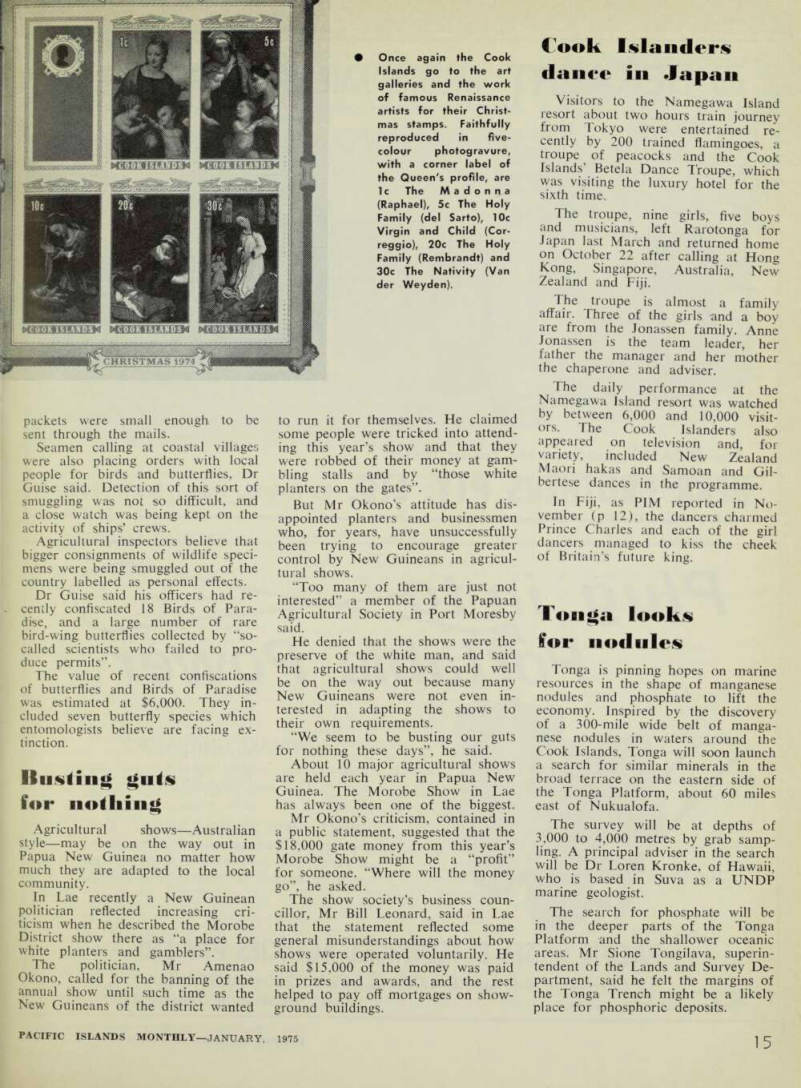
Once again the Cook Islands go to the art galleries and the work of famous Renaissance artists for their Christ mas stamps. Faithfully reproduced in five colour photogravure, with a corner label of the Queen's profile, are 1c The Madonna (Raphael), 5c The Holy Family (del Sarto), 10c Virgin and Child (Cor reggio), 20c The Holy Family (Rembrandt) and 30c The Nativity (Van der Weyden).
Advertisements & other items, pp. 16-18 (1 item)
These MF distributors
NEW CALEDONIA
Pacific Motors S.A.,
NOUMEACEDEX
BRITISH SOLOMON ISLANDS
TAHITI
Ets, Donald.
P.O. Box 131. PAPEETE
NEW HEBRIDES
CONDOMINIUM
Pentecost Pacific S.A..
Santo and Port Vila
can show you the
greater the load on an MF2I Trailer
the better the grip!
The all-steel hydraulic-tipping MF2I is a “goanywhere” unit with large section tyres to give good flotation on wet ground and MF’s famous rear axlo design which puts 25% of the load on the tractor’s rear wheels. The bigger the load, thebetterthegrip!
Capacity is 3 1 /2. tons, tray area 60 square feet. A powerful hydraulic ram tips the tray to 56 degrees for fast, clean unloading. Everything about this trailer is planned for one-man operation. What’s more, it’s built for years of tough work in the field or on the road. / m A
MFE 74041
MF
MASSEY-FERGUSON
.. WINNER OFTWO EXPORT AWARDS
BEKAERT means MILES OF FENCES
The BEKAERT people for the Pacific Islands.
★ CHOICE OF STYLES
★ FIRST QUALITY
★ GALVANISED OR
PLASTIC COATINGS
BEKAERT is the leading European wire-mill with a yearly capacity of over 350,000 tons of high quality wires and wire-products and all kinds of ornamental, welded or chain link fences.
For further information or supplies contact: KERR BROTHERS PTY. LTD. 65 York St., Sydney, N.S.W., 2001.
Plug
Potable Power
m m
KAWASAKI GENERATORS
Dual voltage models ranging from 600 watt to 1300 watt 240/110/12 volt.
SINGLE PHASE 240 VOLT 2-3-4-5-71 KVA
Featured in a strong roll-over frame or as a trolley type as illustrated. These quality units are suitable for electric motor duties.
PACIFIC DIESEL & TECHNICAL AGENCIES PTY LTD Telephone: 19 Carrington Rd. MARRICKVILLE N.S.W. 2204 AUSTRALIA 55-3473 55-3867 Cables: “DIESELTECH”, Sydney. TELEX: 25568
The Editor's Mailbag
Gogodala Dancers
Your November issue (p 15) contained an article on the Fourth Niugini Arts Festival, specifically mentioning the Gogodala Dancers, from Balimo in the Western District of Papua New Guinea. Being an ex resident of Balimo I would like to add a few comments.
As stated in your article, the dancing in this area has been re vived only in the past three years, together with the traditional carvings of these people and various other aspects of their culture including canoe racing. The person responsible for this, more than anybody, is Mr Tony Crawford who for the past three years has given himself whole heartedly to try to give back to the Gogodalas some of their culture which was mercilessly taken from them during the 1930 s and 40s as the Evangelical missions took over.
When this project was begun by Mr Crawford, who was then attached to the Commonwealth Art Advisory Board, only a handful of old men had any idea what their culture really was like and it took extensive research material collected by Mr Crawford from various parts of the world to revive their memories and
create interest among the younger men.
Despite considerable opposition
from missions in the area, the first Gogodala carvings seen for many years began to appear towards the end of 1972 and as more interest was created most of the younger men began to try their hand at the carvings of their forefathers.
The completion of the Gogodala Cultural Centre in July this year was a milestone in achievement for the Gogodala people—the centre is based on a traditional Gogodala Longhouse and the younger men had the chance to participate in the building of their traditional housing.
The centre was opened by our Chief Minister, Mr Michael Somare in August this year in the midst of what would have been the biggest display of Gogodala cultural activi ties seen for over 30 years.
With the completion of the Long house which gave the people a place to dance in traditional surroundings, Tony Crawford with the help of some of the older men then set about reviving some of the tradi tional Gogodala dances.
As Gogodala dancing had been banned since the 1930 s and therefore largely forgotten the people involved had to start from scratch learning
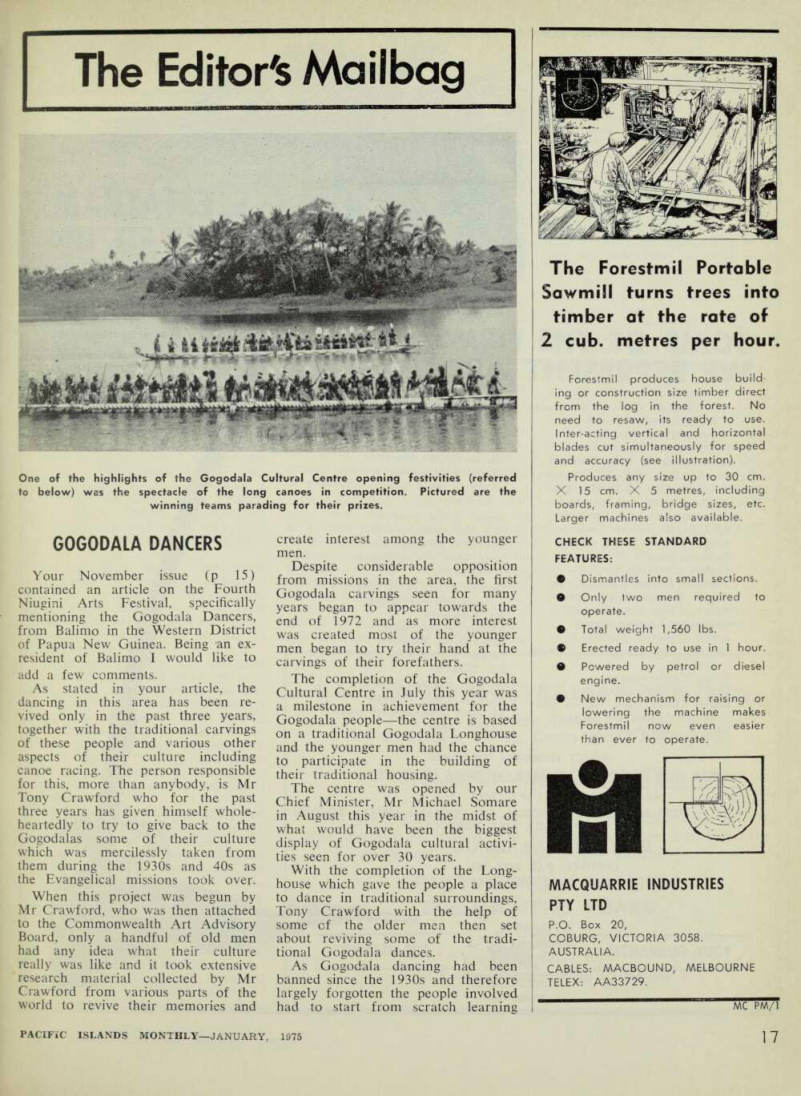
One of the highlights of the Gogodala Cultural Centre opening festivities (referred to below) was the spectacle of the long canoes in competition. Pictured are the winning teams parading for their prizes.
Letters
the basic steps from research material and some of the old men who had defied the ban on dancing.
The result of these efforts was displayed admirably at the Niugini Arts Festival in Port Moresby re cently.
Hopefully, people in other parts of New Guinea and the Pacific who have lost most of their traditions will be able to follow the example of the Gogodala people and restore some of their customs and traditions before it is too late.
They will be fortunate indeed if they can enlist the help of someone like Tony Crawford to help them achieve these goals.
Paul H. Clowes.
Port Moresby.
Percy Chatterton's
Papua
This is an unsolicited mini-review of Percy Chatterton’s Papua, Day That I Loved, a copy of which I eventually obtained from Pacific Publication’s Sydney headquarters the other day and have now read with the warm pleasure I had anti cipated.
Having been closely associated with Percy for over 40 of his 50 years in the land of his adoption, as colleague and friend, I suppose I know him as well as most and— as you will know—his writing is typical of the man.
There are plenty of quotable quotes such as would surely bring a quick dollar to whoever may be dis posed to send them to Readers Digest—or whatever. Such as, “I like simple people. I detest osten tation, pomposity and self-assertive ness. I deplore the cult of bigness.
The dinosaur died of it; it may yet turn out to be homo sapiens’ termi nal illness”.
And “In the Hebrew story of creation, an angel with a flaming sword barred the way back to the Garden of Eden. The angel who bars the way back to the Melanesian Eden grasps in his hand a transistor radio, its sword-like antenna glittering hypnotically”.
Only at one point in the book did I put a question mark in the margin, on p 121 where Percy shares a bit of his thinking on essential constitu ents of a culture—culture meaning “a way of life—the whole of it”. In this context he rejoices (as I do) in
what begins to look as if a renewed appreciation of PNG’s traditional languages is well under way. Then he goes on to ask . . . “But what of traditional religion, which, in coastal Papua at any rate, was based on a belief that the influence of the spirits of the dead is still active in the lives of the living? Is there any likelihood of its survival or revival? I rather doubt it .
I won t start up a theological debate with Percy, but, in the spirit ?/rii hro P°i OSI , St ‘ he - late F - F Wil iams, I think there is room for at least some measure of blending of cultures as affecting this Papuan culture constituent alongside Christian teaching. For if the Christian concept of immortality means anything it surely must include a recognition that the spirit of those who have gone before continues to be ■? c “ v . e o\ r i,! he hv ? s °( th e living, must it not? What a hundred 19th century Papuans included in their belief (that the influence of the spirits of the dead was still active in the lives of the living) may have been as vanous as what 100 Christians may include in their belief in immortality.
So, there may be some common ground somewhere in this category of culture.
Dr Chatterton’s rich fund of personal anecdotes is as entertaining as it is inexhaustible, and the general reader will appreciate the warm humanity running through it all, whether in the earlier missionoriented chapters or in the later political flavoured pages.
In these latter, what sticks out a mile is the prophetic content of much that the Hon Member of the House
of Assembly gave voice to in the House. Time and again, it appears, a variety of—at the time—lost causes have been resurrected at a later stage by somebody else and become ‘won causes’, two of them (p 95) during the printing of this book and after Chatterton’s retire ment from the House!
Thank you> Stuart Inder> for talk . ing Percy into writing this book. In your fore Word to his book you sur prised me by referring to “that slight trace of Lancashire accent he has even after 50 years jn Papua -. rm a , ad from Lancashire m y Se lf, and my w jf e more so, and we are agreed that whatever accent Percy may have it>s not L ancashire . i j n . c]ine t 0 beMeve that like his wr iting, j t j s p Ure p erc yi Your little write . up of the artist Ber , 81 - ownj on the backfo , d of the dust cover cou , d well have included horticulturist, for before joining up as a m i ssio nary he had raised the world record collection of tuschias and was a wor d authority on them from his London nurseries!
Perhaps some readers will put down this book conceding that some at j east of “ those bloody mission aries - didn -, do tOO bad a job one wa y an( j ano ther, and the Rev Percy Chatterton, QBE, LED, LCP, in particular.
Sydney.
Maurice Nixon.
O Rev Maurice Nixon is currently secretary of Sydney’s Pitt Street Con gregational Church, but he was with Percy Chatterton at Hanuabada in 1931 and remained as a missionary in Papua until his retirement in 1968.
Advertisements & other items, pp. 19-22 (1 item)
The Foreslrnil Portable
Sawmill turns trees into
timber at the rate of
2 cub. metres per hour.
Foreslrnil produces house build ing or construction size timber direct from the log in the forest. No need to resaw, its ready to use.
Inter-acting vertical and horizontal blades cut simultaneously for speed and accuracy (see illustration).
Produces any size up to 30 cm.
X 15 cm. X 5 metres, including boards, framing, bridge sizes, etc.
Larger machines also available.
CHECK THESE STANDARD
FEATURES:
• Dismantles into small sections. • Only two men required to operate. • Total weight 1,560 lbs. ® Erected ready to use in 1 hour. • Powered by petrol or diesel engine. • New mechanism for raising or lowering the machine makes Forestmil now even easier than ever to operate.
MACQUARRIE INDUSTRIES
PTY LTD
P.O. Box 20,
COBURG, VICTORIA 3058.
AUSTRALIA.
CABLES: MACBOUND, MELBOURNE
TELEX: AA33729.
MC PM/1
SOME OF THE
WE REPRESENT
Asia Rubber Works (Singapore Rubber Shoes) Frappier (French Brandy) Huvet (French Brandy) Indika (Belgium Dairy Produce) Durobor S.A. (Belgium Glassware) Miroiterie Gen. de Belgiqe S.A. (Louvre glass and mirrors) City Engineers (U.K. Bicycles) F.H.I. Japan (Subaru Cars) Kraggs (Wines, Spirits, Ciders) Sunshine Biscuits Sunrise (Confectionery) Flamenco (Instant Coffee & Tea) Quaker Products (Oats, Jets) Hancocks (Spaghetti, Cereals) Melbourne Canning (Jams) Amatil (Twisties, Twirlies) Edward Zorn (Margarine, Cooking Fats) Allens (Confectionery) Red Tulip (Fine Chocolates) Robert Timms (New Guinea Gold Instant Coffees and Teas) S.P.C (Canned Fruit)
FIRMS
ARE:
S.P.C. (Abalone) Wing Lee (See You Sauce) Magnet (Mattresses) Essteel (Cookware) Warner-Drayton (Fans) Mitchell's (Abrasives) Tilbury & Lewis (Sports Trophies i.
Silverplate) Regent (Swiss watches) Lega Marcasite (Jewellery) Austramax (Pressure Lanterns) Lawn Chair; Tubco (Garden Furniture) Electronic Industries (Electrical Household Appliances) Jex (Steelwool) Arnbro (Folding Beds) James Miller (Blankets) Elmaco (Plastics —Electrical Fittings B.X. (Plastics) Stegbar (Wooden Louvres) Franklite (Light Fittings) J.J. Cash (Embroidered Labels) Disston (Saws)
S. E. TATHAM
& CO. PTY. ITD.
ASKEW HOUSE, 364 LONSDALE ST.,
MELBOURNE, 3001, AUSTRALIA.
G.P.O. BOX 8—
CABLES "SET",
TELEPHONE: 601125
BUYERS FOR THE
PACIFIC ISLANDS
\ \ 1
DIRECT ENQUIRIES WELCOMED
PAPUA NEW GUINEA: S. E. TATHAM (P.N.G.) PTY. LTD
LAE: MALAITA STREET (P.O. BOX 1562).
PORT MORESBY: CNR. GOROA AND MUNAHU
(P.O. BOX 6733, BOROKO).
FUI: S. E. TATHAM (FIJI) LTD.,
LAUTOKA: P.O. BOX 366.
SUVA: G.P.O. BOX 671.
STREETS,
YOUR GUARANTEE
1
GORDON
FOR SERVICE
SINCE 1924
BALLANDE (AUSTRALIA) PTY. LTD.
Bollande House 110 Alexander Street, Crows Nest, Aust. 2065
ISLAND MERCHANTS
Have great pleasure in announcing their appointment as sole purchasing agents for all construction and building materials of Australian origin for the . . .
CONSTRUCTION DIVISION
COMMODITIES BOARD
TONGA
Previously known as The Tonga Construction Company
The perfect answer to increasing motoring costs wm i
OPEL REKORD 21 DIESEL
Opel Rekord is famous throughout the world and is the undisputed leader in its class in Europe.
A car doesn’t just get a great reputation .. .it has to earn it! Opel Rekord is the result of exhaustive engineering development and much consumer research. Safety is assured, through Opel’s continuing program of testing.
The lively 2.1 litre diesel engine has been praised by motoring experts for its economy and reliability.
The result is a better car for you.
See and drive the new Opel Rekord 2.1 Diesel 2or 4 door sedan or 5 door CarAVan at.. .
LaiWoa, Papeete, Tahiti.
Joseph Cheval and Cie., Noumea, New Caledonia, Comptoir Francais des Nouvelles Hebrides, Port Vila, New Hebrides.
Sociedade Agricola Patria e Trabalho, Lda., Dili, Portuguese Timor.
A 902 m
Just for the record...
OPEL REKORD
DIESEL
it makes sense for you!
These Damsels Were A
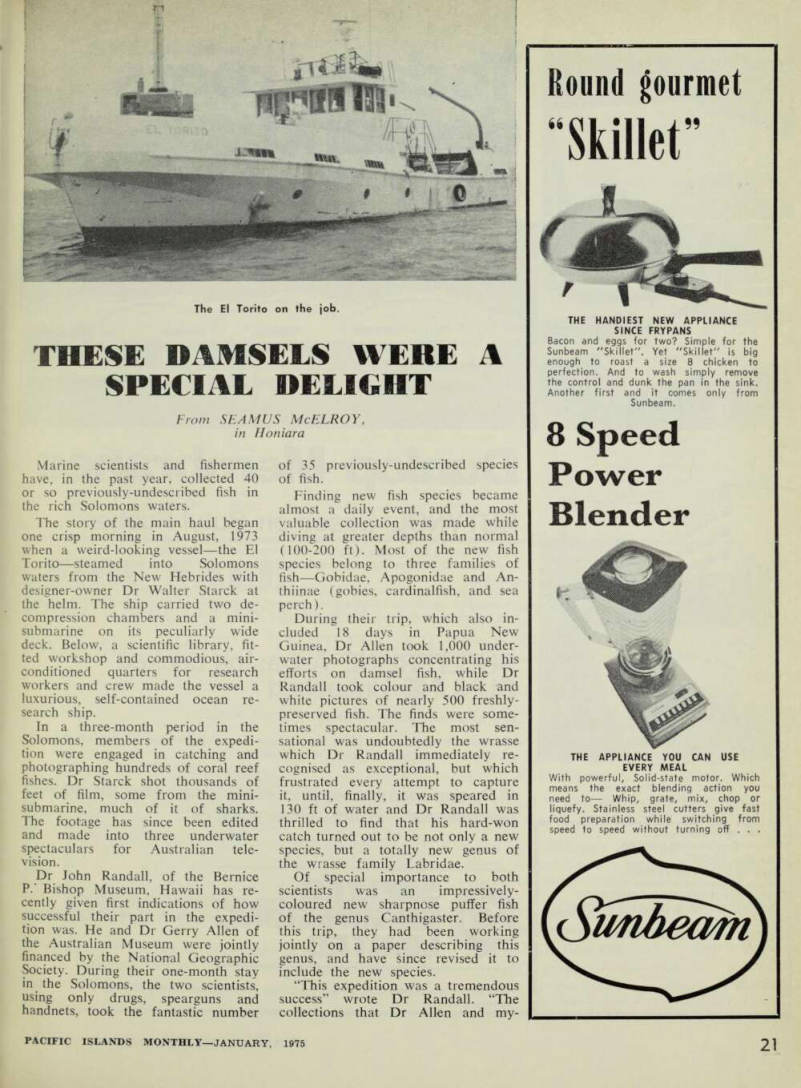

Special Delight
From Seamus Mcelroy,
in Honiara
Marine scientists and fishermen have, in the past year, collected 40 or so previously-undescribed fish in the rich Solomons waters.
The story of the main haul began one crisp morning in August, 1973 when a weird-looking vessel—the El Torito—steamed into Solomons waters from the New Hebrides with designer-owner Dr Walter Starck at the helm. The ship carried two decompression chambers and a minisubmarine on its peculiarly wide deck. Below, a scientific library, fitted workshop and commodious, airconditioned quarters for research workers and crew made the vessel a luxurious, self-contained ocean research ship.
In a three-month period in the Solomons, members of the expedition were engaged in catching and photographing hundreds of coral reef fishes. Dr Starck shot thousands of feet of film, some from the minisubmarine, much of it of sharks.
The footage has since been edited and made into three underwater spectaculars for Australian television.
Dr John Randall, of the Bernice P. Bishop Museum, Hawaii has recently given first indications of how successful their part in the expedition was. He and Dr Gerry Allen of the Australian Museum were jointly financed by the National Geographic Society. During their one-month stay in the Solomons, the two scientists, using only drugs, spearguns and handnets, took the fantastic number
of 35 previously-undescribed species of fish.
Finding new fish species became almost a daily event, and the most valuable collection was made while diving at greater depths than normal (100-200 ft). Most of the new fish species belong to three families of fish—Gobidae, Apogonidae and An thiinae (gobies, cardinalfish, and sea perch).
During their trip, which also in eluded 18 days in Papua New Guinea, Dr Allen took 1,000 under water photographs concentrating his efforts on damsel fish, while Dr Randall took colour and black and white pictures of nearly 500 freshly preserved fish. The finds were some times spectacular. The most sen sational was undoubtedly the wrasse which Dr Randall immediately re cognised as exceptional, but which frustrated every attempt to capture it, until, finally, it was speared in 130 ft of water and Dr Randall was thrilled to find that his hard-won catch turned out to be not only a new species, but a totally new genus of the wrasse family Labridae.
Of special importance to both scientists was an impressively coloured new sharpnose puffer fish of the genus Canthigaster. Before this trip, they had been working jointly on a paper describing this genus, and have since revised it to include the new species, “This expedition was a tremendous success” wrote Dr Randall. “The collections that Dr Allen and my-
The El Torito on the job.
Delightful damsels
self made in the Solomons were ex tremely valuable. It will be many years before all the specimens will be fully reported on”.
Though their material was origin ally divided between both the Aust ralian and Bishop Museums, parts of it have since been sent across the world to experts specialising in par ticular families. The first publication to include any of their material will probably be Dr Allen’s forthcoming book Damsel Fishes of the South Pacific.
The book will include an exciting new damsel fish of the genus Chromis, which was first collected by Dr Allen off the Alite Reef near Malaita, in 150 ft of water, and has been named in his honour. Future publications of both these authors will undoubtedly draw heavily upon the material collected during this expedition, and their scientific value Dr Randall writes, “will be greatly enhanced as a result of their oppor tunity to collect in the rich Mela nesian area”.
The fish collections at the Aust ralian and Bishop Museums have also benefited considerably. More
specimens, which were first dis covered elsewhere in the Pacific, were obtained, giving new evidence to studies on the distribution and ecology of coral fish in the Pacific.
Following on closely behind the departure of this expedition, Dr Herbert Axilrod, author of a series of books on Pacific Marine Fishes, visited BSIP for a week in Novem ber. Two keen fish naturalists in the Solomons—lan Gower and Noel Gray—helped Dr Axilrod during his stay to collect five fish not previ ously known to him. It is possible that two or three of these fish will turn out to be new species.
Earlier this year, a zoology lec turer from Armidale University, NSW, organised a two-week trip to the Solomons on a Siganus (Spine feet) collecting field trip. Dr David Woodland and an assistant Mr Greg Wallace were looking for specimens
of two supposedly-different Siganid
species, each previously collected only once in the Solomons.
There was also the possibility of a third (new) species which was spotted by Dr Randall during his visit six months earlier, but was never collected. Dr Woodland, as opposed to the previous two expeditions, was trying to determine biometrically the actual number of Siganus species that
have been collected from the South Seas.
When trying to identify Siganids, colour was often used in the past as the main criterion for determining different species of this genus. How ever, Siganids can undergo several different colour or pattern changes in their lifetime, and in the past, these different stages or forms have sometimes been reported as different species.
With the aid of a computer, Dr Woodland worked out (mainly from museum material) some characteris tics other than colour which he could measure and which were con stant for a particular species. By this method, he had successfully reduced the Siganid species list for the South Seas from over 80 to about 25. In the Solomons he collected enough evidence to confirm that the two specimens previously collected only once from Solomon waters were, in fact, two different species.
When the man with undoubtedly the best first-hand knowledge of fish in the tropical Pacific, Dr Randall, says “I don’t know when I’ve had a more productive stay in the field”, one can only conclude that many more new and spectacular fish remain to be discovered, especially in deeper waters.
Advertisements & other items, pp. 23-25 (1 item)
“Skillet”
Round gourmet
THE HANDIEST NEW APPLIANCE
SINCE FRYPANS
Bacon and eggs for two? Simple for the Sunbeam "Skillet", Yet "Skillet" is big enough to roast a size 8 chicken to perfection. And to wash simply remove the control and dunk the pan in the sink.
Another first and it comes only from Sunbeam.
8 Speed
Power
Blender
w
THE APPLIANCE YOU CAN USE
EVERY MEAL
With powerful, Solid-state motor. Which means the exact blending action you need to — Whip, grate, mix, chop or liquefy. Stainless steel cutters give fast food preparation while switching from speed to speed without turning off . . .
o -
Todays roofs
demand
new materials
■ * * up
Dunlop Membranes
BUTYNOL- Based on Butyl Rubber
One-ply roofing has far less weight and bulk than built-up systems.
Therefore, the architect gains greater design freedom plus reduced loads on supporting members.
For the owner, certain structural costs are lowered and maintenance problems minimised. The contractor benefits from reduced materials handling, lower shipping costs and a work day with more productive hours.
SHELTERLINE Asbestos backed
DUNLINE Unbacked
Both based on well-proven Hypalon* Synthetic Rubber.
Hurricane Bebe' October 1 972 and Cyclone Lottie' December 1973 produced no problems for Dunlop Membranes and Adhesives.
Illustrations depict: Roman Catholic Seminary, Suva.
Pacific Fishing Company, Levuka.
The Fiji Times' Extensions, Suva.
I The General Manager, I Shelter Engineering Limited, I P.O. Box 10-043, I Christchurch, New Zealand.
I Please forward information on
□ BUTYNOL ROOFING MEMBRANE
□ SHELTERLINE & DUNLINE ROOFING
[MEMBRANES
□ MEMBRANES FORWATER
I MANAGEMENT
* NAME
ADDRESS
O Dunlop membranes are widely used also for Water
Management- Ponds, Reservoirs, etc.
$
SHELTER
ENGINEERING
LIMITED
A
DUNLOP COMPANY
•HYPALON is a registered Du Pont trademark for chlorosulfonated polyethylene synthetic rubber.
FOR SALE
85ft. CARGO/PASSENGER
VESSEL, SANTA TERETIA 111
r fp- •
inn
K 1 * 1 The above vessel is brand new and is designed and is admirably suited for inter-island passenger/cargo trade.
Details are as follows: Twin screw Cargo/Passenger vessel having 10 passenger berths; 3,500 cubic feet or 60 tons cargo capacity; twin Kelvin T 6 Engines producing 180 BHP at 1,000 RPM; Service speed of 9 Knots; Length overall 85.75 Feet; Draft Loaded 7.5 Feet; Lifesaving equipment for 50 persons; Hydraulic cargo and anchor gear; Radar; 14 ft. Diesel powered launch and 2 punts; Fuel capacity 21 tons; 2 Auxiliary Motors with 2J KVA alternators.
The vessel is new and ready for service immediately.
It can be jumboised very easily.
Offers invited by and further information can be obtained from— The General Manager, Carpenters Fiji Limited, G.P.O. Box 296,
SUVA, FIJI.
Gilbertese ask UN to ignore
Banaban claim to Ocean Is.
Prom a Tarawa correspondent
The GEIC’s politics were under the scrutiny of the United Nations recently, with the GEIC trying to fight off a plea by the Banabans for independence for Ocean Island, and hosting a mission from the Commit tee of 24 (the decolonisation com mittee) which went to the group to “observe” the Ellice Islands referen dum on secession. The mission took advantage of the trip to make an investigation generally, and later pre sented a report to the full committee.
The Committee of 24 prepared a draft resolution for the UN General Assembly, saying it hoped that the UK would accelerate “the process of decolonisation”. The mission had recommended that steps be taken to give elected representatives more experience in subjects at present re served to the Governor, Mr John Smith, and ex-officio members of the House of Assembly. It reported that the Chief Minister. Mi Naboua Ratieta, had said that by the time of the next general election, in four years, there would be enough ex perience to move to full internal self-government.
The committee, in its draft reso lution, asked the UK to enlist the aid of UN specialist agencies to help further the development of the GEIC, and to diversify the economy so that the group would not be so dependent on phosphate, coconuts and handi crafts. It suggested fishing and agri culture. One suggestion was that the GEIC should use more of its own phosphate to enrich the soil. But one could ask—which soil? It’s a scarce commodity on any atoll. A develop ment plan should be prepared for the Ellice Islands, as they could be come a separate territory in 1976.
But the future status of the Gilbert Islands is a minor issue, compared with the Banabans’ demands for the independence of Ocean Island. Mr Ratieta appeared before the Com mittee of 24 to ask it to ignore the Banaban petition. At the same time the Rev Setareki Tuilovoni, president of the Methodist Conference in Fiji, wrote to the committee saying the conference had resolved to give moral support to the Banabans’ desire to be independent in association with Fiji.
The church had taken over the pas toral responsibility for most of the Banabans in Fiji to release the Rev
Tebuke Rotan to work for the Rabi Island Council.
Mr Tuilovoni wrote that the Bana bans’ claim was legitimate, for long before the British arrived they were independent. Each ethnic group of the GEIC should be able to decide its own future.
Mr Ratieta based his case to the committee on history, the economy of the GEIC, the fact that about one-third of the Ocean Islanders who settled on Rabi Island in Fiji in 1945 were Gilbert Islanders, and the large share the Banabans now received from phosphate mining. He said the Banabans, as land-owners, were more generously treated than would be the case in most countries. In 1974, for example, they would receive S 3 mil lion, which was one-seventh of the total revenue from phosphate. In addition the Banabans’ share was not taxed by the GEIC Government.
For every Si million of phosphate tax, the Banabans received $65.83 a person, while the Gilbert and Ellice Islanders received only 514.17. From additional land leased for mining in 1973, the Banabans received 50 per cent of phosphate earnings. The GEIC did not resent the good for tune of the Banabans, which allowed them to hire international experts and foreign lawyers to lobby on their behalf. But it objected strongly to one of its islands seeking to break away simply and solely to enjoy all the wealth which rightly belonged to the nation as a whole.
The GEIC relied on the current revenue from phosphate to finance development it hoped to achieve in other spheres, after the phosphate was exhausted in a few years. The Banabans on Rabi Island were for tunate they had an island rich in resources, which could not be found in the coral atolls of the GEIC.
Mr Ratieta quickly rejected a claim that the Ocean Island case was the same as that of the Ellice Islands. The Ellice Islanders, unlike the Banabans, were not Micronesians.
They did not speak the same language as the Gilbertese, and that included the Banabans. Ellice Islands’ traditions were different from those of the Gilbert Islands. Finally, Ocean Island was only 200 miles from Tarawa.
Advertisements & other items, p. 26 (1 item)
Monthly
Become a part of PlM’s Pacific and subscribe now
Pacific Islands Monthly Keeps you informed on Pacific happenings
Fill in the details on the attached order form .
Irian Jaya, a forthcoming
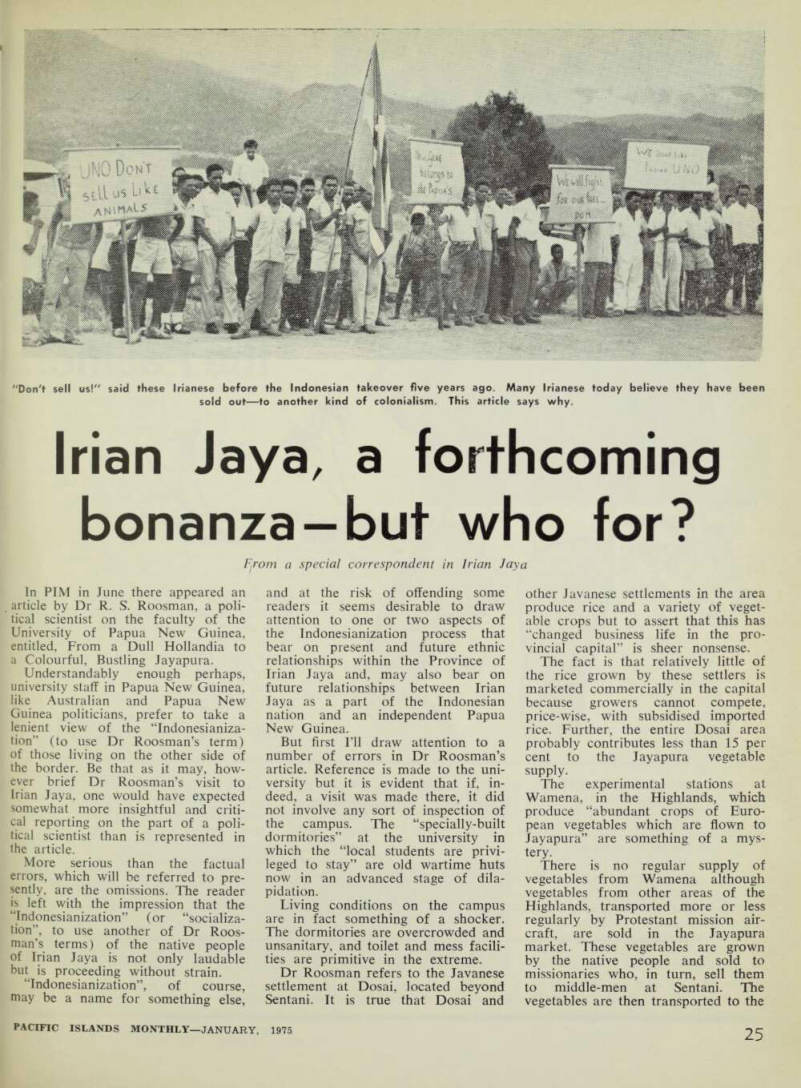
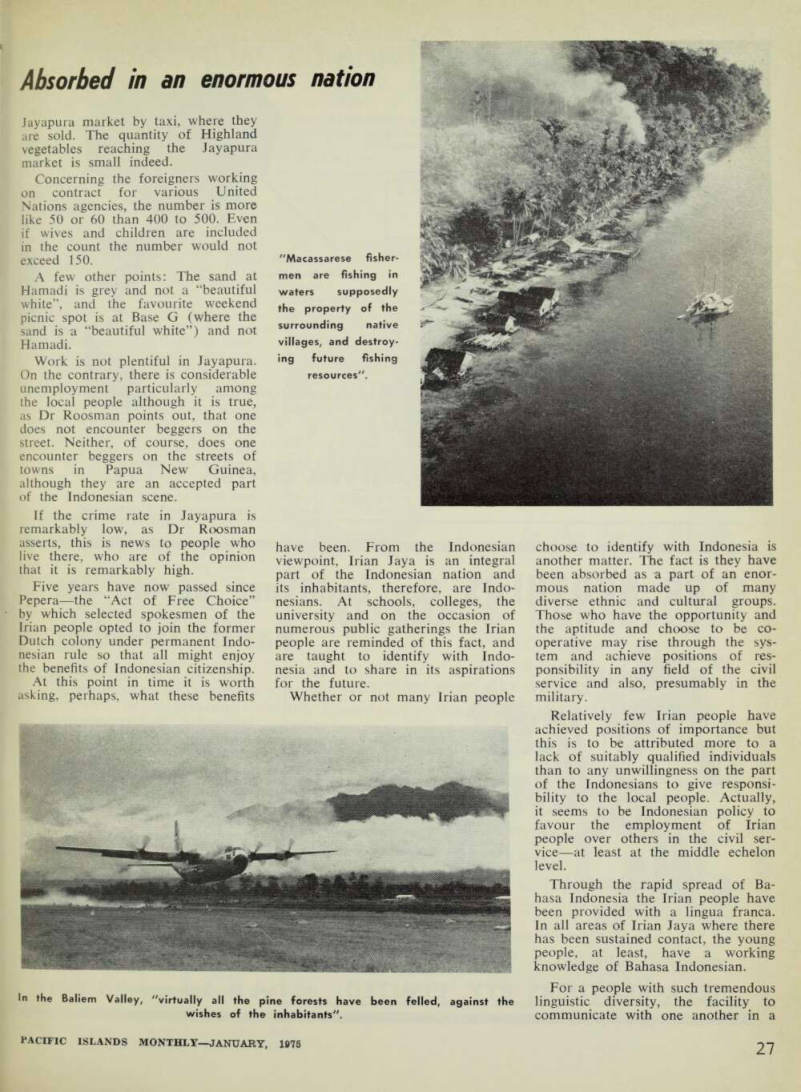
bonanza —but who for?
From a special correspondent in Irian Jaya
In PIM in June there appeared an article by Dr R. S. Roosman, a poli tical scientist on the faculty of the University of Papua New Guinea, entitled, From a Dull Hollandia to a Colourful, Bustling Jayapura.
Understandably enough perhaps, university staff in Papua New Guinea, like Australian and Papua New Guinea politicians, prefer to take a lenient view of the “Indonesianiza tion” (to use Dr Roosman’s term) of those living on the other side of the border. Be that as it may, how ever brief Dr Roosman’s visit to Irian Jaya, one would have expected somewhat more insightful and criti cal reporting on the part of a poli tical scientist than is represented in the article.
More serious than the factual errors, which will be referred to pre sently, are the omissions. The reader js left with the impression that the “Indonesianization” (or “socializa tion”, to use another of Dr Roos man’s terms) of the native people of Irian Jaya is not only laudable but is proceeding without strain.
“Indonesianization”, of course, may be a name for something else,
and at the risk of offending some readers it seems desirable to draw attention to one or two aspects of the Indonesianization process that bear on present and future ethnic relationships within the Province of Irian Jaya and, may also bear on future relationships between Irian Jaya as a part of the Indonesian nation and an independent Papua New Guinea.
But first I’ll draw attention to a number of errors in Dr Roosman’s article. Reference is made to the uni versity but it is evident that if, in deed, a visit was made there, it did not involve any sort of inspection of the campus. The “specially-built dormitories” at the university in which the “local students are privi leged to stay” are old wartime huts now in an advanced stage of dila pidation.
Living conditions on the campus are in fact something of a shocker.
The dormitories are overcrowded and unsanitary, and toilet and mess facili ties are primitive in the extreme.
Dr Roosman refers to the Javanese settlement at Dosai, located beyond Sentani. It is true that Dosai and
other Javanese settlements in the area produce rice and a variety of veget able crops but to assert that this has “changed business life in the pro vincial capital” is sheer nonsense.
The fact is that relatively little of the rice grown by these settlers is marketed commercially in the capital because growers cannot compete, price-wise, with subsidised imported rice. Further, the entire Dosai area probably contributes less than 15 per cent to the Jayapura vegetable supply.
The experimental stations at Wamena, in the Highlands, which produce “abundant crops of Euro pean vegetables which are flown to Jayapura” are something of a mys tery.
There is no regular supply of vegetables from Wamena although vegetables from other areas of the Highlands, transported more or less regularly by Protestant mission air craft, are sold in the Jayapura market. These vegetables are grown by the native people and sold to missionaries who, in turn, sell them to middle-men at Sentani. The vegetables are then transported to the
Don't sell us!" said these Irianese before the Indonesian takeover five years ago. Many Irianese today believe they have been sold out —to another kind of colonialism. This article says why.
Absorbed in an enormous nation
Jayapura market by taxi, where they are sold. The quantity of Highland vegetables reaching the Jayapura market is small indeed.
Concerning the foreigners working on contract for various United Nations agencies, the number is more like 50 or 60 than 400 to 500. Even if wives and children are included in the count the number would not exceed 150.
A few other points: The sand at Hamadi is grey and not a “beautiful white”, and the favourite weekend picnic spot is at Base G (where the sand is a “beautiful white”) and not Hamadi.
Work is not plentiful in Jayapura.
On the contrary, there is considerable unemployment particularly among the local people although it is true, as Dr Roosman points out, that one does not encounter beggers on the street. Neither, of course, does one encounter beggers on the streets of towns in Papua New Guinea, although they are an accepted part of the Indonesian scene.
If the crime rate in Jayapura is remarkably low, as Dr Roosman asserts, this is news to people who live there, who are of the opinion that it is remarkably high.
Five years have now passed since Pepera—the “Act of Free Choice” by which selected spokesmen of the Irian people opted to join the former Dutch colony under permanent Indo nesian rule so that all might enjoy the benefits of Indonesian citizenship.
At this point in time it is worth asking, perhaps, what these benefits
have been. From the Indonesian viewpoint, Irian Jaya is an integral part of the Indonesian nation and its inhabitants, therefore, are Indo nesians. At schools, colleges, the university and on the occasion of numerous public gatherings the Irian people are reminded of this fact, and are taught to identify with Indo nesia and to share in its aspirations for the future.
Whether or not many Irian people
choose to identify with Indonesia is another matter. The fact is they have been absorbed as a part of an enor mous nation made up of many diverse ethnic and cultural groups.
Those who have the opportunity and the aptitude and choose to be co operative may rise through the sys tem and achieve positions of res ponsibility in any field of the civil service and also, presumably in the military.
Relatively few Irian people have achieved positions of importance but this is to be attributed more to a lack of suitably qualified individuals than to any unwillingness on the part of the Indonesians to give responsi bility to the local people. Actually, it seems to be Indonesian policy to favour the employment of Irian people over others in the civil ser vice—at least at the middle echelon level.
Through the rapid spread of Ba hasa Indonesia the Irian people have been provided with a lingua franca.
In all areas of Irian Jaya where there has been sustained contact, the young people, at least, have a working knowledge of Bahasa Indonesian.
For a people with such tremendous linguistic diversity, the facility to communicate with one another in a
In the Baliem Valley, "virtually all the pine forests have been felled, against the wishes of the inhabitants".
"Macassarese fisher men are fishing in waters supposedly the property of the surrounding native villages, and destroy ing future fishing resources".
Complex bureaucracy
common language is a great step forward; that the lingua franca is the language of those now respons ible for their welfare is of even greater significance for the Irian people.
With a good deal of United Nations help (largely made possible by the SUS3O-million gift from the Netherlands Government) Indonesia has expended considerable effort and money in such projects as road build ing, improvements in coastal ship ping facilities, telecommunications, airstrip building and so on.
The harsh critic will point out that there is surprisingly little to show for these efforts and the large sums supposedly expended on de velopment, and he may also point to the wastage and inefficiency that may be attributed, in part, to a complex bureaucracy compounded by para military rule, and in part from the lack of system in the matter of financial favours and other forms of recognition that must be made if pro jects are to edge forward.
But problems of this sort are manifest elsewhere in Indonesia and further, Indonesia is hardly alone in haying to combat problems of in efficiency and corruption. That there is relatively little to show for Indo nesian efforts in Irian Jaya (other than, perhaps, in the erection of government buildings and houses for military and government personnel) should not detract from the fact that some effort is being made.
If Indonesianization were nothing more than a matter of public works programmes, and teaching the local people to salute the flag and sing a few national songs in the Indonesian language, there would be no cause for apprehension. But this is not the case.
Because Irian Jaya is a part of Indonesia, Indonesians from other areas are more or less free to enter the province. This has meant the entry of thousands of immigrants, mostly from the Celebes, with whom the Irian people must compete for a livelihood.
Indonesianization also means that the resources of Irian Jaya belong to Indonesia. The exploitation of these resources is well under way and un doubtedly will intensify in the future.
What the Irian people are beginning to experience, in fact, is a massive rip-off of their resources, essentially for the benefit of Indonesia.
The visitor to Jayapura does not have to be particularly observant to notice that the work force engaged in road and building construction is made up not of local Irian people but of Macassarese.
Macassarese also predominate on the wharves loading and unloading ships, in pit-sawing activities, in the local fishing industry, and in the local fish and produce market where it is largely the Macassarese who operate as middle-men. As well, virtually all petty trading is in the hands of Macassarese.
This situation, whereby the Macas
sarese predominate in every avenue of unskilled and semi-skilled work as well as in the markets and in oppor tunities for petty trading, prevails not only in Jayapura but in every town of any size in Irian Jaya.
The numbers of Macassarese liv ing in Irian Jaya is unknown and the official figure, whatever it might be, is likely to be inaccurate because to a great extent the Macassarese population is a transient one.
Numbers of Macassarese are brought to Irian Jaya by labour con tractors to work on specific projects; others arrive on their own initiative
" Exploitation"
in search of work or trading oppor tunities and move from one town to another.
The Irian people in the towns laugh about the Macassarese and call them “birds” because, they say, they seem able to live anywhere and exist on practically nothing. Their pre sence, however, is particularly resented.
The fact is the Irian people do not share the dedicated work ethic of the Macassarese and are unable to compete with them for employ ment opportunities or as traders. Nor can they compete with them, it seems, in the competition for their own resources.
Macassarese and Buttonese fisher men are practising fishing techniques in Jayapura waters (supposedly the property of the surrounding native villages) which are destroying the future fishing resources. They are also engaged in timber activities on land which, by rights, belongs to the native people. It is largely the Macassarese who, through excessive hunting, have threatened crocodiles with extinction, thereby depleting a valuable resource.
The exploitation of Irian Jaya’s resources has barely begun, but if the practices now being followed are con tinued by Indonesia, the end result for the Irian people could be serious indeed.
As yet, the forestry industry is in its infancy but it is understood that with the exception of reserves set aside for timber mills at Hamadi and Manokwari, which are operated with foreign assistance, all the forest re serves of the province have been allocated to Indonesian exploiters without any regard to native land rights.
Conservation is hardly a forte of the Indonesians and it is doubtful whether any consideration has, or will be given, to re-afforestation. In the Baliem Valley virtually all the pine forests that remained have been felled to provide materials for government building projects in Wa mena. This was a police action earned out against the wishes of the k)ani inhabitants of the valley.
In swamp areas of the south coast, ironwood resources are threatened with extinction. The native people of jhe area are pressured by Forestry department and other government otticials, as well as by soldiers and Police, into cutting logs in return for tobacco and such trivia as plastic buckets, sarongs, notebooks and pen cils. Tfie timber is exported to Sura
baya and destinations outside Indonesia, but none of the export earnings are returned to the district to assist in local development.
The Indonesians claim to respect traditional native land rights. If these rights mean anything, the land and its timber should belong to the native people of the area.
Irian Jaya has rich resources in shrimp and tuna but how long these will last is open to some doubt. The grounds are being exploited by the Japanese in accordance with what must be one of the most liberal fishing agreements in recent times.
With regard to tuna fishing, one provision of the agreement was that
the Japanese should give training to local people in the techniques of tuna fishing so that at some future point in time they would be able to carry on with the industry themselves, No such training has been given, A few Irian men are employed as cheap labour to carry out menial tasks but the skilled work continues to be carried out by Japanese. The highest position held by an Irian man is that of bosun on one of the ships.
Unless government pressure is brought to bear, foreign companies are not likely to expend much time or money in training local labour so long as it is possible to recruit more
But will PNG seek to join with Irian?
highly-skilled labour from other areas of Indonesia. •. .• This appears to be the situation with regard to Freeport Sulphur Company, which at present is expicking the hugh copper resources on the south coast in the Kokonau area, and it is certainly the situation with regard to Indonesia Surveys (ISSA)—a seismographic firm carrying out surveys to locate oil resources in the Asmat region of the south coast of Irian Jaya.
Labour recruiting for ISSA (apparently at the insistence of the Indonesian authorities) is in the hands of recruiters who bring in some hundreds of outside labourers on a contract basis. Virtually no native Irian labour is employed. t u ♦ .v, f„ r In short, hen, the pattern for oanles in TrlaS 8 Java leemfto be eft abb shed ’and there is no reason re heliefe that the oil industry as
? Itlr develous the Soronf
lining wSS?
(if and when the huge deposits of
Gag Island are exploited) will offer significant employment opportunities to the local people.
Whether or not Irian Taya will benefit financially from all these resources in terms of revenue pumped back into the provincial economy remains to be seen. Assuming that big sums are channelled into local development, the question then arises, f or whose primary benefit—that of t h e native Irian people or the Indonesians who have settled either tern- Pprarily or permanently in the provmce? whether the Indonesian authorities h t recognise it or not large I?Ln neonb beheve . , be j ng exploited and ? a Java is subiecF to a neo th , • an - aya SUDjeCt 10 a neo colomal re g,me. 1° view of the extraordinary number of armed troops and military vehicles one may observe in any of in the major towns the Indonesian authorities might be hard pu, to contradict this view.
Of more immediate importance is the fact that many Irian people, and particularly the young people with some education, look upon an in dependent Papua New Guinea as their hope for the future. It is popu larly believed, that at a not-too distant time Papua New Guinea will demand union with Irian Jaya to make up one independent nation.
This is held to be so despite the pro testations of friendship and goodwill politicians in Papua New Guinea profess to feel towards Indonesia and the negative remarks one or two poli ticians have made about Irian poli tical refugees living within their border.
Hie hope of eventual union with Papua New Guinea may be a mere pipe dream, but the resentment of the Indonesian presence is real enough and not altogether without cause. Indonesianization, as has been suggested, has its less pleasant side.
Sporadic rebellion in various parts of Irian Jaya—particularly in the border regions—is nothing new. In dealing with these outbreaks in re cent years, the Indonesian military authorities have generally acted with commendable restraint.
But there is good reason to believe
that resistance to Indonesian author ity will increase rather than diminish and a series of localised rebellions with appeals to Papua New Guinea for assistance is not at all unlikely.
Whether or not such resistance would ever become sufficiently strong and co-ordinated to pose a serious threat to the Indonesian military authorities is a matter for speculation.
Only one thing, perhaps, is reason ably certain. Because of its resources in minerals and possibly in oil, the possession of Irian Jaya (which in earlier years was something of an economic disaster) is now viewed by Indonesia as being a likely bonanza.
This view may still turn out to be wrong but in either event, in the foreseeable future Indonesia is not likely to take kindly to anything in the nature of rebellion with nationalistic overtones and will prob ably react strongly to scotch any suggestion of union with Papua New Guinea.
“Indonesianization” may then take on a new dimension which will pose serious moral questions for Papua New Guinea politicians. If the poli ticians have not considered the possi bility suggested here then it is time, perhaps, that they did; in the view of this writer it is the likely course of events.
Advertisements & other items, pp. 28-34 (1 item)
Bonds
FAMOUS AUSTRALIAN
COTTON GARMENTS
IT AT \ /y V K
Renowned for
quality
throughout
the Pacific...
Our smiling ‘CHESTY BOND’ is easily' the most famous character symbol of the; Australian clothing market. That’s because of the top-cotton quality. Naturally' we’re proud of ‘Chesty’. And we’re proudl too of our ‘S’port’ Briefs —built for masculine comfort.
Both these garments are in cool, longwearing, easy-care cotton and are now\ BOND’SET to prevent shrinkage.
BOND’S INDUSTRIES make wonderful garments for the whole family.
There’s ‘CHESTY BOND’ Singlets, ‘S’PORT’ Briefs, ‘GRAND SLAM’ Sport Shirts for men and boys, ‘COTTONTAILS’ and ‘KEENIES’ Briefs for women and girls, and ‘CORAL ISLAND’ ultra-cool underwear for everybody. Then too there’s the delightful range of ‘BONDS- AND’ luxury clothes for babies and hildren. As well as clothing we also lake towels. Beautiful towels. Rich, thick ,nd thirsty, luxury towels for bath and •each in glorious patterns and colours, md there’s lovely gift packs too. There ire TWO famous towel names from m hich to choose ... DRI-GLO AND )ICKIES. Both names mean top quality.
Mr A p DI Manager, BOND'S INDUSTRIES GROUP 100 Mallett St. Camperdown. N.S.W. 2050, Australia . . ... AnnKinn CVHMPY
DAIWA BANK SERVING YOU IN THE PACIFIC BASIN & Head Office Osaka,Japan With 137 Branches throughout Japan Singapore Representative Office Suite No. 1007, 10th Floor Robina House 1 Shenton Way, Singapore 1 Republic of Singapore Coble Address: SINGDAIWA Affiliated Bank P.T. BANK PERDANIA Djalan Raya Mangga Besar 7&9 Djakarta Our Correspondent Banks are in city— Apia. Suva, Lae, Madang Port Moresby, Rabaul, Wewak. Guam, all Principal cities in Australia and New Zealand Contact your banker or our office. y Los Angeles Agency 555 South Flower St. Suite 4040 Los Angeles, Calif. 90071 Sydney Representative Office Bth Floor Prudential Building 39-49, Martin Place, Sydney
THE DAIWA BANK LTD.
Head Office : 21. Bingomachi 2-chome, Higashi-ku, Osaka, Japan Overseas : London, New York, Los Angeles, Frankfurt, Sydney, Singapore
KERR BROTHERS the Lightburn people for
Pacific Islands
We are able to offer immediate delivery of the complete range of Lightburn products . . . concrete mixers, hydraulic jacks, electric power tools and electric washing machines.
Due to the high standard of their engineering and their outstanding reliability, these Lightburn products are being exported in ever increasing volume to over 70 countries.
LIGHTBURN
Exported to over 70 Countries For further information or supplies contact KERR BROTHERS PTY. LIMITED, 65 York St., Sydney, N.S.W. 2001
r v i SlftY
f-zy
v> V !V c
NELSON &
In our 80 year
Selling
"SERVICE"
to the Pacific Islands
ROBERTSON
PTY. LIMITED
(Established. 1895)
PLANTATION HOUSE, 197 CLARENCE STREET, SYDNEY
CABLES: "IVAN", SYDNEY, BRISBANE. TELEX: AA22381, SYDNEY.
FOR:
INDENTS
COMMODITIES
SHIPPING
TRAVEL
INSURANCE
REAL ESTATE
Branch Office: Nelson & Robertson Pty. Ltd., 303 Adelaide St., Brisbane, Old New Guinea Representatives: Rabtrad Niugini Pty. Ltd., Rabaul Lae Madang Kieta.
SPEED-E-GAS
Lae
Wewak
Rdbaull
Honiara
Port i
Moresby
Kie
□ □ □ □ ne /
[autoka
0 cs c o Z 3
R arotongg^
3 New terminals...
P 6Established...
P and more to come.
Sydney
.. .to ensure regular supply of Speed-e-gas* in the Pacific region three new bulk storage terminals have been opened at Rarotonga, Nukualofa and Lautoka. These terminals join already established bulk storage facilities at Port Moresby, Lae, Wewak, Rabaul, Honiara and Kieta.
And to meet future needs bulk terminals are to be built at Santo and Suva.
These terminals will maintain supplies of clean efficient and safe Speed-e-gas all year round.
Speed-e-gas is the most dependable fuel...because it's here in bulk. Liquified Petroleum Gas has been proven to be ideal fuel for all cooking and water heating needs.
A
SPEEDEGAS
!U The Gas Supply Company Limited, Head Office 221 Miller St., North Sydney, 2060.
Phone: 920-951 and available throughout the Pacific.
A member of the Boral group of companies.
Speed-e-gas is known in New Guinea as Guinea-Gas, in Tonga as Tonga Speed-e-gas and in Fiji as Fiji-Gas.
BLII2
SIX FEETOF
DEADLY GERMS
CONCENTRATED PEA-BEU
The strong one that cares for your world Like all Insects the cockroach has six legsand every one will have thousands of germs on them from his unsavoury habits. So it's worth getting rid of fast. Concentrated Pea-Beu contains one of the world's most powerful insecticides so it kills insects in seconds and it's rigidly tested through every stage of manufacture so you can spray it safely with confidence to protect the health and well-being of your family.
Concentrated Pea-Beu kills flies, mosquitoes, aH disease carrying insects in seconds.
M
Save hundreds of dollars
on Australians most efficient
WALK IN, ALUMINIUM
COOLROOMS AND
FREEZE ROOMS
Hundreds already installed! The most economical supplementary cool- -ooms for bottles and food, providing the largest storage capacity of any comparable coolrooms of the same exterior dimensions. Five sizes —from 90-360 cu. ft. capacity; 16 models offering normal temp., two temp., deep freeze, or for pastry and ice storage applications. White vinyl interior, embossed rustproof aluminium exterior. • SUPPLIED IN EASY-TO-ERECT, DO-IT-YOURSELF KIT FORM.
Available from: AUSTRALIAN NEW CALEDONIA EXPORTS (SILVER & BARDA), 363 George St., Sydney, 2000 and Branches.
BRECKWOLDT & CO., 276 Pitt St., Sydney, 2000 and Branches.
PETER FISHER TRADING PTY. LTD., 321 Pitt St., Sydney, 2000.
HAGEMEYER (A'SIA), 59 Anzac Pde., Kensington, 2033 and Branches.
KERR BROS, 65 York St., Sydney, 2000.
Manufactured by:
WARBURTON FRANKI
NELSON & ROBERTSON PTY. LTD., 197 Clarence St., Sydney, 2000.
RABAUL TRADING CO. PTY. LTD., P.O. Box 219, Rabaul and Branches; ROY GALLIMORE & ASSOCIATES, P.O. Box 179, Vila, New Hebrides; C. SULLIVAN (EXPORT) PTY. LTD., 60 Margaret St., Sydney, 2000 ano Branches.
W. S. TAIT & CO, PTY. LTD., 31 Macquarie Place, Sydney, 2000 ano Branches. 199 Parramatta Road, Cnr. Skarratt Street, Auburn, N.S.W. 2144, Australia. Phone 648-1711.
POWERED BY
KELVINATOR.
Five-year warranty on compressor. Early de: livery.
Torture' Story
From Irian Jaya
From a Lae correspondent
Indonesian troops are torturing and killing civilians in Irian Jaya just across the border from Papua New Guinea, an Irianese claimed in Lae in November.
The claim was made by Mr Martinus Kambu, a second year student at the Papua New Guinea University of Technology.
He said he had proof from contacts in Irian Jaya that a leader of the Papua Freedom Movement there had died while being tortured by Indo nesian troops in September. The leader, Obet Tabuni, aged about 29, had been captured by Indonesian troops in a restaurant in the capital, Jayapura.
Tabuni was one of a group of several men who returned to Irian Jaya late in 1969 after fleeing to Papua New Guinea to escape the Indonesians. The men formed a rebel group operating between the border
and Jayapura. They were all members of the Papua Freedom Movement. . ii. , Tabum and two of the rebels had gone to Jayapura to meet one of their contacts, a doctor, in a restaurant.
However, the doctor had betrayed them and the restaurant was surrounded by soldiers who stormed in firing guns.
Tabuni, who was armed, shot and
killed the doctor who had betrayed him. He also killed a soldier, but he and his companions were captured within a few minutes .
The Indonesian military newspaper in Jayapura later carried a photo graph of Tabuni. It showed him handcuffed and was published with a warning to West Irianese not to resist Indonesians.
Advertisements & other items, pp. 35-36 (1 item)
Henry Cumines Pty. Ltd.
D apua new guinea
printing co. pty. ltd.
Serving the Country from Aitape to Alotau, Manus to Moresby Leaders in Commercial Offset and Letterpress Printing. • Stationery • Office Supplies • Office Equipment • Rubber Stamps • Self-Adhesive Labels • In Fact: — Everything For The Office.
P.O. Box 633, Port Moresby P.O. Box 759, Lae P.O. Box 1239, Rabaul
HENRY CUMINES PTY. LTD.
EXPORTERS • IMPORTERS
ISLAND AGENTS
428 GEORGE ST., SYDNEY
CABLES: HENCO SYDNEY. G.P.O. Box 3949. PHONE: 25-3383.
For specialised and personalised buying service throughout the Pacific Islands and the East.
Represented in; PAPUA: Agencies Pacific Pty Ltd, Box 50 44, P. 0., Boroko, Port Moresby.
Telephone 55261.
NEW GUINEA: Madang, W. Double, P.O. Box 22, Madang. Telephone 2696.
FIJI: K. Witherington Ltd, P.O. 293, Suva. Telephone 22-356.
NEW HEBRIDES: John Lum & Associates, Box 65, P. 0., Santo. Telephone 329.
Resident Agents in other Pacific Territories.
YOU GET A BETTER DEAL FROM
PACIFIC MACHINERY
* a N . i. >
CAT 3208
Marine Engine aft Horsepower.
Includes Twin Disc MGSO2 2:1 Marine Gear.
Several in stock. Other Ratios Available.
Parts Availability Throughout the Pacific
PACIFIC
MACHINERY, INC.
SUBSIDIARY OF
THEO. H. DAVIES & CO., LTD.
CB
YOUR
CATERPILLAR
DEALER
HAWAII: 94-025 Farrington Hwy., Waipahu, Hawaii 96797. Phone: 677-9111. Cable: “PAMACAT.” TLX: 723397.
GUAM: Phone: 646-4479. Also U.S. Trust Territory and American Samoa.
nedlloyd Koninklijke Nedlloyd bv
REGULAR SAILINGS BY FAST, MODERN CARGO VESSELS from NEW ZEALAND via PANAMA to:
EUROPE
(MEDITERRANEAN & NORTH CONTINENT)
and from AUSTRALIA to:
CENTRAL AMERICA & CARIBBEAN
INDUCEMENT SAILINGS BY CARCARRIER
heavy-lift facilities—refrigerated space—cargo deeptanks For further particulars apply to Agents: from EUROPE via PANAMA to:
PAPEETE, NOUMEA,
APIA, SUVA, LAUTOKA,
NEW ZEALAND.
Ets. Donald Tahiti Papeete.
Agence Maritime et Aerienne Caledonienne S.A. A.M.A.C., Noumea.
Russell & Somers (Wellington) Ltd.
Wellington, N.Z.
D. F, Nelson & Co. Ltd. Island Transport Ltd.
Apia. Suva, Lautoka.
NEDLLOYD
Interocean Australia Services Pty. Ltd. General Representative Pacific Sydney. Box 194 ' Wellington, N.Z.
Ancestors...
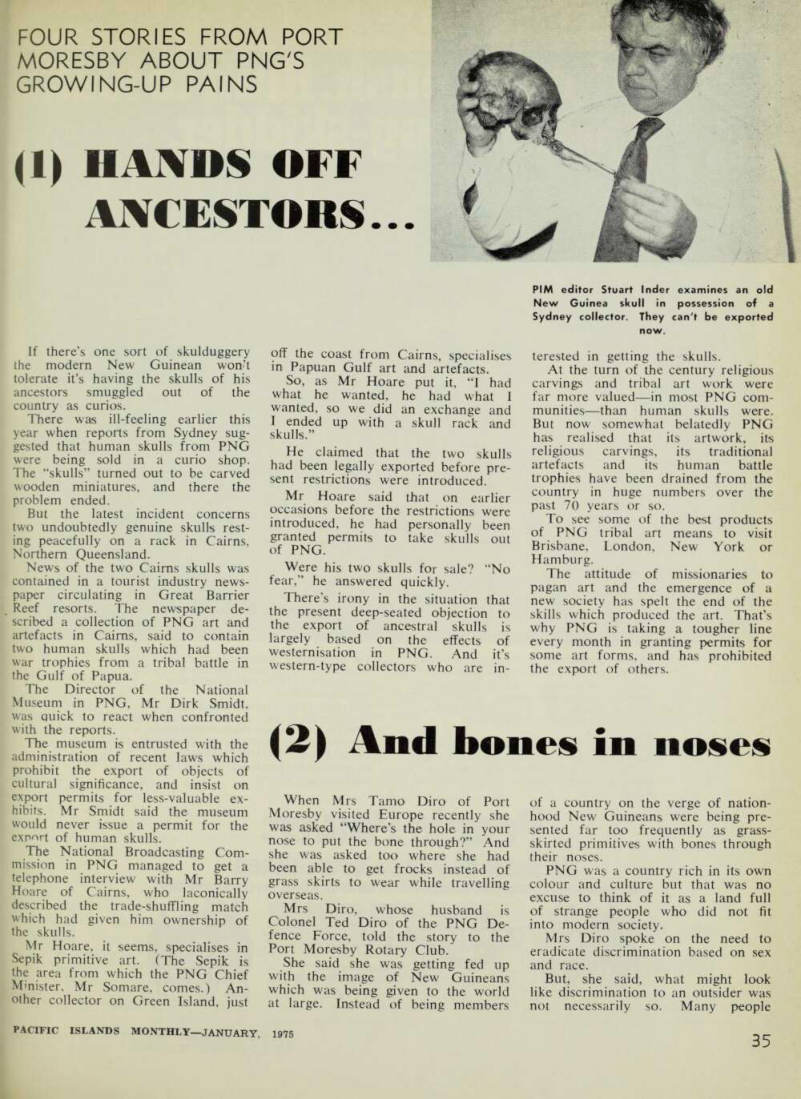
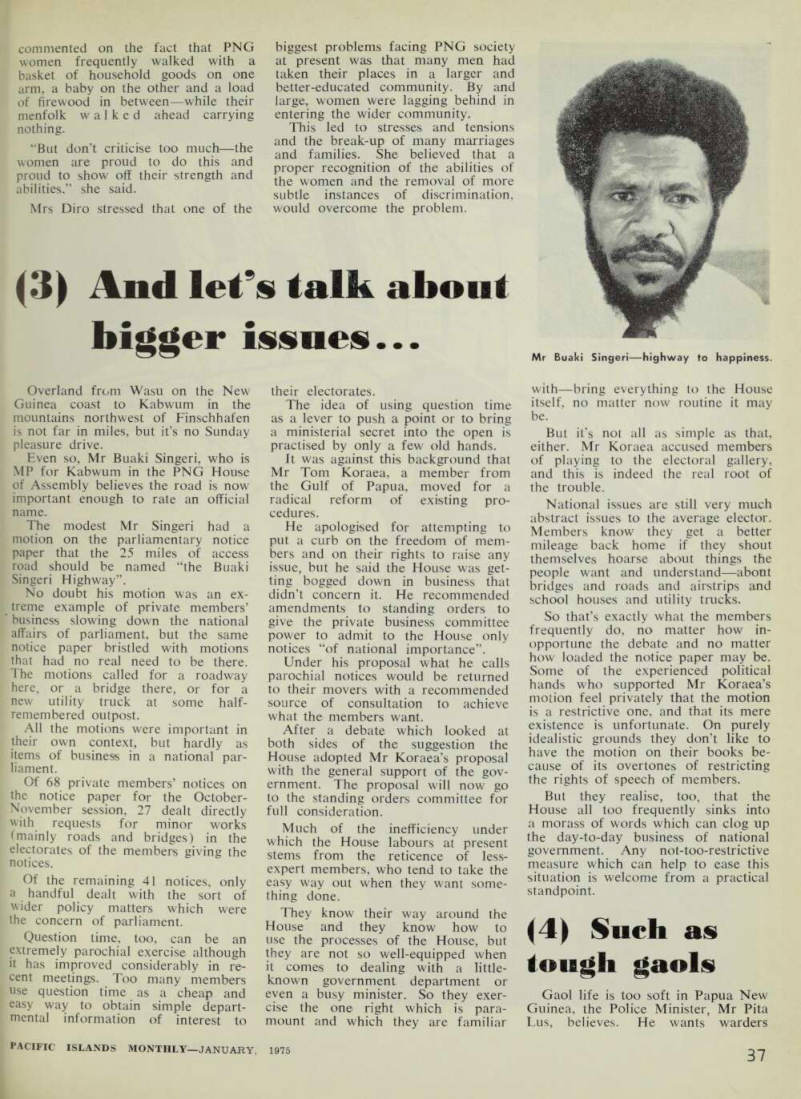
Four Stories From Port
Moresby About Png's
Growing-Up Pains
(1) Hands Off
Ancestors...
If there’s one sort of skulduggery the modern New Guinean won’t tolerate it’s having the skulls of his ancestors smuggled out of the country as curios.
There was ill-feeling earlier this year when reports from Sydney sug gested that human skulls from PNG were being sold in a curio shop.
The “skulls” turned out to be carved wooden miniatures, and there the problem ended.
But the latest incident concerns two undoubtedly genuine skulls rest ing peacefully on a rack in Cairns, Northern Queensland.
News of the two Cairns skulls was contained in a tourist industry news paper circulating in Great Barrier Reef resorts. The newspaper de scribed a collection of PNG art and artefacts in Cairns, said to contain two human skulls which had been war trophies from a tribal battle in the Gulf of Papua.
The Director of the National Museum in PNG, Mr Dirk Smidt, was quick to react when confronted with the reports.
The museum is entrusted with the administration of recent laws which prohibit the export of objects of cultural significance, and insist on export permits for less-valuable ex hibits. Mr Smidt said the museum would never issue a permit for the export of human skulls.
The National Broadcasting Com mission in PNG managed to get a telephone interview with Mr Barry Hoare of Cairns, who laconically described the trade-shuffling match which had given him ownership of the skulls.
Mr Hoare, it seems, specialises in Sepik primitive art. (The Sepik is the area from which the PNG Chief Minister. Mr Somare, comes.) An other collector on Green Island, just
off the coast from Cairns, specialises in Papuan Gulf art and artefacts.
So, as Mr Hoare put it, “I had what he wanted, he had what I wanted, so we did an exchange and I ended up with a skull rack and skulls.”
He claimed that the two skulls had been legally exported before present restrictions were introduced.
Mr Hoare said that on earlier occasions before the restrictions were introduced, he had personally been granted permits to take skulls out of PNG.
S a UllS f °L. r , sale? “ No ’ wered quickly.
There s irony in the situation that the present deep-seated objection to the export of ancestral skulls is largely based on the effects of westernisation in PNG. And it’s western-type collectors who are in-
terested in getting the skulls, At the turn of the century religious carvings and tribal art work were far more valued—in most PNG corn munities—than human skulls were.
But now somewhat belatedly PNG has realised that its artwork, its religious carvings, its traditional artefacts and its human battle trophies have been drained from the in hu 8 e numbers over the pa si 70 years or |°- . T ° so ™ e , of the best Products S f PNG ‘ nba ' art means to visit Brisbane, London, New York or H The' Ittitude of missionaries to pagan art and the emergence of a new society has spelt the end of the skills which produced the art. That’s why PNG is taking a tougher line every month in granting permits for some art forms, and has prohibited the export of others.
(2) And bones in noses
When Mrs Tamo Diro of Port Moresby visited Europe recently she was asked “Where’s the hole in your nose to put the bone through?” And she was asked too where she had been able to get frocks instead of grass skirts to wear while travelling overseas.
Mrs Diro, whose husband is Colonel Ted Diro of the PNG Defence Force, told the story to the
Port Moresby Rotary Club.
She said she was getting fed up with the image of New Guineans which was being given to the world at large. Instead of being members
of a country on the verge of nation hood New Guineans were being pre sented far too frequently as grass skirted primitives with bones through their noses.
PNG was a country rich in its own colour and culture but that was no excuse to think of it as a land full of strange people who did not fit into modern society, Mrs Diro spoke on the need to eradicate discrimination based on sex and race, But, she said, what might look like discrimination to an outsider was not necessarily so. Many people
PIM editor Stuart Inder examines an old New Guinea skull in possession of a
Sydney collector. They can't be exported
now.
commented on the fact that PNG women frequently walked with a basket of household goods on one arm, a baby on the other and a load of firewood in between—while their menfolk walked ahead carrying nothing.
“But don’t criticise too much—the women are proud to do this and proud to show off their strength and abilities,” she said.
Mrs Diro stressed that one of the
biggest problems facing PNG society at present was that many men had taken their places in a larger and better-educated community. By and large, women were lagging behind in entering the wider community.
This led to stresses and tensions and the break-up of many marriages and families. She believed that a proper recognition of the abilities of the women and the removal of more subtle instances of discrimination, would overcome the problem.
(3) And let’s talk about bigger i§sne§...
Overland from Wasu on the New Guinea coast to Kabwum in the mountains northwest of Finschhafen is not far in miles, but it’s no Sunday pleasure drive.
Even so, Mr Buaki Singeri, who is MP for Kabwum in the PNG House of Assembly believes the road is now important enough to rate an official name.
The modest Mr Singeri had a motion on the parliamentary notice paper that the 25 miles of access road should be named “the Buaki
Singeri Highway”.
No doubt his motion was an ex treme example of private members’ business slowing down the national affairs of parliament, but the same notice paper bristled with motions that had no real need to be there.
The motions called for a roadway here, or a bridge there, or for a new utility truck at some half remembered outpost.
All the motions were important in their own context, but hardly as items of business in a national par liament.
Of 68 private members’ notices on the notice paper for the October- November session, 27 dealt directly with requests for minor works (mainly roads and bridges) in the electorates of the members giving the notices.
Of the remaining 41 notices, only a handful dealt with the sort of wider policy matters which were the concern of parliament.
Question time, too, can be an
extremely parochial exercise although
it has improved considerably in re cent meetings. Too many members use question time as a cheap and easy way to obtain simple depart mental information of interest to
their electorates.
The idea of using question time as a lever to push a point or to bring a ministerial secret into the open is practised by only a few old hands.
It was against this background that Mr Tom Koraea, a member from the Gulf of Papua, moved for a radical reform of existing pro cedures.
He apologised for attempting to put a curb on the freedom of mem bers and on their rights to raise any issue, but he said the House was get ting bogged down in business that didn’t concern it. He recommended amendments to standing orders to give the private business committee power to admit to the House only notices “of national importance”.
Under his proposal what he calls parochial notices would be returned to their movers with a recommended source of consultation to achieve what the members want.
After a debate which looked at both sides of the suggestion the House adopted Mr Koraea’s proposal with the general support of the gov ernment. The proposal will now go to the standing orders committee for full consideration.
Much of the inefficiency under which the House labours at present stems from the reticence of less expert members, who tend to take the easy way out when they want some
thing done.
They know their way around the House and they know how to use the processes of the House, but they are not so well-equipped when it comes to dealing with a little known government department or even a busy minister. So they exer cise the one right which is para mount and which they are familiar
with—bring everything to the House itself, no matter now routine it may be.
But it's not all as simple as that, either. Mr Koraea accused members of playing to the electoral gallery, and this is indeed the real root of the trouble.
National issues are still very much abstract issues to the average elector.
Members know they get a better mileage back home if they shout themselves hoarse about things the people want and understand —about bridges and roads and airstrips and school houses and utility trucks.
So that’s exactly what the members frequently do, no matter how in opportune the debate and no matter how loaded the notice paper may be.
Some of the experienced political hands who supported Mr Koraea’s motion feel privately that the motion is a restrictive one, and that its mere existence is unfortunate. On purely idealistic grounds they don’t like to have the motion on their books be cause of its overtones of restricting the rights of speech of members.
But they realise, too, that the House all too frequently sinks into a morass of words which can clog up the day-to-day business of national government. Any not-too-restrictive measure which can help to ease this situation is welcome from a practical standpoint.
(4) Such as
tough gaols
Gaol life is too soft in Papua New Guinea, the Police Minister, Mr Pita Lus, believes. He wants warders
Mr Buaki Singeri—highway to happiness.
armed with pistols to shoot escaping prisoners on sight.
“And we don’t want any of this United Nations in our gaols,” Mr Lus told the House of Assembly in October. He said that the conditions laid down by United Nations for the treatment of prisoners were out of touch with reality.
They did not apply to PNG con ditions where there was an urgent need for gaols with tougher con ditions, not a “soft and easy life”.
Mr Lus said he planned to draw up a set of proposals for the treat ment of prisoners, and would submit them to cabinet.
Mr Lus made a number of state ments at the recent session of parlia ment calling for a harder deal all round towards punishment and treat ment of prisoners. He also supported capital punishment as a mandatory penalty for wilful murder, but the government as a whole outvoted him.
Mr Lus said he believed he could muster a sufficient amount of sup port in the cabinet for his proposals on harder treatment of prisoners.
He also advocated the extensive use of prisoners for public construc tion projects, such as road and bridge building.
“Any prisoners, short or long term, should be made to work very hard, or there is no point in sending them to gaol,” he said. “If I was minister in charge of prisons, I would make sure they worked very hard indeed.” ■Excessive overseas travel by politicians was robbing money from the people of Papua New Guinea, Mr Tom Koraea told the House.
He said, during the Budget debate, that expenditure of thousands of dollars on unnecessary travelling was no different to stealing money from the people who urgently needed it.
He accused public servants and fellow politicians of dishonest use of public funds and said that if overseas travelling brought back something worth while he would not criticise it, but he was distressed to see thousands of dollars wasted every year.
He believed the money could be better spent on small-scale industries at the village level.
He also criticised public servants for frequently clocking into work late, clocking off early, and taking excessively long tea breaks.
“A few dollars lost here and a few lost there amounts to thousands of dollars in the year when you consider the large number of public servants we have,” Mr Koraea said.
Capital punishment for wilful murder has been abolished in Papua
New Guinea. A mandatory penalty of life imprisonment has been sub stituted.
The House of Assembly in Port Moresby made the change while pro cessing its new Criminal Code Bill, the main purpose of which was to consolidate and unify the two sets of criminal codes existing in PNG.
One code was inherited from Papua and one from New Guinea, dating back to the time when two separate administrations existed.
However, the new bill also contains amendments to adapt the codes where necessary to better suit Papua New Guinea.
Crimes involving treason still carry the death penalty. Penalties for other offences will be examined by a law reform commission which is to be set up shortly.
Advertisements & other items, pp. 38-46 (4 items)
People Power:
Caterpillar reliability, productivity availability.
Now you can get it all in a wheel skidder. The b i o.
A whole new standard in skidder engineering. 120 turbocharged horsepower, 17,400 pounds ot working muscle with full articulation and frame oscillation for stability and minimum maintenance.
Single lever “on the go” powershift. Dual rate steering for controlled response at all speeds.
An operator’s compartment engineered for efficiency with safety features built in for man and machine.
You’ll find all the best skidder ideas, plus added refinement and top quality manufacturing that can make the 518 the backbone of your logging operation.
And Hastings Deering will ensure that your backbone stays in top condition no matter how far in the bush you are. Parts, maintenance, repairs or simply information we II see that you get it fast. That’s People Power!
So go tackle the jungle with the new Cat 518 and Hastings Deering.
People Power:
25 Years in Papua New Guinea
we work as hard, backing-up a single sale,as we do for a fleet. You can depend on it!
HASTINGS DEERING
n
fIH yourt
I L| CATERPILLA
cSterTrliaTcat. and ta are trademark, ol Caterpillar Tractor Company. (Throughout Queensland.
Northern Territory and South-West Pacific.
a P< \s^ t® s !Lo\s ® _(5 A <»>»« i Manufactured by Commonwealth New Guinea Timbers Ltd. and available from leading suppliers throughout the Pacific.
COLONIAL ERA
CEMETERY OF
NORFOLK IS.
Researchers, genealogists, visitors to Norfolk Island and everybody interested in Australia's early history will find it fascinating.
It's fully illustrated and written by R. Nixon Dalkin, a former administrator of Norfolk Island.
PRICE; Australia, $6.00 Aust. plus 85c posted; Pacific Islands and Overseas, $6.00 Aust. plus $l.lO posted; US.A., $10.60 U.S. posted.
Pacific Publications
(Aust.) Pty. Ltd.
G.P.O. Box 3408, Sydney,
N.S.W. 2001.
serves the Islands with expert
insurance service and advice.
QUEENSLAND INSURANCE
COMPANY LIMITED
(Incorporated 1886 in Australia) Head Office: 82 Pitt Street, Sydney FlJl—Branch Office, Suva, Manager for Fiji: F. N. Davies (A.A.1.1.).
LAUTOKA—District Manager: G. A. Wooley.
HONIARA (B.S.l.P.)—Breckwoldt & Company (5.1.) Pty. Limited.
NEW CALEDONIA—T. A. Hagen, Ste. W. A. Johnston, S.A.R.L. —Noumea.
NEW HEBRlDES—Resident Officer: R. J. Allsop (A.A.LI.) Vila; Santo: Burns Philp (New Hebrides) Ltd.
TAHlTl—Arthur Chung: Immeuble B.L, Front de Mer, Papeete.
NIUE, NORFOLK ISLAND, SAMOA, TONGA and other South Sea Islands—Burns Philp (South Sea) Company Ltd.
QUEENSLAND INSURANCE (P.N.G.) LTD
PAPUA NEW GUINEA
Head Office, Port Moresby: General Manager; D. J. Granter.
District Managers at Rabaul: C. D. Dickings; Lae: R. Jackson; Mt. Hagen: D. F. Carroll.
From the
Islands Press
A topsy-turvy story about rain causing a drought in the New Hebrides Group News: The water supply in Vila has been affected greatly by continuous rain throughout this week. The Public Works Department said this morning that the supply in Vila has been cut off and is not expected to resume again until midnight tonight.
It is reported that this is due to heavy flooding at the water pump site at Tagabe. . . .
From an editorial in the Arawa Bulletin: The signing of a contract by Papua New Guinea to install an expensive new telephone cable link to Australia won't make a lot of difference to life in PNG for the average villager. It highlights some of the extravagant Australian contracts which "help" poor PNG but somehow end up as financial benefit to Australians.
In recent years, we have seen computers installed, lavish office blocks and hotels built, all in the name of assistance to an under-developed nation . , .
From a letter by Young Tiaon in the Atoll
Pioneer, GEIC:
I wish the word ‘hypocrisy’ had not been invented because I am fed up with guys who always look down their noses on people, trying to find faults in them.
It seems to me that dear old N. T. Teribata is one of those goody-goody people who never commits any sins and 1 am not surprised either if he’s got a special licence which gives him the power to judge people and expect them to do the right thing.
From the New Hebrides Group News: According to a report from a Radio Vila correspondent on Tanna this morning, a woman from Etukur village on South Tanna saw an old coconut trunk mysteriously rise into an upright position last Friday when she went to do her gardening.
Naturally, the woman was astonished for the trunk had been lying on the ground, after being blown down by a strong wind, and had been left to rot.
When the woman returned to Etukur with her story, police at Isangel and local people were asked to investigate. They had a look but could not produce any reasonable answers. Now the old coconut trunk is still standing and flourishing. People on South Tanna believe that this is a sign of something about to happen on the island.
A plea for civilised driving by Dr A. H. Sarei (District Commissioner, Bougainville) in the Arawa Bulletin: With the Aropa-Kieta-Arawa road almost completely sealed, the drivers have become more and more heavy-footed.
The temptation to speed has become great. Already in the last couple of months, three people were killed instantly and many injured when cars and their drivers
tried to do their thing—speeding . . . Please drive slowly.
Many Bougainville villages are along the road.
Many of our people walk along the dark bitumen.
Before you realise it you have killed one of us. In the period of two weeks apart, two of our children have been killed on the bitumen road, Arawa-Aropa. You have invaded us in our quiet way of life, will you not at least respect the only thing left dear to us —LIFE!!
From a letter by Rosemary Schmitz in the Norfolk Islander: I am an Australian. I was born and bred in Australia. I came to Norfolk Island as a child at 12 years of age. I have been here ever since.
If Mrs Brook would like to keep calling my children Bounty Scum let her come and see me. At least I own up to mine. Do you, Gladys?
From the Micronesian Independent; Marianas District Judge Jesus Sonada was fired by Trust Territory High Court Chief Justice Harold W. Burnett.
But this is not the end of the matter. Judge Sonada claims he digs the gig and doesn't want to be fired.
He refuses to accept Justice Burnett's termination order as the final say in the matter. Instead, he went lawyer looking. In due time he employed Ben Abrams, the former Marianas District Public Defender . . . Abrams on behalf of the ousted judge, joined the Trust Territory, the High Commissioner and Justice Burnett in a lawsuit asking for reinstatement to the bench and for $lO,OOO damages.
From the Norfolk Islander: We had the opportunity of speaking with Mr Weir (Assistant Director, Institute of Criminology, Canberra) and while he agreed that Norfolk Island does not as yet have a desperate situation in regard to these problems (crime and vandalism), he did say that on opinions gathered during his talks, Norfolk Island, in keeping with the rest of the world, could see an increase in crime, not only from the adult population, but also from the adolescent age groups, especially females. He hastened to explain that while we may consider ourselves isolated from the problems of the rest of the world, that with the island’s dependence on tourism there will be nothing that he could see that would prevent this unhappy state of affairs besetting the island in the future.
From a letter by Miss Anjila Nand, in the
Western Herald, Lautoka, Fiji:
I think smoking is a had habit because it can damage your health. Sometimes it is a nuisance while travelling in a bus. Once while travelling I saw a man smoke a packet of cigarettes in an hour. As soon as he finished he began to spit.
Because the bus was moving, some of the spittle fell on the people sitting in the back seats.
From the Norfolk Islander:
As though the weather isn't depressing enough at the moment, it was more depressing to be informed that the public toilets in Burnt Pine had been temporarily put cut of action by the acts of a few "hoods", the like of whicl seem to be making their slimy appearance felt these days.
It was equally depressing to witness Sgt Greg Hinks busily dusting for fingerprints, the damage that had been perpetrated in the men's and ladies' toilets.
U597-8/71
v. a 8 \ s vX I * « a-n o ® 3 0 □ 0 Co TO 3 0 o 8 °
m «
eaker
W* Look to Pioneer’s new ES-2000 Two-channel Sound Mates. A stereo system designed to play together as a well-balanced audio team.
Pioneer’s receiver gets away from "top-heavy
sound by giving you a highly selective AM/FM tuning section and 34 watts (IHF) of music power And for four-channel, just add a pair of speakers. All this and MIC mixing, too.
And this turntable is more than
just hot’ looking. The ultra-smooth belt-drive
mechanism provides loving care for your records, plus auto-cut and return.
For real living presence sound, kiss your
tweakers” goodbye. This two-way, two-speaker
system gives you earthy, heart-moving sound.
Pioneer’s new ES-2000 Two-channel
Sound Mates. Great musical partners for
whatever you play to music.
ES-2000
Two-channel Sound Mates
Australia Pioneer Electronics Australia Pty. Ltd., 256-8, City Road, South Melbourne, Victoria 3205, Australia Tel: 696605 Branches in all states Fiji Islands Brijlal & Company, G.P.O. Box No. 362, Suva, Fiji Islands Tel: 22-258 Lae Hagemeyer (Australasia) 8.V., P.O. Box No. 90, Lae, New Guinea Tel; 2718 Rabaul Hagemeyer (Australasia) 8.V.. P.O. Box No. 63, Rabaul, New Guinea
CrDPIO NEER
Port Moresby Hagemeyer (Australasia) 8.V., P.O. Box No. 1428, Boroko, Port Moresby, New Guinea Madang Hagemeyer (Australasia) 8.V., P.O. Box No. 673, Madang, T.P.N.G.
New Zealand Tee Vee Radio Ltd., P.O. Box No. 5029.
Auckland, New Zealand Tel; 763-064 Norfolk Island Burns Philp (South Sea) Co., Ltd..
Norfolk Island. South Pacific Nauru Island Jacob Enterprises, P.O. Box No. 4, Nauru Island Tahiti Ets. PERFECT. B.P. 594, Papeete.
Tahiti Tel: 20-407 New Caledonia Menard Freres, B.P. 123, Noumea, New Caledonia Tel: 52-22 American Samoa Transpac Corporation, P.O. Box 1477, Pago Pago, American Samoa 96799 Tol- 2227
If you ve got work to do.
- i m w \* . ♦ ;.v '4 % ' . . jV'Mi•■;,*. *v n» •'■ v ’ v »'-v;"S\ s Sv-»of N ' * - v ' •. ' ’ 1 •■ v; KV\ ;i . \ V vv* -, ' v ’ i*. . *\%•; • • ii. * ,A.* r *•» *• v y •■ / ,‘t •, • -H\. if; *t - * . ’a.a- . •.» v <. •
■■ii—wiiff* r i
J 1 . V* w ■ f * i ! :\ ! i * M* ,1 '• - - * • a m If you ve got work to do.
weve got trucks to do it.
TOYOTA Hi-Lux
TOYOTA
Stout
TOYOTA
Hi Ace
TOYOTA
Land Cruiser Pickup r „ rwA mew GUINEA: ELA MOTORS LIMITED, Scratchley Rd„ Badili, Papua. US. ™ U^[ a T E C q R WESTERN SAMOAf BURNS PH I LR P (SOUTH SEA) LTD., P.a Box U SUPPLIES CO. LTD., G.P.O. Box 355. Suva. AMERICAN SAMOA: BURNS PHILP (SOUTH SEA) CO., LTD., Pago Pago WEbTfcKN* MFNDANA ENTERPRISES (5.1.). I Apia. GUAM P O. Box 174, Honiara RlCKV'S'autoTo. P O BoxMSB, Agana. NEW HEBRIDES: NEW HEBRIDES MOTORS LTD , P.O. Box 18, Vila
SOLOMON ISLANDS: MENDANA ENTERPRISES (S.I.).LT!
, V . ■ '«'■ v V ' j- , j.\x* n „ , ; \ ' ' >' \. -'C ' , x . . ' ‘ S. SX ■ . \*\ ' -.-X .' , S -V. > . .V - , **. •' »' • \' v . ■' V '-• n' V ■ “ % % .■ \ \ % * .- t 49 - % *> *■ 4 - - V * V * ' ' < % - N 4 '■ ' ! ’’ k * . . «‘v .- ■ % x , ♦ : v. * \ : - •, 5 \ x * * • 'V > «». s > % I . v.
V:'A\ V \^V » , % * , * % t I \_ 1 * * >i N -: a *- '■ > *1
TOYOTA Land Cruiser
i I i £T"
From different styles of the 4-wheel-drive Land Cruiser, to vans and pickups, to heavy duty trucks. Toyota makes them.
And Toyota makes them tough.
There’s a Toyota truck that will work for you. Economically,
Reliably.
Find out about it. From your local Toyota dealer.
TOYOTA Dyna
TOYOTA Truck
TOYOTA
Toyo-Ace
TOYOTA
TAHITI: NIPPON AUTOMOTO, B.P. 545, Papeete. COOK ISLANDS: COOK ISLANDS TRADING CORPORATION LTD PO Box 92 Rarotonga. NAURU ISLAND: NAURU COOPERATIVE SOCIETY. GILBERT & ELLICE ISLANDS COLONY: TARAWA MOTORS Box 36' f, a ':: k :l? r^L NORFOLK ISLAND; MARIE’S NORFOLK TOURS, LTD., P.O. Box 276. TIMOR: SANG TAI HOO.SangTa, Building, Dili: EW CALEDONIA: SOCIETE IMPORTATION AUTOMOBILE DU PACIFIQUE. Rond-Pointdu Pacific (Station Total) B.P. 438, Noumea.
Magazine Section
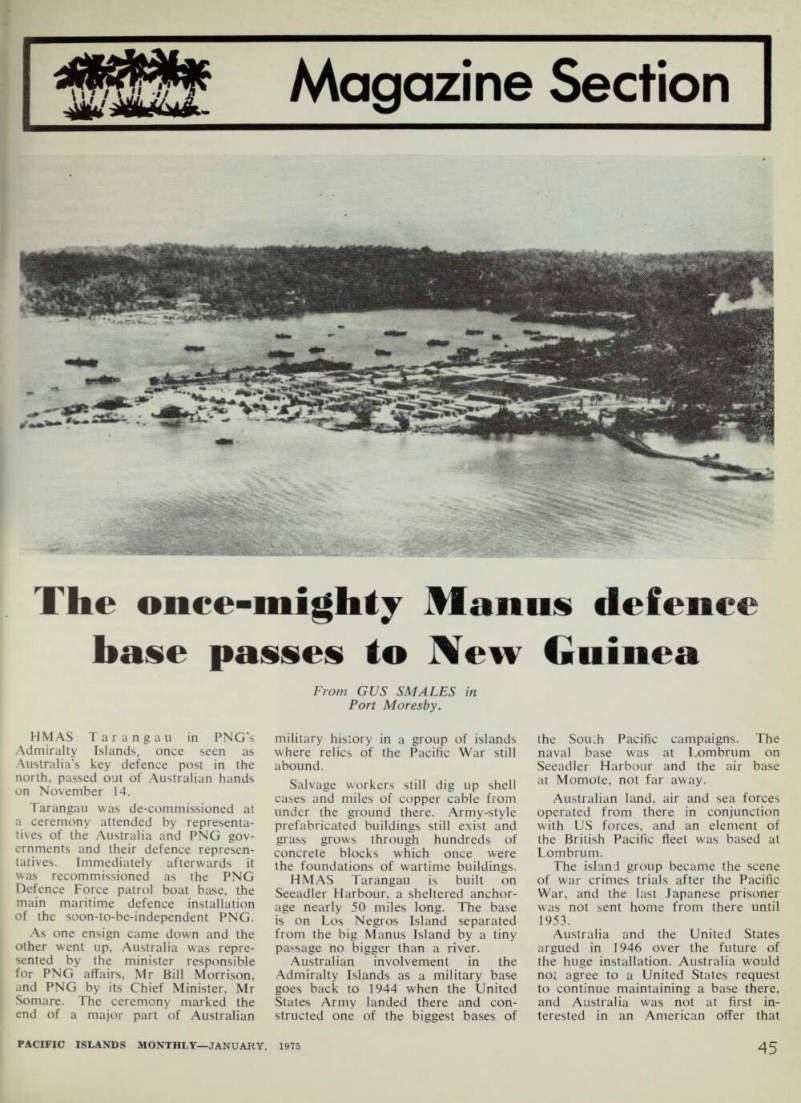
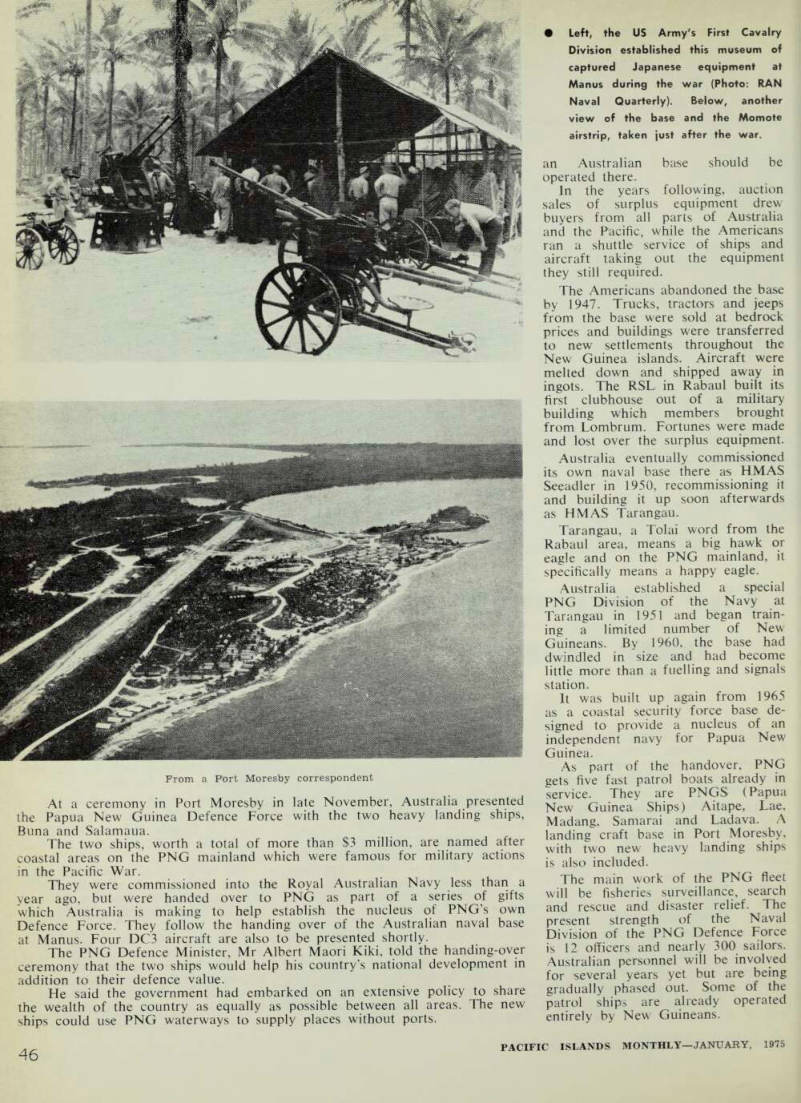
The onece-mighty Manus defence base passes to New Guinea
From GUS SMALES in Port Moresby.
HMAS Tarangau in PNG’s Admiralty Islands, once seen as Australia’s key defence post in the on rt November°l4 of AUStral ‘ an handS Tarangau was de-commissioned at a ceremony attended by representatives of the Australia and PNG governments and their defence representatives. Immediately afterwards it was recommissioned as the PNG Defence Force patrol boat base, the mam maritime defence installation of the soon-to-be-mdependent PNG.
As one ensign came down and the other went up, Australia was represented by the minister responsible for PNG affairs, Mr Bill Morrison, and PNG by its Chief Minister, Mr Somare. The ceremony marked the end of a major part of Australian
military history in a group of islands where relics of the Pacific War still abound.
Salvage workers still dig up shell cases and miles of copper cable from under the ground there. Army-style prefabricated buildings still exist and grass grows through hundreds of concrete blocks which once were the foundations of wartime buildings.
HMAS Tarangau is built on Seeadler Harbour, a sheltered anchora g e nearly 50 miles long. The base j s 0 n Los Negros Island separated from the big Manus Island by a tiny passage no bigger than a river.
Australian involvement in the Admiralty Islands as a military base goes back to 1944 when the United States Army landed there and constructed one of the biggest bases of
the South Pacific campaigns. The naval base was at Lombrum on Seeadler Harbour and the air base at Momote - not far away , Australian land, air and sea forces operated from there in conjunction with US forces, and an element of the British Pacific fleet was based at Lombrum.
The island group became the scene of war crimes trials after the Pacific War, and the last Japanese prisoner was not sent home from there until 1953.
Australia and the United States argued in 1946 over the future of the huge installation. Australia would not agree to a United States request to continue maintaining a base there, and Australia was not at first in terested in an American offer that
At a ceremony in Port Moresby in late November, Australia presented the Papua New Guinea Defence Force with the two heavy landing ships, Buna and Salamaua.
The two ships, worth a total of more than $3 million, are named after coastal areas on the PNG mainland which were famous for military actions in the Pacific War.
They were commissioned into the Royal Australian Navy less than a year ago, but were handed over to PNG as part of a series of gifts which Australia is making to help establish the nucleus of PNG’s own Defence Force. They follow the handing over of the Australian naval base at Manus. Four DC3 aircraft are also to be presented shortly.
The PNG Defence Minister, Mr Albert Maori Kiki. told the handing-over ceremony that the two ships would help his country’s national development in addition to their defence value.
He said the government had embarked on an extensive policy to share the wealth of the country as equally as possible between all areas. The new ships could use PNG waterways to supply places without ports.
an Australian base should be operated there.
In the years following, auction sales of surplus equipment drew buyers from all parts of Australia and the Pacific, while the Americans ran a shuttle service of ships and aircraft taking out the equipment they still required.
The Americans abandoned the base by 1947. Trucks, tractors and jeeps from the base were sold at bedrock prices and buildings were transferred to new settlements throughout the New Guinea islands. Aircraft were melted down and shipped away in ingots. The RSL in Rabaul built its first clubhouse out of a military building which members brought from Lombrum. Fortunes were made and lost over the surplus equipment.
Australia eventually commissioned its own naval base there as HMAS Seeadler in 1950, recommissioning it and building it up soon afterwards as HMAS Tarangau.
Tarangau, a Tolai word from the Rabaul area, means a big hawk or eagle and on the PNG mainland, it specifically means a happy eagle.
Australia established a special PNG Division of the Navy at Tarangau in 1951 and began train ing a limited number of New Guineans. By 1960, the base had dwindled in size and had become little more than a fuelling and signals station.
It was built up again from 1965 as a coastal security force base de signed to provide a nucleus of an independent navy for Papua New Guinea.
As part of the handover, PNG gets five fast patrol boats already in service. They are PNGS (Papua New Guinea Ships) Aitape, Lae.
Madang, Samarai and Ladava. A landing craft base in Port Moresby, with two new heavy landing ships is also included.
The main work of the PNG fleet will be fisheries surveillance, search and rescue and disaster relief. The present strength of the Naval Division of the PNG Defence Force is 12 officers and nearly 300 sailors.
Australian personnel will be involved for several years yet but are being gradually phased out. Some of the patrol ships are already operated entirely by New Guineans.
From a Port Moresby correspondent
Left, the US Army's First Cavalry Division established this museum of captured Japanese equipment at Manus during the war (Photo: RAN Naval Quarterly). Below, another view of the base and the Momote airstrip, taken just after the war.
Yesterday
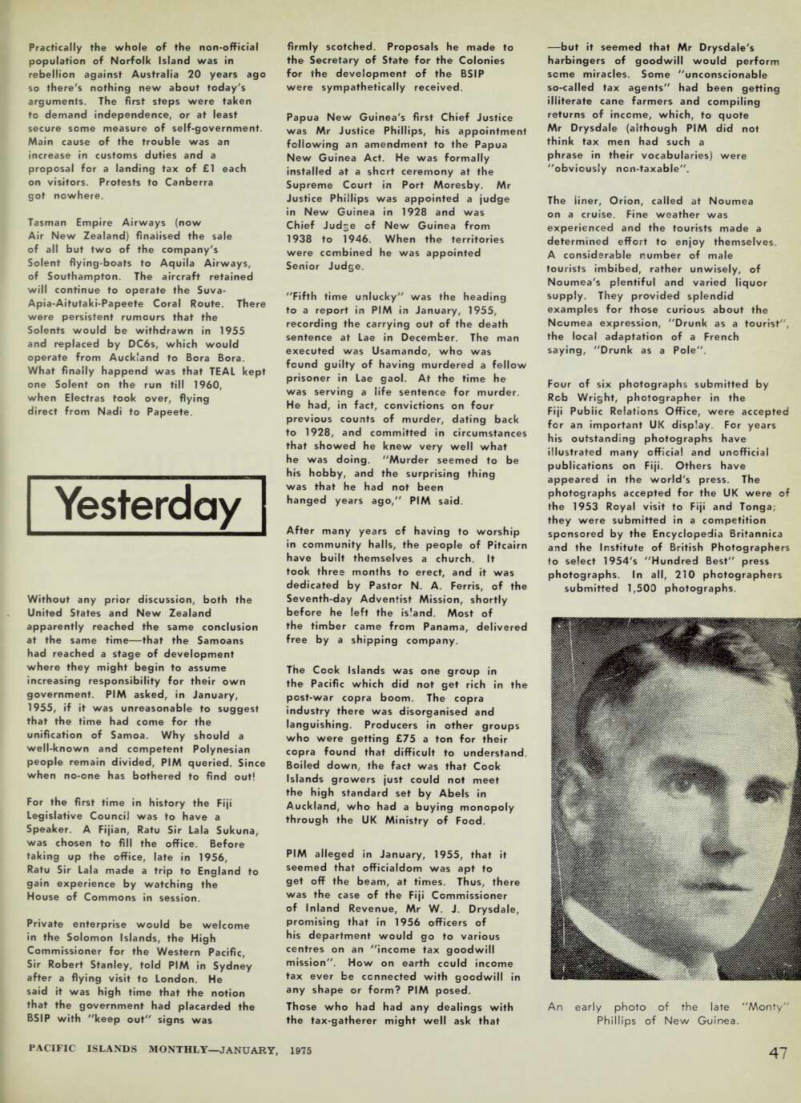
Practically the whole of the non-official population of Norfolk Island was in rebellion against Australia 20 years ago so there's nothing new about today's arguments. The first steps were taken to demand independence, or at least secure some measure of self-government.
Main cause of the trouble was an increase in customs duties and a proposal for a landing tax of £1 each on visitors. Protests to Canberra got nowhere.
Tasman Empire Airways (now Air New Zealand) finalised the sale of all but two of the company's Solent flying-boats to Aquila Airways, of Southampton. The aircraft retained will continue to operate the Suva- Apia-Aitutaki-Papeete Coral Route. There were persistent rumours that the Solents would be withdrawn in 1955 and replaced by DC6s, which would operate from Auckland to Bora Bora.
What finally happend was that TEAL kept one Solent on the run till 1960, when Electras took over, flying direct from Nadi to Papeete.
Without any prior discussion, both the United States and New Zealand apparently reached the same conclusion at the same time—that the Samoans had reached a stage of development where they might begin to assume increasing responsibility for their own government. PIM asked, in January, 1955, if it was unreasonable to suggest that the time had come for the unification of Samoa. Why should a well-known and competent Polynesian people remain divided, PIM queried. Since when no-one has bothered to find out!
For the first time in history the Fiji Legislative Council was to have a Speaker. A Fijian, Ratu Sir Lala Sukuna, was chosen to fill the office. Before taking up the office, late in 1956, Ratu Sir Lala made a trip to England to gain experience by watching the House of Commons in session.
Private enterprise would be welcome in the Solomon Islands, the High Commissioner for the Western Pacific, Sir Robert Stanley, told PIM in Sydney after a flying visit to London. He said it was high time that the notion that the government had placarded the BSIP with "keep out" signs was
firmly scotched. Proposals he made to the Secretary of State for the Colonies for the development of the BSIP were sympathetically received.
Papua New Guinea's first Chief Justice was Mr Justice Phillips, his appointment following an amendment to the Papua New Guinea Act. He was formally installed at a short ceremony at the Supreme Court in Port Moresby. Mr
Justice Phillips was appointed a judge
in New Guinea in 1928 and was Chief Judge of New Guinea from 1938 to 1946. When the territories were combined he was appointed
Senior Judge.
"Fifth time unlucky" was the heading to a report in PIM in January, 1955, recording the carrying out of the death sentence at Lae in December. The man executed was Usamando, who was found guilty of having murdered a fellow prisoner in Lae gaol. At the time he was serving a life sentence for murder.
He had, in fact, convictions on four previous counts of murder, dating back to 1928, and committed in circumstances that showed he knew very well what he was doing. "Murder seemed to be his hobby, and the surprising thing was that he had not been hanged years ago," PIM said.
After many years cf having to worship in community halls, the people of Pitcairn have built themselves a church. It took three months to erect, and it was dedicated by Pastor N. A. Ferris, of the
Seventh-day Adventist Mission, shortly
before he left the island. Most of the timber came from Panama, delivered free by a shipping company.
The Cook Islands was one group in the Pacific which did not get rich in the post-war copra boom. The copra industry there was disorganised and languishing. Producers in other groups who were getting £75 a ton for their copra found that difficult to understand.
Boiled down, the fact was that Cook Islands growers just could not meet the high standard set by Abels in Auckland, who had a buying monopoly through the UK Ministry of Food.
PIM alleged in January, 1955, that it seemed that officialdom was apt to get off the beam, at times. Thus, there was the case of the Fiji Commissioner of Inland Revenue, Mr W. J. Drysdale, promising that in 1956 officers of his department would go to various centres on an "income tax goodwill mission". How on earth could income tax ever be connected with goodwill in any shape or form? PIM posed.
Those who had had any dealings with the tax-gatherer might well ask that
—but it seemed that Mr Drysdale's harbingers of goodwill would perform some miracles. Some "unconscionable so-called tax agents" had been getting illiterate cane farmers and compiling returns of income, which, to quote Mr Drysdale (although PIM did not think tax men had such a phrase in their vocabularies) were
"obviously non-taxable".
The liner, Orion, called at Noumea on a cruise. Fine weather was experienced and the tourists made a determined effort to enjoy themselves.
A considerable number of male tourists imbibed, rather unwisely, of Noumea's plentiful and varied liquor supply. They provided splendid examples for those curious about the Noumea expression, "Drunk as a tourist", the local adaptation of a French saying, "Drunk as a Pole".
Four of six photographs submitted by Rob Wright, photographer in the Fiji Public Relations Office, were accepted for an important UK display. For years his outstanding photographs have illustrated many official and unofficial publications on Fiji. Others have appeared in the world's press. The photographs accepted for the UK were of the 1953 Royal visit to Fiji and Tonga; they were submitted in a competition sponsored by the Encyclopedia Britannica and the Institute of British Photographers to select 1954's "Hundred Best" press photographs. In all, 210 photographers submitted 1,500 photographs.
An early photo of the late "Monty"
Phillips of New Guinea.
Advertisements & other items, p. 50 (1 item)
mAnA
is a vehicle for Pacific Islands’ writers and artists to publish their work. It is an organ of the South Pacific Creative Arts Society and its editorial committee comprises writers from many islands.
Material for publication must be sent direct to MANA’s editor, Marjorie Crocombe, South Pacific Creative Arts Society, Box 5083, Suva MANA starts its third year in PIM with works by four writers by now familiar to regular readers, and one new contributor.
Vanessa Griffen, from Fiji, is one of the best short story writers in the South Pacific and spent last year on a Creative Writing Fellowship in Port Moresby; Shashikant Nair, also from Fiji, and Mildred Sope, from the New Hebrides, are both University of the South Pacific graduates in education, now teaching in their respective homelands; and Ruperake Petaia, a Western Samoan, works for the Public Service Commission in Apia.
Publishing for the first time in MANA is Aivu Kula, from Papua New Guinea, who is a teaching fellow in the Literature Department of the University of Papua New Guinea.
The Visitors
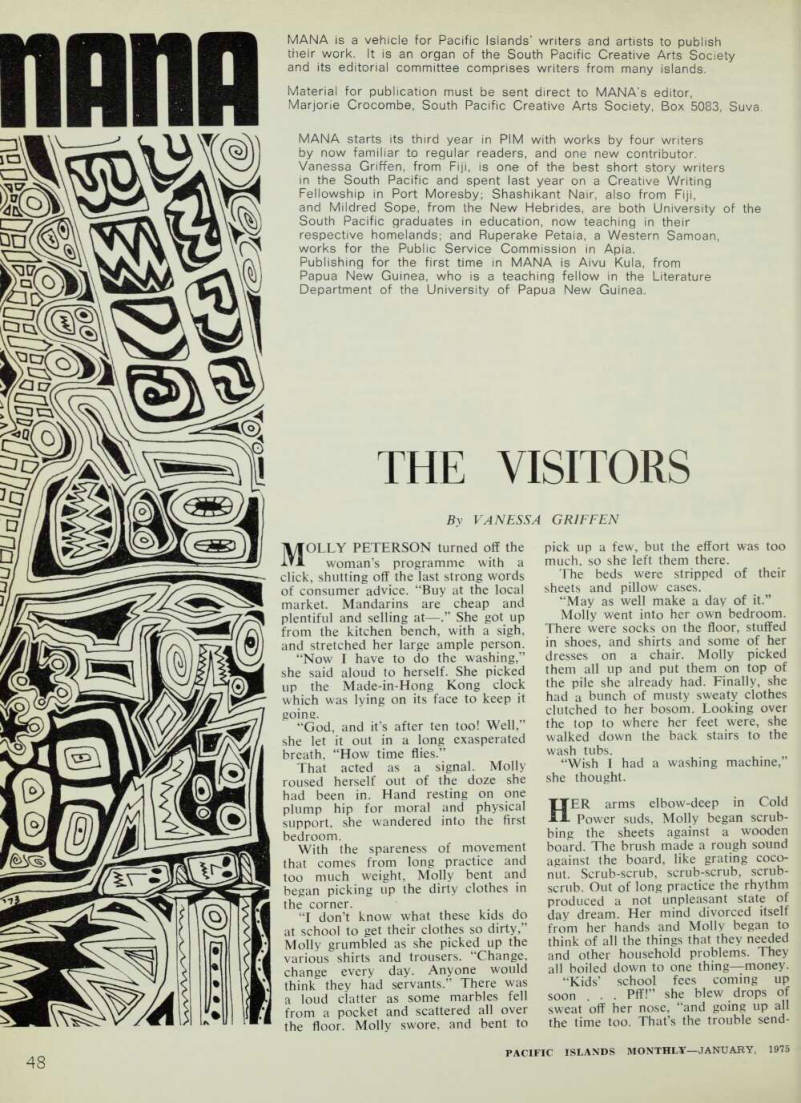
By Vanessa Griffen
MOLLY PETERSON turned off the woman’s programme with a click, shutting off the last strong words of consumer advice. “Buy at the local market. Mandarins are cheap and plentiful and selling at—.” She got up from the kitchen bench, with a sigh. and stretched her large ample person.
“Now I have to do the washing,” she said aloud to herself. She picked up the Made-in-Hong Kong clock which was lying on its face to keep it go i ng “God, and it’s after ten too! Well,” she let it out in a long exasperated breath, “How time flies.”
That acted as a signal. Molly roused herself out of the doze she had been in. Hand resting on one plump hip for moral and physical support she wandered into the first bedroom.
With the spareness of movement that comes from long practice and too much weight, Molly bent and began picking up the dirty clothes in the corner.
“I don’t know what these kids do at school to get their clothes so dirty,”
Molly grumbled as she picked up the various shirts and trousers. “Change, change every day. Anyone would think they had servants.” There was a loud clatter as some marbles fell from a pocket and scattered all over the floor Molly swore, and bent to
pick up a few, but the effort was too much, so she left them there, The beds were stripped of their sheets and pillow cases, “May as well make a day of it.
Molly went into her own bedroom There were socks on the floor, stuffed in shoes, and shirts and some of her dresses on a chair. Molly picked them all up and put them on top of the pile she already had. Finally, she had a bunch of musty sweaty clothes clutched to her bosom. Looking over the top to where her feet were, she walked down the back stairs to the wa t S,. t V^ >s ; ,4 u■ u- » “Wish I had a washing machine, she thought. IJT-R 3XIIIB elbow-deep in Cold Power suds, Molly began scrub bing the sheets against a wooden board. The brush made a rough sound against the board, like grating coco nut. Scrub-scrub, scrub-scrub, scrub scrub. Out of long practice the rhythm produced a not unpleasant state of day dream. Her mind divorced itself from her hands and Molly began to think of all the things that they needed and other household problems. They all boiled down to one thing—money, “Kids’ school fees coming up soon • • • pff! sh t f blew drops of sweat off her nose, and going up all the time too. Thats the trouble send
ing them to a religious school.” She flopped a sheet into an empty tub.
“Private, they have to pay their own costs. Government, it’s all paid for.”
Molly had to sigh over this basic dilemma that troubled her. In her weak moments when the electricity needed paying for, and a new term was coming up, her common sense rebelled against the difference.
“Still, church says you have to bring them up in their religion.” It was what Molly always decided eventually. She didn’t go to church herself, except at Christmas and Easter, but her kids were going to go, Molly was determined about that.
“They can decide for themselves later,” she often said, vaguely, as if that settled the whole matter.
She came to their school uniforms.
They were still new, Molly had just had them made. Their colours were bright and unfaded and the kids still enjoyed wearing them. Molly scrubbed them with care. They were made to last and there was no sense in scrub bing the hell out of them.
Her hands softened their vigorous movements as she picked up young Michael’s pants.
“Eh, he’s a good boy. Doing well too.”
Molly stopped scrubbing and smiled, leaning her hips against the concrete tub to think about it. He was the only one doing well in school and that made her proud. Still, he was such a devil, and so cheeky.
Molly remembered the comments under ‘Conduct’ on his last school report.
“Takes after his father,” she thought with disgust.
Molly began scrubbing violently again.
“Bloody bugger, he’s always late, never home, and spends his money on booze. Never think of the kids. And the fees, who’s going to pay for it?
He doesn’t have to worry.” Un consciously, Molly began ignoring all his clothes that needed washing. “No, they come to me.” The dress got thrown into the next tub and caused a spurt of soapy water to splash into Molly’s eye. It took a few minutes to wash her eye and get the soap out.
In the momentary lull, she heard a knock on the front door.
“Dammit. Who is it now? Probably the post boy with more bills.”
She dried her hands on her skirt and went to open the door.
TIALE-WAY down the passage, XJL Molly recognised the silhouettes of her visitors through the lace curtains. There was no mistaking the white skirt, dark tie, neatly trimmed haircut.
“Oh God, not them again,” she thought. “Can’t leave a person alone.”
She walked heavily up to the door, wondering what to say to them, and how she was going to get rid of them. As Molly bent down to open the door, she saw the man straighten up and pick up his briefcase.
“Hm. Getting ready,” she thought.
The movement irritated her. There was nothing that filled Molly with more annoyance and alarm, than that bracing gesture made by these people who came to see her.
“Yes?” Molly said, the door open half way, composing her face so that it was non-committal and uninviting.
Behind the door she tried to straighten her skirt, at the same time clutching nervously at her blouse which had
popped open from all the scrubbing.
The man smiled. “We are members of the Church of Jesus Christ.” He gestured towards a freckle-faced girl with lovely ginger hair pulled back, who stepped up beside him.
“And we are trying to spread the word of Jesus’ love for us,” the girl finished the sentence.
Molly just looked from one to the other.
“You see, Jesus came down on this earth many years ago, and he died for us because he loved us,” the man went on.
Molly leaned her weight against the door and held it for support.
“Um, yes . . .” she said, and shifted uncomfortably.
The girl had a soft shy voice and Molly focused her attention on her.
“We think one of the best ways of learning of Christ’s love can be found in these little booklets we have here,” she said.
The ginger head ducked down and she began unclasping the briefcase.
Molly watched her and in the brief silence felt it was time she said some thing.
“Well ... ah ...” a plump hand waved vaguely in the direction of the books. “I don’t think . . . you see . . .
Anyway,” Molly said loudly in a final desperate effort. “I go to church myself and I hear the sermons and we have our own religion, my children go to church, and I—and we don’t need any books here.”
Finally ended, Molly took a breath and looked at them. She felt cornered on her own doorstep and definitely at a disadvantage. The girl’s face was raised towards Molly and she looked candid and sweet. She had arranged five books like a hand of cards.
The man pointed to them.
“Perhaps you would be interested in some of these.” he said.
Molly began shaking her head.
“ ‘Peace on Earth’, ‘Love thy Neighbour’, ‘The Good Samari tan’ . ..” He began reciting the titles of the books.
While Molly listened to him, she noticed the dust on her lace curtains.
“Needs washing too,” she thought, to herself. The man was giving a brief synopsis of each booklet. At the thought of washing, Molly remem bered all the wet clothes sitting in the tub, and from that all her domestic worries. The faces of her visitors focused again and Molly listened to the last of their speech.
She suddenly felt removed from them and her basic kindness and respect because they were Europeans, left her.
“They can well talk,” she thought unreasonably.
Mollv stood up straight and cleared her throat.
“No, I’m very sorry,” she said
decisively, a little cross, but still polite, “I . . . we don’t need any of those books in this house.”
Molly stood there, aware of her torn top, the soap suds that had wet her skirt, which was already dirty, and how sweaty she was. She stood up straight in the doorway and used her appearance as a wall to pin her statement on. Without being able to put it into words, she nevertheless was cannily aware that the one thing that would put them off was the actual roughness of her appearance and her life. Molly deliberately bullied them with it.
“Oh, well, that’s all right,” the girl said quickly.
“Well, thank you. Good morning,” the man said.
They smiled, packed their things together and left. Molly shut the door after them, and watched them through the curtain.
“Bloody nuisances,” she said, watching them go next door, MOLLY went back to her washing, and finished wringing the clothes out. Then she put them all in a bucket, picked up her peg basket, and took them to the clothesline.
Over the fence she could see Annie hanging up her washing, her mouth full of pegs.
“Hey, Annie,” Molly called across.
“They come to your place?” Annie poked her head over the clothesline.
She was short, a little on the dumpy side, with black curly hair over a face that had once been very fine.
“Ah?” she said. “Who you talk ing about?”
Molly was flinging clothes over the line, bending down slowly to pick them up, shaking them out, then spacing them out over the line. She jerked her head in the direction of the street.
“Them,” Molly said, a bit breath less from the exertion. “Those church people.”
“Oi . . .” Annie laughed. “Oh yes, they come all right. I said ‘No thank you’ and shut the door.” She always had been a cheeky one, Molly thought.
Annie disappeared behind a sheet to pick up some pegs. Molly waited for her to emerge, all the while pegging her clothes together with a practised efficiency. “Me, I couldn’t get rid of them,” she said. “Always come when I’m busy and never stop talking. Talk about talk!” she huffed. “Anyone’d think I had all day to stand there.”
Molly was working her way along the line. It was nearly midday and the sun was hot. Beads of perspiration began to settle on her forehead. She knew she was too fat. She looked over at Annie with a certain amount
of mild envy. Annie was better off than her. She didn’t have so many children and her husband didn’t spend so much money on booze. Still, she was a good soul. No airs about her.
ANNIE finished hanging out her washing. She came and stood by the fence, watching Molly. They were ready for a good chat.
“Anyway, how’s Tom these days?”
Annie said as an opening: “You heard from him yet? How he’s liking Australia?”
Molly took a peg out of her mouth.
She pegged two shirts together and her face relaxed into a bit of a smile.
“Oh, last time we heard, he was working as a labourer. Construction work. Building office buildings in Sydney.” She started unfolding a sheet. “Six stories I think.”
“Isa, poor thing, he must be cold.”
Annie added brightly, with slight in consequence, “He gets good pay or no?”
“Oh, yes. Overseas, they pay a lot.
Sometimes $lOO a week. That’s a lot of money.”
“Better than they pay here.”
Molly thought for a minute. On the basis of her son’s experience in Syd ney she felt obliged to say, just to be
fair. “Yes, but things more expensive there.” It was what she had always been led to believe.
“That’s true,” Annie aereed. “Ex pensive! Well, everything’s so ex pensive these days. . . .”
She let her voice drift off in a ruminating note as if remembering the times when you could °et a bun for a penny. Annie had a tendency to drift off like that.
“I tell you!” Molly broke in sharply. It was hittin? on a hard, constant fact of her existence. She witnessed it when she went shopping, when she looked at things and the purple stamped prices of last week had changed. Molly felt qualified to speak about it, “Up and up. That’s all they go, prices.” She jabbed the pegs over the clothes. “I tell you, you go into the big shops nowadays and everything’s gone up. Sugar gone up, butter gone up, everything’s gone up. They tell you it’s because of the strike and shipping cost.” Molly felt her temper rise. “But I don’t know.” She shook her head. “The strike was last year.
But what can you say?”
“Yes, everything’s going up,” said Annie.
“I tell you, Annie,” Molly had got her breath back, “it’s going up all the time. You go in the big shops and everything’s gone up. First one cent, then more—two cents, three cents. Every week too! Butter, sugar, tea, jam. And what can you do?”
“Me, I get it from some of the small Indian shops.” Annie wanted to be helpful and also prided herself in her good sense. “Some of the small stores have all the things vou need.
Bit cheaper too.”
Molly had finished hanging out her clothes, and stood leaning against their frangipani tree. She puffed out her cheeks and started to fan herself with her hand.
“Trouble is, no time,” she said briefly.
They both were silent for a minute.
There didn’t seem anything else to say.
ANNIE said, “Did you hear about the Simpsons’ fight last night?
Down the road . . .?” and that started them off on their usual line of gossip.
Molly relaxed against the tree and folded her arms. Gussie next door had come home drunk and had a fight with his wife. Terrible noise, always bickering those two. The brown dog down the road had chased Annie’s kids, almost bit the little one. . • • And what about so and so’s daughter who was pregnant? Yes, always was a flighty thing. . . . Molly asked after Annie’s cousin’s baby and that got them on to talking about kids They talked about all the new
babies that had been born that they knew about.
Molly had quite cooled down now, and was half-sitting on the frangipani tree, her skirt pulled above her knees, which she flapped now and again to fan herself. The sun was past midday and there was only the faint sug gestion of a breeze, which passed over them occasionally in a light teasing manner. Annie was sitting in the shade of a hibiscus bush near the fence.
They had had a good hour’s gossip and were working up the energy to go inside and prepare lunch.
“Well,” Mollv sighed. “Kids’ school fees coming up.”
“Yes. I only got two to pay, but it’s hard.”
“I don’t know where the money’s going to come from,” Molly said in a loud half-joking voice, raising her big arms to heaven. “The Lord will provide, I suppose.”
They both laughed at that. “One thing about Molly,” Annie thought, “she never complains.”
Molly laughed and then felt a little twinge of guilt. The remnants of her churchgoing days came back to her and she felt she took a risk saying that about the Lord. Besides you never knew when the Lord was help ing you, and it wasn’t as if she didn’t believe in him . . . Molly got up and shook down her skirt.
“Well, better go and have lunch,” she said briskly.
“Yes, better be off. Wonder what the time is?” Annie sounded vague.
They both be can moving towards their separate houses. Just before she went through the door Annie called back cheerfully.
“Back to work again!” Molly just waved without looking back.
MOLLY went into her kitchen. She sat down heavily at the kitchen table. After a minute, she opened a tin of corned beef, cut up some onions, and had it all with some left over dalo. The kitchen was quiet and because it was part of one of those old wooden houses, there was a com fortable gloom about it. There were very few sounds, except the drip of the tap into the sink. Molly munched into her lunch, enjoying the onions.
She got up and poured herself a glass of ice water out of the fridge, then came back and sat down on the bench. The Made-in-Hong Kong clock went tick-tick tick-tick with its face down, in the empty kitchen. Molly’s munching sounded very loud in her head. Her foot patted the floor in a kind of tired contentment.
A movement in the corner attracted her attention. A grey mouse crept out from behind the cupboard, and stood poised and alert in the middle of the room. It cocked its head to one side and stared at her. Molly thumped her foot on the floor and it scampered away. The clock went on ticking.
Molly turned on the radio to check the time.
“Ladies,’" a pleasant male voice came on, “have you heard about the grand 50th Anniversary sale being held at Sander’s?” There was an adequate dramatic pause. “Well, there’ll be drastic reductions in all departments, including the super market. Ladies, come to the Women’s Wear and see the latest in Australian summer fashions, all at reduced prices!” He ran through the list of other departments advertising their particular bargains. “And, specially for mothers,” he said indulgently, dropping the final treat, “there will be reduced prices on many goods in the supermarket. So remember—the grand reductions at Sander’s in their 50th Anniversary sale! Beginning on Monday—”
Molly switched it off. In the moment’s silence she heard a knocking on the door.
“Lord, who is it now?” she thought.
Molly got up, put her plate in the sink and lumbered out to the front door. She could see the young Fijian boy standing there, in a khaki shirt.
He was peering through the curtains and getting ready to knock again.
Molly opened the door.
“Yes?” she said.
“Registered article,” he mumbled, feeling in his bag. “Have to sign the book.”
“Eh, what?” Molly was a bit confused “What’s that?”
“Registered article from Australia.”
He had a letter in one hand and with the other he balanced a book under Molly’s nose. “Sign please.”
Molly took the book and signed.
The postboy tore off one piece and gave it to her, folded the book into his pocket, then bounded down the sta j rs Molly sat at the kitchen table, fingering the envelope. She thought it
must be from Tom. She turned it over and opened it slowly with her finger.
A slip of paper fell out, neatly folded, and a letter. Molly unfolded the paper carefully in front of her. It was a cheque from Tom for $2O. Molly looked at the 2 and 0 written in thick black ink. Yes, she could do with $2O right now.
“Thank God I can pay for the school fees,” was the first thing that came into her head. It was an un expected bonus and she was glad of it.
She thought of Tom in Australia. So like him to try to help them out a little. Molly began calculating the things she would pay for first. While she was doing that, she decided that, just this once, she would spend a little bit of it on something nice for the kids. There was more than enough that needed paying for, true but after all it was a present, and why not give them something nice for a change.
“I know what,” she thought, and the compromise pleased her. “I’ll buy them some oranges. Sunkist oranges.
They are always wishing for some.”
Molly could just see the super market, the boxes of oranges at 40 cents a pound, the price written in thick red lettering, the Indian boy standing by the scales, ready to weigh them. Usually two or three oranges made up a pound.
“Overseas and expensive,” Molly admitted, then shrugged. “What the hell. We don’t have it often.”
Molly got up to get ready to go to town. She picked up the Made-in- Hong Kong clock and looked at it.
Two-fifteen. She would just make it to the ANZ bank in time.
Molly heard her number being called and went up with the red plastic chip that had the number on it. The Australian teller took her cheque without looking at her, made a few scribbles over it, then stamped it loudly. He glanced up at her briefly. ,“How d’ya want it?” he asked.
Molly hesitated then waved a hand.
“Two tens,” she said.
It was all the same.
Kidnapped
By Ruperake Petaia
I was six when Mama was careless She sent me to school alone five days a week One day I was kidnapped by a band of Western philosophers armed with glossy-pictured textbooks and registered reputations ‘Holder of B.A. and M.A. degrees * I was held in a classroom guarded by Churchill and Garibaldi pinned-up on one wall and Hitler and Mao dictating from the other Guevara pointed a revolution at my brains from his ‘Guerilla Welfare ’
Each three-month term they sent threats to my Mama and Papa Mama and Papa loved their son and paid ransom fees each time Mama and Papa grew poorer and poorer and my kidnappers grew richer and richer I grew whiter and whiter On my release fifteen years after I was handed (among loud applause from fellow victims) a piece of paper to decorate my walls certifying my release.
Bruddahs
By Ruperake Petaia
Bruddah White is Bruddah Blacks Bruddah Bruddah Black is Bruddah Browns Bruddah Bruddah Brown is Bruddah Reds Bruddah Bruddah Red is Bruddah Yellows Bruddah All da Bruddahs are Human Beings.
One day Bruddah Yellow fights Bruddah White.
Bruddah Brown, Bruddah Red And Bruddah Black Love deir Bruddahs Dey decide to help deir warring Bruddahs Dey give dem guns And Dey give dem deir sons Da sons doesn’t know Da reason why Dey will kill deir Fuddahs Bruddahs and Deir Fuddahs Bruddahs sons.
Da war is over Da Fuddahs is mad when Dey find no peace But all deir sons dead.
Mi No Kio
By Mildred Sope
U talem se mi man Lolowai Mi no kia se mi man blong koprah Mi stap ia mi fainem sam feren Mi stap ia long ‘Alberea Beronie’
Mi stap suet ol taem nomo No kat man i kam luk mi No kat man i kia long mi Mi stap tingting long tubui blong mi Ako u nomo u suit long mi.
You said I was a person from Lolowai I don’t give a damn if I’m only a plantation worker I make friends with people from all the islands I spend my time on the ‘Alberea Beronie’
I sweat every day for my sake Nobody comes to pay me a visit Nobody cares for me in any way I never let my mind wander from my beloved Who’s so dear to me.
Love And Death
By Shashikant Nair
As the rain slants in the wind, and sparkling in the light falls, I lean against the lamp-post and dream of another shine, Of the light in your eyes, of your hair tumbling black as The blackness of the night which surrounds the light, Under which I stand.
I feel the rain as it drenches my body, And bothers my eye with tumbling drops and Pastes my hair into a soaking mass on my head, soaking my clothes with oppressing cold.
I think of other times when the rain caressing my head Had tickled my face and mingled with my clothes, To be warmed by me and you.
This very rain had splashed my feet and yours besides, Will now splash my feet and wash your face, As it seeps deep, deep into the earth wherein you lie, And where I can reach you only when I die.
Black Venture
By Aivu Kula
Gripped by a white whirlpool I mercilessly tread on the peace of tradition Breaking the undisturbed bone of my ancestors Unlawfully cracking the dawn of nature And cursing my right of birth Then It’s new, they say Better and rewarding Come and take, they say Greed and selfishness inherit my soul Making me a parasite To devour the wastes of temptation Searching for myself in nowhere Like a blind man fighting darkness Again It’s new, they say Better and rewarding Come and take, they say A photocopy of the west Wandering the wilderness of civilisation Becoming a token of the rare And a homeless shame of pride Pounding on the locked doors of reality Once more It’s new, they say Better and rewarding Come and take, they say But What’s new?
What’s better?
What’s rewarding?
Come and take
W-H-A-T ???
How And Why
By Sina Fe’Ao
How I’d love to be yours, but how is my question.
Everytime I see you you look cold and uninterested.
If only you could see the struggling within my heart, the questioning of how and why.
How I survive I don’t know.
Please try to read what I don t say, read what I hide in my heart.
Different languages separate us but should I suffer because of culture If only you could read what I hide.
Advertisements & other items, pp. 55-56 (1 item)
Engineering
Australian
Equipment
Tough, and
reliable
-W / x M A z Australian Department of Overseas Trade Australia’s industries demand the best. Australian manufacturers have met these demands with equipment and materials that are tough, reliable and economical. The same products will meet your requirements. Finished and semi-finished machined parts; ferrous and non-ferrous metals; forgings and castings, machine tools to efficiently handle everything from jobbing to batch-production to continuous high volume production.
Australian made equipment will bring you manufacturing efficiency at lower maintenance cost. Look to Australia for your engineering equipment.
Quality and value that’s only hours away.
Ask the man who knows Australia. The Australian Trade Commissioner will be pleased to give you details of suppliers. You can contact him at: — PNG —P.O. Box 2123, Konedobu. Port Moresby.
FIJI—Cnr. Pratt and Joske Streets, SUVA Tel. 25624. (P.O. Box 1252).
Your friends for a lifetime
All over the world, the Singer name stands for the very best in sewing machines. For dependability.
Reliability. The latest in technical innovation. Whatever you sew, see Singer.
Simply the best you can buy.
Singer Model 242 zig-zag sewing machine electrically operated.
Singer Model 179N1, traditional treadle-operated machine.
Singer Model 179N2, hand or electrically operated
SINGER
congratulates the Government of Papua New Guinea the opening of their commissions in Wellington and Suva. on
Books, Reviews, Writers
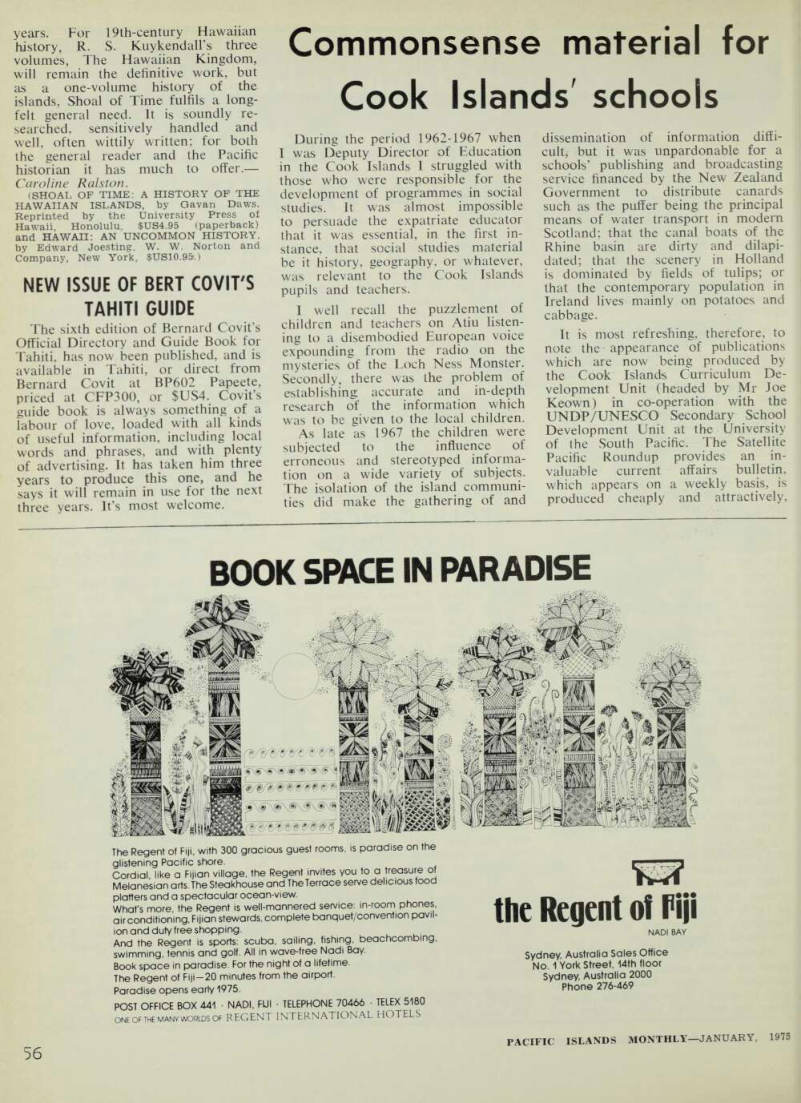
Insight Into The Lives
Of The Hawaiians
Edward Joesting’s Hawaii: An Uncommon History, is a readable, pleasant account of Hawaiian history since western contact. It does not, however, live up to its title “un common”.
In the introduction the author claims that his work is not con ventional history but an in-depth study of particular events—“a deeper, more human look into Hawaii’s past than is possible with a general history”. A justifiable aim, but, un fortunately, what follows is a string of episodes with little or no interpre tation and neither thematic nor strict chronological structure to give the work coherence. The protagonists are presented without a context.
There is no sense of the changing patterns of life in Hawaii, the de velopment of foreign settlement or the place of the Hawaiians in this new world.
Only in the early chapters of the book is the reader presented with a picture of the Hawaiians. After the death of Kamehameha I, they dis appear completely from the narrative, except for a brief glimpse of the high chief Boki in the late 1820 s. The work becomes increasingly Euro centric, a progression of portraits of white settlers, culminating in a brief history of polo in the islands, played of course by rich successful haoles (whites).
Hawaii: An Uncommon History, is an adequate introduction to Hawaiian history, despite its lapses into anecdotal trivia, but for those who want a greater insight into the lives of non-whites in Hawaii, the reprint ing of Gavan Daws’ Shoal of Time, first published in 1968, will be a most welcome occurrence. Shoal of Time which covers the period from Cook’s arrival to the granting of statehood in 1959, is slightly less extensive than Joesting’s work which includes two pre-contact chapters.
Throughout his book, Daws re veals an acute sensitivity towards the question of race, Hawaiian, haole and Oriental. The problems arising from the inflow of white settlers and
plantation labourers, coinciding as it did with the rapid decrease in the Hawaiian population, led to white domination of both Hawaiian and Oriental combined with much in justice, bitterness and racial pre judice.
The question of race relations and racial justice lies at the heart of Hawaiian history and Daws, unlike Joesting, does not ignore the issue.
While Daws does not indulge in un realistic speculative history neither does he mince words about the cost in human terms of Hawaii’s involve ment in the whaling trade, the suc cessful development of the sugar in
dustry, or the islands’ annexation to the United States and later elevation to statehood.
White consuls, businessmen, naval captains, missionaries, politicians and planters all played a part in under mining the independence of Hawaii, while the sugar men swamped the island demographically with planta tion labour to guarantee their own profits. During the 19th century the Hawaiians understood and feared the haoles’ increasing interference and control of Hawaiian affairs, which led them to use the only powers they had, to restrict it. Rarely was a haole elected to the lower house of the legislature by the Hawaiians and throughout the latter half of the century Hawaiian converts to Ameri can Protestantism drifted to other Christian denominations less ob viously allied with aggressive Ameri canism.
In the 20th century, the Massie case, the treatment of the Japanese during World War II and the argu ments raised against statehood for Hawaii in the 1950 s are further evidence of the racism that has inter mittently but consistently marred Hawaii’s history. As Daws empha sises in his conclusion, aloha, how ever one translates it, has been con spicuously absent from much of Hawaiian history despite the tourist industry’s propaganda to the contrary.
Shoal of Time is a concise but imaginative history of Hawaii, of the indigenous Hawaiians and the flow of immigrants who have settled there since European contact. The dif ference in attitude and viewpoint be tween Daws and Joesting is perhaps not so surprising when one realises that Joesting is a representative of one of the Big Five, the five white companies which for decades had a stranglehold over Hawaii’s economy, and which Daws argues have at times had a baleful influence on the islands’ development.
In 400 pages it is not reasonable to expect detailed analyses of the many major changes that have occurred in Hawaii over the last 200
years. For 19th-century Hawaiian history, R. S. Kuykendall’s three volumes, The Hawaiian Kingdom, will remain the definitive work, but as a one-volume history of the islands, Shoal of Time fulfils a long felt general need. It is soundly re searched, sensitively handled and well, often wittily written; for both the general reader and the Pacific historian it has much to offer.— Caroline Ralston. (SHOAL OF TIME: A HISTORY OF THE HAWAIIAN ISLANDS, by Gavan Daws.
Reprinted by the University Press of Hawaii, Honolulu, $U54.95 (paperback)
And Hawaii; An Uncommon History,
by Edward Joesting. W. W. Norton and Company, New York, $U510.9&.)
New Issue Of Bert Covit's
Tahiti Guide
The sixth edition of Bernard Covit’s Official Directory and Guide Book for Tahiti, has now been published, and is available in Tahiti, or direct from Bernard Covit at 8P602 Papeete, priced at CFP3OO, or SUS 4. Covit’s guide book is always something of a labour of love, loaded with all kinds of useful information, including local words and phrases, and with plenty of advertising. It has taken him three years to produce this one, and he says it will remain in use for the next three years. It’s most welcome.
Folk Dances
In Colour
Beth Dean and Victor Carell, of Sydney, are known throughout the Pacific Islands for their knowledge of the arts. They directed the first South Pacific Arts Festival and will be directing the next. Beth’s book on Pacific Islands Art and Dance, written with the late Bruce Palmer, is still available, and meanwhile Beth and Victor are working on a larger book of South Pacific Dance, in colour, to be published this year by Pacific Pub lications, The new book is a companion volume to Folkloric in Australia, written by Beth Dean with full colour photographs by Stan Goik, and just published. This extremely attractive volume on art paper describes in words and pictures the folk dances and the folk music brought to Aus tralia by migrants from Europe and elsewhere. There is a great surge of interest developing in folk dancing in Australia and the future for amateur and professional groups is opening wide. The book does not include any South Pacific groups, but the pictures and descriptions will be of great interest to all Island people interested in dance.
(Folkloric In Australia. By Beth
Dean and Stan Goik. Pacific Publications, Box 3408 GPO, Sydney, $6.95.)
Cook Islands' schools
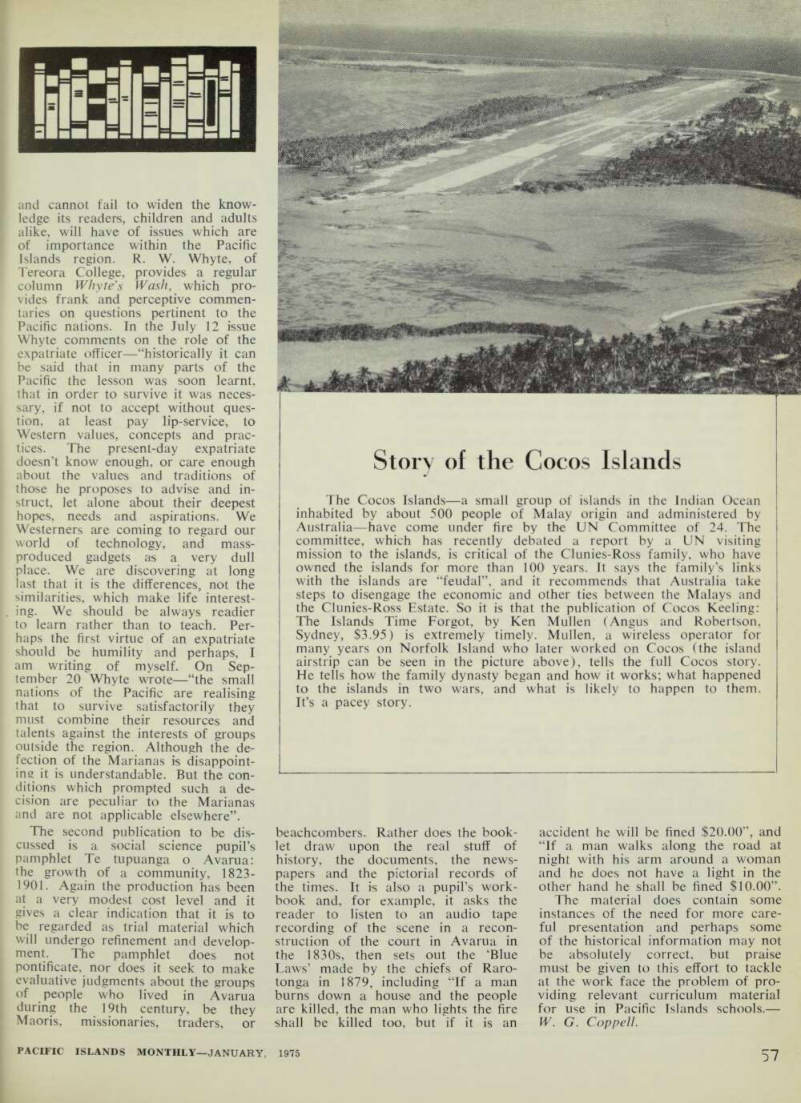
Commonsense material for Cook Islands' schools
During the period 1962-1967 when I was Deputy Director of Education in the Cook Islands 1 struggled with those who were responsible for the development of programmes in social studies. It was almost impossible to persuade the expatriate educator that it was essential, in the first in stance, that social studies material be it history, geography, or whatever, was relevant to the Cook Islands pupils and teachers.
I well recall the puzzlement of children and teachers on Atiu listen ing to a disembodied European voice expounding from the radio on the mysteries of the Loch Ness Monster.
Secondly, there was the problem of establishing accurate and in-depth research of the information which was to be given to the local children.
As late as 1967 the children were subjected to the influence of erroneous and stereotyped informa tion on a wide variety of subjects.
The isolation of the island communi ties did make the gathering of and
dissemination of information diffi cult, but it was unpardonable for a schools’ publishing and broadcasting service financed by the New Zealand Government to distribute canards such as the puffer being the principal means of water transport in modern Scotland; that the canal boats of the Rhine basin are dirty and dilapi dated; that the scenery in Holland is dominated by fields of tulips; or that the contemporary population in Ireland lives mainly on potatoes and cabbage.
It is most refreshing, therefore, to note the appearance of publications which are now being produced by the Cook Islands Curriculum De velopment Unit (headed by Mr Joe Keown) in co-operation with the UNDP/UNESCO Secondary School Development Unit at the University of the South Pacific. The Satellite Pacific Roundup provides an in valuable current affairs bulletin, which appears on a weekly basis, is produced cheaply and attractively,
and cannot fail to widen the know ledge its readers, children and adults alike, will have of issues which are of importance within the Pacific Islands region. R. W. Whyte, of Tereora College, provides a regular column Whyte’s Wash, which pro vides frank and perceptive commen taries on questions pertinent to the Pacific nations. In the July 12 issue Whyte comments on the role of the expatriate officer—“historically it can be said that in many parts of the Pacific the lesson was soon learnt, that in order to survive it was neces sary, if not to accept without ques tion, at least pay lip-service, to Western values, concepts and prac tices. The present-day expatriate doesn’t know enough, or care enough about the values and traditions of those he proposes to advise and in struct, let alone about their deepest hopes, needs and aspirations. We Westerners are coming to regard our world of technology, and mass produced gadgets as a very dull place. We are discovering at long last that it is the differences, not the similarities, which make life interest ing. We should be always readier to learn rather than to teach. Per haps the first virtue of an expatriate should be humility and perhaps, I am writing of myself. On Sep tember 20 Whyte wrote—“the small nations of the Pacific are realising that to survive satisfactorily they must combine their resources and talents against the interests of groups outside the region. Although the de fection of the Marianas is disappoint ing it is understandable. But the con ditions which prompted such a de cision are peculiar to the Marianas and are not applicable elsewhere”.
The second publication to be dis cussed is a social science pupil’s pamphlet Te tupuanga o Avarua: the growth of a community, 1823- 1901. Again the production has been at a very modest cost level and it gives a clear indication that it is to be regarded as trial material which will undergo refinement and develop ment. The pamphlet does not pontificate, nor does it seek to make evaluative judgments about the groups of people who lived in Avarua during the 19th century, be they Maoris, missionaries, traders, or
beachcombers. Rather does the book let draw upon the real stuff of history, the documents, the news papers and the pictorial records of the times. It is also a pupil’s work book and, for example, it asks the reader to listen to an audio tape recording of the scene in a recon struction of the court in Avarua in the 1830 s, then sets out the ‘Blue Laws’ made by the chiefs of Raro tonga in 1879, including “If a man burns down a house and the people are killed, the man who lights the fire shall be killed too, but if it is an
accident he will be fined $20.00”, and “If a man walks along the road at night with his arm around a woman and he does not have a light in the other hand he shall be fined $10.00”.
The material does contain some instances of the need for more care ful presentation and perhaps some of the historical information may not be absolutely correct, but praise must be given to this effort to tackle at the work face the problem of pro viding relevant curriculum material for use in Pacific Islands schools.— W. G. Coppell.
Advertisements & other items, p. 58 (1 item)
the Regent of Fiji
BOOK SPACE IN PARADISE
The Regent of Fiji, with 300 gracious guest rooms, is paradise on the glistening Pacific shore.
Cordial, like a Fijian village, the Regent invites you to a treasure of Melanesian arts. The Steakhouse and The Terrace serve delicious food platters and a spectacular ocean-view.
What’s more, the Regent is well-mannered service: in-room phones, air conditioning. Fijian stewards, complete banquet/convention pavilion and duty free shopping.
And the Regent is sports: scuba, sailing, fishing, beachcombing, swimming, tennis and golf. All in wave-free Nadi Bay.
Book space in paradise. For the night of a lifetime.
The Regent of Fiji-20 minutes from the airport.
Paradise opens early 1975.
POST OFFICE BOX 441 ■ NADI, FUI • TELEPHONE 70466 • TELEX 5180 ONE OF the many WORLDS OF REGENT INTERNATIONAL HOTELS
the Regent of Fiji
NADI BAY
Sydney, Australia Sales Office No. 1 York Street, 14th floor Sydney, Australia 2000 Phone 276-469
Story of the Cocos Islands
The Cocos Islands—a small group of islands in the Indian Ocean inhabited by about 500 people of Malay origin and administered by Australia—have come under fire by the UN Committee of 24. The committee, which has recently debated a report by a UN visiting mission to the islands, is critical of the Clunies-Ross family, who have owned the islands for more than 100 years. It says the family’s links with the islands are “feudal”, and it recommends that Australia take steps to disengage the economic and other ties between the Malays and the Clunies-Ross Estate. So it is that the publication of Cocos Keeling: The Islands Time Forgot, by Ken Mullen (Angus and Robertson, Sydney, $3.95) is extremely timely. Mullen, a wireless operator for many years on Norfolk Island who later worked on Cocos (the island airstrip can be seen in the picture above), tells the full Cocos story.
He tells how the family dynasty began and how it works; what happened to the islands in two wars, and what is likely to happen to them.
It’s a pacey story.
Advertisements & other items, pp. 60-61 (1 item)
A Selection erf pacific
From the Pacific Islands specialists . . . Pacific Publications
PAPUA NEW GUINEA
HANDBOOK
7th edition This new edition of the Papua New Guinea Handbook —completely revised and reset —provides the first full upto-date details of the new self-governing nation.
For businessmen, travellers, schools, universities and libraries, government departments, tourists and Papua New Guinea residents, this timely, up-to-the-minute edition, is essential.
A large attractive fold-out map of Papua New Guinea is also included. 332 pages of text.
PRICE: Australia, $5.50 plus 85c posted, Pacific Islands and Overseas, $5.50 Aust., plus $l.lO posted; U.S.A., $9.80 U. 5. posted.
FOR CHILDREN
LITTLE CHIMBU IN
BOUGAINVILLE Nancy Curtis This is the story of lovable Little Chimbu, and his friends, who go off to see the biggest hole in the world . . . the Bougainville copper mine, at Panguna, in New Guinea.
Adventures follow one after the other on their arrival at the mine, and young readers (and their parents) will be fascinated by Nancy Curtis' colourful, yet accurate and instructive account of the workings of the big Bougainville enterprise ... its giant trucks, its processing plant, its port and shipping.
Illustrated in full colour.
PRICE: Australia, Pacific Islands and Overseas, $3.25 Aust., plus 30c posted; U.S.A., $5.30 U.S. posted.
PfIPUR
nm cuiiiEfl
HfIiIOBOOK
m
HANDBOOK OF FIJI
4th edition In trade and as a magnet for tourists, Fiji is growing in importance. For businessmen, travellers, students and others who want to keep abreast of events, the fourth edition of the Handbook of Fiji is an essential guide.
As well as sections dealing exhaustively with history, geography, government and politics, finance, trade, education, social services, etc., there is a completely revised tourist section. This is in keeping with the growing importance to Fiji of this industry. An extensive accommodation guide and a folding road-map of Viti Levu are included. With 14 other maps and attractive full-colour cover.
PRICE: Australia, Pacific Islands and Overseas, $3.95 Aust., plus 30c posted; U.S.A., $4.90 U.S. posted.
HOLY TORTURE IN FIJI
Written by a group of academic participants and observers.
Editing and commentary by Prof. Ron Crocombe.
This book describes sacred ancient rituals involving physical ordeals which are performed once a year at certain Hindu temples in Fiji. The rituals include walking on fire, dancing on upturned knife-blades, whipping, plunging the hands in burning fat and piercing the body with steel skewers and silver wires.
Yet those who go through the ordeals suffer no pain, burns or injuries.
The book is beautifully produced in full colour and black-and-white.
PRICE: Australia, Pacific Islands and Overseas, $3.95 Aust., plus 30c posted; U.S.A., $6.40 U.S. posted.
holy
TORTURE
HANDBOOK
OF FIJI fourth edition
iiii
m Percy ChAtterittn’s Pap«a
DAY THAT 1
HAVE LOVED
|L sr *9
FOLKLORIC IN AUSTRALIA
Text: Beth Dean Photographs: Stan Goik This attractive large format book illustrates the beauty and vitality of national folk dances brought to Australia by newcomers from Europe and elsewhere, and now a strongly growing cultural movement in our cities and towns. Performances of some of the leading folk dance groups in Australia have been captured on stage, in colour, and the better known dances described. Folk groups represented include those from Greece, the USSR, Croatia, Israel, Lebanon, Sweden, the United Kingdom, Armenia, Bulgaria, Latvia, Latin America, Australia and others. Surprisingly, this is the first book to illustrate the scope of the great folk dance cultural development in Australia. 88 pages in full colour.
PRICE: Australia, $6.95 plus 85c posted, Pacific Islands and Overseas, $6.95 Aust., plus $l.lO posted; U.5.A., $11.95 U.S. posted, Percy Chatterton's Papua
DAY THAT I HAVE LOVED
Percy Chatterton This is more than an autobiography by well-known Percy Chatterton, OBE, who has spent 50 years in Papua as missionary, teacher and outspoken politician fighting for the underdog. It is a colourful, and charming, account of the Papuan people, giving warm insight into their hopes, fears and changing way of life. Some Papuan leaders say they don't want Papua to be submerged by New Guinea in the move towards independence, and readers of Percy Chatterton's timely book will readily sympathise with their desire to retain their identity. The book is illustrated with evocative pen sketches by Percy Chatterton s longtime friend and neighbour in Port Moresby, Rev. Bert Brown, DDirc « x „ J. 44 P a 9es, illustrated. rRICt: Australia, Pacific Islands and Overseas, $5.25 Aust plus 30c posted; U.5.A., $8.30 U. 5. posted.
FRIENDLY ISLAND
Patricia Ledyard Tonga, sunlit South Pacific island kingdom, was described as a ''Friendly Island" by Captain Cook, but nobody was ever more enchanted by its spell than a young Scottish doctor and a young American girl who fell in love with it and with one another more than 20 years ago. Here is the warming story of their life in Tonga, and of their Tongan friends and neighbours, told by the American girl.
Patricia Matheson, formerly Ledyard, still lives on the sandy point in the beautiful harbour of Vava'u. Her book, first published in 1956 and now updated with a new foreword by the author, has become a South Pacific classic. 256 pages, illustrated.
PRICE; Australia, Pacific Islands and Overseas, $3.00 Aust., plus 30c posted; U.5.A., $4.95 U.S. posted.
COLONIAL ERA CEMETERY
OF NORFOLK ISLAND
R. Nixon Dalkin An important addition to Australiana is this first detailed examination of the graves in the Norfolk Island cemetery.
The author is a former Administrator of Norfolk Island, now living in Canberra. The attractive book, well illustrated with early drawings and photographs, including close-ups of the major headstones, records all inscriptions in the colonial cemetery and relates many of the colourful stories of those buried there—convicts, soldiers and civilians.
Norfolk Island was settled within a few weeks of the arrival of the First Fleet in 1788, and the cemetery is thus of great historical interest and importance. The oldest extant grave in the historic cemetery, its headstone still intact, is that of a First Fleet convict who died on the island in 1789.
PRICE: Australia, $6.00 plus 85c posted. Pacific Islands and Overseas, $6.00 Aust., plus $l.lO posted; U.S.A., $10.60 U.S. posted.
Send your order, with payment, to
Pacific Publications (Aust.) Pty. Ltd.
29 Alberta Street, Sydney, N.S.W. 2000 (Postal Address: Box 3408, G.P.0., Sydney, N.S.W. 2001.)
the periodicals
Around and about the periodicals
In quality and interest the standard is maintained in the latest issues of three Pacific
periodicals.
The Journal of Pacific History (Australian National University, PO Box 4, Canberra ACT 2600) is an annual, but from this year it will appear twice yearly, March and Sep tember. Volume 10, in March, will mark 10 years of publication. The latest. Volume 9 for 1974, carries articles re-assessing Sir Arthur Gordon of Fiji; it looks at the Mela nesian Mission in the Solomon Islands; and cargoism and politics in Bougainville between 1962 and 1972; and gives us a case study of the use of firearms during indigenous war fare in the Islands in the days of early contact.
William Tagupa writes on some aspects of modern politics and per sonalities in French Polynesia, and in the manuscripts section, John Dunmore records in French with an English synopsis a French account of Port Praslin, in the Solomons, in 1769. The port was formed by off shore islands off the north west tip of Santa Ysabel. Colin Allan, for merly with the Western Pacific High Commission, gives us some March ing Rule stories. These are merely selections from the Pacific goodies to be found in this readable and in valuable journal.
Pacific Perspective is published twice yearly by the South Pacific Social Sciences Association (PO Box 5083, Suva) whose chairman is Pro fessor Ron Crocombe. Editor of Pacific Perspective is Sione K. Tu pouniua. Volume 2 No. 2 has articles, among others discussing cultural obstacles to Fijian commercial enter prise; traditional values in health planning (by Dr Reuben Taureka of PNG), and an especially interesting piece by Francis Bugotu on colonisa tion in the Solomons. The papers were among those read at a seminar in Suva in December, 1973.
Bugotu said: “The challenge for us Pacific Islanders is not to stand wide-eyed on one side of the arena, blankly watching our interests being mani pulated and aspirations changed by foreigners, but to stand in the centre of the ring and be involved, with
one foot firmly on the ground. The task is to find a design for a future which serves our interests, and need not necessarily be patterned on Western lines, nor serve Western strategic, economic or political aims”.
Volume 9, No. 3 of the quarterly New Guinea; Australia, the Pacific and South-East Asia (a mouthful, so it is usually known as the New Guinea Quarterly) contains two long articles on the Cocos and Christmas Islands, and Australian Labor Party policy between 1941 and 1949 which eventually made the policy for post war Papua New Guinea. The Labor Party came to power in Australia in 1941, and this article especially dis cusses wartime Army influence in making the PNG policy.
The New Guinea Quarterly is the organ of the Council on New Guinea Affairs, and subscriptions go to Box 3408 GPO Sydney.
Meanwhile, Kovave, the twice yearly journal of Papua New Guinea literature illustrated by New Guinea artists (subscriptions from Jacaranda Press, 65 Park Road, Milton, Queens land) has produced an attractive special issue, Modern Images from Niugini, which includes colour plates of modern New Guinea art. This issue ($2.50), is produced by Georgina Beier, and describes lead ing artists and their art, and com ments on the PNG art scene —if it could be so called—with knowledge, insight and wit, and with no little scorn when she describes the medioc rity of PNG’s European “Sunday painters” and their annual art show, “where most of the work presented is atrocious, some is slick and com petent but all is lacking in origin ality”.
There is certainly originality and competence in the New Guinean work she selects for discussion in this special issue. • The Education Faculty of the University of Papua New Guinea has brought out a book on education and the highlands. Education and Rural Development in the Highlands of PNG, is edited by J. P. Powell and Michael Wilson and is a collection of papers by education staff and university students. Information in the book has been gathered from village communities in the Eastern, Western and Southern Highlands Districts. It covers expectations of the school system and the extent to which these have been met, views on the primary ‘push out’ problem, the desire for adult education and opinions on ways in which rural de velopment may be fostered. Attention
Advertisements & other items, p. 62 (1 item)
Papua
Handbook of
New Guinea
THE LATEST!
SELF-GOVERNMENT
EDITION!
This new edition of the Handbook of Papua New Guinea — completely revised and reset — provides the first full up-to-date details of the new self-governing nation.
For businessmen, travellers, schools, universities and libraries, government departments, tourists and Papua New Guinea residents, this timely, up -to - the - minute edition, is essential.
The Handbook covers everything —geography and history right up to self - government, commerce, trade and banking, forestry, primary and secondary industries, finance and taxation, communications and transport, health and education, law and defence, the churches and missions, land and land policy, etc. Each of the 19 districts is treated in detail, with clear and comprehensive maps, all newly drawn.
There is also a greatly expanded list, for easy reference, of company registrations and an enlarged tourist section that has all the latest information on facilities and amenities in all areas.
A large attractive fold-out map of Papua New Guinea is also included. The first edition of the Papua New Guinea handbook was published 20 years ago. This 7th edition, is the only reference book available today with all the information on the world's newest nation.
PRICE: Australia, $5.50 plus 85c posted Pacific Islands and Overseas, $5.50 Aust., plus $l.lO posted, U.S.A., $9.80 U.S. posted.
Fill in the details
on the attached
order form.
Pacific Transport
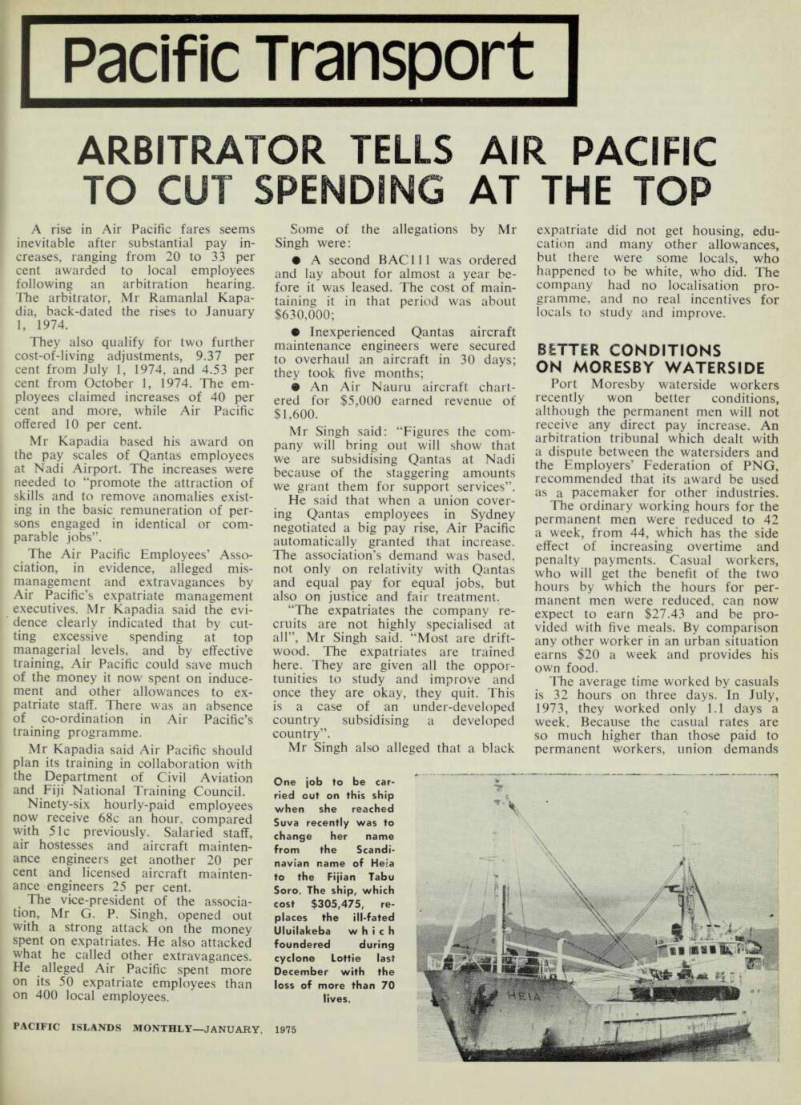
Arbitrator Tells Air Pacific
To Cut Spending At The Top
A rise in Air Pacific fares seems inevitable after substantial pay in creases, ranging from 20 to 33 per cent awarded to local employees following an arbitration hearing.
The arbitrator, Mr Ramanlal Kapa dia, back-dated the rises to January 1, 1974.
They also qualify for two further cost-of-living adjustments, 9.37 per cent from July 1, 1974, and 4.53 per cent from October 1, 1974. The em ployees claimed increases of 40 per cent and more, while Air Pacific offered 10 per cent.
Mr Kapadia based his award on the pay scales of Qantas employees at Nadi Airport. The increases were needed to “promote the attraction of skills and to remove anomalies exist ing in the basic remuneration of per sons engaged in identical or com parable jobs”.
The Air Pacific Employees’ Asso ciation, in evidence, alleged mis management and extravagances by Air Pacific’s expatriate management executives. Mr Kapadia said the evi dence clearly indicated that by cut ting excessive spending at top managerial levels, and by effective training, Air Pacific could save much of the money it now spent on induce ment and other allowances to ex patriate staff. There was an absence of co-ordination in Air Pacific’s training programme.
Mr Kapadia said Air Pacific should plan its training in collaboration with the Department of Civil Aviation and Fiji National Training Council.
Ninety-six hourly-paid employees now receive 68c an hour, compared with 51c previously. Salaried staff, air hostesses and aircraft mainten ance engineers get another 20 per cent and licensed aircraft mainten ance engineers 25 per cent.
The vice-president of the associa tion, Mr G. P. Singh, opened out with a strong attack on the money spent on expatriates. He also attacked what he called other extravagances.
He alleged Air Pacific spent more on its 50 expatriate employees than on 400 local employees.
Some of the allegations by Mr Singh were: • A second BACIII was ordered and lay about for almost a year be fore it was leased. The cost of main taining it in that period was about $630,000; • Inexperienced Qantas aircraft maintenance engineers were secured to overhaul an aircraft in 30 days; they took five months; 9 An Air Nauru aircraft chart ered for $5,000 earned revenue of $1,600.
Mr Singh said: “Figures the com pany will bring out will show that we are subsidising Qantas at Nadi because of the staggering amounts we grant them for support services”.
He said that when a union cover ing Qantas employees in Sydney negotiated a big pay rise, Air Pacific automatically granted that increase.
The association’s demand was based, not only on relativity with Qantas and equal pay for equal jobs, but also on justice and fair treatment.
“The expatriates the company re cruits are not highly specialised at all”, Mr Singh said. “Most are drift wood. The expatriates are trained here. They are given all the oppor tunities to study and improve and once they are okay, they quit. This is a case of an under-developed country subsidising a developed country”.
Mr Singh also alleged that a black
expatriate did not get housing, edu cation and many other allowances, but there were some locals, who happened to be white, who did. The company had no localisation pro gramme, and no real incentives for locals to study and improve.
Better Conditions
On Moresby Waterside
Port Moresby waterside workers recently won better conditions, although the permanent men will not receive any direct pay increase. An arbitration tribunal which dealt with a dispute between the watersiders and the Employers’ Federation of PNG, recommended that its award be used as a pacemaker for other industries.
The ordinary working hours for the permanent men were reduced to 42 a week, from 44, which has the side effect of increasing overtime and penalty payments. Casual workers, who will get the benefit of the two hours by which the hours for per manent men were reduced, can now expect to earn $27.43 and be pro vided with five meals. By comparison any other worker in an urban situation earns $2O a week and provides his own food.
The average time worked by casuals is 32 hours on three days. In July, 1973, they worked only 1.1 days a week. Because the casual rates are so much higher than those paid to permanent workers, union demands
One job to be car ried out on this ship when she reached Suva recently was to change her name from the Scandi navian name of Heia to the Fijian Tabu Soro. The ship, which cost $305,475, re places the ill-fated Uluilakeba which foundered during cyclone Lottie last December with the loss of more than 70 lives.
for sick and annual leave for casual workers were refused.
Annual and sick leave is now granted to permanent workers after only three months’ service. Previously there was a qualifying period of six months. Sick leave is now nine days a year, compared with six previously.
Another new provision is seven days compassionate leave, of which two days are on full pay. However, this may only be given on the death of an immediate relative.
The tribunal refused increases for night work, leave fares or leave travelling time, or a day’s holiday for a picnic. Casual workers were refused the right to continue to work a ship once they had started work on it.
The tribunal refused to extend rest breaks above the existing 10 minutes, but granted 10 minutes washing time at the end of each day. Another claim turned down was that employers be ordered to deduct union dues from workers’ pay. air niugini adds
Two To Its Fleet
Two turbo-prop aircraft from Japan landed at Wewak in New Guinea on December 3 to go into service for Air Niugini. One was a Japanese 64-seater, YS-11A, which is spending 30 days under evaluation by Air Niugini. It is operated by a Japanese crew on regular Air Niu gini services.
The second was the first of two reconditioned Fokker Friendships, which Air Niugini bought from a Japanese airline for $600,000 each.
The two aircraft provide an addi tional 104 seats to cope with peak December and January traffic.
British Airways
Advances Withdrawal
British Airways will withdraw from transpacific flights from Sydney to London about seven weeks earlier than originally intended. The last flight from Sydney will now be on February 3, and not at the end of March. The airline considers it can use the capacity better elsewhere.
Britain and Australia recently concluded an air services agreement under which British Airways flights will terminate at Los Angeles and Qantas will withdraw services through Mexico and the US to London.
British Airways, under an arrange ment with Air New Zealand, will take over Air NZ DC 10s at Los Angeles and fly them to London and back. This will be an extension of the daily Air NZ service from Auck land to Los Angeles. One of these services, via Honolulu, will put down at Nadi.
Micronesia's shipping problems
Micronesian sea transport suffers from an obsolete fleet, generally in adequate port facilities and an over all lack of planning for a viable ship ping system, resulting from neglect, a lack of funds and misplaced priori ties, reported Truk Congressman Mr Sasauo Haruo after a 24-day survey of shipping services and port facilities.
Mr Haruo, chairman of the Con gress joint committee on resources and development, made his survey with a shipping expert from the United Nations Economic and Social Commission for Asia and the Far East, Mr Danko Koludrovic.
Mr Haruo said the major problem about shipping in Micronesia was giving adequate service in and be tween the districts. Bringing cargo into Micronesia was less of a prob lem than it was a year ago, before the TT Government removed the ex clusive shipping monopoly for Trans pacific Lines Inc, and allowed various companies to service Micronesian ports.
Attacking the United States over the shipping question, he said ship ping had not been a No 1 priority with the administering authority. “As an island nation, shipping is our life line, but all our ships are obsolete, the vessels are hazardous, and worst of all there is no plan to improve the situation, except plans to build new ships which constantly get de ferred by the administration”, he complained.
Mr Koludrovic, who has studied many US aid programmes in Asia and the South Pacific, said he was surprised at the shipping situation in Micronesia. The US had poured mil lions of dollars into many other nations where it had no formal com mitment as it had under the UN trusteeship agreement on Micronesia.
The most fundamental elements in attempting to set up an efficient ship ping service—collecting statistics about tonnage and other matters in the various ports—were non-existent.
Senator John Mangefel, who took part in the survey, said shipping problems had reduced travel and communications between the districts, and thus had affected Micronesian unity. The Congress of Micronesia had repeatedly given high priority to acquiring more field trip ships for the districts in annual budgets, but only one ship out of eight had been financed and built.
The Department of the Interior, through the influence of Ambassador Franklin H. Williams of the Office
of Micronesian Status Relations, in the past shifted funds from ships to other programmes. Recently he pro posed that three ships be cut out of the proposed 1975 budget so that the funds could be diverted to im prove power facilities in one district.
The administering authority had given first priority to airport and road construction and neglected ship ping, which was “vital to the welfare of the people of Micronesia as a Pacific Islands nation”.
Mr Haruo said the committee, to correct the problems, planned to re commend that an independent agency be set up to oversee the operations of the TT transport division, which was preoccupied with day-to-day operations of shipping.
“We need an independent agency to set policies and goals and monitor our government transport system”, he said. “The lack of such a policy setting agency is reflected in the pre sent poor state of affairs in shipping in Micronesia today”.
The joint committee expects to submit a detailed report of its find ings, plus specific recommendations to the Sixth Congress of Micronesia, in January.
Png Students'
Transport Survey
Thirty-one students of the two universities in Papua New Guinea are making a major study of the coun try’s water transport system for the Department of Transport. The study is the biggest yet in a joint pro gramme, now in its fifth year, which combines the research resources of the department, the universities, and the New Guinea research unit of the Australian National University.
The study, of coastal and inland waters, includes Wewak and western islands areas, Manus, the Madang Islands, the Siassi Islands, the south coast of East and West New Britain, the island groups to the north and west of New Ireland, the Bougain ville Islands, the Trobriands, D'Entrecasteaux Islands, the Louisi ade Archipelago, and the Gulf and Western District coast and islands.
The students will build up an in ventory of factual information to provide a planning basis policy. They will also report on transport prob lems in the areas.
Minister for Transport and Civil Aviation Mr lambakey Okuk said one problem was the frequent break
down of outboard motors, the ex pense of spare parts, and the delay in getting them. The department needed to know how widespread the problem was. The students’ study, which includes coverage of even the remoter islands, should enable the department to assess how motor breakdowns affect mobility.
The department is also examining the use of personal and public trans port in selling market and export products. Officers are visiting the main centres in the areas involved to explain the scope of the study to field officers, and ensure students re ceive every help in reaching remoter areas.
Mr Okuk said he had heard criti cism that his department concen trated on roads rather than other forms of transport. While the de partment was constantly reviewing national road needs, other modes of transport were also being reviewed.
He added that while the study would be wide, there would be gaps.
One of these would be filled by a study by his department of canoe arrivals and departures at Koki in January. The information gathered would supplement information from a road traffic census on the Hiritano Highway, Rigo Road and Sogeri Road.
Transport Briefs
• The Union Steam Ship Co of NZ Ltd has increased by four per cent the freight rates on a number of commodities for Norfolk Island. The commodities are refrigerated cargo, cement, hardboard/fibrolite and bund led timber. There has also been an increase in the minimum charge per bill of lading to $26.86. • Mr Cedric WiseL' Air New Zea land’s data processing and methods manager, has been appointed general manager of Polynesian Airlines, succeeding Mr Marsden Stanton.
Mr J. Terence Betham becomes PA’s finance and administration manager. © Air Pacific, in November, took delivery of the first of four New Trislanders, which will replace the ageing Herons. The 15-seater plane which cost $210,000 and cruises at 140 knots, was expected to go into service about the end of December.
Air Pacific hopes to take delivery of the second Trislander in January and the remaining two in April. Other newcomers to Air Pacific are two Tongan girls, Halaevalu Magisi, 20. and Atulouaki Latu, 19, who will train as air hostesses. The introduc tion of Fiji-Auckland flights, via Tonga, made it necessary to engage Tongans.
© A new ship, the He de Lumiere, in January, will replace the Port de France on the Australia-Norfolk Island run. The new ship will offer a four-weekly service from Sydney to Lord Howe Island, Norfolk Island, Auckland, Noumea and back to Sydney. The Port de France will con tinue on the Sydney-Noumea service. • An inter-island ferry to be built in Tonga for Mr Uliti Uata will have a hull of New Zealand kauri, while the keel and beams will be of the hardwood, tangato, from Eua. The ferry, 70 ft long, will be the largest wooden ship built in Tonga. • Captain Mike Bailes, former master of the Hifofua, one of Tonga’s merchant ships, has gone to New Zealand to take over captaincy of a sail-training ship, the Spirit of Adventure, which makes cruises for the benefit of NZ youth. Tonga had hoped that Captain Bailes would re main in the kingdom to run the mer chant marine training school. Earlier in 1974 he ran the Pacific Navigation Co’s marine school. 9 People from Kai village, near Morobe, recently bought a cargo ship, the Davara Rabaul, from Ma dang Sharp Shipping Services to run a service from Lae to Popondetta. and from Lae to Rabaul. They paid $18,500 for it.
Advertisements & other items, pp. 65-66 (1 item)
The Bank Line
MONTHLY SERVICES
U.K., CONTINENT to PAPUA NEW GUINEA & SOLOMON ISLANDS PAPUA NEW GUINEA to NORTH AMERICA & U.K., CONTINENT SOLOMON ISLANDS, FIJI, TONGA, SAMOA AND TARAWA to U.K.,
CONTINENT
U.S. GULF/AUSTRALASIA VESSELS CALL AT FIJI WHEN REQUIRED / yjLM N
FOR PARTICULARS APPLY:
BANK LINE (AUSTRALASIA) PTT. LTD., SYDNEY, N.S.W.
Braybon
GENERATING SETS
MARINE APPLICATION
Marine Application of Braybon Alternators ensure continuity of operation as these Australian built brushless Alternators are designed for arduous conditions in high ambient temperature.
Capacities of 3 K.V.A. to 100 K.V.A. engine powered or separate are available to specification.
Write for our brochures and prices without obligation.
Aw
IPP.
31 K.V.A. BRAYBON/BRIGGS AND STRATTON
HOUSE LIGHTING
House Lighting Diesel Sets we manufacture in capacities of 2 K.V.A. to approximately 40 K.V.A. as crank start, electric, remote, and fully automatic with air cooled diesel engines.
90 K.V.A. BRAYBON/CUMMINS.
PORTABLE PETROL ELECTRIC
DRIVEN SETS
Portable Petrol Engine Driven Sets for house lighting, builder power tools, floor sander, electric welder, etc., are manufactured in capacities of 1,2, 3|, and 7i K.V.A. 240 volt. Keenly priced, these sets lend themselves to many applications. ♦
Braybon Bros
V PTY. LTD.,
ROTHWELL AVENUE, CONCORD WEST 2138.
Tel.: 73-3246.
il
2 K.V.A. BRAYBON/FETTER.
AUSTRALIAN MANUFACTURERS
ESTABLISHED 40 YEARS 1934-1974.
Cruising
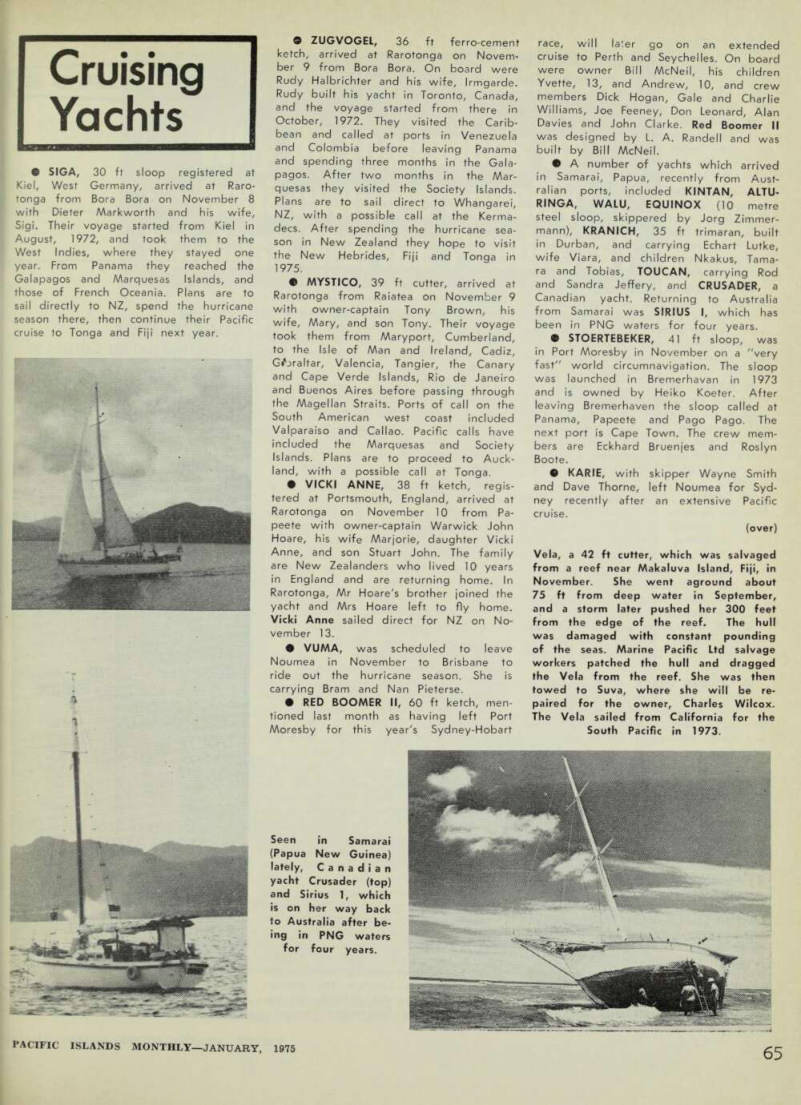
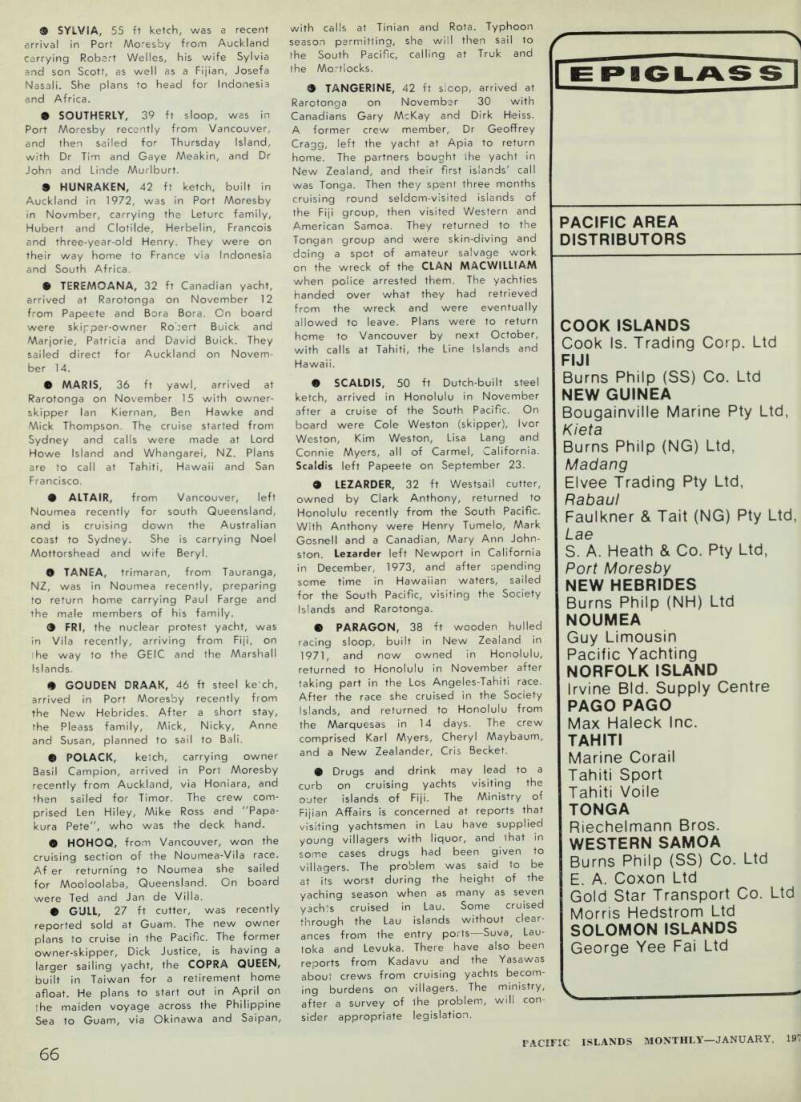
Yachts
© SIGA, 30 ft sloop registered at Kiel, West Germany, arrived at Raro tonga from Bora Bora on November 8 with Dieter Markworth and his wife, Sigi. Their voyage started from Kiel in August, 1972, and took them to the West Indies, where they stayed one year. From Panama they reached the Galapagos and Marquesas Islands, and those of French Oceania. Plans are to sail directly to NZ, spend the hurricane season there, then continue their Pacific cruise to Tonga and Fiji next year.
O ZUGVOGEL, 36 ft ferro-cement ketch, arrived at Rarotonga on Novem ber 9 from Bora Bora. On board were Rudy Halbrichter and his wife, Irmgarde.
Rudy built his yacht in Toronto, Canada, and the voyage started from there in October, 1972. They visited the Carib bean and called at ports in Venezuela and Colombia before leaving Panama and spending three months in the Gala pagos. After two months in the Mar quesas they visited the Society Islands.
Plans are to sail direct to Whangarei, NZ, with a possible call at the Kerma decs. After spending the hurricane sea son in New Zealand they hope to visit the New Hebrides, Fiji and Tonga in 1975. ® MYSTICO, 39 ft cutter, arrived at Rarotonga from Raiatea on November 9 with owner-captain Tony Brown, his wife, Mary, and son Tony. Their voyage took them from Maryport, Cumberland, to the Isle of Man and Ireland, Cadiz, G/jraltar, Valencia, Tangier, the Canary and Cape Verde Islands, Rio de Janeiro and Buenos Aires before passing through the Magellan Straits. Ports of call on the South American west coast included Valparaiso and Callao. Pacific calls have included the Marquesas and Society Islands. Plans are to proceed to Auck land, with a possible call at Tonga. • VICKI ANNE, 38 ft ketch, regis tered at Portsmouth, England, arrived at Rarotonga on November 10 from Pa peete with owner-captain Warwick John Hoare, his wife Marjorie, daughter Vicki Anne, and son Stuart John. The family are New Zealanders who lived 10 years in England and are returning home. In Rarotonga, Mr Hoare's brother joined the yacht and Mrs Hoare left to fly home.
Vicki Anne sailed direct for NZ on No vember 13. • VUMA, was scheduled to leave Noumea in November to Brisbane to ride out the hurricane season. She is carrying Bram and Nan Pieterse. • RED BOOMER 11, 60 ft ketch, men tioned last month as having left Port Moresby for this year's Sydney-Hobart
race, will la'er go on an extended cruise to Perth and Seychelles. On board were owner Bill McNeil, his children Yvette, 13, and Andrew, 10, and crew members Dick Hogan, Gale and Charlie Williams, Joe Feeney, Don Leonard, Alan Davies and John Clarke. Red Boomer II was designed by L. A. Randell and was built by Bill McNeil. • A number of yachts which arrived in Samarai, Papua, recently from Aust ralian ports, included KINTAN, ALTU
Ringa, Walu, Equinox (10 Metre
steel sloop, skippered by Jorg Zimmer mann), KRANICH, 35 ft trimaran, built in Durban, and carrying Echart Lutke, wife Viara, and children Nkakus, Tama ra and Tobias, TOUCAN, carrying Rod and Sandra Jeffery, and CRUSADER, a Canadian yacht. Returning to Australia from Samarai was SIRIUS I, which has been in PNG waters for four years. ® STOERTEBEKER, 41 ft sloop, was in Port Moresby in November on a "very fast" world circumnavigation. The sloop was launched in Bremerhavan in 1973 and is owned by Heiko Koeter. After leaving Bremerhaven the sloop called at Panama, Papeete and Pago Pago. The next port is Cape Town. The crew mem bers are Eckhard Bruenjes and Roslyn Boote. • KARIE, with skipper Wayne Smith and Dave Thorne, left Noumea for Syd ney recently after an extensive Pacific cruise. (over) Vela, a 42 ft cutter, which was salvaged from a reef near Makaluva Island, Fiji, in November. She went aground about 75 ft from deep water in September, and a storm later pushed her 300 feet from the edge of the reef. The hull was damaged with constant pounding of the seas. Marine Pacific Ltd salvage workers patched the hull and dragged the Vela from the reef. She was then towed to Suva, where she will be re paired for the owner, Charles Wilcox.
The Vela sailed from California for the South Pacific in 1973.
Seen in Samarai (Papua New Guinea) lately, Canadian yacht Crusader (top) and Sirius 1, which is on her way back to Australia after be ing in PNG waters for four years.
® SYLVIA, 55 ft ketch, was a recent arrival in Port Moresby from Auckland carrying Robert Welles, his wife Sylvia and son Scott, as well as a Fijian, Josefa Nasali. She plans to head for Indonesia and Africa. 9 SOUTHERLY, 39 ft sloop, was in Port Moresby recently from Vancouver, and then sailed for Thursday Island, with Dr Tim and Gaye Meakin, and Dr John and Linde Murlburt. 9 HUNRAKEN, 42 ft ketch, built in Auckland in 1972, was in Port Moresby in Novmber, carrying the Leturc family, Hubert and Clotilde, Herbelin, Francois and three-year-old Henry. They were on their way home to France via Indonesia and South Africa. 9 TEREMOANA, 32 ft Canadian yacht, arrived at Rarotonga on November 12 from Papeete and Bora Bora. On board were skipper-owner Robert Buick and Marjorie, Patricia and David Buick. They sailed direct for Auckland on Novem ber 14. 9 MARIS, 36 ft yawl, arrived at Rarotonga on November 15 with owner skipper lan Kiernan, Ben Hawke and Mick Thompson. The cruise started from Sydney and calls were made at Lord Howe Island and Whangarei, NZ. Plans are to call at Tahiti, Hawaii and San Francisco. 9 ALTAIR, from Vancouver, left Noumea recently for south Queensland, and is cruising down the Australian coast to Sydney. She is carrying Noel Mottorshead and wife Beryl. 9 TANEA, trimaran, from Tauranga, NZ, was in Noumea recently, preparing to return home carrying Paul Farge and the male members of his family. 9 FRI, the nuclear protest yacht, was in Vila recently, arriving from Fiji, on ihe way to the GEIC and the Marshall Islands. 9 GOUDEN DRAAK, 46 ft steel keich, arrived in Port Moresby recently from the New Hebrides. After a short stay, the Pleass family, Mick, Nicky, Anne and Susan, planned to sail to Bali. 9 POLACK, ketch, carrying owner Basil Campion, arrived in Port Moresby recently from Auckland, via Honiara, and then sailed for Timor. The crew com prised Len Hiley, Mike Ross and "Papa kura Pete", who was the deck hand. 9 HOHOQ, from Vancouver, won the cruising section of the Noumea-Vila race.
Af er returning to Noumea she sailed tor Mooloolaba, Queensland. On board were Ted and Jan de Villa. 9 GULL, 27 ft cutter, was recently reported sold at Guam. The new owner plans to cruise in the Pacific. The former owner-skipper, Dick Justice, is having a larger sailing yacht, the COPRA QUEEN, built in Taiwan for a retirement home afloat. He plans to start out in April on the maiden voyage across the Philippine Sea to Guam, via Okinawa and Saipan,
with calls at Tinian and Rota. Typhoon season permitting, she will then sail to the South Pacific, calling at Truk and the Mortlocks. 9 TANGERINE, 42 ft sloop, arrived at Rarotonga on November 30 with Canadians Gary McKay and Dirk Heiss.
A former crew member, Dr Geoffrey Cragg, left the yacht at Apia to return home. The partners bought the yacht in New Zealand, and their first islands' call was Tonga. Then they spent three months cruising round seldom-visited islands of the Fiji group, then visited Western and American Samoa. They returned to the Tongan group and were skin-diving and doing a spot of amateur salvage work on the wreck of the CLAN MACWILLIAM when police arrested them. The yachties handed over what they had retrieved from the wreck and were eventually allowed to leave. Plans were to return home to Vancouver by next October, with calls at Tahiti, the Line Islands and Hawaii. 9 SCALDIS, 50 ft Dutch-built steel ketch, arrived in Honolulu in November after a cruise of the South Pacific. On board were Cole Weston (skipper), Ivor Weston, Kim Weston, Lisa Lang and Connie Myers, all of Carmel, California.
Scaldis left Papeete on September 23. 9 LEZARDER, 32 ft Westsail cutter, owned by Clark Anthony, returned to Honolulu recently from the South Pacific.
With Anthony were Henry Tumelo, Mark Gosnell and a Canadian, Mary Ann John ston. Lezarder left Newport in California in December, 1973, and after spending some time in Hawaiian waters, sailed for the South Pacific, visiting the Society Islands and Rarotonga. 9 PARAGON, 38 ft wooden hulled racing sloop, built in New Zealand in 1971, and now owned in Honolulu, returned to Honolulu in November after taking part in the Los Angeles-Tahiti race.
After the race she cruised in the Society Islands, and returned to Honolulu from the Marquesas in 14 days. The crew comprised Karl Myers, Cheryl Maybaum, and a New Zealander, Cris Becket. 9 Drugs and drink may lead to a curb on cruising yachts visiting the outer islands of Fiji. The Ministry of Fijian Affairs is concerned at reports that visiting yachtsmen in Lau have supplied young villagers with liquor, and that in some cases drugs had been given to villagers. The problem was said to be at its worst during the height of the yaching season when as many as seven yachts cruised in Lau. Some cruised through the Lau islands without clear ances from the entry ports —Suva, Lau toka and Levuka. There have also been reports from Kadavu and the Yasawas about crews from cruising yachts becom ing burdens on villagers. The ministry, after a survey of the problem, will con sider appropriate legislation.
Advertisements & other items, pp. 68-70 (1 item)
Pacific Area
DISTRIBUTORS
COOK ISLANDS
Cook Is. Trading Corp. Ltd
FIJI
Burns Philp (SS) Co. Ltd
NEW GUINEA
Bougainville Marine Pty Ltd, Kieta Burns Philp (NG) Ltd, Madang Elvee Trading Pty Ltd, Rabaul Faulkner & Tait (NG) Pty Ltd, l_ ae S. A. Heath & Co. Pty Ltd, Port Moresby
NEW HEBRIDES
Burns Philp (NH) Ltd
NOUMEA
Guy Limousin Pacific Yachting
NORFOLK ISLAND
Irvine Bid. Supply Centre
PAGO PAGO
Max Haleck Inc.
TAHITI
Marine Corail Tahiti Sport Tahiti Voile
TONGA
Riechelmann Bros.
WESTERN SAMOA
Burns Philp (SS) Co. Ltd E. A. Coxon Ltd Gold Star Transport Co. Ltd Morris Hedstrom Ltd
SOLOMON ISLANDS
George Yee Fai Ltd
Why do thousands of
boat-owners specify
Epiglass Marine Products?
Epiglass gives you the biggest range of marine glues, fillers, preservatives, resins, skinning systems and paints going. The biggest ... and the best. Laboratory tested and proven in the water on thousands and thousands of boats!
That’s why you can buy Epiglass products with complete confidence. If it’s Epiglass, it will outlast all others. Just ask the man who uses Epiglass! mm m&mm » CM
mm i
BBSS/.
m II from 7ftto73ft epiglass |power or sail Consolidated Chemicals Limited. Auckland.
“For further information contact Consolidated Chemicals Ltd, P.O. Box 15-104, New Lynn, Auckland, New Zealand”.
PAPUA NEW GUINEA
on the move...
m ISI I : ii 8
if I ' -i
s T
Frll
n
r- wy"
t*.
•ill if ills
■ ■ll
■Him
*»JS *** a* i The Papua New Guinea Government Offices in Construction House, Wellington.
The Papua New Guinea Government announces the official opening of its Commission in New Zealand.
For all enquiries, applications for entry permits, visas, trade investment, employment opportunities and general information contact; m mr
PAPUA NEW GUINEA GOVERNMENT COMMISSIONER
FIRST FLOOR, CONSTRUCTION HOUSE, 80-82 KENT TERRACE, WELLINGTON.
TELEPHONE: 55-5452.
See page 75 for our new offices in Suva.
Papna New Guinea moves
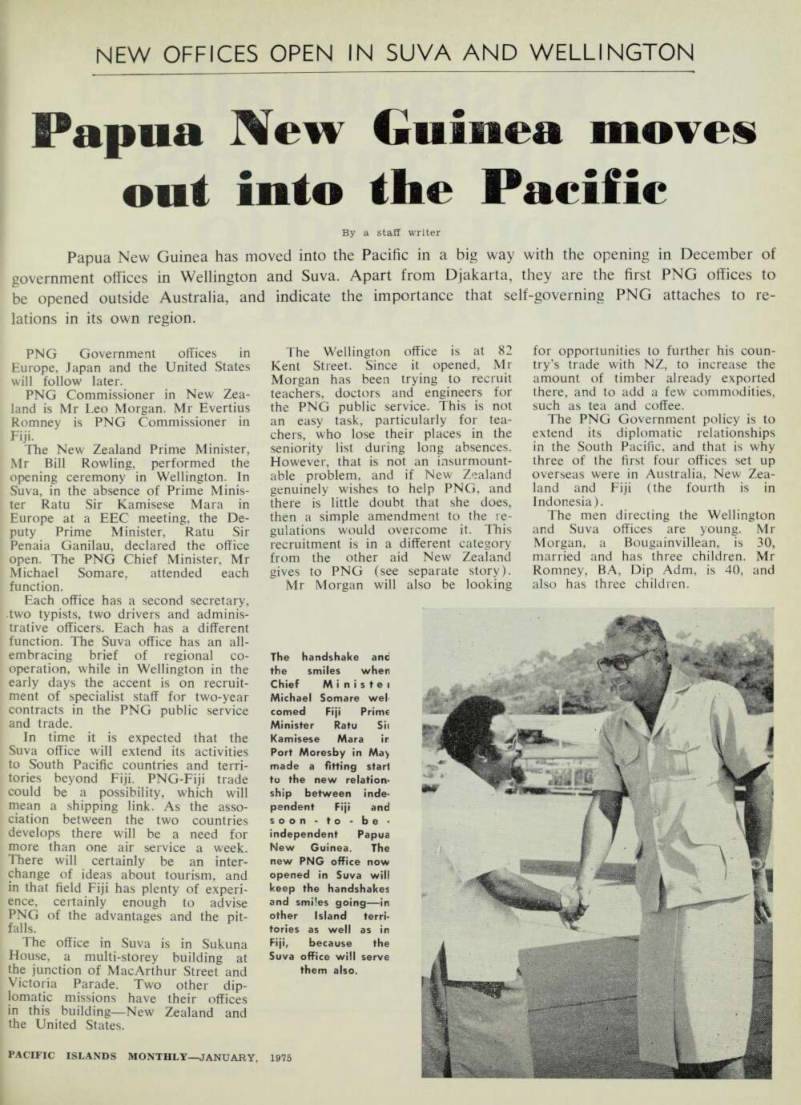
NEW OFFICES OPEN IN SUVA AND WELLINGTON
Papna New Guinea moves out into the Pacific
By a staff writer
Papua New Guinea has moved into the Pacific in a big way with the opening in December of government offices in Wellington and Suva. Apart from Djakarta, they are the first PNG offices to be opened outside Australia, and indicate the importance that self-governing PNG attaches to re lations in its own region.
PNG Government offices in Europe, Japan and the United States will follow later.
PNG Commissioner in New Zea land is Mr Leo Morgan. Mr Evertius Romney is PNG Commissioner in Fiji.
The New Zealand Prime Minister, Mr Bill Rowling, performed the opening ceremony in Wellington. In Suva, in the absence of Prime Minis ter Ratu Sir Kamisese Mara in Europe at a EEC meeting, the De puty Prime Minister, Ratu Sir Penaia Ganilau, declared the office open. The PNG Chief Minister, Mr Michael Somare, attended each function.
Each office has a second secretary, two typists, two drivers and adminis trative officers. Each has a different function. The Suva office has an all embracing brief of regional co operation, while in Wellington in the early days the accent is on recruit ment of specialist staff for two-year contracts in the PNG public service and trade.
In time it is expected that the Suva office will extend its activities to South Pacific countries and terri tories beyond Fiji. PNG-Fiji trade could be a possibility, which will mean a shipping link. As the asso ciation between the two countries develops there will be a need for more than one air service a week.
There will certainly be an inter change of ideas about tourism, and in that field Fiji has plenty of experi ence, certainly enough to advise PNG of the advantages and the pit falls.
The office in Suva is in Sukuna House, a multi-storey building at the junction of MacArthur Street and Victoria Parade. Two other dip lomatic missions have their offices in this building—New Zealand and the United States.
The Wellington office is at 82 Kent Street. Since it opened, Mr Morgan has been trying to recruit teachers, doctors and engineers for the PNG public service. This is not an easy task, particularly for tea chers, who lose their places in the seniority list during long absences.
However, that is not an insurmount able problem, and if New Zealand genuinely wishes to help PNG, and there is little doubt that she does, then a simple amendment to the re gulations would overcome it. This recruitment is in a different category from the other aid New Zealand gives to PNG (see separate story).
Mr Morgan will also be looking
for opportunities to further his coun try’s trade with NZ, to increase the amount of timber already exported there, and to add a few commodities, such as tea and coffee.
The PNG Government policy is to extend its diplomatic relationships in the South Pacific, and that is why three of the first four offices set up overseas were in Australia, New Zea land and Fiji (the fourth is in Indonesia).
The men directing the Wellington and Suva offices are young. Mr Morgan, a Bougainvillean, is 30, married and has three children. Mr Romney, BA, Dip Adm, is 40, and also has three children.
The handshake and the smiles when Chief Minister Michael Somare wel corned Fiji Prime Minister Ratu Sii Kamisese Mara in Port Moresby in May made a fitting start to the new relation ship between inde pendent Fiji and soon-to-be
independent Papua
New Guinea. The new PNG office now opened in Suva will keep the handshakes and smiles going—in other Island terri tories as well as in Fiji, because the Suva office will serve them also.
Advertisements & other items, p. 72 (1 item)
To stand tall
in 118 countries
you need to
keep on your toes
Staying on top in the business researching, making, installing Staying on top in the business world means backing a programme of continuing innovation with a sound service programme.
So Otis employs some 50,000 specialists in 118 countries researching, making, installing and servicing Otis elevators, escalators and allied transportation systems.
Otis keeps moving people and things. While looking for better ways of doing it.
Otis Elevator Company Ltd., Nukuwatu Street, Lami, Suva, FIJI.
Telephone 361-248 Suva. 36372 A
Is Trade Plus Aid
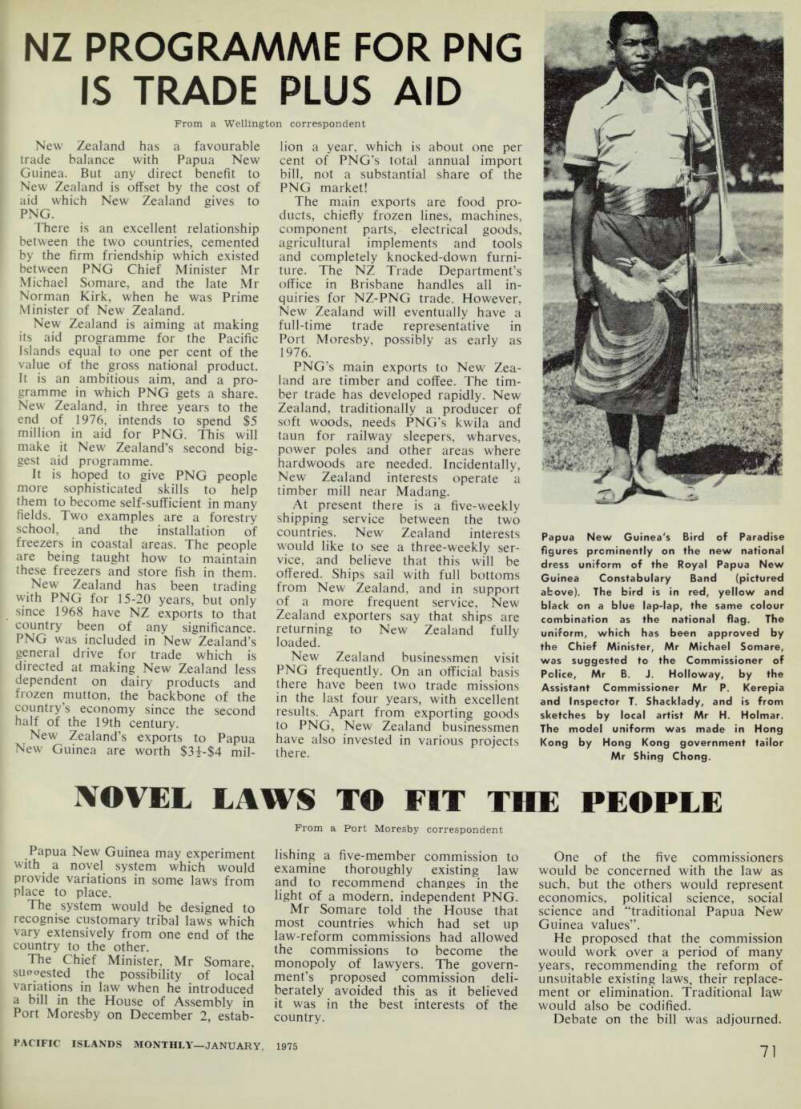
Nz Programme For Png
From a Wellington correspondent
New Zealand has a favourable trade balance with Papua New Guinea. But any direct benefit to New Zealand is offset by the cost of aid which New Zealand gives to
Png.
There is an excellent relationship between the two countries, cemented by the firm friendship which existed between PNG Chief Minister Mr Michael Somare, and the late Mr Norman Kirk, when he was Prime Minister of New Zealand.
New Zealand is aiming at making its aid programme for the Pacific Islands equal to one per cent of the value of the gross national product.
It is an ambitious aim, and a pro gramme in which PNG gets a share.
New Zealand, in three years to the end of 1976, intends to spend $5 million in aid for PNG. This will make it New Zealand’s second big gest aid programme.
It is hoped to give PNG people more sophisticated skills to help them to become self-sufficient in many fields. Two examples are a forestry school, and the installation of freezers in coastal areas. The people are being taught how to maintain these freezers and store fish in them.
New Zealand has been trading with PNG for 15-20 years, but only since 1968 have NZ exports to that country been of any significance.
PNG was included in New Zealand’s general drive for trade which is directed at making New Zealand less dependent on dairy products and frozen mutton, the backbone of the country’s economy since the second half of the 19th century.
New Zealand’s exports to Papua New Guinea are worth S3i-$4 mil
lion a year, which is about one per cent of PNG’s total annual import bill, not a substantial share of the PNG market!
The main exports are food pro ducts, chiefly frozen lines, machines, component parts, electrical goods, agricultural implements and tools and completely knocked-down furni ture. The NZ Trade Department’s office in Brisbane handles all in quiries for NZ-PNG trade. However, New Zealand will eventually have a full-time trade representative in Port Moresby, possibly as early as 1976.
PNG’s main exports to New Zea land are timber and coffee. The tim ber trade has developed rapidly. New Zealand, traditionally a producer of soft woods, needs PNG’s kwila and taun for railway sleepers, wharves, power poles and other areas where hardwoods are needed. Incidentally, New Zealand interests operate a timber mill near Madang.
At present there is a five-weekly shipping service between the two countries. New Zealand interests would like to see a three-weekly ser vice, and believe that this will be offered. Ships sail with full bottoms from New Zealand, and in support of a more frequent service, New Zealand exporters say that ships are returning to New Zealand fully loaded.
New Zealand businessmen visit PNG frequently. On an official basis there have been two trade missions in the last four years, with excellent results. Apart from exporting goods to PNG, New Zealand businessmen have also invested in various projects there.
Papua New Guinea's Bird of Paradise figures prominently on the new national dress uniform of the Royal Papua New Guinea Constabulary Band (pictured above). The bird is in red, yellow and black on a blue lap-lap, the same colour combination as the national flag. The uniform, which has been approved by the Chief Minister, Mr Michael Somare, was suggested to the Commissioner of Police, Mr B. J. Holloway, by the Assistant Commissioner Mr P. Kerepia and Inspector T. Shacklady, and is from sketches by local artist Mr H. Holmar.
The model uniform was made in Hong Kong by Hong Kong government tailor Mr Shing Chong.
Novel Laws To Fit The People
From a Port Moresby correspondent
Papua New Guinea may experiment with a novel system which would provide variations in some laws from place to place.
The system would be designed to recognise customary tribal laws which vary extensively from one end of the country to the other.
The Chief Minister, Mr Somare, supoested the possibility of local variations in law when he introduced a bill in the House of Assembly in Port Moresby on December 2, estab
lishing a five-member commission to examine thoroughly existing law and to recommend changes in the light of a modern, independent PNG.
Mr Somare told the House that most countries which had set up law-reform commissions had allowed the commissions to become the monopoly of lawyers. The govern ment’s proposed commission deli berately avoided this as it believed it was in the best interests of the country.
One of the five commissioners would be concerned with the law as such, but the others would represent economics, political science, social science and “traditional Papua New Guinea values”.
He proposed that the commission would work over a period of many years, recommending the reform of unsuitable existing laws, their replace ment or elimination. Traditional law would also be codified.
Debate on the bill was adjourned.
Advertisements & other items, p. 74 (1 item)
<*
o'><s<V
Fiji Gives A Friendly
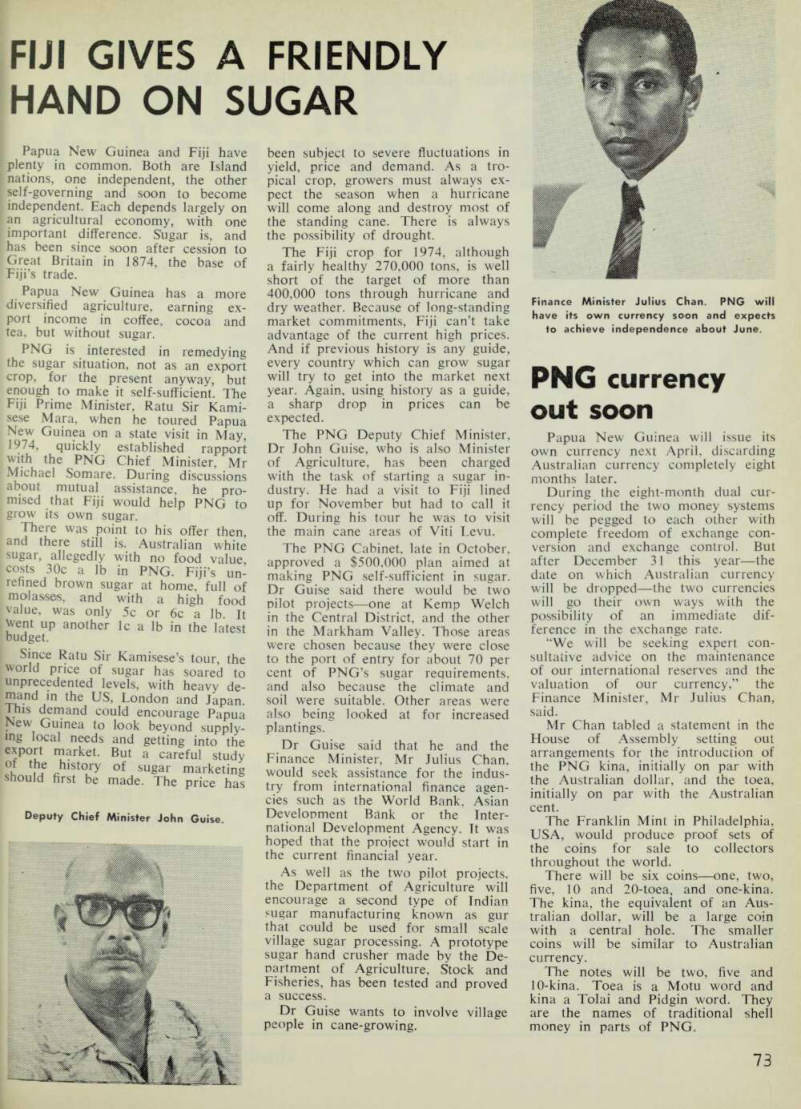
Hand On Sugar
Papua New Guinea and Fiji have plenty in common. Both are Island nations, one independent, the other self-governing and soon to become independent. Each depends largely on an agricultural economy, with one important difference. Sugar is, and has been since soon after cession to Great Britain in 1874, the base of Fiji’s trade.
Papua New Guinea has a more diversified agriculture, earning ex port income in coffee, cocoa and tea, but without sugar.
PNG is interested in remedying the sugar situation, not as an export crop, for the present anyway, but enough to make it self-sufficient. The Fiji Prime Minister, Ratu Sir Kami sese Mara, when he toured Papua New Guinea on a state visit in May, 1974, quickly established rapport with the PNG Chief Minister, Mr Michael Somare. During discussions about mutual assistance, he pro mised that Fiji would help PNG to grow its own sugar.
There was point to his offer then, and there still is. Australian white sugar, allegedly with no food value, costs 30c a lb in PNG. Fiji’s un refined brown sugar at home, full of molasses, and with a high food value, was only 5c or 6c a lb. It Went up another 1c a lb in the latest budget.
Since Ratu Sir Kamisese’s tour, the world price of sugar has soared to unprecedented levels, with heavy de in the US, London and Japan, this demand could encourage Papua New Guinea to look beyond supply ing local needs and getting into the export market. But a careful study of the history of sugar marketing should first be made. The price has
been subject to severe fluctuations in yield, price and demand. As a tro pical crop, growers must always ex pect the season when a hurricane will come along and destroy most of the standing cane. There is always the possibility of drought.
The Fiji crop for 1974, although a fairly healthy 270,000 tons, is well short of the target of more than 400,000 tons through hurricane and dry weather. Because of long-standing market commitments, Fiji can’t take advantage of the current high prices.
And if previous history is any guide, every country which can grow sugar will try to get into the market next year. Again, using history as a guide, a sharp drop in prices can be expected.
The PNG Deputy Chief Minister, Dr John Guise, who is also Minister of Agriculture, has been charged with the task of starting a sugar in dustry. He had a visit to Fiji lined up for November but had to call it off. During his tour he was to visit the main cane areas of Viti Levu.
The PNG Cabinet, late in October, approved a $500,000 plan aimed at making PNG self-sufficient in sugar.
Dr Guise said there would be two pilot projects—one at Kemp Welch in the Central District, and the other in the Markham Valley, Those areas were chosen because they were close to the port of entry for about 70 per cent of PNG’s sugar requirements, and also because the climate and soil were suitable. Other areas were also being looked at for increased plantings.
Dr Guise said that he and the Finance Minister, Mr Julius Chan, would seek assistance for the indus try from international finance agen cies such as the World Bank, Asian Development Bank or the Inter national Development Agency. It was hoped that the project would start in the current financial year.
As well as the two pilot projects, the Department of Agriculture will encourage a second type of Indian sugar manufacturing known as gur that could be used for small scale village sugar processing. A prototype sugar hand crusher made by the De partment of Agriculture, Stock and Fisheries, has been tested and proved a success.
Dr Guise wants to involve village people in cane-growing.
Deputy Chief Minister John Guise.
Finance Minister Julius Chan. PNG will have its own currency soon and expects to achieve independence about June.
PNG currency
out soon
Papua New Guinea will issue its own currency next April, discarding Australian currency completely eight months later.
During the eight-month dual cur rency period the two money systems will be pegged to each other with complete freedom of exchange con version and exchange control. But after December 31 this year—the date on which Australian currency will be dropped—the two currencies will go their own ways with the possibility of an immediate dif ference in the exchange rate.
“We will be seeking expert con sultative advice on the maintenance of our international reserves and the valuation of our currency,” the Finance Minister, Mr Julius Chan, said.
Mr Chan tabled a statement in the House of Assembly setting out arrangements for the introduction of the PNG kina, initially on par with the Australian dollar, and the toea, initially on par with the Australian cent.
The Franklin Mint in Philadelphia, USA, would produce proof sets of the coins for sale to collectors throughout the world.
There will be six coins—one, two, five, 10 and 20-toea, and one-kina.
The kina, the equivalent of an Aus tralian dollar, will be a large coin with a central hole. The smaller coins will be similar to Australian currency.
The notes will be two, five and 10-kina. Toea is a Motu word and kina a Tolai and Pidgin word. They are the names of traditional shell money in parts of PNG.
Advertisements & other items, pp. 76-78 (1 item)
paper products
New Zealands most innovative packaging and printing combine
group
I * •' *. m w m w congratuates the Government of Papua New Guinea on its innovation of the Wellington and Suva Offices to foster trade and good relations.
All peoples of the Pacific have a common interest in the balanced and
progressive development
of the region.
We are proud that A.H.I.
Paper group can provide the most comprehensive printing, packaging and
promotional material
supply system. Pacific Wide Offices make service a pleasure for our customers and ourselves.
WliM
Paper Products Group incorporating HYGRADE PACKAGING COMPANY
and MARTIN PRINTING COMPANY,
862 Great South Road, Penrose, (Private Bag), Penrose, Auckland, New Zealand. Phones; 592-839.
PAPUA NEW GUINEA
goes Pacific...
V it % anim
n*Mi ssl
J 2 The Papua New Guinea Government Offices in Sukuna House, Suva.
The Papua New Guinea Government announces the official opening of its Commission in Fiji.
For all enquiries, applications for entry permits, visas, trade investment, employment opportunities and general information contact:
PAPUA NEW GUINEA GOVERNMENT COMMISSIONER
SIXTH FLOOR, SUKUNA HOUSE, MacARTHUR STREET, SUVA. TELEPHONE: 2-4939.
See page 68 for our new offices in Wellington.
Do you want to do business
in New Zealand?
Ask the bank
which has
40% of the banking
business in
New Zealand
The BNZ can give you full information on buying or selling in New Zealand and overseas.
Full information on investment, movement of money, transfers of dividends etc., is also readily available.
There are offices everywhere, more than 400 in fact.
Whatever your financial or trade needs, the BNZ can help you.
Wellington - International Division, Box 2392.
Sydney -GPO Box 507, Sydney,
N.S.W. 2001.
Melbourne - GPO Box 528 E, Melbourne, Vic. 3001.
Tokyo - Mr G. Scott, Bank of New Zealand Representative Office, Japan,Suite 240, New Tokyo Bldg, 3-1, 3-Chrome, Marunouchi, Chiyoda-ku, Tokyo 100.
Singapore - Mr R. F. Warren, Bank of New Zealand Representative Office, South East Asia. 4th Floor, Ramayana Bldg, 45/47 D, Robinson Rd, Singapore.
London - PO Box 402, London EC4.
Fiji -25 Victoria Parade. Also at Labasa, Lautoka, Nadi, Sigatoka, Ba.
H
Bank of New Zealand
Business and Development
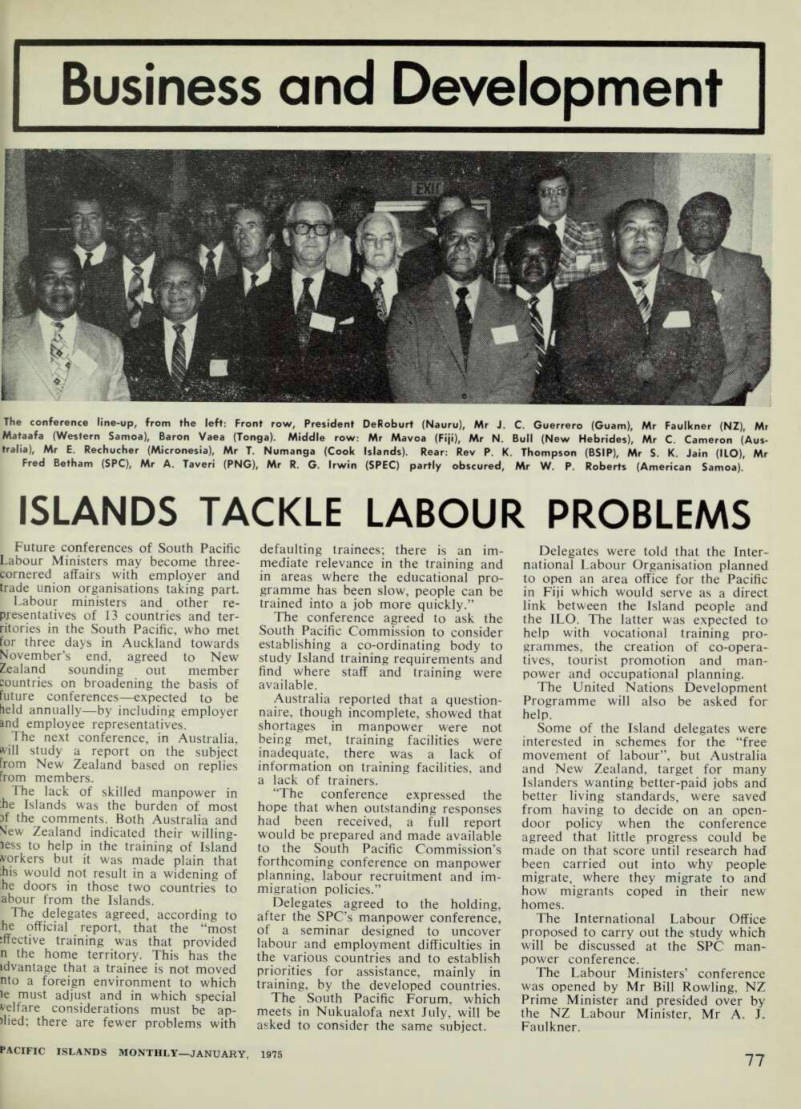
The conference line-up, from the left: Front row, President DeRoburt (Nauru), Mr J. C. Guerrero (Guam), Mr Faulkner (NZ), Mr Mataafa (Western Samoa), Baron Vaea (Tonga). Middle row: Mr Mavoa (Fiji), Mr N. Bull (New Hebrides), Mr C. Cameron (Aus tralia), Mr E. Rechucher (Micronesia), Mr T. Numanga (Cook Islands). Rear: Rev P. K. Thompson (BSIP), Mr S. K. Jain (ILO), Mr Fred Betham (SPC), Mr A. Taveri (PNG), Mr R. G. Irwin (SPEC) partly obscured, Mr W. P. Roberts (American Samoa).
Islands Tackle Labour Problems
Future conferences of South Pacific Labour Ministers may become three cornered affairs with employer and trade union organisations taking part.
Labour ministers and other re presentatives of 13 countries and ter ritories in the South Pacific, who met for three days in Auckland towards November’s end, agreed to New Zealand sounding out member countries on broadening the basis of future conferences—expected to be held annually—by including employer and employee representatives.
The next conference, in Australia, will study a report on the subject from New Zealand based on replies from members.
The lack of skilled manpower in ;he Islands was the burden of most the comments. Both Australia and Mew Zealand indicated their willing less to help in the training of Island workers but it was made plain that his would not result in a widening of he doors in those two countries to abour from the Islands.
The delegates agreed, according to he official report, that the “most sffective training was that provided n the home territory. This has the idvantage that a trainee is not moved nto a foreign environment to which ie must adjust and in which special welfare considerations must be ap )lied; there are fewer problems with
defaulting trainees; there is an im mediate relevance in the training and in areas where the educational pro gramme has been slow, people can be trained into a job more quickly.”
The conference agreed to ask the South Pacific Commission to consider establishing a co-ordinating body to study Island training requirements and find where staff and training were available.
Australia reported that a question naire, though incomplete, showed that shortages in manpower were not being met, training facilities were inadequate, there was a lack of information on training facilities, and a lack of trainers.
“The conference expressed the hope that when outstanding responses had been received, a full report would be prepared and made available to the South Pacific Commission’s forthcoming conference on manpower planning, labour recruitment and im migration policies.”
Delegates agreed to the holding, after the SPC’s manpower conference, of a seminar designed to uncover labour and employment difficulties in the various countries and to establish priorities for assistance, mainly in training, by the developed countries.
The South Pacific Forum, which meets in Nukualofa next July, will be asked to consider the same subject.
Delegates were told that the Inter national Labour Organisation planned to open an area office for the Pacific in Fiji which would serve as a direct link between the Island people and the ILO. The latter was expected to help with vocational training pro grammes, the creation of co-opera tives, tourist promotion and man power and occupational planning.
The United Nations Development Programme will also be asked for help.
Some of the Island delegates were interested in schemes for the “free movement of labour”, but Australia and New Zealand, target for many Islanders wanting better-paid jobs and better living standards, were saved from having to decide on an open door policy when the conference agreed that little progress could be made on that score until research had been carried out into why people migrate, where they migrate to and how migrants coped in their new homes.
The International Labour Office proposed to carry out the study which will be discussed at the SPC man power conference.
The Labour Ministers’ conference was opened by Mr Bill Rowling, NZ Prime Minister and presided over by the NZ Labour Minister, Mr A. L Faulkner.
islanders protest over prices
Gendarmes come in when Wallis islanders protest over prices
From a Noumea correspondent
Irate islanders in the Wallis group have removed their French Adminis trator Mr Jacques de Agostini and demanded the withdrawal of the Sofrana shipping line from their waters in protest over the soaring price of goods imported to the islands.
The French High Commissioner in the Pacific, Mr J-G Eriau, hastily flew to Wallis from Noumea aboard a French naval aircraft when the furore flared up in November. He was accompanied by other civil ser vants together with the Public Prose cutor, a colonel and five gendarmes.
The Wallis affair came to a head when the angry islanders demon strated in their capital Mata Utu and
prevented the Sofrana vessel berth ing and discharging cargo on its 6weekly voyage. This prompted the immediate flight to the island of Sofrana Director, Gaspard Ravel, the French Director of Maritime Services in Noumea, Mr Jean Sauvee and a public servant from the Wallis office in Noumea.
French reaction was immediate— the return to Noumea of Mr de Agostini, whose removal was de manded by the islanders, and a promptly-announced 20 per cent drop in freight rates plus a 20 per cent cut in prices on grocer shop shelves.
Calm was thus speedily restored and the Capitaine Tasman was allowed to berth and discharge its cargo.
Next move was the arrival in Wallis, only four days after the first French mission, of High Commiss ioner Eriau with gendarmes and other escort. Mr Eriau met with the island’s hereditary chiefs and elected representatives.
At a gathering of about 60 not ables in the Territorial Assembly, local leaders repeated their demands for the replacement of Mr de Agos tini and the Sofrana Line. It was re ported that the islanders were not prepared to guarantee the safety of the French Administrator should he try to return to pack his belongings.
Returning to Noumea after these talks, Mr Eriau stated that the French Government would consider nominating a new administrator in the group as well as examining the possible take-over of the shipping service.
Throughout the tempest, Noumea reports reaffirmed the islanders’ loyalty and attachment to France.
However, when provisions arrive only at six-weekly intervals accumu
lated price hikes are inevitably in furiating. Moreover, the violent out cry from the whole population of more than 5,000 people must be seen against a background of the poverty of a subsistence economy, , with very few paid job opportunities i and heavy dependence on cash from i migrant workers going to New Cale donia, where home-bound cheques < have been diminishing under the pre- • sent economic slump.
Life in Wallis and Futuna, 1,200 ( miles from Noumea, remains a fairly T tightly-closed circuit within the; French empire. A widespread group ( of international specialists—health,, agricultural, rat-control officers and J others—who inspected the islands? several years ago under a programme j run by the South Pacific Commission! came out with such a devastating < report of the islands’ sanitation and! health situation that it aroused af furore in Noumea’s French adminis tration.
That was during the term of offices of the late Afoafouvale Misimoa asg SPC Secretary-General and thes French immediately made it knownc that SPC specialists would no longen be welcome in Wallis, so the was placed out of bounds to foreignn inspection.
Rothmans (PNG) has
government interest
The Investment Corporation oh Papua New Guinea in December; acquired a 26 per cent shareholding in the local subsidiaries of the Aus? tralian tobacco and cigarette manui facturers, Rothmans of Pall Mali (Australia) Ltd. The deal was worth $587,000, giving the corporation shares in two companies formerly wholly owned by Rothmans.
The companies are Rothmans oc Pall Mall (PNG) Pty Ltd and Right land Tobacco Pty Ltd, both operating factories near Goroka in the PNC Highlands. The two companies emr ploy more than 350 New Guineans and supply markets in PNG, thr British Solomons and the New Hebrides.
The PNG Investment Corporatioic is a statutory authority sponsored be the Australian Government and nov wholly responsible to the PNO Government. It is designed to phasg ownership of PNG ventures into tbr hands of New Guineans. At presem it holds the shares in its own namn and issues unit trust type shares whicc can be bought only by PNO nationals. , . .
The corporation now has substantial shareholdings in 24 major compam© which previously provided no equitt for New Guineans.
Advertisements & other items, p. 80 (1 item)
From Germany
SOFT DRINK MACHINERY
FOR SALE
ALL FULLY RECONDITIONED
Eight-head PROGRESSIVE FILLING
MACHINE.
Single track HYDRO BOTTLE
WASHER.
250 G.P.H. CARBONATOR.
IDEAL FOR IMPROVING OR
ESTABLISHING A SAAALL TO
MEDIUM SIZE SOFT DRINK
FACTORY.
All flavours Fruit Juices, Bottlers' Concentrates available with formulae and continued free Technical advice.
CONTACT;
KEITH HARRIS & CO. LTD.,
1015 ANN STREET, VALLEY,
BRISBANE, 4006, AUSTRALIA.
184 SUSSEX STREET,
(3RD FLOOR),
SYDNEY.
CABLE ADDRESS:
DEMKAY, SYDNEY.
ASK US FOR QUOTATIONS
FROM GERMANY
• kitchen appliances • refrigerators • washing machines • wines • lace materials • paper serviettes • sanitary towels • toilet paper • curtain materials • dress materials • automotive parts and tools • garage equipment • fork lifts • agricultural sprayers, etc., etc.
Caledonians
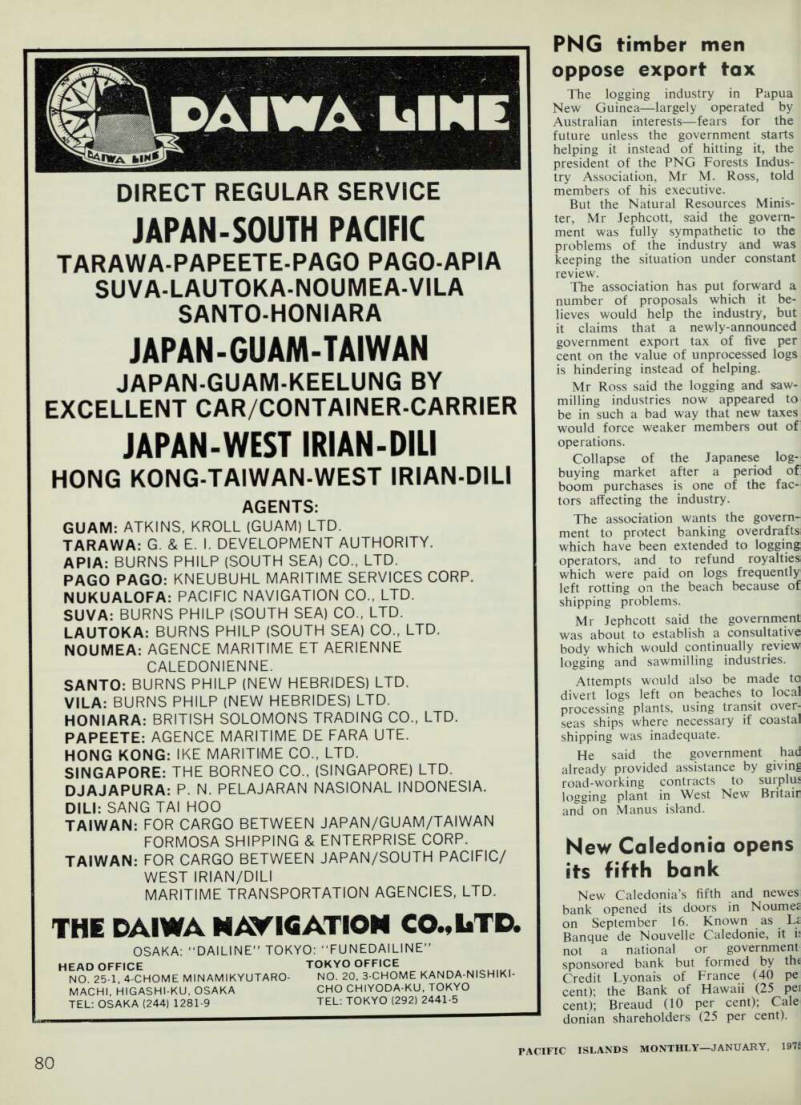
Hard Times
Ahead For
French Governor J-G Eriau warned of necessary austerity mea sures, mounting unemployment and a stem line against trouble-makers, when he opened the current budget session of the New Caledonian Territorial Assembly in mid- November.
Governor Eriau, not long returned from Paris, pointed out the value of French “national solidarity” when he promised that the Paris govern ment would meet the growing budget deficit faced by an island which France had earlier predicted would be the world’s second greatest pro ducer of nickel by 1975.
Following several years massive build-up of the island’s public ser vice in preparation for the nickel developments, Governor Eriau has now announced that there must be sackings in the service. The lopsided growth of the civil service has led to its consuming practically all terri torial revenue, forcing the islanders to engage upon extensive, costly loans besides subsidies from France, to pay for massive infrastructural programmes.
Since, legally, the Caledonian budget must balance each year, the governor announced a handout of about SAIS million from France, of which about half is to make up for the nickel export tax exemption granted to the SLN mining company.
Amid the current economic gloom, the Territorial Assembly is sending yet another mission to Paris in Janu ary to try to obtain some decisive action over nickel industry expansion.
Meanwhile, referring to his recent talks with French President Giscard d’Estaing, Governor Eriau stressed that local trouble-makers in the pre sent difficult circumstances would promptly be brought to justice as in recent cases.
The governor saw two main prob lems facing the economy—an in :rease in unemployment coupled with a rise in prices which in 1974 was jxpected to exceed 18 per cent. At the same time, expansion in the lickel industry (68,000 tonnes of metal exported in 1974) was not sufficient to support all the expendi ture undertaken and the islanders were warned that they would have to contribute more to the island’s de velopment if they were to expect future aid from France. The French Administration has proposed a 1975
budget expenditure of 10,000 million CFP (SA9O million) with a rise in indirect taxes of about SAI4 million.
Governor Eriau detailed future prospects for nickel development, ad mitting that the recent shelving of the new factory for the north was a “hard blow” for the territory. Most likely advance is now awaited from the joint project of the SEN and the state oil company SNPA (Aqui taine). But first, certain tax con cessions must be agreed upon to make the venture workable.
Meanwhile, the message for the
Caledonians is that Paris has achieved a prestigious new airport terminal, port installations, sporting stadiums and the rest but has failed to match this with appropriate revenue-producing industrialisation, Although it was Paris and not the Caledonians who controlled the execution of these expensive develop ment contracts, the locals have now been told to tighten their belts, pay for the beautiful spectacle and woe to those who impinge upon others’ democratic rights by contesting the situation.
PNG timber men
oppose export tax
The logging industry in Papua New Guinea —largely operated by Australian interests—fears for the future unless the government starts helping it instead of hitting it, the president of the PNG Forests Indus try Association, Mr M. Ross, told members of his executive.
But the Natural Resources Minis ter, Mr Jephcott, said the govern ment was fully sympathetic to the problems of the industry and was keeping the situation under constant review.
The association has put forward a number of proposals which it be lieves would help the industry, but it claims that a newly-announced government export tax of five per cent on the value of unprocessed logs is hindering instead of helping.
Mr Ross said the logging and saw milling industries now appeared to be in such a bad way that new taxes would force weaker members out of operations.
Collapse of the Japanese log buying market after a period of boom purchases is one of the fac tors affecting the industry.
The association wants the govern ment to protect banking overdrafts; which have been extended to logging operators, and to refund royalties which were paid on logs frequently left rotting on the beach because of shipping problems.
Mr Jephcott said the government was about to establish a consultative body which would continually review logging and sawmilling industries.
Attempts would also be made to divert logs left on beaches to local processing plants, using transit over seas ships where necessary if coastal shipping was inadequate.
He said the government had already provided assistance by giving road-working contracts to surplus logging plant in West New Britain and on Manus island.
New Caledonia opens
its fifth bank
New Caledonia’s fifth and newes bank opened its doors in Noumea on September 16. Known as li Banque de Nouvelle Caledonie, it if not a national or government sponsored bank but formed by the Credit Lyonais of France (40 pe cent); the Bank of Hawaii (25 pei cent); Breaud (10 per cent); Cale donian shareholders (25 per cent).
Advertisements & other items, pp. 81-82 (2 items)
79
ACIFIC ISLANDS MONTHLY—JANUARY, 1875
Union Steam Ship Co. Of N.Z.
PACIFIC ISLANDS TRANSPORT UNE
Owners: Thor Dahls Hvalfangerselskap A/S — Sandefjord, Norway.
MOTOR VESSEL "THORSISLE"
Regular Freight and Passenger Services between Pacific Coast Ports of U.S.A. and Canada and
TAHITI and SAMOA
GENERAL STEAMSHIP CORPORATION LTD.
General Agents 400 California Street, San Francisco, California, U.S.A.
APlA—Burns Phi Ip (South Sea) Company, SYDNEY—Trans-Austral Shipping Pty. Ltd.
Ltd. SUVA—Burns Philp (South Sea) Company, PAPEETE —Agence Maritime Internationale Ltd.
Tahiti. LAE/RABAUL —Burns Philp (New Guinea) Ltd.
PAGO PAGO—G. H. C. Reid & Co. PORT VILA —Comptoirs Francais de Nouvelles NOUMEA—Etablissements Ballande. Hebrides.
UNION STEAM SHIP CO. of N.Z.
LIMITED
Serving the Pacific for nearly 100 years.
Regular Sailings by Modern Vessels
From Auckland to Lautoka, Suva, Pago Pago, Apia, Niue, Vavau, Nukualofa. Also from Tauranga to Lautoka, Suva, Apia, Nukualofa. Regular sailings from Australia to New Zealand to enable transhipment of cargo to all the above ports.
Ship your cargo by a Union Company Vessel.
BRANCHES AT ALL MAIN AUSTRALIAN, NEW ZEALAND AND ISLAND PORTS.
DAIWA LINE
DIRECT REGULAR SERVICE
JAPAN-SOUTH PACIFIC
TARAWA-PAPEETE-PAGO PAGO-APIA
SUVA-LAUTOKA-NOUMEA-VILA
SANTO-HONIARA
JAPAN-GUAM-TAIWAN
JAPAN-GUAM-KEELUIMG BY
EXCELLENT CAR/CONTAINER-CARRIER
JAPAN-WEST IRIAN-DILI
HONG KONG-TAIWAN-WEST IRIAN-DILI
AGENTS:
GUAM: ATKINS, KROLL (GUAM) LTD.
TARAWA; G. & E. I. DEVELOPMENT AUTHORITY.
APIA: BURNS PHILP (SOUTH SEA) CO., LTD.
PAGO PAGO: KNEUBUHL MARITIME SERVICES CORP.
NUKUALOFA: PACIFIC NAVIGATION CO., LTD.
SUVA: BURNS PHILP (SOUTH SEA) CO., LTD.
LAUTOKA; BURNS PHILP (SOUTH SEA) CO., LTD.
NOUMEA: AGENCE MARITIME ET AERIENNE
CALEDONIENNE.
SANTO: BURNS PHILP (NEW HEBRIDES) LTD.
VILA: BURNS PHILP (NEW HEBRIDES) LTD.
HONIARA: BRITISH SOLOMONS TRADING CO., LTD.
PAPEETE: AGENCE MARITIME DE FARA UTE.
HONG KONG: IKE MARITIME CO., LTD.
SINGAPORE: THE BORNEO CO., (SINGAPORE) LTD.
DJAJAPURA: P. N. PELAJARAN NASIONAL INDONESIA.
DILI: SANG TAI HOO
TAIWAN: FOR CARGO BETWEEN JAPAN/GUAM/TAIWAN
FORMOSA SHIPPING & ENTERPRISE CORP.
TAIWAN: FOR CARGO BETWEEN JAPAN/SOUTH PACIFIC/
WEST IRIAN/DILI
MARITIME TRANSPORTATION AGENCIES, LTD.
THE DAIWA NAVIGATION CO.,LTD.
OSAKA: “DAILINE” TOKYO; “FUNEDAILINE"
HEAD OFFICE TOKYO OFFICE
NO. 25-1, 4-CHOME MINAMIKYUTARO- NO. 20, 3-CHOME KANDA-NISHIKI-
MACHI, HIGASHI-KU, OSAKA CHO CHIYODA-KU, TOKYO
TEL; OSAKA (244) 1281-9 TEL: TOKYO (292) 2441-5
Shipping Information
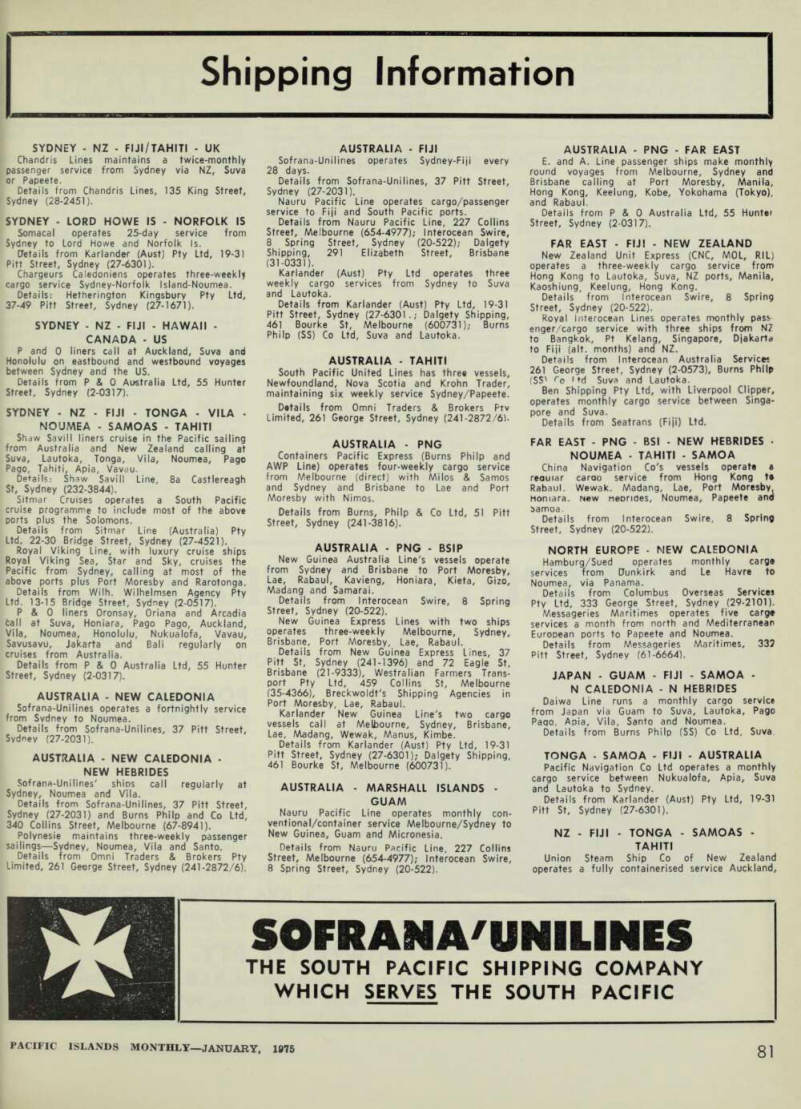

SYDNEY - NZ - FIJI/TAHITI ■ UK Chandris Lines maintains a twice-monthly passenger service from Sydney via NZ, Suva or Papeete.
Details from Chandris Lines, 135 King Street, Sydney (28-2451).
SYDNEY - LORD HOWE IS - NORFOLK IS Somacal operates 25-day service from Sydney to Lord Howe and Norfolk Is.
Details from Karlander (Aust) Pty Ltd, 19-31 Pitt Street, Sydney (27-6301).
Chargeurs Caledoniens operates three-weekly cargo service Sydney-Norfoik Island-Noumea.
Details: Hetherington Kingsbury Pty Ltd, 37-49 Pitt Street, Sydney (27-1671).
SYDNEY - NZ - FIJI - HAWAII -
Canada - Us
P and 0 liners call at Auckland, Suva and Honolulu on eastbound and westbound voyages between Sydney and the US.
Details from P & 0 Australia Ltd, 55 Hunter Street, Sydney (2-0317).
SYDNEY - NZ - FIJI - TONGA ■ VILA -
Noumea - Samoas - Tahiti
Shaw Savill liners cruise in the Pacific sailing from Australia and New Zealand calling at Suva, Lautoka, Tonga, Vila, Noumea, Pago Pago, Tahiti, Apia, Vavau.
Details: Shaw Savill Line, 8a Castlereagh St, Sydney (232-3844).
Sitmar Cruises operates a South Pacific cruise programme to include most of the above ports plus the Solomons.
Details from Sitmar Line (Australia) Pty Ltd, 22-30 Bridge Street, Sydney (27-4521).
Royal Viking Line, with luxury cruise ships Royal Viking Sea, Star and Sky, cruises the Pacific from Sydney, calling at most of the above ports plus Port Moresby and Rarotonga.
Details from Wilh. Wilhelmsen Agency Pty Ltd, 13-15 Bridge Street, Sydney (2-0517).
P & 0 liners Oronsay, Oriana and Arcadia call at Suva, Honiara, Pago Pago, Auckland, Vila, Noumea, Honolulu, Nukualofa, Vavau, Savusavu, Jakarta and Bali regularly on cruises from Australia.
Details from P & 0 Australia Ltd, 55 Hunter Street, Sydney (2-0317).
Australia - New Caledonia
Sofrana-Unilines operates a fortnightly service from Sydney to Noumea.
Details from Sofrana-Unilines, 37 Pitt Street, Sydney (27-2031).
Australia - New Caledonia -
New Hebrides
Sofrana-Unilines' shins call regularly at Sydney, Noumea and Vila.
Details from Sofrana-Unilines, 37 Pitt Street, Sydney (27-2031) and Burns Philp and Co Ltd, 340 Collins Street, Melbourne (67-8941).
Polynesie maintains three-weekly passenger sailings—Sydney, Noumea, Vila and Santo.
Details from Omni Traders & Brokers Pty Limited, 261 George Street, Sydney (241-2872/6).
Australia - Fiji
Sofrana-Unilines operates Sydney-Fiji every 28 days.
Details from Sofrana-Unilines, 37 Pitt Street, Sydney (27-2031).
Nauru Pacific Line operates cargo/passenger service to Fiji and South Pacific ports.
Details from Nauru Pacific Line, 227 Collins Street, Melbourne (654-4977); Interocean Swire, 8 Spring Street, Sydney (20-522); Dalgety Shipping, 291 Elizabeth Street, Brisbane (31-0331).
Karlander (Aust) Pty Ltd operates three weekly cargo services from Sydney to Suva and Lautoka.
Details from Karlander (Aust) Pty Ltd, 19-31 Pitt Street, Sydney (27-6301.; Dalgety Shipping, 461 Bourke St, Melbourne (600731); Burns Philp (SS) Co Ltd, Suva and Lautoka.
Australia - Tahiti
South Pacific United Lines has three vessels, Newfoundland, Nova Scotia and Krohn Trader, maintaining six weekly service Sydney/Papeete.
Details from Omni Traders & Brokers Prv Limited, 261 George Street, Sydney (241-2872/61.
Australia - Png
Containers Pacific Express (Burns Philp and AWP Line) operates four-weekly cargo service from Melbourne (direct) with Milos & Samos and Sydney and Brisbane to Lae and Port Moresby with Nimos.
Details from Burns, Philp & Co Ltd, 51 Pitt Street, Sydney (241-3816).
Australia - Png - Bsip
New Guinea Australia Line's vessels operate from Sydney and Brisbane to Port Moresby, Lae, Rabaul, Kavieng, Honiara, Kieta, Gizo, Madang and Samarai.
Details from Interocean Swire, 8 Spring Street, Sydney (20-522).
New Guinea Express Lines with two ships operates three-weekly Melbourne, Sydney, Brisbane, Port Moresby, Lae, Rabaul.
Details from New Guinea Express Lines, 37 Pitt St, Sydney (241-1396) and 72 Eagle St, Brisbane (21-9333), Westralian Farmers Trans port Pty Ltd, 459 Collins St, Melbourne (35-4366), Breckwoldt's Shipping Agencies in Port Moresby, Lae, Rabaul.
Karlander New Guinea Line's two cargo vessels call at Melbourne, Sydney, Brisbane, Lae, Madang, Wewak, Manus, Kimbe.
Details from Karlander (Aust) Pty Ltd, 19-31 Pitt Street, Sydney (27-6301); Dalgety Shipping, 461 Bourke St, Melbourne (600731).
Australia - Marshall Islands -
Guam
Nauru Pacific Line operates monthly con ventional/container service Melbourne/Sydney to New Guinea, Guam and Micronesia.
Details from Nauru Pacific Line, 227 Collins Street, Melbourne (654-4977); Interocean Swire, 8 Spring Street, Sydney (20-522).
Australia - Png - Far East
E. and A. Line passenger ships make monthly round voyages from Melbourne, Sydney and Brisbane calling at Port Moresby, Manila, Hong Kong, Keelung, Kobe, Yokohama (Tokyo), and Rabaul.
Details from P & 0 Australia Ltd, 55 Hunter Street, Sydney (2-0317).
FAR EAST - FIJI - NEW ZEALAND New Zealand Unit Express (CNC, MOL, RIL) operates a three-weekly cargo service from Hong Kong to Lautoka, Suva, NZ ports, Manila, Kaoshiung, Keelung, Hong Kong.
Details from Interocean Swire, 8 Spring Street, Sydney (20-522).
Royal Inferocean Lines operates monthly pass enger/cargo service with three ships from NZ to Bangkok, Pt Kelang, Singapore, Djakarta to Fiji (alt. months) ana NZ.
Details from Interocean Australia Services 261 George Street, Sydney (2-0573), Burns Philp (SS' r o itd Suva and Lautoka.
Ben Shipping Pty Ltd, with Liverpool Clipper, operates monthly cargo service between Singa pore and Suva.
Details from Seatrans (Fiji) Ltd.
FAR EAST - PNG - BSI - NEW HEBRIDES •
Noumea • Tahiti - Samoa
China Navigation Co's vessels operate e reauiar carao service from Hong Kong te Rabaul. Wewak. Madang, Lae, Port Moresby Honiara. New heondes, Noumea, Papeete and aamoa.
Details from Interocean Swire, 8 Spring Street, Sydney (20-522).
North Europe - New Caledonia
Hamburg/Sued operates monthly carge services from Dunkirk and Le Havre to Noumea, via Panama.
Details from Columbus Overseas Services Pty Ltd, 333 George Street, Sydney (29-2101).
Messageries Maritimes operates five carge services a month from north and Mediterranean European ports to Papeete and Noumea.
Details from Messageries Maritimes, 332 Pitt Street, Sydney (61-6664).
JAPAN - GUAM - FIJI - SAMOA ■
N Caledonia - N Hebrides
Daiwa Line runs a monthly cargo service from Japan via Guam to Suva, Lautoka, Pago Pago, Apia, Vila, Santo and Noumea.
Details from Burns Philp (SS) Co Ltd, Suva TONGA - SAMOA - FIJI - AUSTRALIA Pacific Navigation Co Ltd operates a monthly cargo service between Nukualofa, Apia, Suva and Lautoka to Sydney.
Details from Karlander (Aust) Pty Ltd, 19-31 Pitt St, Sydney (27-6301).
NZ - FIJI - TONGA - SAMOAS -
Tahiti
Union Steam Ship Co of New Zealand operates a fully containerised service Auckland,
or Onehunga, Suva, Pago Pago, Apia and Nukualofa every 14 days.
A service is operated Auckland, or Onehunga, Lautoka, Suva, Auckland approximately every two weeks.
A 28-day service is operated from Auckland to Papeete.
Details from any office of the Union Steam Ship Co, Fiji, Tonga, Samoa, Auckland.
Nz - Norfolk
USS Co vessels operate 26-day cargo service Auckland, Suva, Norfolk Is, Auckland.
Details from Union Steam Ship Co of NZ Ltd. PO Box 12, Auckland.
NZ - N CALEDONIA - N HEBRIDES - FIJI - WALLIS IS - NG - BSIP Sofrana Unilines with four ships operates to Vila and Santo; to Honiara and New Guinea; and to Noumea.
Details from Sofrana-Unilines, 42 Customs Street, Auckland (73-279), P.O. Box 3614.
Telex: NZ 2313.
Nz - Fiji - Us
Crusader cargo ships call at Suva, Levuka and Honolulu on NZ-US west coast trips and at Suva and/or Lautoka on US-NZ southbound trips.
Details from Blue Star Port Lines (Manage ment) Ltd, P.O. Box 192 Wellington (70179).
Nz - Fiji
Fijian Swift and M.V. La Bonita operate a regular 18 day service from Auckland to Suva and Lautoka.
Details from Reef Shipping Agencies Ltd, P.O. Box 13-315, Onehunga, NZ. (Phone 663- 918, 663-928).
UK - PANAMA - SAMOA - FIJI The Fiji Direct Service, cargo only, is main tained by Conference vessels, sailing at regular
monthly intervals out of London, via Panama, for Apia, Suva and Lautoka.
Details from Burns Philp (SS) Co Ltd, Suva.
UK - PNG - BSIP - GEIC - N HEBRIDES ■
N Caledonia
Bank Line operates a monthly direct cargo service from Europe, via the Panama Canal to Papeete, Noumea, major PNG ports and Honiara, occasionally to Tarawa, Vila, Santo, Kieta, Jayapura and Yandina.
Details from Bank Line (A'asia) Pty Ltd, 1 York St, Sydney (27-2041).
Us - Samoa - Australia
Pacific Far East Line operates a three weekly freighter service from Pacific coast ports to Pago Pago, Sydney, Melbourne, Tasmania and Brisbane, returning via Auckland, Pago Pago, to Pacific northwest ports, Vancouver, San Francisco and Los Angeles. (No passengers carried).
Details from PFEL, 50 Young Street, Sydney (27-4272).
US - SYDNEY ■ GEIC ■ HONOLULU Columbus Lines operates a three weekly container cargo sailing from West Coast, US to Australasia, returning via Tarawa, GEIC and Honolulu to Nth America.
Details from Columbus Overseas Services Pty Ltd, 333 George Street, Sydney (29-2101).
Us - Fiji/Tahiti - Australia
Bank Line Ltd operate regular cargo set vices from US Gulf ports to Australia and NZ.
Calls at Suva, Lautoka and Papeete on demand.
Details from Bank Line (A/asia) Pty Ltd, 1 York St, Sydney (27-204).
Pacific Far East Line cruise ships operate regularly from San Francisco, Los Angeles, Honolulu, Moorea, Papeete, Rarotonga, Auck land, Opua, Sydney, and return via Suva,
Niuafoou, Pago Pago and Honolulu to Sane Francisco.
Freight is carried on these passenger linersz Details from PFEL, 50 Young Street, Sydneys (27-4272).
Us - Tahiti - Samoa
Pacific Islands Transport operates i five/six weekly cargo service from North American west coast ports to Papeete, Pag«£ Pago, Apia.
Details from Trans-Austral Shipping Pty Ltdb 19 Pitt Street, Sydney (27-2441).
Us Commission
To Decide Rate Rise
The US Federal Maritime Comr mission will decide the extent, ii any, of a rise in freight rates fox the Pacific Islands Transport Limi between the US west coast ano, Hawaii and American Samoa. An. increase, proposed by the line, hai been opposed by the Americau Samoa Government and locas merchants.
FMC’s Bureau of Hearing counsel, Donald J. Brunner and C Douglass Miller, at a public hearing urged approval of a proposed ris<{ of 23 per cent. They said that withe out the increase, PITL would bx forced to curtail its services t«: American Samoa.
Advertisements & other items, pp. 83-84 (1 item)
hĥħ
SOFRANA'UNILINES
THE SOUTH PACIFIC SHIPPING COMPANY
WHICH SERVES THE SOUTH PACIFIC
POWERLITE GENERATORS
a 1 •X
15 YEARS PROVEN SERVICE
THROUGHOUT AUSTRALIA
PORTABLE or
STATIONARY
We offer you a choice of AIR or WATER cooled Power units.
DIESEL or PETROL driven by the engine of your choice.
BRUSHLESS or SLIP RING ALTERNATORS made to any requirement or specification in either— Manual, Automatic, Electric and Start-A-Matic.
A full range available from;
1 KVA THROUGH TO 500 KVA
Service and parts readily available.
POWERLITE PTY. LTD.
23A Gordon St., Chipping Norton, N.S.W., 2170, Australia.
Phone: 727-0077. Telex: 24893.
Deaths
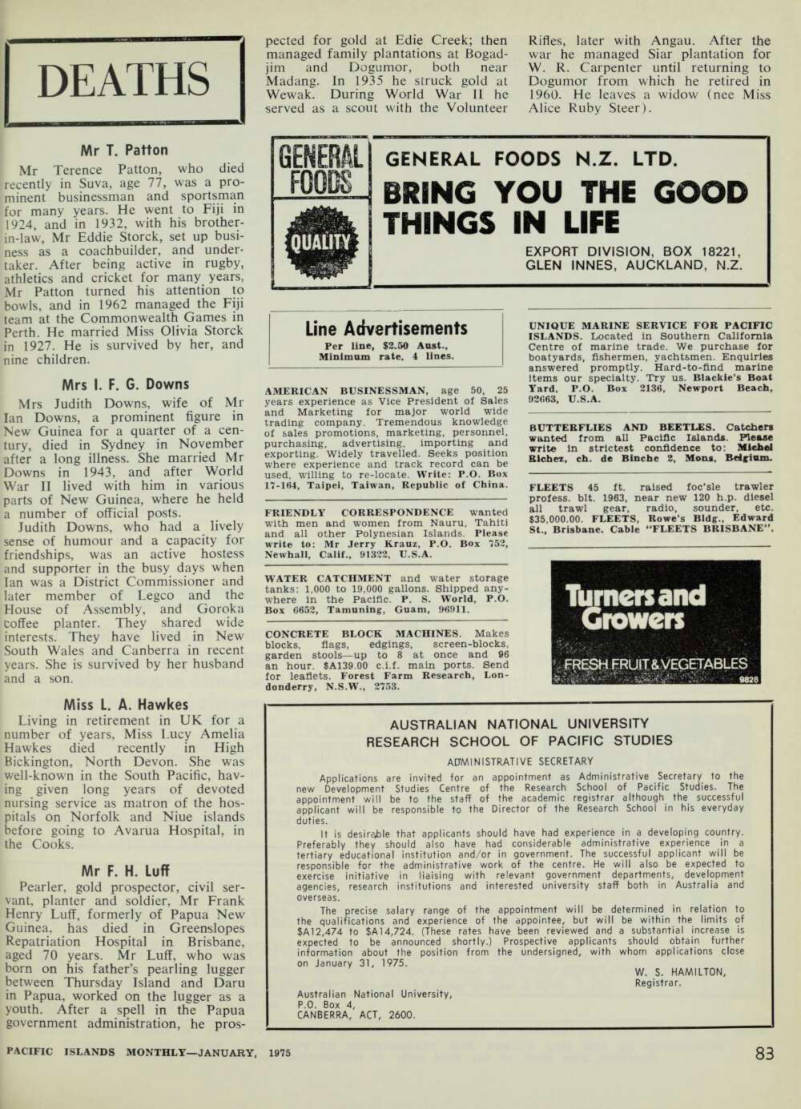
Mr T. Patton Mr Terence Patton, who died recently in Suva, age 77, was a pro minent businessman and sportsman for many years. He went to Fiji in 1924, and in 1932, with his brother in-law, Mr Eddie Storck, set up busi ness as a coachbuilder, and under taker. After being active in rugby, athletics and cricket for many years, Mr Patton turned his attention to bowls, and in 1962 managed the Fiji team at the Commonwealth Games in Perth. He married Miss Olivia Storck in 1927. He is survived by her, and nine children.
Mrs I. F. G. Downs Mrs Judith Downs, wife of Mr lan Downs, a prominent figure in New Guinea for a quarter of a cen tury, died in Sydney in November after a long illness. She married Mr Downs in 1943, and after World War II lived with him in various parts of New Guinea, where he held a number of official posts.
Judith Downs, who had a lively sense of humour and a capacity for friendships, was an active hostess and supporter in the busy days when lan was a District Commissioner and later member of Legco and the House of Assembly, and Goroka coffee planter. They shared wide interests. They have lived in New South Wales and Canberra in recent years. She is survived by her husband and a son.
Miss L. A. Hawkes Living in retirement in UK for a number of years, Miss Lucy Amelia Hawkes died recently in High Bickington, North Devon. She was well-known in the South Pacific, hav ing given long years of devoted nursing service as matron of the hos pitals on Norfolk and Niue islands before going to Avarua Hospital, in the Cooks.
Mr F. H. Luff Pearler, gold prospector, civil ser vant, planter and soldier, Mr Frank Henry Luff, formerly of Papua New Guinea, has died in Greenslopes Repatriation Hospital in Brisbane, aged 70 years. Mr Luff, who was born on his father’s pearling lugger between Thursday Island and Daru in Papua, worked on the lugger as a youth. After a spell in the Papua government administration, he pros
pected for gold at Edie Creek; then managed family plantations at Bogad jim and Dogumor, both near Madang. In 1935 he struck gold at Wewak. During World War II he served as a scout with the Volunteer
Rifles, later with Angau. After the war he managed Siar plantation for W. R. Carpenter until returning to Dogumor from which he retired in 1960. He leaves a widow (nee Miss Alice Ruby Steer),
Advertisements & other items, pp. 85-88 (3 items)
Foods
GENERAL
GENERAL FOODS N.Z. LTD.
BRING YOU THE GOOD
THINGS IN LIFE
EXPORT DIVISION, BOX 18221,
GLEN INNES, AUCKLAND, N.Z.
Line Advertisements
Per line, $2.50 Aust., Minimum rate. 4 lines.
AMERICAN BUSINESSMAN, age 50, 25
years experience as Vice President of Sales and Marketing for major world wide trading company. Tremendous knowledge of sales promotions, marketing, personnel, purchasing, advertising, importing and exporting. Widely travelled. Seeks position where experience and track record can be used, willing to re-locate. Write: P.O. Box 17-164, Taipei, Taiwan, Republic of China.
FRIENDLY CORRESPONDENCE wanted
with men and women from Nauru, Tahiti and all other Polynesian Islands. Please write to: Mr Jerry Krauz, P.O. Box 752, Newhall, Calif., 91322, U.S.A.
WATER CATCHMENT and water storage tanks: 1,000 to 19,000 gallons. Shipped anywhere in the Pacific. P. S. World, P.O.
Box 6652, Tamuning, Guam, 96911.
CONCRETE BLOCK MACHINES. Makes
blocks, flags, edgings, screen-blocks, garden stools —up to 8 at once and 96 an hour. $A139.00 c.i.f. main ports. Send for leaflets. Forest Farm Research, Londonderry, N.S.W., 2753.
UNIQUE MARINE SERVICE FOR PACIFIC
ISLANDS. Located in Southern California Centre of marine trade. We purchase for boatyards, fishermen, yachtsmen. Enquiries answered promptly. Hard-to-find marine Items our specialty. Try us. Blackie’s Boat Yard, P.O. Box 2136, Newport Beach,
92663, U.S.A.
BUTTERFLIES AND BEETLES. Catchers
wanted from all Pacific Islands. Please write in strictest confidence to: Michel Richer, ch. de Binche 2, Mons, Belgium.
FLEETS 45 ft. raised foc’sle trawler profess, bit. 1963, near new 120 h.p. diesel all trawl gear, radio, sounder, etc. $35,000.00. FLEETS, Rowe’s Bldg., Edward St., Brisbane. Cable “FLEETS BRISBANE”.
AUSTRALIAN NATIONAL UNIVERSITY
RESEARCH SCHOOL OF PACIFIC STUDIES
ADMINISTRATIVE SECRETARY
Applications are invited for an appointment as Administrative Secretary to the new Development Studies Centre of the Research School of Pacific Studies. The appointment will be to the staff of the academic registrar although the successful applicant will be responsible to the Director of the Research School in his everyday duties.
It is desirable that applicants should have had experience in a developing country.
Preferably they should also have had considerable administrative experience in a tertiary educational institution and/or in government. The successful applicant will be responsible for the administrative work of the centre. He will also be expected to exercise initiative in liaising with relevant government departments, development agencies, research institutions and interested university staff both in Australia and overseas.
The precise salary range of the appointment will be determined in relation to the qualifications and experience of the appointee, but will be within the limits of $A12,474 to $A 14,724. (These rates have been reviewed and a substantial increase is expected to be announced shortly.) Prospective applicants should obtain further information about the position from the undersigned, with whom applications close on January 31, 1975.
W. S. HAMILTON,
Registrar.
Australian National University, P.O. Box 4,
CANBERRA, ACT, 2600.
§e) LnnJ 3 §e) [nnJ i i InnJ a
SAMOAN HIDEAWAY
BEACH RESORT HOTEL
"The real Western Samoa"
Bungalows situated on a palm-fringed carpet of sand at the mouth of a jungle stream. This is Western Samoa. You'll be glad you came.
Bookings: Instant Hotels, Advance Accommodation, United Travel (in N.Z.), Accommodations Abroad (in Aust.).
Cables: "HIDEAWAY" Apia.
P.O. Box 1191, Apia, Western Samoa.
Primitive luxury
(Polynesian style) Nestled away in the untouched Kingdom of Tonga is new, luxurious "Port of Refuge” International resort. Here is a unique opportunity for your clients to experience the tranquil and relaxed Tongan atmosphere while they enjoy the picturesque surroundings of the new "Port of Refuge". And only a short flight from Fi|i.
Reasonable tariffs from $17.50 with special concessions for children. Agents commission 10 per cent.
Tonga's
Port of Refuge
INTERNATIONAL RESORT
Uava’u Tonga Cables: "Refuge" Tonga or "Tonqatours"
Sydney. Phone: Sydney 85-1603 or 922-1817
3007
Stay at
Aggie Grey's the
South Pacific's legendary hotel Situated right in the heart of Western Samoa. Enjoy Polynesian-style friendliness and service, in cool surroundings, superb entertainment and food. Magnificent white sand beaches only a short drive away.
Airconditioned rooms, swimming pool and full bar facilities.
Bookings through Union Steamship Company of NZ, Pan Am, Air New Zealand or direct to Aggie Grey's, Apia, Western Samoa. Cables: AGGIES, APIA.
KEEPING BABY
HAPPY & WELL-
By giving your baby a Fisher's Teething Powder as needed, you not only keep the little one happy and well, but save yourself all those upsets and nervous tension that beset a mother when baby suffers distress. If used as directed Fisher's Teething Powders quickly and safely soothe baby's sore gums, digestive disorders and intestinal upsets.
Get a packet from your chemist or store today—only 30c for 20 powders —you'll be so glad you did. Fisher & Co., Manufacturing Chemists (Est. 1876), 17 May St., St. Peters, N.S.W. 2044.
PIM 808/72
PARK VIEW MOTEL—BRISBANE
Quiet location —opp. Botanic Gardens.
Single, double, family suites, all with refrig., air conditioning, phone, TV, radio tea making facilities, from $l2. Pool and restaurant.
Phone 31-2695—Telex 40270 Write for coloured brochure — Park View Motel, 128 Alice St, BRISBANE, Qld., 4000.
$
SOUTHERN PACIFIC INSURANCE
COMPANY (PNG) LIMITED
(INCORPORATED IN PAPUA NEW GUINEA)
HEAD OFFICE: BANK HAUS, CHAMPION PDE. P.O. BOX 136 PORT MORESBY, PAPUA NEW GUINEA. PH. 2623 • FIRE • FIRE AND VOLCANIC ERUPTION • HOUSEHOLD COMPREHENSIVE • MOTOR VEHICLE • COMPULSORY THIRD PARTY • COMPULSORY WORKERS COMPENSATION
MARINE • PUBLIC LIABILITY « BURGLARY
Enquiries are invited for all classes of insurance from special representatives at: PORT MORESBY: H. A. McKEE, General Manager, Champion Pde., P.O. Box 136, Ph. 2623 or 2075. LAE: K. J. ARMSTRONG, Manager for Lae, Central Ave, P.O. Box 755, Ph. *£ 4590 or 42-4256. RABAUL: R. H. MEYER, Manager for Rabaul, Mango Ave., P.O. Box 123, Pn. 92-2417 or 92-2755.
Turners Supply Co
FRESH FRUIT & VEGETABLES
9813
INTEROCEAN-NEW ZEALAND LTD.
STEAMSHIP OPERATORS • AGENTS • BROKERS
TEIEX. NZ3791 • ANS. BACK: PLYZETIM • TELEGRAPHIC ADDRESS: ZEAMARINER WELLINGTON • TELEPHONE: 71-976 • P.O. BOX 3637, WELLINGTON, N.Z LEVEL M. WILLIAMS PARKING CENTRE • BOULCOU STREET, WELLINGTON
Our busine
c*c
Your cargo; to anyv
Two paddle steamers on the Yangtse River in 1873 marked the beginning of the China Navigation Company. Today, the same flag flies above eighteen modern motor ships plying an extensive network of cargo routes between Papua New Guinea and Pacific Island ports (as far East as Tahiti) and Japan, New Zealand, Australia and Thailand.
For 100 years, the flag of the China Navigation Company has meant experience, reliability and speed across the sea. Today, it’s flying as strong as ever. y ta p ls and a' l enquiries there are Agents at the following ports: Papua New Guinea: Steamships Trading Co. Ltd., Port Moresby, Samarai, Lae. Madang, ■p i 1 V” ♦ r) n i * T ■ o - puna. M. up uu lien uuuica, kJ icamaii 1 IdUlllg AjU. GIU.
Tnnt^l’ T .J Bxt..^U,iniea! 8 xt. .^ U , in i ea ! Ltd J ’ ,Y^ ev^ a Fiji: Morris HedstromLtd.. Suva, Lautoka. Western Samoa; Morris Hedstrom Ltd., Apia. \ • tt j . r. j x. , . , " *'> * *!»• iicusuuiu i-j iu., ouva, L,auiuKd. vvesieiu sdinua: morns neusirom uia., /\pia.
BSiP-BritUh*! I l Strom T Lt i-’ *r ,uk i 1 j°u and Vava ’ u - Tahiti: Etablissements Donald Tahiti, Papeete. New Caledonia: Etablissements Ballande, Noumea. 9^i! I o P p? nt l S f 1 i S u OI Jl onsTrad T ingCoLtd ’ HoniaraNewHebrides:LesCorn P toirs Francais desNouvelles-Hebrides, Vila and Santo. AUSTRALIA—Sydney: interocean bwire Pty. Ltd. Melbourne: Interocean Australia Pty. Ltd. Brisbane: Gilchrist & Sanderson Pty. Ltd. NEW ZEALAND— P. &O. (N.Z.) Ltd. & Swire**9 h^enteal C BlUff ’ Napier ‘ J apan: Swire McKinnon, Tokyo, Yokohama, Osaka, Kobe and Nagoya. Eastern Managers: Butterfield m CN co JOHN SWIRE & SONS PTY. LTD. General Agents in Australia, 8 Spring Street, Sydney, Phone: 27 9351.
THE CHINA NAVIGATION CO LTD
MEMBER OF THE SWIRE GROUP.
Wholly set up and printed In Australia by PACIFIC PUBLICATIONS (AUST.I PTY. LTD., 29 Alberta Street, Sydney, 201.
„D AT THE GPO SYDNEY FOR TRANSMISSION BY POST AS A NEWSPAPER CATEGORY B REGISTERED^ AT ia THE ri GPO v SYDN Y the recommended Australian retail price only.
Datsun
I M **»«i ■l i p s A j I r * m
WmZJ/ .
** ■ - JB :j‘* Hg And wherever you’ll go in over 120 nations throughout the world you’ll find proud DATSUN drivers.
Perhaps the main reason is that DATSUN was designed to meet a wide variety of conditions—mountain roads and super highways, blistering suns and freezing temperatures. DATSUN is indeed the international car that has precision engineering and a stunning string of rally victories behind it.
Its superb handling, safety features and high speed efficiency make DATSUN the choice of young and old alike. DATSUN- the car that really satisfies the world over.
DATSUN
NISSAN
DATSUN distributor network covers the following areas: Fiii*T.P.N.G.*W. Samoa*New Caledonia• New Hebrides* B.S.l.P.*Timor*Norfolk<