Pacific Islands Monthly

News Magazine Of The South Pacific
lpl;
■ AUSTRALIA, N.Z., P.N.G., FIJI, N. HEBRIDES 60c TONGA, W. SAMOA, 8.5.1. P., G.E.I.C. 60c
Cooks, Norfolk, Niue, Nauru 60C
Am. Samoa, Hawaii, Micronesia, Guam $L.Oo
MCtA/ CA I CHAKII A A Kin CDChiru n/M u.irn I
Our Cover
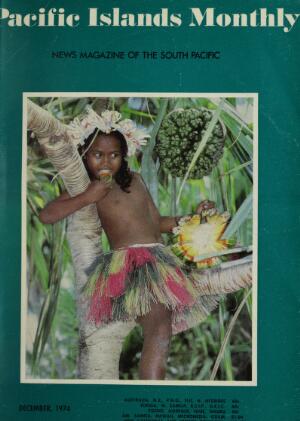
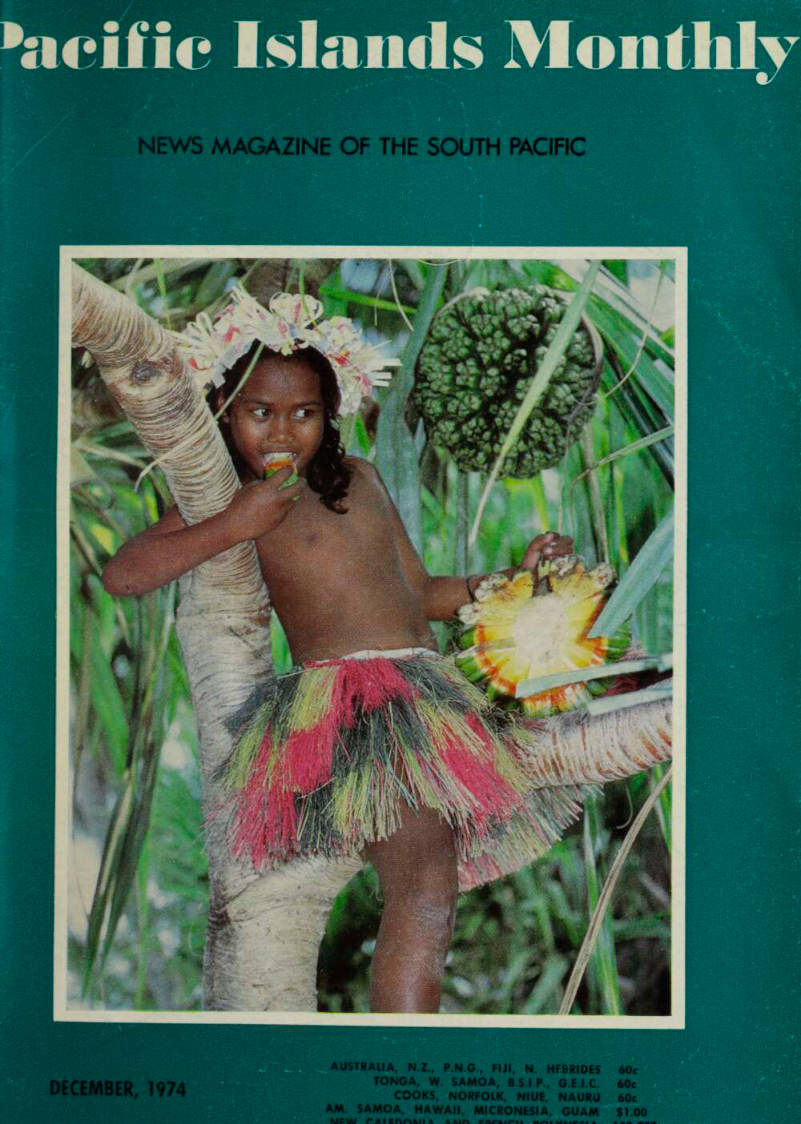
Another Eve in a Garden of Eden—but this garden is in the Gilbert Islands and the fruit which seven-year-old Angela Tenanorake is enjoying is from the pandanus tree, a sweet fruit enjoyed by islanders, young and old alike, and sometimes made into rough cakes. A pandanus fruit, larger than Angela’s head, hangs alongside the child. The picture was taken by the Ger man film producer Karl Heinz von Stellmach for the film of the Gilberts, Sailing in the Trade Winds.
Advertisements & other items, p. 2 (1 item)
little things
I
We’re big on
at Toyota.
There are a lot of things that make a Toyota a great automobile. Big things like computerized quality control. And little things like eye tests.
For the last five years we've been running tests to determine the limits of visibility under various conditions. We test with men and with women. On country roads and city streets. Then we use the results to design our cars from the shape of the windscreen, to the size of the mirrors, to the position and brightness of the headlamps.
Compared to our more sophisticated testing and research, or compared to our performance and sty I But the little things we do add up Because we've been doing them for 36 years. And we'll keep on doing them. Because they go a long way toward making you satisfied. tests may seem insignificant.
TOYOTA
This Issue
Eral
erving Islands' culture 29 ain Cook in America 37 id companies' profits 83 nt's advice to makers ... 83
Irican Samoa
over television film 15
)K Islands
group may mine seabed nodules 85 votes for 'exiles' in NZ 90 jet highlights 7 's first Indian Mayor 7 Talanoa 13 ers' memoirs wanted 19 ch's modern role 33 headquarters for UNDP 39 ?ry in the caneflelds 61 d companies' profits 83 cannery for Levuka 84 cer estate plan shelved 85 rical industry for Lautoka 86 RU lems because of wealth 35
changes 89
New Caledonia
Political demonstrations 6 Americans in Le Nickel 86
New Hebrides
Political changes agreed in London , 4 Co-operative societies make money .. 86
Niue
NZ gift, a parliament building 89
Solomon Islands
Solodia appointed minister 11 Mamaloni's public apology 16
Papua New Guinea
Prisoner escapes twice 6 New currency 15 Kaputin in court 25 Debate on Constitution 25 Ministers differ on reef blasting ... 26 Guinea Gold, wartime newspaper ... 51 Percy Chatterton's Papua 67 New planes demonstrated 77 Air pilots sacked 77 Stevedores paralyse Port Moresby .. 78 Biggest fishery closes 86 Coastal fleet increase 88
Tonga
King to import Japanese wrestling 15 Better shipping service 78 Mess at Vavau's port 78 Island companies' profits 83 Japanese airline plan abandoned 85 Oil search consortium withdraws 85
United States Trust Territory
Congress election results 9 Further delay to Enewetakese return 27 Pan-Am awarded Saipan-Tokyo air route 79
Western Samoa
Budget provisions 7 Ancient pottery finds 21 Stone-throwing condemned 25
\RTMENTS: Up front with the Editor, 3; Tropicalities, 15; Editor's Mailbag, 23; i the Islands Press, 42; Magazine Section, 51; Yesterday, 53; MANA, 54; s, 61; Pacific Transport, 77; Cruising Yachts, 81; Business and Development, 83- Shipping Information, 87; Advertisers' Index, 91.
Advertisements & other items, p. 4 (1 item)
[££4/?S~ &nju*£s
•' •• • • • : x >. • . •!•;
IcoW- sfo^L-
Patter /6 ajjHSts acadty <r gw
, -v ;■.>;. ■ I :■ ' 4*r
[££4/?S~ &nju*£s
ffarkw 15 ajtyvAkft
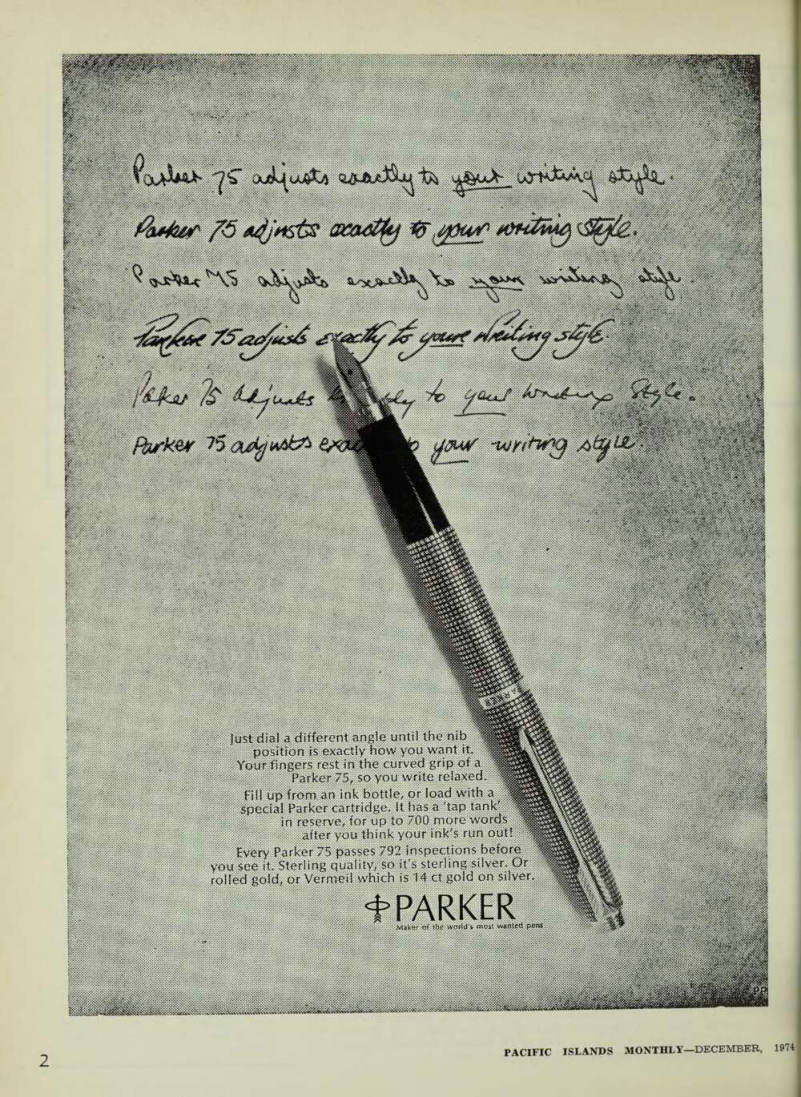
e ™"*3 A^: > Ji||| - ' ' ' ■ ’• ' Just dial a different angle until the nib position is exactly how you want it.
Your fingers rest in the curved grip of a Parker 75, so you write relaxed. ••: Fill up from an ink bottle, or load with a special Parker cartridge. It has a 'tap tank 7 in reserve, for up to 700 more words after you think your ink's run out!
Every Parker 75 passes 792 inspections before you see it. Sterling quality, so it’s sterling silver. Or rolled gold, or Vermeil which is 14 ct gold on silver.
tPARKER
Maker -ot ihe world'4 fnoii wanted peiw V -i > \ • > A i' i , •; ■' ' - : 4 §;:i ■’ V: ’ ,£Js§gw ■■ ✓ ,V£ • ■
Monthly
Pacific Islands
FOUNDED BY R. W. ROBSON IN 1930
Published Monthly By
Pacific Publications (Aust.) Pty. Ltd.,
29 Alberta St., Syctney, N.S.W., 2000.
Postal Address: G.P.O. BOX 3408, SYDNEY,
N.S.W., 2001.
Telegraphic Address: PACPUB, Sydney.
Telex 25168.
Telephones: 61-9197, 61-7101, 61-4369.
onsulting Directors: R. W. Robson, Judy Tudor.
Chief Executives: Manager: Selwyn Hughes.
Publisher: Stuart Inder.
Director of Advertising: W. A. Gasnier.
Pacific Islands Monthly
Editor: Stuart Inder.
Assistant Editor: John Carter.
Advertising Manager: W. A. Gasnier.
Circulation Manager: Jill Garland.
Subscription Rates:
Pacific Islands Monthly" is airfreighted to all bscribers and agents in the Pacific Islands id the U.S.A.; copies to Nauru and other eas go by surface mail, jstralia (incl. Lord Howe and Thursday Is.), }w Zealand, Papua New Guinea, Fiji, New ‘brides, Tonga, Western Samoa, Solomon lands, Gilbert & Ellice Islands, Cook Islands, jrfolk Island, Niue and Nauru Islands: $6.80 >cal currency); American Samoa, Hawaii, icronesia and Guam; $12.00 US; New iledonia and French Polynesia 1,100 CFP; i Mainland: $14.00 US; United Kingdom; i-10. Elsewhere $B.OO Aust.
Representatives
|i: Advertising— Fiji Times & Herald Ltd., 1 Gordon St., Suva. Telephone: 25-601. lex.: FJ 2124. Distribution—Desai Book Depot Ltd., P.O. Box 160, SUVA. Tel.: 311-424. pua New Guinea: PORT MORESBY, PNG Print -3 Co. Pty. Ltd., P.O. Box 633; LAE, P.O. Box 7; RABAUL, Mr. David Simpson, P.O. Box 164 (c/- Rabaul Photographic. Tel.: 2677.) inch Polynesia. Distribution—Hachette Paci iu.e, 10 Ave Bruat, Papeete, w Zealand; Pacific Publications, C.P.O. Box 29, Auckland. 379-494. Representative: Mr Breckell, Breckell Publishing, Kingdon House, rigdon Street, Newmarket, Auckland. Tel.: 54-6834. Telex.: NZ 2727, ited Kingdom: Advertising—Overseas Publicity 1., 214 Oxford Street, London, WIN OEA. one: 01-636 8296/7. Subscriptions—T. B. sham, Park House, 22 Park Street, Croydon,
Cr9 3Np. Tel.: 01-6884177.
9an: Advertising—Universal Media Corpora tion, C.P.O. Box 46, Tokyo. Tel.: 666-3036. :toria: Advertising Pacific Publications ust.) Pty. Ltd., 2nd Floor, 61 Flinders Lane, Ibourne, 3000. Telephone: 652-1565. eensland: Advertising—Beale Media Services, 2 St. Paul's Terrace, Fortitude Valley, Qld., 4006. Tel.: 52-5827. waii and U.S. Mainland only: N. Grogan, 54 Hayden Street, Honolulu, 96815. md change of address notices, Form 3579 d new subscriptions to P.O. Box 2193 Honolulu, Hawaii, U.S.A. 96805). :ond class postage paid at Honolulu, Hawaii.
Copyright ©, 1974,
Pacific Publications (Aust) Pty. Ltd.
December, 1974 Vol. 45, No. 12
Up Front
with the Editor
When Australian Prime Minister Gough Whitlam’s Labor Gov ernment was first elected at the end of 1972, Mr Whitlam suspended the Queen’s Honours List—which meant that the Australian Govern ment henceforth did not recommend to Queen Elizabeth that she bestow knighthoods and lesser honours on Australian citizens.
The Australian Government has not supplied a list since, although various Australians still receive honours in the two traditional lists each year (June and January), be cause the State governments have the right to put in their own nominations.
Australian Labor is traditionally anti-Honours List, but Mr Whitlam gave the matter a new twist after his appointment by announcing it was time Australia developed some kind of national honours system of her own in place of the knighthoods and Commanders of the Order of the British Empire, etc, which were part and parcel of the present system.
He managed to make it sound as if Australians thought knighthoods were just a load of old rubbish, which isn’t true; but Australians do object to seeing year after year the Queen’s honours being handed out often to people who have done nothing more to earn them than sub scribe to the right political slush fund, or the right club.
Australians have yet to learn just what sort of a system Mr Whitlam will give them in place of the tradi tional royal honours, although there have been many and irreverent sug gestions made by the public—such as the “Order of the Dead Wombat” and “Commander of the Raw Prawn”.
But what has any of this to do with the Pacific Islands?
The other day in Sydney I un expectedly got involved in a dis cussion with three New Guineans on the future of the British honours system in Papua New Guinea. These were people, you might say, of some substance and authority; certainly New Guinea nationalist but not anti- British or anti-monarchist.
They were doubtful about the rea sons why the Queen apparently thought it necessary to hand out honours to New Guineans, and I can sum up their attitude this way:
“The Chief Minister says we must all stand together as one country, which we should. But we don’t stand together, and perhaps w© never will.
“So the Queen announces honours presumably on the recommendation of both the Chief Minister and the Australian Government. A Bougain ville man gets a knighthood. The Tolais and the Papuans, among others, are not impressed, any more than Bougainvilleans would be im pressed if a Tolai got one. Perhaps the Bougainvilleans are impressed with Sir Paul Lapun’s knighthood, but if Papua New Guinea has to have an honours system then it has to have something that everybody understands.
“There is just no word of mouth in Papua New Guinea which says that so-and-so is a great man because he has the Queen’s medal. There is no word of mouth which widely values the Queen’s honours (which means no disrespect to the Queen).
A man can be a bigger man in his own area, because of his personal reputation”.
The men then debated why it is that the Queen, who knows nobody personally in Papua New Guinea, should allow her name to be used in giving honours. Not surprisingly, the conclusion was reached that she was allowing herself to be used for political purposes—“to help hold the country together”. And all three deplored the fact that the Queen was involved in politics.
Their last question was directed at me. “What do the other Pacific Islands with a British background think of the honour’s system? Is this attitude of ours unreasonable?”
Frankly, I don’t know what the Islands think of it. I should imagine attitudes vary from island to island.
I don’t think the New Guineans’ attitude is at all unreasonable. I sim ply don’t know if it is representative.
Stuart Inder
Advertisements & other items, p. 5 (1 item)
Acific Islands Monthly—December, 1974
Pacific Islands Monthly
At Last! Down In The New
Hebrides Something Stirs
From a Vila correspondent
Britain and France announced on November 5 new measures, agreed in talks in London, to “encourage the further political and economic development” of the New Hebrides and then, in a Press conference, through their representatives at the talks. Miss Joan Lestor, Under secretary of State at the British Foreign Office, and Mr Olivier Stirn, French Secretary of State in the Department of Overseas Terri tories, dashed hopes of any moves towards early independence.
There was no indication of the New Hebrides becoming independent in the foreseeable future, they said.
It wasn’t even discussed.
The main points of the agreement were: • A representative assembly, with new powers, to replace the present Advisory Council elected by uni versal suffrage before the end of 1975 and be so constituted as to ensure fair representation of all sectors of
the population.
• The first urban and rural zones will be set up at the beginning of next year and the first local councils elected by universal suffrage. • The two governments agreed on the principle of unification of jurisdiction and penal laws to be drawn from the British penal pro cedure and the French penal code. • The two governments will study the possibility of granting a status of double nationality to citizens of the New Hebrides who are not either French or British. • A new code of land tenure will be established and applied to all in habitants without distinction of origin.
In the interim period before elec tions to the new council are held, the Advisory Council will be improved with the addition of two further no minated New Hebridean members and the abolition of the right of official members to vote.
The new elected Territorial As sembly, which is what the New Hebrideans have asked for over the
years, will have 24 New Hebridean members and seven each British and French members.
According to an exchange of notes between the condominium partners before the London talks, the Protocol of 1914 would be modified to allow New Hebrideans found guilty of an offence by the Indigenous Tribunals to appeal to the Joint Tribunal.
This chance to appeal could be used for prison penalties of over 30 days and fines over £2O (about 4,000 NHF). The appeal would be against the finding or the penalty, or both.
The appeal procedure is defined in a ruling which has been established by the Judges of the Joint Tribunal.
The modification of the Protocol would also carry changes in the jurisdiction of the Joint Tribunal and the Indigenous Tribunals. From now on, each type of Indigenous Tribunal would have jurisdiction over all in fractions to the Indigenous Penal Code committed by New Hebrideans.
Until now, infractions committed in the Central Islands 1 and at Paa ma districts and carrying a penalty of over one year in prison fell under the jurisdiction of the Joint Tribunal.
In a comment on these modifica tions to the Protocol, spokesmen for the two residencies declared that it was a question of important legal reforms insofar as they put an end to the unsatisfactory situation where by people condemned by the In digenous Tribunals were put in a less favourable position than those con demned by the National Tribunals and the Tribunals of the Ist Degree, who always had the right of appeal to a higher Tribunal.
The discontinuance of the old Joint Tribunal jurisdictions in the Central Islands 1 and Paama districts meant that the Indigenous Tribunals in different districts would have the same powers.
The spokesmen explained that the reason the right of appeal had been limited to sentences of over 30 days prison and fines of over £2O sterling was they wanted to avoid seeing the Joint Tribunal being inundated by
appeals on minor cases, which would, in effect, slow down the Joint Tribunal’s work and have a good chance of slowing down the hearing of appeals of more serious cases coming from the Indigenous Tribunals and Tribunals of the Isl Degree.
Mr Stirn reported to the French Cabinet that the French legal code will define crimes, but the British legal procedure will be used to judge them.
This, officials conceded, woulc create problems. For instance, the French code continues to impose the death penalty for certain crimes. A New Hebridean could, therefore, be condemned to death, but, as Britah has abolished capital punishment, hi would be certain of escapin] execution.
In the economic sector, it wa agreed in principle that the Nev Hebridean currency would be peggei to the French franc, and curren links with the Australian dolla would be dropped. Plans will alsi be made to improve social and econ
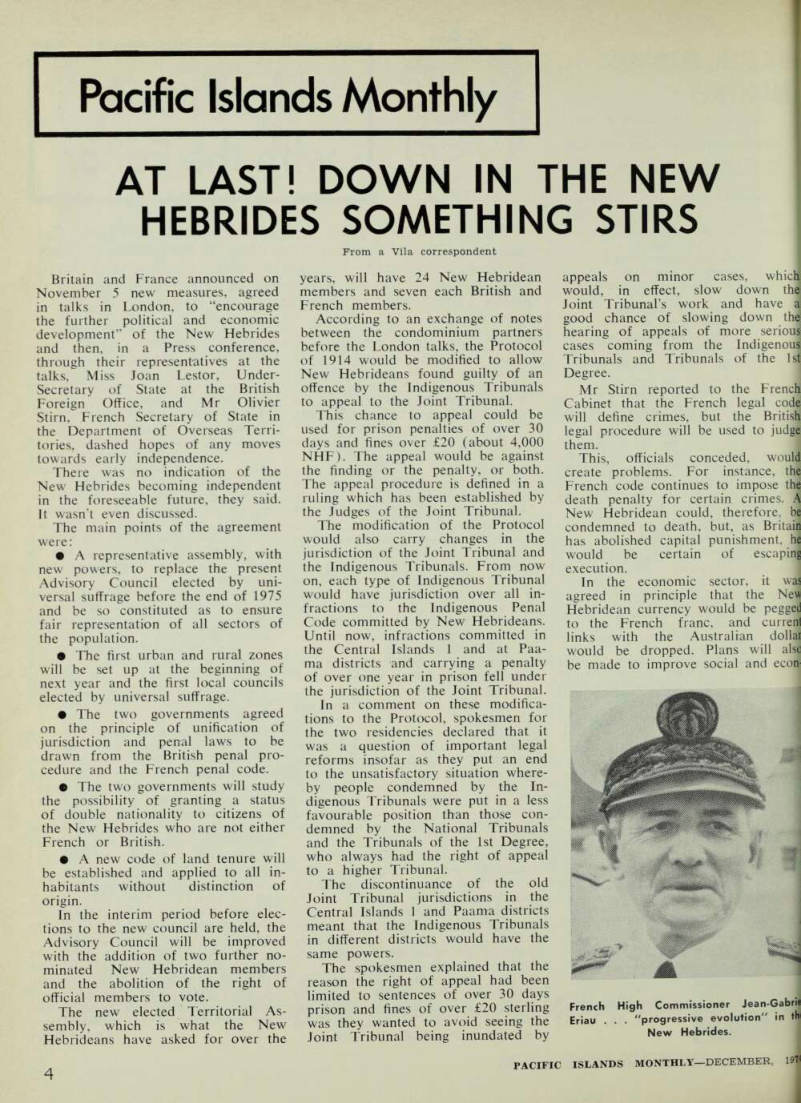
French High Commissioner Jean-Gabrie Eriau ... "progressive evolution" in the New Hebrides.
lie standards, particularly in the ral areas.
This is not the whole story, bow er. Miss Lestor and Mr Stirn will it the condominium in January ■ further talks.
The French High Commissioner, r Jean-Gabriel Eriau, was inter wed over Radio Noumea before : talks.
T don’t know what the results of ; conference will be”, he said, “but issure you that the French side I be taking initiatives, which are tied at satisfying the aspirations the diverse ethnic groups of the w Hebrides, in organising certain inges in proper order and with i regard for each individual. ‘I personally predict favourable 'elopment for agriculture and tie breeding. The desirable mges to the Protocol which will possible after this London con ence will lead to, I hope, peace certain quarters, which will prove t the two governments have the ire to lead the archipelago to a igressive evolution. Anyway, that the desire of the French Govern nt”, iefore the London meeting, the w Hebrides National Party sent a r-point petition to the Resident nmissioners. he points were; The formation a Legislative Council; involvement New Hebrideans in all constitu lal discussions; opposition to the nation of municipal councils and abolition of the Protocol, Vhile British and French officials ged themselves with delight over Anglo-French reforms for the v Hebrides, and congratulated another on what some liked to “the enormous step forward for anesians ’, the immediate reac of New Hebrideans appeared to a kind of puzzled and restrained
welcome.
“There’s a terrible lack of detail about the major proposals”, said one official of the New Hebrides National Party, two weeks after the results of the London ministerial talks were announced.
“But on the basis of anything is better than nothing, we must wel come the reforms as far as they go”.
Generally, New Hebridean reac tion was like a Roman crowd being faced with the rare sight of a Chris tian actually twisting the tail of a lion . . . there was a scattering of polite applause ... but it wasn’t what they came to see!
A Representative Assembly with wider powers and responsibilities?
What did it mean? Power to frame legislation which would tackle some of the urgent problems of the New Hebrides? Real fiscal responsibility for raising revenue and deciding how it should be spent?
A lot of questions were left un answered in the first bald statement covering the results of the talks. And though thousands of excited listeners waited for illumination from Radio Vila, the government-run broadcast ing service, its coverage dried up after the initial burst of publicity for the official communique.
There was one shaft of explanat ory light cast on the phrase double resortissant. That, said Radio Vila announcers, simply meant that in future New Hebrideans would be issued with a proper passport identi fying them as citizens of the New Hebrides, and guaranteeing the pro tection of British or French em bassies when they travel abroad.
Yet it was all so unsatisfactory.
Land has been, and remains, a major issue of strife in the New Hebrides.
The London communique, however, merely mentioned “a new system of land tenure” and did nothing to m
dicate, even briefly, the premise upon which the new system would be based.
One sentence in the communique which led to a great deal of specu lation, much of it cynically humor ous, was the mention of “rationalis ing the Residencies”.
That had to mean, surely, that at last the French and British govern ments would get around to pruning their top-heavy departments and weeding out some of the regiments of administrative officers who sprout faster than papaws in the New Hebrides.
“Maybe it means we’ll only have to deal with one blundering bureau crat, instead of two and sometimes three”, commented one soured businessman in Vila.
Meanwhile, in the Residencies, senior officials were muttering mutin ously about the task they face in organising elections for local authori ties early in 1975” and immediately afterwards organising the elections for the Representative Assembly.
One French admin officer growled C est impossible when the news came through from London, and his British colleagues seemed to agree.
Especially since one source revealed that there would be no extra money forthcoming from London or Paris to put all the new proposals into effect.
Considered reaction to the reforms will come this month when the Ad visory Council meets to look at next year’s Condominium Budget. There will be no stopping the New Heb ridean members raising the subject of the Anglo-French proposals.
And if the Resident Commissioners —who are joint Chairmen of Adco —can’t reveal more than they have already done, they had better look out for the first cyclone of the season.
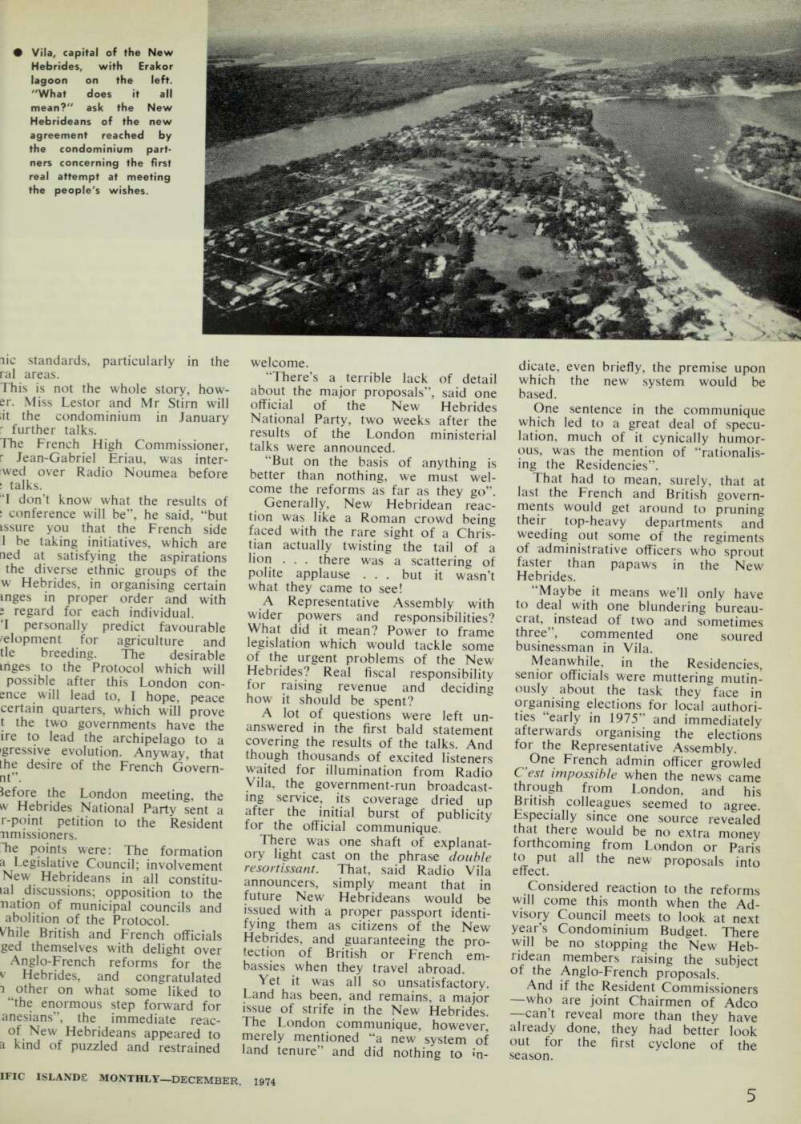
Vila, capital of the New Hebrides, with Erakor lagoon on the left.
"What does it all mean?" ask the New Hebrideans of the new agreement reached by the condominium part ners concerning the first real attempt at meeting the people's wishes.
Advertisements & other items, p. 7 (1 item)
Ific Islands Monthly—December, 1974
Writing on
the wall for Caledonians?
From a Noumea correspondent
The French flag trampled on and burned, anti-colonialist slogans painted on public buildings in Nou mea, the word “traitor” splashed across the tomb of the late Senator Henri Lafleur: these are some of the recent anti-French incidents in New Caledonia surrounding the court ap peal of 12 persons originally sen tenced for up to six months of prison over political incidents.
Two lawyers were flown in from Paris to defend the 12 Caledonians in their court appeal on October 29.
Shortly beforehand, it was announced that Mr Olivier Stirn, new French Minister for Overseas Territories, would not be making his scheduled November visit to Noumea, a visit which had been expected to bring some good news for the economy on the nickel front. Instead, it be came clear that the much-publicised SOMMENI smelter project for the north, around Poum-Koumac, was shelved, in view of mounting costs.
Caledonian exasperation has been stretched a long way since de Gaulle’s promises of new nickel pro jects back in 1966. Still, inflation gallops ahead, unemployment con tinues and young Melanesians parti cularly are agitating more aggress ively for greater local political control.
While the French in recent years have tried to reinforce Caledonian loyalty to France by highlighting wreath-laying and other ceremonies at war memorials, at Touho in October one of the most recently constructed of these monuments was splashed with paint by Melanesian agitators. And as 12 men and women remained imprisoned on He Nou after refusing to clear the Noumea courthouse during a political trial in September, wall inscriptions appeared around Noumea and inland demand ing “Liberate our brothers”.
The appeal hearing gave an open ing for the defendants’ lengthy ac counts of grievances over alleged freedom of political expression and the court finally reduced all penal ties to two months imprisonment.
The day the judgment was handed down, November 5, the Noumea
cemetery attendant found graffiti even on the tomb of anti-autonomist Senator Henri Lafleur, who had been buried two weeks earlier.
No doubt mindful that this series of incidents had begun with a demon stration at the French military march past on September 24 commemorat ing the French taking possession of New Caledonia, the authorities an nounced that to mark the Armistice Day of November 11 there would be a ceremony at the Noumea war memorial but not a military parade.
Meanwhile, even in traditionally calm quarters, the wrath of the dis illusioned again boiled over when a group of hitherto-docile supporters of the French administration opened a broadside of criticism and exasper ation at Paris treatment of the probleme caledonien.
Three leaders of the Mouvement Liberal Caledonien (MLC) late in October called a press conference to denounce the way in which Paris has
“walked all over them” in return for their willingness to co-operate with the island’s French administration.
The MLC, led by Jean Leques, are breakaways from the autonomist Union Caledonienne party and have always been upheld by the pro administration press as model Cale donians who have diligently urged i their fellows to follow Paris dictates. I Now three MLC leaders, after the resignation of two other Territorial Assembly members earlier this year,! have made their outburst, threatening they would not vote the 1,500 mil lion CFP taxes (SAI3 million) the administration might seek to impose to help overcome the current budget deficit: since Paris had assumed con trol of the Caledonian mining indus try, then Paris should pay the con sequences.
Moreover, affirmed the MLC, if the French Government had not made such promises over nickel ex pansion, the territory would never have indebted itself to the present extent over grandiose infrastructure expenses.
Meanwhile, as Caledonians con tinue irritated by economic and poli tical stresses, the only offer of ap peasement is a suggestion that France will modify the workings of the Conseil de Gouvemement. TTiis five-man advisory council is presided over by the French governor, a pub lic servant appointed by Paris, who is the island’s Chief Executive.
Already, it is pointed out, Governor Eriau has begun to carve out spheres! of individual interest for the council members, by assigning a definite! topic for a councillor to study. How ever this device, which has long been: in disuse, merely marks a return to the “reform” introduced by the them Governor Jean Risterucci, almost seven years ago.
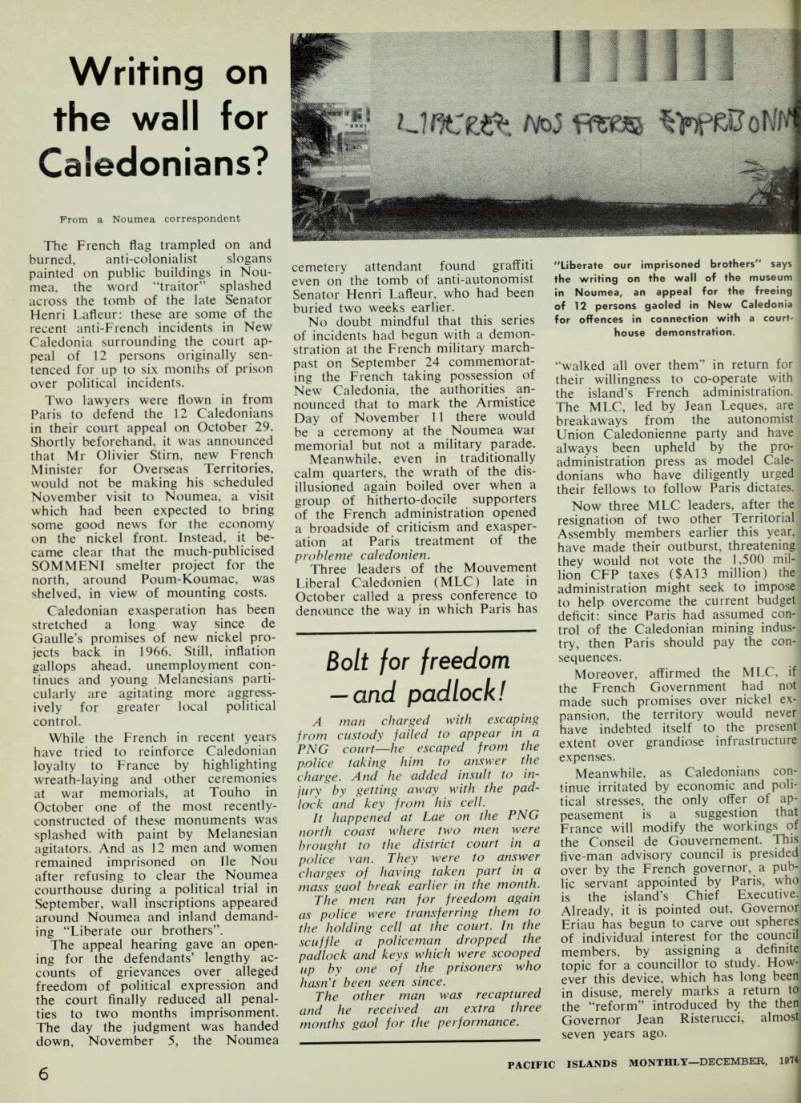
"Liberate our imprisoned brothers" says the writing on the wall of the museum in Noumea, an appeal for the freeing of 12 persons gaoled in New Caledonia for offences in connection with a court house demonstration.
and padlock!
Bolt for freedom and padlock!
A man charged with escaping from custody failed to appear in a PNG court —he escaped from the police taking him to answer the charge. And he added insult to in jury by getting away with the pad lock and key from his cell.
It happened at Lae on the PNG north coast where two men were brought to the district court in a police van. They were to answer charges of having taken part in a mass gaol break earlier in the month.
The men ran for freedom again as police were transferring them to the holding cell at the court. In the scuffle a policeman dropped the padlock and keys which were scooped up by one of the prisoners who hasn’t been seen since.
The other man was recaptured and he received an extra three months gaol for the performance.
Fiji people but ...

Dark days ahead for Fiji people but ...
From SUE WENDT in Suva
“Do without . . . exercise restraint , . . grow more food . . .” are three of the basic messages in Fiji’s tough but to-be-expected 1975 Budget, introduced by Minister of Finance Mr Charles Stinson, on Novem ber 15.
While it did not increase income or company tax, the sl32i million Budget introduced measures the government hopes will curb inflation, presently running at between 18-20 oer cent, by cutting down Fiji’s im oort bill.
Petrol rose by 3c a gallon, spirits >y 20c a bottle, wines 10c a bottle, agarettes by more than 1c a packet )f 10, sugar by 1c a lb, beer by 2c i 26 oz bottle. Imported foods will ilso increase in price with some terns facing substantially-increased iscal duty.
The Carpenter Group subsequently varned that it might have to with- Iraw from food distribution because »f rising costs. The Budget would ncrease business operating costs, said he management. Some of the group’s iperations, such as food distribution, /ere now only marginal and more ost increases might lead to a with rawal.
Dozens of different kinds of im orted foods previously admitted ree of duty look like disappearing rom supermarket shelves, because f tax totalling 15 per cent (10 per ent fiscal duty and five per cent ustoms duty). A five per cent fiscal uty also goes on imported meat, egetables, breakfast foods, milk nd fresh fruit.
Fiscal duty on poultry and pet 3od increases from 25 to 30 per ent. These are just a few of the eavy increases in imported food nes.
Mr Stinson said it was hoped that jch measures would persuade Fiji eople to produce more at home, he government would place greater mphasis on agricultural develop lent and rural training schemes.
The long list of fiscal duty in cases included almost all house old appliances (washing machines om 20 per cent to 60 per cent, ater heaters from 35 to 60 per mt), and such items as laundry >aps and detergents (from 7i per :nt to 25 per cent) clothing, latenals and office equipment—and
even Christmas decorations (from 25 per cent to 50 per cent).
Budget highlights are: • Overseas borrowing to increase next year to cushion the country’s reserves and to finance its increased capital programme. • Exchange control to continue to avoid additional pressures on over seas reserves. • Severe cutbacks on lending for the financing of luxury goods for local consumption or speculation on inventories or real estate. • Capital inflow to be en couraged, but the gearing rates of three to one to be maintained with a degree of flexibility. • Direct control of imported goods which use a lot of electricity or fuel to continue. • Rapid expansion of cane pro duction by opening up new areas to get very high priority.
Mr Stinson warned that Fiji could run down its overseas reserves by a further $27 million next year unless government introduced appropriate
measures or borrowed heavily.
Commenting on the growing bur den of civil service pay, Mr Stinson said that similar increases repeated next year would be “enough to sink any sailing ship”. He estimated that civil service pay would soar to $40,620,000 next year from $26,400,000 this year. But the num ber of people employed would
hardly change.
Civil service pay would account for 38.9 per cent of the government’s operating costs next year, compared with 35.9 per cent this year.
funds with Si.Bs million followel by Health with $1.59 million.
As in the past the highest depan mental receipts are expected fronj the Customs Department but thd Inland Revenue Department is inj creasing its revenue at a most satis factory rate.
“In the interests of overall ecod omic stability, it is essential that th( government budget for 1975 be non inflationary; therefore, only a modes deficit of $52,970 has been budgetel for”, said Saili.
Thus, the picture that Saili give| to the 1975 Budget is one of safety and security: increased revenue, de creased government spending, a mo dest deficit.
Added to this is Western Samoa] healthy foreign exchange situatioi which at the time of the Budge stood at approximately $4.5 million The minister considers that $4 mil lion is the minimum safety figure.
On the negative side, with all o Saili’s apparent good intentions, then seems to be a glaring deficiency, am this in Saili’s approach to industrial isation, the importance of which ha been ignored for two years.
Though Saili’s attempt at indus trialisation needs the country’s sym pathy (because the drastic drop h agricultural exports and the sever control over allocations during th last two years point to the need fo industrialisation) how the country j to be industrialised remains a ke problem.
Saili, prefers the idea of an Indus trial Free Zone. He was convince of this because of intensive stud and observation, he said. Other however, prefer the present system protection for local industries, th necessity for overseas investmen and granting of incentives as the exist now.
But the critical question still n mains—though the government planning for the future, what is doing about industrialisation now?
In fact the Budget talked vei little about any new industries major importance, a sign that the was very little to talk about!
It mentioned a brewery, a joi venture by the Samoan Governme and a West German firm but ev( this is for the future, next year, the earliest.
But, to end on a bright noi exports this year were greatly bett than last year. Agricultural expoi for the nine months to Septemb 30, 1974, totalled a record $5.1 mi ion, compared with $2.3 million f the same period last year. Saili a mits though that this improveme was mainly due to increased ov< seas prices rather than volume.
Samoa S Cloudy Sky
... A Silver Lining In
From Felise Va’a in Apia
Under fire for most of his term as Western Samoa’s Minister of Finance, Sam Saili bounced back to present a picture of a healthy economic situation for Western Samoa during his Budget speech to the Legislative Assembly in November.
Saili reported that government expenditure for 1975 will be SWSIS.I million. When capital project aid and soft-term loans are taken into consideration, this will be increased to SWS2O.6 million.
“This total includes just over $8.9 million of expenditure which is related solely to development projects, and thus approximately 43 per cent of next year’s total government expenditure will be used for developng our country”, said Saili.
The large proportion given to development is mainly due to a 16.1 per cent increase in government revenue expected in 1975. Of the
total estimated revenue of $13.58 million in 1975, only $10.57 million has been allocated to government current expenditure representing only an 8i per cent increase over 1974.
Statutory expenditure of $989,000 has risen by 21.8 per cent over 1974 due mainly to increases in MPs’ salaries and higher debt-servicing requirements.
Present total debt servicing costs represent only 5.67 per cent of the total ordinary revenue. “This figure is still very low by international standards as international lending institutions conservatively regard 11 per cent-12 per cent as approaching a reasonable limit”, admitted Saili, thereby confirming what the Opposi tion had argued all along.
Government’s current expenditure is geared mainly towards the pro vision of more efficient social ser vices. Thus Education gets the most
Suva's First
Indian Mayor
Suva has its first Indian mayor, Cr Navin Maharaj, who was elected by 10 votes to seven at the City Council meeting early in November. The 18th Mayor of Suva, he succeeds Cr Isireli Vuibau. An alliance Party candi date, he beat the National Fed eration Party candidate, Cr C. P.
Bidesi. His father, the late Mr Ram Chandra Maharaj, was the first Indian elected member of the Fiji Legislative Council in 1929.
Advertisements & other items, pp. 9-10 (2 items)
7
ACIFIC ISLANDS MONTHLY—DECEMBER, 1974
Farmer-Proved
A.RX.WELDMESH
NOW IN METRIC SIZES
Weldmesh has gone metric: So now we’ll supply your order in metres, millimetres and mass. Basically that’s the only difference.
Certainly there’s a change in appearance of some of the meshes but the range of products you’ve known is still the same. Yards, pig-pen flooring, gates and so on. They all retain the benefits for which Weldmesh has become famous.
Strength, long life, versatility, ease of erection, hygiene, fire proof, economy and of course, its do-ityourself capabilities.
Farmer-proved Weldmesh, now in metric sizes, has an application on your property. For literature, The Export Department contact your local A.R.C. Industries Ltd. building material supplier, 440 Collins Street, or write to; Melbourne, 3000, Victoria, Australia.
Cables: “Benignant”, Melbourne. ■ A.R.C. Engineering Pty. Ltd. ■ Please send me your free booklet on ! □ Cattle Products □ Pig Products J □ Sheep Products □ Field Gates ■ □ Do-it-yourself information Tick applicable square.
! Name
Address □ Tick if for school project L...--- Tel
ARC. ■
02250
Micronesian
New Faces In
Congress
From a Saipan correspondent Twelve sitting members of the Congress of Micronesia—27 seats vere in jeopardy—were beaten in the -eneral elections, the results of vhich were declared unofficially in nid-November.
Biggest upsets were in the Senate Sections. Senator Edward D. Pange inan, chairman of the Marianas > olitical Status Committee and leader >f the Marianas side in the talks vith the United States, was beaten >y nearly 400 votes by Pedro A. fenorio. Another leader Senator \.ndon Amaraich, of Truk, a voci erous critic of the United States rusteeship in Micronesia, lost his eat. The victor was Nick Bossy.
A woman candidate, Carmen dilnc Bigler, who is married to an American, made history, becoming be first of her sex to occupy a seat i the House of Representatives. She eat the sitting member for District 7 ive in the Marshalls, John Heine, nd two other contenders.
Another prominent House of Representatives member, Felipe Q.
Ualig, of the Marianas, who was umped by his party, the Popular 'arty, before the election, predict bly lost his seat to Jose P. Mafnas f the Territorial Party.
Dumped or not, he would prob bly have lost because all but one f the four Popular Party men up or re-election in the Marianas lost beir seats. The successful Popular 'arty man was Herman R. Guerrero /ho unseated Pedro P. Tenorio.
The results in the Marianas are elieved to reflect the people’s im atience at the slow pace of the pro ress of the political status talks, Ithough personalities, behaviour and amily affairs play a significant part a campaigns. In the case of 'angelinan, there was criticism of iis alleged pro-American bias.
There will be fresh faces, there ore, at the next rounds of talks be ween the United States and the /licronesian Joint Committee on uture Status and between the Jnited States and the Marianas.
The Marianas will pursue their oal, a separate commonwealth tatus in union with the United States, in the next round scheduled o begin on Saipan on December 2.
Advertisements & other items, pp. 11-12 (2 items)
Acific Islands Monthly—December, 1974
Hooker Fui
HOOKER FIJI H
PRESENTS
TAMAVUA HEIGHTS ESTATES and
NAMADI HEIGHTS ESTATES
SUVA'S FINEST
RESIDENTIAL DEVELOPMENT
superb homesites with panoramic sea views overlooking Laucala Bay and the South Pacific Ocean beyond.
TAMAVUA Suva's nicest and most modern suburb.
197Qs featuring:
freehold land only 3 1 / 2 miles from Suva * complete city facilities and amenities * elevated, gently undulating and mostly view lots sizes from 32 perches (1/sth acre) to 120 perches (% acre) * each lot is fully sewered * reticulated water available * underground drainage *full width tarsealed roads * concrete kerbingand channelling footpaths * concrete driveway crossings * street tree planting and roadside lawns * standard building covenants for your protection sea breeze throughout the year + bus transport nearby * handy to neighbourhood shops.
HOOKER’S LAND PURCHASE PLAN
Hooker Fiji Limited offers you the most generous land purchasing terms in Suva, 10 per cent deposit, terms 9% per cent simple interest, reducing quarterly, up to seven years to pay.
Lot prices range from $5500 to $14,850 most lots are priced at about $7500. Cash purchasers receive 10 per cent discount on all lots.
Special terms are available for registered builders.
This fine freehold land is a sound investment with assured gilt edged security. Suva's present population is approximately 69,000 wi\h an annual growth rate of more than 3 per cent.
PROGRESSIVE MASTER PLANNING
The planning and development of Tamavua Heights and Namadi Heights Estates, which together consist of 207 acres, utilise one of the newest concepts in fine living, that of no power poles or overhead telephone wires in order to create a more pleasant environment, free of visual pollution in an area of great natural beauty.
Throughout both estates, fine new homes of a variety of architecture have been constructed and occupied by lot purchasers.
Tamavua Heights is zoned residential 'A' (single family residence) and Namadi is zoned residential 'B' (single family residence or flats).
Careful imaginative planning has made these Estates the ideal area to live in, and to bring up your children in.
For details. Estate plans and lot prices write to
HOOKER FUI
LImITED
G.P.O. Box 1420, Suva, Fiji.
Room 203, Development Bank Building, Victoria Parade, Suva.
Telephone 25634.
These MF distributors
NEW ZEALAND
C. B. Norwood Limited, P.O. Box 298,
WELLINGTON
PAPUA NEW GUINEA
Ela Motors Limited, P.O. Box 75,
PORT MORESBY
FIJI ISLANDS
Burns Ptiilp (South Sea) Co. Ltd., P.O. Box 355,
SUVA
Branches throughout the region Branches and dealers throughout Papua New Guinea
NEW CALEDONIA
Industrial Machinery only Pacific Motors S.A., B p C 2
NOUMEA CEDEX
TAHITI
Henri Lombard, P.O. Box 36.
PAPEETE
NEW CALEDONIA
Construction Machinery only Cemic S.A., P.O. Box 2059,
NOUMEA
BRITISH SOLOMON ISLANDS
R. C. Symes (Pty.) Ltd., P.O. Box 88,
HONIARA,
GUADALCANAL
can show you, the
MFSO backhee loader is yards ahead
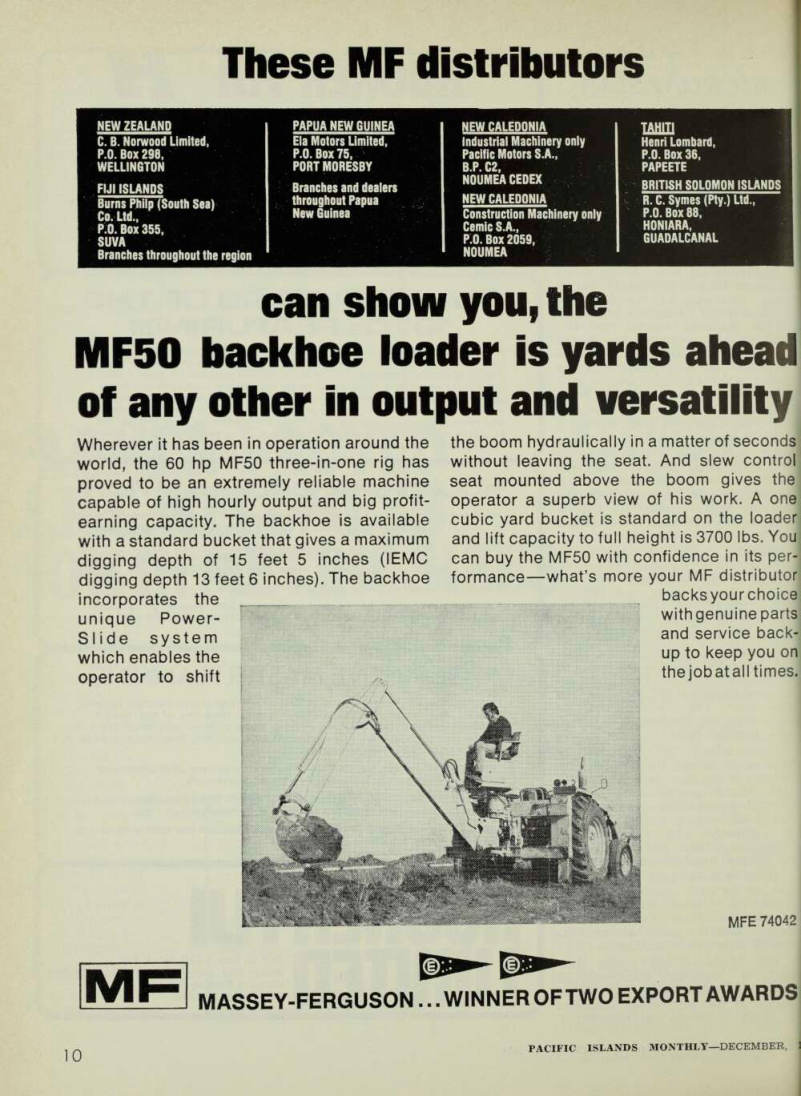
of any other in output and versatility Wherever it has been in operation around the world, the 60 hp MFSO three-in-one rig has proved to be an extremely reliable machine capable of high hourly output and big profitearning capacity. The backhoe is available with a standard bucket that gives a maximum digging depth of 15 feet 5 inches (lEMC digging depth 13 feet 6 inches). The backhoe incorporates the unique Power- Slide system which enables the operator to shift the boom hydraulically in a matter of seconds without leaving the seat. And slew control seat mounted above the boom gives the operator a superb view of his work. A one cubic yard bucket is standard on the loader and lift capacity to full height is 3700 lbs. You can buy the MFSO with confidence in its performance —what’s more your MF distributor backs your choice withgenuine parts and service backup to keep you on
thejobatalltimes.
■s ■■■>
MFE 74042
MASSEY-FERGUSON.
p]
WINNER OFTWO EXPORT AWARDS
beat 'em, recruit 'em
Mamaloni's motto: If you can't beat 'em, recruit 'em
From a Honiara correspondent
he ever-changing political scene he Solomons received yet another :e-up when it was announced that ip Solodia Funifaka, leader of opposition USIPA party and one :he government’s severest critics, been appointed Minister of Works Public Utilities. e replaces Dr Gideon Zoleveke moves over to become Minister Home Affairs, the portfolio erto reserved by Chief Minister naloni. his latest development in the ewhat giddy progress of local ;ics has left most onlookers at a especially as rumours persist that more USIPA members are to be ed into the Council of Ministers, ting members of the Cabinet, n by surprise at Funifaka’s un ited appointment, are extremely irbed. So are senior USIPA mem , who had no advance warning of move. amaloni’s surorise recruitment of ifaka immediately before the smber meeting of the Legislative mbly may be seen as an attempt he part of the Chief Minister to d the torrid scenes of the pre s meeting. At the last assembly ifaka marshalled his forces so well the government’s White Paper on nation had to be withdrawn as :ceptable. leaving the already rtain education system in a ibles. uch of the December meeting is duled for discussion of the lates and Budget for 1975. The inistration has already reluctantly >unced that the starting date for much heralded seventh Develop t Plan has been postponed until middle of next year. The Chief ister is presumably doing what an to avert more trouble in that re by drawing Funifaka into the ews of Funifaka’s appointment released on the same day as the ication of the report of the ilisation Committee. Unlike most ial BSIP publications this one was h waiting for, being well-written, Stic and constructive. traces precious lacklustre at )ts to train and promote indigenes ie public and commercial sectors the churches, and is not slow to :ise instances in all three areas ■e the committee considers that
localisation has been tardy.
By far the greater part of the report, however, consists of a thorough and hard-hitting appraisal of localisation prospects, post by post in the Solomons. Recommended dates of localisation are given for all public sector positions, ranging from the
Government Printer and the Senior Crown Counsel, scheduled for re placement next year, to the Principal Veterinary Officer, whom the com pilers of the report envisage still being at post in 1989.
The report has still to be accepted by the government. Doubtless the more dyed-in-the-wool old colonials will continue their rearguard action against localisation. The permanent and pensionable officers are already lobbying for additional compensation should they be dislodged. Never theless, publication of the report re presents a significant advance towards independence.
Advertisements & other items, pp. 13-14 (2 items)
11
IFIC ISLANDS MONTHLY—DECEMBER, 1974
Union Steam Ship Co. Of N.Z.
HENRY CUMINES PTY. LTD.
EXPORTERS • IMPORTERS
ISLAND AGENTS
428 GEORGE ST., SYDNEY
CABLES: HENCO SYDNEY. G.P.O. Box 3949. PHONE: 25-3383.
For specialised and personalised buying service throughout the Pacific Islands and the East.
Represented in: PAPUA: Agencies Pacific Pty Ltd, Box 5044, P. 0., Boroko, Port Moresby.
Telephone 55261.
NEW GUINEA: Madang, W. Double, P.O. Box 22, Madang. Telephone 2696.
FIJI: K. Witherington Ltd, P.O. 293, Suva. Telephone 22-356.
NEW HEBRIDES: John Lum & Associates, Box 65, P. 0., Santo. Telephone 329.
Resident Agents in other Pacific Territories.
UNION STEAM SHIP CO. of N.Z.
LIMITED
Serving the Pacific for nearly 100 years.
Regular Sailings by Modern Vessels
From Auckland to Lautoka, Suva, Pago Pago, Apia, Niue, Vavau, Nukualofa. Also from Tauranga to Lautoka, Suva, Apia, Nukualofa. Regular sailings from Australia to New Zealand to enable transhipment of cargo to all the above ports.
Ship your cargo by a Union Company Vessel.
BRANCHES AT ALL MAIN AUSTRALIAN, NEW ZEALAND AND ISLAND PORTS.
Whatever your
irrigation problem,the
ahswer is in here I
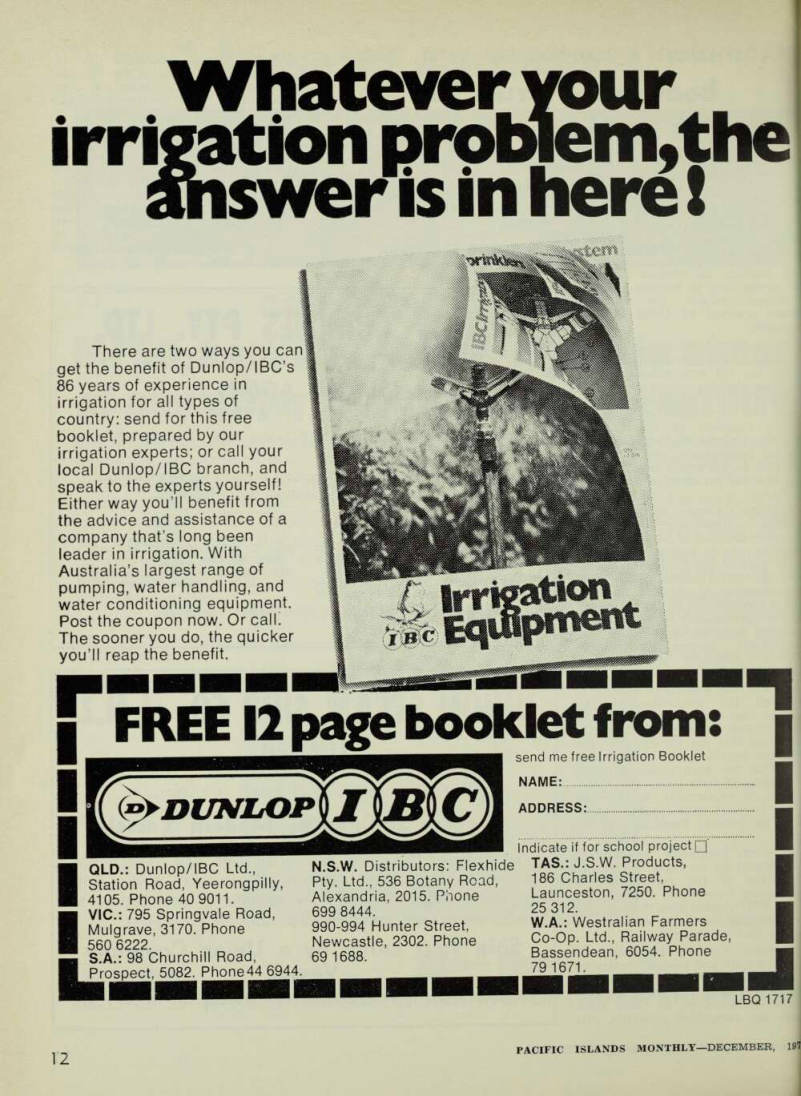
There are two ways you can get the benefit of Dunlop/IBC’s 86 years of experience in irrigation for all types of country: send for this free booklet, prepared by our irrigation experts; or call your local Dunlop/IBC branch, and speak to the experts yourself!
Either way you’ll benefit from the advice and assistance of a company that’s long been leader in irrigation. With Australia’s largest range of pumping, water handling, and water conditioning equipment.
Post the coupon now. Or calk The sooner you do, the quicker you’ll reap the benefit. i k '1
ion
cm&
r FREE 12 page booklet from:
send me free I I
DUNLOP
I
NAME:
ADDRESS:
OLD.: Dunlop/IBC Ltd., Station Road, Yeerongpilly, 4105. Phone 40 9011.
VIC.: 795 Springvale Road, Mulgrave, 3170. Phone 560 6222.
S.A.: 98 Churchill Road, Prospect, 5082. Phone 44 6944.
N.S.W. Distributors: Flexhide Pty. Ltd., 536 Botany Road, Alexandria, 2015. Phone 699 8444. 990-994 Hunter Street, Newcastle, 2302. Phone 69 1688.
Indicate if for school project □ TAS.: J.S.W. Products, 186 Charles Street, Launceston, 7250. Phone 25 312.
W.A.: Westralian Farmers Co-Op. Ltd., Railway Parade, Bassendean, 6054. Phone 79 1671.
LBQ 1717
fiji talanoa
With Sue Wendt,
in Suva
With British housewives facing a sugar famine in November, Fiji, ironically, was missing out on booming world sugar prices. News of record prices like $F1115.66 per ton being paid in London had Fiji Sugar Corporation share holders beating their breasts in frustration.
Fiji's No 1 industry is beset with problems. With the cane crushing season nearly over, the FSC looks like being hard put to fulfil established sugar contracts and other regular markets, let alone cash in on the soaring world prices. It was the same last year. In its recently-released annual report, the FSC recorded a drop in profit for the year end ing March, 1974. The net profit of $974,458 was $73,364 below the profit for the previous year, when the mills were owned by CSR Ltd of Australia.
During the previous season, the CSR profit fell by nearly $600,000 because of hurricane damage costs. Although the FSC didn't face a hurricane in its first year of operating, the season saw poor crops and exchange rate fluctua tions.
The production target for the 1973 season was 408,000 tons from 3,019,000 tons of cane. The actual amount of sugar produced was only 296,479 tons from 2,456,281 tons of cane crushed at the four mills. Many farmers failed to meet their harvest quotas or even their basic farm allotment.
Despite the profit drop, Fiji Sugar Corporation directors re commended payment of a 7? per cent dividend to shareholders.
Prospects for the 74 season don’t seem much brighter for the FSC. It is predicted that fuel costs for the industry could rise to $600,000, and already there are fears that sugar output will fall short of the minimum require ments.
Meanwhile, canefarmers have received their second payment for cane crushed during the 1974 season. The total payments to date are $11.50 per ton—the highest price yet paid in Fiji—and a third payment in June will take the price for this year’s crop to $l5 a ton.
Tourism, the dominion’s No 2 industry is also feeling the pinch, with visitor-growth rates down, British Airways due to pull out of Nadi Airport from next March and hotels half-empty in November and early December.
For the first time, locals were being offered discounts of up to 50 per cent at several Viti Levu hotels and even popular Tai Island resort, off Lautoka, was offering a 25 per cent discount to locals up until mid-December. The newest outer island resort, Treasure Island, was allowing a 50 per cent reduction.
The newly opened Naviti Resort on the Coral Coast was suffering teething problems, not the least of them in the area of service.
Friends of mine, staying there a week after the official opening, said it took an hour and a half to receive breakfast in their rooms. Only four rooms were occupied that weekend. But things will improve. . . .
Another Naviti Ltd hotel, the Isa Lei in Suva, is for sale, as is the Hillcrest, also in Suva.
Construction of the Coral Gar dens Hotel on the Coral Coast was at a standstill in October- November, but the receiver of Australia’s Mainline Corporation, Mr James Jamieson, said in Suva that he expected to find a buyer for Mainline’s interest in the hotel.
Mainline has a majority share holding in the three-quarters complete hotel through its sub sidiary, Mainline Fiji Ltd. As holder of a first mortgage, the
First National City Bank is also eager to find a buyer for the Coral Gardens.
At Pacific Harbour, Deuba, there is no sign of new hotel construction, although the area is beginning to resemble the luxury residential resort promised by its developers. The first 40 private villas are due to open in Decem ber and those who last saw the development as mud and marsh land will be pleasantly surprised to see a number of high-standard homes, swimming pools, flourish ing gardens, motor-boats skim ming down man-made canals and tar-sealed roads. The Prime Minister, Ratu Sir Kamisese Mara, a keen golfer, was to open the Pacific Harbour Golf Course on December 1.
Varying tariffs are charged for the villas, according to their size and whether or not they have swimming pools. Introductory rates include deluxe two-bedroom villas with swimming pool at SFSS per night (without pool SF4B) and a standard two-bedroom villa with pool at SF4S per night (SF3B without pool).
Costings are subject to such fluctuation that Fiji hotels are re luctant to set tariffs for more than a few months. The Fijian, 288room luxury hotel on Yanuca Island, recently hiked its single rate tariff from $2O to $26 and the double rate from $26 to $32.
For single accommodation in a suite, you’ll now pay $42.50. For a deluxe suite, the single rate is $55.
Those rates are for accommo dation only. With three meals and a reasonable liquor consumption, a visitor’s minimum daily cost would be around $40 —and that’s a conservative estimate.
The number of visitors to Fiji during the first seven months of this year fell by 0.5 per cent, com pared with the same period in
1973—a bitter blow for sections of the industry counting on an increase of at least 10 per cent.
Last year Fiji’s gross earnings from tourism totalled $46.3 million —an increase of 25 per cent over 1972. In terms of visitor numbers, the increase was 12 per cent. We won’t get figures for this year’s tourism earnings until well into 1975, but the growth rate doesn’t look good.
Earlier this year, it was suggested by some members of government that the growth rate of Fiji tourism should be controlled. The guestion was—what would be a desirable growth rate?
A Fiji Tourism Planning Committee was established at the 1974 Tourism Convention, held last April, The committee’s man- W3S . , , ® . to u stuby economic and social benefits and costs associated with various levels of tourism growth; • to study the constraints on growth; • within 90 days to recommend to government achievable and desirable growth rates.
The committee, consisting of Dr lan Ernst, Mr Robin Smith and Mr Richard Warner, all with vast experience in Fiji tourism, parti cularly its problems, prepared three thoroughly-researched papers, and presented these and their conclusions to government three months ago. Nothing more has been heard.
Among other things, the com mittee concluded that Fiji has the physical capacity to maintain an 18 per cent yearly growth rate in visitor arrivals, and that "any lower growth rate would be waste ful of Fiji’s resources and would not produce any discernible benefit." The thing now, then, is to attract the visitors back again!
A hopeful note came from the Fiji Visitors’ Bureau manager in North America, Mr John Holmes, who said the number of US visi tors to Fiji had dropped as low as it would go. The only way from now on was up. . . .
Meanwhile, we are all (?) tightening our belts in response to a plea from Fiji’s Minister for Finance, Mr Charles Stinson. In November he warned Fiji people
to be ready for harder times and ordered a tighter credit squeeze.
He appealed to people to defer buying non-essentials until at least 1976 and said the govern ment had instructed banks to clamp down on unnecessary credit. He confirmed that inflation had jumped from about nine per cent 12 months ago to between 18-20 per cent and added that the country's foreign reserves were expected to fall by about $7.9 million this year—and next year “even more frighteningly" by $27.2 million, to under $3O million.
However, he said (perhaps to prevent us all jumping out the nearest window) he believed Fiji was in a better position than many other countries to ride the crisis out.
Many people feel the same way, despite the continuing exo dus of skilled and other workers to Canada and elsewhere. We mav find, though, that the "good life" really belongs to those who've never left their villages, and that notices saying "Gone fishing" are posted on everv door. . . .
Advertisements & other items, pp. 15-16 (2 items)
13
2IFIC ISLANDS MONTHLY—DECEMBER, 1974
The Daiwa Bank Ltd
DAIWA BANK SERVING YOU IN THE PACIFIC BASIN r * i Head Office ; Osaka,Japan With 137 Branches throughout Japan Singapore Representative Office Suite No. 1007, 10th Floor Robina House 1 Shenfon Way, Singapore 1 Republic of Singapore Cable Address: SINGDAIWA Affiliated Bank P.T BANK PERDANIA Djalan Raya Mangga Besar 7&9 Djakarta Our Correspondent Banks are in city— Apia, Suva, Lae.
Madang Port Moresby, Rabaul, Wewak. Guam, all Principal cities in Australia and New Zealand Contact your banker or our office. i Los Angeles Agency 555 South Flower St. Suite 4040 los Angeles, Calif. 90071 Sydney Representative Office Bth Floor Prudential Building 39-49, Martin Place, Sydney
Head Office : 21. Bingomachi 2-chome, Higashi-ku, Osaka, Japan Overseas ; London, New York, Los Angeles, Frankfurt, Sydney, Singapore
Tropicalities
Unas & Toeas
are aVoming
Lustralian dollars and cents are the way out in Papua New nea. PNG’s own kinas and toeas begin circulating in April, and existing Australian currency will withdrawn eight months later, he new currency is named from itional shell money which has ’ been established in many PNG imunities. peculation and rumour about the ency arrangements ended the ;r day when the Finance Minis- Mr Julius Chan, outlined the stable in the national parliament, so far the public at large has no what the new notes and coins look like. The design is being ; a secret at present to avoid ible fraud among thousands of semi-sophisticated people who have to be educated to the new ency. nimals, birds and plants are re ed to be the themes. [r Somare’s deputy, Dr John >e, can sit back smugly in the lory that his face has already sared on a short-lived currency :, albeit a bogus one. It happened ago when an Australian ic servant in Port Moresby npted a joke which went bad. printed batches of notes called ski money” (Maski is the Mela m pidgin word for “it doesn’t er”) and started circulating i. t selected Dr Guise and the il Mr Gala Oala-Rarua, now is diplomatic representative in ralia, as archetypes of black :al politicians, and had their res on the notes. The affair led onfusion, anger and embarrass and wound up in a police in ?ation.
PNG currency which was sup i to be legal but which never Y m got into top gear was the oc tion money printed by Japan in d War 11. The notes, showing
a picture of coconut palms, still turn up from time to time and are now sold through dealers in Australia.
Incredibly stupid rumours over PNG’s currency arrangements have been causing periodic problems over the past two years. Most of the rumours, which arose in the white community, were based on a belief that Australian currency would be frozen or made valueless without warning. This led to panic transfers of large sums of money to Aust ralian bank accounts.
One rumour claimed that a crate from Switzerland had been seen to break open on the Lae wharf, spilling out its secret incriminating bundles of a new, unannounced currency.
Another rumour alleged secret night landings by an RAAF Hercules which supposedly taxied to the far side of Port Moresby airport where bundles of new money were trans ferred into unlighted trucks!
But although the white commun ity of PNG was the fertile ground which got most of these rumours going, the greatest problem in the currency education about to begin will be in remote village communi ties. The word “mark” still hangs on in Pidgin, dating back to German times, and today meaning a 10-cent coin.
Bank officials estimate that some thing like $2 million—much of it in coins—may be hoarded in remote villages. The money is effectively out of circulation and therefore use less to the economy. It is being used for “closed-circuit” transactions among blood relations, or is simply being hoarded for its status value.
Digging it out of its holes in the ground (literally) and teaching re cognition of the new notes and coins between April and December next year will prove a huge undertaking.
Sumo, Tonga’s
newest sport
Tonga’s King Taufa’ahau T'upou IV hopes to import Sumo—Japanese traditional wrestling—into Tonga and make it the kingdom’s national sport.
Maybe it’s just as well. The other national sport, rugby union, isn’t doing too well, seeing that the Tongans lost nine out of 10 matches
on their UK tour.
Three Tongan youths, ’Uli’uli Fifita, ’Alani Falevai and Latu Vai vaka, have gone with the royal bless ing to Japan to learn Sumo. They were selected in Tonga by the Japanese Sumo master Asahiyama.
The king has asked Mr Hahano Vaha’i and Mr John Hepplewhite to form an executive committee in Tonga to supervise the sport when it gets off the ground. Come to think of it, a bout finishes on the ground.
PI M's not an expert at Sumo, so we might be mistaken when we com pare it with another form of wrest ling—Cumberland and Westmorland style as practised in those two Eng lish counties. A Sumo wrestler ap pears to take a hold of his opponent’s loin cloth and attempt, without breaking the hold, to upend his adversary.
In Cumberland and Westmorland style, the two arms are locked around the opponent and a throw has to be accomplished without the hold being broken. There are such exotically-named manoeuvres as the Flying Mare and the Hank.
Looking at the physique of a Sumo wrestler PIM might be pardoned in thinking that the first requisite for a good Sumo man is to eat and eat until he tips the scale at a tonne!
Who** boss in
American Samoa?
American Samoa’s retiring Governor, John M. Haydon, who left for home in October after a five year stint in the territory, did some personal censoring of a television programme before he left.
He was watching an Education Department film “Born Innocent” and was shocked by what he saw— a sexual assault on a young girl by other girls, and that on a programme screened at peak teenage viewing time.
After speaking with the Director of Education Mere Betham, the Governor called the studio and ordered the immediate stoppage of the programme, but the TV staff told Mr Haydon that only one man could decide, the programme man ager Mr Roy Clemans.
When Mr Clemans baulked at taking orders regarding television
censorship, saying that any decision! to stop a programme should be his, the Governor made for the studio after telling Mr Clemans that he, the Governor, made the ultimate de cision.
Mr Haydon found the studio locked, a normal precaution in the evenings, and had to scale the secur ity fence and enter the studio by the back door. Then, in no uncertain terms, he ordered the film to be stopped.
For 40 minutes the silver screen! told the audience “Please stand by” before resuming with another film.
Mr Haydon’s comment later was “Nearly 50 per cent of the popula tion of American Samoa is under 15 years of age and to show this type of material indicates a serious lack of judgment, serious lack of under standing of the role of television in American Samoa and is a most bla tant example, so far, of the misuse of our television station”.
KiiEoiihmi makes
a public confession
In protest against the French nuclear tests, Solomon Islands poli ticians and civil servants boycotted and picketed a cocktail party aboard a French minesweeper paying a goodwill visit to Honiara. All but three senior guests turned back when confronted by the picket.
One of the three was Chief Minis ter Solomon Mamaloni. Later, he made a public apology for attending the party.
Official embarrassment turned tc mortification when it was discovered that the leaflets distributed by the demonstrators had been run off b) the government’s visual aids service There was another spot o] bother in Honiara when member! of the Solomon Islands Informa tion and Broadcasting Departmen held an emergency meeting anc threatened to go on strike after om of their number had been publicb harrassed by a leading member o the People’s Progressive Party accus ing the service of favouring oppositioi USIPA. Ironically, USIPA has beei accusing the broadcasting and infor mation service of favouring th< government in its reports. The striki was averted at the last moment. Afte another dispute had flared up late: over another series of incidents, ffi( expatriate Senior Information Office: resigned, ending a most unhappy yea for the department.
Advertisements & other items, pp. 17-20 (2 items)
15
FIC ISLANDS MONTHLY—DECEMBER, 1974
Loveliness
New
for
vour skin
Keeping your complexion beautiful is essentially your own responsibility.
Only you can give your skin the vital beauty care it needs. Only you can resolve to keep it young and pretty by giving it the beauty benefits of a unique tropically moist oil blend.
Oil of Ulan, with its tremendous potential to help prevent wrinkledryness, can do much to ward off those tiny age lines a woman fears most. Because this unique beauty fluid enjoys complete compatibility with the skin’s own natural fluids, it helps to balance those precious “Liquid” assets of combined oil and moisture that gives the complexion its youthful softness and bloom.
Almost every skin has a moisture problem, and this unique beauty fluid can help to solve this very important aspect of complexion care. It is natural for the moisture content of the outer layer to evaporate constantly, but, when your skin is subjected to harsh climatic conditions the evaporation rate speeds up. Tiny lines, and flaky patches will appear prematurely unless there is some form of relief for the thirsty, parched skin.
Oil of Ulan assists in providing this relief, by supplementing the natural oil and moisture and helping protect the skin’s outer layer against wrinkle dryness. This helps nature to maintain the dew-fresh look that gives your complexion its youthful bloom.
A film of Oil of Ulan smoothed over the face and neck will greatly help to protect your skin from the depletory effect of artificial indoor environments and natural elements such as wind and sun.
This moist oil blend provides an ideal beautifying base for make-up, and at the same time brings out the best in your complexion. By smoothing this beauty fluid on morning and night, your complexion gains smoothness and loveliness.
From the earliest teens, through middle age to the later years, a beautiful complexion can be the living proof of your daily devotion. Pledge the remarkable beauty benefits of Oil of Ulan (which is available from pharmacies and beauty counters) to your complexion today.
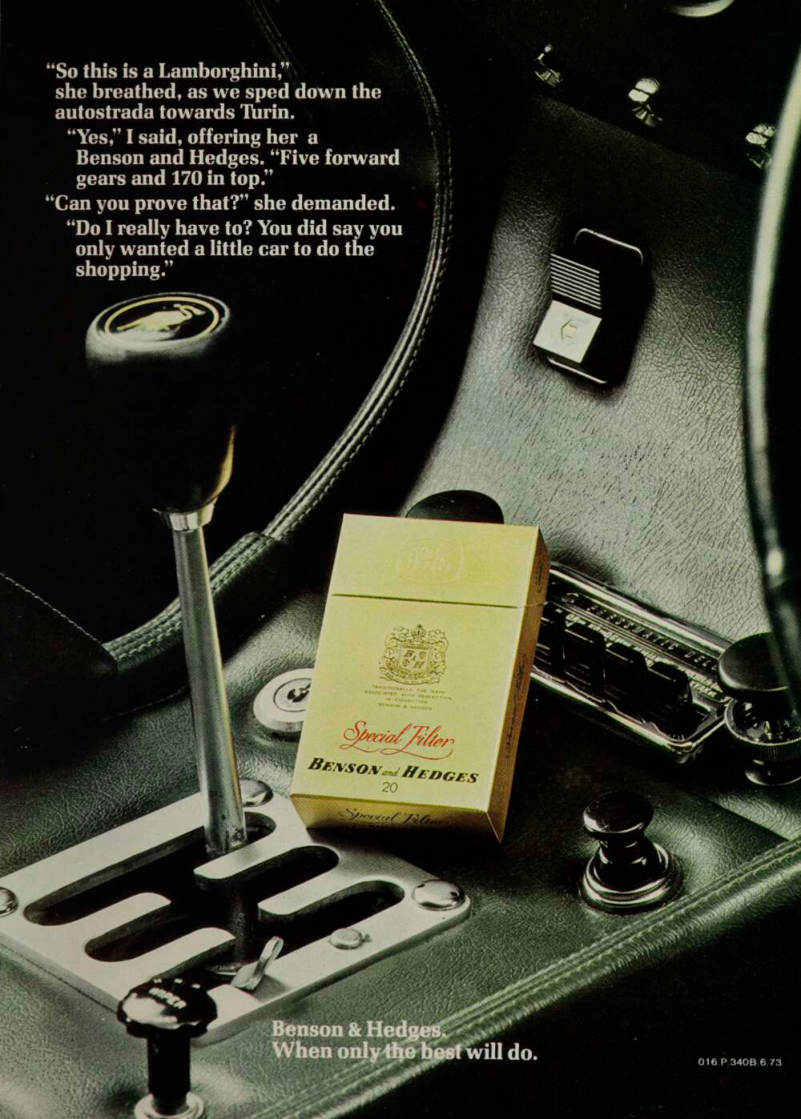
k So this is a Lamborghini,” she breathed, as we sped down the autostrada towards l\irin.
“Yes,” I said, offering her a Benson and Hedges. “Five forward gears and 170 in top.”
“Can you prove that?” she demanded.
“Do I really have to? You did say you only wanted a little car to do the shopping.”
V • as & K N , % V V ... m Benson & Hedges!
When only-the be* s^: vr 9f. will do. 016 P 3408 6 73
The Mazda 81600 pickup.
A truck-load of fun and economy.
m m m . m -■i Whatever you want in a pickup, the 81600 delivers it.
With performance. With economy. With style.
Consider the things we build into it so you can get more out of it.
The 1600 cc overhead cam engine, for instance, is a lot like the one you find in some sports cars. Yet ours just sips gas. And the important things like the heavy duty suspension system and the safe, sure braking system make operating the 81600 a joy.
Want a sporty pickup for the fun of it?
Or just for its carry-all capabilities?
Test drive the Mazda 81600 pickup The truck-load of fun and economy.
MAZDA
'V a*. w
BlbOO
FIJI ISLANDS Niranjans Autoport Ltd. G.P.O. Box 450, Suva TEL: 22691 NEW CALEDONIA Societe Riviere et Bernanos, 27. Rue de Sebastopol, Noumea NEW GUINEA PNG Motors Ltd. P.O. Box 1394, Boroko, Papua TEL: 55788 NEW ZEALAND Mazda Motors of New Zealand Ltd. Auckland P.O. Box 22-472 TEL: 69-099 WESTERN SAMOA H. & J Retzlaff, P.O. Box 195, Apia TEL: 237 NEW HEBRIDES Societe Bourgeois et Cie, P.O. Box 28, Port Vila PORTUGUES TIMOR Sang Tai Hoo, Dili, The trademark MAZDA in this advertisement stands for AUTOMOBILES MAZDA as far as France and her territories are concerned.
you have for breakfast?
Tell us Ratu Mara, what do you have for breakfast?
From Vijen Dr A Kumar
in Lautoka THERE is that yarn about Fiji’s elder statesman, the late Ratu Sir Lala Sukuna, about the time he gave a lift in his car to a Fijian villager. Ratu Sir Lala was being driven to a village near Sigatoka for an official welcome meeting when he came upon the elderly man trudging along the dusty road with a large bundle of tapioca on his back.
The ratu (chief) and the com moner struck up a lively con versation. The man, it transpired, was going to the meeting to see the big ratu and make an offering of tapioca to him. No, he had never seen him before but from what he had heard of him, he was “the great one”.
Ratu Sir Lala never let on that he was the subject of the com moner’s adulation. The man, of course, found out when the car stopped at the village.
Such snippets are the very life of an autobiography or biography.
Although Fiji has produced a crop of brilliant and gifted leaders, not one has left behind a book of memoirs—except with the probable exception of the late
Mr Ayodhya Prasad, the founder of the Fiji Kisan Sangh (cane farmers’ union). He wrote a very illuminating history of the Kisan Sangh in Hindi which remains largely unread and untranslated into English. The book reveals the author’s prejudices with some very frank opinions on leaders living and dead.
Pandit Vishnu Deo, one of the longest serving members of the old Legislative Council, died without putting pen to paper.
Ratu Sir Edward Cakobau, the colourful and gentlemanly soldier and politician, similarly left no thoughts on paper. Mr A. D.
Patel, the founder of the opposi tion National Federation Party, was all his life a controversial political figure but never as sembled his ideas into a book.
I recently met his widow, Mrs Lila Patel, who gave a rare in sight into the man who was largely not understood or was mis understood. She has a whole col lection of priceless letters and documents which would make en
thralling reading.
How many people, for example, know of the close personal friend ship between Mr Patel and his political adversary, Ratu Sir Kamisese Mara, who is now Fiji’s Prime Minister? Mrs Patel had never given a thought to getting these published until 1 planted the idea in her mind. But, her next question took me by sur prise: “Who will write it?”
Indeed, that is a big question because Fiji has not so far pro duced any writers of note. Per haps, the University of the South Pacific may give us scholars and writers to do research and pub lish biographies of our national heroes who are gone. Perhaps the government or some trust found ation could allocate funds for such a worthwhile project.
Fiji boasts a rich cultural heri tage further enhanced through the mixing of diverse cultures and traditions. But it is a literary desert. Apart from two daily newspapers (the second, the Fiji Sun, was launched in October
this year) and a smattering of thin weeklies or monthlies pub lished in English, Fijian and Hindi, it has nothing else to show.
There is no book publishing house, although a few document ary-type pictorial books have gone down well.
While children and students in Fiji do not need their own little Red Book, there is an urgent need for them to know what Fiji is all about. And lives of great men—Fiji’s own great men— should be part of their learning.
I do not know whether Ratu Sir Kamisese Mara is secretly working on his memoirs or has even given it a thought. It would be a great pity if he did not leave behind a book or two (not that he is retiring yet). The Prime Minister, who ranks with the world’s statesmen, is the architect of Fiji’s independence. No doubt, he received help and co-operation from the present leader of the Opposition, Mr Siddiq Koya, to ensure an orderly transfer of power from the British to the people of Fiji. But it is Ratu Sir Kamisese who has been at the centre of things.
Ratu Sir Kamisese the leader is well known by the people. But what about Ratu Sir Kamisese the man? Few in Fiji know what he has for breakfast, what he reads, what films he likes, which world leaders he admires—and abhors.
While these are not important things, they help to bring the leader and the people closer.
Apart from that, Ratu Sir Kamisese is a part of our evolving history. It would be an experience to look at Fiji through his eyes.
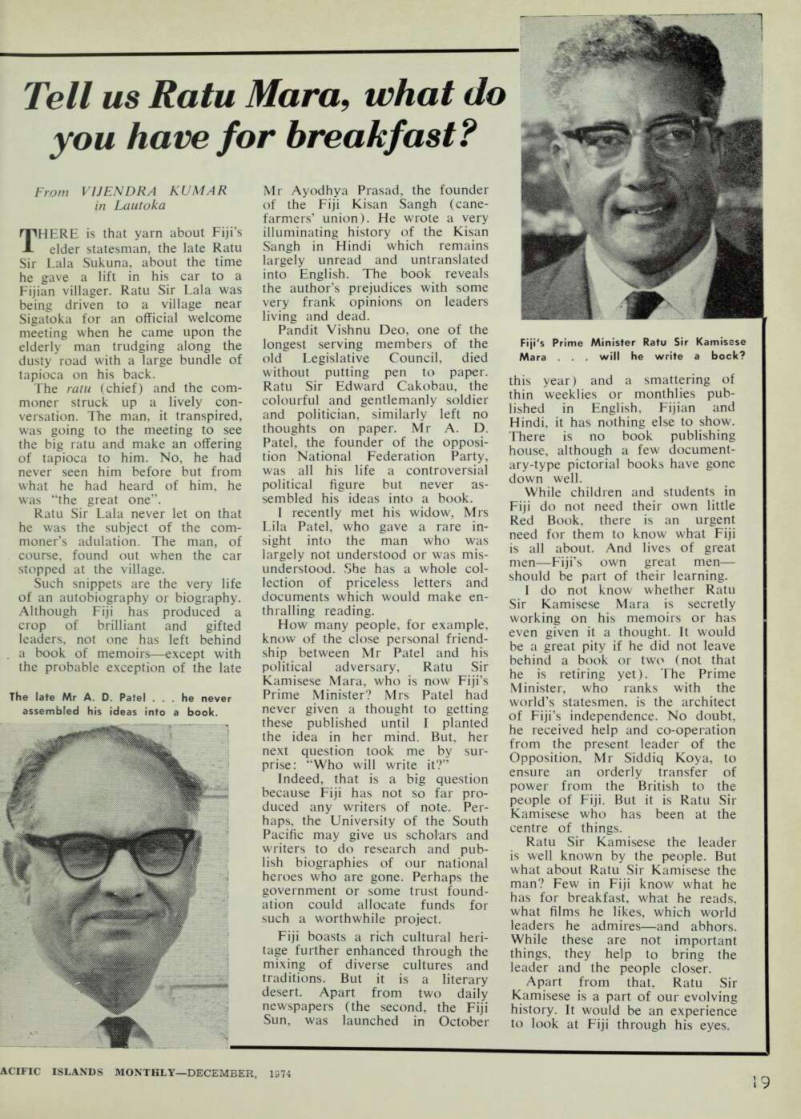
The late Mr A. D. Patel ... he never assembled his ideas into a book.
Fiji's Prime Minister Ratu Sir Kamisese Mara ... will he write a book?
Advertisements & other items, pp. 21-22 (2 items)
Acific Islands Monthly—December, 1374
40% of the banking
Do you want to do business
in New Zealand?
Ask the bank
which has
40% of the banking
business in
New Zealand
The BNZ can give you full information on buying or selling in New Zealand and overseas.
Full information on investment, movement of money, transfers of dividends etc. is also readily available.
There are offices everywhere, more than 400 in fact.
Whatever your financial or trade needs, the BNZ can help you.
H
Bank of New Zealand
Wellington - International Division, Box 2392.
Sydney -GPO Box 507, Sydney,
N.SW. 2001.
Melbourne - GPO Box 528 E, Melbourne, Vic. 3001.
Tokyo - Mr G. Scott, Bank of New Zealand Representative Office, Japan, Suite 240, New Tokyo Bldg, 3-1, 3-Chrome, Marunouchi, Chiyoda-ku, Tokyo 100.
Singapore - Mr R. F. Warren, Bank of New Zealand Representative Office, South East Asia. 4th Floor, Ramayana Bldg, 45/47 D, Robinson Rd, Singapore.
London - PO Box 402, London EC4.
Fiji - 25 Victoria Parade. Also at Labasa, Lautoka, Nadi, Sigatoka, Ba.
[?]o Polynesia's past
Samoa find—a clue [?]o Polynesia's past
From FELISE VA’A in Apia The discovery of fragments of an ent pottery off the coast of Upolu, >out 20 miles from Apia, Western imoa’s capital, may upset all the eories about Polynesian settlement the Pacific.
The pottery, which was discovered st year by Mr T. T. Hassall, pro :t engineer involved in the dredg g of a wharf site at Mulifanua, has :en examined by Professor Jesse D. nnings, of the University of Utah the United States, who arrived in estern Samoa in August with his ife and a team of university shi fts.
Professor Jennings believes that the id could establish Samoa as the Jest Polynesian settlement, and the iging area for the mass Polynesian igrations to the rest of the Pacific lands.
His theory contradicts others held anthropologists which place the
oldest settlement in the Cook Islands, or Hawaii or Tonga.
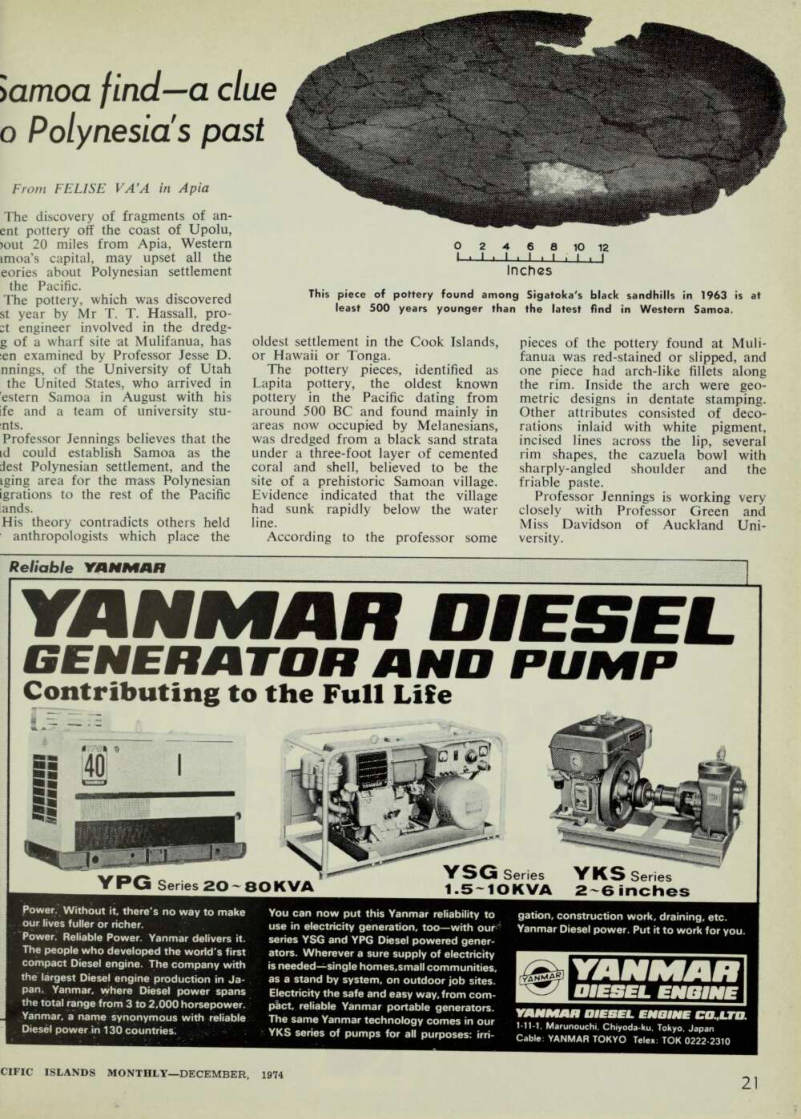
The pottery pieces, identified as Lapita pottery, the oldest known pottery in the Pacific dating from around 500 BC and found mainly in areas now occupied by Melanesians, was dredged from a black sand strata under a three-foot layer of cemented coral and shell, believed to be the site of a prehistoric Samoan village.
Evidence indicated that the village had sunk rapidly below the water line.
According to the professor some
pieces of the pottery found at Muli fanua was red-stained or slipped, and one piece had arch-like fillets along the rim. Inside the arch were geo metric designs in dentate stamping.
Other attributes consisted of deco rations inlaid with white pigment, incised lines across the lip, several rim shapes, the cazuela bowl with sharply-angled shoulder and the friable paste.
Professor Jennings is working very closely with Professor Green and Miss Davidson of Auckland Uni versity.
This piece of pottery found among Sigatoka's black sandhills in 1963 is at least 500 years younger than the latest find in Western Samoa.
Advertisements & other items, pp. 23-24 (2 items)
21
CIFIC ISLANDS MONTHLY—DECEMBER, 1974
Yhmmss Diesel
Reliable YANMAR
GENERATOR AND RUMP
Contributing to the Full Life
1
YPG Series 20~80KVA*
/-■ M
YSG Series YKS Series
I.S'IOKVA 2'6 inches
Power. Without it. there's no way to make our lives fuller or richer.
Power. Reliable Power. Yanmar delivers it.
The people who developed the world's first compact Diesel engine. The company with the largest Diesel engine production in Japan. Yanmar, where Diesel power spans the total range from 3 to 2,000 horsepower.
Yanmar, a name synonymous with reliable Diesel power in 130 countries.
You can now put this Yanmar reliability to use in electricity generation, too—with our series YSG and YPG Diesel powered generators. Wherever a sure supply of electricity is needed—single homes.small communities, as a stand by system, on outdoor job sites.
Electricity the safe and easy way. from compact, reliable Yanmar portable generators.
The same Yanmar technology comes in our YKS series of pumps for all purposes: irrigation, construction work, draining, etc.
Yanmar Diesel power. Put it to work for you.
DIESEL
YANMAR DIESEL EMDIME CD.,LTD.
1-11-1. Marunouchi. Chiyoda-ku, Tokyo, Japan Cable: YANMAR TOKYO Telex: TOK 0222-
IP?
X ■ I \ I ■■ 1 , v
Kodak pocket
camera
Now you’ll get die pictures you used to miss* ♦♦ Small enough to slip into your pocket. Light enough to carry anywhere. So simple to usejust drop in the new 110-size film cartridge, aim, and shoot. Yet it takes big 3 1 /2" x 4 7 /e" color pictures. Choose from the range of five new Camera measures: 4 1 /2" x 2" x 1"
Kodak pocket Instamatic camera outfits — each complete with wrist strap, Kodacolor II film, magicube and instructions. There’s one priced to suit your pocket. See your local island photo dealer.
K>.
KODAK (Australasia) PTY. LTD.
K6
The Editor's Mailbag
A Condominium
Complaint
[ refer to the letter “A Condo nium Complaint” (PIM, Oct, p 17) the anonymous “Vila Correspon it”. I doubt that many would dis ee with the princiole that the igenous population of any country >uld be given priority for employ nt if they can match the qualifica as of imported labour, Un tunately in the New Hebrides (only :ause of the lack of adequate train opportunities) indigenous qualifi ions are sadly lacking and this is vexed issue in implementing the nt Immigration Regulation referred in “Vila Correspondent’s” letter, fhe main purpose of this letter is comment, particularly on the tenor the above anonymous letter which in effect, a statement on behalf of New Hebrides National Party, IM readers may be surprised to rn that there are other political ties in the New Hebrides which, I uld suggest, are far more re sentative of the views of indigenous w Hebrideans and others than is National Party. t is accepted that the National *ty is British-oriented, and subject many outside influences, fhis party has fulfilled a useful pose in the past of accelerating political awareness of indigenous w Hebrideans. It has, at times, :n responsible for constructive icism and a notable achievement its record is a recent Joint Regula i allowing appeals from Native urts to the Joint Court, however, the bitter racial policies espouses and the attempt to trans nt racial philosophies that have no jvance to the New Hebrides have ded to earn it the contempt of w Hebrideans and non-New brideans alike. The recent bizarre ident where the party leaders used occasion of the death of one of ir members as a suitable occasion air the party’s land policies lost s group any credibility it may have I as being representative of the w Hebridean attitudes. [ believe that the bitterness and the ialism that increasingly dominates National Party thinking is idamentally alien to the New bridean character and inspired gelv from outside sources.
People in the New Hebrides tire of iring, and reading (particularly in
English-speaking publications, both local and abroad) of nothing but the view of the National Party.
I would suggest to the editors and readers of PIM that in trying to ascertain the political aspirations of the New Hebrides they would do well to pay increasing attention to the policies of the UCNH and MANN parties and Nagriamal movement.
These three groups have recently acted jointly to effectively counteract the extremist views of the National Party.
D. H. Curtis
Vila, New Hebrides.
Png Land
Having read about some of the Papua New Guinea tribal disputes over land, it appears to me that the govern ment there, in looking for guidance, should go past the traditional British systems of freeholds, leaseholds, etc.
The government should take control of all land use administered by regional authorities. The use of land should be designated.
The principle should be established that private citizens should not profit through community-planning decis ions. The private controlled non-use of land should be avoided by new forms of freehold and leasehold titles, or introducing land use rights, based on use and non-use.
If any one would like more infor mation about this system I would be only too happy to oblige.
G. L. Lamont
Hurlstone Park, NSW.
Ngvr-Angau Calling
The NGVR-ANGAU Association has been in existence for a few years now, and we would be glad if we could get in contact with more of our former comrades. We would like to enlarge our association in NSW and possibly Australia and Papua New Guinea.
A lot of addresses are known but we would like to hear of a lot more if possible.
Current office bearers are Roy MacSween, President (345952), 8 Prince Edward Circle, Kingsford, NSW 2032; Clarrie James, secretary (820691 x 11); Alan Moore, trea surer (5872982) 3/2A Hamilton Street, Carlton, NSW 2218. Tony Dunne is the publicity officer.
We meet at Kensington War Me
morial Club, Goodwood Street, Ken sington, on Anzac Day for our re union and annual meeting and other meetings as required. The subscrip tion is $1 to join the association.
J. MOORE (for the Secretary).
Sydney.
Nauruan Workers
I refer to A. M. Kanani’s letter in August, 1974, issue of PIM (p 25).
Mr Kanani answered the first of three questions in the second para graph of his letter by saying that President Deßoburt “. . . has lost his feeling for those who are . . in the final paragraph of the letter.
He appears to know about the Pre sident’s feelings and if so, he must know the answers to the queries he made initially in his letter. Perhaps he can tell us the answers.
He made the claim that the De- Roburt Government displays a dis tressing lack of concern for its skilled workers. This may be the case as he claims, but has he given thought to the fact that these “skilled workers” could be and probably have been guilty of the claim he made of the government?
Mr Kanani referred to Nauruans with “European skills” to receive commensurate salaries. What are these “European skills?”
Finally, it may interest your read ers to know that in the Nauruan language the word “Kanani” means “show off” or “big poser”.
L. D. Keke.
Northcote, Vic.
Blackbirding
I am researching for a novel set in the Pacific Islands labour trade era (the blackbirders), and would be glad to see any original material from Island or North Queensland residents giving authentic back ground. No real names will be men tioned in the novel, which will be set in North Queensland and Tanna, New Hebrides.
Keith Willey
8 Line Place, Weetangera, ACT 2614
• Correspondents are reminded that names and addresses must be in cluded on letters to the editor, not necessarily for publication, although preference is given to those which are signed for publication.
Advertisements & other items, pp. 25-26 (2 items)
23
CIFIC ISLANDS MONTHLY—DECEMBER, 1974
Speed-E-Gas
SPEEDE-GAS
<0
Lae
Wewak
Port i
MoresP'
Q
Kieta
QD
new>
Hukualofe
lautoka
CS i o c c.
Rarotonga
• M
Sydney
3 New terminals.
m 6Established...
and more to come.
.. .to ensure regular supply of Speed-e-gas* in the Pacific region three new bulk storage terminals have been opened at Rarotonga, Nukualofa and Lautoka. These terminals join already established bulk storage facilities at Port Moresby, Lae, Wewak, Rabaul, Honiara and Kieta.
And to meet future needs bulk terminals are to be built at Santo and Suva.
These terminals will maintain supplies of clean efficient and safe Speed-e-gas all year round.
Speed-e-gas is the most dependable fuel...because it's here in bulk. Liquified Petroleum Gas has been proven to be ideal fuel for all cooking and water heating needs.
SPEEDE-GAS
The Gas Supply Company Limited, Head Office - 221 Miller St., North Sydney, 2060.
Phone: 920-951 and available throughout the Pacific.
A member of the Boral group of companies..
Speed-e-gas is known in New Guinea as Guinea-Gas, in Tonga as Tonga Speed-e-gas and in Fiji as Fiji-Gas.
PNG's Constitution
Calm after storm over PNG's Constitution
From Percy Chatterton
in Port Moresby
After a week’s break, the Papua ew Guinea House of Assembly re imed sittings on October 14, and, I sitting days later, rose on the 29th -or, to be more accurate, in the early )urs of the 30th.
The break had been a politically rbulent one, with Father Momis’ ationalist Pressure Group and Simon aumi’s Nationalist Action Group >arliamentary and non-parliamentary ings of the same movement) staging :monstrations against the previous sek’s decision to grant “provisional tizenship” to non-indigenes during e period in which they are waiting become eligible for naturalisation full citizens under the Constitu >nal Planning Committee’s pro >sals.
There had been some extraordin y outbursts of emotion and even reats of violence, based on the ghly-improbable assumption that ousands of white expatriates will owd through this grudgingly >ened door and “take over the iuntry”.
In cold fact the stringent con tions proposed for the granting of ovisional citizenship, and the possi bly that even if granted it may bsequently be revoked leaving the ctim stateless, mean that anyone irrently enjoying full citizenship of i affluent country will need to be [her very courageous or completely azy to take the risks involved in plying for it.
Chief Minister Somare’s guess that •t more than 200 white expatriates II apply is probably an over timate. The PNG Post-Courier is about right when it called this rore a non-issue.
Anyway, the Chief Minister kept s cool, and when the House re sembled was in a strong enough sition to secure an overwhelming te in favour of the termination of r John Kaputin’s appointment as a inister. (Mr Kaputin had previously en deprived of his Justice portfolio, t had continued in office as a nister without portfolio). At the rne time the Public Service Board Dved to suspend from duty the Sec ary (ie departmental head) of the jpartment of the Interior, Mr non Kaumi, who had taken a lead l part in the previous week’s de
monstrations, and had allegedly ad vocated the overthrow of the govern ment which he was supposed to be serving.
When, after the completion of a Budget debate which maintained the well-established reputation of PNG budget debates for dullness and irrelevance, the House got back to the discussion of the Report of the CPC, the going was fairly quiet with a number of divisions but few fire works, and by the time the House rose chapters five and six of the Report had been disposed of.
In the debate on chapter five, dealing with human rights and ob ligations and emergency powers, the Opposition was successful in its aim of having the Bill of Rights included in the Constitution itself, and not relegated to subsidiary legislation as
the government proposed.
Chapter six deals with the national legislature, which in future is to be called the National Parliament but which will not differ greatly in com position from the present House of Assembly. However, the National Pressure Group, with Opposition support, was able to insist on the adoption of the CPC’s proposal for a five-year term of office for future parliaments in place of the present four-year term.
On the other hand, the government secured the retention of “regional seats”, which the CPC had wanted to abolish, but had to drop its pro posals for educational or literacy qualifications for candidates for these seats.
There are still nine chapters of the Report left for consideration at the House’s November sittings, but prob ably not more than two of these will be controversial.
In spite of the House’s pre occupation with budgetary and con stitutional matters, the government managed to secure the enactment of some important legislation. Of the bills agreed to, the most far-reaching in scope was that providing for the establishment of a National Develop ment and Investment Authority (NIDA for short) which will have wide powers of control over foreign investment and the activities of foreign-owned companies. There was also a measure designed to detach PNG’s armed forces from the Aust ralian military forces and make pro vision for their control, discipline
and use after independence.
A new Criminal Code which was! enacted is in the nature of an interim! measure, designed to amalgamate the! previously separate Papuan and New!
Guinean codes and generally to tidy! them up, pending an entirely new! look at the code to be undertaken! by a Law Reform Commission yeti to be set up. An unexpected feature! of the interim code is that it sub-| stitutes mandatory life imprisonment for the death sentence in cases of! wilful murder.
The tabling of a highly-criticall report from the Auditor-General led! to the introduction and enactment on a Bill designed to tighten up and streamline audit procedures. The fad that the Auditor-General’s strongest criticism was directed towards the expenses accounts of ministers trad veiling overseas was no doubt the reason why the government moved so rapidly on this issue. In the coun-J try at large there is already consider-! able criticism of the amounts being! spent on “trips for the boys”.
Our parliamentarians are being] worked hard these days, and they] evidently feel that they are not being] adequately remunerated for their] labours. A motion calling for an in-] crease in backbenchers’ salaries was] passed by a substantial majority; but] modestly it did not suggest howl much or when.
Barbarism in Samoa
Chief Justice Donne, of Western Samoa, is making a determined at tempt to stamp out stone-throwing, which he described as “too preva lent” and having been responsible for some “terrible injuries” and “terrible consequences”. He called it a cow ardly, savage, barbaric and un civilised action when sentencing Malosi Patu Alefaio, to 21 days’ imprisonment on a charge of assault.
It was alleged Alefaio was in volved in an incident at Salamumu which led to the death of Isaako Aise’e. One man has been charged with the murder of Aise’e, and an other with manslaughter. The only part Alefaio played in the matter was that he was a member of a party which attacked Aise’e, and he threw stones, none of which hit Aise’e.
Mr Justice Donne said he hoped his remarks about stone-throwing would help and guide the lower courts, which generally dealt with such matters. He hoped Samoans would be encouraged to get stone throwing completely out of their systems. He could assure stone throwers that the courts in future would see that it was not made worthwhile.
John Kaputin
On Tax Count
Former PNG Minister for Justice, Mr John Kaputin, will appear in a Port Moresby court on November 28 to answer a charge of having failed to produce taxation in formation for the New Guinea Development Corporation. He is company secretary.
Mr Kaputin, whose place in the ministry was terminated by the Chief Minister with the support of the House of Assembly, has pleaded not guilty. When the matter first came up in court on October 31, Mr Kaputin was not in court and was fined $35 ex parte. The magistrate invali dated the proceedings soon after when Mr Kaputin turned up and claimed he had mistakenly gone to the wrong court.
Advertisements & other items, p. 27 (1 item)
25
ICIFIC ISLANDS MONTHLY—DECEMBER, 1974
Png Ministers Differ
On Reef Blasting
Papua New Guinea’s Minister for Agriculture, Dr John Guise, conn sidered a Defence Force explosives team destroyed a natural wonder] when it blew out a reef in Snake!
Passage at Tagula Island in the Louisiade area. But Mr Albert Maori Kiki, Minister for Defence, Foreign Relations and Trade, argued that the team did no more than de molish two coral outcrops in the entrance of the channel, which had long been a danger to shipping.
The team did not destroy a major reef formation or do any lasting damage to marine life he said. In fact, it created a safe boat channel, 25 ft deep and 50 ft wide, to allow easy access for ships. The work had been done at the request of the Dis trict Commissioner, and one of his staff was able to see the whole
operation.
Dr Guise earlier claimed that the original request to blow the passage came from the now defunct District Advisory Committee, which had no authority to go beyond an advisory function. He asked for the task force to be recalled immediately.
Advertisements & other items, pp. 28-31 (2 items)
Throughout
the Islands
are foremost in
General Insurance
QUEENSLAND INSURANCE
COMPANY LIMITED
(Incorporated 1886 in Australia)
Head Office: 82 Pitt Street, Sydney FIJI —Branch Office, Suva, Manager for Fiji: F. N. Davies (A.A.1.1.).
LAUTOKA—District Manager: G. A. Wooley.
HONIARA (8.5.1. P.) —Breckwoldt & Company (5.1.) Pty.
Limited.
NEW CALEDONIA—T. A. Hagen, Ste. W. A. Johnston, S.A.R.L.—Noumea.
NEW HEBRlDES—Resident Officer: R. J. Allsop (A.A.1.1.) Vila; Santo: Bums Philp (New Hebrides) Ltd.
TAHlTl—Arthur Chung: Immeuble 8.1., Front de Mer, Papeete.
NIUE, NORFOLK ISLAND, SAMOA, TONGA and other South Sea Islands—Burns Philp (South Sea) Company Ltd,
QUEENSLAND INSURANCE (P.N.G.) LTD
PAPUA NEW GUINEA
Head Office, Port Moresby: General Manager: D. J. Granter.
District Managers at Rabaul: C. D. Dickings; Lae: R. Jackson; Mt. Hagen: D. F. Carroll.
H 361
NOW! THE PAPUA NEW GUINEA HANDBOOK
At last! The seventh edition of the Papua New Guinea Handbook —the self-government issue—completely revised and reset. The first full, up-to-date details of the new self-governing nation, for businessmen, travellers, schools, government departments.
Covers everything. Geography, history, commerce, trade and banking, forestry, finance, taxation, company registrations, the public service, where to stay, what to see, etc, etc.
With detailed maps. 332 pages. $5.50 plus postage. PACIFIC PUBLICATIONS (AUST) PTY LTD, GPO Box 3408, Sydney, NSW 2001.
Subscription Rates
Pacific
Islands
Monthly
NEWS MAGAZINE OF THE SOUTH PACIFIC
pacific Islands ■ Overleaf is your order form for a 12 months subscription.
See our announcement opposite.
SUBSCRIPTION RATES
One Year
Australia (including Lord Howe and Thursday
Islands), New Zealand, Papua New Guinea, Fiji, New Hebrides, Tonga, Cook Islands, Western Samoa, Solomon Islands, Gilbert and Ellice Islands, Norfolk Island, Niue and Nauru $6.80 (local currency) American Samoa, Micronesia, Hawaii and Guam $12.00 US U.S, Mainland $14.00 US New Caledonia and French Polynesia 1,100 CFP Kingdom £5.10 Stg. $8.00 Aust. *Airmail extra on application. All other subscription rates listed include air delivery.
SUBSCRIPTION FORM
name address city/state/country/post code (please print) Attached is my payment of for a 12 months subscription.
New □ Renewal Q
Pacific Islands Monthly
29 Alberta Street, Sydney, N.S.W. 2000, Australia (Postal Address: Box 3408, G.P.O., Sydney, N.S.W. 2001.)
To become
a regular
reader , fill in the details on the attached order
Become a part of PlM’s Pacific and subscribe now © s© f” £ o a Oh it Jh B o vh cl b £ cT B i-B O CO CL V V Pi// in the details on the attached order form.
Congress cold shoulder
for Enewetak's exiles
From a Saipan correspondent
The United States Congress has dashed the hopes of the people of Enewetak atoll of an early return to their homes from which they have been exiled since 1947. Congress has refused to vote the money needed to clean up the atoll which has been used as a nuclear testing site.
Several times in the last two years, the Enewetakese, 350 of them, living on Ujelang in the Marshalls for 27 years, have been promised an early return. Contamination is the main obstacle and recently plans were completed for a clean-up.
Now, they have been told by Lieutenant-General Warren D. John son, Director of the US Defence Nuclear Agency that the Congress committees concerned have refused the necessary funds requested by the Defence Department.
“Apparently”, said General John son, “some members of the Congress are not convinced the United States is committed to carry out this pro ject. They are also concerned with the overall cost and the fact that, when we presented our proposals to them, they were not sufficiently de finitized”.
Mr Ted Mitchell, Director of the Micronesian Legal Services Corpora tion, which is handling the Enewe takese legal affairs, told the Micro nesian News Service that if there was no other way of obtaining the money it would mean another year’s delay in the return to the atoll—and per haps more.
Deputy High Commissioner Peter T. Coleman, who saw the Enewetak people in September, said he was hopeful that some other way would be found to “revive the interest of Congress in the Enewetak project”.
The clean-up and rehabilitation programme, which includes extensive replanting of trees and crops and the building of houses, is estimated to cost SUS3S million. The US Nuclear Agency, which is responsible for the clean-up, with the Department of the Interior looking after the rehabilita tion side of the scheme, asked Con gress for about SUSI 2 million to begin the work.
The “environmental impact state ment” prepared by the Nuclear De fence Agency recommended that the people be allowed to return to their homes and establish settlements on
three major islands in the southern part of the atoll. They will not be allowed to settle on islands in the northern area because of heavy con tamination still remaining from the tests, 43 of which were conducted mostly on or near the northern islands.
The people were told they would be allowed to send an advance party of about 50 to Japtan Island in the south before the end of this year.
Some of them would work with the clean-up force.
One island is so heavily contami nated with plutonium 239, a highly toxic radio-active isotope with a half life of 24,000 years, that it must remain quarantined for many years.
Tests of plants, soil, fish, birds and water revealed that radio-active con tamination varied greatly from place to place, as well as from island to island. In general, it was found that radio-active levels in lagoon water, fish and birds were not enough to be harmful. But plants in the north ern islands of the atoll have high concentrations of radio-activity.
The Atomic Energy Commission recommended that these islands be not used for living on or for agricul ture, including raising farm animals.
Coconut crabs (a delicacy through out Micronesia), should not be eaten if taken from contaminated areas.
The island of Runit, where 17 tests were held, is heavily contami nated, in particular, with plutonium.
The AEC recommended that plu tonium-contaminated soil from Runit and other islands be put into two existing nuclear craters on Runit and entombed in concrete. This is apparently the most practical of several alternative methods of dis posal of the material.
While accepting that Runit will have to remain quarantined, the people of Enewetak were dis appointed to learn that Enjebi, one of the major islands of the atoll and the traditional home island of a sub division of the Enewetak people, known as “Dri-Enjebi” (people of Enjebi) cannot be populated at pre sent, because the AEC does not know how to clean up some radio activity.
0 Enewetak, previously Enhvetok, is now regarded as the official spell ing.
Advertisements & other items, pp. 31-32 (2 items)
27
IFIC ISLANDS MONTHLY—DECEMBER, 1974
South Pacific
20 MINUTES FROM THE AIRPORT;
CENTURIES APART FROM THE WORLD.
m,..,, __j
JUDD
’TV □
EIJ
* ' as 3 » Pacific passengers can step into one of the world's most legendary experiences The Regent of Fiji is a beach-front paradise 300 gracious rooms clustered among towering palms and dazzling orchids. With two enchanted dining rooms. The rousing Meke Lounge. Complete banquet convention pavilion and duty free shopping.
Outside, the gleaming Vuda-white shore-slopes into wavefree Nadi Bay Experience our realm of ocean sports. Beachcombing, tennis, or golf And our own fresh-water pool.
Book space in paradise now. For the night of a lifetime.
The Regent of Fiji-20 minutes from the airport Paradise opens early 1975.
POST OFFICE BOX 441 • NADI, FUI • TELEPHONE 70466 • TELEX 5180 ONE Of the many WORLDS Of REGENT INTERNATIONAL HOTELS
the Regent of Fiji
Sydney, Australia Sales Office No. 1 York Street, 14th floor Sydney, Australia 2000 Phone 276-469
THE BIG FLAVOURS COME TO THE
SOUTH PACIFIC
p
RTAHB.S
The red hibiscus symbol proudly marKs the introduction of some of New Zealand s most popular soft drinks by Island Bottlers of Fiji Ltd., from their new modern factory.
In Apia in Western Samoa the same flavourful range is produced by the Apia Bottling Company and people everywhere are asking for these
PAEROA, TARTAN DRY GINGER
ALE and the colourful fruity range of JU'CY
SOFT DRINKS.
They're yours to enjoy . . . time after time.
Manufactured under franchise to Innes Tartan Ltd., Auckland, New Zealand by-
H ISLAND BOTTLERS OF FIJI LTD.
™ APIA BOTTLING COMPANY LTD.
Repair Ravages Of Civilisation?
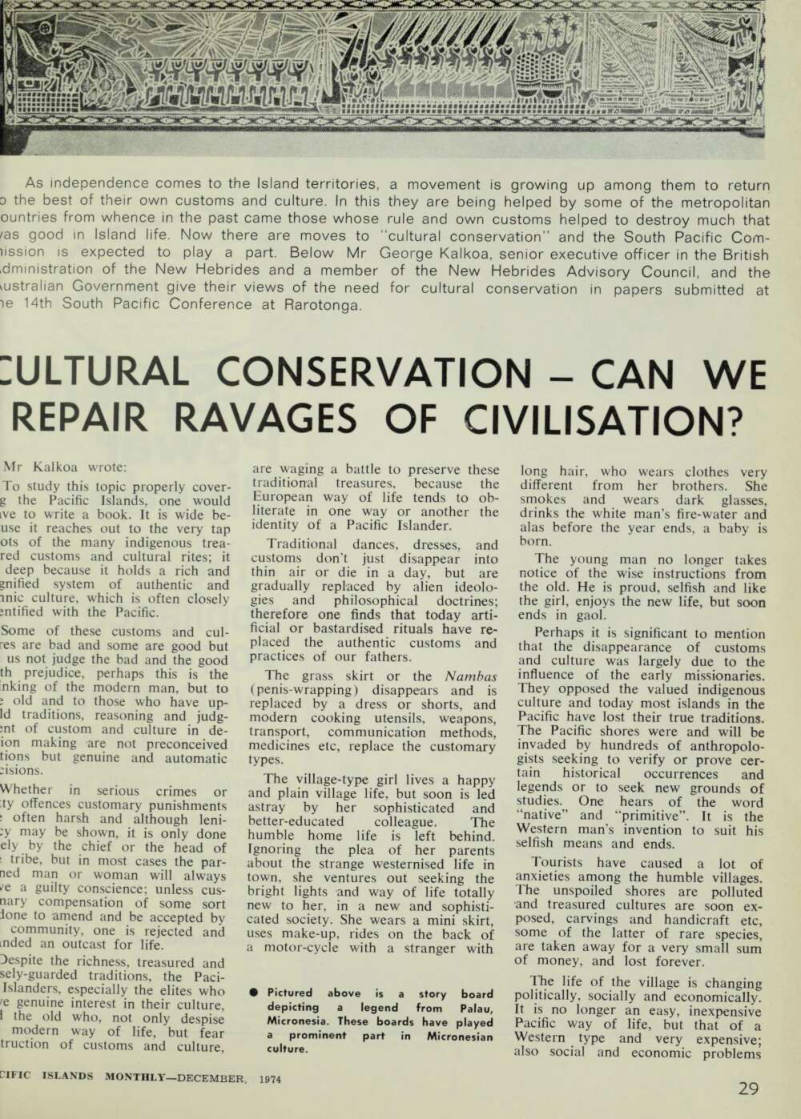

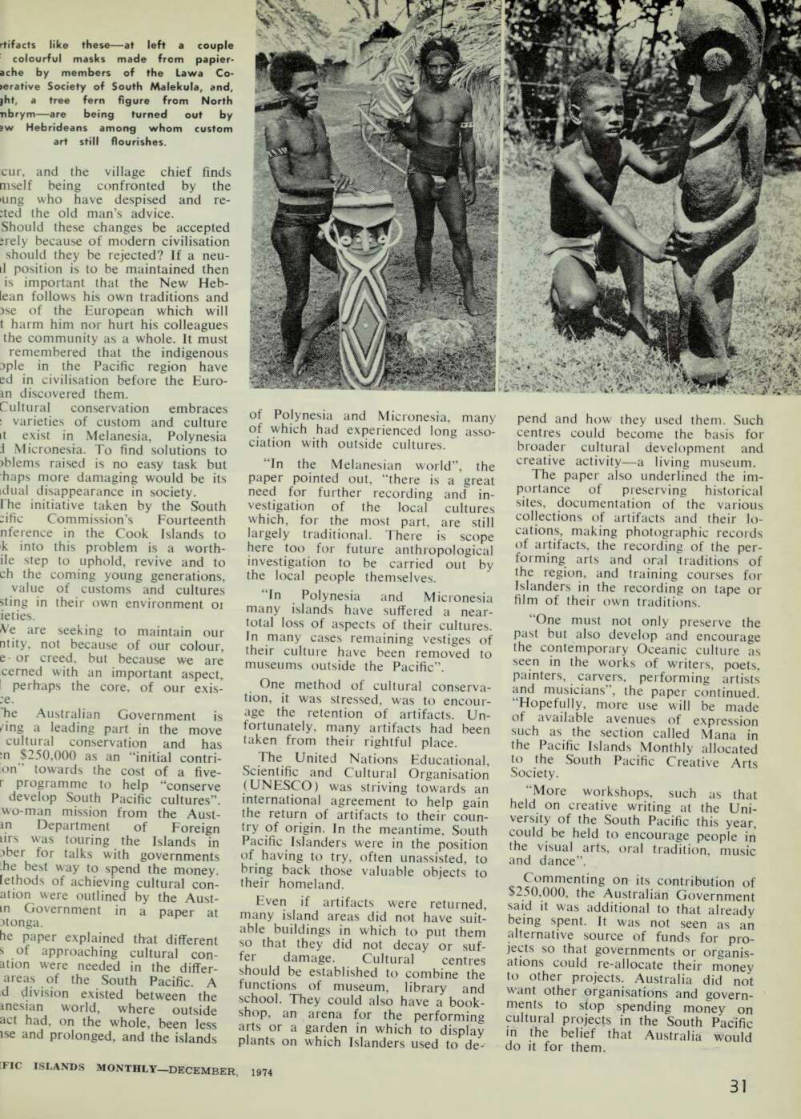
Cultural Conservation-Can We
As independence comes to the Island territories, a movement is growing up among them to return d the best of their own customs and culture. In this they are being helped by some of the metropolitan ountries from whence in the past came those whose rule and own customs helped to destroy much that fas good in Island life. Now there are moves to “cultural conservation’’ and the South Pacific Com lission is expected to play a part. Below Mr George Kalkoa, senior executive officer in the British administration of the New Hebrides and a member of the New Hebrides Advisory Council, and the Australian Government give their views of the need for cultural conservation in papers submitted at ie 14th South Pacific Conference at Rarotonga.
Mr Kalkoa wrote: To study this topic properly coverg the Pacific Islands, one would ive to write a book. It is wide beuse it reaches out to the very tap ots of the many indigenous treared customs and cultural rites; it deep because it holds a rich and unified system of authentic and imc culture, which is often closely mtified with the Pacific.
Some of these customs and culres are bad and some are good but us not judge the bad and the good th prejudice, perhaps this is the nking of the modern man, but to ; old and to those who have up- Id traditions, reasoning and judg- ;nt of custom and culture in deion making are not preconceived tions but genuine and automatic :is ‘° ns - Whether in serious crimes or ty offences customary punishments ; often harsh and although leni- :y may be shown, it is only done ely by t he chief or the head of : tribe, but in most cases the parned man or woman will always /e a guilty conscience; unless cusnary compensation of some sort ione to amend and be accepted by community, one is rejected and mded an outcast for life.
Despite the richness, treasured and 0
■ Si Mat
are waging a battle to preserve these traditional treasures, because the European way of life tends to obliterate in one way or another the identity of a Pacific Islander.
Traditional dances, dresses, and customs don’t just disappear into thin air or die in a day, but are gradually replaced by alien ideologies and philosophical doctrines; therefore one finds that today artificial or bastardised rituals have replaced the authentic customs and practices of our fathers.
The grass skirt or the Nambas (penis-wrapping) disappears and is replaced by a dress or shorts, and modern cooking utensils, weapons, transport, communication methods, medicines etc, replace the customary types.
The village-type girl lives a happy and plain village life, but soon is led astray by her sophisticated and better-educated colleague. The humble home life is left behind Ignoring the plea of her parents about the strange westernised life in town, she ventures out seeking the bright lights and way of life totally new to her, in a new and sophisticated society. She wears a mini skirt, uses make-up, rides on the back of a motor-cycle with a stranger with
long hair, who wears clothes very different from her brothers. She smokes and wears dark glasses, drinks the white man’s fire-water and alas before the year ends, a baby is
born -
The young man no longer takes notice of the wise instructions from the old. He is proud, selfish and like the girl, enjoys the new life, but soon ends in gaol.
Perhaps it is significant to mention that the disappearance of customs and culture was largely due to the influence of the early missionaries, They opposed the valued indigenous culture and today most islands in the Pacific have lost their true traditions.
The Pacific shores were and will be invaded by hundreds of anthropolo gists seeking to verify or prove cer- ! ain . histor , ical occurrences and °n l ° l Cek neW r 8 5° unds °j ? d - „ on f tt he ? rs . .°t t ? e . wo £ d J? at . lve and , P nmitl . ve • Jt 1? the man s I ? vent j on to sult his 86 fish means and ends * Tourists have caused a lot of anxieties among the humble villages, The unspoiled shores are polluted and treasured cultures are soon ex posed, carvings and handicraft etc, some of the latter of rare species, are taken away for a very small sum °f money, and lost forever.
socklfy iTy 8
« foTofa
Pictured above is a story board depicting a legend from Palau, Micronesia. These boards have played a prominent part in Micronesian culture.
cur, and the village chief finds mself being confronted by the •ung who have despised and re ded the old man’s advice.
Should these changes be accepted irely because of modern civilisation should they be rejected? If a neu il position is to be maintained then is important that the New Heb lean follows his own traditions and )se of the European which will t harm him nor hurt his colleagues the community as a whole. It must remembered that the indigenous aple in the Pacific region have ed in civilisation before the Euro in discovered them.
Cultural conservation embraces : varieties of custom and culture it exist in Melanesia, Polynesia I Micronesia. To find solutions to >blems raised is no easy task but haps more damaging would be its idual disappearance in society.
Fhe initiative taken by the South :ific Commission’s Fourteenth nference in the Cook Islands to k into this problem is a worth ile step to uphold, revive and to ch the coming young generations, value of customs and cultures sting in their own environment oi ieties.
Ae are seeking to maintain our ntity, not because of our colour, e- or creed, but because we are cerned with an important aspect, 1 perhaps the core, of our exis :e. he Australian Government is a leading part in the move cultural conservation and has ;n $250,000 as an “initial contri on” towards the cost of a five r programme to help “conserve develop South Pacific cultures”, wo-man mission from the Aust in Department of Foreign urs was touring the Islands in 3ber for talks with governments .he best way to spend the money, lethods of achieving cultural con ation were outlined by the Aust in Government in a paper at atonga. he paper explained that different s of approaching cultural con ation were needed in the differ areas of the South Pacific. A d division existed between the inesian world, where outside act had, on the whole, been less ise and prolonged, and the islands
of Polynesia and Micronesia, many of which had experienced long asso ciation with outside cultures.
“In the Melanesian world”, the paper pointed out, “there is a great need for further recording and in vestigation of the local cultures which, for the most part, are still largely traditional. There is scope here too for future anthropological investigation to be carried out by the local people themselves.
“In Polynesia and Micronesia many islands have suffered a near total loss of aspects of their cultures.
In many cases remaining vestiges of their culture have been removed to museums outside the Pacific”.
One method of cultural conserva tion, it was stressed, was to encour age the retention of artifacts. Un fortunately, many artifacts had been taken from their rightful place.
The United Nations Educational, Scientific and Cultural Organisation (UNESCO) was striving towards an international agreement to help gain the return of artifacts to their coun try of origin. In the meantime, South Pacific Islanders were in the position of having to try, often unassisted, to bring back those valuable objects to their homeland.
Even if artifacts were returned, many island areas did not have suit able buildings in which to put them so that they did not decay or suf fer damage. Cultural centres should be established to combine the functions of museum, library and school. They could also have a book shop, an arena for the performing arts or a garden in which to display plants on which Islanders used to de
pend and how they used them. Such centres could become the basis for broader cultural development and creative activity—a living museum.
The paper also underlined the im portance of preserving historical sites, documentation of the various collections of artifacts and their lo cations, making photographic records of artifacts, the recording of the per forming arts and oral traditions of the region, and training courses for Islanders in the recording on tape or film of their own traditions.
“One must not only preserve the past but also develop and encourage the contemporary Oceanic culture as seen in the works of writers, poets, painters, carvers, performing artists and musicians”, the paper continued.
Hopefully, more use will be made of available avenues of expression such as the section called Mana in the Pacific Islands Monthly allocated to the South Pacific Creative Arts Society.
“More workshops, such as that held on creative writing at the Uni versity of the South Pacific this year, could be held to encourage people in the visual arts, oral tradition, music and dance”.
Commenting on its contribution of 5250,000, the Australian Government said it was additional to that already being spent. It was not seen as an alternative source of funds for pro jects so that governments or organis ations could re-allocate their money to other projects. Australia did not want other organisations and govern ments to stop spending money on cultural projects in the South Pacific m the belief that Australia would do it for them.
[?]tifacts like these—at left a couple colourful masks made from papier [?]ache by members of the Lawa Co [?]erative Society of South Malekula, and, [?]ght, a tree fern figure from North [?]mbrym —are being turned out by [?]ew Hebrideans among whom custom art still flourishes.
Advertisements & other items, pp. 33-36 (3 items)
29
CIFIC ISLANDS MONTHLY—DECEMBER, 1974
8-Speed
Power
Blender
-the
appliance
you can use
every meal.
With powerful, Solid-state motor. Solid-state means added versatility for exactly the blending action you need —to stir, puree, cream, whip, grate, mix, chop or liquefy.
Stainless steel cutters operate at high speed for fast food preparation.
Switch from speed to speed without turning off.
KERR BROS.
THE
PEOPLE
FOR THE PACIFIC ISLANDS
it's Danish —
it's good!
Available in the Pacific Islands through:
KERR BROTHERS
PTY. LIMITED
65 YORK STREET, SYDNEY, N.S.W. 2000.
* / / A* /
PVMPIfWpeM IRON
Australia's best selling non-electric Iron! For reliability, ease of handling, and excellence of quality at a low price, you can t beat the HANOI. It's simplicity itself to operate—NO PUMPING 15 REQUIRED IT'S IMPOSSIBLE TO OVERFILL THE FUEL TANK and one filling does approximately 2 hours effortless ironing. Attractively finished in nickel plate. Spare parts always available.
THE PORTABLE OUTDOORS COOKER at a sensible price!
Twin independent burners for fast cooking. Twin tanks for double capacity. Steel case, when opened, acts as triple-wind shield. Rustproof Noisy or silent burners as required. Small or large porcelain enamel ovens also available separately. HANOl—the lowest priced QUALITY Twin Burner Portable! ■ ■ m PTY Evans Rd, Salisbury North. Ph. 47 2122
HANOI IAiOIIMCS ltd! BRISBANE, Queensland. Australia
31
FIC ISLANDS MONTHLY—DECEMBER, 1974
Justice-a
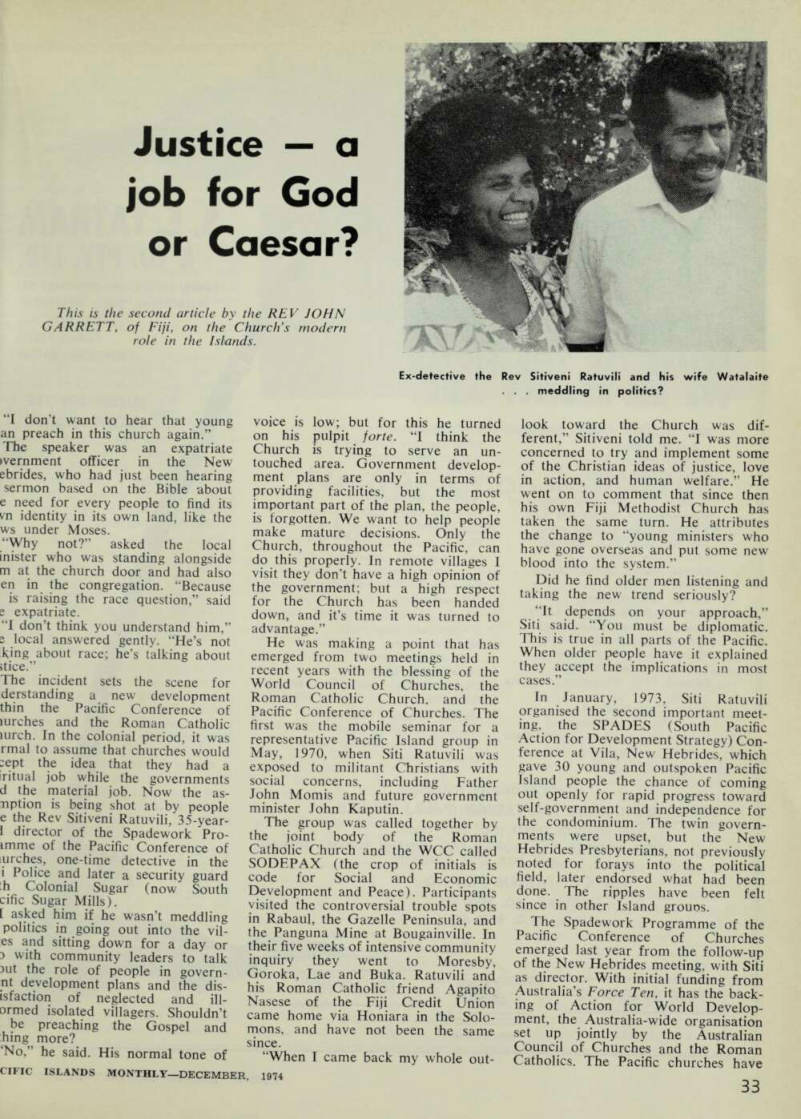
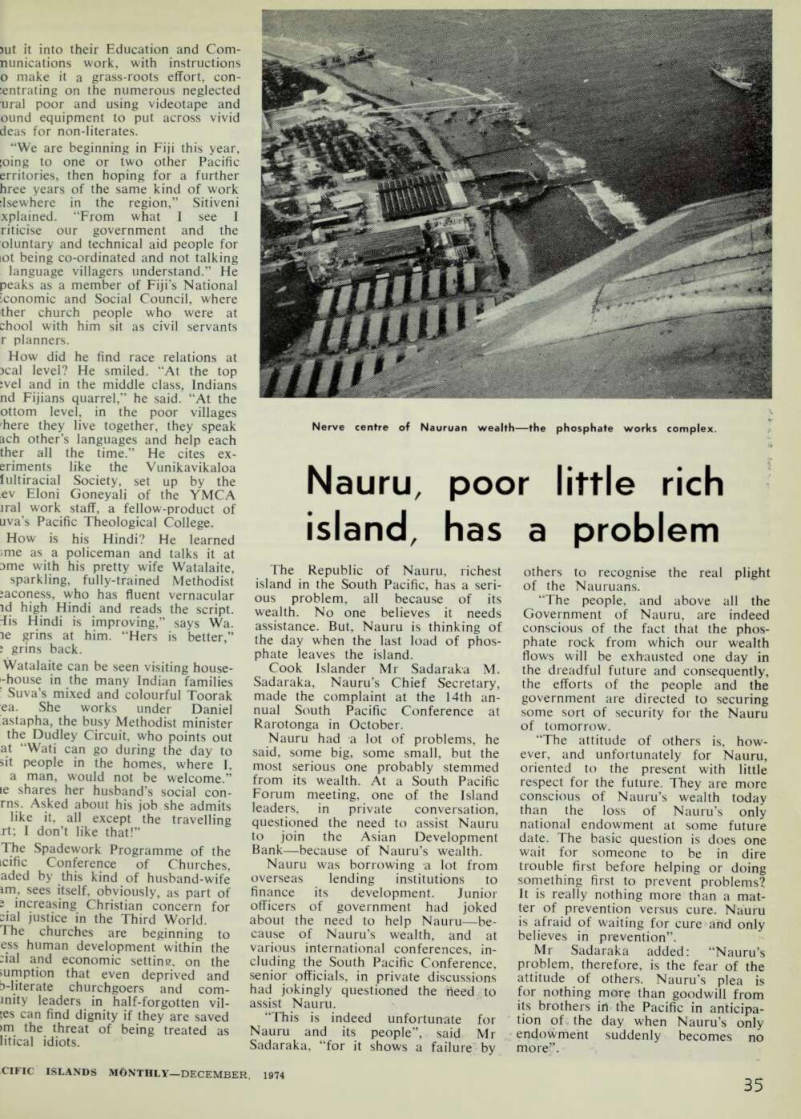
job for God or Caesar?
This is the second article by the REV JOHN GARRETT, of Fiji, on the Church’s modern role in the Islands.
“I don't want to hear that young an preach in this church again.”
The speaker was an expatriate ivernment officer in the New ebrides, who had just been hearing sermon based on the Bible about e need for every people to find its vn identity in its own land, like the ws under Moses.
“Why not?” asked the local inister who was standing alongside m at the church door and had also en in the congregation. “Because is raising the race question,” said s expatriate.
“I don’t think you understand him,”
“ local answered gently. “He’s not king about race; he’s talking about dice.”
The incident sets the scene for derstanding a new development thin the Pacific Conference of lurches and the Roman Catholic lurch. In the colonial period, it was rmal to assume that churches would :ept the idea that they had a iritual job while the governments d the material job. Now the as nption is being shot at by people e the Rev Sitiveni Ratuvili, 35-year- I director of the Spadework Pro imme of the Pacific Conference of lurches, one-time detective in the i Police and later a security guard -h Colonial Sugar (now South cific Sugar Mills). 1 asked him if he wasn’t meddling politics in going out into the vil es and sitting down for a day or 3 with community leaders to talk 3ut the role of people in govern nt development plans and the dis isfaction of neglected and ill ormed isolated villagers. Shouldn’t be preaching the Gospel and hing more? ‘No,” he said. His normal tone of
voice is low; but for this he turned on his pulpit forte. “I think the Church is trying to serve an un touched area. Government develop ment plans are only in terms of providing facilities, but the most important part of the plan, the people, is forgotten. We want to help people make mature decisions. Only the Church, throughout the Pacific, can do this properly. In remote villages I visit they don’t have a high opinion of the government; but a high respect for the Church has been handed down, and it’s time it was turned to advantage.”
He was making a point that has emerged from two meetings held in recent years with the blessing of the World Council of Churches, the Roman Catholic Church, and the Pacific Conference of Churches. The first was the mobile seminar for a representative Pacific Island group in May, 1970, when Siti Ratuvili was exposed to militant Christians with social concerns, including Father John Momis and future government minister John Kaputin.
The group was called together by the joint body of the Roman Catholic Church and the WCC called SODEPAX (the crop of initials is code for Social and Economic Envelopment and Peace). Participants visited the controversial trouble spots in Rabaul, the Gazelle Peninsula, and the Panguna Mine at Bougainville. In their five weeks of intensive community inquiry they went to Moresby, Goroka, Lae and Buka. Ratuvili and his Roman Catholic friend Agapito Nasese of the Fiji Credit Union came home via Honiara in the Solo mons, and have not been the same since.
“When I came back my whole out
look toward the Church was dif ferent,” Sitiveni told me. “I was more concerned to try and implement some of the Christian ideas of justice, love in action, and human welfare.” He went on to comment that since then his own Fiji Methodist Church has taken the same turn. He attributes the change to “young ministers who have gone overseas and put some new blood into the system.”
Did he find older men listening and taking the new trend seriously?
“It depends on your approach,”
Siti said. “You must be diplomatic.
This is true in all parts of the Pacific.
When older people have it explained they accept the implications in most cases.”
In January, 1973, Siti Ratuvili organised the second important meet ing, the SPADES (South Pacific Action for Development Strategy) Con ference at Vila, New Hebrides, which gave 30 young and outspoken Pacific Island people the chance of coming out openly for rapid progress toward self-government and independence for the condominium. The twin govern ments were upset, but the New Hebrides Presbyterians, not previously noted for forays into the political field, later endorsed what had been done. The ripples have been felt since in other Island grouos.
The Spadework Programme of the Pacific Conference of Churches emerged last year from the follow-up of the New Hebrides meeting, with Siti as director. With initial funding from Australia’s Force Ten, it has the back ing of Action for World Develop ment, the Australia-wide organisation set up jointly by the Australian Council of Churches and the Roman Catholics. The Pacific churches have
Ex-detective the Rev Sitiveni Ratuvili and his wife Watalaite ... meddling in politics?
nit it into their Education and Com nunications work, with instructions o make it a grass-roots effort, con :entrating on the numerous neglected ural poor and using videotape and ound equipment to put across vivid deas for non-literates.
“We are beginning in Fiji this year, ;oing to one or two other Pacific erritories, then hoping for a further hree years of the same kind of work ilsewhere in the region,” Sitiveni xplained. “From what I see I riticise our government and the oluntary and technical aid people for lot being co-ordinated and not talking language villagers understand.” He peaks as a member of Fiji’s National xonomic and Social Council, where ther church people who were at chool with him sit as civil servants r planners.
How did he find race relations at jcal level? He smiled. “At the top wel and in the middle class, Indians nd Fijians quarrel,” he said. “At the ottom level, in the poor villages r here they live together, they speak ach other’s languages and help each ther all the time.” He cites ex eriments like the Vunikavikaloa lultiracial Society, set up by the ev Eloni Goneyali of the YMCA iral work staff, a fellow-product of □va’s Pacific Theological College.
How is his Hindi? He learned )me as a policeman and talks it at ame with his pretty wife Watalaite, sparkling, fully-trained Methodist jaconess, who has fluent vernacular id high Hindi and reads the script, -lis Hindi is improving,” says Wa. le grins at him. “Hers is better,” ; grins back.
Watalaite can be seen visiting house -house in the many Indian families r Suva’s mixed and colourful Toorak ea. She works under Daniel astapha, the busy Methodist minister the Dudley Circuit, who points out at “Wati can go during the day to sit people in the homes, where I, a man, would not be welcome.” ic shares her husband’s social con rns. Asked about his job she admits like it, all except the travelling rt; I don’t like that!”
The Spadework Programme of the icific Conference of Churches, aded by this kind of husband-wife im, sees itself, obviously, as part of 2 increasing Christian concern for cial justice in the Third World.
The churches are beginning to ess human development within the :ial and economic settine, on the sumption that even deprived and t)-literate churchgoers and com mity leaders in half-forgotten vil ;es can find dignity if they are saved »m the threat of being treated as litical idiots.
Advertisements & other items, pp. 37-38 (2 items)
33
CIFIC ISLANDS MONTHLY—DECEMBER, 1974
S. E. Tatham
SOME OF THE
WE REPRESENT
Asia Rubber Works (Singapore Rubber Shoes) Frappier (French Brandy) Huvet (French Brandy) Indika (Belgium Dairy Produce) Durobor S.A. (Belgium Glassware) Miroiterie Gen. de Belgiqe S.A. (Louvre glass and mirrors) City Engineers (U.K. Bicycles) F.H.I. Japan (Subaru Cars) Kraggs (Wines, Spirits, Ciders) Sunshine Biscuits Sunrise (Confectionery) Flamenco (Instant Coffee & Tea) Quaker Products (Oats, Jets) Hancocks (Spaghetti, Cereals) Melbourne Canning (Jams) Amatil (Twisties, Twirlies) Edward Zorn (Margarine, Cooking Fats) Allens (Confectionery) Red Tulip (Fine Chocolates) Robert Timms (New Guinea Gold Instant Coffees and Teas) S.P.C (Canned Fruit)
FIRMS
ARE:
S.P.C. (Abalone) Wing Lee (See You Sauce) Magnet (Mattresses) Essteel (Cookware) Warner-Drayton (Fans) Mitchell's (Abrasives) Tilbury & Lewis (Sports Trophies & Silverplate) Regent (Swiss watches) Lega Marcasite (Jewellery) Austramax (Pressure Lanterns) Lawn Chair; Tubco (Garden Furniture) Electronic Industries (Electrical Household Appliances) Jex (Steelwool) Arnbro (Folding Beds) James Miller (Blankets) Elmaco (Plastics —Electrical Fittings' B.X. (Plastics) Stegbar (Wooden Louvres) Franklite (Light Fittings) JJ. Cash (Embroidered Labels) Disston (Saws)
S. E. TATHAM
& CO. PTY. LTD.
ASKEW HOUSE, 364 LONSDALE ST.,
MELBOURNE, 3001, AUSTRALIA.
G.P.O. BOX 8—
CABLES "SET",
TELEPHONE: 601125
BUYERS FOR THE
PACIFIC ISLANDS
% 1 » % 1 %
DIRECT ENQUIRIES WELCOMED
PAPUA NEW GUINEA: S. E. TATHAM (P.N.G.) PTY. LTD.,
LAE: MALAITA STREET (P.O. BOX 1562).
PORT MORESBY: CNR, GOROA AND MUNAHU STREETS, GORDON
(P.O. BOX 6733, BOROKO).
FUI: S. E. TATHAM (FIJI) LTD.,
LAUTOKA: P.O. BOX 366.
SUVA; G.P.O. BOX 671.
YOUR GUARANTEE
i
FOR SERVICE
T. 2
SINCE 1924
island, has a problem
Nauru, poor little rich island, has a problem
The Republic of Nauru, richest island in the South Pacific, has a serious problem, all because of its wealth. No one believes it needs assistance. But, Nauru is thinking of the day when the last load of phosphate leaves the island.
Cook Islander Mr Sadaraka M.
Sadaraka, Nauru’s Chief Secretary, made the complaint at the 14th annual South Pacific Conference at Rarotonga in October.
Nauru had a lot of problems, he said, some big, some small, but the most serious one probably stemmed from its wealth. At a South Pacific Forum meeting, one of the Island leaders, in private conversation, questioned the need to assist Nauru to join the Asian Development Bank—because of Nauru’s wealth.
Nauru was borrowing a lot from overseas lending institutions to finance its development. Junior officers of government had joked about the need to help Nauru—because of Nauru’s wealth, and at various international conferences, ineluding the South Pacific Conference, senior officials, in private discussions had jokingly questioned the heed to
as^. Nauru -
This is indeed unfortunate for Nauru and its people”, said Mr Sadaraka, “for it shows a failure by
others to recognise the real plight of the Nauruans.
“The people, and above all the Government of Nauru, are indeed conscious of the fact that the phos phate rock from which our wealth flows will be exhausted one day in the dreadful future and consequently, the efforts of the people and the government are directed to securing some sort of security for the Nauru of tomorrow.
“The attitude of others is, how ever, and unfortunately for Nauru, oriented to the present with little respect for the future. They are more conscious of Nauru’s wealth today than the loss of Nauru’s only national endowment at some future date. The basic question is does one wait for someone to be in dire trouble first before helping or doing something first to prevent problems?
It is really nothing more than a mat ter of prevention versus cure. Nauru is afraid of waiting for cure and only believes in prevention”.
Mr Sadaraka added: “Nauru’s problem, therefore, is the fear of the attitude of others. Nauru’s plea is for nothing more than goodwill from its brothers in the Pacific in anticipa tion of the day when Nauru’s only endowment suddenly becomes no more”.
Nerve centre of Nauruan wealth—the phosphate works complex.
Advertisements & other items, pp. 39-40 (2 items)
35
CIFIC ISLANDS MONTHLY—DECEMBER, 1974
Modular Home Units...In Everyway!
YOU LI WELCOME OUR TROPICAL
• PRE-CONSTRUCTED IN N.Z. AND
PRE-TREATED FOR TROPIC CONDITIONS
• SHIPPED KNOCKED-DOWN TO YOUR
DESTINATION
• EASILY ERECTED ON SITE WITH MINIMUM
SKILLED LABOUR
• OFFER LUXURY AT A REASONABLE PRICE Perfect for holiday and permanent homes orcommercial and industrial housing projects. 4 models to choose from; ‘Leisuredeck’, (illustrated) Sunseeker’, ‘Castaway’, ‘Sunlover' in 1,2,3-bedroom units. . . modular construction streamlines design, gives flexibility . . . pre-construction cuts costs and assembly-but not quality. . . maintenance-free pre-coated insulated Permalum metal weather-boarding . . . pre-piped plumbing unit. Plus many other quality features!
Already performance-proven in the New Hebrides, Pitcairn and Japan.
IT m
welcome! homes limited
Mail this coupon now!
Like to know more?
I I I I I 1 To: The Manager, Welcome Homes Ltd Box 12203, Penrose, Auckland, N.Z.
Please send me, without obligation, brochureson your Modular Home Units.
Name Address Property Located At 664^J
Save hundreds of dollars
on Australians most efficient
WALK IN, ALUMINIUM
COOLROOMS AND
FREEZE ROOMS
Hundreds already installed! The most economical supplementary coolrooms for bottles and food, providing the largest storage capacity of any comparable coolrooms of the same exterior dimensions. Five sizes —from 90-360 cu. ft. capacity; 16 models offering normal temp., two temp., deep freeze, or for pastry and ice storage applications. White vinyl interior, embossed rustproof aluminium exterior. • SUPPLIED IN EASY-TO-ERECT, DO-IT-YOURSELF KIT FORM.
Available from: m.
AUSTRALIAN NEW CALEDONIA EXPORTS (SILVER & BARDA), 363 George St., Sydney, 2000 and Branches.
BRECKWOLDT & CO., 276 Pitt St., Sydney, 2000 and Branches.
PETER FISHER TRADING PTY. LTD., 321 Pitt St., Sydney, 2000.
HAGEMEYER (A'SIA), 59 Anzac Pde., Kensington, 2033 and Branches.
KERR BROS, 65 York St., Sydney, 2000.
Manufactured by:
NELSON & ROBERTSON PTY. LTD., 197 Clarence St., Sydney, 2000.
RABAUL TRADING CO. PTY. LTD., P.O. Box 219, Rabaul and Branches.
ROY GALLIMORE & ASSOCIATES, P.O. Box 179, Vila, New Hebrides.
C. SULLIVAN (EXPORT) PTY. LTD., 60 Margaret St., Sydney, 2000 and Branches.
W. S. TAIT & CO, PTY. LTD., 31 Macquarie Place, Sydney, 2000 and Branches. m
WARBURTON FRAHK6
199 Parramatta Road, Cnr. Skarratt Street, Auburn, N.S.W. 2144, Australia. Phone 648-1711.
POWERED BY
KELVINATOR.
Five-year warranty on compressor. Early delivery.
Portland, Oregon

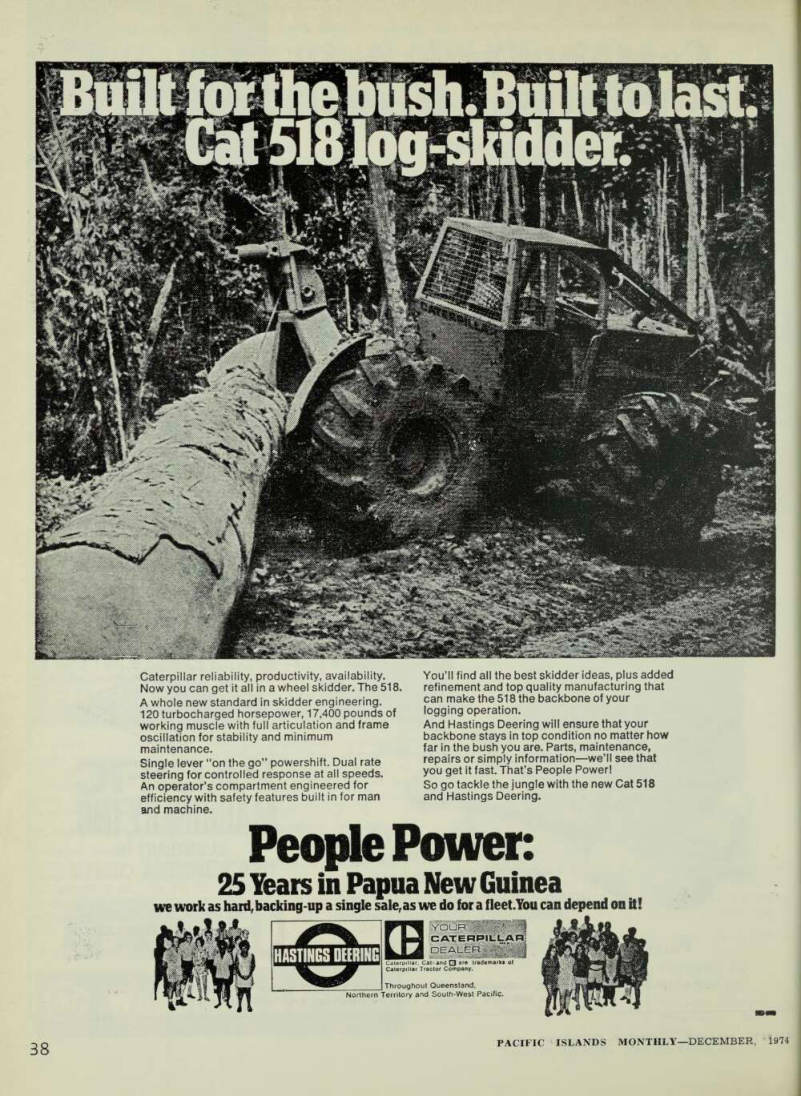
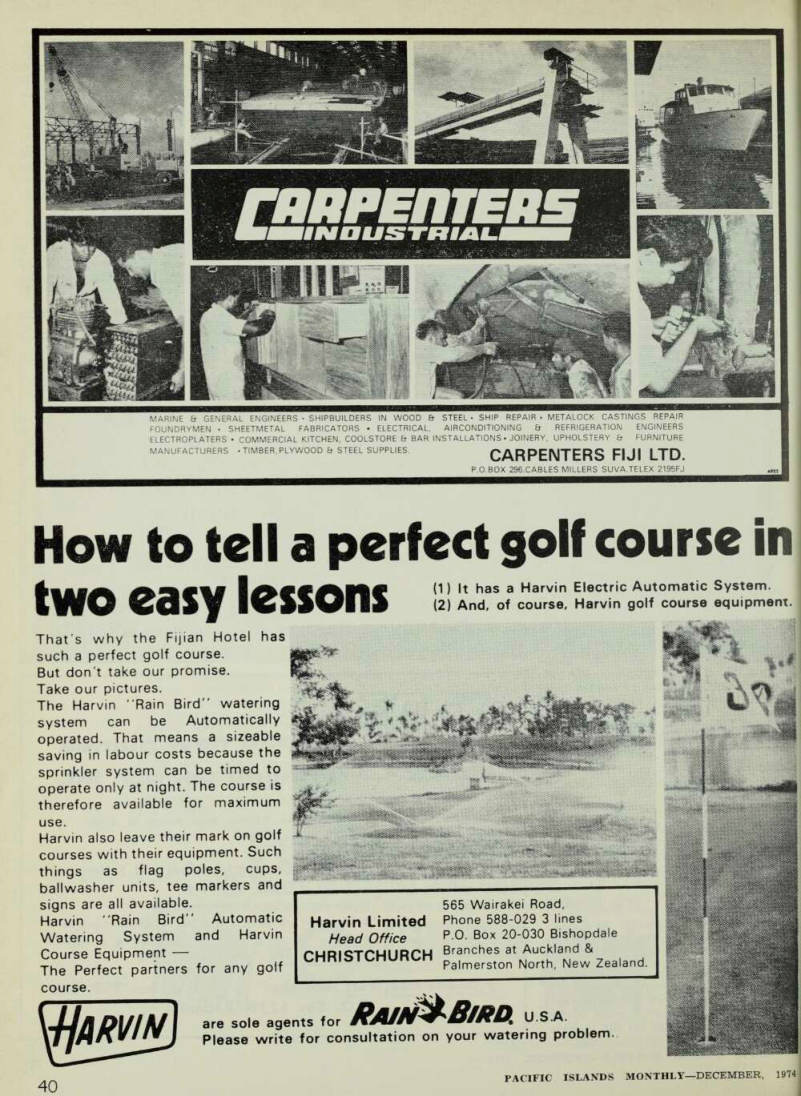
Captain Cook is in Portland, Oregon
From Patricia Matheson,
Meeting an old friend in an un :xpected place is always a joy . . . ind so it was with a feeling of sur mise and pleasure that I learned a ew days ago that Captain James rook was in Portland, Oregon.
I met Cook first a long time ago n my school books, but it was when came to share his great love for he world of the Pacific that I began o know him better. Then I read his ournals in the monumental Beagle lole edition and came to appreciate he mental energy and moral honesty if the great navigator.
From time to time, I picked up ome new fact about his life or his york, until I came to feel that, in pite of the barrier of two centuries, a spite, too, of the fact that he was ;ne of the truly great men of all ime, he had become a friend.
How did he happen to be in Port and, Oregon? He came at the invita ion of Thomas Vaughn, executive
director of the Oregon State His torical Society, who has long been interested in Cook’s three voyages of Pacific exploration. To make Cook come to Portland meant to Vaughn the assembling from all over the world of material associated with the explorer. Museums and private col lectors of many lands were contacted and responded so generously that it is no exaggeration to say that the Oregon exhibit is the greatest collec tion of Cook that has ever been shown.
Vaughn was particularly fortunate in obtaining practically the whole Cook gallery from the National Maritime museum in Greenwich, England. With that to form the basis of the exhibit, with important items from Australia, New Zealand, Cana da, Ireland and Russia, its success was ensured.
There was an international flavour to the opening festivities of July 1,
1974 when Admiral Sir Charles Madden, chairman of the Board of the National Maritime Museum in Greenwich introduced Capt James Cook to Portland, Oregon. Present also were Consul-General of New Zealand S. M. Hope and Mrs Hope, Consul-General of Australia R. L.
Dean and Mrs Dean and the Consul- General of the USSR, Alexander Zinxchuk. Since then the exhibit has
Captain Cook
been attended by a constant stream of visitors eager to feel the thrill of being in the presence of a great man.
And how do you come to know a great man? In exactly the same way in which you become acquainted with an ordinary friend. You share his thoughts, meet his comrades, interest yourself in his work and learn the circumstances of his daily life. All those things, I did with Capt James Cook at the Oregon Historical Society in Portland the other day.
I found myself being thankful that the camera had not been invented when Cook sailed; for the artists who accompanied him on his travels and those who portrayed both him and his contemporaries added a personal touch that photography could never have given.
I was particularly interested in the portraits of the men who had sailed with Cook—his fellow captains, King and Clarke and the steady American, Gore, whose sad duty it was to lead the last expedition back to England after Cook had been killed. There was Bligh, too—not yet the implacable captain of the Bounty, but already showing, as the 21-year old master of the Resolution, some thing of both the headstrong stub bornness that led to the mutiny and of the persistence and skill which enabled him to sail in an open boat from the Tongan island of Tofua to the East Indies.
There are several pictures of the young Joseph Banks, the nobleman whose aristocratic ideas brought him into conflict with the practical Cook, but who, nevertheless, did more than any other man to acquaint the world with the wonders of Pacific flora and fauna. There are also portraits of the other great explorers of Cook’s time as well as of the men in Eng land who backed him at the Ad miralty.
Finally, there are paintings of the artists themselves—of Sydney Parkin son, the brilliant young artist of the first journey who lost his life in Bata
via on the homeward journey—of the father and son naturalists, the
Forsters, and of John Webber of whom it was written, “The peoples, seas, and landscapes of all the oceans of the world came under his brush”.
Turning to the paintings, engrav ings, and drawings of the travels, it is easy to feel all the excitement that swept through the world when the islands of the Pacific first cast their romance and mystery over the minds of men. Never before had the old world seen the kangaroo that in Par kinson’s drawing stands erect with ears cocked suspiciously, nor had it ever known the lushness of island landscape nor the majesty of island peoples as Webber portrays them in
painting after painting of Tonga and Hawaii.
Cook valued his artists, but he was not content to let their im pressions give the whole record of the trips. He kept meticulous iournals —some of which, written in tiis own clear hand, can be seen at he exhibition. He also collected nany artifacts. Especially note worthy is the Tongan collection and he beautiful Hawaiian feather cape which was lent by the USSR.
Cook’s nautical instruments are here, too, and it is interesting to lote that they were all the most up o-date of his day. There are, too, )lans of his ships and copies of the :harts he made of all the new lands le found.
Of the little things of common, veryday life, there are many—the utlery he used at table, his gold cuff inks, his ivory rule, his inlaid dress tig case—all, like the man himself, ood, solid, durable.
And, finally, there are several epresentations of Cook’s tragic death t Kealakekua Bay on February 14, 779 of which the best is probably lat by Clevely. There is a copy of le coat-of-arms which George 111 estowed posthumously on Cook and record of the even greater tribute lat he paid by standing weeping ith bowed head when the news was rought to him of the explorer’s eath.
Because the exhibition is to con nue until January 1975, I write lis in hope that all Pacific people ho are travelling in the United tales in the next few months, will ut Portland, Oregon, on their inerary, visit the exhibition at the regon Historical Society and come » know better that great man, Cap in James Cook.
E Was Also
N Norfolk
Captain Cook was also on Nor ►lk Island in October. As part of e Cook Bicentenary Celebrations, e islanders re-enacted Cook’s nding there on October 10, 1774. eading his party, all garbed as x>k described the landing party, is George (Mac) Adams as Cook, ley followed to the letter every -P the famous navigator took— e walk along the beach, the climb ► the rocks, inspection of the flax ant, the walk into the pine forest hind Emily Bay, and the cutting •wn of the pine tree, which was ken back to the ship. Attending r celebrations were Australia’s ime Minister Gough Whitlam and rs Whitlam, and Minister for the ipital Territory Gordon Bryant.
Advertisements & other items, pp. 41-42 (2 items)
Icific Islands Monthly—December, 1974
Machinery, Inc.
YOU GET A BETTER DEAL FROM
PA C/F/C MA CH/NERY
f&r v- ■V, ix &
CAT 3208
Marine Engine ft Horsepower.
Includes Twin Disc MGSO2 2:1 Marine Gear.
Several in stock. Other Ratios Available.
Parts Availability Throughout the Pacific
PAPIFIP
MACHINERY, INC.
SUBSIDIARY OF
THEO. H. DAVIES & CO., LTD.
VOUR
CATERPILLAR
DEALER
HAWAII: 94-025 Farrington Hwy. f Waipahu, Hawaii 96797. Phone: 677-9111. Cable: “PAMACAT.” TLX: 723397.
GUAM: Phone: 646-4479. Also U.S. Trust Territory and American Samoa.
Caterpillar reliability, productivity, availability.
Now you can get it all in a wheel skidder. The 518.
A whole new standard in skidder engineering. 120 turbocharged horsepower, 17,400 pounds of working muscle with full articulation and frame oscillation for stability and minimum maintenance.
Single lever “on the go” powershift. Dual rate steering for controlled response at all speeds.
An operator’s compartment engineered for efficiency with safety features built in for man and machine.
You’ll find all the best skidder ideas, plus added refinement and top quality manufacturing that can make the 518 the backbone of your logging operation.
And Hastings Deering will ensure that your backbone stays in top condition no matter how far in the bush you are. Parts, maintenance, repairs or simply information —we’ll see that you get it fast. That's People Power!
So go tackle the jungle with the new Cat 518 and Hastings Deering.
People Power:
25 Years in Papua New Guinea
we work as hard, backing-up a single sale,as we do for a fleet. You can depend on it! n
HASTINGS DEERING
YOUR
fUJ CATERPILLA
LU DEALe ai
Caterpillar. Cali and Q are trademarks Caterpillar Tractor Company.
Throughout Queensland.
Northern Territory and South-West Pacific.
A Fiji Home For The Undp
The United Nations Development Programme, which was forced to close its office in Western Samoa in July, has succeeded in persuading Fiji to allow it to transfer operations to the dominion.
Some time before Prime Minister Fiame Mataafa of Western Samoa ordered UNDP out of the country, the agency made an approach to the Fiji Government for a base in Fiji but the government refused to accept UNDP conditions which would have placed a financial burden on it.
The Fiji Government has now agreed to provide a site for the office under normal crown lease conditions, so long as Fiji does not have to make any contribution to the cost above the government’s share of the regional governments’ contributions.
Advertisements & other items, pp. 43-54 (8 items)
W. H. Grove & Sons Ltd.
ESTABLISHED 1896
ISLAND MERCHANTS
Exporters to the Pacific of Dairy Products and all New Zealand consumer and manufactured goods.
ENTRUST YOUR REQUIREMENTS TO THE
ESTABLISHED FIRM
P.O. Box 3718,
AUCKLAND
Cables
GROVE AUCKLAND
D apua new guinea
printing co. pty. ltd.
Serving the Country from Aitape to Alotau, Manus to Moresby Leaders in Commercial Offset and Letterpress Printing. • Stationery 9 Office Supplies • Office Equipment • Rubber Stamps • Self-Adhesive Labels • In Fact;- Everything For The Office.
P.O. Box 633, Port Moresby P.O. Box 759, Lae P.O. Box 1239, Rabaul
MARINE & GENERAL ENGINEERS • SHIPBUILDERS IN WOOD & STEEL • SHIP REPAIR • METALOCK CASTINGS REPAIR FOUNDRYMEN • SHEETMETAL FABRICATORS • ELECTRICAL, AIRCONDITIONING & REFRIGERATION ENGINEERS ELECTROPLATERS • COMMERCIAL KITCHEN, COOLSTORE & BAR INSTALLATIONS • JOINERY. UPHOLSTERY £t FURNITURE MANUFACTURERS • TIMBER.PLYWOOD & STEEL SUPPLIES. CARPENTERS FIJI LTD
P.0.80X 296. CABLES MILLERS SUVA.TELEX 2195FJ
How to tell a perfect golf course in
two easy lessons
(1) It has a Harvin Electric Automatic System. (2) And, of course, Harvin golf course equipment.
That's why the Fijian Hotel has such a perfect golf course.
But don't take our promise.
Take our pictures.
The Harvin "Rain Bird" watering system can be Automatically operated. That means a sizeable saving in labour costs because the sprinkler system can be timed to operate only at night. The course is therefore available for maximum use.
Harvin also leave their mark on golf courses with their equipment. Such things as flag poles, cups, ballwasher units, tee markers and signs are all available.
Harvin "Rain Bird" Automatic Watering System and Harvin Course Equipment The Perfect partners for any golf course. \ wmm. ** \ j Harvin Limited Head Office
CHRISTCHURCH
565 Wairakei Road, Phone 588-029 3 lines P.O. Box 20-030 Bishopdale Branches at Auckland & Palmerston North, New Zealand.
Ra/n^B/rd %
U.S.A.
are sole agents for Please write for consultation on your watering problem. ■ *
ARE YOU GIVING
BLOOD
THE DANGEROUS WAY?
Mosquito biting a human being.
CONCENTRATED PEA-BEU
The strong one that cares for your world The common mosquito is more than just a nuisance, its bite can spread dangerous disease. So it's worth getting rid of fast.
Concentrated Pea-Beu contains one of the world's most powerful insecticides so it kills insects in seconds and it's rigidly tested through every stage of manufacture so you can spray it safely with confidence to protect the health and well-being of your family.
Concentrated Pea-Beu kills flies, mosquitoes,aH disease carrying insects in seconds,m
!i® *'S 3
SOUTHERN PACIFIC INSURANCE
COMPANY (PNG) LIMITED
(INCORPORATED IN PAPUA NEW GUINEA)
HEAD OFFICE: BANK HAUS, CHAMPION PDE. P.O. BOX 136 PORT MORESBY, PAPUA NEW GUINEA. PH. 2623 • FIRE • FIRE AND VOLCANIC ERUPTION • HOUSEHOLD COMPREHENSIVE • MOTOR VEHICLE • COMPULSORY THIRD PARTY • COMPULSORY WORKERS COMPENSATION
MARINE • PUBLIC LIABILITY o BURGLARY
Enquiries are invited for all classes of insurance from special representatives at; PORT MORESBY: H. A. McKEE, General Manager, Champion Pde., P.O. Box 136 Ph. 2623 or 2075. LAE: K. J. ARMSTRONG, Manager for Lae, Central Ave, P.O. Box 758, Ph. 42-4590 92 R ' Mana 9 er for Rabaul, Mango Ave., P.O. Box 123, Ph.
41
iCIFIC ISLANDS MONTHLY—DECEMBER, 1974
From the
Islands Press
From a letter by Nathanael Fu in the Samoa Times; Please allow me to use a few lines in your newspaper to inform the Price Control Board (if there is still one in existence) that almost every shopkeeper in the country is intentionally ignoring your price control orders.
From a letter by Alipate Fua in the Tonga Chronicle: Through lack of maintenance and care, what used to be an all-weather road has become a mere bush track. Here, the depth of mud and the intense growth of weeds on the "supposed to be government road" was quite adequate for planting and pastoral grazing.
From Town Talk in the Arawa Bulletin: Toilet paper made in PNG is now on sale. However, there’s no truth in the rumour that the instruction has gone out from Konedobu that the industrial drive must start from the bottom and work its way up.
From a letter by G. K. Chambers in the Cook Islands News: Avatiu Harbour has been described as the dirtiest in the South Pacific. When the Manuvai is in port oil can be seen clinging to ropes and boats and bits of wood. Who cares?
From the Highland News (PNG): A prominent Kama traditional leader and council committeeman Rupoe has criticised the government over the mass exodus of Europeans from New Guinea. . . . Rupoe says the Europeans should be able to remain until they feel like leaving and not be made to feel unwelcome or hastily localised . . . Rupoe also says that before the Europeans came we did not have a good life at all, as many people seem to think. We had an awful life fighting, not eating properly, no facilities, a high infant mortality rate and low age expectancy.
Now some of us are leading a far better life but we need the Europeans to stop longer so that we can really go further ahead.
From the Micronesian Independent under the
heading "Rinky-dink ka dink":
Micronesian Independent critic Mike White has applied for a permit to do piano tuning in
Saipan. White’s application said the operation
would be completely owned by an expatriate but that his wife (a TT citizen) will almost certainly get all the profits.
From the GEIC's Atoll Pioneer: Miss Alisa Koveu, aged 19, has established a new women's record in the Ellice Group, when she hit 250 runs at a
cricket match played the Samoan style, at Nui in which only women took part. The teams were captained by Mrs Bikini Minute and Mrs Faali Manga. The team under Mrs Manga won the match with an impressionable score of 475 runs. The other made 259 runs.
A Tongan proverb quoted in the Tonga Chronicle: 'Uli'uli 'a fine 'eua —the dark complexion of an Eua woman. The women of Eua were not regarded as good looking and though they wandered freely at day time, they were locked up and well protected in their homes at night. The proverb refers to something not good enough but well protected and looked after.
From the Arawa Bulletin: The Bulletin staff apologise for the blank page in this issue. In order to give ample space to the election news it was necessary to include an extra page.
Criticism of globe-trotting MPs by Pangu Party man Mr Anskar Karmel and United Party member Mr Akepa Miakwe, as reported by Mokonda Rema in the PNG Post-Courier: “. . . Leaders cannot speak the truth and support the facts if, for instance, we do not know the people and the actual situation up here in the Highlands”, Mr Karmel said. The two men said the Government was failing in sending politicians overseas when they did not know what it was like on the other side of the mountain in their own country . . .
From the American Samoa News Bulletin: Governor Haydon was on hand for a rain-making experiment on the old runway at Pago Pago International Airport. The experiment involved such chemicals as calcium carbide and amonium nitrate, plus water and fire. After two hours of waiting and preparation, the experiment itself wasn’t too spectacular. The chemical mixture was supposed to create gases which would ‘prime’ the moisture in the air and produce an inch of rain within three days. There is no indication that the experiment had anything to do with it—but nearly two inches of rain fell in less than 24 hours after the chemicals were mixed. That is nearly as much rain as drought-plagued Tutuila has had in the past four months.
From the latest addition to Islands Press, the Lae Nius: The Maintenance Department at the University of Technology is receiving congratulations from University authorities, particularly from the mathematics and physics departments ... A spokesman for the University said that for more than a year, staff in the two departments had to borrow hot water to make a brew at each break. The spokesman said that a few weeks ago, the Maintenance Department was called in to investigate a water leak. After removing a panel from the front of the cupboard adjoining the sink to get to the leak, workmen found that the water heater had never been switched on.
From Town Talk in the Arawa Bulletin: The Fickle Finger of Fate strikes again! Repeated complaints made about leaking concrete mixers spilling their load all over the Kieta Road brought no response. First car to come to grief on globs of concrete was police-owned.
43
ACIFIC ISLANDS MONTHLY—DECEMBER, 1974
what else?
Bacardi
ice and
... nothing else if you feel so inclined, for there’s no real problem where and how and what you drink Bacardi rum with.
Because Bacardi rum is so light, dry, highly refined and pure it complements every mixer, yet remains distinctively itself. Bacardi and Coke and ice ... Bacardi and ginger... Bacardi and tonic with a zest of lemon or lime ... Bacardi and fruit juice ... Mix up your own Bacardi party.
Because ...
Anything
goes with
Bacardi rum
BACARDI
rum-themixableone. mmm n Bacardi and the Bat Device a-e trade '-.a r ks of Bacardi and Company Limited.
"Coca-Cola" and "Coke" are the registered trade marks of The Coca-Cola Company.
BAC/2382/72
' H 4#\ 9 #? * ■-> . m in
%i gp
tat
OF AUSTRALIA
11 •
2§ KG NfT
SfSs H >C|4. > /L d **£ 4. 4 *
the most important ingredient
BREAD FLOURS;
CAKE FLOURS;
BISCUIT FLOURS;
SPECIALITY FLOURS;
MAINTOP —high protein bread flour ANCHOR—bakers flour • 50/50 MEAL —brown bread MEDlUM—cake and pastry • SPONGE —sponge cakes SPECIAL CAKE—madeira and cup cakes STRONG —cracker biscuits • MEDIUM —Shortbreads SOFT —sweet biscuits RYE flour • RYE meal • KIBBLED RYE SHARPS —roti and chapati flour • 100% STONE GROUND
WHOLEMEAL
GILLESPIE BROS. PTY. LTD.
HEAD OFFICE: BRISBANE OFFICE:
52 UNION ST,, PYRMONT, SYDNEY, N.S.W. CABLE ADDRESS: „ AL „L o v N ' o amn 1 (G.P.O. BOX 2518, SYDNEY, 2001.) "GILLESPIE", (P.O. BOX 8, ALBION, BRISBANE, 4010.) PHONE- 660-4933. SYDNEY AND BRISBANE. PHONE: 6-1121.
RELIABLE
RETMH
I H oat One of the world’s largest manufacturers of marine engines comes to the Pacific.
Now the Renault Marine range is available to the Pacific owner, whether it be commercial or pleasure, offering horsepower ratings from 5 to 320.
The Renault engine not only offers the advantages of advanced design incorporating a host of features but there is also an invisible extra - reliability. The kind of reliability that won t let you down at critical moments, and when service is required you’ll find it easy to perform - a very important plus in remote locations. All round Renault Marine is worth a look.
Dealerships Renault is seeking dealers in the Pacific. If you are interested we invite you to contact Campbell Motor Imports at this address: Mr Eric Sinclair
CAMPBELL MOTOR IMPORTS LIMITED
PO Box 5940 Auckland New Zealand
\sd \ sus® v - -—o a c I \ V, c^
U U CO
HL OS ° I 0 1 .
I I m *
for the lively, alert Burns Philp family For most of 90 years Burns Philp people have been busy learning new things. Know-how is an important part of the company’s tradition, so it is not surprising that much of our modern effort is devoted to education and training.
This effort is visible almost everywhere in the Islands.
Training local managers, sponsoring students at near and distant schools, on-the-job training in specific skills —these are all part of it. They lead to better opportunities for individuals and better service by all the Burns Philp companies.
Best of all, the fun of education never ends. There is always something new to know, something more difficult to do, something challenging to discover. That keeps Burns Philp alert and lively.
Burns
Philp
GROUP OF COMPANIES K
PRINCIPAL OFFICE—7 BRIDGE STREET SYDNEY NSW 2000 AUSTRALIA
L %4 > - ■ ffi fV* 'Vv */-
, fsk /r Of / .
Vlr V * I nttl ...«. v? r *J.wi ;• hS m xv ; -iy ¥mWM /> &' / * /- i .'<■ - y '■ * w £’ & >'■ "/■-• ■ 1 ■ ss s x ~u. ir V*
IS ICwP
S klr L: «»« 1 lit : a>" m iM
s i f ;B|SCCMT AND «)ODLf
.s#»* FiOURS. SHARPS, nc
c > -' ( w m-l V
ii *’ Stß&E¥ I^l
»g«j 8F £ 5- n. -V' Av
*shh« --*r. -i, -* r : :: ;.*>' E 7 ,"■’ - -f ... : . >#>; %* t* ■ *• s.jutjv&s? ■ ■■ JV^ a ¥ — y » TM \
:SLS
»« ST* r 71 i a
:i»y¥rr.
il f * *■ j ‘ « • r rhe flag we’ve flown for a hundred years.
Two paddle steamers on the Yangtse River in 1873 marked Ere beginning of the China Navigation Company. Today, the same ag flies above eighteen modern motor ships plying an extensive etwork of cargo routes between Papua New Guinea and Pacific hand ports (as far East as Tahiti) and Japan, New Zealand, Australia nd Thailand.
For 100 years, the flag of the China Navigation Company has leant experience, reliability and speed across the sea. Today, it’s ying as strong as ever. r further details and all enquiries there are Agents at the following ports: Papua New Guinea; Steamships Trading Co. Ltd., Port Moresby. Samarai, Lae, Madang, haul, Kieta. Burns Philp (New Guinea) Ltd., Wewak, Kavieng. Fiji; Morris Hedstrom Ltd., Suva, Lautoka. Western Samoa: Morris ilcdstrom Ltd., Apia, nga: Morris Hedstrom Ltd . Nukualofa and Vava’u. Tahiti; Etablissements Donald. Tahiti, Papeete. New Caledonia: Etablisscmenls Ballande. Noumea. 5.1. P.: British Solomons Trading Co. Ltd., Honiara. New Hebrides: Les Comptoirs Francais des Nouvelles-Hebrides, Vila and Santo. AUSTRALIA—Sydney; Interocean ire Pty. Ltd Melbourne: Interocean Australia Services Pty. Ltd. Brisbane: Wills, Gilchrist & Sanderson Pty. Ltd. NEW ZEALAND—P & O. (N.Z.) Ltd. ickland. Uellington, Christchurch. Dunedin. Bluff. Napier, (apan; Swire McKinnon. Tokyo, Yokohama, Osaka, Kobe and Nagoya. Eastern Managers: Butterfield >wire, 9 Connaught Rd., Central, Hong Kong.
JOH\ SWIRE & SONS PTY. LTD. General Agents in Australia, 8 Spring Street, Sydney, Phone: 27 9351.
Cm)THE CHINA NAVIGATION CO LTD
MEMBER OF THE SWIRE GROUP
IS 008
— r -.- - ---■ ' T “* ■'■■ - v ‘■'" ™ " r ~~wr--
The natural Choice.
It's Honda. Anywhere there's action. A job to be done.
Fun to be had. Safely and economically.
The snappy line-up is studded with star performers.
Easy-to-handle motorbikes that possess a big-hearted spirit. .Engineered for breezing through traffic or escaping to the country. Rugged reliability that lets you go, go, go.
Little wonder so many people around I the world ride Honda.
It's the all-round natural choice.
K I
fiiSwwsa
mm ■Wmr ST-70 PAPUA NEW GUINEA: Steamships Trading Co.. Ltd. P.O. Box 74, Papua / U.S. TRUST TERRITORY: J.C. Tenorio Enterprise P.O. Box 137 Saipan / FIJI ISLANDS: Coral Island Motors: Walu Bay Suva Fiji Island. P.O. Box 3179 Lami/TARAWA: The Gilbert & Ellice Islands Development Authority Gilbert & Ellice Islands / WESTERN SAMOA: Motor Distributors (Samoa) Ltd. P.O. Box 576, Apia / AMERICAN SAMOA; Max Haleck Inc. P.O. Box 99, Pago Pago/TONGA: E.M. Jones Ltd. P.O. Box 34, Nukualofa/SOLOMON ISLANDS: British Solomons Trading Co., Ltd. P.O. Box 114 Honiara/NEW CALEDONIA: Establissements Ballande, Noumea / TAHITI: Ets. COMIMPEX P.O. Box 200, Papeete / COOK ISLANDS: Cook Islands Motor Centre Ltd. P.O. Box 74, Rarotonga / NAURU ISLAND: Nauru Cooperative Society 14th Floor, Wales Corner, 227 Collins Street Melbourne Victoria 300
Cific Islands Monthly—December, 1974
47
ACIFIC ISLANDS MONTHLY—DECEMBER, 1974
Ific Islands Monthly—December. 1974
Magazine Section
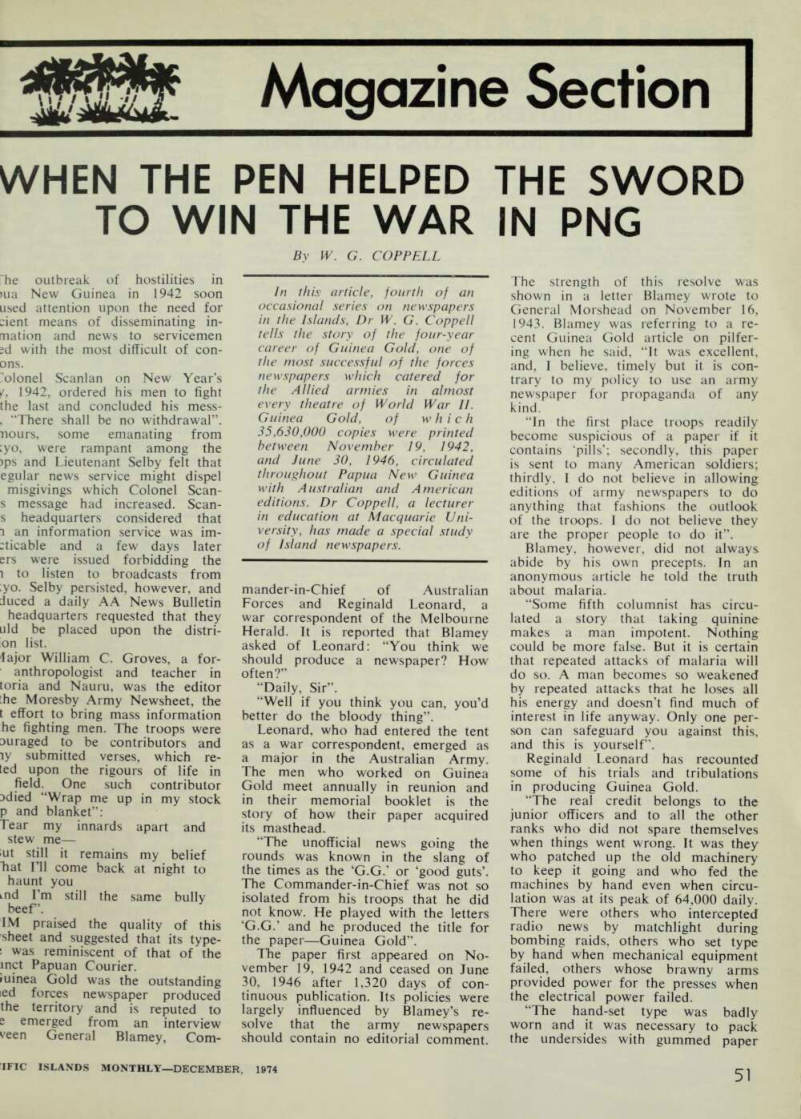
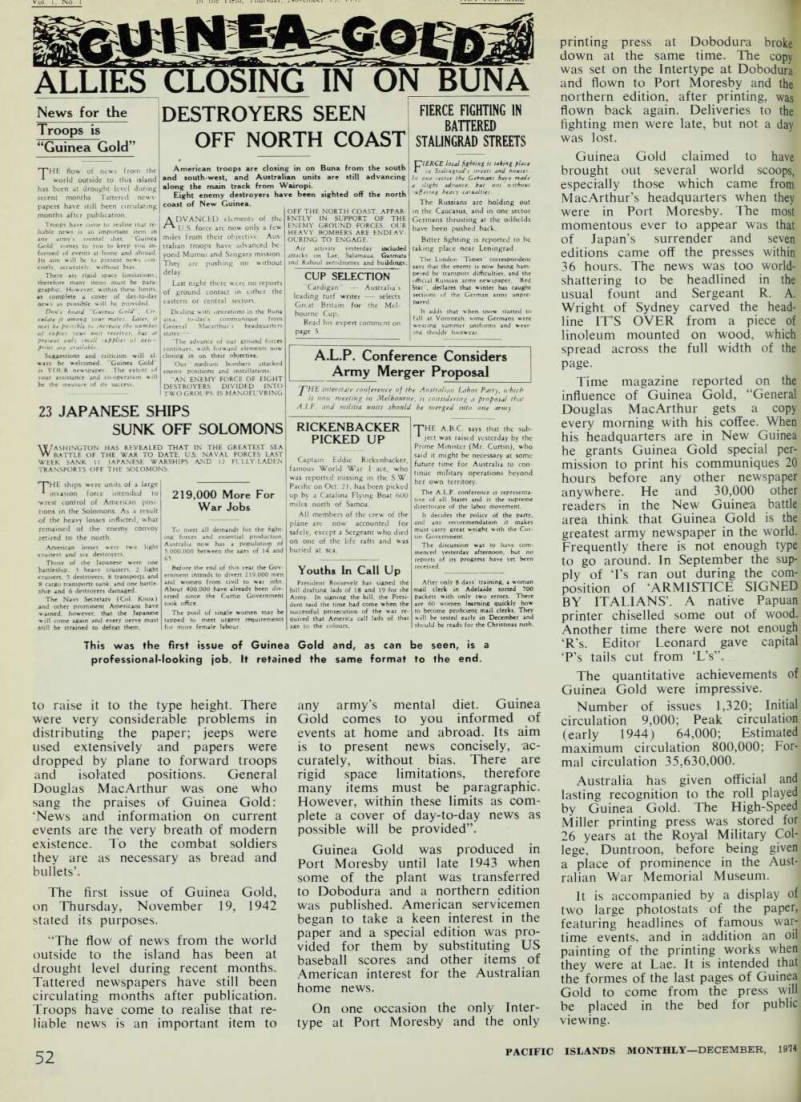
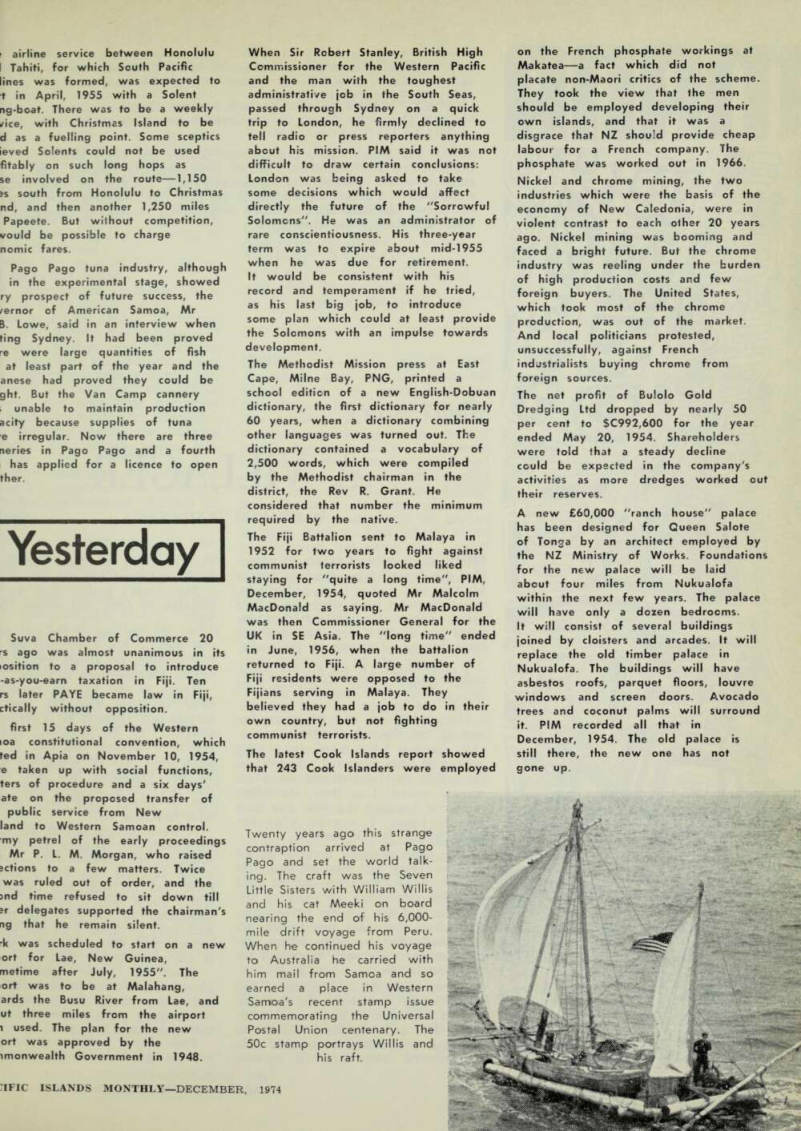
When The Pen Helped The Sword
To Win The War In Png
Tie outbreak of hostilities in ma New Guinea in 1942 soon used attention upon the need for zient means of disseminating in mation and news to servicemen ;d with the most difficult of con ons.
'olonel Scanlan on New Year’s /, 1942, ordered his men to fight the last and concluded his mess , “There shall be no withdrawal”, nours, some emanating from ;yo, were rampant among the >ps and Lieutenant Selby felt that egular news service might dispel misgivings which Colonel Scan s message had increased. Scan s headquarters considered that i an information service was im :ticable and a few days later ers were issued forbidding the i to listen to broadcasts from :yo. Selby persisted, however, and Juced a daily AA News Bulletin headquarters requested that they uld be placed upon the distri on list. lajor William C. Groves, a for anthropologist and teacher in toria and Nauru, was the editor the Moresby Army Newsheet, the t effort to bring mass information he fighting men. The troops were auraged to be contributors and ty submitted verses, which re ted upon the rigours of life in One such contributor adied “Wrap me up in my stock p and blanket”: Tear my innards apart and stew me— ut still it remains my belief "hat I’ll come back at night to haunt you md I’m still the same bully beef”.
IM praised the quality of this sheet and suggested that its type : was reminiscent of that of the met Papuan Courier, iuinea Gold was the outstanding ied forces newspaper produced the territory and is reputed to e emerged from an interview veen General Blarney, Com-
By W. G. Coppell
In this article, fourth of an occasional series on newspapers in the Islands, Dr W. G. Coppell tells the story of the four-year career of Guinea Gold, one of the most successful of the forces newspapers which catered for the Allied armies in almost every theatre of World War 11.
Guinea Gold, of which 35,630,000 copies were printed between November 19, 1942, and June 30, 1946, circulated throughout Papua New Guinea with Australian and American editions. Dr Coppell, a lecturer in education at Macquarie Uni versity, has made a special study of Island newspapers.
mander-in-Chief of Australian Forces and Reginald Leonard, a war correspondent of the Melbourne Herald. It is reported that Blarney asked of Leonard; “You think we should produce a newspaper? How often?”
“Daily, Sir”.
“Well if you think you can, you’d better do the bloody thing”.
Leonard, who had entered the tent as a war correspondent, emerged as a major in the Australian Army.
The men who worked on Guinea Gold meet annually in reunion and in their memorial booklet is the story of how their paper acquired its masthead.
“The unofficial news going the rounds was known in the slang of the times as the ‘G.G.’ or ‘good guts’.
The Commander-in-Chief was not so isolated from his troops that he did not know. He played with the letters ‘G.G.’ and he produced the title for the paper—Guinea Gold”.
The paper first appeared on No vember 19, 1942 and ceased on June 30, 1946 after 1,320 days of con tinuous publication. Its policies were largely influenced by Blarney’s re solve that the army newspapers should contain no editorial comment.
The strength of this resolve was shown in a letter Blarney wrote to General Morshead on November 16, 1943. Blarney was referring to a re cent Guinea Gold article on pilfer ing when he said, “It was excellent, and, I believe, timely but it is con trary to my policy to use an army newspaper for propaganda of any kind.
“In the first place troops readily become suspicious of a paper if it contains ‘pills’; secondly, this paper is sent to many American soldiers; thirdly, 1 do not believe in allowing editions of army newspapers to do anything that fashions the outlook of the troops. I do not believe they are the proper people to do it”.
Blarney, however, did not always abide by his own precepts. In an anonymous article he told the truth about malaria.
“Some fifth columnist has circu lated a story that taking quinine makes a man impotent. Nothing could be more false. But it is certain that repeated attacks of malaria will do so. A man becomes so weakened by repeated attacks that he loses all his energy and doesn’t find much of interest in life anyway. Only one per son can safeguard you against this, and this is yourself”.
Reginald Leonard has recounted some of his trials and tribulations in producing Guinea Gold.
“The real credit belongs to the junior officers and to all the other ranks who did not spare themselves when things went wrong. It was they who patched up the old machinery to keep it going and who fed the machines by hand even when circu lation was at its peak of 64,000 daily.
There were others who intercepted radio news by matchlight during bombing raids, others who set type by hand when mechanical equipment failed, others whose brawny arms provided power for the presses when the electrical power failed.
“The hand-set type was badly worn and it was necessary to pack the undersides with gummed paper
to raise it to the type height. There were very considerable problems in distributing the paper; jeeps were used extensively and papers were dropped by plane to forward troops and isolated positions. General Douglas MacArthur was one who sang the praises of Guinea Gold: ‘News and information on current events are the very breath of modern existence. To the combat soldiers they are as necessary as bread and bullets • The first issue of Guinea Gold, on Thursday, November 19, 1942 stated its purposes. - r , u The flow of news from the world outside to the island has been at drought level during recent months.
Tattered newspapers have still been
circulating months after publication.
Troops have come to realise that reliable news is an important item to
any army’s mental diet. Guinea Gold comes to you informed of events at home and abroad. Its aim is to present news concisely, ac curately, without bias. There are rigid space limitations, therefore many items must be paragraphic, However, within these limits as com plete a cover of day-to-day news as possible will be provided”, Guinea Go|d was produced in port Moresby until late 1943 whe n some of the plant was transferred to Dobodura and a northern edition was published. American servicemen began to take a keen interest in the paper and a special edition was pro {or by substituting US baseba n scores and other items of American interest for the Australian .
On one occasion the only Inter type at Port Moresby and the only
printing press at Dobodura broke down at the same time. The copy was set on the Intertype at Dobodura and flown to Port Moresby and the northern edition, after printing, was flown back again. Deliveries to the fighting men were late, but not a day was lost.
Guinea Gold claimed to have brought out several world scoops, especially those which came from Mac Arthur's headquarters when they were in Port Moresby. The most momentous ever to appear was that of Japan’s surrender and seven editions came off the presses within 36 hours. The news was too world shattering to be headlined in the usual fount and Sergeant R. A.
Wright of Sydney carved the head line IT’S OVER from a piece of linoleum mounted on wood, which spread across the full width of the page.
Time magazine reported on the influence of Guinea Gold, “General Douglas MacArthur gets a copy every morning with his coffee. When his headquarters are in New Guinea he grants Guinea Gold special per mission to print his communiques 20 hours before any other newspaper anywhere. He and 30,000 other readers in the New Guinea battle area think that Guinea Gold is the greatest army newspaper in the world.
Frequently there is not enough type to go around. In September the sup ply of T’s ran out during the com position of ARMISTICE SIGNED BY ITALIANS’. A native Papuan printer chiselled some out of wood.
Another time there were not enough ‘R's. Editor Leonard gave capital ‘P’s tails cut from ‘L’s”.
The quantitative achievements of Guinea Gold were impressive.
Number of issues 1,320; Initial circulation 9,000; Peak circulation (early 1944) 64,000; Estimated maximum circulation 800,000; For mal circulation 35,630,000.
Australia has given official and lasting recognition to the roll played by Guinea Gold. The High-Speed Miller printing press was stored for 26 years at the Royal Military Col lege, Duntroon, before being given a place of prominence in the Aust ralian War Memorial Museum.
It is accompanied by a display of two large photostats of the paper, featuring headlines of famous war time events, and in addition an oil painting of the printing works when they were at Lae. It is intended that the formes of the last pages of Guinea Gold to come from the press will be placed in the bed for public viewing.
airline service between Honolulu I Tahiti, for which South Pacific lines was formed, was expected to ■t in April, 1955 with a Solent ng-boat. There was to be a weekly /ice, with Christmas Island to be d as a fuelling point. Some sceptics ieved Solents could not be used fitably on such long hops as se involved on the route—l,lso >s south from Honolulu to Christmas nd, and then another 1,250 miles Papeete. But without competition, vould be possible to charge nomic fares.
Pago Pago tuna industry, although in the experimental stage, showed ry prospect of future success, the rernor of American Samoa, Mr B. Lowe, said in an interview when ting Sydney. It had been proved re were large quantities of fish at least part of the year and the anese had proved they could be ght. But the Van Camp cannery . unable to maintain production acity because supplies of tuna e irregular. Now there are three neries in Pago Pago and a fourth has applied for a licence to open ther.
Advertisements & other items, p. 55 (1 item)
51
IFIC ISLANDS MONTHLY—DECEMBER, 1974
Yesterday
Suva Chamber of Commerce 20 rs ago was almost unanimous in its losition to a proposal to introduce -as-you-earn taxation in Fiji. Ten rs later PAYE became law in Fiji, ctically without opposition. first 15 days of the Western 10a constitutional convention, which ted in Apia on November 10, 1954, e taken up with social functions, ters of procedure and a six days' ate on the proposed transfer of public service from New land to Western Samoan control, my petrel of the early proceedings Mr P. L. M. Morgan, who raised actions to a few matters. Twice was ruled out of order, and the jnd time refused to sit down till ir delegates supported the chairman's ng that he remain silent.
'k was scheduled to start on a new ort for Lae, New Guinea, metime after July, 1955". The ort was to be at Malahang, ards the Busu River from Lae, and ut three miles from the airport i used. The plan for the new ort was approved by the imonwealth Government in 1948.
When Sir Robert Stanley, British High Commissioner for the Western Pacific and the man with the toughest administrative job in the South Seas, passed through Sydney on a quick trip to London, he firmly declined to tell radio or press reporters anything about his mission. PIM said it was not difficult to draw certain conclusions: London was being asked to take some decisions which would affect directly the future of the "Sorrowful Solomons". He was an administrator of rare conscientiousness. His three-year term was to expire about mid-1955 when he was due for retirement.
It would be consistent with his record and temperament if he tried, as his last big job, to introduce some plan which could at least provide the Solomons with an impulse towards development.
The Methodist Mission press at East Cape, Milne Bay, PNG, printed a school edition of a new English-Dobuan dictionary, the first dictionary for nearly 60 years, when a dictionary combining other languages was turned out. The dictionary contained a vocabulary of 2,500 words, which were compiled by the Methodist chairman in the district, the Rev R. Grant. He considered that number the minimum required by the native.
The Fiji Battalion sent to Malaya in 1952 for two years to fight against communist terrorists looked liked staying for "quite a long time", PIM, December, 1954, quoted Mr Malcolm MacDonald as saying. Mr MacDonald was then Commissioner General for the UK in SE Asia. The "long time" ended in June, 1956, when the battalion returned to Fiji. A large number of Fiji residents were opposed to the Fijians serving in Malaya. They believed they had a job to do in their own country, but not fighting communist terrorists.
The latest Cook Islands report showed that 243 Cook Islanders were employed
on the French phosphate workings at Ma katea—a fact which did not placate non-Maori critics of the scheme.
They took the view that the men should be employed developing their own islands, and that it was a disgrace that NZ should provide cheap labour for a French company. The phosphate was worked out in 1966.
Nickel and chrome mining, the two industries which were the basis of the economy of New Caledonia, were in violent contrast to each other 20 years ago. Nickel mining was booming and faced a bright future. But the chrome industry was reeling under the burden of high production costs and few foreign buyers. The United States, which took most of the chrome production, was out of the market.
And local politicians protested, unsuccessfully, against French industrialists buying chrome from foreign sources.
The net profit of Bulolo Gold Dredging Ltd dropped by nearly 50 per cent to $C992,600 for the year ended May 20, 1954. Shareholders were told that a steady decline could be expected in the company's activities as more dredges worked out their reserves.
A new £60,000 "ranch house" palace has been designed for Queen Salote of Tonga by an architect employed by the NZ Ministry of Works. Foundations for the new palace will be laid about four miles from Nukualofa within the next few years. The palace will have only a dozen bedrooms.
It will consist of several buildings joined by cloisters and arcades. It will replace the old timber palace in Nukualofa. The buildings will have asbestos roofs, parquet floors, louvre windows and screen doors. Avocado trees and coconut palms will surround it. RIM recorded all that in December, 1954. The old palace is still there, the new one has not gone up.
Twenty years ago this strange contraption arrived at Pago Pago and set the world talk ing. The craft was the Seven Little Sisters with William Willis and his cat Meeki on board nearing the end of his 6,000mile drift voyage from Peru.
When he continued his voyage to Australia he carried with him mail from Samoa and so earned a place in Western Samoa's recent stamp issue commemorating the Universal Postal Union centenary. The 50c stamp portrays Willis and his raft.
Advertisements & other items, p. 57 (1 item)
:Ific Islands Monthly—December, 1974
mana
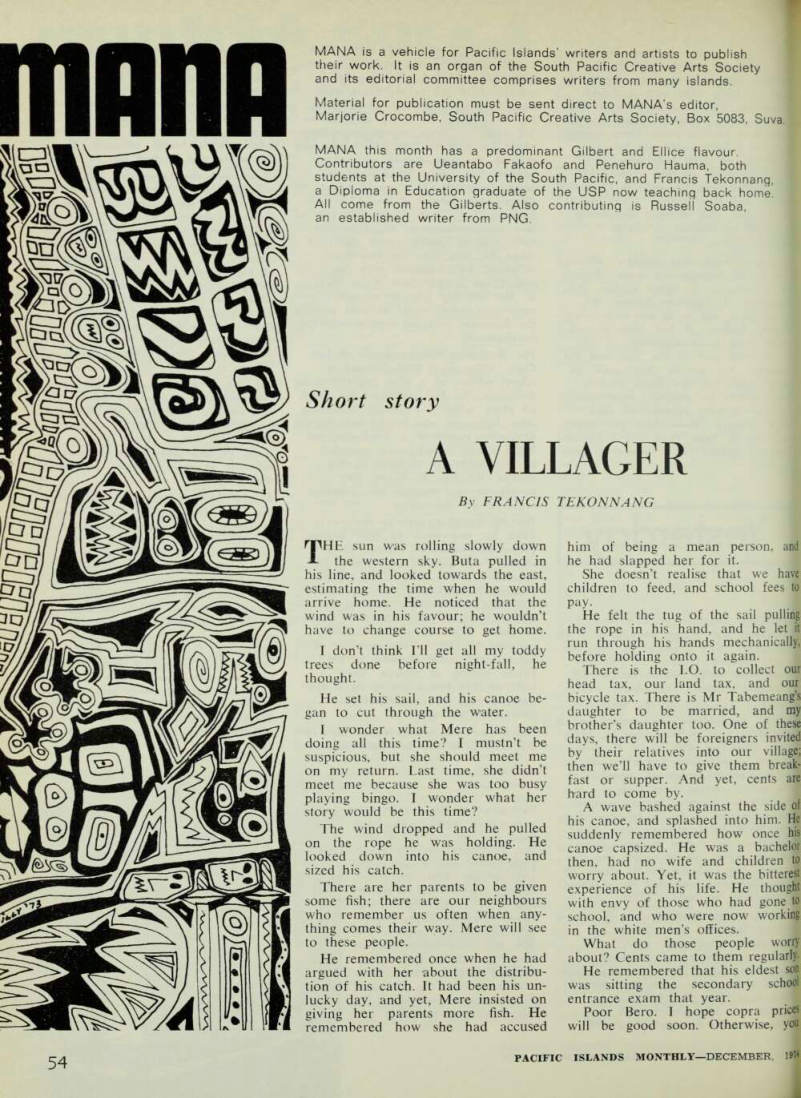
is a vehicle for Pacific Islands’ writers and artists to publish their work. It is an organ of the South Pacific Creative Arts Society and its editorial committee comprises writers from many islands.
Material for publication must be sent direct to MANA’s editor, Marjorie Crocombe, South Pacific Creative Arts Society, Box 5083, Suva.
MANA this month has a predominant Gilbert and Ellice flavour.
Contributors are Ueantabo Fakaofo and Penehuro Hauma, both students at the University of the South Pacific, and Francis Tekonnang, a Diploma in Education graduate of the USP now teaching back home.
All come from the Gilberts. Also contributing is Russell Soaba, an established writer from PNG.
A Villager
Short story
By Francis Tekonnang
THE sun was rolling slowly down
the western sky. Buta pulled in his line, and looked towards the east, estimating the time when he would arrive home. He noticed that the wind was in his favour; he wouldn’t have to change course to get home.
I don’t think I’ll get all my toddy trees done before night-fall, he
thought.
He set his sail, and his canoe be gan to cut through the water.
I wonder what Mere has been doing all this time? I mustn’t be suspicious, but she should meet me on my return. Last time, she didn’t meet me because she was too busy playing bingo. I wonder what her story would be this time?
The wind dropped and he pulled on the rope he was holding. He looked down into his canoe, and sized his catch.
There are her parents to be given some fish; there are our neighbours who remember us often when any thing comes their way. Mere will see to these people.
He remembered once when he had argued with her about the distribu tion of his catch. It had been his un lucky day, and yet, Mere insisted on giving her parents more fish. He remembered how she had accused
him of being a mean person, and he had slapped her for it.
She doesn’t realise that we have children to feed, and school fees to pay - He felt the tug of the sail pulling the rope in his hand, and he let it run through his hands mechanically, before holding onto it again.
There is the 1.0. to collect our head tax, our land tax, and our bicycle tax. There is Mr Tabemeang’s daughter to be married, and my brother’s daughter too. One of these days, there will be foreigners invited by their relatives into our village; then we’ll have to give them break fast or supper. And yet, cents are hard to come by.
A wave bashed against the side of his canoe, and splashed into him. He suddenly remembered how once his canoe capsized. He was a bachelor then, had no wife and children to worry about. Yet, it was the bitterest experience of his life. He thought with envy of those who had gone to school, and who were now working in the white men’s offices.
What do those people worry about? Cents came to them regularly.
He remembered that his eldest son was sitting the secondary school entrance exam that year.
Poor Bero. 1 hope copra prices will be good soon. Otherwise, you
end up like me. I will try my for you, son, if you are lucky, he wind dropped again, and he isted the rope in his hands auto ically. He noticed a roll of fish line near the mast, and he embered how Mere’s parents had mmended him to her. But that not the only reason. He also e from a family with a good rd and enough land. And added lis credit were his industriousness fishing skills. He remembered disappointed they were with > for not getting good marks in school subjects. want him to work hard and go i secondary school, e remembered scolding Bero a he didn’t attend school.
'hat is this all about? he remem d asking him, threateningly. If don’t change your behaviour, 3 is a canoe for you, there is a e, my toddy knife and my axe, you’ll see how hard this life is, you will envy your age-mates have gone for further education, it did Bero say he was learning :hool? Yes, English, Maths, His and . . . nother wave bashed against the of his canoe, and he noticed a strands of sea-weed stranded on :anoe.
E tide was already in, he real ised, scanning the beach, and he :ed four children running about t. ley want nothing to eat but d, buns, and rice. Mm . . . there is. He was glad. He pulled in his and lowered it onto his canoe, cached out for his paddle under sail, and he began to paddle re. lis is my bit, he accepted it. long will this last us? ere walked over to meet him. low is it?” she inquired, got a few”. 3 jumped down and pulled his e a few yards parallel to the h. She joined him, looked into :anoe, and, satisfied, she shouted a basket. lang on to the canoe. I am I to take these up first”, he told 3 took the sail and the mast to shed, and when he returned, re was already there and she emptying his catch into a bas- He unloaded his fishing gear the beach, and waited for her nish emptying the catch, hat’s all”, she said. 3 pushed the canoe out a few s from the beach, dropped its or, and then joined Mere and re.
THEY had three separate huts which were not far from the beach. They were typical huts, but their sleeping hut gave the impression that it was very new. The roof was made of coconut leaves, the wall of evenly spaced mid-ribs of coconut fronds, and the floor was gravel, and covered with coconut mats. Tucked at the back were the family belong ings. Pandanus sleeping mats, care fully folded, were placed on top of a large suitcase. Left of it, about two or three feet away, was a small box with a small radio on it. A mos quito net hung on a line at the back of the hut.
Behind this was a smaller hut where Mere did her cooking. A few yards further back towards the beach was their canoe shed. Around them were other huts of the village.
Buta left Mere and Maure in their cooking hut, and went over to their sleeping hut. He washed his legs in a wash tub near the entrance, and went in. He took out his cigarette tin, and rolled himself a small cigar.
I wander what the time is now?
He crawled over to the radio, and switched it on.
I wish I knew English.
The radio invited applications for vacant posts: the people wanted had to be able to understand and speak English. It was a few minutes to five, and he knew he had to get going.
He switched the radio off, went over and pulled out his toddy knife that he had thrust into the veranda of the hut, took his toddy shells, and went over to his bike that was still leaning against a coconut trunk. The main road was about a hundred yards away, and he had to push his bike past a couple of huts, before he could get on to the road.
I wonder what Tebanti has been
doing today?
He saw Tebanti’s wife feeding her cooking fire, and inquired.
“Where is Tebanti?”
“He is not back from Tauma”.
“What are you cooking?”
“Our supper”.
He went past Koura’s hut but saw no one around.
These people aren't home, they must be out playing cards.
He thought of them with pity and contempt.
I wonder how old Bebeia is now?
He is very lucky to have a job. When they returned many years ago, they had three children. Someone said that his two eldest boys are in KGV now.
He saw Bero playing with other boys of his age, and sighed.
Shall I take him with me? No.
We will be late.
He got on his bike, and rode to the main road before he disappeared into the bush.
THE fire was already alight. Mere was cleaning the entrails of his catch in a basin full of sea water.
Maure had gone with a basket of fish for her grandparents.
Mere finished cleaning the fish and she started cooking them over the red charcoal.
That one too. Bring that to the middle. Put another one in. That’s a tasty one. That must be cooked.
She raised her eyes. I hope Maure will be back soon. “Bero O!” she called. She removed the cooked fish to the edge of the fire, and went to get a dish. “Come here!”
Bero allowed himself reluctantly to go to her. She removed the cooked fish onto the dish, and took in another one.
That one is cooked too. Turn that one over. Push that one a bit this way, and that the other. That must be burnt. Move that a bit this way.
This one is cooked.
Maure appeared.
“Take these to Tebanti”. She saw Bero drag himself behind her. “And you, take these to Tora. It’s getting dark, so that is enough of your play”.
She removed the cooked ones onto the dish, and took in others.
BUTA had worked on his favour ite trees, and was returning home. He came to a fallen coconut trunk and jumped down. How long will this remain here? I hope some one will remove it soon. He remem bered the huge machines he had seen during his period of service on Ocean Island. What do they call them?
Teburutoutia’ or something. He lifted his bike over the trunk, and jumped on it again.
The path was narrow, like a giant
snake running through the shrubs, under thick foliage and by the pits.
Sometimes he almost bumped into someone around the curves, but he knew the traffic rules, and was always aware of the dangers. He passed a ‘babai pit’—there was only dry sand in it. He passed another—there was dry mud and scattered pools of water in it. Then another one. Then another with weeds. He came to a long valley, and jumped down. He pushed his bike up the other side, and back to his village.
Darkness crept in from nowhere and spread herself out through the village over the sea and the horizon beyond. And as ‘Tai’ dived further and further into the depths of the ocean, she made herself thicker and thicker, and hurricane lamps were lit to push it back.
A dish of roasted fish, peeled fresh coconut and a bowl of toddy were laid between two mats, outside the sleeping hut. A hurricane lamp, which hung from a hook under the veranda of the hut, cast pale red light over Buta and Mere and Bero and Maure. They were eating in silence, save for the sound of fresh coconut being crushed between jaws.
“Have they finished those buns?”
Buta asked Mere.
“No. We will have them to morrow”.
“Give some to me”.
Mere lifted herself up and went to get them.
“There you are”, she said reproachfully.
Bero and Maure took them timidly, but soon forgot the em barrassment, and they began to eat more fresh coconut.
When they had finished eating, Buta and Mere retired into their sleeping hut. He talked about selling his catch to his neighbours, and she talked about making and selling buns. He talked about men like him who had gone to Tarawa and had found jobs there; and she talked about starting a bakery if they ever went there.
Ueantabo Fakaofo, who wrote the poem at right.
Kabirau,
my anointing oil
By Ueantabo Fakaofo
Kabirau, Kabirau
Sweet and pleasant is your scent I seek to break my evil spell
Kabirau, Kabirau
Let those scents stick to me fast And cover the stench of ill-luck
Kabirau , Kabirau
Sweet is your smell in my senses And sweet be my name On the tongue of the girl I love.
Advertisements & other items, p. 59 (1 item)
55
FIC ISLANDS MONTHLY— DECEMBER, 1974
Dawn of my manhood
By Ueantabo Fakaofo
The years of Childhood have ended, The constellation Rimwimata’ is up in the skies Twinkling on the whole island at rest Laying in bed tossing and wakeful I waited for dawn Ten-tere-koo, 1 the early morning call of the cocks This, the dawn of my manhood at last To the eastern side of the island To the baangota 2 of heroic Ancestors I was taken — Where the dewy winds blew Where the waves struck mercilessly on the angry rocks, Waters spiralled to Mone 3 —the destination of my soul Onto te b’a-te narir 4 boulder I was installed with my spear pointing eastwards as I chanted the chant of a warrior—the meditation of a rorobuaka 5 To Auriaria The Great Ancestral God of War I asked for strength and courage And my mauri 6 from my enemies. 1 Antares 2 Gilbertese shrine 3 Undersea kingdom 4 A hard, dense boulder 5 Fullgrown man, a warrior 6 ‘Safety’
(1) It’S Not That Easy
Two short stories by PENEHURO HAUMA
‘SHOOT! Shoot!” he shouted to the Red team’s centre-forward, his voice ringing above the shouting of the match’s near-to-capacity crowd. The ball was finally snatched away from the attackers with catlike speed by the White team’s defence The self-proclaimed soccer star was on the side-line; he had arrived from the city two days before. He was born in this village of Tautau but had lived most of the time in the city, attending school there. However, every holiday he came home to his family; and it was during one of these holidays that this match occurred.
Sau was the name of this youth.
His favourite team was the one in red; he used to go around with boys of that particular team, and he knew the captain and most of the players well.
“Jesus' What a waste of a ball!” he muttered when the shot from a
Red player just missed the Whites’ goal. Somewhere to his left there were some girls whom he fancied, Even though he was well known for boasting about his skills, the pre sence of the girls had made him open up even further.
A player from the Red team, at tempting to tackle a White player, over-stretched his ordinary shorts, busted them, and, to the spectators’ delight, revealed that he was wearing nothing underneath. Despite his attempt to cover his ‘precious organs’ quickly their momentary but clear exposure was enough to make the spectators roar with laughter, It was obvious that the player had to get another pair of shorts if he was to continue. A replacement had to be found quickly while he went looking for another pair. The only one available with shorts on was Sau. The Red captain waved to him to take the field. Everyone (spec tators and players) clapped as Sau jumped about to warm himself up
one of the routines he had seen soccer players in the city going through).
Sau in fact had never played soccer before, not even at school. He was, however, a very keen fan of the game. Every Saturday he went to the park to watch the matches there.
From this, Sau thought that he had learned enough techniques.
He had often thought of himself a Bobby Charlton, one of the English stars of the ’6os.
He had lied to his friends in the ?age that he was a regular secondgrade schools’ representative. The ?ng spectators were eager to see their self-proclaimed soccer star in ?on. The girls in the crowd giggled ?dly to attract his attention.
Come on, Sau, put that red sing let on and choose any position!” the Captain called.
Sau was so excited. “I’ll start off in the centre-forward position”, he ? himself.
THE ref signalled for the kick-off.
Sau positioned himself quickly at centre-forward between the insides, ? the ball with his left foot, turned around and passed it to the centre- The ref’s whistle brought the ball back to the centre, and the ref told Sau to push the ball beyond the ? before passing it back to any of his team mates.
Come on, Sau”, the girls shouted; they thought the ref did not know what he was doing. (Fancy penalising someone who was a regular player in the city!) Anyway the ball was given to the White team. Before the ref blew his whistle again, Sau was in the circle charging the ball, was penalised again.
A spectator said something funny ?ut Sau and the spectators roared with laughter. Sau was breaking one of the simplest rules of the game. Realising what was happening, the Red captain moved Sau to the wing, bringing the winger to the centre.
In a lightning movement, the Red goalie dived for a superb save. He threw the ball to the captain at fullback who dribbled the ball at top speed beating two players before unloading to the centre-half; the centre- ? drew four backs and slipped the ball to the right winger who took it over to the far right; the left fullback chased him, leaving only the right full-back to mark the other four forwards; the winger zoomed around the eft fullback and then lobbed the ball to the centre-forward who ?sted it down neatly and held it long enough to attract the right fullback. Sau found himself in front of the goal mouth. He shouted for the
ball. It came rolling beautifully from the centre-forward.
“Go! Go! Sau, Go!” The air was filled with girls shouting.
The spectators were on their feet now. The cheering suddenly stopped.
Silence! Then followed by Boooooo!
To his disappointment, he saw the ball going far and wide and he was standing only six yards from the goal mouth.
Time and time again he spoiled the beautiful moves of his team. He was moved from one position to another. At half time, he was placed at the left-half. The opposing team found it a good place for initiating their moves. Whenever Sau got the ball, he couldn’t pass it away quickly
enough before his opposite snatched it away from him. If he did manage to pass, it was either too short or to a member of the White team.
Whenever he was charged by a big ger player he backed down.
To save himself from further humiliation, he pretended that he had sprained his ankle. The captain and the team were so relieved when an other substitute came on.
On the side-line, Sau found all the people looking at him. He felt so small. When they stopped looking, he sneaked away to his home.
Thereafter, he never again talked about soccer to anybody, though he still went to see it played.
(2) Letter’S Experience
WAKE up, you lazy fella!” And Letter suddenly found him self staring at the not-too-pleasant face of a brown fella. Looking around, he found himself in a strange place. “It can’t be Fiji!” he told himself. The brown fella had a raincoat on and fresh drops of rain were still on it. Fiji, Letter had been told, had plenty of sunshine and no rain!
Three months earlier, he had been in Australia, in a small town north of Sydney. His white friend there had sent him to convey some news to his friend in Fiji. The friend, Letter was told, was studying for a ticket to success (or something like that) at a university there.
He learnt from his white friend that the South Pacific Islands were full of charming people, plenty of beautiful scenery, and dancing girls (especially the hip-swinging ones).
Those things made him accept going to Fiji. He never dreamt that he would be choked in an envelope for three months, that his head would be banged with rubber stamps, and he would have to put up with a hellish crowd of letters in a smelly tarpaulin sack.
“Hell, how come it took three months for you to arrive?” the brown fella continued. “You lazy bugger!”
Letter got scared. “Do they usually welcome foreigners this way?” he asked himself.
“Anyway, what news have you got for me?” the brown fella asked him, while flashing through Letter’s body.
Letter very much liked to swear at the brown fella. The brown fella
twisted, folded, and even rolled up Letter despite Letter’s groans and moans.
When Letter looked around, he was surprised that he was in a cell like cubicle about 8 ft by 10 ft big.
Beside the door stood a wardrobe next to a small drawer. There was a fixed bed facing them on the oppo site side. On the far side opposite the door, there was a long bench fixed to the wall and, above it, fixed just to the left-hand corner of the small window, were three bookshelves about to collapse under the weight of books.
Letter felt home-sick. He thought of the spacious and well-furnished house of his friend in Australia, where he had a room. He missed the television as well.
The brown fella’s face looked tired and weary. “Poor fella!” sighed Letter, wondering how long that fella had been imprisoned in that cell, “What a university!” he thought to himself. His thoughts were cut short when the brown fella squeezed him up into a paper ball.
When he regained consciousness, he found himself in a rubbish bin.
His other rolled-up friends there told him that he should consider himself lucky to have found a place in a university rubbish bin, and in a wonderful country like Fiji. He couldn’t protest for he knew they were all locals, and it was bad for outsiders like himself to complain about someone else’s country, even if that country seemed like a prison.
Anyway, he knew he didn’t have long to live.
Short Story
The Villager's Request
The Villager's Request
By Russell Soaba
AHA! ha! ha! Well! At first I thought it was only a walk. A little walk. I didn’t know why I was walking. Nor did I know where my walk was taking me. No one told me to take a walk in the first place, anyway. Still, there was music in the air. Which was why 1 decided to take a walk. I think.
But wait! Yes, I was walking in a trouble mind. Weariness too (out of old age perhaps) faltered my con science. And loneliness balked my pride, my innate pride, my integral native being, besmalling me all the more, until I couldn’t remember my self the way I did last year and the years before. Some nostalgia about an anonymous home began to stalk my soul.
Well, I don't know how you say it in English but I hope the young lad who is now translating and trans cribing my narration into your langu age uses the right words so that you’ll know what I’m trying to say.
Anyway, I was suddenly gripped by those nostalgic feelings I have never felt before. The funny thing is that I have forgotten where my vil lage is. I have a vague idea though, especially when people tell me that I am in the heart of the city: I am in Port Moresby: therefore, home must be in the northerly direction.
But which way is it to the north?
You must forgive me but I am a villager; I am uneducated, I can’t read signs on the road, and I have no sense of direction. Of course, of course, people told me numerous times that the sun rises in the east and sets in the west and that if you are facing the east, north is on your left . . . But how do you expect me to know that if I spend all my time in the dark confinement of the docks at my job as an interior warehouse cleaner then anxiously rush out after work to just see the twilight without knowing if it is sunrise or sunset? Of course I could wait and watch which way the sun moves but I have no time to do that because my boss calls me back for a roll call before knock off time.
And by the time I am free I can’t tell the difference between night and daylight because the lights in the city are always on, day and night. I could
go away from the city altogether, go north to my village, and find this out: but then again, which way is it to the north?
Another funny thing about me is that I am left-handed. So if by any chance I caught the sun napping above the eastern horizon how could I tell which side of me was my left, where north is? I always mistake my right to be my left because I don’t use my right hand at all!
I must have been lost, deep in the sea of familiar faces because I recall, at one stage, asking a passerby which way it was to the north. He stopped and stared past me at something I couldn’t see and laughed. He just laughed and laughed—so much so that he had forgotten to answer me and strolled on. Along Wards Road one time I interrupted yet another passerby with the same question.
There was a stench of alcohol about this one as he looked me straight in the eye, staggering a bit.
“Know what I think, Pop?” he said after a long, contemptuous stare. “Ya dead drunk, old boy!” he shouted at me, almost throwing his massive, podgy body all over the smallness of my 60 year-old stature.
“Ya drunk, ya hear! Dead drunk!”
And the young Papuan staggered along the gutter, vomiting and cursing in tok peles. A sad case, I took the educated lad to be.
The signs along the road became alien all of a sudden. I couldn’t re cognise the meanings of some of them even though a friend (who is now transcribing my adventures for you) had been reading and explaining them to me for the last six years. Once I stood under a sign I knew too well to be safe enough for any living crea ture. Yet to my annoyance a police van pulled up and transported me to Kalabus. When 1 demanded an ex planation for my arrest from the chief inspector, he just lit his pipe with deliberate care and stared hard at me, letting the smoke fill my line of vision and dull the cold sense of humour in his eyes.
“What d’you mean ‘I demand an explanation for all this’?” he laughed suddenly.
“Did you think that bus stop sign was a nudist camp or something?
Standing there with just that scrap of cloth around your groins and no other place else! Hah! Another sam ple of the living ends! Sergeant! Get some clothes for this antique village hippy and send him off”.
A hoarse “yessir” echoed eerily along the corridor of the prison cells, followed by a percussion of heels and soon the repetitive boot sounds died away into the enclosures within.
Such discipline for youth nowadays, I sighed: I wish they’d felt;the pains we’ve endured during our initiation ceremonies.
The chief rose from his chair, his stare transfixed on me with that ob vious laughter still clouding his dark blue eyes. I felt something wet, but warm, trickle down my shaking legs.
I discovered I was afraid.
“You poor old village idiot!” he laughed aloud. Such a civilised laugh, I thought: especially with that wide red mouth, like a crocodile’s.
“Aha! ha! ha!” laughed the in spector. “What a mess! Go on!
Vamoose!”
And he walked out on me! Me!
Me! Me, a 60 year-old village elder, respected by many, being walked out on? O shame! O guilt! O terrible shame!
Rather, still laughing, the chief in spector walked into my cell and locked himself in.
I would like to tell you about what happened after the police bit but my friend here is anxious to catch the bus to the other end of the city to see his girlfriend. And since my friend happens to be one of those quiet but
polite gentlemen produced by Western
education (through schools, colleges, universities, etc) he probably finds it impossible to tell me straight out whether I am mad or not.
In any case, it won’t hurt if I my self go for a walk now (alas, I have run out of bus fares since the be ginning of the year) and start asking everybody in the streets of Port Moresby which way it is to the north.
Will it? I mean, it had been a long time since I left the village and like anybody, and with that strange music so soul-searchingly piercing as well as soft in the air of city life, I am somehow homesick.
Advertisements & other items, pp. 63-64 (1 item)
We solve industrial problems.
CONVEYOR BELTS
POSITIVE DRIVE BELTS
DOCK FENDERS
INDUSTRIAL V-BELTS
HOSE
DUNNAGE BAGS
PILLOW TANKS
Problem: Remove the water from a flooded field
to save a 4-million dollar crop.
SOLUTION: 150 giant Goodyear V-belts
worked around the clock on a pumping system that removed over half-a-million gallons of water a minute.
Other problems like; how to remove a river bottom; how to dig a trench under water; how to move a desert; or how to handle tons of red-hot sinter in a steel mill, etc.
Goodyear's special heavy-duty hoses and belts can solve
these problems efficiently, economically and lastingly.
GOOD YEAR
We solve industrial problems.
GOODYEAR DISTRIBUTORS
Boroko Motors Ltd.
P.O. Box 1259, Boroko, Port Moresby, Papua New Guinea Solomon Motors Ltd, P.O. Box 20, Mendana Avenue, Honiara, Guadalcanal, Solomon Islands Societe Generale cf Automobile B.P. 554, Noumea, New Caledonia Coral Island Motors, P.O. Box 296, Suva, Fuji Guam Tire Supply Co.
P.O. Box 1486, Agana, Guam.
J J Perronnet, P.O. Box 181, Port Vila, New Hebrides Santo Engineers, Santo, New Hebrides Morris Hedstrom Ltd.
Apia Western Samoa Western Samoa Transport Cooperative Society Ltd.
P.O. Box 321, Apia, Western Samoa Morris Hedstrom Ltd, Nuku 'Alofa Tonga, Service Mobil B P 306, Papeete Tahiti J 628
PACIFIC ISLANDS MONTHLY—DECEMBER, 1974
SPECIFY
KLINKY PLY
FOR ALL TROPICAL
CONSTRUCTION
Prufply — insect resistant interior ply Duraply — weatherproofed exterior ply Placarol doors — resist warping and swelling Manufactured by Commonwealth New Guinea Timbers Ltd. and available from leading suppliers throughout the Pacific.
PACIFIC ISLANDS MONTHLY—DECEMBER, 1974
60
Books, Reviews, Writers

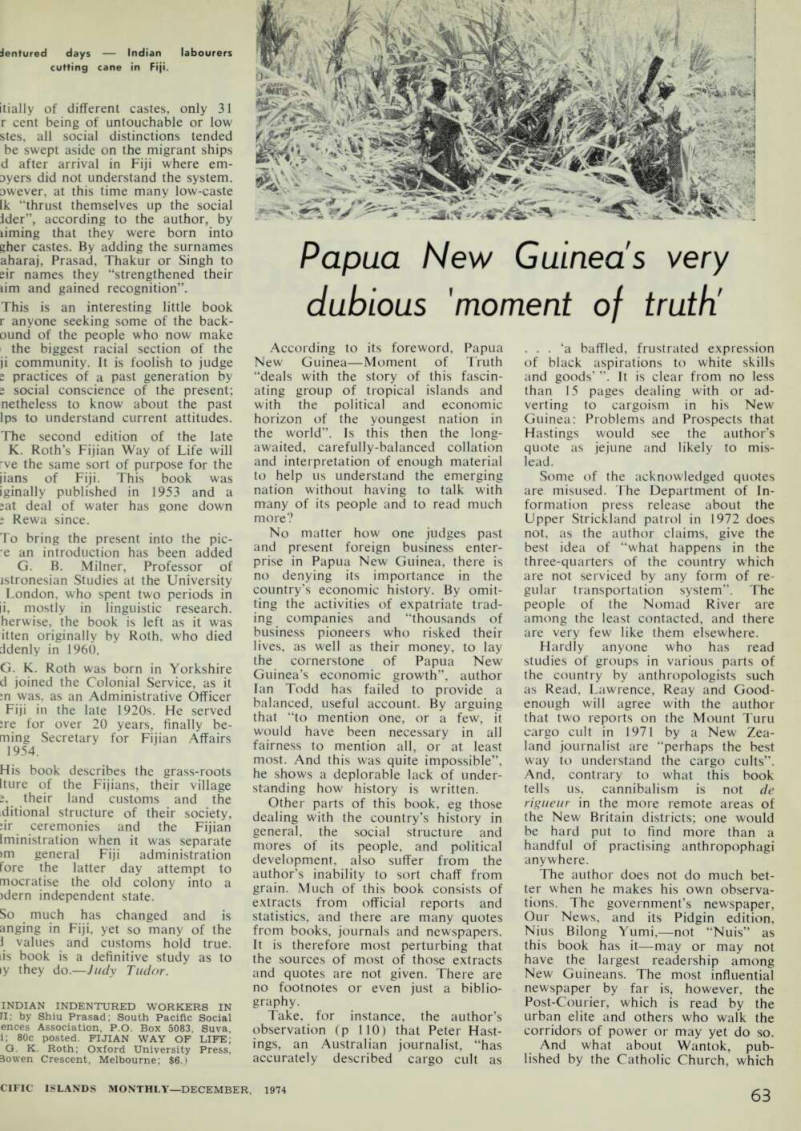
Slavery In The Canefields And A
Free Life In The Fijian Village
The abuses of the indenture system der which recruits from India pro ?led the plantation labour in Fiji ?un 1879 to 1916 are mentioned in ?st accounts of Fiji’s modern history. But mentioned only.
A small booklet by Shiu Prasad Indian Indentured Workers in Fiji, published by the South Pacific Social Defences Association now goes some way towards filling the gap and is all the more acceptable because it manages to remain objective and without the emotionalism one might expect under the circumstances.
By the time Britain had made Fiji a colony in October, 1874, there were already over 600 European plantations in Fiji, most of them using Pacific Islanders, from the Solomons, New Hebrides, Gilberts etc, as labourers because Fijians found nothing attractive in this sort of work.
Many of these “other islanders” had been recruited illegally—black- ?ded was the term used at the time and it was partly in order to pre vent this practice that Britain rereluctantly agreed to annex Fiji. But since having done it, and put a brake on the activities of South Seas re- ?iters, the question of labour for existing plantations arose and as indentured Indian labour had already come to Mauritius and the West Indies, this appeared to be the solution for Fiji.
In all, over 60,000 Indians were indentured during the 37 years the system operated. The majority of ?m remained in Fiji after their indentures were completed and bebecame the nucleus from which the ?ge Indian population of today’s ?i has descended.
The recruits had many reasons for ?itting India for a new life but it is pretty obvious that the recruiters in India were not very different from the old Pacific blackbirders and had very much the same line of patter.
Fiji appears to have been presented with an earthly paradise in some cases and to have been located somewhere close to Calcutta in others. Men and married women with husbands were recruited but in a proportion of 100
of the former to 40 of the latter—a fact that was to cause considerable immediate social trouble and a dis proportion of males to females in the Fiji Indian society for generations to come.
Mr Prasad describes the conditions which these people met in Fiji through the eyes of those still living and who experienced the system. Most went into the labour lines for plantation labour, others, according to the author, were chosen for other work, pretty much on physical appearance.
Sardars — foremen — were usually persons who looked strong or were smart and talkative; stablemen were those who “showed admiration and care for the animals”. Gardeners were often “physically weak”, so were water carriers—a job also frequently given to women. Cooks and domestic servants were “usually chosen from those who respected white men, appeared clean, looked delicate in constitution . . . could understand the white man’s Hindu stani . . .”
To be a cook was a good cop although cooks could have their problems, especially with nagging housewives. One ex-indentured cook explained to the author: “Whenever the sahib was absent she compelled me to do the same piece of work over and over again . . . I refused to obey her one day and she rushed to me with unexpected anger. As she passed over a lying sack I pulled one end of it. She fell on her back. I darted out of the room, across the lawn and reached my friend’s house.
In the afternoon the sahib came to see me and took me back. On the way I explained to him why I had run away. He did not say anything but patted my back. From that day on ward she never dared to quarrel with me but often helped me and talked to me politely.”
Which proves that even in the dark days of 1879-1916 there was man to man rapport between employer and servant when it came to reaction to nagging females.
Although the immigrants were
itially of different castes, only 31 r cent being of untouchable or low stes, all social distinctions tended be swept aside on the migrant ships d after arrival in Fiji where em ayers did not understand the system, owever, at this time many low-caste Ik “thrust themselves up the social Ider”, according to the author, by liming that they were born into gher castes. By adding the surnames aharaj, Prasad, Thakur or Singh to eir names they “strengthened their lim and gained recognition”.
This is an interesting little book r anyone seeking some of the back ound of the people who now make the biggest racial section of the ji community. It is foolish to judge s practices of a past generation by 2 social conscience of the present; netheless to know about the past Ips to understand current attitudes.
The second edition of the late K. Roth’s Fijian Way of Life will we the same sort of purpose for the iians of Fiji. This book was iginally published in 1953 and a ;at deal of water has gone down 2 Rewa since.
To bring the present into the pic •e an introduction has been added G. B. Milner, Professor of istronesian Studies at the University London, who spent two periods in ji, mostly in linguistic research, herwise, the book is left as it was itten originally by Roth, who died ddenly in 1960.
G. K. Roth was born in Yorkshire d joined the Colonial Service, as it ;n was, as an Administrative Officer Fiji in the late 19205. He served ;re for over 20 years, finally be ming Secretary for Fijian Affairs 1954.
His book describes the grass-roots Iture of the Fijians, their village 2, their land customs and the ditional structure of their society, fir ceremonies and the Fijian Iministration when it was separate >m general Fiji administration fore the latter day attempt to mocratise the old colony into a idem independent state.
So much has changed and is anging in Fiji, yet so many of the 1 values and customs hold true, lis book is a definitive study as to ly they do. —Judy Tudor.
Indian Indentured Workers In
II; by Shiu Prasad; South Pacific Social ences Association, P.O. Box 5083, Suva, i; 80c posted. FIJIAN WAY OF LIFE; G. K. Roth; Oxford University Press, 3owen Crescent, Melbourne; $6.)
Tahitian flower by any other name . . .
The thousands of tourists who drive around the coastal road encircling Tahiti come away with the impression that the whole island is a garden. Yet almost all the brilliant blossoms they see are expatriate—brought in over the last couple of hundred years by foreigners. Only the tiare —gardenia tahiensis (rubiaceae) —and the pua —or fragaea tahitensis (loganiaceae), are indigenous to the island.
But whether local or foreign, all have adopted this most romantic island of the Pacific. Tahiti and flowers are now in separable.
Les Editions du Pacifique have now produced a book in full colour that shows and describes each of the plants and flowers that can be seen along any roadway. The scientific name, the Tahitian name and the common names are given, as well as the plant’s original home. Introductory chapters describe how the non-indigenous plants and flowers arrived on the island. A handy book for garden enthusiasts to take with them or for tourists to buy as a souvenir of the garden of Tahiti. (PLANTS AND FLOWERS OF TAHITI; Les Editions du Pacifique: $3.50.)
Advertisements & other items, p. 66 (1 item)
Todays roofs
demand
new materials
Dunlop Membranes
BUTYNOL* Based on Butyl Rubber
One-ply roofing has far less weight and bulk than built-up systems.
Therefore, the architect gains greater design freedom plus reduced loads on supporting members.
For the owner, certain structural costs are lowered and maintenance problems minimised. The contractor benefits from reduced materials handling, lower shipping costs and a work day with more productive hours.
SHELTERLINE - Asbestos backed
DUNLINE - Unbacked Both based on well-proven Hypalon* Synthetic Rubber.
Hurricane 'Bebe' October 1972 and Cyclone 'Lottie' December 1973 produced no problems for Dunlop Membranes and Adhesives.
Illustrations depict: Roman Catholic Seminary, Suva.
Pacific Fishmg company, Levuka © Dunlop mem are widely used also for Water
Management- Ponds, Reservoirs, etc.
The General Manager, Shelter Engineering Limited, P.O. Box 10-043, Christchurch, New Zealand.
Please forward information on
□ BUTYNOL ROOFING MEMBRANE
O SHELTERLINE & DUNLINE ROOFING
O MEMBRANES
□ MEMBRANES FOR WATER
MANAGEMENT
NAME ...
ADDRESS ...
SHELTER
ENGINEERING D A DUNLOP COMPANY
LIMITED
*HYPALON is a registered Du Pont trademark for chlorosulfonated polyethylene synthetic rubber. 2263
PACIFIC ISLANDS MONTHLY—DECEMBER, 1974
62
dubious 'moment of truth'
Papua New Guinea's very dubious 'moment of truth'
According to its foreword, Papua New Guinea—Moment of Truth “deals with the story of this fascin ating group of tropical islands and with the political and economic horizon of the youngest nation in the world”. Is this then the long awaited, carefully-balanced collation and interpretation of enough material to help us understand the emerging nation without having to talk with many of its people and to read much more?
No matter how one judges past and present foreign business enter prise in Papua New Guinea, there is no denying its importance in the country’s economic history. By omit ting the activities of expatriate trad ing companies and “thousands of business pioneers who risked their lives, as well as their money, to lay the cornerstone of Papua New Guinea’s economic growth”, author lan Todd has failed to provide a balanced, useful account. By arguing that “to mention one, or a few, it would have been necessary in all fairness to mention all, or at least most. And this was quite impossible”, he shows a deplorable lack of under standing how history is written.
Other parts of this book, eg those
dealing with the country’s history in
general, the social structure and mores of its people, and political development, also suffer from the author’s inability to sort chaff from grain. Much of this book consists of extracts from official reports and statistics, and there are many quotes from books, journals and newspapers.
It is therefore most perturbing that the sources of most of those extracts and quotes are not given. There are no footnotes or even just a biblio graphy.
Take, for instance, the author’s observation (p 110) that Peter Hast ings, an Australian journalist, “has accurately described cargo cult as
. . . ‘a baffled, frustrated expression of black aspirations to white skills and goods’ It is clear from no less than 15 pages dealing with or ad verting to cargoism in his New Guinea: Problems and Prospects that Hastings would see the author’s quote as jejune and likely to mis lead.
Some of the acknowledged quotes are misused. The Department of In formation press release about the Upper Strickland patrol in 1972 does not, as the author claims, give the best idea of “what happens in the three-quarters of the country which are not serviced by any form of re
gular transportation system”. The
people of the Nomad River are among the least contacted, and there are very few like them elsewhere.
Hardly anyone who has read studies of groups in various parts of the country by anthropologists such as Read, Lawrence, Reay and Good enough will agree with the author that two reports on the Mount Turn cargo cult in 1971 by a New Zea land journalist are “perhaps the best way to understand the cargo cults”.
And, contrary to what this book tells us, cannibalism is not de rigueur in the more remote areas of the New Britain districts; one would be hard put to find more than a
handful of practising anthropophagi
anywhere.
The author does not do much bet ter when he makes his own observa tions. The government’s newspaper, Our News, and its Pidgin edition, Nius Bilong Yumi, —not “Nuis” as this book has it—may or may not have the largest readership among New Guineans. The most influential newspaper by far is, however, the Post-Courier, which is read by the urban elite and others who walk the corridors of power or may yet do so.
And what about Wantok, pub lished by the Catholic Church, which
[?]entured days-Indian labourers cutting cane in Fiji.
icerns itself with grass roots poli » and is fairly widely distributed the New Guinea mainland?
Ihere are brief sketches of several ders—Somare, Guise, Kiki and putin—in order to “guess the »wers” to questions such as “Are billions of dollars of foreign in itment safe?”, “Is communism sly to take over?”, and “Are there ng to be massacres of the Congo •e, or murderous civil wars?”
'Xpart from some inaccuracies, eg Guise’s grandfather was a trader, a government official, these tches do not give sufficient cover of the current leadership: saipwalova, Hannett, Abal, Chan 1 Ave are just a few who come to ad.
Even worse than misquotes, lissions and errors of judgment, falsities. A glaring example of se is the following description of >al warfare: Roaring their individual or tribal var cries, fearful-looking painted md decorated men wade into each ither. Sometimes to the skirl of lative pipe bands playing well cnown Scottish tunes, more often o the drum and saxophone music if nightclub bands playing some if Tom Jones’ latest hit tunes.
Worst of all is the undisguised ropean ethno-centricity which per les this book. It is incredible to d, in 1974, that “in the years to ne, when Aussies and Kanakas et abroad and watch this fascin ng country take its rightful place the world community of nations, y can justly say: ‘we did it to iler”’ (p 140). One can but hope it any New Guinean reading this ik decides that dismal ignorance, intentional offensiveness, has >duced it.
Newsprint is not only expensive vadaysr, it is also scarce. Bad iks are therefore rarely reviewed, lave made this exception because iua New Guinea—Moment of ith is the worst book I have come oss in recent years. I recommend t you buy it, not at its present ce of $9.95 but when it is being naindered for, say 50c. —Harry kman.
Papua New Guinea—Moment Of
UTH. By lan Todd. Angus & Robert , P.O. Box 177, Cremome Junction, N, 2090. $9.95.)
Advertisements & other items, pp. 67-68 (2 items)
63
IFIC ISLANDS MONTHLY— DECEMBER, 1974
Bank of Hawaii
is the bank of the Pacific.
You can bank on it... in Guam Tamuning Koror Yap Saipan Roi Namur Wake Kwajalein Ponape midway Tahiti American Samoa.
All in all, we have 70 branches throughout Hawaii and the Pacific offering full banking services. May we help you?
Bank of Hawaii the bank of the Pacific® * affiliate of Banque de Tahiti
PACIFIC ISLANDS MONTHLY—DECEMBER, 1974
64
At Navels
Here's Looking
In reading Niugini Lives, published by Jacaranda Press, the thought occurs, “What was the motive behind Jacaranda’s publishing of this col lection?” And the answer, un doubtedly, is that the publication was done with nothing but the purely altruistic motive of assisting the New Guineans in the search to find some one among them who can write about something worth writing about, for surely no publisher would ever expect to sell Niugini Lives except to those whose names appear in the list of authors, and are not, like Ahuia Ova listed among them, quite dead.
These days when librarians think they are archivists and think they must buy everything published, the greatest sales will be assuredly to libraries.
Niugini Lives is a collection of introversion, a contemplation of navels and appendages. Such collec tions have been seen in developed countries for the last 100 years. Who, anyway, wants to sit with Leo Han nett and listen to his earthy and his
spiritual adventures? In sum, that’s what this book is about, although the authors have avoided using the word.
Literary introversion is a thing of the past: today we write about what makes the other people tick. Oh, boy!
Haven’t we in the 20th century be come literary extroverts! And the paternal Mr Jacaranda knows this, and has not published Niugini Lives with the hope of selling it, but as an encouragement to future authors: a sprat to catch something bigger one day.
The authors and the New Guinea public should be grateful to Jacaranda for his fostering of literature in Papua New Guinea, and let us hope that Jacaranda’s faith is someday rewarded and someone emerges who can write and has something to write about.
In the meantime, I suppose, altruists like Mr Jacaranda can do little to help except to publish, as encourage ment, what is available. This is obviously what he has done in Niugini Lives, and all New Guineans interes ted in cultural development should thank him for his benevolence.
Peter Livingston.
(NIUGINI LIVES, soft cover, 109 pages, price $1.95, and published by The Jacaranda Press, Box 859, Brisbane, Queensland.)
Window onto a New Guinea tribe

Penguin Books, Australia are to be congratulated for their initiative dis played in reprinting for distribution in Australia a book which has a quite different approach to the task of making an anthropological report.
Gardens of War is but one of the scintillating results of the visit in 1961 of the Harvard-Peabody New Guinea expedition to the world of the Dugum Dani. in what was then Dutch New Guinea.
Robert Gardner produced the film Dead Birds and the tributes to his skill in portraying the unique life style of the Dani is recorded in the presentation to him of the 1963 Robert Flaherty Award and the Florence, Melbourne and Trento Film Festival awards.
The authors are not placing before us a weighty and academic tome which analyses to the infinite degree all aspects of the Dani way of life.
The purist anthropologist would un doubtedly complain that the visit to the Grand Valley of the Baliem was too brief to permit the authors to make a definitive statement about these people who believe in the myth that “tells of a contest which decided whether men would be like birds and
die, or be like snakes, which shed their skins and have eternal life. The bird won, and from that time all men, like birds must die.”
Gardner and Heider set out to present the quintessence of a society which says that “the Dani are warriors because they have wanted to be since boyhood, not because they are per suaded by political arguments, or their own sentimental or patriotic feelings. They are ready to fight whenever their leaders decide to do so.”
In her introduction to Gardens of War, Margaret Mead succinctly epitomises the purpose of the book.
“But essentially this is a visual book, a record of what any Western reader might have seen had he been set down suddenly among the Dani.”
“That is what we have here; an array of pictures that will remain long after the Dani, pacified, freed (possibly only unhappily) from the long, relentless cycle of killing and being killed, trapped perhaps in some less congenial treadmill of modern tech nological society—have ceased to live and move as they do now.”
One can only agree. The written word in Gardens of War is reduced
to the minimum, to the simple and direct statement, which supports and elucidates the visual impression. Some of the photographic work is outstand ing—from the solitude of the sentry standing alone on high upon the watchtower; to the wall of spears of the warriors about to enter battle, or to the pell mell confusion of the ritualised fighting.
We are spared the bare-breast syndrome; the colour photography is subdued and the natural colouring of the tropical jungle pervades the scenes, and always, it seems, the photographs have been chosen with sensitivity so as to sustain the dignity of the Dani.
A thread of continuity runs through the sequences of visual presentations.
In some instances, such as in the section on violence, the impression is quite kaleidoscopic, and yet there can be a sudden freezing of motion juxtaposed upon the action. This is seen in the solicitude shown as the spear point is removed from the wounded warrior, or when “the corpse of a youth killed in battle is displayed in a chair, decorated with shell goods and nets and surrounded by mourn ing women.”
One minor criticism can be made that, in some places because of the endeavour to provide as full a measure as possible of visual evidence, the photographs become too small and too cramped and then definition and meaning is lost, but this is a very slight flaw in a most commendable
production.
W. G. Coppell.
(GARDENS OF WAR. By Robert Gardner and Karl Heider. Penguin Books Australia Ltd, Ringwood, Victoria. $4.95*.)
Advertisements & other items, p. 69 (1 item)
65
CIFIC ISLANDS MONTHLY—DECEMBER, 1974
Paperbacks for your
Christmas holidays
Here’s a selection of recent paperbacks available in the Islands in time for Christmas:
Yoga For Health And
BEAUTY (Pan, $1.80). Exercise yourself to death instead of drink ing yourself to death with Joan Gould’s precise text and clear
photographs.
KEN Y ATT A (Fontana, $2.75).
Carefully researched, fully-docu mented account of the life and times of Jomo Kenyatta, Kenya’s first President, by Jeremy Murray- Brown.
Whats Happening To
OUR CHILDREN? (Fontana, $1.50). Anthony Bullen, Roman Catholic Director of Religious Education for the archdiocese of Liverpool, England, addresses this one to parents and teachers of older children, and discusses the generation gap. To bridge it, he says, we all need to examine our
basic principles.
Gazetteer Of Scottish
GHOSTS (Fontana, $1.25).
Christmas is ghost-story time, so here Peter Underwood, president
of the Ghost Club (founded 1862, would you believe?) records ghosts and ghostly happenings in more than 100 places throughout Scotland. Old ghosts and modern ghosts. With a useful index.
Tarzan Of The Apes
(Pan, $4.30). A paperback, des pite its large format and large price. Here is Edgar Rice Bur roughs’ famous character in comic strip form again by illus trator Burne Hogarth, who first began to draw Tarzan in 1936, and has recently been persuaded to re-illustrate the famous tales in this new clear and colourful
version. Surprisingly fascinating,
especially to adult kids.
Dream Power (Pan $1.50).
Dr Ann Faraday, with a PhD on sleep and dreaming, takes a seri ous look at dreams and dreaming, during which she offers some ad vice on how to dream to some purpose.
Pan and Fontana titles are both published by William Collins Ltd , whose Sydney address is Box 476
Gpo.
Advertisements & other items, pp. 70-72 (1 item)
I Have
An excitingly
different book
about Papua
New Guinea
Percy Chatterton's Papua
DAY THAT
I HAVE
LOVED
This is more than an autobiography by well-known Percy Chatterton, OBE, who has spent 50 years in Papua as missionary, teacher and outspoken politician fighting for the underdog. It is a colourful, and charming, account of the Papuan people, giving warm insight into their hopes, fears and changing way of life.
Some Papuan leaders say they don't want Papua to be submerged by New Guinea in the move towards independence, and readers of Percy Chatterton’s timely book will readily sympathise with their desire to retain their identity. The book is illustrated with evocative pen sketches by Percy Chatterton’s longtime friend and neighbour in Port Moresby, Rev. Bert Brown. 144 pages, illustrated.
PRICE: Australia, Pacific Islands and Overseas, $5.25 Aust., plus 30c posted; U.S.A., $8.30 U.S. posted.
Fill in the details
on the attached
order form .
DAY THAT I HAVE LOVED" sells In Australia for $5.25 plus 30c posted; Pacific Islands and Overseas, $5.25 Aust., plus 30c posted; U.S.A., $8.30 U.S. posted.
Percy Chatterton’s Papua
DAY THAT I
HjWE LOVED
Overleaf is your order form.
See our announcement opposite.
ORDER FORM
I enclose my payment of for copy(ies) of "Day That I Have Loved". address city/state/country/post code (please print)
Pacific Publications (Aust.) Pty. Ltd.
29 Alberta Street, Sydney, N.S.W. 2000, Australia (Postal Address: Box 3408, G.P.0., Sydney, N.S.W. 2001.)
To purchase this b, just fill in the details on the attached order form.
Papua, By An 'Honest
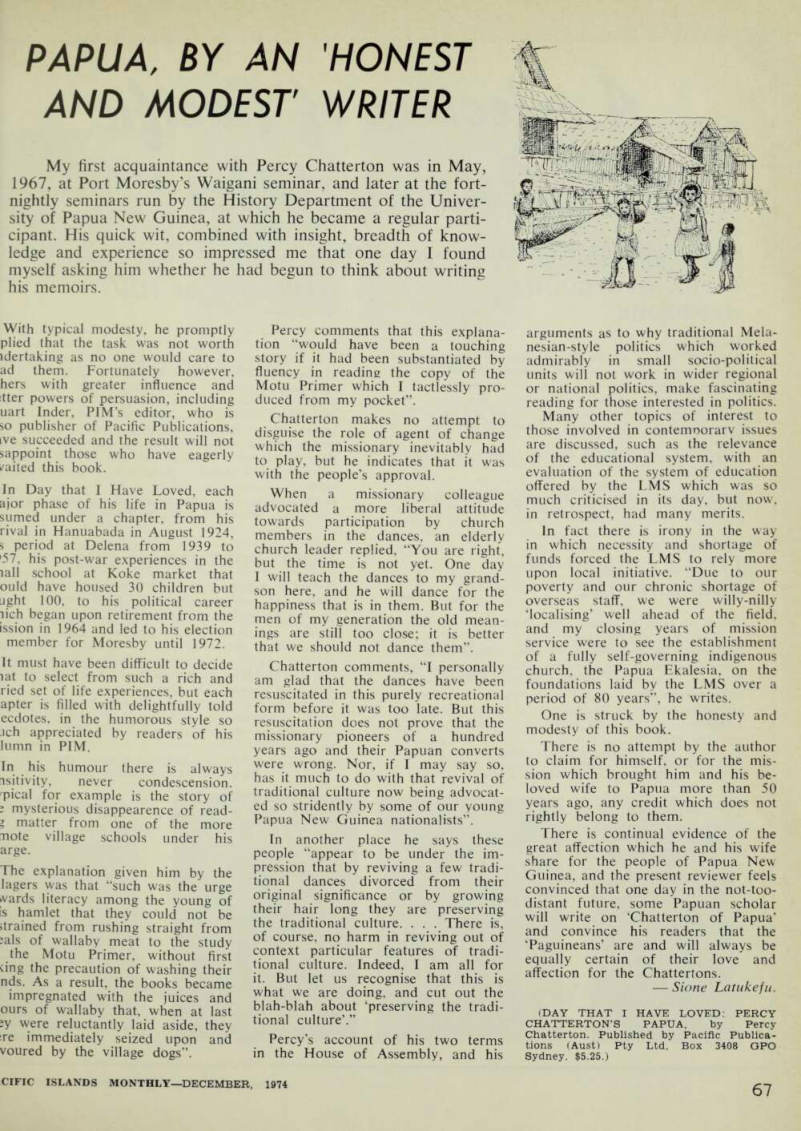
And Modest' Writer
My first acquaintance with Percy Chatterton was in May, 1967, at Port Moresby’s Waigani seminar, and later at the fort nightly seminars run by the History Department of the Univer sity of Papua New Guinea, at which he became a regular parti cipant. His quick wit, combined with insight, breadth of know ledge and experience so impressed me that one day I found myself asking him whether he had begun to think about writing his memoirs.
With typical modesty, he promptly plied that the task was not worth idertaking as no one would care to ad them. Fortunately however, hers with greater influence and tter powers of persuasion, including uart Inder, PlM’s editor, who is so publisher of Pacific Publications, ive succeeded and the result will not sappoint those who have eagerly /aited this book.
In Day that I Have Loved, each ajor phase of his life in Papua is sumed under a chapter, from his rival in Hanuabada in August 1924, s period at Delena from 1939 to '57, his post-war experiences in the lall school at Koke market that ould have housed 30 children but Light 100, to his political career fich began upon retirement from the ission in 1964 and led to his election member for Moresby until 1972.
It must have been difficult to decide lat to select from such a rich and ried set of life experiences, but each apter is filled with delightfully told ecdotes, in the humorous style so Jch appreciated by readers of his lumn in PIM.
In his humour there is always isitivity, never condescension, 'pical for example is the story of ; mysterious disappearence of read y matter from one of the more note village schools under his arge.
The explanation given him by the lagers was that “such was the urge wards literacy among the young of is hamlet that they could not be drained from rushing straight from jals of wallaby meat to the study the Motu Primer, without first cing the precaution of washing their nds. As a result, the books became impregnated with the juices and ours of wallaby that, when at last were reluctantly laid aside, they :re immediately seized upon and voured by the village dogs”.
Percy comments that this explana tion “would have been a touching story if it had been substantiated by fluency in reading the copy of the Motu Primer which I tactlessly pro duced from my pocket”.
Chatterton makes no attempt to disguise the role of agent of change which the missionary inevitably had to play, but he indicates that it was with the people’s approval.
When a missionary colleague
advocated a more liberal attitude towards participation by church members in the dances, an elderly church leader replied, “You are right, but the time is not yet. One day I will teach the dances to my grand son here, and he will dance for the happiness that is in them. But for the men of my generation the old mean ings are still too close; it is better that we should not dance them”.
Chatterton comments, “I personally am glad that the dances have been resuscitated in this purely recreational form before it was too late. But this resuscitation does not prove that the missionary pioneers of a hundred years ago and their Papuan converts were wrong. Nor, if I may say so, has it much to do with that revival of traditional culture now being advocat ed so stridently by some of our young Papua New Guinea nationalists”.
In another place he says these people “appear to be under the im pression that by reviving a few tradi tional dances divorced from their original significance or by growing their hair long they are preserving the traditional culture. . . . There is, of course, no harm in reviving out of context particular features of tradi tional culture. Indeed, I am all for it. But let us recognise that this is what we are doing, and cut out the blah-blah about ‘preserving the tradi tional culture’.”
Percy’s account of his two terms in the House of Assembly, and his
arguments as to why traditional Mela nesian-style politics which worked admirably in small socio-political units will not work in wider regional or national politics, make fascinating reading for those interested in politics.
Many other topics of interest to those involved in contemnorarv issues are discussed, such as the relevance of the educational system, with an evaluation of the system of education offered by the LMS which was so much criticised in its day, but now, in retrospect, had many merits.
In fact there is irony in the way in which necessity and shortage of funds forced the LMS to rely more upon local initiative. “Due to our poverty and our chronic shortage of overseas staff, we were willy-nilly ‘localising’ well ahead of the field, and my closing years of mission service were to see the establishment of a fully self-governing indigenous church, the Papua Ekalesia, on the foundations laid by the LMS over a period of 80 years’’, he writes.
One is struck by the honesty and modesty of this book.
There is no attempt by the author to claim for himself, or for the mis sion which brought him and his be loved wife to Papua more than 50 years ago, any credit which does not rightly belong to them.
There is continual evidence of the great affection which he and his wife share for the people of Papua New Guinea, and the present reviewer feels convinced that one day in the not-too distant future, some Papuan scholar will write on ‘Chatterton of Papua' and convince his readers that the ‘Paguineans’ are and will always be equally certain of their love and affection for the Chattertons.
Sione Latukefu.
(Day That I Have Loved; Percy
Chatterton’S Papua, By Percy
Chatterton. Published by Pacific Publica tions (Aust) Pty Ltd, Box 3408 GPO Sydney. $5.25.)
Advertisements & other items, pp. 73-77 (4 items)
67
IFIC ISLANDS MONTHLY—DECEMBER, 1974
Selection Pacific
islands titles
From the Pacific Islands specialists
Pacific Publications
PAPUA NEW GUINEA
HANDBOOK
HANDBOOK OF FIJI
4th edition 7th edition This new edition of the Papua New Guinea Handbook —completely revised and reset —provides the first full upto-date details of the new self-governing nation.
For businessmen, travellers, schools, universities and libraries, government departments, tourists and Papua New Guinea residents, this timely, up-to-the-minute edition, is essential.
A large attractive fold-out map of Papua New Guinea is also included. 332 pages of text.
PRICE: Australia, $5.50 plus 85c posted. Pacific Islands and Overseas, $5.50 Aust., plus $l.lO posted; U.S.A., $9.80 U.S. posted. in trade and as a magnet for tourists, Fiji is growing in importance. For businessmen, travellers, students and others who want to keep abreast of events, the fourth edition of the Handbook of Fiji is an essential guide.
As well as sections dealing exhaustively with history, geography, government and politics, finance, trade, education, social services, etc., there is a completely revised tourist section. This is in keeping with the growing importance to Fiji of this industry. An extensive accommodation guide and a folding road-map of Viti Levu are included. With 14 other maps and attractive full-colour cover.
PRICE: Australia, Pacific Islands and Overseas, $3.95 Aust., plus 30c posted; U.S.A., $4.90 U.S. posted.
FOR CHILDREN
LITTLE CHIMBU IN
BOUGAINVILLE
HOLY TORTURE IN FIJI
Nancy Curtis Written by a group of academic participants and observers.
Editing and commentary by Prof. Ron Crocombe.
This is the story of lovable Little Chimbu, and his friends, who go off to see the biggest hole in the world . . . the Bougainville copper mine, at Panguna, in New Guinea.
Adventures follow one after the other on their arrival at the mine, and young readers (and their parents) will be fascinated by Nancy Curtis' colourful, yet accurate and instructive account of the workings of the big Bougainville enterprise ... its giant trucks, its processing plant, its port and shipping.
Illustrated in full colour.
PRICE; Australia, Pacific Islands and Overseas, $3.25 Aust., plus 30c posted; U.S.A., $5.30 U.S. posted.
This book describes sacred ancient rituals involving physical ordeals which are performed once a year at certain Hindu temples in Fiji. The rituals include walking on fire, dancing on upturned knife-blades, whipping, plunging the hands in burning fat and piercing the body with steel skewers and silver wires.
Yet those who go through the ordeals suffer no pain, burns or injuries.
The book is beautifully produced in full colour and black-and-white.
PRICE: Australia, Pacific Islands and Overseas, $3.95 Aust., plus 30c posted; U.S.A., $6.40 U.S. posted.
PfIPUR
Mill CUHIER
HRIIDBOOK
m m
HOLY
TORTURE
r"
IN FIJI
HANDBOOK
or fwi fourth edition M m
Percy Chattcrfon’s Pajm*
DAY THAT I
HAVE LOVED
fcaJ
m m ■Jj PS iS«k^£= **
OLKLORIC IN AUSTRALIA
Text: Beth Dean Photographs: Stan Goik is attractive large format book illustrates the beauty and tality of national folk dances brought to Australia by wcomers from Europe and elsewhere, and now a strongly owing cultural movement in our cities and towns. Perrmances of some of the leading folk dance groups in jstralia have been captured on stage, in colour, and the tter known dances described. Folk groups represented dude those from Greece, the USSR, Croatia, Israel, banon, Sweden, the United Kingdom, Armenia, Bulgaria, tvia, Latin America, Australia and others. Surprisingly, is is the first book to illustrate the scope of the great Ik dance cultural development in Australia. 88 pages in full colour.
ICE: Australia, $6.95 plus 85c posted. Pacific Islands and erseas, $6.95 Aust., plus $1.10 posted; U.S.A., $11.95 U.S. posted, rcy Chatterton's Papua
>AY THAT I HAVE LOVED
Percy Chatterton is is more than an autobiography by well-known Percy atterton, OBE, who has spent 50 years in Papua as ssionary, teacher and outspoken politician fighting for ; underdog. It is a colourful, and charming, account the Papuan people, giving warm insight into their pes, fears and changing way of life. Some Papuan iders say they don't want Papua to be submerged by :w Guinea in the move towards independence, and jders of Percy Chatterton's timely book will readily •npathise with their desire to retain their identity. The ok is illustrated with evocative pen sketches by Percy atterton's longtime friend and neighbour in Port Moresby, v. Bert Brown. .144 pages, illustrated.
ICE: Australia, Pacific Islands and Overseas, $5.25 Aust., plus 30c posted; U.S.A., $8.30 U.S. posted.
FRIENDLY ISLAND
Patricia Ledyard Tonga, sunlit South Pacific island kingdom, was described as a "Friendly Island" by Captain Cook, but nobody was ever more enchanted by its spell than a young Scottish doctor and a young American girl who fell in love with it and with one another more than 20 years ago. Here is the warming story of their life in Tonga, and of their Tongan friends and neighbours, told by the American girl.
Patricia Matheson, formerly Ledyard, still lives on the sandy point in the beautiful harbour of Vava'u. Her book, first published in 1956 and now updated with a new foreword by the author, has become a South Pacific classic. 256 pages, illustrated.
PRICE: Australia, Pacific Islands and Overseas, $3.00 Aust., plus 30c posted; U.S.A., $4.95 U.S. posted.
COLONIAL ERA CEMETERY
OF NORFOLK ISLAND
R. Nixon Dalkin An important addition to Australiana is this first detailed examination of the graves in the Norfolk Island cemetery.
The author is a former Administrator of Norfolk Island, now living in Canberra. The attractive book, well illustrated with early drawings and photographs, including close-ups of the major headstones, records all inscriptions in the colonial cemetery and relates many of the colourful stories of those buried there—convicts, soldiers and civilians.
Norfolk Island was settled within a few weeks of the arrival of the First Fleet in 1788, and the cemetery is thus of great historical interest and importance. The oldest extant grave in the historic cemetery, its headstone still intact, is that of a First Fleet convict who died on the island in 1789.
PRICE: Australia, $6.00 plus 85c posted, Pacific Islands and Overseas, $6.00 Aust., plus $1.10 posted; U.S.A., $10.60 U.S. posted.
Send your order, with payment, to
Pacific Publications (Aust.) Pty. Ltd.
29 Alberta Street, Sydney, N.S.W. 2000 (Postal Address: Box 3408, G.P.O., Sydney, N.S.W. 2001.)
OUR AIM IN THE SOUTH PACIFIC
IS TO PROVIDE, SAFE,
RELIABLE, EFFICIENT TRANSPORTATION.
/ o r r % ✓ r r O & r N \ r r r t r r Hold f f \ r V'\ t ,1 I / r r ♦ < r % •> c <~ «- Holden The illustration shows the various vehicles that General Motors Dealers sell in the South Pacific. They have been thoroughly proven to be safe, efficient and reliable. G.M. vehicles put the driver and passengers first, in terms of comfort and ease of handling.
GENERAL MOTORS VEHICLES..THEY MAKE A LOT OF SENSE FOR THE SOUTH PACIFIC.
And everywhere you see a General Motors car or truck indicated on the illustration you know there is a General Motors Authorised Dealer.
He is factory selected, his staff factory trained, his Dealership stocked with genuine, economical General Motors parts. Because General Motors put you first ...they are the leaders in the Automotive world today.
69
LCIFIC ISLANDS MONTHLY—DECEMBER, 1974
British pacific Jet
airways news
'UBLISHED BY BRITISH AIRWAYS
A RIM ADVERTISING SUPPLEMENT
Two-For-One Deal
A special two-for-the-price-of-one deal for business travellers is offered in the latest programme of British Airways Speedbird holidays.
Under this new plan an executive can take his wife to London or New York and not pay more for hotel accommodation than he would when travelling on his own.
There is a choice of first class hotels at varying rates and the price for seven days (which starts at SAI3I in London and SA2OI in New York) also includes private chauffeur-driven transport between the air port and hotel and some local sightseeing tours.
Full details are available from travel agents or British Airways offices.
The race of the Midnight Sun
On Tuesday June 24, 1975, competing yachts will U off from Granton Harbour, Edinburgh at the start f the sth annual Fair Isle International Yacht Race, 'rganised by the Forth Corinthian Yacht Club, this ice has been adopted by the Royal Ocean Racing Club id is a qualifying race for membership.
Now firmly established as the premier offshore race i the east of Scotland, it covers a distance of some 00 miles, starting at Edinburgh, rounding Fair Isle— stween Orkney and Shetland—and ending at Kirkwall, •rkney. The many trophies awarded for the race in ude the Trident Trophy, presented by British Airways )r the first overseas competitor across the line.
The event offers a splendid opportunity for yachts len to sail in northern waters at a time of the year hen there is almost perpetual daylight in those lati ides—hence the nickname “Race of the Midnight an . Entrants from countries outside Britain can well imbine the race with a holiday cruise in the fascinat ig Scottish islands, where there is an abundance of iod anchorages. The race offers three divisions. The rst is the principal division for International Offshore ule Mark 111 rated yachts; the second is for non-lOR ited yachts, racing under a handicapping system; the lird is for multi-hull craft. Further details can be btained from The Commodore, Forth Corinthian acht Club, 1 Granton Square, Edinburgh, EHS IHE :otland.
Our last issue
This, regrettably, is the last edition of British Airways Pacific Jet News. This is because, as we told you last month, the British Airways trans-Pacific VCIO services will cease operating from the end of March, 1975.
At the same time (as was also reported) a new DC 10 aircraft interchange service will start operating from the beginning of April, which will provide a daily through one-aircraft service between Auckland and London.
As far as Los Angeles the aircraft will be operated by Air New Zealand crews, but at Los Angeles it will be taken over by British Airways crews for the non-stop flight to London.
Flights will call at Honolulu or Papeete on their way to Los Angeles and Thursday’s flight will provide a one-aircraft service from Fiji to London.
There are frequent connections at Auckland from Australian ports.
It will be the first time British Airways has operated a Los Angeles/London service with wide bodied aircraft.
The full schedule is published below:
Chc
Sat Sun
Mon Tue
Te556A
Wed Fri
Te556A
Thu
Fri
1815
Syd
1400 TE556 1850 1400 TE556 1850 TE556 TE862 1930
Akl
2015 2015 1830 2130 2045 2330
Nan
0640 2230 0640 0046 (+1) 0855
Hnl
0800 0315 0800 1015
Ppt
0500
Lax
1620 BA598 1600 BA598 1620 BA598 1835
Lax
1830 1830 1830
Lhr
Sun Mon
Tue Wed
Thu Sat
Fri
1240 1240 1240
Advertisements & other items, p. 77 (1 item)
Acific Islands Monthly—December, 1974
Change
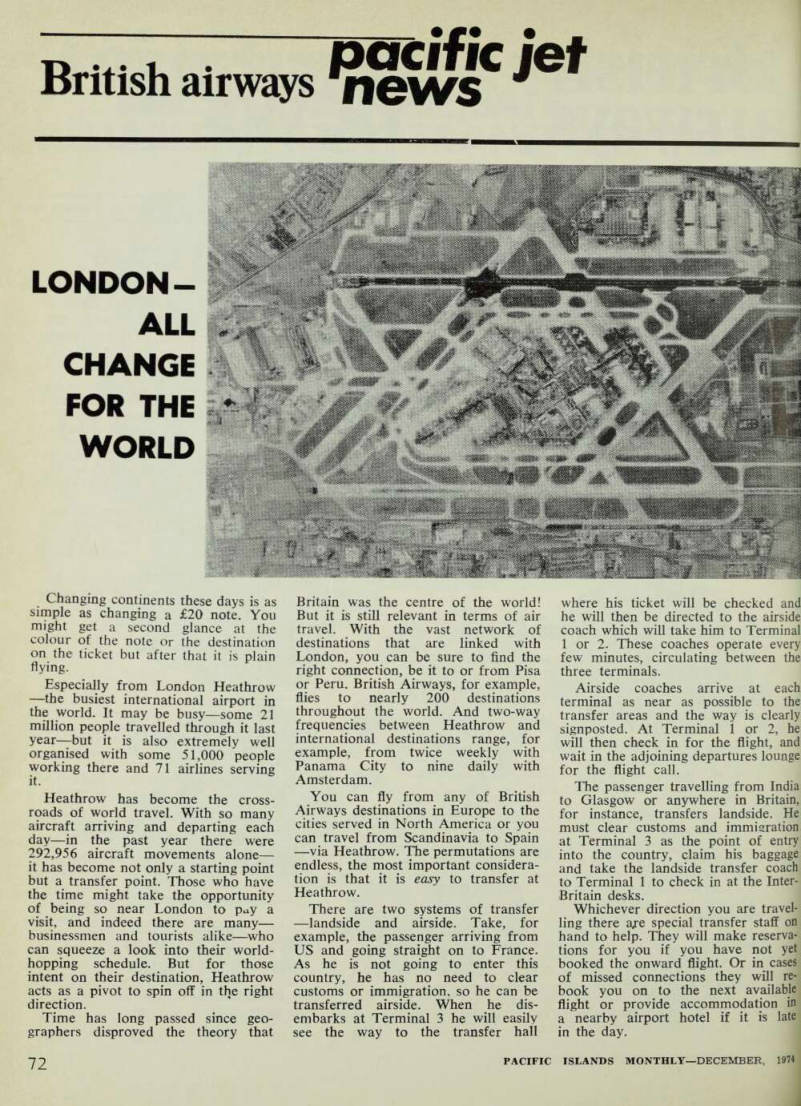
London
All
For The
World
Changing continents these days is as simple as changing a £2O note. You might get a second glance at the colour of the note or the destination on the ticket but after that it is plain flying.
Especially from London Heathrow —the busiest international airport in the world. It may be busy—some 21 million people travelled through it last year—but it is also extremely well organised with some 51,000 people working there and 71 airlines serving it.
Heathrow has become the cross roads of world travel. With so many aircraft arriving and departing each day—in the past year there were 292,956 aircraft movements alone— it has become not only a starting point but a transfer point. Those who have the time might take the opportunity of being so near London to pay a visit, and indeed there are many— businessmen and tourists alike—who can squeeze a look into their world hopping schedule. But for those intent on their destination, Heathrow acts as a pivot to spin off in the right direction.
Time has long passed since geo graphers disproved the theory that
Britain was the centre of the world!
But it is still relevant in terms of air travel. With the vast network of destinations that are linked with London, you can be sure to find the right connection, be it to or from Pisa or Peru, British Airways, for example, flies to nearly 200 destinations throughout the world. And two-way frequencies between Heathrow and international destinations range, for example, from twice weekly with Panama City to nine daily with Amsterdam.
You can fly from any of British Airways destinations in Europe to the cities served in North America or you can travel from Scandinavia to Spain —via Heathrow. The permutations are endless, the most important considera tion is that it is easy to transfer at Heathrow.
There are two systems of transfer —landside and airside. Take, for example, the passenger arriving from US and going straight on to France.
As he is not going to enter this country, he has no need to clear customs or immigration, so he can be transferred airside. When he dis embarks at Terminal 3 he will easily see the way to the transfer hall
where his ticket will be checked and he will then be directed to the airside coach which will take him to Terminal 1 or 2. These coaches operate every few minutes, circulating between the three terminals.
Airside coaches arrive at each terminal as near as possible to the transfer areas and the way is clearly signposted. At Terminal 1 or 2, he will then check in for the flight, and wait in the adjoining departures lounge for the flight call.
The passenger travelling from India to Glasgow or anywhere in Britain, for instance, transfers landside. He must clear customs and immigration at Terminal 3 as the point of entry into the country, claim his baggage and take the landside transfer coach to Terminal 1 to check in at the Inter- Britain desks.
Whichever direction you are travel ling there aje special transfer staff on hand to help. They will make reserva tions for you if you have not yet booked the onward flight. Or in cases of missed connections they will re book you on to the next available flight or provide accommodation in a nearby airport hotel if it is late in the day.
Advertisements & other items, p. 78 (1 item)
British airways
Competition results
Uncle Peter's Junior Jet-Setters Competition results
There was a large number of entries for Uncle Peter’s Junior Jet-Setters Essay Competition and as the andard was very high all round, it presented an extremely difficult task to the judges to decide on the winners.
We are most grateful to the headmistress of St Joseph’s Secondary School, Suva, and her staff for under iking this very difficult choice for us and the names of the winners in the various classes (with their junior jet ub mileages, where they have given them to us) are published below:
As unfortunately, this is our last issue and the space was not available to publish more than one entry, ;low is the overall winning entry in all classes, that of Philip Comish.
True Stories
Over 13 1. Shareen AH 1,326 2. Clara Banks 69,470 3. Roshanara Begum Khan ... 5,012 Age 8 to 12 1. David Leonard 57,851 2. Hugh Maybin 62,985 3.) Simon Campbell Fraser ... ... 16,374 ) Arvind Kumar Age 7 and under 1. Nicola Fraser ... 16,376 2. Emma Holdsworth 11,644
Imaginary Stories
Over 13 1. Philip Cornish 154,520 2. Judith House 202,211 3. Mafi Bale Age 8 to 12 1. Anna Maybin 12,985 2. Satendra Narain 1,348 3. Susan Cornish 31,514 Age 7 and under 1. Catherine Donaldson 15,064 2. Simon Stoddart 3,659 3. Susan Stoddart 3,659
Winning Essay: MAYDAY 1661
I awoke to the raucous crowing of e dawn-announcing farmyard >cks. I pushed open the attic, it lietly sighed. I saw the life-giving in steadily shorten the shadows and y up the dew-sodden grass. It was e first proper sunrise I’d felt for onths. Today the sun really had ;at. It was the first of May, 1661.
Mayday 1661; I shook my me ory, we had a king on the throne, was so used to the dull Puritan iled years behind with no celebra- Dns at all. Yes the sun really had ;at.
I was born in 1646 while the oyalists and Roundheads slaugh red themselves over England. When was just three when our good king harles was beheaded, our family as stunned and enraged, we swore :ver to help a Roundhead again. I member Roundheads marching on iad beyond our farm, ugly, cruel,
war lovers, their bullying eyes glinting the punishment for hiding a Royalist, I hate them. Yet now they were gone and life was merry and this was to be the first and probably, I hope, the merriest Mayday in my life. My thoughts were broken off by a shrill shout from the kitchen.
“Philip, Simon, breakfast!”
We clambered into our trousers and clean jerkins. Our trousers were gathered at the knee and we put socks on and then ill-fitting shoes.
We stormed down to the room below and said good morning. Our father sat quietly in a chair not far from the table. He was a kind, good humoured man and an excellent farmer. He was dressed in similarstyled clothing and wore a big widebrimmed Cavalier hat. One of his ears was missing. It had been cut off by one of the cruel Roundhead soldiers when they searched the farm,
just a few years ago.
Mother stood in the corner stirring a large pot of porridge. She was dressed in a red dress spun by her own hand and wore a little head cap.
She spun the clothes for us and cooked for us and sometimes helped in harvest time.
We sat down and ate the steaming porridge avidly. Father had long since said grace and he too was eat ing. Breakfast was silent except for the gay bird songs that riddled this Mayday. Father rose as we all finished and we read from the Bible and said prayers. Father went to feed the animals and we followed, Mother stayed inside preparing to day’s food and doing the housework, It was a warm morning and the farm was in full life. We collected the hens’ eggs and milked our cow and fed the mud-wallowing, food loving pigs who guzzled down their
food in no time. Soon we were ready to go.
We left the house taking a little basket of food. Father gave us a shilling each and we thanked him, overjoyed. A shilling was worth a lot to us. So we plodded the country mud road. We scaled a Norfolk hil lock and saw below us the buzzing, excited town of Norwich. Our pace quickened as we hurried down to Norwich. Shortly we arrived. Nor wich was agog with excitement, everybody had seemed to have thought the same things this morning.
First I went to the celebrated may pole.
The maypole looked like a barber’s pole, but it was many-coloured. It stood, a symbol of the new rule and happiness. We all danced round for real joy. I learnt gay Mayday songs that people had remembered despite the pleasure-killing Puritan rule.
It was late morning after our joy ful dance round the maypole. Every thing, everybody was lively. They wore their brightest and best clothes and created a terrific noise.
Next I saw a bear-baiting contest.
I saw a rather miserable, sullen bear standing chained, ironed to a rock strength pole. The owner set five vicious brute dogs who were to chew the bear up. The contest began. The
dogs gnawed at the bear. Soon one dog was dead, its brains had been dashed out by the powerful club of the bear. The other four bit, dancing from the annoyed bear. Then an other went. Then rather tattered the dogs withdrew and the bloodstained bear stood, the victor at high costs.
I saw several fights each as terrifying as the other. I am not squeamish but somehow it seemed that this was not the right kind of entertainment for me.
After our lunch of apples, bread and milk we went to see a cockfight.
This was not as bad as the bear baiting. It seemed more worthwhile.
First the bets were placed. Keen betters shouted their towering amounts on their favoured cock. The cocks were a bold sight, prepared to fight to the death. All seemed well then suddenly something made me shake and feel rather sick—rusty razor-sharp blades had been tied to the cocks ankles. Thank goodness they were not to use them. Anyway the fight began. Angry clucking arose over the din of the betters and the cocks started what seemed delicately plucking each other in short decisive thrusts. One cock was soon a bloody mess, his wings were stained red.
Luckily I placed my penny on the would-be victor. Then suddenly the
suffering blood-ridden cock fell. The victor danced his last, make-surej vicious thrusts and grumbles and delighted shrieks arose from the crowd as the cock strutted around the dying defeated. I claimed my penny and went off to see the Mayday pro cession.
First two brightly coloured jug glers came dancing and juggling down the street. Then the Mayking came, riding on a pretend horse and dressed in royal gay clothes he walked on followed by jesters, merry-makers, singers and other lively people. Everybody enjoyed it— the poor, humble folk to the mag nificently dressed cavalier gentlemen.
We all clapped, shouted and sang as the light hearted always fun pro cession rolled on to dusk in west.
As the procession ended we left Mayday-celebrating Norwich and walked silently home in our own thoughts, I thought of the bear, so miserable on such a happy day. The vicious annoying dog, his brains spilled everywhere. I remembered the cocks pecking to death and then the grand Mayday procession. It seemed so new to me. Yes, the Cromwellian dictatorship of cruelty was over. No I shall never forget this Mayday, never, never never.
Advertisements & other items, p. 79 (1 item)
”— — pacific Jet
British airways TiewS
kCIFIC ISLANDS MONTHLY—DECEMBER, 1974
January, 1975
Coming Events In Britain
Some highlights of the next few months
European Architectural Heritage Year Throughout Europe January to December. 1 International Racing Car Show Olympia, London to 11 January. 1 International Boat Show Earls Court, London to 11 January. 1 Camping, Outdoor Life & Travel Exhibition Olympia, London to 12 January. 4 The Holiday '75 Show Olympia, London to 12 January. 4 International Racing & Sporting Motorcycle Show Horticultural Halls, London to 11 January.
February
1 Rugby; Scotland v Ireland (Union) Murrayfield, Edinburgh. 1 Rugby: England v France (Union) Twickenham, Middlesex. 7 Cruft's Dog Show Olympia, London and 8 February. 14 English Folk Dance & Song Society Festival Royal Albert Hall, London and 15 February. 15 Rugby: Wales v England (Union) Cardiff.
March
1 Rugby: Scotland v Wales (Union) Murrayfield, Edinburgh. 1 Soccer League Cup Final Wembley, London (provisional). 4 Daily Mail Ideal Home Exhibition Olympia, London to 29 March. 12 Soccer: England v West Germany (venue not yet fixed) (provisional). 15 Rugby: England v Scotland (Union) Twickenham, Middlesex. 15 Rugby Football: Wales v Ireland (Union) Cardiff Arms Park, Cardiff.
May
3 Soccer: F.A. Cup Final Wembley, London. 21 Chelsea Flower Show Royal Hospital, Chelsea, London to 23 May (provisional). 23 Bath Festival Bath, Somerset to 1 June. 28 Bath & West Show Show Site, Shepton Mallet, Somerset to 31 May. 28 Golf: Walker Cup St. Andrews, Fife and 29 May.
June
11 Grosvenor House Antiques Fair Grosvenor House, London to 21 June. 17 Royal Hiohland Agricultural Show Inglisten, Edinburgh to 20 June (provisional). 27 Royal National Rose Society Summer Show Royal Horticultural!
Society Halls, London and 28 June.
Advertisements & other items, pp. 80-82 (2 items)
ij...« . pacific jet
74
PACIFIC ISLANDS MONTHLY—DECEMBER, 19
ij...« . pacific jet British airways news
Seiko
Automatic self-winding, Water resistant, Automatic self-winding, Water resistant- Second setting device, Instant day and date setting Second setting device, Instant day and date setting
Technology of the future.
Dedication of the past.
Seiko, the quality watch of today.
Every Seiko watch is a triumphant merger of Seiko's unique microelectronic-technology and time-honored tradition of handcraftsmanship.
Add to all this Seiko's insistence on making every part of every Seiko watch, thus quality-controlling every step.
This unique merging of future technology and past dedication creates the quality watch of today; Seiko.
SEIKO
K. Hattori & Co., Ltd., Tokyo, Japan.
Someday all watches will be made this way.
r \ % k* y \w*i / j.' * ■ V ': / / % V ' i-' - 4 &***" , «* “»i, ttew-' b' k «ounfl » ceirtt® 5 -.
£2SU *">.!S
__<s
««• - sii« “*;«■&»«■
*"■tsS»fes^rtfSt-
Mu ?' C n interesting m''™ Aus tta\ia and * aHaits. . tl ■your Begin" nick Patterson and Barry Seebet. w «ith your hosts OieKß )T
2p.m. ~»SSSSS
Hours: 8 a.m-' ”, , 0 a.m.^ds Write for Free Programme Guides, 1975 colored calendars, fan cards and information to Radio Australia, Melbourne 3000.
Pacific Transport
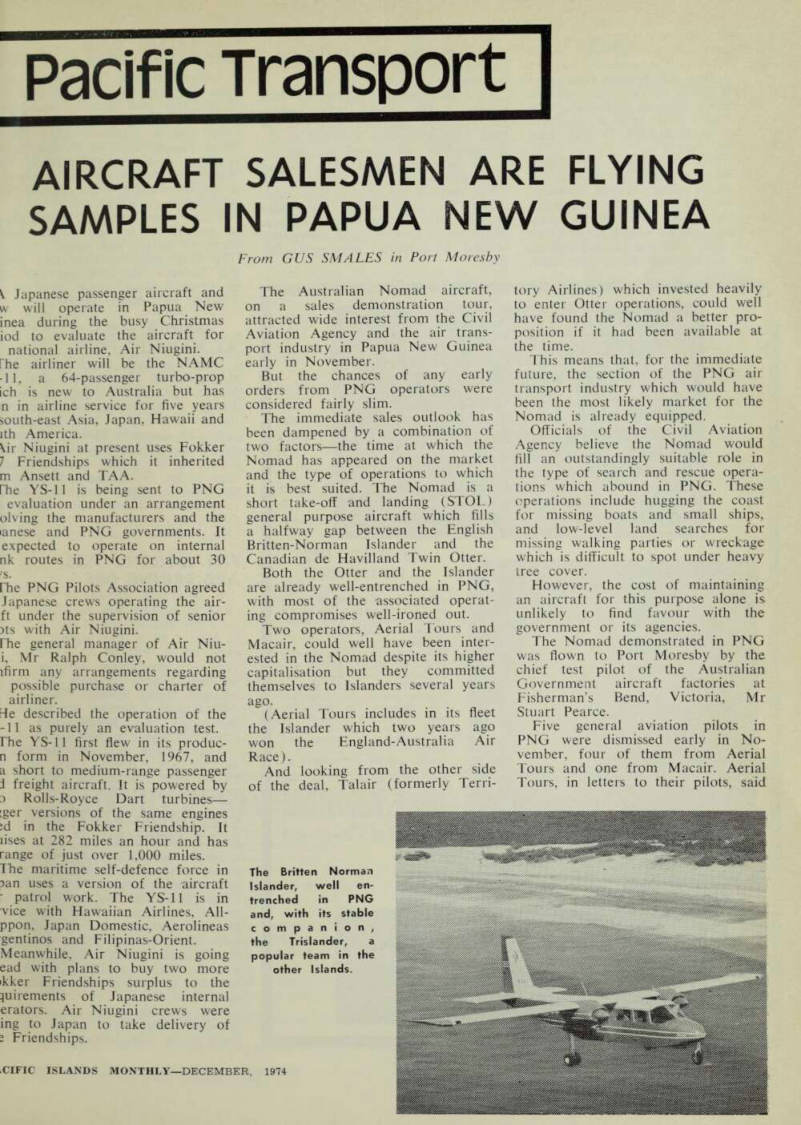
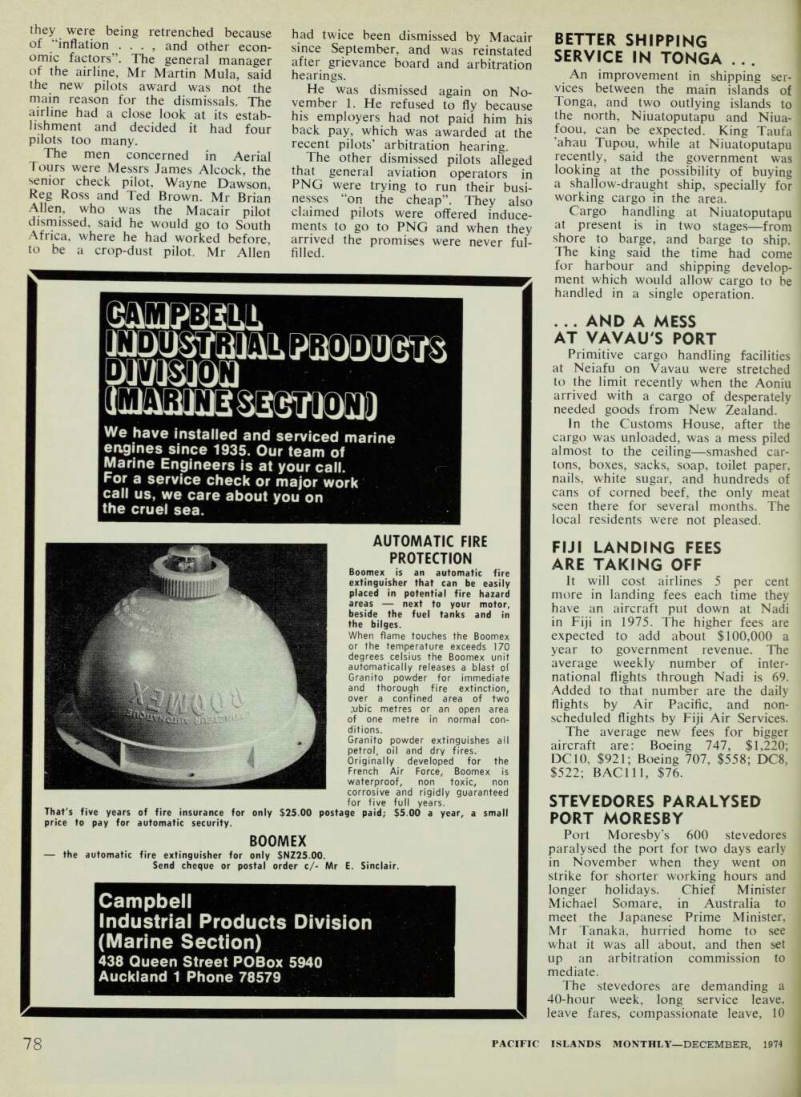
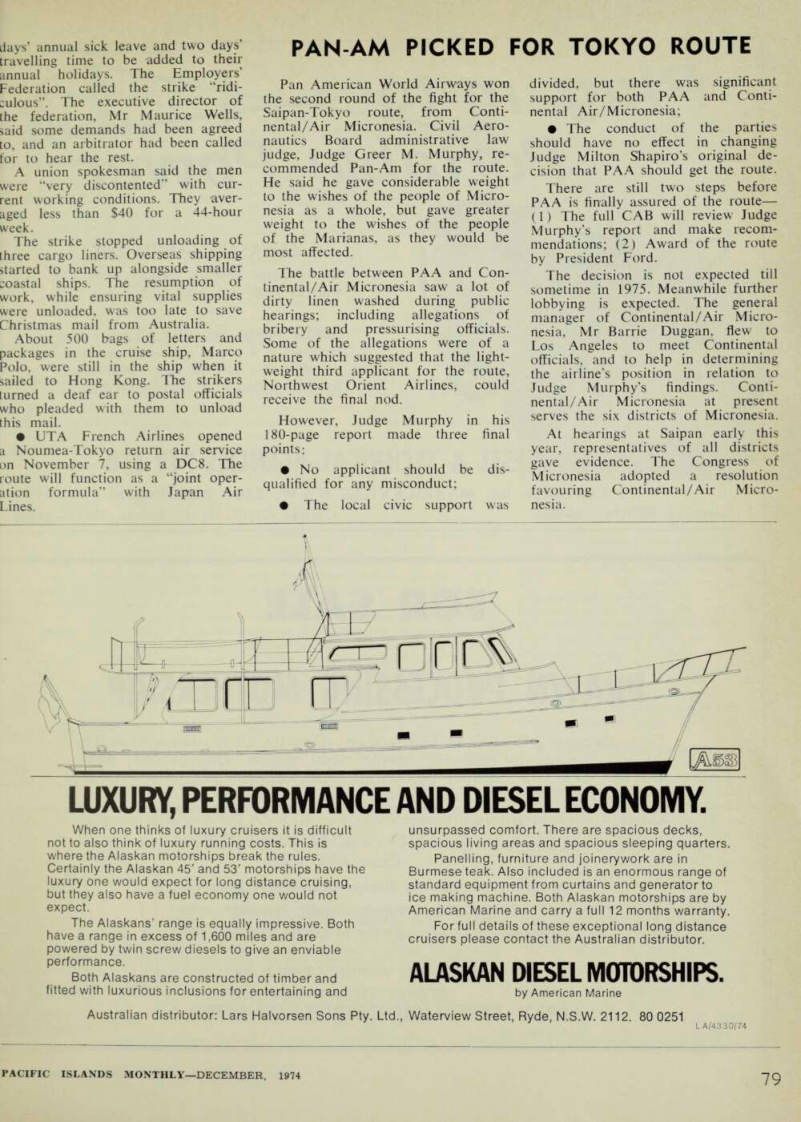
Aircraft Salesmen Are Flying
Samples In Papua New Guinea
From GUS SMALES in Port Moresby
V Japanese passenger aircraft and w will operate in Papua New inea during the busy Christmas iod to evaluate the aircraft for national airline, Air Niugini. fhe airliner will be the NAMC ■ll, a 64-passenger turbo-prop ich is new to Australia but has n in airline service for five years south-east Asia, Japan, Hawaii and ith America.
Niugini at present uses Fokker 7 Friendships which it inherited m Ansett and TAA. fhe YS-11 is being sent to PNG evaluation under an arrangement olving the manufacturers and the •anese and PNG governments. It expected to operate on internal nk routes in PNG for about 30 's. fhe PNG Pilots Association agreed Japanese crews operating the air ft under the supervision of senior its with Air Niugini. fhe general manager of Air Niu i, Mr Ralph Conley, would not ifirm any arrangements regarding possible purchase or charter of airliner.
EJe described the operation of the -11 as purely an evaluation test.
Fhe YS-11 first flew in its produc n form in November, 1967, and a short to medium-range passenger J freight aircraft. It is powered by j Rolls-Royce Dart turbines— :ger versions of the same engines ;d in the Fokker Friendship. It uses at 282 miles an hour and has range of just over 1,000 miles.
The maritime self-defence force in aan uses a version of the aircraft • patrol work. The YS-11 is in vice with Hawaiian Airlines, All ppon, Japan Domestic, Aerolineas gentinos and Filipinas-Orient.
Meanwhile, Air Niugini is going ead with plans to buy two more •kker Friendships surplus to the quirements of Japanese internal erators. Air Niugini crews were ing to Japan to take delivery of i Friendships.
The Australian Nomad aircraft, on a sales demonstration tour, attracted wide interest from the Civil Aviation Agency and the air transport industry in Papua New Guinea early in November.
But the chances of any early orders from PNG operators were considered fairly slim.
The immediate sales outlook has been dampened by a combination of two factors—the time at which the Nomad has appeared on the market and the type of operations to which it is best suited. The Nomad is a short take-off and landing (STOL) general purpose aircraft which fills a halfway gap between the English Britten-Norman Islander and the Canadian de Havilland Twin Otter.
Both the Otter and the Islander are already well-entrenched in PNG, with most of the associated operating compromises well-ironed out.
Two operators, Aerial Tours and Macair, could well have been interested in the Nomad despite its higher capitalisation but they committed themselves to Islanders several years a go. (Aerial Tours includes in its fleet the Islander which two years ago won the England-Australia Air Race).
And looking from the other side of the deal, Talair (formerly Terri-
tory Airlines) which invested heavily to enter Otter operations, could well have found the Nomad a better pro position if it had been available at the time.
This means that, for the immediate future, the section of the PNG air transport industry which would have been the most likely market for the Nomad is already equipped, Officials of the Civil Aviation Agency believe the Nomad would fill an outstandingly suitable role in the type of search and rescue opera tions which abound in PNG. These operations include hugging the coast for missing boats and small ships, and low-level land searches for
missing walking parties or wreckage
which is difficult to spot under heavy tree cover, However, the cost of maintaining an aircraft for this purpose alone is unlikely to find favour with the government or its agencies.
The Nomad demonstrated in PNG was flown to Port Moresby by the chief test pilot of the Australian Government aircraft factories at Fisherman’s Bend, Victoria, Mr Stuart Pearce, Five general aviation pilots in PNG were dismissed early in No vember, four of them from Aerial Tours and one from Macair. Aerial Tours, in letters to their pilots, said
The Britten Norman Islander, well en trenched in PNG and, with its stable companion, the Trislander, a popular team in the other Islands.
the y were being retrenched because of ‘inflation . . . , and other econ omic factors”. The general manager of the airline, Mr Martin Mula, said the new pilots award was not the main reason for the dismissals. The airline had a close look at its estab lishment and decided it had four pilots too many.
The men concerned in Aerial Tours were Messrs James Alcock, the senior check pilot, Wayne Dawson, Reg Ross and Ted Brown. Mr Brian Allen, who was the Macair pilot dismissed, said he would go to South Africa, where he had worked before, to be a crop-dust pilot. Mr Allen
had twice been dismissed by Macair since September, and was reinstated after grievance board and arbitration hearings.
He was dismissed again on No vember 1. He refused to fly because his employers had not paid him his back pay, which was awarded at the recent pilots’ arbitration hearing.
The other dismissed pilots alleged that general aviation operators in PNG were trying to run their busi nesses “on the cheap”. They also claimed pilots were offered induce ments to go to PNG and when they arrived the promises were never ful filled.
Better Shipping
Service In Tonga . . .
An improvement in shipping ser vices between the main islands of Tonga, and two outlying islands to the north, Niuatoputapu and Niua foou, can be expected. King Taufa ’ahau Tupou, while at Niuatoputapu recently, said the government was looking at the possibility of buying a shallow-draught ship, specially for working cargo in the area.
Cargo handling at Niuatoputapu at present is in two stages—from shore to barge, and barge to ship.
The king said the time had come for harbour and shipping develop ment which would allow cargo to be handled in a single operation.
... And A Mess
At Vavau's Port
Primitive cargo handling facilities at Neiafu on Vavau were stretched to the limit recently when the Aoniu arrived with a cargo of desperately needed goods from New Zealand.
In the Customs House, after the cargo was unloaded, was a mess piled almost to the ceiling—smashed car tons, boxes, sacks, soap, toilet paper, nails, white sugar, and hundreds of cans of corned beef, the only meat seen there for several months. The local residents were not pleased.
Fiji Landing Fees
Are Taking Off
It will cost airlines 5 per cent more in landing fees each time they have an aircraft put down at Nadi in Fiji in 1975. TTe higher fees are expected to add about 1100,000 a year to government revenue. The average weekly number of inter national flights through Nadi is 69.
Added to that number are the daily flights by Air Pacific, and non scheduled flights by Fiji Air Services.
The average new fees for bigger aircraft are: Boeing 747, $1,220; DC 10, $921; Boeing 707, $558; DCS,
$522; Baciii, $76.
Stevedores Paralysed
Port Moresby
Port Moresby’s 600 stevedores paralysed the port for two days early in November when they went on strike for shorter working hours and longer holidays. Chief Minister Michael Somare, in Australia to meet the Japanese Prime Minister, Mr Tanaka, hurried home to see what it was all about, and then set up an arbitration commission to mediate.
The stevedores are demanding a 40-hour week, long service leave, leave fares, compassionate leave, 10
days’ annual sick leave and two days’ travelling time to be added to their annual holidays. The Employers’
Federation called the strike “ridi culous”. The executive director of the federation, Mr Maurice Wells, said some demands had been agreed to, and an arbitrator had been called for to hear the rest.
A union spokesman said the men were “very discontented” with cur rent working conditions. They aver aged less than $4O for a 44-hour week.
The strike stopped unloading of three cargo liners. Overseas shipping started to bank up alongside smaller coastal ships. The resumption of work, while ensuring vital supplies were unloaded, was too late to save Christmas mail from Australia.
About 500 bags of letters and packages in the cruise ship, Marco Polo, were still in the ship when it sailed to Hong Kong. The strikers turned a deaf ear to postal officials who pleaded with them to unload this mail. • UTA French Airlines opened a Noumea-Tokyo return air service on November 7, using a DCS. The route will function as a “joint oper ation formula” with Japan Air Lines.
Advertisements & other items, pp. 83-84 (2 items)
Icific Islands Monthly—December, 1974
SiTil
PJR
U V A s
We have installed and serviced marine engines since 1935. Our team of Marine Engineers is at your call.
For a service check or major work call us, we care about you on the cruel sea.
AUTOMATIC FIRE
PROTECTION
Boomex is an automatic fire extinguisher that can be easily placed in potential fire hazard areas next to your motor, beside the fuel tanks and the bilges.
When flame touches the Boomex or the temperature exceeds 170 degrees Celsius the Boomex unit automatically releases a blast of Granito powder for immediate and thorough fire extinction, over a confined area of two jubic metres or an open area of one metre in normal conditions.
Granito powder extinguishes all petrol, oil and dry fires.
Originally developed for the French Air Force, Boomex is waterproof, non toxic, non corrosive and rigidly guaranteed for five full years.
That's five years of fire insurance for only $25.00 postage paid; $5.00 a year, a small price to pay for automatic security.
BOOMEX
the automatic fire extinguisher for only $NZ25.00.
Send cheque or postal order c/- Mr E. Sinclair.
Campbell
Industrial Products Division
(Marine Section)
438 Queen Street POBox 5940 Auckland 1 Phone 78579
Pan-Am Picked For Tokyo Route
Pan American World Airways won the second round of the fight for the Saipan-Tokyo route, from Conti nental/Air Micronesia. Civil Aero nautics Board administrative law judge, Judge Greer M. Murphy, re commended Pan-Am for the route.
He said he gave considerable weight to the wishes of the people of Micro nesia as a whole, but gave greater weight to the wishes of the people of the Marianas, as they would be most affected.
The battle between PAA and Con tinental/Air Micronesia saw a lot of dirty linen washed during public hearings; including allegations of bribery and pressurising officials.
Some of the allegations were of a nature which suggested that the light weight third applicant for the route, Northwest Orient Airlines, could receive the final nod.
However, Judge Murphy in his 180-page report made three final points; • No applicant should be dis qualified for any misconduct; • The local civic support was
divided, but there was significant support for both PAA and Conti nental Air/Micronesia; • The conduct of the parties should have no effect in changing Judge Milton Shapiro's original de cision that PAA should get the route.
There are still two steps before PAA is finally assured of the route— (l) The full CAB will review Judge Murphy’s report and make recom mendations; (2) Award of the route by President Ford.
The decision is not expected till sometime in 1975. Meanwhile further lobbying is expected. The general manager of Continental/Air Micro nesia, Mr Barrie Duggan, flew to Los Angeles to meet Continental officials, and to help in determining the airline’s position in relation to Judge Murphy’s findings. Conti nental/Air Micronesia at present serves the six districts of Micronesia.
At hearings at Saipan early this year, representatives of all districts gave evidence. The Congress of Micronesia adopted a resolution favouring Continental/Air Micro nesia.
Advertisements & other items, pp. 85-86 (1 item)
Luxury, Performance And Diesel Economy.
When one thinks of luxury cruisers it is difficult not to also think of luxury running costs. This is where the Alaskan motorships break the rules.
Certainly the Alaskan 45' and 53' motorships have the luxury one would expect for long distance cruising, but they also have a fuel economy one would not expect.
The Alaskans’ range is equally impressive. Both have a range in excess of 1,600 miles and are powered by twin screw diesels to give an enviable performance.
Both Alaskans are constructed of timber and fitted with luxurious inclusions for entertaining and unsurpassed comfort. There are spacious decks, spacious living areas and spacious sleeping quarters.
Panelling, furniture and joinerywork are in Burmese teak. Also included is an enormous range of standard equipment from curtains and generator to ice making machine. Both Alaskan motorships are by American Marine and carry a full 12 months warranty.
For full details of these exceptional long distance cruisers please contact the Australian distributor.
ALASKAN DIESEL MOTORSHIPS.
by American Marine Australian distributor: Lars Halvorsen Sons Pty. Ltd., Waterview Street, Ryde, N.S.W. 2112. 80 0251 LA/43 30/74
Plug in t
Portable Power
C %
KAWASAKI GENERATORS
Dual voltage models ranging from 600 watt to 1300 watt 240/110/12 volt.
SINGLE PHASE 240 VOLT 2-3-4-5-7| KVA
Featured in a strong roll-over frame or as a trolley type as illustrated. These quality units are suitable for electric motor duties.
PACIFIC DIESEL & TECHNICAL AGENCIES PTY LTD 19 Carrington Rd. MARRICKVILLE N.S.W. 2204 AUSTRALIA Telephone; 55-3473 55-3867 Cables: “DIESELTECH”, Sydney. TELEX; 25568
FOR SALE
PRAWN PROCESSING MOTHERSHIP
Gross tonnage 345; L.O.A. 143 ft. 6 in.; Breadth 24 ft.; Draught 9 ft. 1 1 in. Powered by 300 HP MWM main engine. One Nissan, one Dorman and two Gardner auxiliaries. Fuel capacity 40 tons. Fitted with Codan SSB; Furuno radar and Furuno echo sounder.
One 100 KVA Stamford alternator and two 40 KVA Dunlite alternators.
Fitted with 2,000 lb. snap freezer, brine tanks and 8,000 cu. ft. freezer space.
Refrigeration serviced by Budge and Terry compressors.
Fitted with 1 ton hydraulic cranes.
Queensland Harbours and Marine Survey.
PRICE ON APPLICATION
APPLY BOX 1380 CAIRNS, Q. 4870
Cruising
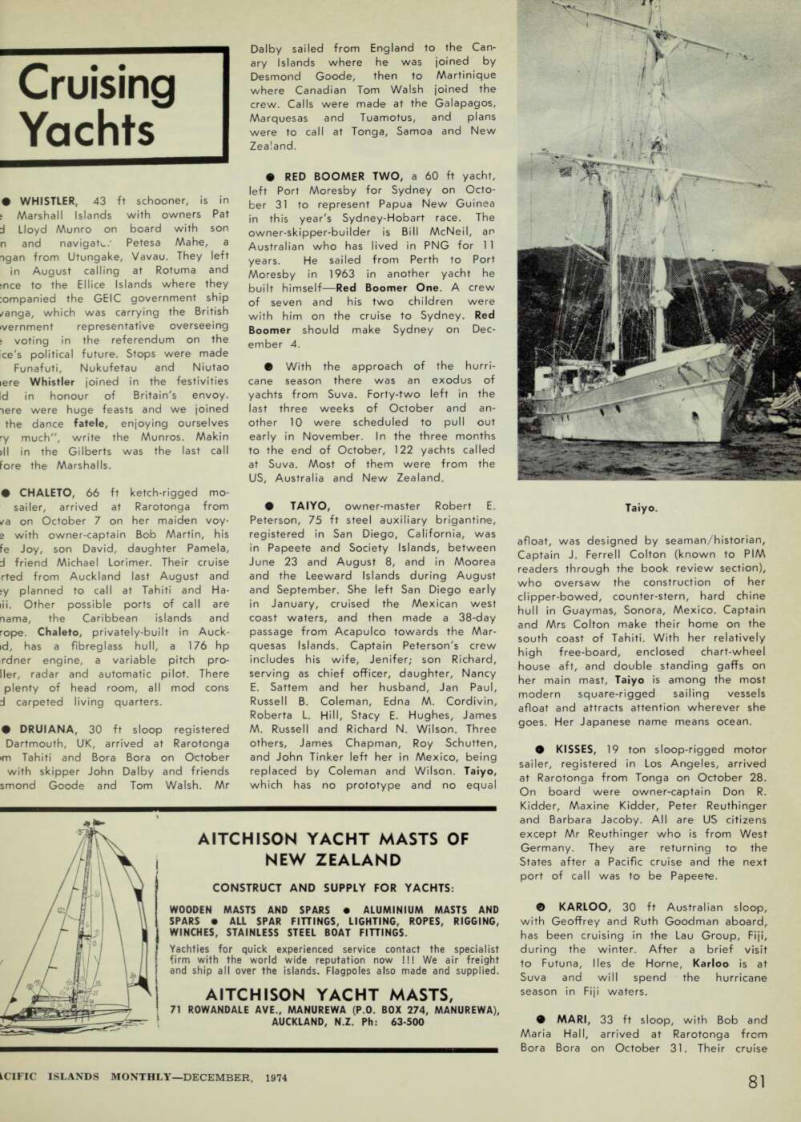
Yachts
• WHISTLER, 43 ft schooner, is in > Marshall Islands with owners Pat d Lloyd Munro on board with son n and navigate/ Petesa Mahe, a igan from Utungake, Vavau. They left in August calling at Rotuma and mce to the Ellice Islands where they :ompanied the GEIC government ship /anga, which was carrying the British ivernment representative overseeing • voting in the referendum on the ce's political future. Stops were made Funafuti, Nukufetau and Niutao lere Whistler joined in the festivities td in honour of Britain's envoy, lere were huge feasts and we joined the dance fatele, enjoying ourselves ry much", write the Munros. Makin >ll in the Gilberts was the last call fore the Marshalls. • CHALETO, 66 ft ketch-rigged mo sailer, arrived at Rarotonga from ✓a on October 7 on her maiden voy a with owner-captain Bob Martin, his fe Joy, son David, daughter Pamela, d friend Michael Lorimer. Their cruise rted from Auckland last August and *y planned to call at Tahiti and Ha lii. Other possible ports of call are nama, the Caribbean islands and rope. Chaleto, privately-built in Auck id, has a fibreglass hull, a 176 hp rdner engine, a variable pitch pro ller, radar and automatic pilot. There plenty of head room, all mod cons d carpeted living quarters. • DRUIANA, 30 ft sloop registered Dartmouth, UK, arrived at Rarotonga >m Tahiti and Bora Bora on October with skipper John Dalby and friends smond Goode and Tom Walsh. Mr
Dalby sailed from England to the Can ary Islands where he was joined by Desmond Goode, then to Martinique where Canadian Tom Walsh joined the crew. Calls were made at the Galapagos, Marquesas and Tuamotus, and plans were to call at Tonga, Samoa and New Zealand. • RED BOOMER TWO, a 60 ft yacht, left Port Moresby for Sydney on Octo ber 31 to represent Papua New Guinea in this year's Sydney-Hobart race. The owner-skipper-builder is Bill McNeil, an Australian who has lived in PNG for 11 years. He sailed from Perth to Port Moresby in 1963 in another yacht he built himself — Red Boomer One. A crew of seven and his two children were with him on the cruise to Sydney. Red Boomer should make Sydney on Dec ember 4. • With the approach of the hurri cane season there was an exodus of yachts from Suva. Forty-two left in the last three weeks of October and an other 10 were scheduled to pull out early in November. In the three months to the end of October, 122 yachts called at Suva. Most of them were from the US, Australia and New Zealand. • TAIYO, owner-master Robert E.
Peterson, 75 ft steel auxiliary brigantine, registered in San Diego, California, was in Papeete and Society Islands, between June 23 and August 8, and in Moorea and the Leeward Islands during August and September. She left San Diego early in January, cruised the Mexican west coast waters, and then made a 38-day passage from Acapulco towards the Mar quesas Islands. Captain Peterson's crew includes his wife, Jenifer; son Richard, serving as chief officer, daughter, Nancy E. Sattem and her husband, Jan Paul, Russell B. Coleman, Edna M. Cordivin, Roberta L. Hill, Stacy E. Hughes, James M. Russell and Richard N. Wilson. Three others, James Chapman, Roy Schutten, and John Tinker left her in Mexico, being replaced by Coleman and Wilson. Taiyo, which has no prototype and no equal
afloat, was designed by seaman/historian.
Captain J. Ferrell Colton (known to PIM readers through the book review section), who oversaw the construction of her clipper-bowed, counter-stern, hard chine hull in Guaymas, Sonora, Mexico. Captain and Mrs Colton make their home on the south coast of Tahiti. With her relatively high free-board, enclosed chart-wheel house aft, and double standing gaffs on her main mast, Taiyo is among the most modern square-rigged sailing vessels afloat and attracts attention wherever she goes. Her Japanese name means ocean. • KISSES, 19 ton sloop-rigged motor sailer, registered in Los Angeles, arrived at Rarotonga from Tonga on October 28.
On board were owner-captain Don R.
Kidder, Maxine Kidder, Peter Reuthinger and Barbara Jacoby. All are US citizens except Mr Reuthinger who is from West Germany. They are returning to the States after a Pacific cruise and the next port of call was to be Papeete. 0 KARLOO, 30 ft Australian sloop, with Geoffrey and Ruth Goodman aboard, has been cruising in the Lau Group, Fiji, during the winter. After a brief visit to Futuna, lies de Horne, Karloo is at Suva and will spend the hurricane season in Fiji waters. • MARI, 33 ft sloop, with Bob and Maria Hall, arrived at Rarotonga from Bora Bora on October 31. Their cruise
Taiyo.
slarted from Fort Lauderdale, California, on November 14, 1973, and calls were made at all the West Indian islands, Venezuela, the Dutch islands and Colombia. Pacific ports of call included the Marquesas where they were greatly impressed by the hospitality and friendliness of the people who would accept nothing in return. Plans were to sail direct to Auckland, spend the hurri cane season seeing New Zealand, then continue their Pacific cruise with calls in Fiji and Tonga.
O HAN-BRI, from Germany, carrying skipper Hans Schmidt, and crew, re cently joined KAREELAH, a trimaran, with Carol and Gus Trouchet, at Santo, to sail to Honiara, via Banks Islands and Santa Cruz. • BLACK LABEL, US-owned trimaran, became a complete loss during a recent storm at Santo, in spite of the efforts of skipper Rowdy Taliaferro, his crew and two guests to save it. They set two extra anchors, but the storm still blew the trimaran on to the reef. A few weeks earlier Black Label was slightly damaged when she ran on a reef at Ambrym. • There was an exodus south from the New Hebrides recently as yachties sought safe anchorages to ride out the hurricane season. KARIE (Wayne Smith), sailed for Sydney; HONEYMEAD (Ches ter and Norma Lemon) for Auckland; HOHOQ, ex Vancouver (skipper Ted DeVilla and son Jan) and trimaran VUMA (Nan and Bram Pieterse), left for Noumea, Mooloolaba and Brisbane. • VAGABOND, carrying Inga and Len Martinson and Lotti, arrived at Vila on the way to the Solomons and Papua New Guinea. • ALLEGRA, trimaran, anchored at Vila late in October, carrying skipper Roy Kisner, of Los Angeles, and crew Florence Wright, Janet Seddon and Peter Mills. She was bound for Port Moresby, via Honiara. © BESS, 34 ft ketch registered at Port Elizabeth, South Africa, arrived at Rarotonga from Papeete and Bora Bora on October 20 with skipper-owner Dieter Wasserman and his wife, Heidi, both Germans. Their cruise started from South Africa, where they had lived for a few years, and they called at Braz ilian ports, Trinidad, Panama, and the Galapagos and Marquesas Islands.
They intend to sail direct to Auckland. • LEZARDER, 32 ft sloop, left Raro tonga recently for Hawaii, via Tahiti, carrying ownerskipper, Clark S. An thony, Gunther Kitchener, of Germany, and two Canadian girls, Mary-Anne Johnson and Patti Buxton. Anthony hoped to sell the sloop in Hawaii and buy a larger, more comfortable yacht for cruising.
Advertisements & other items, pp. 87-88 (2 items)
81
LCIFIC ISLANDS MONTHLY—DECEMBER, 1974
Aitchison Yacht Masts Of
NEW ZEALAND
CONSTRUCT AND SUPPLY FOR YACHTS:
WOODEN MASTS AND SPARS • ALUMINIUM MASTS AND SPARS • ALL SPAR FITTINGS, LIGHTING, ROPES, RIGGING,
WINCHES, STAINLESS STEEL BOAT FITTINGS.
Yachties for quick experienced service contact the specialist firm with the world wide reputation now !!! We air freight and ship all over the islands. Flagpoles also made and supplied.
AITCHISON YACHT MASTS,
71 ROWANDALE AVE., MANUREWA (P.O. BOX 274, MANUREWA),
AUCKLAND, N.Z. Ph: 63-500
OLDING
generating
We offer a range of generating sets from 4KVA to 200KVA coupled to the world renowned V.M. diesel engine. Larger sets to I,OOOKVA are available coupled to G.M., engines. The alternators available are G.E.C. - STAMFORD.
Spares and technical back-up for all States.
We supply. We service. We perform— just like the great equipment we distribute.
We're more than machinery.
OLDING
INDUSTRIES PTY. LIMITED
To: OLDING INDUSTRIES PTY. LTD. at:
Townsville: Cnr. Woolcock & Hamill Sts., Townsville 4814. Phone (077) 79 7722. Telex AA77140 Brisbane: 37 Industrial Ave., Wacol 4076. Phone (072) 72 3566. Telex AA41451 Sydney: 10 Pioneer Ave., Thornleigh 2120. Phone (02) 848 8288. Telex AA24586 Melbourne: Fairbank Rd„ South Clayton 3169. Phone (03) 551 2666. Telex AA32879 Launceston: 411 Hobart Rd., Launceston 7250. Phone (003) 46 9402 Adelaide: Unit 11, 28 Gray St., Kilkenny 5009. Phone (08) 268 2126. Telex AA88144 Please contact me regarding Olding generating sets.
Name Address ..
Post Code Phone
Business and Development
Times Are Hard But Island
Companies Had A Good Year
Despite rising wages bills and eavier overheads, some of the slands’ big companies have chalked p increased profits for the last trad ig year.
Hie W. R. Carpenter group in Fiji lade a net profit of $1,779,000 while tie profit for the company’s South 'acific group, which includes Fiji as /ell as Tonga and Western Samoa, nded the year with a record profit f $3,084,800. The parent group, V. R. Carpenter Holdings, head uartered in Sydney, painted a less osy picture, however, because of the ailure of Mainline Corporation which ould cut its profit of $8,201,000 $8,112,000 in 72/73) to $6,212,000.
Burns Philp (SS) Co Ltd was atisfied with its profit of $1,217,396 $1,019,778 in 72/73) which was ichieved in the face of Fiji Govern nent restrictions on car imports and ontrol of profit margins, import estrictions in Western Samoa and ailure to acquire a suitable site for a nain store in Tonga’s capital, Nukua ofa, to replace the one destroyed by ire in 1970.
What did help Burns Philp were ugh produce prices, steady tourist evenue and more spending by the ustomers although sales and profit ;rowth were below expectations.
Trading in American Samoa was ;ood, the company reported. The ter itory had a prosperous local eco lomy. That picture, however, has >een somewhat tarnished of late hrough the four-month-plus drought vhich has closed the big fish can leries and thrown 1,260 employees )ut of work.
Burns Philp declared a final lividend of 73 per cent, making a 15 >er cent payout for the year.
The exodus of expatriates from J apua New Guinea affected the narket but that cast no shadows in he Steamships Trading Company’s >oardroom from whence came the lews that the net profit had risen by 16.3 per cent over the previous /ear’s —sl,l2l,99B compared with 5768,425.
The final dividend of 5.5 per cent irought the year’s payout to 10 per
cent. It was 8 per cent for 1972/73.
These are also golden times for Emperor Mines Ltd, controllers of the gold mine and associated industries at Vatukoula in Fiji. A few years ago, when the price of gold was pegged, Vatukoula had forgotten what a profit was.
For the year ended June 30, Emperor Mines earned an operating profit of $1,419,000 compared with $863,000 the previous year and that despite sharply increasing costs parti cularly for fuel oil used for generat ing power.
It’s fashionable these days for air lines to lose money, but Polynesian Airlines, of Western Samoa, made an operating profit of $6,210. The total profit, however, was $83,997 as settlement of a lawsuit removed the company’s liability for DC4 rental payments.
The value of Carpenters to Island economies was underlined by Mr Lyle Cupit, managing director of the South Pacific group. He pointed out that Carpenters, in 1973/74, injected $18.5 million into Fiji through local purchases; paid $6,460,000 in wages to its 3,858 employees in Fiji, Tonga and Western Samoa and paid $6,630,000 in local taxes, Qn , he credit side of the ba i ance shee , , he turnover was $65 534 600 , an increase of 17.8 per cent Qn 1972/73. , . . . ' , Other injections Carpenters plan for Fiji’s economy include a new $3 million office block, shopping arcade an d car P a rk to be built on the Suva site of Morris Hedstroms old wooden building which was pulled down about 15 years ago, and a ship repair yard a t Walu Bay, Suva.
Makers are putting clock
back, says island agent
Many Australian manufacturers exporting to the Pacific Islands could improve their standing and their profits by using the services of island agents, says Mr Henry Cumines, managing director of Sydney-based island agent, Henry Cumines Pty Ltd. For example, they sent sales staff to the islands who failed to get to “first base” because they did not understand the area, he says.
Now some manufacturers are thinking of putting the clock back by reverting to a system which failed them 20 years ago—selling direct to the customer in the Pacific. Twenty years ago they found that having to do all the documentation, pay wharfage bills, etc, and then have to wait for their money was costing more than they paid agents in commission.
“Sometimes they had to wait 60 days for their money”, Mr Cumines said. “They soon realised that if they
traded through an islands agent they were paid on invoice, and if they really wanted their money quickly, sometimes a telephone call was enough. All they pay the agent now is five per cent—it will cost them 12 per cent if they do it themselves.
Some of them make the mistake of trying to trade in the Pacific as they do in Asia or Europe, “Four or five million people over millions of square miles of ocean is not an easy market because one ship can be required to carry a wide variety of goods, entailing a huge amount of paper work. One shipment to Europe, on the other hand, could be made up of one line only, and requires little paperwork. Manufac turers who set up their own export sections won’t save money. All they will do is make their goods dearer in the islands”, Mr Cumines said there are other
areas where manufacturers fail to meet the demands of clients in the Pacific. One mistake is failing to en sure goods ordered go to the ship.
If a consignment ordered by an agent misses a ship the agent does not know about it till he gets loading documents from the shipping com pany. That does not happen till the ship completes loading, and more often after the ship sails. The agent chasing the manufacturer often finds the goods are still in the warehouse or the manufacturer’s yard. The re sult is a dissatisfied customer in the Islands, perhaps having to wait two months for the next ship.
Manufacturers paying attention to detail and consulting islands agents invariably reaped the rewards. They were able to keep up with the chang ing pattern of islands trading because they were well advised. Agents ad vised them when a customer was looking for something new.
Like many other islands agents, Mr Cumines is appalled at the in efficiency of the transport system servicing the islands. He does not lay all the blame on road transport com panies, or shipping companies. In fact, he sympathises with them in having to cope with traffic jams, lack of berths, industrial trouble and labour shortages. But he is upset when a ship from Melbourne, for PNG, scheduled to call at Sydney, bypasses Sydney without a word to shippers or the islands agents.
The race to book space for cargo for PNG is another matter of con cern. Often a shipper will book space on two or three ships for one con signment. With all his cargo loaded the shipper neglects to inform any one he does not require the extra space. This often leads to ships sail ing without full cargoes, which adds up to increased costs.
In spite of the problems, Mr Cumines is not unhappy with his calling. He has been an islands agent since leaving school in 1941. first with C. Sullivan and Co, and then with Robert Gillespie Pty Ltd. He started his own company in 1966.
Multi-million boost
for Fiji's fisheries
The Fiji fishing industry, already the second biggest export earner in the country, will get a boost when a multi-million dollar cannery is built next to the fish-freezing factory at Levuka by 1976. Yellowfin and alba core tuna will be canned for export to Japan, Europe and the United States.
The Fiji Government, under a new agreement with the Japanese-owned Pacific Fishing Co, will get a 25 per
nt interest in the cannery in return r letting the company have land, tarf and other facilities. The Pacific shing Co will get a tuna processing d export monopoly in Fiji for 10 ars, although Fiji citizens will still allowed to go into the industry if ;y wish. Employment will treble er five years.
The Pacific Fishing Co is exporting out 10,000 tons of frozen tuna a ar from Levuka. It is a subsidiary C. Itoh and Co Ltd, Osaka, and chiryo Ltd, Tokyo. The Fijian welopment Fund Board has 9,513 the 280,000 shares.
looker shelves
iji estate plans
Because some of the Fijian owners the land refused to co-operate, ooker Fiji Ltd a subsidiary of the g Australian-based land and housing tate developers, has shelved plans r building a new suburb near ivavou village on the Queen’s Road •out three miles from Suva’s centre.
The area, spread over 117 acres, as to have provided about 300 sidential lots, a small shopping ntre, a primary school and a sports Id. Hooker’s commitment also pro ded for water, sewerage and elec icity and paved roads. The Fijian vners would have received part of
the selling price of each lot (all on a Native Land lease) and annual rentals, estimated at $40,000 in the early years of development.
Work on the site came to an abrupt halt in October, 1973, when a minority of the owners staged a confrontation. Since then, there has been no work, and the contractors have removed equipment and materials.
The Native Land Trust Board and the Fiji Government, including the Deputy Prime Minister, Ratu Sir Penaia Ganilau, failed in negotia tions aimed at getting the project going again. Hooker is prepared to continue the development, on what ever basis the Native Land Trust Board and the Fijian owners agree.
The board will review the situation in a few months.
No Japanese aerial
partners tor Tonga
Tonga’s flirtation with Japanese business tycoons is over. Plans to establish a national airline in partner ship with the Japanese have been abandoned, King Taufa’ahau Tupou TV announced at the closing of the 741 h session of the Legislative As sembly in November. He bracketed with that news a statement that the four oil prospecting firms remaining
in the consortium, which spent S 3 mil lion in a fruitless search for oil in Tonga, have withdrawn.
The four are Ampol Exploration, Aquitaine Tonga, Republic Inter national and Gulf Oil of Tonga. Two partners who withdrew early in the piece were Shell and BP.
The withdrawal, said the king, did not mean the end of the search for off shore oil as feelers were going out to American and Japanese com panies.
So far as airlines are concerned, the king hinted that there had been other negotiations elsewhere for a suitable partner but nothing had been decided.
He didn’t elaborate, but he was possibly talking about the suggestion (PIM, July, p 77) that Tonga and Nauru should spread wings together.
On the other hand, Tonga might have decided, with Air Pacific in mind, not to rock the canoe but go along with Fiji’s aspira ions for a regional air line.
NZ group hopes to
mine Cook's nodules
New Zealand and the Cook Islands will be the only beneficiaries from the Cook Islands seabed manganese deposits, said to be the richest in the world. RAO Holdings, a privately
owned New Zealand group, recently put a proposition to the Cook Islands Government, but details were with held. No firm announcement was ex pected before the Cook Islands elec tions.
Mr R. A. Owens founder of RAO Holdings, said the deposits would be exploited by a new, untried method.
He also said the profits would be shared between NZ and the Cook Islands, though not on a 50-50 basis.
Americans enter
Le Nickel
The US mining company AMAX announced in October that through the stockmarket it had purchased a 10.7 per cent shareholding in the Paris-based Societe Le Nickel (SLN) which is the sole company smelting nickel in New Caledonia, The Americans had planned an entry into Caledonian nickel back in 1969 when the French Penarroya joined with AMAX to form PENA MAX, in a plan to treat lateritic ore in southern New Caledonia. Along with other international projects, this has not been realised and to date the French SLN remains the only company smelting on the island.
Its latest venture involves a merger with the state oil company Aquitaine (SNPA) in a 50-50 partnership to
be known as Societe Metallurgique Le Nickel (SMLN). Once negotia tions are completed over their tax formula in New Caledonia and the partnership can be formally estab lished, it is intended that the SMLN should extend current SUN operations to include treatment of southern lateritic ore.
Meanwhile the smelting project for the north has been shelved (see p 6) and Japan, battling with the energy crisis, has announced plans to cut back its imports of Caledonian nickel ore by a third. During the first nine months of 1974, the Caledonians exported 2.6 million tonnes of nickel ore to Japan, while the island’s metal production over the same period totalled 50,417 tonnes.
PNG's biggest
fishery closes
The oil-rich sheik of Kuwait on the Persian Gulf has closed down his fishing company in Papua New Guinea, throwing more than 200 New Guineans out of work. One reason for the closure—rising fuel costs!
The company, Gulf Fisheries Pty Ltd, is PNG’s biggest fishing com pany and draws heavily on skilled trainees in the mechanical trades. It is a major employer of New
Guineans as trawler masters and seamen.
What the company called “diSi culties with the PNG Government in an attempt to arrange overseas finance”, was another reason given • for the close-down.
About 230 employees were stood down when they collected their pay towards the end of October.
All but eight of the dismissed workers are New Guineans, who have been given one week’s notice.
Most of them live with their fami lies at the company’s base at Napa Napa on the shores of Port Moresby Harbour.
Ten 150-ton trawlers owned by the company are being decommissioned, but their future is not yet known.
A company spokesman said rising wage and fuel costs and a slump in the world price of shrimps—the company’s staple catch—had already contributed to the shut-down.
New industry
for Lautoka
Lautoka will be the South Pacific base of a joint electrical engineering venture involving the big Cable Price Downer group of New Zealand and H. P. Singh (Fiji) Ltd, electrical, automotive and machinery contract ing and sales firm. The new Fiji com pany will be Switchboard Industries Fiji Ltd, the manager of which will be Mr Harry Hoddinott of A. and G. Price Ltd, Auckland, which is part of the CPD group.
A. and G. Price decided to move into Fiji to meet market requirements on the spot after securing a number of contracts, including the supply of electrical equipment to the Suva abattoirs, water and sewerage treat ment plants and the new Yuda Point power station.
Switchboard Industries will operate from a 6,000 sq ft factory near the port. There is adequate room for expansion. An internal training pro gramme will be launched for local employees, but some selected staff will be sent to A. and G. Price in Auckland for advanced training and experience. • Urban co-operative societies in Vila and Santo are increasing their turnovers rapidly, and are passing on some of the benefits in free film shows for members and their families.
The Vila Urban Consumers Co-op Society averages 5A2,000 a day, and its target of |A400,000 for 1974 is likely to be exceeded by 25 per cent.
Layng Co-op Society, Santo, after sales of SA 13,000 in July, expects the 1974 target of $A 100,000 to be ex ceeded by 50 per cent.
Advertisements & other items, pp. 90-92 (2 items)
Oaiwa Line
Hiwa
DIRECT REGULAR SERVICE
JAPAN-SOUTH PACIFIC
TARAWA-PAPEETE-PAGO PAGO-APIA
SUVA-LAUTOKA-NOUMEA-VILA
SANTO-HONIARA
JAPAN-GUAM-TAIWAN
JAPAN-GUAM-KEELUNG BY
EXCELLENT CAR/CONTAINER-CARRIER
JAPAN-WEST IRIAN-DILI
HONG KONG-TAI WAN-WEST IRIAN-DILI
AGENTS:
GUAM: ATKINS, KROLL (GUAM) LTD.
TARAWA: G. & E. I. DEVELOPMENT AUTHORITY.
APIA: BURNS PHILP (SOUTH SEA) CO., LTD.
PAGO PAGO: KNEUBUHL MARITIME SERVICES CORP.
NUKUALOFA: PACIFIC NAVIGATION CO., LTD.
SUVA: BURNS PHILP (SOUTH SEA) CO., LTD.
LAUTOKA: BURNS PHILP (SOUTH SEA) CO., LTD.
NOUMEA: AGENCE MARITIME ET AERIENNE
CALEDONIENNE.
SANTO: BURNS PHILP (NEW HEBRIDES) LTD.
VILA: BURNS PHILP (NEW HEBRIDES) LTD.
HONIARA: BRITISH SOLOMONS TRADING CO., LTD.
PAPEETE: AGENCE MARITIME DE FARA UTE.
HONG KONG: IKE MARITIME CO., LTD.
SINGAPORE: THE BORNEO CO., (SINGAPORE) LTD.
DJAJAPURA: P. N. PELAJARAN NASIONAL INDONESIA.
DILI: SANG TAI HOO
TAIWAN: FOR CARGO BETWEEN JAPAN/GUAM/TAIWAN
FORMOSA SHIPPING & ENTERPRISE CORP.
TAIWAN: FOR CARGO BETWEEN JAPAN/SOUTH PACIFIC/
WEST IRIAN/DILI
MARITIME TRANSPORTATION AGENCIES, LTD.
THE DAIWA NAVIGATION CO.,LTD,
OSAKA: “DAILINE" TOKYO: "FUNEDAILINE"
HEAD OFFICE TOKYO OFFICE
NO. 25-1, 4-CHOME MINAMIKYUTARO- NO. 20, 3-CHOME KANDA-NISHIKI-
MACHI, HIGASHI-KU, OSAKA CHO CHIYODA-KU, TOKYO
TEL: OSAKA (244) 1281-9 TEL: TOKYO (292) 2441-5
THE BANK LINE
MONTHLY SERVICES
U.K., CONTINENT to PAPUA NEW GUINEA & SOLOMON ISLANDS PAPUA NEW GUINEA to NORTH AMERICA & U.K., CONTINENT SOLOMON ISLANDS, FIJI, TONGA, SAMOA AND TARAWA to U.K.,
CONTINENT
☆ U.S. GULF/AUSTRALASIA VESSELS CALL AT FIJI WHEN REQUIRED V Li. Lit
FOR PARTICULARS APPLY:
THE BANK LINE (AUSTRALASIA) PTY. LTD., SYDNEY, N.S.W.
Dressed timber,
scantlings, mouldings
are available for the
South Pacific
building industry
available from oxw o o d
G.RO.BoxS
Honiara 8.5.1. P.
Ph. 0720 direct Australian enquiries to Foxwood, Cairns,North Queensland
85
ACIFIC ISLANDS MONTHLY—DECEMBER, 1974
Shipping Information
Shipping
iYDNEY - NZ - FIJI/TAHITI - UK idris Lines maintains a twice-monthly ger service from Sydney via NZ, Suva jeete. iils from Chandris Lines, 135 King Street, l (28-2451).
EY ■ LORD HOWE IS ■ NORFOLK IS acal operates 25-day service from t to Lord Howe and Norfolk Is. ills from Karlander (Aust) Pty Ltd, 19-31
treet, Sydney (27-6301).
rgeurs Caleaoniens operates three-weeklj service Sydney-Norfolk Island-Noumea. i i Is: Hetherington Kingsbury Pty Ltd, Pitt Street, Sydney (27-1671).
SYDNEY - NZ - FIJI - HAWAII •
Canada ■ Us
md 0 liners call at Auckland, Suva and ilu on eastbound and westbound voyages sn Sydney and the US. si Is from P & 0 Australia Ltd, 55 Hunter , Sydney (2-0317). lEY - NZ - FIJI - TONGA - VILA •
Noumea - Samoas ■ Tahiti
w Savill liners cruise in the Pacific sailing Australia and New Zealand calling at Lautoka, Tonga, Vila, Noumea, Pago Tahiti, Apia, Vavau. ails: Shaw Savill Line, 8a Castlereagh 'dney (232-3844). nar Cruises operates a South Pacific programme to include most of the above plus the Solomons. ails from Sitmar Line (Australia) Pty !2-30 Bridge Street, Sydney (27-4521). al Viking Line, with luxury cruise ships Viking Sea, Star and Sky, cruises the c from Sydney, calling at most of the ports plus Port Moresby and Rarotonga, ails from Wilh. Wilhelmsen Agency Pty 3-15 Bridge Street, Sydney (2-0517). & 0 liners Oronsay, Oriana and Arcadia at Suva, Honiara, Pago Pago, Auckland, Noumea, Honolulu, Nukualofa, Vavau, avu, Jakarta and Bali regularly on s from Australia. ails from P & 0 Australia Ltd, 55 Hunter , Sydney (2-0317).
Australia - New Caledonia
rana-Unilines operates a fortnightly service Sydney to Noumea. ails from Sofrana-Unilines, 37 Pitt Street, y (27-2031).
Australia - New Caledonia -
New Hebrides
rana-Unilines' ships call regularly at iy, Noumea and Vila, ails from Sofrana-Unilines, 37 Pitt Street, iy (27-2031) and Burns Philp and Co Ltd, Collins Street, Melbourne (67-8941).
Polynesie maintains three-weekly passenger sailings—Sydney, Noumea, Vila and Santo.
Details from Omni Traders & Brokers Pty Limited, 261 George Street, Sydney (241-2872/6).
Australia - Fiji
Sofrana-Unilines operates Sydney-Fiji every 28 days.
Details from Sofrana-Unilines, 37 Pitt Street, Sydney (27-2031).
Nauru Pacific Line operates cargo/passenger service to Fiji and South Pacific ports.
Details from Nauru Pacific Line, 227 Collins Street, Melbourne (654-4977); Interocean Swire, 8 Spring Street, Sydney (20-522); Dalgety Shipping, 291 Elizabeth Street, Brisbane (31-0331).
Karlander (Aust) Pty Ltd operates three weekly cargo services from Sydney for Suva and Lautoka.
Details from Karlander (Aust) Pty Ltd, 19-31 Pitt Street, Sydney (27-6301.; Dalgety Shipping, 461 Bourke St, Melbourne (600731); Burns Philp (SS) Co Ltd, Suva and Lautoka.
Australia - Tahiti
South Pacific United Lines has three vessels, Newfoundland, Nova Scotia and Krohn Trader, maintaining six weekly service Sydney/Papeete.
Details from Omni Traders & Brokers Prv Limited, 261 George Street, Sydney (241-2872/61-
Australia - Png
Containers Pacific Express (Burns Philp and AWP Line) operates four-weekly cargo service from Melbourne (direct) with MV Nimos and Sydney and Brisbane to Lae and Port Moresby with MV Tenos.
Details from Burns, Philp & Co Ltd, 51 Pitt Street, Sydney (241-3816).
Australia - Png - Bsip
New Guinea Australia Line's vessels operate from Sydney and Brisbane to Port Moresby, Lae, Rabaul, Kavieng, Honiara. Kieta, Gizo, Madang and Samarai.
Details from Interocean Swire, 8 Spring Street, Sydney (20-522).
New Guinea Express Lines with two ships operates three-weekly Melbourne, Sydney, Brisbane, Port Moresby, Lae, Rabaul.
Details from Npw Guinea Express Lines, 37 Pitt St, Sydney (241-1396) and 72 Eagle St, Brisbane (21-9333), Westralian Farmers Trans port Pty Ltd, 459 Collins St, Melbourne (35-4366), Breckwoldt's Shipping Agencies in Port Moresby, Lae, Rabaul.
Karlander New Guinea Line's two cargo vessels call at Melbourne, Sydney, Brisbane, Lae, Madang, Wewak, Manus, Kimbe.
Details from Karlander (Aust) Pty Ltd, 19-31 Pitt Street, Sydney (27-6301); Dalgety Shipping, 461 Bourke St, Melbourne (600731).
Australia - Marshall Islands -
Guam
Nauru Pacific Line operates monthly con ventional/container service Melbourne/Sydney to New Guinea, Guam and Micronesia.
Details from Nauru Pacific Line, 227 Collins Street, Melbourne (654-4977); Interocean Swire, 8 Spring Street, Sydney (20-522).
Australia - Png - Far East
E. and A. Line passenger ships make monthly round voyages from Melbourne, Sydney and Brisbane calling at Port Moresby, Manila, Hong Kong, Keelung, Kobe, Yokohama (Tokyo), and Rabaul.
Details from P & 0 Australia Ltd, 55 Hunter Street, Sydney (2-0317).
FAR EAST - FIJI - NEW ZEALAND New Zealand Unit Express (CNC, MOL, RIL) operates a three-weekly cargo service from Hong Kong to Lautoka, Suva, NZ ports, Manila, Kaoshiung, Keelung, Hong Kong.
Details from Interocean Swire, 8 Spring Street, Sydney (20-522).
Royal Interocean Lines operates monthly pass enger/cargo service with three ships from NZ to Bangkok, Pt Kelang, Singapore, Djakarta to Fiji (alt. months) and NZ.
Details from Interocean Australia Services, 261 George Street, Sydney (2-0573), Burns Philp (SS) Co Ltd. Suva and Lautoka.
Ben Shipping Pty Ltd, with Liverpool Clipper, operates monthly cargo service between Singa pore and Suva.
Details from Seatrans (Fiji) Ltd.
FAR EAST - PNG - BSI - NEW HEBRIDES •
Noumea - Tahiti - Samoa
China Navigation Co's vessels operate a reauiar caroo service from Hong Kong te Rabaul. Wewak. Madang, Lae, Port Moresby, Honiara. New neondes, Noumea, Papeete and aamoa.
Details from Interocean Swire, 8 Spring Street, Sydney (20-522).
North Europe - New Caledonia
Hamburg/Sued operates monthly carge services from Dunkirk and Le Havre to Noumea, via Panama.
Details from Columbus Overseas Services Pty Ltd, 333 George Street, Sydney (29-2101).
Messageries Maritimes operates five carge services a month from north and Mediterranean European ports to Papeete and Noumea.
Details from Messageries Maritimes, 332 Pitt Street, Sydney (61-6664).
JAPAN ■ GUAM - FIJI - SAMOA •
N Caledonia - N Hebrides
Daiwa Line runs a monthly cargo service from Japan via Guam to Suva, Lautoka, Pago Pago, Apia, Vila, Santo and Noumea.
Details from Burns Philp (SS) Co Ltd, Suva
New Zealand - Cook Is
Lorena, owned by NZ Shipping Corporation, operates three-weekly freight service between Auckland and Rarotonga with occasional calls at Aitutaki and Lyttleton.
Details: Silk and Boyd, Box 131, Rarotonga, or CIS Co, Box 448, Auckland.
TONGA • SAMOA - FIJI - AUSTRALIA Pacific Navigation Co Ltd operates a monthly cargo service between Nukualofa, Apia, Suva and Lautoka to Sydney.
Details from Karlander (Aust) Pty Ltd, 19-31 Pitt St, Sydney (27-6301).
NZ - FIJI - TONGA - SAMOAS -
Tahiti
Union Steam Ship Co of New Zealand operates a fully containerised service Auckland, or Onehunga, Suva, Pago Pago, Apia and Nukualofa every 14 days.
A service is operated Auckland, or Onehunga, Lautoka, Suva, Auckland approximately every two weeks.
A 28-day service is operated from Auckland to Papeete.
Details from any office of the Union Steam Ship Co, Fiji, Tonga, Samoa, Auckland.
Nz - Norfolk
USS Co vessels operate 26-day cargo service Auckland, Suva, Norfolk Is, Auckland.
Details from Union Steam Ship Co of NZ Ltd, PO Box 12, Auckland.
NZ - N CALEDONIA • N HEBRIDES • FIJI - WALLIS IS - NG - BSIP Sofrana Unilines with four ships operates to Vila and Santo; to Honiara and New Guinea,- and to Noumea.
Details from Sofrana-Unllines, 42 Customs Street, Auckland (73-279), P.O. Box 3614.
Telex: NZ 2313.
Nz - Fiji - Us
Crusader cargo ships call at Suva, Levuka and Honolulu on NZ-US west coast trips and at Suva and/or Lautoka on US-NZ southbound trips.
Details from Blue Star Port Lines (Manage ment) Ltd, P.O. Box 192 Wellington (70179).
Nz - Fiji
Fijian Swift and M.V. La Bonita operate a regular 18 day service from Auckland to Suva and Lautoka.
Details from Reef Shipping Agencies Ltd, P.O. Box 13-315, Onehunga, NZ. (Phone 663- 918, 663-928).
UK - PANAMA - SAMOA - FIJI The Fiji Direct Service, cargo only, is main tained by Conference vessels, sailing at regular monthly intervals out of London, via Panama, for Apia, Suva and Lautoka.
Details from Burns Philp (SS) Co Ltd, Suva.
UK - PNG - BSIP - GEIC - N HEBRIDES -
N Caledonia
Bank Line operates a monthly direct cargo service from Europe, via the Panama Canal to Papeete, Noumea, major PNG ports and Honiara, occasionally to Tarawa, Vila, Santo, Kieta, Jayapura and Yandina.
Details from Bank Line (A'asia) Pty Ltd, 1 York St, Sydney (27-2041).
Us - Samoa - Australia
Pacific Far East Line operates a three weekly freighter service from Pacific coast ports to Pago Pago, Sydney, Melbourne, Tasmania and Brisbane, returning via Auckland, Pago Pago, to Pacific northwest ports, Vancouver, San Francisco and Los Angeles. (No passengers carried).
Details from PFEL, 50 Young Street, Sydney (27-4272).
US - SYDNEY ■ GEIC - HONOLULU Columbus Lines operates a three weekly container cargo sailing from West Coast, US to Australasia, returning via Tarawa, GEIC and Honolulu to Nth America.
Details from Columbus Overseas Services Pty Ltd, 333 George Street, Sydney (29-2101).
Us - Fiji/Tahiti - Australia
Bank Line Ltd operate regular cargo set vices from US Gulf ports to Australia and NI Calls at Suva, Lautoka and Papeete on demand Details from Bank Line (A/asia) Pty Ltd 1 York St, Sydney (27-204).
Pacific Far East Line cruise ships operate regularly from San Francisco, Los Angeles, Honolulu, Moorea, Papeete, Rarotonga, Auck land, Opua, Sydney, and return via Suva, Niuafoou, Pago Pago and Honolulu to San Francisco.
Freight is carried on these passenger liners.
Details from PFEL, 50 Young Street, Sydney (27-4272).
Us ■ Tahiti - Samoa
Pacific Islands Transport operates a five/six weekly cargo service from North American west coast ports to Papeete, Pago Pago, Apia.
Details from Trans-Austral Shipping Pty Ltd, 19 Pitt Street, Sydney (27-2441), • The Papua New Guinea coastal fleet will be increased during 1974- 75. In the PNG budget, the Finance Minister, Mr Julius Chan, allocated $600,000 to buy ships, and to help areas which depend on sea transport.
Other work aimed at improving transport communications, started in 1973-74 and in earlier years, will be continued. This work is on roads, wharves and aerodromes. Work on the Jackson’s (Port Moresby) and Nadzab (near Lae) airports in the current year will cost $5.6 million.
This is being paid for by the Aus tralian Government.
Advertisements & other items, pp. 93-94 (2 items)
87
IFIC ISLANDS MONTHLY—DECEMBER, 1974
Interocean-New Zealand Ltd.
STEAMSHIP OPERATORS • AGENTS • BROKERS
NZ3791 • ANS. BACK; PLYZETIM • TELEGRAPHIC ADDRESS: ZEAMARINER WELLINGTON • TELEPHONE: 71-976 LEVEL M. WILLIAMS PARKING CENTRE • BOULCOTT STREET. WELLINGTON
P.O. BOX 3637, WELLINGTON, N.Z,
nedlloyd
Koninklijke Nedlloyd bv
REGULAR SAILINGS BY FAST, MODERN CARGO VESSELS from EUROPE via PANAMA to:
PAPEETE, NOUMEA,
APIA, SUVA, LAUTOKA,
NEW ZEALAND.
from NEW ZEALAND via PANAMA to:
EUROPE
(MEDITERRANEAN Cr NORTH CONTINENT)
and from AUSTRALIA to:
CENTRAL AMERICA Cr CARIBBEAN
INDUCEMENT SAILINGS BY CARCARRIER
heavy-lift facilities—refrigerated space—cargo deeptanks For further particulars apply to Agents: Ets. Donald Tahiti Agence Maritime et Aerienne Caledonienne D. F. Nelson & Co. Ltd. Island Transport Ltd.
Papeete. S.A. A.M.A.C., Noumea. Apia. Suva, Lautoka.
NEDLLOYD
Russell & Somers (Wellington) Ltd. Interocean Australia Services Pty. Ltd. General Representative Pacific Wellington, N.Z. Sydney. Box 194, Wellington, N.Z.
Aust Tax Changes Upset Nauruans
he Australian Government’s de an to cancel tax exemption of tralians working on Nauru has jt the Nauruans. Tax will be sd from next July, says the Aust in Minister for Foreign Affairs, he decision filled Nauru’s Presi t Hammer Deßoburt with “a ie of disappointment and dis s”, he told the Nauru Parliament.
L tax-free income was a great action for expatriates in Nauru, rom the latest available figures, the President, it appeared that ut 70 per cent of the European atriate staff employed by the re lic will be affected, ecalling that the Australian /eminent decided on tax exemp of Australians in Nauru when >ecame a republic and confirmed decision in 1970, President De >urt said his government believed ; decision was based, not only on ealistic and sympathetic under iding of the economic well-being the republic, but also on its own l-being. fauna believed, quite naturally, ; a decision by the Australian /eminent to revoke such exemp i would only be taken for grave
reasons affecting the economy, good government or well-being of the Australian people. 5> “My government is not convinced”, the President said, “nor has it been so claimed by the Australian Govern ment, that the present economy of Australia is likely to be influenced in any way by the collection of what must be a very paltry amount to them of revenue from Australian nationals employed in Nauru, the cost of collection of which is likely to exceed the amount collected.
“It is distressing to record that the Australian Government, being as it is, the government of a vast, ex tremely rich and well-developed country, has apparently decided that the value to Australia of the kind of money 1 have just referred to would seem to have been placed higher than other considerations and, an important one which comes to mind now, is Nauru’s dire need for Australians to assist in the industry for mining of phosphate which Aust ralia wants and which we are com mitted to supply to them.
“The decision of the Australian Government, as conveyed to my government, appears to be in con
tradiction somewhat with the Aust ralian Government’s expressions of sympathy, support for and interest in the well-being of the peoples of small Pacific Islands and, of course, the people of this republic”.
Tax exemption was only tempor ary, an Australian Government spokesman pointed out to PIM, “introduced at the time of indepen dence as a short-term transitional measure, in recognition of the special circumstances existing at the time to enable Nauru to alter the basis of recruitment of Australians.
“The other important factor is that the arrangement was a funda mental departure from the standard basis of taxation of foreign-sourced income.” • Mr A. L. Fogg, a senior officer in the Australian Foreign Affairs Department, has been appointed High Commissioner to Nauru, suc ceeding Mr L. G. Sellars, Australia’s first High Commissioner to Nauru, who was appointed in 1972.
Announcing the appointment, Prime Minister Gough Whitlam said the government attached importance to Australia’s relations with Nauru and was looking forward to a con tinuing development of close links between the two countries.
Advertisements & other items, p. 95 (2 items)
89
IFIC ISLANDS MONTHLY—DECEMBER, 1974
Jusfrute
Cordial Makers—Pastrycooks—Smallgoods Manufacturers— Confectioners—Canners
FOLLOW THE EXAMPLE OF
AUSTRALIAN AND SOUTH EAST
ASIAN LEADING FOOD PROCESSORS
USE
GOLD BADGE
ESSENCES, SEASONINGS,
PERFUMES, COLOURS.
ALSO
JUSFRUTE
FRUIT JUICE CONCENTRATES
CREATIVE TECHNOLOGY,
FLAVOURS AND FRAGRANCES
We invite your enquiries, either direct, or through your normal Buying Agent.
OUR TECHNICAL LABORATORIES ARE
AT YOUR SERVICE
KEITH HARRIS & CO. LTD. 7 SEFTON ROAD, THORNLEIGH, 2120, N.S.W.
Cables; KEHAR, Sydney. 1015 Ann Street, Valley, Q'ld., 4006. Cables: KEHARBRIS, Brisbane.
No votes for Cooks exiles in NZ
Using a little legal fencing, Cook Islands Premier Sir Albert Henry has almost certainly ensured victory for his Cook Islands Party in the elections on December 3.
As the voting regulations make no provision for absentees to vote by postal vote—as they are able to do in Australia and New Zealand elections—Sir Albert refused voting facilities to more than 3,000 Cook Islanders living in New Zealand. And the majority of them, so observers in Auckland say, would have voted for Dr Tom Davis and his Democratic Party. That could have meant defeat for the CIP.
“But why should we let them vote in New Zealand?” asked Sir Albert. speaking in Auckland on October 18.
Accusing Dr Davis of visiting New Zealand to “stir up strife”, the Premier said: “Cook Islanders in New Zealand were quite happy with the situation until the Leader of the Opposition started stirring up strife.
“Whv should we chance the law just because one man cannot Let sum
rort intoe CooT lsLnds? f doiPt
analyse* the law I am iust’ a candi date in to? ekTction*™ d Z a , Modestly he added, You need a
lawyer to interpret the law—l’m just a politician.” J He agreed that Cook Islanders living in New Zealand were eligible to vote in New Zealand elections but he preferred the people living in the Cooks to decide who would govern them; not those who lived outside.
“I can see no reason to change the law,” he added, and pointed out that since self-government came to the Cooks there had been three elections but no one in New Zealand had raised the question of voting.
“It has only come up now that the Leader of the Opposition thinks he is getting no support,” the Premier said.
The Cooks electoral regulations allow an islander, who has been away for not more than three years, f° t V ?i e . as , soor as be returns home, but , lf be ha f bee P awa J longer, he !? ust b ? Ve been back , not l ess ~a n three mont hs before being
all £ wed Jo vot f',
i V*™ 6 C °° k Islanders m New Zea ' Am ™ y TCt T< t 0 V u° te but Sir A,bert u mana g ed f from the outset to f°° k the g °° Se °l th ? se intended re ’ * urn,ng vot l ers who had been away for more than three years.
When the election date was set
for December 3, it was just under! three months from the date of the declaration to polling day, so that! none of the voters who had been away for more than three years could qualify.
Cook Islanders in New Zealand] have sought the help of NZ politi cians in their endeavours to exercise their vote but the Prime Minister, Mr Bill Rowling, refuses to get in volved.
Opposition Leader Mr Muldoon raised the matter in Parliament urging that the government should do all it could to ensure that Cook Islanders living in New Zealand were able to vote there.
Mr Rowling said New Zealand had no right to interfere in matters which were quite properly the domestic concern of the Cook Islands Government and people. 1 Cook Islanders in Auckland have prepared a test case for the High Court in Rarotonga to check the eligibility of islanders abroad to vote.
The action was in the name of Teariki Mahurangi, of Grey Lynn.
The action complained that Mahu rangi, a Cook Islander, on the Cl electoral roll, would not be able to vote while living temporarily in Auckland. If the High Court throws the case out, it will be referred to the Supreme Court in New Zealand. 1
Advertisements & other items, pp. 96-97 (1 item)
at its best...
For
RUM
say
OVERPROOF AND UNDERPROOF
la 5 oz, and 13 oz. flasks and 26 oz. and 40 oz. bottles.
BLENDED AND BOTTLED BY JOHN WALKER & SONS LIMITED. $6
22ZZZ
Line Advertisements
Per line, $2.50 Aust., Minimum rate. 4 lines.
GENERATING SET FOR SALE.
k Island Administration has a 50KW iting set in excellent condition for t $A5.000 FOB Norfolk where it may >pected with records. ALTERNATOR 'actured by Crompton Parkinson, id, 3phsoHz O.BPP 62.4KVA 1000 RPM •Its 41 DC Amps 17 AC Volts 415 AC 87.5 cont. rating. Diesel manufacby W. H. Dorman England Type . Both integrally mounted fabricated base and price includes panel with e control and battery bank. Enquiries ministrator, Norfolk Island 2809.
G ITALIAN MAN would appreciate ly correspondence and, eventually, exchange with residents in any indent Island. Write to: Giovanni ntis, Casella Postale 97, 70100 Bari,
QE MARINE SERVICE FOR PACIFIC
[DS. Located in Southern California ; of marine trade. We purchase for irds, fishermen, yachtsmen. Enquiries red promptly. Hard-to-find marine our specialty. Try us. Blackie’s Boat P.O. Box 2136, Newport Beach,
U.S.A.
RETE BLOCK MACHINES. Makes
, flags, edgings, screen-blocks, i stools —up to 8 at once and 96 iur. $A139.00 c.i.f. main ports. Send aflets. Forest Farm Research, Lonrry, N.S.W., 2753.
ERFLIES AND BEETLES. Catchers
d from all Pacific Islands. Please in strictest confidence to: Michel c, ch. de Binche 2, Mons. Belgium, fs 45 ft! raised foc’sle trawler is. bit. 1963, near new 120 h.p. diesel ;rawl gear, radio, sounder, etc. 0.00. FLEETS, Rowe’s Bldg., Edward risbane. Cable “FLEETS BRISBANE”.
OLONIAL ERA
EMETERY OF
ORFOLK IS.
iearchers, genealogists, visitors to rfolk Island and everybody inested in Australia's early history will find it fascinating, fully illustrated and written by Nixon Dalkin, a former administrator of Norfolk Island.
CE: Australia, $6.00 Aust. plus 85c ted; Pacific Islands and Overseas, 00 Aust. plus $l.lO posted; U.S.A., .60 U.S. posted.
Pacific Publications
(Aust.) Pty. Ltd.
G.P.O. Box 3408, Sydney,
N.S.W. 2001.
Turners Supply Co
FRESH FRUIT & VEGETABLES
9813
Nz To Give Niue Assembly Building
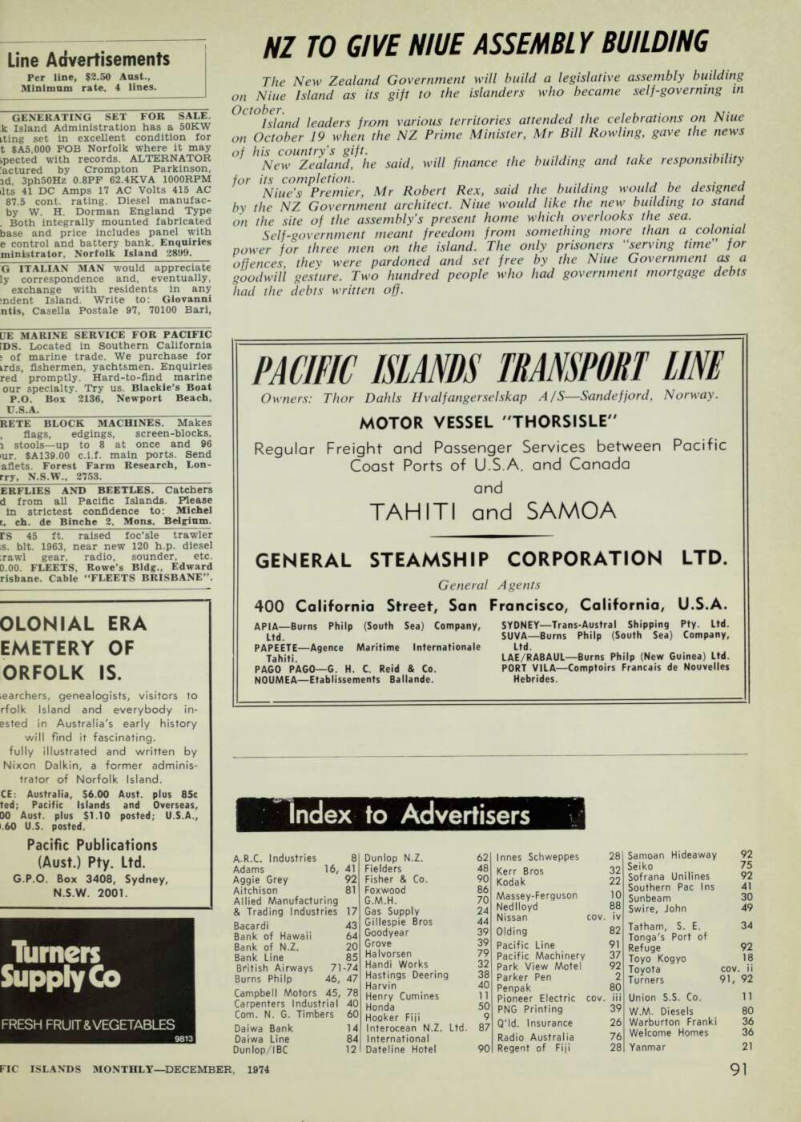
The New Zealand Government will build a legislative assembly building on Niue Island as its gift to the islanders who became self-governing in Island leaders from various territories attended the celebrations on Niue on October 19 when the NZ Prime Minister, Mr Bill Rowling, gave the news of his country’s gift. ... , , ...
New Zealand, he said, will finance the building and take responsibility for its completion. . , Niue’s Premier, Mr Robert Rex, said the building would be designed by the NZ Government architect. Niue would like the new building to stand on the site of the assembly’s present home which overlooks the sea.
Self-government meant freedom from something more than a colonial power for three men on the island. The only prisoners “serving time” for offences, they were pardoned and set free by the Niue Government as a goodwill gesture. Two hundred people who had government mortgage debts had the debts written off.
Index to Advertisers
A.R.C. Industries 8 Adams 16, 41 Aggie Grey 92 Aitchison 81
Allied Manufacturing
& Trading Industries 17 Bacardi 43 Bank of Hawaii 64 Bank of N.Z. 20 Bank Line 85 British Airways 71-74 Burns Philp 46, 47 Campbell Motors 45, 78 Carpenters Industrial 40 Com. N. G. Timbers 60 Daiwa Bank 14 Daiwa Line 84 Dunlop/IBC 12
Dunlop N.Z. 62 Fielders 48 Fisher & Co. 90 Foxwood 86
G.M.H. 70
Gas Supply 24 Gillespie Bros 44 Goodyear 39 Grove 39 Halvorsen 79 Handi Works 32 Hastings Deering 38 Harvin 40 Henry Cumines 11 Honda 50 Hooker Fiji 9 Interocean N.Z. Ltd. 87 International Dateline Hotel 90
Innes Schweppes 28 Kerr Bros 32 Kodak 22 Massey-Ferguson 10 Nedlloyd 88 Nissan cov. iv Olding 82 Pacific Line 91 Pacific Machinery 37 Park View Motel 92 Parker Pen 2 Penpak 80 Pioneer Electric cov. iii PNG Printing 39 Q'ld. Insurance 26 Radio Australia 76 Regent of Fiji 28
Samoan Hideaway 92 Seiko 75 Sofrana Unilines 92 Southern Pac Ins 41 Sunbeam 30 Swire, John 49 Tatham, S. E. 34 Tonga's Port of Refuge 92 Toyo Kogyo 18 Toyota cov. ii Turners 91, 92 Union S.S. Co. 11 W.M. Diesels 80 Warburton Frank! 36 Welcome Homes 36 Yanmar 21
Advertisements & other items, pp. 97-100 (5 items)
91
FIC ISLANDS MONTHLY—DECEMBER, 1974
Pacific Islands Transport Une
Owners: Thor Dahls Hvalfangerselskap A/S—Sandefjord, Norway.
MOTOR VESSEL "THORSISLE"
Regular Freight and Passenger Services between Pacific Coast Ports of U.S.A. and Canada and
TAHITI and SAMOA
GENERAL STEAMSHIP CORPORATION LTD.
General Agents 400 California Street, San Francisco, California, U.S.A.
APlA—Borns Philp (Sooth Sea) Company, SYDNEY—Trans-Aostral Shipping Pty. Ltd.
Ltd. SUVA —Borns Philp (Sooth Sea) Company, PAPEETE —Agence Maritime Internationale Ltd.
Tahiti. LAE/RABAUL —Borns Philp (New Goinea) Ltd.
PAGO PAGO—G. H. C. Reid & Co. PORT VlLA—Comptoirs Francais de Noovelles NOUMEA—Etablissements Ballande. Hebrides.
Wholly set up and printed in Australia by PACIFIC PUBLICATIONS (AUST.) PTY. LTD., 29 Alberta Street, Sydney, 2000.
REGISTERED AT THE GPO SYDNEY FOR TRANSMISSION BY POST AS A NEWSPAPER CATEGORY B Australian price given on the front cover is recommended Australian retail price only.
LruiJ
§e) S&> LruiJ §s) InnJ r i §s) LmJ SeJ
SAMOAN HIDEAWAY
BEACH RESORT HOTEL
"The real Western Samoa"
Bungalows situated on a palm-fringed carpet of sand at the mouth of a jungle stream. This is Western Samoa. You'll be glad you came.
Bookings: Instant Hotels, Advance Accommodation, United Travel (in N.Z.), Accommodations Abroad (in Aust.).
Cables: "HIDEAWAY" Apia.
P.O. Box 1191, Apia, Western Samoa.
Primitive luxury
(Polynesian style) Nestled away in the untouched Kingdom of Tonga is new, luxurious "Port pf Refuge" International resort. Here is a unique opportunity for your clients to experience the tranquil and relaxed Tongan atmosphere while they enjoy the picturesque surroundings of the new "Port of Refuge". And only a short flight from Fi|i.
Reasonable tariffs from $17.50 with special concessions for children. Agents commission 10 per cent.
Tonga's
Fort of Refuge
Jgi INTERNATIONAL RESORT 0
Ar* Uava’u Tonga Cables: "Refuge" Tonga or "Tongatoors"
Sydney. Phone: Sydney 85-1603 or 922-1817
DATELINE HOTEL
TONGA
EL'ssJjJ
Friendly Hotel” of the "Friendly Islands' Situated along the Nukualofa waterfront. Only five minutes walk from town. Single, double, family suites, airconditioning, and hot and cold water showers. Pool, bar, restaurant, duty-free shop, tour desk and boutique.
Book through your travel agent or write to International Dateline Hotel, P.O. Box 62, Nukualofa Tonga.
Cable Address: "DATELINE".
Represented Overseas by: Charles J. Henry and Associates Pty. Ltd.
Sydney and Melbourne. 097 ,
- JUU/
Stay at
Aggie Grey's the
South Pacific's legendary hotel the heart of Western njo Y Po'vnesian-style friendliness and service, in cool surroundings, superb k nm u nt and .f° od - Magnificent white sand beaches only a short drive away fulmar Swes rOomS ' swimmin 9 P°°' Bookings through Union Steamship Company of NZ, Pan Am, Air New Zealand or direct to Aggie Grey's, Apia Western Samoa. Cables: AGGIES, APIA.
PARK VIEW MOTEL—BRISBANE
Quiet location —opp. Botanic Gardens.
Single, double, family suites, all with refrig., air conditioning, phone, TV, radio, tea making facilities, from $l2. Pool and restaurant.
Phone 31-2695—Telex 40270.
Write for coloured brochure— Park View Motel, 128 Alice St, BRISBANE, Old., 4000.
Turners and Growers
FRESH FRUIT & VEGETABLES
A SOOTHING
AID FOR BABY
You'll be delighted what a soothing and effective aid Fisher's Teething Powders are to baby's natural teething disorders. Sore gums, digestive disturbances and intestinal upsets quickly respond to Fisher's Teething Powders.
So safe too, if used as directed, they do not contain Calomel, Opiates, Bromides, or any harmful substances. Save yourself distress and keep the little one happy and well by using Fisher's Teething Powders as needed. Only 30c for 20 powders from your chemist or store.
Fisher & Co., Manufacturing Chemist (Est. 1876), 17 May St., St. Peters,
N.S.W. 2044.
PIM 807/72
Pacific classic reprinted . . .
Patricia Ledyard's FRIENDLY ISLAND
Just released—a new paperback edition of Patricia Ledyard's warmhearted story of her love affair with Tonga, updated and with a new foreword.
Price: Australia and overseas, $3.95 Aust., plus 30c posted; U.S.A., $6.40 U.S. posted.
Pacific Publications (Aust) Pty Ltd.,
Postal Address: G.P.O. Box 3408, Sydney, N.S.W. 2001.
SOFRANA'UNILINES
THE SOUTH PACIFIC SHIPPING COMPANY
WHICH SERVES THE SOUTH PACIFIC
Look to Pioneer’s new ES-2000 Two-channel Sound Mates. A stereo system designed to play together as a well-balanced audio team.
Pioneer’s receiver gets away from ‘ top-heavy’ sound by giving you a highly selective AM/FM tuning section and 34 watts (IHF) of music power.
And for four-channel, just add a pair of speakers. All this and MIC mixing, too.
And this turntable is more than just hot’ looking. The ultra-smooth belt-drive mechanism provides loving care for your records, plus auto-cut and return.
For real living presence sound, kiss your
tweakers” goodbye. This two-way, two-speaker
system gives you earthy, heart-moving sound.
Pioneer’s new ES-2000 Two-channel
Sound Mates. Great musical partners for
whatever you play to music.
ES-2000
Two-channel Sound Mates
CiD PIONEER
Australia Pioneer Electronics Australia Pty. Ltd., 256-8, City Road, South Melbourne, Victoria 3205, Australia Tel: 696605 Branches in all states Fiji Islands Brijlal & Company, G.P.O. Box No. 362, Suva, Fiji Islands Tel: 22-258 Lae Hagemeyer (Australasia) 8.V., PO. Box No. 90, Lae, New Guinea Tel: 2718 Rabaul Hagemeyer (Australasia) 8.V., P.O. Box No. 63, Rabaul, New Guinea Port Moresby Hagemeyer (Australasia) 8.V., P.O. Box No. 1428, Boroko, Port Moresby, New Guinea Madang Hagemeyer (Australasia) 8.V., P.O. Box No. 673, Madang, T.P.N.G.
New Zealand Tee Vee Radio Ltd., P.O. Box No. 5029, Auckland, New Zealand Tel; 763-064 Norfolk Island Burns Philp (South Sea) Co., Ltd., Norfolk Island. South Pacific Nauru Island Jacob Enterprises. P.O. Box No. 4, Nauru Island Tahiti Ets. PERFECT, B.P. 594, Papeete.
Tahiti Tel: 20-407 New Caledonia Menard Freres, B.P. 123, Noumea, New Caledonia Tel: 52-22 American Samoa Transpac Corporation, P.O. Box 1477, Pago Pago, American Samoa 96799 Tel: 2227
mm £ sr wm - >-* And wherever you’ll go in over 120 nations throughout the world you’ll find proud DATSUN drivers.
Perhaps the main reason is that DATSUN was designed to meet a wide variety of conditions—mountain roads and super highways, blistering suns and freezing temperatures. DATSUN is indeed the international car that has precision engineering and a stunning string of rally victories behind it.
Its superb handling, safety features and high speed efficiency make DATSUN the choice of young and old alike. DATSUN—the car that really satisfies the world over.
DATSUN
NISSAN
*7 DATSUN distributor network covers the following areas: Fiji*T.P.N.G.*W. Samoa* New Caledonia • New Hebrides* 8.5.1.P.* Timor* Norfolk