Pacific Islands Monthly
News Magazine Of The South Pacific
November, 1974
AUSTRALIA, N.Z., P.N.G., FIJI, N. HEBRIDES 60c TONGA, W. SAMOA, 8.5.1. P., G.E.I.C. 60c
Cooks, Norfolk, Niue, Nauru 60C
Am. Samoa. Hawaii, Micronesia, Guam $L.Oo
NEW CALEDONIA AND FRENCH POLYNESIA 100 CFP
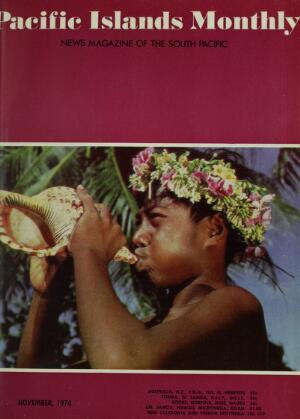
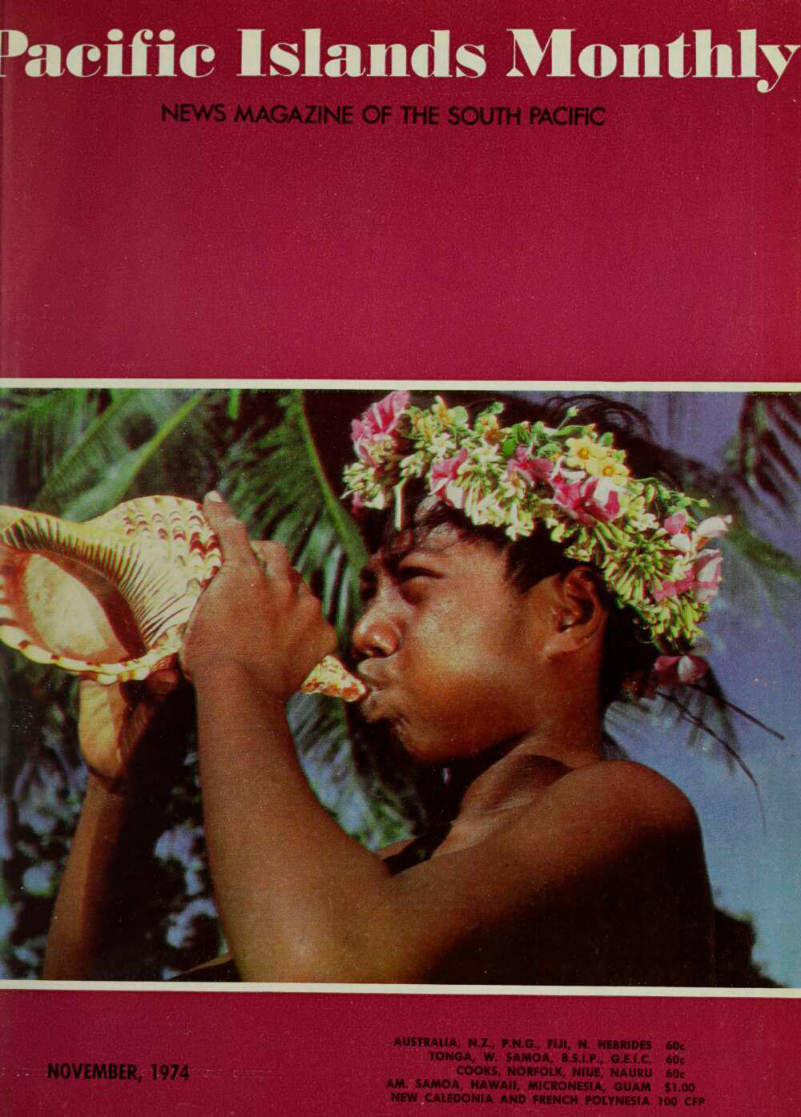
Our Cover
Judging by his solemn ex pression, this young GEIC lad could be heralding something im portant—perhaps the result of the recent referendum on whether the Ellice people should separate from the Gilbertese? (See p 8.) Or maybe he’s just demonstrating his tech nique for the cameras in a scene from Karl-Heinz Stellmach’s film Sailing in the Trade Winds . . .
The conch shell, which the lad is blowing, figures in many cere monies in the Islands.
Advertisements & other items, p. 2 (1 item)
wgjm
“ s J. •to: ss w 1 Sc A v> s S 8 '
mmscoTTs
Eg *ri
p- ><J( sJsxw C
o JPlf S
M 1 " ■ W s
[superb!
AUSTRALIA
4* ...
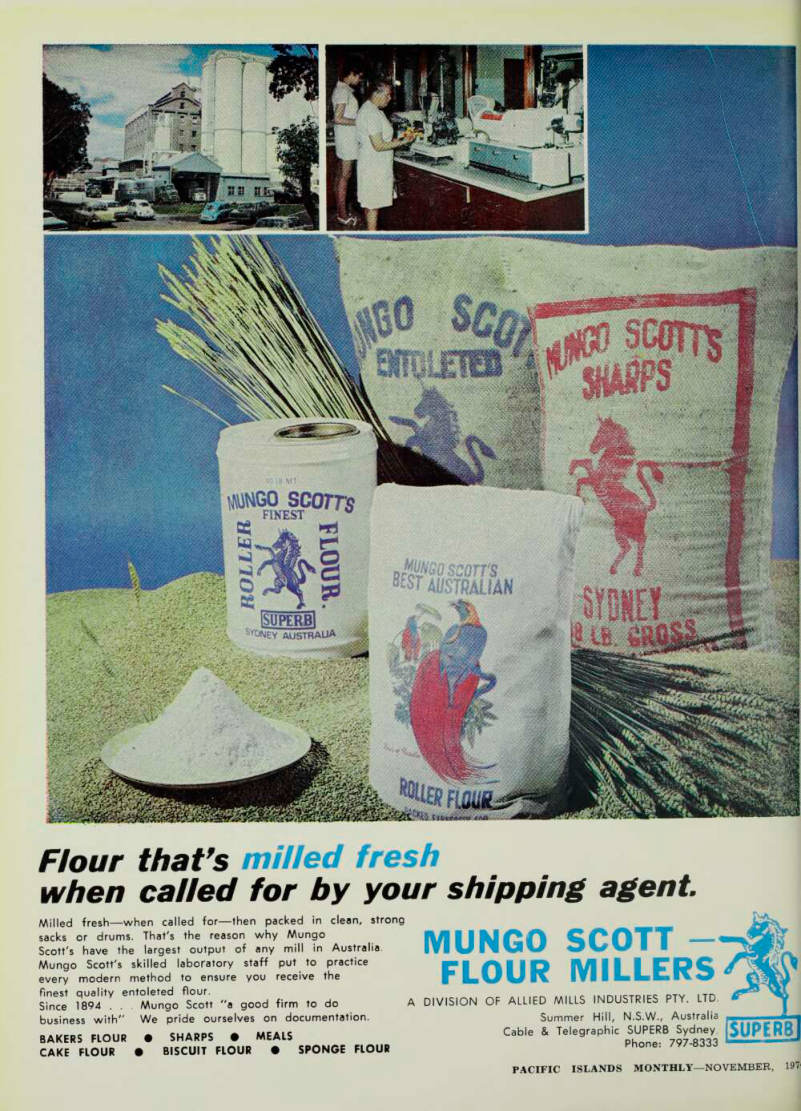
Flour that's milled fresh
when called for by your shipping agent Milled fresh—when called for —then packed in clean, strong sacks or drums. That's the reason why Mungo Scott's have the largest output of any mill in Australia.
Mungo Scott's skilled laboratory staff put to practice every modern method to ensure you receive the finest quality entoleted flour.
Since 1894 . . Mungo Scott "a good firm to do A business with" We pride ourselves on documentation.
BAKERS FLOUR • SHARPS • MEALS
CAKE FLOUR • BISCUIT FLOUR • SPONGE FLOUR
MUNGO SCOTT -
FLOUR MILLERS
DIVISION OF ALLIED MILLS INDUSTRIES PTY. LTD.
Summer Hill, N.S.W., Australia .
Cable & Telegraphic SUPERB Sydney PE RBj Phone: 797-8333 kv
wgjm
This Issue
Eral
h Pacific Conference 4 t SP Arts Festival venue 23 nesians in Auckland 35 oving Islanders' education in NZ 39 itoring Pacific currents 45 (location of Pacific air routes 79 of the sea 81
onal shipping plans 82
Ik Islands
h Pacific Conference ... 4 ions 19 newspapers 10 ion celebrations 12 icus Festival (pics) 17
Talanoa 18
sts' complaints 24 > for tea-drinkers 27 short-lived Polynesia Company 57 -up for Uluilakeba replacement 82 ares up 89 (n at celebrations 104
Ert And Ellice Islands
• votes for separation 8 id politics 47 RU c servants unhappy 93
Caledonia
b demonstrations 10 Island casino 11
New Hebrides
London talks 9 New newspapers 10 Rescue procedures tightened 83 Air fares up 89 Cambridge Credit continues 104
Niue
Population figures 41 Self-government celebrations 104
Norfolk Island
Charter air service 81 Companies on tax charge 93
Papua New Guinea
The budget 7 Amateurs in the courts 10 Money in cassowaries 10 New newspapers 10 Niugini Arts Festival 15 Irian Jayans at Festival 16 Filipino recruits answer back 26 Concern at public service exodus 43 Bougainville re-negotiations 89 Air fares up 89 Receiver for tea growers 93 Search fails 104 Woman driver killed 104 Urban wage fixed 104 Bougainville buys airline 104
Solomon Islands
Chief Minister takes control 6
Tonga
South Pacific Conference 4 Drug taking ... 9 Stowaways in Sydney 104
United States Trust Territory
Drug taking 9 Arrival of new inter-island ship 81 Massive Transpac suit 83 Drought disaster 104 Governor leaves 104
Western Samoa
Strike by nurses 33 Air fares up 89 Trouble at WSTEC 91 Hussey's new job 104 Ocean rower arrives 104
iRTMENTS: Up front with the Editor, 3; Topicalities, 10; Editor's Mailbag, 29; the Islands Press, 48; Magazine Section, 57; Yesterday, 59; MANA, 60; Books, s acific Transport, 79; Cruising Yachts, 84; Business and Development, 89; Shipping Airways Information, 96; Deaths of Islands People, 101; Advertisers' Index, 103; Postscripts, 104.
Advertisements & other items, p. 4 (1 item)
the Regent of Fiji
20 MINUTES FROM THE AIRPORT;
CENTURIES APART FROM THE WORLD.
in □ itin. r Pacific passengers can step into one of the world’s most legendary experiences.
The Regent of Fiji is a beach-front paradise. 300 gracious rooms clustered among towering palms and dazzling orchids. With two enchanted dining rooms. The rousing Meke Lounge. Complete banquet/convention pavilion and duty free shopping.
Outside, the gleaming Mjda—white shore—slopes into wave-free Nadi Bay. Experience our realm of ocean sports.
Beachcombing. tenn is, or golf. And our own fresh-water pool.
Make your reservations in paradise now. For the night of a lifetime.
The Regent of Fiji. Paradise opens early 1975.
POST OFFICE BOX 441 • NADI, FUI • TELEPHONE 70700 • TELEX 5180 OR 5214 ONE OF THE many worlds OF REGENT INTERNATIONAL HOTELS
the Regent of Fiji
NADI BAY
In Continental U.S. Toll Free (800) 421-6665 In California Toll Free (800) 252-0277 In Los Angeles: (213) 652-1454 • In Japan; 211-4541 Sydney, Australia Sales Office No. 1 York Street, 14th floor, Sydney, Australia 2000 Phone 276-469
Pacific Islands
Onthly
FOUNDED BY R. W. ROBSON IN 1930
Published Monthly By
Icific Publications (Aust.) Pty. Ltd.,
Alberta St., Sydney, N.S.W., 2000.
stal Address: G.P.O. BOX 3408, SYDNEY,
N.S.W., 2001.
Telegraphic Address: PACPUB, Sydney.
Telex 25168.
Lephones: 61-9197, 61-7101, 61-4369.
jlting Directors: R. W. Robson, Judy Tudor.
Chief Executives: Manager: Selwyn Hughes.
Publisher; Stuart Inder. irector of Advertising: W. A. Gasnier.
Pacific Islands Monthly
Editor: Stuart Inder.
Assistant Editor: John Carter.
Advertising Manager: W. A. Gasnier.
Circulation Manager: Barry Badger.
Subscription Rates:
fic Islands Monthly” is airfreighted to all ribers and agents in the Pacific Islands the U.S.A.; copies to Nauru and other go by surface mail, alia (incl. Lord Howe and Thursday Is.), Zealand, Papua New Guinea, Fiji, New des, Tonga, Western Samoa, Solomon Is, Gilbert & Ellice Islands, Cook Islands, Ik Island, Niue and Nauru Islands: $6.80 currency); American Samoa, Hawaii, nesia and Guam; $12.00 US; New onia and French Polynesia 1,100 CFP; Mainland: $14.00 US; United Kingdom: . Elsewhere $B.OO Aust.
Representatives
Advertising— Fiji Times & Herald Ltd., Gordon St., Suva. Telephone: 25-601. : FJ 2124. Distribution—Desai Book Depot P.O. Box 160, SUVA. Tel.: 311-424. i New Guinea: PORT MORESBY, PNG Print 0. Pty. Ltd., P.O. Box 633; LAE, P.O. Box RABAUL, Mr. David Simpson, P.O. Box 164 c/- Rabaul Photographic. Tel.: 2677.) i Polynesia. Distribution—Hachette Paci -10 Ave Bruat, Papeete.
Zealand: Pacific Publications, C.P.O. Box Auckland. 379-494. Representative: Mr eckell, Breckell Publishing, Kingdon House, on Street, Newmarket, Auckland. Tel.: 54-6834. Telex.: NZ 2727.
I Kingdom; Advertising—Overseas Publicity 214 Oxford Street, London, WIN OEA. : 01-636 8296/7. Subscriptions—T. B. m. Park House, 22 Park Street, Croydon,
Cr9 3Np. Tel.: 01-6884177.
: Advertising—Universal Media Corpora 1, C.P.O. Box 46, Tokyo. Tel.: 666-3036. ia: Advertising Pacific Publications ) Pty. Ltd., 33 Lonsdale Street, urne, Vic. 3006. Telephone: 662-3263. stand: Advertising—Beale Media Services it. Paul's Terrace, Fortitude Valley, Qld., 4006. Tel.: 52-5827. i and U.S. Mainland only: N. Grogan Hayden Street, Honolulu, 96815. change of address notices, Form 3579 new subscriptions to P.O. Box 2193 Honolulu, Hawaii, U.S.A. 96805).
J class postage paid at Honolulu, Hawaii.
Copyright ©, 1974,
acific Publications (Aust) Pty. Ltd.
November, 1974 Vol. 45, No. 11
Up Front
with the Editor
My old friend and colleague Gus Smales says it very well on p 89.
The last 12 months of wear and tear on Papua New Guinea’s Chief Minister Michael Somare has forced Mr Somare to sell himself loudly against the increasing clamour of groups which now see themselves as “more nationalist than the govern ment”. The Chief Minister is neither more radical nor more conservative than he ever was, but the circum stances have changed. Mr Somare now has to answer the slogan shouters on their own ground.
Michael Somare’s difficulties began to develop after he announced in March that he was aiming for December 1 as Independence Day.
At the same time it became clear that the Constitutional Planning Committee’s report was going to take longer to see the light of day than anybody had expected. Every week that the report was delayed meant that the December 1 date was more difficult to attain.
Since nobody could actually act, because there was nothing concrete to act on, PNG politics then entered an unprecedented bitching phase.
The Chief Minister, and the country, were soon embroiled in heated debate on (a) whether December 1 was too early for in dependence (b) whether some aspects of the constitution—which were being leaked out by now—were what was wanted.
At the same time the Somare Government found itself faced with the prospect of renegotiating the big Bougainville Copper agreement, so the critics naturally bought in on that too. The renegotiation, they said, had to be “tough”—though Somare’s negotiating team seemed to be making it as tough as possible, to the point of complete stalemate at one stage.
He won through with Bougainville.
If he hadn’t been so successful, his enemies would surely have clawed him down. He won through on a major facet of the constitution argument— the matter of provisional citizenship (see p 7). And he won through on one of those side issues that have
infested the arguments of recent months—whether or not Minister for Justice Mr John Kaputin should be fired.
Mr Somare wanted to fire him, but he could do nothing more than strip him of his portfolio and leave him still a minister—without port folio. It looked for a time that he might have to give Kaputin his job back, but in mid-October he finally had him relegated to the back benches with massive parliamentary support which was as much a vote of con fidence in the Chief Minister as a measure of John Kaputin’s un popularity in the parliament. It’s a fact that the noisiest criticism of Michael Somare comes from outside parliament, although not necessarily from non-parliamentarians.
Not too much further attention need be given to John Kaputin. He got his chance—Minister for Justice is a pretty good post to have—and he messed it up without help from anybody else. He told the House after it had sacked him that he “was never moulded to fit into the colonial shoe, whereas others have fitted beautifully into it”. The shoes he wears might also be out of step with everybody else’s.
Strange it is that when Michael Somare’s Pangu Party men got the chance to form a government two years ago there was genuine fear that they were too radical and that they would move too fast. They haven’t changed, but for some they are not now radical enough, and have not moved fast enough.
Despite the vocal critics, it is a national New Guinean government, not a colonial government, taking it on the chin. And it’s the New Guineans who are going to be the final arbiters as to whether a national central government remains in power.
I merely hope that the decision is made democratically, and not as a result of hysterical shouts from the barricades and of the cries for blood shed that PNG has heard in recent weeks.
Stuart Inder
Advertisements & other items, p. 5 (1 item)
3
[FIC ISLANDS MONTHLY—NOVEMBER, 1974
Pacific Islands Monthly
A Pen Stroke And The Pacific
Becomes An Islands Co-Operative
Colonialism’s shadow seems to have lifted from the South Pacific Commission and Conference. With sweet reason permeating the atmosphere like at no other conference in SPC history, the 14th conference, which lasted here for eight working days from September 25, approved without amendment the Memorandum of Understand ing agreed at the Wellington meeting of the eight member govern ments of the SPC.
From John Carter
PIAA's man in Rarotonga
At long last the Islands have an equal say with their former colonial masters in the doings of the SPC.
The memorandum was ceremoniously signed by the Big Eight and the oc casion was regarded as so important that, for the first time in the history of the commission and conference, four prime ministers attended —New Zealand’s new Prime Minister Mr Bill Rowling, Australian Prime Minister Gough Whitlam, Fiji’s Ratu Sir Kamisese Mara and Western Samoa’s Fiame Mataafa.
Three of them put their names to the document which bears such an obscure title that history will have to add a footnote everytime it’s trotted out for inspection. Australia’s Science Minister Bill Morrison added his name because Prime Minister Whitlam had been and gone, an overnight stop on the way to the United Nations. The brief visit gave Mr Whitlam one of those firsts he likes to collect—the first Australian prime minister to visit the Cook Islands and the first prime minister from anywhere to attend the South Pacific Conference.
Little time was taken over such an historic occasion. The irrepressible Premier of the Cooks, Sir Albert Henry, allowed no one or anything much time. With a rod of iron en cased in suave geniality he ran that conference like a schoolmaster.
I’m sure that it was the memoran dum which brought a subtle change to the atmosphere. At other con ferences there have been flashes of anger; sneers at colonial masters and a definite cleavage of opinions; the metropolitan governments on one side, the Islands on the other. But now the Islands have got rid of the chip on their shoulder. They are masters in their own house.
It’s not that perfect, of course. The Big Eight are still there, as the Com mittee of Representatives of Participat ing Governments. They’ve only one vote like the rest, but that committee is charged with various duties which make it stand out from the remainder.
The metropolitans contribute most and so call the tune. But even this
distinction is on its way out. T 1 Islands expect, and will get, equali in everything.
Now, they’re calling for “localis tion” of secretariat posts, arguii that Islanders know better than an one else what Islanders want. Th will come.
The memorandum seeks to repla the Canberra Agreement of 194 which established the SPC. It w assented to by all eight participati governments and thus has the foi of law, but it’s really a short c they’d sooner not put the searchli§ on. Hence, when one delegi questioned a rule which was direct contradiction to the Canbei Agreement he was asked to wait ur after the tea-break to pursue his poi During tea-break, things were ( plained to him. He withdrew query immediately on the resumpti< He’d got the message—let the chan] over be smooth and don’t start r picking over details.
After the memorandum was sigr (see box for main points), came 1 question: “Where do we go fn here?” Australia provided part the answer in a speech by Bill M rison who asked whether the Pac would continue to need both South Pacific Forum and the SPC.
He continued: “I don’t believe this stage in rushing in with s gestions. We should consider h best the Forum with SPEC and SPC can develop in the next cou of vears.
“The 30th anniversary of 1 organisation in 1977 may be the propriate time to review the functi* of the organisation and consi whether a whole new agreem should be formulated and a new s cessor organisation brought i being.”
He offered to host a conference
Lame-Change Coming
icuss his suggestion and said Aus ilia would table his proposal at the 75 conference which will be held xt September on Nauru.
In any case a change of name for 5 SPC is coming, and on the Cooks’ ggestion, a region-wide contest will held to choose a name which will feet the new look, and will also lect the US-held territories above i equator.
Here are some unofficial suggest is: Pacific Commission, Society of cific Countries (which allows the C to keep its badge), League of cific Islands, Pacific Islands Union d the United Countries of the cific.
This gentle zephyr of change—Bill orison called it a gentle bloodless 'olution —could have a great impact the South Pacific, particularly if, I believe it must, the SPC seeks a ser union with the Forum, but le can be done without a big ancial shot in the arm.
Which brings us to the only dark :ch in the conference—the erosion greatly-increased dollar contribu ns by inflation and the devaluation the Australian and NZ dollars, r the first time, with the 15 per it increased contributions of the ; Eight—UK, USA, NZ, Australia, mce, Fiji, Nauru and Western noa —and voluntary contributions hiding $A250,000 each from Aus lia and New Zealand, the budget sed the $2 million mark, everyone rejoiced until Secretary aeral Fred Betham—who was re >ointed, but says he’ll only do one re year—told them that they uld have to tighten their belts, j increase was 15 per cent; world ation was 20 per cent, and 70 per t of the devalued dollars from dralia and New Zealand would be nt in currency areas which haven’t alued.
Tiat was a real jolt and added ency to the conference’s directive, gested by the US, that the sec iry-general finds more money in from governments outside the on or from agencies, t was a good point. For too long, agencies, UNDP, UNDAT, WHO, universities. Foundation for the pies of the South Pacific and -rs, have been on the outside dng in. As the SPC will undergo e change, some method should Found to give the agencies, which e the money, some active part in organisation. he SPC will never amount to
much more than it is until it has more money to spend. So many times has come the cry at conferences—you give us schemes on paper but not the money to finance them.
Perhaps, because of the money shortage, and also because chairman Sir Albert got through the agenda like a whirlwind, the works pro gramme for 1975, which lists prio rities in the SPC’s budgeted pro gramme, was disposed of in two hours. Past conferences have taken at least a week.
Maybe the process was too hurried.
Some delegates would have liked to have spoken on it; to have pleaded for priority for some item way down the list. They didn’t get the chance.
This is part of the new look. The Planning Committee, whose delibera tions can be attended by all the Islands and agencies too, now does the job of compiling the programme and listing priorities. Therefore, the theory goes, there’s no need for lengthy debate at the conference.
Which many delegates agreed with, but some will ask what is the use of attending the conference if the main job is already done?
In two hours the conference ap proved expenditure of $A2,371,624, which is $157,412 more than the SPC has got. Mr Betham also warned that
four specialist posts may have to be jettisoned.
The Big Eight gave the following sums towards the budget, on an agreed percentage basis; Australia (31 per cent) $475,837, plus $250,000 voluntary contribution for special projects; Fiji (1 pc) $15,349; France (14 pc) $214,895 plus voluntary $50,000; Nauru (1 pc) $15,349 plus $1,500 voluntary; New Zealand (16 pc) $245,594 plus $250,000 volun tary; United Kingdom (16 pc) $245,594; US (20 pc) $306,991; Western Samoa (1 pc) $15,349. The Island territories including Fiji ($3,400) contributed $36,393 between them.
The item which took the longest time was one which will no longer appear on the agenda—addresses by territorial delegations on their special needs and problems. PNG’s Tony Siaguru argued for abolishing the addresses, which have been a feature of all conferences. So out they go, but there’s nothing to stop any member from circulating a paper setting out his country’s problems and needs.
One subject, which it was pro phesied would take some time and cause some argument, took little time and produced no argument. It was the three-year-old topic of the establish
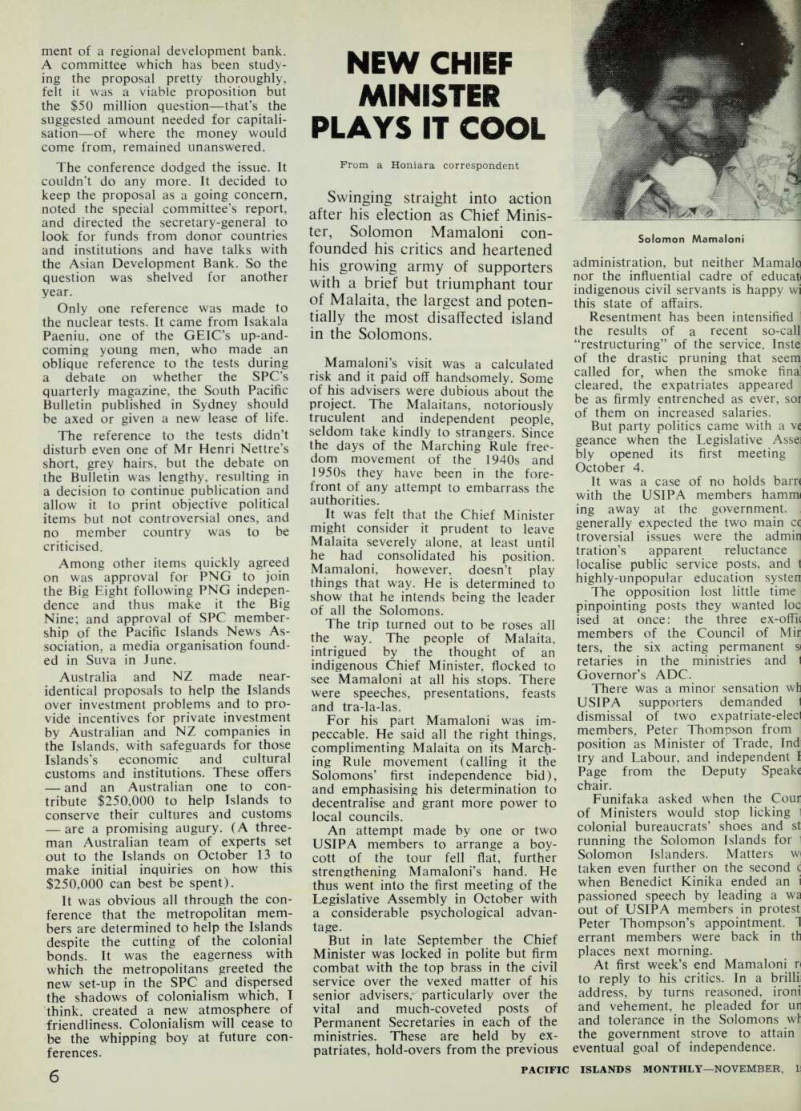
The Queensland Gov ernment has offered the Papua New Guinea Government open selection of an 8,000-piece collection of PNG art and arti facts worth SAI.S million, to help "fill gaps" in PNG's museum. The collec tion, which was assembled by an early Lieut-Gov of Papua and Governor of Queensland, Sir William MacGregor, is regarded as one of the most impor tant of its kind. Pic ture shows Queens land Museum director Dr Alan Bartholomai examining some of the pieces. Photo; Australian Informa tion Service.
ment of a regional development bank.
A committee which has been study ing the proposal pretty thoroughly, felt it was a viable proposition but the $5O million question—that’s the suggested amount needed for capitali sation—of where the money would come from, remained unanswered.
The conference dodged the issue. It couldn’t do any more. It decided to keep the proposal as a going concern, noted the special committee’s report, and directed the secretary-general to look for funds from donor countries and institutions and have talks with the Asian Development Bank. So the question was shelved for another year.
Only one reference was made to the nuclear tests. It came from Isakala Paeniu, one of the GEIC’s up-and coming young men, who made an oblique reference to the tests during a debate on whether the SPC’s quarterly magazine, the South Pacific Bulletin published in Sydney should be axed or given a new lease of life.
The reference to the tests didn’t disturb even one of Mr Henri Nettre’s short, grey hairs, but the debate on the Bulletin was lengthy, resulting in a decision to continue publication and allow it to print objective political items but not controversial ones, and no member country was to be criticised.
Among other items quickly agreed on was approval for PNG to join the Big Eight following PNG indepen dence and thus make it the Big Nine; and approval of SPC member ship of the Pacific Islands News As sociation, a media organisation found ed in Suva in June.
Australia and NZ made near identical proposals to help the Islands over investment problems and to pro vide incentives for private investment by Australian and NZ companies in the Islands, with safeguards for those Islands’s economic and cultural customs and institutions. These offers and an Australian one to con tribute $250,000 to help Islands to conserve their cultures and customs are a promising augury. (A three man Australian team of experts set out to the Islands on October 13 to make initial inquiries on how this $250,000 can best be spent).
It was obvious all through the con ference that the metropolitan mem bers are determined to help the Islands despite the cutting of the colonial bonds. It was the eagerness with which the metropolitans greeted the new set-up in the SPC and dispersed the shadows of colonialism which, I think, created a new atmosphere of friendliness. Colonialism will cease to be the whipping boy at future con ferences.
The changes in
a nutshell
The effect of the signing of the South Pacific Memorandum will be: • A de facto merger of the South Pacific Commission and the South Pacific Conference, and abolition of the session of Senior Commissioners of the participating governments; • All members of the new body, the eight participating governments and the other Island members, will have one vote each, abolishing plura lity of voting which has existed until now, when each metropolitan power had as many votes as it had depen dent territories; • Compilation of the works pro gramme and the budget will be the task of the Planning Committee which will meet a few months before the annual conference. Its deliberations and decisions will be vetted by the Committee of Representatives of the Participating Governments, which re places the session. That committee's decisions, however, will be subject to the will of all the members meet ing in the annual conference. • A name-finding competition will be organised in the region by the secretariat to find a new name for the South Pacific Commission and Conference.
Advertisements & other items, p. 7 (1 item)
5
'IFIC ISLANDS MONTHLY—NOVEMBER, 1974
New Chief
Minister
Plays It Cool
From a Honiara correspondent
Swinging straight into action
after his election as Chief Minis ter, Solomon Mamaloni con founded his critics and heartened his growing army of supporters with a brief but triumphant tour of Malaita, the largest and poten tially the most disaffected island in the Solomons.
Mamaloni’s visit was a calculated risk and it paid off handsomely. Some of his advisers were dubious about the project. The Malaitans, notoriously truculent and independent people, seldom take kindly to strangers. Since the days of the Marching Rule free dom movement of the 1940 s and 1950 s they have been in the fore front of any attempt to embarrass the authorities.
It was felt that the Chief Minister might consider it prudent to leave Malaita severely alone, at least until he had consolidated his position.
Mamaloni, however, doesn’t play things that way. He is determined to show that he intends being the leader of all the Solomons.
The trip turned out to be roses all the way. The people of Malaita, intrigued by the thought of an indigenous Chief Minister, flocked to see Mamaloni at all his stops. There were speeches, presentations, feasts and tra-la-las.
For his part Mamaloni was im peccable. He said all the right things, complimenting Malaita on its March ing Rule movement (calling it the Solomons’ first independence bid), and emphasising his determination to decentralise and grant more power to local councils.
An attempt made by one or two USIPA members to arrange a boy cott of the tour fell flat, further strengthening Mamaloni’s hand. He thus went into the first meeting of the Legislative Assembly in October with a considerable psychological advan tage.
But in late September the Chief Minister was locked in polite but firm combat with the top brass in the civil service over the vexed matter of his senior advisers,' particularly over the vital and much-coveted posts of Permanent Secretaries in each of the ministries. These are held by ex patriates, hold-overs from the previous
administration, but neither Mamalo nor the influential cadre of educat indigenous civil servants is happy wi this state of affairs.
Resentment has been intensified 1 the results of a recent so-call “restructuring” of the service. Inste of the drastic pruning that seem called for, when the smoke final cleared, the expatriates appeared be as firmly entrenched as ever, soi of them on increased salaries.
But party politics came with a ve geance when the Legislative Assei bly opened its first meeting October 4.
It was a case of no holds barn with the USIPA members hamrru ing away at the government, generally expected the two main cc troversial issues were the admin tration’s apparent reluctance localise public service posts, and t highly-unpopular education systen The opposition lost little time pinpointing posts they wanted loc ised at once: the three ex-offi( members of the Council of Mir ters, the six acting permanent si retaries in the ministries and 1 Governor’s ADC.
There was a minor sensation wh USIPA supporters demanded 1 dismissal of two expatriate-eled members, Peter Thompson from position as Minister of Trade, Ind try and Labour, and independent I Page from the Deputy Speake chair.
Funifaka asked when the Cour of Ministers would stop licking i colonial bureaucrats’ shoes and st running the Solomon Islands for i Solomon Islanders. Matters wi taken even further on the second c when Benedict Kinika ended an i passioned speech by leading a wa out of USIPA members in protest Peter Thompson’s appointment. 1 errant members were back in th places next morning.
At first week’s end Mamaloni r< to reply to his critics. In a brillii address, by turns reasoned, ironi and vehement, he pleaded for ur and tolerance in the Solomons wt the government strove to attain eventual goal of independence.
Solomon Mamaloni
Is it the devil you know
in New Guinea politics?
From PERCY CHATTERTON in Port Moresby
Papua New Guinea’s House of Assembly began its Budget leeting on September 23 and after a two-week run adjourned on )ctober 4 for a week’s break, after which it is to meet for a further wo weeks of sittings from October 14 to 25.
During the first half of the meeting inance Minister Julius Chan’s Budget as had to play second fiddle to the mtinuing debate on the Constitu anal Planning Committe’s report, 3W being considered chapter by lapter in the light of two other Dcuments —the government’s white iper, and a second paper setting out e views of the opposition United arty.
Interest in the debate was height led right at the start by Father John Komis’ announcement of the forma lin of a “nationalist pressure group”, imprising the more radically minded embers of the CPC and drawing its pport from both opposition and ivernment benches. Clearly, it could >se a threat to the Somare govern ent’s already slender majority.
However, the indications are that ost members of the conservatively iented opposition prefer the devil ey know to the devil they don’t low. They may be suspicious of •mare, but they are far more spicious of the radical nationalists.
Be that as it may, there is no doubt at Chief Minister Somare has done ast of the scoring during the first If of the match. The chapters of e CPC report dealt with so far are apters one to four.
Chapter 1, dealing with intro ctory matters and general prin )les, was dealt with by compromise, ic government wanted a short con tution; the CPC was prepared to ncede that it should be “not unduly ig”. On the issue of the con tution’s entrenchment, the govern ;nt conceded that a two-thirds ijority of the House must be obtain in order to amend the constitution, d that two months must elapse ;ween a proposal for a constitutional lendment and its passage through ' House. There will also be pro ion for a full scale review of the nstitution after three years.
To keep the constitution within mageable length, it was agreed that should set out only basic principles,
the details being enacted in a series of “organic” or “constitutional” laws.
The United Party opposition secured agreement to the most important of these laws being enacted before independence, which could have the effect of setting back the date of independence.
Chapter 2 of the report deals with National Goals and Directive Prin ciples, and includes an investment code to control the impact of overseas investment. Here the divergence of view was not in relation to the con tents of the chapter, but as to whether the investment code should or should not be included in the constitution.
Mr Somare wanted it to be in sub sidiary legislation; Father Momis wanted it in the constitution, and forced a show-down in which the House supported Mr Somare by 52 votes to 28.
Chapter 3 deals with the proposed “leadership code” and the Ombuds man Commission to be set up to police it. Here the only difference of opinion was on the question of to whom the code should apply. Mr Somare won the approval of the House for a more restricted list of office holders than that advocated by the CPC.
Chapter 4 deals with one of the thorniest issues in the whole report, that of citizenship. Here again, Mr Somare won a victory for moderation.
The House agreed to the concept of “provisional citizenship” for people who have lived in PNG for eight years or more, but who are not eligible for immediate naturalisation under the CPC’s proposals. It also agreed that automatic citizenship should be available to those with two grandparents born in PNG, instead of, as the CPC had proposed, two indigenous grandparents.
This change will smooth the way to citizenship for a large number of PNG’s mixed-race community.
So that’s the score at half-time; and Continued next page
there are 1 1 more chapters to go!
When the 1974-75 Budget was brought down, the disarming Mr Julius Chan, after describing it as “fair and reasonable”, went on to refer to it as a “Robin Hood Budget”, framed on the principle that most of the government’s needed extra re venue should be provided by those who are best able to pay.
Company tax is increased from 25 per cent to 334 per cent; personal income tax is increased for people earning more than $lO,OOO a year; and the minimum income level carry ing liability to pay tax is raised from $416 to $624 p.a.
There will also be an export tax of 24 per cent on agricultural exports.
This tax is designed to solve a prob lem which has defeated successive colonial treasurers, that of extracting a contribution to national revenue from indigenous cash-crop farmers who are obtaining a substantial in come from their labours,, but who, being illiterate, are unable to keep records for income tax purposes.
Bona-fide indigenous companies and co-operatives are to have a five-year tax holiday to help them get on their feet. On the other hand, “pioneer status” companies, previously exempt from the dividend withholding tax of 15 per cent, will now have to pay it; and Christian missions, charitable bodies and councils will in future have to pay tax on income derived from commercial activities. (The mission reaction to the latter provision has been: “Fair enough, but it means that we shall have to wind down some of our edu£ational and health services now financed from this source, and it will cost the government more to fill the gan so created in these services than it will collect in tax from us.”) The Budget’s principal novelty is a betting tax on olf-course bookmakers and their clients. This will involve legalising an activity which up to the present has been technically illegal, though for years no serious attempt has been made to curb it.
Legalising it will now enable book
makers to operate in the open, wit the result that what in the past h< been mainly an expatriate indulgent may come to rival the card game ( “Lucky” as a means of partir Papuans and New Guineans froi their money, especially as gamblir with cards remains illegal. If th comes about, the social ill-coi sequences may well outweigh tl financial benefits.
Finally, our Minister for Finam has budgeted for a deficit of SlO mi lion. This is generally regarded hei as a device for twisting the Australis Government’s arm for a supplemei tary grant to what is felt by boi government and opposition to be disappointing first slice of the S 5( million cake which we have be( encouraged to expect to receive ov< the next three years.
At half time, the only speech ( the Budget apart from Mr Chan’s ov has come from the oppositior shadow Finance Minister, John Mi dleton. His main criticism was th the Budget placed undue reliance (
the dwindling expatriate sector of the community to carry the burden of ■evenue raising.
He challenged Mr Chan’s predic ;ion that the size of the expatriate community would level out and re nain relatively stable, and offered his )wn prediction that it would continue o decrease by about 5,000 people a 'ear. This rate might be accelerated >y the increased tax burdens proposed >y the Budget, Mr Middleton said.
The shadow minister’s second riticism was on what he called ‘departmental non-performance”, /hich had resulted in last year’s ex icnditure targets not having been net.
Meanwhile there comes the news f the successful conclusion of the Dng drawn-out negotiations between ne Somare government and Bougain ille Copper. The government has jcured a good bargain for PNG. This an hardly fail to strengthen Chief linister Somare’s prestige throughout le country and particularly in ougainville, and so to strengthen his osition vis-a-vis the nationalist pres jre group.
> See Somare gilds his image p 89.
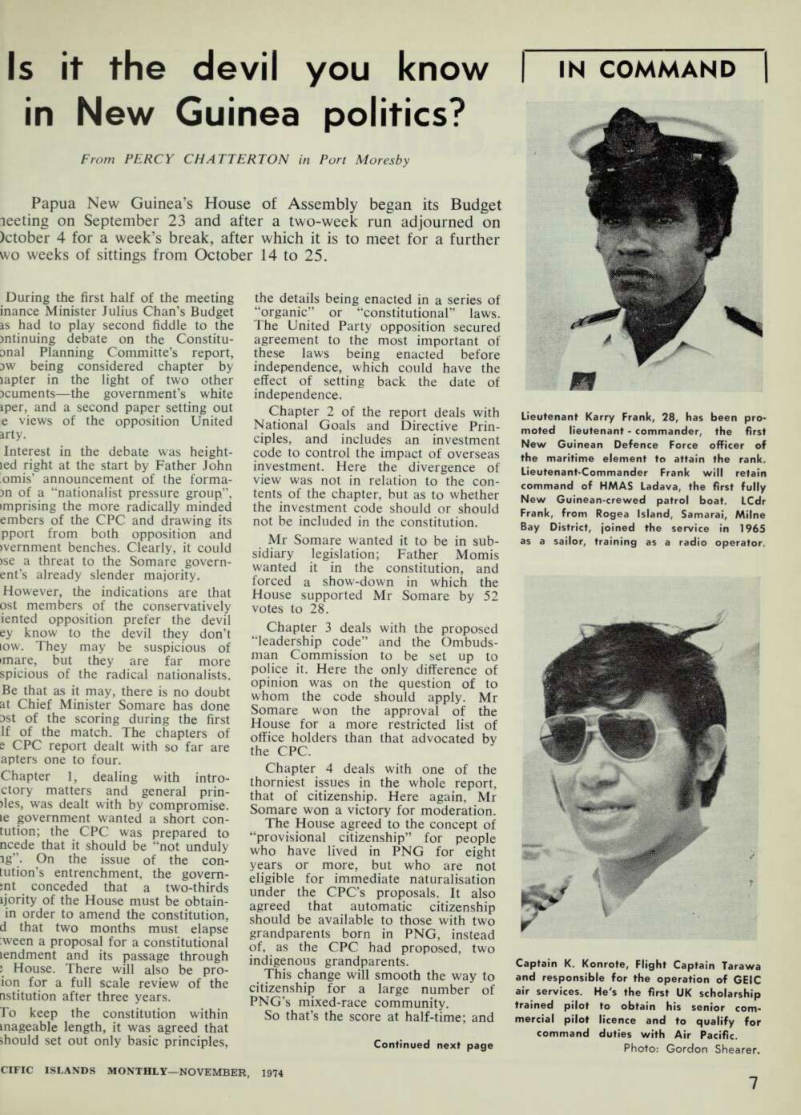
In Command
Lieutenant Karry Frank, 28, has been pro moted lieutenant - commander, the first New Guinean Defence Force officer of the maritime element to attain the rank.
Lieutenant-Commander Frank will retain command of HMAS Ladava, the first fully New Guinean-crewed patrol boat. LCdr Frank, from Rogea Island, Samarai, Milne Bay District, joined the service in 1965 as a sailor, training as a radio operator.
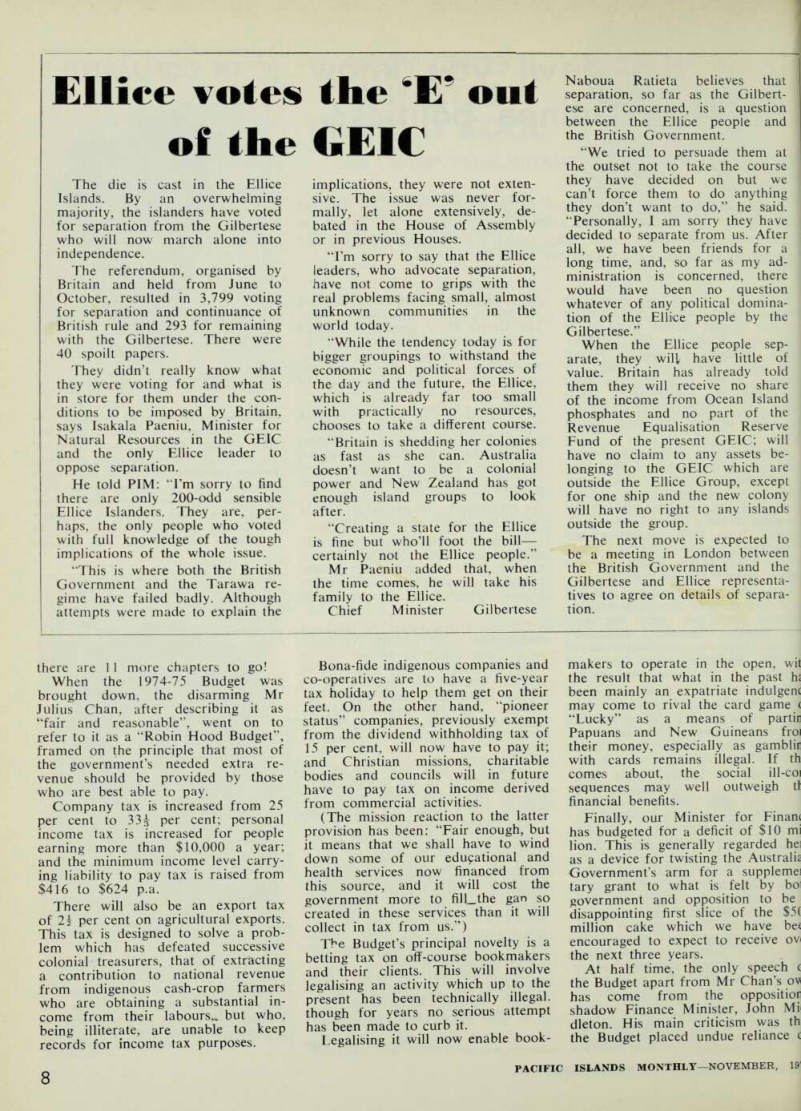
Captain K. Konrote, Flight Captain Tarawa and responsible for the operation of GEIC air services. He's the first UK scholarship trained pilot to obtain his senior com mercial pilot licence and to qualify for command duties with Air Pacific.
Photo: Gordon Shearer.
Advertisements & other items, p. 9 (1 item)
7
CIFIC ISLANDS MONTHLY—NOVEMBER, 1974
of the GEIC
Ellice votes the 'E' out of the GEIC
The die is cast in the Ellice Islands. By an overwhelming majority, the islanders have voted for separation from the Gilbertese who will now march alone into independence.
The referendum, organised by Britain and held from June to October, resulted in 3,799 voting for separation and continuance of British rule and 293 for remaining with the Gilbertese. There were 40 spoilt papers.
They didn’t really know what they were voting for and what is in store for them under the con ditions to be imposed by Britain, says Isakala Paeniu, Minister for Natural Resources in the GEIC and the only Ellice leader to oppose separation.
He told PIM; “I’m sorry to find there are only 200-odd sensible Ellice Islanders. They are, per haps, the only people who voted with full knowledge of the tough implications of the whole issue.
“This is where both the British Government and the Tarawa re gime have failed badly. Although attempts were made to explain the
implications, they were not exten sive. The issue was never for mally, let alone extensively, de bated in the House of Assembly or in previous Houses.
“I’m sorry to say that the Ellice leaders, who advocate separation, have not come to grips with the real problems facing small, almost unknown communities in the world today.
“While the tendency today is for bigger groupings to withstand the economic and political forces of the day and the future, the Ellice, which is already far too small with practically no resources, chooses to take a different course.
“Britain is shedding her colonies as fast as she can. Australia doesn’t want to be a colonial power and New Zealand has got enough island groups to look after.
“Creating a state for the Ellice is fine but who’ll foot the bill— certainly not the Ellice people.”
Mr Paeniu added that, when the time comes, he will take his family to the Ellice.
Chief Minister Gilbertese
Naboua Ratieta believes that separation, so far as the Gilbert ese are concerned, is a question between the Ellice people and the British Government.
“We tried to persuade them at the outset not to take the course they have decided on but we can’t force them to do anything they don’t want to do,” he said.
“Personally, I am sorry they have decided to separate from us. After all, we have been friends for a long time, and, so far as my ad ministration is concerned, there would have been no question whatever of any political domina tion of the Ellice people by the Gilbertese.”
When the Ellice people sep arate, they will have little of value. Britain has already told them they will receive no share of the income from Ocean Island phosphates and no part of the Revenue Equalisation Reserve Fund of the present GEIC; will have no claim to any assets be longing to the GEIC which are outside the Ellice Group, except for one ship and the new colony will have no right to any islands outside the group.
The next move is expected to be a meeting in London between the British Government and the Gilbertese and Ellice representa tives to agree on details of separa tion.
On Drugs
Islands Warned
Tonga, alarmed at the invasion by ug takers, warned other Islanders Rarotonga’s South Pacific Confer ice in October to “try to stop the affic of narcotic drugs before it ;ts to your beautiful shores”. The arning was sounded by Maafu apou, Governor of Vavau, who [vised, “Look out for your yachts en and check on your volunteers”, e reported that two American jace Corps Volunteers and a madian volunteer had recently en deported after appearing on arges connected with the cultiva >n in Vavau of marihuana.
The men said the drug was grown r their own use. Fining them, the igistrate ordered that half the lount of the fines be paid to two •ngan farmers who reported the ;n.
Meanwhile, the Congress of Micro sia has taken speedy action to off a judgment by Chief Justice irold W. Burnett invalidating the ritory drug statutes. This had had 1 effect of making the smoking of rihuana legal. Congress passed a v law which strengthens the codes ating to the use of drugs and im ;es more severe penalties for isession of marihuana. \merican Samoa’s Legislature also sed a bill increasing penalties for g offences.
Advertisements & other items, pp. 11-98 (2 items)
Sw= Ss
On the razor's edge in the New Hebrides
From a Vila correspondent
November 4 and 5 are the dates set for the long-time-coming mmistmal meeting between Britain and France which may, which must, settle a few crucial questions about the future of the New Hebrides.
In a short, guarded statement —which gave no hint of the agenda for the talks-the British and French Residencies anhoth nC RpQiHp V^V Radl ° Vlla t !?? t
dS »nS nU^°? erS, IS?r
du Boulay and Mr Langlois, would be flying to London for levH at at Residency level m Vila, appear to be aware that further delays would have disastrous consequences in terms of progress and harmony among the racial groups of the condominium. nil??'_ especially, are pm- S . * ot of fai Jh on . tbe ta!ks even burst_ intoprint, mp^ gh i thClr mf ® rmatlon depart- Expected a, ?T 8 J ° n£ k GS 118 expected to be a much more countrv’s P affairs ’Vm 1 " 1 ? 8 ,! th f ountrys affairs. Some kind of co B uM emerge Un ’
Thpri K p „ a Kt .u thp nnpcr r n ° doUbt that talkers in
Sw= SS
£»» pre-talks broadsides. And left no ihf Cd e o n n Ce a g e S n h d 0 a U ' d ßu^w, t , 0 h P £ of New Hebridean political
thought became strikingly evident.
Three formerly separate groups, Na Griamel, United Communities of the New Hebrides (UCNH) and MANH ( a clever juxtaposi tion of initials simply meaning Man, New Hebrides) held a joint meeting in Vila and the National Party met.
Each of the others is French influenced, including the Na Griamel movement of bearded Jimmy Stevens—whose followers at Santo stood silently to watch the arrival of Queen Elizabeth in February, but broke into cheering and pro-French banner waving when the French High Commis sioner visited a few months later.
All three have now joined forces, claiming to have much the same ideas for the future of the New Hebrides. Mr Remy Dela veuve, president of UCNH, told a crowd of around 300 at the tri partite rally that everyone in the country—black, white or yellow —must work together to make the New Hebrides a better place.
Jimmy Stevens admitted, to the astonishment of some observers, that Na Griamel had no fight with properly registered claims to land held by foreigners ... his move ment, he said, was more con cerned with areas of “black bush” which should be properly de veloped. There was a time, not so long ago, when Mr Stevens fiercely spoke out against foreign land holdings in the New Hebrides.
The president of MANH, Mr Aimee Malere, said that some of the laws of the New Hebrides needed changing, but whatever one s colour, whether indigenous or expatriate, MANH wanted everyone to participate in the future of the New Hebrides. He added; “Independence is good, but we must take it slowly and try to build up the New Hebrides first.”
Another UCNH speaker, Father Gerard Leymang, said there were two ways to independence .
“a good way and a rubbish way”.
And the good way was to take things step by step.
Continued on p 94
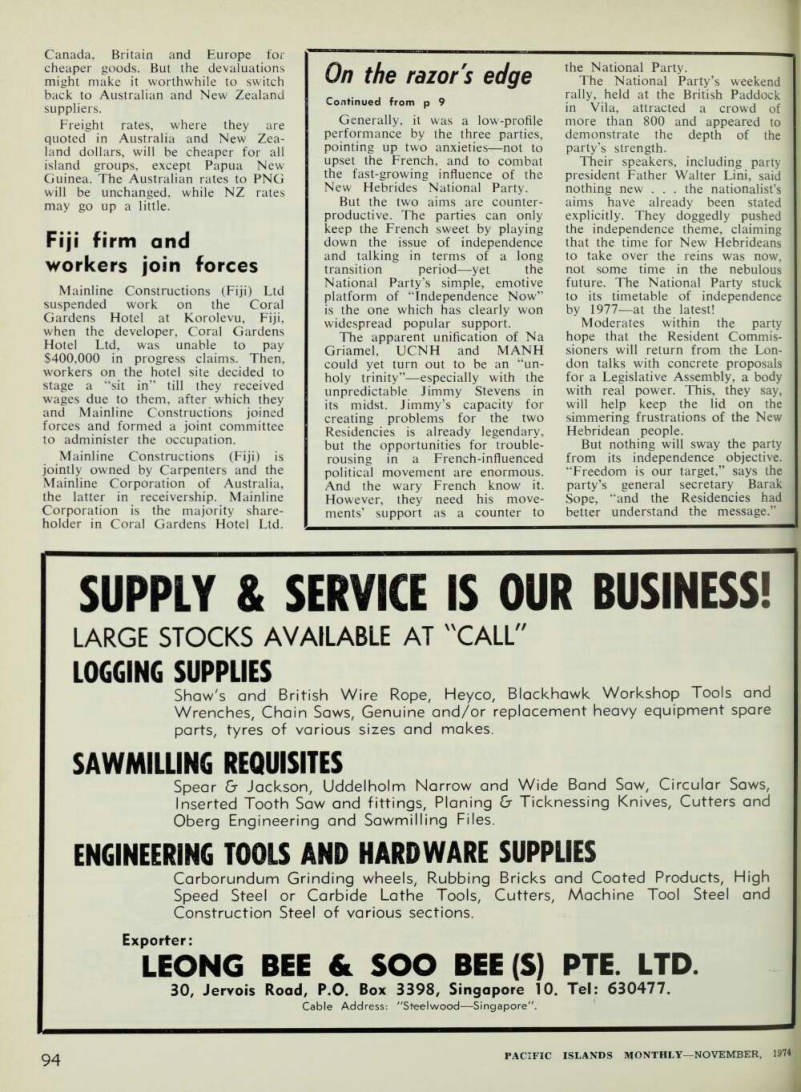
Generally, it was a low-profile performance by the three parties, pointing up two anxieties—not to upset the French, and to combat the fast-growing influence of the New Hebrides National Party.
But the two aims are counter productive. The parties can only keep the French sweet by playing down the issue of independence and talking in terms of a long transition period—yet the National Party’s simple, emotive platform of “Independence Now” is the one which has clearly won widespread popular support.
The apparent unification of Na Griamel, UCNH and MANH could yet turn out to be an “un holy trinity”—especially with the unpredictable Jimmy Stevens in its midst. Jimmy’s capacity for creating problems for the two Residencies is already legendary, but the opportunities for trouble rousing in a French-influenced political movement are enormous.
And the wary French know it, However, they need his move ments’ support as a counter to
the National Party.
The National Party’s weekend rally, held at the British Paddock in Vila, attracted a crowd of more than 800 and appeared to demonstrate the depth of the party’s strength, Their speakers, including party president Father Walter Lini, said nothing new ... the nationalist’s aims have already been stated explicitly. They doggedly pushed the independence theme, claiming that the time for New Hebrideans to take over the reins was now, not some time in the nebulous future. The National Party stuck to its timetable of independence by 1977—at the latest!
Moderates within the party hope that the Resident Commis sioners will return from the Lon don talks with concrete proposals for a Legislative Assembly, a body with real power. This, they say, will help keep the lid on the simmering frustrations of the New Hebridean people, But nothing will sway the party from its independence objective, “Freedom is our target,” says the party’s general secretary Barak Sope, “and the Residencies had better understand the message.”
9
2IFIC ISLANDS MONTHLY—NOVEMBER, 1974
Tropica I ities
Vonlli to the
barricades
Militant members of the Union of Caledonian Youth have successfully campaigned for removal of an offending Melanesian spear-surrender plaque in Noumea’s central square.
But the young Caledonians’ latest “anti-colonialist” campaign swiftly brought upon their backs an attack from truncheon-bearing French police.
The plaque on the Governor Olry statue was regarded as offensive to Melanesians as it depicted island warriors surrendering their arms to their new French masters. Demands for removal of the bronze engraving began in the Territorial Assembly three years ago, but the protest cam paign really gained momentum early this year. (PIM April.) Some local groups grew impatient with administrative delays on the job, and in September red and green paint was sprayed over the plaque by Melanesian chief Nidoishe Naisse line and Jean-Jacques Bourdinat, whose late father, a barrister, was formerly head of the local Bar Asso ciation. Through September and Oc tober workmen were chiselling at the monument, under police supervision, and it was expected the controver sial plaque would not be long in reaching its resting place among local historic pieces.
While the Melanesians have been persuaded that spears are out, French police truncheons were in action at Noumea court house when a group of sympathisers at the trial of two young Melanesians refused a judge’s order to clear the court.
Those on trial were a young Melanesian graduate mathematics teacher, who was later sentenced to two weeks in prison and his colla borator to one week for attempting to demonstrate at the military parade of September 24, anniversary of the French taking of possession of New Caledonia. Their “independence” banners were promptly snatched by police as they protested over freedom of expression, after Governor Eriau
had banned a Caledonian Youth public meeting planned the week be fore.
Thirteen sympathisers who refused to leave the court room at the sub sequent trial made it known they would not resist arrest, but an un expected number of police were ordered to charge with truncheons to drive them out. Later 12 young people, including Caledonian Dr J-P Caillard, J-J Bourdinat and three Melanesian women, were sentenced to prison terms of up to six months.
The violence of the police interven tion to remove such a small unresist ing group has led to uneasiness over future repercussions.
Meanwhile Caledonians, under continuous pressure from govern ment-controlled media, are obviously weary of political agitation on both sides. Resigned to leaving Paris to face the problems of Autonomic, Budget deficit now approaching SA2O million, and charges of colonialism in the exploitation of Caledonian nickel, the locals seem anxious to divert their attention to their own A, B, C of Automobiles, Boats and Cuisine.
*Aina(eiirs’ in (lie
PIVG courts
Papua New Guinea in September announced its first major break from the British legal system by permitting assessors without legal qualifications to sit with Supreme Court judges on criminal trials.
What are defined as “experienced Papuans and New Guineans” will sit with the existing all-white judiciary to advise on local customs, tradi tional backgrounds and interpretation of evidence.
The immediate purpose of the scheme is to phase as much New Guinean content into the courts as possible while bridging the gap which will exist until the country produces its own judges.
Details of the scheme were an nounced by the Chief Minister, Mr Somare, following a long series of investigations into a situation which has been of increasing concern to his government.
But although the plan is essen tially a “bridging” operation, Mr
Somare said the assessors would be I retained if necessary even after the I country’s own nationals were ap-l pointed as judges. Their retention! would depend on the success of the I scheme, and the amount of real aid I which it was able to give to skilled judges.
Mr Somare said there was no sug-| gestion that the assessors would de- \ cide the guilt or innocence of a per son on trial. However, the assessors I would sit throughout each trial, and at the end they would give an overall opinion to the judge.
During a hearing the assessor I assigned to the case would be in a position to advise the judge on 1 “modes of thought and language”! and special knowledge of customs.
The assessor system operates in some other areas of the Pacific.
Changes with the
Islands' press
An afternoon daily, Fiji Sun, ap peared in Suva on October 8, and the weekly Sunday Sun on October; 13. They are published by a new company. Newspapers of Fiji Ltd, with NZ and Hong Kong capital. ; Suva already has one morning daily, the Fiji Times, which is 105] years old. The Fiji Times group re-] cently launched the Western Herald at Lautoka, a regional 16-page weekly with 10,000 copies distributed free throughout the western side of the main island. It’s the first free regional s paper in the South Pacific.
In Saipan, Micronesia, a third weekly newspaper has appeared, the Free Press. Publisher is Alfonso C. ; Rasa. . I A new weekly, the Lae Nius, in English despite its Pidgin name, has appeared in Lae, New Guinea, owned by the Papua New Guinea Printing Co Pty Ltd, whose managing direc tor, Ray Thurecht, was once produc tion chief for Port Moresby’s South Pacific Post Pty Ltd, publishers of PNG’s only daily, the Post-Courier.
Lae Nius is a small format 12-pagerJ produced offset.
The Post-Courier is owned by Melbourne-based Herald and Weekly Times Ltd, which announced inj October it had acquired from Wilke; & Co, all the shares in Pacific Publi
nations Pty Ltd, the company which owns the Fiji Times, PIM, and other Pacific publications.
In Vila, husband and wife editing :eam, Jean and Penny Barbier, until •ecently entire staff of the New Hebrides weekly newspaper Nakamal, ire now producing a travel-orientated nagazine called Kousurata, a local anguage word meaning ‘to roam’.
Nakamal, owned by local business nen, ceased publication some nonths ago and attempts to revive t have so far failed.
First Island
*asino
New Caledonians with a spare A 2,000 in their pockets are invited 0 join the list of shareholders in the land’s casino, planned to open at le end of the year in Noumea.
Work is now well under way for le construction of the Casino Royal, le first gaming casino in the South acific Islands. Mr Raymond Frere, of the controlling company OCABA, announced the issue of a irther 49 million CFP capital in sptember which was being taken up V Caledonian and overseas investors.
The casino will operate in the "iginal reception halls of the 330- >om Chateau Royal hotel, right on nse Vata beach. In preparation for e opening, the Caledonian press is itiating the locals in the rules of iccarat, Black Jack, roulette, etc.
The American-based Bally Cor )ration, which recently made head les during the Australian judicial quiry into Organised Crime in iubs, when allegations were made at Bally had Mafia connections, adered for the supply of slot achines to the casino.
The tender, which came through e Noumea representative of a well lown Australian export firm, was not cepted.
An Australian, well-known in mbling circles, Mr Abe Saffron, is introduced to the casino directors the Sydney representative of an ernational airline but his offer of rticipation in the casino was also dined.
Meanwhile, as a further move on ; Noumea tourist front, the first ge of work has begun on the Holi y Inn project at Brunnelet Point, posite the Cercle Nautique yacht b. The hilltop on the Point is being elled off into the waters of Baie ; Pecheurs to provide extensive rina development.
With its bays harbouring a growing ay of yachts and its casino taking pe on the beachfront, Noumea is rcasing its visitor interest.
Advertisements & other items, p. 13 (2 items)
11
3IFIC ISLANDS MONTHLY— NOVEMBER, 1974
A.R.C.Weldmesh
mmm
FARMER-PROVED
NOW IN METRIC SIZES
Weldmesh has gone metric: So now we’ll supply your order in metres, millimetres and mass. Basically that’s the only difference.
Certainly there’s a change in appearance of some of the meshes but the range of products you’ve known is still the same. Yards, pig-pen flooring, gates and so on. They all retain the benefits for which Weldmesh has become famous.
Strength, long life, versatility, ease of erection, hygiene, fire proof, economy and of course, its do-ityourself capabilities.
Farmer-proved Weldmesh, now in metric sizes, has an application on your property. For literature, The Export Department contact your local A.R.C. Industries Ltd. building material supplier, 440 Collins Street, or write to; Melbourne, 3000, Victoria, Australia.
Cables: “Benignant”,
Melbourne.
A.R.C. Engineering Pty. Ltd.
Please send me your free booklet on □ Cattle Products □ Pig Products □ Sheep Products □ Field Gates □ Do-it-yourself information Tick applicable square.
Name Address □ Tick if for school project Tel.
ARC
02250
Charlie Was
Their
Darling
From a Suva correspondent Charles Windsor, Prince of Wales and heir to Britain’s Throne, could have been King of Fiji in his own right in October. Already a favourite with the many who saw him and read about him during his visits here in 1970 and earlier this year, he captured 99 per cent of Fiji’s hearts in the four days here from October 8 and did it so disarmingly that Cakobau’s crown could have been his for the asking.
And maybe he wouldn’t have minded. His obvious delight at being here again wasn’t just another Royal job like opening a town hall or lay ing a foundation stone. A good mixer in the Buckingham Palace new look in which royal restraint and formality have gone by the board, he got among the people and made Fiji’s Cession Centenary Year as much an enjoyable thing for himself as did the many thousands of Fiji people who enjoyed the four-day, $350,000 junket.
Everyone believed him when he
told the welcoming thousands at Suva’s Albert Park on October 8, “I was filled with joy when my mother, her Majesty the Queen, asked me to represent her at celebrations to mark the centenary of the link with the British Crown.”
But the Queen could hardly have chosen anyone else, except herself, of course. Prince Charles has Fiji
in his own portfolio. He was here, in October, 1970, and scored a triumph, when he gave back to Fiji, as representative of the Crown, its ownself, which the chiefs, headed by King Cakobau, ceded to Prince Charles’ great - great - great - grand mother, the many islands of Fiji, j He brought it back. He was here again in February on an unofficial call when the British frigate, HMS Jupiter, in which he was serving as radio officer, just happened to be passing through Fiji waters.
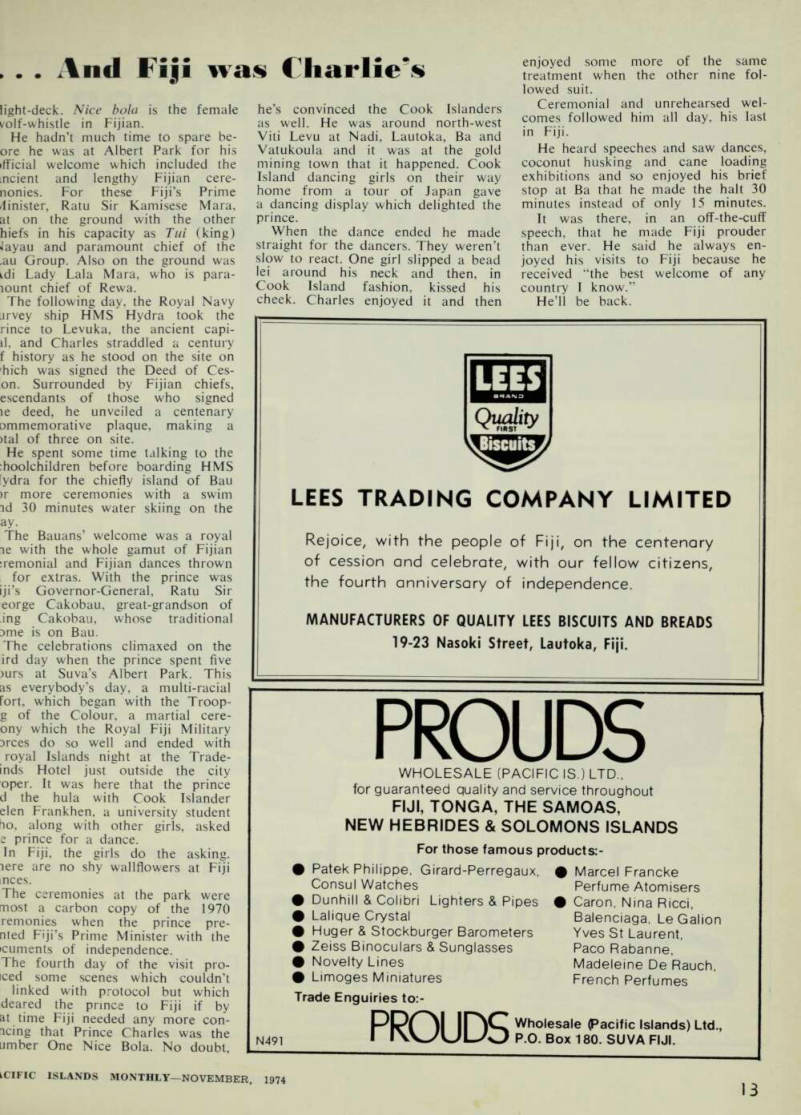
As it was an unofficial visit, he really let his hair down, diving into the water off Beqa to join Fijians in a fish drive, and dancing the tuibotoj a Fijian conga dance, with a Fijian girl The hair came down this time as well, and no doubt a picture taken of the heir to the throne doing a hula with a Cook Islands girl will have gone round the world.
There were cries of “Nice bold" from Fijian girls when he landed a!
Nadi Airport in a RAF VC 10 which flew miniature standards (his personal standard) and the Fiji flag over the
His Royal Hula Highness in a pose which showed he knew what it was all about when he did the Island thing with Cook Islander Helen Frankhen at Suva's Trade winds Hotel—one of those delightful episodes which endeared the prince to Fiji.— Photo: Chris Moorehouse, Fiji Times
. . . And Fiji was Charlie's
light-deck. Nice bola is the female volf-whistle in Fijian.
He hadn’t much time to spare be ore he was at Albert Park for his ►fficial welcome which included the indent and lengthy Fijian cere nonies. For these Fiji’s Prime Minister, Ratu Sir Kamisese Mara, at on the ground with the other hiefs in his capacity as Tui (king) Jayau and paramount chief of the ,au Group. Also on the ground was idi Lady Lala Mara, who is para lount chief of Rewa.
The following day, the Royal Navy nrvey ship HMS Hydra took the rince to Levuka, the ancient capi d, and Charles straddled a century f history as he stood on the site on r hich was signed the Deed of Ces on. Surrounded by Fijian chiefs, escendants of those who signed ic deed, he unveiled a centenary □mmemorative plaque, making a >tal of three on site.
He spent some time talking to the :hoolchildren before boarding HMS !ydra for the chiefly island of Bau )r more ceremonies with a swim id 30 minutes water skiing on the ay.
The Bauans’ welcome was a royal le with the whole gamut of Fijian ;remonial and Fijian dances thrown for extras. With the prince was iji’s Governor-General, Ratu Sir eorge Cakobau, great-grandson of ing Cakobau, whose traditional ime is on Bau.
The celebrations climaxed on the ird day when the prince spent five iurs at Suva’s Albert Park. This as everybody’s day, a multi-racial Fort, which began with the Troop g of the Colour, a martial cere ony which the Royal Fiji Military arces do so well and ended with royal Islands night at the Trade inds Hotel just outside the city oper. It was here that the prince d the hula with Cook Islander elen Frankhen, a university student No, along with other girls, asked e prince for a dance.
In Fiji, the girls do the asking, lere are no shy wallflowers at Fiji mces.
The ceremonies at the park were most a carbon copy of the 1970 remonies when the prince pre nted Fiji’s Prime Minister with the icuments of independence.
The fourth day of the visit pro iced some scenes which couldn’t linked with protocol but which deared the prince to Fiji if by at time Fiji needed any more con acing that Prince Charles was the amber One Nice Bola. No doubt,
he’s convinced the Cook Islanders as well. He was around north-west Viti Levu at Nadi, Lautoka, Ba and Vatukoula and it was at the gold mining town that it happened. Cook Island dancing girls on their way home from a tour of Japan gave a dancing display which delighted the prince.
When the dance ended he made straight for the dancers. They weren’t slow to react. One girl slipped a bead lei around his neck and then, in Cook Island fashion, kissed his cheek, Charles enjoyed it and then
enjoyed some more of the same treatment when the other nine fol lowed suit.
Ceremonial and unrehearsed wel comes followed him all day, his last in Fiji.
He heard speeches and saw dances, coconut husking and cane loading exhibitions and so enjoyed his brief stop at Ba that he made the halt 30 minutes instead of only 15 minutes.
It was there, in an off-the-cuff speech, that he made Fiji prouder than ever. He said he always en joyed his visits to Fiji because he received “the best welcome of any country I know.”
He’ll be back.
Advertisements & other items, pp. 14-16 (2 items)
duty-free prices.
International quality...
French & International perfumes Classic porcelain figurines.
Diamond engagement & eternity Precision Swiss Watches.
Mikimoto Cultured Pearls Australian Opals.
Gold & Silver jewellery.
Oroton handbags & accessories Pocket purse & table lighters. v N 490
PROUDS
Suva, Nadi, Lautoka, Sigatoka.
(Fiji Ltd.,)
LEES
LEES TRADING COMPANY LIMITED
Rejoice, with the people of Fiji, on the centenary of cession and celebrate, with our fellow citizens, the fourth anniversary of independence.
MANUFACTURERS OF QUALITY LEES BISCUITS AND BREADS 19-23 Nasoki Street, Lautoka, Fiji.
PROUDS
WHOLESALE (PACIFIC IS.) LTD.,
for guaranteed quality and service throughout
FIJI, TONGA, THE SAMOAS,
NEW HEBRIDES & SOLOMONS ISLANDS
N 491 For those famous products: - • Patek Philippe, Girard-Perregaux, Consul Watches • Dunhill & Colibri Lighters & Pipes • Lalique Crystal • Huger & Stockburger Barometers • Zeiss Binoculars & Sunglasses • Novelty Lines • Limoges Miniatures • Marcel Francke Perfume Atomisers • Caron, Nina Ricci, Balenciaga, LeGalion Yves St Laurent, Paco Rabanne, Madeleine De Rauch, French Perfumes Trade Enguiries to:inC Wholesale (Pacific Islands) Ltd., * ■\V/UL/0 P.O. Box 180. SUVA FIJI.
Cope Allman has been
making products in Fiji
for the last 52 years.
Knurr • f PI >
There will be many
more to come.
COPE ALLMAN (SOUTH PACIFIC) LIMITED
A MEMBER OF THE COPE ALLMAN INTERNATIONAL GROUP 10U
13
ICIFIC ISLANDS MONTHLY—NOVEMBER. 1974
diversity’
'Dazzling diversity’ of PNG tradition
From Kirsty Powell,
in Port Moresby.
The Fourth Niugini Arts Festival is over. For three weeks, 50 (roups from various parts of Papua New Guinea, and from other have performed in varying combinations, on 50 different occasions, in 30 different locations around Port Moresby
In market places, sports fields, mools, colleges, the stadium, the ►pen Air Theatre, and the cultural mtre, people have danced, and sung, id acted plays, and played musical istruments before the biggest and
lost far-flung audience ever.
It was the most ambitious festival Jt. Perhaps too ambitious: for the rge number of participating groups ere uneven in quality, and the omentum and excitement of the "st week were not maintained. The ogadala dancers (from Balimo in e Western District), performed on e last Saturday night before a mere •nnkling of people on the grass of e cultural centre. On the Sunday, iwever, the final night of the festi il, they danced to a crowd of over thousand packed into the Open Air icatre.
And the crowd was rapt. The ogadala dancers have never before en seen outside Western District. their grass and leaf skirts, with eir highly elaborate painted and athered masks, and their bobbing il pieces they danced to the com lling rhythm of kundu drums (two them eight feet long—the longest ndus I’ve seen), gourd rattles, per ssive “walking sticks” of split mboo, conch shells, and haunting ng.
They moved on stage like seasoned rformers, following the patterns olved for performing in their great ighouses. The performance is
splendid in itself. But it is also the expression of a remarkable cultural revival, for these dances and their superb costumes, apparently lost after 40 years of disuse and disapproval, have been revived in the last three years.
Such a cultural revival not un naturally strives for authenticity to tradition and authentic tradition rep resents one strand in the festival per formances. The dazzling diversity of Papua New Guinean tradition was once again demonstrated.
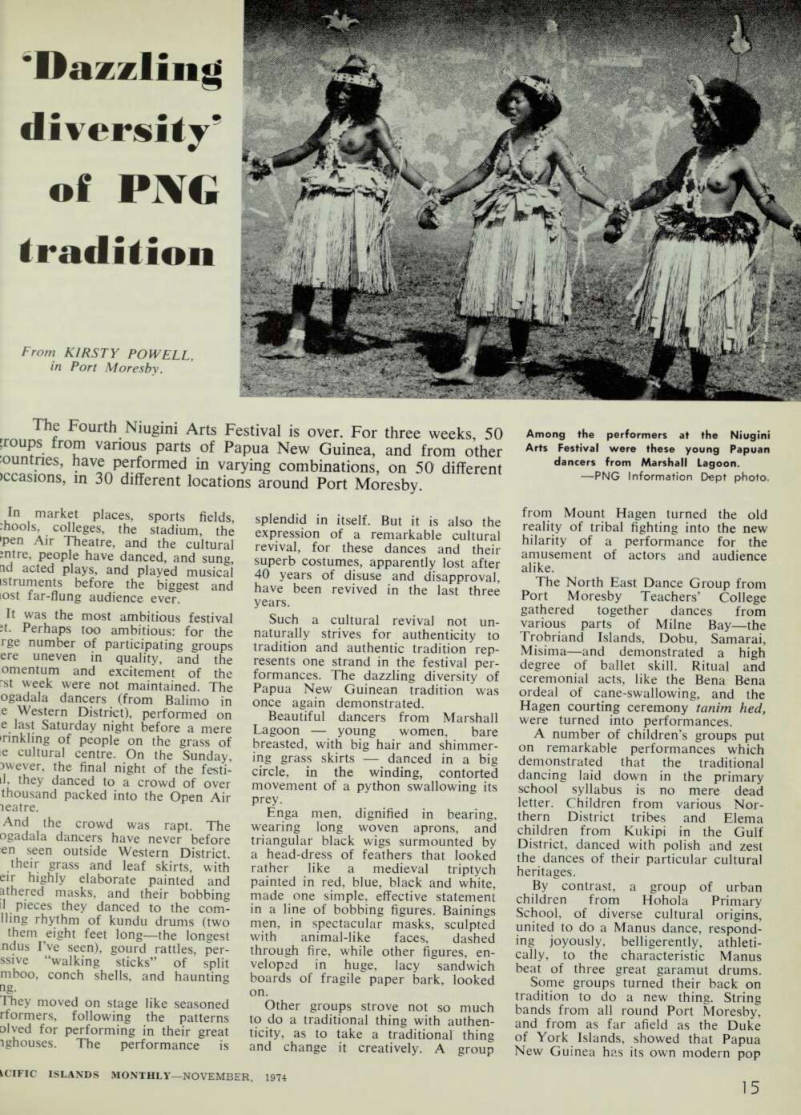
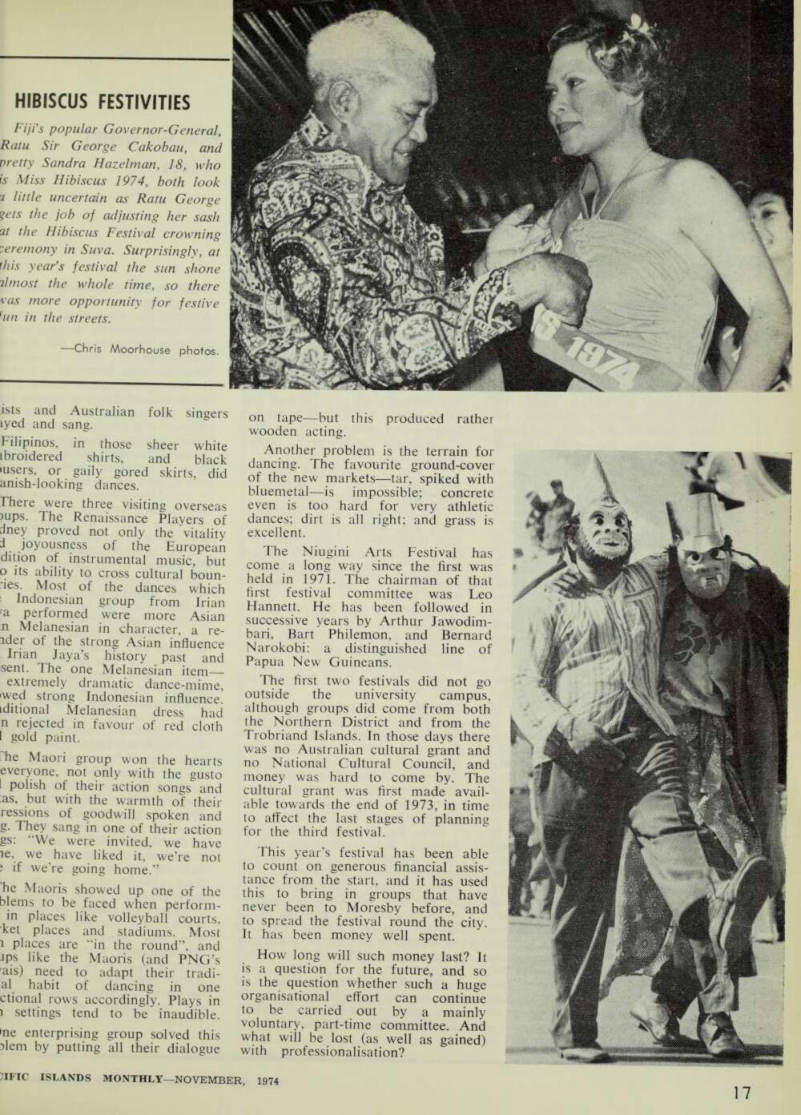
Beautiful dancers from Marshall Lagoon young women, bare breasted, with big hair and shimmer ing grass skirts danced in a big circle, in the winding, contorted movement of a python swallowing its prey.
Enga men, dignified in bearing, wearing long woven aprons, and triangular black wigs surmounted by a head-dress of feathers that looked rather like a medieval triptych painted in red, blue, black and white, made one simple, effective statement in a line of bobbing figures. Bainings men, in spectacular masks, sculpted with animal-like faces, dashed through fire, while other figures, en veloped in huge, lacy sandwich boards of fragile paper bark, looked on.
Other groups strove not so much to do a traditional thing with authen ticity, as to take a traditional thing and change it creatively. A group
from Mount Hagen turned the old reality of tribal fighting into the new hilarity of a performance for the amusement of actors and audience alike.
The North East Dance Group from Port Moresby Teachers’ College gathered together dances from various parts of Milne Bay—the Trobriand Islands, Dobu, Samarai, Misima—and demonstrated a high degree of ballet skill. Ritual and ceremonial acts, like the Bena Bena ordeal of cane-swallowing, and the Hagen courting ceremony tanim hed, were turned into performances.
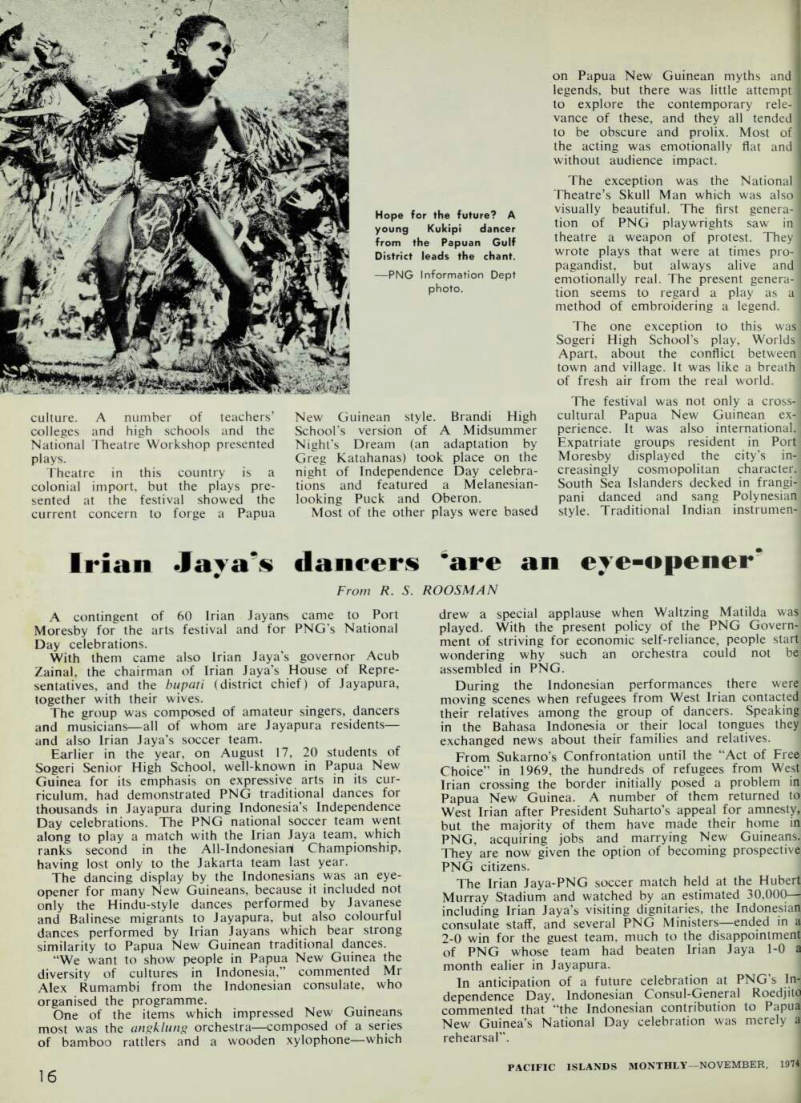
A number of children’s groups put on remarkable performances which demonstrated that the traditional dancing laid down in the primary school syllabus is no mere dead letter. Children from various Nor thern District tribes and Elema children from Kukipi in the Gulf District, danced with polish and zest the dances of their particular cultural heritages.
By contrast, a group of urban children from Hohola Primary School, of diverse cultural origins, united to do a Manus dance, respond ing joyously, belligerently, athleti cally, to the characteristic Manus beat of three great garamut drums.
Some groups turned their back on tradition to do a new thing. String bands from all round Port Moresby, and from as far afield as the Duke of York Islands, showed that Papua New Guinea has its own modern pop
Among the performers at the Niugini Arts Festival were these young Papuan dancers from Marshall Lagoon. —PNG Information Dept photo.
culture. A number of teachers’ colleges and high schools and the National Theatre Workshop presented plays.
Theatre in this country is a colonial import, but the plays pre sented at the festival showed the current concern to forge a Papua
New Guinean style. Brandi High School's version of A Midsummer Night’s Dream (an adaptation by Greg Katahanas) took place on the night of Independence Day celebra tions and featured a Melanesian looking Puck and Oberon.
Most of the other plays were based
on Papua New Guinean myths and] legends, but there was little attempt! to explore the contemporary rele vance of these, and they all tended! to be obscure and prolix. Most of I the acting was emotionally flat and without audience impact.
The exception was the National Theatre’s Skull Man which was also visually beautiful. The first genera-j tion of PNG playwrights saw in theatre a weapon of protest. They wrote plays that were at times pro- i pagandist, but always alive and ! emotionally real. The present genera-j tion seems to regard a play as a method of embroidering a legend.
The one exception to this was Sogeri High School’s play, Worlds Apart, about the conflict between town and village. It was like a breath of fresh air from the real world.
The festival was not only a cross-j cultural Papua New Guinean ex perience. It was also international.
Expatriate groups resident in Port Moresby displayed the city’s in creasingly cosmopolitan character.
South Sea Islanders decked in frangi pani danced and sang Polynesian style. Traditional Indian instrumen-
Hope for the future? A young Kukipi dancer from the Papuan Gulf District leads the chant. —PNG Information Dept
photo.
Advertisements & other items, p. 17 (1 item)
15
ICIFIC ISLANDS MONTHLY—NOVEMBER, 1974
Irian Java's dancers 'are an eve-opener'
From R. S. Roosman
A contingent of 60 Irian Jayans came to Port Moresby for the arts festival and for PNG’s National Day celebrations.
With them came also Irian Jaya’s governor Acub Zainal, the chairman of Irian Jaya’s House of Repre sentatives, and the bupati (district chief) of Jayapura, together with their wives.
The group was composed of amateur singers, dancers and musicians—all of whom are Jayapura residents— and also Irian Jaya’s soccer team.
Earlier in the year, on August 17, 20 students of Sogeri Senior High School, well-known in Papua New Guinea for its emphasis on expressive arts in its cur riculum, had demonstrated PNG traditional dances for thousands in Jayapura during Indonesia’s Independence Day celebrations. The PNG national soccer team went along to play a match with the Irian Jaya team, which ranks second in the All-Indonesiari Championship, having lost only to the Jakarta team last year.
The dancing display by the Indonesians was an eye opener for many New Guineans, because it included not only the Hindu-style dances performed by Javanese and Balinese migrants to Jayapura, but also colourful dances performed by Irian Jayans which bear strong similarity to Papua New Guinean traditional dances.
“We want to show people in Papua New Guinea the diversity of cultures in Indonesia,” commented Mr Alex Rumambi from the Indonesian consulate, who organised the programme.
One of the items which impressed New Guineans most was the angklung orchestra —composed of a series of bamboo rattlers and a wooden xylophone —which
drew a special applause when Waltzing Matilda was played. With the present policy of the PNG Govern- 1 ment of striving for economic self-reliance, people start! wondering why such an orchestra could not bej assembled in PNG.
During the Indonesian performances there were moving scenes when refugees from West Irian contacted their relatives among the group of dancers. Speaking in the Bahasa Indonesia or their local tongues they, exchanged news about their families and relatives.
From Sukarno’s Confrontation until the “Act of Free Choice” in 1969, the hundreds of refugees from West Irian crossing the border initially posed a problem in Papua New Guinea. A number of them returned to West Irian after President Suharto’s appeal for amnesty, but the majority of them have made their home in PNG, acquiring jobs and marrying New Guineans., They are now given the option of becoming prospective PNG citizens.
The Irian Jaya-PNG soccer match held at the Hubert Murray Stadium and watched by an estimated 30,000 —■ including Irian Jaya’s visiting dignitaries, the Indonesian consulate staff, and several PNG Ministers—ended in a 2-0 win for the guest team, much to the disappointment of PNG whose team had beaten Irian Jaya 1-0 a month ealier in Jayapura.
In anticipation of a future celebration at PNG’s In dependence Day, Indonesian Consul-General Roedjito commented that “the Indonesian contribution to Papua New Guinea’s National Day celebration was merely a rehearsal”.
wed and sa A n U e Stral ' an S ' nBerS *... . .
ibrcndered I?* 1 ?
•users or pailv on rP H k anish-looking dances ’ 5 There were three visiting overseas >ups. The Renaissance Players of dney proved not only the vitality ditiM 0 o U f n fnstr.,mPnl a h i e Eur ° P t an 0 its -ihilitv tn rrmc a music, but des Mm S hfj b ?“ n u' Indonesian w , h ( ch ■a oerformed ? f A lr i an n Melanesian in eh m °, re Slan rder of me s,rAn„ a • Cter n a re "
Irian Tava’c ? Asian influence sent Th. y nn £r IS ° ry • P * S and sent, ihe one Melanesian item— extremely dramatic dance-mime,
wed strong Indonesian influence.’
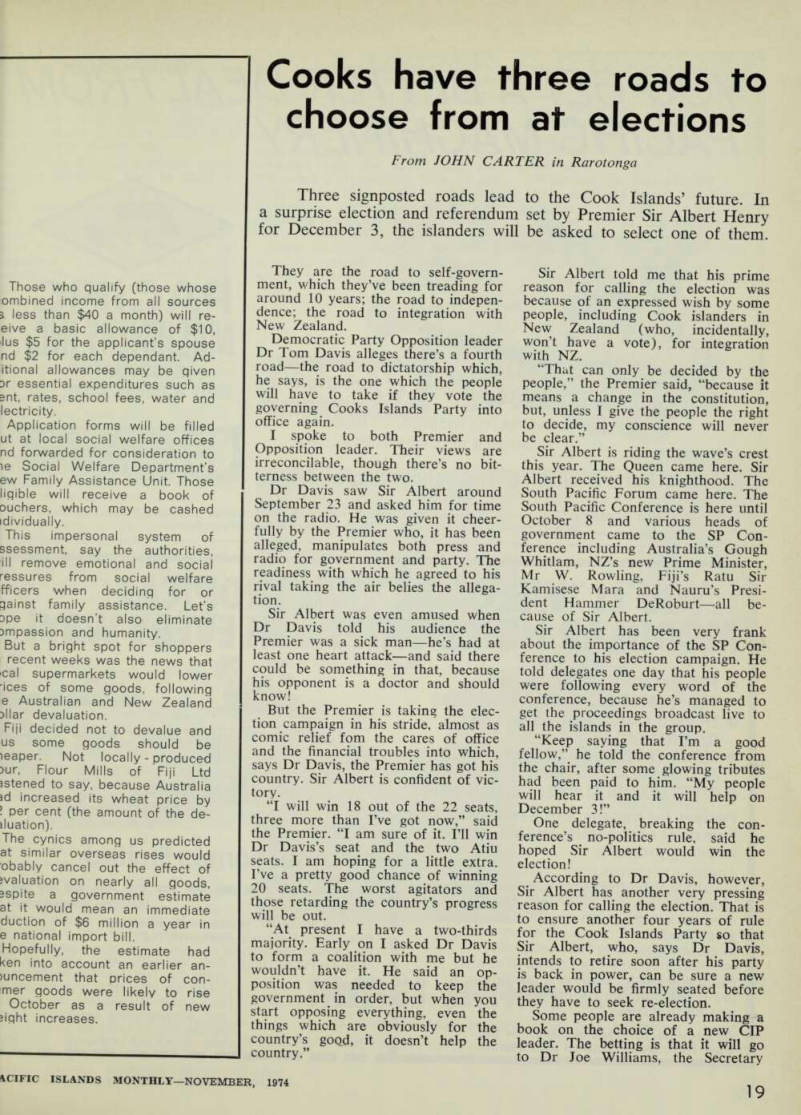
iditional Melanesian dress had n rejected in favour of red cloth 1 gold paint. -l , JJ® Maon grou P won 1 the hc3rts i rrS*- ? n y the gusto po isn of their action songs and as, but with the warmth of their ressions of goodwill spoken and g ‘ ,ey sang m one of their action gs: We were invited, we have ie, we have liked it, we’re not 5 if we’re going home.” w•, , ’ e Maoris showed up one of the .ms to be faced when performm places like volleyball courts, ket places and stadiums. Most i places are ‘in the round”, and jps like the Maoris (and PNG’s ais) need to adapt their tradial habit of dancing in one ctional rows accordingly. Plays in i settings tend to be inaudible. ►ne enterprising group solved this flem by putting all their dialogue
on tape - but this produced rather wooden acting.
Another problem is the terrain for dancing. The favourite ground-cover the " e , w markets-tar spiked with bluemetal—is impossible; concrete even is too hard for very athletic dances; dirt is all right; and grass is excellent.
The Niugini Arts Festival has come a long way since the first was held in 197 L The chairman of that first festiva l committee was Leo Hannett. He has been followed in successive years by Arthur Jawodim bari - Bart Philemon, and Bernard Narokobi: a distinguished line of Pa P ua New Guineans, The first two festivals did not go outside the university campus, although groups did come from both the Northern District and from the Trobriand Islands. In those days there was no Australian cultural grant and no National Cultural Council, and money was hard to come by. The cultural grant was first made avail able towards the end of 1973, in time to affect the last stages of planning for the third festival, This year’s festival has been able to count on generous financial assis tance from the start, and it has used this to bring in groups that have never been to Moresby before, and to spread the festival round the city, It has been money well spent, . How loi ? g Wlll such money last? It is a Question for the future, and so 18 the Question whether such a huge organisational effort can continue to . be car ried .out by a mainly voluntary, part-time committee. And what will be lost (as well as gained) with professionalisation?
Hibiscus Festivities
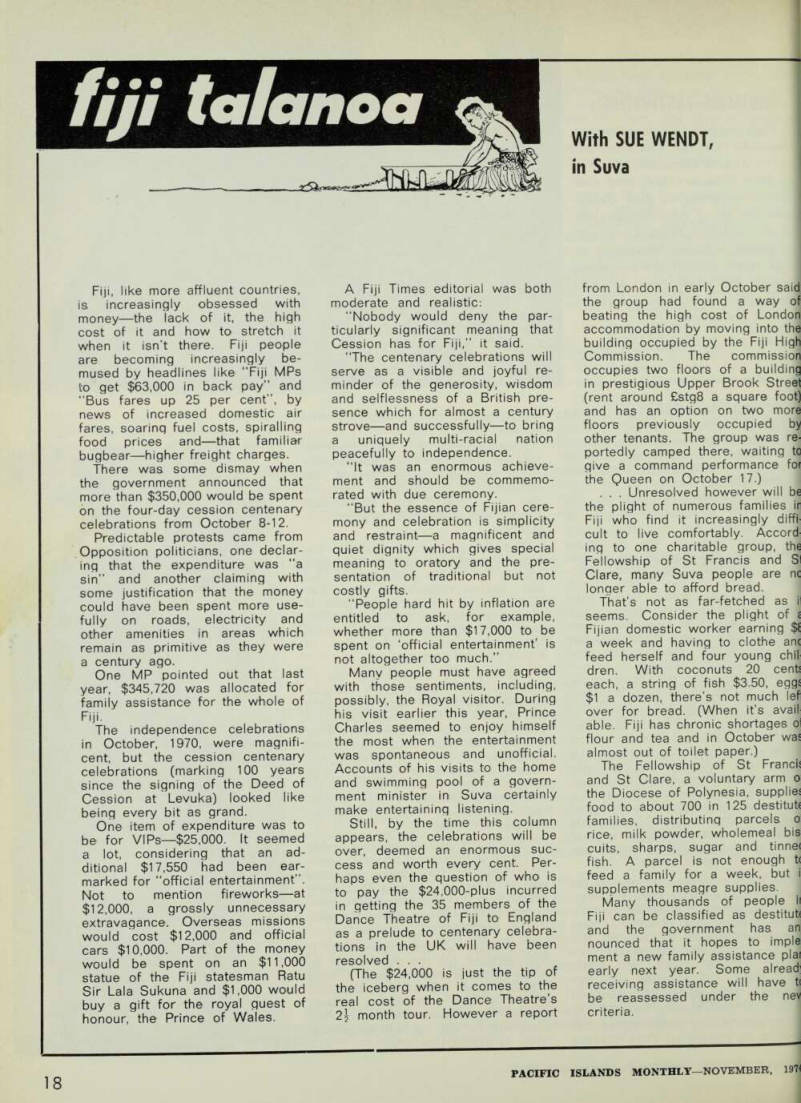
Fiji’s popular Governor-General, Ratu Sir George Cakobau, and pretty Sandra Hazelman, 18, who is Miss Hibiscus 1974, both look [?] little uncertain as Ratu George gets the job of adjusting her sash at the Hibiscus Festival crowning ceremony in Suva. Surprisingly, at this year's festival the sun shone [?]almost the whole time, so there was more opportunity for festive [?]un in the streets. —Chris Moorhouse photos.
Advertisements & other items, p. 19 (1 item)
17
2IFIC ISLANDS MONTHLY—NOVEMBER, 1974
fiji talanoa
With Sue Wendt,
in Suva
Fiji, like more affluent countries, is increasingly obsessed with money —the lack of it, the high cost of it and how to stretch it when it isn't there. Fiji people are becoming increasingly be mused by headlines like “Fiji MPs to get $63,000 in back pay” and “Bus fares up 25 per cent”, by news of increased domestic air fares, soaring fuel costs, spiralling food prices and —that familiar bugbear—higher freight charges. there was some dismay when the government announced that more than $350,000 would be spent on the four-day cession centenary celebrations from October 8-12.
Predictable protests came from Opposition politicians, one declar ing that the expenditure was “a sin” and another claiming with some justification that the money could have been spent more use fully on roads, electricity and other amenities in areas which remain as primitive as they were a century ago.
One MP pointed out that last year, $345,720 was allocated for family assistance for the whole of Fiji.
The independence celebrations in October, 1970, were magnifi cent, but the cession centenary celebrations (marking 100 years since the signing of the Deed of Cession at Levuka) looked like being every bit as grand.
One item of expenditure was to be for VIPs —$25,000. It seemed a lot, considering that an ad ditional $17,550 had been ear marked for “official entertainment”.
Not to mention fireworks —at $12,000, a grossly unnecessary extravagance. Overseas missions would cost $12,000 and official cars $lO,OOO. Part of the money would be spent on an $ll,OOO statue of the Fiji statesman Ratu Sir Lala Sukuna and $l,OOO would buy a gift for the royal guest of honour, the Prince of Wales.
A Fiji Times editorial was both moderate and realistic: ‘‘Nobody would deny the par ticularly significant meaning that Cession has. for Fiji,” it said.
“The centenary celebrations will serve as a visible and joyful re minder of the generosity, wisdom and selflessness of a British pre sence which for almost a century strove —and successfully—to bring a uniquely multi-racial nation peacefully to independence.
"It was an enormous achieve ment and should be commemo rated with due ceremony.
“But the essence of Fijian cere mony and celebration is simplicity and restraint —a magnificent and quiet dignity which gives special meaning to oratory and the pre sentation of traditional but not costly gifts.
“People hard hit by inflation are entitled to ask, for example, whether more than $17,000 to be spent on ’official entertainment’ is not altogether too much.”
Many people must have agreed with those sentiments, including, possibly, the Royal visitor. During his visit earlier this year, Prince Charles seemed to enjoy himself the most when the entertainment was spontaneous and unofficial.
Accounts of his visits, to the home and swimming pool of a govern ment minister in Suva certainly make entertaining listening.
Still, by the time this column appears, the celebrations will be over, deemed an enormous suc cess and worth every cent. Per haps even the question of who is to pay the $24,000-plus incurred in getting the 35 members of the Dance Theatre of Fiji to England as a prelude to centenary celebra tions in the UK will have been resolved . . . (The $24,000 is just the tip of the iceberg when it comes to the real cost of the Dance Theatre’s 2\ month tour. However a report
from London in early October saidj the group had found a way of beating the high cost of Londorr accommodation by moving into the building occupied by the Fiji High Commission. The commission occupies two floors of a building in prestigious Upper Brook Street (rent around £stgB a square foot) and has an option on two more floors previously occupied by other tenants. The group was re portedly camped there, waiting to give a command performance for the Queen on October 17.) . . . Unresolved however will be the plight of numerous families in Fiji who find it increasingly diffi cult to live comfortably. Accordj ing to one charitable group, the Fellowship of St Francis and Si Clare, many Suva people are no longer able to afford bread.
That’s not as far-fetched as il seems. Consider the plight of 8 Fijian domestic worker earning $€ a week and having to clothe anc feed herself and four young chil dren. With coconuts 20 cents each, a string of fish $3.50, eggs $1 a dozen, there’s not much lefl over for bread. (When it’s avail able. Fiji has chronic shortages ol flour and tea and in October was almost out of toilet paper.) The Fellowship of St Francis and St Clare, a voluntary arm o' the Diocese of Polynesia, supplies food to about 700 in 125 destitute families, distributing parcels, ol rice, milk powder, wholemeal bis cuits, sharps, sugar and tinnee fish. A parcel is not enough tc feed a family for a week, but i supplements meagre supplies.
Many thousands of people ir Fiji can be classified as destitute and the government has an nounced that it hopes to imple ment a new family assistance plar early next year. Some already receiving assistance will have t( be reassessed under the nev criteria.
Those who qualify (those whose ombined income from all sources > less than $4O a month) will re eive a basic allowance of $lO, lus $5 for the applicant’s spouse nd $2 for each dependant. Ad itional allowances may be given or essential expenditures such as snt, rates, school fees, water and lectricity.
Application forms will be filled ut at local social welfare offices nd forwarded for consideration to le Social Welfare Department’s ew Family Assistance Unit. Those liqible will receive a book of □uchers, which may be cashed idividually.
This impersonal system of ssessment, say the authorities, ill remove emotional and social ressures from social welfare fficers when deciding for or gainst family assistance. Let’s Dpe it doesn’t also eliminate impassion and humanity.
But a bright spot for shoppers recent weeks was the news that cal supermarkets would lower •ices of some goods, following e Australian and New Zealand Dllar devaluation.
Fiji decided not to devalue and us some goods should be reaper. Not locally - produced )ur, Flour Mills of Fiji Ltd istened to say, because Australia id increased its wheat price by ! per cent (the amount of the de lation).
The cynics among us predicted at similar overseas rises would obably cancel out the effect of valuation on nearly all goods, sspite a government estimate at it would mean an immediate duction of $6 million a year in e national import bill.
Hopefully, the estimate had ken into account an earlier an- Hjncement that orices of con fer goods were likely to rise October as a result of new Jight increases.
Cooks have three roads to choose


choose from at elections
From JOHN CARTER in Rarotonga
Three signposted roads lead to the Cook Islands’ future. In a surprise election and referendum set by Premier Sir Albert Henry for December 3, the islanders will be asked to select one of them.
They are the road to self-govern ment, which they’ve been treading for around 10 years; the road to indepen dence; the road to integration with New Zealand.
Democratic Party Opposition leader Dr Tom Davis alleges there’s a fourth road—the road to dictatorship which, he says, is the one which the people will have to take if they vote the governing Cooks Islands Party into office again.
I spoke to both Premier and Opposition leader. Their views are irreconcilable, though there’s no bit terness between the two.
Dr Davis saw Sir Albert around September 23 and asked him for time on the radio. He was given it cheer fully by the Premier who, it has been alleged, manipulates both press and radio for government and party. The readiness with which he agreed to his rival taking the air belies the allega tion.
Sir Albert was even amused when Dr Davis told his audience the Premier was a sick man—he’s had at least one heart attack—and said there could be something in that, because his opponent is a doctor and should know!
But the Premier is taking the elec tion campaign in his stride, almost as comic relief fom the cares of office and the financial troubles into which, says Dr Davis, the Premier has got his country. Sir Albert is confident of vic tory.
“I will win 18 out of the 22 seats, three more than I’ve got now,” said the Premier. “I am sure of it. I’ll win Dr Davis’s seat and the two Atiu seats. I am hoping for a little extra.
I’ve a pretty good chance of winning 20 seats. The worst agitators and those retarding the country’s progress will be out.
“At present I have a two-thirds majority. Early on I asked Dr Davis to form a coalition with me but he wouldn’t have it. He said an op position was needed to keep the government in order, but when you start opposing everything, even the things which are obviously for the country’s good, it doesn’t help the country.”
Sir Albert told me that his prime reason for calling the election was because of an expressed wish by some people, including Cook islanders in New Zealand (who, incidentally, won’t have a vote), for integration with NZ.
“That can only be decided by the people,” the Premier said, “because it means a change in the constitution, but, unless I give the people the right to decide, my conscience will never be clear.”
Sir Albert is riding the wave’s crest this year. The Queen came here. Sir Albert received his knighthood. The South Pacific Forum came here. The South Pacific Conference is here until October 8 and various heads of government came to the SP Con ference including Australia’s Gough Whitlam, NZ’s new Prime Minister, Mr W. Rowling, Fiji’s Ratu Sir Kamisese Mara and Nauru’s Presi dent Hammer Deßoburt—all be cause of Sir Albert.
Sir Albert has been very frank about the importance of the SP Con ference to his election campaign. He told delegates one day that his people were following every word of the conference, because he’s managed to get the proceedings broadcast live to all the islands in the group.
“Keep saying that I’m a good fellow,” he told the conference from the chair, after some glowing tributes had been paid to him. “My people will hear it and it will help on December 3!”
One delegate, breaking the con ference’s no-politics rule, said he hoped Sir Albert would win the election!
According to Dr Davis, however, Sir Albert has another very pressing reason for calling the election. That is to ensure another four years of rule for the Cook Islands Party so that Sir Albert, who, says Dr Davis, intends to retire soon after his party is back in power, can be sure a new leader would be firmly seated before they have to seek re-election.
Some people are already making a book on the choice of a new CIP leader. The betting is that it will go to Dr Joe Williams, the Secretary
Vho follows Henry?
>r Social Services, or to Hugh enry, one of Sir Albert’s sons, so iat the Henry dynasty’s career will 5. ensured a further run.
Sir Albert, it is also predicted, won’t op out altogether. He’ll be Head of ate!
Sir Albert told me; “We have a lall Democratic Party opposition, anted, and it’s unfortunate it doesn’t atter what it is, they oppose it,” he mplained. “They’ve hampered much ogress. We have committees which an certain projects and publicise em. The next thing we know is that j opposition has been at work and ople owning land on the island we mt to improve oppose us, accusing of planning to dispossess them. It our policy not to force anything on j people if they don’t want it. So, : put the plan aside.
“We have a good project. We have ; finance from New Zealand, and icn nothing is done New Zealand nts to know why it hasn’t been ne. All these things have been mpering us since 1972, and all :ause of underground agitators. ‘lf I have to force an issue I am ;used of being a dictator. If I don’t anything I’m still blamed. ‘This would have gone on until 76 when the life of the present -liament would have ended but by it time the people would have been restless and disappointed because )jects hadn’t been carried out, that vould have been a bigger headache me.” ‘lt’s really very advantageous to ft an election now,” Sir Albert led. sir Albert’s own desires, he says, far as the referendum is concerned, all for the status quo—self-govern nt in free association with New dand. He doesn’t want indepen ice and says he never has said that did—that the independence he was sr when on the way to Caracas the Law of the Sea conference was right to have a voice in inter ional affairs. But whatever hap icd he would never want to change Cook Islanders’ right to New iland citizenship embodied in the Act of 1948. This defines citizens New Zealand as people born in w Zealand, the Cooks, Niue and Tokelaus.
If we could look after our own eign affairs without that act being nged, then it would be all right, at was the meaning of what I said en I mentioned independence, but never be party to our people ing NZ citizenship. Dr Davis told
the people of the four islands sup porting his party that they would lose that right if there was independence and that they should go for integra tion with New Zealand.
“Agitators among the Cook Island ers in New Zealand, supported by some Europeans married to Cook Islanders, said the same thing and demanded a referendum. Now we are back to the 1965 position when we decided on internal self-government, and I told them that full independence was no longer an issue.
“New Zealand has not dominated us or our internal workings. We have become a partner in the Forum with
NZ blessing and we are playing our part as a full self-governing country.
There was the point to be made at Caracas that we were not a vassal of New Zealand and that there was no domination from outside. That was recognised by all at Caracas, so I was satisfied. There’s no need to change anything!”
What does Dr Davis think?
“No one really knows why he wants an election,” he said. “He has used a variety of reasons. His statement that they wanted independence became unpopular so he dropped it like a hot coal.
“Then the four islands, Penrhyn,
akahanga, Atiu and Mangaia, said at if he succeeded in making the Doks independent—and as they had ways been victimised by him it Duld be worse if the Cooks went dependent—they wanted integration ith New Zealand. Sir Albert went New Zealand where he had a rrible time from our people. They arly lynched him and he had to ive a meeting almost under guard.
“His references to integration when : came back confused the people. It ad as though he wanted integration. :ame out in the Cook Islands News ying he was finding any excuse for election, and made my stand in the iddle to continue as we are.
“This, Sir Albert said, confused the ople and he used that as a reason r an election involving changing tide three of the constitution, which s to do with self-government, and tides five and six which have to do th NZ citizenship and foreign ? airs. Five and six require a ferendum but, instead of calling a ferendum, he called an election.
“We accept the challenge.”
Dr Davis said it was wrong for • Albert to say the Democratic rty had hampered the government.
“How can we,” he asked, “when : are only seven? He has put bills ough which have given his ministers nost dictatorial power and tries to ime us for his failures.”
I asked Dr Davis what he thought is a reason for Sir Albert’s election -11.
“He’s not a well man,” he replied, le wants to get off the scene and pes an election win would allow n to retire completely, or become ;ad of State and put someone else charge. He hasn’t been able to do s up to now because he really has one to hand over to so he hopes secure the government for the next ar years.
“If he wins this election, I feel sure will go independent. He will then
be free of a restricting influence from New Zealand. He will then make the existence of an opposition impossible in other words full dictatorship.
“I feel sure he will go independent because he is in terrible money trouble and needs much more than the ordinary aid New Zealand gives him.
He needs about six and a half to seven million dollars to get out of financial trouble. Independent, he has the right to negotiate for aid with outside powers, Japan or even Soviet Russia, which would be a strong possibility.
“He has had three visits to Japan and I think he has some set-up there, but can’t do it with only internal self-government. He will be fighting to win an election on his mana; go independent, move out and then put someone else in.
“I am fighting this election on the basis that he wants to go independent regardless of what he says to the con trary and if he does, Co-k Islanders will lose their NZ citizenship.”
And what are Dr Davis’s chances of winning?
“Both sides are confident,’ he says.
Advertisements & other items, pp. 21-24 (3 items)
19
&CIFIC ISLANDS MONTHLY—NOVEMBER, 1974
Machinery, Inc.
YOU GET A BETTER DEAL FROM
PA CIFIC MA CHINERY
% ’ >rv vr %
CAT 3208
Marine Engine ft Horsepower.
Includes Twin Disc MGSO2 2:1 Marine Gear.
Several in stock. Other Ratios Available.
Parts Availability Throughout the Pacific Mi
PACIFIC
MACHINERY, INC.
SUBSIDIARY OF
THEO. H. DAVIES & C 0„ LTD. □
YOUR
CATERPILLAR
DEALER
HAWAII: 94-025 Farrington Hwy., Waipahu, Hawaii 96797. Phone: 677-9111. Cable: “PAMACAT.” TLX: 723397.
GUAM: Phone; 646-4479. Also U.S. Trust Territory and American Samoa.
YOU LI WELCOME OUR TROPICAL
MODULAR HOME UNITS...INEVERYWAY!
• PRE-CONSTRUCTED IN N.Z. AND
PRE-TREATED FOR TROPIC CONDITIONS
• SHIPPED KNOCKED-DOWN TO YOUR
DESTINATION
• EASILY ERECTED ON SITE WITH MINIMUM
SKILLED LABOUR
• OFFER LUXURY AT A REASONABLE PRICE Perfect for holiday and permanent homes or commercial and industrial housing projects. 4 models to choose from: ‘Leisu redeck’, (illustrated) ‘Sunseeker’, ‘Castaway’, Sunlover’ in 1,2,3-bedroom units. . modular construction streamlines design, gives flexibility . . . pre-construction cuts costs and assembly-but not quality. . . maintenance-free pre-coated insulated Permalum metal weather-boarding . pre-piped plumbing unit. Plus many other quality features!
Already performance-proven in the New Hebrides , Pitcairn and Japan. i*
welcome! homes limited
Mail this coupon now!
Like to know more?
I I I I I A To: The Manager, Welcome Homes Ltd Box 12203, Penrose, Auckland. N.Z.
Please send me, without obligation, brochureson your Modular Home Units.
Name Address Property Located At ,6649
I DV
SPECIALISTS IN
EXPORT QUALITY...
•SANDY’ ADJUSTABLE
ALUMINIUM VENTILATING
LOUVRE WINDOWS
SHOWERSCREENS
Made with • Sliding Doors • Folding Doors • Pivot Doors • Fixed Panels m sj . ■ h «-L. - ; m mm
SsilliiiHi
a ML
SANDY 1 ALUMINIUM
GLAZING BAR FOR
ECONOMICAL SIDEWALL
GLAZING
ALUMINIUM SHOPFRONTS,
ENTRANCES AND WINDOW WALLS
MfflES JfiflDV fi COV.
637 GARDENERS ROAD, MASCOT, N.S.W., 2020, AUSTRALIA.
mil I m ii I 4 I m w L . li w\ I *5
Cook&Clean
Frypan
with detachable cradle
for complete and
easy cleaning
Now Sunbeam presents an electric frypan that comes apart for complete cleaning the easy way. New “cook and clean” cradle combines legs, buffet handles and bottom shield —helps keep out grease from cooking, removes for cleaning. Clean the pan in the dishwasher or sink, and the cradle in the sink. Then put them back together with the twist of a knob.
Super accurate heat control also removes for complete frypan immersibility. Has a high dome vented cover which tilts to six positions, together with Sunbeam’s special pan tilt lever for grilling. Truly Australia’s new “easy-clean” frypan. i rr 4i/in
21
CIFIC ISLANDS MONTHLY—NOVEMBER, 1974
South Pacific
Festival In Nz
The next South Pacific Arts Festival ill be held in Rotorua, New Zealand : February or March, 1976. This was treed at the 14th South Pacific Con rence in Rarotonga in October.
The conference agreed that the mth Pacific Arts Festival should be continuing event. It was decided to dd a festival planning workshop next \nuary.
Advertisements & other items, pp. 25-26 (2 items)
23
CIFIC ISLANDS MONTHLY—NOVEMBER, 1974
The Pacific Islands.
KERR BROS. THE
KEY TERRAIN PEOPLE FOR
Pitch Fibre Pipe—light easy to handle. Key Terrain's comprehensive range of polypropylene snap joint fittings are available to fit pipe bores 3", 4" and 6".
These fittings will accept plain ended Pitch Fibre pipes which can be cut by a hand saw, eliminating on sight machining and waste, and ensuring safe storage, transit and installation.
Simply by pushing the pipe and rubber 'D' ring firmly into the flexible fitting, a completely dry and watertight joint is made.
No mastics or lubricants are required.
For further information please contact:
KERR BROTHERS PTY. LTD.
ISLAND MERCHANTS,
65 YORK STREET, SYDNEY, N.S.W.
Is your business
as weak
as a battleship?
c’T’ :T ,
... n vv' /- /'' *r „ " •••:•,- ;s; Battleships were heavily protected against surface attack. But they proved totally vulnerable to attack from the air. So they vanished into history. Too many businesses vanish each year for similar reasons they’re heavily insured against obvious risks, yet fatally open to other unforeseen hazards. Let Bain Dawes’ risk management experts identify all your risks and advise you how to minimise them. Then we’ll see where you’re over or under insured, and arrange a balanced insurance programme that gives you real security. Call us today while you’re still on an even keel.
Insurance
Bain Dawes
Brokers and Risk Management Consultants
formerly Harvey Trinder
Hunter Street, Port Moresby. Phone 2241.
B. H. Watson, Executive Director.
And at Sydney, Newcastle, Melbourne, Brisbane, Adelaide, Perth, Hobart, Launceston.
UNITED KINGDOM, EUROPE, NORTH AMERICA, NEW ZEALAND BDll/7915
Unhappier
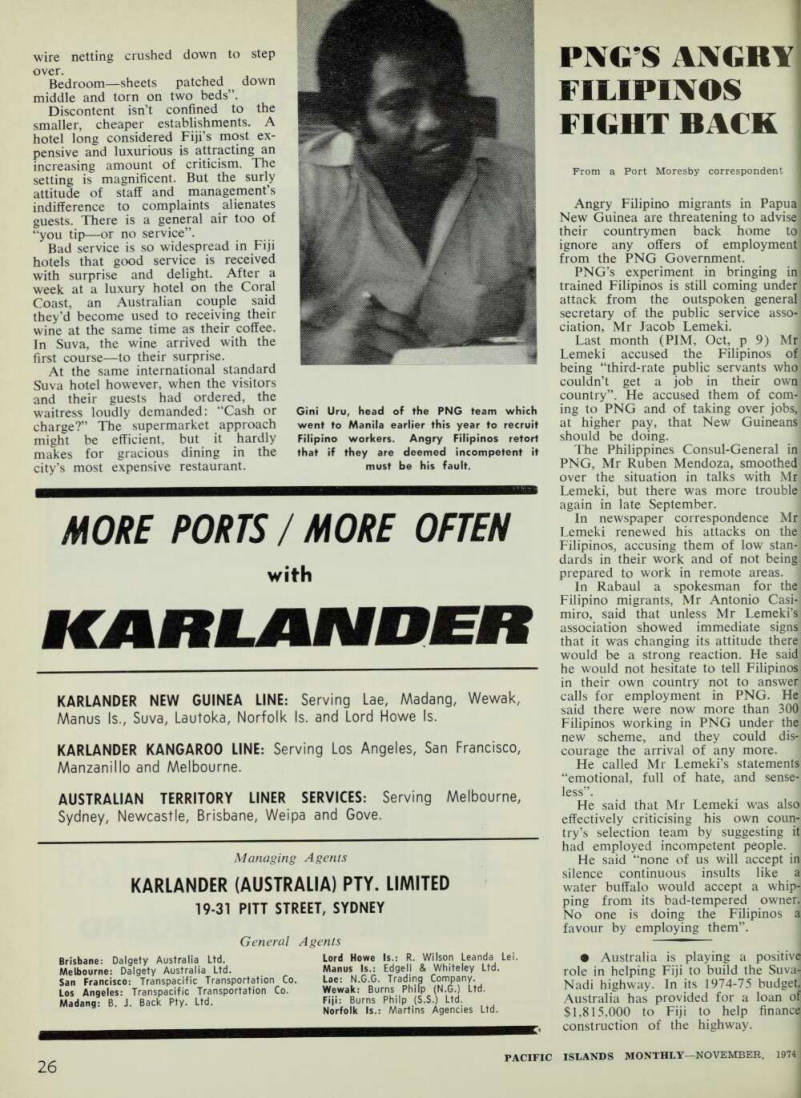
face of Friendly Fiji
From SUE WENDT in Suva Tourism in Fiji isn’t the flourishing healthy plant it used to be. The in cipient rot has corroded quite sign nificantly the traditional “friendly Fiji” image. (It’s certainly time for a new image!) Fiji Visitors Bureau offices, the Consumer Council and the Depart ment of Communications, Works and Tourism all have fat files of com plaints from angry visitors with grievances to air.
Causes range from undelivered souvenirs to over-charging by dud free dealers, from surliness of staff to cockroaches in the food.
An irate Auckland woman in Sep tember demonstrated a new weapon in the fight against what she con sidered unfair dealing. She picketed a Suva duty free shop and after at tracting the Press, the police and an interested crowd, she succeeded in getting her money back.
Mrs Renata Stempher contended that the duty free dealer quoted her a price of $175 for a stereo set. But when she gave the shopkeeper $2OO in New Zealand travellers’ cheques (5F224) she received only $23 change instead of $49.
The shopkeeper said he quoted the price in New Zealand currency, but Mrs Stempher said she understood he quoted Fiji currency.
Although the manager declared at first that a sale was a sale, after Mrs Stempher stood outside the shop tell ing would-be customers of her ex perience, he finally agreed to the re turn of the set.
The “persuasion” can only be blufl or veiled threats, for the FVB and the Consumer Council have no legal authority to enforce a settlement. The police, too, keep out of it if it’s a straightforward argument between tourist and shopkeeper over prices Shop around! is the obvious message Price isn’t the only complaint Numerous letters tell of obsolete goods being substituted for new, dur ing packing. Other goods are paid for, but not delivered.
Complaints against duty free dealers are numerous, but if it’s simply a case of a tourist buying in one shop and finding he could have
jought the goods elsewhere for less, here’s little the Fiji Visitors Bureau >r any other agency can do.
The bureau’s policy is to try to latisfy the customer. In this respect, aid an FVB spokesman, “it is often lelpful to persuade the merchant that n the interests of good publicity >verseas, the complaining customer hould be satisfied even if it does put hem out of pocket for a few dollars.”
In the case of duty free dealers, it s often a matter of the unscrupulous ew blackening the name of the whole ndustry. As the Consumer Council loints out: “We are very much aware if the customer who behaves rudely; he people who use dishonest tactics nd take up shopkeepers’ time when hey have no intention of buying; of he bouncing cheques . . .”
And over recent years, it hasn’t Iways been true that taxi drivers ave charged unrealistic, inflated rices, as is often believed. In follow ig up these complaints last year the Consumer Council discovered that the overnment-published schedule being uoted in some tourist publications r as 20 years old! Obviously, taxi rivers were not following it or dis laying it. Taxi meters—to be intro uced soon—will solve that problem.
Of major concern are the street )uts. Under the heading “Sword filing Touts”, a local travel agent rote of numerous complaints re vived concerning the “tactics and lanners of the numerous touts selling )-cal!ed Fijian swords on Suva reels”.
“Their favourite approach is to irround in twos, threes or fours, derly tourists or young women tour ts and then almost belligerently Ter to carve the person’s name on ie sword at a cost ranging from The agent cited cases where young omen have been in tears after this pe of approach and one elderly mple terrified by the whole incident.
“Such standover tactics, with be ildered visitors surrounded by big, irly, in most cases unshaven, dirty agleted Fijian males, conveys an dremely bad impression of Fijian
)spitality and friendliness”, the
;ent declared.
A visitor wrote describing one of iva’s less expensive guest houses: “Meals—no choice; waitress didn’t eak or understand much English.
Dinner—poor soup, meat, one een veg, 1 potato.
Breakfast—poor tea (bad taste), ied egg and bacon badly cooked id greasy, boiled egg put on big ate, no egg cup or spoon.
Pool—not usable—dirty sur undings—bad access to pool with
wire netting crushed down to step over.
Bedroom —sheets patched down middle and torn on two beds”.
Discontent isn’t confined to the smaller, cheaper establishments. A hotel long considered Fiji’s most ex pensive and luxurious is attracting an increasing amount of criticism. The setting is magnificent. But the surly attitude of staff and management’s indifference to complaints alienates guests. There is a general air too of “you tip—or no service”.
Bad service is so widespread in Fiji hotels that good service is received with surprise and delight. After a week at a luxury hotel on the Coral Coast, an Australian couple said they’d become used to receiving their wine at the same time as their coffee.
In Suva, the wine arrived with the first course—to their surprise.
At the same international standard Suva hotel however, when the visitors and their guests had ordered, the waitress loudly demanded: “Cash or charge?” The supermarket approach might be efficient, but it hardly makes for gracious dining in the city’s most expensive restaurant.
Gini Uru, head of the PNG team which went to Manila earlier this year to recruit Filipino workers. Angry Filipinos retort that if they are deemed incompetent it must be his fault.
Advertisements & other items, pp. 27-28 (2 items)
25
ICIFIC ISLANDS MONTHLY—NOVEMBER, 1974
If it’s worth building,
it’s worth Pyneboard
a * a $ Pyneboard’s great for building kitchen cupboards or rugged industrial storage units.
You can paint it, repaint it —ring the colour changes, always get a smooth finish.
Check —with so many sizes, the ones you want may already be on the shelf!
iiiiii
PYNEBOARD
MARKETED BY CSR BUILDING MATERIALS. EXPORT SALES’
4 O’CONNELL STREET, SYDNEY, 2000, AUSTRALIA
E324EH
MORE PORTS / MORE OFTEN
it A RLAIUOER
KARLANDER NEW GUINEA LINE: Serving Lae, Madang, Wewak, Manus Is., Suva, Lautoka, Norfolk Is. and Lord Howe Is.
KARLANDER KANGAROO LINE: Serving Los Angeles, San Francisco, Manzanillo and Melbourne.
AUSTRALIAN TERRITORY LINER SERVICES: Serving Melbourne,
Sydney, Newcastle, Brisbane, Weipa and Gove.
with
Managing Agents
KARLANDER (AUSTRALIA) PTY. LIMITED
19-31 PITT STREET, SYDNEY
General Agents Brisbane: Dalgety Australia Ltd.
Melbourne: Dalgety Australia Ltd.
San Francisco; Transpacific Transportation Co.
Los Angeles: Transpacific Transportation Co.
Madang; B. J. Back Pty. Ltd.
Lord Howe Is.; R. Wilson Leanda Lei.
Manus Is.: Edgell & Whiteley Ltd.
Lae: N.G.G. Trading Company.
Wewak: Burns Philp (N.G.) Ltd.
Fiji: Burns Philp (S.S.) Ltd.
Norfolk Is.: Martins Agencies Ltd.
Filipinos
Png’S Angry
Fight Back
Prom a Port Moresby correspondent
Angry Filipino migrants in Papua New Guinea are threatening to advise their countrymen back home to ignore any offers of employment from the PNG Government.
PNG’s experiment in bringing in trained Filipinos is still coming under attack from the outspoken general secretary of the public service asso-| ciation, Mr Jacob Lemeki.
Last month (PIM, Oct, p 9) Mr Lemeki accused the Filipinos of being “third-rate public servants who couldn’t get a job in their own country”. He accused them of com ing to PNG and of taking over jobs, at higher pay, that New Guineans should be doing.
The Philippines Consul-General in PNG, Mr Ruben Mendoza, smoothed over the situation in talks with Mr Lemeki, but there was more trouble again in late September.
In newspaper correspondence Mr Lemeki renewed his attacks on the Filipinos, accusing them of low stan dards in their work and of not being prepared to work in remote areas.
In Rabaul a spokesman for the Filipino migrants, Mr Antonio Casi miro, said that unless Mr Lemeki’s association showed immediate signs that it was changing its attitude there would be a strong reaction. He said he would not hesitate to tell Filipinos in their own country not to answer calls for employment in PNG. He said there were now more than 300 Filipinos working in PNG under the new scheme, and they could dis courage the arrival of any more.
He called Mr Lemeki’s statements “emotional, full of hate, and sense less”.
He said that Mr Lemeki was also effectively criticising his own coun try’s selection team by suggesting it had employed incompetent people.
He said “none of us will accept in silence continuous insults like a water buffalo would accept a whip ping from its bad-tempered owner.
No one is doing the Filipinos a favour by employing them”. • Australia is playing a positive role in helping Fiji to build the Suva- Nadi highway. In its 1974-75 budget, Australia has provided for a loan of $1,815,000 to Fiji to help finance construction of the highway.
Brewing Again
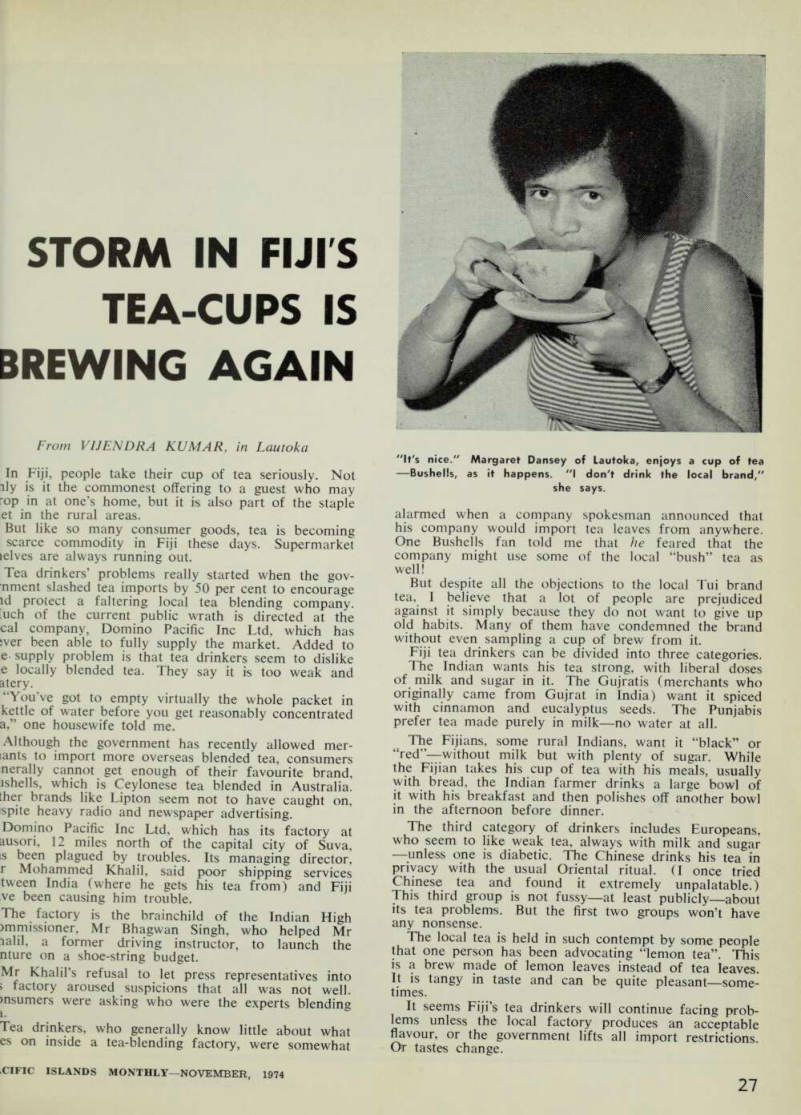
Storm In Fiji's
Tea-Cups Is
From VUENDRA KUMAR, in Lautoka In Fiji, people take their cup of tea seriously. Not ily is it the commonest offering to a guest who may rop in at one’s home, but it is also part of the staple et in the rural areas.
But like so many consumer goods, tea is becoming scarce commodity in Fiji these days. Supermarket lelves are always running out.
Tea drinkers’ problems really started when the gov nment slashed tea imports by 50 per cent to encourage id protect a faltering local tea blending company. :uch of the current public wrath is directed at the cal company, Domino Pacific Inc Ltd, which has wer been able to fully supply the market. Added to e supply problem is that tea drinkers seem to dislike e locally blended tea. They say it is too weak and atery.
“You’ve got to empty virtually the whole packet in kettle of water before you get reasonably concentrated a,” one housewife told me.
Although the government has recently allowed mer tants to import more overseas blended tea, consumers nerally cannot get enough of their favourite brand, ishells, which is Ceylonese tea blended in Australia, ther brands like Lipton seem not to have caught on, spite heavy radio and newspaper advertising.
Domino Pacific Inc Ltd, which has its factory at ausori, 12 miles north of the capital city of Suva, is been plagued by troubles. Its managing director, r Mohammed Khalil, said poor shipping services tween India (where he gets his tea from) and Fiji ve been causing him trouble.
The factory is the brainchild of the Indian High unmissioner, Mr Bhagwan Singh, who helped Mr lalil, a former driving instructor, to launch the nture on a shoe-string budget.
Mr Khalil’s refusal to let press representatives into > factory aroused suspicions that all was not well, msumers were asking who were the experts blending Tea drinkers, who generally know little about what es on inside a tea-blending factory, were somewhat
alarmed when a company spokesman announced that his company would import tea leaves from anywhere.
One Bushells fan told me that he feared that the company might use some of the local “bush” tea as well!
But despite all the objections to the local Tui brand tea, I believe that a lot of people are prejudiced against it simply because they do not want to give up old habits. Many of them have condemned the brand without even sampling a cup of brew from it.
Fiji tea drinkers can be divided into three categories.
The Indian wants his tea strong, with liberal doses of milk and sugar in it. The Gujratis (merchants who originally came from Gujrat in India) want it spiced with cinnamon and eucalyptus seeds. The Punjabis prefer tea made purely in milk—no water at all.
The Fijians, some rural Indians, want it “black” or “red”—without milk but with plenty of sugar. While the Fijian takes his cup of tea with his meals, usually with bread, the Indian farmer drinks a large bowl of it with his breakfast and then polishes off another bowl in the afternoon before dinner.
The third category of drinkers includes Europeans, who seem to like weak tea, always with milk and sugar —unless one is diabetic. The Chinese drinks his tea in privacy with the usual Oriental ritual. (I once tried Chinese tea and found it extremely unpalatable.) This third group is not fussy—at least publicly—about its tea problems. But the first two groups won’t have any nonsense.
The local tea is held in such contempt by some people that one person has been advocating “lemon tea”. This is a brew made of lemon leaves instead of tea leaves.
It is tangy in taste and can be quite pleasant—some times.
It seems Fiji’s tea drinkers will continue facing prob lems unless the local factory produces an acceptable flavour, or the government lifts all import restrictions.
Or tastes change.
"It's nice." Margaret Dansey of Lautoka, enjoys a cup of tea —Bushells, as it happens. "I don't drink the local brand," she says.
Advertisements & other items, pp. 29-30 (2 items)
27
CIFIC ISLANDS MONTHLY—NOVEMBER, 1974
+Parker
i' TT "
' Vv •' v
fa*4ur ?6 &sjrtstsamdty
• '?*« . fs
j&~$CB/ ?£ &-lju*£s
fbrk&r iSoutyttAbK
'a >■• -v *■ >; ••'•■?
i£&w' ■wyihi'Kj ,ai
:.S:^; : x ;•: L/<^.
' ,v: <■■ , Just dial a different angle until the nib position is exactly how you want it.
Your fingers rest in the curved grip of a Parker 75, so you write relaxed.
Fill up from an ink bottle, or load with a special Parker cartridge. It has a 'tap tank' in reserve, for up to 700 more words after you think your ink's run out!
Every Parker 75 passes 792 inspections before you see it. Sterling quality, so it's sterling silver. Or rolled gold, or Vermeil which is 14 ct gold on silver.
+PARKER
.Maker of ihe world'* most wanted pens ' > i ' V >v T--¥- ; vf^ , ■■• ■ ..•■■•■ ■ ■ • • • ...% Ky s - .
V, Wi I
Film Censorship In The
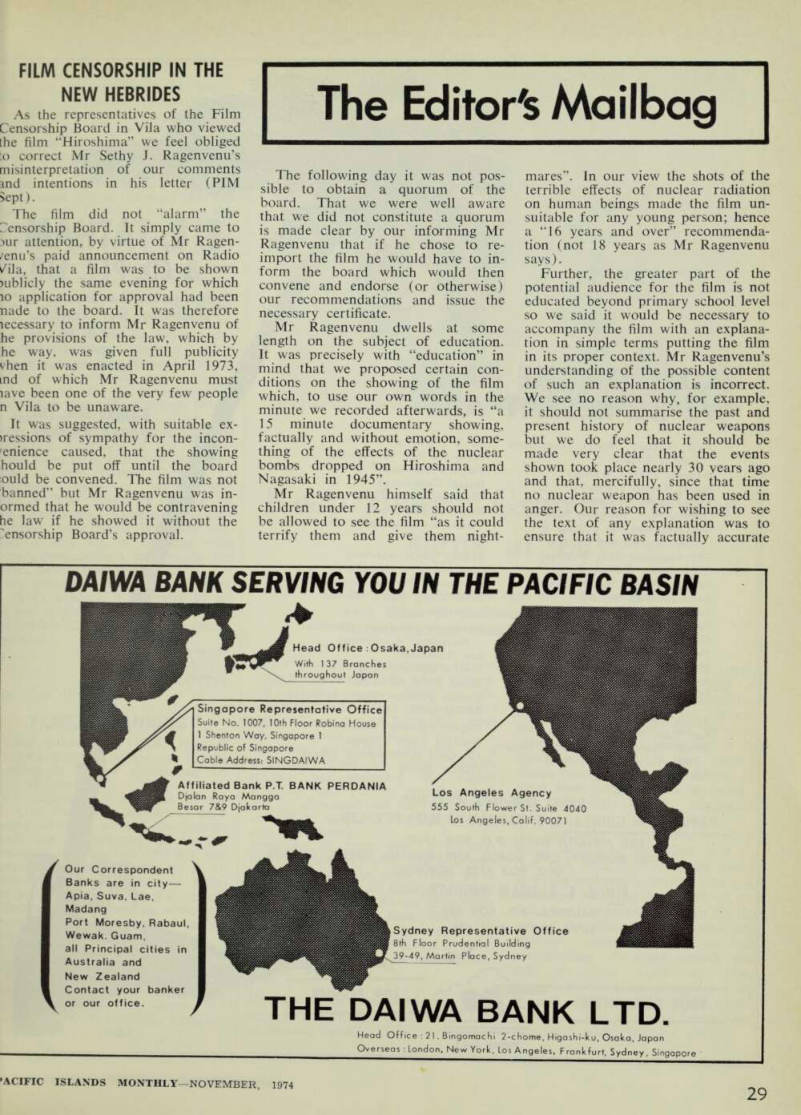
New Hebrides
As the representatives of the Film Censorship Board in Vila who viewed the film “Hiroshima” we feel obliged :o correct Mr Sethy J. Ragenvenu’s misinterpretation of our comments and intentions in his letter (PIM Sept).
The film did not “alarm” the Censorship Board. It simply came to aur attention, by virtue of Mr Ragen /enu’s paid announcement on Radio Vila, that a film was to be shown mblicly the same evening for which 10 application for approval had been nade to the board. It was therefore accessary to inform Mr Ragenvenu of he provisions of the law, which by he way, was given full publicity vhen it was enacted in April 1973, ind of which Mr Ragenvenu must lave been one of the very few people n Vila to be unaware.
It was suggested, with suitable ex >ressions of sympathy for the incon venience caused, that the showing hould be put off until the board ould be convened. The film was not banned” but Mr Ragenvenu was in ormed that he would be contravening he law if he showed it without the Censorship Board’s approval.
The Mailbag
The f o n ow i ng d a y was not pos . sible to obtain a quorum of the board. That we were well aware that we did not constitute a quorum j s made clear by our informing Mr Ragenvenu that if he chose to reimport the film he would have to inform the board which would then convene and endorse (or otherwise) our recommendations and issue the necessary certificate.
Mr Ragenvenu dwells at some length on the subject of education.
It was precisely with “education” in mind that we proposed certain conditions on the showing of the film which, to use our own words in the minute we recorded afterwards, is “a 15 minute documentary showing, factually and without emotion, something of the effects of the nuclear bombs dropped on Hiroshima and Nagasaki in 1945”.
Mr Ragenvenu himself said that children under 12 years should not be allowed to see the film “as it could
terrify them and give them night-
mares”. In our view the shots of the terrible effects of nuclear radiation on human beings made the film un suitable for any young person; hence a “16 years and over” recommenda tion (not 18 years as Mr Ragenvenu says).
Further, the greater part of the potential audience for the film is not educated beyond primary school level so we said it would be necessary to accompany the film with an explana tion in simple terms putting the film in its proper context. Mr Ragenvenu’s understanding of the possible content of such an explanation is incorrect.
We see no reason why, for example, it should not summarise the past and present history of nuclear weapons but we do feel that it should be made very clear that the events shown took place nearly 30 vears ago and that, mercifully, since that time no nuclear weapon has been used in anger. Our reason for wishing to see the text of any explanation was to ensure that it was factually accurate
md as objective and non-emotive as he film itself.
Finally, “no speeches”. Mr Ragen renu is a responsible person and we iccepted his stated reasons for wishing 0 show the film without question.
Jut “speeches” would have converted 1 film-showing into a public meeting Dd such a meeting would be subject 0 the laws governing public order.
We must dispute strongly the alle ation made by Mr Ragenvenu that any film that makes New Hebrideans tiink and start questioning about life nd the world must be examined”.
Tiis is utterly untrue. All films estined for public screening in the few Hebrides are subject to censor lip. Many have been made subject > restrictions on age, most often be mse they contained an unacceptable icasure of sex or violence, and a ;ry few have been banned entirely >r the same reasons.
As far as we are concerned, the tore films that will encourage people 1 the New Hebrides to think, the Jtter. But would Mr Ragenvenu, as ducation Secretary of the Presby rian Church of the New Hebrides, ish to see “Deep Throat” (a itorious American pornographic m) or “The Clockwork Orange” (a m portraying horrible violence) reened freely here? We think not. hat is why we, in common with ery other civilised country in the Drld, have censorship laws.
We consider that, for the benefit PlM’s readers, it is useful to set it the original facts of the matter, id preferable that they be examined jectively.
A. R. Worer,
J. Bonhote,
J. Kalotiti.
la, New Hebrides.
Family Planning
Your publication (PIM, June, p ) contained an article on Family mning in Samoa mentioning Dr uis Heilman.
We consider Dr Heilman of the fice of Population Affairs to be a ding advocate of anti-life policies thin the Department of Health, ucation and Welfare (HEW) and Dress our agreement with Mr A. U. imaono, American Samoa Dele e at Large concerning the “myth” federal family planning volunteer i and mass fertility control experi ntation upon the poor.
Fhe Dept of HEW—Food and ug Administration has removed iPO-Provera from the market, n the months ahead we shall do ' best to expose such abuses.
RANDY ENGEL, Director.
Coalition for Life, [K>rt, Pa.
Advertisements & other items, pp. 31-32 (2 items)
29
•ACIFIC ISLANDS MONTHLY-NOVEMBER, 1974
The Daiwa Bank Ltd
DAI WA BANK SERVING YOU IN THE PACIFIC BASIN Head Office : Osaka,Japan With 137 Branches throughout Japan Singapore Representative Office Suite No. 1007, 10th Floor Robina House 1 Shenton Way, Singapore 1 Republic of Singapore Cable Address: SINGDAIWA Affiliated Bank P.T BANK PERDANIA Djalan Raya Mangga Besar 7&9 Djakarta Our Correspondent Banks are in city— Apia, Suva, Lae, Madang Port Moresby, Rabaul, Wewak. Guam, all Principal cities in Australia and New Zealand Contact your banker or our office. \ Los Angeles Agency 555 South Flower St. Suite 4040 Los Angeles. Calif. 90071 Sydney Representative Office 8th Floor Prudential Building 39-49, Martin Place, Sydney
Head Office ; 21. Bingomachi 2-chome, Higashi-ku, Osaka, Japan 'erseas : London. New York, Los Angeles, Frankfort, Sydney, Singapore
SOME OF THE
WE REPRESENT
Asia Rubber Works (Singapore Rubber Shoes) Frappier (French Brandy) Huvet (French Brandy) Indika (Belgium Dairy Produce) Durobor S.A. (Belgium Glassware) Miroiterie Gen. de Belgiqe S.A. (Louvre glass and mirrors) City Engineers (U.K. Bicycles) F.H.I. Japan (Subaru Cars) Kraggs (Wines, Spirits, Ciders) Sunshine Biscuits Sunrise (Confectionery) Flamenco (Instant Coffee & Tea) Quaker Products (Oats, Jets) Hancocks (Spaghetti, Cereals) Melbourne Canning (Jams) Amatil (Twisties, Twirlies) Edward Zorn (Margarine, Cooking Fats) Allens (Confectionery) Red Tulip (Fine Chocolates) Robert Timms (New Guinea Gold Instant Coffees and Teas) S.P.C (Canned Fruit)
FIRMS
ARE;
S.P.C. (Abalone) Wing Lee (See You Sauce) Magnet (Mattresses) Essteel (Cookware) Warner-Drayton (Fans) Mitchell's (Abrasives) Tilbury & Lewis (Sports Trophies & Silverplate) Regent (Swiss watches) Lega Marcasite (Jewellery) Austramax (Pressure Lanterns) Lawn Chair; Tubco (Garden Furniture) Electronic Industries (Electrical Household Appliances) Jex (Steelwool) Arnbro (Folding Beds) James Miller (Blankets) Elmaco (Plastics —Electrical Fittings) B.X. (Plastics) Stegbar (Wooden Louvres) Franklite (Light Fittings) JJ. Cash (Embroidered Labels) Disston (Saws)
S. E. TATHAM
& CO. PTY. LTD.
ASKEW HOUSE, 364 LONSDALE ST.,
MELBOURNE, 3001, AUSTRALIA.
G.P.O. BOX 8—
CABLES "SET",
TELEPHONE: 601125
BUYERS FOR THE
PACIFIC ISLANDS
DIRECT ENQUIRIES WELCOMED
PAPUA NEW GUINEA: S. E. TATHAM (P.N.G.) PTY. LTD.,
LAE: MALAITA STREET (P.O. BOX 1562).
PORT MORESBY: CNR. GOROA AND MUNAHU STREETS, GORDON
(P.O. BOX 6733, BOROKO).
FIJI: S. E. TATHAM (FIJI) LTD.,
LAUTOKA: P.O. BOX 366.
SUVA: G.P.O. BOX 671.
YOUR GUARANTEE
-mmo
1
FOR SERVICE
T. 2
SINCE 1924
signs at bay
Keep those 44 "Growing Older” signs at bay
The one possession that no woman would ever think of exchanging is the gift of a smooth flawless complexion.
Vet it is surprising that some women virtually surrender this prize possessmn as they grow older, in the mistaken belief that the outward signs of age are an inevitable result of the ageing process.
However, with the discovery of a tropically moist oil blend, modern science has provided the means whereby flaky patches and fine lines can be alleviated and the complexion assisted to retain its youthful softness and smoothness.
Everyone is born with a smooth, flawless baby-soft skin which is suspTemiful s o up B ply of Tatural and moisture (sebum). As we grow older the body processes slow down, the glands do not produce sufficient fluids, and unless special care is taken the skin will deteriorate and wrinkle dryness will result. .
Restore Skin Radiance How to restore that ‘baby’ bloom and counteract ageing skin? The answer
—use this moist oil blend to supple ment the diminishing supply of nat ural fluids and restore smoothness and radiance to the skin Kllown
- Tti * .J
re . as °il of Ulan, the moist oil , ,s 'hcntical in structure to the s^in s se ' 3Um an d is thus able to rnerge readily with it and achieve the ideal l eve l necessary to maintain a soft, naturally fresh complexion beauty.
An inevitable film of this moist oil blend should be smoothed over the face and neck each morning before fffl* ma^ U , p t 0 e “ ure ' hat y° ur sWI f ta Y ma^ t » anc * to Pro tect. our com P^ exion through the day a § ain st the effects of the weather and a rtificial elements such as air conditioning. At night smooth your Oil of Ulan moist oil blend generously into the complexion for it will then exert its remarkable smoothing and softening influence on your skin while you are asleep.
Advertisements & other items, pp. 33-35 (2 items)
31
CIFIC ISLANDS MONTHLY—NOVEMBER, 1974
Brought Many
4 T
CAREER SHE
A HOUSE DOWN.
On October 26th 1972 Hurricane Bebe struck Fiji. Huge areas were completely devastated. Houses were flattened, roofs were ripped off.
It was during this storm that a partially completed Harveytile roof met and weathered what was the toughest test any roof is likely to meet.
It took the full brunt of this ferocious storm without losing so much as one tile. Nor did days of driving torrential rain cause the roof to leak.
The larger, longer tiles of Harveytile
mean fewer joints. Thus providing complete weather protection for a lifetime and then some.
Harveytile roofs began with violent
volcanic upheavals where rocks were born. The ceaseless march of ancient
glaciers, ground and splintered the rock
into particles which rivers then carried to line their banks.
It is these very same particles that form the protective surfacing of Harveytile roofs. Quarried stone silica and natural river pebble chips are selected from locations around New Zealand.
Harveytile roofs offer you eight beautiful roofing colours. Natural colours that are as old as the hills.
As Bebe demonstrated, even a hurricane can't budge the tiles of a roof that was a million years in the making.
Harveytile. Riverstone roofs.
The roof that's a million years in the
making.
Harveytile
Riverstone Roofs
Please send me your free Harveytile Brochure that will show me, in colour, the full range of textures available.
mim—ssSi
Company Limited
Name
I Address
Please send to: Harvey Tile Company Ltd. 40 Mt. Wellington Highway, P.O. Box 62-019 Auckland, New Zealand.
HAWAII
Kamaaina Roofing, Inc., 91-430, Komohana St, Ewa Beach, Oahu, Hawaii 96706.
Hilo-Pacific Roofing Co. Ltd., 23, Pohaku St, Hilo, Hawai 96720.
NEW CALEDONIA
New Zealand Overseas Trading Corp. Ltd., B.P. 4127, Noumea.
PAPUA NEW
GUINEA
A.C.I. (New Guinea) Pty. Ltd.
P.O. Box 613, Lae.
NORFOLK
ISLAND
Irvine's Building Supply Centre, Box 117, lsland.
WESTERN
SAMOA
H. & ). Retzlaff., P.O. Box 195, Apia, Western Samoa.
Fin A.C.I. - Harvey (South Pacific) Ltd., P.O. Box 1095.
Suva, Fiji.
TAHITI
Ets. Sin Tung Hing., B.P. 1605, Fare-Ute, Papeete, Tahiti.
The Tradewinds Convention Centre in Fiji that weathered the full force of Hurricane Bebe, without losing a tile.
Become a part of PIM’s Pacific and subscribe now % V as & o rt Oh O O T5 s o co bO 0 C OJ Oh Oh o j o CO Oh 0> o /'/// m /Ac details on the attached order form.
Its Stand Or Deliver
In Western Samoa
From FELISE VA’A in Apia
When is a midwife a midwife?
This appears to be one of those
ridiculous philosophical prob
lems, yet it is the definition of midwife that is behind the current unrest among the nurses of Western Samoa.
This unrest led to a limited strike by the nurses early August resulting in a fairly large proportion of dis comfort on the part of the Health Department—but luckily it was not a catastrophe.
The trouble began when the Nurs ing Board of Western Samoa earlier this year started to implement the provisions of nursing legislation, approximately five years after the passing of the legislation. It provides for the registration of all nurses in Western Samoa in the three special ised areas of general nursing, mater nity and midwifery.
For those nurses who qualified at the local School of Nursing, registra tion in general nursing and maternity was a comparatively simple matter.
But not so in the case of midwifery registration. The Nursing Board was of the opinion that locally qualified nurses could not register as midwives because they could not in fact qualify.
Is a midwife someone who (1) has learned the elements of midwifery during a general course on nursing or (2) has spent many years of nursing service performing duties generally recognised as midwifery ones?
If she is, then the Western Samoa Registered Nurses Association, which represents nurses, nursing aids and trainees, is right. Local nurses do qualify to be called midwives and, therefore, to be registered.
But if the definition means a mid wife is (1) someone who has attended a recognised school for mid wives or (2) someone who has learned more than the elements of midwifery, then according to that definition, the Nursing Board of Western Samoa is right. For there is no recognised midwifery school in Western Samoa and by expert opinion midwifery is much more complicated than many nurses think.
Anyway, when this problem arose earlier this year the Nurses Asso ciation agreed with a heavy heart to forget its own interpretation, provided the Nursing Board established a mid wifery school for local nurses.
The board was given three months to do this, and if it failed to do it the nurses planned to strike. The board characteristically failed to establish the school. The association instructed all nurses performing mid wifery duties in the Apia General Hospital and in the districts to cease performing those duties—which they did.
And the Health Department was forced to call in for duty all the New Zealand - qualified midwives, about seven of them in Western Samoa. Most of them went on duty in the Apia General Hospital, includ ing the Superintendent of Nursing, Miss Moana Matatumua, who is also a member of the Nursing Board.
Village trained midwives helped out in the districts.
Things returned almost to normal after about three weeks, following a meeting between the association and the Public Service Commission. The nurses agreed to resume midwifery duties—provided the commission re instated two dismissed nurses.
The nurses had been suspended for alleged unethical practices (ie, they permitted practitioners of the Samoan traditional medical art to perform for patients at the hospital). The association pointed out that (1) the World Health Organisation en courages legitimate folk medicine (2) the two nurses were among their leaders in the midwifery registration issue. The two nurses were re instated.
Some individual nurses however have indicated that they will not per form midwifery duties, and this is not the end of the controversy. The Nurses’ Association has indicated that it will continue to pressure the Nurs ing Board to establish a midwifery school in Samoa, to enable local nurses to register in midwifery. It is not satisfied with the board’s latest conciliatory measure, which consists of diplomas in midwifery for local nurses: nothing less than registration will satisfy them. It is now a matter of prestige.
Advertisements & other items, pp. 35-36 (2 items)
33
CIFIC ISLANDS MONTHLY—NOVEMBER, 1974
Singer
Your friends for a lifetime.
Ail over the world, the Singer name stands for the very best in sewing machines. For dependability.
Reliability. The latest in technical innovation. Whatever you sew, see Singer.
Simply the best you can buy.
Singer Model 242 zig-zag sewing machine electrically operated.
Singer Model 179N1, traditional treadle-operated machine. % ■m m Singer Model 179N2, hand or electrically operated.
SINGER
congratulates the Government and people of Fij on the Centenary of Cession and the
Fourth Anniversary of Independence.
Polynesia's
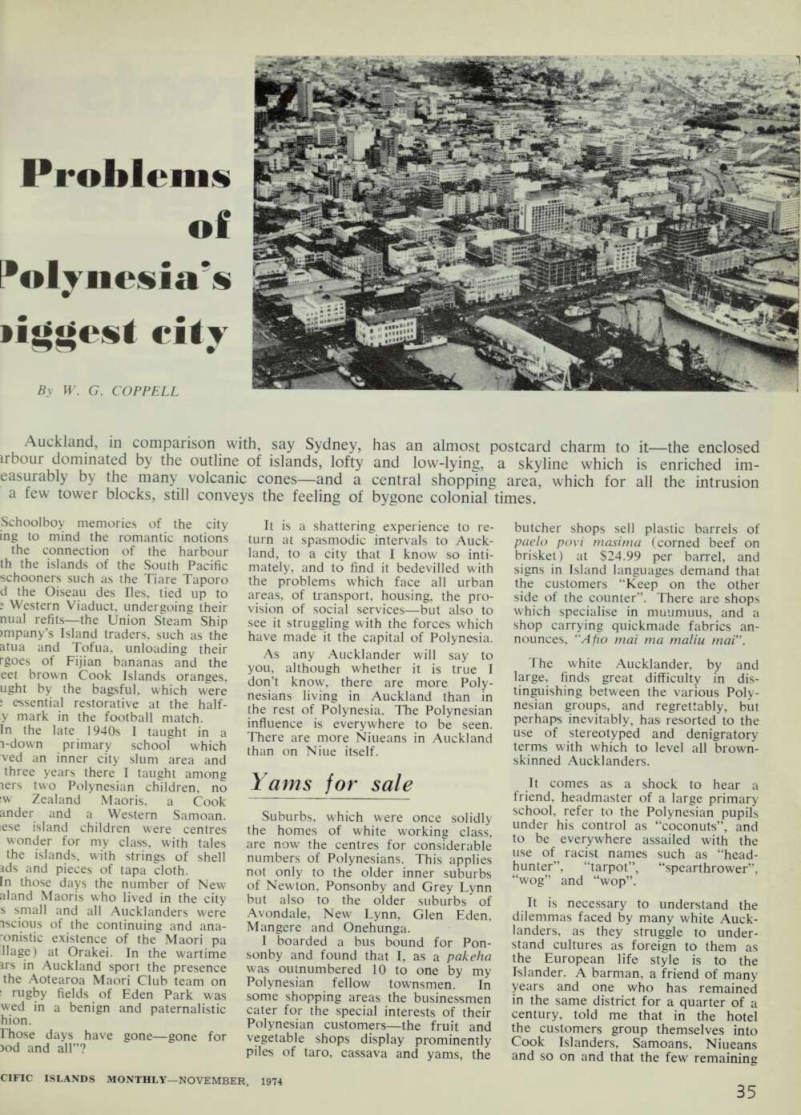


Problems of Polynesia's biggest city
By W. G. Coppell
Auckland, in comparison with, say Sydney, has an almost postcard charm to it—the enclosed trbour dominated by the outline of islands, lofty and low-lying, a skyline which is enriched im easurably by the many volcanic cones—and a central shopping area, which for all the intrusion a few tower blocks, still conveys the feeling of bygone colonial times.
Schoolboy memories of the city ing to mind the romantic notions the connection of the harbour th the islands of the South Pacific schooners such as the Tiare Taporo d the Oiseau des lies, tied up to ; Western Viaduct, undergoing their nual refits—the Union Steam Ship )mpany’s Island traders, such as the atua and Tofua, unloading their rgoes of Fijian bananas and the eet brown Cook Islands oranges, ught by the bagsful, which were ; essential restorative at the half y mark in the football match.
In the late 1940 s I taught in a i-down primary school which ved an inner city slum area and three years there I taught among icrs two Polynesian children, no ;w Zealand Maoris, a Cook ander and a Western Samoan, ese island children were centres wonder for my class, with tales the islands, with strings of shell ads and pieces of tapa cloth.
In those days the number of New aland Maoris who lived in the city s small and all Aucklanders were ascious of the continuing and ana onistic existence of the Maori pa llage) at Orakei. In the wartime ars in Auckland sport the presence the Aotearoa Maori Club team on • rugby fields of Eden Park was wed in a benign and paternalistic hion.
Fhose days have gone—gone for aod and all”?
It is a shattering experience to re turn at spasmodic intervals to Auck land, to a city that I know so inti mately, and to find it bedevilled with the problems which face all urban areas, of transport, housing, the pro vision of social services—but also to see it struggling with the forces which have made it the capital of Polynesia.
As any Aucklander will say to you, although whether it is true I don’t know, there are more Poly nesians living in Auckland than in the rest of Polynesia. The Polynesian influence is everywhere to be seen.
There are more Niueans in Auckland than on Niue itself.
Yams for sale
Suburbs, which were once solidly the homes of white working class, are now the centres for considerable numbers of Polynesians. This applies not only to the older inner suburbs of Newton, Ponsonby and Grey Lynn but also to the older suburbs of Avondale, New Lynn, Glen Eden.
Mangere and Onehunga.
I boarded a bus bound for Pon sonby and found that I, as a pakeha was outnumbered 10 to one by my Polynesian fellow townsmen. In some shopping areas the businessmen cater for the special interests of their Polynesian customers—the fruit and vegetable shops display prominently piles of taro, cassava and yams, the
butcher shops sell plastic barrels of paelo povi masima (corned beef on brisket) at 524.99 per barrel, and signs in Island languages demand that the customers “Keep on the other side of the counter”. There are shops which specialise in muumuus, and a shop carrying quickmade fabrics an nounces, “Afio mai ma maliu mai”.
The white Aucklander, by and large, finds great difficulty in dis tinguishing between the various Poly nesian groups, and regrettably, but perhaps inevitably, has resorted to the use of stereotyped and denigratory terms with which to level all brown skinned Aucklanders.
It comes as a shock to hear a friend, headmaster of a large primary school, refer to the Polynesian pupils under his control as “coconuts”, and to be everywhere assailed with the use of racist names such as “head hunter”, “tarpot”, “spearthrower”, “wog” and “wop”.
It is necessary to understand the dilemmas faced by many white Auck landers, as they struggle to under stand cultures as foreign to them as the European life style is to the Islander. A barman, a friend of many years and one who has remained in the same district for a quarter of a century, told me that in the hotel the customers group themselves into Cook Islanders, Samoans, Niueans and so on and that the few remaining
hite patrons have retreated to a >rner of the saloon bar.
However, Auckland is in the >sition now that its way of life is tally dependent upon the Poly ;sian. Step aboard any bus and the lances are 10 to one that the driver ill be brown-skinned; in the laun ies and clothing factories Islands 3men represent by far the largest irt of the work-force. I have a iend who was matron of a hospital the South Seas, and now a matron a large Auckland hospital, who mits that if the Island women who rry out the duties of cleaners, iindry workers and many of the un illed tasks about the wards were go, her hospital would cease to riction.
In the present economic environ mt the Islander is fortunate in ickland, there has been no unem 3yment in the city throughout 1974, man reporting himself as out of a ) in the morning is suitably placed afternoon. For the sake of the my Islands people, whose stake in :w Zealand is slight, it must be ped that unemployment will not :ome a blight upon them.
Many attempts are being made to d ways of fitting the Polynesian 3ple into Auckland in as sympa tic and understanding way as is ssible. The Auckland regional hority is currently examining sites, ere a combined Islands mare (meet place) will be established, with arge meeting hall and with Island
style houses grouped about the grounds. The government is making provision for some rented State houses to be reserved for Island families and young Islanders are receiving apprenticeship training in the skilled trades social nroblems inere L are social problems
Tdentity and
of cultural hn y ks "" preSerVa,lOn The Pacific Islanders’ Church in Edinburgh Street, Newton, is a prime example of the approach of voluntary organisations to the problems faced by he Js land «; T . h e Rev R. L Challis, together with ministers from the Cook
Islands, Western Samoa and Niue, direct the activities of a very large and diverse congregation. , „ , . , ,„ . , ln all there are ei B ht full-time ministers, and on a Sunday 21 ser vices are conducted m the city and at Glen Eden ’ Te Atatu, Manurewa, nriph]in „„ „ nH AvrmHak a thrm sand children attend the Sunday school and up to 1400 people majr p tcel ?. d **J®. A' oC i!°o servlce in Engllsh at Edinburgh Street.
The church is involved in activities typical of its work in the Islands; there are youth clubs, boys brigade, girls brigade, clubs for the middle-
»ed and the lay preachers’ class, he church devotes much of its time ) choir practices, and in the foyer e trophies won by the Sunday hool choirs. Sporting activities are so sponsored by the church and it is teams which compete in cricket id basketball, but it has decided, >r rather obvious reasons, that it ill not sponsor rugby league or igby union teams. The needs of the lands children in the local schools e met in some small degree by the inisters taking part in Bible classes 1 a once weekly basis.
The police, on the other hand see e problems from an entirely dif rent point of view.
Thev are basically concerned to en re that the Islanders keep out of aiible and when trouble occurs that is dealt with judiciously and fairly, lere is a task force of police which charged with dealing with affrays
volving Polynesians.
linor crimes
Interestingly enough, a senior police ficer told me that experience has own that much of the trouble lich occurs is not between rival ands groups, but more frequently solves members of the same family. 2 also said that many of the anders who come under the notice the police do so for minor in ictions, which often take place be use of ignorance of standards of haviour acceptable in Auckland.
The police are now more concerned establishing a preventative role and 2 so-called “J-Teams” (for Joint ams) have been created for Auck id Central, Henderson and Ota hu. These teams are made up of e member of the police force, a jresentative of the Department ’ of aori and Island Affairs and a
minister of religion. The general philosophy being adopted is that the police members are not on the teams to detect offenders, but to support community workers and convey the police point of view.
To understand, even to some slight extent, what is happening to the burgeoning Polynesian community in Auckland and elsewhere in New Zealand is a task of some magnitude and it is essential that hasty judg ments are not taken. There is great danger in the proposition put forward by a very prominent politician that the solution lies simply in sending the Polynesians back home.
There seems no doubt that the child born of Island parents in New Zea land will become a New Zealander; there is so little to attract him to return to his ancestral home.
A Mangaian said to me that he had felt sad when he had first arrived in Auckland, having left his land, but now he could see so many ad vantages for his children, he had gained so much from his job, and there was so much happening in Auckland, that he didn’t think that he would ever return to Mangaia.
A Rarotongan girl spoke to me in Queen Street and told me in nostalgic terms about her family and friends in Rarotonga but when I asked her if she was going to return home, she thought not as her father had died and would not be able to support her in Rarotonga.
And yet the ties with the Islands are being kept very much alive for many people. Mangere airport must be one of the most crowded airports in the world for its size, and when ever there is a plane leaving from or arriving from Island destinations, the numbers of Island people in the passenger lobby is astounding.
There are more Niueans in Auckland than on Niue. Here Niueans farewell departure of family and friends at Niue's airport.
Advertisements & other items, pp. 37-38 (2 items)
35
CIFIC ISLANDS MONTHLY—NOVEMBER, 1974
Todays roofs
demand
new materials
m s s m * MB w Illustrations depict: Roman Catholic Seminary, Suva.
Pacific Fishing Company, Levuka.
The Fiji Times' Extensions, Suva.
I The General Manager, • Shelter Engineering Limited, I P.O. Box 10-043, I Christchurch, New Zealand.
I Please forward information on
□ BUTYNOL ROOFING MEMBRANE
□ SHELTERLINE & DUNLINE ROOFING
I MEMBRANES
I □ MEMBRANES FORWATER
I MANAGEMENT
■ NAME
I ADDRESS
1 I I I I I
Dunlop Membranes
BUTYNOL- Based on Butyl Rubber
One-ply roofing has far less weight and bulk than built-up systems.
Therefore, the architect gains greater design freedom plus reduced loads on supporting members.
For the owner, certain structural costs are lowered and maintenance problems minimised. The contractor benefits from reduced materials handling, lower shipping costs and a work day with more productive hours.
SHELTERLINE Asbestos backed
DUNLINE Unbacked
Both based on well-proven Hypalon* Synthetic Rubber.
Hurricane Bebe' October 1972 and Cyclone Lottie' December 1973 produced no problems for Dunlop Membranes and Adhesives.
O Dunlop membranes are widely used also for Water
Management- Ponds, Reservoirs, etc.
0
SHELTER
ENGINEERING
LIMITED
A DUNLOP COMPANY
•HYPALON is a registered Du Pont trademark for chlorosulfonated polyethylene synthetic rubber.
Discrimination
Allegation
The likelihood of increased violence in Auckland was dis cussed by an Auckland City council committee in September.
The council’s Senior Community Adviser, Mr P. K. Harwood, said, “We are heading for a violent time in Auckland if things continue the way they are going.”
His comments were made when the committee was dis cussing allegations that the police task force was discriminating against Islanders and New Zea land Maoris. Mr Harwood’s statement followed another he made on August 29 on Pacific Islanders and drink. He main tained that experience through advice bureaux and social ser vices involved in the treatment of alcoholism showed that Pacific Islanders had fewer drink prob lems than the general population.
Advertisements & other items, pp. 39-40 (2 items)
37
CIFIC ISLANDS MONTHLY—NOVEMBER, 1974
Coming Your Way?
500 MILLION
GERMS
CONCENTRATED PEA-6EU
The strong one that cares for your wor The common house fly is a notorious disease carrier. On average it brings in 500 million germs or more into your home. So (t s worth getting rid of fast. Concentrated Pea-Beu contains one of the world s most powerful insecticides so it kills insects in seconds and it's rigidly tested through every stage of manufacture so you can spray it safely with confidence . to protect the health and well-being of your family.
Concentrated Pea-Beu kills flies, mosquitoes, dl disease carrying insects in seccnc
Our business is cargo.
Your cargo: to anywhere in our Pacific.
Two paddle steamers on the Yangtse River in 1873 marked the beginning of the China Navigation Company. Today, the same flag flies above eighteen modern motor ships plying an extensive network of cargo routes between Papua New Guinea and Pacific Island ports (as far East as Tahiti) and |apan, New Zealand, Australia and Thailand.
For 100 years, the flag of the China Navigation Company has meant experience, reliability and speed across the sea. Today, it’s flying as strong as ever.
For further details and all enquiries there are Agents at the following ports: Papua New Guinea: Steamships Trading Co. Ltd., Port Moresby, Samarai, Lae, Madang, Rabaul Kieta. Burns Philp (New Guinea) Ltd., Wewak, Kavieng. Fiji: Morris Hedstrom Ltd., Suva, Lautoka. Western Samoa: Morns Hedstrom Ltd Apia.
Tonga:' Morris Hedstrom Ltd., Nukualofa and Vava’u. Tahiti: Etablissements Donald Tahiti, Papeete. New Caledonia: Etablissements Ballande Noumea. 8.5.1. P.: British Solomons Trading Co. Ltd.. Honiara, New Hebrides: LesComptoirs Francais desNouvelles-Hebrides, Vila and Santa AUSTRALIA—Sydney: Interocean Swire Ptv Ltd. Melbourne: Interocean Australia Services Pty. Ltd. Brisbane: Wills, Gilchrist & Sanderson Pty. Ltd. NEW ZEALAND—?. & O. (N.Z..) Ltd.
Auckland, Wellington, Christchurch, Dunedin, Bluff, Napier. Japan: Swire McKinnon. Tokyo, Yokohama, Osaka, Kobe and Nagoya. Eastern Managers: Butterfield & Swire, 9 Connaught Rd., Central, Hong Kong,
yCN/
JOHN SWIRE & SONS PTY. LTD. General Agents in Australia, 8 Spring Street, Sydney, Phone: 27 9351.
THE CHINA NAVIGATION CO LTD
MEMBER OF THE SWIRE GROUP.
Islanders get
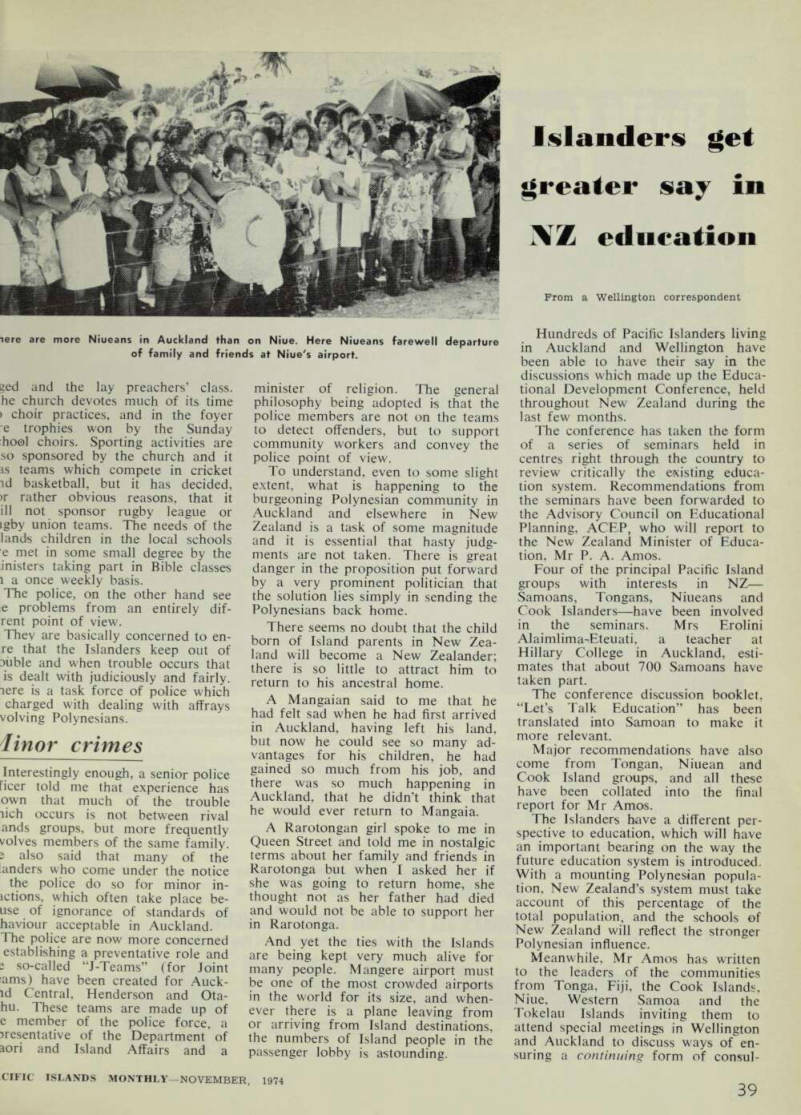

greater say in XZ education
From a Wellington correspondent
Hundreds of Pacific Islanders living in Auckland and Wellington have been able to have their say in the discussions which made up the Educa tional Development Conference, held throughout New Zealand during the last few months.
The conference has taken the form of a series of seminars held in centres right through the country to review critically the existing educa tion system. Recommendations from the seminars have been forwarded to the Advisory Council on Educational Planning, ACEP, who will report to the New Zealand Minister of Educa tion, Mr P. A. Amos.
Four of the principal Pacific Island groups with interests in NZ Samoans, Tongans, Niueans and Cook Islanders—have been involved in the seminars. Mrs Erolini Alaimlima-Eteuati, a teacher at Hillary College in Auckland, esti mates that about 700 Samoans have taken part.
The conference discussion booklet, “Let’s Talk Education” has been translated into Samoan to make it more relevant.
Major recommendations have also come from Tongan, Niuean and Cook Island groups, and all these have been collated into the final report for Mr Amos.
The Islanders have a different per spective to education, which will have an important bearing on the way the future education system is introduced.
With a mounting Polynesian popula tion, New Zealand’s system must take account of this percentage of the total population, and the schools of New Zealand will reflect the stronger Polynesian influence.
Meanwhile, Mr Amos has written to the leaders of the communities from Tonga, Fiji, the Cook Islands, Niue, Western Samoa and the Tokelau Islands inviting them to attend special meetings in Wellington and Auckland to discuss ways of en suring a continuing form of consul
tation between the Island groups and the government.
“It may well prove that an advisory council of some sort could be estab lished to offer this avenue of consul tation,” Mr Amos said.
Such an organisation could con sider a broad range of activities associated with Island people, includ ng resettlement programmes, the de velopment of a truly multi-cultural ;ociety, and educational opportunity.
“I am anxious to get Pacific Is anders thinking and discussing this ype of development. In Auckland, am aware a local group has been stablished involving all Island Kopies, and it may be that a similar Wellington group, and then in turn i similar national group may be ;stablished.
“This would then provide a work ible structure for consultation, and eaction, to and from the government md the broader community,” Mr \mos concluded.
Mr Phil Amos has also made mother announcement of particular ignificance to Pacific Islands children, vho form a large proportion of many lasses in some New Zealand schools, t is planned that refresher courses vill be commenced in Teacher Train ng Colleges for Island teachers, who, ►ecause they do not possess New Zealand teaching qualifications, are at ►resent unable to use their talents in 4ew Zealand schools.
Mr Amos said Polynesian children n NZ would benefit from contact rom teachers of their own race, and vith the enhanced teacher-pupil re ationships a better teaching climate vould result.
An article by lain McDonald in the 4ew Zealand Herald emphasises the ducational plight of Pacific Islands hildren in New Zealand schools. He aid it was “not clear to what extent tie use of another language was a landicap to learning English . . . slanders were less successful than heir European contemporaries in ■nglish and reading. But Islanders id just as well as the Europeans in pelling and arithmetic. The difficulty ►f educating Polynesian children is ncreased by the unwillingness of eachers —mostly Europeans—to work i schools in inner-city suburbs of Auckland where most Polynesians ive. Teacher - pupil relationships ould be marred by a lack of under tanding of cultural differences”. • The population of Niue Island t December 31, 1973, was estimated t 4,142. The figure has declined teadily since 1966, when it was ,194, with emigration to New Zea md as the major cause. The popu ition of the island in 1884 was esti lated at 5,070.
Islanders In Trouble
Tongan and Samoans were involved in two separate assault cases in Auck land recently, and in each case the Samoan was charged. Pai Amituanai, 24, admitted he had struck Tarita Tali with a pocket-knife in the lower abdomen. The court was told a dis agreement developed between the two at a party, and they agreed to fight.
Amituanai stood up to go out and Tali struck him in the face. Ami tuanai then retaliated with the pocket knife. Mr M. L. Morgan, SM, sen
tenced Amituanai to six months’ periodic detention and ordered him to pay $19.50 costs.
In the second case Joseph Bentley, 30, was remanded for a probation report and sentence, after pleading guilty to having assaulted a Tongan with a bottle. It was stated that Bentley and two friends passed a Tongan and insults were exchanged.
Bentley asked the Tongan to explain the insults, and was pushed to the ground. They started fighting, and Bentley smashed a beer bottle over the Tongan’s head.
Advertisements & other items, pp. 41-44 (3 items)
39
CIFIC ISLANDS MONTHLY—NOVEMBER, 1974
People Power:
Caterpillar reliability, productivity, availability.
Now you can get it all in a wheel skidder. The 518.
A whole new standard in skidder engineering. 120 turbocharged horsepower, 17,400 pounds of working muscle with full articulation and frame oscillation for stability and minimum maintenance.
Single lever “on the go” powershift. Dual rate steering for controlled response at all speeds.
An operator’s compartment engineered for efficiency with safety features built in for man and machine.
You’ll find all the best skidder ideas, plus added refinement and top quality manufacturing that can make the 518 the backbone of your logging operation.
And Hastings Peering will ensure that your backbone stays in top condition no matter how far in the bush you are. Parts, maintenance, repairs or simply information —we’ll see that you get it fast. That’s People Power!
So go tackle the jungle with the new Cat 518 and Hastings Deering.
People Power:
25 Years in Papua New Guinea
we work as hard,backing-up a single sale,as we do for a fleet. You can depend on it! ui n
HASTINGS DIERING
E your •*«!
CATERPILLA
DEALER f
Caterpillar. Cali and O are trademark* ot Caterpillar Tractor Company.
Throughout Queensland.
Territory and South-West Pacific.
D pua new guinea
printing co. ply. ltd.
Serving the Country from Aitape to Alotau, Manus to Moresby.
Leaders in Commercial Offset and Letterpress Printing. • Stationery Office Supplies • Office Equipment • Rubber Stamps • Self-Adhesive Labels • In Fact:— Everything For The Office.
P.O. Box 633, Port Moresby P.O. Box 759, Lae P.O. Box 1239, Rabaul
smso
THE NEW LONGER-LIFE
KNIVES THAT HAVE THE EDGE
OVER ALL OTHERS
Swiss design and manufacture
OBTAINABLE
FROM THE
LEADING
BUTCHER
SUPPLIERS
Sole Importers:
PETER FISHER
TRADING PTY. LTD.
321 Pitt Street
SYDNEY
Telephone 26 1109
Every imaginable type of inboard marine engine is sold and serviced by Clae. And if you believe it to be unimaginable—Clae will tailor-make it to suit your needs.
Clae PD 35: 35 HP □ Clae BD 65: 65 HP □ Clae BD 95: 95 HP □ Clae BD 145: 145 HP □ Detroit 3-53: 100 HP □ Detroit 4-53: 140 HP □ Detroit 6V-53: 216 HP □ Detroit 4-71: 165 HP □ Detroit 6-71: 250 HP □ Detroit BV-71: 350 HP □ Detroit 12V-71:525 HP □ Detroit
16V-71; 635 HP □ De-
troit 12V-149: 800 HP □ Detroit 16V-149:1060 HP.
sillllßiillii :
lliiii 18 lii1■ 8 iI. II i 111 l 111888liil 'lB , ’ 8 .'' ' ' I ; • CONTACT: Clae Engine Sales & Service, 31 Hoskins Avenue,
BANKSTOWN, N.S.W. 2200. Phone: 709-4777
Also at Brisbane, Rockhampton, Mackay and Townsville.
41
•ACIFIC ISLANDS MONTHLY- NOVEMBER, 1974
Some second thoughts on public service exodus
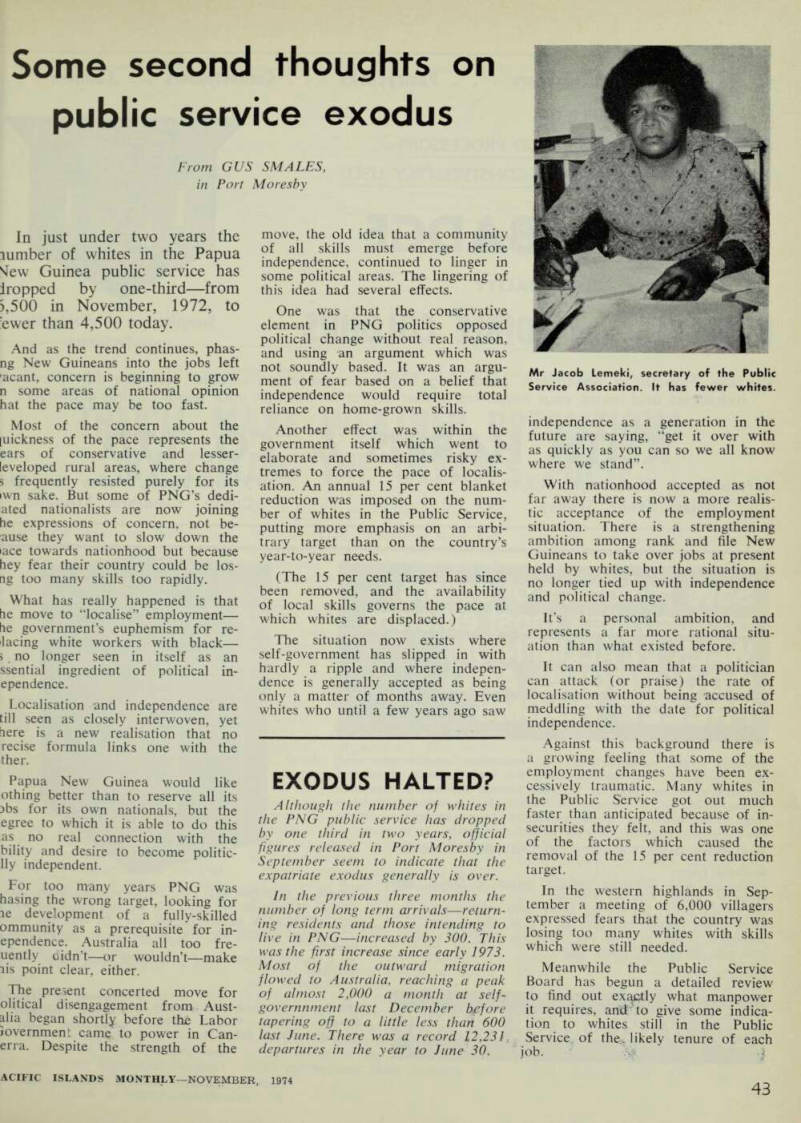
public service exodus
From Gus Smales,
in Port Moresby
In just under two years the lumber of whites in the Papua Sew Guinea public service has
Iropped by one-third—from
3,500 in November, 1972, to
: ewer than 4,500 today.
And as the trend continues, phas ng New Guineans into the jobs left r acant, concern is beginning to grow n some areas of national opinion hat the pace may be too fast.
Most of the concern about the [uickness of the pace represents the ears of conservative and lesser leveloped rural areas, where change s frequently resisted purely for its iwn sake. But some of PNG’s dedi ated nationalists are now joining he expressions of concern, not be ause they want to slow down the •ace towards nationhood but because hey fear their country could be los ng too many skills too rapidly.
What has really happened is that he move to “localise” employment— he government’s euphemism for re lacing white workers with black— » no longer seen in itself as an ssential ingredient of political in ependence.
Localisation and independence are till seen as closely interwoven, yet here is a new realisation that no recise formula links one with the ther.
Papua New Guinea would like othing better than to reserve all its ibs for its own nationals, but the egree to which it is able to do this as no real connection with the bility and desire to become politic lly independent.
For too many years PNG was hasing the wrong target, looking for le development of a fully-skilled ommunity as a prerequisite for in ependence. Australia all too fre uently didn’t—or wouldn’t—make lis point clear, either. pie present concerted move for olitical disengagement from Aust ria began shortly before the Labor jovernment came to power in Can erra. Despite the strength of the
move, the old idea that a community of all skills must emerge before independence, continued to linger in some political areas. The lingering of this idea had several effects.
One was that the conservative element in PNG politics opposed political change without real reason, and using an argument which was not soundly based. It was an argu ment of fear based on a belief that independence would require total reliance on home-grown skills.
Another effect was within the government itself which went to elaborate and sometimes risky ex tremes to force the pace of localis ation. An annual 15 per cent blanket reduction was imposed on the num ber of whites in the Public Service, putting more emphasis on an arbi trary target than on the country’s year-to-year needs. (The 15 per cent target has since been removed, and the availability of local skills governs the pace at which whites are displaced.) The situation now exists where self-government has slipped in with hardly a ripple and where indepen dence is generally accepted as being only a matter of months away. Even whites who until a few years ago saw
independence as a generation in the future are saying, “get it over with as quickly as you can so we all know where we stand”.
With nationhood accepted as not far away there is now a more realis tic acceptance of the employment situation. There is a strengthening ambition among rank and file New Guineans to take over jobs at present held by whites, but the situation is no longer tied up with independence and political change.
It’s a personal ambition, and represents a far more rational situ ation than what existed before.
It can also mean that a politician can attack (or praise) the rate of localisation without being accused of meddling with the date for political independence.
Against this background there is a growing feeling that some of the employment changes have been ex cessively traumatic. Many whites in the Public Service got out much faster than anticipated because of in securities they felt, and this was one of the factors which caused the removal of the 15 per cent reduction target.
In the western highlands in Sep tember a meeting of 6,000 villagers expressed fears that the country was losing too many whites with skills which were still needed.
Meanwhile the Public Service Board has begun a detailed review to find out exactly what manpower it requires, and to give some indica tion to whites still in the Public Service of the:.-, likely tenure of each job.
Mr Jacob Lemeki, secretary of the Public Service Association. It has fewer whites.
Exodus Halted?
Although the number of whites in the PNG public service has dropped by one third in two years, official figures released in Port Moresby in September seem to indicate that the expatriate exodus generally is over.
In the previous three months the number of long term arrivals—return ing residents and those intending to live in PNG—increased by 300. This was the first increase since early 1973.
Most of the outward migration flowed to Australia, reaching a peak of almost 2,000 a month at self governnment last December before tapering off to a little less than 600 last June. There was a record 12,23 i, departures in the year to June 30.
Advertisements & other items, pp. 45-49 (5 items)
43
ACIFIC ISLANDS MONTHLY—NOVEMBER, 1974
Gold Badge
• To Islands Cordial-makers . . . Pastrycooks . . . Confectioners . . .Canners
FOLLOW THE EXAMPLE OF
AUSTRALIA'S LEADING FOOD PROCESSORS
WHO FOR 30 YEARS HAVE CONSISTENTLY USED
GOLD BADGE
FINE QUALITY
ESSENCES and EDIBLE COLOURS
We are Flavouring Specialists producing highly concentrated soluble essences for the food industries and invite your enquiries, either direct or through your usual buying channels.
KEITH HARRIS & CO. LTD.
BA B 1 Samples are available for manufacturers Sefton Road, Thornleigh, N.S.W.
Cables: Kehar, Sydney 1015 Ann Street, Valley N.l, Qld.
Cables: Keharbris, Brisbane
Save hundreds of dollars
on Australia’s most efficient
WALK IN, ALUMINIUM
COOLROOMS AND
FREEZE ROOMS
Hundreds already installed! The most economical supplementary coolrooms for bottles and food, providing the largest storage capacity of any comparable coolrooms of the same exterior dimensions. Five sizes —from 90-360 cu. ft. capacity; 16 models offering normal temp., two temp., deep freeze, or for pastry and ice storage applications. White vinyl interior, embossed rustproof aluminium exterior. • SUPPLIED IN EASY-TO-ERECT, DO-IT-YOURSELF KIT FORM.
Available from: AUSTRALIAN NEW CALEDONIA EXPORTS (SILVER & BARDA), 363 George St., Sydney, 2000 and Branches.
BRECKWOLDT & CO., 276 Pitt St., Sydney, 2000 and Branches.
PETER FISHER TRADING PTY. LTD., 321 Pitt St., Sydney, 2000.
HAGEMEYER (A'SIA), 59 Anzac Pde., Kensington, 2033 and Branches.
KERR BROS, 65 York St., Sydney, 2000.
Manufactured by:
NELSON & ROBERTSON PTY. LTD., 197 Clarence St., Sydney, 2000.
RABAUL TRADING CO. PTY. LTD., P.O. Box 219, Rabaul and Branches.
ROY GALLIMORE & ASSOCIATES, P.O. Box 179, Vila, New Hebrides.
C. SULLIVAN (EXPORT) PTY. LTD., 60 Margaret St., Sydney, 2000 and Branches.
W. S. TAIT & CO, PTY, LTD., 31 Macquarie Place, Sydney, 2000 and Branches.
WARBURTON FRANK!
199 Parramatta Road, Cnr. Skarratt Street, Auburn, N.S.W. 2144, Australia. Phone 648-1711.
Powered by Kelvlnator.
Five-year warranty on compressor. Early delivery.
Sts3T #
THEY'LL MAKE WEATHER PREDICTIONS
BY FEELING THE OCEAN'S PULSE
From GARY MEYERS, in Honolulu
Since the days of the earliest :plorers, the major ocean currents ive been observed by navigators id oceanographers. The average irrents can be reliably charted be use there is now a vast amount of ita available, but a major problem to discover how the currents vary am month to month and from year year.
The oceans are large, so for a par ular month of a particular year 2 observations are so few and so dely separated that very little can said about the general circulation, id, since the cost of sending ships er the entire ocean each month is ahibitive, no solution to the prob n seems imminent.
Knowledge of the changes in the rrent systems is needed to make ig-range predictions of the weather d of draughts over the continents.
Led by Professor Klaus Wyrtki, a mp of oceanographers at the Uni rsity of Hawaii is presently work ; on this problem. They are estab ling a network of sea level morn ing stations on a number of cific Islands. This network will ow continuous observation of the :ific Ocean’s equatorial current tern. shown on the accompanying map the major Pacific Ocean currents, te that three great currents flow oss the Pacific. Between the lati es of Tahiti and Hawaii, the rth and South Equatorial Currents
flow westward. Separating these two broad currents is the narrower Equatorial Countercurrent which flows eastward.
You will see that the Counter current is not symmetric about the equator. It flows principally in the region which mariners have called the doldrums. As PIM readers well know, the doldrums is not a region where strong winds are unknown, but by comparison the winds are relatively weak there, especially during certain seasons of the year.
Why do the currents flow in this particular configuration? The North and South Equatorial Currents are driven westward by the Trade Winds of the two hemispheres, causing the ocean water to pile up on the western side of the Pacific, The Counter current is the return flow eastward down the path of least resistance, ie, the doldrums.
Ocean currents at any one instant are turbulent flows. The water moves in great eddies and swirls, rather than along smooth trajectories as the arrows on the map might suggest.
This means that if someone started floating in the North Equatorial Current at Johnston Island he would not necessarily end up near the Philippines. The arrows represent the average flow over an area a few hundred miles on each side and over a period of about a month.
The islands of the Pacific are scat tered across these three currents, and
many of them are in geographical positions especially suitable for moni toring the currents with sea level gauges Only one is vitally missing Dr Wyrtki has often stood at the map with his finger on a spot about half way between Christmas and Hawaii and said, “What we really need is an island right here] ” His comment generally draws a laugh because no island is there, but if it were there it would be located near the boundary between the North Equatorial Cur rent and the Countercurrent, an ideal location for a gauge.
Fortunately, many other islands are located in the right places In Professor Wyrtki’s network existing sea level stations run by a variety of agencies were incorporated at the start. The PNG Department of Pub lie Works agreed to provide data from Rabaul the BSIP Marine De partment, data from Honiara- and the French Office de la Recherche
Scientifique, Z 1 from Noumea
Observations at Suva will be avail able from the Fi ‘n Marine Depart ment, and at Papeete and Rikitea “ s s
STS3T
How the currents flow. For an explanation of abbreviations, see text.
•cean Survey will make available leir records from Honolulu, Johns >n, Midway, Wake, Kwajalein, luam, Pago Pago, Canton and Truk.
These existing stations are shown / dots on the map.
But, we have not been able to cate all the gauges operating in , e Pacific. If any PIM reader knows a gauge which is operating but )es not appear on the map, this formation would be greatly appre ated at the Department of Oceano aphy, University of Hawaii.
In the future the number of ations in the existing network will i approximately doubled by the in allation of new gauges. This work is already begun: since the first of e year, new gauges have been stalled at Christmas, Ponape, ajuro, Nauru, Tarawa, and French igate Shoals. The many agencies d' individuals on the islands who ovided valuable assistance are ich appreciated. The new and ture stations are shown by circles the map.
Within the next two months, uversity personnel will be travel 's to Palau, Yap, Fanning, and uapagos to install new gauges on ;se islands.
Some of the islands indicated by cles are uninhabited and will re ire the installation of a remote device. Dr Martin tousek of the Hawaii Institute of ophysics is developing the elec mcs equipment. Signals from the note stations will be received at nning Island. The first transmitting it has just begun operating at vis. [t may not be obvious to every i why sea level is related to cur its. Most people are perhaps not mliar with Coriolis force, a force perceptible to human senses, which ises any body moving over the th to be deflected from a straight h. Coriolis force is caused by the th’s rotation and is directed at
right angles to the direction of motion.
Because of it, the surface of an ocean current flowing westward, for example, slopes upward toward the north when the current is in the northern hemisphere. Though it’s a surprise to some, the sea surface would not be flat even if all the waves were removed!
We can further our understanding of ocean currents by considering a j ll * l * r Human senses can detect centrifugal force, which affects the surface level of a moving fluid as Coriolis force does. lo feel centrifugal force, tie a weight to a string and whirl it around y° ur k ea , P OI L Ihe string is centrifugal force. Everyone is
familiar with the surface slope of a stirred cup of tea. The slope is caused by centrifugal force piling the tea up against the side of the cup.
Also, the faster the tea is stirred, the greater the slope. In a similar way, because of Coriolis force, the faster an ocean current flows over the rotat ing earth, the greater the sea surface slope across the current.
By measuring the fluctuations in the slope across the three equatorial currents, Professor Wyrtki and his fellow oceanographers will monitor the strength of the currents from month to month.
From the measurements, they hope to make these long range predictions that will be of benefit to all who five in the Pacific.
45
CIFIC ISLANDS MONTHLY—NOVEMBER, 1974
Gboo
r
GOODfYEAR
G 8
CROSS PLY TYRE
G 8 offers you improved wet-
skid protection smoother
handling and quieter softer
ride. Three choices:
G 8 Custom G 8
Super Cushion G 8
m m M m w
GOODfVEAR
GBOO
RADIAL PLY TYRE
You get extra tyre toughness,
longer tread life and more
fuel economy from Goodyear
GBOO, Custom GBOO Rib or
GBOO Grand Prix.
Boroko Motors Ltd.
P.O. Box 1259 Boroko, Port Moresby
Papua, NEW GUINEA
Solomon Motors Ltd.
P.O. Box 20, Mendana Avenue. Honiara Guadalcanal, SOLOMON ISLANDS Societe Generale d'Automobiles B.P. 554 Noumea
NEW CALEDONIA
Coral Island Traders P.O. Box 296 Suva
FIJI
Guam Tire & Supply Co.
P.O. Box 1486 Agana
GUAM
SOHECO
B.P. 208 Port Vila
NEW HEBRIDES
Morris Hedslrom Ltd.
Apia
WESTERN SAMOA
Haleck Service Center P.O. Box 1138 Pago Pago
AMERICAN SAMOA 96920
Service Mobil B.P. 306 Papeete
TAHITI
Santo Engineers Santo
NEW HEBRIDES
Morris Hedstrom Ltd.
Nukualofa
TONGA
Q 640 ■N
Candid Politics
The Atoll Pioneer, Gilbert and Ellice Islands, reports the following incident during a House of Assembly debate: “The member from Nanumea decided he had had enough of the Ministers, so he stood up at the middle of a speech by another member and he told the Minis ter for Natural Resources that he was not the boss in the meet ing, the Speaker was. When he was interrupted the man from Nanumea sat down and sighed: T’m sorry Sir, I’ve lost my mind’.”
Advertisements & other items, pp. 49-58 (4 items)
47
DIFIC ISLANDS MONTHLY—NOVEMBER, 1974
"Service"
“)qi : 1 % 1 OW' -o
79 Years' Experience
Selling
"SERVICE"
to the Pacific Islands
NELSON & ROBERTSON
PTY. LIMITED
2: o lP (Established 1895)
PLANTATION HOUSE, 197 CLARENCE STREET, SYDNEY
CABLES: "IVAN", SYDNEY, BRISBANE. TELEX; AA22381, SYDNEY.
FOR:
INDENTS
COMMODITIES
SHIPPING
TRAVEL
INSURANCE
REAL ESTATE
Branch Office: Nelson & Robertson Pty. Ltd., 303 Adelaide St., Brisbane, Old.
New Guinea Representatives: Rabaul Trading Co. Pty. Ltd., Rabaul Lae Madang Kieta.
From the
Islands Press
From the Tonga Chronicle:
Wealth doesn't necessarily mean an erosion of a nation's cultural values, according to His Majesty. Addressing the Niuatpuotapu Show, he said that Saudi Arabia's great wealth had not caused a cultural decline. However, His Majesty pointed out that the people of Saudi Arabia prayed five times a day—and perhaps Tongans did not worship enough.
From the Arawa Civic Association Bulletin,
Bougainville:
Personal head tax notices are being delivered throughout the town as a service to the community to advise them of their responsibility to pay.
A Head Tax is $lO per head for male and female adults, but if a person does not receive a tax demand it does not release him from the responsibility to pay ... A collection office will be set up in the supermarket.
From a letter by Amos Kito in the Cook Islands News: At the time of the French Revolution there were women who sat as close as possible to Madame Guillotine waiting for the tumbrels to arrive; they got their greatest moments of ecstasy when they literally saw heads roll. These same women are still with us, even on this fair island. Some still do their knitting and others hold their glass of sherry, gin, beer, lemonade, or cup of tea, coffee or Milo and for the want of anything better to do, they let their tongues wag and set the blade falling. Such tongues are honed to an edge of sharpness greater than the finest of steel.
Great fun, keep it up ladies, there is an inexhaustible supply of heads.
Heading in the Tonga Chronicle on a new commercial bank: “Bank opens with a burst.”
From a letter by Roger Williams in the Atoll Pioneer, GEIC, on supplies for outer islands: The Development Authority spokesman continued the fallacy of a good service (ie an average of two or three ships a month). This figure is most misleading as it is common to get two or three ships in a week and then none for a month. Sometimes two ships call on one day!
Anyway, the number of ships calling is unimportant— what they carry is the main concern.
From the News Bulletin, American Samoa: Radio Station WVUV listeners may have been puzzled Saturday when they heard several minutes of click, click, click of an obviously unattended record.
Did the announcer fall asleep? Was someone late for work? No. The fault lies with the boss.
The entire staff was at the station listening intently to Office of Samoan Information director,
Neal Corbett, who talked a little longer than he intended to. His subject: Plans to improve the programming at WVUV.
From a report in the Cook Islands News: "What 1 said at the airport prior to my departure for the Law of the Sea Conference in Caracas has been misquoted so many times that I would like to replay the tape of my speech for you ALL to hear and perhaps stop people telling stories of what they think I said" [about independence], stated the Premier, Hon Sir Albert Henry, to a large crowd at Ngatangiia Packing Shed. An attentive audience heard the Premiers' entire speech and this proved without a doubt that he did not say that the Cook Islands would go independent.
From a letter by Michael Alan White in the
Micronesian Independent, Majuro:
I have held my tongue, in the name of a free press, throughout my four years in Micronesia at some of the outrageous things you have printed in your paper. 1 have kept my mouth closed in the name of the free enterprise system, while you advocated the virtues of a return to a more traditional way of life for the people of Micronesia while at the same time your advertisements, hypocritically, consisted of 1 Schlitz, Datsun, Marlboro, Mobil and department stores.
I have remained quiet throughout some of your egregiously and wildly inaccurate stories on a wide variety of topics. But I am unable to do so any more. I 1 feel that, with the publication of “peeking through the palms” . . . you have hit a new low, not only for the noble profession of journalism which you profess, but for humanity and human decency.
From the Micronesian Independent: Donald H. Segretti has applied for a position with the Congress of Micronesia. Although Trust Territory employment policy is to keep job applications] confidential, it is hard to keep anything secret if it is connected with the Watergate affair.
Segretti is a Californian lawyer who pleaded guilty to three dismeanour charges for his activities as a political “dirty tricks man” for the Republicans.
From the Cook Islands News: “It is so unusual for anyone wanting to take dirty clothes we didn’t or haven’t given much thought or action to securing the premises. It is now quite obvious we do have some people who would do this sort of thing,” said Mr Hugh Henry, secretary of Supportive Services, commenting on a break-in at the Government laundry.
Letter from Mahendra Singh in The Fiji Times: We have often read in this column that the Royal Fiji Police Force is not doing its best to protect the citizens of this country. But very seldom do we read j about the force’s good deeds. Because of the growing rate of inflation and unemployment the crime rate will move upwards. The police are trying their utmost to solve their many problems . . . but a policeman works about 70 to 80 hours a week. A police con stable is not paid any overtime except for an extra j duty allowance of $6 a month. A constable’s salary j is, I understand, $894 a year. ... The greatest burden of the force is carried by constables and non commissioned officers, but they are among the worst paid employees of the government.
‘So this is a Lamborghini
she breathed, as wo spoil down the autostrada towards Turin.
“Yes,” I said, offering hor a Bonson and Hodges. “Five forward gears and 170 in top.” ‘Can you prove that?” she demanded.
“Do I really have to? You did say you only wanted a little car to do the
shopping.”
5) * t r V ■H., V V m 1 ' 0"
X"- Benson & Hedges. > T When only4t|o bjesf will do. 016 P 3408 673
Lk t\%mm me? 4 r / /■ r • • Look to Pioneer’s new ES-2000 Two-channel Sound Mates. A stereo system designed to play together as a well-balanced audio team.
Pioneer’s receiver gets away from "top-heavy
sound by giving you a highly selective AM/FM tuning section and 34 watts (IHF) of music power.
And for four-channel, just add a pair of speakers. All this and MIC mixing, too And this turntable is more than just hot' looking. The ultra-smooth belt-drive mechanism provides loving care for your records, plus auto-cut and return.
For real living presence sound, kiss your
tweakers" goodbye. This two-way, two-speaker
system gives you earthy, heart-moving sound.
Pioneer’s new ES-2000 Two-channel
Sound Mates. Great musical partners for
whatever you play to music.
ES-2000 Two-channel Sound Mates
CW) PIONEER
Australia Pioneer Electronics Australia Pty. Ltd., 256-8, City Road, South Melbourne.
Victoria 3205, Australia Tel: 696605 Branches in all states Fiji Islands Brijlal & Company, G.P.O. Box No. 362, Suva, Fiji Islands Tel: 22-258 Lae Hagemeyer (Australasia) 8.V., P.O. Box No. 90, Lae, New Guinea Tel: 2718 Rabaul Hagemeyer (Australasia) 8.V., P.O. Box No. 63, Rabaul, New Guinea Port Moresby Hagemeyer (Australasia) 8.V., P.O. Box No. 1428, Boroko, Port Moresby, New Guinea Madang Hagemeyer (Australasia) 8.V., P.O. Box No. 673, Madang, T.P.N.G.
New Zealand Tee Vee Radio Ltd , P.O. Box No. 5029, Auckland, New Zealand Tel: 763-064 Norfolk Island Burns Philp (South Sea) Co.. Ltd., Norfolk Island, South Pacific Nauru Island Jacob Enterprises, P.O. Box No. 4, Nauru Island Tahiti Ets. PERFECT, B.P. 594, Papeete, Tahiti Tel: 20-407 New Caledonia Menard Freres, B.P. 123, Noumea.
New Caledonia Tel: 52-22 American Samoa Transpac Corporation, P.O. Box 1477, Pago Pago, American Samoa 96799 Tel: 2227
Bacardi
ice and
what else?
... nothing else if you feel so inclined, for there’s no real problem where and how and what you drink Bacardi rum with.
Because Bacardi rum is so light, dry, highly refined and pure it complements every mixer, yet remains distinctively itself. Bacardi and Coke and ice ... Bacardi and ginger... Bacardi and tonic with a zest of lemon or lime ... Bacardi and fruit juice ... Mix up your own Bacardi party.
Because ...
Anything
goes with
Bacardi rum
BACARDI
rum-the mixable one. :« c 1 4 Bacardi and the Bat Device are registered trade marks of Bacardi and Company Limited.
“Coca-Cola” and “Coke” are the registered trade marks of The Coca-Cola Company.
BAC/2382/72
* • , ■- • \*.s - -r. v-' & « « * k ■; ■» itv , .., %? '■< *z '-* v ' -a* % .. .♦. f f.» . ♦ » * *,• ’■> * > T . '' - 1 « f' - ,«►•; * , ' ■ ’ «■ ■ «. f, \i „ -- '% ' "-\ • ' *
■ y-H.-V
* i *. '' •< • 4 . ? V- '* ' ■ ' " v- . . ; 'a. . '* **• 4 4 f >« ! • »• fv* i S : . *1 . » »■ ' - VI • .
V' M£ V . ■a?' ' srr s ; .«ar ; »* /* ’• I I
Land Cruiser
'V
YOTA
Dyna » * gMituvii C£_
TOYOTA
Get through
a Toyot,
When the going gets roughest, depend on Toyota to get you through every time.
Road conditions, water, extremes of heat and cold—nothing, but nothing stops Toyota from coming through for you with the biggest loads faster and more economically.
World-famous for the engineering excellence of its automobiles, Toyota also makes a complete line of rugged, versatile commercial vehicles designed to keep costs down, profits rising. The Toyota Land Cruiser defies TOYOTA Stout
TOYOTA Hi L
n ux
TOYOTA 1000
TOYOTA
all obstacles to get the job done.
The Dyna and Stout trucks come through better in the light and medium pickup categories, while the Hi-Ace makes an excellent all-purpose vehicle.
For the big jobs, Toyota offers the heavy-duty truck - to keep profits rising load after load.
And for the big family, Toyota offers two roomy station wagons the trusty Toyota 1000 and the luxurious Corolla. Make it a point to see your nearest Toyota dealer soon. When you do, ask him to prove how Toyota can keep coming through for you again and again. \ TOYOTA Truck
TOYOTA Hi-Ace
TOYOTA Corolla A •>APUA, NEW GUINEA: ELA MOTORS LIMITED, SCRATCHLEY RD., BADILI, PAPUA U.S. TRUST TERRITORY; MICROL CORPORATION, P.O. BOX 267, SAIPAN.
FIJI ISLANDS: AUTOMOTIVE SUPPLIES CO., LTD , G.P.O. BOX 355, SUVA. AMERICAN SAMOA: BURNS PHILP (SOUTH SEA) CO , LTD., PAGO PAGO WESTERN aAMOA: BURNS PHILP (SOUTH SEA) LTD , P.O. BOX 188, APIA. GUAM: RICKY'S AUTO CO., P.O. BOX 1458, AG AN A NEW HEBRIDES: NEW HEBRIDES MOTORS LID., P.O. BOX 18, VILA. SOLOMON ISLANDS: MENDANA ENTERPRISES (S I ). LTD , P.O. BOX 174, HONIARA. NEW CALEDONIA: SOCIETE D'IMPORTATION AUTOMOBILE DU PACIFIC, B.P. 438, NOUMEA. TAHITI: NIPPON AUTOMOTO, B P, 545, PAPEETE COOK ISLANDS' COOK ISLANDS TRADING CORPORATION LTD., P.O. BOX 92, RAROTONGA NAURU ISLAND: NAURU COOPERATIVE SOCIETY. GILBERT & ELLICE ISLANDS COLONY: TARAWA MOTORS BOX 36 BAIRIKI TARAWA. NORFOLK ISLAND; MARIE'S NORFOLK TOURS, LTD , P.O. BOX 276. TIMOR: SANG TAI HOO, SANG TAI BUILDING, DILI
is o 9 A; 4*
UflUc
% -• 000
Wjjf
%i in#
SmMEYMSM
mm£E waustba m
25 KG NET
11 I r , u -
the most important ingredient
BREAD FLOURS:
CAKE FLOURS:
BISCUIT FLOURS:
SPECIALITY FLOURS:
• MAINTOP— high protein bread flour • ANCHOR— bakers flour • 50/50 MEAL—brown bread • MEDlUM—cake and pastry • SPONGE —sponge cakes • SPECIAL CAKE—madeira and cup cakes • STRONG—cracker biscuits • MEDIUM —Shortbreads • SOFT— sweet biscuits • RYE flour • RYE meal • KIBBLED RYE • SHARPS—roti and chapati flour • 100% STONE GROUND
WHOLEMEAL
GILLESPIE BROS. PTY. LTD.
HEAD OFFICE: BRISBANE OFFICE:
52 UNION ST , PYRMONT, SYDNEY, N.S.W. CABLE ADDRESS; ALBION, BRISBANE, QUEENSLAND. (GPO COX 2518, SYDNEY, 2001.) "GILLESPIE", (P.O. BOX 8, ALBION, BRISBANE, 4010.) PHONE: 660-4933. SYDNEY AND BRISBANE. PHONE: 6-1121.
. r V :: l .v- M
KlJcJcoh
SOY SA
Z fTSFIfi. •*. i t«n I '.a*
So Superior It’s Sensational E
Discover the easy, delicious way famous chefs use to enhance the flavor of meat, poultry, fish . . . casseroles,.stews and gravies.
There's no substitute for "vintage flavor"
Kikkoman the preferred soy sauce.
Il KIKKOMAN SHOYU CO., LTD.
Nihonbashi, Tokyo 103, Japan
" / . >• - V m ■ ■ ■ - **■ m -■ - > v m eS"^ « / ' - -I
lOttS/amous
There is no Substitute for Quality
Magazine Section
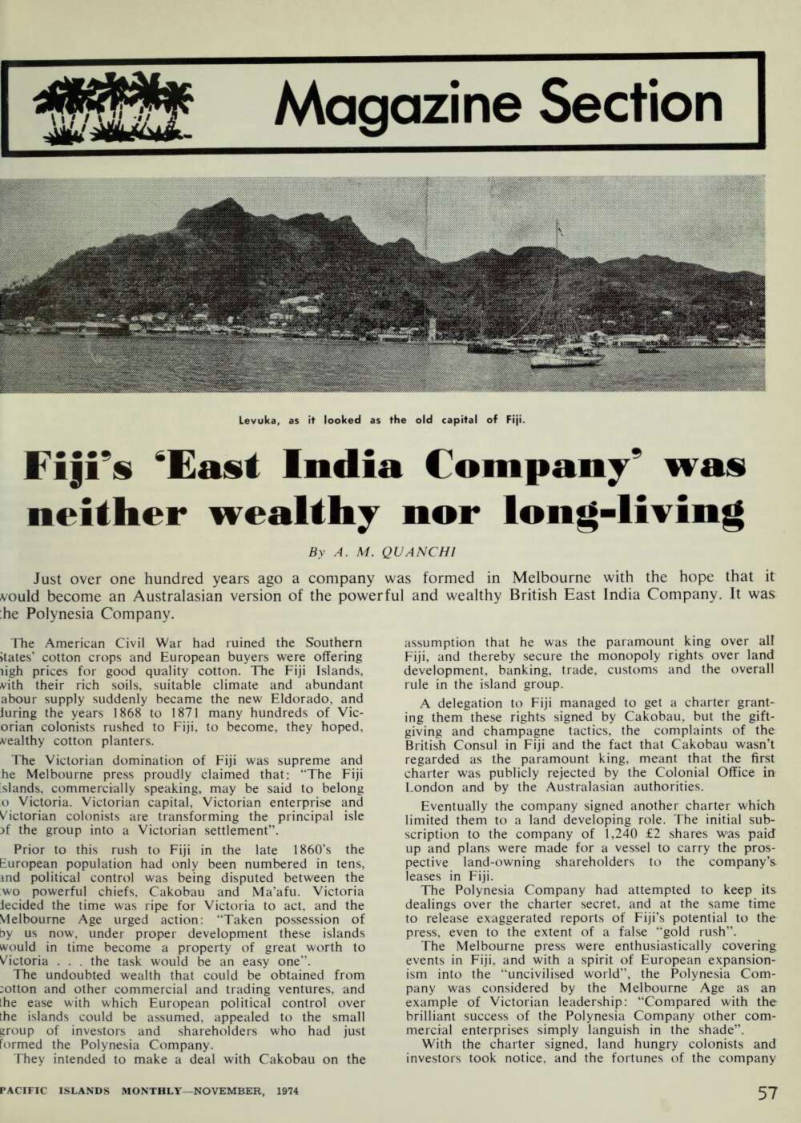
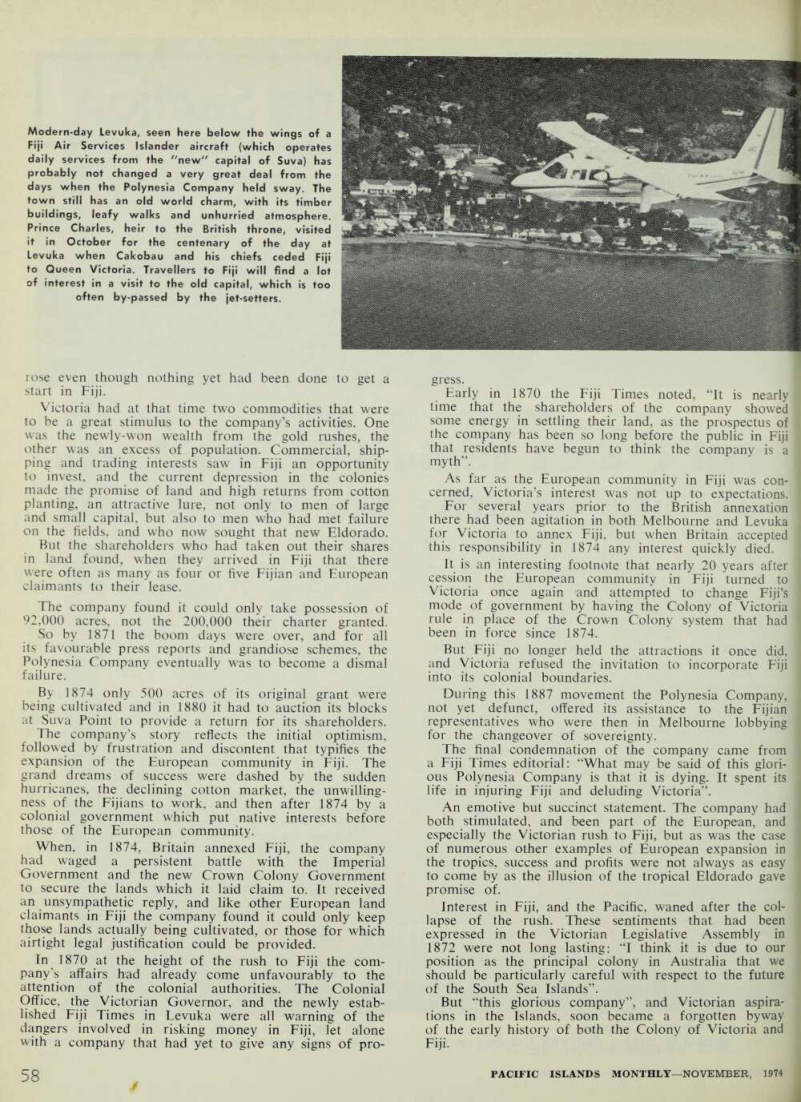
Fiji's 'East India Company was neither wealthy nor long-living
By A. M. Quanchi
Just over one hundred years ago a company was formed in Melbourne with the hope that it vould become an Australasian version of the powerful and wealthy British East India Company. It was the Polynesia Company.
The American Civil War had ruined the Southern dates’ cotton crops and European buyers were offering ligh prices for good quality cotton. The Fiji Islands, vith their rich soils, suitable climate and abundant abour supply suddenly became the new Eldorado, and luring the years 1868 to 1871 many hundreds of Vic orian colonists rushed to Fiji, to become, they hoped, wealthy cotton planters.
The Victorian domination of Fiji was supreme and he Melbourne press proudly claimed that: “The Fiji slands, commercially speaking, may be said to belong o Victoria. Victorian capital, Victorian enterprise and Victorian colonists are transforming the principal isle if the group into a Victorian settlement”.
Prior to this rush to Fiji in the late 1860’s the European population had only been numbered in tens, and political control was being disputed between the wo powerful chiefs, Cakobau and Ma’afu. Victoria lecided the time was ripe for Victoria to act, and the Melbourne Age urged action: “Taken possession of by us now, under proper development these islands would in time become a property of great worth to Victoria . . . the task would be an easy one”.
The undoubted wealth that could be obtained from :otton and other commercial and trading ventures, and the ease with which European political control over the islands could be assumed, appealed to the small group of investors and shareholders who had just formed the Polynesia Company.
They intended to make a deal with Cakobau on the
assumption that he was the paramount king over all Fiji, and thereby secure the monopoly rights over land development, banking, trade, customs and the overall rule in the island group.
A delegation to Fiji managed to get a charter grant ing them these rights signed by Cakobau, but the gift giving and champagne tactics, the complaints of the British Consul in Fiji and the fact that Cakobau wasn’t regarded as the paramount king, meant that the first charter was publicly rejected by the Colonial Office in London and by the Australasian authorities.
Eventually the company signed another charter which limited them to a land developing role. The initial sub scription to the company of 1,240 £2 shares was paid up and plans were made for a vessel to carry the pros pective land-owning shareholders to the company’s, leases in Fiji.
The Polynesia Company had attempted to keep its dealings over the charter secret, and at the same time to release exaggerated reports of Fiji’s potential to the press, even to the extent of a false “gold rush”.
The Melbourne press were enthusiastically covering events in Fiji, and with a spirit of European expansion ism into the “uncivilised world”, the Polynesia Com pany was considered by the Melbourne Age as an example of Victorian leadership: “Compared with the brilliant success of the Polynesia Company other com mercial enterprises simply languish in the shade”.
With the charter signed, land hungry colonists and investors took notice, and the fortunes of the company
Levuka, as it looked as the old capital of Fiji.
rose even though nothing yet had been done to get a start in Fiji.
Victoria had at that time two commodities that were to be a great stimulus to the company’s activities. One was the newly-won wealth from the gold rushes, the other was an excess of population. Commercial, ship ping and trading interests saw in Fiji an opportunity to invest, and the current depression in the colonies made the promise of land and high returns from cotton planting, an attractive lure, not only to men of large and small capital, but also to men who had met failure on the fields, and who now sought that new Eldorado.
But the shareholders who had taken out their shares in land found, when they arrived in Fiji that there were often as many as four or five Fijian and European claimants to their lease.
The company found it could only take possession of 92,000 acres, not the 200,000 their charter granted.
So by 1871 the boom days were over, and for all its favourable press reports and grandiose schemes, the Polynesia Company eventually was to become a dismal failure.
By 1874 only 500 acres of its original grant were being cultivated and in 1880 it had to auction its blocks at Suva Point to provide a return for its shareholders.
The company’s story reflects the initial optimism, followed by frustration and discontent that typifies the expansion of the European community in Fiji. The grand dreams of success were dashed by the sudden hurricanes, the declining cotton market, the unwilling ness of the Fijians to work, and then after 1874 by a colonial government which put native interests before those of the European community.
When, in 1874, Britain annexed Fiji, the company had waged a persistent battle with the Imperial Government and the new Crown Colony Government to secure the lands which it laid claim to. It received an unsympathetic reply, and like other European land claimants in Fiji the company found it could only keep those lands actually being cultivated, or those for which airtight legal justification could be provided.
In 1870 at the height of the rush to Fiji the com pany’s affairs had already come unfavourably to the attention of the colonial authorities. The Colonial Office, the Victorian Governor, and the newly estab lished Fiji Times in Levuka were all warning of the dangers involved in risking money in Fiji, let alone with a company that had yet to give any signs of pro
gress.
Early in 1870 the Fiji Times noted, “It is nearly time that the shareholders of the company showed some energy in settling their land, as the prospectus of the company has been so long before the public in Fiji that residents have begun to think the company is a myth”.
As far as the European community in Fiji was con cerned, Victoria’s interest was not up to expectations.
For several years prior to the British annexation there had been agitation in both Melbourne and Levuka for Victoria to annex Fiji, but when Britain accepted this responsibility in 1874 any interest quickly died.
It is an interesting footnote that nearly 20 years after cession the European community in Fiji turned to Victoria once again and attempted to change Fiji’s mode of government by having the Colony of Victoria rule in place of the Crown Colony system that had been in force since 1874.
But Fiji no longer held the attractions it once did, and Victoria refused the invitation to incorporate Fiji into its colonial boundaries.
During this 1887 movement the Polynesia Company, not yet defunct, offered its assistance to the Fijian representatives who were then in Melbourne lobbying for the changeover of sovereignty.
The final condemnation of the company came from a Fiji Times editorial: “What may be said of this glori ous Polynesia Company is that it is dying. It spent its life in injuring Fiji and deluding Victoria”.
An emotive but succinct statement. The company had both stimulated, and been part of the European, and especially the Victorian rush to Fiji, but as was the case of numerous other examples of European expansion in the tropics, success and profits were not always as easy to come by as the illusion of the tropical Eldorado gave promise of.
Interest in Fiji, and the Pacific, waned after the col lapse of the rush. These sentiments that had been expressed in the Victorian Legislative Assembly in 1872 were not long lasting; “I think it is due to our position as the principal colony in Australia that we should be particularly careful with respect to the future of the South Sea Islands”.
But “this glorious company”, and Victorian aspira tions in the Islands, soon became a forgotten byway of the early history of both the Colony of Victoria and Fiji.
Modern-day Levuka, seen here below the wings of a Fiji Air Services Islander aircraft (which operates daily services from the "new" capital of Suva) has probably not changed a very great deal from the days when the Polynesia Company held sway. The town still has an old world charm, with its timber buildings, leafy walks and unhurried atmosphere.
Prince Charles, heir to the British throne, visited it in October for the centenary of the day at Levuka when Cakobau and his chiefs ceded Fiji to Queen Victoria. Travellers to Fiji will find a lot of interest in a visit to the old capital, which is too often by-passed by the jet-setters.
Yesterday
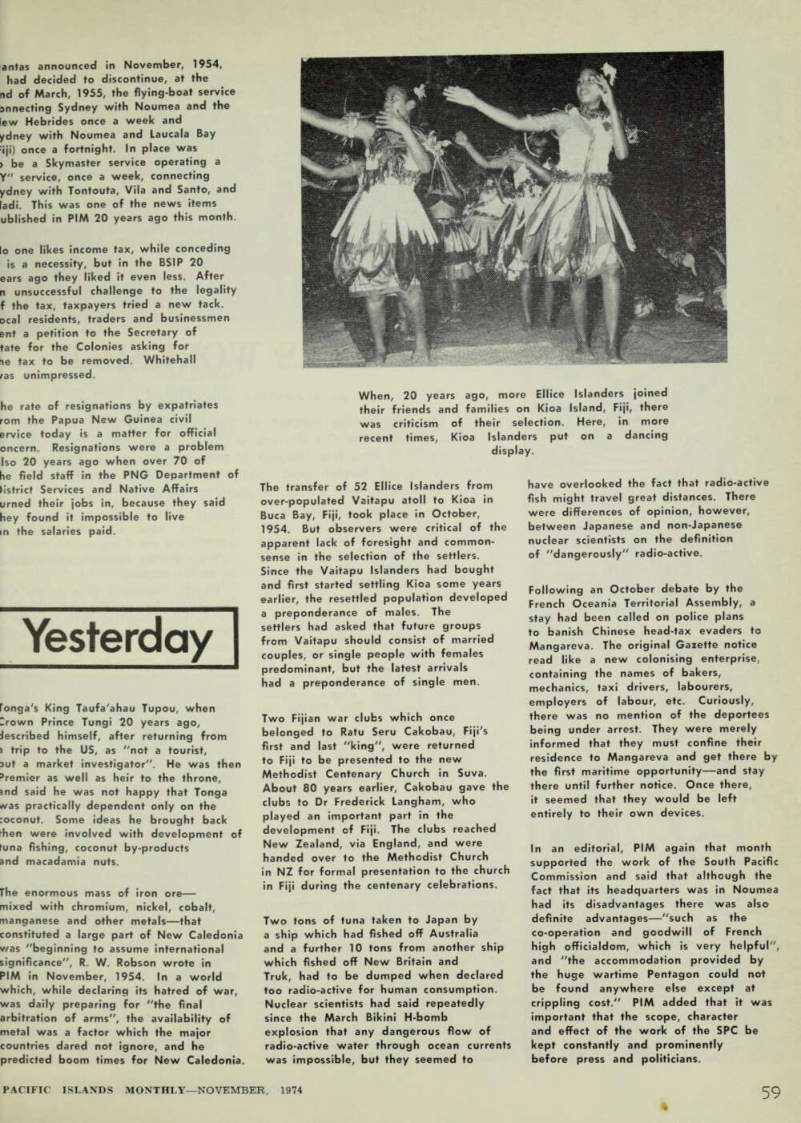
antas announced in November, 1954, had decided to discontinue, at the nd of March, 1955, the flying-boat service dnnecting Sydney with Noumea and the lew Hebrides once a week and ydney with Noumea and Laucala Bay : iji) once a fortnight. In place was > be a Skymaster service operating a Y" service, once a week, connecting ydney with Tontouta, Vila and Santo, and Fadi. This was one of the news items üblished in PIM 20 years ago this month. lo one likes income tax, while conceding is a necessity, but in the BSIP 20 ears ago they liked it even less. After n unsuccessful challenge to the legality f the tax, taxpayers tried a new tack, ocal residents, traders and businessmen ent a petition to the Secretary of tafe for the Colonies asking for ie tax to be removed. Whitehall ras unimpressed. he rate of resignations by expatriates rom the Papua New Guinea civil ervice today is a matter for official oncern. Resignations were a problem Iso 20 years ago when over 70 of he field staff in the PNG Department of district Services and Native Affairs urned their jobs in, because they said hey found it impossible to live in the salaries paid.
fonga's King Taufa'ahau Tupou, when -rown Prince Tungi 20 years ago, described himself, after returning from i trip to the US, as "not a tourist, sut a market investigator". He was then *remier as well as heir to the throne, md said he was not happy that Tonga ivas practically dependent only on the :oconut. Some ideas he brought back fhen were involved with development of funa fishing, coconut by-products and macadamia nuts.
The enormous mass of iron ore— mixed with chromium, nickel, cobalt, manganese and other metals —that constituted a large part of New Caledonia was "beginning to assume international significance", R. W. Robson wrote in PIM in November, 1954. In a world which, while declaring its hatred of war, was daily preparing for "the final arbitration of arms", the availability of metal was a factor which the major countries dared not ignore, and he predicted boom times for New Caledonia.
The transfer of 52 Ellice Islanders from over-populated Vaitapu atoll to Kioa in Buca Bay, Fiji, took place in October, 1954. But observers were critical of the apparent lack of foresight and common sense in the selection of the settlers.
Since the Vaitapu Islanders had bought and first started settling Kioa some years earlier, the resettled population developed a preponderance of males. The settlers had asked that future groups from Vaitapu should consist of married couples, or single people with females predominant, but the latest arrivals had a preponderance of single men.
Two Fijian war clubs which once belonged to Ratu Seru Cakobau, Fiji's first and last "king", were returned to Fiji to be presented to the new Methodist Centenary Church in Suva.
About 80 years earlier, Cakobau gave the clubs to Dr Frederick Langham, who played an important part in the development of Fiji. The clubs reached New Zealand, via England, and were handed over to the Methodist Church in NZ for formal presentation to the church in Fiji during the centenary celebrations.
Two tons of tuna taken to Japan by a ship which had fished ofF Australia and a further 10 tons from another ship which fished off New Britain and Truk, had to be dumped when declared too radio-active for human consumption.
Nuclear scientists had said repeatedly since the March Bikini H-bomb explosion that any dangerous flow of radio-active water through ocean currents was impossible, but they seemed to
have overlooked the fact that radio-active fish might travel great distances. There were differences of opinion, however, between Japanese and non-Japanese nuclear scientists on the definition of "dangerously" radio-active.
Following an October debate by the French Oceania Territorial Assembly, a stay had been called on police plans to banish Chinese head-tax evaders to Mangareva. The original Gazette notice read like a new colonising enterprise, containing the names of bakers, mechanics, taxi drivers, labourers, employers of labour, etc. Curiously, there was no mention of the deportees being under arrest. They were merely informed that they must confine their residence to Mangareva and get there by the first maritime opportunity —and stay there until further notice. Once there, it seemed that they would be left entirely to their own devices.
In an editorial, RIM again that month supported the work of the South Pacific Commission and said that although the fact that its headquarters was in Noumea had its disadvantages there was also definite advantages—"such as the co-operation and goodwill of French high officialdom, which is very helpful", and "the accommodation provided by the huge wartime Pentagon could not be found anywhere else except at crippling cost." PIM added that it was important that the scope, character and effect of the work of the SPC be kept constantly and prominently before press and politicians.
When, 20 years ago, more Ellice Islanders joined their friends and families on Kioa Island, Fiji, there was criticism of their selection. Here, in more recent times, Kioa Islanders put on a dancing display.
Advertisements & other items, p. 62 (1 item)
nnm
MANA is a vehicle for Pacific Islands’ writers and artists to publish their work. It is an organ of the South Pacific Creative Arts Society and its editorial committee comprises writers from many islands.
Material for publication must be sent direct to MANA’s editor, Marjorie Crocombe, South Pacific Creative Arts Society, Box 5083, Suva.
All the writers in this special Creative Writers Workshop issue of MANA have published their work except Lavenia Kaurasi of Rotuma a student studying for a degree at the USP. She is one of the older Fiji teachers. Russall Soaba of Now Guinoa is alroady an established writer in his own country but he attended the workshop, the only participant from New Guinea. He writes, plays, short stories and poetry but lately he has been concentrating on short stories. Peni Tutu’ila Malupo is from Tonga; Teata Makirere from the Cook Islands; Till Peseta and Viggo Rasmussen from Western Samoa; Mildred Sope from the New Hebrides.
All the work except Soaba’s came out of the workshop.
Writers Workshop
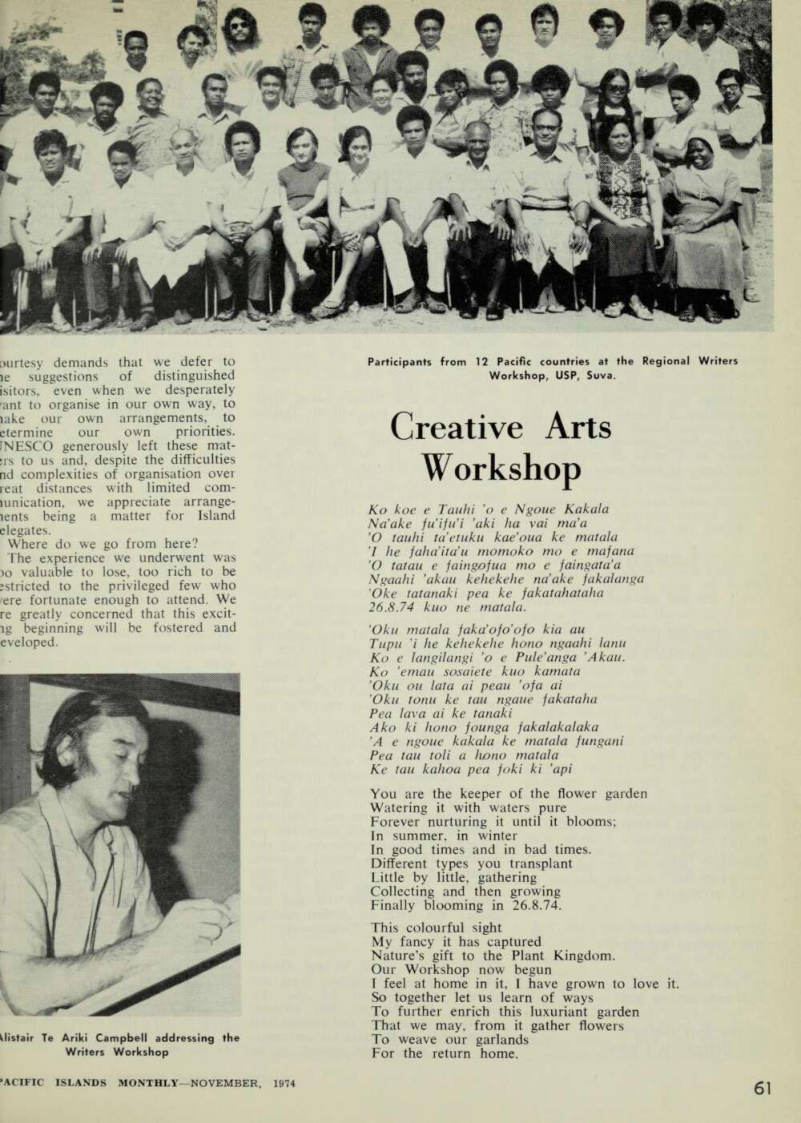
By Marjorie Crocombe
The outstanding success of the Creative Writers Workshop which UNESCO and the University of the South Pacific sponsored at the USP in Suva from August 26 to September 6 was epitomised by the noted Tongan poet, composer and choreographer, Peni Tutu ila Malupo, who wrote the poem on the opposite page.
Peni’s poem was presented at an evening, well attended by an appre ciative audience, at which members of the workshop served up a rich diversity of songs, drama, poetry and short stories, much of it written by the members during the work shop.
Items were presented in a number of the Pacific's many national langu ages, as well as in neo-Melanesian (or Pidgin) and in English. Eti Sa’aga referred to them as “voices crying out in love, anger, sorrow, hope and shame”. The Pacific has never seen such a concentrated flowering of latent writing talent.
Denigrated, inhibited and withdrawn during the colonial era, the Pacific people are again beginning to take confidence and express themselves in traditional forms of expression that remain part of a valued heritage, as well as in new forms and styles re flecting the changes within the con tinuity of the unique world of our Island cultures.
The expressive arts were given a great stimulus by the workshop.
Member after member spoke of the confidence and motivation, as well as the skills and techniques generated by the workshop. They spoke of plans to return to Samoa, Rarotonga, Tarawa, Tonga, the New Hebrides and elsewhere across the Pacific to carry forward and expand the initiatives begun at the workshop.
It rests with the individuals who attended the workshop to give his
or her skills to those back home who did not have the opportunity to attend.
Why do we regard the workshop as such a success?
Firstly, because it gave people with the talents for writing, the opportun ity to meet together with people of other Pacific cultures between which there are great affinities, though we have been separated by great dis tances as well as colonial boundaries.
Secondly, we appreciated the fact that our consultants were deeply attuned to the cultures of the Pacific.
Albert Wendt of Samoa is familiar also with several other cultures.
Alistair Te Ariki Campbell, a noted New Zealand poet, shared a deep one-ness with us through his own Polynesian ancestry and his appre ciation of the hunger of Islanders to express themselves again after a hundred years of humiliation and lacking confidence. Jo Nacola of Fiji helped us to create our drama in its natural setting. Bob Smith has been in the Islands for some time and has absorbed a deep appreciation and understanding through which he gave us valuable technical assistance.
Thirdly, the organisation was undertaken by a committee of Islanders. We appreciated the help we have received from others, but in too many international meetings in the Pacific the presence and pressures of foreign advisers and experts is often too overpowering, and Pacific
ourtesy demands that we defer to le suggestions of distinguished isitors, even when we desperately r ant to organise in our own way, to take our own arrangements, to etermine our own priorities.
INESCO generously left these mat :rs to us and, despite the difficulties nd complexities of organisation over reat distances with limited com mnication, we appreciate arrange lents being a matter for Island elegates.
Where do we go from here?
The experience we underwent was jo valuable to lose, too rich to be sstricted to the privileged few who 'ere fortunate enough to attend. We re greatly concerned that this excit ig beginning will be fostered and eveloped.
Alistair Te Ariki Campbell addressing the Writers Workshop
Participants from 12 Pacific countries at the Regional Writers Workshop, USP, Suva.
Workshop
Creative Arts Workshop
Ko koe e Tauhi ’o e Ngoue Kakala Na’ake fu’ifu’i ’aki ha vai ma’a ’O tauhi ta’etuku kae’oua ke matala 7 he faha’ita’u momoko mo e mafana ’O tatau e faingofua mo e faingata’a Ngaahi ’akau kehekehe na’ake fakalanga Oke tatanaki pea ke fakatahataha 26.8.74 kuo ne matala. ’Oku matala faka’ofo’ofo kia au Tupu 7 he kehekehe hono ngaahi lanu Ko e langilangi ’o e Pule’anga ’Akau.
Ko ’email sosaiete kuo kamata ’Oku ou lata ai peau ’ofa ai 'Oku tonu ke tan ngaue fakataha Pea lava ai ke tanaki Ako ki hono founga fakalakalaka ’A e ngoue kakala ke matala fungani Pea tail toll a hono matala Ke tau kahoa pea foki ki ’ api You are the keeper of the flower garden Watering it with waters pure Forever nurturing it until it blooms; In summer, in winter In good times and in bad times.
Different types you transplant Little by little, gathering Collecting and then growing Finally blooming in 26.8.74.
This colourful sight My fancy it has captured Nature’s gift to the Plant Kingdom.
Our Workshop now begun I feel at home in it, I have grown to love it.
So together let us learn of ways To further enrich this luxuriant garden That we may, from it gather flowers To weave our garlands For the return home.
Advertisements & other items, p. 63 (1 item)
61
’ACIFIC ISLANDS MONTHLY—NOVEMBER. 1974
The Next Resort
Short story
By Russell Soaba
A CESSNA circles, whines and almost flaps like a loose calico in the wind before touching down to perch at Tarakwaruru. Out of that foreign man-made bird steps a girl of about 18, short, light brown and wearing a pair of swollen cosmetic eye-lids that reminds one of the story of a restless ‘daughter of the soil’ brought up in towns. We watch her unconcernedly, the way we are watch ing the other passengers alight from the small plane. She does not matter much. She is just one of the many that come and go, anonymous.
Yet quite against our childish stares of interest the girl walks straight to us, clutching a Qantas travelling bag and a brown parcel. She eyes each one of us for a moment then without offering us a smile of greeting she says, “Are you small ones Anuki?”
“We are,” we return in unison after discovering that she speaks Anuki.
“Then I am glad to speak my own language again after a long time,” she says, this time smiling. Her cheeks are swollen, if not fat, and almost flush with the European powder she might have puffed them with this morning before her journey. “What are your names?” she then asks.
We read out our names in turns.
When I mention my first name the big girl just stares at me for some time as if I have said something wrong. She then bites her lips which are painted red.
“What is your father’s name, Septi mus?” she asks me, without looking at me.
“Father Gabriel, my elder,” I answer her. In Anuki we always address those older than us our elders.
But with this girl I am forced by some unknown demand to do so.
“Ah?” she looks straight at my eyes.
“My father’s name is Father Gabriel, my elder,” I tell her again with care. “He is the priest of the station.”
The girl’s eyebrows are uplifted slightly, as if she is surprised by what 1 have just said. As she turns away I see an expression of woe, suffering, but mainly of pain, on her face. It is as if the mention of my father’s name hurts her feelings. We watch her walk off to collect the remainder of her belongings with the other pas sengers.
“Septimus!” the girl calls and beckons me after she has collected all her luggage. “Come and carry some of my things,” she orders in English.
There is a high-pitched croak in her voice as if a fire is burning her throat.
The other little boys and girls come and help us with the luggage and we walk to the station with the big girl leading. The Cessna behind us roars, moans and its wings carry it high into the air. It is going back to Port Moresby from where the girl has come. We walk on, seeing nothing but the isolation of Tarakwaruru.
THE station itself is dry almost throughout the year. Trees are stunted and thinned by the dry seasons, the banana and coconut leaves are stale, olive and remain torn by the dry winds while the surround ing hills, barely big enough to be
hills, look rocky and uninviting.
The only grass patches that survivd between the rocks put on the colour of near-savannah and lifelessness and the black soil on which you stand just lightly hides a thick layer of coral and rocks. A hard drive of a digging stick into the earth will result in a stubborn ricochet and a raw peel of the skin of the palms.
Not many people who have gone to towns and cities ever come back to Tarakwaruru. Yet the station itself has produced many who had “struck the jackpot” ranging from mere car penters to senior public servants and intellectuals. But in its isolation alone, Tarakwaruru becomes the next resort for the troubled-minded like this big girl who might have been running from one net of confusion to another perhaps during all her
outh. She has spent most of her fe in the city, perhaps. Or perhaps he went to a high school in Aus *alia thus making herself alien and ninteresting in our eyes.
My father sometimes tells me of is own fears about the youths rought up in a foreign soil. He fears ley have lost their beginnings, but ic never explains fully what he leans by that because he thinks I m still too young to understand.
Some day, Septimus,” he tells me, you will know of the torments of the ities.”
“Septimus?” a little girl who is bout my size and who helps me airy the big girl’s travelling bag calls ly name.
“Yes?”
“Who is the big girl?”
“I don’t know, Charlotte.”
“I think she must be your big ister,” suggests Charlotte.
“I don’t know. I have many rela tes who have gone to Port Moresby, ut I don’t know if they are my rothers or sisters. None of them irites to my father, Charlotte. They on’t even send pictures of them slves.”
“But I still think she looks like our big sister,” insists Charlotte, as : she has known any of my relatives have gone to towns even before tie was born! I look unbelievingly t Charlotte who grins, revealing two illk teeth that are missing. We call er window-teeth. Some day when 'e are big enough I shall marry her.
CHE big girl leads us into the station, and in front of one class □om she turns and stares at me the 'ay she did at the airstrip. She picks ff a leaf that has just been warped y the sun and holds it to her nose, he then lets it go, shaking her head 'ith a melancholy look and letting er eyes follow the leaf until she is /atching the black soil.
“Septimus, where is the house of our father?” she asks the leaf that > lying indifferently between her feet.
We lead her to the Mission House.
Father Gabriel comes out of the Mission House and eyes the girl for very long time. Within moments lis face, that was once known to wear /rinkled passions of animation, now urns bitter, remote and becomes an xpression worn by dedicated re igious figures in moments of tor aenting contemplation. He opens his aouth to speak to the girl but his ower lip just hangs and trembles /ith the profoundest of human motions that words cannot express.
“Ma-Mary?” Father Gabriel aanages to stammer. “Ar-are you _9”
“Yes, Dadi,” replies the girl, her back turned on us and her head bowed. “I have come back to you.”
“My daughter!” cries my old father, as he folds his little, half tubercular body round the big girl.
Continuous, successive jerks of sob bing come out from both my father and the big girl, until my father’s wailing is louder with his whistly gaspings which indicate that he is already suffering from phlegmatics.
We all stand still, stunned.
When the big girl turns away to stare at me, still sobbing uncontroll ably, she becomes a little girl who is angered by some unknown enemy which she cannot conquer. She charges at me in a passionate fury out of a kind of love now forgotten, yet being gradually revived, and I find myself in her womanly busom.
“Septimus!” she shrieks in a weird tone. “Remember me? It’s me— Mary! Why—why don’t you recog nise me!?”
During the girl’s and my father’s meanings as well as Charlotte and the other little ones’ quiet crying, I feel in my soul a certain inflow of consolation. There is tranquility and peace in the air that surrounds us, as I remain numb in the arms of my sister, my blood. Her belly is soft and warm, a bit swollen, and I know Mary is seated with a child, with a guilt. And that guilt forces her not to be sure if I love her or not.
Laughter
By Ta Makirere
How often we think That laughter shows Joy.
A Joy in meeting A Joy in success A Joy in knowing That sorrow has Gone.
Yet we forget laughter— Which comes in strange coats.
A coat of scorn A coat of hate A coat of fear Or of arrogance.
Do we ever ponder The laughter we share Is it one of knowing That sorrow has gone Or one that shatters And friendship is gone.
The nuisance
By Ta Makirere
He sees me approaching Always seems to How I simply don’t know Outside the national bank Nubukalou bridge Along the water front Wherever he still sees me I hurry to keep An appointment with the teller The travel agent or watch maker But somehow out of nowhere He suddenly appears His hair ungroomed for days His coat so stained and dirty Baggy trousers hanging low Disguising his feeble form Eyes so piercing yet appealing “Is it some trick?” I wonder But when he holds his palm to me And in my path he stands “It’s no trick!” my mind echoes.
“Excuse me please?” he pleads With a voice that melts the heart.
“I have no bus fare with me To get me to my home”.
Suva sun
By Ta Makirere
How temperamental you are
How unpredictable
You begin with a promise To run an even race But somewhere along your track With not so much as a wink To warn conditioned minds You close your eyes And sleep Behind weeping clouds At noon?
At two?
At three?
Or four?
Have you no way of warning
Uluagali'i
By Tili Peseta
THE policeman walked into his house, took off his helmet and passed a weary hand across his brow.
He placed the helmet carefully on top of the food safe. Like the uniform he wore, he was proud of the helmet: a policeman was respect able, the uniform told the world that he was educated, a man knowledge able about the ways of the papalagi.
He was going to sit down on the mats when he remembered that he had to be careful and not crease the uniform as he needed to wear it again the next day. He looked around for a lavalava to change into. He went to the square wooden box which served as a holdall for his clothes, and the house-linen. With one hand he rummaged through to find a lavalava.
“Where on earth has this lavalava got to. Why do I never seem to find anything that I want.” He put both hands in the box and started digging out the clothes from the bottom of the box.
“Curse this woman! Why is she never around when I need her.” The
policeman spied a piece of flowery
material among the jumbled clothes and with one pull the clothes above it tumbled onto the floor.
“Can’t this woman ever keep any thing in the house where I can find it.” He picked up the fallen clothes and crammed them back into the box.
Then he slammed down the lid. It caught the top of his little finger and he swore. He gingerly sucked the little finger while changing into his lavalava. Then taking off his shirt, he flung both to land on a long piece of sinnet strung out across the span of two fale posts. He had forgotten to be mindful of creasing his uniform.
“Blast that woman. She is never here when I come home.” He sat down reaching out for the All which was under the foodsafe, laid down on his side and went to sleep.
AT the beach, about 500 yards from the shore, a dark object floated and bobbed up at intervals.
It moved slowly towards the beach.
Gradually the object could be dis tinguished as that of the head of a person. The head lifted from the water. The eyes behind the fishing goggles were a blur, the face burnt a coconut brown. The swimmer hit
shallow water and started to wade ashore.
Slowly a figure of a woman emerged. She wore a tattered shirt opened half-way down her chest and notched around her bulging middle.
This bulge was accentuated by a strmg Of fish tied around her stomach. The woman lifted something she was trailing in the water and slung it over her shoulder. It was a thick metal spear about three feet long and at one end, a purplish octopus hung with its tentacles drooping. The spear was pushed through the head of the octopus. With the goggles pushed up on her forehead, shanghai in one hand, and the other balancing the spear on her shoulder,
the woman made her way towards the beach. A dirty brown lavalava reached half-way down her shins, As the woman sauntered along the path towards her house, a hunchedback old woman greeted her.
“Malo, Maaloa, L see that you had favourable fishing. Your man will be
happy tonight.’
' Thank you, Tina. Here are some fish to roast on the charcoal for your meal tonight.” This was said while the woman untied the string and wrenched three fair-sized fishes free of the string.
“Bless you! May you always have good fishing.” The woman retied the string of fish around her stomach and continued up the path.
At the house, she untied the fish
and left them on a large flat stone which formed part of the paepae of the fale. Then she walked to the cooking house at the back, picked up the axe, and started chopping firewood.
The sound of the falling axe splintered the sleeping man’s dreams and woke him up. He rubbed his eyes, and sat up in time to see her carrying the firewood to the fireplace.
The man got up and went to the cooking house. His wife turned around.
“Good sleeping, my husband. Now fill the big pot with some water, and cook the fish for our evening meal.
I’m going to the pool to bathe.”
The man squatted to light the fire.
Advertisements & other items, p. 65 (1 item)
63
ACIFIC ISLANDS MONTHLY—NOVEMBER, 1974
More Poems From
The Workshop
Tahroro
By Lavenia Kaurasi
Tm often made to turn with shame Our indigenous sauce denied fair praise Taroro Bona wherever we go Meaning We the eaters Of a sauce of stinking odour.
But let me first explain Tahroro is the name Clean handling and practice Are essential for its make Selected, green coconuts are salted and fermented The water-tight cork, rolled from banana leaves Ensures the Tahroro fitness to eat.
On green smoked leaves This pink sauce is spread Between layers of fish or beef or chicken Whether baked or grilled The dish is praised By many VIPs inspecting our island.
My friends you forget The Kora on sale Its taste and smell Are very much the same If you must cut labels into people’s faces Why not Kora Bona for a change?
Advertisements & other items, p. 66 (1 item)
Tomorrow
By VIGGO RASMUSSEN
tomorrow flowers will bloom to catch the sun but i will be gone slipping slowly thru' the melting dew glistening into another endless thought
The rush
By Mildred Sope
The town was overflowing with people hurrying from all directions to all destinations.
The lunch hour rush I, among the crowd, trying to be invisible to any mates around.
Advertisements & other items, pp. 67-68 (2 items)
65
ACIFIC ISLANDS MONTHLY—NOVEMBZR, 1574
V!U a<v>
D 9'<o^>
“*' 19 Manufactured by Commonwealth New Guinea Timbers Ltd. and available from leading suppliers throughout the Pacific.
SPEED-E-GAS
Lae
We wok
Rdbaul
Honiara
Porb
SPV
More
Kieta
□□ QC new new
Loutoka
a c cl
nfi
Rarotonj^ 7
p* 3 New terminals
3^
Sydney
6tstablished...
and more to come.
.. .to ensure regular supply of Speed-e-gas* in the Pacific region three new bulk storage terminals have been opened at Rarotonga, Nukualofa and Lautoka. These terminals join already established bulk storage facilities at Port Moresby, Lae, Wewak, Rabaul, Honiara and Kieta.
And to meet future needs bulk terminals are to be built at Santo and Suva.
These terminals will maintain supplies of clean efficient and safe Speed-e-gas all year round.
Speed-e-gas is the most dependable fuel...because it's here in bulk. Liquified Petroleum Gas has been proven to be ideal fuel for all cooking and water heating needs.
SPEEDEGAS
ui The Gas Supply Company Limited, Head Office 221 Miller St., North Sydney, 2060, Phone: 920-951 and available throughout the Pacific.
A member of the Boral group of companies.
Speed-e-gas is known in New Guinea as Guinea-Gas, in Tonga as Tonga Speed-e-gas and in Fiji as Fiji-Gas.
Books, Reviews, writers
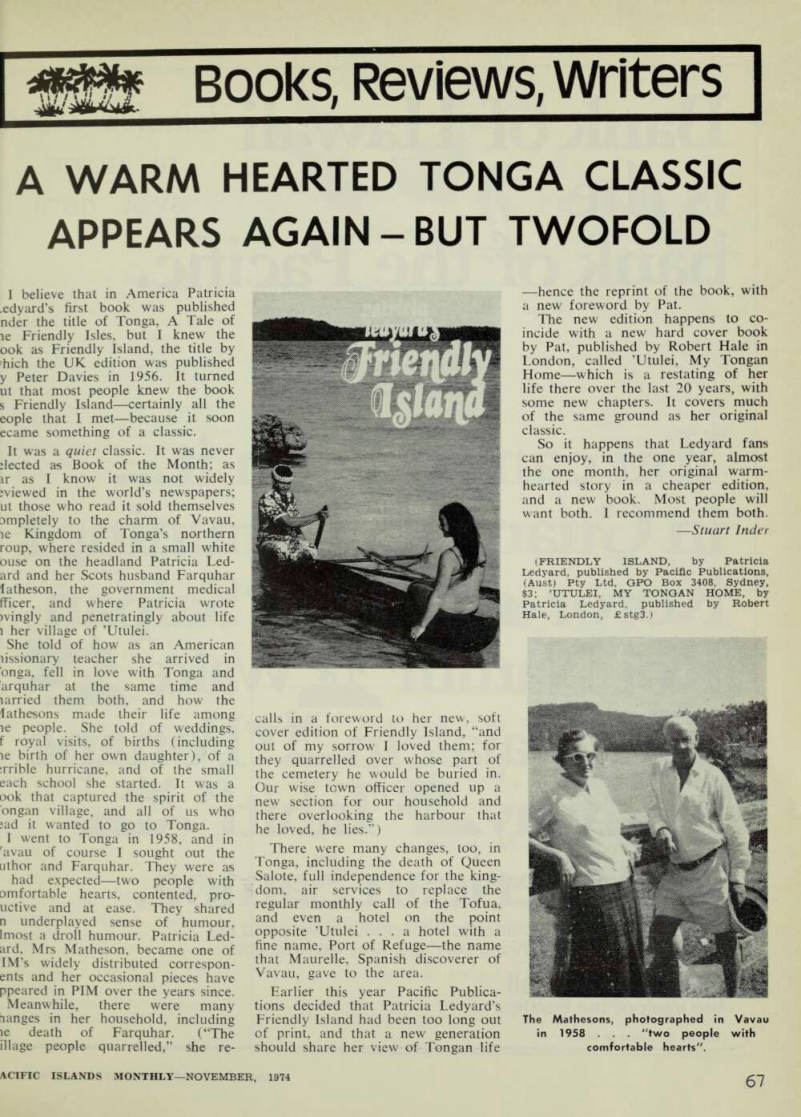
A Warm Hearted Tonga Classic
Appears Again-But Twofold
I believe that in America Patricia .edyard’s first book was published nder the title of Tonga, A Tale of le Friendly Isles, but I knew the ook as Friendly Island, the title by 'hich the UK edition was published y Peter Davies in 1956. It turned ut that most people knew the book
s Friendly Island—certainly all the
eople that I met—because it soon ecame something of a classic.
It was a quiet classic. It was never dected as Book of the Month; as ir as I know it was not widely in the world’s newspapers; ut those who read it sold themselves Dmpletely to the charm of Vavau, ic Kingdom of Tonga’s northern roup, where resided in a small white ouse on the headland Patricia Led ard and her Scots husband Farquhar latheson, the government medical fficer, and where Patricia wrote >vingly and penetratingly about life i her village of ’Utulei.
She told of how as an American lissionary teacher she arrived in onga, fell in love with Tonga and arquhar at the same time and larried them both, and how the lathesons made their life among ic people. She told of weddings, f royal visits, of births (including ic birth of her own daughter), of a ;rrible hurricane, and of the small each school she started. It was a ook that captured the spirit of the bngan village, and all of us who ;ad it wanted to go to Tonga.
I went to Tonga in 1958, and in r avau of course I sought out the Lithor and Farquhar. They were as had expected—two people with omfortable hearts, contented, pro uctive and at ease. They shared n underplayed sense of humour, Imost a droll humour. Patricia Led ard, Mrs Matheson, became one of IM’s widely distributed correspon ents and her occasional pieces have ppeared in PIM over the years since.
Meanwhile, there were many Ganges in her household, including le death of Farquhar. (“The illage people quarrelled,” she re-
calls in a foreword to her new, soft cover edition of Friendly Island, “and out of my sorrow I loved them; for they quarrelled over whose part of the cemetery he would be buried in.
Our wise town officer opened up a new section for our household and there overlooking the harbour that he loved, he lies.”) There were many changes, too, in Tonga, including the death of Queen Salote, full independence for the king dom, air services to replace the regular monthly call of the Tofua, and even a hotel on the point opposite ’Utulei ... a hotel with a fine name, Port of Refuge—the name that Maurelle, Spanish discoverer of Vavau, gave to the area.
Earlier this year Pacific Publica tions decided that Patricia Ledyard’s Friendly Island had been too long out of print, and that a new generation should share her view of Tongan life
—hence the reprint of the book, with a new foreword by Pat.
The new edition happens to co incide with a new hard cover book by Pat, published by Robert Hale in London, called ’Utulei, My Tongan Home—which is a restating of her life there over the last 20 years, with some new chapters. It covers much of the same ground as her original classic.
So it happens that Ledyard fans can enjoy, in the one year, almost the one month, her original warm hearted story in a cheaper edition, and a new book. Most people will want both. I recommend them both.
Stuart Inder
(FRIENDLY ISLAND, by Patricia Ledyard, published by Pacific Publications, (Aust) Pty Ltd, GPO Box 3408, Sydney,
$3; ’Utulei, My Tongan Home, By
Patricia Ledyard, published by Robert Hale, London, £stg3.)
The Mathesons, photographed in Vavau in 1958 . . . "two people with comfortable hearts".
Advertisements & other items, pp. 69-70 (2 items)
67
ACIFIC ISLANDS MONTHLY—NOVEMBER, 1974
Bank of Hawaii
is the bank of the Pacific.
You can bank on it... in Guam i&Tamuning t Koror J2fYap -£ Saipan Roi Namur WJke JL Kwajalein JltPonape Midway Tahiti 2* American Samoa.
All in all, we have 70 branches throughout Hawaii and the Pacific offering full banking services. May we help you?
Bank of Hawaii the bank of the Pacific® * affiliate of Banque de Tahiti
Irian Jaya
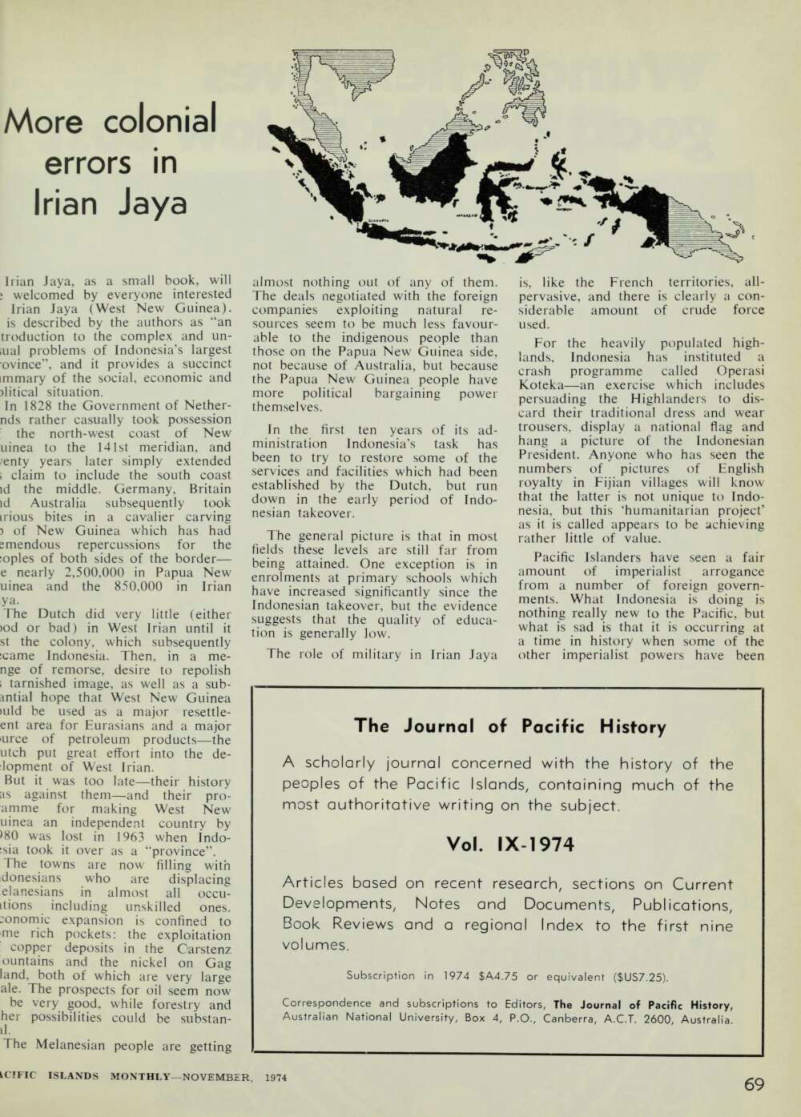

More colonial errors in Irian Jaya
Irian Jaya, as a small book, will * welcomed by everyone interested Irian Jaya (West New Guinea), is described by the authors as “an troduction to the complex and un lual problems of Indonesia’s largest ovince”, and it provides a succinct immary of the social, economic and ilitical situation.
In 1828 the Government of Nether nds rather casually took possession the north-west coast of New uinea to the 141st meridian, and /enty years later simply extended i claim to include the south coast id the middle. Germany, Britain \d Australia subsequently took irious bites in a cavalier carving ) of New Guinea which has had smendous repercussions for the :oples of both sides of the border— e nearly 2,500,000 in Papua New uinea and the 850,000 in Irian ya.
The Dutch did very little (either >od or bad) in West Irian until it st the colony, which subsequently :came Indonesia. Then, in a me nge of remorse, desire to repolish i tarnished image, as well as a sub antial hope that West New Guinea >uld be used as a major resettle ent area for Eurasians and a major urce of petroleum products—the utch put great effort into the de lopment of West Irian.
But it was too late—their history as against them—and their pro amme for making West New uinea an independent country by >BO was lost in 1963 when Indo :sia took it over as a “province”.
The towns are now filling with donesians who are displacing elanesians in almost all occu itions including unskilled ones. ;onomic expansion is confined to me rich pockets: the exploitation copper deposits in the Garstenz ountains and the nickel on Gag land, both of which are very large ale. The prospects for oil seem now be very good, while forestry and her possibilities could be substan il.
The Melanesian people are getting
almost nothing out of any of them.
The deals negotiated with the foreign companies exploiting natural re sources seem to be much less favour able to the indigenous people than those on the Papua New Guinea side, not because of Australia, but because the Papua New Guinea people have more political bargaining power themselves.
In the first ten years of its ad ministration Indonesia’s task has been to try to restore some of the services and facilities which had been established by the Dutch, but run down in the early period of Indo nesian takeover.
The general picture is that in most fields these levels are still far from being attained. One exception is in enrolments at primary schools which have increased significantly since the Indonesian takeover, but the evidence suggests that the quality of educa tion is generally low.
The role of military in Irian Jaya
is, like the French territories, all pervasive, and there is clearly a con siderable amount of crude force used.
For the heavily populated high lands, Indonesia has instituted a crash programme called Operasi Koteka—an exercise which includes persuading the Highlanders to dis card their traditional dress and wear trousers, display a national flag and hang a picture of the Indonesian President. Anyone who has seen the numbers of pictures of English royalty in Fijian villages will know that the latter is not unique to Indo nesia, but this ‘humanitarian project’ as it is called appears to be achieving rather little of value.
Pacific Islanders have seen a fair amount of imperialist arrogance from a number of foreign govern ments. What Indonesia is doing is nothing really new to the Pacific, but what is sad is that it is occurring at a time in history when some of the other imperialist powers have been
reed to revise their thinking—or at ist their techniques.
Like the French in New Caledonia d Tahiti, and like the Americans Guam, Indonesians deny that they e a colonial power and insist that eir territories are an integral part the metropolitan country. But latever wording is used, the people West New Guinea are, like the ople of the French and American •ritories, a subject people.
One advantage of withdrawing ac owledged colonial powers is that ;y have to have a policy of local ities But Indonesia, like France, lists that everybody is a citizen d an “equal” and uses this rational tion to refuse significant priority local people.
The Indonesian Government allo tes more resources per head to the ople of Irian Jaya than it does to ler provinces in Indonesia. This iicates their real interest, but Indo sia is so poor and so disorganised present that this does not amount much.
It obviously wants to make ‘a good )’ of the administration of ‘the ovince’ and to incorporate it firmly 0 Indonesia. But from what has jn seen elsewhere of the delayed iction against imperial domination, ; Free Papua Movement or some er equivalent may ultimately umph and obtain independence.
This is probably a long way off, 1 in the meantime Indonesia is thusiastically committing the same id of errors, with the same self hteous arrogance, that the other onial powers in the Pacific com tted.
Garnaut and Manning write dis ssionately, but it is clear that the flanesian people are much worse than they were—and almost cer nly much worse off than they uld have been if Indonesia had t insisted on her own imperial ex ision when they objected so
angly (and understandably) to
itch imperialism.
The major criticism is not of this >st useful book, but of the price ich the publishers demand for it. e text is only 110 pages and yet “recommended” selling price is 8.95.
Lhis is a disgraceful exploitation monopoly rights which the pub ler has on a publication for which re is likely to be considerable de nd, for Indonesia ensures that less □rmation is publicly available on an Jaya than on any other Pacific /eminent —except perhaps the Re flic of Nauru.— R. G. Crocombe. [RIAN JAYA, by R. Garnaut and C. nning. Australian National University ss, Canberra. $8.95.)
Advertisements & other items, pp. 71-74 (3 items)
69
LCIFIC ISLANDS MONTHLY—NOVEMBER, 1974
The Journal of Pacific History
A scholarly journal concerned with the history of the peoples of the Pacific Islands, containing much of the most authoritative writing on the subject.
Vol. IX-1974 Articles based on recent research, sections on Current Developments, Notes and Documents, Publications, Book Reviews and a regional Index to the first nine volumes.
Subscription in 1974 $A4.75 or equivalent ($U57.25).
Correspondence and subscriptions to Editors, The Journal of Pacific History, Australian National University, Box 4, P. 0., Canberra, A.CT. 2600, Australia.
Wunderflex gives
good design at low cost
m % m
E324ED
You want modern design?
Then use modern material that won’t warp, shrink or rot You want least cost?
Then build with a board that can be worked with handyman’s tools.
Inside and out, your home will have the modern, simple lines at Wunderflex building board.
ItViunderlich
Wunderflex
Available from: Papua New Guinea; Steamships Trading Co Ltd.
Norfolk Island: Irvine’s Building Supply Centra Made in Australia and marketed by CSR Building Materials Export Sales; 4 O’Connell Street. Sydney, Australia 2000
pnpun new cumEß hmidbook
PAPUA
NEW GUINEA
HANDBOOK
This new edition of the Papua New Guinea Handbook —completely revised and reset—provides the first full upto-date details of the new self-governing nation.
For businessmen, travellers, schools, universities and libraries, government departments, tourists and Papua New Guinea residents, this timely, up-to-the-minute edition, is essential.
The Handbook covers everything—geography and history right up to self-government, commerce, trade and banking, forestry, primary and secondary industries, finance and taxation, communications and transport, health and education, law and defence, the churches and missions, land and land policy, etc.
Each of the 19 districts is treated in detail, with dear and comprehensive maps, all newly drawn.
There is also a greatly expanded list, for easy reference, of company registrations and an enlarged tourist section that has all the latest information on facilities and amenities in all areas.
A large attractive fold-out map of Papua New Guinea is also included. The first edition of the Papua New Guinea Handbook was published 20 years ago. This 7th edition, is the only reference book available today with all the information on the world's newest nation. 332 pages of text.
PRICE; Australia, *55.50 plus 85c posted, Pacific Islands and Overseas, $5.50 Aust., plus $l.lO posted; U.S.A., $9.80 U.S. posted. "Suggested retail price
AT DYMOCK'S GEORGE STREET
OR OTHER CITY BOOKSHOPS
ORDER FORM
name address.
I enclose payment for the amount of $ for copy(ies) of the Papua New Guinea Handbook.
PACIFIC PUBLICATIONS (AUST.) PTY. LTD.,
Postal Address: Box 3408, G.P.0., Sydney, N.S.W. 2001. (29 Alberta Street, Sydney.) ( Near corner Goulburn St, & Wentworth Ave.)
imccot to DAncir iciamoc aaomtui v mciucaadcd 107 A
changing
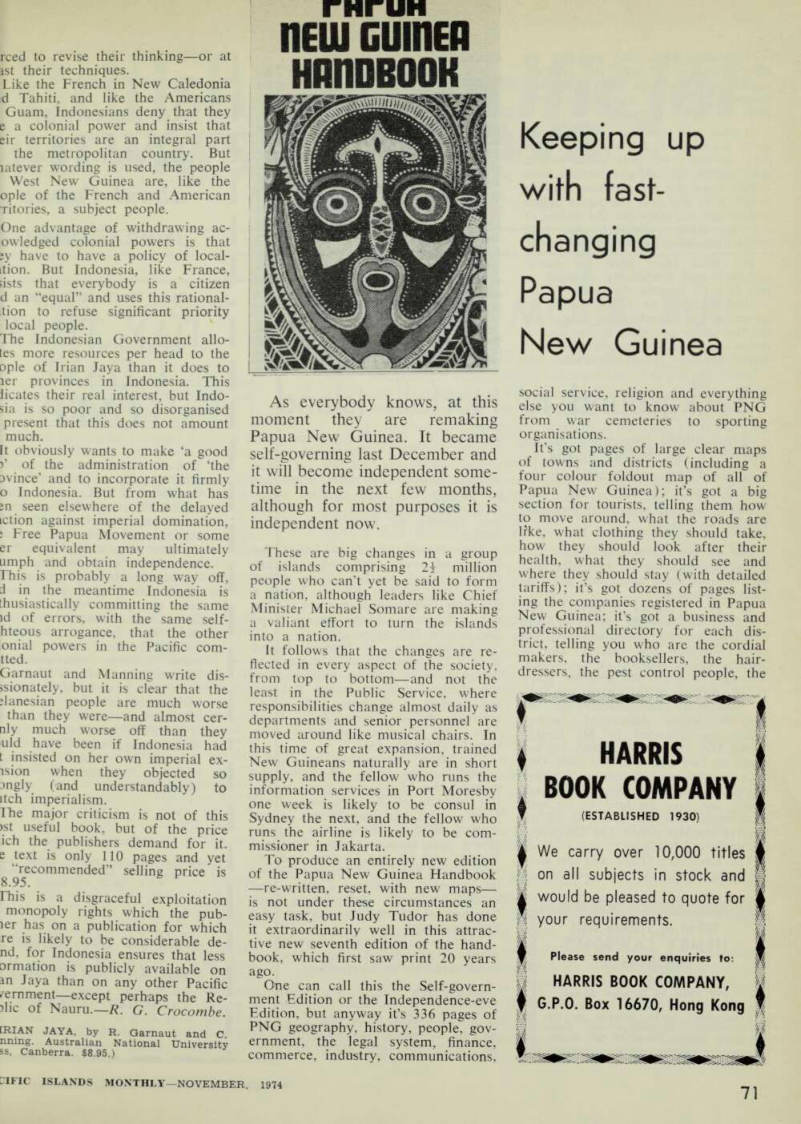
Keeping up with fast changing Papua New Guinea
As everybody knows, at this
moment they are remaking
Papua New Guinea. It became self-governing last December and it will become independent some time in the next few months, although for most purposes it is
independent now.
These are big changes in a group of islands comprising 21 million people who can’t yet be said to form a nation, although leaders like Chief Minister Michael Somare are making a valiant effort to turn the islands into a nation.
It follows that the changes are re flected in every aspect of the society, from top to bottom—and not the least in the Public Service, where responsibilities change almost daily as departments and senior personnel are moved around like musical chairs. In this time of great expansion, trained New Guineans naturally are in short supply, and the fellow who runs the information services in Port Moresby one week is likely to be consul in Sydney the next, and the fellow who runs the airline is likely to be com missioner in Jakarta.
To produce an entirely new edition of the Papua New Guinea Handbook —re-written, reset, with new maps— is not under these circumstances an easy task, but Judy Tudor has done it extraordinarily well in this attrac tive new seventh edition of the hand book, which first saw print 20 years ago.
One can call this the Self-govern ment Edition or the Independence-eve Edition, but anyway it’s 336 pages of PNG geography, history, people, gov ernment, the legal system, finance, commerce, industry, communications.
social service, religion and everything else you want to know about PNG from war cemeteries to sporting organisations.
It's got pages of large clear maps of towns and districts (including a four colour foldout map of all of Papua New Guinea); it’s got a big section for tourists, telling them how to move around, what the roads are like, what clothing they should take, how they should look after their health, what they should see and where they should stay (with detailed tariffs); it’s got dozens of pages list ing the companies registered in Papua New Guinea; it’s got a business and professional directory for each dis trict, telling you who are the cordial makers, the booksellers, the hair dressers, the pest control people, the
accountants, the motor garages, the child minding services, the customs agents, etc. It tells you about the drinking hours and names those who hold the liquor licences.
It also tells you how the govern ment departments are organised, what they do and who runs them, but in this respect this self-government issue differs from the six previous editions which gave not only the name of the permanent secretary but the names of all the other personnel who held senior positions in the department.
But such have been the extra ordinary and continuing changes in this last 12 months that editor Judy Tudor decided to retain only the names of the departmental heads, and list the senior positions in the depart ments and not the people who hold them, because to do otherwise was
impossible.
Nevertheless, despite problems like this the seventh edition of the Papua New Guinea Handbook is remarkable for the accuracy of its information, which was still being updated in some sections only a month before publica tion. In any case, the publishers say in a foreword that they plan to pro duce an early revision of the hand book soon after independence and to update in more frequent, but smaller, editions from then on. In the meantime, they point out, they have done their best “to ensure that the information in this new edition is, at the time PNG approaches indepen dent status, as up-to-date as it is possible for any handbook to get”.
(Papua New Guinea Handbook.
Seventh edition. Published by Pacific Pub lications (Australia) Pty Ltd, GPO Box 3408, Sydney, $5.50.)
Advertisements & other items, p. 75 (2 items)
71
DIFIC ISLANDS MONTHLY—NOVEMBER. 1974
Harris
BOOK COMPANY
(ESTABLISHED 1930)
We carry over 10,000 titles on all subjects in stock and would be pleased to quote for your requirements.
Please send your enquiries to;
HARRIS BOOK COMPANY,
G.P.O. Box 16670, Hong Kong
Background to Norfolk Island
The double centenary of the discovery of Norfolk Island by Captain Cook, celebrated on the island on October 10, has brought with it a rush of Norfolk Island literature.
But all are the sort of books and booklets which have a long life, and they are not some ephemeral get-rich quick pot-boilers.
R. N. Dalkin’s Colonial Era Cemetery of Norfolk Island (Pacific Publications, $6) was reviewed in these columns last month, and is already selling steadily on the island.
Among the acknowledgements given by the author in that book was one to Merval Hoare, secretary of the Norfolk Island Historical Society which was founded by Mr Dalkin —and Mrs Hoare this month has her name on two books of her own. One is a newly revised edition of her Rambler’s Guide to Norfolk Island, which can now be said to be well established, and the other is an at tractive booklet called The Discovery of Norfolk Island.
The Rambler’s Guide was first pub lished in 1965, and the new edition
is the fifth (the fourth was pub lished in 1972). The guide is a potted illustrated history of that historic island, 900 miles north-east of Sydney, but with detailed chap ters on just what to see, whether you ramble by foot or by hired vehicle.
Mrs Hoare seems to know the history of every road, every feature of the island, so her guide makes fascinating reading besides being a practical where-and-what-is-it. This new edition has newly drawn maps and a new full-colour cover.
The Discovery of Norfolk Island is only 24 pages, but most attractively presented in a booklet published by the Australian Government Publish ing Service in Canberra. The illus trations include watercolour draw ings and etchings connected with
Cook’s explorations.
The book concentrates on Cook’s second voyage during which he dis covered the island, and gives verba tim extracts of the discovery from Cook, from the expedition’s astro nomer, William Wales, the expedi tion’s naturalists, Johann Reinhold Forster and his son George, and ex tracts from the log of Joseph Gilbert, the master, Charles Clarke, the second lieutenant, and extracts from the journal of Robert Cooper, the first lieutenant.
There is an index and select biblio graphy. The booklet is an attractive, small addition to Norfolkana.
(Rambler’S Guide To Norfolk
ISLAND, by Merval Hoare. Published by Pacific Publications, GPO Box 3408, Sydney.
$1.90. The Discovery Of Norfolk
ISLAND, by Merval Hoare. Published by the Australian Government Publishing Service, Canberra, 65 cents.)
Advertisements & other items, pp. 76-77 (2 items)
I Have
An excitingly
different book
about Papua
New Guinea
Percy Chatterton's Papua
DAY THAT
I HAVE
LOVED
This is more than an autobiography by well-known Percy Chatterton. OBE, who has spent 50 years in Papua as missionary, teacher and outspoken politician fighting for the underdog. It is a colourful, and charming, account of the Papuan people, giving warm insight into their hopes, fears and changing way of life.
Some Papuan leaders say they don’t want Papua to be submerged by New Guinea in the move towards independence, and readers of Percy Chatterton’s timely book will readily sympathise with their desire to retain their identity. The book is illustrated with evocative pen sketches by Percy Chatterton’s longtime friend and neighbour in Port Moresby, Rev. Bert Brown. 144 pages, illustrated.
PRICE: Australia, Pacific Islands and Overseas, $5.25 Aust., plus 30c posted; U.S.A., $8.30 U.S. posted.
Fill in the details
on the attached
order form.
When in Sydney visit
HENRY LAWSON'S
BOOKSHOP
531 ROYAL ARCADE,
Pitt Thru to George Street.
Write for our catalogue of new and secondhand books relating to the Polynesian, Micronesian and Melanesian Island Groups of the Pacific.
British
airways pacific jet news
ÜBLISHED BY BRITISH AIRWAYS
A PIM ADVERTISING SUPPLEMENT
New Speedbird
holidays
The new Speedbird holiday pro gramme just launched by British Air ways for the period November 1, 1974 to March 31, 1975 gives a choice of add-on package holidays in Britain, Europe and North America at very competitive rates.
“London for You”, for example, includes 13 nights’ hotel accommoda tion with English breakfast, tickets for six popular shows, an Avis self-drive car free of rental for three days, sightseeing, entertainment, a London Countdown card giving discounts at many shops, stores and restaurants and a number of other advantages for only 5A90.00.
An innovation in one of the holi days in Britain is one week in London plus a second week of unlimited travel .throughout England, Wales and Scot land by express coach services. Ac commodation and continental break fast are included in the first week but not in the second as travellers can choose to stay wherever they wish.
A package which includes accom modation, two tickets to London theatres, the use of an Avis car for one day and a 10 per cent cash dis count card to many restaurants, stores etc, is available for only 5A72.00.
If an eight-day British Rail pass is taken instead of the coach, the cost is SAB7.
“Europe for You” offers eight, 12 or 15 day coach tours of Europe starting at the low price of SAII3 for an itinerary which includes five capitals. All coach travel is during daytime.
America, too, is included in the programme. You plan as you go along and select accommodation at any of the 500 Holiday Inns throughout North America. For two persons sharing a room the cost is SAB each per day, or with self-drive car including un limited mileage, SAM a day each.
Mi Sa Moce, Fiji!
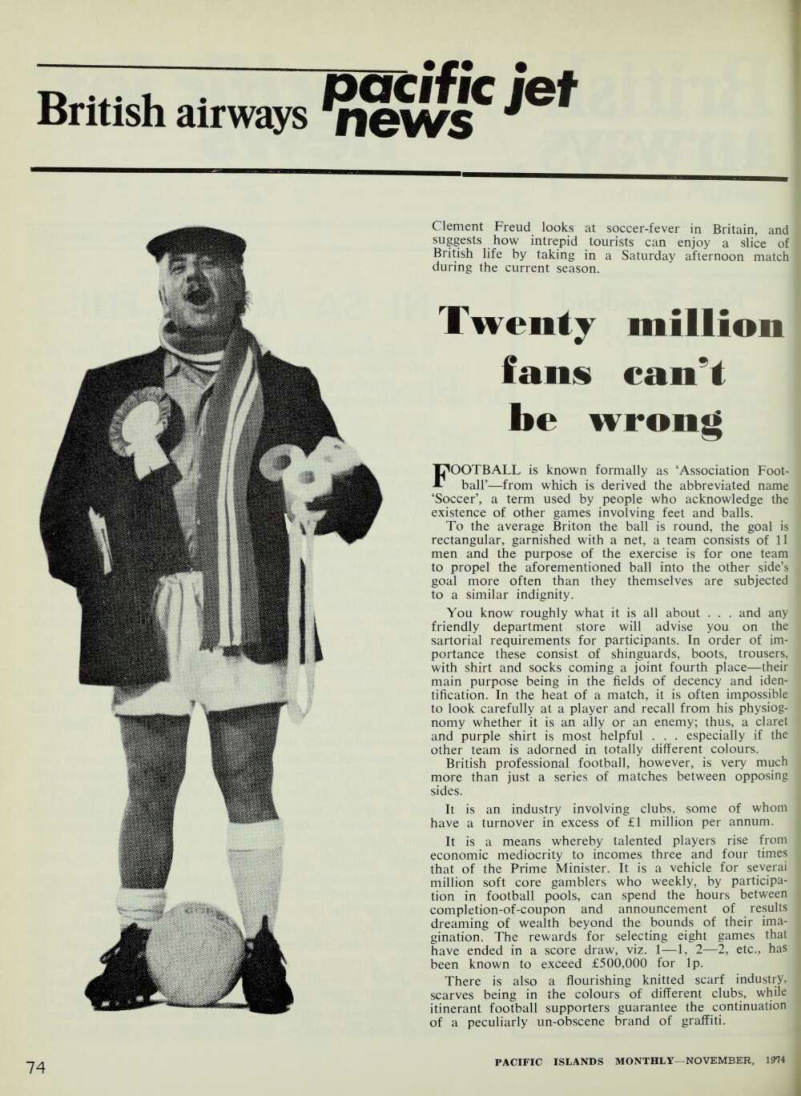
British Airways will cease operating its VC 10 services from Melbourne and Sydney across the Pacific by way of Nadi and Honolulu to Los Angeles and on to New York and London from the end of March, 1975.
At the same time a new British Airways/Air New Zea land interchange service will be introduced providing daily services by DC 10 between Auckland and London.
A government statement announcing the British Airways withdrawal from the Pacific route issued simultaneously in London and Canberra said that the British Government had agreed that British Airways should cease operations on the South Pacific route between Australia and the USA to balance the withdrawal of Qantas services through North America and Mexico to London.
This meant that British Airways and Qantas would no longer be authorised to operate services between Britain and A ustralia on routes other than the Kangaroo route (via South East Asia and Hong Kong).
The statement said that arrangements negotiated by government delegations in April and July had created a new framework within which the long-standing commercial co operation between British Airways and Qantas could continue successfully taking into account current conditions on international routes over which they operated.
The new DC 10 aircraft interchange agreement will provide a daily through one-aircraft service between Auck land and London. As far as Los Angeles the aircraft will be operated by Air New Zealand crews, but at Los Angeles it will be taken over by British Airways crews for the non-stop operation to London.
Flights will call at Honolulu or Papeete on their way to Los Angeles and Thursday’s flight will provide a one aircraft service from Fiji to London. There are frequent connections at Auckland from Australian ports.
It will be the first time British Airways has operated a Los Angeles/London service with wide-bodied aircraft.
British Airways first started services across the Pacific in April 1967 with 707 jetliners. The change to VC 10s was made in April 1969 and in October of the same year Los A ngeles became the port-of-call on the west coast of A merica instead of San Francisco.
Clement Freud looks at soccer-fever in Britain, and suggests how intrepid tourists can enjoy a slice of British life by taking in a Saturday afternoon match during the current season.
Advertisements & other items, p. 77 (1 item)
Acific Islands Monthly—November, 1974
Twenty million
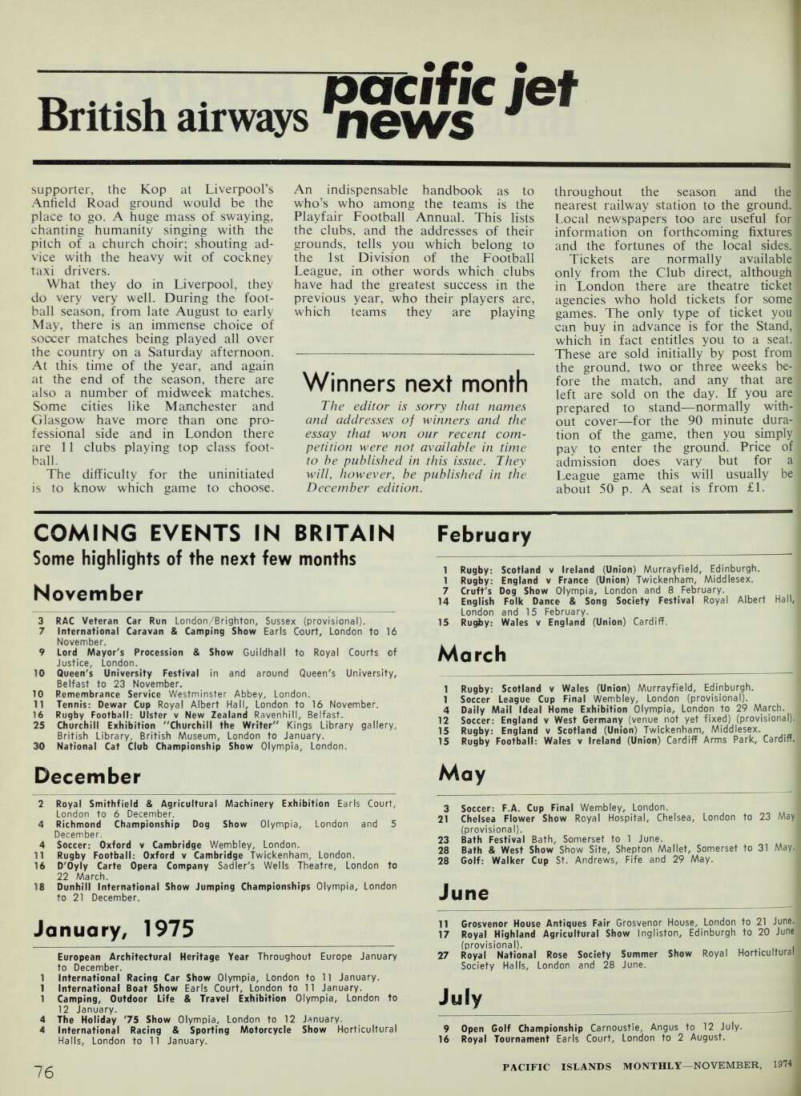
fans can’t be wrong
FOOTBALL is known formally as ‘Association Foot ball’—from which is derived the abbreviated name ‘Soccer’, a term used by people who acknowledge the existence of other games involving feet and balls.
To the average Briton the ball is round, the goal is rectangular, garnished with a net, a team consists of 11 men and the purpose of the exercise is for one team to propel the aforementioned ball into the other side’s goal more often than they themselves are subjected to a similar indignity.
You know roughly what it is all about . . . and any friendly department store will advise you on the sartorial requirements for participants. In order of im portance these consist of shinguards, boots, trousers, with shirt and socks coming a joint fourth place—their main purpose being in the fields of decency and iden tification. In the heat of a match, it is often impossible to look carefully at a player and recall from his physiog nomy whether it is an ally or an enemy; thus, a claret and purple shirt is most helpful . . . especially if the other team is adorned in totally different colours.
British professional football, however, is very much more than just a series of matches between opposing sides.
It is an industry involving clubs, some of whom have a turnover in excess of £1 million per annum.
It is a means whereby talented players rise from economic mediocrity to incomes three and four times that of the Prime Minister. It is a vehicle for several million soft core gamblers who weekly, by participa tion in football pools, can spend the hours between completion-of-coupon and announcement of results dreaming of wealth beyond the bounds of their ima gination. The rewards for selecting eight games that have ended in a score draw, viz. I—l,1 —1, 2 —2, etc., has been known to exceed £500,000 for Ip.
There is also a flourishing knitted scarf industry, scarves being in the colours of different clubs, while itinerant football supporters guarantee the continuation of a peculiarly un-obscene brand of graffiti.
Football in Britain, with all the ittendant publicity it receives on adio and television, is the most alked about sport, the most written bout sport, and, it is generally recog lised, the sport that most accurately epresents the people of the country.
Go into a hostelry and say ‘How re things going?’, and provided that lie question is asked between August ,nd early May, the question will be •resumed to refer to the fortunes of he local professional football club.
In the period between the wars, t was felt by sociologists that the ittle man who had led a tediously aonotonous life harnessed himself □ his weekly 90 minutes of glamour ►y supporting his team and basking a the reflected glory—if any. What 5 certain is that a prosperous team aeans a great deal to the com aercial well-being of a town, which 5 why Burnley, with a population >f 74,000 and a First Division team, aeans much more to the people of mgland than, say Bradford, which •as 300,000 and a team in the Fourth Division.
But football in Britain is even aore than just a game of skill, an xcuse for cheap week-end travel, a aeans of turning Ip into a fortune iid a star on to which you can lang your humdrum life.
By identifying with the club of our home town, men and women •f Britain can have weekly moments •f joy and misery . . . and in several ases, history has been changed adically as a result of the game, 'or instance, in 1970, when England /ent to Mexico to defend the World mp they won in 1966, Mr Wilson’s jovernment wooed the national team nd players with Downing Street •arties prior to departure, messages •f encouragement in the preliminary ounds . . . and when England were nocked out of the competition by
West Germany, in front of a home TV audience exceeding 20,000,000, the national feeling of misery was generally felt to have caused Labours defeat at the polls a week later.
This blind and continued support for the team of one’s first patronage is a strange phenomenon. The manager has long since retired to run a tobacconist or sports equipment shop near the ground. The players are scattered and forgotten, the ground has been rebuilt and the club colours changed when, after an inevitable cash crisis, a new chair man took over and his wife decided that green and white might look nicer than the discredited orange and black.
But come hell or high water, the old age pensioners still talk about ‘our team’ . . . and when the results are announced at 5 pm on a Satur day, victory for their erstwhile heroes (alas, all dead) still calls for celebration.
Naturally, the game has changed significantly as more money and more skill became available for training
and management. The stars of my youth had bullet heads with which they transferred a fierce ball crossed from the wing into the back of the net with not so much as a late night headache to show for it. Other stars had amazingly strong left or right foot shots and they distinguished themselves mostly by idiosyncrasies of dress—like long shorts or heavily brilliantined hair.
Until the mid 19505, footballers were on a maximum wage which compared with junior schoolmasters and, from a social point of view, professional football got no one any where.
Today, the stars of football nego tiate their contracts, some of them through agents. They drive large cars, endorse clothes, hair tonics and beer, are seen in the best night clubs and attend smart dinner parties. Even on the field of play, where their elders would solemnly shake the hand of a man who has scored a goal, these young lions jump upon the scorer and smother him with kisses, em braces and 1 know not what.
And yet, while so many of the trimmings of the game have changed, much of the intrinsic character has remained. If you are a masochist, you still go and watch Chelsea . . . a side of great talent with an un canny way of losing against bad teams, beating the good ones.
At Bolton, they play it as hard today as they did when they had defenders with legs like oak trees whose second or third kick was actually directed at the ball. At Aston Villa, Birmingham, they get huge crowds out of all proportion to the allure of the game, and at Ipswich, where the games are skilful and the team succeeds more often than it fails, the crowds are small.
If there is change it has come in cities with two first class teams . . . like Manchester, where United ruled supreme for the twenty post-war years . . . only to sink into the Second Division this spring, leaving Manchester City to represent Man cunian honour. While the world will watch the results of Manchester City, the supporters of United will remain loyal ... at least for the next five years.
Perhaps if one wanted to be in doctrinated into the arts of being a
supporter, the Kop at Liverpool’s Anfield Road ground would be the place to go. A huge mass of swaying, chanting humanity singing with the pitch of a church choir; shouting ad vice with the heavy wit of cockney taxi drivers.
What they do in Liverpool, they do very very well. During the foot ball season, from late August to early May, there is an immense choice of soccer matches being played all over the country on a Saturday afternoon.
At this time of the year, and again at the end of the season, there are also a number of midweek matches.
Some cities like Manchester and Glasgow have more than one pro fessional side and in London there are 11 clubs playing top class foot ball.
The difficulty for the uninitiated is to know which game to choose.
An indispensable handbook as to who’s who among the teams is the Playfair Football Annual. This lists the clubs, and the addresses of their grounds, tells you which belong to the Ist Division of the Football League, in other words which clubs have had the greatest success in the previous year, who their players are, which teams they are playing
throughout the season and the nearest railway station to the ground.
Local newspapers too are useful for information on forthcoming fixtures and the fortunes of the local sides.
Tickets are normally available only from the Club direct, although in London there are theatre ticket agencies who hold tickets for some games. The only type of ticket you can buy in advance is for the Stand, which in fact entitles you to a seat.
These are sold initially by post from the ground, two or three weeks be fore the match, and any that are left are sold on the day. If you are prepared to stand —normally with out cover —for the 90 minute dura tion of the game, then you simply pay to enter the ground. Price of admission does vary but for a League game this will usually be about 50 p. A seat is from £l.
Advertisements & other items, p. 79 (1 item)
Minus 90
From October 13, BA 591, the westbound trans-Pacific service, becomes BA 501 to suit our friendly computer BOADICEA.
Cheap Excursions
Extended
British Airways are extending the validity of cheap excursion fares between Australia and UK via Asia from a minimum stay of 45 days to 21 days. The fare level will be only half the normal economy fare.
In December the peak period, the carrier will offer 21/180 days return fare to London of $859.20. This will decrease to $802.20 on January 1, against a normal economy return fare of $1,489.60 Since its introduction in 1971, the 45/180 days economy ex cursion fare has been popular for visiting relations and friends in the UK.
The new validity period is subject to Government approval.
Winners next month
The editor is sorry that names and addresses of winners and the essay that won our recent com petition were not available in time to be published in this issue. They will, however, be published in the December edition.
January, 1975
Coming Events In Britain
Some highlights of the next few months
November
3 RAC Veteran Car Run London/Brighton, Sussex (provisional). 7 International Caravan & Camping Show Earls Court, London to 16 November. 9 Lord Mayor's Procession & Show Guildhall to Royal Courts of Justice, London. 10 Queen's University Festival in and around Queen's University, Belfast to 23 November. 10 Remembrance Service Westminster Abbey, London. 11 Tennis: Dewar Cup Royal Albert Hall, London to 16 November. 16 Rugby Football; Ulster v New Zealand Ravenhill, Belfast. 25 Churchill Exhibition "Churchill the Writer" Kings Library gallery, British Library, British Museum, London to January. 30 National Cat Club Championship Show Olympia, London.
December
2 Royal Smithfield & Agricultural Machinery Exhibition Earls Court, London to 6 December. 4 Richmond Championship Dog Show Olympia, London and 5 December. 4 Soccer: Oxford v Cambridge Wembley, London. 11 Rugby Football; Oxford v Cambridge Twickenham, London. 16 D'Oyly Carte Opera Company Sadler's Wells Theatre, London to 22 March. 18 Dunhill International Show Jumping Championships Olympia, London to 21 December.
January, 1975
European Architectural Heritage Year Throughout Europe January to December. 1 International Racing Car Show Olympia, London to 11 January. 1 International Boat Show Earls Court, London to 11 January. 1 Camping, Outdoor Life & Travel Exhibition Olympia, London to 12 January. 4 The Holiday '75 Show Olympia, London to 12 January. 4 International Racing & Sporting Motorcycle Show Horticultural Halls, London to 11 January.
February
1 Rugby: Scotland v Ireland (Union) Murrayfield, Edinburgh. 1 Rugby: England v France (Union) Twickenham, Middlesex. 7 Cruft's Dog Show Olympia, London and 8 February. 14 English Folk Dance & Song Society Festival Royal Albert Hall, London and 15 February. 15 Rugby: Wales v England (Union) Cardiff.
March
1 Rugby: Scotland v Wales (Union) Murrayfield, Edinburgh. 1 Soccer League Cup Final Wembley, London (provisional). 4 Daily Mail Ideal Home Exhibition Olympia, London to 29 March. 12 Soccer: England v West Germany (venue not yet fixed) (provisional). 15 Rugby: England v Scotland (Union) Twickenham, Middlesex. 15 Rugby Football; Wales v Ireland (Union) Cardiff Arms Park, Cardiff.
May
3 Soccer: F.A. Cup Final Wembley, London. 21 Chelsea Flower Show Royal Hospital, Chelsea, London to 23 May (provisional). 23 Bath Festival Bath, Somerset to 1 June. 28 Bath & West Show Show Site, Shepton Mallet, Somerset to 31 May. 28 Golf: Walker Cup St. Andrews, Fife and 29 May.
June
11 Grosvenor House Antiques Fair Grosvenor House, London to 21 June. 17 Royal Highland Agricultural Show Ingliston, Edinburgh to 20 June
(provisional). M , J
27 Royal National Rose Society Summer Show Royal Horticultural Society Halls, London and 28 June.
July
9 Open Golf Championship Carnoustie, Angus to 12 July. 16 Royal Tournament Earls Court, London to 2 August.
Advertisements & other items, pp. 80-82 (3 items)
r>..., . pacific jet
76
PACIFIC ISLANDS MONTHLY—NOVEMBER, 1974
r>..., . pacific jet British airways news
77
ACIFIC ISLANDS MONTHLY—NOVEMBER, 1974
can show you the
These IMF distributors
NEW CALEDONIA
Pacific Motors S.A.,
B.P. H 5,
NOUMEA CEDEX
TAHITI
Ets, Donald,
P.O. Box 131, PAPEETE
BRITISH SOLOMON ISLANDS
NEW HEBRIDES
CONDOMINIUM
Pentecost Pacific S.A., Santo and Port Vila
can show you the
greater the load on an MF2I Trailer
the better the grip!
The all-steel hydraulic-tipping MF2I is a “goanywhere” unit with large section tyres to give good flotation on wet ground and MF’s famous rear axlo design which puts 25% of the load on the tractor’s rear wheels. The bigger the load, the betterthe grip!
Capacity is 3 1 /2. tons, tray area 60 square feet. A powerful hydraulic ram tips the tray to 56 degrees for fast, clean unloading. Everything about this trailer is planned for one-man operation. What’s more, it’s built for years of tough work in the field or on the road. / t * /
MFE 74041
MF= M ASSEY-FERGUSON... WINNER OF TWO EXPORT AWARDS
KNOX SCHLAPP PTY. LTD
SOUTH WEST PACIFIC AGENTS FOR:
fv cr>
WORLD RENOWNED
FOR OVER 100 YEARS
IN BOTH PLEASURE
AND WORK BOATS
MARINE
DIESEL ENGINES
* 4. 4/ ♦ * i i Twin Keel Motor Yacht "TAU" owned and operated by Mr. Colin Philp of Suva. Powered by GARDNER 6L38 MARINE ENGINE; cruising speed of 9 knots.
KNOX SCHLAPP PTY. LTD.
135-139 McEVOY STREET, ALEXANDRIA, N.S.W., 2015.
Phone: 699 8333. Telex: AA20483. Telegrams: "KNOXSCHLAP", Sydney.
SUB AGENTS:
• FATHOM FISHERIES, TONGA.
• S. A. HEATH & SONS, PORT MORESBY.
• LUTHERAN SHIPPING, MADANG.
• NEW HEBRIDES MTS, PORT VILA.
• SASAPE SLIPWAYS, TULAGI, HONIARA.
• SHERWOOD ENGINEERING, RABAUL.
s> -e.
N O /
Pacific Transport
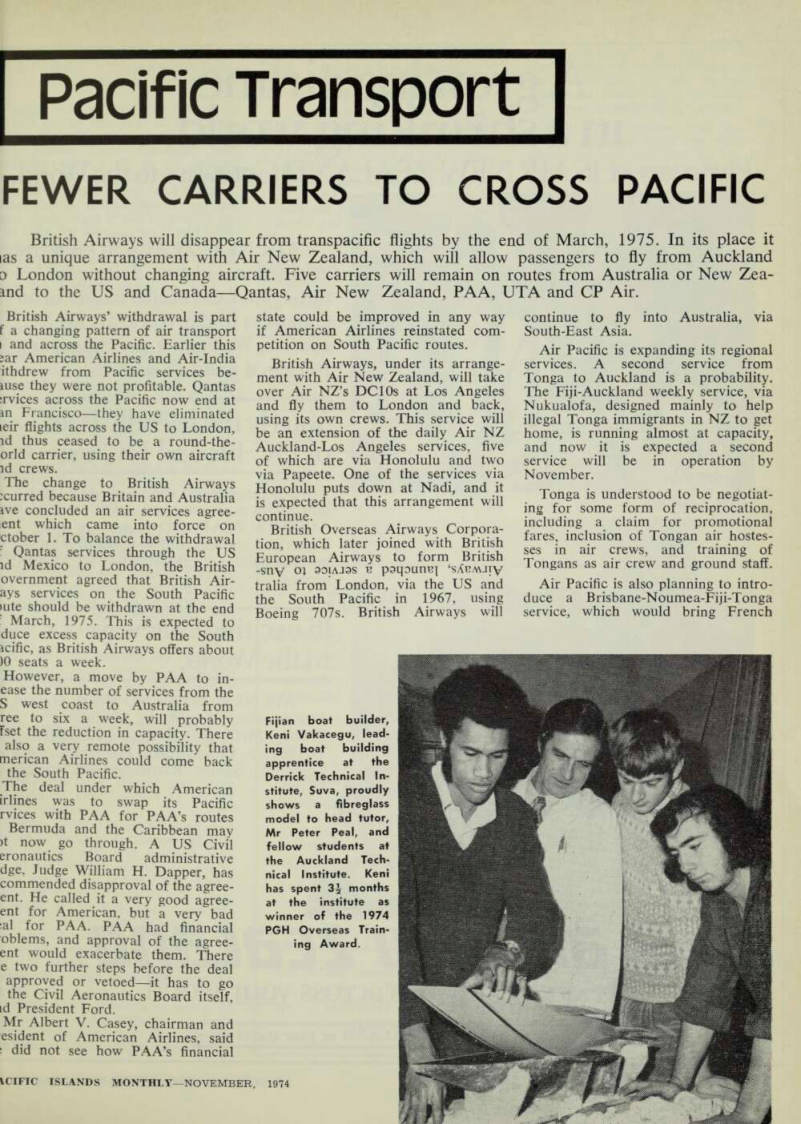
Fewer Carriers To Cross Pacific
British Airways will disappear from transpacific flights by the end of March, 1975. In its place it las a unique arrangement with Air New Zealand, which will allow passengers to fly from Auckland d London without changing aircraft. Five carriers will remain on routes from Australia or New Zea md to the US and Canada—Qantas, Air New Zealand, PAA, UTA and CP Air.
British Airways’ withdrawal is part f a changing pattern of air transport i and across the Pacific. Earlier this jar American Airlines and Air-India ithdrew from Pacific services be mse they were not profitable. Qantas irvices across the Pacific now end at m Francisco—they have eliminated ieir flights across the US to London, id thus ceased to be a round-the orld carrier, using their own aircraft id crews.
The change to British Airways jcurred because Britain and Australia ive concluded an air services agree ent which came into force on ctober 1. To balance the withdrawal : Qantas services through the US id Mexico to London, the British overnment agreed that British Air ays services on the South Pacific jute should be withdrawn at the end March, 1975. This is expected to duce excess capacity on the South icific, as British Airways offers about )0 seats a week.
However, a move by PAA to in ease the number of services from the S west coast to Australia from ree to six a week, will probably Fset the reduction in capacity. There also a very remote possibility that merican Airlines could come back the South Pacific.
The deal under which American irlines was to swap its Pacific rvices with PAA for PAA’s routes Bermuda and the Caribbean may )t now go through. A US Civil eronautics Board administrative dge. Judge William H. Dapper, has commended disapproval of the agree ent. He called it a very good agree ent for American, but a very bad :al for PAA. PAA had financial oblems, and approval of the agree ent would exacerbate them. There e two further steps before the deal approved or vetoed—it has to go the Civil Aeronautics Board itself, id President Ford.
Mr Albert V. Casey, chairman and esident of American Airlines, said : did not see how PAA’s financial
state could be improved in any way if American Airlines reinstated com petition on South Pacific routes.
British Airways, under its arrange ment with Air New Zealand, will take over Air NZ’s DClOs at Los Angeles and fly them to London and back, using its own crews. This service will be an extension of the daily Air NZ Auckland-Los Angeles services, five of which are via Honolulu and two via Papeete. One of the services via Honolulu puts down at Nadi, and it is expected that this arrangement will continue.
British Overseas Airways Corpora tion, which later joined with British European Airways to form British -sny oj 90IAJ9S n paqounnj ‘sAn/vuiy tralia from London, via the US and the South Pacific in 1967, using Boeing 7075. British Airways will
continue to fly into Australia, via South-East Asia.
Air Pacific is expanding its regional services. A second service from Tonga to Auckland is a probability.
The Fiji-Auckland weekly service, via Nukualofa, designed mainly to help illegal Tonga immigrants in NZ to get home, is running almost at capacity, and now it is expected a second service will be in operation by November.
Tonga is understood to be negotiat ing for some form of reciprocation, including a claim for promotional fares, inclusion of Tongan air hostes ses in air crews, and training of Tongans as air crew and ground staff.
Air Pacific is also planning to intro duce a Brisbane-Noumea-Fiji-Tonga service, which would bring French
Fijian boat builder, Keni Vakacegu, lead ing boat building apprentice at the Derrick Technical In stitute, Suva, proudly shows a fibreglass model to head tutor, Mr Peter Peal, and fellow students at the Auckland Tech nical Institute. Keni has spent months at the institute as winner of the 1974 PGH Overseas Train ing Award.
ourists to Tonga. It launched a weekly flight Tonga - Suva - Nadi ioniara - Port Moresby on September 9.
These new services, just before the rrival of the first two of four Tris ander aircraft, and a loan equivalent FI million from Australia, have elped to give a lift to the airline’s respects. It now has rights for 12 lonths at Pago Pago and Majuro, Ithough no announcement has yet een made when it will take these up.
Tie US Civil Aeronautics Board limit d the rights to 12 months so that at le end of a year it could review the •wnership of Air Pacific. The US could ress for a shareholding for PAA in iir Pacific, a move suggested some me ago and welcomed by the Fiji rime Minister, Ratu Sir Kamisese fara.
There has been a change in the lanagement of Air Pacific. Mr Stanley »uigg has been appointed general lanager in place of Mr Chris Ritchie, [e acted as general manager from .ugust when Mr Ritchie returned to .ustralia on medical advice. Mr itchie will resume duties with Qantas, om which he was seconded, when he jeovers. He was in Fiji as manager f Fiji Airways (now Air Pacific) om 1959 to 1965.
Low Progress On
He Law Of The Sea
Governments will have to consider ow to reach general agreement on II elements on a package deal on iws for the seas before the next ;ssion of the Law of the Sea Con :rence.
As the next session, the third of le third United Nations conference ti the law of the sea, is scheduled • start in Geneva on March 17. )75, governments do not have uch time to reconcile many con cting views. The second session of e third conference was held at aracas in June and July.
PNG has said it will pay close tention to developments to protect MG’s interests.
Papua New Guinea’s views are milar to those of Indonesia and Fiji, at the physical and political area an archipelago should be every ing within a dotted line drawn und its most outlying islands, islets reefs. Micronesia is after an ex usive economic zone extending 200 iles beyond dotted line boundaries. 5 views were put at Caracas by e US which, however, does not :cessarily agree with Micronesia’s ews.
Japan, which depends so much on e sea for a big part of its food, tiich it secures from the Pacific, ants reasonable proportions main
tained about the outer limits of an archipelago. While there is plenty of “free” ocean in the Pacific, there are also plenty of fishing grounds inside the 200 miles of outer limits of dotted lines drawn round archipela goes.
Sir Albert Henry, for the Cook Islands, asked the last meeting of the conference to give special attention to the Pacific, which was economi cally poor. If minerals were dis covered in the seabed of small coun tries, and could be extracted, those countries should receive some of the benefits. He had in mind (naturally) the recent discovery of manganese nodules in the seabed round the Cook Islands,
Britain’s view, a typical British compromise, is that the area under the sovereignty of an archipelago should be limited to a maximum of five times its total land surface.
The Caracas session was attended by 130 countries. Fifty new countries, which did not take part in the pre paratory work, were negotiating on law of the sea issues for the first time, and this made progress slow.
Progress can be expected to continue being slow on such an important set of issues,
Micronesian Princess
On The Job
The Micronesian Princess, the first new ship specially built for the Micronesian inter-island service, arrived at Saipan on her delivery voyage in September.
The Micronesian Princess, 1,300 tons, is 242 ft long, and is capable of a top speed of 15 knots. There is deck capacity for more than 100 passengers, and cabin accommoda tion for 12. The ship can also carry 36 20 ft containers. The crew of 12 is under Captain John Ongrung, of Palau. The ship is the first of eight to be delivered over the next few years.
Concrete Proposals
Soon For Regional
Shipping?
It s now several years since a South Pacific regional shipping line was first mooted seriously and it hasn’t yet got to sea. But when the South Pacific Forum holds its next meeting at Nukualofa in July, 1975, it will probably have before it concrete proposals for getting a shipping line into operation.
The eight South Pacific Forum countries who met at Nukualofa late in August (PIM, Oct, p 83), agreed that Suva would be the best place to set up the headquarters of a shipping corporation. In addition to its central position, it had the necessary communications and banking facilities.
The director of the South Pacific Bureau for Economic Co-operation (SPEC), Mahe Tupouniua, said an investigation showed that a regional shipping line in the South Pacific would have shown total freight savings of at least $F3.7 million on the 1973 freight rates. For too long services in the South Pacific had been owned and operated from outside the region. Problems such as unsuitable ships, wrong union attitudes and an imbalance of trade all contributed in
varying degrees to the overall difficult situation.
Sou* Tacific Regional° “hipping
Council with President Hammer Deßoburt of Nauru as first ™n TTte meedns also set ud an Xsory boa“hh Mr Bob Dods ptu Secretarv for Transnort and
chaiS ' SPEC
w j|i provide secretarial services for the council The advisory board will make a detailed proposal about the corporat ion for consideration by the next mee ting of the council, in Suva, in April or May, 1975. As a short-term objective the council will organise the shipping line on a pooling basis. The various nations agreed that was the best arrangement till the corporation was financially strong enough to buy its own ships.
The Australian delegation advised that Australia would provide up to $50,000 towards the cost of consultants for the shipping venture in the coming year.
Forum countries represented at the meeting were New Zealand, Australia, Fiji, Nauru, Papua New Guinea, Western Samoa, the Cook Islands and Western Samoa. The GEIC sent an observer.
Hold-Up For Fiji's
Uluilakeba Replacement
The Tabu Soro, bought in Norway by the Fiji Government to replace the Uluilakeba in the Lau service, is P rovin S more expensive than plan “d - Parliame "' n expenditure of $305,457 for the ship,
Sf, pdce f °f
*187,742, *60,000 for delivery, fuel an( * s P ecia l fittings for the voyage, $lO - 000 f ° r insurance and travelling expenses for two officials, *32,000 for a l teratlons in Fiji and $14,546 fo^ on t in p n 9 ies - The Tabu Soro ran into expensive trouble soon after leaving Norway on . the delivery voyage. A fuel pump feded and the engine broke down, Jh. e shi P P ut int 9 P 9F t ? f . S P ain ’
Trinidad, for repairs. She left there °. n dul y 7 and arnved at Panama SIX days later.
There were still problems with the engine, including cooling trouble, and more work was necessary. About mid-September, the Tabu Soro was on sea trials at Balboa to ensure she was fit enough to cover the remain ing 6,500 miles, The extra money involved in the trouble will be at least $35,000.
The Tabu Soro is unlikely to go
ito service before 1975, and in the leantime is missing out on lucrative □pra cargoes.
The government intends to take sgal action to recover the extra toney spent on repairs to the Tabu oro during its delivery voyage on re grounds that the ship was sur ged and certified fit for her voyage, he Assistant Minister for Roads and larine Transport, Mr Ted Beddoes, rid in Parliament in reply to a ques on that the ship was inspected by ic Fiji Director of Marine in March, id was reported suitable.
It was agreed to buy it, subject to passing a special survey for classi ;ation under rules of Det Norse eritas (the Norwegian equivalent of loyds), and any recommendations ere to be complied with by the vners. To ensure it was properly luipped and capable of making the mg delivery voyage, Det Norse eritas was asked to make a further irvey. The Harbour Master, Suva, ho was in Britain on leave, accepted divery of the ship in Oslo in April i behalf of the government. The >ecial survey had been completed id certificates issued. Afterwards, ie Harbour Master, while still in ritain, resigned from the Fiji Civil irvice.
Luge Transpac
Uit For Damages
Transpacific Lines Inc (Transpac), ie former shipping line which served ie US Trust Territory and which now in receivership, is again the ibject of a massive court action, ormer shareholders in the line have ied a suit against the TT Govern icnt for SUS3I million, plus puni ve damages of SUSIO million, aimed as defendants are the High ommissioner, Mr Edward E. ihnston, the Attorney-General, Mr ichard I. Miyamoto, and the trans it consultant, Mr Wayne C. hiessen.
The plaintiffs allege that Messrs ihnston, Miyamoto and Thiessen ded oppressively and maliciously i interfering with their contract ghts. The 24 plaintiffs include eorge C. Kiskaddon, former head : MILI (Transpac’s predecessor), ie Yap Shipping Co-op Association id Micronesian citizens, Pedro . Guerrero, Manuel D. Muna, arlos A. Shoda, Segundo Sablan, id Herculano Kohler.
The latest suit followed an earlier :tion in the US Court of Claims, hich was dismissed for lack of risdiction. In that suit, 16 Transpac lareholders sought recovery of lancial losses from the US, alleging
that their private property was taken for public use by the US.
The plaintiffs allege that the Trust Territory did not live up to a con tract, negotiated in August, 1968, with Micronesia Interocean Line Inc (MILI), which subsequently became Transpac. They claimed the TT Government was to furnish reason able port facilities and did not, caus ing financial loss to them.
“The TT engaged in management practices causing a terminal financial crisis and destruction of Transpac, making the performance of the con tract impossible”, they said.
They also alleged that the actions of those placed in operational con trol of Transpac contributed to the financial and operational destruction of Transpac, causing the company to be put in receivership. They based the $3l million claim on past and future earnings of Transpac which, they argued, would have resulted but for the actions of the defendants.
New Hebrides Tightens
Rescue Procedures
The New Hebrides condominium, appalled at the cost of search-rescue operations, in some cases unneces sary, are to lay down conditions under which they will be launched.
This action was sparked by a search for a launch, said to be missing, with seven people. Aircraft of Air Melanesiae and Air Pacific, merchant and naval ships, were diverted to look for the launch. It transpired that the launch had not put to sea.
A committee is now considering a search and rescue instruction, after which firm new procedures are ex-
pected to be introduced. In the mean time, the administration will not divert ships and aircraft for -a search unless there is a good reason to be lieve a vessel is overdue. Anyone anxious about a vessel has first to find out whether it set out in the first place, whether it may have anchored on the way, and be certain it has not turned up elsewhere. No full air/sea search will be launched until those three conditions have been met.
PNG Defence Force naval officer, Lieu tenant Sevese Peter Raepa, pictured in Melbourne in September during an Australian-sponsored training course for Search and Rescue Co-ordinators directed by Mr Max Miles (left), and attended by men from many countries.
Advertisements & other items, pp. 83-84 (2 items)
Icific Islands Monthly—November, 1974
shrinking world...
A
growing airline
in a si
Fly to any of 16 AIR NEW ZEALAND Gateways to the World,
os Angeles
■ I
Singapore
AIR NEW ZEALAND is a truly international airline, flying you throughout the Pacific to any of 16 Gateways to the World, as far apart as Wellington and Singapore, Auckland and Los Angeles.
You fly the friendly fleet
of DClOs and DC Bs.
Our magnificent wide-bodied DC-lOs now fly on most international AIR NEW ZEALAND routes. On other flights and services, our personalised DC-8s provide outstanding AIR NEW ZEALAND service.
16 exciting Gateways
to the World.
AIR NEW ZEALAND flies to Hawaii Los Angeles, Hong Kong, Singapore, Sydney, Melbourne, Brisbane, Auckland, Wellington, Christchurch, Fiji, Tahiti, New Caledonia, Samoa, Rarotonga and Norfolk Island.
air neiu
Friendliest wings across your world.
Talk to AIR NEW ZEALAND or your travel agent
ANZ 233
Air charters
for Norfolk
A new charter air service, link ing Brisbane with Norfolk Island, was launched in September by Air Norfolk using an Aero-Com mander turbo-prop aircraft. Mr Charles Herman, an executive of the airline, said the aircraft would carry six passengers. Flying time is two, and three-quarter hours.
Advertisements & other items, pp. 85-88 (3 items)
81
VCIFIC ISLANDS MONTHLY—NOVEMBER, 1974
Commercial Vessels For Sale
COASTAL TANKER. Built Japan 1960, ABS 100, Al, S/S 9/76, LOA 175 ft, G/T 529, N/T 229. Bulk Fuel Capacity 542 DWT. Single Hanshin Diesel 550 BMP. Recent conversion from Gas tanker with extensive renovations, including new cargo pumps, etc., 1973.
A 5200,000 0.N.0.
COASTAL VESSEL. Built Holland 1950. Lloyds 100 Al, LOA 150 ft, G/T 349, N/T 164, DWT 425. Bale 23,000 cu. ft. Single Screw Industrie Diesel 300 BHP. New accommodation throughout 1969. Extensive renovations and overhaul at special survey 1974.
A 5120,000 0.N.0.
FISHING/PRAWN MOTHER SHIP. Built Holland 1958. Lloyds 100 Al, S/S 1978, LOA 160 ft, Beam 25 ft, G/T 347, N/T 129. Single Deut 500 HP. Speed 10 k. Vessel fully equipped for storage, processing and packing fish/prawns or suitable as trawler or service vessel.
A 5200,000 0.N.0.
CARGO VESSEL. Built Cairns, Australia 1966. Australian State, expires Feb. 1975. LOA 81 ft, Beam 18 ft, Draft 5 ft. Caterpillar Diesel 120 HP.
Speed 7 k. 80 ton dw. (5,000 cu ft). Cargo gear 1 ton SWL, Hydraulic Winch. Fuel Cap. 600 galls. F.W. 600 galls.
A 565,000 Terms Available.
For further details of listed vessels and many other cargo vessels, tugs, barges, yachts, work boats, etc., CONTACT P.O. BOX 783, LAE, PAPUA NEW GUINEA.
TELEPHONE: 42-4305. CABLES: MARINESERV.
WORLD FAMOUS RELIABILITY
Grß 42 Only when you prefer quality before ornamentation will you fully appreciate a Grand Banks cruiser.
She will rise to every cruising occasion with ability and grace. Ruggedly built, but with fine yachting interiors she is the most outstanding and durable value in the yachting world today.
The Grand Banks exceptional sea worthiness is only equalled by the luxurious, comfortable accommodations, outstanding hand craftsmanship and rich teaks and parquets.
Famousfortheir reliability, all Grand Banks models feature a range in excess of 1000 miles with their dependable diesel power and low fuel consumption.
Grand Banks 32', 36' and 42' are built of hand laid fibreglass, while the 48' and 50' models are of Philippine mahogany. m GB 42 All modelsfeature wide walk around decks and warm, rich golden Burmese teak interiors.
All boats are fully backed with 12 months warranty. Forfull details please contact Australian Distributor.
GRAND BANKS DIESEL CRUISERS.
By American Marine.
Australian Distributor: Lars Halvorsen Sons Pty. Ltd.
Waterview Street, Ryde, N.S.W. 2112. Phone 80 0251 LA4329/74
mmUM
FOR
SALE
M.V. "HUNTRESS" at present in fiji • Canadian registry • 141 gross tons • Ideally suited as cruise or charter vessel • Presently rigged for fishing tuna with hydraulic pullers • Refrigerated hold aft, dry cargo hold forward • Exquisite accommodation • Twin screw 6-71 G.M.C. • Mains, 10 K.W. and 20 K.W. lighting plants • Radar, sounder, 150 watt phone, citizens band, V.H.F., automatic direction finder, automatic pilot, Loran, intercom throughout, garburator, deep freeze, refrigerator, CO I2 system, plus much more.
The pride of any fleet! Price: $165,000 Canadian.
Contact; C. IRWIN, GENERAL DELIVERY, LAUTOKA, FIJI.
diesels
*<r i * .
V. M. DIESEL 1 14 DAN
Ranked among the world's best, the competitively priced V.M. air cooled engine is available from 6BHP to 3608 HP ratings. These robust engines of proven design feature interchangeable parts from single to six cylinder models in the in-line range and from the V 6 to the VI2. Power take-off points for all applications.
We supply. We service. We perform— just like the great equipment we distribute.
We're more than machinery.
□ LDINb)
INDUSTRIES PTY. LIMITED
j To: OLDING INDUSTRIES PTY. LTD. at;- Townsville; Cnr. Woolcock & Hamill Sts., Townsville 4814. Phone (077) 79 7722. Telex AA77140 Brisbane: 37 Industrial Ave., Wacol 4076. Phone (072) 72 3566. Telex AA41451 I Sydney: 10 Pioneer Ave., Thornleigh 2120. Phone (02) 848 8288. Telex AA24586 I Melbourne: Fairbank Rd., South Clayton 3169. Phone (03) 551 2666. Telex AA32879 I Launceston: 411 Hobart Rd., Launceston 7250. Phone (003) 46 9402 j Adelaide: Unit 1 1, 28 Gray St., Kilkenny 5009. Phone (08) 268 2126. Telex AA88144 I I Please contact me regarding VM Diesel Engines.
Name ...
Address
j PIM/I
Post Code Phone :_1
83
fcCIFIC ISLANDS MONTHLY—NOVEMBER, 1974
Cruising
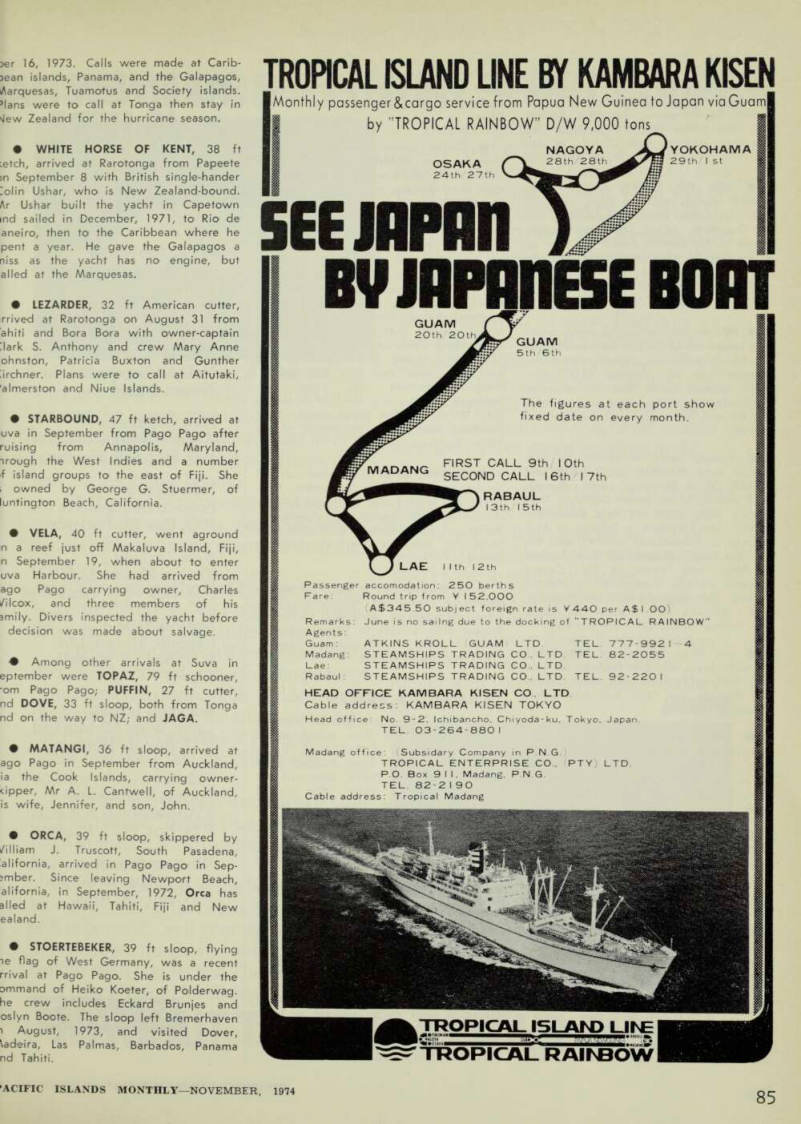
Yachts
• CHANSON, 40 ft sailing cutter registered at Los Angeles and which left Rarotonga last July headed for Tonga and Fiji, returned to Rarotonga in late September from Hawaii. On board were skipper-owner Harold A. Kilmer and Jean Reilly, who intend to visit French Polynesia and Fiji after engine repairs have been carried out. • UNTIE, 41 ft gaff-rigged cutter, arrived at Rarotonga on September 30 from Papeete with single-hander Mr A. C.
Murdoch who left Milford Haven, Wales, in his yacht six years ago. He called at Malta, where he stayed for one year before visiting Spain, Morocco and the Canary Islands. He stayed at Grenada, West Indies, for four years, then left the Panama Canal and sailed direct to the Marquesas. Mr Murdoch is bound out of Rarotonga to Russell, NZ. • LA PAZ, 35 ft sloop registered at Morro Bay, California, arrived at Raro tonga after a very rough passage from Papeete with owner-skipper Leland H.
Richey and his wife, Shirley, on Septem ber 6. From Morro Bay they had called at Mexican ports, Costa Rica, the Mar quesas and Tahiti. They left Rarotonga on September 18 with plans to call at New Zealand, Australia and New Guinea.
They are returning to California, but were undecided about what other ports to call at between the Coral Sea and Hawaii. • NATHALIE, 36 ft Swiss sloop registered at Basilea, arrived at Rarotonga from Papeete on September 11 with owner-captain William Ischer, Bernard Boudin and Jean Pierre Deruwe. Their cruise started from France two years ago and took them to Caribbean ports, Colombia, Ecuador, the Galapagos Islands and French Polynesia. Nathalie left Raro tonga on September 14 for Tonga, Fiji, New Zealand and Australia and with plans to complete a circumnavigation. • MAREDEA, 60 ft American yawl registered at Wilmington, Del., arrived at Rarotonga on September 20 from Papeete with co-owners Dan Leahy, Christine Rooney and Bill Wilson. Also on board were two crew, Vic Culina and Jacques Shelly. Mr Shelly is French, the rest Americans. Maredea once belonged to the US Naval Academy which used her for racing. The present cruise, which her co-owners hope will be a circumnaviga tion, started from New York on Novem
jer 16, 1973. Calls were made at Carib >ean islands, Panama, and the Galapagos, Marquesas, Tuamotus and Society islands.
Mans were to call at Tonga then stay in slew Zealand for the hurricane season. • WHITE HORSE OF KENT, 38 ft :etch, arrived at Rarotonga from Papeete >n September 8 with British single-hander 'olin Ushar, who is New Zealand-bound.
Ar Ushar built the yacht in Capetown md sailed in December, 1971, to Rio de aneiro, then to the Caribbean where he pent a year. He gave the Galapagos a niss as the yacht has engine, but ailed at the Marquesas. • LEZARDER, 32 ft American cutter, rrived at Rarotonga on August 31 from ahitl and Bora Bora with owner-captain Mark S. Anthony and crew Mary Anne ohnston, Patricia Buxton and Gunther Mrchner. Plans were to call at Aitutaki, ’almerston and Niue Islands. • STARBOUND, 47 ft ketch, arrived at uva in September from Pago Pago after ruising from Annapolis, Maryland, Trough the West Indies and a number f island groups to the east of Fiji. She ; owned by George G. Stuermer, of luntington Beach, California. • VELA, 40 ft cutter, went aground n a reef just off Makaluva Island, Fiji, n September 19, when about to enter uva Harbour. She had arrived from ago Pago carrying owner, Charles /ilcox, and three members of his smily. Divers inspected the yacht before decision was made about salvage. • Among other arrivals at Suva in eptember were TOPAZ, 79 ft schooner, ■om Pago Pago; PUFFIN, 27 ft cutter, nd DOVE, 33 ft sloop, both from Tonga nd on the way to NZ; and JAGA. • MATANGI, 36 ft sloop, arrived at ago Pago in September from Auckland, ia the Cook Islands, carrying owner dipper, Mr A. L. Cantwell, of Auckland, is wife, Jennifer, and son, John. • ORCA, 39 ft sloop, skippered by /illiam J. Truscott, South Pasadena, alifornia, arrived in Pago Pago in Sep ?mber. Since leaving Newport Beach, alifornia, in September, 1972, Orca has ailed at Hawaii, Tahiti, Fiji and New ealand. • STOERTEBEKER, 39 ft sloop, flying Te flag of West Germany, was a recent rrival at Pago Pago. She is under the ommand of Heiko Koeter, of Polderwag. he crew includes Eckard Brunjes and oslyn Boote. The sloop left Bremerhaven i August, 1973, and visited Dover, Vadeira, Las Palmas, Barbados, Panama nd Tahiti.
• ELLA, 32 ft cutter, owned and skippered by Walter Poitevent, of Hono lulu, was a recent arrival at Pago Pago.
She left Honolulu in March, 1974, and visited the Marquesas, Tuamotus, Society and Cook Islands before Pago Pago. The Ella crew includes Beth Church, of San Francisco, and Don Murray, of Winnipeg. • LEIF THE LUCKY, 34 ft sloop, arrived recently at Pago Pago, and will make its home there. The master, Leif V. Gustafson, sailed her from "some where in the Western Pacific" to take up a position in American Samoa. He de clined to say where he started from, but said he made calls at Truk, Ponape and N'auru on the way. • FRI, the nuclear protest yacht, which was towed out of the test zone in 1973 by the French authorities, recently sailed into Papeete from NZ, carrying 12,000 anti bomb protest cards from all countries bordering the Pacific. After leaving Tahiti the Fri will sail to Fiji and the Marshall Islands. • Among yachts in Honiara in Sep tember were MYONIE, 36 ft ketch, and SEEKER, 30 ft fibreglass yacht. Myonie, with owners Al and Helen Gehrmon, from Florida, USA, is on her third circumnavi gation. The Solomons is familiar to Al— he was in Guadalcanal in 1943 with the US "Sea Bees". Myonie left New Zealand in May, with stops at Fiji, Canton (Phoenix Islands), Funafuti (Ellice Islands).
Seeker, with single-hander Jim Kennedy, of Los Angeles, USA, is bound for Kusaie and Ponape in the US Trust Territory. • Last news we had of WANDERER IV, with Susan and Eric Hiscock, on their way back to England from New Zealand and Sydney, was that they had safely arrived in Darwin. • SEVEN SEAS, 33 ft sloop, with owners Hans and Bridgette Wolf-Sternig from West Berlin, arrived in Port Moresby on its way to Europe via Suez. They in tend having a working stopover for a while. © PLUNCH, 33 ft sloop from Hamburg, arrived in Port Moresby in September from Suva and Noumea. On board were owner Gunter Hermann and crew mem ber Dittmar Viohle, who hope to work in Moresby. • NOELNAI, built in Port Moresby of ferro-cement by well-known couple Graham and Noela Byrnes, departed Moresby in September for Samarai, Lae and Madang on the start of their Indo nesian cruise. • MAR-Y-PAZ, 60 ft ketch built by Alan Orams in New Zealand for Kermit and Delores Wall, reached Port Moresby
after starting in the Auckland-Suva yacht race and continuing through New Cale donia and the New Hebrides. They intend cruising to Bali and eventually Hong Kong. ® Other recent visitors to Port Moresby were KRANICH, 40 ft Piver tri maran, with Eckard and Vera Luedthe and their three children, en route to Germany, and DULCINEA, 37 ft sloop, which arrived from Pago Pago and left mid-September for Bali and Singapore. Crew includes Californian Judy Erickson. • JINDIVIK, 33 ft Australian trimaran, was badly damaged and later overturned and sank in heavy seas recently off the southern Papua coast. Three men on board, owner Adrian Vandernilt, Cliff Shugg and Paul Carney, set out from Townsville. Heavy seas ripped off the port float; about two days later the tri maran overturned. The three men managed to salvage a life raft on which they drifted to the Papua coast. They stumbled ashore near the mouth of the Purari River. • CURLEW, an 81 ft schooner, arrived in American Samoa in September from Apia. The wood-hulled craft was built in Maine and is owned by Francis C.
Romen, of Santa Monica, California, who plans an indefinite stay in American Samoa. • IE MOANA, 50 ft ketch owned by George A. Perry, of Wilmington, Dela ware, returned to American Samoa in August after a visit to Western Samoa.
Previous ports of call included Panama, Tahiti and Cook Islands.
Transport Briefs
• The NZ Government “banana boat”, the Moana Roa, which made 145 voyages out of Auckland in the last 14 years, has been handed over to the Royal NZ Navy, and will be come a survey ship. She sailed 580,000 miles in those 14 years, plying mainly to the Cook Islands, but as a commercial proposition she was a disaster.
Captain Fraser, the master, and the chief engineer, Mr W. H.
Maidens, served with the ship since it was built. • A new shipping service linking
Fiji with Singapore was begun in
September. The ship, Liverpool
Clipper, chartered for the service by Ben Shipping (Pte) Ltd, Singapore, from the Portland Shipping Co of Glasgow, will carry general and re frigerated cargo. The service will operate once a month. Fiji agent is Seatians (Fiji) Ltd.
Advertisements & other items, pp. 89-92 (3 items)
85
’ACIFIC ISLANDS MONTHLY— NOVEMBER, 1974
SEEMpnn^^H
TROPICAL ISLAND LINE BY KAMBARA KISEN
Monthly passenger&cargo service from Papua New Guinea to Japan via Guam
by "TROPICAL RAINBOW” D/W 9,000 tons
NAGOYA YOKOHAMA
29th I st
SEEMpnn^^H
l BVjnranESE boot
GUAM
20th 20th
GUAM
MADANG
LAE
The figures at each port show fixed date on every month.
FIRST CALL 9th I Oth
SECOND CALL I 6th I 7th
RABAUL
13th 15th Passenger accomodation: 250 berths Fare: Round trip from V 152.000 A 5345.50 subject foreign rate is Y 440 per AJI.OO) June is no sailng due to the docking of "TROPICAL RAINBOW Remarks: Agents: Guam : Madang; Lae: Rabaul : ATKINS KROLL GUAM LTD TEL. 777-9921 4 STEAMSHIPS TRADING CO . LTD TEL 82-2055
STEAMSHIPS TRADING CO , LTD
STEAMSHIPS TRADING CO, LTD TEL 92-220 1
HEAD OFFICE KAMBARA KISEN CO LTD
Cable address; KAMBARA KISEN TOKYO Head office: No. 9-2, Ichibancho. Chiyoda-ku. Tokyo, Japan.
TEL 03-264-880 I
Madang office: (Subsidary Company in P NG.
TROPICAL ENTERPRISE CO, PTV, LTD.
P.O. Box 9 I I. Madang, P N G
TEL. 82-2 I 90
Cable address: Tropical Madang
TROPICAL ISLAM) LIISE
TROPICAL RAIISBOW
YOUR NEW FIAT
IS HERE
American Samoa Silver Star Transport Inc.
P.O. Box CB-4, Pago Pago Fiji W. R. Carpenter (South Pacific) Ltd. trading as Millers Motors Private Bag, Suva Nauru Nauru Cooperative Society Nauru Island New Caledonia Agence Automobile S.A.
P.O. Box 842, Noumea New Hebrides Societe Bourgeois & Cie P.O. Box 28, Portvila New Zealand Torino Motors Ltd.
P.O. Box 6240, Auckland Norfolk Island Cascade Motors Ltd.
P.O. Box 34, Norfolk Island Solomon Islands Chan Wing Motors Ltd.
P.O. Box 4, Honiara Tahiti Societe Tahitienne d’Automobiles S.A.R.L.
P.O. Box 1723, Papeete Western Samoa E. A. Coxon & Co. Ltd.
P.O. Box 38, Apia
ansa
FIAT OF AUSTRALIA PTV. LTD.
HOWTO OWN A LUXURY SPORT COUPE
.A; :: To be perfectly honest there never was anything to stop a family man from driving the luxury sport coupe he always wanted. Provided, of course, that he was prepared to make certain sacrifices, like leaving his family behind.
Or that his family were prepared to make certain sacrifices, like being less comfortable and more cramped than they deserved to be.
This is where the Fiat 124 Sport Coupe is a little different. Not only is it a joy to drive, but it’s also a joy to be driven in.
Look inside and you’ll see abeautifully designed dashboard with a full complement of instruments, comfortable padded seats, thick carpets, and all the trimmings that the Italians are famous for. But look again, and you’ll see something else: nothing. And a lot of it.
In other words there’s enough room for four people. And by that we mean room to stretch, yawn and scratch for four six foot men.
Now try looking in the boot. There’s a lot more nothing there too. 9.6 cubic feet of it to be exact. So if your wife wants to take all those things you never use on holiday with you, let her. There’ll be more than enough room for them.
But let’s face it. When you buy a luxury sport coupe, you don’t just buy it for what you can get into it. You buy it for what you can get out of it. What you get out of the Fiat 124 Sport Coupe is 118 bhp and a smooth 0-60 in 10.4 seconds. After all, it’s not called a sport coupe for nothing.
The Fiat 124 Sport Coupe contains every feature you’ll find in any luxury sport coupe near its price. That is of course, if you can find a luxury sport coupe anywhere near its price.
But if you do, check to see if ifs got power-assisted disc brakes on all four wheels, a tachometer that never makes mistakes, a five speed gear box and a smooth-as-silk suspension.
Once you’ve done that you’ll probably decide that the Fiat 124 Sport Coupe is the car you’ve been waiting for. We’re pleased to be able to tell you that you won’t have to wait any longer.
Your local Fiat dealer will be able to arrange early delivery.
So why not go down for a test drive today. And don’t forget to take your family with you. We can assure you they’ll grow to love it. 8080 m
WITHOUT TRADING IN YOUR FAMILY.
Do you want to do business
in New Zealand?
Ask the bank
which has
40% of the banking
business in
New Zealand
The BNZ can give you full information on buying or selling in New Zealand and overseas.
Full information on investment, movement of money, transfers of dividends etc. is also readily available.
There are offices everywhere, more than 400 in fact.
Whatever your financial or trade needs, the BNZ can help you.
Wellington - International Division, Box 2392.
Sydney - GPO Box 507, Sydney,
N.SW. 2001.
Melbourne - GPO Box 528 E, Melbourne, Vic. 3001.
Tokyo - Mr G. Scott, Bank of New Zealand Representative Office, Japan,Suite 240, New Tokyo Bldg, 3-1, 3-Chrome, Marunouchi, Chiyoda-ku, Tokyo 100.
Singapore - Mr R. F. Warren, Bank of New Zealand Representative Office, South East Asia. 4th Floor, Ramayana Bldg, 45/47 D, Robinson Rd, Singapore.
London - PO Sox 402, London EC4.
Fiji - 25 Victoria Parade. Also at Labasa, Lautoka, Nadi, Sigatoka, Ba.
H
Bank of New Zealand
87
fcCIFIC ISLANDS MONTHLY—NOVEMBER, 1974
Business and Development
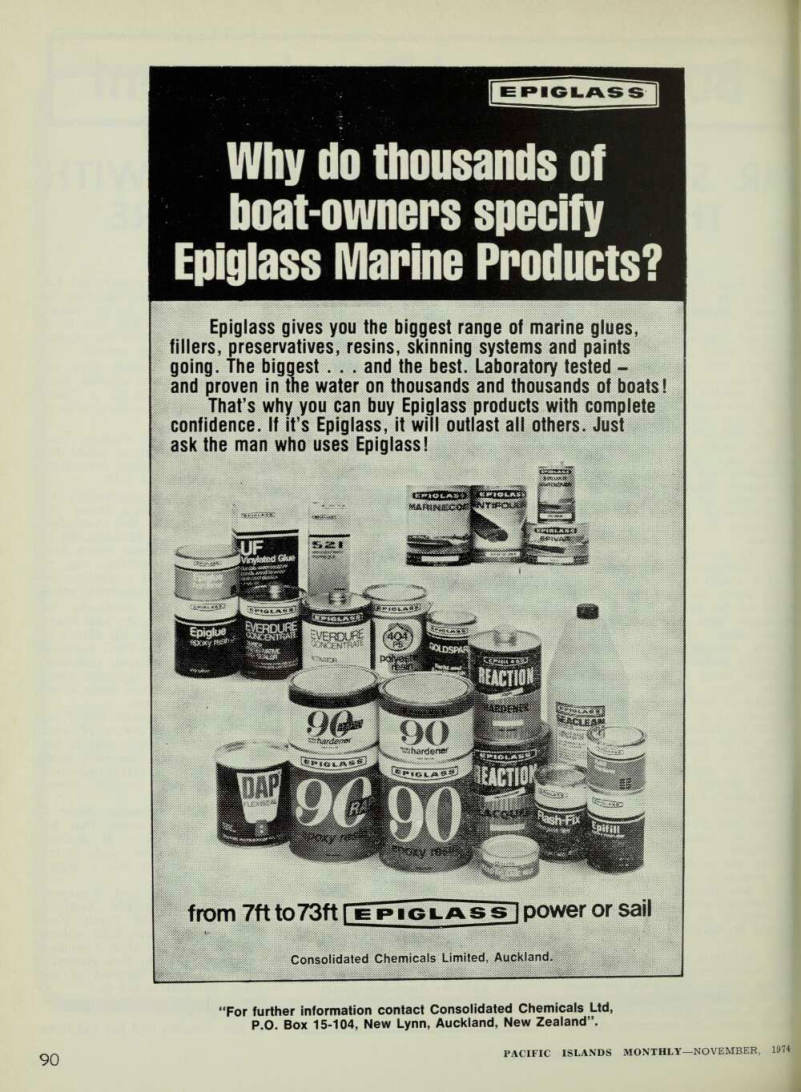
Ar Somare Gilds His Image With
The Bougainville Brochure
From GUS SMALES, in Port Moresby
fhe Papua New Guinea Chief nister, Mr Somare, used an extra linary document in October to lounce the terms of a newly ;otiated agreement on the Bou nville Island copper mine, fhere’s little doubt that had he n announcing the same informa i 12 months ago the presentation □ld have been altogether different.
Somare then was a sort of ional idol, secure in the knowledge t he rarely had to justify his ions and that his undisputed ionalism was in the interests of country. Such an announcement months ago would have been lightforward, factual and in low despite its obvious national im tance.
Jut 12 months of wear and tear a new-nation government can ke a wealth of difference.
"he result was that the statement led on the Bougainville terms of cement emerged as a sort of bal colour brochure selling the acity, astuteness, infallibility and mright perfection of the Somare ilition brand of nationalism. The □al terms of the agreement •eared to have been put into the cment as a mere appendage.
Lven the Government Information ice which handled the statement cribed it to journalists as “an wer to statements from new itical groups”. The new political ups preach a loud-voiced “A black >ua New Guinea for black mans and New Guineans” policy ich is becoming increasingly lionable.
"hey are a fairly far cry from pragmatic sort of nationalism ch has generally emerged from Somare’s establishment. But they creating an emotionalism which put Mr Somare into a new situa i. le is feeling the reaction of the V atmosphere of nationalism which was largely responsible for creat in the first place. le is being forced to sell himself dly against the increasing clamour
of groups which see themselves as more nationalist than the govern ment. The Bougainville statement, with its big plug for the national strength of the government, was an obvious part of this reaction. Mr Somare is out to prove every op portunity that he and his followers can stand up to the world.
His basic political outlook today is neither more radical nor more conservative than it ever was, but it is the circumstances surrounding him that have changed. No longer is he the central figure of nationalism, and there is a natural psychological re action as well as a political one to prove his sufficiency.
His experience in government has shown him that the shouting of Third-World slogans is no substi tute for plain hard work, but he is finding he has to answer the slogan shouters on their own ground.
Before the new terms were an nounced, Mr Somare accused Bou gainville Copper Ltd of a “back door” approach to achieve what it wants in PNG.
But Papua New Guinea, and Papua New Guinea alone, would dic tate the terms of foreign investment inside its borders, he said.
Mr Somare was commenting on the company’s attempt during the negotiations to get the Australian Government to lend $230,000,000 to PNG. The proposed loan, which Aus tralia refused to provide, was to allow PNG to buy a controlling in terest in the big Bougainville mine.
Mr Somare had steadfastly re fused to comment on the final round of talks, but he broke his silence in a broadcast from the PNG National Broadcasting Commission, comment ing on reports of the approach which Bougainville Copper had made to the Australian Government.
His remarks suggested that PNG itself had not been aware of what was going on, although this is not borne out in other statements from Australia. There is every indication that Australia acted in close liaison with PNG.
Mr Somare’s comments made it abundantly clear however that his government was not at all anxious to have to buy a major share in the mine. All it wanted was a bigger slice of the earnings.
The Chief Minister said, “I suppose the company approached Australia because they thought Papua New Guinea was still some little colony that Australia looked after, I suppose the company thought that Australia could influence the decision of my ministry, but that is not so.”
Here are the detailed terms of the settlement: • The company will pay tax from
January 1, 1974, instead of 1978 or 1979, as under the old agreement. • The company will not be en titled to “accelerated depreciation” provisions which could delay tax payments. ® The company will pay an addi tional tax of 70 per cent on all in come exceeding $87.2 million annually. (Normal company tax in PNG is 33-1/3 per cent.) • The company will no longer have the right to exclude 20 per cent of its income. ® The company will be subject to ordinary income tax, import duties, stamp duties, vehicle registra tions, and other fees and charges which had been waived under the old agreement. ® The normal laws of PNG will apply to the company in matters concerning imports, exports, appro val of contracts, environmental pro tection and pollution control. © The company will pay 50 cents a tonne on production to establish an environmental rehabilitation fund. • Government directors on the company’s board will have veto powers over grants and donations made by the company. • The Bougainville Provincial Gov ernment will have policy control over the business advisory services operated by the company. • The company will guarantee that no new mines will be developed on Bougainville without approval by the Bougainville Islanders.
Mr Somare said he considered the points gained by his government in the negotiations had won “a tremen dous improvement”. He said the negotiations had been carried out against a background of recognition that foreign interests must not dominate the economic affairs of
Png.
It’s hard to escape the conviction, too, that the newly-arising political groups have nothing to offer above what Mr Somare’s government has already offered.
The groups are largely composed of men very similar in outlook and background to Michael Somare, although some perhaps a bit younger.
Many of them if they had started early enough could now be in exactly the same position as he is.
But he beat them to the start, and now they are trying to catch up by claiming a “stronger” breed of nationalism. It’s a last-minute sprint for the second prize, with the un voiced hope that the first prize could be available if the leader stumbles.
The talks which led to the newly announced settlement began in April.
Mr Somare had at first been reluc tant to make any move which might frighten away future overseas in vestment, but as the pressures of nationalism mounted at home he pushed for a renegotiation of the agreement.
This became possible on a govern ment basis after PNG achieved self government in December last year.
Samoan trust estates
under fire
From FELISE VA’A in Apia Western Samoa’s Public Accounts Committee accused the Western Samoa Trust Estates Corporation administration of “incompetency, mis administration and corruption” in a report submitted to the Western Samoa Parliament.
The fault was mainly with regard to debts owing to the corporation by commercial firms, private persons and government departments of $86,025.30 at February 28 this year, and by the corporation’s board members and staff of $81,263.19 for the same period, a total of $167,288.49.
Comparative debt figures for pre vious years were: $209,047 (1973)* $122,772 (1972); $117,074 (1971) and $55,671 (1970).
The Controller and Chief Auditor, Mr T. Overhoff, alleged in the report the deteriorating situation was due to the action of the general manager, Tupuola Nuuausala, “permitting the corporation’s funds to be used ille gally for his own purpose up to a sum of $21,862.”
The report alleged that most of this sum was used by Tupuola to finance the construction of a number of boarding houses.
In an interview with the Samoa Times, Tupuola denied there was anything illegal in his use of WSTEC funds because the funds were openly debited to his account.
He said staff members were per mitted to borrow money from the corporation provided they paid it back eventually. This had always
been a tradition within the cor poration.
The extent of borrowing is one thing. The declining profit margin is another. Occurring together, they prompted the Public Accounts Com mittee to recommend “that govern ment immediately make drastic changes in the membership of the board of directors and executive staff in management of WSTEC”.
The profitability of the corporation during 1970 and 1971 averaged 5.35 per cent. Total funds used averaged about $2.5 million.
However, the corporation’s profit ability in 1972 declined drastically to a mere 0.5 per cent “representing a net profit (excluding soap factory) of only $14,963 derived from the employment of funds and capital of over $2.5 million,” the report said.
“With the inclusion of soap fac tory profits of $34,808 (utilising funds and capital worth $100,000), the overall profitability of the cor poration in 1972 was only 1.9 per cent on the employment of funds and capital of over $2.6 million.”
Profits declined in copra exports by $5,294 in 1972 compared with $71,206 in 1971 and there was a $41,518 loss in cocoa exports in 1972.
A drop of over 50 per cent was recorded in the profitability of the corporation’s engineering shop.
Biggest headache was the sharp decline in the profits from copra and cattle. These constituted a sub stantial section of the corporation’s activities, contributing in 1969 48 per cent of the net profit earned but declining to an average of 38.5 per cent for 1970 and 1971. By 1972 the profit margin had been reduced to 16 per cent.
The Public Accounts Committee expressed its concern at the “over killing” of WSTEC cattle. This over killing had negated the natural in crease of the herd estimated at 20 per cent per annum.
Overkilling had become so bad that by 1973 there were only 7,513 cattle in the WSTEC herd, compared with 11,280 in 1955.
The committee alleged that the administration of WSTEC lease land was most inefficient; rentals were not paid in advance as required, no action was taken when rentals were due for review and re-assessment, little or ineffective effort was made to collect outstanding rents.
After the report was tabled in Parliament, the government asked Tupuola to retire, which he refused to do, saying that the government was bound to retain him under con tract.
He threatened to take the matter to
art if the government forced him t.
Fhe government did force him out the convenient method of having i Head of State make an order ter nating his services.
In the meantime, Tupai Lee is ing general manager, and, accord ; to reliable sources, several teams outside experts are studying ways improving WSTEC’s services.
lauruan public
srvants unhappy
Fhe Nauruan Workers Organisation which the republic’s public servants ong has protested to President mmer Deßoburt about the delay implementing the Kelly Report on irgin of Skills which was designed improve the sliding scale of salaries, [n a letter to President Deßoburt, NWO complains that the Cabinet > taken no action although the >ort was submitted nearly a year ), and that the Cabinet has appoint a commission to consider salary reases for ministers and MPs ile the question of the NWO’s ges structure revision remains in :yance. ‘We view this lengthy inactivity with at concern and we can only say t any further delay does not help morale of Nauruan public vants,” states the letter which is ned by Allan Thoma, NWO’s )uty chairman, Deiye, the retary, and Christmas Bam, the asurer. fhe letter adds, “It is not fair nor litable to your people especially to ise who rightly should benefit from > report to delay this matter then”
orfolk companies
n tax charges
>ix companies registered in Norfolk md were fined in the Special leral Court in Sydney on October for having failed to lodge income returns between 1970 and 1973. lilar charges against 18 other npanies were adjourned to Nov ber 21 on the application of their msel, who said the returns had n lodged. It had been said the
returns were not in order, and the firms wanted to put them in order.
The firms dealt with were Hartley Miltons Ltd (three charges), Pangona Ltd (four charges); Pangona Con sultants Ltd (two charges); Anne Gould (Holdings) Ltd (two charges); R. W. Gould (Distributing) Pty Ltd (two charges); and Ula Ltd (two charges). In each case a fine of $4O was imposed, plus $6 costs.
Mr G. Smythe, SM, said the 1901 Income Tax Assessment Act, as amended, applied to Norfolk Island.
He ordered the companies to file returns on or before November 11.
Mr D. P. Wall, who appeared for the Commissioner of Taxation, said when the cases were before the court in September, the companies had formed a complex tax avoidance scheme “involving millions of dol lars”.
Receiver for New
Guinea tea growers
Mount Hagen Tea Growers’ Pty Ltd, which is facing a number of financial problems, in September invited a receiver-manager to take over.
Dr John Guise, PNG Agriculture Minister, said the tea industry was of considerable value to the develop ment of the country. It earned more than $2.5 million in export income, and employed a work force of 5,000 to 7,000 in an area where there was little alternative employment, except coffee. Mount Hagen Tea Growers employed 1,000 people and processed tea grown by about 100 smallholders.
Dr Guise said he hoped the ap pointment of a receiver would enable the company’s plantation and factory to continue to grow and process tea.
Mixed feelings on
dollar devaluation
Devaluation of the Australian and NZ dollars by 12 per cent on Sep tember 25 was warmly welcomed in the Islands—at first news because it immediately reduced import prices.
But later there was disappointment when it was learned that some Aus tralian manufacturers had slapped a 12 per cent increase on the price of their goods.
However, Fiji expects a big reduc tion in its import bill as Australia and NZ provide about 50 per cent of imports.
A spokesman for the W. R, Car penter group in Fiji said that his company, because of prices increases in Australian and New Zealand goods when those countries revalued their currencies, turned to the US,
Canada, Britain and Europe for cheaper goods. But the devaluations might make it worthwhile to switch back to Australian and New Zealand suppliers.
Freight rates, where they are quoted in Australia and New Zea land dollars, will be cheaper for all island groups, except Papua New Guinea. The Australian rates to PNG will be unchanged, while NZ rates may go up a little.
Fiji firm and
workers join forces
Mainline Constructions (Fiji) Ltd suspended work on the Coral Gardens Hotel at Korolevu, Fiji, when the developer, Coral Gardens Hotel Ltd, was unable to pay $400,000 in progress claims. Then, workers on the hotel site decided to stage a “sit in” till they received wages due to them, after which they and Mainline Constructions joined forces and formed a joint committee to administer the occupation.
Mainline Constructions (Fiji) is jointly owned by Carpenters and the Mainline Corporation of Australia, the latter in receivership. Mainline Corporation is the majority share holder in Coral Gardens Hotel Ltd.
Air fares up
At least four Pacific airlines increased their fares in Septem ber. Rising fuel costs, higher wages bills, maintenance and associated airline costs were blamed.
Air Melanesiae lifted domes tic fares by 4.5 per cent. Poly nesian Airlines lifted fares by 12 per cent. Air Niugini added an average 10 per cent to domestic passenger, freight and charter rates. Air Pacific raised fares and cargo charges on internal routes by 13.5 per cent.
In defending the increases for Air Niugini, PNG’s Minister for Transport and Civil Aviation, Mr lambakey Okuk, explained that international airline fares and freight rates had increased on August 1 and further rises were predicted to come into effect around November 1. This would result in increases of 20 per cent in international tariffs in nine months, he said. Further, Air Pacific had increased fare and freight rates by 10 per cent in July and was seeking further rises, while the Australian domes tic tariffs rose by an average of 12 per cent in August.
Advertisements & other items, pp. 93-99 (6 items)
89
2IFIC ISLANDS MONTHLY—NOVEMBER. 1974
boat-owners specify
Why do thousands of
Epiglass Marine Products?
Epiglass gives you the biggest range of marine glues, fillers, preservatives, resins, skinning systems and paints going. The biggest... and the best. Laboratory tested and proven in the water on thousands and thousands of boats!
That’s why you can buy Epiglass products with complete confidence. If it’s Epiglass, it will outlast all others. Just ask the man who uses Epiglass! mm S&,s£i rj 90 m !> from 7ft to73ft I epiglass] power or sail Consolidated Chemicals Limited, Auckland.
“For further information contact Consolidated Chemicals Ltd, P.O. Box 15-104, New Lynn, Auckland, New Zealand”.
VCIFIC AREA
STRIBUTORS
DOK ISLANDS
Dok Is. Trading Corp. Ltd Jl jrns Philp (SS) Co. Ltd
EW GUINEA
)ugainville Marine Pty Ltd, e t a jrns Philp (NG) Ltd, adang vee Trading Pty Ltd, 3 haul iulkner & Tait (NG) Pty Ltd, le A. Heath & Co. Pty Ltd, Moresby
EW HEBRIDES
jrns Philp (NH) Ltd
DUMEA
uy Limousin icific Yachting
DRFOLK ISLAND
/ine Bid. Supply Centre
\GO PAGO
ax Haleck Inc. \H 111 arine Corail ihiti Sport ihiti Voile
DNGA
echelmann Bros.
ESTERN SAMOA
jrns Philp (SS) Co. Ltd A. Coxon Ltd old Star Transport Co. Ltd orris Hedstrom Ltd
OLOMON ISLANDS
eorge Yee Fai Ltd
Turners Supply Co
FRESH FRUIT & VEGETABLES
offers expert
insurance service
throughout
the Islands
QUEENSLAND INSURANCE
COMPANY LIMITED
(Incorporated 1886 in Australia)
Head Office: 82 Pitt Street, Sydney FIJI —Branch Office, Suva, Manager for Fiji: F. N. Davies (A.A.1.1.).
LAUTOKA —District Manager: G. A. Wooley.
HONIARA (8.5.1. P.) —Breckwoldt & Company (5.1.) Pty.
Limited.
NEW CALEDONIA—T. A. Hagen, Ste. W. A. Johnston, S.A.R.L.—Noumea.
NEW HEBRIDES —Resident Officer: R. J. Allsop (A.A.1.1.) Vila; Santo: Bums Philp (New Hebrides) Ltd.
TAHlTl—Arthur Chung: Immeuble 8.1., Front de Mer, Papeete.
NIUE, NORFOLK ISLAND, SAMOA, TONGA and other South Sea Islands—Bums Philp (South Sea) Company Ltd.
QUEENSLAND INSURANCE (P.N.G.) LTD
PAPUA NEW GUINEA
Head Office, Port Moresby: General Manager: D. J. Granter.
District Managers at Rabaul: C, D. Dickings; Lae: R. Jackson; Mt. Hagen: D. F. Carroll.
H 360
NOW! THE PAPUA NEW GUINEA HANDBOOK
At last! The seventh edition of the Papua New Guinea Handbook —the self-government issue—completely revised and reset. The first full, up-to-date details of the new self-governing nation, for businessmen, travellers, schools, government departments.
Covers everything. Geography, history, commerce, trade and banking, forestry, finance, taxation, company registrations, the public service, where to stay, what to see, etc, etc.
With detailed maps. 332 pages. $5.50 plus postage. PACIFIC PUBLICATIONS (AUST) PTY LTD, GPO Box 3408, Sydney, NSW 2001.
Why Naco
Louvre
Windows won
the Good
Design Award
Proven design features perpetuate Naco as the most popular louvre on international markets. High volume manufacture ensures prompt delivery and competitive prices. Design features include a central rib for weather tight closure; fingertip operating handle incorporating positive lock; centre pivoted blade ensures perfect balance, louvres do not blow open or closed.
Double operating bars are totally enclosed to ensure clean modern lines. Anodised aluminium or zinc plated steel construction; optional security bars available for additional security protection.
Contact Comalco Fabricators Export Pty Limited, manufacturers and overseas distributors of Naco products.
COMALCO FABRICATORS
EXPORT PTY. LIMITED
BOX 715 G.P.O.
BRISBANE 4001
AUSTRALIA.
COMALCO
is aluminium
‘presented by Industrial Design Council of Australia
COM 854
Turners and Growers
FRESH FRUIT&VEGETABLES
9828
SUPPLY & SERVICE IS OUR BUSINESS!
LARGE STOCKS AVAILABLE AT "CALL"
LOGGING SUPPLIES
Shaw's and British Wire Rope, Heyco, Blackhawk Workshop Tools and Wrenches, Chain Saws, Genuine and/or replacement heavy equipment spare parts, tyres of various sizes and makes.
SAWMILLINC REQUISITES
Spear £r Jackson, Uddelholm Narrow and Wide Band Saw, Circular Saws, Inserted Tooth Saw and fittings, Planing £r Ticknessing Knives, Cutters and Oberg Engineering and Sawmilling Files.
ENGINEERING TOOLS AND HARDWARE SUPPLIES
Carborundum Grinding wheels, Rubbing Bricks and Coated Products, High Speed Steel or Carbide Lathe Tools, Cutters, Machine Tool Steel and Construction Steel of various sections.
Exporter: LEONG BEE & SOO BEE (S) PTE. LTD. 30, Jervois Road, P.O. Box 3398, Singapore 10. Tel: 630477.
Cable Address: "Steelwood—Singapore".
The car for all the right reasons.
REUABIUTY
DURABILITY
COMFORT
STYLE
i Fhe kind of car you need for where you are going to drive, is Victor. This is the rugged, reliable car, that has the power you need (1800 c.c. developing 77 b.h.p. and the economy that saves.
Comfortable driving is assured, through Victor's four coil suspension, and very comfortable, fully reclining bucket seats.
Victor also features these safety features: Two speed wiper/washers. Dual circuit brakes with power discs up front. Seat belts.
Victor is the right sized car, with full stretch out room for five adults.
Vauxhall Victor dealers back you up best, with genuine General Motors service and economical spare parts.
You’ve read the right reasons... why not drive the right car, Vauxhall Victor at: Fiji: MILLERS MOTORS LTD. New Caledonia: ETABLISSEMENTS BALLANDE.
Portuguese Timor: SOCIEDADE AGRICOLA PATRIA. E TRABALHO LDA.
Solomon Islands: SOLOMON ISLANDS SERVICE STATION.
Western Samoa: 0. F. NELSON & CO. LTD.
VICTOR
it
91
IFIC ISLANDS MONTHLY—NOVEMBER, 1974
93
CIFIC ISLANDS MONTHLY—NOVEMBER, 1974
On the razor's edge
94
PACIFIC ISLANDS MONTHLY —NOVEMBER, 1974
On the razor's edge Continued from p 9
95
:iFIC ISLANDS MONTHLY—NOVEMBER, 1974
Shipping & Airways Information
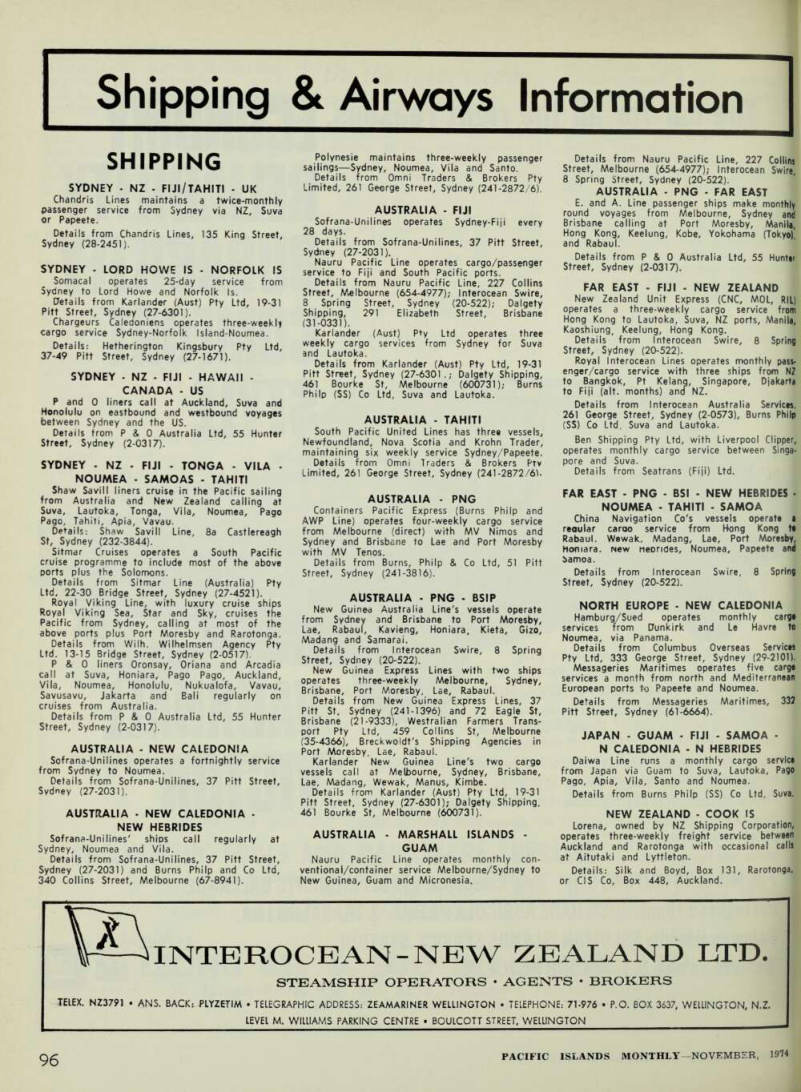
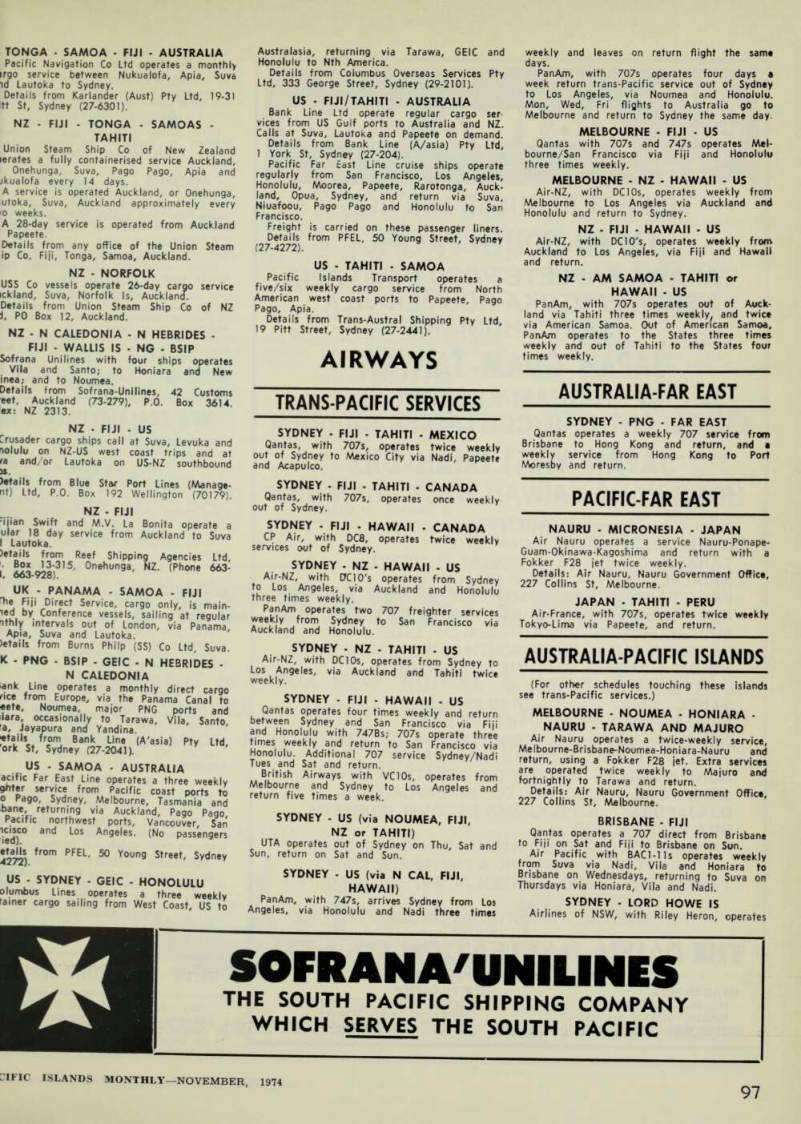
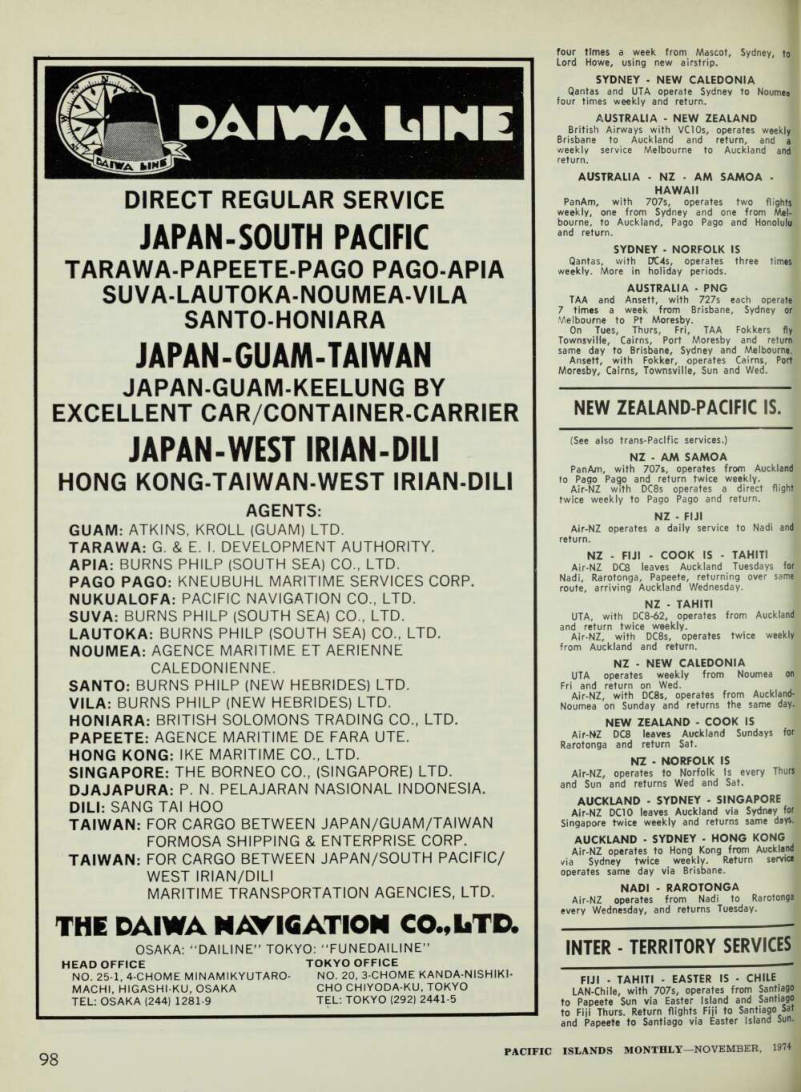
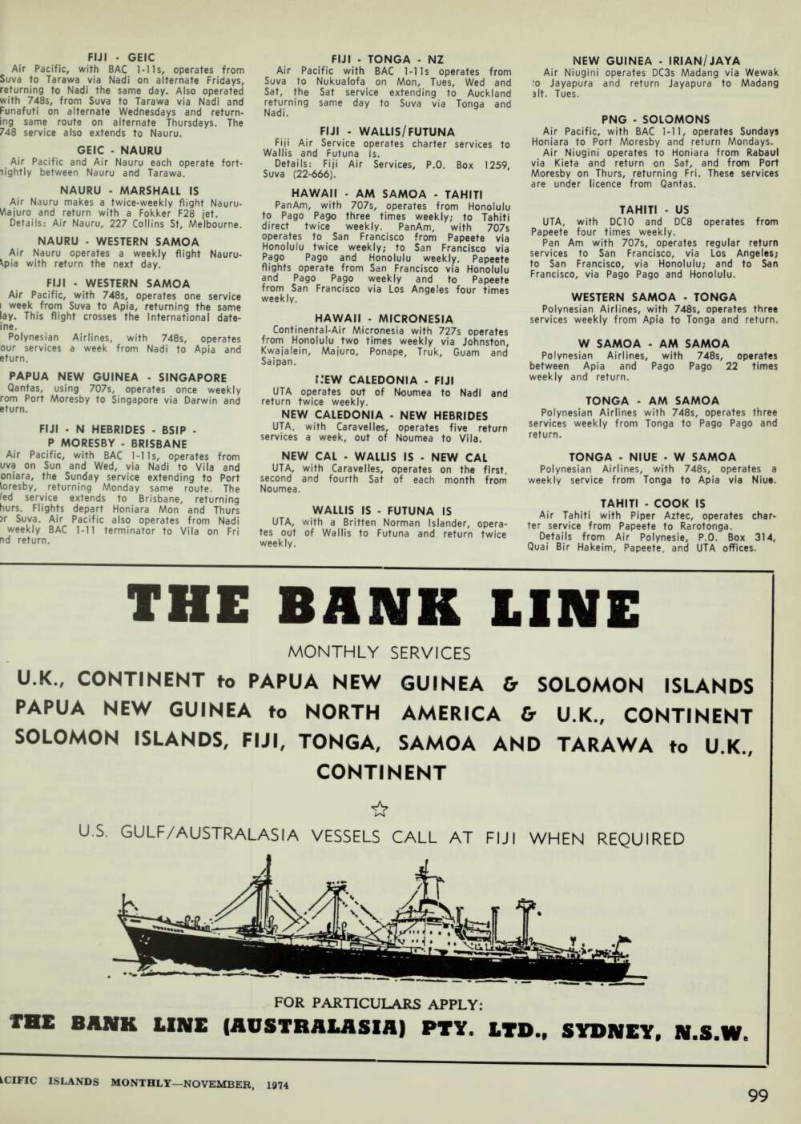
Shipping
SYDNEY - NZ - FIJI/TAHITI - UK Chandris Lines maintains a twice-monthly passenger service from Sydney via NZ, Suva or Papeete.
Details from Chandris Lines, 135 King Street, Sydney (28-2451).
SYDNEY - LORD HOWE IS - NORFOLK IS Somacal operates 25-day service from Sydney to Lord Howe and Norfolk Is.
Details from Karlander (Aust) Pty Ltd, 19-31 Pitt Street, Sydney (27-6301).
Chargeurs Caledoniens operates three-weekly cargo service Sydney-Norfolk Island-Noumea.
Details: Hetherington Kingsbury Pty Ltd, 37-49 Pitt Street, Sydney (27-1671).
SYDNEY - NZ - FIJI - HAWAII -
Canada - Us
P and 0 liners call at Auckland, Suva and Honolulu on eastbound and westbound voyages between Sydney and the US.
Derails from P & 0 Australia Ltd, 55 Hunter Street, Sydney (2-0317).
SYDNEY - NZ - FIJI - TONGA - VILA -
Noumea - Samoas - Tahiti
Shaw Savill liners cruise in the Pacific sailing from Australia and New Zealand calling at Suva, Lautoka, Tonga, Vila, Noumea, Pago Pago, Tahiti, Apia, Vavau.
Details: Shaw Savill Line, 8a Castlereagh St, Sydney (232-3844).
Sitmar Cruises operates a South Pacific cruise programme to include most of the above ports plus the Solomons.
Details from Sitmar Line (Australia) Pty Ltd, 22-30 Bridge Street, Sydney (27-4521).
Royal Viking Line, with luxury cruise ships Royal Viking Sea, Star and Sky, cruises the Pacific from Sydney, calling at most of the above ports plus Port Moresby and Rarotonga.
Details from Wilh. Wilhelmsen Agency Pty Ltd. 13-15 Bridge Street, Sydney (2-0517).
P & 0 liners Oronsay, Oriana and Arcadia call at Suva, Honiara, Pago Pago, Auckland, Vila, Noumea, Honolulu, Nukualofa, Vavau, Savusavu, Jakarta and Bali regularly on cruises from Australia.
Details from P & 0 Australia Ltd, 55 Hunter Street, Sydney (2-0317).
Australia - New Caledonia
Sofrana-Unilines operates a fortnightly service from Sydney to Noumea.
Details from Sofrana-Unilines, 37 Pitt Street, Sydney (27-2031).
Australia - New Caledonia -
New Hebrides
Sofrana-Unilines' ships call regularly at Sydney, Noumea and Vila.
Details from Sofrana-Unilines, 37 Pitt Street, Sydney (27-2031) and Burns Philp and Co Ltd, 340 Collins Street, Melbourne (67-8941).
Polynesie maintains three-weekly passenger sailings—Sydney, Noumea, Vila and Santo.
Details from Omni Traders & Brokers Pty Limited, 261 George Street, Sydney (241-2872/6).
Australia ■ Fiji
Sofrana-Unilines operates Sydney-Fiji every 28 days.
Details from Sofrana-Unilines, 37 Pitt Street, Sydney (27-2031).
Nauru Pacific Line operates cargo/passenger service to Fiji and South Pacific ports.
Details from Nauru Pacific Line, 227 Collins Street, Melbourne (654-4977); Interocean Swire, 8 Spring Street, Sydney (20-522); Dalgety Shipping, 291 Elizabeth Street, Brisbane (31-0331).
Karlander (Aust) Pty Ltd operates three weekly cargo services from Sydney for Suva and Lautoka.
Details from Karlander (Aust) Pty Ltd, 19-31 Pitt Street, Sydney (27-6301.; Dalgety Shipping, 461 Bourke St, Melbourne (600731); Burns Philp (SS) Co Ltd, Suva and Lautoka.
Australia - Tahiti
South Pacific United Lines has three vessels, Newfoundland, Nova Scotia and Krohn Trader, maintaining six weekly service Sydney/Papeete.
Details from Omni Traders & Brokers Prv Limited, 261 George Street, Sydney (241-2872/6).
Australia - Png
Containers Pacific Express (Burns Philp and AWP Line) operates four-weekly cargo service from Melbourne (direct) with MV Nimos and Sydney and Brisbane to Lae and Port Moresby with MV Tenos.
Details from Burns, Philp & Co Ltd, 51 Pitt Street, Sydney (241-3816).
Australia - Png • Bsip
New Guinea Australia Line's vessels operate from Sydney and Brisbane to Port Moresby, Lae, Rabaul, Kavieng, Honiara. Kieta, Gizo, Madang and Samarai.
Details from Interocean Swire, 8 Spring Street, Sydney (20-522).
New Guinea Express Lines with two ships operates three-weekly Melbourne, Sydney, Brisbane, Port Moresby, Lae, Rabaul.
Details from New Guinea Express Lines, 37 Pitt St, Sydney (241-1396) and 72 Eagle St, Brisbane (21-9333), Westralian Farmers Trans port Pty Ltd, 459 Collins St, Melbourne (35-4366), Breckwoldt's Shipping Agencies in Port Moresby, Lae, Rabaul.
Karlander New Guinea Line's two cargo vessels call at Melbourne, Sydney, Brisbane, Lae, Madang, Wewak, Manus, Kimbe.
Details from Karlander (Aust) Pty Ltd, 19-31 Pitt Street, Sydney (27-6301); Dalgety Shipping, 461 Bourke St, Melbourne (600731).
Australia - Marshall Islands -
Guam
Nauru Pacific Line operates monthly con ventional/container service Melbourne/Sydney to New Guinea, Guam and Micronesia.
Details from Nauru Pacific Line, 227 Collins Street, Melbourne (654-4977); Interocean Swire. 8 Spring Street, Sydney (20-522).
Australia - Png - Far East
E. and A. Line passenger ships make monthly round voyages from Melbourne, Sydney and Brisbane calling at Port Moresby, Manila, Hong Kong, Keelung, Kobe, Yokohama (Tokyo), and Rabaul.
Details from P & 0 Australia Ltd, 55 Hunter Street, Sydney (2-0317).
FAR EAST - FIJI - NEW ZEALAND New Zealand Unit Express (CNC, MOL, RIL) operates a three-weekly cargo service from Hong Kong to Lautoka, Suva, NZ ports, Manila, Kaoshiung, Keelung, Hong Kong.
Details from Interocean Swire, 8 Spring Street, Sydney (20-522).
Royal Interocean Lines operates monthly pass enger/cargo service with three ships from NZ to Bangkok, Pt Kelanq, Singapore, Djakarta to Fiji (alt. months) and NZ.
Details from Interocean Australia Services, 261 George Street, Sydney (2-0573), Burns Philp (SS) Co Ltd. Suva and Lautoka.
Ben Shipping Pty Ltd, with Liverpool Clipper, operates monthly cargo service between Singa pore and Suva.
Details from Seatrans (Fiji) Ltd.
FAR EAST - PNG • BSI • NEW HEBRIDES •
Noumea - Tahiti - Samoa
China Navigation Co's vessels operate i regular carao service from Hong Kong te Rabaul. Wewak, Madang, Lae, Port Moresby, Honiara. New neondes, Noumea, Papeete and bamoa.
Details from Interocean Swire, 8 Spring Street, Sydney (20-522).
North Europe - New Caledonia
Hamburg/Sued operates monthly carge services from Dunkirk and Le Havre to Noumea, via Panama.
Details from Columbus Overseas Services Pty Ltd, 333 George Street, Sydney (29-2101).
Messageries Maritimes operates five carge services a month from north and Mediterranean European ports to Papeete and Noumea.
Details from Messageries Maritimes, 332 Pitt Street, Sydney (61-6664).
JAPAN - GUAM - FIJI - SAMOA -
N Caledonia • N Hebrides
Daiwa Line runs a monthly cargo service from Japan via Guam to Suva, Lautoka, Pago Pago, Apia, Vila, Santo and Noumea.
Details from Burns Philp (SS) Co Ltd, Suva.
New Zealand - Cook Is
Lorena, owned by NZ Shipping Corporation, operates three-weekly freight service between Auckland and Rarotonga with occasional calls at Aitutaki and Lyttleton.
Details: Silk and Boyd, Box 131, Rarotonga, or CIS Co, Box 448, Auckland.
TONGA - SAMOA - FIJI - AUSTRALIA Pacific Navigation Co Ltd operates a monthly irgo service between Nukualofa, Apia, Suva id Lautoka to Sydney.
Details from Karlander (Aust) Pty Ltd, 19-31 itt St, Sydney (27-6301).
NZ - FIJI - TONGA - SAMOAS -
Tahiti
Union Steam Ship Co of New Zealand lerates a fully containerised service Auckland, Onehunga, Suva, Pago Pago, Apia and jkualofa every 14 days.
A service is operated Auckland, or Onehunga, utoka, Suva, Auckland approximately every fo weeks.
A 28-day service is operated from Auckland Papeete.
Details from any office of the Union Steam ip Co, Fiji, Tonga, Samoa, Auckland.
Nz - Norfolk
USS Co vessels operate 26-day cargo service ickland, Suva, Norfolk Is, Auckland.
Details from Union Steam Ship Co of NZ J, PO Box 12, Auckland.
NZ - N CALEDONIA - N HEBRIDES - FIJI • WALLIS IS - NG - BSIP Sofrana Unilines with four ships operates Vila and Santo,- to Honiara and New inea; and to Noumea.
Details from Sofrana-Unilines, 42 Customs eet, Auckland (73-279), P.O. Box 3614 ex: NZ 2313.
Nz - Fiji - Us
Crusader cargo ships call at Suva, Levuka and nolulu on NZ-US west coast trips and at ra and/or Lautoka on US-NZ southbound ».
Mails from Blue Sta<r Port Lines (Manage nt) Ltd, P.O. Box 192 Wellington (70179).
Nz - Fiji
■ijian Swift and M.V. La Bonita operate a ular 18 day service from Auckland to Suva I Lautoka.
Mails from Reef Shipping Agencies Ltd '■ 315 ' Onehunga, NZ. (Phone 663- UK - PANAMA - SAMOA - FIJI rhe Fiji Direct Service, cargo only, is main led by Conference vessels, sailing at regular ithly intervals out of London, via Panama Apia, Suva and Lautoka.
Mails from Burns Philp (SS) Co Ltd, Suva.
K - PNG • BSIP - GEIC - N HEBRIDES -
N Caledonia
>ank Line operates a monthly direct cargo rice from Europe, via the Panama Canal to fete, Noumea, major PNG ports and lara, occasionally to Tarawa, Vila, Santo Jayapura and Yandina.
Mails from Bank Line (A'asia) Pty Ltd 'ork St, Sydney (27-2041).
Us - Samoa - Australia
acific Far East Line operates a three weekly ghter service from Pacific coast ports to o Pago, Sydney, Melbourne, Tasmania and bane, returning via Auckland, Pago Pago Pacific northwest ports, Vancouver, San Ted) 00 anC * *"° S n 9 e * es- (No passengers Ma_iU from PFEL, 50 Young Street, Sydney US - SYDNEY - GEIC - HONOLULU olumbus Lines operates a three weekly lamer cargo sailing from West Coast, US to
Australasia, returning via Tarawa, GEIC and Honolulu to Nth America.
Details from Columbus Overseas Services Pty Ltd, 333 George Street, Sydney (29-2101).
Us ■ Fiji/Tahiti - Australia
Bank Line Ltd operate regular cargo ser vices from US Gulf ports to Australia and NZ.
Calls at Suva, Lautoka and Papeete on demand.
Details from Bank Line (A/asia) Pty Ltd, 1 York St, Sydney (27-204).
Pacific Far East Line cruise ships operate regularly from San Francisco, Los Angeles, Honolulu, Moorea, Papeete, Rarotonga, Auck land, Opua, Sydney, and return via Suva, Niuafoou, Pago Pago and Honolulu to San Francisco.
Freight is carried on these passenger liners.
Details from PFEL, 50 Young Street, Sydney (27-4272).
Us - Tahiti - Samoa
Pacific Islands Transport operates a five/six weekly cargo service from North American west coast ports to Papeete, Pago Pago, Apia.
Details from Trans-Austral Shipping Pty Ltd, 19 Pitt Street, Sydney (27-2441).
Airways
Trans Pacific Services
SYDNEY - FIJI ■ TAHITI - MEXICO Qantas, with 7075, operates twice weekly out of Sydney to Mexico City via Nadi, Papeete and Acapulco.
SYDNEY - FIJI - TAHITI - CANADA Qantas, with 7075, operates once weekly out of Sydney.
SYDNEY - FIJI - HAWAII - CANADA CP Air, with DCS, operates twice weekly services out of Sydney.
SYDNEY - NZ ■ HAWAII - US Air-NZ, with DClO's operates from Sydney to Los Angeles, via Auckland and Honolulu three times weekly.
PanAm operates two 707 freighter services weekly from Sydney to San Francisco via Auckland and Honolulu.
SYDNEY - NZ - TAHITI - US Air-NZ, with DClOs, operates from Sydney to Los Angeles, via Auckland and Tahiti twice weekly.
SYDNEY - FIJI - HAWAII - US Qantas operates four times weekly and return between Sydney and San Francisco via Fiji and Honolulu with 74785; 707 s operate three times weekly and return to San Francisco via Honolulu. Additional 707 service Sydney/Nadi Tues and Sat and return.
British Airways with VClOs, operates from Melbourne and Sydney to Los Angeles and return five times a week.
Sydney - Us (Via Noumea, Fiji,
Nz Or Tahiti)
UTA operates out of Sydney on Thu, Sat and Sun, return on Sat and Sun.
SYDNEY - US (via N CAL, FIJI,
Hawaii)
PanAm, with 7475, arrives Sydney from Los Angeles, via Honolulu and Nadi three times
weekly and leaves on return flight the same days.
PanAm, with 707 s operates four days a week return trans-Pacific service out of Sydney to Los Angeles, via Noumea and Honolulu.
Mon, Wed, Fri flights to Australia go to Melbourne and return to Sydney the same day.
Melbourne - Fiji • Us
Qantas with 707 s and 747 s operates Mel bourne/San Francisco via Fiji and Honolulu three times weekly.
MELBOURNE - NZ - HAWAII - US Air-NZ, with DClOs, operates weekly from Melbourne to Los Angeles via Auckland and Honolulu and return to Sydney.
NZ - FIJI - HAWAII - US Air-NZ, with DClO's, operates weekly from Auckland to Los Angeles, via Fiji and Hawaii and return.
NZ - AM SAMOA ■ TAHITI or
Hawaii - Us
PanAm, with 707 s operates out of Auck land via Tahiti three times weekly, and twice via American Samoa. Out of American Samoa, PanAm operates to the States three times weekly and out of Tahiti to the States four times weekly.
Australia-Far East
Sydney - Png - Far East
Qantas operates a weekly 707 service from Brisbane to Hong Kong and return, and a weekly service from Hong Kong to Port Moresby and return.
Pacific-Far East
Nauru ■ Micronesia - Japan
Air Nauru operates a service Nauru-Ponape- Guam-Okinawa-Kagoshima and return with a Fokker F2B jet twice weekly.
Details: Air Nauru, Nauru Government Office, 227 Collins St, Melbourne.
Japan - Tahiti - Peru
Air-France, with 7075, operates twice weekly Tokyo-Lima via Papeete, and return.
Australia-Pacific Islands
(For other schedules touching these islands see trans-Pacific services.)
Melbourne - Noumea - Honiara -
Nauru - Tarawa And Majuro
Air Nauru operates a twice-weekly service, Melbourne-Brisbane-Noumea-Honiara-Nauru and return, using a Fokker F2B let. Extra services are operated twice weekly to Majuro and fortnightly to Tarawa and return.
Details: Air Nauru, Nauru Government Office, 227 Collins St, Melbourne.
Brisbane • Fiji
Qantas operates a 707 direct from Brisbane to Fiji on Sat and Fiji to Brisbane on Sun.
Air Pacific with BACI-lls operates weekly from Suva via Nadi, Vila and Honiara to Brisbane on Wednesdays, returning to Suva on Thursdays via Honiara, Vila and Nadi.
Sydney ■ Lord Howe Is
Airlines of NSW, with Riley Heron, operates
four times a week from Mascot, Sydney, to Lord Howe, using new airstrip.
Sydney - New Caledonia
Qantas and UTA operate Sydney to Noumea four times weekly and return.
Australia - New Zealand
British Airways with VClOs, operates weekly Brisbane to Auckland and return, and a weekly service Melbourne to Auckland and return.
AUSTRALIA - NZ - AM SAMOA ■
Hawaii
PanAm, with 7075, operates two flights weekly, one from Sydney and one from Mel bourne, to Auckland, Pago Pago and Honolulu and return.
Sydney - Norfolk Is
Qantas, with DC4s, operates three times weekly. More in holiday periods.
Australia - Png
TAA and Ansett, with 727 s each operate 7 times a week from Brisbane, Sydney or Melbourne to Pt Moresby.
On Tues, Thurs, Fri, TAA Fokkers fly Townsville, Cairns, Port Moresby and return same day to Brisbane, Sydney and Melbourne.
Ansett, with Fokker, operates Cairns, Port Moresby, Cairns, Townsville, Sun and Wed.
New Zealand-Pacific Is.
(See also trans-Padfic services.)
Nz - Am Samoa
PanAm, with 7075, operates from Auckland to Pago Pago and return twice weekly.
Air-NZ with DCBs operates a direct flight twice weekly to Pago Pago and return.
Nz - Fiji
Air-NZ operates a daily service to Nadi and return.
NZ - FIJI - COOK IS - TAHITI Air-NZ DCS leaves Auckland Tuesdays for Nadi, Rarotonga, Papeete, returning over same route, arriving Auckland Wednesday.
Nz - Tahiti
UTA, with DCB-62, operates from Auckland and return twice weekly.
Air-NZ, with DCBs, operates twice weekly from Auckland and return.
Nz - New Caledonia
UTA operates weekly from Noumea on Fri and return on Wed.
Air-NZ, with DCBs, operates from Auckland- Noumea on Sunday and returns the same day.
New Zealand - Cook Is
Air-NZ DCS leaves Auckland Sundays for Rarotonga and return Sat.
Nz ■ Norfolk Is
Air-NZ, operates to Norfolk Is every Thurs and Sun and returns Wed and Sat.
Auckland - Sydney ■ Singapore
Air-NZ DCIO leaves Auckland via Sydney for Singapore twice weekly and returns same days.
Auckland ■ Sydney - Hong Kong
Air-NZ operates to Hong Kong from Auckland via Sydney twice weekly. Return service operates same day via Brisbane.
Nadi - Rarotonga
Air-NZ operates from Nadi to Rarotonga every Wednesday, and returns Tuesday.
Inter - Territory Services
FIJI - TAHITI - EASTER IS - CHILE LAN-Chile, with 7075, operates from Santjago to Papeete Sun via Easter Island and Santiago to Fiji Thurs. Return flights Fiji to Santiago Sat and Papeete to Santiago via Easter Island Sun.
, n ... F ' JI • GEIC Air Pacific, with BAG 1-1 Is, operates from Suva to Tarawa via Nadi on alternate Fridays, returning to Nadi the same day. Also operated with 7485, from Suva to Tarawa via Nadi and Funafuti on alternate Wednesdays and returning same route on alternate Thursdays. The 748 service also extends to Nauru.
Geic ■ Nauru
Air Pacific and Air Nauru each operate fortlightly between Nauru and Tarawa. ... ... ~u aii
Nauru - Marshall Is
Air Nauru makes a twice-weekly flight Nauru- Maiuro and return with a Fokker F2B jet.
Details: Air Nauru, 227 Collins St, Melbourne.
Nauru ■ Western Samoa
Air Nauru operates a weekly flight Nauru- Vpia with return the next day.
Fiji ■ Western Samoa
a- c j ajviUA Air Pacific, with 7485, operates one service i week from Suva to Apia, returning the same lay. This flight crosses the International date-
in S-, ...
Polynesian Airlines, with 7485, operates SJrn ‘ ’° P,S
Papua New Guinea - Singapore
Qentes using 7075, operates once weekly rom Port Moresby to Singapore via Darwin and eturn - FIJI - N HEBRIDES - BSIP -
P Moresby - Brisbane
Air Pacific, with BAG 1-1 Is, operates from uva on Sun and Wed, via Nadi to Vila and omara, the Sunday service extending to Port loresby, returning Monday same route. The (ed service extends to Brisbane, returning hurs. Flights depart Honiara Mon and Thurs >r SU u* ft P , aC , i [ iC als - operates from Nadi C termmator t 0 Vlla on Fn ° etUm -
Fiji - Tonga - Nz
Air Pacific with BAG 1-1 Is operates from Suva to Nukualofa on Mon, Tues, Wed and Sat, the Sat service extending to Auckland returning same day to Suva via Tonga and Nadi. .
Fiji - Wallis/Futuna
Fiji Air Service operates charter services to Wallis and Futuna Is.
Details: Fiji Air Services, P.O. Box 1259, Suva (22-666). '
Hawaii - Am Samoa - Tahiti
PanAm, with 7075, operates from Honolulu to Paqo Paqo three times weeklv to Tahiti direct twice weekly. PanAm, with 707 s
Honolulu San" Francisco via
Pago Pago and* Honolulu weeklv Paneete Ss op P e a r 9 a ° te vTi Honoll and c Pa9 ° Pago week| V and to Papeete from s an Francisco via Los Angeles four times weekly.
Hawaii - Micronesia
Continental-Air Micronesia with 727 s operates
from Honolulu two times weekly via Johnston, S a J' in ' Maiuro - Pona|,e - Truk ' Guam
saipan ‘
F:Ew Caledonia - Fiji
UTA operates out of Noumea to Nadi and return twice weekly.
New Caledonia ■ New Hebrides
UTA ' with Caravelles, operates five return services a week, out of Noumea to Vila.
NEW CAL - WALLIS IS - NEW CAL UTA, with Caravelles, operates on the first, second and fourth Sat of each month from Noumea.
Wallis Is - Futuna Is
UTA, with a Britten Norman Islander, operates .°. ut of Wallis t 0 Futuna and return twice week| V-
New Guinea • Irian/Java
Air Niugini operates DC3s Madang via Wewak to Jayapura and return Jayapura to Madang alt. lues.
Png - Solomons
Air Pacific, with BAC 1-11, operates Sundays Honiara to Port Moresby and return Mondays.
Air Niugini operates to Honiara from Rabaul via Kieta and return on Sat, and from Port Moresby on Thurs, returning Fri. These services are under licence from Qantas.
Tahiti - Us
UTA, with DCIO and DCS operates from Papeete four times weekly.
Pan Am with 7075, operates regular return services to San Francisco, via Los Angeles; to San Francisco, via Honolulu; and to San Francisco, via Pago Pago and Honolulu.
Western Samoa - Tonga
Polynesian Airlines, with 7485, operates three services weekly from Apia to Tonga and return.
W Samoa - Am Samoa
Polynesian Airlines, with 7485, operates between Apia and Pago Pago 22 times weekly and return.
Tonga - Am Samoa
Polynesian Airlines with 7485, operates three services weekly from Tonga to Pago Pago and return.
Tonga - Niue - W Samoa
Polynesian Airlines, with 7485, operates a weekly service from Tonga to Apia via Niue.
Tahiti - Cook Is
Air Tahiti with Piper Aztec, operates char ter service from Papeete to Rarotonga.
Details from Air Polynesia, P.O. Box 314, Quai Bir Hakeim, Papeete, and UTA offices.
Internal Services
Fiji
Air Pacific, with HS74Bs, BAC 1-1 Is and Herons operates regular services to Labasa, Taveuni, Nadi, Suva and Savusavu.
Fiji Air Services, with Britten-Norman Islander and Beechcraft Baron aircraft, operates services to Castaway and Plantation village resorts. The Fijian hotel, Korolevu Beach hotel, Flagship Beachcomber hotel, Levuka, Lakeba, Vatukoula. Charter flights operate to anywhere in the Pacific.
Details: Fiji Air Services, P.O. Box 1259, Suva (telephone 22-666).
French Polynesia
Air Polynesie, with Fokker F 27 Friendship, Twin Otters and Islanders, operates to
Bora Bora, Huahine, Moorea, Rangiroa, Raiatea, Manihi, Takapoto, Hiva Oa, Ua Huka, Maupiti and Tubuai, Rurutu.
Details from Air Polynesie, P.O. Box 314, Quai Bir Hakeim, Papeete, and UTA offices.
Air Tahiti, with light aircraft operates shuttle service from Papeete to Moorea and charter service to Raiatea, Bora Bora, Huahine, Rangiroa and Manihi.
Guam - Us Trust Territory
Continental-Air Micronesia with 727 s operates regular service connecting Honolulu and Guam with Saipan, Rota, Yap, Palau, Truk, Ponape, Kwajalein, Majuro, Tinian and Johnston Island.
Details from Air Micronesia, Saipan.
Air Pacific International Inc (not connected with the Fiji-based Air Pacific) operates Douglas DCS and 4 engined Herons in scheduled service daily to Saipan-Tinian-Rota-Yap-Ulithi-Koror-Truk from Guam. Group travel charters are available on 15 day minimum notice within the Trust Territories of the Pacific Islands.
Details: Air Pacific International Inc, Box 7689, Tamuning, Guam, USA. Cable: AIRPAC Guam. Phone; 6465871.
Gilbert And Ellice Islands
Air Pacific, with Herons, operates regularf services between Tarawa, Butaritari, North Tatoiteuea and Abemama.
Papua New Guinea
Air Niugini, with Fokkers and DC3s, operates a network of services between all major centres in Papua New Guinea. These services connect with Ansett and TAA's 727 Australia-PNG services.
DC3 aircraft are available for charter within
Png.
Aerial Tours operates in Central, Western, Gulf and Sepik districts. Aircraft are based at: Port Moresby, Kerema, Daru, Kiunga, Vanimo, Wewak.
Talair (Tourist Airlines of Niugini)—opera-® tes scheduled service and charter flights from| Port Moresby, Goroka, Kundiawa, Madang, Wewak, Vanimo, Mt Hagen, Mendi to Highlands, Sepik and Coastal areas. Talco Territory Travel Service of Papua New Guinea —Twin Otter Tourist flights throughout Papua New Guinea.
Further details from Talair, P.O. Box 108, Goroka, Papua New Guinea; Sydney Office: Papua New Guinea House, 225 Clarence St, Sydney.
Melanesian Airline Company Pty Limited (Macair) operates extensive commuter and charter services. Head office, PO Box 556, Lae.
Branches at Port Moresby, Alotau, Popondetta, Wau, Daru, Mt Hagen, Mendi and Goroka.
Crowley Airways Pty Ltd operates scheduled fixed-wing services from bases at Lae, Hoskins, Rabaul, Kavieng and Kieta to 34 ports in Morobe, West New Britain, East New Britain, New Ireland and Bougainville districts, also helicopter and fixed-wing charters to anywhere in Papua New Guinea. Head office: PO Box 34, Lae. Phone 424733. Cables CROWLEY. Telex NE 42569.
Bougainville Air Services Pty Ltd operates daily throughout Bougainville. There are 11 regular services Kieta-Buin. Details: Arawa, Phone 956-159; Buka, Phone 16, Box 298, PO, Kieta.
New Caledonia
Air Caledonie with Twin Otters, and Is landers operates regular services to Houal fou, Isle of Pines, Isle Ouen, Kone, Koumac, Lifou, M are, Noumea, Ouvea Touho, Mueo, Belep, Tiga.
Details from Air Caledonie, Noumea.
New Hebrides
Air Melanesiae with Britten-Norman Islanders and Trislander operates to Santo, Malekula Norsup and Lamap, Aoba (Walaha and Longana), Pentecost (Lonorore), Erromanga, Tongoa, Aneityum, Tanna, Epi, Sola and Vila. Direct connections are available to and from Santo for all international flights arriving in Vila.
Details from Air Melanesiae P.O. Box 72.
Solomon Islands
Solair, with Beech Barons and Islanders operates to Auki, Avu Avu, Babanakira, Bara koma, BeHona Is, Fera Is, Gizo, Honiara, Kira Kira, Marau, Munda, Parasi, Sege, Yandma, Santa Cruz, Mono, Rennell Is, Choiseul Bay Ballalae and Rinai Cove.
Details from Solomon Islands Airways Ltd, Box 23, Honiara, BSIP.
Tonga
Tonga Internal Air Service, with Britten- Norman Islander aircraft, operates from Fua'amotu, (airport for Nukualofa) to Vava u (daily except Sunday) and Eua (daily except* Sunday). Aircraft available for sightseeing and regional charters. . „ , .
Details from Tonga Tourist and Development Co, PO Box 91, Nukualofa, Tonga.
Cook Islands
Cook Islands Airways Ltd, with a Britten- Norman Islander, operates seven flights a ween between Rarotonga and Aitutaki. Service win be extended to Atiu. Manqaia and Mitiaro when airstrips are built. Private charters and scenic flights over Rarotonga and its reefs are also available.
Advertisements & other items, pp. 100-104 (3 items)
Interocean-New Zealand Ltd.
STEAMSHIP OPERATORS • AGENTS • BROKERS
TELEX. NZ3791 • ANS. BACK: PLYZETIM • TELEGRAPHIC ADDRESS: ZEAMARINER WELLINGTON • TELEPHONE: 71-976 • P.O. BOX 3637, WELLINGTON, N.Z.
LEVEL M. WILLIAMS PARKING CENTRE • BOULCOTT STREET. WELLINGTON
SOFRANA'UNILINES
THE SOUTH PACIFIC SHIPPING COMPANY
WHICH SERVES THE SOUTH PACIFIC
V m
CAIWA LINE
DIRECT REGULAR SERVICE
JAPAN-SOUTH PACIFIC
TARAWA-PAPEETE-PAGO PAGO-APIA
SUVA-LAUTOKA-NOUMEA-VILA
SANTO-HONIARA
JAPAN-GUAM-TAIWAN
JAPAN-GUAM-KEELUNG BY
EXCELLENT CAR/CONTAINER-CARRIER
JAPAN-WEST IRIAN-DILI
HONG KONG-TAI WAN-WEST IRIAN-DILI
AGENTS:
GUAM: ATKINS, KROLL (GUAM) LTD.
TARAWA: G. & E. I. DEVELOPMENT AUTHORITY.
APIA: BURNS PHILP (SOUTH SEA) CO., LTD.
PAGO PAGO: KNEUBUHL MARITIME SERVICES CORP.
NUKUALOFA: PACIFIC NAVIGATION CO., LTD.
SUVA: BURNS PHILP (SOUTH SEA) CO., LTD.
LAUTOKA: BURNS PHILP (SOUTH SEA) CO., LTD.
NOUMEA: AGENCE MARITIME ET AERIENNE
CALEDONIENNE.
SANTO: BURNS PHILP (NEW HEBRIDES) LTD.
VILA: BURNS PHILP (NEW HEBRIDES) LTD.
HONIARA: BRITISH SOLOMONS TRADING CO., LTD.
PAPEETE: AGENCE MARITIME DE FARA UTE.
HONG KONG: IKE MARITIME CO., LTD.
SINGAPORE: THE BORNEO CO., (SINGAPORE) LTD.
DJAJAPURA: P. N. PELAJARAN NASIONAL INDONESIA.
DILI: SANG TAI HOO
TAIWAN: FOR CARGO BETWEEN JAPAN/GUAM/TAIWAN
FORMOSA SHIPPING & ENTERPRISE CORP.
TAIWAN: FOR CARGO BETWEEN JAPAN/SOUTH PACIFIC/
WEST IRIAN/DILI
MARITIME TRANSPORTATION AGENCIES, LTD.
THE DAIWA NAVIGATION CO.# LTD.
OSAKA: “DAILINE" TOKYO: “FUNEDAILINE"
HEAD OFFICE TOKYO OFFICE
NO. 25-1, 4-CHOME MINAMIKYUTARO- NO. 20. 3-CHOME KANDA-NISHIKI-
MACHI, HIGASHI-KU, OSAKA CHO CHIYODA-KU, TOKYO
TEL; OSAKA (244) 1281-9 TEL; TOKYO (292) 2441-5
THE BANK LINE
MONTHLY SERVICES
U K., CONTINENT to PAPUA NEW GUINEA & SOLOMON ISLANDS PAPUA NEW GUINEA to NORTH AMERICA & U.K., CONTINENT SOLOMON ISLANDS, FIJI, TONGA, SAMOA AND TARAWA to U.K.,
CONTINENT
☆ US- GULF/AUSTRALASIA VESSELS CALL AT FIJI WHEN REQUIRED / \liU
FOR PARTICULARS APPLY:
TH£ BANK LINE (AUSTRALASIA) PTY. LTD., SYDNEY,
N.S.W.
PACIFIC ISLANDS TRANSPORT LINE
Owners: Thor Dahls Hvalfangerselskap A/S —Sandefjord, Norway.
MOTOR VESSEL "THORSISLE"
Regular Freight and Passenger Services between Pacific
Coast Ports of U.S.A. and Canada
and
TAHITI and SAMOA
GENERAL STEAMSHIP CORPORATION LTD.
General Agents 400 California Street, San Francisco, California, U.S.A.
APlA—Burns Philp (Sooth Sea) Compa*Y. SYDNEY—Trans-Austral Shipping Pty. Ltd nationale Tahiti.
PAGO PAGO—G. H. C. Reid & Co.
NOUMEA —Etablissements Ballande.
PAPEETE Agence Maritime Inter- Ltd.
SUVA —Borns Philp (South Sea) Company, Ltd.
LAE/RABAUL —Burns Philp (New Guinea) Ltd.
PORT VILA Comptoirs Francais de Nouvelles Hebrides.
UNION STEAM SHIP CO. of N.Z.
LIMITED
Serving the Pacific for nearly 100 years.
Regular Sailings by Modern Vessels
From Auckland to Lautoka, Suva, Pago Pago, Apia, Niue, Vavau, Nukualofa. Also from Tauranga to Lautoka, Suva, Apia, Nukualofa. Regular sailings from Australia to New Zealand to enable transhipment of cargo to all the above ports.
Ship your cargo by a Union Company Vessel.
BRANCHES AT ALL MAIN AUSTRALIAN, NEW ZEALAND AND ISLAND PORTS.
97
DIFIC ISLANDS MONTHLY—NOVEMBER, 1974
Lcific Islands Monthly—November, 1974
Islands People
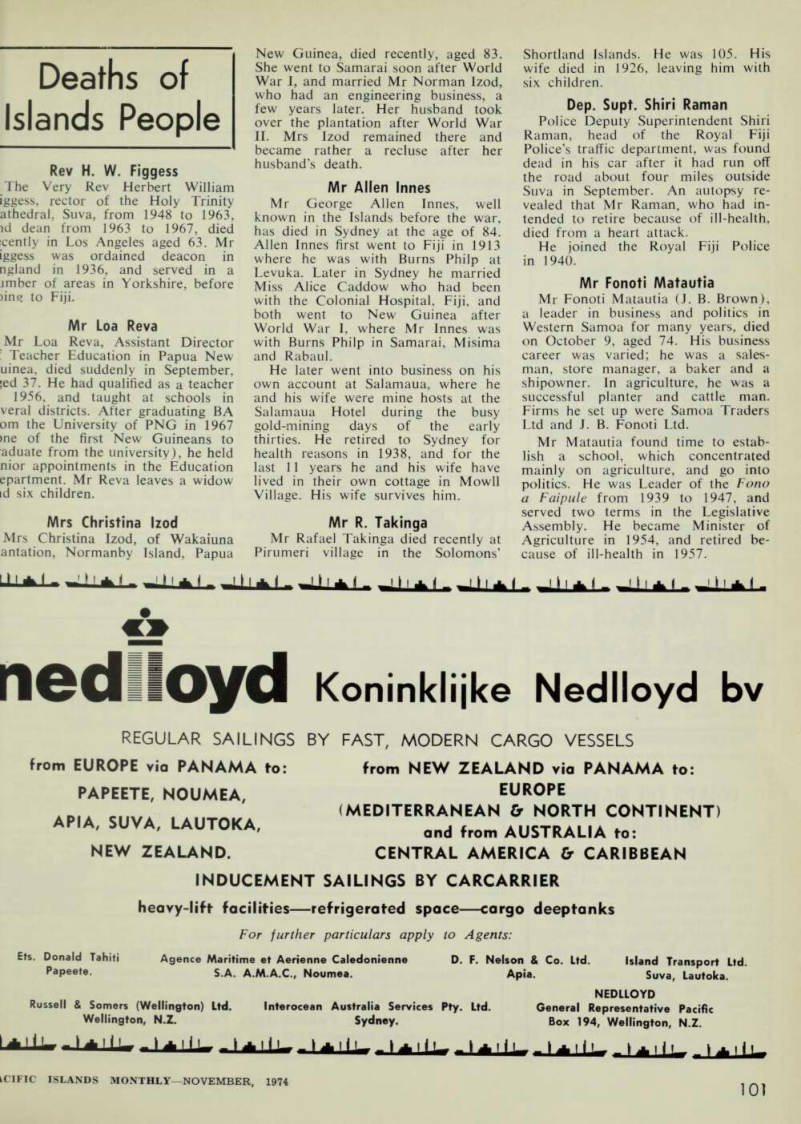
Deaths of Islands People
Rev H. W. Figgess The Very Rev Herbert William iggess, rector of the Holy Trinity athedral, Suva, from 1948 to 1963, id dean from 1963 to 1967, died ;cently in Los Angeles aged 63. Mr iggess was ordained deacon in ngland in 1936, and served in a jmber of areas in Yorkshire, before ling to Fiji.
Mr Loa Reva Mr Loa Reva, Assistant Director : Teacher Education in Papua New uinea, died suddenly in September, ;ed 37. He had qualified as a teacher 1956, and taught at schools in veral districts. After graduating BA om the University of PNG in 1967 me of the first New Guineans to aduate from the university), he held nior appointments in the Education epartment. Mr Reva leaves a widow id six children.
Mrs Christina Izod Mrs Christina Izod, of Wakaiuna antation, Normanby Island, Papua
New Guinea, died recently, aged 83.
She went to Samarai soon after World War 1, and married Mr Norman Izod, who had an engineering business, a few years later. Her husband took over the plantation after World War 11. Mrs Izod remained there and became rather a recluse after her husband’s death.
Mr Allen Innes Mr George Allen Innes, well known in the Islands before the war, has died in Sydney at the age of 84.
Allen Innes first went to Fiji in 1913 where he was with Burns Philp at Levuka. Later in Sydney he married Miss Alice Caddow who had been with the Colonial Hospital, Fiji, and both went to New Guinea after World War I, where Mr Innes was with Burns Philp in Samarai, Misima and Rabaul.
He later went into business on his own account at Salamaua, where he and his wife were mine hosts at the Salamaua Hotel during the busy gold-mining days of the early thirties. He retired to Sydney for health reasons in 1938, and for the last 11 years he and his wife have lived in their own cottage in Mowll Village. His wife survives him.
Mr R. Takinga Mr Rafael Takinga died recently at Pirumeri village in the Solomons’
Shortland Islands. He was 105. His wife died in 1926, leaving him with six children.
Dep. Supt. Shiri Raman
Police Deputy Superintendent Shiri Raman, head of the Royal Fiji Police’s traffic department, was found dead in his car after it had run off the road about four miles outside Suva in September. An autopsy re vealed that Mr Raman, who had in tended to retire because of ill-health, died from a heart attack.
He joined the Royal Fiji Police in 1940.
Mr Fonoti Matautia Mr Fonoti Matautia (J. B. Brown), a leader in business and politics in Western Samoa for many years, died on October 9, aged 74. His business career was varied; he was a sales man, store manager, a baker and a shipowner. In agriculture, he was a successful planter and cattle man.
Firms he set up were Samoa Traders Ltd and J. B. Fonoti Ltd.
Mr Matautia found time to estab lish a school, which concentrated mainly on agriculture, and go into politics. He was Leader of the Fono a Faipule from 1939 to 1947, and served two terms in the Legislative Assembly. He became Minister of Agriculture in 1954, and retired be cause of ill-health in 1957.
Advertisements & other items, pp. 105-107 (2 items)
101
ICIFIC ISLANDS MONTHLY—NOVEMBER, 1974
nedilOyd Koninklijke Nedlloyd bv
REGULAR SAILINGS BY FAST, MODERN CARGO VESSELS from EUROPE via PANAMA to
PAPEETE, NOUMEA,
APIA, SUVA, LAUTOKA,
NEW ZEALAND.
from NEW ZEALAND via PANAMA to:
EUROPE
(MEDITERRANEAN Cr NORTH CONTINENT)
and from AUSTRALIA to:
CENTRAL AMERICA Cr CARIBBEAN
INDUCEMENT SAILINGS BY CARCARRIER
heavy-lift facilities—refrigerated space—cargo deeptanks For further particulars apply to Agents: Ets. Donald Tahiti Papeete.
Agence Maritime et Aerienne Caledonienne S.A. A.M.A.C., Noumea.
Russell & Somers (Wellington) ltd.
Wellington, N.Z.
Interocean Australia Services Pty. Ltd Sydney.
D. F. Nelson & Co. Ltd. Island Transport Ltd.
Apia. Suva, Lautoka.
NEDLLOYD
General Representative Pacific Box 194, Wellington, N.Z. 1*. 1*. i j. 111— i j. 111—
is) LnnJ is) Cri ?Q r i is) Eq] 1
DATELINE HOTEL
TONGA
"Friendly Hotel" of the "Friendly Islands"
Situated along the Nukualofa waterfront. Only five minutes walk from town. Single, double, family suites, airconditioning, and hot and cold water showers. Pool, bar, restaurant, duty-free shop, tour desk and boutique.
Book through your travel agent or write to International Dateline Hotel, P.O. Box 62, Nukualofa Tonga.
Cable Address; "DATELINE".
Represented Overseas by; Charles J. Henry and Associates Pty. Ltd.
Sydney and Melbourne. y* 7
PARK VIEW MOTEL—BRISBANE
Quiet location —opp. Botanic Gardens.
Single, double, family suites, all with refrig., air conditioning, phone, TV, radio tea making facilities, from $l2. Pool and restaurant.
Phone 31-2695—Telex 40270.
Write for coloured brochure— Park View Motel, 128 Alice St, BRISBANE, Old., 4000
3007
Stay at
Aggie Grey's the
South Pacific's legendary hotel Situated right in the heart of Western bamoa. Enjoy Polynesian-style friendliness and service, in cool surroundings, superb en t®rt3 |nm 6nt and food. Magnificent white sand beaches only a short drive away Air,conditioned rooms, swimming pool and full bar facilities.
Bookings through Union Steamship Company of NZ, Pan Am, Air New Zealand or direct to Aggie Grey's, Apia, Western Samoa. Cables: AGGIES, APIA.
Primitive luxury
(Polynesian style) Nestled away in the untouched Kingdom of Tonga is new, luxurious "Port of Refuge" International resort. Here is a unique opportunity for your clients to experience the tranquil and relaxed Tongan atmosphere while they enjoy the picturesque surroundings of the new "Port of Refuge". And only a short flight from Fiji.
Reasonable tariffs from $17.50 with special concessions for children. Agents commission 10 per cent.
Tonga's
Port of Refuge
INTERNATIONAL RESORT U
Uava’u Tonga Cables: "Refuge" Tonga or "Tongatours"
Sydney. Phone: Sydney 85-1603 or 282-472
■*A A fa
SAMOAN HIDEAWAY
BEACH RESORT HOTEL
"The real Western Samoa"
Bungalows situated on a palm-fringed carpet of sand at the mouth of a jungle stream. This is Western Samoa. You'll be glad you came.
Bookings: Instant Hotels, Advance Accommodation, United Travel (in N.Z.), Accommodations Abroad (in Aust.).
Cables; "HIDEAWAY" Apia.
P.O. Box 1191, Apia, Western Samoa.
S
SOUTHERN PACIFIC INSURANCE
COMPANY (PNG) LIMITED
(INCORPORATED IN PAPUA NEW GUINEA)
HEAD OFFICE: BANK HAUS, CHAMPION PDE. P.O. BOX 136 PORT MORESBY, PAPUA NEW GUINEA. PH. 2623 • FIRE • FIRE AND VOLCANIC ERUPTION • HOUSEHOLD COMPREHENSIVE • MOTOR VEHICLE • COMPULSORY THIRD PARTY • COMPULSORY WORKERS COMPENSATION
MARINE • PUBLIC LIABILITY • BURGLARY
Enquiries are invited for ail classes of insurance from special representatives at: PORT MORESBY: H. A. McKEE, General Manager, Champion Pde., P.O. Box 136,_ p h. 2623 or 2075. LAE: K. J. ARMSTRONG, Manager for Lae, Central Ave, P.O. Box 758, Ph. 42-4590 or 42-4256. RABAUL: R. H. MEYER, Manager for Rabaul, Mango Ave., P.O. Box 123, Pn. 92-2417 or 92-2755.
WHAT'S THE MATTER
WITH BABY?
Most probably it's teething troubles and the surest way of soothing baby's sore gums, digestive disturbances and intestinal upsets, is to give baby Fisher's Teething Powders. You'll be delighted how effective they are—and so safe too, if used as directed. Fisher's Teething Powders are available from your chemist or store—only 30c for 20 powders. Fisher & Co., Manufacturing Chemists (Est. 1876), 17 May St., St.
Peters, N.S.W. 2044.
PIM 806/72
Pacific classic reprinted . . .
Patricia Ledyard's FRIENDLY ISLAND
Just released —a new paperback edition of Patricia Ledyard's warmhearted story of her love affair with Tonga, updated and with a new foreword.
Price: Australia and overseas, $3.95 Aust., plus 30c posted; U.S.A., $6.40 U.S. posted.
Pacific Publications (Aust) Pty Ltd.,
Postal Address: G.P.O. Box 3408, Sydney, N.S.W. 2001.
Line Advertisements
Per line, $2.50 Aust., Minimum rate. 4 lines.
HQUE MARINE SERVICE FOR PACIFIC
LANDS. Located in Southern California ntre of marine trade. We purchase for fttyards, fishermen, yachtsmen. Enquiries swered promptly. Hard-to-find marine ms our specialty. Try us. Blackie’s Boat rd, P.O. Box 2136, Newport Beach,
163, U.S.A.
EED AN APPALOOSA the world’s lest equine breed. Third largest breed [istry in the world. Australian mares in d to imported American Appaloosa Jlions for sale. R. Hanson, 123 Kenthurst ad, Kenthurst, 2154 N.S.W. Australia, one 654-1572 (Sydney, Australia).
FT YACHT MAST HEAD SLOOP.
lit Sydney 1965. LOA 30 ft, beam 8 ft in., draft 5 ft 6 in. Volvo Penta NDI ssel. Marine ply, stainless steel rigging, 3y mast. This vessel is fully equipped i has successfully cruised the British omon Islands, Papua New Guinea and easily operated single handed. Price: ),500.00 0.N.0. For further details of sel contact: P.O. Box 783, Lae, Papua w Guinea. Tel.: 42-4305. Cable: Marinev.
VESTMENT. Block of 12 apartments istructed of permanent materials. Fully anted, showing good returns. Contact; ardie Apartments, Box 263, Port Vila, w Hebrides.
NCRETE BLOCK MACHINES. Makes
cks, flags, edgings, screen-blocks, •den stools—up to 8 at once and 96 hour. $A139.00 c.i.f. main ports. Send leaflets. Forest Farm Research, Loniderry, N.S.W., 2753.
TTERFLIES AND BEETLES. Catchers
Qted from all Pacific Islands. Please te in strictest confidence to; Michel her, ch. de Binche 2, Mons, Belgium.
EETS 45 ft. raised foc’sle trawler ifess. bit. 1963, near new 120 h.p. diesel trawl gear, radio, sounder, etc. .000.00. FLEETS, Rowe’s Bldg., Edward Brisbane. Cable “FLEETS BRISBANE’’.
DIO TECHNICIAN experienced in vice and installation radio and hi-fi, \/V.H.F. communications equipment, requires position Pacific Islands, ase write: J. Ward, 19 Caspar Street, rview Park, South Aust. 5126.
HENRY CUMINES PTY. LTD.
EXPORTERS • IMPORTERS
ISLAND AGENTS
428 GEORGE ST., SYDNEY
CABLES: HENCO SYDNEY. G.P.O. Box 3949. PHONE: 25-3383.
For specialised and personalised buying service throughout the Pacific Islands and the East.
Represented in: PAPUA: Agencies Pacific Pty Ltd, Box 5044, P. 0., Boroko, Port Moresby.
Telephone 55261.
NEW GUINEA: Madang, W. Double, P.O. Box 22, Madang. Telephone 2696.
Resident Agents FIJI: K. Witherington Ltd, P.O. 293, Suva. Telephone 22-356.
NEW HEBRIDES: John Lum & Associates, Box 65, P. 0., Santo. Telephone 329. in other Pacific Territories.
pi r to easy far ■ . •m
Australia’s finest agricultural
equipment is now illustrated
in one new folder by Grasslands.
Send for your free copy today.
■GRASSLANDS^
■ 25 Fairfield St., Villawood, -
■N.S.W. 2163 AUSTRALIA
f ' ' " im
|NAHE ...
■ ADDRESS
Group mtmofi
StMS CONSOUOAKO 110
P.C.
WANTED
COMMON BUTTERFLIES
AND DAY FLYING
MOTHS. Can pay 25 cents to 75 cents each. cam.
O. Poseidon (male green, $2.75 each, female 60 cents each). P. Ulysseus $1 75 Euchenor $l.OO. Papilios 25 cents to $5.00 each. Long horn beetles 25 cents to $5.00. Large walking sticks with and without wings, 6 to 9 inch body size $2.00 to $4.00 each.
Only first quality perfect specimens for study purpose only. Will pay for postage.
Collectors please write to: BUTTERFLY CO., 51-17 Rockaway Beach Blvd., Far Rockaway, N.Y. 11691. U.S.A.
Index to Advertisers
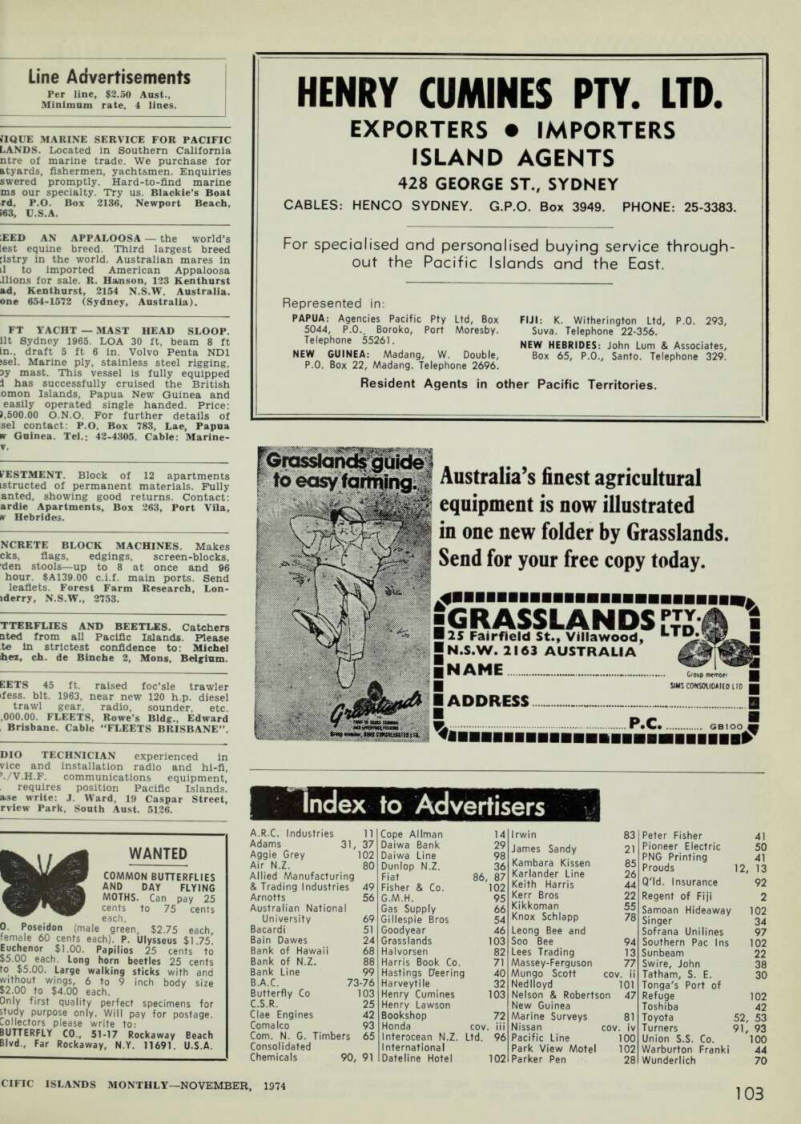
A. Industries 11 Adams 31, 37 Aggie Grey 102 Air N.Z. 80 Allied Manufacturing & Trading Industries 49 Arnotts 56 Australian National University 69 Bacardi 51 Bain Dawes 24 Bank of Hawaii 68 Bank of N.Z. 88 Bank Line 99 B. 73-76 Butterfly Co 103 C. 25 Clae Engines 42 Comalco 93 Com. N. G. Timbers 65 Consolidated Chemicals 90, 91
Cope Allman 14 Daiwa Bank 29 Daiwa Line 98 Dunlop N.Z. 36 Fiat 86, 87 Fisher & Co. 102
G.M.H. 95
Gas Supply 66 Gillespie Bros 54
Goodyear 46
Grasslands 103 Halvorsen 82 Harris Book Co. 71 Hastings Peering 40 Harveytile 32 Henry Cumines 103 Henry Lawson Bookshop 72 Honda cov. iii Interocean N.Z. Ltd. 96 International Dateline Hotel 102
Irwin 83 James Sandy 21 Kambara Kissen 85 Karlander Line 26 Keith Harris 44 Kerr Bros 22 Kikkoman 55 Knox Schlapp 78 Leong Bee and Soo Bee 94 Lees Trading 13 Massey-Ferguson 77 Mungo Scott cov. ii
Nedlloyd 101
Nelson & Robertson 47 New Guinea Marine Surveys 81 Nissan cov. iv Pacific Line 100 Park View Motel 102 Parker Pen 28
Peter Fisher 41 Pioneer Electric 50 PNG Printing 41 Prouds 12, 13 Q'ld. Insurance 92 Regent of Fiji 2 Samoan Hideaway 102 Singer 34 Sofrana Unilines 97 Southern Pac Ins 102 Sunbeam 22 Swire, John 38 Tatham, S. E. 30 Tonga's Port of Refuge 102 Toshiba 42 Toyota 52, 53 Turners 91, 93 Union S.S. Co. 100 Warburton Franki 44 Wunderlich 70
Advertisements & other items, p. 107 (1 item)
103
CIFIC ISLANDS MONTHLY—NOVEMBER, 1974
Postscripts
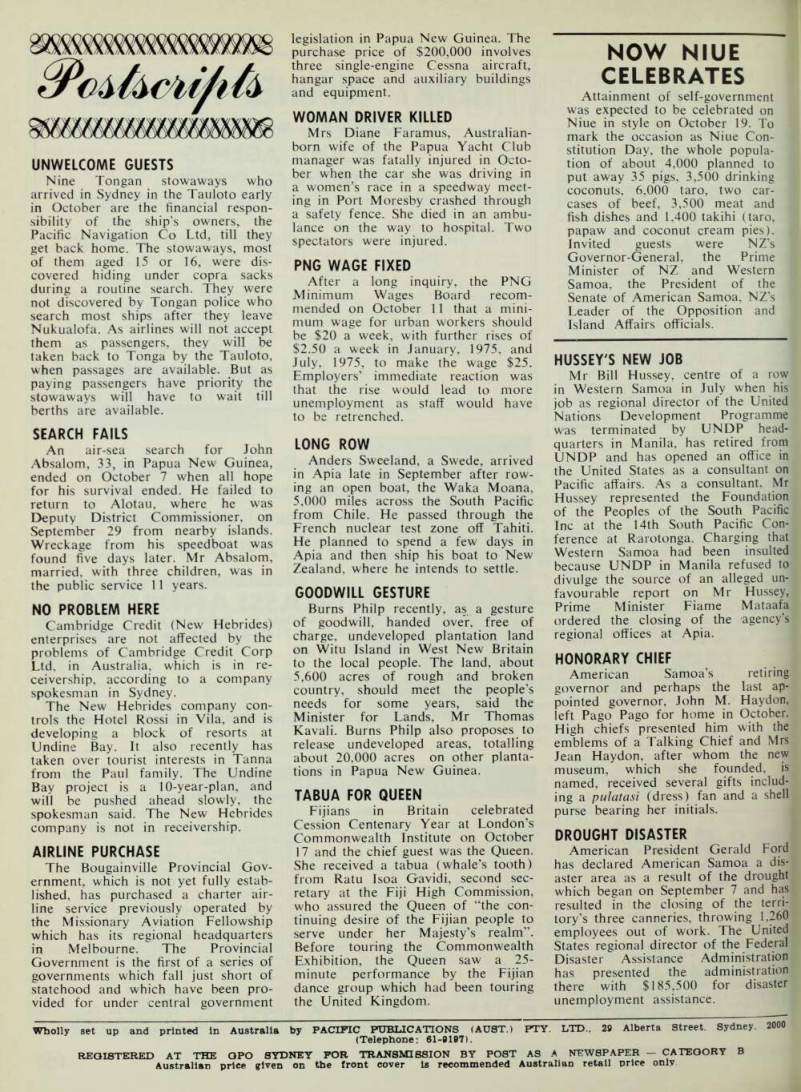
Unwelcome Guests
Nine Tongan stowaways who arrived in Sydney in the Tauloto early in October are the financial respon sibility of the ship’s owners, the Pacific Navigation Co Ltd, till they get back home. The stowaways, most of them aged 15 or 16, were dis covered hiding under copra sacks during a routine search. They were not discovered by Tongan police who search most ships after they leave Nukualofa. As airlines will not accept them as passengers, they will be taken back to Tonga by the Tauloto, when passages are available. But as paying passengers have priority the stowaways will have to wait till berths are available.
Search Fails
An air-sea search for John Absalom, 33, in Papua New Guinea, ended on October 7 when all hope for his survival ended. He failed to return to Alotau, where he was Deputy District Commissioner, on September 29 from nearby islands.
Wreckage from his speedboat was found five days later. Mr Absalom, married, with three children, was in the public service 11 years.
No Problem Here
Cambridge Credit (New Hebrides) enterprises are not affected by the problems of Cambridge Credit Corp Ltd, in Australia, which is in re ceivership, according to a company spokesman in Sydney.
The New Hebrides company con trols the Hotel Rossi in Vila, and is developing a block of resorts at Undine Bay. It also recently has taken over tourist interests in Tanna from the Paul family. The Undine Bay project is a 10-year-plan, and will be pushed ahead slowly, the spokesman said. The New Hebrides company is not in receivership.
Airline Purchase
The Bougainville Provincial Gov ernment, which is not yet fully estab lished, has purchased a charter air line service previously operated by the Missionary Aviation Fellowship which has its regional headquarters in Melbourne. The Provincial Government is the first of a series of governments which fall just short of statehood and which have been pro vided for under central government
legislation in Papua New Guinea. The purchase price of $200,000 involves three single-engine Cessna aircraft, hangar space and auxiliary buildings and equipment.
Woman Driver Killed
Mrs Diane Faramus, Australian born wife of the Papua Yacht Club manager was fatally injured in Octo ber when the car she was driving in a women’s race in a speedway meet ing in Port Moresby crashed through a safety fence. She died in an ambu lance on the way to hospital. Two spectators were injured.
Png Wage Fixed
After a long inquiry, the PNG Minimum Wages Board recom mended on October 11 that a mini mum wage for urban workers should be $2O a week, with further rises of $2.50 a week in January, 1975, and July, 1975, to make the wage $25, Employers’ immediate reaction was that the rise would lead to more unemployment as staff would have to be retrenched.
Long Row
Anders Sweeland, a Swede, arrived in Apia late in September after row ing an open boat, the Waka Moana, 5,000 miles across the South Pacific from Chile. He passed through the French nuclear test zone off Tahiti.
He planned to spend a few days in Apia and then ship his boat to New Zealand, where he intends to settle.
Goodwill Gesture
Burns Philp recently, as a gesture of goodwill, handed over, free of charge, undeveloped plantation land on Witu Island in West New Britain to the local people. The land, about 5,600 acres of rough and broken country, should meet the people’s needs for some years, said the Minister for Lands, Mr Thomas Kavali. Burns Philp also proposes to release undeveloped areas, totalling about 20,000 acres on other planta tions in Papua New Guinea.
Tabua For Queen
Fijians in Britain celebrated Cession Centenary Year at London’s Commonwealth Institute on October 17 and the chief guest was the Queen.
She received a tabua (whale’s tooth) from Ratu Isoa Gavidi, second sec retary at the Fiji High Commission, who assured the Queen of “the con tinuing desire of the Fijian people to serve under her Majesty’s realm”.
Before touring the Commonwealth Exhibition, the Queen saw a 25minute performance by the Fijian dance group which had been touring the United Kingdom.
Hussey's New Job
Mr Bill Hussey, centre of a row in Western Samoa in July when his job as regional director of the United Nations Development Programme was terminated by UNDP head quarters in Manila, has retired from UNDP and has opened an office in the United States as a consultant on Pacific affairs. As a consultant, Mr Hussey represented the Foundation of the Peoples of the South Pacific Inc at the 14th South Pacific Con ference at Rarotonga. Charging that Western Samoa had been insulted because UNDP in Manila refused to divulge the source of an alleged un favourable report on Mr Hussey, Prime Minister Fiame Mataafa ordered the closing of the agency’s regional offices at Apia.
Honorary Chief
American Samoa’s retiring governor and perhaps the last ap pointed governor. John M. Haydon, left Pago Pago for home in October.
High chiefs presented him with the emblems of a Talking Chief and Mrs Jean Haydon, after whom the new museum, which she founded, is named, received several gifts includ ing a pulatasi (dress) fan and a shell purse bearing her initials.
Drought Disaster
American President Gerald Ford has declared American Samoa a dis aster area as a result of the drought which began on September 7 and has resulted in the closing of the terri tory’s three canneries, throwing 1,260 employees out of work. The United States regional director of the Federal Disaster Assistance Administration has presented the administration there with $185,500 for disaster unemployment assistance.
Now Niue
Celebrates
Attainment of self-government was expected to be celebrated on Niue in style on October 19. To mark the occasion as Niue Con stitution Day, the whole popula tion of about 4,000 planned to put away 35 pigs, 3,500 drinking coconuts, 6,000 taro, two car cases of beef, 3,500 meat and fish dishes and 1,400 takihi (taro, papaw and coconut cream pies).
Invited guests were NZ’s Governor-General, the Prime Minister of NZ and Western Samoa, the President of the Senate of American Samoa, NZ’s Leader of the Opposition and Island Affairs officials.
Advertisements & other items, pp. 108-110 (3 items)
Wholly set up and printed in Australia by PACIFIC PUBLICATIONS (AUBT.) PTY. LTD.. 29 Alberta Street. Sydney. 2000
(Telephone: 61-9197).
REGISTERED AT THE QPO SYDNEY FOR TRANSMISSION BY POST AS A NEWSPAPER CATEGORY B Australian price given on the front cover Is recommended Australian retail price only
Cific Islands Monthly—November, 1974
The natural Choice.
It's Honda. Anywhere there’s action. A job to be done.
Fun to be had. Safely and economically.
The snappy line-up is studded with star performers.
Easy-to-handle motorbikes that possess a big-hearted spirit. for breezing through traffic or escaping to the country. Rugged reliability that lets you go, go, go.
Little wonder so many people around the world ride Honda.
It’s the all-round natural choice.
bgfl
■ - - ■ r r m
men ±r• lot w
• *!^o GU J NEA: Steamshi P s Trading Co.. Ltd. P.O. Box 74. Papua / U.S. TRUST TERRITORY: J.C. Tenorlo Enterprise P.O. Box 137, Saipan / FIJI ISLANDS: Coral Island Motors: Walu Bay Suva Fiji Island. P.O. Box 3179 Lami / TARAWA: The Gilbert & Ellice Islands Development Authority Gilbert & Ellice Islands/WESTERN SAMOA: Motor Distributors (Samoa) Ltd. P.O. Box 576, Apia / AMERICAN SAMOA: Max Haleck Inc. P 0 Box o*. P ™ /T ° NGA: E M> Jones Ltd ‘ P 0 Box 34, Nukualofa / SOLOMON ISLANDS: British Solomons Trading Co., Ltd. P.O. Box 114, Honiara / NEW CALEDONIA: Establissements Ballande, Noumea/TAHITI: Ets. COMIMPSX P.O. Box 200, Papeete/COOK ISLANDS: Cook islands Trading Corporation Ltd. P.O. Box 92, Rarotonga / NAURU ISLAND: Nauru Cooperative Society 14th Floor, Wales Corner, 227 Collins Street Melbourne Victoria 3000
And y onll go in oyer li ■ 120 nations throughout the world you'll find proud DATS UN drivers.
Perhaps the main reason is that DATSUN was designed to meet a wide variety of conditions—mountain mads and super highways, blistering suns and freezing temperatures. DATSUN is. indeed the international car that has precision engineering and a stunning string of rally victories behind it.
Its superb handling, safety features and: high speed, efficiency make D ATSUN the choice of young and old alike. DATSUN—the car that really satisfies, the world over.
DATSUN
NISSAN
cßatribator network cavers the following arena: y *rn\ -wnr . JJ .. D