Pacific Islands Monthly


News Magazine Of The South Pacific
October, 1974
AUSTRALIA, N.Z., P.N.G., FIJI, N. HEBRIDES 60c TONGA, W. SAMOA, 8.5.1. P., G.E.I.C. 60c
Cooks, Norfolk, Niue, Nauru 60C
Am. Samoa, Hawaii, Micronesia, Guam $L.Oo
NEW CALEDONIA AND FRENCH POLYNESIA 100 CFP
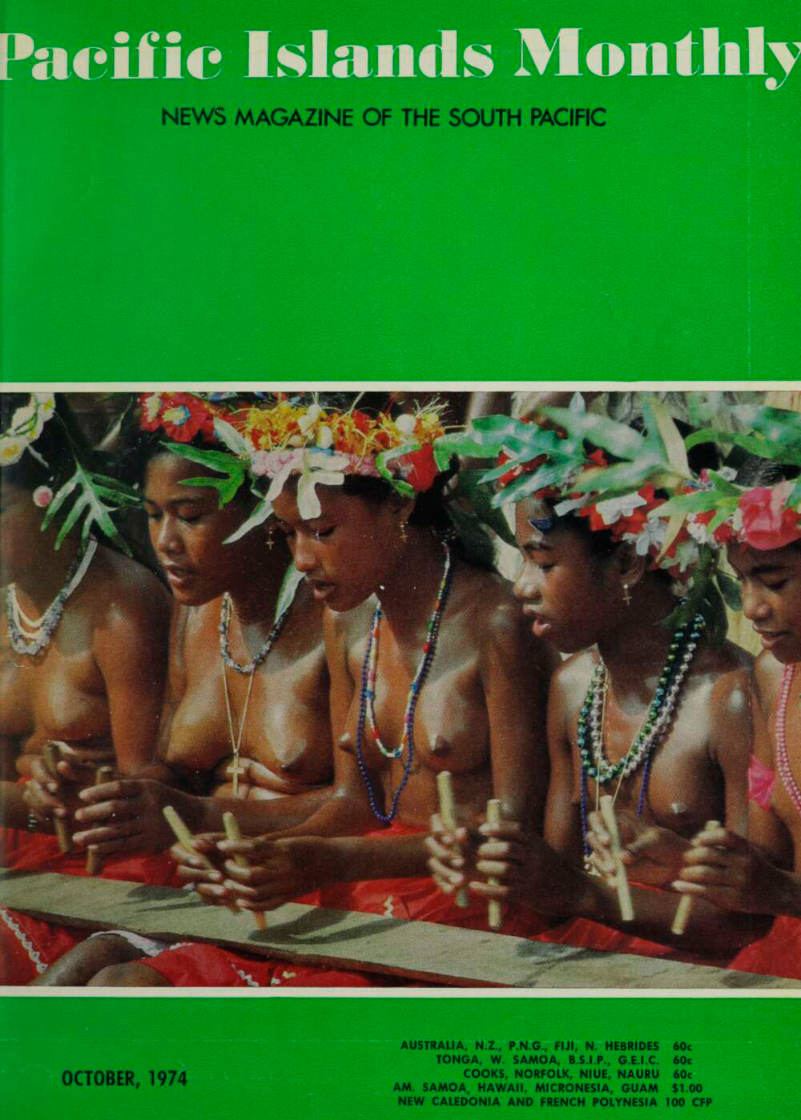
Our Cover
Quite oblivious to the camera, these girls from Nett Municipality, Ponape, in Micronesia, concentrate on their part in a. traditional Ponapean dance. They comprise the Tokia row, one of four tiers of dancers performing to songs of old legends. This study was taken at a feast in Uh Municipality, Ponape, by Carl Viti, a photo grapher with the Trust Territory Education Department.
Advertisements & other items, p. 2 (1 item)
The floturol Choice.
It's Honda. Anywhere there’s action. A job to be done.
Fun to be had. Safely and economically.
The snappy line-up is studded with star performers.
Easy-tohandle motorbikes that possess a big-hearted spirit.
Engineered for breezing through traffic or escaping to the country. Rugged reliability that lets you go, fe go, go.
Little wonder so many people around the world ride Honda.
It’s the all-round natural choice. i m gjiK. j£.'- € ■ La * ■
ii w
SMM
% *. '% m
iffririiTXjiii
PAPUA NEW GUINEA: Steamships Trading Co., Ltd. P.O. Box 74, Papua / U.S. TRUST TERRITORY: J.C. Tenorio Enterprise P.O. Box 137, Saipan / FIJI ISLANDS: Coral Island Motors: Walu Bay Suva Fiji Island. P.O. Box 3179 Lami / TARAWA: The Gilbert & Ellice Islands Development Authority Gilbert & Ellice Islands / WESTERN SAMOA: Motor Distributors (Samoa) Ltd. P.O. Box 576, Apia / AMERICAN SAMOA: Max Haleck Inc. P.O. Box 99 Pago Pago / TONGA: E.M. Jones Ltd. P.O. Box 34, Nukualofa / SOLOMON ISLANDS: British Solomons Trading Co.. Ltd. P.O. Box 114, Honiara / NEW CALEDONIA: Establissements Ballande, Noumea / TAHITI: Ets. COMIMPEX P.O. Box 200, Papeete/COOK ISLANDS: Cook Islands Trading Corporation Ltd. P.O. Box 92, Rarotonga / NAURU ISLAND: Nauru Cooperative Society 14th Floor, Wales Corner, 227 Collins Street Melbourne Victoria 3000
In This Issue
Eneral
jstralian aid 8 jptain Cook's boots missing 38 SW Islands' agents raise fees 39 itham'a 50 years 73 m-Am may join with TWA 81 >S new container service 83 x>ker in the Pacific 95
Merican Samoa
agic accidents 38
Dok Islands
action in January 7 amp issues criticised ... 35 ;w Cooks-NZ shipping service ... 83 irotonga airport costs 83 Jl ■ange visitor to Suva 10 ght of the long knives 15 omen barmaids allowed now ... 38 sthodist Church President installed 39 e first years after cession 59 d of night-flying restrictions 83 jw USS container service 83 d luck with new ship 83 ugh anti-inflationary measures 95 ►tel in doubt 98
Ench Polynesia
itonomists' walkout 108
Lbert And Ellice Islands
►use of Assembly meets 32 lief Minister's trip 39
Lord Howe Island
Airstrip in operation 83
Nauru
GEIC Chief Minister's visit 39 Airline developments 79
New Caledonia
Rebel newspaper folds 10 Athletic nun 10 Cook memorial 11 Berthing facilities upgraded 38
New Hebrides
Shipwreck as tourist attraction 11 Cook bicentenary stamps 37
Niue
Self-government vote 7 Niuean killed in crash 39
Norfolk Island
Cook bicentenary stamps 38 Norfolk cemetery book 67
Papua New Guinea
Political developments 7 Gogodala Cultural Centre opening 7 Urban wage inquiry 8 Filipinos under attack 9 What Indonesia thinks of New Guinea 23 Consulate-General's office in Jakarta 23 The dangers of the betel nut 31
Bougainville's taxi business 32 World War II bombs destroyed 38 Seventh plane crash 38 Family Welfare Association 38 Boxing and wrestling control 39 Artifacts smuggling racket 39 Family boat-building business 39 Fears over Land Acquisition Bill 92 Record year for Development Bank 93 Hooker in PNG 95 Pension scheme planned 98 Fire death of Alex Hopper 105
Pitcairn Island
Further drop in population 10
Solomon Islands
Chief Minister appointed 5 Wages withheld 38 Review of food production 97
Tonga
Father and son meet after 43 years 11 Tongans to leave NZ by Christmas ... 38 Birth rate down 39 With a deck passenger to the outer islands 41 Air link with Nauru 79 Extension of internal airline 81 New USS container service 83 Another resort hotel 98
United States Trust Territory
Back to Eniwetok 38 Another airline for Marianas 39
Western Samoa
Nurses on strike 38 New USS container service 83 Development Bank opens 93
PARTMENTS: Up front with the Editor, 3; Tropicalities, 10; People, 13; Editor's Jilbag, 17; In a Nutshell, 38; From the Islands Press, 49; Yesterday, 50; Magazine ction, 59; MAN A, 62; Books, 66; Pacific Transport, 79; Cruising Yachts, 85; Business d Development, 92; Produce, 99; Shipping and Airways Information, 100; Deaths of Islands People, 105; Advertisers' Index, 108.
Advertisements & other items, p. 4 (1 item)
from the
A message
National Bank
The National Bank has formed a new bank in Papua New Guinea, the Bank of South Pacific Limited.
As from Tuesday October 1,1974 all branches of The National Bank in Papua New Guinea became branches of the Bank of South Pacific Limited.
All accounts conducted with The National Bank and The National Bank Savings Bank in Papua New Guinea will be automatically transferred to the Bank of South Pacific Limited pursuant to the Banking (Transfer of Business) Act 1974 of the Papua New Guinea Parliament.
National Bank cheque books and passbooks may continue to be used with the Bank of South Pacific Limited during the changeover period.
All facilities, borrowing arrangements and other engagements entered into by The National Bank of Australasia Limited and The National Bank Savings Bank Limited in Papua New Guinea will be continued by the new bank.
Bank of South Pacific Limited
A subsidiary of The National Bank of Australasia Limited Administrative and Principal office: Branches: Douglas Street, Port Moresby. Boroko, Kieta, Lae, Mt. Hagen, Rabaul. 300-P-938
Pacific Islands
Monthly
FOUNDED BY R. W. ROBSON IN 1930
Published Monthly By
Pacific Publications (Aust.) Pty. Ltd.,
29 Alberta St., Syoney, N.S.W., 2000.
Postal Address; G.P.O. BOX 3408, SYDNEY,
N.S.W., 2001.
Telegraphic Address.- PACPUB, Sydney.
Telex 25168.
Telephones: 61-9197, 61-7101, 61-4369.
onsulting Directors: R. W. Robson, Judy Tudor.
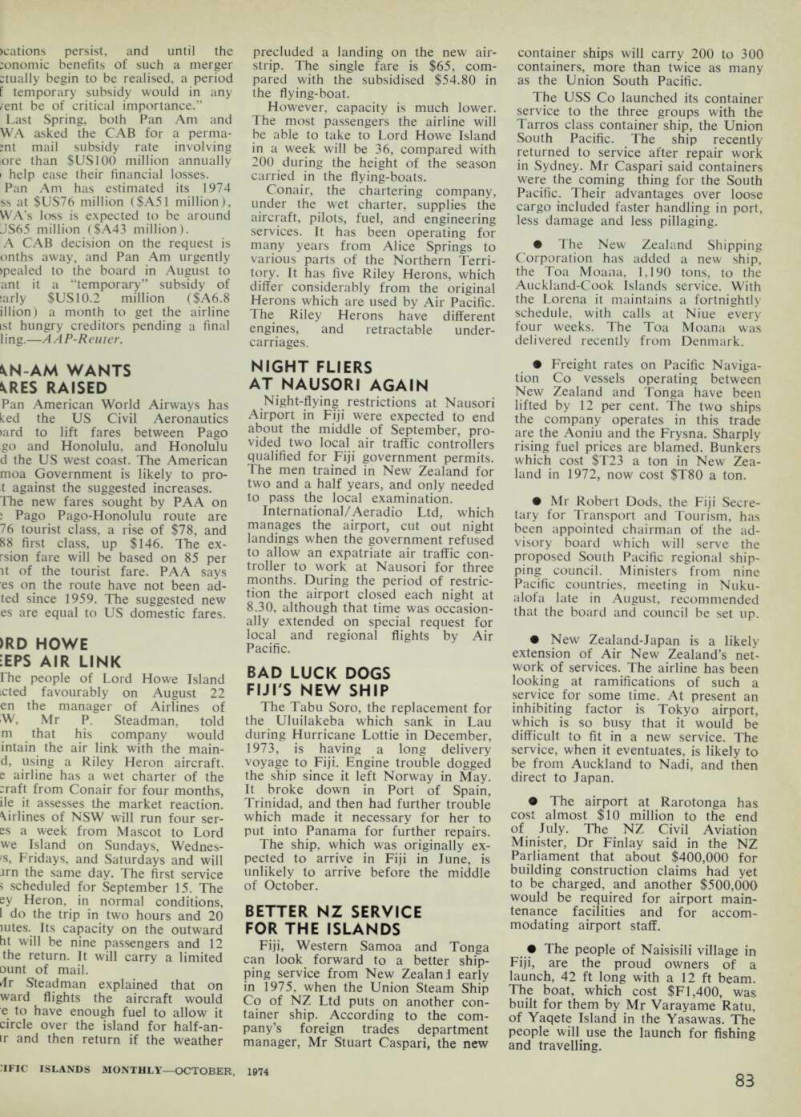
Chief Executives: Manager: Selwyn Hughes.
Publisher: Stuart Inder.
Director of Advertising: W. A. Gasnier.
Pacific Islands Monthly
Editor: Stuart Inder.
Assistant Editor: John Carter.
Advertising Manager; W. A. Gasnier.
Circulation Manager: Barry Badger.
Subscription Rates;
Pacific Islands Monthly" is airfreighted to all ibscribers and agents in the Pacific Islands id the U.S.A.; copies to Nauru and other eas go by surface mail, jstralia (incl. Lord Howe and Thursday Is.), sw Zealand, Papua New Guinea, Fiji, New •brides, Tonga, Western Samoa, Solomon lands, Gilbert & Ellice Islands, Cook Islands, arfolk Island, Niue and Nauru Islands: $6.80 acal currency); American Samoa, Hawaii, icronesia and Guam; $12.00 US; New iledonia and French Polynesia 1,100 CFP; 5 Mainland: $14.00 US; United Kingdom: i-10. Elsewhere $B.OO Aust.
Representatives
ji: Advertising— Fiji Times & Herald Ltd., > Gordon St., Suva. Telephone: 25-601. lex.; FJ 2124. Distribution—Desai Book Depot Ltd., P.O. Box 160, SUVA. Tel.: 311-424. ipua New Guinea: PORT MORESBY, PNG Print g Co. Pty. Ltd., P.O. Box 633; LAE, P.O. Box ■7; RABAUL, Mr. CTavid Simpson, P.O. Box 164 (c/- Rabaul Photographic. Tel.; 2677.) ench Polynesia. Distribution—Hachette Paci iue, 10 Ave Bruat, Papeete, w Zealand: Pacific Publications, C.P.O. Box 29, Auckland. 379-494. Representative: Mr Breckell, Breckell Publishing, Kingdon House, ngdon Street, Newmarket, Auckland. Tel.: 54-6834. Telex.: NZ 2727. ited Kingdom: Advertising—Overseas Publicity i., 214 Oxford Street, London, WIN OEA. one: 01-636 8296/7. Subscriptions—T. B. aham, Park House, 22 Park Street, Croydon,
Cr9 3Np. Tel.: 01-6884177.
pan; Advertising—Universal Media Corpora tion, C.P.O. Box 46, Tokyo. Tel.: 666-3036. :toria; Advertising Pacific Publications jst.) Pty. Ltd., 33 Lonsdale Street, ilbourne, Vic. 3006. Telephone: 662-3263. eensland; Advertising—Beale Media Services, 2 St. Paul's Terrace, Fortitude Valley, Qld., 4006. Tel.; 52-5827. waii and U.S. Mainland only: N. Grogan, 54 Hayden Street, Honolulu, 96815. md change of address notices. Form 3579 i new subscriptions to P.O. Box 2193 Honolulu, Hawaii, U.S.A. 96805). :ond class postage paid at Honolulu, Hawaii.
Copyright ©, 1974, Pacific Publications (Aust) Pty. Ltd.
October, 1974 Vol. 45, No. 10
Up Front
with the Editor
How objective is objectivity? The question occurs to most journalists from time to time as they struggle to be objective in their reporting, and to most editors as they struggle to select objective reports. They realise soon enough that objectivity, like beauty, is in the eye of the beholder.
I’ve never claimed that PIM is objective, although I do say that it makes the effort to the best of its ability, its small resources and allow ing for its unconscious biases. But in the end, what PIM records as having happened in the Pacific Is lands is what PIM or its many con tributing correspondents think hap pened, and there must be anomalies in interpretation or in the collection of facts.
These thoughts occur to me after looking over the report beginning on p 5 about the events leading up to and following the election of Solomon Mamaloni as first Chief Minister of the Solomon Islands. It’s an amalga mation of reports from two corres pondents close to the scene—which is a method we frequently use to obtain a more rounded version of events.
After the story was in print we received yet a third report from a knowledgeable correspondent, too late to embody in the material, so I am now going to give readers the oppor tunity to do their own editing.
This third correspondent is far more concerned than the others about Mamaloni’s image with the public and his fellow parliamentarians. He thinks this image could have a strong bearing on possible future events.
Mr Mamaloni, he says, is the father of five children, two from his first marriage which ended in divorce, and the other three from a subsequent marriage by custom, and that his present marital state is unclear as he has been living with a girlfriend.
He adds: “Feelings are mixed about him. Elitist Solomon Islands businessmen are sporting smug smiles, while ordinary folk are apprehensive.
To the average Solomon Islander, the character of the person is important in leadership. Divorce and womanis ing and late night beer parties are not
so agreeable to a strongly religious, yet tradition-minded people.”
The correspondent acknowledges fully the new Chief Minister’s charm, ability, forthrightness, honesty and political shrewdness. But on the political problems ahead of Mr Mamaloni, who is in charge of a minority government (the 24-member House consists of nine USIPA mem bers, five PPP of whom three in cluding Mr Mamaloni are in cabinet, and nine independents), the corres pondent says that the Chief Minister is already under pressure from within the cabinet for a coalition with
Usipa.
He predicts that USIPA, the oppo sition, will turn down the offer and force the independents to put pen to paper to avow their support for the man that they placed in high office.
The correspondent sees the inde pendents in the Assembly as creating an aura of instability in the govern ment while professing to be a buffer that will ensure stability. They are in fact, he says, withholding from the Chief Minister the confidence of directing a majority government, and Mr Mamaloni is “not very happy” about his position.
As I have said, do your own editing. The only comment 1 want to make is that the move by the Solomons into the era of self government will be as bumpy politic ally as Papua New Guinea’s is at this moment, for coalitions are un easy affairs at the best of times.
Stuart Inder
Advertisements & other items, pp. 5-6 (2 items)
3
\CIFIC ISLANDS MONTHLY—OCTOBER, 1974
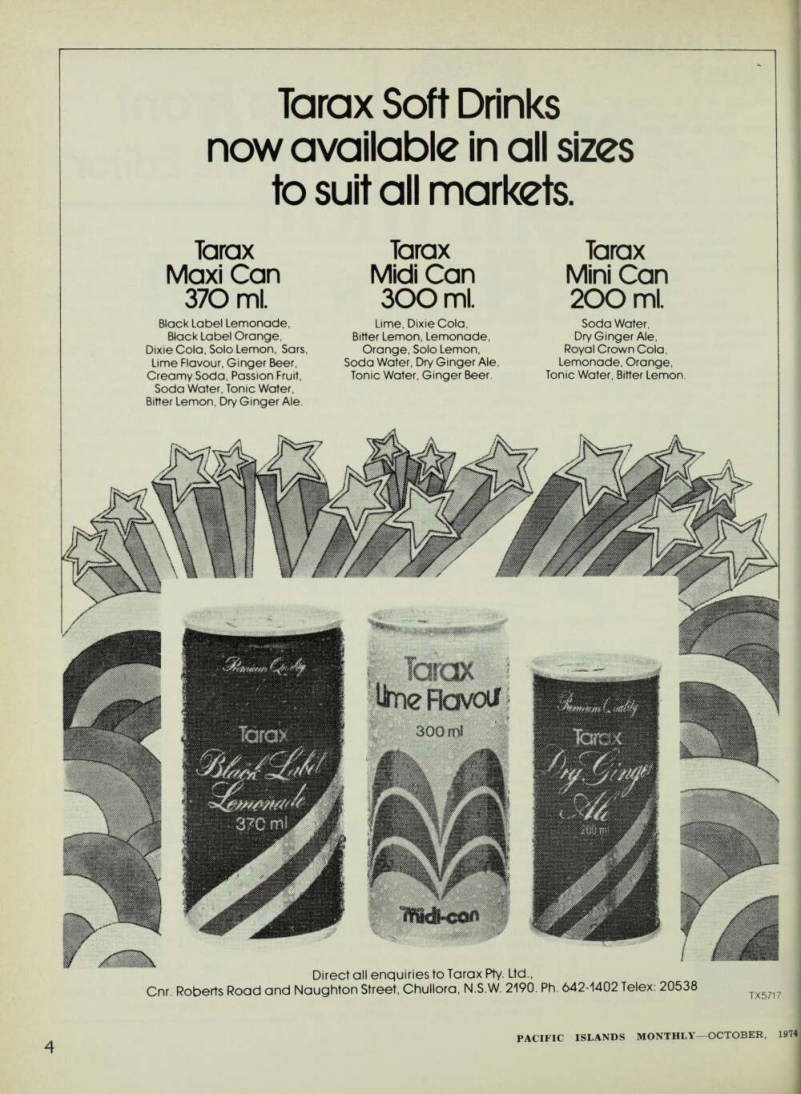
Tarax Soft Drinks
now available in all sizes
to suit all markets.
Tarax
Maxi Can
370 ml.
Black Label Lemonade, Black Label Orange, Dixie Cola. Solo Lemon, Sars, Lime Flavour, Ginger Beer, Creamy Soda, Passion Fruit, Soda Water, Tonic Water, Bitter Lemon, Dry Ginger Ale.
Tarax
Midi Can
300 ml.
Lime, Dixie Cola, Bitter Lemon. Lemonade, Orange, Solo Lemon, Soda Water, Dry Ginger Ale, Tonic Water, Ginger Beer.
Tarax
Mini Can
200 ml.
Soda Water, Dry Ginger Ale, Royal Crown Cola, Lemonade, Orange, Tonic Water, Bitter Lemon. d & a ' . - • • • • ■ , Direct all enquiries to Tarax Pty. Ltd., Cnr. Roberts Road and Naughton Street, Chullora, N.S.W. 2190. Ph. 642-1402 Telex: 20538 TX5717
Triumph for
Pacific Islands Monthly
Triumph for the Solomons' Solomon
From a Honiara correspondent Solomon Mamaloni, 32-year-old lember for West Makira, is the first 'hief Minister of the Solomon >lands. He beat off the challenge of ve other candidates after a series of jcret ballots held among the 24 lected members of the Governing Council (now the Legislative Assem ly) in Honiara on Tuesday, .ugust 27.
For the trenchant and charismatic famaloni, the election was a triumph f planning and organisation. An arly favourite for the top political ost, he was considered by many to ave peaked too soon, and had irgely been written off as a con fer for the big job. Instead atten on began to focus on some of the ther candidates, notably the quietly npressive Benedict Kinika (East lakira); the veteran David Kau mae (Are Are); and the radical hilip Solodia Funifaka (Lau and Ibaelalea).
Far from having shot his bolt, awever, Mamaloni showed that he ad merely been biding his time, and week or so before the election, imours began sweeping the capital 1 the effect that the small man with e big personality had quietly ithered an impressive array of voting rength and was going to make a rong late bid for the position. This as enough for a local businessman inning a book on the event to re state Mamaloni as 5-4 on favourite.
For a time the issue was obscured f the shifting political patterns in e Solomons. The United Solomon lands Party Association (USIPA), d by Kinika and Gideon Zoleveke, arted off with a majority of elected embers in its ranks, but as polling ly grew closer there were a number defections to Mamaloni’s People’s
Progressive Party (PPP) and to the neutrals.
The days immediately before the election were hectic in the extreme, with members of one camp nominat ing former members of the other, frantic private meetings being held and alliances being formed and broken, and no one sure who was going to vote for whom.
Then, in a shrewd pre-election move, Mamaloni arranged for his nomination to come from the highly respected Willie Betu, long regarded as one of the more moderate and level-headed elected members. A number of the undecided took this as a sign that Mamaloni, if elected, would pursue a middle-course, and this undoubtedly gained him votes.
True to local form, little of all this leaked out to the general public.
Hardly any details of the circum stances surrounding the election were released by the authorities, and as far as the vast majority of islanders were concerned, the whole affair was a marked non-event.
For the participants, on the other hand, it turned out to be a real cliff hanger, with the issue in doubt to the very end. It was ostensibly a secret
ballot held behind closed doors in Honiara’s Kalala House, with only the elected members and a few ad ministrative bigwigs present. But no one ever keeps a secret for long in the Solomons.
It took two and a half hours and six ballots before the Chief Minister was selected. From the start it be came apparent that there were only two men in it, the two Eastern Dis trict representatives, Mamaloni and Kinika, with Solodia Funifaka corn ing third in most ballots. When the Malaita man finally dropped out, Mamaloni and Kinika tied with 12 votes each on the fifth ballot. On the sixth and last poll Mamaloni surged ahead to gain the victory by 14 votes to 10.
For all his comparative youth, the new Chief Minister takes up his new
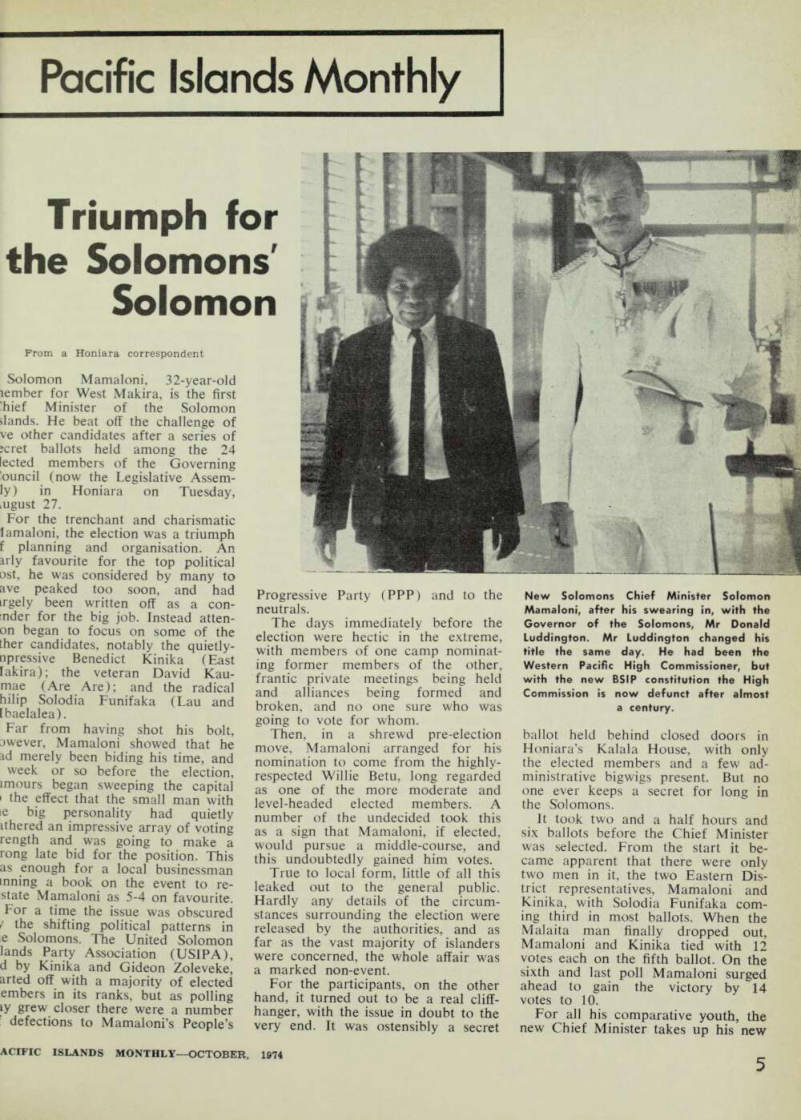
New Solomons Chief Minister Solomon Mamaloni, after his swearing in, with the Governor of the Solomons, Mr Donald Luddington. Mr Luddington changed his title the same day. He had been the Western Pacific High Commissioner, but with the new BSIP constitution the High Commission is now defunct after almost a century.
duties with a wealth of administra tive and political experience. Born in Rumahui village on Makira in the Eastern Solomons and a student of the Anglican Pawa School and King George VI Secondary School, he was educated to third form at Te- Aute Maori College, Hawkes Bay, New Zealand.
He entered government service in 1966, first as an executive officer and then as clerk to the Legislative Council which he was later to join as an elected member. He began his political career in 1970, and was one of only six sitting members who re tained their seats at the general elec tion of 1973.
The dormant and parochial poli tical situation was considerably en livened by the arrival of Mamaloni’s vigorous personality. From the begin ning, he showed himself to be an outstanding politician, honest, out spoken, an excellent debater and brilliant speaker. A forthright critic of administrative inefficiency, from his early days in the chamber, he declared himself an opponent of what he called the three unwelcome visitors of poverty, ignorance and disease.
In his public utterances he ex pressed his opinion of the expatriate administration (“a backfire of colonialism”); the local education policy (“superficial . . . shortsighted . . . miseducation”); medical services (“insufficient facilities and staff”); the salaries and living conditions of labourers in the capital (“would spark a revolution in other coun tries”).
One of Mamaloni’s preoccupations has been the divided state of the country and the poor communications between the scattered islands. He has been scathing about the inadequate panaceas introduced by the authori ties for the different districts: “In the Eastern District they inject politics; in Western they inject education; in Central they inject tourism, and in Malaita they inject birth-control”.
As the Chairman of the Local Government Committee, a position which he had held since 1973, Mama loni was an outstanding success. His major piece of legislation was the design and introduction of a wide ranging system of decentralisation, giving increased powers to the local councils. This was easily the most im portant step forward so far taken in the development of the Solomons.
Mamaloni will not be short of problems in his new job. At the moment the copra-based economy is buoyant and exports are booming, but the almost inevitable downturn in the market will once again reduce the islands to depending on the an nual grant-in-aid being paid with in
creasing reluctance from Great Britain. Like every other group in the Pacific the Solomons are in inflation’s grip. Police had to be called in re cently to restore order after fights at a Honiara market over the spiralling prices of food on sale there.
Less than 48 hours after he had been sworn in as Solomons Chief Minister, Solomon Mamaloni released the names of the five elected mem bers of his Council of Ministers. The group includes three former commit tee chairmen in Willie Betu, David Kausimae and Gideon Zoleveke. The two newcomers are NZ-born Peter Thompson, an Anglican priest, and Stephen Cheka, at 28 the youngest member of the inner circle.
It is a strong council. Betu, Kau simae and Zoleveke are experienced politicians, while Thompson, the only expatriate among the leaders, has long been a prominent back-bencher and commands enormous support in his own constituency and considerable respect among his fellow-elected members in the Legislative Assembly.
Cheka, too, for all his youth, has been one of the up-and-coming politicians.
Willie Betu, the dapper and charm ing 36 year-old Santa Isabel man, becomes Minister of Education and Cultural Affairs. Although his brief will include such varied activities as libraries, museums and film censor ship, undoubtedly most of his energy will go into sorting out the much maligned education system. To help him, however, is his newly-appointed Chief Education Officer, Francis Bugotu, an educationist of distinction and a man with a Pacific-wide repu tation.
In his capacity as Minister of Trade, Industry and Labour, the 42 year-old Peter Thompson will need all his considerable store of energy.
He will also require a certain amount of luck as so much of the economic future of the Solomons depends upon external forces which the government can do little to control.
Thompson has set his face against excess feather-bedding—“people start with what they have got and build from that”—but has always been concerned to see that islanders share in any profits made by overseas firms out of local resources. He holds that the basic principles of development are communications and marketing, and has joked that he would some times like to cut the revenues of government departments by half and
spend the surplus on building more
roads in the districts.
As the Minister of Works and Pub lic Utilities, the 52 year-old Choiseul man, Gideon Zoleveke should have few problems. He has already shown himself to be a capable and un
obtrusive administrator. The Marine I Department, another of Zoleveke’s I responsibilities, has come in for pub-1 lie criticism in the past, but the in-1 creasing use of commercial vessels ini the Solomons seas should take some I of the strain off government vessels. I David Kausimae’s main interests! will be in the rural areas. He is the I new Minister of Agriculture and!
Rural Economy. A few years ago! agriculture in the Solomons was I something of a sick joke, but it has! taken enormous strides in the last! year or so and the 44 year-old Are!
Are representative should be able to I build on sound foundations.
Stephen Cheka, 28, Minister of I Health and Welfare, inherits a con-| troversial medical service and one! which is always battling against! shortages of staff and funds. His taskl will be a challenging one. He is a! former primary school teacher.
Mamaloni has decided, at least fori the time being, to retain control of!
Home Affairs, including local govem-j ment and information and broad-i casting. The new constitution allows for a sixth minister, so it is possible that at some future date Mamaloni! may relinquish all or some of these!
additional responsibilities.
There are also three ex-officio] members of the Council of Ministers:! the Financial Secretary, the Attorney-] General and the Deputy Governor,] all of them expatriates. The Chairman] of the Council is the Governor.
The United Solomon Islands Party! has announced that it has selected a shadow cabinet with its members acting as opposition spokesmen in the I
Legislative Assembly.
USIPA also has a new leader in Philip Solodia Funifaka, the 36 year-i old Malaita man from the Lauj Lagoon. It was announced that Funi faka had taken over the reins fromj Benedict Kinika. The reason given for Kinika’s stepping down was that he and Mamaloni were both Makiraj men, and that it might cause unrest on the island if they were seen to be : in contention in Honiara.
Solodia Funifaka has always ranked high in the councils of USIPA and had enough support from the rank and file Legislative Assembly members to come third to Mamaloni] and Kinika in the recent election. A former student for the priesthood, he became a schoolteacher and then a I labour inspector. Known for his in dependent and forthright views on ■ many subjects, he was expected to be something of a firebrand whenj elected to the Governing Council in 1973. Instead he impressed many people with his willingness to listen to opposing points of view.
Advertisements & other items, p. 7 (1 item)
5
ACIFIC ISLANDS MONTHLY—OCTOBER, 1974
or something
Towards self government, or something
Niue Islanders in September voted overwhelmingly in favour of self government in free association with New Zealand. About the time of the referendum, Cook Islands Premier, Sir Albert Henry, did a complete somersault and said he would hold an election in January on integration vith New Zealand. Sir Albert, it will ae recalled, just before going to the -aw of the Sea conference at Caracas, said he would soon be look ng for full indepedence for the I'ooks.
About 1,600 Niueans went to the >olls. The vote was almost two to )ne in favour of self-government and 'ree association. Niue Islanders living n New Zealand and Australia, did lot get a vote. Niueans in NZ out lumber Niueans on their own island, fhe United Nations sent a team of hree to Niue to observe the referen lum.
Now that the referendum has been :arried, the Niue Assembly will make aws for the island. The NZ Parlia nent will only legislate on request rom the Niue Assembly. Niueans, jowever, will retain NZ citizenship.
Z will continue to be responsible or Niue’s foreign affairs and defence nterests, and will continue economic ind administrative assistance.
In some circles in New Zealand, lowever, the referendum was re ;arded as something of a farce. It vas a straight-out vote, for or against he new constitution, with, presum ibly, a status quo if the “noes” had von. Many felt that an alternative— ntegration with New Zealand—might lave carried the day.
Sir Albert Henry, who went to 4Z for the funeral of Mr Norman Cirk, said islanders in NZ were con used about the Cook Islands’ consti tution. There was much misunder tanding about the government’s tc-1965 decision for self-government.
“I am giving every Cook Islander ri the Cook Islands the right to vote n the issue of self-government or itegration with New Zealand,” he aid. “I promised our people living i New Zealand I would prepare the ountry immediately on my return or a snap election to decide this isue.” • The New Hebrides had a popu ation of 91,212 at December 31, 973, according to an estimate by the Condominium Bureau of Census and tatistics.
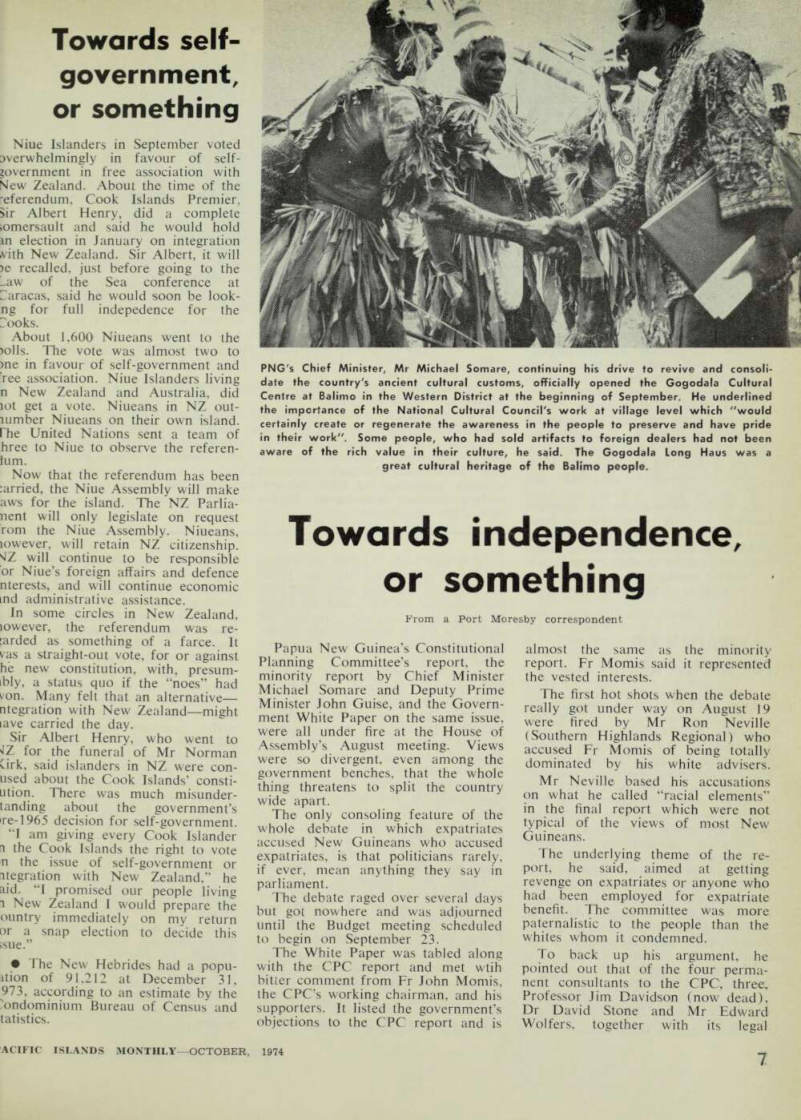
PNG's Chief Minister, Mr Michael Somare, continuing his drive to revive and consoli date the country's ancient cultural customs, officially opened the Gogodala Cultural Centre at Balimo in the Western District at the beginning of September. He underlined the importance of the National Cultural Council's work at village level which "would certainly create or regenerate the awareness in the people to preserve and have pride in their work". Some people, who had sold artifacts to foreign dealers had not been aware of the rich value in their culture, he said. The Gogodala Long Haus was a great cultural heritage of the Balimo people.
Towards independence,
or something
From a Port Moresby correspondent
Papua New Guinea’s Constitutional Planning Committee’s report, the minority report by Chief Minister Michael Somare and Deputy Prime Minister John Guise, and the Govern ment White Paper on the same issue, were all under fire at the House of Assembly’s August meeting. Views were so divergent, even among the government benches, that the whole thing threatens to split the country wide apart.
The only consoling feature of the whole debate in which expatriates accused New Guineans who accused expatriates, is that politicians rarely, if ever, mean anything they say in parliament.
The debate raged over several days but got nowhere and was adjourned until the Budget meeting scheduled to begin on September 23.
The White Paper was tabled along with the CPC report and met wtih bitter comment from Fr John Momis, the CPC’s working chairman, and his supporters. It listed the government’s objections to the CPC report and is
almost the same as the minority report. Fr Momis said it represented the vested interests.
The first hot shots when the debate really got under way on August 19 were fired by Mr Ron Neville (Southern Highlands Regional) who accused Fr Momis of being totally dominated by his white advisers.
Mr Neville based his accusations on what he called “racial elements” in the final report which were not typical of the views of most New Guineans.
The underlying theme of the re port, he said, aimed at getting revenge on expatriates or anyone who had been employed for expatriate benefit. The committee was more paternalistic to the people than the whites whom it condemned.
To back up his argument, he pointed out that of the four perma nent consultants to the CPC, three.
Professor Jim Davidson (now dead).
Dr David Stone and Mr Edward Wolfers, together with its legal
officer, Mr John Ley, were whites.
Various features of the report, Mr Neville said, were known to be the personal views and ideas of one or another of the advisers. One example he gave was that when Mr Ley came to Papua New Guinea the question of a leadership code was one of “his pet hobby horses”.
“Now, we find it an integral part of the constitution,” said Mr Neville, who was supported by Mr Tim Ward.
There was more in the same vein which constrained Works Minister Mr Yano Belo, speaking on the third day, to warn members that if a com promise was not reached, Papua New Guinea could be split apart.
Opposition Leader Mr Tei Abal put the people before any of the reports and called on the House to keep the people in mind when they voted on the constitution.
“The constitution is very impor tant,” he said, “and it will set down the basic rules on how our country should be run after independence.”
Mr T. Kambipi thought the debate had come much too soon and pointed a suspicious finger at the “educated members of the backbenchers—such people as Michael Pondros and John Momis because some of them are tricky”.
As to the White Paper, Mr Damien Kerebu said it might have been drafted down at Canberra, and if it provided a way for outsiders to come into the country to live, there would be trouble soon.
There were other calls for unity,
notably one from Minister for Mines Sir Paul Lapun who, from the fence on which he sat, said some members had criticised the CPC and the Chief Minister but, he said, “instead of making a lot of nonsense, we should be working together to come up with a better solution”.
There were many more speeches but the target for some of them, Fr John Momis, remained silent until the debate had been adjourned. Then, surprise! He came in On the motion for the adjournment, something he wouldn’t have been able to do, in Fiji for example where, under the rules, nothing already debated can be resurrected in the adjournment de bate.
He fired an angry broadside at the two white MHAs, Mr Neville and Mr Tim Ward, who had taunted him with being brainwashed by white advisers.
Those two members, said Fr Momis, had demonstrated that they were not prepared to accept and
identify themselves with genuine
Papua New Guinea nationalism.
“Aliens of this kind not only want to be accepted by the Papua New Guinea community but also to be entrenched in their privileged positions as businessmen,” he said.
“They are part of the system which
purports to support and promote the welfare and the development of the people, but, in fact, entrenches the privileged position of these expatriates and denies the opportunity to Papua New Guineans to become less de pendent and achieve real self-reliance and full human dignity.”
The claim that the CPC had been manipulated by highly-educated white advisers was a gross misrepresenta tion of the working relationship be tween members and staff of the committee. Such a claim was a blatant negation of the ability of New Guineans to think for themselves.
There had never been any question of the members of the CPC being brainwashed by their advisers whose role was to provide advice when it was sought and not otherwise.
“This was clearly understood by members, staff and consultants alike,” he said, “and the advice given us was accepted or rejected by the com mittee as it saw fit.”
Replying to a charge that the com mittee had not consulted the people enough, Fr Momis said letters ex plaining the main issues went to 200 discussion groups throughout the country and almost 1,000 written sub missions came back from those groups.
Advertisements & other items, p. 9 (1 item)
7
ACIFIC ISLANDS MONTHLY—OCTOBER, 1974
Australian Aid
For South Pacific
Australia will give Papua New Guinea $187,226,000 in economic aid in 1974-75, an increase of $11,492,000 over the 1973-74 figure. This is pro vided for in the Australian budget, which also allocates $22,722,000 to PNG in defence co-operation expendi ture, down $778,000 on 1973-74.
Other provisions for aid in the South Pacific are (1973-74 figures, where applicable, in brackets): Bilateral expenditures Projects, equipment, experts and related activi ties: Aid programme, $3.8 million ($2,025 million); Suva-Nadi highway, loan, $1,815 million; Air Pacific, loan, $845,000. Training: Aid pro gramme, $477,000 ($283,000). Other: Preservation and development of South Pacific cultures, $50,000.
The South Pacific will also share in “hidden” aid, estimated to cost $l2 million, which is given to educational institutions for the benefit of overseas students.
Low wages 'causing morals breakdown'
Families in squatter settlements around Port Moresby are so near poverty that the menfolk are sending their wives and sometimes elder daughters to work as prostitutes to increase the family income.
This allegation was made by the Papua New Guinea Teachers Association in a submission to the Minimum Urban Wages Board which is holding an inquiry into urban wages.
The association said the present minimum wage of $l5 a week had caused a breakdown in morality in the settlement area which contains around 10,000 squatters living in slum conditions.
The allegation that prostitution was widespread was supported by Mrs A. Orembo, a teacher, who said that many families could not afford sufficient food and clothing. Prostitution was a means of supplementing the present minimum wage of $l5. Some men also went out gambling in an effort to get more money. There was a high rate of absenteeism among schoolchildren, many of whom had no clothes to wear to school or were too ashamed to go to school in rags.
The Council of Trade Unions is seeking an increase in the minimum wage from $l5 a week to $42 over the next two years.
The Port Moresby R. C. Diocese said in its submission that the minimum urban wage should be raised to $26.40, and if a lower wage was set it should be tax free.
A minimum wage of $26.40 could be regarded as a just wage for a couple with three children.
On the request by the Council of Trade Unions for an increase to $42, the Finance Department told the Wages Board that a $4O a week urban wage would lead to a substantial drop in private enterprise employment, as em ployers sought to cut their wages bill by retrenching among the lower-paid staff. To take the minimum wage to $2O a week would not really affect public servants, assuming the PSA did not take such an increase as a reason for seeking relativity adjustment. Higher increases, however, would lead to de mands for adjustment.
Filipinos
Dissension over PNG's Filipinos
rHE scheme to use Filipinos in Papua New Guinea to fill the acuum left by departing professional Australian expatriates has run into un xpected snags and raised the ire of be PNG Public Service Association
Psa).
The government is also embarrassed y a number of Filipinos who have efused to work in rural areas and ave been sent home.
The PSA has described the Filipino rofessionals as being third-rate and lleged that the 300 in Papua New iuinea on contract are being pam ered.
Mr Jacob Lemeki, general secretary f the PSA, which represents about 0,000 government employees, threat ned that his association would do 11 in its power to stop any govern lent move to improve salaries and Dnditions of employment of Filipinos ntil the urban workers’ wage is im roved.
He said the Filipinos were being aid higher wages than their New uinean colleagues, were refusing to ork in rural areas and were being ven free transport to and from their ork.
“The association will no longer derate the continuing insult by the jvemment which ignores the prob ms of the people of this country hile it continues hand-outs to •reigners who are nothing but third ite public servants in their own luntry,” he said.
“Such treatment is nothing but an suit to the national public servants id workers in the private sector, who ive to rely on public transport and e often disciplined when they are te for work.”
Mr Lemeki alleged that the lipinos, recruited three months ago,
had very little interest in Papua New Guinea and had taken the opportunity to come to Papua New Guinea as they regarded it as a jumping-off place for migration to Australia.
The PSA made it clear at the out set to the Public Service Board that recruits from a developing country should not be paid more than they would get on returning to their own country. They should be paid at the same rate as PNG nationals.
A spokesman for the newly-formed Filipino Contract Officers Association described Mr Lemeki’s attack as saddening but refused further com ment.
Later, however, Mr Tony Casimiro, a Filipino electrician with the Public Works Department, speaking for his group in Rabaul, said Filipinos’ skills were for sale on the market the same as any other commodity. Papua New Guinea had bought or hired those skills because they were the cheapest for the available price. He was sure Papua New Guinea would have had to pay more for the same quality skills in other countries.
“We may be new in this country,” said Mr Casimiro, “but we realise that Mr Lemeki’s attack is only partly against us. We are the pawns in his attacks against the Public Service Board and the government.”
Dealing with the allegation that they were using PNG as a jumping off place for migration to Australia, Mr Casimiro said the majority of Filipinos in Papua New Guinea wished to save money and had no intention of migrating to Australia.
In any case it was none of Mr Lemeki’s business once the recruits had completed their contract obliga tions.
“We want to work and fulfil our
From a Port Moresby correspondent
obligations and to help by teaching Papua New Guinea nationals to achieve a better life and to build a nation where all men are equal and live in harmony regardless of race, colour or creed,” he said.
The Minister for National Develop ment, Mr Gavera Rea, defended the recruiting scheme and said, two days after Mr Lemeki’s attack, that Fili pinos could provide valuable assistance in areas where New Guineans were not at present available. He felt strongly that, in the future, with training and experience New Guineans could undertake any of the jobs now being held by Filipinos.
He said he agreed with Mr Lemeki that more Filipinos should be assist ing in rural areas and that they should have the same conditions as other public servants as far as travel to and from work was concerned. There was a need, however, for the assistance of Filipino workers at this stage of the country’s development.
Back came Mr Lemeki with the statement that Mr Gavera Rea should study the facts before championing a dubious cause. If the minister looked hard enough he should be able to learn for himself that the Transport Authority local staff had already threatened to take industrial action because transport was not provided for them. Filipinos were better paid than the drivers, yet they had free transport.
Was that, he asked, part of the incentive scheme to obtain Filipino workers and at the same time deny the facility to PNG’s own public servants.
Meanwhile, the Philippines Govern ment has opened a consulate in Papua New Guinea to look after its nationals’ welfare while serving in PNG. Consul is Mr Ruben Mendosa.
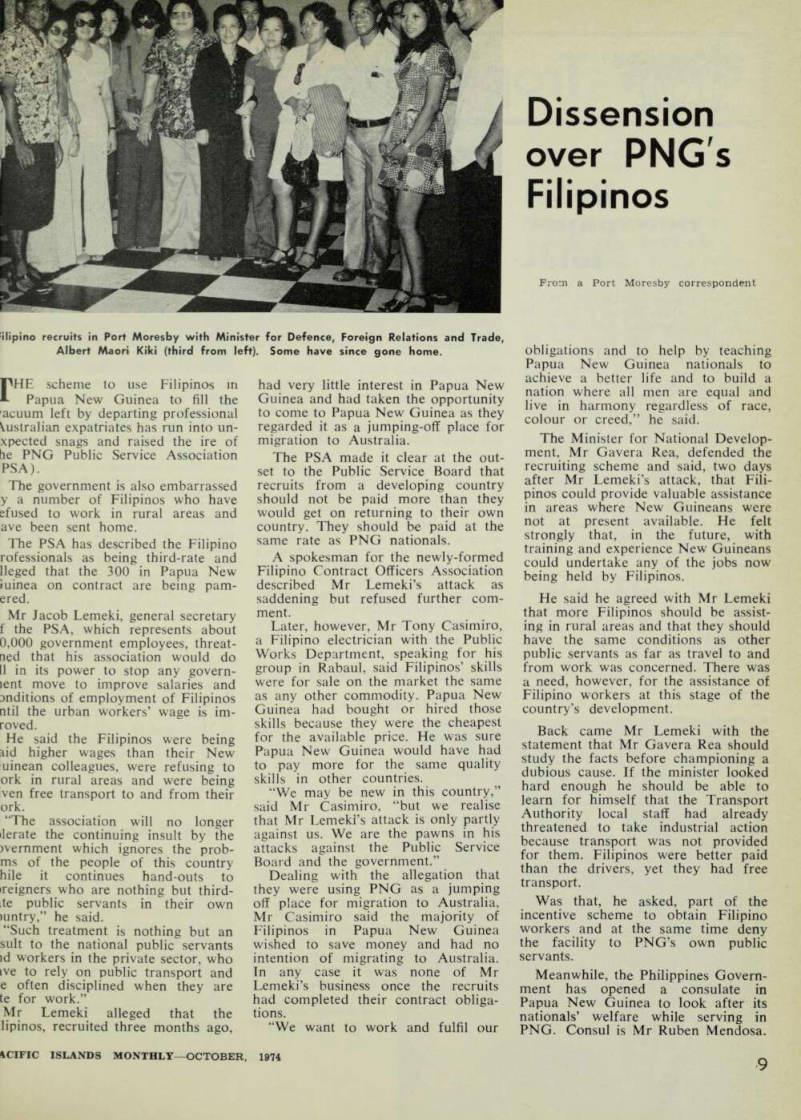
[?]ilipino recruits in Port Moresby with Minister for Defence, Foreign Relations and Trade, Albert Maori Kiki (third from left). Some have since gone home.
Advertisements & other items, p. 11 (1 item)
9
%CIFIC ISLANDS MONTHLY—OCTOBER, 1974
Tropicalities
Rebel newspaper folds
Noumea’s most vociferous “rebel” newspaper, Alain Bernut’s Voix du Cagou, has suspended publication, at least until 1975. The paper has for several years fed the local population a consistent diet of hard-hitting criticism of the “colonialist” policies of the local French Administration as well as attacking any personalities who have displeased the editor.
Much read and well-informed of local grievances, Bernut himself has tended to be a one-man-show and re peatedly split with his associates. A member of the Territorial Assembly, it is only in latter days that he came out as a fighting autonomist, but ap parently has been unable to work in suitable collaboration with other autonomist leaders.
It was announced recently in Nou mea that his weekly was under police investigation. At that time front page cartoons had been directed at the strong-man tactics of French Governor Eriau. One cartoon depicted a portrait gallery featuring pictures of Hitler, Stalin and Eriau. Another caricature depicted a head, resemb ling Eriau and backed up by a bat talion of armed militia.
Among recent incidents, following the governor’s banning of a July pub lic meeting planned by the militant Union of Caledonian Youth (UJC), Bernut’s paper widely publicised the sending of protest letters to overseas organisations, including the French Society for the Rights of Man.
Following this, in early September, Governor Eriau authorised the UJC to hold a public meeting to protest against rising prices, unemployment of Caledonians and racial discrimina tion as well as to call for a “Cale donian nation”. However a proposed march to the centre of town was banned.
As far as the Caledonian Youth claims over unemployment of locals, particularly Melanesians, is con cerned, figures are fairly inaccessible since the Melanesians are usually
readily absorbed back into tribal liv ing. On the rising prices issue, how ever, local authorities are aware of the situation and expect that con sequent wage and salary increases on the island this year could be around 25 per cent.
Finally, on the political front, the new French Minister for Overseas Territories, Mr Olivier Stirn, is ex pected to arrive on November 21 for a visit to New Caledonia. At a time when Paris is showing an increasingly firm hand in the territory and when many Caledonians’ livelihood depends directly or indirectly upon the co operation, if not the favours, of the French Administration, the Minister will face a situation where the auto nomy game seems well under control.
Plenty of room
on Pitcairn
The population of Pitcairn Island has dropped to 66, the smallest figure for many years. It is now difficult to get enough men to man the long boats when a ship stops off the island.
But there are no immediate plans for abandoning the island, Tom Chris tian, the radio engineer, reported in a recent message to the Voice of Prophecy International Radio Pro duction Centre of the Seventh-day Adventist Church in Glendale, Cali fornia.
He reported he would like to build a new house to replace the older one he is living in, but is hold ing off till the island’s future is more settled. He hopes the population will build up, and the island will continue to be inhabited.
The island is now visited by ships from the UK about every three
months. This has seriously jeopard- ,| ised the economy of the island. In ! the 1960 s between 60 and 70 ships! a year would stop off the island. The i ships are the main source of income, . as the passengers buy the islanders’l souvenirs and handcrafted items.
Medical problems have caused a j number of people to leave the island.!
There is no doctor, nor is there a j hospital. Young people leave to fur-| ther their education.
In 1936, Pitcairn had a population I of 200. Twenty years later the figure was down to 161. It dropped to 1521 in 1957, and in 1963 it was down to 86. There was a slight rise, to 90, in 1 1964, but by 1968 it was down to I 76, and the present figure of 66 is I expected to drop away in the next! few months as more people leave. J
New Caledonia’s
aililt'tfie mill
A 46 year-old French nun was! among those who took part in the latest “Operation Guam”, a massive! foot-race organised in Noumea ini August to raise further funds for New Caledonia’s team going to the forth-j coming sth South Pacific Games in Guam.
Keenly applauded by her young > pupils, Sister Marie-Stephane enthusi-1 astically joined some 3,000 parti-j
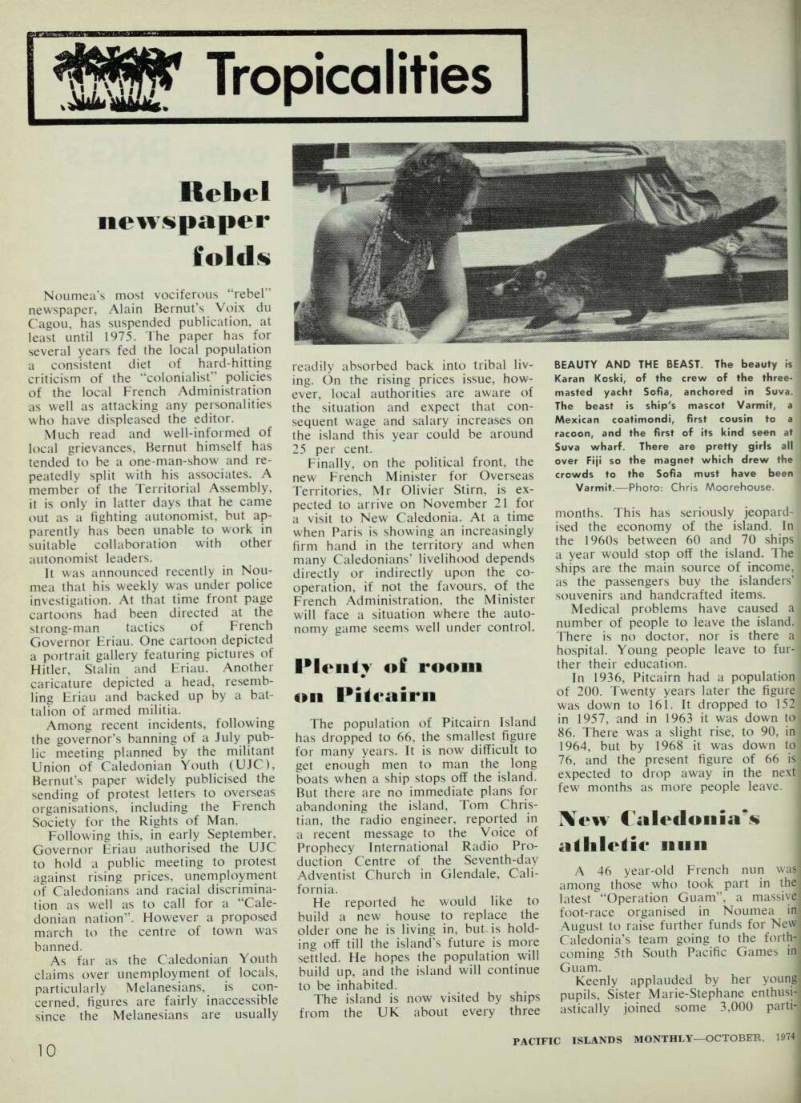
BEAUTY AND THE BEAST. The beauty is Karan Koski, of the crew of the three masted yacht Sofia, anchored in Suva.
The beast is ship's mascot Varmit, a Mexican coatimondi, first cousin to a racoon, and the first of its kind seen at Suva wharf. There are pretty girls all over Fiji so the magnet which drew the crowds to the Sofia must have been Varmit. — Photo: Chris Moorehouse.
ipants divided into 12 categories to in their various courses around the lagenta aerodrome and sporting adiums.
Raising funds for sport has become uite a popular pastime in Noumea, here high school boys and girls re sntly challenged their teachers, men id women, to a cycling race. Entry ;es in this case were donated towards ipporting the annual round-New aledonia Tour Cycliste bicycle trial, hich in September again attracted itrants from France, Australia and ew Zealand.
lello dad
ind goodbye
A father, 92, and a son, 60, met •r the first time for 43 years for a ere 20 minutes at Tonga’s Vavau rfield recently.
New Zealander, George Raymond /den, settled at Vavau many years ;o, running a plantation and a store, is wife took their three sons back New Zealand in 1931 for school g. Time passed, Mr Lyden took the mgan name of Peti Faiteni, and a ingan “wife” and brought up an her family.
Early in August, his son John, on Pacific cruise from Auckland, was Nukualofa for a day. He made up s mind to see his father, so boarded Tonga Tourist and Development Co rcraft, bound for Vavau. The pilot, aptain Adrian Barralet, set up the eeting, with some difficulty, over s radio, Mr Lyden, Sen, or Peti iiteni, living the life of a semi cluse near Neiafu, agreed to come the airstrip only on condition the n paid the taxi fare. Five minutes
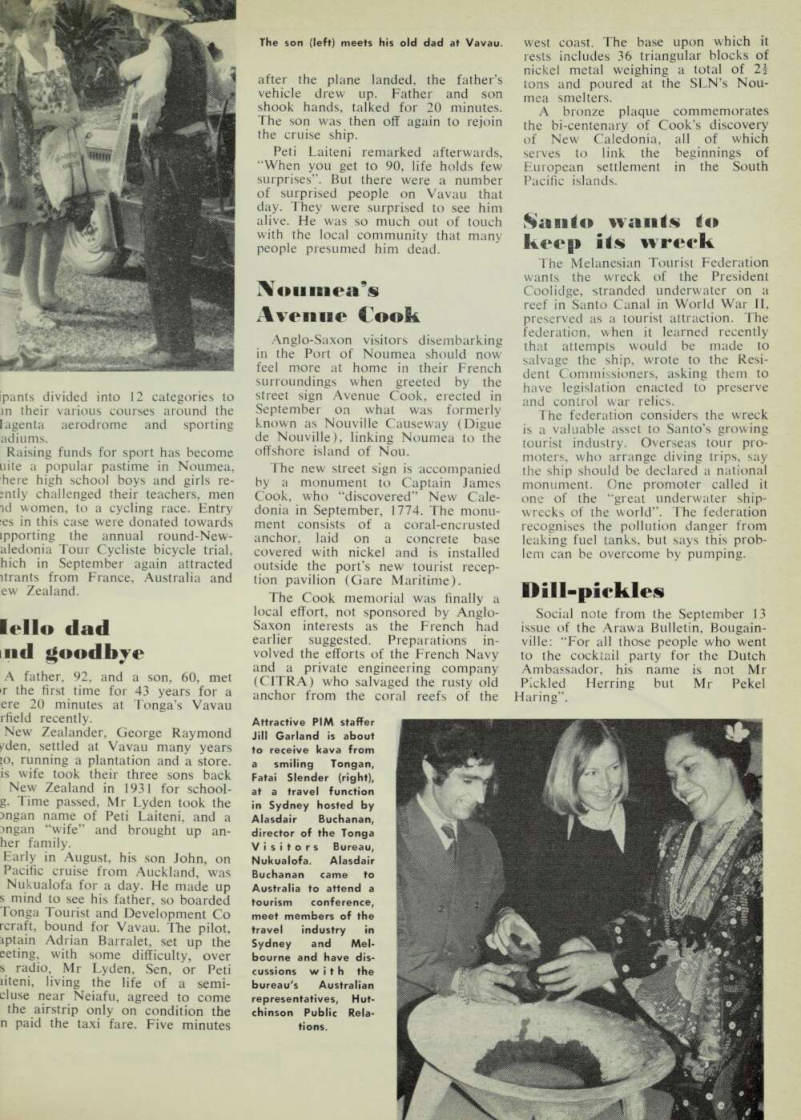
The son (left) meets his old dad at Vavau. after the plane landed, the father’s vehicle drew up. Father and son shook hands, talked for 20 minutes.
The son was then off again to rejoin the cruise ship.
Peti Faiteni remarked afterwards, “When you get to 90, life holds few surprises”. But there were a number of surprised people on Vavau that day. They were surprised to see him alive. He was so much out of touch with the local community that many people presumed him dead.
Won mea’s
Avenue Cook
Anglo-Saxon visitors disembarking in the Port of Noumea should now feel more at home in their French surroundings when greeted by the street sign Avenue Cook, erected in September on what was formerly known as Nouville Causeway (Digue de Nouville), linking Noumea to the offshore island of Nou.
The new street sign is accompanied by a monument to Captain James Cook, who “discovered” New Cale donia in September, 1774. The monu ment consists of a coral-encrusted anchor, laid on a concrete base covered with nickel and is installed outside the port’s new tourist recep tion pavilion (Gare Maritime).
The Cook memorial was finally a local effort, not sponsored by Anglo- Saxon interests as the French had earlier suggested. Preparations in volved the efforts of the French Navy and a private engineering company (CITRA) who salvaged the rusty old anchor from the coral reefs of the
west coast. The base upon which it rests includes 36 triangular blocks of nickel metal weighing a total of tons and poured at the SLN’s Nou mea smelters.
A bronze plaque commemorates the bi-centenary of Cook’s discovery of New Caledonia, all of which serves to link the beginnings of European settlement in the South Pacific islands.
Kaaiio wants to
kee|) its wreck
The Melanesian Tourist Federation wants the wreck of the President Coolidge, stranded underwater on a reef in Santo Canal in World War 11, preserved as a tourist attraction. The federation, when it learned recently that attempts would be made to salvage the ship, wrote to the Resi dent Commissioners, asking them to have legislation enacted to preserve and control war relics.
The federation considers the wreck is a valuable asset to Santo’s growing tourist industry. Overseas tour pro moters, who arrange diving trips, say the ship should be declared a national monument. One promoter called it one of the “great underwater ship wrecks of the world”. The federation recognises the pollution danger from leaking fuel tanks, but says this prob lem can be overcome by pumping.
IHII-pickles
Social note from the September 13 issue of the Arawa Bulletin, Bougain ville: “For all those people who went to the cocktail party for the Dutch Ambassador, his name is not Mr Pickled Herring but Mr Pekel Haring”,
Attractive PIM staffer Jill Garland is about to receive kava from a smiling Tongan, Fatai Slender (right), at a travel function in Sydney hosted by Alasdair Buchanan, director of the Tonga Visitors Bureau, Nukualofa. Alasdair Buchanan came to Australia to attend a tourism conference, meet members of the travel industry in Sydney and Mel bourne and have dis cussions with the bureau's Australian representatives, Hut chinson Public Rela tions.
Advertisements & other items, p. 14 (1 item)
Skillet
1 . s, I Jr V /
Round gourmet
The handiest newappliance
since frypans
Bacon and eggs for two? With a Sunbeam “Skillet” it’s easier than ever. Just the right size. Yet “Skillet” is big enough itself to roast a size 8 chicken to perfection. And it washes easier than a plate.
Just remove the control and dunk the whole pan in the sink.
“Skillet” is another great new idea from Sunbeam. Handier for small families and singles. It looks like a frypan, cooks like a frypan. But it has a talent of its own. It’s designed to be versatile, to be both compact and roomy. “Skillet” looks beautiful, cooks beautifully.
Nobody but Sunbeam can offer you a Round Gourmet Skillet. It’s absolutely on its own. It only comes from Sunbeam. L 83.4186
People

• Miss Mary Vance Trent, US State Department’s liaison officer in Micronesia, completed her two-year our of duty early in July. She has etired from the US Foreign Service vhich she entered 27 years ago. She ;erved in American embassies in Oslo, Prague, Paris, Jakarta md Wellington, and has also been a nember of the US delegation to the Jnited Nations. Her successor at Jaipan is Mr Alf E. Bergesen, who las served since 1950 in Burma and Cambodia. • Mr Philip Palmer, 72, manager or Burns Philp on Fanning Island etumed recently to Australia to re ire after 47 years in Burns Philp’s :mploy. He was first skipper of a mall ship in Bougainville, then nanaged copra estates in Bougain ille and New Britain. In 1937, Mr ’aimer went to Fanning Island as nanager, and except for several years »n naval service during World War I, and holidays, remained there till ic retired. He is not certain yet /here he and Mrs Palmer will live, 'Ut he expects it will be in north Queensland. He has been succeeded s manager at Fanning Island by the ssistant manager, Mr John Fleet wood. ® Bishop Darmancier flew home > France in July, via Fiji, New Cale onia and New Hebrides, after spend ig 22 years in the Pacific, the past ight as Bishop of Wallis and Futuna ►lands, Monsignor Darmancier is icceeded by the first Polynesian ishop of Wallis and Futuna, Mgr olesio Fuahea, who was born in Zallis and has served in Samoa. • Mr E. J. L. Ride, head of the outh Pacific section of the Australian breign Affairs Department and well nown to Island government officials, as been appointed counsellor at the mstralian Embassy in Washington DC). He leaves towards the year id. His successor in the South acific section is Miss Mary Mc herson, until recently counsellor at le Australian Embassy in Rome. • Mr Felix Pinczuk has been ap linted Secretary for Finance in auru, succeeding Mr Alex Gilroy, ho has returned to Australia. • It looks as if Monsignor Herbert aivu, 62, Vicar General of the RC rchdiocese of Rabaul and named in ugust as Auxiliary Bishop of Port
Moresby, will no sooner be con secrated a bishop than he will be come an archbishop, the Archbishop of Port Moresby. Archbishop Virgil Copas has announced his intention of resigning his Port Moresby see and is reported to have said he would like to hand over the see to Mgr Paivu.
Meanwhile, in Fiji, it has been reported that Monsignor Pita Mataca, 41, has become the first Fijian bishop, as assistant bishop to Archbishop
George Pearce.
• Mr Luke Sela has been ap pointed to head the first overseas information office set up by the Papua New Guinea Government, which will be in Papua New Guinea
House, Sydney. Mr Sela, a Manus Islander, was Government Principal Information Officer and before that news editor of the government broad casting network. • Britain will upgrade its consulate in Papua New Guinea to commission status in October with the appoint ment of Mr George Baker, as British Commissioner. Mr Baker, 57, at pre sent Deputy British Government representative in St Vincent in the West Indies, has served in Washing ton, Tanzania and Zaire. • Mr Evertius Romney, formerly executive officer in the PNG Depart ment of Transport, has been ap pointed PNG Commissioner in Fiji, and arrived in Suva in September.
Advertisements & other items, pp. 15-16 (2 items)
13
ACIFIC ISLANDS MONTHLY—OCTOBER, 1974
Deadly Germs
SIX FEETOF
CONCENTRATED PEA-BEU
The strong one that cares for your world Like all insects the cockroach has six legsand every one will have thousands of germs on them from his unsavoury habits. So it s worth getting rid of fast. Concentrated Pea-Beu contains one of the world’s most powerful insecticides so it kills insects in seconds and it's rigidly tested through every stage of manufacture so you can spray it safely with confidence MM to protect the health and well-being of your family.
Concentrated Rea-Beu kills flies, mosquitoes, dl disease carrying insects in seconds.
y •; -v m ; ■■ . ■ 'u
/&Adjusts acadty &s)uf <ssk-
Mm, •:• ? ■"' , MF:*
fd-fcjU
fkrkw 75aefy*6&>
■Mu WW:
>fc (f&uj Arr^-^ys%*§&•**
_Z—-
ff' wi'fny AtfU,
. i. ''•'•••s , V " w \ , ■■ >:: :V: : ri:;^ : :::r-Si:'■■: ': ■ .-. .
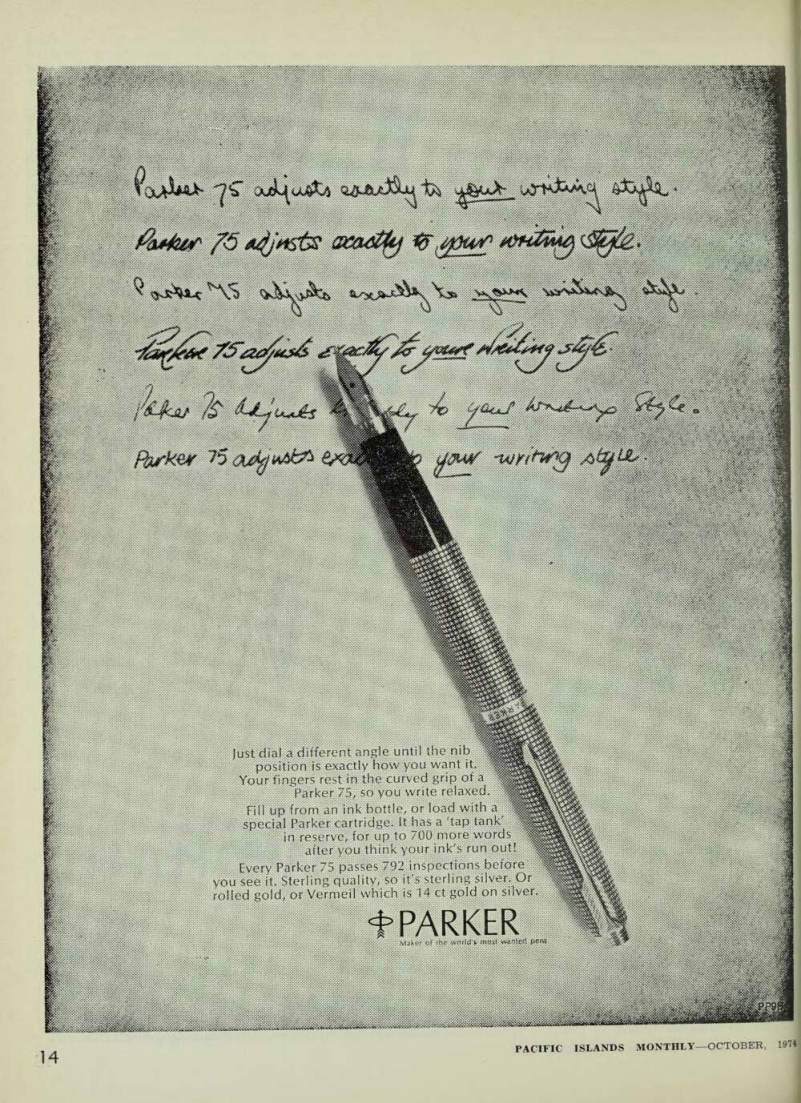
Just dial a different angle until the nib position is exactly how you want it.
Your fingers rest in the curved grip of a Parker 75, so you write relaxed.
Fill up from an ink bottle, or load with a special Parker cartridge. It has a 'tap tank in reserve, for up to 700 more words after you think your ink's run out!
Every Parker 75 passes 792 inspections before you see it. Sterling quality, so it’s sterling silver. Or rolled gold, or Vermeil which is 14 ct gold on silver.
t PARKER
Maker oi ihe world t moil wanted pens
the long knives
Saru’s night of the long knives
From Vijendra Kumar
in Lautoka
IT was the night of the long knives—and steel spikes. At Mr Mohammed Ishaque’s home at Saru, on a hilly settlement four miles inland from Lautoka, a crowd of 200 waited in silent anticipation for the strangest of all ceremonies to start. A full moon shone brightly from the clear sky.
About a dozen performers, the youngest of whom was a boy of seven, sat on a stage covered with a tangerine-sheeted canopy. They wore loose-fitting, white long pants, shirts and head-dress.
Their high priest, Maulvi Abu Bakar, led them in chanting ancient prayers of which the refrain of marhaba, marhaba echoed loudly to the rhythm of small goat-skin drums some men were playing.
Thick smoke from incense burning in a large urn coiled up ward to the canopy. Its pungent smell pervaded the atmosphere.
At about 11 pm the priest received the other-wordly sign he had been expecting. Later, I learnt that he must sight the reflection of the moon and a star—the Islamic religious symbol—on the sheet before he may order his men to risk their lives.
At a nod from Maulvi Abu Bakar, one of the performers got up, took off his shirt and came up to face the priest, who, too, had risen. The priest picked up a nine inch long piano wire needle and skewered the other man’s tongue.
As blood oozed from the wound, the priest licked it with his tongue.
The bleeding stopped.
The man then picked up two ornamentally-decorated steel spikes, each a foot long. Swaying eerily to the insistent tattoo of the drums, he faced the audience. He lifted the spikes high and, in a single swift motion, plunged them deep into his belly.
The crowd gasped. Some women
screamed. Others turned away their faces.
As the man pulled out the spikes, blood spurted from the wounds. The bearded high priest came up to him, fanned incense smoke from a smouldering urn on the wounds and then lapped up the blood.
So started the macabre and bloody ceremony of raativ, an ancient cult which is believed to have its origins in Kerala in south India. It is, undoubtedly, the most mysterious of all rituals and only a few people in Fiji know its secret.
Mr Ishaque, a successful poultry farmer, holds the ceremony at his home every year either in August or September. He invites anyone interested to see the spectacular and terrifying show and entertains them to a lavish dinner. To him and his family, the ceremony has deep religious meaning.
Maulvi Abu Bakar is a true master of the art. The men who dare death have unwavering faith and trust in him and his occult powers.
As the ceremony at Mr Ishaque’s home got underway, one by one the performers rose and joined the dance of death. They began to hack and slash at their bodies in terrifying acts of self-torture.
Razor-edged knives and daggers cut open the flesh.
Bloqd flowed but Maulvi Abu Bakar, through some mystic power, healed the open wounds and stop ped the flow of blood. The ceremony had a frightening climax when the priest himself joined the show.
He ordered two performers to lie on their backs. Picking up a cane knife, he rained a series of powerful blows on the men. As a wound opened, he stamped it with his foot. He then covered the two “bodies” under a white “shroud”, one got the eerie feeling that the men were dead.
But when Maulvi Abu Bakar
flung the sheets away, the two rose unharme.d.
One of Fiji’s noted masters of raativ is Maulvi Abdullah of Lautoka. Because of failing health, he has retired from this calling.
He recently told me that the priest received the mystic powers through the grace of Allah.
Certain verses from the Islamic holy book, the Koran, contained the secret power. Much depended on how these were chanted and in what frequency, he said.
He said some masters in India were capable of doing incredible things. There, the ceremony was usually performed on a river bank.
The officiating priest would hack a man into pieces and then throw the pieces into the river.
As the limbs and pieces floated downstream, strange things started to happen. One by one, the pieces started joining and eventually the disintegrated man swam ashore the same whole man he was before his immolation.
Strange? Incredible? Perhaps.
But Fiji too has sesames whose doors remain locked—at least to us mere mortals.
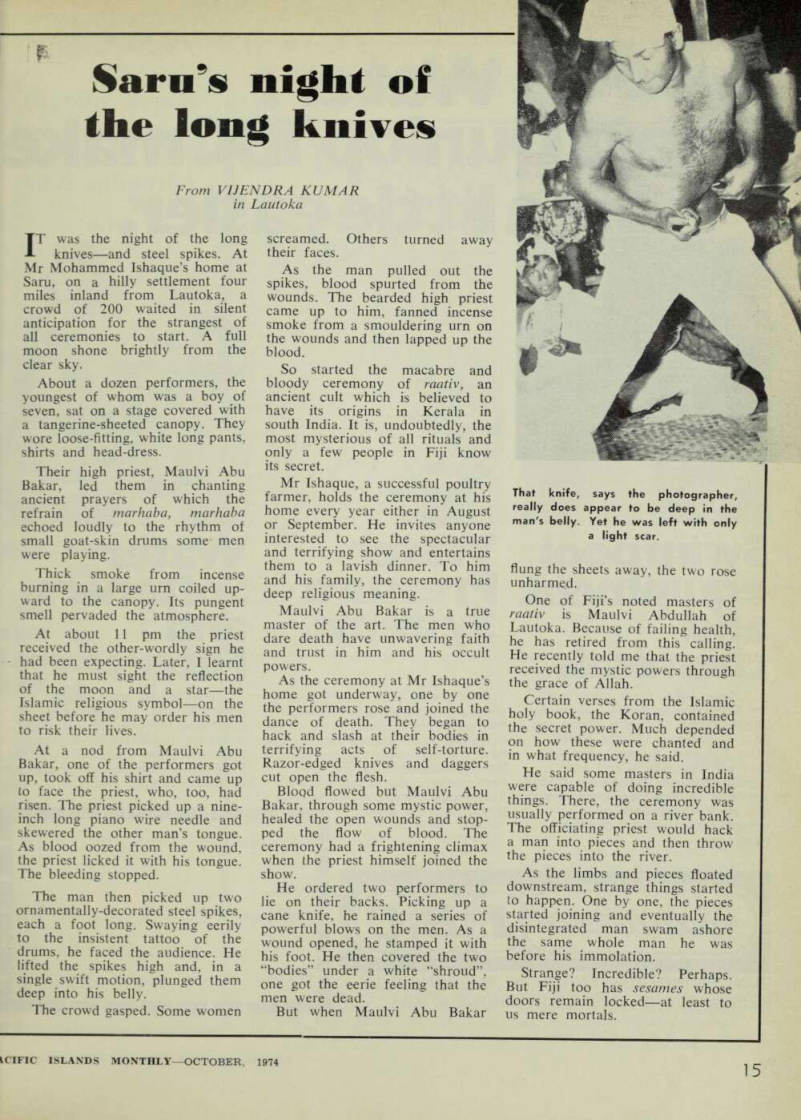
That knife, says the photographer, really does appear to be deep in the man's belly. Yet he was left with only a light scar.
Advertisements & other items, pp. 17-19 (2 items)
15
ICTFIC ISLANDS MONTHLY—OCTOBER, 1974
3 ways Dunlop/IBC make
Wstt© v* •
life a little easier.
■' ‘‘isiiii ■ ,
•NmUPII
Swim pool Water Water
equipment Pressure Softeners
and Systems, and
chemicals. Filters.
Swim safe, swim clean with Wherever your need for water Dunlop/IBC manufacture an IBC/Jacuzzi —Australia’s finest and pressure, whether it be domestic. advanced and complete range of largest range of quality filters and holiday home or caravan, rural or automatic and manual water pool equipment. They’re called industrial applications, Dunlop/IBC softeners and filters for domestic, “The Saturday Savers ", because have the right water system with commercial and industrial purposes, they work so simply and well. the right capacity for the job. Free advice from technical experts Dunlop/IBC pool experts are always Performance and inbuilt quality is always readily available. available to give free advice on have made the IBC brand famous any pool problem —building, throughout the world ■HBHHiHHHIHH equipment, or correct chemical treatment. * Please send me free literature on
ADDRESS I
DUNLOP/IBC LTD..STATION RD., YEERONGPILLY, ■ PHONE
BRISBANE, 4105, AUSTRALIA. PHONE 409011 MB Hi ■■■ M H ■■ L8Q1636
Become a part of PIM’s Pacific and subscribe now % ■a .z z £ O a 15 S -o u fl o O fl Oh ct S o oo Oh o o FV7/ m details on the attached order form.
The Editor's Mailbag

A Condominium Complaint
In the Condominium of the New Hebrides there has been a consider able feeling of concern by the New Hebrides National Party Governing Council over the failure to imple ment Joint Regulations.
The Joint Immigration Regulation No. 18 of 1971 is sound and covers a wide area in this field (there are also National Immigration Laws).
The Joint Immigration Regulation is, as far as I can see, used only for record purposes, perhaps for the rest of the world to think well of France and England.
Since the Joint Regulation came into force in 1971, the two Resident Commissioners by joint decision have appointed principal immigration officers from each of the national administrations to carry out the duties on their behalf under the res pective jurisdictions within the New Hebrides, and instead of calling it a Joint Immigration Law we are back to square one, where two national administrations are only serving their own interests in the appointments. For example, there were a number of undesirable aliens from New Caledonia who recently managed to obtain permits to enter the New Hebrides and who are now causing a lot of trouble. If both immigration officers made rulings together instead of one exercising his power under his national jurisdiction, there would have been no cause to complain to the Resident Commiss ioners in May on this point.
The New Hebrides National Party Governing Council approached the British and French Resident Com missioners in May, 1974, stating that their respective principal immi gration officers were not observing properly the duties designated to them in the manner laid down by Joint Regulation No. 18 of 1971. It is reported that one of the Resident Commissioners jokingly replied that perhaps the immigration officers had not studied the regulation. In reply, someone said, “How encouraging”.
The two Resident Commissioners admitted to the National Party Governing Council that their officers had been letting things slide and had not kept strictly to the regu lation. They promised to instruct
them to take more care in following the regulation.
Most New Hebrideans are worried that so many Pacific Islanders are coming to look for jobs in the New Hebrides. These people could easily lose their jobs when the New Heb rides becomes independent. We should be prepared to let them know that priority will be given to suit ably qualified New Hebrideans in respect of employment, so that we do not spoil our relationship with them at this stage for later.
I feel, too, that there should be safeguards against Europeans who come here as tourists or on contract and feel they are free to buy land and settle down here permanently.
One sympathises with the fact that perhaps these people are trying to escape from the pressures of life in their own country and are looking for a quiet haven like the New Heb rides in which to live. But they should also be reminded that, for those who buy land here in the New Hebrides there is the New Hebrides National Party land policy that all land owned by non-New Hebrideans may be nationalised. This may be one of the dreams of this political party but it is better if people know beforehand so that they won’t be taken by surprise; it may never come to be but one can never tell.
Vila Correspondent.
New Hebrides.
Now Niueans Know!
Nearly half the adults on Niue Island are arguing with the members of the Exco Committee because of misunderstanding over self-govern ment.
The reason that the people on Niue Island have so many questions to ask the Leader of Government and the other three members of the Executive Committee, is that they do not even know what self-government is, when it starts and what is gonna take place etc.
I don’t really know why some of these people don’t even know what self-government is, for example, Taoa, who has many questions to ask the Leader of Government.
I have heard some of the speeches
on the radio at meetings with some questions like this one. When Niue stands by itself where does Niue get its money from? Some of the people think that self-government is the same as independent, like other Paci fic states, eg Tonga and Western Samoa who are already independent.
Self-government means that New Zealand will still grant money to Niue. And New Zealand will still defend Niue and Niueans will still be :itizens of New Zealand; going in and out of New Zealand and staying as ong as they like but independence s different. If Niue is fully indepen dent—that is standing by itself like i baby without a mother and with out care—New Zealand will not give Niue any money, or defence and Niueans will not be allowed to go to New Zealand.
Integration would make Niue part of New Zealand. Every law in New Zealand would be the same on Niue.
Federation with other Pacific States neans choosing a leader from the 3 acific Islands.
I will not try to hide my name from the readers. I am a 16-year-old boy. I attend Niue High School and I am in SA.
H. Tolitule.
Niue.
Mindless Claptrap
I cannot let the references by L.
N. Nevels Jr (PIM, Aug, p 23) to the Heads of State of Papua New Guinea and Fiji pass. While 1 sympathise with the problems of someone who has worked to build up land or a business, there have, un fortunately, been misuses, which have led to the present attitudes. There has been too great a difference between the rich, high living, often empty headed European, and the poor, hard working local.
I suppose the Europeans are too busy making a quick buck to bother to learn about the ancient culture of Melanesians. Those who do, and are working with the people of Fiji and Papua New Guinea, would not dream of making such an ignorant and ill mannered remark.
As to your reference to Ratu Mara, I expect you realise that Ratu Sir Kamisese Mara has more dignity in his little finger, than most heads of state in the world today, with the
possible exception of Mrs Indira Ghandi, Big Norm and Big Gough, that is.
Sorry about the land old boy, but the wheel turns you know.
G. Drummond Mcgrath.
Honiara, BSI.
With reference to Mr L. N. Nevels Jr’s letter published in PIM (Aug p 23) regarding the Prime Minister’s recent visit to Papua New Guinea, Ratu Sir Kamisese did not endeavour “to create a fictitious historical unity”.
He was informed to his great in terest and with warm appreciation on behalf of his hosts, of the con tribution made by Fijian missionaries to Papua New Guinea. He visited the graves of three Fijian martyrs for their faith—Rev Penijamini Lewa, Rev Livai Naboro and Rev Timoci Varavi who died in Papua New Guinea in 1878.
A Papua New Guinea Information Service release said more than 100 preachers, pastors and ministers went to Papua New Guinea from Fiji be tween 1875 and 1929. Their preach ing was responsible for the growth of an indigenous church, now part of the United Church in Papua New Guinea, the release continued.
And, he said that people from his
vn island in Fiji had been closely mnected with missionaries. In 1835 e Reverends Cross and Cargill were ven permission by his great-great andfather to land at Lakeba and troduce Christianity to Fiji. The ader of the first missionary group go to Papua New Guinea from iji was Aminio Baledrokadroka who me from Lakeba.
This link is recorded with pride id it is true.
J. B. Vosanibola,
Private Secretary to the Prime Minister. iva, Fiji.
Sucking Nauru's
Life-Blood
The ill-informed pen of Mr Deiye is once again graced the pages of >ur monthly magazine (PIM, July 37). I am not writing to give him e correct facts since he could have )tained them if he cared to in the st place. But it bothers me to read s letter which is riddled with un unded facts.
Let me remind Mr Deiye that "oken Hill South expects to mine assive phosphate deposits in south sst Queensland (Australia) within year. This company announced in >66 its discovery of phosphate in ueensland. Needless to say that ustralia’s phosphate requirements ill be fulfilled from these deposits id perhaps Nauru may no longer pply Australia’s needs once these iposits are worked, in the future.
One thing is certain and that is at as a result of Broken Hill >uth’s proposals to mine the ueensland deposits Mr Deiye will ) longer claim “that the Australian rmers are sucking the life blood the Nauruan people”.
I have only one suggestion to Mr eiye and that is to make certain s facts are correct in future.
L. D. Keke
orthcote, Vic.
We're Great Printers!
I must congratulate PIM on the ay you have kept your high stan ird in workmanship of the maga ne. I doubt if there is any other agazine that has kept up the stan ird of the print and paper like you ive, except the National Geographic agazine. Some magazines now use
a plastic gum to keep the pages together, and in the warm areas, upon opening, the pages fall apart, even before you read them.
Western Australia.
R. Durance.
A/I Ahd I Hd Aaaddic
/Viauk! Uk Iviaukij
Towards the end of Mrs Judy Tudor’s review of Alan Ward’s: A Show of Justice (PIM, Aug, p 73) she mentioned Ward s one “idiosyn crasy—‘Maori’ is neither singular nor plural . . .
This usage was questioned during our editorial examination of the work,
and we have on record the author’s reply. It is: ‘Maori is a Polynesian word and is correctly both singular and plural.
The Maori intelligentsia prefer this and since my whole book pleads for respect for Maori sensitivities, I have felt obliged to respect their view, though it is not yet generally ac cepted in New Zealand’.
I do hope this explains the posi tion satisfactorily,
H. R. Field,
Promotion Manager.
Australian National University Press, Canberra, ACT.
Advertisements & other items, pp. 19-24 (3 items)
17
4CIFIC ISLANDS MONTHLY—OCTOBER, 1874
Sunto
-* f -Yi : r S mm SH #>W_ T«**
sTEE c#
%ER!^w
«sbj&
«Er<J7,47 te ) «AO«
Sunto
ilk-
io*»w?'^S *4.
STEEL
: um Ft w»» s tcowm
SVONE?
ii M* “Cf or s ®k. : wp* o **«*„
YOU GET A BETTER DEAL FROM
PA CIFIC MA CHIN FRY
* mi sa It jK
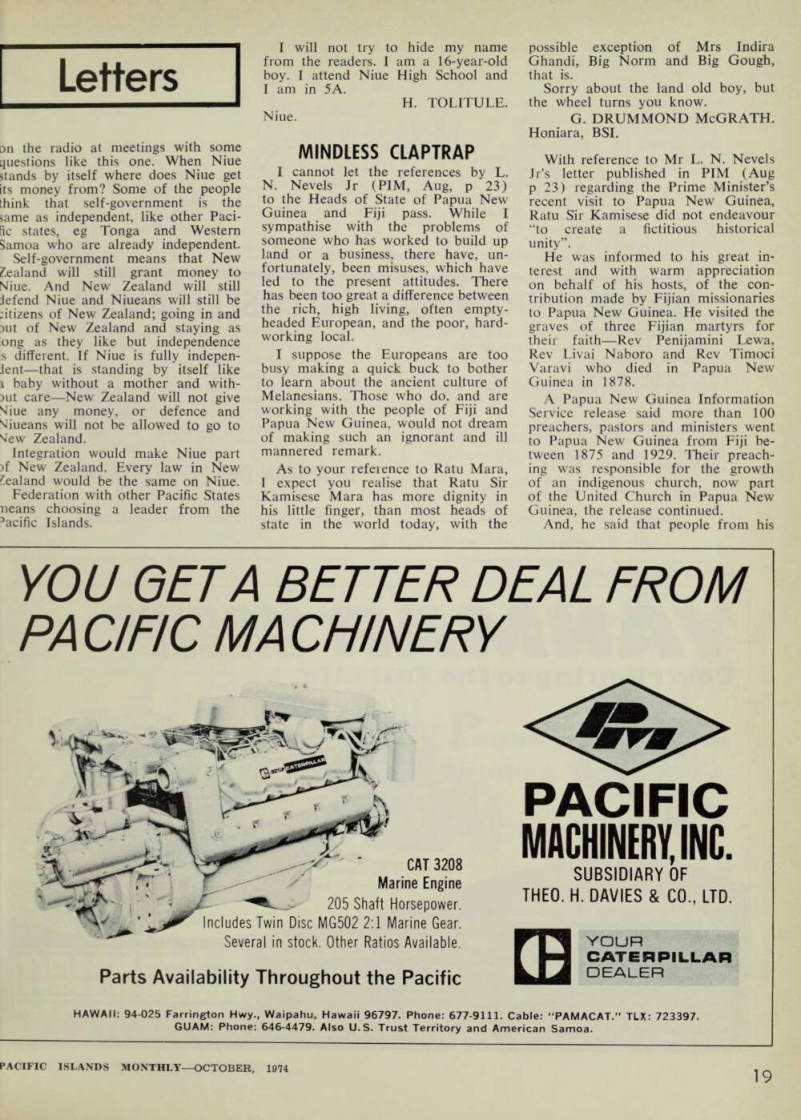
CAT 3208
Marine Engine 205 Shaft Horsepower.
Includes Twin Disc MGSO2 2:1 Marine Gear.
Several in stock. Other Ratios Available.
Parts Availability Throughout the Pacific Mi
PAPiFir
MACHINERY, INC.
SUBSIDIARY OF
THEO. H. DAVIES & CO., LTD.
YOUR
CATERPILLAR
DEALER
HAWAII: 94-025 Farrington Hwy., Waipahu, Hawaii 96797. Phone: 677-9111. Cable: “PAMACAT.” TLX: 723397.
GUAM: Phone: 646-4479. Also U.S. Trust Territory and American Samoa.
<r J V («—!-
on cr
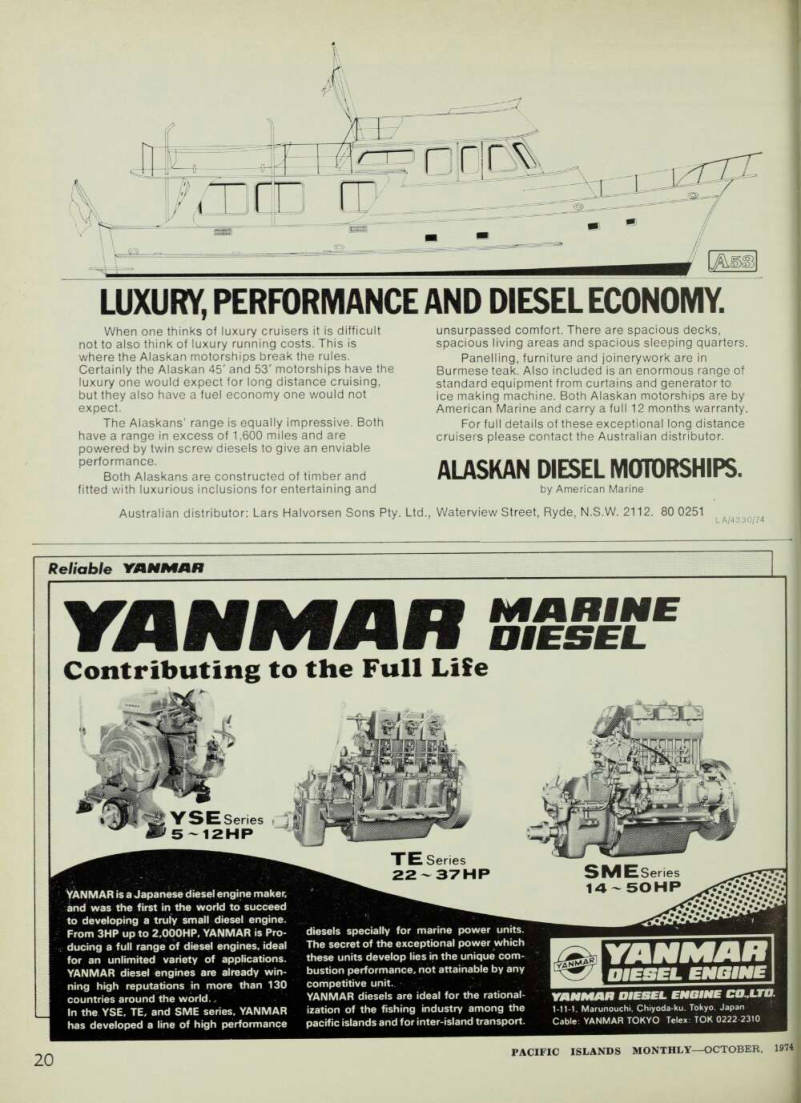
LUXURY, PERFORMANCE AND DIESEL ECONOMY.
When one thinks of luxury cruisers it is difficult not to also think of luxury running costs. This is where the Alaskan motorships break the rules.
Certainly the Alaskan 45' and 53' motorships have the luxury one would expect for long distance cruising, but they also have a fuel economy one would not expect.
The Alaskans’ range is equally impressive. Both have a range in excess of 1,600 miles and are powered by twin screw diesels to give an enviable performance.
Both Alaskans are constructed of timber and fitted with luxurious inclusions for entertaining and unsurpassed comfort. There are spacious decks, spacious living areas and spacious sleeping quarters.
Panelling, furniture and joinerywork are in Burmese teak. Also included is an enormous range of standard equipment from curtains and generator to ice making machine. Both Alaskan motorships are by American Marine and carry a full 12 months warranty.
For full details of these exceptional long distance cruisers please contact the Australian distributor.
ALASKAN DIESEL MOTORSHIPS.
by American Marine Australian distributor: Lars Halvorsen Sons Pty. Ltd., Waterview Street, Ryde, N.S.W. 2112. 80 0251 L A/4330/74
Reliable YAMMAH
YAM MAR
Contributing to the Full Li(e
MARINE
YSE Series
5-12 HP
TE Series
SME
Series 37 HP 22 50HP YANMAR is a Japanese diesel engine maker, and was the first in the world to succeed to developing a truly small diesel engine From 3HP up to 2,000 HP, YANMAR is Producing a full range of diesel engines, ideal for an unlimited variety of applications.
YANMAR diesel engines are already winning high reputations in more than 130 countries around the world.
In the YSE, TE, and SME series, YANMAR has developed a line of high performance diesels specially for marine power units.
The secret of the exceptional power which these units develop lies in the unique combustion performance, not attainable by any competitive unit..
YANMAR diesels are ideal for the rationalization of the fishing industry among the pacific islands and for inter-island transport.
Pyanmah
Esai DIESEL
YAMMAM DIESEL EMBIME CO.,LTD.
1-11-1, Marunouchi. Chiyoda-ku. Tokyo. Japan Cable: YANMAR TOKYO Telex: TOK 0222-2310
W. H. GROVE & SONS LTD.
ESTABLISHED 1896
ISLAND MERCHANTS
Exporters to the Pacific of Dairy Products and all New Zealand consumer and manufactured goods.
ENTRUST YOUR REQUIREMENTS TO THE
ESTABLISHED FIRM
P.O. Box 3718, Cables
AUCKLAND GROVE AUCKLAND
D apua new guinea
printing co. ply. ltd.
Serving the Country from Aitape to Alotau, Manus to Moresby.
Leaders in Commercial Offset and Letterpress Printing.
Stationery Office Supplies O Office Equipment Rubber Stamps • Self-Adhesive Labels • In Fact:— Everything For The Office.
P.O. Box 633, Port Moresby P.O. Box 759, Lae P.O. Box 1239, Rabaul
SPEED-E-GAS
SPEEI>EGAS
Lae
Wewak
Rdbaul
Honiara
Port
Moresby
Kieta
DO □ □ new
new
Nukualofa/
lautoka
CC c Cj /OS 2*
RarotenM^
Cl
Sydney
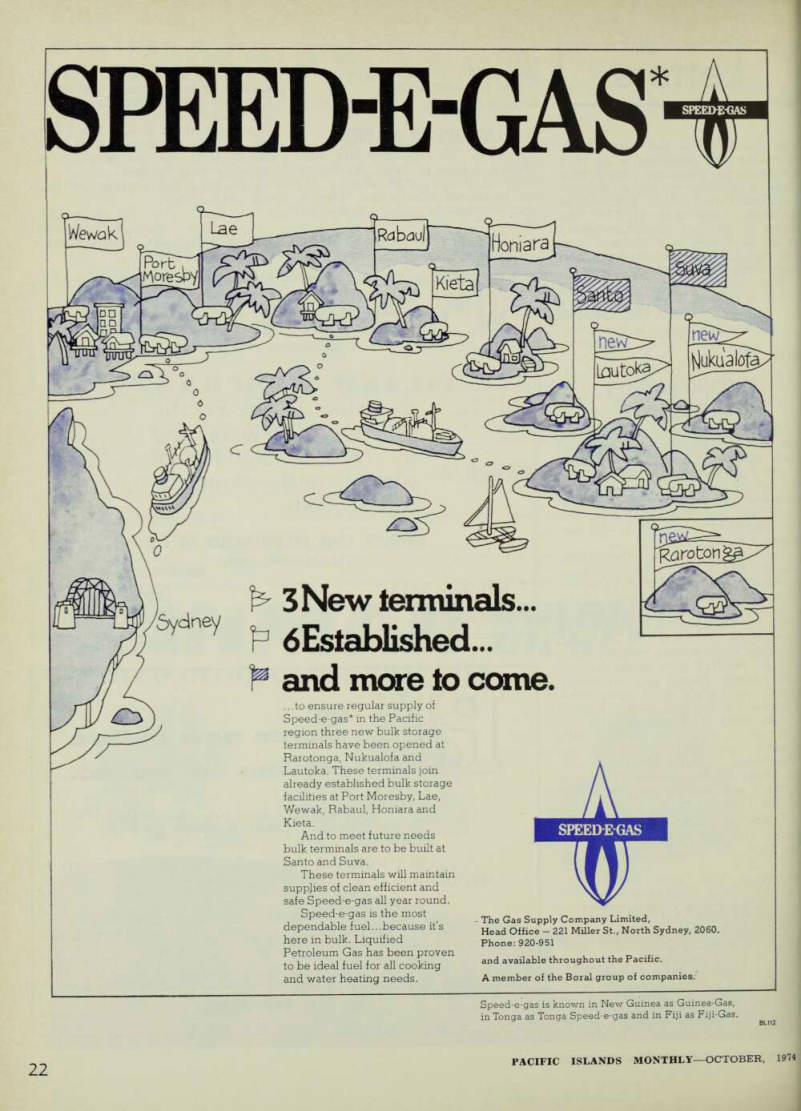
& 3 New terminals...
P 6Established...
and more to come.
.. .to ensure regular supply of Speed-e-gas* in the Pacific region three new bulk storage terminals have been opened at Rarotonga, Nukualofa and Lautoka. These terminals join already established bulk storage facilities at Port Moresby, Lae, Wewak, Rabaul, Honiara and Kieta.
And to meet future needs bulk terminals are to be built at Santo and Suva.
These terminals will maintain supplies of clean efficient and safe Speed-e-gas all year round.
Speed-e-gas is the most dependable fuel...because it's here in bulk. Liquified Petroleum Gas has been proven to be ideal fuel for all cooking and water heating needs.
SPEEDEGAS
The Gas Supply Company Limited, Head Office - 221 Miller St., North Sydney, 2060.
Phone:92o-951 and available throughout the Pacific.
A member of the Boral group of companies.
Speed-e-gas is known in New Guinea as Guinea-Gas, in Tonga as Tonga Speed-e-gas and in Fiji as Fiji-Gas.
Letters
\CIFIC ISLANDS MONTHLY—OCTOBER, 1974
East Irian Or Ng? What Indonesia


Thinks Of Its Emerging Neighbour
In the days of Bung Sukarno when Australia and Papua New Guinea pondered over the Indonesian strong nan's plans for his newly-acquired territory of West New Guinea (Irian Jaya), there was a story in Jakarta hat Sukarno had a map of the whole of the region and on that map East New Guinea, like West New Guinea, was depicted as part of Indonesia. But with Sukarno's downfall, confrontation ceased and today >apua New Guinea and Indonesia are exchanging messages of friendship. How does the Indonesian view >apua New Guinea's changing status? Below, Dr R. S. Roosman, senior lecturer in the Political Studies Depart nent of the University of Papua New Guinea, samples current Indonesian thought through the pages of its ewspapers.
By R. S. Roosman
It is in the light of Papua New luinea gaining its self-government ist year and ultimately its indepen ence, that so much publicity has sen given by the newspapers in idonesia’s capital city Jakarta. The iiara Karya Dec 1, 1973 announced lat “This day, Saturday Dec 1 repre :nts the birthday of a new Republic: apua New Guinea”, appearing as a ib-title to Michael Somare’s picture sside the New Guinean flag.
Apparently furnished by the same mrce and author, three newspapers iblished the same article under fferent titles and dates: “Papua ew Guinea, newly emerging under ie leadership of a former journalist” 2ahaya Kita Dec 2); “Papua New uinea, a newly emerging nation”
Vlerdeka Dec 3); and “Papua New uinea; The last unknown territory” >inar Harapan, Dec 3).
The Jakarta Times (Dec 3) pub hing in English, wrote: “Papua ew Guinea assumes self-government iring a quiet ceremony . . . The r -year-old Chief Minister Michael >mare took formal responsibility for s 2i million people from the for er Australian Administrator Leslie hnson. Although it will take time r PNG to achieve its independence, 'erseas countries have already own interest in establishing closer lations with the young nation; eanwhile, the UK and Indonesia ive established their diplomatic presentation to PNG, and it can be pected that before long New Zea ad, the USA and Japan will simi rly have their diplomatic represent ives sent there. Papua New Guinea 11 become the biggest nation in the ►uth Pacific after Australia and New :aland. Presently, Papua New uinea is inclined to grow closer to astralia and Indonesia, however, me observers have said that the w nation will gain prestige soon playing a role in regional affairs”.
Prior to these articles, the Kompas daily of Nov 20, 1973 published an article titled “We must welcome Papua New Guinea’s Independence” and quoted Irian Jaya’s governor Acub Zainal’s statement: “I am con vinced that PNG’s self-government which will come next month, will not have any negative effect on people in Irian Jaya. Therefore, PNG’s in dependence must be welcomed. Also, because people in Irian Jaya now feel themselves 100 per cent Indo nesian”.
On the border agreement which was signed by Adam Malik, the governor had this to say: “The agree ment has a positive result. The situ ation has improved greatly, and we have become good neighbours. Even if problems arise between people liv ing on both sides of the border, these can be solved peacefully. The socio
economic development in PNG will not have a detrimental effect on neighbouring Irian Jaya, although so far such an effect has not yet been felt”.
Malik’s 3-day visit to Port Moresby in mid-November ’73 was covered by Merdeka of Nov 20 in an article: “When Adam Malik was in PNG”.
He is pictured while inspecting the PNG guard of honour with PNG Foreign Minister Maori Kiki, and in another picture while shaking hands with Michael Somare at a state dinner given by the Chief Minister.
The article says, in part: “Many problems were discussed by Adam Malik, among them the signing of an administrative border agreement”.
The Jakarta Times (Dec 3) quoted PNG’s Chief Minister as having said that “his country’s foreign policy will be oriented less toward Australia, and more towards Indonesia and Japan, and sees his country as a bridge be tween Asia and the inland people of the Pacific Ocean”. Under the title “Reluctance to accept independence in PNG”, Suara Karya (Dec 4) quoted an article in US Newsweek by Tony Clifton, that “Kugame Kura, a PNG tribal chief, ordered his fellow-tribesmen to erect a fence around a 15 km area to protect political freedom (ie independence) from coming into his tribal territory”.
On Josephine Abaijah’s Papua Besena Movement, the article says that “they (the Papuans) feel them selves superior to the people from the north, and therefore reject be coming part of the same country”.
Indonesia Raya (Dec 15) in an article entitled, “The Tolai Political Movement in East Irian” (note: Otherwise, the author, Amri Marzali, used the term Papua New Guinea throughout his article) wrote: “In early 1971, the former head of the Indonesian delegation in the West New Guinea dispute with the Nether-
Kiki's visit
lands, the late Soedjarwo Tjondro negoro, was invited to observe from close by the preparations of the Australian Government to give PNG self-government. Not long thereafter, prominent PNG-ans visited Indonesia.
First, the leader of the PNG Parlia ment with five of its members, fol lowed by a visit by the (late) PNG Minister of Information Paulus Arek in late 1971. Chief Minister Michael Somare visited Indonesia at the end of 1972. Very recently, 14 PNG parliamentarians accompanied by two public servants, visited Indonesia”.
The visit was covered by four Jakarta newspapers, Suara Karya Harian Angkatan Bersenjata, Nusan tara (all three on Dec 4) and Kompas (Dec 5). Both Suara Karya and Harian Angkatan Bersenjata give exactly the same version of the article, as both newspapers speak for the military faction. The article men tioned the 14-man delegation as “representing all political parties and is headed by Stephen Tago, a mem ber of the Progressive People’s Party, one of the partners in the Coalition Government. Their 7-day visit is de signed to be a familiarisation visit during which the delegates will meet
their Indonesian counterparts in Jakarta and members of the regional assemblies in Surabaya and Bandung”.
Sinar Harapan (Dec 18) published a photograph of eight members of the delegation at “Kertamukti”, the Governor’s office in Bandung, West Java, with Deputy Governor Nasuhi, during which they were presented with souvenirs in the form of the Seal of West Java and a three dimensional wooden puppet represent ing the mythological hero Gatotkacha and—according to Mr Nasuhi— “symbolising Independence, Law and Order”.
Under the heading, “A Papua New Guinean Department Chief attends Cultural Conference”, Harian Ang katan Bersenjata of Dec 8 reported, “The PNG Minister of Police, Cul ture and Recreation Pita Lus arrived in Jakarta for a 12-day visit in Indo nesia. The minister, accompanied by his private secretary John Haugie, will join the Australian delegation to the UNESCO Conference in Jogya karta which will be opened on Mon day Dec 10, 1973. Before returning to his country, he will meet Indo nesian government leaders to discuss problems which have some relevance to his function”.
The highlight was certainly Mr
and Mrs Albert Maori Kiki’s visit to Indonesia. Indonesia Raya (Dec 13) was the first newspaper to break the news, in an article, “The PNG De fence Minister is coming to Indo nesia”: “The Ministry of Foreign Affairs announced yesterday Mr Maori Kiki’s plan to visit Indonesia from Dec 15-20 upon invitation of Foreign Minister Adam Malik. Be sides meeting Mr Malik, Mr Maori will pay a state call to the other Indonesian leaders”.
In a special article Berita Yudha (Dec 21) published “Maori Kiki’s Life-story” in which his year and
Albert Maori Kiki.
)lace of birth, education, career and eligion were elucidated in detail. In >inar Harapan (Dec 17) Mr Kiki is eferred to as “the founder and eader of the PNG labour movement, md he has a long-standing experience n the nationalist movement in his :ountry. He has the ability of speak ng several local tongues besides his mowledge of English and Pidgin”.
Berita Buana (Dec 17) reports hat the guests were received at dalik’s residence in Jakarta. In a •ress interview Kiki is quoted as aying: “New Zealand’s proposal to orm a sub-regional co-operation •ody in the South Pacific is of great ignificance for my country”. How ver, he said that he was observing urther developments until more larity was given by the proposing arties, ie Australia and New Zea and. On foreign matters PNG had till to consult the Australian govern ment. “PNG will merely follow what Australia has already done”, he said mghingly, “because PNG is still a ew boy in the group”.
Harian Angkatan Bersenjata (Dec 7) in an article, “Papua Niugini will dllow the steps of its Elder Mothers’’, said of Maori Kiki’s state ments at a press interview that “PNG dll wait and see how a wider ;gional co-operation in the Asia acific area is going to develop such s New Zealand's Prime Minister forman Kirk proposed when he isited Port Moresby en-route to In onesia”. “It would be better”, Kiki dded, “that PNG’s elder brothers .ustralia, New Zealand and Indo esia discuss the matter first, and 3me to an appropriate formulation f what their Asia-Pacific regional 3-operation consists, so that it is isy for PNG—which is still young -to join them, for PNG’s problems ;semble theirs”. Kiki was of the pinion that regional co-operation in ie Asia-Pacific area was “a good lea”.
Indonesia Raya of Dec 18 in its tide, “Sub-regional grouping of
idonesia-Aussie-New Zealand-Papua
iuGini?” reported that a joint corn unique was issued by the govern ents of Indonesia and New Zealand which it was agreed by President jharto and New Zealand Prime linister Kirk (who visited Indonesia cently) that Indonesia and New saland would approach PNG to find way to form a new sub-regional ouping. The proposed grouping, hich includes Indonesia as a parl or, would be in line with New Zea nd’s and Australia’s policy to rengthen their ties with Asia.
PNG Foreign Minister Kiki—while siting Indonesia—stated that “his mntry would not object to such a
grouping. It will emphasise PNG’s role as a bridge between Southeast Asia and the Pacific, and also as a possible way to help the backward province of Irian Jaya which shares a common border with PNG”.
At a press conference. Kiki revealed his country’s intention to open a legation in Jakarta in the middle of 1974 (Berita Buana, Dec 20).
“But” he commented, “because PNG is still under the supervision of the Australian Department of Foreign Affairs, the final decision on the matter rests with them”. Kiki further disclosed that “Australia has agreed to the opening of diplomatic representation for PNG at the consular level”.
About Maori Kiki’s meeting with President Suharto on Dec 19, at which Foreign Minister Malik was also present, Berita Yudha (Dec 20) had this to say; “There is no clarification about matters that were discussed during the meeting which was merely a visit to make the acquaintance of the Indonesian president”. However Berita Buana of Dec 20 revealed that “Kiki’s meeting with President Suharto and several Indonesian department heads was held in a friendly atmosphere. Their discussions ineluded the problem of joint border and regional co-operation and an exchange of diplomatic personnel, sports teams and cultural groups”.
Kiki revealed further that “a future exchange of PNG and Indonesian students should be viewed as part of a scheme of exchanging human beings” and he hoped that “such an exchange will also include the sending of dancers and other artists”.
Kiki met Indonesian Minister of
Communications Emil Salim in his Jakarta office for half an hour. In the article, “Maori Kiki explores co operation in the field of communi cation”, (Berita Yudha, Dec 20).
Salim said that PNG Foreign Minis ter Kiki wanted to see as much as possible of transport and communi cation in Indonesia. Both countries have similar products to export, such as timber and mining products. Indo nesia should develop its South Paci fic trade; so far, the flow of export goods is directed toward Europe, Japan and the USA which Salim re ferred to as “traditional trade”. Indo nesia’s South Pacific trade—which involves merely one or two vessels a month—can be considered minimal.
Shipping would improve by exploring which products can be exported to the South Pacific area and what methods of transportation can be im plemented on such trade. Salim said further that “he is studying the pos sibilities of directing the flow of Indonesian goods toward the South Pacific”. The Pacific countries have started to co-operate with ASEAN countries, a fact which already shows prospects of trade promotion, especially of industrial goods, In “Niugini wants to import from Indonesia” (Harian Kami Dec 21) Maori Kiki is quoted as saying that “his visit to Indonesia is to learn much from Indonesia’s experiences in various fields including the import of goods from Japan. He hopes also that PNG can import from Indonesia in the future”.
According to Harian Angkatan Bersenjata of Dec 20, Kiki said there is no Communist Party in PNG be-
Irian Jayans (or West New Guineans) passing the Cenderawasih University at Abepura.
Photo: R. S. Roosman.
Defence co-operation
cause “his government is well aware of the dangers of communism”. Con cerning the possibility of training PNG officers in Indonesia, Maori Kiki said that “this matter has been discussed with the Indonesian mili tary leaders. However, there are no plans to train PNG cadets at the Akabri, the Indonesian Military Academy, because of linguistic diffi culties: people in PNG do not speak Bahasa Indonesia; the official lan guage in PNG is English”.
The Jakarta Times (Dec 20) wrote that Minister Kiki visited the Indo nesian Foreign Office, Bureau of Education and Training, “to become more informed on the system of training diplomats in Indonesia”. Kiki who holds a teacher’s certificate did not miss the opportunity to give a lecture. He said, among others: “You are fortunate that you have Bahasa Indonesia”, furthermore, “Since we are neighbours it is important that we must know each other”.
A press conference was held at the Wisma Yani Hall in Jakarta, before Maori Kiki boarded a plane on Dec 19 on his way home via Singapore.
In an article “Papua Niugini offers training of teachers and farmers from Irian Jaya”, Sinar Harapan (Dec 20) quoted Kiki as saying that “PNG offers teachers’ training and instruc tion in the fields of agriculture and technology to West Irianese as well as other Indonesians, because PNG has the institutions of tertiary educa tion in those fields”. This was in answer to the question of whether PNG was prepared to help its closest neighbour Irian Jaya. In its develop ment, PNG is more advanced than Irian Jaya. The present (Indonesian) government is not to be blamed for it, because West Irian’s condition should be rather judged from the point of view of the former (Dutch) administration. Fortunately, the Aust ralian government has been generous enough to PNG so that PNG has achieved its present stage of develop ment, whereas the Dutch did not assist West Irian.
On co-operation in defence and security matters, the feasibility of training PNG military officers at the Military Academy in Bandung, West Java was agreed.
Considering the need for establish ing formal diplomatic relations, Kiki revealed that “PNG will open a con
sulate in Jakarta in mid-1974”. He mentioned that “problems arising from border disputes are not un common. In this connection, the possibility of establishing a joint border patrol has been discussed.
Exchange of cultural missions and university students would also be in valuable for both countries, so as to reach a mutual understanding of the ways of life in both Irian Jaya and
Png”.
An article titled, “The Papua New Guinea that I saw; the Strength of its Armed Forces” by August Pareng kuan, appearing in Kompas (Dec 6) gives figures of New Guineans parti cipating in the Pacific Islands Regi ment, the PNG Police Force and the Navy. The author added: “In its Air Force, which is really small, there are no PNG members”.
Australia’s Minister of Defence, Mr Barnard, is quoted in the article as having said in Port Moresby on Jan 25, 1973 that “the aid of SA23 million for the development of the PNG Armed Forces will be given in the form of equipment, technical and operational aid, and training facilities.
Although a threat from without is not likely, at the present, we must remain alert. We must maintain our
Kiki opens office
PNG’s Minister for Defence, Foreign Relations and Trade, Mr Albert Maori Kiki, opened PNG’s new Consulate-General’s office in Jakarta, the Indonesian capital, on September 2. It is the first overseas mission established by PNG apart from those in Canberra and Sydney.
Commenting on Mr Kiki’s visit to Indonesia, Chief Minister Michael Somare said it was imperative that PNG and Indonesia continued to develop the friendship and co-opera tion which had characterised their contacts with each other up to the present.
"Our Commissioner in Jakarta, Mr Robin Kumaina, and his staff will be doing their utmost to create an image of PNG as a trusted and reliable friend of Indonesia,”' said Mr Somare.
Advertisements & other items, pp. 25-32 (4 items)
23
CIFIC ISLANDS MONTHLY —OCTOBER, 1974
and grading costs down
These MF distributors
PAPUA NEW GUINEA
Ela Motors limited, P.O. Box 75.
PORT MORESBY
Branches and Dealers throughout Papua New Guinea
FIJI. TONGA. WESTERN
SAMOA AND OTHER SOUTH
PACIFIC TERRITORIES
Motor Division, Burns Philp (South Sea) Co. Ltd., P.O. Box 355,
SUVA. FIJI
Branches throughout the region
NEW CALEDONIA
Pacific Motors S.A.,
BP H 5
NOUMEACEDEX
TAHITI
Ets. Donald,
P.O. Box 131. PAPEETE
BRITISH SOLOMON ISLANDS
R. C. Symes Pty. Ltd.,
HONIARA. GUADALCANAL
NEW HEBRIDES
CONDOMINIUM
Pentecost Pacific S.A., Santo and Port Vila
can show you
how the MF2I Blade keeps levelling
and grading costs down
No special operating skill is required with this versatile implement. You’ll be amazed at the way the MF2I handles general dirt moving, road building, ditching, back-filling, levelling, cleaning and dozens of other jobs.
The MF 21 quickly is depth controlled by the tractor hydraulics.
Pitch and angle of the blade are adjustable from the tractor seat and blade can be completely reversed for back-filling. Make a full 6 foot or 8 foot cut with blade extensions.
Grader wheel, side attaches to an MFI3S tractor and MF I plate and scarifier kits available.
MFE 74040
MASSEY-FERGUSON... WINNER OF TWO EXPORT AWARDS
KERR BROS
THE
PEOPLE FOR THE PACIFIC ISLANDS
It Pays to Buy WEEKS the
Big Value Trailer Range!
From 3 ton up to 10 ton, 2 or 4 wheels, tipping and non-tipping. Weeks trailers are specially designed for heavy duty work and long life. From the Weeks range, you will find a trailer to suit your particular carrying application. For further details, please write to
KERR BROS. PTY. LTD
ISLAND MERCHANTS,
1 m *4
65 YORK STREET, SYDNEY.
CABLES: CAREFULNESS, SYDNEY.
■-« X* m r
GOODfvEAR
TRACTION HI-MILER HI-MILER G 8
TRACTION 100
SUPER ROAD LUG
ALL SERVICE
For rugged 'stop-go' delivery work. Gives longer mileage and easier steering.
Round shoulder tire With 3-T cord. Abrasion resistant ex- A non-directional for highway trucks, stronger than steel, tra-thick tread and mud and snow tire.
Assures extra trac- developed for bus deep-grooved, sharp an- Reduces skidding tion on all surfaces, and highway trucks, gle lugs assure positive and weaving, wet and dry. traction on all types of road surfaces. ■m, / ✓ K « « J*. •* "N I w < %
THE RIGHT TIRE FOR EVERY JOB
HIGHWAY - ON/OFF THE ROAD - CROSS COUNTRY Boroko Motors Ltd.
P.O. Box 1259 Boroko, Port Moresby
Papua, NEW GUINEA
Solomon Motors Ltd.
P.O. Box 20, Mendana Avenue, Honiara Guadalcanal, SOLOMON ISLANDS Societe Generale d’Automobiles B.P. 554 Noumea
NEW CALEDONIA
Coral Island Traders P.O. Box 296 Suva
FIJI
Guam Tire & Supply Co.
P.O. Box 1486 Agana
GUAM
SOHECO
8.P.208 Port Vila
NEW HEBRIDES
Morris Hedstrom Ltd.
Apia
WESTERN SAMOA
Haleck Service Center P.O. Boxll3B Pago Pago
AMERICAN SAMOA 96920
Service Mobil B.P. 306 Papeete
TAHITI
Santo Engineers Santo
NEW HEBRIDES
Morris Hedstrom Ltd.
Nukualofa
TONGA
Q 641
rZ7r?r7?arM3a
For
RUM
at its best...
say
fripti?
OVERPROOF AND UNDERPROOF
to 5 oz. and 13 oz. flasks and 26 oz. and 40 oz. bottles.
WINDED AND BOTTLED BY JOHN WALKER & SONS LIMITED, » » * * j rrzr7~2n. / i 2 z x 2 V
Save hundreds of dollars
on Australians most efficient
WALK IN, ALUMINIUM
COOLROOMS AND
FREEZE ROOMS
Hundreds already installed! The most economical supplementary coolrooms for bottles and food, providing the largest storage capacity of any comparable coolrooms of the same exterior dimensions. Five sizes —from 90-360 cu. ft. capacity; 16 models offering normal temp., two temp., deep freeze, or for pastry and ice storage applications. White vinyl interior, embossed rustproof aluminium exterior. • SUPPLIED IN EASY-TO-ERECT, DO-IT-YOURSELF KIT FORM.
Available from: ■ AUSTRALIAN NEW CALEDONIA EXPORTS (SILVER & BARDA), 363 George St., Sydney, 2000 and Branches.
BRECKWOLDT & CO., 276 Pitt St., Sydney, 2000 and Branches.
PETER FISHER TRADING PTY. LTD., 321 Pitt St., Sydney, 2000.
HAGEMEYER (A'SIA), 59 Anzac Pde., Kensington, 2033 and Branches.
KERR BROS, 65 York St., Sydney, 2000.
Manufactured by:
NELSON & ROBERTSON PTY. LTD., 197 Clarence St., Sydney, 2000.
RABAUL TRADING CO. PTY. LTD., P.O. Box 219, Rabaul and Branches.
ROY GALLIMORE & ASSOCIATES, P.O. Box 179, Vila, New Hebrides.
C. SULLIVAN (EXPORT) PTY. LTD., 60 Margaret St., Sydney, 2000 and Branches.
W. S. TAIT & CO, PTY. LTD., 31 Macquarie Place, Sydney, 2000 and Branches.
WARBURTON FRANK!
199 Parramatta Road, Cnr. Skarratt Street, Auburn, N.S.W. 2144, Australia. Phone 648-1711.
Powered by Kelvinator.
Five-year warranty on compressor. Early delivery.
r
rnuPEmEßs
* i MARINE a GENERAL ENGINEERS • SHIPBUILDERS IN WOOD & STEEL • SHIP REPAIR. METALOCK CASTINGS REPAIR FOUNDRYMEN • SHEETMETAL FABRICATORS • ELECTRICAL, AIRCONDITIONING & REFRIGERATION ENGINEERS ELECTROPLATERS • COMMERCIAL KITCHEN, COOLSTORE & BAR INSTALLATIONS • JOINERY, UPHOLSTERY & FURNITURE MANUFACTURERS • TIMBER,PLYWOOD & STEEL SUPPLIES. CARPENTERS FIJI LTD
P.O.BOX 296. CABLES MILLERS SUVA.TELEX 2195FJ
X^ // / X £ 7 / X M / / i / // Y; *<L /> Manufactured by Commonwealth New Guinea Timbers Ltd. and available from leading suppliers throughout the Pacific. m
25
‘ACIFIC ISLANDS MONTHLY—OCTOBER, 1974
27
4CIFIC ISLANDS MONTHLY—OCTOBER, 1974
Euphoria Or Cancer? Take Your
Choice With The Betel Nut
From BARRY WHEELER in Port Moresby
Resigned New Guineans are learning belatedly that even the simple pleasures of life, if not fat tening, illegal or addictive, can cer tainly be guaranteed by someone to
be unhealthy.
In a few months one of their treasured and pleasurable pastimes, the chewing of the euphoric betel nut, is to be assailed by a govern ment campaign which one cynic has suggested will turn Papua New Guinea into a nation of misan thropes.
Government officials here are tak ing their cue from the anti-smoking campaign to bombard chewers with a bewildering array of statistics to prove that betel nut is indeed a health hazard.
For instance, say health depart ment officials, it’s a fact that betel nut, chewed with lime, pepper or
mustard, causes 35 per cent of the total number of cancer cases in Papua New Guinea.
Even more persuasive is their claim that betel nut chewing has resulted in Papua New Guinea being accorded the unenviable distinction of having the world’s highest number of mouth cancer cases.
Betel nut chewing is not a social trait confined to Papua New Guinea, although some experts have argued that there are few countries with such a high proportion of the population indulging in the habit.
As an adjunct, or even an alter native, to cigarette smoking, chewing is an everyday pastime for more than 200 million people in a geographic area extending crescent-like from Africa to north-west Australia.
The nut itself is slightly larger than a big cherry, brownish in colour and.
like nutmeg, is hot and acrid with aromatic and astringent properties.
To achieve the euphoric effect it is necessary to chew the nut with lime-processed from coral, sea-shells or mountain lime—and a pepper or mustard stick.
Once a chewer has taken the in gredients from his betel set, usually carried nowadays in a plastic travel ling bag, the next stage is a matter of personal preference.
Some wrap the lime in a betel leaf before chewing; others apply the lime directly to the inside of the cheek with a spatula while the most common practice is to gnaw a lime dipped pepper stick while sucking away at the nut.
The mixture is prosaically termed a “cerebral stimulant”. The effect is a trifle more dramatic. The pupils contract, there is an increased secre tion of tears, sweat, and red-coloured saliva, and the chewer is imbued with a feeling of well-being, good humour and an increased capacity for work.
The beginner undergoes an initial phase not unlike that a person new to smoking experiences—dizziness, vertigo, nausea and cold perspiration —but habituation is soon established and the unpleasant symptoms diminish.
One of the most highly-prized effects is the pleasant odour imparted to the breath and, despite the neces sity to spit out the red juice, it is so cially acceptable here as a mild drug because of the rare incidence of addiction.
Attitudes to betel chewing are de termined largely by social circum stances. To the culture-bound alien the practice is loathsome and con trary to reasonable standards of hygiene.
To the New Guinean it is no more offensive than smoking, perhaps even less so because it sweetens the breath in addition to driving away care and promoting goodwill.
Yet health officials here say it is
indisputably harmful.
According to dental therapist Anthony Pumpara, who is preparing the government campaign, betel nut causes a build-up of debris around the mouth and gums.
Since the use of the toothbrush is not customary in Papua New Guinea, the result is that 90 per cent of the
population suffers from some kind of gum disease.
In contrast, he points out, only 10 per cent of the people have tooth decay, probably because of a natural diet, free from the impurities con tained in western foods.
The mixture of betel nut, lime and pepper or mustard sticks, says Mr Pumpara, burns the soft tissues inside the mouth, causing irritation and, eventually, sores.
A major part of the oral hygiene campaign will be advice on how to spot the tell-tale signs of mouth can cer, described simply in booklets as “white marks” which are noticeable during the intermediate stage between irritation and sores.
Should the campaign have any ap preciative success, cigarettes—which don’t bear the customary health warning on packets in Papua New Guinea—are unlikely to become sig nificantly more popular.
Comparing the two in terms of tension easing and cost, betel nut is far the better buy for a nation of low-income earners. But the cam paign might, as one happy chewer suggested, result in a rush on tooth brushes by those sufficiently moved to make some kind of gesture, no
matter how small.-
Aap.
Landowners in
the taxi business
Eight landowners from the central Bougainville villages of Guava and Moroni have established a taxi busi ness, Guava Holdings. Both these villages receive large compensation payments from Bougainville’s copper mine and their residents are develop ing several business enterprises.
The radio-controlled taxis, a 10strong fleet of new model Fords, are based in the coastal town of Arawa.
The company was launched early this year with advice from Bougain ville Copper’s business advisory staff and the directors appointed a tem porary expatriate manager, Yvonne Reid. Most of the drivers are Bou gainvilleans with several New Britain men lending experience. Re cently an Australian taxi driver, John O'Brien, offered to work at a mission on the island and found himself instead back “behind the wheel”. He is training a local man as the permanent manager.
Public demand has been high since February’s Queen’s visit. Every weekend the lime-green taxis ply busily between Panguna, the mine site, down through Arawa and Kieta and out to the Aropa airport. Guava taxis are, after half their first year of operation, a successful business.
West Irian Or Ng?
Armed Forces in PNG which in peacetime can be employed for developmental purposes.
In September, 1963, Australia reinforced its troops in PNG with the formation of Battalion II of PIR soldiers posted in Vanimo which directly borders Irian Jaya, while the First Battalion was stationed in Lae.
During Sukarno’s ‘Confrontation’
Australia anticipated the possibility of Indonesia’s ambition to take over the whole island. With Sukarno’s downfall and with Indonesia’s cessation of its ‘Confrontation’, the number of soldiers m PNG was cut down. nro S c^oes not mean, however, that PIR battalions have been withdrawn a o g u er j a.xi mi * Robert J. O Neill, a former officer of the Australian Army—who is menticmed in Parengkuan’s article— warned m his “Canberra Papers on Strategy and Defence ’ that “although Indonesia has terminated its confrontation policy, this does not mean that a policy a la Sukarno could not tiappen again”
Samuel Pardede, another Indoaesian journalist, in his article, Negative Voices against the Indo- Tesian Repubhc have been neutralised (Smar Harapan, Jan 3, 1974) >aid, inter aha; “Before, there were
many negative voices in PNG against Indonesia, and there was widespread anxiety about territorial expansion by Indonesia. However, these voices have been gradually eliminated ever since an Indonesian Consulate- General was established in Port Moresby, three months ago”.
Pardede is also the author of a series of articles, appearing in Sinar Harpan, under the title, “Papua Niu gini after Self-Government”. In the January 7, 1974 issue he wrote: “Not so long ago, voices could be heard, particularly of PNG people living in the area bordering Irian Jaya who were discontented with the border agreement. People in Vanimo have criticised the agreement, because—as they said—fishermen from the Irian Jaya side have been also fishing in PNG waters, to the disadvantage of the PNG population living in the northern coastal districts”.
Mr Pardede wrote further: “Self government brings the country one step closer to its independence, to be conveyed in 1975 at the latest. It goes without doubt that independence which is merely promised and trans ferred, must have a different value from independence that had to be paid with blood as was the case with Indonesia’s struggle for freedom”.
Geic Life Under Microscope
As Assembly Meets
From a Tarawa correspondent
Bread and butter issues dominated the August session of the Gilbert and Ellice Islands House of Assembly.
Throughout the session, members fired a wide range of questions at the government—housing, rents, water supplies, air and sea transport, Ocean Island phosphate. North Tabiteuea sour toddy permits, copra. In fact, little covering life in the GEIC did not come under scrutiny in some way or other.
The House narrowly passed a motion to set up a select to review the Constitution. The Chief Minister Mr Naboua Ra.ieta, said the amendments sought were basically to recognise the de facto parties m the assembly. The Sovem ment would also like to see provision for Junior ministers written into constitution. , At nt ministers had ‘o learn their work onMhe jobwhich was an
—e S junior
experienced men from which the Chief Minister could make promotions to cabinet. It might be necessary to make other amendments to the con stitution, depending on the outcome f the re f erendum on the future status th EUice IslandSj expected in October There was some opposition to any suggestion of junior ministers, on the und Q f cost . The need for written prov ision for the party system was a i so questione d. j b e government was defeated when it opposed a motion to increase the number of private members’ days to two a wee k when the House was sit ting s pea kers in favour of the motion sa j d tbe mo ve was necessary as there was not en ough time for members f rom ou tlying areas to get round de partments and ask questions which they d j d no t as k in the House.
By questioning departments they CO uld get answers and then go home and tell the neople what they had done. Mr Ratieta said private mem bers’ day was for all members. To a ffow two days would be to turn the House into a debating club. Private members in the House of Commons had one hour a week and considered themselves lucky, The government was successful in amending a motion that it pay the money required by local government for Queen’s Birthday celebrations. The amendment provides that the govern
ment may make grants. Some mem bers claimed that island councils could not give prizes for Queen’s Birthday sports because they had no money.
Sport was dying out.
Mr Tomu Sione said that in the outer islands people only went to see a “piece of cloth” (the Union flag) and then went home. If no money was provided it was better not to hold celebrations.
During the debate it was urged that the Queen’s Birthday message be sent promptly to outer islands. Once, said a member, a big crowd gathered at Funafuti to hear the message only to be told it had not arrived.
The Deputy Governor, Mr D.
Freegard, replying to a query on the right of the police to search for and seize sour toddy, said that before July 2. 1974, a permit was required on North Tabiteuea to drink or sup ply sour toddy. After that date, it ceased to be an offence to drink or supply it, but it remained an offence under the Liquor Ordinance to offer it for sale.
Mr Tito Teburoro (Tabiteuea North) said it was difficult to under stand why people were not allowed to sell sour toddy when they were allowed to drink it.
Mr Freegard said it was not a matter for the government—it was up to the island council to make by-laws.
The Minister of Commerce and Industry, Mr Sione Tui Kleis, said in answer to a question that the Copra Reserve Fund was not a fund as such, but merely the accumulated capital of the Copra Board. The capital started to accumulate soon after World War II but the board was not established till 1955. At present the working capital was about SH million.
Mr Teburoro was smartly put in his place when he asked if the drop of $7O in the world market would affect the copra reserves. Mr Tm Kleis replied that Mr Teburoro should know as he was a member of the Copra Board. . .
Later in the session the minister said the government intended to direct the Copra Board to re-examine its price stabilisation policy and in part> cular the level of reserves. The reserves should be maintained only at a level necessary for a degree ot price stabilisation. Thus the grower would receive more for his copra when world prices were high.
Advertisements & other items, pp. 35-36 (1 item)
\
"So this is a Lamborghini,' she breathed, as we sped down the autostrada towards l\irin.
“Yes,” I said, offering her a Benson and Hedges. “Five forward gears and 170 in top .”
“Can you prove that?” she demanded.
“Do I really have to? You did say you only wanted a little car to do the
shopping.”
=)) I :: m *.v \ a A rso *Z*oeac* 20 v m & m X i • mrnr- v ■>.' -xx
•ps.v.-- :
X w: y'A/Ai< £v- Benson & He When best Will do. 016 P 3408 6 73
Automatic self-winding,Water resistant Second setting device, Instant day and date setting Automatic self-winding,Water resistant Second setting device, Instant day and date setting
Technology of the future.
Dedication of the past.
Seiko, the quality watch of today.
Every Seiko watch is a triumphant merger of Seiko's unique microelectronic-technology and time-honored tradition of handcraftsmanship.
Add to ail this Seiko’s insistence on making every part of every Seiko watch, thus quality-controlling every step.
This unique merging of future technology and past dedication creates the quality watch of today: Seiko.
K. Hattori & Co., Ud.. Tokyo, Japan.
Someday all watches will be made this way.
Cuckoos In The Cook

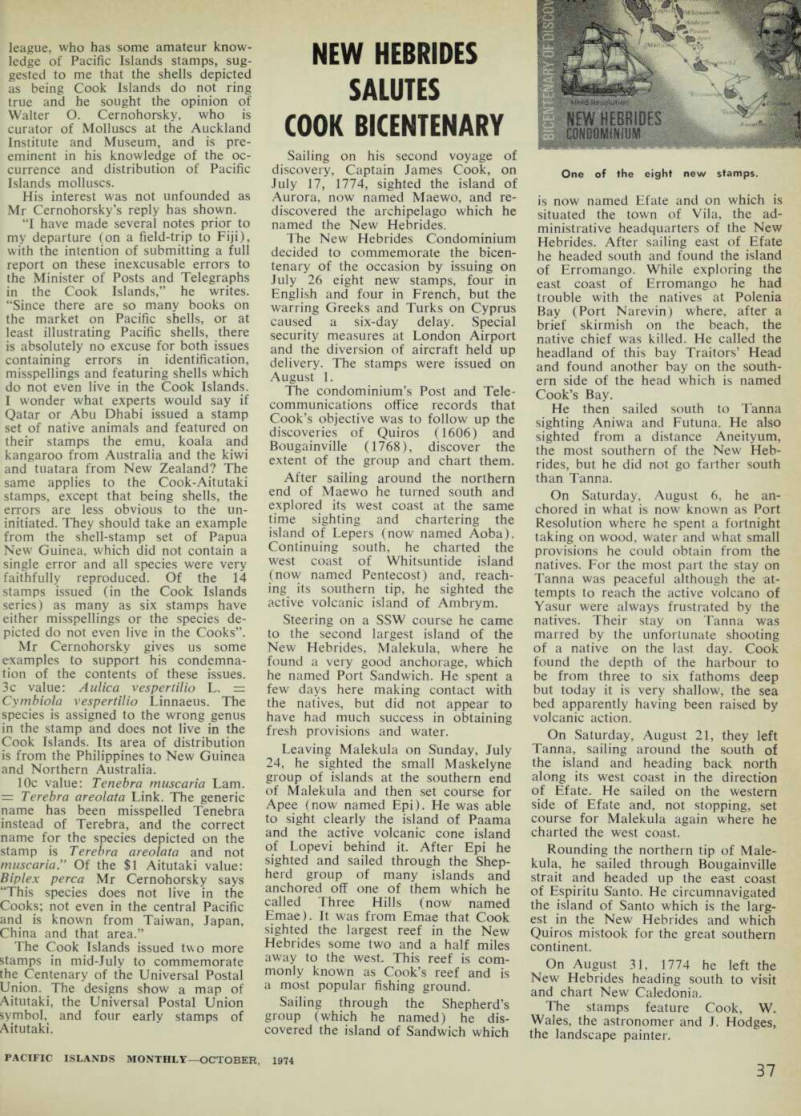
Islands' Stamp Nest
From a special correspondent
Stamp collecting is like many another hobby. The enthusiast is frequently committed to the acquisi tion and study of objects and trivia, which in themselves have little or no intrinsic value. This is particularly true of philately, where there is devotion to tiny scraps of coloured paper, which, but for the support of the hobbyist and the philatelic entre preneur, would normally be con signed to the scrapheap or the in cinerator.
Therefore, it seems to be a retreat from reality to suggest that it is improper for the nations of the world to profit, often very handsomely, from the idiosyncratic behaviour of the stamp collector, naive and gullible though it may be on many occasions.
There is nothing which is more im noral in financing government projects from the sale of stamps to philatelists than there is in conducting lotteries to pay for opera houses, or taxing ooker machines in order to provide for hospitals and homes for the aged.
Gone are the days when stamps, were mundane, monochromatic, and bore the likenesses of a dreary pro cession of heads of states. We are now in the era of the multivaried, multicoloured, multivalued and multi sized stamps and the issuing agencies are literally queueing up to make one issue after another which will titillate the fancies of the thematic collector, and good luck to them.
However, surely there should be some rules of fair play in these matters. Is it asking too much to suggest that when a thematic issue is made, which by import at least, would lead the collector to believe that natural objects, flowers, animals, sea shells and so on are, in fact, to be found in that country the information, stated and implied on the stamps, should have been thoroughly re searched and is accurate?
Thematic issues, like women’s dresses and men’s shirts follow fashions, and the successful sea-shell issue of Papua New Guinea seems to
have been a trend-setter in the Pacific Island countries as the Cook Islands has followed suit with two issues, one for the Cook Islands and one for Aitutaki.
The reasons for this double issue must be another story; here we are interested in the veracity of the information on the stamps. A col
The stamp pictured at the top is one of the cuckoos, Aulica vespertiiio, which has an area of distribution from the Philip pines to Papua New Guinea and Northern Australia, but not in the Cooks, says ex pert Mr Cernohorsky. The lower stamp is a Terebra areolata and not, as the stamp says, Tenebra muscaria.
league, who has some amateur know ledge of Pacific Islands stamps, sug gested to me that the shells depicted as being Cook Islands do not ring true and he sought the opinion of Walter O. Cernohorsky, who is curator of Molluscs at the Auckland Institute and Museum, and is pre eminent in his knowledge of the oc currence and distribution of Pacific Islands molluscs.
His interest was not unfounded as Mr Cernohorsky’s reply has shown.
“I have made several notes prior to my departure (on a field-trip to Fiji), with the intention of submitting a full report on these inexcusable errors to the Minister of Posts and Telegraphs in the Cook Islands,” he writes.
“Since there are so many books on the market on Pacific shells, or at least illustrating Pacific shells, there is absolutely no excuse for both issues containing errors in identification, misspellings and featuring shells which do not even live in the Cook Islands.
I wonder what experts would say if Qatar or Abu Dhabi issued a stamp set of native animals and featured on their stamps the emu, koala and kangaroo from Australia and the kiwi and tuatara from New Zealand? The same applies to the Cook-Aitutaki stamps, except that being shells, the errors are less obvious to the un initiated. They should take an example from the shell-stamp set of Papua New Guinea, which did not contain a single error and all species were very faithfully reproduced. Of the 14 stamps issued (in the Cook Islands series) as many as six stamps have either misspellings or the species de picted do not even live in the Cooks”.
Mr Cernohorsky gives us some examples to support his condemna tion of the contents of these issues. 3c value: Aulica vesper tilio L.
Cymbiola vespertilio Linnaeus, The species is assigned to the wrong genus in the stamp and does not live in the Cook Islands. Its area of distribution is from the Philippines to New Guinea and Northern Australia. 10c value: Tenebra muscaria Lam. = Terebra areolata Link. The generic name has been misspelled Tenebra instead of Terebra, and the correct name for the species depicted on the stamp is Terebra areolata and not muscaria Of the $1 Aitutaki value: Biplex perca Mr Cernohorsky says “This species does not live in the Cooks; not even in the central Pacific and is known from Taiwan, Japan, China and that area.”
The Cook Islands issued two more stamps in mid-July to commemorate the Centenary of the Universal Postal Union. The designs show a map of Aitutaki, the Universal Postal Union symbol, and four early stamps of Aitutaki.
Advertisements & other items, pp. 37-38 (2 items)
35
’ACIFIC ISLANDS MONTHLY—OCTOBER, 1974
"Therma-Panel
mm
I “CANBERRA”
Three bedroom elevated home, lots of living space, brick laundry under, and two carports.
George Hudson s new Therma-Panel modular units mean that you can build your own home in a fraction of the time required for traditional materials.
Write for detailed plans and prices from the sole Pacific Islands agent:
A. RIETTE (EXPORT) PTY. LTD.
300 GEORGE STREET, SYDNEY 2000.
Cables: Ramaritime, Sydney
WhaVs so
different about
"THERMA-PANEL
HOMES?
Just this:
• Only three basic components for walls, ceilings, doors and windows. • Makes building simple as A.B.C. • Specially designed for the owner-builder. • Fully insulated walls and ceilings. • Cuts on-site construction time. • Cuts on-site construction costs, • Pitched or flat roof with exposed beams for real beauty.
Bank of Hawaii is the bank of the Pacific.
Itbu can bank on it... in Guam 3&Tamuning t Koror Yap Jf Saipan Roi Namur JL Kwajalein JltPonape
MidwayTahiti*-3^-
3* American Samoa.
All in all, we have 70 branches throughout Hawaii and the Pacific offering full banking services. May we help you?
Bank of Hawaii the bank of the Pacific® V • affiliate of Banque de Tahiti
Salutes
New Hebrides
Cook Bicentenary
Sailing on his second voyage of discovery, Captain James Cook, on July 17, 1774, sighted the island of Aurora, now named Maewo, and re discovered the archipelago which he named the New Hebrides.
The New Hebrides Condominium decided to commemorate the bicen tenary of the occasion by issuing on July 26 eight new stamps, four in English and four in French, but the warring Greeks and Turks on Cyprus caused a six-day delay. Special security measures at London Airport and the diversion of aircraft held up delivery. The stamps were issued on August 1.
The condominium’s Post and Tele communications office records that Cook’s objective was to follow up the discoveries of Quiros (1606) and Bougainville (1768), discover the extent of the group and chart them.
After sailing around the northern end of Maewo he turned south and explored its west coast at the same time sighting and chartering the island of Lepers (now named Aoba).
Continuing south, he charted the west coast of Whitsuntide island (now named Pentecost) and, reach ing its southern tip, he sighted the active volcanic island of Ambrym.
Steering on a SSW course he came to the second largest island of the New Hebrides, Malekula, where he found a very good anchorage, which he named Port Sandwich. He spent a few days here making contact with the natives, but did not appear to have had much success in obtaining fresh provisions and water.
Leaving Malekula on Sunday, July 24, he sighted the small Maskelyne group of islands at the southern end of Malekula and then set course for Apee (now named Epi). He was able to sight clearly the island of Paama and the active volcanic cone island of Lopevi behind it. After Epi he sighted and sailed through the Shep herd group of many islands and anchored off one of them which he called Three Hills (now named Emae). It was from Emae that Cook sighted the largest reef in the New Hebrides some two and a half miles away to the west. This reef is com monly known as Cook’s reef and is a most popular fishing ground.
Sailing through the Shepherd’s group (which he named) he dis covered the island of Sandwich which
is now named Efate and on which is situated the town of Vila, the ad ministrative headquarters of the New Hebrides. After sailing east of Efate he headed south and found the island of Erromango. While exploring the east coast of Erromango he had trouble with the natives at Polenia Bay (Port Narevin) where, after a brief skirmish on the beach, the native chief was killed. He called the headland of this bay Traitors’ Head and found another bay on the south ern side of the head which is named Cook’s Bay.
He then sailed south to Tanna sighting Aniwa and Futuna. He also sighted from a distance Aneityum, the most southern of the New Heb rides, but he did not go farther south than Tanna.
On Saturday. August 6, he an chored in what is now known as Port Resolution where he spent a fortnight taking on wood, water and what small provisions he could obtain from the natives. For the most part the stay on Tanna was peaceful although the at tempts to reach the active volcano of Yasur were always frustrated by the natives. Their stay on Tanna was marred by the unfortunate shooting of a native on the last day. Cook found the depth of the harbour to be from three to six fathoms deep but today it is very shallow, the sea bed apparently having been raised by volcanic action.
On Saturday, August 21, they left Tanna, sailing around the south of the island and heading back north along its west coast in the direction of Efate. He sailed on the western side of Efate and, not stopping, set course for Malekula again where he charted the west coast.
Rounding the northern tip of Male kula, he sailed through Bougainville strait and headed up the east coast of Espiritu Santo. He circumnavigated the island of Santo which is the larg est in the New Hebrides and which Quiros mistook for the great southern continent.
On August 31, 1774 he left the New Hebrides heading south to visit and chart New Caledonia.
The stamps feature Cook, W.
Wales, the astronomer and J. Hodges, the landscape painter.
One of the eight new stamps.
News in a Nutshell
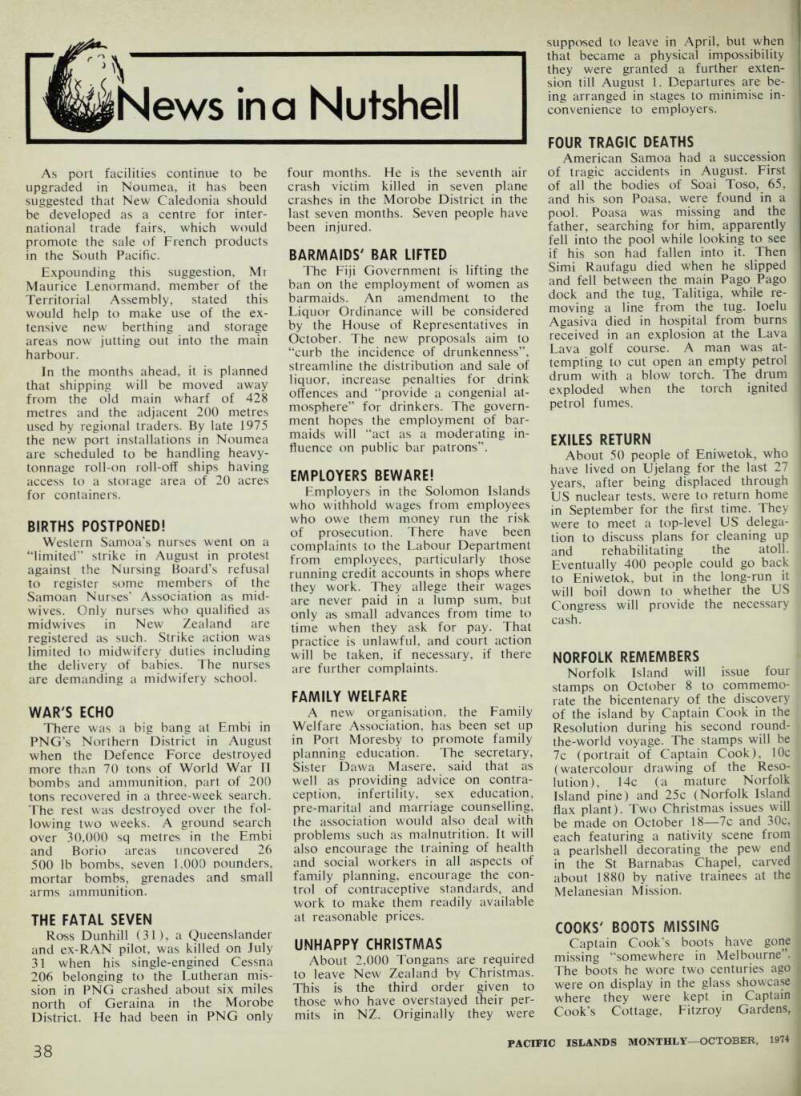
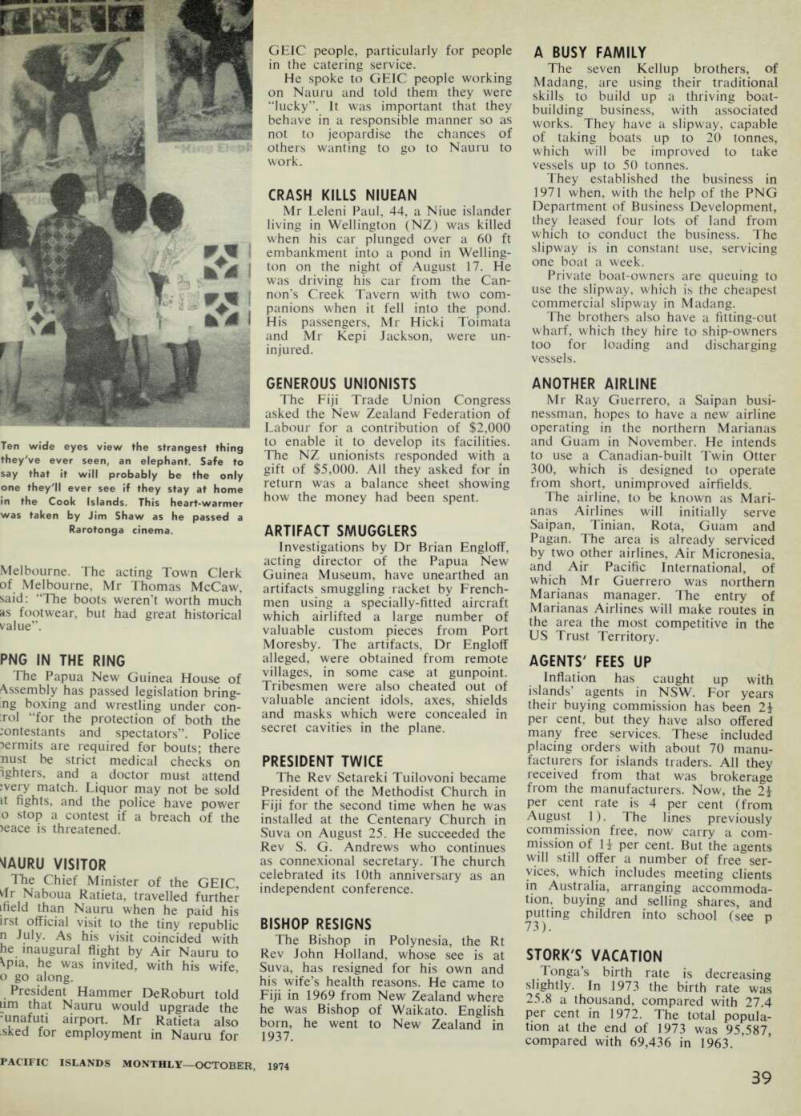
As port facilities continue to be upgraded in Noumea, it has been suggested that New Caledonia should be developed as a centre for inter national trade fairs, which would promote the sale of French products in the South Pacific.
Expounding this suggestion, Mi Maurice Lenormand, member of the Territorial Assembly, stated this would help to make use of the ex tensive new berthing and storage areas now jutting out into the main harbour.
In the months ahead, it is planned that shipping will be moved away from the old main wharf of 428 metres and the adjacent 200 metres used by regional traders. By late 1975 the new port installations in Noumea are scheduled to be handling heavy tonnage roll-on roll-off ships having access to a storage area of 20 acres for containers.
Births Postponed!
Western Samoa’s nurses went on a “limited” strike in August in protest against the Nursing Board’s refusal to register some members of the Samoan Nurses’ Association as mid wives. Only nurses who qualified as midwives in New Zealand are registered as such. Strike action was limited to midwifery duties including the delivery of babies. The nurses are demanding a midwifery school.
War's Echo
There was a big bang at Embi in PNG’s Northern District in August when the Defence Force destroyed more than 70 tons of World War II bombs and ammunition, part of 200 tons recovered in a three-week search.
The rest was destroyed over the fol lowing two weeks. A ground search over 30,000 sq metres in the Embi and Borio areas uncovered 26 500 lb bombs, seven 1,000 pounders, mortar bombs, grenades and small arms ammunition.
The Fatal Seven
Ross Dunhill (31), a Queenslander and ex-RAN pilot, was killed on July 31 when his single-engined Cessna 206 belonging to the Lutheran mis sion in PNG crashed about six miles north of Geraina in the Morobe District. He had been in PNG only
four months. He is the seventh air crash victim killed in seven plane crashes in the Morobe District in the last seven months. Seven people have been injured.
Barmaids 7 Bar Lifted
The Fiji Government is lifting the ban on the employment of women as barmaids. An amendment to the Liquor Ordinance will be considered by the House of Representatives in October. The new proposals aim to “curb the incidence of drunkenness”, streamline the distribution and sale of liquor, increase penalties for drink offences and “provide a congenial at mosphere” for drinkers. The govern ment hopes the employment of bar maids will “act as a moderating in fluence on public bar patrons”.
Employers Beware!
Employers in the Solomon Islands who withhold wages from employees who owe them money run the risk of prosecution. There have been complaints to the Labour Department
from employees, particularly those
running credit accounts in shops where they work. They allege their wages are never paid in a lump sum, but only as small advances from time to time when they ask for pay. That practice is unlawful, and court action will be taken, if necessary, if there are further complaints.
Family Welfare
A new organisation, the Family Welfare Association, has been set up in Port Moresby to promote family planning education. The secretary, Sister Dawa Masere, said that as well as providing advice on contra
ception, infertility, sex education,
pre-marital and marriage counselling, the association would also deal with problems such as malnutrition. It will also encourage the training of health and social workers in all aspects of family planning, encourage the con trol of contraceptive standards, and work to make them readily available at reasonable prices.
Unhappy Christmas
About 2,000 Tongans are required to leave New Zealand by Christmas.
This is the third order given to those who have overstayed their per mits in NZ. Originally they were
supposed to leave in April, but when that became a physical impossibility they were granted a further exten sion till August 1. Departures are be ing arranged in stages to minimise in convenience to employers.
Four Tragic Deaths
American Samoa had a succession of tragic accidents in August. First of all the bodies of Soai Toso, 65, and his son Poasa, were found in a pool. Poasa was missing and the father, searching for him, apparently fell into the pool while looking to see if his son had fallen into it. Then Simi Raufagu died when he slipped and fell between the main Pago Pago dock and the tug, Talitiga, while re moving a line from the tug. loelu Agasiva died in hospital from burns received in an explosion at the Lava Lava golf course. A man was at tempting to cut open an empty petrol drum with a blow torch. The drum exploded when the torch ignited petrol fumes.
Exiles Return
About 50 people of Eniwetok, who have lived on Ujelang for the last 27 years, after being displaced through US nuclear tests, were to return home in September for the first time. They were to meet a top-level US delega tion to discuss plans for cleaning up and rehabilitating the atoll.
Eventually 400 people could go back to Eniwetok, but in the long-run it will boil down to whether the US Congress will provide the necessary cash.
Norfolk Remembers
Norfolk Island will issue four stamps on October 8 to commemo rate the bicentenary of the discovery of the island by Captain Cook in the Resolution during his second round the-world voyage. The stamps will be 7c (portrait of Captain Cook), 10c (watercolour drawing of the Reso lution), 14c (a mature Norfolk Island pine) and 25c (Norfolk Island flax plant). Two Christmas issues will be made on October 18—7 c and 30c, each featuring a nativity scene from a pearlshell decorating the pew end in the St Barnabas Chapel, carved about 1880 by native trainees at the Melanesian Mission.
Cooks 7 Boots Missing
Captain Cook’s boots have gone missing “somewhere in Melbourne”.
The boots he wore two centuries ago were on display in the glass showcase where they were kept in Captain Cook’s Cottage, Fitzroy Gardens,
Melbourne. The acting Town Clerk of Melbourne, Mr Thomas McCaw, said: “The boots weren’t worth much as footwear, but had great historical value”.
Png In The Ring
The Papua New Guinea House of Assembly has passed legislation bring ing boxing and wrestling under con :rol “for the protection of both the :ontestants and spectators”. Police 3ermits are required for bouts; there nust be strict medical checks on ighters, and a doctor must attend ;very match. Liquor may not be sold it fights, and the police have power o stop a contest if a breach of the )eace is threatened.
Muru Visitor
The Chief Minister of the GEIC, tfr Naboua Ratieta, travelled further [field than Nauru when he paid his irst official visit to the tiny republic n July. As his visit coincided with he inaugural flight by Air Nauru to he was invited, with his wife, o go along.
President Hammer Deßoburt told um that Nauru would upgrade the Funafuti airport. Mr Ratieta also sked for employment in Nauru for
GEIC people, particularly for people in the catering service.
He spoke to GEIC people working on Nauru and told them they were “lucky”. It was important that they behave in a responsible manner so as not to jeopardise the chances of others wanting to go to Nauru to work.
Crash Kills Niuean
Mr Leleni Paul, 44, a Niue islander living in Wellington (NZ) was killed when his car plunged over a 60 ft embankment into a pond in Welling ton on the night of August 17. He was driving his car from the Can non’s Creek Tavern with two com panions when it fell into the pond.
His passengers, Mr Hicki Toimata and Mr Kepi Jackson, were un injured.
Generous Unionists
The Fiji Trade Union Congress asked the New Zealand Federation of Labour for a contribution of $2,000 to enable it to develop its facilities.
The NZ unionists responded with a gift of $5,000. All they asked for in return was a balance sheet showing how the money had been spent.
Artifact Smugglers
Investigations by Dr Brian Engloff, acting director of the Papua New Guinea Museum, have unearthed an artifacts smuggling racket by French men using a specially-fitted aircraft which airlifted a large number of valuable custom pieces from Port Moresby. The artifacts, Dr Engloff alleged, were obtained from remote villages, in some case at gunpoint.
Tribesmen were also cheated out of valuable ancient idols, axes, shields and masks which were concealed in secret cavities in the plane.
President Twice
The Rev Setareki Tuilovoni became President of the Methodist Church in Fiji for the second time when he was installed at the Centenary Church in Suva on August 25. He succeeded the Rev S. G. Andrews who continues as connexional secretary. The church celebrated its 10th anniversary as an independent conference.
Bishop Resigns
The Bishop in Polynesia, the Rt Rev John Holland, whose see is at Suva, has resigned for his own and his wife’s health reasons. He came to Fiji in 1969 from New Zealand where he was Bishop of Waikato. English born, he went to New Zealand in 1937.
A Busy Family
The seven Kellup brothers, of Madang, are using their traditional skills to build up a thriving boat building business, with associated works. They have a slipway, capable of taking boats up to 20 tonnes, which will be improved to take vessels up to 50 tonnes.
They established the business in 1971 when, with the help of the PNG Department of Business Development, they leased four lots of land from which to conduct the business. The slipway is in constant use, servicing one boat a week.
Private boat-owners are queuing to use the slipway, which is the cheapest commercial slipway in Madang.
The brothers also have a fitting-out wharf, which they hire to ship-owners too for loading and discharging vessels.
Another Airline
Mr Ray Guerrero, a Saipan busi nessman, hopes to have a new airline operating in the northern Marianas and Guam in November. He intends to use a Canadian-built Twin Otter 300, which is designed to operate from short, unimproved airfields.
The airline, to be known as Mari anas Airlines will initially serve Saipan, Tinian, Rota, Guam and Pagan. The area is already serviced by two other airlines, Air Micronesia, and Air Pacific International, of which Mr Guerrero was northern Marianas manager. The entry of Marianas Airlines will make routes in the area the most competitive in the US Trust Territory.
Agents 7 Fees Up
Inflation has caught up with islands’ agents in NSW. For years their buying commission has been 2i per cent, but they have also offered many free services. These included placing orders with about 70 manu facturers for islands traders. All they received from that was brokerage from the manufacturers. Now, the 2T per cent rate is 4 per cent (from August 1). The lines previously commission free, now carry a com mission of H per cent. But the agents will still offer a number of free ser vices, which includes meeting clients in Australia, arranging accommoda tion, buying and selling shares, and putting children into school (see p
Stork's Vacation
Tonga’s birth rate is decreasing slightly. In 1973 the birth rate was 25.8 a thousand, compared with 27 4 per cent in 1972. The total popula tion at the end of 1973 was 95,587, compared with 69,436 in 1963.
Ten wide eyes view the strangest thing they've ever seen, an elephant. Safe to say that it will probably be the only one they'll ever see if they stay at home in the Cook Islands. This heart-warmer was taken by Jim Shaw as he passed a Rarotonga cinema.
Advertisements & other items, p. 42 (1 item)
South Pacific
THE BIG FLAVOURS COME TO THE
ait**. n Hr
WARIAHm
The red hibiscus symbol proudly marks the introduction of some of New Zealand's most popular soft drinks by Island Bottlers of Fiji Ltd., from their new modern factory.
In Apia in Western Samoa the same flavourful range is produced by the Apia Bottling Company and people everywhere are asking for these famous names -
LEMON and PAEROA, TARTAN DRY GINGER
ALE and the colourful fruity range of JU'CY
SOFT DRINKS.
They're yours to enjoy . . . time after time.
Manufactured under franchise to Innes Tartan Ltd., Auckland, New Zealand by-
ES3 ISLAND BOTTLERS OF FIJI LTD.
W APIA BOTTLING COMPANY LTD.
YOU LI WELCOME OUR TROPICAL
MODULAR HOME UNITS...IN EVERYWAY!
• PRE-CONSTRUCTED IN N.Z. AND
PRE-TREATED FOR TROPIC CONDITIONS
• SHIPPED KNOCKED-DOWN TO YOUR
DESTINATION
• EASILY ERECTED ON SITE WITH MINIMUM
SKILLED LABOUR
• OFFER LUXURY AT A REASONABLE PRICE Perfect for holiday and permanent homes or commercial and industrial housing projects. 4 modelstochoosefrom: Leisuredeck’, (illustrated) ‘Sunseeker’, ‘Castaway’, ‘Sunlover in 1,2,3-bedroom units. . modular construction streamlines design, gives flexibility . . . pre-construction cuts costs and assembly- but not quality. . . maintenance-free pre-coated insulated Permalum metal weather-boarding . pre-piped plumbing unit. Plus many other quality features!
Already performance-proven in the New Hebrides, Pitcairn and Japan. m m
welcome! homes limited
Mail this coupon now!
Like to know more?
To: The Manager, Welcome Homes Ltd Box 12203, Penrose, Auckland, N.Z.
Please send me, without obligation, brochures on your Modular Home Units.
Name ..
Address X Property Located At 664^
Off Tonga's Beaten Track
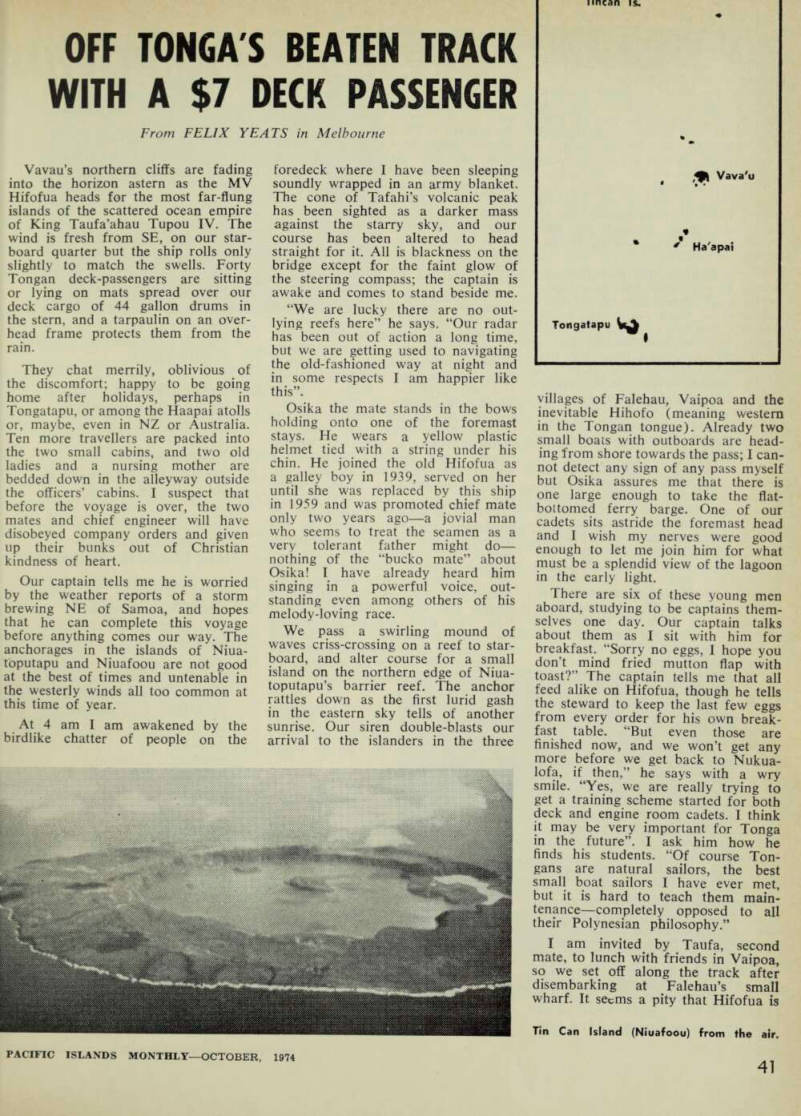

With A $7 Deck Passenger
From FELIX YEATS in Melbourne
Vavau’s northern cliffs are fading into the horizon astern as the MV Hifofua heads for the most far-flung islands of the scattered ocean empire of King Taufa’ahau Tupou IV. The wind is fresh from SE, on our star board quarter but the ship rolls only slightly to match the swells. Forty Tongan deck-passengers are sitting or lying on mats spread over our deck cargo of 44 gallon drums in the stern, and a tarpaulin on an over head frame protects them from the rain.
They chat merrily, oblivious of the discomfort; happy to be going home after holidays, perhaps in Tongatapu, or among the Haapai atolls or, maybe, even in NZ or Australia.
Ten more travellers are packed into the two small cabins, and two old ladies and a nursing mother are bedded down in the alleyway outside the officers’ cabins. I suspect that before the voyage is over, the two mates and chief engineer will have disobeyed company orders and given up their bunks out of Christian kindness of heart.
Our captain tells me he is worried by the weather reports of a storm brewing NE of Samoa, and hopes that he can complete this voyage before anything comes our way. The anchorages in the islands of Niua toputapu and Niuafoou are not good at the best of times and untenable in the westerly winds all too common at this time of year.
At 4 am I am awakened by the birdlike chatter of people on the
foredeck where I have been sleeping soundly wrapped in an army blanket.
The cone of Tafahi’s volcanic peak has been sighted as a darker mass against the starry sky, and our course has been altered to head straight for it. All is blackness on the bridge except for the faint glow of the steering compass; the captain is awake and comes to stand beside me.
“We are lucky there are no out lying reefs here” he says. “Our radar has been out of action a long time, but we are getting used to navigating the old-fashioned way at night and in some respects I am happier like this”.
Osika the mate stands in the bows holding onto one of the foremast stays. He wears a yellow plastic helmet tied with a string under his chin. He joined the old Hifofua as a galley boy in 1939, served on her until she was replaced by this ship in 1959 and was promoted chief mate only two years ago—a jovial man who seems to treat the seamen as a very tolerant father might do— nothing of the “bucko mate” about Osika! I have already heard him singing in a powerful voice, out standing even among others of his melody-loving race.
We pass a swirling mound of waves criss-crossing on a reef to star board, and alter course for a small island on the northern edge of Niua toputapu’s barrier reef. The anchor rattles down as the first lurid gash in the eastern sky tells of another sunrise. Our siren double-blasts our arrival to the islanders in the three
villages of Falehau, Vaipoa and the inevitable Hihofo (meaning western in the Tongan tongue). Already two small boats with outboards are head ing from shore towards the pass; I can not detect any sign of any pass myself but Osika assures me that there is one large enough to take the flat bottomed ferry barge. One of our cadets sits astride the foremast head and I wish my nerves were good enough to let me join him for what must be a splendid view of the lagoon in the early light.
There are six of these young men aboard, studying to be captains them selves one day. Our captain talks about them as I sit with him for breakfast. “Sorry no eggs, I hope you don’t mind fried mutton flap with toast?” The captain tells me that all feed alike on Hifofua, though he tells the steward to keep the last few eggs from every order for his own break fast table. “But even those are finished now, and we won’t get any more before we get back to Nukua lofa, if then,” he says with a wry smile. “Yes, we are really trying to get a training scheme started for both deck and engine room cadets. I think it may be very important for Tonga in the future”. I ask him how he finds his students. “Of course Ton gans are natural sailors, the best small boat sailors I have ever met, but it is hard to teach them main tenance —completely opposed to all their Polynesian philosophy.”
I am invited by Taufa, second mate, to lunch with friends in Vaipoa, so we set off along the track after disembarking at Falehau’s small wharf. It seems a pity that Hifofua is
Tin Can Island (Niuafoou) from the air.
too big to come through the pass, as all is calm in the lagoon and there is hardly a ripple at the wharf. Taufa tells me that the government had a scheme to blast a deeper channel through the pass but funds are lack ing. Surely, this is the sort of prac tical work which should be financed by one of the proliferation of organisations such as the South Pacific Forum. South Pacific Commission, SPEC etc. Though. I suppose that they have little money left over for actual work after paying all the air fares and other expenses of their members gallivanting around the con ference circuits.
Our lunch is all prepared and served in a coconut leaf pola basket on the fresh cement floor of our host’s new cement block house. He apolo gises for the lack of chairs and table, saying that he had actually had a local carpenter make these but that his aunt had fancied them so he had to surrender even such newly acquired treasures to comply with Tongan custom. Uncles count for little in Tonga, but aunts and their offspring have all your possessions at their command.
After lunch we walk to a neigh bour’s house where a demure Tongan maiden is already straining pounded kava root into a locally-carved wooden kumete bowl. We sit in a ring drinking and talking until 1 feel that I am unable to drink any more, and apologise to my hosts as I stagger to my feet and walk back to the wharf. The villages here abound in lime bushes loaded with juicy fruit, but I see no signs of bananas or oranges though I am told that these are also plentiful. The horse-drop pings along the way make me sigh for my garden in Melbourne, so many years bereft of this nourishment. But 1 don't think that Osika would wel come me back aboard laden with such a basket.
Next day is Sunday, and only by a special dispensation of the strict Sab batarian law are we allowed to sail for the sister island of Niuafoou, 100 miles westward. The captain has spent much time anxiously listening to reports of the gale now intensifying 300 miles to our NE and fears that its associated trough of low pressure may spawn a hurricane to head in our direction.
“We have had a lot of engine trouble lately, but my chief engineer was working overtime in Vavau and thinks he has fixed it. Don't fancy breaking down with a storm around, though Hifofua is a very tough ship.”
The recent loss of the MV Uluilakeba in a hurricane in the Lau group of Fiji is fresh in my mind. After tea we haul up the anchor and head NW,
at first to round the offlying reef in visible in the gloom. The main engine turns at reduced speed as we do not want to come up on the island before first light.
That night the weather changes and an increasing NW wind brings the captain to the bridge where I have already been driven to take refuge from the rain and spray. But the hourly weather forecast from Hawaii is encouraging, so he retires to his bunk after sending a cadet to bring me a mug of cocoa. Another pas senger is sleeping in his day-cabin, so he cannot offer me a place to sleep and in any case 1 am travelling very cheaply with a deck passenger ticket only $7 for the round trip.
The wind holds in the NW, making conditions impossible at Futu, the main anchorage. Our captain decides to circle the island to find shelter enough to get the passengers ashore, so we cruise along a few hundred yards off the black cliffy shore. Old and new volcano craters stick up above the coconut palms, which stretch back up the slope to the rim of the main crater, two miles in diameter. No houses are visible, though some laughing children run out at one point and are delighted when the ship’s siren blows a greet ing.
Finally, a place is chosen and the passengers are sent ashore in our rowing lifeboat, towed by the motor boat. The rowboat can keep its position better in the surf, but I am glad I decided to stay aboard as we watch the boat edging through a narrow gap in the unfriendly rocks.
Four such trips and all are ashore.
The captain decides to let the ship drift during the night to save fuel, regaining our sheltered position by starting up the engine briefly every few hours.
The third mate, Petesa, has gone ashore with the passengers to arrange for pork and vegetables for the crew’s rations, and next morning he swims off to tell us that all will be provided and that the islanders are afraid we may sail away without unloading their long-awaited stores. There has been no ship here for four months. All the luxury goods—flour, sugar, soap, kerosene, etc, were exhausted long ago. The only tractor and the truck have been immobilised for more than a month for lack of fuel.
All that day we lie off the eastern coast, but in the evening the wind whips round to SSE and we go round to drift on and off the western shore that night. At daybreak we approach Futu, but great waves from yester day’s wind are dashing up the beach and breaking high over the natural
Continued p 46
From p 42
jetty, an outcrop of black volcanic rock. In the centre of the bay, a green oasis of coconut palms, hibiscus and ironwood trees surrounds the post master’s house and the copra shed.
All the rest was blotted out by the last big eruption 30 years ago, and the oasis is flanked on either side by wastes of black cinder, the crust of the lava flow. The concrete tower and buttresses of a church stand out bleak and stripped— stark reminders that once there was a village here.
A crowd of people is silent and hopeful on the shore—wondering again, perhaps, if we are going to sail away. A man runs down the jetty and plunges into the surf. The motorboat is quickly lowered and he is brought aboard, clutching a small tin con taining a letter which our captain shows me. “Can’t go off and leave them; look at this.” The postmaster’s plea is certainly compelling, and even his urgent request for a bar of soap doesn’t make me smile as it might have done. “Anyhow, it would cost us $2OO in fuel to go back to Vavau, and we’d lose all the freight”. So we stay and hope for better weather.
Next day, the sea is calmer at first, deceptively so, as our motorboat finds as it tries to tow drums of kerosene ashore. But Sione, the bos’n, is a good seaman and saves the boat from being caught in the surf; swimmers leap off the jetty and manhandle the drums to the beach. These Tongans are certainly tough! Small children splash at the water’s edge, pursuing each great wave as it recedes in a creamy foam, and then rushing shrieking up the sand as its successor threatens to engulf them. No over cautious parents here to spoil their fun as in our more safety-conscious lands. Their fathers are the men who swam out fearlessly with the mail to passing steamers, through water from which Hifofua’s crew caught two 80 lb sharks last night. A third, larger, broke the trace.
All the drums ashore, I enjoy shark steaks with the captain as a change from the mutton flap which is now finished. We are now five days behind schedule and running short of many of our everyday needs including soap and toilet paper. A sack of sugar and another of flour have been com mandeered from the hold for the crew ration, with the ready agreement of the consignee, afraid no doubt of losing all his cargo. There was an argument earlier today with the underpaid stevedores who were reluctant to work at all in so rough a sea until the captain threatened to return to Vavau forthwith.
That night, Thursday, we stay at
Rich Vegetation
anchor off the jetty, and next day at last the sea is calm enough to un load our long-awaited cargo. Calm enough, though 1 wouldn’t feel too happy if the sacks of flour, being thrown ashore from the crest of each wave, were mine! All day the work continues, and it is dusk again before the hold is empty.
Once more a night at anchor, and then we begin to load the copra to take back to Vavau. Last year a sack was worth only $3.50; now each brings $2O and our full load of 800 will be worth $16,000 to someone.
In all the other islands of Tonga, the people have their own smallholdings and make their own copra, $2O going into their own pockets for every sack they make.
After making their own, they can if they wish make copra on land belonging to the nobles, the king or the government and they get roughly a half-share of the profit. Here in Niuafoou, all the smallholdings were taken over by the government when
the population was evacuated after the eruption 30 years ago.
Some years later, the people were allowed to return, but the land re mained in the hands of two nobles and the government so these people have no choice but to work for some one else, and feel keenly that they are less free than their fellow-Tongans on other islands. However, there are signs the government will re-establish private smallholdings and a survey for this purpose is being carried out.
Next day, Sunday, I pluck up courage at last to go ashore for a walk, and stride off in the cool of early morning across the lava flow covering the site of the village of Aleleuta. Soon I am walking up a narrow track amid the most luxuriant vegetation I have seen since Tahiti, with butterflies and birds of many sorts and colours all around me in the greenery. From the rim of the main crater I look down to the lake 500 ft below and across to a group of small islands. The water’s edge has the same rich vegetation as that surrounding me, but there is no life sign in the crater and no canoes
on its placid waters. Maybe it is brackish, and maybe there are no fish!
The heat reflected on all sides is sweltering, and I marvel at the tiny ferns and other plants which have established themselves in the un friendly lava. Perhaps in another century all will be green again— unless a new eruption sets back Mother Nature’s efforts to reclothe the island.
Back at the ship I find the crew very happy—Petesa has bought a large pig and everyone is assured of plenty of pork (if nothing else) until we get back to Tonga. The storms of the last few days seem far away as the anchor comes up from the calm water of the bay next morning and we set course for Vavau with our full cargo of the precious coconut meat.
I wonder about the company profit and loss account for the voyage, which seems to have been carried out more as a public service than a purely business affair. Perhaps we in richer countries can learn something from the operations of Tonga’s Pacific Navigation Company?
Advertisements & other items, pp. 44-51 (2 items)
anaa
YOUR NEW FIAT
IS HERE
American Samoa Silver Star Transport Inc.
P.O. Box CB-4, Pago Pago Fiji W. R. Carpenter (South Pacific) Ltd. trading as Millers Motors Private Bag, Suva Nauru Nauru Cooperative Society Nauru Island New Caledonia Agence Automobile S.A.
P.O. Box 842, Noumea New Hebrides Societe Bourgeois & Cie P.O. Box 28, Portvila New Zealand Torino Motors Ltd.
P.O. Box 6240, Auckland Norfolk Island Cascade Motors Ltd.
P.O. Box 34, Norfolk Island Solomon Islands Chan Wing Motors Ltd.
P.O. Box 4, Honiara Tahiti Societe Tahitienne d’Automobiles S.A.R.L.
P.O. Box 1723, Papeete Western Samoa E. A. Coxon & Co. Ltd.
P.O. Box 38, Apia
anaa
FIAT OF AUSTRALIA PTV. LTD.
HOWTO OWN A LUXURY SPORT COUPE
- V. To be perfectly honest there never was anything to stop a family man from driving the luxury sport coupe he always wanted. Provided, of course, that he was prepared to make certain sacrifices, like leaving his family behind.
Or that his family were prepared to make certain sacrifices, like being less comfortable and more cramped than they deserved to be.
This is where the Fiat 124 Sport Coupe is a little different. Not only is it a joy to drive, but it’s also a joy to be driven in.
Look inside and you’ll see abeautifully designed dashboard with a full complement of instruments, comfortable padded seats, thick carpets, and all the trimmings that the Italians are famous for. But look again, and you’ll see something else: nothing. And a lot of it.
In other words there’s enough room for four people. And by that we mean room to stretch, yawn and scratch for four six foot men.
Now try looking in the boot. There’s a lot more nothing there too. 9.6 cubic feet of it to be exact. So if your wife wants to take all those things you never use on holiday with you, let her. There’ll be more than enough room for them.
But let’s face it. When you buy a luxury sport coupe, you don’t just buy it for what you can get into it. You buy it for what you can get out of it. What you get out of the Fiat 124 Sport Coupe is 118 bhp and a smooth 0-60 in 10.4 seconds. After all, it’s not called a sport coupe for nothing.
The Fiat 124 Sport Coupe contains every feature you’ll find in any luxury sport coupe near its price. That is of course, if you can find a luxury sport coupe anywhere near its price.
But if you do, check to see if it’s got power-assisted disc brakes on all four wheels, a tachometer that never makes mistakes, a five speed gear box and a smooth-as-silk suspension.
Once you’ve done that you’ll probably decide that the Fiat 124 Sport Coupe is the car you’ve been waiting for. We’re pleased to be able to tell you that you won’t have to wait any longer.
Your local Fiat dealer will be able to arrange early delivery.
So why not go down for a test drive today. And don’t forget to take your family with you. We can assure you they’ll grow to love it. 8088
FIAT OF AUSTRALIA KTY LTD
Z 3
WITHOUT TRADING IN YOUR FAMILY.
' r ‘s ' V■ y ■ ... * - if I (/) o o & in
lUSIC AND UTTER COMFORT. DAILY AT 10.35.
Like any other modern airliner, the HS 748 is built for passenger comfort. And that means full, efficient air-conditioning, smooth and vibration-free flight, and low cabin noise levels.
Plus a whole new range of tasteful cabin seatings from economy class all the way up to luxury executive layouts.
But the difference is that the HS 748 can take all this spacious, sophisticated comfort into small, remote airfields where modern airliner luxury has never been seen before.
And the 748 can be a pampering 48-passenger airliner in the morning- but a rugged, almost 6-ton capacity freighter the very same afternoon.
You can do a lot with the versatile 54.86 cubic metres the HS 748 offers you.
To find out how much, for how little, contact Hawker Siddeley now. at
» HAWKER SIDDELEY AVIATION
Kingston upon Thames, England.
Hawker Siddeley Group supplies mechanical, electrical and aerospace equipment with world-wide sales and service.
Why did I ever
leave school so early?
Collier Macmillan Schools courses offer a second chance.
These days, it’s the man with education who gets ahead. If you’ve got the qualifications you’re well on the way to big money and a real career. Collier Macmillan Schools can show you 264 ways to do it. Our Home Study Programmes can help you achieve the specialised knowledge, the training you need to really go places in a career. We can give you the qualifications for success. While you’re still working you can prepare yourself for a better job, a successful career, with one of our Home Study Courses. Clip the coupon for more details on our huge selection of Collier Macmillan Schools Courses.
Now’s the time to think of your future.
LIST OF COURSES
EXAMINATION COURSES
ENGINEERING
Council Eng'g Institutions Part 1 Society ot Engineers Civil/Elect /Mechanical Institute of Eng’g Designers 2nd Class Marine Engineers' City & Guilds Institute Electrical Eng'g Practice Telecommunication Tech's
COMMERCIAL
Inst, of A fill. Accountants Comm Education Soc, Aust.
Diploma in Accountancy Diploma in Management Institute of Sales & Marketing Executives Aust Institute of Travel Aust. Chamber of Shipping Dip. Shipping Practice Uni. of London G.C.E.
CERTIFICATE COURSES
ENGINEERING
Aeronautical Courses Automobile Courses General Auto Engineering Mechanics' Mech./Elec.
Building Courses Architecture Surveying Arch. Draughtsmanship & Design Carpentry & Joinery Civil & Constructional Courses Geology Draughtsmanship Courses General Draughtsmanship Electrical & Electronics Courses Elec Installations & Wiring Electronics Eng'g Computer Programming Production Engineering Courses Management Courses Mechanical Eng'g Courses Diesel Engines Mice, Refrigeration Ser g & Mtce.
Maintenance Engineering General Mech. Engineering Radio & Telecommunication Courses Radio Servicing, Maintenance & Repairs Television Servicing
COMMERCIAL
Accountancy Courses Bookkeeping & Accountancy Practical Bookkeeping Business Studies Courses Sales & Marketing Courses Secretarial Courses Pitman Script Shorthand-Typing Writing Courses For Children Fiction Article, Photo-Journalism Courses (or Pleasure & Profit Art Water Colour Oils Music Piano, Guitar Photography General Education English & Foreign Language Sociology Rapid Reading Practical & Applied Psychology General Education
Many other
courses available.
Collier Macmillan Schools
Incorporating British Institute of Careers and British Institute of Engineering Technology m Australia - College House, 113 Pacific Highway, North Sydney, NSW 2060.
I
""" POST THIS COUPoTt^ """
POST THIS COUPON TODAY
Collier Macmillan Schools Dept. 82- 31-04
P O. Box 503, North Sydney, Australia 2060.
I I I I am interested in Please send me the appropriate Career-book without obligation.
Name (please print) I Address Postcode I j^^ccupation... A 9©
How to tell a perfect golf course in
two easy lessons
{1) It has a Harvin Electric Automatic (2) And, of course, Harvin golf course System, equipment.
That's why the Fijian Hotel has such a perfect golf course.
But don't take our promise.
Take our pictures.
The Harvin "Rain Bird" watering system can be Automatically operated. That means a sizeable saving in labour costs because the sprinkler system can be timed to operate only at night. The course is therefore available for maximum use.
Harvin also leave their mark on golf courses with their equipment. Such things as flag poles, cups, ballwasher units, tee markers and signs are all available.
Harvin "Rain Bird" Automatic Watering System and Harvin Course Equipment The Perfect partners for any golf course. >r V f u •' - > 5 * -* ■-
mmt-
***- .. 565 Wairakei Road, Phone 588-029 3 lines P.O. Box 20-030 Bishopdale Branches at Auckland & Palmerston North, New Zealand.
Harvin Limited Head Office
CHRISTCHURCH
are sole agents for usa Please write for consultation on your watering problem.
Wunderflex gives
good design at low cost
v h m
E324ED
You want modern design?
Then use modern material that won’t warp, shrink or rot.
You want least cost?
Then build with a board that can be worked with handyman’s tools.
Inside and out, your home will have the modern, simple lines of Wunderflex building board.
LViunderlich
Wunderflex
Available from: Papua New Guinea; Steamships Trading Co. Ltd.
Norfolk Island: Irvine’s Building Supply Centre Made in Australia and marketed by CSR Building Materials Export Sales: 4 O’Connell Street, Sydney, Australia 2000
From the
Islands Press
Item in the list of bills and resolutions to be introduced in the session of the 13th Legislature as reported in the American Samoa News Bulletin: House.Hß 274, Nofoa Alo Steffany, Maiava Oliva Hunkin, Ligoligo K. Eseroma, Tupua E. Le’iato and Seuffagafaga M. Langkilde sets up a new
obscenity statue.
From the New Hebrides Radio News: We have a report from Allan Vanu at Mbossung, SE Ambrym, of a man from Asse village walking along and kicking his gun as he went. He forgot it was loaded—until he heard the shot and saw the blood on his foot. The shot had gone right through his foot. Custom medicine later healed the wound.
He’s learnt the lesson, “Be careful with firearms”, the hard way.
Words of advice to Islanders (faced with over population problems) tendered by Dick Tullis in an article Peeking through the Palms in the News of Micronesia: . . . Despite what that weird collection of loudmouthed crooks in the Congress of Micronesia and in the Guam Legislature have to say about it, the day of the romantic, idle islander is forever 'sayonara'. The happy-go-lucky ukulele plucking coconut picker with the magnificent body of a bronze giant and the tiny brain of an undernourished maggot has gone the way of the Indian (North-American), the buffalo and the whooping crane. The world no longer needs islanders. They are a drug on the market. And the faster they snapwise to that, the faster they can realistically plan their survival. ... Dr Fleming discovered penicillin. And that did it. That blew the ball game! People quit dying. New births every day! . . . Right now there are more people on these islands than the resources will support. ... If Micronesians can't bring themselves to more realistic relationship with the Americans, and if other nations don't want them, then they are down to just one cold choice: They got to do less screwing and more dying!
The shortcomings of women as seen by N. T.
Teribata (Betio) in a letter in the GEIC's Atoll Pioneer: . . . May I begin with a saying which says “Satan finds idle hands for mischief”. As far back as in Adam’s time Eve his helper wandered away from him and on the spot was tempted and fallen in disobedience by the Devil. . . . This illustration will support the fact that nearly all women are forgetful of their own responsibilities at homes for their families doing what is beneficial for all. Instead they are spending 60 per cent of their time in Bingo Playing and Card Playing which are not commercially valuable for them. Also doesn’t help anyone in the Colony, does it? . . .
Body snatchers in the Solomons as reported in the BSI News Sheet: Grave robbers of Huni village, Wainoni District on Makira are exhibiting in the village’s custom house a man’s head they have dug up. The man, whose head has been dug up, was the oldest man at Huni before he died last year. The area’s Governing Council member, Benedict Kinika, said that six men who claimed they were relatives of the old man dug up the grave without asking the man’s close relatives. They are in the same custom line known in the area as the Pagewa line or Shark line. They claimed that they had to dig up the grave because the man was buried in disputed land. Mr Kinika said the men saw after they had dug up the grave that the body was still intact. They had to cut off the head . . .
From a letter by Edward Kingmele, of White River (BSD in the BSI News Sheet: . . Another of the introduced strings of evil on our island is the excessive use of readymade Whiteman's alcohol.
Like films it has considerable impact on our island society.
Unlike our Pacific alcohol such as kava, coconut toddy and betel nut, beer stripped our people of their identity as human and he became like Whiteman and brought much distress in his family. ... If you want to see the sight just stroll to the Honiara Hotel or call at either Social Welfare Office or at Police Department and see for yourself what effect Whiteman's brought with his alcohol. . . .
From the Arawa Civic Association Bulletin: So many of our theatre seats are b ... d up it can be embarrassing if you enter after “lights out” and attempt to sit down without being noticed— What a let-down! I do hope Maintenance have a night out to feel what the trouble is! Slashers have carved up the upholstery. Some picture goers have gone home and taken their seats with them, and blank spaces remain.
From the Tonga Chronicle: A fisherman's generosity put 40 people—almost a whole village—in hospital in Niuatoputapu. Fish poisoning hit almost everyone in the village of Falehau. Forty people were treated either at home or at the island's only hospital at Hihifo which was packed to capacity for the first time. The incident occurred after a Falehau fisherman landed a big shark near the village, cut it up and presented portions to every home. It proved to be poisonous.
From a letter by Hemant Kumar in The Fiji Times: Nausori is not a big town, but is quite a busy place, especially at the bus stand. I have noticed that only a few drivers care to show the right destination boards. The most common is either Suva or Nausori, even if the bus is going to Suva, Bau, Raralevu or Wainibokasi. On many occasions I have seen tourists get on to buses showing a Suva destination. But when it begins going to a strange place they become puzzled and angry.
From the New Hebrides radio Group News: Last week a large turtle was caught by the people of Uri village at Port Stanley on Malekula and was reported to have travelled about 3,000 miles.
A spokesman from Lakatoro reported that the turtle had a ring tied up on its shell with the writing “Tahiti” on it. Though it hasn’t got anybody’s name on the ring they are going to send it to Tahiti.
Yesterday
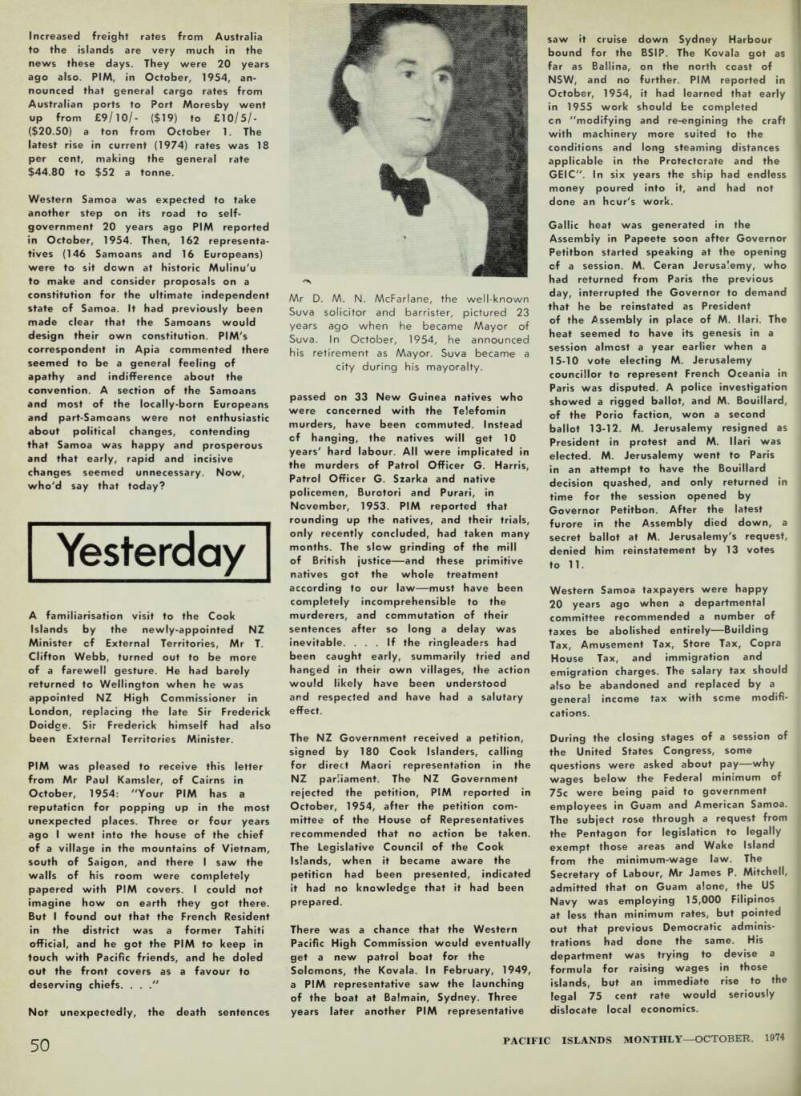
Increased freight rates from Australia to the islands are very much in the news these days. They were 20 years ago also. PIM, in October, 1954, an nounced that general cargo rates from Australian ports to Port Moresby went up from £9/10/- ($l9) to £lO/5/- ($20.50) a ton from October 1. The latest rise in current (1974) rates was 18 per cent, making the general rate $44.80 to $52 a tonne.
Western Samoa was expected to take another step on its road to self government 20 years ago PIM reported in October, 1954. Then, 162 representa tives (146 Samoans and 16 Europeans) were to sit down at historic Mulinu'u to make and consider proposals on a constitution for the ultimate independent state of Samoa. It had previously been made clear that the Samoans would design their own constitution. PlM's correspondent in Apia commented there seemed to be a general feeling of apathy and indifference about the convention. A section of the Samoans and most of the locally-born Europeans and part-Samoans were not enthusiastic about political changes, contending that Samoa was happy and prosperous and that early, rapid and incisive changes seemed unnecessary. Now, who'd say that today?
A familiarisation visit to the Cook Islands by the newly-appointed NZ Minister of External Territories, Mr T.
Clifton Webb, turned out to be more of a farewell gesture. He had barely returned to Wellington when he was appointed NZ High Commissioner in London, replacing the late Sir Frederick Doidce. Sir Frederick himself had also been External Territories Minister.
PIM was pleased to receive this letter from Mr Paul Kamsler, of Cairns in October, 1954: "Your PIM has a reputation for popping up in the most unexpected places. Three or four years ago I went into the house of the chief of a village in the mountains of Vietnam, south of Saigon, and there I saw the walls of his room were completely papered with PIM covers. I could not imagine how on earth they got there.
But I found out that the French Resident in the district was a former Tahiti official, and he got the PIM to keep in touch with Pacific friends, and he doled out the front covers as a favour to deserving chiefs. . . ."
Not unexpectedly, the death sentences
passed on 33 New Guinea natives who were concerned with the Telefomin murders, have been commuted. Instead of hanging, the natives will get 10 years' hard labour. All were implicated in the murders of Patrol Officer G. Harris, Patrol Officer G. Szarka and native policemen, Burotori and Purari, in November, 1953. PIM reported that rounding up the natives, and their trials, only recently concluded, had taken many months. The slow grinding of the mill of British justice—and these primitive natives got the whole treatment according to our law—must have been completely incomprehensible to the murderers, and commutation of their sentences after so long a delay was inevitable. ... If the ringleaders had been caught early, summarily tried and hanged in their own villages, the action would likely have been understood and respected and have had a salutary effect.
The NZ Government received a petition, signed by 180 Cook Islanders, calling for direct Maori representation in the NZ parliament. The NZ Government rejected the petition, PIM reported in October, 1954, after the petition com mittee of the House of Representatives recommended that no action be taken.
The Legislative Council of the Cook Islands, when it became aware the petition had been presented, indicated it had no knowledge that it had been
prepared.
There was a chance that the Western Pacific High Commission would eventually get a new patrol boat for the Solomons, the Kovala. In February, 1949, a PIM representative saw the launching of the boat at Balmain, Sydney. Three years later another PIM representative
saw it cruise down Sydney Harbour bound for the BSIP. The Kovala got as far as Ballina, on the north coast of NSW, and no further. PIM reported in October, 1954, it had learned that early in 1955 work should be completed cn "modifying and re-engining the craft with machinery more suited to the conditions and long steaming distances applicable in the Protectorate and the GEIC". In six years the ship had endless money poured into it, and had not done an hour's work.
Gallic heat was generated in the Assembly in Papeete soon after Governor Petitbon started speaking at the opening of a session. M. Ceran Jerusalemy, who had returned from Paris the previous day, interrupted the Governor to demand that he be reinstated as President of the Assembly in place of M. Mari. The heat seemed to have its genesis in a session almost a year earlier when a 15-10 vote electing M. Jerusalemy councillor to represent French Oceania in Paris was disputed. A police investigation showed a rigged ballot, and M. Bouillard, of the Porio faction, won a second ballot 13-12. M. Jerusalemy resigned as President in protest and M. Mari was elected. M. Jerusalemy went to Paris in an attempt to have the Bouillard decision quashed, and only returned in time for the session opened by Governor Petitbon. After the latest furore in the Assembly died down, a secret ballot at M. Jerusalemy's request, denied him reinstatement by 13 votes to 11.
Western Samoa taxpayers were happy 20 years ago when a departmental committee recommended a number of taxes be abolished entirely—Building Tax, Amusement Tax, Store Tax, Copra House Tax, and immigration and emigration charges. The salary tax should also be abandoned and replaced by a general income tax with some modifi cations.
During the closing stages of a session of the United States Congress, some questions were asked about pay —why wages below the Federal minimum of 75c were being paid to government employees in Guam and American Samoa.
The subject rose through a request from the Pentagon for legislation to legally exempt those areas and Wake Island from the minimum-wage law. The Secretary of Labour, Mr James P. Mitchell, admitted that on Guam alone, the US Navy was employing 15,000 Filipinos at less than minimum rates, but pointed out that previous Democratic adminis trations had done the same. His department was trying to devise a formula for raising wages in those islands, but an immediate rise to the legal 75 cent rate would seriously dislocate local economics.
Mr D. M. N. McFarlane, the well-known Suva solicitor and barrister, pictured 23 years ago when he became Mayor of Suva. In October, 1954, he announced his retirement as Mayor. Suva became a city during his mayoralty.
Advertisements & other items, pp. 53-60 (1 item)
little things
We’re big on
at Toyota.
There are a lot of things that make a Toyota a great automobile. Big things like computerized quality control. And little things like eye tests.
For the last five years we've been running tests to determine the limits of visibility under various conditions. We test with men and with women. On country roads and city streets. Then we use the results to design our cars from the shape of the windscreen, to the size of the mirrors, to the position and brightness of the headlamps.
Compared to our more sophisticated testing and research, or compared to our performance and styli Because we've been doing them for 36 years. And we'll keep on doing them. Because they go a long way toward making you satisfied. tests may seem insignificant.
But the little things we do add up
TOYOTA
It took time to perfect the
NEW Hyster electrics.
Time to make the best.
mi \4 i ■:
■ fll
HYSTER
m ■ u We could have added new Hyster electric trucks to our extensive lift truck range some time ago. After all, we knew what people wanted, and we had the dealer and service network to back our sales Australia-wide.
But long after electric lift trucks first hit the market, we were busy perfecting a better hydraulic system to overcome the oil leaks and minimise the battery drain other manufacturers weren't so concerned about.
We wanted to make ours the top performance electric. An easy-handling truck with a short turning radius. Longer life between charges. Smoother deceleration. And single pedal control to keep the drivers^happy.
Now we’ve built these advantages into a range of Hyster electric trucks with load capacities of up to 10,000 lbs (5,000 kgs). We believe they're the world's finest, and they’re available from your Hyster dealer. Ask to see them in action. Or contact Hyster Australia Pty. Ltd., Ashford Avenue, Miiperra, N.S.W. 2214. Telephone Sydney 77 0511.
HYSTER AUSTRALIA PTY. LTD.
HR39.84
■A a o aa yv-. ft : m • ■'= (C ■> ■ ft % M# f m
J^neynsm
Of AUSTHALI
25 KG HIT
aft IS N- I A J* **< % r -. 1 -wR" wR" ft
the most important ingredient
BREAD FLOURS:
CAKE FLOURS:
BISCUIT FLOURS:
SPECIALITY FLOURS:
• MAINTOP—high protein bread flour • ANCHOR—bakers flour • 50/50 MEAL—brown bread • MEDlUM—cake and pastry • SPONGE —sponge cakes • SPECIAL CAKE —tnadeira and cup cakes • STRONG—cracker biscuits • MEDIUM —Shortbreads • SOFT —sweet biscuits • RYE flour • RYE meal * KIBBLED RYE • SHARPS—roti and chapati flour • 100% STONE GROUND
WHOLEMEAL
52
GILLESPIE BROS. PTY. LTD.
HEAD OFFICE:
UNION ST., PYRMONT, SYDNEY, N.S.W. CABLE ADDRESS:
(G.P.O. BOX 2518, SYDNEY, 2001.) "GILLESPIE",
PHONE: 6604933, SYDNEY AND BRISBANE.
BRISBANE OFFICE:
ALBION, BRISBANE, QUEENSLAND.
(P.O. BOX 8, ALBION, BRISBANE, 4010.)
PHONE: 6-1121.
- : ■ CO n ■ ME RA*>
SOUTH
[lll
Sffl
2p:hS
■Mill •« <1 ■■
hhiiM!S
ft* e=a I S 3
n □
■ mi mi
‘C «■' i T.
A □ With a little friendly help from Burns Philp!
While more and more tourists are discovering the Islands, more and more islanders are discovering the welcome flow of tourist dollars. This is business as business should be, both buyer and seller happy with the arrangement and the rest of the community profiting as well.
Throughout the Islands, Burns Philp are on the scene helping the good business to happen. Local people with local knowledge aid the tourists through a score and more of Burns Philp agencies—shipping agents, airline agents, travel agents and many others.
Over hundreds of thousands of square miles of the Pacific, the familiar Burns Philp name helps people to feel at home in these wonderful far away places.
Bums
Philp
GROUP OF COMPANIES M
PRINCIPAL OFFICE-7 BRIDGE STREET SYDNEY NSW 2000 AUSTRALIA
BEST VALUE
Tasty Corned Beef The Argentines’ finest
CORNED BEEF
CORNED BEEF
SOLE EXPORTERS TO THE PACIFIC ISLANDS
HAGEMEYER (AUSTRALASIA) B.V
P O. Box 49 Kensington N.S.W. 2033 Australia Telephone 662 1222 Telex AA22214 Cables Hagemeyer Sydney Lae P.O, Box 90 Telephone 2718 Rabaul P.O. Box 63 Telephone 2633 Boroko/Port Moresby P.O, Box 1428 Telephone 56144 Madang P.O. Box 673 Telephone 2445
The Mazda 81600 pickup.
A truck-load of fun and economy.
is# " f "
iplpk
■ *&b ■ ,' ■ * >-..,■* • v
OTRf*
'mlWi
v.* • w ; ' |W"r *• ; ‘ ; :'■ ■ M^fcP Sii Whatever you want in a pickup, the 81600 delivers it.
With performance. With economy. With style.
Consider the things we build into it so you can get more out of it.
The 1600 cc overhead cam engine, for instance, is a lot like the one you find in some sports cars. Yet ours just sips gas. And the important things like the heavy duty suspension system and the safe, sure braking system make operating the 81600 a joy.
Want a sporty pickup for the fun of it?
Or just for its carry-all capabilities?
Test drive the Mazda 81600 pickup.
The truck-load of fun and economy. ®1974 Toyo Kogyo Co.. Ltd
UMAZOA
■m V •ii '-'i, b 6-00 6; :-s ; NEW p7IZ nt G Bo° Eo°;. 4 p “• ?el T 5 E 5788 2 NEW 27 ' B “' WESTERN SAMOA H& J Retzlaff P 0 Box 195 Apia TEL 237 NEW LbrSL ,T Motors of New Zealand Ltd. Auckland P.O. Box 22 472 TEL: 69 099 , r u. box 19b. Apia TEL. 237 NEW HEBRIDES Societe Bourgeois et C.e, P 0. Box 28, Port Vila PORTUGUES TIMOR Sang Tai Hoo Di The trademark MAZDA in this advertisement stands for AUTOMOBILES MAZDA as far as France and her territories are concerned.
• Ft k'
what else?
... nothing else if you feel so inclined, for there’s no real problem where and how and what you drink Bacardi rum with.
Because Bacardi rum is so light, dry, highly refined and pure it complements every mixer, yet remains distinctively itself. Bacardi and Coke and ice ... Bacardi and ginger... Bacardi and tonic with a zest of lemon or lime ... Bacardi
Anything
goes with
Bacardi rum
and fruit juice ... Mix up D your own Bacardi party.
Because... I rum-themixableone. - - ■ » Hi * m 9 m I mi * ... r-N . mori/c nf Bacardi and Company Limitad
BAC/2382/72
Magazine Section
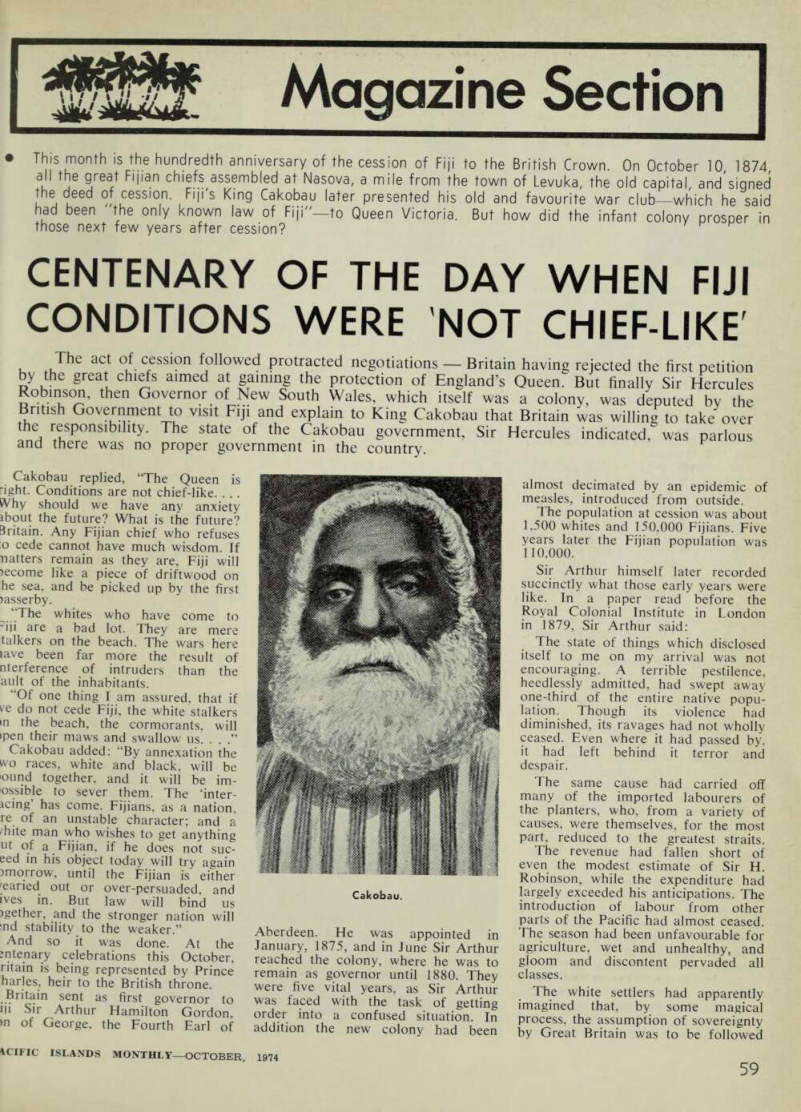
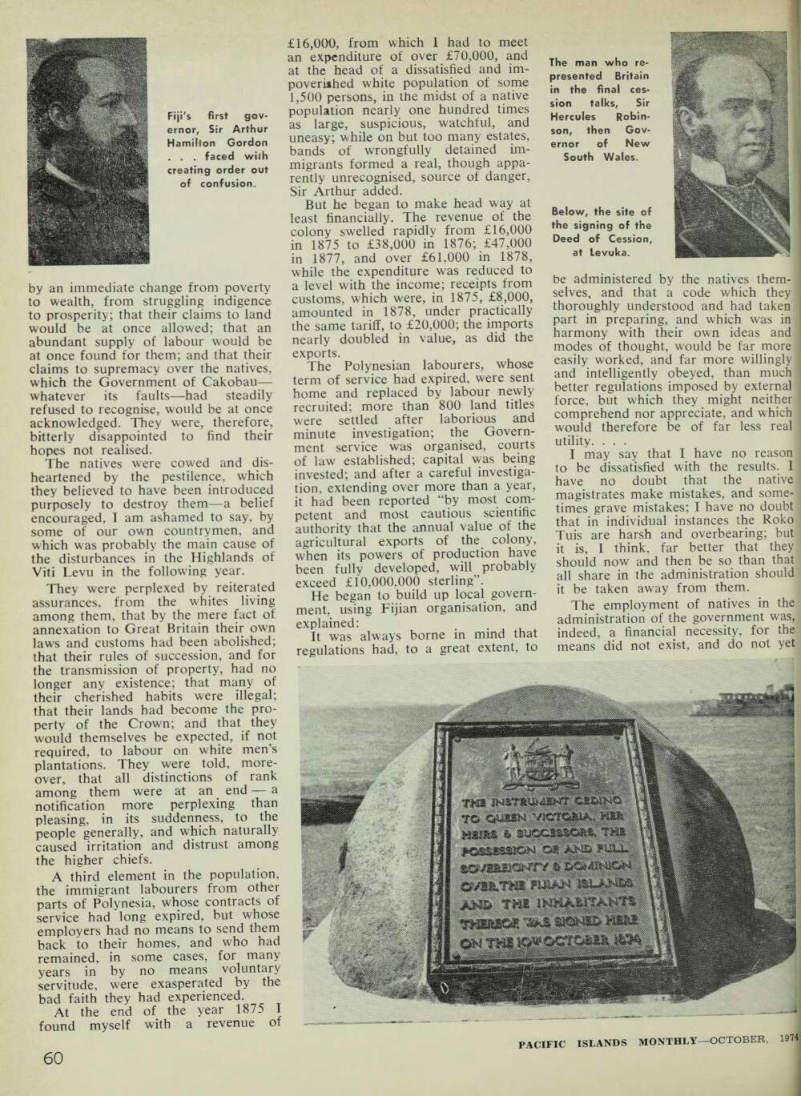

Centenary Of The Day When Fiji
Conditions Were 'Not Chief-Like'
• This month is the hundredth anniversary of the cession of Fiji to the British Crown. On October 10, 1874, all the great Fijian chiefs assembled at Nasova, a mile from the town of Levuka, the old capital, and siqned the deed of cession. Fiji's King Cakobau later presented his old and favourite war dub—which he said had been the only known law of Fiji"—to Queen Victoria. But how did the infant colony prosper in those next few years after cession? K H
The act of cession followed protracted negotiations Britain having rejected the first petition by the great chiefs aimed at gaining the protection of England’s Queen. But finally Sir Hercules Robinson, then Governor of New South Wales, which itself was a colony, was deputed by the British Government to visit Fiji and explain to King Cakobau that Britain was willing to take over the responsibility. The state of the Cakobau government, Sir Hercules indicated, was parlous and there was no proper government in the country.
Cakobau replied, “The Queen is right. Conditions are not chief-like. . ..
Why should we have any anxiety ibout the future? What is the future?
Britain. Any Fijian chief who refuses o cede cannot have much wisdom. If natters remain as they are, Fiji will jecome like a piece of driftwood on he sea, and be picked up by the first jasserby.
“The whites who have come to 7 i\i are a bad lot. They are mere talkers on the beach. The wars here lave been far more the result of nterference of intruders than the ault of the inhabitants.
“Of one thing I am assured, that if ye do not cede Fiji, the white stalkers m the beach, the cormorants, will ipen their maws and swallow us. . . .”
Cakobau added: “By annexation the wo races, white and black, will be ound together, and it will be im ossible to sever them. The ‘inter ring’ has come. Fijians, as a nation, re of an unstable character; and a diite man who wishes to get anything ut of a Fijian, if he does not suc eed in his object today will try again amorrow, until the Fijian is either [earied out or over-persuaded, and ives in. But law will bind us jgether, and the stronger nation will :nd stability to the weaker.”
And so it was done. At the intenary celebrations this October, ritain is being represented by Prince harles, heir to the British throne.
Britain sent as first governor to ip Sir Arthur Hamilton Gordon, m of George, the Fourth Earl of
almost decimated by an epidemic of measles, introduced from outside.
The population at cession was about 1,500 whites and 150,000 Fijians. Five years later the Fijian population was 110,000.
Sir Arthur himself later recorded succinctly what those early years were like. In a paper read before the Royal Colonial Institute in London in 1879, Sir Arthur said: The state of things which disclosed itself to me on my arrival was not encouraging. A terrible pestilence, heedlessly admitted, had swept away one-third of the entire native popu lation. Though its violence had diminished, its ravages had not wholly ceased. Even where it had passed by, it had left behind it terror and despair.
The same cause had carried off many of the imported labourers of the planters, who, from a variety of causes, were themselves, for the most part, reduced to the greatest straits.
The revenue had fallen short of even the modest estimate of Sir H.
Robinson, while the expenditure had largely exceeded his anticipations. The introduction of labour from other parts of the Pacific had almost ceased.
The season had been unfavourable for agriculture, wet and unhealthy, and gloom and discontent pervaded all classes.
The white settlers had apparently imagined that, by some magical process, the assumption of sovereignty by Great Britain was to be followed
Aberdeen. He was appointed in January, 1875, and in June Sir Arthur reached the colony, where he was to remain as governor until 1880. They were five vital years, as Sir Arthur was faced with the task of getting order into a confused situation. In addition the new colony had been
Cakobau.
£16,000, from which I had to meet an expenditure of over £70,000, and at the head of a dissatisfied and im poverished white population of some 1,500 persons, in the midst of a native population nearly one hundred times as large, suspicious, watchful, and uneasy; while on but too many estates, bands of wrongfully detained im migrants formed a real, though appa rently unrecognised, source of danger, Sir Arthur added.
But he began to make head way at least financially. The revenue of the colony swelled rapidly from £16,000 in 1875 to £38,000 in 1876; £47,000 in 1877, and over £61,000 in 1878, while the expenditure was reduced to a level with the income; receipts from customs, which were, in 1875, £B,OOO, amounted in 1878, under practically the same tariff, to £20,000; the imports nearly doubled in value, as did the exports.
The Polynesian labourers, whose term of service had expired, were sent home and replaced by labour newly recruited; more than 800 land titles were settled after laborious and minute investigation; the Govern ment service was organised, courts of law established; capital was being invested; and after a careful investiga tion, extending over more than a year, it had been reported “by most com petent and most cautious scientific authority that the annual value of the agricultural exports of the colony, when its powers of production have been fully developed, will probably exceed £10,000,000 sterling”.
He began to build up local govern ment, using Fijian organisation, and explained: It was always borne in mind that regulations had, to a great extent, to
by an immediate change from poverty to wealth, from struggling indigence to prosperity; that their claims to land would be at once allowed; that an abundant supply of labour would be at once found for them; and that their claims to supremacy over the natives, which the Government of Cakobau — whatever its faults—had steadily refused to recognise, would be at once acknowledged. They were, therefore, bitterly disappointed to find their hopes not realised.
The natives were cowed and dis heartened by the pestilence, which they believed to have been introduced purposely to destroy them —a belief encouraged, I am ashamed to say, by some of our own countrymen, and which was probably the main cause of the disturbances in the Highlands of Viti Levu in the following year.
They were perplexed by reiterated assurances, from the whites living among them, that by the mere fact of annexation to Great Britain their own laws and customs had been abolished; that their rules of succession, and for the transmission of property, had no longer any existence; that many of their cherished habits were illegal; that their lands had become the pro perty of the Crown; and that they would themselves be expected, if not required, to labour on white men’s plantations. They were told, more over, that all distinctions of rank among them were at an end a notification more perplexing than pleasing, in its suddenness, to the people generally, and which naturally caused irritation and distrust among the higher chiefs.
A third element in the population, the immigrant labourers from other parts of Polynesia, whose contracts of service had long expired, but whose employers had no means to send them back to their homes, and who had remained, in some cases, for many years in by no means voluntary servitude, were exasperated by the bad faith they had experienced.
At the end of the year 1875 I found myself with a revenue of
be administered by the natives them selves, and that a code which they j thoroughly understood and had taken part in preparing, and which was in ! harmony with their own ideas and j modes of thought, would be far more j easily worked, and far more willingly and intelligently obeyed, than much better regulations imposed by external force, but which they might neither j comprehend nor appreciate, and which would therefore be of far less real utility. . . .
I may say that I have no reason to be dissatisfied with the results. I have no doubt that the native magistrates make mistakes, and some-, times grave mistakes; I have no doubt that in individual instances the Roko Tuis are harsh and overbearing; but it is, I think, far better that they should now and then be so than that all share in the administration should it be taken away from them.
The employment of natives in the administration of the government was, indeed, a financial necessity, for the means did not exist, and do not yet
Fiji's first gov ernor, Sir Arthur Hamilton Gordon . . . faced with creating order out of confusion.
Below, the site of the signing of the Deed of Cession, at Levuka.
The man who re presented Britain in the final ces sion talks, Sir Hercules Robin son, then Gov ernor of New South Wales.
exist, for the payment of such a staff of white officials as would have been required had the services of natives been dispensed with. But had no such imperative cause existed to render their employment inevitable, I should squally have deemed it to be required ay considerations of policy.
Unless removed from their habitual alaces of residence, and treated with i harshness wholly incompatible with he understanding on which the islands lad been ceded to England, chiefs of ntelligence, high rank, and great ocial influence, would have become, f stripped of all authority, and leprived of all employment except hat of brooding over their own hanged condition, very dangerous lements in the colony.
For, be it remembered, the legal ion-recognition of their position /ould not have in any way deprived hem of the power they possessed over bose who yielded to them an in tinctive and unquestioning obedience, ts it is, they are cheerful and willing ssistants to the Government in the erformance of its duties.
The results of the system actually dopted were apparent when the lountaineers of Viti Levu attacked le Christian villages of the Singa )ka. I apnealed to the Rokos for sip, and named thirty men as the antingent each was to send. Had the ime state of mind existed that I >und on my arrival, sullen and :luctant submission would at best ave been given to the order, and ore probably excuses would have jen made for the non-appearance of e force; the mischief would have •read, and a long and costly war ould have resulted. What was in ct the answer to the appeal? From most every province came double e number of men asked for—picked en out of a host of volunteers—and e troubles were suppressed by native rces alone, without delay and at a ifling cost. . . .
I will only say one word on the ture prospects of the colony imely, that I believe Fiji to be an Imirable field for the investment of rge capital, whether in sugar or ffee estates. Sugar grows spon neously, is of the first quality, and is a practically boundless market in ustralia.
As regards coffee culture, Fiji is >w in much the same position as jylon thirty or forty years ago, and have no doubt that those who now und estates there will find them in 1 long time amply remunerative. I ve never seen finer tobacco than at raised in Fiji, and the cotton oduced there is admitted to be of ; best description.
Fiji was set on its long road to lependence.
Advertisements & other items, p. 61 (1 item)
59
ISLANDS MONTHLY—OCTOBER, 1974
Modern Science can do
Wonders for Your Skin
The beauty of your skin really begins down under the surface, where the tiny oil and moisture glands main tain a fine balance by releasing just the right amounts of natural fluids to nurture the complexion and keep it soft, supple and always with a youth ful, radiant glow.
Early in life, nature supplies these vital secretions in abundance. But with the passing years they slow down, and the complexion thirsts for oil and moisture to supplement the dwindling natural supplies. Without them the skin will soon lose its plumpness and resilience as tiny lines and other tell tale signs of age make a premature appearance.
Beauty secrets revealed Cosmetic chemists formulated a tropically moist oil blend with the remarkable ability to assist nature, by supplying never failing quantities of vital oil and moisture to the skin.
This important scientific break through is helping women all over the world achieve and maintain a youthfully smooth and radiant com plexion. The unique beautifying fluid is available from pharmacies here as Oil of Ulan. It quickly penetrates into the surface layer of the skin and merges readily with the natural fluids, achieving the level necessary to main tain a soft, naturally beautiful com plexion.
To keep your complexion smooth and radiant, generously apply a film of Oil of Ulan over your face and neck every day. It is helpful to every type of complexion because as well as maintaining a balanced level of vital oils and moisture it also sets up an invisible film on the skin sur face to protect against harsh weather elements and the dehydrating effects of artificial air-conditioning. Used as you would a make-up base, Oil of Ulan moist oil blend not only beauti fies and helps protect the skin against wrinkle dryness, but ensures that your make-up smooths on easily and stays soft and matt. Stroked on again at night, paying special attention to the neck and chinline Oil of Ulan will nurture the skin all through the night while you sleep.
Skin care experts advise Every time you laugh, squint, grimace or smile, you stretch the delicate skin around your eyes. There fore this area is particularly prone to lines and wrinkle dryness and needs the gentle care of Oil of Ulan. This moist oil blend should be gently fingerprinted on, in an anti-clockwise motion starting from beneath the eyes and extended onto the temples. Oil of Ulan gently penetrates and helps restore the delicate oil and moisture balance which keeps the skin soft and beautifully smooth.
Advertisements & other items, p. 63 (1 item)
61
CIFIC ISLANDS MONTHLY—OCTOBER, 1974
Mana
is a vehicle for Pacific Islands’ writers and artists to publish their work. It is an organ of the South Pacific Creative Arts Society and its editorial committee comprises writers from many islands.
Material for publication must be sent direct to MANA's editor, Marjorie Crocombe, South Pacific Creative Arts Society, Box 5083, Suva.
MANA this month features the writing of two Rotumans.
Makereta Manueli is studying for a Diploma of Education in Science Teaching at the University of the South Pacific.
Her story shows a deep understanding of her culture, and for that reason it has been allowed to take more space than is ordinarily given to a single piece in MANA. She has also included a poem.
John Antonio, now living in New Zealand, has already published in MANA.
Neighbours
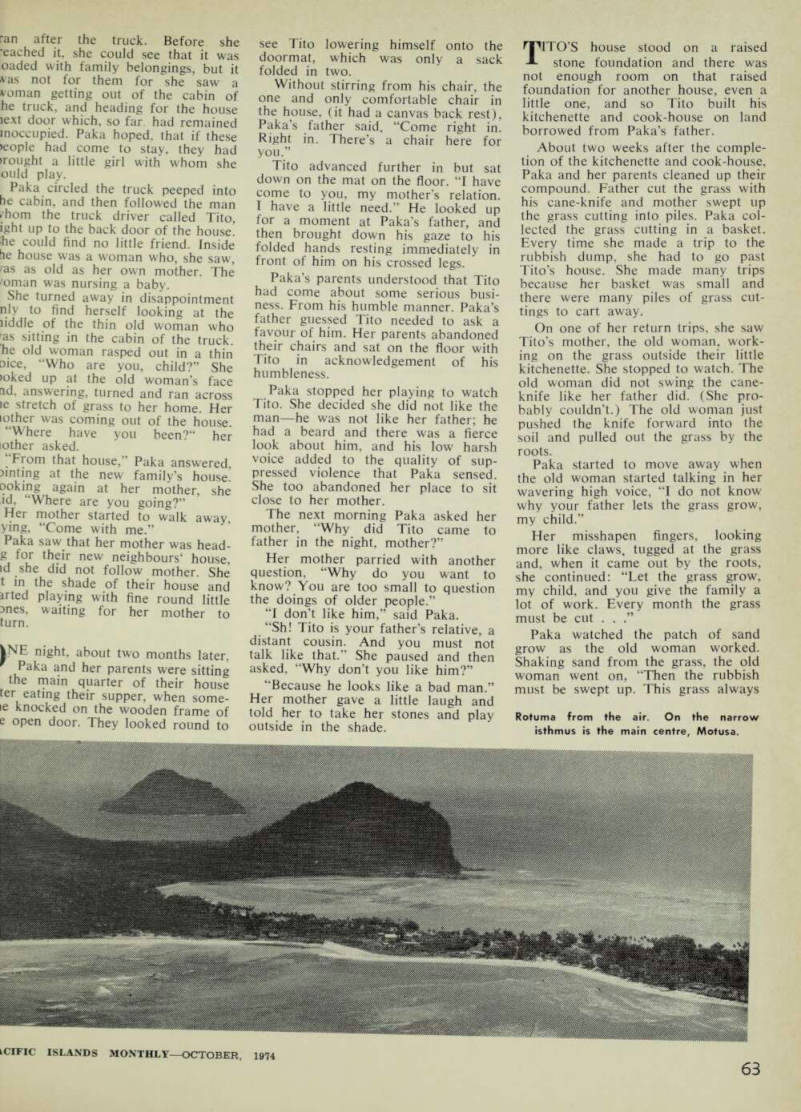
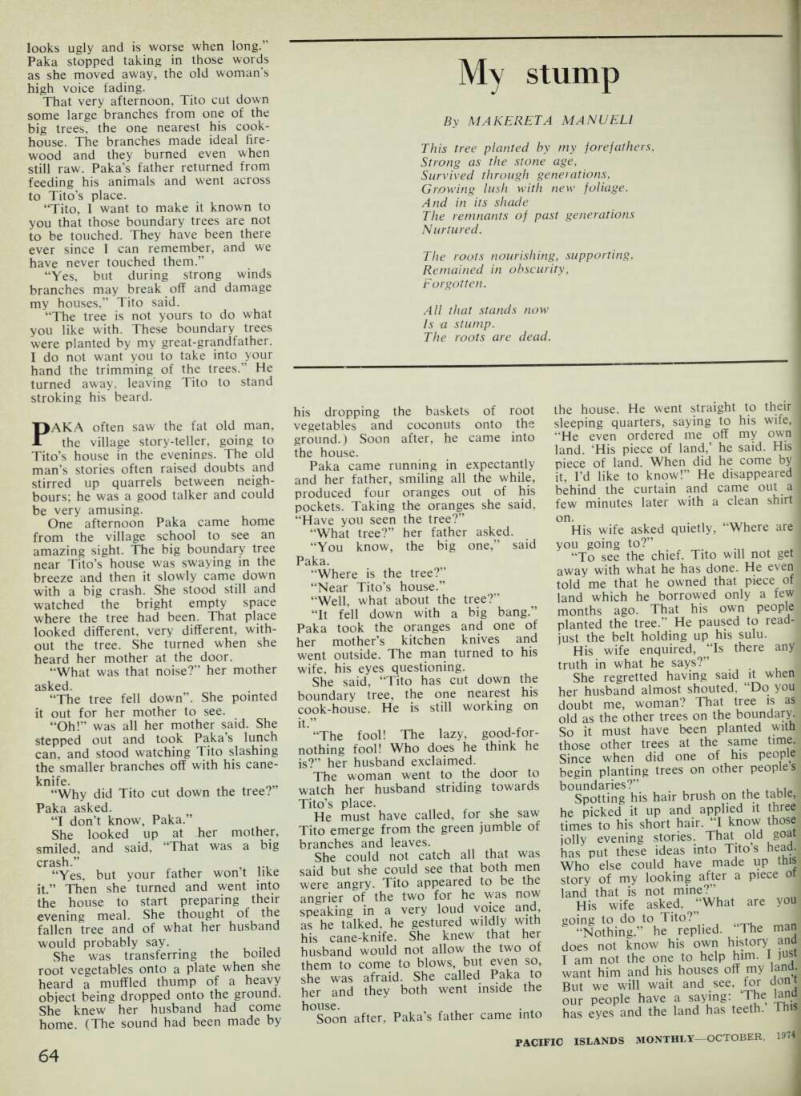
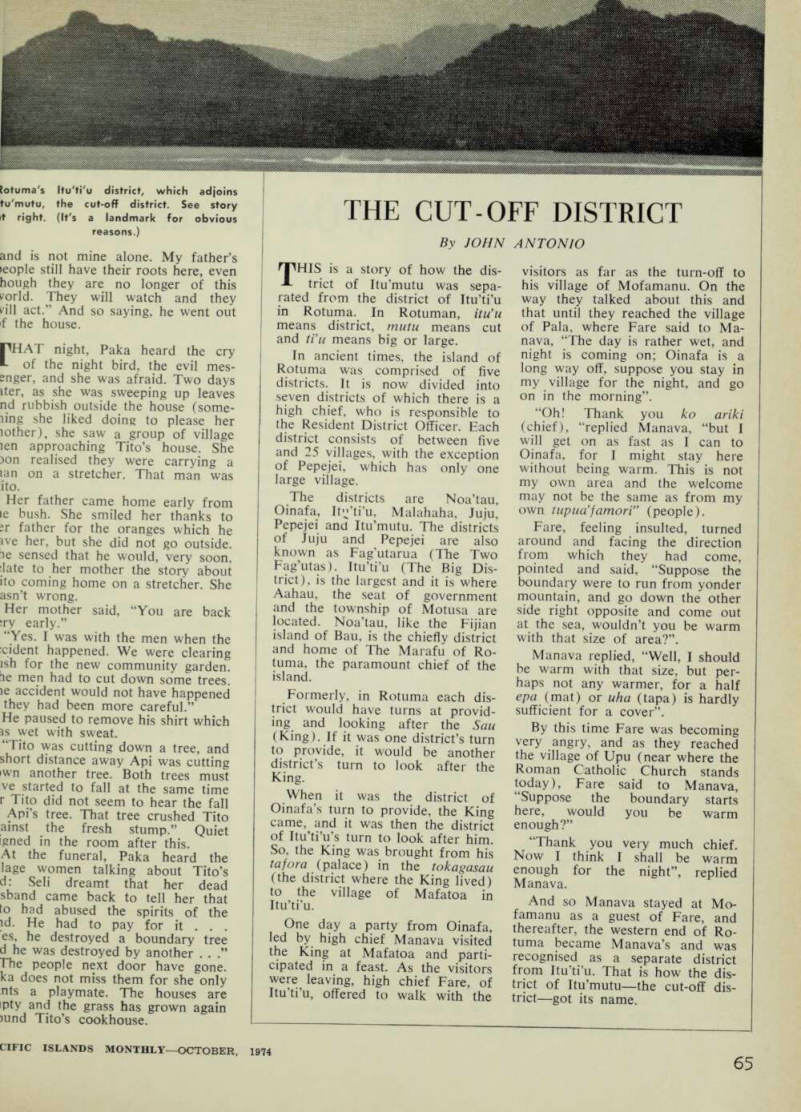
The New
By Makereta Manueli
She was on her way out of the door when her mother said, “Where are you going, Paka?”
“Just outside to play,” Paka replied quietly, hoping her mother would not ask her to stay inside the house.
“Well, don’t play out in the sun,” was all her mother said.
With a quick yes, she ran out and down to the well where they drew washing-water and bath water from.
She walked round the well singing a song she had learned at school. With a child’s perception she knew her mother would not call if she could hear her. At the end of her song, she ran out onto the road and, with a quick glance at the house, she walked rapidly away, heading for her friend’s house at the other end of the village.
The road ran behind the cluster of houses in their brown thatch. A few of the houses had given way to white washed cement cottages and little wooden buildings. It was mid-morning and a few women were still sweeping
up leaves and rubbish around their houses.
Some would call out the expected: “Where are you off to?”, and she would reply, with a little movement of the head, “Just over there.”
Every time she made this trip to her friend’s house she was asked the same question, and she never changed her reply. This exchange had come to mean nothing but a way of greeting a little child, and Paka knew that the question was not asked out of curio sity.
On arrival at her friend’s house, she was told by the mother that her friend had gone with the others to the bush to fetch fruit. She turned and returned home quickly.
PAKA heard the sound of a truck as she neared her home, and she was astonished to see the truck slowing down and turning m to their compound. Excitement and cunosi y put speed to her little legs and she
! be track - before she cached it, she could see that it was oaded with family belongings, but it f?- r then ? f ? r * he ? aw a hP frnrt B H g K OU i ° f f he of l°V he h 9 us <: ext door which, so far had remained £nn!; UP h e H aka t° Ped ; that u ,f th u Se >eople had come to stay, they had tt.,V ittle gir ‘ W ‘ th Whom she PtTiro Io A tv, * i J . he rahin P !f P ,! d mt ° ?hnm b e “f° llowei J ‘he man hihMinm I dr J Ver c /!l ed u TIt °’ ight u p to the back door of the house. he could find no little friend. Inside be house was a woman who, she saw, 'as as old as her own mother. The 'Oman was nursing a baby She turned away in disappointment nly to find herself looking at the fiddle of the thin old woman who 'as sitting in the cabin of the truck he old woman rasped out in a thin Dice, “Who are you child*?” She »oked up at the old woman’s face nd. answering, turned and ran across le stretch of grass to her home. Her lother was coming out of the house.
“Where have you been? 44 her lother asked.
“From that house,” Paka answered, finting at the new family’s house! ooking again at her mother, she id, “Where are you going?” ’
Her mother started to walk away ymg, “Come with me.” ’
Paka saw that her mother was headg for their new neighbours 4 house, id she dm not follow mother. She t in the shade of their house and irted playing with fine round little Dnes, waiting for her mother to urn ’ . , , INh night, about two months later, Paka and her parents were sitting fir C ? a * n f , arter of their house f r t thei r supper, when some- ' d °Vi 16 wooden frame of e open door. They looked round to
see Tito lowering himself onto the doormat, which was only a sack folded in two.
Without stirring from his chair, the one and only comfortable chair in the house ’ had a canvas back rest), Paka’s father said, “Come right in Right in * There ’ S a chair here for you ”
Tito advanced further in but sat down on the mat on the floor. “I have come to you ’ my mother’s relation.
I have a little need.” He looked up for a moment at Paka’s father, and then brought down his gaze to his folded hands resting immediately in front of him on his crossed legs. V
n,i„ / , f
, ka s P af cnts understood that Tito had i ome s P, me serious busi ‘ Fr ° m h i?. mble manner. Paka’s ! ather gl f, s ? ed J lto needed to a * k a hlm ‘ l* er paren * s abandoned Ir cbairs and sat , on the floor Wlt h / lto ., in acknowledgement of his humbleness.
Paka stopped her playing to watch Tito. She dec i de d she did not like the man — be was not Bke her father; he bad a Beard and there was a fierce look about him, and his low harsh v °i ce added to the quality of sup- Pressed violence that Paka sensed, Sbe to ° abandoned her place to sit close to her mother.
The next morning Paka asked her mother, “Why did Tito came to father in the night, mother?”
Her mother parried with another question, “Why do you want to know? You are too small to question the doings of older people.”
“I don’t like him,” said Paka.
“Sh! Tito is your father’s relative, a distant cousin. And you must not talk like that.” She paused and then asked, “Why don’t you like him?”
“Because he looks like a bad man.”
Her mother gave a little laugh and told her to take her stones and play outside in the shade.
TITO’S house stood on a raised stone foundation and there was not enough room on that raised foundation for another house, even a little one, and so Tito built his kitchenette and cook-house on land borrowed from Paka’s father.
About two weeks after the comple tion of the kitchenette and cook-house, Paka and her parents cleaned up their compound. Father cut the grass with his cane-knife and mother swept up the grass cutting into piles. Paka col lected the grass cutting in a basket.
Every time she made a trip to the rubbish dump, she had to go past Tito’s house. She made many trips because her basket was small and there were many piles of grass cut tings to cart away.
On one of her return trips, she saw Tito’s mother, the old woman, work ing on the grass outside their little kitchenette. She stopped to watch. The old woman did not swing the cane knife like her father did. (She pro bably couldn’t.) The old woman just pushed the knife forward into the soil and pulled out the grass by the roots.
Paka started to move away when the old woman started talking in her wavering high voice, "1 do not know why your father lets the grass grow, my child.”
Her misshapen fingers, looking more like claws, tugged at the grass and, when it came out by the roots, she continued: “Let the grass grow, my child, and you give the family a lot of work. Every month the grass must be cut . .
Paka watched the patch of sand grow as the old woman worked.
Shaking sand from the grass, the old woman went on, “Then the rubbish must be swept up. This grass always
Rotuma from the air. On the narrow isthmus is the main centre, Motusa.
looks ugly and is worse when long.”
Paka stopped taking in those words as she moved away, the old woman’s high voice fading.
That very afternoon, Tito cut down some large branches from one of the big trees, the one nearest his cook house. The branches made ideal fire wood and they burned even when still raw. Paka’s father returned from feeding his animals and went across to Tito’s place.
“Tito, I want to make it known to you that those boundary trees are not to be touched. They have been there ever since I can remember, and we have never touched them.”
“Yes, but during strong winds branches may break off and damage my houses,” Tito said.
“The tree is not yours to do what you like with. These boundary trees were planted by my great-grandfather.
I do not want you to take into your hand the trimming of the trees.” He turned away, leaving Tito to stand stroking his beard.
PAKA often saw the fat old man, the village story-teller, going to Tito’s house in the evenings. The old man’s stories often raised doubts and stirred up quarrels between neigh bours; he was a good talker and could be very amusing.
One afternoon Paka came home from the village school to see an amazing sight. The big boundary tree near Tito’s house was swaying in the breeze and then it slowly came down with a big crash. She stood still and watched the bright empty space where the tree had been. That place looked different, very different, with out the tree. She turned when she heard her mother at the door.
“What was that noise?” her mother dskcd “The tree fell down”. She pointed it out for her mother to see.
“Oh!” was all her mother said. She stepped out and took Paka’s lunch can, and stood watching Tito slashing the smaller branches off with his cane knife.
“Why did Tito cut down the tree?
Paka asked.
“I don’t know, Paka.”
She looked up at her mother, smiled, and said, “That was a big crash.”
“Yes, but your father wont like it.” Then she turned and went into the house to start preparing their evening meal. She thought of the fallen tree and of what her husband would probably say.
She was transferring the boiled root vegetables onto a plate when she heard a muffled thump of a heavy object being dropped onto the ground.
She knew her husband had come home. (The sound had been made by
his dropping the baskets of root vegetables and coconuts onto the ground.) Soon after, he came into the house.
Paka came running in expectantly and her father, smiling all the while, produced four oranges out of his pockets. Taking the oranges she said, “Have you seen the tree?”
“What tree?” her father asked.
“You know, the big one,” said Pcikci “Where is the tree?”
“Near Tito’s house.”
“Well, what about the tree?”
“It fell down with a big bang.”
Paka took the oranges and one of her mother’s kitchen knives and went outside. The man turned to his wife, his eyes questioning.
She said, “Tito has cut down the boundary tree, the one nearest his cook-house. He is still working on it.”
“The fool! The lazy, go<pd-for nothing fool! Who does he think he is?” her husband exclaimed.
The woman went to the door to watch her husband striding towards Tito’s place.
He must have called, for she saw Tito emerge from the green jumble of branches and leaves.
She could not catch all that was said but she could see that both men were angry. Tito appeared to be the angrier of the two for he was now speaking in a very loud voice and> as he talked, he gestured wildly with his cane-knife. She knew that her husband would not allow the two of them to come to blows, but even so, she was afraid. She called Paka to her and they both went inside the house. , . , Soon after, Paka’s father came into
the house. He went straight to their I sleeping quarters, saying to his wife, I “He even ordered me off my own j land, ‘His piece of land,’ he said. His I piece of land. When did he come by I it, I’d like to know!” He disappeared behind the curtain and came out a J few minutes later with a clean shirt I on.
His wife asked quietly, “Where are j you going to?”
“To see the chief. Tito will not get away with what he has done. He even told me that he owned that piece of land which he borrowed only a few months ago. That his own people planted the tree.” He paused to read just the belt holding up his sulu.
His wife enquired, “Is there any truth in what he says?”
She regretted having said it when her husband almost shouted. Do you doubt me, woman? That tree is as old as the other trees on the boundary.
So it must have been planted with those other trees at the same time.
Since when did one of his people begin planting trees on other peoples boundaries?” . I Spotting his hair brush on the table, he picked it up and applied it three times to his short hair. “I know those iolly evening stories. That old goat has put these ideas into Titos head.
Who else could have made up this story of my looking after a piece ot land that is not mine?”
His wife asked. “What are you going to do to Tito?
“Nothing” he replied. “The man does not know his own history and I am not the one to help him. I just want him and his houses off my land.
But we will wait and see, for dont our people have a saying: The land has eyes and the land has teeth, inis
and is not mine alone. My father’s icople still have their roots here, even hough they are no longer of this yorld. They will watch and they yill act.” And so saying, he went out if the house.
PHAT night, Paka heard the cry of the night bird, the evil mes snger, and she was afraid. Two days iter, as she was sweeping up leaves nd rubbish outside the house (some ling she liked doing to please her lother), she saw a group of village len approaching Tito’s house. She )on realised they were carrying a lan on a stretcher. That man was ito.
Her father came home early from ie bush. She smiled her thanks to *r father for the oranges which he ive her, but she did not go outside, ie sensed that he would, very soon, ■late to her mother the story about ito coming home on a stretcher. She asn’t wrong.
Her mother said, “You are back sry early.”
“Yes. I was with the men when the ;cident happened. We were clearing ish for the new community garden, tie men had to cut down some trees, ie accident would not have happened they had been more careful.”
He paused to remove his shirt which is wet with sweat.
“Tito was cutting down a tree, and short distance away Api was cutting •wn another tree. Both trees must ve started to fall at the same time r Tito did not seem to hear the fall Api’s tree. That tree crushed Tito ainst the fresh stump.” Quiet igned in the room after this.
At the funeral, Paka heard the lage women talking about Tito’s d: Seli dreamt that her dead sband came back to tell her that to had abused the spirits of the id. He had to pay for it . . . es, he destroyed a boundary tree d he was destroyed by another . . .”
The people next door have gone, ka does not miss them for she only nts a playmate. The houses are pty and the grass has grown again >und Tito’s cookhouse.
Rotuma's Itu'ti'u district, which adjoins [?]tu'mutu, the cut-off district. See story [?]t right. (It's a landmark for obvious reasons.)
Advertisements & other items, p. 65 (1 item)
63
ICIFIC ISLANDS MONTHLY—OCTOBER, 1974
My stump
By Makereta Manueli
This tree planted by my forefathers, Strong as the stone age, Survived through generations, Growing lush with new foliage.
And in its shade The remnants of past generations Nurtured.
The roots nourishing, supporting, Remained in obscurity, Forgotten.
All that stands now Is a stump.
The roots are dead.
The Cut-Off District
By John Antonio
fPHIS is a story of how the dis trict of Itu’mutu was sepa rated from the district of Itu’ti’u in Rotuma. In Rotuman, itu’u means district, mutu means cut and ti’u means big or large.
In ancient times, the island of Rotuma was comprised of five districts. It is now divided into seven districts of which there is a high chief, who is responsible to the Resident District Officer. Each district consists of between five and 25 villages, with the exception of Pepejei, which has only one large village.
The districts are Noa’tau, Oinafa, Malahaha, Juju, Pepejei and Itu’mutu. The districts of Juju and Pepejei are also known as Fag'utarua (The Two Fag’utas). Itu’ti’u (The Big Dis trict), is the largest and it is where Aahau, the seat of government and the township of Motusa are located. Noa’tau, like the Fijian island of Bau, is the chiefly district and home of The Marafu of Ro tuma, the paramount chief of the island.
Formerly, in Rotuma each dis trict would have turns at provid ing and looking after the Sau (King). If it was one district’s turn to provide, it would be another district’s turn to look after the King.
When it was the district of Oinafa’s turn to provide, the King came, and it was then the district of Itu’ti’u’s turn to look after him.
So, the King was brought from his tafora (palace) in the tokagasau (the district where the King lived) to the village of Mafatoa in Itu’ti’u.
One day a party from Oinafa, led by high chief Manava visited the King at Mafatoa and parti cipated in a feast. As the visitors were leaving, high chief Fare, of Itu’ti’u, offered to walk with the
visitors as far as the turn-off to his village of Mofamanu. On the way they talked about this and that until they reached the village of Pala, where Fare said to Ma nava, “The day is rather wet, and night is coming on; Oinafa is a long way off, suppose you stay in my village for the night, and go on in the morning”.
“Oh! Thank you ko ariki (chief), “replied Manava, “but I will get on as fast as I can to Oinafa, for I might stay here without being warm. This is not my own area and the welcome may not be the same as from my own tupua'jamori" (people).
Fare, feeling insulted, turned around and facing the direction from which they had come, pointed and said, “Suppose the boundary were to run from yonder mountain, and go down the other side right opposite and come out at the sea, wouldn’t you be warm with that size of area?”.
Manava replied, “Well, I should be warm with that size, but per haps not any warmer, for a half epa (mat) or uha (tapa) is hardly sufficient for a cover”.
By this time Fare was becoming very angry, and as they reached the village of Upu (near where the Roman Catholic Church stands today), Fare said to Manava, “Suppose the boundary starts here, would you be warm enough?”
“Thank you very much chief.
Now I think I shall be warm enough for the night”, replied Manava.
And so Manava stayed at Mo famanu as a guest of Fare, and thereafter, the western end of Ro tuma became Manava’s and was recognised as a separate district from Itu’ti’u. That is how the dis trict of Itu’mutu—the cut-off dis trict—got its name.
Advertisements & other items, p. 67 (1 item)
65
CIFIC ISLANDS MONTHLY—OCTOBER, 1974
Books, Reviews, writers
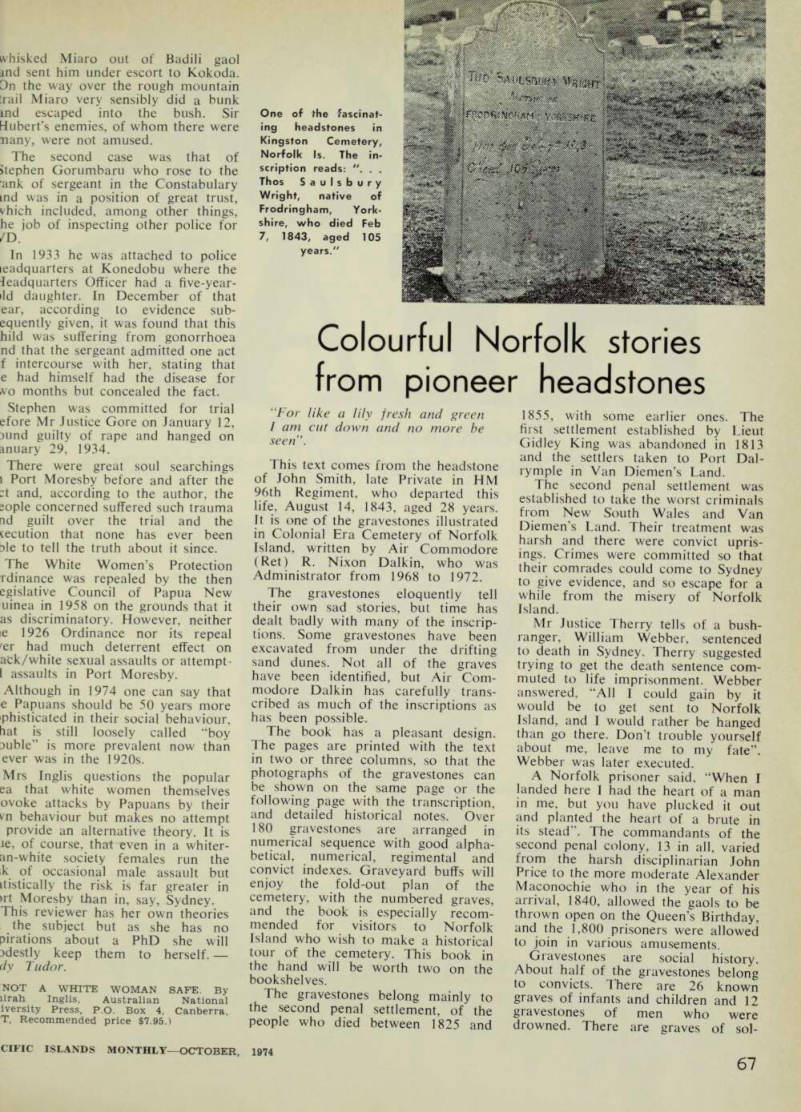
The Finer Points Of Rape In
The 20S-Papua Style
Confucius said: if rape inevitable, lean back and enjoy it. Nonetheless, we can take it as a general rule that most women dislike being raped and that if they are white they parti cularly dislike being raped by a black man. Which, of course, is just another case of ridiculous, illogical racial prejudice and what Amirah Inglis’ book, Not a White Woman Safe, is about.
The title comes from an article of the same name which appeared in Sydney Truth in April 1930 and a facsimile of the page on which it was published makes the exciting looking dust-jacket—all of which goes to show that even the Australian National University Press isn’t above a bit of commercialism on the side.
It is a fond belief among publishers that an attractive or sensational book jacket does wonders as a sales gim mick, no matter what kind of material appears inside the covers.
In this case what is inside the covers is a thesis for a Master’s degree, which leads one to wonder what Australian academics would do if they couldn’t exhume some ancient Papua New Guinea currently un popular foible to explore in the interests of their MAs or PhDs.
Mrs Inglis explores the “sexual anxiety and politics in Port Moresby, 1920-34” for her thesis, particularly the White Women’s Protection Ordinance that was passed in 1926 and which provided the death penalty for rape or attempted rape of a white female. This ordinance, she believes, was brought about by hysteria and panic with, she infers, mighty little cause, at least looked at from the distance of 1974.
Up to the time that the ordinance became law, no white female had actually been raped, or at least had not reported being raped, which may be is not the same thing. There had, however, been peeping toms, a clutch of bedroom prowlers; one woman, a nurse, who had had a hospital orderly “clutch at her fork”; an indecent ex posure or two; a few assaults on small children; and one woman from Paga
Hill, who must have been a sound sleeper, who reported waking up with a “native lying on top of her.”
Most of these assaults were disposed of by the women themselves who yelled “Get out!”, administering a kick were it did most good, or shrieked for husband, friends or even Papuan servants.
The urge to get such crimes into the statute book as capital offences was largely, so the author thinks, the result of injured chauvinistic white male sexual pride. That they suc ceeded at all was only through the unexpected weakness of the then Lieut Governor, Sir Hubert Murray.
The new ordinance did not prevent
such assaults and the author gives two case histories in which the death sentence was actually pronounced but carried out in only one instance.
The first case concerned a man named Miaro from the Gulf District who was accused of attempted rape of a merchant’s wife. He was duly tried, found guilty and sentenced to death. The gallows were erected at Badili gaol and the execution j scheduled for January 13, 1930.
However, at the last moment, a telegram from the then Labor Prime Minister of Australia made the “strongest possible representations” that the execution be not proceeded with and with apparent alacrity Sir Hubert, fearing a lynching party, i
whisked Miaro out of Badili gaol and sent him under escort to Kokoda.
On the way over the rough mountain trail Miaro very sensibly did a bunk and escaped into the bush. Sir Hubert's enemies, of whom there were uany, were not amused.
The second case was that of Stephen Gorumbaru who rose to the ank of sergeant in the Constabulary ind was in a position of great trust, vhich included, among other things, he job of inspecting other police for /D.
In 1933 he was attached to police icadquarters at Konedobu where the Jeadquarters Officer had a five-year ild daughter. In December of that ear, according to evidence sub equently given, it was found that this hild was suffering from gonorrhoea nd that the sergeant admitted one act f intercourse with her, stating that e had himself had the disease for vo months but concealed the fact.
Stephen was committed for trial efore Mr Justice Gore on January 12, Dund guilty of rape and hanged on anuary 29, 1934.
There were great soul searchings i Port Moresby before and after the :t and, according to the author, the sople concerned suffered such trauma ad guilt over the trial and the iecution that none has ever been ale to tell the truth about it since.
The White Women’s Protection rdinance was repealed by the then egislative Council of Papua New uinea in 1958 on the grounds that it as discriminatory. However, neither ie 1926 Ordinance nor its repeal 'er had much deterrent effect on ack/white sexual assaults or attempt- I assaults in Port Moresby.
Although in 1974 one can say that e Papuans should be 50 years more phisticated in their social behaviour, hat is still loosely called “boy Duble” is more prevalent now than ever was in the 19205.
Mrs Inglis questions the popular ea that white women themselves ovoke attacks by Papuans by their vn behaviour but makes no attempt provide an alternative theory. It is ae, of course, that even in a whiter an-white society females run the k of occasional male assault but itistically the risk is far greater in >rt Moresby than in, say, Sydney.
This reviewer has her own theories the subject but as she has no pirations about a PhD she will Ddestly keep them to herself. dy Tudor.
Not A White Woman Safe. By
lirah Inglis, Australian National iversity Press, P.O. Box 4, Canberra, T, Recommended price $7.95.)
One More For The Raft Lovers
To most of us, people who put to sea on bundles of logs or papyrus stalks for long drift voyages across big oceans are clearly nuts, even though the stories they write after wards are interesting enough.
Latest saga is from Vital Alsar who was one of four who set out from Ecuador on a balsa raft in May 1970 and ended up in Mooloolaba, Queensland, in November the same year.
His book, La Balsa To Australia, tells the story of the 8,564 miles, longest-ever drift and the adventures that befell the party on their express ride to Australia, never stopping to dilly-dally at any of the islands on the way.
There is a sameness about these rafting accounts, beginning with the original Kon Tiki, then William Willis, de Bisschop and Heyerdahl again, in his Ra which wallowed across the Atlantic to show that Egyptians could have populated South America way back god knows when.
It is therefore difficult to see what La Balsa set out to prove that hadn’t
been proved before by the great dis comforts and adventures of other raft voyagers. Nonetheless, for arm chair sailors it makes an adequate i entertainment and as it was, in effect, Australia’s very own raft voyage (proving perhaps that aborigines could have drifted there from Middle America), it achieved a considerable amount of publicity in that country, at the time.
Particularly publicity about La Balsa’s cat, Minet, which survived the epic drift only to be taken into cus tody by Australia’s over-zealous quarantine officers with their usual malice aforethought. The fate which hung over Minet caused such a hulla baloo that there was a stay of execution at least long enough for the wife of the captain of a foreign ship then in Brisbane to offer a home.
Minet, who was quite a cat, there fore makes this book one for cat lovers as well as for vicarious voyag ers on balsa rafts. —Judy Tudor.
(La Balsa To Australia. By Vital
Alsar with Enrique Hank Lopez. Hodder p Stoughton, Warwick Lane, London, EC-ir, 4AN, recommended price, $7.50.)
from pioneer headstones

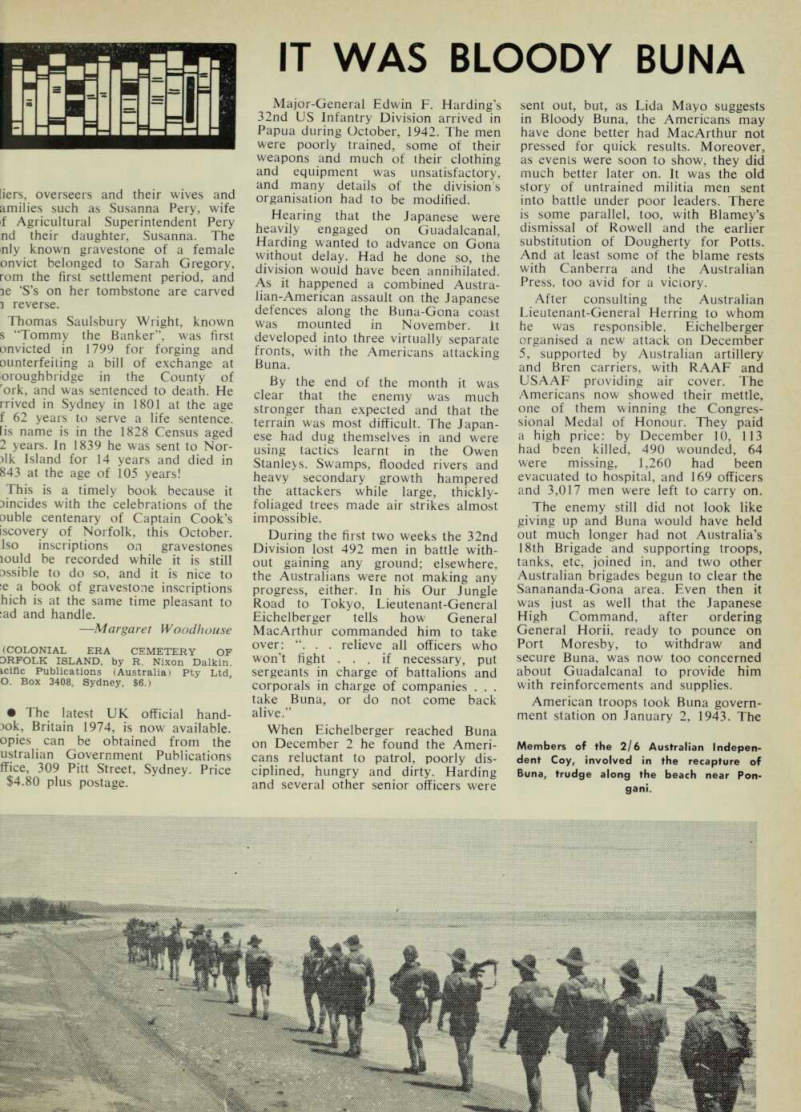
Colourful Norfolk stories from pioneer headstones
“For like a lily fresh and green I am cut down and no more be seen”.
This text comes from the headstone of John Smith, late Private in HM 96th Regiment, who departed this life, August 14, 1843, aged 28 years.
It is one of the gravestones illustrated in Colonial Era Cemetery of Norfolk Island, written by Air Commodore (Ret) R. Nixon Dalkin, who was Administrator from 1968 to 1972.
'Die gravestones eloquently tell their own sad stories, but time has dealt badly with many of the inscrip tions. Some gravestones have been excavated from under the drifting sand dunes. Not all of the graves have been identified, but Air Com modore Dalkin has carefully trans cribed as much of the inscriptions as has been possible.
The book has a pleasant design.
The pages are printed with the text in two or three columns, so that the photographs of the gravestones can be shown on the same page or the following page with the transcription, and detailed historical notes. Over 180 gravestones are arranged in numerical sequence with good alpha betical, numerical, regimental and convict indexes. Graveyard buffs will enjoy the fold-out plan of the cemetery, with the numbered graves, and the book is especially recom mended for visitors to Norfolk Island who wish to make a historical tour of the cemetery. This book in the hand will be worth two on the bookshelves.
The gravestones belong mainly to the second penal settlement, of the people who died between 1825 and
1855, with some earlier ones. The first settlement established by Lieut Gidley King was abandoned in 1813 and the settlers taken to Port Dal rymple in Van Diemen’s Land.
The second penal settlement was established to take the worst criminals from New South Wales and Van Diemen’s Land. Their treatment was harsh and there were convict upris ings. Crimes were committed so that their comrades could come to Sydney to give evidence, and so escape for a while from the misery of Norfolk Island.
Mr Justice Therry tells of a bush ranger, William Webber, sentenced to death in Sydney. Therry suggested trying to get the death sentence com muted to life imprisonment. Webber answered, “All I could gain by it would be to get sent to Norfolk Island, and I would rather be hanged than go there. Don’t trouble yourself about me, leave me to my fate”.
Webber was later executed.
A Norfolk prisoner said, “When I landed here I had the heart of a man in me, but you have plucked it out and planted the heart of a brute in its stead”. The commandants of the second penal colony, 13 in all, varied from the harsh disciplinarian John Price to the more moderate Alexander Maconochie who in the year of his arrival, 1840, allowed the gaols to be thrown open on the Queen’s Birthday, and the 1,800 prisoners were allowed to join in various amusements.
Gravestones are social history.
About half of the gravestones belong to convicts. There are 26 known graves of infants and children and 12 gravestones of men who were drowned. There are graves of sol-
One of the fascinat ing headstones in Kingston Cemetery, Norfolk Is. The in scription reads: ". . .
Thos Salisbury Wright, native of Frodringham, York shire, who died Feb 7, 1843, aged 105 years."
liers, overseers and their wives and amilies such as Susanna Pery, wife
if Agricultural Superintendent Pery
nd their daughter, Susanna. The nly known gravestone of a female onvict belonged to Sarah Gregory, rom the first settlement period, and 3e ‘S’s on her tombstone are carved 1 reverse.
Thomas Saulsbury Wright, known s “Tommy the Banker”, was first onvicted in 1799 for forging and ounterfeiting a bill of exchange at oroughbridge in the County of r ork, and was sentenced to death. He rrived in Sydney in 1801 at the age f 62 years to serve a life sentence, [is name is in the 1828 Census aged 2 years. In 1839 he was sent to Nor )lk Island for 14 years and died in 843 at the age of 105 years!
This is a timely book because it Dincides with the celebrations of the Quble centenary of Captain Cook’s iscovery of Norfolk, this October.
Iso inscriptions on gravestones tould be recorded while it is still Dssible to do so, and it is nice to :e a book of gravestone inscriptions hich is at the same time pleasant to :ad and handle. —Margaret Woodhouse
(Colonial Era Cemetery Of
DRFOLK ISLAND, by R. Nixon Dalkin. iciflc Publications (Australia) Pty Ltd, O. Box 3408, Sydney, $6.) • The latest UK official hand x)k, Britain 1974, is now available, opies can be obtained from the ustralian Government Publications ffice, 309 Pitt Street, Sydney. Price $4.80 plus postage.
Advertisements & other items, pp. 69-70 (2 items)
67
CIFIC ISLANDS MONTHLY—OCTOBER, 1974
Hear
LOOK
Kodak presents‘Talkies’...
super 8 color movies withlip-sync’sound.
The cameras. The new Kodak Ektasound movie cameras record both the picture and synchronised sound directly onto a magneticstriped sound film all at the press of a single button.
Automatic sound control.
The omnidirectional microphone plugs into the camera and is controlled by an automatic gain control.
Automatic light control.
The f/1.2 lens, 230° shutter, bright optical viewfinder, and double-vane CdS automatic exposure control system enable movie-making under mo§t lighting conditions.
The films. Choose from Kodak Ektachrome 160 sound movie film for indoors or outdoors; or KodachromeU sound movie film for daylight movies.
The projectors. Ask about the exciting new Kodak Ektasound movie projectors with tape-deck styling.
Or you can use any conventional super 8 sound projector.
KODAK (Australasia) PTY. LTD.
Kodak Ektasound movie cameras.
See them demonstrated at leading Island photo dealers.
K6l/4838
It Was Bloody Buna

Major-General Edwin F. Harding’s 32nd US Infantry Division arrived in Papua during October, 1942. The men were poorly trained, some of their weapons and much of their clothing and equipment was unsatisfactory, and many details of the divisions organisation had to be modified.
Hearing that the Japanese were heavily engaged on Guadalcanal, Harding wanted to advance on Gona without delay. Had he done so, the division would have been annihilated.
As it happened a combined Austra lian-American assault on the Japanese defences along the Buna-Gona coast was mounted in November. It developed into three virtually separate fronts, with the Americans attacking Buna.
By the end of the month it was clear that the enemy was much stronger than expected and that the terrain was most difficult. The Japan ese had dug themselves in and were using tactics learnt in the Owen Stanleys. Swamps, flooded rivers and heavy secondary growth hampered the attackers while large, thickly foliaged trees made air strikes almost impossible.
During the first two weeks the 32nd Division lost 492 men in battle with out gaining any ground; elsewhere, the Australians were not making any progress, either. In his Our Jungle Road to Tokyo, Lieutenant-General Eichelberger tells how General MacArthur commanded him to take over: “. . . relieve all officers who won’t fight ... if necessary, put sergeants in charge of battalions and corporals in charge of companies . . . take Buna, or do not come back alive,”
When Eichelberger reached Buna on December 2 he found the Ameri cans reluctant to patrol, poorly dis ciplined, hungry and dirty. Harding and several other senior officers were
sent out, but, as Lida Mayo suggests in Bloody Buna, the Americans may have done better had MacArthur not pressed for quick results. Moreover, as events were soon to show, they did much better later on. It was the old story of untrained militia men sent into battle under poor leaders. There is some parallel, too, with Blarney’s dismissal of Rowell and the earlier substitution of Dougherty for Potts.
And at least some of the blame rests with Canberra and the Australian Press, too avid for a victory.
After consulting the Australian Lieutenant-General Herring to whom he was responsible, Eichelberger organised a new attack on December 5, supported by Australian artillery and Bren carriers, with RAAF and USAAF providing air cover. The Americans now showed their mettle, one of them winning the Congres sional Medal of Honour. They paid a high price: by December 10, 113 had been killed, 490 wounded, 64 were missing, 1,260 had been evacuated to hospital, and 169 officers and 3,017 men were left to carry on.
The enemy still did not look like giving up and Buna would have held out much longer had not Australia’s 18th Brigade and supporting troops, tanks, etc, joined in, and two other Australian brigades begun to clear the Sanananda-Gona area. Even then it was just as well that the Japanese High Command, after ordering General Horii, ready to pounce on Port Moresby, to withdraw and secure Buna, was now too concerned about Guadalcanal to provide him with reinforcements and supplies.
American troops took Buna govern ment station on January 2, 1943. The
Members of the 2/6 Australian Indepen dent Coy, involved in the recapture of Buna, trudge along the beach near Pon gani.
Mlies suffered 2,870 casualties in the irea, 913 of them Australians. In the inal stages alone, the enemy lost ,390 men. That it was the bloodiest ►attle in Papua is clear from the final igures for that part of the islands; ,163 Australians and 671 Americans illed, 3,533 of the former wounded nd 2,171 of the latter.
There have been few Austerlitzes, lost battles have been won in spite f errors made by the victors—be ause the losers made more of them.
Tiere was too little planning for Buna nd too little appreciation of the nemy’s fighting qualities. The author laims that MacArthur’s ignorance of ic terrain in New Guinea cost many ves, an ignorance “that led him iroughout the campaign to make im ossible demands on his front-line Dmmanders”.
The southern Philippines have lenty of jungle country, too, and, loreover, MacArthur had met some f the Australian generals who fought i the Owen Stanleys. Was it really norance, or a search for personal ados? After the Allies had taken obodura on December 20, the ipanese could have been by-passed, ; was later done in other areas, istead, MacArthur wanted a clear-cut ctory and Blarney went along with m. They did learn from the Buna ona campaign but many of their mntrymen paid for the lesson with eir lives.
This book brings together some of e material in the two nations’ official ar histories and in books by writers ce George Johnston, Osmar White, aymond Pauli and John Vader. On is score alone it deserves to be read few people have the time to go rough the lengthy and often tedious ficial accounts, and most of the )oks alluded to are out of print. Lida ayo has, however, done more: she the first American writer to see her iuntry’s effort in Papua in its oper context.
There are some errors; eg 2/10 Bn is at Wanigela on October 5, nine ivs before 128th US Regiment and '6 Independent Coy, and the AIF -re certainly not “regulars”—only oody amateurs as every recruit was Id ad nauseam. And Bloody Buna 3uld have been enhanced by the nd of maps contained in official war stories.
To sum up, this is a useful book, helns Americans, Australians and 5W Guineans alike to become better quainted with an important period the Islands’ history. Only if we iderstand what the last war was e can we hope to take the steps cessary to prevent the recurrence
such a calamity.
Harry Jackman.
fBLOODY BUNA, by Lida Mayo. Double y & Inc, New York, 1974. $U57.95.)
Advertisements & other items, p. 72 (1 item)
Todays roofs
demand
new materials
- m I m ,: ■ -C > I * * * . - ?
Dunlop Membranes
BUTYNOL- Based on Butyl Rubber
One-ply roofing has far less weight and bulk than built-up systems.
Therefore, the architect gains greater design freedom plus reduced loads on supporting members.
For the owner, certain structural costs are lowered and maintenance problems minimised. The contractor benefits from reduced materials handling, lower shipping costs and a work day with more productive hours.
SHELTERLINE-Asbestos backed
DUNLINE Unbacked
Both based on well-proven Hypalon* Synthetic Rubber.
Hurricane Bebe' October 1972 and Cyclone Lottie' December 1973 produced no problems for Dunlop Membranes and Adhesives.
Illustrations depict: Roman Catholic Seminary, Suva.
Pacific Fishing Company, Levuka.
The Fiji Times' Extensions, Suva.
General Manager, • Shelter Engineering Limited, P.O. Box 10-043, Christchurch, New Zealand.
Please forward information on s
□ BUTYNOL ROOFING MEMBRANE j
□ SHELTERLINE & DUNLINE ROOFING
I MEMBRANES
□ MEMBRANES FORWATER
MANAGEMENT
NAME j
I ADDRESS
• -I O Dunlop membranes are widely used also for Water
Management - Ponds, Reservoirs, etc.
$
SHELTER
ENGINEERING (>
LIMITED
A DUNLOP COMPANY
♦HYPALON is a registered Du Pont trademark for chlorosulfonated polyethylene synthetic rubber.
Percy Chatterton's
Papua
Percy Chatterton’s Papua: Day That I Have Loved, is to be published shortly by Pacific Publications, in Sydney. It is more than an autobiography by well-known Percy Chatterton, OBE, who has spent 50 years in Papua as missionary, teacher and outspoken politician fighting for the underdog. It is a colourful, and charming, account of the Papuan people, giving warm in sight into their hopes, fears and changing way of life.
Some Papuan leaders say they don't want Papua to be sub merged by New Guinea in the move towards independence, and readers of Percy Chatter ton's timely book will readily sympa thise with their desire to retain their identity. The book is illus trated with evocative pen sketches by Percy Chatterton’s longtime friend and neighbour in Port Moresby, Rev Bert Brown. The price is $5.25.
Too modest?
When I read such books as Andrew G. Stewart’s In Letters of Gold, I must ask, is this the best the mission aries can now do? Is this all they can give us as a record of the great work they have done in the Pacific? It is clear to me that there is a need for someone not connected with the Church to write an assessment of the work done in the Pacific by devoted missionaries of all denominations.
That their work was valuable none can deny.
Even those who, like Michael Somare, question some of the results achieved in the destruction of mater ial culture, must remember that even concurrently with that material des truction, the missionaries were imbuing the Pacific Islanders with spirituality in the midst of the rank est materialism. Had it not been for the teaching of the missionaries, most of those, who, through educa tion and erudition, can now find words of criticism, may not yet have reached this stage of articulation.
Without whatever primitive means at their disposal, it was the mission aries, who, in most areas of the Paci fic, undertook the difficult task of establishing the first educational in stitutions. That’s why I am dis appointed in Andrew Stewart’s book: it modestly scratches the surface of his work in the Pacific, and tells us
little of the profound need in human and spiritual terms supplied through his work and the work of other missionaries.
In Letters of Gold is highly read able, and in his long life Pastor Stewart of the Seventh-day Adventist Church has seen his mission from early beginnings to its full develop ment. From 1906 to 1970 he was present at every divisional conference session of his church which must be a record unequalled by any of his contemporaries or indeed few, if any, Pacific missionaries. For nearly 80 years, more than the life-span of most humans, Pastor Stewart main tained a lively interest in, and greatly contributed to, the growth of his church. He served in many parts of the Pacific.
For these reasons, in spite of my complaint above, In Letters of Gold becomes a history of certain aspects of Pacific development. Throughout the book Pastor Stewart reveals his simple faith and his complete trust in his Protector. It is undoubtedly this spirit which gave him his power and authority and brought about suc cess in some difficult situations.
He is not slow to give praise and gratitude to other workers in the field with him. I think, as far as he goes, Pastor Stewart has written a valuable contribution to our records of the Pacific. And I enjoyed reading it. But I do think it is time some historian wrote a Pacific history of Mission
activities.-
Peter Livingston.
(IN LETTERS OF GOLD, by Andrew G.
Stewart, published by Pacific Press Pub lishing Association, Mountain View, Cali fornia, Omaha, Nebraska and Oshawa, Ontario; paper-back, illustrated, 128 pages, no price given.)
Advertisements & other items, pp. 73-74 (2 items)
71
LCIFIC ISLANDS MONTHLY—OCTOBER, 1974
Harris
BOOK COMPANY
(ESTABLISHED 1930)
We carry over 10,000 titles on all subjects in stock and would be pleased to quote for your requirements.
Please send your enquiries to;
HARRIS BOOK COMPANY,
G.P.O. Box 16670, Hong Kong
■ ■ 9 1 and what tn^c§;dp^ffor.you. we sayall iiilil: Switch on with‘Eveready’.
All Purpose See what the POWER cells can Bwwms' needs you can be.sure- that•.; : ; ‘Eveready* will be there. With fresh, dependable power.
Products of gjgp Eveready’ wtd'Ujttlon Carbide’ are registered IVade Marks. 085.P.481
From 'Easy' Street At 43 To A New
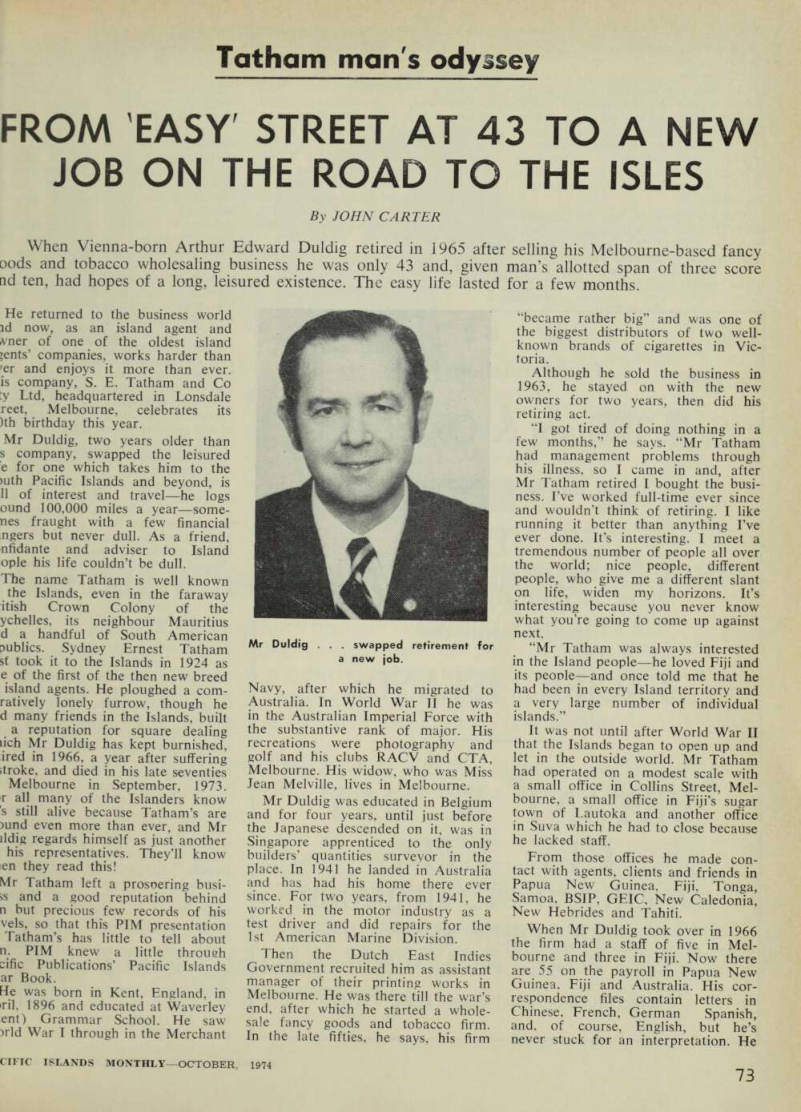
Tatham man's odyssey
FROM 'EASY' STREET AT 43 TO A NEW JOB ON THE ROAD TO THE ISLES
By John Carter
When Vienna-born Arthur Edward Duldig retired in 1965 after selling his Melbourne-based fancy oods and tobacco wholesaling business he was only 43 and, given man’s allotted span of three score ad ten, had hopes of a long, leisured existence. The easy life lasted for a few months.
He returned to the business world id now, as an island agent and vner of one of the oldest island >ents’ companies, works harder than r er and enjoys it more than ever, is company, S. E. Tatham and Co :y Ltd, headquartered in Lonsdale reet, Melbourne, celebrates its )th birthday this year.
Mr Duldig, two years older than s company, swapped the leisured e for one which takes him to the >uth Pacific Islands and beyond, is 11 of interest and travel—he logs ound 100,000 miles a year—some nes fraught with a few financial ngers but never dull. As a friend, nfidante and adviser to Island ople his life couldn’t be dull.
The name Tatham is well known the Islands, even in the faraway itish Crown Colony of the ychelles, its neighbour Mauritius d a handful of South American publics. Sydney Ernest Tatham sf took it to the Islands in 1924 as e of the first of the then new breed island agents. He ploughed a com ratively lonely furrow, though he d many friends in the Islands, built a reputation for square dealing uch Mr Duldig has kept burnished, ired in 1966, a year after suffering itroke, and died in his late seventies Melbourne in September, 1973. r all many of the Islanders know s still alive because Tatham’s are )und even more than ever, and Mr ildig regards himself as just another his representatives. They’ll know en they read this!
Mr Tatham left a prosnering busi es and a good reputation behind n but precious few records of his vels, so that this PIM presentation Tatham’s has little to tell about n. PIM knew a little throueh cific Publications’ Pacific Islands ar Book.
He was born in Kent, England, in 'ril, 1896 and educated at Waverley ent) Grammar School. He saw )rld War I through in the Merchant
“became rather big” and was one of the biggest distributors of two well known brands of cigarettes in Vic toria.
Although he sold the business in 1963, he stayed on with the new owners for two years, then did his retiring act.
“I got tired of doing nothing in a few months,” he says. “Mr Tatham had management problems through his illness, so I came in and, after Mr Tatham retired I bought the busi ness. I’ve worked full-time ever since and wouldn’t think of retiring, I like running it better than anything I’ve ever done. It’s interesting. I meet a tremendous number of people all over the world; nice people, different people, who give me a different slant on life, widen my horizons. It’s interesting because you never know what you’re going to come up against next.
“Mr Tatham was always interested in the Island people—he loved Fiji and its peonle—and once told me that he had been in every Island territory and a very large number of individual islands.”
It was not until after World War II that the Islands began to open up and let in the outside world. Mr Tatham had operated on a modest scale with a small office in Collins Street, Mel bourne, a small office in Fiji’s sugar town of Lautoka and another office in Suva which he had to close because he lacked staff.
From those offices he made con tact with agents, clients and friends in Papua New Guinea, Fiji, Tonga, Samoa, BSIP, GEIC, New Caledonia, New Hebrides and Tahiti.
When Mr Duldig took over in 1966 the firm had a staff of five in Mel bourne and three in Fiji. Now there are 55 on the payroll in Papua New Guinea, Fiji and Australia. His cor respondence files contain letters in Chinese, French, German Spanish, and, of course, English, but he’s never stuck for an interpretation. He
Navy, after which he migrated to Australia. In World War II he was in the Australian Imperial Force with the substantive rank of major. His recreations were photography and golf and his clubs RACY and CTA, Melbourne. His widow, who was Miss Jean Melville, lives in Melbourne.
Mr Duldig was educated in Belgium and for four years, until just before the Japanese descended on it, was in Singapore apprenticed to the only builders’ quantities surveyor in the place. In 1941 he landed in Australia and has had his home there ever since. For two years, from 1941, he worked in the motor industry as a test driver and did repairs for the Ist American Marine Division.
Then the Dutch East Indies Government recruited him as assistant manager of their printing works in Melbourne. He was there till the war’s end, after which he started a whole sale fancy goods and tobacco firm.
In the late fifties, he says, his firm
Mr Duldig . . . swapped retirement for a new job.
and his staff, which includes Chinese, can do it all.
His Fiji staff, headed by Mr Kantilal Jiwan, general manager, who is at Lautoka, and Mr Mohammed Janif at the Suva office, is completely localised. With the exception of Australian David Marburg, general manager and manager at the Lae branch, the PNG staff is local. Papuan Albert Karo is the Port Moresby manager The warehouse in Lae was opened in 1972 and the warehouse in Port Moresby a year later. But Mr Duldig had begun to spread his wings in 1969. He went further than most island agents and entered the Indian
Ocean, trading with the Seychelles and Mauritius. He must have done a good job there because the colony government appointed him their representative in Australia in 1970.
One of the firm’s representatives, a Chinese, looks after things in the Western Pacific while Mr Duldig makes the central and eastern Pacific his parish, doing at least three tours a year as well as numerous visits to Papua New Guinea and annual calls on clients in SE Asia, the Seychelles, Mauritius and East Africa. South America sees him less frequently.
“From a pin to a ship” is the usual gamut of the island agent’s trading activities but Mr Duldig concentrates
as much as nossible on Australian. ; products with a bias towards food products “because that is the strength of Australia” he says although secondary Australian pro ducts are coming more to the fore.
I wrote in an article on island i agents (PIM, Dec, 1971, p 44), “The island agent is all things to all his clients, even Father Christmas to their children,” Mr Duldig is no exception.
One of his favourite chores is to look after the welfare of three island children in school in Melbourne—two from Noumea and one from the New Hebrides. They look to him for everything they need in Australia* even pocket money. There’s no charge for the service. It’s one of the many things done for clients who are more friends than clients.
He’d never make a living as Father Christmas, and as the major part of an agent’s income stems from brokerage fees, which like everything else in these inflationary days have gone up slightly from the 2i per cent charged a few years ago, it’s puzzling ; to the outsider to understand how he makes a living at all.
He does and, if he’s a good agent it’s a good living.
“But overheads have risen to such an extent in the last 18 months that an island agent can’t possibly make ends meet on the old brokerage allowed by the manufacturers, so the buying commission has had to be in creased,” says Mr Duldig. “We work on volume and very small profits.
Even the finance-generating power of the big manufacturers and others, even the banks, are finding it difficult to keep un with inflation, so the com mission had to go up.
“This brings problems because
inflation is growing in the Islands where they have to depend so much on overseas suppliers. Then the cost of goods has risen substantially, some more than 50 per cent. As we finance every project and stand to lose if anything goes wrong, our problems increase.
“The manufacturer is the safest of the lot. He exports the goods, gets the benefit of the sale and hasn't to foot the bill if anything goes wrong.
The island agent deals with all classes and kinds of people in the Islands. Some are well educated, well established. Others, starting from scratch have difficulty in keeping their financial records. If financial records go awry, the agent catches
the draught.
“Basically, the problem encounter
ed in the Islands is the lack of pro fessionalism,” Mr Duldig says.
“Qualified accountants are hard to find and it is hard for the Islander to keep his records straight if he hasnt good professional advice. That’s where
: come in. We sometimes have to vise our clients on how to control nr businesses but, by and large, the ijority of Island businesses are well a.
“More than that, it’s our experience it, so far as honesty is concerned, ;re is no one better than the Islander sinessman.”
To be a successful island agent u’ve got to be resourceful and r Duldig is that. He was once at uncion in Paraguay, having arrived plane, and was waiting for his bag
gage. Everybody’s but his came out.
He was stranded without his bags. The airline representative explained that it must have been stored with the bag gage to be offlifted at the next port of call, hundreds of miles away. No, he couldn’t look for it. It would take too long and would hold up the flight.
Senor Duldig would get it within a week. But Senor Duldig wasn’t going to wait a week.
He remembered a very impressive looking document he carried, a parchment with red seals attached which he had got from the South Australian Government, a kind of trading gimmick, impressive, yes, but not worth the paper or the sealing wax. He flourished this under the airline man’s nose together with dire threats of what his government would do if the aircraft flew away with diplomatic baggage.
The aircraft left more than two hours late. Mr Duldig had got his baggage.
There was the time when an air line manager in one of the islands told him his flight had been cancel led. He discovered that it hadn’t; that the plane had taken off without him but with a friend of the airline’s local manager occupying his seat.
Mr Duldig saw the airline manager
and left him in no doubt about the future of his job if a plane wasn’t found. It was but it was going slightly off route. Mr Duldig took the plane and finished up in Honolulu as a guest of the airline for five days until the plane arrived to take him home.
So, if, as a bemused traveller, you want to take it out of an airline or some local tinpot would-be dictator, seek out Mr Duldig. After all, he should know. Among Tatham’s many activities is that of travel agents!
Mr Jiwan (Fiji).
Mr Marburg (PNG).
Advertisements & other items, pp. 75-80 (4 items)
73
CIFIC ISLANDS MONTHLY—OCTOBER, 1974
Bryant & May
Congratulations to S. E. Tatham & Co. Pty. Ltd. on the achievement of
50 YEARS
of increasingly successful trading with the
PACIFIC ISLANDS
BRYANT & MAY
PTY. LTD.
560 CHURCH ST., RICHMOND
VICTORIA 3121
Phone: 42-1165 Cables: BRYMAY, Melbourne. Telex: 33210.
ma&xs. 1
•» I * f The flag we’ve flown for a hundred years Two paddle steamers on the Yangtse River in 1873 marked the beginning of the China Navigation Company. Today, the same flag flies above eighteen modern motor ships plying an extensive network of cargo routes between Papua New Guinea and Pacific Island ports (as far East as Tahiti] and Japan, New Zealand, Australia and Thailand.
For 100 years, the flag of the China Navigation Company has meant experience, reliability and speed across the sea. Today, it’s flying as strong as ever.
For further details and ill enquiries there are Agents at the following ports: Papua New Guinea: Steamships 'trading Co. Ltd., Port Moresby, Samarai, Lae, Madang.
Rabaul, Kieta Burns Philp (New Guinea) Ltd., Wewak, Kavieng. Fiji: Morris Hedstrom Ltd.. Suva, Lautoka. Western Samoa; Morris Hedstrom Ltd., Apia.
Tonga; Morris Hedstrom Lid., Nukualofa and Vava’u. Tahiti: Etablissements Donald, Tahiti, Papeete. New Caledonia: Etablissements Ballande, Noumea. 8.5.1. P.: British Solomons Trading Co. Ltd., Honiara. New Hebrides: LesComptoirs Francais desNouvelles-Hebrides.VilaandSanto. AUSTRALIA—Sydney: Interocean Swire Ptv Ltd. Melbourne: Interocean Australia Services Pty. Ltd. Brisbane: Wills, Gilchrist & Sanderson Pty. Ltd. NEW ZEALAND—P. & O. (N.Z.) Ltd.
Auckland. Wellington, Christchurch, Dunedin, Bluff, Napier. Japan: Swire McKinnon, Tokyo, Yokohama, Osaka, Kobe and Nagoya. Eastern Managers: Butterfield & Swire, 9 Connaught Rd., Central, Hong Kong.
CN co JOHN SWIRE & SONS PTY. LTD. General Agents in Australia, 8 Spring Street, Sydney, Phone: 27 9351.
THE CHINA NAVIGATION CO LTD
MEMBER OF THE SWIRE GROUP.
IS 008
a ■ V&M
WAFT
sm ■ 7
M&Sv£>Tv* '. -v-
-*, .*. ; \V S / • . • ■ ' ■ 'v i ‘W^v;
\*PO ..„•;*«? fOH>-]
£ • 'Qki -**■ - '■*= ’♦' , - : ■ * . * ; 1- M® ' ;£**% x<- ' .- ~v- V T** -■>*v * - %■ '■ •■'■•■ -V V.v> '
Kraft congratulates
theTatham Group
on 50 years of service to me
Pacific Islands.
KRAFT
Reg'd Trade Mark 059-P-1025
CONGRATULATIONS TO
S. E. TATHAM & CO. PTY. LTD,
ON THEIR 50TH YEAR OF TRADING.
We ere proud to hove shared in this service to the Island
trade by supplying . . .
TOP QUALITY
• MILLET BROOMS
• GENERAL HOUSEHOLD BROOMS AND BRUSHWARE
• INDUSTRIAL AND SPECIALISED BROOMS
• PERSONAL BRUSHWARE
• TIDY TOTS TOYS
BROOMS AND BRUSHWARE
THE FEDERAL BROOM Co. Pty. Ltd.
20 FRED STREET, LEICHHARDT,
N.S.W. 2040 AUSTRALIA.
Cables "Fedbroom" Sydney.
% % % 1 1 !S
Buyers for the Pacific Islands
for 50 years
S. E. TATHAM & CO. PTY. LTD.
ASKEW HOUSE, 364 LONSDALE ST.,
MELBOURNE, 3001, AUSTRALIA.
G.P.O. BOX B—CABLES: "SET"
TELEPHONE; 60 1125
AND IN
PAPUA NEW GUINEA: S. E. TATHAM (P.N.G.) PTY. LTD.,
LAE: MALEKULA ST. (P.O. BOX 1562).
PORT MORESBY; CNR. GOROKA & MUNAHU STS., GORDON
(P.O. BOX 6733, BOROKO).
FIJI: S. E. TATHAM (FIJI) LTD.,
LAUTOKA: P.O. BOX 366.
SUVA: G.P.O. BOX 671.
YOUR
GUARANTEE ■ ~WOt
SINCE 1924
si
FOR SERVICE
Acific Islands Monthly—October, 1974
Cific Islands Monthly—October, 1974
Pacific Transport
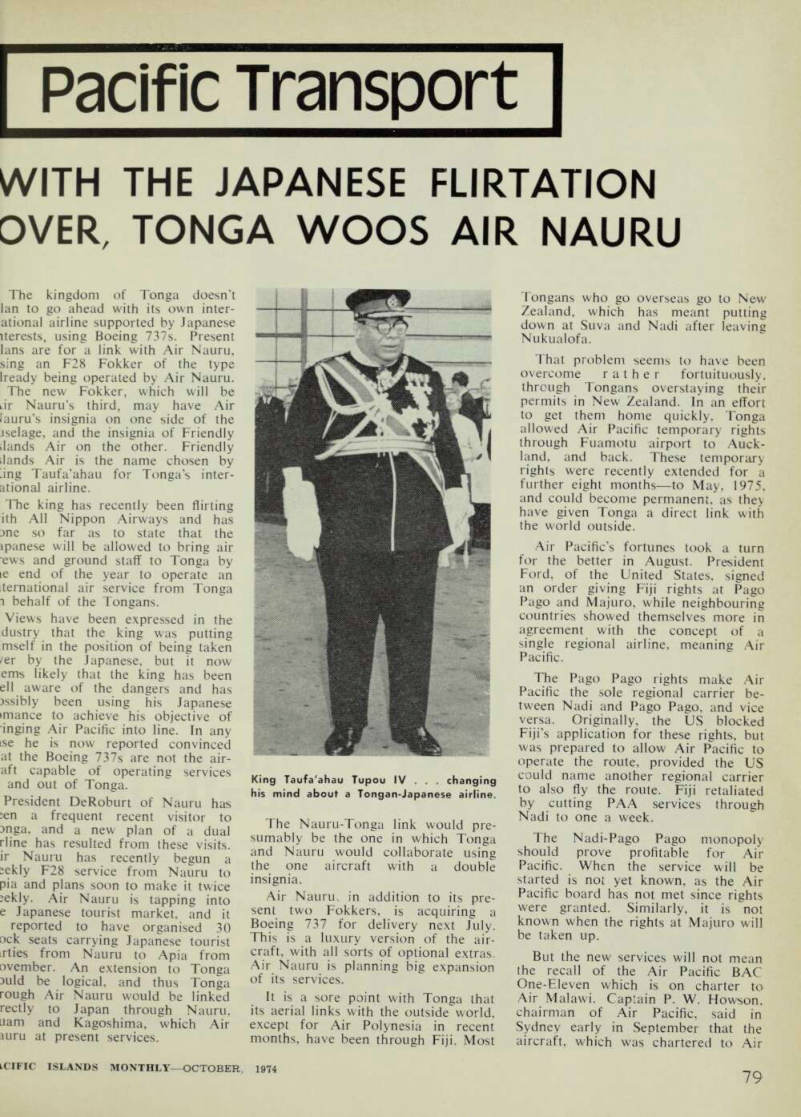


With The Japanese Flirtation
Over, Tonga Woos Air Nauru
The kingdom of Tonga doesn’t lan to go ahead with its own inter ational airline supported by Japanese iterests, using Boeing 7375. Present lans are for a link with Air Nauru, sing an F2B Fokker of the type Iready being operated by Air Nauru.
The new Fokker, which will be dr Nauru’s third, may have Air lauru’s insignia on one side of the aselage, and the insignia of Friendly ilands Air on the other. Friendly ilands Air is the name chosen by dng Taufa’ahau for Tonga’s inter ational airline.
The king has recently been flirting ith All Nippon Airways and has ane so far as to state that the ipanese will be allowed to bring air ews and ground staff to Tonga by ic end of the year to operate an temational air service from Tonga i behalf of the Tongans.
Views have been expressed in the dustry that the king was putting mself in the position of being taken ftr by the Japanese, but it now ems likely that the king has been ell aware of the dangers and has assibly been using his Japanese imance to achieve his objective of inging Air Pacific into line. In any ise he is now reported convinced at the Boeing 737 s are not the air aft capable of operating services and out of Tonga.
President Deßoburt of Nauru has sen a frequent recent visitor to ?nga, and a new plan of a dual rline has resulted from these visits, ir Nauru has recently begun a eekly F2B service from Nauru to pia and plans soon to make it twice jekly. Air Nauru is tapping into e Japanese tourist market, and it reported to have organised 30 □ck seats carrying Japanese tourist irties from Nauru to Apia from □vember. An extension to Tonga Duld be logical, and thus Tonga rough Air Nauru would be linked rectly to Japan through Nauru, uam and Kagoshima, which Air auru at present services.
The Nauru-Tonga link would pre sumably be the one in which Tonga and Nauru would collaborate using the one aircraft with a double insignia.
Air Nauru, in addition to its pre sent two Fokkers, is acquiring a Boeing 737 for delivery next July.
This is a luxury version of the air craft, with all sorts of optional extras.
Air Nauru is planning big expansion of its services.
It is a sore point with Tonga that its aerial links with the outside world, except for Air Polynesia in recent months, have been through Fiji. Most
Tongans who go overseas go to New Zealand, which has meant putting down at Suva and Nadi after leaving Nukualofa.
That problem seems to have been overcome rather fortuituously, through Tongans overstaying their permits in New Zealand. In an effort to get them home quickly, Tonga allowed Air Pacific temporary rights through Fuamotu airport to Auck land, and back. These temporary rights were recently extended for a further eight months—to May, 1975. and could become permanent, as they have given Tonga a direct link with the world outside.
Air Pacific’s fortunes took a turn for the better in August. President Ford, of the United States, signed an order giving Fiji rights at Pago Pago and Majuro, while neighbouring countries showed themselves more in agreement with the concept of a single regional airline, meaning Air Pacific.
The Pago Pago rights make Air Pacific the sole regional carrier be tween Nadi and Pago Pago, and vice versa. Originally, the US blocked Fiji’s application for these rights, but was prepared to allow Air Pacific to operate the route, provided the US could name another regional carrier to also fly the route. Fiji retaliated by cutting PAA services through Nadi to one a week.
The Nadi-Pago Pago monopoly should prove profitable for Air Pacific. When the service will be started is not yet known, as the Air Pacific board has not met since rights were granted. Similarly, it is not known when the rights at Majuro will be taken up.
But the new services will not mean the recall of the Air Pacific BAG One-Eleven which is on charter to Air Malawi. Captain P. W. Howson, chairman of Air Pacific, said in Sydney early in September that the aircraft, which was chartered to Air
King Taufa'ahau Tupou IV . . . changing his mind about a Tongan-Japanese airline.
lalawi for five months, would not 5 required for at least two years.
“We are trying to negotiate an ex nsion of that charter,” he said.
Air Pacific’s main need today is to ;t back into the black through >erational efficiency. Complaints ive been many in recent months >out late arrivals, and even non rivals, without telling anybody. This is infuriated a number of would-be avellers in Tonga.
The problem basically, has been aintenance. The airline does not ive a big enough maintenance staff keep its growing fleet in the air. nd the ageing Herons, which were ed for Royal flights in New Zealand te in 1953, need much more atten >n to keep them airworthy.
Air Pacific expects to be on the ay to overcoming that problem by placing the Herons with Trislanders, e first two of which are expected be in service by the end of 1974.
Dnga Extending
S Tourist Airline
Tonga’s internal airline, operated the Tonga Tourist and Develop ait Co and known locally and in rrectly as Air Vavau, will shortly extending its service to Haapai, 2 central group of the three main oups of Tonga.
The 2,500 ft strip in Haapai, on main island of Lifuka, has been mpleted although it still needs a ished coral surface. The Britten Drman Islanders will begin a once veek service in October, Tongatapu lapai-Tongatapu and, additionally, ce a week, Tongatapu-Haapai ivau and return. The Haapai group s probably the most beautiful island mery in Tonga, and with great irist potential once accommodation d facilities are provided. But with air service, and an overnight ferry vice from Nukualofa the only :ans of contact, it has never seen my visitors.
Lifuka is the island which Captain >ok named “Friendly Island”, and >m which all of Tonga now gets name of the Friendly Islands. It's ly about 4\ sq miles in area with >erb beaches.
The local airline last year began a vice from Nukualofa to Eua, ich has continued profitable, and h the opening of the Haapai strip the main groups are now con ned by air.
The local airline has lately been hit serious fuel shortages, and three les in a month recently had to up fuel from Fiji in its own aircraft keep itself operational.
Pan-Am And Twa
May Join Forces
The possibility that Pan American World Airways may eventually merge with Trans World Airlines is being publicly embraced by both inter national carriers following talks with the US Government.
Chief executives of both airlines met privately with Transportation Secretary Mr Claude S. Brinegar, in separate sessions to discuss their plight.
Both airlines face millions of dollars in losses this year, due to higher fuel costs and a drop in pas senger traffic between the United States and Europe.
“We believe that a Pan Am merger with TWA could provide one logical and positive step toward the long term viability of our nation’s inter national air services,” the TWA chair man, Mr Charles C. Tillinghast, said after the meeting, A Pan Am spokesman said his air line agreed with the TWA statement, but he emphasised that Pan Am is not engaged in merger talks with any one. Such a union between the two carriers would require approval by the Civil Aeronautics Board (CAB).
Mr Tillinghast’s statement, in which Pan Am concurred, said a merger is not the answer to the air lines’ problems for the short-term.
“So long as current economic dis
>cations persist, and until the :onomic benefits of such a merger dually begin to be realised, a period f temporary subsidy would in any be of critical importance.”
Last Spring, both Pan Am and WA asked the CAB for a perma ;nt mail subsidy rate involving ore than SUSIOO million annually i help ease their financial losses.
Pan Am has estimated its 1974 ss at SUS 76 million (SASI million), WA’s loss is expected to be around JS6S million (SA43 million).
A CAB decision on the request is onths away, and Pan Am urgently ipealed to the board in August to ant it a “temporary” subsidy of :arly SUSIO.2 million (SA6.B illion) a month to get the airline ist hungry creditors pending a final ling. —A A P-Reuter.
\N-Am Wants
\Res Raised
Pan American World Airways has ked the US Civil Aeronautics >ard to lift fares between Pago go and Honolulu, and Honolulu d the US west coast. The American moa Government is likely to pro t against the suggested increases.
The new fares sought by PAA on ; Pago Pago-Honolulu route are 76 tourist class, a rise of $7B, and 88 first class, up $146. The ex rsion fare will be based on 85 per it of the tourist fare. PAA says es on the route have not been ad ted since 1959. The suggested new es are equal to US domestic fares.
>Rd Howe
;eps air link Lhe people of Lord Howe Island icted favourably on August 22 en the manager of Airlines of W, Mr P. Steadman, told m that his company would intain the air link with the main d, using a Riley Heron aircraft, e airline has a wet charter of the :raft from Conair for four months, ile it assesses the market reaction. \irlines of NSW will run four ser es a week from Mascot to Lord we Island on Sundays, Wednes 's, Fridays, and Saturdays and will jrn the same day. The first service 5 scheduled for September 15. The ey Heron, in normal conditions, I do the trip in two hours and 20 mtes. Its capacity on the outward ht will be nine passengers and 12 the return. It will carry a limited ount of mail.
At Steadman explained that on ward flights the aircraft would e to have enough fuel to allow it circle over the island for half-an ir and then return if the weather
precluded a landing on the new air strip, The single fare is $65, com pared with the subsidised $54.80 in the flying-boat.
However, capacity is much lower.
The most passengers the airline will be able to take to Lord Howe Island in a week will be 36, compared with 200 during the height of the season carried in the flying-boats.
Conair, the chartering company, under the wet charter, supplies the aircraft, pilots, fuel, and engineering services. It has been operating for many years from Alice Springs to various parts of the Northern Terri tory. It has five Riley Herons, which differ considerably from the original Herons which are used by Air Pacific, The Riley Herons have different engines, and retractable under carriages.
Night Fliers
At Nausori Again
Night-flying restrictions at Nausori Airport in Fiji were expected to end about the middle of September, pro vided two local air traffic controllers qualified for Fiji government permits.
The men trained in New Zealand for two and a half years, and only needed to pass the local examination.
International/Aeradio Ltd, which manages the airport, cut out night landings when the government refused to allow an expatriate air traffic con troller to work at Nausori for three months. During the period of restric tion the airport closed each night at 8.30, although that time was occasion ally extended on special request for local and regional flights by Air Pacific.
Bad Luck Dogs
Fiji's New Ship
The Tabu Soro, the replacement for the Uluilakeba which sank in Lau during Hurricane Lottie in December, 1973, is having a long delivery voyage to Fiji. Engine trouble dogged the ship since it left Norway in May.
It broke down in Port of Spain, Trinidad, and then had further trouble which made it necessary for her to put into Panama for further repairs.
The ship, which was originally ex pected to arrive in Fiji in June, is unlikely to arrive before the middle of October.
Better Nz Service
For The Islands
Fiji, Western Samoa and Tonga can look forward to a better ship ping service from New Zealand early in 1975, when the Union Steam Ship Co of NZ Ltd puts on another con tainer ship. According to the com pany’s foreign trades department manager, Mr Stuart Caspari, the new
container ships will carry 200 to 300 containers, more than twice as many as the Union South Pacific.
The USS Co launched its container service to the three groups with the Tarros class container ship, the Union South Pacific. The ship recently returned to service after repair work in Sydney. Mr Caspari said containers were the coming thing for the South Pacific. Their advantages over loose cargo included faster handling in port, less damage and less pillaging. • The New Zealand Shipping Corporation has added a new ship, the Toa Moana, 1,190 tons, to the Auckland-Cook Islands service. With the Lorena it maintains a fortnightly schedule, with calls at Niue every four weeks. The Toa Moana was delivered recently from Denmark. • Freight rates on Pacific Naviga tion Co vessels operating between New Zealand and Tonga have been lifted by 12 per cent. The two ships the company operates in this trade are the Aoniu and the Frysna. Sharply rising fuel prices are blamed. Bunkers which cost ST23 a ton in New Zea land in 1972, now cost STBO a ton. • Mr Robert Dods, the Fiji Secre tary for Transport and Tourism, has been appointed chairman of the ad visory board which will serve the proposed South Pacific regional ship ping council. Ministers from nine Pacific countries, meeting in Nuku alofa late in August, recommended that the board and council be set up. • New Zealand-Japan is a likely extension of Air New Zealand’s net work of services. The airline has been looking at ramifications of such a service for some time. At present an inhibiting factor is Tokyo airport, which is so busy that it would be difficult to fit in a new service. The service, when it eventuates, is likely to be from Auckland to Nadi, and then direct to Japan. • The airport at Rarotonga has cost almost $lO million to the end of July. The NZ Civil Aviation Minister, Dr Finlay said in the NZ Parliament that about $400,000 for building construction claims had yet to be charged, and another $500,000 would be required for airport main tenance facilities and for accom modating airport staff. • The people of Naisisili village in Fiji, are the proud owners of a launch, 42 ft long with a 12 ft beam.
The boat, which cost $F 1,400, was built for them by Mr Varayame Ratu, of Yaqete Island in the Yasawas. The people will use the launch for fishing and travelling.
Advertisements & other items, pp. 81-86 (4 items)
79
ICIFIC ISLANDS MONTHLY—OCTOBER, 1974
S.P.C. fine fruits
S pc PC PM C % Cling P€
are naturally better
S.P.C. fine fruits are unaffected... except by the goodness of the Sun.
They're truly Nature's own... with an added touch of personalised S.P.C. care.
SPC
everfresh any time.
SPC 4607
COLONIALS
Colonials Raw Denim Flairs... 4 14 oz. heavyweight denim or cord. They're flaired d just the way you like, j Colonials Raw Denim... ? heavy with flair!
RAW
{9 :v„ »<l .&• •y m mm ft * m ...
V Sm
lifjJT
OPEL ASCONA
Hi •• • ••• A beautiful reason for the sales leadership
of Opel in Germany.
When you drive Ascona, it is easy to see why Opel is now the top selling car in its native Germany.
The styling is clean and modern.
Interiors are roomy and relaxing.
Handling is as safe and sure as a car’s can be.
You get exhilarating performance with a choice of 1.2, 1.6 or 1.9 litre engines. Economical fuel consumption and low maintenance costs make Ascona a real money saver.
And with Ascona your Opel Dealer has a complete stock of spare parts readily available. 2-door or 4-door sedans. A sporty Ascona SR. Or 3-door CarA Van.
Each gives you German craftsmanship and continental styling.
A 808 See and drive the new Opel Ascona at LaiWoa, Papeete, Tahiti.
Joseph Cheval and Cie., Noumea, New Caledonia.
Comptoir Frangais des Nouvelles Hebrides, Port Vila, New Hebrides.
Sociedade Agricola Patria e Trabalho, Lda., Dili, Portuguese Timor.
Caterpillar reliability, productivity, availability.
Now you can get it all in a wheel skidder. The 518.
A whole new standard in skidder engineering. 120 turbocharged horsepower, 17,400 pounds of working muscle with full articulation and frame oscillation for stability and minimum maintenance.
Single lever “on the go” powershift. Dual rate steering for controlled response at all speeds.
An operator’s compartment engineered for efficiency with safety features built in for man and machine.
You’ll find all the best skidder ideas, plus added refinement and top quality manufacturing that can make the 518 the backbone of your logging operation.
And Hastings Deering will ensure that your backbone stays in top condition no matter how far in the bush you are. Parts, maintenance, repairs or simply information —we’ll see that you get it fast. That’s People Power!
So go tackle the jungle with the new Cat 518 and Hastings Deering.
People Power:
25 Years in Papua New Guinea
we work as hard, backing-up a single sale,as we do for a fleet. You can depend on it!
tell*
m
HASTINGS DEERING
YOUR;
CATERPILLA
dealer Caterpillar. Cali and tB are trademarks ol Caterpillar Tractor Company. , Throughout Queensland, Northern Territory and South-West Pacific.
B
81
CIFIC ISLANDS MONTHLY—OCTOBER, 1974
/Ific Islands Monthly—October, 1074
Cruising
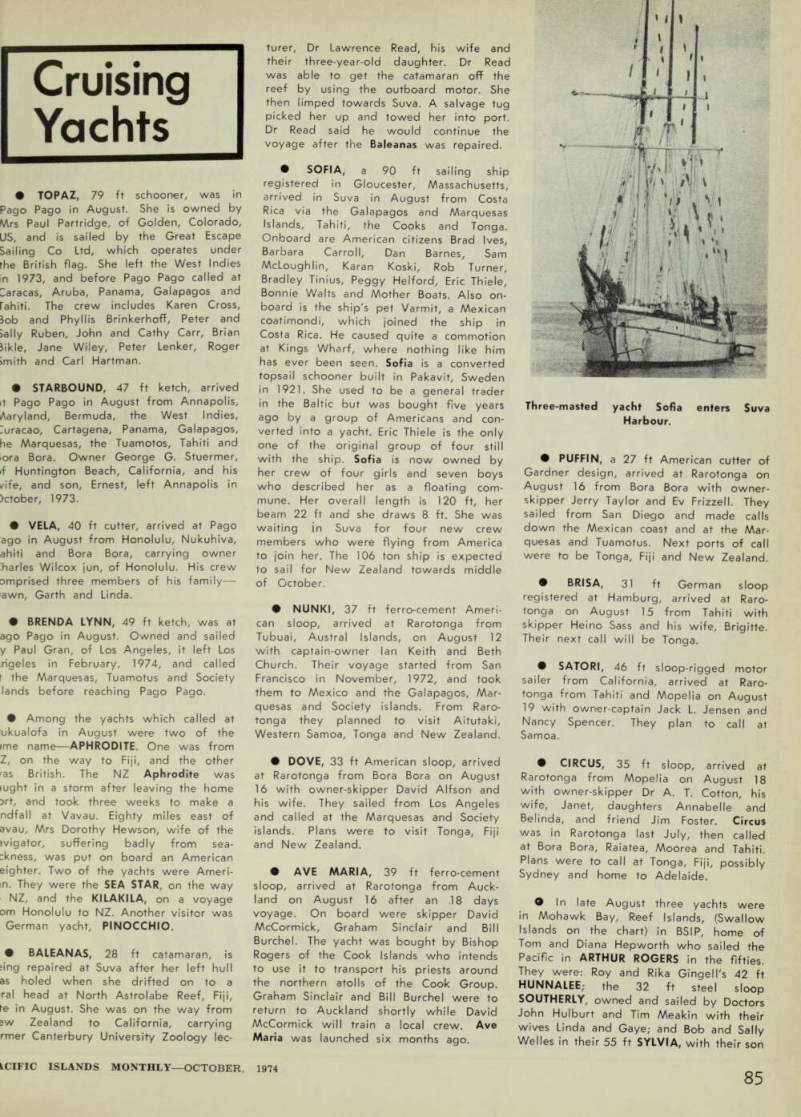

Yachts
• TOPAZ, 79 ft schooner, was in Pago Pago in August. She is owned by Mrs Paul Partridge, of Golden, Colorado, US, and is sailed by the Great Escape Sailing Co Ltd, which operates under the British flag. She left the West Indies in 1973, and before Pago Pago called at Caracas, Aruba, Panama, Galapagos and Fahiti. The crew includes Karen Cross, Job and Phyllis Brinkerhoff, Peter and Sally Ruben, John and Cathy Carr, Brian Jikle, Jane Wiley, Peter Lenker, Roger >mith and Carl Hartman. • STARBOUND, 47 ft ketch, arrived it Pago Pago in August from Annapolis, Aaryland, Bermuda, the West Indies, luracao, Cartagena, Panama, Galapagos, he Marquesas, the Tuamotos, Tahiti and iora Bora. Owner George G. Stuermer, if Huntington Beach, California, and his irife, and son, Ernest, left Annapolis in >ctober, 1973. • VELA, 40 ft cutter, arrived at Pago ago in August from Honolulu, Nukuhiva, ahiti and Bora Bora, carrying owner iharles Wilcox jun, of Honolulu. His crew omprised three members of his family— awn. Garth and Linda. • BRENDA LYNN, 49 ft ketch, was at ago Pago in August. Owned and sailed y Paul Gran, of Los Angeles, it left Los rigeles in February, 1974, and called I- the Marquesas, Tuamotus and Society lands before reaching Pago Pago. • Among the yachts which called at ukualofa in August were two of the ime name— APHRODITE. One was from Z, on the way to Fiji, and the other 'as British. The NZ Aphrodite was lught in a storm after leaving the home >rt, and took three weeks to make a ndfall at Vavau. Eighty miles east of avau, Mrs Dorothy Hewson, wife of the wigator, suffering badly from sea :kness, was put on board an American eighter. Two of the yachts were Ameri n. They were the SEA STAR, on the way NZ, and the KILAKILA, on a voyage om Honolulu to NZ. Another visitor was German yacht, PINOCCHIO. • BALEANAS, 28 ft catamaran, is ?ing repaired at Suva after her left hull as holed when she drifted on to a ral head at North Astrolabe Reef, Fiji, te in August. She was on the way from -w Zealand to California, carrying rmer Canterbury University Zoology lec
turer. Dr Lawrence Read, his wife and their three-year-old daughter. Dr Read was able to get the catamaran off the reef by using the outboard motor. She then limped towards Suva. A salvage tug picked her up and towed her into port.
Dr Read said he would continue the voyage after the Baleanas was repaired. • SOFIA, a 90 ft sailing ship registered in Gloucester, Massachusetts, arrived in Suva in August from Costa Rica via the Galapagos and Marquesas Islands, Tahiti, the Cooks and Tonga.
Onboard are American citizens Brad Ives, Barbara Carroll, Dan Barnes, Sam McLoughlin, Karan Koski, Rob Turner, Bradley Tinius, Peggy Helford, Eric Thiele, Bonnie Walts and Mother Boats. Also on board is the ship's pet Varmit, a Mexican coatimondi, which joined the ship in Costa Rica. He caused quite a commotion at Kings Wharf, where nothing like him has ever been seen. Sofia is a converted topsail schooner built in Pakavit, Sweden in 1921. She used to be a general trader in the Baltic but was bought five years ago by a group of Americans and con verted into a yacht. Eric Thiele is the only one of the original group of four still with the ship. Sofia is now owned by her crew of four girls and seven boys who described her as a floating com mune. Her overall length is 120 ft, her beam 22 ft and she draws 8 ft. She was waiting in Suva for four new crew members who were flying from America to join her. The 106 ton ship is expected to sail for New Zealand towards middle of October. • NUNKI, 37 ft ferro-cement Ameri can sloop, arrived at Rarotonga from Tubuai, Austral Islands, on August 12 with captain-owner lan Keith and Beth Church. Their voyage started from San Francisco in November, 1972, and took them to Mexico and the Galapagos, Mar quesas and Society islands. From Raro tonga they planned to visit Aitutaki, Western Samoa, Tonga and New Zealand. • DOVE, 33 ft American sloop, arrived at Rarotonga from Bora Bora on August 16 with owner-skipper David Alfson and his wife. They sailed from Los Angeles and called at the Marquesas and Society islands. Plans were to visit Tonga, Fiji and New Zealand. • AVE MARIA, 39 ft ferro-cement sloop, arrived at Rarotonga from Auck land on August 16 after an .18 days voyage. On board were skipper David McCormick, Graham Sinclair and Bill Burchel. The yacht was bought by Bishop Rogers of the Cook Islands who intends to use it to transport his priests around the northern atolls of the Cook Group.
Graham Sinclair and Bill Burchel were to return to Auckland shortly while David McCormick will train a local crew, Ave Maria was launched six months ago.
• PUFFIN, a 27 ft American cutter of Gardner design, arrived at Rarotonga on August 16 from Bora Bora with owner skipper Jerry Taylor and Ev Frizzell. They sailed from San Diego and made calls down the Mexican coast and at the Mar quesas and Tuamotus. Next ports of call were to be Tonga, Fiji and New Zealand. • BRISA, 31 ft German sloop registered at Hamburg, arrived at Raro tonga on August 15 from Tahiti with skipper Heino Sass and his wife, Brigitte.
Their next call will be Tonga. • SATORI, 46 ft sloop-rigged motor sailer from California, arrived at Raro tonga from Tahiti and Mopelia on August 19 with owner-captain Jack L. Jensen and Nancy Spencer. They plan to call at Samoa. • CIRCUS, 35 ft sloop, arrived at Rarotonga from Mopelia on August 18 with owner-skipper Dr A. T. Cotton, his wife, Janet, daughters Annabelle and Belinda, and friend Jim Foster. Circus was in Rarotonga last July, then called at Bora Bora, Raiatea, Moorea and Tahiti.
Plans were to call at Tonga, Fiji, possibly Sydney and home to Adelaide.
O In late August three yachts were in Mohawk Bay, Reef Islands, (Swallow Islands on the chart) in BSIP, home of Tom and Diana Hepworth who sailed the Pacific in ARTHUR ROGERS in the fifties.
They were: Roy and Rika Gingell's 42 ft HUNNALEE; the 32 ft steel sloop SOUTHERLY, owned and sailed by Doctors John Hulburt and Tim Meakin with their wives Linda and Gaye; and Bob and Sally Welles in their 55 ft SYLVIA, with their son
Three-masted yacht Sofia enters Suva Harbour.
Scott and a Fiji crew member. All three had come up from New Zealand, entering the Solomons at Graciosa Bay, and all three planned leisurely cruises westward to America. Tom Hepworth sent PIM this news, and adds, for the benefit of others: ’'Don't be put off by Admiralty Chart 17, which is inaccurate. Mohawk Bay is spacious and easy of access, and a perfect anchorage in the Trade Wind season." • LUTE SONG 11, Cuttyhunk auxiliary cetch, arrived in Papeete recently, carry ng David and Ann Harris, who were making a return to the Pacific. They auilt the ketch in Falmouth, England, and ailed from there in June, 1972, calling it Spain, Portugal, Madeira Island, Canary slands, and cruising in the West Indies or 15 months, before coming through he Panama Canal. They cruised in the Galapagos and the Marquesas for about hree months before sailing to Papeete, hey expect to be in French Polynesia ill April, 1975, and will then cruise to Jew Zealand via Samoa, Tonga and Fiji. )avid Harris wrote to PIM from Papeete, hocked at the way that place has hanged since he was last there in 1959.
The prices here are impossible!" he /rote. He also wrote that the Canadian acht, KHADENA, was lost about mid lugust off Rangiroa. The American yacht ATSY ANN would now sail from Papeete :> Hawaii and California instead of New ealand as originally planned. • MATANGI, 36 ft sloop registered at .uckland, arrived at Rarotonga on July 8 from Auckland with owner-skipper Mr . L. Cantwell, his wife, Jennifer, and ?n John. They planned to return to uckland with calls at Tahiti, Tonga, Fiji, ie New Hebrides and New Caledonia. • MAH JONG, 34 ft sloop registered f Auckland, arrived at Rarotonga on July ? with owner-skipper Mr A. Montague id his wife, Meg. They had been cruis ig in the Marquesas and Society Islands id planned to return to Auckland with ills at Tonga and Fiji. © KINYA, a Swedish sloop registered Hamburg, Germany, arrived at Raro mga from Raiatea on August 4 with Kuntedahl and Michael Millard. The icht sailed for Pago Pago on August 7. • TSURU, 75 ft steel-hulled ketch gistered at Wilmington, Del, USA, rived at Rarotonga from Bora Bora on ugust 8 with owner-captain David -1 ler, his wife and two children and ree other crew members. The voyage arted from San Francisco on October 1, *73, and calls were made at the Gala gos, Marquesas and Society islands, lere will be calls at Pago Pago, Fiji, e New Hebrides and the Solomons.
O MOON MIST, a 45 ft ketch-rigged, mkee Clipper-style yacht registered in molulu, arrived at Rarotonga from the
Society Islands on August 8. On board were owner-skipper Dick Chesburgh, his wife Jay and their three children. The family had spent a year cruising, start ing from San Diego and calling at the Hawaiian, Marquesas and Society islands.
They spent three months in the Marquesas and two months in Tahiti. Plans were to call at Tonga and Fiji, and spend the hurricane season in NZ. The sea-going family then hopes to complete a circum navigation. • MARLUVA, 44 ft American sloop, arrived at Rarotonga from Bora Bora on August 6 with owner-captain Andrew Burnes, his wife Amie, Nika Sullivan and Will Castle. Their voyage started from Cape Cod, on the east US coast, and took them through the hinterland water way to Miami and the Bahamas. From there they called at Port Antonio and Montego Bay, both in Jamaica —then the San Bias islands and Panama. Pacific ports of call included the Galapagos, Marquesas and Society islands. Plans were to call at Fiji, then either NZ or Australia—as circumstances dictated. • LA CROSSE, 36 ft ketch registered at San Diego, California, arrived at Raro tonga on July 30 from Tahiti with owner captain B. Turner and Mrs Turner. They sailed for New Zealand on August 10 with calls planned for Tonga and Fiji. • BOBBES, 26 ft sloop, arrived at Rarotonga from Bora Bora on August 9 with Bob Jones and wife Claire. They are sailing the yacht to New Zealand for the German owners Herr Uwe Tolks and his wife, Renata. The German couple cruised from West Germany to Tahiti in Bobbes and flew from there to NZ. Plans were to call at Tonga and Fiji. © KYON, 27 ft sloop registered at Glasgow, arrived at Rarotonga from the Society Islands on July 13 with owner-skipper John Anderson and his wife, Helen. Their cruise started from Glasgow in August 1972, and calls were made at Cork (Ireland) and the Canary
Islands. In the West Indies they cruised from Antigua in the north to Grenada in the south, then visited Venezuela, Curacao and San Bias Islands and the Panama Canal zone. Pacific ports of call included the Galapagos, Marquesas, Tuamotus and Society Islands.
Plans were to call at Tonga and Fiji and be back in Scotland by August 1976, after completing a circumnavigation.
Mr Anderson is an ex-deck officer of the Merchant Navy and served as a midship man in the Royal Navy. • AVILION, 43 ft sloop registered at Durban, South Africa, arrived at Raro tonga from Tahiti and Bora Bora on August 26. On board were the Rogotzki family; owner-skipper Siegfried, his wife Brigitte, and their children, Hans Olaf and Mark Erwin. Plans were to call at Niue Island. • ELLA, 32 ft cutter registered at Honolulu, arrived at Rarotonga on August 27 from Papeete, Bora Bora and Aitutaki with owner-skipper Walter Poitevent. Don Murray and Beth Church joined the yacht in Rarotonga, Beth having left the American sloop NUNKI there. They will call at Pago Pago en route to New Zealand. • Three new yachts arrived in Pago Pago early in September. The DAY SPRING I is owned by R. S. Russell of Suva, Fiji. The boat is 38 feet long, made of cement, built in Auckland, New Zea land, and flies the British flag. Russell and his crew of seven planned to stay a week in American Samoa. ® DULCIANA is owned by Peter J.
Kurst of Anaheim, California. The 32 foot cutter was built in Japan and is sailing out of Newport Beach, California. Kurst has been sailing in French Polynesia and planned a week stay in Pago Pago. • Jane and Dave Gildea, of Palo Alto, California, arrived in the 34 foot cutter VOLUNTEER. The wood-hulled boat was built in Nova Scotia. The Gildeas have been sailing in French Polynesia and planned a one-month visit to Samoa.
Advertisements & other items, pp. 87-90 (4 items)
85
kCIFIC ISLANDS MONTHLY—OCTOBER, 1974
A growing airline
in a shrinking world...
Fly to any of 16 AIR NEW ZEALAND Gateways to the World. m A"
Los Angele
JC~. f la Wk AIR NEW ZEALAND is a truly international airline, flying you throughout the Pacific to any of 16 Gateways to the World, as far apart as Wellington and Singapore, Auckland and Los Angeles.
\bu fly the friendly fleet
of DC 10s and DC Bs.
Our magnificent wide-bodied DC-10s now fly on most international AIR NEW ZEALAND routes. On other flights and services, our personalised DC-8s provide outstanding AIR NEW ZEALAND service.
16 exciting Gateways
to the World.
AIR NEW ZEALAND flies to Hawaii Los Angeles, Hong Kong, Singapore, Sydney, Melbourne, Brisbane, Auckland.
Wellington, Christchurch, Fiji, Tahiti. New Caledonia, Samoa, Rarotonga and Norfolk Island. sr
Singapore
air heiju zEaiann
Friendliest wings across your world.
Talk to AIR NEW ZEALAND or your travel agent
ANZ 233
AITCHISON YACHT MASTS OF
NEW ZEALAND
CONSTRUCT AND SUPPLY FOR YACHTS:
WOODEN MASTS AND SPARS • ALUMINIUM MASTS AND SPARS • ALL SPAR FITTINGS, LIGHTING, ROPES, RIGGING
WINCHES, STAINLESS STEEL BOAT FITTINGS
Yachties for quick experienced service contact the specialist firm with the world wide reputation now !!! We air freight and ship all over the islands. Flagpoles also made and supplied.
AITCHISON YACHT MASTS,
71 ROWANDALE AVE., MANUREWA (P.O. BOX 274, MANUREWA)
AUCKLAND, N.Z. Ph: 63-500
87
4CIFIC ISLANDS MONTHLY—OCTOBER, 1974
British
airways pacific jet news
PUBLISHED BY BRITISH AIRWAYS
A PIM ADVERTISING SUPPLEMENT
A Place By Any Other Name . . .
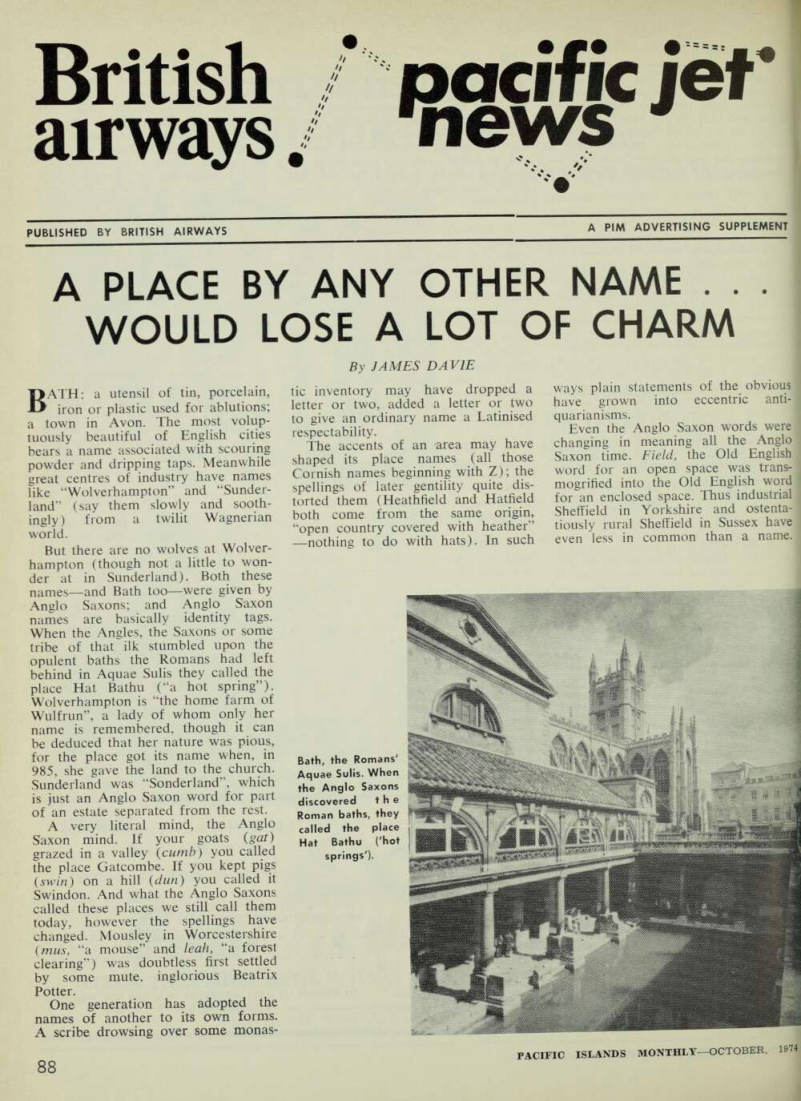
Would Lose A Lot Of Charm
By James Davie
BATH; a utensil of tin, porcelain, iron or plastic used for ablutions; a town in Avon. The most volup tuously beautiful of English cities bears a name associated with scouring powder and dripping taps. Meanwhile great centres of industry have names like “Wolverhampton” and “Sunder land” (say them slowly and sooth ingly) from a twilit Wagnerian world.
But there are no wolves at Wolver hampton (though not a little to won der at in Sunderland). Both these names—and Bath too —were given by Anglo Saxons; and Anglo Saxon names are basically identity tags.
When the Angles, the Saxons or some tribe of that ilk stumbled upon the opulent baths the Romans had left behind in Aquae Sulis they called the place Hat Bathu (“a hot spring”).
Wolverhampton is “the home farm of Wulfrun”, a lady of whom only her name is remembered, though it can be deduced that her nature was pious, for the place got its name when, in 985, she gave the land to the church.
Sunderland was “Sonderland”, which is just an Anglo Saxon word for part of an estate separated from the rest.
A very literal mind, the Anglo Saxon mind. If your goats (gat) grazed in a valley (cumb) you called the place Gatcombe. If you kept pigs (swin) on a hill (dun) you called it Swindon. And what the Anglo Saxons called these places we still call them today, however the spellings have changed. Mousley in Worcestershire (mus, “a mouse” and leak, “a forest clearing”) was doubtless first settled by some mute, inglorious Beatrix Potter.
One generation has adopted the names of another to its own forms.
A scribe drowsing over some monas
tic inventory may have dropped a letter or two, added a letter or two to give an ordinary name a Latinised respectability.
The accents of an area may have shaped its place names (all those Cornish names beginning with Z); the spellings of later gentility quite dis torted them (Heathfield and Hatfield both come from the same origin, “open country covered with heather” —nothing to do with hats). In such
ways plain statements of the obvious have grown into eccentric anti quarianisms.
Even the Anglo Saxon words were changing in meaning all the Anglo Saxon time. Field, the Old English word for an open space was trans mogrified into the Old English word for an enclosed space. Thus industrial Sheffield in Yorkshire and ostenta tiously rural Sheffield in Sussex have even less in common than a name.
Bath, the Romans' Aquae Sulis. When the Anglo Saxons discovered the Roman baths, they called the place Hat Bathu ('hot springs').
fhe first was the open space through vhich the River Sheaf flowed; the econd was an enclosed space in vhich sheep ( sceap ) were kept.
In their sagging tunics and dirty owls the Anglo Saxons cleared and icdged and ditched. Not over mrdened with imagination they abelled each part of a forest cleared, ach enclosure hedged, each settle icnt ditched with some statement of lie startlingly obvious. The names hey slapped on so lightly have stuck ar over a thousand years, for they xercised a pioneer’s right as they so much of England from :rub and marsh (the Celts, a hill welling race, hadn’t dared to, the Romans, an occupying force, hadn’t ared to), Burh was the Old English word ar a fortified settlement; ham for an state, tun for an enclosure, hurst for copse or wooded hillock. Names tiding in borough, ham, ton and urst are scattered liberally across lost of England like picnic litter.
But others had been before; and thers, Vikings and Normans, were ) come after. One pattern of names as imposed upon another until, -Id up to the light of history, the tap of England is as complicated as Persian rug. To you and me it is i idiosyncratically pretty pattern. To i- expert every line has meaning, date can be deduced.
The oldest names on this map be ing to the oldest features in the ndscape. A river is no man’s pre tty; and no man presumes to lange the name it bears. There is geographical plethora of Rivers Esk, xe, Ex and Ouse because these imes all derive from a single Celtic ord, and that word meant no more -and no less—than “water”. But the eat rivers, the Thames, Trent, Tyne, :vern and Tees, have always been lied by these names that go back :yond history, whose meaning is iried deeper than the impertinent obings of etymology can reach.
These names are full of colours id textures. Alainn was beautiful; I, white; breac, spotted; buidhe, How; caien, beautiful; cam and om, crooked; cron, dark brown; arg, red; dubh, black or dark . . . 11 these are components in Gaelic ace names, and we are only four :ters into the alphabet. Allowed to ime a place, the Anglo Saxons con
cocted telegraphic addresses; the Celts wrote sonnets.
The Roman map of Roman Britain was a military plan, for the Romans were concerned chiefly with reconcil ing a dank stretch of territory on the edge of the known world with the needs of military strategy. They built roads, but they imposed few names.
And left even fewer. As every school boy knows, a town with a name end ing in “Chester” or “cester” (standing for castra, a camp) was a Roman garrison. Names like Colchester, Manchester, Winchester, Cirencester are proof of a Roman past as solid as any number of ruined barracks, baths and temples set in municipal flower beds. The Romans, in fact, called these four towns Camulo donum, Mancunium (hence still, to day, a Mancunian, not a Mancas trian), Venta Belgorum and Corinium —old British names crisply trimmed to fit Latin tongues. Caster is an adaptation of the Anglo Saxon caester, still an echo of castra, but a name given by those who came later to the relics of what had been before.
In effect, the Romans when they left rolled up the map and took it with them.
On holey ground
A great hole was dug under York Minster when a reinforced concrete corset was built into its foundations to clamp the cathedral together and save the 210 ft high central tower from collapse. Now the hole is contributing money at the rate of £40,000 a year towards the massive cost of preserving this glorious Gothic building.
In the excavations were found parts of three earlier churches, a Roman legion headquarters and a Saxon burial ground. Using treasures found in the excavated rubble a museum was laid out trans forming an empty hole into 2,000 years of York history. This is known as the Undercroft.
Since it was opened nearly two years ago, about half a million people have made the circular tour. Among the things they see are a restored Roman painting and a 1,000 year-old Viking drinking horn.
in $27 million profit
British Airways turns in $27 million profit
A profit of $A26.9 million for the year ended March 31, 1974, was an nounced by the Chairman of British Airways, Mr David Nicolson, at a conference in London following the publication of the airline’s annual report and accounts. The profit figure compared with SAB.4 million for the previous year, Mr Nicolson said.
The profit before interest and taxation was 5A98.6 million, an in crease of 79.6 per cent on British Airways’ first year of operation and represented a return on assets of 11.7 per cent compared with 6.7 per cent in 1972/73.
The report, however, warns of the growing difficulties the airline industry is experiencing. Fuel prices and other rising costs began to bite during the year under review and British Airways has assumed in its long term plans that it will have to pay substantially increased fuel prices.
“As a consequence we cannot ignore the huge uncertainty that hangs over the scale of our future activities,”
Mr Nicolson said, “but the problem is not solely one for British Airways.
It is one that affects all carriers.
“We believe the future of our enter prise depends on being able to com pete effectively and profitably in all sectors of the air travel market. We intend to maintain our economic position despite inevitable changes that will occur in the general world pattern of air transport.”
The year under review was the first in which the centralised management had controlled the companies within the group and the report goes on to say that the profit justified the creation of British Airways, which was formed from the merger of BOAC and BEA.
It meant that British Airways was able to pay the British Government 5A9.9 million on public dividend capital.
Despite a good year, Mr Nicolson forecast a loss for 1974/75 of 5A22.7 million which could rise to as much as SA29 to SA32 million.
“However,” he said, “depressing as the immediate future may appear to be, it is perhaps some consolation that we are in better financial shape than many of our competitors,”
Advertisements & other items, p. 91 (1 item)
British airways
89
„ ... , . pacific jet British airways
LCIFIC ISLANDS MONTHLY—OCTOBER, 1874
Concorde
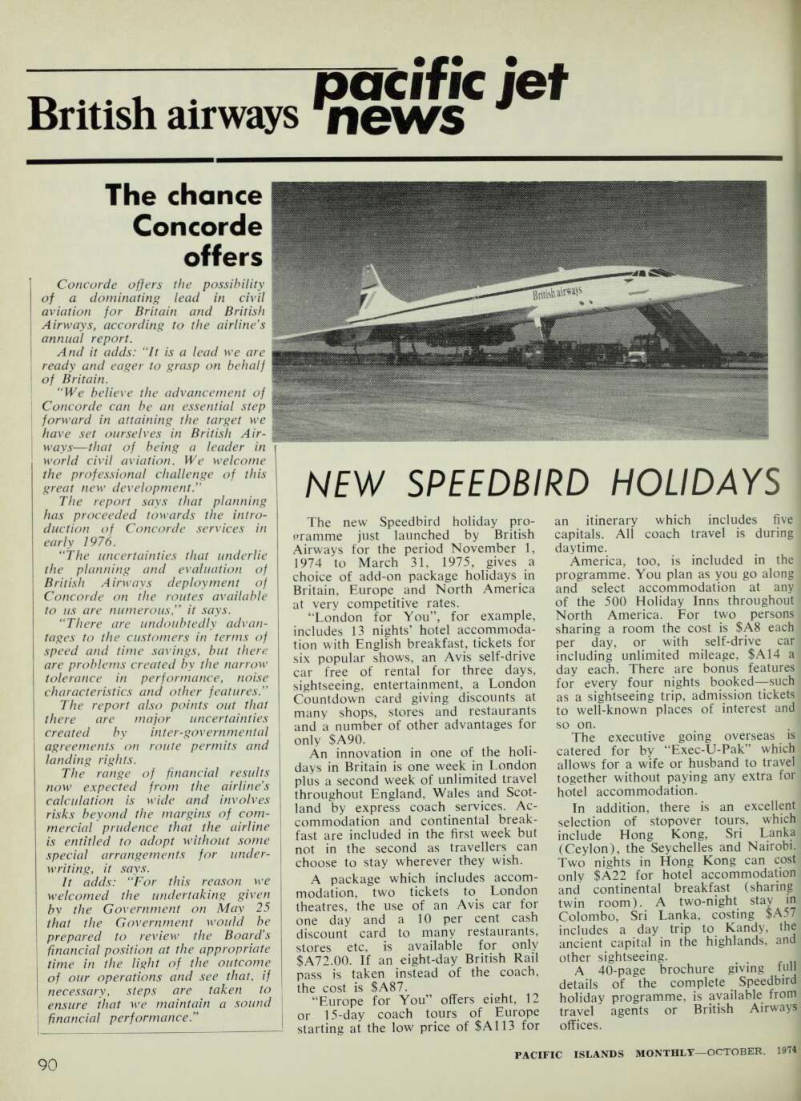
The chance Concorde offers
Concorde offers the possibility j of a dominating lead in civil aviation for Britain and British Airways, according to the airline’s annual report.
And it adds: “It is a lead we are ready and eager to grasp on behalf \ of Britain.
“We believe the advancement of I Concorde can be an essential step forward in attaining the target we have set ourselves in British Air- ways—that of being a leader in world civil aviation. We welcome the professional challenge of this great new development.”
The report says that planning has proceeded towards the intro duction of Concorde services in early 1976.
“The uncertainties that underlie the planning and evaluation of British Airways deployment of Concorde on the routes available to us are numerous,’” it says.
“There are undoubtedly advan tages to the customers in terms of speed and time savings, but there are problems created by the narrow tolerance in performance, noise characteristics and other features.”
The report also points out that there are major uncertainties created by inter-governmental agreements on route permits and landing rights.
The range of financial results now expected from the airline’s calculation is wide and involves risks beyond the margins of com mercial prudence that the airline is entitled to adopt without some special arrangements for under writing, it says.
It adds: “For this reason we welcomed the undertaking given by the Government on May 25 that the Government would be prepared to review the Board’s financial position at the appropriate [ time in the light of the outcome of our operations and see that, if j necessary, steps are taken to ensure that we maintain a sound financial performance.”’
New Speedbird Holidays
The new Speedbird holiday pro gramme just launched by British Airways for the period November 1, 1974 to March 31, 1975, gives a choice of add-on package holidays in Britain, Europe and North America at very competitive rates.
“London for You”, for example, includes 13 nights’ hotel accommoda tion with English breakfast, tickets for six popular shows, an Avis self-drive car free of rental for three days, sightseeing, entertainment, a London Countdown card giving discounts at many shops, stores and restaurants and a number of other advantages for only SA9O.
An innovation in one of the holi days in Britain is one week in London plus a second week of unlimited travel throughout England, Wales and Scot land by express coach services. Ac commodation and continental break fast are included in the first week but not in the second as travellers can choose to stay wherever they wish.
A package which includes accom modation, two tickets to London theatres, the use of an Avis car for one day and a 10 per cent cash discount card to many restaurants, stores etc, is available for only 5A72.00. If an eight-day British Rail pass is taken instead of the coach, the cost is SAB7.
“Europe for You” offers eisht, 12 or 15-day coach tours of Europe starting at the low price of SAII3 for
an itinerary which includes five I capitals. All coach travel is during 1 daytime.
America, too, is included in the programme. You plan as you go along and select accommodation at any of the 500 Holiday Inns throughout ’
North America. For two persons sharing a room the cost is SAB each per day, or with self-drive car including unlimited mileage, SAI4 a day each. There are bonus features i for every four nights booked-such as a sightseeing trip, admission tickets to well-known places of interest and so on.
The executive going overseas is catered for by “Exec-U-Pak” which allows for a wife or husband to travel together without paying any extra for hotel accommodation.
In addition, there is an excellent selection of stopover tours, which include Hong Kong, Sri Lanka (Ceylon), the Seychelles and Nairobi.
Two nights in Hong Kong can cost only SA22 for hotel accommodation and continental breakfast (sharing twin room). A two-night stay in Colombo, Sri Lanka, costing 1A57 includes a day trip to Kandy, the ancient capital in the highlands, and other sightseeing.
A 40-page brochure giving full details of the complete Speedbird holiday programme, is available from travel agents or British Airways offices.
Prince Charles For Fiji Celebrations
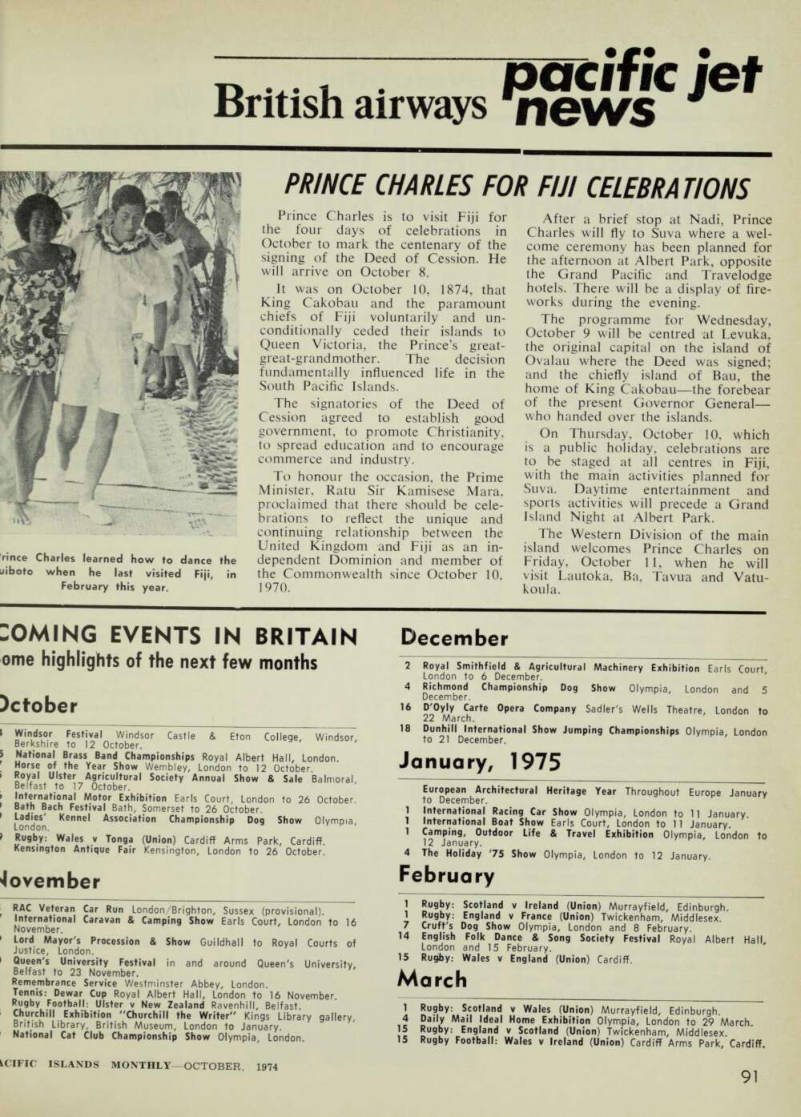
Prince Charles is to visit Fiji for the four days of celebrations in October to mark the centenary of the signing of the Deed of Cession. He will arrive on October 8.
It was on October 10, 1874, that King Cakobau and the paramount chiefs of Fiji voluntarily and un conditionally ceded their islands to Queen Victoria, the Prince’s great great-grandmother. The decision fundamentally influenced life in the South Pacific Islands.
The signatories of the Deed of Cession agreed to establish good government, to promote Christianity, to spread education and to encourage commerce and industry.
To honour the occasion, the Prime Minister, Ratu Sir Kamisese Mara, proclaimed that there should be cele brations to reflect the unique and continuing relationship between the United Kingdom and Fiji as an in dependent Dominion and member of the Commonwealth since October 10. 1970.
After a brief stop at Nadi, Prince Charles will fly to Suva where a wel come ceremony has been planned for the afternoon at Albert Park, opposite the Grand Pacific and Travelodge hotels. There will be a display of fire
works during the evening.
The programme for Wednesday, October 9 will be centred at Levuka, the original capital on the island of Ovalau where the Deed was signed; and the chiefly island of Bau, the home of King Cakobau—the forebear of the present Governor General— who handed over the islands.
On Thursday, October 10, which is a public holiday, celebrations are to be staged at all centres in Fiji, with the main activities planned for Suva. Daytime entertainment and sports activities will precede a Grand Island Night at Albert Park.
The Western Division of the main island welcomes Prince Charles on Friday, October 11, when he will visit Lautoka, Ba, Tavua and Vatu koula.
prince Charles learned how to dance the [?]uiboto when he last visited Fiji, in February this year.
January, 1975
Doming Events In Britain
[?]ome highlights of the next few months
Jctober
I Windsor Festival Windsor Castle & Eton College, Windsor, Berkshire to 12 October. i National Brass Band Championships Royal Albert Hall, London.
Horse of the Year Show Wembley, London to 12 October • Royal Ulster Agricultural Society Annual Show & Sale Balmoral, Belfast to 17 October. > International Motor Exhibition Earls Court, London to 26 October. ’ oath Bach Festival Bath, Somerset to 26 October. ’ Ladies Kennel Association Championship Dog Show Olympia, London. K > Rugby: Wales v Tonga (Union) Cardiff Arms Park, Cardiff.
Kensington Antique Fair Kensington, London to 26 October.
November
' RAC Veteran Car Run London/Brighton, Sussex (provisional).
International Caravan & Camping Show Earls Court, London to 16 November. • Lord Mayor's Procession & Show Guildhall to Royal Courts of Justice, London. • Queen's University Festival in and around Queen's University, Belfast to 23 November.
Remembrance Service Westminster Abbey, London.
Tennis: Dewar Cup Royal Albert Hall, London to 16 November.
Rugby Football: Ulster v New Zealand Ravenhill, Belfast.
Churchill Exhibition "Churchill the Writer" Kings Library gallery, British Library, British Museum, London to January.
National Cat Club Championship Show Olympia, London.
December
2 Royal Smithfield & Agricultural Machinery Exhibition Earls Court London to 6 December. 4 Richmond Championship Dog Show Olympia, London and 5 December. 16 D'Oyly Carte Opera Company Sadler's Wells Theatre, London to 22 March. 18 Dunhill International Show Jumping Championships Olympia, London to 21 December.
January, 1975
European Architectural Heritage Year Throughout Europe January to December. 1 International Racing Car Show Olympia, London to 11 January. 1 International Boat Show Earls Court, London to 11 January. 1 Camping, Outdoor Life & Travel Exhibition Olympia, London to 12 January. 4 The Holiday '75 Show Olympia, London to 12 January.
February
1 Rugby: Scotland v Ireland (Union) Murrayfield, Edinburgh. 1 Rugby: England v France (Union) Twickenham, Middlesex. 7 Cruft's Dog Show Olympia, London and 8 February. 14 English Folk Dance & Song Society Festival Royal Albert Hall, London and 15 February. 15 Rugby: Wales v England (Union) Cardiff.
March
1 Rugby; Scotland v Wales (Union) Murrayfield, Edinburgh. 4 Daily Mail Ideal Home Exhibition Olympia, London to 29 March. 15 Rugby: England v Scotland (Union) Twickenham, Middlesex. 15 Rugby Football: Wales v Ireland (Union) Cardiff Arms Park, Cardiff.
Advertisements & other items, p. 93 (1 item)
British airways
91
n ... . pacific jet British airways
LCIFIC ISLANDS MONTHLY—OCTOBER, 1974
PNG planters fear legal
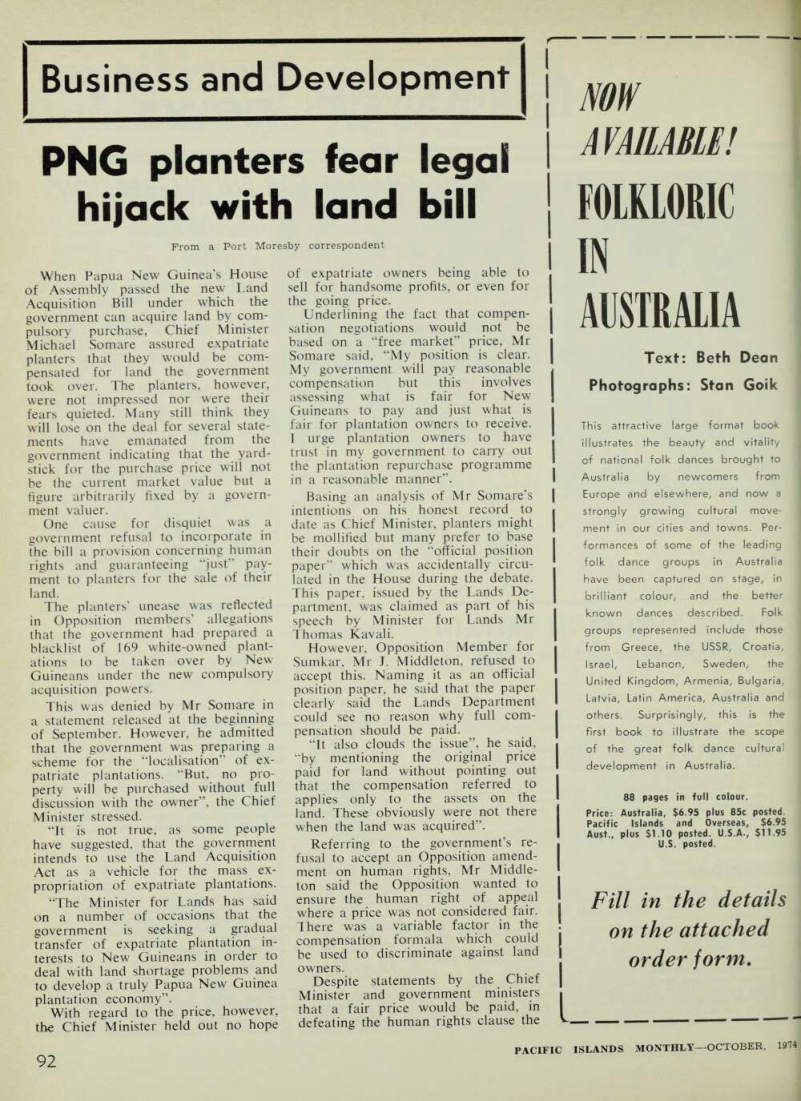
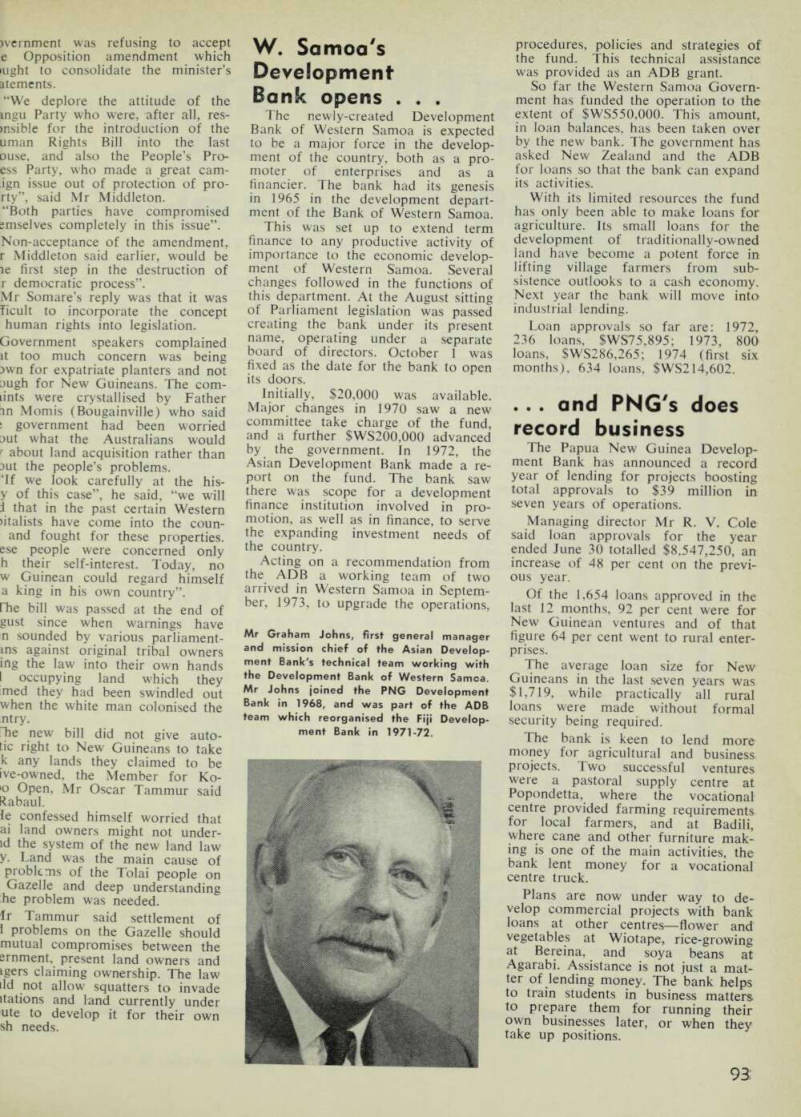
Business and Development
PNG planters fear legal hijack with land bill
From a Port Moresby correspondent
When Papua New Guinea’s House of Assembly passed the new Land Acquisition Bill under which the government can acquire land by com pulsory purchase, Chief Minister Michael Somare assured expatriate planters that they would be com pensated for land the government took over. The planters, however, were not impressed nor were their fears quieted. Many still think they will lose on the deal for several state ments have emanated from the government indicating that the yard stick for the purchase price will not be the current market value but a figure arbitrarily fixed by a govern ment valuer.
One cause for disquiet was a government refusal to incorporate in the bill a provision concerning human rights and guaranteeing “just” pay ment to planters for the sale of their land.
The planters’ unease was reflected in Opposition members’ allegations that the government had prepared a blacklist of 169 white-owned plant ations to be taken over by New Guineans under the new compulsory acquisition powers.
This was denied by Mr Somare in a statement released at the beginning of September. However, he admitted that the government was preparing a scheme for the “localisation” of ex patriate plantations. “But, no pro perty will be purchased without full discussion with the owner”, the Chief Minister stressed.
“It is not true, as some people have suggested, that the government intends to use the Land Acquisition Act as a vehicle for the mass ex propriation of expatriate plantations.
“The Minister for Lands has said on a number of occasions that the government is seeking a gradual transfer of expatriate plantation in terests to New Guineans in order to deal with land shortage problems and to develop a truly Papua New Guinea plantation economy”.
With regard to the price, however, the Chief Minister held out no hope
of expatriate owners being able to sell for handsome profits, or even for the going price.
Underlining the fact that compen sation negotiations would not be based on a “free market” price, Mr Somare said, “My position is clear.
My government will pay reasonable compensation but this involves assessing what is fair for New Guineans to pay and just what is fair for plantation owners to receive.
I urge plantation owners to have trust in my government to carry out the plantation repurchase programme in a reasonable manner”.
Basing an analysis of Mr Somare’s intentions on his honest record to date as Chief Minister, planters might be mollified but many prefer to base their doubts on the “official position paper” which was accidentally circu lated in the House during the debate.
This paper, issued by the Lands De partment, was claimed as part of his speech by Minister for Lands Mr Thomas Kavali.
However, Opposition Member for Sumkar, Mr J. Middleton, refused to accept this. Naming it as an official position paper, he said that the paper clearly said the Lands Department could see no reason why full com pensation should be paid.
“It also clouds the issue”, he said, “by mentioning the original price paid for land without pointing out that the compensation referred to applies only to the assets on the land. These obviously were not there when the land was acquired”.
Referring to the government’s re fusal to accept an Opposition amend ment on human rights, Mr Middle ton said the Opposition wanted to ensure the human right of appeal where a price was not considered fair.
There was a variable factor in the compensation formala which could be used to discriminate against land owners.
Despite statements by the Chief Minister and government ministers that a fair price would be paid, in defeating the human rights clause the
jvcrnment was refusing to accept e Opposition amendment which lught to consolidate the minister’s atements.
“We deplore the attitude of the mgu Party who were, after all, res msible for the introduction of the uman Rights Bill into the last ouse, and also the People’s Pro ess Party, who made a great cam ign issue out of protection of pro rty”, said Mr Middleton.
“Both parties have compromised smselves completely in this issue”.
Non-acceptance of the amendment, r Middleton said earlier, would be ae first step in the destruction of r democratic process”.
Mr Somare’s reply was that it was Ticult to incorporate the concept human rights into legislation.
Government speakers complained it too much concern was being Dwn for expatriate planters and not augh for New Guineans. The com lints were crystallised by Father in Momis (Bougainville) who said : government had been worried aut what the Australians would r about land acquisition rather than aut the people’s problems. ‘lf we look carefully at the his y of this case”, he said, “we will i that in the past certain Western fitalists have come into the coun and fought for these properties, ese people were concerned only h their self-interest. Today, no w Guinean could regard himself a king in his own country”, fhe bill was passed at the end of gust since when warnings have n sounded by various parliament ms against original tribal owners ing the law into their own hands I occupying land which they imed they had been swindled out when the white man colonised the ntry.
Tie new bill did not give auto tic right to New Guineans to take k any lands they claimed to be ive-owned, the Member for Ko -10 Open, Mr Oscar Tammur said Rabaul. le confessed himself worried that ai land owners might not under id the system of the new land law y. Land was the main cause of problems of the Tolai people on Gazelle and deep understanding he problem was needed.
Ir Tammur said settlement of 1 problems on the Gazelle should mutual compromises between the srnment, present land owners and igers claiming ownership. The law ild not allow squatters to invade itations and land currently under ute to develop it for their own sh needs.
W. Samoa's
Development
Bank opens . . .
The newly-created Development Bank of Western Samoa is expected to be a major force in the develop ment of the country, both as a pro moter of enterprises and as a financier. The bank had its genesis in 1965 in the development depart ment of the Bank of Western Samoa.
This was set up to extend term finance to any productive activity of importance to the economic develop ment of Western Samoa. Several changes followed in the functions of this department. At the August sitting of Parliament legislation was passed creating the bank under its present name, operating under a separate board of directors. October 1 was fixed as the date for the bank to open its doors.
Initially, $20,000 was available.
Major changes in 1970 saw a new committee take charge of the fund, and a further SWS2OO,OOO advanced by the government. In 1972, the Asian Development Bank made a re port on the fund. The bank saw there was scope for a development finance institution involved in pro motion, as well as in finance, to serve the expanding investment needs of the country.
Acting on a recommendation from the ADB a working team of two arrived in Western Samoa in Septem ber, 1973, to upgrade the operations,
procedures, policies and strategies of the fund. This technical assistance was provided as an ADB grant.
So far the Western Samoa Govern ment has funded the operation to the extent of $W5550,000. This amount, in loan balances, has been taken over by the new bank. The government has asked New Zealand and the ADB for loans so that the bank can expand its activities.
With its limited resources the fund has only been able to make loans for agriculture. Its small loans for the development of traditionally-owned land have become a potent force in lifting village farmers from sub sistence outlooks to a cash economy.
Next year the bank will move into industrial lending.
Loan approvals so far are: 1972, 236 loans, $W575,895; 1973, 800 loans, $W5286,265; 1974 (first six months), 634 loans, $W5214,602.
. . . and PNG's does
record business
The Papua New Guinea Develop ment Bank has announced a record year of lending for projects boosting total approvals to $39 million in seven years of operations.
Managing director Mr R. V. Cole said loan approvals for the year ended June 30 totalled $8,547,250, an increase of 48 per cent on the previ ous year.
Of the 1,654 loans approved in the last 12 months, 92 per cent were for New Guinean ventures and of that figure 64 per cent went to rural enter prises.
The average loan size for New Guineans in the last seven years was $1,719, while practically all rural loans were made without formal security being required.
The bank is keen to lend more money for agricultural and business projects. Two successful ventures were a pastoral supply centre at Popondetta, where the vocational centre provided farming requirements for local farmers, and at Badili, where cane and other furniture mak ing is one of the main activities, the bank lent money for a vocational centre truck.
Plans are now under way to de velop commercial projects with bank loans at other centres—flower and vegetables at Wiotape, rice-growing at Bereina, and soya beans at Agarabi. Assistance is not just a mat ter of lending money. The bank helps to train students in business matters to prepare them for running their own businesses later, or when they take up positions.
Mr Graham Johns, first general manager and mission chief of the Asian Develop ment Bank's technical team working with the Development Bank of Western Samoa.
Mr Johns joined the PNG Development Bank in 1968, and was part of the ADB team which reorganised the Fiji Develop ment Bank in 1971-72.
Advertisements & other items, pp. 94-96 (1 item)
Foirioric
NOW
AVAILABLE!
IN
AUSTRALIA
Text: Beth Dean
Photographs: Stan Goik
This attractive large format book illustrates the beauty and vitality of national folk dances brought to Australia by newcomers from Europe and elsewhere, and now a strongly growing cultural movement in our cities and towns. Performances of some of the leading folk dance groups in Australia have been captured on stage, in brilliant colour, and the better known dances described. Folk groups represented include those from Greece, the USSR, Croatia, Israel, Lebanon, Sweden, the United Kingdom, Armenia, Bulgaria, Latvia, Latin America, Australia and others. Surprisingly, this is the first book to illustrate the scope of the great folk dance cultural development in Australia. 88 pages in full colour.
Price: Australia, $6.95 plus 85c posted.
Pacific Islands and Overseas, $6.95 Aust., plus $l.lO posted. U.S.A., $11.95 U.S. posted.
Fill in the details
on the attached
order form .
mr fix says
with
M ARSON Tools & Rivets
7
HERE'S HOW THEY WORK
Insert pointed end of stem Into tool.
Piece rivet in prepared hole and squeeze handles.
"Klik" the rivet 1* set, stem breaks oft completely and is ejected.
HERE'S WHAT THEY DO
Replace spot welding, nuts and bolts, screws and other less economical methods of fastening. The fastening is quicker, stronger, cheaper and resistant to vibration. Ideal for hundreds of repair and construction needs . . . mending toys, metal furniture, awnings, etc.
MARSON No. 220
WORKSHOP MASTER
The most complete tradesman and handyman construction and repair kit. Contains HP4 plier plus 200 assorted rivets in steel carrying case. Suggested retail $25.00.
MARSON HP2/4 MONITOR
The world's strongest and most versatile riveting tool in steel case. Sets rivets 3/32" to 3/16" diameter. Suggested retail $21.30. mr ; su
RAK-66 RIVET-ALL KIT
The only deluxe riveting kit in attractive gift pack. Contains riveting plier and large assortment of rivets. Sets three sizes of rivets. Suggested retail $5.89. mns
MARSON No. 250
MASTER MARINER
Designed specially for the boat builder. Contains HP4 hand plier plus over 200 assorted rivets in copper, stainless steel and marine specification aluminium.
Suggested retail $26.25.
saS*
LAZY TONG RIVETER
Sets rivets up to 3/16" dia. Small diameter head permits riveting in restricted areas.
Suggested retail $27.75. % ’I
MARSON KLIK FAST RIVETS
Klik fast rivets are available in minor packs of 25, poly bags of 100 and boxes of 500.
They are available in steel, aluminium, copper, and stainless steel, in 1/8", 5/32", 3/16" and %" dia. and from 1/8" (3mm) long to 2" (50mm) long.
AT ALL LEADING HARDWARE STORES
Distributed all over Australia and guaranteed by MARSON PRODUCTS (AUST.) PTY. LTD. 108 Warrane Road, Willoughby, N.S.W.
Hooker—alive and doing
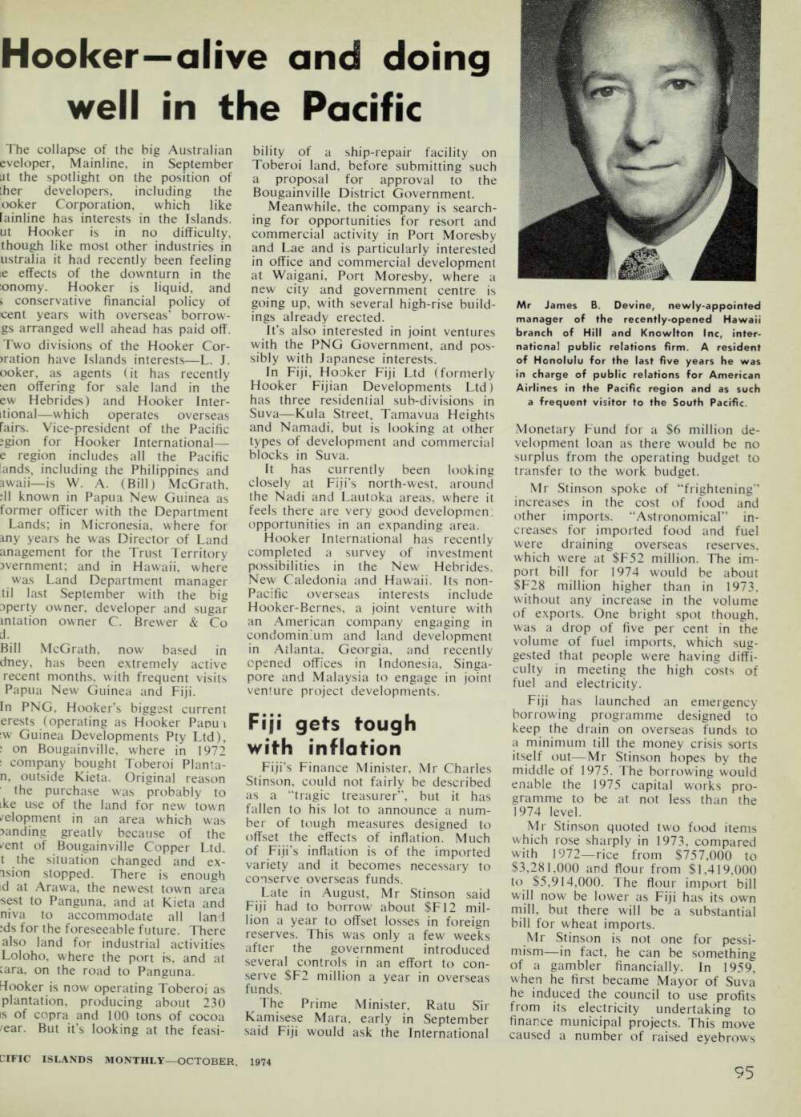
well in the Pacific
The collapse of the big Australian eveloper, Mainline, in September Lit the spotlight on the position of ther developers, including the ooker Corporation, which like fainline has interests in the Islands, ut Hooker is in no difficulty, though like most other industries in ustralia it had recently been feeling ie effects of the downturn in the onomy. Hooker is liquid, and i conservative financial policy of cent years with overseas’ borrow gs arranged well ahead has paid off.
Two divisions of the Hooker Cor >ration have Islands interests—L. J. ooker, as agents (it has recently :en offering for sale land in the ew Hebrides) and Hooker Inter itional—which operates overseas fairs. Vice-president of the Pacific jgion for Hooker International— e region includes all the Pacific lands, including the Philippines and awaii —is W. A. (Bill) McGrath, :11 known in Papua New Guinea as former officer with the Department Lands; in Micronesia, where for any years he was Director of Land anagement for the Trust Territory avernment; and in Hawaii, where was Land Department manager til last September with the big aperty owner, developer and sugar mtation owner C. Brewer & Co d.
Bill McGrath, now based in dney, has been extremely active recent months, with frequent visits Papua New Guinea and Fiji.
In PNG, Hooker’s biggest current erests (operating as Hooker Panua w Guinea Developments Pty Ltd), on Bougainville, where in 1972 company bought Toberoi Planta n, outside Kieta. Original reason the purchase was probably to ike use of the land for new town /elopment in an area which was sanding greatly because of the /ent of Bougainville Copper Ltd. t the situation changed and ex ision stopped. There is enough id at Arawa, the newest town area sest to Panguna, and at Kieta and niva to accommodate all land ;ds for the foreseeable future. There also land for industrial activities Loloho, where the port is, and at :ara, on the road to Panguna.
Hooker is now operating Toberoi as plantation, producing about 230 is of copra and 100 tons of cocoa /ear. But it’s looking at the feasi
bility of a ship-repair facility on Toberoi land, before submitting such a proposal for approval to the Bougainville District Government.
Meanwhile, the company is search ing for opportunities for resort and commercial activity in Port Moresby and Lae and is particularly interested in office and commercial development at Waigani, Port Moresby, where a new city and government centre is going up, with several high-rise build ings already erected.
It’s also interested in joint ventures with the PNG Government, and pos sibly with Japanese interests.
In Fiji, Hooker Fiji Ltd (formerly Hooker Fijian Developments Ltd) has three residential sub-divisions in Suva—Kula Street, Tamavua Heights and Namadi, but is looking at other types of development and commercial blocks in Suva.
It has currently been looking closely at Fiji’s north-west, around the Nadi and Lautoka areas, where it feels there are very good developmen: opportunities in an expanding area.
Hooker International has recently completed a survey of investment possibilities in the New Hebrides, New Caledonia and Hawaii. Its non- Pacific overseas interests include Hooker-Bernes, a joint venture with an American company engaging in condominium and land development in Atlanta, Georgia, and recently opened offices in Indonesia, Singa pore and Malaysia to engage in joint venture project developments.
Fiji gets tough
with inflation
Fiji’s Finance Minister, Mr Charles Stinson, could not fairly be described as a “tragic treasurer”, but it has fallen to his lot to announce a num ber of tough measures designed to offset the effects of inflation. Much of Fiji’s inflation is of the imported variety and it becomes necessary to conserve overseas funds.
Late in August, Mr Stinson said Fiji had to borrow about SFI2 mil lion a year to offset losses in foreign reserves. This was only a few weeks after the government introduced several controls in an effort to con serve SF2 million a year in overseas funds.
The Prime Minister, Ratu Sir Kamisese Mara, early in September said Fiji would ask the International
Monetary Fund for a $6 million de velopment loan as there would be no surplus from the operating budget to transfer to the work budget.
Mr Stinson spoke of “frightening” increases in the cost of food and other imports. “Astronomical” in creases for imported food and fuel were draining overseas reserves, which were at SFS2 million. The im port bill for 1974 would be about SF2B million higher than in 1973, without any increase in the volume of exports. One bright spot though, was a drop of five per cent in the volume of fuel imports, which sug gested that people were having diffi culty in meeting the high costs of fuel and electricity.
Fiji has launched an emergency borrowing programme designed to keep the drain on overseas funds to a minimum till the money crisis sorts itself out —Mr Stinson hopes by the middle of 1975. The borrowing would enable the 1975 capital works pro gramme to be at not less than the 1974 level.
Mr Stinson quoted two food items which rose sharply in 1973, compared with 1972—rice from $757,000 to $3,281,000 and flour from $1,419,000 to $5,914,000. The flour import bill will now be lower as Fiji has its own mill, but there will be a substantial bill for wheat imports.
Mr Stinson is not one for pessi mism—in fact, he can be something of a gambler financially. In 1959, when he first became Mayor of Suva he induced the council to use profits from its electricity undertaking to finance municipal projects. This move caused a number of raised eyebrows
Mr James B. Devine, newly-appointed manager of the recently-opened Hawaii branch of Hill and Knowlton Inc, inter national public relations firm. A resident of Honolulu for the last five years he was in charge of public relations for American Airlines in the Pacific region and as such a frequent visitor to the South Pacific.
long the financial pundits of the en colonial administration, but any iticism was in hushed, off-the-record ties. It may be that 1975 will see tn steering Fiji through smoother ancial waters.
World sugar prices are at almost precedented levels, and copra, hough not as high as three or four >nths ago, is bringing good prices, ith some doubts about the current > soy bean crop, copra growers ve little to fear about future prices.
And Fiji is looking to increased »ar sales, limited only by produc n, to the United States in 1975. e US is studying the possibility of ling sugar quotas before they ex e on December 31, 1974. This uld give any country with diplo itic relations with the US the right send sugar without restriction.
Fhe Fiji quota at present is about 000 tons a year; the country be /es it can supply the US with ),000 tons a year, which would e the economy a tremendous lift, 1 help to build up those overseas erves. i The Mitsui Mining and Smelt- Co, of Japan, unable to build a mina plant in Japan because of lution-control problems, is looking the possibility of setting up on inel Island in the Solomons.
BSIP aims of
self-sufficiency
The Solomon Islands should aim at becoming self-sufficient in basic foods, where such a policy made economic and political sense, and sup plying other basic foods at the lowest cost to the country. This was sug gested by a committee which investi gated the demand and supply of local and imported food as part of the government’s plan to combat rising prices.
The committee limited itself to the study of foods which were the basis of family diet for most people in the Solomons—root crops, mainly sweet potato, rice, flour, bread, biscuits, fresh, frozen and tinned fish and sugar.
Recent studies suggested that at least 60 per cent of Solomon Islander cash income in the lower brackets was spent on food. Insufficient atten tion had been given in the past to the role of supply and price of food in deciding real income.
Food production had been under valued and cash incomes had been given too much prominence as a measure of development. Cash in comes were usually earned where im ported food was advertised and readily available, and local foods
were not promoted or were in short supply. TTie result was an ever increasing use of imports, and crea tion of long-term problems of foreign exchange and dependence on basic foods from overseas.
The committee, referring to root crops, recommended that generous provision be made in all urban plans for garden land, up to one acre for each household, if possible, and im proved planning and extension work to help food gardening, especially the cultivation of the sweet potato. A marketing agency, with the full back ing of the government, should be set up in Honiara, and possibly other towns, to market root crops. Small markets should be set up in all hous ing areas.
Guadalcanal Plains Ltd should de velop and market a standard low-cost rice for the home market. The government should give more help to local fishermen to market their catches.
The government should also ap point an authority to co-ordinate the transport, slaughter and marketing of local beef. The tariff should be re moved from Fiji sugar, tinned meat and fish. An import trade committee should be set up to take advantage of favourable trading opportunities in other countries.
As an immediate follow-up to the
report, the government should make a feasibility study, with commercial banks and import traders, of an im port credit guarantee scheme for the bulk ordering of basic foods.
The chairman of the committee was the Governing Council member for South Guadalcanal, Rennell and Bellona, Mr Stephen Cheka, sitting with Messrs Samuel Saki, Stephen Yee. Roy Kershaw, Anthony Grif fiths, Charles Johnson and Tony Hughes (executive secretary).
Meanwhile, the tourist industry is lamenting the shortage of US dollars, caused by a sharp drop-off in the number of American tourists. Against that, more tourists from Australia, New Zealand and Europe are visiting the Solomons.
Mr Ollie Torling, managing direc tor of Tambea Village Tourist Re sort Ltd, said his company was not making money this year, because few Americans were visiting the Solo mons. Mr Bruce Saunders, a director of Laulasi Adventure Tours Co, Malaita, said his business had also been affected.
Devaluation of American currency is given as the reason for the drop in American tourists. They visited other areas which were cheaper to get to.
Another resort
hotel tor Tonga
Work has begun on the 96-room Ha’atafu Beach Resort Hotel on the west coast of Tongatapu, 13 miles from Nukualofa. The owners, Pacific Resorts Pty Ltd, operating through their Tongan company,
Tonga Tourist and Development Co, plan to complete the first stage of 58 rooms by next July in time for the next meeting of the South Pacific Forum —the annual summit meeting of Pacific leaders.
Pacific Resorts already owns the magnificent Port of Refuge Hotel in Vavau, Tonga’s northern group, which is the only international stan dard hotel in the group besides the government-owned Tonga Inter national Dateline, in Nukualofa.
The Dateline has dropped its stan dards of accommodation and service in recent years, and if the new Ha’atafu Beach Resort provides the same standard provided in Vavau then the Dateline will lose customers.
The beach at Ha’atafu is a magnifi cent white sand beach, and the com pany is also providing a nine-hole golf course.
Tonga can expect an influx of Japanese businessmen on holidays through word-of-mouth advertising by the president of a Japanese in dustrial company, Mr Seitaro Iwai.
Mr Iwai, during a recent holiday, said Tonga was fortunate as nature had not been interfered with. He intended to return and would also tell his Japanese friends that Tonga was the place to visit for holidays.
Mr Iwai met King Taufa’ahau and government leaders. He was the guest of the king at a feast, during which he presented him with a samurai sword in recognition of the king’s interest in Japan’s traditional sport. He also presented the king with a traditional Sumo costume decorated with traditional Japanese designs.
Coral Gardens
in doubt?
The immediate future of the luxurious, yet uncompleted Corali Gardens Hotel, Korolevu, Fiji, is in doubt now that Mainline Corporation! in Australia is in receivership. Main-1 line owned about 76 per cent of Coral Gardens. Work is still pro ceeding on the hotel, but for howl long is the question.
Mainline was overdrawn with the First National City Bank and had in tended to put money into the project to finish it, when it went into receiver ship. There are now two options:] (1) First National City Bank elects to complete the project; (2) someone else buys it and completes it.
Noahs Ltd, which was to managd the hotel, is concerned. Originally it had been intended to open the hotel in October, and bookings were ac-l cepted for October, November and December. A strike by building workers set the opening date back to December. Now the Mainline troubles make it impossible to fore-| cast an opening date.
A spokesman for Noahs said Noahs had conducted a “very success ful promotion” for the Coral Gardens Hotel, and the company held “fan tastic” bookings for October, Novem ber and December.
“We hope that people will under stand,” he added.
Mainline Construction (Fiji) Ltc did not get caught up in the receiver ship of the Mainline Corp Ltd ir Australia. The Carpenter group ii Fiji owns 50 per cent of Mainlim Construction, which has erectec several big buildings.
“They are still carrying on as fa as we are concerned,” a Carpente spokesman said in Sydney. “The] are still earning money and makinj money. It is a viable proposition ii
every way.”
PNG to start
a pension scheme
The Papua New Guinea Govern ment will set up a compulsor national provident fund scheme t( apply, initially, to all urban worker and later to rural workers. Payment will be made when the participant reach 55.
The scheme will be based on : contribution equal to 12 per cent o salary—seven per cent paid by th employer, and five per cent by th employee. One of the chief aims o the scheme is to help people wh( have moved from traditional villag life into the cash economy.
Advertisements & other items, pp. 97-100 (3 items)
95
CIFIC ISLANDS MONTHLY—OCTOBER. 1974
STuarT
KNOX SCHLAPP PTY. LTD
SOUTH WEST PACIFIC AGENTS FOR:
<o
MARINE & INDUSTRIAL ENGINES
STuarT
MARINE PETROL ENGINES
SAVAGE
MARINE ENGINE COOLING
SYSTEMS & ACCESSORIES
MUIR
ANCHOR WINCHES & WINDLASSES.
CAPSTANS—HYDRAULIC &
MECHANICAL STEERING SYSTEMS
KNOX SCHLAPP PTY. LTD.
135-139 McEVOY STREET,
Phone: 699 8333. Telex: AA20483.
SUB AGENTS:
• FATHOM FISHERIES, TONGA.
• S, A. HEATH & SONS, PORT MORESBY.
• LUTHERAN SHIPPING, MADANG.
• NEW HEBRIDES MTS, PORT VILA.
• SASAPE SLIPWAYS, TULAGI, HONIARA.
• SHERWOOD ENGINEERING, RABAUL.
ALEXANDRIA, N.S.W., 2015.
Telegrams: "KNOXSCHLAP", Sydney.
Write for literature on
GARDNER □
STUART □ MUIR □
SAVAGE □
Please tick your requirement Name Address
POST THIS COUPON TODAY!
DAIWA BANK SERVING YOU IN THE PACIFIC BASIN Head Office Osaka,Japan With 137 Branches throughout Japan Singapore Representative Office Suite No. 1007, 10th Floor Robina House 1 Shenfon Way, Singapore 1 Republic of Singapore Cable Address: SINGDAIWA Affiliated Bank P.T BANK PERDANIA Djalan Raya Mangga Besar 7&9 Djakarta Our Correspondent Banks are in city— Apia, Suva, Lae, Madang Port Moresby, Rabaul Wewak. Guam, all Principal cities in Australia and New Zealand Contact your banker or our office.
Los Angeles Agency 555 South Flower St. Suite 4040 los Angeles, Calif. 90071 Sydney Representative Office Bth Floor Prudential Building 39-49, Martin Place, Sydney
THE DAIWA BANK LTD.
Head Office : 21. Bingomachi 2-chome, Higashi-ku, Osaka, Japan Overseas : London. New York. Los Angeles. Frankfurt. Sydney, Singapore
ENGINEERING CONSULTING SERVICES
515 Stanley Street, South Brisbane, Q. 4101 Australia.
Phone (072) 44 6911
WE STANDBY—OUR STANDBYS
Diesel Powered Electric Generating Sets. Second hand available Ex Stock llKv, 6.6Kv, 4 5V 240VTransformers HKv-415V, 6.6Kv-415V. AUSTRALIA'S LARGEST RANGE
' OF DIESEL STEAMGAS TURBINES.
NEW SKID MOUNTED MACK DIESEL
POWERED SETS 100-250K.V.A.
immediate delivery SMW Steam turbine 1250KVA Ruston Gas Turbine. 1250KVA GM 16-567 Engines. 625KVA Ruston BVEBX 580KVA Mirrlees HSF7 (llKv). 500KVA National (6.6 Kv). 450KVA Cummins Vl2. 428KVA National. 375KVA Worthington. 259KVA Ruston SVEB. 190KVA Ruston 4VER. 190KVA Ruston 6VCR. 188KVA 0343 Caterpillar skid mounted. 2 x 175KVA Mirrlees TL4 (Powerhouse pair). 137.5KVA D 333 Caterpillar. 110KVA National. 75KVA Cummins 185 skid mounted. 75KVA AEC Diesel skid mounted. 69KVA McLaren skid mounted. 31 KVA Buda Diesel Trailer mounted. 31 KVA inter-skid mounted. 30KVA Lister diesel. 30KVA Cat D 3400 engine. 3 x 25KVA Ford V 8 petrol. 3 x 20KVA Perkins. 15KVA Petter. 6.25KVA Petter Diesel. 4 x SKVA Ford Prefect Petrol.
PLUS: DIESELS ALTERNATORS AND
COMPLETE POWER HOUSES.
ALSO NEW 250KVA (prospectus sent on request).
Monthly newsletter circulated (please write for details).
Installation —Sales —Service —Spares —Lease —Hire
97
IFIC ISLANDS MONTHLY—OCTOBER, 1974
Produce Prices
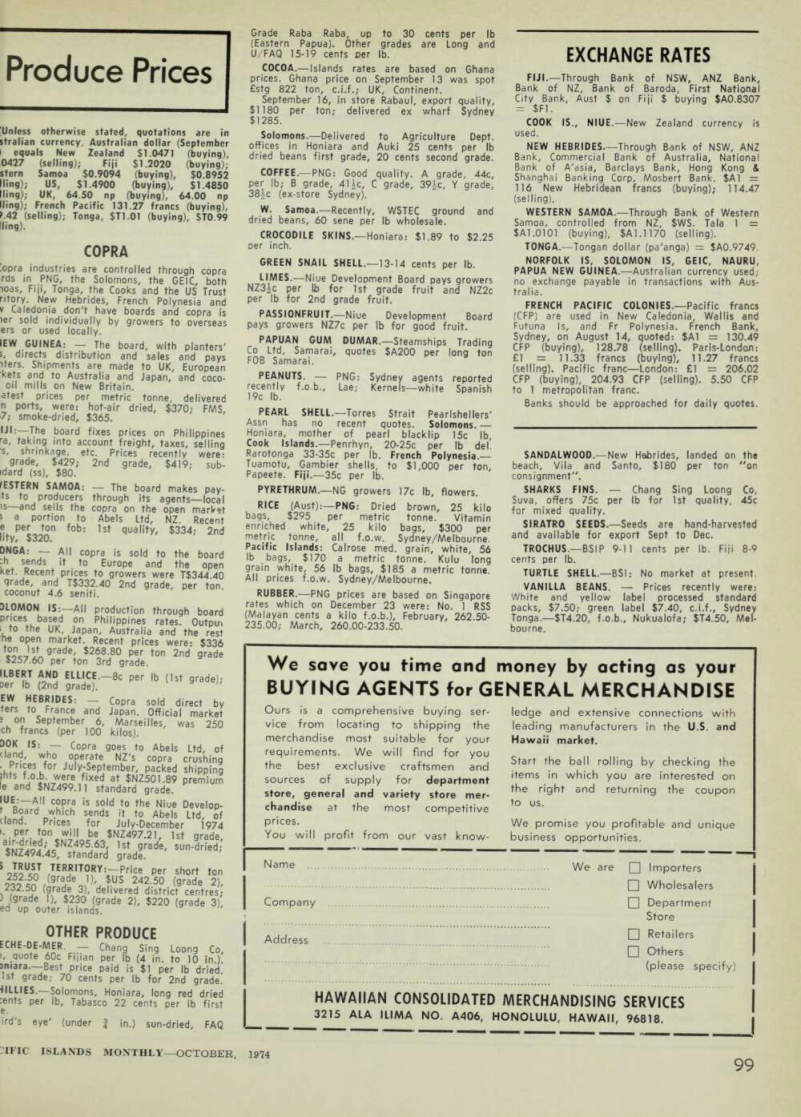
[Unless otherwise stated, quotations are in stralian currency. Australian dollar (September i equals New Zealand $1.0471 (buying), 0427 (selling); Fiji $1.2020 (buying); stern Samoa $0.9094 (buying), $0.8952 Hing); US, $1.4900 (buying), $1.4850 lling); UK, 64.50 np (buying), 64.00 np lling); French Pacific 131.27 francs (buying), >.42 (selling); Tonga, STI.OI (buying), 5T0.99 lling).
Copra
lopra industries are controlled through copra rds in PNG, the Solomons, the GEIC, both icas, Fiji, Tonga, the Cooks and the US Trust ritory. New Hebrides, French Polynesia and * Caledonia don't have boards and copra is ter sold individually by growers to overseas ers or used locally. lEW GUINEA: The board, with planters' >, directs distribution and sales and pays iters. Shipments are made to UK, European kets and to Australia and Japan, and coco oil mills on New Britain, atest prices per metric tonne, delivered n ports, were: hot-air dried, $370; FMS, 7; smoke-dried, $365.
IJl:—The board fixes prices on Philippines ra, taking into account freight, taxes, selling s, shrinkage, etc. Prices recently were: grade, $429; 2nd grade, $419; sub idard (ss), $BO. fESTERN SAMOA; The board makes pay ts to producers through its agents—local is and sells the copra on the open market i a portion to Abels Ltd, NZ. Recent f ° b: Ut qUal ‘ ty ' $334, ‘ 2nd °, NGA: AH copra is sold to the board :h sends it to Europe and the open ket. Recent prices to growers were T 5344 40 grade, and T 5332.40 2nd grade, per ton coconut 4.6 seniti.
DLOMON IS:— All production through board prices based on Philippines rates. Outpui ■ to the UK, Japan, Australia and the rest he open market. Recent prices were: $336 L°o" Is ' grade ' $268 8 ° Pc ton 2nd grade $257.60 per ton 3rd grade. * N S ELUCE.-Sc per lb (Ist grade), per lb (2nd grade).
EW HEBRIDES; Copra sold direct by ters to France and Japan. Official market ; on September 6, Marseilles, was 250 ch francs (per 100 kilos).
DOK IS: Copra goes to Abels Ltd, of Pr’Lc''? 0 ,°P er c ate N l Z ' s c °P ra crushing . Prices for July-September, packed shipping L i w°t b K I7 Tn r o e , flXed at $NZ501.89 premium le and $NZ499.11 standard grade. lUE:— AH copra is sold to the Niue Develop f Board which sends it to Abels Ltd, of eland. Prices for July-December 1974 '. per ton will be $NZ497.21, Ist grade, a «? NZ * 495 J 63 i' Ist grade ' sun-dried; $NZ494.45, standard grade. per short lon ono sA / 9ra / e „ l, ' J t US 242 - 50 2), 232.50 (grade 3), delivered district centres; ) (grade 1), $230 (grade 2), $220 (grade 3), ed up outer islands.
Other Produce
ECHE-DE-MER. Chang Sing Loong Co, i, quote 60c Fipan per lb (4 in. to 10 in.), jniara.—Best price paid is $1 per lb dried.
Ist grade; 70 cents per lb for 2nd grade. 4lLLlES.—Solomons, Honiara, long red dried rents per lb. Tabasco 22 cents per lb first e. ird's eye' (under in.) sun-dried, FAQ
Grade Raba Raba, up to 30 cents per lb (Eastern Papua). Other grades are Long and U/FAQ 15-19 cents per lb.
COCOA. —lslands rates are based on Ghana prices. Ghana price on September 13 was spot £stg 822 ton, c.i.f.; UK, Continent.
September 16, in store Rabaul, export quality, $llBO per ton; delivered ex wharf Sydney $1285.
Solomons. —Delivered to Agriculture Dept, offices in Honiara and Auki 25 cents per lb dried beans first grade, 20 cents second grade.
COFFEE. —PNG: Good quality. A grade, 44c, per lb; B grade, 41£c, C grade, 39£c, Y grade, 38Jc (ex-store Sydney).
W. Samoa. —Recently, WSTEC ground and dried beans, 60 sene per lb wholesale.
CROCODILE SKlNS.— Honiara: $1.89 to $2.25 per inch.
GREEN SNAIL SHELL.—I 3-14 cents per lb.
LIMES.—Niue Development Board pays growers NZ3£c per lb for Ist grade fruit and NZ2c per lb for 2nd grade fruit.
PASSIONFRUIT. —Niue Development Board pays growers NZ7c per lb for good fruit.
PAPUAN GUM DUMAR. —Steamships Trading Co Ltd, Samarai, quotes SA2OO per long ton FOB Samarai.
PEANUTS. PNG: Sydney agents reported recently f.0.b., Lae; Kernels—white Spanish 19c lb.
PEARL SHELL. —Torres Strait Pearlshel lers' Assn has no recent quotes. Solomons.
Honiara, mother of pearl blacklip 15c lb, Cook Islands.— Penrhyn, 20-25 c per lb del.
Rarotonga 33-35 c per lb. French Polynesia.— Tuamotu, Gambier shells, to $l,OOO per ton, Papeete. Fiji,— 3sc per lb.
PYRETHRUM. —NG growers 17c lb, flowers.
RICE (Aust):— PNG: Dried brown, 25 kilo bags, $295 per metric tonne. Vitamin enriched white, 25 kilo bags, $3OO per metric tonne, all f.o.w. Sydney/Melbourne.
Pacific Islands: Calrose med. grain, white, 56 lb bags, $l7O a metric tonne. Kulu long grain white, 56 lb bags, $lB5 a metric tonne.
All prices f.o.w. Sydney/Melbourne.
RUBBER. —PNG prices are based on Singapore rates which on December 23 were: No. 1 RSS (Malayan cents a kilo f.0.b.), February, 262.50- 235.00; March, 260.00-233.50.
SANDALWOOD. —New Hebrides, landed on the beach, Vila and Santo, $lBO per ton "on consignment".
SHARKS FINS. Chang Sing Loong Co, Suva, offers 75c per lb for Ist quality, 45c for mixed quality.
SIRATRO SEEDS. —Seeds are hand-harvested and available for export Sept to Dec.
TROCHUS.— BSIP 9-11 cents per lb. Fiji 8-9 cents per lb.
TURTLE SHELL.— BSI: No market at present.
VANILLA BEANS. Prices recently were: White and yellow label processed standard packs, $7.50; green label $7.40, c.i.f., Sydney Tonga.—sl4.2o, f.0.b., Nukualofa; $T4.50, Mel bourne.
Exchange Rates
FlJl.— Through Bank of NSW, ANZ Bank, Bank of NZ, Bank of Baroda, First National City Bank, Aust $ on Fiji $ buying $A0.8307
= Sfi.
COOK IS., NIUE. —New Zealand currency is used.
NEW HEBRIDES.— Through Bank of NSW, ANZ Bank, Commercial Bank of Australia, National Bank of A'asia, Barclays Bank, Hong Kong & Shanghai Banking Corp, Mosbert Bank. SAI = 116 New Hebridean francs (buying); 114.47 (selling).
WESTERN SAMOA.— Through Bank of Western Samoa, controlled from NZ, SWS. Tala 1 = SAI.OIOI (buying), $A 1.1170 (selling).
TONGA. —Tongan dollar (pa'anga) = $A0.9749.
Norfolk Is, Solomon Is, Geic, Nauru,
PAPUA NEW GUlNEA. —Australian currency used; no exchange payable in transactions with Aus tralia.
FRENCH PACIFIC COLONIES.— Pacific francs (CFP) are used in New Caledonia, Wallis and Futuna Is, and Fr Polynesia. French Bank, Sydney, on August 14, quoted: SAI = 130.49 CFP (buying), 128.78 (selling). Paris-London: £1 = 11.33 francs (buying), 11.27 francs (selling). Pacific franc—London: £1 = 206.02 CFP (buying), 204.93 CFP (selling). 5.50 CFP to 1 metropolitan franc.
Banks should be approached for daily quotes.
Advertisements & other items, p. 101 (2 items)
99
:iFIC ISLANDS MONTHLY—OCTOBER, 1974
Buying Agents For General Merchandise
We sove you time and money by acting as your
Ours is a comprehensive buying service from locating to shipping the merchandise most suitable for your requirements. We will find for you the best exclusive craftsmen and sources of supply for department store, general and variety store merchandise at the most competitive prices.
You will profit from our vast knowledge and extensive connections with leading manufacturers in the U.S. and Hawaii market.
Start the ball rolling by checking the items in which you are interested on the right and returning the coupon to us.
We promise you profitable and unique business opportunities. 1~~l Importers □ Wholesalers Name We are Company □ Department Store Address IZ'l'Z'Z'Z'' '' D Re,ailers □ Others (please specify)
HAWAIIAN CONSOLIDATED MERCHANDISING SERVICES
3215 ALA ILIMA NO. A 406, HONOLULU, HAWAII, 96818.
Shipping & Airways Information
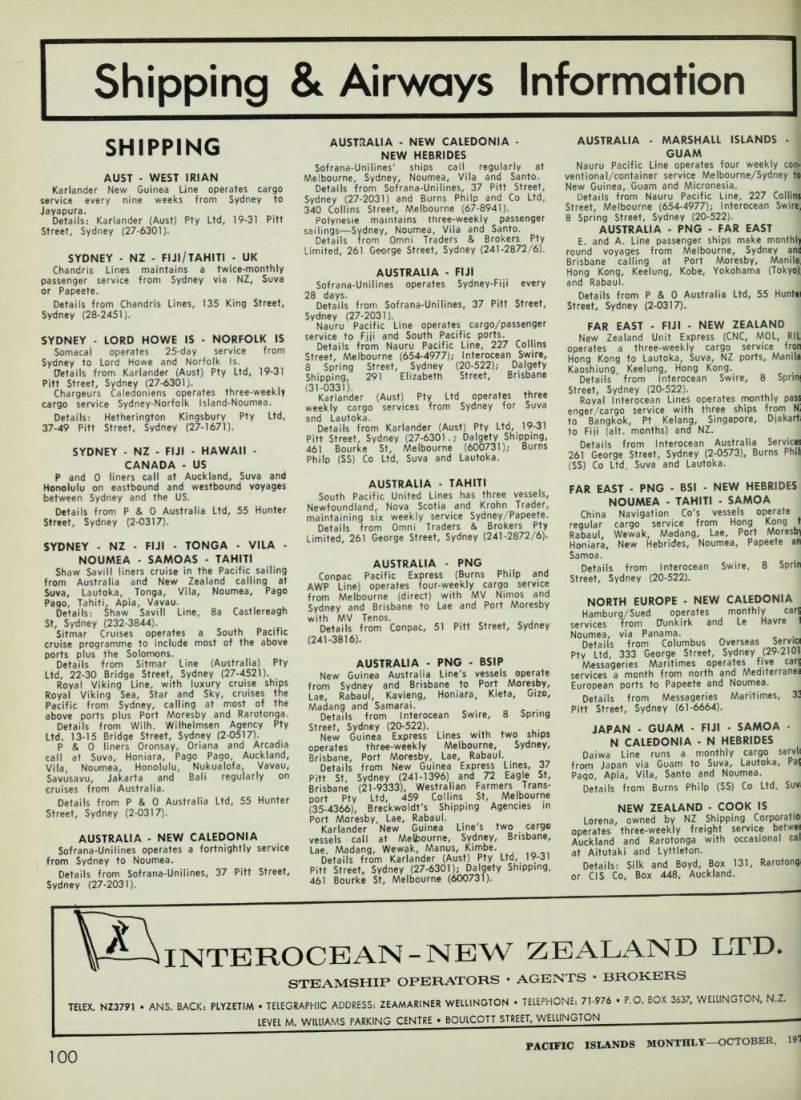
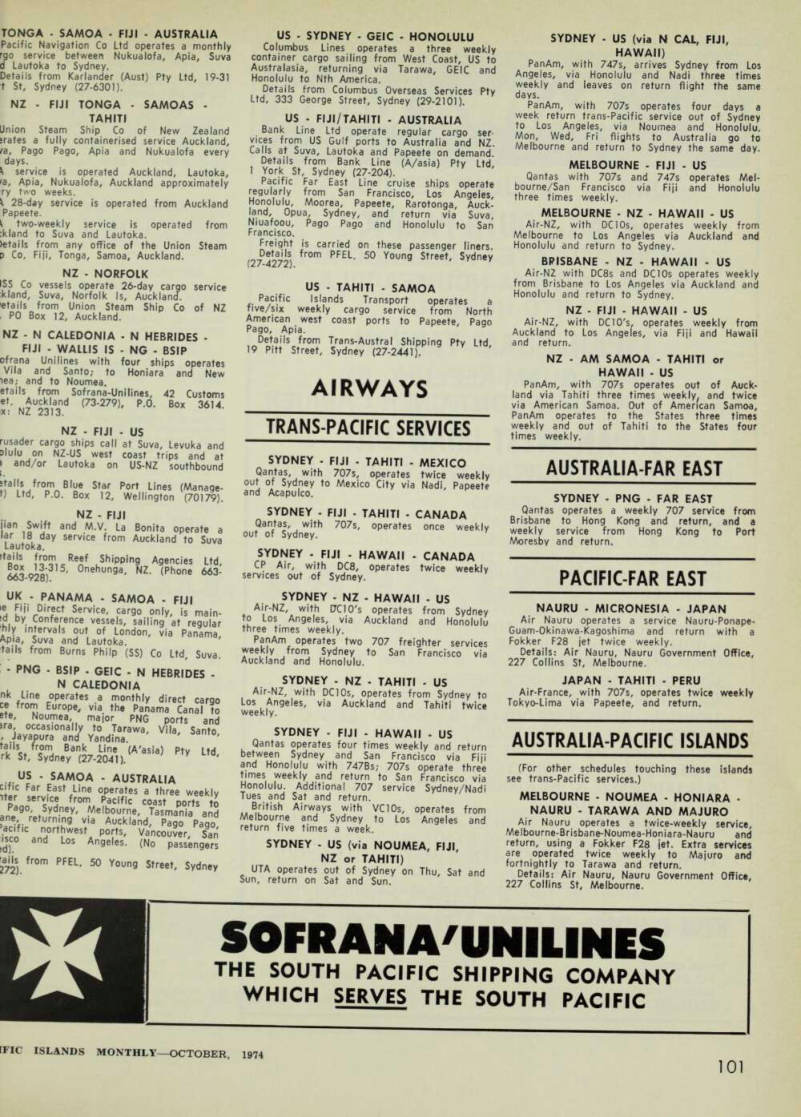
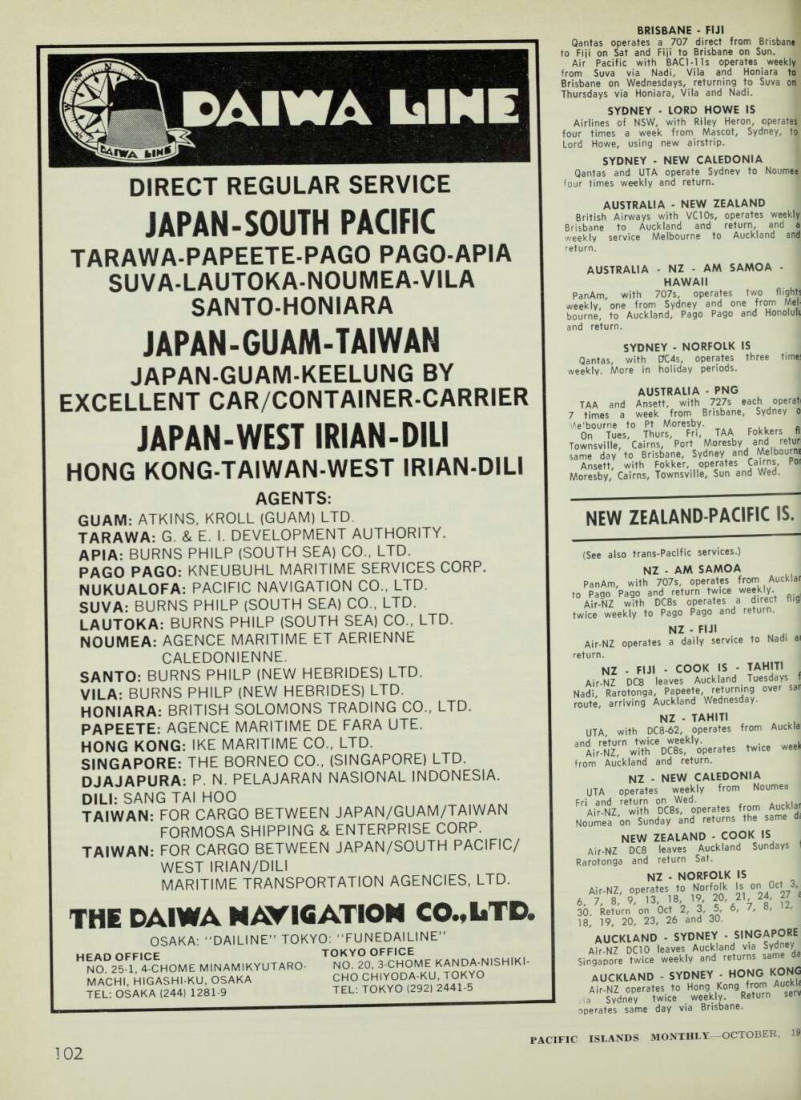
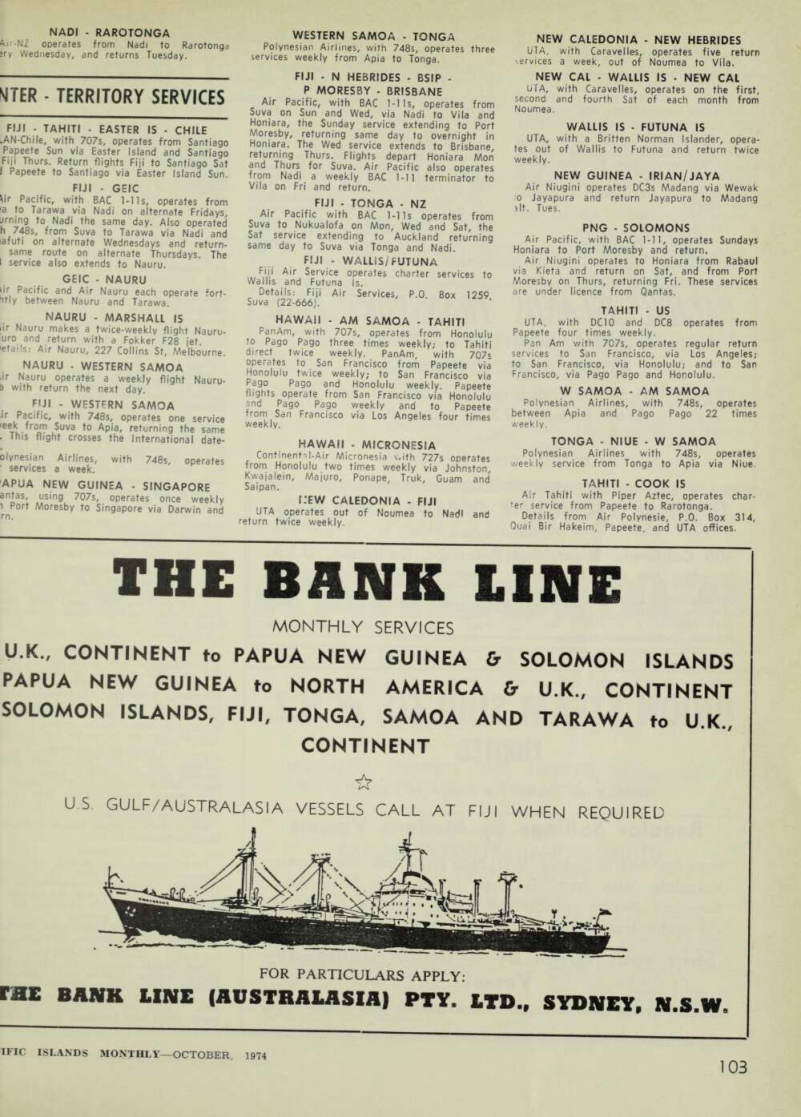
Shipping
Aust - West Irian
Karlander New Guinea Line operates cargo service every nine weeks from Sydney to Jayapura.
Details: Karlander (Aust) Pty Ltd, 19-31 Pitt Street, Sydney (27-6301).
SYDNEY - NZ - FIJI/TAHITI - UK Chandris Lines maintains a twice-monthly passenger service from Sydney via NZ, Suva or Papeete.
Details from Chandris Lines, 135 King Street, Sydney (28-2451).
SYDNEY - LORD HOWE IS - NORFOLK IS Somacal operates 25-day service from Sydney to Lord Howe and Norfolk Is.
Details from Karlander (Aust) Pty Ltd, 19-31 Pitt Street, Sydney (27-6301).
Chargeurs Caledoniens operates three-weekly cargo service Sydney-Norfolk Island-Noumea.
Details: Hetherington Kingsbury Pty Ltd, 37-49 Pitt Street, Sydney (27-1671).
SYDNEY - NZ ■ FIJI - HAWAII -
Canada - Us
P and 0 liners call at Auckland, Suva and Honolulu on eastbound and westbound voyages between Sydney and the US.
Details from P & 0 Australia Ltd, 55 Hunter Street, Sydney (2-0317).
SYDNEY - NZ - FIJI - TONGA - VILA •
Noumea - Samoas - Tahiti
Shaw Savill liners cruise in the Pacific sailing from Australia and New Zealand calling at Suva, Lautoka, Tonga, Vila, Noumea, Pago Pago, Tahiti, Apia, Vavau.
Details: Shaw Savill Line, 8a Castlereagh St, Sydney (232-3844).
Sitmar Cruises operates a South Pacific cruise programme to include most of the above ports plus the Solomons.
Details from Sitmar Line (Australia) Pty Ltd, 22-30 Bridge Street, Sydney (27-4521).
Royal Viking Line, with luxury cruise ships Royal Viking Sea, Star and Sky, cruises the Pacific from Sydney, calling at most of the above ports plus Port Moresby and Rarotonga.
Details from Wilh. Wilhelmsen Agency Pty Ltd, 13-15 Bridge Street, Sydney (2-0517).
P & 0 liners Oronsay, Oriana and Arcadia call at Suva, Honiara, Pago Pago, Auckland, Vila, Noumea, Honolulu, Nukualofa, Vavau, Savusavu, Jakarta and Bali regularly on cruises from Australia.
Details from P & 0 Australia Ltd, 55 Hunter Street, Sydney (2-0317).
Australia - New Caledonia
Sofrana-Unilines operates a fortnightly service from Sydney to Noumea.
Details from Sofrana-Unilines, 37 Pitt Street, Sydney (27-2031).
Australia - New Caledonia -
New Hebrides
Sofrana-Unilines' ships call regularly at Melbourne, Sydney, Noumea, Vila and Santo.
Details from Sofrana-Unilines, 37 Pitt Street, Sydney (27-2031) and Burns Philp and Co Ltd, 340 Collins Street, Melbourne (67-8941).
Polynesie maintains three-weekly passenger sailings—Sydney, Noumea, Vila and Santo.
Details from Omni Traders & Brokers Pty Limited, 261 George Street, Sydney (241-2872/6).
Australia - Fiji
Sofrana-Unilines operates Sydney-Fiji every 28 days.
Details from Sofrana-Unilines, 37 Pitt Street, Sydney (27-2031).
Nauru Pacific Line operates cargo/passenger service to Fiji and South Pacific ports.
Details from Nauru Pacific Line, 227 Collins Street, Melbourne (654-4977); Interocean Swire, 8 Spring Street, Sydney (20-522); Dalgety Shipping, 291 Elizabeth Street, Brisbane (31-0331).
Karlander (Aust) Pty Ltd operates three weekly cargo services from Sydney for Suva and Lautoka. .
Details from Karlander (Aust) Pty Ltd, 19-31 Pitt Street, Sydney (27-6301.; Dalgety Shipping, 461 Bourke St, Melbourne (600731); Burns Philp (SS) Co Ltd, Suva and Lautoka.
Australia • Tahiti
South Pacific United Lines has three vessels, Newfoundland, Nova Scotia and Krohn Trader, maintaining six weekly service Sydney/Papeete.
Details from Omni Traders & Brokers Pty Limited, 261 George Street, Sydney (241-2872/6).
Australia ■ Png
Conpac Pacific Express (Burns Philp and AWP Line) operates four-weekly cargo service from Melbourne (direct) with MV Nimos and Sydney and Brisbane to Lae and Port Moresby with MV Tenos.
Details from Conpac, 51 Pitt Street, Sydney (241-3816).
Australia ■ Png - Bsip
New Guinea Australia Line's vessels operate from Sydney and Brisbane to Port Moresby, Lae, Rabaul, Kavieng, Honiara. Kieta, Gizo, Madang and Samarai. .
Details from Interocean Swire, 8 Spring Street, Sydney (20-522).
New Guinea Express Lines with two ships operates three-weekly Melbourne, Sydney, Brisbane, Port Moresby, Lae, Rabaul.
Details from New Guinea Express Lines, 37 Pitt St, Sydney (241-1396) and 72 Eagle St, Brisbane (21-9333), Westralian Farmers Trans port Pty Ltd, 459 Collins St, Melbourne (35-4366), Breckwoldt's Shipping Agencies in Port Moresby, Lae, Rabaul.
Karlander New Guinea Line's two cargo vessels call at Melbourne, Sydney, Brisbane, Lae, Madang, Wewak, Manus, Kimbe.
Details from Karlander (Aust) Pty Ltd 19-31 Pitt Street, Sydney (27-6301); Dalgety Shipping, 461 Bourke St, Melbourne (600731).
Australia - Marshall Islands ■
Guam
Nauru Pacific Line operates four weekly con ventional/container service Melbourne/Sydney to New Guinea, Guam and Micronesia.
Details from Nauru Pacific Line, 227 Collins Street, Melbourne (654-4977); Interocean Swire, 8 Spring Street, Sydney (20-522).
Australia - Png - Far East
E. and A. Line passenger ships make monthly round voyages from Melbourne, Sydney and Brisbane calling at Port Moresby, Manila, Hong Kong, Keelung, Kobe, Yokohama (Tokyo), and Rabaul.
Details from P & 0 Australia Ltd, 55 Huntei Street, Sydney (2-0317).
FAR EAST - FIJI - NEW ZEALAND New Zealand Unit Express (CNC, MOL, RIL operates a three-weekly cargo service fron Hong Kong to Lautoka, Suva, NZ ports, Manila Kaoshiung, Keelung, Hong Kong.
Details from Interocean Swire, 8 Sprint Street, Sydney (20-522).
Royal Interocean Lines operates monthly pass enger/cargo service with three ships from Ni to Bangkok, Pt Kelang, Singapore, Djakarti to Fiji (alt. months) and NZ.
Details from Interocean Australia Services 261 George Street, Sydney (2-0573), Burns Phil| (SS) Co Ltd, Suva and Lautoka.
FAR EAST - PNG - BSI - NEW HEBRIDES
Noumea - Tahiti - Samoa
China Navigation Co's vessels operate regular cargo service from Hong Kong t Rabaul. Wewak, Madang, Lae, Port Moresby Honiara, New Hebrides, Noumea, Papeete an Samoa.
Details from Interocean Swire, 8 Sprln Street, Sydney (20-522).
North Europe - New Caledonia
Hamburg/Sued operates monthly carg services from Dunkirk and Le Havre 1 Noumea, via Panama. .3 Details from Columbus Overseas Seryicj pty Ltd, 333 George Street, Sydney (29-2101 Messageries Maritimes operates five carg services a month from north and Mediterranea European ports to Papeete and Noumea.
Details from Messageries Maritimes, 33 Pitt Street, Sydney (61-6664).
JAPAN - GUAM - FIJI - SAMOA -
N Caledonia - N Hebrides
Daiwa Line runs a monthly cargo servk from Japan via Guam to Suva, Lautoka, Pag Pago, Apia, Vila, Santo and Noumea.
Details from Burns Phi Ip (SS) Co Ltd, Suvi
New Zealand ■ Cook Is
Lorena, owned by NZ Shipping Corporate operates three-weekly freight service betwej Auckland and Rarotonga with occasional cal at Aitutaki and Lyttleton.
Details: Silk and Boyd, Box 131, Rarotongi or CIS Co, Box 448, Auckland.
TONGA - SAMOA ■ FIJI - AUSTRALIA Pacific Navigation Co Ltd operates a monthly rgo service between Nukualofa, Apia, Suva d Lautoka to Sydney.
Details from Karlander (Aust) Pty Ltd, 19-31 t St, Sydney (27-6301).
NZ ■ FIJI TONGA - SAMOAS ■
Tahiti
Union Steam Ship Co of New Zealand jrates a fully containerised service Auckland, ra, Pago Pago, Apia and Nukualofa every days. \ service is operated Auckland, Lautoka, ra, Apia, Nukualofa, Auckland approximately ry two weeks. 2B-day service is operated from Auckland Papeete. two-weekly service is operated from :kland to Suva and Lautoka. details from any office of the Union Steam p Co, Fiji, Tonga, Samoa, Auckland.
Nz - Norfolk
ISS Co vessels operate 26-day cargo service kland, Suva, Norfolk Is, Auckland.
'eta ils from Union Steam Ship Co of NZ ■ PO Box 12, Auckland.
NZ - N CALEDONIA ■ N HEBRIDES - FIJI - WALLIS IS - NG - BSIP ofrana Unilines with four ships operates Vila and Santo; to Honiara and New iea,- and to Noumea. etails from Sofrana-Unilines, 42 Customs et ' MT U &', a « nd ( 73 * 279 ). P-0. Box 3614. x: NZ 2313.
Nz - Fiji - Us
rusader cargo ships call at Suva, Levuka and B, ulu on NZ-US west coast trips and at i and/or Lautoka on US-NZ southbound B^ue 3 * ar por * Lines (Manage t) Ltd, P.O. Box 12, Wellington (70179).
Nz - Fiji
ian an d M.V. La Bonita operate a , r '8 day service from Auckland to Suva Lautoka.
' f v n°7, e Shipping Agencies Ltd, 663 928) 3 5 ' onehunga ' NZ - (Phone 663- UK - PANAMA - SAMOA - FIJI 5 hJ' r« 7 Ct Service ' P argo on| Y' is main •a by Conference vessels, sailing at regular My intervals out of London, via Panama, Apia, Suva and Lautoka. tails from Burns Philp (SS) Co Ltd, Suva. - PNG - BSIP - GEIC - N HEBRIDES -
N Caledonia
nk Line operates a monthly direct cargo ce from Europe, via the Panama Canal to ete, Noumea major PNG ports and ira, occasionally to Tarawa, Vila, Santo , Jayaoura and Yandina. lie* c J Bank Line (A'asia) Pty Ltd rk St, Sydney (27-2041). '
Us - Samoa - Australia
citic Far East Line operates a three weekly iter service from Pacific coast ports to Pago, Sydney, Melbourne, TasmaMa and ane returning via Auckland, Pago Paqo Rrn IC a northwest ports, Vancouver, San ,j£o an d Los Angeles. (No passengers gjj from PFEL ' 50 Y °ung Street, Sydney
US - SYDNEY ■ GEIC - HONOLULU Columbus Lines operates a three weekly container cargo sailing from West Coast, US to Australasia, returning via Tarawa, GEIC and Honolulu to Nth America.
Details from Columbus Overseas Services Pty Ltd, 333 George Street, Sydney (29-2101).
Us ■ Fiji/Tahiti - Australia
Bank Line Ltd operate regular cargo ser vices from US Gulf ports to Australia and NZ.
Calls at Suva, Lautoka and Papeete on demand.
Details from Bank Line (A/asia) Pty Ltd 1 York St, Sydney (27-204).
Pacific Far East Line cruise ships operate regularly from San Francisco, Los Angeles, Honolulu, Moorea, Papeete, Rarotonga, Auck land, Opua, Sydney, and return via Suva, Niuafoou, Pago Pago and Honolulu to San Francisco.
Freight is carried on these passenger liners.
DetaHs from PFEL, 50 Young Street, Sydney (27-4272).
Us - Tahiti - Samoa
Pacific Islands Transport operates a five/six weekly cargo service from North American west coast ports to Papeete, Paqo Pago, Apia.
Details from Trans-Austral Shipping Pty Ltd 19 Pitt Street, Sydney (27-2441).
Airways
Trans Pacific Services
SYDNEY ■ FIJI - TAHITI - MEXICO Qantas, with 7075, operates twice weekly out of Sydney to Mexico City via Nadi, Papeete and Acapulco.
SYDNEY - FIJI - TAHITI - CANADA Qantas, with 7075, operates once weeklv out of Sydney.
SYDNEY - FIJI - HAWAII - CANADA CP Air, with DCS, operates twice weekly services out of Sydney.
SYDNEY - NZ - HAWAII - US Air-NZ, with CTClO's operates from Sydney to Los Angeles, via Auckland and Honolulu three times weekly.
PanAm operates two 707 freighter services weekly from Sydney to San Francisco via Auckland and Honolulu.
SYDNEY - NZ - TAHITI - US Air-NZ, with DClOs, operates from Sydney to Los Angeles, via Auckland and Tahiti twice weekly.
SYDNEY - FIJI - HAWAII - US Qantas operates four times weekly and return between Sydney and San Francisco via Fiji and Honolulu with 74785; 707 s operate three times weekly and return to San Francisco via Honolulu. Additional 707 service Sydney/Nadi Tues and Sat and return.
British Airways with VClOs, operates from Melbourne and Sydney to Los Angeles and return five times a week.
Sydney - Us (Via Noumea, Fiji,
Nz Or Tahiti)
UTA operates out of Sydney on Thu, Sat and Sun, return on Sat and Sun.
SYDNEY - US (via N CAL, FIJI,
Hawaii)
PanAm, with 7475, arrives Sydney from Los Angeles, via Honolulu and Nadi three times weekly and leaves on return flight the same days.
PanAm, with 707 s operates four days a week return trans-Pacific service out of Sydney to Los Angeles, via Noumea and Honolulu.
Mon, Wed, Fri flights to Australia go to Melbourne and return to Sydney the same day.
Melbourne - Fiji - Us
Qantas with 707 s and 747 s operates Mel bourne/San Francisco via Fiji and Honolulu three times weekly, MELBOURNE - NZ ■ HAWAII - US Air-NZ, with DClOs, operates weekly from Melbourne to Los Angeles via Auckland and Honolulu and return to Sydney.
BRISBANE - NZ - HAWAII - US Air-N2 with DCBs and DClOs operates weekly from Brisbane to Los Angeles via Auckland and Honolulu and return to Sydney.
NZ - FIJI - HAWAII - US Air-NZ, with DClO's, operates weekly from Auckland to Los Angeles, via Fiji and Hawaii and return.
NZ - AM SAMOA - TAHITI or
Hawaii - Us
PanAm, with 707 s operates out of Auck land via Tahiti three times weekly / and twice via American Samoa. Out of American Samoa, PanAm operates to the States three times weekly and out of Tahiti to the States four times weekly.
Australia-Far East
Sydney - Png - Far East
Qantas operates a weekly 707 service from Brisbane to Hong Kong and return, and a weekly service from Hong Kong to Port Moresby and return.
Pacific-Far East
Nauru - Micronesia - Japan
Air Nauru operates a service Nauru-Ponape- Guam-Okinawa-Kagoshima and return with a Fokker F2B jet twice weekly.
Details: Air Nauru, Nauru Government Office, 227 Collins St, Melbourne.
Japan - Tahiti - Peru
Air-France, with 7075, operates twice weekly Tokyo-Lima via Papeete, and return.
Australia-Pacific Islands
(For other schedules touching these islands see trans-Pacific services.)
Melbourne - Noumea - Honiara -
Nauru - Tarawa And Majuro
Air Nauru operates a twice-weekly service, Melbourne-Brisbane-Noumea-Honiara-Nauru and return, using a Fokker F2B jet. Extra services are operated twice weekly to Majuro and fortnightly to Tarawa and return.
Details; Air Nauru, Nauru Government Office, 227 Collins St, Melbourne.
Brisbane - Fiji
Qantas operates a 707 direct from Brisbane to Fiji on Sat and Fiji to Brisbane on Sun.
Air Pacific with BACI-lls operates weekly from Suva via Nadi, Vila and Honiara to Brisbane on Wednesdays, returning to Suva on Thursdays via Honiara, Vila and Nadi.
Sydney - Lord Howe Is
Airlines of NSW, with Riley Heron, operates four times a week from Mascot, Sydney, to Lord Howe, using new airstrip.
Sydney - New Caledonia
Qantas and UTA operate Sydney to Noumea four times weekly and return.
Australia - New Zealand
British Airways with VClOs, operates weekly Brisbane to Auckland and return, and a weekly service Melbourne to Auckland and return.
AUSTRALIA - NZ - AM SAMOA •
Hawaii
Pan Am, with 7075, operates two flights weekly, one from Sydney and one from Mel bourne, to Auckland, Pago Pago and Honoluk and return.
Sydney - Norfolk Is
Qantas, with DC4s, operates three times weekly. More in holiday periods.
Australia - Png
TAA and Ansett, with 727 s each operati 7 times a week from Brisbane, Sydney o Melbourne to Pt Moresby.
On Tues, Thurs, Fri, TAA Fokkers fl Townsville, Cairns, Port Moresby and retun same day to Brisbane, Sydney and Melbourne Ansett, with Fokker, operates Cairns, For Moresby, Cairns, Townsville, Sun and Wed.
New Zealand-Pacific Is.
(See also trans-Paclfic services.)
Nz - Am Samoa
Pan Am, with 7075, operates from Aucklar to Pago Pago and return twice weekly.
Air-NZ with DCBs operates a direct fligl twice weekly to Pago Pago and return.
Nz - Fiji
Air-NZ operates a daily service to Nadi ar return.
NZ - FIJI ■ COOK IS ■ TAHITI Air-NZ DCS leaves Auckland Tuesdays t Nadi, Rarotonga '"S* ovc ' sa " route, arriving Auckland Wednesday.
Nz - Tahiti
UTA, with DCB-62, operates from Aucklai and return twice weekly. .
Air-NZ, with DCBs, operates twice week from Auckland and return.
Nz - New Caledonia
UTA operates weekly from Noumea Fri and return on Wed. A Uar Air-NZ, with DCBs, operates from Aucklar Noumea on Sunday and returns the same d<
New Zealand - Cook Is
Air-NZ DCS leaves Auckland Sundays Rarotonga and return Sat.
Nz - Norfolk Is
30. Return on Oct 2,3, 5,6, 7,8, 12, 18, 19, 20, 23, 26 and 30.
AUCKLAND - SYDNEY ’ SING J p O RE , Air-NZ DCIO leaves Auckland via Sydney Singapore twice weekly and returns same da
Auckland - Sydney - Hong Kong
Air-NZ operates to Hong Kong from Auckte /ia Sydney twice weekly. Return serv operates same day via Brisbane.
Nadi • Rarotonga
Ai NZ operates from Nadi to Rarotonga jry Wednesday, and returns Tuesday.
Nter - Territory Services
FIJI - TAHITI - EASTER IS - CHILE .AN-Chile, with 7075, operates from Santiago Papeete Sun via Easter Island and Santiago Fiji Thurs. Return flights Fiji to Santiago Sat I Papeete to Santiago via Easter Island Sun.
Fiji - Geic
Vir Pacific, with BAC 1-lls, operates from ' a to Tarawa via Nadi on alternate Fridays, jrmng to Nadi the same day. Also operated h 7485, from Suva to Tarawa via Nadi and lafuti on alternate Wednesdays and return same route on alternate Thursdays. The I service also extends to Nauru.
Geic - Nauru
ur Pacific and Air Nauru each operate fort- Ntly between Nauru and Tarawa.
Nauru - Marshall Is
Tr Nauru makes a twice-weekly flight Nauru uro and return with a Fokker F2B jet.
'etai ls: Air Nauru, 227 Collins St, Melbourne.
Nauru - Western Samoa
Jr Nauru operates a weekly flight Nauru a with return the next day.
Fiji - Western Samoa
ir Pacific, with 7485, operates one service reek from Suva to Apia, returning the same . This flight crosses the International date olynesian Airlines, with 7485, operates services a week.
Apua New Guinea - Singapore
antas, using 7075, operates once weekly i Port Moresby to Singapore via Darwin and rn.
Western Samoa - Tonga
Polynesian Airlines, with 7485, operates three services weekly from Apia to Tonga.
FIJI - N HEBRIDES - BSIP -
P Moresby - Brisbane
Air Pacific, with BAC 1-1 Is, operates from Suva on Sun and Wed, via Nadi to Vila and Honiara, the Sunday service extending to Port Moresby, returning same day to overnight in Honiara. The Wed service extends to Brisbane, returning Thurs. Flights depart Honiara Mon and Thurs for Suva. Air Pacific also operates from Nadi a weekly BAC 1-11 terminator to Vila on Fri and return.
Fiji - Tonga - Nz
Air Pacific with BAC 1-1 Is operates from Suva to Nukualofa on Mon, Wed and Sat, the Sat service extending to Auckland returning same day to Suva via Tonga and Nadi.
Fiji - Wallis/Futuna
Fiji Air Service operates charter services to Wallis and Futuna Is.
Details; Fiji Air Services, P.O Box 1259 Suva (22-666).
Hawaii - Am Samoa - Tahiti
PanAm, with 7075, operates from Honolulu to Pago Pago three times weekly; to Tahiti direct twice weekly. PanAm, with 707 s operates to San Francisco from Papeete via Honolulu twice weekly; to San Francisco via Pago Pago and Honolulu weekly. Papeete flights operate from San Francisco via Honolulu and Pago Pago weekly and to Papeete from San Francisco via Los Angeles four times weekly.
Hawaii - Micronesia
Continental-Air Micronesia with 727 s operates
from Honolulu two times weekly via Johnston, Kwajalein, Majuro, Ponape, Truk, Guam and Saipan.
F.'Ew Caledonia - Fiji
UTA operates out of Noumea to Nadi and return twice weekly.
New Caledonia - New Hebrides
UTA, with Caravelles, operates five return .ervices a week, out of Noumea to Vila.
NEW CAL - WALLIS IS - NEW CAL UIA, with Caravelles, operates on the first, second and fourth Sat of each month from Noumea.
Wallis Is - Futuna Is
UTA, with a Britten Norman Islander, opera tes out of Wallis to Futuna and return twice weekly.
New Guinea - Irian/Java
Air Niugini operates DC3s Madang via Wewak fo Jayapura and return Jayapura to Madang alt. lues.
Png - Solomons
Air Pacific, with BAC 1-11, operates Sundays Honiara to Port Moresby and return.
Air Niugini operates to Honiara from Rabaul via Kieta and return on Sat, and from Port Moresby on Thurs, returning Fri. These services are under licence from Qantas.
Tahiti - Us
UTA, with DCIO and DCS operates from Papeete four times weekly.
Pan Am with 7075, operates regular return services to San Francisco, via Los Angeles; to San Francisco, via Honolulu; and to San Francisco, via Pago Pago and Honolulu.
W Samoa - Am Samoa
Polynesian Airlines, with 7485, operates between Apia and Pago Pago 22 times weekly.
Tonga - Niue - W Samoa
Polynesian Airlines with 7485, operates weekly service from Tonga to Apia via Niue.
Tahiti - Cook Is
Air Tahiti with Piper Aztec, operates char ter service from Papeete to Rarotonga.
Details from Air Polynesie, P.O. Box 314, Quai Bir Hakeim, Papeete, and UTA offices.
Internal Services
pijl Air Pacific, with HS74Bs, BAC 1-1 Is and Herons operates regular services to Labasa, Taveuni, Nadi, Suva and Savusavu, Fiji Air Services, with Britten-Norman Islander and Beechcraft Baron aircraft, operates services to Castaway and Plantation village resorts. The Fijian hotel, Korolevu Beach hotel, Flagship Beachcomber hotel, Levuka, Lakeba, Vatukoula. Charter flights operate to anywhere in the Pacific. on o. v 10 «, Details: F lll Air Services, P.O. Box 1259, Suva (telephone 22-666).
French Polynesia
Air Polynesie, with Fokker F 27 Friendship, Twin Otters and Islanders, operates to
Bora Bora, Huahine, Moorea, Rangiroa, Raiatea, Manihi, Takapoto, Hiva Oa, Da Huka, Maupiti and Tubuai, Rurutu.
Details from Air Polynesia, P.O. Box 314, Quai Bir Hakeim, Papeete, and UTA offices.
Air Tahiti, with light aircraft operates shuttle service from Papeete to Moorea and charter service to Raiatea, Bora Bora, Huahine, Rangiroa and Manihi.
Guam - Us Trust Territory
Continental-Air Micronesia with 727 s operates regular service connecting Honolulu and Guam with Saipan, Rota, Yap, Palau, Truk, Ponape, Kwajalein, Majuro and Johnston Island.
Details from Air Micronesia, Saipan.
Air Pacific International Inc (not connected with the Fiji-based Air Pacific) operates Douglas DC3 and 4 engined Herons in scheduled service daily to Saipan-Tinian-Rota-Yap-Ulithi-Koror-Truk from Guam. Group travel charters are available on 15 day minimum notice within the Trust Territories of the Pacific Islands.
Details: Air Pacific International Inc, Box 7689, Tamuning, Guam, USA. Cable: AIRPAC Guam. Phone: 6465871.
Gilbert And Ellice Islands
Air Pacific, with Herons, operates regular services between Tarawa, Butaritari, North Tabiteuea and Abemama.
Papua New Guinea
Air Niugini, with Fokkers and DC3s, operates a network of services between all major centres in Papua New Guinea. These services connect with Ansett and TAA's 727 Australia-PNS services. , I DCS aircraft are available for charter within
Png.
Aerial Tours operates in Central, Western, Gulf and Sepik districts. Aircraft are based at: Port Moresby, Kerema, Daru, Kiunga, Vanimo, Wewak.
Talair (Tourist Airlines of Niugini)—opera tes scheduled service and charter flights from Port Moresby, Goroko, Kundiawa, Madang, Wewak, Vanimo, Mt Hagen, Mendi to Highlands, Sepik and Coastal areas. Talco Territory Travel Service of Papua New Guinea —Twin Ottei Tourist flights throughout Papua New Guinea.
Further details from Talair, P.O. Box 108, Goroka, Papua New Guinea; Sydney Office: Papua New Guinea House, 225 Clarence St, Sydney. ...
Melanesian Airline Company Pty Limitet (Macair) operates extensive commuter am charter services. Head office, PO Box 556, Lae Branches at Port Moresby, Alotau, Popondetta Wau, Daru, Mt Hagen, Mendi and Goroka.
Crowley Airways Pty Ltd operates schedule: fixed-wing services from bases at Lae, Hoskins Rabaul, Kavieng and Kieta to 34 ports i Morobe, West New Britain, East New Britain New Ireland and Bougainville districts, als helicopter and fixed-wing charters to anywher in Papua New Guinea. Head office: PO Box 34 Lae. Phone 424733. Cables CROWLEY. Tele Air Services operates dail throughout Bougainville. There are nine reguia services Kieta-Buin. Details: Arawa, Phon 956-159; Buka, Phone 16. Box 298, PO, Kiet<
New Caledonia
Air Caledonie with Twin Otters, and I: landers operates regular services to Houa lou, Isle of Pines, Isle Ouen, Kone, Kouma Lifou., Mare, Noumea, Ouvea Touho, Muei Belep, Tiga. ...
Details from Air Caledonie, Noumea.
New Hebrides
Air Melanesiae with Britten-Norman Islande and Trislander operates to Santo,- Maleku Norsup and Lamap, Aoba (Walaha and Longana Pentecost (Lonorore), Erromanga .. To JWJJ Aneityum, Tanna, Epi, Sola and Vila. Dire connections are available to and from San for all international flights arriving m Vila.
Details from Air Melanesiae P.O. Box 72.
Solomon Islands
Solair, with Beech Barons and Islande operates to Auki, Avu Avu Babanak ra, Ba koma, Bellona Is, Fera Is, Gizo, Honiara, Ki Kira, Marau, Munda, Paras., Sege, Yand.n Santa Cruz, Mono, Rennell Is, Choiseul Bd Ballalae and Ringi Cove. .. ue Details from Solomon Islands Airways Li Box 23, Honiara, BSIP.
Tonga
Tonga Internal Air Service, with Bntte Norman Islander aircraft, operates fr Fua'amotu, (airport for Nukua!o fa ) To V ava (daily except Sunday) and Eua (twice da except Sunday). Aircraft available for sigi seeing and regional charters.
Details from Tonga Tourist and Developme Co. PO Box 91, Nukualofa, Tonga.
Cook Islands
Cook Islands Airways Ltd, with a Bntti Norman Islander, operates seven flights a we between Rarotonga and Aitutaki. * be extended to Atiu, Mangaia and Mini when airstrips are built. Private charters scenic flights over Rarotonga and its reets also available.
Advertisements & other items, pp. 102-106 (3 items)
Interocean-New Zealand Ltd.
STEAMSHIP OPERATORS • AGENTS • BROKERS
TELEX. NZ3791 • ANS. BACK: PLYZETIM • TELEGRAPHIC ADDRESS: ZEAMARINER WELLINGTON • TELEPHONE: 71-976 • P.O. BOX 3637, WELLINGTON, N.Z.
LEVEL M. WILLIAMS PARKING CENTRE • BOULCOTT STREET, WELLINGTON -
SOFRANA'UNILINES
THE SOUTH PACIFIC SHIPPING COMPANY
WHICH SERVES THE SOUTH PACIFIC
DIRECT REGULAR SERVICE
JAPAN-SOUTH PACIFIC
TARAWA-PAPEETE-PAGO PAGO-APIA
SUVA-LAUTOKA-NOUMEA-VILA
SANTO-HONIARA
JAPAN-GUAM-TAIWAN
JAPAN-GUAM-KEELUNG BY
EXCELLENT CAR/CONTAINER-CARRIER
JAPAN-WEST IRIAN-DILI
HONG KONG-TAIWAN-WEST IRIAN-DILI
GUAM: ATKINS, KROLL (GUAM) LTD.
TARAWA; G. & E. I. DEVELOPMENT AUTHORITY, APIA: BURNS PHILP (SOUTH SEA) CO., LTD.
PAGO PAGO: KNEUBUHL MARITIME SERVICES CORP.
NUKUALOFA: PACIFIC NAVIGATION CO., LTD.
SUVA: BURNS PHILP (SOUTH SEA) CO., LTD.
LAUTOKA: BURNS PHILP (SOUTH SEA) CO., LTD.
NOUMEA: AGENCE MARITIME ET AERIENNE
CALEDONIENNE.
SANTO; BURNS PHILP (NEW HEBRIDES) LTD.
VILA: BURNS PHILP (NEW HEBRIDES) LTD.
HONIARA: BRITISH SOLOMONS TRADING CO., LTD.
PAPEETE: AGENCE MARITIME DE FARA UTE.
HONG KONG; IKE MARITIME CO., LTD.
SINGAPORE: THE BORNEO CO., (SINGAPORE) LTD.
DJAJAPURA: P. N. PELAJARAN NASIONAL INDONESIA.
DILI: SANG TAI HOO
TAIWAN; FOR CARGO BETWEEN JAPAN/GUAM/TAIWAN
FORMOSA SHIPPING & ENTERPRISE CORP.
TAIWAN; FOR CARGO BETWEEN JAPAN/SOUTH PACIFIC/
WEST IRIAN/DILI
MARITIME TRANSPORTATION AGENCIES, LTD.
THE DAIWA MAVICATIOE CO.* LTD.
AGENTS:
OSAKA; “DAILINE” TOKYO: “FUNEDAILINE 1
HEAD OFFICE
NO. 25-1, 4-CHOME MINAMIKYUTARO-
MACHI, HIGASHI-KU, OSAKA
TEL: OSAKA (244) 1281-9
TOKYO OFFICE
NO. 20, 3-CHOME KANDA-NISHIKI-
- CHIYODA-KU, TOKYO
TEL: TOKYO (292) 2441-5
THE BANK LINE
MONTHLY SERVICES
U.K., CONTINENT to PAPUA NEW GUINEA & SOLOMON ISLANDS PAPUA NEW GUINEA to NORTH AMERICA & U.K., CONTINENT SOLOMON ISLANDS, FIJI, TONGA, SAMOA AND TARAWA to U.K.,
CONTINENT
☆ US. GULF/AUSTRALASIA VESSELS CALL AT FIJI WHEN REQUIRED
FOR PARTICULARS APPLY:
raE BANK LINE (AUSTRALASIA) PTY. LTD., SYDNEY, N.S.W,
PACIFIC ISLANDS TRANSPORT LINE
Owners: Thor Dahls Hvalfangerselskap A/S —Sandefjord, Norway.
MOTOR VESSEL "THORSISLE"
Regular Freight and Passenger Services between Pacific Coast Ports of U.S.A. and Canada and
TAHITI and SAMOA
GENERAL STEAMSHIP CORPORATION LTD.
General Agents 400 California Street, San Francisco, California, U.S.A. phii > ** sm) c -”*” ajs • • Ltd PAPEETE Agence Maritime Inter- (.AE/RABAUL —Burns Phi Ip (New Guinea) nationale Tahiti. Ltd PAGO PAGO —G. H. C. Reid & Co. PORT VILA Comptoirs Francais de NOUMEA—Etablissements Ballande. Nouvelles Hebrides.
UNION STEAM SHIP CO. of N.Z.
LIMITED
Serving the Pacific for nearly 100 years.
Regular Sailings by Modern Vessels
From Auckland to Lautoka, Suva, Pago Pago, Apia, Niue, Vavau, Nukualofa. Also from Tauranga to Lautoka, Suva, Apia, Nukualofa. Regular sailings from Australia to New Zealand to enable transhipment of cargo to all the above ports.
Ship your cargo by a Union Company
Vessel.
BRANCHES AT AIL MAIN AUSTRALIAN, NEW ZEALAND AND ISLAND PORTS.
101
tFIC ISLANDS MONTHLY—OCTOBER, 1974
Ific Islands Monthly-October, 1974
Deaths of Islands People
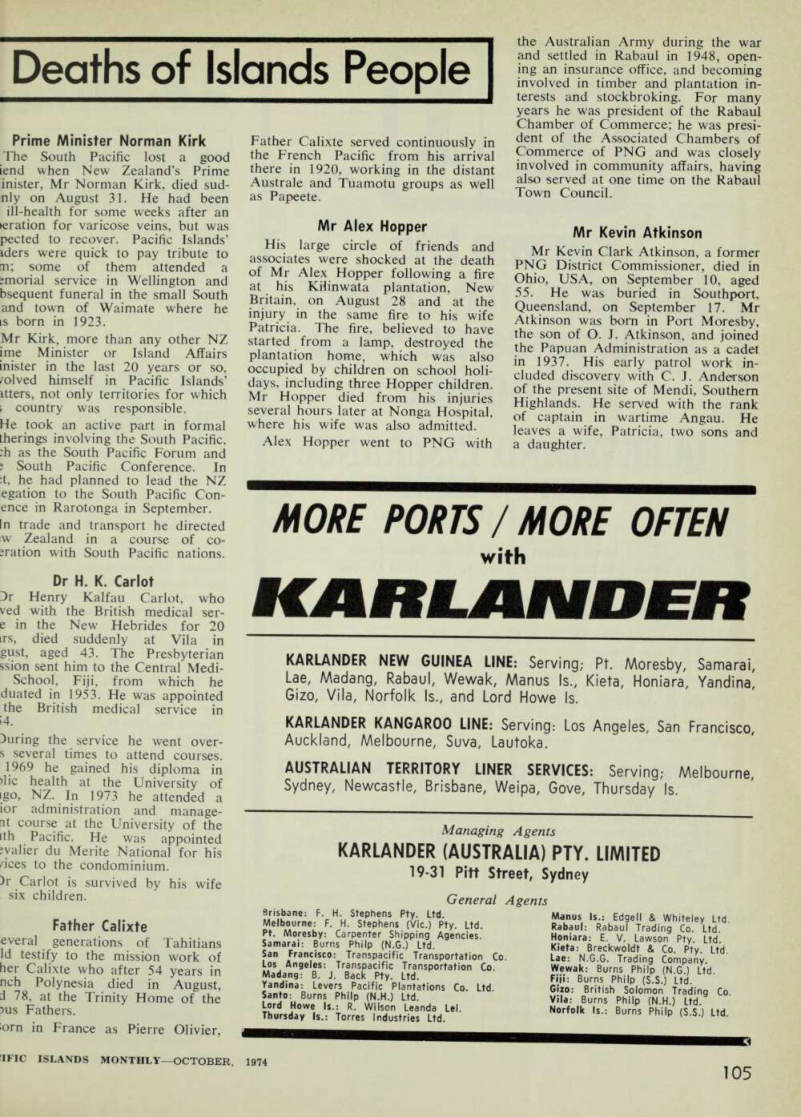
Prime Minister Norman Kirk The South Pacific lost a good iend when New Zealand’s Prime inister, Mr Norman Kirk, died sud nly on August 31. He had been ill-health for some weeks after an ►eration for varicose veins, but was pected to recover. Pacific Islands’ iders were quick to pay tribute to m; some of them attended a jmorial service in Wellington and bsequent funeral in the small South and town of Waimate where he is born in 1923.
Mr Kirk, more than any other NZ ime Minister or Island Affairs inister in the last 20 years or so, solved himself in Pacific Islands’ itters, not only territories for which • country was responsible.
He took an active part in formal therings involving the South Pacific, ;h as the South Pacific Forum and ; South Pacific Conference. In :t, he had planned to lead the NZ egation to the South Pacific Con ence in Rarotonga in September. [n trade and transport he directed w Zealand in a course of co ;ration with South Pacific nations.
Dr H. K. Carlot Dr Henry Kalfau Carlot, who ved with the British medical ser e in the New Hebrides for 20 irs, died suddenly at Vila in gust, aged 43. The Presbyterian ssion sent him to the Central Medi- School, Fiji, from which he duated in 1953. He was appointed the British medical service in >4. during the service he went over s several times to attend courses. 1969 he gained his diploma in )lic health at the University of igo, NZ. In 1973 he attended a ior administration and manage rs course at the University of the ith Pacific. He was appointed jyalier du Merite National for his dees to the condominium. )r Carlot is survived by his wife six children.
Father Calixte everal generations of Tahitians Id testify to the mission work of her Calixte who after 54 years in nch Polynesia died in August, d 78, at the Trinity Home of the ?us Fathers. lorn in France as Pierre Olivier,
Father Calixte served continuously in the French Pacific from his arrival there in 1920, working in the distant Australe and Tuamotu groups as well as Papeete.
Mr Alex Hopper His large circle of friends and associates were shocked at the death of Mr Alex Hopper following a fire at his KHinwata plantation, New Britain, on August 28 and at the injury in the same fire to his wife Patricia. The fire, believed to have started from a lamp, destroyed the plantation home, which was also occupied by children on school holi days, including three Hopper children.
Mr Hopper died from his injuries several hours later at Nonga Hospital, where his wife was also admitted.
Alex Hopper went to PNG with
the Australian Army during the war and settled in Rabaul in 1948, open ing an insurance office, and becoming involved in timber and plantation in terests and stockbroking. For many years he was president of the Rabaul Chamber of Commerce; he was presi dent of the Associated Chambers of Commerce of PNG and was closely involved in community affairs, having also served at one time on the Rabaul Town Council.
Mr Kevin Atkinson Mr Kevin Clark Atkinson, a former PNG District Commissioner, died in Ohio, USA, on September 10, aged 55. He was buried in Southport, Queensland, on September 17. Mr Atkinson was bom in Port Moresby, the son of O. J. Atkinson, and joined the Papuan Administration as a cadet in 1937. His early patrol work in cluded discovery with C. J. Anderson of the present site of Mendi, Southern Highlands. He served with the rank of captain in wartime Angau. He leaves a wife, Patricia, two sons and a daughter.
Advertisements & other items, pp. 107-108 (2 items)
Ific Islands Monthly—October, 1974
Kmelmioer
MORE PORTS / MORE OFTEN
with
KARLANDER NEW GUINEA LINE: Serving; Pt. Moresby, Samarai, Lae, Madang, Rabaul, Wewak, Manus Is., Kieta, Honiara, Yandina, Gizo, Vila, Norfolk Is., and Lord Howe Is.
KARLANDER KANGAROO LINE: Serving: Los Angeles, San Francisco,
Auckland, Melbourne, Suva, Lautoka.
AUSTRALIAN TERRITORY LINER SERVICES: Serving,- Melbourne,
Sydney, Newcastle, Brisbane, Weipa, Gove, Thursday Is.
Managing Agents
KARLANDER (AUSTRALIA) PTY. LIMITED
19-31 Pitt Street, Sydney
General Agents
Brisbane: F. H. Stephens Pty. Ltd.
Melbourne: F. H. Stephens (Vic.) Pty. Ltd.
Pt. Moresby: Carpenter Shipping Agencies.
Samarai: Burns Philp (N.G.) Ltd.
San Francisco: Transpacific Transportation Co.
Los Angeles: Transpacific Transportation Co.
Madang: B. J. Back Pty. Ltd.
Yandina: Levers Pacific Plantations Co. Ltd Santo: Burns Philp (N.H.) Ltd.
Lord Howe Is.: R. Wilson Leanda Lei.
Thursday Is.: Torres Industries Ltd.
Manus Is.: Edgell & Whiteley Ltd Rabaul: Rabaul Trading Co. Ltd.
Honiara: E. V. Lawson Pty. Ltd.
Kieta: Breckwoldt & Co. Pty. Ltd.
Lae: N.G.G. Trading Company.
Wewak: Burns Philp (N.G.) Ltd.
Fiji; Burns Philp (S.S.) Ltd.
Gizo: British Solomon Trading Co Vila: Burns Philp (N.H.) Ltd.
Norfolk Is.: Burns Philp (S.S.) Ltd
serves the
Islands with expert
insurance service
and advice.
QUEENSLAND INSURANCE
COMPANY LIMITED
(Incorporated 1886 in Australia)
Head Office; 82 Pitt Street, Sydney FIJI —Branch Office, Suva, Manager for Fiji: F. N. Davies (A.A.1.1.). , LAUTOKA —District Manager: G. A. Wooley.
HONIARA (8.5.1. P.) —Breckwoldt & Company (5.1.) Pty.
Limited. „ . , NEW CALEDONIA —T. A. Hagen, Ste. W. A. Johnston, S.A.R.L. —Noumea. T t n NEW HEBRIDES —Resident Officer: R. J. Allsop (A.A.1.1.) Vila.
Santo: Burns Philp (New Hebrides) Ltd.
TAHITI —Arthur Chung: Immeuble 8.1., Front de Mer, Papeete.
NIUE, NORFOLK ISLAND, SAMOA, TONGA and other South Sea Islands —Burns Philp (South Sea) Company Ltd.
QUEENSLAND INSURANCE (P.N.G.) LTD
PAPUA NEW GUINEA
Head Office, Port Moresby; General Manager: D. J_Granter.
District Managers at Rabaul: C. D. Dickmgs; Lae: R. Jackson, Mt. Hagen: D. F. CarrolL H 359
The MANA section of Pacific Islands Monthly is to be published each year as a kA A N A— book by the South Pacific Creative Arts Society. As a society member you get y our copy. Life membership of the SPCAS is $lOO Fijian or equivalent; foundation membership (good for three years) $25, ordinary membership served by the South Pacific Commission and $2.50 subscriptions to the Secretary, Box 5083, Suva, Fiji. $4 for those outside the islands for those addresses within the islands. Send
of the Jolly Roger

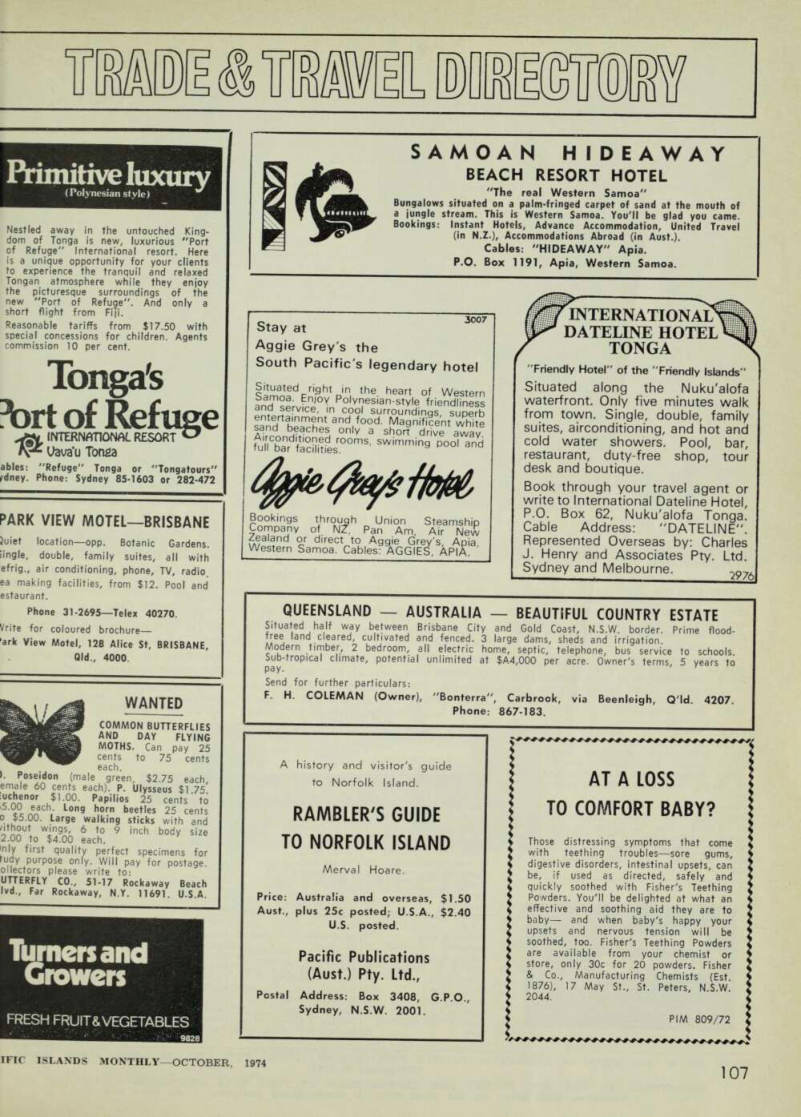
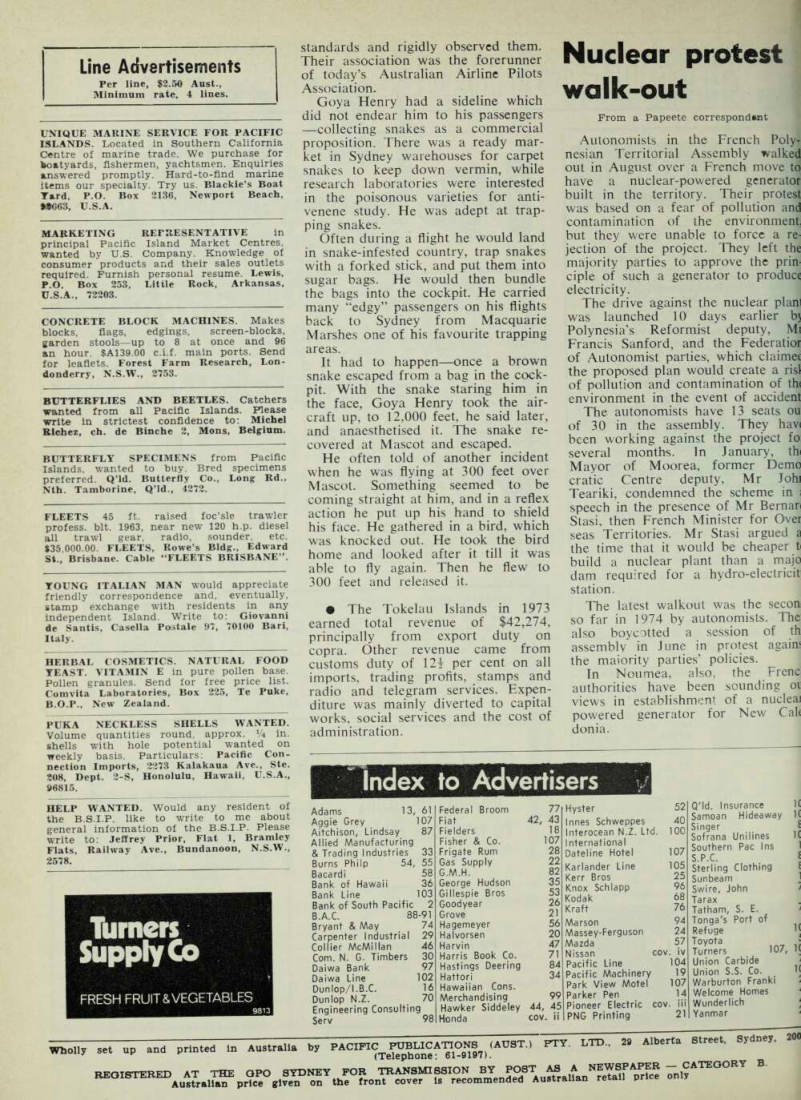
Colourful captain of the Jolly Roger
By a special reporter
The loss of a leg in an aviation accident did not prevent Goya Henry, who died recently in Sydney from becoming a colourful character in two transport fields —air and sea. He was probably best known as an aviator, in Australia at any rate, but his maritime career was in Papua New Guinea.
At an age when most men, after an adventurous aviation career like his would have settled for an early retirement, Goya Henry took himsell off to PNG—this was in the early 1950s —to become a master in the small ships of the coastal fleet. He was in PNG for about 10 years, be coming a well-known, and popula figure. But his career at sea palee into insignificance compared wit] some of his exploits as an aviatior pioneer.
He was one of the early barn stormers in a Genairco plane, name the Jolly Roger, complete with sku and crossbones, operating out o Mascot, Sydney. This was in th early 1930s. He made his living flym; joyriders, and there were thousand who wanted to see what Sydne; looked like from the sky. He als used beaches all along the NSW coas as landing fields. He once flew unde Sydney Harbour Bridge.
Mr Henry was indirectly responi ible for giving Australia-wide confix of civil aviation to the Feden Government. He used a technicalit to allow him to fly in Queensland an Victoria without crossing State boi ders. Mr Henry, after the accident i which he lost a leg, was refused licence to fly by the forerunner c today’s Civil Aviation Departmen The then civil aviation branch of th Defence Department ruled that on! pilots with all their limbs could fly.
Mr Henry appealed to the Hig Court, which ruled that the branc did not have control oyer intrastal aviation. In the air again, he woul often fly to the Victorian or Queen land borders. Then he would ha\ his aircraft towed across the bord< to a suitable airfield and continue h activities “intrastate”. It took tvs referendums to give the Feder; Government control over civ aviation. , During the vacuum when tnei were no Federal civil aviation regi lations covering intrastate flights tr pilots themselves set their own safe!
Continued on p
standards and rigidly observed them.
Their association was the forerunner of today’s Australian Airline Pilots Association.
Goya Henry had a sideline which did not endear him to his passengers —collecting snakes as a commercial proposition. There was a ready mar ket in Sydney warehouses for carpet snakes to keep down vermin, while research laboratories were interested in the poisonous varieties for anti venene study. He was adept at trap ping snakes.
Often during a flight he would land in snake-infested country, trap snakes with a forked stick, and put them into sugar bags. He would then bundle the bags into the cockpit. He carried many “edgy” passengers on his flights back to Sydney from Macquarie Marshes one of his favourite trapping areas.
It had to happen—once a brown snake escaped from a bag in the cock pit. With the snake staring him in the face, Goya Henry took the air craft up, to 12,000 feet, he said later, and anaesthetised it. The snake re covered at Mascot and escaped.
He often told of another incident when he was flying at 300 feet over Mascot. Something seemed to be coming straight at him, and in a reflex action he put up his hand to shield his face. He gathered in a bird, which was knocked out. He took the bird home and looked after it till it was able to fly again. Then he flew to 300 feet and released it. • The Tokelau Islands in 1973 earned total revenue of $42,274, principally from export duty on copra. Other revenue came from customs duty of 12i per cent on all imports, trading profits, stamps and radio and telegram services. Expen diture was mainly diverted to capital works, social services and the cost of administration.
Advertisements & other items, pp. 109-110 (2 items)
107
IFIC ISLANDS MONTHLY—OCTOBER, 1974
innJ
n §s) innJ
SAMOAN HID E A WAY
BEACH RESORT HOTEL
"The real Western Samoa"
Bungalows situated on a palm-fringed carpet of sand at the mouth of a jungle stream. This is Western Samoa. You'll be glad you came.
Bookings: Instant Hotels, Advance Accommodation, United Travel (in N.Z.), Accommodations Abroad (in Aust,), Cables: "HIDEAWAY" Apia.
P.O. Box 1191, Apia, Western Samoa.
Primitive luxury
(Polynesian st vie) * Nestled away in the untouched Kingdom of Tonga is new, luxurious "Port of Refuge" International resort. Here is a unique opportunity for your clients to experience the tranquil and relaxed Tongan atmosphere while they enjoy the picturesque surroundings of the new "Port of Refuge". And only a short flight from Fi|i.
Reasonable tariffs from $17.50 with special concessions for children. Agents commission 10 per cent.
Tonga's
ibrt of Refuse
INTERNATIONAL RESORT 0
M- Uava’u Tonga ables: "Refuge" Tonga or "Tongatours" rdney. Phone: Sydney 85-1603 or 282-472
PARK VIEW MOTEL—BRISBANE
3uiet location—opp. Botanic Gardens.
Single, double, family suites, all with efrig., air conditioning, phone, TV, radio ea making facilities, from $l2. Pool and estaurant.
Phone 31-2695—Telex 40270.
Vrite for coloured brochure— ’ark View Motel, 128 Alice St, BRISBANE, Old., 4000.
WANTED
COMMON BUTTERFLIES
AND DAY FLYING
MOTHS. Can pay 25 cents to 75 cents . .. each. • Poseidon (male green, $2.75 each, emale 60 cents each). P. Ulysseus $1 75 iuchenor $! °°. Papilios 25 cents ’ to 5.00 each. Long horn beetles 25 cents o $5.00. Large walking sticks with and wings, 6 to 9 inch body size 2.00 to $4.00 each. inly first quality perfect specimens for ludy purpose only. Will pay for postage, ollectors please write to: UTTERFLY CO., 51-17 Rockaway Beach Ivd., Far Rockaway, N.Y. 11691. U.S.A.
INTERNATIONAL
DATELINE HOTEL
TONGA
"Friendly Hotel" of the "Friendly Islands"
Situated along the Nuku'alofa waterfront. Only five minutes walk from town. Single, double, family suites, airconditioning, and hot and cold water showers. Pool, bar, restaurant, duty-free shop, tour desk and boutique.
Book through your travel agent or write to International Dateline Hotel, P.O. Box 62, Nuku'alofa Tonga.
Cable Address: "DATELINE".
Represented Overseas by: Charles J. Henry and Associates Pty. Ltd.
Sydney and Melbourne. 007 .
Stay at
3007
Aggie Grey's the
South Pacific's legendary hotel Situated right in the heart of Western Samoa. Enjoy Polynesian-style friendliness and service, in cool surroundings! superb sand rt bea^hpl and f ° oCl ' M a 9 nific ent white al™ ?r5 che s onlv a short drive away Ml bar 'fiutes. 0 ° mS ' swimmin 9 o°°l Bookings through Union Steamship Company of NZ, Pan Am, Air New Zealand or direct to Aggie Grey's, Apia, Western Samoa. Cables: AGGIES, APIA.
QUEENSLAND AUSTRALIA BEAUTIFUL COUNTRY ESTATE
Situated half way between Brisbane City and Gold Coast, N.S.W. border. Prime floodtree land cleared, cultivated and fenced. 3 large dams, sheds and irrigation Modern timber, 2 bedroom, all electric home, septic, telephone, bus service to schools.
Sub-tropical climate, potential unlimited at $A4,000 per acre. Owner's terms, 5 years to pay.
Send for further particulars: F. H. COLEMAN (Owner), "Bonterra", Carbrook, via Beenleigh, Q'ld. 4207.
Phone: 867-183.
A history and visitor's guide to Norfolk Island.
RAMBLER'S GUIDE
TO NORFOLK ISLAND
AAerval Hoare.
Price: Australia and overseas, $1.50 Aust., plus 25c posted; U.S.A., $2.40 U.S. posted.
Pacific Publications (Aust.) Pty. Ltd., Postal Address: Box 3408, G.P.0., Sydney, N.S.W. 2001.
AT A LOSS
TO COMFORT BABY?
Those distressing symptoms that come with teething troubles—sore gums, digestive disorders, intestinal upsets, can be, if used as directed, safely and quickly soothed with Fisher's Teething Powders. You'll be delighted at what an effective and soothing aid they are to baby— and when baby's happy your upsets and nervous tension will be soothed, too. Fisher's Teething Powders are available from your chemist or store, only 30c for 20 powders. Fisher & Co., Manufacturing Chemists (Est. 1876), 17 May St., St. Peters, N.S.W. 2044.
PIM 809/72
Turners and Growers
FRESH FRUIT&VEGETABLES
Line Advertisements
Per line, $2.50 Aust., Minimum rate. 4 lines.
UNIQUE MARINE SERVICE FOR PACIFIC
ISLANDS. Located in Southern California Centre of marine trade. We purchase for boatyards, fishermen, yachtsmen. Enquiries answered promptly. Hard-to-find marine items our specialty. Try us. Blackie’s Boat Tard, P.O. Box 2136, Newport Beach,
9®663, U.S.A.
MARKETING REPRESENTATIVE in
principal Pacific Island Market Centres, wanted by U.S. Company. Knowledge of consumer products and their sales outlets required. Furnish personal resume. Lewis, P.O. Box 253, Little Rock, Arkansas,
U.S.A., 72203.
CONCRETE BLOCK MACHINES. Makes
blocks, flags, edgings, screen-blocks, garden stools—up to 8 at once and 96 an hour. $A139.00 c.i.f. main ports. Send for leaflets. Forest Farm Research, Londonderry, N.S.W., 2753.
BUTTERFLIES AND BEETLES. Catchers
wanted from all Pacific Islands. Please write in strictest confidence to: Michel Bichez, ch. de Binche 2, Mons, Belgium.
BUTTERFLY SPECIMENS from Pacific Islands, wanted to buy. Bred specimens preferred. Q’ld. Butterfly Co., Long Rd., Nth. Tamborine, Q’ld., 4272.
FLEETS 45 ft. raised foc’sle trawler profess, bit. 1963, near new 120 h.p. diesel all trawl gear. radio, sounder, etc. $35,000.00. FLEETS, Rowe’s Bldg., Edward St., Brisbane. Cable “FLEETS BRISBANE’’.
YOUNG ITALIAN MAN would appreciate friendly correspondence and, eventually, stamp exchange with residents in any independent Island. Write to: Giovanni de Santis, Casella Postale 97, 70100 Bari, Italy.
HERBAL COSMETICS. NATURAL FOOD
YEAST. VITAMIN E in pure pollen base.
Pollen granules. Send for free price list.
Comvita Laboratories, Box 225, Te Puke, 8.0. P., New Zealand.
PUKA NECKLESS SHELLS WANTED.
Volume quantities round, approx. J A in. shells with hole potential wanted on weekly basis. Particulars: Pacific Connection Imports, 2273 Kalakaua Ave., Ste. 208, Dept. 2-S, Honolulu, Hawaii, U.S.A., 96815.
HELP WANTED. Would any resident of the 8.5.1. P. like to write to me about general information of the 8.5.1. P. Please write to: Jeffrey Prior, Flat 1, Bramley Flats, Railway Ave., Bundanoon, N.S.W., 2578.
Turners Supply Co
FRESH FRUIT & VEGETABLES
9813
Nuclear protest
walk-out
From a Papeete correspondent
Autonomists in the French Poly nesian Territorial Assembly walked out in August over a French move to have a nuclear-powered generator built in the territory. Their protest was based on a fear of pollution and contamination of the environment, but they were unable to force a re jection of the project. They left the majority parties to approve the prin ciple of such a generator to produce electricity.
The drive against the nuclear plant was launched 10 days earlier b> Polynesia’s Reformist deputy, Mi Francis Sanford, and the Federation of Autonomist parties, which claimec the proposed plan would create a risl of pollution and contamination of th( environment in the event of accident The autonomists have 13 seats ou of 30 in the assembly. They hav< been working against the project foi several months. In January, th< Mayor of Moorea, former Demo cratic Centre deputy, Mr Johi Teariki, condemned the scheme in i speech in the presence of Mr Beman Stasi, then French Minister for Over seas Territories. Mr Stasi argued a the time that it would be cheaper t( build a nuclear plant than a majo dam required for a hydro-electricit; station.
The latest walkout was the secon so far in 1974 by autonomists. The; also boycotted a session of th assembly in June in protest agains the maiority parties’ policies.
In Noumea, also, the Frencl authorities have been sounding or views in establishment of a nucleai powered generator for New Cab donia.
Index to Advertisers
Adams 13, 61 Aggie Grey 107 Aitchison, Lindsay 87 Allied Manufacturing & Trading Industries 33 Burns Philp 54, 55 Bacardi 58 Bank of Hawaii 36 Bank Line 103 Bank of South Pacific 2
B.A.C. 88-91
Bryant & May Carpenter Industrial 29 Collier McMillan 46 Com. N. G. Timbers 30 Daiwa Bank 97 Daiwa Line 102 Dunlop/1.8.C. 16 Dunlop N.Z. 70 Engineering Consulting Serv 98
Federal Broom 77 Fiat 42, 43 Fielders 18 Fisher & Co. 107 Frigate Rum 28 Gas Supply 22
G.M.H. 82
George Hudson 35 Gillespie Bros 53 Goodyear 26 Grove 21 Hagemeyer 56 Halvorsen 20 Harvin 47 Harris Book Co. 71 Hastings Deering 84 Hattori 34 Hawaiian Cons.
Merchandising 99 Hawker Siddeley 44, 45 Honda cov. ii
Hyster 52 Innes Schweppes 40 Interocean N.Z. Ltd. 100 International Dateline Hotel 107 Karlander Line 105 Kerr Bros 25 Knox Schlapp 96 Kodak 68 Kraft 76 Marson 94 Massey-Ferguson 24 Mazda 57 Nissan cov. iv Pacific Line 104 Pacific Machinery 19 Park View Motel 107 Parker Pen 14 Pioneer Electric cov. iii PNG Printing 21
Q'ld. Insurance Samoan Hideaway 1C
Singer J
Sofrana Unilines 1C Southern Pac Ins 1
S.P.C.
Sterling Clothing c Sunbeam 1 Swire, John Tarax Tatham, S. E.
Tonga's Port of Refuge R Toyota * Turners 107, U Union Carbide Jj Union S.S. Co. 1C Warburton Franki * Welcome Homes i Wunderlich * Yanmar J
Advertisements & other items, pp. 110-112 (3 items)
Wholly set up and printed In Australia by (ADBT.) PTY. LTD.. 2« Alberta Street, y |
Wholly set up and printed In Australia by (ADBT.) PTY. LTD.. 2« Alberta Street, y REOlBTlßKD A^^^ro^ro>^^^Tß^eS^BTM^4 B.
Fic Islands Monthly—October, 1974
aaker
* Viable
Iwl
\ Look to Pioneer s new ES-2000 Two-channel SoundMates. A stereo system designed to play together as a well-balanced audio team.
Pioneer’s receiver gets away from ‘top-heavy
sound by giving you a highly selective AM/FM tuning section and 34 watts (IHF) of music power And for four-channel, just add a pair of speakers. All this and MIC mixing, too And this turntable is more than just hot" looking. The ultra-smooth belt-drive mechanism provides loving care for your records, plus auto-cut and return.
For real living presence sound, kiss your
tweakers goodbye. This two-way, two-speaker
system gives you earthy, heart-moving sound.
Pioneer’s new ES-2000 Two-channel
SoundMates. Great musical partners for whatever you play to music ES-2000
Two-channel SoundMates
Australia Pioneer Electronics Australia Pty. Ltd., 256-8, City Road, South Melbourne Victoria 3205, Australia Tel: 696605 Branches in all states Fiji Islands Brijlal & Company. G.P.O. Box No. 362 auva, Fiji Islands Tel: 22-258 _ae Hagemeyer (Australasia) B.V., PO. Box Mo. 90, Lae, New Guinea Tel: 2718 Habaul Hagemeyer (Australasia) B.V, PO. Box Mo. 63. Rabaul, New Guinea Port Moresby Hagemeyer (Australasia) B.V, P.O. Box No. 1428, Boroko, Port Moresby, New Guinea Madang Hagemeyer (Australasia) B.V, P.O. Box No. 673, Madang, T.P.N.G.
New Zealand Tee Vee Radio Ltd., P.O. Box No. 5029, Auckland, New Zealand Tel: 763-064 Norfolk Island Burns Philp (South Sea) Co.. Ltd.
Norfolk Island. South Pacific Nauru Island Jacob Enterprises, P.O. Box No. 4 Nauru Island Tahiti Ets. PERFECT, B.P. 594, Papeete Tahiti Tel: 20-407 New Caledonia Menard Freres, B.P. 123, Noumea New Caledonia Tel: 52-22 American Samoa Transpac Corporation, P.O. Box 1477, Pago Pago, American Samoa 96799 Tel: 2227
i m * ■* * r'v -■ «■ fs* ' * 1 * MM *9mmmv*. fli a - « s, ► ,=% /* * f%9 *2s»
iwmm
mm , - ,'v*„ ; IK’ : And wherever you’ll go in over 120 nations throughout the world you’ll find proud DATSUN drivers.
Perhaps the main reason is that DATSUN was designed to meet a wide variety of conditions—mountain roads and super highways, blistering suns and freezing temperatures. DATSUN is indeed the international car that has precision engineering and a stunning string of rally victories behind it.
Its superb handling, safety features and high speed efficiency make DATSUN the choice of young and old alike. DATSUN-the car that really satisfies the world over.
DATSUN
NISSAN
& Sir m wm 1 T ■ ' Jisip:# nr vi '» DATSUN distributor network covers the following areas: fcaMHM n. n mr -nr Cl XT . V'nw HoJiriHpS. R