Pacific Islands Monthly


News Magazine Of The South Pacific
September, 1974
AUSTRALIA, N.Z., P.N.G., FIJI, N, HEBRIDES 60c
Tonga, W. Samoa, B.S.I.P., G.E.I.C. 60C
Cooks, Norfolk, Niue, Nauru 60C
Am. Samoa, Hawaii, Micronesia, Guam $1.00
NEW CALEDONIA AND FRENCH POLYNESIA 100 GFP
Our Cover
Four attractive youngsters look out on to the outside world from their atoll home in the Tokelaus.
Some day they will have to make a decision—to stay at home and follow the peaceful and, some times, difficult life of the atoll dweller, remote from the bustling world, or join that world, follow ing thousands of their kinfolk to New Zealand. Laurence Bracken, of Pago Pago, who took the picture, writes on page 39 about the “almost forgotten ” Tokelaus.
Advertisements & other items, p. 2 (1 item)
The natural Choice.
It’s Honda. Anywhere there’s action. A job to be done.
Fun to be had. Safely and economically.
The snappy line-up is studded with star performers.
Easy-to-handle motorbikes that possess a big-hearted spirit. for breezing through traffic or escaping to the country. Rugged reliability that lets you go, go, go.
Little wonder so many people around the world ride Honda.
It’s the all-round natural choice. i I
jfffS
m 70 ST CT PAPUA NEW GUINEA: Steamships Trading Co., Ltd. P.O. Box 74, Papua/U.S. TRUST TERRITORY: J.C. Tenorio Enterprise P.O Box 137 Saipan / FIJI ISLANDS: Coral Island Motors: Walu Bay Suva Fiji Island. P.O. Box 3179 Lami / TARAWA: The Gilbert & Ellice Islands Development Authority Gilbert & Ellice Islands / WESTERN SAMOA: Motor Distributors (Samoa) Ltd. P.O. Box 576, Apia / AMERICAN SAMOA: Max Haleck Inc. P.O. Box 99, Pago Pago/TONGA: E.M. Jones Ltd. P.O. Box 34, Nukualofa / SOLOMON ISLANDS: British Solomons Trading Co., Ltd. Box 114 Honiara / NEW CALEDONIA: Establissements Ballande, Noumea / TAHITI: Ets. COMIMPEX P.O. Box 200, Papeete/COOK ISLANDS: Cook Islands Trading Corporation Ltd. P.O. Box 92, Rarotonga / NAURU ISLAND: Nauru Cooperative Society 14th Floor. Wales Corner, 227 Collins Street Melbourne Victoria 3000
In This Issue
Meral
* students' tape recording 15 ober 10—red letter day 15 mging role of missionaries 19 (ional transport conferences 73 ge coconut potential 89 rision on Air Pacific 91
Erican Samoa
/ Haydon resigns 7 seum gets French coat 12
Ok Islands
mier and independence 9 y free robberies 44 r in Rarotonga 44 >roved shipping service 77 ating a new elite 13 brain drain 21 ling for crime 44 jrch protests Sunday trading 44 ice's October visit 44 lional transport conferences 73 \ interested in Air Pacific 75 'ol bomb at Suva wharf 79 mp down on money export 91 rists' complaints 94 itrolling profits 102
Nch Polynesia
ich navy ship banned in GEIC 8 ond launch for Tahiti service 77
Bert And Ellice Islands
test against nuclear tests 8
Id Howe Island
I of flying-boats 77
Nauru
Gift to Western Samoa 45 Regional aviation conference 73 Upgrading phosphate 94 Consul-General appointment 102
New Caledonia
Assembly demands self-government .. 11 Documenting the Caldoche vernacular 15 Full container service soon 77 Latest plans for nickel 91
New Hebrides
Security risk gaoled 45 Wreck of the Trudy 78
Norfolk Island
Council's protest 3 Increase in tourists 92
Papua New Guinea
Volcano erupts (pic) 7 Bougainville copper talks 9 Parliamentary clashes 10 Investment Corporation's profits ... 12 The primitive art business 17 Changing role of missionaries 19 Talks on better shipping service ... 79 Extensions at Moresby airport 80 Rural workers' wage increase 94 Giregire gaoled 102
Pitcairn Island
Windmills for energy 12
Solomon Islands
Drug runner appeals 5 Chief Minister's election 8
Strikers win more pay 44 Plane services cut 45 Woodford of the Solomons 59 BSIP ship sold to Fiji company 78
Tokelau Islands
The almost-forgotten islands 39
Tonga
Cost of living rises 6 Regional transport conferences 73 Hopes for shipping expansion 75 1973-74 trade deficit 89 King's Saudi Arabia talks 93 Princess's appointment 93
United States Trust Territory
Micronesian status draft agreement . 6 Changing the drug laws 13 Saipan's last battle 57
Western Samoa
Local Watergate 11 UNDP sacking 32 Paying the inflation bill .. 33 Regional airline conference 73
•ARTMENTS: Up front with the Editor, 3; Tropicalities, 12; Editor's Mailbag, 23; a Nutshell, 44; From the Islands Press, 47; Yesterday, 48; Magazine Section, 57; NA, 60; Books, 67; Pacific Transport, 73; Cruising Yachts, 81; Business and Develop it, 89; Produce, 95; Shipping and Airways Information, 96; Deaths of Islands People, 102; Postscripts, 102; Advertisers' Index, 104.
Advertisements & other items, p. 4 (1 item)
8-Speed
—”<=— —' X si®
imbernn
Power
Blender
-the
appliance
you can use
every meal.
With powerful, Solid-state motor. Solid-state means added versatility for exactly the blending action you need —to stir, puree, cream, whip, grate, mix, chop or liquefy.
Stainless steel cutters operate at high speed for fast food preparation.
Switch from speed to speed without turning off. fcWri-rifc.Trirtri 183.3335
Pacific Islands
Monthly
FOUNDED BY R. W. ROBSON IN 1930
Published Monthly By
Pacific Publications (Aust.) Pty. Ltd.,
29 Alberta St., Sydney, N.S.W., 2000.
Postal Address: G.P.O. BOX 3408, SYDNEY,
N.S.W., 2001.
Telegraphic Address: PACPUB, Sydney.
Telex 25168.
Telephones: 61-9197, 61-7101, 61-4369.
nsulting Directors: R. W. Robson, Judy Tudor.
Chief Executives: Manager: Selwyn Hughes.
Publisher: Stuart Inder.
Director of Advertising: W. A. Gasnier.
Pacific Islands Monthly
Editor: Stuart Inder.
Assistant Editor: John Carter.
Advertising Manager: W. A. Gasnier.
Circulation Manager: Barry Badger.
Subscription Rates:
'acific Islands Monthly" is airfreighted to all bscribers and agents in the Pacific Islands d the U.S.A.; copies to Nauru and other sas go by surface mail, stralia (incl. Lord Howe and Thursday Is.), w Zealand, Papua New Guinea, Fiji, New brides, Tonga, Western Samoa, Solomon ands, Gilbert & Ellice Islands, Cook Islands, rfolk Island, Niue and Nauru Islands: $6.80 ical currency); American Samoa, Hawaii, cronesia and Guam; $12.00 US; New ledonia and French Polynesia 1,100 CFP; Mainland: $14.00 US; United Kingdom: -10. Elsewhere $B.OO Aust.
Representatives
i: Advertising— Fiji Times & Herald Ltd., Gordon St., Suva. Telephone: 25-601. lex.; FJ 2124. Distribution —Desai Book Depot Ltd., P.O. Box 160, SUVA. Tel.; 311-424. pua New Guinea: PORT MORESBY, PNG Print j Co. Pty. Ltd., P.O. Box 633; LAE, P.O. Box 7; RABAUL, Mr. David Simpson, P.O. Box 164 (c/- Rabaul Photographic. Tel.: 2677.) :nch Polynesia. Distribution—Hachette Paci ue, 10 Ave Bruat, Papeete, w Zealand: Pacific Publications, C.P.O. Box 29, Auckland. 379-494. Representative: Mr Breckell, Breckell Publishing, Kingdon House, igdon Street, Newmarket, Auckland. Tel.: 54-6834. Telex.: NZ 2727. ited Kingdom: Advertising—Overseas Publicity 1., 214 Oxford Street, London, WIN OEA. one: 01-636 8296/7. Subscriptions—T. B. aham. Park House, 22 Park Street, Croydon,
Cr9 3Np. Tel.: 01-6884177.
ian: Advertising—Universal Media Corpora- Mon, C.P.O. Box 46, Tokyo. Tel.; 666-3036. toria : Advertising Pacific Publications ist.) Pty. Ltd., 33 Lonsdale Street, Ibourne, Vic. 3006. Telephone: 662-3263. eensland; Advertising—Beale Media Services, I St. Paul's Terrace, Fortitude Valley, Qld., 4006. Tel.: 52-5827. waii and U.S. Mainland only; N. Grogan, 54 Hayden Street, Honolulu, 96815. nd change of address notices, Form 3579 i new subscriptions to P.O. Box 2193, Honolulu, Hawaii, U.S.A. 96805). ond class postage paid at Honolulu, Hawaii.
Copyright ©, 1974,
Pacific Publications (Aust) Pty. Ltd.
September, 1974 Vol. 45, No. 9
Up Front
with the Editor
It is fitting that there should be another political controversy on Nor folk Island. It’s fitting because this is Norfolk’s year.
On October 10 it celebrates the 200th anniversary of its discovery by Captain Cook—and the island is only 14 years short of the 200th anni versary of its first settlement by Britain.
In almost 200 years of settlement one would have expected that its political fate would have been firmly settled, but the islanders don’t think so.
Norfolk Island, 1,000 miles north east of Sydney, is only 14 square miles in area, with a population of about 1,500. It’s still noted mainly for its stately Norfolk Island pines— the trees which so impressed Captain Cook in 1774 as being suitable for masts for British ships. It’s because of this, and because of the wild flax that grew there and which looked as if it could be useful for sails, that Cook took possession of the then un inhabited island.
And because the British Admiralty agreed with him, it was a matter of only a week or two after the landing of Captain Phillip’s First Fleet at Botany Bay in 1788 that a vessel was despatched to Norfolk to found a settlement and prevent any other power acquiring it. Thus Norfolk Island became the second British settlement in the South Pacific. As it happened, neither the flax plant nor the pine trees turned out to be useful —the pine trees had too many knots in them—and the island in subse quent years became a prison colony.
Its modern history began in 1856 after the convicts had departed and there arrived by special arrangement the entire population of Pitcairn Island to begin a new life, their own island being thought too small for them. Some of the Pitcairners later got homesick and returned to Pit cairn, which is the reason why the descendants of the Bounty mutineers can today be found on both Pitcairn and Norfolk.
Britain agreed at the time that
Norfolk Island would be considered a “separate and distinct settlement”.
Responsibility for the island was vested in the Governor of NSW—not the colonial government of NSW but the governor himself, and a number of the early governors enjoyed having their own little community to play with, even testing out the Norfolk school pupils on their maths during their visits and inspecting the state of the drains.
But the Australian colonies formed the commonwealth at the turn of the century, and by 1914, despite some protests on the island that Norfolk was still a separate and distinct settle ment, Norfolk became a territory of Australia, and still is.
Australia has not up to now made income tax laws for it, nor do the people pay rates, nor radio licence fees. But nor do they receive pen sions and other social service hand outs. The island gets along on its own small resources, which include the proceeds from tourism, plus a fairly small subsidy from the Australian Government. Some facts are on p 92.
The population over the years has been swollen with Australians and New Zealanders, and some people from Britain, who have retired there or set themselves up as small shop keepers.
The current fuss has been sparked off by a letter to the eight-man Norfolk Island council in July by the Minister for the Australian Capital Territory, Mr Gordon Bryant, whose responsibility includes Norfolk.
During almost the whole history of Norfolk since 1856 there have been complaints on the island that they have not been allowed to pro perly conduct their own affairs. There have been commissions and royal commissions, petitions to the Queen and even a court challenge or two.
The recent debate in the council about the contents of the Minister’s letter is simply another manifestation of Norfolk’s contihued frustration with outside authority.
What the Minister said in his letter was that advantages to the people of Norfolk Is would accrue “by closer
slationship with the mainstream of ustralian life”, and that the island s disadvantaged by isolating itself om the varied and highly desirable >cial welfare benefits which member lip of the Australian taxation system akes possible”.
This seems a highly colourful way : preparing the islanders still further ►r the joys of Australian income tax.
Fhe islanders have been left in little >ubt these last 12 months that they e going to get it, although they m’t know when.) The Minister’s letter laid it clearly i the line where the Australian Gov nment stands over Norfolk’s consti tional position. The Minister was ying virtually that Norfolk can be garded as part of the Australian ainland and that he intends to treat as such.
The Minister reminded council that ; had the final responsibility for the [ministration of Norfolk Island, that e Australian Government had the nstltutional right to make laws ►plicable to Norfolk and that in his ;w it was “counter-productive” for e islanders to continue to debate eir constitutional position.
'Hie letter drew a heated response, ainly on the matter of who was •ss. Councillor Duncan Mclntyre id that when the minister acted ainst the advice of council or acted thout seeking council’s advice on y matter concerning Norfolk Island ;n he defied not only the elected presentatives of the people. He fied the whole island. He exceeded » power.
He said the United Nations
Covenant on Human Rights permitted Norfolk Island to choose its own political future and its own political form, and that “Norfolk Island is entitled to the last word over the Minister, and that is true, even if the Minister thinks it is counter-productive”.
He added that if Norfolk Island did not argue its case vigorously before the eyes of the world, in the UN if necessary, “then we sell out the island and we are not free men”, Councillor Smith agreed, and he said if the Minister was going to take away Norfolk’s human rights he would like to see the island placed under the United Nations.
The debate was reported in detail in the Norfolk Islander, the little weekly newspaper produced by Tom Lloyd and his wife Tim, and then got an airing in the mainland newspapers and TV. The mainland newspapers stressed mention of the United Nations and reported that moves were likely for UN intervention on Norfolk, according to an unofficial
poll.
What appeared from newspaper reports to be a second Mutiny on the Bounty irritated Minister Bryant in Canberra, who promptly sent Norfolk a cable suggesting if the council wished to communicate with him only through the medium of the press, it seemed “an odd way to do business”. He said he was personally sympathetic to council having some
executive responsibility, and pointed
out that the Norfolk Island Council in i 960 had been empowered to make laws, to carry out local govern-
ment functions and to raise local revenue, but these powers had been removed by the Australian Govern ment in 1963 “at the express request of the council, which assured the Minister of the day that it was the unanimous wish of the people”. He reminded them that the council had reverted to an advisory one and still was advisory, but he was willing to make an early recommendation for those powers to be reintroduced if that was what Norfolk wanted, The Minister was speaking the truth. Local government was intro duced with a great flourish on Nor folk in 1960 but a bloc on the council refused to put it into practice, Faced with Mr Bryant’s cable the councillors appeared not so mutinous, Council passed unanimously the fol lowing motion, “That the council dis sociates itself from the recent pub licity in the Australian and local press concerning the visit to Norfolk Island by the United Nations dele gation and further emphasises that the Norfolk Island Council has not considered such action. Furthermore no poll was ever conducted to ascer tain the views of all councillors con cerning a proposed visit by the UN delegation to Norfolk Island.”
The question now is, does the council want the reintroduction of local government?
I think it might be a good idea if it took this step again. As an advisory council it’s little more than a debat ing society, and it has only itself to blame if nobody takes it very seriously.
Stuart Inder
Advertisements & other items, pp. 5-6 (2 items)
3
CIFIC ISLANDS MONTHLY—SEPTEMBER, 1974
Careershe
* 1 .
T .f *
IN HBt BRIEF
CAREERSHE
BROUGHT MANY
AROUSE DOWN.
On October 26th 1972 Hurricane Bebe struck Fiji. Huge areas were completely devastated. Houses were flattened, roofs were ripped off.
It was during this storm that a partially completed Harveytile roof met and weathered what was the toughest test any roof is likely to meet.
It took the full brunt of this ferocious storm without losing so much as one tile. Nor did days of driving torrential rain cause the roof to leak.
The larger, longer tiles of Harveytile
mean fewer joints. Thus providing complete weather protection for a lifetime and then some.
Harveytile roofs began with violent volcanic upheavals where rocks were born. The ceaseless march of ancient
glaciers, ground and splintered the rock
into particles which rivers then carried to line their banks.
It is these very same particles that form the protective surfacing of Harveytile roofs. Quarried stone silica and natural river pebble chips are selected from locations around New Zealand.
Harveytile roofs offer you eight beautiful roofing colours. Natural colours that are as old as the hills.
As Bebe demonstrated, even a hurricane can't budge the tiles of a roof that was a million years in the making.
Harveytile. Riverstone roofs.
The roof that's a million years in the
making.
Harveytile
Riverstone Roofs
I Please send me your free Harveytile Brochure that will show me, in colour, j the full range of textures available.
Name
I Address Please send to: Harvey Tile Company Ltd. 40 Mt. Wellington Highway, P.O. Box 62-019 Auckland, New Zealand.
WfiSTSft!at~ The Harvey Tile KSnSiSM Company Limited
HAWAII
Kamaaina Roofing Inc., 91-430, Komohana St, Ewa Beach, Oahu, Hawaii 96706.
Hilo-Pacific Roofing Co. Ltd., 23, Pohaku St,
Hiio, Hawa
96720.
NEW CALEDONIA
New Zealand Overseas Trading Corp. Ltd., B.P. 4127, Noumea.
PAPUA NEW
GUINEA
A.C.I. (New Guinea) Pty. Ltd.
P.O. Box 613, Lae.
NORFOLK
ISLAND
Irvine's Building Supply Centre, Box 117, lsland.
WESTERN
SAMOA
H. & J. Retzlaff., P.O. Box 195, Apia, Western Samoa.
FIJI
A.C.I. - Harvey (South Pacific) Ltd., P.O. Box 1095.
Suva, Fiji.
TAHITI
Ets. Sin Tung Hing., B.P. 1605, Fare-Ute, Papeete, Tahiti.
The Tradewinds Convention Centre in Fiji that weathered the full force of Hurricane Bebe, without losing a tile.
Drug runner in a strange land
£ ? TU I ™ n . ner caught and dealt ‘ h .‘ n . ?tenn^ ds J n pnl L hiad ? fine of . *50.000 reduced to a " d a , sentence of five years prisonment reduced to four years the Fiji Court of Appeal. And ; Piper Cherokee aircraft he flew, uch was forfeited to the Solomon ands Government, has been reised to Bishop Aviation Ltd, in 5w Zealand, on payment of an unreified, but believed to be substan- 1, sum of money.
The drug runner was VannHrpv BisW 33 of Auckland H .s on his way from Hong w Zealand. His aircraft was irched when it landed in the Soloms, and officials found 101 lb of mabis resin. Bishop, in the High urt of the BSIP, pleaded guilty to arges of possession of marihuana
d importing prohibited drugs.
, ... ln an appeal to the Fiji Court of
Appeal on the grounds of severity of sent ?? ce > Blshop banned , the total punishment was manifestly excessive . Mr Richard Davis, for the crown, agreed that the $50,000 seemed very difficult to justify and suggested it could be reduced to an amount Bishop could conceivably pay. The five years’ imprisonment was not excessive in the circumstances, as Bishop could have received a stiffer sentence in New Zealand, where he was bound.
The court chairman, Sir Trevor Gould: More severe than five years, sso ’° 0 00 and the forfeiture of his air-
cratt? .
M f Davis said he was °nly referrm 8 t 0 tlie length of the prison tei ?}- . Mr Karam Ramrakha, for Bishop, s Jf d the c 9 urt s . hou l d consider the effect a native prison would have on a New Zealander accustomed to a more sophisticated life cycle. Bishop com-
plained about inadequate toilet facili ties, and lice in his blankets. Bishop had tried to escape, and had been put in a punishment cell, which at least had its own toilet. t Negligible recreational facilities and °* “J te English con v^ r . satlon ™ ade J lfe almost like so ld ary confinement.No counselling, P s V chiatn .c or rehabilitation facilities available. If the judges weighed all those factors they could conclude at a l? v .e-year P nson sentence be- ? am ? vlc l ous and f ° r a 0 eigner m a strange land - When Bishop was dealt with in the BSIP, the High Court was told that the drugs were worth between $150,000 and $200,000. Bishop said then he was to be paid $50,000 to take the drugs into New Zealand, He did not consider himself a “pur veyor of misery” as there was a dif ference between hard and soft drugs.
Advertisements & other items, p. 7 (1 item)
Cific Islands Monthly—September, 1974
Give And Take At Guam Brings
A New Compact For Micronesia
Prom a Saipan correspondent
Quid pro quos must have filled the air at the Guam conference between the Congress of Micronesia’s Joint Committee on Future Status and the United States. Full agreement was reached—this after interminable talks going back to 1969—0 n Micronesia’s new status after a series of surprising concessions by both sides, concessions which a few months ago, seemed more remote than the Milky Way.
The draft text of the new compact was released in Washington and circulated in the Congress of Micro nesia on August 8. But all is not over. The compact has to be ap proved by the Congresses of the United States and of Micronesia and a plebiscite of the peoples of the Carolines and the Marshalls. The Marianas, conducting separate negoti ations, remain outside the compact.
A 55 per cent majority is needed to approve the compact, and should at least two-thirds of the voters in any district reject the agreement the com pact will not apply to that district.
Since the Guam talks, however, the Joint Committee suggested several changes in the terms of the agree ment and these will be the subject of further discussion.
The committee’s co - chairmen, Senator Lazarus Salii and Congress man Ekpap Silk represented Micro nesia and Ambassador Franklin H.
Williams and his deputy James M.
Wilson Jr the IJnited States.
Highlights of the draft agreement, according to the Washington release, are: • The new Government of Micro nesia will have full responsibility for its internal affairs. It will be self governing under its own constitution, with its own laws and its own courts. • The United States will have the responsibility for Micronesian foreign affairs and defepce. It will have the exclusive rights to establish and main tain certain military installations in the area. • The US will provide continuing financial assistance to Micronesia for an initial period of 15 years. This will include support for government operations, starting at an annual level of SUS3S million, and additional grants for capital improvements, starting at $12.5 million annually, both declining gradually over the period. Loans for other development projects will also be made available at an annual rate cf $5 million.
• The US will also provide federal postal, meteorological and commercial aviation services to Micronesia. • Both parties will enjoy most favoured nation status with respect to each other’s customs laws, export import regulations and other com mercial taxes. • US currency will continue to be used as legal tender in Micronesia for an indefinite period. • Micronesia and the US will establish appropriate representation in each other’s capitals. • The compact may be terminated unilaterally by either party at the end of 15 years, but the association can continue in effect indefinitely in the absence of such action.
In separate undertakings the US has also agreed to transfer to local control all public lands held in trust.
With US Congressional approval it will also continue financial and de velopment assistance to Micronesia during a tentatively agreed five-year period between approval of the agreement and the end of the trustee ship in amounts ranging from a pro jected level of $76 million this fiscal year to $6l million in the last years of the trusteeship. During this period action will be taken to phase in the
new government established under thd new Micronesian constitution and td terminate the trusteeship arrangement] The United States seems to have gained the most from the bargaining but it will cost them millions of dollars in grants which, initially, they refused. The talks bogged down last year over the Micronesians’ demand for annual aid of $lOO million later reduced to $BO million. The new compact will give them $l2B million to begin with. This will reduce gradu ally. In return, the Americans suc ceeded in their demand that uni lateral termination of the compact cannot be effected for 15 years. The Micronesians wanted it limited to five years. Most important of all, from their standpoint, the US will get ex clusive military rights.
It will continue to occupy Kwaja lein atoll, the missile range, as well as parts of Bikini and Eniwetok atolls and will have access and anchorage rights in Malakal Harbour, Palau and adjacent waters; joint use oi the proposed airfield at Garrem Island or the Babelthaup airfield anc an option on 32,000 acres of land for ground force training and manoeuvres on Babelthaup Island Requirements in the Marianas are the subject of separate negotiations.
Tongan Nobles Have The Last
Word Over Salary Rises
The confrontation between the Tonga House of Assembly and the Privy Council over a 20 per cent cost-of-living allowance (COLA) ended in a qualified win for the assembly. The parliamentarians’ COLA is dated back to July 1, 1973, and that for civil servants and daily-paid labourers back to January 1, 1974. The Privy Council earlier had decided COLA should become effective for all from April 1, 1974.
The assembly erupted at this and by an 8-4 vote refused initially to pass the estimates for 1974-75. In 1973, the house had carried a lution that any salary increase coming from a review of salaries for the civil service should take effect from July 1, 1973. Members were annoyed as the Privy Council decision that COLA should become effective for all from April 1, 1974 was over-riding the wishes of the people’s represent atives. “It’s undemocratic” was the cry. .
Some members of the assembly were not happy with the new decision from the Privy Council. Mr Masao Paasi, People’s No 1 Representative for Vavau, said that the Privy Council, in reviewing the matter, had not stated clearly the reason why civil servants and labourers should gain COLA backdated to only January 1, 1974, when members of the House had their salaries backdated to July 1, 1973. In pointing out that the cost of living had risen by 30 per cent since the 19605, he asked why civil servants and labourers were treated differently.
An attempt was made to have the matter referred again to the Privy Council, but eight nobles outvoted six people’s representatives against such a move.
Haydon To Leave Pago 'With Love
And Affection For Samoans'
From a Pago Pago correspondent
After five years of controversy, ohn M. Haydon has resigned as iovernor of American Samoa. Hayon, who was sworn in as governor n August 5, 1969, sent his resignaon to Secretary of the Interior :ogers C. B. Morton on August 5 larking five years to the day as the ead of the territory. . . tt j • . Wntmg to Morton, Haydon said, [t has been a source of real satisiction to serve tne American amoan people for the past five ears ’
Although Haydon did not go into etails, he did indicate that he hoped ) return to his native Seattle, Washington, for “family and business masons”. tt • i i j* , , • i ::j". imea aown a cnance io elect ineir
"" rnofThad iTptd -
m, “that I would have the honour ' serving as American Samoa’s last 3 pointed governor but this possiility has been negated by the :ople’s rejection of the election, for le third time in less than two years.” „ . . . . , .
Haydon said his decision had st h,mgl whatsoever to do with last ;ars Hatch Act hearings in which was charged with interfering with cal elections. Haydon was cleared
of those charges by Civil Service Commission Judge John McCarthy.
“We will leave American Samoa,” said Haydon, “with a great deal of love and affection for the Samoan people.”
TTie Haydons plan to leave in mid-October.
Haydon has not always been popular. He has been a colourful, uniquely-dedicated, demanding gover nor. He has also been an abrupt, iconoclastic governor, who has not hesitated to overpower those who stood in his way.
Haydon’s primary intent during his tenure has been to “get things done” and to “do a job”. He has been single-minded in his efforts.
Shortly after arriving in American Samoa, he shocked the local Samoan leaders when he dumped a load of rubbish on the desk of a village chief.
The point that Haydon had in mind was to show that the area was covered with the rubbish. The point the Samoans got was that he lacked re spect for the village chief.
For various reasons, Haydon had his local detractors, including news paper editor Jake King, of the Samoa News. King filed numerous suits against Haydon, none of which was successful. Haydon, for his part, has seemed to be somewhat paranoiac with regard to the Press and has been accused of attempting to manipulate the local Press.
These charges were particularly brought up when Haydon was charged with violations of the Hatch Act last year and had to appear be fore a Civil Service hearing. The charges grew mainly out of a tele vision programme done by Haydon, and radio tapes made by several local Samoan leaders. The prosecution contended that Haydon used the Press to achieve surety that he would stay in office, while Haydon con tended that he had no such intentions and that he did not interfere with the government Press.
In typical Haydon fashion, during the hearings, he managed to get into a rather vocal argument with the KVZK television news director over who could and who couW not be interviewed.
Oddly enough, although Haydon’s opponents have seemed convinced that he actually did not want an elected Samoan governor, he has seemed to be consistent in his attempts to be the last appointed gov ernor.
A bit of historical parallel is that Commander Tilley, who was the first appointed governor of American Samoa, was acquitted before a United States Navy Court Martial Board for much the same charges that Haydon faced in the Hatch Act hearings.
Haydon was surely aware of this tidy
Continued p 101
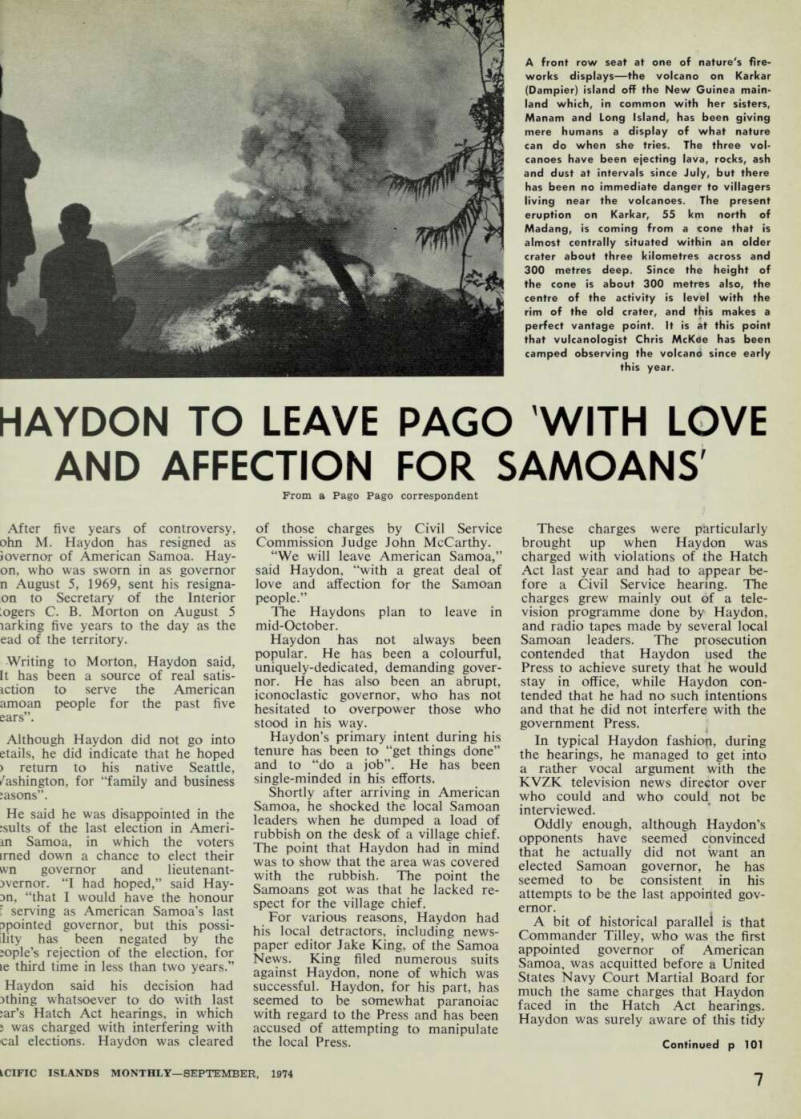
A front row seat at one of nature's fire works displays—the volcano on Karkar (Dampier) island off the New Guinea main land which, in common with her sisters, Manam and Long Island, has been giving mere humans a display of what nature can do when she tries. The three vol canoes have been ejecting lava, rocks, ash and dust at intervals since July, but there has been no immediate danger to villagers living near the volcanoes. The present eruption on Karkar, 55 km north of Madang, is coming from a cone that is almost centrally situated within an older crater about three kilometres across and 300 metres deep. Since the height of the cone is about 300 metres also, the centre of the activity is level with the rim of the old crater, and this makes a perfect vantage point. It is at this point that vulcanologist Chris McKee has been camped observing the volcano since early this year.
; of historical data, which would ve made for interesting writing th future historians of the territory.
His accomplishments have been my. The budget for the territory s grown considerably during his veraorship, but so has local infla n. The legislature has grown, es cially after becoming a full-time v-making body under Haydon. blic services and facilities have en expanded, but are still not able keep pace with demands. Much >re private enterprise has entered t territory, but the ranks of the vemment have grown also.
Haydon’s two most outstanding :omplishments are probably the nation of the Community College American Samoa and the fact that > people of American Samoa are wly moving towards more internal f-government.
Haydon, single-handed, created the mmunity College, even after con tants said that there was no local iire for such. Today it has almost ►OO students and will open at its vly-acquired Mapusaga campus in ffember.
Haydon’s insistence that Samoans put into top positions wherever
possible has not always been for the best. However, a number of very good administrators have come out of this, including Public Safety Com missioner Tufele Li’a, the new Director of Education Mere Betham and others.
This has helped build faith in the Samoan’s ability to govern and has helped lead to more willingness to be more responsible for internal govern ment. Although the idea has yet to be fully accepted, a beginning has been made.
“I’m only human,” Haydon said recently, “and I hate to leave things undone, but I feel that a good start has been made on many projects during my administration.”
Haydon, in his five years, has been only human, and he has made begin nings. For that he will be remem bered.
His wife Jean will also be remem bered, not for anything controversial, but because of the leading part she played in Samoan affairs. To her must go most of the credit for the Museum of American Samoa, fast becoming a repository of Samoan culture and history. She was also active in social and sociological circles but in all her activities she was careful never to stray into her husband’s domain and kept herself aloof from the political scene.
Advertisements & other items, p. 9 (1 item)
Lcific Islands Monthly—September, 1974
long time a'coming
BSIP Chief Minister a long time a'coming
From a Honiara correspondent
Although the election of the Solo mon Islands first chief minister is scheduled for August 27, and it is now August 12, the mists wreathing the protectorate’s political situation show little signs of clearing.
It appears there will definitely be at least two candidates, Solomon Mamaloni, leader of the People’s Progressive Party, and Benedict Kinika leader of the reconstituted United Solomon Islands Party. There might even be four with Dr Gideon Zoloveke, the USIP’s deputy leader, and Philip Solodia, also of the USIP, entering the lists. In fact, there could be five, with the addition of David Kausimae, whose party affiliation is uncertain. That is how fluid the situ ation is.
Party strategies for the election are not likely to be released. PPP would almost certainly field Mama loni, but it is also likely that Mama loni might decline, favouring instead a relatively short wait for a shot at the prime ministership during the life of the next House. PPP is aiming at 1980 as a date for independence.
USIPA might also consider this with a view to strengthening its party base in preparation for the next election, but spurred by the ambitions of Solodia and Zoloveke it is hardly likely to do so. Internal wrangling with USIP might see Kinika, Solodia and Zoloveke nominated and party members voting by personal choice between the three rather than exercis ing the party vote on one candidate.
Meanwhile, hard lobbying will begin when members start to arrive in Honiara later this week. If Mama loni does indeed stand and is elected, then he might choose as his deputy his old colleague David Kausimae.
Kinika’s success would mean that either Solodia or Zoloveke would be come deputy, probably the former.
The first chief minister and his cabinet will have their work cut out.
There is the newly-drawn local gov ernment policy to be implemented stage by difficult stage; the revision of fiscal policy which is bound by its very nature to be controversial; there is the review of the policy of the subject dearest to Solomon Is landers—lands, and related minerals policy. Localisation and shipping policies are also under close scrutiny,
and also a policy on health services.
While these reviews are being made, the government will be bring ing into being a new education system. This subject draws much speculation as to its possible fate if Kinika, who has stated his objection to the system, becomes leader of the country.
The scheme is to provide a two tier secondary schooling structure with secondary schools being classi fied “academic” or rural-oriented “Area High Schools”. Kinika favours the more expensive “comprehensive” system, claiming, with the support of two other USIPA members, one Solodia, that the two-tier system would create an unwanted class society.
Cabinet has an extremely difficult job ahead of it to say the least, and irresponsible bickering by the Op position would cause significant loss of confidence in the Solomons Gov ernment at a time when it needs it most. Imported inflation will not make things better, and indeed is having a snowballing effect on rural folk; in particular those whose high receipts from copra (the price of which is at an all-time high of $A336 per ton locally) finds its way into the trade store and out of the country again. Cabinet may well see its way to speeding on price control legislation as well as any other means it can muster to curb as much as it can the effects of this inflation.
Britain is not being too helpful to the country either. It makes avail able capital development aid based on the ability of the country to pay out of its own revenue —with a de creasing supplement of grant-in-aid to revenue —the costs of implement ing capital development projects.
This has the effect of forcing the government to seek as much revenue as it can from an already financially hard-pressed people.
With its hopes for stable govern ment in the Solomons, if indeed the British Government does have such hopes, it is almost unrealistic. The Solomons is capable of political in dependence tomorrow, but would still need double its current revenue levels to speed up development to a politically appreciative plane if stable government in the future is to be realised.
With current British policy, it appears Britain, while on the one hand making generous offers of de velopment aid, is anxious, on the
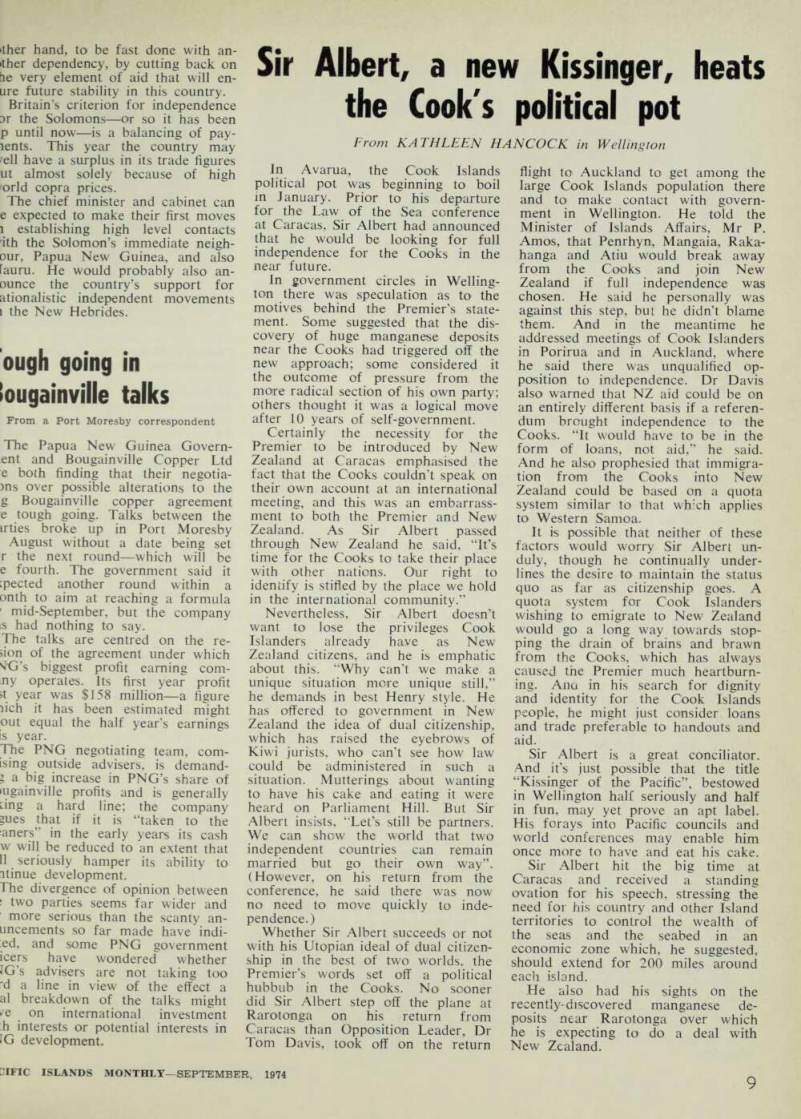
Benedict Kinika . . . favourite for the top job?
>ther hand, to be fast done with an ther dependency, by cutting back on tie very element of aid that will en ure future stability in this country.
Britain’s criterion for independence ar the Solomons—or so it has been p until now—is a balancing of pay lents. This year the country may 'ell have a surplus in its trade figures ut almost solely because of high 'orld copra prices.
The chief minister and cabinet can e expected to make their first moves i establishing high level contacts ith the Solomon’s immediate neigh our, Papua New Guinea, and also lauru. He would probably also an ounce the country’s support for ationalistic independent movements i the New Hebrides.
Britain Still Rules Gilberts' Waves
As a gesture against the French nuclear tests at Mururoa atoll, the GEIC Government recently refused a request from a French vessel, conducting ar oceanographic survey off Ocean Island, to call at the island for water.
But the ship called and was supplied with water. The British Govern ment, which controls GElC’s foreign affairs, had overruled the colony i government, Isakala Paeniu, Minister for Natural Resources, protested if the House of Assembly in August.
The minister was moving a resolution condemning the tests and calling on the British Government to make “vigorous protests ” to France on GEIC. behalf.
Britain, the minister alleged, wanted to please France because she wcl renegotiating the terms of British entry into the Common Market and Franct was likely to be one EEC member that would oppose the new terms.
“You see, the British if they want to sell us, we the people of thest islands, like trade goods, they would do so,” said Isakala.
The resolution was approved and sent to the British Government, so far without reaction from London.
Bougainville talks
[?]ough going in Bougainville talks
From a Port Moresby correspondent The Papua New Guinea Govern ent and Bougainville Copper Ltd e both finding that their negotia )ns over possible alterations to the g Bougainville copper agreement e tough going. Talks between the irties broke up in Port Moresby August without a date being set r the next round—which will be e fourth. The government said it ipected another round within a onth to aim at reaching a formula r mid-September, but the company is had nothing to say.
The talks are centred on the re don of the agreement under which 'JG’s biggest profit earning com ny operates. Its first year profit }t year was $158 million—a figure lich it has been estimated might out equal the half year’s earnings is year.
The PNG negotiating team, com ising outside advisers, is demand- I a big increase in PNG’s share of »ugainville profits and is generally dng a hard line; the company =ues that if it is “taken to the aners” in the early years its cash w will be reduced to an extent that II seriously hamper its ability to
itinue development.
The divergence of opinion between : two parties seems far wider and more serious than the scanty an uncements so far made have indi ct, and some PNG government icers have wondered whether IG’s advisers are not taking too *d a line in view of the effect a al breakdown of the talks might /e on international investment :h interests or potential interests in 1G development.
the Cook's political pot
Sir Albert, a new Kissinger, heats the Cook's political pot
From KATHLEEN HANCOCK in Wellington
In Avarua, the Cook Islands political pot was beginning to boil in January. Prior to his departure for the Law of the Sea conference at Caracas, Sir Albert had announced that he would be looking for full independence for the Cooks in the near future.
In government circles in Welling ton there was speculation as to the motives behind the Premier’s state ment. Some suggested that the dis covery of huge manganese deposits near the Cooks had triggered off the new approach; some considered it the outcome of pressure from the more radical section of his own party; others thought it was a logical move after 10 years of self-government.
Certainly the necessity for the Premier to be introduced by New Zealand at Caracas emphasised the fact that the Cooks couldn’t speak on their own account at an international meeting, and this was an embarrass ment to both the Premier and New Zealand. As Sir Albert passed through New Zealand he said, “It’s time for the Cooks to take their place with other nations. Our right to identify is stifled by the place we hold in the international community.”
Nevertheless, Sir Albert doesn’t want to lose the privileges Cook Islanders already have as New Zealand citizens, and he is emphatic about this. “Why can’t we make a unique situation more unique still,” he demands in best Henry style. He has offered to government in New Zealand the idea of dual citizenship, which has raised the eyebrows of Kiwi jurists, who can’t see how law could be administered in such a situation. Mutterings about wanting to have his cake and eating it were heard on Parliament Hill, But Sir Albert insists, “Let’s still be partners.
We can show the world that two independent countries can remain married but go their own way”. (However, on his return from the conference, he said there was now no need to move quickly to> inde pendence.) Whether Sir Albert succeeds or not with his Utopian ideal of dual citizen ship in the best of two worlds, the Premier’s words set off a political hubbub in the Cooks. No sooner did Sir Albert step off the plane at Rarotonga on his return from Caracas than Opposition Leader, Dr Tom Davis, took off on the return
flight to Auckland to get among the large Cook Islands population there and to make contact with govern ment in Wellington. He told the Minister of Islands Affairs, Mr P.
Amos, that Penrhyn, Mangaia, Raka hanga and Atiu would break away from the Cooks and join New Zealand if full independence was chosen. He said he personally was against this step, but he didn’t blame them. And in the meantime he addressed meetings of Cook Islanders in Porirua and in Auckland, where he said there was unqualified op position to independence. Dr Davis also warned that NZ aid could be on an entirely different basis if a referen dum brought independence to the Cooks. “It would have to be in the form of loans, not aid,” he said.
And he also prophesied that immigra tion from the Cooks into New Zealand could be based on a quota system similar to that which applies to Western Samoa.
It is possible that neither of these factors would worry Sir Albert un duly, though he continually under lines the desire to maintain the status quo as far as citizenship goes. A quota system for Cook Islanders wishing to emigrate to New Zealand would go a long way towards stop ping the drain of brains and brawn from the Cooks, which has always caused the Premier much heartburn ing. Ana in his search for dignity and identity for the Cook Islands people, he might just consider loans and trade preferable to handouts and aid.
Sir Albert is a great conciliator.
And it’s just possible that the title “Kissinger of the Pacific”, bestowed in Wellington half seriously and half in fun, may yet prove an apt label.
His forays into Pacific councils and world conferences may enable him once more to have and eat his cake.
Sir Albert hit the big time at Caracas and received a standing ovation for his speech, stressing the need for his country and other Island territories to control the wealth of the seas and the seabed in an economic zone which, he suggested, should extend for 200 miles around each island.
He also had his sights on the recently-discovered manganese de posits near Rarotonga over which he is expecting to do a deal with New Zealand.
Advertisements & other items, p. 11 (1 item)
9
DIFIC ISLANDS MONTHLY—SEPTEMBER, 1974
Sacking underlines PNG
internal divisions
From a Port Moresby correspondent
Personality clashes involving lead ing New Guineans highlighted events in the nation in July and August.
Following in the wake of the con troversial Constitutional Planning Committee’s report which the Chief Minister, Mr Michael Somare and his deputy, Dr John Guise criticised, came the news that Justice Minister John Kaputin, a CPC member who figured largely in the drafting of the report, had been asked by Mr Somare to resign his portfolio.
The Constitutional Planning Com mittee report was submitted to the last sitting of the House of Assembly in June but was not voted on. It is being debated in an August sitting.
Mr Somare and Eh- Guise opposed some important aspects of the report, and released a draft minority report which drew fire from the CPC vice chairman, Father John Momis and Mr Kaputin.
The latter challenged the “moral position” of the report and the Chief Minister took this as a leadership challenge.
In a brief statement released when Mr Kaputin was in Australia return ing from official overseas business, Mr Somare confirmed that he had asked him for his resignation “subject to an explanation of his recent state ments and his performance as Minister for Justice”.
The minister refused to resign. On his return five days later, he was stripped of his portfolio, becoming Minister without Portfolio.
Under the present Papua New Guinea Act, a minister cannot be totally removed until his position is considered by the Ministerial Nomi nations Committee and the House.
But, for the first time, Papua New Guinea’s normally flexible Chief Minister had taken a hard line, asserting his authority openly and showing his countrymen that he was not prepared to put up with leader ship snipes from allegedly incompe tent ministers. He said Mr Kaputin attended few Cabinet meetings.
Mr Kaputin, never a man to be walked over, delivered a lengthy statement to a press conference at Port Moresby’s Jackson’s Airport as soon as he returned from Australia, saying in part .. As for tendering by resignation, you can tell your friends, I am fed up with being told what to do simply because one is a minority.
Mr Kaputin said that as “a Tolai and a Mataungan” his position in the government was never “secure and free”. He talked of a struggle going on between the Establishment (which was “foreign dominated”) and the nationalist movement. He talked of the “Tolai nation” and said he had been working on “foreign soil”. He defended his work as Justice Minister and said he had worked “a hell of a lot more” than 50 per cent of the ministers.
“I am a minister in this govern ment and until I confer with my col leagues on the Gazelle I have nothing further to say.”
The Tolai-based Mataungan Asso ciation stated that it would pull its three representatives out of the coalition government if Mr Kaputin was not reinstated as Justice Minister.
Meanwhile, the government is tak ing seriously an anonymous telephone caller’s threat to murder Mr Somare.
According to Dr Guise, speaking in the House of Assembly on August 22, the caller told the Chief Minis ter the Tolais would deal with him as they had dealt with District Com missioner Jack Emanuel (stabbed to death in August, 1971).
The second clash involved the Secretary of the Interior Department, Mr Simon Kaumi and his Minister, Mr John Poe. Mr Kaumi, also a Tolai, is a former PNG Chief Electoral Officer.
The issue concerned the Cor rective Institution Service, a part of the Interior Department. In an emotional outburst, Mr Kaumi said he would no longer be responsible for that service.
Among his many criticisms were the frustrations he said he had ex perienced in his role as department head dealing with his minister and other senior public servants.
He said that 18 expatriate officers in the service had no local under standing and accused the administra tion of the Corrective Institution Service of running a luxury establish ment at a cost of $4.3 million.
He stated that the national officers of the service were bullied and terrorised by some European officers “who cannot let go their desire to dominate black people.”
Mr Kaumi said that a staff mem ber whom he sent to the Corrective Institution at Bomana near Port Moresby to investigate certain matters had been unable to do so because
of interference by Mr Poe’s expatriat* adviser, Mr Warren Dutton.
In answer, Mr Poe said that eithei he or Mr Kaumi would have to gc and accused Mr Kaumi of breaching all accepted rules of behaviour tween a departmental head and i minister.
Mr Poe went on to refute a num her of Mr Kaumi’s claims.
The Deputy Leader of the Op position, Mr Paul Langro called oi Mr Poe to resign. Later, it was an nounced that Mr Poe and Mr Kaum had reconciled their differences.
The clashes highlighted the positioi of various white advisers in PNG including those who have been advis ing on the PNG Constitution, am touched off “anti-whitey” expression in various quarters.
Meanwhile, Sinake Giregire (Dalo and his partner Michael Pondro (Manus) have formed their promise Country Party, composed entirely c backbenchers. A release on Augm 20 gave a list of 18 names with 1 signatures, all but four ex-Unite Party members, but some of thes were in doubt. Mr Pondros, wh announced the new party, said would remain neutral between th government and the Oppositio United Party, and hoped to hold tL balance of power.
Until Mr Giregire’s announcemen the divisions in the 100-membe House of Assembly were approx mately—Pangu 22, United Party 3! 40, People’s Progress Party h Nationals 12, Mataungans 3. E John Guise carries three membe and the remainder are independent The coalition government is con posed of Pangu, PPP, National an Mataungan, with support from E Guise.
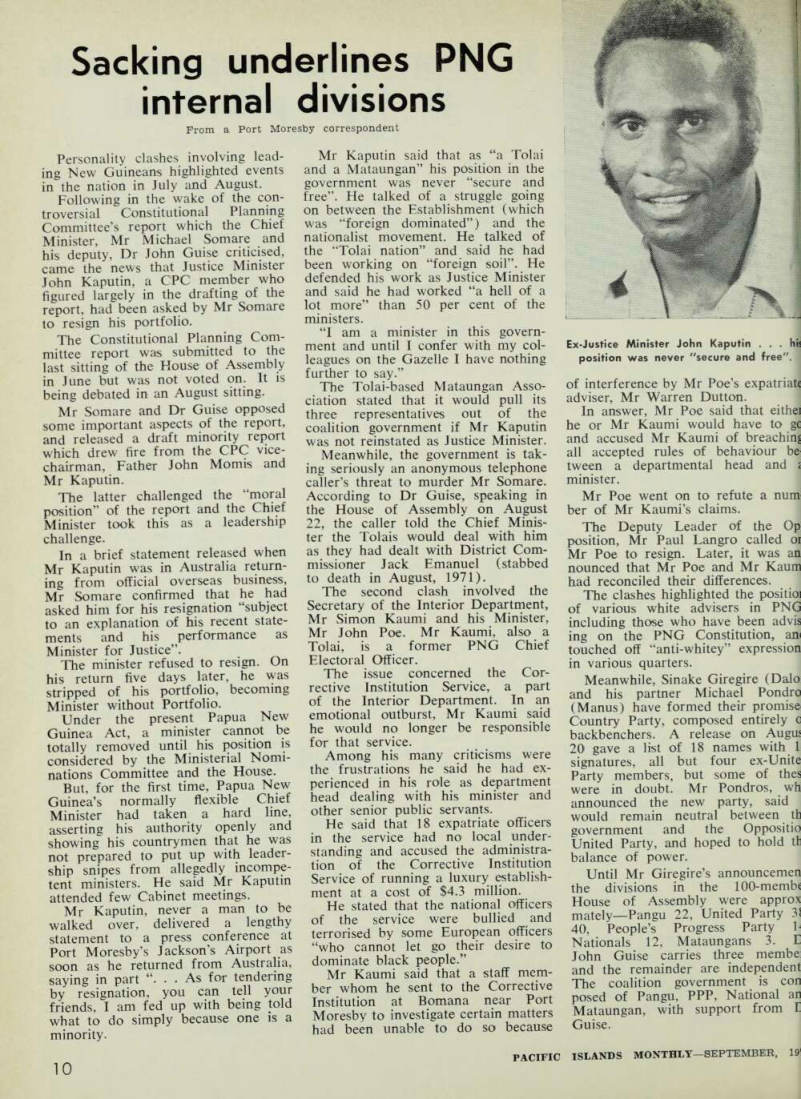
Ex-Justice Minister John Kaputin . . . his[?] position was never "secure and free".
Caledonian-style

Storming the Bastille Caledonian-style
From a Noumea correspondent If July 14 is specially remembered i Tahiti for the gaiety of hip vinging dancers, it seems that Nou lea is really getting closer to the riginal spirit of the French national ay with real-life re-enactments of ic storming of the Bastille—that old rench challenge to authority.
The events sparking off the Nou lea incidents centred on protests om the Territorial Assembly and ic trade unions over staggering rises the island’s cost of living and the ss of jobs by Caledonians who feel asted by metropolitan French, seme mes better qualified recent arrivals, 'ten including former military men • wives of army and public officials.
One target of the rising storm was ;parting Secretary-General, Michel svallois, second to the governor as ;ad of the French public service on e island and representative of the wernor at debates of the Territorial ssembly. Four bullet holes were iund in Levallois’ Noumea residence i July 19. A week later, attempts ere made to fire a building occu ed by other top French officials.
While the instigators of these acts ere not immediately known, it must 5 explained that by now most in icntial Caledonians have been rectly or indirectly persuaded by e French administration not to ruggle for local political responsibil /, but to be content simply with aking money and leaving the werning decisions to Paris. This eans the only real forces left ittling for autonomy are the lesser iid workers and Melanesians.
Nevertheless, the Assembly major f by 17 to 15 voted in June a fur er demand for internal self-govem ent. The French President and ime Minister both acknowledged re ipt of this motion, whereupon, to ark July 14, the same three parties cided to send their joint project r autonomy to the Paris authorities.
Meanwhile, as the bitter resentment ntinued over rising unemployment, e island’s largest party, Union aledonienne, was reportedly accused “fascism” by Mr Levallois, during i assembly debate demanding prior r for jobs to Caledonians. In reply, e party asked what kind of “ism”
should be applied to a “represent ative of the administration who criticises and opposes the propositions put forward by the representatives of the people?”
Then came the celebration of July 14. Official ceremony centred on the traditional march-past of French
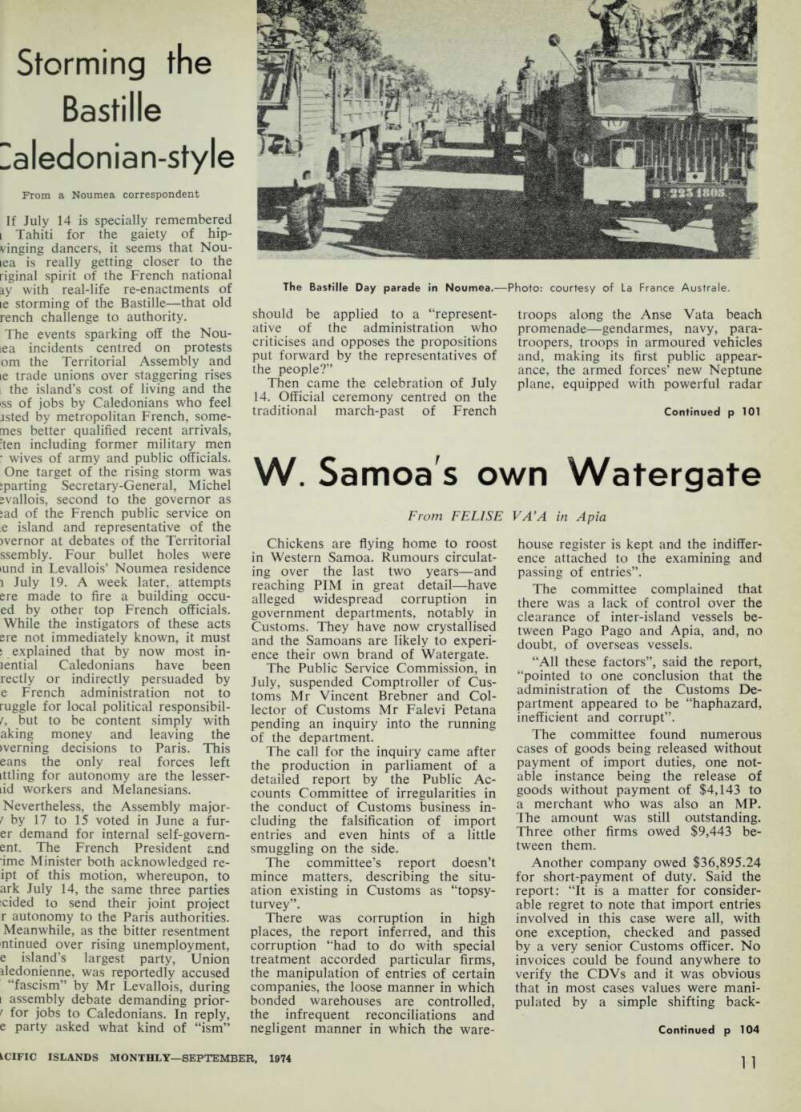
troops along the Anse Vata beach promenade—gendarmes, navy, para troopers, troops in armoured vehicles and, making its first public appear ance, the armed forces’ new Neptune plane, equipped with powerful radar
Continued p 101
The Bastille Day parade in Noumea. — Photo: courtesy of La France Australe.
to survey the sea approaches to New Caledonia and detect submarines or other vessels.
However, amid the drinking of this holiday weekend, various disturbances resulted in clashes with the police and some $15,000 worth of damage, with smashed shop windows, battered cars and French flags torn from pub lic buildings. Governor Eriau then insisted that he would not tolerate public disturbances by “irresponsible kids”, but some locals countered that the incidents were “provoked” by the authorities. That such damage was allowed to occur, despite the number of police and others available, again suggested, as in the 1970 Naisseline affair, that the French administration must find such events useful. The whole affair was certainly timely, to frighten the locals over the auto nomists, shortly before the September senate elections.
Several days later came the bullet traces on the residence of Secretary- General Levallois. This was followed by the news conference of a visiting military chief of staff from Paris, General F. Maurin, who stated that present military strength on the island was considered sufficient, so there were no immediate plans to bring in reinforcements from the Foreign Legion. However greater mobility was required and for this purpose the Puma troop-transporting helicopters were awaited. Local army and naval installations are also to be extended at Plum and Pte Chaleix.
The militant autonomists of the Union of Caledonian Youth (UJC) had been planning a public demon stration downtown on July 27 to pro test over rising prices, increasing un employment of Caledonians and racial discrimination. However, in view of the preceding events Governor Eriau promptly took out an edict prohibiting the public meeting, under threat of severe penalties. The UJC called off their outdoor rally, while denouncing “the anti-demo cratic nature of the colonial regime we endure, which forbids us to de monstrate in public”. Still the authorities remained on the alert, and at the appointed time three columns of gendarmes and riot squad police were at the ready on the scene.
Equipped with helmets, arms and cameras they were left to spend several idle hours in the sun without incident.
It all added up to the sort of stuff making French national day the kind of Pacific celebrations tourists will really want to pay to see.
W. Samoa's own Watergate
From FELISE VA'A in Apia
Chickens are flying home to roost in Western Samoa. Rumours circulat ing over the last two years—and reaching PIM in great detail—have alleged widespread corruption in government departments, notably in Customs. They have now crystallised and the Samoans are likely to experi ence their own brand of Watergate.
The Public Service Commission, in July, suspended Comptroller of Cus toms Mr Vincent Brebner and Col lector of Customs Mr Falevi Petana pending an inquiry into the running of the department.
The call for the inquiry came after the production in parliament of a detailed report by the Public Ac counts Committee of irregularities in the conduct of Customs business in cluding the falsification of import entries and even hints of a little smuggling on the side.
The committee’s report doesn’t mince matters, describing the situ ation existing in Customs as “topsy turvey”.
There was corruption in high places, the report inferred, and this corruption “had to do with special treatment accorded particular firms, the manipulation of entries of certain companies, the loose manner in which bonded warehouses are controlled, the infrequent reconciliations and negligent manner in which the ware
house register is kept and the indiffer ence attached to the examining and passing of entries”.
The committee complained that there was a lack of control over the clearance of inter-island vessels be tween Pago Pago and Apia, and, no doubt, of overseas vessels.
“All these factors”, said the report, “pointed to one conclusion that the administration of the Customs De partment appeared to be “haphazard, inefficient and corrupt”.
The committee found numerous cases of goods being released without payment of import duties, one not able instance being the release of goods without payment of $4,143 to a merchant who was also an MP.
The amount was still outstanding.
Three other firms owed $9,443 be tween them.
Another company owed $36,895.24 for short-payment of duty. Said the report: “It is a matter for consider able regret to note that import entries involved in this case were all, with one exception, checked and passed by a very senior Customs officer. No invoices could be found anywhere to verify the CD Vs and it was obvious that in most cases values were mani pulated by a simple shifting back-
Continued p 104
ward of the decimal point or mis stating the country of origin of the imports.
“Yet another company owed $24,326.83 representing short-payment of import duties which arose because of subsequently disallowed claims.
But again collusion between the cus toms examiner and the importer was suspected. Other firms owed $8,899.42 all of which had been paid since so that only $3,670.51 was still owing by firms, other than the ones already mentioned.
“Thus, the Customs Department failed badly in the administration of the law affecting import duties.
Some unethical practices were re sorted to and worst of all, top Cus toms officers had apparently colluded with importers in falsifying the re cords”.
Because of the inefficiency of the Customs Department in controlling the bonded warehouses, and the lack of complete honesty in those respons ible for their operation, the commit tee recommended the immediate closing of all licensed bonded ware houses except those in the sheds at Apia Wharf.
With regard to the movements of inter-island ships, the committee said it felt that a considerable amount of smuggling was going on because there was little, if any, check made on
whether the cargo discharged agreed! with the manifest.
It, therefore, recommended thatl ships arriving from Pago should be: cleared in daylight hours only and! that cargo from those ships should! be handled as was other overseas; cargo.
The committee pointed out thatl having a separate Comptroller of Customs and a Collector of with the relevant Act providing fois the latter post only, caused internal! misunderstanding as to degrees of responsibility of the two officers coni cerned, thus providing an excellenj escape valve for either to “pass tha buck” to the other.
The committee recommended tha a senior officer be sought from th( NZ Department of Customs to hea( the local department.
The Commission of Inquiry hac begun its work at the time of writing Government officer members ar< Laufili Time (chairman), Amituana Vili, David Hull (Attorney-General), Eddie Meredith (PSC) and Martin Kleis (Commissioner of Labour) who are sitting with private company representatives and an employees’ representative.
The commission will report its find ings to the Public Service Commiss ion, so that the PSC, it is pointed out with scrupulous attention to the maxim that no-one’s guilty until it’s proved, may decide either to fire the people responsible or give them a salary rise!
Advertisements & other items, p. 13 (1 item)
11
LCIFIC ISLANDS MONTHLY—SEPTEMBER, 1974
Tropicalities
A whiteman's
eargo eult
Papua New Guinea’s Investment Corporation Fund, formed in Sep tember last year as a share unit trust by the Investment Corporation of Papua New Guinea, which was two years old last February, will shortly be delivering the goods to the share holders in the shape of dividends.
And the shareholders, all indigenes, are likely to get a pleasant surprise.
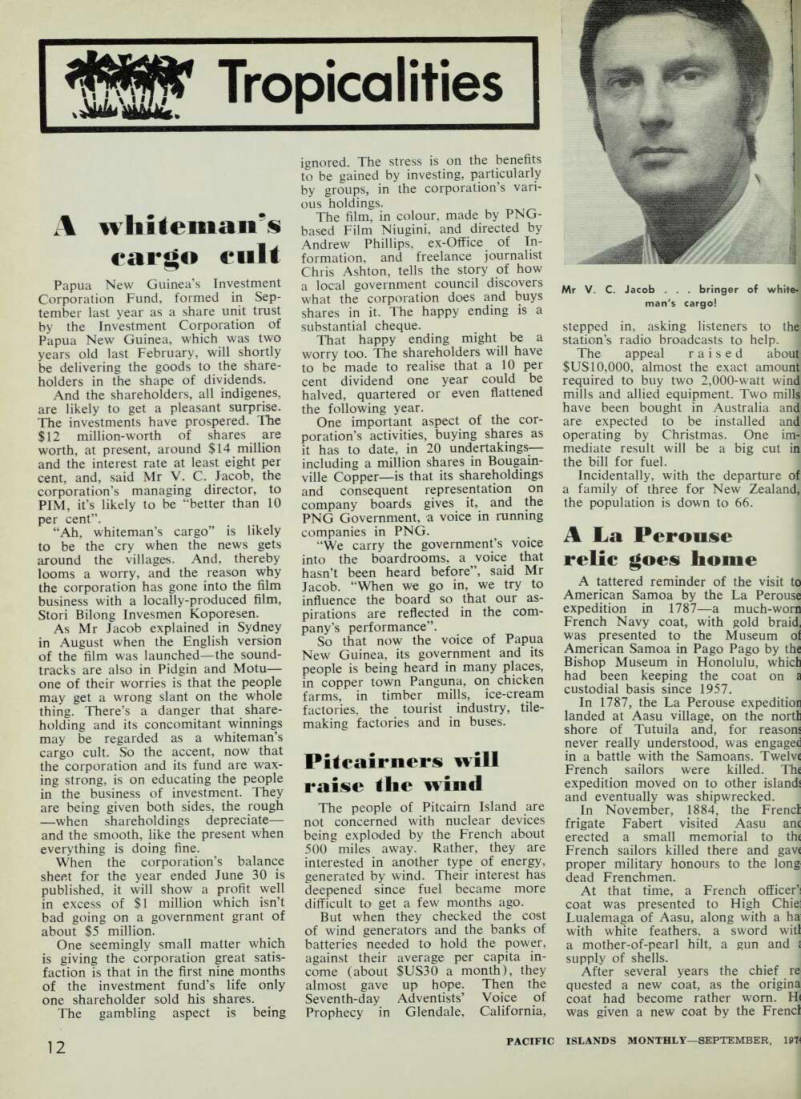
The investments have prospered. The $l2 million-worth of shares are worth, at present, around $l4 million and the interest rate at least eight per cent, and, said Mr V. C. Jacob, the corporation’s managing director, to PIM, it’s likely to be “better than 10 per cent”.
“Ah, whiteman’s cargo” is likely to be the cry when the news gets around the villages. And, thereby looms a worry, and the reason why the corporation has gone into the film business with a locally-produced film, Stori Bilong Invesmen Koporesen.
As Mr Jacob explained in Sydney in August when the English version of the film was launched—the sound tracks are also in Pidgin and Motu — one of their worries is that the people may get a wrong slant on the whole thing. There’s a danger that share holding and its concomitant winnings may be regarded as a whiteman’s cargo cult. So the accent, now that the corporation and its fund are wax ing strong, is on educating the people in the business of investment. They are being given both sides, the rough —when shareholdings depreciate— and the smooth, like the present when everything is doing fine.
When the corporation’s balance sheet for the year ended June 30 is published, it will show a profit well in excess of $1 million which isn’t bad going on a government grant of about $5 million.
One seemingly small matter which is giving the corporation great satis faction is that in the first nine months of the investment fund’s life only one shareholder sold his shares.
The gambling aspect is being
ignored. The stress is on the benefits to be gained by investing, particularly by groups, in the corporation’s vari ous holdings.
The film, in colour, made by PNG based Film Niugini, and directed by Andrew Phillips. ex-Office of In formation, and freelance journalist Chris Ashton, tells the story of how a local government council discovers what the corporation does and buys shares in it. The happy ending is a substantial cheque.
That happy ending might be a worry too. The shareholders will have to be made to realise that a 10 per cent dividend one year could be halved, quartered or even flattened the following year.
One important aspect of the cor poration’s activities, buying shares as it has to date, in 20 undertakings— including a million shares in Bougain ville Copper—is that its shareholdings and consequent representation on company boards gives it, and the PNG Government, a voice in running companies in PNG.
“We carry the government’s voice into the boardrooms, a voice that hasn’t been heard before”, said Mr Jacob. “When we go in, we try to influence the board so that our as pirations are reflected in the com
pany’s performance”.
So that now the voice of Papua New Guinea, its government and its people is being heard in many places, in copper town Panguna, on chicken farms, in timber mills, ice-cream factories, the tourist industry, tile making factories and in buses.
Pitcairners will
raise the wind
The people of Pitcairn Island are not concerned with nuclear devices being exploded by the French about 500 miles away. Rather, they are interested in another type of energy, generated by wind. Their interest has deepened since fuel became more difficult to get a few months ago.
But when they checked the cost of wind generators and the banks of batteries needed to hold the power, against their average per capita in come (about SUS3O a month), they almost gave up hope. Then the Seventh-day Adventists’ Voice of Prophecy in Glendale, California,
stepped in, asking listeners to the station’s radio broadcasts to help.
The appeal raised about SUSIO,OOO, almost the exact amount required to buy two 2,000-watt wind mills and allied equipment. Two mills have been bought in Australia and are expected to be installed and operating by Christmas. One im mediate result will be a big cut in the bill for fuel.
Incidentally, with the departure of a family of three for New Zealand, the population is down to 66.
A La Perouse
relie goes home
A tattered reminder of the visit to American Samoa by the La Perouse expedition in 1787 —a much-worn French Navy coat, with gold braid, was presented to the Museum of American Samoa in Pago Pago by the Bishop Museum in Honolulu, which had been keeping the coat on a custodial basis since 1957.
In 1787, the La Perouse expedition landed at Aasu village, on the north shore of Tutuila and, for reasons never really understood, was engaged in a battle with the Samoans. Twelve French sailors were killed. The expedition moved on to other islands and eventually was shipwrecked.
In November, 1884, the Frenct frigate Fabert visited Aasu anc erected a small memorial to the French sailors killed there and gave proper military honours to the long dead Frenchmen.
At that time, a French officer 5 ! coat was presented to High Chiel Lualemaga of Aasu, along with a ha with white feathers, a sword will a mother-of-pearl hilt, a gun and supply of shells.
After several years the chief re quested a new coat, as the origina coat had become rather worn. H< was given a new coat by the Frencl
Mr V. C. Jacob . . . bringer of white man's cargo!
Javy and the original coat was put side.
However, in 1957, the original coat ras given to the Government of American Samoa and then transferred > the Bishop Museum in Honolulu. d that time American Samoa had no mseum and asked the Honolulu mseum to keep the coat until there r as a proper place for it.
The Museum of American Samoa as opened last year.
iVhen file law
yen i to pot
It is, according to a court ruling, jite legal to be in possession of arihuana and to sell it in the US rust Territory. Chief Justice Harold r . Burnett, in July, removed restric ts on the sale or possession of arihuana when he issued his judg ent in a case the Trust Territory overnment brought against Mariano . Bermudes, who had been arrested id charged with having possessed id sold marihuana.
Mr Justice Burnett invalidated the itutes and regulations covering the issession and sale of marihuana. He 50 invalidated the laws which de led what a drug was and em iwered the Director of Health Ser ies to decide which drugs had “sub mtial potential” for abuse. He us made it impossible for the TT >vernment to prosecute individuals r the sale or possession of mari ana. But his ruling did not affect e statutes prohibiting the sale or •ssession of hard drugs, such as rpin and opium.
The judge said the law, which dele ted authority to the Director of jalth Services to determine drugs the basis of “current medical owledge”, did not provide a efficiently precise standard upon lich the director can base his de minations”.
“The medical profession is in a te of flux as to its appraisal of irihuana and is dubious about the estance’s role in drug abuse,” the lief Justice said.
Another point in question was that rmudes could have been given a [fer sentence for the sale and ssession of marihuana under the tutes made invalid, than he could :eive for importing and selling ium or heroin. Mr Justice Burnett d he did not feel that was right, i was an important factor in his validating the marihuana statutes.
A delighted Assistant Public De ider, Mr Benjamin Abrams, who peared for Bermudes, described * Justice Burnett’s order as a
“courageous and enlightened de cision”.
“The effects highlight the fallacy of so-called victimless crimes, since any self-respecting doctor knows that marihuana presents no threat to the user or the community,” Mr Abrams said. “There is no victim.”
He said he hoped the Congress of Micronesia and the Trust Territory Government would use the oppor tunity to observe the results of the decision before any laws affecting the use of marihuana were enacted.
However, the whole issue went to pot again later when High Commis sioner Edward Johnston announced that the possession of the happy weed remained an offence because the United States Federal Controlled Sub stances Act, which made possession of the drug an offence, applied fully to the Trust Territory.
Warning—don’t eat
European food
Expose a Pacific Islander to Euro pean food and it is not long before he has a dental problem. Dental authorities say this is particularly so in Tahiti. Now, in the Solomon Islands, a New Zealand dentist. Dr Ron Whatmough, has given another warning that children who eat Euro pean food are more likely to have tooth decay than those who don’t.
He quoted the Reef Islands chil dren as being good examples—their teeth were healthier than those of some of the children he had seen on Makira. He blamed the state of the Makira teeth on European food, saying more of it had probably been included in diets than Melanesian food. The Reef Islands children had some of the best teeth he had ever seen. He felt that was because the people of the outer islands were far away from urban area, where the diet was more “Europeanised”.
There were very few Reef Islands children with dental decay. Usually there was only one tooth to be filled for every 30 children. But in Makira there was one filling for every child.
Creating a new
elite in Fiji
Fiji could follow the House of Lords with a system of “life peer ages”, but instead of dukes, earls, lords, etc, could use the traditional title of ratu or some new title. That is the view of Ratu David Togani valu, Minister without Portfolio.
Speaking at an open day at the Fulton Missionary College, he ques tioned whether people should slavishly cling to custom unsuited for advancing times. Rather, they should hold on to what was good, and dis card the outworn, the indefensible and superficial.
At some time in the past a man became a Fijian chief because of his qualities of leadership. At some stage the title became hereditary. Natur ally, there would have been heredi tary titleholders who would never have achieved the title on their own merits.
“I wonder if, in these days, when Fiji is coming to grips with the reali ties of life as an independent nation, we might not have a look at our system of titles,” he said. “Might not we introduce our own system of life peerages, bestowing the title of ratu, or perhaps some new title, on meri-
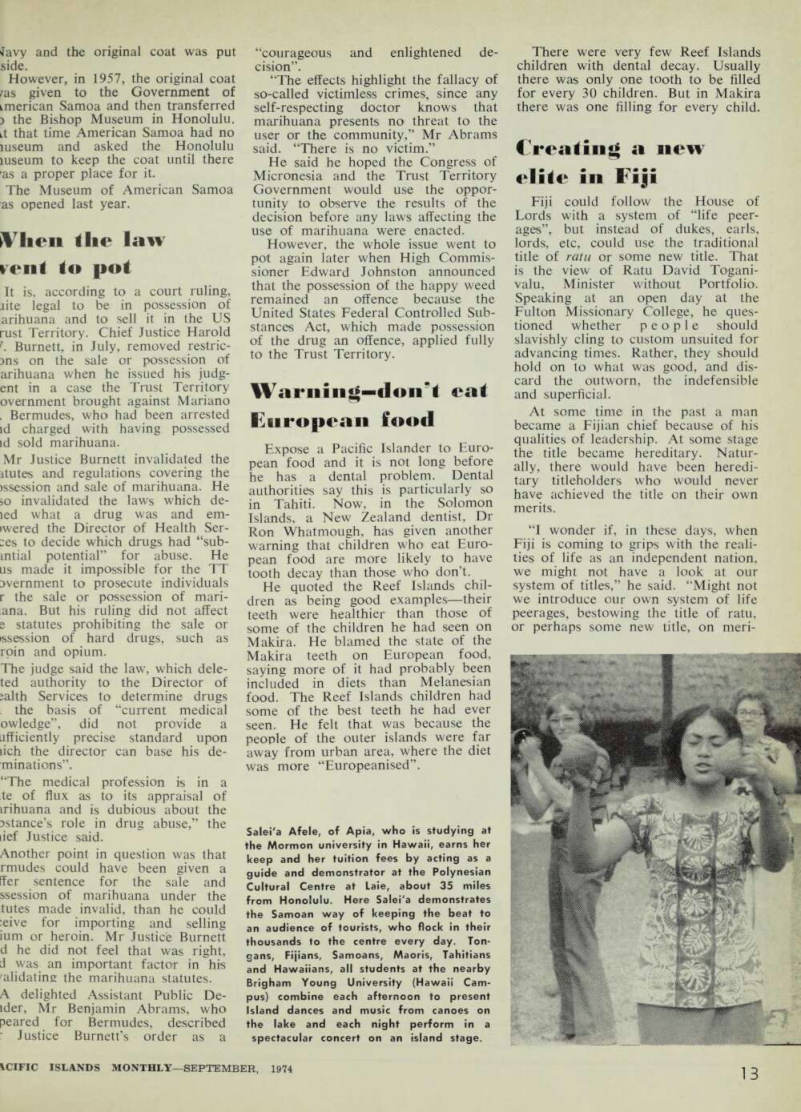
Salei'a Afele, of Apia, who is studying at the Mormon university in Hawaii, earns her keep and her tuition fees by acting as a guide and demonstrator at the Polynesian Cultural Centre at Laie, about 35 miles from Honolulu. Here Salei'a demonstrates the Samoan way of keeping the beat to an audience of tourists, who flock in their thousands to the centre every day. Ton gans, Fijians, Samoans, Maoris, Tahitians and Hawaiians, all students at the nearby Brigham Young University (Hawaii Cam pus) combine each afternoon to present Island dances and music from canoes on the lake and each night perform in a spectacular concert on an island stage.
>rious personages, to be held for leir lifetime only.”
Can roil hear
lie mother? 9
Students at the University of the mth Pacific, Suva, are “going home” rough their voices. A casual exer se in educational broadcasting has :come a way of preparing other )ung people for the kind of univers / life they will experience.
The idea started when the director the USP language laboratory and cording studio, Mr Mike O’Brien, icouraged four of them to talk into icrophones about themselves, how ey felt while away from their fami ;s, what it was like in the university id so on.
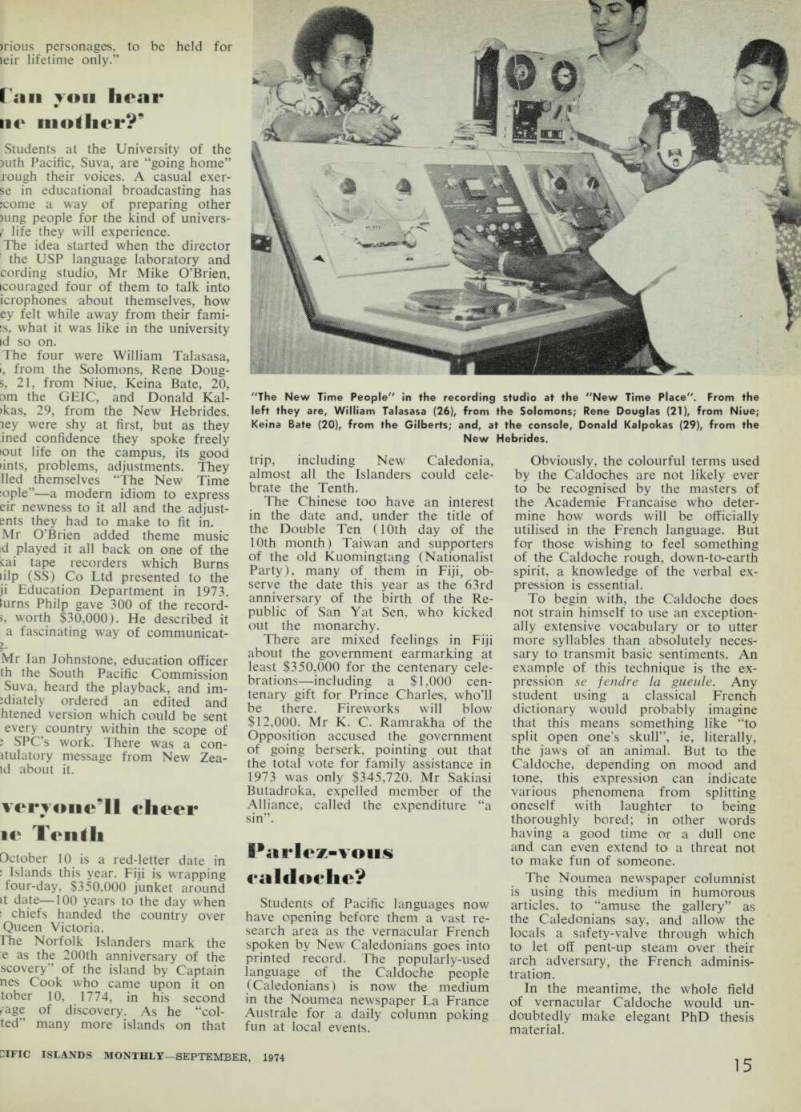
The four were William Talasasa, i, from the Solomons, Rene Doug s, 21, from Niue, Keina Bate, 20, om the GEIC, and Donald Kal >kas, 29, from the New Hebrides, icy were shy at first, but as they ined confidence they spoke freely •out life on the campus, its good >ints, problems, adjustments. They lied themselves “The New Time :ople”—a modern idiom to express eir newness to it all and the adjust ers they had to make to fit in.
Mr O’Brien added theme music d played it all back on one of the £ai tape recorders which Burns dip (SS) Co Ltd presented to the ji Education Department in 1973. turns Philp gave 300 of the record 5, worth $30,000). He described it a fascinating way of communicat y 5* Mr lan Johnstone, education officer th the South Pacific Commission Suva, heard the playback, and im idiately ordered an edited and htened version which could be sent every country within the scope of j SPC’s work. There was a con itulatory message from New Zea id about it.
veryone’ll chccr
ic Tenth
October 10 is a red-letter date in ; Islands this year. Fiji is wrapping four-day, $350,000 junket around it date—loo years to the day when ; chiefs handed the country over Queen Victoria.
The Norfolk Islanders mark the :e as the 200th anniversary of the scovery” of the island by Captain nes Cook who came upon it on tober 10, 1774, in his second /age of discovery. As he “col ted” many more islands on that
trip, including New Caledonia, almost all the Islanders could cele brate the Tenth.
The Chinese too have an interest in the date and, under the title of the Double Ten (10th day of the 10th month) Taiwan and supporters of the old Kuomingtang (Nationalist Party), many of them in Fiji, ob serve the date this year as the 63rd anniversary of the birth of the Re public of San Yat Sen, who kicked out the monarchy.
There are mixed feelings in Fiji about the government earmarking at least $350,000 for the centenary cele brations—including a $l,OOO cen tenary gift for Prince Charles, who’ll be there. Fireworks will blow $12,000. Mr K. C. Ramrakha of the Opposition accused the government of going berserk, pointing out that the total vote for family assistance in 1973 was only $345,720. Mr Sakiasi Butadroka, expelled member of the Alliance, called the expenditure “a sin”.
i’arlcz-vous
caldoche?
Students of Pacific languages now have opening before them a vast re search area as the vernacular French spoken by New Caledonians goes into printed record. The popularly-used language of the Caldoche people (Caledonians) is now the medium in the Noumea newspaper La France Australe for a daily column poking fun at local events.
Obviously, the colourful terms used by the Caldoches are not likely ever to be recognised by the masters of the Academic Francaise who deter mine how words will be officially utilised in the French language. But for those wishing to feel something of the Caldoche rough, down-to-earth spirit, a knowledge of the verbal ex pression is essential.
To begin with, the Caldoche does not strain himself to use an exception ally extensive vocabulary or to utter more syllables than absolutely neces sary to transmit basic sentiments. An example of this technique is the ex pression se fendre la gueule. Any student using a classical French dictionary would probably imagine that this means something like “to split open one’s skull”, ie, literally, the jaws of an animal. But to the Caldoche, depending on mood and tone, this expression can indicate various phenomena from splitting oneself with laughter to being thoroughly bored; in other words having a good time or a dull one and can even extend to a threat not to make fun of someone.
The Noumea newspaper columnist is using this medium in humorous articles, to “amuse the gallery” as the Caledonians say, and allow the locals a safety-valve through which to let off pent-up steam over their arch adversary, the French adminis tration.
In the meantime, the whole field of vernacular Caldoche would un doubtedly make elegant PhD thesis material.
"The New Time People" in the recording studio at the "New Time Place". From the left they are, William Talasasa (26), from the Solomons; Rene Douglas (21), from Niue; Keina Bate (20), from the Gilberts; and, at the console, Donald Kalpokas (29), from the New Hebrides.
Advertisements & other items, pp. 15-18 (3 items)
13
iCIFIC ISLANDS MONTHLY—SEPTEMBER, 1974
A growing airline
in a shrinking world...
Fly to any of 16 AIR NEW ZEALAND Gateways to the World. r \ n AIR NEW ZEALAND is a truly international airline, flying you throughout the Pacific to any of 16 Gateways to the World, as far apart as Wellington and Singapore, Auckland and Los Angeles.
You fly the friendly fleet
of DClOs and DC Bs.
Los Angeles
l*'* ■! m Ml
Singapore
Our magnificent wide-bodied DC-10s now fly on most international AIR NEW ZEALAND routes. On other flights and services, our personalised DC-8s provide outstanding AIR NEW ZEALAND service.
16 exciting Gateways
to the World.
AIR NEW ZEALAND flies to Hawaii Los Angeles, Hong Kong, Singapore, Sydney, Melbourne, Brisbane, Auckland.
Wellington, Christchurch. Fiji, Tahiti, New Caledonia, Samoa, Rarotonga and Norfolk Island.
air new zraiann
Friendliest wings across your world.
Talk to AIR NEW ZEALAND or your travel agent
ANZ 23
Bank of Hawaii is the bank of the Pacific.
You can bank on it... in Guam J&Tamuning t Koror Yap £ Saipan Roi Namur j£Wake iffif mSL Kwajalein JltPonape ik American Samoa.
All in all, we have 70 branches throughout Hawaii and the Pacific offering full banking services. May we help you?
Bank of Hawaii the bank of the Pacific® y * affiliate of Banque de Tahiti
15
DIFIC ISLANDS MONTHLY—SEPTEMBER, 1974
Mr Somare Is No Pin-Up Boy For
Png Primitive Art Dealers
By LAURIE MARSHALL, Sydney artifacts dealer
No one, especially the primitive •t dealers, would like to see the rtifact position in Papua New uinea become as desperate as that listing in Polynesia and most of the nailer islands of Melanesia. It is regrettable fact that places like iji, Tonga, Samoa and New Cale- Dnia have been so denuded of their idigenous art that not even a com •ehensive selection remains to dis ay in their museums.
The reasons for this situation mge from the deliberate destruction : so-called heathen idols to the •eakdown of village and tribal life, he imposition of European culture id beliefs and acceptance by the itive populations of the concept of dividual ownership of property has d to a loss of identification with eir old ways of life. Ceremonies ive lost their meaning and artifacts ive become symbols of an un vilised past.
Artifacts which escaped destruc m by intent or neglect were either •llected by overseas museums, or ken home by expatriates as sou mirs to add visual emphasis to eir stories of life among the vages of the Pacific.
Not until well into this century d the colonial governments see any icessity to preserve what little re ained, and even then often left its Election and display in amateurish mds. So, the meaning behind many stom objects was lost or forgotten, id prejudices led to the emascula m of statues and repression of tails pertaining to their use which jre considered as profane or un voury. Even now a ticket in the ji Museum describes some exhibits “The tawdry trappings of a witch ctor”.
The net result of all this is that lat little Polynesian art finds its ly to the market is generally from e estates of dead collectors. Deal ? sell this material for extremely ?h prices and usually have a wait l list of customers. Main pur asers are Americans and Euro ans and the only way the Islands n hope to retrieve their art is by ying the market price. Very few ople especially dealers can brd to make presents of them or 1 for a fraction of the price they id a private collector.
Several months ago PNG Chief Minister Mr Somare announced new regulations banning the export of artifacts made before 1962. That was not likely to make him the primi tive art dealers’ pin-up boy. For many years they have looked to New Guinea as their main source of supply. Most are re-pricing their older items, and collectors who want this material must now expect to pay significantly higher prices.
The regulations are not calculated to produce joyful cries from the Sepik villages either. The economy along the River and in the Maprik area has been built up to a significant degree by the sale of their art and many have become so expert at ageing their carvings that they may have difficulty in convincing the authorities that they only made them the previous month. Some New Guinea artifacts dealers have already pulled out of the business and Australian dealers are debating the worth of future buying visits.
If they decide their money can be better spent elsewhere, not only the carvers, but those who rely on an income from provision of services can expect a drastic financial setback.
As a substitute the government would have to organise a steady stream of free-spending tourists pre pared to suffer the danger and dis comfort of malarial mosquitoes, the sight and sound of marauding miss ionaries searching for souls and the feelings of frustration produced by surly, slow service. Failing this, those politicians who represent the area may have to revert to the prac tice of burying their faeces, hair and fingernail clipping if they wish to avoid being cursed by sorcerers as well as by their constituents.
The restrictions, however, are not
altogether unwarranted, and have been made necessary by the actions of dealers, collectors and even missionaries who have exported artifacts which they well knew were classified as national treasures.
Not all artifacts made after 1962 are inferior, but it is an unfortunate fact that the bulk of the present-day material is of ‘tourist quality’. With the exception of those stores which cater for this trade, such artifacts are unsaleable on the Australian art market. The trend towards tourist carvings has accelerated, particularly over the past four years, with genu ine pieces becoming increasingly difficult to obtain in quantities which make a Sepik buying a profit able proposition for the dealers.
The answer to PNG’s native art problem is not to prohibit the ex port of genuine artifacts but to en sure their continuity. Nothing can be dons to stop the adoption of European tools, food or transport ation. It should be, however, quite possible to reverse the decline of belief and pride in the art and cere monies which are essential to the continuance of their cultural identity.
Perhaps the government could in troduce indigenous culture as a com pulsory school subject, using such people as village elders and crafts men as teachers instead of the pro ducts of teachers’ colleges. As well as ensuring that the old traditions and skills are not lost it could pro vide a means of future local em ployment as guides for tourists and as curators of Haus Tambarans and other places of religious and cul tural importance to ensure that both locals and visitors alike treat them with the same respect as is demanded of visitors to temples, shrines and churches in Asian and European countries.
If the people can be convinced that their culture, with its attendant art forms, is worth preserving it will survive, despite the pressures exerted by tourism and the acceptance of a basically European life style. PNG, unlike most other Pacific countries, is still in the position to retain its art; not merely in museums, but in the towns and villages as living testimony to the imagination, culture and creativity of the indigenous population.
Advertisements & other items, pp. 19-20 (2 items)
17
ICIFIC ISLANDS MONTHLY—SEPTEMBER, 1974
Skulls For Sale
Sepik Cultural Committee alleged during August that human skulls from Papua New Guinea were on sale in a Sydney artifacts shop with price tags in hundreds of dollars. The committee said the dealer was offering eieht skulls in defiance of a 10-yearold ordinance banning the sale of skeletal remains. The skulls had been obtained by two dealers, one operating in PNG and the other in Australia.
Start precautions against
disease carrying insects with. . ,
The Insect Spray
that is
Completely ,
Completely
Effective
Rigid testing selects only
pure, sale ingredients In formulating insect sprays, the aim is maximum effectiveness against many species of pests with maximum safety for humans and pets. A.N.I. Research Chemists are at work world-wide to ensure that concentrated Pca- Bcu aerosol insecticide satisfies in all respects. Its active insecticidal ingredient is pyrethrins . . . proven the most potent insect-killing substance available. All raw materials must conform to rigid specifications of chemical purity. A programme of progress checking then operates at every stage of processing from mixing the insectkilling concentrate and high-grade ‘carrier’ to injecting the propellant which produces Pea-Beu’s high-speed spray Rigid quality control of every stage of manufacture ensures that Pea-Beu is brought to you in the purest, safest and most effective form. Because of this Pea-Beu is also really effective against every type of insect pest including flies and mosquitoes. « .. :
Pyrethrins; Nature’s
pest control
From the small, innocent-looking white Pyrethrum daisy modern chemistry extracts pure pyrethrins. This sym; fluid is so deadly to all insects, even the microscopic quanti ties carried in droplets of Pea-Beu spray kill instantly o contact. Yet pyrethrins are absolutely harmless to th human system, even in infants. Pea-Beu aerosol ir secticide is also guaranteed safe near any warm-bloode domestic animal and near food. Even in the pur state, the odour of pyrethrins is neither overpowerin nor unpleasant.
Harmless to spray freely
anywhere
As a powerful space spray, Pea-Beu effectively rids an room of dangerous cockroaches, mosquitoes and oth< biting insects and plays a major role in family health-protection. In addition it is perfectly safe to spray in kitchen cupboards or on pantry shelves, with no risk of food contamination. The unique strength of the Pea-Beu formula kills the toughest cockroach and colonies of ants rapidly too, yet cannot affect humans or pets in any way.
Pea-Beu aerosol insecticide is so strong it is effective in killing flies, mosquitoes and every type of insect pest.
Powerful Pea-Beu kills all insects —yet it's so pure it’s safe to spray anywhere
Pea-Beu the safe, powerful insecticide
change, bloody missionaries?
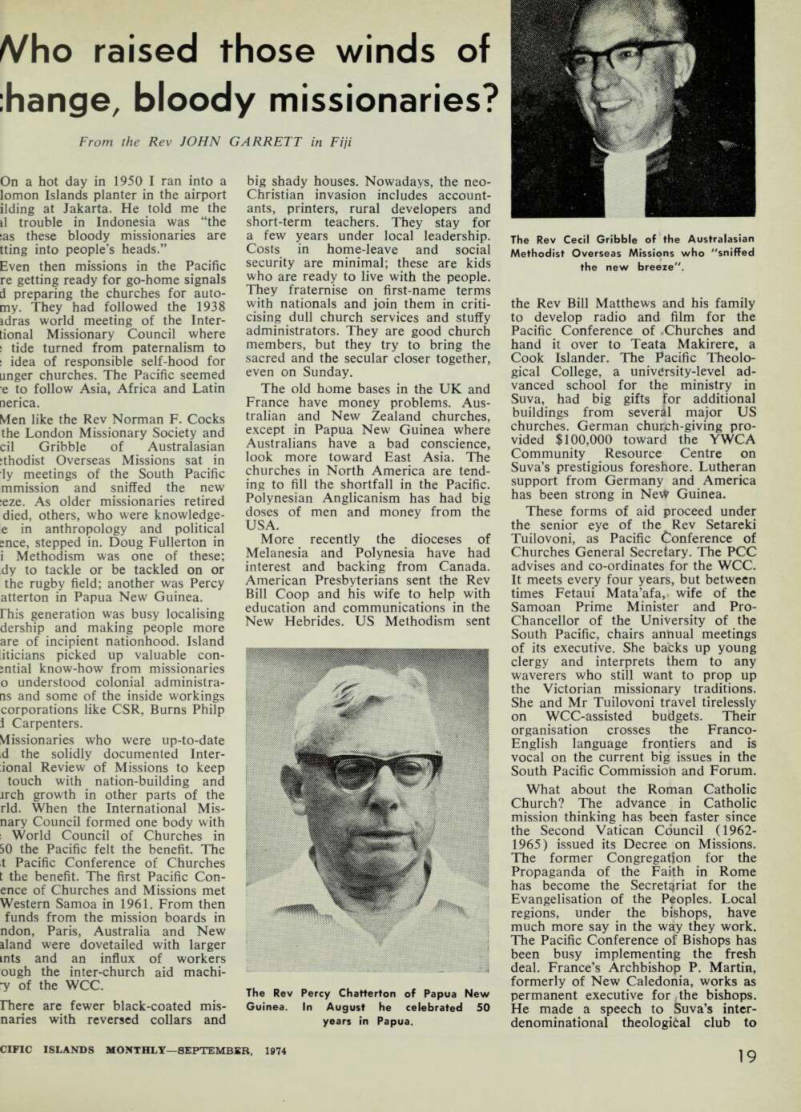
Who raised those winds of change, bloody missionaries?
From the Rev JOHN GARRETT in Fiji
On a hot day in 1950 I ran into a lomon Islands planter in the airport ilding at Jakarta. He told me the d trouble in Indonesia was “the ;as these bloody missionaries are tting into people’s heads.”
Even then missions in the Pacific re getting ready for go-home signals d preparing the churches for auto my. They had followed the 1938 idras world meeting of the Inter tional Missionary Council where i tide turned from paternalism to : idea of responsible self-hood for anger churches. The Pacific seemed e to follow Asia, Africa and Latin nerica.
Men like the Rev Norman F. Cocks the London Missionary Society and cil Gribble of Australasian dhodist Overseas Missions sat in ly meetings of the South Pacific mmission and sniffed the new :eze. As older missionaries retired died, others, who were knowledge e in anthropology and political snee, stepped in. Doug Fullerton in i Methodism was one of these; dy to tackle or be tackled on or the rugby field; another was Percy atterton in Papua New Guinea.
Phis generation was busy localising dership and making people more are of incipient nationhood. Island iticians picked up valuable con mtial know-how from missionaries 0 understood colonial administra tis and some of the inside workings corporations like CSR, Burns Philp 1 Carpenters.
Missionaries who were up-to-date d the solidly documented Inter ional Review of Missions to keep touch with nation-building and irch growth in other parts of the rid. When the International Mis nary Council formed one body with : World Council of Churches in SO the Pacific felt the benefit. The t Pacific Conference of Churches t the benefit. The first Pacific Con ence of Churches and Missions met Western Samoa in 1961. From then funds from the mission boards in ndon, Paris, Australia and New aland were dovetailed with larger mts and an influx of workers ough the inter-church aid machi •y of the WCC.
There are fewer black-coated mis naries with reversed collars and
big shady houses. Nowadays, the neo- Christian invasion includes account ants, printers, rural developers and short-term teachers. They stay for a few years under local leadership.
Costs in home-leave and social security are minimal; these are kids who are ready to live with the people.
They fraternise on first-name terms with nationals and join them in criti cising dull church services and stuffy administrators. They are good church members, but they try to bring the sacred and the secular closer together, even on Sunday.
The old home bases in the UK and France have money problems. Aus tralian and New Zealand churches, except in Papua New Guinea where Australians have a bad conscience, look more toward East Asia. The churches in North America are tend ing to fill the shortfall in the Pacific.
Polynesian Anglicanism has had big doses of men and money from the
Usa.
More recently the dioceses of Melanesia and Polynesia have had interest and backing from Canada.
American Presbyterians sent the Rev Bill Coop and his wife to help with education and communications in the New Hebrides. US Methodism sent
the Rev Bill Matthews and his family to develop radio and film for the Pacific Conference of .Churches and hand it over to Teata Makirere, a Cook Islander. The Pacific Theolo gical College, a university-level ad vanced school for the ministry in Suva, had big gifts for additional buildings from several major US churches. German church-giving pro vided $lOO,OOO toward the YWCA Community Resource Centre on Suva’s prestigious foreshore. Lutheran support from Germany and America has been strong in Neifr Guinea.
These forms of aid proceed under the senior eye of the Rev Setareki Tuilovoni, as Pacific Conference of Churches General Secretary. The PCC advises and co-ordinates for the WCC.
It meets every four years, but between times Fetaui Mata’afa, wife of the Samoan Prime Minister and Pro- Chancellor of the University of the South Pacific, chairs annual meetings of its executive. She backs up young clergy and interprets them to any waverers who still want to prop up the Victorian missionary traditions.
She and Mr Tuilovoni travel tirelessly on WCC-assisted budgets. Their organisation crosses the Franco- English language frontiers and is vocal on the current big issues in the South Pacific Commission and Forum.
What about the Roman Catholic Church? The advance in Catholic mission thinking has been faster since the Second Vatican Council (1962- 1965) issued its Decree on Missions.
The former Congregation for the Propaganda of the Faith in Rome has become the Secretariat for the Evangelisation of the Peoples. Local regions, under the bishops, have much more say in the way they work.
The Pacific Conference of Bishops has been busy implementing the fresh deal. France’s Archbishop P. Martin, formerly of New Caledonia, works as permanent executive for ,the bishops.
He made a speech to Suva’s inter denominational theological club to
The Rev Percy Chatterton of Papua New Guinea. In August he celebrated 50 years in Papua.
The Rev Cecil Gribble of the Australasian Methodist Overseas Missions who "sniffed the new breeze".
how his colours on subjects like laximum practical co-operation with ther Christians and opposition to tomic testing. Catholics and Pro ;stants have been attending one nother’s meetings freely. The Roman !atholics are in several national auncils of churches and want to >in the Pacific Conference of Churches, where they are already bservers.
The Roman Catholics have an Jvantage in total commitment be mse of the celibate religious com lunities like the Marists and Divine tord Missionaries. Many members f these groups opt for citizenship hen countries become independent, he trend is less clear among Pro stant missionary expatriates, who jntract for a term, not for life.
As a result of the changes in mis ons most churches now feel the rain of two problems: finding local oney to raise the ratio of Pacific mding to foreign help, and training cal leaders and administrators. The oman Catholics also face leakage om the ranks of the priesthood and ligious communities; there is talk the need for married clergy in iltures where lifelong celibacy causes izzlement.
All the new trends are accelerating :cause of the preponderance of ider-25s in the churches. Funerals, tirements, and resignations assist. ie churches are being dragged oaning, if not screaming, out of the >th into the late 20th century. They e listening to ideas that never tered the heads of the (bloody?) issionaries of yesterday.
Advertisements & other items, pp. 21-22 (2 items)
19
CIFIC ISLANDS MONTHLY— SEPTEMBER, 1974
S. E. Tatham
SOME OF THE FIRMS
WE REPRESENT ARE:
Asia Rubber Works (Singapore Rubber Shoes) Frappier (French Brandy) Huvef (French Brandy) Indika (Belgium Dairy Produce) Durobor S.A. (Belgium Glassware) Miroiterie Gen. de Belgiqe S.A. (Louvre glass and mirrors) City Engineers (U.K. Bicycles) F.H.I. Japan (Subaru Cars) Kraggs (Wines, Spirits, Ciders) Sunshine Biscuits Sunrise (Confectionery) Flamenco (Instant Coffee & Tea) Quaker Products (Oats, Jets) Hancocks (Spaghetti, Cereals) Melbourne Canning (Jams) Amatil (Twisties, Twirlies) Edward Zorn (Margarine, Cooking Fats) Allens (Confectionery) Red Tulip (Fine Chocolates) Robert Timms (New Guinea Gold Instant Coffees and Teas) S.P.C (Canned Fruit) S.P.C. (Abalone) Wing Lee (See You Sauce) Magnet (Mattresses) Essteel (Cookware) Warner-Drayton (Fans) Mitchell's (Abrasives) Tilbury & Lewis (Sports Trophies & Silverplate) Regent (Swiss watches) Lega Marcasite (Jewellery) Austramax (Pressure Lanterns) Lawn Chair; Tubco (Garden Furniture) Electronic Industries (Electrical Household Appliances) Jex (Steelwool) Arnbro (Folding Beds) James Miller (Blankets) Elmaco (Plastics —Electrical Fittings; B.X. (Plastics) Stegbar (Wooden Louvres) Franklite (Light Fittings) JJ. Cash (Embroidered Labels) Disston (Saws)
S. E. TATHAM
& CO. PTY. LTD.
ASKEW HOUSE, 364 LONSDALE ST.,
MELBOURNE, 3001, AUSTRALIA.
G.P.O. BOX 8—
CABLES "SET",
TELEPHONE: 601125
BUYERS FOR THE
PACIFIC ISLANDS
52 \ m
DIRECT ENQUIRIES WELCOMED
PAPUA NEW GUINEA: S. E. TATHAM (P.N.G.) PTY. LTD.,
LAE: MALAITA STREET (P.O. BOX 1562).
PORT MORESBY: CNR. GOROA AND MUNAHU STREETS, GORDON
(P.O. BOX 6733, BOROKO).
FUI: S. E. TATHAM (FIJI) LTD.,
LAUTOKA: P.O. BOX 366.
SUVA: G.P.O. BOX 671.
YOUR GUARANTEE
~*mo
SINCE 1924
1
FOR SERVICE
T. 2
Critics Confounded
Father Gregory Singkai, the 39ar-old Rector of the RC Diocesan minary at Bomana, is the first New iinean to be made a diocesan shop. His appointment by Pope iul as Bishop of Bougainville was nounced in Rome on August 6. He cceeds Bishop Leo Lemay. Also an unced at the same time was the pointment of another New Guinean, onsignor Herbert Paivu, aged 62, car General of the Archdiocese of \baul as titular Bishop of Temu ma and Auxiliary Bishop of Port oresby.
The appointments are an indication it the RC Church is speeding up localisation in Papua New Guinea lere it has had to face criticism r allegedly dragging its feet on the pointment of indigenes to bishop s. The appointment of Fr Singkai ll confound those critics who said - only New Guineans given “top” is were elderly men who would be lenable to the influence of the ite clergy.
Fiji's brainy migrants
seek greener pastures
From VIJENDRA KUMAR in Lautoka
is facing an exodus of * professional and skilled people who are leaving Fiji in increasingly large numbers to seek better fortunes in other countries. Last year, 3,747 people left the country to settle mainly in Canada and America. A sprinkling went to Australia and New Zealand. Ac cording to the government statistician, Mr Mohammed Ali Sahib, the rate of emigration is accelerating and this year’s figures are expected to be still higher.
Although the Bureau of Statistics has not released a racial break down, it is no secret that a vast majority of the migrants are Indians. Many Chinese have left the country in the past few years and the trend is continuing. The government has expressed concern at this brain drain which it can ill afford at its present stage of development but has not yet seriously grappled with the problem.
Top professionals have left Fiji disgruntled and dejected, dis contented at salary disparities between locals and expatriates.
Some were frustrated with slow advancement. Several doctors have gone to Australia where they earn many times more than they did in Fiji and have opportunities to pursue post-graduate courses.
Skilled workers such as electric ians, motor mechanics, carpenters and joiners find a ready market for their skills in Canada where a majority of them find their new home. Once settled there, they gradually bring in their entire families and friends. Vancouver has several thousand Fiji nationals.
Some have ventured further inland into the biting cold for more money and better opnortunities.
Many teachers have found good positions in Canadian schools where they are continuing their own studies in different fields.
Perhaps the real reason for the migration of Indians stems from a sense of insecurity. Politically, they are equal to any other race but political power these days is tied up with economics. The Indians have uncertainties about the land problem which recently sparked off a rowdy scene in the
House of Representatives. A state ment by a minister that Indians would no longer get leases on land administered by the Native Land Trust Board (NLTB) did not help to allay these fears. On the con trary, it merely confirmed the Indians’ suspicions.
Since then, the NLTB and the government have tried to patch up the monumental political blunder but its real effects are yet to be seen.
A recent trend in emigration is even more alarming. Several busi nessmen have left. Recently, two leading Indian capitalists left to settle in New Zealand where the New Zealand Government welcom ed their investment. Some have gone to America and have estab lished small businesses. Others are planning to leave.
The owner of a flourishing print ing press at Lautoka is selling out to settle in Montreal. A Chinese merchant has offered for sale his three-storey building at Ba, a town on the Western Coast of Viti Levu, because he wants to live in Aus tralia.
This trend underlines the real fears felt by the Indian community and to some extent by the Chinese, who are in a small minority. The businessmen who have left and those planning to leave prospered well in Fiji and their departure from a country which has prided itself on being a showcase for democracy and political stability seems puzzling. But deep under currents flow beneath the system.
The government has tightened up on the flight of capital which may have an effect on slowing down the trend. But sharp busi nessmen know ways of circum venting the restrictions and are secretly channelling out cash and salting it in foreign banks—for a ‘rainy day’.
One of the ironies of the situation is that Fiji may be paying for speeding its policy of localising jobs soon after self-government.
With the local expertise flying away ?> the government may find itself in the embarrassing position of recruiting expatriates to fill posts for which no locals are available.
Advertisements & other items, pp. 23-24 (2 items)
Cific Islands Monthly—September, 1914
* Therma-Panel
"CANBERRA”
Three bedroom elevated home, lots of living space, brick laundry under, and two carports, George Hudson’s new Therma-Panel modular units mean that you can build your own home in a fraction of the time required for traditional materials.
Write for detailed plans and prices from the sole Pacific Islands agent:
A. RIETTE (EXPORT) PTY. LTD.
300 GEORGE STREET, SYDNEY 2000.
Cables: Ramaritime, Sydney
WhaVs so
different about
* THERMA-PANEL
HOMES?
Just this:
• Only three basic components for walls, ceilings, doors and windows. • Makes building simple as A.B.C. • Specially designed for the owner-builder. • Fully insulated walls and ceilings. • Cuts on-site construction time. • Cuts on-site construction costs. • Pitched or flat roof with exposed beams for real beauty.
Save hundreds of dollars
on most efficient
WALK IN, ALUMINIUM
COOLROOMS AND
FREEZE ROOMS
Hundreds already installed! The most economical supplementary coolrooms for bottles and food, providing the largest storage capacity of any comparable coolrooms of the same exterior dimensions. Five sizes —from 90-360 cu. ft. capacity; 16 models offering normal temp., two temp., deep freeze, or for pastry and ice storage applications. White vinyl interior, embossed rustproof aluminium exterior. • SUPPLIED IN EASY-TO-ERECT, DO-IT-YOURSELF KIT FORM.
Available from; AUSTRALIAN NEW CALEDONIA EXPORTS (SILVER & BARDA), 363 George St., Sydney, 2000 and Branches.
BRECKWOLDT & CO., 276 Pitt St., Sydney, 2000 and Branches.
PETER FISHER TRADING PTY. LTD., 321 Pitt St., Sydney, 2000.
HAGEMEYER (A'SIA), 59 Anzac Pde., Kensington, 2033 and Branches.
KERR BROS, 65 York St., Sydney, 2000.
Manufactured by:
NELSON & ROBERTSON PTY. LTD., 197 Clarence St., Sydney, 200( RABAUL TRADING CO. PTY. LTD., P.O. Box 219, Rabaul and Brand ROY GALLIMORE & ASSOCIATES, P.O. Box 179, Vila, New Hebrii C. SULLIVAN (EXPORT) PTY. LTD., 60 Margaret St., Sydney, 2000 Branches.
W. S. TAIT & CO, PTY. LTD., 31 Macquarie Place, Sydney, 2000 Branches. 199 Parramatta Road, Cnr, Skarratt Street, Auburn, N.S.W. 2144, Australia. Phone 648-1711.
Powered by Kelvina Five-year warranty compressor. Early livery.
The Editor's Mailbag
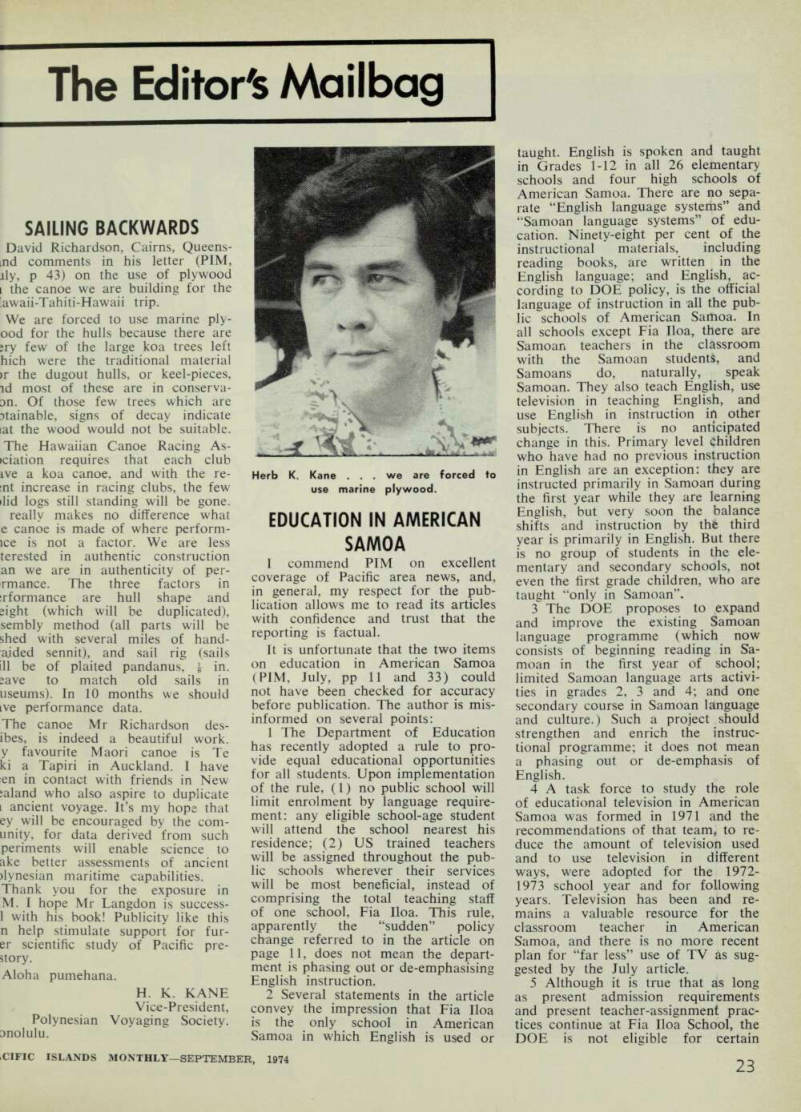

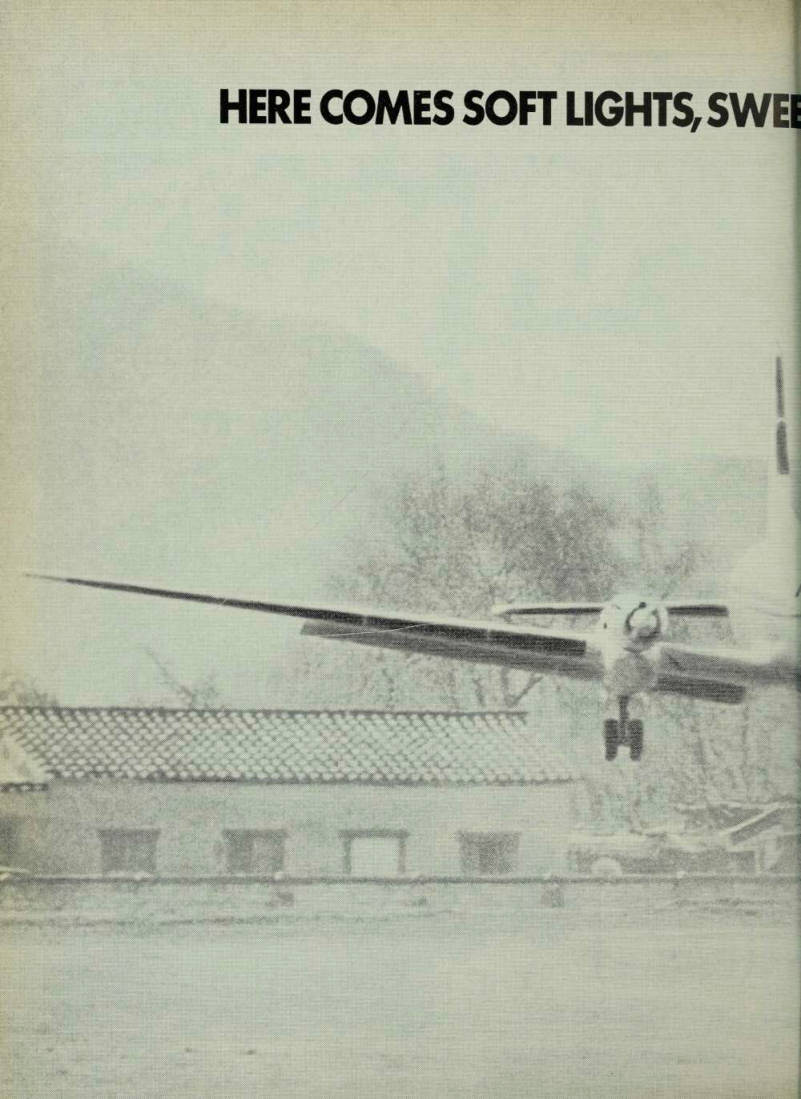
Sailing Backwards
David Richardson, Cairns, Queens ind comments in his letter (PIM, ily, p 43) on the use of plywood [ the canoe we are building for the [awaii-Tahiti-Hawaii trip.
We are forced to use marine ply ood for the hulls because there are iry few of the large koa trees left hich were the traditional material >r the dugout hulls, or keel-pieces, id most of these are in conserva an. Of those few trees which are atainable, signs of decay indicate lat the wood would not be suitable.
The Hawaiian Canoe Racing As •ciation requires that each club ive a koa canoe, and with the re ;nt increase in racing clubs, the few did logs still standing will be gone. really makes no difference what e canoe is made of where perform ice is not a factor. We are less terested in authentic construction an we are in authenticity of per rmance. The three factors in :rformance are hull shape and sight (which will be duplicated), sembly method (all parts will be shed with several miles of hand aided sennit), and sail rig (sails ill be of plaited pandanus, i in. save to match old sails in useums). In 10 months we should tve performance data.
The canoe Mr Richardson des ibes, is indeed a beautiful work, y favourite Maori canoe is Te ki a Tapiri in Auckland. I have en in contact with friends in New ;aland who also aspire to duplicate i ancient voyage. It’s my hope that ey will be encouraged by the corn unity, for data derived from such periments will enable science to ake better assessments of ancient fiynesian maritime capabilities.
Thank you for the exposure in M. I hope Mr Langdon is success -1 with his book! Publicity like this n help stimulate support for fur er scientific study of Pacific pre story.
Aloha pumehana.
H. K. Kane
Vice-President, Polynesian Voyaging Society, anolulu.
Education In American
Samoa
I commend PIM on excellent coverage of Pacific area news, and, in general, my respect for the pub lication allows me to read its articles with confidence and trust that the reporting is factual.
It is unfortunate that the two items on education in American Samoa (PIM, July, pp 11 and 33) could not have been checked for accuracy before publication. The author is mis informed on several points: 1 The Department of Education has recently adopted a rule to pro vide equal educational opportunities for all students. Upon implementation of the rule, (1) no public school will limit enrolment by language require ment; any eligible school-age student will attend the school nearest his residence; (2) US trained teachers will be assigned throughout the pub lic schools wherever their services will be most beneficial, instead of comprising the total teaching staff of one school, Fia Iloa. This rule, apparently the “sudden” policy change referred to in the article on page 11, does not mean the depart ment is phasing out or de-emphasising English instruction. 2 Several statements in the article convey the impression that Fia Iloa is the only school in American Samoa in which English is used or
taught. English is spoken and taught in Grades 1-12 in all 26 elementary schools and four high schools of American Samoa. There are no sepa rate “English language systems” and “Samoan language systems” of edu cation. Ninety-eight per cent of the instructional materials, including reading books, are written in the English language; and English, ac cording to DOE policy, is the official language of instruction in all the pub lic schools of American Samoa. In all schools except Fia Iloa, there are Samoan teachers in the classroom with the Samoan students, and Samoans do, naturally, speak Samoan. They also teach English, use television in teaching English, and use English in instruction in other subjects. There is no anticipated change in this. Primary level children who have had no previous instruction in English are an exception: they are instructed primarily in Samoan during the first year while they are learning English, but very soon the balance shifts and instruction by thfc third year is primarily in English. But there is no group of students in the ele mentary and secondary schools, not even the first grade children, who are taught “only in Samoan”. 3 The DOE proposes to expand and improve the existing Samoan language programme (which now consists of beginning reading in Sa moan in the first year of school; limited Samoan language arts activi ties in grades 2, 3 and 4; and one secondary course in Samoan language and culture.) Such a project should strengthen and enrich the instruc tional programme; it does not mean a phasing out or de-emphasis of English. 4 A task force to study the role of educational television in American Samoa was formed in 1971 and the recommendations of that team, to re duce the amount of television used and to use television in different ways, were adopted for the 1972- 1973 school year and for following years. Television has been and re mains a valuable resource for the classroom teacher in American Samoa, and there is no more recent plan for “far less” use of TV as sug gested by the July article. 5 Although it is true that as long as present admission requirements and present teacher-assignment prac tices continue at Fia Iloa School, the DOE is not eligible for certain
Herb K. Kane . . . we are forced to use marine plywood.
;deral funds, this has not been the ;ason for plans to change the opera on of Fia Iloa school, plans which, xording to the DOE rule, will not s fully implemented until 1975-1976. 6. The article indicates that only Dove-average students can speak 3th English and Samoan, and that i large number of students” cannot i instructed in English because they >eak Samoan. In every educational r stem, there are students who have ore facility in languages than hers, but in no way is the number I bilingual students in American unoa limited to the above-average, bviously the fact that a child speaks imoan does not preclude his speak g English and receiving instruction English. 7 The item on page 33 indicating at there will be no instructional levision programming in American imoa for the rest of the year is in durate. On May 29, 1974, the DOE mounced that instructional telecasts ere ceasing, because of power prob ms, for the remainder of the 1973-
1974 school year. The school year ended three days later on May 31, 1974. Instructional television pro gramming will begin again in Sep tember when schools reopen.
(Mrs) Marilyn Barry,
ITV Manager.
American Samoa.
New Hebrides Censorship
The film Hiroshima-Nagasaki recently caused alarm to the Censor ship Board of the Joint Administra tion of the British and French governments in Vila. It was purely a documentary (15 minutes) film, depicting the immediate effects of the atom bomb explosion that took place in Japan during World War 11.
Radio Vila announced the screen ing of the film and that it was open to the public; children under the age of 12 were not to be allowed to see it as it could terrify them and give them nightmares. The notice aroused the Board’s suspicions and it im mediately banned the screening. The reason for the ban was that the film had not been submitted to the Board, and that the Board had not granted permission for it to be screened.
The Joint Regulation on Censor ship came into force in 1973, but the publication of it was poor. The Presbyterian Church of the New
Hebrides, which occasionally imports films for its use, did not possess a copy until this dispute arose.
The regulation states that . . No person shall exhibit to the public any cinematograph film ... in the New Hebrides unless and until a permit has been granted by the Censorship Board.”
The members of the Board include the French and British district agents, who act as joint chairmen, the district education officers of each national service and two New Hebrideans ap pointed by the Resident Commis sioners by joint decision.
Fair enough! No film should be exhibited for public screening with out the approval of the Censorship Board. The film was not screened.
But a good crowd of people, many of whom had travelled several miles, many of whom had paid taxi fares especially to come over for the film, and many of whom had cancelled their meetings for that night, were disappointed at discovering that the film was cancelled. I was disappointed too by the Board’s action. I had gone to the trouble of bringing the film in from Fiji; preparing a simple explana tion to accompany the film and get ting the necessary equipment ready for the programme. But it was all to our disappointment, when just a
Cont on p 29
ew hours prior to the scheduled ime, the programme had to be ancelled.
People of the New Hebrides, like be rest of the world, hear of the aternational fuss over the develop ment of nuclear arms by the big owers —Russia and the United States alking on nuclear disarmament; India ntering into the nuclear race; China nd France carrying out nuclear test igs. New Hebrideans generally do ot appreciate why countries such as lew Zealand and Australia should go m the extent of boycotting the ships nd planes that service the New lebrides Group in their protest gainst French nuclear testing. New lebrides, as an innocent country and eople, suffers the direct consequences f such international fuss. Why should it suffer? Is all this fuss necessary? yhat is wrong with nuclear arms nd nuclear explosions? These are ome of the questions that puzzle the Jew Hebrideans. Most remain quite >norant of the reasons for the fuss nd the danger of nuclear bombs The screening of the film was itended to dispel some of this fog f ignorance. As such, it was purely ducational —to help the public of me New Hebrides to be aware of the angers of nuclear weapons. To ensure lat the screening of the film achieved mis purpose, a simple explanatory iece was prepared to accompany le film. However the purpose was ever achieved. The film was on loan ar a very short time and had to be immediately.
The film was screened before three members of the Board on the follow ig day. (Incidentally, the regulation as it that “. . . four members of the oard shall constitute a quorum”, ince things were rushed through, the oard could not form a proper uorum to see the film.) The Board ave its approval for the public :reening of the film, but only with fluctance and reservations reflected i the manner in which permission as granted. Before the film could be mown, a certificate of approval had ) be obtained from the Board. No oung person under the age of 18 mould be allowed to see it. Any ex lanation accompanying the film must e related only to the context in which me incident occurred. In other words, must say: “America dropped the ombs in Japan when the two ountries were at war with each ther during the second World War i 1945” . . . full stop! Furthermore
it was demanded that such an ex planation must be written out and shown to the Board before it was used; and again that no speeches must be made following the screen ing of the film.
Fine! But who wants to be made aware of a danger that is not an issue, and it is a danger to every living soul on the face of the earth.
If we must not bring in the current aspect of the danger, then what is the point of screening the film at all?
If education is to serve any com munity, it must deal with issues that are immediately related to the life of that community. Unless our education has something to say about our life here and now, it is not worth pursuing.
It was explained that the Board was concerned about public order. It is funny that Public Order should be the Board’s first concern. The Board is not interested in checking every film that comes into the Group.
For instance, anything on Mickey Mouse or the Wild West, which simply provide entertainment, are allowed to pass unquestioned But any film that makes New Hebrideans think and start questioning about life and the world must be examined. One wonders if this reflects political fear and suspicion on the Board’s part.
Often, when a person does some thing that he knows is unfair to the person behind whose back he does it, he is very careful that the game is not revealed to the person who is
being cheated. A lot of information that should be communicated to the New Hebrideans never gets past the! clutches of the two administrations. I The New Hebridean petitioner to the United Nations was infuriated on dis covering that the information on New Hebrides sent out by the UN never came to the knowledge of the general public.
The recent incident over the film is j another example of the way New Hebrideans have been deprived of j information on matters of importance J to them as people and as a country. I Education in the New Hebrides is very much polished by the colonial varnish of the British and the French 1 governments.
Sethy J. Regenvanu.
Vila, New Hebrides.
Aviation Lynch Law
The article by your staff writer on the development of regional air j services in the South Pacific (August, j p 75), should be disturbing to any-j one with some knowledge of the factors which make airline operation successful, and to anyone with some I affection for the Islands. Each group doing its nationalistic bit in aviation will, in my opinion, lead to com mercial success for none—just more and more subsidies, unreal balance sheets, and increasing influence from foreign interests.
Surely the core of unity in the area is Fiji—and surely Air Pacific should be the international carrier, with not a cent of Australian, New Zealand or British money in it, but rather the currencies of all the Island groups referred to in your article.
The owners of Air Pacific should then negotiate rights for the airline, using Nadi as the international pivot, to operate with high frequency into Australian and New Zealand airports, and even across the Tasman as part of a triangle, if that leg were con sidered to be commercially sound.
The days of waving an airline as a flag are over—an airline must now be a hard commercial proposition.
What has to be found in equipment should not be more than two types of aircraft, instead of the mixed bag of machines which appears to be building up now as a result of every one going off and doing their own thing; one aircraft type for inter national services into Australia and New Zealand; and the other for regional services. What you buy to a great extent is what you can get overhauled, certainly the major over hauls, in Auckland or Sydney. In other words, do not try to build up an expensive maintenance base in
Nadi. Keep down the number of
people employed.
For each Island group to pursue ts expensive and unnecessary policies, as outlined, would add up to i luxury this family of islands could lot afford, with so much else to be lone for the good of the people.
George Lynch.
Sydney.
Future Arts Festivals
That the First South Pacific Festi val of Arts 1972 was a resounding luccess, both in spontaneous joy generated and in the rehabilitation md preservation of many foundering :ultures was the unanimous opinion )f participants, editorials, spectators, he organisers and the host country, "iji. The directors of the Sydney )pera House Opening Committee vere so impressed that three hundred >r so of the participants were ogether again in Sydney for the Jpera House Opening by Her dajesty, the Queen in 1973.
New Zealand has offered to host he next South Pacific Festival. It has >een suggested that this event should >ccur every four years. But without l permanent body created to ensure ontinuity—such as the Olympic James or the Adelaide Festival of enjoy—there is grave danger of ragmentation through natural human nertia. The ideals and goals should »e decisively crystalised and set down or a permanent constitution with the •riginal enthusiasm and imagination ;ept alive.
When the South Pacific Commiss on meets, there should be a con erted effort to create through that ody which was responsible for the rst festival, an organisation which /ill be permanent, knowledgeable and edicated.
Considering the mountainous prob ;ms of such an inter-nation effort or the arts, it is hoped that the ex erience of the first South Pacific ■estival of Arts will guide the —and any such permanent ody as may be decided upon in rder to further the best display poss ible of the rich store of treasures /hich is the art forms of the Pacific copies.
Above all, the arts of the South ’acific must be encouraged. The /orld needs the joy and the beauty hey present to us all. As an antidote or some of the ills the West has
known in theatre and other art pur suits, they are invaluable.
Beth Dean.
Sydney.
A 'Biased' Reviewer!
W. G. Coppell’s book review of The New Pacific (PIM, Aug, p 69) or, to give it the correct title. The New South Pacific was biased. What is worse, Dr Coppell did not admit his bias. I wish to play by the rules.
This letter is biased.
It is biased against crass and fatuous nonsense such as that your reviewer put before us last month.
Waigani, KEITH JACKSON.
Papua New Guinea.
Great Wall Broken
Huang Sui-Lan in the Making of a Fiji Chinese (PIM, Mana, July p 64) has for me broken a Great Wall of human barrier. I have now moved from taking for granted my attitude of the stereotyped Chinese to regarding him or her as just another human being, and with other human beings I must remember that I co-exist.
I am going to be a more confident and contended man in my small capacity in our business dealings.
To Huang I say merci!
M. Tagarasi.
Vila,
Advertisements & other items, pp. 25-30 (3 items)
23
ICIFIC ISLANDS MONTHLY—SEPTEMBER, 1974
I
Manufactured by Commonwealth New Guinea Timbers Ltd. and available from leading suppliers throughout the Pacific.
DAIWA BANK SERVING YOU IN THE PACIFIC BASIN r * Head Office .Osaka,Japan With 137 Branches throughout Japan Singapore Representative Office Suite No. 1007, 10th Floor Robina House 1 Shenton Way, Singapore 1 Republic of Singapore Cable Address: SINGDAIWA Affiliated Bank P.T BANK PERDANIA Djalan Raya Mangga Besar 7&9 Djakarta Our Correspondent Banks are in city— Apia, Suva, Lae, Madang Port Moresby, Rabaul Wewak. Guam, all Principal cities in Australia and New Zealand Contact your banker or our office. y Los Angeles Agency 555 South Flower St. Suite 4040 Los Angeles, Calif. 90071 Sydney Representative Office Bth Floor Prudential Building 39-49, Martin Place, Sydney
THE DAIWA BANK LTD
Head Office : 21. Bingomachi 2-chome, Higashi-ku, Osaka, Japan Overseas : London, New York, Los Angeles, Frankfurt, Sydney, Singapore
HERE COMES SOFT LIGHTS, SWEE
£ 1. • 'fe:
SjT?» vrr arvm yj-r**rrrrt*r^
** w*- '
iilß
, ■ i •-M Mi
USIC AND UTTER COMFORT. DAILY AT 10.35.
Like any other modern airliner, the HS 748 is built for passenger comfort. And that means full, efficient air-conditioning, smooth and vibration-free flight, and low cabin noise levels.
Plus a whole new range of tasteful cabin seatings from economy class all the way up to luxury executive layouts.
But the difference is that the HS 748 can take all this spacious, sophisticated comfort into small, remote airfields where modern airliner luxury has never been seen before.
And the 748 can be a pampering 48-passenger airliner in the morning-but a rugged, almost 6-ton capacity freighter the very same afternoon.
You can do a lot with the versatile 54.86 cubic metres the HS 748 offers you.
To find out how much, for how little, contact Hawker Siddeley now.
S •>* i ... * ..W -v. , - ...
> HAWKER SIDDELEY AVIATION
Kingston upon Thames, England.
Hawker Siddeley Group supplies mechanical, electrical and aerospace equipment with world-wide sales and service.
Every imaginable type of inboard marine engine is sold and serviced by Clae. And if you believe it to be unimaginable —Clae will tailor-make it to suit your needs.
Clae PD 35: 35 HP □ Clae BD 65: 65 HP □ Clae BD 95: 95 HP □ Clae BD 145: 145 HP □ Detroit 3-53: 100 HP □ Detroit 4-53: 140 HP □ Detroit 6V-53: 216 HP □ Detroit 4-71: 165 HP □ Detroit 6-71: 250 HP □ Detroit BV-71: 350 HP □ Detroit I 12V-71:525 HP □ Detroit
16V-71: 635 HP □ De-
troit 12V-149: 800 HP □ Detroit 16V-149:1060 HP.
CONTACT: Clae Engine Sales & Service, 31 Hoskins Avenue,
BANKSTOWN, N.S.W. 2200. Phone: 709-4777
Also at Brisbane, Rockhampton, Mackay and Townsville. ■ ill
Letters
25
LCIFIC ISLANDS MONTHLY—SEPTEMBER, 1974
A Natural Way

for Your Skin to Look Lovelier
Today, with the advance in cosmetic chemistry it is possible to preserve your natural youth ful beauty almost indefinitely.
The evolution of a tropically moist oil blend which is com pletely compatible with the oil and moisture content of the skin, has made it possible to bring a smooth natural radiance to the complexion. When this remarkable beauty fluid is ap plied to the complexion, it rapidly sinks into the skin rather than ride ineffectively on the surface. It not only provides ideal protection to the skin, but it also assists in giving added smoothness and softness to the complexion.
Oil of Ulan moist oil blend should be smoothed on at every opportunity—in the morning, at night, and always before apply ing make-up. Ask at your phar
macy or beauty counter for Oil of Ulan today to give your skin the assistance it needs. The simple beauty treatment takes only a few minutes each day, but it will reward you with a
naturally youthful complexion
loveliness. * * * Your elbows are often as much exposed as your com plexion and require as much care and attention. For elbows that are smooth and pretty, mix up a little fresh lemon juice with white sugar grains. Gently rub this into your elbows in a circular motion. Leave on for a few minutes then rinse off and pat dry. To preserve the new skin, smooth on your Oil of Ulan to keep the elbows soft and free from dryness.
The desire to look pretty is a natural ex pression of femininity, so an awareness at an early age of correct beauty care will pay dividends, not only in your youth, but in the years ahead.
Advertisements & other items, pp. 31-33 (2 items)
Letters
29
ACIFIC ISLANDS MONTHLY—SEPTEMBER, 1974
■Grasslands Ttd
D apua new guinea
printing co. ply. ltd.
Serving the Country from Aitape to Alotau, Manus to Moresby.
Leaders in Commercial Offset and Letterpress Printing. Stationery • Office Supplies • Office Equipment • Rubber Stamps • Self-Adhesive Labels • In Fact: — Everything For The Office.
P.O. Box 633, Port Moresby P.O. Box 759, Lae P.O. Box 1239, Rabaul
I Grasslands guide;
to easy farming.. t ' s {Vvi. • 5 >1 r , |* I **Sr"
' k-;•» /.£ *
Australia’s finest agricultural
equipment is now illustrated
in one new folder by Grasslands.
Send for your free copy today.
■GRASSLANDS Ttd
■ 25 Fairfield St., Villawood,
■ N.S.W. 2163 AUSTRALIA
■ NAME
■ ADDRESS -
£ P.C.
Group nwnoot
SIMS CONSOIIOAKO LlO
to the Pacific Islands
79 Years' Experience
Selling
"SERVICE"
NELSON & ROBERTSON
PTY. LIMITED
(Established 1895)
PLANTATION HOUSE, 197 CLARENCE STREET, SYDNEY
CABLES: "IVAN", SYDNEY, BRISBANE. TELEX: AA22381, SYDNEY.
FOR:
INDENTS
COMMODITIES
SHIPPING
TRAVEL
INSURANCE
REAL ESTATE
Branch Office: Nelson & Robertson Pty. Ltd., 303 Adelaide St., Brisbane, Old.
New Guinea Representatives: Rabaul Trading Co. Pty. Ltd., Rabaul Lae Madang Kieta.
sake, not tor a friend!
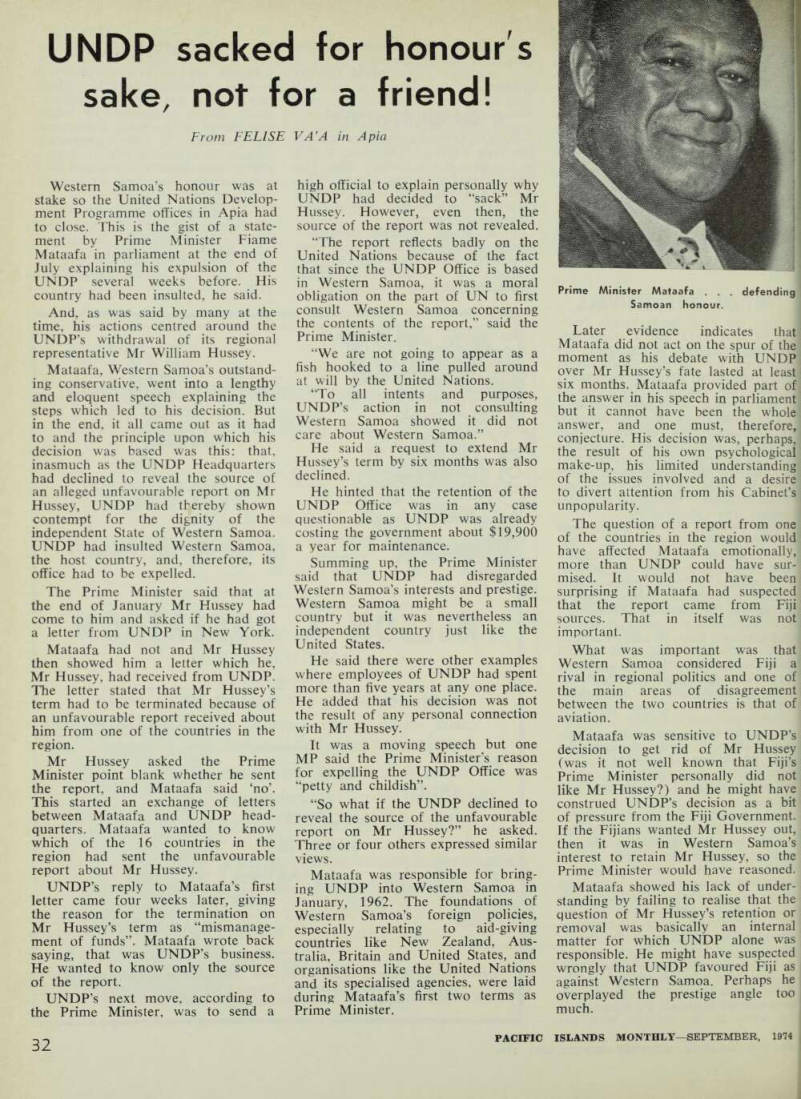
UNDP sacked for honour's sake, not tor a friend!
From FELISE VA’A in Apia
Western Samoa’s honour was at stake so the United Nations Develop ment Programme offices in Apia had to close. This is the gist of a state ment by Prime Minister Fiame Mataafa in parliament at the end of July explaining his expulsion of the UNDP several weeks before. His country had been insulted, he said.
And, as was said by many at the time, his actions centred around the UNDP’s withdrawal of its regional representative Mr William Hussey.
Mataafa, Western Samoa’s outstand ing conservative, went into a lengthy and eloquent speech explaining the steps which led to his decision. But in the end, it all came out as it had to and the principle upon which his decision was based was this; that, inasmuch as the UNDP Headquarters had declined to reveal the source of an alleged unfavourable report on Mr Hussey, UNDP had thereby shown contempt for the dignity of the independent State of Western Samoa.
UNDP had insulted Western Samoa, the host country, and, therefore, its office had to be expelled.
The Prime Minister said that at the end of January Mr Hussey had come to him and asked if he had got a letter from UNDP in New York.
Mataafa had not and Mr Hussey then showed him a letter which he, Mr Hussey, had received from UNDP.
The letter stated that Mr Hussey’s term had to be terminated because of an unfavourable report received about him from one of the countries in the region.
Mr Hussey asked the Prime Minister point blank whether he sent the report, and Mataafa said ‘no’.
This started an exchange of letters between Mataafa and UNDP head quarters. Mataafa wanted to know which of the 16 countries in the region had sent the unfavourable report about Mr Hussey.
UNDP’s reply to Mataafa’s first letter came four weeks later, giving the reason for the termination on Mr Hussey’s term as “mismanage ment of funds”. Mataafa wrote back saying, that was UNDP’s business.
He wanted to know only the source of the report.
UNDP’s next move, according to the Prime Minister, was to send a
high official to explain personally why UNDP had decided to “sack” Mr Hussey. However, even then, the source of the report was not revealed.
“The report reflects badly on the United Nations because of the fact that since the UNDP Office is based in Western Samoa, it was a moral obligation on the part of UN to first consult Western Samoa concerning the contents of the report,” said the Prime Minister.
“We are not going to appear as a fish hooked to a line pulled around at will by the United Nations.
“To all intents and purposes, UNDP’s action in not consulting Western Samoa showed it did not care about Western Samoa.”
He said a request to extend Mr Hussey’s term by six months was also declined.
He hinted that the retention of the UNDP Office was in any case questionable as UNDP was already costing the government about $19,900 a year for maintenance.
Summing up, the Prime Minister said that UNDP had disregarded Western Samoa’s interests and prestige.
Western Samoa might be a small country but it was nevertheless an independent country just like the United States.
He said there were other examples where employees of UNDP had spent more than five years at any one place.
He added that his decision was not the result of any personal connection with Mr Hussey.
It was a moving speech but one MP said the Prime Minister’s reason for expelling the UNDP Office was “petty and childish”.
“So what if the UNDP declined to reveal the source of the unfavourable report on Mr Hussey?” he asked.
Three or four others expressed similar views.
Mataafa was responsible for bring ing UNDP into Western Samoa in January, 1962. The foundations of Western Samoa’s foreign policies, especially relating to aid-giving countries like New Zealand, Aus tralia, Britain and United States, and organisations like the United Nations and its specialised agencies, were laid during Mataafa’s first two terms as Prime Minister.
Later evidence indicates that i Mataafa did not act on the spur of the moment as his debate with UNDP over Mr Hussey’s fate lasted at least six months. Mataafa provided part of the answer in his speech in parliament but it cannot have been the whole answer, and one must, therefore, conjecture. His decision was, perhaps, the result of his own psychological make-up, his limited understanding of the issues involved and a desire to divert attention from his Cabinet’s unpopularity.
The question of a report from one of the countries in the region would have affected Mataafa emotionally, more than UNDP could have sur mised. It would not have been surprising if Mataafa had suspected that the report came from Fiji sources. That in itself was not important.
What was important was that Western Samoa considered Fiji a rival in regional politics and one of the main areas of disagreement between the two countries is that of aviation.
Mataafa was sensitive to UNDP’s decision to get rid of Mr Hussey (was it not well known that Fiji’s Prime Minister personally did not like Mr Hussey?) and he might have construed UNDP’s decision as a bit of pressure from the Fiji Government.
If the Fijians wanted Mr Hussey out, then it was in Western Samoa’s interest to retain Mr Hussey, so the Prime Minister would have reasoned.
Mataafa showed his lack of under standing by failing to realise that the question of Mr Hussey’s retention or removal was basically an internal matter for which UNDP alone was responsible. He might have suspected wrongly that UNDP favoured Fiji as against Western Samoa. Perhaps he overplayed the prestige angle too much.
Prime Minister Mataafa . . . defending Samoan honour.
to foot inflation bill
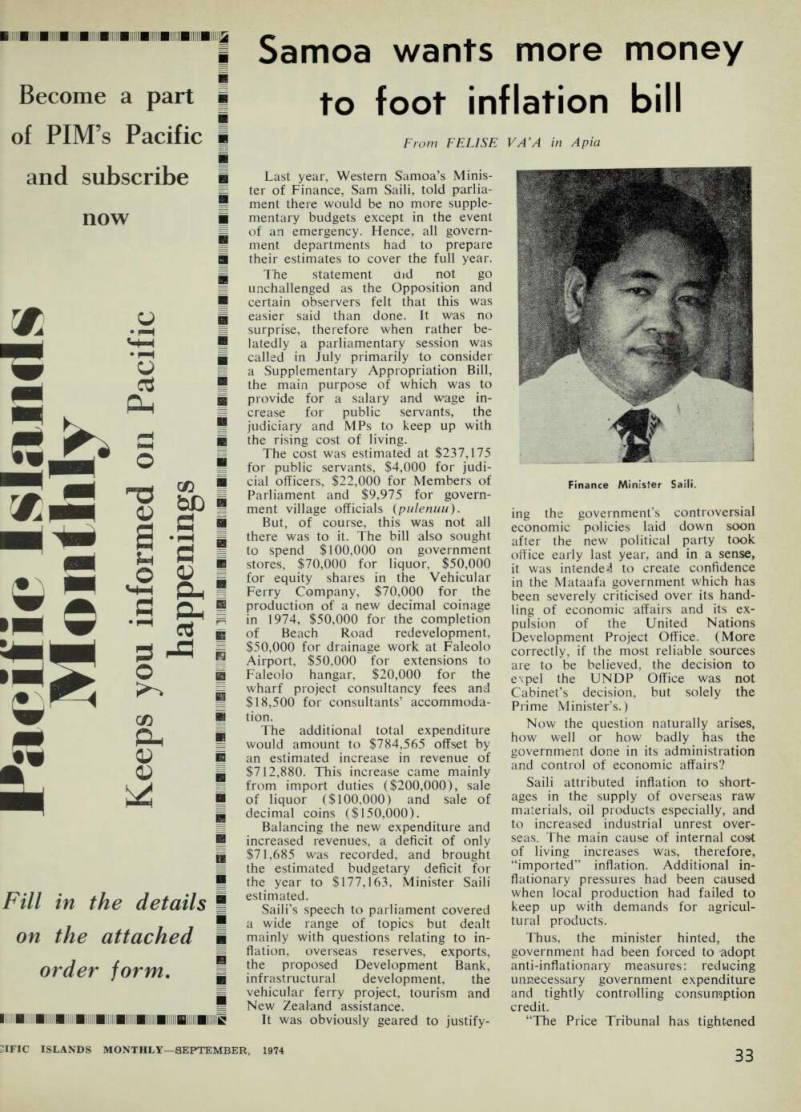
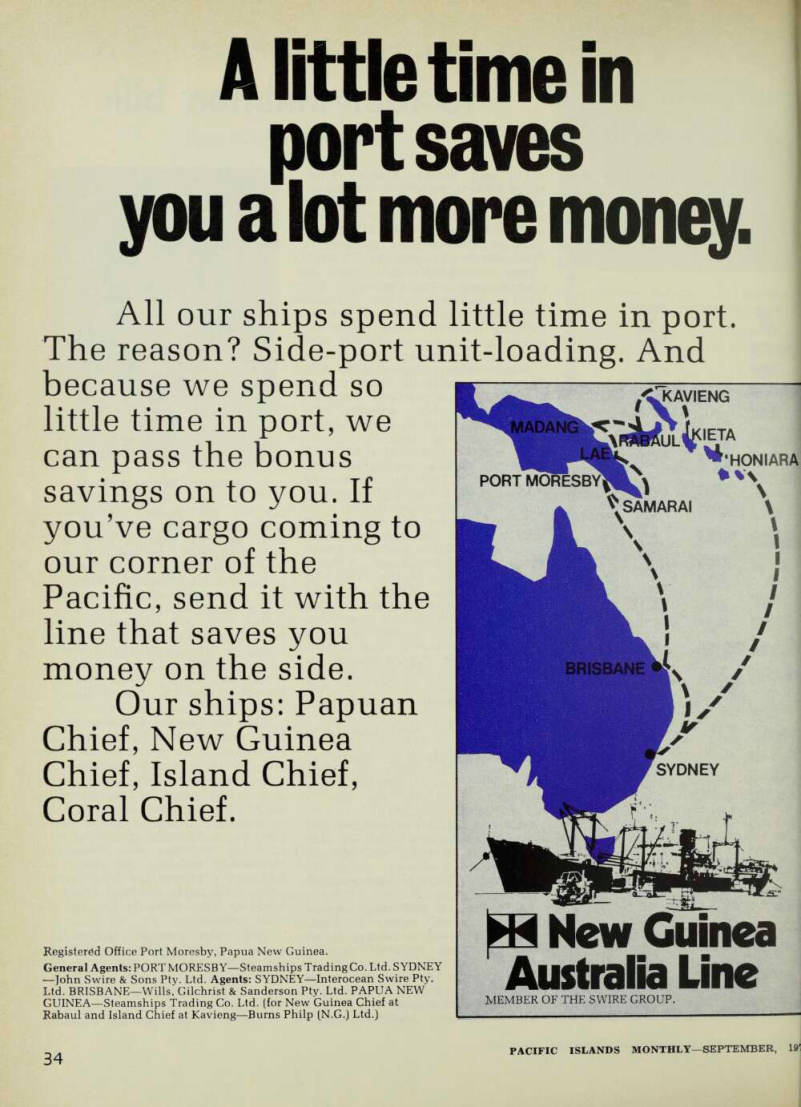

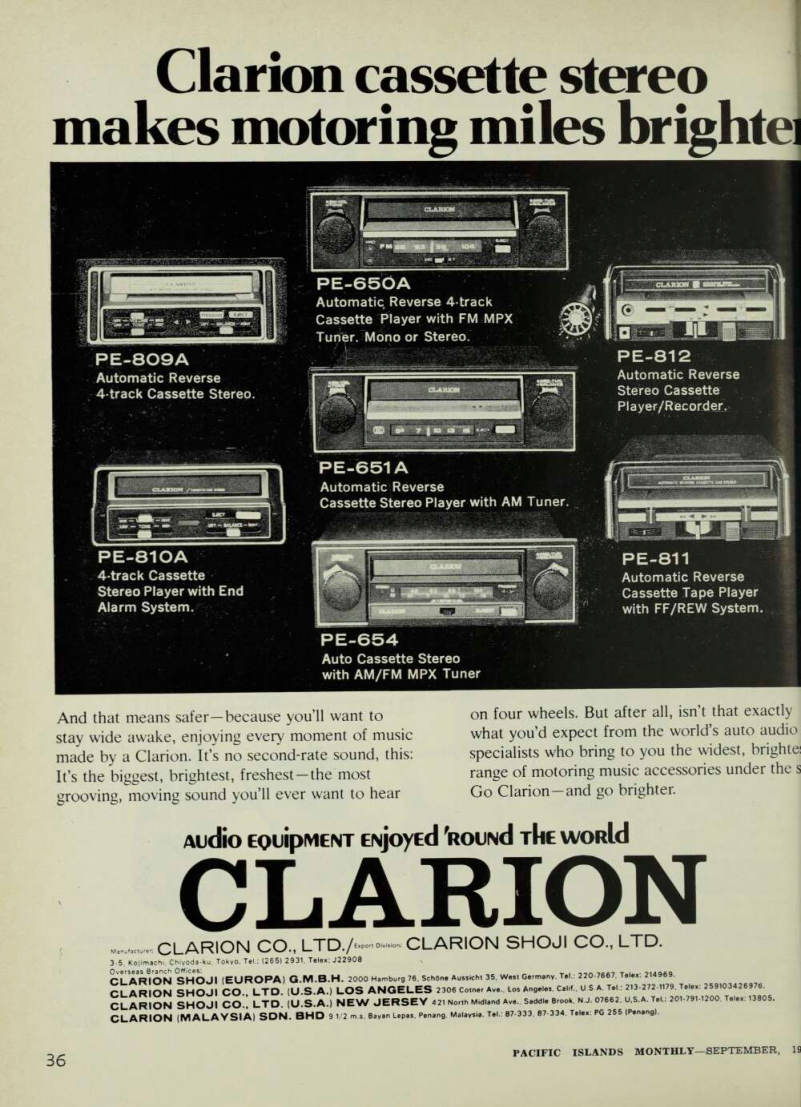
Samoa wants more money to foot inflation bill
From FELISE VA’A in Apia
Last year, Western Samoa’s Minis ter of Finance, Sam Saili, told parlia ment there would be no more supple mentary budgets except in the event of an emergency. Hence, all govern ment departments had to prepare their estimates to cover the full year.
The statement aid not go unchallenged as the Opposition and certain observers felt that this was easier said than done. It was no surprise, therefore when rather be latedly a parliamentary session was called in July primarily to consider a Supplementary Appropriation Bill, the main purpose of which was to provide for a salary and wage in crease for public servants, the judiciary and MPs to keep up with the rising cost of living.
The cost was estimated at $237,175 for public servants, $4,000 for judi cial officers, $22,000 for Members of Parliament and $9,975 for govern ment village officials ( pulenuu ).
But, of course, this was not all there was to it. The bill also sought to spend $lOO,OOO on government stores, $70,000 for liquor, $50,000 for equity shares in the Vehicular Ferry Company, $70,000 for the production of a new decimal coinage in 1974, $50,000 for the completion of Beach Road redevelopment, $50,000 for drainage work at Faleolo Airport, $50,000 for extensions to Faleolo hangar, $20,000 for the wharf project consultancy fees and $18,500 for consultants’ accommoda tion.
The additional total expenditure would amount to $784,565 offset by an estimated increase in revenue of $712,880. This increase came mainly from import duties ($200,000), sale of liquor ($100,000) and sale of decimal coins ($150,000).
Balancing the new expenditure and increased revenues, a deficit of only $71,685 was recorded, and brought the estimated budgetary deficit for the year to $177,163, Minister Saili estimated.
Saili’s speech to parliament covered a wide range of topics but dealt mainly with questions relating to in flation, overseas reserves, exports, the proposed Development Bank, infrastructural development, the vehicular ferry project, tourism and New Zealand assistance.
It was obviously geared to justify-
ing the government's controversial economic policies laid down soon after the new political party took office early last year, and in a sense, it was intended to create confidence in the Mataafa government which has been severely criticised over its hand ling of economic affairs and its ex pulsion of the United Nations Development Project Office. (More correctly, if the most reliable sources are to be believed, the decision to expel the UNDP Office was not Cabinet’s decision, but solely the Prime Minister’s.) Now the question naturally arises, how well or how badly has the government done in its administration and control of economic affairs?
Saili attributed inflation to short ages in the supply of overseas raw materials, oil products especially, and to increased industrial unrest over seas. The main cause of internal cost of living increases was, therefore, “imported” inflation. Additional in flationary pressures had been caused when local production had failed to keep up with demands for agricul tural products.
Thus, the minister hinted, the government had been forced to adopt anti-inflationary measures: reducing unnecessary government expenditure and tightly controlling consumption credit.
“The Price Tribunal has tightened
Finance Minister Saili.
ypocritica! statements
control over the essential food ns but in the longer term, the t way we can successfully combat srnational inflation, is to raise the el of productivity and increase icultural and industrial produc i”, he said. fo state an economic principle, if s one, however, is just like reciting ►oem that has been memorised for •ediency’s sake. To put that prin le into action is quite another ig and to the majority of Samoans > is the key issue. What has the itaafa government done to im •ve industrial and agricultural pro :tion? Very little, many expert icrvers of the local scene will say. >m this they will conclude that 'eminent statements on this point hypocritical. It seems that a lot future promises are made but at really matters to the majority Samoans is the NOW, the present ment.
Jaili said that during the first nine nths of 1973, the country’s over s reserves declined by about )0,000. By the fourth quarter, the icit was reduced to $BOO,OO0 —a re gain of $lOO,OOO. This was tainly not much to be proud of I seriously questioned the wisdom Saili’s financial and economic icies. Was a $lOO,OOO gain, for ;ance, an adequate recompense for widespread sufferings the noans had to endure from the be ning of the Mataafa regime? Saili’s ist that the economic actions taken April, 1973, enabled a reversal of serious trend, was in reality an pty one.
Jowever, there was a positive ; to Saili’s speech, and this was announcement that Western noa’s copra and cocoa were getting remely high prices in overseas rkets. Thus in July, an fob price about $1,400 a ton was received cocoa, and about $4OO a ton for •ra compared with $BBO per ton I $l5O per ton respectively 12 nths ago. fhis favourable state of affairs 1 enabled the government to allow maximum possible importation consumer and capital-goods com nsurate with keeping a necessary j 1 of overseas reserves, f this situation continued, it was •ected that a small balance of r ments deficit would occur in r 4. But again, many Samoans ecially in the villages, are hoping t Saili’s plans (for a smaller de t) could be achieved without un
necessary suffering to them through scarcity of goods, high prices and, most of all, unemployment.
Saili forecast that total agricultural export earnings for 1974 would exceed $W55,000,000 for the first time since 1964, compared with $W53.74 million for 1973. This high figure, however, is mainly the result of the high price for cocoa and copra.
Volume-wise, present exports are comparatively insignificant. In 1972, 1,890 tons of cocoa worth $896,376 were exported, whereas in 1973 only 1,218 tons of cocoa worth $1,072,189 were exported. In the first five months of 1974, 544 tons of cocoa, worth $487,599 were exported compared
with 249 tons worth $122,579 for the first five months in 1973. Copra exports in 1972 were 18,722 tons worth $1,378,850 whereas in 1973 only 13,946 tons worth $1,643,381 were exported.
For the first five months of 1974, 5,498 tons of copra worth $1,493,171 were exported compared with 6,902 tons worth $605,079 for the first five months of 1973. Banana exports fell from 94,333 cases in 1972 to 39,285 cases in 1973.
Says Saili: “It is anticipated that the 1974 exports of bananas will nearly approximate those for 1972, and a reversal of the decline of the banana export industry is definitely
king place with 30,285 cases ported in the five months to May , 1974, compared with 12,222 ses exported to May 31, 1973”.
Despite the tremendous input the •vernment allocates to agricultural velopment, the intended results are r from being clear. Basically the suits are still negative as the above ures and those of previous years 11 indicate, always keeping in mind at agriculture is the present and evious governments’ favourite pro ;t, the one that had the most atten »n and the one in which Samoa’s vernments have been placing Dost all their fragile eggs.
Saili blamed the lack of shipping tween New Zealand and Western moa as one of the obstacles to the •establishment of the banana indus r, but this is not convincing enough, le shipping people, principally the lion Steam Ship Co, could retaliate saying that the reason why there is a lack of shipping was that there ;re not enough exports from estem Samoa to justify increased vices.
This is not an attempt to belittle ; proposed enlarged Development nk of Western Samoa. Operating the Development Loan Fund, the ank” made 236 loans worth 5,895 to planters in 1972, 800 ms worth $286,285 in 1973 and 4 loans worth $214,602 in the first months of this year.
Virtually, all loans are made for ricultural projects but loans are w beginning to be made for other rposes like industrial development d fisheries. The fact that govern :nt is making loans available for :se purposes is highly commendable i it is to be hoped, however, that Jtomers use the money diligently i profitably. The government is w negotiating for a SUS 2 million n from the Asian Development nk to increase the local develop nt bank’s capital.
New Zealand will provide aid rth over SNZB million for de opment projects in Western Samoa ;r the next three-year period. This very encouraging as, in the past, hout this aid, economic progress Western Samoa would have been y minimal.
Ml in all, Saili’s frenetic attempt eliminate the deficit in Western noa’s balance of payments position y be a sincere gesture but hardly ensible in view of the unemploy nt and underemployment caused, ■haps as the previous Minister of lance, Tofa Siaosi, said, a certain icit level is acceptable but it is a ater evil to deprive people of s.
Advertisements & other items, pp. 35-40 (5 items)
33
DIFIC ISLANDS MONTHLY—SEPTEMBER, 1974
Become a part
of PIM’s Pacific and subscribe now V © ag o Oh CO bC P n3 § I o p Ph A Ph Cd P O CO Ph P P Fill in the details on the attached order form.
portsaves
A little time in
you a lot more money.
<KAVIENG
All our ships spend little time in port.
The reason? Side-port unit-loading. And because we spend so little time in port, we can pass the bonus savings on to you. If you’ve cargo coming to our corner of the Pacific, send it with the line that saves you money on the side.
Our ships: Papuan
Chief, New Guinea Chief, Island Chief, Coral Chief.
MADANG
*V\
PORT MORESBY
VSAMARAI
BRISBANE
I I if
SYDNEY
Registered Office Port Moresby, Papua New Guinea.
General Agents: PORT MORESBY—Steamships Trading Co. Ltd. SYDNEY —John Swire & Sons Pty. Ltd. Agents: SYDNEY —Interocean Swire Pty.
Ltd. BRISBANE—WiIIs, Gilchrist & Sanderson Pty. Ltd. PAPUA NEW GUlNEA—Steamships Trading Co. Ltd. (for New Guinea Chief at Rabaul and Island Chief at Kavieng—Burns Philp (N.G.) Ltd.)
New Guinea
Australia Line
MEMBER OF THE SWIRE GROUP.
The Forestmil
Portable Sawmill turns
trees into timber at
the rate oflooosuper
feet per hour.
‘Forestmil’ produces house building or construction size timber direct from the log in the forest. No need to resaw, it’s ready to use. Inter-acting vertical and horizontal blades cut simultaneously for speed and accuracy, (see illustration) ‘Forestmii’ is ideal for cutting usable timber from reject logs.
Produces any size up to 12" x 6" x 18', including boards, framing, bridge sizes, etc.
CHECK THESE FEATURES:
• Dismantles into small sections: « Only 2 men required to operate. • Total weight 1560 lbs. • Erected ready to use in 1 hr. • Powered by petrol or diesel motor. • Now easier than ever to operate.
Write for further information to:
MACQUARRIE INDUSTRIES PTY. LTD.
133 Bakers Road Coburg, Victoria, 3058. Australia Phone: 350 3411 MI-F-4
Clarion cassette stereo
makes motoring miles brighte
PE-809A
Automatic Reverse 4-track Cassette Stereo.
PE-810A
4-track Cassette Stereo Player with End Alarm System.
PE-65CA
Automatic, Reverse 4-track Cassette Player with FM MPX Tuner. Mono or Stereo. ; ® * y l« —■
PE-651 A
Automatic Reverse Cassette Stereo Player with AM Tuner.
PE-654 Auto Cassette Stereo with AM/FM MPX Tuner PE-812 Automatic Reverse Stereo Cassette Player/Recorder.
BMHi
PE-811 Automatic Reverse Cassette Tape Player with FF/REW System.
And that means safer—because you’ll want to stay wide awake, enjoying every moment of music made by a Clarion. It’s no second-rate sound, this: It’s the biggest, brightest, freshest—the most grooving, moving sound you’ll ever want to hear on four wheels. But after all, isn’t that exactly what you’d expect from the world’s auto audio specialists who bring to you the widest, brighte; range of motoring music accessories under the s Go Clarion—and go brighter.
Audio EouipMENT ENjoyEd bouNd tlie would
CLARION
Manufacrer CLARION CO., LTD./ E^tt)Msta CLARION SHOJI CO., LTD. 3-5, Ko)imachi, Chiyoda-ku. Tokyo. Tel.: 1265) 2931, Telex; J 22908 \ CLARION SHOJI (EUROPA) G.M.B.H. 2000 Hamburg 76, Sch One Aussicht 35, West Germany. Tel.; 220-7667. Telex: 214969.
CLArIoN SHOJI CO , LTD. (U.S.A.) LOS ANGELES 2306 Co.ner Av.. to. Clif.. U.S.A. Te,.: 213-272-1179. Tel.x: 259103426976.
CLARION SHOJI CO.. LTD. (U.S.A.) NEW JERSEY 421 North Midland Ave., Saddle Brook. N.J. 07662. U.S.A. Tel.: 201-791-1200. Telex: 13805.
CLARION (MALAYSIA) SDN. BHD 9 1/2 m.s. Bayan lepas, Penang, Malaysia. Tel.: 87-333. 87-334. Telex: PG 255 (Penang).
The strangest things
can happen at sea.
L/ /VN A Sr 9. !»•
That’s why you need
custom-designed marine insurance.
It’s just possible that something monstrous could happen to your vessel or cargo. And any number of less spectacular troubles could overtake them. The best defence is marine insurance custom-designed to your individual needs. Such as you get from Bain Dawes. We’re insurance brokers. We study your requirements, design an individual policy to meet them, and place it where you get the best possible cover on the best possible terms. Call us today before the monster season starts.
Bain Dawes
formerly Harvey Trinder
Insurance Brokers and Risk Management Consultants Hunter Street, Port Moresby. Phone 2241.
And at Sydney, Newcastle, Melbourne, Brisbane, Adelaide, Perth, Hobart, Launceston.
UNITED KINGDOM, EUROPE, NORTH AMERICA, NEW ZEALAND.
BDIO/7603CLEM
mm i m ■ g m a m m ; * . *1 rs % k' : nnth-m ■
SYDNEY N,ss
& AUSTRALIA
mm * *. m
25 KG m
‘ v.- •< I -V r* a -4 Ki
the most important ingredient
BREAD FLOURS:
CAKE FLOURS;
BISCUIT FLOURS;
SPECIALITY FLOURS;
• MAINTOP —high protein bread flom • ANCHOR —bakers flour • 50/50 MEAL— brown bread • MEDlUM— cake and pastry • SPONGE —sponge cakes • SPECIAL CAKE—madeira and cup cakes • STRONG —cracker biscuits • MEDIUM —Shortbreads • SOFT —sweet biscuits • RYE flour • RYE meal • KIBBLED RYE • SHARPS — ro b and chapati flour • 100% STONE GROUND
WHOLEMEAL
GILLESPIE BROS. PTY. LTD.
HEAD OFFICE:
52 UNION ST., PYRMONT, SYDNEY, N.S.W.
(G.P.O. BOX 2518, SYDNEY, 2001.)
PHONE: 660-4933.
CABLE ADDRESS;
"GILLESPIE",
SYDNEY AND BRISBANE.
BRISBANE OFFICE:
ALBION, BRISBANE, QUEENSLAND.
(P.O. BOX 8, ALBION, BRISBANE, 401
PHONE; 6-1121.
35
:IFIC ISLANDS MONTHLY—SEPTEMBER, 1974
37
DIFIC ISLANDS MONTHLY—SEPTEMBER, 1974
The Tokelaus, Where To Be Almost
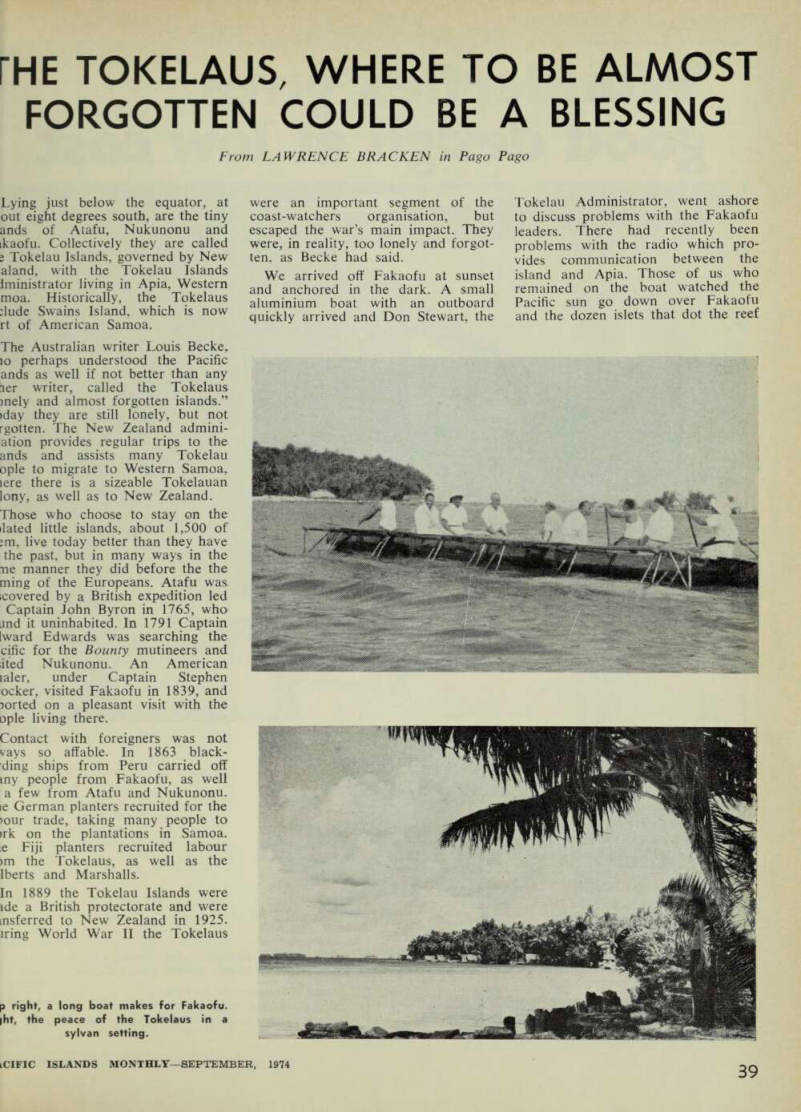

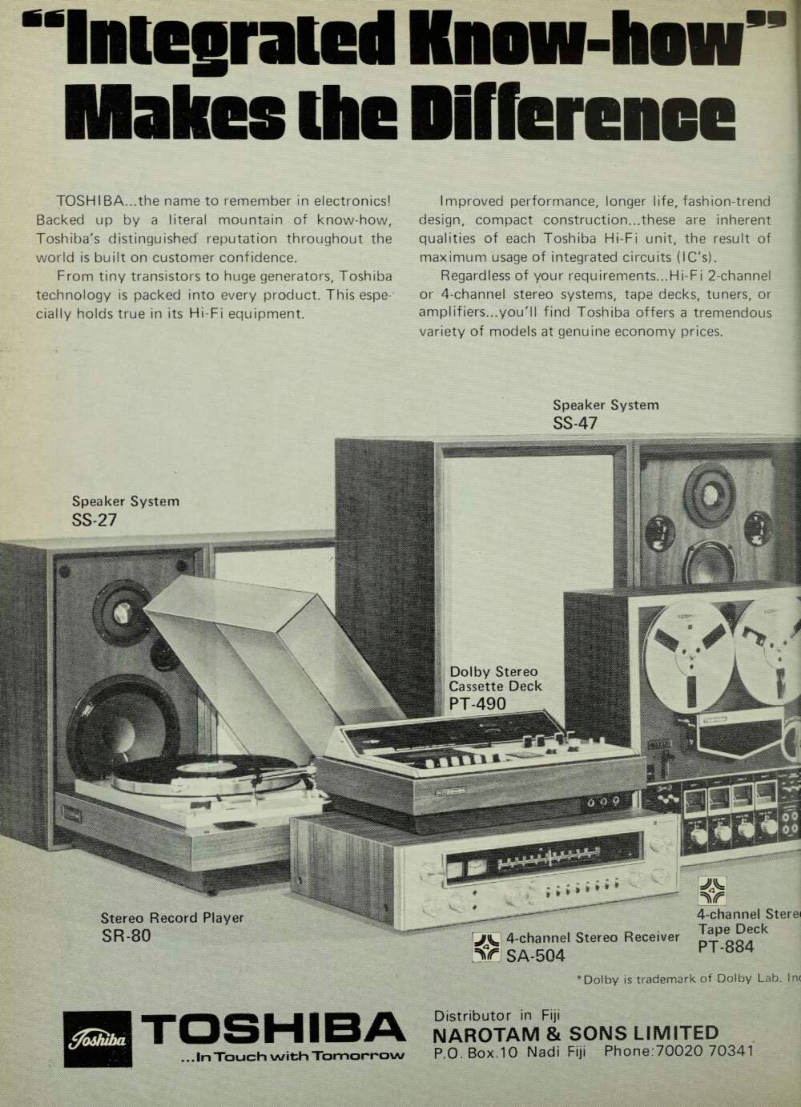
Forgotten Could Be A Blessing
From LAWRENCE BRACKEN in Pago Pago
Lying just below the equator, at out eight degrees south, are the tiny ands of Atafu, Nukunonu and ikaofu. Collectively they are called ; Tokelau Islands, governed by New aland, with the Tokelau Islands Iministrator living in Apia, Western moa. Historically, the Tokelaus dude Swains Island, which is now rt of American Samoa.
The Australian writer Louis Becke, 10 perhaps understood the Pacific ands as well if not better than any ier writer, called the Tokelaus mely and almost forgotten islands.” iday they are still lonely, but not rgotten. The New Zealand admini ation provides regular trips to the ands and assists many Tokelau ople to migrate to Western Samoa, lere there is a sizeable Tokelauan lony, as well as to New Zealand.
Those who choose to stay on the ilated little islands, about 1,500 of jm, live today better than they have the past, but in many ways in the Tie manner they did before the the ming of the Europeans. Atafu was icovered by a British expedition led Captain John Byron in 1765, who and it uninhabited. In 1791 Captain [ward Edwards was searching the cific for the Bounty mutineers and ited Nukunonu. An American laler, under Captain Stephen ocker, visited Fakaofu in 1839, and jorted on a pleasant visit with the ople living there.
Contact with foreigners was not vays so affable. In 1863 black ding ships from Peru carried off my people from Fakaofu, as well a few from Atafu and Nukunonu. ic German planters recruited for the >our trade, taking many people to irk on the plantations in Samoa, e Fiji planters recruited labour >m the Tokelaus, as well as the Iberts and Marshalls.
In 1889 the Tokelau Islands were ide a British protectorate and were msferred to New Zealand in 1925. iring World War II the Tokelaus
were an important segment of the coast-watchers organisation, but escaped the war’s main impact. They were, in reality, too lonely and forgotten, as Becke had said.
We arrived off Fakaofu at sunset and anchored in the dark. A small aluminium boat with an outboard quickly arrived and Don Stewart, the
Tokelau Administrator, went ashore to discuss problems with the Fakaofu leaders. There had recently been problems with the radio which pro vides communication between the island and Apia. Those of us who remained on the boat watched the Pacific sun go down over Fakaofu and the dozen islets that dot the reef
[?]p right, a long boat makes for Fakaofu. [?]ght, the peace of the Tokelaus in a sylvan setting.
Reluctant to move
around the island. It suddenly became obvious just how truly isolated the Pokelaus are, even in this age of nass tourism and jet planes.
Early next morning a group of Fokelauan long-boats put off from the sland and began unloading stocks of •ice, flour and other staples that had ieen brought to them. A typhoon had lestroyed most of the natural food :rops and it would take time for the sland’s food supply to catch up. The irst request was for cigarettes. The sland had run out a week before and hose who smoked were eager to con inue ihe habit.
About 600 people live on the tiny sland. They are crowded into neat hatch-sided houses, set along wide oral-covered paths that criss-cross he island. Stewart pointed out that his was by choice. A few years ago, he Tokelau administration, realising hat conditions were far too crowded, ad built a number of new houses nd a new water supply on another sland, which lies only about 500 ards from Fakaofu. However, the eople are reluctant to move to the ther island. It was only after the /ork was finished that they bothered 3 tell their benefactors that there /ere ancient ghosts on the other iland and they would be content to lay crowded.
On tour of the island, which took bout 30 minutes, we visited the andicraft co-operative, where the 'omen were busy with last-minute ricing of items for Apia. Then to the mall hospital and the new ware ouse, where the men were storing le rice and flour.
Administrator Stewart was busy in onversation with the two New Zea ind school teachers, whose house ad only recently burned down, latcrials for a new house would be n the next boat, he assured them, ut when would the next boat call?
On leaving we were all presented r ith paning gifts of shells and mats s we climbed in the long-boats and eaded out through the narrow pas ige in the reef. As the ship got nderway, the last of the Tokelauan oys were still jumping overboard to vim back to shore.
We set off northwest for Nukunonu nth i s wide lagoon, one of the lost beautiful in the Pacific. As our trip approached we could see several bkelauan sailing canoes out on the igoon, sailing as they have for enturies.
Nukunonu is dominated by a mas ive Catholic church which sits in the entre of the island, dividing it in
half. The single road (for Nukunonu has a truck!) runs through an arch way in the rear of the church.
I talked with a New Zealand teacher who had lived on Nukunonu for three years. She said that she and her husband and two children loved it and wouldn’t want to leave, despite the isolation. She showed me the school, a well-designed airy building, suited perfectly for a tropical climate.
The only problem was that they ran out of space and had built a Toke lauan-styie house next to the school, as an annex.
Her son, who was about 10 years old, and his Tokelauan friend showed me the island, both chatting in Toke lauan along the way. I was introduced to a Tokelauan nurse, who had studied in New Zealand. Together the four of us visited the new Nukunonu hospital, which was under construction at one end of the island. Again I was im pressed by the design, which lent it self well to such a situation.
Meanwhile, there was much prob lem-solving and reporting going on down on the beach, as Stewart met with the local leaders. Again we were given parting gifts in the Polynesian fashion, as we set out through the crashing surf for our ship. At the last minute people were still shoving letters into our hands, to be mailed to friends and relatives in Samoa and New Zeabnd.
After running north all night, we anchored at Atafu the next morning.
With the exception of the island of Puluwat, in Micronesia, Atafu is the most beautiful out-island Tve ever visited. Spacious and well laid-out, the houses are set along a labyrinth of paths lined with shells and flowers.
Another hospital was under con struction on Atafu. And again the school and the teacher’s house were impressive. A gang of children escorted us around the island, pointing out the sights. An old man in a wheel chair offered us fresh coconuts and talked of his days in Ania, before he returned to Atafu.
A young Tokelauan, who had come with us from Samoa, visited his family. He was leaving for the United States and had come home for one last visit. I met his brother, who was a teacher and who had lived in New Zealand. I asked him if he would like to return to New Zealand.
“No,” he said. “I am home here.
This is my island. I’ll stay here.”
As we left Atafu for the long trip back to Samoa, 1 almost envied his life in the Tokelaus. To be forgotten is bad. But to be almost forgotten in these times may be a blessing.
• Tokelauans in NZ, p 43.
How the Tokelauans fare in NZ
An NZ resettlement scheme has created a large Tokelauan centre in New Zealand and has
relieved population pressures on
the three atolls. How do the re settled islanders react to their
new and strange surroundings?
Meemia O’Brien, a student from the GEIC, who was in New Zea land recently on a health educa
tion diploma course, supplies an
answer.
The hurricane of 1966 caused nuch suffering and hardship to the Fokelauans. As a result, at their re juest, the New Zealand Government jlanned a permanent resettlement scheme for them in New Zealand.
The scheme started with 12 single nen, who were taken to Rotorua to vork for the forestry industry. In December of the same year, three named couples and their children vere resettled at Rotoehu, the men vorking for the forestry industry too. \part from the hurricane calamity, he New Zealand Government de cided it had to relieve the population 3ressure on the three atolls and pro
vide job opportunities which the re mote islands could not offer.
So far the scheme has brought about 500 Tokelauans to New Zealand. The three atolls are ex periencing a depletion of the younger generation because of the steady out flow to New Zealand. Some went of their own accord; others were brought out by relatives in New Zealand.
Many are still in the Taupo-Rotorua area; others have moved to Welling ton which has a thriving Tokelauan community.
Though New Zealand is largely free of the racial strife from which so many countries suffer, the islanders feel they are being deprived of cer tain rights and privileges. For example, Tokelauans have to live in New Zealand for 20 years to qualify for old-age benefits, 10 years for invalids, three years for widow’s benefit and a year for sickness and unemployment benefits.
Some islanders told me that when they applied for housing, they were given old worn-out houses; they were charged more than the usual price or a flat refusal was the answer. In employment they were often given menial tasks.
The migrants face very real prob lems of adjustment. The relaxed atmosphere of the islands and their simple diet accounts for a total lack of coronary complaints. But once in New Zealand with its sophisticated and complicated way of life, the Tokelauans often complain of anaemia, gout, colds, pneumonia, heart, joint and chest troubles.
During my field work in Rotorua, I visited four Tokelauan families.
They told me that the main problem they faced when they first arrived in New Zealand was adapting to their new environment.
Another was the language barrier, especially if they did not speak English fluently. Money in terms of budgeting and spending was another housewives’ headache.
One woman told me that she often felt lonely whenever her husband and children went to work and school.
Adaptation to a totally new environ ment could be quite a problem to islanders. However, once they are adapted and acclimatised, they feel at home immediately. Most of the islanders whom I have seen or met in New Zealand seemed to like their new home.
Advertisements & other items, pp. 41-45 (3 items)
39
ICIFIC ISLANDS MONTHLY—SEPTEMBER, 1974
Wunderflex gives
good design at low cost
r t. . $ S % V 4 &
E324ED
You want modern design?
Then use modern material that won’t warp, shrink or rot You want least cost?
Then build with a board that can be worked with handyman’s tools.
Inside and out, your home will have the modern, simple lines of Wunderflex building board.
LViunderlich
Wunderflex
Available from; Papua New Guinea: Steamships Trading Co. Ltd.
Norfolk Island: Irvine’s Building Supply Centre Made in Australia and marketed by CSR Building Materials Export Sales: 4 O’Connell Street, Sydney, Australia 2000
anywhere,
any time,
any gas.
and it’s
all Australian.
W i ■$ w I ‘4v y .•• II For further information & addresses of your local distributor contact:
THE COMMONWEALTH
INDUSTRIAL GASES LIMITED
Gases Export Department, 138 Bourke Road, Alexandria, N.S.W., Australia 2015.
Cables ‘CIGAS’-Telex 20241 Sydney. 017.024
‘‘Integrated Know-how”
Makes the Difference
TOSHIBA...the name to remember in electronics!
Backed up by a literal mountain of know-how, Toshiba's distinguished reputation throughout the world is built on customer confidence.
From tiny transistors to huge generators, Toshiba technology is packed into every product. This especially holds true in its Hi-Fi equipment.
Improved performance, longer life, fashion-trend design, compact construction...these are inherent qualities of each Toshiba Hi-Fi unit, the result of maximum usage of integrated circuits (IC's).
Regardless of your requirements...Hi-Fi 2-channel or 4-channel stereo systems, tape decks, tuners, or amplifiers...you'll find Toshiba offers a tremendous variety of models at genuine economy prices.
Speaker System SS-47 1BW Speaker System SS-27 . 1 J ; : m • : :
V# Tt >
a * W Dolby Stereo Cassette Deck PT-490 « i i » • * ;*** j^ Stereo Record Player SR-80 4-channel Stere< jnL 4-channel Stereo Receiver
S> SA-504 PT ' 884
* Dolby is trademark of Dolby Lab. In<
tfoSuba
VnCLJID /\ Distributor in Fiji
TUbnlUA NAROTAM & SONS LIMITED
... In Touch witH Tomorrow P.0. Box.10 Nadi Fiji Phone:70020 70341
f for
RUM
at its best...
say
OVERPROOF AND UNDERPROOF
Id 5 oz. and 13 oz. flasks and 26 oz, and 40 oz. bottles.
BLENDED AND BOTTLED BY JOHN WALKER & SONS LIMITED, s zrsj? ~z. $6 ZZ3g
41
ACIFIC ISLANDS MONTHLY—SEPTEMBER, 1974
News in a Nutshell
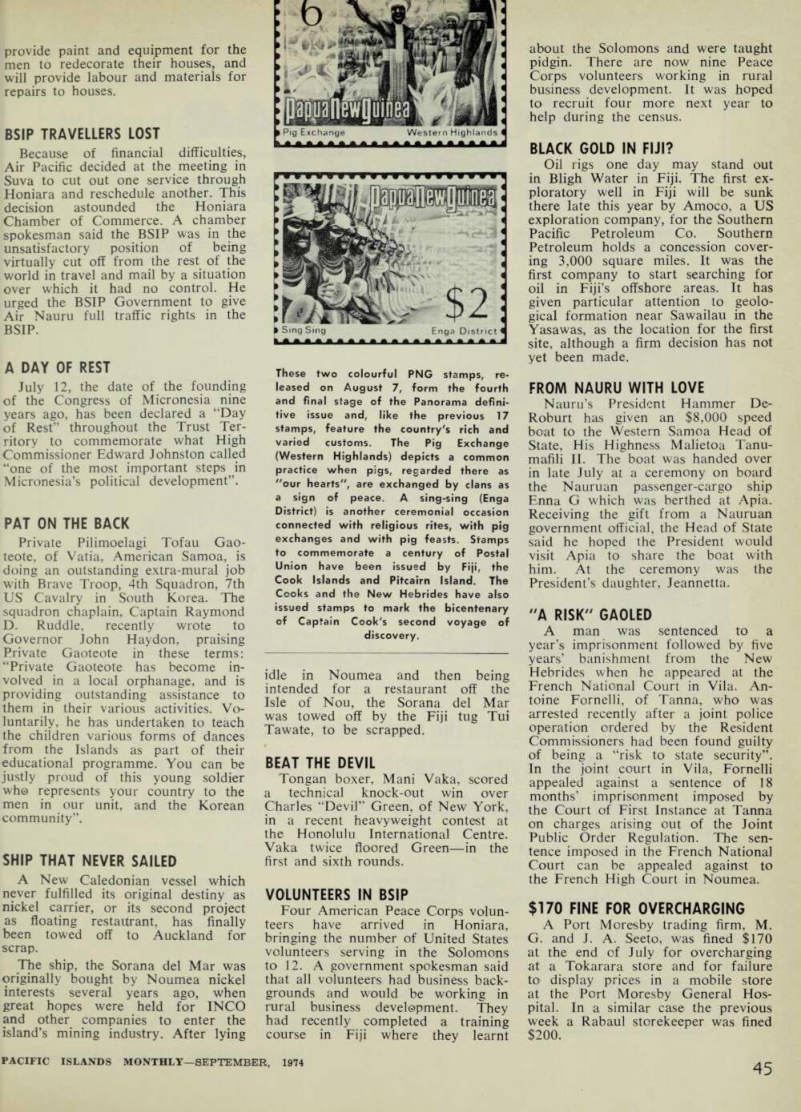
The University of the South Pacific has reached agreement with the Cook Islands Government for the establish ment of a university extension centre in the Cooks. Agreement followed a two-day conference at Rarotonga between members of the USP Executive Committee, the Cook Islands Minister of Social Services Tupui Henry and ministry personnel.
The centre is expected to operate from next February.
Cane For Crime
Fiji’s courts have sentenced six young men to a total of 34 strokes of the cane after convicting them of crimes involving violence or sexual offences. A magistrate at Nausori, near Suva, gave a 25-year-old man two years in jail and recommended six strokes of the cane when he pleaded guilty to robbing a taxi driver with violence. At Lautoka in Western Fiji, Mr Justice Kenneth Stuart, sit ting in the Supreme Court, sentenced two men to six months in jail and six strokes each, a third to six months and four strokes, and a fourth to five months and four strokes, for an offence against a 15-year-old girl. In another case at Lautoka, the acting Chief Justice, Mr Justice Tuivaga, sentenced a man who pleaded guilty to raping a five-year-old girl to five years and eight strokes.
Sunday Trading Protest
Ab®ut 2,000 Methodist Church members staged a protest march through Suva to deliver a petition to the Governor-General complaining about Sunday trading. In their petition, which they handed in at the gates of Government House, the members called for a ban on Sunday trading and for workers not to be forced to work on Sundays. Later, at an open-air meeting in a city park, church representatives opposed a government proposal to establish a state lottery and another one to allow a Japanese company to make rum from Fiji molasses. Marchers carried banners calling for an end to Sunday visits by tourist ships, for which duty-free shopkeepers are now allowed to open their shops. Organised Sunday sport will be another of the group’s targets.
Skulls For Sale
Human skulls from Papua New Guinea are on sale in a Sydney arti
fact shop with price tags of several hundreds of dollars, a cultural organi sation has claimed. The Sepik Cul tural Committee in the northern coastal town of Wewak claimed that eight skulls were being offered by a Sydney dealer in contravention of an ordinance passed 10 years ago ban ning the sale of skeletal remains. Mr Rick White, executive officer of the committee, said the sale of the skulls had been reported to the organisation by two other artifact dealers, one operating in Papua New Guinea and the other in Australia. Mr White de clined, however to reveal the name of the dealer who was later reported —again anonymously—by radio as denying the charges, although he conceded his company may have offered such skulls for sale in the past.— AAP.
Time Flies
The duty free shop at Teotue in the Cook Islands, owned by South Seas International Ltd, has an attraction for thieves. About mid-July it was broken into for the third time.
The pattern was similar—a large quantity of watches, worth thousands of dollars, was stolen. The police said the thieves obviously had a fair knowledge of the layout of the shop.
A question arises—where would a thief “flog” a large number of watches in the Cook Islands.
$3L Million Suit Fails
Shareholders of Transpacific Lines failed in a $3l million alleged breach of-contract claim against the United States Government. The US Court of Appeals declined to hear the case, saying that the Trust Territory Government was not an agency of the United States for contract pur poses, in spite of controls exercised by the US Department of the Interior, Sixteen shareholders, on March 30, 1973, filed their suit on behalf of about 800 owners of 500,000 ordinary shares. The $3l million figure was the projected market value of the claimants’ stock in 1978, the end of the 10-year Transpac franchise.
Transpac is now insolvent and under a court-administered receivership.
Prince In Fiji
The Prince of Wales, Prince Charles, will spend four days in Fiji
in October for the celebration to mark the 100th anniversary of cession to the British Crown. The main cele brations will be in Suva on October 10. The government will strike a $25 silver coin and a $lOO gold coin to mark the occasion.
Png Changes
Mr Jack Bagita has succeeded Mr Philip Bouraga as District Com missioner for East New Britain in ' Papua New Guinea. He was for merly District Commissioner for New Ireland. Mr Bouraga has been I appointed Secretary of the Depart ment of the Chief Minister.
Only five of Papua New Guinea’s 19 administrative districts are now headed by white commissioners as the country gradually severs more colonial ties with Australia. The ratio favours New Guineans for the first time since colonial administration was first imposed. Minister for Local : Government, Mr Boyamo Sali, con firmed the appointment of nine New Guinean district commissioners to bring the indigenous content of the top regional administration force ! to 14.
Mr Sali said the appointments were a significant indication of the effectiveness with which expatriate district commissioners had been able to pass on their skills and experience
to New Guinean officers.-
Aap.
Spc For Cooks
The 14th South Pacific Conference will open at Tereora College on Rarotonga in the Cook Islands on September 25 and will close on October 8. Following the meeting of the eight member governments in Wellington (NZ) in March when agreement was reached on a merger of the Conference and the Commiss ion, the 14th Conference is expected to alter procedure to merge the two bodies, give all territories represented in the Conference one vote each with the Conference becoming the ruling body.
Bsip Strikers Win
Men employed by the D. J. Gubbay Co on building sites at Point Cruz and Mendana Avenue, Honiara, received better pay and improved conditions in an award handed down after a one-day strike. A hurriedly appointed conciliator, Mr A. D.
Hughie, a senior labour inspector, gave labourers a rise of 20c a day and tradesmen of all clases 13c a day more. Other terms are that the em ployer has to provide a first-aid kit on building sites, and employees have to produce a certificate before they get sick pay. The company agreed to
provide paint and equipment for the men to redecorate their houses, and will provide labour and materials for repairs to houses.
Bsip Travellers Lost
Because of financial difficulties, Air Pacific decided at the meeting in Suva to cut out one service through Honiara and reschedule another. This decision astounded the Honiara Chamber of Commerce. A chamber spokesman said the BSIP was in the unsatisfactory position of being virtually cut off from the rest of the world in travel and mail by a situation over which it had no control. He urged the BSIP Government to give Air Nauru full traffic rights in the
Bsip.
A Day Of Rest
July 12, the date of the founding of the Congress of Micronesia nine years ago, has been declared a “Day of Rest” throughout the Trust Ter ritory to commemorate what High Commissioner Edward Johnston called “one of the most important steps in Micronesia’s political development”.
Pat On The Back
Private Pilimoelagi Tofau Gao teote, of Vatia, American Samoa, is doing an outstanding extra-mural job with Brave Troop, 4th Squadron, 7th US Cavalry in South Korea. The squadron chaplain, Captain Raymond D. Ruddle. recently wrote to Governor John Haydon, praising Private Gaoteote in these terms: “Private Gaoteote has become in volved in a local orphanage, and is providing outstanding assistance to them in their various activities. Vo luntarily, he has undertaken to teach the children various forms of dances from the Islands as part of their educational programme. You can be justly proud of this young soldier who represents your country to the men in our unit, and the Korean community”.
Ship That Never Sailed
A New Caledonian vessel which never fulfilled its original destiny as nickel carrier, or its second project as floating restaurant, has finally been towed off to Auckland for scrap.
The ship, the Sorana del Mar was originally bought by Noumea nickel interests several years ago, when great hopes were held for INCO and other companies to enter the island’s mining industry. After lying
idle in Noumea and then being intended for a restaurant off the Isle of Nou, the Sorana del Mar was towed off by the Fiji tug Tui Tawate, to be scrapped.
Beat The Devil
Tongan boxer, Mani Vaka, scored a technical knock-out win over Charles “Devil” Green, of New York, in a recent heavyweight contest at the Honolulu International Centre.
Vaka twice floored Green—in the first and sixth rounds.
Volunteers In Bsip
Four American Peace Corps volun teers have arrived in Honiara, bringing the number of United States volunteers serving in the Solomons to 12. A government spokesman said that all volunteers had business back grounds and would be working in rural business development. They had recently completed a training course in Fiji where they learnt
about the Solomons and were taught pidgin. There are now nine Peace Corps volunteers working in rural business development. It was hoped to recruit four more next year to help during the census.
Black Gold In Fiji?
Oil rigs one day may stand out in Bligh Water in Fiji. The first ex ploratory well in Fiji will be sunk there late this year by Amoco, a US exploration company, for the Southern Pacific Petroleum Co. Southern Petroleum holds a concession cover ing 3,000 square miles. It was the first company to start searching for oil in Fiji’s offshore areas. It has given particular attention to geolo gical formation near Sawailau in the Yasawas, as the location for the first site, although a firm decision has not yet been made.
From Nauru With Love
Nauru’s President Hammer De- Roburt has given an $B,OOO speed boat to the Western Samoa Head of State, His Highness Malietoa Tanu mafili 11. The boat was handed over in late July at a ceremony on board the Nauruan passenger-cargo ship Enna G which was berthed at Apia.
Receiving the gift from a Nauruan government official, the Head of State said he hoped the President would visit Apia to share the boat with him. At the ceremony was the President’s daughter, Jeannetta.
"A Risk" Gaoled
A man was sentenced to a year’s imprisonment followed by five years’ banishment from the New Hebrides when he appeared at the French National Court in Vila. An toine Fornelli, of Tanna, who was arrested recently after a joint police operation ordered by the Resident Commissioners had been found guilty of being a “risk to state security”.
In the joint court in Vila, Fornelli appealed against a sentence of 18 months’ imprisonment imposed by the Court of First Instance at Tanna on charges arising out of the Joint Public Order Regulation. The sen tence imposed in the French National Court can be appealed against to the French High Court in Noumea.
$L7O Fine For Overcharging
A Port Moresby trading firm, M.
G. and J. A. Seeto, was fined $l7O at the end of July for overcharging at a Tokarara store and for failure to display prices in a mobile store at the Port Moresby General Hos pital. In a similar case the previous week a Rabaul storekeeper was fined $2OO.
These two colourful PNG stamps, re leased on August 7, form the fourth and final stage of the Panorama defini tive issue and, like the previous 17 stamps, feature the country's rich and varied customs. The Pig Exchange (Western Highlands) depicts a common practice when pigs, regarded there as "our hearts", are exchanged by clans as a sign of peace. A sing-sing (Enga District) is another ceremonial occasion connected with religious rites, with pig exchanges and with pig feasts. Stamps to commemorate a century of Postal Union have been issued by Fiji, the Cook Islands and Pitcairn Island. The Cooks and the New Hebrides have also issued stamps to mark the bicentenary of Captain Cook's second voyage of discovery.
Advertisements & other items, pp. 48-49 (2 items)
Good? Year
Goodyear’s advanced tire technology is
contributing to many new transportation concepts.
r u The first tires on the moon were built by Goodyear.
The fastest tires on earth were made by Goodyear.
Now, Goodyear produces the world’s largest tires. < Boroko Motors Ltd.
P.O. Box 1259, Boroko Port Moresby, PAPUA NEW GUINEA Coral Island Traders P.O. Box 296, Suva, FIJI Solomon Motors Ltd.
P.O. Box 20, Mendana Avenue, Honiara Guadalcanal, SOLOMON ISLANDS Guam Tire & Supply Co.
P.O. Box 1486, Agana, GUAM Morris Hedstrom Ltd.
Apia, WESTERN SAMOA
Morris Hedstrom Ltd.
Nukualofa, TONGA Societe Generale d'Automobiles B.P. 554, Noumea
NEW CALEDONIA
Santo Engineers
Santo, NEW HEBRIDES
Service Mobil B.P. 306, Papeete, TAHITI
From the
Islands Press
Extract from a Tonga Chronicle report of an interview with King Taufa'ahau Tupou IV after his visit to Saudi Arabia: ... As far as Saudi Arabia is concerned, they want to render assistance to any country that requires it but Tonga is the first country in the Pacific to seek relationships with them and as far as they are concerned, Tonga is the largest
country in the Pacific.
From an editorial in the Samoa Times on the expulsion of the UNDP's officers from Western Samoa by Prime Minister Fiame Mataafa. Comment is "after" the funeral oration by Mark Anthony in Shakespeare's Julius Caesar: . . . Was all this aid to Western Samoa dishonourable on ihe part of UNDP? Was this aid ambition? What a cruel blow was there when the Prime Minister decided to kick out Western Samoa's benefactor, yet Mataafa is an honourable man. See what a blow William B. Hussey made. And beloved Mataafa (Brutus?). His was the unkindest blow of all. Let us stand in silence and weep. (After pause). There is nothing more for us to do. Let us go up to Capitol Hill and bury UNDP off.’ce.
From a letter in the PNG Post-Courier by E. Muhlenhard (Lae) on the destruction of culture and tradition in PNG: . . . But why do we always blame the missions for destroying the culture of the people? Does no one else have a part in this? Let us look at the music.
What kind of music is requested on the request programmes? Is it the beautiful cultural music of the people? Or is it the imported pop tunes and such vulgar ones as “Down by the Ohio” and “I did it for Mary”
From a letter signed, "Unsatisfied", in the Atoll Pioneer, GEIC, describing a tour of a biscuit factory at Lautoka: Everyone in the factory looked like government to P officials fresh and handsome.
Extract from an editorial in the Norfolk Islander: . . . Although we have received numerous assurances that the Minister and his staff are anxious to help preserve the identity of Norfolk Island and its people, there is no guarantee that the socialistic and centralistic philosophy of the present Australian Government will allow this happy state of affairs to continue. Now that income-tax facilities are available for Australian residents who are here for less than six months, it must surely take only a stroke of the pen to make us all "taxpayers".
Whether this would be an economic exercise for the government is, in their opinion, beside the point.
So far as they are concerned, all will be well just so long as the "round individual Norfolk Island peg" is whittled away until it fits neatly into the squareness of bureaucratic uniformity . . .
From the Nauru Bulletin: The Director of Lands and Survey notifies the general public that survey work will be carried out on the island’s major roads over the next few months. Survey measurements will be made with tapes which are difficult for drivers to see and the co-operation of all drivers is requested in observing the road signs and in following the directions given by the survey team. The Director particularly requests that drivers do not play “chicken” with the survey teams as this is a major cause of accidents in similar situations overseas.
From a report in the Highland News (PNG) of a speech by Dr John Guise, Minister of Agriculture: “Let me make it very clear once and for all that I am not going to sit back and watch this country’s rare species, especially protected butterflies, being smuggled out by some unscrupulous black marketeer to make a fortune overseas. I am going to put a stop to this, and I am going to do it ruthlessly.”
A New Hebrides News report: The New Hebrides General Labour Union told the Prime Minister (of Fiji, Ratu Sir Kamisese Mara, on a brief stopover in Vila) that they preferred Fijian workers in the New Hebrides who would be able to train New Hebrideans in their work. The union does not want Fijians occupying positions which could easily be filled by New Hebrideans.
From Tohi Tala Niue: Niue's labour shortage was highlighted recently when two 10-year-olds signed on as labourers unloading beer cartons off the Moana Roa. One of the youngsters received a well-aimed boot on his posterior and was told to get off to school. The other must have looked older than all of his 10 years —he stayed on, and according to our informant, worked a lot harder than his elders.
A barber's lament as reported in The Fiji Times: Lautoka barbers want the government to ban long hair because they are worried about a decline in business. Mr Rahmat Ali, of New Globe Hairdressers, said his business had dropped about 50 per cent in the past three years and he might have to close down soon. . . . Another Lautoka hairdresser, Mr Uttam Manchu, told The Fiji Times the government should pass laws to force people to get their hair cut. . . .
Editorial comment in the PNG Post-Courier on new regulations to protect the Bird of Paradise: . . The dodo has disappeared from Mauritius.
The kiwi can be found in New Zealand only in sanctuaries and zoos. Let’s make sure this doesn’t happen to the Bird of Paradise—one of the most beautiful creatures on earth.
Yesterday
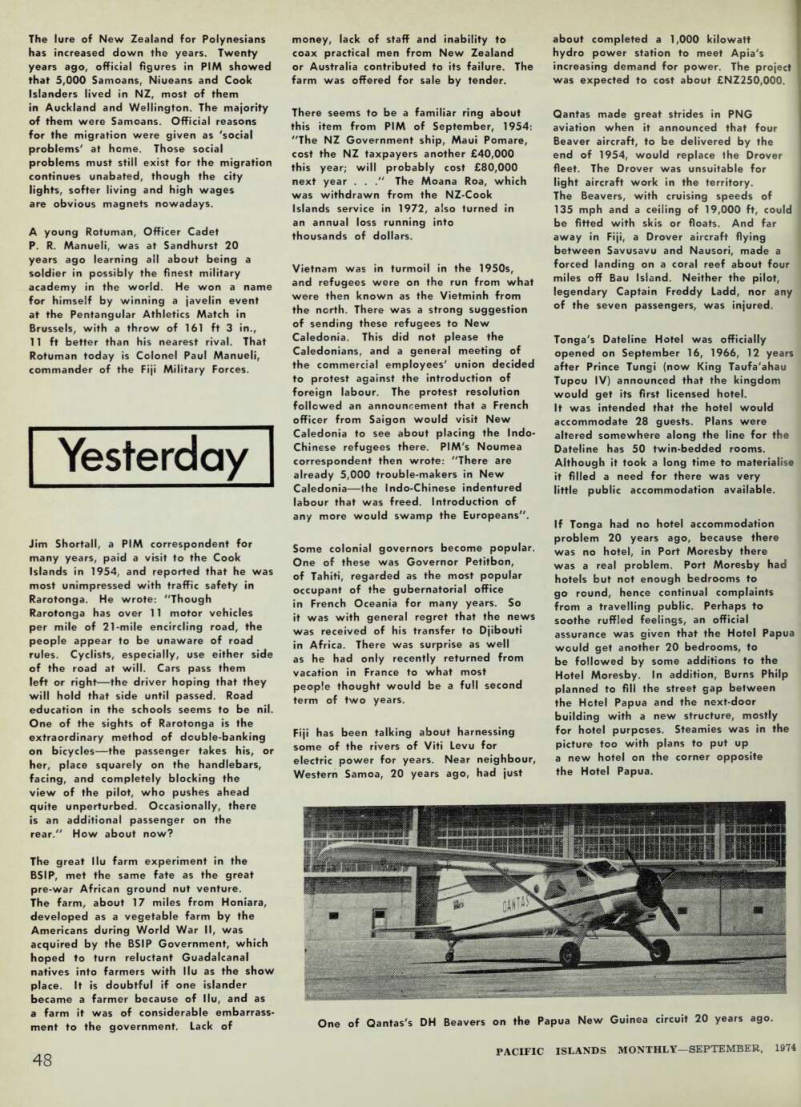
The lure of New Zealand for Polynesians has increased down the years. Twenty years ago, official figures in PIM showed that 5,000 Samoans, Niueans and Cook Islanders lived in NZ, most of them in Auckland and Wellington. The majority of them were Samoans. Official reasons for the migration were given as 'social problems' at home. Those social problems must still exist for the migration continues unabated, though the city lights, softer living and high wages are obvious magnets nowadays.
A young Rotuman, Officer Cadet P. R. Manueli, was at Sandhurst 20 years ago learning all about being a soldier in possibly the finest military academy in the world. He won a name for himself by winning a javelin event at the Pentangular Athletics Match in Brussels, with a throw of 161 ft 3 in., 11 ft better than his nearest rival. That Rotuman today is Colonel Paul Manueli, commander of the Fiji Military Forces.
Jim Shortall, a PIM correspondent for many years, paid a visit to the Cook Islands in 1954, and reported that he was most unimpressed with traffic safety in Rarotonga. He wrote: "Though Rarotonga has over 11 motor vehicles per mile of 21-mile encircling road, the people appear to be unaware of road rules. Cyclists, especially, use either side of the road at will. Cars pass them left or right—the driver hoping that they will hold that side until passed. Road education in the schools seems to be nil.
One of the sights of Rarotonga is the extraordinary method of double-banking on bicycles—the passenger takes his, or her, place squarely on the handlebars, facing, and completely blocking the view of the pilot, who pushes ahead quite unperturbed. Occasionally, there is an additional passenger on the rear." How about now?
The great llu farm experiment in the BSIP, met fhe same fate as the great pre-war African ground nut venture.
The farm, about 17 miles from Honiara, developed as a vegetable farm by the Americans during World War 11, was acquired by the BSIP Government, which hoped to turn reluctant Guadalcanal natives into farmers with llu as the show place. It is doubtful if one islander became a farmer because of llu, and as a farm it was of considerable embarrass ment to the government. Lack of
money, lack of staff and inability to coax practical men from New Zealand or Australia contributed to its failure. The farm was offered for sale by tender.
There seems to be a familiar ring about this item from PIM of September, 1954: "The NZ Government ship, Maui Pomare, cost the NZ taxpayers another £40,000 this year; will probably cost £BO,OOO next year . . ." The Moana Roa, which was withdrawn from the NZ-Cook Islands service in 1972, also turned in an annual loss running into thousands of dollars.
Vietnam was in turmoil in the 19505, and refugees were on the run from what were then known as the Vietminh from the north. There was a strong suggestion of sending these refugees to New Caledonia. This did not please the Caledonians, and a general meeting of the commercial employees' union decided to protest against the introduction of foreign labour. The protest resolution followed an announcement that a French officer from Saigon would visit New Caledonia to see about placing the Indo- Chinese refugees there. PlM's Noumea correspondent then wrote: "There are already 5,000 trouble-makers in New Caledonia—the Indo-Chinese indentured labour that was freed. Introduction of any more would swamp the Europeans".
Some colonial governors become popular.
One of these was Governor Petitbon, of Tahiti, regarded as the most popular occupant of the gubernatorial office in French Oceania for many years. So it was with general regret that the news was received of his transfer to Djibouti in Africa. There was surprise as well as he had only recently returned from vacation in France to what most people thought would be a full second term of two years.
Fiji has been talking about harnessing some of the rivers of Viti Levu for electric power for years. Near neighbour, Western Samoa, 20 years ago, had just
about completed a 1,000 kilowatt hydro power station to meet Apia's increasing demand for power. The project was expected to cost about £NZ250,000.
Qantas made great strides in PNG aviation when it announced that four Beaver aircraft, to be delivered by the end of 1954, would replace the Drover fleet. The Drover was unsuitable for light aircraft work in the territory.
The Beavers, with cruising speeds of 135 mph and a ceiling of 19,000 ft, could be fitted with skis or floats. And far away in Fiji, a Drover aircraft flying between Savusavu and Nausori, made a forced landing on a coral reef about four miles off Bau Island. Neither the pilot, legendary Captain Freddy Ladd, nor any of the seven passengers, was injured.
Tonga's Dateline Hotel was officially opened on September 16, 1966, 12 years after Prince Tungi (now King Taufa'ahau Tupou IV) announced that the kingdom would get its first licensed hotel.
It was intended that the hotel would accommodate 28 guests. Plans were altered somewhere along the line for the Dateline has 50 twin-bedded rooms.
Although it took a long time to materialise it filled a need for there was very little public accommodation available.
If Tonga had no hotel accommodation problem 20 years ago, because there was no hotel, in Port Moresby there was a real problem. Port Moresby had hotels but not enough bedrooms to go round, hence continual complaints from a travelling public. Perhaps to soothe ruffled feelings, an official assurance was given that the Hotel Papua would get another 20 bedrooms, to be followed by some additions to the Hotel Moresby. In addition, Burns Philp planned to fill the street gap between the Hotel Papua and the next-door building with a new structure, mostly for hotel purposes. Steamies was in the picture too with plans to put up a new hotel on the corner opposite the Hotel Papua.
One of Qantas's DH Beavers on the Papua New Guinea circuit 20 years ago.
Advertisements & other items, pp. 51-58 (2 items)
for extra freshness
Come up to Kool
w W L
£QDI
' • ’ 'V^ST
7,' »# m y '{Set s • t H U597-8/71
Look to Pioneer’s new ES-2000 Two-channel Sound Mates. A stereo system designed to play together as a well-balanced audio team.
Pioneer’s receiver gets away from "top-heavy
sound by giving you a highly selective AM/FM tuning section and 34 watts (IHF) of music power, And for four-channel, just add a pair of speakers. All this and MIC mixing, too And this turntable is more than
just hot looking. The ultra-smooth belt-drive
mechanism provides loving care for your records, plus auto-cut and return.
For real living presence sound, kiss your
tweakers’ goodbye. This two-way, two-speaker
system gives you earthy, heart-moving sound.
Pioneer’s new ES-2000 Two-channel
Sound Mates. Great musical partners for
whatever you play to music.
Mpiongei
ES-2000
Two-channel Sound Mates
Australia Pioneer Electronics Australia Pty Ltd 256-8, City Road, South Melbourne, Victoria 3205, Australia Tel 696605 Branches in all states Fiji Islands Brijlal & Company, G.P O Box No. 362, Suva, Fiji Islands Tel 22-258 Lae Hagemeyer (Australasia) B.V, P.O Box No 90, Lae, New Guinea Tel: 2718 Rabaul Hagemeyer (Australasia) 8.V., P.O Box No. 63, Rabaul, New Guinea Port Morseby Hagemeyer (Australasia) B.V , P.O Box No 1428, Boroko Port Moresby, New Guinea Madang Hagemeyer (Australasia) B.V , P.O Box No 673, Madang, T.P.N.G New Zealand Tee Vee Radio Ltd , P.O Box No. 5029, Auckland, New Zealand Tel 763-064 Norfolk Island Burns Philp (South Sea) Co., Ltd..
Norfolk Island, South Pacific Nauru Island Jacob Enterprises, P.O. Box No. 4, Nauru Island Tahiti Ets PERFECT, B P. 594. Papeete, Tahiti Tel: 20-407 New Caledonia Menard Freres, B P 123, Noumea, New Caledonia Tel: 52-22 American Samoa Transpac Corporation, P.O. Box 1477.
Pago Pago, American Samoa 96799 Tel: 2227
* *5 ¥ J* « ■ M
ITSFIfi.
So Superior It’s Sensational!
Discover the easy, delicious way famous chefs use to enhance the flavor of meat, poultry, fish . . . casseroles, stews and gravies.
There's no substitute for "vintage flavor"
Kikkoman the preferred soy sauce.
Ml KIKKOMAN SHOYU CO., LTD.
Nihonbashi, Tokyo 103, Japan
iMx .1
iii
SHS
■ > MB* si 2s-
dvl
A-* * V^ v< W :'U y#' S
ssn
V J •AS * ** "■; ISs?
I— : #s m %# * ■ Land Cruiser H ,v • \,..- -ll - V -A **
i , »W ■ a**S*3S%!
“ jjßfci • * m-3 • * .“ -■
OTA
Dyna *
Get through
with a Toyota.
When the going gets roughest, depend on Toyota to get you through every time.
Road conditions, water, extremes of heat and cold —nothing, but nothing stops Toyota from coming through for you with the biggest loads faster and more economically.
World-famous for the engineering excellence of its automobiles, Toyota also makes a complete line of rugged, versatile commercial vehicles designed to keep costs down, profits rising. The Toyota Land Cruiser defies TOYOTA Stout
TOYOTA Hi-Lux
i
SUIT
TOYOTA 1000
TOYOTA
all obstacles to get the job done.
The Dyna and Stout trucks come through better in the light and medium pickup categories, while the Hi-Ace makes an excellent all-purpose vehicle.
For the big jobs, Toyota offers the heavy-duty truck to keep profits rising load after load.
And for the big family, Toyota offers two roomy station wagons the trusty Toyota 1000 and the luxurious Corolla. Make it a point to see your nearest Toyota dealer soon. When you do, ask him to prove how Toyota can keep coming through for you again and again.
TOYOTA Truck rr
TOYOTA Hi-Ace
nsrn
TOYOTA Corolla PAPUA, NEW GUINEA: ELA MOTORS LIMITED, SCRATCHLEY RD., BADILI, PAPUA U.S. TRUST TERRITORY: MICROL CORPORATION, P.O. BOX 267, SAIPAN.
FIJI ISLANDS: AUTOMOTIVE SUPPLIES CO., LTD , G.P.O. BOX 355, SUVA. AMERICAN SAMOA: BURNS PHILP (SOUTH SEA) CO., LTD., PAGO PAGO. WESTERN SAMOA: BURNS PHILP (SOUTH SEA) LTD , P.O. BOX 188, APIA. GUAM: RICKY'S AUTO CO., P.O. BOX 1458, AGANA NEW HEBRIDES: NEW HEBRIDES MOTORS LID., P.O. BOX 18. VILA. SOLOMON ISLANDS: MENDANA ENTERPRISES (S I ). LTD., P.O. BOX 174, HONIARA NEW CALEDONIA: SOCIETE D IMPORTATION AUTOMOBILE DU PACIFIC, B.P. 438, NOUMEA. TAHITI: NIPPON AUTOMOTO, B P. 545, PAPEETE. COOK ISLANDS' COOK ISLANDS TRADING CORPORATION LTD., P.O. BOX 92. RAROTONGA NAURU ISLAND: NAURU COOPERATIVE SOCIETY. GILBERT & ELLICE ISLANDS COLONY: TARAWA MOTORS, BOX 36, BAIRIKI TARAWA. NORFOLK ISLAND: MARIE'S NORFOLK TOURS, LTD , P.O, BOX 276, TIMOR: SANG TAI HOO. SANG TAI BUILDING, DILI
Bacardi
ice and
what else?
... nothing else if you feel so inclined, for there’s no real problem where and how and what you drink Bacardi rum with.
Because Bacardi rum is so light, dry, highly refined and pure it complements every mixer, yet remains distinctively itself. Bacardi and Coke and ice ... Bacardi and ginger... Bacardi and tonic with a zest of lemon or lime ... Bacardi and fruit juice ... Mix up your own Bacardi party.
Because ...
Anything
goes with
Bacardi rum
BACARDI
rum-the mixableone. ■ 'A d i «a UK aw . m Bacardi and the Bat Device are registered trade marks of Bacardi and Company Limited.
“Coca-Cola” and "Coke” are the registered trade marks of The Coca-Cola Company.
BAC/2382/72
There’s no end
to the distance we go
When a company like Suzuki decides to go the distance, it makes a commitment.
A commitment to its customers.
Customers in more than 110 countries.
Customers who count on Suzuki products.
A commitment to its products. Products which aim to be the safest, toughest, most reliable machines in their class.
And a commitment to the future. To research now, for better and longer-lasting products tomorrow.
Suzuki. We go the distance. In today’s world, that’s important. $
SUZUKI]
We go the distance.
SUZUKI MOTOR CO LTD
Hamamatsu, Japan am ISLAND CVCLERV PONAPE LEO ETSCHEIT TARAWA G. & E.l, COOPERATIVE FEDERATION LTD. NAURU CAPELLE & PARTNER FIJI D. GOKAL :OMPANY LIMITED TONGA MORRIS HEDSTROM LTD. NIUE BURNS PHILP (SOUTH SEA) COMPANY LTD. NEW GUINEA & PAPUA TUTT BRYANT cif;c ltd. new Hebrides henri leroux new Caledonia supercal tahiti Nippon automoto Norfolk martin's agencies ltd.
..serve simply with SAO
Arnott’s Sao biscuits are the handiest cracker biscuits you can buy. No sooner is one pack finished than you’re opening another. They’re always fresh and ready when you want them, pack after pack. Just take anything you fancy and...
WOrnottefMous Biscuits
i9' There is no Substitute for Quality
55
2IFIC ISLANDS MONTHLY—SEPTEMBER, 1974
Magazine Section
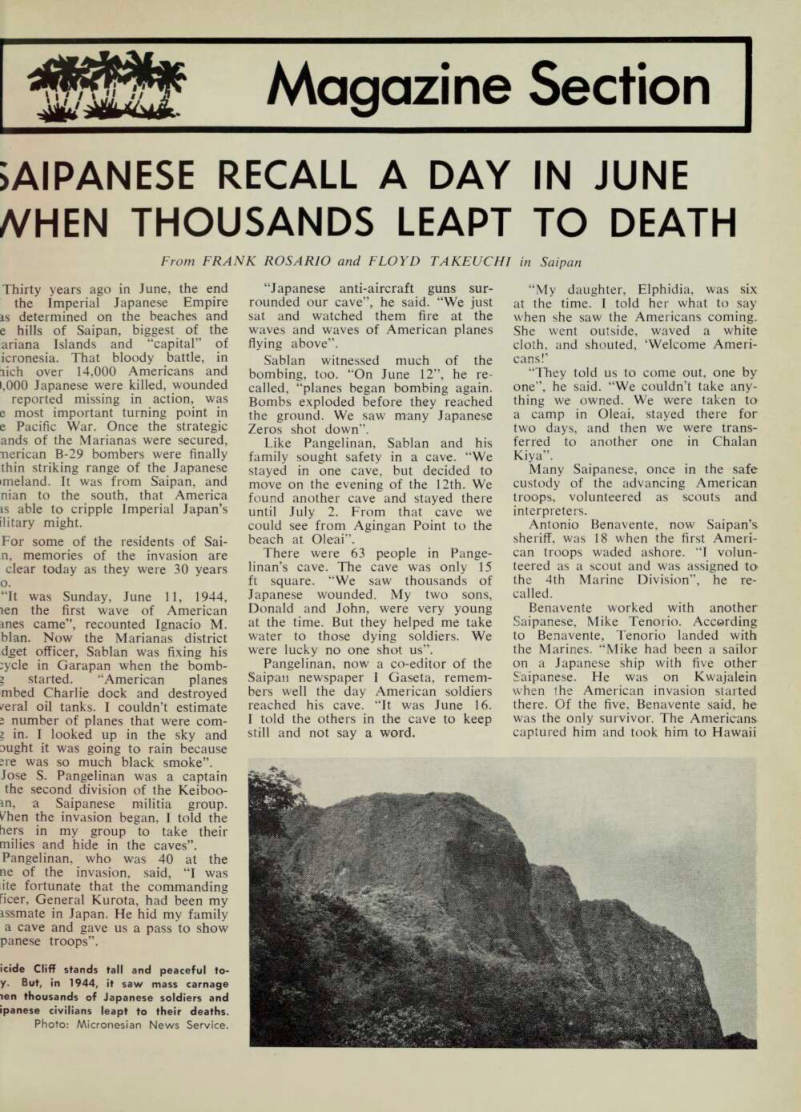
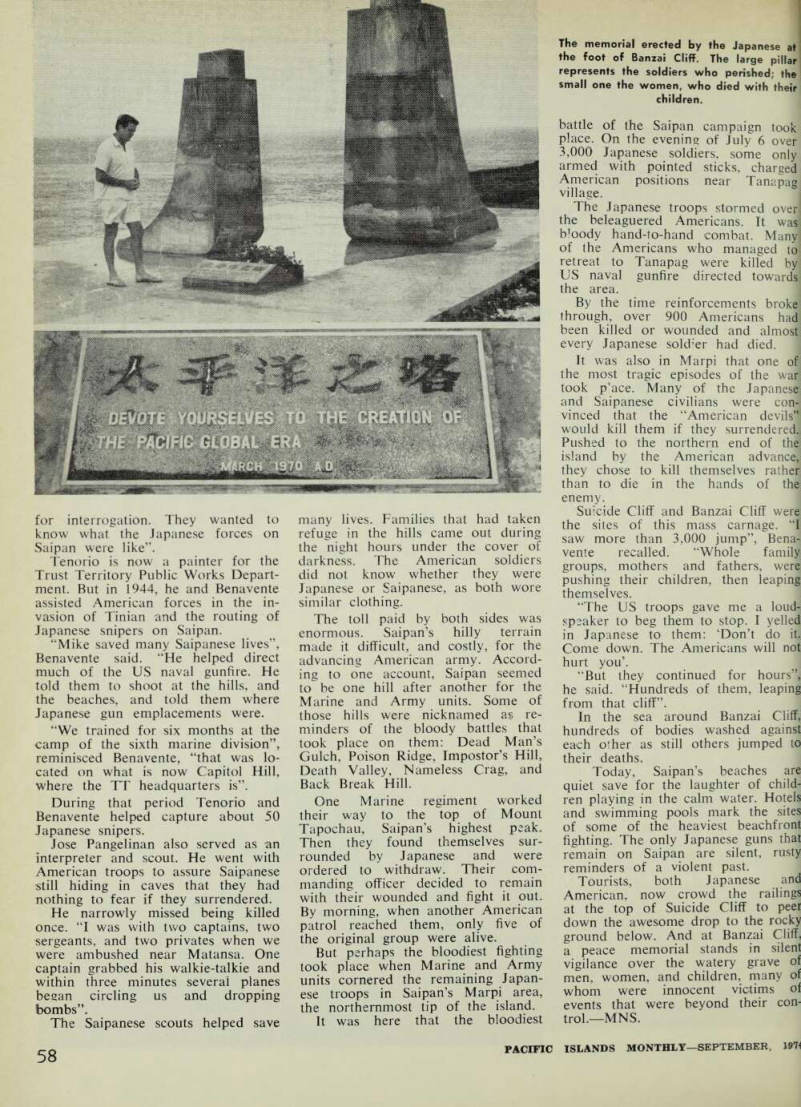
Saipanese Recall A Day In June
When Thousands Leapt To Death
From FRANK ROSARIO and FLOYD TAKEUCHI in Saipan
Thirty years ago in June, the end the Imperial Japanese Empire as determined on the beaches and e hills of Saipan, biggest of the ariana Islands and “capital” of icronesia. That bloody battle, in lich over 14,000 Americans and l, Japanese were killed, wounded reported missing in action, was e most important turning point in e Pacific War. Once the strategic ands of the Marianas were secured, nerican B-29 bombers were finally thin striking range of the Japanese •meland. It was from Saipan, and nian to the south, that America is able to cripple Imperial Japan’s ilitary might.
For some of the residents of Sai n, memories of the invasion are clear today as they were 30 years o.
“It was Sunday, June 11, 1944, len the first wave of American anes came”, recounted Ignacio M. blan. Now the Marianas district dget officer, Sablan was fixing his :ycle in Garapan when the bomb l started. “American planes mbed Charlie dock and destroyed /eral oil tanks. I couldn’t estimate ; number of planes that were com l in. I looked up in the sky and Dught it was going to rain because sre was so much black smoke”.
Jose S. Pangelinan was a captain the second division of the Keiboo m, a Saipanese militia group.
Wien the invasion began, I told the tiers in my group to take their milies and hide in the caves”.
Pangelinan, who was 40 at the ne of the invasion, said, “I was ite fortunate that the commanding ficer, General Kurota, had been my issmate in Japan. He hid my family a cave and gave us a pass to show panese troops”.
“Japanese anti-aircraft guns sur rounded our cave”, he said. “We just sat and watched them fire at the waves and waves of American planes
flying above”.
Sablan witnessed much of the bombing, too. “On June 12”, he re
called, “planes began bombing again.
Bombs exploded before they reached the ground. We saw many Japanese Zeros shot down”.
Like Pangelinan, Sablan and his family sought safety in a cave. “We stayed in one cave, but decided to move on the evening of the 12th. We found another cave and stayed there until July 2. From that cave we could see from Agingan Point to the beach at Oleai”.
There were 63 people in Pange linan’s cave. The cave was only 15 ft square. “We saw thousands of Japanese wounded. My two sons, Donald and John, were very young at the time. But they helped me take water to those dying soldiers. We were lucky no one shot us”.
Pangelinan, now a co-editor of the Saipan newspaper I Gaseta, remem bers well the day American soldiers reached his cave. “It was June 16.
I told the others in the cave to keep still and not say a word.
“My daughter, Elphidia, was six at the time. I told her what to say when she saw the Americans coming.
She went outside, waved a white cloth, and shouted, ‘Welcome Ameri cans!’
“They told us to come out, one by one”, he said. “We couldn’t take any thing we owned. We were taken to a camp in Oleai, stayed there for two days, and then we were trans ferred to another one in Chalan Kiya”.
Many Saipanese, once in the safe custody of the advancing American troops, volunteered as scouts and interpreters.
Antonio Benavente, now Saipan’s sheriff, was 18 when the first Ameri can troops waded ashore. “I volun teered as a scout and was assigned to the 4th Marine Division”, he re called.
Benavente worked with another Saipanese, Mike Tenorio. According to Benavente, Tenorio landed with the Marines. “Mike had been a sailor on a Japanese ship with five other Saipanese. He was on Kwajalein when the American invasion started there. Of the five, Benavente said, he was the only survivor. The Americans captured him and took him to Hawaii
[?]icide Cliff stands tall and peaceful to [?]y. But, in 1944, it saw mass carnage [?]en thousands of Japanese soldiers and [?]ipanese civilians leapt to their deaths.
Photo: Micronesian News Service.
for interrogation. They wanted to know what the Japanese forces on Saipan were like”.
Tenorio is now a painter for the Trust Territory Public Works Department. But in 1944, he and Benavente assisted American forces in the invasion of Tinian and the routing of Japanese snipers on Saipan.
“Mike saved many Saipanese lives”, Benavente said. “He helped direct much of the US naval gunfire. He told them to shoot at the hills, and the beaches, and told them where Japanese gun emplacements were.
“We trained for six months at the camp of the sixth marine division”, reminisced Benavente, “that was located on what is now Capitol Hill, where the TT headquarters is”.
During that period Tenorio and Benavente helped capture about 50 Japanese snipers.
Jose Pangelinan also served as an interpreter and scout. He went with American troops to assure Saipanese still hiding in caves that they had nothing to fear if they surrendered.
He narrowly missed being killed once. “I was with two captains, two sergeants, and two privates when we were ambushed near Matansa. One captain grabbed his walkie-talkie and within three minutes several planes began circling us and dropping bombs”.
The Saipanese scouts helped save
many lives. Families that had taken refuge in the hills came out during the night hours under the cover of darkness. The American soldiers did not know whether they were Japanese or Saipanese, as both wore similar clothing.
The toll paid by both sides was enormous. Saipan’s hilly terrain ma de it difficult, and costly, for the advancing American army. Accordj ng to one account, Saipan seemed to be one hill after another for the Marine and Army units. Some of those hills were nicknamed as re minders of the bloody battles that took place on them: Dead Man’s Gulch, Poison Ridge, Impostor’s Hill, Death Valley, Nameless Crag, and Back Break Hill.
One Marine regiment worked their way to the top of Mount
Tapochau, Saipan’s highest peak.
Then they found themselves sur rounded by Japanese and were ordered to withdraw. Their corn manding officer decided to remain with their wounded and fight it out.
By morning, when another American patrol reached them, only five of the original group were alive, But perhaps the bloodiest fighting took place when Marine and Army units cornered the remaining Japan ese troops in Saipan’s Marpi area, the northernmost tip of the island.
It was here that the bloodiest
battle of the Saipan campaign took place. On the evening of July 6 over 3,000 Japanese soldiers, some only armed with pointed sticks, charged American positions near Tanapag village.
The Japanese troops stormed overl the beleaguered Americans. It was; bloody hand-to-hand combat. Many l of the Americans who managed to retreat to Tanapag were killed by US naval gunfire directed towards the area.
By the time reinforcements broke through, over 900 Americans had been killed or wounded and almost] every Japanese sold’er had died.
It was also in Marpi that one of the most tragic episodes of the war took p’ace. Many of the Japanese] and Saipanese civilians were con-i vinced that the “American devils” would kill them if they surrendered.
Pushed to the northern end of the? island by the American advance] they chose to kill themselves rather than to die in the hands of the enemy.
Suicide Cliff and Banzai Cliff were the sites of this mass carnage. “I saw more than 3,000 jump”, Bena-I vente recalled. “Whole family groups, mothers and fathers, were pushing their children, then leaping themselves.
“The US troops gave me a loud speaker to beg them to stop. I yelled in Japanese to them: ‘Don’t do it.
Come down. The Americans will not hurt you’.
“But they continued for he said. “Hundreds of them, leaping from that cliff”.
In the sea around Banzai Cliff, hundreds of bodies washed against each other as still others jumped to their deaths.
Today, Saipan’s beaches are quiet save for the laughter of child ren playing in the calm water. Hotels and swimming pools mark the sites of some of the heaviest beachfront fighting. The only Japanese guns that remain on Saipan are silent, rusty reminders of a violent past.
Tourists, both Japanese and American, now crowd the railings at the top of Suicide Cliff to peer down the awesome drop to the rocky ground below. And at Banzai Cliff, a peace memorial stands in silent vigilance over the watery grave of men, women, and children, many of whom were innocent victims of events that were beyond their con
trol.-
Mns.
The memorial erected by the Japanese at the foot of Banzai Cliff, The large pillar represents the soldiers who perished; the small one the women, who died with their children.
who ruled
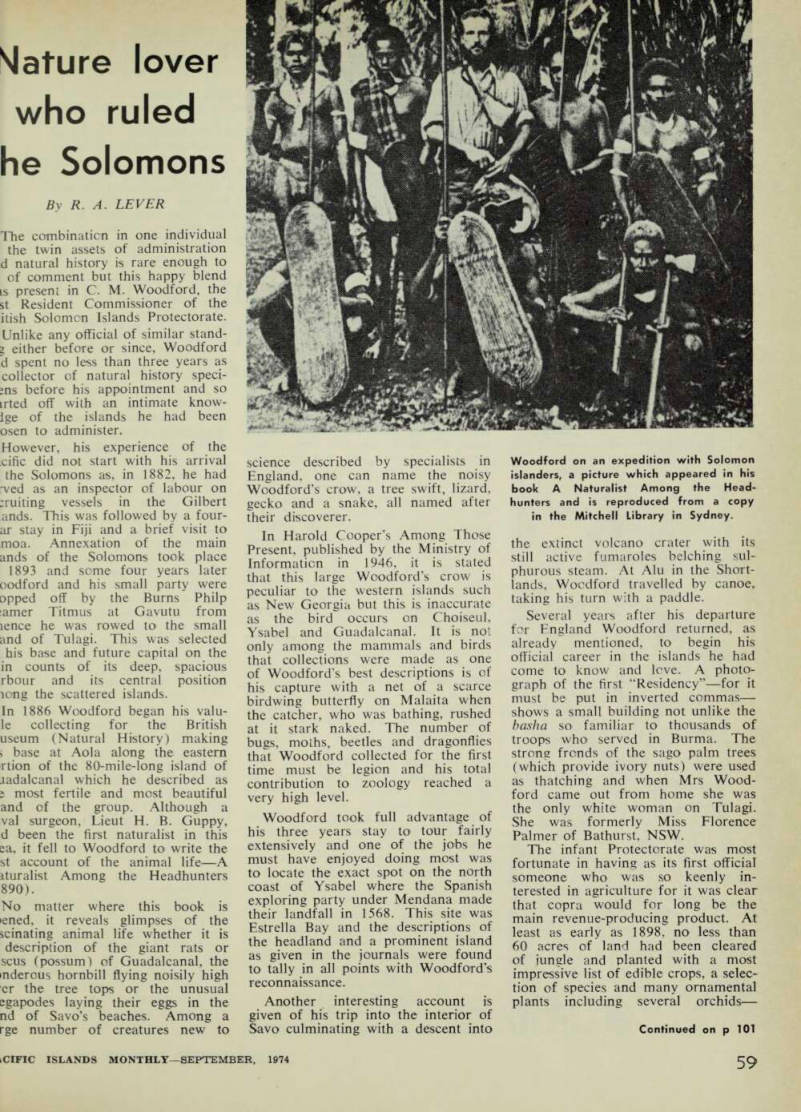
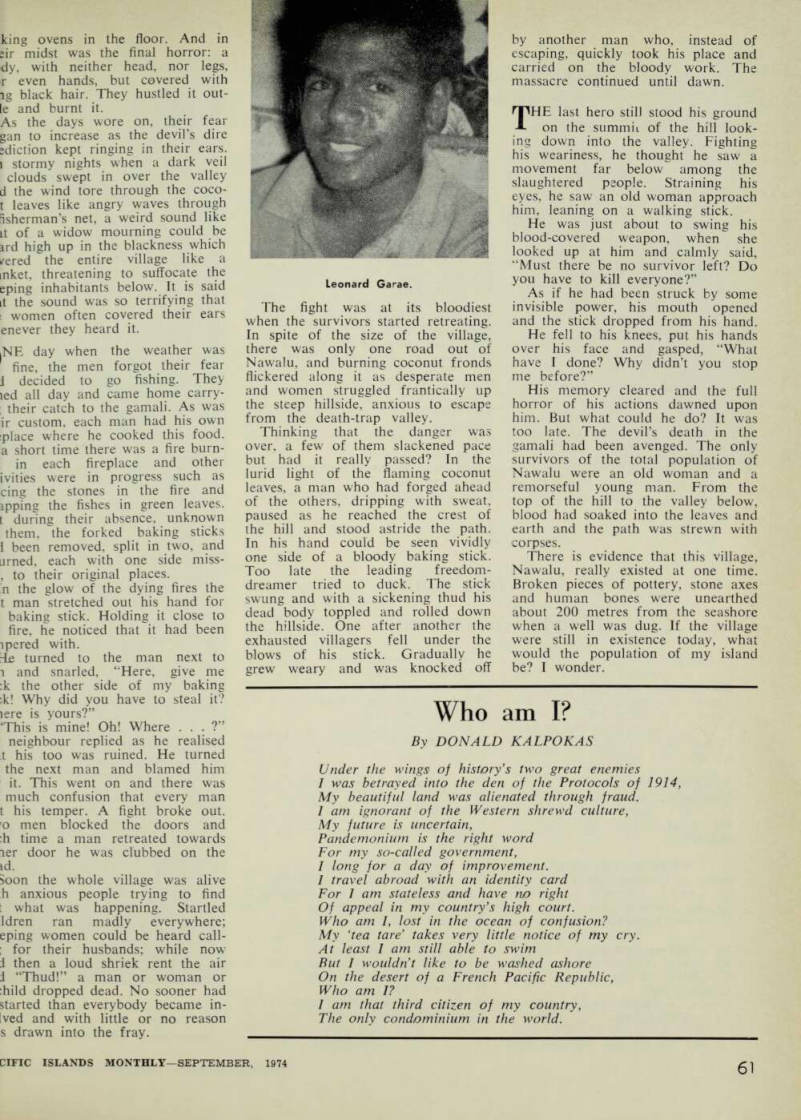
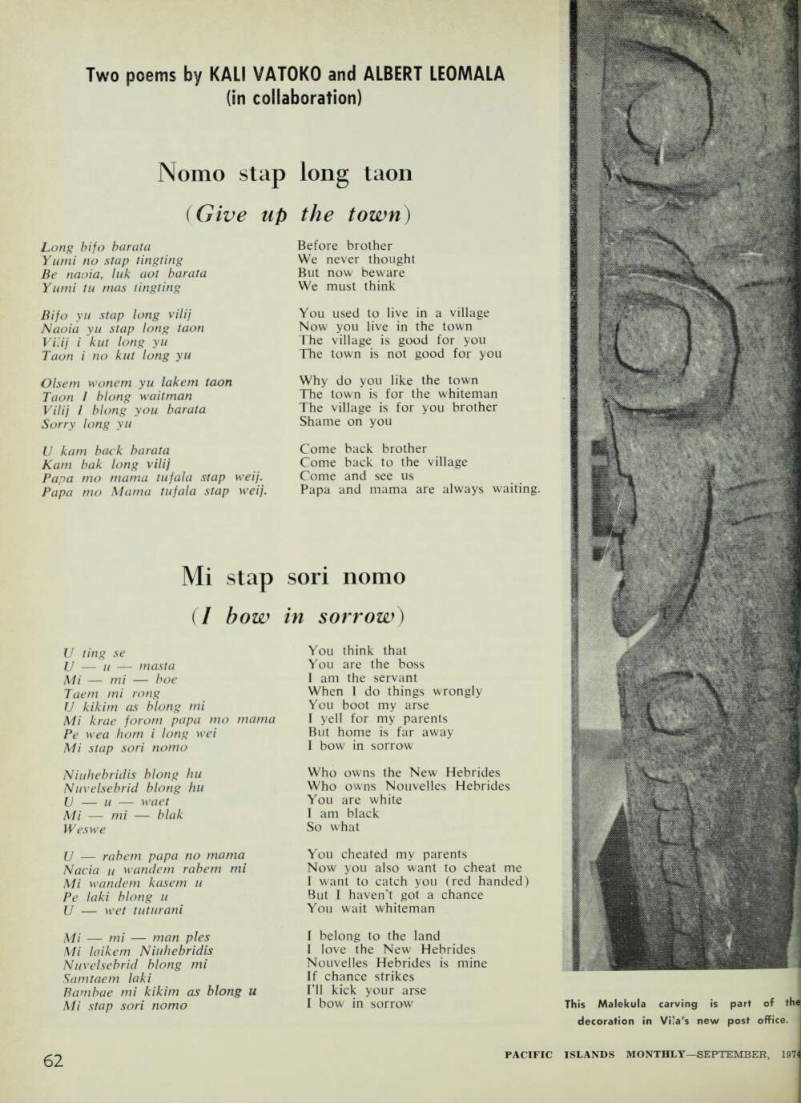
Nature lover who ruled The Solomons
By R. A. Lever
The combination in one individual the twin assets of administration d natural history is rare enough to of comment but this happy blend is present in C. M. Woodford, the st Resident Commissioner of the itish Solomon Islands Protectorate.
Unlike any official of similar stand l either before or since, Woodford d spent no less than three years as collector of natural history speci ms before his appointment and so irted off with an intimate know- Ige of the islands he had been osen to administer.
However, his experience of the cific did not start with his arrival the Solomons as, in 1882, he had -ved as an inspector of labour on :ruiting vessels in the Gilbert ands. This was followed by a four ar stay in Fiji and a brief visit to moa. Annexation of the main ands of the Solomons took place 1893 and some four years later oodford and his small party were
opped off by the Burns Philp
lamer Titmus at Gavutu from lence he was rowed to the small and of Tulagi. This was selected his base and future capital on the in counts of its deep, spacious rbour and its central position long the scattered islands.
In 1886 Woodford began his valu le collecting for the British useum (Natural History) making i base at Aola along the eastern rtion of the 80-mile-long island of aadalcanal which he described as t most fertile and most beautiful and of the group. Although a val surgeon, Lieut H. B. Guppy, d been the first naturalist in this ea, it fell to Woodford to write the st account of the animal life—A ituralist Among the Headhunters 890).
No matter where this book is >ened, it reveals glimpses of the scinating animal life whether it is description of the giant rats or scus (possum) of Guadalcanal, the
•nderous hornbill flying noisily high
cr the tree tops or the unusual egapodes laying their eggs in the nd of Savo’s beaches. Among a rge number of creatures new to
science described by specialists in England, one can name the noisy Woodford’s crow, a tree swift, lizard, gecko and a snake, all named after their discoverer.
In Harold Cooper’s Among Those Present, published by the Ministry of Information in 1946, it is stated that this large Woodford’s crow is peculiar to the western islands such as New Georgia but this is inaccurate as the bird occurs on Choiseul, Ysabel and Guadalcanal. It is not only among the mammals and birds that collections were made as one of Woodford’s best descriptions is of his capture with a net of a scarce birdwing butterfly on Malaita when the catcher, who was bathing, rushed at it stark naked. The number of bugs, moths, beetles and dragonflies that Woodford collected for the first time must be legion and his total contribution to zoology reached a very high level.
Woodford took full advantage of his three years stay to tour fairly extensively and one of the jobs he must have enjoyed doing most was to locate the exact spot on the north coast of Ysabel where the Spanish exploring party under Mendana made their landfall in 1568. This site was Estrella Bay and the descriptions of the headland and a prominent island as given in the journals were found to tally in all points with Woodford’s reconnaissance.
Another interesting account is given of his trip into the interior of Savo culminating with a descent into
the extinct volcano crater with its still active fumaroles belching sul phurous steam. At Alu in the Short lands, Woodford travelled by canoe, taking his turn with a paddle.
Several years after his departure for England Woodford returned, as already mentioned, to begin his official career in the islands he had come to know and love. A photo graph of the first “Residency”—for it must be put in inverted commas— shows a small building not unlike the basha so familiar to thousands of troops who served in Burma. The strong fronds of the sago palm trees (which provide ivory nuts) were used as thatching and when Mrs Wood ford came out from home she was the only white woman on Tulagi.
She was formerly Miss Florence Palmer of Bathurst, NSW.
The infant Protectorate was most fortunate in having as its first official someone who was so keenly in terested in agriculture for it was clear that copra would for long be the main revenue-producing product. At least as early as 1898, no less than 60 acres of land had been cleared of jungle and planted with a most impressive list of edible crops, a selec tion of species and many ornamental plants including several orchids—
Continued on p 101
Woodford on an expedition with Solomon islanders, a picture which appeared in his book A Naturalist Among the Head hunters and is reproduced from a copy in the Mitchell Library in Sydney.
nething that the Solomons can al ys be counted on turning out. lat must have been almost unique ong official reports was detailed ormation on coconut cultivation, •ughing of the grass plains on adalcanal and even descriptions of ne of the important insect pests— written from first-hand knowledge. \s would be expected, many prob es arose during these pioneer days, the least being strong representa is from Lever Bros (the fore iner of the Unilever combine) to allowed to import coolie labour om the teeming millions of India”, rtunately this attempt was turned vn flat by Woodford’s chief in Fiji e High Commissioner for the ►stern Pacific) aided, one can be e, by emphatic dissent from lagi. Another problem was to zover and stop the illegal importa i of arms and ammunition, this ng a matter in which visiting war ps greatly helped by policing.
Woodford's term of office ended ly in 1914 by which time he was irly 62, having been born at avesend in 1852. Besides the ard of a CMG, Woodford was also recipient of the Gill Memorial
Medal from R °y al Geographical Society for his services to travel, During his official service he visited the , virtually unknown Rennell, Bellona and Sikaiana islands—the home of rather primitive peoples of Polynesian ancestry far from the main islands.
The unveiling, in Woodford’s memory, of a bronze plate on a memorial surmounted by a lamp standard was performed on the Tulagi waterfront by the then Officer Administering Government, Mr J. C.
Barley who had served under him.
One can be sure that Woodford, as a stickler for historical accuracy, would not have been amused at the inclusion in official reports (after his time) that Mendana had given the name Ysabel after his wife when it was well written up that it was to commemorate their departure from Peru in November, 1567, on St Ysabel’s Day. Woodford lived to the age of 75, dying at Steyning, Sussex, in October, 1927. How pleased he would be to know that the Advisory Council is rapidly giving place to a cabinet government with nearly all its members full-blooded Solomon Islanders.
Advertisements & other items, pp. 61-62 (2 items)
59
ICIFIC ISLANDS MONTHLY—SEPTEMBER, 1974
mnnn
MANA is a vehicle for Pacific Islands’ writers and artists to publish their work. It is an organ of the South Pacific Creative Arts Society and its editorial committee comprises writers from many islands.
Material for publication must be sent direct to MANA’s editor, Marjorie Crocombe, South Pacific Creative Arts Society, Box 5083, Suva.
All the writers in this issue are from the New Hebrides. Apart from Kali Vatoko, none of them has had any work published before.
They speak with anger and sensitivity as the new voice of the New Hebrides—and what a remarkable and powerful voice it is.
With the exception of Leonard Garae, a British Secondary School student in Vila, all the writers—Albert Leomala, Kali Vatoko, Donald Kalpokas, Hanson Lini and Mildred Sope—are students at the University of the South Pacific, and are all finishing diplomas in education.
With them begins a modern New Hebridean literature.
Beware, The Worst Is
Still To Come!
By Leonard Garae
I come from a small island called Aoba in the New Hebrides. Until recently, accounts of the incredible feats of brave warriors, their vietorious speeches, and custom songs composed in their honour were all handed down by word of mouth as there was no written literature. The story I am going to tell you was handed down in this way. Today people still believe that the events
it records actually happened.
About 200 years ago, the site which is known today as Vureas (where Vureas High School is situated), supported a large population.
It was said to have been one of the most densely populated areas on Aoba. Its original name was Nawalu which means ‘deep valley’. It was here that the men lived in their gamali (men’s club houses) and the women in their vale (ordinary houses). One can imagine them walking the well-trodden bush paths down to the beach to swim and to fish on sunny days. By sundown they would return heavily laden with red fishes and shells in woven baskets of coconut leaves.
Every day it happened that the men’s unfinished meals which were left in baskets in one particular gamali always vanished while the men were either working in the gardens or fishing, or while they were sleeping at night. k Finally one of them protested, “I won’t tolerate this any longer! Tonight I am to catch the thief whether it be man or woman, devil or human being. When I have done so, I will make him or her feel sorry for ever trying to enter our gamali and steal our food!”
“We are all with you!” shouted
the others and it was decided they should take action that very night, 'rwUSK was approaching and every!
U one re tired early pretending to he sleepy. Both doors were barred and each man listened intently for the slightest sound, while his hands rested on his bow and arrows. Sud denly, out of the piles of baking stones at each end of the gamali emerged two tall, hairy figures. They t’ptoed around feeling for food in the baskets hanging from the ceiling, “Now!” A man’s voice split the silence and all the men threw them^ selves at the two figures but without using their weapons. When the short but fierce fight ended? one G f t he intruders lay dead upon the floor, The second escaped their grip and sneaked out of the gamali.
As they ad staggered to their feet, a c j ear vo i ce shattered the night, sending echoes bouncing back from the hillsides around the deep sleepj ng va n ey> “Beware”, it said, “for this is just the beginning. The worst is still to CO me!”
Everyone was scared stiff. The men stood rooted to the spot and t h e i r hair stood on end. As the echoes died away, they heard the distant murmur of mourning. Not a man dared m ove until dawn, The smoke from the women’s fires rose high in the sky and the fresh ear i y morning breeze carried it away . The children ran out of the houses. The sound of their happy voices reached the men in the ill fated gamali and they realised it was daylight. What a sight met their eyes as they gazed around. Baking stones and pieces of unburnt wood were scattered everywhere around the
king ovens in the floor. And in sir midst was the final horror: a dy, with neither head, nor legs, r even hands, but covered with ig black hair. They hustled it out le and burnt it.
As the days wore on, their fear gan to increase as the devil’s dire sdiction kept ringing in their ears. i stormy nights when a dark veil clouds swept in over the valley d the wind tore through the coco t leaves like angry waves through fisherman's net, a weird sound like it of a widow mourning could be ard high up in the blackness which /ered the entire village like a mket, threatening to suffocate the eping inhabitants below. It is said it the sound was so terrifying that : women often covered their ears enever they heard it. .NE day when the weather was fine, the men forgot their fear 1 decided to go fishing. They led all day and came home carry : their catch to the gamali. As was ir custom, each man had his own iplace where he cooked this food, a short time there was a fire burn in each fireplace and other ivities were in progress such as cing the stones in the fire and ipping the fishes in green leaves, t during their absence, unknown them, the forked baking sticks I been removed, split in two, and arned, each with one side miss , to their original places, fn the glow of the dying fires the t man stretched out his hand for baking stick. Holding it close to fire, he noticed that it had been ipered with, Te turned to the man next to i and snarled, “Here, give me :k the other side of my baking ;k! Why did you have to steal it? lere is yours?” ‘This is mine! Oh! Where . . . ?” neighbour replied as he realised t his too was ruined. He turned the next man and blamed him it. This went on and there was much confusion that every man t his temper. A fight broke out. 0 men blocked the doors and :h time a man retreated towards ler door he was clubbed on the id. boon the whole village was alive h anxious people trying to find ; what was happening. Startled Idren ran madly everywhere; eping women could be heard call : for their husbands; while now 1 then a loud shriek rent the air 1 “Thud!” a man or woman or :hild dropped dead. No sooner had started than everybody became in ived and with little or no reason s drawn into the fray.
The fight was at its bloodiest when the survivors started retreating.
In spite of the size of the village, there was only one road out of Nawalu, and burning coconut fronds flickered along it as desperate men and women struggled frantically up the steep hillside, anxious to escape from the death-trap valley.
Thinking that the danger was over, a few of them slackened pace but had it really passed? In the lurid light of the flaming coconut leaves, a man who had forged ahead of the others, dripping with sweat, paused as he reached the crest of the hill and stood astride the path.
In his hand could be seen vividly one side of a bloody baking stick.
Too late the leading freedom dreamer tried to duck. The stick swung and with a sickening thud his dead body toppled and rolled down the hillside. One after another the exhausted villagers fell under the blows of his stick. Gradually he grew weary and was knocked off
by another man who, instead of escaping, quickly took his place and carried on the bloody work. The massacre continued until dawn.
THE last hero still stood his ground on the summit of the hill look ing down into the valley. Fighting his weariness, he thought he saw a movement far below among the slaughtered people. Straining his eyes, he saw an old woman approach him, leaning on a walking stick.
He was just about to swing his blood-covered weapon, when she looked up at him and calmly said, “Must there be no survivor left? Do you have to kill everyone?”
As if he had been struck by some invisible power, his mouth opened and the stick dropped from his hand.
He fell to his knees, put his hands over his face and gasped, “What have I done? Why didn’t you stop me before?”
His memory cleared and the full horror of his actions dawned upon him. But what could he do? It was too late. The devil’s death in the gamali had been avenged. The only survivors of the total population of Nawalu were an old woman and a remorseful young man. From the top of the hill to the valley below, blood had soaked into the leaves and earth and the path was strewn with corpses.
There is evidence that this village, Nawalu, really existed at one time.
Broken pieces of pottery, stone axes and human bones were unearthed about 200 metres from the seashore when a well was dug. If the village were still in existence today, what would the population of my island be? I wonder.
Leonard Garae.
Who am I?
By Donald Kalpokas
Under the wings of history’s two great enemies I was betrayed into the den of the Protocols of 1914, My beautiful land was alienated through fraud.
I am ignorant of the Western shrewd culture, My future is uncertain, Pandemonium is the right word For my so-called government, I long for a day of improvement.
I travel abroad with an identity card For I am stateless and have no right Of appeal in my country’s high court.
Who am I, lost in the ocean of confusion?
My ‘tea tare’ takes very little notice of my cry.
At least I am still able to swim But I wouldn’t like to be washed ashore On the desert of a French Pacific Republic, Who am I?
I am that third citizen of my country, The only condominium in the world.
Advertisements & other items, p. 63 (1 item)
61
CIFIC ISLANDS MONTHLY—SEPTEMBER, 1974
Nomo stap long taon
Two poems by KALI VATOKO and ALBERT LEOMALA (in collaboration)
Nomo stap long taon (Give up the town)
Long bifo barata Yumi no stap tingting Be naoia, luk aot barata Yumi tu mas tingting Bifo yu stap long vilij Naoia yu stap long taon Vilij i kut long yu Taon i no kut long yu Olsem wonem yu lakem taon Taon I blong waitman Vilij I blong you barata Sorry long yu U kam back barata Kam bak long vilij Papa mo mama tufala stap weij.
Papa mo Mama tufala stap weij.
Before brother We never thought But now beware We must think You used to live in a village Now you live in the town The village is good for you The town is not good for you Why do you like the town The town is for the whiteman The village is for you brother Shame on you Come back brother Come back to the village Come and see us Papa and mama are always waiting.
Mi stap sori nomo (/ bow in sorrow)
U ting se U u masta Mi mi boe Taem mi rong U kikim as blong mi Mi krae forom papa mo mama Pe wea horn i long wei Mi stap sori nomo Niuhebridis blong hu Nuvelsebrid blong hu V u waet Mi mi blak Wes we U rabem papa no mama Nacia u wandem rabem mi Mi wandem kasem u Pe laki blong u U wet tuturani Mi mi man pies Mi laikem Niuhebridis Nuvelsebrid blong mi Samtaem laki Bambae mi kikim as blong u Mi stap sori nomo
You think that You are the boss 1 am the servant When I do things wrongly You boot my arse I yell for my parents But home is far away I bow in sorrow Who owns the New Hebrides Who owns Nouvelles Hebrides You are white I am black So what You cheated my parents Now you also want to cheat me I want to catch you (red handed) But I haven’t got a chance You wait whiteman I belong to the land I love the New Hebrides Nouvelles Hebrides is mine If chance strikes I’ll kick your arse I bow in sorrow
This Malekula carving is part of the decoration in Vila's new post office.
The origin of land diving
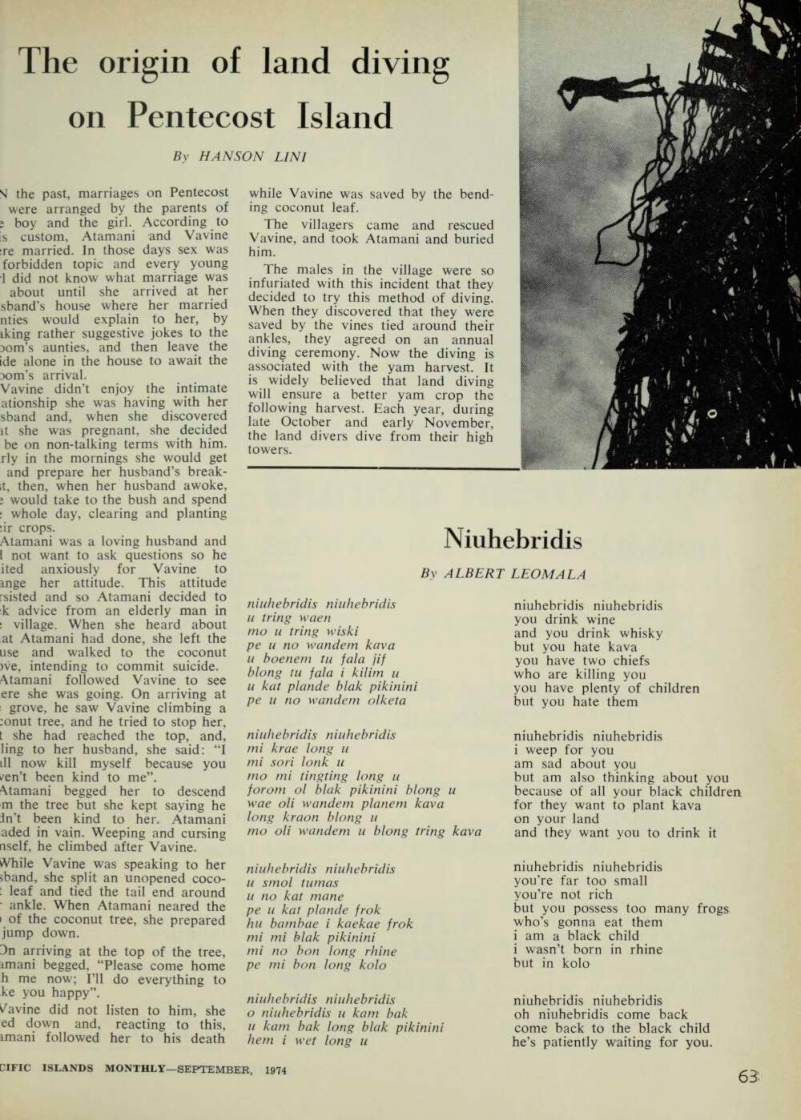
on Pentecost Island
By Hanson Lini
V the past, marriages on Pentecost were arranged by the parents of j boy and the girl. According to is custom, Atamani and Vavine ;re married. In those days sex was forbidden topic and every young 1 did not know what marriage was about until she arrived at her sband’s house where her married nties would explain to her, by iking rather suggestive jokes to the xun’s aunties, and then leave the ide alone in the house to await the xun’s arrival.
Vavine didn’t enjoy the intimate ationship she was having with her sband and, when she discovered it she was pregnant, she decided be on non-talking terms with him. rly in the mornings she would get and prepare her husband’s break it, then, when her husband awoke, j would take to the bush and spend : whole day, clearing and planting ;ir crops.
Atamani was a loving husband and I not want to ask questions so he ited anxiously for Vavine to ange her attitude. This attitude rsisted and so Atamani decided to k advice from an elderly man in : village. When she heard about at Atamani had done, she left the use and walked to the coconut >ve, intending to commit suicide.
Atamani followed Vavine to see ere she was going. On arriving at grove, he saw Vavine climbing a :onut tree, and he tried to stop her, t she had reached the top, and, ling to her husband, she said: “I ill now kill myself because you /en’t been kind to me”.
Atamani begged her to descend m the tree but she kept saying he in’t been kind to her. Atamani aded in vain. Weeping and cursing nself, he climbed after Vavine.
While Vavine was speaking to her sband, she split an unopened coco : leaf and tied the tail end around ■ ankle. When Atamani neared the i of the coconut tree, she prepared jump down. 3n arriving at the top of the tree, amani begged, “Please come home h me now; I’ll do everything to ke you happy”.
Ravine did not listen to him, she ed down and, reacting to this, rniani followed her to his death
while Vavine was saved by the bend ing coconut leaf.
The villagers came and rescued Vavine, and took Atamani and buried him.
The males in the village were so infuriated with this incident that they decided to try this method of diving.
When they discovered that they were saved by the vines tied around their ankles, they agreed on an annual diving ceremony. Now the diving is associated with the yam harvest. It is widely believed that land diving will ensure a better yam crop the following harvest. Each year, during late October and early November, the land divers dive from their high towers.
Niuhebridis
By Albert Leomala
niuhebridis niuhebridis u tring waen mo u tring wiski pe u no wandem kava u boenem tu fala jif blong tu fala i kilim u u kat plande blak pikinini pe u no wandem olketa niuhebridis niuhebridis mi krae long u mi sori lonk u mo mi tingting long u forom ol blak pikinini blong u wae oli wandem planem kava long kraon blong u mo oli wandem u blong tring kava niuhebridis niuhebridis u smol tumas u no kat mane pe u kat plande frok hu bambae i kaekae frok mi mi blak pikinini mi no bon long rhine pe mi bon long kolo niuhebridis niuhebridis o niuhebridis u kam bak u kam bak long blak pikinini hem i wet long u
niuhebridis niuhebridis you drink wine and you drink whisky but you hate kava you have two chiefs who are killing you you have plenty of children but you hate them niuhebridis niuhebridis i weep for you am sad about you but am also thinking about you because of all your black children for they want to plant kava on your land and they want you to drink it niuhebridis niuhebridis you’re far too small you’re not rich but you possess too many frogs, who’s gonna eat them i am a black child i wasn’t born in rhine but in kolo niuhebridis niuhebridis oh niuhebridis come back come back to the black child he’s patiently waiting for you.
Advertisements & other items, p. 65 (1 item)
Cific Islands Monthly—September, 1974
Motherland
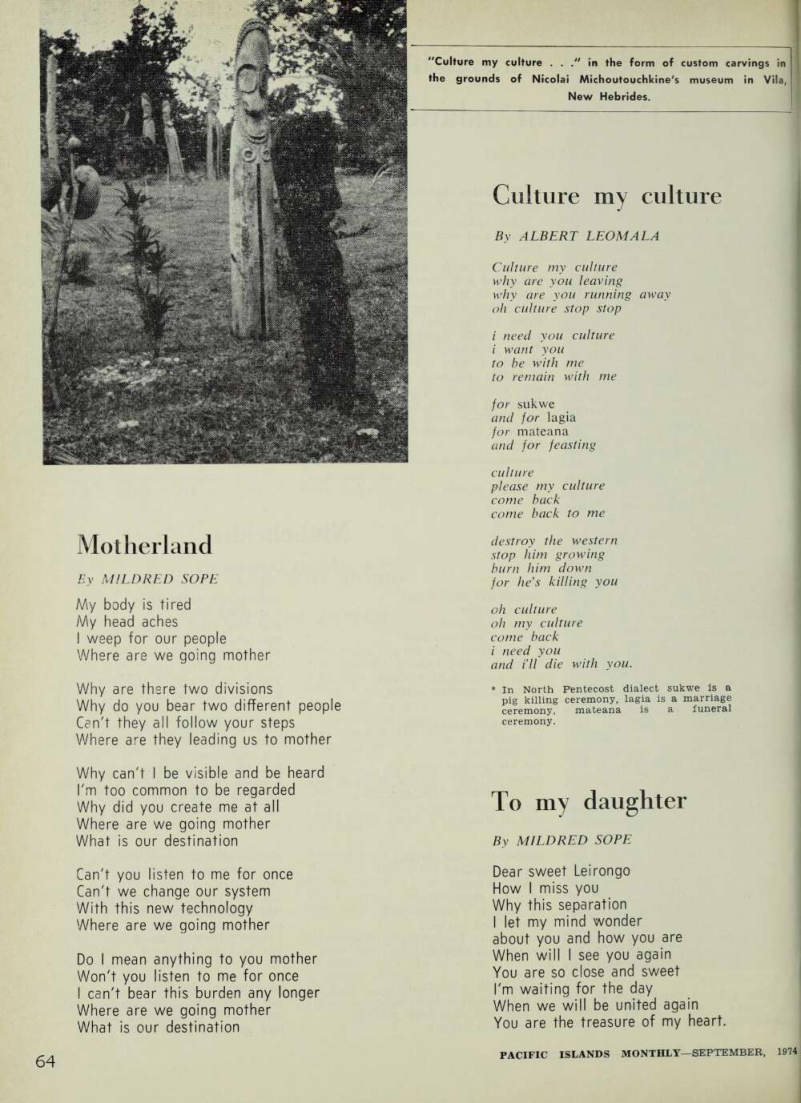
By Mildred Sore
My body is tired My head aches I weep for our people Where are we going mother Why are there two divisions Why do you bear two different people Can't they all follow your steps Where are they leading us to mother Why can't I be visible and be heard I'm too common to be regarded Why did you create me at all Where are we going mother What is our destination Can't you listen to me for once Can't we change our system With this new technology Where are we going mother Do I mean anything to you mother Won't you listen to me for once I can't bear this burden any longer Where are we going mother What is our destination
"Culture my culture . . "in the form of custom carvings in the grounds of Nicolai Michoutouchkine's museum in Vila, New Hebrides.
Culture my culture
By Albert Leomala
Culture my culture why are you leaving why are you running away oh culture stop stop i need you culture i want you to be with me to remain with me for sukwe and for lagia for mateana and for feasting culture please my culture come back come back to me destroy the western stop him growing burn him down for he’s killing you oh culture oh my culture come back i need you and i’ll die with you.
* In North Pentecost dialect sukwe is a pig killing ceremony, lagia is a marriage ceremony, mateana is a funeral ceremony.
To my daughter
By Mildred Sope
Dear sweet Leirongo How I miss you Why this separation I let my mind wonder about you and how you are When will I see you again You are so close and sweet I'm waiting for the day When we will be united again You are the treasure of my heart.
Advertisements & other items, pp. 67-68 (2 items)
65
ACIFIC ISLANDS MONTHLY-SEPTEMBER, 1974
Todays roofs
demand
new materials
-i m * s % m jstrations depict: )man Catholic Seminary, Suva, icific Fishing Company, Levuka. le Fiji Times' Extensions, Suva. ■ aw mmmm mmmm mmmm m^mt he General Manager, helter Engineering Limited, .0. Box 10-043, hristchurch. New Zealand. lease forward information on
] BUTYNOL ROOFING MEMBRANE
] SHELTERLINE & DUNLINE ROOFING
IEMBRANES
] MEMBRANES FORWATER
IANAGEM ENT
AME
Dunlop Membranes
BUTYNOL’Based on Butyl Rubber
One-ply roofing has far less weight and bulk than built-up systems.
Therefore, the architect gains greater design freedom plus reduced loads on supporting members.
For the owner, certain structural costs are lowered and maintenance problems minimised. The contractor benefits from reduced materials handling, lower shipping costs and a work day with more productive hours.
SHELTERLINE Asbestos backed
DUNLINE Unbacked
Both based on well-proven Hypalon* Synthetic Rubber.
Hurricane Bebe' October 1972 and Cyclone 'Lottie' December 1973 produced no problems for Dunlop Membranes and Adhesives. © Dunlop membranes are widely used also for Water
Management- Ponds, Reservoirs , etc.
$
SHELTER
ENGINEERING
LIMITED
A DUNLOP COMPANY
DDRESS.
•HYPALON is a registered Du Pont trademark for chlorosulfonated polyethylene synthetic rubber. 2263
Our business is cargo.
Your cargo: to anywhere in our Pacific.
Two paddle steamers on the Yangtse River in 1873 marked the beginning of the China Navigation Company. Today, the same flag flies above eighteen modern motor ships plying an extensive network of cargo routes between Papua New Guinea and Pacific Island ports (as far East as Tahiti) and Japan, New Zealand, Australia and Thailand.
For 100 years, the flag of the China Navigation Company has meant experience, reliability and speed across the sea. Today, it’s flying as strong as ever.
For further details and all enquiries there are Agents at the following ports: Papua New Guinea: Steamships Trading Co. Ltd., Port Moresby. Samarai, Lae. Madang, Rabaul, Kieta. Burns Philp (New Guinea) Ltd., Wewak, Kavieng. Fiji: Morris Hedstrom Ltd., Suva, Lautoka. Western Samoa: Morris Hedstrom Ltd., Apia.
Tonga: Morris Hedstrom Ltd., Nuku’alofa and Vava’u. Tahiti: Etablissements Donald Tahiti, Papeete. New Caledonia; Etablissements Ballande, Noumea. 8.5.1. P.: British Solomons Trading Co. Ltd., Honiara. New Hebrides; Les Comptoirs Francais desNouvelles-Hebrides, Vila and Santo. AUSTRALIA—Sydney: Interocean Swire Pty. Ltd. Melbourne; Interocean Australia Services Pty. Ltd. Brisbane: Wills, Gilchrist & Sanderson Pty. Ltd. NEW ZEALAND — P . & O. (N.Z.) Ltd.
Auckland, Wellington, Christchurch, Dunedin, Bluff, Napier, Japan; Swire McKinnon, Tokyo, Yokohama, Osaka, Kobe and Nagoya. Eastern Managers: Butterfield & Swire, 9 Connaught Rd., Central, Hong Kong.
CN co JOHN SWIRE & SONS PTY. LTD. General Agents in Australia, 8 Spring Street, Sydney, Phone: 27 9351.
THE CHINA NAVIGATION CO LTD
MEMBER OF THE SWIRE GROUP.
Books, Reviews, writers
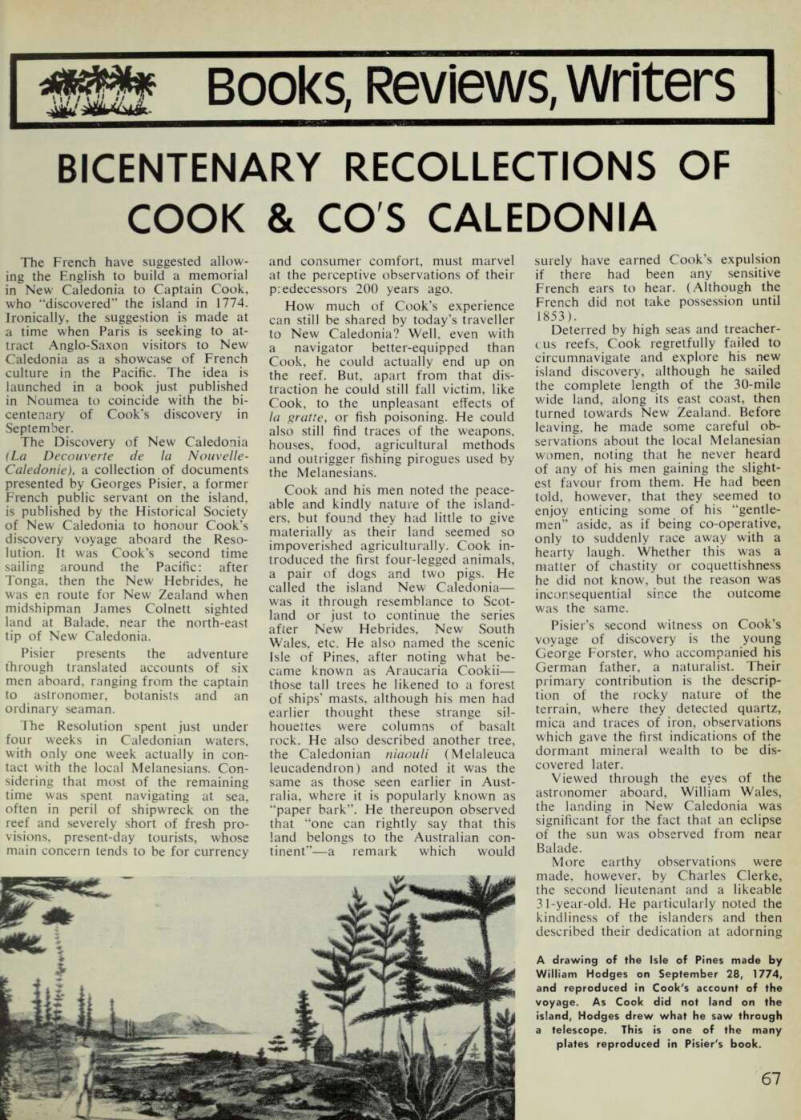

Bicentenary Recollections Of
Cook & Co's Caledonia
The French have suggested allow ing the English to build a memorial in New Caledonia to Captain Cook, who “discovered” the island in 1774.
Ironically, the suggestion is made at a time when Paris is seeking to at tract Anglo-Saxon visitors to New Caledonia as a showcase of French culture in the Pacific. The idea is launched in a book just published in Noumea to coincide with the bi centenary of Cook’s discovery in September.
The Discovery of New Caledonia (La Decouverte de la Nouvelle- Caledonie), a collection of documents presented by Georges Pisier, a former French public servant on the island, is published by the Historical Society of New Caledonia to honour Cook’s discovery voyage aboard the Reso lution. It was Cook’s second time sailing around the Pacific: after Tonga, then the New Hebrides, he was en route for New Zealand when midshipman James Colnett sighted land at Balade, near the north-east tip of New Caledonia.
Pisier presents the adventure through translated accounts of six men aboard, ranging from the captain to astronomer, botanists and an ordinary seaman.
The Resolution spent just under four weeks in Caledonian waters, with only one week actually in con tact with the local Melanesians. Con sidering that most of the remaining time was spent navigating at sea, often in peril of shipwreck on the reef and severely short of fresh pro visions, present-day tourists, whose main concern tends to be for currency
and consumer comfort, must marvel at the perceptive observations of their predecessors 200 years ago.
How much of Cook’s experience can still be shared by today’s traveller to New Caledonia? Well, even with a navigator better-equipped than Cook, he could actually end up on the reef. But, apart from that dis traction he could still fall victim, like Cook, to the unpleasant effects of la gratte, or fish poisoning. He could also still find traces of the weapons, houses, food, agricultural methods and outrigger fishing pirogues used by the Melanesians.
Cook and his men noted the peace able and kindly nature of the island ers, but found they had little to give materially as their land seemed so impoverished agriculturally. Cook in troduced the first four-legged animals, a pair of dogs and two pigs. He called the island New Caledonia— was it through resemblance to Scot land or just to continue the series after New Hebrides, New South Wales, etc. He also named the scenic Isle of Pines, after noting what be came known as Araucaria Cookii— those tall trees he likened to a forest of ships’ masts, although his men had earlier thought these strange sil houettes were columns of basalt rock. He also described another tree, the Caledonian niaouli (Melaleuca leucadendron) and noted it was the same as those seen earlier in Aust ralia, where it is popularly known as “paper bark”. He thereupon observed that “one can rightly say that this land belongs to the Australian con tinent”—a remark which would
surely have earned Cook’s expulsion if there had been any sensitive French ears to hear. (Although the French did not take possession until 1853).
Deterred by high seas and treacher cus reefs, Cook regretfully failed to circumnavigate and explore his new island discovery, although he sailed the complete length of the 30-mile wide land, along its east coast, then turned towards New Zealand. Before leaving, he made some careful ob servations about the local Melanesian women, noting that he never heard of any of his men gaining the slight est favour from them. He had been told, however, that they seemed to enjoy enticing some of his “gentle men” aside, as if being co-operative, only to suddenly race away with a hearty laugh. Whether this was a matter of chastity or coquettishness he did not know, but the reason was inconsequential since the outcome was the same.
Pisier’s second witness on Cook’s voyage of discovery is the young George Forster, who accompanied his German father, a naturalist. Their primary contribution is the descrip tion of the rocky nature of the terrain, where they detected quartz, mica and traces of iron, observations which gave the first indications of the dormant mineral wealth to be dis covered later.
Viewed through the eyes of the astronomer aboard, William Wales, the landing in New Caledonia was significant for the fact that an eclipse of the sun was observed from near Balade.
More earthy observations were made, however, by Charles Clerke, the second lieutenant and a likeable 31-year-old. He particularly noted the kindliness of the islanders and then described their dedication at adorning
A drawing of the Isle of Pines made by William Hodges on September 28, 1774, and reproduced in Cook's account of the voyage. As Cook did not land on the island, Hodges drew what he saw through a telescope. This is one of the many plates reproduced in Pisier's book.
one particular feature of the anatomy, the organ peculiar to the male sex which received every article of deco ration. Clerke says he offered a man a stocking and it was immediately drawn over this spot. A bead neck lace, offered next, was used to attach the stocking, while a souvenir medal lion was applied to the same location, with apparent disregard for the nakedness of the rest of the body.
It is with the observations of the Swedish doctor and botanist aboard, Anders Sparrman, that the reader obtains some comparisons with French experiences at Balade 19 years afterwards, since the Swede wrote later and was then familiar with the 1793 voyage of d’Entre :asteaux. This leads to discussion of the cannibalistic practices of the Caledonian indigenes.
Such practices were not generally suspected by the English and they re :all the shocked retreat of islander :ompanions who found them eating from a bone of beef and could not be persuaded that it came from a four-legged animal. On the other band, the ship’s doctor, Mr Patten, found the islanders expressed quite appreciative interest in his well-fat ;ened arms and calves.
Pisier’s final witness to the dis :overy of New Caledonia is second junmaster John Marra. This young Irish seaman’s most dramatic me mory is almost a whole day the ordinary seamen spent taking two aour shifts at the oars of two boats, vhich were lowered over the side and used to row the Resolution away Torn the reef, against a heavy swell vith no wind.
Most of Pisier’s reference docu nents were located in London, Paris and Sydney and included recent writ ngs of New Zealander J. C. Beagle aole. The main intention of Pisier and his publishers was to make available to French readers some of he wealth of observations on early Vew Caledonia contained generally n English sources.
In New Caledonia itself Pisier ound few traces of Cook’s passage, either verbal or material. He did, aowever, find records and hand drafted objects from the expedition at the Australian Museum and Vlitchell Library, in Sydney, which s where Caledonians have tradition ally entrusted material they wished
to have safely guarded for posterity.
Efforts are now being made in Noumea to have the Caledonians make articles available for safe-keeping by local French authorities.
Pisier also suggests that the Eng- “ authorised to erect in New Caledonia a monument to Cap tain Cook which would be a way of returning the courtesy allowed to the French when they built their menu- ,•/ t “ ment to navigator La Perouse at bydney S Botany Bay.
Actually, suggesting that the Eng lish should come and build a monu ment to Cook seems to be a clever French way of inviting English enter prise to subsidise the promotion of Caledonian tourism.
Helen Rousseau.
(la decouverte de la nouvelle- CALEDONIE, presented by Georges Pisier, Published by Societe d'Etudes Historiques de la Nouvelle-Caledonie, P.O. Box 7, Noumea 1974, 196 pp with charts, portraits and photographs. No price indicated.)
Advertisements & other items, p. 70 (1 item)
Wild (Australia) Pty. Ltd.
Best in their class -
but never enough until now.
At last, however,the Wild NKOI.N 10 and NKIO levels are available in sufficient quantities and at a lower price. The new Wild factory in Singapore is producing them with the high precision expected of and guaranteed by Wild Heerbrugg.
I want to hear more about the lower-priced Wild levels.
Please send me your special brochure.
Name: Address:
HEERBRUGG
Wild NKOI Dumpy Level H
AUSTRALIA
WILD (AUSTRALIA) PTY. LTD.
45 Epping Road, North Ryde, N.S.W. 11 Buchanan Street, West End, Brisbane, Qld. 83-85 Palmerston Crescent, South Melbourne, 3205.
BRIAN BELL Cr CO. PTY. LTD., BOROKO, T.P.N.G.
Png's Improvement
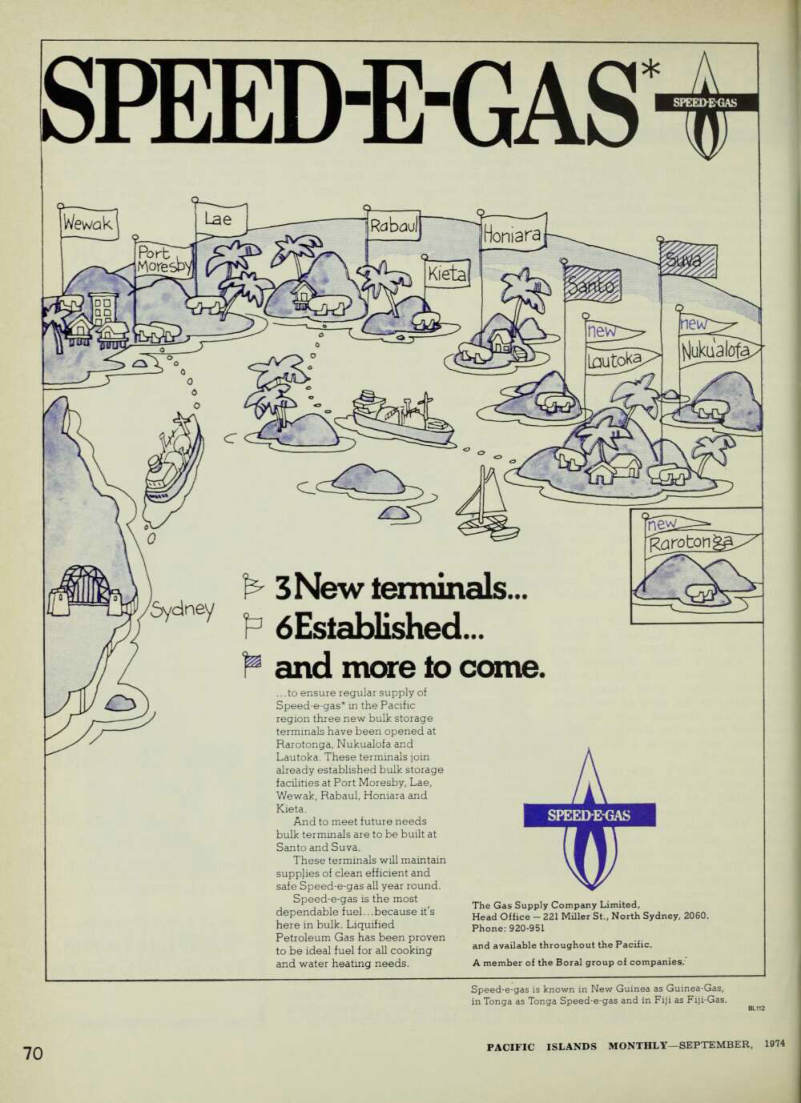
Writing The Rules For
Of the eight aims of the Improve ment Plan for Papua New Guinea, the two central and crucial ones are (i) a rapid increase in the proportion of the economy under control of New Guinean individuals and groups, and in the proportion of personal and property income that goes to New Guineans, and (ii) a more self-reliant economy, less dependent for its needs on imported goods and services and better able to meet the needs of its people through local production.
By now, the tremendous difficulties in transforming the capitalist, colonial dual economy into an egalitarian, tradition-respecting one have been re cognised by most people concerned about the new nation’s future. New Guineans and foreigners involved in the detailed planning and implementa tion have to tackle many problems, eg, how people, whose vision rarely extends beyond their village, can be persuaded to think and act as citizens of one large political entity, how the rules and machinery of judiciary, bureaucracy, education system, com mercial conduct and, in fact, of just about every aspect of life can be changed to make possible the achieve ment of the aims of the Plan.
To illustrate but one of the prob lems, namely that of changing the economic structure: about 90 per cent of manufacturing and almost as much of building and construction are in foreign hands, the islanders have practically no share in finance and banking, and there are far too few islanders with industrial or com mercial skills and experience.
For some time to come, New Guineans will have to continue using the skills and experience of foreigners.
It is, therefore, good to have Alterna tive Strategies for Papua New Guinea, which consists of essays by a number of foreign academics and senior bureaucrats who have influenced or are taking part in the drawing up of
the Improvement Plan. They have, rightly, eschewed telling New Guineans what ought to be done— partly because what is good for Canberra or Tokyo or Washington is not necessarily so for Konedobu, and, partly, because every one of the contributors has been long enough in the country to appreciate that only those who truly belong to its culture can fully understand the neople’s needs and decide how those needs are to be met.
The value of the essays lies in their defining some of the problems and in listing a number of possible solutions. The core problem is the current lack of national awareness and consequent absence of national unity.
It is not only a stumbling block in the path to greater productivity, the sine qua non of meeting the people’s expectations of more schools, more
hospitals, better infrastructure, higher incomes, and a rising standard of iiving, but it also bedevils the internal and external security of the new date.
It is no wonder that, in the light Df the goings-on in the House of As jembly since 1964 and of humbling jecessionism in several parts of the :ountry, not one of the contributors :o this book believes that the West ninster-style democracy set up by \ustralia will survive.
This reviewer will shed no tears if t does not, as long as the political itructure and the way in which the leople are governed pay respect to he individual’s human dignity. It is : airly certain that the bulk of the country’s population, namely sub listence farmers, small cash croppers md their families, are more con fined with having full bellies than he franchise.
In A Foreign Policy for an Indepen lent Papua New Guinea, James jriffin summarises the proceedings of 1 seminar held at Port Moresby in 1972, and he provides a very useful ntroduction to the domestic scene vhich is, of course, inseparable from breign affairs.
Papua New Guinea cannot escape he influence and power of the ’acific Rim nations, the United hates, Japan and Australia, and it nay well have to cope with a less luiescent situation west of the Sepik md Fly rivers. It is helpful that a tatement on future relations between Australia and New Guinea, by Pea cock (1972) and Labor’s plan for *apua New Guinea, by Whitlam 1970) are appended to the text.
And even more useful is the nclusion of a submission dealing with *apua New Guinea vis-a-vis Japan, >y the former Department of External ferritories to the Australian Senate handing Committee on Foreign Affairs and Defence (1972). Kan ;aroo and Emu are still top of the >atting in a long innings, but Rising hin may take their place on the list.— iarry Jackman.
(Alternative Strategies For
>APUA NEW GUINEA, ed by A. Clunies loss and J. Langmore 1973. Oxford Jniversity Press, 7 Bowen Crescent, Mel lourne, hard cover $9.75, paperback $5.95.)
(A Foreign Policy For An
Ndependent Papua New Guinea,
d by J. Griffin 1974. Angus & Robertson. 02 Glover Street, Cremorne, Sydney, Lustralia. Hard cover $5.95, paperback 3.95.)
Advertisements & other items, pp. 71-72 (2 items)
69
‘ACIFIC ISLANDS MONTHLY—SEPTEMBER, 1974
Harris
BOOK COMPANY
(ESTABLISHED 1930)
We carry over 10,000 titles on all subjects in stock and would be pleased to quote for your requirements.
Please send your enquiries to;
HARRIS BOOK COMPANY,
G.P.O. Box 16670, Hong Kong
SPEED-E-GAS
SPEEI>E*GAS
Lae
We wok
Rdbaul
Honiara
Port ,
M\ore SP
Kieta
IDO
JQD
tie ne
boutoka
1 o c Cj y
new
Raroton^a^
3^ O
Sydney
k 3 New terminals.,
P 6Established...
and more to come.
.. .to ensure regular supply of Speed-e-gas* in the Pacific region three new bulk storage terminals have been opened at Rarotonga, Nukualofa and Lautoka. These terminals join already established bulk storage facilities at Port Moresby, Lae, Wewak, Rabaul, Honiara and Kieta.
And to meet future needs bulk terminals are to be built at Santo and Suva.
These terminals will maintain supplies of clean efficient and safe Speed-e-gas all year round.
Speed-e-gas is the most dependable fuel...because it's here in bulk. Liquified Petroleum Gas has been proven to be ideal fuel for all cooking and water heating needs.
SPEEDEGAS
The Gas Supply Company Limited, Head Office 221 Miller St., North Sydney, 2060.
Phone; 920-951 and available throughout the Pacific.
A member of the Boral group of companies.
Speed-e-gas is known in New Guinea as Guinea-Gas, in Tonga as Tonga Speed-e-gas and in Fiji as Fiji-Gas.
The Spaniards will 'launch'
The Lost Caravel
Robert Langdon, executive officer of the Pacific Manuscripts Bureau, Canberra, has found an enthusiastic advocate for his forthcoming book, The Lost Caravel, in the person of the Spanish Ambassador to Australia, Senor Don Alberto Pascual Villar.
Even though the book is still some months from publication, the Am bassador has already interested a Spanish publisher in a Spanish trans lation and is planning a launching party at the Spanish Embassy in Canberra for the English edition which is to be brought out by Pacific Publications (Aust) Pty Ltd.
The Embassy first heard about The Lost Caravel when the author sought the Ambassador’s assistance in ob taining a colour transparency of a painting by a Basque artist depicting the departure for the Moluccas in 1525 of the expedition of Garcia Jofre de Loaisa. The Embassy duly obliged, with the result that the dust jacket of The Lost Caravel will be graced by a most striking and colour ful picture.
The picture recalls the golden age of Spain and sets the tone of the book, which tells how the Loaisa ex pedition, then comprising four ships, passed through the Strait of Magellan on May 26, 1526.
Five days later, the ships were separated by a storm. One, the caravel San Lesmes vanished.
The book goes on to tell how, in Langdon’s view, the ship was wrecked in the Tuamotu Archipelago, how the crew survived and inter-married with the local women, and how they and their descendants spread over the next 250 years to many parts of Polynesia, and influenced the whole course of Polynesian history, includ ing the design of Polynesian voyaging canoes.
Weeks after PIM (Mar Up Front, p iii) published first news of the book, the sceptics marshalled their forces. Herb Kane, part-Hawaiian, commercial artist and organiser of the Polynesian Voyaging Society, fired the first broadside in the Hono lulu Advertiser.
More shots have been fired since then in the Honolulu Advertiser’s columns, not all trying to blow Lang don’s theory to bits.
Ernest V. Perry, something of a humorist and open to be persuaded either way, wrote that he hoped to be among the first purchasers of The Lost Caravel, partly because “Robert
Langdon is my kind of man. He puts me in mind of another gutsy fella— Erich von Daniken (Chariots of the Gods?). In view of the fact that man’s resistance to change is directly proportional to the degree of change, 1 find myself hoping that the remark able similarity of their views and the concomitant findings of each will serve with equal force to shatter the stupid shackles of legendary and tra ditional beliefs.”
Writing from the other camp, R.
H. Gulmon argued, in a reply to Perry, that “The Polynesians’ epic voyages of discovery and colonisation had long since been completed and the outposts of Polynesia, Hawaii, Easter Island and New Zealand were already thriving colonies when the ‘lost caravel’ and its crew of wander ing Iberians met disaster on Amanu atoll.
“The great voyaging canoes, con structed without the aid of metal tools or fasteners, and capable of open ocean voyages of 2,000 miles or more, were unique Polynesian achievements as were the navigational techniques by which they were guided. Furthermore, the canoes so accurately described by Cook and his contemporaries in the late 18th century bore no discernible marks of European influence. It therefore seems probable that Polynesian voy aging traditions, at least, will survive publication of ‘The Lost Caravel’
Mr Perry, attacked Herb Kane’s commentary in the Advertiser (PIM, May, p 23) with “Mr Kane’s poorly researched words do not hold water, and I suspect he honours tradition more than the scientific research he advocates. He, and others like him, should look to Guam and the Philip pines before screaming ‘foul’ at Robert Langdon”, Mr Langdon took up the gauntlet in April (PIM, May p 25) when he wrote that his book made no men tion of the Marquesas but dealt with a Spanish ship “that came to grief in 1526 on Amanu atoll, which is in the Tuamotu Archipelago”. Mr Kane had referred to Marquesan canoes.
He continued, “I should mention, however, that the evidence I have used is not ‘very obscure’ as Mr Kane seems to think. It is all taken from readily available literature, most of which may be consulted at such places as the Bishop Museum or the Gregg M. Sinclair Library, University of Hawaii.
Advertisements & other items, p. 73 (1 item)
71
•ACIFIC ISLANDS MONTHLY—SEPTEMBER, 1974
From the heart of Matane
There is a simple sincerity about the writing of Paulias Matane which I find most appealing, and which is, 1 think, of greater value in establish ing a truly New Guinean literature than is the self-conscious material so much of which is being produced under the tutelage of one mentor or another.
Paulias Matane does not, it seems to me, write for the sake of writing but because he has something to say.
It is because of this that there are no forced purple passages, no intro verted contemplation of his glandular structure, and that what he says is said straight in the most powerful language of all: from the heart in simple sentence structures and in a vocabulary easily understood by any reader. I truly enjoyed reading Aimbe, The Challenger, We might well say, “Matane has done it again!” And, I hope, this is not the last time we will hear from him.
The locale is unidentified, but it could be New Britain.
Of course, the fact that he writes in his introduction “Here I trace the life of a fictitious young boy” does not stop the reader from seein- Aimbe as autobiographical (what writing is not?) and that adds to the usefulness of the writing as record of the past and the life of the people among whom Matane was born and brought up. Such records as these are of value in the literature of an emerging people: no personal opinion expressed as incontrovertible fact, no axe to grind, no tirade of hatred against op pressors, but plain observation of facts, and an impression of truthful ness in the telling. It reads easily. It flows smoothly. Is this not what writing should be? Let’s hope Matane will write more for us and that his writing will inspire others to follows his example.
Do not think, however, that Matane has not brought into Aimbe, The Challenger mention of the political and social thinking of the people who pass through his book. He has done so but without rancour. His charac ters emerge as people because he knows them as people and not as vehicles for getting across his private ideas. I should think that Matane possesses the true attributes of a writer, and he, because of his ability to express himself and to make his characters express ideas which are theirs and not merely those of the author put into the mouths of caricatures, he should, as an author, if he wants to, go further. Matane is, in my opinion, at the present moment,
of all those who have come my way, Papua New Guinea’s best writer.
The ending of the book is sad: . . what do you think of the future of this country?” I looked Raka in the face and said dryly, “Listen, Raka, to be quite honest and frank, I do not know. Do you?”
“No, I don’t,” he replied.
Even you dear reader, at 5i.25, can afford to buy Aimbe, The Challenger, and 1 recommend that you do. And you, Paulias, don’t stop here but the sure there are readers waiting for your next book. —Peter Livingston.
(Aimbe, The Challenger, By Paulias
Matane, published by Niugini Press Pty Ltd, PO, Box 3395, Port Moresby, Papua New Guinea. Paperback; 52 pages; $1.25.
Our copy from Jacaranda Press.)
Boat for all seasons
“When I come up for judgment and they stop me at the gate and ask ‘what’s your excuse?’ I’ll tell them I designed the Gloucester Light Dory and they’ll have to let me in!” So says Philip C. Bolger in his book Small Boats.
Whether or not he makes it past the pearly gates or not, Mr Bolger’s breezy presentation makes light and interesting reading of what is normally very intimidating bookmatter.
Bolger’s designs are mostly simple and easy to build, and run the gamut from an 18th-century pinnace to an ocean-going rowboat, various motor designs, keel and centreboard sailing boats and of course many variations of the übiquitous dory theme.
The book is well illustrated with both photographs and drawings and enough detail is supplied to allow the reader to build any of the 31 designs included. One design of parti cular interest is called the Gloucester Yawl and is specifically designed for the youth club of the Outward Bound type. To describe this boat or its rig would be folly on my part; suffice to say that it has three masts, shallow draught and would probably either exhaust its crew in a few hours or build a group of hairy-chested beasties with muscles like canta loupes.
This is the ideal book for a man who wants to build a boat cheaply, but can’t decide what type. He could do much worse than to let Mr Bolger decide for him. His enthusiasm rubs from the book like wet ink. —John Collins. (SMALL BOATS, by Philip G. Bolger, Inter national Marine Publishing Company, 21 Elm Street, Camden, Maine, USA. $U512.50.)
Advertisements & other items, p. 74 (1 item)
Papua
Available
September
Handbook of
Papua
New Guinea
1974'S
SELF-GOVERNMENT
ISSUE
This new edition of the Handbook of Papua New Guinea — completely revised and reset— provides the first full up-to-date details of the new self-governing nation.
For businessmen, travellers, schools, universities and libraries, government departments, tourists and Papua New Guinea residents, this timely, up-to-the-minute edition, is essential.
The Handbook covers everything
—geography and history right up
to self - government, commerce, trade and banking, forestry, primary and secondary industries, finance and taxation, communications and transport, health and education, law and defence, the churches and missions, land and land policy, etc. Each of the 19 districts is treated in detail, with clear and comprehensive maps, all newly drawn.
There is also a greatly expanded list, for easy reference, of company registrations and an enlarged tourist section that has all the latest information on facilities and amenities in all areas.
A large attractive fold-out map of Papua New Guinea is also included. The first edition of the Papua New Guinea handbook was published 20 years ago. This 7th edition, is the only reference book available today with all the information on the world's newest nation.
PRICE; Australia, $5.50 plus 85c posted, Pacific Islands and Overseas, $5.50 Aust., plus $l.lO posted, U.S.A., $9.80 U.S. posted.
Fill in the details
on the attached
order form.
Pacific Transport
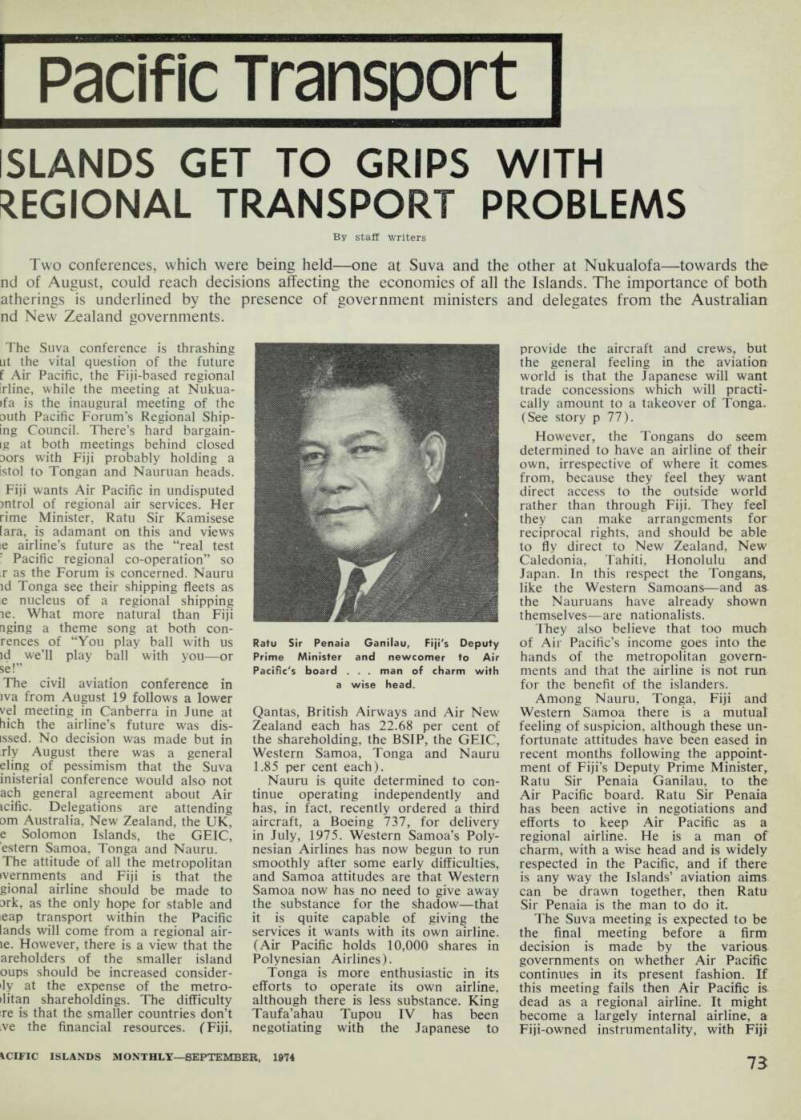
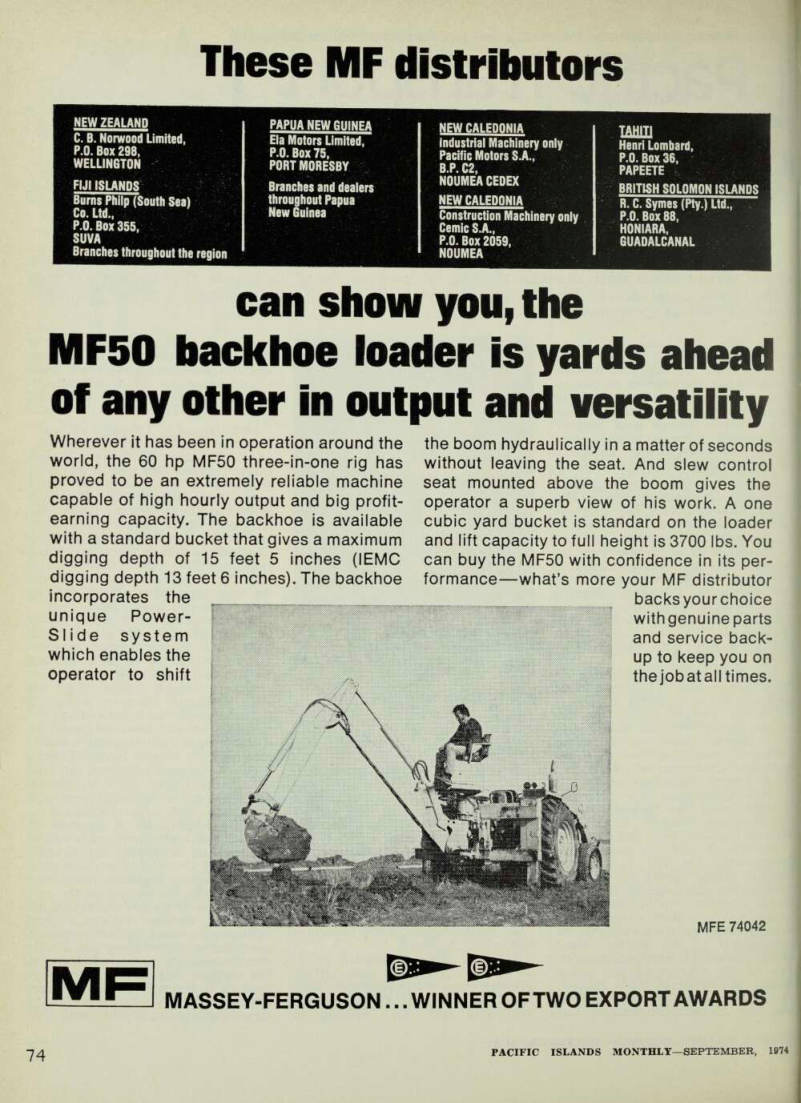
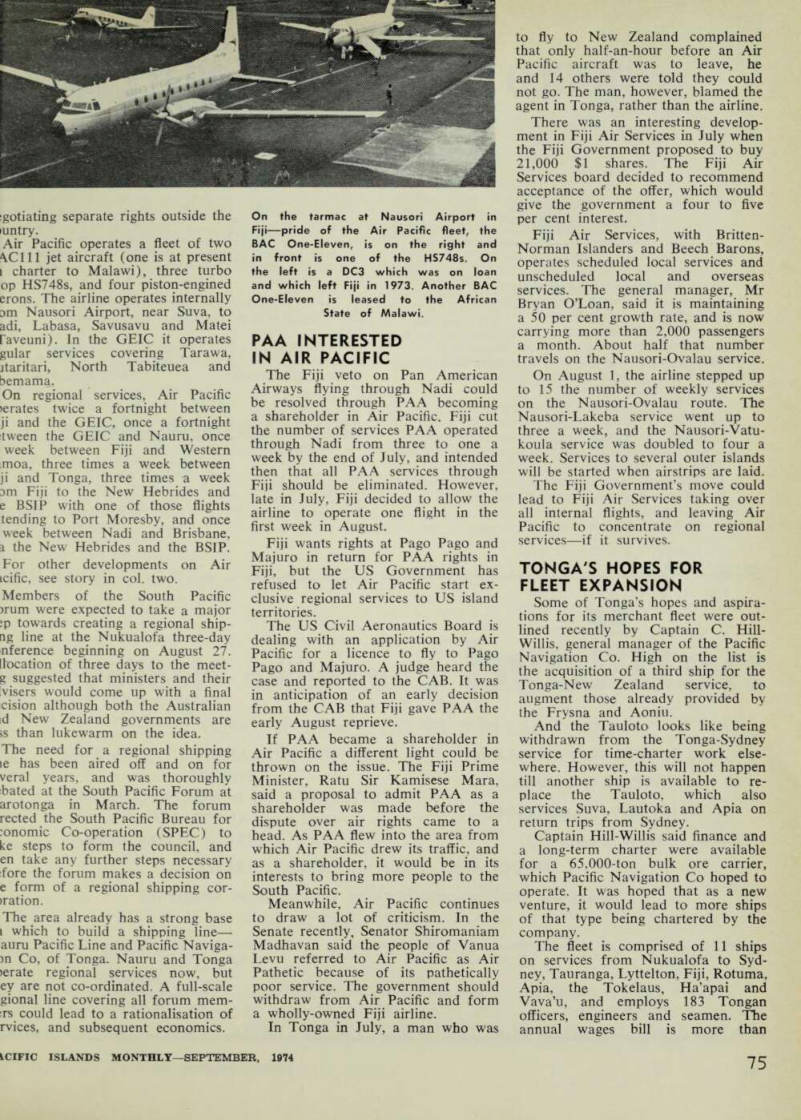
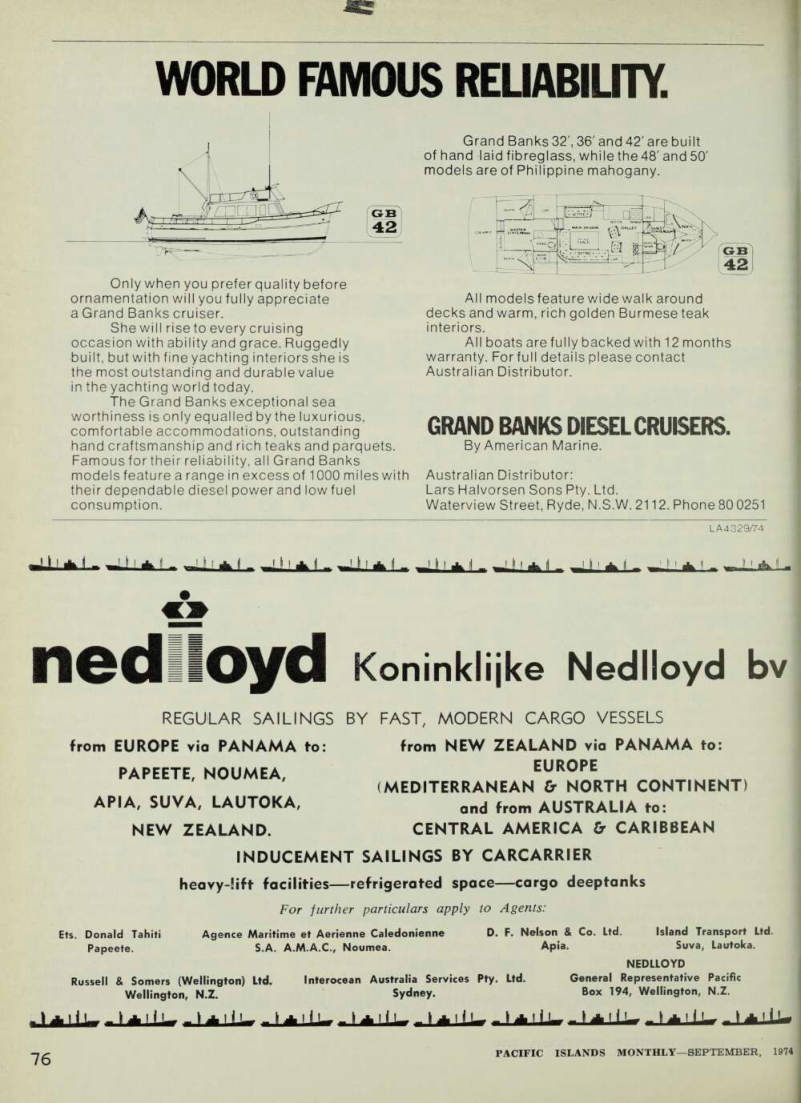
Slands Get To Grips With
Regional Transport Problems
By staff writers
Two conferences, which were being held—one at Suva and the other at Nukualofa—towards the nd of August, could reach decisions affecting the economies of all the Islands. The importance of both atherings is underlined by the presence of government ministers and delegates from the Australian nd New Zealand governments.
The Suva conference is thrashing ut the vital question of the future f Air Pacific, the Fiji-based regional irline, while the meeting at Nukua »fa is the inaugural meeting of the □uth Pacific Forum’s Regional Ship ing Council. There’s hard bargain ig at both meetings behind closed Dors with Fiji probably holding a istol to Tongan and Nauruan heads.
Fiji wants Air Pacific in undisputed mtrol of regional air services. Her rime Minister, Ratu Sir Kamisese lara, is adamant on this and views e airline’s future as the “real test : Pacific regional co-operation” so ,r as the Forum is concerned. Nauru id Tonga see their shipping fleets as e nucleus of a regional shipping What more natural than Fiji aging a theme song at both con rences of “You play ball with us id we’ll play ball with you—or se!”
The civil aviation conference in iva from August 19 follows a lower vel meeting in Canberra in June at hich the airline’s future was dis issed. No decision was made but in rly August there was a general eling of pessimism that the Suva inisterial conference would also not ach general agreement about Air icific. Delegations are attending om Australia, New Zealand, the UK, e Solomon Islands, the GEIC, estern Samoa, Tonga and Nauru.
The attitude of all the metropolitan ivernments and Fiji is that the gional airline should be made to ark, as the only hope for stable and ieap transport within the Pacific lands will come from a regional air le. However, there is a view that the areholders of the smaller island oups should be increased consider •ly at the expense of the metro ilitan shareholdings. The difficulty re is that the smaller countries don’t ve the financial resources. (Fiji,
Qantas, British Airways and Air New Zealand each has 22.68 per cent of the shareholding, the BSIP, the GEIC, Western Samoa, Tonga and Nauru 1.85 per cent each).
Nauru is quite determined to con tinue operating independently and has, in fact, recently ordered a third aircraft, a Boeing 737, for delivery in July, 1975. Western Samoa’s Poly nesian Airlines has now begun to run smoothly after some early difficulties, and Samoa attitudes are that Western Samoa now has no need to give away the substance for the shadow—that it is quite capable of giving the services it wants with its own airline. (Air Pacific holds 10,000 shares in Polynesian Airlines).
Tonga is more enthusiastic in its efforts to operate its own airline, although there is less substance. King Taufa’ahau Tupou IV has been negotiating with the Japanese to
provide the aircraft and crews, but the general feeling in the aviation world is that the Japanese will want trade concessions which will practi cally amount to a takeover of Tonga. (See story p 77).
However, the Tongans do seem determined to have an airline of their own, irrespective of where it comes from, because they feel they want direct access to the outside world rather than through Fiji. They feel they can make arrangements for reciprocal rights, and should be able to fly direct to New Zealand, New Caledonia, Tahiti, Honolulu and Japan. In this respect the Tongans, like the Western Samoans —and as the Nauruans have already shown themselves —are nationalists.
They also believe that too much of Air Pacific’s income goes into the hands of the metropolitan govern ments and that the airline is not run for the benefit of the islanders.
Among Nauru, Tonga, Fiji and Western Samoa there is a mutual feeling of suspicion, although these un fortunate attitudes have been eased in recent months following the appoint ment of Fiji’s Deputy Prime Minister, Ralu Sir Penaia Ganilau, to the Air Pacific board. Ratu Sir Penaia has been active in negotiations and efforts to keep Air Pacific as a regional airline. He is a man of charm, with a wise head and is widely respected in the Pacific, and if there is any way the Islands’ aviation aims can be drawn together, then Ratu Sir Penaia is the man to do it.
The Suva meeting is expected to be the final meeting before a firm decision is made by the various governments on whether Air Pacific continues in its present fashion. If this meeting fails then Air Pacific is dead as a regional airline. It might become a largely internal airline, a Fiji-owned instrumentality, with Fiji
Ratu Sir Penaia Ganilau, Fiji's Deputy Prime Minister and newcomer to Air Pacific's board . . . man of charm with a wise head.
igotiating separate rights outside the iuntry.
Air Pacific operates a fleet of two ACIII jet aircraft (one is at present i charter to Malawi), three turbo op HS74Bs, and four piston-engined erons. The airline operates internally am Nausori Airport, near Suva, to adi, Labasa, Savusavu and Matei faveuni). In the GEIC it operates gular services covering Tarawa, itaritari, North Tabiteuea and bemama.
On regional services, Air Pacific >erates twice a fortnight between ji and the GEIC, once a fortnight tween the GEIC and Nauru, once week between Fiji and Western moa, three times a week between ji and Tonga, three times a week Dm Fiji to the New Hebrides and e BSIP with one of those flights tending to Port Moresby, and once week between Nadi and Brisbane, a the New Hebrides and the BSIP.
For other developments on Air icific, see story in col. two.
Members of the South Pacific )rum were expected to take a major ;p towards creating a regional ship rig line at the Nukualofa three-day nference beginning on August 27. [location of three days to the meet g suggested that ministers and their visers would come up with a final cision although both the Australian id New Zealand governments are >s than lukewarm on the idea.
The need for a regional shipping le has been aired off and on for veral years, and was thoroughly bated at the South Pacific Forum at arotonga in March, The forum rected the South Pacific Bureau for :onomic Co-operation (SPEC) to ke steps to form the council, and en take any further steps necessary fore the forum makes a decision on e form of a regional shipping cor iration.
The area already has a strong base i which to build a shipping line—auru Pacific Line and Pacific Naviga )n Co, of Tonga. Nauru and Tonga >erate regional services now, but ey are not co-ordinated. A full-scale gional line covering all forum mem :rs could lead to a rationalisation of rvices, and subsequent economics.
Paa Interested
In Air Pacific
The Fiji veto on Pan American Airways flying through Nadi could be resolved through PAA becoming a shareholder in Air Pacific. Fiji cut the number of services PAA operated through Nadi from three to one a week by the end of July, and intended then that all PAA services through Fiji should be eliminated. However, late in July, Fiji decided to allow the airline to operate one flight in the first week in August.
Fiji wants rights at Pago Pago and Majuro in return for PAA rights in Fiji, but the US Government has refused to let Air Pacific start ex clusive regional services to US island territories.
The US Civil Aeronautics Board is dealing with an application by Air Pacific for a licence to fly to Pago Pago and Majuro. A judge heard the case and reported to the CAB. It was in anticipation of an early decision from the CAB that Fiji gave PAA the early August reprieve.
If PAA became a shareholder in Air Pacific a different light could be thrown on the issue. The Fiji Prime Minister, Ratu Sir Kamisese Mara, said a proposal to admit PAA as a shareholder was made before the dispute over air rights came to a head. As PAA flew into the area from which Air Pacific drew its traffic, and as a shareholder, it would be in its interests to bring more people to the South Pacific.
Meanwhile, Air Pacific continues to draw a lot of criticism. In the Senate recently. Senator Shiromaniam Madhavan said the people of Vanua Levu referred to Air Pacific as Air Pathetic because of its pathetically poor service. The government should withdraw from Air Pacific and form a wholly-owned Fiji airline.
In Tonga in July, a man who was
to fly to New Zealand complained that only half-an-hour before an Air Pacific aircraft was to leave, he and 14 others were told they could not go. The man, however, blamed the agent in Tonga, rather than the airline.
There was an interesting develop ment in Fiji Air Services in July when the Fiji Government proposed to buy 21,000 $1 shares. The Fiji Air Services board decided to recommend acceptance of the offer, which would give the government a four to five per cent interest.
Fiji Air Services, with Britten- Norman Islanders and Beech Barons, operates scheduled local services and unscheduled local and overseas services. The general manager, Mr Bryan O’Loan, said it is maintaining a 50 per cent growth rate, and is now carrying more than 2,000 passengers a month. About half that number travels on the Nausori-Ovalau service.
On August 1, the airline stepped up to 15 the number of weekly services on the Nausori-Ovalau route. The Nausori-Lakeba service went up to three a week, and the Nausori-Vatu koula service was doubled to four a week. Services to several outer islands will be started when airstrips are laid.
The Fiji Government’s move could lead to Fiji Air Services taking over all internal flights, and leaving Air Pacific to concentrate on regional services—if it survives.
Tonga's Hopes For
Fleet Expansion
Some of Tonga’s hopes and aspira tions for its merchant fleet were out lined recently by Captain C. Hill- Willis, general manager of the Pacific Navigation Co. High on the list is the acquisition of a third ship for the Tonga-New Zealand service, to augment those already provided by the Frysna and Aoniu.
And the Tauloto looks like being withdrawn from the Tonga-Sydney service for time-charter work else where. However, this will not happen till another ship is available to re place the Tauloto, which also services Suva, Lautoka and Apia on return trips from Sydney.
Captain Hill-Willis said finance and a long-term charter were available for a 65,000-ton bulk ore carrier, which Pacific Navigation Co hoped to operate. It was hoped that as a new venture, it would lead to more ships of that type being chartered by the company.
The fleet is comprised of 11 ships on services from Nukualofa to Syd ney, Tauranga, Lyttelton, Fiji, Rotuma, Apia, the Tokelaus, Ha’apai and Vava’u, and employs 183 Tongan officers, engineers and seamen. The annual wages bill is more than
On the tarmac at Nausori Airport in Fiji—pride of the Air Pacific fleet, the BAC One-Eleven, is on the right and in front is one of the HS748s. On the left is a DC3 which was on loan and which left Fiji in 1973. Another BAC One-Eleven is leased to the African State of Malawi.
1700,000. Another 5T150,000 is ent in Tonga on stores and main nance.
Tonga also supplied crew men for her ships for which the Pacific avigation Co was agent. These eluded the Enna G, James Cook and avlur.
He said that when a marine training hool was established, Tonga would i able to supply a steady stream of amen for both Tongan and foreign ips. There was a world shortage of lined and qualified seamen.
The navigation training scheme in inga was started in October, 1973, ider the guidance of Captain Mike files, using the old tug, Hifofua, as training ship. Sixteen cadets are in fining at present. Four of them are igineer cadets and the others are ;ck cadets.
. . And Its Needs
Or An Airline
Tonga needs to attend to several iportant matters related to the >eration of a regional or inter itional air service before its first icing 737 arrives, Mr Yoichi ayashi, international managing rector of All Nippon Airways, said aen he visited the country in July, is visit was “accidental”. He and his mpany’s deputy manager of the ternational marketing section, Mr itsuo Tanaka, were in the Pacific on her matters, so he took time off go to Tonga to “look it over”.
Mr Hayashi said airport facilities iuld have to be improved, more •tel accommodation would be re ared, roads should be improved, d hotel catering requirements should assured.
All Nippon has earmarked two 7s for Tonga.
Ord Howe Flying-Boat
Ings Swan-Song Soon
The last flying-boat service con cting Sydney and Lord Howe Island scheduled for September 10. Since e passenger service was discontinued May, Airlines of NSW has main ined a link to carry mails and other sential goods. On most flights her issenger capacity has been fully ken up with officials connected with e laying of the air-strip. In some stances the flying-boat has had to ake two flights a week. She is fully •oked right up to the last flight.
The flying-boat, which was damaged Lord Howe Island on June 9 when own ashore by strong winds, was ken back to Rose Bay hangar for pairs. These were expected to be tished about the middle of August, irlines of NSW then intended to put back on the Sydney-Lord Howe n.
The other flying-boat, which was
about to be transferred to her new owners, Antilles Air Boats, in the Caribbean, was then hurriedly im pressed into the Lord Howe run. She was to be withdrawn when the damaged flying-boat was renaired and back in service, and sent to Antilles Air Boats.
The new strip had an unscheduled testing on August 4, when an RAAF Caribou transport aircraft landed to pick up a man suffering from a compound ankle fracture. The plane was to make an aerial survey of the partly completed strip, but this was changed to a mercy mission before it took off from Richmond in NSW.
It carried a doctor, a nurse and a medical orderly. After picking the man up the aircraft flew him to Brisbane for hospital treatment. The Caribou landed and took off in strong crosswinds.
All Nippon has earmarked two 737’s for Tonga.
Second Launch
For Tahiti Service
A new passenger launch will go into service between Papeete and Moorea about the end of this year.
Mr Pierre Sachet, who has been running a 50-passenger launch on this service for about 10 years, with the Keke 11, has found it necessary be cause of the demand to get a bigger launch to augment the Keke II services.
The new launch, Keke 111, designed by Sydney naval architect Warwick Hood, will be 100 ft long. It is a welded aluminium launch, capable of 23 knots, and will be able to carry 165 passengers in air-conditioned comfort. Keke 111 will be powered by two 2,500 hp MTU engines.
Sofrana To Launch
Full Container Service
Sofrana-Unilines will launch a full container service between Sydney and Noumea about the middle of October with a Tarros class container ship, similar to the Union South Pacific.
Sofrana is looking for a more econo mical operation. There will be con tinuous reception of goods at a Syd ney depot, which will avoid queueing at the wharves.
Cargo from Brisbane and Mel bourne for New Caledonia will be collected at depots, put into con tainers and railed to Sydney for loading into the ship. The ship can carry about 90 conventional con tainers of general and refrigerated cargo. Specialised containers will be available for shippers.
The container ship will be named the Captain Scott, and will replace a conventional cargo ship of that name, which Sofrana has on charter.
Another ship chartered bv Sofrana,
the Captain Magellan, at present on the Australia-New Caledonia-New Hebrides service, will be withdrawn.
No decision has yet been made about the future of the chartered ships.
A new ship, the Capitaine Wallis, expected to go into service in September, will replace the Capitaine Bougainville on the Sydney-Fiji run, and will offer more space. The Capitaine Bougainville will go to New Zealand to replace the Capitaine La Perouse on the NZ-New Guinea service. She has more cargo space than Capitaine La Perouse. The La Perouse will operate a service from Melbourne and Sydney to the New Hebrides, New Caledonia and Fiji, replacing the Capitaine Magellan.
Improved Shipping
Service For Cooks
It was announced in Rarotonga in late July that an improved shipping service from New Zealand ports to Rarotonga would begin shortly.
The recently-formed New Zealand Shipping Corporation plans to begin a fortnightly service to the Cooks using two small motor vessels the MV Lorena (1,000 tons) and the MV Toa Moana (1,600 tons). These vessels will replace the NZGV Moana Roa which has made ap proximately tri-weekly calls at Raro tonga from Auckland since November 1960.
The Lorena and Toa Moana (Sea Warrior) are both small enough to berth, discharge and load cargoes in the improved Avatiu Harbour. This should save costs, because the much larger Moana Roa had to anchor in the roadstead off Avarua and discharge and load cargoes by lighters, a costly procedure, especially when the weather was bad.
The Moana Roa will be used by the Royal New Zealand Navy as a research vessel and it is understood
Captain Drew, who was recently ap pointed captain superintendent in the Gilbert and Ellice Islands Development Authority. He went to the GEIC from England in 1967 to start the marine training school.
that most of her former crew will I join those of Lorena and Toa Moana..
The Moana Roa made its last and I 145th call at Rarotonga in late July-early August.
Captain Steve Ponsford, operational! manager for the New Zealand Ship ping Corporation, spent a week ini Rarotonga in July. He said the cor poration will provide a better ship ping service for the Cook Islands thani they have experienced before and! that his visit to the Cooks had givem him a better appreciation of what! operations are needed.
Fiji Company Buys
A Solomons Ship
The Wong Shipping Co, of Fiji hasi bought the Coral Princess from the!
BSIP Government bringing the Wong; fleet to four. The Coral Princess willi be used mainly to trade from the Laui and Lomaiviti islands to the Vanuai Levu coast. Trade along the Wainunu coast, on the south side of Vanuai Levu, has increased, and there are often complaints of irregularity of shipping services.
The Coral Princess, 138 tons, is 89 ft long and is powered by two Gardiner eight-cylinder engines. She has a wooden hull and an aluminium superstructure and is equipped with a freezer. On her BSIP register she was allowed to carry 50 passengers—six in the saloon and 44 on deck. These may be changed to suit Fiji require ments. I The Tabu Soro, bought by the Fiji Government to replace the Uluilakeba, which sank in Hurricane Lottie in December, 1973, has been delayed by engine trouble on her delivery voyage. The ship, with a Norwegian crew, left Kristiansand, Norway, in May. She put into Port of Spain, Trinidad, for repairs.
Mystery Of
The Lost Trudy
A minor sea mystery surrounds the disappearance of the inter-island trading vessel Trudy, lost with nine people aboard in New Hebridean waters between the islands of Efate and Erromango.
Even after three days of intensive searching by sea, air and land — covering a total area of more than 40,000 square miles —only two pieces of ship’s wreckage were found—-I top cabin section and a length of broken hull timber. There were no survivors, no bodies.
The popular theory is that the ship, on a routine voyage from Vila to Tanna carrying gas cylinders among its cargo, blew a hole in its bottom, and sank instantly, carrying most of the five crew and four passengers
ith it. One veteran South Pacific ilor commented grimly; “If any xlies had been hurled into the ater, the sharks would soon take re of them.”
It doesn’t leave much for the Ficial Court of Inquiry to do, except :t through evidence of the ship’s aworthiness, the master’s compe nce—neither of which is questioned ■and the formal procedure of mari ne disaster inquiry.
The Trudy, owned by Tanna busi ssman Bob Paul, was a familiar -ht among the southern islands of s New Hebrides, picking up cash rgoes for shipment to Vila and inging supplies of tinned food, tilding materials—and gas cylin rs.
As she slipped out of Vila harbour i the evening of July 26 it was just other sea-trek along an intimately own route, and the Pacific waters ;re in a kindly mood. A few miles uth of Efate, Trudy radioed her sition ... it was the last known ntact.
It was not unknown for the ship call in at Erromango on her way Tanna, but after a weekend of ence a worried Bob Paul asked the thorities in Vila for assistance, le of Air Melanesiae’s Islander air ift was sent out, and just before sk on July 29 the pilot spotted lat looked like ship’s wreckage out 15 miles north-west of Dillon’s y. In a first-light take off from tnna next day, the Islander re lated the wreckage and guided the ndominium vessel Navaka and the nerican yacht Silhouette to the spot, ey picked up the wreckage, and it s positively identified as being from > Trudy.
One result of the Court of Inquiry iy be that procedures for the re rting of passengers sailing on inter md vessels should be tightened Radio Vila, the New Hebrides sadcasting Service, reported that > handling agents for the Trudy Vila had not known that she was rying four passengers in addition the five crew members.
Trol 'Bomb'
R Suva Wharf
\ petrol leakage in July from a iker point at Kings Wharf, Suva, blighted the need to relocate tanker :harge and bunker facilities in i’s capital city. There was a heavy icentration of high octane petrol nes while a tanker was discharging, fhe fire brigade was ealled in. A trine Department spokesman said was likely that the fuel being :harged at North Point had Daked t the valves in the lines serving South Bunker point.
All cargo work was suspended at the south end of the wharf, and the gate leadmg to that wharf was closed, as a highly explosive situation had developed.
Apart ' from inconvenience and delays to shipping, the incident pointed to the dangers of fuel lines and bunkering facilities in conjunction with a commercial port, and dangerously close to the business centre of the city. The emergency underlines the need to relocate the tanker discharge and bunker facilities on a site remote from the city.
The leak was traced at the end of July and the faulty pipe removed.
Wharf activities were back to normal at the beginning of August.
Aust Talks May Bring
Better Service To Png
Another attempt is being made to cut down delays on the Australian waterfront so that shipping companies may give a more efficient, and cheaper, service to Papua New Guinea. Recently officials from PNG visited Australia to discuss the question of providing regular berthing m Sydney, Melbourne and Brisbane for ships in the Australia-PNG trade, A guarantee of regular berths would not eliminate industrial trouble, which is rife, but it would ensure that ships would not have to tie up in the harbour till space was available. At present, particularly in Sydney, there
is a glut of shipping, a result of a 25 I per cent cut in the tariff on imports. ] The shipping companies have tried time-slotting the arrival of trucks at the waterfront to eliminate the huge cost of having them queue and wait for several hours before accepting the cargo. This has helped, but it is a system subject to breakdown for various causes, often industrial, and often associated with the narrow I streets leading to the wharves, parti- 1 cularly in Sydney.
The PNG team had talks with officials of the Australian Shippers’
Council, the Chamber of Shipping, stevedoring interests, the Departments of Overseas Trade and Transport, the NSW Maritime Services Board and i the Melbourne Harbour Trust. The four main shipping lines serving PNG, are prepared to co-operate by rear ranging schedules to make the best use of the facilities should regular berths be provided. These lines are Karlander, New Guinea Australia j Line, New Guinea Express Line and I Conpac.
Big Extensions At
Port Moresby Airport
June, 1976, is the target for com pletion of reconstruction of major work at Port Moresby airport. The 1 work includes a new runway, taxi ways, parking apron and associated works. The new runway will be 2,500 metres long and will be capable of handling fully loaded Boeing 727 s and 7075. It will also be able to handle the jumbos—Boeing 7475.
The runway at present in use is 1,750 metres long, and was designed for Constellation-type aircraft. It is now becoming uneconomic to main tain this runway as a heavy duty , pavement. • The Air Niugini fleet will soon increase to 22 with the addition of two more 40-seat Fokker Friend ships. The aircraft, which cost about 1300,000 each, were bought in Japan during a recent visit by the general manager of Air Niugini, Mr R. G.
Conley, and the engineering man ager, Mr L. Cooper. The first aircraft is expected in November, and the second in January, 1975. There will be 10 Fokkers in the fleet when these two aircraft go into service. 9 Increased fuel costs have forced Polynesian Airlines to raise fares.
Recent increases have been approved by the governments of Western Samoa, Tonga and Fiji. The main new fares are Apia to Nadi or Suva, $76.15, and Apia-Tonga, $62.20 (both single). Polynesian Airlines has been appointed agents for CP Air in Western Samoa and Niue.
Advertisements & other items, pp. 75-82 (5 items)
73
VCIFIC ISLANDS MONTHLY—SEPTEMBER, 1074
of any other in output and versatility
These MF distributors
NEW ZEALAND
C. B. Norwood Limited, P.O. Box 298,
WELLINGTON
FIJI ISLANDS
PAPUA NEW GUINEA
E P
NEW CALEDONIA
industrial Machinery only Pacific Motors S.A.,
B.P. C 2,
NOUMEA CEDEX
NEW CALEDONIA
TAHITI
Henri Lombard, P.0.80x 36,
PAPEETE
BRITISH SOLOMON ISLANDS
can show youi the
MFSO backhoe loader is yards ahead
of any other in output and versatility Wherever it has been in operation around the world, the 60 hp MFSO three-in-one rig has proved to be an extremely reliable machine capable of high hourly output and big profitearning capacity. The backhoe is available with a standard bucket that gives a maximum digging depth of 15 feet 5 inches (lEMC digging depth 13 feet 6 inches). The backhoe incorporates the unique Power- Slide system which enables the operator to shift the boom hydraulically in a matter of seconds without leaving the seat. And slew control seat mounted above the boom gives the operator a superb view of his work. A one cubic yard bucket is standard on the loader and lift capacity to full height is 3700 lbs. You can buy the MFSO with confidence in its performance —what’s more your MF distributor backs yourchoice withgenuine parts and service backup to keep you on the job at all times. J 3
MFE 74042
MASSEY-FERGUSON... WINNER OFTWO EXPORT AWARDS
WORLD FAMOUS RELIABILITY.
Gr B 42 i?Rr Only when you prefer quality before ornamentation will you fully appreciate a Grand Banks cruiser.
She will rise to every cruising occasion with ability and grace. Ruggedly built, but with fine yachting interiors she is the most outstanding and durable value in the yachting world today.
The Grand Banks exceptional sea worthiness is only equalled by the luxurious, comfortable accommodations, outstanding hand craftsmanship and rich teaks and parquets.
Famous for their reliability, all Grand Banks models feature a range in excess of 1000 miles with their dependable diesel power and low fuel consumption.
Grand Banks 32', 36' and 42' are built of hand laid fibreglass, while the 48' and 50' models are of Philippine mahogany.
G B 42 All modelsfeature wide walk around decks and warm, rich golden Burmese teak interiors.
All boats are fully backed with 12 months warranty. For full details please contact Australian Distributor.
GRAND BANKS DIESEL CRUISERS.
By American Marine.
Australian Distributor: Lars Halvorsen Sons Pty. Ltd.
Waterview Street, Ryde, N.S.W. 2112. Phone 80 0251
LA4329/M
Koninklijke Nedlloyd bv
BY FAST, MODERN CARGO VESSELS
from NEW ZEALAND via PANAMA fo:
EUROPE
(MEDITERRANEAN & NORTH CONTINENT)
and from AUSTRALIA fo:
CENTRAL AMERICA & CARIBBEAN
INDUCEMENT SAILINGS BY CARCARRIER
heavy-lift facilities—refrigerated space—cargo deeptanks For further particulars apply to Agents: Ets. Donald Tahiti Agence Maritime et Aerienne Caledonienne D. F. Nelson & Co. Ltd. Island Transport Ltd.
Papeete. S.A. A.M.A.C., Noumea. Apia. Suva, Lautoka.
NEDLLOYD
Russell & Somers (Wellington) Ltd. Interocean Australia Services Pty. Ltd. General Representative Pacific Wellington, N.Z, Sydney. Box 194, Wellington, N.Z.
nedlloyd
REGULAR SAILINGS
from EUROPE via PANAMA fo:
PAPEETE, NOUMEA,
APIA, SUVA, LAUTOKA,
NEW ZEALAND.
TROPICAL ISLAND LINE BY KAMBARA KISEN
Monthly passenger&cargo service from Papua New Guinea to Japan via Guam I by "TROPICAL RAINBOW” D/W 9,000 tons
NAGOYA
28th 28th
YOKOHAMA
29th I st
OSAKA
GUAM
GUAM
FIRST CALL 9th I Oth
MADANG
SECOND CALL 16th 17th
RABAUL
13th 15th
LAE
The figures at each port shov fixed date on every month. th 12th Passenger accomodation: 250 berths Round trip from ¥ 152.000 A 5345.50 subject foreign rate is ¥440 per Asl OO June is no sailng due to the docking of "TROPICAL RAINBOW' ATKINS KROLL GUAM LTD TEL. 777-992 1 4 STEAMSHIPS TRADING CO , LTD TEL 82-2055
STEAMSHIPS TRADING CO, LTD
STEAMSHIPS TRADING CO, LTD TEL 92-220 1 Remarks : Agents: Guam : Madang; Lae: Rabaul:
HEAD OFFICE KAMBARA KISEN CO LTD
Cable address: KAMBARA KISEN TOKYO Head office: No. 9-2. Ichibancho. Chiyoda-ku. Tokyo. Japan.
TEL 03-264-880 I
Madang office: Subsidary Company in PN G
TROPICAL ENTERPRISE CO. PTY LTD.
P.O Box 9 11, Madang, P N G
TEL 82-2 190
Cable address: Tropical Madang
TROPICAL ISLAND Ul€
TROPICAL RAINBOW
KERR RROS. THE VICON PEOPLE
FOR THE PACIFIC ISLANDS
YOU'LL SPREAD A LOAD MORE ACCURATELY
WITH THE VICON VARI/SPREADER
And with the tari/Spreader it is accuracy built to last —the use of corrosion resistant materials sees to that. • Strong, rust free, easy to clean hopper, moulded from glass fibre reinforced polyester. • Stainless steel regulating plate. • Polyester spreading bowl. • Stainless steel spout.
"Versatility" is the right word for the Vicon Vari/Spreader. It broadcasts fertilisers, grain, grass and clover seeds all with equal guaranteed precision. • Spreads as little as 5 lb of grass seed per acre f 2,500 lb per acre of fertiliser. • P.T.O. driven. • Effective spreading with up to 24 ft.
MAKE THE VARI/SPREADER YOUR CHOICE FOR
LONG DISTANCE ACCURACY
For further information contact:
KERR BROTHERS PTY. LIMITED
65 YORK STREET, SYDNEY, N.S.W. 2000.
Throughout
the Islands
are foremost in
General Insurance
QUEENSLAND INSURANCE
COMPANY LIMITED
(Incorporated 1886 in Australia)
Head Office: 82 Pitt Street, Sydney FIJI —Branch Office, Suva, Manager for Fiji: F. N. Davie* (A.A.1.1.).
LAUTOKA—District Manager: U. Singh.
HONIARA (8.5.1. P.) —Breckwoldt & Company (5.1.) Pty.
Limited.
NEW CALEDONIA—T. A. Hagen, Ste. W. A. Johnston, S.A.R.L.—Noumea.
NEW HEBRlDES—Resident Officer; R. J. Allsop (A.A.1.1.) Vila; Santo; Burns Philp (New Hebrides) Ltd.
TAHlTl—Arthur Chung: Immeuble 8.1., Front de Mer, Papeete.
NIUE, NORFOLK ISLAND, SAMOA, TONGA and other South Sea Islands—Burns Philp (South Sea) Company Ltd.
QUEENSLAND INSURANCE (P.N.G.) LTD
PAPUA NEW GUINEA
Head Office, Port Moresby: General Manager; D. J. Granter.
District Managers at Rabaul: C, D. Dickings; Lae; R. Jackson; Mt. Hagen: D. F. Carroll.
V339R
The MANA section of Pacific Islands Monthly is to be published each year as a MANA —book by the South Pacific Creative Arts Society. As a society member you get your copy. Life membership of the SPCAS is $lOO Fijian or equivalent; foundation membership (good for three years) $25, ordinary membership $4 for those outside the islands served by the South Pacific Commission and $2.50 for those addresses within the islands. Send subscriptions to the Secretary, Box 5083, Suva, Fiji.
75
kCIFIC ISLANDS MONTHLY—SEPTEMBER, 1974
77
iCIFIC ISLANDS MONTHLY—SEPTEMBER, 1974
79
CIFIC ISLANDS MONTHLY—SEPTEMBER, 1974
Cruising
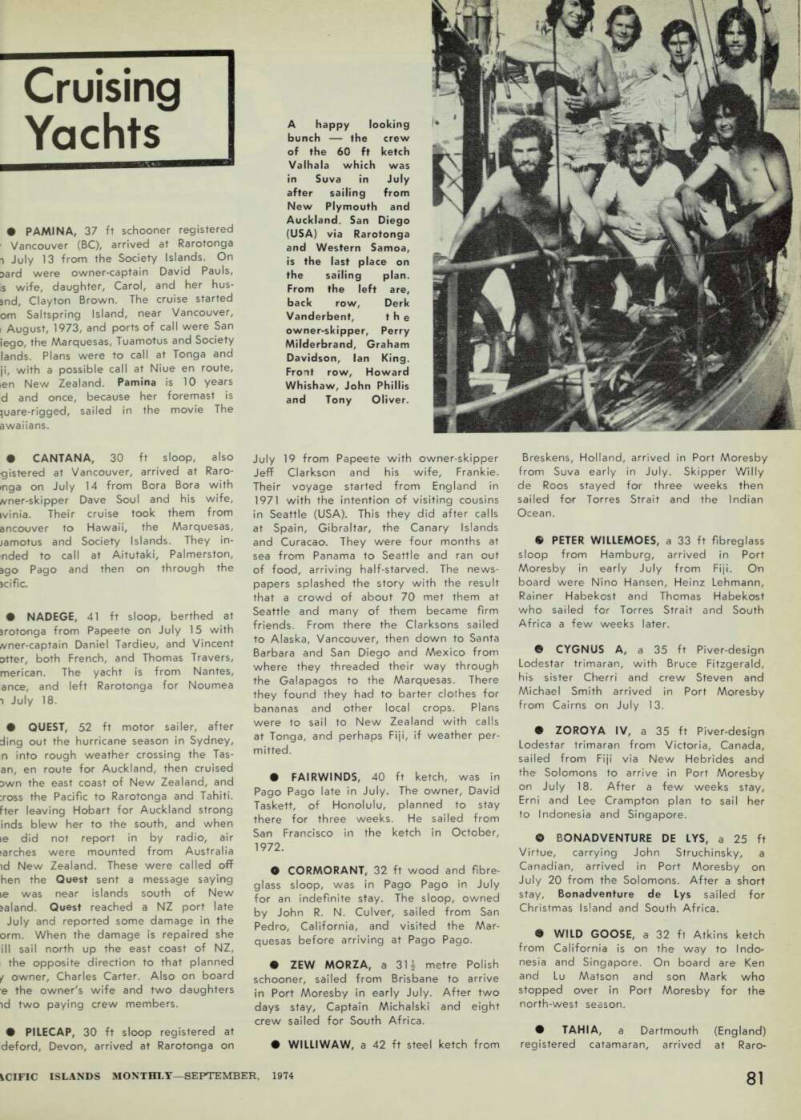

Yachts
• PAMINA, 37 ft schooner registered ■ Vancouver (BC), arrived at Rarotonga i July 13 from the Society Islands. On jard were owner-captain David Pauls, is wife, daughter, Carol, and her hus jnd, Clayton Brown. The cruise started om Saltspring Island, near Vancouver, i August, 1973, and ports of call were San iego, the Marquesas, Tuamotus and Society lands. Plans were to call at Tonga and ji, with a possible call at Niue en route, ien New Zealand. Pamina is 10 years d and once, because her foremast is juare-rigged, sailed in the movie The awaiians. © CANTANA, 30 ft sloop, also gistered at Vancouver, arrived at Raro »nga on July 14 from Bora Bora with /vner-skipper Dave Soul and his wife, ivinia. Their cruise took them from ancouver to Hawaii, the Marquesas, jamotus and Society Islands. They in nded to call at Aitutaki, Palmerston, ago Pago and then on through the acific. • NADEGE, 41 ft sloop, berthed at arotonga from Papeete on July 15 with /vner-captain Daniel Tardieu, and Vincent atter, both French, and Thomas Travers, merican. The yacht is from Nantes, ance, and left Rarotonga for Noumea t July 18. • QUEST, 52 ft motor sailer, after ding out the hurricane season in Sydney, n into rough weather crossing the Tas an, en route for Auckland, then cruised >wn the east coast of New Zealand, and :ross the Pacific to Rarotonga and Tahiti, fter leaving Hobart for Auckland strong inds blew her to the south, and when le did not report in by radio, air larches were mounted from Australia id New Zealand. These were called off hen the Quest sent a message saying le was near islands south of New aaland. Quest reached a NZ port late July and reported some damage in the orm. When the damage is repaired she ill sail north up the east coast of NZ, the opposite direction to that planned owner, Charles Carter. Also on board e the owner's wife and two daughters id two paying crew members. • PILECAP, 30 ft sloop registered at deford, Devon, arrived at Rarotonga on
July 19 from Papeete with owner-skipper Jeff Clarkson and his wife, Frankie.
Their voyage started from England in 1971 with the intention of visiting cousins in Seattle (USA). This they did after calls at Spain, Gibraltar, the Canary Islands and Curacao. They were four months at sea from Panama to Seattle and ran out of food, arriving half-starved. The news papers splashed the story with the result that a crowd of about 70 met them at Seattle and many of them became firm friends. From there the Clarksons sailed to Alaska, Vancouver, then down to Santa Barbara and San Diego and Mexico from where they threaded their way through the Galapagos to the Marquesas. There they found they had to barter clothes for bananas and other local crops. Plans were to sail to New Zealand with calls at Tonga, and perhaps Fiji, if weather per mitted. • FAIRWINDS, 40 ft ketch, was in Pago Pago late in July. The owner, David Taskett, of Honolulu, planned to stay there for three weeks. He sailed from San Francisco in the ketch in October, 1972.
O CORMORANT, 32 ft wood and fibre glass sloop, was in Pago Pago in July for an indefinite stay. The sloop, owned by John R. N. Culver, sailed from San Pedro, California, and visited the Mar quesas before arriving at Pago Pago. © ZEW MORZA, a 31 i metre Polish schooner, sailed from Brisbane to arrive in Port Moresby in early July. After two days stay. Captain Michalski and eight crew sailed for South Africa. • WILLIWAW, a 42 ft steel ketch from
Breskens, Holland, arrived in Port Moresby from Suva early in July. Skipper Willy de Roos stayed for three weeks then sailed for Torres Strait and the Indian Ocean. ® PETER WILLEMOES, a 33 ft fibreglass sloop from Hamburg, arrived in Port Moresby in early July from Fiji. On board were Nino Hansen, Heinz Lehmann, Rainer Habekost and Thomas Habekost who sailed for Torres Strait and South Africa a few weeks later. © CYGNUS A, a 35 ft Piver-design Lodestar trimaran, with Bruce Fitzgerald, his sister Cherri and crew Steven and Michael Smith arrived in Port Moresby from Cairns on July 13. © ZOROYA IV, a 35 ft Piver-design Lodestar trimaran from Victoria, Canada, sailed from Fiji via New Hebrides and the Solomons to arrive in Port Moresby on July 18. After a few weeks stay, Erni and Lee Crampton plan to sail her to Indonesia and Singapore. © BONADVENTURE DE LYS, a 25 ft Virtue, carrying John Struchinsky, a Canadian, arrived in Port Moresby on July 20 from the Solomons. After a short stay, Bonadventure de Lys sailed for Christmas Island and South Africa. • WILD GOOSE, a 32 ft Atkins ketch from California is on the way to Indo nesia and Singapore. On board are Ken and Lu Matson and son Mark who stopped over in Port Moresby for the north-west season. • TAHIA, a Dartmouth (England) registered catamaran, arrived at Rare
A happy looking bunch-the crew of the 60 ft ketch Valhala which was in Suva in July after sailing from New Plymouth and Auckland. San Diego (USA) via Rarotonga and Western Samoa, is the last place on the sailing plan.
From the left are, back row, Derk Vanderbent, the owner-skipper, Perry Milderbrand, Graham Davidson, lan King.
Front row, Howard Whishaw, John Phillis and Tony Oliver.
tonga from Bora Bora on July 31 with owner-skipper-builder James Kings and Wendy Smith. They plan to complete a circumnavigation. Their voyage started from England on October 1, 1973, and they called at Madeira and Canary Is lands, the West Indies, the Cocos Islands —although this put them in the Doldrums —then the Marquesas, Tuamotus and Society islands. Plans were to call at Tonga, Fiji and Darwin. Mr Kings hopes to do another circumnavigation in another vessel in a few years time. • GULL, 27 ft fibreglass auxiliary cutter, arrived at her home port, Guam, on July 15 after a leisurely maiden voyage from Taiwan with extensive visits at Okinawa and Yap (West Carolines).
On board were skipper-owner Dick Justice and crew member Koko Heide from Japan. In December, after the typhoon season, Gull will continue her leisurely circumnavigation via Oceania. • Honiara was "alive" with cruising yachts recently—nine of them in harbour was an all-time record according to yachtie Bram Pieterse writing from the Point Cruz Yacht Club. They came from Germany, Honolulu, Australia, Canada and the USA. A remarkable coincidence was the simultaneous presence of three Lodestar trimarans — ZOROYA IV, from Canada (Lee and Ernie Crampton), YACHT KRANICH, Germany (Berliners Vera and Eckart Lutke), and VUMA from Sydney (Nan and Bram Pieterse). Other visitors included NEPTUNE from Hamburg (Gerard Diekov and Robyn Gras), sloop SEVEN SEAS (Berliners Bridgette and Hans Wolf-Sternig), sloop CAMELOT, from Los Angeles (former deputy sheriff Charley McCain and wife Laura), CHRISTIAN ROSE from Honolulu, RENEGADE and WESTER WIND. The arrival of so many German visitors, writes Bram Pieterse, brought the remark from the local club wit that the anchorage was "becoming a little 'over krauted' • CAMELOT came to grief only hours after leaving Point Cruz. At 2 am the following day, a waterspout tossed her on to a reef near Tagula island in the Louisiade Archipelago. Holed above the waterline, Camelot was high and dry on the reef in a short time. Canoes from a nearby village rescued Laura and Charlie McCain and their tortoiseshell cat, B-l, their ratguard and companion through two years of sailing. A Taiwanese fish ing boat took them to Misima air strip where they got transport to Samarai.
Hope of salvaging Camelot was aban doned and they transferred salvage rights to Nimoa Catholic mission station where "we had received so much assistance", wrote the McCains to PIM. They eventu ally arrived in Brisbane via Port Moresby en-route to America and, having learned that B-l was banned from entry, they
attempted to smuggle her through but Customs found the cat. They told PIM in their letter, in which they asked for help to save B-l, that "no one seems to realise what she means to us —she is part of the crew, part of the family". By the time PIM got the letter, it was all over.
According to a message from the Courier- Mail in Brisbane, B-l had been destroyed.
A Customs Department spokesman said officers had merely applied quarantine laws. The McCains are now at home in Duarte, California. • Among the many yachts which called at Suva over the past couple of months were: MAHLISH, ketch (Don and Esther Brown) on way from Vavau to New Zealand; SILHOUETTE (David Morine, Keith Caldwell, Jeff and Gay Rose) from Auckland; WAYFARER, ketch (Ron and Margaret Sharp, E. Manning, L. Chalfield) bound for Australia from Bay of Islands (NZ); BELINDA, sloop (Kember and Pat McMaster) from Whangarei (NZ); CAVIAR, sloop (John and Dianne Borrachough) from Auckland; PETER WILLEMOES, sloop (Niko Hansen, Thomas and Dianna Haberost and Hernk Lehmann) from Apia; SULA, sloop (Frank and Con MacNamara) from Vavau; KARLOO, sloop (Geoffrey and Ruth Good
man) from Whangarei; KARIE, Blyth Spirit design sloop (Wayne Smith) on way to Vila; ARWEN, yawl (Adrian Hickey and Anne Hill) from Samoa on way to Sydney; TANGERINE, sloop (Geoff Croga, Dirk Hess, Gary McKay and Gloria Kegg) from Vavau; PRINCESS, yawl (Manfred E.
Schmidt, Annie Christonsen, Alison Warren and Ron Hash) from Honolulu. • FLAMINGO— PIM recently had a note from Ron Herrick, owner-skipper of Flamingo, a 31 ft cutter (NZ built of Kauri). For the last couple of years he has been in the Solomons and Bougain ville with wife Dorothy, daughter Lindy and crewman Jim Kingston. They left Kieta in October 1973 for Australia, visit ing Sterling Island, Samarai, Cairns, the Barrier Reef islands, before reaching Mackay for the hurricane season, where Flamingo is undergoing a face lift before the next trip. Present plans are to leave Mackay mid-September with a NZ crew man Chris McNair, calling at New Cale donia, New Hebrides, Fiji, Tonga and reaching Auckland in time for Christmas.
Ron's wife and daughter won't be going on this trip —too much open water, they say!
Advertisements & other items, pp. 83-87 (3 items)
81
U3IFIC ISLANDS MONTHLY—SEPTEMBER, 1974
Water
Australia’s largest and most advanced range of
PRESSURE
SVSTEmS
$l5O
ECON-O-JET
Packaged water systems.
From Only $255 k
From only
Id"
K m /I
AQUA GENIE
Out-performs anything in its price range!
Only $l5O *9
NAME
ADDRESS
m ‘J” Series High Pressure Unit Range of multi-stage deep and shallow well capacities models, from 200 to 2600 g.p.h., pressures from 20 ten 20 p.s.i., depths to 300 ft. From $570 Water Equipment Catalogue 288 Pages—covers pumps of all types, irrigation, water conditioning, domestic and commercial pool filtration. Price $2, post fcee surface mail (enclose cheque/ money order) DUNLOP/IBC LTD., Station Road, Yerrongpilly, 4105. Phone: 40-9011.
HYDRO-PAK (Left) from $320 New RM2 range of shallow and deep well models, capacities to 1180 g.p.h. pressures to 75 p.s.i.
PHONE
rediscovering water
LBQO4IO I.F.
MORE PORTS / OFTEN
KARLANDER
KARLANDER NEW GUINEA LINE: Serving; Pt. Moresby, Samarai, Lae, Madang, Rabaul, Wewak, Manus Is., Kieta, Honiara, Yandina, Gizo, Vila, Norfolk Is., and Lord Howe Is.
KARLANDER KANGAROO LINE: Serving: Los Angeles, San Francisco,
Auckland, Melbourne, Suva, Lautoka.
AUSTRALIAN TERRITORY LINER SERVICES: Serving,- Melbourne,
Sydney, Newcastle, Brisbane, Weipa, Gove, Thursday Is.
with
Managing Agents
KARLANDER (AUSTRALIA) PTY. LIMITED
19-31 Pitt Street, Sydney
General Agents Brisbane: F. H. Stephens Pty. Ltd.
Melbourne: F. H. Stephens (Vic.) Pty. Ltd.
Pt. Moresby: Carpenter Shipping Agencies.
Samarai: Burns Phi Ip (N.G.) Ltd.
San Francisco: Transpacific Transportation Co.
Los Angeles: Transpacific Transportation Co.
Madang: B. J. Back Pty. Ltd.
Yandina; Levers Pacific Plantations Co. Ltd.
Santo; Burns Philp (N.H.) Ltd.
Lord Howe Is.: R. Wilson Leanda Lei.
Thursday Is.: Torres Industries Ltd.
Manus Is.: Edged & Whiteley Ltd.
Rabaul: Rabaul Trading Co. Ltd.
Honiara: E. V. Lawson Pty. Ltd.
Kieta: Breckwoldt & Co. Pty. Ltd.
Lae: N.G.G. Trading Company.
Wewak: Burns Philp (N.G.) Ltd.
Fiji: Burns Philp (S.S.) Ltd.
Gizo: British Solomon Trading Co.
Vila: Burns Philp (N.H.) Ltd.
Norfolk Is.: Burns Philp (S.S.) Ltd.
m V. 3* 3%.
Caterpillar reliability, productivity, availability.
Now you can get it all in a wheel skidder. The 518.
A whole new standard in skidder engineering. 120 turbocharged horsepower, 17,400 pounds of working muscle with full articulation and frame oscillation for stability and minimum maintenance.
Single lever “on the go” powershift. Dual rate steering for controlled response at all speeds.
An operator’s compartment engineered for efficiency with safety features built in for man and machine.
You’ll find all the best skidder ideas, plus added refinement and top quality manufacturing that can make the 518 the backbone of your logging operation.
And Hastings Peering will ensure that your backbone stays in top condition no matter how far in the bush you are. Parts, maintenance, repairs or simply information —we’ll see that you get it fast. That’s People Power!
So go tackle the jungle with the new Cat 518 and Hastings Deering.
People Power:
25 Years in Papua New Guinea
we work as hard,backing-up a single sale,as we do for a fleet. You can depend on it! n
HASTINGS DEERING
YOUR '
CATERPILLAR
DEALER . 1
Throughout Queensland.
Northern Territory and South-West Pacific.
British
airways pacific jet news
ÜBLISHED BY BRITISH AIRWAYS
A PIM ADVERTISING SUPPLEMENT
Hong Kong-Sports Centre Of The Orient
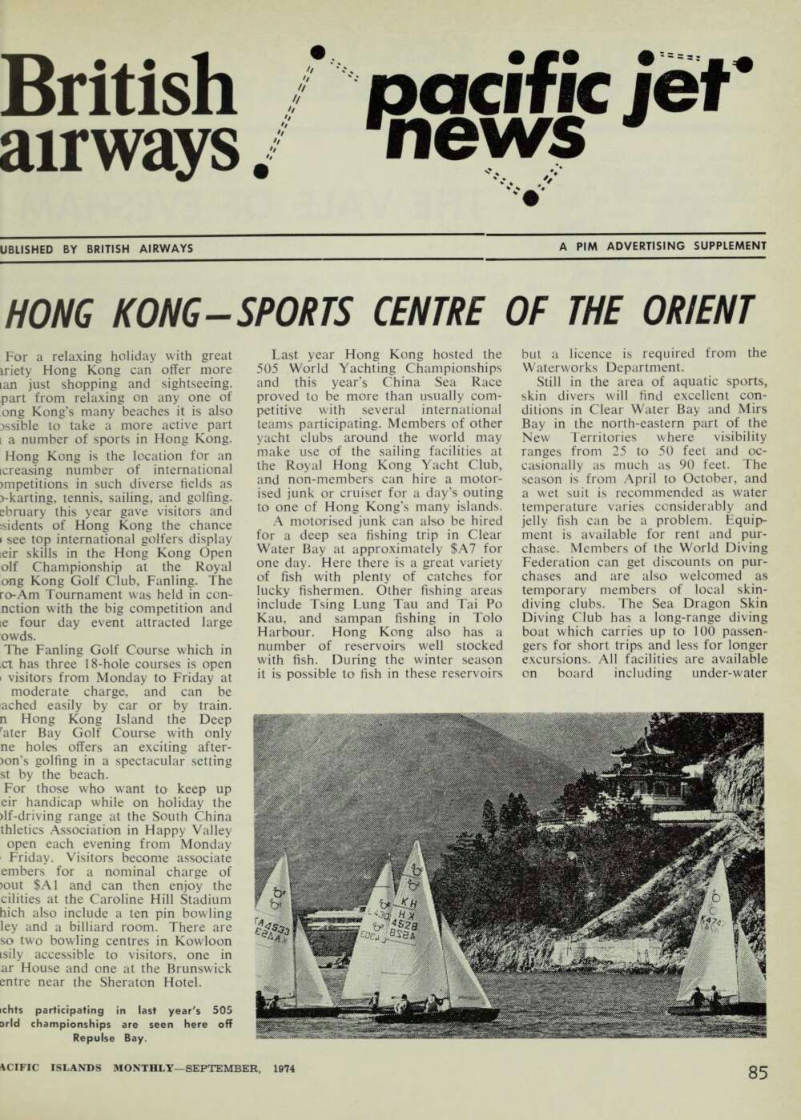
For a relaxing holiday with great iriety Hong Kong can offer more lan just shopping and sightseeing, part from relaxing on any one of ong Kong’s many beaches it is also >ssible to take a more active part i a number of sports in Hong Kong.
Hong Kong is the location for an icreasing number of international impetitions in such diverse fields as >-karting, tennis, sailing, and golfing, ebruary this year gave visitors and ;sidents of Hong Kong the chance ► see top international golfers display ieir skills in the Hong Kong Open olf Championship at the Royal ong Kong Golf Club, Fanling. The ro-Am Tournament was held in con nction with the big competition and ie four day event attracted large owds.
The Fanling Golf Course which in ct has three 18-hole courses is open • visitors from Monday to Friday at moderate charge, and can be ached easily by car or by train, n Hong Kong Island the Deep r ater Bay Golf Course with only ne holes offers an exciting after )on’s golfing in a spectacular setting st by the beach.
For those who want to keep up eir handicap while on holiday the >lf-driving range at the South China thletics Association in Happy Valley open each evening from Monday Friday. Visitors become associate embers for a nominal charge of )Out SAI and can then enjoy the cilities at the Caroline Hill Stadium hich also include a ten pin bowling ley and a billiard room. There are so two bowling centres in Kowloon isily accessible to visitors, one in ar House and one at the Brunswick entre near the Sheraton Hotel.
Last year Hong Kong hosted the 505 World Yachting Championships and this year’s China Sea Race proved to be more than usually competitive with several international teams participating. Members of other yacht clubs around the world may make use of the sailing facilities at the Royal Hong Kong Yacht Club, and non-members can hire a motorised junk or cruiser for a day’s outing to one of Hong Kong’s many islands.
A motorised junk can also be hired for a deep sea fishing trip in Clear Water Bay at approximately SA7 for one day. Here there is a great variety of fish with plenty of catches for lucky fishermen. Other fishing areas include Tsing Lung Tau and Tai Po Kau, and sampan fishing in Tolo Harbour. Hong Kong also has a number of reservoirs well stocked with fish. During the winter season it is possible to fish in these reservoirs
but a licence is required from the Waterworks Department, Still in the area of aquatic sports, skin divers will find excellent con ditions in Clear Water Bay and Mirs Bay in the north-eastern part of the New Territories where visibility ranges from 25 to 50 feet and oc casionally as much as 90 feet. The season is from April to October, and a wet suit is recommended as water temperature varies considerably and jelly fish can be a problem. Equip ment is available for rent and pur chase. Members of the World Diving Federation can get discounts on pur chases and are also welcomed as temporary members of local skin diving clubs. The Sea Dragon Skin Diving Club has a long-range diving boat which carries up to 100 passen gers for short trips and less for longer excursions. All facilities are available on board including under-water
[?]chts participating in last year's 505 [?]orld championships are seen here off Repulse Bay.
scooters, and in the near future there will also be a decompression cham ber. At the moment there is only one decompression chamber at the Royal Navy Base, HMS Tamar.
Water-skiing can be arranged at Deep Water Bay, where the Water Ski Club charges SA9 an hour for a speedboat with operator and skis.
The Happy Valley Race Meetings held through October till May are popular events on Saturday after noons, and now also on some Wed nesday evenings. Off-course betting has recently been introduced and in tensified the interest in these races.
It is also possible to go riding on your own at several stables near Fanling. You can go for a steady trek round the valley or for a more exciting ride on hillside paths if you are an experienced rider.
There are tennis courts at Bowen Road and Victoria Park on Hong Kong Island and at Kowloon Tsai Park in Kowloon.
For spectator sports there is also football, with many international games against visiting teams. Cricket can be enjoyed on Hong Kong’s sedate cricket field in the middle of Central.
British Airways has some exciting new cheap holidays to offer in Hong Kong. There is the two day stopover (not including the air fare) which is available for as little as 5A20.30 per person (sharing a twin room and depending on the hotel chosen) and includes hotel accommodation, air port transfers, continental breakfast and a sightseeing tour.
Complete holidays are available from Sydney and cost from SAB47 for 13 days in Hong Kong, including the air fare. For those with more time available a tour embracing Bali, Singapore, Bangkok, Macau and Japan as well as Hong Kong, taking 35 days, can be bought for 5A1,625 per person. This includes the economy air fare from Sydney, ac commodation in fully air-conditioned budget class hotels, table d’hote meals, airport transfers, gratuities and local taxes.
More information about Hong Kong may be obtained from offices of the Hong Kong Tourist Association at: PO Box 2597, Hong Kong; Bligh House, 4 Bligh Street, Sydney; or Hong Kong Bank Building, 160 San some Street, San Francisco 94104.
Advertisements & other items, p. 87 (1 item)
85
&CIFIC ISLANDS MONTHLY—SEPTEMBER. 1074
The Vale Of Evesham
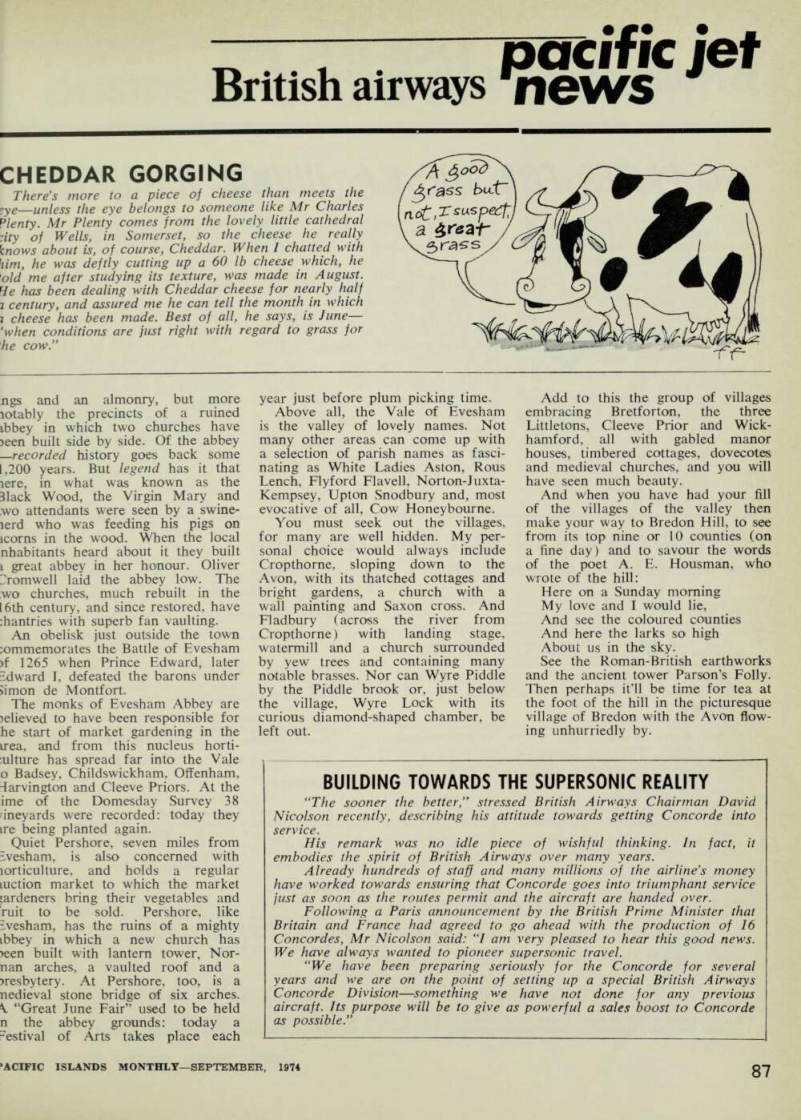
By Ronald Webber
SHAKESPEARE’S Avon—its clear, fish-abundant waters flowing through willowed reedy banks— catches the ancient town of Evesham in a noose of water before twisting and turning its 26 miles to the Severn at Tewkesbury. In and around the noose lies the Vale of Evesham. To the west it stretches as far as the city of Worcester and its eastern boundary is formed by Warwickshire.
Tooking at it from across the low banks of the Avon one sees that the Vale is give over to market garden ing, an industry that forms the character of the whole area. The deep, black earth is ideal for the raising of vegetables: above all it grows asparagus supremely well.
Evesham “grass” as the local people call it, when eaten fresh during the months of May and June is an ex perience even to the most discrimi nating palate. Most of the asparagus is grown in small, individually-owned pockets of land which have to be hand-worked during the season from dawn to dusk. Badsey is one of the main centres for asparagus.
Belts of orchards break up the flat ness. In early summer the plum trees erupt for a short while into a mist of whiteness as millions of buds burst into blossom and give the valley a snow-like covering. This doesn’t last long, but there is always a good chance of seeing it: the local authori ties get together each year and desig
nate a “Blossom Sunday” when motorists in particular can view this wonderful work of nature at its best.
Usually it is round about Easter time.
The recommended “Blossom Trail” is to the north and northwest of Evesham through the hills of the Tenches, along the Evesham-Pershore road and to the north and west of the town of Pershore itself. The finest view of all is perhaps from the top of Hipton Hill, reached by taking the road through Church Tench and on past the crossroads leaving Sheriffs Tench on the right. But for detailed information about the “Blossom Trail”, inquire at any Royal Auto mobile Club Service Centre in the area: the RAC helps to organise the event.
But even if you should miss the “blowth” as they call it around here, it’s worth coming to the orchards in August and September when people swarm in to harvest the yellow and purple Pershore Eggs, the Victorias, Belles de Touvain and other plums.
If you come across a notice inviting you to enter and “pick your own” don’t turn the offer down if you want fresh plums at bargain prices.
There are also apple orchards.
Right in the middle of all this lush ness is the town of Evesham itself.
A pleasant country town with the Avon running through, it has a few timber-framed and Georgian build
ngs and an almonry, but more lotably the precincts of a ruined ibbey in which two churches have peen built side by side. Of the abbey —recorded history goes back some 1,200 years. But legend has it that iere, in what was known as the Slack Wood, the Virgin Mary and wo attendants were seen by a swine lerd who was feeding his pigs on icorns in the wood. When the local nhabitants heard about it they built i great abbey in her honour. Oliver Cromwell laid the abbey low. The wo churches, much rebuilt in the 16th century, and since restored, have chantries with superb fan vaulting.
An obelisk just outside the town commemorates the Battle of Evesham )f 1265 when Prince Edward, later idward I, defeated the barons under >imon de Montfort.
The monks of Evesham Abbey are pelieved to have been responsible for he start of market gardening in the irea, and from this nucleus horti culture has spread far into the Vale o Badsey, Childswickham, Offenham, darvington and Cleeve Priors. At the ime of the Domesday Survey 38 dneyards were recorded: today they ire being planted again.
Quiet Pershore, seven miles from ivesham, is also concerned with lorticulture, and holds a regular mction market to which the market gardeners bring their vegetables and ruit to be sold. Pershore, like ivesham, has the ruins of a mighty ibbey in which a new church has >een built with lantern tower, Nor nan arches, a vaulted roof and a presbytery. At Pershore, too, is a nedieval stone bridge of six arches.
“Great June Fair’’ used to be held n the abbey grounds; today a -estival of Arts takes place each
year just before plum picking time.
Above all, the Vale of Evesham is the valley of lovely names. Not many other areas can come up with a selection of parish names as fascinating as White Ladies Aston, Rous Lench, Flyford Flavell, Norton-Juxta- Kempsey, Upton Snodbury and, most evocative of all, Cow Honeybourne.
You must seek out the villages, for many are well hidden. My personal choice would always include Cropthorne, sloping down to the Avon, with its thatched cottages and bright gardens, a church with a wall painting and Saxon cross. And Fladbury (across the river from Cropthorne) with landing stage, watermill and a church surrounded by yew trees and containing many notable brasses. Nor can Wyre Piddle by the Piddle brook or, just below the village, Wyre Lock with its curious diamond-shaped chamber, be left out.
Add to this the group of villages embracing Bretforton, the three Littletons, Cleeve Prior and Wick hamford, all with gabled manor houses, timbered cottages, dovecotes and medieval churches, and you will have seen much beauty.
And when you have had your fill of the villages of the valley then make your way to Bredon Hill, to see from its top nine or 10 counties (on a fine day) and to savour the words of the poet A. E. Housman, who wrote of the hill: Here on a Sunday morning My love and I would lie, And see the coloured counties And here the larks so high About us in the sky.
See the Roman-British earthworks and the ancient tower Parson’s Folly.
Then perhaps it’ll be time for tea at the foot of the hill in the picturesque village of Bredon with the Avon flow ing unhurriedly by.
Stopover in Hong Kong
Many travellers like to spend a few days in Hong Kong on their way to Britain. Apart from seeing this beautiful island and the fascinating New Territories, it gives the opportunity of a wonderful shopping spree.
Hong Kong, which is on British Airways routes from Sydney and Melbourne on the way to Britain, can be visited on a special cheap stopover package which has been produced by the airline for its passengers.
This gives the choice of five hotels and the price includes accommodation for two nights, continental breakfast, service charges, transport between airport and hotel and a half-day sightseeing tour by air conditioned motor coach either of Hong Kong island or of Kowloon and the New Territories.
Prices are from $ A 20.30 and further information is obtainable from any office of British Airways or from your travel agent.
Cheddar Gorging
There’s more to a piece of cheese than meets the zye —unless the eye belongs to someone like Mr Charles Plenty. Mr Plenty comes from the lovely little cathedral :ity of Wells, in Somerset, so the cheese he really knows about is, of course, Cheddar. When I chatted with him, he was deftly cutting up a 60 lb cheese which, he 'old me after studying its texture, was made in August.
He has been dealing with Cheddar cheese for nearly half 2 century, and assured me he can tell the month in which 2 cheese has been made. Best of all, he says, is June — 'when conditions are just right with regard to grass for he cow.”
Building Towards The Supersonic Reality
“The sooner the better,’* stressed British Airways Chairman David Nicolson recently, describing his attitude towards getting Concorde into service.
His remark was no idle piece of wishful thinking. In fact, it embodies the spirit of British Airways over many years.
Already hundreds of staff and many millions of the airline’s money have worked towards ensuring that Concorde goes into triumphant service just as soon as the routes permit and the aircraft are handed over.
Following a Paris announcement by the British Prime Minister that Britain and France had agreed to go ahead with the production of 16 Concordes, Mr Nicolson said: “1 am very pleased to hear this good news.
We have always wanted to pioneer supersonic travel.
“We have been preparing seriously for the Concorde for several years and we are on the point of setting up a special British Airways Concorde Division—something we have not done for any previous aircraft. Its purpose will be to give as powerful a sales boost to Concorde as possible.”
Advertisements & other items, p. 89 (1 item)
British airways
87
‘ACIFIC ISLANDS MONTHLY—SEPTEMBER, 1974
Big Prizes For The B.A. Junior Jet-Setters!
Uncle Peter asks British Airways Junior Jet-Setters to write stories about their holidays, real or imagined, and is offering some wonderful prizes.
Here is what he has to say: Do you sometimes have the feeling that you could tell a good story (other than the ones you make up especially for Mum!)? Perhaps when you are older, you will write a book or ... on the other hand maybe you are more interested in reporting the way things really are.
Well, here’s a chance to try yourself out. I’m not judging your spelling or grammar (enough of that at school I guess), only how well you make up a story or how well you report an incident, picking out the principal things that interest more people.
Here is an idea to get you going: you could write a story of a family going on holiday in the year 2000 or 1974, or even 1674!
You could talk of the places, people and animals that they meet and see and you should do all you can to read and learn about the dif ferent people and use the facts that you have gathered together to build up your story.
What I need to know about you is: your name and address; your age; your junior jet club mileage; and whether the basis of your story is true or imaginary.
Prizes are the same for those who enter for the true story competition as well as for the imaginary story competition. They are:
Ist. A Li-lo airbed 72 in. x 29 in. 2nd. A black leather writing case complete with notepaper pad and envelopes. 3rd. The Travellers Digest—an in teresting guide book covering six continents. 4th. There are 20 fourth places of a pack of playing cards.
Every entry will be acknowledged.
The closing date for this competi tion is September 30, 1974. You should mail your entries either direct to me: Uncle Peter, British Airways, PO Box 1361 Suva, FIJI or to your travel agent who will send it to me.
September
Coming Events In Britain
Some highlights of the next few months
2 International Air Show. Farnborough, Hampshire, to 8 September. 7 Braemar Royal Highland Gathering. Braemar, Aberdeenshire. 12 World 3-Day Event Championship (Horse Trials). Burley, Ringwood, 14 Horse Racing; St Leger Doncaster, Yorkshire. 27 Newcastle Festival Newcastle upon Tyne, Northumberland, to 13 October.
October
4 Windsor Festival Windsor Castle & Eton College, Windsor, Berkshire to 12 October. 5 National Brass Band Championships Royal Albert Hall, London. 7 Horse of the Year Show Wemb ey, London to 12 October. 15 Royal Ulster Agricultural Society Annual Show & Sale Balmoral, Belfast to 17 October. 16 International Motor Exhibition Earls Court, London to 26 October. 19 Bath Bach Festival Bath, Somerset to 26 October. 19 Ladies' Kennel Association Championship Dog Show Olympia, London. 19 Rugby; Wales v Tonga (Union) Cardiff Arms Park, Cardiff. 21 Kensington Antique Fair Kensington, London to 26 October.
November
3 RAC Veteran Car Run London/Brighton, Sussex (provisional). 7 International Caravan & Camping Show Earls Court, London to 16 November. 9 Lord Mayor's Procession & Show Guildhall to Royal Courts of Justice, London. 10 Queen's University Festival in and around Queen's University, Belfast to 23 November. 10 Remembrance Service Westminster Abbey, London. 11 Tennis: Dewar Cup Royal Albert Hall, London to 16 November. 16 Rugby Football; Ulster v New Zealand Ravenhill, Belfast. 25 Churchill Exhibition ''Churchill the Writer" Kings Library gallery, British Library, British Museum, London to January. 30 National Cat Club Championship Show Qlympia, London.
December
2 Royal Smithfield & Agricultural Machinery Exhibition Earls Court, London to 6 December. 4 Richmond Championship Dog Show Olympia, London and 5 December. 16 D'Oyly Carte Opera Company Sadler's Wells Theatre, London to 22 March. 18 Dunhill International Show Jumping Championships Olympia, London to 21 December.
January, 1975
European Architectural Heritage Year Throughout Europe January to December. 1 International Racing Car Show Olympia, London to 11 January. 1 International Boat Show Earls Court, London to 11 January. 1 Camping, Outdoor Life & Travel Exhibition Olympia, London to 12 January. 4 The Holiday '75 Show Olympia, London to 12 January.
February
1 Rugby: Scotland v Ireland (Union) Murrayfield, Edinburgh. 1 Rugby: England v France (Union) Twickenham, Middlesex. 7 Cruft's Dog Show Olympia, London and 8 February. 14 English Folk Dance & Song Society Festival Royal Albert Hall, London and 15 February. 15 Rugby: Wales v England (Union) Cardiff.
March
1 Rugby: Scotland v Wales (Union) Murrayfield, Edinburgh. 4 Daily Mail Ideal Home Exhibition Olympia, London to 29 March. 15 Rugby: England v Scotland (Union) Twickenham, Middlesex. 15 Rugby Football: Wales v Ireland (Union) Cardiff Arms Park, Cardiff.
May
21 Chelsea Flower Show Royal Hospital, Chelsea, London to 23 May provisional. 23 Bath Festival Bath, Somerset to 1 June. 28 Bath & West Show Shepfon Mallet, Somerset to 31 May.
Advertisements & other items, p. 90 (1 item)
British airways
88
PACIFIC ISLANDS MONTHLY— SEPTEMBER, 1974
„ . . pacific jet British airways
Business and Development

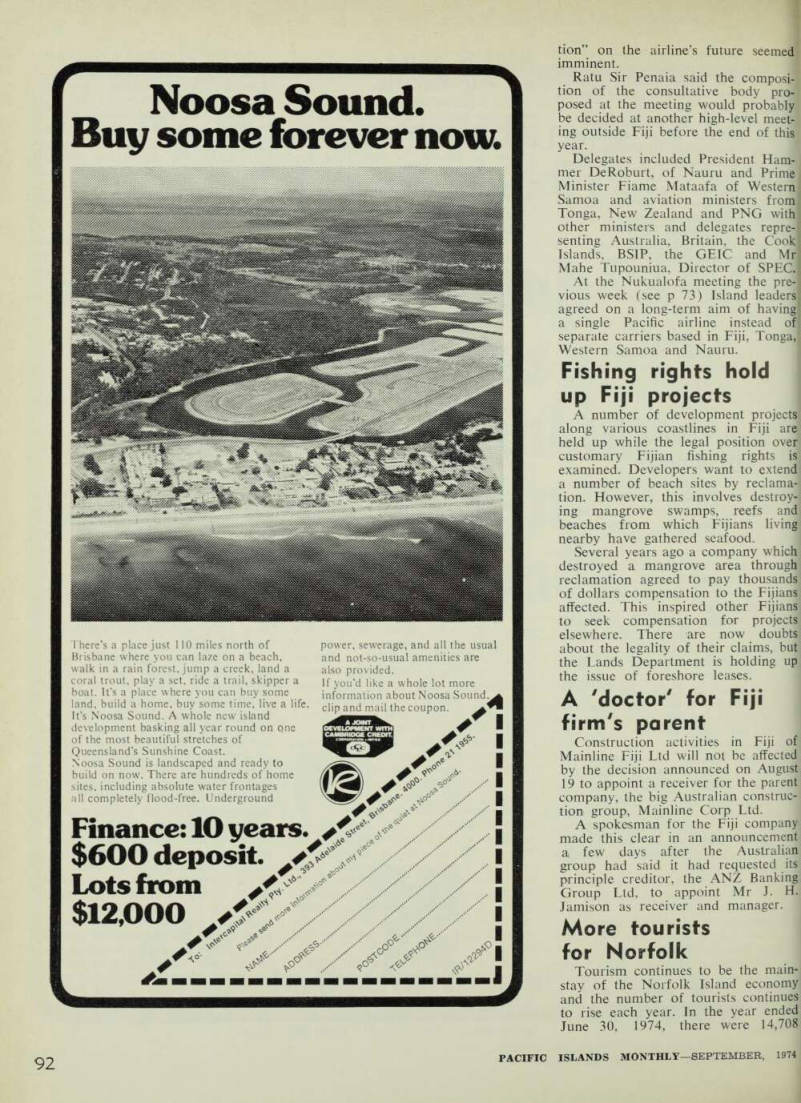
Experts Say Coconuts Can Be
Milked For Another $100 Mil
The coconut industry, with outlets eight of the world’s major mar jts, could earn at least SUSIOO illion a year more by 1980. This pire, based on 1971 prices, is what Lperts came up with in a United ations survey made at the request r the governments of 10 countries eluding Papua New Guinea, Fiji, onga, the GEIC, the Solomons, Western Samoa and the Philippines.
Coconut oil consumption could be creased by up to 250,000 tons— )out 40 per cent —for edible use by >BO, and by about 130,000 tons (a larter) for inedible use. Desiccated )conut use could rise by about a ird (35,000 tons), and copra cake id meal consumption by more than K),000 tons, if supplies were avail )le. The prospects for shell char mi were less clear, with growth rgely dependent on Japan to offset jssible losses elsewhere.
To realise opportunities, the edible le of the market would depend on >sitive action by the producers to welop their markets. On the in- Lible side, virtually all the growth as “natural”, inherent in the ex acted development of the “end-uses” arket.
Strictly on the marketing side of >conut selling—which was in the mds of individual countries and oducing enterprises—some specific eas of possible action were clear: • Concluding long-term supply with major importers to otect the market and ensure buyers : supplies at relatively stable prices; • The development of the market r the methyl esters of coconut oil, be sold to fatty alcohol acid and kylolamide producers (or direct to itergent companies) instead of ude oil; • The development (as by Monte :gro in the Philippines) of carbon :tivation on a contract basis for irbon activators in the importing amtries. (This is only a possibility; >conut-activated carbon is not arketable on its own to end-users.) The prospects for sales of fatty
acids, fatty alcohols and glycerine to the eight countries surveyed appeared to be virtually nil. In the case of the acids and alcohols, that was because there was almost no market in bulk products to end-users, while processors were not interested in buying semi-finished material in that form.
The survey, dealing with market development and strategy, said an opportunity clearly existed to stimulate consumption in the eight markets of edible coconut oil and copra cake by joint promotional activity within the framework of the Asian Coconut Community. • An attempt had to be made to stabilise prices, which could include collection and dissemination of better information on supply conditions, long-term contracts with key buyers, and by producer country governments adopting clear, consistent policies on export supplies; • As in the long-term increased
supplies would be required, new plantings should start immediately as a guarantee to buyers of continued supply. In the short-term, supply conditions could be improved by better handling in the producing countries; • Effective grading standards and better quality control would consider ably increase buyers’ confidence and the return to the producers; • Continued development of new coconut products was essential to the strength of the market. Producing countries should concentrate on new uses, either entirely new as in the case of coconut protein products, or new to export trade, as in the case of coconut milk or water products.
A coconut promotion board could be established by the Asian Coconut Community to control, co-ordinate and direct promotional and market development programmes. In selected end-user markets, local bodies should be established, in co-ordination with
>cal users, to plan and execute larket development programmes, hose local bodies should appoint rofessional advisers to carry out the etailed work of public relations, ivertising and market research.
The activities of the coconut pro lotion board could be financed by a ivy on coconut exports by members f the Asian Coconut Community, hat would be about half of one sr cent of the fob value provided utline programmes suggested in the irvey were adopted in full.
The promotional budgets suggested >talled less than SUSI million in the rst year, rising to about SUS 3 lillion in the fifth year. In addition > the specific promotional budgets, dministrative and other expenses ere likely to be about $U5750,000.
Without that expenditure the poten al growth might be about SUS3O lillion, compared with the SUSIOO lillion envisaged. Even then the rospects for SUS3O million growth ould be uncertain.
down
m Fiji money
The Fiji Government has clamped own on the movement of money out f Fiji in an effort to conserve bout $2 million in overseas funds, he controls are aimed at cutting the nnual amount spent by Fiji people n overseas trips, education, invest lent, gifts and allowances from $8 lillion to S 6 million. These are the lain measures: • A resident migrating to another ountry may take no more than 30,000 on departure. The remainder lay be withdrawn in the next three ears after departure; • A limit of 52,000 for an over ;as holiday, but the amount may be ccumulated for two years; • Limit of $3OO on cash gifts previously $500); • Remittances to overseas de endants now $l,OOO a year (pre iously $2,000), but $2,000 may be Dent in cases of special need; • Overseas education allowances emain at $4,000, but more support ig documents will be needed; • Purchase of shares in foreign ompanies banned; • A resident may not invest in a ouse overseas, unless he plans to ve in it permanently.
Spending on overseas business trips dll not be curtailed, but will come nder tighter official scrutiny.
The Finance Minister, Mr Charles tinson, said there had been a worry ig fall in foreign reserves and a rise i import costs. It was not a very appy situation for a developing ountry.
Islands agree
on Air Pacific
Civil aviation ministers and repre sentatives from 11 countries including Fiji have agreed that additional capi tal should be made available to Air Pacific to ensure “a firm base for continuing and viable operations to provide reliable services”. The agree ment came at a four-day meeting which ended in Suva on August 22.
Most ministers gave assurances that the necessary money would be forth coming. They also considered pro posals for restructuring the airline to increase the degree of ownership by Island governments, including Fiji, said a joint communique.
The meeting decided a consultative body should be set up to achieve broad policies on regional co-opera tion in civil aviation in the best interests of the island nations; explore practical ways and means of co operation between Island airlines operating in the region and consider means of restructuring air services either in single airline concept or to allow for the varying interests of the Island nations.
After the meeting Fiji’s Minister for Communications, Works and Tourism, Ratu Sir Penaia Ganilau, who was chairman, said the future of Air Pacific “had been discussed at some length”. A “satisfactory solu
tion” on the airline’s future seemed imminent.
Ratu Sir Penaia said the composi tion of the consultative body pro posed at the meeting would probably be decided at another high-level meet ing outside Fiji before the end of this year.
Delegates included President Ham mer Deßoburt, of Nauru and Prime j Minister Fiame Mataafa of Western Samoa and aviation ministers from!
Tonga, New Zealand and PNG with ; other ministers and delegates repre senting Australia, Britain, the Cookl Islands, BSIP, the GEIC and Mrl Mahe Tupouniua, Director of SPEC.!
At the Nukualofa meeting the pre-j vious week (see p 73) Island leaders! agreed on a long-term aim of having! a single Pacific airline instead of separate carriers based in Fiji, Tonga,!
Western Samoa and Nauru.
Fishing rights hold
up Fiji projects
A number of development projects along various coastlines in Fiji are held up while the legal position over customary Fijian fishing rights is examined. Developers want to extend a number of beach sites by reclama-j tion. However, this involves destroy ing mangrove swamps, reefs and; beaches from which Fijians living nearby have gathered seafood.
Several years ago a company which destroyed a mangrove area through reclamation agreed to pay thousands] of dollars compensation to the Fijians affected. This inspired other Fijians to seek compensation for projects elsewhere. There are now doubts about the legality of their claims, but the Lands Department is holding up the issue of foreshore leases.
A 'doctor' for Fiji
firm's parent
Construction activities in Fiji of Mainline Fiji Ltd will not be affected by the decision announced on August 19 to appoint a receiver for the parent company, the big Australian construe-j tion group, Mainline Corp Ltd.
A spokesman for the Fiji company made this clear in an announcement a few days after the Australian group had said it had requested its principle creditor, the ANZ Banking Group Ltd, to appoint Mr J. H.
Jamison as receiver and manager.
More tourists
tor Norfolk
Tourism continues to be the main stay of the Norfolk Island economy and the number of tourists continues to rise each year. In the year ended June 30, 1974, there were 14,708
iitors, compared with 12,476 in •73, and 11,054 in 1972.
The Administrator, Air-Commo >re E. T. Pickerd, addressing the st meeting of the seventh Island Duncil, said that in the current year, e bicentenary year, there was a •ong indication that the current ve\ of tourists would, at least, be aintained.
He told the council that the import 11 for 1973-74 was expected to be ore than $5 million. As the island ,d to rely increasingly on imports, was only natural that both the pub and private sectors had felt and fleeted the impact of price rises and Blation.
In 1973-74, revenue was expected exceed $1 million—final figures ;re not yet available. All the main urces of revenue, except company ;s, were above estimate. The main eeipts were: Customs, $313,000; imps, $169,600; company fees, 44,500; liquor profit, $121,000. The jmmonwealth Government grant is $120,000.
Expenditure for 1973-74 was esti ated at $829,700. There was some mmitted, but unspent, money from 73-74, which would need to be re ted for 1974-75. There were in sases in some of the major items expenditure, in particular educa »n, health and social welfare, areas lere there was little local control.
Air-Commodore Pickerd said that r 1974-75, revenue was estimated be $950,600, and expenditure 62,400.
iore in Pacific
ay packets
Pay packets became heavier in yeral parts of the Pacific in July d August. In Western Samoa, the vernment ordered a minimum rate $1.50 a day for all wage earners tside the public service.
Men working on the new Suva idi road in Fiji won a rise of 20c hour to 72c. But fellow workers iployed by other Fiji construction mpanies were on strike for higher y.
In Papua New Guinea, the salaries all national public servants receiv -1 not more than $7,015 a year, ;re lifted by $225 a year, subject variation when the Consumer Price dex figures for the June quarter e published. The Public Service >sociation has agreed that no hir er salary increases based on the st of living will apply before July 1975.
The minimum urban wage in ipua New Guinea was raised to $l5 week, and a hike in the rural wage is been granted. (See p 94.)
An Arabian
nights' dream?
King Taufa’ahau Tupou returned to Tonga in July from Saudi Arabia talking in terms of a million dollar project—carrying cement from Taiwan and South Korea to Saudi Arabia. Saudi Arabia imports two thirds of her cement from those countries.
He said Saudi Arabia had asked the Pacific Navigation Co, of Tonga, to submit estimates for the service and to say how regularly it could operate. Two-thirds of Saudi Arabia’s cement requirements could run into hundreds of thousands of tons. With an agreed rate of $lO to $l5 a ton, a million dollar project could result.
When all expenses were deducted the profit should be considerable.
The king said the present indica tions were that the activities of the Pacific Navigation Co would increase to a stage where opening of an office in London would be warranted.
The prime reason for his visit to Saudi Arabia was to ensure that Tonga would not be affected by any sudden oil shortage, by making ar rangements for larger Tongan ships in the class of bulk carriers to be refuelled in Arab ports. Negotiations, however, were not yet complete, as Tonga had not confirmed the size and type of bulk carrier it would use.
When it acquired its first carrier Tonga would make definite submis sions.
Saudi Arabia knew very little about Tonga. When it was known there that he was to make a visit, the Saudi Arabia authorities asked about Tonga at the office of the British High Commissioner, and read all that was possible. But they were mystified about Tonga’s wish to make contact, and also about what Tonga might need.
They thought that Tonga might be after a $lOO million grant, and were very surprised when the king told them that what he wanted was a
simple business negotiation for help,
or an assurance, over a continuous oil supply. He believed it was the first time Saudi Arabia had negoti ations with a small country like Tonga.
The king said it was hoped, while the Suez Canal was being cleared, to acquire the ships Tonga needed.
Once the canal was opened, Tonga would be able to go ahead and meet its obligations with its fleet. If plans for a bulk ore carrier and the car riage of cement to Saudi Arabia came to fruition it would mean that the centre of gravity for the activities of
the Tongan fleet had been transferred from the Pacific to the Indian and Atlantic Oceans.
Now Fiji has
a Woolworths store
The Carpenter group in Fiji engaged in a public relations exercise when it asked Mrs Grace Deoki to open its Woolworths store in Suva in July. Mrs Deoki, president of the Fiji National Council of Women, re ceived a table of groceries from the managing director of Carpenters Fiji Ltd, Mr Lyle Cupit, which, she said, she would hand over to the St Chris topher’s Home for Children.
The official opening was several months after the store opened its doors for business on December 1, 1973. It is a wholly-owned Carpenter operation with no connections with Woolworths chain stores in the USA, Australia or New Zealand, although it operates on similar lines. The US and the Australia-New Zealand Wool worths are also independent of each other.
Carpenters registered the name Fiji Woolworths in 1963. Mr Cupit said the group was considering opening more Woolworths stores in other
Princess Pilolevu, the only daughter of King Taufa'ahau Tupou, of Tonga, who will play a full and active role in the Tongan tourist industry as education and training officer of the Tonga Visitors' Bureau. One of her first tasks is to help a group from the United Nations, visiting Tonga in September, to run a three months hotel and travel agency training course. Legislation to create a tourist board to regulate, maintain and control the tourist industry in Tonga has been prepared. Under the legislation the board will control licensing of agents, hotels and tourist enterprises. The legislation is aimed at giving local people the chance to take part in all tourist enterprises and
developments.
parts of the country. The stores cater for middle to low income earners and specialise in quick, large-scale sales of goods householders need for every day use. Mr Cupit expects sales in the first year to realise more than $3 million.
Nauru enriching
its riches
The Nauru Phosphate Corporation is installing a calcination plant de signed to produce the highest quality phosphate in the world. It is being erected on the southern side of the drying plant. Calcination reduces the excess carbonate and organic matter in phosphate, which can then be con verted into clear phosphoric acid.
This premium grade phosphate is used to produce a number of in dustrial products and complex ferti lisers.
The plant was designed by West’s (A’asia) Ltd after tests on a scaled down pilot plant in Australia. A sub sidiary company, West’s Nauru Ltd, is erecting the plant. West’s Nauru has sub-contracted the steel erection work to Steel Mains Pty Ltd, which is also erecting a new one million gallon fresh water storage tank near the NPC Staff Club.
Killing the goose?
The Fiji tourist industry has been told to pull up its socks, or face hard times. Advocates for promotion of the industry throughout the 1950 s
told of the benefits Fiji would gain from the tourist industry. No doubt there have been many financial bene fits, but at a cost, Mr Raj Singh, from the Fiji Minis try of Tourism, told a recent meeting of the Fiji Visitors’ Bureau board that letters of complaint from visitors already filled two files, and a third file had been started. The FVB man ager for western Fiji, Mr Radike j Qereqeretabua, in his monthly report to the board, also listed a number of complaints.
He said three Nadi duty-free dealers did no good to the name of their town or to Fiji by their activi-j ties. These included brandishing wea-J pons and swearing at visitors.
Planters will feel
the squeeze
Lean times are ahead, say Papua; New Guinea’s planters and farmers as they contemplate future profits whittled down by the latest award of an $8 a week minimum wage for rural workers.
It was the second attempt by Min ister for National Development, Mr Gavera Rea, to create a new basic; figure for the rural workers. His first; wages board recommended a $6.40 minimum, a 50c rise on the previous] rate, but that wasn’t enough. He appointed a second board and its recommendation of a basic $8 has dismayed the primary producers.
Some planters are talking of fall ing sales, of unemployment and even plantations closing down. But they have failed to frighten the workers, who, according to one representa tive, would be happy to take over any plantation which closed.
Biggest wages bills will have to be footed by expatriate planters but some point out “localisation” is fast approaching and indigenous planta tion owners will find themselves saddled with a wages burden. The people of four villages in the Madang district now own Militat plantation which was recently handed over to them by the government under a scheme for “rural people to secure a more equitable share of wealth”.
But world prices for copra and cocoa are likely to remain high, the optimists say. There’s not the same hope for the tea, coffee and rubber planters.
Some planters, with fingers crossed, are hoping the industrial registrar will disallow the award, as he can do if he feels it is not in the national in terest. If he doesn’t, they say, primary food prices will shoot up.
Meanwhile, a minimum wages board is considering a new basic wage for urbanites.
Tonga's trade in the red
Tonga had a huge trade deficit of more than 5T4.75 million in 1973-74.
Imports cost $T7,996,601, while ex ports, mainly copra, earned $T3,244,594. Food accounted for about one-third of the import bi115T2,287,052. $T2,287,052. Frozen and preserved meat ($T680,000) and flour (more than $T630,000) accounted for more than half of the food imports.
Other big import items were ma chinery, motor vehicles and parts, about ST2 million, petroleum, $T581,251, and liquor, cigarettes, cigars and tobacco, $7707,874. The major suppliers were New Zealand and Australia, who provided goods worth more than STS million. Other main import sources were Britain, Japan, Fiji, Iran, Hong Kong and the US.
Tonga’s copra exports in 1973 rose only marginally on the 1972 figure—
from 12,250 tons to 12,362 tons —but the value more than doubled, from $T1,064,570 to $T2,175,461, reflect ing the buoyant world market. Other earners of export income were de siccated coconut, $T371,068; bananas, $T306,435; water melons, 5T157,341; handicrafts and curios, $T'33,889; ground food, such as taro, yams, etc, $T27,074; and tomatoes, $T23,089.
Tonga’s major markets were Hol land, 5T827,925; Australia, $T731,966; New Zealand, $T672,730; Norway, $T348,331; Britain, 5T188,525; Denmark, 5T165,711; West Germany, $T165,656.
Revenue collected by the Customs Department on dutiable imports valued at 5T4,821,824, was 5T1,244,004.
In 1972-73, there was a surplus of about $350,000 in the balance of pay ments.
Advertisements & other items, pp. 91-92 (2 items)
89
ICIFIC ISLANDS MONTHLY—SEPTEMBER, 1974
40% of the banking
Do you want to do business
in New Zealand?
Ask die bank
which has
40% of the banking
business in
New Zealand
The BNZ can give you full information on buying or selling in New Zealand and overseas.
Full information on investment, movement of money, transfers of dividends etc. is also readily available.
There are offices everywhere, more than 400 in fact.
Whatever your financial or trade needs, the BNZ can help you.
Wellington - International Division, Box 2392.
Sydney - GPO Box 507, Sydney,
N.S.W. 2001.
Melbourne - GPO Box 528 E, Melbourne, Vic. 3001.
Tokyo - Mr G. Scott, Bank of New Zealand Representative Office, Japan, Suite 240, New Tokyo Bldg, 3-1, 3-Chrome, Marunouchi, Chiyoda-ku, Tokyo 100.
Singapore - Mr R. F. Warren, Bank of New Zealand Representative Office, South East Asia. 4th Floor, Ramayana Bldg, 45/47 D, Robinson Rd, Singapore.
London - PO 6ox 402, London EC4.
Fiji - 25 Victoria Parade. Also at Labasa, Lautoka, Nadi, Sigatoka, Ba. n
Bank of New Zealand
New Caledonia plans
Paris treads warily over New Caledonia plans
From a Noumea correspondent
As the French Sixth Plan draws to an end, marked by dramatic failure as far as the objectives for New Caledonian nickel are concerned, Noumea authorities are now warily setting up goals for the Seventh Plan, through 1976-80.
Whereas previously, it had been predicted that New Caledonia would be exporting up to 200,000 tons of nickel metal by 1976, latest cautious estimates call for the production of just 120,000 tons by 1980. This would be made up of about 80,000 tons from the SEN, 18,000 tons as the initial level of output at the factory to be built in the north around Poum- Koumac and some 20,000 tons from a factory planned to treat lateritic nickel ore in the south of the island around Goro-Port Boise.
To achieve this target, the plan prescribes that there must be assistance with the building up of necessary infrastructure, as well as an effort to limit price rises and wage increases while improving productivity and allowing suitable tax concessions to the French companies involved. All of this is much more cautious than the optimistic 1969 assertions that by 1976 New Galedonia’s nickel would be earning annually for France enough foreign currency to equal one third of the nation’s (low) foreign reserves at that time.
As far as future nickel ore exports are concerned, the object would be to meet Japan’s needs of around 3.5 million tons a year. At the same time, the French would continue prospecting for other minerals,
especially searching the seabed for oil.
After mining, the second main in dustry treated by the French Plan for New Caledonia is tourism. Here it is hoped that the number of overseas visitors to the island will reach 85,000 by 1980, compared with 12,000 in 1973 and an expected 24,000 this year. The 1980 goal de pends on a high inflow of Japanese tourists, together with an increase in hotel capacity of international stan dard from the current 1,000 to an eventual 1,500 rooms, The poorest Caledonian sector, that of agriculture and livestock, underlines the need for the territory to reduce the expenditure of valuable foreign currency for imported food stuffs. It is hoped that local produc tion should thus satisfy 70 per cent of local demand for beef, 100 per cent of pork and poultry needs, 75 per cent of fresh vegetables and 100 per cent of tropical foodstuffs. Judg ing by agricultural performance to date, great strides would need to be made in the organisation of local production and sales distribution to achieve these goals, as New Cale donia currently relies on the outside world to supply about SA3O million worth of foodstuffs annually, No-one can blame the Caledonians, after seeing the outcome of the Sixth Plan, for being highly sceptical about the Seventh. Yet, judging by the rapid expansion of port, airport and general construction works around Noumea, Paris planners are obviously prepared to invest heavily in projects for the island.
Advertisements & other items, pp. 93-96 (3 items)
91
ACIFIC ISLANDS MONTHLY—SEPTEMBER, 1974
Noosa Sound.
Buy some forever now.
i 3 i s iW lip There’s a place just 110 miles north of Brisbane where you can laze on a beach, walk in a rain forest, jump a creek, land a coral trout, play a set, ride a trail, skipper a boat. It’s a place where you can buy some land, build a home, buy some time, live a life.
It’s Noosa Sound. A whole new island development basking all year round on qne of the most beautiful stretches of Queensland's Sunshine Coast.
Noosa Sound is landscaped and ready to build on now. There are hundreds of home sites, including absolute water frontages all completely flood-free. Underground
Finance: 10 years, y
$6OO deposit. /
Lots from 6
$12,000 / * & power, sewerage, and all the usual and nqt-so-usual amenities are also provided.
If you’d like a whole lot more information about Noosa Sound^ y* clip and mail the coupon. ✓ ✓ ✓ ✓ m kV r vCT Jp
Bn Vila
visit the
studia-museawn
at French painter
iV, JMichoutauchkine
CREATOR OF THE FIRST
ART GALLERY IN THE
SOUTH PACIFIC IN 1959
ON SALE • PAINTINGS
• DRAWINGS • FABRICS
O NEEDLE WORKS
O ADVISOR IN
SOUTH PACIFIC DECOR
ROAD TO PAGO VILLAGE,
BOX 224, PORT VILA,
NEW HEBRIDES.
93
iCIFIC ISLANDS MONTHLY—SEPTEMBER, 1974
Produce Prices
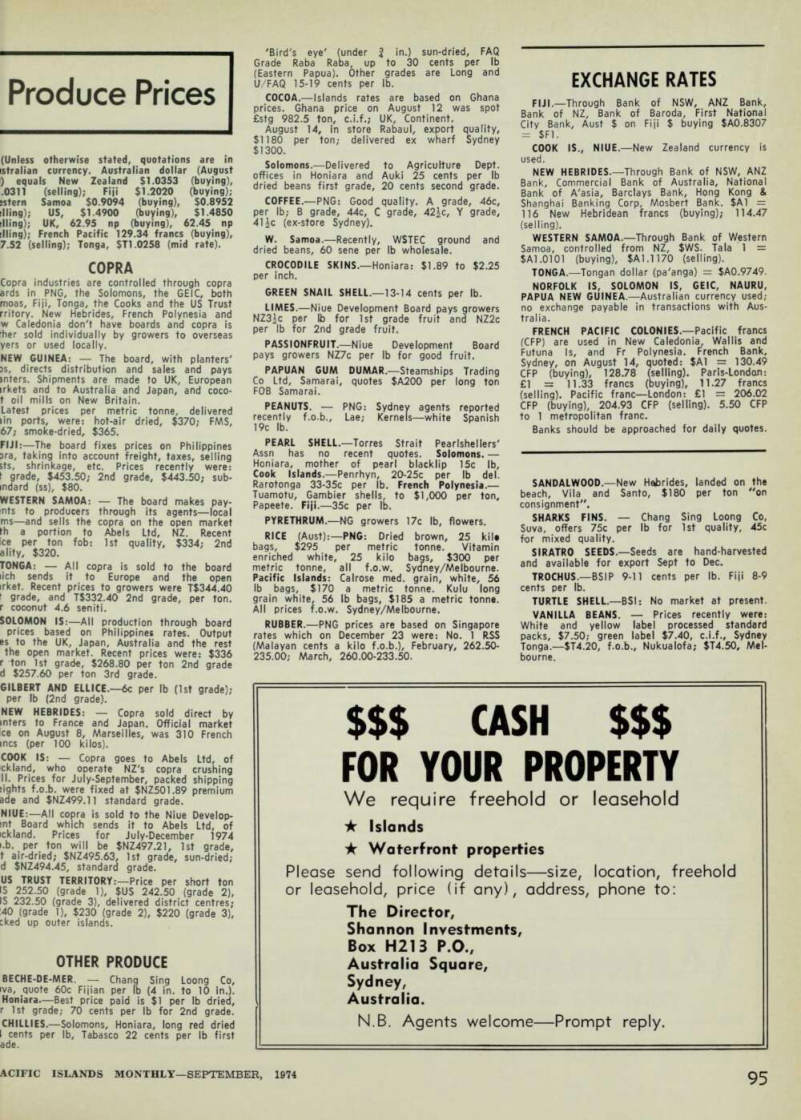
(Unless otherwise stated, quotations are in istralian currency. Australian dollar (August ) equals New Zealand $1.0353 (buying), .0311 (selling); Fiji $1.2020 (buying); •stern Samoa $0.9094 (buying), $0.8952 tiling); US, $1.4900 (buying), $1.4850 tiling); UK, 62.95 np (buying), 62.45 np tiling); French Pacific 129.34 francs (buying), 7.52 (selling); Tonga, $T1.0258 (mid rate).
Copra
Copra industries are controlled through copra ards in PNG, the Solomons, the GEIC, both moas, Fiji, Tonga, the Cooks and the US Trust rritory. New Hebrides, French Polynesia and w Caledonia don't have boards and copra is fher sold individually by growers to overseas yers or used locally.
NEW GUINEA: The board, with planters' }s, directs distribution and sales and pays inters. Shipments are made to UK, European irkets and to Australia and Japan, and coco t oil mills on New Britain.
Latest prices per metric tonne, delivered lin ports, were; hot-air dried, $370; FMS, 67; smoke-dried, $365.
FIJI:—The board fixes prices on Philippines ara, taking into account freight, taxes, selling sts, shrinkage, etc. Prices recently were: I grade, $453.50; 2nd grade, $443.50; sub mdard (ss), $BO.
WESTERN SAMOA: The board makes pay nts to producers through its agents—local ms—and sells the copra on the open market th a portion to Abels Ltd, NZ. Recent ice per ton fob: Ist quality, $334; 2nd ality, $320.
TONGA: All copra is sold to the board lich sends it to Europe and the open irket. Recent prices to growers were T 5344.40 f grade, and T 5332.40 2nd grade, per ton. r coconut 4.6 seniti.
SOLOMON IS:—All production through board prices based on Philippines rates. Output es to the UK, Japan, Australia and the rest the open market. Recent prices were; $336 r ton Ist grade, $268.80 per ton 2nd grade d $257.60 per ton 3rd grade.
GILBERT AND ELLICE.—6c per lb (Ist grade); per lb (2nd grade).
NEW HEBRIDES: Copra sold direct by inters to France and Japan. Official market ce on August 8, Marseilles, was 310 French mcs (per 100 kilos).
COOK IS: Copra goes to Abels Ltd, of ckland, who operate NZ's copra crushing 11. Prices for July-September, packed shipping lights f.o.b. were fixed at $NZ501.89 premium ade and $NZ499.11 standard grade.
NIUE:—AII copra is sold to the Niue Develop mt Board which sends it to Abels Ltd, of ickland. Prices for July-December 1974 i.b. per ton will be $NZ497.21, Ist grade, t air-dried; $NZ495.63, Ist grade, sun-dried; d $NZ494.45, standard grade.
US TRUST TERRITORY:—Price per short ton IS 252.50 (grade 1), SUS 242.50 (grade 2), IS 232.50 (grade 3), delivered district centres; 40 (grade 1), $230 (grade 2), $220 (grade 3), eked up outer islands.
Other Produce
BECHE-DE-MER. Chang Sing Loong Co, iva, quote 60c Fijian per lb (4 in. to 10 in.).
Honiara.—Best price paid is $1 per lb dried, r Ist grade; 70 cents per lb for 2nd grade.
CHILLIES.—SoIomons, Honiara, long red dried I cents per lb. Tabasco 22 cents per lb first ade.
'Bird's eye' (under in.) sun-dried, FAQ Grade Raba Raba, up to 30 cents per lb (Eastern Papua). Other grades are Long and U/FAQ 15-19 cents per lb.
COCOA.—lslands rates are based on Ghana prices. Ghana price on August 12 was spot £stg 982.5 ton, c.i.f.; UK, Continent.
August 14, in store Rabaul, export quality, $llBO per ton; delivered ex wharf Sydney $l3OO.
Solomons.—Delivered to Agriculture Dept, offices in Honiara and Auki 25 cents per lb dried beans first grade, 20 cents second grade.
COFFEE.—PNG: Good quality. A grade, 46c, per lb; B grade, 44c, C grade, 42£c, Y grade, 41£c (ex-store Sydney).
W. Samoa.—Recently, WSTEC ground and dried beans, 60 sene per lb wholesale.
CROCODILE SKlNS.—Honiara: $1.89 to $2.25 per inch.
GREEN SNAIL SHELL—I 3-14 cents per lb.
LIMES.—Niue Development Board pays growers NZ3£c per lb for Ist grade fruit and NZ2c per lb for 2nd grade fruit.
PASSIONFRUIT.—Niue Development Board pays growers NZ7c per lb for good fruit, PAPUAN GUM DUMAR.—Steamships Trading Co Ltd, Samarai, quotes SA2OO per long ton FOB Samarai.
PEANUTS. PNG: Sydney agents reported recently f.0.b., Lae; Kernels—white Spanish 19c lb.
PEARL SHELL.—Torres Strait Pea r Ishel lers' Assn has no recent quotes. Solomons.
Honiara, mother of pearl blacklip 15c lb.
Cook Islands.—Penrhyn, 20-25 c per lb del.
Rarotonga 33-35 c per lb. French Polynesia.— Tuamotu, Gambier shells, to $l,OOO per ton, Papeete. Fiji.—3sc per lb.
PYRETHRUM—NG growers 17c lb, flowers.
RICE (Aust): —PNG: Dried brown, 25 kilo bags, $295 per metric tonne. Vitamin enriched white, 25 kilo bags, $3OO per metric tonne, all f.o.w. Sydney/Melbourne.
Pacific Islands: Calrose med. grain, white, 56 lb bags, $l7O a metric tonne. Kulu long grain white, 56 lb bags, $lB5 a metric tonne.
All prices f.o.w. Sydney/Melbourne.
RUBBER.—PNG prices are based on Singapore rates which on December 23 were; No. 1 RSS (Malayan cents a kilo f.0.b.), February, 262.50- 235.00; March, 260.00-233.50.
SANDALWOOD. —New Hebrides, landed on the beach, Vila and Santo, $lBO per ton "on consignment".
SHARKS FINS. Chang Sing Loong Co, Suva, offers 75c per lb for Ist quality, 45c for mixed quality.
SIRATRO SEEDS—Seeds are hand-harvested and available for export Sept to Dec.
TROCHUS.—BSIP 9-11 cents per lb. Fiji 8-9 cents per lb.
TURTLE SHELL.—BSI: No market at present.
VANILLA BEANS. Prices recently were: White and yellow label processed standard packs, $7.50; green label $7.40, c.i.f., Sydney Tonga.—sl4.2o, f.0.b., Nukualofa; $T4.50, Mel bourne.
Exchange Rates
FlJl.—Through Bank of NSW, ANZ Bank, Bank of NZ, Bank of Baroda, First National City Bank, Aust $ on Fiji $ buying $A0.8307 = $ Fl.
COOK IS., NIUE.—New Zealand currency is used.
NEW HEBRIDES—Through Bank of NSW, ANZ Bank, Commercial Bank of Australia, National Bank of A'asia, Barclays Bank, Hong Kong & Shanghai Banking Corp, Mosbert Bank. SAI = 116 New Hebridean francs (buying); 114.47 (selling).
WESTERN SAMOA—Through Bank of Western Samoa, controlled from NZ, SWS. Tala 1 = SAI.OIOI (buying), $A1.1170 (selling).
TONGA. —Tongan dollar (pa'anga) = $A0,9749.
Norfolk Is, Solomon Is, Geic, Nauru,
PAPUA NEW GUINEA. —Australian currency used; no exchange payable in transactions with Aus tralia.
FRENCH PACIFIC COLONIES—Pacific francs (CFP) are used in New Caledonia, Wallis and Futuna Is, and Fr Polynesia. French Bank, Sydney, on August 14, quoted: SAI = 130.49 CFP (buying), 128.78 (selling). Paris-London: £1 = 11.33 francs (buying), 11.27 francs (selling). Pacific franc—London: £1 = 206.02 CFP (buying), 204.93 CFP (selling). 5.50 CFP to 1 metropolitan franc.
Banks should be approached for daily quotes.
Advertisements & other items, p. 97 (2 items)
95
ACIFIC ISLANDS MONTHLY—SEPTEMBER, 1974
sss CASH sss
FOR YOUR PROPERTY
We require freehold or leasehold ★ Islands ★ Waterfront properties Please send following details—size, location, freehold or leasehold, price (if any), address, phone to: The Director, Shannon Investments, Box H2l 3 P. 0., Australia Square, Sydney, Australia.
N.B. Agents welcome—Prompt reply.
Shipping & Airways Information
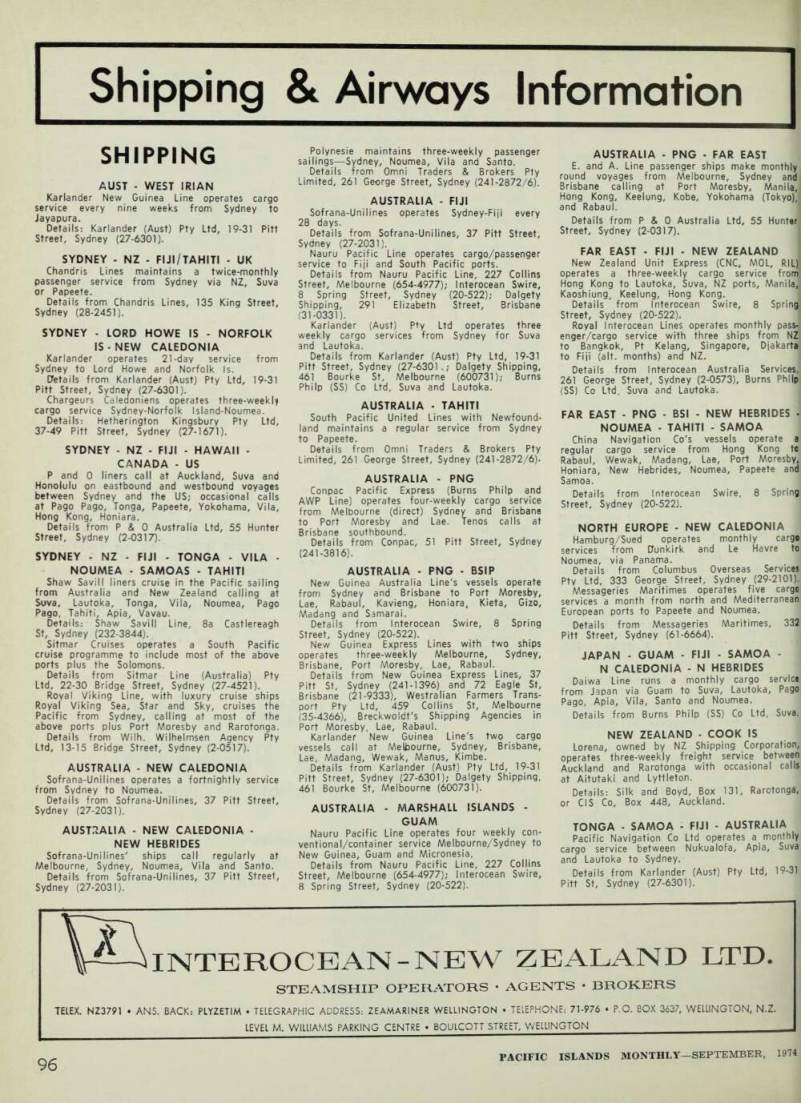
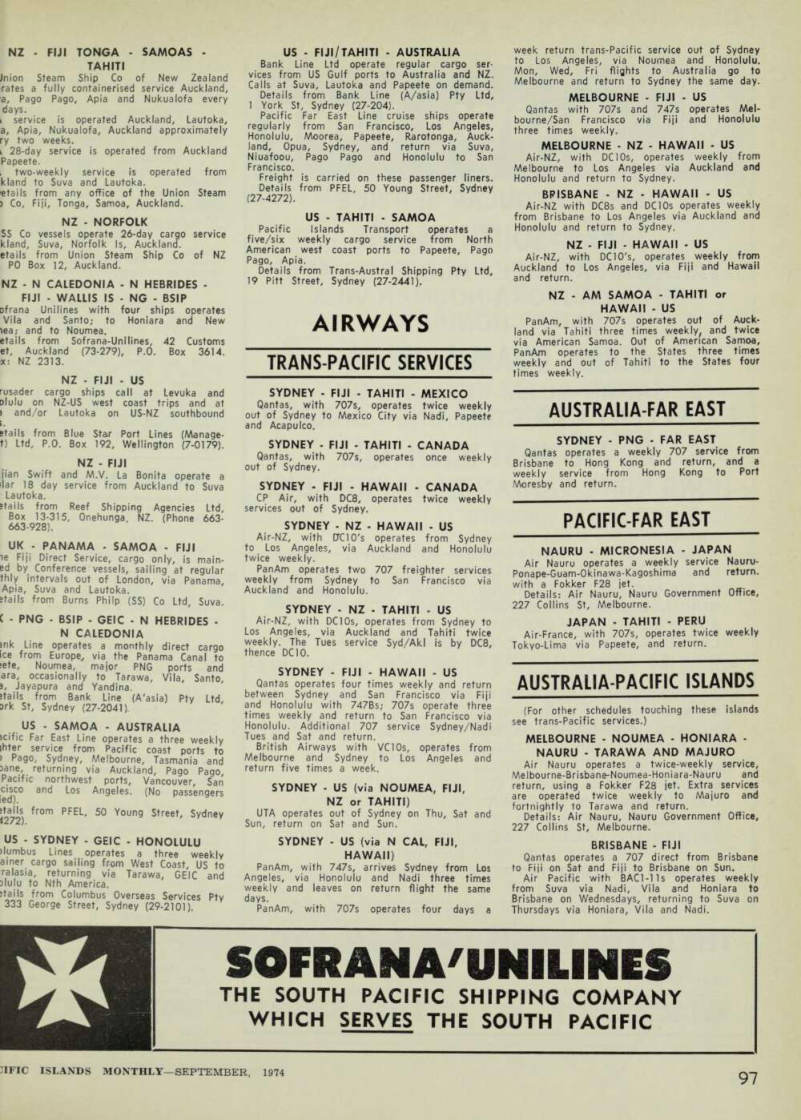
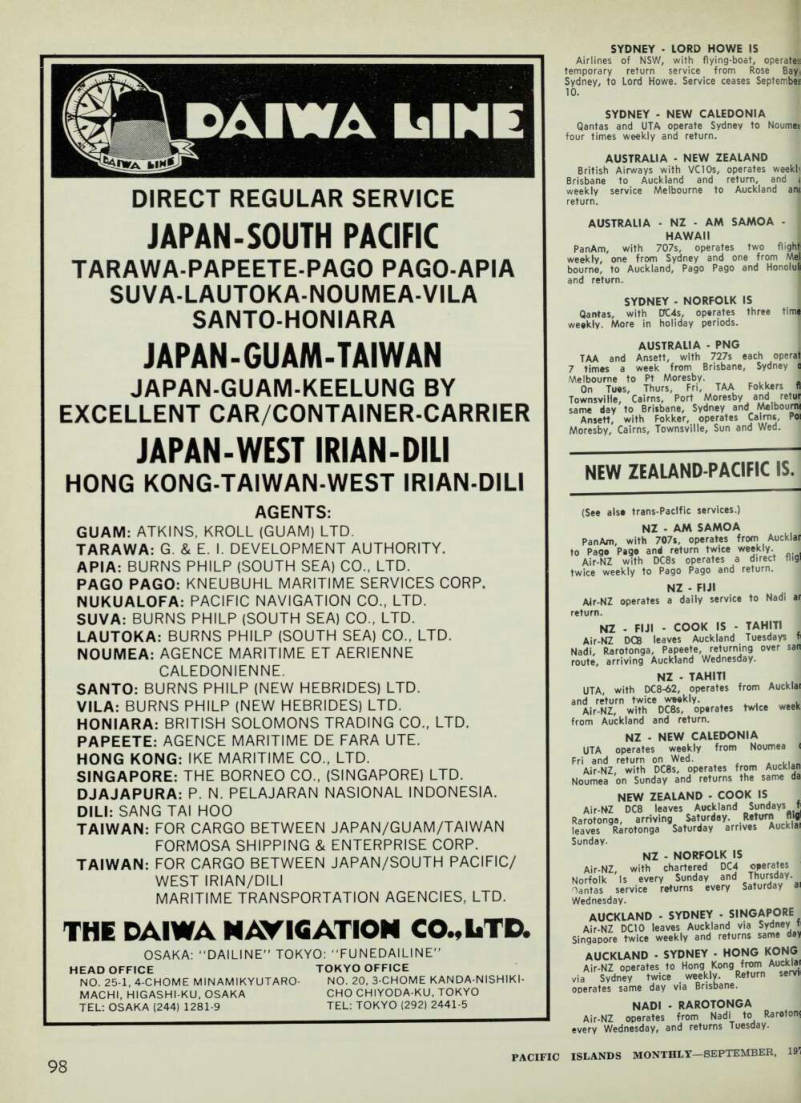
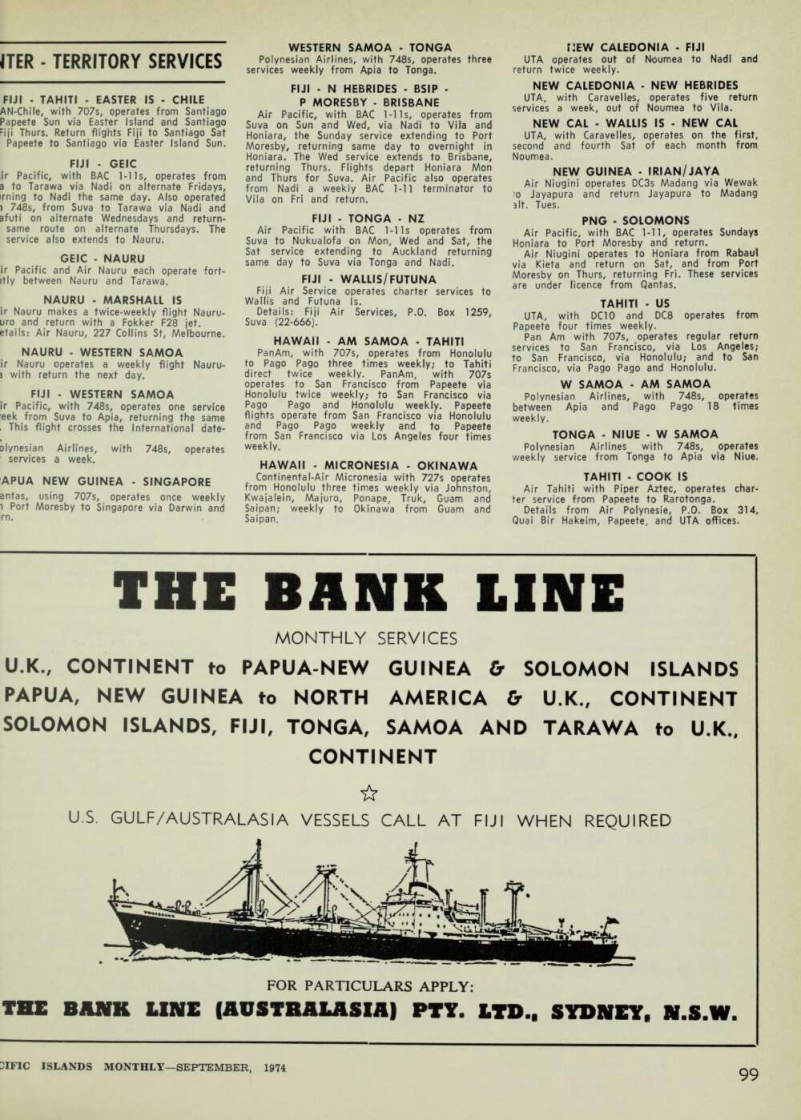
Shipping
Aust - West Irian
Karlander New Guinea Line operates cargo service every nine weeks from Sydney to Jayapura.
Details: Karlander (Aust) Pty Ltd, 19-31 Pitt Street, Sydney (27-6301).
SYDNEY - NZ - FIJI/TAHITI - UK Chandris Lines maintains a twice-monthly passenger service from Sydney via NZ, Suva or Papeete.
Details from Chandris Lines, 135 King Street, Sydney (28-2451).
SYDNEY - LORD HOWE IS - NORFOLK
Is-New Caledonia
Karlander operates 21-day service from Sydney to Lord Howe and Norfolk Is.
Details from Karlander (Aust) Pty Ltd, 19-31 Pitt Street, Sydney (27-6301).
Chargeurs Caledonians operates three-weekly cargo service Sydney-Norfolk Island-Noumea.
Details: Hetherington Kingsbury Pty Ltd, 37-49 Pitt Street, Sydney (27-1671).
SYDNEY - NZ - FIJI - HAWAII -
Canada - Us
P and 0 liners call at Auckland, Suva and Honolulu on eastbound and westbound voyages between Sydney and the US; occasional calls at Pago Pago, Tonga, Papeete, Yokohama, Vila, Hong Kong, Honiara.
Details from P & 0 Australia Ltd, 55 Hunter Street, Sydney (2-0317).
SYDNEY - NZ - FIJI - TONGA - VILA ■
Noumea - Samoas - Tahiti
Shaw Savill liners cruise in the Pacific sailing from Australia and New Zealand calling at Suva, Lautoka, Tonga, Vila, Noumea, Pago Pago, Tahiti, Apia, Vavau.
Details: Shaw Savill Line, 8a Castlereagh St, Sydney (232-3844).
Sitmar Cruises operates a South Pacific cruise programme to include most of the above ports plus the Solomons.
Details from Sitmar Line (Australia) Pty Ltd, 22-30 Bridge Street, Sydney (27-4521).
Royal Viking Line, with luxury cruise ships Royal Viking Sea, Star and Sky, cruises the Pacific from Sydney, calling at most of the above ports plus Port Moresby and Rarotonga.
Details from Wilh. Wilhelmsen Agency Pty Ltd, 13-15 Bridge Street, Sydney (2-0517).
Australia - New Caledonia
Sofrana-Unilines operates a fortnightly service from Sydney to Noumea.
Details from Sofrana-Unilines, 37 Pitt Street, Sydney (27-2031).
Australia - New Caledonia -
New Hebrides
Sofrana-Unilines' ships call regularly at Melbourne, Sydney, Noumea, Vila and Santo.
Details from Sofrana-Unilines, 37 Pitt Street, Sydney (27-2031).
Polynesie maintains three-weekly passenger sailings—Sydney, Noumea, Vila and Santo.
Details from Omni Traders & Brokers Pty Limited, 261 George Street, Sydney (241-2872/6).
Australia ■ Fiji
Sofrana-Unilines operates Sydney-Fiji every 28 days.
Details from Sofrana-Unilines, 37 Pitt Street, Sydney (27-2031).
Nauru Pacific Line operates cargo/passenger service to Fiji and South Pacific ports.
Details from Nauru Pacific Line, 227 Collins Street, Melbourne (654-4977); Interocean Swire, 8 Spring Street, Sydney (20-522); Dalgety Shipping, 291 Elizabeth Street, Brisbane (31-0331).
Karlander (Aust) Pty Ltd operates three weekly cargo services from Sydney for Suva and Lautoka.
Details from Karlander (Aust) Pty Ltd, 19-31 Pitt Street, Sydney (27-6301.; Dalgety Shipping, 461 Bourke St, Melbourne (600731); Burns Philp (SS) Co Ltd, Suva and Lautoka.
Australia ■ Tahiti
South Pacific United Lines with Newfound land maintains a regular service from Sydney to Papeete.
Details from Omni Traders & Brokers Pty Limited, 261 George Street, Sydney (241-2872/6).
Australia - Png
Conpac Pacific Express (Burns Philp and AWP Line) operates four-weekly cargo service from Melbourne (direct) Sydney and Brisbane to Port Moresby and Lae. Tenos calls at Brisbane southbound.
Details from Conpac, 51 Pitt Street, Sydney (241-3816).
Australia - Png - Bsip
New Guinea Australia Line's vessels operate from Sydney and Brisbane to Port Moresby, Lae, Rabaul, Kavieng, Honiara, Kieta, Gizo, Madang and Samarai.
Details from Interocean Swire, 8 Spring Street, Sydney (20-522).
New Guinea Express Lines with two ships operates three-weekly Melbourne, Sydney, Brisbane, Port Moresby, Lae, Rabaul.
Details from New Guinea Express Lines, 37 Pitt St, Sydney (241-1396) and 72 Eagle St, Brisbane (21-9333), Westralian Farmers Trans port Pty Ltd, 459 Collins St, Melbourne (35-4366), Breckwoldt's Shipping Agencies in Port Moresby, Lae, Rabaul.
Karlander New Guinea Line's two cargo vessels call at Melbourne, Sydney, Brisbane, Lae, Madang, Wewak, Manus, Kimbe.
Details from Karlander (Aust) Pty Ltd, 19-31 Pitt Street, Sydney (27-6301); Dalgety Shipping, 461 Bourke St, Melbourne (600731).
Australia - Marshall Islands ■
Guam
Nauru Pacific Line operates four weekly con ventional/container service Melbourne/Sydney to New Guinea, Guam and Micronesia.
Details from Nauru Pacific Line, 227 Collins Street, Melbourne (654-4977); Interocean Swire, 8 Spring Street, Sydney (20-522).
Australia - Png ■ Far East
E. and A. Line passenger ships make monthly, round voyages from Melbourne, Sydney and Brisbane calling at Port Moresby, Manila, Hong Kong, Keelung, Kobe, Yokohama (Tokyo), and Rabaul.
Details from P & 0 Australia Ltd, 55 Hunter Street, Sydney (2-0317).
FAR EAST - FIJI - NEW ZEALAND New Zealand Unit Express (CNC, MOL, RIL) operates a three-weekly cargo service from Hong Kong to Lautoka, Suva, NZ ports, Manila,) Kaoshiung, Keelung, Hong Kong.
Details from Interocean Swire, 8 Spring!
Street, Sydney (20-522).
Royal Interocean Lines operates monthly pass enger/cargo service with three ships from NZ to Bangkok, Pt Kelang, Singapore, Djakarta to Fiji (alt. months) and NZ.
Details from Interocean Australia Services,] 261 George Street, Sydney (2-0573), Burns Philp (SS) Co Ltd, Suva and Lautoka.
FAR EAST - PNG - BSI - NEW HEBRIDES •
Noumea • Tahiti - Samoa
China Navigation Co's vessels operate a regular cargo service from Hong Kong to Rabaul, Wewak, Madang, Lae, Port Moresby, Honiara, New Hebrides, Noumea, Papeete and Samoa.
Details from Interocean Swire, 8 Spring] Street, Sydney (20-522).
North Europe - New Caledonia
Hamburg/Sued operates monthly cargo services from Dunkirk and Le Havre to Noumea, via Panama.
Details from Columbus Overseas Services Pty Ltd, 333 George Street, Sydney (29-2101).
Messageries Maritimes operates five cargo services a month from north and European ports to Papeete and Noumea.
Details from Messageries Maritimes, 332 Pitt Street, Sydney (61-6664).
JAPAN - GUAM - FIJI - SAMOA ■
N Caledonia - N Hebrides
Daiwa Line runs a monthly cargo service from Japan via Guam to Suva, Lautoka, Pago Pago, Apia, Vila, Santo and Noumea.
Details from Burns Philp (SS) Co Ltd, Suva.
New Zealand - Cook Is
Lorena, owned by NZ Shipping Corporation, operates three-weekly freight service between Auckland and Rarotonga with occasional calls at Aitutaki and Lyttleton.
Details: Silk and Boyd, Box 131, Rarotongd or CIS Co, Box 448, Auckland.
TONGA - SAMOA - FIJI - AUSTRALIA Pacific Navigation Co Ltd operates a monthly cargo service between Nukualofa, Apia, Suva and Lautoka to Sydney.
Details from Karlander (Aust) Pty Ltd, 19-31 Pitt St, Sydney (27-6301).
NZ - FIJI TONGA - SAMOAS -
Tahiti
Jnion Steam Ship Co of New Zealand rates a fully containerised service Auckland, a, Pago Pago, Apia and Nukualofa every days. i service is operated Auckland, Lautoka, a, Apia, Nukualofa, Auckland approximately ry two weeks. i 28-day service is operated from Auckland Papeete. i two-weekly service is operated from kland to Suva and Lautoka. >etai Is from any office of the Union Steam ) Co, Fiji, Tonga, Samoa, Auckland.
Nz - Norfolk
SS Co vessels operate 26-day cargo service kland, Suva, Norfolk Is, Auckland, etails from Union Steam Ship Co of NZ PO Box 12, Auckland.
NZ - N CALEDONIA • N HEBRIDES - FIJI - WALLIS IS - NG - BSIP ofrana Unilines with four ships operates Vila and Santo; to Honiara and New iea; and to Noumea. etails from Sofrana-UnMines, 42 Customs et, Auckland (73-279), P.O. Box 3614. x: NZ 2313.
Nz - Fiji - Us
rusader cargo ships call at Levuka and olulu on NZ-US west coast trips and at i and/or Lautoka on US-NZ southbound i. etails from Blue Star Port Lines (Manage t) Ltd, P.O. Box 192, Wellington (7-0179).
Nz - Fiji
jian Swift and M.V. La Bonita operate a ilar 18 day service from Auckland to Suva Lautoka. etails from Reef Shipping Agencies Ltd, Box 13-315, Onehunga, NZ. (Phone 663- 663-928).
UK - PANAMA - SAMOA - FIJI ie Fiji Direct Service, cargo only, is main ed by Conference vessels, sailing at regular thly intervals out of London, via Panama, Apia, Suva and Lautoka. etails from Burns Philp (SS) Co Ltd, Suva.
C - PNG ■ BSIP - GEIC - N HEBRIDES -
N Caledonia
jnk Line operates a monthly direct cargo ice from Europe, via the Panama Canal to iete, Noumea, major PNG ports and ara, occasionally to Tarawa, Vila, Santo e, Jayapura and Yandina. stalls from Bank Line (A'asia) Pty Ltd, ark St, Sydney (27-2041),
Us - Samoa - Australia
scific Far East Line operates a three weekly ihter service from Pacific coast ports to i Pago, Sydney, Melbourne, Tasmania and jane, returning via Auckland, Pago Pago Pacific northwest ports, Vancouver, San cisco and Los Angeles. (No passengers led). 1272) fr ° m PFEL ' 50 Youn9 street ' Sydney US - SYDNEY - GEIC ■ HONOLULU ilumbus Lines operates a three weekly amer cargo sailing from West Coast, US to ralasia, returning via Tarawa, GEIC and jlulu to Nth America. ‘tails from Columbus Overseas Services Pty 333 George Street, Sydney (29-2101),
Us - Fiji/Tahiti - Australia
Bank Line Ltd operate regular cargo ser vices from US Gulf ports to Australia and NZ.
Calls at Suva, Lautoka and Papeete on demand.
Details from Bank Line (A/asia) Pty Ltd, 1 York St, Sydney (27-204).
Pacific Far East Line cruise ships operate regularly from San Francisco, Los Angeles, Honolulu, Moorea, Papeete, Rarotonga, Auck land, Opua, Sydney, and return via Suva, Niuafoou, Pago Pago and Honolulu to San Francisco.
Freight is carried on these passenger liners.
Details from PFEL, 50 Young Street, Sydney (27-4272).
Us - Tahiti - Samoa
Pacific Islands Transport operates a five/six weekly cargo service from North American west coast ports to Papeete, Pago Pago, Apia.
Details from Trans-Austral Shipping Pty Ltd, 19 Pitt Street, Sydney (27-2441).
Airways
Trans Pacific Services
SYDNEY ■ FIJI - TAHITI - MEXICO Qantas, with 7075, operates twice weekly out of Sydney to Mexico City via Nadi, Papeete and Acapulco.
SYDNEY - FIJI - TAHITI - CANADA Qantas, with 7075, operates once weekly out of Sydney.
SYDNEY - FIJI - HAWAII - CANADA CP Air, with DCS, operates twice weekly services out of Sydney.
SYDNEY ■ NZ - HAWAII - US Air-NZ, with DClO's operates from Sydney to Los Angeles, via Auckland and Honolulu
twice weekly.
PanAm operates two 707 freighter services weekly from Sydney to San Francisco via Auckland and Honolulu.
SYDNEY - NZ ■ TAHITI - US Air-NZ, with DClOs, operates from Sydney to Los Angeles, via Auckland and Tahiti twice weekly. The Tues service Syd/Akl is by DCS, thence DC 10.
SYDNEY - FIJI - HAWAII - US Qantas operates four times weekly and return between Sydney and San Francisco via Fiji and Honolulu with 74785; 707 s operate three times weekly and return to San Francisco via Honolulu. Additional 707 service Sydney/Nadi Tues and Sat and return.
British Airways with VClOs, operates from Melbourne and Sydney to Los Angeles and return five times a week.
Sydney - Us (Via Noumea, Fiji,
Nz Or Tahiti)
UTA operates out of Sydney on Thu, Sat and Sun, return on Sat and Sun.
SYDNEY - US (via N CAL, FIJI,
Hawaii)
PanAm, with 7475, arrives Sydney from Los Angeles, via Honolulu and Nadi three times weekly and leaves on return flight the same days.
PanAm, with 707 s operates four days a
week return trans-Pacific service out of Sydney to Los Angeles, via Noumea and Honolulu.
Mon, Wed, Fri flights to Australia go to Melbourne and return to Sydney the same day.
Melbourne - Fiji - Us
Qantas with 707 s and 747 s operates Mel bourne/San Francisco via Fiji and Honolulu three times weekly.
MELBOURNE - NZ - HAWAII ■ US Air-NZ, with DClOs, operates weekly from Melbourne to Los Angeles via Auckland and Honolulu and return to Sydney.
BRISBANE - NZ - HAWAII ■ US Air-N2 with DCBs and DClOs operates weekly from Brisbane to Los Angeles via Auckland and Honolulu and return to Sydney.
NZ - FIJI - HAWAII - US Air-NZ, with DClO's, operates weekly from Auckland to Los Angeles, via Fiji and Hawaii and return.
NZ - AM SAMOA - TAHITI or
Hawaii - Us
PanAm, with 707 s operates out of Auck land via Tahiti three times weekly, and twice via American Samoa. Out of American Samoa, PanAm operates to the States three times weekly and out of Tahiti to the States four times weekly.
Australia-Far East
Sydney - Png ■ Far East
Qantas operates a weekly 707 service from Brisbane to Hong Kong and return, and a weekly service from Hong Kong to Port Moresby and return.
Pacific-Far East
Nauru - Micronesia - Japan
Air Nauru operates a weekly service Nauru- Ponape-Guam-Okinawa-Kagoshima and return, with a Fokker F2B jet.
Details: Air Nauru, Nauru Government Office, 227 Collins St, Melbourne.
Japan - Tahiti - Peru
Air-France, with 7075, operates twice weekly Tokyo-Lima via Papeete, and return.
Australia-Pacific Islands
(For other schedules touching these islands see trans-Pacific services.)
Melbourne - Noumea - Honiara -
Nauru - Tarawa And Majuro
Air Nauru operates a twice-weekly service, Melbourne-Brisbane-Noumea-Honiara-Nauru and return, using a Fokker F2B jet. Extra services are operated twice weekly to Majuro and fortnightly to Tarawa and return.
Details: Air Nauru, Nauru Government Office, 227 Collins St, Melbourne.
Brisbane - Fiji
Qantas operates a 707 direct from Brisbane to Fiji on Sat and Fiji to Brisbane on Sun.
Air Pacific with BACI-lls operates weekly from Suva via Nadi, Vila and Honiara to Brisbane on Wednesdays, returning to Suva on Thursdays via Honiara, Vila and Nadi.
Sydney - Lord Howe Is
Airlines of NSW, with flying-boat, operates temporary return service from Rose Bay* Sydney, to Lord Howe. Service ceases Septembee 10.
Sydney - New Caledonia
Qantas and UTA operate Sydney to Noumet four times weekly and return.
Australia - New Zealand
British Airways with VClOs, operates weekh Brisbane to Auckland and return, and weekly service Melbourne to Auckland ant return.
AUSTRALIA - NZ - AM SAMOA -
Hawaii
PanAm, with 7075, operates two flight! weekly, one from Sydney and one from Mel bourne, to Auckland, Pago Pago and Honolul) and return.
Sydney ■ Norfolk Is
Qantas, with OC4s, operates three time weekly. More in holiday periods.
Australia - Png
TAA and Ansett, with 727 s each operat 7 times a week from Brisbane, Sydney o Melbourne to Pt Moresby. 3 On Tues, Thurs, Fn, TAA Fokkers n TownsviHe, Cairns, Port Moresby and retur same day to Brisbane, Sydney and Melbouriu Ansett, with Fokker, operates Cairns, Poi Moresby, Cairns, Townsville, Sun and Wed.
New Zealand-Pacific Is.
(See also trans-Padfic services.)
Nz - Am Samoa
PanAm, with 7075, operates from Aucklar to Pago Pago and return twice weekly.
Air-NZ with DCBs operates a direct fligl twice weekly to Pago Pago and return.
Nz - Fiji
Air-NZ operates a daily service to Nadi ar return.
NZ - FIJI ■ COOK IS - TAHITI Air-NZ DCS leaves Auckland Tuesdays f Nadi, Rarotonga, Papeete, returning over san route, arriving Auckland Wednesday.
Nz - Tahiti
UTA, with DCB-62, operates from Aucklar and return twice weekly.
Air-NZ, with DCBs, operates twice week from Auckland and return.
Nz - New Caledonia
UTA operates weekly from Noumea < Fri and return on Wed.
Air-NZ, with DCBs, operates from Aucklan Noumea on Sunday and returns the same da
New Zealand - Cook Is
Air-NZ DCS leaves Auckland Sundays f Rarotonga, arriving Saturday. Return niff leaves Rarotonga Saturday arrives Aucklai Sunday.
Nz - Norfolk Is
Air-NZ, with chartered DC4 operates Norfolk Is every Sunday and Oantas service returns every Saturday at Wednesday.
Auckland - Sydney - Singapore
Air-NZ DCIO leaves Auckland via Sydney J Singapore twice weekly and returns same day
Auckland - Sydney - Hong Kong
Air-NZ operates to Hong Kong from Auckia via Sydney twice weekly. Return senn operates same day via Brisbane.
Nadi - Rarotonga
Air-NZ operates from Nadi to Rarotom every Wednesday, and returns Tuesday.
Iter - Territory Services
FIJI ■ TAHITI - EASTER IS - CHILE AN-Chile, with 7075, operates from Santiago Papeete Sun via Easter Island and Santiago Fiji Thurs. Return flights Fiji to Santiago Sat Papeete to Santiago via Easter Island Sun.
Fiji - Geic
ir Pacific, with BAC 1-1 Is, operates from a to Tarawa via Nadi on alternate Fridays, irning to Nadi the same day. Also operated » 7485, from Suva to Tarawa via Nadi and afuti on alternate Wednesdays and return same route on alternate Thursdays. The service also extends to Nauru.
Geic - Nauru
ir Pacific and Air Nauru each operate fort itly between Nauru and Tarawa.
Nauru - Marshall Is
ir Nauru makes a twice-weekly flight Nauru uro and return with a Fokker F2B jet. etails: Air Nauru, 227 Collins St, Melbourne.
Nauru - Western Samoa
ir Nauru operates a weekly flight Nauru i with return the next day.
Fiji - Western Samoa
ir Pacific, with 7485, operates one service eek from Suva to Apia, returning the same , This flight crosses the International date olynesian Airlines, with 7485, operates services a week.
Apua New Guinea - Singapore
antas, using 7075, operates once weekly i Port Moresby to Singapore via Darwin and rn.
Western Samoa - Tonga
Polynesian Airlines, with 7485, operates three services weekly from Apia to Tonga.
FIJI - N HEBRIDES - BSIP -
P Moresby - Brisbane
Air Pacific, with BAC 1-1 Is, operates from Suva on Sun and Wed, via Nadi to Vila and Honiara, the Sunday service extending to Port Moresby, returning same day to overnight in Honiara. The Wed service extends to Brisbane, returning Thurs. Flights depart Honiara Mon and Thurs for Suva, Air Pacific also operates from Nadi a weekly BAC 1-11 terminator to Vila on Fri and return.
Fiji - Tonga - Nz
Air Pacific with BAC 1-1 Is operates from Suva to Nukualofa on Mon, Wed and Sat, the Sat service extending to Auckland returning same day to Suva via Tonga and Nadi.
Fiji ■ Wallis/Futuna
Fiji Air Service operates charter services to Wallis and Futuna Is.
Details: Fiji Air Services, P.O. Box 1259, Suva (22-666).
Hawaii - Am Samoa - Tahiti
PanAm, with 7075, operates from Honolulu to Pago Pago three times weekly; to Tahiti direct twice weekly. PanAm, with 707 s operates to San Francisco from Papeete via Honolulu twice weekly; to San Francisco via Pago Pago and Honolulu weekly. Papeete flights operate from San Francisco via Honolulu and Pago Pago weekly and to Papeete from San Francisco via Los Angeles four times weekly.
Hawaii - Micronesia - Okinawa
Continental-Air Micronesia with 727 s operates
from Honolulu three times weekly via Jonnston, Kwajalein, Majuro, Ponape, Truk, Guam and Saipan; weekly to Okinawa from Guam and Saipan.
New Caledonia • Fiji
UTA operates out of Noumea to Nadi and return twice weekly.
New Caledonia - New Hebrides
UTA, with Caravelles, operates five return services a week, out of Noumea to Vila.
NEW CAL - WALLIS IS - NEW CAL UTA, with Caravelles, operates on the first, second and fourth Sat of each month from Noumea.
New Guinea - Irian/Jaya
Air Niugini operates DC3s Madang via Wewak to Jayapura and return Jayapura to Madang alt. lues.
Png - Solomons
Air Pacific, with BAC 1-11, operates Sundays Honiara to Port Moresby and return.
Air Niugini operates to Honiara from Rabaul via Kieta and return on Sat, and from Port Moresby on Thurs, returning Fri. These services are under licence from Qantas.
Tahiti - Us
UTA, with DCIO and DCS operates from Papeete four times weekly.
Pan Am with 7075, operates regular return services to San Francisco, via Los Angeles; to San Francisco, via Honolulu; and to San Francisco, via Pago Pago and Honolulu.
W Samoa - Am Samoa
Polynesian Airlines, with 7485, operates between Apia and Pago Pago 18 times weekly.
Tonga - Niue - W Samoa
Polynesian Airlines with 7485, operates weekly service from Tonga to Apia via Niue.
Tahiti - Cook Is
Air Tahiti with Piper Aztec, operates char ter service from Papeete to Rarotonga.
Details from Air Polynesie, P.O. Box 314, Quai Bir Hakeim, Papeete, and UTA offices.
Internal Services
Fiji
Air Pacific, with HS74Bs, BAC 1-1 Is and Herons operates regular services to Labasa, Taveuni, Nadi, Suva and Savusavu.
Fiji Air Services, with Britten-Norman Islander and Beechcraft Baron aircraft, operates services to Castaway and Plantation village resorts. The Fijian hotel, Korolevu Beach hotel, Flagship Beachcomber hotel, Levuka, Lakeba, Vatukoula. Charter flights operate to anywhere in the Pacific.
Details: Fiji Air Services, P.O. Box 1259, Suva (telephone 22-666).
French Polynesia
Air Polynesie, with Fokker F 27 Friendship, Twin Otters and Islanders, operates to
Bora Bora, Huahine, Moorea, Rangiroa, Raiatea, Manihi, Takapoto, Hiva Oa, Da Huka, Maupiti and Tubuai, Rurutu.
Details from Air Polynesia, P.O. Box 314, Quai Bir Hakeim, Papeete, and UTA offices.
Air Tahiti, with light aircraft operates shuttle service frojn Papeete to Moorea and charter service to Raiatea, Bora Bora, Huahine, Rangiroa and Manihi.
Guam - Us Trust Territory
Continental-Air Micronesia with 727 s operates regular service connecting Honolulu, Okinawa and Guam with Saipan, Rota, Yap, Palau, Truk, Ponape, Kwajalein, Majuro and Johnston Island.
Details from Air Micronesia, Saipan.
Air Pacific International Inc (not connected with the Fiji-based Air Pacific) with Piper Navajo and a deHavilland Heron, operates regular services linking Guam, Saipan, Tinian, and Rota, and charter services are available to other Trust Territory islands.
Details, Air Pacific International Inc, P.O.
Box 7689, Tamuning, Guam, 96911, USA.
Lagoon Aviation Inc with Grumman Wid« geons, operate charter services for the Mar.. shalls district, based on Majuro.
Gilbert And Ellice Islands
Air Pacific, with Herons, operates regular' services between Tarawa, Butaritari, Northi Tabiteuea and Abemama.
Papua New Guinea
Air Niugini, with Fokkers and DC3s, operates; a network of services between all major centres; in Papua New Guinea. These services connect with Ansett and TAA's 727 Australia-PNG| services.
DCS aircraft are available for charter withim
Png.
Aerial Tours operates in Central, Western!
Gulf and Sepik districts. Aircraft are basedl at: Port Moresby, Kerema, Daru, Kiungal Vanimo, Wewak, Talair (Tourist Airlines of New Guinea)—| operates scheduled service and charter flight! from Port Moresby, Goroka, Kundiava, Madangl Wewak, Vanimo, Mt Hagen, Mendi to Highlands* Sepik and Coastal areas. Talco Territory Travel Service of Papua New Guinea—Twin Otter Tourist flights throughout Papua New Guinea.
Further details from Talair, P.O. Box 108, Goroka, Papua New Guinea; also Papua New Guinea House, 225 Clarence St, Sydney.
Melanesian Airline Company Pty Limited (Macair) operates extensive commuter and charter services. Head office, PO Box 556, Lae.
Branches at Port Moresby, Alotau, Popondetta, Wau, Daru, Mt Hagen, Mendi and Goroka.
Crowley Airways Pty Ltd operates through out Papua New Guinea. Details: P.O. Box 34, Lae. Offices also in Rabaul, Kieta, Kavieng, Hoskins, Port Moresby.
Bougainville Air Services operates daily throughout Bougainville. There are nine regular services Kieta-Buin. Details: Arawa, Phone 956-159; Buka, Phone 16. Box 298, PO, Kieta.
New Caledonia
Air Caledonie with Twin Otters, and Is landers operates regular services to Houal k>u. Isle of Pines, Isle Ouen, Kone, Koumac, Lifou, Mare, Noumea, Ouvea Touho, Mueo, Belep, Tiga.
Details from Air Caledonie, Noumea.
New Hebrides
Air Melanesiae with Britten-Norman Islanders and Trislander operates to Santo, Malekula Norsup and Lamap, Aoba (Walaha and Longana), Pentecost (Lonorore), Erromanga 'ongoa, Aneityum, Tanna, Epi, Sola and Vila. Dired connections are available to and fronri Santo for all international flights arriving in Vila.
Details from Air Melanesiae P.O. Box 72.
Solomon Islands
Solair, with Beech Barons and Islanders operates to Auki, Avu Avu, Babanakira, Bara koma, Beltona Is, Fera Is, Gizo, Honiara, Kira Kira, Marau, Munda, Parasi, Sege, Yandma, Santa Cruz, Mono, Rennell Is, Choiseul Bay, Ballalae and Ringi Cove.
Details from Solomon Islands Airways Ltd, Box 23, Honiara, BSIP.
Tonga
Tonga Internal Air Service, with Britten Norman Islander aircraft, operates frorj Fua'amotu, (airport for Nukualofa) to Vavaii (daily except Sunday) and Eua (twice daily except Sunday). Aircraft available for signt seeing and regional charters.
Details from Tonga Tourist and Developmenl Co, PO Box 91, Nukualofa, Tonga.
Cook Islands
Cook Islands Airways Ltd, with a Britten Norman Islander, operates seven flights a wee» between Rarotonga and Aitutaki. Serv |C . e .. *'■ be extended to Atiu, Manga.a and M.tiar when airstrips are built. Scenic flights ovei Rarotonga and its reefs are also available.
Advertisements & other items, pp. 98-103 (4 items)
Interocean-New Zealand Ltd
A
STEAMSHIP OPERATORS • AGENTS • BROKERS
TELEX. NZ3791 • ANS. BACK; PLYZETIM • TELEGRAPHIC ADDRESS: ZEAMARINER WELLINGTON • TELEPHONE: 71-976 • P.O. BOX 3637, WELLINGTON, N.Z.
LEVEL M. WILLIAMS PARKING CENTRE • BOULCQTT STREET, WELLINGTON
SOFRANA'UNILINES
THE SOUTH PACIFIC SHIPPING COMPANY
WHICH SERVES THE SOUTH PACIFIC
DAIWA LINE
DIRECT REGULAR SERVICE
JAPAN-SOUTH PACIFIC
TARAWA-PAPEETE-PAGO PAGO-APIA
SUVA-LAUTOKA-NOUMEA-VILA
SANTO-HONIARA
JAPAN-GUAM-TAIWAN
JAPAN-GUAM-KEELUNG BY
EXCELLENT CAR/CONTAINER-CARRIER
JAPAN-WEST IRIAN-DILI
HONG KONG-TAIWAN-WEST IRIAN-DILI
AGENTS:
GUAM; ATKINS, KROLL (GUAM) LTD.
TARAWA: G. & E. I. DEVELOPMENT AUTHORITY.
APIA: BURNS PHILP (SOUTH SEA) CO., LTD.
PAGO PAGO: KNEUBUHL MARITIME SERVICES CORP.
NUKUALOFA; PACIFIC NAVIGATION CO., LTD.
SUVA: BURNS PHILP (SOUTH SEA) CO., LTD.
LAUTOKA; BURNS PHILP (SOUTH SEA) CO., LTD.
NOUMEA; AGENCE MARITIME ET AERIENNE
CALEDONIENNE.
SANTO: BURNS PHILP (NEW HEBRIDES) LTD.
VILA: BURNS PHILP (NEW HEBRIDES) LTD.
HONIARA: BRITISH SOLOMONS TRADING CO., LTD.
PAPEETE: AGENCE MARITIME DE FARA UTE.
HONG KONG: IKE MARITIME CO., LTD.
SINGAPORE: THE BORNEO CO., (SINGAPORE) LTD.
DJAJAPURA; P. N. PELAJARAN NASIONAL INDONESIA.
DILI: SANG TAI HOO
TAIWAN: FOR CARGO BETWEEN JAPAN/GUAM/TAIWAN
FORMOSA SHIPPING & ENTERPRISE CORP.
TAIWAN: FOR CARGO BETWEEN JAPAN/SOUTH PACIFIC/
WEST IRIAN/DILI
MARITIME TRANSPORTATION AGENCIES, LTD,
THE DAIWA N/KTIGATIOM CO.. LTD.
OSAKA: “DAILINE” TOKYO: “FUNEDAILINE"
HEAD OFFICE TOKYO OFFICE
NO. 25-1, 4-CHOME MINAMIKYUTARO- NO. 20, 3-CHOME KANDA-NISHIKI-
MACHI, HIGASHI-KU, OSAKA CHO CHIYODA-KU, TOKYO
TEL; OSAKA (244) 1281-9 TEL; TOKYO (292) 2441-5
THE BANK LINE
MONTHLY SERVICES
U.K., CONTINENT to PAPUA-NEW GUINEA Cr SOLOMON ISLANDS PAPUA, NEW GUINEA to NORTH AMERICA & U.K., CONTINENT SOLOMON ISLANDS, FIJI, TONGA, SAMOA AND TARAWA to U.K.,
CONTINENT
☆ U.S. GULF/AUSTRALASIA VESSELS CALL AT FIJI WHEN REQUIRED s JL
FOR PARTICULARS APPLY;
THE BANK LINE (AUSTRALASIA) PTT. LTD.. SYDNEY. N.S.W.
PACIFIC ISLANDS TRANSPORT LINE
Owners: Thor Dahls Hvalfangerselskap A/S—Sandefjord, Norway.
MOTOR VESSEL "THORSISLE"
Regular Freight and Passenger Services between Pacific
Coast Ports of U.S.A. and Canada
and
TAHITI and SAMOA
GENERAL STEAMSHIP CORPORATION LTD.
General Agents 400 California Street, San Francisco, California, U.S.A.
APlA—Burns Philp (South So*) Company, SYDNEY—Trans-Austral Shipping Pty. Ltd.
Ltd.
PAPEETE Agonce Maritime Inter- SUVA —Burns Philp (South Sea) Company, nationale Tahiti.
PAGO PAGO—G. H. C. Raid & Co.
NOUMEA—Etablissements Bailande.
LIU.
LAE/RABAUL—Burns Philp (New Guinea) Ltd.
PORT VILA Comptoirs Franeais do Nouvclles Hebrides.
UNION STEAM SHIP CO. of N.Z.
LIMITED
Serving the Pacific for nearly 100 years.
Regular Sailings by Modern Vessels
From Auckland to Lautoka, Suva, Pago Pago, Apia, Niue, Vavau, Nukualofa. Also from Tauranga to Lautoka, Suva, Apia, Nukualofa. Regular sailings from Australia to New Zealand to enable transhipment of cargo to all the above ports.
Ship your cargo by a Union Company Vessel.
BRANCHES AT Ail MAIN AUSTRALIAN, NEW ZEALAND AND ISLAND PORTS.
97
IIFIC ISLANDS MONTHLY—SEPTEMBER, 1974
99
DIFIC ISLANDS MONTHLY—SEPTEMBER, 1974
Storming the Bastille
101
Storming the Bastille From p 11
UFIC ISLANDS MONTHLY—SEPTEMBER, 1974
m p 59
NATURE LOVER RULED THE SOLOMONS
OVERNOR RESIGNS
im p 7
Islands People
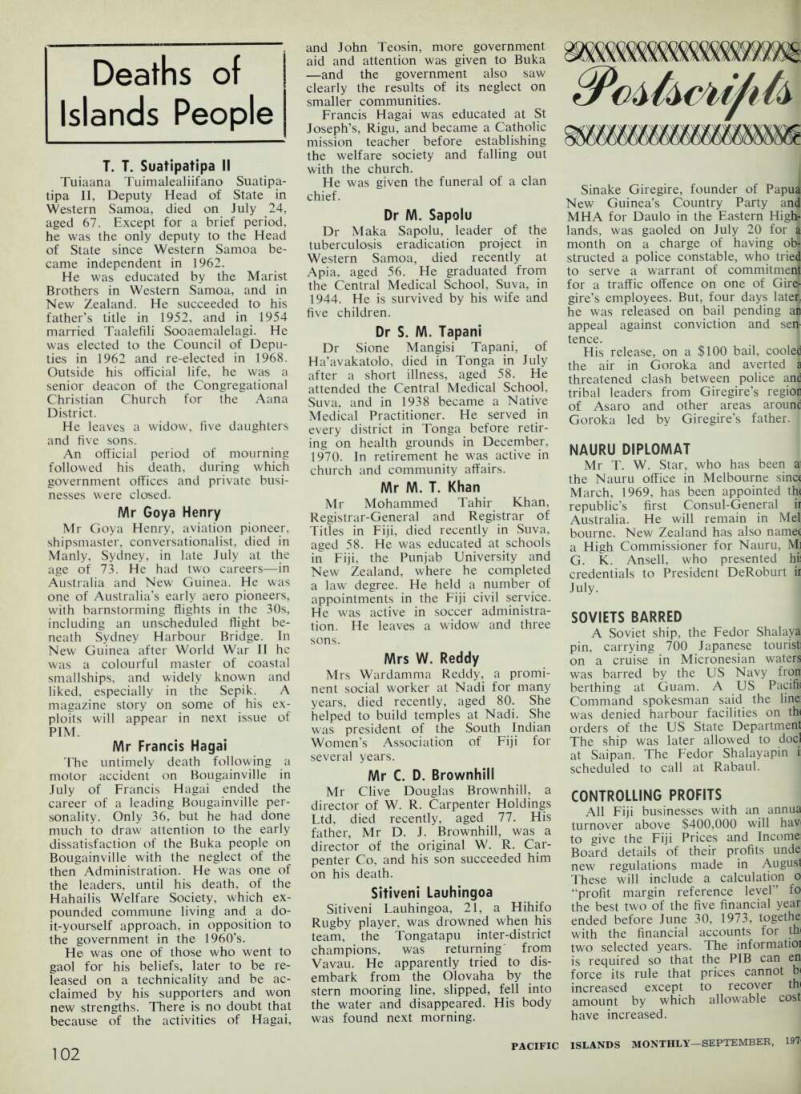
Deaths of Islands People
T. T. Suatipatipa II Tuiaana Tuimalealiifano Suatipa tipa 11, Deputy Head of State in Western Samoa, died on July 24, aged 67. Except for a brief period, he was the only deputy to the Head of State since Western Samoa be came independent in 1962.
He was educated by the Marist Brothers in Western Samoa, and in New Zealand. He succeeded to his father’s title in 1952, and in 1954 married Taalefili Sooaemalelagi. He was elected to the Council of Depu ties in 1962 and re-elected in 1968.
Outside his official life, he was a senior deacon of the Congregational Christian Church for the Aana District.
He leaves a widow, five daughters and five sons.
An official period of mourning followed his death, during which government offices and private busi nesses were closed.
Mr Goya Henry
Mr Goya Henry, aviation pioneer, shipsmaster, conversationalist, died in Manly, Sydney, in late July at the age of 73. He had two careers —in Australia and New Guinea. He was one of Australia’s early aero pioneers, with barnstorming flights in the 30s, including an unscheduled flight be neath Sydney Harbour Bridge. In New Guinea after World War II he was a colourful master of coastal smallships, and widely known and liked, especially in the Sepik. A magazine story on some of his ex ploits will appear in next issue of
Pim.
Mr Francis Hagai The untimely death following a motor accident on Bougainville in July of Francis Hagai ended the career of a leading Bougainville per sonality. Only 36, but he had done much to draw attention to the early dissatisfaction of the Buka people on Bougainville with the neglect of the then Administration. He was one of the leaders, until his death, of the Hahailis Welfare Society, which ex pounded commune living and a do it-yourself approach, in opposition to the government in the 1960’5.
He was one of those who went to gaol for his beliefs, later to be re leased on a technicality and be ac claimed by his supporters and won new strengths. There is no doubt that because of the activities of Hagai,
and John Teosin, more government aid and attention was given to Buka —and the government also saw clearly the results of its neglect on smaller communities.
Francis Hagai was educated at St Joseph’s, Rigu, and became a Catholic mission teacher before establishing the welfare society and falling out with the church.
He was given the funeral of a clan chief.
Dr M. Sapolu Dr Maka Sapolu, leader of the tuberculosis eradication project in Western Samoa, died recently at Apia, aged 56. He graduated from the Central Medical School, Suva, in 1944. He is survived by his wife and five children.
Dr S. M. Tapani Dr Sione Mangisi Tapani, of Ha’avakatolo, died in Tonga in July after a short illness, aged 58. He attended the Central Medical School, Suva, and in 1938 became a Native Medical Practitioner. He served in every district in Tonga before retir ing on health grounds in December, 1970. In retirement he was active in church and community affairs.
Mr M. T. Khan Mr Mohammed Tahir Khan, Registrar-General and Registrar of Titles in Fiji, died recently in Suva, aged 58. He was educated at schools in Fiji, the Punjab University and New Zealand, where he completed a law degree. He held a number of appointments in the Fiji civil service.
He was active in soccer administra tion. He leaves a widow and three sons.
Mrs W. Reddy Mrs Wardamma Reddy, a promi nent social worker at Nadi for many years, died recently, aged 80. She helped to build temples at Nadi. She was president of the South Indian Women’s Association of Fiji for several years.
Mr C. D. Brownhill Mr Clive Douglas Brownhill, a director of W. R. Carpenter Holdings Ltd, died recently, aged 77. His father, Mr D. J. Brownhill, was a director of the original W. R. Car penter Co, and his son succeeded him on his death.
Sitiveni Lauhingoa
Sitiveni Lauhingoa, 21, a Hihifo Rugby player, was drowned when his team, the Tongatapu inter-district champions, was returning' from Vavau. He apparently tried to dis embark from the Olovaha by the stern mooring line, slipped, fell into the water and disappeared. His body was found next morning.
Postscripts
Sinake Giregire, founder of Papua New Guinea’s Country Party and: MHA for Daulo in the Eastern High lands, was gaoled on July 20 for a month on a charge of having obi structed a police constable, who tried to serve a warrant of commitment for a traffic offence on one of Girej gire’s employees. But, four days latef. he was released on bail pending a| appeal against conviction and sen tence.
His release, on a $lOO bail, coole| the air in Goroka and averted & threatened clash between police and tribal leaders from Giregire’s region of Asaro and other areas around Goroka led by Giregire’s father.
Nauru Diplomat
Mr T. W. Star, who has been ai the Nauru office in Melbourne sine* March, 1969, has been appointed the republic’s first Consul-General ir Australia. He will remain in Mel bourne. New Zealand has also namec a High Commissioner for Nauru, Mi G. K. Ansell, who presented hi! credentials to President Deßoburt ii July.
Soviets Barred
A Soviet ship, the Fedor Shalaya pin, carrying 700 Japanese tourist on a cruise in Micronesian waters was barred by the US Navy fron berthing at Guam. A US Pacifit Command spokesman said the line] was denied harbour facilities on th( orders of the US State Department The ship was later allowed to docl at Saipan. The Fedor Shalayapin i: scheduled to call at Rabaul.
Controlling Profits
All Fiji businesses with an annua turnover above $400,000 will havi to give the Fiji Prices and Income: Board details of their profits unde: new regulations made in August These will include a calculation o “profit margin reference level” fo the best two of the five financial year ended before June 30, 1973, togethe with the financial accounts for t±u two selected years. The informatioi is required so that the PIB can en force its rule that prices cannot b( increased except to recover th( amount by which allowable cost have increased.
Advertisements & other items, pp. 105-106 (2 items)
103
FIC ISLANDS MONTHLY—SEPTEMBER, 1974
LnnJ
§e) F tO §s) LnnJ F r i FsJ InnJ ll 1
DATELINE HOTEL
TONGA
"Friendly Hotel" of the "Friendly Islands"
Situated along the Nuku'alofa waterfront. Only five minutes walk from town. Single, double, family suites, airconditioning, and hot and cold water showers. Pool, bar, restaurant, duty-free shop, tour desk and boutique.
Book through your travel agent or write to International Dateline Hotel, P.O. Box 62, Nuku'alofa Tonga.
Cable Address: "DATELINE".
Represented Overseas by: Charles J. Henry and Associates Pty. Ltd.
Sydney and Melbourne. 197 ,
Primitive luxury
(Polynesian style) Nestled away in the untouched Kingdom of Tonga is new, luxurious "Port 3f Refuge" International resort. Here is a unique opportunity for your clients (o experience the tranquil and relaxed fongan atmosphere while they enjoy (■he picturesque surroundings of the lew "Port of Refuge". And only a short flight from Fi|i.
Reasonable tariffs from $17.50 with special concessions for children. Agents :ommission 10 per cent.
Tonga's
brt of Refuge
Mi IMTFDNATIANA/ W
INTERNATIONAL RESORT
A?* Uava’u Tonga bles: "Refuge" Tonga or "Tongatours"
Iney. Phone: Sydney 85-1603 or 282-472
Aggie Grey's the
South Pacific's legendary hotel Situated right in the heart of Western Samoa. Enjoy Polynesian-style friendliness and service, in cool surroundings, superb entertainment and food. Magnificent white sand beaches only a short drive away Airconditioned rooms, swimming pool and full bar facilities.
Bookings through Union Steamship Company of NZ, Pan Am, Air New Zealand or direct to Aggie Grey's, Apia Western Samoa. Cables: AGGIES, APIA.
SAMOA N HID E AWAY
BEACH RESORT HOTEL
"The real Western Samoa"
Bungalows situated on a palm-fringed carpet of sand at the mouth of a jungle stream. This is Western Samoa. You'll be glad you came.
Bookings: Instant Hotels, Advance Accommodation, United Travel (in N.Z.), Accommodations Abroad (in Aust.).
Cables: "HIDEAWAY" Apia.
P.O. Box 1191, Apia, Western Samoa.
ARK VIEW MOTEL—BRISBANE
jiet location —opp. Botanic Gardens, ngle, double, family suites, all with frig., air conditioning, phone, TV, radio, a making facilities, from $l2. Pool and staurant.
Phone 31-2695—Telex 40270. rite for coloured brochure— irk View Motel, 128 Alice St, BRISBANE, Old., 4000.
A history and visitor's guide to Norfolk Island.
RAMBLER'S GUIDE TO NORFOLK ISLAND
Merval Hoare.
Price: Australia and overseas, $1.50 Aust., plus 25c posted; U.S.A., $2.40 U.S. posted.
Pacific Publications (Aust.) Pty. Ltd.,
Postal Address; Box 3408, G.P.0., Sydney, N.S.W. 2001.
WANTED
COMMON BUTTERFLIES
AND DAY FLYING
MOTHS. Can pay 25 cents to 75 cents each. . Poseidon (male green, $2.75 each, imale 60 cents each). P. Ulysseus $1 75 jchenor $l.OO. Papilios 25 cents to 5.00 each. Long horn beetles 25 cents i $5.00. Large walking sticks with and ithout wings, 6 to 9 inch body size 2.00 to $4.00 each. ily first quality perfect specimens for udy purpose only. Will pay for postage. >1 lectors please write to: JTTERFLY CO., 51-17 Rockaway Beach vd., Far Rockaway, N.Y. 11691. U.S.A.
FIRE
VEHICLE
SOUTHERN PACIFIC INSURANCE
COMPANY LIMITED
Head Office: Equitable Life Building, 80 Alfred Street, AAilsons Point, N.S.W., 2061.
Specialising in Pacific Island Insurance requirements for over 30 years.
FIRE AND VOLCANIC ERUPTION • HOUSEHOLD COMPREHENSIVE • MOTOR • COMPULSORY THIRD PARTY • COMPULSORY WORKERS' COMPENSATION
• PUBLIC LIABILITY • MARINE
Enquiries Invited for all classes of insurance from special representatives at: PORT MORESBY. H. A. K. McKee, Manager for Papua New Guinea, Champion Parade, P-0. Box 136. RABAUL: K. J. Armstrong—Manager at Rabaul, Mango Avenue, PO Box 123. LAE: R. H. Myer—Manager at Lae, Kam Hong's Building, Central Avenue, P.O.
Box 758. SUVA-FIJI: L. M. Rolls—Manager for Fiji, McGowan's Building, Margaret Street P.O. Box 521.
Turners and Growers
FRESH FRUIT & VEGETABLES
Line Advertisements
Per line, $2.50 Aust., Minimum rate. 4 lines.
FOR SALE 3 acre tropical Island paradise situated China Straits, Papua, adjacent to mainland ideal for tourism, big game fishing, two dwellings, staff quarters, wharf and sheds. For further particulars: P.O, Box 7, Kincumber, NSW, 2251, Australia.
FLEETS 49 ft. Tourist boat profess, bit. 1952, in survey, sleeps 12, 3,000 lbs refrig, capacity, engine aft, dry cargo space available $30,000.00. FLEETS, Rowe’s Bldg., Edward St., Brisbane. Cable “FLEETS
BRISBANE”.
CONCRETE BLOCK MACHINES. Makes
blocks, flags, edgings, screen-blocks, garden stools —up to 8 at once and 96 an hour. $A139.00 c.i.f. main ports. Send for leaflets. Forest Farm Research, Londonderry, N.S.W., 2753.
SEEK PACIFIC STAMPS. In exchange offer assistance with your hard to get shopping in Sydney. May I help you?
M. Lewis, 2/69 Tarrants Ave., Eastwood, NSW 2122, Australia.
MANAGERIAL POSITION WANTED on an
agricultural development in Pacific Islands.
Disposing of own property in N.S.W., Aust.
Please reply; lan Pilcher, C/- Box 3408, G.P.0., Sydney, Aust., 2001.
BUTTERFLIES AND BEETLES. Catchers
wanted from all Pacific Islands. Please write in strictest confidence to: Michel Bichez, ch. de Binche 2, Mons, Belgium.
BUTTERFLY SPECIMENS from Pacific Islands, wanted to buy. Bred specimens preferred. Q’ld. Butterfly Co., Long Rd., Nth. Tamborine, Q’ld., 4272.
ALL BOOKS AND JOURNALS ON AUST-
RALASIA AND THE PACIFIC BOUGHT
AND SOLD. Catalogues issued and sent free on application. Correspondence invited. Berkelouw, 15-19 Boundary St., Rushcutters Bay, Sydney, 2011. Phone: 31-8215.
UNIQUE MARINE SERVICE FOR PACIFIC
ISLANDS. Located in Southern California Centre of marine trade. We purchase for boatyards, fishermen, yachtsmen. Enquiries answered promptly. Hard-to-find marine items our specialty. Try us. Blackie’s Boat Yard, P.O. Box 2136, Newport Beach,
92663, U.S.A.
MARKETING REPRESENTATIVE in
principal Pacific Island Market Centres, wanted by U.S. Company. Knowledge of consumer products and their sales outlets required. Furnish personal resume. Lewis, P.O. Box 253, Little Rock, Arkansas,
U.S.A., 72203.
Turners Supply Co
FRESH FRUIT & VEGETABLES
9813
Index to Advertisers
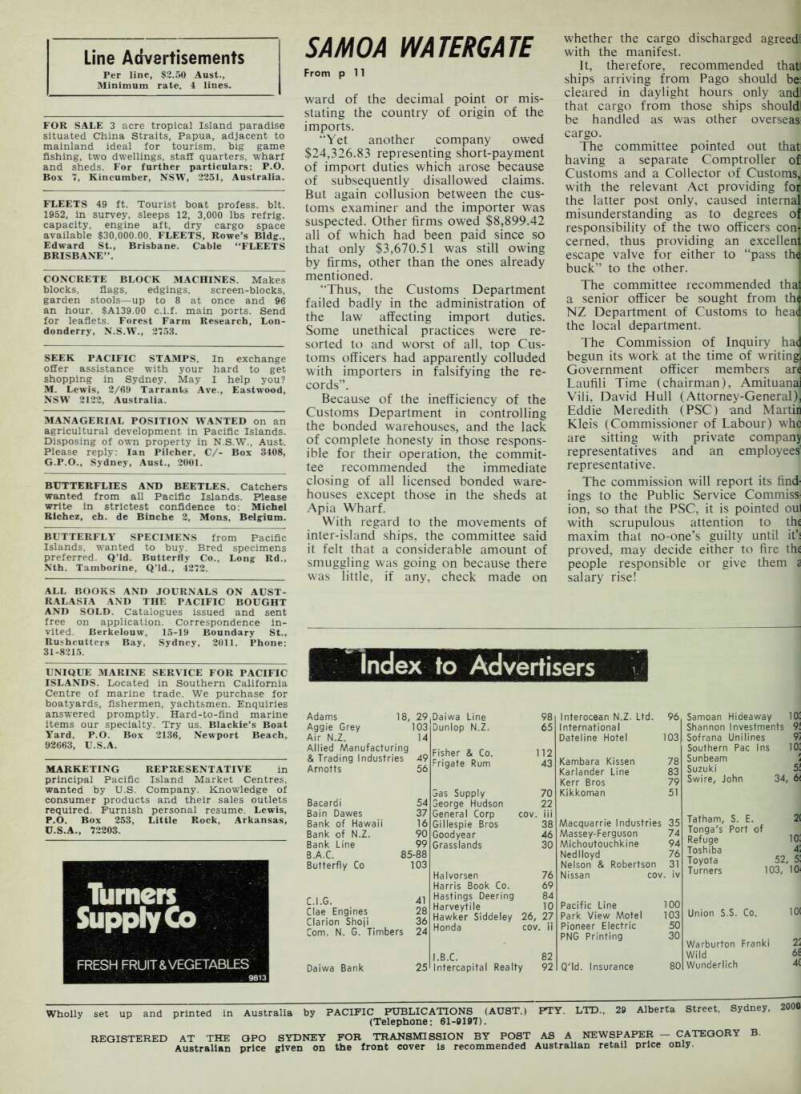
Adams 18, 29, Aggie Grey 103 Air N.Z. 14 Allied Manufacturing & Trading Industries 49 Arnotts 56 Bacardi 54 Bain Dawes 37 Bank of Hawaii 16 Bank of N.Z. 90 Bank Line 99 B. 85-88 Butterfly Co 103 C. 41 Clae Engines 28 Clarion Shoji 36 Com. N. G. Timbers 24 Daiwa Bank 25
Daiwa Line 98 Dunlop N.Z. 65 Fisher & Co. 112 Frigate Rum 43 Gas Supply 70 George Hudson 22 General Corp cov. iii Gillespie Bros 38 Goodyear 46 Grasslands 30 Halvorsen 76 Harris Book Co. 69 Hastings Deering 84 Harveytile 10 Hawker Siddeley 26, 27 Honda cov. ii 1.8. C. 82 Intercapital Realty 92
Interocean N.Z. Ltd. 96 International Dateline Hotel 103 Kambara Kissen 78 Karlander Line 83 Kerr Bros 79 Kikkoman 51 Macquarrie Industries 35 Massey-Ferguson 74 Michoutouchkine 94 Nedlloyd 76 Nelson & Robertson 31 Nissan cov. iv Pacific Line 100 Park View Motel 103 Pioneer Electric 50 PNG Printing 30 Q'ld. Insurance 80
Samoan Hideaway 10c Shannon Investments 9i Sofrana Unilines 95 Southern Pac Ins 10c Sunbeam 2 Suzuki 5 t Swire, John 34, 6 i Tatham, S. E. 2( Tonga's Port of Refuge 101 Toshiba 42 Toyota 52, 51 Turners 103, 10' Union S.S. Co. 10( Warburton Frank! 22 Wild 68 Wunderlich 4C
Advertisements & other items, pp. 106-108 (2 items)
Samoa Watergate
From p 11
Wholly set up and printed in Australia by PACIFIC PUBLICATIONS (AUST.) PTY. LTD.. 29 Alberta Street, Sydney. 200 ft (Telephone; 61-0197).
REGISTERED AT THE GPO SYDNEY FOR TRANSMISSION BY POST AS A NEWSPAPER CATEGORY B.
Australian price given on the front cover is recommended Australian retail price only.
e crowd
TFC-24505W
om
TFC-5000A
BHHEHbHhHI
>rtability. Professional performance. These are just two the reasons for General cassette/radios’all-age popularity.
Advanced features like Automatic Level Control, Auto-Stop, sensitive built-in condenser microphone and Automatic equency Control are standard for both models. And the solisticated TFC-5000A has a whole host of superb extras— professional-type mixing circuit, a sleep switch, a triplenction meter, a Variable Sound Monitoring System.
Why don’t you visit your local dealer and see these casitte/radios for yourself? We’re sure you’ll agree, this is one ne when it’s sensible to join the crowd.
TFC-5000A
Deluxe solid-state MW/SW/FM 3-band radio with cassette recorder
TFC-24505W
Solid-state MW/SWi/SW 2 3-band radio with cassette recorder
OGENERAL
THE GENERAL CORPORATION japan
1116, Suenaga, Takatsu-ku Kawasaki-city, Japan
II m m S>iii m f % j* r T
!SSS»!s
nP
bhe
► f* -O’
you ...
there’s
f ■4 1 4* • r^m.
And wherever you’ll go in over 120 nations throughout the world you’ll find proud DATSUN drivers.
Perhaps the main reason is that DATSUN was designed to meet a wide variety of conditions—mountain roads and super highways, blistering suns and freezing temperatures. DATSUN is indeed the international car that has precision engineering and a stunning string of rally victories behind it.
Its superb handling, safety features and high speed efficiency make DATSUN the choice of young and old alike. DATSUN—the car that really satisfies the world over.
DATSUN
NISSAN
■ i . ■■ s
ill
DATSUN distributor network covers the following areas; Fiji • T.P.N.G. •W. Samoa-New Caledonia - New Hebrides- 8.5.1.P.-Timor-Norfolk- A. Samoa - Tahiti - Cook - Nauru - Tonga - Saipan - Guam - Australia - New Zealand