Pacific Islands Monthly

News Magazine Of The South Pacific
August, 1974
AUSTRALIA, NX, P.N.G., FIJI, N. HEBRIDES 60c TONGA, W. SAMOA, 8.5.1. P., G.E.I.C. 60c
Cooks, Norfolk, Niue, Nauru 60C
Am. Samoa, Hawaii, Micronesia, Guam $L.Oo
NEW CALEDONIA AND FRENCH POLYNESIA 100 CFP
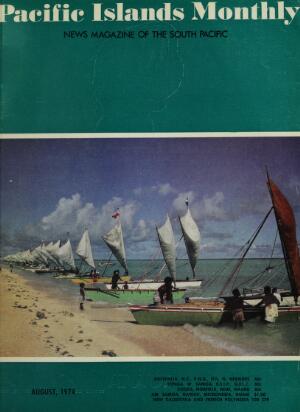
Our Cover
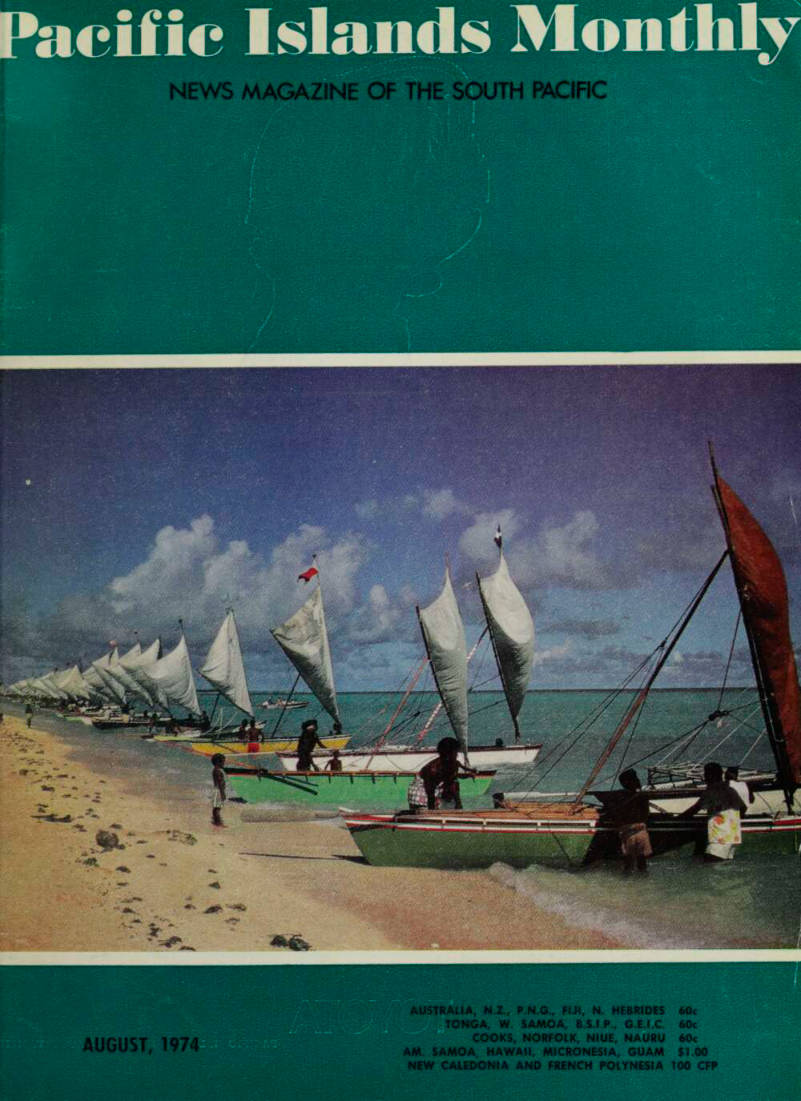
Lining up for a canoe race on Bairiki on the GElC’s atoll capital of Tarawa, an attractive scene from the film made by Karl-Heinz Stellmach, Sailing in the Trade Winds, which was seen by the Queen in a special screen ing at Buckingham Palace.
Advertisements & other items, p. 2 (1 item)
little things
Wre bk on
at Toyota.
There are a lot of things that make a Toyota a great automobile. Big things like computerized quality control. And little things like eye tests.
For the last five years we've been running tests to determine the limits of visibility under various conditions. We test with men and with women. On country roads and city streets. Then we use the results to design our cars from the shape of the windscreen, to the size of the mirrors, to the position and brightness of the headlamps.
Compared to our more sophisticated testing and research, or compared to our performance and styli Because we've been doing them for 36 years. And we'll keep on doing them. Because they go a long way toward making you satisfied. tests may seem insignificant.
But the little things we do add up
TOYOTA
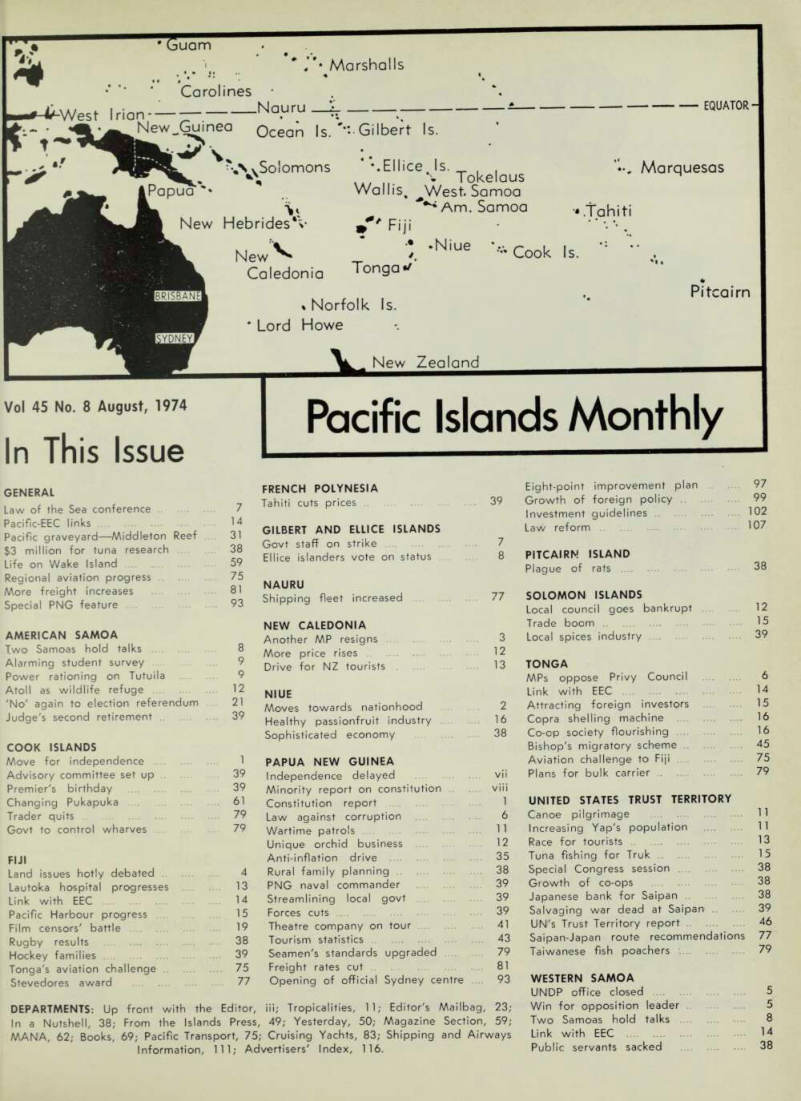
In This Issue
General
Law of the Sea conference 7 Paciflc-EEC links 14 Pacific graveyard —Middleton Reef 31 $3 million for tuna research 38 Life on Wake island 59 Regional aviation progress 75 More freight increases 81 Special PNG feature 93
American Samoa
Two Samoas hold talks 8 Alarming student survey 9 Power rationing on Tutuila 9 Atoll as wildlife refuge 12 'No' again to election referendum 21 Judge's second retirement 39
Cook Islands
Move for independence 1 Advisory committee set up 39 Premier's birthday 39 Changing Pukapuka 61 Trader quits 79 Govt to control wharves 79
Fiji
Land issues hotly debated 4 Lautoka hospital progresses 13 Link with EEC 14 Pacific Harbour progress 15 Film censors' battle 19 Rugby results 38 Hockey families 39 Tonga's aviation challenge 75 Stevedores award 77
French Polynesia
Tahiti cuts prices 39
Gilbert And Ellice Islands
Govt staff on strike 7 Ellice islanders vote on status 8
Nauru
Shipping fleet increased 77
New Caledonia
Another MP resigns 3 More price rises 12 Drive for NZ tourists 13
Niue
Moves towards nationhood 2 Healthy passionfruit industry 16 Sophisticated economy 38
Papua New Guinea
Independence delayed vii Minority report on constitution viii Constitution report 1 Law against corruption 6 Wartime patrols 11 Unique orchid business 12 Anti-inflation drive 35 Rural family planning 38 PNG naval commander 39 Streamlining local govt ... 39 Forces cuts 39 Theatre company on tour 41 Tourism statistics 43 Seamen's standards upgraded 79 Freight rates cut 81 Opening of official Sydney centre 93
DEPARTMENTS: Up front with the Editor, iii; Tropicalities, 11; Editor's Mailbag, 23; In a Nutshell, 38; From the Islands Press, 49; Yesterday, 50; Magazine Section, 59; MANA, 62; Books, 69; Pacific Transport, 75; Cruising Yachts, 83; Shipping and Airways Information, 111; Advertisers' Index, 116.
Eight-point improvement plan 97 Growth of foreign policy 99 Investment guidelines 102 Law reform 107
Pitcairn Island
Plague of rats 38
Solomon Islands
Local council goes bankrupt 12 Trade boom 15 Local spices industry 39
Tonga
MPs oppose Privy Council 6 Link with EEC 14 Attracting foreign investors 15 Copra shelling machine 16 Co-op society flourishing 16 Bishop's migratory scheme 45 Aviation challenge to Fiji 75 Plans for bulk carrier 79
United States Trust Territory
Canoe pilgrimage 11 Increasing Yap's population 11 Race for tourists 13 Tuna fishing for Truk 15 Special Congress session ... 38 Growth of co-ops 38 Japanese bank for Saipan 38 Salvaging war dead at Saipan 39 UN's Trust Territory report 46 Saipan-Japan route recommendations 77 Taiwanese fish poachers 79
Western Samoa
UNDP office closed 5 Win for opposition leader 5 Two Samoas hold talks 8 Link with EEC 14 Public servants sacked 38
Advertisements & other items, p. 4 (1 item)
Knox Schlapp Pty. Ltd.
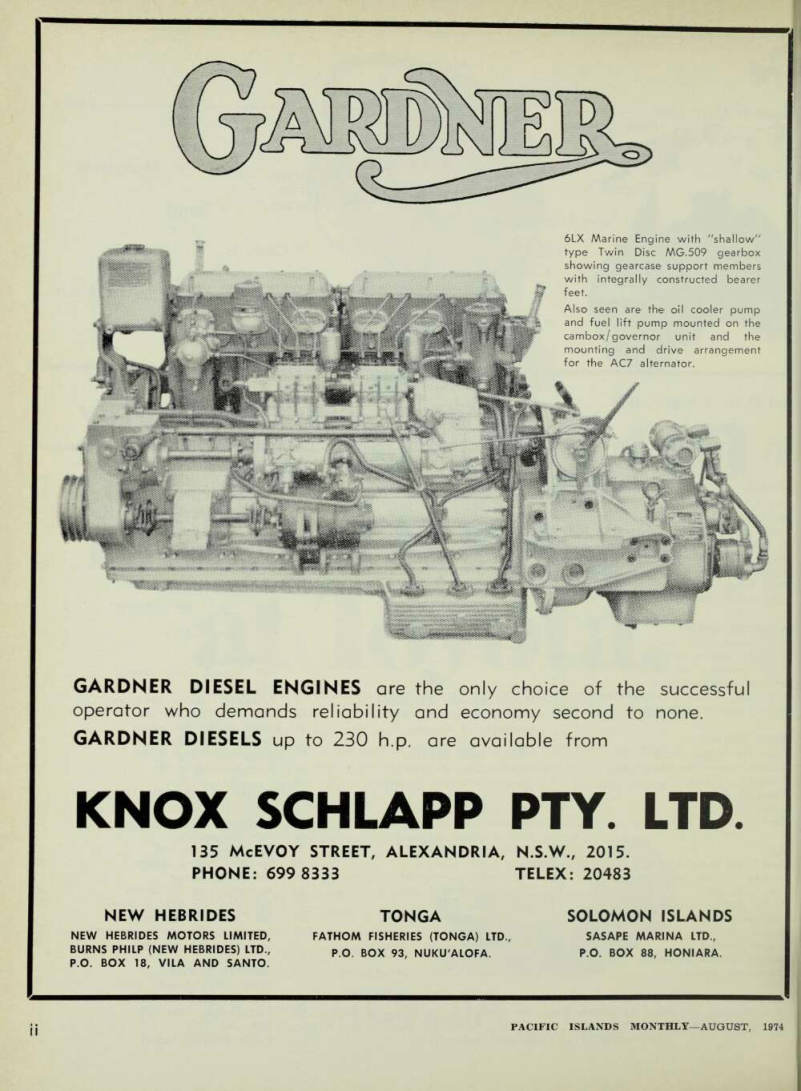
D D A o 6LX Marine Engine with "shallow" type Twin Disc MG.509 gearbox showing gearcase support members with integrally constructed bearer feet.
Also seen are the oil cooler pump and fuel lift pump mounted on the cambox/governor unit and the mounting and drive arrangement for the AC7 alternator. \ P -- w ** s I I GARDNER DIESEL ENGINES are the only choice of the successful operator who demands reliability and economy second to none.
GARDNER DIESELS up to 230 h.p. are available from
KNOX SCHLAPP PTY. LTD.
135 McEVOY STREET, ALEXANDRIA, N.S.W., 2015.
PHONE: 699 8333 TELEX: 20483
NEW HEBRIDES TONGA SOLOMON ISLANDS
NEW HEBRIDES MOTORS LIMITED, FATHOM FISHERIES (TONGA) LTD., SASAPE MARINA LTD., BURNS PHILP (NEW HEBRIDES) LTD., p.O. BOX 93, NUKUALOFA. P.O. BOX 88, HONIARA.
P.O. BOX 18, VILA AND SANTO.
Pacific Islands
Monthly
FOUNDED BY R. W. ROBSON IN 1930
Published Monthly By
Pacific Publications (Aust.) Pty. Ltd.,
29 Alberta St., Sydney, N.S.W., 2000.
Postal Address: G.P.O. BOX 3408, SYDNEY,
N.S.W., 2001.
Telegraphic Address: PACPUB, Sydney.
Telex 25168.
Telephones: 61-9197, 61-7101, 61-4369.
insulting Directors: R. W. Robson, Judy Tudor.
Chief Executives: Manager: Selwyn Hughes.
Publisher: Stuart Inder.
Director of Advertising; W. A. Gasnier.
Pacific Islands Monthly
Editor: Stuart Inder.
Assistant Editor: John Carter.
Advertising Manager: W. A. Gasnier.
Circulation Manager: Barry Badger.
Subscription Rates:
Pacific Islands Monthly" is airfreighted to all ibscribers and agents in the Pacific Islands id the U.S.A.; copies to Nauru and other eas go by surface mail, iistralia (incl. Lord Howe and Thursday Is.), ew Zealand, Papua New Guinea, Fiji, New ebrides, Tonga, Western Samoa, Solomon lands, Gilbert & Ellice Islands, Cook Islands, orfolk Island, Niue and Nauru Islands: $6.80 ocal currency); American Samoa, Hawaii, jcronesia and Guam; $12.00 US; New aledonia and French Polynesia 1,100 CFP; S Mainland: $14.00 US; United Kingdom: 5-10. Elsewhere $B.OO Aust.
Representatives
ji: Advertising— Fiji Times & Herald Ltd., 3 Gordon St., Suva. Telephone: 25-601.
Hex.: FJ 2124. Distribution—Desai Book Depot Ltd., P.O. Box 160, SUVA. Tel.; 311-424. apua New Guinea: PORT MORESBY, PNG Print ig Co. Pty. Ltd., P.O. Box 633; LAE, P.O. Box 27; RABAUL, Mr. David Simpson, P.O. Box 164 (c/- Rabaul Photographic. Tel.: 2677.) ench Polynesia. Distribution —Hachette Paci que, 10 Ave Bruat, Papeete, ew Zealand: Pacific Publications, C.P.O. Box 229, Auckland. 379-494. Representative: Mr . Breckell, Breckell Publishing, Kingdon House, ingdon Street, Newmarket, Auckland. Tel.: 54-6210. Telex.: NZ 2727. nited Kingdom: Advertising—Overseas Publicity Id., 214 Oxford Street, London, WIN OEA. hone: 01-636 8296/7. Subscriptions—T. B. raham. Park House, 22 Park Street, Croydon,
Cr9 3Np. Tel.: 01-6884177.
apan: Advertising—Universal Media Corpora tion, C.P.O. Box 46, Tokyo. Tel.: 666-3036. ictoria: Advertising Pacific Publications \ust.) Pty. Ltd., 33 Lonsdale Street, \elbourne, Vic. 3006. Telephone: 662-3263. ueensland: Advertising—Beale Media Services, 32 St. Paul's Terrace, Fortitude Valley, Qld., 4006. Tel.: 52-5827. awaii and U.S. Mainland only: N. Grogan, 354 Hayden Street, Honolulu, 96815.
Send change of address notices, Form 3579 nd new subscriptions to P.O. Box 2193, Honolulu, Hawaii, U.S.A. 96805). econd class postage paid at Honolulu, Hawaii.
Copyright ©, 1974,
Pacific Publications (Aust) Pty. Ltd.
August, 1974 Vol. 45, No. 8
Up Front
with the Editor
There are, according to Fiji Minis ter without Portfolio, Ratu David Toganivalu, special requirements of the Press in a developing country.
The Press, he submits, is an alien concept in the Pacific Islands, having been developed most often to serve the interests of the traders, the colonisers, the teachers and all the other members of the expatriate population.
Furthermore, the Press in those territories that have been under British rule has continued in the British tradition, just as the Press in the American Pacific territories has followed the American tradition and that in the French territories has followed the French tradition.
Ratu David asks whether there is not now room for a concept of a Press in a Pacific tradition?
It’s a good question, and he asked it in the course of a constructive and well-balanced address to the in augural session of the Pacific Islands News Association in Suva at the end of June. That session was called to get the association started—an as sociation open to newspapers, broad casting organisations and government information offices in the South Pacific Commission area. Its aims are to promote and protect freedom of expression in the Pacific Islands and to foster responsible journalism and professional standards in the Pacific news media.
Taking part in this important get together were editors from Papua New Guinea, the Solomons, Fiji, Tonga, Western Samoa, Norfolk Island, Tahiti, the Cooks, the Gilbert and Ellice, Micronesia, Australia and New Zealand. I turned out to be the Australian delegate.
The association has got off the ground because of a heck of a lot of work by Jim Richstad, Research Associate at the East West Com munications Institute, Hawaii, and Len Usher, former publisher of The Fiji Times, and because of some immediate cash grants by the Papua
New Guinea Post Courier and The Fiji Times. Widely experienced Ten Usher, appointed by the conference as the organising director, now has the big job of following up the de tails, and as he will certainly do that as competently as he organised the big Suva conference, there is no doubt about the future of the Pacific Islands News Association.
But back to Ratu David and his concept of a Press in a Pacific tradition.
Ratu David sees this tradition as revolving round a concerted effort by governments and the Press in the Islands to examine, together, those areas where national interest can take priority over sectional interests.
In Fiji, for example, the minister sees Press responsibility—and he’s referring to Press in the broadcast sense, to include radio—as the need to heighten awareness of modern methods of farming and land use, as the need to generate enthusiasm for self-help schemes and rural develop ment, to inform people who may not be aware of the importance of financial management, of such things as birth control, and education. The Press has the responsibility of ex plaining the complexities of political processes, of inflation and the balance of payments.
It has, in a sentence, he feels, the responsibility to help in the creation of a sense of national unity and pur pose, and it must keep in mind that when it criticises, its criticism will be read by people who might react in a different way from the newspaper readers of Sydney or Auckland.
As one way of achieving some of these objectives, the Fiji minister would personally like to see an ex tension of the sort of combined operation seen in wartime Britain, with the government and editors get ting together for off-the-record exchanges about national problems and aims.
Ratu David Toganivalu is an en lightened cabinet minister with a
good working relationship with the Press. One could say that his concept is one that should ideally be shared by the Press everywhere and no< merely in the Pacific Islands. But i is particularly applicable to the Islands, for anybody with any ex perience of these emergent nations knows that what might, in the Western tradition, be a bright waji of treating events and utterances; might be viewed there in quite r different light.
A different approach is required, and I should think will certainly be developed, as indigenous journalists take control of their own newspapers and radio and produce the kind of Press they think best suited to their needs.
But there are, I believe, dangers in government and Press working too closely together if this means the Press gives up some of its independence.
About two years ago in these notes I said that with the emergence of self-government and independence in Papua New Guinea the Press there could expect new pressures from the bureaucrats—a new kind of intoler ance. more dangerous to the Press freedom because it will have as its base a nationalistic fervour with the dedication almost of a religious cru sade.
That is, the belief by newly emergent governments in newly emergent nations that they have a divine right to be excused from pub lic criticism because they are trying so hard to govern in the best interests of the people. They have a belief that the Press cannot be both friend and critic in developing countries where, allegedly, democracy is so fragile.
Democracy so fragile that it can not stand the light is of course not democracy at all. Freedom of speech is a basic freedom in the Pacific Islands as anywhere else, and any attempt to restrict it, using the argu ment that the Islands are “different”, that the Pacific way means suppress ion of public debate, has to be re sisted.
Stuart Inder
Complexion beauty that
will last a lifetime
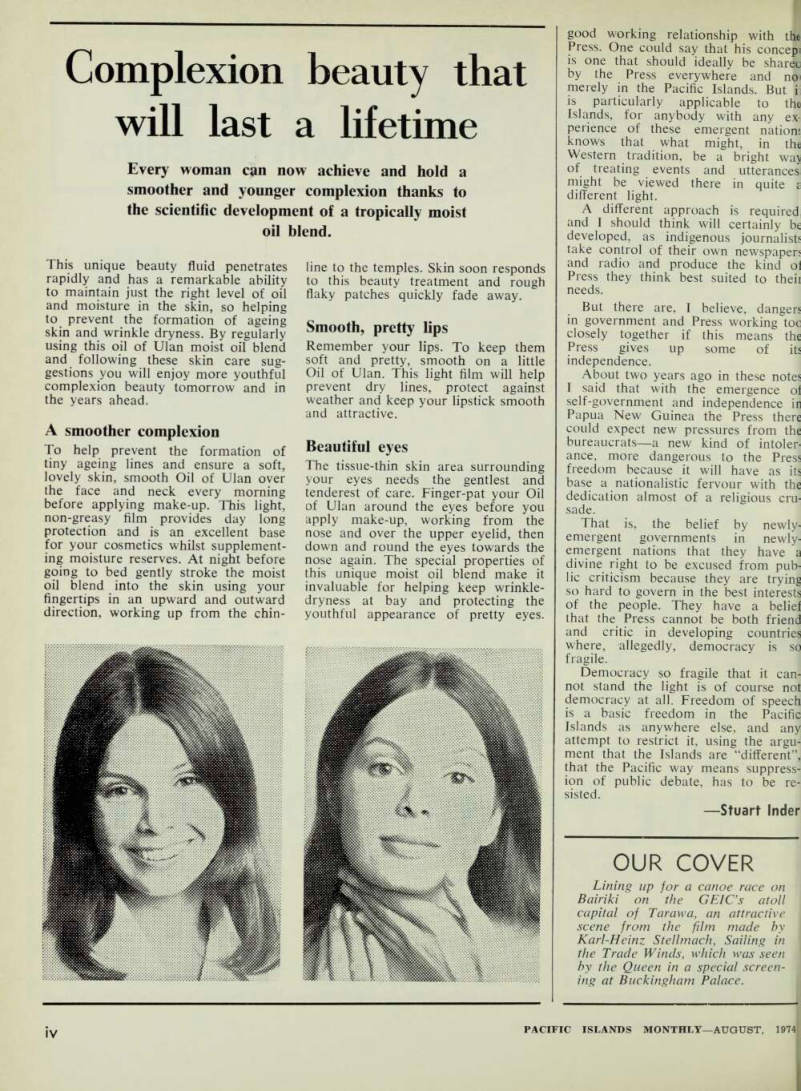
Every woman can now achieve and hold a smoother and younger complexion thanks to the scientific development of a tropically moist oil blend.
This unique beauty fluid penetrates rapidly and has a remarkable ability to maintain just the right level of oil and moisture in the skin, so helping to prevent the formation of ageing skin and wrinkle dryness. By regularly using this oil of Ulan moist oil blend and following these skin care sug gestions you will enjoy more youthful complexion beauty tomorrow and in the years ahead.
A smoother complexion To help prevent the formation of tiny ageing lines and ensure a soft, lovely skin, smooth Oil of Ulan over the face and neck every morning before applying make-up. This light, non-greasy film provides day long protection and is an excellent base for your cosmetics whilst supplement ing moisture reserves. At night before going to bed gently stroke the moist oil blend into the skin using your fingertips in an upward and outward direction, working up from the chin
line to the temples. Skin soon responds to this beauty treatment and rough flaky patches quickly fade away.
Smooth, pretty lips
Remember your lips. To keep them soft and pretty, smooth on a little Oil of Ulan. This light film will help prevent dry lines, protect against weather and keep your lipstick smooth and attractive.
Beautiful eyes The tissue-thin skin area surrounding your eyes needs the gentlest and tenderest of care. Finger-pat your Oil of Ulan around the eyes before you apply make-up, working from the nose and over the upper eyelid, then down and round the eyes towards the nose again. The special properties of this unique moist oil blend make it invaluable for helping keep wrinkle dryness at bay and protecting the youthful appearance of pretty eyes.
Advertisements & other items, pp. 7-8 (1 item)
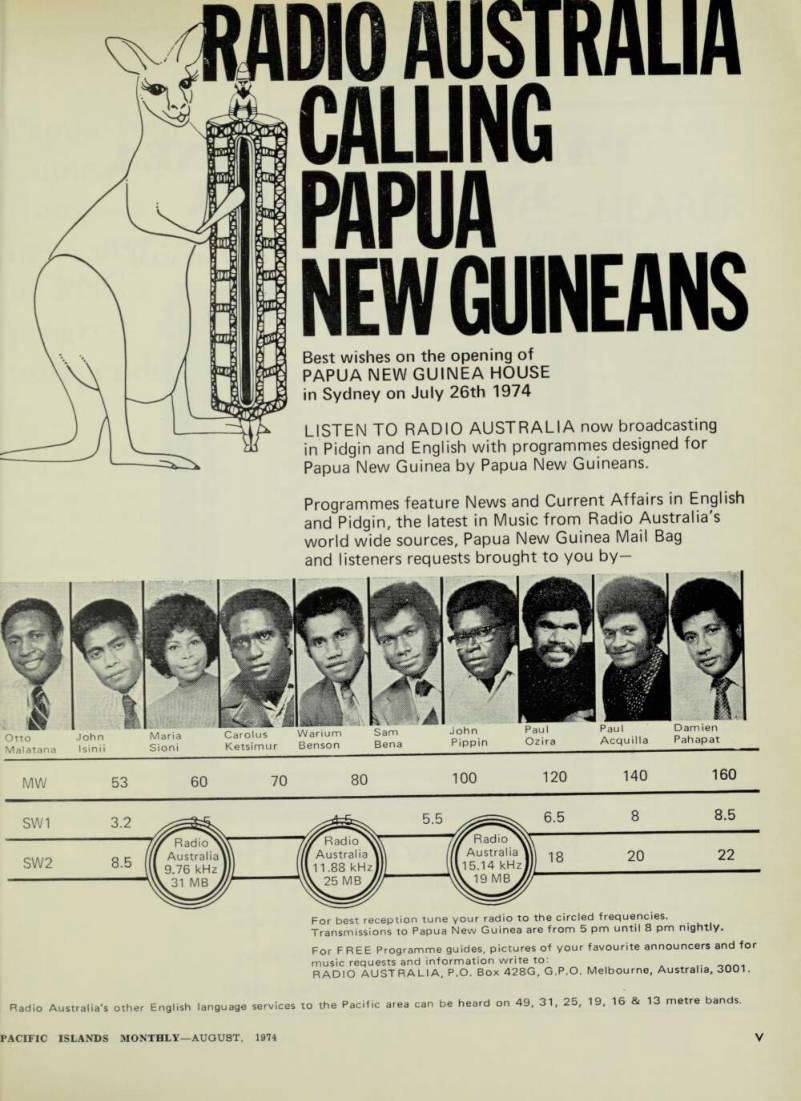
New Guineans
RADIO AUSTRALIA
F CALLING
PAPUA
NEW GUINEANS
Best wishes on the opening of
PAPUA NEW GUINEA HOUSE
in Sydney on July 26th 1974
LISTEN TO RADIO AUSTRALIA now broadcasting
in Pidgin and English with programmes designed for Papua New Guinea by Papua New Guineans.
Programmes feature News and Current Affairs in English and Pidgin, the latest in Music from Radio Australia's world wide sources, Papua New Guinea Mail Bag and listeners requests brought to you by— & & w m.
V i r /j A Paul Damien Acquilla Pahapat Paul John Pippin Bena Benson MW 53 60 70 80 100 120 140 160
SWI
3.2 SW2 8.5 Radio Austral Rad Radio Australia 9.76 kHz 31 MB a 18 14 kHz 44 I- H MB 19 MB 8.5 20 22 For best reception tune your radio to the circled frequencies.
Transmissions to Papua New Guinea are from 5 pm until 8 pm nightly.
For FREE Programme guides, pictures of your favourite announcers and for music requests and information write to: RADIO AUSTRALIA, P.O. Box 428 G, G.P.O. Melbourne, Australia, 3001.
Radio Australia's other English language services to the Pacific area can be heard on 49. 31, 25, 19, 16 & 13 metre bands.
" "a* *Pua NewGu'^
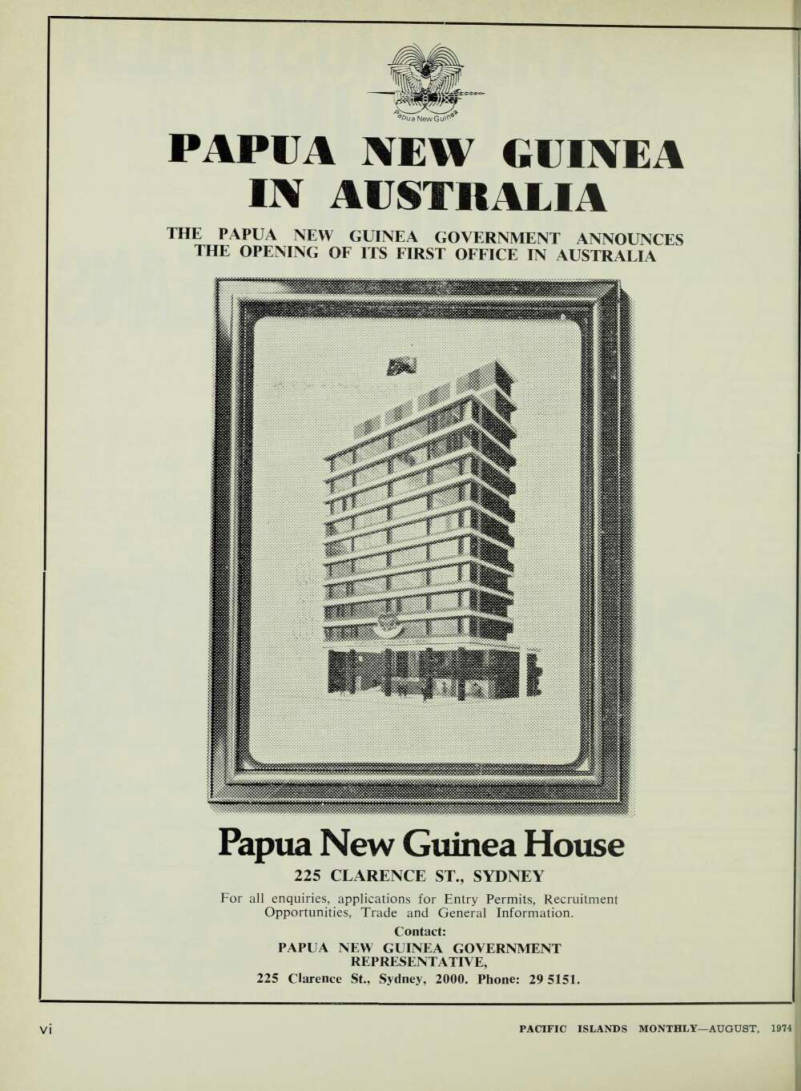
PAPUA NEW GUINEA
IN AUSTRALIA
THE PAPUA NEW GUINEA GOVERNMENT ANNOUNCES
THE OPENING OF ITS FIRST OFFICE IN AUSTRALIA I I 8
Papua New Guinea House
225 CLARENCE ST., SYDNEY
For all enquiries, applications for Entry Permits, Recruitment Opportunities, Trade and General Information.
Contact:
PAPUA NEW GUINEA GOVERNMENT
REPRESENTATIVE,
225 Clarence St., Sydney, 2000. Phone: 29 5151.
independence
Papua New Guinea House —a new step in PNG’s progress to
As Australia has assisted in the development of Papua New Guinea for so many years and Sydney is Australia's largest city, it was no surprise that the city was chosen as the site for the soon-to-be independent nation's first office block outside of Papua New ■Guinea. Papua New Guinea House, a worthy shop window in which to display the country is being opened with appro priate ceremonial on July 26.
In a special feature begin ning on p 93 PIM gives the background to PNG House, what goes on there and an illuminat ing glance at the plans for the country's prosperous future.
Pacific Islands Monthly
Independence-Nearer,
Yet Further Away
Papua New Guinea is ready for independence. And so is the Cooks.
And perhaps the Gilbert and Ellice. The stories are on the following pages.
Papua New Guinea in July finally got its long awaited Constitutional Planning Committee report giving a blueprint for the future of an inde pendent nation. The uproar which followed the tabling of the bulky document, which was in preparation over a period of two years, and is still only in draft form, had died down by early July, but the lull might only be temporary. The House of Assembly went into recess for a month to give members a cooling-off period, and in August the debate will continue at a special session.
But meanwhile the fuss did demon strate once again the Papua New Guinea ability for compromise.
The report recommends sweeping changes to Papua New Guinea’s system of government (for the details, see page 1), but Chief Minister Michael Somare, and his deputy Dr John Guise, have opposed some of its major points.
Mr Somare found himself in face to-face conflict with Father John Momis, the Constitutional Planning Committee’s deputy chairman and the man who has had the strongest in fluence on the committee of parlia mentarians drawn from all sides of the House.
It is not the first time Father Momis has trodden on Mr Somare’s toes. He is a highly articulate and single-minded politician from Bou gainville, and his outspoken criticism of the Somare government is often supported by the Minister for Justice Mr John Kaputin, from Rabaul, who is more a sniper than a stormer of trenches.
Earlier this year on the national radio Father Momis said bluntly that PNG could finish up with “mediocre leadership” unless “radical steps” were taken immediately. Mr Kaputin has been equally critical of the leader ship.
From a Port Moresby correspondent
When the CPC report was tabled at the June/July meeting, Mr Somare submitted a draft minority report on behalf of himself and Dr Guise. The House then retired temporarily to digest the meaty documents.
It wasn’t an easy job. The Pangu Party, Mr Somare’s own party, was split into parliamentary and non parliamentary divisions, and in the accompanying rumpus Pangu s national president, Mr Moi Avei, threatened to resign unless the parlia mentary wing listened to the “voice of the masses” as represented by the non-parliamentary members. His complaint was that the executive was entitled to express its opinions, and not be dominated by the parlia mentary members. He and other executive members walked out of the meeting, leaving the party MHAs.
But the fracas died when Mr Somare said he agreed with the stand of the executive members.
But the real confrontation was yet to come. At a subsequent meeting of the coalition Pangu and National parties, three members including Father Momis were ordered from the table.
Father Momis said that he, Mr Pikah Kasau (of Manus), and Mr Toni Ila (Lae), had been ordered from the meeting by Mr Somare and the chairman, Mr Albert Maori Kiki, Minister for Foreign Affairs, Defence and Trade, after having criticised “deals” between Mr Somare, the coalition People’s Progress Party and some members of the opposition United Party.
Father Momis also claimed that when he and the others left the room, expatriate advisers had been called in to address the meeting on the Somare-Guise minority report.
Mr Somare refuted the allega tions.
In the meantime, Mr Kaputin let
December 1 taraet
L/Cicmuci 1
datp ic rlrnnnprl utllc MlwpjJCU
his barrage loose challenging the “moral position of the minority re port", suggesting that it had been written in a night and querying the Chief Minister’s right to make it.
It appeared as if Mr Kaputin was again having his nibble at the leader ship, and with the support of Father Momis.
Mr Somare immediately stated that he was prepared to take up the chal lenge on the floor of the House. It’s unlikely that the Chief Minister would not win such a challenge.
At a press conference after the Momis and Kaputin attacks, Mr Somare criticised both members say ing that Mr Kaputin would have to explain his statement challenging the minority report, to cabinet. And he went on to make the telling point that it Mr Kaputin had bothered to attend cabinet meetings he would have known that the report had not been written in one night. (Mr Kaputin’s come-uppance fol lowed soon after, when Mr Somare asked for Mr Kaputin’s resignation ) . , resignation).
Then just when the situation looked as if it would get out of hand came the news that Father Momis had agreed to compromise on the CPC report.
v We wa , nt , the c t lef Mm,ster t 0 know we don t see the report as unchangeable, he said.
The committee agreed to alter some of its recommendations, particularly those relating to citizenship.
The Opposition United Party’s senior man on the CPC, Mr Paul Langro, told the House of Assembly that the amendments to the report bad been made as “an indication of willingness” on behalf of the CPC to reac h consensus.
The willingness” finally permeated the wh ole of the House on every important . ISS U|> culminating in agree- Mr So ™ a J* d .rop his Decemoer 1 target date for mdepenoence. . . tinn C tn & ICC °f- ls !I V? n ' for December 1 March but in the lin/hnl /S
Home he 1? l} T f
nHenenTnee T mstead S*
as K pr l CtlC ' enacted by the Hous^of^ssemblv 611 * 6d by , the Hou se of Assembly.
For good measure, he did not vote against an Opposition amendment requesting that the House itself endorse
merellTfhTTTlT’nTt fSI
that PNG was back ‘where h had a • *^ aS u C • where it had started , n March, wlth no declslon on independence.
The House passed the measures on the voices.
What this means is that while the passage of the constitution is the key
t 0 the independence date, it is unlikely that because of machinery measures independence should follow in much less than three months after the con stitution is decided on.
Mr Somare said later at a news conference that he hoped that after debate in August and September the constitution would be passed by the House in November, and that formal independence would come before February, although he declined to name another target date.
It still is possible, but unlikely, that December 1 is the date, Perhaps the Australian Govern ment thought it was likely when in J u ly it put into the mouth of the retiring Australian Governor-General, Sir Paul Hasluck, in his speech open ing Federal Parliament, the state ™nt that P endm S the declaration of independence, Australia would con duct its relations with PNG as if it were an independent nation.
Editorialised Port Moresby’s Post Courier: “In one respect this might he taken as a compliment from a beneficent foreign government. But it could also be seen as pre-empting the d “ ision , of the House of Assembly Puttmg another pressure on the PNG Government at a time when it M has h res of jts own j t looks a unilateral declaration of independence for one country by another, and that, to say the least, is presumptuous, however well-intentioned.”
And why there was a minority report
Prom a Port Moresby correspondent
Why did Chief Minister Somare and Deputy Chief Minister John Guise make their minority report on the Constitutional Planning Com mittee’s work?
It’s probably the most interesting question of a whole lot of interesting questions thrown up by the un precedented debate on Papua New Guinea’s constitution.
During the acrimonious scenes in and out of the House during the de bate, Mr Somare retorted that he and Dr Guise had every right to make a minority report—as had every other member of the CPC who mightn’t agree with the major report.
This was true, but why should both Mr Somare and Dr Guise be the ones to team up to produce an amended report?
When Mr Somare had the com plicated task of putting together the coalition government in 1972, Dr Guise stood apart to the end, keep ing with him a group of about six
politicians. He joined the coalition, but even today he claims no party affiliation, although he holds the job of Deputy Chief Minister and has a ministerial position.
Mr Somare has used him because it has paid him to have the elder statesman, known for his political wiliness, and a Papuan as well, in a top position. It has helped the cause of compromise, so necessary if the coalition is to survive. And it has suited Dr Guise to remain up there where the power is, to keep an eye on his own future.
Dr Guise sees bis future as Presi dent of an independent Papua New Guinea. He has always advocated a presidential type system of govern ment for PNG, but the CPC report doesn’t want such a system. It wants a cabinet system and a Prime Minis ter, and no head of state. The Somare/Guise minority report argues for a President.
What’s in it for Mr Somare? In a sentence, the Prime Ministership, and thus the power, because he sees a President of an independent PNG as a figurehead. He argues that this is in line with PNG tradition, with the elder batesman as the head of the clan bat not necessarily wielding the power.
By backing Dr Guise for the pre sidency, Mr Somare is free for the exercise of power—which, let it be said, he has become adept at hand ling. He would be a good Prime Minister—once free of the possibility of pressures from Dr Guise.
Mr Somare and Dr Guise also want relaxation of the citizenship laws as recommended by the Momis report. Under the Momis provisions even Dr Guise would not become a citizen, and certainly none of Mr Somare’s expatriate friends, but in any case both men genuinely feel that the proposed restrictions are too severe.
nationhood
Autopsy on blueprints for PNG's nationhood
From Percy Chatterton In
Port Moresby After repeated delays the final report of Papua New Guinea’s Con stitutional Planning Committee, still incomplete, was tabled m the House of Assembly on June 27. Simultan eously, a minority report, necessarily also incomplete, was presented by Chief Minister Michael Somare, and the Deputy Chief Minister, Dr John Guise. Both Somare and Dr Guise had been ex-officio members of the CPC: indeed Mr Somare was its titular chairman, but they had not taken a regular part in its activities, and it had been its Deputy-Chair man Father John Momis, who had spearheaded the committee’s work.
The report is a massive affair, comprehensive in its coverage and sonorous in its style. The thorough ness with which the committee has tackled and carried through its job cannot but be admired; but there seem to be many, both inside and outside parliament, who feel that at this stage in Papua New Guinea’s emergence into independent nation .hood the national need would have been better served by something simpler sooner. This is one of the themes of the minority report.
After a week of acrimonious ex changes between Chief Minister Somare on the one hand and Father Momis and Mr John Kaputin on the other, it now looks as if the CPC, recognising that Mr Somare can count on support from the People’s Progress Party component of his National Coalition as well as from some members of the opposition United Party, is prepared to modify some of its recommendations, and that, when the House reconvenes in August, a “post-final” version of the report may appear. Whether it will go far enough to satisfy Messrs Somare and Guise remains to be seen.
The part of the report which has received the most publicity has been that which relates to citizenship. But its most important part is that which deals with the machinery of govern
ment. The House of Assembly is to be renamed the National Parliament, but its reality is not much changed, the committee having opted for a basically “Westminster” system. The 18 “regional” seats of the present House will be abolished, and the official seats (already a dead letter) will formally disappear. The number of “open” electorates will be correspondingly increased, leaving the House, as at present, with a membership of just over 100. This means one member for every 25,000 of the population; and the committee recommends that the allowable variation from this norm should be fixed at 20 per cent, giving a range of 20,000 to 30,000. This range has been very substantially exceeded in the past (18,000 to 44,000), and such a limitation would seem to be very desirable.
The most important innovations in this part of the report are the establishment of “watch-dog” committees on the American model and, rather startlingly, the rejection of the concept of a Head of State.
Under the committee’s plan formal functions such as assent to bills would be vested in the Speaker, while the head of state would in effect be the Cabinet, or, as it is to be renamed, the National Executive Council. The report argues that a collective rather than an
individual head of state will be more “Melanesian”.
On both these issues the minority report dissents. Messrs Somare and Guise want a President as head of state, and would prefer a strengthen ing of the present “subject commit tee system” to the plan proposed by the CPC.
CPC has proposed a literacy test for candidates for election to the National Parliament, but this is op posed by the minority report and by many members of the present House, and it is likely to be one G f the points on which the CPC will give way.
Perhaps the most far reaching of the report’s recommendations is that dealing with decentralisation. The CPC accepts the concept of provin cial government, but rejects the present four “regions” (Papua, High lands. New Guinea lowlands and New Guinea islands) as a basis for such government, which it prefers should be established at district level This will mean 19 or 20 provincial assemblies with a total membership of about 300. Has anyone done any arithmetic on the cost to the tax payers, I wonder! But costly or not, this proposal appears to have general support, and a Bill to implement it has already been passed without dissent.
I think that provincial government
Burden on tarnavprc es# ucr#f Uil laAfJayCls
district by district may work very well in the New Guinea islands region, where most of the boundaries are natural ones. Will it work equally well on the mainland, where district boundaries are artificial? The dis trict boundaries were drawn into the map by the now-execrated colonial government to suit the requirements of a kiap system of control; and relabelling them provinces does not make them less artificial or less colonial.
In its chapter on provincial gov ernment the CPC seems to me to be using the same set of arguments on the one hand to reject regional level government and on the other to support district level government.
But it is undoubtedly right in claim ing that this is what the people have asked for. Whether they will like it when they get it, and have to pay for it, remains to be seen.
The report sets out in some detail
the functions and powers of provin cial governments and the channels open to them for revenue raising.
The fact remains that the cost of this potentially very expensive scheme, whether it be financed from national or provincial revenue, will fall on the taxpayers, and in Papua New Guinea this means on the wage and salary earners, since Finance Minister Julius Chan does not seem to have been any more successful than his colonial predecessors in ex tracting income tax from primary producers who can plead illiteracy as an excuse for not keeping records.
The report and the minority report differ only marginally on the issue of provincial government. The latter wants more flexibility in determining areas to be designated provinces.
Reading between the lines, one may guess that Dr Guise would still prefer larger units as “provinces” a term which, incidentally, he first suggested the use of.
The citizenship issue has, perhaps, loomed larger in public debate than
its importance warrants. The CPC proposals are certainly tough. Under them an expatriate would have to have lived in Papua New Guinea for 160 years to qualify for immediate naturalisation. Others would have to wait for periods of from three to eight years before becoming eligible.
I think that the CPC is right in not wanting too many naturalised citizens around in the early formative years of independence, and, after all, we whiteskins do tend to be bossy.
But the recommendations seem un duly harsh towards people of mixed race, many of whom have no white “taint” in their ancestry, and some of whom are of pure Melanesian descent. The CPC has conceded that the definition of “indigenous” should include people from neighbouring Irian Jaya, the Torres Strait Islands and the Solomon Islands. But what about those from other parts of Melanesia such as the Loyalty Islands and Fiji? It seems odd that a committee so bitterly anti-colonial as this one should be prepared to regard as aliens people who trace their descent from a Melanesian born under a different colonial yoke!
The authors of the minority report and their supporters are in favour of more liberal citizenship rules, and it seems likely that a compromise will be reached on this issue before the House reassembles.
One chapter of the report sets out a Bill of Rights designed to replace the present Human Rights Ordinance and largely covering the same ground, though in some areas a distinction is made between the rights of citizens and those of non citizens. Another lays down a leader ship code to regulate the activities of politicians and senior public servants, and recommends the ap pointment of an “Ombudsman Commission” to see that it is adhered to. This commission will also carry out the functions more generally associated with ombudsmanship, namely that of being available to attend to the complaints of ordinary people who feel aggrieved about their treatment by the bureaucracy.
The report comes down firmly on the side of an independent judiciary and a non-political public service, and recommends the establishment of two commissions a Judicial and Legal Service Commission and a Public Service Commission, to ensure that these ends are secured.
In a chapter on “The Disciplined Forces” the committee sets out its views on the functions and respon sibilities of the Police Force on the one hand and the Defence Force on the other. It recommends that both
these forces should be under the control of the National Executive Council, acting through civilian ministers. It is emphatic that the Defence Force should be used to assist in maintaining internal security only when a state of emergency has been declared by processes laid down in the Constitution.
In an important final chapter the committee lays down the principle of “one person one office” and lists a number of offices whose holders should be, it considers, free from outside direction and control. These, it suggests, should be designated “Constitutional Holders”. They are listed as: The Chief Justice and other judges of the National Court of Justice; the Chief Ombudsman and other ombudsmen: the Public Pros ecutor; the Public Solicitor; the Electoral Commissioner; the Clerk of the National Parliament; the members of the Public Service Commission; the Auditor General; and the Chief Magistrate.
A basic principle underpinning the whole CPC report is that set out at the beginning of the chapter on the National Executive Council (that is, the Cabinet) namely that “Power belongs to the people”. The report adds: “In the great majority of the societies that make up our nation it was from the people, rather than kings or chiefs, that power was taken by the colonial rulers. It is therefore appropriate that it be the people to whom that power should now be returned.”
“Power belongs to the people”. A noble ideal indeed, and one which very few nations have successfully put into practice. Will Papua New Guinea take its place among that select few? • Behind with its legislative draft ing programme because of a lack of staff Papua New Guinea will be helped out by Australia, Chief Minister Mr Michael Somare assured questioners in the middle of July.
Mr Somare said he had spoken with the Australian Attorney-General, Senator Lionel Murphy, during Senator Murphy’s visit to PNG.
The Chief Minister said Senator Murphy had given him an assurance that he would “do all possible” to assist Papua New Guinea in its legis lative drafting programme. Apart from the work that would soon be necessary in preparing a draft Con stitution Bill, there was also a con siderable backlog of legislative draft ing work to be done.
Now Cooks want independence
The Cook Islands is moving towards full independence.
The Premier, Sir Albert Henry, in a broadcast from Rarotonga on July 15, said he intended to have Clause 5 of the constitution amended to allow the Cook Islands to manage their own foreign affairs. New Zealand, which is responsible for the Cl foreign affairs and defence, is unlikely to object.
Sir Albert said that when he returned from the Law of the Sea conference in Caracas a referendum would be held on independence. If necessary a general election would be held.
In Wellington, the NZ Prime Minister, Mr Norman Kirk, said New Zealand would co-operate to the fullest extent if the Cooks wanted full independence from NZ. Sir Albert planned to stop off in Wellington on the way to Caracas for indepen dence talks with Mr Kirk, and with the Minister of Island Affairs, Mr P. Amos.
Mr Amos said he knew some members of the Cook Islands Cabinet wanted a review of the constitution. As far as he knew, the Cooks was not seeking to give up reliance on NZ for defence.
The Cook Islands has a population of about 20,000. There are another 12,000 Cook Islanders living in New Zealand, mainly in Auckland.
Niue moves to self-government
Niue Island is on the way to a new constitution which will give it full self-government, with New Zealand remaining responsible for defence and foreign affairs. The appropriate bills will not come into effect till a referendum is held on the island to see if the people favour self-government on the basis of the constitution attached to the bill.
The proposed constitution was drawn up in close consultation with the Niue Island Assembly, by the Assembly’s constitutional adviser, Professor R. Q. Quentin- Baxter, Professor of Constitutional Law and Jurisprudence at Victoria University, Wellington.
The constitution provides for the general direction and control of the island to be in the hands of an executive council of four —the Premier of Niue and three other members of the Assembly. The Assembly will elect the premier, who will choose the other three members.
The Assembly will consist of a speaker and 20 members. Fourteen of the 20 will be elected from village constituencies, and six from a common roll.
The NZ Minister of Island Affairs, Mr Amos, when he intro duced the Niue Constitution Bill and the Niue Amendment Bill in the NZ Parliament, in July, said the Constitution Bill protected the
status of Niue Islanders as New Zealand citizens. It provided for a NZ Government representative to be stationed on the island. It also established the basis for co operation between the two govern ments.
The bill met the wishes of the Niue Island Assembly, set out in a resolution presented to the Prime Minister, Mr Norman Kirk, when he visited the island in March. It also implemented the NZ Govern ment's promise to give the people self-government by 1974.
Mr Amos said the Constitution Bill was a further step in the pro gramme for constitutional progress agreed between the NZ Govern ment and a delegation from the Niue Island Assembly in February, 1973. Then, the Assembly asked NZ to take appropriate steps to prepare Niue for self-government during 1974.
When it made the request it emphasised its overwhelming desire for Niue to remain in close as sociation with NZ after achieving self-government. The bill will soon be tabled in the Niue Island Assembly.
The two bills will be studied by the Islands Affairs Committee of the NZ Parliament. Ultimate pas sage is a formality as the op position has welcomed the measures.
Caledonian
Another
Mp Resigns
From a Noumea correspondent
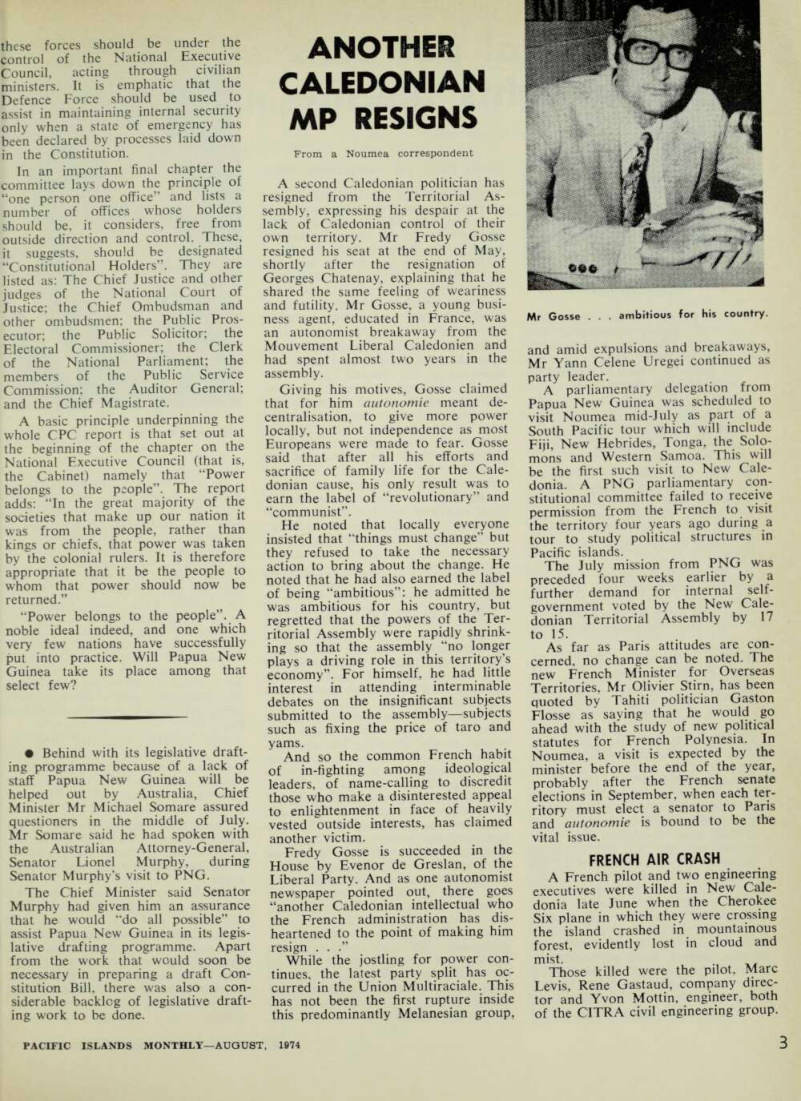
A second Caledonian politician has resigned from the Territorial As sembly, expressing his despair at the lack of Caledonian control of their own territory. Mr Fredy Gosse resigned his seat at the end of May, shortly after the resignation of Georges Chatenay, explaining that he shared the same feeling of weariness and futility. Mr Gosse, a young busi ness agent, educated in France, was an autonomist breakaway from the Mouvement Liberal Caledonien and had spent almost two years in the assembly.
Giving his motives, Gosse claimed that for him autonomic meant de centralisation, to give more power locally, but not independence as most Europeans were made to fear. Gosse said that after all his efforts and sacrifice of family life for the Cale donian cause, his only result was to earn the label of “revolutionary” and “communist”.
He noted that locally everyone insisted that “things must change” but they refused to take the necessary action to bring about the change. He noted that he had also earned the label of being “ambitious”: he admitted he was ambitious for his country, but regretted that the powers of the Ter ritorial Assembly were rapidly shrink ing so that the assembly “no longer plays a driving role in this territory’s economy”. For himself, he had little interest in attending interminable debates on the insignificant subjects submitted to the assembly—subjects such as fixing the price of taro and yams.
And so the common French habit of in-fighting among ideological leaders, of name-calling to discredit those who make a disinterested appeal to enlightenment in face of heavily vested outside interests, has claimed another victim.
Fredy Gosse is succeeded in the House by Evenor de Greslan, of the Liberal Party. And as one autonomist newspaper pointed out, there goes “another Caledonian intellectual who the French administration has dis heartened to the point of making him resign . .
While the jostling for power con tinues, the latest party split has oc curred in the Union Multiraciale. This has not been the first rupture inside this predominantly Melanesian group,
and amid expulsions and breakaways, Mr Yann Celene Uregei continued as party leader.
A parliamentary delegation from Papua New Guinea was scheduled to visit Noumea mid-July as part of a South Pacific tour which will include Fiji, New Hebrides, Tonga, the Solo mons and Western Samoa. This will be the first such visit to New Cale donia. A PNG parliamentary con stitutional committee failed to receive permission from the French to visit the territory four years ago during a tour to study political structures in Pacific islands.
The July mission from PNG was preceded four weeks earlier by a further demand for internal self government voted by the New Cale donian Territorial Assembly by 17 to 15.
As far as Paris attitudes are con cerned, no change can be noted. The new French Minister for Overseas Territories, Mr Olivier Stirn, has been quoted by Tahiti politician Gaston Flosse as saying that he would go ahead with the study of new political statutes for French Polynesia. In Noumea, a visit is expected by the minister before the end of the year, probably after the French senate elections in September, when each ter ritory must elect a senator to Pans and autonomic is bound to be the vital issue.
French Air Crash
A French pilot and two engineering executives were killed in New Cale donia late June when the Cherokee Six plane in which they were crossing the island crashed in mountainous forest, evidently lost in cloud and mist. w Those killed were the pilot, Marc Levis, Rene Gastaud, company direc tor and Yvon Mottin, engineer, both of the CITRA civil engineering group.
Mr Gosse ... ambitious for his country.
Fiji's political pot boils
as land lights the fire
From a Suva correspondent
Fiji MPs may brandish nooses and daggers in parliament, according to a ruling by the Speaker of the House of Representatives, Mr R. D. Patel, during a turbulent session late in June.
Since then he has had second thoughts, following a plea by the Deputy Speaker, Mr Vijay R. Singh, and is reconsidering the matter.
Tempers really boiled. These were some incidents: • The Leader of the Opposition, Mr S. M. Koya, brandished two nooses and invited two Indian mem bers, Mr Vijay R. Singh, and Mr Krishna Reddy, both Government members, to hang themselves; • Mr Maleli Raibe, a Govern ment member, asked if it would be in order to produce two daggers and ask opposition members to make use of them on themselves; • The chairman of the Native Land Trust Broad, Ratu William Toganivalu, who is also Minister for Fijian Affairs, said that while he was in office, he would refuse leases of Fijian land to any more Indian ap plicants; • Mr Koya withdrew from the House of Representatives after the Speaker told him to leave. (The Speaker and Mr Koya are both mem bers of the National Federation Party). • The Opposition Whip, Mr Karam Ramrakha, faced the pos sibility of a criminal charge for allegedly having served subpoenas in the House of Representatives while it met.
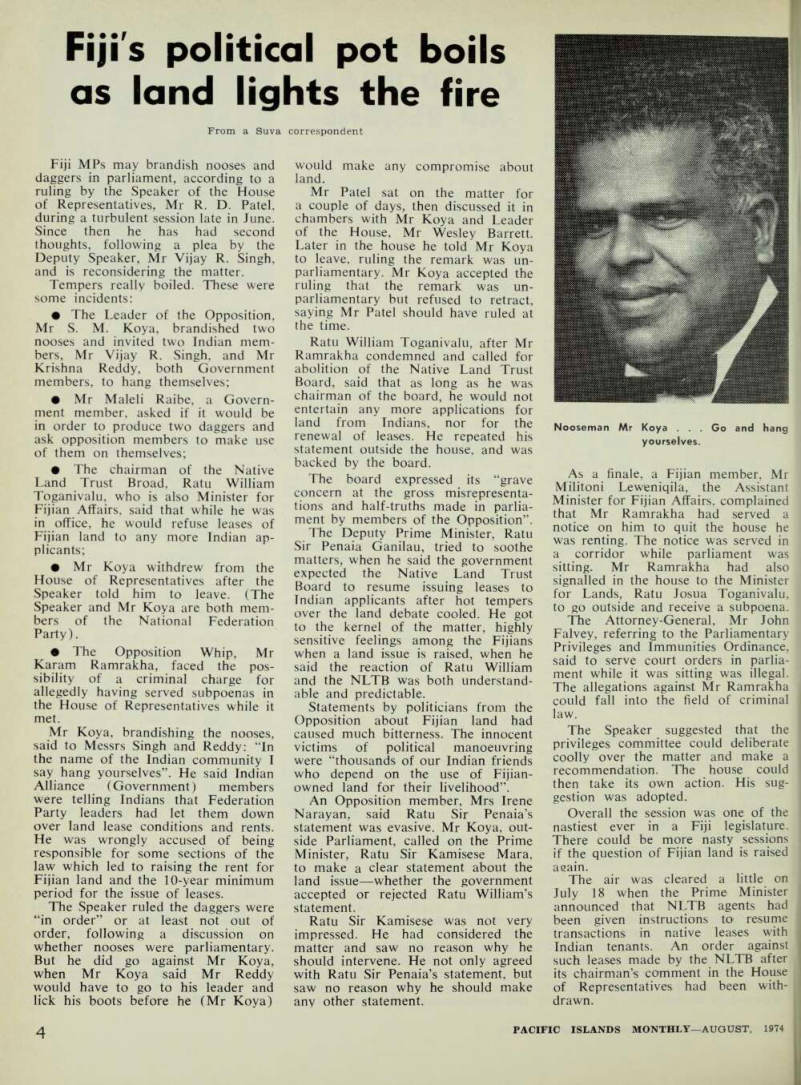
Mr Koya, brandishing the nooses, said to Messrs Singh and Reddy: “In the name of the Indian community I say hang yourselves”. He said Indian Alliance (Government) members were telling Indians that Federation Party leaders had let them down over land lease conditions and rents.
He was wrongly accused of being responsible for some sections of the law which led to raising the rent for Fijian land and the 10-year minimum period for the issue of leases.
The Speaker ruled the daggers were “in order” or at least not out of order, following a discussion on whether nooses were parliamentary.
But he did go against Mr Koya, when Mr Koya said Mr Reddy would have to go to his leader and lick his boots before he (Mr Koya)
would make any compromise about land.
Mr Patel sat on the matter for a couple of days, then discussed it in chambers with Mr Koya and Leader of the House, Mr Wesley Barrett.
Later in the house he told Mr Koya to leave, ruling the remark was un parliamentary. Mr Koya accepted the ruling that the remark was un parliamentary but refused to retract, saying Mr Patel should have ruled at the time.
Ratu William Toganivalu, after Mr Ramrakha condemned and called for abolition of the Native Land Trust Board, said that as long as he was chairman of the board, he would not entertain any more applications for land from Indians, nor for the renewal of leases. He repeated his statement outside the house, and was backed by the board.
The board expressed its “grave concern at the gross misrepresenta tions and half-truths made in parlia ment by members of the Opposition”.
The Deputy Prime Minister, Ratu Sir Penaia Ganilau, tried to soothe matters, when he said the government expected the Native Land Trust Board to resume issuing leases to Indian applicants after hot tempers over the land debate cooled. He got to the kernel of the matter, highly sensitive feelings among the Fijians when a land issue is raised, when he said the reaction of Ratu William and the NLTB was both understand able and predictable.
Statements by politicians from the Opposition about Fijian land had caused much bitterness. The innocent victims of political manoeuvring were “thousands of our Indian friends who depend on the use of Fijian owned land for their livelihood”.
An Opposition member, Mrs Irene Narayan, said Ratu Sir Penaia’s statement was evasive. Mr Koya, out side Parliament, called on the Prime Minister, Ratu Sir Kamisese Mara, to make a clear statement about the land issue—whether the government accepted or rejected Ratu William’s statement.
Ratu Sir Kamisese was not very impressed. He had considered the matter and saw no reason why he should intervene. He not only agreed with Ratu Sir Penaia’s statement, but saw no reason why he should make any other statement.
As a finale, a Fijian member, Mr Militoni Leweniqila, the Assistant Minister for Fijian Affairs, complained that Mr Ramrakha had served a notice on him to quit the house he was renting. The notice was served in a corridor while parliament was sitting. Mr Ramrakha had also signalled in the house to the Minister for Lands, Ratu Josua Toganivalu, to go outside and receive a subpoena.
The Attorney-General, Mr John Falvey, referring to the Parliamentary Privileges and Immunities Ordinance, said to serve court orders in parlia ment while it was sitting was illegal.
The allegations against Mr Ramrakha could fall into the field of criminal law.
The Speaker suggested that the privileges committee could deliberate coolly over the matter and make a recommendation. The house could then take its own action. His sug gestion was adopted.
Overall the session was one of the nastiest ever in a Fiji legislature.
There could be more nasty sessions if the question of Fijian land is raised aeain.
The air was cleared a little on July 18 when the Prime Minister announced that NLTB agents had been given instructions to resume transactions in native leases with Indian tenants. An order against such leases made by the NLTB after its chairman’s comment in the House of Representatives had been with drawn.
Nooseman Mr Koya ... Go and hang yourselves.
for friendship's sake?
Did Mataafa sack the UNDP for friendship's sake?
From an Apia correspondent
The United Nations Development Programme office in Western Samoa dosed its doors for the last time at the end of July—expelled by Prime Minister Fiame Mataafa. For what?
For the sake of friendship? Or for something far more subtle, like rivalries between Pacific nations served by the UNDP?
At June’s beginning, without any formal announcement to the public, Prime Minister Mataafa gave the agency 60 days notice to close down and get out. He sent a cable to that effect to UNDP in New York and later, in a 60-second conversation with UNDP’s acting regional repre sentative in Apia, Ray Fort, con firmed the order.
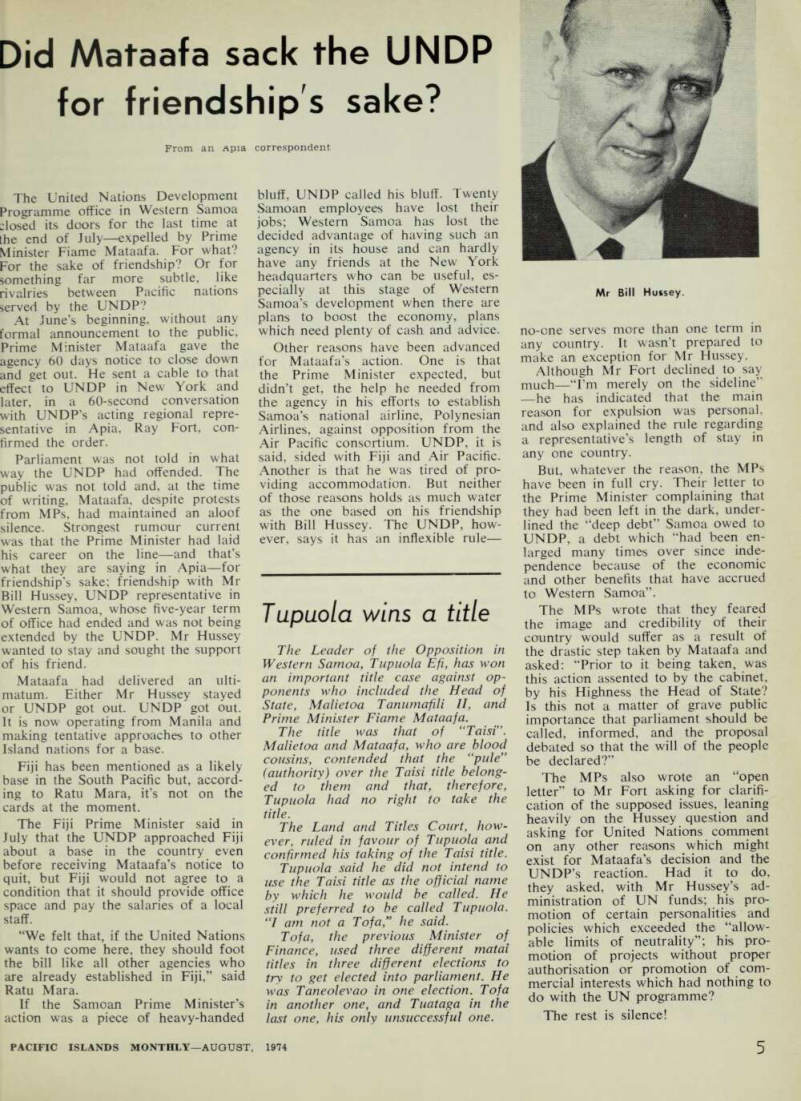
Parliament was not told in what way the UNDP had offended. The public was not told and, at the time of writing, Mataafa, despite protests from MPs, had maintained an aloof silence. Strongest rumour current was that the Prime Minister had laid his career on the line—and that’s what they are saying in Apia—for friendship’s sake; friendship with Mr Bill Hussey, UNDP representative in Western Samoa, whose five-year term of office had ended and was not being extended by the UNDP. Mr Hussey wanted to stay and sought the support of his friend.
Mataafa had delivered an ulti matum. Either Mr Hussey stayed or UNDP got out. UNDP got out.
It is now operating from Manila and making tentative approaches to other Island nations for a base.
Fiji has been mentioned as a likely base in the South Pacific but, accord ing to Ratu Mara, it’s not on the cards at the moment.
The Fiji Prime Minister said in July that the UNDP approached Fiji about a base in the country even before receiving Mataafa’s notice to quit, but Fiji would not agree to a condition that it should provide office space and pay the salaries of a local staff.
“We felt that, if the United Nations wants to come here, they should foot the bill like all other agencies who are already established in Fiji,” said Ratu Mara.
If the Samoan Prime Minister’s action was a piece of heavy-handed
bluff, UNDP called his bluff. Twenty Samoan employees have lost their jobs; Western Samoa has lost the decided advantage of having such an agency in its house and can hardly have any friends at the New York headquarters who can be useful, es pecially at this stage of Western Samoa’s development when there are plans to boost the economy, plans which need plenty of cash and advice.
Other reasons have been advanced for Mataafa’s action. One is that the Prime Minister expected, but didn’t get, the help he needed from the agency in his efforts to establish Samoa’s national airline, Polynesian Airlines, against opposition from the Air Pacific consortium. UNDP, it is said, sided with Fiji and Air Pacific.
Another is that he was tired of pro viding accommodation. But neither of those reasons holds as much water as the one based on his friendship with Bill Hussey. The UNDP, how ever, says it has an inflexible rule—
no-one serves more than one term in any country. It wasn’t prepared to make an exception for Mr Hussey.
Although Mr Fort declined to say much —“I’m merely on the sideline” —he has indicated that the main reason for expulsion was personal, and also explained the rule regarding a representative’s length of stay in any one country.
But, whatever the reason, the MPs have been in full cry. Their letter to the Prime Minister complaining that they had been left in the dark, under lined the “deep debt” Samoa owed to UNDP, a debt which “had been en larged many times over since inde pendence because of the economic and other benefits that have accrued to Western Samoa”.
The MPs wrote that they feared the image and credibility of their country would suffer as a result of the drastic step taken by Mataafa and asked; “Prior to it being taken, was this action assented to by the cabinet, by his Highness the Head of State?
Is this not a matter of grave public importance that parliament should be called, informed, and the proposal debated so that the will of the people be declared?”
The MPs also wrote an “open letter” to Mr Fort asking for clarifi cation of the supposed issues, leaning heavily on the Hussey question and asking for United Nations comment on any other reasons which might exist for Mataafa’s decision and the UNDP’s reaction. Had it to do, they asked, with Mr Hussey’s ad ministration of UN funds; his pro motion of certain personalities and policies which exceeded the “allow able limits of neutrality”; his pro motion of projects without proper authorisation or promotion of com mercial interests which had nothing to do with the UN programme?
The rest is silence!
Mr Bill Hussey.
Tupuola wins a title
The Leader of the Opposition in Western Samoa, Tupuola Efi, has won an important title case against op ponents who included the Head of State, Malietoa Tanumafli 11, and Prime Minister Fiame Mataafa.
The title was that of “Taisi”.
Malietoa and Mataafa, who are blood cousins, contended that the “pule” (authority) over the Taisi title belong ed to them and that, therefore, Tupuola had no right to take the title.
The Land and Titles Court, how ever, ruled in favour of Tupuola and confirmed his taking of the Taisi title.
Tupuola said he did not intend to use the Taisi title as the official name by which he would be called. He still preferred to be called Tupuola. ‘T am not a Tofa,” he said.
Tofa, the previous Minister of Finance, used three different matai titles in three different elections to try to get elected into parliament. He was Taneolevao in one election. Tofa in another one, and Tuataga in the last one, his only unsuccessful one.
'Democracy'
Prevails
In Tonga
From a Nukualofa correspondent Tonga’s Legislative Assembly “took on” the government in June and refused to pass the estimates for 1974-75. No one could remember such a thing happening before. The 8-4 vote against accepting the estimates was a protest against the government ignoring a parliamentary resolution of 1973 over a review of salaries for the civil service and members of the assembly.
The 1973 resolution was that any salary increase recommended by the review should take effect from July 1, 1973. The Privy Council, however, directed that there should be a cost of-living allowance of 20 per cent, effective from April 1, 1974.
Masao Passi, No 1 People’s Representative from Vavau, said the government had no right to violate a House resolution. It was not the fault of the House that the govern ment took so long to decide the cost of-living allowance.
Next day, the Acting Prime Minister and Minister of Lands and Survey, S. L. Tuita, asked the House to reconsider its resolution. If members were adamant he would introduce an alternative—that the House approve only half the stipulated amount as a token vote, to which could be added a special warrant should there be approval of the requested revision of the cost-of living allowance to be back-dated to July 1, 1973.
Siosiua H. Fonua, editor of the Tonga Chronicle, commenting on the House resolution, said: “The year 1974 will probably go down in the history of Tonga’s parliamentary ses sions as being one of the most significant insofar as the power of the Legislative Assembly is concerned.
In my own opinion, it took a lot of courage and perseverance on the part of the people’s representatives and the nobles to attempt what seemed an impossible task, ie, to have the Privy Council amend their original decision for the Cost of Living Allowance (COLA) payable from April 1, 1974, to be backdated to July 1, 1973, for the parliamentarians. This, indeed, is not a small undertaking for the Privy Council, . . .
“They, (the MPs) felt that the government had ignored the authority of the House, and hence weakened the status of the Legislative As-
sembly, . . . The issue in question was therefore of paramount im portance for the benefit of maintain ing the democratic principles of the Tongan system of government.
“True, Tonga’s is not a wholly democratic government, but a con stitutional monarchy, but the prin ciples adopted by a Tonga Legislative Assembly involve a certain amount of democracy. This victory must mean therefore that the government do respect the resolutions of the House and its deliberations and the amendment of their original decision is by no means a sign of a prejudiced government, but a realisation of the power of democracy and the willing ness to maintain the harmonious relationships that exist between the people and the government, . . .”
The Legislative Assembly, on June 28, approved a record $T6.57 million for 1974-75.
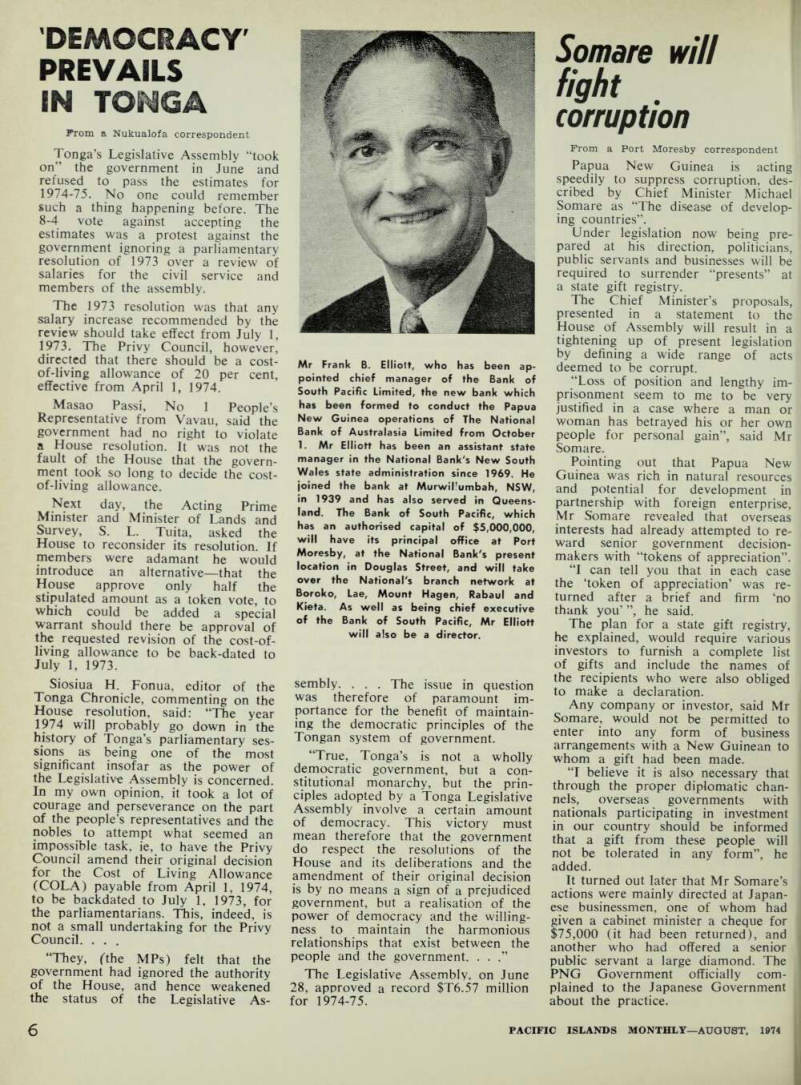
Mr Frank B. Elliott, who has been ap pointed chief manager of the Bank of South Pacific Limited, the new bank which has been formed to conduct the Papua New Guinea operations of The National Bank of Australasia Limited from October 1. Mr Elliott has been an assistant state manager in the National Bank's New South Wales state administration since 1969. He joined the bank at Murwillumbah, NSW, in 1939 and has also served in Queens land. The Bank of South Pacific, which has an authorised capital of $5,000,000, will have its principal office at Port Moresby, at the National Bank's present location in Douglas Street, and will take over the National's branch network at Boroko, Lae, Mount Hagen, Rabaul and Kieta. As well as being chief executive of the Bank of South Pacific, Mr Elliott will also be a director.
fight
Somare will fight corruption
Prom a Port Moresby correspondent Papua New Guinea is acting speedily to suppress corruption, des cribed by Chief Minister Michael Somare as “The disease of develop ing countries”.
Under legislation now being pre pared at his direction, politicians, public servants and businesses will be required to surrender “presents” at a state gift registry.
The Chief Minister’s proposals, presented in a statement to the House of Assembly will result in a tightening up of present legislation by defining a wide range of acts deemed to be corrupt, “Loss of position and lengthy im prisonment seem to me to be very justified in a case where a man or woman has betrayed his or her own people for personal gain”, said Mr Somare.
Pointing out that Papua New Guinea was rich in natural resources and potential for development in partnership with foreign enterprise, Mr Somare revealed that overseas interests had already attempted to re ward senior government decision makers with “tokens of appreciation”.
“I can tell you that in each case the ‘token of appreciation’ was re turned after a brief and firm ‘no thank you’ ”, he said.
The plan for a state gift registry, he explained, would require various investors to furnish a complete list of gifts and include the names of the recipients who were also obliged to make a declaration.
Any company or investor, said Mr Somare, would not be permitted to enter into any form of business arrangements with a New Guinean to whom a gift had been made.
“I believe it is also necessary that through the proper diplomatic chan nels, overseas governments with nationals participating in investment in our country should be informed that a gift from these people will not be tolerated in any form”, he added.
It turned out later that Mr Somare’s actions were mainly directed at Japan ese businessmen, one of whom had given a cabinet minister a cheque for $75,000 (it had been returned), and another who had offered a senior public servant a large diamond. The PNG Government officially com plained to the Japanese Government about the practice.
Even atolls like the GEIC
have their labour troubles
Permanent staff of the GEIC Gov ;rnment had to take over some main government services in June when nore than 200 daily-paid employees unestablished staff) went on strike ? or higher pay, demanding in some :ases almost 50 per cent more. The BKATM, the union representing the employees, rejected a government )ffer of increases of 3c to 7c an hour, jack-dated to June 1.
The Chief Minister, Mr Naboua Hatieta, went on the air to warn of i threat to the economy should the government concede the demands, fhe government had made a generous offer, which would put the jEIC rates among the highest in the Pacific. To give in to the demand
would encourage the GEIDA work ers to look for higher wages; then there would be demands by govern ment workers, and so on.
The government wished to attract industry to the GEIC, but would not be able to do that if the GEIC paid higher wages than elsewhere. The overall cost of wage increases could run into millions of dollars, leading to highly inflated costs and unem ployment. No one wanted that.
Some non-union members did not offer for work after the strike started, not because they supported the strike, but because of threats by the strikers.
There was some inconvenience to the Central Colony Hospital at Bikenibeu, without orderlies to care for mental patients, attend to the hospital linen and cook. The hospital also lost its labourers and the supply of toddy which they provided. Some patients had to use mats for sleeping to save linen, and admissions were restricted to emergency cases.
Apart from that matters seemed to go along smoothly. Nursing staff onerated the washing machines, and kitchen staffs seemed bigger than before. Patients were even getting decorations on their meat pies. In fact, the staff seemed to be enjoying the change from normal routine.
The strikers returned to work on July 1, a little more than a week after they went out. The govern ment’s position was that it would not enter into negotiations on wages for unestablished workers at present.
However, the government reopened the offer already made, effective from July 1, for workers who re turned on that date. Workers who did not strike received the new rates from June 1.
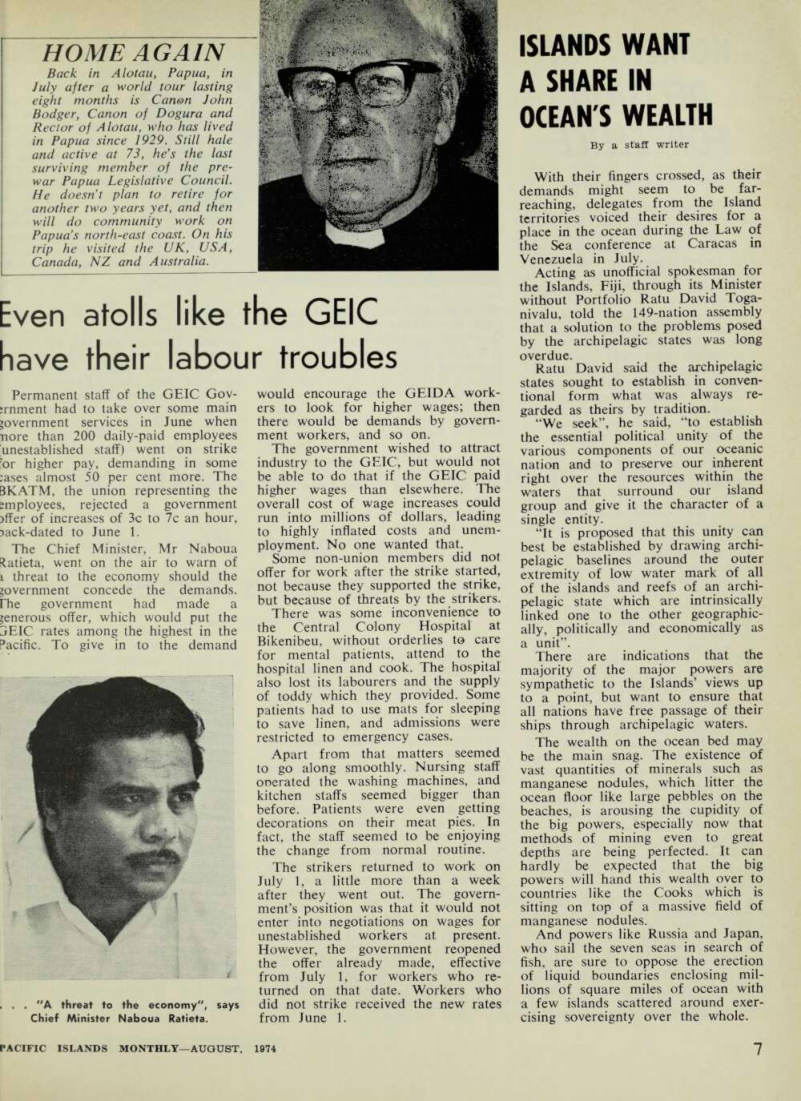
Home Again
Back in Alotau, Papua, in July after a world tour lasting eight months is Canon John Bodger, Canon of Dogura and Rector of Alotau, who has lived in Papua since 1929. Still hale and active at 73, he’s the last surviving member of the pre war Papua Legislative Council.
He doesn’t plan to retire for another two years yet, and then will do community work on Papua’s north-east coast. On his trip he visited the UK, USA, Canada, NZ and Australia.
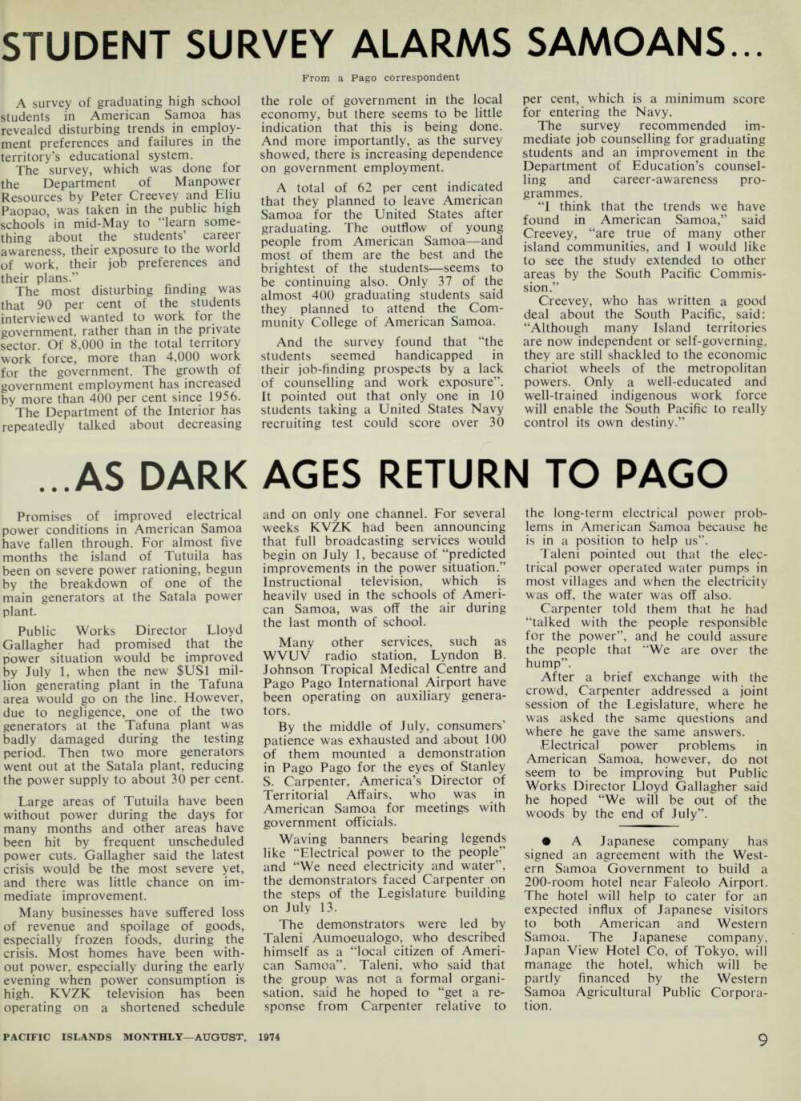
... "A threat to the economy", says Chief Minister Naboua Ratieta.
Islands Want
A Share In
Ocean's Wealth
By a staff writer
With their fingers crossed, as their demands might seem to be far reaching, delegates from the Island territories voiced their desires for a place in the ocean during the Law of the Sea conference at Caracas in Venezuela in July.
Acting as unofficial spokesman for the Islands, Fiji, through its Minister without Portfolio Ratu David Toga nivalu, told the 149-nation assembly that a solution to the problems posed by the archipelagic states was long overdue.
Ratu David said the archipelagic states sought to establish in conven tional form what was always re garded as theirs by tradition.
“We seek”, he said, “to establish the essential political unity of the various components of our oceanic nation and to preserve our inherent right over the resources within the waters that surround our island group and give it the character of a single entity.
“It is proposed that this unity can best be established by drawing archi pelagic baselines around the outer extremity of low water mark of all of the islands and reefs of an archi pelagic state which are intrinsically linked one to the other geographic ally, politically and economically as a unit”.
There are indications that the majority of the major powers are sympathetic to the Islands’ views up to a point, but want to ensure that all nations have free passage of their ships through archipelagic waters.
The wealth on the ocean bed may be the main snag. The existence of vast quantities of minerals such as manganese nodules, which litter the ocean floor like large pebbles on the beaches, is arousing the cupidity of the big powers, especially now that methods of mining even to great depths are being perfected. It can hardly be expected that the big powers will hand this wealth over to countries like the Cooks which is sitting on top of a massive field of manganese nodules.
And powers like Russia and Japan, who sail the seven seas in search of fish, are sure to oppose the erection of liquid boundaries enclosing mil lions of square miles of ocean with a few islands scattered around exer cising sovereignty over the whole.
Moment Of
Decision
For Ellice
Prom a Tarawa correspondent The 7,000 Ellice islanders forming “junior” partners in the GEIC will know by early October where they are going—along independence road with the Gilberts or along the colonial road with Britain, which is trying hard to shed its remaining colonies.
The islanders are busy voting on a referendum on their future political status. Voting started in July but so many ballot papers will have to be brought from outlying islands and collected from Ellice men serving on foreign ships that completion and counting has been set as late as October 1.
The choices open to them on the ballot paper are: • The establishment of a separate Ellice Islands Colony; • To remain with the Gilberts as part of the GEIC and what the colony becomes when its status is altered.
The referendum was agreed to by Britain, and by the Gilbertese, after the Ellice people, through their re presentatives, objected to plans to make the colony self-governing. They feared political domination by the Gilbertese, who outnumber them by seven to one.
Britain, however, has left the Ellice people in no doubt of the hard road they’ll have to tread if they opt for separation. At first, they seemed to expect that they would get a generous share of the colony’s pos sessions. This isn’t on, Britain told them, and then listed the conditions for separation.
These are: • The Ellice Islands would be come a separate dependent territory of the United Kingdom; • The Ellice Islands would receive no part of the Revenue Equalisation Reserve Fund of the Gilbert and Ellice Islands Colony; • The Ellice Islands would receive no part of present or future phospate royalties. • The Ellice Islands would have no claim to any of the assets (whether fixed, moveable or in cash) belonging to the Gilbert and Ellice Islands Colony and situated outside the Ellice Islands themselves, except for
one ship which would be transferred from the Gilbert and Ellice Islands Development authority; and • An Ellice Islands Colony would be limited to the Ellice Islands Group and would have no right to any other territory of the Gilbert and Ellice Islands Colony.
If the islanders vote for separation and the Gilbertese agree, there will be discussions on the future constitution of the Ellice Islands Colony and other details such as schooling and employment outside the Ellice
Group and the level of British aid to the new colony.
Since Britain made the conditions known, there has been little comment from the Ellice people. So far only several of their leaders have spoken— all but one favouring separation. It will be no surprise if the majority, voting in the referendum, do an about-turn rather than accept the obvious disadvantages associated with separation.
Going it alone is fine if you’ve the strength to stand on your feet!
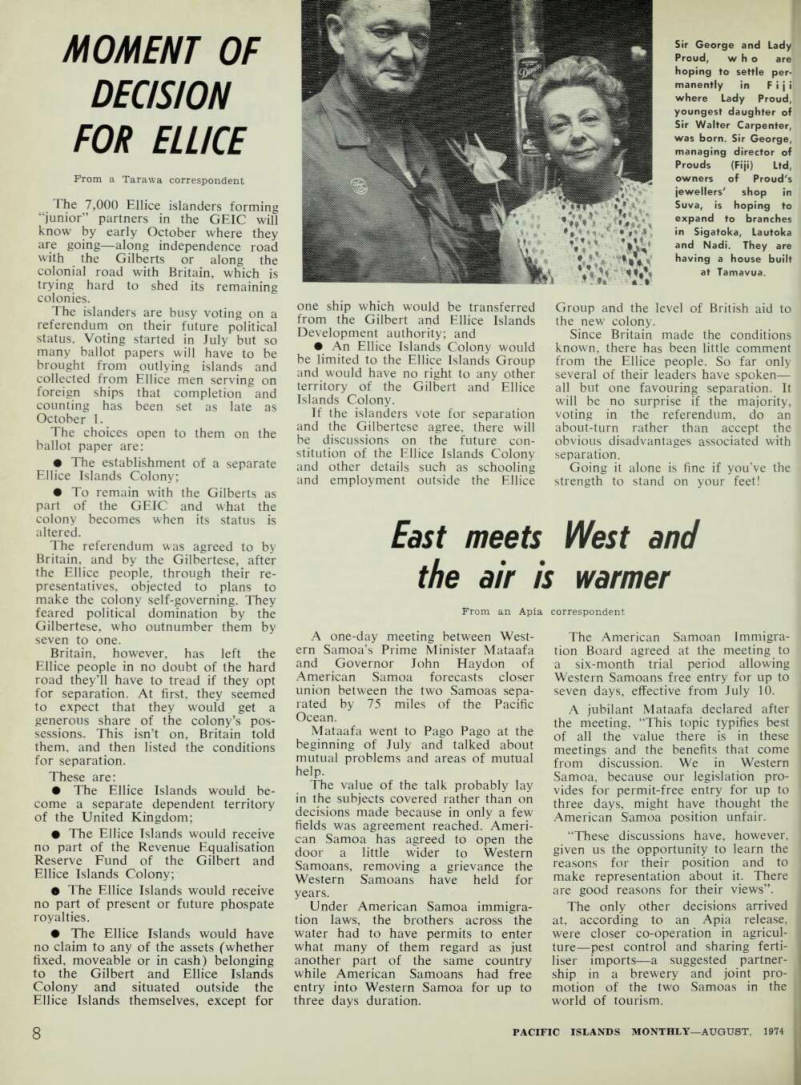
Sir George and Lady Proud, who are hoping to settle per manently in Fiji where Lady Proud, youngest daughter of Sir Walter Carpenter, was born. Sir George, managing director of Prouds (Fiji) Ltd, owners of Proud's jewellers' shop in Suva, is hoping to expand to branches in Sigatoka, Lautoka and Nadi. They are having a house built at Tamavua.
East meets West and
the air is warmer
From an Apia correspondent
A one-day meeting between West ern Samoa’s Prime Minister Mataafa and Governor John Haydon of American Samoa forecasts closer union between the two Samoas sepa rated by 75 miles of the Pacific Ocean.
Mataafa went to Pago Pago at the beginning of July and talked about mutual problems and areas of mutual help.
The value of the talk probably lay in the subjects covered rather than on decisions made because in only a few fields was agreement reached. Ameri can Samoa has agreed to open the door a little wider to Western Samoans, removing a grievance the Western Samoans have held for years.
Under American Samoa immigra tion laws, the brothers across the water had to have permits to enter what many of them regard as just another part of the same country while American Samoans had free entry into Western Samoa for up to three days duration.
The American Samoan Immigra tion Board agreed at the meeting to a six-month trial period allowing Western Samoans free entry for up to seven days, effective from July 10.
A jubilant Mataafa declared after the meeting, “This topic typifies best of all the value there is in these meetings and the benefits that come from discussion. We in Western Samoa, because our legislation pro vides for permit-free entry for up to three days, might have thought the American Samoa position unfair.
“These discussions have, however, given us the opportunity to learn the reasons for their position and to make representation about it. There are good reasons for their views”.
The only other decisions arrived at, according to an Apia release, were closer co-operation in agricul ture —pest control and sharing ferti liser imports—a suggested partner ship in a brewery and joint pro motion of the two Samoas in the world of tourism.
Student Survey Alarms Samoans...
From a Pago correspondent
A survey of graduating high school students in American Samoa has revealed disturbing trends in employ ment preferences and failures in the territory’s educational system.
The survey, which was done for the Department of Manpower Resources by Peter Creevey and Eliu Paopao, was taken in the public high schools in mid-May to “learn some thing about the students’ career awareness, their exposure to the world of work, their job preferences and their plans.’’
The most disturbing finding was that 90 per cent of the students interviewed wanted to work for the government, rather than in the private sector. Of 8,000 in the total territory work force, more than 4,000 work for the government. The growth of government employment has increased by more than 400 per cent since 1956.
The Department of the Interior has repeatedly talked about decreasing
the role of government in the local economy, but there seems to be little indication that this is being done.
And more importantly, as the survey showed, there is increasing dependence on government employment. . . . i , , A total of 62 per cent indicated that they planned to leave American Samoa for the United States after graduating. The outflow of young people from American Samoa—and most of them are the best and the brightest of the students—seems to be continuing also. Only 37 of the almost 400 graduating students said they planned to attend the Commumty College of American Samoa.
And the survey found that “the students seemed handicapped in their job-finding prospects by a lack of counselling and work exposure”.
It pointed out that only one in 10 students taking a United States Navy recruiting test could score over 30
per cent, which is a minimum score for entering the Navy, The survey recommended im mediate job counselling for graduating students and an improvement in the Department of Education’s counsel ling and career-awareness pro grammes ..j think (hat , he trends we have found in American Samoa,” said Creevey .* are true o( ma other js|and communitieS; and 1 would like t the study extended to other areas b the South Pacific Commis . s j Qn „ c i. eevey , who has written a good deal about the South Pacific said: *. Although many Is)and territories are now independent or self-governing, they are still shackled to the economic chariot wheels of the metropolitan powers. Only a well-educated and well-trained indigenous work force will enable the South Pacific to really control its own destiny.”
...As Dark Ages Return To Pago
Promises of improved electrical power conditions in American Samoa have fallen through. For almost five months the island of Tutuila has been on severe power rationing, begun by the breakdown of one of the main generators at the Satala power plant.
Public Works Director Lloyd Gallagher had promised that the power situation would be improved by July 1, when the new SUSI mil lion generating plant in the Tafuna area would go on the line. However, due to negligence, one of the two generators at the Tafuna plant was badly damaged during the testing period. Then two more generators went out at the Satala plant, reducing the power supply to about 30 per cent.
Large areas of Tutuila have been without power during the days for many months and other areas have been hit by frequent unscheduled power cuts. Gallagher said the latest crisis would be the most severe yet, and there was little chance on im mediate improvement.
Many businesses have suffered loss of revenue and spoilage of goods, especially frozen foods, during the crisis. Most homes have been with out power, especially during the early evening when power consumption is high. KVZK television has been operating on a shortened schedule
and on only one channel. For several weeks KVZK had been announcing that full broadcasting services would begin on July 1, because of “predicted improvements in the power situation.”
Instructional television, which is heavily used in the schools of American Samoa, was off the air during the last month of school.
Many other services, such as WVUV radio station, Lyndon B.
Johnson Tropical Medical Centre and Pago Pago International Airport have been operating on auxiliary generators F 6 ‘ , ... - T . By the middle of July, consumen patience was exhausted and about 100 of them mounted a demonstration in Pago Pago for the eyes of Stanley S. Carpenter, America s Director f Territorial Affairs who was in American Samoa for meetings with government officials.
Waving banners bearing legends like “Electrical power to the people” and “We need electricity and water”, the demonstrators faced Carpenter on the steps of the Legislature building on July 13.
The demonstrators were led by Taleni Aumoeualogo, who described himself as a “local citizen of American Samoa”. Taleni, who said that the group was not a formal organisation, said he hoped to “get a response from Carpenter relative to
the long-term electrical power prob lems in American Samoa because he is in a position to help us”, Taleni pointed out that the elec trical power operated water pumps in most villages and when the electricity was off, the water was off also, Carpenter told them that he had “talked with the people responsible for the power” and he could assure ' he Pf°P le that We are over the ’ ... , . u Af ‘ er a brl f exchange w.th the cr °» d - Catjenter addressed a joint session of the Legislature, where he was asked the same questions and where he the answers , Electrical power problems in American Samoa however do not seem t 0 be improving but Pub ic Works Director Lloyd Gallagher said he hoped .. We win be out of th woods b the end o( Jul .. • A Japanese company has signed an agreement with the West ern Samoa Government to build a 200-room hotel near Faleolo Airport, The hotel will help to cater for an expected influx of Japanese visitors to both American and Western Samoa. The Japanese company, Japan View Hotel Co, of Tokyo, will manage the hotel, which will be partly financed by the Western Samoa Agricultural Public Corpora tion.
Advertisements & other items, p. 20 (1 item)
InnJ
lis) InnJ §e) LnaJ 0 1 i
InFO
Aggie Grey's the
South Pacific's legendary hotel the - heart of Western bamoe. Enjoy Polynesian-style friendliness and service, in cool surroundings, superb entertainment and food. Magnificent white sand beaches only a short drive away swimmi " 9 0001 and Bookings through Union Steamship Company of NZ, Pan Am, Air New Zealand or direct to Aggie Grey's, Apia Western Samoa. Cables: AGGIES, APIA.
AUTHENTIC ISLANDS
ARTIFACTS
• BASKETWARE
• CARVINGS • TEXTILES
• FIGURINES • CURIOS
FROM THE NEW GUINEA
ISLANDS AND OUTLYING
ATOLLS
Catalogue and Price List sent on request.
B. F. DARCEY & COMPANY PTY. LTD.,
TONIVA BEACH,
Post Office Box 162, Kieta,
BOUGAINVILLE ISLAND,
PAPUA NEW GUINEA.
mf™
W* DATELINE HOTEL VJ,
/ TONGA
"Friendly Hotel" of the "Friendly Islands"
Situated along the Nukualofa waterfront. Only five minutes walk from town. Single, double, family suites, airconditioning, and hot and cold water showers. Pool, bar, restaurant, duty-free shop, tour desk and boutique.
Book through your travel agent or write to International Dateline Hotel, P.O. Box 62, Nukualofa Tonga.
Cable Address: "DATELINE".
Represented Overseas by: Charles J. Henry and Associates Pty. Ltd.
Sydney and Melbourne. 097
Primitive luxury
(Polynesian style) Nestled away in the untouched Kingdom of Tonga is new, luxurious "Port of Refuge" International resort. Here is a unique opportunity for your clients to experience the tranquil and relaxed Tongan atmosphere while they enjoy the picturesque surroundings of the new "Port of Refuge". And only a short flight from Fiji.
Reasonable tariffs from $17.50 with special concessions for children. Agents commission 10 per cent.
Tonga's
Port of Refuge
INTERNATIONAL RESORT
A-* Uava’u Tonga Cables: "Refuge" Tonga or "Tongatours"
Sydney. Phone: Sydney 85-1603 or 282-472
k fa
SAMOAN HIDEAWAY
BEACH RESORT HOTEL
"The real Western Samoa"
Bungalows situated on a palm-fringed carpet of sand at the mouth of a jungle stream. This b Western Samoa. You'll be glad you came.
Bookings: Instant Hotels, Advance Accommodation, United Travel (in N.Z.), Accommodations Abroad (in Aust.).
Cables: "HIDEAWAY" Apia.
P.O. Box 1191, Apia, Western Samoa.
sss CASH sss
FOR YOUR PROPERTY
We require freehold or leasehold ★ Islands ★ Waterfront properties Please send following details—size, location, freehold or leasehold, price (if any), address, phone to: The Director, Shannon Investments, Box H 213 P. 0., Australia Square, Sydney, Australia.
N.B. Agents welcome—Prompt reply.
PARK VIEW MOTEL—BRISBANE
Quiet location—opp. Botanic Gardens.
Single, double, family suites, all with ref rig., air conditioning, phone, TV, radio, tea making facilities, from $l2. Pool and restaurant.
Phone 31-2695—Telex 40270.
Write for coloured brochure— Park View Motel, 128 Alice St, BRISBANE, Old., 4000.
Tropicalities
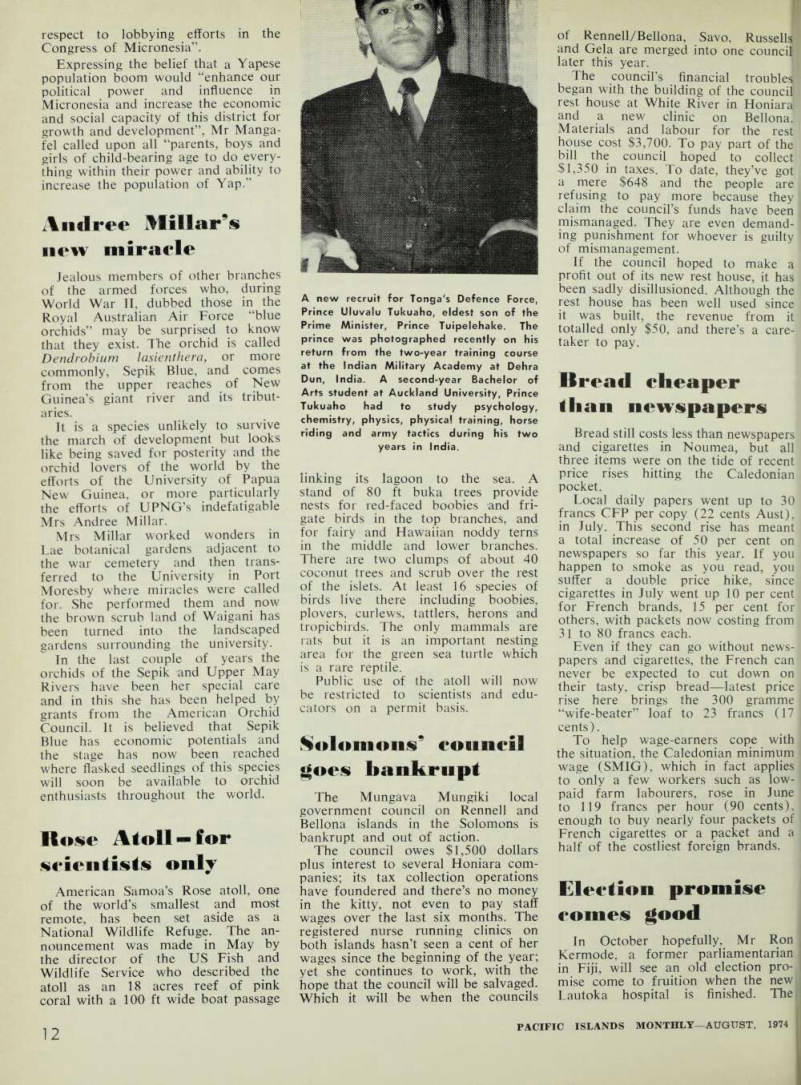
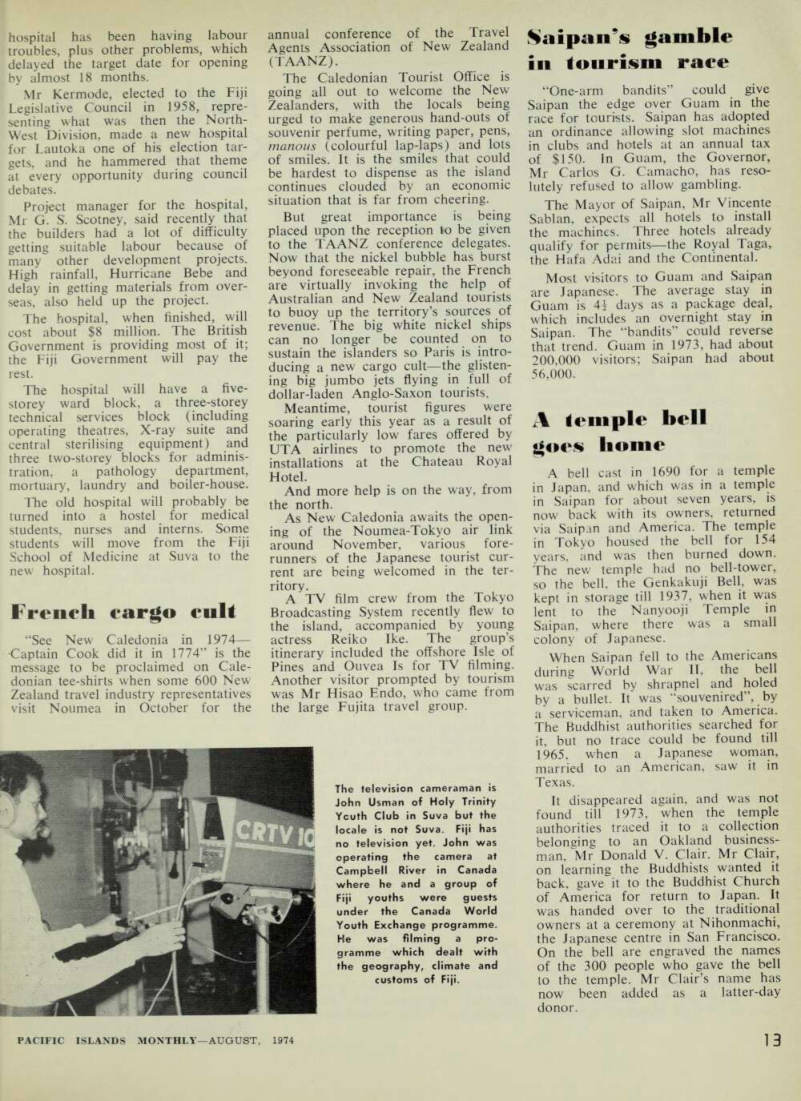
The stuff of
PNG history
According to calculations by Can >erra’s Pacific Manuscripts Bureau for details of what the bureau is loing see p 71) something like 3,000 o 3,500 patrols were carried out in he Australian Mandated Territory of 4ew Guinea between 1915 and 1941.
These patrols varied from short likes of two or three days to arduous ixploratory treks of five or six nonths. Some were so full of idventure that the officers involved :ould have pretty well filled a book vith the details had they been so ninded.
Indeed, whether the officers were iterary-minded or not, it was their luty to write a report on what they lad done when they returned to home >ase, and to submit one copy to the :entral administration in Rabaul and mother to the local district office.
The pre-war patrol reports that lave been preserved in public institu ions constitute valuable source naterial for a wide range of present lay research. However, most of the eports that were once on file in the ormer Mandated Territory were lost luring World War 11. In fact, only ibout 230 are now positively known o exist.
Of those, about 50 are in the National Archives of Papua New Guinea in Port Moresby; seven are n the Dixson Library, Sydney; 13 n the National Library of Australia, Canberra; and 47 in the Australian Archives (formerly Commonwealth Archives), Canberra.
The remainder have been located n private hands by Mr Kevin Green, lirector of the PMB’s Papua New Guinea Records Project. These are low on microfilm in the 19 sponsor ng libraries of that project.
Mr Green’s success in uncovering ipproximately half of the present otal of known reports has encouraged lim to hope that further reports will :ventually be forthcoming.
More than 160 district officers, issistant district officers and patrol )fficers are known to have served in he Mandated Territory between the vars.
Reports (not necessarily all they
wrote) have been located for only
26 of the officers —apart from those filed in Port Moresby. So it is to be hoped that others may yet be forth
coming. The list is printed below.
Bob Langdon, executive officer of
the Bureau, tells us that anyone
knowing the whereabouts of any of
the officers in the list, or of relatives or descendants of them, is invited to get in touch with Mr Green, C/- the
Pacific Manuscripts Bureau, Austra
lian National University, Canberra.
Where reports by an officer have
been located, his name is preceded
by an asterisk. The names are part
of history.
T. G. Aitchison, J. Appleby, G. Austin, W. B.
Ball, E. M. Bastard, *C. D. Bates, J. W. Bell, G. W. Benham, *J. R. Black, A. A. Bloxham, H. A. Booth, R. H. Boyan, S. W. Brearley, *K. W. T. Bridge, A. W. Cains, *B. Calcutt, H. C. Cardew, E. K. Carlile, D. G. N. Chambers, S. J. Chapman, C. G. Clifton, R. R. Cole, H. F.
Cook, J. A. Costelloe, W. I. Crichton, H. G.
Cunningham, D. W. Dally-Watkins, *J. E.
Daymond, N. J. Dillane, N. Douglas, H. L.
Downing, *l. F. G. Downs, M. S. Edwards, W. M. Edwards, D. S. Elliott, G. M. R. Elliott, G. Ellis, W. M. English, C. Falkner, R. M.
Farlow, E. A. Feldt, D. M. Fienberg (Fenbury), H. L, Fletcher, A. C. Forte, H. S. Foulkes, G. K.
Freeman, W. B. Giles, E. R. Gittoes, J. A.
Grant, G. Greathead, H. A. Gregory, N. S.
Griffiths, H. Hamilton, G. C. Harris, *H. W.
Hartley, D. Heaton-Brown, H. B. Hempsted, *G.
Hickley, J. W. Hodgekiss, W. J. Hook, L. F. S.
Hore, L. F. Hewlett, A. J. Hunter, *E. E.
Jones, J. H. Jones, N. Judd, J. I. Kenny, *G.
Keogh, *A. F. Kyle, L. G. R. Kyngdon, W. N.
Leach, C. J. Levien, N. C. Lineham, J. H.
Lukin, I. D. Lyon, J. Kyng, I. M. Mack, T. L.
McAdam, *J. K. McCarthy, E. C. McDonald, J. H.
McDonald, F. Macdonnell, *J. B. Mackay, R. K. C. McMullen, N. D. McWilliam, R. G. G.
Mader, F. W. Mantle, J. W. Mason, R. Melrose, J. I. Merrylees, C. J. Millar, P. J. Miller, *J. S.
Milligan, E. H. F. Mitchell, P. J. Mollison, *L.
Morris, G. W. Mostyn, F. H. Moy, J. C. Mullaly, J. J. Murphy, G. Naess, M. Wilder Neligan, •C. T. H. Nelson, *H. L. R. Niall, H. M. Nickols, •A. Nurton, *E. W. Oakley, G. C. O'Donnell, H. L. S. B. Ogilvy, W. M. B. Ogilvy, R. G.
Ormsby, N. Penglase, P. M. Penhalluriack, V B.
Pennefather, E. F. Phibbs, M. J. P. A. Pitt, W. G. Pooley, L. Pursehouse, J. R. Rigby, A. A.
Roberts, A. L. Roberts, *E. D. Robinson, T, L.
Roper, A. H. Ross, A. J. Samson, W. E. Sanson, A. H. Scroggie, F. N. W. Shand, B. W. Sherman, G. E. Simcocks, S. S. Skeate, R. I. Skinner, H. G. F. Somerset, *C- W. Slattery, R. B.
Strudwick, E. Taylor, *J. L. Taylor, J. T.
Tennent, *K. H. Thomas, 0. J. Thompson, *G. W. L. Townsend, W. J. Townsend, N. R.
Tutton, D. H. Vertigan, L. G. Vial, P. Vivian, T. W. Walker, J. Walstab, C. F. Warde, J.
Waterhouse, D. Waugh, E. C. Webster, J. P.
White, H. Wickham, W. M. Wilkin, H. L.
Williams, A. H. Wilson, C. A. Wittkop, *H. E.
Woodman, R. A. Woodward, *Y. G. Yanner.
Details of all the patrol reports
whose existence is known—except
those in the National Archives, Port
Moresby—have been published over 14 pages of the latest issue of the Pacific Manuscripts’ news-sheet Pambu, No 35, April-June, 1974, which deserves to be a collector’s item. Don’t ask us, ask Bob Langdon for your copy.
A pilgrimage
by eanoe
A two weeks voyage in the open seas from Satawal to Saipan in May and June may become an annual pilgrimage for the people of Satawal to pay a tribute to their ancestors. As a side effect, the voyages would be used to train future navigators from among the young people of Satawal.
Two sailing canoes carrying 11 people set out on May 28. They stop ped at West Fayu, a turtle-breeding ground to capture six turtles for relatives on Saipan. The crews were greeted by cheering Carolinians. After reaching Saipan the men from Satawal made a pilgrimage to the Island of Managaha to pay homage to their ancestor King Aghrub, who was buried there after leading a mass migration from Satawal to Saipan when Satawal was devastated by a typhoon in the 19th century.
The canoes carried for part of the way a correspondent for the National Geographic Society Magazine who was gathering material about the trip, particularly the navigation techniques of the people of the area.
Volunteers for
Yap wanted!
There’ll be some funny goings on among the teenagers of Yap in the United States Trust Territory of the Pacific if the youngsters respond to an appeal by James Mangafel, a mem ber of the Yap District Legislature.
Alarmed at the smallness of Yap’s population in relation to those of the other five districts, Mr Mangafel introduced a resolution during the legislature’s July session.
He expressed concern over the small population, which, he said, “has rendered us somewhat politically im potent and ineffectual in relations with our sister districts especially with
respect to lobbying efforts in the Congress of Micronesia”.
Expressing the belief that a Yapese population boom would “enhance our political power and influence in Micronesia and increase the economic and social capacity of this district for growth and development”, Mr Manga fel called upon all “parents, boys and girls of child-bearing age to do every thing within their power and ability to increase the population of Yap.”
Andree Millar 9 *
ii m miracle Jealous members of other branches of the armed forces who, during World War 11, dubbed those in the Royal Australian Air Force “blue orchids” may be surprised to know that they exist. The orchid is called Dendrobium lasienthera, or more commonly, Sepik Blue, and comes from the upper reaches of New Guinea’s giant river and its tribut aries.
It is a species unlikely to survive the march of development but looks like being saved for posterity and the orchid lovers of the world by the efforts of the University of Papua New Guinea, or more particularly the efforts of UPNG’s indefatigable Mrs Andree Millar.
Mrs Millar worked wonders in Lae botanical gardens adjacent to the war cemetery and then trans ferred to the University in Port Moresby where miracles were called for. She performed them and now the brown scrub land of Waigani has been turned into the landscaped gardens surrounding the university.
In the last couple of years the orchids of the Sepik and Upper May Rivers have been her special care and in this she has been helped by grants from the American Orchid Council. It is believed that Sepik Blue has economic potentials and the stage has now been reached where flashed seedlings of this species will soon be available to orchid enthusiasts throughout the world.
Hose Atoll —Cor
seientists only
American Samoa’s Rose atoll, one of the world’s smallest and most remote, has been set aside as a National Wildlife Refuge. The an nouncement was made in May by the director of the US Fish and Wildlife Service who described the atoll as an 18 acres reef of pink coral with a 100 ft wide boat passage
linking its lagoon to the sea. A stand of 80 ft buka trees provide nests for red-faced boobies and fri gate birds in the top branches, and for fairy and Hawaiian noddy terns in the middle and lower branches.
There are two clumps of about 40 coconut trees and scrub over the rest of the islets. At least 16 species of birds live there including boobies, plovers, curlews, tattlers, herons and tropicbirds. The only mammals are rats but it is an important nesting area for the green sea turtle which is a rare reptile.
Public use of the atoll will now be restricted to scientists and edu cators on a permit basis,
Solomons 9 eonneil
goes bankrupt
The Mungava Mungiki local government council on Rennell and Bellona islands in the Solomons is bankrupt and out of action.
The council owes $1,500 dollars plus interest to several Honiara com panies; its tax collection operations have foundered and there’s no money in the kitty, not even to pay staff wages over the last six months. The registered nurse running clinics on both islands hasn’t seen a cent of her wages since the beginning of the year; yet she continues to work, with the hope that the council will be salvaged.
Which it will be when the councils
of Rennell/Bellona, Savo, Russells and Gela are merged into one council later this year.
The council’s financial troubles began with the building of the council rest house at White River in Honiara and a new clinic on Bellona.
Materials and labour for the rest house cost $3,700. To pay part of the bill the council hoped to collect $1,350 in taxes. To date, they’ve got a mere $648 and the people are refusing to pay more because they claim the council’s funds have been mismanaged. They are even demand ing punishment for whoever is guilty of mismanagement.
If the council hoped to make a profit out of its new rest house, it has been sadly disillusioned. Although the rest house has been well used since it was built, the revenue from it totalled only $5O, and there’s a care taker to pay.
Ilread cheaper
than newspapers
Bread still costs less than newspapers and cigarettes in Noumea, but all three items were on the tide of recent price rises hitting the Caledonian pocket.
Local daily papers went up to 30 francs CFP per copy (22 cents Aust), in July. This second rise has meant a total increase of 50 per cent on newspapers so far this year. If you happen to smoke as you read, you suffer a double price hike, since cigarettes in July went up 10 per cent for French brands, 15 per cent for others, with packets now costing from 31 to 80 francs each.
Even if they can go without news papers and cigarettes, the French can never be expected to cut down on their tasty, crisp bread —latest price rise here brings the 300 gramme “wife-beater” loaf to 23 francs (17 cents).
To help wage-earners cope with the situation, the Caledonian minimum wage (SMIG), which in fact applies to only a few workers such as low paid farm labourers, rose in June to 119 francs per hour (90 cents), enough to buy nearly four packets of French cigarettes or a packet and a half of the costliest foreign brands.
Election promise
eomes good
In October hopefully, Mr Ron Kermode, a former parliamentarian in Fiji, will see an old election pro mise come to fruition when the new Lautoka hospital is finished. The
A new recruit for Tonga's Defence Force, Prince Uluvalu Tukuaho, eldest son of the Prime Minister, Prince Tuipelehake. The prince was photographed recently on his return from the two-year training course at the Indian Military Academy at Dehra Dun, India. A second-year Bachelor of Arts student at Auckland University, Prince Tukuaho had to study psychology, chemistry, physics, physical training, horse riding and army tactics during his two years in India.
hospital has been having labour troubles, plus other problems, which delayed the target date for opening by almost 18 months.
Mr Kermode, elected to the Fiji Legislative Council in 1958, repre senting what was then the North- West Division, made a new hospital for Lautoka one of his election tar gets, and he hammered that theme at every opportunity during council debates.
Project manager for the hospital, Mr G. S. Scotney, said recently that the builders had a lot of difficulty getting suitable labour because of many other development projects.
High rainfall, Hurricane Bebe and delay in getting materials from over seas, also held up the project.
The hospital, when finished, will cost about $8 million. The British Government is providing most of it; the Fiji Government will pay the rest.
The hospital will have a five storey ward block, a three-storey technical services block (including operating theatres, X-ray suite and central sterilising equipment) and three two-storey blocks for adminis tration, a pathology department, mortuary, laundry and boiler-house.
The old hospital will probably be turned into a hostel for medical students, nurses and interns. Some students will move from the Fiji School of Medicine at Suva to the new hospital.
French cargo cult
“See New Caledonia in 1974 — ■Captain Cook did it in 1774” is the message to be proclaimed on Cale donian tee-shirts when some 600 New Zealand travel industry representatives visit Noumea in October for the
annual conference of the Travel Agents Association of New Zealand
(Taanz).
The Caledonian Tourist Office is going all out to welcome the New Zealanders, with the locals being urged to make generous hand-outs of souvenir perfume, writing paper, pens, manous (colourful lap-laps) and lots of smiles. It is the smiles that could be hardest to dispense as the island continues clouded by an economic situation that is far from cheering.
But great importance is being placed upon the reception to be given to the TAANZ conference delegates.
Now that the nickel bubble has burst beyond foreseeable repair, the French are virtually invoking the help of Australian and New Zealand tourists to buoy up the territory’s sources of revenue. The big white nickel ships can no longer be counted on to sustain the islanders so Paris is intro ducing a new cargo cult—the glisten ing big jumbo jets flying in full of dollar-laden Anglo-Saxon tourists.
Meantime, tourist figures were soaring early this year as a result of the particularly low fares offered by UTA airlines to promote the new installations at the Chateau Royal Hotel.
And more help is on the way, from the north.
As New Caledonia awaits the open ing of the Noumea-Tokyo air link around November, various fore runners of the Japanese tourist cur rent are being welcomed in the ter ritory.
A TV film crew from the Tokyo Broadcasting System recently flew to the island, accompanied by young actress Reiko Ike. The group’s itinerary included the offshore Isle of Pines and Ouvea Is for TV filming.
Another visitor prompted by tourism was Mr Hisao Endo, who came from the large Fujita travel group.
Saipan's gamble
in tourism rare
“One-arm bandits” could give Saipan the edge over Guam in the race for tourists. Saipan has adopted an ordinance allowing slot machines in clubs and hotels at an annual tax of $l5O. In Guam, the Governor, Mr Carlos G. Camacho, has reso lutely refused to allow gambling.
The Mayor of Saipan, Mr Vincente Sablan, expects all hotels to install the machines. Three hotels already qualify for permits—the Royal Taga, the Hafa Adai and the Continental.
Most visitors to Guam and Saipan are Japanese. The average stay in Guam is 4i days as a package deal, which includes an overnight stay in Saipan. The “bandits” could reverse that trend. Guam in 1973, had about 200,000 visitors; Saipan had about 56,000.
A temple bell
goes home
A bell cast in 1690 for a temple in Japan, and which was in a temple in Saipan for about seven years, is now back with its owners, returned via Saipan and America. The temple in Tokyo housed the bell for 154 years, and was then burned down.
The new temple had no bell-tower, so the bell, the Genkakuji Bell, was kept in storage till 1937, when it was lent to the Nanyooji Temple in Saipan, where there was a small colony of Japanese.
When Saipan fell to the Americans during World War 11. the bell was scarred by shrapnel and holed by a bullet. It was “souvenired”, by a serviceman, and taken to America.
The Buddhist authorities searched for it, but no trace could be found till 1965, when a Japanese woman, married to an American, saw it in Texas.
It disappeared again, and was not found till 1973, when the temple authorities traced it to a collection belonging to an Oakland business man, Mr Donald V. Clair. Mr Clair, on learning the Buddhists wanted it back, gave it to the Buddhist Church of America for return to Japan. It was handed over to the traditional owners at a ceremony at Nihonmachi, the Japanese centre in San Francisco.
On the bell are engraved the names of the 300 people who gave the bell to the temple. Mr Clair’s name has now been added as a latter-day donor.
The television cameraman is John Usman of Holy Trinity Youth Club in Suva but the locale is not Suva. Fiji has no television yet. John was operating the camera at Campbell River in Canada where he and a group of Fiji youths were guests under the Canada World Youth Exchange programme.
He was filming a pro gramme which dealt with the geography, climate and customs of Fiji.
'Come Visit Us' Says Mara To
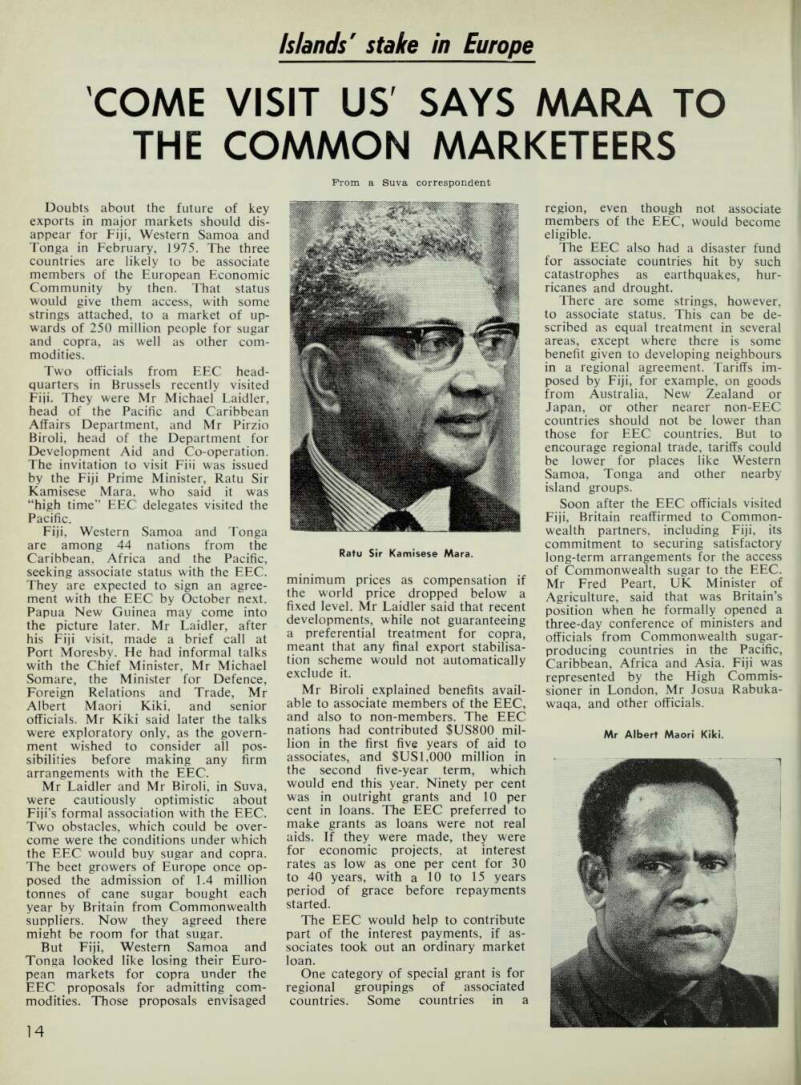
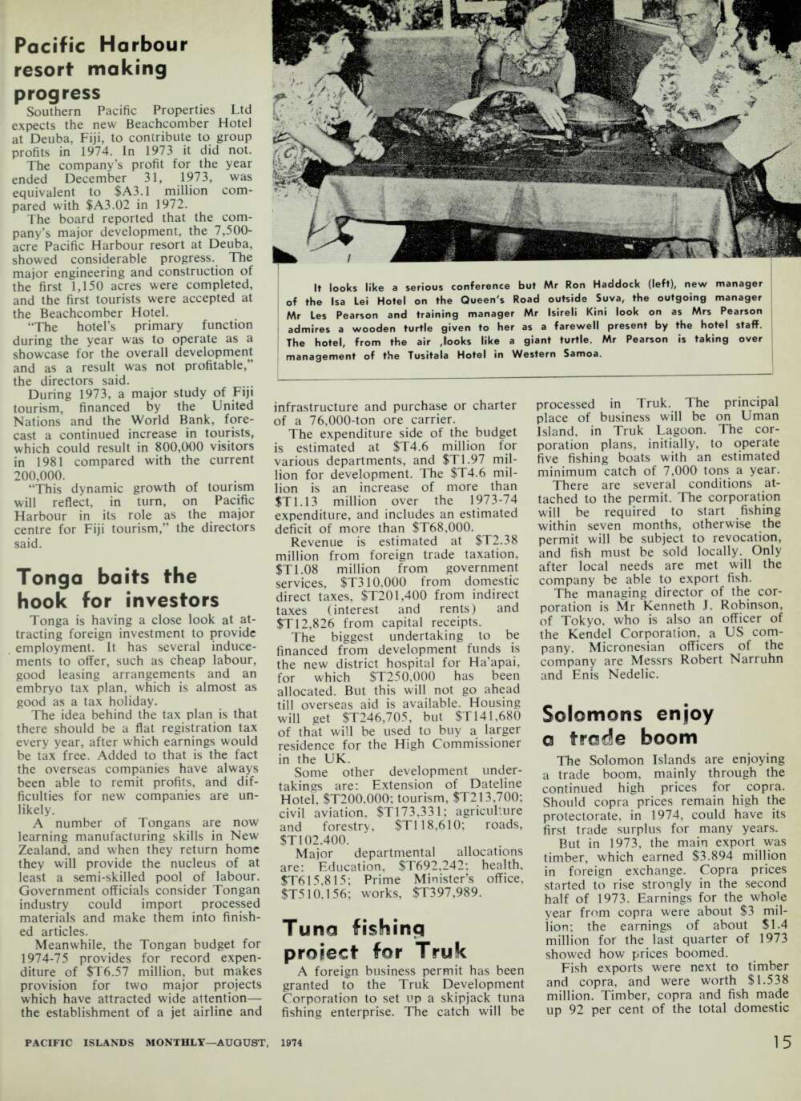
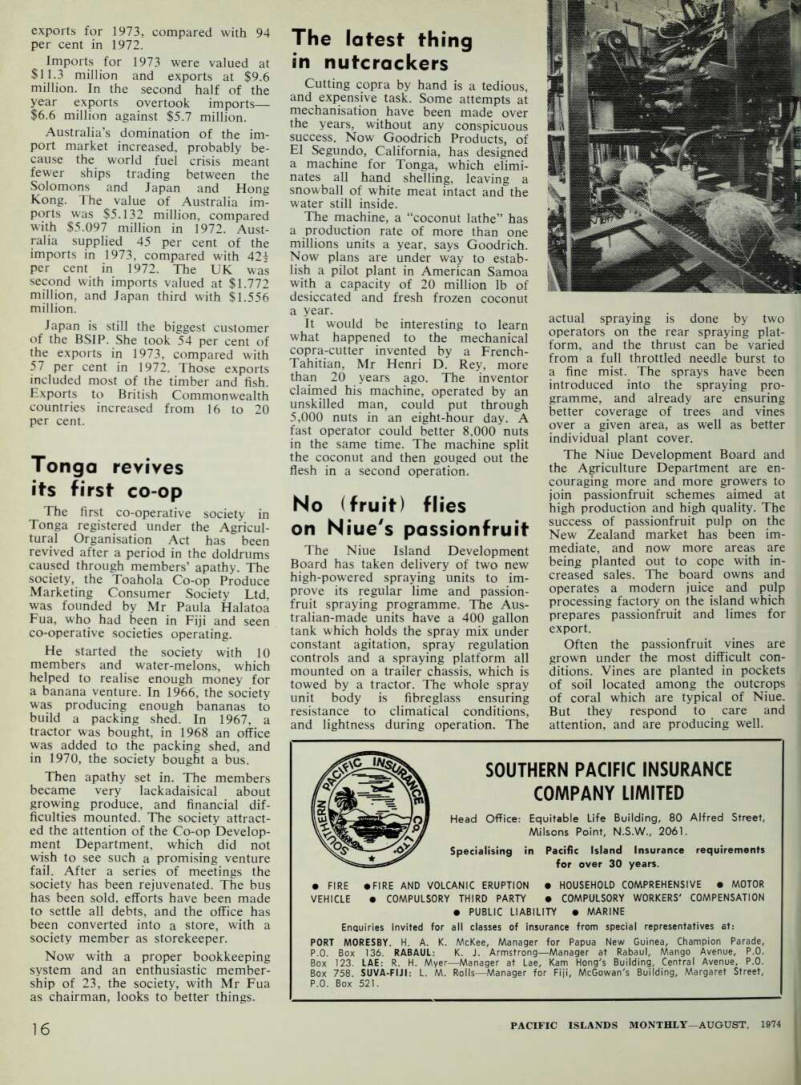
Islands' stake in Europe
The Common Marketeers
Doubts about the future of key exports in major markets should dis appear for Fiji, Western Samoa and Tonga in February, 1975. The three countries are likely to be associate members of the European Economic Community by then. That status would give them access, with some strings attached, to a market of up wards of 250 million people for sugar and copra, as well as other com modities.
Two officials from EEC head quarters in Brussels recently visited Fiji. They were Mr Michael Laidler, head of the Pacific and Caribbean Affairs Department, and Mr Pirzio Biroli, head of the Department for Development Aid and Co-operation.
The invitation to visit Fiii was issued by the Fiji Prime Minister, Ratu Sir Kamisese Mara, who said it was “high time” EEC delegates visited the Pacific.
Fiji, Western Samoa and Tonga are among 44 nations from the Caribbean, Africa and the Pacific, seeking associate status with the EEC.
They are expected to sign an agree ment with the EEC by October next.
Papua New Guinea may come into the picture later. Mr Laidler, after his Fiji visit, made a brief call at Port Moresby. He had informal talks with the Chief Minister, Mr Michael Somare, the Minister for Defence, Foreign Relations and Trade, Mr Albert Maori Kiki, and senior officials. Mr Kiki said later the talks were exploratory only, as the govern ment wished to consider all pos sibilities before making any firm arrangements with the EEC.
Mr Laidler and Mr Biroli, in Suva, were cautiously optimistic about Fiji’s formal association with the EEC.
Two obstacles, which could be over come were the conditions under which the EEC would buy sugar and copra.
The beet growers of Europe once op posed the admission of 1.4 million tonnes of cane sugar bought each year by Britain from Commonwealth suppliers. Now they agreed there misht be room for that sugar.
But Fiji, Western Samoa and Tonga looked like losing their Euro pean markets for copra under the EEC proposals for admitting com modities. Those proposals envisaged
Prom a Suva correspondent
minimum prices as compensation if the world price dropped below a fixed level. Mr Laidler said that recent developments, while not guaranteeing a preferential treatment for copra, meant that any final export stabilisa tion scheme would not automatically exclude it.
Mr Biroli explained benefits avail able to associate members of the EEC, and also to non-members. The EEC nations had contributed SUSBOO mil lion in the first five years of aid to associates, and SUS 1,000 million in the second five-year term, which would end this year. Ninety per cent was in outright grants and 10 per cent in loans. The EEC preferred to make grants as loans were not real aids. If they were made, they were for economic projects, at interest rates as low as one per cent for 30 to 40 years, with a 10 to 15 years period of grace before repayments started.
The EEC would help to contribute part of the interest payments, if as sociates took out an ordinary market loan.
One category of special grant is for regional groupings of associated countries. Some countries in a
region, even though not associate members of the EEC, would become eligible.
The EEC also had a disaster fund for associate countries hit by such catastrophes as earthquakes, hur ricanes and drought.
There are some strings, however, to associate status. This can be de scribed as equal treatment in several areas, except where there is some benefit given to developing neighbours in a regional agreement. Tariffs im posed by Fiji, for example, on goods from Australia, New Zealand or Japan, or other nearer non-EEC countries should not be lower than those for EEC countries. But to encourage regional trade, tariffs could be lower for places like Western Samoa, Tonga and other nearby island groups.
Soon after the EEC officials visited Fiji, Britain reaffirmed to Common wealth partners, including Fiji, its commitment to securing satisfactory long-term arrangements for the access of Commonwealth sugar to the EEC.
Mr Fred Peart, UK Minister of Agriculture, said that was Britain’s position when he formally opened a three-day conference of ministers and officials from Commonwealth sugar producing countries in the Pacific, Caribbean, Africa and Asia. Fiji was represented by the High Commis sioner in London, Mr Josua Rabuka waqa, and other officials.
Ratu Sir Kamisese Mara.
Mr Albert Maori Kiki.
Pacific Harbour
resort making
progress
Southern Pacific Properties Ltd expects the new Beachcomber Hotel at Deuba, Fiji, to contribute to group profits in 1974. In 1973 it did not.
The company’s profit for the year ended December 31, 1973, was equivalent to SA3.I million com pared with 5A3.02 in 1972.
The board reported that the com pany’s major development, the 7,500acre Pacific Harbour resort at Deuba, showed considerable progress. The major engineering and construction of the first 1,150 acres were completed, and the first tourists were accepted at the Beachcomber Hotel.
“The hotel’s primary function during the year was to operate as a showcase for the overall development and as a result was not profitable,” the directors said.
During 1973, a major study of Fiji tourism, financed by the United Nations and the World Bank, fore cast a continued increase in tourists, which could result in 800,000 visitors in 1981 compared with the current 200,000.
“This dynamic growth of tourism will reflect, in turn, on Pacific Harbour in its role as the major centre for Fiji tourism,” the directors said.
Tonga baits the
hook for investors
Tonga is having a close look at at tracting foreign investment to provide employment. It has several induce ments to offer, such as cheap labour, good leasing arrangements and an embryo tax plan, which is almost as good as a tax holiday.
The idea behind the tax plan is that there should be a flat registration tax every year, after which earnings would be tax free. Added to that is the fact the overseas companies have always been able to remit profits, and dif ficulties for new companies are un likely.
A number of Tongans are now learning manufacturing skills in New Zealand, and when they return home they will provide the nucleus of at least a semi-skilled pool of labour.
Government officials consider Tongan industry could import processed materials and make them into finish ed articles.
Meanwhile, the Tongan budget for 1974-75 provides for record expen diture of 5T6.57 million, but makes provision for two major projects which have attracted wide attention — the establishment of a jet airline and
infrastructure and purchase or charter of a 76,000-ton ore carrier.
The expenditure side of the budget is estimated at 5T4.6 million for various departments, and 5T1.97 mil lion for development. The 5T4.6 mil lion is an increase of more than 5T1.13 million over the 1973-74 expenditure, and includes an estimated deficit of more than 5T68,000.
Revenue is estimated at 5T2.38 million from foreign trade taxation, ST 1.08 million from government services, 5T310,000 from domestic direct taxes, 5T201,400 from indirect taxes (interest and rents) and $T12,826 from capital receipts.
The biggest undertaking to be financed from development funds is the new district hospital for Ha’apai, for which 5T250,000 has been allocated. But this will not go ahead till overseas aid is available. Housing will get 5T246/705, but $T141,680 of that will be used to buy a larger residence for the High Commissioner in the UK.
Some other development under takings are; Extension of Dateline Hotel, ST200.000; tourism, $T213,700; civil aviation, $T173,331; agriculture and forestry, $T118,610; roads, 5T102.400.
Major departmental allocations are; Education, $T692,242; health, 5T615,815; Prime Minister’s office, $T510,156; works, 5T397,989.
Tuna fishing
proiect for Truk
A foreign business permit has been granted to the Truk Development Corporation to set up a skipjack tuna fishing enterprise. The catch will be
processed in Truk. The principal place of business will be on Uman Island, in Truk Lagoon. The cor poration plans, initially, to operate five fishing boats with an estimated minimum catch of 7,000 tons a year.
TTiere are several conditions at tached to the permit. The corporation will be required to start fishing within seven months, otherwise the permit will be subject to revocation, and fish must be sold locally. Only after local needs are met will the company be able to export fish.
The managing director of the cor poration is Mr Kenneth I. Robinson, of Tokyo, who is also an officer of the Kendel Corporation, a US com pany, Micronesian officers of the company are Messrs Robert Narruhn and Enis Nedelic.
Solomons enjoy
a trade boom
The Solomon Islands are enjoying a trade boom, mainly through the continued high prices for copra.
Should copra prices remain high the protectorate, in 1974, could have its first trade surplus for many years.
But in 1973, the main export was timber, which earned 53.894 million in foreign exchange. Copra prices started to rise strongly in the second half of 1973. Earnings for the whole year from copra were about S 3 mil lion; the earnings of about 51.4 million for the last quarter of 1973 showed how prices boomed.
Fish exports were next to timber and copra, and were worth $1,538 million. Timber, copra and fish made up 92 per cent of the total domestic
It looks like a serious conference but Mr Ron Haddock (left), new manager of the Isa Lei Hotel on the Queen's Road outside Suva, the outgoing manager Mr Les Pearson and training manager Mr Isireli Kini look on as Mrs Pearson admires a wooden turtle given to her as a farewell present by the hotel staff.
The hotel, from the air looks like a giant turtle. Mr Pearson is taking over management of the Tusitala Hotel in Western Samoa.
exports for 1973, compared with 94 per cent in 1972.
Imports for 1973 were valued at $11.3 million and exports at $9.6 million. In the second half of the year exports overtook imports— s6.6 million against $5.7 million.
Australia’s domination of the im port market increased, probably be cause the world fuel crisis meant fewer ships trading between the Solomons and Japan and Hong Kong. The value of Australia im ports was $5,132 million, compared with $5,097 million in 1972. Aust ralia supplied 45 per cent of the imports in 1973, compared with 42i per cent in 1972. The UK was second with imports valued at $1,772 million, and Japan third with $1,556 million.
Japan is still the biggest customer of the BSIP. She took 54 per cent of the exports in 1973, compared with 57 per cent in 1972. Those exports included most of the timber and fish.
Exports to British Commonwealth countries increased from 16 to 20 per cent.
Tonga revives
its first co-op
The first co-operative society in Tonga registered under the Agricul tural Organisation Act has been revived after a period in the doldrums caused through members’ apathy. The society, the Toahola Co-op Produce Marketing Consumer Society Ltd, was founded by Mr Paula Halatoa Fua, who had been in Fiji and seen co-operative societies operating.
He started the society with 10 members and water-melons, which helped to realise enough money for a banana venture. In 1966, the society was producing enough bananas to build a packing shed. In 1967, a tractor was bought, in 1968 an office was added to the packing shed, and in 1970, the society bought a bus.
Then apathy set in. The members became very lackadaisical about growing produce, and financial dif ficulties mounted. The society attract ed the attention of the Co-op Develop ment Department, which did not wish to see such a promising venture fail. After a series of meetings the society has been rejuvenated. The bus has been sold, efforts have been made to settle all debts, and the office has been converted into a store, with a society member as storekeeper.
Now with a proper bookkeeping system and an enthusiastic member ship of 23, the society, with Mr Fua as chairman, looks to better things.
The latest thing
in nutcrackers
Cutting copra by hand is a tedious, and expensive task. Some attempts at mechanisation have been made over the years, without any conspicuous success. Now Goodrich Products, of El Segundo, California, has designed a machine for Tonga, which elimi nates all hand shelling, leaving a snowball of white meat intact and the water still inside.
The machine, a “coconut lathe” has a production rate of more than one millions units a year, says Goodrich.
Now plans are under way to estab lish a pilot plant in American Samoa with a capacity of 20 million lb of desiccated and fresh frozen coconut a year.
It would be interesting to learn what happened to the mechanical copra-cutter invented by a French- Tahitian, Mr Henri D. Rey, more than 20 years ago. The inventor claimed his machine, operated by an unskilled man, could put through 5,000 nuts in an eight-hour day. A fast operator could better 8,000 nuts in the same time. The machine split the coconut and then gouged out the flesh in a second operation.
No (fruit) flies
on Niue's passionfruit
The Niue Island Development Board has taken delivery of two new high-powered spraying units to im prove its regular lime and passion fruit spraying programme. The Aus tralian-made units have a 400 gallon tank which holds the spray mix under constant agitation, spray regulation controls and a spraying platform all mounted on a trailer chassis, which is towed by a tractor. The whole spray unit body is fibreglass ensuring resistance to climatical conditions, and lightness during operation. The
actual spraying is done by two operators on the rear spraying plat form, and the thrust can be varied from a full throttled needle burst to a fine mist. The sprays have been introduced into the spraying pro gramme, and already are ensuring better coverage of trees and vines over a given area, as well as better individual plant cover.
The Niue Development Board and the Agriculture Department are en couraging more and more growers to join passionfruit schemes aimed at high production and high quality. The success of passionfruit pulp on the New Zealand market has been im mediate, and now more areas are bein£ planted out to cope with in creased sales. The board owns and operates a modern juice and pulp processing factory on the island which prepares passionfruit and limes for export.
Often the passionfruit vines are grown under the most difficult con ditions. Vines are planted in pockets of soil located among the outcrops of coral which are typical of Niue.
But they respond to care and attention, and are producing well.
Advertisements & other items, pp. 26-28 (1 item)
Company Limited
SOUTHERN PACIFIC INSURANCE
Head Office: Equitable Life Building, 80 Alfred Street, AAilsons Point, N.S.W., 2061.
Specialising in Pacific Island Insurance requirements for over 30 years. • FIRE • FIRE AND VOLCANIC ERUPTION • HOUSEHOLD COMPREHENSIVE • MOTOR VEHICLE • COMPULSORY THIRD PARTY • COMPULSORY WORKERS' COMPENSATION
• PUBLIC LIABILITY • MARINE
Enquiries invited for all classes of Insurance from special representatives at: PORT MORESBY. H. A. K. McKee, Manager for Papua New Guinea, Champion Parade, P.O. Box 136. RABAUL: K. J. Armstrong—Manager at Rabaul, Mango Avenue, P.O.
Box 123. LAE: R. H. Myer—Manager at Lae, Kam Hong's Building, Central Avenue, P.O.
Box 758. SUVA-FIJI: L. M. Rolls—Manager for Fiji, McGowan's Building, Margaret Street, P.O. Box 521.
S
So this is a Lamborghini.” she breathed, as we sped down the autostrada towards Thrin. •‘Yes,” I said, offering her a Benson and Hedges. “Five forward gears and 170 in top.' "Can you prove that?” she demanded.
"Do I really have to? You did say you only wanted a little car to do the
shopping.”
\ vA 9U « -i'. •K i'.V-: v ■ v mm
Benson &Hed|
When only *l|e basf will do. 016 P 3408 6.73
She never
sleeps.
The Coral Chief and her three sister ships are working 24 hours a day, seven days a week. They
never sleep. They never
can. With side-port unit-loading, their time in Port barely gives their crews time to see more than the wharf.
If your cargo is bound for our corner of the Pacific, send it by the
ships that never sleep—
the four Chiefs of the New Guinea Australia Line. ‘New Guinea Chief’, ‘lsland Chief’, ‘Coral Chief’, ‘Papuan Chief’.
New Guinea Australia Line Pty. Ltd., Registered Office Port Moresby, Papua New Guinea.
General Agents: PORT MORESBY —Steamships Trading Co. Ltd.
SYDNEY —John Swire & Sons Pty. Ltd.
Agents: SYDNEY —Interocean Swire Pty. Ltd.
BRISBANE —Wills, Gilchrist & Sanderson Pty. Ltd.
PAPUA NEW GUINEA —Steamships Trading Co. Ltd. (for “New Guinea Chief’’ at Rabaul and “Island Chief” at Kavieng—Burns Philp (N.G.) Ltd.). •■u im
Porabrokers
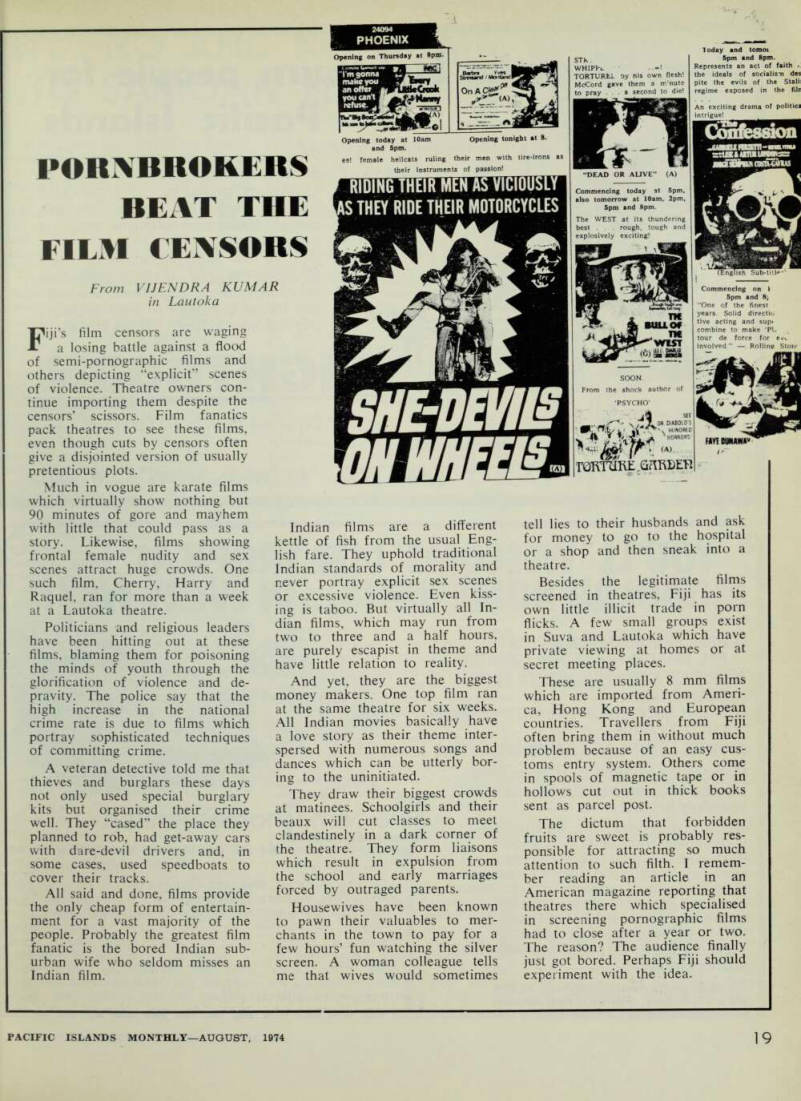
Beat The
Film Censors
From Vijen Dr A Kumar
in Lautoka
Fiji’s film censors are waging a losing battle against a flood of semi-pornographic films and others depicting “explicit” scenes of violence. Theatre owners con tinue importing them despite the censors’ scissors. Film fanatics pack theatres to see these films, even though cuts by censors often give a disjointed version of usually pretentious plots.
Much in vogue are karate films which virtually show nothing but 90 minutes of gore and mayhem with little that could pass as a story. Likewise, films showing frontal female nudity and sex scenes attract huge crowds. One such film, Cherry, Harry and Raquel, ran for more than a week at a Lautoka theatre.
Politicians and religious leaders have been hitting out at these films, blaming them for poisoning the minds of youth through the glorification of violence and de pravity. The police say that the high increase in the national crime rate is due to films which portray sophisticated techniques of committing crime.
A veteran detective told me that thieves and burglars these days not only used special burglary kits but organised their crime well. They “cased” the place they planned to rob, had get-away cars with dare-devil drivers and, in some cases, used speedboats to cover their tracks.
All said and done, films provide the only cheap form of entertain ment for a vast majority of the people. Probably the greatest film fanatic is the bored Indian sub urban wife who seldom misses an Indian film.
Indian films are a different kettle of fish from the usual Eng lish fare. They uphold traditional Indian standards of morality and never portray explicit sex scenes or excessive violence. Even kiss ing is taboo. But virtually all In dian films, which may run from two to three and a half hours, are purely escapist in theme and have little relation to reality.
And yet, they are the biggest money makers. One top film ran at the same theatre for six weeks.
All Indian movies basically have a love story as their theme inter spersed with numerous songs and dances which can be utterly bor ing to the uninitiated.
They draw their biggest crowds at matinees. Schoolgirls and their beaux will cut classes to meet clandestinely in a dark corner of the theatre. They form liaisons which result in expulsion from the school and early marriages forced by outraged parents.
Housewives have been known to pawn their valuables to mer chants in the town to pay for a few hours’ fun watching the silver screen. A woman colleague tells me that wives would sometimes
tell lies to their husbands and ask for money to go to the hospital or a shop and then sneak into a theatre.
Besides the legitimate films screened in theatres, Fiji has its own little illicit trade in porn flicks. A few small groups exist in Suva and Lautoka which have private viewing at homes or at secret meeting places.
These are usually 8 mm films which are imported from Ameri ca, Hong Kong and European countries. Travellers from Fiji often bring them in without much problem because of an easy cus toms entry system. Others come in spools of magnetic tape or in hollows cut out in thick books sent as parcel post.
The dictum that forbidden fruits are sweet is probably res ponsible for attracting so much attention to such filth. I remem ber reading an article in an American magazine reporting that theatres there which specialised in screening pornographic films had to close after a year or two.
The reason? The audience finally just got bored. Perhaps Fiji should experiment with the idea.
Advertisements & other items, p. 30 (1 item)
Lightburn
Kerr Bros, the Lightburn people for
Islands
M We are able to offer immediate delivery of the complete range of Lightburn products . , . concrete mixers, hydraulic jacks, electric power tools and electric washing machines.
Due to the high standard of their engineering and their outstanding reliability, these Lightburn products are being exported in ever increasing volume to over 70 countries.
LIGHTBURN
Exported to over 70 Countries For further information or supplies contact KERR BROTHERS PTY. LIMITED, 65 York St., Sydney, N.S.W. 2001
YOU LL WELCOME OUR TROPICAL
MODULAR HOME UNITS...IN EVERYWAY!
• PRE-CONSTRUCTED IN N.Z. AND
PRE-TREATED FOR TROPIC CONDITIONS
O SHIPPED KNOCKED-DOWN TO YOUR
DESTINATION
0 EASILY ERECTED ON SITE WITH MINIMUM
SKILLED LABOUR
@ OFFER LUXURY AT A REASONABLE PRICE Perfect for holiday and permanent homes or commercial and industrial housing projects. 4 modelstochoosefrom: ‘Leisuredeck’, (illustrated) ‘Sunseeker’, ‘Castaway’, Sunlover’ in 1,2,3-bedroom units. . . modular construction streamlines design, gives flexibility . . . pre-construction cuts costs and assembly-but not quality. . . maintenance-free pre-coated insulated Permalum metal weather-boarding . . . pre-piped plumbing unit. Plus many other quality features!
Already performance-proven in the New Hebrides, Pitcairn and Japan.
welcome I homes limited
Like to know more?
Mail this coupon now!
To: The Manager, Welcome Homes Ltd Box 12203, Penrose, Auckland, N.Z.
Please send me, without obligation, brochureson your Modular Home Units.
Name ..
Address Property Located At 664^J|
To Samoan Elections
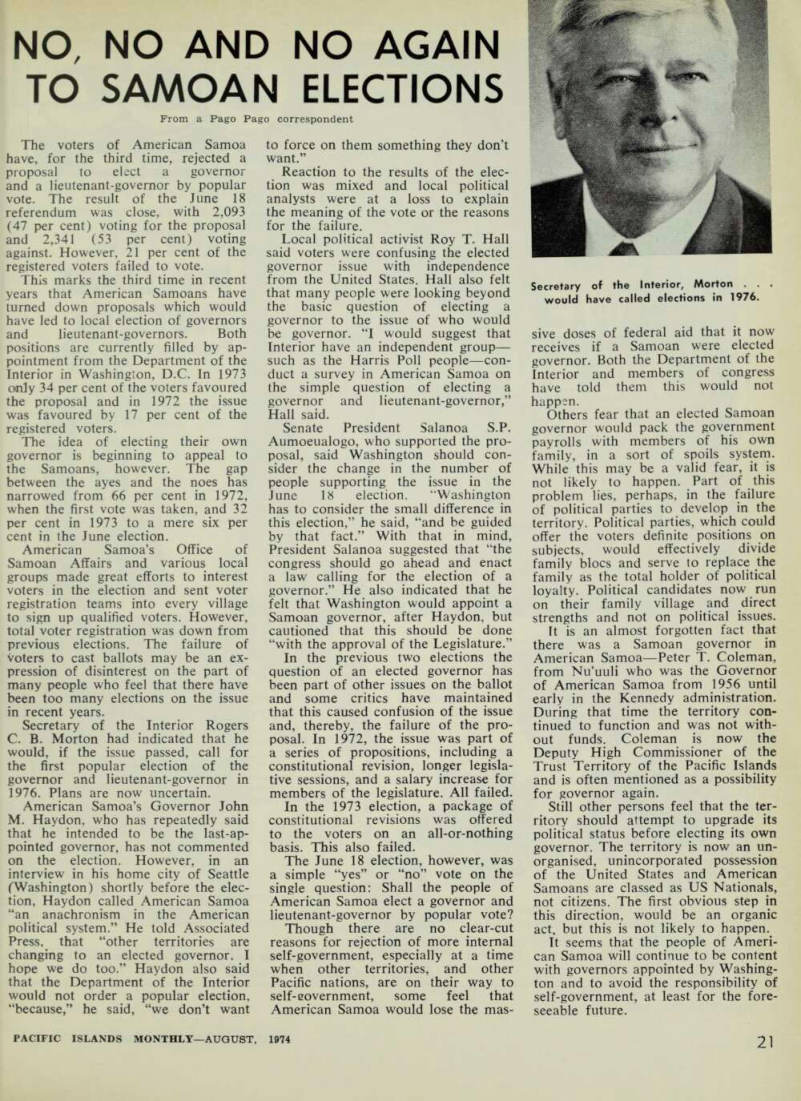
No, No And No Again
From a Pago Pago correspondent
The voters of American Samoa have, for the third time, rejected a proposal to elect a governor and a lieutenant-governor by popular vote. The result of the June 18 referendum was close, with 2,093 (47 per cent) voting for the proposal and 2,341 (53 per cent) voting against. However, 21 per cent of the registered voters failed to vote.
This marks the third time in recent years that American Samoans have turned down proposals which would have led to local election of governors and lieutenant-governors. Both positions are currently filled by ap pointment from the Department of the Interior in Washington, D.C. In 1973 only 34 per cent of the voters favoured the proposal and in 1972 the issue was favoured by 17 per cent of the registered voters.
The idea of electing their own governor is beginning to appeal to the Samoans, however. The gap between the ayes and the noes has narrowed from 66 per cent in 1972, when the first vote was taken, and 32 per cent in 1973 to a mere six per cent in the June election.
American Samoa’s Office of Samoan Affairs and various local groups made great efforts to interest voters in the election and sent voter registration teams into every village to sign up qualified voters. However, total voter registration was down from previous elections. The failure of voters to cast ballots may be an ex pression of disinterest on the part of many people who feel that there have been too many elections on the issue in recent years.
Secretary of the Interior Rogers C. B. Morton had indicated that he would, if the issue passed, call for the first popular election of the governor and lieutenant-governor in 1976. Plans are now uncertain.
American Samoa’s Governor John M. Haydon, who has repeatedly said that he intended to be the last-ap pointed governor, has not commented on the election. However, in an interview in his home city of Seattle (Washington) shortly before the elec tion, Haydon called American Samoa “an anachronism in the American political system,” He told Associated Press, that “other territories are changing to an elected governor. I hope we do too.” Haydon also said that the Department of the Interior would not order a popular election, “because,” he said, “we don’t want
to force on them something they don’t want.”
Reaction to the results of the elec tion was mixed and local political analysts were at a loss to explain the meaning of the vote or the reasons for the failure.
Local political activist Roy T. Hall said voters were confusing the elected governor issue with independence from the United States. Hall also felt that many people were looking beyond the basic question of electing a governor to the issue of who would be governor. “I would suggest that Interior have an independent group— such as the Harris Poll people—con duct a survey in American Samoa on the simple question of electing a governor and lieutenant-governor,”
Hall said.
Senate President Salanoa S.P.
Aumoeualogo, who supported the pro posal, said Washington should con sider the change in the number of people supporting the issue in the June 18 election. “Washington has to consider the small difference in this election,” he said, “and be guided by that fact.” With that in mind.
President Salanoa suggested that “the congress should go ahead and enact a law calling for the election of a governor.” He also indicated that he felt that Washington would appoint a Samoan governor, after Haydon, but cautioned that this should be done “with the approval of the Legislature.”
In the previous two elections the question of an elected governor has been part of other issues on the ballot and some critics have maintained that this caused confusion of the issue and, thereby, the failure of the pro posal. In 1972, the issue was part of a series of propositions, including a constitutional revision, longer legisla tive sessions, and a salary increase for members of the legislature. All failed.
In the 1973 election, a package of constitutional revisions was offered to the voters on an all-or-nothing basis. This also failed.
The June 18 election, however, was a simple “yes” or “no” vote on the single question: Shall the people of American Samoa elect a governor and lieutenant-governor by popular vote?
Though there are no clear-cut reasons for rejection of more internal self-government, especially at a time when other territories, and other Pacific nations, are on their way to self-eovernment, some feel that American Samoa would lose the mas-
sive doses of federal aid that it now receives if a Samoan were elected governor. Both the Department of the Interior and members of congress have told them this would not happen.
Others fear that an elected Samoan governor would pack the government payrolls with members of his own family, in a sort of spoils system.
While this may be a valid fear, it is not likely to happen. Part of this problem lies, perhaps, in the failure of political parties to develop in the territory. Political parties, which could offer the voters definite positions on subjects, would effectively divide family blocs and serve to replace the family as the total holder of political loyalty. Political candidates now run on their family village and direct strengths and not on political issues.
It is an almost forgotten fact that there was a Samoan governor in American Samoa —Peter T. Coleman, from Nu’uuli who was the Governor of American Samoa from 1956 until early in the Kennedy administration.
During that time the territory con tinued to function and was not with out funds. Coleman is now the Deputy High Commissioner of the Trust Territory of the Pacific Islands and is often mentioned as a possibility for governor again.
Still other persons feel that the ter ritory should attempt to upgrade its political status before electing its own governor. The territory is now an un organised, unincorporated possession of the United States and American Samoans are classed as US Nationals, not citizens. The first obvious step in this direction, would be an organic act, but this is not likely to happen.
It seems that the people of Ameri can Samoa will continue to be content with governors appointed by Washing ton and to avoid the responsibility of self-government, at least for the fore seeable future.
Secretary of the Interior, Morton. would have called elections in 1976.
Advertisements & other items, p. 32 (1 item)
Water
Australia’s largest and most advanced range ol
PRESSURE
SVSTEffIS
ECON-O-JET
Packaged water systems.
From Only $2lO M * I
From only
□ [fi CJ & IS
AQUA GENIE
Out-pertorms anything in its price range!
Only $139
NAME
ADDRESS
m ‘J” Series High Pressure Unit Range of multi-stage deep and shallow well capacities models, from 200 to 2600 g.p.h., pressures from 20 toi2o p.s.i., depths to 300 ft. ' From $360 Wj Water Equipment Catalogue 288 Pages—covers pumps of all types, irrigation, water conditioning, domestic and commercial pool filtration. Price $2, post fcee surface mail (enclose cheque/ money order) DUNLOP/IBC LTD., Station Road, Yerrongpilly, 4105. Phone: 40-9011.
I HYDRO-PAK (Left) from $303 TWIN-PAK (Above) from $393 New RM2 range of shallow and deep well models, capacities to 1180 g.p.h pressures to 75 p.s.i.
I
PHONE _J
I'MIC rediscovering water lbqo4io i.f.
The Editor's Mailbag
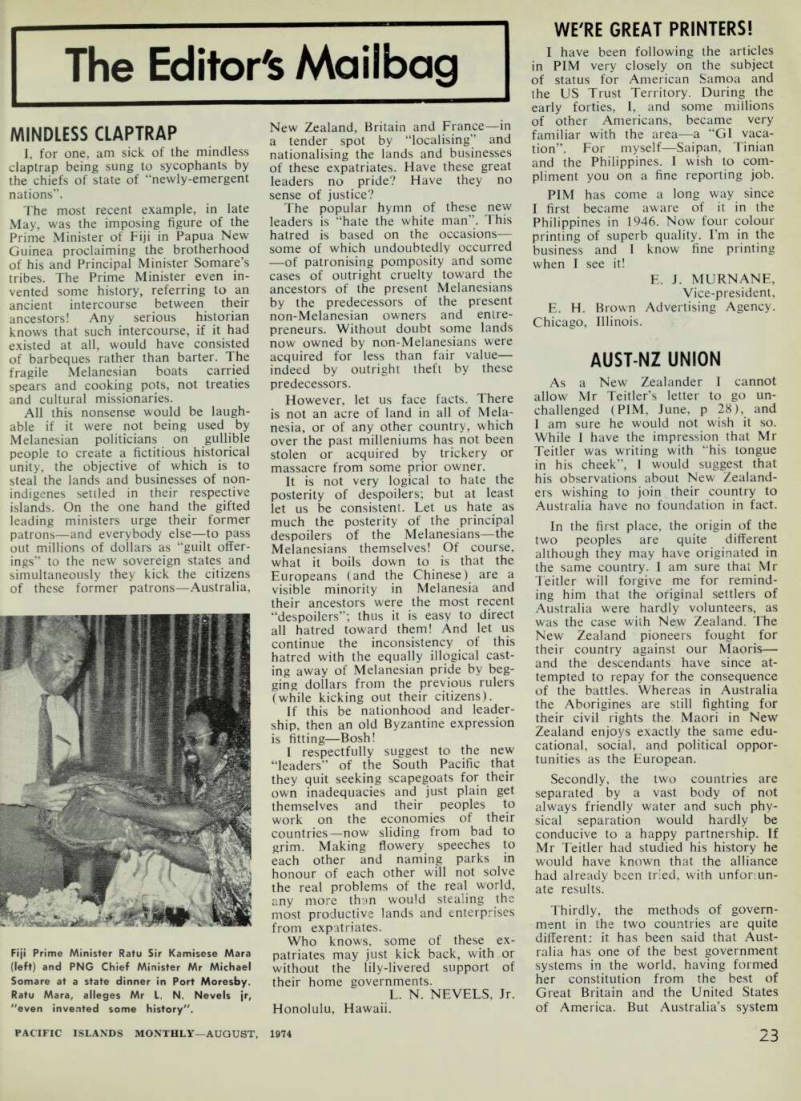


Mindless Claptrap
I, for one, am sick of the mindless claptrap being sung to sycophants by the chiefs of state of “newly-emergent nations”.
The most recent example, in late May, was the imposing figure of the Prime Minister of Fiji in Papua New Guinea proclaiming the brotherhood of his and Principal Minister Somare’s tribes. The Prime Minister even in vented some history, referring to an ancient intercourse between their ancestors! Any serious historian knows that such intercourse, if it had existed at all, would have consisted of barbeques rather than barter. The fragile Melanesian boats carried spears and cooking pots, not treaties and cultural missionaries.
All this nonsense would be laugh able if it were not being used by Melanesian politicians on gullible people to create a fictitious historical unity, the objective of which is to steal the lands and businesses of non indigenes settled in their respective islands. On the one hand the gifted leading ministers urge their former patrons —and everybody else —to pass out millions of dollars as “guilt offer ings” to the new sovereign states and simultaneously they kick the citizens of these former patrons—Australia,
New Zealand, Britain and France —in a tender spot by “localising” and nationalising the lands and businesses of these expatriates. Have these great leaders no pride? Have they no sense of justice?
The popular hymn of these new leaders is “hate the white man”. This hatred is based on the occasions— some of which undoubtedly occurred —of patronising pomposity and some cases of outright cruelty toward the ancestors of the present Melanesians by the predecessors of the present non-Melanesian owners and entre preneurs. Without doubt some lands now owned by non-Melanesians were acquired for less than fair value — indeed by outright theft by these predecessors.
However, let us face facts. There is not an acre of land in all of Mela nesia, or of any other country, which over the past milleniums has not been stolen or acquired by trickery or massacre from some prior owner.
It is not very logical to hate the posterity of despoilers; but at least let us be consistent. Let us hate as much the posterity of the principal despoilers of the Melanesians —the Melanesians themselves! Of course, what it boils down to is that the Europeans (and the Chinese) are a visible minority in Melanesia and their ancestors were the most recent “despoilers”; thus it is easy to direct all hatred toward them! And let us continue the inconsistency of this hatred with the equally illogical cast ing away of Melanesian pride by beg ging dollars from the previous rulers (while kicking out their citizens).
If this be nationhood and leader ship, then an old Byzantine expression is fitting—Bosh!
I respectfully suggest to the new “leaders” of the South Pacific that they quit seeking scapegoats for their own inadequacies and just plain get themselves and their peoples to work on the economies of their countries —now sliding from bad to grim. Making flowery speeches to each other and naming parks in honour of each other will not solve the real problems of the real world, any more than would stealing the most productive lands and enterprises from expatriates.
Who knows, some of these ex patriates may just kick back, with or without the lily-livered support of
their home governments.
L. N. Nevels, Jr.
Honolulu, Hawaii.
We're Great Printers!
I have been following the articles in PIM very closely on the subject of status for American Samoa and the US Trust Territory. During the early forties, I, and some millions of other Americans, became very familiar with the area —a “GI vaca tion”. For myself—Saipan, Tinian and the Philippines. I wish to com pliment you on a fine reporting job.
PIM has come a long way since I first became aware of it in the Philippines in 1946. Now four colour printing of superb quality. I’m in the business and I know fine printing when I see it!
E. J. Murnane
Vice-president,
E. H. Brown Advertising Agency.
Chicago, Illinois.
Aust-Nz Union
As a New Zealander I cannot allow Mr Teitler’s letter to go un challenged (PIM, June, p 28), and I am sure he would not wish it so.
While I have the impression that Mr Teitler was writing with “his tongue in his cheek”, I would suggest that his observations about New Zealand ers wishing to join their country to Australia have no foundation in fact.
In the first place, the origin of the two peoples are quite different although they may have originated in the same country. I am sure that Mr Teitler will forgive me for remind ing him that the original settlers of Australia were hardly volunteers, as was the case with New Zealand. The New Zealand pioneers fought for their country against our Maoris— and the descendants have since at tempted to repay for the consequence of the battles. Whereas in Australia the Aborigines are still fighting for their civil rights the Maori in New Zealand enjoys exactly the same edu cational, social, apd political oppor tunities as the European.
Secondly, the two countries are separated by a vast body of not always friendly water and such phy sical separation would hardly be conducive to a happy partnership. If Mr Teitler had studied his history he would have known that the alliance had already been tried, with unfortun ate results.
Thirdly, the methods of govern ment in the two countries are quite different: it has been said that Aust ralia has one of the best government systems in the world, having formed her constitution from the best of Great Britain and the United States of America. But Australia’s system
Fiji Prime Minister Ratu Sir Kamisese Mara (left) and PNG Chief Minister Mr Michael Somare at a state dinner in Port Moresby.
Ratu Mara, alleges Mr L. N. Nevels jr, "even invented some history".
Letters
of government, with its complexities, would be too much for the simple New Zealander.
It is possible that Mr Teitler has been misled or has been incorrect in his interpretation of the remarks made to him. Here is a nation which has much in common with Australia: natural resources, hard working people, vast areas of land, cosmopolitan population, similar government problems, just as many restless unions and labour shortages —and plenty of hot air. The question in many New Zealanders’ minds (I cannot speak for all my country men) is not “when will New Zea land join the Commonwealth of Australia?” but “when will Australia become the next state of the United States of America?”
Mr Teitler may have been better employed in drawing our attention to the rather peculiar attitudes of our Pacific Islands friends. While Fiji and Samoa are actively denouncing the deportation by Australia and New Zealand of illegal immigrants, the same nations are just as vocifer ously expecting these countries to assist them with their annual budgets.
It seems appalling to me that small Island territories are gaining indepen dence and yet expect their associate bigger nations to carry on contribut ing to their mismanaged economies.
This is true not only of the Cook Islands (who, in my opinion, are the worst offenders) but also of Fiji and, to a lesser extent. Western Samoa and Tonga. Fiji, in particular, has followed the Cook Islands example of reducing the number of Euro peans who may work in her islands —and many of these Europeans have assisted to give Fiji its present eco nomic independence, such as it is. I notice that the rot is now setting in in British Solomon Islands as well.
Surely one of the prime moves in the Pacific Area should be the free exchange of peoples, irrespective of colour, creed, or nationality.
In conclusion, may I say thank you, thank you, Stuart Inder! Your timely, accurate, and honest obser vation on the New Hebrides is the best thing that has been written about these islands. Of all the peoples in the Pacific who need both econ omic aid and friendly assistance, it is the New Hebrideans. Here again, the self-centred interest of the smaller
Pacific territories is evident. The New Hebrides has been overlooked too long—not only by the rest of the world but also by its sister islands in the Pacific.
Oleg Whimp.
Luganville, New Hebrides.
Nauruan Workers
To all those interested in Nauruan affairs, Mr Keke’s reply (PIM, May, p 29) to Mr Deiye’s letter (PIM, March, p 15) raises some interesting questions about President Deßoburt.
Mr Keke forecasts that negotiations the Nauruan Workers’ Organisation (NWO) will have with President Deßoburt will be “tough and grue some”. Why? Has the President, since he first fought for the Nauruan workers, changed sides and sympa thies? Does he not now see the wisdom in paying Nauruans a reason able salary to live on, and Nauruans with European skills, commensurate salaries?
As long as the government dis plays a distressing lack of concern for its skilled workers, expatriate labour will be “permanent stop-gap” —at least until the phosphate runs out!
If the NWO has “tough and grue some” negotiations with the President, it will not be because their claims are unreasonable but because the President, who is never on the island long enough to catch any of the local epidemics, has lost his feeling for those who are. In which case the old saying that ‘power corrupts’ will ring true on Nauru.
A. M. Kanani.
Melbourne, Vic.
Campus Wild Men
It is unfortunate that PIM has not been above the Fiji Times in its story about University of the South Pacific students headed: “Wild Men of the Campus” (PIM, April, p 16).
The Fiji Times (the source of your story) had sensationalised and dis storted out of proportion the incidents it reported.
As a student, I would like to give my perspective on the incidents: • The alleged “fight between Indian and Samoan students . . . with the Indians producing cane knives” is totally false because it never oc curred. The story is based on an incident between one Indian and a Samoan student in August, 1973. The
Letters
two students settled their differences immediately. © In February, 1974, a small group of Fijian and Samoan students had a fight because of a misunder standing and this was settled amic ably afterwards. • The Fijian politicians who spoke to a group of students were guests of the Fijian Cultural Society whose visit had been arranged by students (not members of the staff) a long time before and only coincided with the Fiji Times publicity attentions on USP. Their comments were elicited to give the public the impression that relations between students created a grave situation. © The Fijian student taken to hospital was not “seriously injured”.
Fights occur almost every weekend at tne dance halls and public bars
near the Fiji Times office, and yet it twice headlined these and other un related incidents at USP (and wrote two admonitory editorials) months after they occurred and had been settled. In giving people a misleading impression and arousing unwarranted alarm and criticisms, the Fiji Times had severely damaged the image of USP and this will take a long time to repair.
The staff members that the Vice- Chancellor chose to listen to before he banned the sale of liquor in the campus had never been to what was supposed to be a Staff/Student club.
If the USP Club failed in any way, it was by default of the majority of staff. These are the people whose reactionary attitude is strengthened by hearsay and gossip about students they don’t know and incidents which don’t affect them. If they had used the club, they might have learnt that “incidents” on campus are solved in formally on student initiatives without reference to the USP Disciplinary Committee.
There was no need for the intro
duction of the ridiculous draconian measures of discipline which the in nocent majority now suffer (eg any gathering of more than six people making “excessive” noise can be deemed to be a “party”, regardless of the type of beverage consumed, and those involved liable to expul sion!).
Most students feel that the USP Disciplinary Committee which is virtually composed of members of staff hasn’t any right to impose punishment on them. The Student Council has therefore asked the Vice- Chancellor to reconsider his decision about the USP Club and to accept the formation of a Disciplinary Com mittee composed entirely of students.
Jone Dakuvula.
University of the South Pacific, Suva, Fiji.
In the June issue of PIM, under the section headed Tropicalities, an article was published under the sub-heading Wild men of the campus.
Being the person responsible for public relations of the USP Students
Letters
Association, I cannot let such articles go unchallenged without correcting some of the distortions. The article clearly indicated that your corres pondent for the section headed Tropicalities, has deliberately dis torted the contents of the press release I made to the Fiji Times on May 22, 1974.
A copy of the release I made to the daily reads; The University of the South Paci fic Students Association is astonished at the information that has been pub lished by the Fiji Times about stu dent activities and other matters related to social life. While it has been very difficult for the USPSA to determine the sources of this in formation, the press has capitalised on them to create biased views of student activities in the minds of the people of this country.
The USPSA would like to express their views on the recent articles pub lished in the Fiji Times in the fol
lowing points:
• There has been an over emphasis of the various incidents that do take place on campus. Incidents which have occurred in the existence of this university have been con densed to look as if they took place during the last six months. • The credibility of the students and their activities has been con strued and irresponsibly reported.
Consequently, parents have begun to lose their confidence in the uni versity. • The USPSA appreciates the communicating role of the Press about student activities to the com munity of Fiji. But we would like that whatever information the people of Fiji get about university students should not be construed and irres ponsibly reported. • The USPSA is not happy with minimal effort of the university ad ministration to clarify the informa tion that has been reported in the Press. • The USPSA is alarmed at the emphasis that the Press has placed on incidents on campus as being racial. Most of the incidents that de velop between students on campus would be the same if the individuals were from the same ethnic groups. • Most of the constructive activi ties of students on the campus don’t
Letters
find their way into the limelight of
the Press.
Isikeli Maitaitoga
(Public Relations Officer, USPSA) University of the South Pacific, Suva, Fiji.
The Fiji Brownes
I was very interested in an article, Arundel, the shy Cecil Rhodes of the Pacific Islands (PIM, April, p 59).
I remember my grandmother Caroline telling me of Mr Arundel and how my grandfather, Captain Joseph Thomas Browne, used to take him to different islands.
My grandparents were stationed on Starbuck Island and I believe Caroline Island was named after my grand mother. They also lived for a time on Fanning and Vostock islands.
My grandfather gathered guano from the different islands and took the shipments to Sydney or New Zealand.
The Brownes had six children, all boys, and all born in the Line Islands.
They came to Fiji in the 1870 s and took up land from the Chief of Rewa known as Tukiwai, and part of Malata. They cultivated the land and planted cotton, sugar cane and bananas and brought in cattle and pigs.
Capt Browne came from the Isle of Wight and his wife Caroline was the daughter of the Rev Mugridge Orsmond, minister of the London Missionary Society stationed at Tahiti.
I would be most grateful for any help in obtaining information about my grandparents’ families.
R. F. Browne.
Nausori, Fiji.
Information Wanted
I am engaged in research on Aust ralian trade with the Pacific Islands, particularly Fiji, in the 19th and 20th centuries. If any of your readers could assist me with information about any of the following business firms which had offices in Sydney in the late 19th century and were in volved in Pacific trading activities, I should be most grateful: A. M. Brodziak & Co; W, & A.
McArthur; Moore & Moore (W.
Marshall Moore was a member of this firm); George Morgan & Co; William E. Morgan (also of Ade laide); Ebenezer Vickery & Sons.
Deryck Scarr
(Senior Fellow) Australian National University, PO Box 4, Canberra, ACT.
Advertisements & other items, pp. 34-40 (1 item)
Wunderflex gives
good design at low cost
m 1 E324E0 You want modern design?
Then use modern material that won’t warp, shrink or rot.
You want least cost?
Then build with a board that can be worked with handyman’s tools.
Inside and out, your home will have the modern, simple lines of Wunderflex building board.
kViunderlich
Wunderflex
Available from: Papua New Guinea: Steamships Trading Co. Ltd.
Norfolk Island: Irvine’s Building Supply Centre Made in Australia and marketed by CSR Building Materials Export Sales: 4 O’Connell Street, Sydney, Australia 2000
anywhere,
any time,
any gas.
and it’s
all Australian.
For further information & addresses of your local distributor contact:
THE COMMONWEALTH
INDUSTRIAL GASES LIMITED
Gases Export Department, 138 Bourke Road, Alexandria, N.S.W., Australia 2015.
Cables ‘CIGAS’-Telex 20241 Sydney. 017.024
:; :S / / 4b m r TA m ■ -■■■
Cook&Clean
Fry pan
with detachable cradle
tor complete and
easy cleaning
Now Sunbeam presents an electric trypan that comes apart for complete cleaning the easy way. New “cook and clean’’ cradle combines legs, buffet handles and bottom shield —helps keep out grease from cooking, removes for cleaning. Clean the pan in the dishwasher or sink, and the cradle in the sink. Then put them back together with the twist of a knob.
Super accurate heat control also removes for complete frypan immersibility. Has a high dome vented cover which tilts to six positions, together with Sunbeam’s special pan tilt lever for grilling. Truly Australia’s new “easy-clean” frypan.
L 83.4140
How to tell a perfect golf course in
two easy lessons
That's why the Fijian Hotel has such a perfect golf course.
But don't take our promise.
Take our pictures.
The Harvin "Rain Bird" watering system can be Automatically operated. That means a sizeable saving in labour costs because the sprinkler system can be timed to operate only at night. The course is therefore available for maximum use.
Harvin also leave their mark on golf courses with their equipment. Such things as flag poles, cups, ballwasher units, tee markers and signs are all available.
Harvin "Rain Bird" Automatic Watering System and Harvin Course Equipment The Perfect partners for any golf course. (1) It has a Harvin Electric Automatic System. (2) And, of course, Harvin golf course equipment.
T % A n „ C
w %im
a *% ■s V 1 Harvin Limited Head Office
CHRISTCHURCH
565 Wairakei Road, Phone 588-029 3 lines P.O. Box 20-030 Bishopdale Branches at Auckland & Palmerston North, New Zealand. are sole agents for u s a Please write for consultation on your watering problem. m
mmm m La Ronde pattern
Cool, easy-to-lay
Vmylflex floor tiles
Vinylflex floor tiles are unaffected by tropical conditions — they go on looking good as new.
The Vinylflex range includes embossed, smooth surface chip and marbleised patterns— suitable for homes, offices, shops and commercial buildings.
Floor tiles are much easier to lay.
When you want wall-to-wall comfort and over a hundred fashion colours to choose from, ask for CSR Vinylflex Floor Tiles.
csr Vinylflex'
FLOOR AND WALL TILES
Stockists: P.N.G.
Steamships Trading Company Limited, Port Moresby, Lae, Samarai, Madang, Goroka, Mt. Hagen, Rabaul, Kieta.
Bowmans (P. & N.G.) Pty. Ltd., Port Moresby, Kieta.
FIJI AND WESTERN SAMOA: Burns Philp (S.S.) Co. Ltd.
MARKETED BY CSR BUILDING MATERIALS
Export Sales: 4 O'Connell St., Sydney, Australia 2000.
cS R
"Why did I ever
leave school so early?
Collier Macmillan Schools
courses offer a second chance.
These days, it's the man with education who gets ahead. If you’ve got the qualifications you’re well on the way to big money and a real career. Collier Macmillan Schools can show you 264 ways to do it. Our Home Study Programmes can help you achieve the
specialised knowledge, the training you
need to really go places in a career. We can give you the qualifications for success. While you’re still working you can prepare yourself for a better job, a successful career, with one of our Home Study Courses. Clip the coupon for more details on our huge selection of Collier Macmillan Schools Courses.
Now’s the time to think of your future.
EXAMINATION COURSES
ENGINEERING
Council Engg Institutions Parti Society of Engineers
LIST OF COURSES
Building Courses Civil/Elect /Mechanical Institute of Engg Designers 2nd Class Marine Engineers' City & Guilds Institute Electrical Eng g Practice Telecommunication Tech's
COMMERCIAL
Inst, of Affil. Accountants Comm. Education Soc. Aust.
Diploma in Accountancy Diploma m Management Institute of Sales & Marketing Executives Aust. Institute of Travel Aust Chamber of Shipping Dip Shipping Practice Uni. of London G.C.E.
CERTIFICATE COURSES
ENGINEERING
Aeronautical Courses Automobile Courses General Auto Engineering Mechanics' Mech./Elec, Architecture Surveying Arch Draughtsmanship & Design Carpentry & Joinery Civil & Constructional Courses Geology Draughtsmanship Courses General Draughtsmanship Electrical & Electronics Courses Elec Installations & Wiring Electronics Eng g Computer Programming Production Engineering Courses Management Courses Mechanical Eng g Courses Diesel Engines Mtce Refrigeration Ser'g & Mtce.
Maintenance Engineering General Mech. Engineering Radio & Telecommunication Courses Radio Servicing, Maintenance & Repairs Pitman Scrip Shorthand-Typing Television Servicing
COMMERCIAL
Accountancy Courses Bookkeeping & Accountancy Practical Bookkeeping Business Studies Courses Sales & Marketing Courses Secretarial Courses mt Typ Writing Courses For Children Fiction Article, Photo-Journalism Courses tor Pleasure & Profit Art Water Colour Oils Music Piano, Guitar Photography General Education English & Foreign Language Sociology Rapid Reading Practical & Applied Psychology General Education
Many other
courses available
Collier Macmillan Schools
Incorporating British Institute of Careers and British Institute of Engineering Technology m Australia - College House, 113 Pacific Highway, North Sydney, NSW 2060.
I
POST THIS COUPON TODAY
Collier Macmillan Schools Dept. 82- 31*04
P O. Box 503, North Sydney, Australia 2060.
I I I I am interested in Please send me the appropriate Career-book without obligation.
Name (please print)
I Address Postcode I
Age
Manufactured by Commonwealth New Guinea Timbers Ltd. and available from leading suppliers throughout the Pacific.
history ...
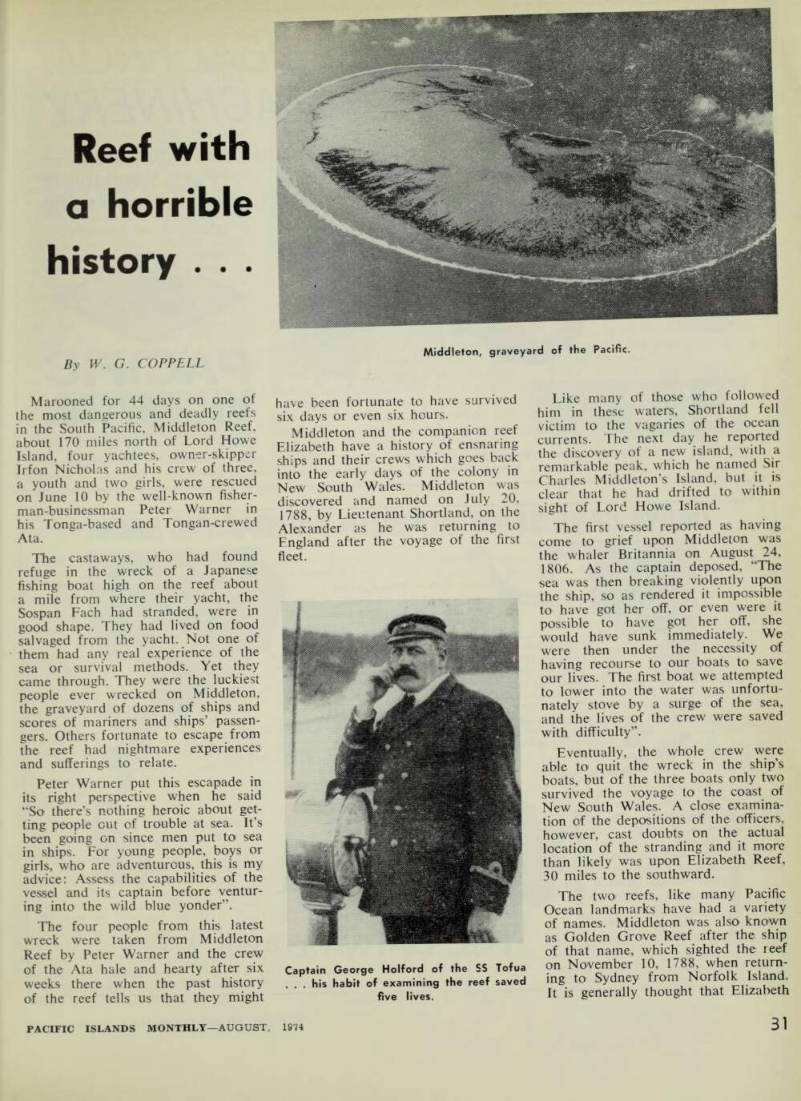

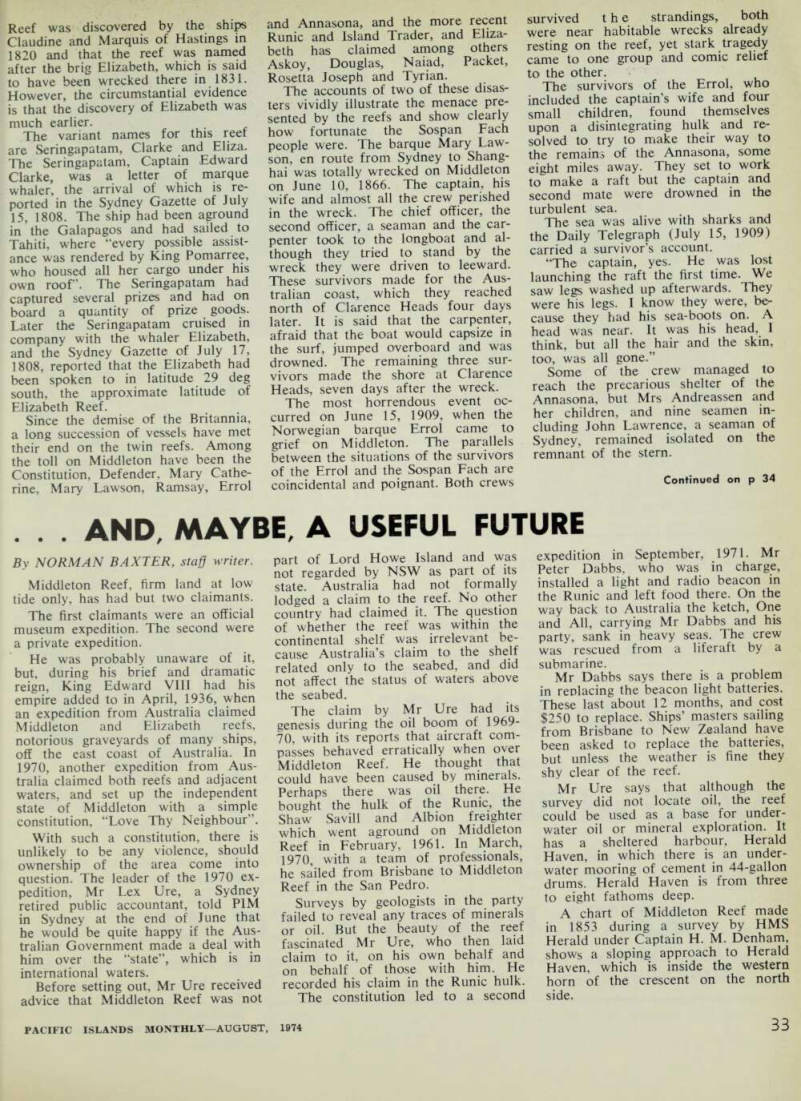

Reef with a horrible history ...
By W. G. Coppell
Marooned for 44 days on one of the most dangerous and deadly reefs in the South Pacific, Middleton Reef, about 170 miles north of Lord Howe Island, four yachtees, owner-skipper Irfon Nicholas and his crew of three, a youth and two girls, were rescued on June 10 by the well-known fisher man-businessman Peter Warner in his Tonga-based and Tongan-crewed Ata, The castaways, who had found refuge in the wreck of a Japanese fishing boat high on the reef about a mile from where their yacht, the Sospan Each had stranded, were in good shape. They had lived on food salvaged from the yacht. Not one of them had any real experience of the sea or survival methods. Yet they came through. They were the luckiest people ever wrecked on Middleton, the graveyard of dozens of ships and scores of mariners and ships’ passen gers. Others fortunate to escape from the reef had nightmare experiences and sufferings to relate.
Peter Warner put this escapade in its right perspective when he said “So there’s nothing heroic about get ting people cut of trouble at sea. It’s been going on since men put to sea in ships. For young people, boys or girls, who are adventurous, this is my advice: Assess the capabilities of the vessel and its captain before ventur ing into the wild blue yonder”.
The four people from this latest wreck were taken from Middleton Reef by Peter Warner and the crew of the Ata hale and hearty after six weeks there when the past history of the reef tells us that they might
have been fortunate to have survived six days or even six hours.
Middleton and the companion reef Elizabeth have a history of ensnaring ships and their crews which goes back into the early days of the colony in New South Wales. Middleton was discovered and named on July 20, 1788, by Lieutenant Shortland, on the Alexander as he was returning to England after the voyage of the first fleet.
Like many of those who followed him in these waters, Shortland fell victim to the vagaries of the ocean currents. The next day he reported the discovery of a new island, with a remarkable peak, which he named Sir Charles Middleton’s Island, but it is clear that he had drifted to within sight of Lord Howe Island.
The first vessel reported as having come to grief upon Middleton was the whaler Britannia on August 24, 1806. As the captain deposed, “The sea was then breaking violently upon the ship, so as rendered it impossible to have got her off, or even were it possible to have got her off, she would have sunk immediately. We were then under the necessity of having recourse to our boats to save our lives. The first boat we attempted to lower into the water was unfortu nately stove by a surge of the sea, and the lives of the crew were saved
with difficulty”.
Eventually, the whole crew were able to quit the wreck in the ship’s boats, but of the three boats only two survived the voyage to the coast of New South Wales. A close examina tion of the depositions of the officers, however, cast doubts on the actual location of the stranding and it more than likely was upon Elizabeth Reef, 30 miles to the southward.
The two reefs, like many Pacific Ocean landmarks have had a variety of names. Middleton was also known as Golden Grove Reef after the ship of that name, which sighted the reef on November 10, 1788, when return ing to Sydney from Norfolk Island.
It is generally thought that Elizabeth
Middleton, graveyard of the Pacific.
Captain George Holford of the SS Tofua ... his habit of examining the reef saved five lives.
Reef was discovered by the ships Claudine and Marquis of Hastings in 1820 and that the reef was named after the brig Elizabeth, which is said to have been wrecked there in 1831.
However, the circumstantial evidence is that the discovery of Elizabeth was much earlier.
The variant names for this reef are Seringapatam, Clarke and Eliza.
The Seringapatam, Captain Edward Clarke, was a letter of marque whaler, the arrival of which is re ported in the Sydney Gazette of July 15, 1808. The ship had been aground in the Galapagos and had sailed to Tahiti, where “every possible assist ance was rendered by King Pomarree, who housed all her cargo under his own roof’. The Seringapatam had captured several prizes and had on board a quantity of prize goods.
Later the Seringapatam cruised in company with the whaler Elizabeth, and the Sydney Gazette of July 17, 1808, reported that the Elizabeth had been spoken to in latitude 29 deg south, the approximate latitude of Elizabeth Reef.
Since the demise of the Britannia, a long succession of vessels have met their end on the twin reefs. Among the toll on Middleton have been the Constitution, Defender, Mary Cathe rine, Mary Lawson, Ramsay, Errol
and Annasona, and the more recent Runic and Island Trader, and Eliza beth has claimed among others Askoy, Douglas, Naiad, Packet, Rosetta Joseph and Tyrian.
The accounts of two of these disas ters vividly illustrate the menace pre sented by the reefs and show clearly how fortunate the Sospan Each people were. The barque Mary Law son, en route from Sydney to Shang hai was totally wrecked on Middleton on June 10, 1866. The captain, his wife and almost all the crew perished in the wreck. The chief officer, the second officer, a seaman and the car penter took to the longboat and al though they tried to stand by the wreck they were driven to leeward.
These survivors made for the Aus tralian coast, which they reached north of Clarence Heads four days later. It is said that the carpenter, afraid that the boat would capsize in the surf, jumped overboard and was drowned. The remaining three sur vivors made the shore at Clarence Heads, seven days after the wreck.
The most horrendous event oc curred on June 15, 1909, when the Norwegian barque Errol came to grief on Middleton. The parallels between the situations of the survivors of the Errol and the Sospan Each are coincidental and poignant. Both crews
survived th e standings, both were near habitable wrecks already resting on the reef, yet stark tragedy came to one group and comic relief to the other.
The survivors of the Errol, who included the captain’s wife and four small children, found themselves upon a disintegrating hulk and re solved to try to make their way to the remains of the Annasona, some eight miles away. They set to work to make a raft but the captain and second mate were drowned in the turbulent sea.
The sea was alive with sharks and the Daily Telegraph (July 15, 1909) carried a survivor’s account.
“The captain, yes. He was lost launching the raft the first time. We saw legs washed up afterwards. They were his legs. I know they were, be cause they had his sea-boots on. A head was near. It was his head, I think, but all the hair and the skin, too, was all gone.”
Some of the crew managed to reach the precarious shelter of the Annasona, but Mrs Andreassen and her children, and nine seamen in cluding John Lawrence, a seaman of Sydney, remained isolated on the remnant of the stem.
Continued on p 34
The accounts of the survivors lack coherence but it is plain that the mother and children suffered cruel deaths. A survivor stated, “The cap tain’s wife saw him drown, she took it quite easy. She never said anything.
She just looked and looked. She took it so well. She never screamed. She held her children close to her. She kissed the baby. She was a happy baby. She laughed after her father was drowned”.
The Daily Telegraph reported, “The stories of the survivors are con flicting. One man, withering in pain while he told his story in broken sentences, has alone given several versions of the horrors that followed.
But certain it is that the unfortunate woman and all her children are dead.
One survivor believes that the dis tracted mother threw the children overboard under the cover of dark ness rather than they should be eaten.
This proposal was made in an under tone, but the mother seemed to divine that something of the sort was sug gested. Lawrence, however, scouted the idea, but next morning all the children had disappeared. That day the mother died.”
Of the complement of 22 on the Errol five survived for four weeks, before being rescued by the Union Steamship Company’s Tofua, whose captain made a habit of examining the reef in case there were castaways.
The survivors had some time pre viously seen the smoke of a steamer, and the captain of the Suva was later to admit that a passenger had brought to his notice that there was a strange wreck on the reef.
“The captain replied that the wreck was an old one, and that sometimes when the tide was low two wrecks could be seen. The course of the Suva was not altered and the incident had passed out of the traveller’s mind
until today when he read of the ac count of the tragic fate of the Errol and her crew.”
Ralph Stock, a well-known yachts man cum-author wrote of Middleton in 1915. “it was worth seeing. Any thing more desolate and sinister than this gigantic horseshoe of coral out in the open sea, a menace to every storm-driven ship in a radius of a hundred miles, it would be difficult
to imagine.”
Only survivors of the Errol (left from the rear) Eilert Jensen, P.
Palmer, J. Law, rence, Anders Johansen and Bjorn Oftedal.
Advertisements & other items, pp. 42-45 (3 items)
Machinery,Inc.
YOU GET A BETTER DEAL FROM
PACIFIC MACHINERY
I r New and Used Equipment Parts Availability Throughout the Pacific ML
YOUR
CATERPILLAR
DEALER
PACIFIC
MACHINERY,INC.
SUBSIDIARY OF THEO. H. DAVIES & CO., LTD.
HAWAII: 94-025 Farrington Hwy., Waipahu, Hawaii, 96797. Phone: 677-9111. Cable: ,/ PAMACAT ,, . Tlx.: 723397.
GUAM: Phone 646-4479. Also U.S. Trust Territory and American Samoa.
OAIWA BANK SERVING YOU IN THE PACIFIC BASIN * Head Office Osaka,Japan With 137 Branches throughout Japan Singapore Representative Office Suite No. 1007, 10th Floor Robina House 1 Shenton Way, Singapore 1 Republic of Singapore Cable Address: SINGDAIWA Affiliated Bank P.T BANK PERDANIA Djolon Raya Mangga Besar 7&9 Djakarta Our Correspondent Banks are in city— Apia, Suva. Lae.
Madang Port Moresby, Rabaul Wewak. Guam, all Principal cities in Australia and New Zealand Contact your banker or our office.
Los Angeles Agency 555 South Flower St. Suite 4040 Los Angeles, Calif. 90071 Sydney Representative Office Bth Floor Prudential Building 39-49, Martin Place, Sydney
THE DAIWA BANK LTD
Head Office : 21. Bingomachi 2-chome, Higashi-ku, Osaka, Japan Overseas : London, New York, Los Angeles, Frankfurt, Sydney, Singapore
Zsttlsk
... AND, MAYBE, A USEFUL FUTURE
By NORMAN BAXTER, staff writer.
Middleton Reef, firm land at low tide only, has had but two claimants.
The first claimants were an official museum expedition. The second were a private expedition.
He was probably unaware of it, but, during his brief and dramatic reign, King Edward VIII had his empire added to in April, 1936, when an expedition from Australia claimed Middleton and Elizabeth reefs, notorious graveyards of many ships, off the east coast of Australia. In 1970, another expedition from Aus tralia claimed both reefs and adjacent waters, and set up the independent state of Middleton with a simple constitution, “Love Thy Neighbour”.
With such a constitution, there is unlikely to be any violence, should ownership of the area come into question. The leader of the 1970 ex pedition, Mr Lex Ure, a Sydney retired public accountant, told PIM in Sydney at the end of June that he would be quite happy if the Aus tralian Government made a deal with him over the “state”, which is in international waters.
Before setting out, Mr Ure received advice that Middleton Reef was not
« *lgt
state Australia had not formally lodged a claim to the reef. No other country had claimed it. The question of whether the reef was within the
ZSttLSK
seabed, tbe seabed The claim by Mr Ure bad its genesis during the oil boom of 1969- 70, with its reports that aircraft compasses behaved erratically when over Middleton Reef. He thought that could have been caused by minerals Perhaps there was oil there. He bought the hulk of the Runic, the Shaw Savill and Albion freighter which went aground on Middleton February, 1961. In March, *«et in .^ eD a ru tea of profes si on als.
Jesailed f Brisbane to Middleton San Pedro .. , .
Surveys by geologists in the party failed to reveal any traces of minerals or oil. But the beauty of the reef fascinated Mr Ure, who then laid claim to it, on his own behalf and on behalf of those with him. He recorded his claim in the Runic hulk.
The constitution led to a second
RE" 1 ;;;,," UTSS’
installed a light and radio beacon in the Runic and left food there. Un the way back Australia ketch One and All, car [y ll ?B Mr ° abb i,. a ™
A* 'XS’SSIS'SI
ancTcost
replace. Ships’ masters sailing io repia Zealand have asked to replace the batteries, £een asked £re fi D h ’ but shy clear ot me rea Mr Ure says that although the survey did not \^under could be ™ed as a.i If water oil or mineral exploration, n has a sheltered harbour. Herald Haven, in which there is an under water mooring of cement in 44-gallon drums. H erald Haven is from three piaht fathoms deen to eight fathoms deep.
A chart of Middleton Reef made in 1853 during a survey byHMS
Herald un^ er . Cap^J^' Herald
shows a sloping approach to Herald Haven, which is inside the western horn of the crescent on the nort side.
Gold Badge
• To Islands Cordial-makers
FOLLOW THE EXAMPLE OF
, Pastrycooks
Confectioners Canners . . .
AUSTRALIA'S LEADING FOOD PROCESSORS
WHO FOR 30 YEARS HAVE CONSISTENTLY USED
GOLD BADGE
FINE QUALITY
ESSENCES and EDIBLE COLOURS
BADGE
n BRAND h
AND
C a LTD.
Samples are available for manufacturers We are Flavoumg Specialists producing highly concentrated soluble essences for the food industries and invite your enquiries, either direct or through your usual buying channels.
KEITH HARRIS & CO. LTD.
Setron Road, Thornleigh, N.S.W.
Cobles: Kehar, Sydney 1015 Ann Street, Valley N.l, Qld.
Cables: Keharbris, Brisbane
Become a part of PlM’s Pacific and subscribe now
Pacific islands Monthly Keeps you informed on Pacific happenings
Fill in the details on the attached order form.
price problem

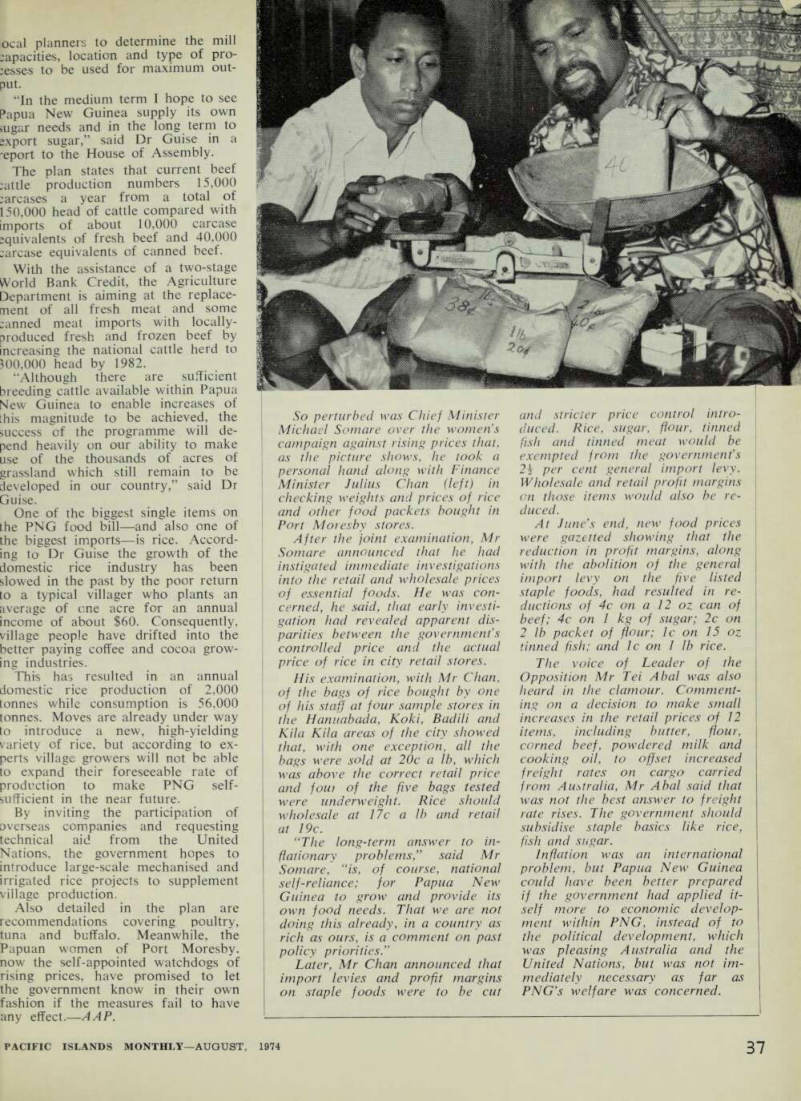
PNG's 'simple answer' to price problem
From Barry Wheeler
in Port Moresby Faced with the spectacle of women battling police in the streets during a violent protest against rising prices, Papua New Guinea has moved hastily to pacify its angry housewives by formulating a long-range plan to re duce the country’s dependence on im ported foodstuffs.
The protests, which early in June had politicians scurrying for cover before the wrath of the burly Papuan women of Port Moresby (PIM, July, p 7), were widely condemned as both an irresponsible and unlawful method of dramatising their grievances.
The women, wading into battle with a baby in on© arm and a placard wielded weapon-like in the other, provided the government with ample proof that not even police road blocks barring the way to Chief Minister Michael Somare’s offices would dissuade them from insisting the situation was serious enough to warrant extreme action.
Even the most chagrined of the politicians had to admit they were successful. The government im mediately launched an anti-inflation drive which included the withdrawal of a general import levy on food stuffs and the introduction of a more rigid system of controlling profit margins allowed to wholesalers and retailers.
As a placatory gesture it was more than enough to satisfy the enraged housewives, but the problem of highly priced imported foodstuffs supplementing a relatively meagre domestic production persisted.
The simple answer, according to a plan announced by Agriculture Minister John Guise, was to reduce PNG’s dependence on imports by stepping up the domestic production.
This could then be retailed at a much lower cost without the artificial loadings of freight charges and im ported inflation.
Should the plan be successfully implemented it will not only provide local producers with higher incomes and enable the housewife to make more purchases from the basic urban wage of $l5, but will gradually sweep costly imports off the supermarket shelves.
The first stage of the Agriculture Department blueprint calls for a more scientific and methodical ap proach to a traditional style of food production—more or less unchanged since tribesmen began sticking sweet potato plants into a backyard plot centuries ago.
A stock of seed supplies and a variety of suitable vegetables will be built up and dispensed to local growers along with technical assist ance and easy access to centralised marketing agencies. The government proposes to construct a number of deep freezer units at strategic points along the coast for the storage of fish and fresh foods which will be collected at regular intervals by a government-chartered ship supplied with financial aid from New Zealand.
Inland agriculture officers will go into the villages to buy fresh foods, then sell the produce themselves or assist local businessmen to market their goods.
To service more remote areas, privately-owned trucks will be hired by the government to transport the vegetables between pre-arranged pick up and vending points.
The lack of sugar production in Papua New Guinea has long been claimed by the government as a glaring example of Australia’s failure to develop properly certain areas of the country during the colonial era.
One of Chief Minister Michael Somare’s oft-stated criticisms of Aus tralian stewardship was that it pur posely discouraged the creation of a sugar industry so that it could unload a large portion of its own export crop on Papua New Guinea.
Now the government has ear marked $500,000 in the next financial year to establish two plantations and mill complexes as the first step to wards commercial production.
Technical advice sought from both Fiji and New Zealand will enable
Dr John Guise ... we must use our grassland.
ocal planners to determine the mill capacities, location and type of pro cesses to be used for maximum out put.
“In the medium term I hope to see Papua New Guinea supply its own sugar needs and in the long term to export sugar,” said Dr Guise in a -eport to the House of Assembly.
The plan states that current beef cattle production numbers 15,000 carcases a year from a total of 150.000 head of cattle compared with imports of about 10,000 carcase equivalents of fresh beef and 40,000 carcase equivalents of canned beef.
With the assistance of a two-stage World Bank Credit, the Agriculture Department is aiming at the replace ment of all fresh meat and some canned meat imports with locally produced fresh and frozen beef by increasing the national cattle herd to 300.000 head by 1982.
“Although there are sufficient breeding cattle available within Papua New Guinea to enable increases of this magnitude to be achieved, the success of the programme will de pend heavily on our ability to make use of the thousands of acres of grassland which still remain to be developed in our country,” said Dr Guise.
One of the biggest single items on the PNG food bill—and also one of the biggest imports—is rice. Accord ing to Dr Guise the growth of the domestic rice industry has been slowed in the past by the poor return to a typical villager who plants an average of one acre for an annual income of about $6O. Consequently, village people have drifted into the better paying coffee and cocoa grow ing industries.
This has resulted in an annual domestic rice production of 2,000 tonnes while consumption is 56,000 tonnes. Moves are already under way to introduce a new, high-yielding variety of rice, but according to ex perts village growers will not be able to expand their foreseeable rate of production to make PNG self sufficient in the near future.
By inviting the participation of overseas companies and requesting technical aid from the United Nations, the government hopes to introduce large-scale mechanised and irrigated rice projects to supplement village production.
Also detailed in the plan are recommendations covering poultry, tuna and buffalo. Meanwhile, the Papuan women of Port Moresby, now the self-appointed watchdogs of rising prices, have promised to let the government know in their own fashion if the measures fail to have
any effect.-
Aap.
So perturbed was Chief Minister Michael Somare over the women’s campaign against rising prices that, as the picture shows, he took a personal hand along with Finance Minister Julius Chan (left) in checking weights and prices of rice and other food packets bought in Port Moresby stores.
After the joint examination, Mr Somare announced that he had instigated immediate investigations into the retail and wholesale prices of essential foods. He was con cerned, he said, that early investi gation had revealed apparent dis parities between the government’s controlled price and the actual price of rice in city retail stores.
His examination, with Mr Chan, of the bags of rice bought by one of his staff at four sample stores in the Hanuabada, Koki, Badili and Kila Kila areas of the city showed that, with one exception, all the bags were sold at 20c a lb, which was above the correct retail price and four of the five bags tested were underweight. Rice should wholesale at 17c a 1b and retail at 19c.
“The long-term answer to in flationary problems,” said Mr Somare, “is, of course, national self-reliance; for Papua New Guinea to grow and provide its own food needs. That we are not doing this already, in a country as rich as ours, is a comment on past policy priorities.”
Later, Mr Chan announced that import levies and profit margins on staple foods were to be cut
and stricter price control intro duced. Rice, sugar, flour, tinned fish and tinned meat would be exempted from the government’s 2\ per cent general import levy.
Wholesale and retail profit margins on those items would also be re duced.
At June’s end, new food prices were gazetted showing that the reduction in profit margins, along with the abolition of the general import levy on the five listed staple foods, had resulted in re ductions of 4c on a 12 oz can of beef; 4c on 1 kg of sugar; 2c on 2 lb packet of flour; 1c on 15 oz tinned fish; and 1c on 1 lb rice.
The voice of Leader of the Opposition Mr Tei Abal was also heard in the clamour. Comment ing on a decision to make small increases in the retail prices of 12 items, including butter, flour, corned beef, powdered milk and cooking oil, to offset increased freight rates on cargo carried from Australia, Mr Abal said that was not the best answer to freight rate rises. The government should subsidise staple basics like rice, fish and sugar.
Inflation was an international problem, but Papua New Guinea could have been better prepared if the government had applied it self more to economic develop ment within PNG, instead of to the political development, which was pleasing Australia and the United Nations, but was not im mediately necessary as far as PNG’s welfare was concerned.
Advertisements & other items, p. 46 (1 item)
the most important ingredient
m m m m m mm. i st m m a i O 9* i Hi H M O P IS. .' ’ l *w *SH
% miw 5
’ -I *
iipycE mmsTBAUA
m m m J
KGNfr
:*m 5J ife :jy
the most important ingredient
BREAD FLOURS:
CAKE FLOURS;
BISCUIT FLOURS;
SPECIALITY FLOURS;
MAINTOP —bigb protein bread flour ANCHOR —bakers flour • 50/50 MEAL —brown bread MEDIUM —cake and pastry • SPONGE —sponge cakes SPECIAL CAKE —madeira and cup cakes STRONG —cracker biscuits * MEDIUM —Shortbreads SOFT —sweet biscuits FCYE flour • RYE m eal • KIBBLED RYE SHARPS — ro ti and chapati flour * 100% STONE GROUND
WHOLEMEAL
GILLESPIE BROS. PTY. LTD.
HEAD OFFICE: BRISBANE OFFICE;
52 UNION ST, PYRMONT, SYDNEY, N.S.W. CABLE ADDRESS: ALBION, BRISBANE, QUEENSLAND. (G.P.O. BOX 2518, SYDNEY, 2001.) "GILLESPIE", (P.O. BOX 8, ALBION, BRISBANE, 4010.) PHONE: 660-4933. SYDNEY AND BRISBANE. PHONE: 6-1121.
News in a Nutshell
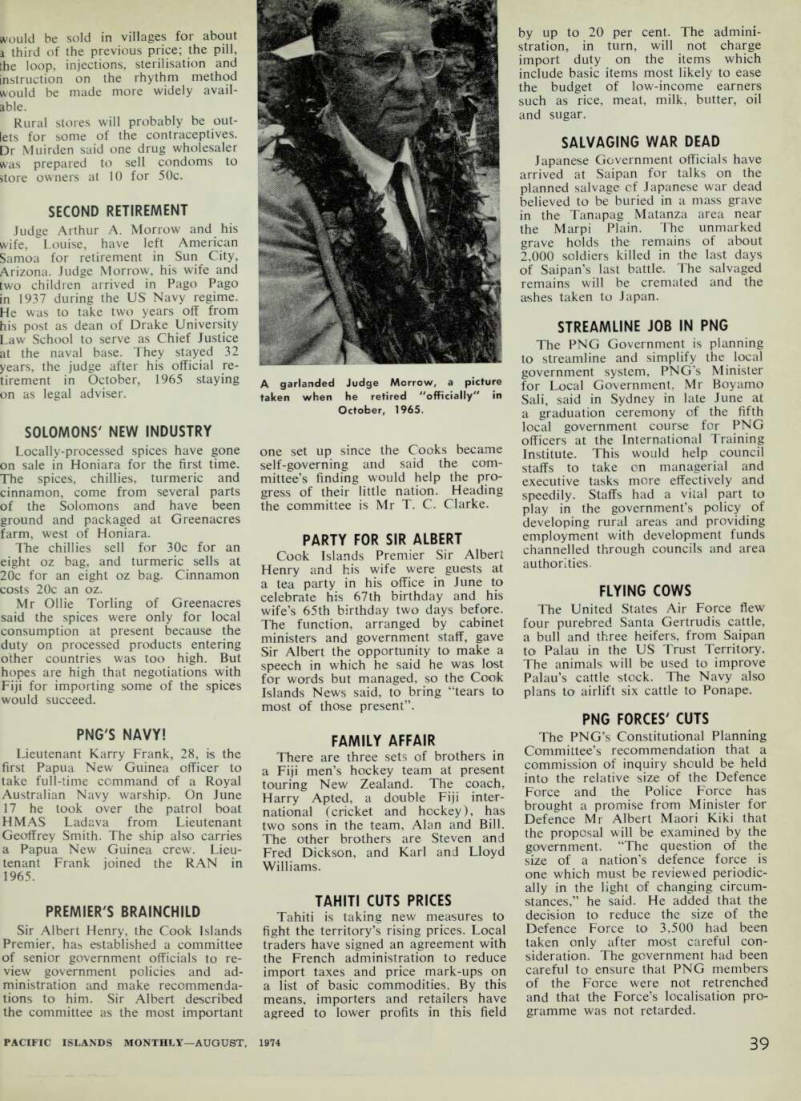
The dismissal of a Western Samoa public servant, Toleafoa Mataitusi, for alleged drunkenness during work ing hours led to two inquiries, after which two senior officials of the Health Department, Tuataga Lafaele (managing secretary) and Lamosi tele Aukusitino (chief accountant), were also sacked. Toleafoa Mataitusi, after his dismissal, had made a long report in which he alleged the other two had used government goods for their own purposes, had employed departmental painters and carpenters for their own work during govern ment working hours and had paid them from government funds. The Public Service Commission, after re ceiving a report from a commission of inquiry into the matter, dismissed the two men. Mataitusi announced later that he might appeal to the Supreme Court against his dismissal.
Congress Meets
The Congress of Micronesia was scheduled to meet in special session at Saipan for not more than 15 days beginning on July 23. Members asked for the special session, the first such session since September, 1972. The agenda includes the return and re apportioning of public lands, amend ments to the Constitutional Conven tion Law, congress revenues and future political status. The last named item could prepare the way for resumption of the political status talks between the Micronesians and the United States. It will be the final session of the Fifth Congress as a general election is scheduled for No vember with the first session of the Sixth Congress following at Saipan next January.
$3 Million Wanted
The Pacific Islands Development Commission is making a major effort to raise $3 million in US federal funds for tuna research. This coun cil consists of the chief executives of Hawaii, Guam, American Samoa and the US Trust Territory. The Trust Territory High Commissioner, Mr Edward E. Johnston, said recently there was room for major investment to tap the vast fisheries resources in the three million square miles of
ocean of Micronesia. Major com panies in the US and Japan had shown interest in the area.
Thrifty Micronesians
The remarkable growth of co operatives and credit unions in the US Trust Territory is shown in sta tistics for 1973. Gross sales of co operatives realised $7.7 million, 22 per cent higher than the 1972 figure.
More than 12,000 Micronesians own and operate about 50 co-operatives.
They have invested about $1 million of their own money in shares, and total assets are valued at more than $4 million. Credit unions made loans of more than $4 million. More than half of them were for home improve ments. The average savings for each member are now $325, which is 27 per cent higher than 1972. There are 46 credit unions, owned and operated by more than 10,000 Micronesians, who have savings of $3.4 million in the unions.
Nearly A Win!
Fiji is getting close to a rugby victory over one of the majors. On June 11, Fiji went down to the New Zealand All Blacks, by one point, 14-13. The All Blacks scored 10 points in the last five minutes to win.
In 1973, Fiji was beaten by one point, 13-12, by the English team on its way for a short tour of NZ.
Sophisticated Niue
The economy of Niue Island in five years has changed from sub sistence plus protein to something more sophisticated involving more imported foods, and consumer durables such as cars and refriger ators, says Mr Don Evans, who left the island recently to return to New Zealand. He was Secretary of the Administrative Department on Niue from March, 1969.
The most notable change he saw in his five years related to people and their living standards. People now had more money to spend, which allowed the private sector of business to develop and expand.
The introduction of the regular air service removed the feeling of iso
lation which Niue Islanders and ex-J patriates had experienced. All were now pleased to receive a weekly! mail from friends and relatives.
Mr Evans returned to New Zea-j land for a post in the Treasury De partment in Wellington. His replace ment is Mr A. Armistead, of the NZ Maori and Island Affairs Depart ment. Mr Armistead’s appointment is in an acting capacity, suggesting that the post will be localised. The post has been advertised on the island.
Pied Piper Wanted
A large rat recently threatened Pitcairn Island’s links with the out side world. The rat crawled into the ham radio rig of Tom Christian, the island’s radio officer, and set up a short circuit. Christian reported there was an explosion in the power supply.
Checking through to find out what had happened, he found the rat. “He was pretty well dried out from the high frequency power that had gone through him,’’ Christian reported. “I removed him and that removed the trouble with the rig.’’
Rats are a pest on Pitcairn, although by constant trapping, the islanders manage to keep them under control. They infest the gardens, and have a particular preference for sweet potatoes.
Japanese Bank For Saipan
The Bank of Tokyo of California hopes to open a commercial bank on Saipan, “with particular emphasis on servicing and financing of new in vestment coming into the Trust Territory”. The bank has applied to the authorities for a permit. It will also put major emphasis on arrang ing joint ventures between Micro nesians and foreign investors. The bank is the US subsidiary of the world-wide Japanese Bank, which already has a branch on Guam.
Pill Goes Rural
Papua New Guinea Government in tends to take family planning in formation beyond clinics, where it is mostly based, to villages throughout the country. Advice on contraceptive techniques, at present available mainly for town dwellers, will be offered to villagers.
Dr Nell Muirden, medical officer in charge of family planning in the Public Health Department, recently gave details of contraceptives which would be available. The condom
would be sold in villages for about i third of the previous price; the pill, the loop, injections, sterilisation and instruction on the rhythm method would be made more widely avail able.
Rural stores will probably be out lets for some of the contraceptives.
Dr Muirden said one drug wholesaler was prepared to sell condoms to store owners at 10 for 50c.
Second Retirement
Judge Arthur A. Morrow and his wife, Louise, have left American Samoa for retirement in Sun City, Arizona. Judge Morrow, his wife and two children arrived in Pago Pago In 1937 during the US Navy regime.
He was to take two years off from his post as dean of Drake University Law School to serve as Chief Justice at the naval base. They stayed 32 years, the judge after his official re tirement in October, 1965 staying on as legal adviser.
Solomons' New Industry
Locally-processed spices have gone on sale in Honiara for the first time.
The spices, chillies, turmeric and cinnamon, come from several parts of the Solomons and have been ground and packaged at Greenacres farm, west of Honiara.
The chillies sell for 30c for an eight oz bag, and turmeric sells at 20c for an eight oz bag. Cinnamon costs 20c an oz.
Mr Ollie Torling of Greenacres said the spices were only for local consumption at present because the duty on processed products entering other countries was too high. But hopes are high that negotiations with Fiji for importing some of the spices would succeed.
Png's Navy!
Lieutenant Karry Frank, 28, is the first Papua New Guinea officer to take full-time command of a Royal Australian Navy warship. On June 17 he took over the patrol boat HMAS Ladava from Lieutenant Geoffrey Smith. The ship also carries a Papua New Guinea crew. Lieu tenant Frank joined the RAN in 1965.
Premier's Brainchild
Sir Albert Henry, the Cook Islands Premier, has established a committee of senior government officials to re view government policies and ad ministration and make recommenda tions to him. Sir Albert described the committee as the most important
one set up since the Cooks became self-governing and said the com mittee’s finding would help the pro gress of their little nation. Heading the committee is Mr T. C. Clarke.
Party For Sir Albert
Cook Islands Premier Sir Albert Henry and his wife were guests at a tea party in his office in June to celebrate his 67th birthday and his wife’s 65th birthday two days before.
The function, arranged by cabinet ministers and government staff, gave Sir Albert the opportunity to make a speech in which he said he was lost for words but managed, so the Cook Islands News said, to bring “tears to most of those present”.
Family Affair
There are three sets of brothers in a Fiji men’s hockey team at present touring New Zealand. The coach, Harry Apted, a double Fiji inter national (cricket and hockey), has two sons in the team, Alan and Bill.
The other brothers are Steven and Fred Dickson, and Karl and Lloyd Williams.
Tahiti Cuts Prices
Tahiti is taking new measures to fight the territory’s rising prices. Local traders have signed an agreement with the French administration to reduce import taxes and price mark-ups on a list of basic commodities. By this means, importers and retailers have agreed to lower profits in this field
by up to 20 per cent. The admini stration, in turn, will not charge import duty on the items which include basic items most likely to ease the budget of low-income earners such as rice, meat, milk, butter, oil and sugar.
Salvaging War Dead
Japanese Government officials have arrived at Saipan for talks on the planned salvage of Japanese war dead believed to be buried in a mass grave in the Tanapag Matanza area near the Marpi Plain. The unmarked grave holds the remains of about 2,000 soldiers killed in the last days of Saipan’s last battle. The salvaged remains will be cremated and the ashes taken to Japan.
Streamline Job In Png
The PNG Government is planning to streamline and simplify the local government system, PNG’s Minister for Local Government, Mr Boyamo Safi, said in Sydney in late June at a graduation ceremony of the fifth local government course for PNG officers at the International Training Institute. This would help council staffs to take on managerial and executive tasks more effectively and speedily. Staffs had a vital part to play in the government’s policy of developing rural areas and providing employment with development funds channelled through councils and area authorities.
Flying Cows
The United States Air Force flew four purebred Santa Gertrudis cattle, a bull and three heifers, from Saipan to Palau in the US Trust Territory.
The animals will be used to improve Palau’s cattle stock. The Navy also plans to airlift six cattle to Ponape.
Png Forces' Cuts
The PNG’s Constitutional Planning Committee’s recommendation that a commission of inquiry should be held into the relative size of the Defence Force and the Police Force has brought a promise from Minister for Defence Mr Albert Maori Kiki that the proposal will be examined by the government. “The question of the size of a nation’s defence force is one which must be reviewed periodic ally in the light of changing circum stances,” he said. He added that the decision to reduce the size of the Defence Force to 3,500 had been taken only after most careful con sideration. The government had been careful to ensure that PNG members of the Force were not retrenched and that the Force’s localisation pro gramme was not retarded.
A garlanded Judge Morrow, a picture taken when he retired "officially" in October, 1965.
Advertisements & other items, p. 50 (1 item)
Go-anywhere
UK mm \ /' % m i
Kodak pocket
camera
v . ...
Now you’ll get the pictures you used to miss ♦♦♦ Camera measures: 4V2" x 2" x 1 Small enough to slip into your pocket. Light enough to carry anywhere. So simple to usejust drop in the new 110-size film cartridge, aim, and shoot. Yet it takes big 3V2" x 4 7 /s" color pictures. Choose from the range of five new Kodak pocket Instamatic camera outfits — each complete with wrist strap, Kodacolor il film, magicube and instructions. There’s one priced to suit your pocket. See your local island photo dealer.
KODAK (Australasia) PTY. LTD.
K6l/46
Footlights Shine On
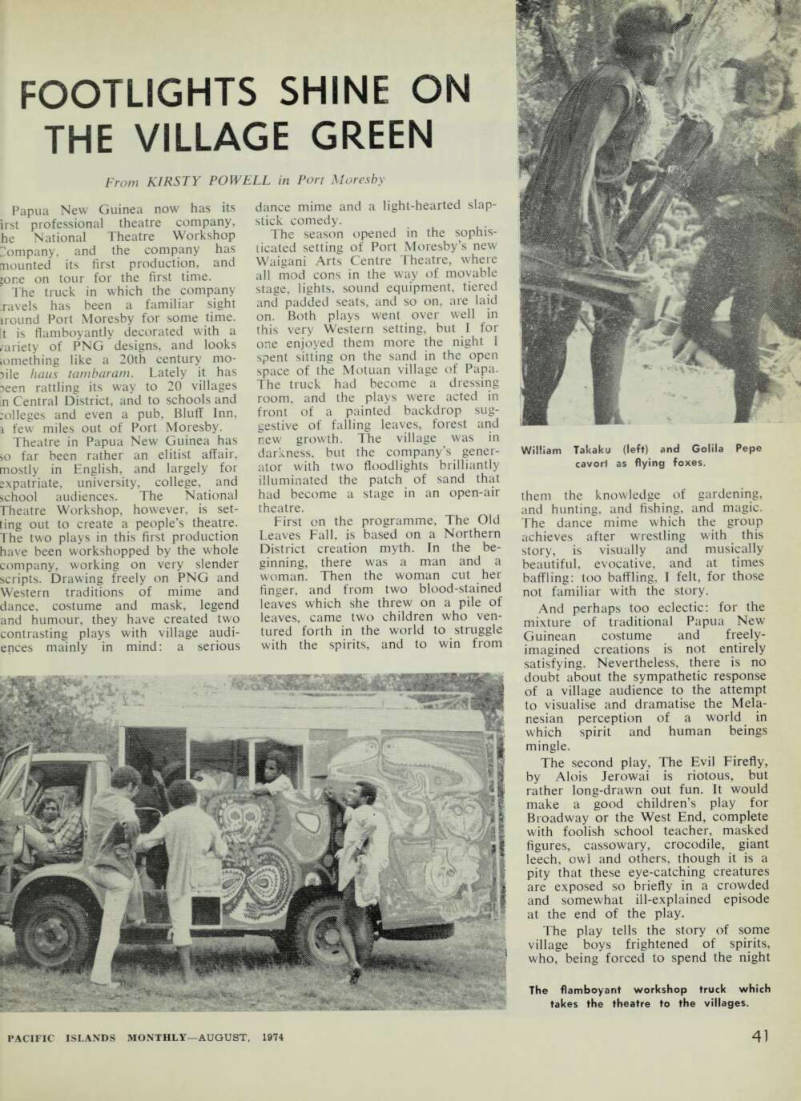

The Village Green
From KIRSTY POWELL in Port Moresby
Papua New Guinea now has its
irst professional theatre company,
he National Theatre Workshop "'ompany and the company has mounted ’ its first production, and »one on tour for the first time.
The truck in which the company ravels has been a familiar sight iround Port Moresby for some time. [t is flamboyantly decorated with a /ariety of PNG designs, and looks iomething like a 20th century mofile bans tambaram. Lately it has 3 een rattling its way to 20 villages in Central District, and to schools and colleges and even a pub, Bluff Inn, a few miles out of Port Moresby.
Theatre in Papua New Guinea has so far been rather an elitist affair, mostly in English, and largely for expatriate, university, college, and school audiences. The National Theatre Workshop, however, is setting out to create a people’s theatre.
The two plays in this first production have been workshopped by the whole company, working on very slender scripts. Drawing freely on PNG and Western traditions of mime and dance, costume and mask, legend and humour, they have created two contrasting plays with village audiences mainly in mind: a serious
dance mime and a light-hearted slap stick comedy.
The season opened in the soptus ticated setting of Port Moresby s new Waigani Arts Centre Theatre, where all mod cons in the way of movable stage, lights, sound equipment, tiered and padded seats, and so on, are laid on. Both plays went over well in this very Western setting, but 1 for one enjoyed them more the night I spent sitting on the sand in the open space of the Motuan village of Papa.
The truck had become a diessing room, and the plays were acted in front of a painted backdrop sug gestive of falling leaves, forest and new growth. The village ? was m darkness, but the company’s gener ator with two floodlights brilliantly illuminated the patch of sand that had become a stage in an open-air theatre.
First on the programme, The Old Leaves Fall, is based on a Northern District creation myth. In the be ginning, there was a man and a woman. Then the woman cut her finger, and from two blood-stained leaves which she threw on a pile of leaves, came two children who ven tured forth in the world to struggle with the spirits, and to win from
them the knowledge of gardening, and hunting, and fishing, and magic.
The dance mime which the group achieves after wrestling with this story, is visually and musically beautiful, evocative, and at times baffling: too baffling, I felt, for those not familiar with the story.
And perhaps too eclectic; for the mixture of traditional Papua New Guinean costume and freely imagined creations is not entirely satisfying. Nevertheless, there is no doubt about the sympathetic response of a village audience to the attempt to visualise and dramatise the Mela nesian perception of a world in which spirit and human beings mingle.
The second play, The Evil Firefly, by Alois Jerowai is riotous, but rather long-drawn out fun. It would make a good children’s play for Broadway or the West End, complete with foolish school teacher, masked figures, cassowary, crocodile, giant leech, owl and others, though it is a pity that these eye-catching creatures are exposed so briefly in a crowded and somewhat ill-explained episode at the end of the play.
The play tells the story of some village boys frightened of spirits, who, being forced to spend the night
William Takaku (left) and Golila Pepe cavort as flying foxes.
The flamboyant workshop truck which takes the theatre to the villages.
n the bush, have terrifying experi ences with flying foxes, a firefly, and ;wo sorcerers. The actors who play ;he parts of the sorcerers provide the comic centre of the play. They are i study in contrast. William Takaku Is an ex-university student, a Bou gainvillean, tall, slim, black. Golila Pepe began as the driver of the com aany’s truck until someone dis covered his gift for comedy. He is Dlder than most of the rest of the actors, a light-skinned, plump Papuan. He speaks in Motu, to the delight of the Papa audience, while ;he rest of the actors speak English, ivith an occasional fragment of pidgin thrown in. Multi-lingual theatre is certainly a possibility in a multi-lingual society.
Papua New Guinea is also a so ciety in ferment, and one may ask what other possibilities there are for theatre here. Recently, we have seen tillage women storming the gates of government in serious political pro test. A people’s theatre that mirrors the concerns of the people will ex plore not only timeless questions but also the questions of the times. It will seek to generate not only laugh ter but ideas. Perhaps in its next production the National Theatre Workshop Company should attempt some topical plays.
Advertisements & other items, pp. 52-53 (1 item)
The fourmost names
a M
RECORD 74
Vice RECORD 915 Handicutter
The fourmost names
in tools
RIDGWAY marries
m Wi MARPLES M 2252 Combination Metre Rule GILBOW G 245 Snips MARPLES M 373 Oval Split Proof Handled Bevel Edge Chisel il 1 RIDGWAY R 230 Scotch Auger Bit GILBOW G 33 Flat Chisel RIDGWAY R 355 Flatbit
RECORD RIDGWAY TOOLS LTD.
Parkway Works, Sheffield, England. mm
Save hundreds of dollars
on Australians most efficient
WALK IN, ALUMINIUM
COOLROOMS AND
FREEZE ROOMS
Hundreds already installed! The most economical supplementary coolrooms for bottles and food, providing the largest storage capacity of any comparable coolrooms of the same exterior dimensions. Five sizes —from 90-360 cu. ft. capacity; 16 models offering normal temp., two temp., deep freeze, or for pastry and ice storage applications. White vinyl interior, embossed rustproof aluminium exterior. • SUPPLIED IN EASY-TO-ERECT, DO-IT-YOURSELF KIT FORM.
Available from: AUSTRALIAN NEW CALEDONIA EXPORTS (SILVER & BARDA), 363 George St., Sydney, 2000 and Branches.
BRECKWOLDT & CO., 276 Pitt St., Sydney, 2000 and Branches.
PETER FISHER TRADING PTY. LTD., 321 Pitt St., Sydney, 2000.
HAGEMEYER (A'SIA), 59 Anzac Pde., Kensington, 2033 and Branches.
KERR BROS, 65 York St., Sydney, 2000.
Manufactured by:
m NELSON & ROBERTSON PTY. LTD., 197 Clarence St., Sydney, 2000.
RABAUL TRADING CO. PTY. LTD., P.O. Box 219, Rabaul and Branches.
ROY GALLIMORE & ASSOCIATES, P.O. Box 179, Vila, New Hebrides.
C. SULLIVAN (EXPORT) PTY. LTD., 60 Margaret St., Sydney, 2000 and Branches.
W. S. TAIT & CO, PTY. LTD., 31 Macquarie Place, Sydney, 2000 and Branches.
® WARBURTON FRANK!
199 Parramatta Road, Cnr. Skarratt Street, Auburn, N.S.W. 2144, Australia. Phone 648-1711.
Powered by Kelvinator.
Five-year warranty on compressor. Early delivery.
THE BIG FLAVOURS COME TO THE
P
RTAN m
SOUTH PACIFIC
The red hibiscus symbol proudly marks the introduction of some of New Zealand's most popular soft drinks by Island Bottlers of Fiji Ltd., from their new modern factory.
In Apia in Western Samoa the same flavourful range is produced by the Apia Bottling Company and people everywhere are asking for these famous names
LEMON and PAEROA, TARTAN DRY GINGER
ALE and the colourful fruity range of JU'CY
SOFT DRINKS.
They're yours to enjoy . . . time after time.
Manufactured under franchise to Innes Tartan Ltd., Auckland, New Zealand by-
ISLAND BOTTLERS OF FIJI LTD.
APIA BOTTLING COMPANY LTD.
Some PNG tourists are real,
and some are not
There is a difference between short term and real tourists, according to the Papua New Guinea Minister for National Development, Mr Gavera Rea, who explained it all recently.
He announced also that tourist figures for the country were up in 1973—the number of short term visitors, at 43,594, being down 0.3 cent on the 1972 figure, while the number of “real” tourists rose by 18 per cent from 18,516 in 1971 to 21,925 in 1973.
The definition “short term” tour ist had been adopted by the United Nations and was applied in PNG, Mr Rea said. It included anyone who travelled, for any reason, to an other country for any period be tween one day and one year. In PNG, it would include children of PNG residents returning from schools in Australia, and people entering for short term employment, business reasons or sporting events, plus the normal tourist visiting PNG on holidays.
He explained the drop in short
term visitors to the fact that fewer people were going to PNG for short term employment.
Mr Rea did not say what real tourists were, but presumably they are people who visit PNG for longer than the “normal” tourist holiday.
The fact that the number of real tourists increased in the two-year period, indicated something—maybe that there is growth in the PNG tourist industry.
The Minister said the PNG government was aware of the econ omic benefits which could flow from tourism, but it was determined that the country would not suffer the associated cultural and other dis advantages that had happened else where.
“A government mission has been appointed to examine the tourist in dustry in several nearby countries so that the government can then guide the future development of the tour ist industry to the greatest benefit of Papua New Guinea”, Mr Rea said.
Advertisements & other items, p. 54 (1 item)
Speed-E-Gas
SPEEI>E'GAS
Lae
Wewak
Rdb od
Honiara
Port 7*
MoreSPNi i
Kieta
DO O □ □ new new
Hukualotgy
butoka
ne
Rarotonga
p' 3 New terminals...
Sydney
P 6Established...
and more to come.
.. .to ensure regular supply of Speed-e-gas* in the Pacific region three new bulk storage terminals have been opened at Rarotonga, Nukualofa and Lautoka. These terminals join already established bulk storage facilities at Port Moresby, Lae, Wewak, Rabaul, Honiara and Kieta.
And to meet future needs bulk terminals are to be built at Santo and Suva.
These terminals will maintain supplies of clean efficient and safe Speed-e-gas all year round.
Speed-e-gas is the most dependable fuel...because it's here in bulk. Liquified Petroleum Gas has been proven to be ideal fuel for all cooking and water heating needs.
SPEEDEGAS
m The Gas Supply Company Limited, Head Office 221 Miller St., North Sydney, 2060.
Phone: 920-951 and available throughout the Pacific.
A member of the Boral group of companies.
Speed-e-gas is known in New Guinea as Guinea-Gas, in Tonga as Tonga Speed-e-gas and in Fijras Fiji-Gas.
Conscience
Bishop Jabs
Australia's
By a staff writer
Tonga, through Bishop Patrick Finau, is the latest South Pacific Islands territory to bring pressure on Australia to open the door to more migrants from the Pacific Islands, and also to cater for guest workers.
Bishop Finau, Roman Catholic Bishop of Tonga, visited New Zealand and Australia in May. About the time he visited New Zealand, the NZ Government decided to extend from June 1 to August 1 the dead line for all Tongan overstayers to leave the country.
Bishop Finau kept his most sting ing comments for Australia. He spoke to Federal Government officials about Australia’s immigration and labour policies. He was frank. He said he was trying to stir the con science of the Australian people over hardships suffered by a near neigh bour —Tonga.
These were some of his comments: “Australia professes to be a Christian country. Well Tonga is also, and it is suffering.”
“If you cannot be Christian, at least be human.”
“I am asking Australia to put aside what is no more than an historical anachronism, its White Australia policy.”
He proposed a pilot scheme which would allow Tongans to come into Australia and work for six months.
This would allow them to go home with enough money to buy a home, agricultural equipment or fishing nets.
Tonga did not want handouts; only the opportunity for the people to help themselves.
With the guest worker scheme, Bishop Finau is not likely to get much change. Australia’s ex- Immigraion Minister, Mr A 1 Grassby, set himself resolutely against such schemes. As he was carrying out government policy, it is likely that his successor Mr Clyde Cameron will take up where Mr Grassby left off. Mr Cameron is also Labour Minister.
Bishop Finau was critical of the Australian policy which sought people with special skills which Aus tralia lacked. If there were such people among what he called the serfs of Tonga they would be well off, and would have no need to come to Australia.
Bishop Finau believes that perma nent migration will ease the problems
of over-population and lack of employment, but it will not solve all the problems in Tonga.
Meanwhile, in New Zealand, time was on the side of hundreds of Tongan “overstayers”. The NZ immigration authorities had set June 1 as the deadline for all Tongans who had overstayed their permits to leave the country. So many came forward that it was soon apparent it was a physical impossibility for all to comply with the order. The date was changed to August 1, with a proviso that overstayers had to have letters from employers saying they were
keen workers who would be hard to replace.
Manufacturers had earlier made representations to the government seeking a reprieve for many over stayers. A number of employers are practically dependent on labour from
the Islands. . .
New Zealand is in the process of revising its immigration policy, this will probably give quotas to places like Fiji and Tonga which do not enjoy rights automatically given to Cook, Niue and Tokelau islanders and Western Samoa, which has an annual quota of 1,500.
Advertisements & other items, pp. 55-56 (1 item)
W. H. Grove & Sons Ltd.
ESTABLISHED 1896
ISLAND MERCHANTS
Exporters to the Pacific of Dairy Products and all New Zealand consumer and manufactured goods.
ENTRUST YOUR REQUIREMENTS TO THE
ESTABLISHED FIRM
P.O. Box 3718, Cables
AUCKLAND GROVE AUCKLAND
D
Jtapua new guinea
printing co. ply. ltd.
Serving the Country from Aitape to Alotau, Manus to Moresby.
Leaders in Commercial Offset and Letterpress Printing. • Stationery • Office Supplies • Office Equipment Rubber Stamps • Self-Adhesive Labels • In Fact: Everything For The Office.
P.O. Box 633, Port Moresby P.O. Box 759, Lae P.O. Box 1239, Rabaul
i • Ob*
Buy and sell the world
with one phone call
Overseas trips to secure new markets or to investigate new trends may be beyond the financial resources of some companies ... yet the price of a local phone call can put you in touch with the world.
ANZ Banking Group will give you general or specific information about any country . . . it’s yours for the asking.
Get the facts on trade. Currency. Credit. Regulations and Legal Matters. Business transactions. Introductions.
Get through to the world through ANZ.
All enquiries to ANZ Bank, Administrative Headquarters, 351 Collins Street, Melbourne, Australia, 3000, telephone 62 0391, or to any ANZ branch in Fiji, Papua New Guinea, British Solomon Islands and New Hebrides.
A fA P AUSTRALIA AMD MEW ZEALAND
BANKING GROUP LIMITED
Tongues In

Cheeks
At The Un!
By a staff writer
There were, as usual, several tongues in cheeks when the United Nations Trusteeship Council held its hardy annual in New York—dis cussion of the report on America’s administration of the Trust Territory of the Pacific Islands.
As usual, there was criticism of the United States stewardship. Two of the severest critics were Soviet Russia and France whose represent atives, in the now familiar hypo critical style, took the US to task for the self-same sins committed by their countries.
Said Soviet delegate V. Kova lenko: “The Soviet Union wishes to see the people of Micronesia, just like those of other colonial terri tories, exercising their inalienable rights to self-determination and in dependence as soon as possible”.
Adhering to the time-honoured custom of keeping a closed mouth on matters which might rock the UN boat, no member of the council mentioned the Soviet “colonies” of Latvia, Lithuania and Estonia! There was the same reaction when the French delegate expressed hopes that the TT administration would suc cessfully develop a plan for Micro nesia’s transition to a new status; that further authority over the Budget would be given to the Con gress of Micronesia; that the political education programme would show meaningful results and that there might be a more thorough role for the district legislatures in a future governmental structure. Which would have brought hollow laughs from representatives of the autonomist parties in French Polynesia, New Caledonia and the New Hebrides.
With a clearer conscience, the Australian delegate questioned why the target date for Micronesian self government had been set for 1981 when progress made over the past 12 months in the US-Micronesia talks on future status indicated an earlier date? He also called for the appoint ment of more Micronesians to res ponsible positions in the TT.
Mr Joab Sigrah, one of Ponape’s representatives on the Congress of Micronesia, told the council that he wished the Trusteeship Council would, as it had done in the past, make a strong recommendation to the United States about greater con trol of the Budget by the Congress
of Micronesia. He also asked for restriction on America s power of veto over legislation approved by the Congress.
This plea didn’t fall on deaf ears, as indeed few pleas from Micro nesians to the Trusteeship Council ever do. The council, in its fin<il re port, called for the regulation of the veto power by “appropriate legis lation” which drew a line between “special interests of territory and the international obligations” of the United States.
The council also asked that the Congress should be given final authority over a larger percentage of the Budget.
But the problem which troubled the Trusteeship Council the most, and rightly so, was the threat of fragmentation hanging over a future United States of Micronesia.
Earlier, Senator Wilfred Kendall of the Congress of Micronesia had said the Congress was disappointed at certain actions of the United States over the question of future status. Presumably, the certain actions were in connection with the separate talks between the United States and the Marianas. The sen ator said that, while the Congress recognised the rights of the people of the TT to self-determination, America should not close the door on any possibility of future unity.
He said he noted that America had indicated that it would hold a ple biscite in the Marianas on the question of future status, whether or not negotiations had been completed with the other districts.
“This course of action”, he said, “will prevent the people of the Marianas from having a real choice on the question of political status”.
He urged the council to persuade America to respect and honour the Congress view that voting on a future political status choice by the people of Micronesia should be all at the same time.
The point was taken by the coun cil which, in its report, asked the United States to do just that and called for the maintenance of the closest possible links between the Marianas and the other districts.
The call by the council for the United States to “preserve the unity of the Marshalls and the Carolines” without including the Marianas seems to indicate that the council recog nises that the negotiations between the Marianas and America will end with the severance of the former from the rest of Micronesia.
Probably, the only realistic view to come from this annual study of America’s stewardship of the Trust Territory.
Advertisements & other items, pp. 57-58 (1 item)
throughout
offers expert
insurance service
the Islands
QUEENSLAND INSURANCE
COMPANY LIMITED
(Incorporated 1886 in Australia)
Head Office: 82 Pitt Street, Sydney FlJl—Branch Office, Suva, Manager for Fiji: F. N. Davies (A.A.1.1.)* , LAUTOKA—District Manager: U. Singh.
HONIARA (8.5.1. P.) —Breckwoldt & Company (5.1.) Fty.
NEW CALEDONIA —T. A. Hagen, Ste. W. A. Johnston, S.A.R.L. —Noumea. T . . . T T % xt-i NEW HEBRIDES —Resident Officer: R. J. Allsop (A.A.1.1.) Vila; Santo: Burns Philp (New Hebrides) Ltd.
TAHITI —Arthur Chung: Immeuble 8.1., Front de Mer, Papeete.
NIUE, NORFOLK ISLAND, SAMOA, TONGA and other South Sea Islands—Burns Philp (South Sea) Company Ltd.
QUEENSLAND INSURANCE(P.N.G.)LTD
PAPUA NEW GUINEA
Head Office, Port Moresby: General Manager: D. J Granter.
District Managers at Rabaul; C. D. Dickings; Lae: R. Jackson; Mt. Hagen: D. F. Carroll.
V33BR
The MANA section of Pacific Islands Monthly is to be published each year as a by the South Pacific Creative Arts Society. As a society member you get your copy. Life membership of the SPCAS is $lOO Fijian or equivalent; foundation membership (good for three years) $25, ordinary membership $4 for those outside the islands served by the South Pacific Commission and $2.50 for those addresses within the islands. Send subscriptions to the Secretary, Box 5083, Suva, Fiji.
f 22Z For
RUM
at its best... say
OVERPROOF AND UNDERPROOF
to 5 oz. and 13 oz. flasks and 26 oz. and 40 oz. bottles.
BLENDED AND BOTTLED BY JOHN WALKER i SONS LIMITED. %
I “CANBERRA”
Three bedroom elevated home, lots of living space, brick laundry under, and two carports.
George Hudson's new Therma-Panel modular units mean that you can build your own home in a fraction of the time required for traditional materials.
Write for detailed plans and prices from the sole Pacific Islands agent :
A. RIETTE (EXPORT) PIV. LTD.
300 GEORGE STREET, SYDNEY 2000.
Cables: Ramaritime, Sydney
What’s so
different about
* THERMA-PANEL
HOMES?
Just
• Only three basic components for walls, ceilings, doors and windows. • Makes building simple as A.B.C. • Specially designed for the owner-builder. • Fully insulated walls and ceilings. • Cuts on-site construction time. • Cuts on-site construction costs. • Pitched or flat roof with exposed beams for real beauty.
Islands Press
From the Islands Press
From the Fiji Times: . , A quarter of a ton of biscuits burned to cinders at a Lautoka factory when the Fiji Electricity Authority cut off the power supply. Bakery workers were unable to get the biscuits out of the $50,000 automated oven and black smoke from
the charred biscuits filled the factory.
From Niue Island's Tohi Tala Niue: The administrative area is getting a real facelift at present. What with park benches under the trees on the green, the road being upgraded and rolled and new urinals in the public toilets, it is almost enough to make one flush with excitement.
From the Arawa Bulletin, Bougainville: It is now six months since the central government deferred the establishment of an Arawa Town Council. Your town, Arawa, is rapidly becoming the second largest in Papua New Guinea, and yet it is administered by a government appointed commissioner who lives in Kieta, a BCL-appomted commissioner who must follow 'he company line, a village-appointed commissioner who has never been sighted and finally your gallant features editor who is the only elected commissioner in the whole town. Who would have the audacity to call it representative or democratic?
From a letter by "Disappointed" in Cook Islands News: I am writing to say that I want to write you a letter, but I want to read it in print. ... I hope I shall receive my paper tomorrow or the next day so that I can read this letter if you print it. When I am sure of receiving the paper I pay for, I will write to you regularly.
From a letter by Abel Buie in the New Hebrides Nakamal: Many people say old times were best . . .
This is a matter of opinion. Some like to know and worry a lot. What you don’t know you don t miss and so don’t have to worry. We used to be guided my our missionaries and planters and occasional D.A. who dropped by to see that everything was alright.
These people lived a long time in the New Hebrides ? and understood us. Now it is different. Most D.A. s are only here for a brief visit. They are like tourists, collect shells and artifacts.
From Papua New Guinea Post-Courier: Two cars assigned to the Fijian Minister's party broke down. It seems that the batteries were flat because the air-conditioners were kept on with the engines switched off. Ah well, it's nice to be coo!
A leading article in The Fiji Times: A comment by Suva’s Mayor, Cr Isireli Vuibau, that people ignore anti-litter laws because the penalties
are too light is a sad reflection on citizens’ attitudes.
Many of the people who casually throw litter about the streets of Suva and other Fiji centres are probably the types who commonly accuse their council and the government of failing to do enough for them.
Their lack of civic pride is symptomatic of a disturbing worldwide trend towards the breakdown of community and national standards. A tightening-up of discipline is necessary to keep Fiji clean and to make all citizens aware of their responsibilities.
From a letter by "The Black Boy Beautiful" in Tohi Tala Niue: I ask for you. Why you treat Niue labour different from’ the people in the office of govt. Why Boss you give increase to April 1973 for them people and not for me and us together labour. This is the too much the very big wrong Boss. Us labour buy things from store just like the hei pene people in office of govt. ...
I promise to you all Boss you give me the April 1973 pay and I give all to wife and kids and put in the bank and no Steineka. I drink bottle. No bottle no drink. I write again about bottle in next time. But I wait first for me to get bit angry about no bottle Steineka.
From a letter by Kane, Honiara, in the BSI News Letter: How about all the talks that centred around mini skirts; what is the result. NOTHING. Some countries made laws against mini skirts, but you will say this is too harsh or Communistic. I wonder could it not be that they are forced to make laws as they are all out to preserve what is dear to them, their Custom, indeed their Culture and perhaps fought evil if not directly then indirectly. Perhaps I am not right to say we achieved nothing re skirts we achieved the freedom of seeing women s asses a practice very much against Solomon Islands Custom once calico was introduced if you like.
A practice which is now accepted and the Custom has gone down the drain. . . .
From the GEICs Atoll Pioneer: Two war helmets and skeleton bones were uncovered yesterday by workers digging trenches for water pipe lines at Betio. They are believed to be remnants of Allied Forces during the assault on Betio in the Second World War.
From an editorial in the Tonga Chronicle on
negligent driving:
One overseas visitor came in the other day, still shaking from a near miss, said a police vehicle with a blue flashing light drove straight at him.
Being a newcomer, he did not know what he d done wrong, but had enough sense and presence of mind to swerve to the side and avoid a collision. He learned later that the police vehicle was escorting the Prince Regent but instead of waving down the ignorant visitor the police just drove straight at him. He got the message all right but with two young passengers with him, he shuddered to think of the consequences . . .
From a report in The Fiji Times: The Leader of the Opposition, Mr Siddiq Koya, brandished two nooses, specially made from new rope, in the House of Representatives yesterday with a request that iwo Government members hang themselves. He told the Deputy Speaker, Mr Vijay Singh, and the national member for the South-Eastern seat, Mr Krishna Reddy: "In the name of the Indian community 1 say hang yourselves".
Yesterday
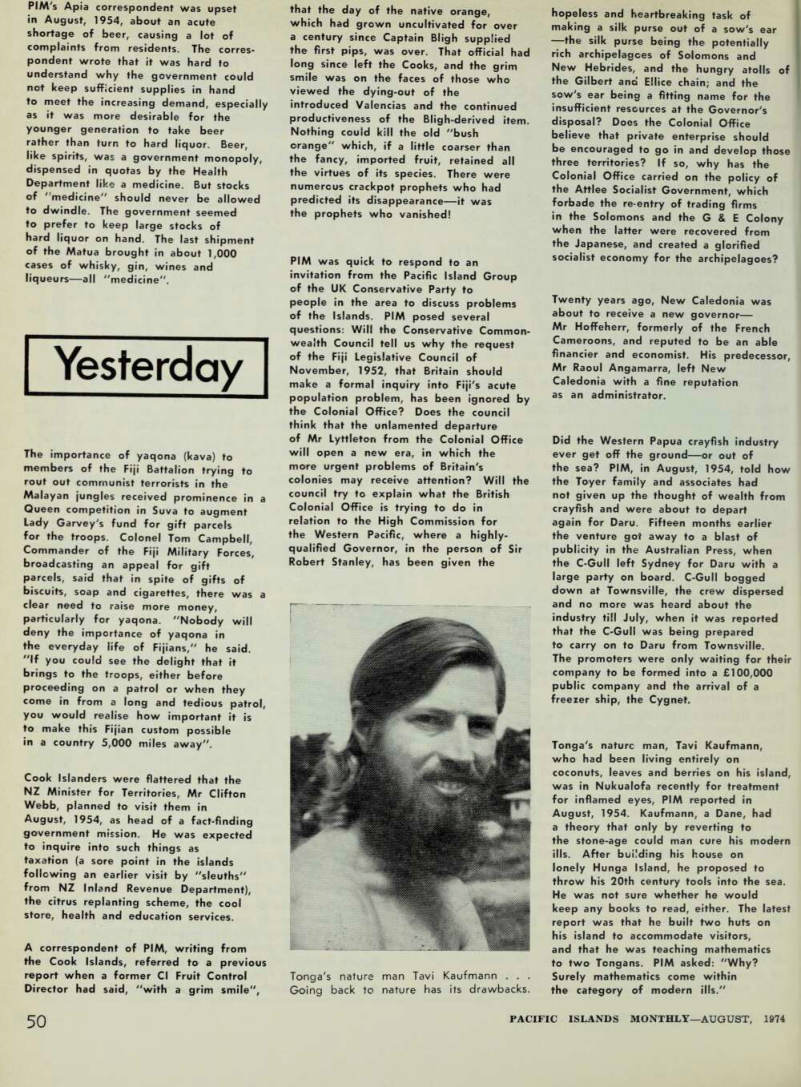
PlM's Apia correspondent was upset in August, 1954, about an acute shortage of beer, causing a lot of complaints from residents. The corres pondent wrote that it was hard to understand why the government could not keep sufficient supplies in hand to meet the increasing demand, especially as it was more desirable for the younger generation to take beer rather than turn to hard liquor. Beer, like spirits, was a government monopoly, dispensed in quotas by the Health Department like a medicine. But stocks of "medicine" should never be allowed to dwindle. The government seemed to prefer to keep large stocks of hard liquor on hand. The last shipment of the Matua brought in about 1,000 cases of whisky, gin, wines and liqueurs—all "medicine".
The importance of yaqona (kava) to members of the Fiji Battalion trying to rout out communist terrorists in the Malayan jungles received prominence in a Queen competition in Suva to augment Lady Garvey's fund for gift parcels for the troops. Colonel Tom Campbell, Commander of the Fiji Military Forces, broadcasting an appeal for gift parcels, said that in spite of gifts of biscuits, soap and cigarettes, there was a clear need to raise more money, particularly for yaqona. "Nobody will deny the importance of yaqona in the everyday life of Fijians," he said.
"If you could see the delight that it brings to the troops, either before proceeding on a patrol or when they come in from a long and tedious patrol, you would realise how important it is to make this Fijian custom possible in a country 5,000 miles away".
Cook Islanders were flattered that the NZ Minister for Territories, Mr Clifton Webb, planned to visit them in August, 1954, as head of a fact-finding government mission. He was expected to inquire into such things as taxation (a sore point in the islands following an earlier visit by "sleuths" from NZ Inland Revenue Department), the citrus replanting scheme, the cool store, health and education services.
A correspondent of RIM, writing from the Cook Islands, referred to a previous report when a former Cl Fruit Control Director had said, "with a grim smile".
that the day of the native orange, which had grown uncultivated for over a century since Captain Bligh supplied the first pips, was over. That official had long since left the Cooks, and the grim smile was on the faces of those who viewed the dying-out of the introduced Valencias and the continued productiveness of the Bligh-derived item.
Nothing could kill the old "bush orange" which, if a little coarser than the fancy, imported fruit, retained all the virtues of its species. There were numerous crackpot prophets who had predicted its disappearance—it was the prophets who vanished!
PIM was quick to respond to an invitation from the Pacific Island Group of the UK Conservative Party to people in the area to discuss problems of the Islands. PIM posed several questions: Will the Conservative Common wealth Council tell us why the request of the Fiji Legislative Council of November, 1952, that Britain should make a formal inquiry into Fiji's acute population problem, has been ignored by the Colonial Office? Does the council think that the unlamented departure of Mr Lyttleton from the Colonial Office will open a new era, in which the more urgent problems of Britain's colonies may receive attention? Will the council try to explain what the British Colonial Office is trying to do in relation to the High Commission for the Western Pacific, where a highly qualified Governor, in the person of Sir Robert Stanley, has been given the
hopeless and heartbreaking task of making a silk purse out of a sow's ear —the silk purse being the potentially rich archipelagoes of Solomons and New Hebrides, and the hungry atolls of the Gilbert and Ellice chain; and the sow's ear being a fitting name for the insufficient resources at the Governor's disposal? Does the Colonial Office believe that private enterprise should be encouraged to go in and develop those three territories? If so, why has the Colonial Office carried on the policy of the Attlee Socialist Government, which forbade the re-entry of trading firms in the Solomons and the G & E Colony when the latter were recovered from the Japanese, and created a glorified socialist economy for the archipelagoes?
Twenty years ago, New Caledonia was about to receive a new governor— Mr Hoffeherr, formerly of the French Cameroons, and reputed to be an able financier and economist. His predecessor, Mr Raoul Angamarra, left New Caledonia with a fine reputation as an administrator.
Did the Western Papua crayfish industry ever get off the ground—or out of the sea? PIM, in August, 1954, told how the Toyer family and associates had not given up the thought of wealth from crayfish and were about to depart again for Daru. Fifteen months earlier the venture got away to a blast of publicity in the Australian Press, when the C-Gull left Sydney for Daru with a large party on board. C-Gull bogged down at Townsville, the crew dispersed and no more was heard about the industry till July, when it was reported that the C-Gull was being prepared to carry on to Daru from Townsville.
The promoters were only waiting for their company to be formed into a £lOO,OOO public company and the arrival of a freezer ship, the Cygnet.
Tonga's nature man, Tavi Kaufmann, who had been living entirely on coconuts, leaves and berries on his island, was in Nukualofa recently for treatment for inflamed eyes, PIM reported in August, 1954. Kaufmann, a Dane, had a theory that only by reverting to the stone-age could man cure his modern ills. After building his house on lonely Hunga Island, he proposed to throw his 20th century tools into the sea.
He was not sure whether he would keep any books to read, either. The latest report was that he built two huts on his island to accommodate visitors, and that he was teaching mathematics to two Tongans. PIM asked: "Why?
Surely mathematics come within the category of modern ills."
Tonga's nature man Tavi Kaufmann ...
Going back to nature has its drawbacks.
Advertisements & other items, pp. 61-68 (1 item)
roHti
ft-J
B ■.r~
wllf
X v •■•• *r ■■
roHti
! 18. SRfti
rm M
uiiHGO scorrs
finest w -
Flour that's milled fresh
when called for by your shipping agent Milled fresh —when called for—then packed in clean, strong sacks or drums. That's the reason why Mungo Scott's have the largest output of any mill in Australia Mungo Scott's skilled laboratory staff put to practice every modern method to ensure you receive the Finest quality entoleted flour.
Since 1894 Mungo Scott "a good firm to do business with" We pride ourselves on documentation.
BAKERS FLOUR 4
CAKE FLOUR •
SHARPS • MEALS
BISCUIT FLOUR • SPONGE FLOUR
MUNGO SCOTT -
FLOUR MILLERS
DIVISION OF ALLIED MILLS INDUSTRIES PTY. LTD.
Summer Hill, N.S.W., Australia Cable & Telegraphic SUPERB Sydney, 7o7.fi mm
Look to Pioneer’s new ES-2000 Two-channel
Sound Mates. A stereo system designed to play together as a well-balanced audio team.
Pioneer’s receiver gets away from ‘top-heavy’
sound by giving you a highly selective AM/FM tuning section and 34 watts (IHF) of music power And for four-channel, just add a pair of speakers. All this and MIC mixing, too And this turntable is more than Hi
just hot’ looking. The ultra-smooth belt-drive
mechanism provides loving care for your records, plus auto-cut and return.
For real living presence sound, kiss your
tweakers” goodbye. This two-way, two-speaker
system gives you earthy, heart-moving sound.
Pioneer’s new ES-2000 Two-channel
Sound Mates. Great musical partners for
whatever you play to music.
(M)pioi\ieen
ES-2000
Two-channel Sound Mates
Australia Pioneer Electronics Australia Pty. Ltd 256-8, City Road, South Melbourne, Victoria 3205, Australia Tel 696605 Branches in all states Fiji Islands Brijlal & Company, G P O Box No 362, Suva, Fiji Islands Tel 22-258 Lae Hagemeyer (Australasia) B V , P.O Box No 90, Lae, New Guinea Tel: 2718 Rabaul Hagemeyer (Australasia) 8.V,, P.O Box No 63. Rabaul, New Guinea Port Morseby Hagemeyer (Australasia) B.V , P.O Box No 1428, Boroko. Port Moresby, New Guinea Madang Hagemeyer (Australasia) B.V, P.O Box No 673, Madang, T.PN G New Zealand Tee Vee Radio Ltd , P.O Box No. 5029, Auckland, New Zealand Tel: 763-064 Norfolk Island Burns Philp (South Sea) Co., Ltd..
Norfolk Island, South Pacific Nauru Island Jacob Enterprises, P.O Box No 4, Nauru Island Tahiti Ets PERFECT, B P. 594, Papeete, Tahiti Tel: 20-407 New Caledonia Menard Freres, B.P. 123, Noumea, New Caledonia Tel: 52-22 American Samoa Transpac Corporation. P.O. Box 1477 Pago Pago, American Samoa 96799 Tel: 2227
Bacardi
ice and
what else?
... nothing else if you feel so inclined, for there’s no real problem where and how and what you drink Bacardi rum with.
Because Bacardi rum is so light, dry, highly refined and pure it complements every mixer, yet remains distinctively itself. Bacardi and Coke and ice ... Bacardi and ginger... Bacardi and tonic with a zest of lemon or lime ... Bacardi and fruit juice ... Mix up your own Bacardi party.
Because ...
goes
Bacardi rum
BACARDI
rum-the mixable one. » mm - Bacardi and the Bat Device are registered trade marks of Bacardi and Company Limited.
“Coca-Cola" and “Coke" are the registered trade marks of The Coca-Cola Company.
BAC/2382/72
A / S' Yi «9« • >' !
IW l»« t ® tmauM
■■hhHHHBHHRHHHHBH
m
V I coeomfa ■ i ■ ■ , a I mi mi ■V r u mm
f® I Ic ■■ mi
skilful industrious Burns Philp folk!
Cocoa and coffee, cattle and copra, they’re all nature’s gifts to man. In return, they all demand effort by man. And woman.
The same is true of all the other good and useful things that grow in the Islands.
And wherever they grow, you’ll find Burns Philp people doing important work. Improving cattle breeds and crop yields, trading, shipping and insuring raw materials, caring for the land and the produce.
The Burns Philp involvement in the Islands’ agriculture and animal husbandry has a most beneficial history. Today and tomorrow the people of the Burns Philp Group of Companies will go on making things grow better for themselves, for the Islands, for all the world.
Burns
Philp
GROUP OF COMPANIES
PRINCIPAL OFFICE—7 BRIDGE STREET SYDNEY NSW 2000 AUSTRALIA
1 m St if ! i*C W m i r «» h i .1 I * 1 s
EXPORT FIOUR MILIERS
E :-5 1 is 8s
BRUNTONS
ERS
H v «
AND
BIS
ODLE
»« ■ m
RPS
ETC
m « € S H ■ B II i m I *a t N m $ % m 203 IS
•*C. as r ?y* : -"' , -< * fit \&yl /-' r v ' •> •-■ r ' r¥*'*: '■ '■ * v. . ■• * —■. -- ■• A ■ :■ ■:■ ■&■■:*■ —..-,• ■•=.• ■<-■■■ .' ■ u> y '-> i -v ■>* . . . ; •; - ; . , .. ■ * t ‘ ' . •«£■/&*,-> V- • c--' j- :\' V ■ •’•• v,...-. .** ••■"■;■ v >...-. £ ■s m
'V V - »*'•■, .V
1' ■ ' ■?'*?.-; J - !&&&*
r&Mt&*s... ■
<f K i - ; 'V ■ /..■■•-•••.,-••** ■ w*--- , v ■ -.J V, :•■ ?$ .>■> ■^•;,: i ;- • ;'•* ./‘T;''r-:• v ‘ •'^•cv 1 :* ' w “ : '-' Uttar ■ w * *»A S i I LJ - *lt I • * r * il r The flag we’ve flown for a hundred years.
Two paddle steamers on the Yangtse River in 1873 marked the beginning of the China Navigation Company. Today, the same flag flies above eighteen modern motor ships plying an extensive network of cargo routes between Papua New Guinea and Pacific Island ports (as far East as Tahiti] and Japan, New Zealand, Australia
and Thailand.
For 100 years, the flag of the China Navigation Company has meant experience, reliability and speed across the sea. Today, it s flying as strong as ever.
For further details and all enquiries there are Agents a, the following ports: Papua New Guinea^. earn HX^Ud^Ap"?!
Rabaul, Kieta. Burns Philp (New Guinea) Ltd., Wcwak, Kavieng. Fiji: Morns Hedstrom Ltd.. Suva. LautoKa.
Tonga: Morris Hedstrom Ltd.. Nukualofa and Vava’u. Tahiti: Etablissements Donald lah.t., apeete. New . Ltabhssemei 8.5.1. P.; British Solomons Trading Co. Ltd, Honiara. New Hebrides: Los Com plot rs Franc a is des Nouyelles-lle brides, \ tla and IJSTRAL Swire Pty. Ltd. Melbourne; Interocean Australia Services Ply. Ltd. Brisbane: Utils Gilchrist * Sanderson Pty. Ltd. NEW ZEALAN Auckland, Wellington, Christchurch, Dunedin, Bluff, Napier. Japan: Swin & Swire, 9 Connaught Rd., Central, Hong Kong. tablissements Ballande, Noumea.
R ALlA—Sydney: Interocean
AND-P. & O. (N.Z.) Ltd.
e McKinnon. Tokyo, Yokohama, Osaka, Kobe and Nagoya. Eastern Managers: Butterfield m CN co JOHN SWIRE & SONS PTY. LTD. General Agents in Australia, 8 Spring Street, Sydney, Phone: 27 9351.
THE CHINA NAVIGATION CO LTD
MEMBER OF THE SWIRE GROUP.
IS 008
The floturol Choice.
It’s Honda. Anywhere there’s action. A job to be done. _bun to be had. Safely and economically.
The snappy line-up is studded with star performers.
Easy-to-handle motorbikes that possess a big-hearted spirit. for breezing through traffic or escaping to Jhe country. Rugged reliability that lets you go, go, go.
Little wonder so many people around the world ride Honda.
It’s the all-round natural choice. . SA » % m yrt ST-70 ,v * v
UAKVFACTtjHKH
PAPUA NEW GUINEA: Steamships Trading Co.. Ltd. P.O. Box 74, Papua/U.S. TRUST TERRITORY: J.C. Tenorio Enterprise P.O. Box 137, Saipan/ FIJI ISLANDS: Coral Island Motors: Walu Bay Suva Fiji Island. P.O. Box 3179 Lami/TARAWA: The Gilbert & Ellice Islands Development Authority Gilbert & Ellice Islands/WESTERN SAMOA: Motor Distributors (Samoa) Ltd. P.O. Box 576, Apia/ AMERICAN SAMOA: Max Haleck Inc. P.O. Box 99, Pago Pago / TONGA: E.M. Jones Ltd. P.O. Box 34. Nukualofa / SOLOMON ISLANDS: British Solomons Trading Co., Ltd. P.O. Box 114, Honiara / NEW CALEDONIA: Establissements Ballande, Noumea / TAHITI: Ets„ COMIMPEX P.O. Box 200, Papeete / COOK ISLANDS: Cook Islands Trading Corporation Ltd. P.O. Box 92, Rarotonga / NAURU ISLAND: Nauru Cooperative Society 14th Floor, Wales Corner, 227 Collins Street Melbourne Victoria 3000
Magazine Section
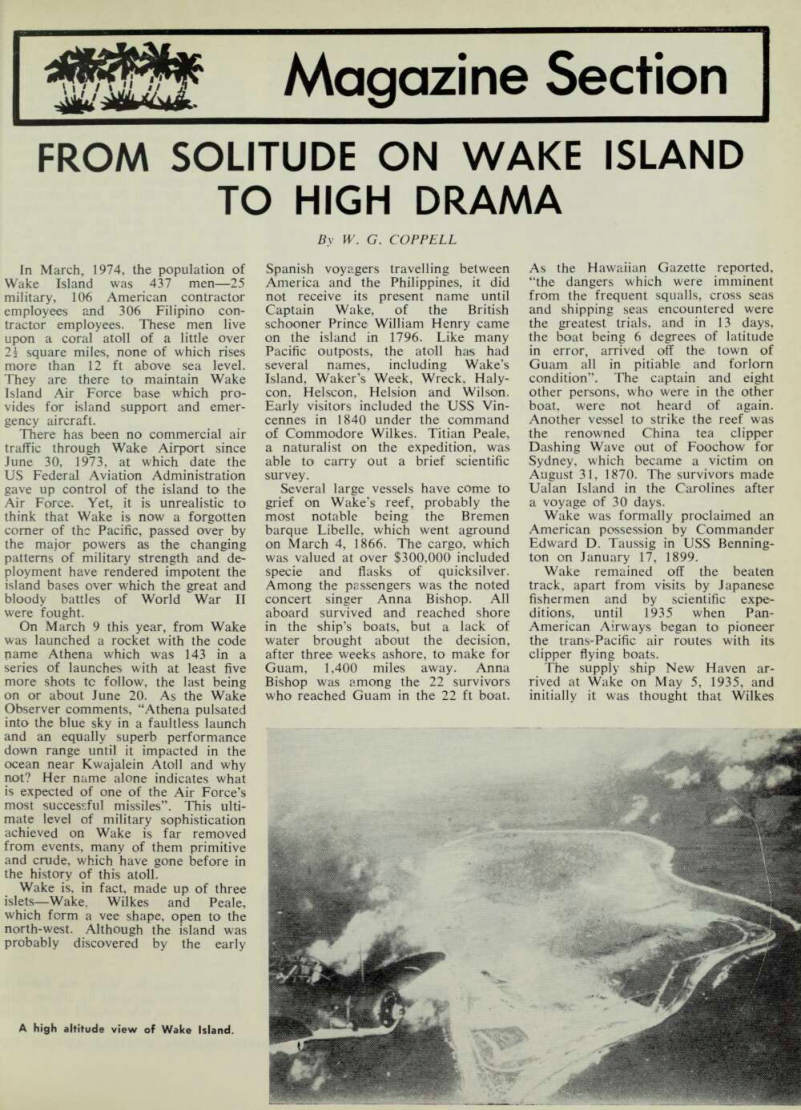
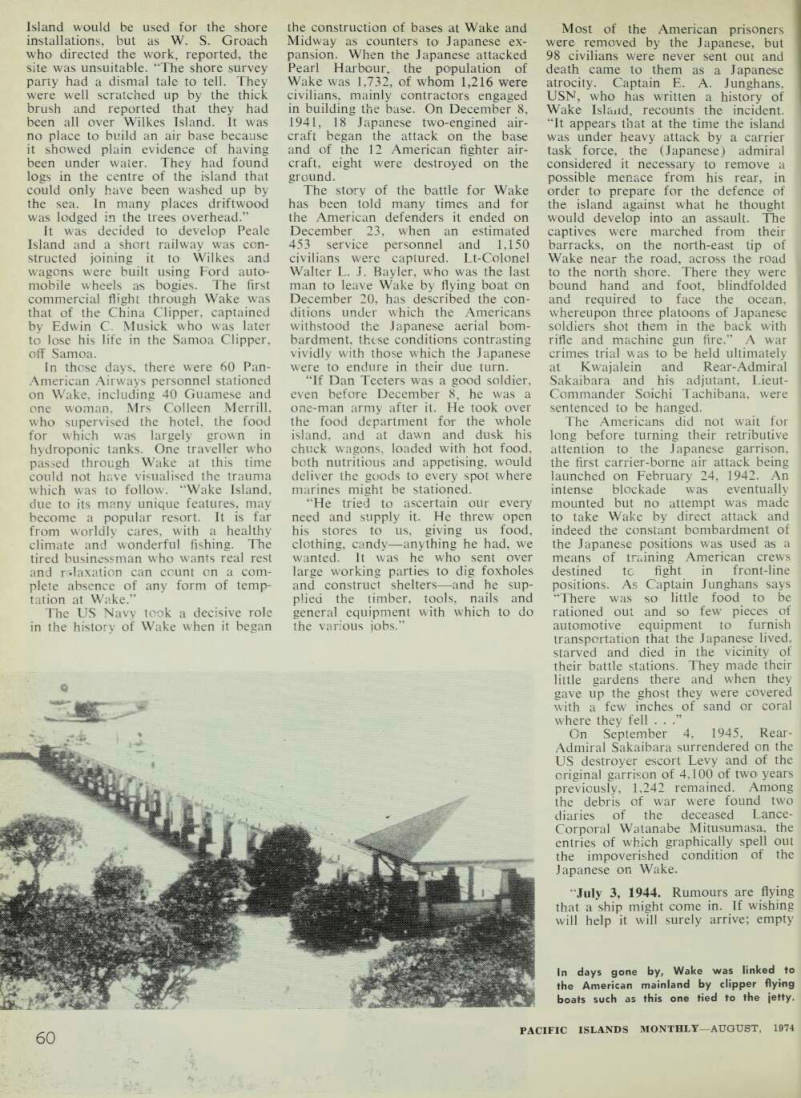
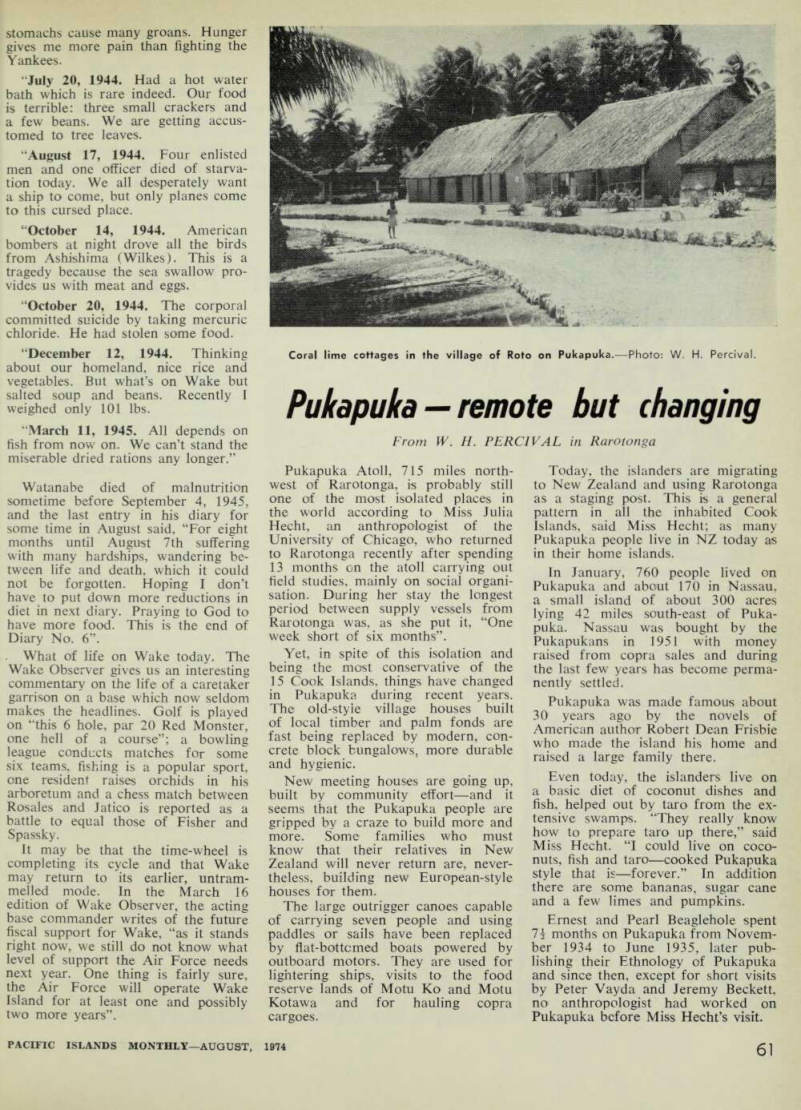
From Solitude On Wake Island
To High Drama
By W. G. Coppell
In March, 1974, the population of Wake Island was 437 men—2s military, 106 American contractor employees and 306 Filipino con tractor employees. These men live upon a coral atoll of a little over 2i square miles, none of which rises more than 12 ft above sea level.
They are there to maintain Wake Island Air Force base which pro vides for island support and emer gency aircraft.
There has been no commercial air traffic through Wake Airport since June 30, 1973, at which date the US Federal Aviation Administration gave up control of the island to the Air Force. Yet, it is unrealistic to think that Wake is now a forgotten comer of the Pacific, passed over by the major powers as the changing patterns of military strength and de ployment have rendered impotent the island bases over which the great and bloody battles of World War II were fought.
On March 9 this year, from Wake was launched a rocket with the code name Athena which was 143 in a series of launches with at least five more shots to follow, the last being on or about June 20. As the Wake Observer comments, “Athena pulsated into the blue sky in a faultless launch and an equally superb performance down range until it impacted in the ocean near Kwajalein Atoll and why not? Her name alone indicates what is expected of one of the Air Force’s most successful missiles”. This ulti mate level of military sophistication achieved on Wake is far removed from events, many of them primitive and crude, which have gone before in the history of this atoll.
Wake is, in fact, made up of three islets—Wake. Wilkes and Peale, which form a vee shape, open to the north-west. Although the island was probably discovered by the early
Spanish voyagers travelling between America and the Philippines, it did not receive its present name until Captain Wake, of the British schooner Prince William Henry came on the island in 1796. Like many Pacific outposts, the atoll has had several names, including Wake’s Island, Waker’s Week, Wreck, Haly con, Helscon, Helsion and Wilson.
Early visitors included the USS Vin cennes in 1840 under the command of Commodore Wilkes. Titian Peale, a naturalist on the expedition, was able to carry out a brief scientific survey.
Several large vessels have come to grief on Wake’s reef, probably the most notable being the Bremen barque Libelle, which went aground on March 4, 1866. The cargo, which was valued at over $300,000 included specie and flasks of quicksilver.
Among the passengers was the noted concert singer Anna Bishop. All aboard survived and reached shore in the ship’s boats, but a lack of water brought about the decision, after three weeks ashore, to make for Guam, 1,400 miles away. Anna Bishop was among the 22 survivors who reached Guam in the 22 ft boat.
As the Hawaiian Gazette reported, “the dangers which were imminent from the frequent squalls, cross seas and shipping seas encountered were the greatest trials, and in 13 days, the boat being 6 degrees of latitude in error, arrived off the town of Guam all in pitiable and forlorn condition”. The captain and eight other persons, who were in the other boat, were not heard of again.
Another vessel to strike the reef was the renowned China tea clipper Dashing Wave out of Foochow for Sydney, which became a victim on August 31, 1870. The survivors made Ualan Island in the Carolines after a voyage of 30 days.
Wake was formally proclaimed an American possession by Commander Edward D. Taussig in USS Benning ton on January 17, 1899.
Wake remained off the beaten track, apart from visits by Japanese fishermen and by scientific expe ditions, until 1935 when Pan- American Airways began to pioneer the trans-Pacific air routes with its clipper flying boats.
The supply ship New Haven ar rived at Wake on May 5, 1935, and initially it was thought that Wilkes
A high altitude view of Wake Island.
Island would be used for the shore installations, but as W. S. Groach who directed the work, reported, the site was unsuitable. “The shore survey parly had a dismal tale to tell. They were well scratched up by the thick brush and reported that they had been all over Wilkes Island. It was no place to build an air base because it showed plain evidence of having been under water. They had found logs in the centre of the island that could only have been washed up by the sea. In many places driftwood was lodged in the trees overhead.”
It was decided to develop Peale Island and a short railway was con structed joining it to Wilkes and wagons were built using Ford auto mobile wheels as bogies. The first commercial flight through Wake was that of the China Clipper, captained by Edwin C. Musick who was later to lose his life in the Samoa Clipper, off Samoa.
In those days, there were 60 Pan-
American Airways personnel stationed
on Wake, including 40 Guamese and one woman, Mrs Colleen Merrill, who supervised the hotel, the food for which was largely grown in hydroponic tanks. One traveller who passed through Wake at this time could not have visualised the trauma which was to follow. “Wake Island, due to its many unique features, may become a popular resort. It is far from worldly cares, with a healthy climate and wonderful fishing. The tired businessman who wants real rest and relaxation can count on a com plete absence of any form of temp tation at Wake.”
The US Navy took a decisive role in the history of Wake when it began
the construction of bases at Wake and Midway as counters to Japanese ex pansion. When the Japanese attacked Pearl Harbour, the population of Wake was 1,732, of whom 1,216 were civilians, mainly contractors engaged in building the base. On December 8, 1941, 18 Japanese two-engined air craft began the attack on the base and of the 12 American fighter air craft, eight were destroyed on the ground.
The story of the battle for Wake has been told many times and for the American defenders it ended on December 23, when an estimated 453 service personnel and 1,150 civilians were captured. Lt-Colonel Walter L. J. Bayler, who was the last man to leave Wake by flying boat on December 20, has described the con ditions under which the Americans withstood the Japanese aerial bom bardment, these conditions contrasting vividly with those which the Japanese were to endure in their due turn.
“If Dan Teeters was a good soldier, even before December 8, he was a one-man army after it. He took over the food department for the whole island, and at dawn and dusk his chuck wagons, loaded with hot food, both nutritious and appetising, would deliver the goods to every spot where marines might be stationed.
“He tried to ascertain our every need and supply it. He threw open his stores to us, giving us food, clothing, candy—anything he had, we wanted. It was he who sent over large working parties to dig foxholes and construct shelters—and he sup plied the timber, tools, nails and general equipment with which to do the various jobs.”
Most of the American prisoners were removed by the Japanese, but 98 civilians were never sent out and death came to them as a Japanese atrocity. Captain E. A. Junghans.
USN, who has written a history of Wake Island, recounts the incident.
“It appears that at the time the island was under heavy attack by a carrier task force, the (Japanese) admiral considered it necessary to remove a possible menace from his rear, in order to prepare for the defence of the island against what he thought would develop into an assault. The captives were marched from their barracks, on the north-east tip of Wake near the road, across the road to the north shore. There they were bound hand and foot, blindfolded and required to face the ocean, whereupon three platoons of Japanese soldiers shot them in the back with rifle and machine gun fire.” A war crimes trial was to be held ultimately at Kwajalein and Rear-Admiral Sakaibara and his adjutant, Lieut- Commander Soichi Tachibana, were sentenced to be hanged.
The Americans did not wait for long before turning their retributive attention to the Japanese garrison, the first carrier-borne air attack being launched on February 24, 1942. An intense blockade was eventually mounted but no attempt was made to take Wake by direct attack and indeed the constant bombardment of the Japanese positions was used as a means of training American crews destined tc fight in front-line positions. As Captain Junghans says “There was so little food to be rationed out and so few pieces of automotive equipment to furnish transportation that the Japanese lived, starved and died in the vicinity of their battle stations. They made their little gardens there and when they gave up the ghost they were covered with a few inches of sand or coral where they fell . .
On September 4, 1945, Rear- Admiral Sakaibara surrendered on the US destroyer escort Levy and of the original garrison of 4,100 of two years previously, 1,242 remained. Among the debris of war were found two diaries of the deceased Lance- Corporal Watanabe Mitusumasa, the entries of which graphically spell out the impoverished condition of the Japanese on Wake.
“July 3, 1944. Rumours are flying that a ship might come in. If wishing will help it will surely arrive; empty
In days gone by, Wake was linked to the American mainland by clipper flying boats such as this one tied to the jetty.
stomachs cause many groans. Hunger gives me more pain than fighting the Yankees.
“July 20, 1944. Had a hot water bath which is rare indeed. Our food is terrible: three small crackers and a few beans. We are getting accus tomed to tree leaves.
“August 17, 1944. Four enlisted men and one officer died of starva tion today. We all desperately want a ship to come, but only planes come to this cursed place.
“October 14, 1944. American bombers at night drove all the birds from Ashishima (Wilkes). This is a tragedy because the sea swallow pro vides us with meat and eggs.
“October 20, 1944. The corporal committed suicide by taking mercuric chloride. He had stolen some food.
“December 12, 1944. Thinking about our homeland, nice rice and vegetables. But what’s on Wake but salted soup and beans. Recently I weighed only 101 lbs.
“March 11, 1945. All depends on fish from now on. We can’t stand the miserable dried rations any longer.”
Watanabe died of malnutrition sometime before September 4, 1945, and the last entry in his diary for some time in August said, “For eight months until August 7th suffering with many hardships, wandering be tween life and death, which it could not be forgotten. Hoping I don’t have to put down more reductions in diet in next diary. Praying to God to have more food. This is the end of Diary No. 6”.
What of life on Wake today. The Wake Observer gives us an interesting commentary on the life of a caretaker garrison on a base which now seldom makes the headlines. Golf is played on “this 6 hole, par 20 Red Monster, one hell of a course”; a bowling league conducts matches for some six teams, fishing is a popular sport, one resident raises orchids in his arboretum and a chess match between Rosales and Jatico is reported as a battle to equal those of Fisher and
Spassky.
It may be that the time-wheel is completing its cycle and that Wake may return to its earlier, untram melled mode. In the March 16 edition of Wake Observer, the acting base commander writes of the future fiscal support for Wake, “as it stands right now, we still do not know what level of support the Air Force needs next year. One thing is fairly sure, the Air Force will operate Wake Island for at least one and possibly two more years”.
Pukapuka remote but changing
From W. H. PERCIVAL in Rarotonga
Pukapuka Atoll, 715 miles north west of Rarotonga, is probably still one of the most isolated places in the world according to Miss Julia Hecht, an anthropologist of the University of Chicago, who returned to Rarotonga recently after spending 13 months on the atoll carrying out field studies, mainly on social organi sation. During her stay the longest period between supply vessels from Rarotonga was, as she put it, “One week short of six months”.
Yet, in spite of this isolation and being the most conservative of the 15 Cook Islands, things have changed in Pukapuka during recent years.
The old-style village houses built of local timber and palm fonds are fast being replaced by modern, con crete block bungalows, more durable and hygienic.
New meeting houses are going up, built by community effort—and it seems that the Pukapuka people are gripped by a craze to build more and more. Some families who must know that their relatives in New Zealand will never return are, never theless, building new European-style houses for them.
The large outrigger canoes capable of carrying seven people and using paddles or sails have been replaced by flat-bottcmed boats powered by outboard motors. They are used for lightering ships, visits to the food reserve lands of Motu Ko and Motu Kotawa and for hauling copra cargoes.
Today, the islanders are migrating to New Zealand and using Rarotonga as a staging post. This is a general pattern in all the inhabited Cook Islands, said Miss Hecht; as many Pukapuka people live in NZ today as in their home islands.
In January, 760 people lived on Pukapuka and about 170 in Nassau, a small island of about 300 acres lying 42 miles south-east of Puka puka. Nassau was bought by the Pukapukans in 1951 with money raised from copra sales and during the last few years has become perma nently settled.
Pukapuka was made famous about 30 years ago by the novels of American author Robert Dean Frisbie who made the island his home and raised a large family there.
Even today, the islanders live on a basic diet of coconut dishes and fish, helped out by taro from the ex tensive swamps. “They really know how to prepare taro up there,” said Miss Hecht. “I could live on coco nuts, fish and taro—cooked Pukapuka style that is—forever.” In addition there are some bananas, sugar cane and a few limes and pumpkins.
Ernest and Pearl Beaglehole spent lh months on Pukapuka from Novem ber 1934 to June 1935, later pub lishing their Ethnology of Pukapuka and since then, except for short visits by Peter Vayda and Jeremy Beckett, no anthropologist had worked on Pukapuka before Miss Hecht’s visit.
Coral lime cottages in the village of Roto on Pukapuka.— Photo: W. H. Percival
mana
is a vehicle for Pacific Islands’ writers and artists to publish their work. It is an organ of the South Pacific Creative Arts Society and its editorial committee comprises writers from many islands.
Material for publication must be sent direct to MANA’s editor, Marjorie Crocombe, South Pacific Creative Arts Society, Box 5083, Suva.
Contributors, to this month’s issue are University of the South Pacific students Seri, from Fiji, and Tere Tuakana, from the Cook Islands; Satendra Nandan, who lectures in English at the university; and from Papua New Guinea, Earnest Mararunga and Nathalia Buamai.
The Load Of Fire Wood
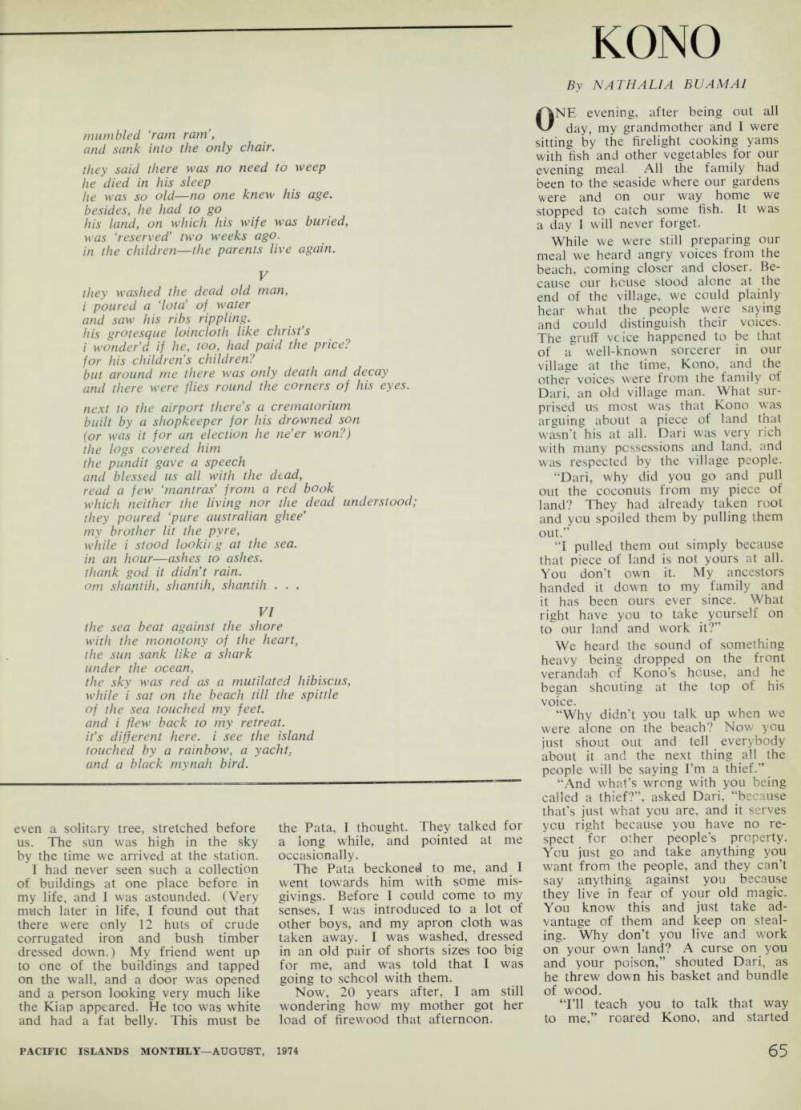
By Earnest Mararunga
"IjS/'AKE up, Kallii, and throw some ** wood on the fire.”
I was getting fed up with this.
Kallii fetch water. Kallii start the fire. Kallii do this and Kallii do that.
I wished I was only a little bit bigger, I would leave this mob and go to the mission station and work there as some of the other boys had been doing. I rose from my cosy nook next to the fire place and threw some wood on the embers, sending up sparks and ash. The solemn group in the hut shifted uncomfortably, and I had to smile but broke off abruptly when . . .
“Watch out, boy! You want to burn the house down round our ears or something!”
It was my turn to feel uneasy as the voice belonged to Kaii and, if there were anything I was frightened of, it was Kaii. A man as old as time itself, with skin laying in folds over his skeleton, and eyes sunk so deep into his skull that when he looked at you it was as if death itself was facing you. It was reputed that in his youth, he had killed and eaten a lot of young boys, raw. I cleared my throat. Pretending to look for more wood, I disappeared behind the broad back of one of the men.
THE sparks had settled and the fire was throwing out more flickering light, darkening the interior more with shadows than ever. Some smoke lingered about the low ceiling. The heat was bearable, a cosy, sleep inducing type of heat, very bearable.
With droopy eye-lids I took in the scene. The bearded faces were all serious as they listened. The flicker ing light played on their faces, some times darkening them and at other times bringing them out a golden brown colour. I was fascinated.
It was the youth from the neigh bouring clan who was holding their attention. I saw him when he came that afternoon. He was dressed in whiteman’s clothes, and was carrying a pack on his shoulders. Later when we were eating at the men’s house, I found out that he had gone to the coast and had worked in a big place where they grew a tree known as a coconut, and where everyone wore whitemen’s clothes and spoke with whitemen in the language which only the ‘tanim talk’ from our clan under stood. In fact I heard him use it once when the Kiap came to collect our names. I shook sleep away, pricked up my ears and listened. His voice was light and carried very well in the closely packed hut.
“It is true that some of you have been on the mission station and you have seen the type of houses the ‘patas’ live in and the kind of food they eat and the clothes they wear and the lights they have at night.
It is not beyond our means to have those things. In fact, during the time I was down at the coast, I saw many people of our colour who had these things and, besides these, some even had cars and motor bikes.” (I had seen a motor bike but, after he had explained, I found out that a car was a four-wheeled thing that carried
more people.)
“All we need is to have some of our younger boys go to school and learn about the ways of the white men, and a side reward from this education, the things we now think are for the privileged whitemen only, will be ours.”
A sigh of disbelief rose from those assembled.
He continued, “I hear that some of you are now asking your ancestors to bring you things, but this is im
possible. How can the dead bring the
living any thing?”
Before he could go on, the voice of Karipan cut in. It was sharp and very authoritative and precise: "Then why does the Pata ask somebody who was now long dead to help him out all the time?”
“What do you mean by that re mark?” the youth asked.
“It is true, the white Pata at the mission station does ask a dead per son, and that person supplies the Pata with everything that he asks for.”
Being the orator he was, Karipan did not beat around the bush once he had the audience under the grip of his oratory. His voice was cool and calm and had the confidence that comes with many years of prac tice. In fact, Karipan was the leader of a movement that was telling my people that if we desired any thing that the patas or the kiaps had, all we had to do was to destroy our gardens and our tree crops, kill some pigs, and then ask the ancestors’ spirits to give us houses of corrugated iron, kerosene lamps, tinned food and blankets and mats, and that we would never have to work again in our lives. Recently his movement was losing some of its followers. No wonder! We lived through a famine because of his preaching, and recently we had slaughtered some pigs but still there was no indication of when the ancestors would heed our re quests.
Karipan went on, “When I was on the station a couple of years back, the Pata gathered all of us and we went inside this big building, and the Pata, who was dressed in clothes that rivalled the sun and the moon and put the birds and the flowers to shame, went to this little platform where there were some light sticks and he bowed and he begged, and some people in the crowd sang but there was no dancing, and next morn ing the shiny bird came and I person ally helped to unload rolls of cloth, crates of food, and drums of
liquids”.
His voice was very firm. “Those things could not have come from anywhere else but from the person he was bowing to the day before.”
The youth shook his head in dis belief.
Karipan continued, “There was a man from the coast, who was on the station with the Pata, and he told me that even the Pata gets his things from the spirits of the people that were already dead. He even said that some of the goods the Pata gets are sent to us by our ancestors, but the Pata does not redistribute these to us, the rightful recipients.
I am not saying that our young guest
is wrong. I am saying that he was misled when he was down on the coast. You all know that I was given £5 money when I went and swept my father’s grave. I have always said that you will get your just rewards if you can only bear with me for a while longer”. Once his old grip was established over them again, he sucked in the air and settled back on his buttocks.
I watched the old con-man smile to himself knowing that no youth could break his hold over the clan.
I withdrew in disgust. I wondered how many times my father had killed pigs at his father’s grave and had come away frustrated because his request had not been granted. 1 wondered how many times he had complied with Karipan’s requests and had burned his gardens and cut down his trees so that he could not be ridiculed by the men of the clan for his non-conformity.
I made up my mind, there and then, that I would go with the young man to the mission station and get educated for a day, and come back and lead my people away from the influence of the rogue Karipan. The fire was down to its embers again.
We rose and went to sleep when Parou said it was very late.
1 COULDN’T sleep that night. I
tossed and turned and my imagi nation ran riot. There I was wearing whitemen’s clothes, eating their food.
I imagined I could even come home with a stomach as big as the kiap’s and I might even have something to cover my feet. I laughed loudly to myself in the dark only to catch an elbow in my stomach. I grunted and rolled over on to my side. Minutes became hours. A rooster crowed.
Other roosters took up the call, and
it re-echoed up and down the length and the breadth of the valley. Birds called to' one another, and, at last, after what seemed a million years, dawn broke. The grey light crept in through the holes in the bark walls of the hut. I rose.
Not bothering about the other sleepers, I threw back the dried bamboo leaves. The cold engulfed me as I stepped out into it. It was a biting cold, wet and clinging.
Around me the mist was hugging the ground. Further away the mist broke up into gigantic balls and went leap frogging over the kunai patches and pitpit grass. I stepped up to the nearest clump of bananas and lifted up my apron cloth. Finished, I re turned to the hut for my leaves to cover my buttocks and then raced for my mother’s pig house. Behind me voices called to me to close the en trance, others implored me to get the fire started. Not today! This boy was off to get his share of education and the whiteman’s goods.
I arrived at the pig house out of breath, the body heat steaming from my body. My mother was up already.
Smoke was lifting slowly from the thatched roof, and lingering in the still air. I poked my head through the low opening.
“You are early, boy. Don’t tell me you are hungry. I sent enough to the men’s house last night. Didn’t you get enough to eat?”
She went back to spinning her strings for a new string bag. She would pause now and then to throw more wood on the small fire. Hell, here was I about to go out into the world and claim my share of for tune, and there she was concerned only with whether I was fed or not, and that infernal fire.
“Mother, I am going to the mission
station to get educated and claim my share of cargo there,” I said im
patiently.
“Oh, yes?” she replied, without a trace of interest in her voice. “And don’t forget to bring in a load of wood this afternoon,” she added.
Women! I cursed. What do they know about education and cargo.
I’ll show her. Without waiting for her to say more, I raced back to the men’s house. The men were all up and were now gathered around the fire.
“I am going to the mission station with the man in European clothes,” I
said uneasily as I had not yet asked the youthful speaker of last night to take me to the station with him.
“You are not!” My father was a man of a few words.
“Yes I am!” I was on the verge of tears.
The young man in European clothes came to my assistance, and, after telling my father that he would take me there and bring me back himself, my father gave his per mission but added, very strongly, that I was not to be educated. I reminded him that I would be away only for a day. My father made it clear that I
was not to be educated not even for a day. With this ringing in my head, we took off for the mission station.
And what a sight we made, the youth in his white shirt and khaki shorts, and me in my apron cloth with a bunch of leaves to cover my back side, and him towering above me.
But that morning I was the bigger person. My head was already in the clouds.
WE followed the old track, which had been worn smooth by countless feet over the years, until the hills were miles behind us, and the grass plain, unbroken by not
even a solitary tree, stretched before us. The sun was high in the sky by the time we arrived at the station.
I had never seen such a collection of buildings at one place before in my life, and I was astounded. (Very much later in life, I found out that there were only 12 huts of crude corrugated iron and bush timber dressed down.) My friend went up to one of the buildings and tapped on the wall, and a door was opened and a person looking very much like the Kiap appeared. He too was white and had a fat belly. This must be
the Pata, I thought. They talked for a long while, and pointed at me
occasionally.
The Pata beckoned to me, and I went towards him with some mis givings. Before I could come to my senses, I was introduced to a lot of other boys, and my apron cloth was taken away. I was washed, dressed in an old pair of shorts sizes too big for me, and was told that I was going to school with them.
Now, 20 years after, I am still wondering how my mother got her load of firewood that afternoon.
B - block
By Seri
Slave, slave, slave, brothers, Up there on Naboro hill there's Lilies dancing, caressing and Kissing wild forest breeze.
I wish we're sick, so we can have bed peace And escape this blazing police ring I know we have earned it from up there But wounds awakening like nightmares Someday cops, judges, prosecutors must pay When we're free to express our love in the ancient way.
My fathers son
By Satendra Nandan
the airport metallic, tarred, rising from the deep blue sea; a white watchtower erect, watching darkly. jumbos idle like oiled white bodies on the beach; while sea-fishes feed to be fed. a few hotels on the landscape bruises on the peasant face; the village—dark and dumb so sullen in the sun; a muddy lost track hobbles to a hut on the hill. a red hill with four coconut trees, under the mango tree a dozen goats; a red flag withered and holy, children — naked, ribs dancing in the light, teeth beaming with stolen sugarcane, growing with the mynah birds. below the hill, a well full of frogs, two boys, a girl shrieking with killing stones. four frogs are floating, eyes to the sun, their white bellies up. quiet and ageless as the hill the old man comes leaning on a ‘lathi’: a sudden slap, a scream, and I run. he curses my mother, pulls them out one by one and buries them under the red earth. the cow grazes and gazes and moos for a second birth that was years ago, i was young and unkind— to the frogs, i mean.
II now in this conditioned office on a swivel chair and farted air i batten on—a civil servant — defined, secure in a sinecure, i see the island in the sea where my father was quarantined.
“for two weeks only,” he said, but the journey? i asked.
his eyes withdrew into himself: “the dark waters and the blind winds the landless sea forever raging it was ‘narak’, many died, I survived, what retribution for leaving a loving home and the cows grazing beside the ‘mandir’ and my friends playing ‘gullidanda’. sleeping and eating we arrived!” that’s how he remember’d the passage of one life into another. 111 early morning — rain, rain, rain, like the nagging of a wife, the phone rang ‘wrong number ’ yawned the woman in my bed. my brother simply said: ‘pitaji’ is dead, oh, well, i’ll forego the dinner, death comes without invitation, worse, such dinners are so rare with the permanent secretary’s wife with so promiscuous an air.
IV the old village was there in the old man’s old bure. a tattered mat on a three-legged bed, the black blanket that made my childhood so warm, the mosquito net with knots and patches. near the grog basin sat the frog, eyes bulging, ineluctable as ever. the basin was empty but the smell of grog was in the corner where i used to serve the ‘tauki’. the village was there, toothless, faceless, nameless, except old pookladdu, the peasant politician, and buddhu, the ‘purjari’, who burnt his arse fire-walking (how father had laughed!) and wanted to lift the hill like hanuman. others’ heads grown grey, hearts grown old a hundred years scribbled in a hundred wrinkles. i looked too well-fed,
mumbled ‘ram ram’, and sank into the only chair. they said there was no need to weep he died in his sleep he was so old—no one knew his age. besides, he had to go his land, on which his wife was buried, was ‘reserved ’ two weeks ago. in the children —the parents live again.
V they washed the dead old man, i poured a ‘lota’ of water and saw his ribs rippling. his grotesque loincloth like Christ’s i wonder’d if he, too, had paid the price? for his children’s children? but around me there was only death and decay and there were flies round the corners of his eyes. next to the airport there’s a crematorium built by a shopkeeper for his drowned son (or was it for an election he ne’er won?) the logs covered him the pundit gave a speech and blessed us all with the dead, read a few ‘mantras’ from a red book which neither the living nor the dead understood; they poured ‘pure australian ghee ’ my brother lit the pyre, while i stood lookii g at the sea. in an hour—ashes to ashes. thank god it didn’t rain. om shantih, shantih, shantih . . .
VI the sea beat against the shore with the monotony of the heart, the sun sank like a shark under the ocean, the sky was red as a mutilated hibiscus, while i sat on the beach till the spittle of the sea touched my feet, and i flew back to my retreat, it’s different here, i see the island touched by a rainbow, a yacht . and a black mynah bird.
Kono
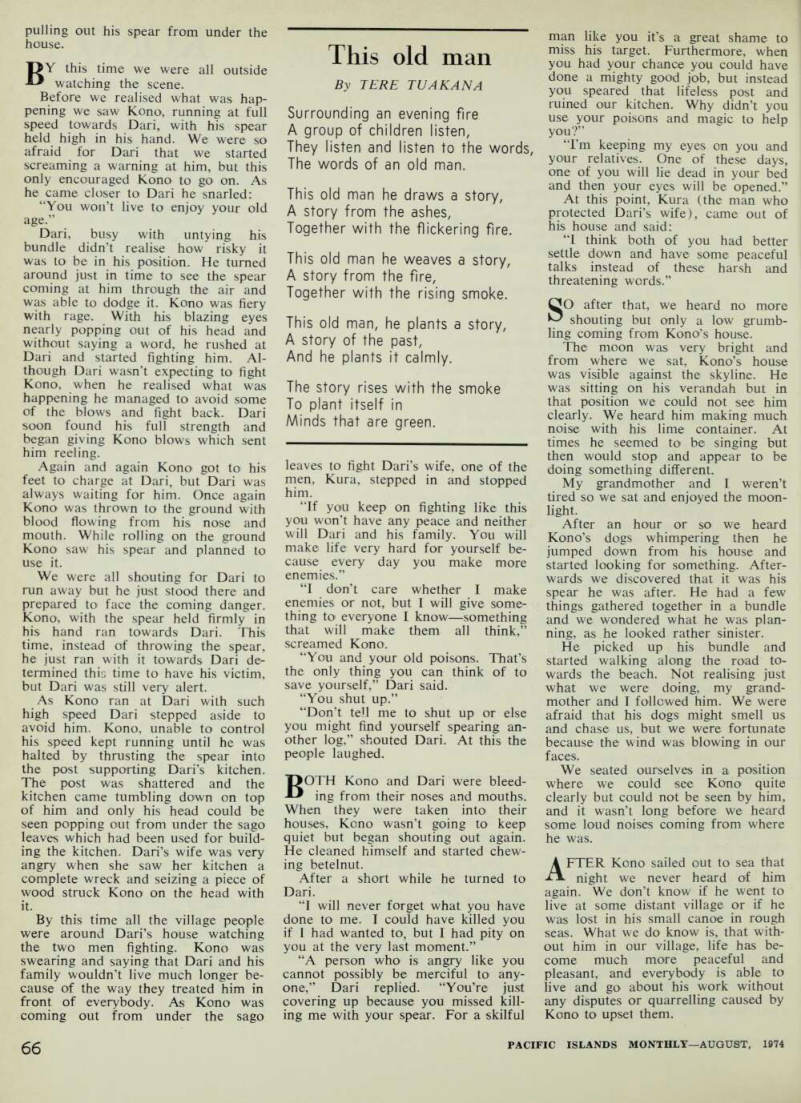
By Nathalia Buamai
ONE evening, after being out all day, my grandmother and 1 were sitting by the firelight cooking yams with fish and other vegetables for our evening meal All the family had been to the seaside where our gardens were and on our way home we stopped to catch some fish. It was a day I will never forget.
While we were still preparing our meal we heard angry voices from the beach, coming closer and closer. Be cause our house stood alone at the end of the village, we could plainly hear what the people were saying and could distinguish their voices.
The gruff voice happened to be that of a well-known sorcerer in our village at the time, Kono, and the other voices were from the family of Dari, an old village man. What sur prised us most was that Kono was arguing about a piece of land that wasn’t his at all. Dari was very rich with many possessions and land, and was respected by the village people.
“Dari, why did you go and pull out the coconuts from my piece of land? They had already taken root and you spoiled them by pulling them out.”
“I pulled them out simply because that piece of land is not yours at all.
You don’t own it. My ancestors handed it down to my family and it has been ours ever since. What right have you to take yourself on to our land and work it?”
We heard the sound of something heavy being dropped on the front verandah of Kono’s house, and he began shouting at the top of his voice.
“Why didn’t you talk up when we were alone on the beach? Now you just shout out and tell everybody about it and the next thing all the people will be saying I’m a thief.”
“And what’s wrong with you being called a thief?”, asked Dari, “because that’s just what you are, and it serves you right because you have no re spect for other people’s property.
You just go and take anything you want from the people, and they can’t say anything against you because they live in fear of your old magic.
You know this and just take ad vantage of them and keep on steal ing. Why don’t you live and work on your own land? A curse on you and your poison,” shouted Dari, as he threw down his basket and bundle of wood.
“I’ll teach you to talk that way to me,” roared Kono, and started
pulling out his spear from under the house.
BY this time we were all outside watching the scene.
Before we realised what was hap pening we saw Kono, running at full speed towards Dari, with his spear held high in his hand. We were so afraid for Dari that we started screaming a warning at him, but this only encouraged Kono to go on. As he came closer to Dari he snarled: “You won’t live to enjoy your old age.”
Dari, busy with untying his bundle didn’t realise how risky it was to be in his position. He turned around just in time to see the spear coming at him through the air and was able to dodge it. Kono was fiery with rage. With his blazing eyes nearly popping out of his head and without saying a word, he rushed at Dari and started fighting him. Al though Dari wasn’t expecting to fight Kono, when he realised what was happening he managed to avoid some of the blows and fight back. Dari soon found his full strength and began giving Kono blows which sent him reeling.
Again and again Kono got to his feet to charge at Dari, but Dari was always waiting for him. Once again Kono was thrown to the ground with blood flowing from his nose and mouth. While rolling on the ground Kono saw his spear and planned to use it.
We were all shouting for Dari to run away but he just stood there and prepared to face the coming danger.
Kono, with the spear held firmly in his hand ran towards Dari. This time, instead of throwing the spear, he just ran with it towards Dari de termined this time to have his victim, but Dari was still very alert.
As Kono ran at Dari with such high speed Dari stepped aside to avoid him. Kono, unable to control his speed kept running until he was halted by thrusting die spear into the post supporting Dari’s kitchen.
The post was shattered and the kitchen came tumbling down on top of him and only his head could be seen popping out from under the sago leaves which had been used for build ing the kitchen. Dari’s wife was very angry when she saw her kitchen a complete wreck and seizing a piece of wood struck Kono on the head with it.
By this time all the village people were around Dari’s house watching the two men fighting. Kono was swearing and saying that Dari and his family wouldn’t live much longer be cause of the way they treated him in front of everybody. As Kono was coming out from under the sago
leaves to fight Dari’s wife, one of the men, Kura, stepped in and stopped him.
“If you keep on fighting like this you won’t have any peace and neither will Dari and his family. You will make life very hard for yourself be cause every day you make more enemies.”
“I don’t care whether I make enemies or not, but I will give some thing to everyone I know—something that will make them all think,” screamed Kono.
“You and your old poisons. That’s the only thing you can think of to save yourself,” Dari said.
“You shut up.”
“Don’t tell me to shut up or else
you might find yourself spearing an
other log,” shouted Dari. At this the
people laughed.
BOTH Kono and Dari were bleed ing from their noses and mouths.
When they were taken into their houses, Kono wasn’t going to keep quiet but began shouting out again.
He cleaned himself and started chew ing betelnut.
After a short while he turned to Dari.
“I will never forget what you have done to me. I could have killed you if I had wanted to, but I had pity on you at the very last moment.”
“A person who is angry like you cannot possibly be merciful to any one,” Dari replied. “You’re just covering up because you missed kill ing me with your spear. For a skilful
man like you it’s a great shame to miss his target. Furthermore, when you had your chance you could have done a mighty good job, but instead you speared that lifeless post and ruined our kitchen. Why didn’t you use your poisons and magic to help you?” ‘Tm keeping my eyes on you and your relatives. One of these days, one of you will lie dead in your bed and then your eyes will be opened.”
At this point, Kura (the man who protected Dari’s wife), came out of his house and said: “I think both of you had better settle down and have some peaceful talks instead of these harsh and
threatening words.”
SO after that, we heard no more shouting but only a low grumb ling coming from Kono’s house.
The moon was very bright and from where we sat, Kono’s house was visible against the skyline. He was sitting on his verandah but in that position we could not see him clearly. We heard him making much noise with his lime container. At times he seemed to be singing but then would stop and appear to be doing something different.
My grandmother and I weren’t tired so we sat and enjoyed the moon light.
After an hour or so we heard Kono’s dogs whimpering then he jumped down from his house and started looking for something. After wards we discovered that it was his spear he was after. He had a few things gathered together in a bundle and we wondered what he was plan ning, as he looked rather sinister.
He picked up his bundle and started walking along the road to wards the beach. Not realising just what we were doing, my grand mother and I followed him. We were afraid that his dogs might smell us and chase us, but we were fortunate because the wind was blowing in our faces.
We seated ourselves in a position where we could see Kono quite clearly but could not be seen by him, and it wasn’t long before we heard some loud noises coming from where he was.
AFTER Kono sailed out to sea that night we never heard of him again. We don’t know if he went to live at some distant village or if he was lost in his small canoe in rough seas. What we do know is, that with out him in our village, life has be come much more peaceful and pleasant, and everybody is able to live and go about his work without any disputes or quarrelling caused by Kono to upset them.
This old man
By Tere Tuakana
Surrounding an evening fire A group of children listen.
They listen and listen to the words, The words of an old man.
This old man he draws a story, A story from the ashes.
Together with the flickering fire.
This old man he weaves a story, A story from the fire, Together with the rising smoke.
This old man, he plants a story, A story of the past, And he plants it calmly.
The story rises with the smoke To plant itself in Minds that are green.
Advertisements & other items, pp. 77-78 (1 item)
good/year
G 8
CROSS PLY TYRE
G 8 offers you improved wet-
skid protection smoother
handling and quieter softer
ride. Three choices:
G 8 Custom G 8
Super Cushion G 8
s 1 Kg m v \ yr I w
GOODfYEAR
0800
RADIAL PLY TYRE
You get extra tyre toughness,
longer tread life and more
fuel economy from Goodyear
GBOO, Custom GBOO Rib or
GBOO Grand Prix.
Boroko Motors Ltd.
P.O. Box 1259 Boroko, Port Moresby
Papua, NEW GUINEA
Solomon Motors Ltd.
P.O. Box 20, Mendana Avenue, Honiara Guadalcanal, SOLOMON ISLANDS Societe Generale d’Automobiles B.P. 554 Noumea
NEW CALEDONIA
Coral Island Traders P.O. Box 296 Suva
FIJI
Guam Tire & Supply Co.
P.O. Box 1486 Agana
GUAM
SOHECO
B.P. 208 Port Vila
NEW HEBRIDES
Morris Hedstrom Ltd.
Apia
WESTERN SAMOA
Haleck Service Center P.O. Box 1138 Pago Pago
AMERICAN SAMOA 96920
Service Mobil B.P. 306 Papeete
TAHITI
Santo Engineers Santo
NEW HEBRIDES
Morris Hedstrom Ltd.
Nukualofa
TONGA
Q 640
m - ■ /
Todays roofs
demand
new materials
m . -:
mim:
mwm wm
IVTH
am •* : ■** m * % !?- 9 Illustrations depict; Roman Catholic Seminary, Suva.
Pacific Fishing Company, Levuka.
The Fiji Times' Extensions, Suva.
I The General Manager, I S he Shelter Engineering Limited, P.O. Box 10-043, Christchurch, New Zealand.
Please forward information on
□ BUTYNOL ROOFING MEMBRANE
□ SHELTERLINE & DUNLINE ROOFING
MEMBRANES
□ MEMBRANES FORWATER
MANAGEMENT
NAME
ADDRESS
Dunlop Membranes
BUTYNOL" Based on Butyl Rubber
One-ply roofing has far less weight and bulk than built-up systems.
Therefore, the architect gains greater design freedom plus reduced loads on supporting members.
For the owner, certain structural costs are lowered and maintenance problems minimised. The contractor benefits from reduced materials handling, lower shipping costs and a work day with more productive hours.
SHELTERLINE Asbestos backed
DUNLINE Unbacked
Both based on well-proven Hypalon* Synthetic Rubber.
Hurricane Bebe' October 1972 and Cyclone Lottie' December 1973 produced no problems for Dunlop Membranes and Adhesives.
O Dunlop membranes are widely used also for Water
Management - Ponds, Reservoirs, etc.
0
SHELTER
ENGINEERING (>
LIMITED
A DUNLOP COMPANY
*HYPALON is a registered Du Pont trademark for chlorosulfonated polyethylene synthetic rubber.
Books, Reviews, writers
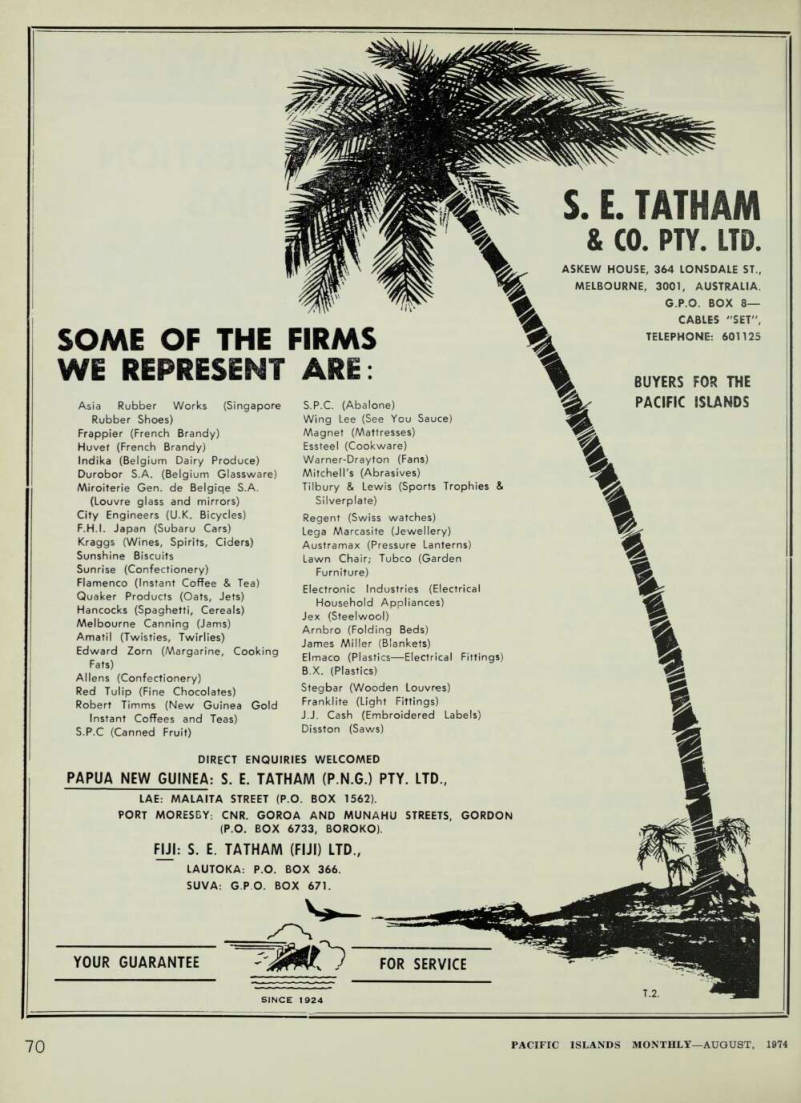
The New Pacific-A Question
Of Bias Or Non-Bias
Any author who sets out to pro mote the social, economic and political cause of an ethnic group other than his own is faced with a fundamental dilemma. No matter how closely he has been associated with the other ethnic group and no matter how long he has been as sociated with it, even at the most intimate levels, he cannot claim to speak without reservation for that group.
The very stuff of his personal socialisation into his own racial group raises a barrier which means that for evermore he has very fundamental values and attitudes which identify him with his own people.
As a Rarotongan once said to me “no matter how long you live in Rarotonga and no matter how closely you live with us you will never learn to think like a Maori, just as we will never come to think like a papa'a’".
A natural consequence arises when an author sets out to speak for a group other than his own, in the efforts to avoid the criticism of being ethnocentric he may project his thinking into avenues which reflect prejudices which may not necessarily be those of the group whose cause he espouses.
When I came to read R. G.
Crocombe’s The New Pacific I felt an unease —a feeling that here was an author who was so intent upon pleading the case of the Pacific Islander and so anxious to make sure that the reader understood the ways in which the European has often affected the islander’s way of life to his detriment that there was emerg ing a predilection to over-state the case.
Crocombe does not admit that his book is biased, but biased it is, and I am not saying here that to be biased is necessarily of a negative valency. If a book is to get over a fundamental social message, and this is what Ron Crocombe is attempting to do>, then he must, per se, be biased, but I think that he would do his cause a greater measure of good if he stated boldly that he is
biased, and if need be tell the reader why he is biased.
There are many very worthy features about The New Pacific, but I would have accepted the inbuilt premises contained in the book if the author had rather more plainly stated his personal position. By way of comparison, it is worthwhile look ing at Humphrey McQueen’s recent publication, Aborigines, Race and Racism, the contents of which in many ways parallel those of the Crocombe book and which addresses itself to what one must presume is a similar audience.
McQueen from the very outset tosses the matters of prejudice, stereo typing, racism, exploitation and other fundamental and controversial issues into the reader’s court. McQueen issues a clear challenge. He says, “This book is deliberately biased.
It has to be biased in order to tell the truth. For nearly two hundred years white Australians have lived a lie about the Aborigines. To see the truth clearly the balance has to be drawn in favour of the Aborigines, which means that this book begins by accepting that white Australians are prejudiced against Aborigines.”
In his preface Crocombe states that
his book “aims to provide a brief and personal view of some major trends in the past, present and pos sible future of the diverse and stimulating societies of the world’s most widely-scattered region”. A personal view by its very nature must be biased and it is better to admit that bias than to attempt to cloak it in the guise of pseudo-objectivity.
To return to Humphrey McQueen here is a book that makes clear the audience to which it is addressing itself, that is students in schools and colleges. I presume that this must also be the readership towards which The New Pacific is directed. If this is so, it serves its purpose adequately as it sets out succinctly and with a great deal of illustrative material a range of topics which are the standard stuff of texts about the developing regions of the world.
However, in order to have en compassed this task more adequately the book should have been tailor made for its ultimate purpose.
Throughout its entire length the book makes obvious its origins—a series of talks given at the University of the South Pacific, which were in turn used by the New Zealand Broad casting Commission. If I were to sit down and have The New Pacific read to me I would undoubtedly enjoy it more than 1 did the reading, and, perhaps, I wouldn’t have become so aware of the book’s deficiencies.
I do not in any way cavil at the sentiments expressed in the book, nor at the arguments concerning the directions to be taken in the future development of the South Pacific Region. However, 1 do feel that its very format leads this book into the dubious realms of generalisations.
Sure, it is very necessary to stress the pressures of population growth in the regions, but it is also im perative to let the reader appreciate that these pressures are not uniform and that they range from the 320 persons per square kilometre at Nauru (with its quite specific raison d’etre) to the 170 of the Tokelaus to the 5.3 of Papua-New Guinea.
Yes, it is valid to assert that Aus-
tralia has been tardy in advancing the interests of Papua-New Guinea, but in a book published in 1973 it is just not good enough to say, “Government policy is for eventual independence for New Guinea and most parties agree that it will be within the next five years and perhaps sooner”. True, as the book says, the ethnic mixture in Fiji has been considerable, but surely this rather glibly glosses over the funda mental areas of attitudes and values which continue to largely set apart the two major ethnic groups.
The happiest moments come in The New Pacific when the author does wear his heart on his sleeve.
Any person who has gone beneath the superficialities of the Pacific scene can more than appreciate the descrip tion of the neck-tie syndrome, of the lack of significance placed by many Pacific Islanders on the accumulation of property, of what Crocombe calls the religion of commerce. There is a perceptive statement on the role of Christianity in the Pacific and the question posed of “was the baby thrown out with the bathwater” gives perspective to an understanding of the religious practices of the region.
I feel that too narrow a view has been taken of whom to include in the generic term Pacific Islander—l agree that it is proper to give prime im portance to the indigenous peoples but it would be flying in the face of reality to consign to some obscure corner the very considerable group of peoples, whose origins are from outside the Pacific Basin, but whose home forevermore will be there.
This must be especially true of the Indian community in Fiji and The New Pacific would have had a better balance if it had given its readers a greater insight into the problems faced by these people.
I am conscious of the dangers of damning with faint praise, but I think that it is fair to say that The New Pacific is a book that should have been written, but as I said earlier, written as a book in its own right.
Unfortunately we have been left with a curate’s egg, which is unfortunate as the ingredients and expertise were there to have produced a really significant work.— W. G. Coppell. (THE NEW PACIFIC. By Crocombe, R. G.
Australian National University Press, P.O.
Box 4, Canberra, A.C.T. 2600. $4.50.)
• The Pacific Manuscripts Bureau was established in 1968 as part of the Research School of Pacific Studies, Australian National Uni versity, Canberra. Its purpose is to locate unpublished documents of value concerning the Pacific Islands and to obtain copies of them on microfilm for five world libraries specialising in Pacific research. The five libraries are the National Libraries of Aust ralia and New Zealand; the Mitchell Library, Sydney; the Library of the University of Hawaii, Honolulu; and the State Library of Victoria. This report from Canberra tells of some of the bureau’s latest acquisitions.
College Magazine
• Faasamoa Pea is the name of a new quarterly publication, printed in both Samoan and English, by the Community College of American Samoa. It deals with the continuation of Samoan culture and customs. The first issue contains a series of articles on the traditional Samoan fine mat and a series of articles on Samoan place names.
Sponsored by the Community Col lege of American Samoa and by the American Samoa Arts Council, it is written and published by students at the Community College.
Complimentary copies can be obtained by writing to Faasamoa Pea, Community College of American Samoa, Pago Pago, American Samoa 96799.
Advertisements & other items, p. 80 (1 item)
S. E. Tain Am
a %
SOME OF THE FIRMS
WE REPRESENT ARE;
Asia Rubber Works (Singapore Rubber Shoes) Frappier (French Brandy) Huvet (French Brandy) Indika (Belgium Dairy Produce) Durobor S.A. (Belgium Glassware) Miroiterie Gen. de Belgiqe S.A. (Louvre glass and mirrors) City Engineers (U.K. Bicycles) F.H.I. Japan (Subaru Cars) Kraggs (Wines, Spirits, Ciders) Sunshine Biscuits Sunrise (Confectionery) Flamenco (Instant Coffee & Tea) Quaker Products (Oats, Jets) Hancocks (Spaghetti, Cereals) Melbourne Canning (Jams) Amatil (Twisties, Twirlies) Edward Zorn (Margarine, Cooking Fats) Allens (Confectionery) Red Tulip (Fine Chocolates) Robert Timms (New Guinea Gold Instant Coffees and Teas) S.P.C (Canned Fruit) S.P.C. (Abalone) Wing Lee (See You Sauce) Magnet (Mattresses) Essteel (Cookware) Warner-Drayton (Fans) Mitchell's (Abrasives) Tilbury & Lewis (Sports Trophies & Silverplate) Regent (Swiss watches) Lega Marcasite (Jewellery) Austramax (Pressure Lanterns) Lawn Chair; Tubco (Garden Furniture) Electronic Industries (Electrical Household Appliances) Jex (Steelwool) Arnbro (Folding Beds) James Miller (Blankets) Elmaco (Plastics —Electrical Fittings) B.X. (Plastics) Stegbar (Wooden Louvres) Franklite (Light Fittings) JJ. Cash (Embroidered Labels) Disston (Saws)
S. E. TAIN AM
& CO. PTY. LTD.
ASKEW HOUSE, 364 LONSDALE ST.,
MELBOURNE, 3001, AUSTRALIA.
G.P.O. BOX 8—
CABLES "SET",
TELEPHONE: 601125
BUYERS FOR THE
PACIFIC ISLANDS
« 55$ 1 1 1
DIRECT ENQUIRIES WELCOMED
PAPUA NEW GUINEA: S. E. TATHAM (P.N.G.) PTY. LTD.,
LAE: MALAITA STREET (P.O. BOX 1562).
PORT MORESBY: CNR. GOROA AND MUNAHU STREETS
(P.O. BOX 6733, BOROKO).
FIJI: S. E. TATHAM (FIJI) LTD.,
LAUTOKA: P.O. BOX 366.
SUVA: G.P.O. BOX 671.
YOUR GUARANTEE
i
GORDON
~m>t)
FOR SERVICE
SINCE 1924
T. 2.
Pacific's
Out Of The
Past
Manuscript dictionaries on Islands languages, a collection of newspaper clippings in Polish on Micronesia, a series of private diaries spanning nearly half a century, patrol reports from pre-war New Guinea, and a large collection of papers relating to the reign of King George Tupou II of Tonga are among the latest docu ments to have been recorded for posterity on microfilm.
They are now among more than 550 titles in the Pacific Manuscript Bureau’s manuscript series.
One of the Island dictionaries, the work of the Rev G. H. Eastman, an LMS missionary in the Cook and Gilbert Islands for many years, was sent to the Pacific Manuscript Bureau for filming just before its compiler died in England late last year at the age of 92.
It is a Rarotongan-English dic tionary, which Mr Eastman compiled between 1913 and 1918 ‘partly as a means of obtaining a fluent use of the language, and partly as a hobby’.
In 1918, the New Zealand Govern ment decided to publish it, as no published Rarotongan dictionary then existed. However, because of short ages of labour and materials, the project fell through. According to the compiler, a copy of the diction ary later formed the basis of Stephen Savage’s A Dictionary of the Maori Language of Rarotonga, which was published posthumously by the De
partment of Island Territories, Wel lington, in 1962. The Eastman dic tionary should therefore be of con siderable value to Cook Islands linguists in particular and Polynesian linguists in general.
Two other Islands dictionaries that have been filmed recently were ob tained under the bureau’s Papua New Guinea Records Project. A few copies of both were multigraphed from script in the eighties of last century. But copies are now ex tremely rare.
One dictionary is of the Duke of York Island language of New Britain. It was compiled by three of the first Methodist missionaries in that area—the Revs George Brown* Benjamin Danks and Isaac Rooney —and is accompanied by a grammar.
The copy filmed was once owned by Rooney and has manuscript additions and corrections by him.
The other dictionary is of the New Britain dialect. It is the work of the Rev R. H. Rickard, a Method ist missionary, who went to New Britain in 1882. Some letters and other papers written by his wife were filmed in 1968.
Other material on Papua New Guinea filmed recently includes: • Patrol reports and other papers, of a former senior Administration official, Mr I. K. McCarthy, now of Melbourne. They cover the years 1926-52 when he was a patrol officer and later district officer in New Guinea. • Press clippings on Papua New Guinea covering the years 1967- 73. The clippings fill 49 reels of film. They were copied in the now-defunct Department of Ex ternal Territories, Canberra, just before it ceased to exist in De cember last year. • The reminiscences of Henry Dex ter, a storekeeper in Papua from 1910 to 1936.
O Reminiscences of Mr J. D.
O’Neill, of Buderim, Queensland, a prospector in New Guinea in the ’thirties.
The diaries and other papers of John T. Arundel, a dominating figure in the Pacific phosphate and copra industry from 1870 until his death in 1919 were filmed in March this year.
The papers relating to the reign of King George Tupou II of Tonga were brought to Australia from Tonga by Mrs Eseta Fusitua, who has been working on a thesis on that topic. The papers include Tonga Cabinet and Privy Council minutes for 1898-1920 and a few files con
cerning the reign of Queen Salote Tupou 111.
The newspaper clippings in Polish referred to above are clippings of articles by the Polish ethnologist Jan Kubary, who was employed by J. C. Godeffroy and Son to carry out scientific work in Micronesia and Polynesia. The clippings cover the period 1873-80 and relate to the Caroline, Cook, Ellice and Marshall Islands, Samoa and Tokelaus. A film of the clippings was made available to the bureau by Dr Saul Riesenberg of the Smithsonian Institution, Washington.
Two diaries of labour-recruiting voyages to New Caledonia and the New Hebrides have been filmed.
They were kept by W. G. Farquhar, a farmer at Maryborough, Queens land, who made his first voyage in the schooner City of Melbourne in November 1870-January 1871 to re cruit labourers for himself and other Maryborough farmers. On his second
voyage, beginning in September
1871, Farquhar was a government agent under the Polynesian Labourers’ Act of 1868. He made his second voyage in the schooner Petrel. His diaries give some vivid glimpses of the labour trade.
Another useful diary is that of George H. Bardsley, a carpenter, of Brisbane, who built the first houses at the Methodist Mission at Dobu, D’Entrecasteaux Islands, Papua. The diary covers the period 21 June 1891 to 24 January 1892.
Other mission material added to the bureau’s growing list in recent months comprises: • The minute books of the Over seas Missions Department of the Methodist Church of New Zea land, 1903-55. The books cover the activities of New Zealand missionaries in the Solomon Islands from 1902, and, more re cently, in Papua New Guinea. • Minute books of the Tangoa Training Institution, Tangoa, New Hebrides, April 1947-October 1970. (This institution was estab lished by the Presbyterian Miss ion to the New Hebrides in 1895 as a training centre for New Heb ridean teachers. Other records of the institution were filmed in 1969). • The diaries of two Mormon missionaries to Hawaii, Simpson Montgomery Molen and his wife Mrs Jane Hyde Molen. The diary of the first-named covers the period 17 September 1857-3 Janu ary 1858—part of a term of three years and three months that Molen then spent in Hawaii. The
second diary, kept by Mrs Molen, is for a much later period, May 1876-February 1877, when Molen, having married, returned to Hawaii for a second term. He and his wife were stationed at Laie, Oahu. © An account by a French Marist missionary, Father Paul Mon tauban, of life on Buka, Solomon Islands, during the Japanese oc cupation of World War 11. It is entitled Trois Ans de Captivite a Buka and covers the period March 1942-September 1945.
Montauban was one of three Marist missionaries who re mained on Buka while the Japan ese were there. He spent more than forty years on the island, from 1914 to 1958, Two films of interest to the nau tically-minded contain (1) the jour nals of one Samuel Hill, who made two voyages to the Pacific in the ships Ophelia and The Packet in the period 1815-22, and (2) a pro visional index to source material on British naval vessels in the Pacific Islands, 1800-1900. The Navy index was sponsored by the Pacific Manu scripts Bureau and compiled by Mrs Catherine Dengate, of Canberra. It is in alphabetical order by ship, and gives the captain’s name, description of the vessel, period of voyage, the location of published and unpub lished accounts, and the vessel’s itinerary, particularly in the Pacific Islands. The index does not claim to be exhaustive, but it should prove to be a useful research tool.
Two manuscripts which emanated from the Cook Islands are an un published novel entitled White Natives, by Julian Hillas (ie the late Julian Dash wood of Mauke) and a diary edited by Mr W. H. Watson of Rarotonga, entitled William Oliver, Yeoman.
Watson says in an introduction to the latter work that Oliver left Devonshire, England, to seek his fortune in Australia in the early 1860 s. The narrative is ‘an account of his adventures taken almost word for word from a diary kept between 1862 and 1892’. The narrative gives an informative account of life in Rarotonga and the Society Islands at that time.
Advertisements & other items, p. 82 (1 item)
Bank of Hawaii
is the bank of the Pacific.
You can bank on it... in Guam 3&Tamuning t Koror-*22;Yap Jt Saipan Roi Namur iiWake ££ mL Kwajalein JltPonape Tahiti 2* American Samoa.
All in all, we have 70 branches throughout Hawaii and the Pacific offering full banking services. May we help you?
Bank erf Hawaii the bank of the Pacific® affiliate of Banque de Tahiti
A better deal
in the NZ sun
Just how often historical mistakes repeat themselves is given emphasis by Alan Ward’s A Show of Justice in which he writes about the relation ship between Maoris and European settlers in 19th century New Zealand.
There was the same old urge on the part of the Maoris on first contact with the better-endowed foreigners to have a slice of their material wealth and, to better participate, a desire by many a Maori chief to have his own pet Pakeha (European) trader estab lished in his village. Jealousy and occasionally violence followed if the trader looked like dispensing his favours elsewhere.
As an extension of this, and a growing appetite for European goods like guns, ammunition, axes and so forth, many Maoris “sold” parcels of land which frequently they had no right to do. Their poor understanding of what land ownership meant to the foreigners frequently led them to think that what they were parting with was temporary land use, and not the permanent alienation of the land it self.
This sort of thing was to repeat itself again and again in the South Pacific but the lessons that should have been learned from the Maori- Pakeha land troubles of the mid 19th century had to be learned all over again right into the 19705.
The Tolais who squat on planta tions of the Gazelle Peninsula in New Guinea, and insist that the land had never been legally purchased from
their ancestors, had their counterparts almost 100 years ago in the Taranaki Maoris who refused to recognise European purchase or confiscation of land by moving in and ploughing up Pakeha farms.
By the same token, the recalcitrant Mataungan Association of the Gazelle is small beer in comparison with the efforts of the Taranaki and King Country Maoris of NZ who kept both the colonial government and the settlers on the hop between 1860 and the 1880 s, sometimes through full scale war, frequently by flaunting Euronean laws which they had no hand in making.
Basically it was the age-old battle of who was to own the land—the Maoris who had got their first or the whitemen who came 500 years later.
In the end those with the greatest material advantages won the day helped by a section of the Maori population which had, almost from the outset, been pro-Pakeha. New Zealand then entered a phase of what officially was supposed to be an integrated, multi-racial society in which Maori and Pakeha were to have equal rights and opportunities and which was held up to the world as an example of how well a plural society could work.
It has never been as simple as that.
Individual Maoris of the 1970 s benefit not at all from what were once tribal lands and now, according to the author, many believe that their ancestors were got at and milched of what was rightfully theirs so they attempt to turn back the historical clock and demand a better place in the NZ sun. It hasn’t exactly come to a brown-power movement but many are vociferous.
This book is interesting for any one seeking enlightenment on colonial land matters but, as it is based on a doctoral thesis, it is pretty hard slogging for the lay reader with its multiplicity of detached footnotes, etc.
The author, not surprisingly, was a consultant on the recent commission of inquiry into land matters in Papua New Guinea which came up with pretty revolutionary ideas on land tenure for that country.
He is a New Zealander but at present is a lecturer in history at Latrobe University, Melbourne. His writing is straightforward, with one idiosyncrasy— with him “Maori” is neither singular nor plural and seldom merits a preliminary “a” or a “the” as in (to quote). “The Crown Pro secutor rejected this saying that Maori became British subjects when New Zealand became a British colony”.
There is probably some professional reason for this but for the moment it escapes this reviewer. —Judy Tudor. (A SHOW OF JUSTICE, by Alan Ward, Australian University Press, Canberra,
Act. $10.95.)
Advertisements & other items, p. 83 (1 item)
Book Company
HARRIS
(ESTABLISHED 1930)
We carry over 10,000 titles on all subjects in stock and would be pleased to quote for your requirements.
Please send your enquiries to;
HARRIS BOOK COMPANY,
G.P.O. Box 16670, Hong Kong
Old-School
Pacific Adventure
The more I read books like The Journal of Lieutenant George Peard of HMS Blossom 1825-1828, the more I am convinced that the education system of 100 to 200 years ago must have been far in advance of that which passes for education nowadays.
Certainly, it was not spread so thinly over so many, but it seems to me that today education is no longer the stimulus to living that it was then, no longer gives men that indi vidual incentive which makes them en quiring, interested in what is around them for the sake of being interested, the master of many skills, masters of the art of living, and all of it not for the mere sake of income. People like Matthew Flinders, William McGregor, Richard Burton of Africa, Captain James Cook, and now Lieutenant George Peard of HMS Blossom.
Peard’s journal of the voyage of Captain Frederick William Beechey RN and HMS Blossom to the Pacific and Arctic in 1825-8 is a lucid ac count of one of the most com prehensive British naval voyages to the Pacific. The Blossom made her way via Cape Horn to the Pacific, called at various places within the Pacific rim, and searched in vain for the expedition of Captain William Edward Parry and John Franklin expected at Baring Strait. George Peard, first lieutenant of the Blossom gives detailed descriptions of the places visited and the inhabitants, among them Pitcairn and the Gambier, Tahitian and Hawaiian Groups. No less valuable are his accounts of Kamchatka, California, the Northwestern extremity of North America, and various parts of South America.
It is interesting to read of the attitude of mind of some Pacific inhabitants which took a 100 years and more to change: Peard writes: “It is complained of by the English and American residents that these gentlemen (Christian Teachers) who have been sent here by the United States Missionary Society, by com pelling the attendance of grown persons at their schools, take up time that would be better employed in cultivating the ground or in learning arts and manufactures, and thus encourage the habit of Idleness prejudicial to the Interest of the country . , .”—Peter Livingston.
(To The Pacific And Arctic With
BEECHEY. Edited by Barry M. Gough.
Cambridge University Press. Boutley House, 200 Enston Road, London. $A11.00.)
Advertisements & other items, p. 84 (1 item)
Papua New
T wo
excellent books
on
Papua New
Guinea
Soft cover edition.
PORT
MORESBY
YESTERDAY & TODAY
lan Stuart
In this book, Port Moresby—yesterday and today, lan Stuart has put together, in an entertaining fashion, the authentic and exhaustive account of the first 97 years of Papua New Guinea's capital, its people and the material creations of those people. There were wars, depressions, royal commissions, scandals, witch-hunts, pioneering fortitude, acts of self-sacrifice, selfreliance and bravery—all the normal behaviour of people thrown together in an isolated, tropical outpost.
PRICE: Australia, Pacific Islands and Overseas, $3.95 Aust., plus 30c posted. U.S.A., $B.BO U.S. posted. ☆
QUEEN EMMA
R. W. Robson This is the story of Queen Emma of New Guinea. It has drama, comedy, high adventure and colourful romance. It has the added merit of being true. This is not only the story of how a Polynesian- American girl entered a man's world in the 19th century and beat it on her own terms; it also is the history of an era.
PRICE: Australia, Pacific Islands and Overseas, $4.00 Aust., plus 30c posted. U.S.A., $6.65 U.S. posted.
Fill in the details
on the attached
order form.
Pacific Transport
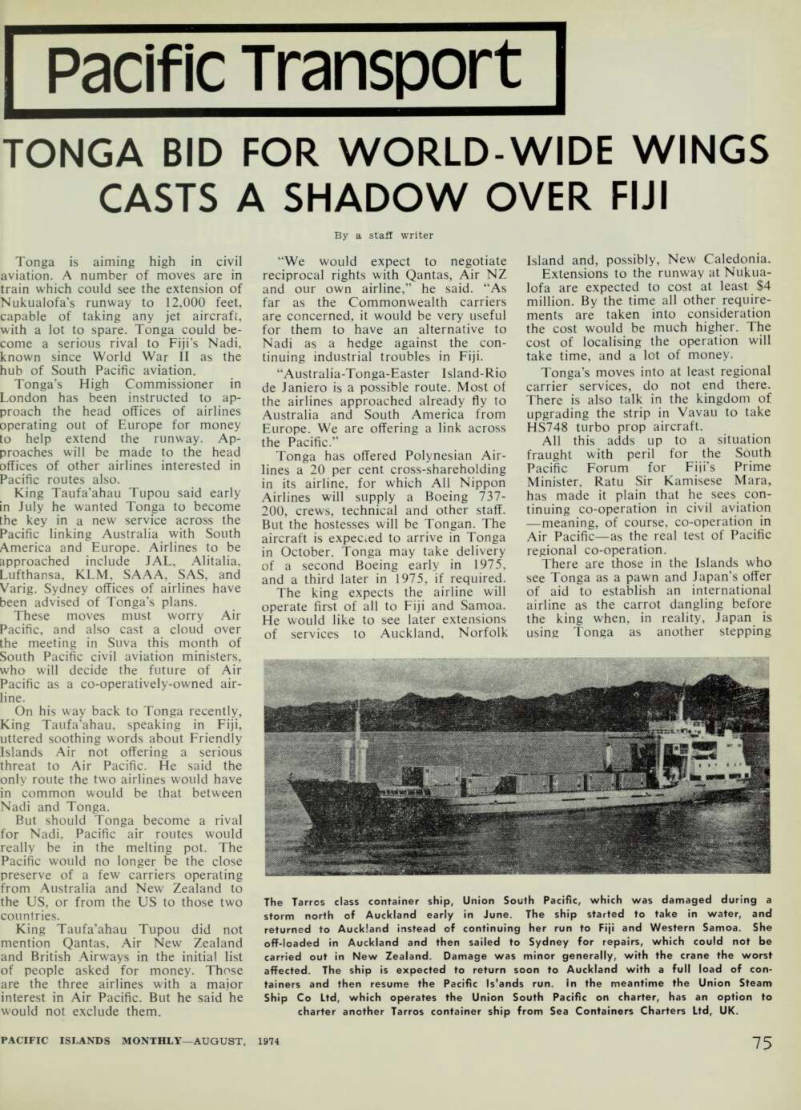

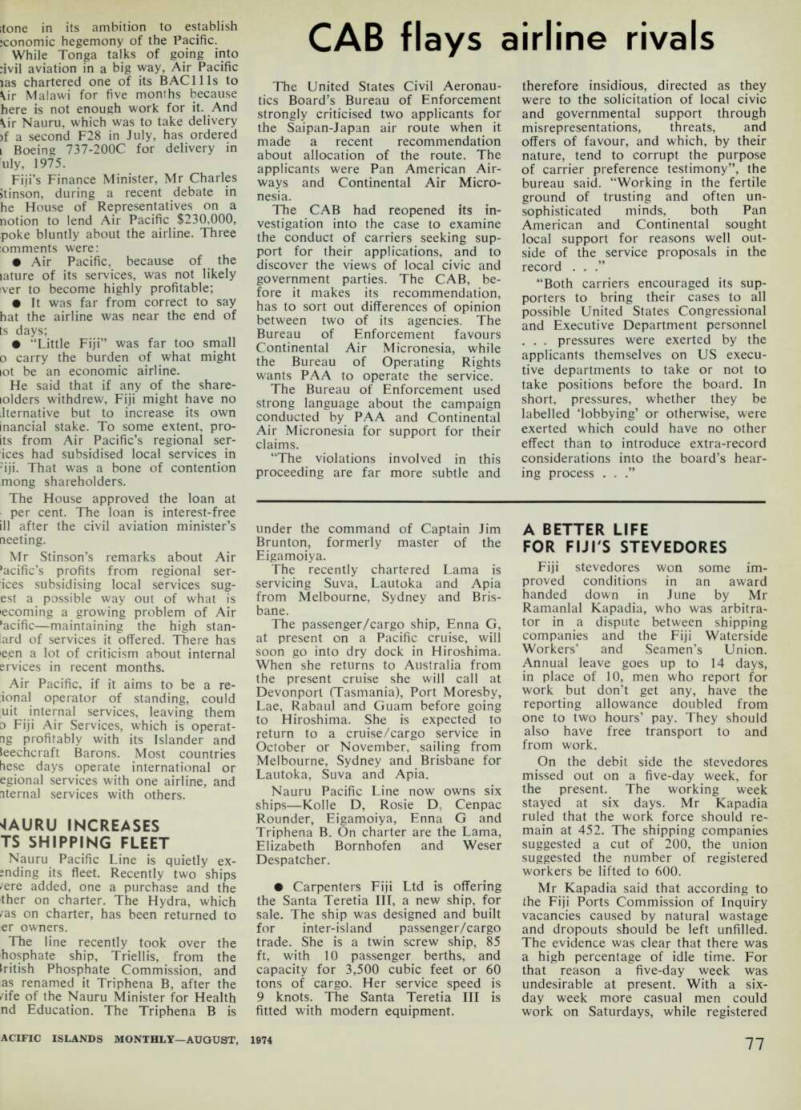

Tonga Bid For World-Wide Wings
Casts A Shadow Over Fiji
By a staff writer
Tonga is aiming high in civil aviation. A number of moves are in train which could see the extension of Nukualofa’s runway to 12,000 feet, capable of taking any jet aircraft, with a lot to spare. Tonga could be come a serious rival to Fiji’s Nadi, known since World War II as the hub of South Pacific aviation.
Tonga’s High Commissioner in London has been instructed to ap proach the head offices of airlines operating out of Europe for money to help extend the runway. Ap proaches will be made to the head offices of other airlines interested in Pacific routes also.
King Taufa’ahau Tupou said early in July he wanted Tonga to become the key in a new service across the Pacific linking Australia with South America and Europe. Airlines to be approached include JAL, Alitalia, Lufthansa, KLM, SAAA, SAS, and Varig. Sydney offices of airlines have been advised of Tonga’s plans.
These moves must worry Air Pacific, and also cast a cloud over the meeting in Suva this month of South Pacific civil aviation ministers, who will decide the future of Air Pacific as a co-operatively-owned air line.
On his way back to Tonga recently, King Taufa’ahau, speaking in Fiji, uttered soothing words about Friendly Islands Air not offering a serious threat to Air Pacific. He said the only route the two airlines would have in common would be that between Nadi and Tonga.
But should Tonga become a rival for Nadi, Pacific air routes would really be in the melting pot. The Pacific would no longer be the close preserve of a few carriers operating from Australia and New Zealand to the US, or from the US to those two countries.
King Taufa’ahau Tupou did not mention Qantas, Air New Zealand and British Airways in the initial list of people asked for money. Those are the three airlines with a major interest in Air Pacific. But he said he would not exclude them.
“We would expect to negotiate reciprocal rights with Qantas, Air NZ and our own airline,” he said. “As far as the Commonwealth carriers are concerned, it would be very useful for them to have an alternative to Nadi as a hedge against the continuing industrial troubles in Fiji.
“Australia-Tonga-Easter Island-Rio de Janiero is a possible route. Most of the airlines approached already fly to Australia and South America from Europe. We are offering a link across the Pacific.”
Tonga has offered Polynesian Airlines a 20 per cent cross-shareholding in its airline, for which All Nippon Airlines will supply a Boeing 737- 200, crews, technical and other staff.
But the hostesses will be Tongan. The aircraft is expected to arrive in Tonga in October. Tonga may take delivery of a second Boeing early in 1975, and a third later in 1975, if required.
The king expects the airline will operate first of all to Fiji and Samoa.
He would like to see later extensions of services to Auckland, Norfolk
Island and, possibly, New Caledonia, Extensions to the runway at Nukua lofa are expected to cost at least $4 million. By the time all other require ments are taken into consideration the cost would be much higher. The cost of localising the operation will take time, and a lot of money.
Tonga’s moves into at least regional carrier services, do not end there, There is also talk in the kingdom of upgrading the strip in Vavau to take HS74B turbo prop aircraft, All this adds up to a situation fraught with peril for the South Pacific Forum for Fiji’s Prime Minister. Ratu Sir Kamisese Mara, has made it plain that he sees con tinuing co-operation in civil aviation —meaning, of course, co-operation in Air Pacific—as the real test of Pacific
regional co-operation,
There are those in the Islands who see Tonga as a pawn and Japan’s offer of aid to establish an international airline as the carrot dangling before the king when, in reality, Japan is using Tonga as another stepping
The Tarros class container ship, Union South Pacific, which was damaged during a storm north of Auckland early in June. The ship started to take in water, and returned to Auckland instead of continuing her run to Fiji and Western Samoa. She off-loaded in Auckland and then sailed to Sydney for repairs, which could not be carried out in New Zealand. Damage was minor generally, with the crane the worst affected. The ship is expected to return soon to Auckland with a full load of con tainers and then resume the Pacific Islands run. In the meantime the Union Steam Ship Co Ltd, which operates the Union South Pacific on charter, has an option to charter another Tarros container ship from Sea Containers Charters Ltd, UK.
itone in its ambition to establish ;conomic hegemony of the Pacific.
While Tonga talks of going into :ivil aviation in a big way, Air Pacific las chartered one of its BACH Is to \ir Malawi for five months because here is not enough work for it. And \ir Nauru, which was to take delivery )f a second F2B in July, has ordered i Boeing 737-200 C for delivery in uly, 1975, Fiji’s Finance Minister, Mr Charles Stinson, during a recent debate in he House of Representatives on a notion to lend Air Pacific $230,000, poke bluntly about the airline. Three ;omments were: • Air Pacific, because of the lature of its services, was not likely ver to become highly profitable; • It was far from correct to say hat the airline was near the end of ts days; • “Little Fiji” was far too small o carry the burden of what might lot be an economic airline.
He said that if any of the share lolders withdrew, Fiji might have no Iternative but to increase its own inancial stake. To some extent, pro its from Air Pacific’s regional ser ices had subsidised local services in 'iji. That was a bone of contention mong shareholders.
The House approved the loan at per cent. The loan is interest-free ill after the civil aviation minister’s aeeting.
Mr Stinson’s remarks about Air •acific’s profits from regional ser ices subsidising local services sug est a possible way out of what is •ecoming a growing problem of Air ’acific —maintaining the high stan !ard of services it offered. There has een a lot of criticism about internal ervices in recent months.
Air Pacific, if it aims to be a re ional operator of standing, could uit internal services, leaving them o Fiji Air Services, which is operat ing profitably with its Islander and leechcraft Barons. Most countries hese days operate international or egional services with one airline, and internal services with others.
Muru Increases
Ts Shipping Fleet
Nauru Pacific Line is quietly ex ending its fleet. Recently two ships /ere added, one a purchase and the ther on charter. The Hydra, which /as on charter, has been returned to er owners.
The line recently took over the hosphate ship, Triellis, from the British Phosphate Commission, and as renamed it Triphena B, after the /ife of the Nauru Minister for Health nd Education. The Triphena B is
under the command of Captain Jim Brunton, formerly master of the Eigamoiya.
The recently chartered Lama is servicing Suva, Lautoka and Apia from Melbourne, Sydney and Bris bane.
The passenger/cargo ship, Enna G, at present on a Pacific cruise, will soon go into dry dock in Hiroshima, When she returns to Australia from the present cruise she will call at Devonporl (Tasmania), Port Moresby, Lae, Rabaul and Guam before going to Hiroshima. She is expected to return to a cruise/cargo service in October or November, sailing from Melbourne, Sydney and Brisbane for Lautoka, Suva and Apia.
Nauru Pacific Line now owns six ships—Kolle D, Rosie D, Cenpac Rounder, Eigamoiya, Enna G and Triphena B. On charter are the Lama, Elizabeth Bornhofen and Weser Despatcher. • Carpenters Fiji Ltd is offering the Santa Teretia 111, a new ship, for sale. The ship was designed and built for inter-island passenger/cargo trade. She is a twin screw ship, 85 ft, with 10 passenger berths, and capacity for 3,500 cubic feet or 60 tons of cargo. Her service speed is 9 knots. The Santa Teretia 111 is fitted with modern equipment.
A Better Life
For Fiji's Stevedores
Fiji stevedores won some im proved conditions in an award handed down in June by Mr Ramanlal Kapadia, who was arbitra tor in a dispute between shipping companies and the Fiji Waterside Workers’ and Seamen’s Union.
Annual leave goes up to 14 days, in place of 10, men who report for work but don’t get any, have the reporting allowance doubled from one to two hours’ pay. They should also have free transport to and from work.
On the debit side the stevedores missed out on a five-day week, for the present. The working week stayed at six days. Mr Kapadia ruled that the work force should re main at 452. The shipping companies suggested a cut of 200, the union suggested the number of registered workers be lifted to 600.
Mr Kapadia said that according to the Fiji Ports Commission of Inquiry vacancies caused by natural wastage and dropouts should be left unfilled.
The evidence was clear that there was a high percentage of idle time. For that reason a five-day week was undesirable at present. With a six day week more casual men could work on Saturdays, while registered
vorkers still received a minimum of 10 hours’ pay.
Mr Kapadia ruled a fixed retiring ige was undesirable, without giving airly long notice to the men affected. 4en of retiring age now would get ittle from the national provident und because they had not been nembers for long. They should be dlowed to continue working till they etired of their own accord. The ilternative would be for employers to >ay “reasonable compensation”.
Mr Kapadia said there was a need or better rest, recreation and refresh nent facilities at Suva wharf. Also, a raining programme was needed to ipgrade dockers’ skills.
Fine No Deterrent
: Or Reef Poachers
A Taiwanese ship released by the Micronesian couris after the owners >aid substantial fines for poaching ap >arently returned immediately to the )lace where it had been “arrested” md repeated the offence. This was evealed in a report from the Palau District Attorney’s office on the arrest >f 12 Taiwan fishermen at Helen Reef.
It was reported that the men went ishore in a small dory while the nother ship remained outside the eef. When the Hafa Adai arrived on he scene on a field trip the mother ship sailed away, leaving the 12 men branded. The men were taken aboard ;he Hafa Adai to be charged with illegally taking marine resources from the reef.
Confiscated were nine bags of trochus, two birds and many eggs, three clams and other items.
The report from the Palau District Attorney’s office suggested that the boat involved was the Nob Tei Sheng Gen No 6, which had recently been released.
Tonga's King Hopes To
Add Big Ship To Fleet
The Tongan flag could be flying on a 76,000-ton bulk carrier in about a year. King Taufa’ahau Tupou sug gested that after a recent visit to the UK and the Middle East. He expects the ship to carry minerals from the South Pacific round the Cape of Good Hope to Europe, and then re turn to the South Pacific via the Mediterranean, the reopened Suez Canal and the Red Sea.
He called at Saudi Arabia on his tour and discussed with the authori ties there the question of picking up bulk fuel. He hopes to come to an arrangement under which Tonga will be guaranteed supplies of fuel in the event of any further embargoes.
Tonga wanted to remain independent of the large oil companies, which
were themselves dependent on Arab fuel.
The king’s hopes depend on estab
lishing diplomatic relations between
Saudi Arabia and Tonga. He expects Saudi Arabia to set up an embassy in Canberra. If that happened the am bassador could be accredited to Tonga as well as Australia.
It’s understood that nothing firm has been arranged about the bulk carrier, and that the idea was con ceived as a result of the need for an ore carrier to operate out of South Australia. King Taufa’ahau feels that Tonga could charter and operate such a vessel if there was steady work for it.
Captain Williams
Leaves The Cooks
After 18 months of trading in the Cook Islands with his 500 tons MV Moana Captain Hugh Williams has sold out and decided to go home to Sydney.
“The Cook Islands are not as happy a place as they were 10 years ago,” he told PIM. “There are too many controls and not enough cargo.”
The reason for the decline in cargo, he thought, was the mass exodus of Cook Islanders to New Zealand since Rarotonga’s international airport was opened last December.
Captain Williams sold Moana to fellow Australian Mr R. Mellor who said if business prospects in the Cooks were not good enough he would take her to New Guinea. Hugh Williams plans to return to Sydney and may buy a 1,000 ton ship with the idea of chartering it to New Guinea or Far Eastern ports.
Cooks Govt To Take
Over The Stevedores
Maritime circles in the Cook Islands are dismayed at a decision of the government to use its powers under the recently-passed Waterfront Industry Act to control stevedoring.
The act also gives the government power to control wharves.
The two stevedoring companies, the Union Steam Ship Co of NZ Ltd and Silk and Boyd Ltd, have been told their services are no longer required.
The repercussions from this are serious, as those companies will have to dismiss their stevedoring staffs, or the government will have to absorb them.
While the industry has been subject to criticism in the past, it has been run ning smoothly recently. The govern ment has been advised by Mr Jim Gatt, a New Zealander, about wharf and stevedoring matters, and Mr Gatt is expected to be appointed to take charge of the waterfront controlling authority as general manager.
Png Upgrades
Its Seamen's Standards
All seamen working in Papua New Guinea vessels over 10 metres, ex cept traditional fishing boats, will be required to undergo training. As well as this seamen will have to have one year’s service at sea before they are considered qualified.
The Minister for Transport and Civil Aviation, Mr lambakey Okuk, outlining the proposed enabling legislation, said every vessel would be required to have a minimum number of qualified seamen. The
imber would be governed by the it of the vessel.
The scheme was aimed at improv g safety and efficiency standards i local vessels where there had eviously been inadequate training navigation, emergency procedures id lifesaving appliances.
The government plans to re-equip 5 fleet over the next three years ith about 50 ships. The cost would ; more than $3.5 million.
The courses will be at Madang autical School. Initially, the intake ill be about 100 men a year and ich course will last about eight eeks.
Experienced seamen now serving on lips will be considered qualified.
Reight Rates
Oom Again
Another setback to Fiji, Tonga id Western Samoa in their battle ith inflation was a heavy rise in eight rates for cargo from Sydney om July 1. The Sydney-Suva rate >se by a whopping 32.32 per cent, onga and Western Samoa did even orse. Cargo for Tonga will have lother 6.43 and Western Samoa an ther 7.5 per cent added to the new ydney-Suva rates.
The new rates for general cargo om Sydney to Suva and Lautoka re $52.60 a tonne (up $l2) and 47 a cubic metre (up $10). The in rease has been applied by all lines ;rvicing the three countries. But the unkering surcharge has been re uced from 8.02 per cent to 6.08 per ;nt.
Constantly rising costs are blamed ir the latest round of increases. In fficient systems on the waterfront, i spite of the efforts of shipping □mpanies to streamline ways of andling cargo, weather, port con estion, and shortage of labour are 11 adding to costs.
The Pacific Navigation Co’s Tau 3to on its last trip to Sydney was in ort for 28 days. The turn-round for . ship of that class only a few aonths ago was less than eight days, t does not require much imagin ,tion to guess what that sort of hing can do to wharf charges.
There was a grain of comfort for *apua New Guinea importers after he July 1 hike in the freight rates >n cargo from Australia to PNG >orts. This was a reduction in the >unker surcharge from 8.02 per cent o 6.48 per cent. The freight rates vent up by 18 per cent, plus an ad litional $lO a tonne on refrigerated :argo.
The new rates from Sydney and
Brisbane for general cargo are (old rates in brackets): Port Moresby-Samarai $40.20 a cubic metre ($34.05); $44.80 a tonne ($37.95).
Lae-Rabaul-Madang $41.50 a cubic metre ($35.15); $46.20 a tonne ($39 15) Kavieng-Kieta $46.65 a cubic metre ($39.55); $52 a tonne ($44.05).
Honiara-Gizo $49.25 a cubic metre ($41.75); $54.95 a tonne ($46.55).
Refrigerated cargo for Honiara- Gizo costs $77.20 a cubic metre ($56.95), while for the other destina tions it is $72 a cubic metre ($52.55).
But Rate Cut For
Png Coastal Trade
Papua New Guinea introduced a completely new freight tariff for coastal vessels on July 1. One of the major effects is a cut in the rates for carrying staple items. The reduc tion, of 10 per cent, applied to such items as flour, sugar, rice, tinned meat and fish, wheatmeal and similar products.
To pay for those concessions, to
recover cost increases and to allow a start to be made on introducing more reliable coastal vessels, freight rates on other commodities will rise by varying amounts. However, the rates on produce—copra, cocoa, cof fee, etc —remain unaltered.
The Minister for Transport and Civil Aviation, Mr lambakey Okuk, said the standard flat general cargo rate covering most commodities, irrespective of value, was abolished.
Rates would be charged in a com pletely flexible manner in proportion to value, sensitivity or characteris tics of each individual commodity.
A new committee, the Coastal Freight Rates Committee, will advise the minister on all matters related to coastal freight rates.
The Union Steam Ship Co of NZ Ltd has increased freight rates on the Auckland-Pacific Islands service by 7 per cent, plus a 3.33 per cent bunker surcharge. The increase is an interim one as the company has applied for a further rise. The in crease became effective with the first voyage of the Union South Pacific after June 21.
Advertisements & other items, p. 86 (1 item)
Ruston
m*-
JUST WHAT THE
DOCTOR ORDERED
FOR CONTINUOUS
OPERATION...
RUSTON
AIR COOLED
DIESEL
ENGINES
RUSTON YWA AND YDA SERIES
Available right now. No waiting. No delays. Have one of the Ruston range working for you in any continuous operation you require. Spares readily available.
MODEL
1 YWA
2YWA
BHP
Continuous rating 12.75 11.75 9.80 7.70 6.20 25.5 23.5 19.6 15.4 12.4
GEC DIESELS AUSTRALIA LTD.
HEAD OFFICE VIC.: 1 Winterton Rd., Clayton. Phone 544 8344. A.H. 729 6762.
N.S.W.- 99 Reserve Rd., Artarmon. Phone: 43 3114. A.H. 449 1416.
OLD.: 115 Breakfast Creek Rd., Newstead. Phone 52 4421. A.H. 62 8086.
S.A.:' 121-131 Torrens Rd., Croydon. Phone: 46 2772.
W.A.: 8 Clever Terrace, Belmont. Phone; 65 4844. N.T.: Phone: 81 9892.
CJ/GECI/FP
CAB flays airline rivals
The United States Civil Aeronau tics Board’s Bureau of Enforcement strongly criticised two applicants for the Saipan-Japan air route when it made a recent recommendation about allocation of the route. The applicants were Pan American Air ways and Continental Air Micro nesia.
The CAB had reopened its in vestigation into the case to examine the conduct of carriers seeking sup port for their applications, and to discover the views of local civic and government parties. The CAB, be fore it makes its recommendation, has to sort out differences of opinion between two of its agencies. The Bureau of Enforcement favours Continental Air Micronesia, while the Bureau of Operating Rights wants PAA to operate the service.
The Bureau of Enforcement used strong language about the campaign conducted by PAA and Continental Air Micronesia for support for their claims.
“The violations involved in this proceeding are far more subtle and
therefore insidious, directed as they were to the solicitation of local civic and governmental support through misrepresentations, threats, and offers of favour, and which, by their nature, tend to corrupt the purpose of carrier preference testimony”, the bureau said. “Working in the fertile ground of trusting and often un sophisticated minds, both Pan American and Continental sought local support for reasons well out side of the service proposals in the record . . .”
“Both carriers encouraged its sup porters to bring their cases to all possible United States Congressional and Executive Department personnel . . . pressures were exerted by the applicants themselves on US execu tive departments to take or not to take positions before the board. In short, pressures, whether they be labelled ‘lobbying’ or otherwise, were exerted which could have no other effect than to introduce extra-record considerations into the board’s hear ing process . . .”
Advertisements & other items, pp. 87-92 (2 items)
77
CIFIC ISLANDS MONTHLY—AUGUST, 1974
Opel Ascoma
W •v'- SI A beautiful reason for the sales leadership
of Opel in Germany.
When you drive Ascona, it is easy to see why Opel is now the top selling car in its native Germany.
The styling is clean and modern.
Interiors are roomy and relaxing.
Handling is as safe and sure as a car’s can be.
You get exhilarating performance with a choice of 1.2, 1.6 or 1.9 litre engines. Economical fuel consumption and low maintenance costs make Ascona a real money saver.
And with Ascona your Opel Dealer has a complete stock of spare parts readily available. 2-door or 4-door sedans. A sporty Ascona SR. Or 3-door CarA Van.
Each gives you German craftsmanship and continental styling.
A 808 See and drive the new Opel Ascona at LaiWoa, Papeete, Tahiti.
Joseph Cheval and Cie., Noumea, New Caledonia.
Comptoir Frangais des Nouvelies Hebrides, Port Vila, New Hebrides.
Sociedade Agricola Patria e Trabalho, Lda., Dili, Portuguese Timor. ■O- - GM
FOR SALE
PRAWN PROCESSING
MOTHERSHIP
Gross tonnage 345; L.O.A. 143 ft. 6 in.; Breadth 24 ft.; Draught 9 ft. 11 in.
Powered by 300 HP MWM main engine. One Nissan, one Dorman and two Gardner auxiliaries. Fuel capacity 40 tons Codan SSB; Furuno radar and Furuno echo sounder.
One 100 KVA Stamford alternator and two 40 KVA Dunlite alternators.
Fitted with 2,000 lb. snap freezer, brine tanks and 8,000 cu. ft. freezer space.
Refrigeration serviced by Budge and Terry compressors.
Two 1 ton hydraulic cianes.
Queensland Harbours and Marine Survey.
P.O.A.
Apply Box 1380 CAIRNS, Q. 4870
These MF distributors
TAHITI
Ets, Donald.
P.O. Box 131. PAPEETE
NEW HEBRIDES
CONDOMINIUM
Pentecost Pacific S.A., Santo and Port Vila
can show you the
greater the load on an MF2I Trailer
the better the grip!
The all-steel hydraulic-tipping MF2I is a “goanywhere” unit with large section tyres to give good flotation on wet ground and MF’s famous rear axle design which puts 25% of the load on the tractor’s rear wheels. The bigger the load, thebetterthegrip!
Capacity is 3 1 /2. tons, tray area 60 square feet. A powerful hydraulic ram tips the tray to 56 degrees for fast, clean unloading. Everything about this trailer is planned for one-man operation. What’s more, it’s built for years of tough work in the field or on the road. w
MFE 74041
MASSEY-FERGUSON... WINNER OFTWO EXPORT AWARDS
MORE PORTS / OFTEN
with
KARL JUMPER
KARLANDER NEW GUINEA LINE: Serving; Ft. Moresby, Samarai, Lae, Madang, Rabaul, Wewak, Manus Is., Kieta, Honiara, Yandina, Gizo, Vila, Norfolk Is., and Lord Howe Is.
KARLANDER KANGAROO LINE: Serving; Los Angeles, San Francisco, Auckland, Melbourne, Suva, Lautoka.
AUSTRALIAN TERRITORY LINER SERVICES: Serving, Melbourne,
Sydney, Newcastle, Brisbane, Weipa, Gove, Thursday Is.
Managing Agents
KARLANDER (AUSTRALIA) PTY. LIMITED
19-31 Pitt Street, Sydney
General Agents
Brisbane: F. H. Stephens Pty. Ltd.
Melbourne: F. H. Stephens (Vic.) Pty. Ltd.
Pt. Moresby: Carpenter Shipping Agencies.
Samarai: Burns Phi Ip (N.G.) Ltd.
San Francisco: Transpacific Transportation Co Los Angeles: Transpacific Transportation Co.
Madang; B. J. Back Pty. Ltd.
Yandina: Levers Pacific Plantations Co. Ltd.
Santo: Burns Philp (N.H.) Ltd.
Lord Howe Is.; R. Wilson Leanda Lei.
Thursday Is.: Torres Industries Ltd.
Manus Is.; Edge 11 & Whiteley Ltd Rabaul: Rabaul Trading Co. Ltd.
Honiara; E. V. Lawson Pty. Ltd.
Kieta; Breckwoldt & Co. Pty. Ltd.
Lae: N.G.G. Trading Company.
Wewak; Burns Philp (N.G.) Ltd.
Fiji: Burns Philp (S.S.) Ltd.
Gizo: British Solomon Trading Co.
Vila: Burns Philp (N.H.) Ltd.
Norfolk Is.: Burns Philp (S.S.) Ltd.
CP m
LUXURY, PERFORMANCE AND DIESEL ECONOMY.
When one thinks of luxury cruisers it is difficult not to also think of luxury running costs. This is where the Alaskan motorships break the rules.
Certainly the Alaskan 45' and 53' motorships have the luxury one would expect for long distance cruising, but they also have a fuel economy one would not expect.
The Alaskans’ range is equally impressive. Both have a range in excess of 1,600 miles and are powered by twin screw diesels to give an enviable performance.
Both Alaskans are constructed of timber and fitted with luxurious inclusions for entertaining and unsurpassed comfort. There are spacious decks, spacious living areas and spacious sleeping quarters.
Panelling, furniture and joinerywork are in Burmese teak. Also included is an enormous range of standard equipment from curtains and generator to ice making machine. Both Alaskan motorships are by American Marine and carry a full 12 months warranty.
For full details of these exceptional long distance cruisers please contact the Australian distributor.
ALASKAN DIESEL MOTORSHIPS.
by American Marine Australian distributor; Lars Halvorsen Sons Pty. Ltd., Waterview Street, Ryde, N.S.W. 2112 80 0251 LA/4330/74
nedlloyd
Koninklijke Nedlloyd bv
REGULAR SAILINGS BY FAST, MODERN CARGO VESSELS from EUROPE via PANAMA to:
PAPEETE, NOUMEA,
APIA, SUVA, LAUTOKA,
NEW ZEALAND.
from NEW ZEALAND via PANAMA to:
EUROPE
(MEDITERRANEAN £r NORTH CONTINENT)
and from AUSTRALIA to:
CENTRAL AMERICA & CARIBBEAN
INDUCEMENT SAILINGS BY CARCARRIER
heavy-lift facilities—refrigerated space—cargo deeptanks For further particulars apply to Agents: Ets. Donald Tahiti Agence Maritime et Aerienne Caledonienne D. F. Nelson & Co. Ltd. Island Transport Ltd.
Papeete. S.A. A.M.A.C., Noumea. Apia. Suva, Lautoka,
NEDLLOYD
Russell & Somers (Wellington) Ltd, Interocean Australia Services Pty. Ltd. General Representative Pacific Wellington, N.Z. Sydney. Box 194, Wellington, N.Z.
Cruising
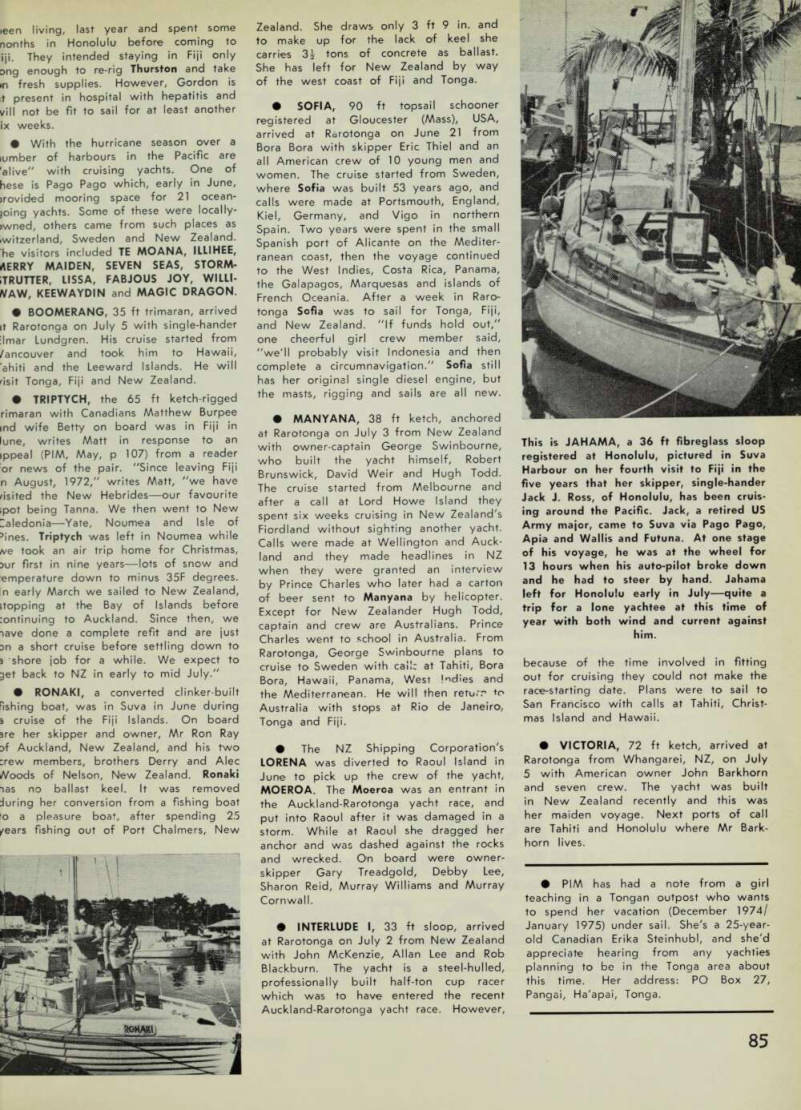
Yachts
• WANDERER IV, Eric and Susan His :ock's 48 ft steel ketch, arrived in Port Moresby on June 17 from Auckland via he New Hebrides. After a couple of /veeks' stay, Wanderer IV sailed for Torres Jtrait, Darwin, South Africa and England. • VALHALLA, a 45i ft Btoek Island cetch from Hawaii arrived in Port Moresby on June 28 from Fiji and New Hebrides. On board were Phil Deming jnd crew Dave McAdams, Lee Stopher, Doug Mitchell. After a short stay Val halla plans to sail for Indonesia and Singapore. • ESQUILO, a 29 ft steel cutter from : rance sailed from Auckland, Noumea snd the Loyalty Islands to arrive in Port Moresby on June 28. After a short stay, Don Ntealey, his French wife Nicole and
Ifieir two-year-old daughter Sabrina plan
fo sail for Darwin, Ceylon, the Seychelles, then on to South Africa. • LOTOS 11, a 32 ft fibreglass sloop From Germany, arrived in Port Moresby on June 29 from Vila. Skipper Dr Gunther Schneider told PIM he had a pleasant trip except for a collision with a whale 100 miles west of Malekula. Fortunately Lotos II suffered no damage but Dr Schneider received some bruised ribs when he was thrown from his bunk.
After four weeks' stay, Lotos II plans to sail for Torres Strait and Indonesia. • KALEWA, 37 ft sloop, registered in Vancouver (BC), arrived at Rarotonga on June 27 from Whangarei, New Zealand, with owner-captain John Cofrin, Carl Straubel and Gretchen Waters, Americans living in Canada. The cruise started from Sydney and it was planned to call at Bora Bora and Hawaii before returning to British Columbia.
O WINDAWAY, 36 ft ketch registered in Vancouver (BC) arrived at Rarotonga on June 25 from the Society Islands with owner-skipper A. Clements, his wife and their two sons. Their cruise started from British Columbia a year ago and since then they have called at California and the Marquesas and Society Islands. Plans were to visit New Zealand. • VOORDEWIND, double-ender ketch registered at Ghent, Belgium, arrived at Rarotonga from Bora Bora on June 28 with owner-skipper L. Vallaman. Mr Valla man, who built the yacht, is an ex shipwright, and hopes to complete a cir cumnavigation. He left Zeebrugge on September 17, 1972, and ports of call included the Canary Islands, Barbados,
Panama, the Galapagos, Marquesas and Society Islands. From Rarotonga, he planned to sail to Tonga, and said that future plans would depend upon the weather, • SEEKER, a 30 ft fibreglass yacht, made her first visit to Fiji in June with single-hander Jim Kennedy who is cruis ing the Pacific after retiring last year as a space engineer in the United States.
Seeker came to Fiji from Samoa where she went on a reef off Pago Pago, and spent three weeks in a land-locked lagoon before being lifted out. From Fiji, Seeker is expected to sail for the New Hebrides and then on to the Solomons and the Caroline Islands. • PIM was brought up to date on the movements of SHEBESSA, an English ketch, in a note from skipper Norman Martin and wife Sheila. During 1973 Shebessa cruised from Melbourne to Sydney, Lord Howe Island, Noumea, New Hebrides and the Solomons to New Guinea. She spent the cyclone season in Madang then left in April for Samara!; thence to Cairns where she was joined by Johnny Matthews, from London, and John Stockton, from Adelaide. After cruis ing the northern part of the Barrier Reef, Shebessa headed for Thursday Island then Darwin. They expected to leave Darwin late June for Dili, Bali, Christmas Island, Cocos Keeling, the Maldives, Seychelles, Mombasa, then down the east coast of Africa to Durban. Next year they'll return to England to complete a circumnaviga tion, either direct or via Rio. The Martins send their regards to all other cruising
yachties.
• KEEWAYDIN, 61-year-old Bermuda rigged ketch, is on her first round-the world voyage after 10 years of extensive refitting. Her new owners, Lundin Bartil and David Sundbaum, are operating their passenger/crew basis world cruise out of a small Swedish town. When she left Suva for Vila (June 27) only seven hands were aboard, most of them crew mem bers. From Vila, Keewaydin will sail for Cairns, Australia, and from there work her way slowly towards home. She is
powered by a 160 hp auxiliary motor and has wall-to-wall carpets, central heating and 16 spacious bunks. • CORAL SEA, 31 metre Polish yacht, was a recent visitor to Rarotonga, carry ing Captain AAichelowski and a crew of 10. She arrived via Amsterdam, Casa blanca, Galapagos and Rangiroa. • STRANGER IV, a 41 ft ferro-concrete yacht registered in Auckland, called at Suva during June on a round trip from New Zealand to Fiji. On board were New Zealanders lan Reid, Philip Dumper, John Nash and Glen Miller. • THURSTON, a 23 ft fibreglass sloop, registered in San Diego> California, ar rived in Fiji at the end of May with Gordon and Sylvia Thurston and their daughter Sherry (12). The Thurstons, who are Canadian citizens, are emigrating to Australia.
They left San Diego, where they had
Top picture,
Keewaydin in
full sail on Suva Harbour and at right, at anchor at Suva wharf.
»een living, last year and spent some nonths in Honolulu before coming to iji. They intended staying in Fiji only ong enough to re-rig Thurston and take m fresh supplies. However, Gordon is it present in hospital with hepatitis and vill not be fit to sail for at least another ix weeks. • With the hurricane season over a lumber of harbours in the Pacific are ’alive" with cruising yachts. One of hese is Pago Pago which, early in June, irovided mooring space for 21 ocean joing yachts. Some of these were locally >wned, others came from such places as >witzerland, Sweden and New Zealand, he visitors included TE MOANA, ILLIHEE,
Aerry Maiden, Seven Seas, Storm
Itrutter, Lissa, Fabjous Joy, Willi
Waw, Keewaydin And Magic Dragon.
• BOOMERANG, 35 ft trimaran, arrived it Rarotonga on July 5 with single-hander ilmar Lundgren. His cruise started from /ancouver and took him to Hawaii, ahiti and the Leeward Islands. He will risit Tonga, Fiji and New Zealand. • TRIPTYCH, the 65 ft ketch-rigged rimaran with Canadians Matthew Burpee ind wife Betty on board was in Fiji in lune, writes Matt in response to an ippeal (PIM, May, p 107) from a reader or news of the pair. "Since leaving Fiji n August, 1972," writes Matt, "we have risited the New Hebrides —our favourite ipot being Tanna. We then went to New Caledonia —Yate, Noumea and Isle of >ines. Triptych was left in Noumea while /ve took an air trip home for Christmas, sur first in nine years—lots of snow and emperature down to minus 35F degrees, n early March we sailed to New Zealand, (topping at the Bay of Islands before rontinuing to Auckland. Since then, we lave done a complete refit and are just 3n a short cruise before settling down to i shore job for a while. We expect to get back to NZ in early to mid July." • RONAKI, a converted clinker-built fishing boat, was in Suva in June during i cruise of the Fiji Islands. On board ire her skipper and owner, Mr Ron Ray yf Auckland, New Zealand, and his two :rew members, brothers Derry and Alec Woods of Nelson, New Zealand. Ronaki nas no ballast keel. It was removed during her conversion from a fishing boat fo a pleasure boat, after spending 25 fishing out of Port Chalmers, New
Zealand. She draws only 3 ft 9 in. and to make up for the lack of keel she carries 3i tons of concrete as ballast.
She has left for New Zealand by way of the west coast of Fiji and Tonga. • SOFIA, 90 ft topsail schooner registered at Gloucester (Mass), USA, arrived at Rarotonga on June 21 from Bora Bora with skipper Eric Thiel and an all American crew of 10 young men and women. The cruise started from Sweden, where Sofia was built 53 years ago, and calls were made at Portsmouth, England, Kiel, Germany, and Vigo in northern Spain. Two years were spent in the small Spanish port of Alicante on the Mediter ranean coast, then the voyage continued to the West Indies, Costa Rica, Panama, the Galapagos, Marquesas and islands of French Oceania. After a week in Raro tonga Sofia was to sail for Tonga, Fiji, and New Zealand. "If funds hold out," one cheerful girl crew member said, "we'll probably visit Indonesia and then complete a circumnavigation." Sofia still has her original single diesel engine, but the masts, rigging and sails are all new. • MANYANA, 38 ft ketch, anchored at Rarotonga on July 3 from New Zealand with owner-captain George Swinbourne, who built the yacht himself, Robert Brunswick, David Weir and Hugh Todd.
The cruise started from Melbourne and after a call at Lord Howe Island they spent six weeks cruising in New Zealand's Fiordland without sighting another yacht.
Calls were made at Wellington and Auck land and they made headlines in NZ when they were granted an interview by Prince Charles who later had a carton of beer sent to Manyana by helicopter.
Except for New Zealander Hugh Todd, captain and crew are Australians. Prince Charles went to school in Australia. From Rarotonga, George Swinbourne plans to cruise to Sweden with cal!: at Tahiti, Bora Bora, Hawaii, Panama, West Indies and the Mediterranean. He will then return to Australia with stops at Rio de Janeiro, Tonga and Fiji. • The NZ Shipping Corporation's LORENA was diverted to Raoul Island in June to pick up the crew of the yacht, MOEROA. The Moeroa was an entrant in the Auckland-Rarotonga yacht race, and put into Raoul after it was damaged in a storm. While at Raoul she dragged her anchor and was dashed against the rocks and wrecked. On board were owner skipper Gary Treadgold, Debby Lee, Sharon Reid, Murray Williams and Murray Cornwall. • INTERLUDE I, 33 ft sloop, arrived at Rarotonga on July 2 from New Zealand with John McKenzie, Allan Lee and Rob Blackburn. The yacht is a steel-hulled, professionally built half-ton cup racer which was to have entered the recent Auckland-Rarotonga yacht race. However,
because of the time involved in fitting out for cruising they could not make the race-starting date. Plans were to sail to San Francisco with calls at Tahiti, Christ mas Island and Hawaii. • VICTORIA, 72 ft ketch, arrived at Rarotonga from Whangarei, NZ, on July 5 with American owner John Barkhorn and seven crew. The yacht was built in New Zealand recently and this was her maiden voyage. Next ports of call are Tahiti and Honolulu where Mr Bark horn lives.
• PIM has had a note from a girl teaching in a Tongan outpost who wants to spend her vacation (December 1974/ January 1975) under sail. She's a 25-year old Canadian Erika Steinhubl, and she'd appreciate hearing from any yachties planning to be in the Tonga area about this time. Her address: PO Box 27, Pangai, Ha'apai, Tonga.
This is JAHAMA, a 36 ft fibreglass sloop registered at Honolulu, pictured in Suva Harbour on her fourth visit to Fiji in the five years that her skipper, single-hander Jack J. Ross, of Honolulu, has been cruis ing around the Pacific. Jack, a retired US Army major, came to Suva via Pago Pago, Apia and Wallis and Futuna. At one stage of his voyage, he was at the wheel for 13 hours when his auto-pilot broke down and he had to steer by hand. Jahama left for Honolulu early in July—quite a trip for a lone yachtee at this time of year with both wind and current against him.
Calling All Yachties
Your friends would like to know where you are, your plans, etc. PIM would too, so drop us a note or card with details of your boat (photo if you have one), crew, ports of call and anything of interest.
Advertisements & other items, pp. 94-96 (1 item)
Yanmar Diesel
Reliable YAMMAR
GENERATOR AND ROME
Contributing to the Full Life
*• ' I*—-
YPG Series 20 80 KVA
m
YSG Series YKS Series
1.5-IOKVA 26inches
Power. Without it, there's no way to make our lives fuller or richer.
Power. Reliable Power. Yanmar delivers it.
The people who developed the world's first compact Diesel engine. The company with the largest Diesel engine production in Japan. Yanmar. where Diesel power spans the total range from 3 to 2,000 horsepower.
Yanmar, a name synonymous with reliable Diesel power in 130 countries.
You can now put this Yanmar reliability to use in electricity generation, too—with our series YSG and YPG Diesel powered generators. Wherever a sure supply of electricity is needed—single homes,small communities, as a stand by system, on outdoor job sites.
Electricity the safe and easy way. from compact, reliable Yanmar portable generators.
The same Yanmar technology comes in our YKS series of pumps for all purposes: irriconstruction work, draining, etc.
Yanmar Diesel power. Put it to work for you.
WMyammar
DIESEL
YANMAR DIESEL EMBIME CD..LTO.
1-11-1. Marunouchi. Chiyoda-ku. Tokyo, Japan Cable; YANMAR TOKYO Telex: TOK 0222-2310
V * «ks» mm MARINE & GENERAL ENGINEERS • SHIPBUILDERS IN WOOD & STEEL • SHIP REPAIR • METALOCK CASTINGS REPAIR FOUNDRYMEN • SHEETMETAL FABRICATORS • ELECTRICAL, AIRCONDITIONING & REFRIGERATION ENGINEERS ELECTROPLATERS • COMMERCIAL KITCHEN, COOLSTORE & BAR INSTALLATIONS • JOINERY, UPHOLSTERY & FURNITURE MANUFACTURERS • TIMBER, PLYWOOD & STEEL SUPPLIES. CARPENTERS FIJI LTD
P.0.80X 296. CABLES MILLERS SUVA.TELEX 2195FJ
1 m *■ W- -2* k* m y in mg. m* **? 3r?v Caterpillar reliability, productivity, availability.
Now you can get it all in awheel skidder. The 518.
A whole new standard in skidder engineering. 120 turbocharged horsepower, 17,400 pounds of working muscle with full articulation and frame oscillation for stability and minimum maintenance.
Single lever “on the go” powershift. Dual rate steering for controlled response at all speeds.
An operator’s compartment engineered for efficiency with safety features built in for man and machine.
You’ll find all the best skidder ideas, plus added refinement and top quality manufacturing that can make the 518 the backbone of your logging operation.
And Hastings Deering will ensure that your backbone stays in top condition no matter how far in the bush you are. Parts, maintenance, repairs or simply information—we’ll see that you get it fast. That’s People Power!
So go tackle the jungle with the new Cat 518 and Hastings Deering.
People Power:
25 Years in Papua New Guinea
we work as hard,backing-up a single sale,as we do for a fleet. You can depend on it! n
HASTINGS DEERING
B
YOUR > ‘ :i
CATERPILLAR
DEALER i
Throughout Queensland, Northern Territory and South-West Pacific.
British pacific jet
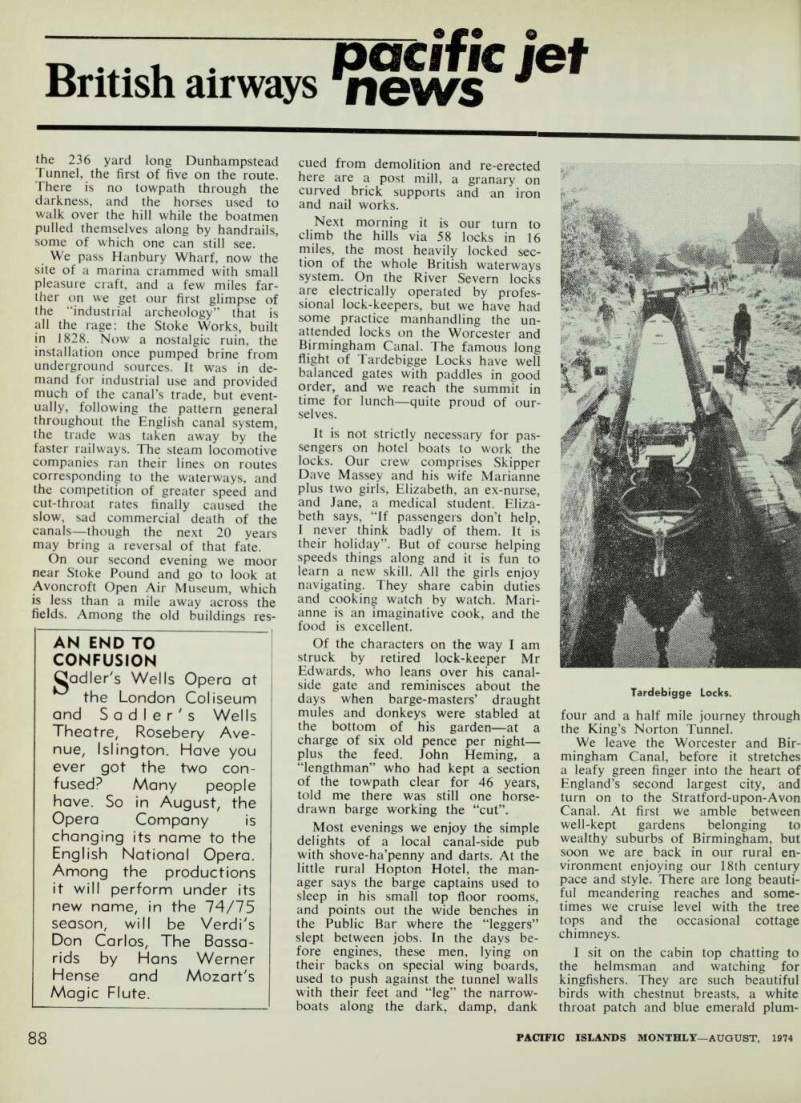
airways news
Holidays For The Narrow-Minded
Published By British Airways
A Pim Advertising Supplement
By Anne Bolt
AT the little town of Stourport in Worcestershire I join the pair of narrow boats that are to be my home for a week. They are 70 feet long by just under seven feet wide—or should I say seven feet narrow. The motorboat Snipe, has a saloon and bar. It is diesel powered and tows the engineless Taurus, the “butty”, with dining room and kitchen. Each boat accommodates six passengers in one double and four single cabins.
Along the corridor is a hot shower.
It’s surprising how comfortable the miniature cabins are, with plenty of running water for their hand-basins, a tiny wardrobe and honey-coloured pine panelling that makes them look
pleasantly ship-shape.
Stourport still has a few pleasant Georgian corners. The town grew up around the important junction of the Stafford and Worcestershire Canal and the Severn river. (By and large England’s canals were dug out and rivers made navigable at the end of the 18th and beginning of the 19th century. The inland waterways sys tem really dates from 1761, after the third Duke of Bridgewater decided to build a canal to carry coal from his mines to Manchester.) In Snipe and Taurus we start our journey from a complex of basins and locks. Stourport used to be the busiest of inland waterway junctions, with warehouses for cargoes, several hostelries for travellers, cottages for bargemasters, and rows of stables for the horses that towed the boats.
Though nowadays commercial traffic has virtually ceased, the basins are bright with pleasure boats, the cus toms house has become a boat club and the clock-tower still functions.
We “lock down” to the tranquil waters of the Severn and slide gently downstream. On the river the speed
limit is six miles an hour upstream and eight downstream. Stretched out in the sun on the cabin top I pretend to myself that I might read a book, but really I indulge in pure inactivity, unqualified relaxation. We pass a Severn Trow, one of the vessels which used to sail up from Bristol to tranship cargo at Stourport, now used by a sailing club.
Holt Reach, lined with weeping willows, is particularly beautiful, and so too are the swans which decorate the river as it winds beside the city
of Worcester. The Gathedral and the Bishop’s Palace overlook the water and on the nght bank the meadows provide wha must be one of Britain s most perfectly situated county cricket
grounds.
Next day we follow the Worcester and Birmingham Canal, finding a different sort of world. The banks seem almost close enough to touch and are lined with water lilies, purple loosestrife and orange balsam. We see herons standing sentinel along the banks. A wooded cutting leads us to
the 236 yard long Dunhampstead Tunnel, the first of five on the route.
There is no towpath through the darkness, and the horses used to walk over the hill while the boatmen pulled themselves along by handrails, some of which one can still see.
We pass Hanbury Wharf, now the site of a marina crammed with small pleasure craft, and a few miles far ther on we get our first glimpse of the “industrial archeology” that is all the rage: the Stoke Works, built in 1828. Now a nostalgic ruin, the installation once pumped brine from underground sources. It was in de mand for industrial use and provided much of the canal’s trade, but event ually, following the pattern general throughout the English canal system, the trade was taken away by the faster railways. The steam locomotive companies ran their lines on routes corresponding to the waterways, and the competition of greater speed and cut-throat rates finally caused the slow, sad commercial death of the canals—though the next 20 years may bring a reversal of that fate.
On our second evening we moor near Stoke Pound and go to look at Avoncroft Open Air Museum, which is less than a mile away across the fields. Among the old buildings res
cued from demolition and re-erected here are a post mill, a granary on curved brick supports and an iron and nail works.
Next morning it is our turn to climb the hills via 58 locks in 16 miles, the most heavily locked sec tion of the whole British waterways system. On the River Severn locks are electrically operated by profes sional lock-keepers, but we have had some practice manhandling the un attended locks on the Worcester and Birmingham Canal. The famous long flight of Tardebigge Locks have well balanced gates with paddles in good order, and we reach the summit in time for lunch—quite proud of our selves.
It is not strictly necessary for pas sengers on hotel boats to work the locks. Our crew comprises Skipper Dave Massey and his wife Marianne plus two girls, Elizabeth, an ex-nurse, and Jane, a medical student. Eliza beth says, “If passengers don’t help, I never think badly of them. It is their holiday”. But of course helping speeds things along and it is fun to learn a new skill. All the girls enjoy navigating. They share cabin duties and cooking watch by watch. Mari anne is an imaginative cook, and the food is excellent.
Of the characters on the way I am struck by retired lock-keeper Mr Edwards, who leans over his canal side gate and reminisces about the days when barge-masters’ draught mules and donkeys were stabled at the bottom of his garden— at a charge of six old pence per night— plus the feed. John Heming, a “lengthman” who had kept a section of the towpath clear for 46 years, told me there was still one horse drawn barge working the “cut”.
Most evenings we enjoy the simple delights of a local canal-side pub with shove-ha’penny and darts. At the little rural Hopton Hotel, the man ager says the barge captains used to sleep in his small top floor rooms, and points out the wide benches in the Public Bar where the “leggers” slept between jobs. In the days be fore engines, these men, lying on their backs on special wing boards, used to push against the tunnel walls with their feet and “leg” the narrow boats along the dark, damp, dank
four and a half mile journey through the King’s Norton Tunnel.
We leave the Worcester and Bir mingham Canal, before it stretches a leafy green finger into the heart of England’s second largest city, and turn on to the Stratford-upon-Avon Canal. At first we amble between well-kept gardens belonging to wealthy suburbs of Birmingham, but soon we are back in our rural en vironment enjoying our 18th century pace and style. There are long beauti ful meandering reaches and some times we cruise level with the tree tops and the occasional cottage chimneys.
I sit on the cabin top chatting to the helmsman and watching for kingfishers. They are such beautiful birds with chestnut breasts, a white throat patch and blue emerald plum
Tardebigge Locks.
age which seems iridescent as they flash across the water.
Skipper Dave, steering Snipe, is happy to teach me canal lore, for in their three years on the water he and his wife have become fascinated by narrow-boat life. Their cabin was colourful in traditional fashion, with gleaming brass, hand-made lace and pretty plates, threaded with ribbon and hung on the walls.
The estuaries and rivers of Britain are navigated by sailors and sea terminology is current. Families working on inland waterways have evolved their own patois. There is no port and starboard for instance.
You call to the “steerer” not helmsman, “Hold in”, ie turn towards the towpath, or “Hold out”. We pass an old narrow-boat, “That’s a Josher”, says Dave. The boat was once owned by Fellows, Morton & Clayton Ltd, and the late Mr Fellows was called Joshua On our last day we follow the Grand Union Canal, skirting the remains of Shakespeare’s Forest of Arden. Instead of travelling tandem the waterway is wide enough for the narrow-boats to be breasted up, and thus side by side we navigate a flight of 20 locks in 1 hour 28 minutes.
Dave says he has never bettered 1 hour 40 minutes before, and we are all particularly proud of a tiny round elderly passenger who walked the lot, taking it as her job to shut one of the gates behind the boats. Between locks we travel at a spanking 10 miles an hour, the speed limit, and so I am able to accept an invitation to inspect a newly converted narrow-boat, have a cup of coffee
and still catch up Snipe and Taurus three locks farther on.
In the afternoon, we moor opposite the charmingly named Cape of Good Hope, a tiny waterman’s pub on the outskirts of Warwick, and there is time to see historic Warwick Castle, which crowns a steep cliff above the meanders of the River Avon. Legend has it the first earth works were erected by Etbelfleda, daughter of Alfred the Great, in 916 AD. Cer tainly before William the Conquer or’s day there was an imposing forti fication and the castle as it stands now was largely built in the 14th century.
You don’t come across a Warwick castle every few miles. Canal-side scenery and canal life itself is more intimate, more suggestive of a slowed down film of rural life as it still exists away from busy roads and city centres. if you want to take a cruiser on the inland waterways James Hoseasons of Sunday ou , st of**. Suffolk, is agen f , °f hire firms based a . / locations.
If you prefer a more gentle journey with someone else to navigate and cook for you, Peter Proud, of Inland Waterway Holiday Cruises, Preston Brook, Runcorn, Cheshire, has three pairs of hotel narrow-boats, including Snipe and Taurus, which operate a number of different cruises including the beautiful Welsh canals as well as the English waterways.
Similar facilities are available from the Inland Cruising Company, of Braunston, Daventry, Northampton shire.
Eating out in Hong Kong
Having acquired a copy of “How to Order Chinese Food , which is available from the Hong Kong Tourist Association a visitor will probably wonder where to go to try out his new-found knowledge.
There are numerous food guides available in Hong Kong, but one that has proved very popular with visitors and residents alike is Eating Out in Hons Kong’’. This book was originally written by Judith Brodie, and it recently came out in a new edition with updated information by Peggy ' ll This guide represents a very personal selection of what the author con siders are the best restaurants in Hong Kong.
Personal visits have been paid to all the restaurants and all types of cuisine are included. , There are of course a number of Cantonese restaurants in the book, after all Cantonese food predominates in Hong Kong. For more exotic fare try one of Chiu Chow or Swatow restaurants or perhaps the very hot food served in Hong Kong’s Szechwan restaurants. . .
But there are also Mexican, Italian, Indian and French restaurants in this very ’ extensive selection, something for every palate. .
The restaurants are listed according to type of cuisine at the beginning of the book, and then appear in alphabetical order throughout. There are selections from the menu for each establishment, and approximate prices.
Those restaurants which accept credit cards have been marked accordingly.
There is a list by location as well, very convenient if you are trying to find somewhere near your hotel, and an outline map at the back of the book will identify the various areas.
The book is available in Hong Kong from book-shops and stationers at HKS7.
Advertisements & other items, p. 98 (1 item)
An End To
CONFUSION
Wells Opera at the London Coliseum and Sadler's Wells Theatre, Rosebery Avenue, Islington. Have you ever got the two confused? Many people have. So in August, the Opera Company is changing its name to the English National Opera.
Among the productions it will perform under its new name, in the 74/75 season, will be Verdi's Don Carlos, The Bassarids by Hans Werner Hense and Mozart's Magic Flute.
You Can Be In Darwin And London On
The Same Day By British Airways!
British Airways flight schedules which were introduced recently make it possible to be in Darwin and London on the same day!
The service leaving Darwin at 12.30 am on Tuesdays arrives in London at 3.55 pm the same day (London time of course).
There are now four British Airways flights a week from Darwin to London. The other three leave at 7.40 pm on Sundays, 8.10 pm on Tuesdays and 5.40 pm on Wednesdays. All arrive in London next morning.
The services are operated by super VCIO jetliners.
The four return flights leaving London on Mondays, Tuesdays, Thursdays and Saturdays are all by 747 jumbo jets.
Sydney
Fiji athlete joins British Airways in Sydney
A former Suva Grammar School boy with an outstanding record in the sporting field, has recently joined British Airways in Sydney as a reser vations assistant.
He is Fiji - born 24 - year - old Grahame Gillmore who first repre sented his country in a junior inter national event as long ago as 1963 when he swam for Fiji against Aus tralia and New Zealand.
When the second South Pacific Games were held in Noumea in 1966 he represented Fiji in the swimming events.
While working in New Zealand in 1969, he and some friends from Fiji raced an 18-footer and finished third in the fresh water championships.
Later that year, Grahame represented Fiji in yachting in the third South Pacific Games and gained a bronze medal.
In January 1971 he competed in the South Pacific javelin champion ships in New Zealand, again repre senting Fiji.
In the 4th South Pacific Games in August 1971 in Papeete, Tahiti, he captained the swimming team and competed in the yachting section.
In 1973, he won the Fiji open championships in yachting and repre sented the country in yachting in Australia in January 1974.
From 1965 to 1969 Grahame com peted in the Fiji cycle races held in conjunction with the hibiscus festival and won the sprint twice and the distance three times.
Since leaving Fiji for Australia early this year, he has taken up motor cross riding. His next target? —the Sydney/Hobart yacht race.
Before joining British Airways, Grahame was a senior passenger agent with American Airlines in Suva.
Advertisements & other items, p. 99 (1 item)
r ; ; pacific jet
89
r ; ; pacific jet British airways news
PACIFIC ISLANDS MONTHLY—AUGUST, 19H
Big Prizes For The Ba Junior Jet-Setters!
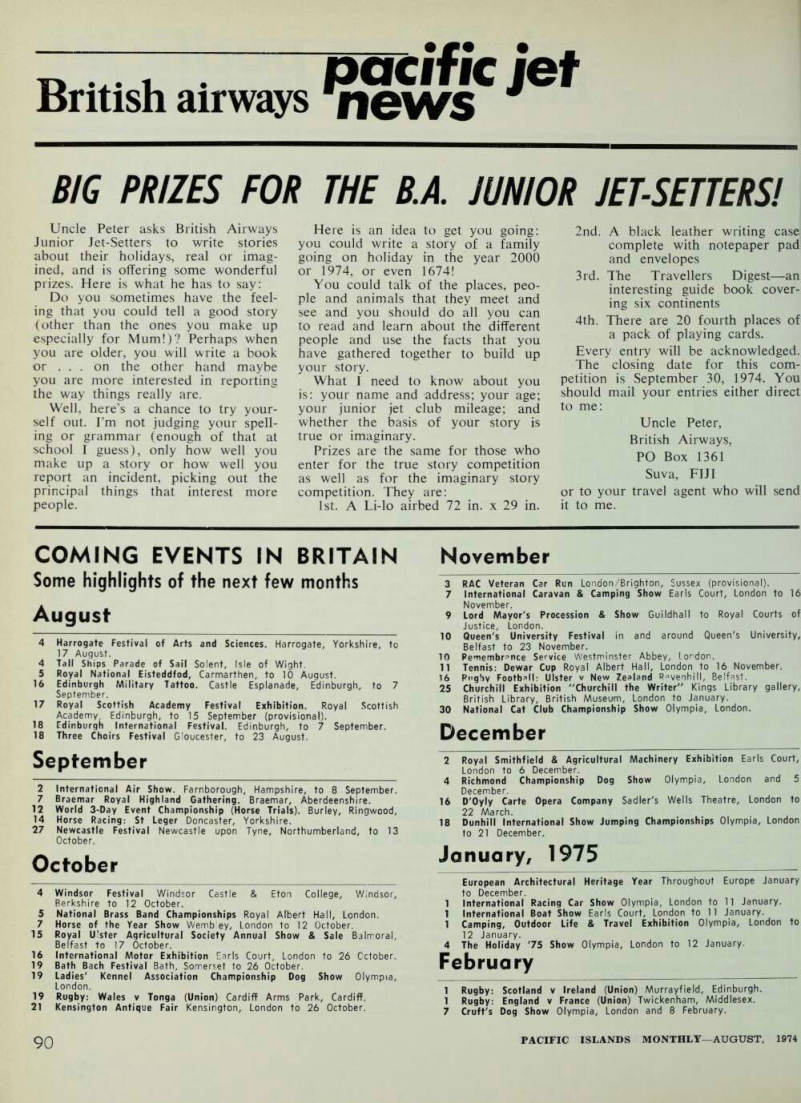
Uncle Peter asks British Airways Junior Jet-Setters to write stories about their holidays, real or imag ined, and is offering some wonderful prizes. Here is what he has to say: Do you sometimes have the feel ing that you could tell a good story (other than the ones you make up especially for Mum!)? Perhaps when you are older, you will write a book or ... on the other hand maybe you are more interested in reporting the way things really are.
Well, here’s a chance to try your self out. I’m not judging your spell ing or grammar (enough of that at school I guess), only how well you make up a story or how well you report an incident, picking out the principal things that interest more people.
Here is an idea to get you going: you could write a story of a family going on holiday in the year 2000 or 1974, or even 1674!
You could talk of the places, peo ple and animals that they meet and see and you should do all you can to read and learn about the different people and use the facts that you have gathered together to build up your story.
What I need to know about you is: your name and address; your age; your junior jet club mileage; and whether the basis of your story is true or imaginary.
Prizes are the same for those who enter for the true story competition as well as for the imaginary story competition. They are; Ist. A Li-lo airbed 72 in. x 29 in.
2nd. A black leather writing case complete with notepaper pad and envelopes 3rd. The Travellers Digest—an interesting guide book cover ing six continents 4th. There are 20 fourth places of a pack of playing cards.
Every entry will be acknowledged.
The closing date for this com petition is September 30, 1974. You should mail your entries either direct to me: Uncle Peter, British Airways, PO Box 1361 Suva, FIJI or to your travel agent who will send it to me.
August
Coming Events In Britain
Some highlights of the next few months
4 Harrogate Festival of Arts and Sciences. Harrogate, Yorkshire, to 17 August. 4 Tall Ships Parade of Sail Solent, Isle of Wight. 5 Royal National Eisteddfod, Carmarthen, to 10 August. 16 Edinburgh Military Tattoo. Castle Esplanade, Edinburgh, to 7 September. 17 Royal Scottish Academy Festival Exhibition. Royal Scottish Academy, Edinburgh, to 15 September (provisional). 18 Edinburgh International Festival. Edinburgh, to 7 September. 18 Three Choirs Festival Gloucester, to 23 August.
September
2 International Air Show. Farnborough, Hampshire, to 8 September. 7 Braemar Royal Highland Gathering. Braemar, Aberdeenshire. 12 World 3-Day Event Championship (Horse Trials). Burley, Ringwood, 14 Horse Racing; St Leger Doncaster, Yorkshire. 27 Newcastle Festival Newcastle upon Tyne, Northumberland, to 13 October.
October
4 Windsor Festival Windsor Castle & Eton College, Windsor, Berkshire to 12 October. 5 National Brass Band Championships Royal Albert Hall, London. 7 Horse of the Year Show Wemb ey, London to 12 October. 15 Royal U'ster Agricultural Society Annual Show & Sale Balmoral, Belfast to 17 October. 16 International Motor Exhibition Earls Court, London to 26 October. 19 Bath Bach Festival Bath, Somerset to 26 October. 19 Ladies' Kennel Association Championship Dog Show Olympia, London. 19 Rugby; Wales v Tonga (Union) Cardiff Arms Park, Cardiff. 21 Kensington Antique Fair Kensington, London to 26 October.
November
3 RAC Veteran Car Run London/Brighton, Sussex (provisional). 7 International Caravan & Camping Show Earls Court, London to 16 November. 9 Lord Mayor's Procession & Show Guildhall to Royal Courts of Justice, London. 10 Queen's University Festival in and around Queen's University, Belfast to 23 November. 10 Remembrance Service Westminster Abbey, London. 11 Tennis: Dewar Cup Royal Albert Hall, London to 16 November. 16 Rugby Football: Ulster v New Zealand R=venhill, Belfast. 25 Churchill Exhibition "Churchill the Writer" Kings Library gallery, British Library, British Museum, London to January. 30 National Cat Club Championship Show Olympia, London.
December
2 Royal Smithfield & Agricultural Machinery Exhibition Earls Court, London to 6 December. 4 Richmond Championship Dog Show Olympia, London and 5 December. 16 D'Oyly Carte Opera Company Sadler's Wells Theatre, London to 22 March. 18 Dunhill International Show Jumping Championships Olympia, London to 21 December.
January, 1975
European Architectural Heritage Year Throughout Europe January to December. 1 International Racing Car Show Olympia, London to 11 January. 1 International Boat Show Earls Court, London to 11 January. 1 Camping, Outdoor Life & Travel Exhibition Olympia, London to 12 January. 4 The Holiday '75 Show Olympia, London to 12 January.
February
1 Rugby; Scotland v Ireland (Union) Murrayfield, Edinburgh. 1 Rugby; England v France (Union) Twickenham, Middlesex. 7 Cruft's Dog Show Olympia, London and 8 February.
Advertisements & other items, pp. 100-102 (2 items)
British airways news
90
PACIFIC ISLANDS MONTHLY—AUGUST, 1974
u ... i . pacific jet British airways news
Seiko
Automatic self-winding, Water resistant, Automatic self-winding. Water resistant Second setting device, instant day and date setting Second setting device, Instant day and date setting
Technology of the future.
Dedication of the past.
Seiko, the quality watch of today.
Every Seiko watch is a triumphant merger of Seiko's unique microelectronic-technology and time-honored tradition of handcraftsmanship.
Add to all this Seiko's insistence on making every part of every Seiko watch, thus quality-controlling every step.
This unique merging of future technology and past dedication creates the quality watch of today: Seiko.
SEIKO
K. Hattorl & Co., Ltd., Tokyo, Japan.
Someday all watches will be made this way.
STATESMAN
smoothest cigars on
S otjN"fd 0 tjN"f d 1801
’’MLzS
mm < US* .
STATESMAN
CORONA
5
Corona
0585
Official Centre Overseas
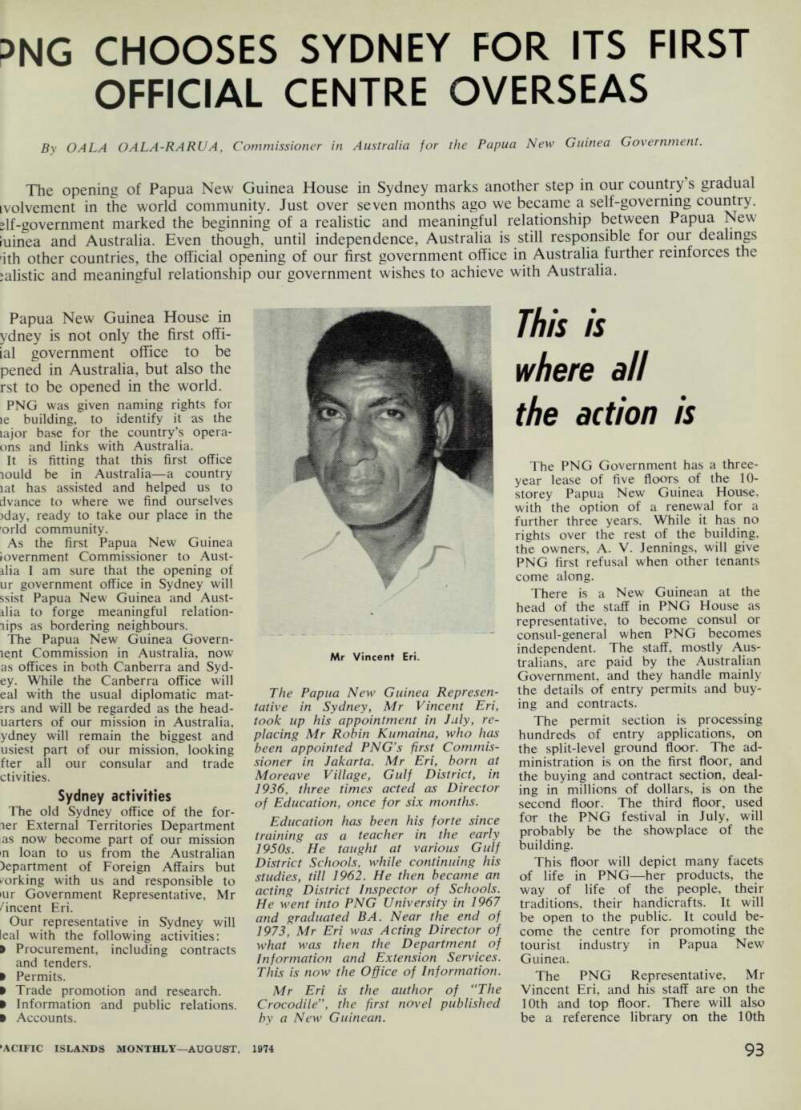
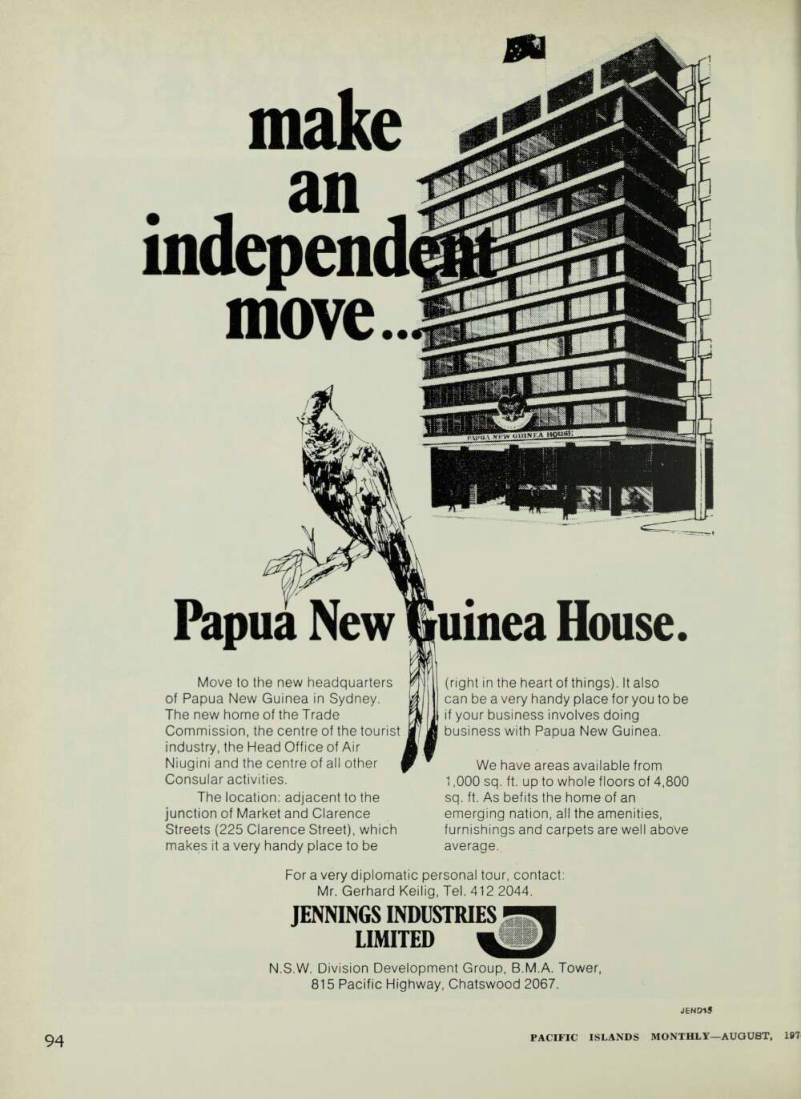
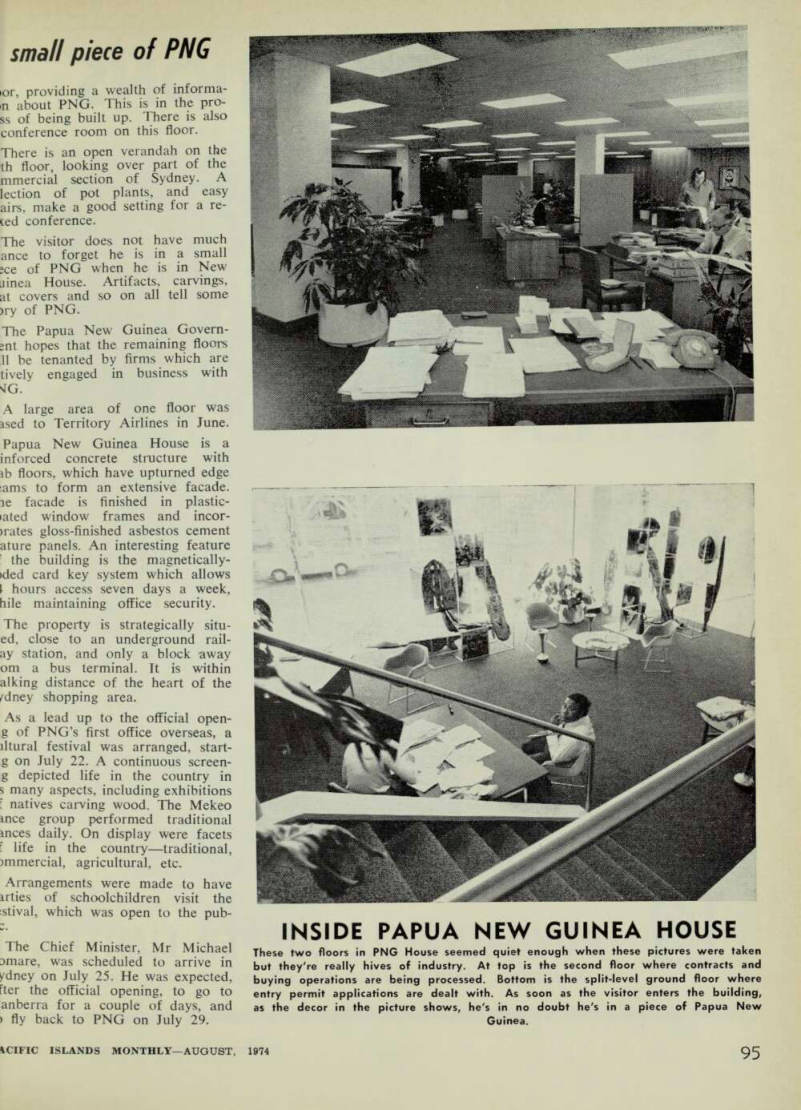
Png Chooses Sydney For Its First
By OALA OALA-RARUA, Commissioner in Australia for the Papua New Guinea Government.
The opening of Papua New Guinea House in Sydney marks another step in our country s gradual ivolvement in the world community. Just over seven months ago we became a self-governing country, fff-government marked the beginning of a realistic and meaningful relationship between Papua New minea and Australia. Even though, until independence, Australia is still responsible for our dealings r ith other countries, the official opening of our first government office in Australia further reinforces the jalistic and meaningful relationship our government wishes to achieve with Australia.
Papua New Guinea House in ydney is not only the first offi ial government office to be pened in Australia, but also the rst to be opened in the world.
PNG was given naming rights for ie building, to identify it as the lajor base for the country’s opera ons and links with Australia.
It is fitting that this first office lould be in Australia—a country lat has assisted and helped us to dvance to where we find ourselves )day, ready to take our place in the orld community.
As the first Papua New Guinea lovernment Commissioner to Aust ria I am sure that the opening of ur government office in Sydney will ssist Papua New Guinea and Aust ria to forge meaningful relation lips as bordering neighbours.
The Papua New Guinea Govern lent Commission in Australia, now as offices in both Canberra and Syd ey. While the Canberra office will eal with the usual diplomatic mat jrs and will be regarded as the head uarters of our mission in Australia, ydney will remain the biggest and usiest part of our mission, looking fter all our consular and trade ctivities.
Sydney activities
The old Sydney office of the for ier External Territories Department as now become part of our mission >n loan to us from the Australian )epartment of Foreign Affairs but working with us and responsible to iur Government Representative, Mr Vincent Eri.
Our representative in Sydney will leal with the following activities: I Procurement, including contracts and tenders.
I Permits. • Trade promotion and research. • Information and public relations, a Accounts.
The Papua New Guinea Represen tative in Sydney, Mr Vincent Eri, took up his appointment in July, re placing Mr Robin Kumaina, who has been appointed PNG’s first Commis sioner in Jakarta. Mr Eri, born at Moreave Village, Gulf District, in 1936, three times acted as Director of Education, once for six months.
Education has been his forte since training as a teacher in the early 19505. He taught at various Gulf District Schools, while continuing his studies, till 1962. He then became an acting District Inspector of Schools.
He went into PNG University in 1967 and graduated BA. Near the end of 1973, Mr Eri was Acting Director of what was then the Department of Information and Extension Services.
This is now the Office of Information.
Mr Eri is the author of “The Crocodile”, the first novel published by a New Guinean.
This is where all the action is
The PNG Government has a three year lease of five floors of the 10storey Papua New Guinea House, with the option of a renewal for a further three years. While it has no rights over the rest of the building, the owners, A. V. Jennings, will give PNG first refusal when other tenants come along.
There is a New Guinean at the head of the staff in PNG House as representative, to become consul or consul-general when PNG becomes independent. The staff, mostly Aus tralians, are paid by the Australian Government, and they handle mainly the details of entry permits and buy ing and contracts.
The permit section is processing hundreds of entry applications, on the split-level ground floor. The ad ministration is on the first floor, and the buying and contract section, deal ing in millions of dollars, is on the second floor. The third floor, used for the PNG festival in July, will probably be the showplace of the building.
This floor will depict many facets of life in PNG—her products, the way of life of the people, their traditions, their handicrafts. It will be open to the public. It could be come the centre for promoting the tourist industry in Papua New Guinea.
The PNG Representative, Mr Vincent Eri, and his staff are on the 10th and top floor. There will also be a reference library on the 10th
Mr Vincent Eri.
small piece of
ior, providing a wealth of informa ,n about PNG. This is in the pre ss of being built up. There is also conference room on this floor.
There is an open verandah on the th floor, looking over part of the mmercial section of Sydney. A lection of pot plants, and easy airs, make a good setting for a re ced conference.
The visitor does not have much ance to forget he is in a small ;ce of PNG when he is in New uinea House. Artifacts, carvings, at covers and so on all tell some >ry of PNG.
The Papua New Guinea Govem ent hopes that the remaining floors 11 be tenanted by firms which are lively engaged in business with sIG.
A large area of one floor was ased to Territory Airlines in June.
Papua New Guinea House is a inforced concrete structure with ib floors, which have upturned edge :ams to form an extensive facade, le facade is finished in plastic lated window frames and incor >rates gloss-finished asbestos cement ature panels. An interesting feature : the building is the magnetically ►ded card key system which allows 1 hours access seven days a week, hile maintaining office security.
The property is strategically situ ed, close to an underground rail ay station, and only a block away om a bus terminal. It is within alking distance of the heart of the shopping area.
As a lead up to the official open g of PNG’s first office overseas, a iltural festival was arranged, start g on July 22. A continuous screen g depicted life in the country in s many aspects, including exhibitions : natives carving wood. The Mekeo mce group performed traditional inces daily. On display were facets I life in the country—traditional, immercial, agricultural, etc.
Arrangements were made to have irties of schoolchildren visit the istival, which was open to the pub- The Chief Minister, Mr Michael 3mare, was scheduled to arrive in /dney on July 25. He was expected, her the official opening, to go to anberra for a couple of days, and ) fly back to PNG on July 29.
Advertisements & other items, pp. 103-104 (2 items)
93
■ACIFIC ISLANDS MONTHLY—AUGUST, 1974
independ
make
move..
I'U\ vt w oiit*rA \/s
Papua New guinea House.
Move to the new headquarters of Papua New Guinea in Sydney.
The new home of the Trade Commission, the centre of the tourist industry, the Head Office of Air Niugini and the centre of all other Consular activities.
The location; adjacent to the junction of Market and Clarence Streets (225 Clarence Street), which makes it a very handy place to be (right in the heart of things). It also can be a very handy place for you to be if your business involves doing business with Papua New Guinea.
We have areas available from 1,000 sq. ft. up to whole floors of 4,800 sq. ft. As befits the home of an emerging nation, all the amenities, furnishings and carpets are well above average.
For a very diplomatic personal tour, contact; Mr. Gerhard Keilig, Tel. 412 2044.
JENNINGS INDUSTRIES
LIMITED
N.S.W. Division Development Group, B.M.A. Tower, 815 Pacific Highway, Chatswood 2067.
JENDSJ
Inside Papua New Guinea House
These two floors in PNG House seemed quiet enough when these pictures were taken but they're really hives of industry. At top is the second floor where contracts and buying operations are being processed. Bottom is the split-level ground floor where entry permit applications are dealt with. As soon as the visitor enters the building, as the decor in the picture shows, he's in no doubt he's in a piece of Papua New Guinea.
Advertisements & other items, pp. 105-106 (2 items)
95
ICIFIC ISLANDS MONTHLY—AUGUST, 1974
' jlttf
CONGRATULATIONS
TO
PAPUA
NEW
GUINEA
Sure steps to self-government in 1973 established for Papua New Guinea a pattern of progress towards independence and a full place in world affairs.
The opening of Papua New Guinea House as a Trade, Consular and Tourist Centre in Sydney is a positive indication of the progress being made.
Bougainville Copper Limited works to make a substantial contribution to Papua New Guinea's development and bright future. ■ ■ ; **
' jlttf
•m ■ v„"‘ ✓ / i ■O. a m m ...' m 8 WL ■ t
BOUGAINVILLE COPPER LIMITED
PANGUNA, BOUGAINVILLE ISLAND, PAPUA NEW GUINEA
An 8-Point Plan For Prosperity
From a Port Moresby correspondent
Papua New Guinea’s philosophy is an eight-point improvement plan which did not just happen overnight.
It evolved from visits ministers, led by the Chief Minister, made to towns and villages.
The ministers soon realised, after meeting many people, that although different areas had different problems, there was an overall similarity. Many continuing policies, drawn up under earlier administrations, were out of date. They did not provide for the type of development PNG wanted.
Mr Somare reported that some of the problems were; • Villages almost empty of young men who had gone to the towns for work; • Unemployment in the towns; 9 Sick people having to walk miles for medical help; • Schooling which did not pre pare students for life in the villages or towns; • A lack of roads and bridges which stopped people from taking their produce to market;
• Small businesses and co operatives not making profits; • A wide gap in living standards between a few rich and a majority poor.
To tackle these problems an over all philosophy of development was laid down so that all government de partments could work to the kind of development required. Many de partments have produced new plans and ideas which will help to develop the eight-point plan philosophy.
The eight-point improvement plan is: • A rapid increase in the pro portion of the economy under the control of New Guinean individuals and groups, and in the proportion of personal and property income that goes to New Guineans; • More equal distribution of economic benefits, including move ment towards equalisation of incomes among people and toward equalisa tion of services among different areas of the country; • Decentralisation of economic
activity, planning and government spending, with emphasis on agricul tural development, village industry, better internal trade and more spend ing channelled to local and area bodies; • An emphasis on small-scale artisan, service and business activity, relying where possible on typically New Guinean forms of economic activity; • A more self-reliant economy, less dependent for its needs on im ported goods and services and better able to meet the needs of its people through local production; • An increasing capacity for meet ing government spending needs from locally raised revenue; e A rapid increase in the activity and equal participation of women in all forms of economic and social activity; • Government control and in volvement in those sectors of the economy where control is necessary to achieve the desired kind of de velopment.
Advertisements & other items, pp. 107-108 (1 item)
peter lovell packers
for fast dependable service...
peter lovell
PTY.
LTD.
CARRIERS, CUSTOMS & FORWARDING
AGENTS; AIRFREIGHT HANDLERS
peter lovell packers
I i
COMPLETE PACKING SERVICE
RO. BOX 322 PORT MORESBY
PAPUA NEW GUINEA
SPEEDY SERVICE
RADIO CONTROLLED VEHICLES
HORNIBROOK CONSTRUCTIONS
PTY. LIMITED.
are proud to be partners In
the progress of
Papua New Guinea
STEEL FABRICATORS • STEEL MERCHANTS
CIVIL ENGINEERING & BUILDING CONTRACTORS
Ww SL £3 r
HEAD OFFICE:
BRIDGE GIRDERS • TRUSSES • TANKS • CONVEYORS • WIDE RANGE OF BEAMS • ANGLES • CHANNELS • PLATES • PIPES • REINFORCING STEEL • CIVIL
ENGINEERING CONTRACTING • WHARVES • BRIDGES
• PILED FOUNDATIONS • BUILDINGS • FACTORIES
• WAREHOUSES.
FABRICATION FACILITIES ALSO AT LAE AND
MADANG.
PORT MORESBY: SPRING GARDEN ROAD, HOHOLA
P.O. BOX 1396, BOROKO, PNG. PH. 53099
ENQUIRIES FOR EXPORTED FABRICATED
STRUCTURAL STEELWORK GIVEN PROMPT
ATTENTION.
A DIVISION OF WOOD HALL LTD.
m
Welcome to
PNG HOUSE
Sydney
de Havilland Marine congratulates the PNC Government on the establishment of PNG House and is proud to have supplied marine craft to PNG Government Departments for the past decade. de Havilland Marine DIVISION OF HAWKER DE HAVILLAND AUSTRALIA PTY. LIMITED *0
fly the

PNG will fly the 'peace flag'
Although not yet independent, and ilthough Australia is still responsible ‘or her overseas affairs, Papua New Guinea is quietly developing a ; oreign policy.
PNG is keen to identify itself imong the nations of the world, and dready several countries have quietly ‘invaded” the country over the last or so with foreign representa ;ion. These include Britain, Indo lesia, New Zealand and Australia— i full-blown diplomatic corps in the naking.
PNG has already set up overseas >ffices in Canberra and Sydney, and vill soon add offices in Wellington, Suva, Jakarta, Tokyo and New York.
Fhese offices will undertake a full ange of diplomatic, trade and con sular functions.
The PNG Chief Minister, Mr Michael Somare, believes PNG must idopt what he calls a “universalist stance”. While she was interested in ‘he ideological and security questions which faced the world today, PNG would not neglect its commitment to her people by involving herself in international squabbling on those issues, he said.
PNG will not seek any form of ideological or military grouping with the big powers. PNG supports a zone of true peace and neutrality in the oceans which lie on either side—the Pacific and the Indian. PNG wants them to be kept free of the arms race in which the big powers competed for military prestige. Although not yet a member of the United Nations, PNG believes in the principles of the UN charter, and will co-operate with all efforts to promote peace, security and international justice.
The basic foreign policy has already been laid down by the Minister for Defence, Foreign Affairs and Trade, Mr Albert Maori Kiki and the PNG Cabinet. Mr Kiki’s portfolio covers three important and sensitive departments of government, all closely linked. As time passes it is likely that each department will have a separate minister, as foreign affairs, defence and trade will be too much for one man.
PNG will be no fledgling in foreign affairs when it becomes independent.
The country has already been directly involved in international meetings and negotiations—trade talks with Japan,
and formalising border agreements with her nearest neighbour, Indonesia, „ . . .
In foreign economic policies, Papua New Guinea enters what Mr Somare calls “a period of exciting economic challenge” as she realises the extent and wealth of her natural resources. In realising her resource potential, he says two factors will underlie every decision made on foreign economic policy: • That about 95 per cent of the people live in a traditional village society; • A system of real values, the mainstay of the country’s society, has developed over hundreds of years.
Mr Somare says these values will not be destroyed for the sake of what is known as development and rofiress v & Several PNG leaders, notably the Chief Minister, and the Finance Minister, Mr Julius Chan, have laid down the terms for foreign invest ment. Basically foreign investment will be on PNG terms for the benefit of the PNG people, while still allow mg investors profit from their enter prise (see p 102), There is no intention on the part of the present government to take Papua New Guinea out of the British Commonwealth. Mr Somare, during
4/7 office in Suva
he Royal tour of PNG by the Queen ;arlier this year said it was his per ;onal hope that the flag of PNG vould soon fly alongside the flags >f other Commonwealth countries. 3 NG would benefit from contacts vith the African bloc and Caribbean :ountries in the Commonwealth.
Zontact with those countries could ead to cultural exchange and a greater understanding and co iperation in solving similar develop nent problems.
PNG would maintain its trade links vith Britain, and through Britain with he EEC. Much of the foreign policy vould be directed to relationships vith other Pacific countries.
Mr Somare believes the Pacific islands can best protect their in erests and further their aspirations hrough regional co-operation. PNG vill have a role in the South Pacific 'orum, where she meets Island leighbours on an equal footing. An ndication of the importance she ittaches to her relationship with her sland neighbours is the decision to et up an office in Suva.
But PNG is also keen to have a >etter understanding with Indonesia
and other Asian countries within the
ASEAN regional grouping. PNG
supports the tormation of regional groupings of countries with common interests and objectives, and is keenly interested in proposals for a quadri partite grouping covering PNG, Indo nesia, Australia and New Zealand.
Overall, PNG is aiming at a home grown foreign policy, and not one with large sections grafted on by others, or borrowed from others.
Thus, she is prepared to take her time about developing her foreign affairs policy, and not jump in too quickly to form alliances, or take sides on world issues.
Almost coinciding with the official opening of Papua New Guinea House was the appointment of three diplo matic appointments in overseas posts.
Mr Robin Kumaina, Representative of the PNG Government in Sydney, will go to Jakarta as Commissioner and Representative to the Indonesian Government. Mr Leo Morgan, re cently Assistant Secretary, Ministerial Services in the Department of the Chief Minister and Development Administration is Commissioner in Wellington and Representative to the NZ Government. Mr Vincent Eri is in Sydney as Representative (see p 93 for background).
Advertisements & other items, pp. 109-111 (2 items)
"Service"
n o Hr * -0 2 O \ UV > c
In our 80th year
Selling
"SERVICE"
to the Pacific Islands
NELSON & ROBERTSON
PTY. LIMITED
PLANTATION HOUSE, 197 CLARENCE STREET, SYDNEY
CABLES: "IVAN", SYDNEY, BRISBANE. TELEX: AA22381, SYDNEY.
AND OUR ASSOCIATED COMPANY
N. & R. TRAVEL PTY. LTD.
Take great pleasure in welcoming
PAPUA NEW GUINEA HOUSE
to Clarence Street, Sydney.
Branch Office: Nelson & Robertson Pty. Ltd., 303 Adelaide St., Brisbane, Old.
New Guinea Representatives: Rabaul Trading Co. Pty. Ltd., Rabaul Lae Madang Kieta.
Commiti
o
Immmmw
It s the policy of Papua New Guinea's new leaders, emphasised to the rest of the world by the establishment of Papua New Guinea’s first consular office, in Sydney.
And it has been the policy too of Burns Philp for the past 90 years in its operations in Papua New Guinea. Were glad to think that Papua New Guinea has a better today because of our yesterdays. And we’re as committed to the future prosperity of Papua New Guinea today as we were so many years ago.
Several generations have known and been associated with Burns Philp in Papua New Guinea, many of them employed and trained by our company. We’ve been involved in the development of the country through education and training programmes, business and economic development. Transport and shipping, agriculture and trading, stimulation of the tourist industry, programmes of community assistance all are part of our continuing contribution to this diversified and fascinating country.
We’re proud to be playing our part to improve the standard of agricultural, service and distribution industries, to develop valuable trading links world wide, increasing Papua New Guinea’s international understanding and trade. We’re committed to these things, and we re committed to making them better. Tomorrow in Papua New Guinea will be a good day. n
tit
Bums
Philp
GROUP OF COMPANIES M
PRINCIPAL OFFICE, 7 BRIDGE STREET
SYDNEY, N.S.W. 2000, AUSTRALIA
with main centres in Papua New Guinea at Port Moresby. Rabaul, Lae, Madang and Samarai
BP.P3
i:.-. w m *s.
HL k * > i Xi * [ G N EM KS
OUT SOON!
7th edition
HANDBOOK OF
PAPUA
NEW GUINEA
1974’s
self government
issue
Completely revised and reset!
PRICE; Australia, $5.50 plus 85c posted; Pacific Islands and Overseas, $5.50 Aust., plus $l.lO posted; U.S.A. $9.80 U.S. posted.
PACIFIC PUBLICATIONS
(AUST.) PTY. LTD.
Box 3408, G.P.0., Sydney, N.S.W. 2001.
TO PAPUA NEW GUINEA
We congratulate the PAPUA NEW GUINEA GOVERNMENT on the opening of PAPUA NEW
GUINEA HOUSE in SYDNEY.
Our best wishes for the future prosperity of your country and success of PAPUA NEW GUINEA
HOUSE
from
PACIFIC DIESEL & TECHNICAL AGENCIES
Distributors of VM Diesel Engines 10 to 400 H.P.
Kawasaki Generators Sierra Trail Boss "The" all terrain vehicle Avon and C-Craft rubber dinghies Archimedes-Penta outboards 19 CARRINGTON ROAD, MARRICKVILLE, N.S.W., 2204, AUSTRALIA
P.O. BOX 7, MARRICKVILLE, 2204.
Cables: Dieseltech Telex: AA25568 Phone: 55-3473, 55-3867.
101
> ACIFIC ISLANDS MONTHLY—AUGUST, 1974
'We Want Help, But

Papua New Guinea, which is rich in natural resources and manpower, lacks the capital and the expertise to exploit them. The Chief Minister and other ministers frankly admit they need outside help, but say that the outside help in the form of in vestment and know-how, must be on PNG’s terms.
The country is well-placed to dic tate its terms. The lessons, often bitter, learned by the many new inde pendent countries since World War U, provide useful guidelines for the development of her policies. Some steps have already been taken.
Mr Somare recently went to Aus tralia to address the Institute of Directors on his country’s foreign investment policy. He left those captains of industry in no doubt that his people will share, in one way or another, foreign investment benefits.
Investors will have to be aware of local customs and traditions, of pro perty rights which can differ from those elsewhere and realise that, in the eyes of New Guineans, return on investment is not as important as some other results of business activity.
For example, a business could pro vide services to the members of one’s own kin group, or it could make new goods available in a region.
The PNG custom of holding regu lar pig exchanges was based on
demonstrating mutual obligations be tween groups and on sharing evenly.
Those exchanges reinforced tra ditional values. Those objectives, as seen by the PNG people, were worth while, regardless of straight business profit.
Profit thus becomes, not an end in itself, but rather a necessity for staying in business.
If PNG people saw the role of business enterprises like that then it was logical to expect those ideas to have a real effect on their thinking on foreign investment in PNG, Mr Somare argued.
One consequence was that PNG investment priorities would differ from those which would be deter mined by purely profit considerations.
A pig freezer might be preferred to highly profitable popcorn factories.
The PNG evaluation of investment proposals would be guided by the benefits the country expected from them in terms of her national objec tives. Investment in underdeveloped districts might be preferred to invest ment in the already highly-developed towns.
The recently set-up National Invest ment and Development Authority will be the central body for co ordinating dealings between an in vestor and the PNG Government.
As a central agency it should make life easier for foreign companies which, at present, had to deal with as many as a dozen different govern ment units. The authority would also make it easier for the government to follow a consistent policy towards all potential investors, and to enforce laws and arguments once investors went into business.
The NIDA will also work towards setting PNG priorities for investment.
In some fields, such as petroleum and natural gas, PNG would actively seek foreign investment because only over seas companies had the capital and organised skills to develop the re sources. But in other areas, such as road transport and agriculture, foreign investment would be actively discouraged and the field reserved for New Guineans.
Any major investor will be ex pected not only to employ the maxi mum number of New Guineans, but
vill also be required to provide train ng to increase the number of skilled itizens.
Mr Somare believes PNG cannot fford to allow major companies in *NG to acquire a trained work force imply by increasing wage rates and ittracting workers from other indus ries. That would have a disastrous ffect on efforts to control inflation, t would also place an impossible train on the limited manpower re ources available to the public service, vhich could not compete at that evel. Investors would be required o train their own staff. If they did ;et workers from other firms, they night still be required to train ad litional people.
Newly-trained staff could then join he national labour market. In that vay every investment project would nake a positive contribution to the reation of a trained work force.
Investors will also be required to >uy supplies from local sources, whenever they are available at com petitive prices, as, for instance, from he PNG highlands which can pro luce almost all vegetables.
Major investment projects create many service businesses. A good example is the town of Bulolo where practically every business was owned by the area’s major industry, Com monwealth New Guinea Timbers.
That sort of thing would not be allowed in future, Mr Somare warned. All service businesses would have to be in local hands.
A most important basic principle was that PNG’s rich natural resources belonged to the PNG people. The government would make sure those resources were exploited in a way which contributed to PNG’s own goals and needs. The people, through their government, would choose how and when those resources were de veloped.
The government would also make sure that resource development did not create a small privileged class of New Guineans. The benefits must go to the masses. For that reason, there would be increased emphasis on taxa tion of resource projects so that the benefits could be redistributed to the people through government projects.
There would also be increasing em
phasis on government ownership in partnership with foreign corporations.
Where there were windfall profits beyond the control of either the gov ernment or the company, the lion’s share would be kept in PNG. While it was recognised that foreign com panies often took risks in resource development projects, it was not in tended to remove all possibility of profit. But foreign companies should be satisfied with a reasonable return on investments, and should not claim absolute rights to gigantic profits which were really produced by PNG’s earth and water.
In secondary industry, PNG wanted investors who would help to set up in dustries which were needed to achieve the country’s development aims. It would look for manufacturing indus tries which would process the country’s agricultural products so that a greater share of the final value would stay in PNG.
However, there were limits to PNG’s desire to attract manufactur ing industry. PNG would look care fully at the costs and benefits 9f any proposals. The government did not
Ivestors Wanted
it to create industrial employment its own sake.
Tie government had adopted a eral policy of incomes stability, did not want a reduction in the I standard of living of people in towns. Similarly, the national it-point improvement plan called a greater equality of incomes. 1 greater equality of services be en the urban and rural areas.
'Change Ideas',
Australians Told
Australian manufacturers and ex ters needed to gear themselves change in their trading relations i Papua New Guinea as that ntry looked forward to indepen ce. That was the theme of an Pess by Mr C. B. Brown, Aust an Trade Commissioner in Port resby, to a Sydney seminar on ie with PNG and the Pacif.c nds.
Uso taking part in the seminar e Mr W. T. McCabe, Trade nmissioner, Suva, and Mr Henry nines, managing director of nry Cumines Pty Ltd, island nts, who spoke on the role the nt could play in developing trade.
At Brown said new consumer ups were emerging in PNG. In ie products the country could be ne more self-sufficient and less ant on exports. There were huge 'elopment projects in train or ng studied at which Australian nufacturers could look as possible pliers.
Tiose projects included two copper isibilities —Ok Tedi and Weipa— Purari River hydro-electricity erne and several timber under ings.
Vlr Brown said that among the >ple there were four main groups o could be looked on as con ners: (1) New Guineans in urban itres; (2) Expatriates; (3) New means earning income from icultural products; and (4) Emer g indigenous people not previously ked on as a consumer market. \ustralia could not afford to rest past success. There was a lot of )dwill in PNG for Australia. Other mtries would be competing in the iG market; Australia would have
to continue to provide the service as in the past, and provide the best export prices. There was a need for individuals, or individual companies and organisations, to visit PNG to assess the demand, and see how their products could be fitted into the trading pattern.
Mr Brown warned there were some fields in which Australia could not compete, or had found competition very strong. These included the car market and electricity generating set markets. Yet in the timber industry, the Japanese had been told to go to Australia to look at sawmills because they were better than anything Japan had in Papua New Guinea.
Speaking on export opportunities
in the Pacific Islands, Mr McCabe listed New Caledonia, the New Hebrides, the Solomon Islands and Fiji as the best prospects. Both Fiji and Western Samoa offered induce ments for investment. The Solomons bought most of their goods from Australia, and it was an area where Australia should keep her fences mended.
There had been considerable eco nomic growth in the New Hebrides.
New hotels going up would help to develop the tourist industry. French
Polynesia offered possibilities for cargo sent by air, as shipping was something of a problem at present for Australian suppliers. Mr McCabe said he hoped soon to appoint a trade correspondent in Papeete.
Advertisements & other items, pp. 112-116 (3 items)
George Page
Ply. ltd . PORT MORESBY
agents for
Yashica Cameras
Minolta Cameras
Dell Cr Howell Projectors
Braun Paximat Projectors
Soligor Lenses
ILFORD
DARKROOM
SUPPLIES
PORT MORESBY
RO. BOX 25 PORT MORESBY.
TELEPHONE 2258.
CUTHBERTSON STREET.
BORDKO
LAKATOI ARCADE
TELEPHONE 54205
VOUR
SAFEST inUESimGIU
IS SELECT
REAL ESTATE
jt land and houses now available
NAME
ADLTRESS PHONE BUS AH
Please forward at no obligations further details.
(N.G.) PTY. LTD.
P.O. Box 486. Port Moresby.
Papua New Guinea. Phone: 2621 or 2076. AH. Phone: 56139.
■RILFPIEC
GHRINJT
WE CONGRATULATE
THE GOVERNMENT OF
PAPUA NEW GUINEA FOR ITS
INITIATIVE IN ESTABLISHING A
VITAL TRADE LINK BETWEEN AUSTRALIA
AND PAPUA NEW GUINEA PER MEDIUM OF
PAPUA NEW GUINEA HOUSE, SYDNEY
Sylvan Smallgoods (NG)
Pty Ltd
MANUFACTURERS OF NO. 1 QUALITY SMALLGOODS
HAMS AND BACON, USING PNG PRIME MEATS P.O. BOX 94 LAE, PAPUA NEW GUINEA. PH. LAE 42-4801
Uniquely Australian
The gum tree is definitely Australia's tree yet it is thriving in many other countries around the world.
So is the uniquely Australian company, ACI.
In co-operation with local interests, ACI is thriving in other countries like New Zealand, Singapore, Thailand, Malaysia and Indonesia.
And in the last four years the company has established factories in
Papua New Guinea manufacturing glass and
corrugated fibreboard packaging and plastic piping.
ACI extends a welcome to representatives of Papua New Guinea in Australia at the opening in Sydney of
PAPUA NEW GUINEA HOUSE.
Australian Consolidated Industries Ltd.
Congratulations to
THE GOVERNMENT
OF
PAPUA NEW GUINEA
on the opening of
PAPUA NEW GUINEA
HOUSE
as their first office in Australia.
FIELDERS STARCHES
PTY. LTD.
7 Darley Street, Leichhardt,
N.S.W., 2040
EXPORT LEADERS IN
C FLOUR • STARCH • GLUTEN
• GLUCOSE.
PAPUA NEW GUINEA
CONGRATULATES
the
PAPUA NEW GUINEA
GOVERNMENT
the opening of
PAPUA NEW GUINEA
HOUSE
in
SYDNEY 26-7-74
NEW GUINEA EXPRESS LINES
Operate direct express services from Melbourne, Sydney and Brisbane to Port Moresby, Lae and Rabaul for all forms of unitised and refrigerated cargo.
Agents throughout PAPUA NEW GUINEA: BRECKWOLDT SHIPPING AGENCIES PTY. LTD.
GUTSY
DATSUH
1500
UTE
It takes guts to become the worlds top selling I-ton truck, guts in a loOOcc engine, guts to give you the power and economy.
This Datsun’s got it all! ■ available from ■ M
boroko motors ltd
throughout PNG - B&G Motors Wewak - Rabaul Garage-Arawa Motors
Jst Be On Our Terms,' Says Somare
103
ACIFIC ISLANDS MONTHLY—AUGUST, 1974
105
CIFIC ISLANDS MONTHLY-AUGUST, 1974
[?]t people
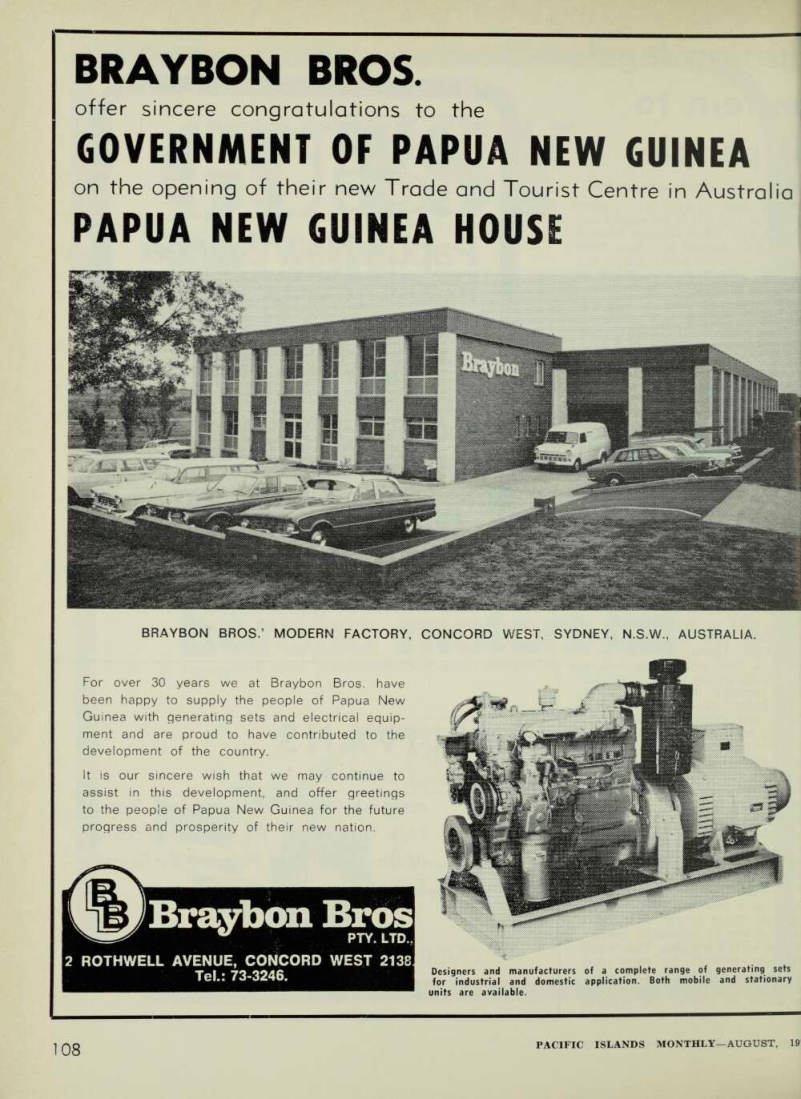
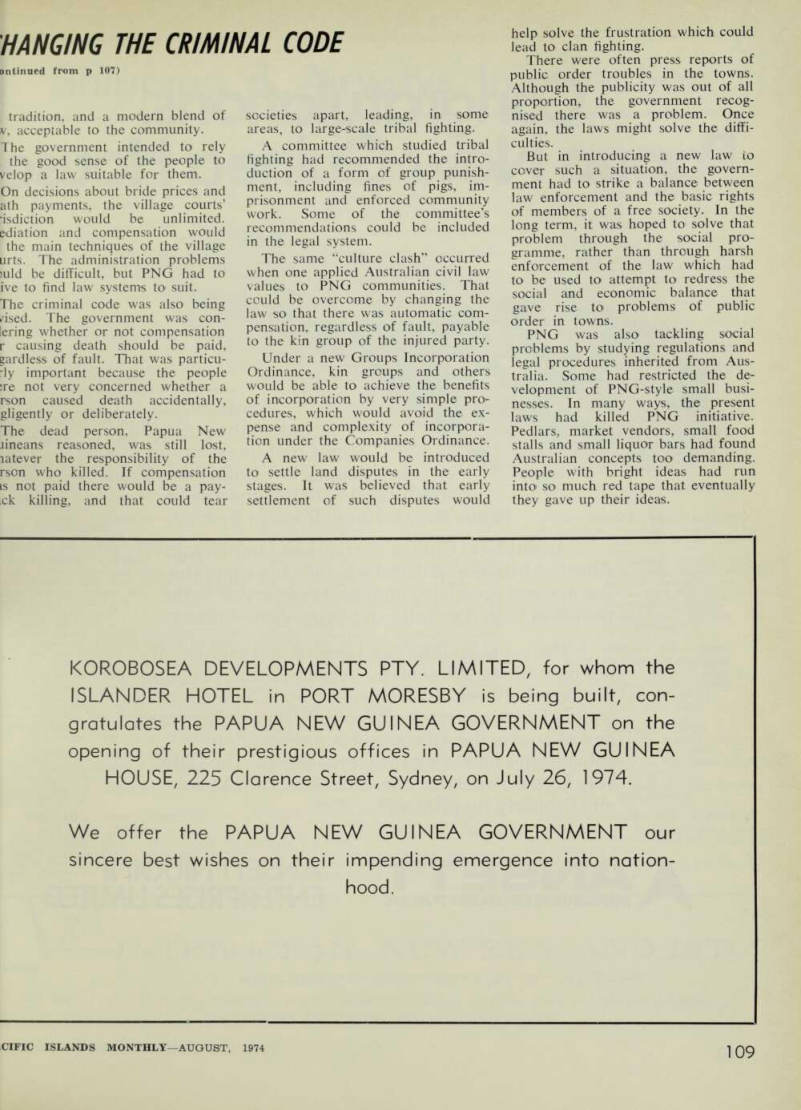
[?]utting legal [?]attern to [?]t people
Prom a Port Moresby correspondent >apua New Guinea will reform law to make it fit its society and :umstances. Chief Minister Michael nare has outlined how laws from stralia have affected his people and ditions, and what it is hoped to lieve by change. -rom the first contact with the ite man, the law and the courts 1 been weapons for a continuing ial revolution in PNG. New laws pped New Guineans from follow customs or from continuing the toms of their ancestors. Some toms were made crimes under the •oduced Queensland Criminal de. ►ometimes Australian law changed G society by what it did not do. i groups could not operate within law. New Guineans’ business isactions, gardening activities and il compensation were based on kin ups—the clans. But they were er given a proper place in civil criminal law. When the people involved in western businesses i public transport or haulage, the groups found they could not ally buy trucks. fhey tried to overcome that by tnerships only to be told they •e illegal. There were many prob is over land usage. The various [its fairly rigidly applied the Aus ian concepts of guilt—in terms newly-introduced offences. Pro cures and evidentiary rules were same as in Australia. They were understood by New Guineans, n some cases the law was hold the people to values which had r er gained acceptance, and probably r er would. vlr Somare said that to a certain snt the law started in the courts, it was where the people saw the r in action. Alien procedures had dered development of a people’s r through the courts.
'Jow, as a first step, PNG was in ducing village courts, which gave ited power to influential leaders, :> had no real training. That would ead the network far wider than > possible with the existing offici ' trained magistrates. The jurisdic i would be limited, but the aim i to reach sensible decisions, based
tradition, and a modern blend of v, acceptable to the community.
The government intended to rely the good sense of the people to velop a law suitable for them.
Dn (WidnrK about hrido nrices and On decisions about bride prices and ath payments, the village courts •kd.Vtion would he unlimited isdiction would be unlimited. tfmai„ a th C „Tu P e“e Xge
urts. The administration problems
>uld be difficult, but PNG had to ive to find law systems to suit.
The criminal code was also being /ised. The government was con lering whether or not compensation r causing death should be paid, gardless of fault. That was particu- ’ly important because the people :re not very concerned whether a rson caused death accidentally,
gligently or deliberately.
The dead person, Papua New lineans reasoned, was still lost, latever the responsibility of the rson who killed. If compensation is not paid there would be a pay- ,ck killing, and that could tear
societies apart, leading, in some areas, to large-scale tribal fighting.
A committee which studied tribal fighting had recommended the intro duction of a form of group punish ment, including fines of pigs, im- Dr : sonment anc j enforced communitv pnsonmem ana eniurcea cummuimy work. Some of the committees recomm endations could be included The same “culture clash” occurred when one applied Australian civil law values to PNG communities. That could be overcome by changing the law so that there was automatic com pensation, regardless of fault, payable to the km § rou P of the in J ured P an Y- Under a new Groups Incorporation Ordinance, kin groups and others would be able to achieve the benefits of incorporation by very simple pro cedures, which would avoid the ex- P ense and complexity of incorpora tlon under the Companies Ordinance.
A new law would be introduced to settle land disputes in the early stages. It was believed that early settlement of such disputes would
help solve the frustration which could lead to clan fighting.
There were often press reports of public order troubles in the towns.
Although the publicity was out of all proportion, the government recog nised there was a problem. Once again, the laws might solve the diffi culties.
But in introducing a new law to cover such a situation, the govern ment had to strike a balance between law enforcement and the basic rights of members of a free society. In the long term, it was hoped to solve that problem through the social pro gramme, rather than through harsh enforcement of the law which had to be used to attempt to redress the social and economic balance that gave rise to problems of public order in towns.
PNG was also tackling social problems by studying regulations and legal procedures inherited from Aus tralia. Some had restricted the de velopment of PNG-style small busi nesses. In many ways, the present laws had killed PNG initiative.
Pedlars, market vendors, small food stalls and small liquor bars had found Australian concepts too demanding.
People with bright ideas had run into so much red tape that eventually they gave up their ideas.
Advertisements & other items, pp. 117-120 (3 items)
107
21FIC ISLANDS MONTHLY—AUGUST, 1974
Printing Co.Pty.Ltd.
Papua New Guinea
wish to congratulate the People and the Government of Papua New Guinea on the opening of
PAPUA NEW GUINEA HOUSE
SYDNEY
Leaders in Printing , Stationery and Office Equipment
SULLIVANS
congratulates the people of Papua New Guinea on the historic occasion of the opening of Papua New Guinea House.
OVER 50 YEARS OF SERVICE
BRAYBON BROS.
offer sincere congratulations to the
GOVERNMENT OF PAPUA NEW GUINEA
on the opening of their new Trade and Tourist Centre in Australia
PAPUA NEW GUINEA HOUSE
I I! 1 I II I Rl 5 .
jggk: v
liißM ■ -ill m h v: MaM BRAYBON BROS.’ MODERN FACTORY, CONCORD WEST, SYDNEY, N.S.W., AUSTRALIA.
For over 30 years we at Braybon Bros, have been happy to supply the people of Papua New Guinea with generating sets and electrical eguipment and are proud to have contributed to the development of the country.
It is our sincere wish that we may continue to assist in this development, and offer greetings to the people of Papua New Guinea for the future progress and prosperity of their new nation.
Braybon Bros
V nrv i
PTY. LTD..
2 ROTHWELL AVENUE, CONCORD WEST 2138
Tel.: 73-3246.
Designers and manufacturers of a complete range of generating sets for industrial and domestic application. Both mobile and stationary units are available.
KOROBOSEA DEVELOPMENTS PTY. LIMITED, for whom the ISLANDER HOTEL in PORT MORESBY is being built, congratulates the PAPUA NEW GUINEA GOVERNMENT on the opening of their prestigious offices in PAPUA NEW GUINEA HOUSE, 225 Clarence Street, Sydney, on July 26, 1974.
We offer the PAPUA NEW GUINEA GOVERNMENT our sincere best wishes on their impending emergence into nationhood.
Congratulations,
Papua New Guinea House.
k Another vital link in the powerful bonds that tie Australia and Papua New Guinea has been consolidated with the opening of Papua New Guinea House in Sydney.
Ansett New Guinea Enterprises Limited joins Ansett Airlines of Australia in offering congratulations, and promising continuity of service to the people of both Australia and Papua New Guinea.
The usual facilities and specialised services of our operations will remain-Ansett Airlines Boeing Services between Australia and Papua New Guinea, coupled with our regular Electra Freighter Services; and of course the specialised activities of our subsidiaries including Duty Free Stores, The Gateway Hotel, The Balus Bar, The Huon Gulf Motel and Property Investments.
▲ ANSETT ANSETT NIUGINI
AIRLINES OF AUSTRALIA ENTERPRISES LIMITED
011-P-42
Hanging The Criminal Code
109
CIFIC ISLANDS MONTHLY—AUGUST, 1974
ontinued from p 107)
Shipping & Airways Information
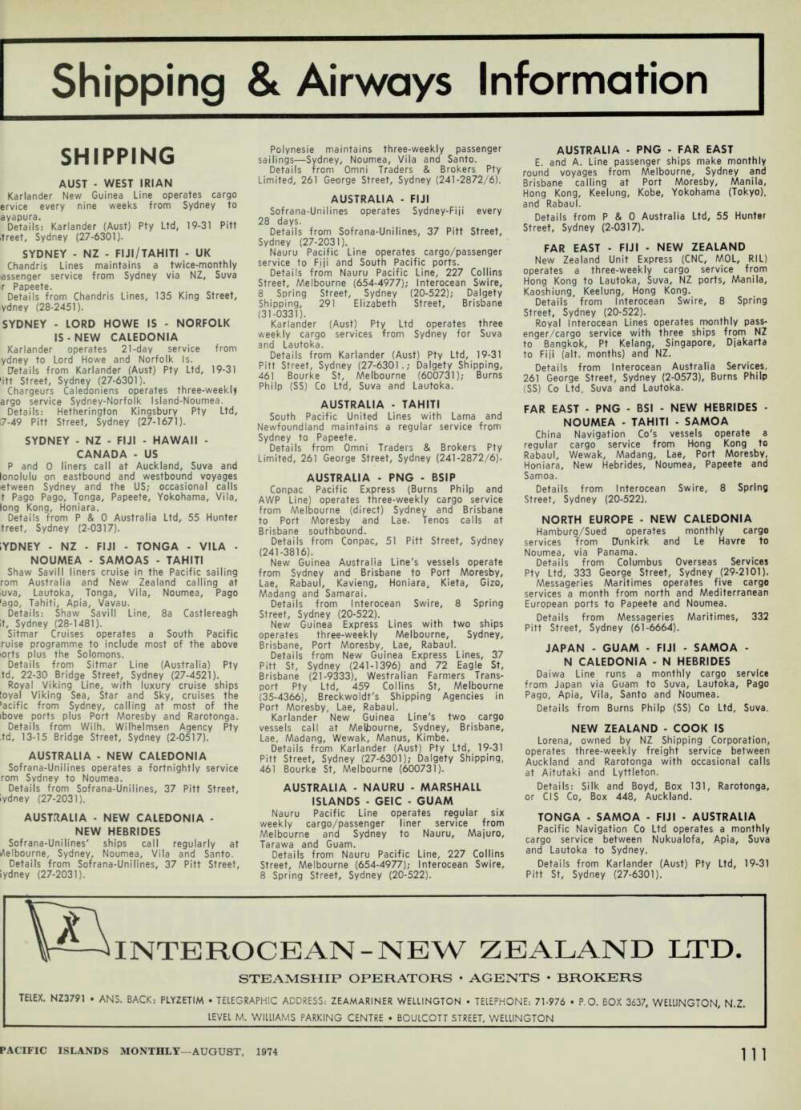
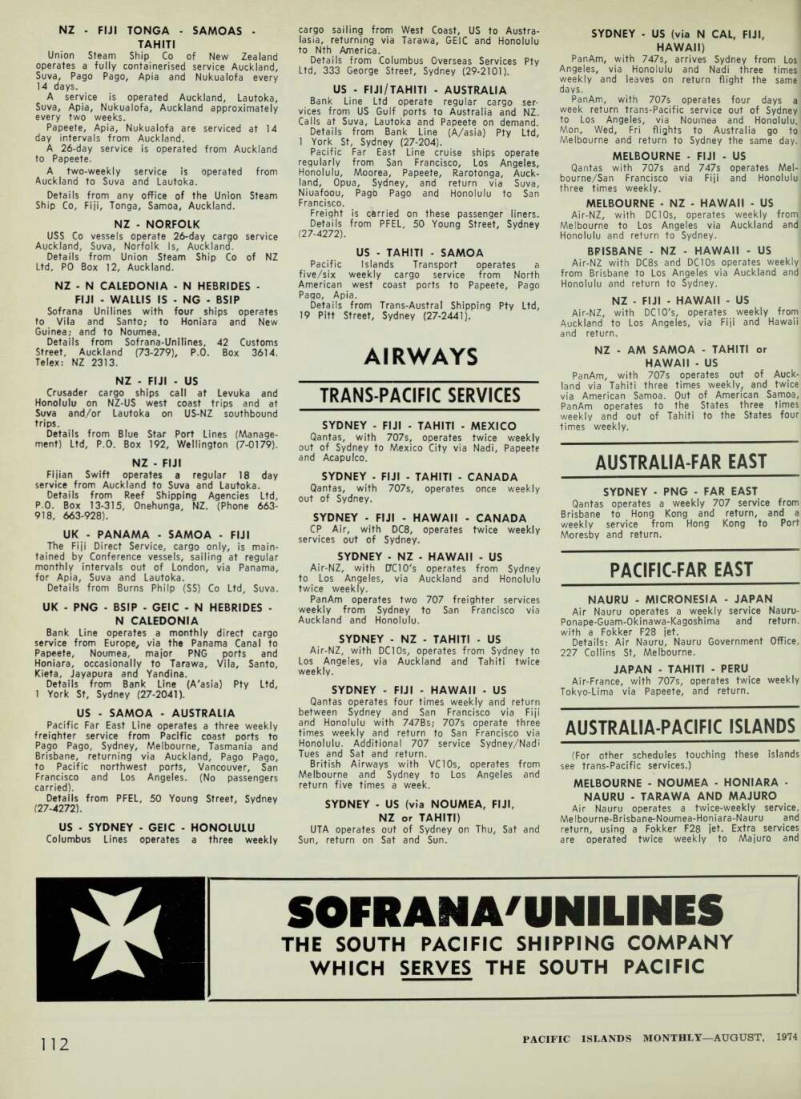
Shipping
Aust - West Irian
Karlander New Guinea Line operates cargo ervice every nine weeks from Sydney to ayapura.
Details: Karlander (Aust) Pty Ltd, 19-31 Pitt itreet, Sydney (27-6301).
SYDNEY - NZ - FIJI/TAHITI - UK Chandris Lines maintains a twice-monthly assenger service from Sydney via NZ, Suva r Papeete.
Details from Chandris Lines, 135 King Street, ydney (28-2451).
SYDNEY - LORD HOWE IS - NORFOLK
Is-New Caledonia
Karlander operates 21-day service from ydney to Lord Howe and Norfolk Is.
Details from Karlander (Aust) Pty Ltd, 19-31
'itt Street, Sydney (27-6301).
Chargeurs Caleaoniens operates three-weekly argo service Sydney-Norfolk Island-Noumea.
Details: Hetherington Kingsbury Pty Ltd, 17-49 Pitt Street, Sydney (27-1671).
SYDNEY - NZ - FIJI - HAWAII -
Canada - Us
P and 0 liners call at Auckland, Suva and lonolulu on eastbound and westbound voyages etween Sydney and the US; occasional calls t Pago Pago, Tonga, Papeete, Yokohama, Vila, long Kong, Honiara.
Details from P & 0 Australia Ltd, 55 Hunter treet, Sydney (2-0317).
IYDNEY - NZ - FIJI - TONGA - VILA ■
Noumea - Samoas - Tahiti
Shaw Savill liners cruise in the Pacific sailing rom Australia and New Zealand calling at luva, Lautoka, Tonga, Vila, Noumea, Pago 'ago, Tahiti, Apia, Vavau.
Details: Shaw Savill Line, 8a Castlereagh It, Sydney (28-1481).
Sitmar Cruises operates a South Pacific ruise programme to include most of the above iorts plus the Solomons.
Details from Sitmar Line (Australia) Pty td, 22-30 Bridge Street, Sydney (27-4521).
Royal Viking Line, with luxury cruise ships loyal Viking Sea, Star and Sky, cruises the 'acific from Sydney, calling at most of the ibove ports plus Port Moresby and Rarotonga.
Details from Wilh. Wilhelmsen Agency Pty td, 13-15 Bridge Street, Sydney (2-0517).
Australia - New Caledonia
Sofrana-Unilines operates a fortnightly service rom Sydney to Noumea.
Details from Sofrana-Unilines, 37 Pitt Street, lydney (27-2031).
Australia - New Caledonia -
New Hebrides
Sofrana-Unilines' ships call regularly at lAelbourne, Sydney, Noumea, Vila and Santo.
Details from Sofrana-Unilines, 37 Pitt Street, iydney (27-2031).
Polynesie maintains three-weekly passenger sailings—Sydney, Noumea, Vila and Santo.
Details from Omni Traders & Brokers Pty Limited, 261 George Street, Sydney (241-2872/6).
Australia - Fiji
Sofrana-Unilines operates Sydney-Fiji every 28 days.
Details from Sofrana-Unilines, 37 Pitt Street, Sydney (27-2031).
Nauru Pacific Line operates cargo/passenger service to Fiji and South Pacific ports.
Details from Nauru Pacific Line, 227 Collins Street, Melbourne (654-4977); Interocean Swire, 8 Spring Street, Sydney (20-522); Dalgety Shipping, 291 Elizabeth Street, Brisbane (31-0331).
Karlander (Aust) Pty Ltd operates three weekly cargo services from Sydney for Suva and Lautoka.
Details from Karlander (Aust) Pty Ltd, 19-31 Pitt Street, Sydney (27-6301.; Dalgety Shipping, 461 Bourke St, Melbourne (600731); Burns Philp (SS) Co Ltd, Suva and Lautoka.
Australia - Tahiti
South Pacific United Lines with Lama and Newfoundland maintains a regular service from Sydney to Papeete.
Details from Omni Traders & Brokers Pty Limited, 261 George Street, Sydney (241-2872/6).
Australia - Png - Bsip
Conpac Pacific Express (Burns Philp and AWP Line) operates three-weekly cargo service from Melbourne (direct) Sydney and Brisbane to Port Moresby and Lae. Tenos calls at Brisbane southbound.
Details from Conpac, 51 Pitt Street, Sydney (241-3816).
New Guinea Australia Line's vessels operate from Sydney and Brisbane to Port Moresby, Lae, Rabaul, Kavieng, Honiara, Kieta, Gizo, Madang and Samarai.
Details from Interocean Swire, 8 Spring Street, Sydney (20-522).
New Guinea Express Lines with two ships operates three-weekly Melbourne, Sydney, Brisbane, Port Moresby, Lae, Rabaul.
Details from New Guinea Express Lines, 37 Pitt St, Sydney (241-1396) and 72 Eagle St, Brisbane (21-9333), Westralian Farmers Trans port Pty Ltd, 459 Collins St, Melbourne (35-4366), Breckwoldt's Shipping Agencies in Port Moresby, Lae, Rabaul.
Karlander New Guinea Line's two cargo vessels call at Melbourne, Sydney, Brisbane, Lae, Madang, Wewak, Manus, Kimbe.
Details from Karlander (Aust) Pty Ltd, 19-31 Pitt Street, Sydney (27-6301); Dalgety Shipping, 461 Bourke St, Melbourne (600731).
Australia - Nauru ■ Marshall
Islands - Geic - Guam
Nauru Pacific Line operates regular six weekly cargo/passenger liner service from Melbourne and Sydney to Nauru, Majuro, Tarawa and Guam.
Details from Nauru Pacific Line, 227 Collins Street, Melbourne (654-4977); Interocean Swire, 8 Spring Street, Sydney (20-522).
Australia - Png - Far East
E. and A. Line passenger ships make monthly round voyages from Melbourne, Sydney and Brisbane calling at Port Moresby, Manila, Hong Kong, Keelung, Kobe, Yokohama (Tokyo), and Rabaul.
Details from P & 0 Australia Ltd, 55 Hunter Street, Sydney (2-0317).
FAR EAST - FIJI - NEW ZEALAND New Zealand Unit Express (CNC, MOL, RIL) operates a three-weekly cargo service from Hong Kong to Lautoka, Suva, NZ ports, Manila, Kaoshiung, Keelung, Hong Kong.
Details ' from Interocean Swire, 8 Spring Street, Sydney (20-522).
Royal Interocean Lines operates monthly pass enger/cargo service with three ships from NZ to Bangkok, Pt Kelanq, Singapore, Djakarta to Fiji (alt. months) and NZ.
Details from Interocean Australia Services, 261 George Street, Sydney (2-0573), Burns Philp (SS) Co Ltd, Suva and Lautoka.
FAR EAST - PNG - BSI - NEW HEBRIDES -
Noumea - Tahiti - Samoa
China Navigation Co's vessels operate a regular cargo service from Hong Kong to Rabaul, Wewak, Madang, Lae, Port Moresby, Honiara, New Hebrides, Noumea, Papeete and Samoa.
Details from Interocean Swire, 8 Spring Street, Sydney (20-522).
North Europe - New Caledonia
Hamburg/Sued operates monthly cargo services from Dunkirk and Le Havre to Noumea, via Panama.
Details from Columbus Overseas Services Pty Ltd, 333 George Street, Sydney (29-2101), Messageries Maritimes operates five cargo services a month from north and Mediterranean European ports to Papeete and Noumea.
Details from Messageries Maritimes, 332 Pitt Street, Sydney (61-6664).
JAPAN - GUAM ■ FIJI - SAMOA -
N Caledonia - N Hebrides
Daiwa Line runs a monthly cargo service from Japan via Guam to Suva, Lautoka, Pago Pago, Apia, Vila, Santo and Noumea.
Details from Burns Philp (SS) Co Ltd, Suva.
New Zealand - Cook Is
Lorena, owned by NZ Shipping Corporation, operates three-weekly freight service between Auckland and Rarotonga with occasional calls at Aitutaki and Lyttleton.
Details: Silk and Boyd, Box 131, Rarotonga, or CIS Co, Box 448, Auckland.
TONGA ■ SAMOA - FIJI - AUSTRALIA Pacific Navigation Co Ltd operates a monthly cargo service between Nukualofa, Apia, Suva and Lautoka to Sydney.
Details from Karlander (Aust) Pty Ltd, 19-31 Pitt St, Sydney (27-6301).
NZ - FIJI TONGA - SAMOAS ■
Tahiti
Union Steam Ship Co of New Zealand operates a fully containerised service Auckland, Suva, Pago Pago, Apia and Nukualofa every 14 days.
A service is operated Auckland, Lautoka, Suva, Apia, Nukualofa, Auckland approximately every two weeks.
Papeete, Apia, Nukualofa are serviced at 14 day intervals from Auckland.
A 26-day service is operated from Auckland to Papeete.
A two-weekly service is operated from Auckland to Suva and Lautoka.
Details from any office of the Union Steam Ship Co, Fiji, Tonga, Samoa, Auckland.
Nz - Norfolk
USS Co vessels operate 26-day cargo service Auckland, Suva, Norfolk Is, Auckland.
Details from Union Steam Ship Co of NZ Ltd, PO Box 12, Auckland.
NZ - N CALEDONIA - N HEBRIDES - FIJI - WALLIS IS - NG - BSIP Sofrana Unilines with four ships operates to Vila and Santo; to Honiara and New Guinea; and to Noumea, Details from Sofrana-Unllines, 42 Customs Street, Auckland (73-279), P.O, Box 3614.
Telex: NZ 2313.
Nz - Fiji - Us
Crusader cargo ships call at Levuka and Honolulu on NZ-US west coast trips and at Suva and/or Lautoka on US-NZ southbound trips.
Details from Blue Star Port Lines (Manage ment) Ltd, P.O. Box 192, Wellington (7-0179).
Nz - Fiji
Fijian Swift operates a regular 18 day service from Auckland to Suva and Lautoka.
Details from Reef Shipping Agencies Ltd, P.O. Box 13-315, Onehunga, NZ. (Phone 663- 918, 663-928).
UK - PANAMA - SAMOA - FIJI The Fiji Direct Service, cargo only, is main tained by Conference vessels, sailing at regular monthly intervals out of London, via Panama, for Apia, Suva and Lautoka.
Details from Burns Philp (SS) Co Ltd, Suva.
UK • PNG - BSIP - GEIC - N HEBRIDES -
N Caledonia
Bank Line operates a monthly direct cargo service from Europe, via the Panama Canal to Papeete, Noumea, major PNG ports and Honiara, occasionally to Tarawa, Vila, Santo, Kieta, Jayapura and Yandina.
Details from Bank Line (A'asia) Pty Ltd, 1 York St, Sydney (27-2041).
Us - Samoa - Australia
Pacific Far East Line operates a three weekly freighter service from Pacific coast ports to Pago Pago, Sydney, Melbourne, Tasmania and Brisbane, returning via Auckland, Pago Pago, to Pacific northwest ports, Vancouver, San Francisco and Los Angeles. (No passengers carried).
Details from PFEL, 50 Young Street, Sydney (27-4272).
US • SYDNEY - GEIC - HONOLULU Columbus Lines operates a three weekly
cargo sailing from West Coast, US to Austra lasia, returning via Tarawa, GEIC and Honolulu to Nth America.
Details from Columbus Overseas Services Pty Ltd, 333 George Street, Sydney (29-2101).
Us - Fiji/Tahiti - Australia
Bank Line Ltd operate regular cargo ser vices from US Gulf ports to Australia and NZ.
Calls at Suva, Lautoka and Papeete on demand.
Details from Bank Line (A/asia) Pty Ltd, 1 York St, Sydney (27-204).
Pacific Far East Line cruise ships operate regularly from San Francisco, Los Angeles, Honolulu, Moorea, Papeete, Rarotonga, Auck land, Opua, Sydney, and return via Suva, Niuafoou, Pago Pago and Honolulu to San Francisco.
Freight is carried on these passenger liners.
Details from PFEL, 50 Young Street, Sydney (27-4272).
Us - Tahiti - Samoa
Pacific Islands Transport operates a five/six weekly cargo service from North American west coast ports to Papeete, Pago Pago, Apia.
Details from Trans-Austral Shipping Pty Ltd, 19 Pitt Street, Sydney (27-2441).
Advertisements & other items, p. 121 (1 item)
Interocean-New Zealand Ltd.
STEAMSHIP OPERATORS • AGENTS • BROKERS
TELEX. NZ3791 • ANS. BACK: PLYZETIM • TELEGRAPHIC ADDRESS: ZEAMARINER WELLINGTON • TELEPHONE: 71-976 • P.O. BOX 3637, WELLINGTON, N.Z LEVEL M. WILLIAMS PARKING CENTRE • BOULCOTT STREET, WELLINGTON
Airways
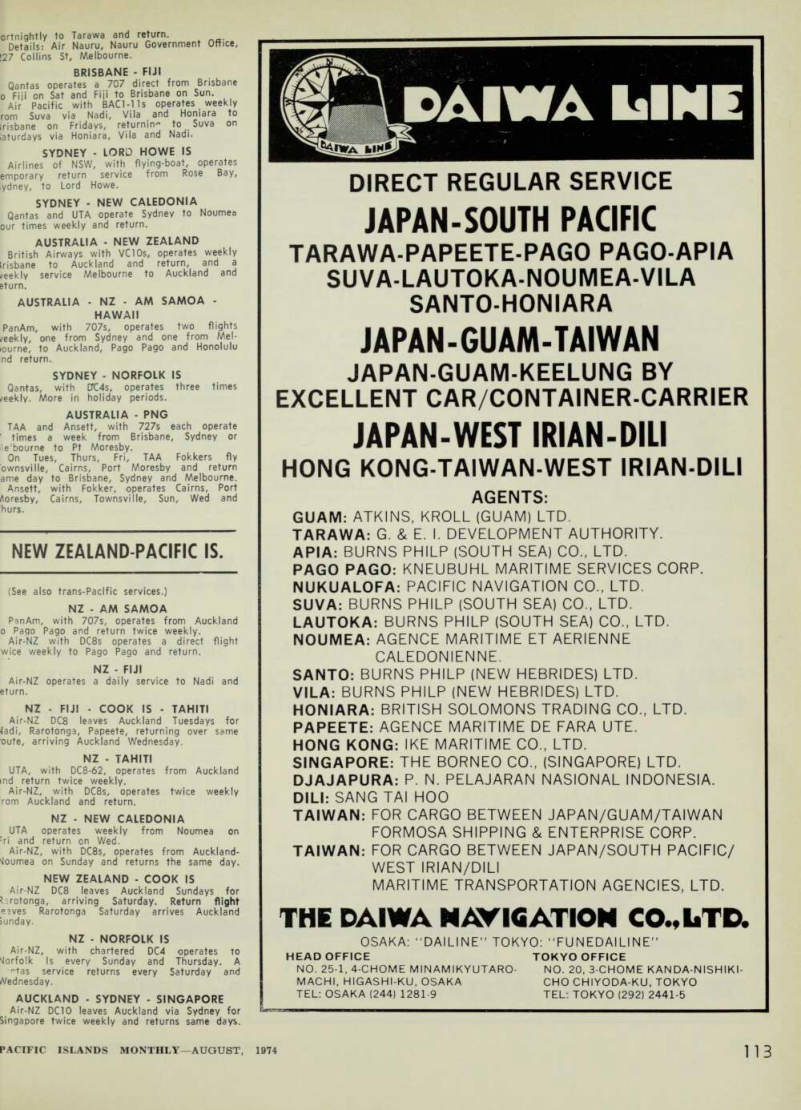
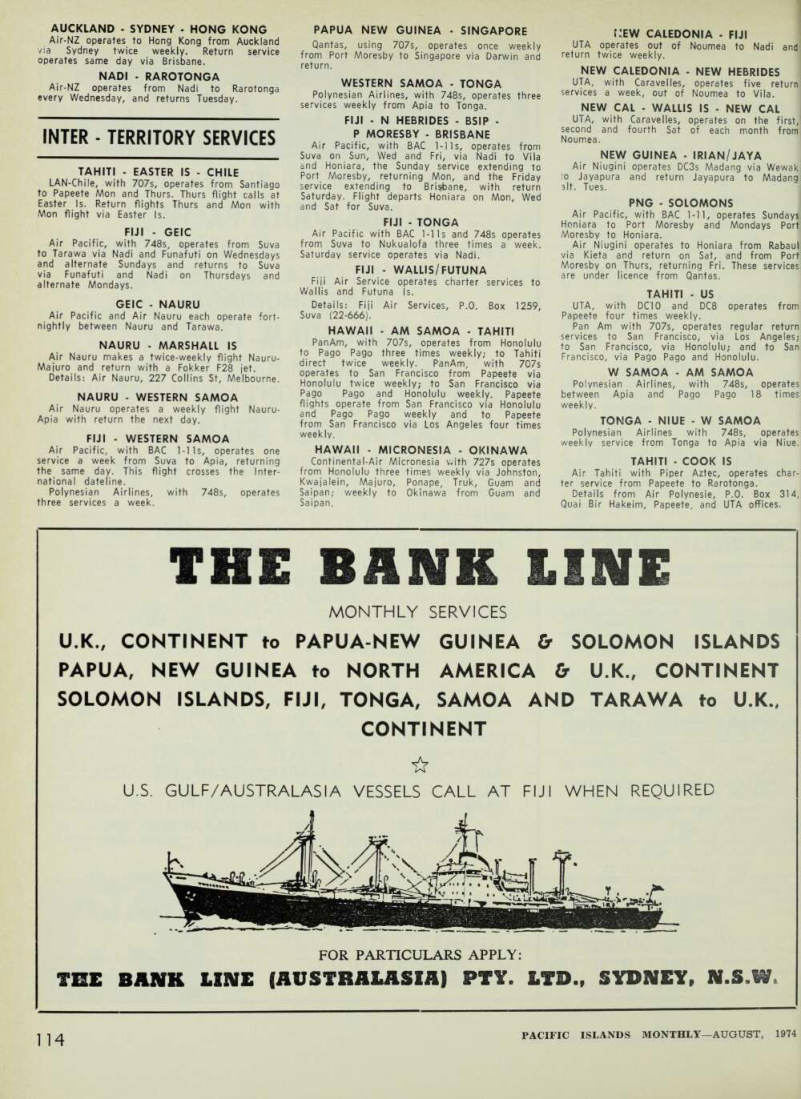
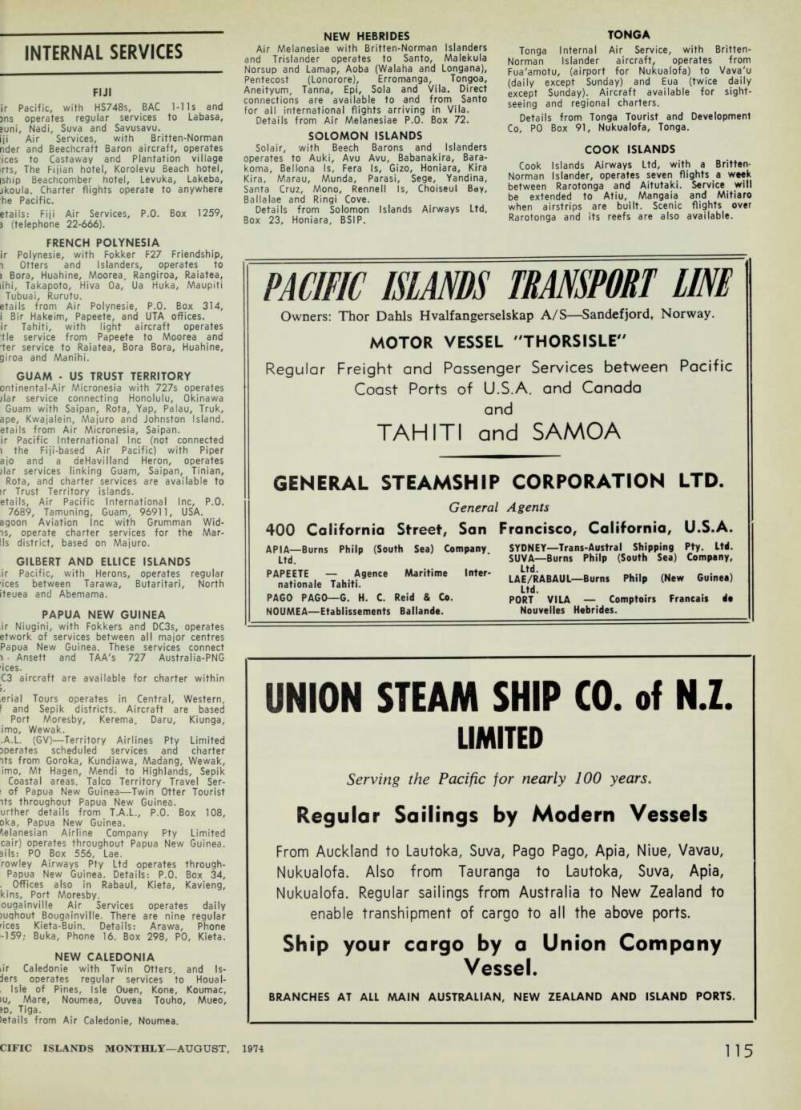
Trans Pacific Services
SYDNEY - FIJI ■ TAHITI - MEXICO Qantas, with 7075, operates twice weekly out of Sydney to Mexico City via Nadi, Papeete and Acapulco.
SYDNEY - FIJI - TAHITI - CANADA Qantas, with 7075, operates once weekly out of Sydney.
SYDNEY - FIJI - HAWAII - CANADA CP Air, with DCS, operates twice weekly services out of Sydney.
SYDNEY - NZ - HAWAII - US Air-NZ, with DClO's operates from Sydney to Los Angeles, via Auckland and Honolulu twice weekly.
PanAm operates two 707 freighter services weekly from Sydney to San Francisco via Auckland and Honolulu.
SYDNEY - NZ - TAHITI - US Air-NZ, with DClOs, operates from Sydney to Los Angeles, via Auckland and Tahiti twice weekly.
SYDNEY - FIJI - HAWAII - US Qantas operates four times weekly and return between Sydney and San Francisco via Fiji and Honolulu with 74785; 707 s operate three times weekly and return to San Francisco via Honolulu. Additional 707 service Sydney/Nadl Tues and Sat and return.
British Airways with VClOs, operates from Melbourne and Sydney to Los Angeles and return five times a week.
Sydney - Us (Via Noumea, Fiji,
Nz Or Tahiti)
UTA operates out of Sydney on Thu, Sat and Sun, return on Sat and Sun.
SYDNEY - US (via N CAL, FIJI,
Hawaii)
PanAm, with 7475, arrives Sydney from Los Angeles, via Honolulu and Nadi three times weekly and leaves on return flight the same days.
PanAm, with 707 s operates four days a week return trans-Pacific service out of Sydney to Los Angeles, via Noumea and Honolulu.
Mon, Wed, Fri flights to Australia go to Melbourne and return to Sydney the same day.
Melbourne - Fiji - Us
Qantas with 707 s and 747 s operates Mel bourne/San Francisco via Fiji and Honolulu three times weekly.
MELBOURNE - NZ - HAWAII ■ US Air-NZ, with DClOs, operates weekly from Melbourne to Los Angeles via Auckland and Honolulu and return to Sydney.
BRISBANE - NZ - HAWAII - US Air-N2 with DCBs and DClOs operates weekly from Brisbane to Los Angeles via Auckland and Honolulu and return to Sydney.
NZ - FIJI - HAWAII - US Air-NZ, with DClO's, operates weekly from Auckland to Los Angeles, via Fiji and Hawaii and return.
NZ - AM SAMOA - TAHITI or
Hawaii - Us
PanAm, with 707 s operates out of Auck land via Tahiti three times weekly, and twice via American Samoa. Out of American Samoa, PanAm operates to the States three times weekly and out of Tahiti to the States four times weekly.
Australia-Far East
Sydney - Png - Far East
Qantas operates a weekly 707 service from Brisbane to Hong Kong and return, and a weekly service from Hong Kong to Port Moresby and return.
Pacific-Far East
Nauru - Micronesia - Japan
Air Nauru operates a weekly service Nauru- Ponape-Guam-Okinawa-Kagoshima and return, with a Fokker F2B jet.
Details; Air Nauru, Nauru Government Office, 227 Collins St, Melbourne.
Japan - Tahiti - Peru
Air-France, with 7075, operates twice weekly Tokyo-Lima via Papeete, and return.
Australia-Pacific Islands
(For other schedules touching these Islands see trans-Pacific services.)
Melbourne - Noumea - Honiara -
Nauru - Tarawa And Majuro
Air Nauru operates a twice-weekly service, Melbourne-Brisbane-Noumea-Honiara-Nauru and return, using a Fokker F2B jet. Extra services are operated twice weekly to Majuro and
ortnightly to Tarawa and return.
Details: Air Nauru, Nauru Government Office, ►27 Collins St, Melbourne.
Brisbane - Fiji
Qantas operates a 707 direct from Brisbane o Fiji on Sat and Fiji to Brisbane on Sun.
Air Pacific with BACI-lls operates weekly rom Suva via Nadi, Vila and Honiara to irisbane on Fridays, returnin'* to Suva on laturdays via Honiara, Vila and Nadi.
Sydney - Lord Howe Is
Airlines of NSW, with flying-boat, operates emporary return service from Rose Bay, ydney, to Lord Howe.
Sydney - New Caledonia
Qantas and UTA operate Sydney to Noumea our times weekly and return.
Australia - New Zealand
British Airways with VClOs, operates weekly Irisbane to Auckland and return, and a weekly service Melbourne to Auckland and stum.
AUSTRALIA - NZ ■ AM SAMOA -
Hawaii
PanAm, with 7075, operates two flights /eekly, one from Sydney and one from Mel icurne, to Auckland, Pago Pago and Honolulu nd return.
Sydney - Norfolk Is
Qantas, with OC4s, operates three times /eekly. More in holiday periods.
Australia - Png
TAA and Ansett, with 727 s each operate times a week from Brisbane, Sydney or 'e'bourne to Pt Moresby.
On lues, Thurs, Fri, TAA Fokkers fly bwnsville, Cairns, Port Moresby and return ame day to Brisbane, Sydney and Melbourne.
Ansett, with Fokker, operates Cairns, Port Moresby, Cairns, Townsville, Sun, Wed and hurs.
New Zealand-Pacific Is.
(See also trans-Padfic services.)
Nz - Am Samoa
PanAm, with 7075, operates from Auckland o Pago Pago and return twice weekly.
Air-NZ with DCBs operates a direct flight wice weekly to Pago Pago and return.
Nz - Fiji
Air-NZ operates a daily service to Nadi and eturn.
NZ - FIJI - COOK IS - TAHITI Air-NZ DCS leaves Auckland Tuesdays for Jadi, Rarotonga, Papeete, returning over same oute, arriving Auckland Wednesday.
Nz - Tahiti
UTA, with DCB-62, operates from Auckland md return twice weekly.
Air-NZ, with DCBs, operates twice weekly rom Auckland and return.
Nz - New Caledonia
UTA operates weekly from Noumea on : ri and return on Wed.
Air-NZ, with DCBs, operates from Auckland 'Joumea on Sunday and returns the same day.
New Zealand - Cook Is
Air-NZ DCS leaves Auckland Sundays for *~rotonga, arriving Saturday. Return flight eaves Rarotonga Saturday arrives Auckland Sunday.
Nz - Norfolk Is
Air-NZ, with chartered DC4 operates to Norfolk Is every Sunday and Thursday. A r tas service returns every Saturday and Wednesday.
Auckland - Sydney - Singapore
Air-NZ DCIO leaves Auckland via Sydney for Singapore twice weekly and returns same days.
Auckland - Sydney - Hong Kong
Air-NZ operates to Hong Kong from Auckland via Sydney twice weekly. Return service operates same day via Brisbane.
Nadi - Rarotonga
Air-NZ operates from Nadi to Rarotonga every Wednesday, and returns Tuesday.
Inter ■ Territory Services
Tahiti - Easter Is - Chile
LAN-Chile, with 7075, operates from Santiago to Papeete Mon and Thurs. Thurs flight calls at Easter Is. Return flights Thurs and Mon with Mon flight via Easter Is.
Fiji - Geic
Air Pacific, with 7485, operates from Suva to Tarawa via Nadi and Funafuti on Wednesdays and alternate Sundays and returns to Suva via Funafuti and Nadi on Thursdays and alternate Mondays.
Geic - Nauru
Air Pacific and Air Nauru each operate fort nightly between Nauru and Tarawa.
Nauru - Marshall Is
Air Nauru makes a twice-weekly flight Nauru- Majuro and return with a Fokker F2B jet.
Details: Air Nauru, 227 Collins St, Melbourne.
Nauru - Western Samoa
Air Nauru operates a weekly flight Nauru- Apia with return the next day.
Fiji - Western Samoa
Air Pacific, with BAC 1-1 Is, operates one service a week from Suva to Apia, returning the same day. This flight crosses the Inter national dateline.
Polynesian Airlines, with 7485, operates three services a week.
Papua New Guinea - Singapore
Qantas, using 7075, operates once weekly from Port Moresby to Singapore via Darwin and return.
Western Samoa ■ Tonga
Polynesian Airlines, with 7485, operates three services weekly from Apia to Tonga.
FIJI - N HEBRIDES - BSIP -
P Moresby - Brisbane
Air Pacific, with BAC 1-1 Is, operates from Suva on Sun, Wed and Fri, via Nadi to Vila and Honiara, the Sunday service extending to Port Moresby, returning Mon, and the Friday service extending to Brisbane, with return Saturday. Flight departs Honiara on Mon, Wed and Sat for Suva.
Fiji - Tonga
Air Pacific with BAC 1-1 Is and 748 s operates from Suva to Nukualofa three times a week.
Saturday service operates via Nadi.
Fiji - Wallis/Futuna
Fiji Air Service operates charter services to Wallis and Futuna Is.
Details: Fiji Air Services, P.O. Box 1259, Suva (22-666).
Hawaii - Am Samoa - Tahiti
PanAm, with 7075, operates from Honolulu to Pago Pago three times weekly; to Tahiti direct twice weekly. PanAm, with 707 s operates to San Francisco from Papeete via Honolulu twice weekly; to San Francisco via Pago Pago and Honolulu weekly. Papeete flights operate from San Francisco via Honolulu and Pago Pago weekly and to Papeete from San Francisco via Los Angeles four times weekly.
Hawaii - Micronesia - Okinawa
Continental-Air Micronesia with 727 s operates from Honolulu three times weekly via Johnston, Kwajalein, Majuro, Ponape, Truk, Guam and Saipan; weekly to Okinawa from Guam and Saipan.
T:Ew Caledonia - Fiji
UTA operates out of Noumea to Nadi and return twice weekly.
New Caledonia - New Hebrides
UTA, with Caravelles, operates five return services a week, out of Noumea to Vila.
NEW CAL - WALLIS IS - NEW CAL UTA, with Caravelles, operates on the firstj second and fourth Sat of each month from Noumea.
New Guinea - Irian/Java
Air Niugini operates DC3s Madang via Wewak to Jayapura and return Jayapura to Madang alt. Tues.
Png ■ Solomons
Air Pacific, with BAC 1-11, operates Sundays Honiara to Port Moresby and Mondays Port Moresby to Honiara.
Air Niugini operates to Honiara from Rabaul via Kieta and return on Sat, and from Port Moresby on Thurs, returning Fri. These services are under licence from Qantas.
Tahiti - Us
UTA, with DCIO and DCS operates from Papeete four times weekly.
Pan Am with 7075, operates regular return services to San Francisco, via Los Angeles; to San Francisco, via Honolulu; and to San Francisco, via Pago Pago and Honolulu.
W Samoa - Am Samoa
Polynesian Airlines, with 7485, operates between Apia and Pago Pago 18 times weekly.
Tonga - Niue ■ W Samoa
Polynesian Airlines with 7485, operates weekly service from Tonga to Apia via Niue.
Tahiti ■ Cook Is
Air Tahiti with Piper Aztec, operates char ter service from Papeete to Rarotonga.
Details from Air Polynesie, P.O. Box 314, Quai Bir Hakeim, Papeete, and UTA offices.
Internal Services
Fiji
ir Pacific, with HS74Bs, BAC 1-1 Is and jns operates regular services to Labasa, •uni, Nadi, Suva and Savusavu. iji Air Services, with Britten-Norman nder and Beechcraft Baron aircraft, operates ices to Castaway and Plantation village Tts, The Fijian hotel, Korolevu Beach hotel, iship Beachcomber hotel, Levuka, Lakeba, jkoula. Charter flights operate to anywhere he Pacific. etails: Fiji Air Services, P.O. Box 1259, a (telephone 22-666).
French Polynesia
ir Polynesie, with Fokker F 27 Friendship, i Otters and Islanders, operates to i Bora, Huahine, Moorea, Rangiroa, Raiatea, lihi, Takapoto, Hiva Oa, Ua Huka, Maupiti Tubuai, Rurutu. etails from Air Polynesie, P.O. Box 314, i Bir Hakeim, Papeete, and UTA offices, ir Tahiti, with light aircraft operates tie service from Papeete to Moorea and ter service to Raiatea, Bora Bora, Huahine, giroa and Manihi.
Guam - Us Trust Territory
ontinental-Air Micronesia with 727 s operates jlar service connecting Honolulu, Okinawa Guam with Saipan, Rota, Yap, Palau, Truk, ape, Kwajalein, Majuro and Johnston Island, etails from Air Micronesia, Saipan, ir Pacific International Inc (not connected i the Fiji-based Air Pacific) with Piper ajo and a deHavilland Heron, operates jlar services linking Guam, Saipan, Tinian, Rota, and charter services are available to >r Trust Territory islands, etails. Air Pacific International Inc, P.O. 7689, Tamuning, Guam, 96911, USA. agoon Aviation Inc with Grumman Wid is, operate charter services for the Mar lls district, based on Majuro.
Gilbert And Ellice Islands
ir Pacific, with Herons, operates regular ices between Tarawa, Butaritari, North iteuea and Abemama.
Papua New Guinea
ir Niugini, with Fokkers and DC3s, operates etwork of services between all major centres Papua New Guinea. These services connect i - Ansett and TAA's 727 Australia-PNG ices.
C 3 aircraft are available for charter within I. ,erial Tours operates in Central, Western, F and Sepik districts. Aircraft are based Port Moresby, Kerema, Daru, Kiunga, imo, Wewak. ■A.L. (GV) —Territory Airlines Pty Limited jperates scheduled services and charter its from Goroka, Kundiawa, Madang, Wewak, imo, Mt Hagen, Mendi to Highlands, Sepik Coastal areas. Talco Territory Travel Ser i of Papua New Guinea—Twin Otter Tourist its throughout Papua New Guinea, urther details from T.A.L., P.O. Box 108, oka, Papua New Guinea.
Melanesian Airline Company Pty Limited cair) operates throughout Papua New Guinea, ails: PO Box 556, Lae. rowley Airways Pty Ltd operates through- Papua New Guinea. Details: P.O. Box 34, Offices also in Rabaul, Kieta, Kavieng, kins. Port Moresby. ougainville Air Services operates daily >ughout Bougainville. There are nine regular rices Kieta-Buin. Details: Arawa, Phone -159; Buka, Phone 16. Box 298, PO, Kieta.
New Caledonia
dr Caledonie with Twin Otters, and Is- Jers operates regular services to Houal , Isle of Pines, Isle Ouen, Kone, Koumac, iu, Mare, Noumea, Ouvea Touho, Mueo, JP, Tiga. letails from Air Caledonie, Noumea.
New Hebrides
Air Melanesiae with Britten-Norman Islanders and Trislander operates to Santo, Malekula Norsup and Lamap, Aoba (Walaha and Longana), Pentecost (Lonorore), Erromanga, Tongoa, Aneityum, Tanna, Epi, Sola and Vila. Direct connections are available to and from Santo for all international flights arriving in Vila.
Details from Air Melanesiae P.O. Box 72.
Solomon Islands
Solair, with Beech Barons and Islanders operates to Auki, Avu Avu, Babanakira, Bara koma, Belkina Is, Fera Is, Gizo, Honiara, Kira Kira, Marau, Munda, Parasi, Sege, Yandina, Santa Cruz, Mono, Rennell Is, Choiseul Bay, Ballalae and Ringi Cove.
Details from Solomon Islands Airways Ltd, Box 23, Honiara, BSIP.
Tonga
Tonga Internal Air Service, with Britten- Norman Islander aircraft, operates from Fua'amotu, (airport for Nukualofa) to Vava'u (daily except Sunday) and Eua (twice daily except Sunday). Aircraft available for sight seeing and regional charters.
Details from Tonga Tourist and Development Co, PO Box 91, Nukualofa, Tonga.
Cook Islands
Cook Islands Airways Ltd, with a Britten- Norman Islander, operates seven flights a week between Rarotonga and Aitutaki. Service will be extended to Atiu, Mangaia and Mitiaro when airstrips are built. Scenic flights over Rarotonga and its reefs are also available.
Advertisements & other items, pp. 122-126 (2 items)
Sofrana'unilines
THE SOUTH PACIFIC SHIPPING COMPANY
WHICH SERVES THE SOUTH PACIFIC
DAIWA
|Ahi^
DIRECT REGULAR SERVICE
JAPAN-SOUTH PACIFIC
TARAWA-PAPEETE-PAGO PAGO-APIA
SUVA-LAUTOKA-NOUMEA-VILA
SANTO-HONIARA
JAPAN-GUAM-TAIWAN
JAPAN-GUAM-KEELUNG BY
EXCELLENT CAR/CONTAINER-CARRIER
JAPAN-WEST IRIAN-DILI
HONG KONG-TAI WAN-WEST IRIAN-DILI
AGENTS:
GUAM: ATKINS, KROLL (GUAM) LTD.
TARAWA: G. & E. I. DEVELOPMENT AUTHORITY.
APIA: BURNS PHILP (SOUTH SEA) CO., LTD.
PAGO PAGO: KNEUBUHL MARITIME SERVICES CORP.
NUKUALOFA: PACIFIC NAVIGATION CO., LTD.
SUVA: BURNS PHILP (SOUTH SEA) CO., LTD.
LAUTOKA: BURNS PHILP (SOUTH SEA) CO., LTD.
NOUMEA: AGENCE MARITIME ET AERIENNE
CALEDONIENNE.
SANTO: BURNS PHILP (NEW HEBRIDES) LTD.
VILA: BURNS PHILP (NEW HEBRIDES) LTD.
HONIARA: BRITISH SOLOMONS TRADING CO., LTD.
PAPEETE: AGENCE MARITIME DE FARA UTE.
HONG KONG: IKE MARITIME CO., LTD.
SINGAPORE: THE BORNEO CO., (SINGAPORE) LTD.
DJAJAPURA: P. N. PELAJARAN NASIONAL INDONESIA.
DILI: SANG TAI HOO
TAIWAN: FOR CARGO BETWEEN JAPAN/GUAM/TAIWAN
FORMOSA SHIPPING & ENTERPRISE CORP.
TAIWAN: FOR CARGO BETWEEN JAPAN/SOUTH PACIFIC/
WEST IRIAN/DILI
MARITIME TRANSPORTATION AGENCIES, LTD.
THE DAIWA NAVIGATION CO-LTD.
OSAKA: “DAILINE" TOKYO; “FUNEDAILINE"
HEAD OFFICE TOKYO OFFICE
NO. 25-1, 4-CHOME MINAMIKYUTARO- NO. 20, 3-CHOME KANDA-NISHIKI-
MACHI, HIGASHI-KU, OSAKA CHO CHIYODA-KU, TOKYO
TEL: OSAKA (244) 1281-9 TEL; TOKYO (292) 2441-5
THE BANK LINE
MONTHLY SERVICES
U.K., CONTINENT to PAPUA-NEW GUINEA & SOLOMON ISLANDS PAPUA, NEW GUINEA to NORTH AMERICA & U.K., CONTINENT SOLOMON ISLANDS, FIJI, TONGA, SAMOA AND TARAWA to U.K.,
CONTINENT
☆ U.S. GULF/AUSTRALASIA VESSELS CALL AT FIJI WHEN REQUIRED &
FOR PARTICULARS APPLY:
THE BANK LINE (AUSTRALASIA) PTY. LTD., SYDNEY, N.S.W.
PACIFIC ISLANDS TRANSPORT LM
Owners: Thor Dahls Hvalfangerselskap A/S—Sandefjord, Norway.
MOTOR VESSEL "THORSISLE"
Regular Freight and Passenger Services between Pacific
Coast Ports of U.S.A. and Canada
and
TAHITI and SAMOA
GENERAL STEAMSHIP CORPORATION LTD.
400 California Street, San Francisco, California, U.S.A.
General Agents APlA—Burns Philp (South Sea) Company.
Ltd.
PAPEETE Agence Maritime Inter- SYDNEY —Trans-Austral Shipping Pty. Ltd.
SUVA—Burns Philp (South Sea) Company, nationale Tahiti.
PAGO PAGO— G, H. C. Reid & Co.
NOUMEA—Etablissements Ballande.
LIU.
LAE/RABAUL—Burns Philp (New Guinea) Ltd.
PORT VILA Comptoirs Franeais da Nouveiles Hebrides.
UNION STEAM SHIP CO. of N.Z.
LIMITED
Serving the Pacific for nearly 100 years.
Regular Sailings by Modern Vessels
From Auckland to Lautoka, Suva, Pago Pago, Apia, Niue, Vavau, Nukualofa. Also from Tauranga to Lautoka, Suva, Apia, Nukualofa. Regular sailings from Australia to New Zealand to enable transhipment of cargo to all the above ports.
Ship your cargo by a Union Company Vessel.
BRANCHES AT ALL MAIN AUSTRALIAN, NEW ZEALAND AND ISLAND PORTS.
Line Advertisements
Per line, $1.35 Aust., Minimum rate. 4 lines.
TROPICAL HOLIDAY HOME RAROTONGA
for sale. Unusual, new home situated on acre of land 75 yards from lagoon and white sand beach, garage and cook house.
Glorious view mountains from sun deck.
Coconut trees, mangos, avocado. All modern only 7 miles from airport and duty free shopping. $24,000. Enquiries to; T. C.
Clarke, P.O. Box 144, Rarotonga, Cook Islands.
YACHTSMAN/NAVIGATOR, 30’s, wishes to join crew of yacht going overseas. Non smoker, likes occasional can. Finance by arrangement. Ken Stokes, Flat 4D/15, Onslow Ave, Elizabeth Bay, N.S.W., 2011, Aust.
JOURNALIST, AUTHOR, PHOTOGRAPHER
and Publications Designer with islands experience seeks interesting position. Nonjournalistic but aesthetically rewarding position considered. K. Gravelle, 54 Bell Street, Fitzroy, Vic. 3065. Australia.
FLEETS fast personnel boat profess, bit. 1968, in survey. 1,000 lbs refrig, capacity, Auto Pilot, 2-way radio, Echo Sounder, shower, H.&C. Water $42,000.00. FLEETS, Rowe’s Bldg., Edward St., Brisbane. Cable
“FLEETS BRISBANE”.
CORRESPONDENCE WANTED by young
man with Pacific Isles. Ethnic music, nature, stamps, tape or letter. AL, 65 Brighton Rd., Scarborough, West Australia, 6019.
UNIQUE MARINE SERVICE FOR PACIFIC
ISLANDS. Located in Southern California Centre of marine trade. We purchase for boatyards, fishermen, yachtsmen. Enquiries answered promptly. Hard-to-find marine items our specialty. Try us. Blackie’s Boat Yard, P.O. Box 2136, Newport Beach,
92663, U.S.A.
BOOKS, antiquarian and other printed material on the Pacific, especially Papua New Guinea, available at moderate prices from Buka Gunana, P.O. Box 95, Pennant Hills, N.S.W’. 2120 Australia. Please write for latest price list.
HEAVY CONSTRUCTION CONTRACTOR,
experienced in earth-moving, dams, jetties, marinas, pipelines, highways, land development and turnkey projects, seeks contracts and or joint ventures in Pacific Islands.
Reply: P.O. Box 2464, Laguna Hills, California, 92653, U.S.A.
MARKETING REPRESENTATIVE in
principal Pacific Island Market Centres, wanted by U.S. Company. Knowledge of consumer products and their sales outlets required. Furnish personal resume. Lewis, P.O. Box 253, Little Rock, Arkansas,
U.S.A., 72203.
CONCRETE BLOCK MACHINE. Makes
blocks, flags, edgings, screen-blocks, garden stools —up to 8 at once and 96 an hour. SAI3O c.i.f. main ports. Send for leaflets. Forest Farm Research, Londonderry. N.S.W., 2753.
BUTTERFLIES AND BEETLES. Catchers
wanted from all Pacific Islands. Please write In strictest confidence to: Michel Bichez, ch. de Binche 2, Mons, Belgium.
BUTTERFLY SPECIMENS from Pacific Islands, wanted to buy. Bred specimens preferred. Q’ld. Butterfly Co., Long Rd., Nth. Tamborine, Q’ld., 4272.
ALL BOOKS AND JOURNALS ON AUST-
RALASIA AND THE PACIFIC BOUGHT
AND SOLD. Catalogues issued and sent free on application. Correspondence invited. Berkelouw, 15-19 Boundary St., Rushcutters Bay, Sydney, 2011. Phone: 31-8215.
YOUNG ITALIAN MAN would appreciate iriendly correspondence and, eventually, stamp exchange with residents in any independent Island. Write to: Giovanni de Santis, Casella Postale 97, 70100 Bari, Italy.
CHARTER FISHING BOAT BUSINESS
FOR SALE, SYDNEY. Established 10 years. 48 ft vessel, all extras. Licensed M.S.B. full booked permanently. Suit boating minded person leaving islands. Owner will teach working 2 or 3 days per week. Good return. Available for sale later in 1974. $27,500. Owner building larger boat.
Enquiries: Box 59 P. 0., Drummoyne,
NSW, 2047.
GENERATOR. Tenders are invited for a Petbow 187 KVA (continuous) 415 volt 50 Hz Diesel Alternator fitted with Rolls Royce 6 cyl. engine. Total running time 64 hours. Mounted on steel unitary frame with control panel. All as new condition.
Complete with servicing manual and parts catalogue. Immediate availability. Write Warburton Frank!, P.O. Box 182, Chatswood, NSW Australia 2067. Telex AA21299.
A SOOTHING
AID FOR BABY
You'll be delighted what a soothing and effective aid Fisher's Teething Powders are to baby's natural teething disorders. Sore gums, digestive disturbances and intestinal upsets quickly respond to Fisher's Teething Powders.
So safe too, if used as directed, they do not contain Calomel, Opiates, Bromides, or any harmful substances. Save yourself distress and keep the little one happy and well by using Fisher's Teething Powders as needed. Only 30c for 20 powders from your chemist or store.
Fisher & Co., Manufacturing Chemists (Est. 1876), 17 May St., St. Peters,
N.S.W. 2044.
PIM 807/72
WANTED
COMMON BUTTERFLIES
AND DAY FLYING
MOTHS. Can pay 25 cents to 75 cents each. 0. Poseidon (male green, $2.75 each, female 60 cents each). P. Ulysseus $1.75.
Euchenor $l.OO. Papilios 25 cents to $5.00 each. Long horn beetles 25 cents to $5.00. Large walking sticks with and without wings, 6 to 9 inch body size $2.00 to $4.00 each.
Only first quality perfect specimens for study purpose only. Will pay for postage.
Collectors please write to; BUTTERFLY CO., 51-17 Rockaway Beach Blvd., Far Rockaway, N.Y. 11691. U.S.A.
WATERFRONT
HOUSE FOR SALE
Domicile in TAX FREE NEW HEBRIDES.
Colonial house on Vila harbour front, best position. Zoned for commercial application. Price $AU5.35,000.
Reply R.M., c/- Box 3408, G.P.0., Sydney, 2001, Australia.
Turners Grow< and
FRESH FRUIT & VEGETABLES
- . 9828
Turners Supply Co
FRESH FRUIT & VEGETABLES
115
CIFIC ISLANDS MONTHLY—AUGUST, 1974
Index to Advertisers
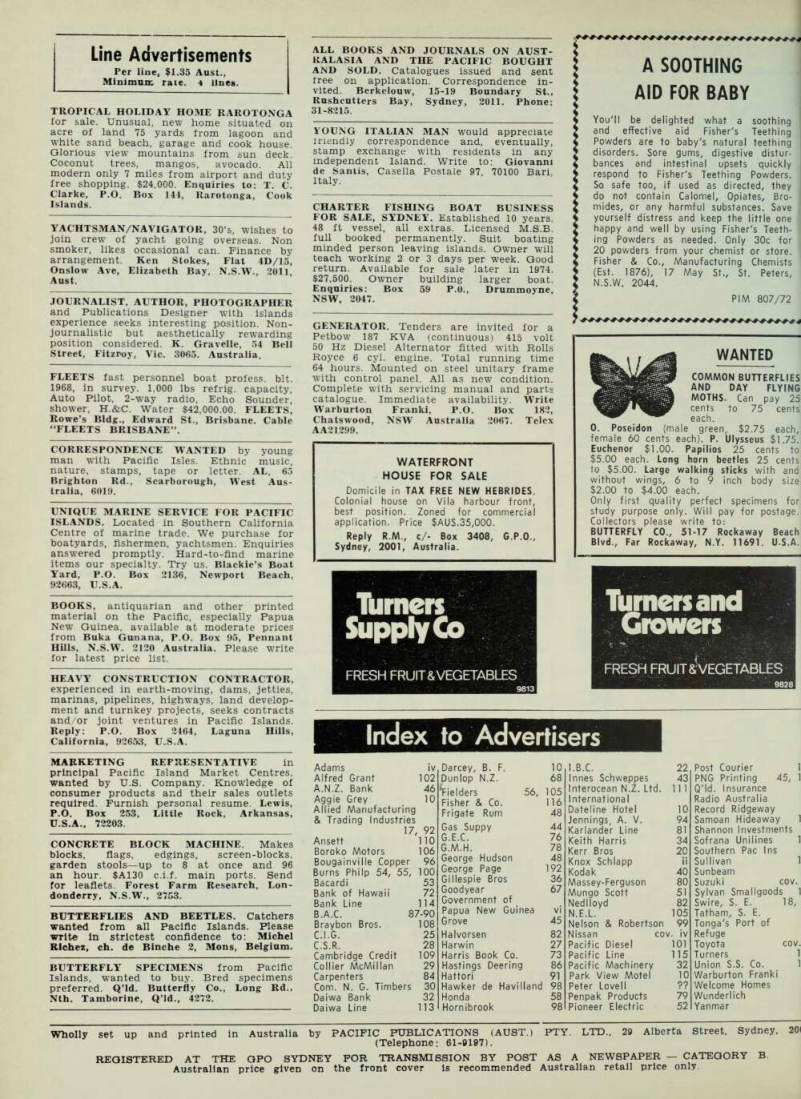
Adams iv Alfred Grant 102 A. N.Z. Bank 46 Aggie Grey 10
Allied Manufacturing
& Trading Industries 17, 92 Ansett 110 Boroko Motors 106 Bougainville Copper 96 Burns Philp 54, 55, 100 Bacardi 53 Bank of Hawaii 72 Bank Line 114 B. 87-90 Braybon Bros. 108 C. 25
C.S.R. 28
Cambridge Credit 109 Collier McMillan 29 Carpenters 84 Com. N. G. Timbers 30 Daiwa Bank 32 Daiwa Line 113
Darcey, B. F. 10 Dunlop N.Z. 68 fielders 56, 105 Fisher & Co. 116 Frigate Rum 48 Gas Suppy 44
G.E.C. 76
G.M.H. 78
George Hudson 48 George Page 192 Gillespie Bros 36 Goodyear 67 Government of Papua New Guinea vi Grove 45 Halvorsen 82 Harwin 27 Harris Book Co. 73 Hastings Deering 86 Hattori 91 Hawker de Havilland 98 Honda 58 Hornibrook 98
1.8. C. 22 Innes Schweppes 43 Interocean N.Z. Ltd. 11l International Dateline Hotel 10 Jennings, A. V. 94 Karlander Line 81 Keith Harris 34 Kerr Bros 20 Knox Schlapp li Kodak 40 Massey-Ferguson 80 Mungo Scott 51
Nedlloyd 82
N.E.L. 105
Nelson & Robertson 99 Nissan cov. iv Pacific Diesel 101 Pacific Line 115 Pacific Machinery 32 Park View Motel 10 Peter Lovell ??
Penpak Products 79 Pioneer Electric 52
Post Courier 1 PNG Printing 45, 1 Q'ld. Insurance Radio Australia Record Ridgeway Samoan Hideaway 1 Shannon Investments Sofrana Unilines 1 Southern Pac Ins Sullivan 1 Sunbeam Suzuki cov.
Sylvan Smallgoods 1 Swire, S. E. 18, Tatham, S. E.
Tonga's Port of Refuge Toyota cov.
Turners 1 Union S.S. Co. 1 Warburton Franki Welcome Homes Wunderlich Yanmar
Advertisements & other items, pp. 126-128 (3 items)
Wholly set up and printed in Australia by PACIFIC PUBLICATIONS (AUST.) PTY. LTD., 29 Alberta Street, Sydney. 20(
(Telephone; 61-9197).
REGISTERED AT THE GPO SYDNEY FOR TRANSMISSION BY POST AS A NEWSPAPER CATEGORY B Australian price given on the front cover is recommended Australian retail price only.
Iii
?IFIC ISLANDS MONTHLY—AUGUST, 1974
There’s no end
to the distance we go.
When a company like Suzuki decides to go the distance, it makes a commitment.
A commitment to its customers.
Customers in more than 110 countries.
Customers who count on Suzuki products.
A commitment to its products. Products which aim to be the safest, toughest, most reliable machines in their class.
And a commitment to the future. To research now, for better and longer-lasting
products tomorrow.
Suzuki. We go the distance. In today’s world, that’s important.
We go the distance.
SUZUKI MOTOR CO LTD
Hamamatsu, Japan AM ISLAND CYCLERY PQNAPE leo ETSCHEIT TARAWA G & E.l. COOPERATIVE FEDERATION LTD. NAURU CAPELLE & PARTNER FIJI D. GOKAL :OMPANY LIMITED TONGA MORRIS HEDSTROM LTD. NIUE BURNS PHILP (SOUTH SEA) COMPANY LTD. NEW GUINEA & PAPUA TUTT BRYANT SIFIC LTD. NEW HEBRIDES FIENRI LEROUX NEW CALEDONIA SUPERCAL TAHITI N IPPON AUTOMOTO NORFOLK MARTIN'S AGENCIES LTD. $
SUZUKI
► And wherever you’ll go in over 120 nations throughout the world you’ll find proud DATSUN drivers.
Perhaps the main reason is that DATSUN was designed to meet a wide variety of conditions—mountain roads and super highways, blistering suns and freezing temperatures. DATSUN is indeed the international car that has precision engineering and a stunning string of rally victories behind it.
Its superb handling, safety features and high speed efficiency make DATSUN the choice of young and old alike. DATSUN—the car that really satisfies the world over.
DATSUN
NISSAN
DATSUN distributor network covers the following areas: Fiji• T.P.N.G. •W. Samoa* New Caledonia• New Hebrides* 8.5.1.P.* Timor-Norfolk . a m . ... a ] m - £3 ; --- A V/inr 7/>olon/i