•acilic Islands Monthly

News Magazine Of The South Pacific
July, 1974
AUSTRALIA, N.Z., P.N.G., FIJI, N. HEBRIDES 60c TONGA, W. SAMOA, 8.5.1. P., G.E.I.C. 60c
Cooks, Norfolk, Niue, Nauru 60C
Am. Samoa, Hawaii, Micronesia, Guam $L.Oo
NEW CALEDONIA AND FRENCH POLYNESIA 100 CFP
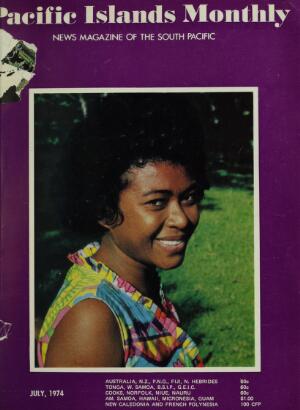
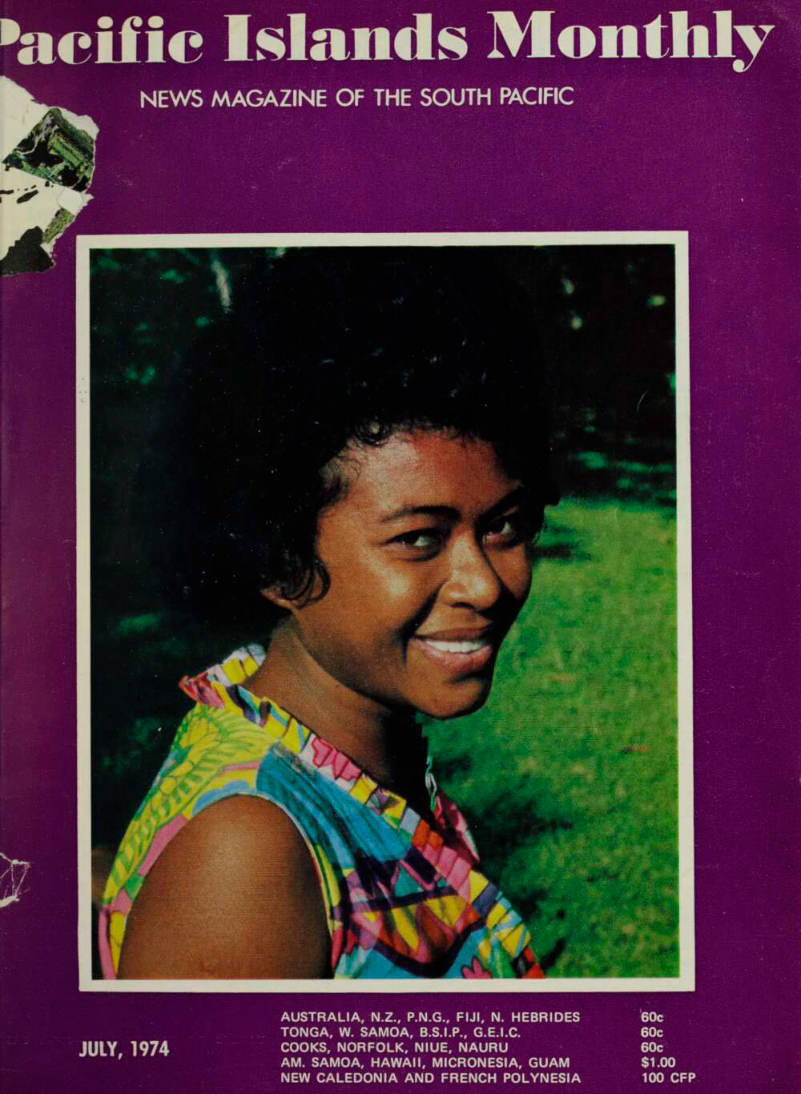
Our Cover
Everybody likes a pretty smile, including PIM and Dr Radomir Joura, of Parramatta, NSW, who took this shot of Mere who lives in Rakiraki village in Kadavu, Fiji.
Advertisements & other items, p. 2 (1 item)
Mazda1000&1200 Pickups,
1 ft •T.
mmmm.
«oo m m A lot of truck for your money.
Check the features for yourself
0 All steel cargo deck with snap shut tailgate 0 Big load carrying capacity 0 Tough, girder-section steel chassis 0 Choice of rugged 1000 or 1200 OHV engine 0 Large, 4-bladed engine fan 0 Laminated safety glass windscreen See your Mazda dealer soon 0 Corrosion-free grille with stylish square headlights 0 2-speed wipers with twin jet washer 0 Roomy bench seat adjustable 6 ways for height and reach 0 Flow-through ventilation system 0 Push in, pull out door lock knobs 0 Easy-to-get-at battery and engine ' a real value-for-money buy.
MAZDA
© 1973 TOYO KOGYO CO., LTD.
FIJI Niranjans Autoport Ltd. G.P.O. Box 450, Suva Tel: 22691 NEW CALEDONIA Societe Riviere et Bernanos, 27, Rue de Sebastopol, Noumea PAPUA NEW GUINEA P.N.G. Associated Ind. Ltd., P.O. Box 1394, Boroko Tel: 55788 NEW ZEALAND Mazda Motors of New Zealand Ltd., Otahuhu, Auckland P.O. Box 22-472 Tel: 69-099 WESTERN SAMOA H. & J. Retzlaff, P.O. Box 195, Apia Tel: 237 NEW HEBRIDES Societe Bourgeois et Cie, P.O. Box 28, Port-Vila PORTUGUESE TIMOR Sang Tai Hoo, Dili AMERICAN SAMOA Max Haleck, Incorporation, P.O. Box 99, Pago Pago, American Samoa 96799 Tel: 89231 POLYNESIE FRANCAISE Comptoir Polynesien, B.P. 628, Papeete, Tahiti 8.5.1. P. Solomon Motors Ltd., P.O. Box 20, Honiara, British Solomon Islands Protectorate Tel: 313 The trademark MAZDA in this advertisement stands for AUTOMOBILES MAZDA as far as France and her territories are concerned.
In This Issue
Eneral
uam gets Games 24 lew church province 32
egional airline wrangle 77
/dney shipping delays 83 PEC headquarters (pic) ... 99
Imerican Samoa
nglish phased out, school TV , 11, 33 ukewarm on referendum 12
Ook Islands
mother ship for Cooks/Niue run 81 Vanganese on sea-bed 98 lo tourist flood 99
Iji
iflation 7 M's visit to PNG 9 lungry tourist industry 10 Ipposition calls for unity 11 lathedral completed 15 hortage of yaqona 32 egional airline wrangle 77 ossible dockworker redundancy 79 hip withdrawn 81 leplacement for Tui Lau 83 )eath of Prime Minister's mother .. . 110 letaliation on air rights 11l
Rench Polynesia
Juclear tests resume 13
Gilbert And Ellice Islands
louse of Assembly meets 12
Lord Howe Island
Last regular flying-boat ... 81 Progress on strip (pic) 83 Middleton Reef rescue 11l Flying-boat salvageable 112
Nauru
Parliament meets 32
New Caledonia
Japanese nickel talks 101 Trimaran rescue 112
New Hebrides
Putting snails to work 15 Joint law and order rules 32
Niue
Another ship for Cooks/Niue run 81
Norfolk Island
Factory burned down 32 End of Newsletter 33
Papua New Guinea
Inflation 7 Fiji PM's visit 9 Mr Somare at the hustings 10 New district 14 PNG's women 21 Bank membership 32 NZ teachers for PNG 32 Manus to get pub ... 33 Water processing plant for Moresby .. 33 Citizenship proposals controversy ... 35 Plans for rice industry 100
Civil aviation changes 11l Knighthoods in honours list 11l
Solomon Islands
Antidote to inflation 14 Bleak future for tourism 16 Leaf house for EXPO 47 End of Australian currency? 101
Tonga
UK loan 10 Basketball riot 16 Colour TV set for King 32 Boxer's win 32 Plans for airline 77
United States Trust Territory
Moves to independence 13 Micronesian "non-citizens" 14 Bikinians' return postponed 16 Public Defender's fight 16 Japanese tracking station 32 Another TT district 33 Compensation for bomb victims ... 47 Saipan's housing problem 49 Unusual disease rate 51
Western Samoa
Coping with tourism 45 Regional airline wrangle 77 Govt plans for economy boost 97 Duty free zone study 101
)EPARTMENTS: Up front with the Editor, 3; Tropicalities, 14; In a Nutshell, 32; Editor's Aailbag, 36; From the Islands Press, 52; Magazine Section, 61; MANA, 64; Yesterday, r l; Books, 73; Pacific Transport, 77; Cruising Yachts, 85; Business and Development, 97; ‘roduce, 102; Shipping and Airways Information, 103; Deaths of Islands People, 110; Postscripts, 111; Advertisers' Index, 112.
Advertisements & other items, p. 4 (1 item)
Water
m
AQUA GENIE
Oul-performs anything in its price range!
Only $139 Australia’s largest and most advanced range of
WATER
PRESSURE
svsisms
From only $139
ECON-O-JET
Packaged water systems.; From Only $2lO j ‘J” Series High Pressure J Unit Range of multi-stage deep and shallow well capacities models, from 200 to 2600 g.p.h., pressures from 20 ton 2o p.s.i., depths to 300 ft. From $360 Water Equipment Catalogue 288 Pages—covers pumps ot all types, irrigation, water conditioning, domestic and commercial pool filtration. Price $2, post fcee Surface mail (enclose cheque/ money order) HYDRO-PAK (Left) from $303 TWIN-PAK (Above) from $393 New RM2 range of shallow and deep well models, capacities to 1180 g.p.h., pressures to 75 p.s.i.
DUNLOP/IBC LTD., Station 4105. Phone: 40-9011.
NAME
ADDRESS
Road, Yerrongpilly,
PHONE.
rediscovering water
LBQO4IO I.F.
Pacific Islands
Monthiy
POUNCED BY R. W. ROBSON IN 1930
Published Monthly By
Pacific Publications (Aust.) Pty. Ltd.,
29 Alberta St., Sydney, N.S.W., 2000.
Postal Address: G.P.O. BOX 3408, SYDNEY,
N.S.W., 2001.
Telagraphic Address: PACPUB, Sydney.
Telex 25168.
Telephones: 61-9197, 61-7101, 61-4369.
insulting Directors; R. W. Robson, Judy Tudor.
Chief Executives: Manager: Selwyn Hughes.
Publisher: Stuart Inder.
Director of Advertising; W. A. Gasnier.
Pacific Islands Monthly
Editor: Stuart Inder.
Assistant Editor: John Carter.
Advertising Manager: W. A. Gasnier.
Circulation Manager: Barry Badger.
Subscription Rates:
Pacific Islands Monthly" is airfreighted to all ibscribers and agents in the Pacific Islands id the U.S.A.; copies to Nauru and other •eas go by surface mail. ustraßa (incl. Lord Howe and Thursday Is.), ew Zealand, Papua New Guinea, Fiji, New ebrides, Tonga, Western Samoa, Solomon lands, Gilbert & Ellice Islands, Cook Islands, orfolk Island, Niue and Nauru Islands: $6.80 ocal currency); American Samoa, Hawaii, iicronesia and Guam; $12.00 US; New aledonia and French Polynesia 1,100 CFP; S Mainland: $14.00 US; United Kingdom: 5-10. Elsewhere $B.OO Aust.
Representatives
iji: Advertising—A. F. Woods, Imex (Pacific) imited. Suite 2A, Victoria Arcade, Suva, Fiji, .0. Box 3117, Lami, SUVA. Telephone: 22-502. >lex. 2124. Distribution—Desai Book Depot Ltd., P.O. Box 160, SUVA. Tel.: 311-424. apua New Guinea; PORT MORESBY, PNG Print ig Co. Pty. Ltd., P.O. Box 633; LAE, P.O. Box 27; RABAUL, Mr. David Simpson, P.O. Box 164 (c/- Rabaul Photographic. Tel.: 2677.) rench Polynesia. Distribution—Hachette Paci qiie, 10 Ave Bruat, Papeete, ew Zealand: Pacific Publications, C.P.O. Box 229, Auckland. 379-494. Representative: John pedding. Civic House, 291 Queen St., Auckland, Tel.: 379-494. nited Kingdom; Advertising—Overseas Publicity Id., 214 Oxford Street, London, WIN OEA. hone: 01-636 8296/7. Subscriptions—T. B. raham. Park House, 22 Park Street, Croydon,
Cr9 3Np. Tel.: 01-6884177.
apan: Advertising—Universal Media Corpora tion, C.P.O. Box 46, Tokyo. Tel.: 666-3036. ictoria: Advertising Pacific Publications \ust.) Pty. Ltd., 33 Lonsdale Street, lelbourne, Vic. 3006. Telephone: 662-3263. ueensland: Advertising—Beale Media Services, 32 St. Paul's Terrace, Fortitude Valley, Qld., 4006. Tel.: 52-5827. awaii and U.S. Mainland only: N. Grogan, 354 Hayden Street, Honolulu, 96815.
Send change of address notices, Form 3579 nd new subscriptions to P.O. Box 2193, Honolulu, Hawaii, U.S.A. 96805), econd class postage paid at Honolulu, Hawaii.
Copyright ©, 1974,
Pacific Publications (Aust) Pty. Ltd.
July, 1974 Vol. 45, No. 7
Up Front
with the Editor
Government schemes frequently enough fail to reach their target, but one that has exceeded its target to some embarrassment is the one calling for a reduction of expatriate staff in the Papua New Guinea public service.
A government plan announced in 1972, was for each department to cut employment of expatriates 15 per cent each year, and this has been done so successfully that the reduc tion rate has been running at about 30 per cent. Chief Minister Michael Somare now admits that they’ve over done it, and that staff has been lost they would have liked to retain. The cuts have especially affected PNG’s ability to carry out its social and economic programmes.
“We would rather employ people from overseas for as long as it is necessary, than have these pro grammes fail because of shortage of manpower,” said Mr Somare. He’s decided as a result that the arbitrary 15 per cent reduction will no longer be enforced.
He deserves applause for his public admission at a time of national fer vour when the country can’t be ex pected to go out of its way to offer concessions to expatriates. He got no thanks for it from the Leader of the Opposition in the House of Assembly, Mr Tei Abal, who said the decision to suspend the programme was neces sary but hardly commendable because the government should have made it earlier.
The PNG Public Service Asso ciation viewed the decision to suspend the target with alarm, agreeing that it was necessary to retain the skills of expatriates so long as the genuine drive for localisation was still assured.
But the most useful reaction in my view comes, surprisingly, from Suva, in an editorial in The Fiji Times, which comments that Mr Somare’s change in policy is both sympathetic and realistic, and it “has lessons for any country which is simultaneously trying to preserve the delicate balance between advancing its own citizens, and fulfilling its economic, social and educational aims”.
“Delicate balance” is the key phrase.
It was inevitable that many expatriates would leave PNG as independence approached, work re strictions were tightened and anti- European sentiment grew. And not only public servants. Between Sep tember 1972 and April 1974 a total of 12,000 expatriates left PNG per manently, among them public ser vants who didn’t leave as a result of the 15 per cent cut, but who were driven by the necessity of establish ing themselves somewhere else.
One of these 1 talked to in Sydney the other day. I’ve known him for more than 25 years, and he’s on his last leave before coming to Australia permanently. It was a “job-finding” leave. It’s a job he is looking for because he’s faced up to the fact that he is unlikely to find a career.
“It’s rather devastating that I’ve been out of this sort of society for a quarter of a century, and I’ve only just realised it as I look around Sydney and see everybody busy,” he said, gloomily. “Everybody has a job to do and they seem to know what they are doing, but there doesn’t seem to be any room for me.”
Yet Mr Somare, despite his sin cerity, can’t hold this man by saying that PNG would “rather employ people from overseas for as long as necessary” than have its pro grammes fail. People are not mere units of work who can be retained for as long as it suits the employer.
On the other hand, as the Public Service Association and Mr Somare himself stress, the drive towards localisation must not falter if it is to be achieved at all, and not drag on.
So l the problem comes back to this matter of keeping a delicate balance.
I wish both sides well, and not for the first time am I relieved that I have usurped the privilege of com menting on problems and not the responsibility of solving them.
Stuart Inder
1973: Growth In Asia
And The Pacific
Extracts from the Statement to Stockholders by Mr Henry Keswick, Chairman, Jar dine, Matheson & Co. Ltd.
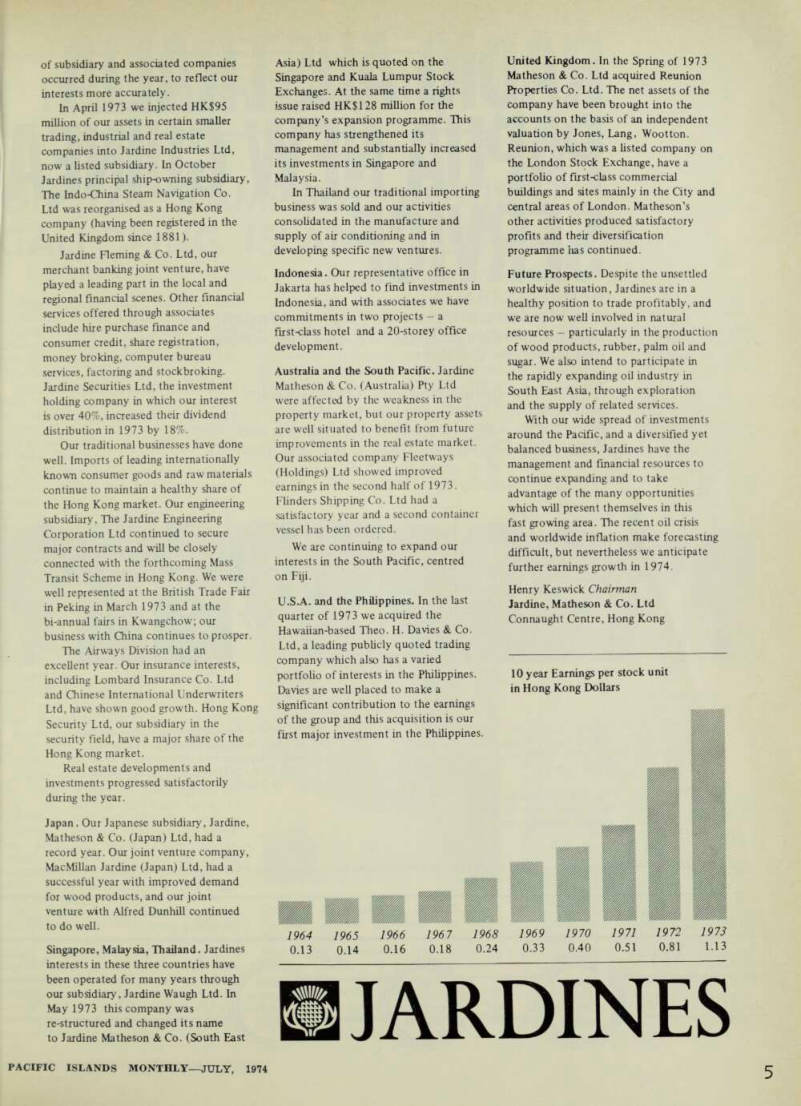
Dividends and earnings per stock unit up 40%. 1973 was one of the most challenging years in Jardines recent history, in which our profit reached a record level and our net worth was more than doubled. Net operating profit after tax for the year ended 31st December, 1973 was HK$ 136.7 million compared with HKS92.3 million in 1972, an increase of 48%. In addition a capital profit of HK$96 million arising from real estate and investment transactions, has been credited direct to reserves. Earnings per stock unit, based on net operating profit, increased to HKS1.13 from the 1972 adjusted figure of HKS0.81, a rise of 40%. The compound growth rate in adjusted earnings per stock unit over the past ten years is 27% per annum.
Total dividends were HK$0.50 per stock unit, up 40% on the 1972 adjusted figure of HKS0.36. By the end of 1973 stockholders’ funds had risen by 154% from HK$573 million in 1972 to HK$1,458 million, mainly as a result of
incorporating the net assets of two acquisitions, Theo. H. Davies & Co. Ltd and Reunion Properties Co. Ltd, and transfers to reserves. The net asset value per stock unit was HK$11.21 at 31st December, 1973, an increase of 120% over the 1972 adjusted figure of
Hks5.09.
The 1973 profit of HK$16.7 million from Theo. H. Davies & Co. Ltd, has not been consolidated in the 1973 accounts; Reunion Properties Co. Ltd’s nine month’s figures have been included.
Following free scrip issues of two for five in May and one for one in November, the issue of 15.7 million new stock units
in the two acquisitions (including free scrip issued), and the issue of 1.8 million stock units to converting Warrant holders, issued capital at year-end reached HK$781 million.
The group has ready access to international sources of finance and during the year raised medium and long term funds of HK$165 million in Europe through guaranteed notes.
Hong Kong. Jardines activities in Hong Kong continued to grow and show profit improvement during 1973. We have reorganised and re-grouped various activities and several changes in names
Earnings after tax 1973 FS 21.2 m. 1972 F$ 14.4 m.
Earnings per stock unit 0.18 0.13 Dividends per stock unit 0.08 0.06 Stockholders’ funds 226 m. 90 m.
Note Currencies converted at rates ruling at mid-April 1974 (F$l = HKS6.45) and 1973 (F$l = HK$6.40)
of subsidiary and associated companies occurred during the year, to reflect our interests more accurately.
In April 1973 we injected HK$95 million of our assets in certain smaller trading, industrial and real estate companies into Jardine Industries Ltd, now a listed subsidiary. In October Jardines principal ship-owning subsidiary, The Indo-China Steam Navigation Co.
Ltd was reorganised as a Hong Kong company (having been registered in the United Kingdom since 1881).
Jardine Fleming & Co. Ltd, our merchant banking joint venture, have played a leading part in the local and regional financial scenes. Other financial services offered through associates include hire purchase finance and consumer credit, share registration, money broking, computer bureau services, factoring and stockbroking.
Jardine Securities Ltd, the investment holding company in which our interest is over 40%, increased their dividend distribution in 1973 by 18%.
Our traditional businesses have done well. Imports of leading internationally known consumer goods and raw materials continue to maintain a healthy share of the Hong Kong market. Our engineering subsidiary, The Jardine Engineering Corporation Ltd continued to secure major contracts and will be closely connected with the forthcoming Mass Transit Scheme in Hong Kong. We were well represented at the British Trade Fair in Peking in March 1973 and at the bi-annual fairs in Kwangchow; our business with China continues to prosper.
The Airways Division had an excellent year. Our insurance interests, including Lombard Insurance Co. Ltd and Chinese International Underwriters Ltd, have shown good growth. Hong Kong Security Ltd, our subsidiary in the security field, have a major share of the Hong Kong market.
Real estate developments and investments progressed satisfactorily during the year.
Japan, Our Japanese subsidiary, Jardine, Matheson & Co. (Japan) Ltd, had a record year. Our joint venture company, MacMillan Jardine (Japan) Ltd, had a successful year with improved demand for wood products, and our joint venture with Alfred Dunhill continued to do well.
Singapore, Malaysia, Thailand. Jardines interests in these three countries have been operated for many years through our subsidiary, Jardine Waugh Ltd. In May 1973 this company was re-structured and changed its name to Jardine Matheson & Co. (South East
Asia) Ltd which is quoted on the Singapore and Kuala Lumpur Stock Exchanges. At the same time a rights issue raised HK$l2B million for the company’s expansion programme. This company has strengthened its management and substantially increased its investments in Singapore and Malaysia.
In Thailand our traditional importing business was sold and our activities consolidated in the manufacture and supply of air conditioning and in developing specific new ventures.
Indonesia. Our representative office in Jakarta has helped to find investments in Indonesia, and with associates we have commitments in two projects - a first-class hotel and a 20-storey office development.
Australia and the South Pacific. Jardine Matheson & Co. (Australia) Pty Ltd were affected by the weakness in the property market, but our property assets are well situated to benefit from future improvements in the real estate market.
Our associated company Fleetways (Holdings) Ltd showed improved earnings in the second half of 1973.
Flinders Shipping Co. Ltd had a satisfactory year and a second container vessel has been ordered.
We are continuing to expand our interests in the South Pacific, centred on Fiji.
U.S.A. and the Philippines. In the last quarter of 1973 we acquired the Hawaiian-based Theo. H. Davies & Co.
Ltd, a leading publicly quoted trading company which also has a varied portfolio of interests in the Philippines.
Davies are well placed to make a significant contribution to the earnings of the group and this acquisition is our first major investment in the Philippines.
United Kingdom. In the Spring of 1973 Matheson & Co. Ltd acquired Reunion Properties Co. Ltd. The net assets of the company have been brought into the accounts on the basis of an independent valuation by Jones, Lang, Wootton.
Reunion, which was a listed company on the London Stock Exchange, have a portfolio of first-class commercial buildings and sites mainly in the City and central areas of London. Matheson’s other activities produced satisfactory profits and their diversification programme has continued.
Future Prospects. Despite the unsettled worldwide situation, Jardines are in a healthy position to trade profitably, and we are now well involved in natural resources - particularly in the production of wood products, rubber, palm oil and sugar. We also intend to participate in the rapidly expanding oil industry in South East Asia, through exploration and the supply of related services.
With our wide spread of investments around the Pacific, and a diversified yet balanced business, Jardines have the management and financial resources to continue expanding and to take advantage of the many opportunities which will present themselves in this fast growing area. The recent oil crisis and worldwide inflation make forecasting difficult, but nevertheless we anticipate further earnings growth in 1974.
Henry Keswick Chairman Jardine, Matheson & Co. Ltd Connaught Centre, Hong Kong
Jardines
10 year Earnings per stock unit in Hong Kong Dollars
Advertisements & other items, p. 8 (1 item)
Service
n.
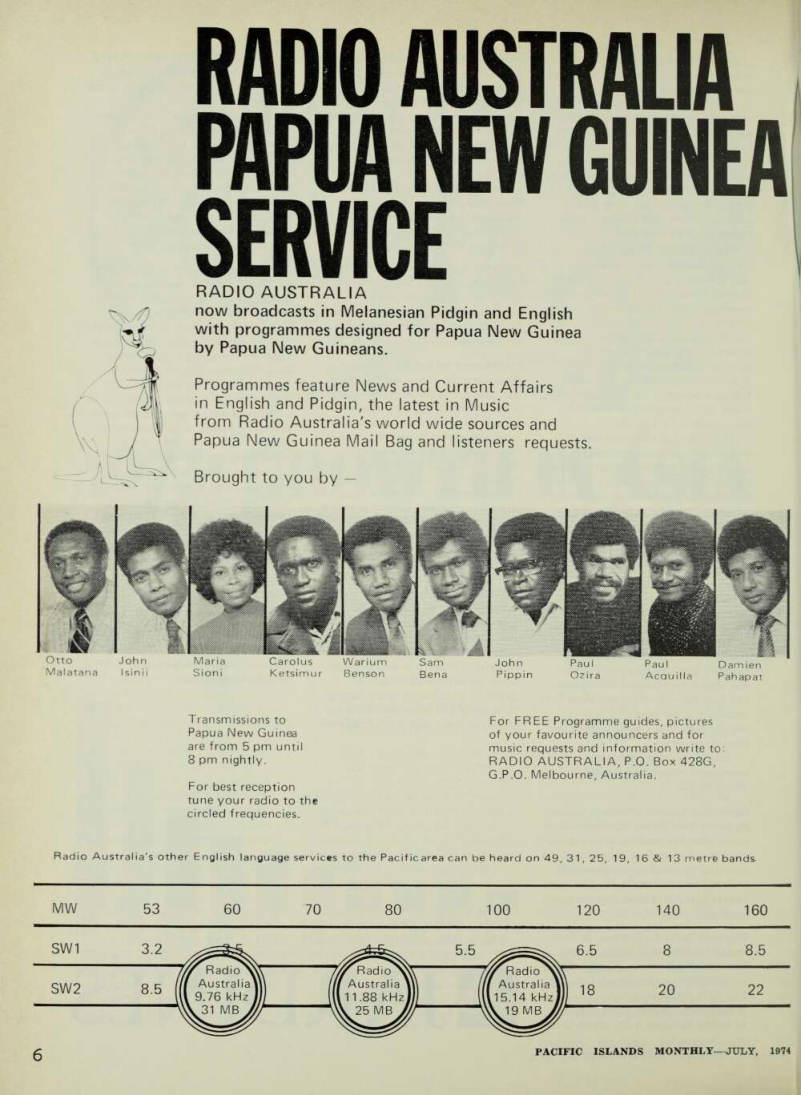
RADIO AUSTRALIA
PAPUA NEW GUINEA
SERVICE
RADIO AUSTRALIA
now broadcasts in Melanesian Pidgin and English with programmes designed for Papua New Guinea by Papua New Guineans.
Programmes feature News and Current Affairs in English and Pidgin, the latest in Music from Radio Australia's world wide sources and Papua New Guinea Mail Bag and listeners requests.
Brought to you by r I » A Transmissions to Papua New Guinea are from 5 pm until 8 pm nightly.
For best reception tune your radio to the circled frequencies.
For FREE Programme guides, pictures of your favourite announcers and for music requests and information write to:
RADIO AUSTRALIA, P.O. Box 428 G,
G.P.O. Melbourne, Australia.
Radio Australia's other English language services to the Pacific area can be heard on 49, 31,25, 19, 16 & 13 metre bands.
Pacific Islands Monthly
On The Rampage Against
Galloping Islands Inflation
From correspondents in Port Moresby and Suva
Workers, university students and housewives in the South Pacific’s two biggest territories Papua New Guinea and Fiji took it in turns in [ate May and June to protest at the high cost of living.
Most publicised protest came from Port Moresby, where for two days in succession hundreds of angry women hurled insults and sometimes dicks and stones at Chief Minister Michael Somare.
On the first occasion they besieged bis city office, led by PNG’s only woman member of parliament, Papuan Miss Josephine Abaijah.
Some of the group forced their way into the office complex, overturning furniture and writing “We want more money please” on a blackboard. Miss Abaijah presented the Chief Minister with a petition demanding increased wages for their men, a freeze on prices, a 50 per cent cut in parliamen tary salaries and fewer overseas trips by ministers. The crowd shouted Mr Somare down.
The next day Mr Somare and Minister for Defence, Foreign Rela tions and Trade, Mr Albert Maori Kiki, agreed to talk to the women in a sports arena, but this turned out to be a debacle, with stones being hurled.
Police protected Mr Somare, who was later driven to the airport to catch an aircraft to Melbourne to address a meeting. But the women followed, storming the airport build ing, smashing glass doors in an attempt to force their way on to the tarmac. They were kept back by police until the Chief Minister’s air craft departed.
Mr Somare said later he didn’t blame the women, who were genuinely concerned about high prices and didn’t realise that inflation was a world wide problem. But he was critical of the part played by Miss Abaijah, and suggested that the violent scenes had been encouraged by her leadership so that she could “have a martyr for her cause”.
He praised the restraint of the police “in face of very real provoca tion and total irresponsibility”.
The university students —at the University of Papua New Guinea in Port Moresby and the University of Technology in Lae —had the same problem as the women —not enough money.
The trouble began at the Univer sity of PNG when students staged a one-day strike in protest at the food and service at the university mess.
But they later included other econ-
omic demands as a kind of bid on behalf of the community at large.
Within a day or two the govern ment announced that they would get an increase of S 3 in their $5 a fort night allowance. They had asked for a $5 increase.
Education Minister Dr Reuben Taureka made it clear that if the offer was not accepted, students hold ing government scholarships would have them cancelled. He said the offer of an increase was made in view of rising food costs, and it was expected that students would use the additional money to pay higher mess fees to enable the mess to feed them at a better standard.
The students were in no mood for threats of cancelled scholarships, and the strike spread to Lae, with private students or those on overseas and company scholarships offering sup port. Many students said they were willing to abandon studies and return home.
The universities shut down for some days. The other demands of the students were that: The salaries of ministers and departmental heads be cut by 10 per cent (which was an improvement on Miss Abaijahs proposal) or frozen indefinitely; that the minimum wages for labourers be increased; that government reduce the number of ministerial and other officials’ trips abroad; the government sell its four acres ministerial retreat outside Port Moresby that it recently bought for $11,000; and that the agreement with Boupainville Copper Ltd be re negotiated giving the PNG Govern ment 60 per cent of equity and eventually the lot, Mr Somare replied that the govern ment had no intention of increasing ministerial salaries although the Constitutional Planning Committee would recommend ways of reviewing them from time to time; the Public Service Association couldn’t be re strained from pressing for increases in pay although it was government policy to keep higher salaries to a
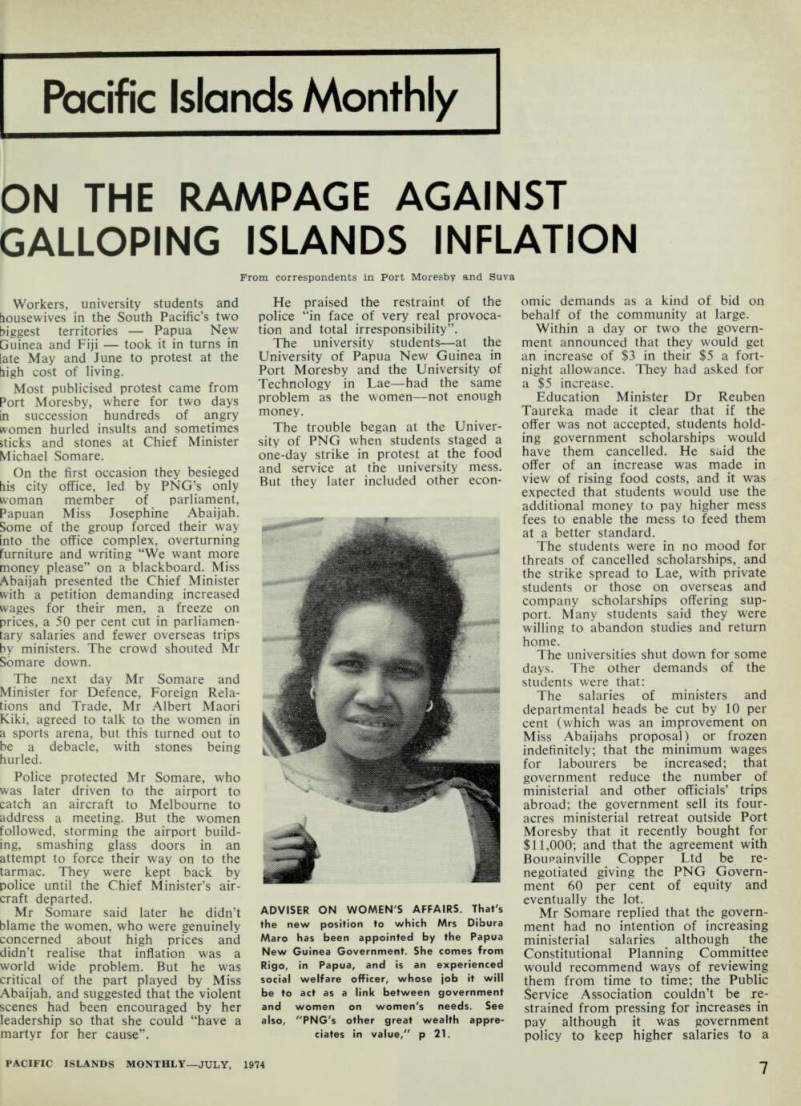
Adviser On Women's Affairs. That's
the new position to which Mrs Dibura Maro has been appointed by the Papua New Guinea Government. She comes from Rigo, in Papua, and is an experienced social welfare officer, whose job it will be to act as a link between government and women on women's needs. See also, "PNG's other great wealth appre ciates in value," p 21.
minimum; the government would sell its retreat if it could do so at a profit and the buyer was a Papua New Guinean; the negotiations with Bougainville Copper Ltd over a bigger share for PNG were already in pro gress; and overseas trips were strictly vetted by a cabinet committee.
On that basis the students accepted the S 3 increase and went back to their studies, with nobody certain about who had won.
The increased students’ allowance will be paid to students at the two universities, the Goroka Teachers College and at the nine teachers’ col leges in the national education system.
The PNG Government reacted to rising pressures and unrest by an nouncing, on June 19, new measures to combat inflation. This was only two days after it was announced that freight rates between Australia and PNG would rise by 18 per cent, plus another $lO a tonne for refrigerated goods.
The government has exempted rice, sugar, flour, tinned fish and meat from the 2i per cent import levy, and has reduced wholesale and retail mar gins by substituting money mark-ups for percentage mark-ups. The date has yet to be fixed for the introduc tion of these measures, estimated to save consumers $3 million a year, but to cost the government $600,000 a year in revenue.
The Finance Minister, Mr Julius Chan, said the government could do little to control inflation, currently estimated at 23 per cent a year. Mr J. Aoae, president of the Public Ser vice Association, said PNG was on the point of explosion because of spiralling costs. Further government delay would bring a crisis.
Fiji in May narrowly avoided an indefinite general strike. It was called by the Fiji Trades Union Congress as a protest against “suppression” of wages by the Fiji Prices and Incomes Board—and it was avoided only because the PIB had some of its teeth removed by the government. The operation on the PIB may turn out to have been the wrong thing.
The PIB has been Fiji’s bogey man since last year, when it was set up to police a government plan to deal with inflation by controlling prices and incomes. For 90 days from April 1 last year, the Fiji Govern ment froze all prices, wages, charges and house rents, and since then it has been systematically easing them, using the PIB as its instrument.
The first relaxation, from July last year, allowed wage increases of up to eight per cent provided that the
last increase was granted not less than 12 months before. There has been a further relaxation since, but the unions have argued that the levels at which wages were frozen last year were too low, and that there is no way that wage-earners can catch up with rising prices under present restrictions.
They felt that the government was prepared to listen to their arguments for “wage justice”, but that the PIB was acting in an arbitrary way and exercising its power indiscriminately.
The Trade Union Congress decided on a national strike to commence on May 20 as a protest against the PIB and also to demand restoration of collective bargaining because of gal loping inflation.
The strike was postponed for 24 hours when the government agreed to talk, and at the end of the talks the strike was called off. The unions won a victory at the expense of the PIB, and the PIB now feels it has been let down by the government.
In essence, the government agreed
that if unions and employers can reach agreement on wage increases that “restore relativity”, then the PIB cannot reject them. The “relativity” clause is open to wide interpretation.
The government also agreed on some other important changes which, in the words of FTUC general secretary James Raman, “achieved a great deal in being able to tame the Prices and Income Board”.
The board, headed by Dr Norman Ross, has since warned the govern ment that as a result of the changes about 6,000 Fiji workers could lose their jobs, and that the government might soon have to take severe action to counteract its new agree ment, such as increasing taxation, restricting imports, credit and govern ment spending. People able to negotiate for higher pay would spend their money on imports, the board said. Relaxation of the anti-inflation ary guidelines would result in wage inflation at the same sort of highly dangerous rate Fiji experienced in 1972 and early 1973.
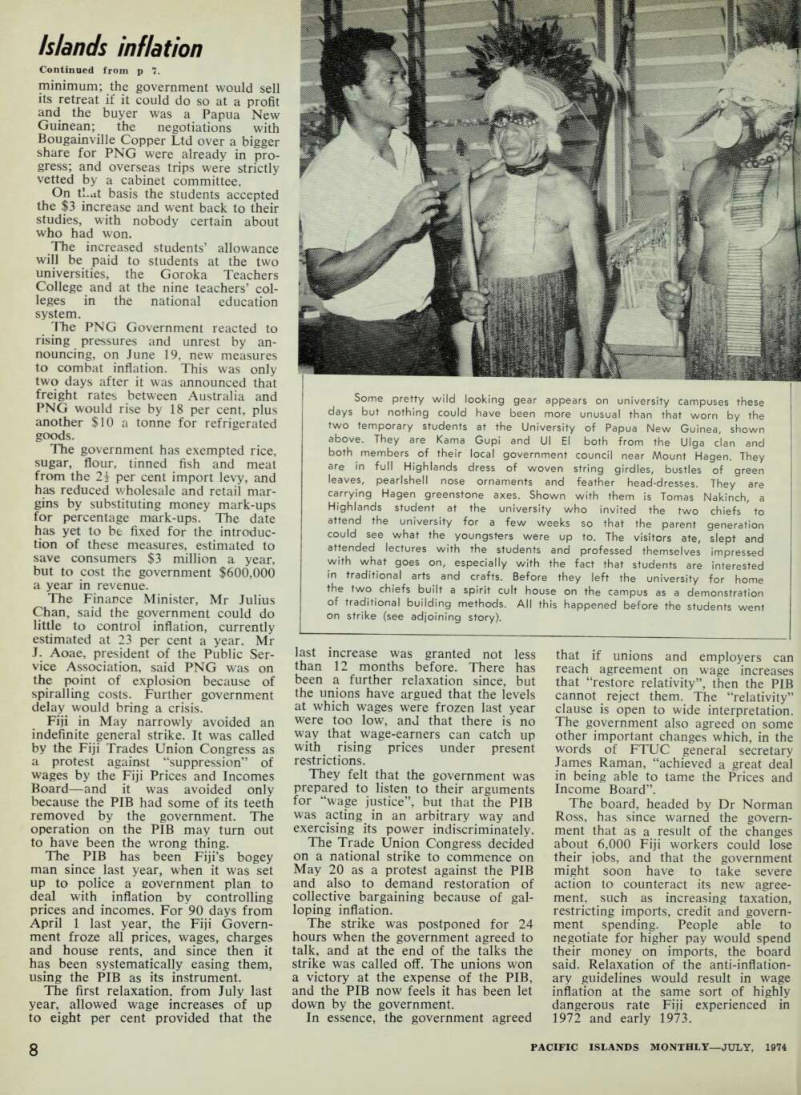
Some pretty wild looking gear appears on university campuses these days but nothing could have been more unusual than that worn by the two temporary students at the University of Papua New Guinea, shown above. They are Kama Gupi and Ul El both from the Ulga clan and both members of their local government council near Mount Hagen. They are in full Highlands dress of woven string girdles, bustles of green leaves, pearlshell nose ornaments and feather head-dresses. They are carrying Hagen greenstone axes. Shown with them is Tomas Nakinch, a Highlands student at the university who invited the two chiefs to attend the university for a few weeks so that the parent generation could see what the youngsters were up to. The visitors ate, slept and attended lectures with the students and professed themselves impressed with what goes on, especially with the fact that students are interested in traditional arts and crafts. Before they left the university for home the two chiefs built a spirit cult house on the campus as a demonstration of traditional building methods. All this happened before the students went on strike (see adjoining story).
Advertisements & other items, p. 10 (1 item)
Islands inflation
Continued from p 7.
A warm handshake
across the Pacific
From a Port Moresby correspondent
Visits by politicians in the southern winter are no new thing for Papua New Guinea but few have had such an enthusiastic offcial welcome as Ratu Sir Kamisese Mara, Prime Minister of Fiji, who spent eight days there in late May. There were big smiles all the way.
As the man who did it himself and jok Fiji from colonial rule to full tatehood in a matter of months in 970, Ratu Mara’s presence gave a cost to Chief Minister Somare’s ampaign for full independence for NG by December 1, this year.
Ratu Mara warned against any elay as quotable quotes he made long the way showed. He questioned le validity of the “grey area” of df-government as a prerequisite for utonomy. There should be no reliminaries, to his way of thinking.
As well he might be, the PM was ithusiastic over the potential of NG. It had gone further ahead, had lore resources developed and transfer I power was much more advanced lan in Fiji on the eve of indepen ;nce. PNG had an obligation, not aly to its people but to the world, » develop—and there was only one ice for development—full steam lead.
But perhaps it was at the end of s final news conference that Ratu [ara put his finger on what PNG ally had going for it as it ap oached statehood: “Certainly,” he said, “we didn’t ive $5OO million promised us”
During his crowded eight days, :companied everywhere by a beam g' Mr Somare, the Fiji PM visited irt Moresby, Mendi, Minj, Mount agen, Bulolo, Lae, Rabaul, the ipper mines at Panguna and the robriand Islands. A hill underneath e Mount Hagen High School cul ral-centre now rejoices in the name Ratu Sir Kamisese Mara Hill; in e Trobriands he was presented with le of their famous carved walking cks. Earlier he had received a pik mask.
In Port Moresby he was entertained two official dinners and he gave a ektail party; in Lae he played a me of golf, and there and in oresby he was entertained by the jian communities.
Out in the bush he towered head d shoulders over the small hill besmen and if, as he declared, he is impressed by the pride they had themselves and their resources, they ire equally impressed by the Fiji ime Minister.
Ratu Sir Kamisese was born a High lief of Fiji and has all the presence d assurance that entails. Of all ntors PNG has ever had, none has
been quite like Fiji’s Prime Minister.
No doubt Chief Minister Somare had just such a reaction in mind when he issued the invitation to visit.
During the tour both Mara and Somare took time out to beat their own particular drums.
Ratu Mara warned that regional aviation could become a “notable failure” unless the Pacific countries involved were prepared to subordinate national interests to the regional con cept. He said that Fiji would welcome participation in Air Pacific by all South Pacific Forum members. New Guinea could also help in a regional shipping line.
Mr Michael Somare in passing blamed the Australian Country Party for the fact that PNG has no sugar industry and indicated that something was going to be done about that.
Both had things to say about paternalistic, dictatorial colonial governments of the past and came out strongly for regional co-opera tion—a sort of Common Market for South Pacific territories. The Prime Minister could see PNG acting as a middle-man in trade between SE Asia and the Pacific as an alternative to trading through Australia, but no details were announced. Indeed, they have to be worked out.
Chief Minister Somare announced
that PNG planned to establish a consulate in Suva; Prime Minister Mara announced that Mrs Akanisi Taureka, a Fijian who is married to New Guinean Dr Reuben Taureka, PNG Minister for Education, had been appointed Fiji’s honorary consul in PNG.
Prime Minister Mara said that Fiji would buy coffee and cocoa from PNG. There was even a suggestion that PNG could import sugar from Fiji instead of from Australia. Some body pointed out that Australian white sugar, allegedly “with no food value”, cost 30 cents a lb in PNG while Fiji brown sugar, which is “full of molasses and has high food value” cost only 5 cents a lb in Fiji.
“In Fiji” are probably the key words in this case, and anyway brown sugar in Fiji is 6 cents per lb.
Before he flew home, Fiji’s Prime Minister invited Chief Minister Somare to make a state visit to Fiji at a time yet to be fixed.
Footnote ; Ratu Mara made his announcement about Fiji’s honorary consul at a small dinner party given by Mrs Taureka at her home. She said the announcement caught her by surprise.
The PNG Post Courier said: “Mrs Taureka has been accused of being a women’s liberation fan but she is
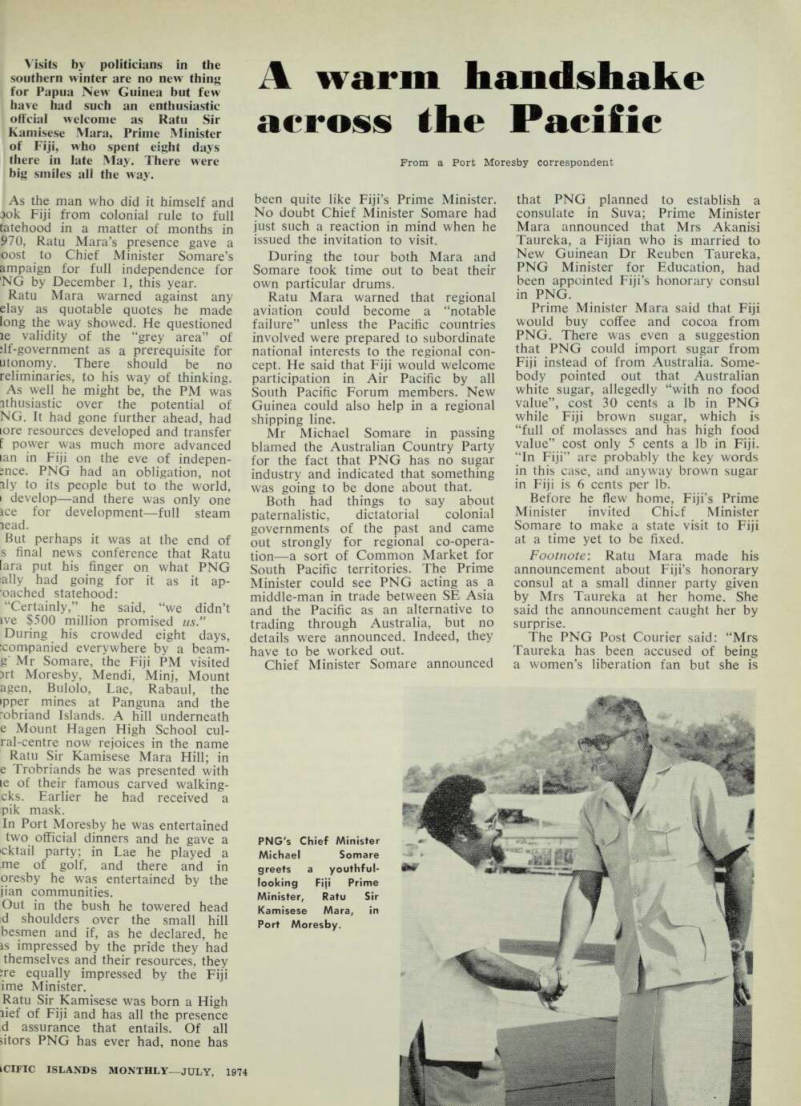
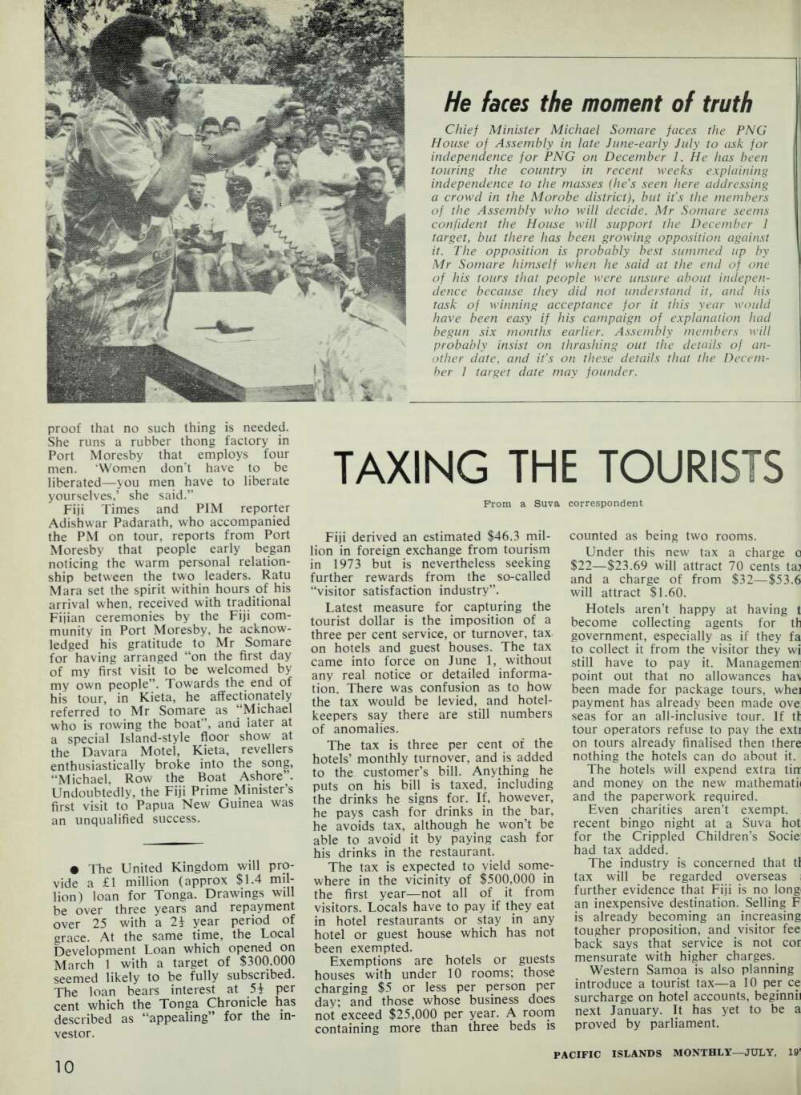
PNG's Chief Minister Michael Somare greets a youthful looking Fiji Prime Minister, Ratu Sir Kamisese Mara, in Port Moresby.
proof that no such thing is needed.
She runs a rubber thong factory in Port Moresby that employs four men, “Women don’t have to be liberated —you men have to liberate yourselves,’ she said.”
Fiji Times and PIM reporter Adishwar Padarath, who accompanied the PM on tour, reports from Port Moresby that people early began noticing the warm personal relation ship between the two leaders. Ratu Mara set the spirit within hours of his arrival when, received with traditional Fijian ceremonies by the Fiji com munity in Port Moresby, he acknow ledged his gratitude to Mr Somare for having arranged “on the first day of my first visit to be welcomed by my own people”. Towards the end of his tour, in Kieta, he affectionately referred to Mr Somare as “Michael who is rowing the boat”, and later at a special Island-style floor show at the Davara Motel, Kieta, revellers enthusiastically broke into the song, “Michael, Row the Boat Ashore”.
Undoubtedly, the Fiji Prime Minister’s first visit to Papua New Guinea was an unqualified success. • The United Kingdom will pro vide a £1 million (approx $1.4 mil lion) loan for Tonga. Drawings will be over three years and repayment over 25 with a 2i year period of grace. At the same time, the Local Development Loan which opened on March 1 with a target of $300,000 seemed likely to be fully subscribed.
The loan bears interest at 5i per cent which the Tonga Chronicle has described as “appealing” for the in vestor.
Advertisements & other items, p. 11 (1 item)
Lcific Islands Monthly—July, 1974
He faces the moment of truth
Chief Minister Michael Somare faces the PNG House of Assembly in late June-early July to ask for independence for PNG on December 1. He has been touring the country in recent weeks explaining independence to the masses (he’s seen here addressing a crowd in the Morobe district), but it’s the members of the Assembly who will decide. Mr Somare seems confident the House will support the December 1 target, but there has been growing opposition against it. The opposition is probably best summed up by Mr Somare himself when he said at the end of one of his tours that people were unsure about indepen dence because they did not understand it, and his task of winning acceptance for it this year would have been easy if his campaign of explanation had begun six months earlier. Assembly members will probably insist on thrashing out the details of an other date, and it’s on these details that the Decem ber 1 target date may founder.
Taxing The Tourists
From a Suva correspondent
Fiji derived an estimated $46.3 mil lion in foreign exchange from tourism in 1973 but is nevertheless seeking further rewards from the so-called “visitor satisfaction industry”.
Latest measure for capturing the tourist dollar is the imposition of a three per cent service, or turnover, tax on hotels and guest houses. The tax came into force on June 1, without any real notice or detailed informa tion. There was confusion as to how the tax would be levied, and hotel keepers say there are still numbers of anomalies.
The tax is three per cent of the hotels’ monthly turnover, and is added to the customer’s bill. Anything he puts on his bill is taxed, including the drinks he signs for. If, however, he pays cash for drinks in the bar, he avoids tax, although he won’t be able to avoid it by paying cash for his drinks in the restaurant.
The tax is expected to yield some where in the vicinity of $500,000 in the first year—not all of it from visitors. Locals have to pay if they eat in hotel restaurants or stay in any hotel or guest house which has not been exempted.
Exemptions are hotels or guests houses with under 10 rooms; those charging $5 or less per person per day; and those whose business does not exceed $25,000 per year. A room containing more than three beds is
counted as being two rooms.
Under this new tax a charge o $22 —$23.69 will attract 70 cents taj and a charge of from $32 —$53.6 will attract $1.60.
Hotels aren’t happy at having t become collecting agents for th government, especially as if they fa to collect it from the visitor they wi still have to pay it. Managemeni point out that no allowances ha\ been made for package tours, whei payment has already been made ove seas for an all-inclusive tour. If tt tour operators refuse to pay the exti on tours already finalised then there nothing the hotels can do about it.
The hotels will expend extra tin and money on the new mathematii and the paperwork required.
Even charities aren’t exempt, recent bingo night at a Suva hot for the Crippled Children’s Socie had tax added.
The industry is concerned that tl tax will be regarded overseas i further evidence that Fiji is no long' an inexpensive destination. Selling F is already becoming an increasing tougher proposition, and visitor fee back says that service is not cor mensurate with higher charges.^ Western Samoa is also planning introduce a tourist tax —a 10 per ce surcharge on hotel accounts, beginnii next January. It has yet to be a proved by parliament.
"De- Emphasised"
Tv And English
In Am Samoa
From a Pago Pago correspondent After ten years of operating one of lie world’s largest educational tele vision facilities, geared to teaching in English, American Samoa’s Depart ment of Education has decided that English is not the best way.
A recent policy change by the Department of Education will result in the closing of the territory’s only English language public school, Fia [loa, and will gear the system towards teaching in Samoan with far ess use of educational television which has been almost eliminated anyhow ;hrough the territorys current power iifficulties.
For a number of years Fia Iloa has been the only public school in the territory where English was the anguage of instruction. It has tradi ionally been attended by those students who spoke English as a first language. This group is about 60 per :ent Samoan, most of them being students who have returned to Samoa Tom the United States, New Zealand, md other English speaking areas.
The reason given by the Depart nent of Education for the sudden change in policy was that federal ’unding would be cut off if the policy )f having an English language system md a Samoan language system was lot ended by consolidating the two groups. All such discrimination, even hough it is based on language ability •ather than race, now must be ended.
However the problem isn’t as iimple as that and what is likely to esult is the same sort of chaos as hey had in the United States when ichools were integrated willy-nilly, iven to the extent of sending bus oads of children commuting across ities in order that individual schools night have the right mixture of black md white.
American Samoa’s large public ducation system, which covers almost 2,000 students from pre-school to ommunity college level, is finding ;self caught in a tough situation. As
more Samoans return to the islands after years of life in the United States or New Zealand, they arc demanding that the qualitv of educa tion be equal to that which they left.
Many of their children do not speak Samoan or do not speak Samoan well enough to be taught only in Samoan, This growing portion of the local community is becoming much more outspoken in its demands that the Government of American Samoa provide quality education.
At the same time, a large number of students still speak Samoan and have been, to a large degree, by passed by the decade of educational television. These students need to be taught in Samoan as their English language ability is not developed to a point where they can receive adequate instruction in English.
Another group of students—those who seem to have above average ability to learn languages—have be come bi-lingual and can operate within either system.
The policy of the Department of Education, for the last ten years, has seemed to be aimed only at English language instruction. Now English is being de-emphasised and Samoan language instruction being em phasised.
It is going to become increasingly difficult for the Department of Education to meet all of the com munity needs and demands in the coming years. In fact, some think that a government controlled educational system, which is virtually autonomous, since most of its funding is from federal monies, rather than local revenues, may not be able to meet the needs at all.
There is a growing feeling among parents that the department should be made more responsible to community needs. One solution would be for the department to be run by an elected school board, which would hire and fire directors,
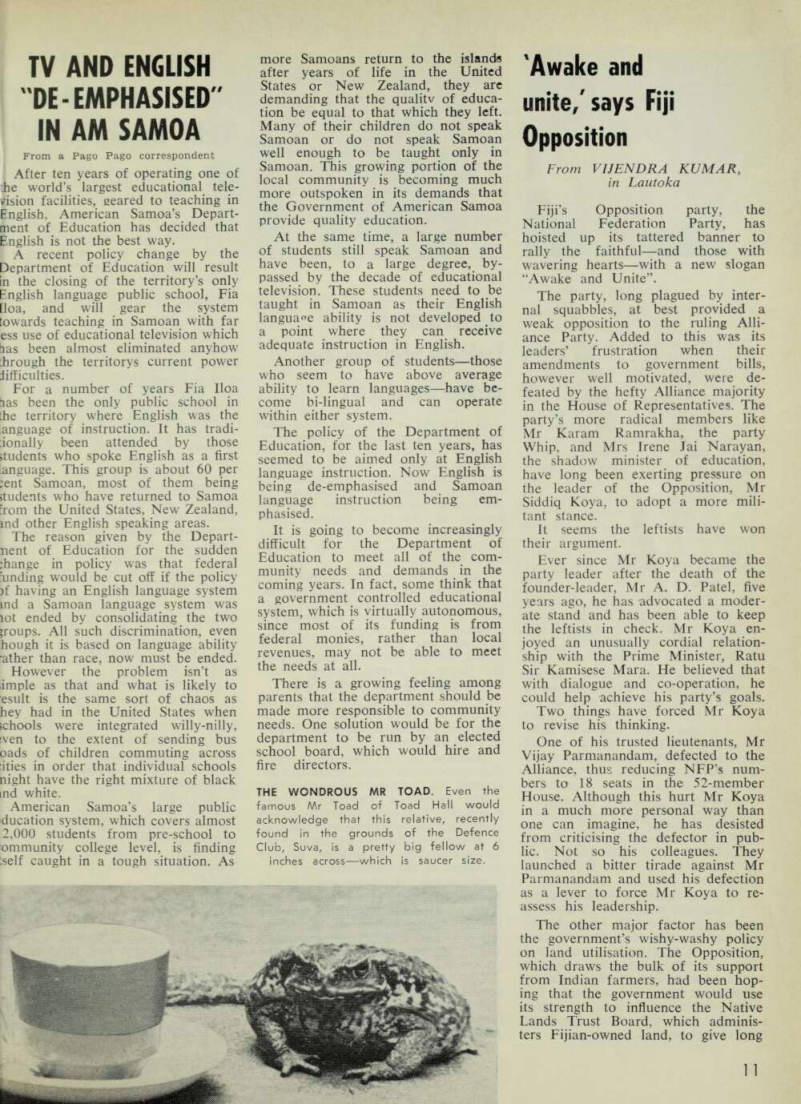
The Wondrous Mr Toad. Even The
famous Mr Toad of Toad Hall would acknowledge that this relative, recently found in the grounds of the Defence Club, Suva, is a pretty big fellow at 6 inches across—which is saucer size.
Opposition
'Awake and unite/says Fiji Opposition
From Vijendra Kumar,
in Lautoka Fiji’s Opposition party, the National Federation Party, has hoisted up its tattered banner to rally the faithful—and those with wavering hearts—with a new slogan “Awake and Unite”.
The party, long plagued by inter nal squabbles, at best provided a weak opposition to the ruling Alli ance Party. Added to this was its leaders’ frustration when their amendments to government bills, however well motivated, were de feated by the hefty Alliance majority in the House of Representatives. The party’s more radical members like Mr Karam Ramrakha, the party Whip, and Mrs Irene Jai Narayan, the shadow minister of education, have long been exerting pressure on the leader of the Opposition, Mr Siddiq Koya, to adopt a more mili tant stance.
It seems the leftists have won their argument.
Ever since Mr Koya became the party leader after the death of the founder-leader, Mr A. D. Patel, five years ago, he has advocated a moder ate stand and has been able to keep the leftists in check. Mr Koya en joyed an unusually cordial relation ship with the Prime Minister, Ratu Sir Kamisese Mara. He believed that with dialogue and co-operation, he could help achieve his party’s goals.
Two things have forced Mr Koya to revise his thinking.
One of his trusted lieutenants, Mr Vijay Parmanandam, defected to the Alliance, thus reducing NFP’s num bers to 18 seats in the 52-member House. Although this hurt Mr Koya in a much more personal way than one can imagine, he has desisted from criticising the defector in pub lic. Not so his colleagues. They launched a bitter tirade against Mr Parmanandam and used his defection as a lever to force Mr Koya to re assess his leadership.
The other major factor has been the government’s wishy-washy policy on land utilisation. The Opposition, which draws the bulk of its support from Indian farmers, had been hop ing that the government would use its strength to influence the Native Lands Trust Board, which adminis ters Fijian-owned land, to give long
term agricultural leases to its tenant farmers.
The Opposition was stunned when the government itself adopted a hard line policy on Crown land. When it took over land formerly owned by the Colonial Sugar Refining Com pany, the government at first agreed to consider an Opposition suggestion to sell the freeholds to tenant farmers. But it changed its mind and decided to give 10-year leases instead.
That ended the honeymoon be tween the Alliance Government and the National Federation Party Opposition. Mr Koya and his col leagues went back to the farmers with the grim message of changed battle plans.
The Opposition leader recently summed up the policy shift in a single sentence: “The era of co operation and dialogue is over. Now it’s going to be confrontation”.
Mr Koya repeated this at a recent meeting of party supporters in a different language. He said if the Alliance failed to solve the land problem and curb inflation (now running at 14 per cent), he would create such an upheaval in the coun try “that none can imagine its scope”.
“We’ll close down Fiji altogether”, he told the enthusiastic crowd.
Fresh after its resounding victory in a recent by-election, the NFP thinks it is ready to take the bull by the horns.
The NFP leaders have been drop ping hints that unless the government seriously grapples with its problems, they will order the Indian cane farmers not to plant any cane next year. With sugar being Fiji’s biggest export commodity (1973 sales to talled more than $34 million), this could cripple the national economy, especially at a time when the sugar market is booming.
Games Reprieve
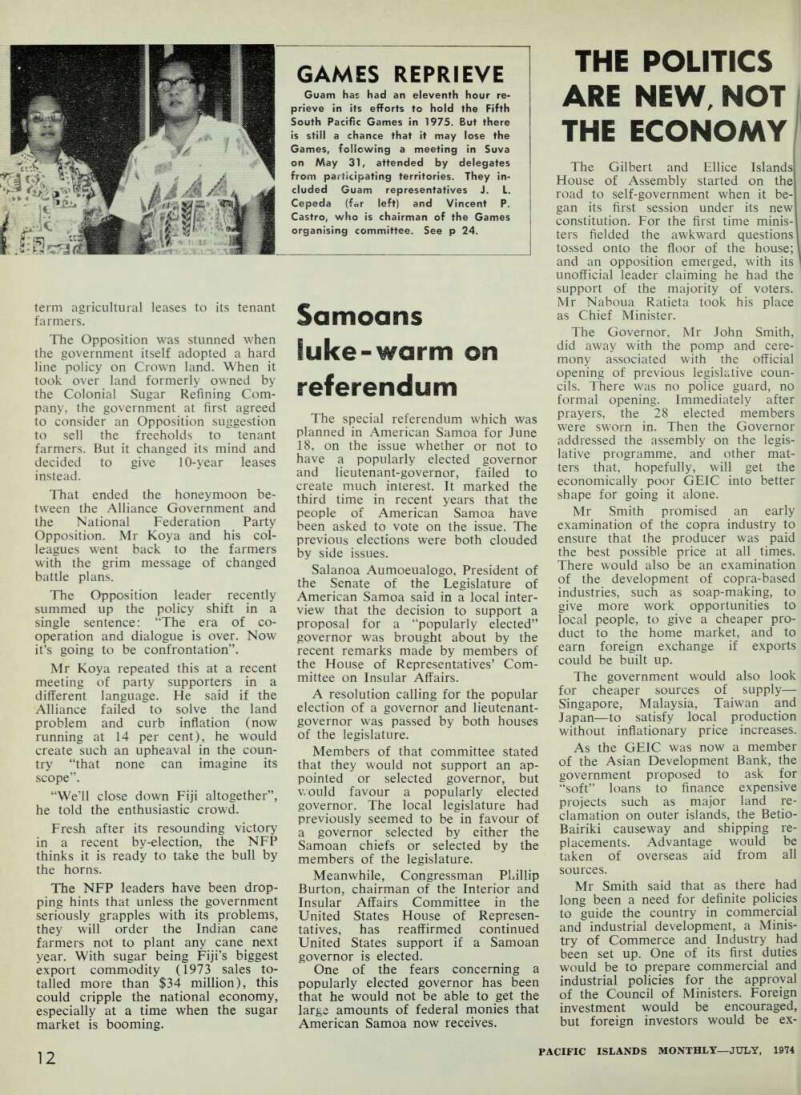
Guam has had an eleventh hour re prieve in its efforts to hold the Fifth South Pacific Games in 1975. But there is still a chance that it may lose the Games, following a meeting in Suva on May 31, attended by delegates from participating territories. They in cluded Guam representatives J. L.
Cepeda (far left) and Vincent P.
Castro, who is chairman of the Games organising committee. See p 24.
luke-warm on
Samoans luke-warm on referendum
The special referendum which was planned in American Samoa for June 18, on the issue whether or not to have a popularly elected governor and lieutenant-governor, failed to create much interest. It marked the third time in recent years that the people of American Samoa have been asked to vote on the issue. The previous elections were both clouded by side issues.
Salanoa Aumoeualogo, President of the Senate of the Legislature of American Samoa said in a local inter view that the decision to support a proposal for a “popularly elected” governor was brought about by the recent remarks made by members of the House of Representatives’ Com mittee on Insular Affairs.
A resolution calling for the popular election of a governor and lieutenant governor was passed by both houses of the legislature.
Members of that committee stated that they would not support an ap pointed or selected governor, but would favour a popularly elected governor. The local legislature had previously seemed to be in favour of a governor selected by either the Samoan chiefs or selected by the members of the legislature.
Meanwhile, Congressman Phillip Burton, chairman of the Interior and Insular Affairs Committee in the United States House of Represen tatives, has reaffirmed continued United States support if a Samoan governor is elected.
One of the fears concerning a popularly elected governor has been that he would not be able to get the large amounts of federal monies that American Samoa now receives.
The Politics
Are New, Not
The Economy
The Gilbert and Ellice Islands House of Assembly started on the road to self-government when it be gan its first session under its new constitution. For the first time minis ters fielded the awkward questions tossed onto the floor of the house; and an opposition emerged, with its unofficial leader claiming he had the support of the majority of voters.
Mr Naboua Ratieta took his place as Chief Minister.
The Governor, Mr John Smith, did away with the pomp and cere mony associated with the official opening of previous legislative coun cils. There was no police guard, no formal opening. Immediately after prayers, the 28 elected members were sworn in. Then the Governor addressed the assembly on the legis lative programme, and other mat ters that, hopefully, will get the economically poor GEIC into better shape for going it alone.
Mr Smith promised an early examination of the copra industry to ensure that the producer was paid the best possible price at all times.
There would also be an examination of the development of copra-based industries, such as soap-making, to give more work opportunities to local people, to give a cheaper pro duct to the home market, and to earn foreign exchange if exports could be built up.
The government would also look for cheaper sources of supply— Singapore, Malaysia, Taiwan and Japan—to satisfy local production without inflationary price increases.
As the GEIC was now a member of the Asian Development Bank, the government proposed to ask for “soft” loans to finance expensive projects such as major land re clamation on outer islands, the Betio- Bairiki causeway and shipping re placements. Advantage would be taken of overseas aid from all sources.
Mr Smith said that as there had long been a need for definite policies to guide the country in commercial and industrial development, a Minis try of Commerce and Industry had been set up. One of its first duties would be to prepare commercial and industrial policies for the approval of the Council of Ministers. Foreign investment would be encouraged, but foreign investors would be ex-
>ected to accept local participation n ownership.
Other matters which will receive ittention are the marine training cheme, to provide more opportuni ies for employment; possible migra ion so that people with skills could >e resettled in friendly and co >perative metropolitan countries; abour and union legislation, to in ;lude measures for the smooth ettlement of industrial disputes; a e-examination of the Gilbert and illice Islands Development Author ty, so that its development function ;an be exercised; and ways of re labilitating more than 500 British Tiosphate Commission employees md their families when the Ocean sland phosphate runs out.
In picking his executive council of ninisters, the Chief Minister had obviously relied as far as possible >n the old team from the defunct legislative Council. But perhaps with he idea of placating the Ellice slanders, who will vote in August in whether to opt out of the GEIC ir not and go it alone as an ad imct of the UK, Mr Ratieta ap lointed two Ellice men to the coun -11. This is one-third of his six-man earn although the Ellice Islands lopulation is only one-sixth of the otal of the whole GEIC.
The two ministers are Isakala •aeniu who retains his portfolio of Natural Resources and Sione Tui Lleis who becomes Minister of Com merce and Industry. Mr Paeniu is Likewarm about secession although ie’ll go along with what the majority if Ellice people want; but ex-priest Cleis is one of the leaders of the ecessionists and although he has •ersonally more to lose now that ie is a GEIC minister, it is not bought that this would influence uch an idealist.
The Chief Minister had invited members of the opposition to serve s ministers but had been turned own. Mr Toalipi Lauti who claims d have more followers than the
government—s 9 per cent of Gil
bertese and 71 per cent of Ellice Islanders—has promised to give the government a hot time.
Party politics are still pretty new in the GEIC where for hundreds of years it was against tradition for in dividuals to put themselves forward and raise their heads above their fellows; where the social unit was the classificatory family, ruled by the old men. There are, therefore, still likely to be shifts in power and in fluence although like true politicians everywhere the members of the House of Assembly were in accord over one thing.
One of the first measures to go be fore the new House was the possi bility of pay rises for members. The Chief Minister moved that a com mission be appointed to inquire into the matter. It was passed un
animously.
Island
Meeting
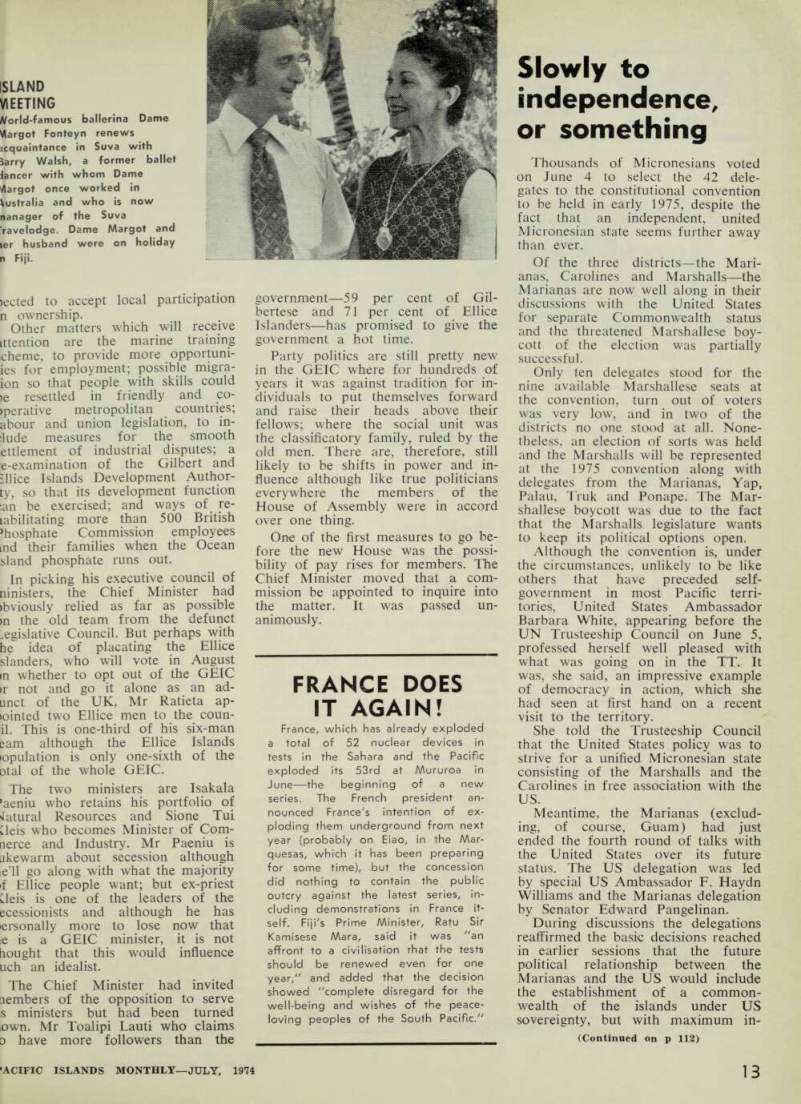
World-famous ballerina Dame Margot Fonteyn renews [?]icquaintance in Suva with Barry Walsh, a former ballet dancer with whom Dame Margot once worked in Australia and who is now manager of the Suva Travelodge. Dame Margot and her husband were on holiday [?]n Fiji.
France Does
It Again!
France, which has already exploded a total of 52 nuclear devices in tests in the Sahara and the Pacific exploded its 53rd at AAururoa in June —the beginning of a new series. The French president an nounced France's intention of ex ploding them underground from next year (probably on Eiao, in the Mar quesas, which it has been preparing for some time), but the concession did nothing to contain the public outcry against the latest series, in cluding demonstrations in France it self. Fiji's Prime Minister, Ratu Sir Kamisese Mara, said it was "an affront to a civilisation rhat the tests should be renewed even for one year," and added that the decision showed "complete disregard for the well-being and wishes of the peace loving peoples of the South Pacific."
or something
Slowly to independence, or something
Thousands of Micronesians voted on June 4 to select the 42 dele gates to the constitutional convention to be held in early 1975, despite the fact that an independent, united Micronesian state seems further away than ever.
Of the three districts—the Mari anas, Carolines and Marshalls—the Marianas are now well along in their discussions with the United States for separate Commonwealth status and the threatened Marshallese boy cott of the election was partially successful.
Only ten delegates stood for the nine available Marshallese seats at the convention, turn out of voters was very low, and in two of the districts no one stood at all. None theless, an election of sorts was held and the Marshalls will be represented at the 1975 convention along with delegates from the Marianas, Yap, Palau, Truk and Ponape. The Mar shallese boycott was due to the fact that the Marshalls legislature wants to keep its political options open.
Although the convention is, under the circumstances, unlikely to be like others that have preceded self government in most Pacific terri tories, United States Ambassador Barbara White, appearing before the UN Trusteeship Council on June 5, professed herself well pleased with what was going on in the TT. It was, she said, an impressive example of democracy in action, which she had seen at first hand on a recent visit to the territory.
She told the Trusteeship Council that the United States policy was to strive for a unified Micronesian state consisting of the Marshalls and the Carolines in free association with the US.
Meantime, the Marianas (exclud ing, of course, Guam) had just ended the fourth round of talks with the United States over its future status. The US delegation was led by special US Ambassador F. Haydn Williams and the Marianas delegation by Senator Edward Pangelinan.
During discussions the delegations reaffirmed the basic decisions reached in earlier sessions that the future political relationship between the Marianas and the US would include the establishment of a common wealth of the islands under US sovereignty, but with maximum in
(Continued on p 112)
ternal self-government and the right to draft and adopt its own consti tution and establish local courts to administer local laws.
Tentative agreement was also reached on specific areas of land to be retained for military purposes by the US and on a seven-year plan of US financial help to the new govern ment of the Northern Marianas (which, some hope, could begin to function as early as July 1976). The tentative agreement is for SUSI3.S million per year, made up of SUSS million to help meet cost of govern ment operations; SUSI.S million for economic development loans, one third of it going to small farmers and fishermen and co-operatives, and SUS 4 million a year to capital im provement projects.
In addition it was expected that a wide range of services and assistance under regular US federal pro grammes will be available to the new government.
Although the fine detail of what is meant by the term “free associa tion with the United States”, which is the aim for Marshalls-Carolines, has never been spelled out, what the Marianas are aiming for already has a precedent. The Caribbean island of Puerto Rico has had US Common wealth status since 1952. It has its own House of Representatives and a Senate, chooses a resident commiss ioner to sit in the federal House of Representatives in Washington who has, however, no vote. Puerto Ricans are US citizens and are sub ject to nearly all US laws except those covering internal revenue.
Advertisements & other items, p. 15 (1 item)
13
•ACIFIC ISLANDS MONTHLY—JULY, 1974
Tropicalities
It's to be Port Moresby DC
Papua New Guinea is to have a new district—the 20th—to cover the capital city of Port Moresby which is to be excised from old Central District. In the tradition of Washing ton DC and Australian Capital Territory, it’s to be the National Capital District.
The decision was made by the cabinet, which “considered the mat ter carefully”, according to Chief Minister Somare. He thought that it would please the people who be lieved that money allocated to Central District was spent on Port Moresby city. Now they would see that Central District expenditure went to that district.
The decision didn’t please every one, including PNG’s opposition and the member for Tari-Komo, Mr Matiabe Yuwi. It was another example of cabinet disregarding the House of Assembly, he said. A de cision of this sort should involve the people of PNG as a whole, through their representatives.
He asked what had happened to the recommendations of a select committee set up during the second House of Assembly to investigate possible sites for a future capital city of PNG. That committee had re commended Arona, near Kainantu, as being climatically and geographic
ally suited but nothing more had been heard of it.
He said that it seemed that the government, having ignored the Papua Besena movement of Miss Abaijah initially, now saw it as a major threat and had proclaimed the new district as an attempt to ap pease the lady.
Despite the valid points, the mem ber for Tari-Komo is crying in the wilderness. Our Port Moresby man says that with all those large, ex pensive buildings rising among the scrub out at suburban Waigani it is impossible to believe that anyone ever expected that PNG’s capital would be anywhere but where it is.
And it’s $lO to a coconut that the new National Capital District will continue to get most of the cash and that Central District will continue to be overshadowed by the big voracious city in its midst.
Making
iioii-chizens
in Micronesia
When is a Micronesian born in Micronesia and living in Micronesia a “non-citizen” of Micronesia? The answer is set out in what is now known as Public Law 5-85 recently approved, rather against his judg ment, by the Trust Territory High Commissioner, Mr Edward E. John ston. He had previously disapproved the measure, but Congress passed it again and sent it back to him for reconsideration.
The measure Mr Johnston signed related to the definition of “non citizen” in the Foreign Investors Business Permit Act. It stated “a non-citizen is any person who is not a Trust Territory citizen, or a Micro nesian who is married to a non citizen, or is under the age of 18 and who is adopted by parents at least
one of whom is not a XT citizen; o any company, corporation or asso ciation in which a person who own any interest is not a Trust Territor; citizen as defined previously”.
The object of the measure is tew prevent people using a Micronesian! husband, wife or adopted child to get into business in the Trust Terri tory.
Mr Johnston, when he first re jected the measure, said it could well be set aside by the courts as illegal.
In a letter to the Congress leader ship after signing the measure he set out his doubts again: “We still feel that this act is discriminatory against Micronesians who have married or been adopted by non-Trust Territory citizens and are now being subjected to rules and regulations not in effect at the time of their marriage and/or adoption”.
The new law would be tested by some Micronesians now classified as non-citizens. However, in spite of his continuing objections he could not justify forwarding the legislation to the Secretary of the Interior, as would have been required had he disapproved the measure a second time.
lISIP's antidote
Ut inflation!
Under a recent order from the High Commissioner of the Solomons, local councils have regained power to organise village people to do com munal work . . . without pay.
It’s really a step back in time.
Years ago local people worked for nothing on special “council days”, cleaning villages and maintaining roads and footpaths. Then labour laws were introduced, pronouncing that work of this kind had to be paid for.
Under the new order, councils can pass by-laws requiring village people to do minor communal work, on anything but commercial ventures.
Any villager can be asked to work up to 26 days in any one year and if he doesn’t do his bit, he can be fined by a native court.
This arrangement doesn’t conform strictly to international agreements on communal work, but the government has been able to satisfy the Inter-
national Labour Organisation of the United Nations that the council by laws would not lead to exploitation of villagers.
This custom operates in several Island territories. In Fiji, for instance, under the Fijian administration—as distinct from the Fiji Government — villagers had work to do without pay, and villagers living away from their villages had to pay a tax in lieu of work. Norfolk islanders, too, have so many days a year compulsory unpaid work or pay a tax.
Big (leas have
little fleas...
Achatina Fulica, the fancy name the bug men have given to the Giant African Snail, is running (or crawl ing) riot in Vila. But not to worry.
The Agriculture Department has found an antidote, two much smaller snails which hail from Hawaii.
These smaller snails, Euqlandina and Gonaxis, eat the giant snails although you’d expect it would be the other way round. But, it’s not surprising; some of PlM’s staff, a little on the small side, believe a good little ’un is worth at least two mediocre big ’uns.
Well, 50 Euqlandinas and 50 Gonaxis (should the plural be Gonaxises?) have arrived in Vila and have been put to work in areas where old Achatina is thick on the ground, which is around the Number 2 and Star Wharf areas.
There’s just one snag. The Gonaxis
is a real little cannibal. He eats both the old Achatina and the Euqlandina, so they’ve had to separate the two little ’uns and put them to work in different areas. The Euqlandina is about two inches long (50.7998 mm in the French sector) while its hungry mate Gonaxis is much smaller and shaped like a normal snail At the time of writing, the Euqlan dina and Gonaxis were busy working their way through the Achatina population with Euqlandina looking over his shoulder in case the Gonaxis decided to try some Euqlandina as a change from Achatina.
Which brings us round to the old ditty—Big fleas have lesser fleas on their backs to bite ’em; little fleas have lesser fleas, and so ad infinitum.
8 nside, a
Safari of gold
It may still not be the most beautiful cathedral in the world but after over 20 years in the making, Holy Trinity Cathedral in Suva is at last complete. It was dedicated on May 22 by the Bishop in Polynesia, the Rt Rev John T. Holland.
First stage of the cathedral was completed between 1948 and 1954 having survived loss of the partly completed roof, torn off by the hur ricane of 1952. This section ended abruptly like funds for building it, and the million three-penny pieces needed for completion, and called
for by the then bishop, the Rt Rev L. S. Kempthorne, took until 1971 to collect.
The first Anglican church in Suva was little more than a wooden hut in what is now Ellery St. This served from 1880 until the pro-cathedral at the corner of Butt and MacArthur Sts was built. The pro-cathedral was demolished after Holy Trinity came into use in 1954, part of the old timber being used to build the tem porary west wall of the cathedral.
The land where the pro-cathedral had been was vacant until Suva’s building boom began in recent years.
The present cathedral is built on a site orginally occupied by old government offices, the last of which was demolished in 1948.
The original plan for the Cathe dral was grandiose and called for the western portion at the same height as stage one, broken by a tall tower and belfry on the southern side. However, 1970 type economics obviously triumphed over aesthetics, in the end. The western end of the cathedral is now of low, modern construction, with verandahs on each side; and the tall tower has been truncated to first floor level but still houses the chimes bought by public subscription for the old pro cathedral in 1899. The flat wall at the west end of stage one has been replaced with a similar but perma nent concrete wall broken by three windows.
Although plain without, the cathe dral has always been pleasant within and contains some valuable furnish ings including a pre-Reformation font dating back to 1399, which was brought to Fiji by the then Governor, J. B. Thurston, in the 1890’s.
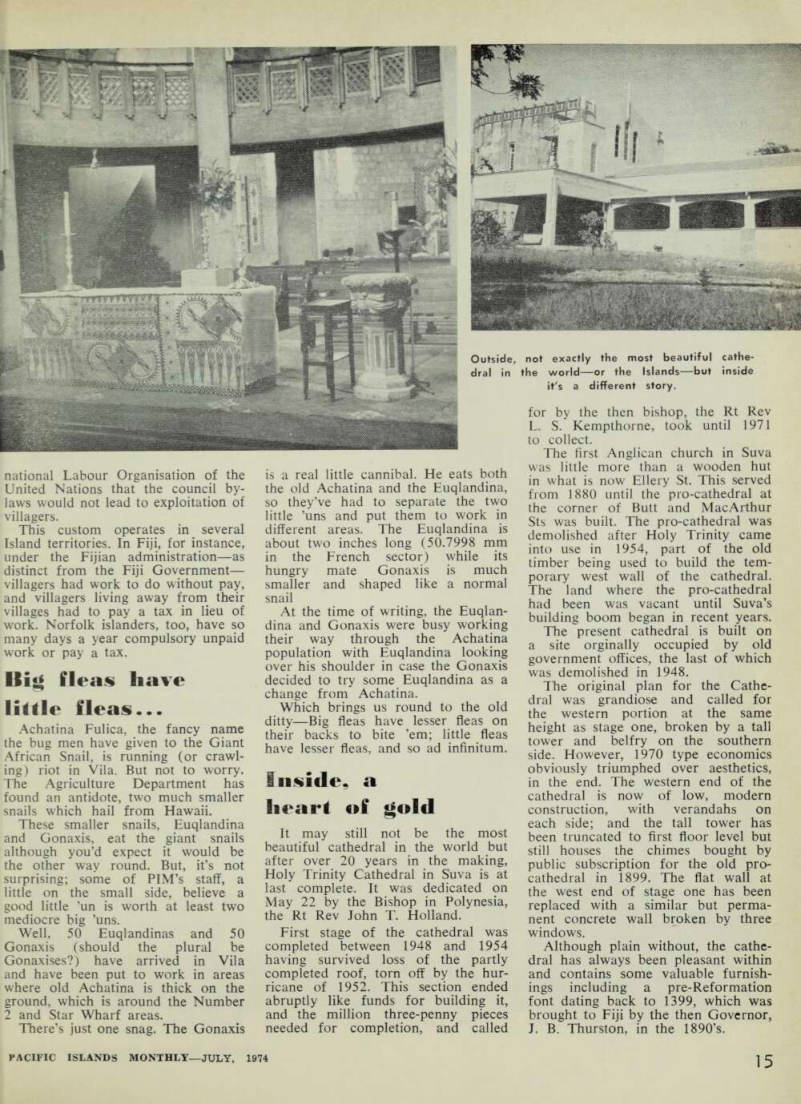
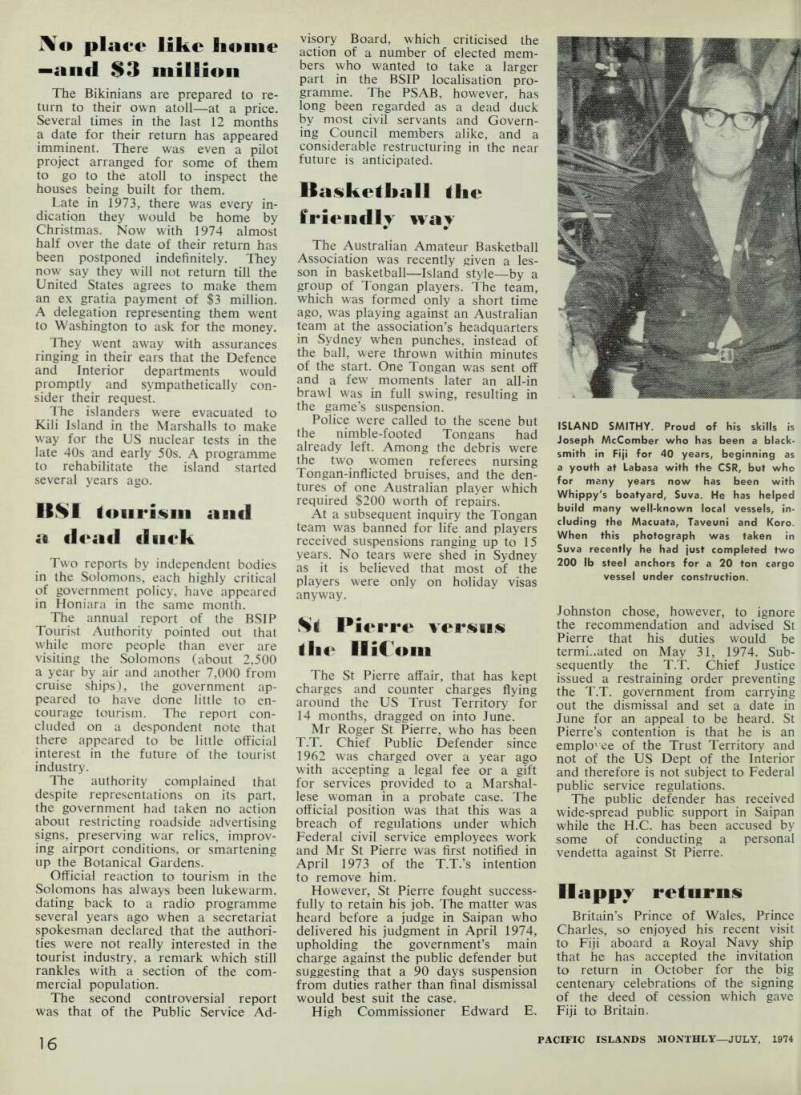
Outside, not exactly the most beautiful cathe dral in the world—or the Islands —but inside it's a different story.
No place like koine
—and $3 million
The Bikinians are prepared to re turn to their own atoll—at a price.
Several times in the last 12 months a date for their return has appeared imminent. There was even a pilot project arranged for some of them to go to the atoll to inspect the houses being built for them.
Late in 1973, there was every in dication they would be home by Christmas. Now with 1974 almost half over the date of their return has been postponed indefinitely. They now say they will not return till the United States agrees to make them an ex gratia payment of $3 million.
A delegation representing them went to Washington to ask for the money.
They went away with assurances ringing in their ears that the Defence and Interior departments would promptly and sympathetically con sider their request.
The islanders were evacuated to Kili Island in the Marshalls to make way for the US nuclear tests in the late 40s and early 50s. A programme to rehabilitate the island started several years ago.
1181 tourism a Bid
a dead duck
Two reports by independent bodies in the Solomons, each highly critical of government policy, have appeared in Honiara in the same month.
The annual report of the BSIP Tourist Authority pointed out that while more people than ever are visiting the Solomons (about 2,500 a year by air and another 7,000 from cruise ships), the government ap peared to have done little to en courage tourism. The report con cluded on a despondent note that there appeared to be little official interest in the future of the tourist industry.
The authority complained that despite representations on its part, the government had taken no action about restricting roadside advertising signs, preserving war relics, improv ing airport conditions, or smartening up the Botanical Gardens.
Official reaction to tourism in the Solomons has always been lukewarm, dating back to a radio programme several years ago when a secretariat spokesman declared that the authori ties were not really interested in the tourist industry, a remark which still rankles with a section of the com mercial population.
The second controversial report was that of the Public Service Ad
visory Board, which criticised the action of a number of elected mem bers who wanted to take a larger part in the BSIP localisation pro gramme. The PSAB, however, has long been regarded as a dead duck by most civil servants and Govern ing Council members alike, and a considerable restructuring in the near future is anticipated.
llasketball ilie
Erie* ib dir way
The Australian Amateur Basketball Association was recently given a les son in basketball—lsland style—by a group of Tongan players. The team, which was formed only a short time ago, was playing against an Australian team at the association’s headquarters in Sydney when punches, instead of the ball, were thrown within minutes of the start. One Tongan was sent off and a few moments later an all-in brawl was in full swing, resulting in the game’s suspension.
Police were called to the scene but the nimble-footed Tongans had already left. Among the debris were the two women referees nursing Tongan-inflicted bruises, and the den tures of one Australian player which required $2OO worth of repairs.
At a subsequent inquiry the Tongan team was banned for life and players received suspensions ranging up to 15 years. No tears were shed in Sydney as it is believed that most of the players were only on holiday visas anyway.
St Fieri re versus
i li< llKoibb
The St Pierre affair, that has kept charges and counter charges flying around the US Trust Territory for 14 months, dragged on into June.
Mr Roger St Pierre, who has been T.T. Chief Public Defender since 1962 was charged over a year ago with accepting a legal fee or a gift for services provided to a Marshal lese woman in a probate case. The official position was that this was a breach of regulations under which Federal civil service employees work and Mr St Pierre was first notified in April 1973 of the T.T.’s intention to remove him.
However, St Pierre fought success fully to retain his job. The matter was heard before a judge in Saipan who delivered his judgment in April 1974, upholding the government’s main charge against the public defender but suggesting that a 90 days suspension from duties rather than final dismissal would best suit the case.
High Commissioner Edward E.
Johnston chose, however, to ignore the recommendation and advised St Pierre that his duties would be terminated on May 31, 1974. Sub sequently the T.T. Chief Justice issued a restraining order preventing the T.T. government from carrying out the dismissal and set a date in June for an appeal to be heard. St Pierre’s contention is that he is an employee of the Trust Territory and not of the US Dept of the Interior and therefore is not subject to Federal public service regulations.
The public defender has received wide-spread public support in Saipan while the H.C. has been accused by some of conducting a personal vendetta against St Pierre.
H a ppy returns
Britain’s Prince of Wales, Prince Charles, so enjoyed his recent visit to Fiji aboard a Royal Navy ship that he has accepted the invitation to return in October for the big centenary celebrations of the signing of the deed of cession which gave Fiji to Britain.
ISLAND SMITHY. Proud of his skills is Joseph McComber who has been a black smith in Fiji for 40 years, beginning as a youth at Labasa with the CSR, but who for many years now has been with Whippy's boatyard, Suva. He has helped build many well-known local vessels, in cluding the Macuata, Taveuni and Koro.
When this photograph was taken in Suva recently he had just completed two 200 lb steel anchors for a 20 ton cargo vessel under construction.
Advertisements & other items, pp. 19-22 (1 item)
Smtesman
smoothest cigars on
national scene
s 1801 1 * i IS* c BH ,
STATESMAN
CORONA
5
Corona
D 685
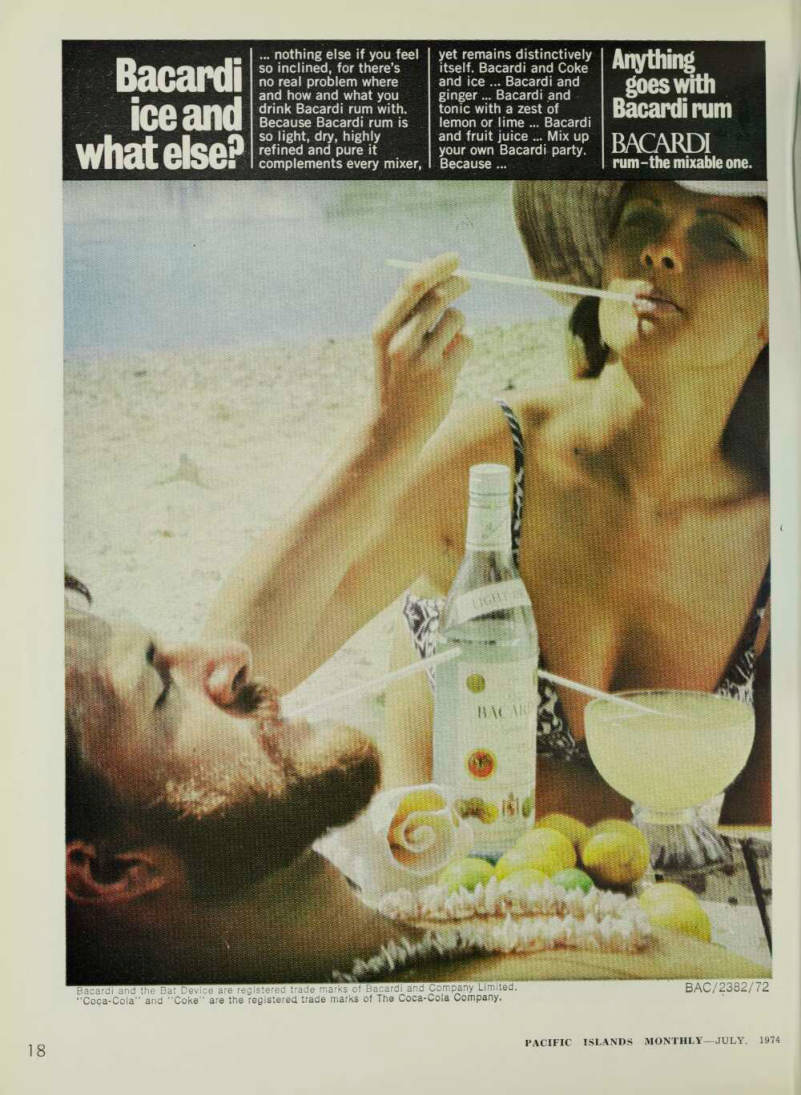
Bacardi
ice and
what else?
... nothing else if you feel so inclined, for there’s no real problem where and how and what you drink Bacardi rum with.
Because Bacardi rum is so light, dry, highly refined and pure it complements every mixer, yet remains distinctively itself. Bacardi and Coke and ice ... Bacardi and ginger... Bacardi and tonic with a zest of lemon or lime ... Bacardi and fruit juice ... Mix up your own Bacardi party.
Because ...
Anything
goes with
Bacardi rum
BACARDI
rum-the mixable one. .A K- . . : m m m Hj m \ m§ % Device are registered trade marks of Bacardi and Company Limited.
'Coca-Cola” and "Coke” are the registered trade marks of The Coca-Cola Company.
BAC/2382/72
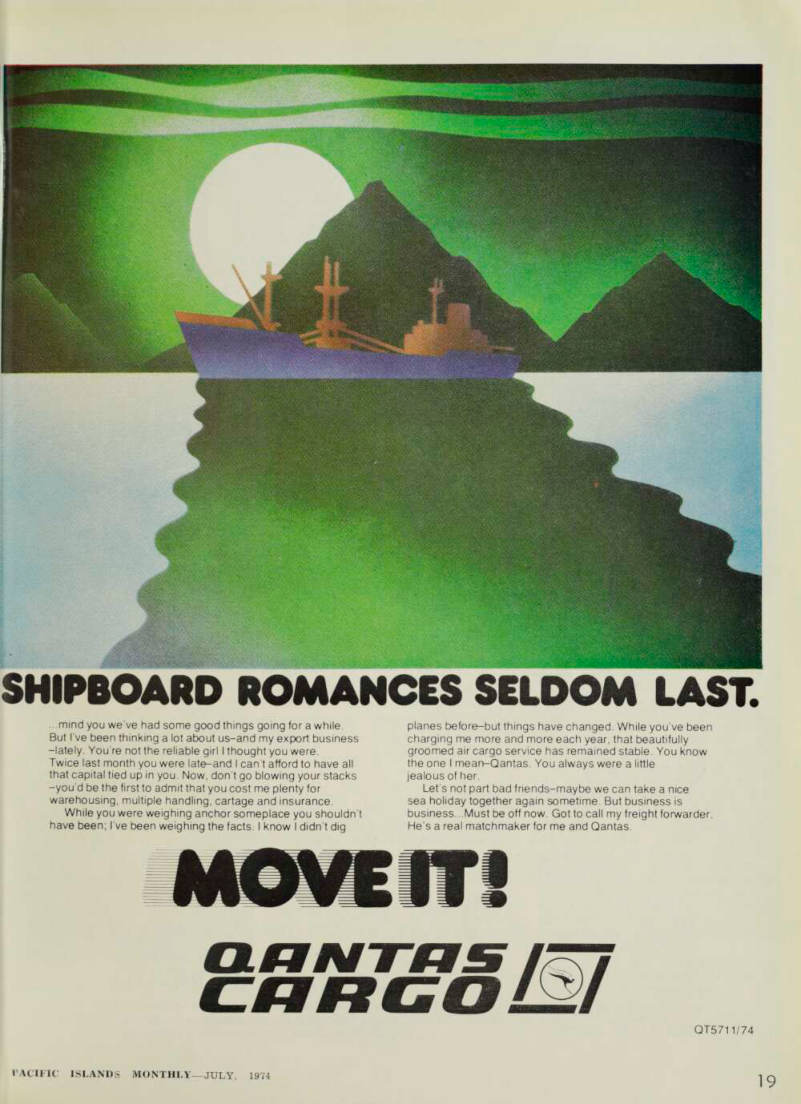
SHIPBOARD ROMANCES SELDOM LAST.
.. .mind you we've had some good things going for a while.
But I've been thinking a lot about us-and my export business -lately. You're not the reliable girl I thought you were.
Twice last month you were late-and I can t afford to have all that capital tied up in you. Now, don't go blowing your stacks -you’d be the first to admit that you cost me plenty for warehousing, multiple handling, cartage and insurance.
While you were weighing anchor someplace you shouldn't have been; I’ve been weighing the facts. I know I didn’t dig planes before-but things have changed. While you've been charging me more and more each year, that beautifully groomed air cargo service has remained stable. You know the one I mear>-Qantas. You always were a little jealous other.
Let’s not part bad friends-maybe we can take a nice sea holiday together again sometime. But business is business. ..Must be off now. Got to call my freight forwarder.
He's a real matchmaker for me and Qantas.
a a terras /—j
cancoL^/
QT5711/74
m s» m m >
NETWT.2&OE.
SOUTH
PACIFIC!
Qhirardelli
MILK CHOCOLATE
WT. 24 OZ. 70.88 G
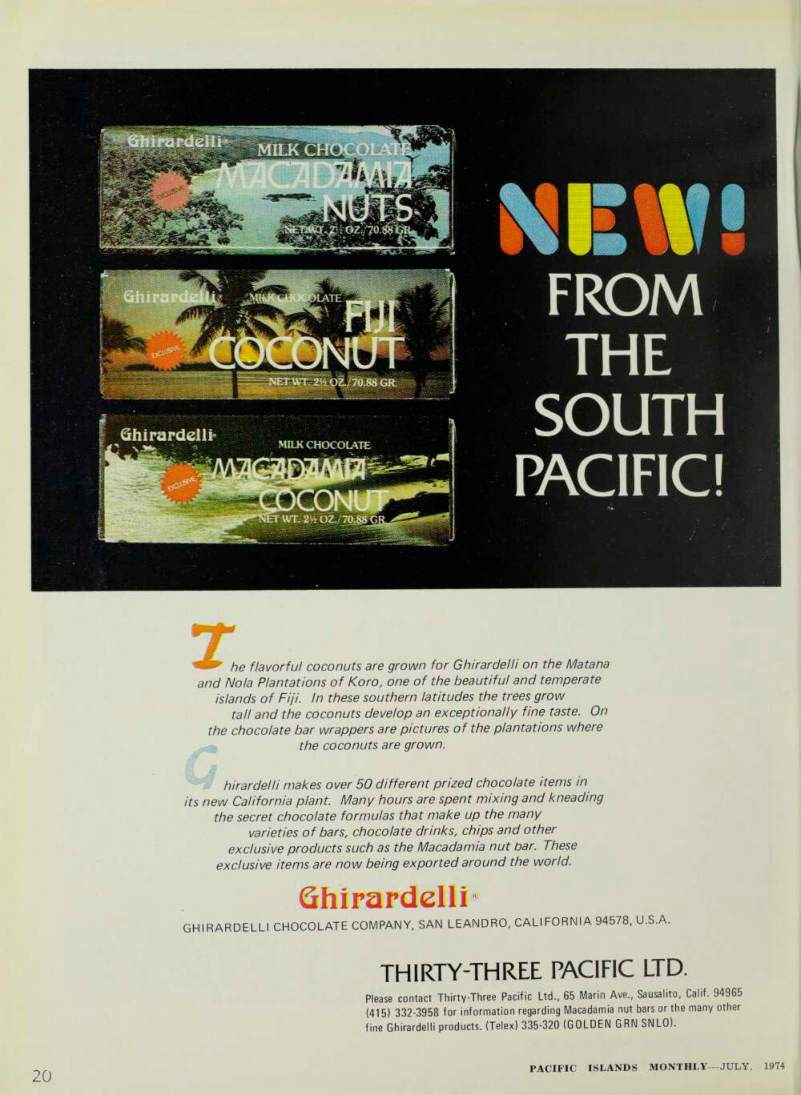
T he flavorful coconuts are grown for Ghirardelh on the Matana and Nola Plantations of Koro, one of the beautiful and temperate islands of Fiji. In these southern latitudes the trees grow tall and the coconuts develop an exceptionally fine taste. On the chocolate bar wrappers are pictures of the plantations where the coconuts are grown. hirardelli makes over 50 different prized chocolate items in its new California plant. Many hours are spent mixing and kneading the secret chocolate formulas that make up the many varieties of bars, chocolate drinks, chips and other exclusive products such as the Macadamia nut bar. These exclusive items are now being exported around the world.
Cjhirardelli”
GHIRARDELLI CHOCOLATE COMPANY, SAN LEANDRO, CALIFORNIA 94578, U.S.A.
THIRTY-THREE PACIFIC LTD.
Please contact Thirty-Three Pacific Ltd., 65 Marin Ave., Sausalito, Calif. 94965 (415) 332-3958 for information regarding Macadamia nut bars or the many other fine Ghirardelli products. (Telex) 335-320 (GOLDEN GRN SNLO).
Wealth Appreciates

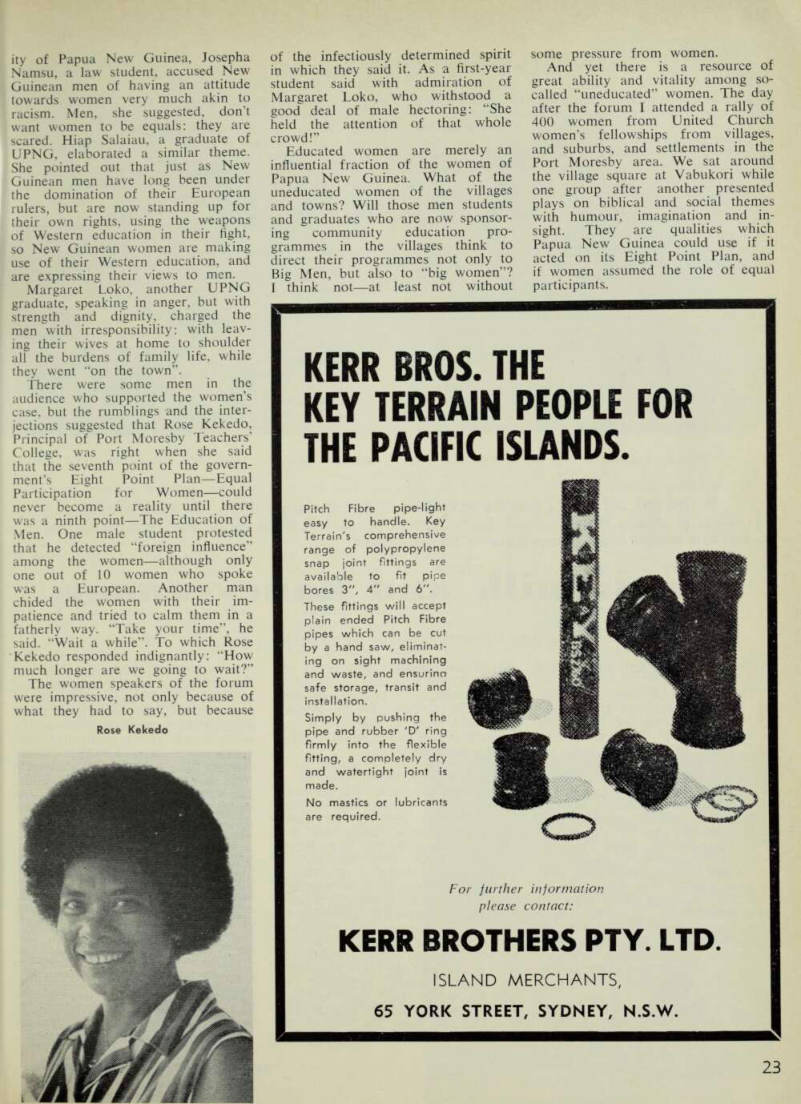
Png's Other Great
In Value
From Kirsty Powell
in Port Moresby A popular stereotype of the New Guinean woman depicts her walking with a bilum or string bag on her head in which is a monstrous load of garden produce or firewood with a child or two on top, while her hus band walks unburdened, with a spear in his hand.
It is a picture from life, but it can easily be misused to suggest that relations between men and women in traditional New Guinean societies illustrate a uniform pattern of male dominance and female suppression.
Nothing in Papua New Guinea is as simple as that.
Such a stereotype does not take account of societies in which women are seen as dangerous rather than inferior; or in which women take the initiative in proposing marriage; or in which women become chiefs; or in which there was an expectation (destined to disillusionment) that some of the first white kiaps (government officers) might have been women. That all white kiaps were, in fact, men helped to strengthen male dominance.
At the beginning of the 20th century, there was a woman con stable in the Northern District. Her like has not been seen since the barbarism of traditional ways has been enlightened by colonial govern ment and education.
In the early days, the vernacular village primary schools of the missions served both boys and girls, in many cases almost equally, but as the stan dard of education offered improved, and it became necessary to set up more advanced schools to serve children from many villages, the pro portion of girls in school decreased.
Education for girls lagged behind, and although recently, the Education Department has expressed a desire to increase the number of girls in school, in fact education has become more and more a male preserve: not so much because of the educators’ in tentions as because of the villagers’ unwillingness to allow their girls to leave the village.
The boys were, among other things, more easily dispensable than their more hard-working sisters.
Moreover, as the aim of universal primary education came to be abandoned for that of the education of an elite, and as provision was made for tertiary and secondary education, the proportion of girls in the whole range of educational in stitutions has still further decreased.
It was not until 1961 that the first government girls’ secondary school was established. Figures for both primary and secondary schools show that although the total number of girls in school has increased in the last 10 years the proportion of girls to boys has decreased (although there has perhaps been a slight in crease in the proportion of girls in secondary schools).
Education, like government, looks like becoming a weapon for the en trenchment and extension of male dominance. In 1973, men out numbered women at the University of Papua New Guinea in the pro-
Margaret Loko, UPNG graduate . . . speak ing in anger. - Photo: UPNG Photography Dept. (Laeko Bala).
Pictured at a recent rally of United Church women's fellowships from the Port Moresby area is Mrs Boio Aiga, from Vabukori village, playing the part of David in an enactment of the story of David and Goliath "done with humour, imagination and insight". -Photo: PNG Post Courier (Phillip Minamama Arau).
portion of nine to one (in 1974, in the proportion of 11 to one); at the University of Technology in the proportion of 25 to one.
It is not surprising in such a con text that university women have often been timid in expressing them selves, and in assuming their rightful roles of leadership in campus life.
Nor is it surprising that they find themselves—when cast into such an abnormal society—the victims of male aggression, and frustration, and
possessiveness.
A favourite attitude of the male poets is that of righteous indignation at those black women who show so little sensitivity to the plight of their black brothers and to the needs of the nations as to cast their eyes at white men. The Constitutional Plan ning Committee has proposed that the children of black women who marry white men should not have the same rights to citizenship as the children of black men who marry white women. I am not unaware of the legal and socio-economic argu ments behind this proposal, but 1 wonder if such a proposal could have gone forward if there had been even a single woman on the Constitutional Planning Committee.
It is well known that there is one woman in the House of Assembly, Josephine Abaijah, She has thrown herself into other causes than that of improving the status of women, but her courage and strength in fighting for her own convictions have shown what women can do, and what power they can wield. A new assertiveness is emerging among women. They are no longer content to let the male dominance of post colonial society go unchallenged.
At a recent forum at the Univers
Sole woman member of the House of Assembly, Josephine Abaijah . . . personi fication of female courage and strength.
ity of Papua New Guinea, Josepha Namsu, a law student, accused New Guinean men of having an attitude towards women very much akin to racism. Men, she suggested, don’t want women to be equals: they are scared. Hiap Salaiau, a graduate of UPNG, elaborated a similar theme.
She pointed out that just as New Guinean men have long been under the domination of their European rulers, but are now standing up for their own rights, using the weapons of Western education in their fight, so New Guinean women are making use of their Western education, and are expressing their views to men.
Margaret Loko, another UPNG graduate, speaking in anger, but with strength and dignity, charged the men with irresponsibility: with leav ing their wives at home to shoulder all the burdens of family life, while they went “on the town”.
There were some men in the audience who supported the women’s case, but the rumblings and the inter jections suggested that Rose Kekedo, Principal of Port Moresby Teachers' College, was right when she said that the seventh point of the govern ment’s Eight Point Plan—Equal Participation for Women —could never become a reality until there was a ninth point—The Education of Men. One male student protested that he detected “foreign influence” among the women—although only one out of 10 women who spoke was a European. Another man chided the women with their im patience and tried to calm them in a fatherly way. “Take your time”, he said. “Wait a while”. To which Rose Kekedo responded indignantly: “How much longer are we going to wait?”
The women speakers of the forum were impressive, not only because of what they had to say, but because
of the infectiously determined spirit in which they said it. As a first-year student said with admiration of Margaret Loko, who withstood a good deal of male hectoring: “She held the attention of that whole crowd!”
Educated women are merely an influential fraction of the women of Papua New Guinea. What of the uneducated women of the villages and towns? Will those men students and graduates who are now sponsor ing community education pro grammes in the villages think to direct their programmes not only to Big Men, but also to “big women”?
I think not—at least not without
some pressure from women.
And yet there is a resource of great ability and vitality among so called “uneducated” women. The day after the forum I attended a rally of 400 women from United Church women’s fellowships from villages, and suburbs, and settlements in the Port Moresby area. We sat around the village square at Vabukori while one group after another presented plays on biblical and social themes with humour, imagination and in sight. They are qualities which Papua New Guinea could use if it acted on its Eight Point Plan, and if women assumed the role of equal participants.
Rose Kekedo
Advertisements & other items, pp. 23-25 (2 items)
21
I’ACIFIC ISLANDS MONTHLY—JULY, 1974
insurance service
serves the
Islands with expert
and advice.
QUEENSLAND INSURANCE
COMPANY LIMITED
(Incorporated 1886 in Australia)
Head Office: 82 Pitt Street, Sydney FIJI —Branch Office, Suva, Manager for Fiji: F. N. Davies (A.A.1.1.).
LAUTOKA—District Manager: U. Singh.
HONIARA (8.5.1. P.) —Breckwoldt & Company (5.1.) Pty.
Limited.
NEW CALEDONIA—T. A. Hagen, Ste. W. A. Johnston, S.A.R.L.—Noumea.
NEW HEBRlDES—Resident Officer: R. J. Allsop (A.A.1.1.) Vila; Santo: Burns Philp (New Hebrides) Ltd.
TAHlTl—Arthur Chung: Immeuble 8.1., Front de Mer, Papeete.
NIUE, NORFOLK ISLAND, SAMOA, TONGA and other South Sea Islands—Bums Philp (South Sea) Company Ltd.
Assets exceed $75,000,000
QUEENSLAND INSURANCE(P.N.G.)LTD
PAPUA NEW GUINEA
Head Office, Port Moresby: Manager for Papua New Guinea: D. J. Granter.
District Managers at Rabaul: C. D. Dickings; Lae: R. Jackson; Mt. Hagen: G. F. Donnelly.
V 337
. . The MANA section of Pacific Islands Monthly is to be published each year as a MANA” by the South Pacific Creative Arts Society. As a society member you get your copy. Life membership of the SPCAS is $lOO Fijian or equivalent; foundation membership (good for three years) $25, ordinary membership $4 for those outside the islands served by the South Pacific Commission and $2.50 for those addresses within the islands. Send subscriptions to the Secretary, Box 5083, Suva, Fiji.
KERR BROS. THE
KEY TERRAIN PEOPLE FOR
THE PACIFIC ISLANDS.
Pitch Fibre pipe-light easy to handle. Key Terrain's comprehensive range of polypropylene snap joint fittings are available to fit pipe bores 3", 4" and 6".
These fittings will accept plain ended Pitch Fibre pipes which can be cut by a hand saw, eliminating on sight machining and waste, and ensurino safe storage, transit and installation.
Simply by pushing the pipe and rubber 'D' ring firmly into the flexible fitting, a completely dry and watertight joint is made.
No mastics or lubricants are required.
I <3 For further information please contact:
KERR BROTHERS PTY. LTD.
ISLAND MERCHANTS,
65 YORK STREET, SYDNEY, N.S.W.
An Eleventh Hour Reprieve For Guam Games
There is still a question mark over the venue of the fifth South Pacific Games, scheduled for Guam in 1975. A mission from French Polynesia was scheduled to visit Guam in June to inspect facilities. If the miss ion’s report is unfavourable, a full session of the South Pacific Games Council will be held on or before August 20, 1974, to consider the future of the Games.
Representatives of eleven participating territories met in Suva on May 31 to consider the organisation of the fifth Games. Mr Les Martin, chairman of the First South Pacific Games Council, explained that three of the main participating territories—Fiji, New Caledonia and French Polynesia—were concerned about reports throwing doubt on whether Guam could stage the Games. They were concerned also because letters to Guam remained unanswered.
Mr Martin handed over chairmanship of the Suva meeting, constituted as an advisory committee under the Games charter, to Mr R. Delaveuve, of New Cale donia. Mr Delaveuve was one of the original party which drew up the charter.
The delegate from Guam admitted that the appre hensions of other territories about 1975 games were well founded. But from now on, he said, there would be no involvement of political ambition prejudicial to
the success of the Games. The Guam Governor, Mr Carlos Camacho, the legislature, sporting bodies, church organisations and the whole population enthusiastically supported the idea of Guam remaining as the host territory for the Fifth South Pacific Games, he said.
The delegate read a resolution of the Guam Legis lature of May 22, 1974, giving full support to the Games. A copy of the resolution was given to each delegate.
The delegate also showed films about Guam. These included shots of sporting facilities as they are at pre sent, and showing how they can be improved.
The advisory committee debated the matter for nine hours. Taking note of the reassurances and promises made by the Guam delegates it then voted unanimously for the Games to be staged between September 1 and 10, 1975, at Agana, Guam. There was, however, a proviso that there be a favourable report from the French Polynesia mission which visited Guam in June.
The territories represented at the Suva meeting were Fiji, Guam, Papua New Guinea, French Polynesia, New Caledonia, Wallis Island, the New Hebrides, the Cooks, Niue and the Samoas.
The date of September 1 is later than the original plan for the Games, which were scheduled for August.
Isle of milk and honeymoons

In June PIM, Joe Murphy gave the background to the squabbling which has endangered Guam's chances of staging the Fifth South Pacific Games. Here he tells about life on Guam, and the changes that have brought about an unprecedented economic boom.
From JOE MURPHY, editor of the Pacific Daily News
How will other Islands athletes find Guam and its people?
They should find them interesting.
The difference between Guam and most of the islands of the South Pacific is startling. Guam is more a small piece of America than an island in the North Pacific. It’s 204 square miles in size and its people, after 400 years of Spanish domination and 75 years of American admini stration, have lost any semblance of being Islanders in the traditional South Pacific sense. They have no native dances, no native songs, and little native culture other than what has been carried over from Spanish times. They have no native dress, no native fishing boats.
But they do have modern concrete apartments, colour TV sets, washers and dryers, air-conditioners, two cars in every garage, and the largest McDonald hamburger stand in America.
Guam is in the midst of what noted Catholic theologian and psychologist Cornelius van der Poel said is a
change unequalled anywhere in the world. Rapid economic and techno logical changes in Guam, especially in the past 10 years, have transformed the island from a quiet, rural, un pretentious spot to a hustling, bustling cosmopolitan community.
Guam was practically blasted out of existence during World War 11, its people were imprisoned and scattered, its agriculture ruined, its buildings levelled. Then, just as the island began to emerge from the war scars, Typhoon Karen, one of the strongest winds ever recorded in world history, slammed into Guam, levelling 90 per cent of its buildings.
This 1962 disaster resulted in a heavy input of US Government rehabilitation funds, with as much as $lOO million being spent on schools, public and private buildings, sewer systems, etc.
Also in that year the Navy abandoned its hated “security clearance” re striction which had kept outsiders away from Guam and thus isolated the islanders from the rest of the world.
Seven years ago Pan American air lines hit Guam with a different kind of blow. It began flying direct Guam flights from Tokyo, only three hours away. With dramatic suddenness, the move began an unprecedented eco nomic boom. Guam’s tourism picture shot up from a bare 3,000 visitors in 1966 to an estimated 300,000 visitors this year, 95 per cent of them from Japan. Income from the tourists should approach $lOO million in 1974.
Thus again life styles are rapidly changing. In 1966 Guam had but 12 hotel rooms. This year the 18-storey Reef Hotel opens on lush Turnon Bay, making it the ninth major hotel to open in a five-year period. Seven of the hotels, the Reef, the Tokyu.
Fujita, Cliff, Kakuei, Dai-ichi, and the Okura are Japanese-owned or operated. Two American hotels, the Guam Hilton, and the Continental, complete the picture. All except the Cliff are located in a sweeping arc along Turnon Bay—the palmy, breezy spot which, ironically, the Japanese
invasion forces hit shortly after Pearl Harbour.
The new Japanese invasion consists mainly of honeymooners, armed with dollars instead of rifles. It has brought about the most dramatic growth rate of any place in the world. In the last six years, fuelled by the Japanese, the shrewd Taiwanese, and the Koreans, Guam’s gross national product has soared by 30 per cent a year for each of those years. Construction alone jumped from $8 million in 1963 to more than $BO million last year, and there is no sign of this letting up. Guam now has a dozen or more high-rises, from eight to 18 storeys. One huge apartment complex under construction has 400 units.
Only eight years ago, only 10,000 private vehicles plied the island’s highways. Currently, there are more than 50,000 private vehicles for 100,000 people, a rate higher than any place in the United States. The popu lation of Guam has jumped from a bare 25,000 immediately after the war to a bustling 100,000 plus today.
An automobile has always been a necessity here because of a lack of a bus system. Just recently, the Guam Government has ordered buses to establish such a system, but whether anybody will use them is anothei thing.
Bank deposits, gross business sales, government tax receipts, any and all indices concerning economic growth, have soared to new heights. Per capita income on Guam is over the $3,000 mark, certainly the highest in the Pacific, excepting perhaps, Japan and Nauru. Thousands of new concrete —
typhoon resistant—homes have been built. Guam’s minimum wage is at $2.05 an hour, but plans are to move it up to $2.25 soon, again one of the highest in the US.
There is such a shortage of labour, particularly in the construction and hotel trades, that there are an estimated 18,000 alien workers on the island, mostly from the Philippines or Korea, but including some Micronesians and Taiwanese. Many Japanese also work for, or manage, the hotels and related tourist plant.
The Japanese, from their own cold, crowded islands, delight in taking one of the several Jumbo jets daily to Guam, to partake of the sunshine, the fishing and snorkelling, to 101 l about on the warm beaches to explore the jungles, and in fact
to visit a “foreign country”—a piece of America.
All these changes, predictably, have brought new problems to Guam, including a crime rate that has doubled, tripled and quadrupled in recent years. It has also brought power shortages, although a $33,000,000 power plant under con struction should resolve that; tele phone problems, with 6,000 residents awaiting phones; the labour shortages; destruction of close family ties; and horrendous traffic jams.
Father van der Poel’s study sug gests that the values of the Guam anian people on religion and culture, and their self-image, are undergoing a serious crisis. He’s afraid that the island may be in the “grip of a night mare”, because of personal insecurity
At right is Guam's first skyscraper, 10 storeys high. It has since been overtaken by a 12-storey build ing and an 18-storey hotel, and there are at least a dozen buildings with seven floors or more. Above is a panoramic view of Agana, Guam's capital, dominated by its cathedral in the centre. The Daily News building is at the right. Most of the high-rise buildings are on Turnon Bay, several kilometres to the north.
brought about by the rapid changes. (One delegate to last year’s South Pacific Conference, looked around at the high-rises, the plush hotels, the bustling economy, the traffic, and remarked that he wouldn’t mind having the problems that Guam had.) Island life here is of course sophisticated, with a mixture of Guamanian, “stateside” American, Japanese, Chinese, Korean, Filipino and Islander all living together in harmony. Nearly 100 different restaurants allow the visitor virtually to eat anything, from German food to Mongolian barbecue.
Islanders visiting Guam for the Games will find prices high although not much higher than in Tahiti.
Some delegates to the South Pacific Conference stayed in their hotel be cause they found it too expensive to travel about by taxi. But the Games committee will provide buses and other easy transportation for the athletes and their entourage, and some prices on Guam, which is a duty free port, are probably lower than you’ll find elsewhere as, for example, liquor, cameras, stereo equipment and jewellery.
Because very little produce or meat is raised on Guam, almost all food stuffs are imported, mostly from the US, which pushes up the cost of living. The tourist trade has brought
better entertainment, and on any night as many as 10 different shows ca n be seen, including Tahitian and Hawaiian dancing and rock ’n’ roll.
Visiting athletes might be fascinated to see the extent of the American military community on Guam. The Navy, for instance, operates at least 10 different commands around the island, including an atomic submarine base, an atomic-laden naval magazine, a naval air station, naval hospital, ship repair facility, communications station and a supply depot.
The Air Force has ali its eggs in one basket, at the sprawling Andersen Air Force base that occupies much of the north end of the island. It’s a strategic air command base, and as many as 120 gigantic 852 s were regularly flying out of Guam to bomb Vietnam at the height of that war.
Some of the vicious looking 852 s are still stationed here.
Guam long had the reputation of being “only a military bastion”, but that of course is far from true any more. Civilian and military com munities go their own way, although there is usually good co-operation.
The Department of Defence spent an estimated $240 million on Guam last year, and employs several thousand local residents.
Politically, the Guamanian people have so far managed to keep control of their island. They have elected their own governor since 1970. The present governor, a dentist and a graduate from the University of Marquette in the States, is a Guamanian, as are 19 members of the 21-member legisla ture. Virtually all of the department heads, from Public Works, to Educa tion, to Agriculture, including the president of the University of Guam are Guamanian-born and raised, although many were educated on the mainland.
Hie legislature passes its own laws, and has virtual autonomy from US decisions, except in such areas as defence and foreign affairs. Some Guamanians want more self-rule in the areas of immigration and air landing rights, but others are perfectly happy with the American system, and would opt for statehood, or a closer
Japanese honeymooners are invading Guam in their thousands. The couple pictured here are inspecting the world record marlin (1156 lb) displayed at Guam International Airport.
Autonomy from US
alliance with the US if given the opportunity.
Guam is watching the political status talks between the US and the nearby northern Marianas (head quarters of the US Trust Territory of Micronesia) with interest, as the Marianas presumably are going after a Commonwealth arrangement with the US. This arrangement would allow the northern Marianas to choose their own constitution, an opportunity Guam never had—a fact that makes the Guamanians a bit envious of their northern neighbours.
All taxes paid into the federal in come system, an estimated $5O mil lion, stay on Guam, including that of the substantial military population, an estimated $ll million. This gives the Guam Government a huge $lOO million annual budget, and local taxes, including property taxes, are thus kept at a minimum. Guam also participates in many federally founded programmes including low-cost hous ing, highway improvements, school lunches, and weather predictions.
All this has created the typical bureaucracy, with over 6,000 people working directly for the Government of Guam, fully one quarter of the work force. Roughly another quarter works for the federal government, or military with another quarter work ing in construction.
Island schools are generally modern, and staffed largely by con tract teachers from the mainland, although more and more islanders are going through training at the excellent University of Guam. The local people speak fluent English, although most of them prefer their Chamorro tongue at home.
The major problem facing Guam anians today isn’t the high cost of living or the traffic situation, but the fact that they may be losing control of the economy of their own island.
They have seen what has happened in Hawaii, and aren’t eager to let this happen on Guam. But the Guaman ian, as a US citizen abides bv US law, which can’t restrict the free movement of citizens. Thousands of Guamanians have moved to the US mainland looking for more op portunity, but additional thousands of mainland citizens have come to Guam looking for travel, sunshine and a slow-paced island life. In recent years thousands of Filipinos have come in on work visas, stayed on, and have applied for permanent residence status. Many eventually be come US citizens here. In 1945 the
Migration control wanted
Guamanians made up 95 per cent of the population. By 1970 they only made up 55 per cent of the popu lation, a fact that makes many Guam politicians extremely nervous; although another fact is that 80 per cent of voters in the current elections will be of Guamanian ancestry.
Naturally, the Guamanian is be coming increasingly more vocal in his demands for control over im migration.
But the islanders still enjoy their “fiestas”, a sort of village-wide feast; their hot local food; their “ranches” out on the fringes of the jungle; and most of them are strong Catholics.
Despite the high-rises, and the highways, and jumble of cars, and the military bases, Guam has main tained much of its natural beauty, its picturesque villages, and historical settings. Huge sections remain in jungle growth, with one area having concealed a Japanese war-time straggler for over 27 years. There may still be other stragglers on the island, because sightings have been reported.
Guam is “Where America’s Day Begins”, and the people of Guam, some of the most patriotic of all Americans, are looking forward to hosting the South Pacific Games, politics aside. They’re proud of their island, and the way it has grown.
Advertisements & other items, p. 28 (1 item)
People Power:
V *■- & 00 m m ■AZ* * i Caterpillar reliability, productivity, availability.
Now you can get it all in a wheel skidder. The 518.
A whole new standard in skidder engineering. 120 turbocharged horsepower, 17,400 pounds of working muscle with full articulation and frame oscillation for stability and minimum maintenance.
Single lever “on the go” powershift. Dual rate steering for controlled response at all speeds.
An operator’s compartment engineered for efficiency with safety features built in for man and machine.
You’ll find all the best skidder ideas, plus added refinement and top quality manufacturing that can make the 518 the backbone of your logging operation.
And Hastings Deering will ensure that your backbone stays in top condition no matter how far in the bush you are. Parts, maintenance, repairs or simply information—we’ll see that you get it fast. That’s People Power!
So go tackle the jungle with the new Cat 518 and Hastings Deering.
People Power:
25 Years in Papua New Guinea
we work as hard,backing-up a single sale,as we do for a fleet. You can depend on it! n Northern Territory anc South-West Pacific. i
US plans further military build-up
From a Saipan correspondent Within the next two years, Guam, which is already the largest foreign “homeport” for the United States Navy, will become the United States major defence base in the Western Pacific. A guided missile frigate and five des troyers are being transferred there along with 3,375 military personnel and dependants for whom more than SUS2O million is being spent on new hous ing units.
A foreign homeport is an overseas base with family residences.
At present Guam has six Polaris submarines, a squadron of seven fast patrol boats and a squadron of minesweepers. A number of 852 bombers, at present based in Thailand, are also being transferred to Guam which already has 30,000 military personnel in its total population of around 105,000. Of the island’s work force of 42,000, 18,000 work for the military forces. The US military presence in 1973 was worth SUSI7I million to the economy.
At the peak of the bombing raids in Vietnam, there were between 150 and 200 852 s on Guam but most of these were switched to US bases during the Middle East alert last year.
The question now being posed is—ls the military build-up on Guam a sign of further US involvement in Cambodia, or even Vietnam, or is Guam being prepared as the main base in the event of America failing to realise her military aims in Micronesia?
Advertisements & other items, pp. 30-32 (1 item)
Bank of Hawaii
is the bank of the Pacific.
You can bank on it... in Guam 3&Tamuning t Saipan Roi Namur JL Kwajalein JttPonape Tahiti 2» American Samoa.
All in all, we have 70 branches throughout Hawaii and the Pacific offering full banking services. May we help you?
Bank of Hawaii the bank of the Pacific® * affiliate of Banque de Tahiti
BRISBANE
ACREAGE
LAND
LUSH 5-10 ACRE LOTS IN A
TRANQUIL SUB-TROPIC VALLEY
mm
CEDARVALE PARK
represents a magnificent investment for grazing, retirement or rapid capital gain. Choice fertile acreage close to booming Brisbane is virtually irreplaceable at today's prices.
With 43 inches average rainfall, thisfertileparkland valley is cleared sown to improved pasture and serviced by sealed roads.
Accessibility is another plus factor 40 minutes drive to Brisbane an hour to the Gold Coast only minutes to Hotel, School and Railway with regular bus services to Brisbaneon the nearby highway.
Seldom are we privileged to offer such outstanding small acreage parcels the most sought after of all land. Select with every confidence your block on Cedarvale Park. r
FROM $A 8500 10% DEPOSIT
and easy terms available
Note: Interstate and overseas clients buy at precisely the same prices as our Brisbane buyers absolutely no distinction or loading applies.
ENQUIRE NOW - CLIP THIS AD AND
MAIL WITH YOUR NAME & ADDRESS
1
MATTHEWS & JOHNSON
HEAD OFFICE: FLOOR 22, BRISBANE PLAZA,
68 QUEEN ST., BRISBANE 4000. PH.: 21 3550 Member: The Real Estate Institute of Queensland
All-new and bigger?
HOLDEN TORANA
The car for its time
The new Holden Torana meets today’s needs because it’s built around today’s ideas. It is easy to drive, easy to park, easy to handle.
Unbeatable when the going gets tough. Quiet and relaxing to ride in. New Torana is wider than the previous Torana more width outside, and inside, the 4 inches of extra width brings hip and shoulder room close to that of many big cars you could name.
You get moulded foam seating, full-width carpets and 2-speed fan-boosted ventilation for extra comfort. Your choice of 6-cylinder engines, or even a V 8 for extra performance. Stronger bumper bars for extra protection. Not to mention the smooth ride and tenacious road holding of a big coil spring at every wheel.
And like every Holden, the new Torana is backed by the most ccmprehensive dealer network providing GM maintenance service and genuine GM spare parts. 9 Illustrated: Holden Torana ‘SL’
COOK ISLANDS: Cook Islands Trading Co. Ltd. FIJI ISLANDS: Burns Philp (South Sea) Co.
NEW CALEDONIA: Etablissements Ballande. NEW HEBRIDES: Comptoir Francais des Nouvelles NORFOLK ISLAND: Sirius Motors Ltd. PAPUA NEW GUINEA: Tutt Bryant Pacific Ltd.
PORTUGUESE TIMOR: S.A.P.T. TONGA: Burns Philp (South Sea) Co.
WESTERN SAMOA: 0. F. Nelson & Co. Ltd.
A 773
Free Beer and Bikes
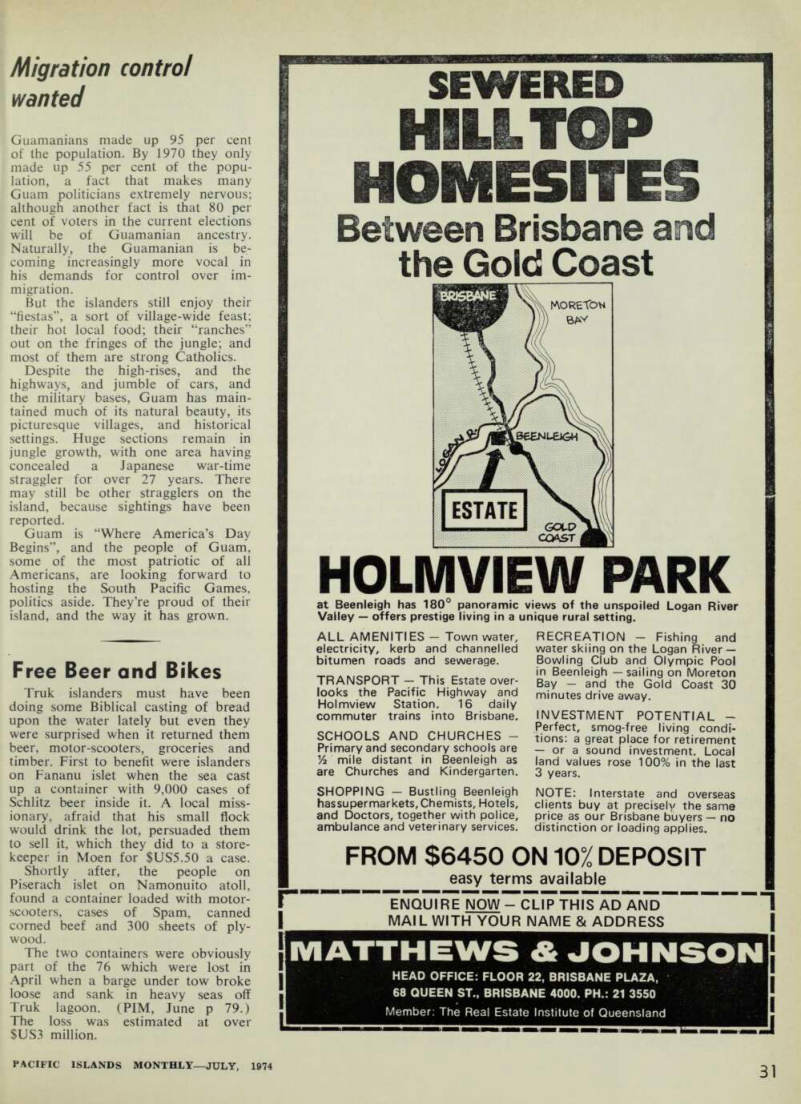
Truk islanders must have been doing some Biblical casting of bread upon the water lately but even they were surprised when it returned them beer, motor-scooters, groceries and timber. First to benefit were islanders on Fananu islet when the sea cast up a container with 9,000 cases of Schlitz beer inside it. A local miss ionary, afraid that his small flock would drink the lot, persuaded them to sell it, which they did to a store keeper in Moen for SUSS.SO a case.
Shortly after, the people on Piserach islet on Namonuito atoll, found a container loaded with motor scooters, cases of Spam, canned corned beef and 300 sheets of ply wood.
The two containers were obviously part of the 76 which were lost in April when a barge under tow broke loose and sank in heavy seas off Truk lagoon. (PIM, June p 79.) The loss was estimated at over SUS 3 million.
Advertisements & other items, p. 33 (1 item)
Homesites
SEWERED
HILLTOP
Between Brisbane and
the Gold Coast
IAORETCm
S££NL£JGH
ESTATE
GOUP
CCAST
HOLMVIEW PARK
at Beenleigh has 180° panoramic views of the unspoiled Logan River Valley offers prestige living in a unique rural setting.
ALL AMENITIES - Town water, electricity, kerb and channelled bitumen roads and sewerage.
TRANSPORT This Estate overlooks the Pacific Highway and Holmview Station, 16 daily commuter trains into Brisbane.
SCHOOLS AND CHURCHES -
Primary and secondary schools are !4 mile distant in Beenleigh as are Churches and Kindergarten.
SHOPPING Bustling Beenleigh hassupermarkets,Chemists, Hotels, and Doctors, together with police, ambulance and veterinary services.
RECREATION Fishing and water skiing on the Logan River Bowling Club and Olympic Pool in Beenleigh sailing on Moreton Bay and the Gold Coast 30 minutes drive away.
INVESTMENT POTENTIAL -
Perfect, smog-free living conditions: a great place for retirement or a sound investment. Local land values rose 100% in the last 3 years.
NOTE: Interstate and overseas clients buy at precisely the same price as our Brisbane buyers no distinction or loading applies.
FROM $6450 ON 10% DEPOSIT
easy terms available
MAIL WITH YOUR NAME & ADDRESS
MATTHEWS & JOHNSON
HEAD OFFICE: FLOOR 22, BRISBANE PLAZA,
68 QUEEN ST., BRISBANE 4000. PH.: 21 3550 Member; The Real Estate Institute of Queensland
Nutshell
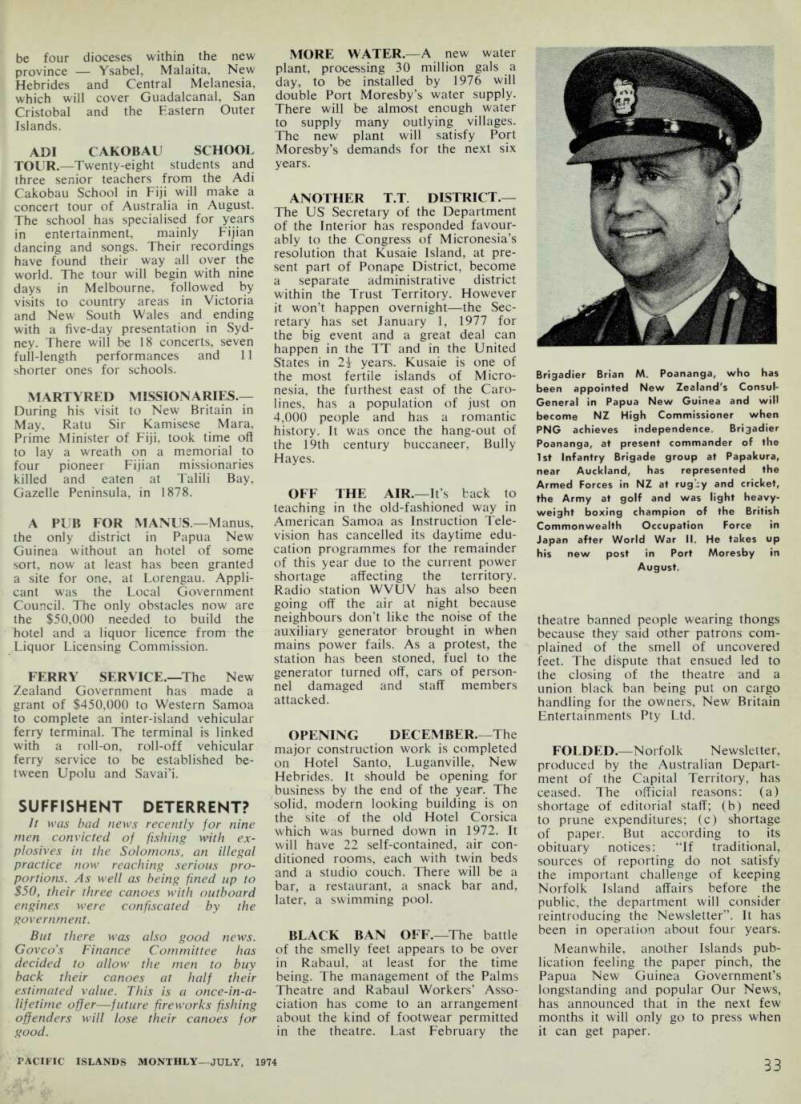
In a Nutshell
Maintaining public order has been codified in one law in the New Heb rides. In the past laws about public order applied separately to New Hebrideans, British and French citi zens. The Resident Commissioners recently made a joint regulation to safeguard law and order.
This law provides for control of meetings, processions and demonstra tions, wearing uniforms, drilling, be haviour which causes public alarm, damage and destruction to property and violence. The law sets out how meetings, processions and demonstra tions may be held. It is now an offence to spread false rumour which may cause public alarm or dissatis faction. It is also an offence to incite people to commit physical violence, and cause damage or destruction and to break the law.
Anyone who wears a prohibited uniform, or takes part in prohibited drilling, may be guilty of an offence.
The new law does not prevent or interfere with lawful and peaceful assemblies or processions.
Closed Circuit For King
—Japanese industrialist Mr Hukashi Momose, and his wife, made a special trip to Tonga in May to pre sent a colour television set and a video-casette-recorder to King Tau fa’ahau. A camera to go with the outfit is also on the way. The king, who was reported to be enthusiastic about the gift, is now self-contained as far as TV services goes although there is no black and white or colour transmission in Tonga.
Prohibited Exports.—It Is
now illegal to take nine rare animal species out of Fiji without a licence from the Department of Agriculture.
The prohibited species are the banded iguana, the Pacific boa, the venomous land snake, the Fiji tree frog, the Fiji land frog, the flying fox, the long-tailed fruit bat, the sheath-tailed bat and the Fiji goshawk.
Women In Agriculture.—
As women are the backbone of agri cultural work in Papua New Guinea, female agricultural officers were urgently needed, according to the PNG Minister for Agriculture who
announced recentl> that a concen trated drive would be made to re cruit 20 young women for entry to Vudal Agricultural College in 1975.
Png’S Bank Membership.—
A World Bank economic mission has arrived in Port Moresby for a fact finding tour of about a month. The mission’s findings will influence whether or not PNG’s application to join the International Bank for Re construction & Development and the International Development Associa tion, will be accepted.
Nz Teachers In Png
Eleven secondary school teachers from New Zealand have gone to Papua New Guinea to work for the remainder of 1974. The PNG Chief Minister, Mr Michael Somare, asked NZ Prime Minister, Kirk to send the teachers to help ease a tempo rary shortage caused by Australian teachers going home as PNG ap proaches independence. The teachers were recruited for science, English and social studies.
Food Legislation. —The
South Pacific Commission is making a survey of food legislation in the South Pacific in response to requests by a number of territories. The. sur vey will provide a basis for up-to date legislation suitable for the Pacific. The field covers the manu facture, retailing, import and ana lysis of foodstuffs.
Nauru Parliament.—The
Nauru Parliament met in May to dis cuss a supplementary finance bill, aimed at raising about $969,000 to add to the main budget. Papers authorising fund transfers within various departments were tabled.
YAQONA SCARCE.—Suva is ex periencing a shortage of yaqona (grog), through hurricane destruc tion of root crops on the main pro ducing islands of Moala and Kadavu.
The alternative source of Taveuni is unreliable. Planters there are after the high prices for copra and are ignoring yaqona. A trickle of sup plies is reaching the capital from Koro and Vanua Levu, but prices are very high.
Help For Mates.—The New
Zealand Federation of Labour at its annual conference gave $702 to the Fiji Trade Union Congress and pro mised another $B9O. The donations were made after the president of the FTUC, Mr Joveci Gavoka, said his organisation did not have a typist or even a typewriter.
TONGAN’S KO. —Heavyweight Tongan boxer, Mani Vaka, knocked out Canadian Earl McLeay in the second round in a bout at the Hono lulu International Centre in May.
Vaka set McLeay up with a left hook to the body and finished him off with a powerful right behind the ear.
RUGBY ADVANCE.—Following
their tour of Australia in 1973, when they tied the tests, Tonga Rugby players now look forward to more tours. Ahead are a tour of Wales, this year and a tour of New Zealand in 1975. The Welsh tour is, in effect, a tour of the UK, for in addition to six matches in Wales, there will be two in England and three in Scot land. On the way home the Tongans hope to play in the USA and Canada.
Market Disadvantage.—
Solomon Islands carvers are at a dis advantage with their artefacts in New Zealand, because they have to pay duty. NZ is a good market. The South Pacific Forum members, in September, 1973, decided to abolish duty on artefacts from member countries, but as the BSIP is not a member yet she misses out on the duty-free privilege. The BSIP may send an observer to forum meetings.
BIG SOCCER.—The BSIP plans to stage an “international” soccer festival at Honiara. Teams from Papua New Guinea and the New Hebrides are interested in playing.
Tracking Station.—The
United States will let Japan set up a scientific tracking station on Kwaja lein in the Marshalls. It will track and guide two experimental satellites which the Japan National Space De velopment Agency plans to launch in 1975 and 1976 from Tanegashima Island, south of Kyushu.
HOT DRlNKS.—Cascade Soft Drinks, a cordial factory opened 10 years ago on Norfolk Island, was burned down on May 23. The factory, which was started by Mr Jim Anderson, was taken over recently by new owners Mr and Mrs Paul Diehlsen, of Sydney, who hope to get back into production in a short time.
New Church Province.—
The Diocese of Melanesia will be come the Province of Melanesia, a self-governing church of the Anglican communion on January 26, 1975.
Then, the Archbishop of New Zea land will hand over to the new Archbishop of Melanesia. There will
be four dioceses within the new province Ysabel, Malaita, New Hebrides and Central Melanesia, which will cover Guadalcanal, San Cristobal and the Eastern Outer Islands.
Adi Cakobau School
TOUR. —Twenty-eight students and three senior teachers from the Adi Cakobau School in Fiji will make a concert tour of Australia in August.
The school has specialised for years in entertainment, mainly Fijian dancing and songs. Their recordings have found their way all over the world. The tour will begin with nine days in Melbourne, followed by visits to country areas in Victoria and New South Wales and ending with a five-day presentation in Syd ney. There will be 18 concerts, seven full-length performances and 11 shorter ones for schools.
Martyred Missionaries.—
During his visit to New Britain in May, Ratu Sir Kamisese Mara, Prime Minister of Fiji, took time oft to lay a wreath on a memorial to four pioneer Fijian missionaries killed and eaten at Talili Bay, Gazelle Peninsula, in 1878.
A Pub For Manus— Manus,
the only district in Papua New Guinea without an hotel of some sort, now at least has been granted a site for one, at Lorengau. Appli cant was the Local Government Council. The only obstacles now are the $50,000 needed to build the hotel and a liquor licence from the
Liquor Licensing Commission.
Ferry Service.— The New
Zealand Government has made a grant of $450,000 to Western Samoa to complete an inter-island vehicular ferry terminal. The terminal is linked with a roll-on, roll-off vehicular ferry service to be established be tween Upolu and Savai’i.
Suffishent Deterrent?
It was bad news recently for nine men convicted of fishing with ex plosives in the Solomons, an illegal practice now reaching serious pro portions. As well as being fined up to SSO, their three canoes with outboard engines were confiscated by the government.
But there was also good news.
Govco’s Finance Committee has decided to allow the men to buy back their canoes at half their estimated value. This is a once-in-a lifetime offer —future fireworks fishing offenders will lose their canoes for good.
MORE WATER.— A new water plant, processing 30 million gals a day, to be installed by 1976 will double Port Moresby’s water supply.
There will be almost enough water to supply many outlying villages.
The new plant will satisfy Port Moresby’s demands for the next six years.
Another T.T. District.—
The US Secretary of the Department of the Interior has responded favour ably to the Congress of Micronesia’s resolution that Kusaie Island, at pre sent part of Ponape District, become a separate administrative district within the Trust Territory. However it won’t happen overnight—the Sec retary has set January 1, 1977 for the big event and a great deal can happen in the TT and in the United States in 2i years. Kusaie is one of the most fertile islands of Micro nesia, the furthest east of the Caro lines, has a population of just on 4,000 people and has a romantic history. It was once the hang-out of the 19th century buccaneer, Bully Hayes.
OFF THE AlR.— lt’s back to teaching in the old-fashioned way in American Samoa as Instruction Tele vision has cancelled its daytime edu cation programmes for the remainder of this year due to the current power shortage affecting the territory.
Radio station WVUV has also been going off the air at night because neighbours don’t like the noise of the auxiliary generator brought in when mains power fails. As a protest, the station has been stoned, fuel to the generator turned off, cars of person nel damaged and staff members attacked.
Opening December.—The
major construction work is completed on Hotel Santo, Luganville, New Hebrides. It should be opening for business by the end of the year. The solid, modern looking building is on the site of the old Hotel Corsica which was burned down in 1972. It will have 22 self-contained, air con ditioned rooms, each with twin beds and a studio couch. There will be a bar, a restaurant, a snack bar and, later, a swimming pool.
BLACK BAN OFF.— The battle of the smelly feet appears to be over in Rabaul, at least for the time being. The management of the Palms Theatre and Rabaul Workers’ Asso ciation has come to an arrangement about the kind of footwear permitted in the theatre. Last February the
theatre banned people wearing thongs because they said other patrons com plained of the smell of uncovered feet. The dispute that ensued led to the closing of the theatre and a union black ban being put on cargo handling for the owners. New Britain Entertainments Pty Ltd.
FOLDED. —Norfolk Newsletter, produced by the Australian Depart ment of the Capital Territory, has ceased. The official reasons: (a) shortage of editorial staff; (b) need to prune expenditures; (c) shortage of paper. But according to its obituary notices: “If traditional, sources of reporting do not satisfy the important challenge of keeping Norfolk Island affairs before the public, the department will consider reintroducing the Newsletter”. It has been in operation about four years.
Meanwhile, another Islands pub lication feeling the paper pinch, the Papua New Guinea Government’s longstanding and popular Our News, has announced that in the next few months it will only go to press when it can get paper.
Brigadier Brian M. Poananga, who has been appointed New Zealand's Consul- General in Papua New Guinea and will become NZ High Commissioner when PNG achieves independence. Brigadier Poananga, at present commander of the Ist Infantry Brigade group at Papakura, near Auckland, has represented the Armed Forces in NZ at rugly and cricket, the Army at golf and was light heavy weight boxing champion of the British Commonwealth Occupation Force in Japan after World War II. He takes up his new post in Port Moresby in August.
Advertisements & other items, p. 36 (1 item)
“Integrated Know-how”*
Makes the Difference
TOSH I BA...the name to remember in electronics!
Backed up by a literal mountain of know-how, Toshiba's distinguished reputation throughout the world is built on customer confidence.
From tiny transistors to huge generators, Toshiba technology is packed into every product. This especially holds true in its Hi-Fi equipment.
Improved performance, longer life, fashion-trend design, compact construction...these are inherent qualities of each Toshiba Hi-Fi unit, the result of maximum usage of integrated circuits (IC's).
Regardless of your requirements...Hi-Fi 2-channel or 4-channel stereo systems, tape decks, tuners, or amplifiers...you'll find Toshiba offers a tremendous variety of models at genuine economy prices.
Speaker System SS-47 iii it 11 iiiiiiiii Speaker System SS-27 ill 1 Dolby Stereo Cassette Deck PT-490 i ft > i I -%i s * * Stereo Record Player SR-80 4-channel Stereo 4-channel Stereo Receiver SA-504 PT-884 'Dolby is trademark of Dolby Lab. inc.
tfo3uba
TOSHIBA
.. In Touch with Tomorrow ■ S< . '
Citizenship Wrangle
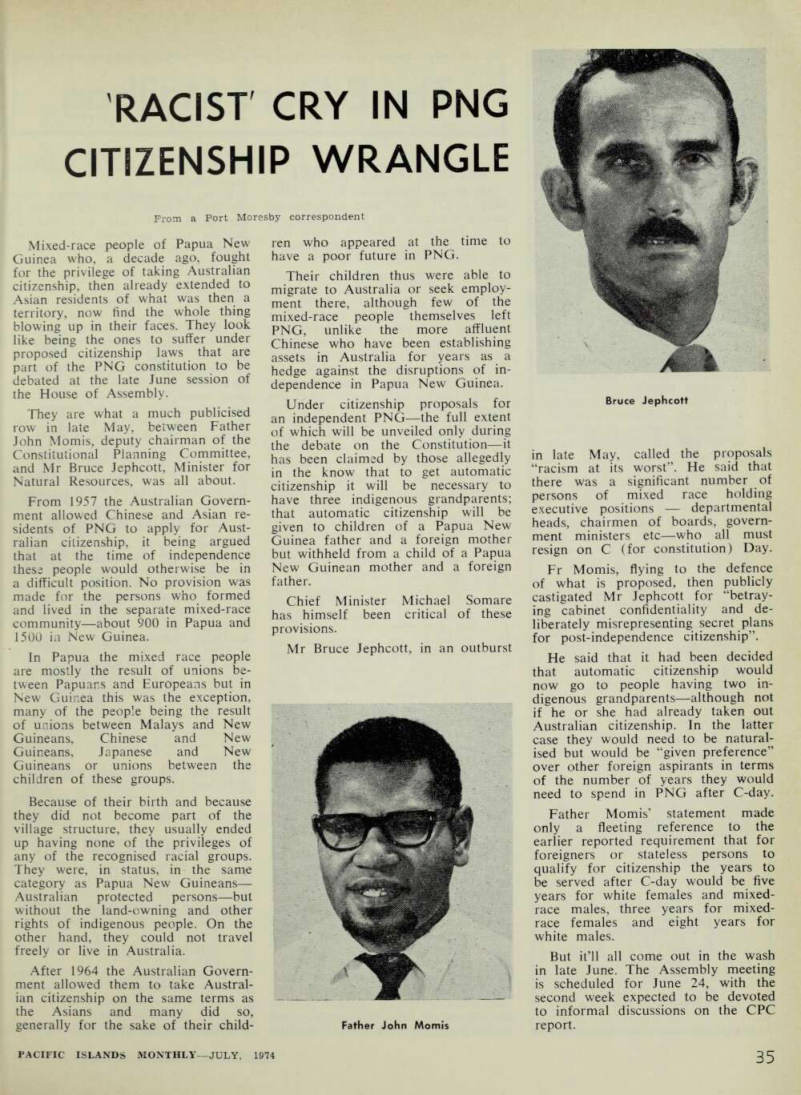
Racist Cry In Png
Prom a Port Moresby correspondent
Mixed-race people of Papua New Guinea who, a decade ago, fought for the privilege of taking Australian citizenship, then already extended to Asian residents of what was then a territory, now find the whole thing blowing up in their faces. They look like being the ones to suffer under proposed citizenship laws that are part of the PNG constitution to be debated at the late June session of the House of Assembly.
They are what a much publicised row in late May, between Father John Momis, deputy chairman of the Constitutional Planning Committee, and Mr Bruce Jephcott, Minister for Natural Resources, was all about.
From 1957 the Australian Govern ment allowed Chinese and Asian re sidents of PNG to apply for Aust ralian citizenship, it being argued that at the time of independence these people would otherwise be in a difficult position. No provision was made for the persons who formed and lived in the separate mixed-race community—about 900 in Papua and 1500 in New Guinea.
In Papua the mixed race people are mostly the result of unions be tween Papuans and Europeans but in New Guinea this was the exception, many of the people being the result of unions between Malays and New Guineans, Chinese and New Guineans, Japanese and New Guineans or unions between the children of these groups.
Because of their birth and because they did not become part of the village structure, they usually ended up having none of the privileges of any of the recognised racial groups.
They were, in status, in the same category as Papua New Guineans— Australian protected persons—but without the land-owning and other rights of indigenous people. On the other hand, they could not travel freely or live in Australia.
After 1964 the Australian Govern ment allowed them to take Austral ian citizenship on the same terms as the Asians and many did so, generally for the sake of their child
ren who appeared at the time to have a poor future in PNG.
Their children thus were able to migrate to Australia or seek employ ment there, although few of the mixed-race people themselves left PNG, unlike the more affluent Chinese who have been establishing assets in Australia for years as a hedge against the disruptions of in dependence in Papua New Guinea.
Under citizenship proposals for an independent PNG—the full extent of which will be unveiled only during the debate on the Constitution —it has been claimed by those allegedly in the know that to get automatic citizenship it will be necessary to have three indigenous grandparents; that automatic citizenship will be given to children of a Papua New Guinea father and a foreign mother but withheld from a child of a Papua New Guinean mother and a foreign father.
Chief Minister Michael Somare has himself been critical of these
provisions.
Mr Bruce Jephcott, in an outburst
in late May, called the proposals “racism at its worst”. He said that there was a significant number of persons of mixed race holding executive positions departmental heads, chairmen of boards, govern ment ministers etc—who all must resign on C (for constitution) Day.
Fr Momis, flying to the defence of what is proposed, then publicly castigated Mr Jephcott for “betray ing cabinet confidentiality and de liberately misrepresenting secret plans for post-independence citizenship”.
He said that it had been decided that automatic citizenship would now go to people having two in digenous grandparents—although not if he or she had already taken out Australian citizenship. In the latter case they would need to be natural ised but would be “given preference” over other foreign aspirants in terms of the number of years they would need to spend in PNG after C-day.
Father Momis’ statement made only a fleeting reference to the earlier reported requirement that for foreigners or stateless persons to qualify for citizenship the years to be served after C-day would be five years for white females and mixed race males, three years for mixed race females and eight years for white males.
But it’ll all come out in the wash in late June. The Assembly meeting is scheduled for June 24, with the second week expected to be devoted to informal discussions on the CPC report.
Father John Momis
Bruce Jephcott
The Editor's Mailbag
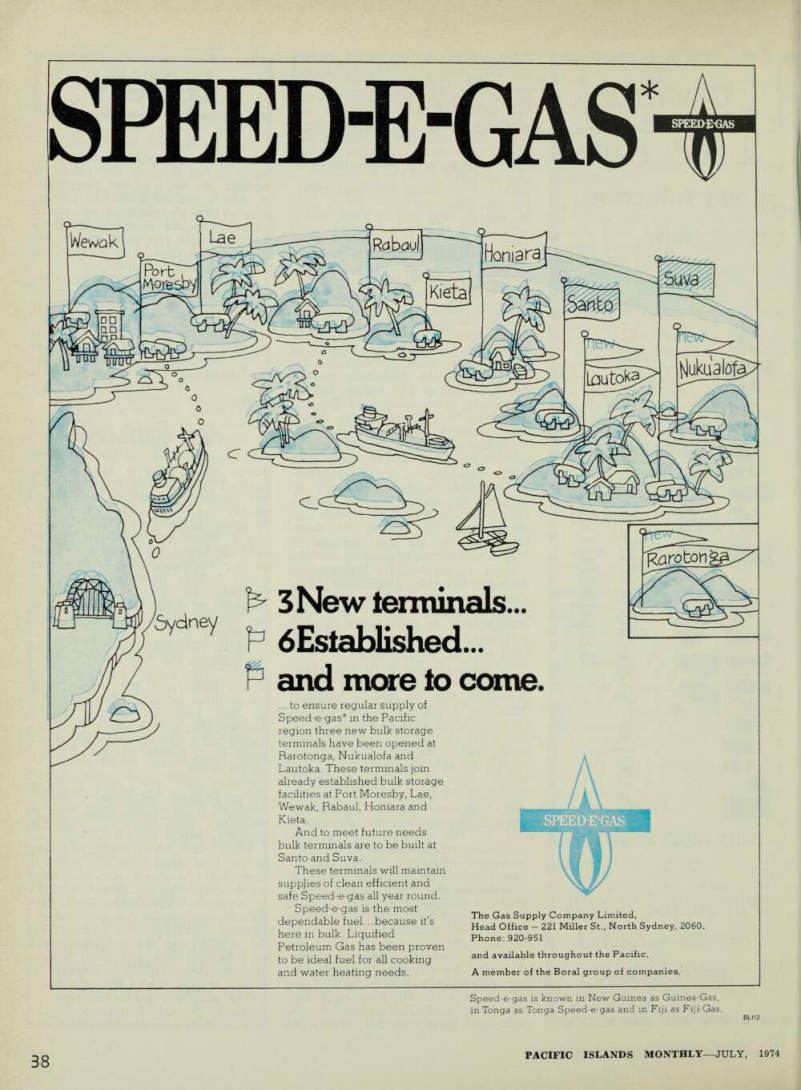
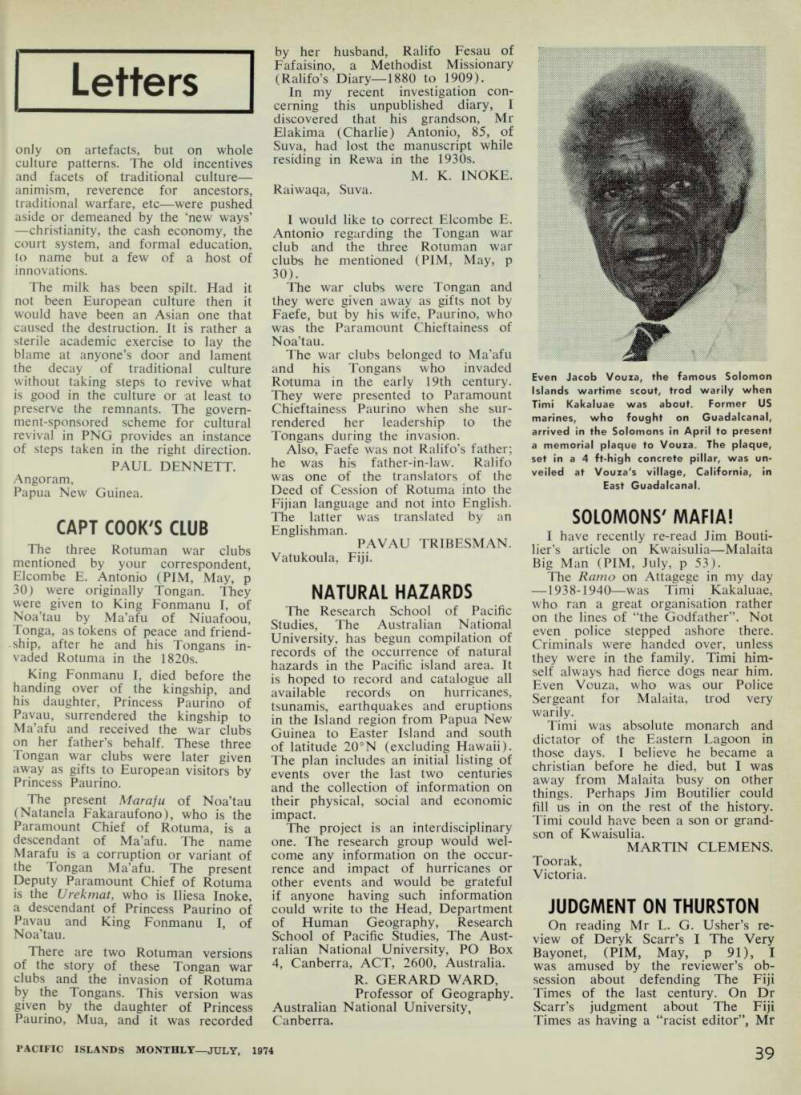
Mission Effect On Art
Mr David Wetherell’s letter (PIM, May, p 33) takes issue with the as sertion made in my book review of Philip Rawson’s Primitive Erotic Art, that Christian missions exert devasta ting effect on primitive art.
Mr Wetherell may be an expert on Papua New Guinea missions, but I doubt that he is any authority in primitive art. The fact that several missions in Papua started schools to teach the natives to carve their tradi tional artefacts is quite commendable.
He does not, however, seem to ap preciate that these objects become merely tourist trade goods when the meaning behind them is lost. The mere fact that the native had to be taught to do the things which were an integral part of their culture is in itself a vindication of my statement.
With regard to my alleged “woolly assumption that Melanesian art forms changed because missionaries meddled with them”, I would point out that my remarks were not restricted to Melanesian, but encompassed pri mitive art from America to Africa and Iceland to Australia.
If Mr Wetherell has the time to read any of the textbooks on primitive art (including Erotic Primitive Art), he will find that almost all the authors, most of whom are museum curators, who have devoted a lifetime to field work and study of so-called primitive art and culture, are of the same opinion as myself.
The degradation of art and culture is a direct result of loss of belief.
In a section dealing with the effect of European culture on primitive peoples, one of these books (Oceanic Mythology—published by Hamlyn, p 16) contains the following, which may help Mr Wetherell to understand that not all missionaries, aside from the ones he quotes, had an affinity for primitive art or beliefs.
“In all this horror perhaps only the missionaries acted with any humanity or held out any hope, but they too wanted something, they wanted souls.
In many island communities the ac ceptance of the powerful gods of the Newcomers was accompanied by the total and deliberate destruction of their own gods. The Rev Ellis de scribed in Polynesian Researchers that the Tahitians burned their gods” . . .
“In Hapaai, in the Tongan group, the missionary John Williams watched while the gods were hung from the
rafters of the house in which they were adored”.
It is a relatively few years since the Haus Tambarans were burned in the Sepik and only a matter of months since a report of mission inspired burning of reputedly price less artefacts there.
Several years ago in Kavieng I was “entertained” by a story of a priest who put an abrupt halt to a Mallangan ceremony by setting the carvings alight with petrol.
It was not my intention to denigrate the work of the missions in the fields of health and welfare, and I am quite aware that a number of missionaries have made a dedicated study of the art and culture in their areas.
I would however, say that the record of the Christian missions in all fields is somewhat like the curate’s egg—“good in parts”.
Laurie Marshall.
Paddington, Sydney.
Whose Wreck?
I was recently cruising in Pacific waters in the Sitmar liner Fairstar.
En route to Vila we passed very close to Noumea while rounding the southern tip of New Caledonia. While waiting for the pilot vessel I noticed a vessel hard and fast on the reef that encircles Noumea.
The bridge officers informed us that it was a Chinese tanker —but it looked to me as if it might have been a Japanese freighter. Would you have this recorded in your magazine at the time of its grounding and its name and nationality? Or perhaps one of your readers in the area may know its history?
Hoping you can help me. I enjoy PIM and read it regularly.
Colin Ell Wood.
Cammeray, Sydney.
Southern Cross Relic
At a recent antique auction in Wellington I obtained a small wooden paddle (7 inches long), which has the following inscription: “Made out of a bit of the old Melanesian Mission Schooner Southern Cross 1874-1891” (on one side) and “O tano nomkel apen (Mot a for) A remembrance of Bishop Pat teson + and Bishop Selwyn +” (on the other side).
Being very interested in the (ship
ping) history of the Pacific (I am Assistant Manager, NZ, • for Royal Interocean Lines) and a regular reader of PIM, I wonder whether you would be able to provide me with any further information relat ing to the above. If not, perhaps you would know some reference books/ institutions/persons who might be able to help?
R. H. Bezuijen.
PO Box 194, Wellington, NZ.
Sucking Nauru's
Life-Blood
It was announced recently by Australia, that the Whitlam ad ministration has decided to cut the present government subsidy of $57 million on superphosphate bounty to the farmers. Hence, Australia de cided to sell the phosphate on the world market at $4O a ton. This is double the price being paid for our phosphate by both consumers, Japan and Australia. Japan is buying our phosphate at $l4 a ton, while Aust ralia is paying only $l2 a ton.
The Australian Prime Minister advised that the present subsidy of $57 million could be best utilised for other projects worthwhile to Australia, as, at present, the Aust ralian farmers are the only people who are benefiting under this subsidy.
Since Nauru became independent, Australia has been guaranteed a fair quota of rock phosphate. It is be yond reasonable doubt, that our phosphate is of the highest quality.
It is the second best in the world, after that of Ocean Island.
At present there is in fact phos phate in such countries as Morocco, Mauritius and in South America.
They are low-grade phosphates yet they are being sold at $4O a ton in the world market. If we concentrate selling our phosphate on the world market we will be getting $4O a ton rather than $l2 the Australian farmer is paying us.
If it is true that the Australian farmers are needing our phosphate, and by the fact alone, that the Australian farmers have become rich as a result of the phosphate, it would have been most generous of them to increase the price of our phos phate to at least $2O a ton. Now it appears that the Australian farmers are sucking the life-blood of the Nauruan people.
We have been administered by Australia for the last 70 years, and our phosphate has been in and out of Australia for that long. It is then up to the Australian people to con sider and judge whether despite the
fact that our phosphate is disappear ing at a fast rate, we are bound to increase the price of our phosphate, to $4O a ton as it is the present price of the phosphate in the world market. Can the Australian farmers
really maintain this price stability of
phosphate as does exist in Morocco and a few other countries?
As far as I see, the Republic Government of Nauru will welcome the suggestion of the Whitlam Government to have the phosphate be sold in the world market. It will not only triple the present price, but it will attract more countries to buy our phosphate in the near future.
Detonga Deiye.
Nauru.
First Contacts!
In your article on the Nauruan stamps (PIM, May p 16), Captain Fearn is mentioned as the “man who first sighted Nauru”. This claim smacks of the old ‘weren’t-we- Europeans-great’ type history book.
Surely Nauruans were the first to sight the island. By having imprinted on the commemorative stamps the words, “175th Anniversary of First Contact”, the Nauruan Government marks 1799 as the year in which the first contact was made with the out side world.
Similar attitudes claim Tasman and Cook as the discoverers of New Zealand, but we all know that the Maoris discovered the islands long before those intrepid sailors set foot on them. I do not wish to quibble but we should remember that the Pacific has a history which goes back many years before Europeans came on the scene.
I also have some comments to add to those of Mr Wetherell in his letter on p 33 of the same issue. 1 have not read the NG Quarterly article to which he refers.
There have been many instances in the East Sepik District (which I know well) of missionaries of diverse creeds destroying traditional artefacts or strongly discouraging their pro duction; and again many where en lightened missionaries, recognising the artistic and cultural significance of artefacts, have done their best to preserve them. However, mission in fluence is only one of the culprits.
The new, and secular concepts in troduced through European contact had more of a devastating effect; not
only on artefacts, but on whole culture patterns. The old incentives and facets of traditional culture— animism, reverence for ancestors, traditional warfare, etc—were pushed aside or demeaned by the ‘new ways’ —Christianity, the cash economy, the court system, and formal education, to name but a few of a host of innovations.
The milk has been spilt. Had it not been European culture then it would have been an Asian one that caused the destruction. It is rather a sterile academic exercise to lay the blame at anyone’s door and lament the decay of traditional culture without taking steps to revive what is good in the culture or at least to preserve the remnants. The govern ment-sponsored scheme for cultural revival in PNG provides an instance of steps taken in the right direction.
Paul Dennett.
Angoram, Papua New Guinea.
Cart Cook's Club
The three Rotuman war clubs mentioned by your correspondent, Elcombe E. Antonio (PIM, May, p 30) were originally Tongan. They were given to King Fonmanu I, of Noa’tau by Ma’afu of Niuafoou, Tonga, as tokens of peace and friend ship, after he and his Tongans in vaded Rotuma in the 1820 s.
King Fonmanu I, died before the handing over of the kingship, and his daughter, Princess Paurino of Pavau, surrendered the kingship to Ma’afu and received the war clubs on her father’s behalf. These three Tongan war clubs were later given away as gifts to European visitors by Princess Paurino.
The present Marafu of Noa’tau (Natanela Fakaraufono), who is the Paramount Chief of Rotuma, is a descendant of Ma’afu. The name Marafu is a corruption or variant of the Tongan Ma’afu. The present Deputy Paramount Chief of Rotuma is the Urekmat, who is Iliesa Inoke, a descendant of Princess Paurino of Pavau and King Fonmanu I, of Noa’tau.
There are two Rotuman versions of the story of these Tongan war clubs and the invasion of Rotuma by the Tongans. This version was given by the daughter of Princess Paurino, Mua, and it was recorded
by her husband, Ralifo Fesau of Fafaisino, a Methodist Missionary (Ralifo’s Diary—lBBo to 1909).
In my recent investigation con cerning this unpublished diary, I discovered that his grandson, Mr Elakima (Charlie) Antonio, 85, of Suva, had lost the manuscript while residing in Rewa in the 19305.
M. K. Inoke.
Raiwaqa, Suva.
I would like to correct Elcombe E.
Antonio regarding the Tongan war club and the three Rotuman war clubs he mentioned (PIM, May, p 30).
The war clubs were Tongan and they were given away as gifts not by Faefe, but by his wife, Paurino, who was the Paramount Chieftainess of Noa’tau.
The war clubs belonged to Ma’afu and his Tongans who invaded Rotuma in the early 19th century.
They were presented to Paramount Chieftainess Paurino when she sur rendered her leadership to the Tongans during the invasion.
Also, Faefe was not Ralifo’s father; he was his father-in-law. Ralifo was one of the translators of the Deed of Cession of Rotuma into the Fijian language and not into English.
The latter was translated by an Englishman.
Pavau Tribesman.
Vatukoula, Fiji.
Natural Hazards
The Research School of Pacific Studies, The Australian National University, has begun compilation of records of the occurrence of natural hazards in the Pacific island area. It is hoped to record and catalogue all available records on hurricanes, tsunamis, earthquakes and eruptions in the Island region from Papua New Guinea to Easter Island and south of latitude 20°N (excluding Hawaii).
The plan includes an initial listing of events over the last two centuries and the collection of information on their physical, social and economic impact.
The project is an interdisciplinary one. The research group would wel come any information on the occur rence and impact of hurricanes or other events and would be grateful if anyone having such information could write to the Head, Department of Human Geography, Research School of Pacific Studies, The Aust ralian National University, PO Box 4, Canberra, ACT, 2600, Australia.
R. Gerard Ward,
Professor of Geography.
Australian National University, Canberra.
Solomons' Mafia!
I have recently re-read Jim Bouti lier’s article on Kwaisulia—Malaita Big Man (PIM, July, p 53).
The Ramo on Attagege in my day —1938-1940—was Timi Kakaluae, who ran a great organisation rather on the lines of “the Godfather”. Not even police stepped ashore there.
Criminals were handed over, unless they were in the family. Timi him self always had fierce dogs near him.
Even Vouza, who was our Police Sergeant for Malaita, trod very warily.
Timi was absolute monarch and dictator of the Eastern Lagoon in those days. I believe he became a Christian before he died, but I was away from Malaita busy on other things. Perhaps Jim Boutilier could fill us in on the rest of the history.
Timi could have been a son or grand son of Kwaisulia.
Martin Clemens.
Toorak, Victoria.
Judgment On Thurston
On reading Mr L. G. Usher’s re view of Deryk Scarr’s I The Very Bayonet, (PIM, May, p 91), I was amused by the reviewer’s ob session about defending The Fiji Times of the last century. On Dr Scarr’s judgment about The Fiji Times as having a “racist editor”, Mr
Even Jacob Vouza, the famous Solomon Islands wartime scout, trod warily when Timi Kakaluae was about. Former US marines, who fought on Guadalcanal, arrived in the Solomons in April to present a memorial plaque to Vouza. The plaque, set in a 4 ft-high concrete pillar, was un veiled at Vouza's village, California, in East Guadalcanal.
Usher says: “name-calling labels are no real substitute for a detached and balanced view of the whole scene”.
Mr Usher finds “great value in the massive research that has gone into the book” but “not in its judgment of either men or events!” Yet Mr Usher’s judgment of Sir John Bates Thurston as having a deep “love of the Fijian people” seems much less balanced or enlightening than Dr Scarr’s massively-researched judg ments.
At the end of the review, Mr Usher wishes for “a more rounded human study of a truly remarkable man”. It seems to me that in Mr Usher’s view, a “more rounded human study” of Thurston is one that finds past editors of The Fiji Times—even dead ones of over 100 years ago—infallible of human weakness.
Jone Dakuvula.
University of the South Pacific, Suva.
Planters Defended
It sickens many of us, black or white, that certain writers base their criticism merely on hearsay. Those like Kalkot Matas-Kele (probably a newcomer?) (PIM, May, p 41) im ply that planters, or “colons”, are responsible as organisers of party politics in the New Hebrides. Quite untrue.
Planters, who take their work seriously, are far too busy organising field work, transporting cargo, re cruiting workers, repairing machinery, fences, tending to the sick, training workers, etc, to find time for the juvenile game of cat-and-mouse politics.
Among the many questions we could ask ourselves, the following few have priority: • Without pioneer (foreign) planters, how would this country have developed in the first place? » Why was it necessary to intro duce outside work force, eg Ton kinese, Wallisians, Tahitians and Gilbertese—for development? • Who decided that this group of islands was to be called New Hebrides? • Why is it that customs and lan guages vary all around the group if all the people are one and the same, ie New Hebrideans? • Who were responsible for inter ference with island customs?
Apart from an occasional un pleasant, hot-headed person as one can find in any type of community and race, the majority of planters have, since early days, got on very well with indigenous people. They still do.
The Sin of Envy, affecting a hand ful of educated islanders, has only very recently been pressured by minority newcomers who seem to revel in manufacturing mental-bullets for the unsuspecting islander to fire.
Man-Santo.
Santo, New Hebrides.
Gutter Language
Here I go again. I do not wish to thrash the subject to death but I cannot resist replying to the over bearing bigots who become hysterical at the sight of bare bums and factual reporting. (PIM, Apr, Feb).
It seems that Mr Hall and Mr Cummings will be satisfied with no thing less than a return to so-called “Victorian morality”, when even table and piano legs were modestly draped and legs were “limbs”.
I am not an advocate of porno graphy (although the “Victorians” were); however, I am over 21 and
feel that I can make my own moral judgments on the media without heaping vitriolic abuse and advice on the heads of various unfortunate editors.
Until I read Mr Hall’s letter, I was unaware that the lass in I.
McDonald’s ad was bare bummed— oh pardon me, I mean bottomed, er posteriored? . . . hmmm, backed?
Fiona Kirk.
Edge Hill, Cairns, Queensland.
No Bsip Foot-And-Mouth
We read in the May issue of PIM, p 64, under “Fishing Ranchers”, that the BSIP is designated as a “Foot and-Mouth” disease area.
We would be interested to know from what authority and on what evidence this information was ob tained.
Australian veterinary consultants have regularly been visiting BSIP and performing animal disease studies and surveys since 1960. From 1967, two veterinary officers have between them performed more than four years of animal disease survey ing under the Australian South Paci fic Aid Programme, and since 1969, the protectorate has had a resident Government Veterinary Officer.
At no time has any evidence been discovered that foot-and-mouth disease is present in the protectorate.
We therefore most definitely re gard the BSIP as foot-and-mouth free and would be pleased if you could print a retraction in the next
issue of PIM.
D. J. Fisk.
Senior Information Officer, For Director of Information, Broad casting Museum and Library Services, Honiara, BSIP.
Sailing Backwards
Reference Herb Kane’s Polynesian expedition (“Hawaiians will sail back into history”, PIM, May, p 21), Nga Toki Matawharoa is a Maori war canoe built for the Centennial cele brations at Waitangi, New Zealand.
Hewn out of solid logs, scarfed together to give a length of 117 ft; traditional Maori carvings from stern to stern; not a sign of a screw or nail or a glued joint. What will Herb Kane’s Dillingham-built canoe look like? Plywood! Built-in buoyancy compartments, polyurethane-painted?
I suppose the crew will be taking a plastic drogue? Might prevent them from drifting backwards into
obscurity.
David Richardson.
Cairns, Queensland.
Advertisements & other items, pp. 38-46 (2 items)
Sydney 2001.
COLONIAL
ERA
CEMETERY
OF
NORFOLK
ISLAND
R. Nixon Dalkin On Norfolk Island the colonial era cemetery at Kingston, offers the clearest precis of life and death in one of the harshest penal colonies ever administered by Britain, and the second British settlement in the South Pacific. Inscriptions vary from crudely carved initials to elegantly scripted narratives of events leading to death— death from disease, violence and the hangman’s rope.
In this scholarly work by R.
Nixon Dalkin, a former Administrator of Norfolk Island, the colonial era cemetery is closely examined. Graves are listed numerically, alphabetically or by military regiment.
The most meagre inscriptions have been expanded by illuminating often very moving historical detail. Researchers and genealogists, and everybody fascinated by Australia’s early history, will find this book invaluable, as will visitors to Norfolk Island.
The fold-out plan of the cemetery will assist those who have the opportunity of themselves visiting this historic link with the colonial past.
PRICE: Australia, $6.00 Aust., plus 85c posted; Pacific and Overseas, $6.00 Aust., plus $l.lO posted; U.S.A., $10.60 U.S. posted.
Pacific
Publications
(A ust) Pty
Box 3408 G.P.O.
Sydney 2001.
Monthly
Become a part of PlM’s Pacific and subscribe now
Pacific Islands Monthly Keeps you informed on Pacific happenings
Fill in the details on the attached order form .
SPEED-E-GAS
SPEED-E-GAS
w
Lae
Wewak
Rabaul
Honiara
Port
Kieta
□□ an
Hukualo^
lautoka
1 o c CL
frs
Rarotonga
Sydney
3 New terminals...
P 6Established...
P and more to come.
.. .to ensure regular supply of Speed-e-gas* in the Pacific region three new bulk storage terminals have been opened at Rarotonga, Nukualofa and Lautoka. These terminals join already established bulk storage facilities at Port Moresby, Lae, Wewak, Rabaul, Honiara and Kieta.
And to meet future needs bulk terminals are to be built at Santo and Suva.
These terminals will maintain supplies of clean efficient and safe Speed-e-gas all year round.
Speed-e-gas is the most dependable fuel... because it's here in bulk. Liquified Petroleum Gas has been proven to be ideal fuel for all cooking and water heating needs.
The Gas Supply Company Limited, Head Office 221 Miller St., North Sydney, 2060.
Phone: 920-951 and available throughout the Pacific.
A member of the Boral group of companies.
Speed-e-gas is known in New Guinea as Guinea-Gas, in Tonga as Tonga Speed-e-gas and in Fiji as Fiji-Gas.
SOME OF THE FIRMS
WE REPRESENT ARE:
Asia Rubber Works (Singapore Rubber Shoes) Frappier (French Brandy) Huvet (French Brandy) Indika (Belgium Dairy Produce) Durobor S.A. (Belgium Glassware) AAiroiterie Gen. de Belgiqe S.A. (Louvre glass and mirrors) City Engineers (U.K. Bicycles) F.H.I. Japan (Subaru Cars) Kraggs (Wines, Spirits, Ciders) Sunshine Biscuits Sunrise (Confectionery) Flamenco (Instant Coffee & Tea) Quaker Products (Oats, Jets) Hancocks (Spaghetti, Cereals) Melbourne Canning (Jams) Amatil (Twisties, Twirlies) Edward Zorn (Margarine, Cooking Fats) Allens (Confectionery) Red Tulip (Fine Chocolates) Robert Timms (New Guinea Gold Instant Coffees and Teas) S.P.C (Canned Fruit) S.P.C. (Abalone) Wing Lee (See You Sauce) Magnet (Mattresses) Essteel (Cookware) Warner-Drayton (Fans) Mitchell's (Abrasives) Tilbury & Lewis (Sports Trophies i.
Silverplate) Regent (Swiss watches) Lega Marcasite (Jewellery) Austramax (Pressure Lanterns) Lawn Chair; Tubco (Garden Furniture) Electronic Industries (Electrical Household Appliances) Jex (Steelwool) Arnbro (Folding Beds) James Miller (Blankets) Elmaco (Plastics —Electrical Fittings) B.X. (Plastics) Stegbar (Wooden Louvres) Franklite (Light Fittings) J.J. Cash (Embroidered Labels) Disston (Saws)
S. E. TATHAM
& CO. PTY. LTD.
ASKEW HOUSE, 364 LONSDALE ST.,
MELBOURNE, 3001, AUSTRALIA.
G.P.O. BOX 8—
CABLES "SET",
TELEPHONE: 601125
BUYERS FOR THE
PACIFIC ISLANDS
2 % \ 1 \ £
DIRECT ENQUIRIES WELCOMED
PAPUA NEW GUINEA: S. E. TATHAM (P.N.G.) PTY. LTD.,
LAE: MALAITA STREET (P.O. BOX 1562).
PORT MORESBY: CNR. GOROA AND MUNAHU STREETS, GORDON
(P.O. BOX 6733, BOROKO).
FIJI: S. E. TATHAM (FIJI) LTD.,
LAUTOKA: P.O. BOX 366.
SUVA: G.P.O. BOX 671.
YOUR GUARANTEE
~mto
i rZk
FOR SERVICE
SINCE 1924
T. 2.
The Forestmil
Portable Sawmill turns
trees into timber at
the rate oflooosuper
feet per hour.
‘Forestmil’ produces house building or construction size timber direct from the log in the forest. No need to resaw, it’s ready to use. Inter-acting vertical and horizontal blades cut simultaneously for speed and accuracy, (see illustration) ‘Forestmil’ is ideal for cutting usable timber from reject logs.
Produces any size up to 12" x 6" x 18', including boards, framing, bridge sizes, etc.
CHECK THESE FEATURES:
• Dismantles into small sections: • Only 2 men required to operate. • Total weight 1560 lbs. • Erected ready to use in 1 hr. • Powered by petrol or diesel motor. lr Now easier than ever to operate.
Write for further information to:
MACQUARRIE INDUSTRIES PTY. LTD.
133 Bakers Road Coburg, Victoria, 3058. Australia Phone: 350 3411 MI-F-4
She never
sleeps.
The Coral Chief and her three sister ships are working 24 hours a day, seven days a week. They never sleep. They never can. With side-port unit-loading, their time in Port barely gives their crews time to see more than the wharf.
If your cargo is bound for our corner of the Pacific, send it by the ships that never sleep— the four Chiefs of the New Guinea Australia Line. ‘New Guinea Chief’, ‘lsland Chief’,‘CoralChief’, rig L» ‘Papuan Chief’.
Tv? T-T
New Guinea Australia Line Pty. Ltd., Registered Office Port Moresby, Papua New Guinea.
General Agents: PORT MORESBY—Steamships Trading Co. Ltd.
SYDNEY—John Swire & Sons Pty. Ltd.
Agents: SYDNEY —Interocean Swire Pty. Ltd.
BRISBANE —Wills, Gilchrist & Sanderson Pty. Ltd.
PAPUA NEW GUlNEA—Steamships Trading Co. Ltd. (for “New Guinea Chief” at Rabaul and “Island Chief” at Kavieng—Burns Philp (N.G.) Ltd.).
U New Guinea
Australia Line
MEMBER OF THE SWIRE GROUP.
TROPICAL ISLAND UNE BY KAMBARA KISEN
Monthly passenger&cargo service from Papua New Guinea to Japan via Guam
by "TROPICAL RAINBOW” D/W 9,000 tons
OSAKA
24th 27th
NAGOYA
YOKOHAMA
29th I st
low inran^^H
■ BVJRPnnESE BOUT
GUAM
20th 20th
MADANG
LAE
The figures at each port show fixed date on every month.
FIRST CALL 9th I Oth
SECOND CALL 16th 17th
RABAUL
3th 15th th, 12th Passenger accomodation: 250 berthes Remarks: Agents: Guam: Madang: Lae: Rabaul: Round trip from ¥ 152,000 A 5345.50 subject foreign rate is Y 440 per ASI.OO June is no sailng due to the docking of “TROPICAL RAINBOW
ATKINS KROLL GUAM LTD.
STEAMSHIPS TRADING CO.. LTD.
STEAMSHIPS TRADING CO.. LTD.
STEAMSHIPS TRADING CO , LTD.
TEL. 777-992 I 4
TEL. 82-2055
TEL. 92-220 I
HEAD OFFICE KAMBARA KISEN CO, LTD
Cable address: KAMBARA KISEN TOKYO Head office: No. 9-2, Ichibancho, Chiyoda-ku, Tokyo, Japan.
TEL. 03-264-880 I
Madang office: (Subsidary Company in P.N.G.)
TROPICAL ENTERPRISE CO.. PTV) LTD
P.O. Box 9 11, Madang. P N G.
TEL. 82-2 I 90
Cable address: Tropical Madang
TROPICAL ISLAISD UISE
TROPICAL RAIISBOW
' YOUir WELCOME OUR TROPICAL
MODULAR HOME UNITS...IN EVERYWAY!
• PRE-CONSTRUCTED IN N.Z. AND
PRE-TREATED FOR TROPIC CONDITIONS
• SHIPPED KNOCKED-DOWN TO YOUR
DESTINATION
• EASILY ERECTED ON SITE WITH MINIMUM
SKILLED LABOUR
• OFFER LUXURY AT A REASONABLE PRICE Perfect for holiday and permanent homes or commercial and industrial housing projects. 4 modelstochoosefrom; ‘Leisuredeck’, (illustrated) ‘Sunseeker’, Castaway’, ‘Sunlover in 1,2,3-bedroom units. . . modular construction streamlines design, gives flexibility . . . pre-construction cuts costs and assembly-but not quality. . . maintenance-free pre-coated insulated Permalum metal weather-boarding . . . pre-piped plumbing unit Plus many other quality features!
IT m
welcome I homes limited
Like to know more? Mail this coupon now!
To: The Manager, Welcome Homes Ltd Box 12203, Penrose, Auckland, N.Z.
Please send me, without obligation, brochures on your Modular Home Units.
Name Address Already performance-proven in the New Hebrides, Pitcairn and Japan.
Property Located At 664^J
fi * m s
Keep a
handy!
OTHER HANOI PRODUCTS!
‘Handi’ range of quality products also includes: a portable Twin - Burner Stovette and ‘Handi’ Pumpless Petrol Iron.
I No need to fumble and fume! Throw light on the subject with a ‘Handi’. It’s twice as bright as electric light. Completely stormproof. Simple and safe to use.
PRESSURE OPERATED
One filling gives 12 hours of brilliant 300 candle-power lighting. Built to last, with chromed, rust - proofed finish. Petrol or Kerosene models.
Ask for Handi! Everywhere!
HANOI WORKS ME
Evans Rd., Salisbury North. Ph. 47 2122
BRISBANE, QUEENSLAND, AUSTRALIA
and eating
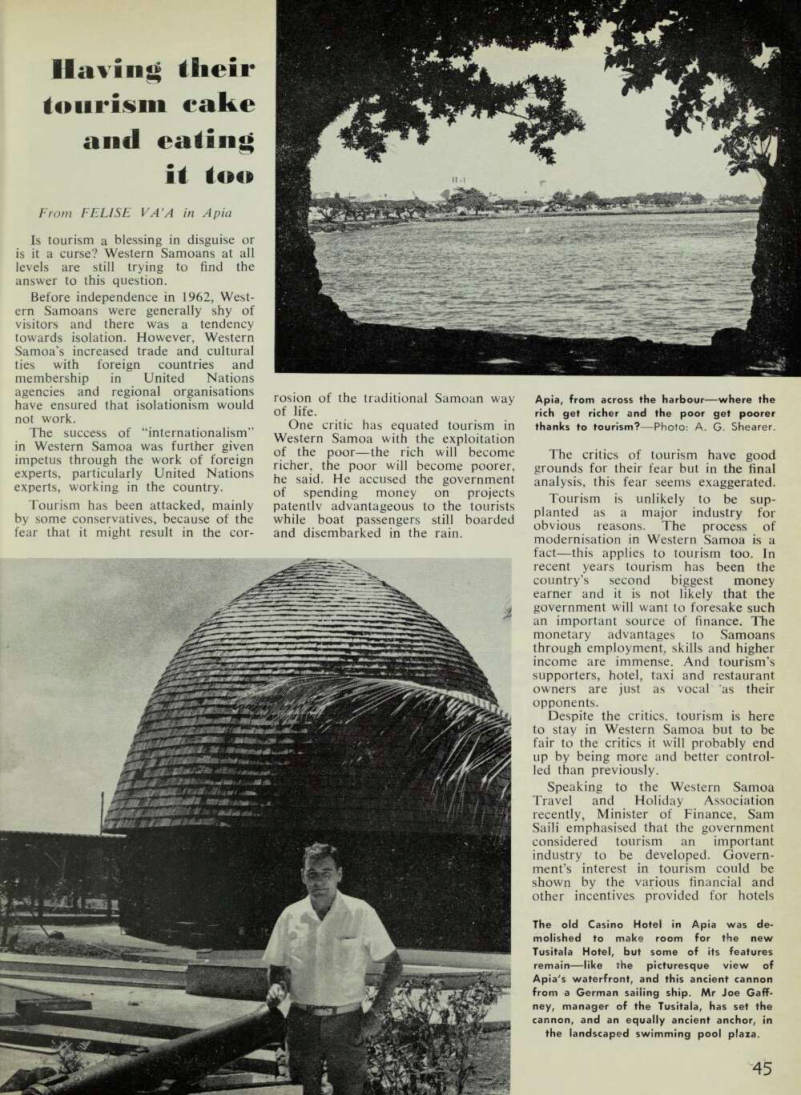

Having their tourism cake and eating it too
From FELISE VA’A in Apia Is tourism a blessing in disguise or is it a curse? Western Samoans at all levels are still trying to find the answer to this question.
Before independence in 1962, West ern Samoans were generally shy of visitors and there was a tendency towards isolation. However, Western Samoa’s increased trade and cultural ties with foreign countries and membership in United Nations
agencies and regional organisations
have ensured that isolationism would not work.
The success of “internationalism” in Western Samoa was further given impetus through the work of foreign experts, particularly United Nations experts, working in the country.
Tourism has been attacked, mainly by some conservatives, because of the fear that it might result in the cor
; f h traditiona , Samoan way j-£ e 3 One critic has equated tourism in Western Samoa the exp i o u a ti 0 n of the poor the rich wil become richer ,j, e wi|| become e he said He accused , he gove^ nment of spe nding money on projects patentlv advantageous to the tourists while boat passengers still boarded and disembarked in the rain.
The critics of tourism have good grounds for their fear but in the final analysis, this fear seems exaggerated.
Tourism is unlikely to be sup planted as a major industry for obvious reasons. The process of modernisation in Western Samoa is a fact—this applies to tourism too. In recent years tourism has been the country’s second biggest money earner and it is not likely that the government will want to foresake such an important source of finance. The monetary advantages to Samoans through employment, skills and higher income are immense. And tourism’s supporters, hotel, taxi and restaurant owners are just as vocal as their opponents.
Despite the critics, tourism is here to stay in Western Samoa but to be fair to the critics it will probably end up by being more and better control led than previously.
Speaking to the Western Samoa Travel and Holiday Association recently, Minister of Finance, Sam Saili emphasised that the government considered tourism an important industry to be developed. Govern ment’s interest in tourism could be shown by the various financial and other incentives provided for hotels
Apia, from across the harbour—where the rich get richer and the poor get poorer thanks to tourism?— Photo: A. G. Shearer.
The old Casino Hotel in Apia was de molished to make room for the new Tusitala Hotel, but some of its features remain—like the picturesque view of Apia's waterfront, and this ancient cannon from a German sailing ship. Mr Joe Gaff ney, manager of the Tusitala, has set the cannon, and an equally ancient anchor, in
the landscaped swimming pool plaza.
and tourist service establishments, government’s purchase of shares in Polynesian Airlines and the Tusitala Hotel, and efforts to improve roads and water supply, he said.
Other government plans for pro moting tourism were the extension of the tourist visa from three to seven days, and the upgrading to inter national standards of Faleolo Airport.
At the end of his speech (read by the Director of Economic Develop ment, Mr Hans Kruse) the minister dropped a bombshell. Beginning January next year, the government planned to introduce a 10 per cent surtax on all tourists visiting Western Samoa (See Business section, this issue).
The announcement was unexpected, especially as it was the same minister who had abolished the 10 per cent bed tax (imposed by the previous Tamasese Government) last year. The minister’s action at that time brought a lot of criticism from the Opposition.
Opposition Leader, Tupuola Efi, accused Saili of inconsistency because Saili had introduced stringent econo mic measures under the pretext that the government had no money, while at the same time abolishing a useful source of revenue.
The tourist people, however, have a chance to fight the measure as it is still to be brought up in parliament.
Indirectly, perhaps, the tax is one way of controlling the inflow of tourists to Western Samoa, and as such favours tourism’s opponents. Many people in the tourist industry say the surtax will discourage tourists from visiting Western Samoa and they point out that the bed tax produced an unfavourable reaction.
As for Western Samoa, tourism development, however, is going ahead full swing. Visitors had to be turned away in 1971 and 1972 because of lack of accommodation.
In 1972 only 20 double rooms were added as a result of expansion at the Hideaway Hotel. With this addition, according to a government report, Western Samoa’s total hotel capacity reached 175 rooms, consisting of 30 singles and 145 doubles, equal to 320 beds.
At the same time, 25 new double rooms at Aggie Grey’s and 35 double rooms at the Tiafau Hotel were near ing completion towards the end of 1972, and, more recently, the Tusitala Hotel (which has replaced the former Casino Hotel) opened with 45 rooms ready, and another 45 rooms to be completed this June.
The Royal Samoan Hotel (Ameri can owned) will ultimately have 450 double rooms. Preliminary work
(reclamation) has already started on this ultra-luxury hotel, the first stage of which is expected to be completed by 1975.
The same report said the tourist industry was the second largest foreign exchange earner after agri culture in 1972 when it earned $1,876,100 compared with $1,550,400 the previous year.
The report ended with this observa tion: “Tourism is expected to be one of the primary growth poles in the struggle for the development of West ern Samoa. Because of its economic importance and its unavoidable im pact on local culture, concrete policies regarding the control of hotel develop ment, hotel ownership and location, standards of hotel classification and inspection will soon be announced in a tourist master plan.”
Advertisements & other items, p. 48 (1 item)
A.R.C. reinforcing fabric
*l* 1&*. sy ii
«*S$NSj£
iWM * ** i- " % H m/ V 3 <M ? « - 1 ‘I
A.R.C. reinforcing fabric
does all your heavy work.
A.R.C. reinforcing fabric is designed and manufactured to do the heavy work in all concrete construction. The resistance welded wire fabric is available in rectangular or square mesh, in flat sheets or rolls and is produced to conform with Australian Standard 1304.
A.R.C. reinforcing fabric permits maximum construction speed and economies while retaining full design strength. The cost and time saved in laying fabric outweighs the use of other reinforcing materials. In addition, A.R.C. manufacture mesh in galvanised and bright wire to suit rural, industrial and domestic applications.
For details and prices of the A.R.C. range of reinforcing fabrics and other meshes contact: The Export Department, A.R.C. Industries Limited, 440 Collins Street, Melbourne, 3000, Victoria, Australia.
Cables: “Benignant”, Melbourne
A.R.C.
m 02241
Hon Leaf House
A fully-furnished and equipped leaf house will be the focal point of a Solomons pavilion at the exhibition of ocean culture to be staged next year at EXPO in Okinawa. The Japanese Government will ship build ing materials from the Solomons plus 10 experts from the Lau Lagoon, North Malaita, to erect it.
It’s also hoped to display a West ern Solomons war canoe, probably the one used during the Queen’s visit in February. The government is taking no chances with its valuable artefacts.
Export licences will have to be obtained and guarantees given that they will be looked after while out of the country.
The Handout
After The Fallout
A special committee of the Con gress of Micronesia has urged that the United States be called on to pay various types of compensation to people who suffered from radiation or had their lives disrupted by the hydrogen bomb explosion over Bikini Atoll on March 1, 1954. The com mittee recommended that should the US not follow the guidelines for compensation legal action should be taken.
The committee report, tabled at a recent session of the Congress, said the US Government was negligent over the explosion. The people of Rongelap and Utirik were exposed to radio-active fall-out, which was the “proximate or sole cause of in juries” to them and their properties.
Additional nuclear tests after they were returned to their islands ex posed them to more radiation, which might have aggravated their con dition.
The committee’s report recom mended that $50,000 be paid each to the “real mother and father” of Lekoj Anjain, who died from leu kemia, directly caused by exposure to radiation. They should be allowed to use the money as they wished.
Those who had thyroid operations because of radiation-induced disease should receive $25,000 each. The people of Utirik, who were displaced from their island for three months, should receive $l,OOO each as an “inconvenience payment” to supple ment $ll6 offered by the Atomic
Energy Commission.
For all other damages and in juries, to people or property, past and future, funds of indeterminate life of $25,000 a year should be set up for Rongelap and Utirik. This money would be used to fund com munity projects decided on by the municipal councils of the islands.
The fund should be replenished each year so that $25,000 would always be available at the start of the next fiscal year.
The committee felt such funds would help to compensate people for their personal physical and pro perty losses which they actually suffered, and also for damage which could not be specifically determined.
They would also help to promote self-sufficiency. The money would also encourage people from both atolls, who had emigrated to district centres to look for work, to return home.
The committee recommended that legislation endorsing the compensa tion should be open-ended so that payments could be made to those who developed illness from radiation in future.
The US Government should spon sor an independent internationally staffed radio-ecological survey of both atolls and give its findings to the people of the atolls. That action should be taken because of the per sistent concern by both exposed and unexposed persons of both atolls about all local food.
Advertisements & other items, p. 50 (1 item)
* Therma-Panel
I 1P* 4 “CANBERRA”
Three bedroom elevated home, lots of living space, brick laundry under, and two carports.
George Hudson's new Therma-Panel modular units mean that you can build your own home in a fraction of the time required for traditional materials.
Write for detailed plans and prices from the sole Pacific Islands agent :
A. RIETTE (EXPORT) PTY. LTD.
300 GEORGE STREET, SYDNEY 2000.
Cables: Ramaritime, Sydney
What’s so
different about
* THERMA-PANEL
HOMES?
Just this:
• Only three basic components for walls, ceilings, doors and windows. • Makes building simple as A.B.C. • Specially designed for the owner-builder. • Fully insulated walls and ceilings. • Cuts on-site constructon time. • Cuts on-site construction costs. • Pitched or flat roof with exposed beams for real beauty.
Save hundreds of dollars
on Australians most efficient
WALK IN, ALUMINIUM
COOLROOMS AND
FREEZE ROOMS
Hundreds already installed! The most economical supplementary coolrooms for bottles and food, providing the largest storage capacity of any comparable coolrooms of the same exterior dimensions. Five sizes —from 90-360 cu. ft. capacity; 16 models offering normal temp., two temp., deep freeze, or for pastry and ice storage applications. White vinyl interior, embossed rustproof aluminium exterior. • SUPPLIED IN EASY-TO-ERECT, DO-IT-YOURSELF KIT FORM • PETROL AND PETROL-ELECTRIC MODELS ARE AVAILABLE FOR AREAS WHERE POWER IS LIMITED OR NON-EXISTENT m Available from; AUSTRALIAN NEW CALEDONIA EXPORTS (SILVER & BARDA), 363 George St., Sydney, 2000 and Branches.
BRECKWOLDT & CO., 276 Pitt St., Sydney, 2000 and Branches.
PETER FISHER TRADING PTY. LTD., 321 Pitt St., Sydney, 2000.
HAGEMEYER (A'SIA), 59 Anzac Pde., Kensington, 2033 and Branches.
Manufactured by:
KERR BROS, 65 York St., Sydney, 2000.
NELSON & ROBERTSON PTY. LTD., 197 Clarence St., Sydney. 2000.
RABAUL TRADING CO. PTY. LTD., P.O. Box 219, Rabaul and Branches ROY GALLIMORE & ASSOCIATES, P.O. Box 179, Vila, New Hebrides C. SULLIVAN (EXPORT) PTY. LTD., 60 Margaret St., Sydney, 2000 and Branches.
W. S. TAIT & CO. PTY. LTD., 31 Macquarie Place, Sydney, 2000 and Branches.
WARBURTON FRAHKI
199 Parramatta Road, Cnr. Skarratt Street, Auburn, N.S.W. 2144, Australia. Phone: 648-1711.
Powered by Kelvinator.
Five-year warranty on compressor. Early delivery.
Saipan's
Depressing
Problem
From a Saipan correspondent The housing situation on Saipan does not present a pretty picture, par ticularly for people on lower in comes. The Marianas District Plan ning Office in 1973 made a survey on housing conditions on the island.
Some details of the survey were re leased recently.
This showed that about one-third of the houses were considered to be “structurally inadequate”, and would not withstand the next serious typhoon. Of 2,388 housing units counted in the survey, 925 were said to be deteriorated wood frame build ings in poor condition. Considered in good condition were 713 concrete structures and 750 wood frame houses.
There had been a phenomenal in crease in housing construction since Typhoon Jean practically either de stroyed or severely damaged the 1,249 houses on the island in 1968. But the housing situation for the majority of Saipanese had not greatly im proved since the World War II in vasion when 15,000 to 20,000 perma nent residential units were totally destroyed.
After Typhoon Jean, as an emer gency housing measure, about 450 units of plywood were built by the US office of Emergency Prepared ness. They were intended to last the two or three years it would take to rebuild permanent housing. Like many temporary structures put up in many parts of the world, 400 of them are still occupied.
The report points to a depressing aspect —because there is insufficient money and a current trend to escape the 20-person, three-family house holds which are common today, most of the present dilapidated homes will not be replaced, proper sanitary facilities will not be built, and a large quantitv of poorly built homes will go up.
“Add to this the poorly planned residential sub-divisions, unpaved dusty roads, inadequate to non existent recreation facilities or neigh bourhood open space and you have the grim picture that is housing for the vast majority of Saipanese,” the report said.
The report suggested that housing might become the most serious prob lem of the 80s for Saipan. The basic cost of a three-bedroom concrete house had risen from $9,000 to
$16,000. That put such permanent housing even further out of the reach of lower income families.
About 700 new concrete homes had been built in recent years, but most were occupied by higher income Saipanese or expatriates. Many of them rented the houses. ■Rentable housing will become a good business and the rental rates will be high the report said. In the end most of the higher income aliens and Saipanese will be living in adequate homes, while the majority of the island’s residents will continue to inhabit rundown houses in near-slum neighbourhoods.”
The report said that for a pro jected population of 18,000 in 1980 another 4,200 residential units would be needed. That meant that 1,800 new units would have to be built, and 900 of the present units would have to be replaced, There should be a study of new techniques of mass production, pre fabrication or modular construction d definite po i icy c n low-cost . , h ? us ' n B- “ d B reat f r fi consideration °f th° se who are not financially able to build better housing . Homes should be designed to reflect the Saipanese way of life.
Advertisements & other items, pp. 51-52 (1 item)
"Service"
O qjr -O Z o (X> V A/ o
75 Years' Experience
Selling
"SERVICE"
to the Pacific Islands
NELSON & ROBERTSON
PTY. LIMITED
(Established 1895)
PLANTATION HOUSE, 197 CLARENCE STREET, SYDNEY
CABLES: "IVAN", SYDNEY, BRISBANE. TELEX: AA22381, SYDNEY.
ISLAND MERCHANTS
SHIPPING AGENTS
TRAVEL AGENTS
INSURANCE AGENTS
REAL ESTATE AGENTS
Branch Office: Nelson & Robertson Pty. Ltd., 303 Adelaide St., Brisbane, Old.
New Guinea Representatives; Rabaul Trading Co. Pty. Ltd., Rabaul Lae Madang Kieta.
Every imaginable type of inboard marine engine is sold and serviced by Clae. And if you believe it to be unimaginable—Clae will tailor-make it to suit your needs.
Clae PD 35: 35 HP □ Clae BD 65: 65 HP □ Clae BD 95: 95 HP □ Clae BD 145: 145 HP □ Detroit 3-53; 100 HP □ Detroit 4-53: 140 HP □ Detroit 6V-53: 216 HP □ Detroit 4-71; 165 HP □ Detroit 6-71: 250 HP □ Detroit BV-71: 350 HP □ Detroit 12V-71:525 HP □ Detroit
16V-71: 635 HP □ De-
troit 12V-149; 800 HP □ Detroit 16V-149:1060 HP.
CONTACT: Clae Engine Sales & Service, 31 Hoskins Avenue,
BANKSTOWN, N.S.W. 2200. Phone: 709-4777
Also at Brisbane, Rockhampton, Mackay and Townsville.
'Unusual'

Disease Rate
A Brookhaven National Laboratory medical team, from Long Island, New York, had some unusual experiences during the recent annual medical survey of Rongelap and Utirik in the Marshall Islands. On Rongelap, the people refused to be examined unless Dr Robert Conard, leader of the team, agreed to give them food.
They also refused to eat cooked coconut crabs until they saw every one in the team eating them. They had asked Dr Conard if the crabs, from the southernmost island of Rongelap atoll were safe for human consumption. Dr Conard assured them they were, but the people refused to eat them till they had been tested.
Dr Conard warned them, however, not to eat crabs from the northern most island till they had been tested.
The “blackmail” over food oc curred during a village meeting. The people told Dr Conard that gather ing food was a task which was in terrupted by the medical examina tions. If they were to be examined, the team would have to provide them with food for the whole day.
The meeting was adjourned im mediately to unload food, which was divided equally among the people by the chief magistrates. It consisted of rice, flour, sugar and some meat, plus some gift food from friends and re latives from Ebeye.
It transpired during the visit that the people of Rongelap and Utirik had been short of food for months because the field trip ships had not brought any since December.
The medical examinations revealed that four people of Rongelap had thyroid problems. Two were exposed to radiation fallout; two were not.
There was a thyroid patient—from Ebeye, who had not been exposed to radiation fallout. All patients were flown to Majuro for treatment.
The team also conducted special examinations for diabetes, to help the Marshalls District Health Ser vices to collect information about the number of diabetics in the dis trict. These examinations showed that at least 20 per cent of those examined were suffering from dia betes.
That was described as unusual by one of the BNL doctors. He said it was a higher percentage than gener ally found in the US. Another doctor said the BNL was doing studies of diabetes in the area to attract top men in the field to go there.
Advertisements & other items, pp. 53-62 (4 items)
Buy and sell the world
b r>
with one phone call
Overseas trips to secure new markets or to investigate new trends may be beyond the financial resources of some companies ... yet the price of a local phone call can put you in touch with the world.
ANZ Banking Group will give you general or specific information about any country . . . it’s yours for the asking.
Get the facts on trade. Currency. Credit. Regulations and Legal Matters. Business transactions. Introductions.
Get through to the world through ANZ.
All enquiries to ANZ Bank, Administrative Headquarters, 351 Collins Street, Melbourne, Australia, 3000, telephone 62 0391, or to any ANZ branch in Fiji, Papua New Guinea, British Solomon Islands and New Hebrides.
▲ VJM AUSTRALIA AMO MEW ZEALAND
Wj BANKINC3 broup limited
From the
Islands Press
From the Micronesian Independent: One of the things the Americans have given us is a federal programme that is supposed to give aid to the aging. We never had a problem taking care of our old ones. With their wisdom we always figured they were taking care of us.
From a letter by Titus Adit in The Fiji Times: An immediate law should be enforced in Fiji against Australian females who visit our civilised country with only bikinis on. This is very prevalent in Fiji when ships call.
Needless to say, this could do more damage to goodwill between Australia and Fiji.
From an article on "'The United Nations in New Hebrides" by Gerard Leymang in the New Hebrides Nakamal: . , . what does one government mean if UN experts introduce a referendum in the New Hebrides.
After this vote will France be left alone with its political empire—New Caledonia, Wallis, French Polynesia—or will it be England with its political empire—Fiji, Solomons, New Guinea, Australia and New Zealand . . .
From a letter by Neil H. Mclntyre in the Norfolk Islander: ... As successive responsible ministers, Mr Enderby and now Mr Bryant show an increasing urge for Remote Control (of Norfolk Island). How either of them can possibly imagine that he knows what is right for Norfolk Island is beyond understanding. The propaganda of public relations officers cannot disguise the fact that in Canberra dwells no Wizard of Oz with supernatural virtues.
Rather, we find Norfolk Island accorded slave-state status, bound by the will of Canberra masters . . .
From the Tonga Chronicle, alleging discrimination
in cutting electricity supplies:
Nukualofa consumers have no idea what it’s like to sit down to a meal and the light goes out for three or four hours. Or in the middle of a church service or activity, the light suddenly goes out leaving the church in darkness. With the shortage of kerosene the regular power cuts are felt more by the country consumers than the town consumers.
From a letter by J. R. Khatri, in The Fiji Times: Fiji as a whole has benefited from the tourist industry and Nadi has benefited in particular. Has Nadi, in turn, given something to the tourist? My answer is “No”! There is an urgent need for a public convenience in the heart of the town and it is the duty of the Nadi Town Council to provide.
From the New Hebrides News: Malekula.—Ma Ling tinned pork is not “tinned Chinaman!” Rumours at S.W. Bay and Milip should be ignored. Tinned pork is good wholesome meat.
From Perry Langston's Nature Diary in the GEIC Atoll Pioneer: Dragon flies which appear in large numbers prior to heavy ram were numerous prior to this rainfall and the children were waving little wands with dragon fly lures on the end and singing this little ditty: "Kanebu Kanebu, e maung ikanne e boiarara ikai" (Dragon fly, dragon fly, it stinks there, but is fragrant here).
The dragon fly then settles on the lure.
From a report on the Goroka Show in the Papua New Guinea Post-Courier: Other show stoppers at the weekend included: The sight of a naked tribesman jumping from a wheel barrow race to retrieve his laplap caught up in the wheel: Tribesmen from remote areas obeying every word of the mini-skirted Teachers’ College girls, who ran the archery test—male officials were pleasantly amazed; an enterprising Papua New Guinean cattleman whose black bull ran uncontrollably and had to be shot, who then entered the freshly-slain meat in the carcase contest.
A report in the BSI News Sheet: A 12-year-old boy has killed a large pig with his hare hands during a hunt in the Duidui hush.
Four men and the boy, Elizah Lade, from the Duidui area, had gone hunting with two dogs. When they got to the bush one of the dogs barked at a pig.
The hunters separated and the young boy found the pig first. Elizah had already killed the first pig when the four men found him.
From a Samoa Times editorial complaining of its castigation by a "top public servant" for "premature revelation of the intended salary rise for
public servants".
. . . Finally, we were told if we don't like cabinet policy about releasing information to the public, then we should go to Fiji or some other place and publish our news paper there. That for us was a shocker. What it really amounted to is that we, Samoan citizens, born of Samoan blood and raised here, have no right to disagree with the cabinet. If we don't like what the cabinet does, then we should pack and leave the country In other words, there is no freedom in this country. We are mere puppets, and we must do what the political party in power wants, or else . . .
Extract from Patrick Gehapine's My View (on the Westernisation of Papua New Guinea) in the
Highland News:
. . . Cheap labour was obtained, provided for by Papua New Guineans. Once again we can say this was ‘exploitation’ of manpower. T think it right in saying this, but who did all the work in the past? It was the women, the men either chewed betelnuts or gossiped about their fighting days. Once again change has brought some freedom to the women whilst the the men work instead of fighting and talking . . .
People of the Pacific
will like working with this symbol for complete business environments see sen company 904 Kohou Street, Honolulu, Hawaii 96817, phone 841-3631
After you don’t believe the way the brand
new decks sound, you won’t
the way they’re priced
The beauty of Pioneer’s cassette decks is the way they reproduce high fidelity sound from unbelievably tiny cassettes. In fact, no others on the market with prices comparable to Pioneer’s new CT-5151, CT-4141 A, and CT-3131A give you so much sound for the money. Take, for instance, CT-5151, the top-notch among the three featured here. With a frequency response range from 30 to 16,000 Hz, a built-in *Dolby noise reduction unit, and long life ferrite solid tape head, you’re going to want to compare CT-5151 with most of the expensive reelto-reel decks. CT-5151 is, indeed, loaded with a lot more features like normal/chromium dioxide tape selector (bias/equalizer independently switchable), full-automatic stop mechanism, tape running pilot light, peak level indicator, over-level limiter, electronically controlled DC motor, and even a memory rewind switch. If you’ve ever doubted the sound quality of cassette tape, now’s the time to hear it all over again. On the CT-5151, CT-4141 A, and CT-3131 A, just a few of many quality high fidelity products made by Pioneer.
To see and listen to any of these, please contact one of the following:- Dimensions: 15-5/8(W) x 9-1 /2(D) x 3-3/4(H) inches.
Weight: CT-5151 101 b. 9oz.
CT-4141 A 101 b. 6oz.
CT-3131 A 9 lb. 11 oz.
' o
CT-4141 A
CT-3131 A
Australia Fiji Isla ae Rabaul 63.
Port Moresby Madang 673.
Come up to Kool
for extra freshness
i C & - -s
£QDI
1 iJ m T Y ft / ©7 U597-8/71
$ •* m ri % 323 F Ii New TOYOTA Corona & m M.' m mm »1 - ■ <S*iW %
A little Toyota
goes a long way
When you get your hands on a Toyota, you've got hold of a car that's built to last.
You've got a sturdy engine that's great on gas.
Yet sporty enough for all the fun that driving a fine car is about.
You've got a safe, sure braking system. And precise, responsive
steering.
And you've got comfort. Real comfort . . . from the design of the seats to the luxury interior that surrounds you.
Talk to your dealer about the model you like most. Ask about PAPUA, NEW GUINEA: ELA MOTORS LIMITED, Scratchley Rd , Bad ill, Papua U.S. TRUST TERR ITORY: MICROL CORPORATION, P O Box 267, Saipan FIJI ISLANDS: AUTOMOTIVE SUPPLIES CO.. LTD, G.P.O. Box 355, Suva AMERICAN SAMOA BURNS PHILP (SOUTH SEA) CO., LTD , Pago Pago WESTERN SAMOA: BURNS PHILP (SOUTH SEA) LTD , P.O, Box 188, Apia GUAM: RICKY'S AUTO CO., P.O. Box 1458, Agana NEW HEBRIDES: NEW HEBRIDES MOTORS LTD., P 0. Box 18, Vila SOLOMON ISLANDS: MENDANA ENTERPRISES (S I ), LTD., P.O. Box 174, Honiara NEW CALEDONIA: SOCIETE IMPORTATION AUTOMOBILE DU PACIFIC, B P 438, Noumea TAHITI: NIPPON AUTOMOTO. B P. 545, Papeete COOK ISLANDS: COOK ISLANDS TRADING CORPORATION LTD , P.O. Box 92, Rarotonga. NAURU ISLAND: NAURU COOPERATIVE SOCIETY GILBERT & ELLICE ISLANDS COLONY: TARAWA MOTORS, Box 36, Bairiki Tarawa NORFOLK ISLAND: MARIE'S NORFOLK TOURS, LTD . P.O, Box 276 TIMOR: SANG TAI HOO, Sang Tai Building, Dili makes a little Toyota go a long way. Then give it a little thought.
TOYOTA 1000
TOYOTA Corolla
TOYOTA
m •' : ■ US tv .
Sl2 ; ;V Wm 1 i '• I I I o s. m 0 . I&W ■' A *4 8 . ■ ■ m % % mp* •111
*CE Of 4HSTI?4ii4
25 KG NfF
I?: i f y s \ J?
W~ J* a^sfe'lr B '- *4r *4^ 4.
the most important ingredient
BREAD FLOURS:
CAKE FLOURS:
BISCUIT FLOURS:
SPECIALITY FLOURS:
• MAINTOP —high protein bread tloui • ANCHOR— bakers flour • 50/50 MEAL —brown bread • MEDlUM— cake and pastry SPONGE —sponge cakes • SPECIAL CAKE —tnadeira and cup cakes • STRONG —cracker biscuits • MEDIUM —Shortbreads • SOFT —sweet biscuits • RYE flour • RYE meal • KIBBLED RYE • SHARPS — r °ti and chapati flour • 10 0% STONE GROUND
WHOLEMEAL
52
GILLESPIE BROS. PTY. LTD.
HEAD OFFICE: BRISBANE OFFICE:
UNION ST., PYRMONT, SYDNEY, N.S.W. CABLE ADDRESS: ALBION, BRISBANE, QUEENSLAND. (G.P.O. BOX 2518, SYDNEY, 2001.) "GILLESPIE", (P.O. BOX 8, ALBION, BRISBANE, 4010.) PHONE: 660-4933. SYDNEY AND BRISBANE. PHONE: 6-1121.
Rio Grande
BEEF
CORNED
j
Grande
CORNED BEEF
SOLE EXPORTERS TO THE PACIFIC ISLANDS
h
HAGEMEYER (AUSTRALASIA) B.V.
P.O. Box 49 Kensington N.S.W. 2033 Australia Telephone 662.1222 Telex AA22214 Cables Hagemeyer Sydney Lae P.O. Box 90 Telephone 2718 Boroko/Porl Moresby P.O, Box 1428 Telephone 56144 Rabaul P.O. Box 63 Telephone 2633 Madang P.O. Box 673 Telephone 2445
WTGDIP
mm . ; . >rM m a
TFC-24505W
TFC-5000A
e om Portability. Professional performance- These are just two of the reasons for General cassette/radios’ all-age popularity.
Advanced features like Automatic Level Control, Auto-Stop, a sensitive built-in condenser microphone and Automatic Frequency Control are standard for both models. And the sophisticated TFC-5000A has a whole host of superb extras— a professional-type mixing circuit, a sleep switch, a triplefunction meter, a Variable Sound Monitoring System.
Why don’t you visit your local dealer and see these cassette/radios for yourself? We’re sure you'll agree, this is one time when it’s sensible to join the crowd.
TFC-5000A
Deluxe solid-state MW'SW FM 3-band radio with cassette recorder
TFC-24505W
Solid-state MW/SWI/SW2 3-band radio with cassette recorder
THE GENERAL CORPORATION japan
1116, Suenaga, Takatsu-ku Kawasaki-city, Japan
55
I’ACIFIC ISLANDS MONTHLY—JULY. 1974
Magazine Section
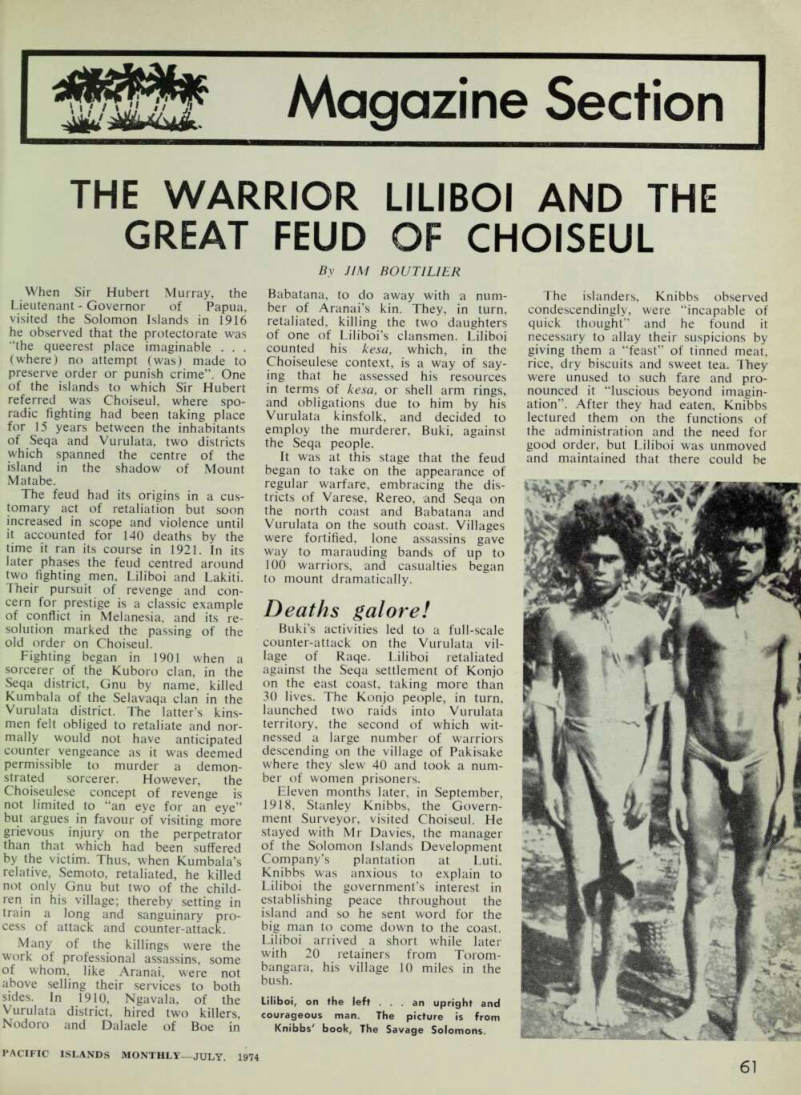
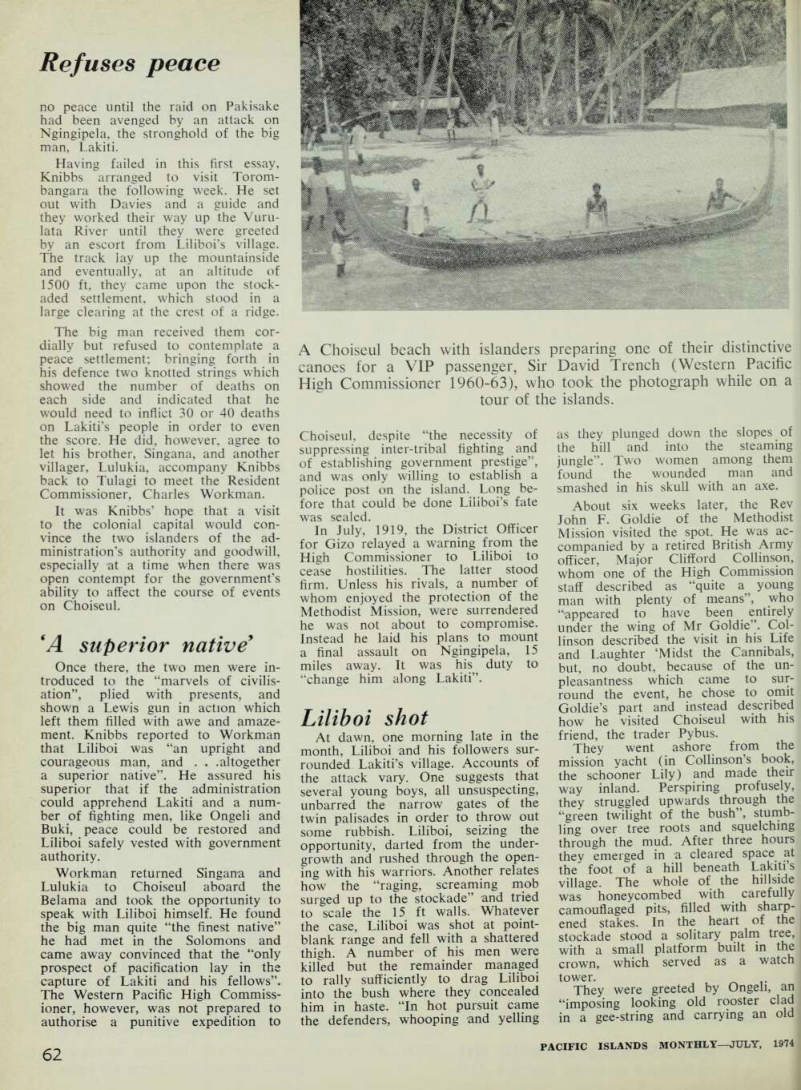
The Warrior Liliboi And The
Great Feud Of Choiseul
By Jim Boutilier
When Sir Hubert Murray, the Lieutenant - Governor of Papua, visited the Solomon Islands in 1916 he observed that the protectorate was “the queerest place imaginable . . . (where) no attempt (was) made to preserve order or punish crime”. One of the islands to which Sir Hubert referred was Choiseul, where spo radic fighting had been taking place for 15 years between the inhabitants of Seqa and Vurulata, two districts which spanned the centre of the island in the shadow of Mount Matabe.
The feud had its origins in a cus tomary act of retaliation but soon increased in scope and violence until it accounted for 140 deaths by the time it ran its course in 1921, In its later phases the feud centred around two fighting men, Liliboi and Lakiti.
Their pursuit of revenge and con cern for prestige is a classic example of conflict in Melanesia, and its re solution marked the passing of the old order on Choiseul.
Fighting began in 1901 when a sorcerer of the Kuboro clan, in the Seqa district, Gnu by name, killed Kumbala of the Selavaqa clan in the Vurulata district. The latter’s kins men felt obliged to retaliate and nor mally would not have anticipated counter vengeance as it was deemed permissible to murder a demon strated sorcerer. However, the Choiseulese concept of revenge is not limited to “an eye for an eye” but argues in favour of visiting more grievous injury on the perpetrator than that which had been suffered by the victim. Thus, when Kumbala’s relative, Semoto, retaliated, he killed not only Gnu but two of the child ren in his village; thereby setting in train a long and sanguinary pro cess of attack and counter-attack.
Many of the killings were the work of professional assassins, some of whom, like Aranai, were not above selling their services to both sides. In 1910, Ngavala, of the Vurulata district, hired two killers, Nodoro and Dalaele of Boe in
Babatana, to do away with a num ber of Aranai’s kin. They, in turn, retaliated, killing the two daughters of one of Liliboi’s clansmen. Liliboi counted his kesa, which, in the Choiseulese context, is a way of say ing that he assessed his resources in terms of kesa, or shell arm rings, and obligations due to him by his Vurulata kinsfolk, and decided to employ the murderer, Buki, against the Seqa people.
It was at this stage that the feud began to take on the appearance of regular warfare, embracing the dis tricts of Varese, Rereo, and Seqa on the north coast and Babatana and Vurulata on the south coast. Villages were fortified, lone assassins gave way to marauding bands of up to 100 warriors, and casualties began to mount dramatically.
Deaths galore!
Buki’s activities led to a full-scale counter-attack on the Vurulata vil lage of Raqe. Liliboi retaliated against the Seqa settlement of Konjo on the east coast, taking more than 30 lives. The Konjo people, in turn, launched two raids into Vurulata territory, the second of which wit nessed a large number of warriors descending on the village of Pakisake where they slew 40 and took a num ber of women prisoners.
Eleven months later, in September, 1918, Stanley Knibbs, the Govern ment Surveyor, visited Choiseul. He stayed with Mr Davies, the manager of the Solomon Islands Development Company’s plantation at Luti.
Knibbs was anxious to explain to Liliboi the government’s interest in establishing peace throughout the island and so he sent word for the big man to come down to the coast.
Liliboi arrived a short while later with 20 retainers from Torom bangara, his village 10 miles in the bush.
The islanders, Knibbs observed condescendingly, were “incapable of quick thought” and he found it necessary to allay their suspicions by giving them a “feast” of tinned meat, rice, dry biscuits and sweet tea. They were unused to such fare and pro nounced it “luscious beyond imagin ation”. After they had eaten, Knibbs lectured them on the functions of the administration and the need for good order, but Liliboi was unmoved and maintained that there could be
Liliboi, on the left ... an upright and courageous man. The picture is from Knibbs' book, The Savage Solomons.
Refuses peace
no peace until the raid on Pakisake had been avenged by an attack on Ngingipela, the stronghold of the big man, Lakiti.
Having failed in this first essay, Knibbs arranged to visit Torom bangara the following week. He set out with Davies and a guide and they worked their way up the Vuru lata River until they were greeted by an escort from Liliboi’s village.
The track lay up the mountainside and eventually, at an altitude of 1500 ft, they came upon the stock aded settlement, which stood in a large clearing at the crest of a ridge.
The big man received them cor dially but refused to contemplate a peace settlement; bringing forth in his defence two knotted strings which showed the number of deaths on each side and indicated that he would need to inflict 30 or 40 deaths on Lakiti’s people in order to even the score. He did, however, agree to let his brother, Singana, and another villager, Lulukia, accompany Knibbs back to Tulagi to meet the Resident Commissioner, Charles Workman.
It was Knibbs’ hope that a visit to the colonial capital would con vince the two islanders of the ad ministration’s authority and goodwill, especially at a time when there was open contempt for the government’s ability to affect the course of events on Choiseul.
‘A superior native 9
Once there, the two men were in troduced to the “marvels of civilis ation”, plied with presents, and shown a Lewis gun in action which left them filled with awe and amaze ment, Knibbs reported to Workman that Liliboi was “an upright and courageous man, and . . .altogether a superior native”. He assured his superior that if the administration could apprehend Lakiti and a num ber of fighting men, like Ongeli and Buki, peace could be restored and Liliboi safely vested with government authority.
Workman returned Singana and Lulukia to Choiseul aboard the Belama and took the opportunity to speak with Liliboi himself. He found the big man quite “the finest native” he had met in the Solomons and came away convinced that the “only prospect of pacification lay in the capture of Lakiti and his fellows”.
The Western Pacific High Commiss ioner, however, was not prepared to authorise a punitive expedition to
Choiseul, despite “the necessity of suppressing inter-tribal fighting and of establishing government prestige”, and was only willing to establish a police post on the island. Long before that could be done Liliboi’s fate was sealed.
In July, 1919, the District Officer for Gizo relayed a warning from the High Commissioner to Liliboi to cease hostilities. The latter stood firm. Unless his rivals, a number of whom enjoyed the protection of the Methodist Mission, were surrendered he was not about to compromise.
Instead he laid his plans to mount a final assault on Ngingipela, 15 miles away. It was duty to “change him along Lakiti”. r . 7 . 7 . / ±
Liliboi S/iOt
At dawn, one morning late in the month, Liliboi and his followers surrounded Lakiti’s village. Accounts of the attack vary. One suggests that several young boys, all unsuspecting, unbarred the narrow gates of the twin palisades in order to throw out some rubbish. Liliboi, seizing the opportunity, darted from the undergrowth and rushed through the opening with his warriors. Another relates how the “raging, screaming mob surged up to the stockade” and tried to scale the 15 ft walls. Whatever the case, Liliboi was shot at pointblank range and fell with a shattered thigh. A number of his men were killed but the remainder managed to rally sufficiently to drag Liliboi into the bush where they concealed him in haste. “In hot pursuit came the defenders, whooping and yelling
as they plunged down the slopes of the hill and into the steaming jungle”. Two women among them found the wounded man and smashed in his skull with an axe.
About six weeks later, the Rev John F. Goldie of the Methodist Mission visited the spot. He was ac companied by a retired British Army officer, Major Clifford Collinson, whom' one of the High Commission staff described as “quite a young man w j t h plenty of means”, who “appeared to have been entirely un der the wing of Mr Goldie”. Col iinson described the visit in his Life an( j L aug hter ‘Midst the Cannibals, ut no doubt, because of the un pleasantness which came to sur round the event, he chose to omit Goldie’s part and instead described how he visited Choiseul with his friend, the trader Pybus.
They went ashore from the mission yacht (in Collmsons book, the schooner Lily) and made their way inland. Perspiring profusely, they struggled upwards through the “green twilight of the bush , stumo ling over tree roots and squelching through the mud. After three hours they emerged in a cleared space at the foot of a hill beneath Lakiti s village. The whole of the hillside was honeycombed with carefully camouflaged pits, filled Wlth shar P" ened stakes. In the heart ot me stockade stood a solitary palm tree, with a small platform built m me crown, which served as a watcn tower. n They were greeted by Ongeli, an “imposing looking old rooster clad in a gee-string and carrying an old
A Choiseul beach with islanders preparing one of their distinctive canoes for a VIP passenger, Sir David Trench (Western Pacific High Commissioner 1960-63), who took the photograph while on a tour of the islands.
Skull on a spear
Tower musket at the ready”. He showed them the shallow grave where Liliboi had been buried, and “quite thoughtlessly, but rather
foolishly . , . (Collinson) suggested
. . . that it would be rather sporting of (Ongeli) to give (him) Liliboi’s skull as a little souvenir of the occasion”. The latter at first refused, profering instead the axe which had dispatched Liliboi, but, by the time Collinson was ready to leave, Ongeli came forward with the big man’s skull thrust on the end of a spear.
Having convinced himself, through Goldie’s enquiries, that Liliboi’s people would not be annoyed by the fate of the skull, Collinson distri buted some cotton and beads and set off for the coast, “blissfully un conscious of the devil’s brew (they) bad left behind (them)”.
However, Liliboi’s kinsmen were furious when they discovered what lad happened and began to prepare for war. Anxious to avoid hostilities, he administration recovered the ikull from Collinson’s collection of curios just as he was about to de part from the protectorate in July 1920 aboard the Mindini. Brodhurst 3HI, the acting Resident Com nissioner, was convinced that Goldie vas responsible for the removal of Jliboi’s head. This, the missionary lemed emphatically, claiming that t was not customary for the choiseulese to preserve their skulls >ut rather to cremate their dead and :ast their enemies’ heads onto ullage dunghills.
Murky ’ mission role
The Methodist Mission’s role in he Liliboi affair is murky. Father loch, the Prefect Apostolic for the Northern Solomons, alleged that jo die was exploiting the Choi eulese feud in an effort to discredit “5 Roman Catholic church there.
The natives Mr Goldie cannot get y persuasion he wants to get y fear”, Boch informed Workman!
He lets them understand that he ictates his own will to the govern ment and that (those) . , . who re use to join his church will be unished”.
Tippett, in his study, Solomon dands Christianity, makes no men on of the part Goldie played in the scovery of Liliboi’s head and em hasises instead the role of the lethodist Mission teacher, Amos ozaka, Tozaka acted as a mediator
in the traditional fashion, travelling long distances under hazardous cir cumstances to conduct negotiations between the two factions.
While he was doing so there was a resurgence of unrest between the Seqa and Vurulata people. As a con sequence, Kane, the Resident Com missioner, decided to send Captain Turner, the Officer Commanding the Armed Constabulary, with a force of police to Choiseul in an effort to halt the fighting. Turner took Lili boi’s skull with him, and while Tippett characterises the expedition as “utterly foolish”, the return of the head, the execution of one of the murderers, and the imprisonment of an accomplice, coming as the did in conjunction with Tozaka’s peace making, terminated the feud.
“I have not the slightest doubt”, Kane reported to the High Com missioner, “that the manner in which (Turner) took hold of proceedings on behalf of the government, his hoisting of the flag, and the presence of 20 constabulary drawn up with fixed bayonets made a great im pression on the native mind and made for a successful conclusion of the proceedings”.
An era ends
With the cessation of hostilities, the warring parties came together for the felling of the suqu. The suqu was a great basket of food resting on the top of a tower, the collapse of which symbolised the overthrow of enmity between the Seqa and Vurulata. Hie ceremonies began with mock battles and the exchange of kesa which had been worked into the sand to show the burial of ill will. The tower was toppled, the suqu crashed to the ground, and the food was distributed in an act of recon ciliation.
The feud was an expression of the dynamics of Choiseulese society.
Warfare encouraged group cohesion, the marshalling of resources, and the appearance of strong leaders. Those leaders, like Lakiti and Liliboi, drew upon vast networks of obligations, promoted assistance by feasting, and sought to maintain their prestige by leading their kinsmen into battle.
When the great feud was over, the traditional avenues for expressing revenge and status began to dis appear. The old order was passing.
Choiseulese society was departing from paganism and the new Christian order gave little oppor tunity for raids and murder as dis plays of power.
Advertisements & other items, pp. 65-66 (3 items)
63
ACIFIC ISLANDS MONTHLY—JULY, 1974
anywhere,
any time,
any gas.
and it’s
all Australian.,
For further information & addresses of your local distributor contact:
THE COMMONWEALTH
INDUSTRIAL GASES LIMITED
Gases Export Department, 138 Bourke Road, Alexandria, N.S.W., Australia 2015.
Cables 'CIGAS’-Telex 20241 Sydney. 017.024
mnnn
MANA is a vehicle for Pacific Islands’ writers and artists to publish their work. It is an organ of the South Pacific Creative Arts Society and its editorial committee comprises writers from many islands.
Material for publication must be sent direct to MANA’s editor, Marjorie Crocombe, South Pacific Creative Arts Society, Box 5083, Suva.
Most of this month’s contributors should be familiar to MANA readers: Konai Helu Thaman, from Tonga, Bro C. Kulagoe, from the Solomons, and from Fiji, Seri, Sam Simpson and Raymond Pillai.
New contributors are Huang Sui-Lan, from Fiji, and Cook Islander, Makiuti Tongia, a student at USP.
Fiji Chinese
The making of a Fiji Chinese
By Huang Sui-Lan
1 NEVER knew a charming or understanding adult in all my childhood and adolescence. All the fathers and mothers I knew, includ ing my own, were a grim lot, so vulgar and coarse and insulting, always shouting, always angry, al ways defensive, always yelling at each other when they were not busy yelling at the kids. And as I grew up I learned the stereotypes of the Chinese: the well disciplined Chinese, the acquiescent Chinese, the con scientious Chinese, the unobtrusive Chinese. I knew how these species of the Chinese came about. Funny, but I never heard a grown-up being loving or even singing except when he was practising diligently for some concert, and even then it was singing about some heart-rending plight of a family. You just cannot call that entertaining or exciting.
At a very early age I decided that I was going to be something entirely removed from the adults around me.
I was going to be a nun. Impossible though that dream was it helped me along in the more miserable moments.
And it represented a life that was not congested by the obligations of my uncongenial folks. My life was to be my own. I would not be coerced to do anything I didn’t particularly want to, or so I thought.
In my more charitable moments I’d see their fault as being illiterate in English and in being Chinese. I did not understand that their lives were a long labour to earn their daily bread, and physical fatigue does not sweeten human natures. But I hated the thought of growing up to be like
the adults around me. It was con fusing to hear the adults say one thing and do another. I heard them say cruel things about their dearest friends, socialise with those they slashed in gossip, say one thing and not mean it. And I couldn’t help being affected by their paranoic attachment to face, to enforcing everyone to know their place in the society so that the slightest injury to their pride, however fanciful, was re acted to in proportions I could not understand. They did not forgive.
And I grew up knowing my place.
Growing older I think I felt a mixture of condescending contempt and pity of my elders. I thought I understood them. They had suffered and laboured all their lives. Coming from a peasant background where security depended on the sun and the moon, the rains and the spirits, it was inevitable that when the opportunity for economic security presented itself, it would be grabbed with both hands.
But I guess only the Chinese would work themselves to their graves, thinking what they were getting a “bargain”. They were living a reality.
They could not afford to dream, but I realised this much later. I could not understand how they could settle for so little with so much hard work.
And I resented being dragged along.
Me, I had a thousand dreams — dreams from which to choose, to master my destiny.
And so it was natural perhaps that the resentment, the condescending contempt and pity on my part was to draw me, like so many other children around the world, into a struggle with the adults around me and responsible
for me. We became enemies talking two different lingos, literally and
metaphorically.
My family and I grew up together in the wop wops, in a neighbourhood where the cows and horses, cats and dogs and goats and chickens far sur passed people in number.
My parents must have been pretty ignorant on family planning. The six of us came into the world in a span of eight years. The seventh 10 years later was a big mistake.
We must have been a real burden on the parents as they were struggling to make a new living in a new en vironment. They had very little time for us.
As a child I remember being looked after by a series of housegirls —all Indians. Where we lived we had a Fijian village 100 yards to our right and an Indian settlement 100 yards to the left. We learned the Indian language and mixed freely with the people in the Indian settle ment. There was very little socialis ing with the Fijians. We took these things as a matter of course. Only much later did I come to understand why we were not encouraged to actively participate in the village affairs.
When I was about five I remem ber that we children were forced to learn to speak Chinese. My parents must have suddenly realised that they were rearing a pack of Indian kids.
We hardly ever conversed with our parents. When they were free late in the evenings we would be in bed.
Some mothers and fathers visited us and were absolutely horrified at our speaking Hindi and not comprehend ing Chinese. The news spread and my parents came under much scorn and ridicule. Hence the rod came to be used. The instrument has a tre mendous influence in producing the basic Chinese personality. We learnt to be Chinese.
What was really great, really tre mendous, was being able to play foot ball and to go fishing with my brothers and their friends. Looking back I realise that I was the only girl accepted into this all-boys club.
I was given this status mainly be cause I could do all the things they could and just as well. We would disappear for hours on end and I knew that when I got home the rod was waiting for me. I resented being a girl, being told to stay home and learn some domestic trait. My brothers seemed to have all the privileges. It seems I was destined to learn my place. I couldn’t seem to get out. It’s like quicksand. You go under slowly and stay there. If you get out, if at all, you crawl.
Initially the rod and the wails of
despair did not matter. For a while I used to think it was worth it. Perhaps if your character is strong you just hang on and do your thing. I fell under its might.
We all grew up straight. If we had any desire to go wrong we never had a chance. Thl Chinese family structure is too strong. If we were unhappy at least we knew security, we knew the rules. As kids I think we were up to pranks of every kind.
My mother was always there with her rod. If we quarrelled we would all get a hiding. We never came home to an empty house. There was always the smell of cooking or people yelling at each other.
There was never a shortage of food. I never remember not having enough to eat. In fact 1 remember being forced to eat all the time. My mother was formidable. I distinctly remember having eggs for breakfast
every day—boiled, fried, poached,
you name it we had it. We had a poultry farm. Eggs abounded, especially the ones we cracked, so we had
to eat them because they were good for us. To this day 1 still have an aversion to eggs. I think my mother had her own myths and legends on how to bring up a family. In fact she contrived to do everything that social psychology books tell you not to do.
My father supported his wife and seven kids doing all kinds of things.
It is difficult to be objective about something that has been part of your indoctrination process. We were al ways told about my parents’ struggles when we were naughty or ungrateful for what was being done for us. Our parents would not have had to struggle if it weren’t for us. It was because of them that we are where we are today. So like all the other Chinese children we have this tie to the parents that we sometimes accept, sometimes reject because we must compromise our beliefs, decisions, ideas and aspirations with those of our parents.
Compared to my parents, our child hood was heaven. But you don’t see it that way when you are a child.
Monday morning street ride
By Seri
At war all night with the bottle this back world itch of crabs and slime as I kick last night’s butts towards USP thus breaking monotony of living in tin-can reservation Raiwaqa: the smell of the meth bottle in salivas and hair the seven virgin bottles lie with the boys on the crash pad floor; all empty, giving the sniff of the local dispensary—carefree like blown out bubble gum on the sidewalk—had plenty of experience, black bitches, liquor and crime and now: to rot and be trodden upon I took it all last few nights to shake it off these few morns and by jolly feel the lice drum the heavies and cold glass hang-over; once, by once, till the rear extreme bumps the Monday Morning Street Ride.
And nothing seems the same any more every bus-stop and us-stop for hissing cabs breaking off the iron jam would pancake the booze pneumonia flat.
People sucking their mucus under fat umbrella squeeze their bulbous noses to cover the baritone bawlings blowing like an oV Louis’ flat saxophone.
Peace signs
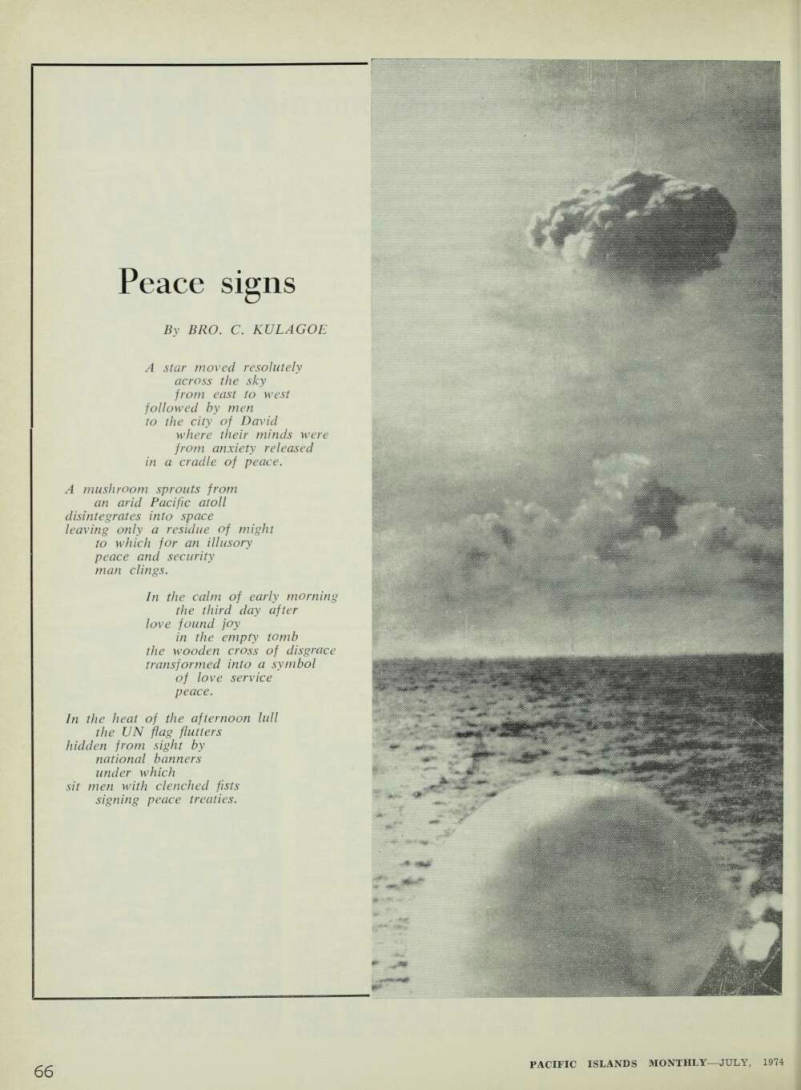
By Bro. C. Kulagoe
A star moved resolutely across the sky from east to west followed by men to the city of David where their minds were from anxiety released in a cradle of peace.
A mushroom sprouts from an arid Pacific atoll disintegrates into space leaving only a residue of might to which for an illusory peace and security man clings.
In the calm of early morning the third day after love found joy in the empty tomb the wooden cross of disgrace transformed into a symbol of love service peace.
In the heat of the afternoon lull the UN flag flutters hidden from sight by national banners under which sit men with clenched fists signing peace treaties.
Being Part European
By Sam Simpson
First Voice: We have a past, no present, no future.
We live in neither or either, some say.
Second Voice: We live in between the past and the present and between the future beyond the past; some say. I grow old. future beyond the past; some say. I grow old.
I grow old.
Third Voice: We live among ourselves. We keep ourselves to our selves.
Everyone belongs to someone, someone belongs to every one.
In between being, living, suffering, dying.
First Voice: Nobody wants us. Nobody wants us. We came from nowhere.
We belong to no one. We belong to nowhere. That is what they say. That is what I hear. That is what 1 hear being said. That is what they think. Around the yaqona bowl. Around the kiosk. In the bus stand, wherever I stand.
Second Voice; I look at them. Everybody looks at us.
They categorise us because they have a category.
Third Voice; / belong to this category.
I belong to that category.
I belong to every category.
I belong to no category.
First Voice: Where do I stand? Between either or neither.
Between either and or.
That is an examination question.
It is a supreme test.
This test defies examination.
This examination defies test.
Second Voice: There is no category beyond this criterion.
This criterion defies a category.
Third Voice: We are not quite human.
We are not quite inhuman.
First Voice: Our strength is in our togetherness.
Together and together we gather.
Being apart, feeling apart, behaving apart.
We have no niche and no habitat, they say.
Second Voice: I fear for the dawn but not the day.
I fear for the day but not the dawn.
I fear for dusk but not darkness.
I fear for darkness but not dusk.
Third Voice: 1 cannot digress beyond this digression.
First Voice: We die but are not dead. I am afraid.
We live but are not alive. I am afraid.
Second Voice: What manner of creature are we?
Third Voice: We have no phyllum, no class, no species.
First Voice: Our genes are black and white and blue.
Second Voice: Everyone has a white ancestor.
Third Voice: Everyone has a black ancestor.
First Voice: Everyone has a colourful ancestor.
Second Voice: In our blood, in our colour, in our culture.
Third Voice: But from this ambiguity, this dilemma, this impasse, this enigma.
First Voice: We see ourself, we find ourself; we know ourself.
Second Voice: In a new light, a different light, of clarity and radiance.
Third Voice: Our weakness is a stepping-stone to new heights, others do not perceive, receive, possess, control, not perceive, receive, possess, control.
First Voice: Yes, I believe we have the gift to perceive, receive, possess and control.
Second Voice: To control without ownership.
To move freely in different spheres, of acceptability and tolerance.
Third Voice: We are the crucial cent to every dollar.
First Voice: We are the crucial ace to every pack.
Second Voice: We are the vital ingredient in every recipe.
Third Voice: In every conflict, instability, disharmony.
First Voice: We catalyse every reaction.
Control the reaction.
Subject the agents, the agencies.
Second Voice: Until calm and peace and solution prevail.
Third Voice: Call us what you may: Half caste, half breed, Euronesian; Part this, part that, part what First Voice: Our symbolism embraces the alphabet.
Second Voice: We control without offence.
Third Voice: No matter what difference.
We divide and rule differences.
We synthesise a new source of solution from differences and opposition.
Outside out, inside in, inside everything, outside every thing.
Labourers’ lament
By Raymond Pillai
We do not wear upon our sleeve That damning star of shame.
But need we symbols to believe We’re Jews in all but name?
We know precisely where we stand, We know our proper place.
We have few rights in this grim land, We are an alien race.
We came in answer to your plea, We came to build your land.
But now that you are strong and free, You turn our hopes to sand.
We, who tilled from dawn to dark, Who worked in wind and rain, We, who strove to make our mark, Now find we toiled in vain.
The good we did you cast aside, You only look for sin.
The wrongs we did, we do not hide, Then must you drag them in?
Must you recall the past that’s gone?
Must you insist on blame?
Why heap your hate and scorn upon The land from whence we came?
We trespass here—that much is clear, But where else should we be?
Our hearts grow numb with mounting fear, It’s time to rise and flee.
From Africa they cast us out, (They found some good excuse.) The same will happen here, no doubt, When we outlive our use.
But wait, perhaps I speak too soon, From ill will no one gains.
What infant nation is immune To slips and growing pains?
Given time, it’s love that wins, And reason humbles pride.
Scratch the surface of our skins: We’re all the same inside.
Beware of dog
By Makiuti Tongia
As I walk this rich suburb full of white and black chiefs I hear the barking of a dog I listen to its calls knowing I am that dog picking what it can from the overflowing rubbish tins.
I say to you chiefs bury the scraps you can’t eat So no hungry dog will come to eat at your locked gate Chiefs, beware of hungry dogs!
Why?
By Makiuti Tongia
My scruffy hide is proud white brother My burning hide smokes you blind My thoughts are like hungry dogs You sneer at me like a museum piece You dive for cover at my every entrance Yet long ago you saw me as no different from the smell you throw Now you pretend not to remember Why?
Elite
By Konai Held Thaman
He regrets his choice now And wished that he had been More true and down to earth; She was a nobody But she had lived And her hands had the marks Of life.
In the dead of night He remembers His promises, his philosophies The fun time he had With the common people — His type of people; He was one of them then: They drank and swore together; Now he is a different person; He has a new face More serious, more commanding And pregnant with pomp.
But he is no better Than the old man With the torn shirt Spitting his way home From his garden And swallowing the gas-smell Dust on his way; Or the fellers Pushing sand carts Across the torn-up village road.
He hears his lost friends cry ‘Come down to us, we need you’; He aches in the desire to Identify with them again, But it’s too late He cannot be himself again And feels the ground Which weeps for his dismemberment.
Advertisements & other items, pp. 71-72 (1 item)
Skillet
Round gourmet
The handiest new appliance
since trypans
Bacon and eggs for two? With a Sunbeam “Skillet” it’s easier than ever. Just the right size. Yet “Skillet” is big enough itself to roast a size 8 chicken to perfection. And it washes easier than a plate.
Just remove the control and dunk the whole pan in the sink.
“Skillet” is another great new idea from Sunbeam. Handier for small families and singles. It looks like a frypan, cooks like a frypan. But it has a talent of its own. It’s designed to be versatile, to be both compact and roomy. “Skillet” looks beautiful, cooks beautifully.
Nobody but Sunbeam can offer you a Round Gourmet Skillet. It’s absolutely on its own. It only comes from Sunbeam. L 83.4186
■te
Todays roofs
demand
new materials
s * *
Dunlop Membranes
BUTYNOL* Based on Butyl Rubber
One-ply roofing has far less weight and bulk than built-up systems.
Therefore, the architect gains greater design freedom plus reduced loads on supporting members.
For the owner, certain structural costs are lowered and maintenance problems minimised. The contractor benefits from reduced materials handling, lower shipping costs and a work day with more productive hours.
SHELTERLINE • Asbestos backed
f DUNLINE- Unbacked
Both based on well-proven Hypalon* Synthetic Rubber.
TaMPt . ' Hurricane Bebe' October 1972 and Cyclone Lottie' December 1973 produced no problems for Dunlop Membranes and Adhesives.
Illustrations depict: S ® Dunlop membranes are widely used also for Water The Fiji Times' Extensions, Suva. Management-Ponds, Reservoirs, etc.
I The General Manager, I Shelter Engineering Limited,
I P.O. Box 10-043. I
I Christchurch, New Zealand. I I Please forward information on i □ BUTYNOL ROOFING MEMBRANE I DVICLI CBI iS E s M K s S t s“““" s " 00,l “ I In ENGINEERING (x»> A DUNLOP COMPANY I □ MEMBRANES FOR WATER I ft
I MANAGEMENT I LIIVII I Ell
I NAME J ”
ADDRESS * HY PALON is a registered Du Pont trademark for chlorosulfonated polyethylene I synthetic rubber.
Yesterday
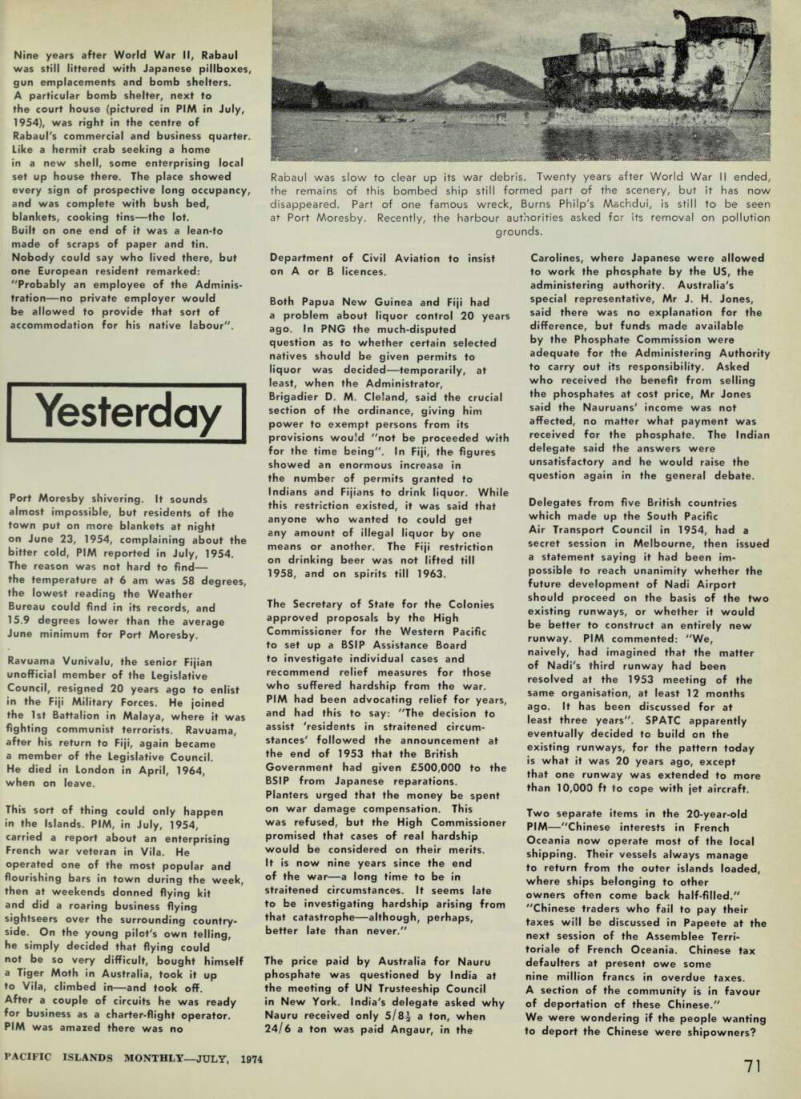
Nine years after World War 11, Rabaul was still littered with Japanese pillboxes, gun emplacements and bomb shelters.
A particular bomb shelter, next to the court house (pictured in PIM in July, 1954), was right in the centre of Rabaul's commercial and business quarter.
Like a hermit crab seeking a home in a new shell, some enterprising local set up house there. The place showed every sign of prospective long occupancy, and was complete with bush bed, blankets, cooking tins—the lot.
Built on one end of it was a lean-to made of scraps of paper and tin.
Nobody could say who lived there, but one European resident remarked: "Probably an employee of the Adminis tration—no private employer would be allowed to provide that sort of accommodation for his native labour".
Port Moresby shivering. It sounds almost impossible, but residents of the town put on more blankets at night on June 23, 1954, complaining about the bitter cold, PIM reported in July, 1954.
The reason was not hard to find— the temperature at 6 am was 58 degrees, the lowest reading the Weather Bureau could find in its records, and 15.9 degrees lower than the average June minimum for Port Moresby.
Ravuama Vunivalu, the senior Fijian unofficial member of the Legislative Council, resigned 20 years ago to enlist in the Fiji Military Forces. He joined the Ist Battalion in Malaya, where it was fighting communist terrorists. Ravuama, after his return to Fiji, again became a member of the Legislative Council.
He died in London in April, 1964, when on leave.
This sort of thing could only happen in the Islands. PIM, in July, 1954, carried a report about an enterprising French war veteran in Vila. He operated one of the most popular and flourishing bars in town during the week, then at weekends donned flying kit and did a roaring business flying sightseers over the surrounding country side. On the young pilot's own telling, he simply decided that flying could not be so very difficult, bought himself a Tiger Moth in Australia, took it up to Vila, climbed in—and took off.
After a couple of circuits he was ready for business as a charter-flight operator.
PIM was amazed there was no
Department of Civil Aviation to insist on A or B licences.
Both Papua New Guinea and Fiji had a problem about liquor control 20 years ago. In PNG the much-disputed question as to whether certain selected natives should be given permits to liquor was decided—temporarily, at least, when the Administrator, Brigadier D. M. Cleland, said the crucial section of the ordinance, giving him power to exempt persons from its provisions would "not be proceeded with for the time being". In Fiji, the figures showed an enormous increase in the number of permits granted to Indians and Fijians to drink liquor. While this restriction existed, it was said that anyone who wanted to could get any amount of illegal liquor by one means or another. The Fiji restriction on drinking beer was not lifted till 1958, and on spirits till 1963.
The Secretary of State for the Colonies approved proposals by the High Commissioner for the Western Pacific to set up a BSIP Assistance Board to investigate individual cases and recommend relief measures for those who suffered hardship from the war.
PIM had been advocating relief for years, and had this to say: "The decision to assist 'residents in straitened circum stances' followed the announcement at the end of 1953 that the British Government had given £500,000 to the BSIP from Japanese reparations.
Planters urged that the money be spent on war damage compensation. This was refused, but the High Commissioner promised that cases of real hardship would be considered on their merits.
It is now nine years since the end of the war—a long time to be in straitened circumstances. It seems late to be investigating hardship arising from that catastrophe—although, perhaps, better late than never."
The price paid by Australia for Nauru phosphate was questioned by India at the meeting of UN Trusteeship Council in New York. India's delegate asked why Nauru received only a ton, when 24/6 a ton was paid Angaur, in the
Carolines, where Japanese were allowed to work the phosphate by the US, the administering authority. Australia's special representative, Mr J. H. Jones, said there was no explanation for the difference, but funds made available by the Phosphate Commission were adequate for the Administering Authority to carry out its responsibility. Asked who received the benefit from selling the phosphates at cost price, Mr Jones said the Nauruans' income was not affected, no matter what payment was received for the phosphate. The Indian delegate said the answers were unsatisfactory and he would raise the question again in the general debate.
Delegates from five British countries which made up the South Pacific Air Transport Council in 1954, had a secret session in Melbourne, then issued a statement saying it had been im possible to reach unanimity whether the future development of Nadi Airport should proceed on the basis of the two existing runways, or whether it would be better to construct an entirely new runway. PIM commented: "We, naively, had imagined that the matter of Nadi's third runway had been resolved at the 1953 meeting of the same organisation, at least 12 months ago. It has been discussed for at least three years". SPATC apparently eventually decided to build on the existing runways, for the pattern today is what it was 20 years ago, except that one runway was extended to more than 10,000 ft to cope with jet aircraft.
Two separate items in the 20-year-old PIM —"Chinese interests in French Oceania now operate most of the local shipping. Their vessels always manage to return from the outer islands loaded, where ships belonging to other owners often come back half-filled."
"Chinese traders who fail to pay their taxes will be discussed in Papeete at the next session of the Assemblee Terri toriale of French Oceania. Chinese tax defaulters at present owe some nine million francs in overdue taxes.
A section of the community is in favour of deportation of these Chinese."
We were wondering if the people wanting to deport the Chinese were shipowners?
Rabaul was slow to clear up its war debris. Twenty years after World War II ended, the remains of this bombed ship still formed part of the scenery, but it has now disappeared. Part of one famous wreck. Burns Philp's Machdui, is still to be seen at Port Moresby. Recently, the harbour authorities asked for its removal on pollution
grounds.
Advertisements & other items, p. 74 (1 item)
Clarion
cassette stereo
makes motoring miles brighter
PE-651 A
Automatic Reverse Cassette Stereo Player with AM Tuner
PE-810A
4-track Cassette Stereo Player with End Alarm System.
PE-811 Automatic Reverse Cassette Tape Player with FF/REW System.
PE-654 Auto Cassette Stereo with AM/FM MPX Tuner And that means safer—because you’ll want to stay wide awake, enjoying every moment of music made by a Clarion. It’s no second-rate sound, this: It’s the biggest, brightest, freshest—the most grooving, moving sound you’ll ever want to hear on four wheels. But after all, isn’t that exactly what you’d expect from the world’s auto audio specialists who bring to you the widest, brightest range of motoring music accessories under the sun.
Go Clarion—and go brighter.
Audio EQuipMENT EiyjoyEd 'Rouwd tlie would
CLARION
CLARION CO., LTD./—— CLARION SHOJI CO., LTD. 3-5, Kojimachi. Chiyoda-ku, Tokyo. Tel.; (265) 2931, Telex: J 22908 CLARION SHOJI (EUROPA) G.M.B.H. 2000 Hamburg 76. ScWJne Aussicht 35, West Germany. Tel.: 220-7667, Telex: 214969.
CLARION SHOJI CO., LTD. (U.S.A.) LOS ANGELES 2306 Cotner Ave., Los Angeles. Calif., U.S.A. Tel.; 213-272-1179. Telex: 259103426976.
CLARION SHOJI CO.! LTD. (U.S.A.) NEW JERSEY 421 North Midland Ave.. Saddle Brook, N.J. 07662, U.S.A. Tel.: 201-791-1200. Telex: 13805.
QLARION (MALAYSIA) SDN. BHD 9 1/2 m.s. Bayan Lepas. Penang, Malaysia. Tel.: 87-333, 87-334, Telex: PG 255 (Penang).
Books, Reviews, writers
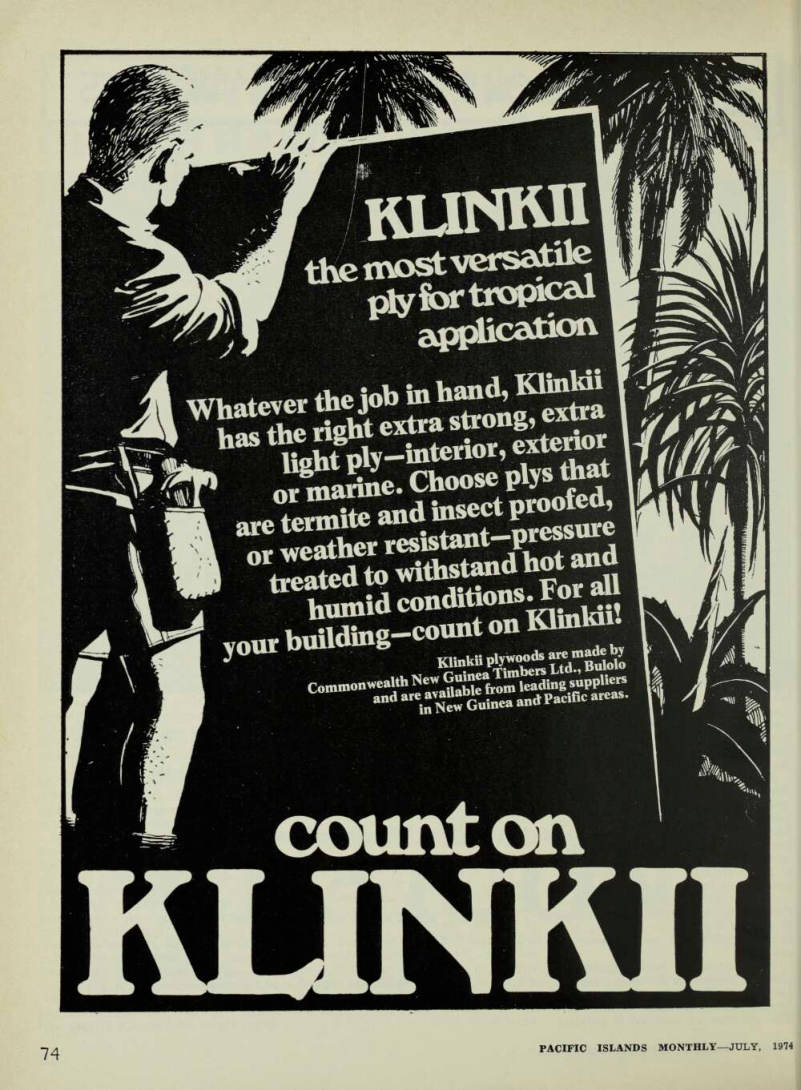
Sisters In The Sun - Pacific
Ladies Of Deceit
Here is a book that bedevils the re viewer. On the one hand there is a force which says “be kind—this is an example of enterprise on the part of writers from within the Pacific Basin, and, as they have lent their talents to a project well worth the undertaking, be charitable—take a forgiving stance and don’t dwell on the deficiencies”.
The other pressure states its position in these terms—“it is time that the literature of the Pacific came of age—talented writers, both indi genous and European are making their marks and it is not in the true interests of the body of writers to gloss over literary malefactions when they obtrude frequently and ob viously”. Sad to say the balance of these forces with this book are very much tipped towards the latter side.
Sisters in the Sun must bring credit to its authors for setting out to give us a definitive account about two of the most enthralling of the coral atolls, a task which has not been undertaken before. However, it is true that there has been quite a deal of literature of both the serious and light-hearted veins produced about both islands and when I saw the book for the first time I thought that here at last would be a serious effort made to sort the wheat from the chaff. Unfortunately this is not the case.
In the stories of Palmerston and Suwarrow Islands are all the in gredients of murder, shipwreck, treasure trove, hermits, pearl shelling, which, because in the main they are true, are the basis of a Pacific Islands account, which could have given us a book redolent in adventure, yet based upon facts elicited from sound research. The authors have taken these stimulating ingredients, whipped them into a potpourri, and then pro duced a half-baked, sour unleavened cake.
In its style the book sets out to give the impression that it is a serious book but its basic structure erodes its foundations of literary respectability.
The selection of material is puzzling
to the reader. There have been enough events connected with the two atolls to ensure that they become the central and sole characters of the book, but too often trivia and minutiae are introduced which are
irritating in their inconsequentiality
and which lend little or nothing to the main themes of the book.
The authors, writing as they did from Rarotonga, suffer from the paradox that faces many Pacific authors, that although they are at the centre of things they are removed from the resources materials to which they must make reference if their historical accounts are to have validity. This is particularly so in this book. The archives of the Mitchell Library, for instance, would have assisted greatly in filling out the events associated with the visits of Captain Michael Fodger to Palmer ston in 1811 and 1812; reference to Ward’s American activities in the
Central Pacific would have given a greater measure of accuracy to the catalogue of shipwrecks on Palmer ston.
For instance, there would not have been the omission of the Delphos of Holmes Hole, wrecked there on October 27, 1846, and the authors would have found that their Bella Sammy, wrecked on an unknown date was the British ship Belissima, wrecked with the loss of all lives in March, 1866. The remains of this vessel were found by the Papeete schooner Aorai, and the crew, finding among the six bodies cast ashore those of a little boy and girl, buried them side by side on the southern islet.
Similarly the account of the wreck of the whaleship Gem on Suwarrow indicates the same lack of careful research. This wreck deserves more than the perfunctory treatment it re ceives. All the crew survived, al though some had difficulty in making the shore, and they spent 21 days on the atoll before making a successful journey in the ship’s boats to Samoa 500 miles to the west.
Although Helm and Percival make mention of the copper sheathing of the Gem adding to its salvage value, it is worth noting that the wreck was sold for $604 and the ship Elizabeth Barker, of New Bedford salvaged 900 barrels of whale oil from the wreck and some spars and rigging.
However, it might be possible to excuse the lack of research if the book was not denigrated by a greater literary transgression. No one carps at the author who reads widely in a particular area and then synthesises in his own words the material he has traversed. But ... it cannot be in the interests of aspiring Pacific writers to allow to pass without derogatory comments a book which reproduces with little or no significant alteration, or without due acknowledgement, passages which have come from other pens. Sisters of the Sun has sinned, and sinned consistently in this respect —among those who have suffered are James Cowan and his Suwarrow Gold; Harry Maude’s Of Islands and
Men; and H. C. Sterndale’s series of articles A Lone Land and They Lived On It, which appeared in the Monthly Review in 1890.
A kind view to take of this book is that the authors would have been better advised to have put together a popular-style book, cheaply pro duced, which did not have preten tions of appealing to the reader in terested in substantial writing about islands with the historical importance of Palmerston and Suwarrow. The mind boggles at the passage in Sisters in the Sun, which describes the thoughts of Jules Tirel, as he awaits a savage death on the beach at Suwarrow, “His thoughts may have switched ... to his happy boyhood days among the apple orchards of Normandy. He may have seen again the milkmaids in their tall white caps and short skirts, and clumsy shoes”. (This passage, by the way, is virtually taken word for word from Stemdale’s 1890 article.) But, in retrospect, perhaps this is the style most appro priate to the book. Priced at $6.25 and with its many shortcomings this is not a book that can be recom mended as approximating to the level of literature that can be produced
from the Pacific region.-
W. G.
Coppell.
(SISTERS IN THE SUN, A. S. Helm and W. H. Percival. Robert Hale, London. $6.25.)
Wendt
New Book Soon
From Albert
Western Samoan writer Albert Wendt, whose novel Sons for the Return Home has met with great success, will have another book out soon, and his work will also appear in a collection of poetry.
His new book is called Flying Fox in a Freedom Tree and comprises eight short stories and a novella, all on Samoan themes. It is to be pub lished by Longmans Green, who will also publish Ten Modern New Zea land Poets, which will contain some of Wendt’s poems.
Longmans Green published Sons for the Return Home, the first edition of which was sold before it got on to the bookstalls. The second edition has been selling briskly, and a UK edition will be published in London in July.
Advertisements & other items, pp. 76-77 (1 item)
Runrii
P-./fer^/?; Wa A i/A / ' ,//'■' ' A A fill ! Rv the
RUNRn
most versatile for tropical application c 4 \
Whatever
humid conditions, tor * ft your
bu-S-countonHinM
«SSSsasaa=
count on
RUNRII
HARRIS
BOOK COMPANY
(ESTABLISHED 1930)
We carry over 10,000 titles on all subjects in stock and would be pleased to quote for your requirements.
Please send your enquiries tot
HARRIS BOOK COMPANY,
G.P.O. Box 16670, Hong Kong
Early Sydney-how and why
The Roebuck Society is to be applauded for the fine catholicity of its choice of Australiana. Its fac simile of the Sydney Gazette for 1811 is hardly a thing of beauty—the original typography sees to that— but it is beautifully done; the actual reproduction is skilful and exact, the index first-class and perhaps more entertaining than the textual contents.
There really was not a lot of grist for the printer’s mill, apart from advertisements, shipping news, the disorders of the lower orders (that is, most of the colony), and the numerous and lengthy regulations of His Excellency Governor Macquarie.
News of the Peninsular War was late and patchy, Bonaparte had unfortu nately sired a legitimate son, and it is with some surprise that we meet a Portuguese squadron putting down pirates in the Ladrones.
More surprising still is the holding over of advertisements—obviously then as now the life-blood of the paper—in favour of an entire column devoted to the ghastly Ode of Mr Michael Massey Robinson for Her Majesty’s Birthday. But for the social historian there is an immediacy about these faits divers, in broken and blunt type, not to be attained by the most meticulous reconstruction; here are the messy streets of Sydney Town, the crude beginnings of rural in dustry, the constant to-and-fro of shipping from Bengal to Tahiti.
MR R. A. SWAN’S book, To Botany Bay, is a serious con tribution to the debate on Australia’s origins penal or geopolitical? initiated by K. W. Dallas. He comes down firmly on the side of the re visionists who see the motivation as not just the dumping of convicts any old where, but as a bid for a com mercial and strategic base in the Oceanic world newly opened by Cook and Bougainville.
The reviewer is also on this side and so were the Spaniards, mightily alarmed at the notion of a British Pacific base. Mr Swan conducts his case well: even though here and there it look a little like special plead ing, and the affairs of the Nether lands are something of a King Charles’ Head, he assembles an enormous number of clues, often significant and always suggestive, to the factors beh'ni the decision for Botany Bay. There are a couple of slips the flat earth theory was dead
long before the 15th century, and it is a shock to find Wesley described as ‘anti-fundamentalistic’ but these do not affect the issue.
Sometimes the evidence does not seem quite strong enough to support all the weight that Mr Swan asks it to bear; but we have a very handy guide to the evolution, through many false starts and abortive projects, of the final ‘plan’ which pitched 1,200 people right around the world on little more than Sir Joseph Banks’ memory of a few days ashore at Botany Bay, and in doing so absent mindedly founded a nation—though Mr Swan might not agree with my adverb.
Beyond this, although ‘serious his torians’ may quibble on details, it is the great, and rare, merit of To Botany Bay that it takes a global and not a parochial view of our be
ginnings.-
O. H. K. Spate.
[The Sydney Gazette, Volume Ix,
1811. $ll. TO BOTANY BAY, by R. A.
Swan. $5.50. Both Roebuck Society, PO Box 17, Aranda, ACT, 2614.
Advertisements & other items, p. 77 (1 item)
Laua Avanapu
by blari Watkins
An entertaining novel based on plantation life on Bougainville Island.
"People who enjoy the book will do so for its account of early plantation life, the stories of the native people of the area, the plantation workers, their loyalties and human cussedness, their way of life in war and peace". Pacific Islands Monthly, June, 1974.
Price: $A3.00 plus postage.
Available from: Tinabar Gift Shop, Rabaul; Rabaul Newsagency; University Book Shop, Boroko, Port Moresby,- P.D.F. Supermarket, Arawa, Bougainville and all other major booksellers throughout Papua New Guinea.
Published by: CAMWAT PTY. LTD., Rebaul, Papua New Guinea.
everything
A book about everything
It’s a long time since 1 have read anything with complete fascination, but that’s what I did with Derek Townsend’s Cannibals to Caviar. You might say it’s a book about food or eating, and then you mightn’t, because so much else plays as important a part in the book.
Oh, the huge stacks of delightfully useless information it contains! Where else could you find out that hyenas’ droppings are white? Do you know how many tons of green fodder the 20,000 elephants in Tsavo National Park eat each year? Did you know that in Britain alone 800 tins of Heinz soups are sold every 60 seconds; that Kowloon (Hong Kong) means nine dragons, and that the Chinese prac tised aromatherapy for 10,000 years before Christ?
In an age where utilitarianism is the order of the day, it is pleasant to know things for the sake of knowing them, knowing that the information cannot be used productively, and that no one cares about it anyway (much good aromatherapy did the Chinese, but it’s no burden to know they did it!) except the one who adds the information to his store of cherished, interesting things.
Cannibals to Caviar takes us to a great many countries and many out of-the-way places; as much a travel book as an eating book. I like Derek Townsend’s style, which, even if now and then it becomes tinged with purple, flows easily and carries the reader along with it.
Townsend takes in most of the Pacific Basin, and some of the Islands—Fiji, Tahiti and Hawaii. But don’t expect to find a great deal of detail on any one place, for Town send is not that kind of writer. He roams about in a sort of anecdotal documentary style.
Some may find the mention of Heinz a little tedious: I do not while it remains in Townsend’s hands, but in the hands of less-restrained writers, the decision, which I’m told Town send has made, to tie-in his writing with one of the great international products, could result in such an absurdity as RLS’s Travels with a Donkey becoming tied-in Sleepy- Time Mattresses. Derek Townsend does not, of course, do anything like this, but he has invented the danger.
The photographic illustrations are good, but I’m not sure that the colour plates are not overshadowed by the interesting drawings by Stuart
Harrison which decorate the chapter headings. They go a long way to add to the attractiveness of an attractive book.
Jacaranda Press has done a good job with Derek Townsend’s Cannibals to Caviar. Besides being an interest ing book to read, it is a book nice to handle, and one which it would be
nice to receive as a present.
Peter
Livingston.
(Cannibals To Caviar, By Derek
Townsend; Jacaranda Press, 32 Church Street, Ryde, NSW; 144 pages with index; illustrated; $3.50.)
New Guineana
Among periodical New Guineana which continues to keep up high standards are the New Guinea Quarterly, published by the Council on New Guinea Affairs, of Sydney, and the New Guinea Research Bul letins, published by the New Guinea Research Unit at the Australian National University, Canberra.
The Quarterly (it’s full name is a mouthful —New Guinea: And Aust ralia, the Pacific and South East Asia) is edited by Peter Hastings and is available by subscription at $2.80 in Australia, PNG and New Zealand, and $3.20 elsewhere, or 75c the copy. Its latest issue, No 1, Vol 9 has a long and fascinating report on what young Bougainville students think of other New Guineans and Europeans and what they think of the influence on Bougainville of the giant copper mine at Panguna.
Pupils from three schools were polled, two of them government schools located in the new town of Arawa.
Other articles in this issue deal with early contacts in the New Guinea Highlands; a non-political PNG army and a study of PNG
political parties.
The New Guinea Research Bulle tins are available at $2.00 each from the ANU Press, PO Box 4, Canberra or $lO.OO for all bulletins issued in a year. Some of the latest include Constitutional Development 1968-73 (No 51); Chimbu Family Relation ships in Port Moresby (No 52) and Money, Motivation and Cash Crop ping (No 53). The bulletins are ex cellent value at the price, and the subjects, as can be seen, are wide
ranging.
Advertisements & other items, p. 78 (1 item)
Comprehensive
reference
books
on the
Pacific
4th edition
HANDBOOK
OF FIJI
For businessmen, travellers, students and others who want to keep abreast of events, the fourth edition, Handbook of Fiji is an essential guide.
As well as sections dealing exhaustively with history, geography, government and politics, finance, trade, education, social services, etc., there is a completely revised tourist section.
An extensive accommodation guide and a folding road map of Viti Levu are included. 264 pages.
PRICE: Australia, $3.95 Aust., plus 45c posted; Pacific Islands and Overseas, $3.95 Aust., plus 70c posted; U.S.A., $5.90 U.S. posted.
11th edition
PACIFIC
ISLANDS
YEAR BOOK
The Pacific Islands Year Book was first published in 1932. It has now become the recognised standard reference work on the Pacific. The 11th edition, like its predecessors, covers in depth every Pacific Island in the 68 million square miles of the world's largest ocean. Each territory is dealt with exhaustively —geography, history, method of government, people, industries, trade, commerce, transport and communications, tourism, business firms, etc. 542 pages.
PRICE: Australia, $9.50 Aust., plus 75c posted; Pacific Islands and Overseas, $9.50 Aust., plus 85c posted; U.S.A., $13.20 U.S. posted.
Fill in the details
on the attached
order form.
Pacific Transport
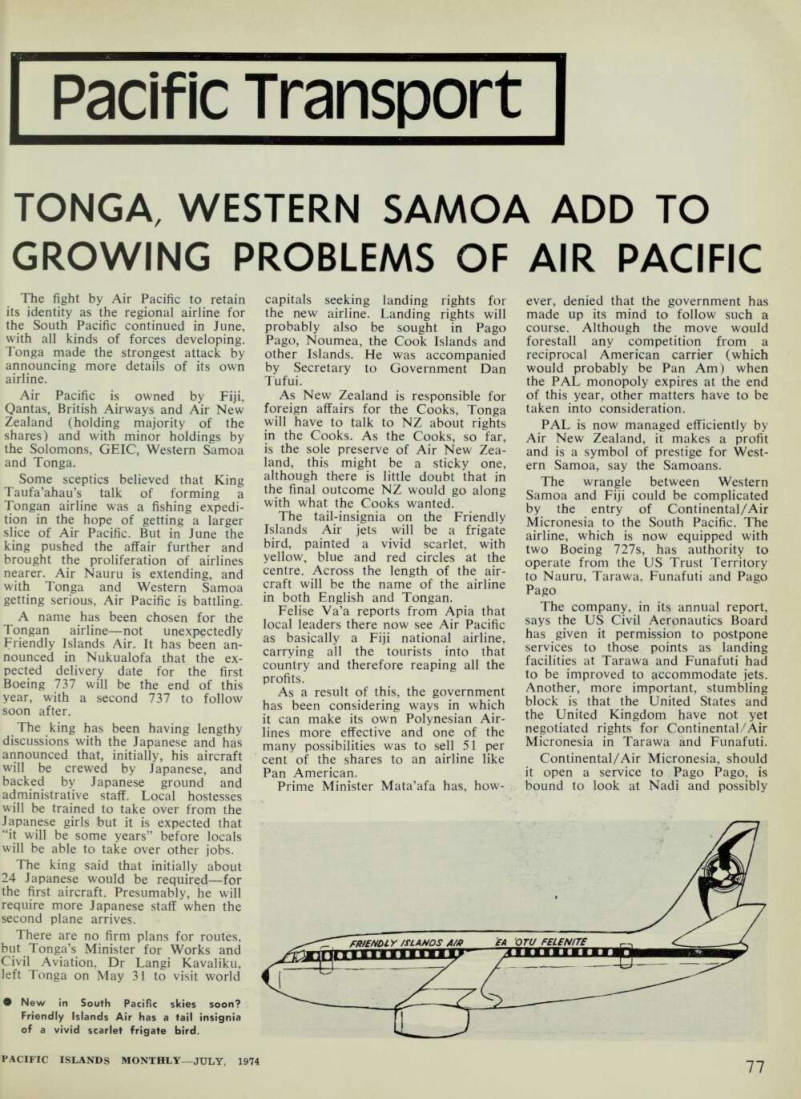

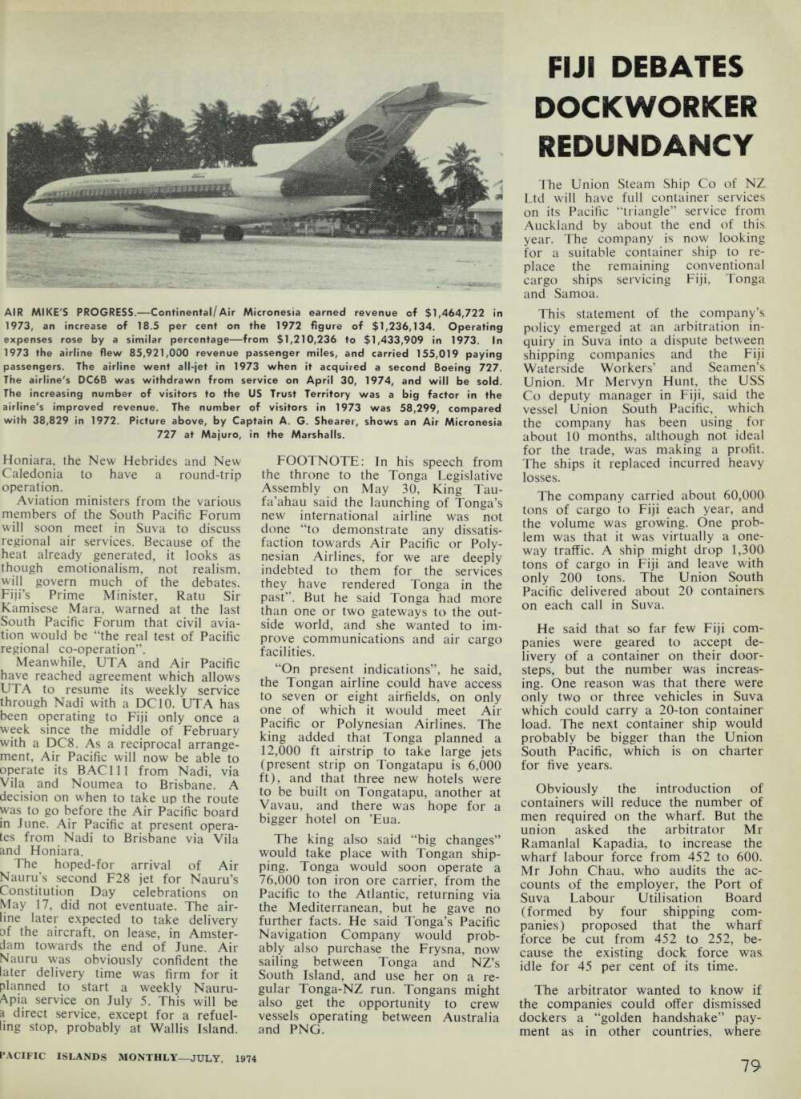
Tonga, Western Samoa Add To
Growing Problems Of Air Pacific
The fight by Air Pacific to retain its identity as the regional airline for the South Pacific continued in June, with all kinds of forces developing.
Tonga made the strongest attack by announcing more details of its own airline.
Air Pacific is owned by Fiji, Qantas, British Airways and Air New Zealand (holding majority of the shares) and with minor holdings by the Solomons, GEIC, Western Samoa and Tonga.
Some sceptics believed that King Taufa’ahau’s talk of forming a Tongan airline was a fishing expedi tion in the hope of getting a larger slice of Air Pacific. But in June the king pushed the affair further and brought the proliferation of airlines nearer. Air Nauru is extending, and with Tonga and Western Samoa getting serious, Air Pacific is battling.
A name has been chosen for the Tongan airline—not unexpectedly Friendly Islands Air. It has been an nounced in Nukualofa that the ex pected delivery date for the first Boeing 737 will be the end of this year, with a second 737 to follow soon after.
The king has been having lengthy discussions with the Japanese and has announced that, initially, his aircraft will be crewed by Japanese, and backed by Japanese ground and administrative staff. Local hostesses will be trained to take over from the Japanese girls but it is expected that “it will be some years” before locals will be able to take over other jobs.
The king said that initially about 24 Japanese would be required—for the first aircraft. Presumably, he will require more Japanese staff when the second plane arrives.
There are no firm plans for routes, but Tonga’s Minister for Works and Civil Aviation, Dr Langi Kavaliku, left Tonga on May 31 to visit world
capitals seeking landing rights for the new airline. Landing rights will probably also be sought in Pago Pago, Noumea, the Cook Islands and other Islands. He was accompanied by Secretary to Government Dan Tufui.
As New Zealand is responsible for foreign affairs for the Cooks, Tonga will have to talk to NZ about rights in the Cooks. As the Cooks, so far, is the sole preserve of Air New Zea land, this might be a sticky one, although there is little doubt that in the final outcome NZ would go along with what the Cooks wanted.
The tail-insignia on the Friendly Islands Air jets will be a frigate bird, painted a vivid scarlet, with yellow, blue and red circles at the centre. Across the length of the air craft will be the name of the airline in both English and Tongan.
Felise Va’a reports from Apia that local leaders there now see Air Pacific as basically a Fiji national airline, carrying all the tourists into that country and therefore reaping all the profits.
As a result of this, the government has been considering ways in which it can make its own Polynesian Air lines more effective and one of the many possibilities was to sell 51 per cent of the shares to an airline like Pan American.
Prime Minister Mata’afa has, how
ever, denied that the government has made up its mind to follow such a course. Although the move would forestall any competition from a reciprocal American carrier (which would probably be Pan Am) when the PAL monopoly expires at the end of this year, other matters have to be taken into consideration.
PAL is now managed efficiently by Air New Zealand, it makes a profit and is a symbol of prestige for West ern Samoa, say the Samoans.
The wrangle between Western Samoa and Fiji could be complicated by the entry of Continental/Air Micronesia to the South Pacific. The airline, which is now equipped with two Boeing 7275, has authority to operate from the US Trust Territory to Nauru, Tarawa, Funafuti and Pago Pago The company, in its annual report, says the US Civil Aeronautics Board has given it permission to postpone services to those points as landing facilities at Tarawa and Funafuti had to be improved to accommodate jets.
Another, more important, stumbling block is that the United States and the United Kingdom have not yet negotiated rights for Continental/Air Micronesia in Tarawa and Funafuti.
Continental/Air Micronesia, should it open a service to Pago Pago, is bound to look at Nadi and possibly
• New in South Pacific skies soon?
Friendly Islands Air has a tail insignia of a vivid scarlet frigate bird.
Honiara, the New Hebrides and New Caledonia to have a round-trip operation.
Aviation ministers from the various members of the South Pacific Forum will soon meet in Suva to discuss regional air services. Because of the heat already generated, it looks as though emotionalism, not realism, will govern much of the debates.
Fiji’s Prime Minister, Ratu Sir Kamisese Mara, warned at the last South Pacific Forum that civil avia tion would be “the real test of Pacific regional co-operation”.
Meanwhile, UTA and Air Pacific have reached agreement which allows UTA to resume its weekly service through Nadi with a DCIO. UTA has been operating to Fiji only once a week since the middle of February with a DCB. As a reciprocal arrange ment, Air Pacific will now be able to operate its BACIII from Nadi, via Vila and Noumea to Brisbane. A decision on when to take up the route was to go before the Air Pacific board in June. Air Pacific at present opera tes from Nadi to Brisbane via Vila and Honiara.
The hoped-for arrival of Air Nauru’s second F2B jet for Nauru’s Constitution Day celebrations on May 17, did not eventuate. The air line later expected to take delivery □f the aircraft, on lease, in Amster dam towards the end of June. Air Nauru was obviously confident the later delivery time was firm for it planned to start a weekly Nauru- Apia service on July 5. This will be a direct service, except for a refuel ling stop, probably at Wallis Island.
FOOTNOTE: In his speech from the throne to the Tonga Legislative Assembly on May 30, King Tau fa’ahau said the launching of Tonga’s new international airline was not done “to demonstrate any dissatis faction towards Air Pacific or Poly nesian Airlines, for we are deeply indebted to them for the services they have rendered Tonga in the past”. But he said Tonga had more than one or two gateways to the out side world, and she wanted to im prove communications and air cargo facilities. airfi , e f dS ’ °"t °v y p - fi _i, 11 , wou * d Air Airlines. The 7° n , 8 r p . lanned . a , ft airstri P <° take large ,ets <P resen ‘ s ‘ r, P ° n Tongatapu is 6,000 fIL a " K d tbree " ew hotel , s . were |° be bmU on Tongatapu, another at Vavau, and the , r ,? was hope for a bigger hotel on Eua.
The king also said “big changes” would take place with Tongan ship ping. Tonga would soon operate a 76,000 ton iron ore carrier, from the Pacific to the Atlantic, returning via the Mediterranean, but he gave no further facts. He said Tonga’s Pacific Navigation Company would prob ably also purchase the Frysna, now sailing between Tonga and NZ’s South Island, and use her on a re gular Tonga-NZ run. Tongans might also get the opportunity to crew vessels operating between Australia and PNG.
AIR MIKE'S PROGRESS.—Continental/Air Micronesia earned revenue of $1,464,722 in 1973, an increase of 18.5 per cent on the 1972 figure of $1,236,134. Operating expenses rose by a similar percentage—from $1,210,236 to $1,433,909 in 1973. In 1973 the airline flew 85,921,000 revenue passenger miles, and carried 155,019 paying passengers. The airline went all-jet in 1973 when it acquired a second Boeing 727.
The airline's DC6B was withdrawn from service on April 30, 1974, and will be sold.
The increasing number of visitors to the US Trust Territory was a big factor in the airline's improved revenue. The number of visitors in 1973 was 58,299, compared with 38,829 in 1972. Picture above, by Captain A. G. Shearer, shows an Air Micronesia 727 at Majuro, in the Marshalls.
Advertisements & other items, p. 80 (1 item)
Ruston
%»■ m
JUST WHAT THE
DOCTOR ORDERED
FOR CONTINUOUS
OPERATION...
RUSTON
AIR COOLED
DIESEL
ENGINES
RUSTON YWA AND YDA SERIES
Available right now. No waiting. No delays. Have one of the Ruston range working for you in any continuous operation you require. Spares readily available.
MODEL
1 YWA
2YWA
BHP
Continuous rating 12.75 11.75 9.80 7.70 6.20 25.5 23.5 19.6 15.4 12.4
GEC DIESELS AUSTRALIA LTD.
HEAD OFFICE VIC.: 1 Winterton Rd., Clayton. Phone 544 8344. A.H. 729 6762.
N.S.W.- 93 Reserve Rd., Artarmon. Phone: 43 3114. A.H. 449 1416.
OLD.: 115 Breakfast Creek Rd., Newstead. Phone 52 4421. A.H. 62 8086.
S.A.:' 121-131 Torrens Rd., Croydon. Phone: 46 2772.
W.A.: 8 Clever Terrace, Belmont. Phone: 65 4844. N.T.- Phone: 81 9892.
CJ/GECI/FP
Dockworker
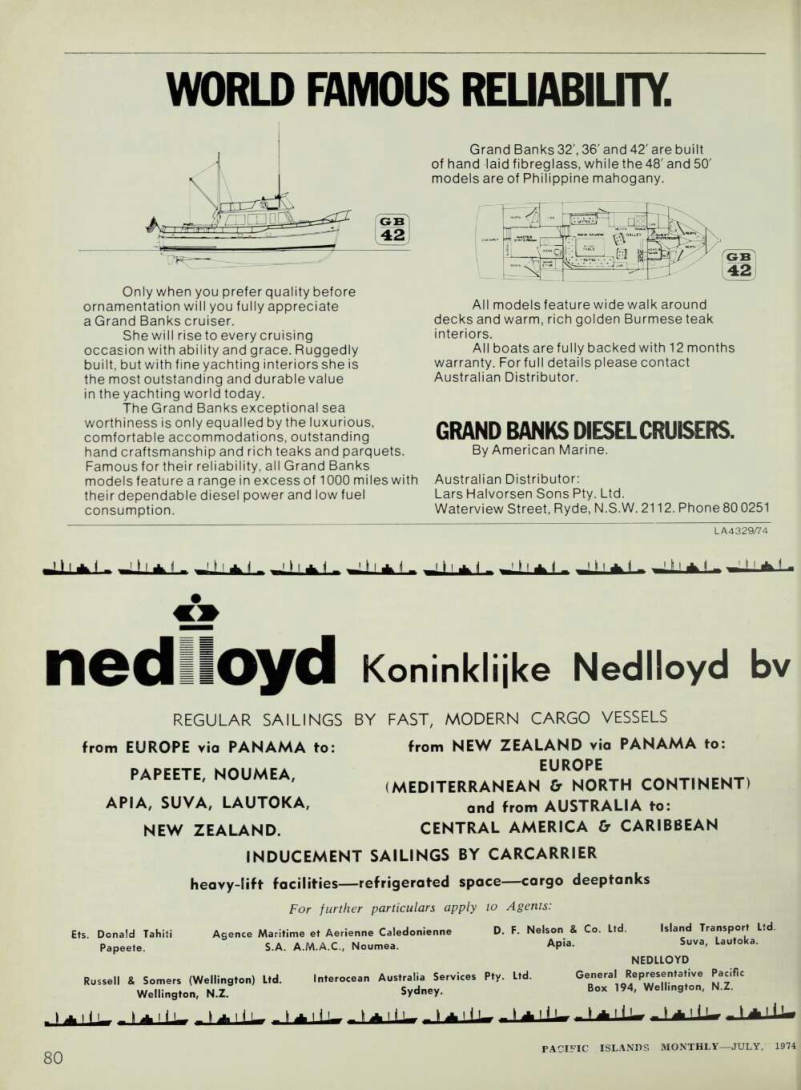
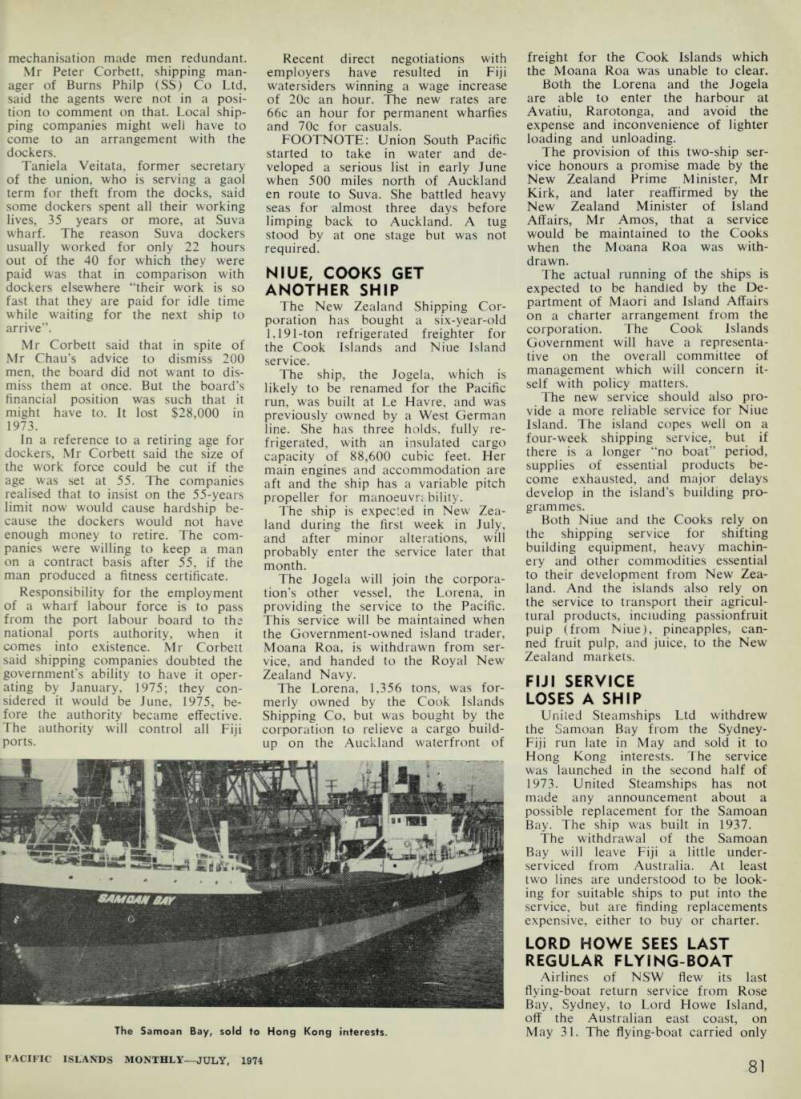
Fiji Debates
Redundancy
The Union Steam Ship Co of NZ Ltd will have full container services on its Pacific “triangle” service from Auckland by about the end of this year. The company is now looking for a suitable container ship to re place the remaining conventional cargo ships servicing Fiji, Tonga and Samoa.
This statement of the company’s policy emerged at an arbitration in quiry in Suva into a dispute between shipping companies and the Fiji Waterside Workers’ and Seamen’s Union. Mr Mervyn Hunt, the USS Co deputy manager in Fiji, said the vessel Union South Pacific, which the company has been using for about 10 months, although not ideal for the trade, was making a profit.
The ships it replaced incurred heavy losses.
The company carried about 60,000 tons of cargo to Fiji each year, and the volume was growing. One prob lem was that it was virtually a one way traffic. A ship might drop 1,300 tons of cargo in Fiji and leave with only 200 tons. The Union South Pacific delivered about 20 containers on each call in Suva.
He said that so far few Fiji com panies were geared to accept de livery of a container on their door steps, but the number was increas ing. One reason was that there were only two or three vehicles in Suva which could carry a 20-ton container load. The next container ship would probably be bigger than the Union South Pacific, which is on charter for five years.
Obviously the introduction of containers will reduce the number of men required on the wharf. But the union asked the arbitrator Mr Ramanlal Kapadia, to increase the wharf labour force from 452 to 600.
Mr John Chau, who audits the ac counts of the employer, the Port of Suva Labour Utilisation Board (formed by four shipping com panies) proposed that the wharf force be cut from 452 to 252, be cause the existing dock force was idle for 45 per cent of its time.
The arbitrator wanted to know if the companies could offer dismissed dockers a “golden handshake” pay ment as in other countries, where
mechanisation made men redundant.
Mr Peter Corbett, shipping man ager of Burns Philp (SS) Co Ltd, said the agents were not in a posi tion to comment on that. Local ship ping companies might well have to come to an arrangement with the dockers.
Taniela Veitata, former secretary of the union, who is serving a gaol term for theft from the docks, said some dockers spent all their working lives, 35 years or more, at Suva wharf. The reason Suva dockers usually worked for only 22 hours out of the 40 for which they were paid was that in comparison with dockers elsewhere “their work is so fast that they are paid for idle time while waiting for the next ship to arrive”.
Mr Corbett said that in spite of Mr Chau’s advice to dismiss 200 men, the board did not want to dis miss them at once. But the board’s financial position was such that it might have to. It lost $28,000 in 1973.
In a reference to a retiring age for dockers, Mr Corbett said the size of the work force could be cut if the age was set at 55. The companies realised that to insist on the 55-years limit now would cause hardship be cause the dockers would not have enough money to retire. The com panies were willing to keep a man on a contract basis after 55, if the man produced a fitness certificate.
Responsibility for the employment
of a wharf labour force is to pass from the port labour board to the national ports authority, when it comes into existence. Mr Corbett said shipping companies doubted the government’s ability to have it oper ating by January, 1975; they con sidered it would be June, 1975, be fore the authority became effective.
The authority will control all Fiji ports.
Recent direct negotiations with employers have resulted in Fiji watersiders winning a wage increase of 20c an hour. The new rates are 66c an hour for permanent wharfies and 70c for casuals.
FOOTNOTE: Union South Pacific started to take in water and de veloped a serious list in early June when 500 miles north of Auckland en route to Suva. She battled heavy seas for almost three days before limping back to Auckland. A tug stood by at one stage but was not required.
Niue, Cooks Get
Another Ship
The New Zealand Shipping Cor poration has bought a six-year-old 1,191-ton refrigerated freighter for the Cook Islands and Niue Island service.
The ship, the Jogela, which is likely to be renamed for the Pacific run, was built at Le Havre, and was previously owned by a West German line. She has three holds, fully re frigerated, with an insulated cargo capacity of 88,600 cubic feet. Her main engines and accommodation are aft and the ship has a variable pitch propeller for manoeuvre bility.
The ship is expected in New Zea land during the first week in July, and after minor alterations, will probably enter the service later that month.
The Jogela will join the corpora tion’s other vessel, the Lorena, in providing the service to the Pacific.
This service will be maintained when the Government-owned island trader, Moana Roa, is withdrawn from ser vice, and handed to the Royal New Zealand Navy.
The Lorena, 1,356 tons, was for merly owned by the Cook Islands Shipping Co, but was bought by the corporation to relieve a cargo build up on the Auckland waterfront of
freight for the Cook Islands which the Moana Roa was unable to clear.
Both the Lorena and the Jogela are able to enter the harbour at Avatiu, Rarotonga, and avoid the expense and inconvenience of lighter loading and unloading.
The provision of this two-ship ser vice honours a promise made by the New Zealand Prime Minister, Mr Kirk, and later reaffirmed by the New Zealand Minister of Island Affairs, Mr Amos, that a service would be maintained to the Cooks when the Moana Roa was with drawn.
The actual running of the ships is expected to be handled by the De partment of Maori and Island Affairs on a charter arrangement from the corporation. The Cook Islands Government will have a representa tive on the overall committee of management which will concern it self with policy matters.
The new service should also pro vide a more reliable service for Niue Island. The island copes well on a four-week shipping service, but if there is a longer “no boat” period, supplies of essential products be come exhausted, and major delays develop in the island’s building pro grammes.
Both Niue and the Cooks rely on the shipping service for shifting building equipment, heavy machin ery and other commodities essential to their development from New Zea land. And the islands also rely on the service to transport their agricul tural products, including passionfruit pulp (from Niue), pineapples, can ned fruit pulp, and juice, to the New Zealand markets.
Fiji Service
Loses A Ship
United Steamships Ltd withdrew the Samoan Bay from the Sydney- Fiji run late in May and sold it to Hong Kong interests. The service was launched in the second half of 1973. United Steamships has not made any announcement about a possible replacement for the Samoan Bay. The ship was built in 1937.
The withdrawal of the Samoan Bay will leave Fiji a little under serviced from Australia. At least two lines are understood to be look ing for suitable ships to put into the service, but are finding replacements expensive, either to buy or charter.
Lord Howe Sees Last
Regular Flying-Boat
Airlines of NSW flew its last flying-boat return service from Rose Bay, Sydney, to Lord Howe Island, off the Australian east coast, on May 31. The flying-boat carried only
The Samoan Bay, sold to Hong Kong interests.
a few passengers to Lord Howe Island, but returned with a full com plement. Now, in accordance with an undertaking given a few months ago, the airline will maintain a token flying-boat service to the island to keep communications open pending completion of the Lord Howe air strip, expected to be late August or
early September.
The manager of Airlines of NSW, Mr P. Steadman, said a special ceremony would be arranged for the last of the “communication link” services.
The two Sandringham aircraft used on the service have been sold to Antilles Air Boats, in the Carib bean. One of them was scheduled to leave Rose Bay on a ferry flight on June 17. The second will probably be ferried to the Caribbean early in 1975 if it can be salvaged after tak ing a battering from hurricane-force winds at the island on June 9. Winds gusting to 80 knots tore the aircraft from its moorings and ran it aground. On June 10, the army team which is laying an airstrip on the island helped to get the flying-boat above the high-water mark. The starboard float was torn off, the star board aileron and a starboard engine were damaged, and the passenger door caved in under the buffeting.
Meantime the New South Wales chapter of the Royal Australian In stitute of Architects has accused the Australian and NSW Governments of allowing construction of the Lord Howe Island airstrip to go ahead without adequate controls or an equivalent impact study. The chapter claims that army sappers are un necessarily destroying parts of the island in constructing the airstrip.
Advertisements & other items, pp. 82-84 (1 item)
nedilOyd Koninklijke Nedlloyd bv
WORLD FAMOUS RELIABILITY.
GB 42 Only when you prefer quality before ornamentation will you fully appreciate a Grand Banks cruiser.
She will rise to every cruising occasion with ability and grace. Ruggedly built, but with fine yachting interiors she is the most outstanding and durable value in the yachting world today.
The Grand Banks exceptional sea worthiness is only equalled by the luxurious, comfortable accommodations, outstanding hand craftsmanship and rich teaks and parquets.
Famous for their reliability, all Grand Banks models feature a range in excess of 1000 miles with their dependable diesel power and low fuel consumption.
Grand Banks 32', 36' and 42' are built of hand laid fibreglass, while the 48' and 50' models are of Philippine mahogany.
All models feature wide walk around decks and warm, rich golden Burmese teak interiors.
All boats are fully backed with 12 months warranty. For full details please contact Australian Distributor.
GRAND BANKS DIESEL CRUISERS.
By American Marine.
Australian Distributor; Lars Halvorsen Sons Pty. Ltd.
Waterview Street, Ryde, N.S.W. 2112. Phone 80 0251 LA4329/74
-U i < - Ji A. 1 JAi J— jfcul -4
nedilOyd Koninklijke Nedlloyd bv
REGULAR SAILINGS BY FAST, MODERN CARGO VESSELS from EUROPE via PANAMA to: from NEW ZEALAND via PANAMA to: PAPEETE, NOUMEA, , ME D,T£EP ANEAnTSoPTH CONSENT.
APIA, SUVA, LAUTOKA, and from AUSTRALIA to:
NEW ZEALAND. CENTRAL AMERICA & CARIBBEAN
INDUCEMENT SAILINGS BY CARCARRIER
heavy-lift facilities—refrigerated space—cargo deeptanks
For further particulars apply to Agents: Ets. Donald Tahiti Agence Maritime et Aerienne Caledonienne D. F. Nelson & Co. Ltd. Island Transport Ltd.
Papeete. S.A. A.M.A.C., Noumea. Apia. Suva, Lautoka.
NEDLLOYD
Russell & Somers (Wellington) Ltd. Interocean Australia Services Pty. Ltd.
Wellington, N.Z.
Sydney.
General Representative Pacific Box 194, Wellington, N.Z.
Pan Am’s good times.
NORTHBOUND FLIGHTS
SUNDAY, TUESDAY AND FRIDAY
Depart NADI 11.59 p.m.
Arrive HONOLULU 8.05 a.m.
Arrive LOS ANGELES 6.50 p.m.
Or spend a day on Waikiki Beach and pick up one of our laterflights to the West Coast.
SOUTHBOUND FLIGHTS
SUNDAY, FRIDAY AND TUESDAY
Depart NADI 5.25 a.m.
Arrive SYDNEY 7.45 a.m.
Our early arrival means a full day left for business or pleasure.
See your Travel Agent or call General Sales Agents, Panair Limited.
Nadi: Nadi Airport 72.100 Suva: 189 Victoria Pde., 22.641 250. P. 133
'Frightening ' Sydney delays
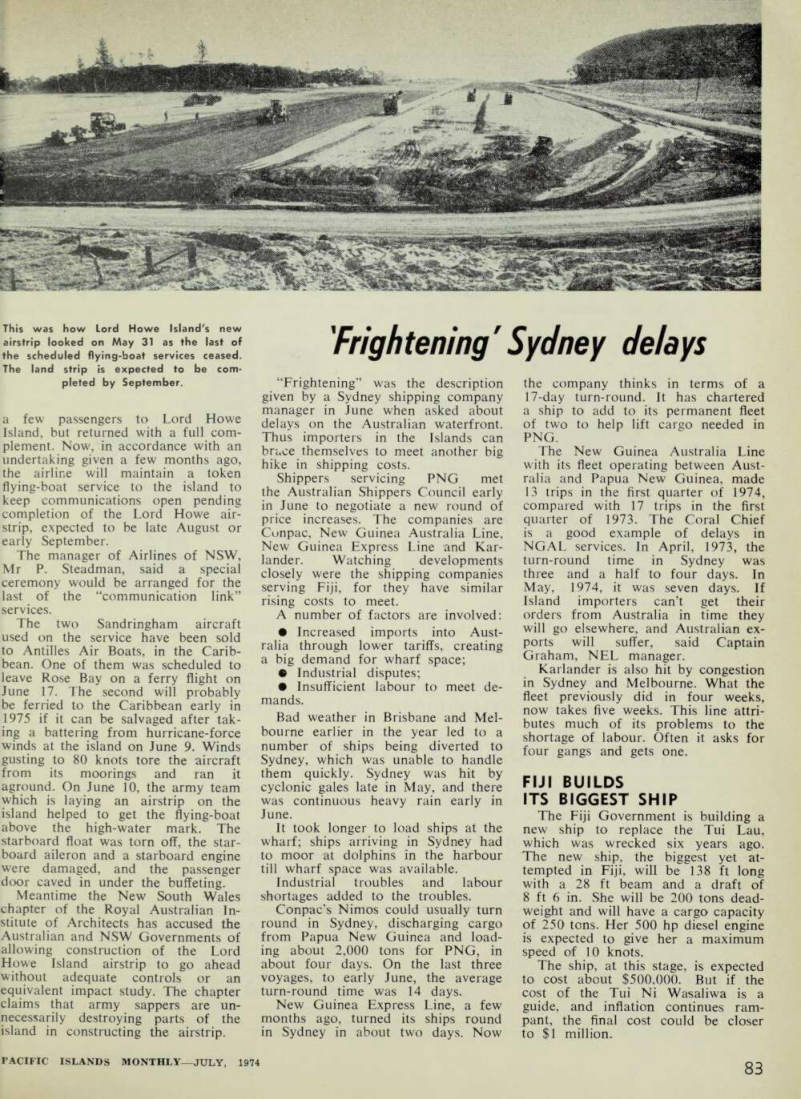
“Frightening” was the description
given by a Sydney shipping company manager in June when asked about delays on the Australian waterfront.
Thus importers in the Islands can brace themselves to meet another big hike in shipping costs.
Shippers servicing PNG met
the Australian Shippers Council early in June to negotiate a new round of price increases. The companies are Cunpac, New Guinea Australia Line, New Guinea Express Line and Kar lander. Watching developments closely were the shipping companies serving Fiji, for they have similar rising costs to meet.
A number of factors are involved: • Increased imports into Aust ralia through lower tariffs, creating a big demand for wharf space; • Industrial disputes; • Insufficient labour to meet de mands.
Bad weather in Brisbane and Mel bourne earlier in the year led to a number of ships being diverted to Sydney, which was unable to handle them quickly. Sydney was hit by cyclonic gales late in May, and there was continuous heavy rain early in June.
It took longer to load ships at the wharf; ships arriving in Sydney had to moor at dolphins in the harbour till wharf space was available.
Industrial troubles and labour shortages added to the troubles.
Conpac’s Nimos could usually turn round in Sydney, discharging cargo from Papua New Guinea and load ing about 2,000 tons for PNG, in about four days. On the last three voyages, to early June, the average turn-round time was 14 days.
New Guinea Express Line, a few months ago, turned its ships round in Sydney in about two days. Now
the company thinks in terms of a 17-day turn-round. It has chartered a ship to add to its permanent fleet of two to help lift cargo needed in
Png.
The New Guinea Australia Line with its fleet operating between Aust ralia and Papua New Guinea, made 13 trips in the first quarter of 1974, compared with 17 trips in the first quarter of 1973. The Coral Chief is a good example of delays in NGAL services. In April, 1973, the turn-round time in Sydney was three and a half to four days. In May, 1974, it was seven days. If Island importers can’t get their orders from Australia in time they will go elsewhere, and Australian ex ports will suffer, said Captain Graham, NEL manager.
Karlander is also hit by congestion in Sydney and Melbourne. What the fleet previously did in four weeks, now takes five weeks. This line attri butes much of its problems to the shortage of labour. Often it asks for four gangs and gets one.
Fiji Builds
Its Biggest Ship
The Fiji Government is building a new ship to replace the Tui Lau, which was wrecked six years ago.
The new ship, the biggest yet at tempted in Fiji, will be 138 ft long with a 28 ft beam and a draft of 8 ft 6 in. She will be 200 tons dead weight and will have a cargo capacity of 250 tons. Her 500 hp diesel engine is expected to give her a maximum speed of 10 knots.
The ship, at this stage, is expected to cost about $500,000. But if the cost of the Tui Ni Wasaliwa is a guide, and inflation continues ram pant, the final cost could be closer to $1 million.
This was how Lord Howe Island's new airstrip looked on May 31 as the last of the scheduled flying-boat services ceased.
The land strip is expected to be com pleted by September.
Advertisements & other items, p. 86 (1 item)
Why choose
Epiglass marine products
for your boat?
I no trttoM hardener »*io ink I
***»=« HEC^
V Epiglass gives you the biggest range of marine glues, fillers, preservatives, resins, skinning systems and paints going. The biggest... and the best.
Laboratory tested-and proven in the wateron thousandsand thousandsof boats! That’s why you can buy Epiglass products with complete confidence.
If it’s Epiglass, it will outlast all others. Just ask the man who uses Epiglass! from 7ft to73ft I epiglass power or sail For further information contact Consolidated Chemicals Limited.
P.O. Box 15-104, New Lynn, Auckland, New Zealand.
PACIFIC AREA DISTRIBUTORS
COOK ISLANDS Cook Is. Trading Corp. Ltd NORFOLK ISLAND Irvine Bid. Supply Centre FIJI Burns Philp (SS) Co. Ltd PAGO PAGO Max Haleck Inc.
NEW GUINEA Bougainville Marine Pty Ltd Kieta TAHITI Tahiti Sport Burns Philp (NG) Ltd Madang TONGA Riechelmann Bros.
Elvee Trading - Pty Ltd Rabaul WESTERN SAMOA Burns Philp (SS) Co, Ltd Faulkner & Tait (NG) Pty Ltd Lae E. A. Coxon Ltd S. A. Heath & Co Pty Ltd Pt Moresby Gold Star Transport Co. Ltd NEW HEBRIDES Burns Philp (NH) Ltd Morris Hedstrom Ltd NOUMEA Guy Limousin SOLOMON ISLANDS George Yee Fai Ltd Pacific Yachting 598
Cruising

Yachts
• EOLUS, 218 ton three-masted bar quentine visited Suva in May while on a round-the-world cruise. She left Ports mouth, England, in December, 1973, and since then she has visited Spain, the Canary Islands, the West Indies, and parts of the Pacific. After leaving Suva she was to call at Norfolk Island and Aus tralia. From Australia she will sail to the Far East across the Indian Ocean, and round the Cape of Good Hope for England. She carries a permanent crew of 15. On this trip she has 23 "guest crew" who pay the owners $4,000 for the cruise. She is owned by a British syndicate, Foundershire. She carries modern equipment such as radar, auto pilot, and an echo sounder. The 200 hp Dorman engine can drive the Eolus at 6 knots and the 550 sq ft of sail can put the speed up to 8 knots in suitable winds. Eolus reached Sydney in early June and took aboard some more "guest" crew. • QUEST, 52 ft motor sailer, which rode out the hurricane season at Rush cutters Bay, Sydney, was scheduled to leave on June 8 for Hobart, New Zealand, Rarotonga and Tahiti. Owner Charles Carter, told PIM before he left it would be a leisurely cruise. He planned to sail down the east coast of New Zealand as far as Bluff before leaving for Raro tonga and Tahiti. His plan then is to turn back to Tonga, Fiji and New Cale donia, and the Australian coast, with Mooloolaba as his landfall. He will then >ail north and west to Singapore. With lim are his wife and two daughters, n Sydney he signed on a young English man, Michael Strachan, as a member of he crew. Michael may leave the Quest n New Zealand. Mr Carter's son, Charles, vho has been cruising with the family n Quest since it left San Diego about the fiddle of 1971, left it in Sydney to go o Taiwan, where he will attend college.
Mhen he reaches Rarotonga Mr Carter lopes to renew acquaintances with an >ld friend, Ron Powell. • CRUSADER, 51 ft sloop, which had >een at Rushcutters Bay, Sydney, waiting or the end of the hurricane season, left m May 18 to sail north along the Aus ralian coast. Owner Don Sorte, originally ntended to sail for Indonesia, but has :hanged his plans, and his latest plan is o visit Manila, Taiwan, Hong Kong and apan. It was also possible that he would all at various points in Papua New guinea. He had a crew of two men and hree women when he left Sydney.
• STORMSTRUTTER, 45 ft Canadian ketch registered at Vancouver, arrived at Rarotonga on May 10 from Papeete with owner-skipper John Samson, his wife, Patricia, and daughters Barbara and Christine. They are on a Pacific cruise which started from Vancouver three years ago. The ketch left for Pago Pago on May 15. • SURPRISE, 38 ft sloop, was an un expected visitor to Sydney late in May.
Carrying Italian owner, Ambrosio Fobar, who is sailing solo round the world, the sloop ran into a heavy storm in the Tasman Sea. The seas, whipped up by cyclonic gales, overturned the Surprise.
Fobar was thrown into the water and was saved only by an 8 ft lifeline attached to a wrist. The sloop did a 360 deg turn and Fobar was able to scramble back on board. The radio was wrecked and food was ruined, so instead of sailing from Auckland round the Cape of Good Hope, as planned, he sailed to Sydney instead. It was the second time seas turned the Surprise over. The first time was after she had rounded Cape Horn, when she went over from stern to bow. The Surprise left Sydney early in June for the Cape of Good Hope and Italy. • RONAKI, clinker built keel-less yacht, arrived in Suva recently from New Zealand. From Suva the Ronaki will cruise in other parts of Fiji, and then sail back to New Zealand, via Tonga. To make up for the lack of a keel she carries about tons of concrete as ballast. On board are the owner-skipper, Rob Ray, and brothers Derry and Alec Wood. • ZEW MORZA, 31 metre schooner, registered at Szczecin (formerly Stettin), Poland, arrived at Rarotonga from Papeete on May 4 on a world cruise. On board were Captain Zdzislaw Michalski and 10 crew all of whom are shipyard workers.
The tourist cruise started from Poland on November 8, 1973, and ports of call included Kiel, Amsterdam, Casablanca, Las Palmas, Barbados, Colon, Panama, Galapagos Islands, Nukuhiva, Rangiroa and Papeete. Zew Morza left Rarotonga on May 7 for Auckland, Sydney, Port Moresby, Timor, Madagascar, Capetown and Poland. • BENDORA, 30 ft Canadian sloop registered at Vancouver, arrived at Raro tonga on May 6 from Huahine, Raiatea, Bora Bora and Papeete with John and Jean Taylor. They spent one year in Mexican waters before sailing to the Marquesas. Bendora left for Tonga on May 20. • MOLOKAI GIRL, 39 ft American sloop registered at Las Vagas, arrived at Rarotonga on May 6 from Auckland after a stormy voyage of 24 days. On
board were skipper Fred Mack, his wife, Else, and a male crew member who joined the yacht in Auckland. Molokai Girl called at Rarotonga a year ago, bound from the USA to New Zealand, and is now making a return voyage via Papeete and Hawaii. • DULCIMER, 40 ft ketch registered at Vancouver (BQ arrived at Rarotonga on May 7 from Papeete, Maupiti and other French Polynesian islands with skipper Philip J. Grange and Gillian M.
Kidd. Previous ports of call included La Paz, Mexico, and the Marquesas Islands. Dulcimer is bound for Auckland via Tonga and Fiji. • TEACHERS PET 111, 32 ft cutter registered at Los Angeles, arrived at Rarotonga from Papeete on May 12 with owner-captain Carlos A. Derives, his wife Kathleen (both school teachers) and daughter Donna (13). Their cruise started in February from Long Beach, California, and calls were made at Marquesas, Tuamotus and Society islands. Plans were to call at Tonga, Fiji, the New Hebrides and Loyalty Islands, and to arrive in New Zealand about November. • MANU OTE Mill, 42 ft sloop registered at Vancouver (BC) arrived at Rarotonga from Papeete on May 12 with skipper H. J. Genciala and one crew member. • KAVENGA, 41 ft ferro-concrete sloop, arrived at Rarotonga on May 28 from Tauranga, New Zealand, with owner-skipper Pat Bowle-Evans, John Grieve, and brothers John and Steve Millar —all Canadians. Mr Bowle-Evans had worked in New Zealand as project manager for a paper mill extension and had his yacht built by Ferro Craft Ltd of Auckland. They sailed direct for Rarotonga and two days out their engine packed up. They were becalmed for four days and, during this time, sighted an other yacht that motored over. This was the 35 ft ketch SPRAY with Tony Pearce and his father-in-law, Vernon Willmen, on board. Spray left England in Septem ber, 1972, on a cruise to NZ, and was bound from Rarotonga to NZ when this unusual chance meeting occurred. The meeting was celebrated by a dinner on board Kavenga. Plans were to stay a week In Rarotonga, then proceed to Tahiti, Hawaii and Vancouver. • CHANSON, 40 ft sailing cutter registered at Los Angeles, arrived at Rarotonga on May 24 with owner-skipper Harold A. Kilmer and his wife Jean.
Their cruise started from California in March, 1962, and since then they've spent two years in Central America, one year in the Galapagos Islands and another year in Polynesia. They planned to sail to Tonga and then spend a year in and
around Fiji. Next countries of call would possibly be New Zealand and Australia and, Mr Kilmer added humorously, they might even complete a circumnavigation at their present rate of progress—if they lived long enough. • PINOCCHIO, 40 ft (11.75 m) ketch registered in Berlin, arrived at Rarotonga on May 31 from Mopelia and other Society Islands with Bernd and Elke Fengler. Previous ports of call included the Galapagos Islands, the Marquesas and Tuamotus. Plans were to call at Tonga. • CIRCUS, 35 ft sloop, arrived at Rarotonga on May 30 from Whangerei, NZ, with owner-skipper Dr A. T. Cotton, David Judell, lan Beverley and Laurie Henbest. The brand-new yacht was to have entered the Auckland-Rarotonga Yacht Race, but was capsised and dis masted while crossing the Tasman from Hobart to Auckland. Circus was com pletely rolled over by a huge wave when 250 miles from Australia; the mast snapped and two cabin windows were stove-in. The four-man crew were in a trough of extreme low pressure with short, steep, confused seas and storm strength winds. They motored the sloop back, but by the time the damage was repaired the race had started. After a week in Rarotonga David Judell was to fly home and some of Dr Cotton's friends were to join'Circus in Rarotonga before sailing to Tahiti. • SHANTOH, 10 m sloop, and JAGA, 12 m ketch, which arrived in Rarotonga in April from French Polynesia, both left in mid-May. • CAPRICE, 31 ft fibreglass ketch built in Hong Kong, arrived in Port Moresby in mid May from Madang with Philip Baker, Ivan Gelderen and Olive Ruff on board. ® COQUETTE, 54 ft Samson design Ferro-concrete schooner, arrived in Port Moresby from Cairns on May 31, and Sill Cunningham planned to stay for a : ew weeks then sail for Lae. • TUI MANU (Mick York), 37 ft yawl, /von the Sydney-Noumea yacht race, which itarted from Sydney on May 30. Her :orrected time was 159.42 hours. Second vas HARMONY (Geoff Foster), 32 ft, in 160.04 hours, and ALCHERINGA (Joe )iamond skipper, owner Jim Bridgland) vas third in 164.19 hours. Line honours vent to BANJO PATTERSON (John Jarrett) >9 ft, in 197 hours, 32 min, 22 sec. • KATIKA, a 50 ft motor sailer ketch, sft Madang in June for Bali and Singa •ore via Irian Jaya, and possibly Manus sland. • PETER PAN, a 37 ft Nicol Cavalier rimaran with owner Reg Lincoln and
his 16-year-old son, Geoff, on board, was waiting in Madang in June for clearance papers to proceed to Bali and Singapore via Irian Jaya. (Mr Lincoln advises any one considering this trip to allow six months to obtain the necessary papers.) Peter Pan left Port Moresby in March and after a hard run to Samarai joined forces with Jeff and Carol Godsby on NANALOA for a leisurely and easy trip via Lae to Madang. • NANALOA, a 36 ft steel ketch with Jeff and Carol Godsby on board, is in Madang for a couple of months before leaving for Namatanai on the east New Ireland coast. • KEEWAYDIM, 24 metre ketch which arrived at Rarotonga on May 15 was expected to leave for Tonga, Fiji, the New Hebrides, and Cairns, Queensland, after a brief stay, sailed from Sweden in September, 1973, to Portsmouth, England.
Keewaydim was entered for a round-the world yacht race, but had to retire to the Canary Islands for repairs. From racing she switched to cruising with calls at the West Indies, Panama, the Gala pagos, Marquesas and the Society Islands. After repairs at Cairns she will cross the Indian Ocean to Capetown, and hopes to be back in Sweden by the spring of 1975. • THYME, 37 ft yacht, left Auckland in May for "four months of Pacific ad venture". On board were owner, Bill Townson, an Auckland boatbuilder, his wife Mona, and friends Emmet Hussey, Rod Fergusson and Stuart Mason. First call was to be in Fiji.
• CHARLEMAGNE, 62 ft cutter (War wick White, skipper), won the Auckland- Rarotonga yacht race in May on corrected time, from SIRIUS, racing cutter (John W.
MacKenzie) and ROULETTE (Fred Andrews).
Line honours went to another 62 ft cutter, KAHURANGI (Wally Stuhlman) in 9 days, 6 hours, 14 min, 40 sec. Charle magne was second across the line in 9 d, 15 h, 28 min, and TOTOLO, 46 ft cutter (Don Winstone) third in 9 d, 17 h, 11 m, 16 s. In the International Offshore Rule Mark 111 rating class Roulette was first, Kahurangi second and Charle magne third. The other yachts which took part in the race were EROS (Denis Drouyn), WHITE SQUALL (Ron Chalmers and NEREIDES (Dyson Gulliver). Nereides was the mother ship for the race.
After the race several of the yachts had Pacific cruises lined up. Kahurangi and Charlemagne were scheduled to sail for Tahiti, Sirius for Samoa and Fiji, and White Squall to Aitutaki, Palmerston, Tonga and possibly the Kermadecs. The land, although Roulette called at Aitutaki first.
Advertisements & other items, pp. 87-90 (3 items)
85
•ACIFIC ISLANDS MONTHLY—JULY, 1974
These MF distributors
can show you the
greater the load on an MF2I Trailer
the better the grip!
The all-steel hydraulic-tipping MF2I is a “goanywhere” unit with large section tyres to give good flotation on wet ground and MF’s famous rear axle design which puts 25% of the load on the tractor’s rear wheels. The bigger the load, thebetterthegrip!
Capacity is 3 1 /2. tons, tray area 60 square feet. A powerful hydraulic ram tips the tray to 56 degrees for fast, clean unloading. Everything about this trailer is planned for one-man operation. What’s more, it’s built for years of tough work in the field or on the road. * A MF
MFE 74041
MASSEY-FERGUSON ...WINNER OF TWO EXPORT AWARDS
FOR SALE
6L2 GARDNER ENGINE, 50 b.h.p., 2:1
reduction gearbox, electric starting, as is condition, $BOO.
613 GARDNER ENGINE, 114 b.h.p., 2:1
reduction gearbox, electric starting and generator, gearbox dismantled, second hand, $l,BOO. Enquiries to:
KNOX SCHLAPP PTY. LTD.,
P.O. Box 67, Alexandria, N.S.W., 2015, Australia.
Phone: 699-8333. Telex: 20483.
AUCTION SALE: T.S.M.V. "BRIGHAM"
TRAWLER, GENERAL PURPOSE VESSEL. FULLY REFRIGERATED
Under instructions from the
LIQUIDATOR, SOUTHERN CONCRETE
MASONRY LTD. (in liquidation) at
NORTHBRIDGE YACHT SERVICE,
WIDGIEWA RD„ NORTHBRIDGE,
SYDNEY on WED., JULY 17 at
2 P.M.
Length: 105 ft. Beam: 21 ft. 5 in. Draft: 8 ft.
English built to NAVAL SPECIFICATION.
Main Engines: 2X PAXMAN 12V. HAXM supercharged diesels each giving 550 b.h.p. at 1,000 r.p.m.
Aux. Engines: FODEN 198 b.h.p diesel and NISSAN 198 b.h.p diesel.
Refrigeration machinery: 5 x 15 h.p.
TERRY V 45.
Cold Rooms: 1 x 1,638 cu. ft. 1 x 912 cu. ft.
Blast Freezers: 2 x 1,155 cu. ft.
Holding Room Locker; 1 x 1,320 cu. ft.
TWIN PRAWN TRAILING RIG with HYDR-
WINCH OPERATION, swim tanks, cooker, sorting table, etc.
Excellent, air conditioned living quarters.
Bridge well instrumented inch RADAR,
RADIO, FISH FINDERS, etc.
Pre-Sale Enquiries to: CAPTAIN T. HAWORTH (SHIP BROKER). Contact Mervyn Browne, phone Sydney: 95 6893, 95 1326.
AUCTIONEERS: PITT SON & BADGERY (AUCTIONEERS) PTY. LTD.
Pyrmont & Allen Sts., Pyrmont, N.S.W.
ssp
m X % RS
GOOD? YEAR
TRACTION HI-MILER HI-MILERGB
TRACTION 100
SUPER ROAD LUG
For rugged 'stop-go' delivery work. Gives longer mileage and easier steering.
Round shoulder tire for highway trucks.
Assures extra traction on all surfaces, wet and dry.
With 3-T cord, stronger than steel, Abrasion resistant extra-thick tread and developed for bus deep-grooved, sharp anand highway trucks, gle lugs assure positive traction on all types of road surfaces.
ALL SERVICE
A non-directional mud and snow tire.
Reduces skidding and weaving. ss I i mi m i Sr> £-1 *8 li m w •\ m p m w ' .v
THE RIGHT TIRE FOR EVERY JOB
HIGHWAY - ON/OFF THE ROAD - CROSS COUNTRY Boroko Motors Ltd.
P.O. Box 1259 Boroko, Port Moresby
Papua, NEW GUINEA
Solomon Motors Ltd.
P.O. Box 20, Mendana Avenue, Honiara Guadalcanal, SOLOMON ISLANDS Societe Generate d’Automobiles B.P. 554 Noumea
NEW CALEDONIA
Coral Island Traders P.O. Box 296 Suva
FIJI
Guam Tire & Supply Co.
P.O. Box 1486 Agana
GUAM
SOHECO
B.P. 208 Port Vila
NEW HEBRIDES
Morris Hedstrom Ltd.
Apia
WESTERN SAMOA
Haleck Service Center P.O. Box 1138 Pago Pago
AMERICAN SAMOA 96920
Service Mobil B.P. 306 Papeete
TAHITI
Santo Engineers Santo
NEW HEBRIDES
Morris Hedstrom Ltd.
Nukualofa
TONGA
Q 641
87
‘ACIFIC ISLANDS MONTHLY—JULY, 1974
British pacifi cjet
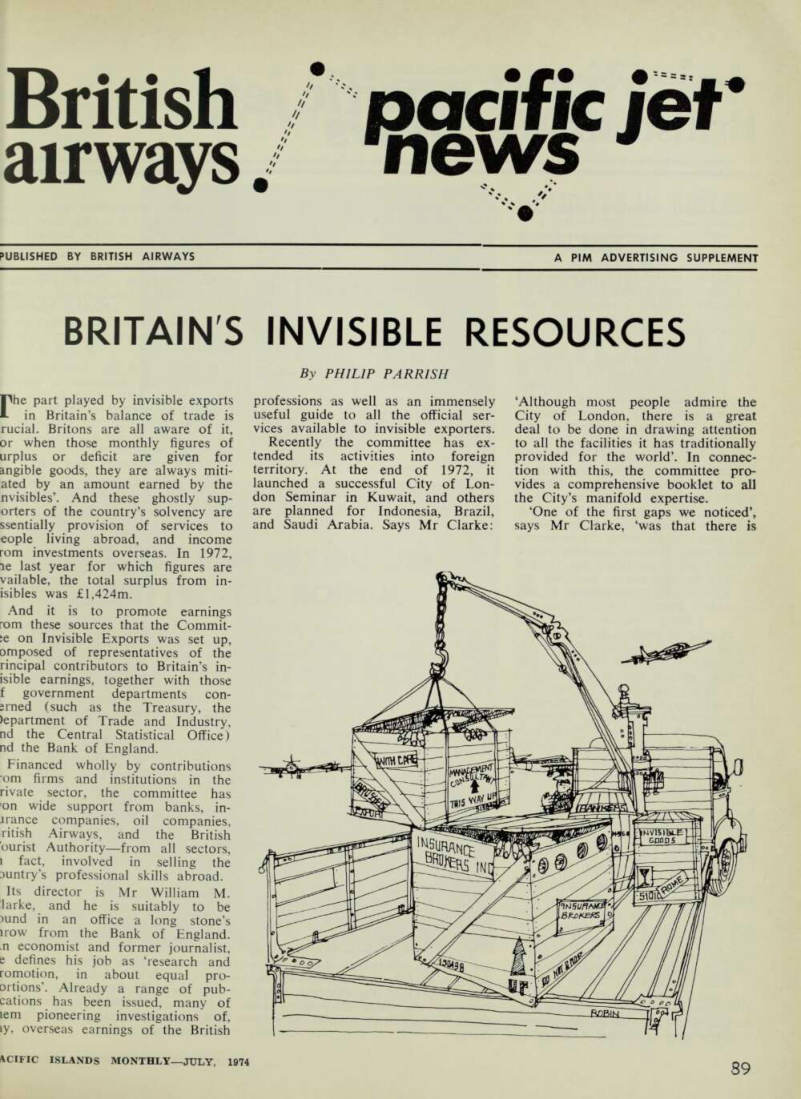
airways news
Britain's Invisible Resources
Published By British Airways
A Pim Advertising Supplement
By Philip Parrish
rhe part played by invisible exports in Britain’s balance of trade is rucial. Britons are all aware of it, or when those monthly figures of urplus or deficit are given for angible goods, they are always initi ated by an amount earned by the nvisibles’. And these ghostly sup orters of the country’s solvency are ssentially provision of services to eople living abroad, and income rom investments overseas. In 1972, le last year for which figures are vailable, the total surplus from in isibles was £ 1,424 m.
And it is to promote earnings rom these sources that the Commit je on Invisible Exports was set up, omposed of representatives of the rincipal contributors to Britain’s in isible earnings, together with those f government departments con ;rned (such as the Treasury, the fepartment of Trade and Industry, nd the Central Statistical Office) nd the Bank of England.
Financed wholly by contributions •om firms and institutions in the rivate sector, the committee has r on wide support from banks, in irance companies, oil companies, ritish Airways, and the British ourist Authority—from all sectors, i fact, involved in selling the Duntry’s professional skills abroad.
Its director is Mr William M. larke, and he is suitably to be )und in an office a long stone’s irow from the Bank of England, n economist and former journalist, e defines his job as ‘research and romotion, in about equal pro ortions’. Already a range of pub cations has been issued, many of lem pioneering investigations of, ly, overseas earnings of the British
professions as well as an immensely useful guide to all the official ser vices available to invisible exporters.
Recently the committee has ex tended its activities into foreign territory. At the end of 1972, it launched a successful City of Lon don Seminar in Kuwait, and others are planned for Indonesia, Brazil, and Saudi Arabia. Says Mr Clarke:
‘Although most people admire the City of London, there is a great deal to be done in drawing attention to all the facilities it has traditionally provided for the world’. In connec tion with this, the committee pro vides a comprehensive booklet to all the City’s manifold expertise. ‘One of the first gaps we noticed’, says Mr Clarke, ‘was that there is
inadequate information about the overseas earnings of the leading pro fessions’, So an inquiry was begun, and its results published last year.
Nine groups were studied in it—ac countants, chartered surveyors and architects, consulting engineers, in dependent schools, management con sultants, the medical professions, patent agents, advertising practition ers, and solicitors. The collated figures showed that these professions earned around £ll3m in 1971. In this area, the committee’s chairman, banker Cyril Kleinworth, finds hope and encouragement for the future. ‘These overseas earnings’, he de clares, ‘are important not only to the balance of payments. To the pro fessions themselves the extension of their markets to include overseas clients may be beneficial in terms of the size and security of their busi ness. To some extent the professions can offset a recession at home by selling more services overseas. More over, these markets are spread throughout the world, and are not always in the same phase of the business cycle’.
Mr Clarke points out that, although the professions have been active mainly in the Commonwealth, they have never been confined to it.
And he sees a period of expansion in Europe particularly for the younger professions. Management consultants and consultant engineers are enlarging their practices both in Europe and North America. Aware of the importance of Europe, the committee has established its own representative in Brussels, to obtain quick information about any policy initiatives in the European Economic Community that will bear on the interests of Britain’s invisible ex porters and to establish a liaison with the European Commission staff.
A glance down the winners of Britain’s Queen’s Award for Industry in 1973 gives some idea of the spread and variety of invisible exports. No fewer than 10 awards went to firms engaged in them. One for example, went to Dick James Music, involved in artist management, music publish ing, and recording, and a firm that has increased its overseas earnings six-fold over a period of three years.
Another went to British Aviation In
surance, which earns the major part of its premium income from overseas.
There was the Mermaid Hotel at Rye, Sussex, with only 30 bedrooms bu * ™ ltb an . a , ctl .™ marke ‘‘ n S which brought it more than 3 000 lators from overseas in 1971/72.
There were two firms of consulting engineers one, Sir Bruce White.
Wolfe Barry, and Partners having one contract worth £l2m in six countries from the Middle East to Asia. There were, of course, insurance brokers, and a systems engineering and management consultancy company, Easams, that specialises in things like avionic systems for combat aircraft.
So the earnings pour in—from tourism, which has more than doubled, to £s3Bm, in six years, from the City itself, from growth areas
like British construction work over seas, earnings for which rose from £som in 1967 to £B7m in 1971.
For cen turies, Britain's invis ible earnings have p roduced a net surplus, William Clarke considers t[ J h skill educat ion and accumu ,ated experi^ nce of these exporters . j Bri j; in a decided advan , a g e in these services to fo B rei tpi .
It seems that the ‘invisibles’ will be increasingly important in earning the currency with which Britain can pay for its imports—and Mr Klem wort considers that ‘the discovery of oil in the North Sea has provided the necessary stimulus to British banks, insurance companies and other in visible exporters to set up specialist departments which are now seeking business abroad’.
Advertisements & other items, p. 91 (1 item)
89
fcCIFIC ISLANDS MONTHLY—JULY, 1974
Junior Jet-Setters!
Big Prizes For The B.A.
Uncle Peter asks British Airways Junior Jet-Setters to write stories about their holidays, real or imagined, and is offering some wonderful prizes.
Here is what he has to say: Do you sometimes have the feeling that you could tell a good story (other than the ones you make up especially for Mum!)? Perhaps when you are older, you will write a book or ... on the other hand maybe you are more interested in reporting the way things really are.
Well, here’s a chance to try your self out. I’m not judging your spelling or grammar (enough of that at school I guess), only how well you make up a story or how well you report an incident, picking out the principal things that interest more people.
Here is an idea to get you going: you could write a story of a family going on holiday in the year 2000 or 1974, or even 1674!
You could talk of the places, people and animals that they meet and see and you should do all you can to read and learn about the different people and use the facts that you have gathered together to build up your story.
What I need to know about you is; your name and address; your age; your junior jet club mileage; and whether the basis of your story is true or imaginary.
Prizes are the same for those who enter for the true story competition as well as for the imaginary story competition. They are: Ist. A Li-lo airbed 72 in, x 29 in. 2nd. A black leather writing case complete with notepaper pad and envelopes 3rd. The Travellers Digest —an interesting guide book cover ing six continents 4th. There are 20 fourth places of a pack of playing cards.
Every entry will be acknowledged.
The closing date for this com petition is September 30, 1974. You should mail your entries either direct to me: Uncle Peter, British Airways, PO Box 1361 Suva, FIJI or to your travel agent who will send it to me.
Advertisements & other items, p. 92 (1 item)
tj ... < . pacific Jet
British airways
Holidays In Britain
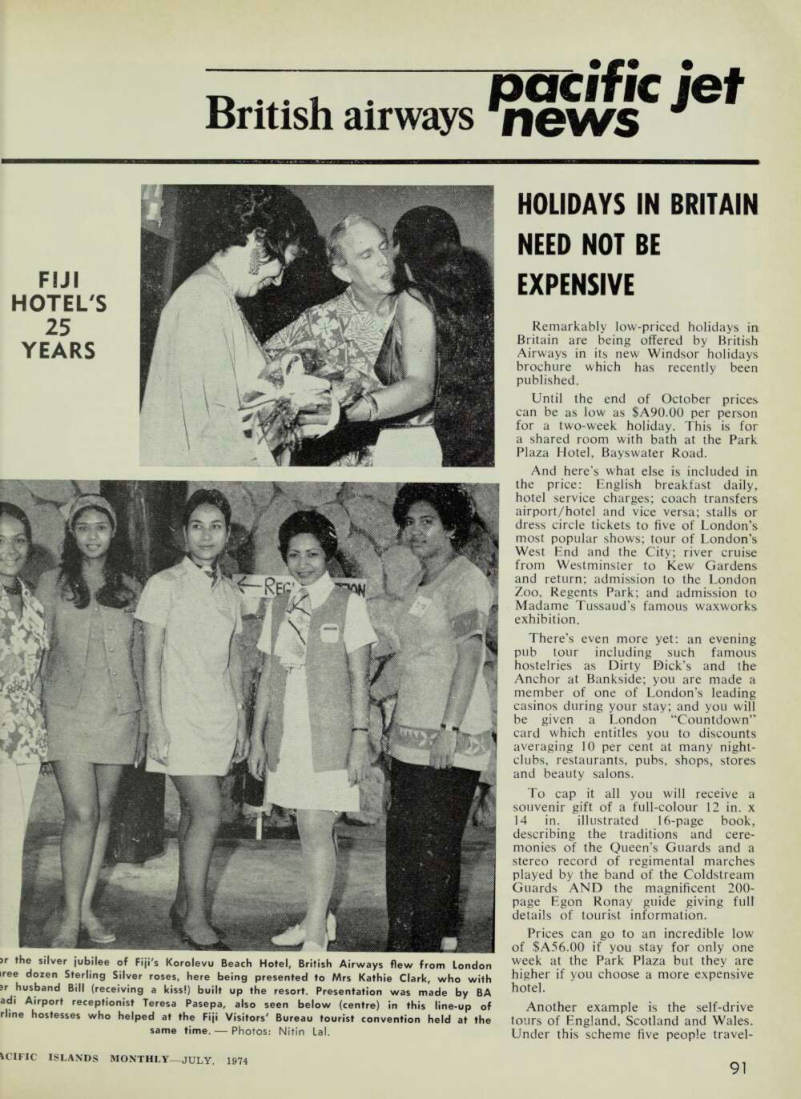
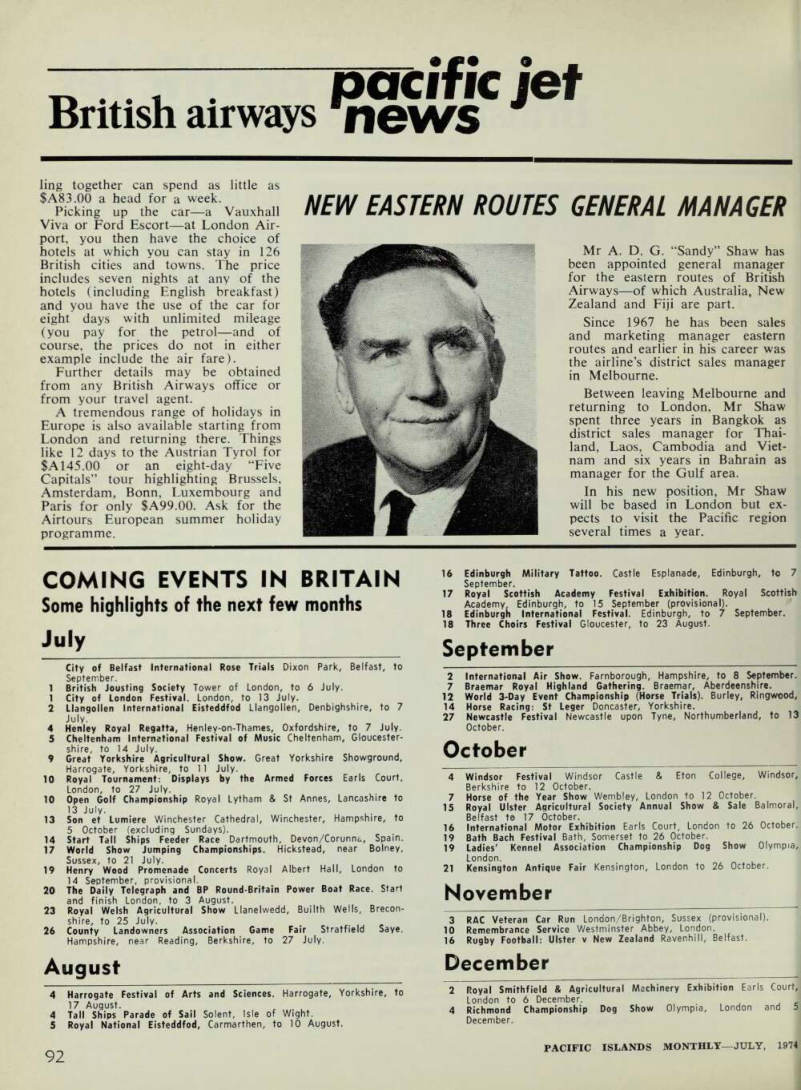
Need Not Be
Expensive
Remarkably low-priced holidays in Britain are being offered by British Airways in its new Windsor holidays brochure which has recently been published.
Until the end of October prices can be as low as 1A90.00 per person for a two-week holiday. This is for a shared room with bath at the Park Plaza Hotel, Bayswater Road.
And here’s what else is included in the price: English breakfast daily, hotel service charges; coach transfers airport/hotel and vice versa; stalls or dress circle tickets to five of London’s most popular shows; tour of London’s West End and the City; river cruise from Westminster to Kew Gardens and return; admission to the London Zoo. Regents Park; and admission to Madame Tussaud’s famous waxworks exhibition.
There’s even more yet: an evening pub tour including such famous hostelries as Dirty Dick’s and the Anchor at Bankside; you are made a member of one of London’s leading casinos during your stay; and you will be given a London “Countdown” card which entitles you to discounts averaging 10 per cent at many night clubs, restaurants, pubs, shops, stores and beauty salons.
To cap it all you will receive a souvenir gift of a full-colour 12 in. x 14 in. illustrated 16-page book, describing the traditions and cere monies of the Queen’s Guards and a stereo record of regimental marches played by the band of the Coldstream Guards AND the magnificent 200page Egon Ronay guide giving full details of tourist information.
Prices can go to an incredible low of 5A56.00 if you stay for only one week at the Park Plaza but they are higher if you choose a more expensive hotel.
Another example is the self-drive tours of England, Scotland and Wales.
Under this scheme five people travel
Fiji
Hotel's
25
Years
[?]or the silver jubilee of Fiji's Korolevu Beach Hotel, British Airways flew from London [?]ree dozen Sterling Silver roses, here being presented to Mrs Kathie Clark, who with [?]er husband Bill (receiving a kiss!) built up the resort. Presentation was made by BA [?]adi Airport receptionist Teresa Pasepa, also seen below (centre) in this line-up of [?]rline hostesses who helped at the Fiji Visitors' Bureau tourist convention held at the same time. Photos: Nitin Lai.
ling together can spend as little as 5A83.00 a head for a week.
Picking up the car—a Vauxhall Viva or Ford Escort—at London Air port, you then have the choice of hotels at which you can stay in 126 British cities and towns. The price includes seven nights at any of the hotels (including English breakfast) and you have the use of the car for eight days with unlimited mileage (you pay for the petrol—and of course, the prices do not in either example include the air fare).
Further details may be obtained from any British Airways office or from your travel agent.
A tremendous range of holidays in Europe is also available starting from London and returning there. Things like 12 days to the Austrian Tyrol for 5A145.00 or an eight-day “Five Capitals” tour highlighting Brussels, Amsterdam, Bonn, Luxembourg and Paris for only 5A99.00. Ask for the Airtours European summer holiday programme.
Advertisements & other items, p. 93 (1 item)
tj ... i . pacific jet
British airways
New Eastern Routes General Manager
Mr A. D. G. “Sandy” Shaw has been appointed general manager for the eastern routes of British Airways—of which Australia, New Zealand and Fiji are part.
Since 1967 he has been sales and marketing manager eastern routes and earlier in his career was the airline’s district sales manager in Melbourne, Between leaving Melbourne and returning to London, Mr Shaw spent three years in Bangkok as district sales manager for Thai land, Laos, Cambodia and Viet nam and six years in Bahrain as manager for the Gulf area.
In his new position, Mr Shaw will be based in London but ex pects to visit the Pacific region several times a year.
July
Coming Events In Britain
Some highlights of the next few months
City of Belfast International Rose Trials Dixon Park, Belfast, to September. 1 British Jousting Society Tower of London, to 6 July. 1 City of London Festival. London, to 13 July. 2 Llangollen International Eisteddfod Llangollen, Denbighshire, to 7 July. 4 Henley Royal Regatta, Henley-on-Thames, Oxfordshire, to 7 July. 5 Cheltenham International Festival of Music Cheltenham, Gloucester shire, to 14 July. 9 Great Yorkshire Agricultural Show. Great Yorkshire Showground, Harrogate, Yorkshire, to 11 July. 10 Royal Tournament: Displays by the Armed Forces Earls Court, London, to 27 July. 10 Open Golf Championship Royal Lytham & St Annes, Lancashire to 13 July. 13 Son et Lumiere Winchester Cathedral, Winchester, Hampshire, to 5 October (excluding Sundays). 14 Start Tall Ships Feeder Race Dartmouth, Devon/Corunna, Spain. 17 World Show Jumping Championships. Hickstead, near Bolney, Sussex, to 21 July. 19 Henry Wood Promenade Concerts Royal Albert Hall, London to 14 September, provisional. 20 The Daily Telegraph and BP Round-Britain Power Boat Race. Start and finish London, to 3 August. 23 Royal Welsh Agricultural Show Llanelwedd, Builth Wells, Brecon shire, to 25 July. . . 26 County Landowners Association Game Fair Stratfield Saye, Hampshire, near Reading, Berkshire, to 27 July.
August
4 Harrogate Festival of Arts and Sciences. Harrogate, Yorkshire, to 17 August. 4 Tall Ships Parade of Sail Solent, Isle of Wight. 5 Royal National Eisteddfod, Carmarthen, to 10 August.
16 Edinburgh Military Tattoo. Castle Esplanade, Edinburgh, to 7 September. 17 Royal Scottish Academy Festival Exhibition. Royal Scottish Academy Edinburgh, to 15 September (provisional). 18 Edinburgh International Festival. Edinburgh, to 7 September. 18 Three Choirs Festival Gloucester, to 23 August.
September
2 International Air Show. Farnborough, Hampshire, to 8 September. 7 Braemar Royal Highland Gathering. Braemar, Aberdeenshire. 12 World 3-Day Event Championship (Horse Trials). Burley, Ringwood, 14 Horse Racing; St Leger Doncaster, Yorkshire. 27 Newcastle Festival Newcastle upon Tyne, Northumberland, to 13 October.
October
4 Windsor Festival Windsor Castle & Eton College, Windsor, Berkshire to 12 October. 7 Horse of the Year Show Wembley, London to 12 October. 15 Royal Ulster Agricultural Society Annual Show & Sale Balmoral, Belfast ta 17 October. 16 International Motor Exhibition Earls Court, London to 26 October. 19 Bath Bach Festival Bath, Somerset to 26 October. 19 Ladies' Kennel Association Championship Dog Show Olympia, London. 21 Kensington Antique Fair Kensington, London to 26 October.
November
3 RAC Veteran Car Run London/Brighton, Sussex (provisional). 10 Remembrance Service Westminster Abbey, London. 16 Rugby Football: Ulster v New Zealand Ravenhill, Belfast.
December
2 Royal Smithfield & Agricultural Machinery Exhibition Earls Court,] London to 6 December. 1 4 Richmond Championship Dog Show Olympia, London and 5 December.
Advertisements & other items, pp. 94-98 (4 items)
British airways
93
ACIFIC ISLANDS MONTHLY—JULY, 1974
So Superior It’s Sensational I
£ r > r: mtfp Ku£ 0& soysa
STSFLfi-
s*£ i HI
So Superior It’s Sensational I
Discover the easy, delicious way famous chefs use to enhance the flavor of meat, poultry, fish . . . casseroles, stews and gravies.
There's no substitute for "vintage flavor"
Kikkoman the preferred soy sauce.
jy KIKKOMAN SHOYU CO., LTD.
Nihonbashi, Tokyo 103, Japan
Our business is cargo.
Your cargo: to anywhere in our Pacific Two paddle steamers on the Yangtse River in 1873 marked the beginning of the China Navigation Company. Today, the same flag flies above eighteen modern motor ships plying an extensive network of cargo routes between Papua New Guinea and Pacific Island ports (as far East as Tahiti] and Japan, New Zealand, Australia and Thailand.
For 100 years, the flag of the China Navigation Company has meant experience, reliability and speed across the sea. Today, it’s flying as strong as ever.
For further details and all enquiries there are Agents at the following ports: Papua New Guinea: Steamships Trading Co. Ltd., Port Moresby, Samarai, Lae, Madang, Rabaul, Kieta. Burns Philp (New Guinea) Ltd., Wewak, Kavieng. Fiji: Morris Hedstrom Ltd., Suva, Lautoka. Western Samoa: Morris Hedstrom Ltd., Apia.
Tonga: Morris Hedstrom Ltd., Nuku’alofa and Vava’u. Tahiti: Etablissements Donald Tahiti, Papeete. New Caledonia: Etablissements Ballande, Noumea. 8.5.1. P.; British Solomons Trading Co. Ltd., Honiara. New Hebrides: Les Comptoirs Francais desNouvelles-Hebrides, Vila and Santo. AUSTRALIA—Sydney: Interocean Swire Pty. Ltd. Melbourne: Interocean Australia Services Pty. Ltd. Brisbane: Wills, Gilchrist & Sanderson Pty. Ltd. NEW ZEALAND—?. & O. (N.Z.) Ltd.
Auckland, Wellington, Christchurch, Dunedin, Bluff, Napier. Japan: Swire McKinnon, Tokyo, Yokohama, Osaka, Kobe and Nagoya. Eastern Managers; Butterfield & Swire, 9 Connaught Rd., Central, Hong Kong. /'PN \cn) JOHN SWIRE & SONS PTY. LTD. General Agents in Australia, 8 Spring Street, Sydney, Phone: 27 9351.
THE CHINA NAVIGATION CO LTE
MEMBER OF THE SWIRE CROUP.
It took time to perfect the
NEW Hyster electrics.
Time to make the best.
* 4 i 1 ... ■
HYSTER
We could have added new Hyster electric trucks to our extensive lift truck range some time ago. After all, we knew what people wanted, and we had the dealer and service network to back our sales Australia-wide.
But long after electric lift trucks first hit the market, we were busy perfecting a better hydraulic system to overcome the oil leaks and minimise the battery drain other manufacturers weren't so concerned about.
We wanted to make ours the top performance electric. An easy-handling truck with a short turning radius. Longer life between charges. Smoother deceleration. And single pedal control to keep the drivers happy.
Now, we’ve built these advantages into a range of Hyster electric trucks with load capacities of up to 10,000 lbs (5,000 kgs). We believe they're the world's finest, and they’re available from your Hyster dealer. Ask to see them in action. Or contact Hyster Australia Pty. Ltd., Ashford Avenue, Milperra, N.S.W. 2214. Telephone Sydney 77 0511.
HYSTER AUSTRALIA PTY. LTD.
HR39.84
r * \ 4 W* f: im 4 •' : : ! -*■ y, * ii * -V £ ,4fe: oi*J' m m 4' :; I tW" ■■ ' > : :»■■:»
iiSi
i• ; , \ ;-i • »..j ?«5j s» ■/ r > > * S »# m IlilliiP ■- .v : m
famous
There is no Substitute (or Quality
95
ICIFIC ISLANDS MONTHLY—JULY, 1974
Business and Development

Western Samoa moves towards stronger trade ties
From FELISE VA’A in Apia
After months of seeming lethargy, Samoa’s Mata’afa government has some big things up its sleeve.
And about time. The general elections are only about 17 months away and the government will have to do something to earn the confi dence of the next new batch of parliamentarians, expected, if Samoan politics run true to form, to number about half the strength of the Fono.
Indications that the government is ip to something came from Mata’afa’s nost outspoken minister, Mr Sam Saili, Minister of Finance, Tourism md Economic Development.
Just returned from the annual ?oard meeting of the Asian Develop nent Bank, Saili said the govern nent was trying to attract a fish can ling company to Western Samoa.
It is not sure which company is he target but it is known for certain hat Saili had had a close look at he fish canning operations of Jumblebee Co in Honolulu. He was nore than impressed.
“Bumblebee is now using a new echnique which eliminates the smell characteristic of fish canning actories,” said the minister.
However, the proposal to attract uch operations to Western Samoa s not new, since it was started by the >revious Tamasese government. Then, he discussions had been with the faiwanese —a fact which lowered the •restige of the Tamasese government, s Red China was then in the scendancy.
The present government’s dis ussions on the question of fish can aries seem to be mainly with the
American companies.
Another notable announcement ''hich Saili made was the possibility i the near future of a trade agree ment with New Zealand.
On his way back from the ADB meeting, Saili had top-level dis ussions on this matter with the NZ ministers of finance, industries and ommerce, overseas trade and ustoms.
Judging from Saili’s statements, the
NZ ministers seemed to have wel comed the idea of a trade agreement between the two countries. And why not? At the moment, New Zealand is Western Samoa’s number one trading partner.
A trade agreement with New Zealand had always been one of Saili’s favourite ideas, even before he entered parliament. Why he didn’t try to bring this about much sooner is a surprise. Hand in hand with the trade agreement will be a reform of the tariff system.
The present system, giving pre ferential treatment to other members of the Commonwealth, will be changed to a single tariff system whereby all countries will get the same tariff, with the exception of those countries with which Western Samoa has a trade agreement.
“The single tariff system is a fairer system,” said Saili. “Under it every body will be equal, except that we will have to give preference to those countries which give us certain ad vantages under a trade agreement.”
He said it wasn’t fair to give pre ference to countries like Singapore and Hong Kong which did not import anything from Western Samoa.
But the trade agreement and single tariff ideas, like the fish cannery, still belong to the future.
The trade agreement would help to solve to a large extent Western Samoa’s present problems of finding suitable markets for its agricultural produce, especially bananas. A fixed banana quota from New Zealand would enable Samoans to plan pro duction.
The tariff system will enable Western Samoa to obtain the maxi mum trade deals with its partners.
The fish cannery will certainly help Western Samoa’s exports and as well create a lot of jobs for Samoans.
It seems that with the general elections approaching, the govern ment party, under pressure from in side and outside, is gradually revers ing its tough policy on economic controls.
With half its term gone it was not before time. In the first 18 months of its life, the Mata’afa government fell short of the country’s expecta tions and looked to have few chances of being returned to power in the general elections at the end of next year. Mata’afa was not showing the high leadership qualities that he demonstrated during his first two terms as Prime Minister yet, last year, the country turned to him be cause of these same qualities.
His government has been blamed for one of Samoa’s worst recessions as a result of stringent economic policies adopted soon after it took over from the Tamasese government.
As part of those policies it, in effect, abolished the bed-tax of Si per night on hotel guests by reducing the
rate to zero to get round the legisla tion which set it up in the first place.
A lot of pressure to remove the tax was put on ministers by those interest ed in the tourist industry but the result had been a loss of revenue to the government which is already hard-pressed financially.
The government recently announced that it intends to introduce a new tax on tourists, beginning January 1975, if the necessary legislation is approved by parliament.
The new 10 per cent surtax on ac counts is expected to rake in more from tourists than the old bed-tax but apparently government thinking now is that as it is spending a lot of money on tourist development, it is up to the visitor to contribute some of it. (See comment p 47.) Another unpopular measure was the reduction in merchants’ import allocations that kept supplies of im ported foodstuffs in short supply for most of 1973, This was coupled with Price Control Board action that pegged retail prices of some goods below landed cost. This was changed towards the end of 1973 and there have been fewer complaints from merchants since.
Government instructions to the Bank of Western Samoa and other lending institutions resulted in a credit squeeze. It has been exceedingly
difficult to gets loans for development and building although there is obviously a lot of money lying idle in the country.
The government floated its National Development Loan of $1 million in May, increasing interest rates and allowing investors to pay on the installment plan—2o per cent now and the rest by November.
The money will go on such things as urban and east coast roads and to provide capital for the Development Bank which makes loans for primary producers.
The government has cancelled (the official term is “suspended”) the Asian Development Bank loan which was to be spent on improvements to the Apia water supply which, accord ing to some accounts, would not be regarded fit to swim in, much less drink, in places like New Zea land. Recently the Deputy Director of Works, Mr Keith Mawson, said in an address to Rotarians that he had seen small, transparent fish come out of local taps—but he denied ever having seen eels.
Mr Saili said that the ADB loan was suspended while the government looked around to see if any money were available. What it really means is that the government has already decided to use some NZ aid money for the water supply.
Japanese In Png
Copper Search
PNG Minister for Mines and Energy, Sir Paul Lapun, has ap proved a plan for a group of Japanese companies to become involved in development of the Frieda River copper prospect in the West Sepik district.
Under the plan, the Japanese group, which is headed by the Sumitomo Corporation, will spend up to $5 million over the next five years in exploration, testing and engineering work.
If the Japanese companies spend the full $5 million, they earn a 40 per cent interest in the project. The remaining 60 per cent would be held by Mt Isa Mines, which has done the ex ploration work at Frieda River to date.
The Frieda River deposit is estimated to contain more than 300 million tons of low-grade copper ore.
Advertisements & other items, p. 99 (1 item)
97
ACIFIC ISLANDS MONTHLY—JULY, 1974
tor grabs
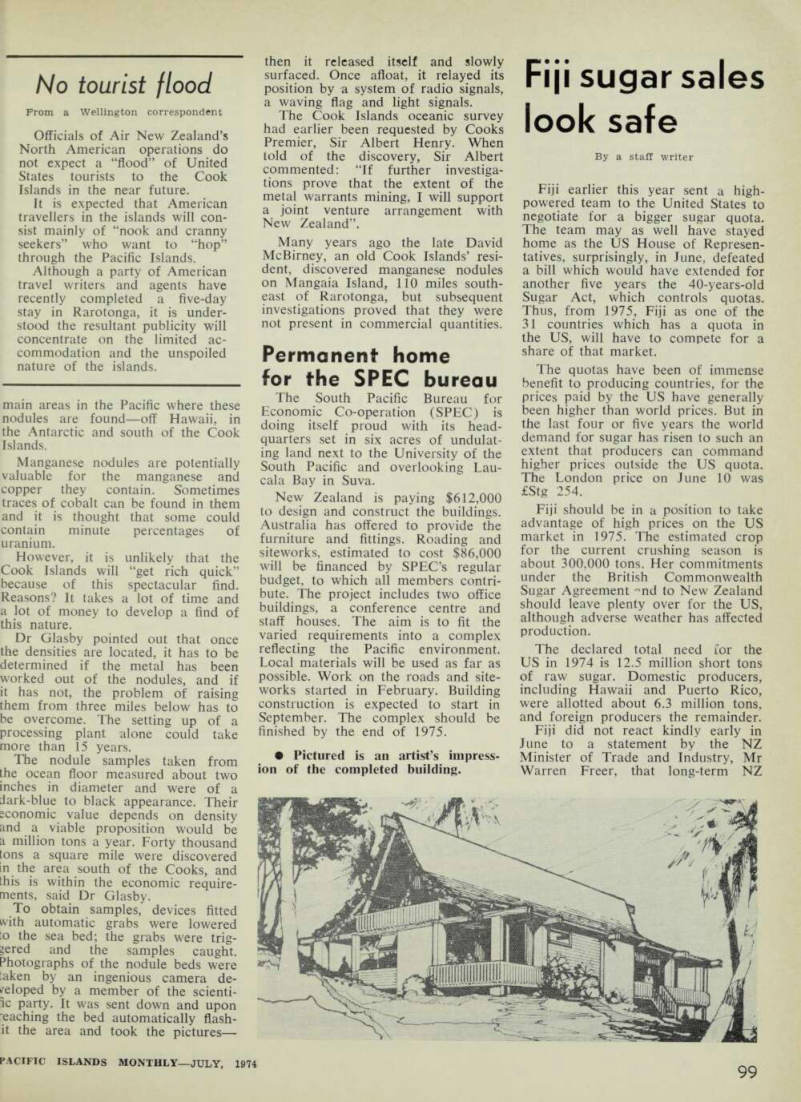
Fortune up tor grabs
From W. H. Percival
in Rarotonga A large and highly-concentrated field of manganese nodules was dis covered on the ocean floor near Rarotonga in mid-May by Dr G. P.
Glasby, a scientist leading an oceanic nodule-searching expedition through the south-west Pacific.
The most highly concentrated areas lie between 120 and 400 miles south-west of Rarotonga and the 100 per cent manganese concentration lies at a depth of 5,400 metres. Be yond these limits the nodule con centration drops to 50 per cent, then 25 per cent, and finally nil.
Dr Glasby, of New Zealand’s Oceanographic Institute, with Dr H.
Backer of West Germany and Mr M. A. Meylan, MSc of the Hawaii Department of Oceanography had arrived with the NZRV Tangaroa on May 15. The research voyage is being made under the auspices of the NZ Department of Scientific and Industrial Research.
Dr Glasby said there are three
main areas in the Pacific where these nodules are found—off Hawaii, in the Antarctic and south of the Cook Islands.
Manganese nodules are potentially valuable for the manganese and copper they contain. Sometimes traces of cobalt can be found in them and it is thought that some could contain minute percentages of uranium.
However, it is unlikely that the Cook Islands will “get rich quick” because of this spectacular find.
Reasons? It takes a lot of time and a lot of money to develop a find of this nature.
Dr Glasby pointed out that once the densities are located, it has to be determined if the metal has been worked out of the nodules, and if it has not, the problem of raising them from three miles below has to be overcome. The setting up of a processing plant alone could take more than 15 years.
The nodule samples taken from the ocean floor measured about two inches in diameter and were of a dark-blue to black appearance. Their economic value depends on density and a viable proposition would be a million tons a year. Forty thousand tons a square mile were discovered in the area south of the Cooks, and this is within the economic require ments, said Dr Glasby.
To obtain samples, devices fitted with automatic grabs were lowered to the sea bed; the grabs were trig gered and the samples caught.
Photographs of the nodule beds were taken by an ingenious camera de veloped by a member of the scienti fic party. It was sent down and upon •eaching the bed automatically flash it the area and took the pictures—
then it released itself and slowly surfaced. Once afloat, it relayed its position by a system of radio signals, a waving flag and light signals.
The Cook Islands oceanic survey had earlier been requested by Cooks Premier, Sir Albert Henry. When told of the discovery, Sir Albert commented: “If further investiga tions prove that the extent of the metal warrants mining, I will support a joint venture arrangement with New Zealand”.
Many years ago the late David Mcßirney, an old Cook Islands’ resi dent, discovered manganese nodules on Mangaia Island, 110 miles south east of Rarotonga, but subsequent investigations proved that they were not present in commercial quantities.
Permanent home
for the SPEC bureau
The South Pacific Bureau for Economic Co-operation (SPEC) is doing itself proud with its head quarters set in six acres of undulat ing land next to the University of the South Pacific and overlooking Lau cala Bay in Suva.
New Zealand is paying $612,000 to design and construct the buildings.
Australia has offered to provide the furniture and fittings. Reading and siteworks, estimated to cost $86,000 will be financed by SPEC’s regular budget, to which all members contri bute. The project includes two office buildings, a conference centre and staff houses. The aim is to fit the varied requirements into a complex reflecting the Pacific environment.
Local materials will be used as far as possible. Work on the roads and site works started in February. Building construction is expected to start in September. The complex should be finished by the end of 1975.
Advertisements & other items, p. 100 (1 item)
Machinery,Inc.
YOU GET A BETTER DEAL FROM
PA CIFIC MA CH/NERY
3 Wh r New and Used Equipment Parts Availability Throughout the Pacific
YOUR
CATERPILLAR
DEALER
PACIFIC
MACHINERY,INC.
SUBSIDIARY OF THEO. H, DAVIES & CO., LTD.
HAWAII: 94-025 Farrington Hwy., Waipahu, Hawaii, 9679 7. Phone: 677-9111. Cable: "PAMACAT . Tlx.; 723397.
GUAM; Phone 646-4479. Also U.S. Trust Territory and American Samoa.
No tourist flood
Prom a Wellington correspondent Officials of Air New Zealand’s North American operations do not expect a “flood” of United States tourists to the Cook Islands in the near future.
It is expected that American travellers in the islands will con sist mainly of “nook and cranny seekers” who want to “hop” through the Pacific Islands.
Although a party of American travel writers and agents have recently completed a five-day stay in Rarotonga, it is under stood the resultant publicity will concentrate on the limited ac commodation and the unspoiled nature of the islands.
Fiji sugar sales
look safe
By a staff writer
Fiji earlier this year sent a high powered team to the United States to negotiate for a bigger sugar quota.
The team may as well have stayed home as the US House of Represen tatives, surprisingly, in June, defeated a bill which would have extended for another five years the 40-years-old Sugar Act, which controls quotas.
Thus, from 1975, Fiji as one of the 31 countries which has a quota in the US, will have to compete for a share of that market.
The quotas have been of immense benefit to producing countries, for the prices paid by the US have generally been higher than world prices. But in the last four or five years the world demand for sugar has risen to such an extent that producers can command higher prices outside the US quota.
The London price on June 10 was £Stg 254.
Fiji should be in a position to take advantage of high prices on the US market in 1975. The estimated crop for the current crushing season is about 300,000 tons. Her commitments under the British Commonwealth Sugar Agreement ~nd to New Zealand should leave plenty over for the US, although adverse weather has affected production.
The declared total need for the US in 1974 is 12.5 million short tons of raw sugar. Domestic producers, including Hawaii and Puerto Rico, were allotted about 6.3 million tons, and foreign producers the remainder.
Fiji did not react kindly early in June to a statement by the NZ Minister of Trade and Industry, Mr Warren Freer, that long-term NZ
• Pictured is an artist’s impress ion of the completed building.
contracts with Fiji and Australia would ensure cheap sugar for New Zealanders for the next 10 years.
The Fiji Prime Minister, Ratu Sir Kamisese Mara, accepted an invita tion from the NZ Prime Minister, Mr Norman Kirk, to go to NZ to “discuss the agreement with a possible view to renegotiation”, Ratu Sir Kamisese hoped to take up the invita tion within a fortnight.
He said he would like a fair and reasonable price under prevailing circumstances. Presumably this was a reference to high world prices, given a kick along by inflationary pressures.
He also said no country liked to feel it was still supplying the cheapest food.
The Fiji Sugar Corporation and the NZ Sugar Co Ltd made an agree ment in 1973 for Fiji to supply New Zealand with 40,000 tons of sugar a year from 1974 to 1978. The arrange ments were confidential to the con tracting parties.
Fiji has supplied raw sugar to New Zealand for many years. In recent years she reached similar agreements with Singapore and Malaysia. The three agreements are aimed at giving security of outlet and price for the Fiji sugar industry.
Papua New Guinea took advantage of the recent visit by Ratu Sir Kamisese to ask Fiji to help it set up its own sugar industry. The Chief Minister, Mr Michael Somare, said Ratu Sir Kamisese and he had looked at the countryside, and Ratu Sir Kamisese told him PNG could go into the sugar industry without any problems.
Papua New Guinea should not have any trouble on the agricultural side of growing sugar. It grows a variety of “chewing” canes which are useful for breeding better commercial varieties of sugar-cane. In 1957, a US ex
pedition went to PNG to look for some of these varieties.
One member of the expedition, Dr John N. Warner, senior geneticist at the experiment station of the Hawaiian Sugar Planters’ Association, then told PIM it was almost certain that the sweet chewing canes origin ated in the New Guinea area. There was wild cane grown in New Guinea, which was suitable for breeding. Cane grown in Hawaii descended from cane collected by earlier expeditions to New Guinea.
Rice factor in
PNG living costs
From a Lae correspondent The consumer price index rose by 5.9 per cent in the March quarter, largely as the result of higher prices for oil imports, shipping freights and imported foods, including rice.
The bigger food bill gave some point to an address by the Chief Minister, Mr Michael Somare, to the people of Kaiapit, in the Markham Valley. He said that approval of his target of December 1, 1974, for in dependence would speed the process of developing a rice project in the Markham. The valley was quite cap able of growing rice, he said, but the Australian Government had stopped it because Australia was growing rice. Australia had ignored the de velopment of rice growing so it could export its own crop to Papua New Guinea.
The Chief Minister might also have said that tremendous efforts have been made in PNG since the end of the Pacific War to get a rice growing industry going. Some Euro peans grew rice in Markham Valley but gave up as cattle ranching de
veloped; indigenous growers, all the way from Mekeo to the Sepik, have also had sporadic enthusiasms for the crop.
None of these efforts has ever produced anything but a drop in the bucket of PNG’s total requirements.
One reason is that, traditionally, local farmers have favoured tree crops rather than annuals as the former do not require such sustained effort. Another reason is that it has now been proved that large mechan ised projects can produce better rice at more reasonable prices than a multitude of small peasant effort pri marily producing for themselves and selling their negligible surpluses. This has been shown in Fiji where the CSR rice project that was supposed to take the place of sugar in the Nausori area never got off the ground, and where the mill estab lished by the company processed nothing but rice imported from USA.
When the sugar mill closed those who had been employed in the in dustry spurned rice growing and simply got themselves jobs in Suva.
Fiji rice growing on a realistic scale never looked like a proposition until, in recent years, two feasibility projects were started in the Rewa and Navua River areas. Both pro jects were based on irrigated, heavily fertilised, weed controlled and mechanised methods. These methods are expensive but can be successful if the project is large enough, sufficient establishment capital is assured and the market is of sufficient size.
Mining Fiji's
magnetite sands
A shot in the arm for Fiji’s mining industry to complement the recovery of Vatukoula’s gold-mining enter prise, could come from the nearby Ba River delta in magnetite iron sands.
The chairman of Southland Mining Ltd, Mr Maurice Messara, says his company’s magnetite iron sands pro spect in Fiji has been outlined in the last year as a deposit of commercial size. The development of the project, with a proposed production rate of 700,000 tonnes of concentrates a year, is contingent on the negotiation of a long-term contract with Japanese interests.
Uiider contracts for similar material recently negotiated in New Zealand, prices were about SUSS to SUS 9 a tonne fob. The iron sands are pel letised and then used as feed for the steel-making process, producing about the same tonnage of basic steel as iron ore.
W. Samoa hopes
for duty free zone
From FELISE VA’A in Apia For many months past, a select committee of Western Samoan government “experts” has been carry ing out a feasibility study on a pro posed duty free industrial zone at Vaiusu. The study is nearly finished, and the government is now consider ing possible modifications before passing it on to parliament later this year.
The results of the study are as yet confidential, but reliable sources say it has been estimated that the mini mum cost of the project would be at least SWSIS million, a substantial sum.
The project would be an attempt to attract overseas investors to set ap business in the zone by allowing duty-free import of raw materials, generous tax concessions, and low Samoan labour costs.
The many concessions are ex pected to please the investors while Western Samoa is expected to benefit n many ways, including better jmployment opportunities for local people and more exports.
The idea of such a zone goes back ;o previous administrations though t is the present Minister of Finance, Sam Saili, who has tried to make it i reality.
Saili supports new industries, jspecially industries with export potential as he wants to see a better palance of payments position for Western Samoa.
But the project does not lack ppposition, especially by some key members of the Opposition. Firstly, he project is regarded as utopian as money to finance it would be hard ;o raise. It is believed that if money s available, it will be needed to inance the next Five Year Develop ment Plan, scheduled to start next However, it is believed that the Minister does not plan to depend on ocal money for setting up the zone, put that he will try to get the money is a gift (and possibly as a loan if jverything else fails) from the Japanese Government with which he las already been negotiating.
Apparently, the Japanese who are enthusiastic about the scheme have luggested that the Western Samoan Government first submit a prelimin iry proposal giving a general outline )f the project. A Japanese mission vould then go to Apia for a first hand look. The Japanese would then pe in a position to act.
Mr Saili told PIM while in Sydney pn his way home from Malaysia,
that the whole idea was to attract overseas capital and know-how, pro vide more employment and create an export trade. The goods emanating from Vaiusu would not be allowed on to the local market but would all be for export.
However, the Minister said, no decision had been made by the cabinet and forecasts on the success or otherwise of such a scheme were premature.
BSIP's goodbye to
the Aussie dollar
The Solomon Islands have a cur rency problem, according to an English expert, but no financial crisis.
It stems from the fact that the BSIP is to have its own currency shortly to re place Australian dollars and cents that it uses currently. It is thought that the local Melanesians might be suspicious of the new money.
Isn’t it possible that the experts underestimate the Solomon Islanders, who in the last couple of generations
have grappled with English half crowns, American dollars, Japanese yen, Australian £.S.D. and Australian dollars, and have still managed to survive?
If it is going to produce all the expected traumas, why change over at all?
The BSIP Governing Council agreed in principle in 1973 to intro duce BSIP currency at the beginning of 1976. Preliminary designs for the money have gone to England for further work.
A UK expert, Mr H. J. Tomkins, who has special responsibilities for currency and banking legislation in the Bank of England, has emphasised that a fundamental factor in success fully launching and establishing a distinctive Solomon Islands currency would be to get the confidence of the public, by convincing them that the external value of the currency would be maintained.
That would best be achieved he thinks, by ensuring that the currency is immediately convertible on demand into a currency of international stand ing, and an obvious choice of cur rency to back the Solomons currency might be the Austr r; an dollar, long familiar and trusted.
The main economic advantage, apart from the convenience of having reserve stocks of notes and coin im mediately available for issue against payment in Honiara, and perhaps other centres in the BSIP, would be the interest which would be earned on the currency backing.
Mr Tomkins also advised the BSIP Government on the introduction of banking legislation to regulate the entry and establishment of new banks.
New National Bank
subsidiary for PNG
The National Bank of Australia has formed a subsidiary to operate in Papua New Guinea. The bank will be known as the Bank of South Pacific Ltd and on October 1, 1974, it will take over the six-branch net work of the National. The principal branch is at Port Moresby. The others are at Lae, Boroko, Mount Hagen, Rabaul and Kieta.
Initially the new bank will be a wholly-owned subsidiary of the National. TLere is provision to issue shares to local people later. On the board are some of the “big names” in Australian commerce—Sir James Forrest, Mr R. R. Law-Smith, Mr J. L. Amies, Sir Rupert Clarke, Mr P. H. Finley, Mr Andrew Grimwade and Mr P. J. V. Ramsden.
The bank will set up a local train ing programme. The National has been in PNG for 17 years.
Advertisements & other items, p. 102 (1 item)
■Grasslands^
Australia’s finest agricultural
equipment is now illustrated
in one new folder by Grasslands.
Send for your free copy today.
■GRASSLANDS^
■25 Fairfield St., Villawood, 1 • - ■ ■'
■ N.S.W. 2163 AUSTRALIA
■ NAME
■ ADDRESS
Group mtmoer
SIMS CONSOLIOAUO LID
r ”wmm. r.t. gb,oo p.c.
Japanese Nickel Talks
The Paris-based mining com pany COFREMMI is to export nickel ore from New Caledonia, despite opposition from indepen dent Caledonian operators at a time when their sales to Japan continue at a greatly reduced level.
Latest talks between Japanese buyers and Caledonian exporters took place in June in Sydney.
Earlier, at a meeting in Noumea in April, there had been no agreement.
In Sydney, an eleven man Noumea delegation represented the eighteen island exporters, in cluding the major operator, the Societe Le Nickel. Represent atives of the Japanese Gokokai association of five smelting com panies agreed to maintain the status quo on ore prices. The Japanese also agreed in future to buy 200,000 tons of ore from COFREMMI, part of the SOM MENI corporation installed in northern New Caledonia, around Koumac-Poum.
With negotiations subject to government control, the Japan ese buyers this time indicated their purchasing intentions three years ahead, although the Cale donians still remain dependent on their yearly quota allocations from the French Mines Depart ment.
Produce Prices
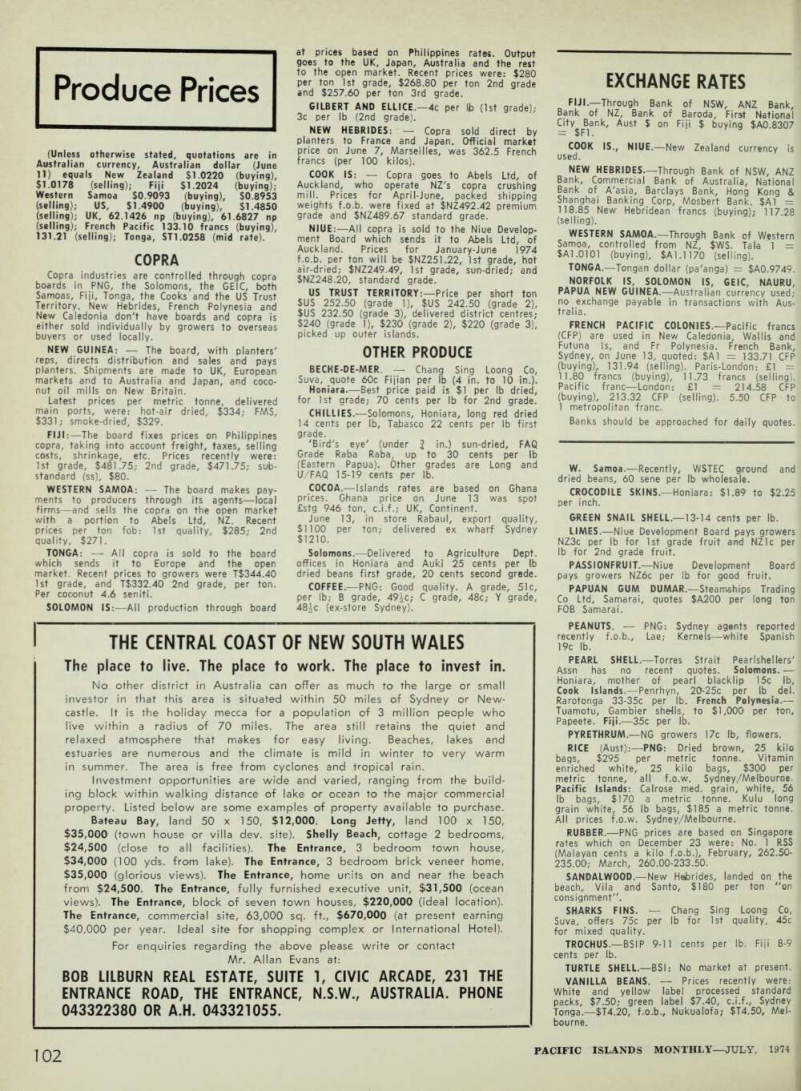
(Unless otherwise stated, quotations are in Australian currency, Australian dollar (June 11) equals New Zealand $1.0220 (buying), $1.0178 (selling); Fiji $1.2024 (buying); Western Samoa $0.9093 (buying), $0.8953 (selling); US, $1.4900 (buying), $1.4850 (selling); UK, 62.1426 np (buying), 61.6827 np (selling); French Pacific 133.10 francs (buying), 131.21 (selling); Tonga, 5T1.0258 (mid rate).
Copra
Copra industries are controlled through copra boards in PNG, the Solomons, the GEIC, both Samoas, Fiji, Tonga, the Cooks and the US Trust Territory. New Hebrides, French Polynesia and New Caledonia don't have boards and copra is either sold individually by growers to overseas buyers or used locally.
NEW GUINEA: The board, with planters' reps, directs distribution and sales and pays planters. Shipments are made to UK, European markets and to Australia and Japan, and coco nut oil mills on New Britain.
Latest prices per metric tonne, delivered main ports, were: hot-air dried, $334; FMS, $331; smoke-dried, $329.
FIJI: —The board fixes prices on Philippines copra, taking into account freight, taxes, selling costs, shrinkage, etc. Prices recently were: Ist grade, $481.75; 2nd grade, $471.75; sub standard (ss), $BO.
WESTERN SAMOA: The board makes pay ments to producers through its agents—local firms—and sells the copra on the open market with a portion to Abels Ltd, NZ. Recent prices per ton fob: Ist quality, $285; 2nd quality, $271.
TONGA; —• All copra is sold to the board which sends it to Europe and the open market. Recent prices to growers were T 5344.40 Ist grade, and T 5332.40 2nd grade, per ton.
Per coconut 4.6 seniti.
SOLOMON IS: —All production through board
at prices based on Philippines rates. Output goes to the UK, Japan, Australia and the rest to the open market. Recent prices were: $2BO per ton Ist grade, $268.80 per ton 2nd grade and $257.60 per ton 3rd grade.
GILBERT AND ELLICE.— 4c per lb (Ist grade); 3c per lb (2nd grade).
NEW HEBRIDES: Copra sold direct by planters to France and Japan, Official market price on June 7, Marseilles, was 362.5 French francs (per 100 kilos).
COOK IS: Copra goes to Abels Ltd, of Auckland, who operate NZ's copra crushing mill. Prices for April-June, packed shipping weights f.o.b. were fixed at $NZ492.42 premium grade and $NZ489.67 standard grade.
NIUE: —AII copra is sold to the Niue Develop ment Board which sends it to Abels Ltd, of Auckland. Prices for January-June 1974 f.o.b. per ton will be $NZ251.22, Ist grade, hot air-dried; $NZ249.49, Ist grade, sun-dried; and $NZ248.20, standard grade.
US TRUST TERRITORY:— Price per short ton SUS 252.50 (grade 1), SUS 242.50 (grade 2), SUS 232.50 (grade 3), delivered district centres; $240 (grade 1), $230 (grade 2), $220 (grade 3), picked up outer islands.
Other Produce
BECHE-DE-MER. Chang Sing Loong Co, Suva, quote 60c Fijian per lb (4 in. to 10 in.).
Honiara. —Best price paid is $1 per lb dried, for Ist grade; 70 cents per lb for 2nd grade.
CHILLIES. —Solomons, Honiara, long red dried 14 cents per lb. Tabasco 22 cents per lb first grade.
'Bird's eye' (under in.) sun-dried, FAQ Grade Raba Raba, up to 30 cents per lb (Eastern Papua). Other grades are Long and U/FAQ 15-19 cents per lb.
COCOA. —lslands rates are based on Ghana prices. Ghana price on June 13 was spot £stg 946 ton, c.i.f.; UK, Continent.
June 13, in store Rabaul, export quality, $llOO per ton,- delivered ex wharf Sydney $l2lO.
Solomons.— Delivered to Agriculture Dept, offices in Honiara and Auki 25 cents per lb dried beans first grade, 20 cents second grade.
COFFEE. —PNG: Good quality. A grade, 51c, per lb; B grade, 49£c; C grade, 48c; Y grade, (ex-store Sydney).
W. Samoa.—Recently, WSTEC ground and dried beans, 60 sene per lb wholesale.
CROCODILE SKlNS.— Honiara: $1.89 to $2.25 per inch.
GREEN SNAIL SHELL.—I 3-14 cents per lb.
LIMES. —Niue Development Board pays growers NZ3c per lb for Ist grade fruit and NZlc per lb for 2nd grade fruit.
PASSIONFRUIT. —Niue Development Board pays growers NZ6c per lb for good fruit.
PAPUAN GUM DUMAR.— Steamships Trading Co Ltd, Samarai, quotes SA2OO per long ton FOB Samarai.
PEANUTS. PNG: Sydney agents reported recently f.0.b., Lae; Kernels—white Spanish 19c lb.
PEARL SHELL. —Torres Strait Pearlshellers' Assn has no recent quotes. Solomons.
Honiara, mother of pearl blacklip 15c lb, Cook Islands. —Penrhyn, 20-25 c per lb del.
Rarotonga 33-35 c per lb. French Polynesia. — Tuamotu, Gambier shells, to $l,OOO per ton, Papeete. Fiji. —3sc per lb.
PYRETHRUM.— NG growers 17c lb, flowers.
RICE (Aust): — PNG: Dried brown, 25 kilo bags, $295 per metric tonne. Vitamin enriched white, 25 kilo bags, $3OO per metric tonne, all f.o.w. Sydney/Melbourne.
Pacific Islands: Calrose med. grain, white, 56 lb bags, $l7O a metric tonne. Kulu long grain white, 56 lb bags, $lB5 a metric tonne.
All prices f.o.w. Sydney/Melbourne.
RUBBER. —PNG prices are based on Singapore rates which on December 23 were: No. 1 RSS (Malayan cents a kilo f.0.b.), February, 262.50- 235.00; March, 260.00-233.50.
SANDALWOOD.— New Hebrides, landed on the beach, Vila and Santo, $lBO per ton "on consignment", SHARKS FINS. Chang Sing Loong Co, Suva, offers 75c per lb for Ist quality, 45c for mixed quality.
TROCHUS.— BSIP 9-11 cents per lb. Fiji 8-9 cents per lb.
TURTLE SHELL.— BSI: No market at present.
VANILLA BEANS. Prices recently were: White and yellow label processed standard packs, $7.50; green label $7.40, c.i.f., Sydney Tonga.—sT4.2o, f.0.b., Nukualofa; $T4.50, Mel bourne.
Exchange Rates
FlJl.— Through Bank of NSW, ANZ Bank, Bank of NZ, Bank of Baroda, First National City Bank, Aust $ on Fiji $ buying $A0.8307
Sfi.
COOK IS., NIUE. —New Zealand currency is used.
NEW HEBRIDES. —Through Bank of NSW, ANZ Bank, Commercial Bank of Australia, National Bank of A'asia, Barclays Bank, Hong Kong & Shanghai Banking Corp, Mosbert Bank. SAI = 118.85 New Hebridean francs (buying); 117.28 (selling).
WESTERN SAMOA. —Through Bank of Western Samoa, controlled from NZ, SWS. Tala 1 = SAI.OIOI (buying), $A1.1170 (selling).
TONGA.— Tongan dollar (pa'anga) = $A0.9749.
Norfolk Is, Solomon Is, Geic, Nauru,
PAPUA NEW GUlNEA. —Australian currency used; no exchange payable in transactions with Aus tralia.
FRENCH PACIFIC COLONIES.— Pacific francs (CFP) are used in New Caledonia, Wallis and Futuna Is, and Fr Polynesia. French Bank, Sydney, on June 13, quoted: SAI = 133.71 CFP (buying), 131.94 (selling). Paris-London: £1 rr 11.80 francs (buying), 11.73 francs (selling).
Pacific franc—London: £1 = 214.58 CFP (buying), 213.32 CFP (selling). 5.50 CFP to 1 metropolitan franc.
Banks should be approached for daily quotes.
Advertisements & other items, p. 104 (1 item)
The Central Coast Of New South Wales
The place to live. The place to work. The place to invest in.
No other district in Australia can offer as much to the large or small investor in that this area is situated within 50 miles of Sydney or Newcastle. It is the holiday mecca for a population of 3 million people who live within a radius of 70 miles. The area still retains the quiet and relaxed atmosphere that makes for easy living. Beaches, lakes and estuaries are numerous and the climate is mild in winter to very warm in summer. The area is free from cyclones and tropical rain.
Investment opportunities are wide and varied, ranging from the building block within walking distance of lake or ocean to the major commercial property. Listed below are some examples of property available to purchase.
Bateau Bay, land 50 x 150, $12,000. Long Jetty, land 100 x 150, $35,000 (town house or villa dev, site). Shelly Beach, cottage 2 bedrooms, $24,500 (close to all facilities). The Entrance, 3 bedroom town house, $34,000 (100 yds. from lake). The Entrance, 3 bedroom brick veneer home, $35,000 (glorious views). The Entrance, home units on and near the beach from $24,500. The Entrance, fully furnished executive unit, $31,500 (ocean views). The Entrance, block of seven town houses, $220,000 (ideal location).
The Entrance, commercial site, 63,000 sq. ft., $670,000 (at present earning $40,000 per year. Ideal site for shopping complex or International Hotel).
For enquiries regarding the above please write or contact Mr. Allan Evans at: 808 LILBURN REAL ESTATE, SUITE 1, CIVIC ARCADE, 231 THE ENTRANCE ROAD, THE ENTRANCE, N.S.W., AUSTRALIA. PHONE
043322380 OR A.H. 043321055.
Shipping & Airways Information
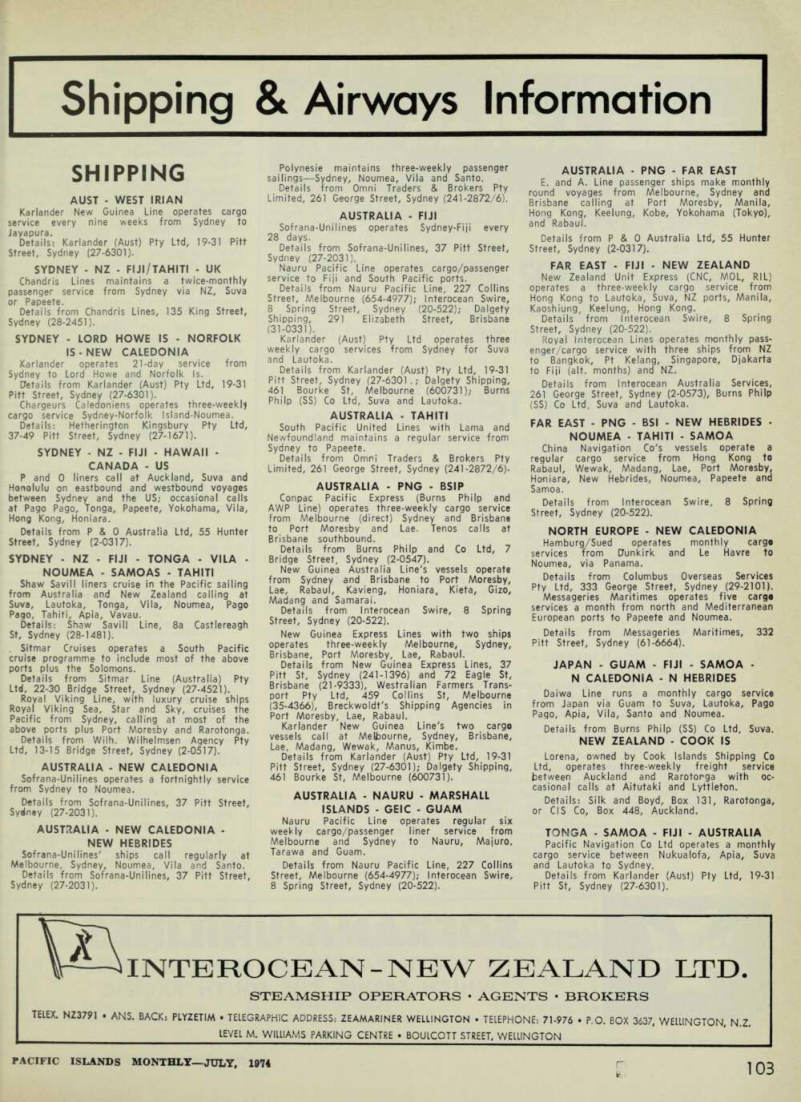
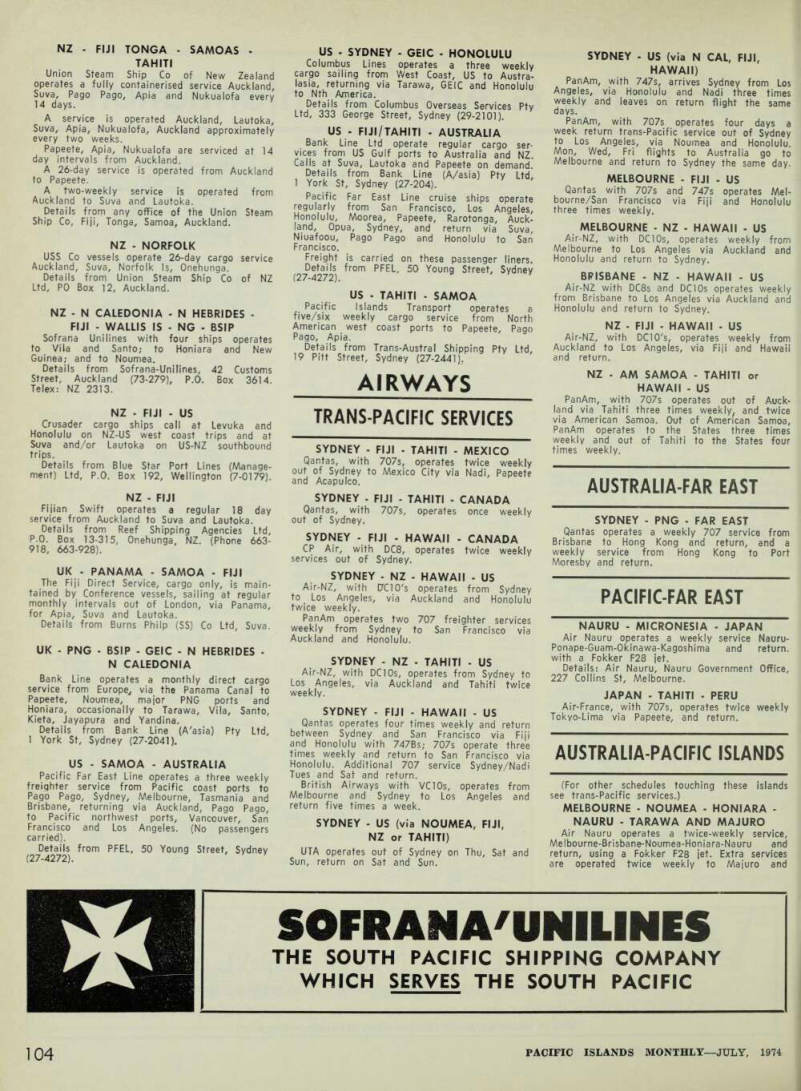
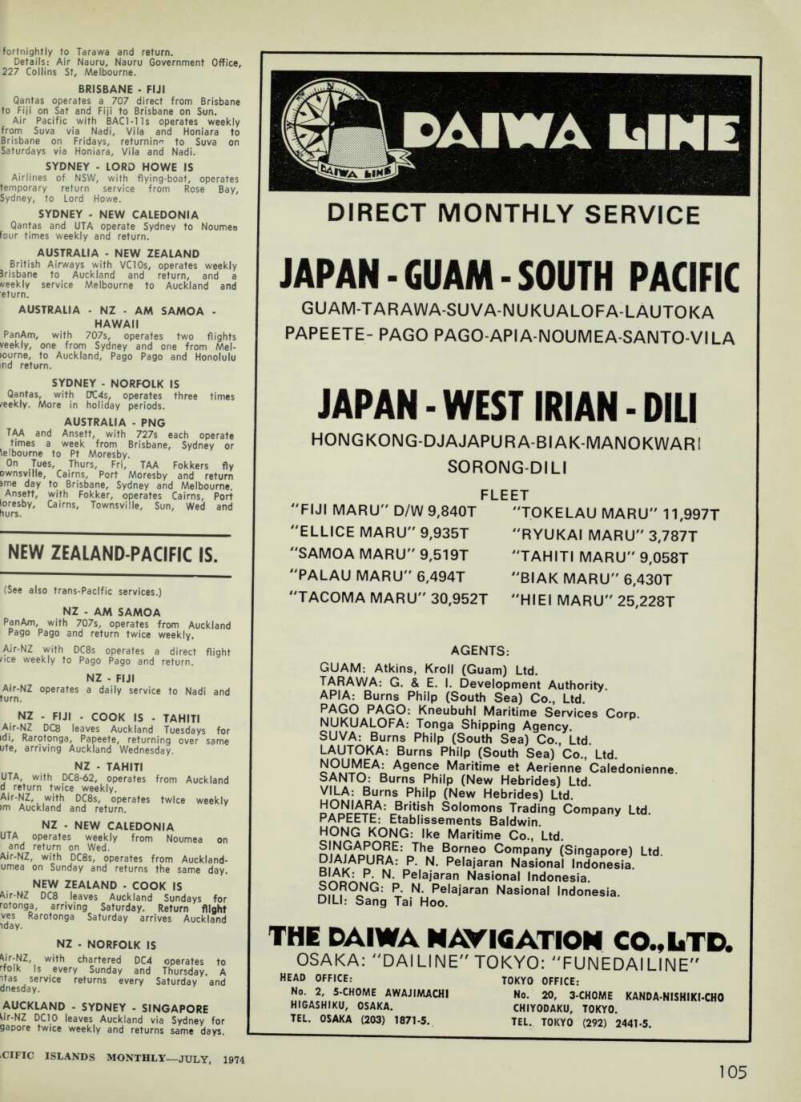
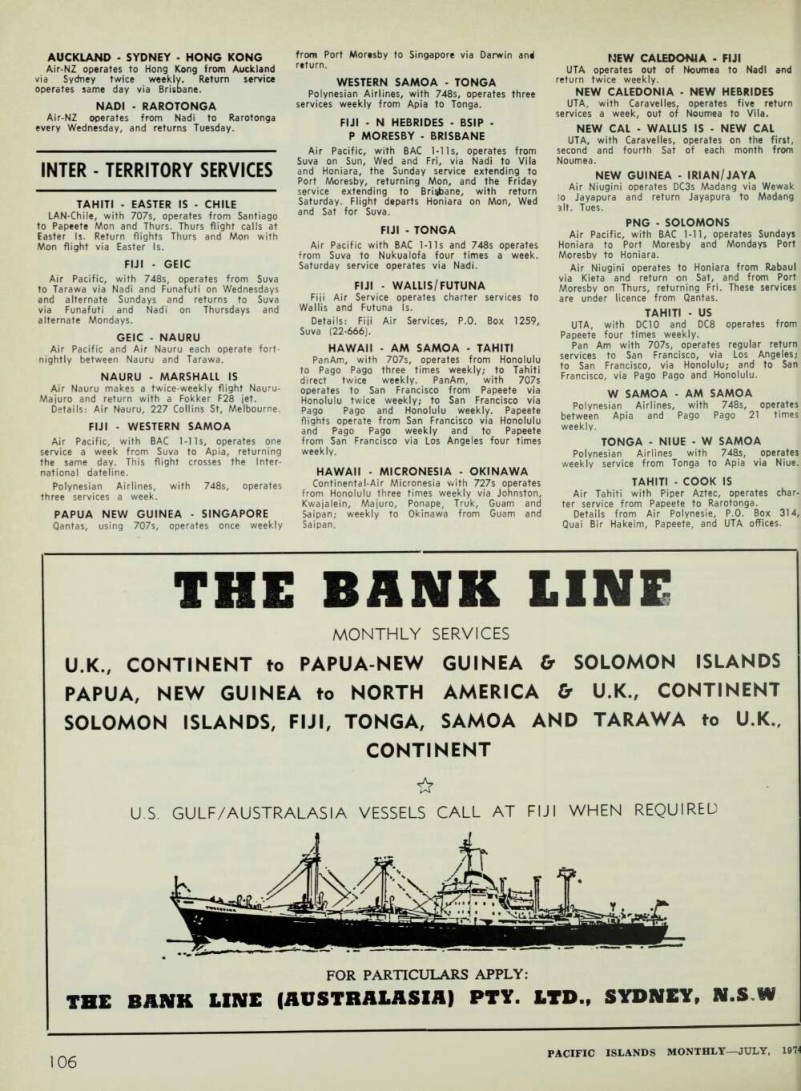
Shipping
Aust - West Irian
Karlander New Guinea Line operates cargo service every nine weeks from Sydney to Jayapura.
Details: Karlander (Aust) Pty Ltd, 19-31 Pitt Street, Sydney (27-6301).
SYDNEY - NZ - FIJI/TAHITI - UK Chandris Lines maintains a twice-monthly passenger service from Sydney via NZ, Suva or Papeete.
Details from Chandris Lines, 135 King Street, Sydney (28-2451).
SYDNEY ■ LORD HOWE IS - NORFOLK
Is-New Caledonia
Karlander operates 21-day service from Sydney to Lord Howe and Norfolk Is. details from Karlander (Aust) Pty Ltd, 19-31 Pitt Street, Sydney (27-6301).
Chargeurs Caledoniens operates three-weekly cargo service Sydney-Norfolk Island-Noumea.
Details: Hetherington Kingsbury Pty Ltd, 37-49 Pitt Street, Sydney (27-1671).
SYDNEY ■ NZ - FIJI - HAWAII -
Canada - Us
P and 0 liners call at Auckland, Suva and Honolulu on eastbound and westbound voyages between Sydney and the US; occasional calls at Pago Pago, Tonga, Papeete, Yokohama, Vila, Hong Kong, Honiara.
Details from P & 0 Australia Ltd, 55 Hunter Street, Sydney (2-0317).
SYDNEY - NZ - FIJI - TONGA - VILA ■
Noumea - Samoas - Tahiti
Shaw Savill liners cruise in the Pacific sailing from Australia and New Zealand calling at Suva, Lautoka, Tonga, Vila, Noumea, Pago Pago, Tahiti, Apia, Vavau.
Details: Shaw Savill Line, 8a Castlereagh St, Sydney (28-1481). . Sitmar Cruises operates a South Pacific cruise programme to include most of the above ports plus the Solomons.
Details from Sitmar Line (Australia) Pty Ltd, 22-30 Bridge Street, Sydney (27-4521).
Royal Viking Line, with luxury cruise ships Royal Viking Sea, Star and Sky, cruises the Pacific from Sydney, calling at most of the above ports plus Port Moresby and Rarotonga.
Details from Wilh. Wilhelmsen Agency Pty Ltd, 13-15 Bridge Street, Sydney (2-0517).
Australia - New Caledonia
Sofrana-Unilines operates a fortnightly service from Sydney to Noumea.
Details from Sofrana-Unilines, 37 Pitt Street, Sydney (27-2031).
Australia - New Caledonia -
New Hebrides
Sofrana-Unilines' ships call regularly at Melbourne, Sydney, Noumea, Vila and Santo.
Details from Sofrana-Unilines, 37 Pitt Street, Sydney (27-2031).
Polynesie maintains three-weekly passenger sailings—Sydney, Noumea, Vila and Santo.
Details from Omni Traders & Brokers Pty Limited, 261 George Street, Sydney (241-2872/6).
Australia - Fiji
Sofrana-Unilines operates Sydney-Fiji every 28 days.
Details from Sofrana-Unilines, 37 Pitt Street, Sydney (27-2031).
Nauru Pacific Line operates cargo/passenger service to Fiji and South Pacific ports.
Details from Nauru Pacific Line, 227 Collins Street, Melbourne (654-4977); Interocean Swire, 8 Spring Street, Sydney (20-522); Dalgety Shipping, 291 Elizabeth Street, Brisbane (31-0331).
Karlander (Aust) Pty Ltd operates three weekly cargo services from Sydney for Suva and Lautoka.
Details from Karlander (Aust) Pty Ltd, 19-31 Pitt Street, Sydney (27-6301.; Dalgety Shipping, 461 Bourke St, Melbourne (600731); Burns Philp (SS) Co Ltd, Suva and Lautoka.
Australia - Tahiti
South Pacific United Lines with Lama and Newfoundland maintains a regular service from Sydney to Papeete.
Details from Omni Traders & Brokers Pty Limited, 261 George Street, Sydney (241-2872/6).
Australia - Png - Bsip
Conpac Pacific Express (Burns Philp and AWP Line) operates three-weekly cargo service from Melbourne (direct) Sydney and Brisbane to Port Moresby and Lae. Tenos calls at Brisbane southbound.
Details from Burns Philp and Co Ltd, 7 Bridge Street, Sydney (2-0547).
New Guinea Australia Line's vessels operate from Sydney and Brisbane to Port Moresby, Lae, Rabaul, Kavieng, Honiara, Kieta, Gizo, Madang and Samarai.
Details from Interocean Swire, 8 Spring Street, Sydney (20-522).
New Guinea Express Lines with two ships operates three-weekly Melbourne, Sydney, Brisbane, Port Moresby, Lae, Rabaul.
Details from New Guinea Express Lines, 37 Pitt St, Sydney (241-1396) and 72 Eagle St, Brisbane (21-9333), Westralian Farmers Trans port Pty Ltd, 459 Collins St, Melbourne (35-4366), Breckwoldt's Shipping Agencies in Port Moresby, Lae, Rabaul.
Karlander New Guinea Line's two cargo vessels call at Melbourne, Sydney, Brisbane, Lae, Madang, Wewak, Manus, Kimbe.
Details from Karlander (Aust) Pty Ltd, 19-31 Pitt Street, Sydney (27-6301); Dalgety Shipping, 461 Bourke St, Melbourne (600731).
Australia - Nauru - Marshall
Islands - Geic - Guam
Nauru Pacific Line operates regular six weekly cargo/passenger liner service from Melbourne and Sydney to Nauru, Majuro, Tarawa and Guam.
Details from Nauru Pacific Line, 227 Collins Street, Melbourne (654-4977); Interocean Swire, 8 Spring Street, Sydney (20-522).
Australia - Png - Far East
E. and A. Line passenger ships make monthly round voyages from Melbourne, Sydney and Brisbane calling at Port Moresby, Manila, Hong Kong, Keelung, Kobe, Yokohama (Tokyo), and Rabaul.
Details from P & 0 Australia Ltd, 55 Hunter Street, Sydney (2-0317).
FAR EAST ■ FIJI ■ NEW ZEALAND New Zealand Unit Express (CNC, MOL, RIL) operates a three-weekly cargo service from Hong Kong to Lautoka, Suva, NZ ports, Manila, Kaoshiung, Keelung, Hong Kong.
Details from Interocean Swire, 8 Spring Street, Sydney (20-522).
Royal Interocean Lines operates monthly pass enger/cargo service with three ships from NZ to Bangkok, Pt Kelang, Singapore, Djakarta to Fiji (alt. months) and NZ.
Details from Interocean Australia Services, 261 George Street, Sydney (2-0573), Burns Philp (SS) Co Ltd, Suva and Lautoka.
FAR EAST - PNG - BSI - NEW HEBRIDES •
Noumea - Tahiti - Samoa
China Navigation Co's vessels operate a regular cargo service from Hong Kong to Rabaul, Wewak, Madang, Lae, Port Moresby, Honiara, New Hebrides, Noumea, Papeete and Samoa.
Details from Interocean Swire, 8 Spring Street, Sydney (20-522).
North Europe - New Caledonia
Hamburg/Sued operates monthly cargo services from Dunkirk and Le Havre to Noumea, via Panama.
Details from Columbus Overseas Services Pty Ltd, 333 George Street, Sydney (29-2101).
Messageries Maritimes operates five cargo services a month from north and Mediterranean European ports to Papeete and Noumea.
Details from Messageries Maritimes, 332 Pitt Street, Sydney (61-6664).
JAPAN - GUAM - FIJI - SAMOA -
N Caledonia - N Hebrides
Daiwa Line runs a monthly cargo service from Japan via Guam to Suva, Lautoka, Pago Pago, Apia, Vila, Santo and Noumea.
Details from Burns Philp (SS) Co Ltd, Suva.
New Zealand - Cook Is
Lorena, owned by Cook Islands Shipping Co Ltd, operates three-weekly freight service between Auckland and Rarotonga with oc casional calls at Aitutaki and Lyttleton.
Details: Silk and Boyd, Box 131, Rarotonga, or CIS Co, Box 448, Auckland.
TONGA - SAMOA - FIJI - AUSTRALIA Pacific Navigation Co Ltd operates a monthly cargo service between Nukualofa, Apia, Suva and Lautoka to Sydney.
Details from Karlander (Aust) Pty Ltd, 19-31 Pitt St, Sydney (27-6301).
NZ - FIJI TONGA ■ SAMOAS ■
Tahiti
Union Steam Ship Co of New Zealand operates a fully containerised service Auckland, Suva, Pago Pago, Apia and Nukualofa every 14 days.
A service is operated Auckland, Lautoka, Suva, Apia, Nukualofa, Auckland approximately every two weeks.
Papeete, Apia, Nukualofa are serviced at 14 day intervals from Auckland.
A 26-day service is operated from Auckland to Papeete.
A two-weekly service is operated from Auckland to Suva and Lautoka.
Details from any office of the Union Steam Ship Co, Fiji, Tonga, Samoa, Auckland.
Nz ■ Norfolk
USS Co vessels operate 26-day cargo service Auckland, Suva, Norfolk Is, Onehunga.
Details from Union Steam Ship Co of NZ Ltd, PO Box 12, Auckland.
NZ • N CALEDONIA - N HEBRIDES - FIJI - WALLIS IS - NG - BSIP Sofrana Unilines with four ships operates to Vila and Santo; to Honiara and New Guinea; and to Noumea.
Details from Sofrana-Unilines, 42 Customs Street, Auckland (73-279), P.O. Box 3614.
Telex: NZ 2313.
Nz - Fiji - Us
Crusader cargo ships call at Levuka and Honolulu on NZ-US west coast trips and at Suva and/or Lautoka on US-NZ southbound trips.
Details from Blue Star Port Lines (Manage ment) Ltd, P.O. Box 192, Wellington (7-0179).
Nz - Fiji
Fijian Swift operates a regular 18 day service from Auckland to Suva and Lautoka.
Details from Reef Shipping Agencies Ltd, P.O. Box 13-315, Onehunga, NZ. (Phone 663- 918, 663-928).
UK - PANAMA - SAMOA - FIJI The Fiji Direct Service, cargo only, is main tained by Conference vessels, sailing at regular monthly intervals out of London, via Panama, for Apia, Suva and Lautoka.
Details from Burns Philp (SS) Co Ltd, Suva.
UK - PNG - BSIP - GEIC - N HEBRIDES -
N Caledonia
Bank Line operates a monthly direct cargo service from Europe, via the Panama Canal to Papeete, Noumea, major PNG ports and Honiara, occasionally to Tarawa, Vila, Santo, Kieta, Jayapura and Yandina.
Details from Bank Line (A'asia) Pty Ltd, 1 York St, Sydney (27-2041).
Us - Samoa - Australia
Pacific Far East Line operates a three weekly freighter service from Pacific coast ports to Pago Pago, Sydney, Melbourne, Tasmania and Brisbane, returning via Auckland, Pago Pago, to Pacific northwest ports, Vancouver, San Francisco and Los Angeles. (No passengers carried).
Details from PFEL, 50 Young Street, Sydney (27-4272).
US - SYDNEY - GEIC - HONOLULU Columbus Lines operates a three weekly cargo sailing from West Coast, US to Austra lasia, returning via Tarawa, GEIC and Honolulu to Nth America, Details from Columbus Overseas Services Pty Ltd, 333 George Street, Sydney (29-2101).
Us ■ Fiji/Tahiti - Australia
Bank Line Ltd operate regular cargo ser vices from US Gulf ports to Australia and NZ.
Calls at Suva, Lautoka and Papeete on demand.
Details from Bank Line (A/asia) Pty Ltd, 1 York St, Sydney (27-204).
Pacific Far East Line cruise ships operate regularly from San Francisco, Los Angeles, Honolulu, AAoorea, Papeete, Rarotonga, Auck land, Opua, Sydney, and return via Suva, Niuafoou, Pago Pago and Honolulu to San Francisco.
Freight is carried on these passenger liners.
Details from PFEL, 50 Young Street, Sydney (27-4272). 7
Us - Tahiti - Samoa
Pacific Islands Transport operates a five/six weekly cargo service from North American west coast ports to Papeete, Pago Pago, Apia.
Details from Trans-Austral Shipping Pty Ltd, 19 Pitt Street, Sydney (27-2441).
Airways
Trans Pacific Services
SYDNEY - FIJI - TAHITI - MEXICO Qantas, with 7075, operates twice weekly out of Sydney to Mexico City via Nadi, Papeete and Acapulco.
SYDNEY - FIJI - TAHITI - CANADA Qantas, with 7075, operates once weekly out of Sydney.
SYDNEY - FIJI - HAWAII - CANADA CP Air, with DCS, operates twice weekly services out of Sydney.
SYDNEY - NZ - HAWAII - US Air-NZ, with DClO's operates from Sydney to Los Angeles, via Auckland and Honolulu twice weekly.
PanAm operates two 707 freighter services weekly from Sydney to San Francisco via Auckland and Honolulu.
SYDNEY - NZ ■ TAHITI - US Air-NZ, with DClOs, operates from Sydney to Los Angeles, via Auckland and Tahiti twice weekly.
SYDNEY - FIJI - HAWAII - US Qantas operates four times weekly and return between Sydney and San Francisco via Fiji and Honolulu with 74785; 707 s operate three times weekly and return to San Francisco via Honolulu. Additional 707 service Sydney/Nadi Tues and Sat and return.
British Airways with VClOs, operates from Melbourne and Sydney to Los Angeles and return five times a week.
Sydney - Us (Via Noumea, Fiji,
Nz Or Tahiti)
UTA operates out of Sydney on Thu, Sat and Sun, return on Sat and Sun.
SYDNEY - US (via N CAL, FIJI,
Hawaii)
PanAm, with 7475, arrives Sydney from Los Angeles, via Honolulu and Nadi three times weekly and leaves on return flight the same days.
PanAm, with 707 s operates four days a week return trans-Pacific service out of Sydney to Los Angeles, via Noumea and Honolulu.
Mon, Wed, Fri flights to Australia go to Melbourne and return to Sydney the same day.
Melbourne - Fiji - Us
Qantas with 707 s and 747 s operates Mel bourne/San Francisco via Fiji and Honolulu three times weekly.
MELBOURNE - NZ - HAWAII - US Air-NZ, with DClOs, operates weekly from Melbourne to Los Angeles via Auckland and Honolulu and return to Sydney.
BRISBANE - NZ - HAWAII ■ US Air-N2 with DCBs and DClOs operates weekly from Brisbane to Los Angeles via Auckland and Honolulu and return to Sydney.
NZ - FIJI - HAWAII - US Air-NZ, with DClO's, operates weekly from Auckland to Los Angeles, via Fiji and Hawaii and return, NZ - AM SAMOA - TAHITI or
Hawaii - Us
PanAm, with 707 s operates out of Auck land via Tahiti three times weekly, and twice via American Samoa. Out of American Samoa, PanAm operates to the States three times weekly and out of Tahiti to the States four times weekly.
Australia-Far East
Sydney - Png • Far East
Qantas operates a weekly 707 service from Brisbane to Hong Kong and return, and a weekly service from Hong Kong to Port Moresby and return.
Pacific-Far East
Nauru ■ Micronesia - Japan
Air Nauru operates a weekly service Nauru- Ponape-Guam-Okinawa-Kagoshima and return, with a Fokker F2B jet.
Details: Air Nauru, Nauru Government Office, 227 Collins St, Melbourne.
Japan - Tahiti - Peru
Air-France, with 7075, operates twice weekly Tokyo-Lima via Papeete, and return.
Australia-Pacific Islands
(For other schedules touching these islands see trans-Pacific services.)
Melbourne - Noumea - Honiara -
Nauru - Tarawa And Majuro
Air Nauru operates a twice-weekly service, Melbourne-Brisbane-Noumea-Honiara-Nauru and return, using a Fokker F2B jet. Extra services are operated twice weekly to Majuro and
fortnightly to Tarawa and return.
Details: Air Nauru, Nauru Government Office, 227 Collins St, Melbourne.
Brisbane • Fiji
Qantas operates a 707 direct from Brisbane to Fiji on Sat and Fiji to Brisbane on Sun.
Air Pacific with BACI-lls operates weekly from Suva via Nadi, Vila and Honiara to Brisbane on Fridays, returning to Suva on Saturdays via Honiara, Vila and Nadi.
Sydney - Lord Howe Is
Airlines of NSW, with flying-boat, operates temporary return service from Rose Bay, Sydney, to Lord Howe.
Sydney ■ New Caledonia
Qantas and UTA operate Sydney to Noumea Four times weekly and return.
Australia - New Zealand
British Airways with VClOs, operates weekly Brisbane to Auckland and return, and a weekly service Melbourne to Auckland and eturn.
AUSTRALIA - NZ - AM SAMOA -
Hawaii
PanAm, with 7075, operates two flights veekly, one from Sydney and one from Mel »ourne, to Auckland, Pago Pago and Honolulu nd return.
Sydney - Norfolk Is
Qantas, with DC4s, operates three times /eekly. More in holiday periods.
Australia - Png
TAA and Ansett, with 727 s each operate times a week from Brisbane, Sydney or lelbourne to Pt Moresby.
On Tues, Thurs, Fri, TAA Fokkers fly ownsville, Cairns, Port Moresby and return ame day to Brisbane, Sydney and Melbourne, Ansett, with Fokker, operates Cairns, Port loresby, Cairns, Townsville, Sun, Wed and nurs.
New Zealand-Pacific Is.
(See also trans-Padfic services.)
Nz - Am Samoa
PanAm, with 7075, operates from Auckland Pago Pago and return twice weekly.
Air-NZ with DCBs operates a direct flight /ice weekly to Pago Pago and return.
Nz - Fiji
Air-NZ operates a daily service to Nadi and turn.
NZ - FIJI - COOK IS - TAHITI Air-NZ DCB leaves Auckland Tuesdays for idi, Rarotonga, Papeete, returning over same ute, arriving Auckland Wednesday.
Nz - Tahiti
UTA, with DCB-62, operates from Auckland d return twice weekly.
Air-NZ, with DCBs, operates twice weekly >m Auckland and return.
Nz - New Caledonia
UTA operates weekly from Noumea on and return on Wed.
Air-NZ, with DCBs, operates from Auckland umea on Sunday and returns the same day.
New Zealand - Cook Is
Air-NZ DCS leaves Auckland Sundays for rotonga, arriving Saturday, Return flight ves Rarotonga Saturday arrives Auckland iday.
Nz - Norfolk Is
*r-UI. with chartered DC4 operates to rfolk Is every Sunday and Thursday. A itas service returns every Saturday and dnesday.
Auckland - Sydney - Singapore
Ur-NZ DC 10 leaves Auckland via Sydney for gapore twice weekly and returns same days.
Auckland - Sydney • Hong Kong
Air-NZ operates to Hong Kong from Auckland via Sydney twice weekly. Return service operates same day via Brisbane.
Nadi - Rarotonga
Air-NZ operates from Nadi to Rarotonga every Wednesday, and returns Tuesday.
Inter - Territory Services
Tahiti - Easter Is - Chile
LAN-Chile, with 7075, operates from Santiago to Papeete Mon and Thurs. Thurs flight calls at Easter Is. Return flights Thurs and Mon with Mon flight via Easter Is.
Fiji • Geic
Air Pacific, with 7485, operates from Suva to Tarawa via Nadi and Funafuti on Wednesdays and alternate Sundays and returns to Suva via Funafuti and Nadi on Thursdays and alternate Mondays.
Geic - Nauru
Air Pacific and Air Nauru each operate fort nightly between Nauru and Tarawa.
Nauru - Marshall Is
Air Nauru makes a twice-weekly flight Nauru- Majuro and return with a Fokker F2B jet.
Details: Air Nauru, 227 Collins St, Melbourne.
Fiji - Western Samoa
Air Pacific, with BAC 1-1 Is, operates one service a week from Suva to Apia, returning the same day. This flight crosses the Inter national dateline.
Polynesian Airlines, with 7485, operates three services a week.
Papua New Guinea - Singapore
Qantas, using 7075, operates once weekly
from Port Moresby to Singapore via Darwin and return.
Western Samoa - Tonga
Polynesian Airlines, with 7485, operates three services weekly from Apia to Tonga.
FIJI - N HEBRIDES - BSIP •
P Moresby - Brisbane
Air Pacific, with BAC 1-1 Is, operates from Suva on Sun, Wed and Fri, via Nadi to Vila and Honiara, the Sunday service extending to Port Moresby, returning Mon, and the Friday service extending to Brisbane, with return Saturday. Flight departs Honiara on Mon, Wed and Sat for Suva.
Fiji - Tonga
Air Pacific with BAC 1-1 Is and 748 s operates from Suva to Nukualofa four times a week.
Saturday service operates via Nadi.
Fiji - Wallis/Futuna
Fiji Air Service operates charter services to Wallis and Futuna Is.
Details: Fiji Air Services, P.O. Box 1259, Suva (22-666).
Hawaii ■ Am Samoa - Tahiti
PanAm, with 7075, operates from Honolulu to Pago Pago three times weekly; to Tahiti direct twice weekly. PanAm, with 707 s operates to San Francisco from Papeete via Honolulu twice weekly; to San Francisco via Pago Pago and Honolulu weekly. Papeete flights operate from San Francisco via Honolulu and Pago Pago weekly and to Papeete from San Francisco via Los Angeles four times weekly.
Hawaii - Micronesia - Okinawa
Continental-Air Micronesia with 727 s operates from Honolulu three times weekly via Johnston, Kwajalein, Majuro, Ponape, Truk, Guam and Saipan; weekly to Okinawa from Guam and Saipan.
New Caledonia • Fiji
UTA operates out of Noumea to Nadi and return twice weekly.
New Caledonia • New Hebrides
UTA, with Caravelles, operates five return services a week, out of Noumea to Vila.
NEW CAL - WALLIS IS ■ NEW CAL UTA, with Caravelles, operates on the first, second and fourth Sat of each month from Noumea.
New Guinea ■ Irian/Jaya
Air Niugini operates DC3s AAadang via Wewak to Jayapura and return Jayapura to Madang alt. Tues.
Png - Solomons
Air Pacific, with BAC 1-11, operates Sundays Honiara to Port Moresby and Mondays Port Moresby to Honiara.
Air Niugini operates to Honiara from Rabaul via Kieta and return on Sat, and from Port Moresby on Thurs, returning Fri. These services are under licence from Qantas.
Tahiti - Us
UTA, with DCIO and DCS operates from Papeete four times weekly.
Pan Am with 7075, operates regular return services to San Francisco, via Los Angeles; to San Francisco, via Honolulu; and to San Francisco, via Pago Pago and Honolulu.
W Samoa - Am Samoa
Polynesian Airlines, with 7485, operates between Apia and Pago Pago 21 times weekly.
Tonga - Niue - W Samoa
Polynesian Airlines with 7485, operates weekly service from Tonga to Apia via Niue.
Tahiti - Cook Is
Air Tahiti with Piper Aztec, operates char ter service from Papeete to Rarotonga.
Details from Air Polynesia, P.O. Box 314, Quai Bir Hakeim, Papeete, and UTA offices.
Internal Services
Fiji
Air Pacific, with HS74Bs, BAC 1-1 Is and Herons operates regular services to Labasa, Taveuni, Nadi, Suva and Savusavu.
Fiji Air Services, with Britten-Norman Islander and Beechcraft Baron aircraft, operates services to Castaway and Plantation village resorts. The Fijian hotel, Korolevu Beach hotel, = lagship Beachcomber hotel, Levuka, Lakeba, /atukoula. Charter flights operate to anywhere n the Pacific.
Details: Fiji Air Services, P.O. Box 1259, >uva (telephone 22-666).
French Polynesia
Air Polynesie, with Fokker F 27 Friendship, 'win Otters and Islanders, operates to lora Bora, Huahine, Moorea, Rangiroa, Raiatea, Aanihi, Takapoto, Hiva Oa, Ua Huka, Maupiti md Tubuai, Rurutu, Details from Air Polynesie, P.O. Box 314, luai Bir Hakeim, Papeete, and UTA offices.
Air Tahiti, with light aircraft operates huttle service from Papeete to Moorea and barter service to Raiatea, Bora Bora, Huahine, langiroa and Manihi.
Guam - Us Trust Territory
Continental-Air Micronesia with 727 s operates
egular service connecting Honolulu, Okinawa nd Guam with Saipan, Rota, Yap, Palau, Truk, onape, Kwajalein, Majuro and Johnston Island.
Details from Air Micronesia, Saipan.
Air Pacific International Inc (not connected 'ith the Fiji-based Air Pacific) with Piper avajo and a deHavilland Heron, operates jgular services linking Guam, Saipan, Tinian, nd Rota, and charter services are available to Iher Trust Territory islands.
Details, Air Pacific International Inc, P.O. ox 7689, Tamuning, Guam, 96911, USA.
Lagoon Aviation Inc with Grumman Wid ens, operate charter services for the Mar lalls district, based on Majuro.
Gilbert And Ellice Islands
Air Pacific, with Herons, operates regular irvices between Tarawa, Butaritari, North KJiteuea and Abemama.
Papua New Guinea
Air Niugini, with Fokkers and DC3s, operates network of services between all major centres Papua New Guinea. These services connect ith Ansett and TAA's 727 Australia-PNG rvices.
DC3 aircraft are available for charter within 'JG.
Aerial Tours operates in Central, Western, jlf and Sepik districts. Aircraft are based : Port Moresby, Kerema, Daru, Kiunga immo, Wewak.
T.A.L. (GV) —Territory Airlines Pty Limited ■ operates scheduled services and charter ghts from Goroka, Kundiawa, Madang, Wewak immo, Mt Hagen, Mendi to Highlands, Sepik d Coastal areas. Talco Territory Travel Ser :e of Papua New Guinea—Twin Otter Tourist ghts throughout Papua New Guinea.
Further details from T.A.L., P.O. Box 108 iroka, Papua New Guinea.
Melanesian Airline Company Pty Limited iacair) operates throughout Papua New Guinea tails: PO Box 556, Lae.
Crowley Airways Pty Ltd operates through t Papua New Guinea. Details: P.O. Box 34 e. Offices also in Rabaul, Kieta, Kavieng' skins. Port Moresby.
Bougainville Air Services operates daily •ouqhout Bougainville. There are nine regular ' ,ic ®s Kieta-Buin. Details: Arawa, Phone 6-159; Buka, Phone 16. Box 298, PO, Kieta.
New Caledonia
Air Caledonie with Twin Otters, and Is iders operates regular services to Houal
lou. Isle of Pines, Isle Ouen, Kone, Koumac, Lifou_, Mare, Noumea, Ouvea Touho, Mueo, Belep, Tiga.
Details from Air Caledonie, Noumea.
New Hebrides
Air Melanesiae with Britten-Norman Islanders and Trislander operates to Santo, Malekula Norsup and Lamap, Aoba (Walaha and Longana), Pentecost (Lonorore), Erromanga, Tongoa, Aneityum, Tanna, Epi, Sola and Vila. Direct connections are available to and from Santo for all international flights arriving in Vila.
Details from Air Melanesiae P.O. Box 72.
Solomon Islands
Solair, with Beech Barons and Islanders operates to Auki, Avu Avu, Babanakira, Bara koma, Bellona Is, Fera Is, Gizo, Honiara, Kira Kira, Marau, Munda, Parasi, Sege, Yandina,
Santa Cruz, Mono, Rennell Is, Choiseul Bay Ballalae and Ring! Cove.
Details from Solomon Islands Airways Ltd Box 23, Honiara, BSIP.
Tonga
Tonga Internal Air Service, with Britten-Norman Islander aircraft, operates from Fua'amotu, (air- Dort for Nukualofa) to Vava'u (daily except Sunday) and Eua (twice daily except Sunday).
Aircraft available for sight-seeing and regional charters.
Details from Tonga Tourist and Development Co, PO Box 91, Nukualofa, Tonga.
Cook Islands
Cook Islands Airways Ltd, with a Britten Norman Islander, operates seven flights a week between Rarotonga and Aitutaki. Service will be extended to Atiu, Mangaia and Mitiaro when airstrips are built. Scenic flights over Rarotonga and its reefs are also available.
Advertisements & other items, pp. 105-111 (4 items)
Interocean-New Zealand Ltd.
STEAMSHIP OPERATORS • AGENTS • BROKERS
TELEX. NZ3791 . ANS. BACK: PLYZETIM • TELEGRAPHIC ADDRESS: ZEAMARINER WELLINGTON • TELEPHONE: 71-976 • P.O. BOX 3637, WELLINGTON, N.Z.
LEVEL M. WILLIAMS PARKING CENTRE » BOULCOTT STREET. WELLINGTON
SOFRANA'UNILINES
THE SOUTH PACIFIC SHIPPING COMPANY
WHICH SERVES THE SOUTH PACIFIC
IMF AIWA
DIRECT MONTHLY SERVICE
JAPAN - GUAM - SOUTH PACIFIC
GUAM-TARAWA-SUVANUKUALOFA-LAUTOKA
PAPEETE- PAGO PAGO-APIA-IMOUMEA-SANTO-VILA
JAPAN - WEST IRIAN - DILI
HONGKONGDJAJAPURA-BIAKMANOKWARI
SORONGDILI
FLEET
"FIJI MARU" D/W 9,840 T
"ELLICE MARU" 9,935 T
"SAMOA MARU" 9,519 T
"PALAU MARU" 6.494 T
"TACOMA MARU" 30,952 T
"TOKELAU MARU" 11,997 T
"RYUKAI MARU" 3/787T
"TAHITI MARU" 9,0581
"BIAK MARU" 6,430 T
"HIEI MARU" 25,228 T
AGENTS:
GUAM: Atkins, Kroll (Guam) Ltd.
TARAWA: G. & E. I. Development Authority.
APIA: Burns Philp (South Sea) Co., Ltd.
PAGO PAGO: Kneubuhl Maritime Services Corp.
NUKUALOFA; Tonga Shipping Agency.
SUVA: Burns Philp (South Sea) Co., Ltd.
LAUTOKA: Burns Philp (South Sea) Co., Ltd.
NOUMEA: Agence Maritime et Aerienne Caledonienne.
SANTO: Burns Philp (New Hebrides) Ltd.
VILA: Burns Philp (New Hebrides) Ltd.
HONIARA: British Solomons Trading Company Ltd.
PAPEETE: Etablissements Baldwin.
HONG KONG: Ike Maritime Co., Ltd. m3a E: J h K. B ° r , neo Company (Singapore) Ltd.
P. N. Pelajaran Nasional Indonesia.
BIAK: P. N. Pelajaran Nasional Indonesia.
P ‘ N - Pela l aran Nasional Indonesia.
DILI: Sang Tai Hoo.
THE DAIWA NAVIGATION CO.,LTD.
OSAKA: "DAILINE" TOKYO: "FUNEDAILINE"
HEAD OFFICE:
No. 2, 5-CHOME AWAJIMACHI
HIGASHIKU, OSAKA.
TEL. OSAKA (203) 1871-5.
TOKYO OFFICE:
No. 20, 3-CHOME KANDANISHIKI-CHO
CHIYODAKU, TOKYO.
TEL. TOKYO (292) 2441-5.
THE BANK LINE
MONTHLY SERVICES
U.K., CONTINENT to PAPUA-NEW GUINEA £r SOLOMON ISLANDS PAPUA, NEW GUINEA to NORTH AMERICA & U.K., CONTINENT SOLOMON ISLANDS, FIJI, TONGA, SAMOA AND TARAWA to U.K.,
CONTINENT
☆ US. GULF/AUSTRALASIA VESSELS CALL AT FIJI WHEN REQUIRED &
FOR PARTICULARS APPLY:
THE BANK LINE (AUSTRALASIA) PTY. LTD., SYDNEY, N.S J
PACIFIC ISLANDS TRANSPORT LINE
Owners: Thor Dahls Hvalfangerselskap A/S—Sandefjord, Norway.
MOTOR VESSEL "THORSISLE"
Regular Freight and Passenger Services between Pacific
Coast Ports of U.S.A. and Canada
and
TAHITI and SAMOA
GENERAL STEAMSHIP CORPORATION LTD.
General Agents
400 California Street, San
APlA—Burns Philp (Sooth Sea) Company.
Ltd.
PAPEETE Agence Maritime Internationale Tahiti.
PAGO PAGO—6. H. C. Reid & Co.
NOUMEA—Etablissements Ballande.
Francisco, California, U.S.A.
SYDNEY—Trans-Austral Shipping Pty. Ltd.
SUVA—Borns Philp (South Sea) Company, Ltd.
LAE/RABAUL —Burns Philp (New Guinea) Ltd.
PORT VILA Comptoirs Francais de Nouvelles Hebrides.
UNION STEAM SHIP CO. of N.Z.
LIMITED
Serving the Pacific for nearly 100 years.
Regular Sailings by Modern Vessels
From Auckland to Lautoka, Suva, Pago Pago, Apia, Niue, Vavau, Nukualofa. Also from Tauranga to Lautoka, Suva, Apia, Nukualofa. Regular sailings from Australia to New Zealand to enable transhipment of cargo to all the above ports.
Ship your cargo by a Union Company
Vessel.
BRANCHES AT ALL AAAIN AUSTRALIAN, NEW ZEALAND AND ISLAND PORTS.
■=u §s) is) InnJ §s) LrinJ [F 3 is) r i §s) InnJ 1
3007
Stay at
Aggie Grey's the
South Pacific’s legendary hotel Situated right in the heart of Western bamoa. Enjoy Polynesian-style friendliness and service, in cool surroundings, superb entertainment and food. Magnificent white sand beaches only a short drive away Airconditioned rooms, swimming pool and full bar facilities.
Bookings through Union Steamship Company of NZ, Pan Am, Air New Zealand or direct to Aggie Grey's, Apia Western Samoa. Cables: AGGIES, APIA.
Primitive luxury
(Polynesian style) ** Nestled away in the untouched Kingdom of Tonga is new, luxurious "Port of Refuge" International resort. Here is a unique opportunity for your clients to experience the tranquil and relaxed Tongan atmosphere while they enjoy the picturesque surroundings of the new "Port of Refuge". And only a short flight from Fiji.
Reasonable tariffs from $17.50 with special concessions for children. Agents commission 10 per cent.
Tonga's
Port of Refuge
INTERNATIONAL RESORT U
Uava’u Tonga Cables: "Refuge" Tonga or "Tongatours"
Sydney. Phone: Sydney 85-1603 or 282-472
TONGAN
HANDICRAFTS
Are you looking for a reliable source of supplies?
Contact: Handicraft Export Department,
BURNS PHILP (SOUTH SEA)
CO. LTD., P.O. Box 55,
Nukualofa, Tonga.
in
SAMOAN HIDEAWAY
BEACH RESORT HOTEL
"The real Western Samoa"
Bungalows situated on a palm-fringed carpet of sand at the mouth of a jungle stream. This is Western Samoa.
You'll be glad came.
Cables: "HIDEAWAY" Apia.
P.O. Box 1191, Apia, Western Samoa.
PARK VIEW MOTEL—BRISBANE
Quiet location —opp. Botanic Gardens.
Single, double, family suites, all with refrig., air conditioning, phone, TV, radio, tea making facilities, from $l2. Pool and restaurant.
Phone 31-2695—Telex 40270.
Write for coloured brochure— Park View Motel, 128 Alice St, BRISBANE, Old., 4000.
DATELINE HOTEL
TONGA
"Friendly Hotel" of the "Friendly Islands"
Situated along the Nukualofa waterfront. Only five minutes walk from town. Single, double, family suites, airconditioning, and hot and cold water showers. Pool, bar, restaurant, duty-free shop, tour desk and boutique.
Book through your travel agent or write to International Dateline Hotel, P.O. Box 62, Nukualofa Tonga.
Cable Address: "DATELINE".
Represented Overseas by: Charles J. Henry and Associates Pty. Ltd.
Sydney and Melbourne. 797(
AUTHENTIC ISLANDS
ARTIFACTS
• BASKETWARE
• CARVINGS • TEXTILES
• FIGURINES • CURIOS
FROM THE NEW GUINEA
ISLANDS AND OUTLYING
ATOLLS
Catalogue and Price List sent on request B. F. DARCEY & COMPANY PTY. LTD.,
TONIVA BEACH,
Post Office Box 162, Kieta,
BOUGAINVILLE ISLAND,
PAPUA NEW GUINEA.
A must for all those interested in South Pacific cultural art and dance.
SOUTH
PACIFIC
Bruce Palmer and Beth Dean PRICE: Australia, Pacific Islands and overseas, $2.95 Aust., plus 30c posted; U.S.A. $4.40 U.S. posted.
PACIFIC PUBLICATIONS
(AUST.) Ply. ltd.
Box 3408, G.P.0., Sydney,
N.S.W. 2001.
A history and visitor's guide to Norfolk Island.
RAMBLER'S GUIDE TO NORFOLK ISLAND
AAerval Hoare.
Price: Australia and overseas, $1.50 Aust., plus 25c posted; U.S.A., $2.40 U.S. posted.
Pacific Publications (Aust.) Pty. Ltd.,
Postal Address: Box 3408, G.P.0., Sydney, N.S.W. 2001.
Line Advertisements
Per line, $1.35 Aust., Minimum rate. 4 lines.
D apua new guinea
printing co. ply. ltd.
Serving the Country from Aitape to Alotau, Manus to Moresby.
Leaders in Commercial Offset and Letterpress Printing. • Stationery Office Supplies • Office Equipment • Rubber Stamps • Self-Adhesive Labels • In Fact:— Everything For The Office.
P.O. Box 633, Fort Moresby P.O. Box 759, Lae P.O. Box 1239, Rabaul
CHARTER FISHING BOAT BUSINESS
FOR SALE, SYDNEY. Established 10 years. 48 ft vessel, all extras. Licensed M.S.B. full booked permanently. Suit boating minded person leaving islands. Owner will teach working 2 or 3 days per week. Good return. Available for sale later in 1974. $27,500. Owner building larger boat.
Enquiries: Box 59 P. 0., Drummoyne,
NSW, 2047.
STEEL SHIP FOR SALE. Built in Denmark, 1953, 90 ft. long, 21 ft. beam, twin screws 2 BV7I GM main engines, 2 371 GM 30 K.W. generators, 40 mile Decca radar, 350 fathom Benmar fathometer, Loran auto pilot, 150 watt radio, 6,000 mile range, recently surveyed. Will deliver anywhere. 120,000 American Dollars. Ready to leave now. Telephone 946 3844. Mr Bryan Evans, Darrow Marine, 828 Bth Avenue, Bonolulu, Hawaii 96816.
BUTTERFLY SPECIMENS from Pacific Islands, wanted to buy. Bred specimens preferred. Q’ld. Butterfly Co., Long Rd., Vth. Tamborine, Q’ld., 4272. [ am a 26 YEAR OLD AMERICAN employed n the Marshall Islands. I wish to correspond with girls from Australia, New Zealand or Tasmania. Write to: Dan M.
Lanphier, Meek Island, APO San Fran- ;isco, 96555. U.S.A.
SUSINESS FOR SALE: Sole Distributor n Islands for prominent Manufacturers yill sell to reputable individual or firm. jOW capital input of $3,000 can be recouped from one transaction. No comletition. Valid reason for selling. For ull details write to L.P., C/- Box 3408, 5.P.0. Sydney, 2001. Australia.
SPERM WHALE TEETH and dressed sea nake skins for sale. Suitable for manuacturers as well as for the tourist and landicraft industry. Price list upon equest. Kampf & Co., 27 Urawa Road, luncraig, W.A. 6023, Australia.
MARKETING REPRESENTATIVE in
►rlncipal Pacific Island Market Centres, ranted by U.S. Company. Knowledge of onsumer products and their sales outlets equired. Furnish personal resume. Lewis, ’.O. Box 253, Little Rock, Arkansas,
F.S.A., 72203.
JONCRETE BLOCK MACHINE. Makes
locks. flags, edgings, screen-blocks, arden stools—up to 8 at once and 96 n hour. SAI3O c.i.f. main ports. Send >r leaflets. Forest Farm Research, Lononderry, N.S.W., 2753.
IUTTERFLIES AND BEETLES, Catchers
'anted from all Pacific Islands. Please 'rite in strictest confidence to: Michel ichez, ch. de Binche 2, Mons, Belgium.
LEFTS. Fast 66 ft. personnel boat, rofess. bit. 1969, cruises 16 knots, radar,
ir-conditioning, radio, sounder, etc*.
25.000. Also cargo vessels from 30 tons, leets, Rowe’s Bldg., Edward St., Brisine, 4000. Cable: “Fleets”, Brisbane
LL BOOKS AND JOURNALS ON AUST-
ALASIA AND THE PACIFIC BOUGHT
ND SOLD. Catalogues issued and sent ee on application. Correspondence inted. Berkelouw, 15-19 Boundary St., usheutters Bay, Sydney, 2011. Phone:
9B tm
SOUTHERN PACIFIC INSURANCE
COMPANY LIMITED
Head Office: Equitable Life Building, 80 Alfred Street, AAilsons Point, N.S.W., 2061.
Specialising in Pacific Island Insurance requirements for over 30 years. • FIRE • FIRE AND VOLCANIC ERUPTION • HOUSEHOLD COMPREHENSIVE • MOTOR VEHICLE • COMPULSORY THIRD PARTY • COMPULSORY WORKERS' COMPENSATION
• PUBLIC LIABILITY • MARINE
Enquiries invited for all classes of insurance from special representatives at: P°0 RT Box OR f36 Y RABAUL K ' V--™ 9 - for Papua New Guinea, Champion Parade,
Box 123. LAE: R.
P°o Bq B 5 S r- F,J,: L R ° lls — Mana9er for Fi i'' McGowan's D /»m McKee, Manager for Papua New Guinea, Champion Parade, u aV Armstrong—Manager at Rabaul, Mango Avenue, P 0 H. AAyer at Lae, Kam Hong's Building, Central Avenue, P.O.’
I: L. M. Rolls—Manager for Fiii, McGowan's Building, Margaret Street,
sss CASH sss
FOR YOUR PROPERTY
We require freehold or leasehold ★ Islands ★ Waterfront properties Please send following details—size, location, freehold or leasehold, price (if any), address, phone to: The Director, Shannon Investments, Box H 213 P. 0., Australia Square, Sydney, Australia.
N.B. Agents welcome—Prompt reply.
105
CIFIC ISLANDS MONTHLY—JULY, 1974
107
ACIFIC ISLANDS MONTHLY—JULY, 1974
109
ACIFIC ISLANDS MONTHLY— JULY, 1974
Deaths of Islands People
Mrs Lusiana Qolikoro Mrs Lusiana Qolikoro, mother of the Fiji Prime Minister, Ratu Sir Kamisese Mara, died in Suva on June 9. She collapsed in church and died later in hospital. Mrs Qolikoro is from Lomaloma, in Vanua Balavu, Eastern Lau.
Many people called at the official residence of the Prime Minister at Veiuto to pay their last respects to Mrs Qolikoro, and his office received many messages of condolence.
Arrangements were made to bury her next to the grave of another son, Mr Josateki Wainiqolo, who was first manager of the Cicia Plantation Co-op Society.
Mr Calvert Warren The death occurred on May 24 on Pitcairn Island of Calvert Warren, aged 85. His death reduces the dwindling population of the island to 71, which includes two Royal Air Force personnel recently arrived to monitor the atmosphere for the French nuclear tests.
Mr Warren is survived by his son, Anderson, Pitcairn’s back-up radio officer, and Erma Christian, wife of the Government Secretary, Ben Christian. The name Warren was not among the Bounty mutineers, but was brought to Pitcairn by an Ameri can seaman off a whaling vessel.
Rusiate Vuruya
Rusiate Vuruya, a prominent Fijian Rugby footballer in the late 40s and early 50s, died at Namuana, Kadavu, in June, aged 52. He toured New Zea land in 1951 and Australia in 1952 with Fijian teams. In his heyday, New Zealanders against whom he played rated him as one of the best No 8 forwards they had ever met. Rusiate served in the Fiji Police Force for many years.
Mrs Mona Laing The death occurred on Norfolk Island on May 24 of Mrs Mona Laing, a resident of the island since 1927 when she and her husband James arrived from New Zealand. Mr
Laing died some years ago. Mrs Laing, who was 81, leaves two sons, both living on Norfolk Island.
Mr K. Anderson Mr Karlo Anderson, an old identity of the Cook Islands, died recently. He managed the A. B. Donald Ltd copra estate, Manuae Islands, for 15 years, then went to live at Vaimaanga. He took a keen interest in sport, and was official referee for all soccer matches in Rarotonga.
Mr P. Raihman Mr Peter Raihman, social re former, sportsman and church leader in Fiji, died in Suva recently, aged 84. He worked for the government for 30 years. He was a founder of the Indian Reform League, and was a senior circuit steward for the Dudley Methodist Church.
Judge A. McCarthy
Judge Alfred McCarthy, for many years Chief Judge of the Cook Islands, died on May 17 at his home on Mauke Island. He was in his late 80s, He retired in 1953 and went to live on the island. He and his wife recently returned to Mauke from a holiday in New Zealand.
Advertisements & other items, p. 112 (1 item)
The Daiwa Bank Ltd.
DAIWA BANK SERVING YOU IN THE PACIFIC BASIN Head Office Osaka,Japan With 137 Branches throughout Japan Singapore Represenfative Office Suite No. 1007, 10th Floor Robina House 1 Shenton Way, Singapore 1 Republic of Singapore Cable Address: SINGDAIWA Affiliated Bank P.T. BANK PERDANIA Djalan Raya Mangga Besar 7&9 Djakarta Our Correspondent Banks are in city— Apia. Suva, Lae.
Madang Port Moresby, Rabaul, Wewak. Guam, all Principal cities in Australia and New Zealand Contact your banker or our office. y Los Angeles Agency 555 South Flower St. Suite 4040 Los Angeles, Calif. 90071 Sydney Representative Office Bth Floor Prudential Building 39-49, Martin Place, Sydney
Head Office ;2 1. Bingomachi 2-chome, Higashi-ku, Osaka, Japan Overseas : London, New York, Los Angeles, Frankfurt, Sydney, Singapore
postdoctoral
: Iji Retaliates Against U.S.
Fiji has cut the number of flights J an American Airways operated hrough Nadi from six to four a week. This is in retaliation against he refusal of the US Government to ;rant landing rights in US territories n the Pacific Islands, American iamoa and the Trust Territory, to Pacific.
>Ng Civil Aviation Changes
Papua New Guinea started licens tig its own pilots, air traffic con rollers and aircraft maintenance ngineers on June 1. PNG now also ssues its own certificates of air worthiness. The licence requirements re to Australian standards. Also rom June 1, the Australian air navi ation regulations were replaced by *NG civil aviation regulations. :nighthoods for png men After a 10-year drought, Papua Jew Guinea came back into the usiness of creating knights with a wallop, in the 1974 Queen’s Birthday lonours. Maybe it was another way f PNG emphasising its self-govern ig status.
Australia was very reluctant in le whole post-war period, to re ommend anything higher than a '.B.E. in PNG and the present mstralian Labor Government turns mmbs down on such social distinc ons although its new Governor- Jeneral, Sir John Kerr, sneaked his onour in just before his appoint lent, as a resident of non-Labor few South Wales.
The two knighthoods on PNG re jmmendation went to Paul Lapun, resent Minister for Mines and nergy. He was elected to the PNG fouse of Assembly, in 1964, which lakes him one of the longest serv ig politicians in the current govern lent.
He was born in Bougainville and ;rved as a teacher in Catholic fission schools before entering poli cs. He fought successfully for a srcentage of royalties from the ougainville Copper Ltd enterprise > go to the original owners of the ind and has been in the forefront hen it came to seeing that jssionist-thinking Bougainville gets fair slice of the PNG cake. The anour—the first to a New Guinean
—can be regarded as a sop to the big, now important, island as well as to the recipient personally.
The other PNG knight is Horace Lionel Richard Niall, now living in retirement near Sydney. He went to New Guinea as a cadet patrol officer in 1927, served in every capacity in the field and was a Dis trict Commissioner 1950-1964, dur ing which time he did much to lay the foundations of the very pleasant city of Lae, which had been com pletely obliterated during World War 11. He was elected to the House of Assembly in 1964 and became its first Speaker.
His knighthood is a tribute by Chief Minister Somare’s present government not only to Sir Home Niall but to the old service to which he belonged.
The previous post-war knight hoods in PNG went to Sir Donald Cleland, then Administrator of the territory, in 1961, who now lives in retirement in Port Moresby; and the late Sir Alan Mann, a former Chief Justice.
Four Rescued From
Middleton Reef
Middleton Reef, about 170 miles north of Lord Howe Is and> c aimed another v i ct j m on April 2 8, the 38 ft fem>concrete yacb l so sp ’ an Fach (Welsh for “little saucepan”). But the four people on the yacht were able to find sanctuary in the wreck of a la P anese fishing boat, the Fuku Maru No 4, about a s mi , e away .
TZ was their home till they were found . , A .
“ « Rescued and taken to Ballina, on the NSW north coast, were Irfon Nicholas, 35, owner and skipper of
the Sospan Fach; Christine Braham, 23, of Adelaide; Peter Lindenmeyer, 18, of Melbourne and Geraldine Yorke, 19, of Auckland. The Sospan Fach left Auckland on April 7 to sail for Australia without a clearance from the customs or marine authori ties. It had no engine, or radio and only one set of sails. The Ata, with a Tongan crew, is owned and oper ated by Peter Warner, well known in the South Pacific for his marine interests in Tonga.
Trimaran Rescue
Two men were rescued and their drifting trimaran, the Capricorn, was abandoned off New Caledonia late in May after one hull was gashed by an unidentified object in the sea. The men were 48-year-old Britisher Fred Howard and 24-year-old Dominique Longheon, of France, who were sailing from Brisbane to Noumea via the Surprise Islands, about 190 miles north-west of New Caledonia, when the mishap occurred. They drifted for a week before being saved by a French air-sea rescue operation, after a Japanese ore carrier had picked up their distress signals.
Flying-Boat Salvageable
The Airlines of NSW Sandringham flying-boat which was badly damaged during a storm at Lord Howe Island on June 9 is salvageable. (See report on p 83). The manager of the air line, Mr P. Steadman, said he was very pleased with a report from structural engineers who flew to Lord Howe to examine the flying boat. There would be a consultation with insurance assessors. Mr Stead man said it would be at least two months before the flying-boat was repaired. In the meantime, a tem
porary air link will be maintained with the island with another Sand ringham. That aircraft, sold to West Indies interests, was to have left Australia in June, but her departure has been deferred.
Woodchip Mill Opened
Annual sales of $6 million are expected from the Jant woodchip mill at Madang, Papua New Guinea to the Japanese Honshu Papua Co.
The mill was officially opened in June. Investment in the project over 10 years is expected to total $lB million. Timber for the mill is drawn from a 83,000-hectare lease between 10 and 25 miles from Madang. The company staff, now 424, is expected to reach 1,200 by 1977.
Some of the cleared land will be used for agriculture, but most of it will be replanted with trees. The PNG Minister for Natural Resources, Mr Bruce Jephcott, who officially opened the mill, said the PNG Gov ernment would regulate how forest resources should be used for the maxi mum benefit of the PNG people.
The District Commissioner, Mr Benson Gegeyo, said the opening of the mill showed the great potential of the Madang district. Through co operation, all parties involved, the government, and people and Jant. would reap many benefits from the enterprise.
Advertisements & other items, p. 113 (2 items)
111
ACIFIC ISLANDS MONTHLY—JULY, 1974
Karlaimder
Turners and Growers
FRESH FRUIT & VEGETABLES
9B? R
MORE PORTS / MORE OFTEN
with
KARLAIMDER
KARLANDER NEW GUINEA LINE: Serving; Ft. Moresby, Samarai, Lae, Madang, Rabaul, Wewak, Manus Is., Kieta, Honiara, Yandina, Gizo, Vila, Norfolk Is., and Lord Howe Is.
KARLANDER KANGAROO LINE: Serving: Los Angeles, San Francisco,
Auckland, Melbourne, Suva, Lautoka.
AUSTRALIAN TERRITORY LINER SERVICES: Serving, Melbourne,
Sydney, Newcastle, Brisbane, Weipa, Gove, Thursday Is.
Managing Agents
KARLANDER (AUSTRALIA) PTY. LIMITED
19-31 Pitt Street, Sydney
General Agents
Brisbane; F. H. Stephens Pty. Ltd.
Melbourne: F. H. Stephens (Vic.) Pty. Ltd.
Pt. Moresby: Carpenter Shipping Agencies.
Samarai; Burns Philp (N.G.) Ltd.
San Francisco: Transpacific Transportation Co.
Los Angeles: Transpacific Transportation Co.
Madang: B. J. Back Pty. Ltd.
Yandina: Levers Pacific Plantations Co. Ltd.
Santo: Burns Philp (N.H.) Ltd.
Lord Howe Is.: R. Wilson Leanda Lei.
Thursday Is.: Torres Industries Ltd.
Manus Is.: Edged & Whiteley Ltd Rabaul: Rabaul Trading Co. Ltd.
Honiara: E. V. Lawson Pty. Ltd.
Kieta: Breckwoldt & Co. Pty. Ltd Lae: N.G.G. Trading Company.
Wewak: Burns Philp (N.G.) Ltd.
Fiji: Burns Philp (S.S.) Ltd.
Gizo: British Solomon Trading Co.
Vila: Burns Philp (N.H.) Ltd.
Norfolk Is.: Burns Philp (S.S.) Ltd.
Index to Advertisers
A.N.Z. Bank 51 A. 46 Aggie Grey 108 Allied Manufacturing & Trading Industries 17, 55 Arnotts 106 Burns Philp (South Sea) 108 Bacardi 18 Bank of Hawaii 28 Bank Line 106 B. 89-92 Bob Lilburn 102 C. 63 Capt. Hathaway 87 Clae Engines 50 Clarion Shoji 72 Com. N. G. Timbers 74 Consolidated Chemicals 84 Daiwa Bank 110
Daiwa Line 105 Darcey B. F. 1081 Dunlop N.Z. 70 Fisher & Co. lizl Gas Supply 381
G.E.C. 78
G.M.H. 30
George Hudson 48 General Corp 60 Gillespie Bros 58 Ghirardelli Chocolates 20 Goodyear 88 Grasslands 100 Hagemeyer 59 Halvorsen 80 Handi Works 44 Harris Book Co. 75 Hastings Deering 26 Honda cov. ill Hyster 95
1.8. C. 2 Interocean N.Z. Ltd. 103 International Dateline Hotel 108 Jardine Matheson 4, 5 Kambara Kissen 43 Karlander Line 111 Kerr Bros 23 Kikkoman 93 Knox Schlapp 87 AAacquarrie Industries 41 Massey-Ferguson 86 Matthews & Johnson 29, 31 Nedlloyd 80 Nelson & Robertson 49 Nissan cov. iv
P.A.A. 82
Pacific Line 107 Pacific Machinery 98 Park View Motel 108
Pioneer Electric 54 PNG Printing 109 Qantas 19 Q'ld. Insurance 22 Refuge 108 Samoan Hideaway 108 Sen Company 53 Shannon Investments 109 Sofrana Unilines 104 Southern Pac Ins 109 Sunbeam 69 Swire, John 42, 94 Tatham, S. E. 40 Tonga's Port of Refuge 108 Toshiba 34 Toyo Kogyo cov. ii Toyota 56, 57 Turners 111, 112 Union S.S. Co. 107 Warburton Franki 48 Welcome Homes 44
Advertisements & other items, pp. 114-116 (3 items)
Micronesian status
(Continued from p 13)
Wholly set up and printed in Australia by PACIFIC PUBLICATIONS (AUST.) PTY. LTD.. 29 Alberta Street. Sydney. 200 C (Telephone; 61-9197).
REGISTERED AT THE OPO SYDNEY FOR TRANSMISSION BY f NEWSPAPER - CATEGORY B.
Australian nrlcp (riven on the front cover is recommended Australian retail price only.
Supply Co
WHAT'S THE MATTER
WITH BABY?
Most probably it's teething troubles and the surest way of soothing baby's sore gums, digestive disturbances and intestinal upsets, is to give baby Fisher's Teething Powders. You'll be delighted how effective they are —and so safe too, if used as directed. Fisher's Teething Powders are available from your chemist or store —only 30c for 20 powders. Fisher & Co., Manufacturing Chemists (Est. 1876), 17 May St., St.
Peters, N.S.W. 2044.
PIM 806/72
Turners Supply Co
FRESH FRUIT & VEGETABLES
9813
The natural Choice.
It’s Honda. Anywhere there’s action. A job to be done.
Fun to be had. Safely and economically.
The snappy line-up is studded with star performers.
Easy-to-handle motorbikes that possess a big-hearted spirit.
Engineered for breezing through traffic or escaping to the country. Rugged reliability that lets you go, go, go.
Little wonder so many people around the world ride Honda.
It’s the all-round natural choice. ■ Vm.
cST
- . w- #$ B mmm. ■ FA P UA NEW GUINEA: Steamships Trading Co.. Ltd. P.O. Box 74, Papua / U.S. TRUST TERRITORY: J.C. Tenorio Enterprise P.O. Box 137, Saipan / FIJI ISLANDS: Coral Island Motors: Walu Bay Suva Fiji Island. P.O. Box 3179 Lami / TARAWA: The Gilbert & Ellice Islands Development Authority Gilbert & Ellice Islands/WESTERN SAMOA: Motor Distributors (Samoa) Ltd. P.O. Box 576, Apia / AMERICAN SAMOA: Max Haleck Inc. P.O. Box 99, Pago Pago/TONGA: E.M. Jones Ltd. P.O. Box 34. Nukualofa / SOLOMON ISLANDS: British Solomons Trading Co.. Ltd. P.O. Box 114, Honiara / NEW CALEDONIA: Establissements Ballande, Noumea /TAHITI: Ets. COMIMPEX P.O. Box 200, Papeete/COOK ISLANDS: Cook Islands Trading Corporation Ltd. P.O. Box 92. Rarotonga / NAURU ISLAND: Nauru Cooperative Society 14th Floor, Wales Corner, 227 Collins Street Melbourne Victoria 3000
?A A N\
\S
Pfte
t i# l»i«T iiSS A m •si r# > r f? i v. ► .1 B V >
MET*
LA-" • .V c,*/ mm&mm
sslS^
>■ And wherever you’ll go in over 120 nations throughout the world you’ll find proud DATSUN drivers.
Perhaps the main reason is that DATSUN was designed to meet a wide variety of conditions—mountain roads and super highways, blistering suns and freezing temperatures. DATSUN is indeed the international car that has precision engineering and a stunning string of rally victories behind it.
Its superb handling, safety features and high speed efficiency make DATSUN the choice of young and old alike. DATSUN-the car that really satisfies the world over. m ■■ , ■
DATSUN
NISSAN
DATSUN distributor network covers the following areas: Fiii.T P N.r...W. Samoa-New Caledonia»New Hebrides- B.SJ.P.-Timor Norfolk-
Iii
;IFIC ISLANDS MONTHLY JULY, 1974