Pacific Islands Monthly


News Magazine Of The South Pacific
June, 1974
AUSTRALIA, N.Z., P.N.G., FIJI, N. HEBRIDES 60c TONGA, W. SAMOA, 8.5.1. P., G.E.I.C. 60c
Cooks, Norfolk, Niue, Nauru 60C
Am. Samoa, Hawaii, Micronesia, Guam $L.Oo
NEW CALEDONIA AND FRENCH POLYNESIA 100 CFP
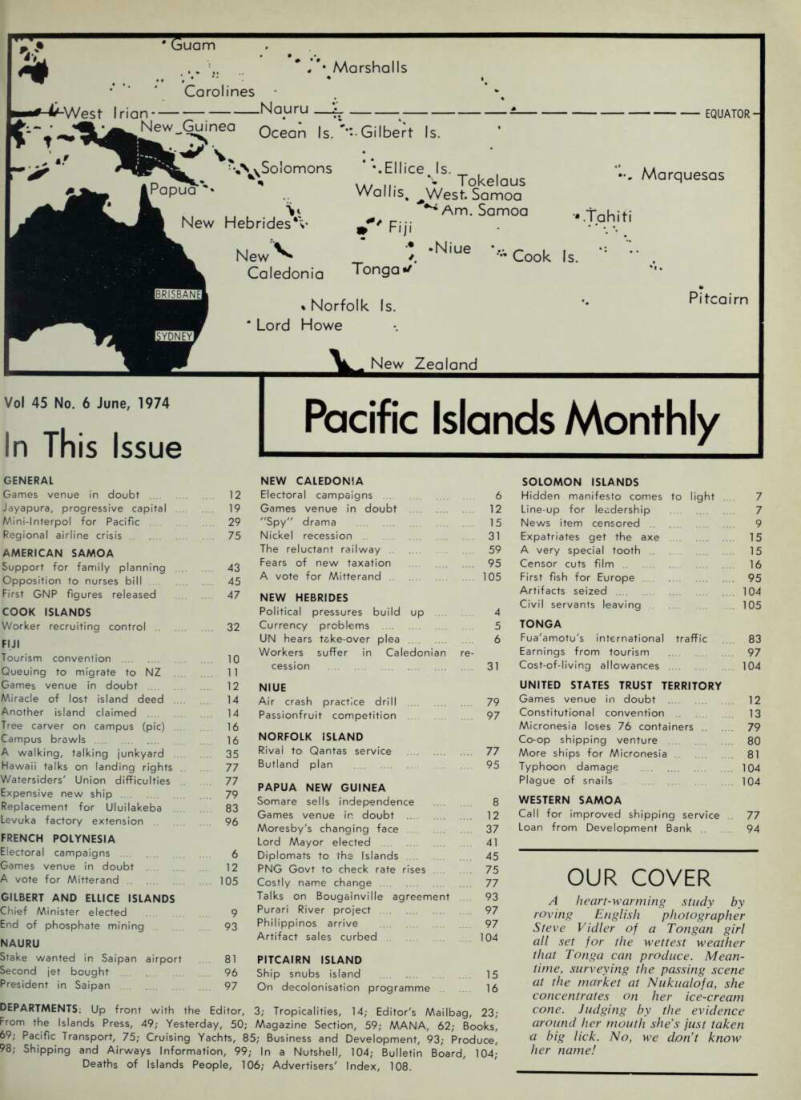
Our Cover
A heart-warming study by roving English photographer Steve Vidler of a Tongan girl all set for the wettest weather that Tonga can produce. Mean time, surveying the passing scene at the market at Nukualofa, she concentrates on her ice-cream cone. Judging by the evidence around her mouth she’s just taken a big lick. No, we don’t know her name!
Advertisements & other items, p. 2 (1 item)
lift
After you don’t believe the way the brand
new decks sound, you won’t
the way they’re priced.
The beauty of Pioneer’s cassette decks Is the way they reproduce high fidelity sound from unbelievably tiny cassettes. In fact, no others on the market with prices comparable to Pioneer's new CT-5151, CT-4141 A, and CT-3131 A give you so much sound for the money. Take, for instance, CT-5151, the top-notch among the three featured here. With a frequency response range from 30 to 16,000 Hz, a built-in *Dolby noise reduction unit, and long life ferrite solid tape head, you’re going to want to compare CT-5151 with most of the expensive reelto-reeldecks. CT-5151 is, indeed, loaded with a lot more features like normal/chromium dioxide tape selector (bias/equalizer independently switchable), full-automatic stop mechanism, tape running pilot light, peak level indicator, over-level limiter, electronically controlled DC motor, and even a memory rewind switch. If you’ve ever doubted the sound quality of cassette tape, now's the time to hear it all over again. On the CT-5151, CT-4141A, and CT-3131A, just a few of many quality high fidelity products made by Pioneer.
To see and listen to any of these, please contact one of the following: - Dimensions: 15-5/B{W) x 9-1/2(D) x 3-3/4(H) inches.
Weight: CT-5151 10 lb. 9oz.
CT-4141 A 101 b. 6oz.
CT-3131 A 91b. 11 oz. □ □
CT-3131A
-4141 1
lift
SBBS
CT-5 Rabaui , P.O. Box Port by, New Gurnea Amenci B-V,, P.O. Box No, I Madang
In This Issue
General
Games venue in doubt 12 Jayapura, progressive capital 19 Mini-Interpol for Pacific 29 Regional airline crisis 75
American Samoa
Support for family planning 43 Opposition to nurses bill 45 First GNP figures released 47
Cook Islands
Worker recruiting control 32
Fiji
Tourism convention 10 Queuing to migrate to NZ 11 Games venue in doubt 12 Miracle of lost island deed 14 Another island claimed 14 Tree carver on campus (pic) 16 Campus brawls 16 A walking, talking junkyard 35 Hawaii talks on landing rights 77 Watersiders' Union difficulties 77 Expensive new ship 79 Replacement for Uiuilakeba 83 Levuka factory extension 96
French Polynesia
Electoral campaigns 6 Games venue in doubt 12 A vote for Mitterand 105
Gilbert And Ellice Islands
Chief Minister elected 9 End of phosphate mining 93
Nauru
Stake wanted in Saipan airport 81 Second jet bought 96 President in Saipan 97
New Caledonia
Electoral campaigns 6 Games venue in doubt 12 "Spy" drama 15 Nickel recession 31 The reluctant railway 59 Fears of new taxation 95 A vote for Mitterand 105
New Hebrides
Political pressures build up 4 Currency problems 5 UN hears take-over plea 6 Workers suffer in Caledonian re cession 31
Niue
Air crash practice drill 79 Passionfruit competition 97
Norfolk Island
Rival to Qantas service 77 Butland plan 95
Papua New Guinea
Somare sells independence 8 Games venue in doubt 12 Moresby's changing face 37 Lord Mayor elected 41 Diplomats to the Islands 45 PNG Govt to check rate rises 75 Costly name change 77 Talks on Bougainville agreement 93 Purari River project 97 Philippinos arrive 97 Artifact sales curbed 104
Pitcairn Island
Ship snubs island 15 On decolonisation programme 16
Solomon Islands
Hidden manifesto comes to light ... 7 Line-up for leadership 7 News item censored 9 Expatriates get the axe 15 A very special tooth 15 Censor cuts film 16 First fish for Europe 95 Artifacts seized 104 Civil servants leaving 105
Tonga
Fua'amotu's international traffic ... 83 Earnings from tourism 97 Cost-of-living allowances 104
United States Trust Territory
Games venue in doubt 12 Constitutional convention 13 Micronesia loses 76 containers 79 Co-op shipping venture 80 More ships for Micronesia 81 Typhoon damage 104 Plague of snails 104
Western Samoa
Call for improved shipping service .. 77 Loan from Development Bank 94
DEPARTMENTS; Up front with the Editor, 3; Tropicalities, 14; Editor's Mailbag, 23; From the Islands Press, 49; Yesterday, 50; Magazine Section, 59; MANA, 62; Books, 69; Pacific Transport, 75; Cruising Yachts, 85; Business and Development, 93; Produce, 98; Shipping and Airways Information, 99; In a Nutshell, 104; Bulletin Board, 104; Deaths of Islands People, 106; Advertisers' Index, 108.
Advertisements & other items, p. 4 (1 item)
Bank of Hawaii
is the bank of the Pacific.
You can bank on it... in Guam 22LTamuning t Koror Yap Jf Saipan Roi Namur JL Kwajalein JltPonape Tahiti^- 2* American Samoa.
All in all, we have 70 branches throughout Hawaii and the Pacific offering full banking services. May we help you?
Bank of Hawaii the bank of the Pacific® • affiliate of Banque de Tahiti
Monthly
Pacific Islands
FOUNDED BY R. W. ROBSON IN 1930
Published Monthly By
Pacific Publications (Aust.) Pty. Ltd.,
29 Alberta St., Sydney, N.S.W., 2000.
Postal Address: G.P.O. BOX 3408, SYDNEY,
N.S.W., 2001.
Telegraphic Address: PACPUB, Sydney.
Telex 25168.
Telephones: 61-9197, 61-7101, 61-4369.
Consulting Directors: R. W. Robson, Judy Tudor.
Chief Executives: Manager: Selwyn Hughes.
Publisher: Stuart Inder.
Director of Advertising: W. A. Gasnier,
Pacific Islands Monthly
Editor: Stuart Inder.
Assistant Editor: John Carter.
Advertising Manager: W. A. Gasnier.
Circulation Manager: Barry Badger.
Subscription Rates:
"Pacific Islands Monthly" is airfreighted to all subscribers and agents in the Pacific Islands and the U.S.A.; copies to Nauru and other areas go by surface mail.
Australia (incl. Lord Howe and Thursday Is.), New Zealand, Papua New Guinea, Fiji, New Hebrides, Tonga, Western Samoa, Solomon Islands, Gilbert & Ellice Islands, Cook Islands, Norfolk Island, Niue and Nauru Islands: $6.80 (local currency); American Samoa, Hawaii, Micronesia and Guam; $12.00 US; New Caledonia and French Polynesia 1,100 CFP; US Mainland: $14.00 US; United Kingdom: £5-10. Elsewhere $B.OO Aust.
Representatives
Fiji; Advertising—A. F. Woods, Imex (Pacific) Limited, Suite 2A, Victoria Arcade, Suva, Fiji, P.O. Box 3117, Lami, SUVA. Telephone: 22-502.
Telex. 2124. Distribution —Desai Book Depot Ltd., P.O. Box 160, SUVA. Tel.: 311-424.
Papua New Guinea: PORT MORESBY, PNG Print ing Co. Pty. Ltd., P.O. Box 633; LAE, P.O. Box 227; RABAUL, Mr. David Simpson, P.O. Box 164 (c/- Rabaul Photographic. Tel.: 2677.) French Polynesia. Distribution —Hachette Paci fique, 10 Ave Bruat, Papeete.
New Zealand: Pacific Publications, C.P.O. Box 2229, Auckland. 379-494. Representative: John Spedding, Civic House, 291 Queen St., Auckland, Tel.: 379-494.
United Kingdom: Advertising—Overseas Publicity Ltd., 214 Oxford Street, London, WIN OEA.
Phone: 01-636 8296/7. Subscriptions—T. 8.
Graham, Park House, 22 Park Street, Croydon,
Cr9 3Np. Tel.: 01-6884177.
Japan: Advertising—Universal Media Corpora tion, C.P.O. Box 46, Tokyo. Tel.; 666-3036.
Victoria: Advertising Pacific Publications (Aust.) Pty. Ltd., 33 Lonsdale Street, Melbourne, Vic. 3006. Telephone: 662-3263.
Queensland: Advertising—Beale Media Services, 232 St. Paul's Terrace, Fortitude Valley, Qld., 4006. Tel.: 52-5827.
Hawaii and U.S. Mainland only: N. Grogan, 3354 Hayden Street, Honolulu, 96815. (Send change of address notices, Form 3579 and new subscriptions to P.O. Box 2193, Honolulu, Hawaii, U.S.A. 96805).
Second class postage paid at Honolulu, Hawaii.
Copyright ©, 1974,
Pacific Publications (Aust) Pty. Ltd.
June, 1974 Vol. 45, No. 6
Up Front
with the Editor
1 SPENT a couple of years as an aviation reporter on a Sydney daily at a time when it seemed one African state or another was achiev ing independence every day of the week, and it was something of a joke to us that just as soon as the flag of each new nation fluttered to the masthead there came an an nouncement that the country was inaugurating its own international airline to compete on world routes.
Having your own airline appeared to be the first prerequisite for in dependence, whether you had enough schools and hospitals, or any sort of economy at all.
The only people who did well out of the glut of international airlines that sought to take to the air in this period were the people who bought and sold second-hand aeroplanes.
The South Pacific nations currently appear to be embarked on a similar exercise in empty nationalism. Air Pacific, Suva-based, but launched as the airline which would service the whole South Pacific region and thus avoid the errors of those African mini-states, is fighting for its future as an international carrier.
Air Pacific links most of the central Pacific Islands as far north as Nauru, and flies to Australia. Its ownership is comprised of Fiji, Qantas, British Airways and Air New Zealand (each with 22.68 per cent of the shareholding), and the British Solomons, the Gilbert and Ellice Islands, Western Samoa, Tonga and Nauru (each with 1.85 per cent).
Nauru’s shares are still in existence although the Republic of Nauru for mally withdrew from the consortium in 1972 because of differences of opinion on how Air Nauru and Air Pacific should work together. Air Nauru has a jet, and is currently taking delivery of a second one, and operates international services as far north as Japan and as far south as Melbourne.
It was Nauru’s decision to with draw which began the cancer which
has eaten away at Air Pacific’s strength. Since then, Tonga and Western Samoa have begun making independence noises, and relations between most of the partners are severely strained. A common cri ticism one hears is that Air Pacific is using its international services to subsidise the costs of its internal Fiji service which of course mainly bene fits only Fiji. Whether or not this is true, these are matters of detail which ought not to be allowed to obscure the real principle, which is: Is the South Pacific to have one regional airline doing the greatest good for the greatest number, or is every mini-state going to establish its own mini international airline and fight its neighbours for landing rights and customers?
Ratu Sir Kamisese Mara, Fiji’s Prime Minister, summed it up in his usual direct fashion following the re cent South Pacific Forum in Raro tonga, when he said that the Forum would stand or fall on civil aviation, which would be “the real test of Pacific regional co-operation”.
He said: “If we fail to resolve this problem then the Forum will become nothing more than a talking shop”.
And he might have added that it would also mean the end of locally controlled aviation in the Pacific Islands.
That Forum authorised Fiji to call a meeting of civil aviation ministers to consider the future. The meeting is now being arranged. It’s more than overdue.
There might be some argument for the Republic of Nauru to con tinue operating its own international airline, because for one thing it can afford the luxury, and for another, it would otherwise be isolated in its mid-Pacific phosphate island. But one can’t see any other members of the consortium achieving anything else but trouble and bankruptcy with their own international airlines.
Stuart Inder
Pacific Islands Monthly
While Britain And France Fiddle
Stateless New Hebrideans Burn
By STUART INDER, recently in Vila
The decolonisation committee of the United Nations has been looking at the situation in the New Hebrides, that strange condominium of islands 1,400 miles north-east of Sydney which is governed by both Britain and France but whose people are neither British nor French. Nor indeed are they New Hebridean.
The situation has virtually re mained unchanged since 1906 when Britain and France, who were then locked in an argument over whose sphere of influence those islands should be, resolved it at least to their own satisfaction by agreeing to share the responsibility.
They made it formal on August 6, 1914, in a “Protocol”, which is the constitution of this extraordinary group of islands that ever since has been consigned to political limbo.
The New Hebrideans are not the only stateless people in the world, but I should think they must be the only stateless people occupying their own country. One article of the pro tocol states that “No native shall ac quire in the group the status of subject or citizen or be under the protection of either of the two sig natory powers”. To this day, the New Hebrideans have no passports, although they do have something which looks like a passport, and which states on the cover, “Anglo- French Condominium of the New Hebrides, travel document for use as passport”.
This document, current for five years, contains a photograph and the name, address and birthplace of the holder, with the following note: “This travel document is the pro perty of the Joint Administration of the Anglo-French Condominium of the New Hebrides by which it is issued. It may be withdrawn at any time. The holder of this travel docu ment travelling abroad may in the case of need request the protection of the British or French authorities”.
Thus the 90,000 people of the New Hebrides have less than colonial status in the world.
Britain and France each operate mini-governments in the islands, sup porting their own schools, hospitals, legal system, etc, while paying lip
service to a joint condominium government which has little author ity. Its joint responsibilities include, among other things, construction and maintenance of roads and bridges, ports and harbours, buoys and lights.
There is an advisory council, but the British and French Resident Commissioners are not bound by it, and in any case it is not popularly elected. Strictly speaking there is no advisory council at this moment, as it finished its formal life last De cember 31, and the details of the next stage of the condominium’s headlong rush towards political de velopment have not even been de cided.
The condominium is currently awaiting a top-level conference in Paris to discuss changes in the pro tocol which will permit a legislative council. This meeting was first scheduled for last year, but it has been continually postponed by ad ministrative crises either in London or Paris, none of which has had any thing to do with the New Hebrides.
This is an indication of just how seriously the developing problems of the New Hebrides are taken in Lon don and Paris, where the major de cisions have to be made.
The problems of the New Hebrides are serious, and if this fact is not recognised by London and Paris then I believe we can expect violence in the New Hebrides.
Should it occur, it can be laid at the door of the governments in Europe.
In the condominium itself the British and French manage to get on quite well at all levels. They have learned to manage their affairs com fortably enough under a protocol formulated for reasons which have long since lost their significance.
There is even some sympathy for the plight of the stateless New Hebrideans.
Much is sometimes made about the difference between British and French attitudes to political develop ment in the Pacific Islands, and this is sometimes used as a prediction that the British and French are never likely to co-operate on the matter of political development in the New Hebrides. But I do not think this is true in the New Hebrides; the ad ministrators who live on the spot, British and French, realise that the New Hebrides has to be broken free of the restraints of the present pro tocol, and that the future of the New Hebridean is more important than British or French power politics.
Britain and France have to stay together in the New Hebrides until the job is done, or exit together.
Each would be sorely embarrassed if either pulled out of the condominium and left the other holding the bag alone against the growing wrath of the United Nations, and the increas ingly vocal demands of the New Hebrideans for control of their own islands.
The current interest by the UN (see separate report) is only a be ginning of the new pressures which are developing in the New Hebrides, by the New Hebrideans.
There has arisen a number of New
Hebridean political parties, the
strongest being the New Hebrides National Party, which has as its main objectives citizenship for the New Hebrideans, one system of government instead of the present three systems (British, French and Joint), an elected legislative coun cil to replace the present advisory council and eventual independence.
The National Party is demanding single systems of law, education and health—all of which, of course, would flow from the single system of government. The party also wants land reforms and an end to land
speculation, whereby New Heb rideans have seen large parcels of land over which they have no con trol, subdivided and sold, and resold, at profit for foreign speculators.
The National Party is not the pro duct of radicals, but of new nationals. It has developed simply from the frustrations of New Heb rideans at the way progress in the New Hebrides has been stunted by :he self-centred political interests of London and Paris.
It is the matter of land which has aeen the rallying point for this up iurge in political development. As •ecent PIM reports have shown, New Tebrideans are actively picketing larcels of land which they feel have ?een unjustly alienated by outsiders, fhere have been numbers of public lemonstrations, and frequent accusa ions that lands were illegally taken Tom native owners in the days be bre the establishment of the con lominium.
This last is a familiar cry in the iouth Pacific, of course, but in the 'Jew Hebrides the chances are that he complaints of the New Heb ideans have a substantial foundation n law. Some of the measures idopted in alienating land in the 4ew Hebrides towards the end of ast century were scandalous.
Today this fact is being officially ecognised, and land is now being landed back. The French adminis ration deserves credit for its action lere, for it is currently in the pro ess of handing back 70,000 hectares if land occupied by the French ontrolled SFNH company. During 974, 2,500 hectares on Santo and 5,000 hectares on Malekula are •eing released from company con
trol, and in 1975-6 a further 40,000 to 45,000 hectares will be handed back. When these lands are disposed of, SFNH will retain only about 20,000 hectares, comprising four cattle stations, one each on Malo and Efate and two on Santo. Australia is supposed to be in the process of handing over to condominium con trol 10,000 hectares of Common wealth land which was a long time ago part of Burns Philp’s assets, but it is extremely slow about it.
The British administration has had working for it a land tenure adviser, Mr J. T. Fleming, who has com pleted a report on how to put some sort of order into the whole New Hebrides land tenure mess. Both London and Paris have been making noises in support of it, but whether this means that eventually there will be joint agreement on the reforms is another matter. Past experience has shown that once key proposals go to London and Paris for bureau cratic consultation, the results seldom reflect the original intent, and cer tainly never are handled with the speed required.
Meanwhile, any outside investor
should give the matter long and earnest thought. Some people with extensive and seemingly long-term interests in the New Hebrides have lately been selling off their freeholds, and retaining only leaseholds.
The problems facing the condo minium will not be resolved by con tinuing amendment to the protocol.
It is a colonial document designed half a century ago to protect the interests of British and French settlers, and until recent years this interpretation has been put on it, particularly by the Joint Court in respect of land claims and registra tion. Britain and France should tear up the protocol and start again.
The three essential matters to be resolved are (1) citizenship for the New Hebrideans; (2) a common code of law for all; (3) a satisfac tory procedure for the settlement of land disputes.
The present inflammatory situation surrounding land can probably be attributed to the colonial-protective interpretation put upon the protocol by the Joint Court in past years and especially to the fact that there is no appeal from the Joint Court to any higher judicial body.
Land reforms could possibly be achieved by amendment to the pro tocol, but the matters of citizenship and law reform need an entirely revised “constitution”. And this in turn depends on London and Paris being able to reach agreement on the future of the condominium.
Simply, the system of separate national administrations must go, and the support of the two metro politan powers must be given to the development of one strong condo minium government, to be managed by an elected legislature of New Hebrideans who are given citizenship in their own country.
And there is no time left.
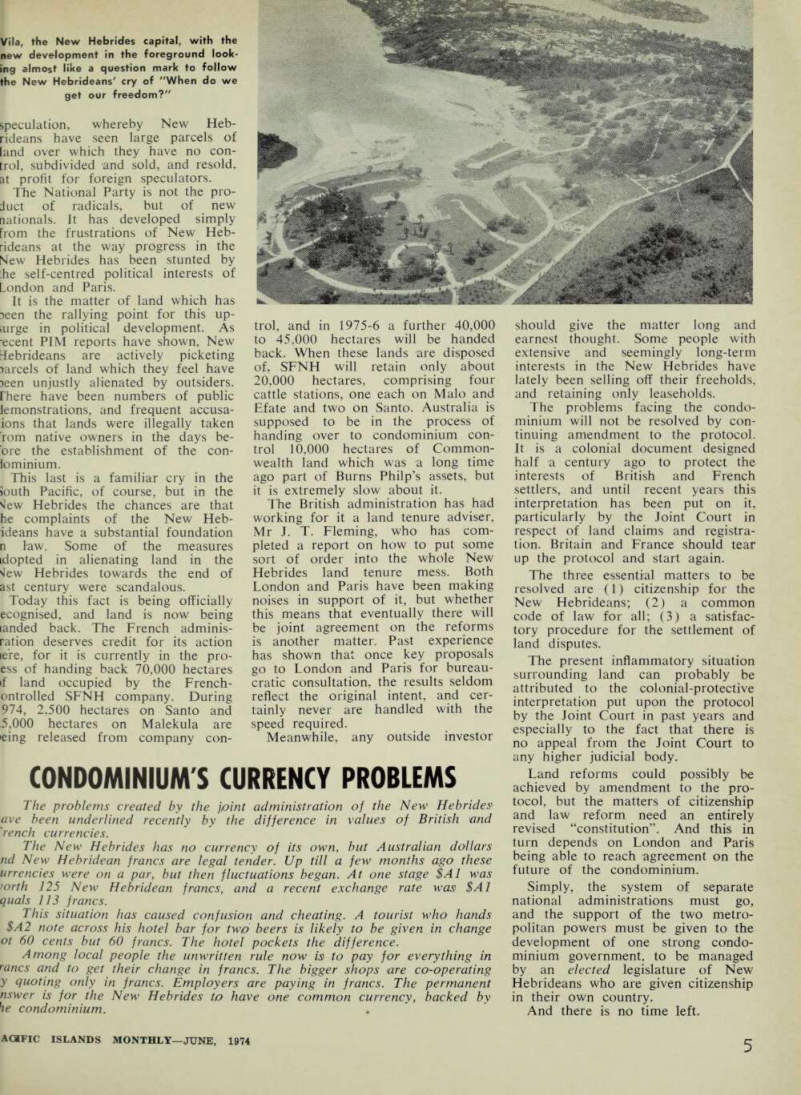
Vila, the New Hebrides capital, with the new development in the foreground look ing almost like a question mark to follow the New Hebrideans' cry of "When do we get our freedom?"
Condominium's Currency Problems
The problems created by the joint administration of the New Hebrides ave been underlined recently by the difference in values of British and 7 rench currencies.
The New Hebrides has no currency of its own, but Australian dollars nd New Hebridean francs are legal tender. Up till a few months ago these urrencies were on a par, but then fluctuations began. At one stage SAI was ’orth 125 New Hebridean francs, and a recent exchange rate was SAI quals 113 francs.
This situation has caused confusion and cheating. A tourist who hands SA2 note across his hotel bar for two beers is likely to be given in change ot 60 cents but 60 francs. The hotel pockets the difference.
Among local people the unwritten rule now is to pay for everything in rancs and to get their change in francs. The bigger shops are co-operating y quoting only in francs. Employers are paying in francs. The permanent nswer is for the New Hebrides to have one common currency, backed by he condominium.
Advertisements & other items, p. 7 (1 item)
5
AOIFIC ISLANDS MONTHLY—JUNE, 1974
United Nations Hears A Plea
For Condominium Take-Over
There was some plain speaking in New York on the situation in the New Hebrides in April when the United Nations Decolonisation Committee debated condominium affairs. Present was Father Walter Lini, a leader of the New Hebrides National Party, who answered questions and gave an address.
Father Lini said that the New Hebrides, to maintain peace, should work for independence. A general election should be held in October for members of a govern ing or legislative assembly. Then, the condominium offices would be come the headquarters of a new government. There would, for example, still be two education departments but one budget.
Father Lini said his party was concerned about the political, social, economic, educational and cultural welfare of the people of the New Hebrides. Because there were two administrations, the whole structure had been one of dividing and segregating people.
“Not only do we have two administrations, but two civil services, two police forces, two educational systems, two medical departments, two official languages and two flags,” he said. “A New Hebridean like myself has no status and no citizenship. He does not have a real passport.”
In reply to questions, Father Lini said the administering powers had not told the people about UN action on the right to self-deter mination. There was no publicity about UN resolutions. Moreover, many people in the New Hebrides did not even know about the UN.
Asked by Mr H. A. Acosta (Venezuela) about the views of other political parties in the New Hebrides, Father Lini said there was some difference among them about independence. One did not wish independence. Another, while in favour of independence, wanted first to fully prepare the people, and not rush the issue. His own party wanted immediate indepen dence, otherwise no independence at all would be achieved. His party had 58,000 members. The others had 3,000 and 300.
In reply to a question by the chairman, Mr Tadesse (Ethiopia), Father Lini said the UK had tried
to localise every post in the public service and in education. It was difficult to say the same for France. The school curriculum in France was the same as the French curriculum in the New Hebrides.
Most of the staff in the New Hebrides schools were basically localised.
Mr A. D. Campbell, an Aus tralian representative on the com mittee asked Father Lini whether he thought a UN mission to the New Hebrides would be acceptable to the two administering powers.
Did Father Lini wish the New Hebrides to be made a UN Trust Territory under the Trusteeship Council?
Father Lini said he did not think Britain and France would accept a UN visiting mission, but his party would like to invite one.
He said the people of the New Hebrides were “afraid” of big countries and their practices of exploitation. The New Hebrides was prepared to be under the administration of a smaller govern ment, such as Australia or New Zealand. The New Hebrides’ trade relationships were closely linked with those countries.
But Australia won’t have a bar of any trusteeship involving the New Hebrides. Mr Campbell made it clear that Australia was not interested in such a proposal.
He said Australia would not wish to start again as a colonial power, and anyway, discussion of a trusteeship arrangement for the New Hebrides was not entirely realistic.
“We have the greatest friendship for, and neighbourly interest in, the people of the New Hebrides, but we are very dubious indeed about the advantage to them or the domestic or international ac ceptability, of such a proposal, and we do not think it should be pursued”, he said.
Soon after Father Lini spoke to the Committee of 24 another poli tical party was formed at Santo — Natuitano (Children of the Land).
Chief Liu, Of Araki Island, was elected president. About 100 at tended the inaugural meeting.
Members of other political parties were invited to attend. Mr Jimmy Stevens, leader of the Nagriamel movement was absent because of ill-health, but some of his followers were there.
Mr Thomas Reuben, of the National Party, said that even though the aims of various poli tical groups in the New Hebrides were different, everyone should work together for the future of the country. Political movements should not interfere with progress in things like education, medical services and local councils.
Pointing Up The Foreign Devil
From a Noumea correspondent Ironically, both French and Australian political groups recently had or feature in common : during their May electoral campaigns members of eat country were pointing to the other to frighten voters with examples of w i they did not want to happen to them.
' The French were, of course, voting for a new president of the Kepubli while Australians were choosing a new national parliament. ... T/ , On the French side, Noumea supporters of right-wing candidate Valei Giscard d’Estaing warned islanders about the dangers of voting for sociali Francois Mitterand, leader of the left-wing coalition. Giscard a Estaing s loc election committee, headed by Caledonian Senator Henri Lafleur were poir ins to the Whitlam socialist government when they published the stateme “Look at our Australian neighbours, on the brink of disaster after only short experience with a regime which is very similar to the (rrenc ) e] wins coalition programme”. . ... At the same time, back in Australia, a small anti-socialist group seekii the preservation of constitutional monarchy sought to frighten local rad listeners against voting Whitlam-socialist, with the dread warning Do yc want a republic—as in France, or South America? , No doubt the French would be just as dismayed at this latter referee as Australians would be at the former.
Manifesto
Bsi Outlaws'
Comes To Light
From a Honiara correspondent A carbon-copy of what could be [escribed as the Ma’asina Rule’s Marching Rule) manifesto has ome to light after being hidden in lamboo for nearly 30 years.
The document, covering several oolscap typed pages, lists the post war movement’s aims, objects and easons. It had been kept hidden by r estus Lokei of Loina village. North rtalaita, ever since the Ma’asina tule was outlawed.
Lokei claims the original was iven to the administration at the utset of the movement to be passed m, as a petition for self-government, d King George VI.
Malaitans still vehemently claim hat Ma’asina Rule was not inspired y cargo-cult ideas, but was a genu [ie attempt to attain self-government.
It was while discussing Ma’asina tule with his elders that the Hon eriel Ausuta, Govco member for Jorth Malaita, discovered the docu lent in January this year. His uncle, .okei, had been fearful for many ears that he would be in trouble nth the white man if it was known e had the papers in his possession.
According to Ausuta, the paper ras written in English by a leading
Ma’asina Rule man, Timothy George, for the nine leaders of the movement. Timothy George was at the time one of y the best-educated Solomon Islanders, having had secondary scho oling in Queensland during the blackbirding davs. f .. „ . J he documei Jt tells of natives bem 8 , horse-whipped and towed thr ° u 8 h Plantations by white planters on orset) ac .
Ausuta, a strong member of the United Solomon Islands Party, has likened the document to the USIPA Manifesto. Indeed, Ma asina Rule once again became a household word of honour on Malaita with the election of Philip Solodia, one of the key founders of USIPA.
In the Governing Council meeting in June last year, Solodia made a
moving speech honouring the leaders of Ma’asina Rule for having sown the seeds of self-government which the Solomons was soon to achieve.
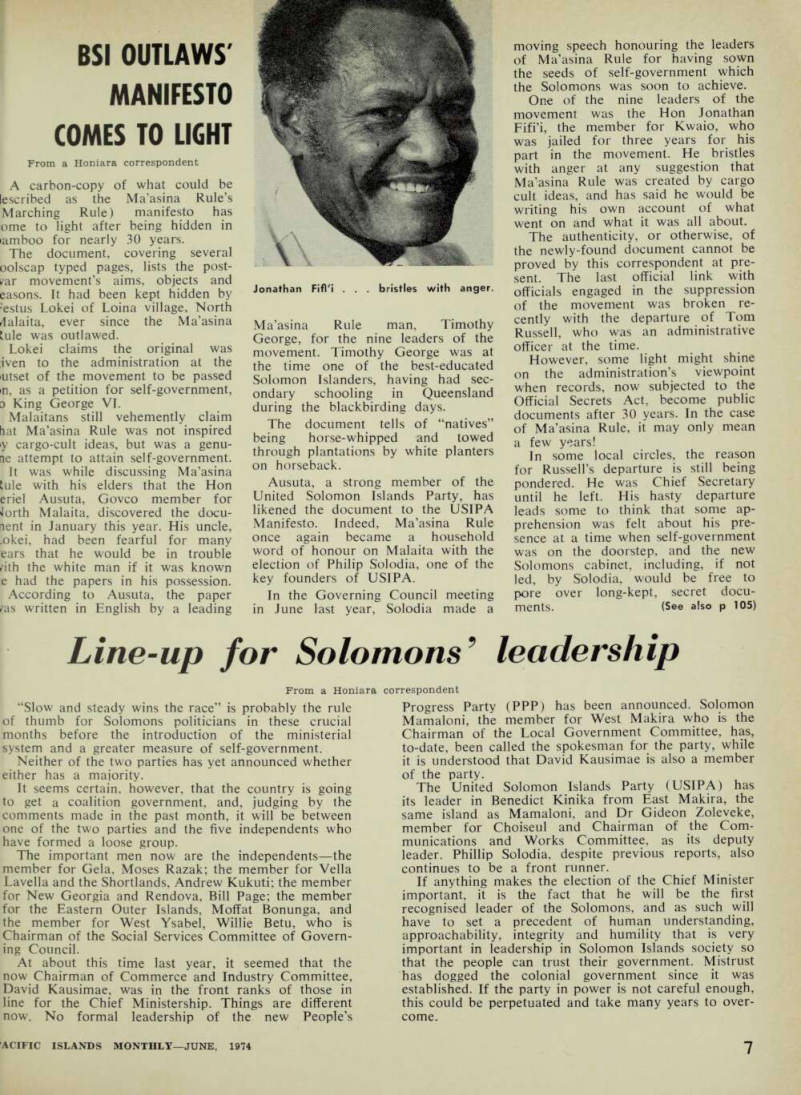
One of the nine leaders of the movement was the Hon Jonathan Fifi’i, the member for Kwaio, who was jailed for three years for his part in the movement. He bristles with anger at any suggestion that Ma’asina Rule was created by cargo cult ideas, and has said he would be writing his own account of what went on and what it was all about.
The authenticity, or otherwise, of the newly-found document cannot be proved by this correspondent at pre sent. The last official link with officials engaged in the suppression of the movement was broken re cently with the departure of Tom Russell, who was an administrative officer at the time.
However, some light might shine on the administration’s viewpoint when records, now subjected to the Official Secrets Act, become public documents after 30 years. In the case of Ma’asina Rule, it may only mean a few years!
In some local circles, the reason for Russell’s departure is still being pondered. He was Chief Secretary until he left. His hasty departure leads some to think that some ap prehension was felt about his pre sence at a time when self-government was on the doorstep, and the new Solomons cabinet, including, if not led, by Solodia, would be free to pore over long-kept, secret docu ments. (See also p 105)
Jonathan Fifl'i . . . bristles with anger.
Line-up for Solomons’ leadership
From a Honiara correspondent
“Slow and steady wins the race” is probably the rule of thumb for Solomons politicians in these crucial months before the introduction of the ministerial system and a greater measure of self-government.
Neither of the two parties has yet announced whether either has a majority.
It seems certain, however, that the country is going to get a coalition government, and, judging by the comments made in the past month, it will be between one of the two parties and the five independents who have formed a loose group.
The important men now are the independents—the member for Gela, Moses Razak; the member for Vella Lavella and the Shortlands, Andrew Kukuti; the member for New Georgia and Rendova, Bill Page; the member for the Eastern Outer Islands, Moffat Bonunga, and the member for West Ysabel, Willie Betu, who is Chairman of the Social Services Committee of Govern ing Council.
At about this time last year, it seemed that the now Chairman of Commerce and Industry Committee, David Kausimae, was in the front ranks of those in line for the Chief Ministership. Things are different now. No formal leadership of the new People’s
Progress Party (PPP) has been announced. Solomon Mamaloni, the member for West Makira who is the Chairman of the Local Government Committee, has, to-date, been called the spokesman for the party, while it is understood that David Kausimae is also a member of the party.
The United Solomon Islands Party (USIPA) has its leader in Benedict Kinika from East Makira, the same island as Mamaloni, and Dr Gideon Zoleveke, member for Choiseul and Chairman of the Com munications and Works Committee, as its deputy leader. Phillip Solodia, despite previous reports, also continues to be a front runner.
If anything makes the election of the Chief Minister important, it is the fact that he will be the first recognised leader of the Solomons, and as such will have to set a precedent of human understanding, approachability, integrity and humility that is very important in leadership in Solomon Islands society so that the people can trust their government. Mistrust has dogged the colonial government since it was established. If the party in power is not careful enough, this could be perpetuated and take many years to over come.
Advertisements & other items, p. 9 (1 item)
7
ACIFIC ISLANDS MONTHLY—JUNE, 1974
Independences
lone voice in a New Guinea wilderness
From a Fort Moresby correspondent
Salesman for independence Mr Michael Somare, Papua New Guinea’s Chief Minister, had six of the toughest days of his career in May when he stumped from centre to centre in a campaign to “explain'’ independence to villagers and demo lish opposition to his plan for in dependence on December 1.
It was a tough nut to crack and his tour showed no sure cracks in the nut. In fact, some of the argu ments he heard might have weak ened his resolve over the date. Both in Menyamya and Wau he was told to delay independence for 15 years.
He argued, when speakers cast doubts on PNG’s ability to get on without outside assistance, that they were asking for continued foreign domination. They had a rich country which had plenty of water, timber, coffee, gold and a copper mine which had a profit almost equal to the country’s total Budget.
But that argument weighed little with some of his opponents. Their criterion to back up their case, that the country wasn’t sufficiently de veloped for independence, was the land around them.
It wasn’t developed, they said; they had no roads, no schools, no hos pitals and they didn’t understand business.
Morobe District saw most of Mr Somare, who operated from Lae during the six days. The villagers were eager to see him. Nearly 200 of them had massed near the Mo robe patrol post the week before in a noisy protest against the indepen dence date and threatened to burn down their council house if he didn’t visit them.
Eventually, they agreed to see him in Lae. They had two problems they wanted to discuss —independence and land claims in the Lae city area. He didn’t seem to get far with his in dependence arguments and said in several places that, if he found there was great opposition from the peo ple, he would change the date. But
he had a success over the land claims.
The Ahi Association had refused a cheque for $160,000 from Minister of Lands Mr Kavali as compensation for the land which is between the Markham and Bumbu rivers and was originally taken from the villagers by the German New Guinea Com pany early this century.
The dispute, which has lasted since 1965, looked like lasting another nine years but, after nearly a day, May 7, spent in talks and a meeting of the association, the association agreed to a settlement, a more favourable one than the one pro posed by Mr Kavali in March. The settlement, described by Mr Muttu Gware, the Ahi president, as a com promise, gives them the $160,000 and 1,410 acres of the disputed land, 570 acres in the Bugandi area of Lae and 840 acres to the city’s north which goes back to the Kamkumun villagers.
Nine outposts were visited in the Morobe District in 3i days and Mr Somare, who travelled with Minister for State Mr Boyamo Sali and 10 pressmen including a television crew from the Australian Broadcasting Commission, finished his tour at Goroka Show on the Sunday. That was when he nearly got into serious trouble with the warriors.
There were about 8,000 colour fully-garbed warriors and women in the ring when Mr Somare opened the show. It was a good time, the Chief Minister decided, to sell his independence date, so he did. The Highlanders didn’t want indepen dence, even before the show. When Mr Somare spoke they wanted it even less. They were obviously an noyed that he had chosen to talk politics when they wanted to get on with winning prizes worth $2,000 for dancing.
Some tried to accost him after the opening ceremony but his security men kept them away although for a
few moments the Chief Minister looked slightly anxious.
Earlier, Mr Somare had done a 3i-day stint in the House of Assem bly when he was again challenged on his date for independence by Leader of the Opposition Mr Tei Abal who asked for a referendum on the date. He claimed that leaders from both the coast and the High lands had asked for it.
Patiently, Mr Somare explained that he had answered that question 21 times already. The date would be resolved at the June sitting of the House of Assembly. He said he didn’t like referendums. The House must take the responsibility to lead How far Mr Somare will get with his proposal at the June sitting is anyone’s guess. Constitutional Plan ning Committee Deputy Chairman Fr John Momis announced several days after the House of Assembly adjourned that the Constitutiona Planning Committee wants the for mal debate on its report delayed until the August sitting, and the in troduction of the draft Constitutiona Bill in the November sitting.
This delay is sure to give op ponents of independence by Decern ber 1 some propaganda to use at thu June sitting.
Fr Momis is hoping that the com mittee’s report will be available foi the public by around May’s end. H< suggested there should be an in formal meeting of MHAs to stud} the proposals and give vent to theii feelings and between then and th( November sitting the public wouk have several months in which tc talk about the report and make theii opinions known to the MHAs.
Fr Momis, speaking on the radic on May 2, voiced the opinion that if the Constitutional Bill wasn’t read} for introduction in the House ol Assembly until November man} MHAs might be reluctant to vote for December 1 as the independence date.
The House of Assembly met foi
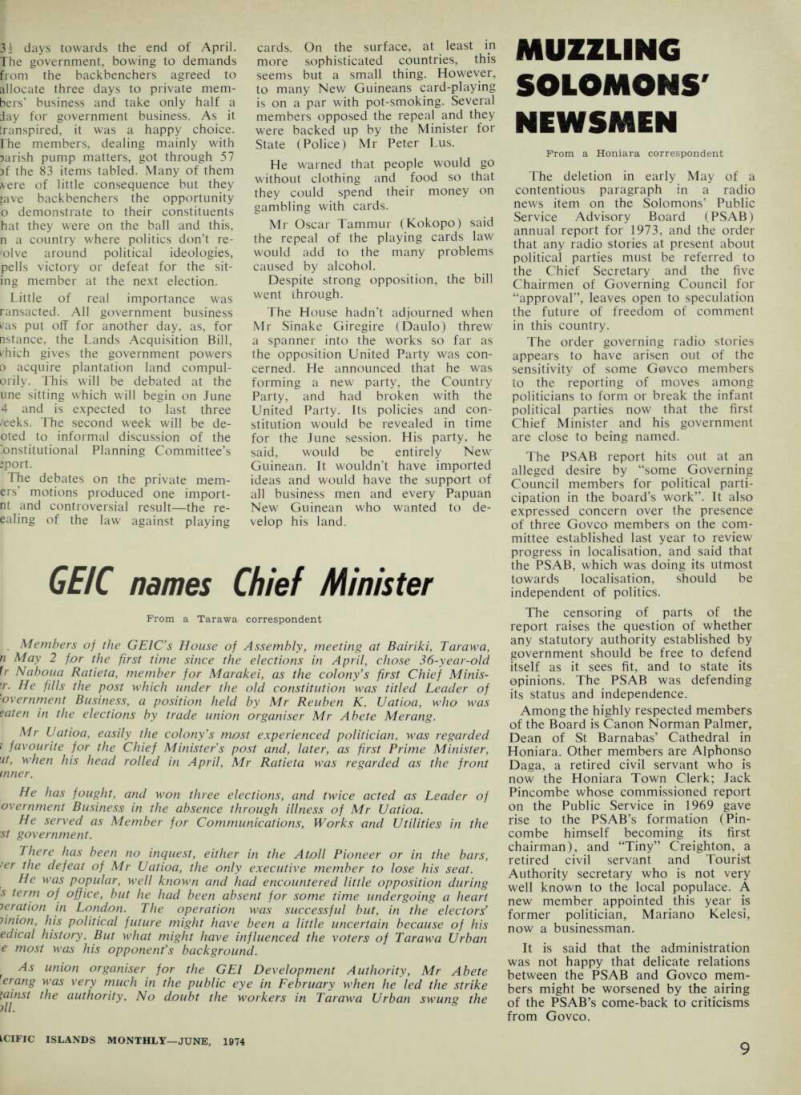
Seme of the 1,000 Tolai women in the protest march against Mr Somare's independence date wend their silent way through Rabaul's streets. The marchers, all in white blouses and blue laplaps, represented 35 women's clubs and fellowship organisations in East New Guinea.
3+ days towards the end of April.
The government, bowing to demands from the backbenchers agreed to allocate three days to private mem bers’ business and take only half a Jay for government business. As it transpired, it was a happy choice.
Fhe members, dealing mainly with sarish pump matters, got through 57 ff the 83 items tabled. Many of them vere of little consequence but they jave backbenchers the opportunity o demonstrate to their constituents hat they were on the ball and this, n a country where politics don’t re solve around political ideologies, pells victory or defeat for the sit ing member at the next election.
Little of real importance was ransacted. All government business vas put off for another day, as, for nstance, the Lands Acquisition Bill, /hich gives the government powers o acquire plantation land compul orily. This will be debated at the une sitting which will begin on June 4 and is expected to last three reeks. The second week will be de oted to informal discussion of the Constitutional Planning Committee’s ;port.
The debates on the private mem ers’ motions produced one import nt and controversial result—the re ealing of the law against playing
cards. On the surface, at least in more sophisticated countries, this seems but a small thing. However, to many New Guineans card-playing is on a par with pot-smoking. Several members opposed the repeal and they were backed up by the Minister for State (Police) Mr Peter Lus.
He warned that people would go without clothing and food so that they could spend their money on gambling with cards.
Mr Oscar Tammur (Kokopo) said the repeal of the playing cards law would add to the many problems caused by alcohol.
Despite strong opposition, the bill went through.
The House hadn’t adjourned when Mr Sinake Giregire (Daulo) threw a spanner into the works so far as the opposition United Party was con cerned. He announced that he was forming a new party, the Country Party, and had broken with the United Party. Its policies and con stitution would be revealed in time for the June session. His party, he said, would be entirely New Guinean. It wouldn’t have imported ideas and would have the support of all business men and every Papuan New Guinean who wanted to de velop his land.
GE/C names Chief Minister
From a Tarawa correspondent . Members of the GElC’s House of Assembly, meeting at Bairiki, Tarawa, n May 2 for the first time since the elections in April, chose 36-year-old fr Naboua Ratieta, member for Marakei, as the colony’s first Chief Minis r. He fills the post which under the old constitution was titled Leader of overnment Business, a position held by Mr Reuben K. Uatioa, who was eaten in the elections by trade union organiser Mr Abete Merang.
Mr Uatioa, easily the colony’s most experienced politician, was regarded ' favourite for the Chief Minister’s post and, later, as first Prime Minister, 'it, when his head rolled in April, Mr Ratieta was regarded as the front inner.
He has fought, and won three elections, and twice acted as Leader of overnment Business in the absence through illness of Mr Uatioa.
He served as Member for Communications, Works and Utilities in the st government.
There has been no inquest, either in the Atoll Pioneer or in the bars, ’ er the defeat of Mr Uatioa, the only executive member to lose his seat.
He was popular, well known and had encountered little opposition during s term of office, but he had been absent for some time undergoing a heart aeration in London. The operation was successful but, in the electors’ linion, his political future might have been a little uncertain because of his edical history. But what might have influenced the voters of Tarawa Urban e most was his opponent’s background. r As union organiser for the GEI Development Authority, Mr Abete \erang was very much in the public eye in February when he led the strike ’ainst the authority. No doubt the workers in Tarawa Urban swung the
Solomons'
Muzzling
Newsmen
From a Honiara correspondent The deletion in early May of a contentious paragraph in a radio news item on the Solomons’ Public Service Advisory Board (PSAB) annual report for 1973, and the order that any radio stories at present about political parties must be referred to the Chief Secretary and the five Chairmen of Governing Council for “approval”, leaves open to speculation the future of freedom of comment in this country.
The order governing radio stories appears to have arisen out of the sensitivity of some Govco members to the reporting of moves among politicians to form or break the infant political parties now that the first Chief Minister and his government are close to being named.
The PSAB report hits out at an alleged desire by “some Governing Council members for political parti cipation in the board’s work”. It also expressed concern over the presence of three Govco members on the com mittee established last year to review progress in localisation, and said that the PSAB, which was doing its utmost towards localisation, should be independent of politics.
The censoring of parts of the report raises the question of whether any statutory authority established by government should be free to defend itself as it sees fit, and to state its opinions. The PSAB was defending its status and independence.
Among the highly respected members of the Board is Canon Norman Palmer, Dean of St Barnabas’ Cathedral in Honiara. Other members are Alphonso Daga, a retired civil servant who is now the Honiara Town Clerk; Jack Pincombe whose commissioned report on the Public Service in 1969 gave rise to the PSAB’s formation (Pin combe himself becoming its first chairman), and “Tiny” Creighton, a retired civil servant and Tourist Authority secretary who is not very well known to the local populace. A new member appointed this year is former politician, Mariano Kelesi, now a businessman.
It is said that the administration was not happy that delicate relations between the PSAB and Govco mem bers might be worsened by the airing of the PSAB’s come-back to criticisms from Govco.
Advertisements & other items, p. 11 (1 item)
9
LCIFIC ISLANDS MONTHLY—JUNE, 1074
tourism blue-print
Future is looking black for Fiji's tourism blue-print
From L. G. USHER in Suva
At the 1973 annual Fiji Tourism Convention, a master plan (the Beit- Collins report) which was to be the blue-print for the future of the tour ist industry in Fiji was unveiled.
This year’s conference at Suva’s Tradewinds Hotel, met with the plan still on paper, and delegates soon learned that the government was having some second thoughts, and had some reservations, about the re port’s contents and even its basic concepts.
In his opening address, the Deputy Prime Minister, Ratu Sir Penaia Ganilau, who is also Minister for Tourism and Civil Aviation as well as Communications and Works, slap ped down The Fiji Times for sug gesting that perhaps he was carrying too heavy a ministerial burden, and this was why decisions were being delayed.
Ratu Sir Penaia’s retort was, in effect, that he would decide things in his own good time, after giving them the amount of thought he con sidered necessary for sound judg ment.
This was quite a good excuse for inaction, but was not particularly in spiring for people and organisations whose own planning depended on knowing how much of the master plan the government proposed to adopt.
There was another blow when the government’s Director of Economic Planning, Mr Akuila Savu, said that the thinking of his organisation was that the 18 per cent growth rate for tourism predicted in the master plan should be held down “in the national interest” (that blessed phrase that usually means whatever politicians and civil servants choose to make it mean) to 12 per cent.
This was not quite the sort of thing to encourage bold enterprise
or stimulate heavy risk-taking by pri vate investors.
The Deputy Prime Minister was uncompromising in his attitude to the American Government’s refusal to give Air Pacific landing rights in Pago Pago unless Pan American was allowed to compete on the Nadi-Pago Pago sector of the South Pacific regional service.
If the Americans remained stub born, Ratu Sir Penaia said, then it would be just too bad for the future of Fiji’s permission for any American airline to continue to use Nadi air port.
This is opening up the possibility that yet another international airline —-Pan American—would stop bring ing visitors to Fiji from overseas.
It followed American Airline’s withdrawal from the Pacific, Air- India’s decision (said to be because of fuel prices) not to fly beyond
Sydney, and strong rumours tha British Airways was about to yiel to pressure to leave Pacific air sei vices to Qantas and Air New Zet land.
But however much initial moanin at the bar there was about all thi: within the conference room the dele gates showed a refreshing sense c
responsibility.
In former days, when it wz fashionable to make the governmei the whipping boy, there was a faint! distasteful aroma of arrogance an self-interest about these annul gatherings.
This year, the spirit was noticeabl different.
OK. The government’s obstinac over landing rights might lose tl Pan-American planes, but tl Government of Fiji had played tc complaisant a role in the past in tl face of IATA-dictated fare increas and the like. It was good to see bit of toughness for a change.
And if the predicted growth ra of tourism was going to stretch tl economy too far, or divert mow from socially-desirable activitie then the industry would like to 1 told the details.
So the convention appointed : investigation committee, charg( with doing some really intensi' study to enable it within 90 days come up with ideas, based on e perience from within the tourist i dustry, for the government to co sider.
The government agreed to wait f these ideas. When Mr Savu offer to serve on the investigation coi mittee his offer was warmly accepte There were complaints about t drabness of the remodelled termir buildings at Nadi airport. All rig! said the convention, let us ma some practical suggestions for ii
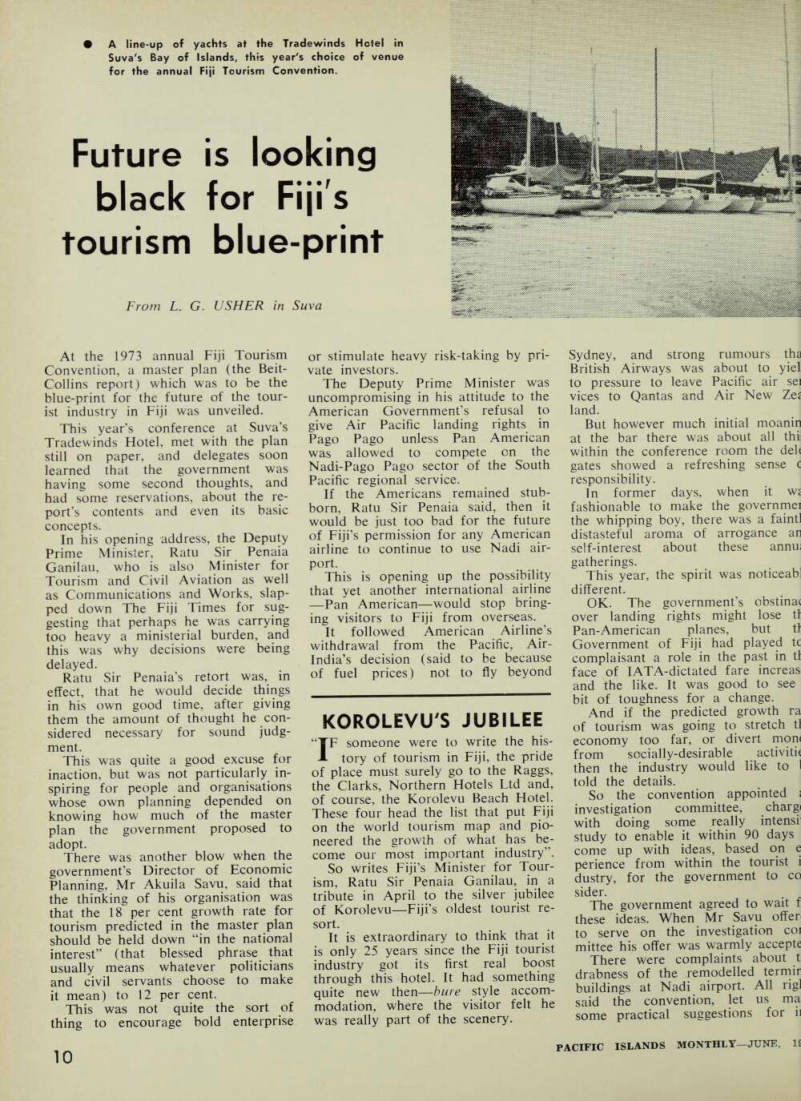
• A line-up of yachts at the Tradewinds Hotel in Suva's Bay of Islands, this year's choice of venue for the annual Fiji Tourism Convention.
provement. In two cases, offers of money were made to back up the suggestions.
All this showed a pleasing sign of maturity in the industry, and a re cognition that those who benefit should share responsibility, and the cost.
If the government was spared the severity of former criticism, its place in the firing line was taken by the airlines.
Why, said a “simple” question from the floor, were Pacific air and sea fares higher than those anywhere else in the world?
And why, others asked, was Qantas dragging its feet on charter services to Fiji when it is always taking many hundreds of Australians on similar trips to Singapore?
And why was the Pacific denied the allocation of charter group space on ordinary flights airlines elsewhere found possible?
And why is Air Pacific, in which the big airline boys have a control ling interest, not allowed propor tional fare concessions to travellers from overseas at excursion fare rates?
About the best that can be said for the uneasy replies from airline representatives present, apart from the perfectly valid argument that airlines are in business to make money, was that they did include an assurance that the points raised would be discussed with the bosses back home.
That made them worth raising at what was, all in all, one of the most useful of the convention series.
Korolevu's Jubilee
“TF someone were to write the his- J. tory of tourism in Fiji, the pride of place must surely go to the Raggs, the Clarks, Northern Hotels Ltd and, of course, the Korolevu Beach Hotel.
These four head the list that put Fiji on the world tourism map and pio neered the growth of what has be come our most important industry”.
So writes Fiji’s Minister for Tour ism, Ratu Sir Penaia Ganilau, in a tribute in April to the silver jubilee of Korolevu —Fiji’s oldest tourist re sort.
It is extraordinary to think that it is only 25 years since the Fiji tourist industry got its first real boost through this hotel. It had something quite new then —bure style accom modation, where the visitor felt he was really part of the scenery.
NZ's welcome to immigrants
may be Fiji's skill drain'
By a staff writer
Fiji islanders reacted to New Zea land’s new immigration policy by queuing at the NZ High Commiss ion’s offices in Suva to apply for permanent entry to NZ. Australia, too, has adopted new guidelines which will make it easier for Islanders to migrate permanently to Australia. „ P ut there is no 'open door policy. In each case skill is a require ment, and in New Zealand the coun trVs capacity to absorb migrants from anywhere is a key factor. The ,f restricts the number of w y ho enter Nz as migrants f he New Zealand Prime Minister, M r N. H. Kirk, announcing his country’s new guidelines, said it was adopting a “non-discriminatory” ap proach. All would be selected ac cording to skill, age and family size.
Immigrants would be drawn from a wide range of countries in a gradual process, which would not involve an abrupt break with previous patterns of immigration.
Apart from skills, and humani tarian reasons such as allowing the reunion of families in NZ, migrants will have to be in good health and of good character, aged between 18 and 25, and have not more than four children.
Fiji’s Prime Minister, Ratu Sir
Kamisese Mara, was philosophical about the possible loss of skilled men to NZ, calling it a “skill drain”.
While Fiji would be sorry to lose such talent there was nothing she could do till the standard of living in Fiji was equal to that of NZ, Australia and Canada. However, NZ’s ability to absorb migrants, may restrict the numbers.
While both Australia and NZ have repeatedly stated their intention of doing as much as possible to help Pacific Islands groups in develop ment, and in fact, are doing a lot, the drain on skills could undo much of their good work. The Islands need all their skills in their race to catch up with the developed countries, and “skill drain” policies may have to be looked at closely in a few years.
No reference was made in the new policy guidelines for NZ about the “guest worker” scheme, which allows labourers to enter the country for limited terms for specific tasks. As this involves unskilled labour only, it will probably continue.
Australia has repeatedly refused to have anything to do with this system, and the Immigration Minister, Mr A 1 Grassby, reaffirmed the policy early in May. But he said then that an Australian Government trade skills mission would be seeking workers from South-East Asia, and the Pacific, with a special priority for Fiji.
Australia welcomed permanent settlers from more than 70 countries, including Fiji. She wanted the per manent settler with skills, and would not discriminate by allowing guest workers from one country. But he would fully support any scheme which allowed Fiji citizens to go to Australia for on-the-job training.
Ratu Sir Kamisese Mara, speaking in the Fiji Parliament recently said that Fiji people could not go to Australia for temporary work be cause of opposition from Australian trade unions. He was speaking on a motion to set up a select committee to examine Australian and NZ im migration policies.
He suggested that Mr Apisai Tora, Opposition spokesman on immigra tion matters, use his influence with trade unions in Australia to try to arrange a system under which Fiji people would be allowed in for temporary work.
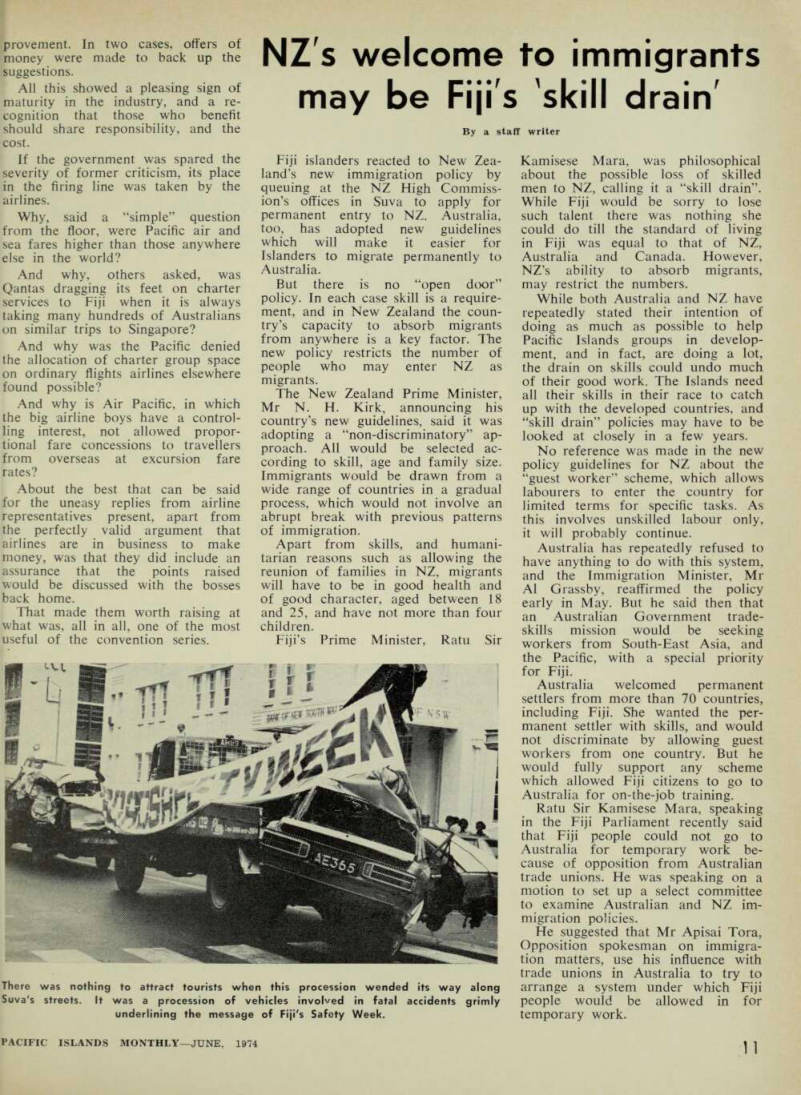
There was nothing to attract tourists when this procession wended its way along Suva's streets. It was a procession of vehicles involved in fatal accidents grimly underlining the message of Fiji's Safety Week.
Behind The Scenes As Guam Gets
Unready For The 1975 Games
The Fifth South Pacific Games are slated for August 9-22 at Guam on the other side of the equator but M with the Games only 14 months away, the venue may be switched in the face of growing doubts that Guami has the ability or the facilities to host them. Alarmed at the absence of news of preparations being made by> ouam, which has failed to answer three requests for information, members of the Games Council have ca I led I a meeting for May 31 in Suva when a switch may be decided on. What has been happening behind the scenes; in Guam? Below, Joe Murphy, editor of Guam's Pacific Daily News, supplies the answers in a special report for PIM, sent before Games Council members decided to act.
From JOE MURPHY, on Guam
Despite Guam’s relatively high level of prosperity, potential visitors are cautioned that the 1975 Games facilities won’t be anywhere near the level of those seen last in 1971 at Tahiti. There are many reasons for this sad situation, but basically the problem stems from the fact that the Games got embroiled in a political controversy between the Democratic Party (which controls the Guam Legislature, and whose Speaker, Sen.
Larry Ramirez, issued the invitation to hold the Games in Guam), and the Republican administration headed by Governor Carlos Camacho.
Ramirez had assumed that the US Government would help pay the cost of the sports facilities needed for Guam, as a gesture to Pacific good will. Unfortunately, the violence at the 1972 Olympic Games, brought an adverse reaction throughout the US, and the federal government refused to guarantee aid to Denver or Salt Lake City, both of whom wanted to host the 1976 Winter Games. Having already refused two states, the US Government couldn’t bend the policy to help Guam.
It had been estimated that Guam’s sports complex would cost from SUSS to $6 million. More than a year ago, Governor Camacho insisted that Guam needed this money for high ways, telephones, power, sewerlines and schools, and announced that Guam would be unable to host the Games.
This unpopular announcement brought ringing editorials protesting at the inhospitality, the “slap in the face”, to Island neighbours. Under pressure, Governor Camacho re considered, deciding that he didn’t have the authority to call off the Games, because that decision had to be made by the South Pacific Games Committee. He did say that he expected help from the business community in building the sporting complex, and that the Guam Govern ment itself wouldn’t be able to give much financial support.
The matter has developed into such a local hassle that Ted Nelson, Guam Games chairman, has already tossed his hat in the ring as a candidate for lieut-governor in this November’s elections, as a Democrat.
And Republican Senator Pauli Calvo, head of the Guam Gamesi Committee, recently announced his; resignation from that post in order toi challenge Governor Camacho in the: September Republican primary, ad ding even more politics to the Guam scene.
But in the meantime some Guam facilities—tennis courts, pool, track, etc —are slowly being upgraded, and other improvements are planned, and still others are being studied by the experts. No central stadium, for instance, exists, and whether one could be completed, even if started im mediately, is questionable.
But there are other alternatives.
The large US military bases on Guam have ample sports facilities for their 30,000 men, and these could be made available for some, or all, of the Games with some give and take between the Guam Government and the military, although even here, too, a hassle has developed. When Rear- Adm. G, Steve Morrison was asked about the possibility of using his facilities, he said this would be perfectly acceptable—providing “his boys” got to participate. But this was out of the question, because the rules for participation had already been set down.
In addition, Guam politicians and the military establishment are in the midst of a battle royal themselves which could affect use of the military snorts facilities. The Navy wants lo move its ammunition wharf out of busy, heavily-populated Apra Harbour to a pristine, rugged, unpopulated area on Guam’s southwest coast. The move, at an estimated cost of SUS 120,000,000 would require the acquisition of some 4,000 Part of the land that would be accuired is owned by yet another Gu< i Senator, Paul Bordallo, who insists that the Navy already has enough Guam land. (Sen. Bordallo’s brother, Ricardo, is another announced Democratic can didate for governor.) Earlier, Governor Camacho signed an agree-
merit with the Navy on the land transfer, but failed to get approval by the Democratic legislature, putting the entire transaction in a state of limbo.
Thus, the spirit of co-operation doesn’t seem to be very high between the military and the local government.
To sum up, Guam, embroiled by a sometimes bitter battle with the military; facing a general election for all 21 of its legislative members and its governor and lieut-governor, plus its Washington Representative in the US Congress, doesn’t seem to be con centrating on the 1975 Games. That is not to say that the Games themselves are a political issue. It’s just that the politicians have other things on their minds.
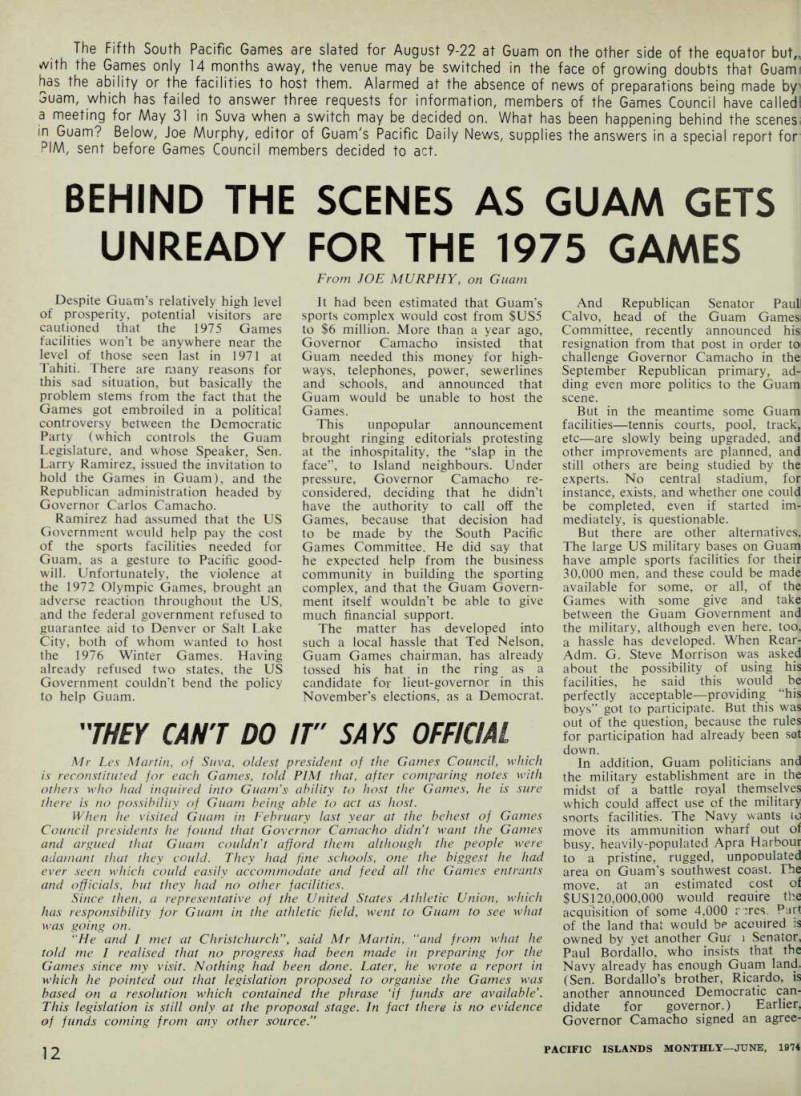
The Guam Hilton overlooking Tumon Bay is probably hoping for a rush of visitors for the Games —if they materialise. The guest room decor reflects the best in Micronesian art. Photo: Walsh Photo graphies.
"They Can't Do It" Says Official
Mr Les Martin, of Suva, oldest president of the Games Council, which is reconstituted for each Games, told PIM that, after comparing notes with others who had inquired into Guam’s ability to host the Games, he is sure there is no possibility of Guam being able to act as host.
When he visited Guam in February last year at the behest of Games Council presidents he found that Governor Camacho didn’t want the Games and argued that Guam couldn’t afford them although the people were adamant that they could. They had fine schools, one the biggest he had ever seen which could easily accommodate and feed all the Games entrants and officials, but they had no other facilities.
Since then, a representative of the United States Athletic Union, which has responsibility for Guam in the athletic field, went to Guam to see what was going on.
“He and I met at Christchurch”, said Mr Martin, “and from what he told me I realised that no progress had been made in preparing for the Games since my visit. Nothing had been done. Later, he wrote a report in which he pointed out that legislation proposed to organise the Games was based on a resolution which contained the phrase ‘if funds are available’.
This legislation is still only at the proposal stage. In fact there is no evidence of funds coming from any other source.”
Micronesia's future in the melting pot
From a Saipan correspondent
The existence of Micronesia as an independent united state is more in doubt than ever. The Marshall Islands district legislature’s threat to break with the Congress of Micro nesia over revenue sharing (PIM, May, p 8) has been backed up by the traditional leaders, the Iroij.
After an all-day meeting at Majuro on April 26, the leaders issued a proclamation, which was later read in church pulpits, support ing moves by the legislature to establish a political status com mission and calling for separate talks with the United States.
The Nitijela (Legislature) fol lowed up its decision to pull out of the Congress and the talks with the
United States by another resolution
opposing participation in the coming
Constitutional Convention, the Con gress legislation for which was signed into law at the end of March.
Much will depend on American attitudes as to how far the Mar shalls will go in their determination to have done with Congress and the joint talks. Their threats, which now have the backing of the Nitijela and the Iroij, may melt away if the Congress agrees to talk again with the Marshalls over revenue sharing.
Meanwhile. America is sitting on the fence. Her reaction to the Mar shallese threats came in statements from the departments of State and Interior. So far, they said, no regard
will be paid to separatist threats and America intends to proceed with the next round of the status talks with the Congress Joint Committee. They are expected in the last quarter of this year. However, if the Marshal lese make good their threats and boycott the Constitutional Conven tion elections in June, the United States will take the situation more seriously.
All this is a big disappointment to Senator Lazarus Salii (Palau), the joint committee chairman, who re turned to Saipan in the middle of April well satisfied with talks he and other members had in California with Ambassador F. Haydn Williams in an effort to clear the air for the next round.
The Marianas, the first of the Island groups to dissent from the plan for a united Micronesia, were scheduled to begin the fourth round of their talks with the United States on Saipan on May 15.
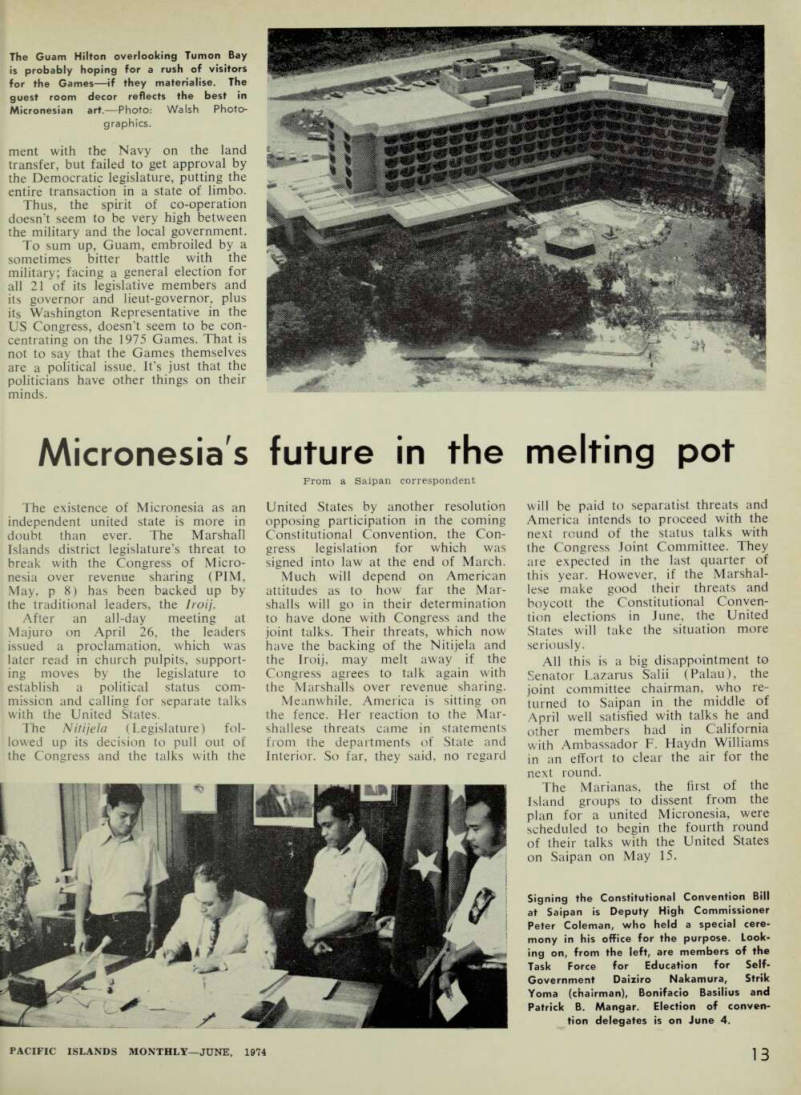
Signing the Constitutional Convention Bill at Saipan is Deputy High Commissioner Peter Coleman, who held a special cere mony in his office for the purpose. Look ing on, from the left, are members of the Task Force for Education for Self- Government Daiziro Nakamura, Strik Yoma (chairman), Bonifacio Basilius and Patrick B. Mangar. Election of conven tion delegates is on June 4.
Tropica lities
A Fiji island and a miraele
When Mrs Phyllis Garnet Malley, formerly of Fiji and now of Honolulu, owner of several Fiji islands, sold one of them a few months ago —five-acre Koro Levu Island, in the Somo Somo Strait, about a mile from Taveuni, Fiji’s third largest island—she parted with the deed of course but not with the large scarlet seal, Queen Victoria’s official seal, which was once attached to the deed.
That’s one of her most treasured keepsakes and by it hangs a tale, an amazing piece of luck.
She bought Koro Levu 22 years ago. “It was practically given to me,” she told PIM recently. It was sold to her by its owner, a woman living in Sydney, who was in dire financial straits. Buying islands then wasn’t much of a gilt-edged proposition, but where Koro Levu was concerned, it was definitely a risk. There was no deed to the island. Now, who’d buy an island without a deed?
Mrs Malley did because, she said, the owner was so distressed. The deed had been lost for 45 years. It was believed to have been irretrievably lost when its owner, the woman’s father, a sea captain, had gone down with his ship. Fiji’s Registrar-General told Mrs Malley she was “buying a pig in a poke”, and advised her that it might—but a faint might—become her property if, after a period, say of 12 years, the question of ownership remained undisturbed and there was no “adverse possession”.
It was a big pig in a poke, even bigger than Mrs Malley or the Registrar-General realised because, around that time, a planter, who had been using the island, had decided to sue the owner for selling it. But Mrs Malley went ahead and clinched the deal.
Later, she was advised to make sure of the title by giving it to the government and then buying it back at an auction—a very risky procedure.
No decisions had been made and Mrs Malley was in America with her husband, who had entered hospital in Baltimore when the miracle happened.
It happened at Levuka, the old capital. A government servant was burning a vast number of obsolete government papers which had been crammed into oily copra sacks. Sack after sack was tipped onto the fire in a corner of the compound.
“After disposing of a dozen or more of these sacks of documents in this drastic fashion,” says Mrs Malley, “he dragged yet another heavy sack across and, just as he was tipping it into the fire, a thick Manila envelope fell into the flames, out of which slid a bright scarlet seal on a green rib bon. He hastily pulled this out of the flames. He shook the contents out on to the ground and, lo and behold, there lay Queen Victoria’s official deed of Koro Levu Island!”
The planter’s court suit was then in process, but Mrs Malley was in undisputed possession. There was a celebration in the Lands Department when Mr Bertie Gregg, now retired from the job of Registrar-General, handed her the scarlet seal.
And another
island tale
A Fiji island described in PIM 16 years ago as “a pint-sized piece of mud, mangroves and sand” today is probably worth thousands of dollars as it is close to a number of islands on which luxury hotels have been built or are about to be built. And the American owner of a 99-year lease of the island, butt of a lot of unfavourable publicity 16 years ago, intends to hold on to it.
The island, Yawalu, about 15 miles off Lautoka, was renamed Ava Ava, and was offered as a prize to promote a movie, The Little Hut.
All that was required was the last line of a limerick. The contest attracted 50,000 entries from all parts of the world. The winner, Kent Shelby, of Long Beach, California, and his wife won the contest. Their entry was:
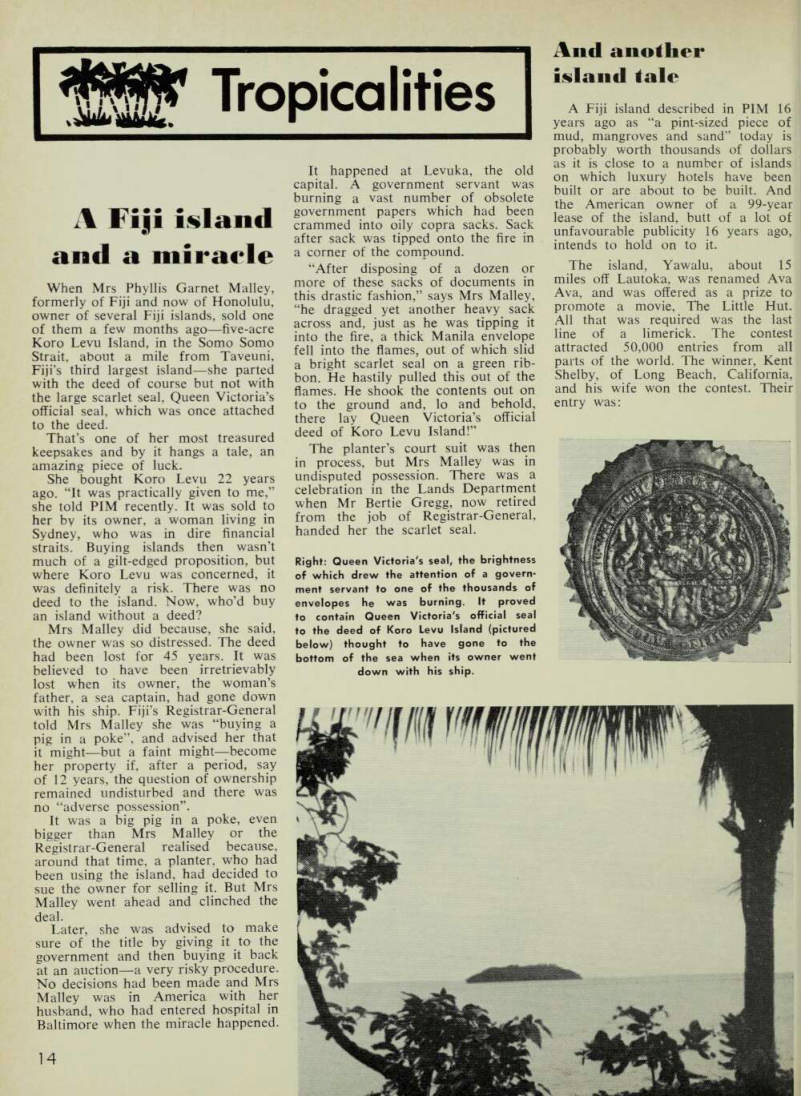
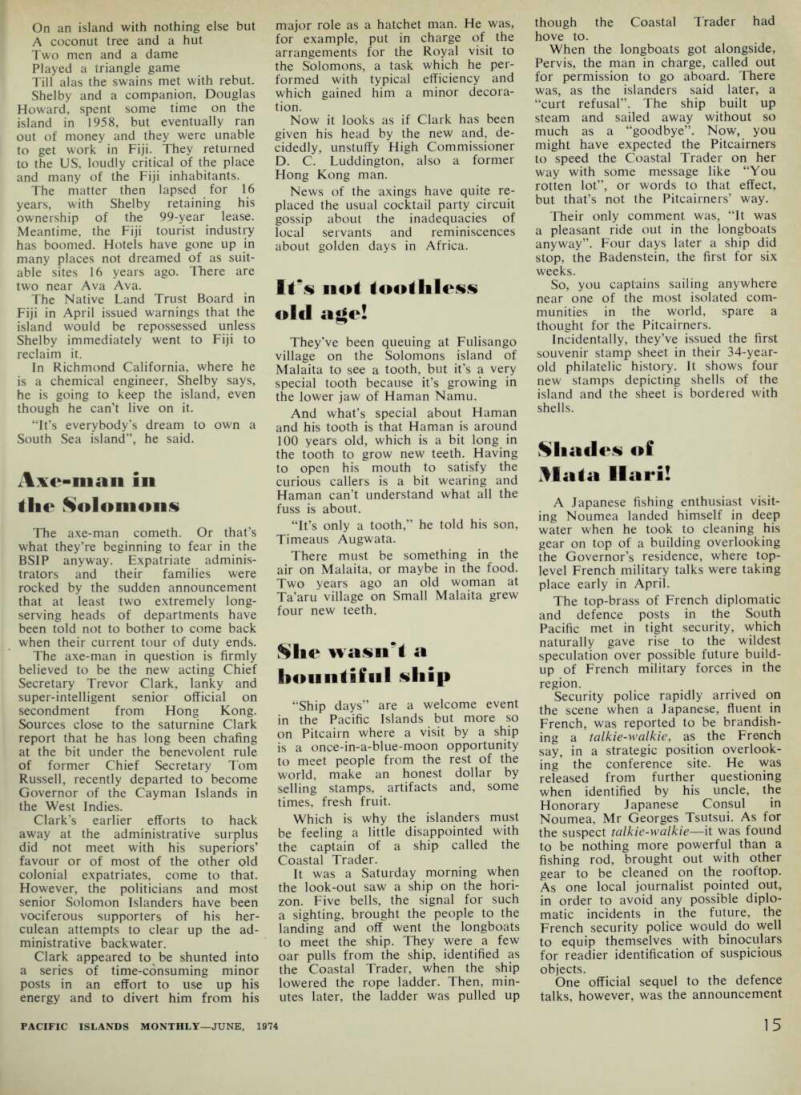
Right: Queen Victoria's seal, the brightness of which drew the attention of a govern ment servant to one of the thousands of envelopes he was burning. It proved to contain Queen Victoria's official seal to the deed of Koro Levu Island (pictured below) thought to have gone to the bottom of the sea when its owner went down with his ship.
On an island with nothing else but A coconut tree and a hut Two men and a dame Played a triangle game Till alas the swains met with rebut.
Shelby and a companion, Douglas Howard, spent some time on the island in 1958, but eventually ran out of money and they were unable to get work in Fiji. They returned to the US, loudly critical of the place and many of the Fiji inhabitants.
The matter then lapsed for 16 years, with Shelby retaining his ownership of the 99-year lease.
Meantime, the Fiji tourist industry has boomed. Hotels have gone up in many places not dreamed of as suit able sites 16 years ago. There are two near Ava Ava.
The Native Land Trust Board in Fiji in April issued warnings that the island would be repossessed unless Shelby immediately went to Fiji to reclaim it.
In Richmond California, where he is a chemical engineer, Shelby says, he is going to keep the island, even though he can’t live on it.
“It’s everybody’s dream to own a South Sea island”, he said.
Axe-man in
the Solomons
The axe-man cometh. Or that’s what they’re beginning to fear in the BSIP anyway. Expatriate adminis trators and their families were rocked by the sudden announcement that at least two extremely long serving heads of departments have been told not to bother to come back when their current tour of duty ends.
The axe-man in question is firmly believed to be the new acting Chief Secretary Trevor Clark, lanky and super-intelligent senior official on secondment from Hong Kong.
Sources close to the saturnine Clark report that he has long been chafing at the bit under the benevolent rule of former Chief Secretary Tom Russell, recently departed to become Governor of the Cayman Islands in the West Indies.
Clark’s earlier efforts to hack away at the administrative surplus did not meet with his superiors’ favour or of most of the other old colonial expatriates, come to that.
However, the politicians and most senior Solomon Islanders have been vociferous supporters of his her culean attempts to clear up the ad ministrative backwater.
Clark appeared to be shunted into a series of time-consuming minor posts in an effort to use up his energy and to divert him from his
major role as a hatchet man. He was, for example, put in charge of the arrangements for the Royal visit to the Solomons, a task which he per formed with typical efficiency and which gained him a minor decora tion.
Now it looks as if Clark has been given his head by the new and, de cidedly, unstuffy High Commissioner D. C. Luddington, also a former Hong Kong man.
News of the axings have quite re placed the usual cocktail party circuit gossip about the inadequacies of local servants and reminiscences about golden days in Africa.
It’s not toothless
old age!
They’ve been queuing at Fulisango village on the Solomons island of Malaita to see a tooth, but it’s a very special tooth because it’s growing in the lower jaw of Haman Namu.
And what’s special about Haman and his tooth is that Haman is around 100 years old, which is a bit long in the tooth to grow new teeth. Having to open his mouth to satisfy the curious callers is a bit wearing and Haman can’t understand what all the fuss is about.
“It’s only a tooth,” he told his son, Timeaus Augwata.
There must be something in the air on Malaita, or maybe in the food.
Two years ago an old woman at Ta’aru village on Small Malaita grew four new teeth.
Slit" wasn't a
bountiful ship
“Ship days” are a welcome event in the Pacific Islands but more so on Pitcairn where a visit by a ship is a once-in-a-blue-moon opportunity to meet people from the rest of the world, make an honest dollar by selling stamps, artifacts and, some times, fresh fruit.
Which is why the islanders must be feeling a little disappointed with the captain of a ship called the Coastal Trader.
It was a Saturday morning when the look-out saw a ship on the hori zon. Five bells, the signal for such a sighting, brought the people to the landing and off went the longboats to meet the ship. They were a few oar pulls from the ship, identified as the Coastal Trader, when the ship lowered the rope ladder. Then, min utes later, the ladder was pulled up
though the Coastal Trader had hove to.
When the longboats got alongside, Pervis, the man in charge, called out for permission to go aboard. There was, as the islanders said later, a “curt refusal”. The ship built up steam and sailed away without so much as a “goodbye”. Now, you might have expected the Pitcairners to speed the Coastal Trader on her way with some message like “You rotten lot”, or words to that effect, but that’s not the Pitcairners’ way.
Their only comment was, “It was a pleasant ride out in the longboats anyway”. Four days later a ship did stop, the Badenstein, the first for six weeks.
So, you captains sailing anywhere near one of the most isolated com munities in the world, spare a thought for the Pitcairners.
Incidentally, they’ve issued the first souvenir stamp sheet in their 34-year old philatelic history. It shows four new stamps depicting shells of the island and the sheet is bordered with shells,
Shades of
Mata llari!
A Japanese fishing enthusiast visit ing Noumea landed himself in deep water when he took to cleaning his gear on top of a building overlooking the Governor’s residence, where top level French military talks were taking place early in April.
The top-brass of French diplomatic and defence posts in the South Pacific met in tight security, which naturally gave rise to the wildest speculation over possible future build up of French military forces in the region.
Security police rapidly arrived on the scene when a Japanese, fluent in French, was reported to be brandish ing a talkie-walkie, as the French say, in a strategic position overlook ing the conference site. He was released from further questioning when identified by his uncle, the Honorary Japanese Consul in Noumea, Mr Georges Tsutsui. As for the suspect talkie-walkie —it was found to be nothing more powerful than a fishing rod, brought out with other gear to be cleaned on the rooftop.
As one local journalist pointed out, in order to avoid any possible diplo matic incidents in the future, the French security police would do well to equip themselves with binoculars for readier identification of suspicious objects.
One official sequel to the defence talks, however, was the announcement
that New Caledonia will be equipped with four military helicopters about October this year. The aircraft are known as Puma, another member of the armoured wild cat family cur rently in vogue. A company of cheetah-cat emergency strike troops were flown to the territory for the annual Alize exercises earlier this year. The Puma has a cruising speed of 240 km an hour and can carry 21 men with their equipment. As pointed out by sources close to the French administration, the helicopter is a significant example of France’s export weapons, “our best exchange currency at the moment”.
Though no other immediate military plans for New Caledonia were released officially after the talks, widespread rumours speedily suggest ed the possible build-up of new army and naval bases on the island. Prompt reaction came from the Union of Caledonian Youth (UJC), whose autonomist activities have already attracted the intervention of riot squad police (gardes mobiles).
At an April meeting, the UJC vigorously denounced the nuclear arms policy of the Paris government.
Speakers also warned against the dangers of having troops of the Foreign Legion based on the West Coast at Koumac, an air-sea opera tions base at Touho, on the East Coast, and possibly a missile base at Balabio, in the north. The Caledonian youth movement also protested at the number of retired French gendarmes and military men who, despite their comfortable pensions, are taking up posts which could otherwise go to Caledonians.
Pitcairners will
be set free!
Freedom from the colonial yoke for Pitcairn is on the horizon. The United Nations sub-committee of the Special Committee of 24 on Decoloni sation has drawn up its programme for 1974. It proposes to deal with 17 island territories in the Pacific and Caribbean regions.
First on the list is the GEIC, followed by Pitcairn and then the Solomons. Also in the list are the New Hebrides, American Samoa, Guam and the US Trust Territory of Micronesia.
Armed with the General Assembly’s resolution of December, 1973, the Committee of 24 will “recommend to the General Assembly the most ap propriate methods, and also the steps to be taken to enable the populations of these territories to exercise fully and without further delay their right to self-determination and indepen dence.”
Finding out what the Pitcairners want should be easy. The committee could ship all 79 of them to Lake Placid so that the United Nations can hear from the islanders’ own lips of their burning desire to be rid of their colonial masters. It would also be a good opportunity for the Pitcairners to sell their handicrafts, souvenirs and stamps to the United Nations’ delegates and staffs.
Wild men
of ihv campus
The involvement of students of the University of the South Pacific in brawls is likely to be transferred from the campus to places like dance halls in Suva. That charge was made by the public relations officer of the USP Students Association, Mr Isikeli Mataitoga, after the Vice-Chancellor, Dr Colin Aikman, banned the sale of liquor in the campus social club.
The ban was imposed, Dr Aikman explained, because of increasing drunkenness, violence and intimida tion on the campus. There were re ports of fights between Western Samoan and Indian students, with the Indians producing cane-knives after the Western Samoans used physical violence and Fijian and Samoan students engaging in a free for-all after a drinking spree.
In another case, a young Fijian student was admitted to the CWM Hospital in Suva with serious head injuries after a Western Samoan bashed him. Beer bottles and drink ing glasses were frequently broken on the walls in the club, and furni ture and fittings were ruined. An other report was that the on-campus students’ pregnancy in 1973 was the highest ever.
Lecturers, disturbed at the behavi our of these students, a small num ber only, pressed Dr Aikman to take stern action. They also asked Fijian leaders to help. Two Ministers, Mr Tone Naisara (Education, Youth and
Sport) and Mr Jonati Mavoa (Labour), an MP, Mr Mosese Qio nibaravi, and the manager of the Native Land Trust Board, Mr Josef ata Kamikamica, spoke to Fijian students.
“The behaviour of USP students, Fijians and other races, has been of concern to me and other responsible citizens”, Mr Naisara said later. “We look to the USP for future leaders in the South Pacific. I trust the stu dents will reconsider their actions and concentrate on providing the future leaders this region needs”.
Mr Mataitoga said the actions of a few irresponsible students were affecting all students. Students feared they would become victims of bash ings at Suva clubs and dance halls because of the closure of their own social clubs. Because students were regarded as a privileged lot attending university they attracted resentment.
Pruning the
Tree of Life
A love-making scene in the film Tree of Life was cut by the Censor ship Board in Honiara in May after receiving a complaint from a member of the public that it was offensive.
The proprietors of the Kukum Cinema in Honiara had ordered the film and planned to run it for the normal two nights. Censors moved in after the first showing, and despite the cuts, there was a full house when it was shown the second time a few nights later.
Taking advantage of the free publicity, the cinema showed it a third time, again to a large audience.
One of the Pacific's leading woodcarvers, Aleki Prescott, of Tonga, transforming a tree info a work of art destined for the University of the South Pacific library in Suva. The tree was blown down by hurricane Bebe. After this picture was taken vandals damaged one of the carvings.
Advertisements & other items, pp. 19-20 (1 item)
‘So this is a Lamborghini,”
she breathed, as we sped down the autostrada towards Turin.
“Yes,” I said, offering her a Benson and Hedges. “Five forward gears and 170 in top.” ‘Can you prove that?” she demanded.
“Do I really have to? You did say you only wanted a little car to do the
shopping.”
c :v>. «7 f % * - - - s’? • *43 * J ' >*■« m a v Benson & When out ill do % E
SHIPBOARD ROMANCES SELDOM LAST.
...mind you we've had some good things going for a while.
But I've been thinking a lot about us-and my export business -lately. You're not the reliable girl I thought you were.
Twice last month you were late-and I can t afford to have all that capital tied up in you. Now, don't go blowing your stacks -you’d be the first to admit that you cost me plenty for warehousing, multiple handling, cartage and insurance.
While you were weighing anchor someplace you shouldn’t have been: I’ve been weighing the facts. I know I didn't dig planes before-but things have changed. While you've been charging me more and more each year, that beautifully groomed air cargo service has remained stable. You know the one I mean-Qantas. You always were a little jealous of her.
Let s not part bad friends-maybe we can take a nice sea holiday together again sometime. But business is business... Must be off now. Got to call my freight forwarder.
He’s a real matchmaker for me and Qantas. !®i QT5711/74
Colourful, Bustling Jayapura
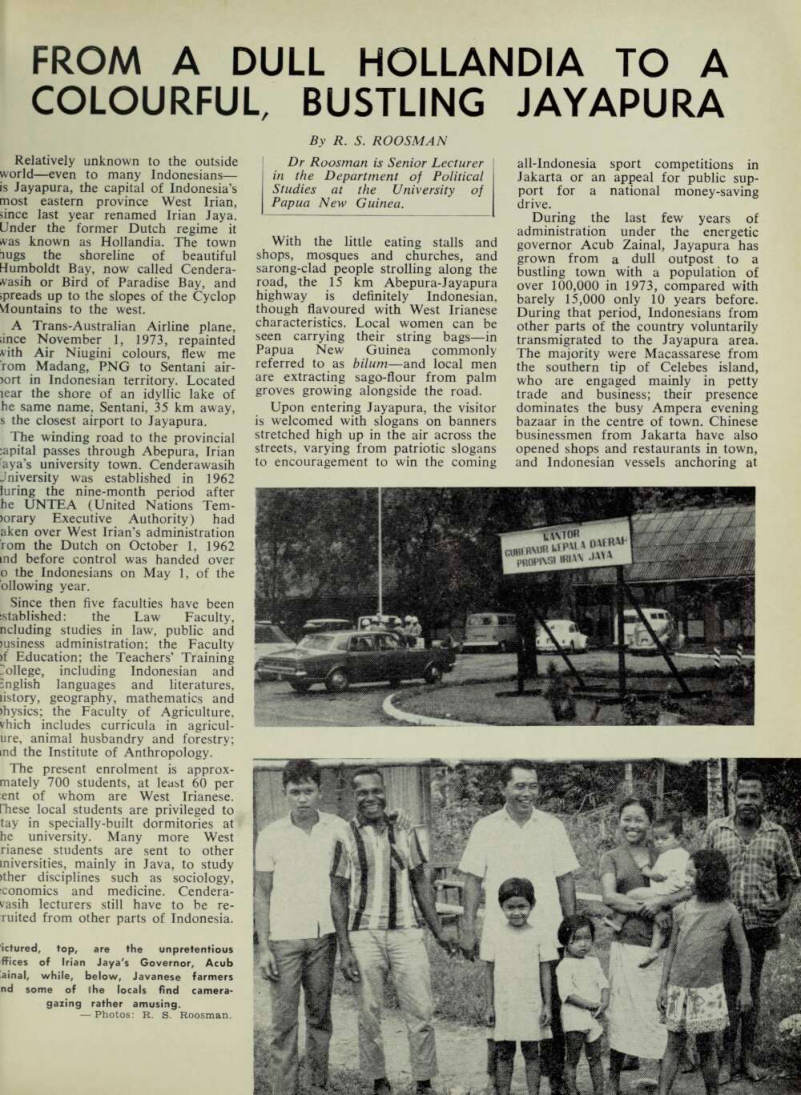
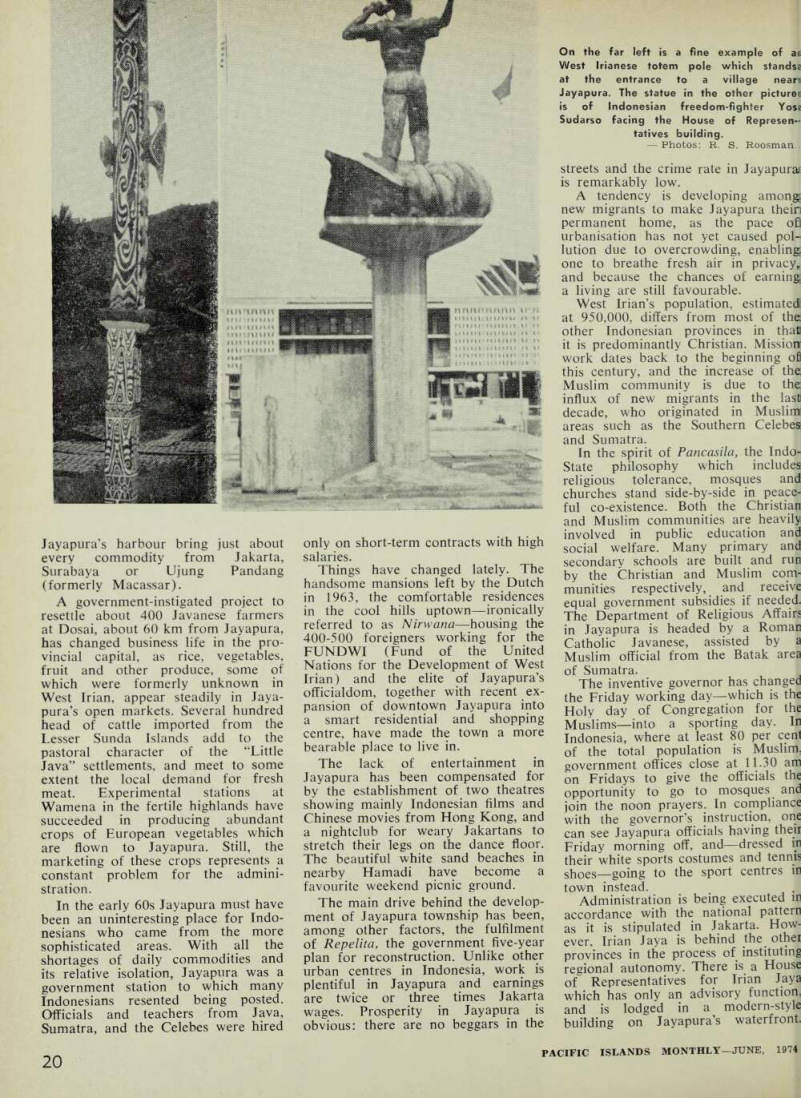
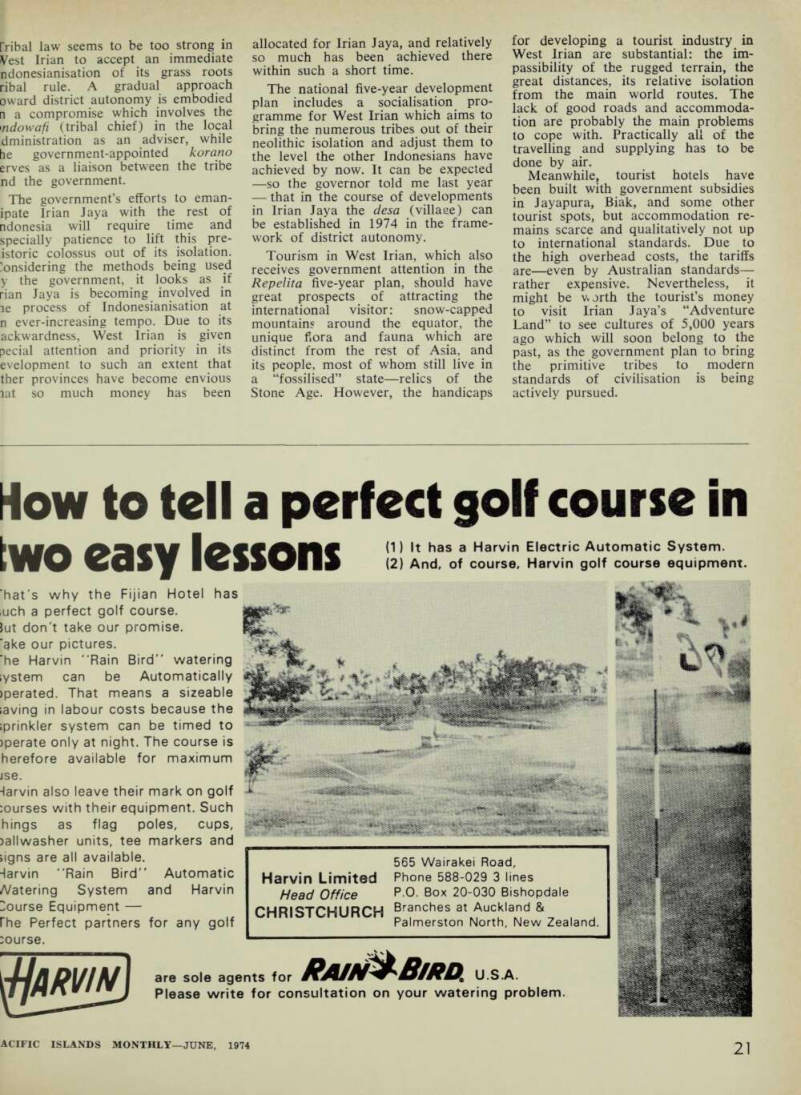
From A Dull Hollandia To A
By R. S. Roosman
Relatively unknown to the outside world —even to many Indonesians— is Jayapura, the capital of Indonesia’s most eastern province West Irian, since last year renamed Irian Jaya.
Under the former Dutch regime it vas known as Hollandia. The town !iugs the shoreline of beautiful Humboldt Bay, now called Cendera vasih or Bird of Paradise Bay, and spreads up to the slopes of the Cyclop Mountains to the west.
A Trans-Australian Airline plane, since November 1, 1973, repainted vith Air Niugini colours, flew me fom Madang, PNG to Sentani air >ort in Indonesian territory. Located iear the shore of an idyllic lake of he same name, Sentani, 35 km away, s the closest airport to Jayapura, The winding road to the provincial :apital passes through Abepura, Irian aya’s university town. Cenderawasih Jniversity was established in 1962 luring the nine-month period after he UNTEA (United Nations Tem )orary Executive Authority) had aken over West Irian’s administration fom the Dutch on October 1, 1962 md before control was handed over o the Indonesians on May 1, of the bllowing year.
Since then five faculties have been istablished: the Law Faculty, ncluding studies in law, public and msiness administration; the Faculty )f Education; the Teachers’ Training Jollege, including Indonesian and English languages and literatures, listory, geography, mathematics and )hysics; the Faculty of Agriculture, vhich includes curricula in agricul ure, animal husbandry and forestry; md the Institute of Anthropology.
The present enrolment is approx mately 700 students, at least 60 per ent of whom are West Irianese. fhese local students are privileged to tay in specially-built dormitories at he university. Many more West rianese students are sent to other iniversities, mainly in Java, to study )ther disciplines such as sociology, iconomics and medicine. Cendera vasih lecturers still have to be re ruited from other parts of Indonesia.
Dr Roosman is Senior Lecturer in the Department of Political Studies at the University of Papua New Guinea.
With the little eating stalls and shops, mosques and churches, and sarong-clad people strolling along the road, the 15 km Abepura-Jayapura highway is definitely Indonesian, though flavoured with West Irianese characteristics. Local women can be seen carrying their string bags—in Papua New Guinea commonly referred to as bilum —and local men are extracting sago-flour from palm groves growing alongside the road.
Upon entering Jayapura, the visitor is welcomed with slogans on banners stretched high up in the air across the streets, varying from patriotic slogans to encouragement to win the coming
all-Indonesia sport competitions in Jakarta or an appeal for public sup port for a national money-saving drive.
During the last few years of administration under the energetic governor Acub Zainal, Jayapura has grown from a dull outpost to a bustling town with a population of over 100,000 in 1973, compared with barely 15,000 only 10 years before.
During that period, Indonesians from other parts of the country voluntarily transmigrated to the Jayapura area.
The majority were Macassarese from the southern tip of Celebes island, who are engaged mainly in petty trade and business; their presence dominates the busy Ampera evening bazaar in the centre of town. Chinese businessmen from Jakarta have also opened shops and restaurants in town, and Indonesian vessels anchoring at
[?]ictured, top, are the unpretentious offices of Irian Jaya's Governor, Acub [?]ainal, while, below, Javanese farmers nd some of the locals find camera gazing rather amusing.
Photos: R. S. Roosman.
Jayapura’s harbour bring just about every commodity from Jakarta, Surabaya or Ujung Pandang (formerly Macassar).
A government-instigated project to resettle about 400 Javanese farmers at Dosai, about 60 km from Jayapura, has changed business life in the pro vincial capital, as rice, vegetables, fruit and other produce, some of which were formerly unknown in West Irian, appear steadily in Jaya pura’s open markets. Several hundred head of cattle imported from the Lesser Sunda Islands add to the pastoral character of the “Little Java” settlements, and meet to some extent the local demand for fresh meat. Experimental stations at Wamena in the fertile highlands have succeeded in producing abundant crops of European vegetables which are flown to Jayapura. Still, the marketing of these crops represents a constant problem for the admini stration.
In the early 60s Jayapura must have been an uninteresting place for Indo nesians who came from the more sophisticated areas. With all the shortages of daily commodities and its relative isolation, Jayapura was a government station to which many Indonesians resented being posted.
Officials and teachers from Java, Sumatra, and the Celebes were hired
only on short-term contracts with high salaries.
Things have changed lately. The handsome mansions left by the Dutch in 1963, the comfortable residences in the cool hills uptown —ironically referred to as Nirwana —housing the 400-500 foreigners working for the FUNDWI (Fund of the United Nations for the Development of West Irian) and the elite of Jayapura’s officialdom, together with recent ex pansion of downtown Jayapura into a smart residential and shopping centre, have made the town a more bearable place to live in.
The lack of entertainment in Jayapura has been compensated for by the establishment of two theatres showing mainly Indonesian films and Chinese movies from Hong Kong, and a nightclub for weary Jakartans to stretch their legs on the dance floor.
The beautiful white sand beaches in nearby Hamadi have become a favourite weekend picnic ground.
The main drive behind the develop ment of Jayapura township has been, among other factors, the fulfilment of Repelita, the government five-year plan for reconstruction. Unlike other urban centres in Indonesia, work is plentiful in Jayapura and earnings are twice or three times Jakarta wages. Prosperity in Jayapura is obvious: there are no beggars in the
streets and the crime rate in Jayapurat is remarkably low, A tendency is developing among new migrants to make Jayapura thein permanent home, as the pace ofi urbanisation has not yet caused pol lution due to overcrowding, enabling one to breathe fresh air in privacy* and because the chances of earning a living are still favourable.
West Irian’s population, estimated! at 950,000, differs from most of the other Indonesian provinces in thatl it is predominantly Christian. Mission work dates back to the beginning ofl this century, and the increase of the Muslim community is due to the influx of new migrants in the last! decade, who originated in Muslim areas such as the Southern Celebess and Sumatra.
In the spirit of Pancasila, the Indo- State philosophy which includes religious tolerance, mosques and churches stand side-by-side in peace ful co-existence. Both the Christian and Muslim communities are heavily involved in public education and social welfare. Many primary and secondary schools are built and run by the Christian and Muslim com munities respectively, and receive equal government subsidies if needed.
The Department of Religious Affairs in Jayapura is headed by a Roman Catholic Javanese, assisted by a Muslim official from the Batak area of Sumatra.
The inventive governor has changed the Friday working day—which is the Holy day of Congregation for the Muslims —into a sporting day. In Indonesia, where at least 80 per cent of the total population is Muslim, government offices close at 11.30 am on Fridays to give the officials the opportunity to go to mosques and join the noon prayers. In compliance with the governor’s instruction, one can see Jayapura officials having theii Friday morning off, and —dressed in their white sports costumes and tennis shoes—going to the sport centres in town instead.
Administration is being executed in accordance with the national pattern as it is stipulated in Jakarta. How ever, Irian Jaya is behind the other provinces in the process of instituting regional autonomy. There is a House of Representatives for Irian Jaya which has only an advisory function, and is lodged in a modern-style building on Jayapura’s waterfront.
On the far left is a fine example of a West Irianese totem pole which stands at the entrance to a village near' Jayapura. The statue in the other picture is of Indonesian freedom-fighter Yos Sudarso facing the House of Represen tatives building.
Photos: R. S. Roosman.
fribal law seems to be too strong in Vest Irian to accept an immediate ndonesianisation of its grass roots ribal rule. A gradual approach oward district autonomy is embodied i a compromise which involves the mdowafi (tribal chief) in the local dministration as an adviser, while
tie government-appointed korano
erves as a liaison between the tribe nd the government.
The government’s efforts to eman ipate Irian Jaya with the rest of ndonesia will require time and specially patience to lift this pre istoric colossus out of its isolation.
Considering the methods being used y the government, it looks as if rian Jaya is becoming involved in le process of Indonesianisation at n ever-increasing tempo. Due to its ackwardness, West Irian is given pedal attention and priority in its evelopment to such an extent that ther provinces have become envious lat so much money has been
allocated for Irian Jaya, and relatively so much has been achieved there within such a short time.
The national five-year development plan includes a socialisation pro gramme for West Irian which aims to bring the numerous tribes out of their neolithic isolation and adjust them to the level the other Indonesians have achieved by now. It can be expected —so the governor told me last year that in the course of developments in Irian Jaya the desa (villaae) can be established in 1974 in the frame work of district autonomy.
Tourism in West Irian, which also receives government attention in the Repelita five-year plan, should have great prospects of attracting the international visitor: snow-capped mountains around the equator, the unique flora and fauna which are distinct from the rest of Asia, and its people, most of whom still live in a “fossilised” state—relics of the Stone Age, However, the handicaps
for developing a tourist industry in West Irian are substantial: the im passibility of the rugged terrain, the great distances, its relative isolation from the main world routes. The lack of good roads and accommoda tion are probably the main problems to cope with. Practically aU of the travelling and supplying has to be done by air.
Meanwhile, tourist hotels have been built with government subsidies in Jayapura, Biak, and some other tourist spots, but accommodation re mains scarce and qualitatively not up to international standards. Due to the high overhead costs, the tariffs are—even by Australian standards— rather expensive. Nevertheless, it might be worth the tourist’s money to visit Irian Jaya’s “Adventure Land” to see cultures of 5,000 years ago which will soon belong to the past, as the government plan to bring the primitive tribes to modern standards of civilisation is being actively pursued.
Advertisements & other items, pp. 23-24 (2 items)
21
ACIFIC ISLANDS MONTHLY—JUNE, 1974
flow to tell a perfect golf course in
two easy lessons
(1) It has a Harvin Electric Automatic System. (2) And, of course, Harvin golf course equipment. ‘hat's why the Fijian Hotel has uch a perfect golf course, lut don't take our promise. ‘ake our pictures.
"he Harvin "Rain Bird" watering iystem can be Automatically iperated. That means a sizeable laving in labour costs because the sprinkler system can be timed to )perate only at night. The course is herefore available for maximum jse.
Harvin also leave their mark on golf sourses with their equipment. Such hings as flag poles, cups, jallwasher units, tee markers and signs are all available.
Harvin "Rain Bird" Automatic /Vatering System and Harvin bourse Equipment Fhe Perfect partners for any golf course.
MVIN
r. ■ * tr TO mm 565 Wairakei Road, Phone 588-029 3 lines P.O. Box 20-030 Bishopdale Branches at Auckland & Palmerston North. New Zealand.
Harvin Limited Head Office
CHRISTCHURCH
are sole agents for PA/P&BiPD. usa Please write for consultation on your watering problem.
n * Caterpillar reliability, productivity, availability.
Now you can get it all in awheel skidder. The 518.
A whole new standard in skidder engineering. 120 turbocharged horsepower, 17,400 pounds of working muscle with full articulation and frame oscillation for stability and minimum maintenance.
Single lever “on the go” powershift. Dual rate steering for controlled response at all speeds.
An operator’s compartment engineered for efficiency with safety features built in for man and machine.
You’ll find all the best skidder ideas, plus added refinement and top quality manufacturing that can make the 518 the backbone of your logging operation.
And Hastings Deering will ensure that your backbone stays in top condition no matter how far in the bush you are. Parts, maintenance, repairs or simply information—we’ll see that you get it fast. That’s People Power!
So go tackle the jungle with the new Cat 518 and Hastings Deering.
People Power:
25 Years in Papua New Guinea
we work as hard,backing-up a single sale,as we do for a fleet. You can depend on it! yj> Northern Territory and South-West Pacific.
HOS3O
The Mailbag

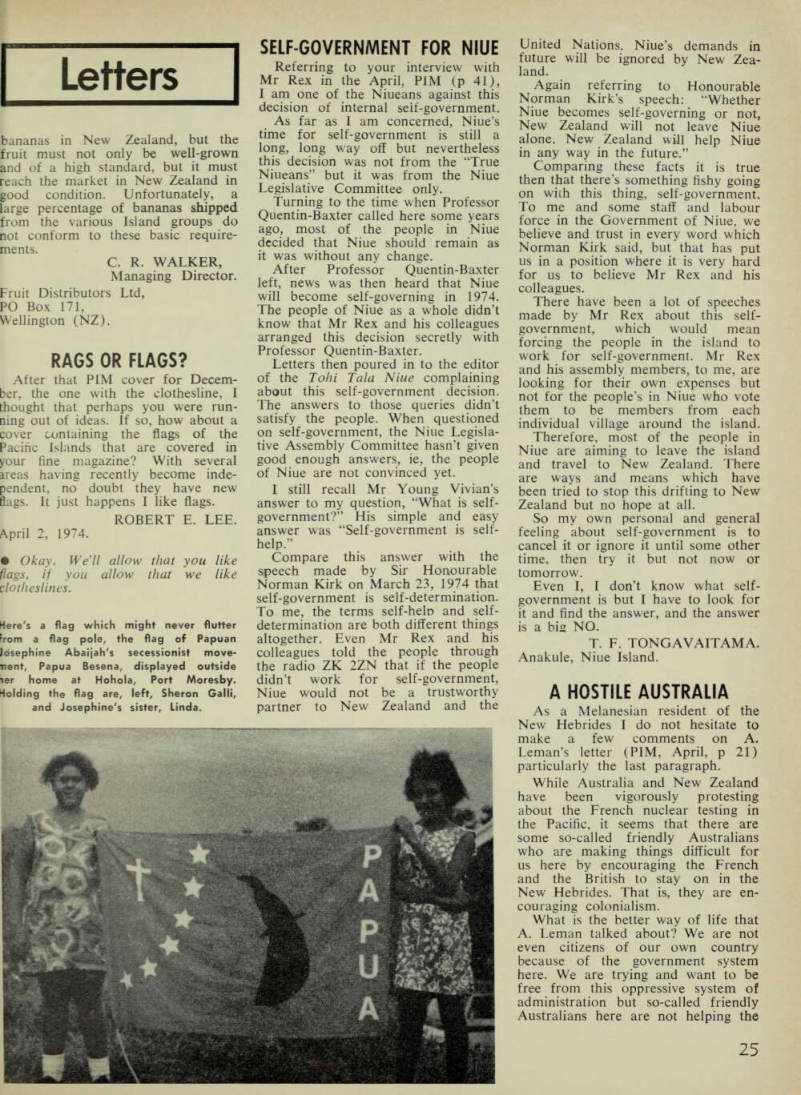

Autopsy On Samoan Bananas
Some statements and assertions nade in an article, (PIM, April, p 15) under the heading The Farmers ire the Samoans’ Last Hope, from Va’a in Apia, require further sxamination.
It is stated that, one of the main easons for the decline in production ‘is lack of a steady market. The slew Zealand market for bananas is instable because it can only absorb o many cases of bananas from fVestern Samoa”.
It goes on to mention that, ■planters have never forgotten an in ident some years ago when hun- Ireds of cases of Samoan bananas vere stranded on the wharf and sold it give-away prices because the New Zealand banana quota from Western Samoa had been filled”.
Fruit Distributors Limited, operat ng under an agreement with the «Jew Zealand Government, com nenced operations in 1951 and has ibsorbed over the years practically ,11 the bananas that have been iffered by the Samoan Government or export.
It is interesting to note the vari tion in quantity between one year nd the next: 1951 62,715 large ases, 1952 65,883, 1953 240,518, 954 287,869, 1955 425,856, 1956 13,390, 1957 308,491, 1958 158,940, 1959 802,116, 1960 93,012, 1961 563,225, 1962 748,020, 963 711,196, 1964 616,803, 1965 12,504, 1966 72,800, 1967 93,146, 968 97,353, 1969 217,030, 1970 00,575; 1971 236,684 small cases, 972 108,005, 1973 40,738, a total f 8,176,869 cases.
It will be noted that the supply ose from 308,000 cases in 1957 to 58,000 cases in 1958 and these were 11 absorbed by the New Zealand larket.
The statement further on in the rticle that, “the Western Samoan iovernment has been talking about n agreement with New Zealand uaranteeing that it will be able to bsorb so many cases of Samoan ananas year in, year out”, can only e effective provided Samoa can uarantee to supply that quantity ear in, year out and judging by erformance this does not appear ossible.
It does seem strange for a state ment to be made that growers have been “discouraged” because a few hundred cases were not absorbed.
We believe the reason for this did not originate from a quota, but through the fact that more bananas were tendered for shipment than were estimated when shipping space was booked and there was no space available to take the larger quantity.
One should really look at the fact that since 1951 our company has bought 8,176,869 cases of bananas from Samoa and only a few hundred cases not shipped.
A statement is made that, “the New Zealand market is crying out for bananas”. This statement is cer tainly not correct. The New Zealand market can absorb a quantity of bananas and it has given preference to the Islands to supply New Zea land’s requirements first before pur chases are made from other coun tries. However, there are many countries able to supply New Zea land with its full requirements and at prices considerably lower than those that are being paid today by the importers to the supplying authorities in the Islands.
The suggestion is made in the article that “planters are complain ing that Fruit Distributors are ex ploiting them, making outrageous profits while the planters are getting only a minimal sum”.
In 1973, Island bananas were sold in New Zealand at a loss of $l.OO per case to the importers. The Pro duce Marketing Division in Samoa was paid SNZ2.BO for every case of bananas shipped to our company; the freight was paid of SNZI.S6 per case to Auckland and transport to the various distribution areas in New Zealand cost a further SNZI.OO per case. This made a total cost into store of $NZ5.36.
The company received from its distributors for those bananas which made a top price (and only a per centage do that), 54.32. The retail price of bananas in New Zealand is fixed by the Price Tribunal and our company has no say whatsoever in the retail price arrangement.
Again, we would like to reiterate that there is a good market for
bananas in New Zealand, but the fruit must not only be well-grown and of a high standard, but it must reach the market in New Zealand in good condition. Unfortunately, a large percentage of bananas shipped from the various Island groups do not conform to these basic require ments.
C. R. Walker
Managing Director.
Fruit Distributors Ltd, PO Box 171, Wellington (NZ).
Rags Or Flags?
After that PIM cover for Decem ber, the one with the clothesline, I thought that perhaps you were run ning out of ideas. If so, how about a cover containing the flags of the Pacific Islands that are covered in your fine magazine? With several areas having recently become inde pendent, no doubt they have new Bags. It just happens I like flags.
Robert E. Lee.
April 2, 1974. • Okay. Well allow that you like flags, if you allow that we like clotheslines.
Self-Government For Niue
Referring to your interview with Mr Rex in the April, PIM (p 41), I am one of the Niueans against this decision of internal self-government.
As far as I am concerned, Niue’s time for self-government is still a long, long way off but nevertheless this decision was not from the “True Niueans” but it was from the Niue Legislative Committee only.
Turning to the time when Professor Quentin-Baxter called here some years ago, most of the people in Niue decided that Niue should remain as it was without any change.
After Professor Quentin-Baxter left, news was then heard that Niue will become self-governing in 1974.
The people of Niue as a whole didn’t know that Mr Rex and his colleagues arranged this decision secretly with Professor Quentin-Baxter.
Letters then poured in to the editor of the Tohi Tala Niue complaining about this self-government decision.
The answers to those queries didn’t satisfy the people. When questioned on self-government, the Niue Legisla tive Assembly Committee hasn’t given good enough answers, ie, the people of Niue are not convinced yet.
I still recall Mr Young Vivian’s answer to my question, “What is self government?” His simple and easy answer was “Self-government is self help.”
Compare this answer with the speech made by Sir Honourable Norman Kirk on March 23, 1974 that self-government is self-determination.
To me, the terms self-heln and self determination are both different things altogether. Even Mr Rex and his colleagues told the people through the radio ZK 2ZN that if the people didn’t work for self-government, Niue would not be a trustworthy partner to New Zealand and the
United Nations. Niue’s demands in future will be ignored by New Zea land.
Again referring to Honourable Norman Kirk’s speech: “Whether Niue becomes self-governing or not, New Zealand will not leave Niue alone. New Zealand will help Niue in any way in the future.”
Comparing these facts it is true then that there’s something fishy going on with this thing, self-government.
To me and some staff and labour force in the Government of Niue, we believe and trust in every word which Norman Kirk said, but that has put us in a position where it is very hard for us to believe Mr Rex and his colleagues.
There have been a lot of speeches made by Mr Rex about this self government, which would mean forcing the people in the island to work for self-government. Mr Rex and his assembly members, to me, are looking for their own expenses but not for the people’s in Niue who vote them to be members from each individual village around the island.
Therefore, most of the people in Niue are aiming to leave the island and travel to New Zealand. There are ways and means which have been tried to stop this drifting to New Zealand but no hope at all.
So my own personal and general feeling about self-government is to cancel it or ignore it until some other time, then try it but not now or tomorrow.
Even I, I don’t know what self government is but I have to look for it and find the answer, and the answer is a bia NO.
T. F. Tongavaitama.
Anakule, Niue Island.
A Hostile Australia
As a Melanesian resident of the New Hebrides I do not hesitate to make a few comments on A.
Leman’s letter (PIM, April, p 21) particularly the last paragraph.
While Australia and New Zealand have been vigorously protesting about the French nuclear testing in the Pacific, it seems that there are some so-called friendly Australians who are making things difficult for us here by encouraging the French and the British to stay on in the New Hebrides. That is, they are en couraging colonialism.
What is the better way of life that A. Leman talked about? We are not even citizens of our own country because of the government system here. We are trying and want to be free from this oppressive system of administration but so-called friendly Australians here are not helping the
Here's a flag which might never flutter From a flag pole, the flag of Papuan [?]osephine Abaijah's secessionist move- Ment, Papua Besena, displayed outside [? [?]er home at Hohola, Port Moresby.
Holding the flag are, left, Sheron Galli, and Josephine's sister, Linda.
tuation by being here. The Mela esians do not invite these people to 3me here and assist with the de slopment of the New Hebrides, hey have invited themselves here ;cause they think there is so much ;re that they can get away with — nd and all!
We welcome the banks but I am ‘raid we cannot tolerate so-called dividual, friendly Australians yet.
'e hope that such people are not apegoats of the Whitlam govern ed.
What does A. Leman mean by ying, “Individual Australians are sisting considerably in the develop ed of the New Hebrides and in e joining together of residents ;re to work together to forget cial, tribal and religious differences order to seek economic and poli •al progress for all”.
We do not need to do that to seek onomic and political progress, sople always like to live with their fferences and this will exist even ars after independence. How on rth could the Australians, who low nothing about our tribal sys m, make us forget the differences? seems that A. Leman does not tow that we are not citizens of our m country and this is what we int before we begin to think of onomic development of our beauti l country.
It also seems that these Aust lians here are ignorant of our his ry. If it had not been for the reli )us organisations they would not ve been able to come here. This ice would have been a French ritory and the nuclear testing aid have been held here, which is t far from Australia, In the olical days the kings were guided the prophets. In the New Heb ies we want our governments to guided by the religious organisa ns so that it will be a happy place * all and not just for the present lite masters.
We believe Christ will bring, ough the religious organisations, ease to the down-trodden Mela sians. Christianity is neither black r white, so may A. Leman be lured that Christ will set us free •m the injustices that exist here ough Christian organisations that believe in. They will work for it aim.
While the Fijians have been forced leave Australia, some Australians
think that they have every right ini the world to live here in the New' Hebrides. As regards education! officials, their behaviour has been the; pattern in all developing countries* so it will be the same for the New' Hebrides.
J. Kaltolu.
Vila, New Hebrides.
Aust-Nz Union
Having travelled recently quite ai bit through both American andl Western Samoa and upon reading your article of the divided Samoasi (PIM, April, p 33), one is remindedl of a similar question of a confedera tion between Australia and New Zealand.
No one in Australia ever seriously considers—or for that matter even cares about—a confederation but as soon as one meets with New Zea landers, they start the subject saying they would be against it. My answer always is that Australia did not pro pose it in the first instance and can easily manage without NZ. But there is no doubt, New Zealanders have a (inferiority) complex about it.
The situation is similar with the Samoas. Western Samoa has a well organised, happy, healthy and clean country with the majority of land, people and wealth. It is the short sightedness of the American Samoans—like the New Zealanders —who would have nothing but gain if only they buried their false pride.
I believe the American Govern ment would be quite happy to part with their “colony”: it has no longer any military value and it only costs them a lot of money without any thing in return.
Meanwhile, just like the Austral ians have no sleepless nights aboul the New Zealanders joining them.
Western Samoans do not worry toe much about their brothers in Ameri can Samoa.
But it is a shame, here and there ; if one thinks of all the money anc3 manpower that is wasted by these duplicate governments and how life of the individual is made miserable by unnecessary and unwarranted “red tape” and regulations betweer these two lots of brother countries!
Let’s ask Mr Kissinger if he has some spare time when he is finished in the Middle East.
Georges M. Teitler.
Killara, NSW.
Advertisements & other items, pp. 25-30 (4 items)
23
ACIFIC ISLANDS MONTHLY—JUNE, 1074
anywhere,
any time,
any gas.
and it’s
all Australian.
£* V - '
,Vj| Jfe= ;
it U .# •
: ■HU For further information & addresses of your local distributor contact:
THE COMMONWEALTH
INDUSTRIAL GASES LIMITED
Gases Export Department, 138 Bourke Road, Alexandria, N.S.W., Australia 2015.
Cables ‘CIGAS’-Telex 20241 Sydney. 017.024
** “CANBERRA”
Three bedroom elevated home, lots of living space, brick laundry under, and two carports.
George Hudson’s new Therma-Panel modular units mean that you can build your own home in a fraction of the time required for traditional materials.
Write for detailed plans and prices from the sole Pacific Islands agent :
A. RIETTE (EXPORT) PTY. LTD.
300 GEORGE STREET, SYDNEY 2000.
Cables: Ramaritime, Sydney
What’s so
different about
* THERMA-PANEL
HOMES?
Just this:
• Only three basic components for walls, ceilings, doors and windows. • Makes building simple as A.B.C. • Specially designed for the owner-builder. • Fully insulated walls and ceilings. • Cuts on-site construction time. • Cuts on-site construction costs. • Pitched or flat roof with exposed beams for real beauty.
KERR BROS.
THE
njlddCS®
trailers
PEOPLE FOR THE PACIFIC ISLANDS
It Pays to Buy WEEKS the
Big Value Trailer Range!
From 3 ton up to 10 ton, 2 or 4 wheels, tipping and non-tipping. Weeks trailers are specially designed for heavy duty work and long life. From the Weeks range, you will find a trailer to suit your particular carrying application. For further details, please write to
KERR BROS. PTY. LTD
r*
ISLAND MERCHANTS,
65 YORK STREET, SYDNEY. CABLES: CAREFULNESS, SYDNEY.
N t s % Australia’s largest and most advanced range of
WRTSR
PRESSURE
svsicms
From only $139
ECON-O-JET
Packaged water systems.
From Only $210; ■ m
? AQUA GENIE
Out-performs anything in its price range!
Only $139 ‘J” Series High Pressure Unit Range of multi-stage deep and shallow well capacities models, from 200 to 2600 g.p.h., pressures from 20 toi2o p.s.i., depths to 300 ft. ' From $360 gr Water Equipment Catalogue 288 Pages—covers pumps of all types, irrigation, water conditioning, domestic and commercial pool filtration. Price $2, post free surface mail (enclose cheque/ money order) DUNLOP/IBC LTD., Station 4105. Phone: 40-9011.
Road, Yerrongpilly, HYDRO-PAK (Left) from $303 TWIN-PAK (Above) from $393 New RM2 range of shallow and deep well models, capacities to 1180 g.p.h., pressures to 75 p.s.i.
NAME
ADDRESS..
PHONE.
rediscovering water
LBQO4IO I.F.
Throughout
the Islands
are foremost in
General Insurance
QUEENSLAND INSURANCE
COMPANY LIMITED
(Incorporated 1886 in Australia)
Head Office: 82 Pitt Street, Sydney FIJI —Branch Office, Suva, Manager for Fiji: F. N. Davie* (A.A.1.1.).
LAUTOKA—District Manager: U. Singh.
HONIARA (8.5.1. P.) —Breckwoldt & Company (5.1.) Pty, Limited.
NEW CALEDONIA—T. A. Hagen, Ste. W. A. Johnston, S.A.R.L.—Noumea.
NEW HEBRlDES—Resident Officer: R. J. Allsop (A.A.1.1.) Vila; Santo: Burns Philp (New Hebrides) Ltd.
TAHlTl—Arthur Chung: Immeuble 8.1., Front de Mer, Papeete.
NIUE, NORFOLK ISLAND, SAMOA, TONGA and other South Sea Islands—Burns Philp (South Sea) Company Ltd.
QUEENSLAND INSURANCE (P.N.G.) LTD
PAPUA NEW GUINEA
Head Office, Port Moresby: General Manager: D. J. Granter.
District Managers at Rabaul: C, D. Dickings; Lae: R. Jackson; Mt. Hagen: D. F. Carroll.
V339R
. . . . . . The MANA section of Pacific Islands Monthly is to be published each year as a AA /K N >\“*book by the South Pacific Creative Arts Society. As a society member you get your copy. Life membership of the SPCAS is $lOO Fijian or equivalent; foundation membership (good for three years) $25, ordinary membership $4 for those outside the islands served by the South Pacific Commission and $2.50 for those addresses within the islands. Send subscriptions to the Secretary, Box 5083, Suva, Fiji.
What your business
can learn
from the stegosaurus.
i s“*> r Ihe stegosaurus was heavily protected against obvious dangers-yet so vulnerable n other ways that he vanished from the earth. Just as many businesses are heavily nsured against obvious risks-yet frighteningly vulnerable to other, less apparent, lazards. Let Bain Dawes’ risk management experts study your operation. Identify four risk areas. Advise you how to minimise them. Tell you where you’re over or mder insured. And arrange a balanced insurance programme that gives you real security. Let’s talk about it. Soon.
Insurance
Bam Dawes „
formerly Harvey Tnnder
rßrokers and Risk Management Consultants Hunter Street, Port Moresby. Phone 2241.
And at Sydney, Newcastle, Melbourne, Brisbane, Adelaide, Perth, Hobart, Launceston.
UNITED KINGDOM, EUROPE, NORTH AMERICA, NEW ZEALAND.
Letters
25
Letters
27
CIFIC ISLANDS MONTHLY—JUNE, 1974
A mini-Interpol
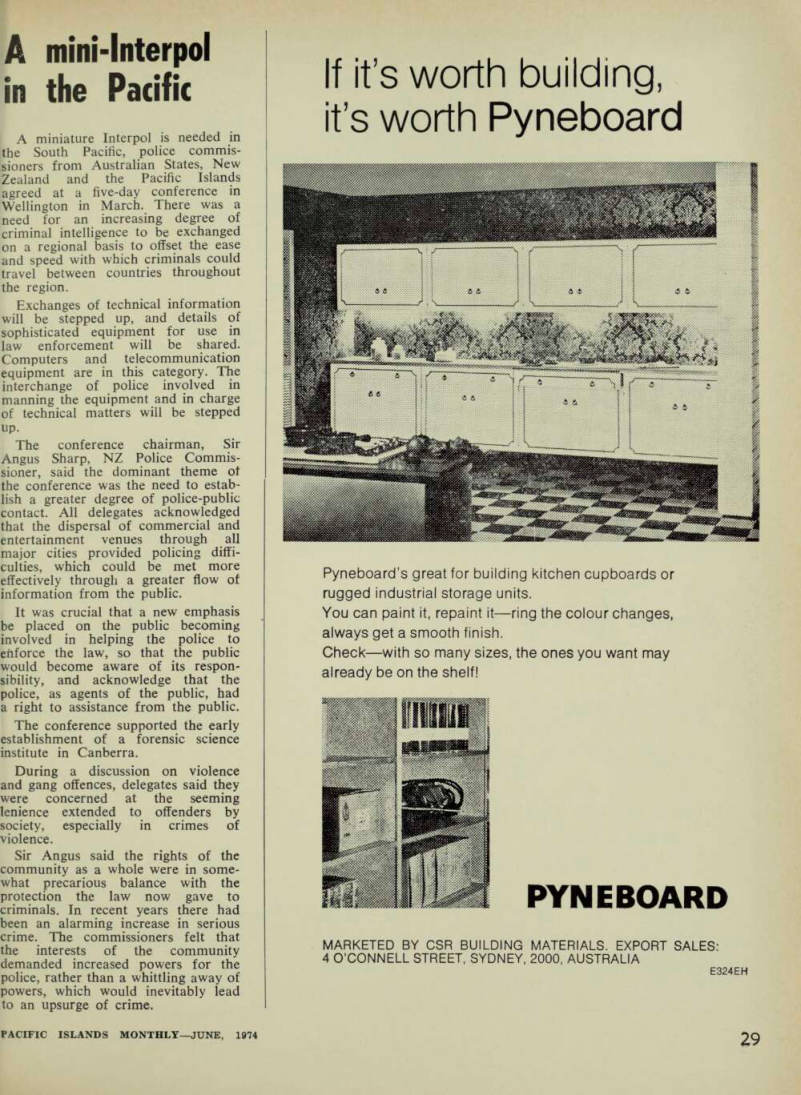
in the Pacific
A miniature Interpol is needed in the South Pacific, police commis sioners from Australian States, New Zealand and the Pacific Islands agreed at a five-day conference in Wellington in March. There was a need for an increasing degree of criminal intelligence to be exchanged on a regional basis to offset the ease and speed with which criminals could travel between countries throughout the region.
Exchanges of technical information will be stepped up, and details of sophisticated equipment for use in law enforcement will be shared.
Computers and telecommunication equipment are in this category. The interchange of police involved in manning the equipment and in charge of technical matters will be stepped up.
The conference chairman, Sir Angus Sharp, NZ Police Commis sioner, said the dominant theme of the conference was the need to estab lish a greater degree of police-public contact. All delegates acknowledged that the dispersal of commercial and entertainment venues through all major cities provided policing diffi culties, which could be met more effectively through a greater flow of information from the public.
It was crucial that a new emphasis be placed on the public becoming involved in helping the police to enforce the law, so that the public would become aware of its respon sibility, and acknowledge that the police, as agents of the public, had a right to assistance from the public.
The conference supported the early establishment of a forensic science institute in Canberra.
During a discussion on violence and gang offences, delegates said they were concerned at the seeming lenience extended to offenders by society, especially in crimes of violence.
Sir Angus said the rights of the community as a whole were in some what precarious balance with the protection the law now gave to criminals. In recent years there had been an alarming increase in serious crime. The commissioners felt that the interests of the community demanded increased powers for the police, rather than a whittling away of powers, which would inevitably lead to an upsurge of crime.
Advertisements & other items, pp. 31-32 (1 item)
If it’s worth building,
it's worth Pyneboard
Pyneboard’s great for building kitchen cupboards or rugged industrial storage units.
You can paint it, repaint it —ring the colour changes, always get a smooth finish.
Check —with so many sizes, the ones you want may already be on the shelf!
PYNEBOARD
MARKETED BY CSR BUILDING MATERIALS. EXPORT SALES:
4 O’CONNELL STREET, SYDNEY. 2000, AUSTRALIA
E324EH
1 58 S. E. TATHAM & CO. PTY. LTD.
ASKEW HOUSE, 364 LONSDALE ST.,
MELBOURNE, 3001, AUSTRALIA.
G.P.O. BOX B—CABLES "SET”
TELEPHONE: 601125
Buyers for the Pacific Islands
AND IN
PAPUA NEW GUINEA: S. E. TATHAM (P.N.G.) PTY. LTD
LAE: MALEKULA ST. (P.O. BOX 1562).
PORT MORESBY: CNR. GOROA & MUNAHU STS., GORDON
(P.O. BOX 6733, BOROKO).
FU[: S. E. TATHAM (FIJI) LTD.,
LAUTOKA P.O. BOX 366,
SUVA G.P.O. BOX 671,
I
YOUR GUARANTEE
i 1
FOR SERVICE
SINCE 1924
New Hebrideans,
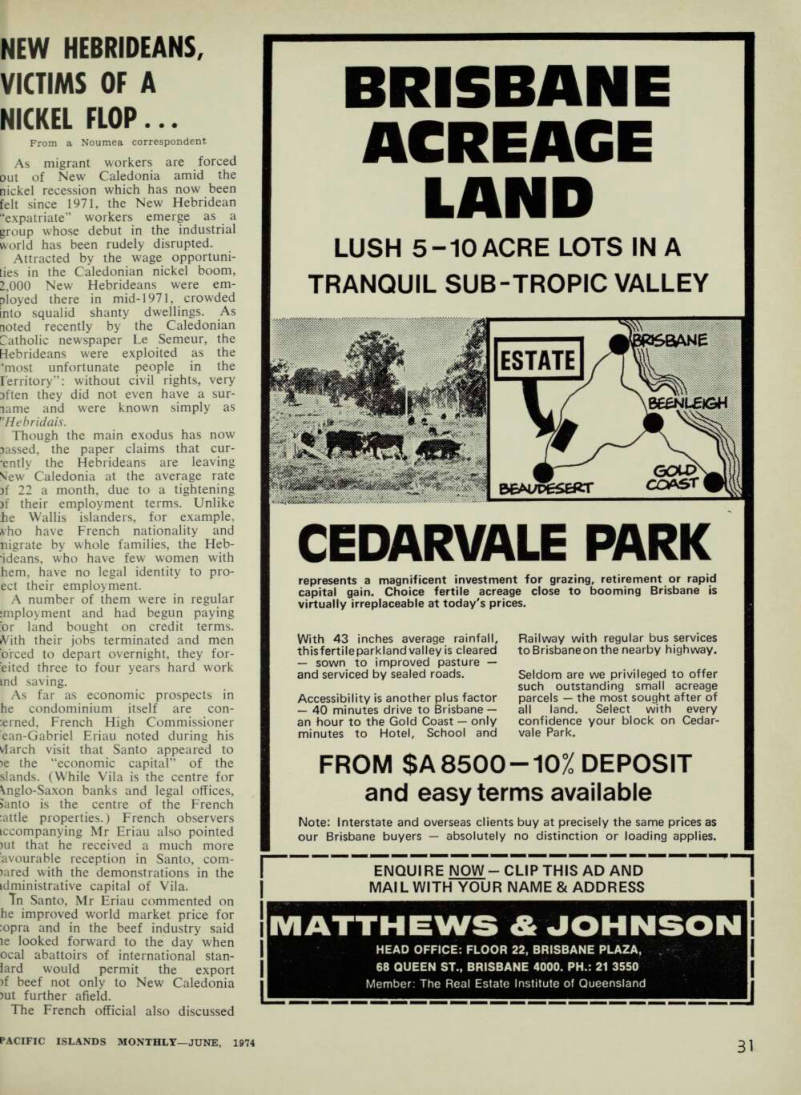

Victims Of A
Nickel Flop...
From a Noumea correspondent. 1 As migrant workers are forced out of New Caledonia amid the nickel recession which has now been felt since 1971, the New Hebridean ‘‘expatriate” workers emerge as a group whose debut in the industrial world has been rudely disrupted.
Attracted by the wage opportuni ties in the Caledonian nickel boom, 2,000 New Hebrideans were em ployed there in mid-1971, crowded into squalid shanty dwellings. As noted recently by the Caledonian Catholic newspaper Le Semeur, the Hebrideans were exploited as the ‘most unfortunate people in the Iferritory”: without civil rights, very jften they did not even have a sur name and were known simply as "Hebridais.
Though the main exodus has now passed, the paper claims that cur •ently the Hebrideans are leaving Vew Caledonia at the average rate if 22 a month, due to a tightening if their employment terms. Unlike he Wallis islanders, for example, vho have French nationality and nigrate by whole families, the Heb ndeans, who have few women with hem, have no legal identity to pro ect their employment.
A number of them were in regular ;mployment and had begun paying :or land bought on credit terms.
With their jobs terminated and men breed to depart overnight, they for feited three to four years hard work md saving.
As far as economic prospects in he condominium itself are con cerned, French High Commissioner fean-Gabriel Eriau noted during his tfarch visit that Santo appeared to )e the “economic capital” of the slands. (While Vila is the centre for \nglo-Saxon banks and legal offices, Janto is the centre of the French :attle properties.) French observers iccompanying Mr Eriau also pointed )ut that he received a much more fevourable reception in Santo, com >ared with the demonstrations in the administrative capital of Vila.
Tn Santo, Mr Eriau commented on he improved world market price for :opra and in the beef industry said le looked forward to the day when ocal abattoirs of international stan lard would permit the export )f beef not only to New Caledonia )ut further afield.
The French official also discussed
tourist development and said that the; New Hebrides should benefit frorm Japanese tourists when the aiding Paris-Tokyo-Noumea comes intoc operation next year.
On the prices problem, it was i pointed out the current world in flation alone cannot explain the ex cessively steep spiral noted in the; New Hebrides. Mr Eriau therefore: suggested that it was hardly neces sary to obtain all imports from ai country “whose currency is presently' strong”. The remark was passed om by the Noumea press as sound ad vice for Caledonian importers who also buy extensively in Australia.
Advertisements & other items, pp. 33-34 (1 item)
Brisbane
ACREAGE
LAND
LUSH 5-10 ACRE LOTS IN A
TRANQUIL SUB-TROPIC VALLEY
-ol • /X'./.v.-vV
CEDARVALE PARK
represents a magnificent investment for grazing, retirement or rapid capital gain. Choice fertile acreage close to booming Brisbane is virtually irreplaceable at today's prices.
With 43 inches average rainfall, thisfertileparkland valley is cleared sown to improved pasture and serviced by sealed roads.
Accessibility is another plus factor 40 minutes drive to Brisbane an hour to the Gold Coast only minutes to Hotel, School and Railway with regular bus services to Brisbaneon the nearby highway.
Seldom are we privileged to offer such outstanding small acreage parcels the most sought after of all land. Select with every confidence your block on Cedarvale Park. r
FROM SABSOO-10% DEPOSIT
and easy terms available
Note: Interstate and overseas clients buy at precisely the same prices as our Brisbane buyers absolutely no distinction or loading applies.
ENQUIRE NOW - CLIP THIS AD AND
MAIL WITH YOUR NAME & ADDRESS
MATTHEWS & JOHNSON
I 9
HEAD OFFICE: FLOOR 22, BRISBANE PLAZA,
68 QUEEN ST., BRISBANE 4000. PH.: 21 3550 Member: The Real Estate Institute of Queensland
DEAD HEAT!
42 '@W L (V C
that's the result
every time—to decide
Australia's most popular
copper fitting!
Ask any plumber and he will “tip” that there is just nothing to choose between the three stablemates-
“YOßKSHlßE” “YORKWAY” &
“YORKSIL”
Precision made and conforming to S.A.A. Standard 8181, for use with light gauge copper tubing . . . you’re on a winner for every application with a Yorkshire Imperial capillary fitting!
Ask your supplier tor Yorkshire Imperial fittings: —
YORKSHIRE
IMPERIAL
YORKSHIRE IMPERIAL AUSTRALIA PTY. LTD.
144-154 Milperra Road, Revesby, N.S.W. 2212. Phone 77-0561 VIC. 569 0859 OLD. 36 0455 W.A. 24 1017 S.A. 43 4445 3Y/6B
...But Cooks Plug
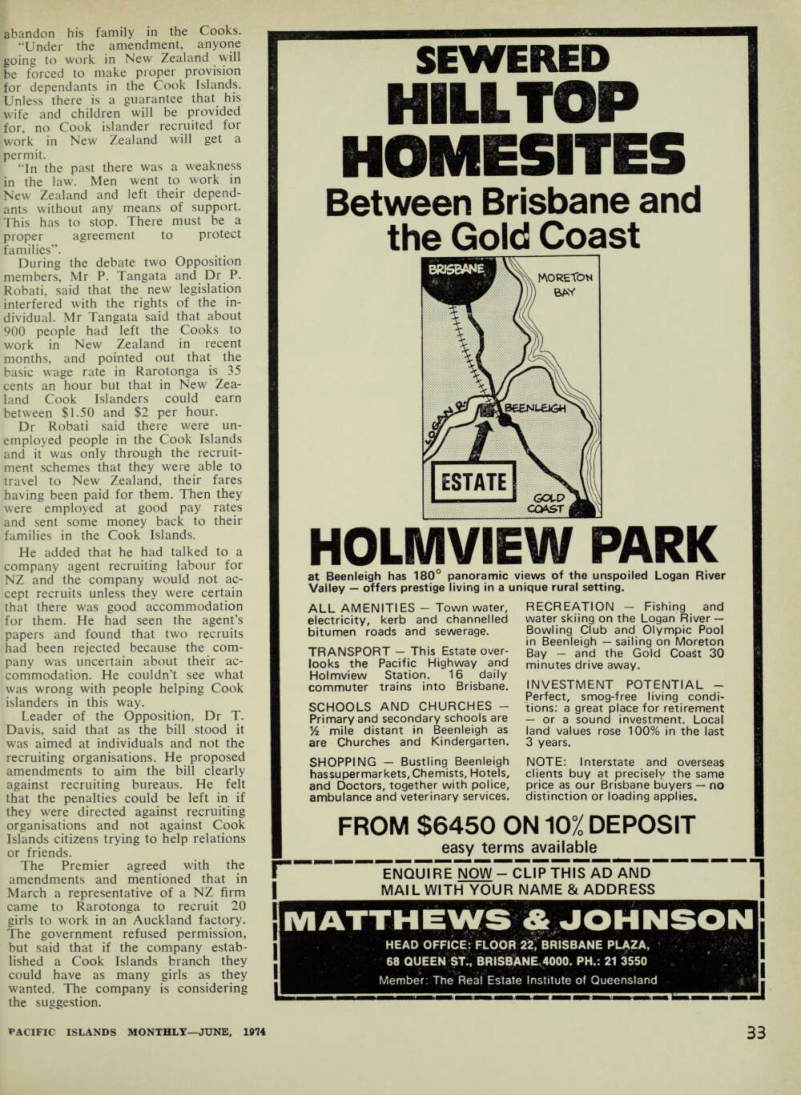
A Labour Gap
Prom a Rarotonga correspondent An amendment to the Cook Islands Industrial and Labour Ordinance 1964 which will ban the recruitment of Cook islanders for work overseas, mainly in New Zea land, without the approval of the Minister of Emigration, was des cribed by Premier Sir Albert Henry as an “anti-blackbirding measure” when he discussed it with PIM.
The amendment, passed by the Cook Islands Legislative Assembly in mid-April, makes it an offence for anyone, whether resident or not within the Cook Islands “to recruit, or cause to recruit or attempt to re cruit any person or persons for em ployment outside the Cook Islands”, unless a prior application to do so is made in writing to the minister.
Any approval given by the minis ter may contain such conditions as he feels necessary and may be re voked or the conditions altered at any time, and the minister’s decision will be final. Penalties of a $5OO fine or six months imprisonment are provided for those found guilty of breaking this law or using fraudulent details in their applications.
Talking to PIM, the Premier denied that his government was in terfering with individual liberty.
People, as was their right, were free to go to New Zealand. They were not seeking to change that.
“What we are doing”, said Sir Albert, “is preventing something which is very much like blackbirding in the old days—the exploitation of workers by organisations recruiting labour for work in New Zealand. We want to make sure that anyone going to work in New Zealand has a pro per job, with good living conditions and wages, and, above all, does not
abandon his family in the Cooks.
“Under the amendment, anyone going to work in New Zealand will be forced to make proper provision for dependants in the Cook Islands.
Unless there is a guarantee that his wife and children will be provided for, no Cook islander recruited for work in New Zealand will get a
permit.
“In the past there was a weakness in the law. Men went to work in New Zealand and left their depend ants without any means of support.
This has to stop. There must be a proper agreement to protect families”.
During the debate two Opposition members, Mr P. Tangata and Dr P.
Robati, said that the new legislation interfered with the rights of the in dividual. Mr Tangata said that about 900 people had left the Cooks to work in New Zealand in recent months, and pointed out that the basic wage rate in Rarotonga is 35 cents an hour but that in New Zea land Cook Islanders could earn between $1.50 and $2 per hour.
Dr Robati said there were un employed people in the Cook Islands and it was only through the recruit ment schemes that they were able to travel to New Zealand, their fares having been paid for them. Then they were employed at good pay rates and sent some money back to their families in the Cook Islands.
He added that he had talked to a company agent recruiting labour for NZ and the company would not ac cept recruits unless they were certain that there was good accommodation for them. He had seen the agent’s papers and found that two recruits had been rejected because the com pany was uncertain about their ac commodation. He couldn’t see what was wrong with people helping Cook islanders in this way.
Leader of the Opposition, Dr T.
Davis, said that as the bill stood it was aimed at individuals and not the
recruiting organisations. He proposed
amendments to aim the bill clearly against recruiting bureaus. He felt that the penalties could be left in if they were directed against recruiting organisations and not against Cook Islands citizens trying to help relations or friends.
The Premier agreed with the amendments and mentioned that in March a representative of a NZ firm came to Rarotonga to recruit 20 girls to work in an Auckland factory.
The government refused permission, but said that if the company estab lished a Cook Islands branch they could have as many girls as they wanted. The company is considering the suggestion.
Advertisements & other items, pp. 35-37 (1 item)
Homesites
SEWERED
HILLTOP
Between Brisbane and
the Gold Coast
fAORETON
L
ESTATE
GOU?
COAST
HOLMVIEW PARK
at Beenleigh has 180° panoramic views of the unspoiled Logan River Valley offers prestige living in a unique rural setting.
ALL AMENITIES - Town water, electricity, kerb and channelled bitumen roads and sewerage.
TRANSPORT This Estate overlooks the Pacific Highway and Holmview Station. 16 daily commuter trains into Brisbane.
SCHOOLS AND CHURCHES -
Primary and secondary schools are y 2 mile distant in Beenleigh as are Churches and Kindergarten.
SHOPPING Bustling Beenleigh hassupermarkets, Chemists, Hotels, and Doctors, together with police, ambulance and veterinary services.
RECREATION - Fishing and water skiing on the Logan River Bowling Club and Olympic Pool in Beenleigh sailing on Moreton Bay and the Gold Coast 30 minutes drive away.
INVESTMENT POTENTIAL -
Perfect, smog-free living conditions: a great place for retirement or a sound investment. Local land values rose 100% in the last 3 years.
NOTE: Interstate and overseas clients buy at precisely the same price as our Brisbane buyers no distinction or loading applies.
FROM $6450 ON 10°/ DEPOSIT
easy terms available
""enquire now "cup this ad and I MAIL WITH YOUR NAME & ADDRESS
MATTHEWS & JOHNSON
HEAD OFFICE: FLOOR 22, BRISBANE PLAZA,
68 QUEEN ST., BRISBANE 4000. PH.: 21 3550 Member; The Real Estate Institute of Queensland
Every imaginable type of inboard marine engine is sold and serviced by Clae. And if you believe it to be unimaginable —Clae will tailor-make it to suit your needs.
Clae PD 35: 35 HP □ Clae BD 65: 65 HP □ Clae BD 95: 95 HP □ Clae BD 145: 145 HP □ Detroit 3-53: 100 HP □ Detroit 4-53: 140 HP □ Detroit 6V-53: 216 HP □ Detroit 4-71: 165 HP □ Detroit 6-71: 250 HP □ Detroit BV-71: 350 HP □ Detroit : ' 12V-71:525 HP □ Detroit
16V-71: 635 HP □ De-
troit 12V-149: 800 HP □ Detroit 16V-149:1060 HP. v CONTACT: Clae Engine Sales & Service, 31 Hoskins Avenue,
BANKSTOWN, N.S.W. 2200. Phone: 709-4777
Also at Brisbane, Rockhampton, Mackay and Townsville.
Become a part of PIM’s Pacific and subscribe now u u c« Oh O a) % a p o PH e p Ph =5 i-P o CD Ph li /•/// m the details on the attached order form.
a junkyard
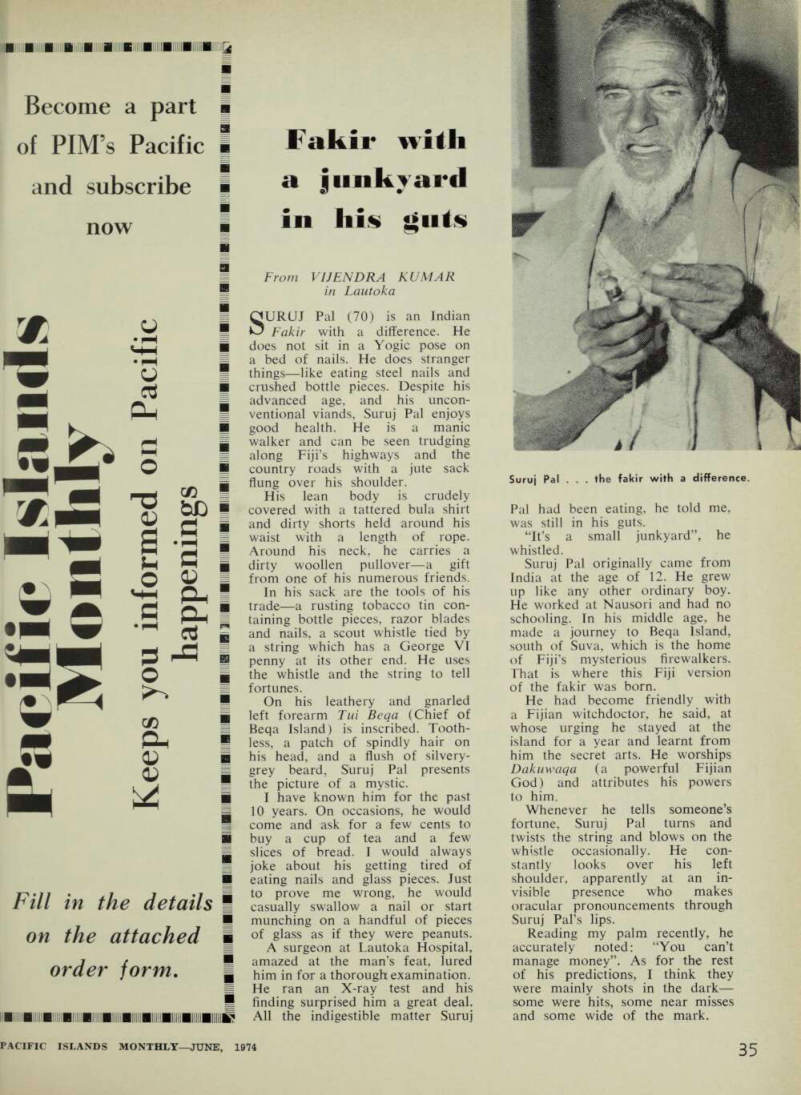
Fakir with a junkyard in his guts
From Vijendra Kumar
in Lautoka SURUJ Pal (70) is an Indian Fakir with a difference. He does not sit in a Yogic pose on a bed of nails. He does stranger things—like eating steel nails and crushed bottle pieces. Despite his advanced age, and his uncon ventional viands, Suruj Pal enjoys good health. He is a manic walker and can be seen trudging along Fiji’s highways and the country roads with a jute sack flung over his shoulder.
His lean body is crudely covered with a tattered bula shirt and dirty shorts held around his waist with a length of rope.
Around his neck, he carries a dirty woollen pullover—a gift from one of his numerous friends.
In his sack are the tools of his trade—a rusting tobacco tin con taining bottle pieces, razor blades and nails, a scout whistle tied by a string which has a George VI penny at its other end. He uses the whistle and the string to tell fortunes.
On his leathery and gnarled left forearm Tui Beqa (Chief of Beqa Island) is inscribed. Tooth less, a patch of spindly hair on his head, and a flush of silvery grey beard, Suruj Pal presents the picture of a mystic.
I have known him for the past 10 years. On occasions, he would come and ask for a few cents to buy a cup of tea and a few slices of bread. I would always joke about his getting tired of eating nails and glass pieces. Just to prove me wrong, he would casually swallow a nail or start munching on a handful of pieces of glass as if they were peanuts.
A surgeon at Lautoka Hospital, amazed at the man’s feat, lured him in for a thorough examination.
He ran an X-ray test and his finding surprised him a great deal.
All the indigestible matter Suruj
Pal had been eating, he told me, was still in his guts.
“It’s a small junkyard”, he whistled.
Suruj Pal originally came from India at the age of 12. He grew up like any other ordinary boy.
He worked at Nausori and had no schooling. In his middle age, he made a journey to Beqa Island, south of Suva, which is the home of Fiji’s mysterious firewalkers.
That is where this Fiji version of the fakir was born.
He had become friendly with a Fijian witchdoctor, he said, at whose urging he stayed at the island for a year and learnt from him the secret arts. He worships Dakuwaqa (a powerful Fijian God) and attributes his powers to him.
Whenever he tells someone’s fortune, Suruj Pal turns and twists the string and blows on the whistle occasionally. He con stantly looks over his left shoulder, apparently at an in visible presence who makes oracular pronouncements through Suruj Pal’s lips.
Reading my palm recently, he accurately noted: “You can’t manage money”. As for the rest of his predictions, I think they were mainly shots in the dark — some were hits, some near misses and some wide of the mark.
Suruj Pal . . . the fakir with a difference.
Advertisements & other items, p. 38 (1 item)
portsaves
A little time in
you a lot more monpyL
-4
MADANG
AE \
K AVI ENG
UL^IETA
PORT
\ All our ships spend little time in port.
The reason? Side-port unit-loading. And because we spend so little time in port, we can pass the bonus savings on to you. If
you’ve cargo coming to
our corner of the Pacific, send it with the line that saves you money on the side.
Our ships: Papuan
Chief, New Guinea Chief, Island Chief, Coral Chief.
New Guinea
HONIARA
BRISBANE
✓ S If f
SYDNEY
Registered Office Port Moresby, Papua New Guinea.
General Agents: PORT MORESBY—Steamships Trading Co. Ltd. SYDNEY —John Swire & Sons Pty. Ltd. Agents: SYDNEY —Interocean Swire Pty.
Ltd. BRISBANE—WiIIs, Gilchrist & Sanderson Pty. Ltd. PAPUA NEW GUlNEA—Steamships Trading Co. Ltd. (for New Guinea Chief at Rabaul and Island Chief at Kavieng—Burns Philp (N.G.) Ltd.)
Australia Line
MEMBER OF THE SWIRE GROUP.
the gloomy
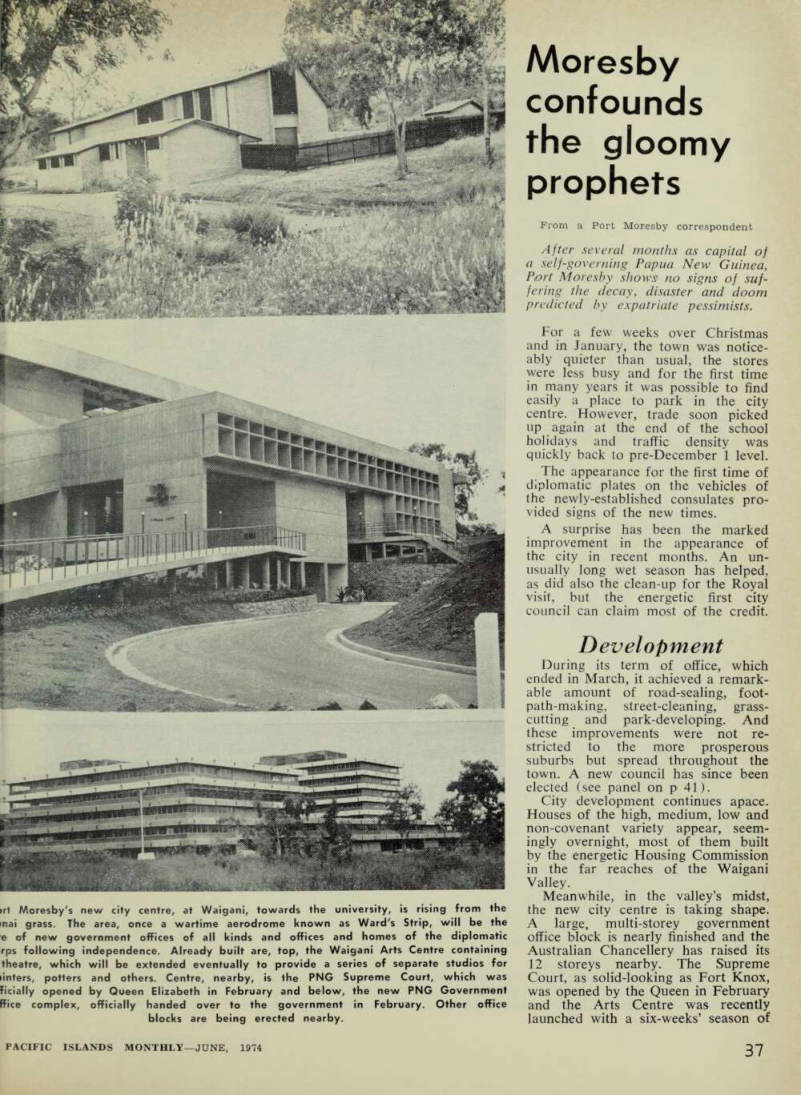


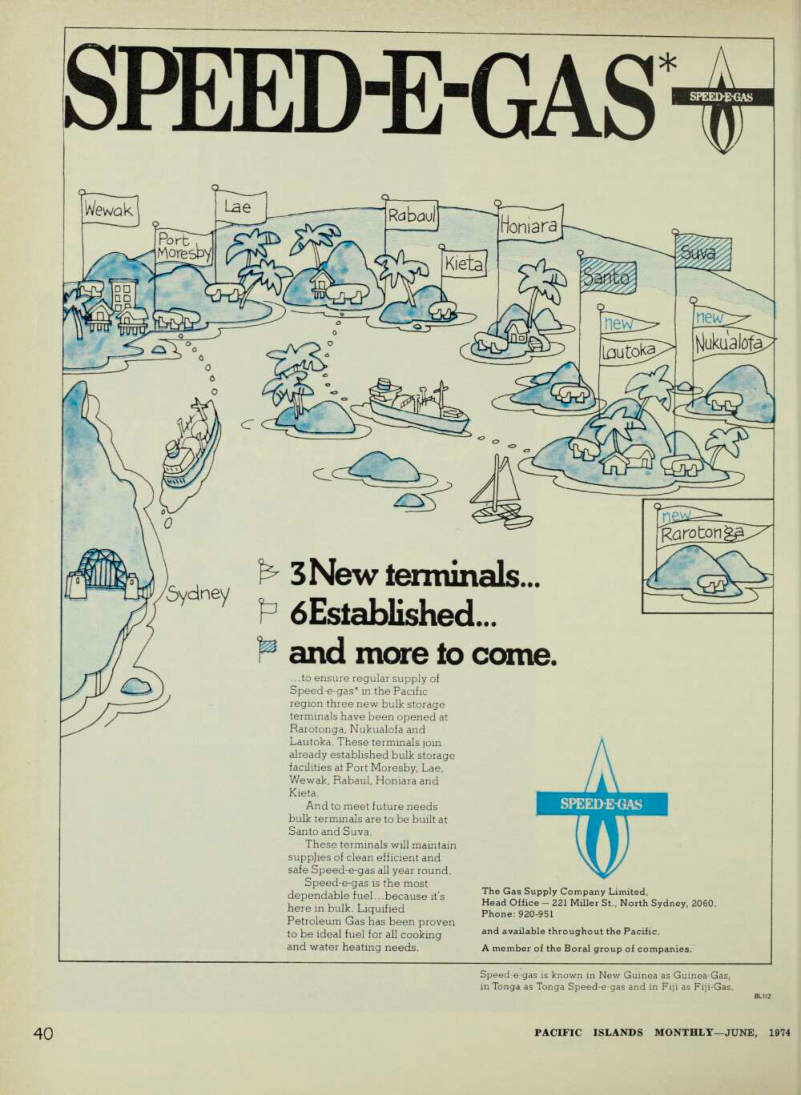
Moresby confounds the gloomy prophets
From a Port Moresby correspondent After several months as capital of a self-governing Papua New Guinea, Port Moresby shows no signs of suf fering the decay, disaster and doom predicted by expatriate pessimists.
For a few weeks over Christmas and in January, the town was notice ably quieter than usual, the stores were less busy and for the first time in many years it was possible to find easily a place to park in the city centre. However, trade soon picked up again at the end of the school holidays and traffic density was quickly back to pre-December 1 level.
The appearance for the first time of diplomatic plates on the vehicles of the newly-established consulates pro vided signs of the new times.
A surprise has been the marked improvement in the appearance of the city in recent months. An un usually long wet season has helped, as did also the clean-up for the Royal visit, but the energetic first city council can claim most of the credit.
Development
During its term of office, which ended in March, it achieved a remark able amount of road-sealing, foot path-making, street-cleaning, grass cutting and park-developing. And these improvements were not re stricted to the more prosperous suburbs but spread throughout the town. A new council has since been elected (see panel on p 41).
City development continues apace.
Houses of the high, medium, low and non-covenant variety appear, seem ingly overnight, most of them built by the energetic Housing Commission in the far reaches of the Waigani Valley.
Meanwhile, in the valley’s midst, the new city centre is taking shape.
A large, multi-storey government office block is nearly finished and the Australian Chancellery has raised its 12 storeys nearby. The Supreme Court, as solid-looking as Fort Knox, was opened by the Queen in February and the Arts Centre was recently launched with a six-weeks’ season of
[?]rt Moresby's new city centre, at Waigani, towards the university, is rising from the [?]nai grass. The area, once a wartime aerodrome known as Ward's Strip, will be the [?]e of new government offices of all kinds and offices and homes of the diplomatic rps following independence. Already built are, top, the Waigani Arts Centre containing theatre, which will be extended eventually to provide a series of separate studios for [?]inters, potters and others. Centre, nearby, is the PNG Supreme Court, which was [?]ficially opened by Queen Elizabeth in February and below, the new PNG Government office complex, officially handed over to the government in February. Other office blocks are being erected nearby.
comic opera, drama and dance pro vided by both local and overseas groups.
The Islander Hotel, between Hohola and Waigani, is well on the way to completion and its public bar already open. In the old town centre, the site is being cleared for the new Travelodge, and the Harbours Board has just reclaimed three acres of land for port development. Above, on Touaguba Hill, the first large houses of the private “dress-circle” develop ment are going up.
Nightlife
The city’s once bright and busy night life does not seem to have re covered from the effects of the riots towards the end of last year. Owners of public transport, weary of replacing rock-shattered windshields at the time, and drivers apprehensive for their safety, withdrew their services after dark. The long lines of buses waiting outside the cheap cinemas to take the patrons home are no more to be seen.
The new liquor laws, which close the bars at 8 pm. have had their effect on the night life, as has also the fuel crisis which shut down the all-night service stations. These were bright oases of light and activity on the night scene. With their soft-drink and cigarette-vending machines, they provided social centres for restless night people who never bought a gallon of petrol in their lives.
Confrontation
There seems to be a general reluctance on the part of both motorists and pedestrians to be about much after dark even though there has been little trouble of late. All has been quiet since the spectacular Defence Force/Police confrontation early in the year. The authorities were eventually unanimous in declar ing that the affair was of little im portance or significance. However, a Y-shaped barbed-wire entanglement did later appear on the top of the high fence surrounding the single soldiers’ quarters at Murray Barracks.
There is speculation as to whether these fortifications are designed to keep the soldiers in or the policemen out.
One opinion is that the young soldiers have an inflated view of their own importance. They are accused of tending to throw their weight around, especially on payday, and are fond of declaring that they are “the back bone of the country”. They called the police much less complimentary names on the night of the fracas, mocking them as “blue blowflies”, along with other imaginative insults less printable.
The poor police have enough to worry about without being called from their beds to deal with fractious soldiers. Car-stealing has suddenly be come a popular activky while house, school and store-breaking flourishes as never before. Some smart operators are combining both varieties of law lessness and use the stolen cars, some times changing number-plates to evade detection, to transport easily the proceeds of their robberies.
Hardly a household in the city seems to have escaped the attentions of the intruders, who often display remarkable daring and ingenuity in their thieving. The stories of their
brazen activities are legion.
New Police Commissioner Brian Holloway has stepped up foot patrols and pleaded for the public’s co operation but, as he has pointed out, the police cannot be everywhere at once.
One exasperated victim has suggest ed setting up a network of paid police informers. Others point out the difficulty the police experience in finding the scene of reported crimes in a city with no house numbers.
Often by the time they arrive, the criminals have long-since made their get-away.
One encouraging development from both the police and the public’s points
Restricted drinking
of view is the dramatic reduction in drunkenness and violent crime brought about by the restricted drinking hours. The appalling brawls, often with fatal results, which were a feature of Friday and Saturday nights seem to be a thing of the past.
The drinkers have accepted the restrictions on their alcoholic con sumption with remarkable docility.
Some are to be seen patiently sitting on the steps of the bars after they close at 2 pm waiting for them to reopen at 6 o’clock.
There were areas of uncertainty in the new legislation but these have been resolved and it is now agreed that the publicans are still able to buy themselves a drink on their own premises! By juggling their trading hours the clubs are permitted to re main open and serve drinks after 8 pm on a couple of nights each week.
The new liquor laws, along with the departure of many expatriates, threatened the city’s many clubs with an uncertain future. However, most seem to be surviving and some even flourishing still.
The Yacht Club, perhaps encourag ed by a visit of Princess Anne and Captain Phillips, is pressing on with elaborate extensions even though its premises are in the path of future wharf developments. Most clubs
have managed to secure at least token New Guinea membership and even in the Papua Club, the most exclusive of them all, a black face is occasion ally to be seen.
The car parks of the RSL establish ments are often full, especially on housie nights, but the Ela Beach branch recently painted over the yard high letters on its facade which pro claimed its identity. Perhaps the members, by keeping a low profile, hope to retain for a while longer their site on a choice section of the public beach reserve?
The service clubs have been more enthusiastic and successful in recruit ing local membership and, of course, the sporting bodies continue to flourish.
For most citizens, black or white, entertaining friends at home is probably the main social activity.
There is a choice of several movies every night of the week but they tend rather to be doing their second or third turn around the circuit. The censors do not allow us to see films with the Australian R (for restricted) rating and this cuts out many of the new productions. It is interesting how quickly the word is passed when a good new film makes an appearance and how much the audiences grow for the occasion.
Drama groups, local and expatriate, continue to entertain us and the
Granville Speedway has reopened after being affected by the fuel shortage. Boxing is enormously popular, the crowds are out again for the current Rugby League season and a visit from Slim Dusty and Company is eagerly looked forward to.
The National Broadcasting Com mission has efficiently taken over the old ABC’s task of entertaining, instructing and informing us. How ever, the sound of the new is, as yet, little different from that of the old. Many of the programmes still come from overseas and some of the school broadcasts, made years ago with European females reading the parts of New Guinean boys, are being heard again for about the fourth year running. However, interesting new programmes both for school and for general consumption are being made.
The NBC’s mail bag is full as usual with listener’s requests and the record library’s task is made easier by the fact that the same 20-odd discs enjoy eternal popularity.
Douglas Lockwood, back at the Post-Courier as managing editor, also has a large mail from readers who feel compelled to write to the news paper. Long may they continue to do so. Their letters form one of the most interesting features of this Moresby-based national daily.
Advertisements & other items, pp. 40-42 (1 item)
This little flower is your key
to the safe insect killer
One of the safest and most potent insect-killers known to contemporary science is derived from an innocentlooking small white flower, the African Pyrethrum daisy. Pure pyrethrins, as chemists call this substance, is the active ingredient in Pea-Beu insect spray, and the key to its concentrated killing power. Continuing research by the chemists in the laboratories of A.N.I. Chemical Research and by health and environmental authorities throughout the world, confirms that insects do not become immune to pyrethrum. Pea- Beu contains a high concentration of pyrethrins which means that short bursts only are needed to kill flies, mosquitoes and every type of insect pest.
The mosquito—a deadly
trafficker of disease The mosquito’s record as a killer is world recognised. Beside wrecking so pure it’s safe to spray anywhere your night’s sleep with its irritating whine and inflicting its painful toxic bites, the mosquito passes on many serious diseases, including malaria, hepatitis, dengue and yellow fever, disfiguring elephantiasis and encephalitis. Pea-Beu is recommended to kill every mosquito that enters your home, because it is guaranteed completely effective, yet absolutely safe.
No fears near food Your kitchen and food-cupboards are the favourite places for houseflies, especially when attracted by exposed food as you cook or serve.
Of course you’re reluctant to use pungent insecticides, and fear toxic effects. But never hesitate to use Pea-Beu.
Its active ingredient guarantees it harmless to humans and pets, and thanks to the purity of all its ingredients, it is completely safe to spray anywhere in the home.
Pea-Beu the safe, powerful insecticide
jlpp
NEW VERSATILITY...
FROM FURUNO
FRS-24
A highly reliable compact solid state radar for small craft.
Simple installation and maintenance. 7" PR I scope. With magnifying lens. 6 ranges (1/2 24n. miles). Automatic synchronization of display sweep and antenna rotation with no waveguide run between. Operates on DC 12, 24, 32 or 110 V. Low power consumption 160 W. • The future today with FURUNO's electronics technology.
0 FURUNO ELECTRIC CO„ LTD.
9-52, Ashihara-cho, Nishinomiya City, Japan
CABLE; FURUNO NISHINOMIYA, TELEX; 5644-498
SPEED-E-GAS
Lae
Wewak
Rdbaul
Honiara
Moresby
Kieta
□ n □ □
Hukualofe
new
C?
lautoka
Rarotonga
P 3 New terminals...
P 6Established...
Sydney
3^
and more to come.
£3 .. .to ensure regular supply of Speed-e-gas* in the Pacific region three new bulk storage terminals have been opened at Rarotonga, Nukualofa and Lautoka. These terminals join already established bulk storage facilities at Port Moresby, Lae, Wewak, Rabaul, Honiara and Kieta.
And to meet future needs bulk terminals are to be built at Santo and Suva.
These terminals will maintain supplies of clean efficient and safe Speed-e-gas all year round.
Speed-e-gas is the most dependable fuel...because it's here in bulk. Liquified Petroleum Gas has been proven to be ideal fuel for all cooking and water heating needs.
SPEEDEGAS
The Gas Supply Company Limited, Head Office 221 Miller St., North Sydney, 2060.
Phone: 920-951 and available throughout the Pacific.
A member of the Boral group of companies.
Speed-e-gas is known in New Guinea as Guinea-Gas, in Tonga as Tonga Speed-e-gas and in Fiji as Fiji-Gas.
City Councillors Will Still Sa Y ‘ Lord
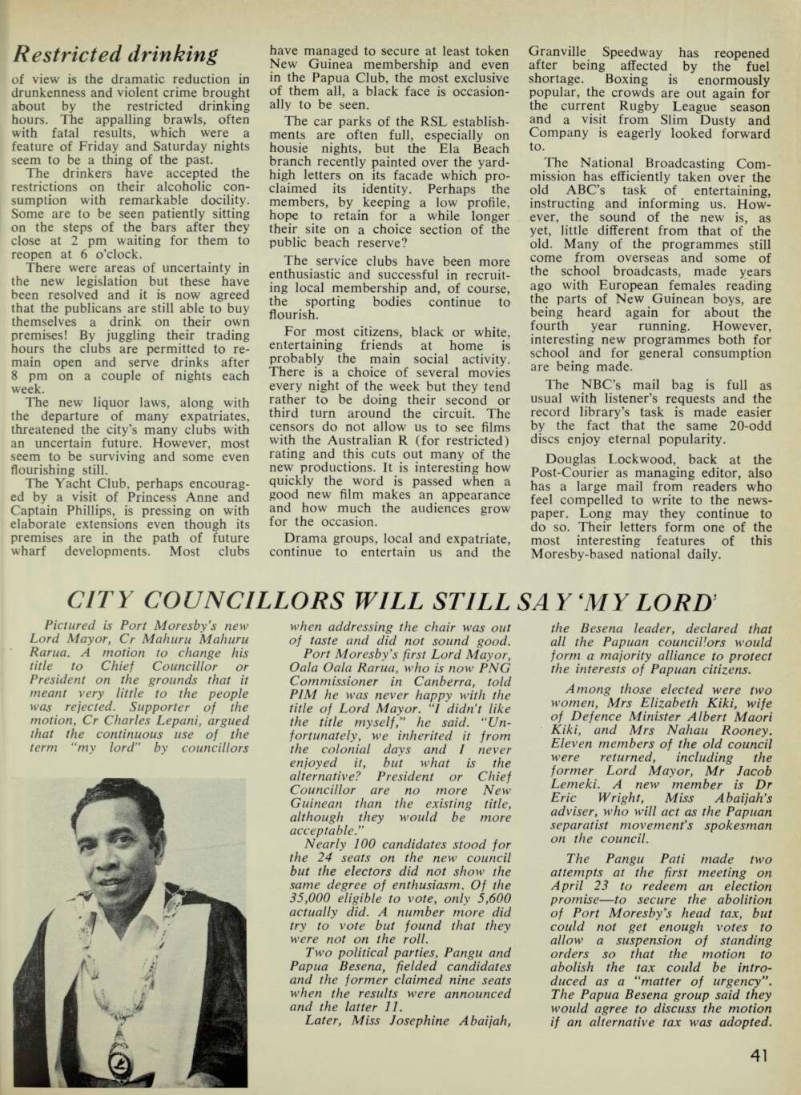
Pictured is Port Moresby’s new Lord Mayor, Cr Mahuru Mahuru Rarua. A motion to change his title to Chief Councillor or President on the grounds that it meant very little to the people was rejected. Supporter of the motion, Cr Charles Lepani, argued that the continuous use of the term “my lord” by councillors
when addressing the chair was out of taste and did not sound good.
Port Moresby’s first Lord Mayor, Oala Oala Rarua, who is now PNG Commissioner in Canberra, told PIM he was never happy with the title of Lord Mayor. “I didn’t like the title myself,” he said. “Un fortunately, we inherited it from the colonial days and I never enjoyed it, but what is the alternative? President or Chief Councillor are no more New Guinean than the existing title, although they would be more acceptable.”
Nearly 100 candidates stood for the 24 seats on the new council but the electors did not show the same degree of enthusiasm. Of the 35,000 eligible to vote, only 5,600 actually did. A number more did try to vote but found that they were not on the roll.
Two political parties, Pangu and Papua Besena, fielded candidates and the former claimed nine seats when the results were announced and the latter 11.
Later, Miss Josephine Abaijah,
the Besena leader, declared that all the Papuan councillors would form a majority alliance to protect the interests of Papuan citizens.
Among those elected were two women, Mrs Elizabeth Kiki, wife of Defence Minister Albert Maori Kiki, and Mrs Nahau Rooney.
Eleven members of the old council were returned, including the former Lord Mayor, Mr Jacob Lemeki. A new member is Dr Eric Wright, Miss Abaijah’s adviser, who will act as the Papuan separatist movement’s spokesman on the council.
The Pangu Pati made two attempts at the first meeting on April 23 to redeem an election promise—to secure the abolition of Port Moresby’s head tax, but could not get enough votes to allow a suspension of standing orders so that the motion to abolish the tax could be intro duced as a “matter of urgency”.
The Papua Besena group said they would agree to discuss the motion if an alternative tax was adopted.
Advertisements & other items, p. 44 (1 item)
Rlinkii
O'- '/'• m*'* til'/; t Lli. the most versatile ply for tropical
applicatiorv
>" jatSSSg
ri aretermtoand-msec^M,
OT t^to^to^dh«tjnd
• KlinkU plywoods a« made by Commonwealth New Guinea ppUers and “'taNew Guinea and Pacific areas.
count cm
RLINKII
\ II
family planning
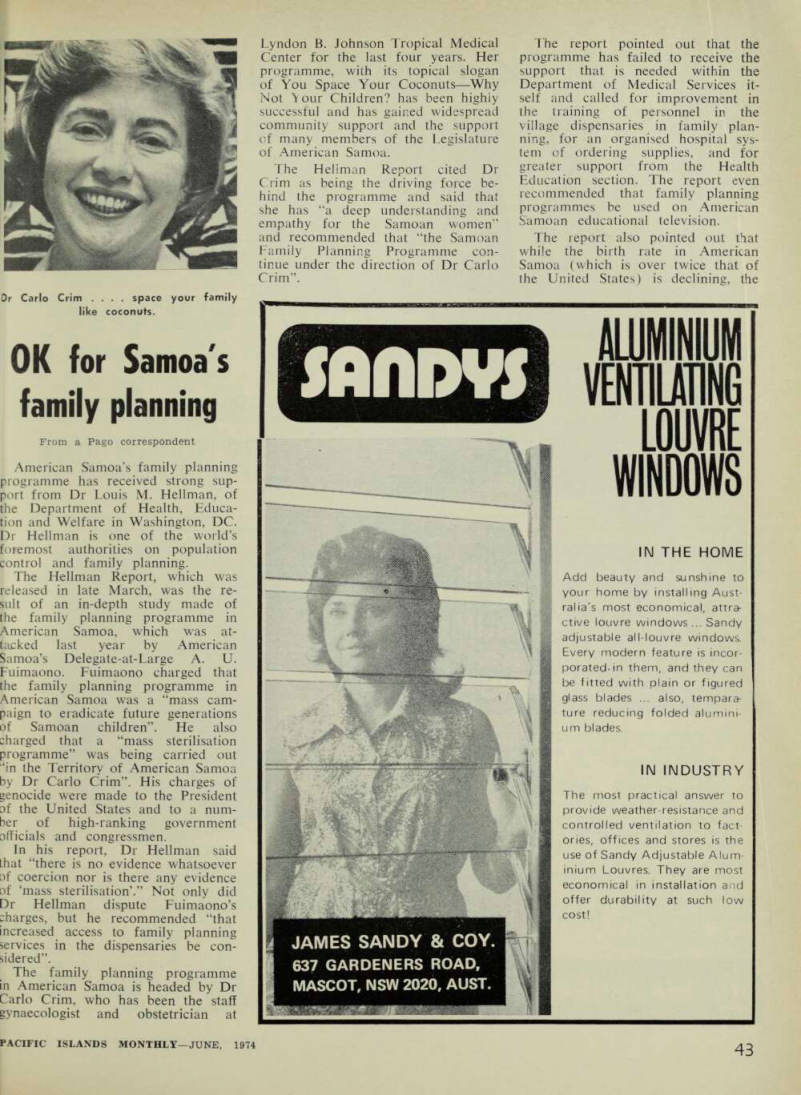

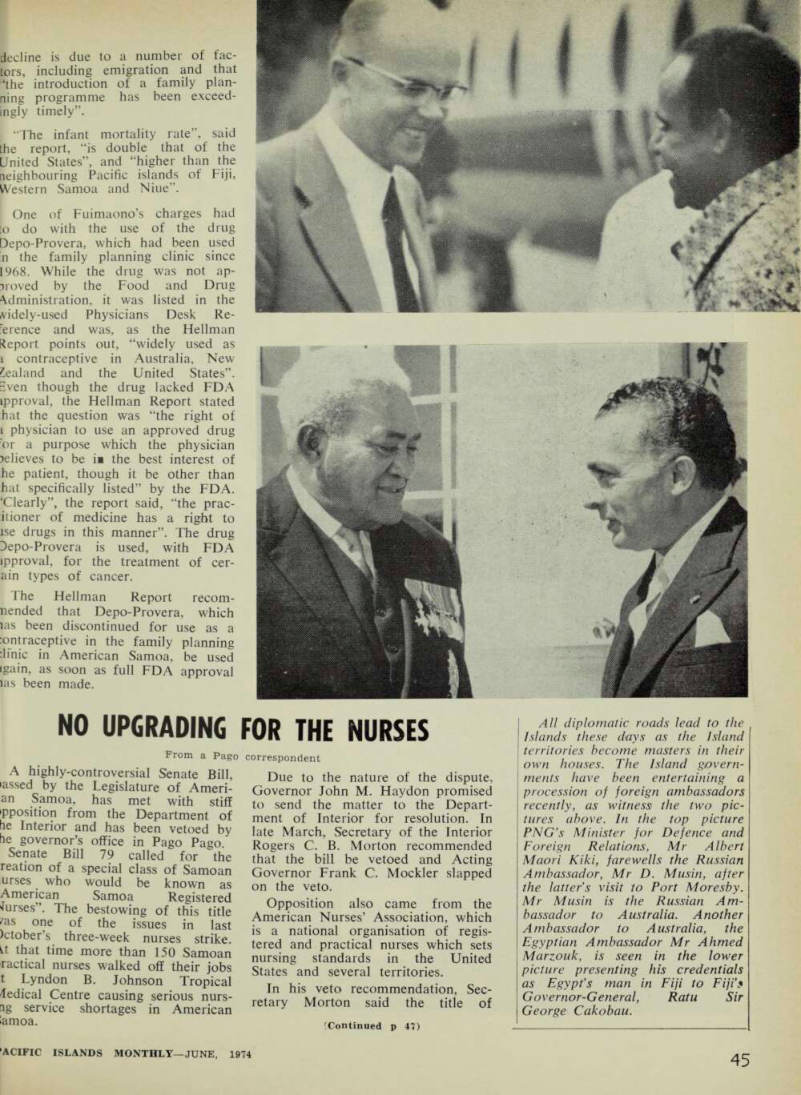
OK for Samoa's family planning
From a Pago correspondent American Samoa’s family planning programme has received strong sup port from Dr Louis M. Heilman, of the Department of Health, Educa tion and Welfare in Washington, DC.
Dr Heilman is one of the world’s foremost authorities on population control and family planning.
The Heilman Report, which was released in late March, was the re sult of an in-depth study made of the family planning programme in American Samoa, which was at tacked last year by American Samoa’s Delegate-at-Large A. U.
Fuimaono. Fuimaono charged that the family planning programme in American Samoa was a “mass cam paign to eradicate future generations of Samoan children”. He also charged that a “mass sterilisation programme” was being carried out ‘in the Territory of American Samoa by Dr Carlo Crim”. His charges of genocide were made to the President of the United States and to a num ber of high-ranking government officials and congressmen.
In his report, Dr Heilman said that “there is no evidence whatsoever of coercion nor is there any evidence of ‘mass sterilisation’.” Not only did Dr Heilman dispute Fuimaono’s charges, but he recommended “that increased access to family planning services in the dispensaries be con sidered”.
The family planning programme in American Samoa is headed by Dr Carlo Crim, who has been the staff gynaecologist and obstetrician at
Lyndon B. Johnson Tropical Medical Center for the last four years. Her programme, with its topical slogan of You Space Your Coconuts—Why Not Your Children? has been highly successful and has gained widespread community support and the support cf many members of the Legislature of American Samoa.
The Heilman Report cited Dr Crim as being the driving force be hind the programme and said that she has “a deep understanding and empathy for the Samoan women” and recommended that “the Samoan Family Planning Programme con tinue under the direction of Dr Carlo Crim”.
The report pointed out that the programme has failed to receive the support that is needed within the Department of Medical Services it self and called for improvement in the training of personnel in the village dispensaries in family plan ning, for an organised hospital sys tem of ordering supplies, and for greater support from the Health Education section. The report even recommended that family planning programmes be used on American Samoan educational television.
The report also pointed out that while the birth rate in American Samoa (which is over twice that of the United States) is declining, the
Dr Carlo Crim ... space your family like coconuts.
decline is due to a number of fac tors, including emigration and that “the introduction of a family plan ning programme has been exceed ingly timely”.
“The infant mortality rate”, said the report, “is double that of the United States”, and “higher than the neighbouring Pacific islands of Fiji, Western Samoa and Niue”.
I One of Fuimaono’s charges had to do with the use of the drug Depo-Provera, which had been used n the family planning clinic since 1968. While the drug was not ap jroved by the Food and Drug Administration, it was listed in the widely-used Physicians Desk Re ference and was, as the Heilman Report points out, “widely used as i contraceptive in Australia, New Zealand and the United States”.
Even though the drug lacked FDA ipproval, the Heilman Report stated hat the question was “the right of i physician to use an approved drug : or a purpose which the physician relieves to be ia the best interest of he patient, though it be other than hat specifically listed” by the FDA. ‘Clearly”, the report said, “the prac itioner of medicine has a right to ise drugs in this manner”. The drug Depo-Provera is used, with FDA ipproval, for the treatment of cer ain types of cancer.
The Heilman Report recom nended that Depo-Provera, which las been discontinued for use as a :ontraceptive in the family planning :linic in American Samoa, be used igain, as soon as full FDA approval las been made.
Advertisements & other items, pp. 45-46 (1 item)
Ventilating
k m i ? - IT?
'■i*
VRE
L
ows
IN THE HOME
Add beauty and sunshine to your home by installing Australia's most economical, attractive louvre windows ... Sandy adjustable all-louvre windows.
Every modern feature is incorporated-in them, and they can be fitted with plain or figured glass blades ... also, temperature reducing folded aluminium blades.
IN INDUSTRY
The most practical answer to provide weather-resistance and controlled ventilation to factories, offices and stores is the use of Sandy Adjustable Aluminium Louvres. They are most economical in installation and offer durability at such low cost!
THE BIG FLAVOURS COME TO THE
SOUTH PACIFIC
iw. » i p
RTAHPP
-I The red hibiscus symbol proudly marks the introduction of some of New Zealand's most popular soft drinks by Island Bottlers of Fiji Ltd. from their new modern factory.
In Apia in Western Samoa the same flavourful range is produced by the Apia Bottling Company and people everywhere are asking for these famous names -
LEMON and PAEROA, TARTAN DRY GINGER
ALE and the colourful fruity range of JU'CY
SOFT DRINKS.
They're yours to enjoy . . . time after time.
Manufactured under franchise to Innes Tartan Ltd., Auckland, New Zealand by-
H ISLAND BOTTLERS OF FIJI LTD.
APIA BOTTLING COMPANY LTD.
Save hundreds of dollars
on Australians most efficient
WALK IN, ALUMINIUM
COOLROOMS AND
FREEZE ROOMS
Hjndreds already installed! The most economical supplementary coolrooms for bottles and food, providing the largest storage capacity of any comparable coolrooms of the same exterior dimensions. Five sizes —from 90-360 cu. ft. capacity; 16 models offering normal temp., two temp., deep freeze, or for pastry and ice storage applications. White vinyl interior, embossed rustproof aluminium exterior. • SUPPLIED IN EASY-TO-ERECT, DO-IT-YOURSELF KIT FORM • PETROL AND PETROL-ELECTRIC MODELS ARE AVAILABLE m
tffl WARBUBTOH FBANKI
No Upgrading For The Nurses

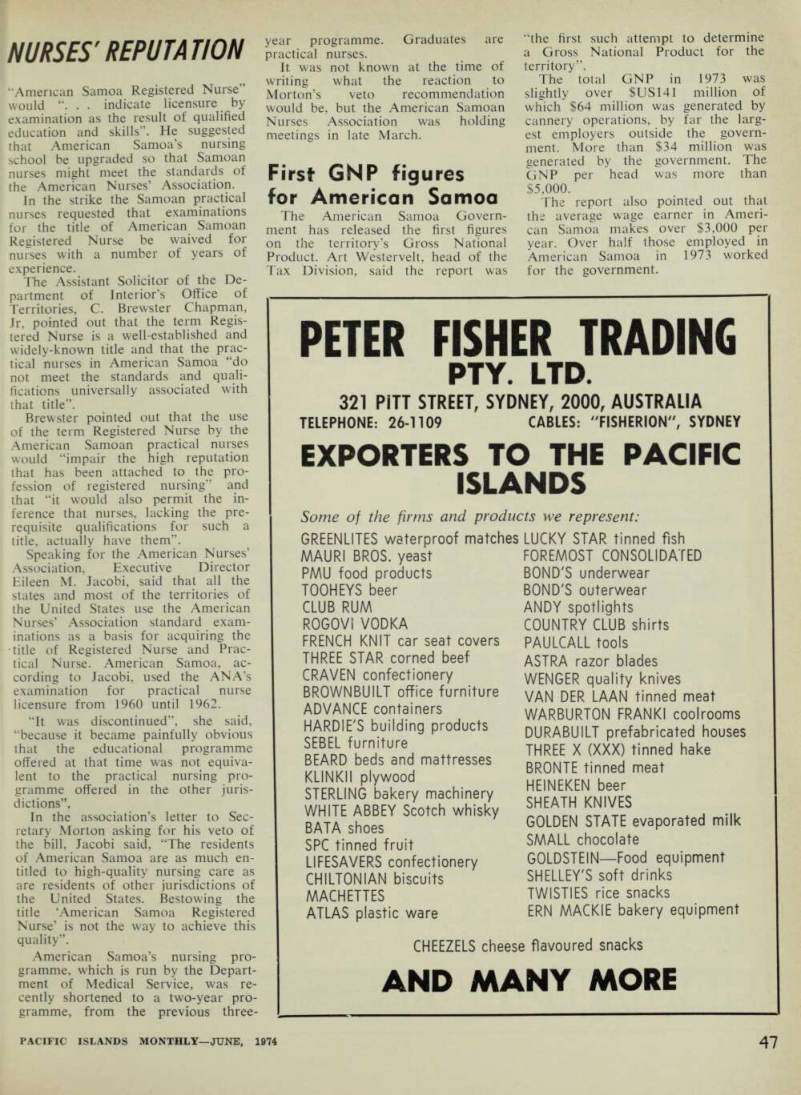
From a Pago correspondent
A highly-controversial Senate Bill, c se by the Legislature of AmerihaS u n^ t Wlt h IPP T V°? * ron ] Department of interior and has been vetoed by He governors office in Pago Pago. 6 * • t , ed f° r the ion or a special class of Samoan urses who would be known as American Samoa Registered Jurses”. The bestowing of this title 'as one of the isiues in las® )ctober’s three-week n,,r W it that timp mnrp tho iln S c Stnke ’ ractical f l 5 ° S “ t r . 8 wa |hed off their jobs t Lyndon B. Johnson Tropical ledical Centre causing serious nursrig service shortages in American ’ amoa -
Due to the nature of the dispute, Governor John M. Haydon promised to sen d the matter to the Depart ment of Interior for resolution. In late March, Secretary of the Interior Rogers C. B. Morton recommended that the bill be vetoed and Acting Governor Frank C. Mockler slapped on the veto. 1 r , , Opposition also came from the A merlca " N “ rses Association which 18 a natlonal organisation of regis tered an d practical nurses which sets nursing standards in the United States and several territories, T u- * , .. e
J a " “The dfl’e o®i
eia y ivionon said me title 01
(Continued p 47)
All diplomatic roads lead to the Islands these days as the Island territories become masters in their own houses. The Island govern ments have been entertaining a procession of foreign ambassadors recently, as witness the two pic tures above. In the top picture PNG’s Minister for Defence and Foreign Relations , Mr Albert Maori Kiki, farewells the Russian Ambassador, Mr D. Musin, after the latter’s visit to Port Moresby.
Mr Musin is the Russian Am bassador to Australia. Another Ambassador to Australia, the Egyptian Ambassador Mr Ahmed Marzouk, is seen in the lower picture presenting his credentials as Egypt’s man in Fiji to Fiji’ > Governor-General, Ratu Sir George Cakobau.
Nurses'reputation
“American Samoa Registered Nurse” would . . indicate licensure by examination as the result of qualified education and skills”. He suggested that American Samoa’s nursing school be upgraded so that Samoan nurses might meet the standards of the American Nurses’ Association.
In the strike the Samoan practical nurses requested that examinations for the title of American Samoan Registered Nurse be waived for nurses with a number of years of experience.
The Assistant Solicitor of the De partment of Interior’s Office of Territories, C. Brewster Chapman, Jr, pointed out that the term Regis tered Nurse is a well-established and widely-known title and that the prac tical nurses in American Samoa “do not meet the standards and quali fications universally associated with that title”, Brewster pointed out that the use of the term Registered Nurse by the American Samoan practical nurses would “impair the high reputation that has been attached to the pro fession of registered nursing” and that “it would also permit the in ference that nurses, lacking the pre requisite qualifications for such a title, actually have them”.
Speaking for the American Nurses’
Association, Executive Director Eileen M. Jacobi, said that all the states and most of the territories of the United States use the American Nurses’ Association standard exam inations as a basis for acquiring the title of Registered Nurse and Prac tical Nurse. American Samoa, ac cording to Jacobi, used the ANA’s examination for practical nurse licensure from 1960 until 1962.
“It was discontinued”, she said, “because it became painfully obvious that the educational programme offered at that time was not equiva lent to the practical nursing pro gramme offered in the other juris dictions”.
In the association’s letter to Sec retary Morton asking for his veto of the bill, Jacobi said, “The residents of American Samoa are as much en titled to high-quality nursing care as are residents of other jurisdictions of the United States. Bestowing the title ‘American Samoa Registered Nurse’ is not the way to achieve this quality”.
American Samoa’s nursing pro gramme, which is run by the Depart ment of Medical Service, was re cently shortened to a two-year pro gramme, from the previous three
year programme. Graduates are practical nurses.
It was not known at the time of writing what the reaction to Morton’s veto recommendation would be, but the American Samoan Nurses Association was holding meetings in late March.
First GNP figures
for American Samoa
The American Samoa Govern ment has released the first figures on the territory’s Gross National Product. Art Westervelt, head of the Tax Division, said the report was
“the first such attempt to determine a Gross National Product for the territory”.
The total GNP in 1973 was slightly over SUSI4I million of which $64 million was generated by cannery operations, by far the larg est employers outside the govern ment. More than $34 million was generated by the government. The GNP per head was more than $5,000.
The report also pointed out that the average wage earner in Ameri can Samoa makes over $3,000 per year. Over half those employed in American Samoa in 1973 worked for the government.
Advertisements & other items, pp. 47-51 (3 items)
45
’ACIFIC ISLANDS MONTHLY—JUNE, 1974
Spoil
yourself a little
Witha
Kodak Carousel'S'
If you like to just sit back and enjoy your own slide show or perhaps just impress your friends a little, you need the
KODAK CAROUSEL ‘S’
Slide Projector.
The unique gravity feed will allow you to act (he entrepreneur with confidence and finesse.: See your local photo dealer. He’ll be glad to r give you a demonstration.
Kodak ■ KODAK (Australasia) PTV. LTD.
See your local Island dealer.
K6l/4267
PETER FISHER TRADING
PTY. LTD.
321 PITT STREET, SYDNEY, 2000, AUSTRALIA
TELEPHONE: 26-1109 CABLES: "FISHERION", SYDNEY
EXPORTERS TO THE PACIFIC
ISLANDS
Some of the firms and products we represent: GREENLITES waterproof matches LUCKY STAR tinned fish MAURI BROS, yeast PMU food products TOOHEYS beer
CLUB RUM
ROGOVI VODKA
FRENCH KNIT car seat covers THREE STAR corned beef CRAVEN confectionery BROWNBUILT office furniture ADVANCE containers HARDIE'S building products SEBEL furniture BEARD beds and mattresses KLINKII plywood STERLING bakery machinery WHITE ABBEY Scotch whisky BATA shoes SRC tinned fruit LIFESAVERS confectionery CHILTONIAN biscuits
MACHETTES
ATLAS plastic ware
FOREMOST CONSOLIDATED
BOND'S underwear BOND'S outerwear ANDY spotlights COUNTRY CLUB shirts PAULCALL tools ASTRA razor blades WENGER quality knives VAN DER LAAN tinned meat WARBURTON FRANKI coolrooms DURABUILT prefabricated houses THREE X (XXX) tinned hake BRONTE tinned meat HEINEKEN beer
SHEATH KNIVES
GOLDEN STATE evaporated milk SMALL chocolate GOLDSTEIN—Food equipment SHELLEY'S soft drinks TWISTIES rice snacks ERN MACKIE bakery equipment CHEEZELS cheese flavoured snacks
AND MANY MORE
YOU LL WELCOME OUR TROPICAL
MODULAR HOME UNITS...IN EVERYWAY!
• PRE-CONSTRUCTED IN N.Z. AND
PRE-TREATED FOR TROPIC CONDITIONS
• SHIPPED KNOCKED-DOWN TO YOUR
DESTINATION
• EASILY ERECTED ON SITE WITH MINIMUM
SKILLED LABOUR
• OFFER LUXURY AT A REASONABLE PRICE Perfect for holiday and permanent homes or commercial and industrial housing projects. 4 models to choose from: Leisu redeck’, (illustrated) ‘Sunseeker'. Castaway’, ‘Sun lover' in 1,2,3- bedroom units. . . modular construction streamlines design, gives flexibility . . . pre-construction cuts costs and assembly-but not quality. . . maintenance-free pre-coated insulated Permalum metal weather-boarding . . . pre-piped plumbing unit. Plus many other quality features!
Already performance-proven in the New Hebrides, Pitcairn and Japan. m
welcome I homes limited
Like to know more? Mail this coupon now!
To: The Manager, Welcome Homes Ltd Box 12203, Penrose, Auckland, N.Z.
Please send me, without obligation, brochureson your Modular Home Units.
Name Address Property Located At 6649
/ / "Mb, K
@isjr
Xi
PmPl£Wpe/n/ IRON
Australia's best selling non-electric Iron! For reliability, ease of handling, and excellence of quality at a low price, you can't beat the HANOI. It's simplicity itself to operate—NO PUMPING IS REQUIRED. IT'S IMPOSSIBLE TO OVERFILL THE FUEL TANK and one filling does approximately 2 hours effortless ironing. Attractively finished in nickel plate. Spare parts always available.
THE PORTABLE OUTDOORS COOKER at a sensible price!
Twin independent burners for fast cooking. Twin tanks for double capacity. Steel case, when opened, acts as triple-wind shield. Rustproof. Noisy or silent burners as required. Small or large porcelain enamel ovens also available separately. HANOl—the lowest priced QUALITY Twin Burner Portable!
From the
Islands Press
lomments on family planning by Benedict Kinika Member for East Makira) in the BSI Govco debate eported by the BSI News Sheet: The Western world was telling Solomon Islanders hey were a liability to creation, and asking them 0 get rid of themselves with birth control lev ices and methods. In a polite way they were
aying, “drop dead”, Mr Kinika said.
: rom an editorial in the Tonga Chronicle on civil
ervants' expected salary increase:
. . It is only fair that civil servants exercise patience over getting an increase) never, of course, giving up lope of a favourable outcome. They have so far urvived the rising consumer price index, and some lave gone so far as to find alternatives to spending ;o much on food stuffs, like going out and planting heir own crops. I think if civil servants, and I refer to hose particularly in the middle salary bracket, were is conscientious in their work as they are concerned ibout the salary increase, there wouldn’t be so
nuch grumbling going on.
: rom a letter in the Samoa Times: Dn Monday night the 18th of March my husband and I vere walking from the Tivoli Theatre to Fabricius. I fell n a hole and scratched and bruised my left leg. On : riday afternoon I went to Apia. Almost a whole week and he hole wasn't filled yet. . . . I'll be leaving Samoa n June. The scar on my leg will be my souvenir of Samoa and I'll never forget the holes on the walkways arid roads of Apia.
From the American Samoa News Bulletin; Governor Frank Mockler has vetoed two Senate bills ntroduced during the recent session of the 13th Legislature, one which would have extended the hours of beer sales from 10 pm to 2 am. . . . Mockler said Senate Bill No 83 which would have extended the beer hours "would only add to the problems the Police Department now has. 1 am informed that it is the late hours drinkers who cause the majority of our cases and our general police oroblems." He said if the bill were to become law, many of our small stores located at some distance from supervision might become centres for late drinking to the detriment of the peace and quiet of the villages.
From the Pitcairn Miscellany on Pitcairn Island: . . . At a public share-out we all saw with our own eyes that all the talk about the size of Anderson’s pumpkins was true. This huge vegetable was cut up at the square and there was plenty for everybody. And so there should have been.
It had a circumference of 72 inches and it weighed 102 lb. And Anderson still swears that it was one of the small ones.
From a letter by Harnam Singh in The Fiji Times: Fiji’s currency notes are not made from very good paper. But if we take care and handle them properly, they will last longer. I have seen people who come to shop fold the notes as if they were rubbish paper.
I tell lots of my customers not to treat money like this and some agree with me. But most of them tell me off, saying it’s not my business.
From Radio Group News, New Hebrides: To Islanders, cyclones are not welcome. However, this time cyclone Pam, when she struck the Island of Tanna she also brought some good news. A report from Mr Ronnie Daniel, a teacher at Loukatai Primary School on Tanna says: “Mr Gideon Kota from the village of Isiai went down to investigate the Co-operative Store to see if it was still standing.
To his amazement he saw a bottle thrown ashore from the waves. He picked it up and found in it a booklet on the Life of Jesus Christ. The booklet had this address on it—Long Beach SDA Church, Box 868, Long Beach, California.
A BSI News Sheet report of a speech by Waita Ben (Member for East Guadalcanal) during a Govco debate on racial differences in Chinese shops: . . . Mr Ben said . . he had seen Chinese storekeepers give angry snarls and order Solomon Islanders out of their shops, while Europeans had walked around helping themselves to goods in a self service store. Mr Ben had overheard two Solomon Islanders inquiring about a figurine worth 48 dollars in one shop. The Chinese owner had told them the statue was only for white men.
From a letter by Mr T. Lumw, of Aoba, in the New Hebrides Nakamal: ... If the NHCC is worried about unruly behaviour, the New Hebrides is not as bad as some other Pacific Islands, worse still are the white man’s countries.
Perhaps it is good that you pray for those bad places and for the New Hebrides to progress with peace and prosperity but not to jump the gun like the government bringing 50 gendarmes from Noumea to uphold law and order. It is childish, over-reactionary and it shows the weakness of both administrations to uphold law in the territory. . . .
From a speech at the Pacific Area Travel Association conference in Jakarta by Ratu Sir Penaia Ganilau, Fiji's Minister for Tourism on the effects of tourism and reported in The Fiji Times: Dozens, even hundreds, of Fiji’s farmers had left their farms to take easier jobs as porters, barmen, guides and taxi drivers ... the deterioration of social values in Fijian society was equally grave. Thirty years ago every Fijian over the age of 10 had known how to milk a cow, kill and cook a pig and grow yams. “Today, I wonder whether as many as half of our city-dwelling Fijians know how to do these
things.” . . .
From a letter in The Fiji Times, written by John Bharat: I have noticed many times that members of the public do not help police in their work. Police do hard work by night and day, but the public does not under stand the police. Without the Fiji police we cannot do any thing, so everybody should help them in every way.
Yesterday
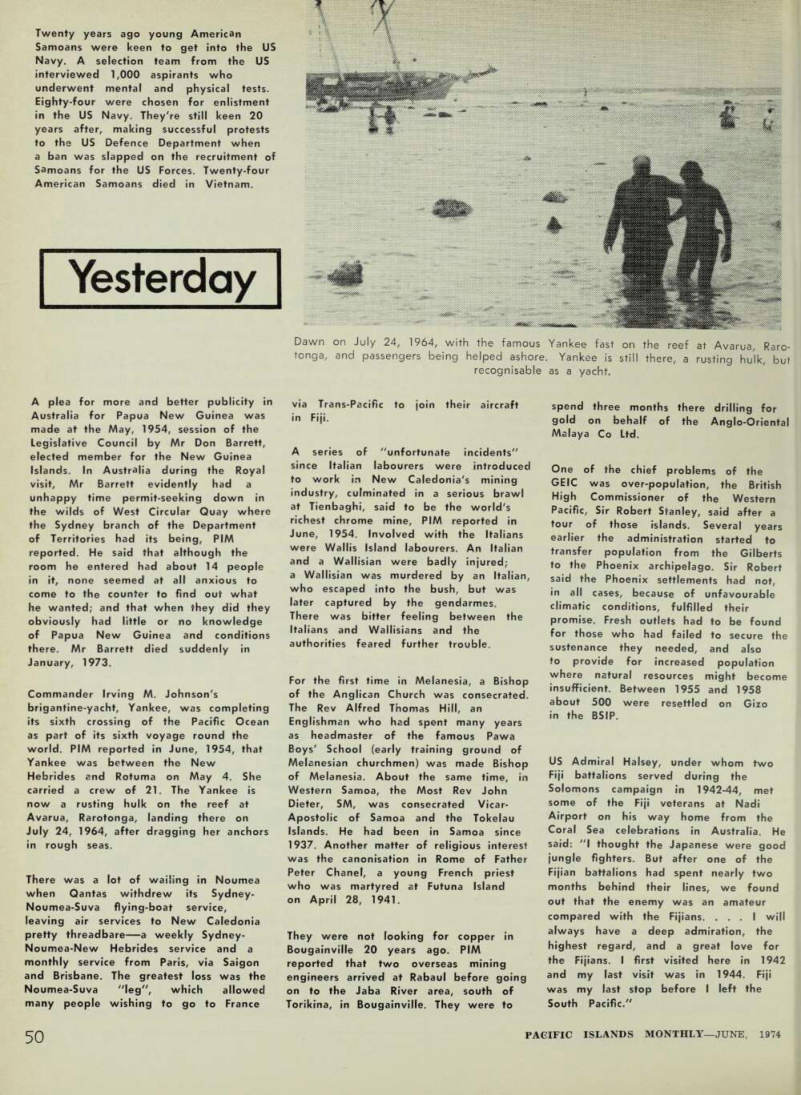
Twenty years ago young American Samoans were keen to get into the US Navy. A selection team from the US interviewed 1,000 aspirants who underwent mental and physical tests.
Eighty-four were chosen for enlistment in the US Navy. They're still keen 20 years after, making successful protests to the US Defence Department when a ban was slapped on the recruitment of Samoans for the US Forces. Twenty-four American Samoans died in Vietnam.
A plea for more and better publicity in Australia for Papua New Guinea was made at the May, 1954, session of the Legislative Council by Mr Don Barrett, elected member for the New Guinea Islands. In Australia during the Royal visit, Mr Barrett evidently had a unhappy time permit-seeking down in the wilds of West Circular Quay where the Sydney branch of the Department of Territories had its being, PIM reported. He said that although the room he entered had about 14 people in it, none seemed at all anxious to come to the counter to find out what he wanted; and that when they did they obviously had little or no knowledge of Papua New Guinea and conditions there. Mr Barrett died suddenly in January, 1973.
Commander Irving M. Johnson's brigantine-yacht, Yankee, was completing its sixth crossing of the Pacific Ocean as part of its sixth voyage round the world. PIM reported in June, 1954, that Yankee was between the New Hebrides and Rotuma on May 4. She carried a crew of 21. The Yankee is now a rusting hulk on the reef at Avarua, Rarotonga, landing there on July 24, 1964, after dragging her anchors in rough seas.
There was a lot of wailing in Noumea when Qantas withdrew its Sydney- Noumea-Suva flying-boat service, leaving air services to New Caledonia pretty threadbare —a weekly Sydney- Noumea-New Hebrides service and a monthly service from Paris, via Saigon and Brisbane. The greatest loss was the Noumea-Suva "leg", which allowed many people wishing to go to France
via Trans-Pacific to join their aircraft in Fiji.
A series of "unfortunate incidents" since Italian labourers were introduced to work in New Caledonia's mining industry, culminated in a serious brawl at Tienbaghi, said to be the world's richest chrome mine, PIM reported in June, 1954. Involved with the Italians were Wallis Island labourers. An Italian and a Wallisian were badly injured; a Wallisian was murdered by an Italian, who escaped into the bush, but was later captured by the gendarmes.
There was bitter feeling between the Italians and Wallisians and the authorities feared further trouble.
For the first time in Melanesia, a Bishop of the Anglican Church was consecrated.
The Rev Alfred Thomas Hill, an Englishman who had spent many years as headmaster of the famous Pawa Boys' School (early training ground of Melanesian churchmen) was made Bishop of Melanesia. About the same time, in Western Samoa, the Most Rev John Dieter, SM, was consecrated Vicar- Apostolic of Samoa and the Tokelau Islands. He had been in Samoa since 1937. Another matter of religious interest was the canonisation in Rome of Father Peter Chanel, a young French priest who was martyred at Futuna Island on April 28, 1941.
They were not looking for copper in Bougainville 20 years ago. PIM reported that two overseas mining engineers arrived at Rabaul before going on to the Jaba River area, south of Torikina, in Bougainville. They were to
spend three months there drilling for gold on behalf of the Anglo-Oriental Malaya Co Ltd.
One of the chief problems of the GEIC was over-population, the British High Commissioner of the Western Pacific, Sir Robert Stanley, said after a tour of those islands. Several years earlier the administration started to transfer population from the Gilberts to the Phoenix archipelago. Sir Robert said the Phoenix settlements had not, in all cases, because of unfavourable climatic conditions, fulfilled their promise. Fresh outlets had to be found for those who had failed to secure the sustenance they needed, and also to provide for increased population where natural resources might become insufficient. Between 1955 and 1958 about 500 were resettled on Gizo in the BSIP.
US Admiral Halsey, under whom two Fiji battalions served during the Solomons campaign in 1942-44, met some of the Fiji veterans at Nadi Airport on his way home from the Coral Sea celebrations in Australia. He said: "I thought the Japanese were good jungle fighters. But after one of the Fijian battalions had spent nearly two months behind their lines, we found out that the enemy was an amateur compared with the Fijians. ... I will always have a deep admiration, the highest regard, and a great love for the Fijians. I first visited here in 1942 and my last visit was in 1944. Fiji was my last stop before I left the South Pacific."
Dawn on July 24, 1964, with the famous Yankee fast on the reef at Avarua, Raro tonga, and passengers being helped ashore. Yankee is still there, a rusting hulk, but recognisable as a yacht.
Advertisements & other items, pp. 53-60 (1 item)
Pacific!
HOCOI
171 m s m tihi
LA I
VZ/70M GR.
Ghirardelli
MlIJv CHOCOLATE
T WT. M O2. 70.88 GK
NEW!
FROM
THE
SOUTH
PACIFIC!
he flavorful Macadamia nuts are grown for Ghirardelli on the Matana and No la Plantations of Koro, one of the beautiful and temperate islands of Fiji. In these southern latitudes the trees grow up to 60 feet tall and the nuts develop an exceptionally fine taste. They are tender, crunchy, superbly flavorful. These are the Noble Macadamia Nuts of the South Pacific. On the wrapper is a picture of Captain Bligh's Cove on the plantations where the nuts are grown. hirardelli makes over 50 different prized chocolate items in its new California plant. Many hours are spent mixing and kneading the secret chocolate formulas that make up the many varieties of bars, chocolate drinks, chips and other exclusive products such as the macadamia nut bar. These exclusive items are now being exported around the world.
Ghirardelli®
GHIRARDELLI CHOCOLATE COMPANY, SAN LEANDRO, CALIFORNIA 94578, U.S.A.
THIRTY THREE PACIFIC LTD
Please contact THIRTY-THREE PACIFIC LTD., 2415 Octavia Street, San Francisco, California 94109, U.S.A., 415/921-0463 for information regarding Macadamia Nut Bars or the many other fine Ghirardelli products. (Telex) 335-320 (GOLDENGRN SNLO)
m I v . .■ ~w&- .„.■ . * *SB
%i ii^
tjmvNm
OF AUSTRALIA
iSHom
B f * ,1 Wff t ,_ , ..** L *
the most
BREAD FLOURS: •
CAKE FLOURS: •
0
BISCUIT FLOURS: •
SPECIALITY FLOURS: •
important ingredient
MAINTOP —high protein bread flour ANCHOR—bakers flour • 50/50 MEAL—brown bread MEDlUM—cake and pastry • SPONGE —sponge cakes SPECIAL CAKE—madeira and cup cakes STRONG —cracker biscuits • MEDIUM —Shortbreads SOFT —sweet biscuits RYE hour • RYE meal • KIBBLED RYE SHARPS —roti and chapati flour • 100% STONE GROUND
WHOLEMEAL
GILLESPIE BROS. PTY. LTD.
HEAD OFFICE: BRISBANE OFFICE;
52 UNION ST., PYRMONT, SYDNEY, N.S.W. CABLE ADDRESS: ALBION, BRISBANE, QUEENSLAND. (G.P.O. BOX 2518, SYDNEY, 2001.) "GILLESPIE", (P.O. BOX 8, ALBION, BRISBANE, 4010.) PHONE: 660-4933. SYDNEY AND BRISBANE. PHONE; 6-1121.
: ■■■ & ** ' ... . . ... ■ - '; - - - ; * i i ■ ' ‘ => ■ ■■ -■. . Bfe - ■ *," ■’/!>, ' $ ; •x . * . „ .iif v
irTa '
- ■ ; * ' ~: ' *f I f» v sP t ■ Go ahead, dive into portable sound with undreamed of fidelity. These Toshiba sensations bring your favorite sounds wherever you are.f Don't take chances with a good time, take Toshiba every time.
Check these outstanding features: KT-215C Cassette Recorder; Built-in microphone, 1C head, automatic shut-off, push-button operation, tape counter, AC/DC.
RP-212S MW/SW 2-band Radio: Shortwave and medium wave reception, pulls-in distant stations, extra large speaker built-in and exterior antennas.
RT-296R Radio/Cassette Recorder: Remarkable tonal richness, medium wave and three shortwave bands, simultaneous recording while listening, tuning meter, automatic level control, tape counter, automatic shut-off, dynamic mike, light weight, AC/DC.
On hot summer days and nights, cool off with one of Toshiba's superior and silent electric fans. A full line of fans with many unusual features is available at your Toshiba dealer's.
Ml
RT-296R
Radio/Cassette Recorder *•••* ••• :::
RP-212S
MW/SW
2-band Radio
KT-215C
Cassette Recorder Electric Fan
tfoSuba
...In Touch with Tomorrow
»s»
EiSZJ
mjuusKoaassy
'o\\ fc nV " /
PW (SOUTH
TtAJcoun.
L r
tJK
y u o ■ ■i o t £2
s to uc u n o
TOMORROW
we mm am-mm im mm
M THi
CROSSING THIS
-WHERE EACH
E 4 A® Si *r I n#
I #llllllll
SOWS«R SftVSUSSS AVAJtASLS.
MSHiOfAN S|H£
■K Burns Philp helps to achieve the good life From Papua New Guinea to the international date line and beyond, the Burns Philp Group of Companies is helping to add to the quality of life for everyone.
Staff training programmes, sports facilities, modern residential accommodation, scholarship assistance these and many other company efforts are aimed at assisting the greatest possible number of people to achieve the good life.
Each year more and more Pacific people enjoy better transport, better homes, better health and generally better lives through the direct and indirect influence of this wide ranging, highly diversified company. Buying and selling, creating, shipping and serving, the thousands of people who make up Burns Philp are engaged in a continuing effort to make every tomorrow better.
Burns
Philp
GROUP OF COMPANIES M
PRINCIPAL OFFICE—7 BRIDGE STREET SYDNEY NSW 2000 AUSTRALIA
p f] < rXM
>, 1 'V' ; : >■„ :’: V I ' K& ||B|| !«(<«(« HI ,*V oArr - I®®' ** K j |«PI
Elfe
, niiSl ; S s l'<
Ull,
M ■ -»-v ? \#P' HI ws ' rc :lJkv *??'■ : ' kVP4*
lyufll CMF
>v 4w mm Mm . , . r *==4; f|f »lli p» 4 tcß t v i.S.Wf fluVieMik aguinwß •J~w rv -‘ V •',: :•;•
mt .'Vv-T'Y- ..'-Tm- ” ,-K?<*’■&&'*' ’V 1 t' ' V^' " ~; •,'•;• ,'. v~. •■-•■ M ; - • -:*•.
IE -■ os Mjfr if
Fas
r IV* *w.-. - ,'■: r* - ,> 1$ ■? 2 ■ , -■' * . . ■ .
ffiif
■■■• ; v,: •<V V*.,...; ;* •* W Y i'L >,,• ■"' 'beW-Qw-M^F- -,.■. , /• - ' *'*•*? * ***'/' y^' W . ■- ■ *■ r-' ’ w ;'^: 1 ■-> ;.: ~,..»■ T - . ■ .
• ?Tfe. ; : -
*•#*' :? -V-WU. #■ »
., *•**»* • a *3 3 •..3 <■ r i* r ... fl ; ; ,/i. - ■'•> •: - .«w ■’. V.
The flag we’ve flown for a hundred years.
Two paddle steamers on the Yangtse River in 1873 marked the beginning of the China Navigation Company. Today, the same flag flies above eighteen modern motor ships plying an extensive network of cargo routes between Papua New Guinea and Pacific Island ports (as far East as Tahiti) and Japan, New Zealand, Australia
and Thailand.
For 100 years, the flag of the China Navigation Company has meant experience, reliability and speed across the sea. Today, it’s flying as strong as ever.
For further details and .til enquiries there are Agents at the following ports: Papua New Guinea: Steamships I rading Co. Ltd., Port Moresby, Samarai, Lae, Madang.
Rabaul, Kieta. Burns Philp (New Guinea) Ltd.. VVewak, Kavieng. Fiji: Morris Hedstrom Ltd., Suva, Lautoka. Western Samoa: Morris Hedstrom Ltd., Apia.
Tonga: Morris Hedstrom Ltd., Nukualofa and Vava’u. Tahiti; Etablissements Donald, Tahiti, Papeete. New Caledonia: Etablissements Ballande, Noumea, 8.5.1. P.: British Solomons Trading Co. Ltd., Honiara. New Hebrides: LesComptoirs Francais des Nouvelles-Hebrides, Vila and Santo. AUSTRALIA—Sydney: Interocean Swire Pty. Ltd. Melbourne; Interocean Australia Services Pty. Ltd. Brisbane: Wills. Gilchrist & Sanderson Ply. Ltd. NEW ZEALAND—F. & O. (N.Z.) Ltd.
Auckland. Wellington, Christchurch, Dunedin. Bluff, Napier. Japan; Swire McKinnon. Tokyo, Yokohama, Osaka, Kobe and Nagoya. Eastern Managers: Butterfield & Swire, 9 Connaught Rd., Central, Hong Kong.
JOHN SWIRE & SONS PTY. LTD. General Agents in Australia, 8 Spring Street, Sydney, Phone: 27 9351.
THE CHINA NAVIGATION CO LTD
MEMBER OF THE SWIRE GROUP. , SOOB pc CN co
Bacardi
ice and
what else?
... nothing else if you feel so inclined, for there’s no real problem where and how and what you drink Bacardi rum with.
Because Bacardi rum is so light, dry, highly refined and pure it complements every mixer, yet remains distinctively itself. Bacardi and Coke and ice ... Bacardi and ginger... Bacardi and tonic with a zest of lemon or lime ... Bacardi and fruit juice ... Mix up your own Bacardi party.
Because ...
Anything
goes with
Bacardi rum
BACARDI
rum-the mixable one. : - A H . : * m & ■
Magazine Section
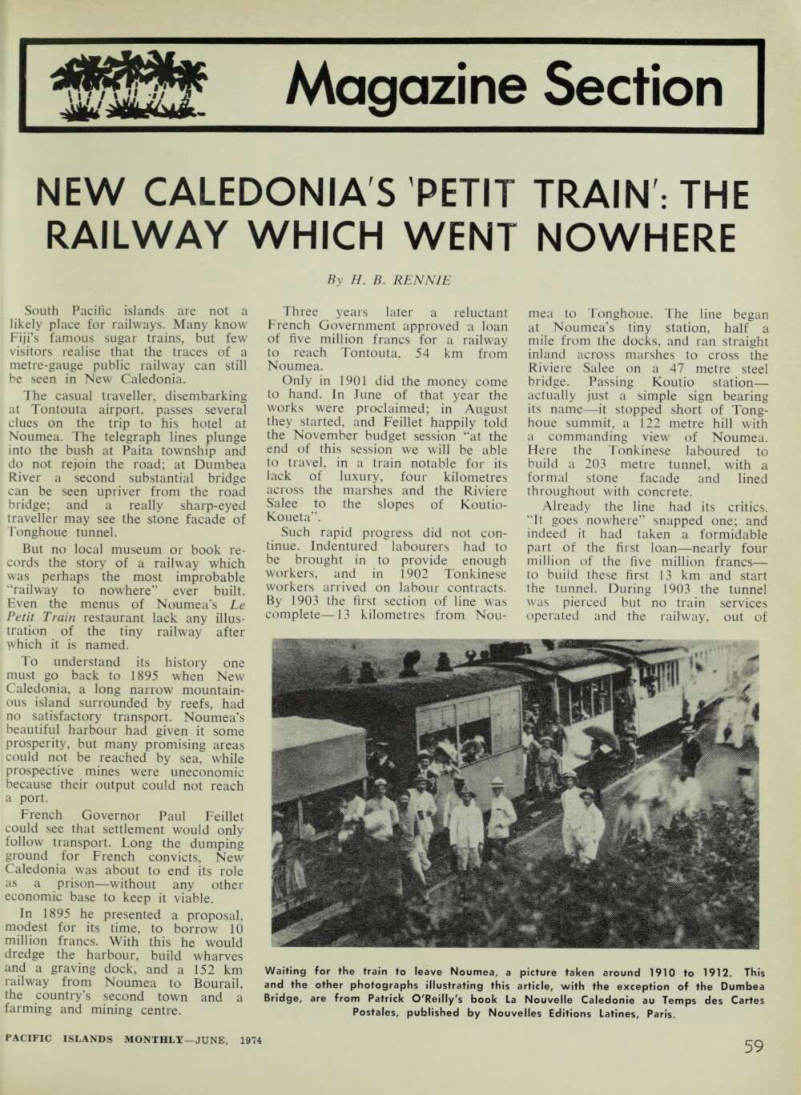
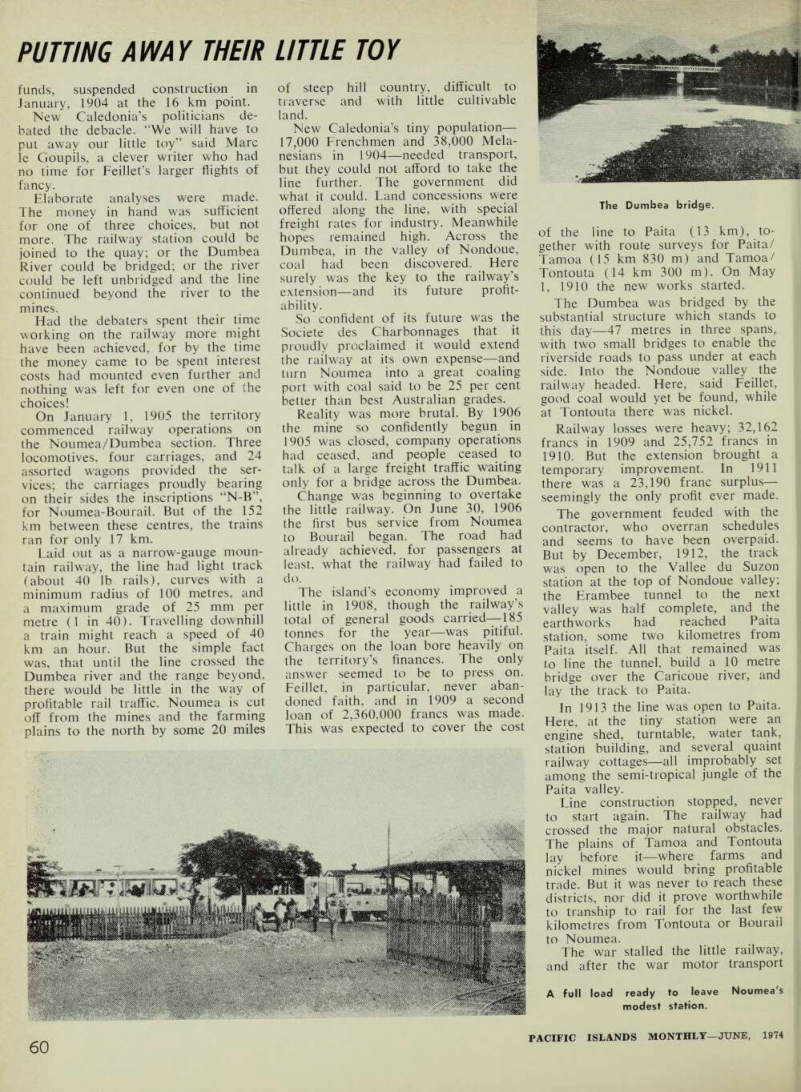
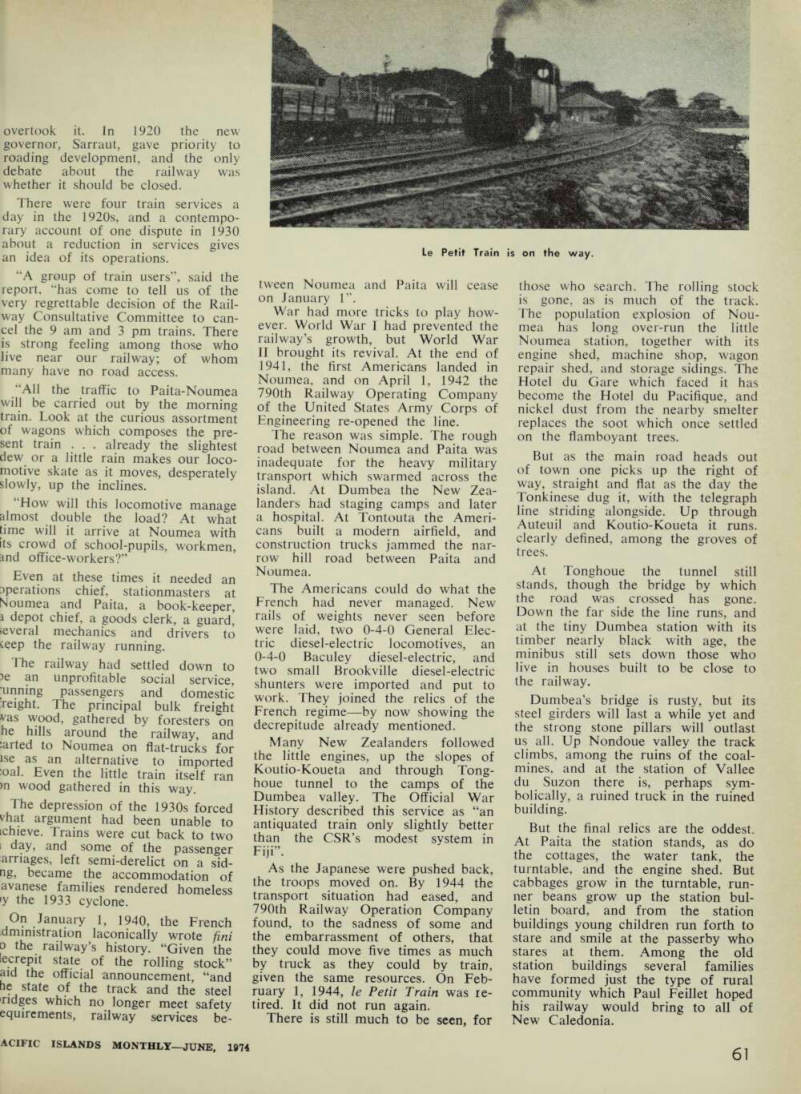
New Caledonia's Petit Train': The
Railway Which Went Nowhere
By H. B. Rennie
South Pacific islands are not a likely place for railways. Many know Fiji’s famous sugar trains, but few visitors realise that the traces of a metre-gauge public railway can still be seen in New Caledonia.
The casual traveller, disembarking at Tontouta airport, passes several clues on the trip to his hotel at Noumea. The telegraph lines plunge into the bush at Paita township and do not rejoin the road; at Dumbea River a second substantial bridge can be seen upriver from the road bridge; and a really sharp-eyed traveller may see the stone facade of Tonghoue tunnel.
But no local museum or book re cords the story of a railway which was perhaps the most improbable “railway to nowhere” ever built.
Even the menus of Noumea’s Le Petit Train restaurant lack any illus tration of the tiny railway after which it is named.
To understand its history one must go back to 1895 when New Caledonia, a long narrow mountain ous island surrounded by reefs, had no satisfactory transport. Noumea’s beautiful harbour had given it some prosperity, but many promising areas could not be reached by sea, while prospective mines were uneconomic because their output could not reach a port.
French Governor Paul Feillet could see that settlement would only follow transport. Long the dumping ground for French convicts, New Caledonia was about to end its role as a prison—without any other economic base to keep it viable.
In 1895 he presented a proposal, modest for its time, to borrow 10 million francs. With this he would dredge the harbour, build wharves and a graving dock, and a 152 km railway from Noumea to Bourail, the country’s second town and a farming and mining centre.
Three years later a reluctant French Government approved a loan of five million francs for a railway to reach Tontouta, 54 km from Noumea, Only in 1901 did the money come to hand. In June of that year the works were proclaimed; in August they started, and Feillet happily told the November budget session “at the end of this session we will be able to travel, in a train notable for its lack of luxury, four kilometres across the marshes and the Riviere Salee to the slopes of Koutio- Koueta”.
Such rapid progress did not con tinue. Indentured labourers had to be brought in to provide enough workers, and in 1902 Tonkinese workers arrived on labour contracts.
By 1903 the first section of line was
complete—l 3 kilometres from Nou
mea to Tonghoue. The line began at Noumea’s tiny station, half a mile from the docks, and ran straight inland across marshes to cross the Riviere Salee on a 47 metre steel
bridge. Passing Koutio station—
actually just a simple sign bearing its name—it stopped short of Tong houe summit, a 122 metre hill with a commanding view of Noumea.
Here the Tonkinese laboured to build a 203 metre tunnel, with a formal stone facade and lined throughout with concrete.
Already the line had its critics.
“It goes nowhere” snapped one; and indeed it had taken a formidable part of the first loan—nearly four million of the five million francs— to build these first 13 km and start the tunnel. During 1903 the tunnel was pierced but no train services operated and the railway, out of
Waiting for the train to leave Noumea, a picture taken around 1910 to 1912. This and the other photographs illustrating this article, with the exception of the Dumbea Bridge, are from Patrick O'Reilly's book La Nouvelle Caledonie au Temps des Cartes Postales, published by Nouvelles Editions Latines, Paris.
Putting Away Their Little Toy
funds, suspended construction in January, 1904 at the 16 km point.
New Caledonia’s politicians de bated the debacle. “We will have to put away our little toy” said Marc le Goupils, a clever writer who had no time for Feillet’s larger flights of fancy.
Elaborate analyses were made.
The money in hand was sufficient for one of three choices, but not more. The railway station could be joined to the quay; or the Dumbea River could be bridged; or the river could be left unbridged and the line continued beyond the river to the mines.
Had the debaters spent their time working on the railway more might have been achieved, for by the time the money came to be spent interest costs had mounted even further and nothing was left for even one of the choices!
On January 1, 1905 the territory commenced railway operations on the Noumea/Dumbea section. Three locomotives, four carriages, and 24 assorted wagons provided the ser vices; the carriages proudly bearing on their sides the inscriptions “N-B”, for Noumea-Bourail. But of the 152 km between these centres, the trains ran for only 17 km.
Laid out as a narrow-gauge moun tain railway, the line had light track (about 40 lb rails), curves with a minimum radius of 100 metres, and a maximum grade of 25 mm per metre (1 in 40). Travelling downhill a train might reach a speed of 40 km an hour. But the simple fact was, that until the line crossed the Dumbea river and the range beyond, there would be little in the way of profitable rail traffic. Noumea is cut off from the mines and the farming plains to the north by some 20 miles
of steep hill country, difficult to traverse and with little cultivable land.
New Caledonia’s tiny population— -17,000 Frenchmen and 38,000 Mela nesians in 1904—needed transport, but they could not afford to take the line further. The government did what it could. Land concessions were offered along the line, with special freight rates for industry. Meanwhile hopes remained high. Across the Dumbea, in the valley of Nondoue, coal had been discovered. Here surely was the key to the railway’s extension —and its future profit ability.
So confident of its future was the Societe des Charbonnages that it proudly proclaimed it would extend the railway at its own expense —and turn Noumea into a great coaling port with coal said to be 25 per cent better than best Australian grades.
Reality was more brutal. By 1906 the mine so confidently begun in 1905 was closed, company operations had ceased, and people ceased to talk of a large freight traffic waiting only for a bridge across the Dumbea.
Change was beginning to overtake the little railway. On June 30, 1906 the first bus service from Noumea to Bourail began. The road had already achieved, for passengers at least, what the railway had failed to do.
The island’s economy improved a little in 1908, though the railway’s total of general goods carried —185 tonnes for the year—was pitiful.
Charges on the loan bore heavily on the territory’s finances. The only answer seemed to be to press on.
Feillet, in particular, never aban doned faith, and in 1909 a second loan of 2,360,000 francs was made.
This was expected to cover the cost
of the line to Paita (13 km), to gether with route surveys for Paita/ Tamoa (15 km 830 m) and Tamoa/ Tontouta (14 km 300 m). On May 1, 1910 the new works started.
The Dumbea was bridged by the substantial structure which stands to this day—47 metres in three spans, with two small bridges to enable the riverside roads to pass under at each side. Into the Nondoue valley the railway headed. Here, said Feillet, good coal would yet be found, while at Tontouta there was nickel.
Railway losses were heavy; 32,162 francs in 1909 and 25,752 francs in 1910. But the extension brought a temporary improvement. In 1911 there was a 23,190 franc surplus— seemingly the only profit ever made.
The government feuded with the contractor, who overran schedules and seems to have been overpaid.
But by December, 1912, the track was open to the Vallee du Suzon station at the top of Nondoue valley; the Erambee tunnel to the next valley was half complete, and the earthworks had reached Paita station, some two kilometres from Paita itself. All that remained was to line the tunnel, build a 10 metre bridge over the Caricoue river, and lay the track to Paita.
In 1913 the line was open to Paita.
Here, at the tiny station were an engine shed, turntable, water tank, station building, and several quaint
railway cottages—all improbably set
among the semi-tropical jungle of the
Paita valley.
Line construction stopped, never to start again. The railway had crossed the major natural obstacles.
The plains of Tamoa and Tontouta lay before it—where farms and nickel mines would bring profitable trade. But it was never to reach these districts, nor did it prove worthwhile to tranship to rail for the last few kilometres from Tontouta or Bourail to Noumea.
The war stalled the little railway, and after the war motor transport
The Dumbea bridge.
A full load ready to leave Noumea's modest station.
overtook it. In 1920 the new governor, S'arraut, gave priority to reading development, and the only debate about the railway was whether it should be closed.
There were four train services a day in the 19205, and a contempo rary account of one dispute in 1930 about a reduction in services gives an idea of its operations.
“A group of train users”, said the report, “has come to tell us of the very regrettable decision of the Rail way Consultative Committee to can cel the 9 am and 3 pm trains. There is strong feeling among those who live near our railway; of whom many have no road access.
“All the traffic to Paita-Noumea will be carried out by the morning train. Look at the curious assortment of wagons which composes the pre sent train . . . already the slightest dew or a little rain makes our loco motive skate as it moves, desperately slowly, up the inclines.
“How will this locomotive manage almost double the load? At what time will it arrive at Noumea with its crowd of school-pupils, workmen, and office-workers?”
Even at these times it needed an Dperations chief, stationmasters at Noumea and Paita, a book-keeper, a depot chief, a goods clerk, a guard, several mechanics and drivers to ceep the railway running.
The railway had settled down to ?e an unprofitable social service, 'unning passengers and domestic reight. The principal bulk freight vas wood, gathered by foresters on he hills around the railway, and :arted to Noumea on flat-trucks for ise as an alternative to imported :oal. Even the little train itself ran m wood gathered in this way.
The depression of the 1930 s forced vhat argument had been unable to ichieve. Trains were cut back to two i day, and some of the passenger arriages, left semi-derelict on a sid ng, became the accommodation of avanese families rendered homeless •y the 1933 cyclone.
On January 1, 1940, the French dministration laconically wrote fini o the railway’s history. “Given the lecrepit state of the rolling stock” aid the official announcement, “and be state of the track and the steel ridges which no longer meet safety equipments, railway services be-
tween Noumea and Paita will cease on January 1”.
War had more tricks to play how ever. World War I had prevented the railway’s growth, but World War II brought its revival. At the end of 1941, the first Americans landed in Noumea, and on April 1, 1942 the 790th Railway Operating Company of the United States Army Corps of Engineering re-opened the line.
The reason was simple. The rough road between Noumea and Paita was inadequate for the heavy military transport which swarmed across the island. At Dumbea the New Zea landers had staging camps and later a hospital. At Tontouta the Ameri cans built a modern airfield, and construction trucks jammed the nar row hill road between Paita and Noumea.
The Americans could do what the French had never managed. New rails of weights never seen before were laid, two 0-4-0 General Elec tric diesel-electric locomotives, an 0-4-0 Baculey diesel-electric, and two small Brookville diesel-electric shunters were imported and put to work. They joined the relics of the French regime—by now showing the decrepitude already mentioned.
Many New Zealanders followed the little engines, up the slopes of Koutio-Koueta and through Tong houe tunnel to the camps of the Dumbea valley. The Official War History described this service as “an antiquated train only slightly better than the GSR’s modest system in Fiji”.
As the Japanese were pushed back, the troops moved on. By 1944 the transport situation had eased, and 790th Railway Operation Company found, to the sadness of some and the embarrassment of others, that they could move five times as much by truck as they could by train, given the same resources. On Feb ruary 1, 1944, le Petit Train was re tired. It did not run again.
There is still much to be seen, for
those who search. The rolling stock is gone, as is much of the track.
The population explosion of Nou mea has long over-run the little Noumea station, together with its engine shed, machine shop, wagon repair shed, and storage sidings. The Hotel du Gare which faced it has become the Hotel du Pacifique, and nickel dust from the nearby smelter replaces the soot which once settled on the flamboyant trees.
But as the main road heads out of town one picks up the right of way, straight and flat as the day the Tonkinese dug it, with the telegraph line striding alongside. Up through Auteuil and Koutio-Koueta it runs, clearly defined, among the groves of trees.
At Tonghoue the tunnel still stands, though the bridge by which the road was crossed has gone.
Down the far side the line runs, and at the tiny Dumbea station with its timber nearly black with age, the minibus still sets down those who live in houses built to be close to the railway.
Dumbea’s bridge is rusty, but its steel girders will last a while yet and the strong stone pillars will outlast us all. Up Nondoue valley the track climbs, among the ruins of the coal mines, and at the station of Vallee du Suzon there is, perhaps sym bolically, a ruined truck in the ruined building.
But the final relics are the oddest.
At Paita the station stands, as do the cottages, the water tank, the turntable, and the engine shed. But cabbages grow in the turntable, run ner beans grow up the station bul letin board, and from the station buildings young children run forth to stare and smile at the passerby who stares at them. Among the old station buildings several families have formed just the type of rural community which Paul Feillet hoped his railway would bring to all of New Caledonia.
Le Petit Train is on the way.
Advertisements & other items, p. 63 (1 item)
Acific Islands Monthly—June, 1974
Mana
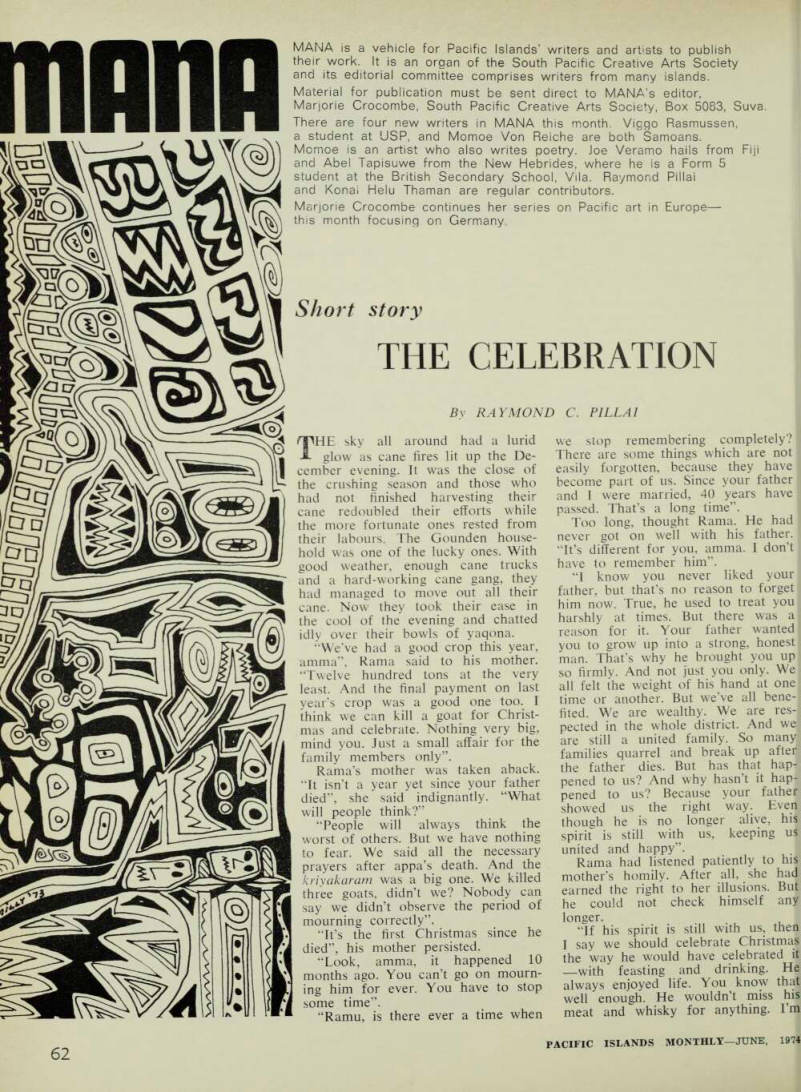
is a vehicle for Pacific Islands’ writers and artists to publish their work. It is an organ of the South Pacific Creative Arts Society and its editorial committee comprises writers from many islands.
Material for publication must be sent direct to MANA’s editor, Marjorie Crocombe, South Pacific Creative Arts Society, Box 5083, Suva.
There are four new writers in MANA this month. Viggo Rasmussen, a student at USP, and Momoe Von Reiche are both Samoans.
Momoe is an artist who also writes poetry. Joe Veramo hails from Fiji and Abel Tapisuwe from the New Hebrides, where he is a Form 5 student at the British Secondary School, Vila. Raymond Pillai and Konai Helu Thaman are regular contributors.
Marjorie Crocombe continues her series on Pacific art in Europe— this month focusing on Germany.
The Celebration
Short story
By Raymond C. Pillai
THE sky all around had a lurid glow as cane fires lit up the De cember evening. It was the close of the crushing season and those who had not finished harvesting their cane redoubled their efforts while the more fortunate ones rested from their labours. The Gounden house hold was one of the lucky ones. With good weather, enough cane trucks and a hard-working cane gang, they had managed to move out all their cane. Now they took their ease in the cool of the evening and chatted idly over their bowls of yaqona.
“We’ve had a good crop this year, amma”, Rama said to his mother.
“Twelve hundred tons at the very least. And the final payment on last year’s crop was a good one too. I think we can kill a goat for Christ mas and celebrate. Nothing very big, mind you. Just a small affair for the family members only”.
Rama’s mother was taken aback.
“It isn’t a year yet since your father died”, she said indignantly. “What will people think?”
“People will always think the worst of others. But we have nothing to fear. We said all the necessary prayers after appa’s death. And the kriyakaram was a big one. We killed three goats, didn’t we? Nobody can say we didn’t observe the period of mourning correctly”.
"It’s the first Christmas since he died”, his mother persisted.
“Look, amma, it happened 10 months ago. You can’t go on mourn ing him for ever. You have to stop some time”.
“Ramu, is there ever a time when
we stop remembering completely? I There are some things which are not easily forgotten, because they have ■ become part of us. Since your father and I were married, 40 years have I passed. That’s a long time”.
Too long, thought Rama. He had never got on well with his father.
“It’s different for you, amma. I don’t have to remember him”.
“I know you never liked your father, but that’s no reason to forget him now. True, he used to treat you harshly at times. But there was a reason for it. Your father wanted you to grow up into a strong, honest] man. That’s why he brought you up so firmly. And not just you only. We all felt the weight of his hand at one ; time or another. But we’ve all bene fited. We are wealthy. We are res pected in the whole district. And we are still a united family. So many families quarrel and break up after the father dies. But has that hap pened to us? And why hasn’t it hap pened to us? Because your father showed us the right way. Even though he is no longer alive, his spirit is still with us, keeping us united and happy”.
Rama had listened patiently to his mother’s homily. After all, she had earned the right to her illusions. But he could not check himself any longer.
“If his spirit is still with us, then I say we should celebrate Christmas the way he would have celebrated it —with feasting and drinking. He always enjoyed life. You know that well enough. He wouldn’t miss his meat and whisky for anything. I’m
sure he wouldn't want us to sit around like fools just because he wasn’t alive to share the occasion with us”.
“I’m sure your father would be filled with sorrow to see you making merry so soon after his death. Wait a little longer, and then you can have as much feasting and drinking as you want”.
“But how much longer, amma?
We didn’t do anything for Easter or Diwali. How long are we going to continue as if we were corpses our selves? I say we should kill one goat at least for Christmas. And people can say what they like. I don’t give a damn!”
Rama had his way in the end. He was the eldest son after all. But his decision was strongly resented. When he brought home the Christmas goat, the family showed not the slightest interest and this made Rama very sore. At the very least they could have asked him whjtt the goat had cost.
THE Christmas celebration proved to be a dispiriting venture. With the exception of Logesan, who was the youngest and who dared not cross his brother, the others found reasons for not being present. The two sisters said they were unable to travel. Their damn fool husbands must have got them pregnant again, thought Rama. Govinda had to go and see his ailing mother-in-law. A likely story! That mother-in-law of Govinda’s was strong as an ox and twice as stupid. Gopal gave the same reason as the year before—he was afraid somebody would set fire to his cane if he left his farm. All feeble excuses! Well, let them stay away if they liked, fumed Rama. If they wanted to be stubborn, that was their own affair, but he wasn’t going to let them spoil his pleasure.
The goat was slaughtered early on Christmas morning. In the past, Rama’s father would have conducted the job personally, wearying every body with his imperious commands.
Today that privilege was Rama’s. He took charge of the operation as if born to the task and gave orders with the aplomb of a veteran.
Logesan held the goat down by the legs while Rama forced a drink of water into the goat’s mouth—the final kindness. Then a deft stroke of the knife sliced through the animal’s throat, releasing a jet of hot blood.
“Look how you’re holding that basin, you ass!” Rama shouted at his son, Anand. “You’ll let the whole stuff spill on the ground”.
Anand did his best to hold the basin steady as the blood gushed into it erratically. The animal’s eyes
dilated in terror, its body heaving in spasms of agony. Uncomprehending, crazed with pain, it struggled to raise its head and look at its tor mentors, but Rama’s firm grip on its muzzle held it prisoner. Hot, tor tured blasts of air snorted through its labouring nostrils. Its body arched in agonised convulsions. Des perately it fought to regain its feet, but the combined weight of the two men brutally quelled all resistance.
The spasms slowly ceased as its life ebbed out. It sagged and went limp, defeated.
The basin was almost full—froth ing, dark, sinister. The flow of blood dwindled to a trickle. Judging the right moment expertly, Rama motioned to Anand to remove the basin. It was not a second too soon as a stream of undigested food spurted from the severed gullet.
Rama twisted the head round and sawed through the spinal cord. The goat convulsed once more, then sub sided. The deed was done.
Rama stood up and flicked the sweat away from his forehead with the back of his hand. “He’s a big bugger, isn’t he?” he said. “Over 100 pounds in my estimation”.
Logesan murmured assent but Anand said nothing. Anand’s face was blanched. He was sickened by the slaughter, more so because it was quite unnecessary. Young as he was, he was still perceptive enough to see that the goat was only a sacrifice to his father’s ego.
Rama was not pleased with Anand’s squeamishness. “Look at
this boy of mine. He is nearly old enough to have hair on his chin, but he’s frightened of a little blood”, Anand was stung. “It’s not the blood. It’s the pain that we give the animal when we kill it”.
“Nonsense!” said Rama. “It doesn't feel a thing. It gets such a shock that it doesn’t know what’s happening to it. Look at that goat there. See how peacefully it lies. Do you think it feels anything? Not one bit. It’s gone. Finished”.
There was indeed something peaceful about the way it lay there, looking calm and composed even though its head was missing. Flies started buzzing round the neck of the carcass, and as the blood on the grass began to thicken and grow dark, the violent scene of a few minutes before seemed more remote and less reprehensible.
THE goat yielded 55 pounds of
meat, which should have pleased Rama, but he was still furious be cause the whole family was not pre sent.
“They should have come”, he complained to his mother. “We always used to celebrate Christmas in a big way. It was fun for every body. But this year they think they can have more fun by themselves in their own homes. Our neighbours must be laughing at us. They know we killed such a big goat, and now there’s no one to eat it. Well then, if nobody wants it, I’ll eat it all by myself”.
“All this is your own doing, Ramu”, said his mother. “You had no patience. You could not wait for even one year to show that you are the big man of the house now. I kept telling you, but you are too big now to listen to an old woman like me”.
“Amma, that’s not true. I just wanted to enjoy Christmas”.
“Since when have you become a Christian, Ramu, that you must cele brate Christmas?”
“Haven’t we always celebrated Christmas? Christmas is not a reli gious thing. It’s only a public holi day. It’s a time for feasting and merry-making”.
“All right, then. You go ahead with your feasting and see how much you enjoy it”.
“I will enjoy it!” he said defiantly.
“Shanti!” he roared at his wife.
“Why isn’t the fried meat ready
yet?”
“I’m just doing it now. I have only two hands, you know”.
“Your tongue seems to be work ing more than your hands nowadays.
Hurry up with that meat”.
A few minutes later his wife
brought in a bowl of chopped meat and liver mixed with fat and blood.
It was done just the way he liked it, with plenty of chillies. In a separate saucer lay the goat’s testicles, lightly fried in oil and neatly quartered.
When Rama’s father had been alive, the first meat was always reserved for him. No one might eat until he had tasted first and pronounced himself satisfied. It was almost a seignorial right, confirming him in his place of honour as head of the house. Now the old man was no more. His mantle had fallen upon Rama’s shoulders, and with it all the prerogatives.
“Ah, it’s a long time since I’ve had such tasty meat”, said Rama with exaggerated relish. In truth he was disappointed to find the meat a little tough, but he was not going to let his chagrin show.
“Here, Anand”, he called to his son. “Take some of this meat”.
Anand shuffled to the table re luctantly and put a few spoonfuls of fried blood into his cupped hand.
“Have some of this too”, said Rama, pointing to the saucer.
“I never eat that”, said Anand hastily. The prospect of eating goat’s testicles repelled him.
“Go on, it’s good stuff”.
“I never eat it”, repeated Anand dully.
“Well, you are going to eat some today, my boy”.
“Why are you forcing him?”
Anand’s mother intervened. “He says he doesn’t want it”.
“Stop molly-coddling the boy.
He’s going to do what I tell him.
Here, eat this”. Rama picked up a piece from the saucer and thrust it at Anand.
Anand took the preferred morsel.
With a tremendous effort of will he bit into it and tried to swallow but the spongy texture and somewhat amoniacal tang of the flesh made him retch. He rushed out to the drain which ran past the kitchen window and vomited until he was exhausted.
“See what you’ve done to the boy!” cried Anand’s mother. “Why are you being so stubborn?”
“He’s just enjoying his Christmas Day”, said Rama’s mother bitterly.
“He just wants to show that he’s the big man of the house. And he has proved it by bullying his son”.
“Stop it!” shouted Rama. “I’ve had enough of you people!” With a violent motion of the hand he swept the meat bowl off the table and stamped out of the house.
His wife looked sadly at the meat strewn over the floor. She had pre pared it so painstakingly, the way her husband liked it, and he had
flung it aside to be trampled under foot. Tears of exasperation welled up in her eyes.
“It’s no use crying, Shanti”, her mother-in-law said to her. “Men never change. In 40 years of married life I never managed to change the ways of Ramu’s father. And I don’t think you’ll ever be able to alter Ramu either. He’s too much like his father. Make the most of your happy moments, and pray that the hard times are few. That’s the only way to endure a lifetime together”.
Shanti made no reply. There was practical wisdom in the old woman’s words, but hardly a grain of comfort.
Still, there was no point in lingering over her troubles. She brushed back her tears as if nothing had happened.
Then she bent down and began pick ing up the pieces of meat one by one.
The fortune teller
By Konai Helu Thaman
Twenty ‘seniti’
Your fortune will be told; Last night we hardly slept Too many young girls Wanted jobs and husbands; “You will marry a white man But you have a rival Who is a very close friend; You will travel To a faraway country Your parents are worried About your future”.
The fortune teller is Short and fat Her wrap-around mat Protects her secrets From which she makes A living Fulfilling dreams Of people who long To travel, get married Or become rich.
Elegy to a toad
By Viggo Rasmussen
Oh Toad! poor Toad!
That lies on this cold And unfriendly road, Who has ripped the life from you?
If God above has so willed That you live and play, Why are you still, At this time of the day?
Tell me dear friend, The cause of this stain, That your heart and guts, On the road have made.
Who could have done, Such a thing to you?
Who in his pride, Dares destroy your life?
Why, you always croaked, Whenever it rains, Waking me up, To watch you play.
Oh! How I wish I could understand, Those sounds you make, So that I’ll say, “Hello”
Whenever you croak.
But alas! we’re separated, Evolved to different states, Never to understand, Never to communicate.
Poor Toad! innocent Toad, Without relatives or friends, How, you have missed the world, And gained a friend.
Goodbye! dear friend, Til always remember your croaks, For you have touched my heart, Even to my very soul.
Pacific Art
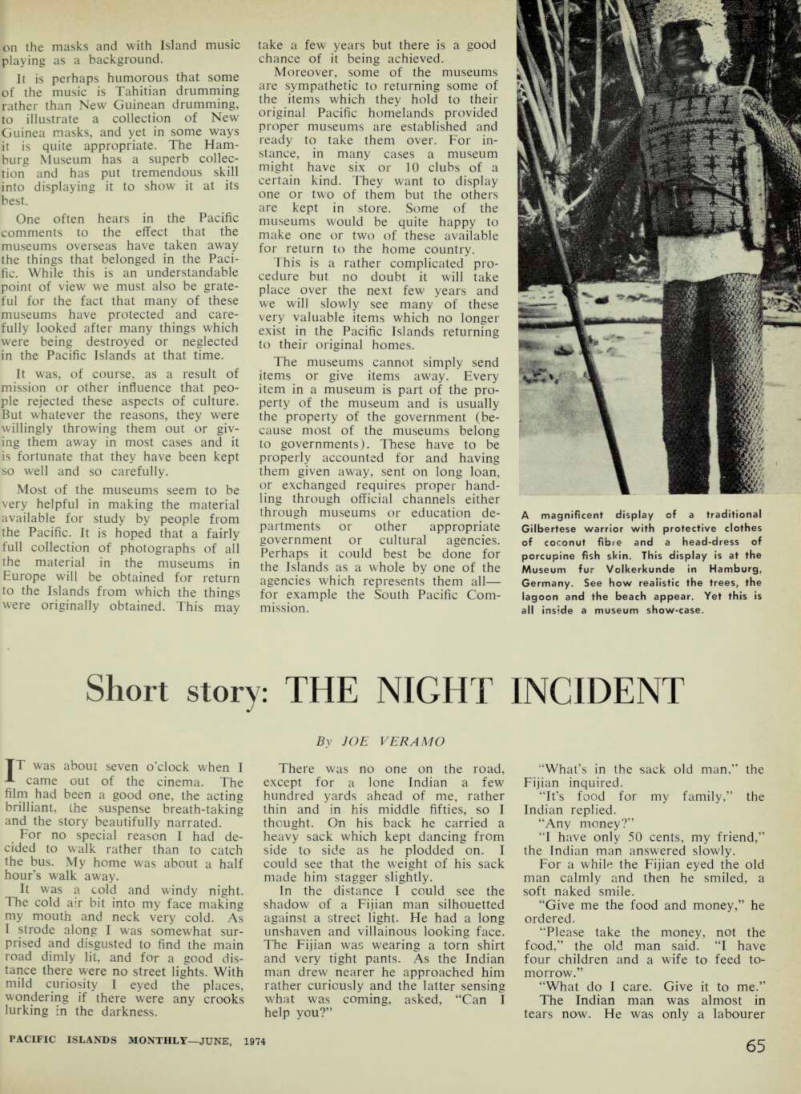
In Germany
By Marjorie Crocombe
There is a wonderful collection of materials from the Pacific at the Museum fur Volkerkunde in Ham burg. Most of the materials from Polynesia and Micronesia are very rare and old but a lot of the material from Melanesia and particularly New Guinea is more recent.
About 60 years ago the Hamburg Museum sent a large expedition to the Pacific Islands. They made many hundreds of photographs which are now a very interesting record of life as it was in the early 1900 s and they also collected large quantities of tools, clothing, housing, canoes and tapa cloth etc from various islands.
The Pacific collection at the Ham burg Museum is beautifully dis played. There are life-size represent ations of people and life-size photo graphs in the walls at the back of the display cabinets showing the scenery, house types and other aspects of the environment so that the artifacts are put into a very realistic context. There is a beautiful New Zealand Maori carved meeting house—complete—the whole meeting house, not a miniature of it—and some beautiful samples from Samoa, Tonga and elsewhere in Polynesia.
Of course between 1900 and 1914 Western Samoa was a colony of Germany and before that German traders, missionaries and sea captains had been travelling in the Pacific for many years. Many of these people had collected items from various parts of the Pacific—especially the Gilbert Islands, Samoa, Marshall Islands and Caroline Islands as well as from northern New Guinea. A lot of these things have found their way into the museum at Hamburg be cause Hamburg was at that time perhaps the most important port in Germany from which the trade to the Pacific Islands originated.
The Hamburg Museum has de voted one very large room to a very realistic display of New Guinea masks. They have an enormous number of masks—some of them eight or 10 feet high, some of them only a few inches high; some of them from the Trobriand Islands, some from the Sepik and so on, but many of them are very beautiful.
All of them are hung from the ceil ing in a rather realistic setting in a room which is very dark but with selected lights playing intermittently
on the masks and with Island music playing as a background.
It is perhaps humorous that some of the music is Tahitian drumming rather than New Guinean drumming, to illustrate a collection of New Guinea masks, and yet in some ways it is quite appropriate. The Hamburg Museum has a superb colleclion and has put tremendous skill into displaying it to show it at its k est v 3 b One often hears in the Pacific comments to the effect that the museums overseas have taken away the things that belonged in the Padfit. While this is an understandable point of view we must also be grateful for the fact that many of these museums have protected and carefully looked after many things which were being destroyed or neglected in the Pacific Islands at that time.
It was, of course, as a result of mission or other influence that peopie rejected these aspects of culture.
But whatever the reasons, they were willingly throwing them out or giving them away in most cases and it is fortunate that they have been kept so well and so carefully.
Most of the museums seem to be very helpful in making the material available for study by people from the Pacific. It is hoped that a fairly r it „ i. .. r y . , r full collection of photographs of all the material in the museums in Europe will be obtained for return to the Islands from which the things were originally obtained. This may
take a few years but there is a good chance of it being achieved.
Moreover some of the museums f. re sympathetic to returning some of thl r hems which they hold to their on «' nal Pacific homelands provided P ro Per museums are established and r fady to take them over. For in st?n“. >» many cases a museum might have six or 10 clubs of a certa ' n kind. They want to display one or two of them but the others are kept in store. Some of the museums would be quite happy to ma ke one or two of these available f or return to the home country, This is a rather complicated pro cedure but no doubt it will take place over the next few years and we will slowly see many of these very valuable items which no longer exist in the Pacific Islands returning to their original homes. miloQlirv , o . . , , The museums cannot simply send items or give items away. Every item in a museum is part of the pro perty of the museum and is usually the property of the government (be cause most of the museums belong to governments). These have to be properly accounted for and having them given away, sent on long loan, .°. r ex £hanged requires proper hand 'nB tf ; rou S h offlclal channe ? either through museums or education de- P artments , or oth f f r appropriate government or cultural agencies, Perhaps it could best be d “ ne for the Islands as a whole by one of the agencies which represents them all— for example the South Pacific Com mission.
A magnificent display of a traditional Gilbertese warrior with protective clothes of coconut fibre and a head-dress of porcupine fish skin. This display is at the Museum fur Volkerkunde in Hamburg, Germany. See how realistic the trees, the lagoon and the beach appear. Yet this is all inside a museum show-case.
Short story: THE NIGHT INCIDENT
By Joe Veramo
TT was about seven o’clock when I A came out of the cinema. The film had been a good one, the acting brilliant, the suspense breath-taking and the story beautifully narrated.
For no special reason I had de cided to walk rather than to catch the bus. My home was about a half hour’s walk away.
It was a cold and windy night.
The cold air bit into my face making my mouth and neck very cold. As I strode along I was somewhat sur prised and disgusted to find the main road dimly lit, and for a good dis tance there were no street lights. With mild curiosity I eyed the places, wondering if there were any crooks lurking in the darkness.
There was no one on the road, except for a lone Indian a few hundred yards ahead of me, rather thin and in his middle fifties, so I thought. On his back he carried a heavy sack which kept dancing from side to side as he plodded on. I could see that the weight of his sack made him stagger slightly.
In the distance I could see the shadow of a Fijian man silhouetted against a street light. He had a long unshaven and villainous looking face.
The Fijian was wearing a torn shirt and very tight pants. As the Indian man drew nearer he approached him rather curiously and the latter sensing what was coming, asked, “Can I help you?”
“What’s in the sack old man,” the
Fijian inquired,
“It’s food for my family,” the
Indian replied,
“Any money?”
“I have only 50 cents, my friend,” the Indian man answered slowly, For a while the Fijian eyed the old man calmly and then he smiled, a soft naked smile.
“Give me the food and money,” he ordered.
“Please take the money, not the food,” the old man said. “I have four children and a wife to feed to morrow.”
“What do I care. Give it to me.”
The Indian man was almost in tears now. He was only a labourer
earning a miserable wage. His chil dren were starving and suffering from malnutrition. To have their food stolen was the last straw.
“Please. I beg you. Have mercy on me, an old man.”
The Fijian began to laugh mirth lessly. There was no compassion in his eyes. He was like a carnivorous creature staring down on his prey.
Slowly the villain pulled out an ugly looking knife which was carved at the end.
For a moment the Indian man stared at his sack of food and then at the man. He knew he had to think of a plan.
By that time I was about 10 yards away. As the Fijian raised his knife I tried to distract his attention by yelling abusive words. The plan worked. Knife in hand he left his prey and approached me instead.
With gritted teeth and vulture-like eyes he stalked me.
As he came nearer I suddenly
lunged at his knife. My surprise
attack caught him off balance and we both fell down struggling against
each other. His breath which smelt of stale yaqona and home-brew just about suffocated me.
Soon he was on top of me and for one fleeting moment I thought it was going to be the end of me.
Just as he was about to plunge the knife into me I heard a loud thump and a crackling sound. The next moment my assailant dropped his knife, and rolled weakly away.
As I looked up, I saw the old Indian man, stick in hand standing above me Slowly I got up and thanked him.
“My name is Ram Singh,” he said.
“Mine’s David,” I said relieving him of his heavy sack. “Are you going this way?”
When we reached an old track off the main road, Ram Singh stopped.
“1 leave you here,” he said. “TTiank you for helping me.”
“It was nothing,” I said.
“May God bless you,” he said. “I will never forget you.”
Slowly he walked away into the night. Before he entered his dimly lit shack he turned and waved to me.
Pig-Hunting On Santo
By Abel Tapisuwe
IT was on the cool, early morning of August 29, 1961, when Robin, Francis and I set off with four dogs, a 12-calibie gun and four cartridges for a pig-hunting.
We had our breakfast very early, which comprised six cabin biscuits for Robin and Francis and two for me with a cup of tea each. Robin was 21, Francis was 28, and I was only five.
After breakfast Robin, holding the gun, led the way with me in the centre and Francis following me closely with the dogs. We walked in this manner for a few hours, slashing our way through the deep, dark jungle or following mud-ridden, pungent tracks, made by wild pigs and bullocks.
Now and then the silence of the jungle was interrupted by the singing of birds and the cracking of dead sticks made by our dogs’ prancing steps. We walked and walked but in vain. There were no pigs, just their endless, winding tracks.
At about two o’clock in the afternoon we heard the distant, clear barking of our dogs. As I could not go as fast as the other two, we made our way slowly (fast for me). When at last we reached the pig and the dogs, Francis carried me and left
me high up on a tree where I was safe from the pig.
From the top of the tree I got a good view of the pig, a black monster about three feet high with fierce, curved tusks. It was cornered by the determined dogs in the roots of a giant tree. Now and then the pig would attack the dogs, and they would rush out like flies buzzing off the sores of an angry man.
Robin loaded the gun with a cartridge and carefully aimed at the brute. “Bang!” reported the gun. It wounded the pig on the side. The pig gave a loud yelp of pain and rushed at the dogs like a man stung by hornets, tearing a pregnant dog on the side. The dog died instantly, “Blasted pig!” swore Robin. “It will pay for this.”
The dogs chased the pig to another huge tree a few yards away. Francis carried me down and again put me on a tree nearby, Robin took aim. “Bang!” roared the gun. The shot caught the swine on his stern. The pig gave another painful whine but did not run out.
Robin shot again but missed. This time the hunted animal attacked the dogs, goring another one to death with its tusks. The pig ran into an other tree. Robin fired the last cart
ridge, hitting the pig on the head.
The victim never showed a sign of weakness, although the blood was dripping from all his wounds.
By this time it was late in the afternoon, and darkness was coming.
Robin and Francis cut two bamboos and tied their knives on them as spears. They planted them into the pig in vain.
When it was dark, we left the monster to go home, empty-handed.
We followed our tracks, but half an hour later we came back to the place where we had been chasing the pig.
We did this many times, each time arriving back at the same spot.
We decided to sleep and searched for a tree which would shelter us with its roots. We were hungry, es pecially myself, but there were no fruits or water that we could eat or drink. The night was so cold that I moved closer and closer to the tree, which was even colder. The dogs’ barking frightened me so I could not sleep.
In the morning we looked for our way home and some hundred yards away found our master’s cocoa plan tation. We hurried to our house with only two dogs and no pigs. Our worried master told us that all through the mght he had been ring ing a" bell usually used to call men back from work.
We told him our story, concluding that it might have been a devil-pig we chased.
A flat thought
By Momoe Von Reiche
Blast the sun And loosen silver spit, From spumes of passionate waves
Rolling incessantly
With withering smiles — Flat colours immerse With A twisted lover’s knot Holding hard to Gnarled driftwoods That litter the Black Sand.
Naked I reach out to a Thought that bubbles And dies with The dawn air.
An entangled soul In coconut roots Despairing a lost Heart . ... so close to a tropical heaven, Wet with moss of a lovers spurn.
Samoa my Life.
Advertisements & other items, pp. 69-70 (1 item)
Mixmaster Mixer
r— *
3 times better than any
other mixer. Designed especially for family food preparation. 12-speed mixfinder dial indicates the correct speed for each mixing action. Complete with 2 heat-resistant bowls and juice extractor. Sunbeam’s exclusive 3-way beating action— extra large, contoured beaters, and automatic bowl movement— gives perfect aeration and more even mixing. It can handle everything from beating one egg to mixing a large fruit cake.
L 83.3336
GOODfYEAR
Goodyear’s advanced tire technology is
contributing to many new transportation concepts.
11 wn f
VEJ
1= n OW* 7 The first tires on the moon were built by Goodyear.
The fastest tires on earth were made by Goodyear.
Now, Goodyear produces the world’s largest tires. < Boroko Motors Ltd.
P.O. Box 1259, Boroko Port Moresby, PAPUA NEW GUINEA Coral Island Traders P.O. Box 296, Suva, FIJI Solomon Motors Ltd.
P.O. Box 20, Mendana Avenue, Honiara Guadalcanal, SOLOMON ISLANDS Guam Tire & Supply Co.
P.O. Box 1486, Agana, GUAM Societe Generale d'Automobiles B.P. 554, Noumea
NEW CALEDONIA
Santo Engineers
Santo, NEW HEBRIDES
Morris Hedstrom Ltd.
Apia, WESTERN SAMOA
V Morris Hedstrom Ltd.
Nukualofa, TONGA Service Mobil B.P. 306, Papeete, TAHITI J
Books, Reviews, Writers
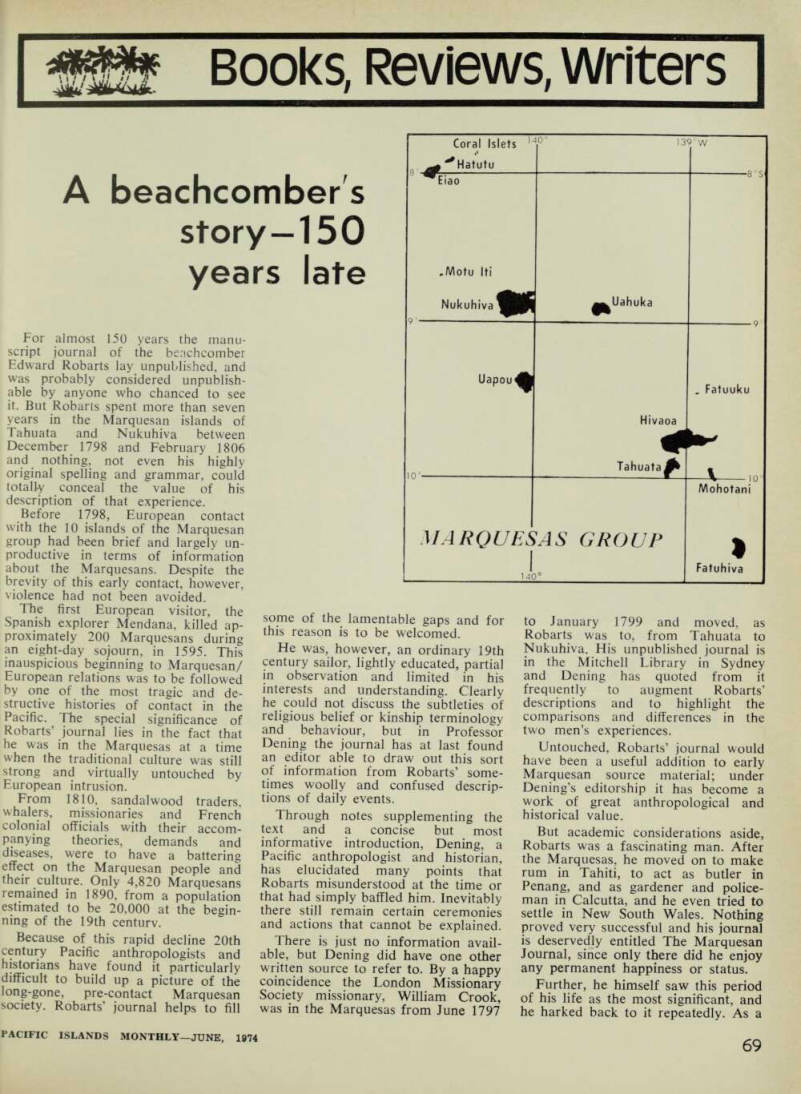

A beachcomber s story—150 years late
For almost 150 years the manu script journal of the beachcomber Edward Robarts lay unpublished, and was probably considered unpublish able by anyone who chanced to see it. But Robarts spent more than seven years in the Marquesan islands of Tahuata and Nukuhiva between December 1798 and February 1806 and nothing, not even his highly original spelling and grammar, could totally conceal the value of his description of that experience.
Before 1798, European contact with the 10 islands of the Marquesan group had been brief and largely un productive in terms of information about the Marquesans. Despite the brevity of this early contact, however, violence had not been avoided.
The first European visitor, the Spanish explorer Mendana, killed ap proximately 200 Marquesans during an eight-day sojourn, in 1595. This inauspicious beginning to Marquesan/ European relations was to be followed by one of the most tragic and de structive histories of contact in the Pacific. The special significance of Robarts’ journal lies in the fact that he was in the Marquesas at a time when the traditional culture was still strong and virtually untouched by European intrusion.
From 1810, sandalwood traders, whalers, missionaries and French colonial officials with their accom panying theories, demands and diseases, were to have a battering effect on the Marquesan people and their culture. Only 4,820 Marquesans remained in 1890, from a population estimated to be 20,000 at the begin ning of the 19th centurv.
Because of this rapid decline 20th century Pacific anthropologists and historians have found it particularly difficult to build up a picture of the long-gone, pre-contact Marquesan society. Robarts’ journal helps to fill
some of the lamentable gaps and for this reason is to be welcomed.
He was, however, an ordinary 19th century sailor, lightly educated, partial in observation and limited in his interests and understanding. Clearly he could not discuss the subtleties of religious belief or kinship terminology and behaviour, but in Professor Dening the journal has at last found an editor able to draw out this sort of information from Robarts’ sometimes woolly and confused descriptions of daily events.
Through notes supplementing the text and a concise but most informative introduction, Dening, a Pacific anthropologist and historian, has elucidated many points that Robarts misunderstood at the time or that had simply baffled him. Inevitably there still remain certain ceremonies and actions that cannot be explained.
There is just no information available, but Dening did have one other written source to refer to. By a happy coincidence the London Missionary Society missionary, William Crook, was m the Marquesas from June 1797
to January 1799 and moved, as Robarts was to, from Tahuata to Nukuhiva. His unpublished journal is in the Mitchell Library in Sydney and Dening has quoted from it frequently to augment Robarts’ descriptions and to highlight the comparisons and differences in the two men’s experiences.
Untouched, Robarts’ journal would have been a useful addition to early Marquesan source material; under Dening’s editorship it has become a work of great anthropological and historical value, But academic considerations aside, Robarts was a fascinating man. After the Marquesas, he moved on to make rum in Tahiti, to act as butler in Penang, and as gardener and police man in Calcutta, and he even tried to settle in New South Wales. Nothing proved very successful and his journal is deservedly entitled The Marquesan Journal, since only there did he enjoy any permanent happiness or status, Further, he himself saw this period of his life as the most significant, and he harked back to it repeatedly. As a
beachcomber, Robarts seems to have been a cut above the normal run. It appears that he spoke a little Russian and French and had made ac quaintance with well-connected people when he visited St Petersburg.
When he finally left Nukuhiva, he did so for honourable reasons, even taking his Marquesan wife with him, an act very few beachcombers, if any, risked. Coloured wives were not well received in early 19th century white society. But these motives should be looked at rather carefully.
We only have Robarts’ explanation of his deeds, and his self-justification is at times fulsome. But it is clear that however Robarts saw himself, he played an important and useful role in the Marquesas, as so many early beachcombers were to do in other parts of Polynesia.
It is interesting that when, after his experience in the Marquesas, Robarts met the beachcomber, George Bruce, in the Bay of Islands, New Zealand, he spoke rather patronisingly of him. Robarts conceded that the trade between the Maoris and the ship, for which Bruce was responsible, had been well conducted but not once did he admit, or perhaps even realise, that this was exactly the nosition he had filled in the Marquesas.
Obviously Robarts’ conception of his own role—“guiding and nourishing the weary navigator”—had been very much more elevated. But despite these shortcomings—his egotism, partial understanding, and his misuse of the English tongue—Robarts’ journal is a distinguished addition to the file of published beachcomber accounts, which includes James Morrison, Archibald Campbell and William Mariner.
Much about Robarts is still un known—the dates of his birth and death, his life before he reached the Marquesas and after the journal ends in Calcutta in 1824. But this is presumably a small loss. His years in the Marquesas were the one out standing period in his life; he was lucky to find himself there, and 150 years later he was lucky to attract a sympathetic and informed editor to make the most of his unique
journal.
Caroline Ralston.
(The Marquesan Journal Of
EDWARD ROBARTS 1797-1824, edited by Greg Dening, Australian National Univer sity Press, Canberra, $9.9&.)
Advertisements & other items, p. 72 (1 item)
A.R.C. reinforcing fabric
ass**
-r- -- «**« - :’ "“*O2! *> 33 V* i/* P# F r* d 'K Sfc# % - 3 ■*T-
does all your heavy work.
A.R.C. reinforcing fabric is designed and manufactured to do the heavy work in all concrete construction. The resistance welded wire fabric is available in rectangular or square mesh, in flat sheets or rolls and is produced to conform with Australian Standard 1304.
A.R.C. reinforcing fabric permits maximum construction speed and economies while retaining full design strength. The cost and time saved in laying fabric outweighs the use of other reinforcing materials. In addition, A.R.C. manufacture mesh in galvanised and bright wire to suit rural, industrial and domestic applications.
For details and prices of the A.R.C. range of reinforcing fabrics and other meshes contact: The Export Department, A.R.C. Industries Limited, 440 Collins Street, Melbourne, 3000, Victoria, Australia.
Cables: “Benignant”, Melbourne
A.R.C.
m 02241
Through the Islands by government handouts

government handouts
I shall never forget, some time after having read and enjoyed Arthur Koestler’s The Lotus and the Robot, the disappointment in discovering that most of his Japanese section in that book was taken from travel brochures.
Then Colin Simpson tried the same thing in his book on Japan from the same brochures but not as skilfully used as by Koestler.
Island Realm by lan Todd and pub lished by Angus and Robertson is in the same category—not travel brochures (some of these make interesting reading) but from govern ment hand-outs, and contains through out the unreality of the government hand-out, the press release, the official report. The book contains an Acknowledgement which does not deny this, but contains no list of any of the actual source material used.
Surely any book purporting to be a book of facts gives details of the source from which the material quoted was obtained. Books not meet ing this requirement must leave the serious reader wondering about their accuracy.
The unreality of this book is illustrated by the bald statement (for instance), “The southern half of Eastern New Guinea became a British
colony in 1888”. True? Well, it is a recorded fact. But how far from the truth is it to anyone knowing the exciting events leading up to 1888.
The statement as quoted here is one which cannot stand on its own and claim reality. Even a qualifying clause inserted to indicate that there were events leading up to this situation would not have greatly increased the length of the book nor its price ($12.50 at that!) and have indicated something of the truth of this event.
The whole book is written in the same hurry with the same unreality.
Nowhere is mentioned the interrela tions between the various Pacific areas which brought about the South Pacific Commission whose entire work was based on this interrelation.
New Guinea is dismissed—although containing more land than all the rest of small islands put together and having contributed more in the way of inter-Pacific co-operation than any of the others—under the chapter heading Neighbours of the Ocean, and in the index is shown as receiving mention on pages 202 and 203. Even if Angus and Robertson and lan Todd do not regard New Guinea as part of the Pacific, we who know some thing of the Pacific are very well
aware that New Guineans are very conscious of their position in the Pacific Ocean. That large area of land called Papua rates 31 lines.
Why did he write the book? Who and what sort of people do Angus and Robertson expect will pay $12.50 for the unsubstantiated material it contains? Consider the section on Fiji, and one would come to the con clusion that all the colourful history, political, economic and cultural, of that fascinating group of islands oc curred without the presence of any human beings whatsoever.
Oh yes, names are mentioned, but remain as dead as the print in which they are spelled. And in Fiji where the people who made its history both Melanesian and others, scintillated in such brilliant colours! lan Todd leaves the reader with the feeling that very hastily he skimmed through a small
portion of the vast documentation of Fiji past and present, snatched a few points and flung them together.
What goes for Fiji goes for the rest of the book. Mr Todd may have had an interesting career but Island Realm makes it obvious that he is not really the man to complete such a wide-ranging book as he has attempted.
Heavily illustrated, most of the black-and-whites are murky, and heaven knows why, with so many ex cellent and cheap colour processes available nowadays we have to be presented with the wishy-washy plates contained in this book. Not for me at that price, thank you!
So all in all, I am not impressed with Angus and Robertson’s Island Realm by lan Todd. The book does show, however, that the Pacific is a too colourful, interesting and im portant one-third of the earth’s surface to have the whole of its history, geography and culture stuffed between
two covers.-
Peter Livingston.
(ISLAND REALM, by lan Todd. Angus and Robertson Pty Ltd, 102 Glover Street, Cremorne Junction, New South Wales 2090; 214 pages with index and maps on end-papers: illustrated; 280 x 220 mms.; $12.50.)
Advertisements & other items, pp. 73-74 (1 item)
Monthly
ATTENTION LIBRARIANS!
The index to volume 43
Pacific Islands
Monthly
January-December 1972 is now available.
Priced at $3.00 Aust., posted.
U.S.A. $4.50 U.S. Posted. ★ Advance orders are also being taken for Vol. 44, 1973. * ■iili —■ Available from: Pacific Publications (Aust.) Pty. Ltd., 29 Alberta Street, Sydney, N.S.W. 2000. (Postal Address: Box 3408, G.P.0., Sydney, N.S.W. 2001.)
Todays roofs
demand
new materials
i-
mKKm
I i & v H * m
Dunlop Membranes
BUTYNOL'Based on Butyl Rubber
One-ply roofing has far less weight and bulk than built-up systems.
Therefore, the architect gains greater design freedom plus reduced loads on supporting members.
For the owner, certain structural costs are lowered and maintenance problems minimised. The contractor benefits from reduced materials handling, lower shipping costs and a work day with more productive hours.
SHELTERLINE Asbestos backed
DUNLINE Unbacked
Both based on well-proven Hypalon* Synthetic Rubber.
Hurricane Bebe' October 1972 and Cyclone Lottie' December 1973 produced no problems for Dunlop Membranes and Adhesives.
Illustrations depict: Roman Catholic Seminary, Suva.
Pacific Fishing Company, Levuka.
The Fiji Times' Extensions, Suva.
I The General Manager, ■ Shelter Engineering Limited, I P.O. Box 10-043.
I Christchurch, New Zealand.
I Please forward information on ■
□ BUTYNOL ROOFING MEMBRANE
□ SHELTERLINE & DUNLINE ROOFING
I MEMBRANES
I □ MEMBRANES FOR WATER
(MANAGEMENT
NAME *
I ADDRESS
I , I O Dunlop membranes are widely used also for Water
Management - Ponds, Reservoirs, etc.
0
SHELTER
ENGINEERING
LIMITED
A DUNLOP COMPANY
‘HYPALON is a registered Du Pont trademark for chlorosulfonated polyethylene synthetic rubber.
Plantation Life Plus A Little Sex
There have been innumerable books written about New Guinea in recent years and at least one written by a New Guinean. Nari Watkins’ Laua Avanapu breaks some new ground, however, by being published in New Guinea and by being written by someone white, over 21 and born in the country—the last still unusual in that country of galloping European transients.
The author was born in Rabaul between the wars, daughter of the late Mr C. I. H. Campbell and Mrs Campbell, well-known planters of Bougainville. Nari was named for a small island off Samarai, where her mother lived when she first went to the then Territory of Papua. Now married and Nari Watkins, the author lives on the original family estate of Raua, on Bougainville’s NE coast.
She also broke new ground by being on the spot in Kieta when Queen Elizabeth, the Duke of Edinburgh and Lord Louis Mountbatten were there earlier this year. She and her book were presented to the Royal party.
Although she calls her book a novel, this really is the story of her self growing up on a plantation in New Guinea before World War 11, of serving in one of the women’s services during it and returning to
her plantation life as a young married woman after it. It is therefore virtually biographical and as such was originally written. However, some where along the way, some literary friend said that she should “introduce some sex” into it to make it a going concern and to this extent she has scrambled the story of her two marriages.
Nari Watkins first husband was killed in a tragic accident when the plantation workboat which he was using exploded. She and her small son were saved. Some years later she remarried and she and her husband and family now divide their time between the plantation on Bougain ville and a cattle property in the Moss Vale district of NSW.
However, in the novel, the heroine Narianne has a slightly more adven turous love life, in accordance with the literary friend’s advice, but this really seems to be beside the point.
People who enjoy the book will do so for its account of early plantation life, the stories of the native people of the area, the plantation workers, their loyalties and human cussedness, their way of life in war and peace.— JT. (LAUA AVANAPU, by Nari Watkins.
Camwat Pty Ltd, Rabaul.)
young literature
New Guinea s rich young literature
By Marjorie Crocombe
During the last five years, Papua New Guinea writers have published an impressive collection both overseas and within the country. The wealth of prose, plays and poetry published assures the building of an impressive national written literature.
Ulli Beier, who was some years on the staff of the University of Papua New Guinea, was undoubtedly the catalyst. He set up the journal of literature, KOVAVE, published by Jacaranda Press, as an outlet for New Guinea writing.
It was followed by the first long book by a New Guinean, Albert Maori Kiki’s autobiography, Ten Thousand Years in a Lifetime. Next came Vincent Eri’s novel The Crocodile. Poets too, obtained an extra outlet for individual collections of poetry from all over the world in a series, Papua Pocket Poets, also edited by Beier and latterly by Prithvindra Chakravarti.
All these publications came from the hard work of some of the Univer sity of Papua New Guinea’s literature department staff and students.
Although the above works have be come well known within New Guinea itself, they are hardly known in the rest of the South Pacific and much more could have been done by the
publishers to sell them to high schools and teachers’ colleges.
Efforts are now under way, not only to make these publications better known overseas, particularly in the South Pacific, but also in cheaper editions so that most high schools can afford them. This is a joint effort between the University of Papua New Guinea Literature Department (which does editing), the Centre for Creative Arts (which prepares covers and illustrations and publishes), the editorial board of Papua New Guinea Writing, and the Department of Education.
Niugini Stories, a collection of 11 stories edited by Mike Greicus and Elton Brash, is the first book pro duced as a result of this joint effort.
The University Co-operative Book store is attempting to sell this and later books across the Pacific.
Niugini Stories begins by pointing out that New Guinea literature is both very old (in oral form) and very new (in the written form). The written material carries tremendous vitality, stirred by the fires of emerg ing nationhood. There is the under standable, but backward-looking criticism of the white colonial past (and sadly some of it remains in the present) as well as the forward-look ing, idealistic, material on the present and future. And there is good insight into the realities of today.
The stories themselves range from Allan Natachee’s poetic legend, Oifu, about the marriage of two light skinned girls to a dark-skinned
husband; John Waiko’s The Spirit Skull, and Mumure Ttopoqogo’s legend Abus Bilong Tupela, to oral literature recorded as written history in How my grandfather killed Mr J.
Green, by Stephen Barereba.
A world in transition, from the old to new, that Papua New Guinea is so deeply involved in now, is high lighted in Joye Harevila’s Final Initiation. Maurice Thompson (of the New Hebrides), Joseph Saruva, Paul Arnold, John Kadiba and Siuras Kavani and Tau Peruka (of New Guinea) all write of the lives they know and live in the foaming, frustrating but fascinating world of young people in a young nation.
Tau Peruka, a Motu writer from Tubusereia village on the Papuan coast near Port Moresby, has broken new ground in that he uses pidgin to tell his Motu titled story, Hemarai Lasi and succeeds effectively to get across his sense of humour.
The second publication, Ol i kam na Pulim Yumi (They came to confuse us) by Johnbili Tokome, is a play about the multitude of religious, governmental, political, economic and social facts and forces that impinge on the innocent and frustrated vil lager. It is funny yet insightful, draw ing on the inconsistency and irrelevance of much that is modern and the confusion as well as the logic of cargo cults.
The abovementioned books, Papua Pocket Poets, volumes 1-40, and other Papua New Guinea writings are all available from The University Book shop, University Post Office, Papua New Guinea.
This is a most impressive begin ning. All the Pacific, as well as further afield, has much to learn from the splendid growth of literature in Papua New Guinea. ® A new pictorial tourist map of the Yap Islands, land of the famous stone money in the western Carolines, has been published by the Printing and Publication Division, Trust Ter ritory of the Pacific Islands, Saipan, Mariana Islands, 96950. • And another small publication that’s a little different is A Honiara Bird Guide, by Geoff W. Stevens and James L. O. Tedder, published by the British Solomon Islands Scout As sociation and available from them at 1A1.50 or SUS2.SO including postage in each case. The 98-page book gives a check list of Honiara birds, where to find them, how to identify them and offers information on birds as pets. One of the most enthusiastic contributors to this little volume was Sir Michael Gass, former Western Pacific High Commissioner, a keen bird watcher. Proceeds go to the Scouts.
Advertisements & other items, pp. 75-76 (1 item)
Harris
BOOK COMPANY
(ESTABLISHED 1930)
We carry over 10,000 titles on all subjects in stock and would be pleased to quote for your requirements.
Please send your enquiries to:
HARRIS BOOK COMPANY,
G.P.O. Box 16670, Hong Kong
Available June!
COLONIAL
ERA
CEMETERY
OF
NORFOLK
ISLAND
R. Nixon Dalkin On Norfolk Island the colonial era cemetery at Kingston, offers the clearest precis of life and death in one of the harshest penal colonies ever administered by Britain, and the second British settlement in the South Pacific. Inscriptions vary from crudely carved initials to elegantly scripted narratives of events leading to death— death from disease, violence and the hangman’s rope.
In this scholarly work by R.
Nixon Dalkin, a former Administrator of Norfolk Island, the colonial era cemetery is closely examined. Graves are listed numerically, alphabetically or by military regiment.
The most meagre inscriptions have been expanded by illuminating often very moving historical detail. Researchers and genealogists, and everybody fascinated by Australia’s early history, will find this book invaluable. as will visitors to Norfolk Island.
The fold-out plan of the cemetery will assist those who have the opportunity of themselves visiting this historic link with the colonial past.
PRICE: Australia, $6.00 Aust., plus 85c posted; Pacific and Overseas, $6.00 Aust,, plus $l.lO posted; U.S.A., $10.60 U.S. posted.
Fill in the details
on the attached
order form.
FIJI
JOHNNY
REPRINT NOW AVAILABLE!
A delightful story for children in colour and black-and-white.
Priced at $2.50 Aust., plus 25c posted; $3.20 U.S. posted.
Pacific Publications (Aust.) Pty. Ltd., G.P.O. Box 3408, Sydney,
N.S.W. 2001.
Pacific Transport
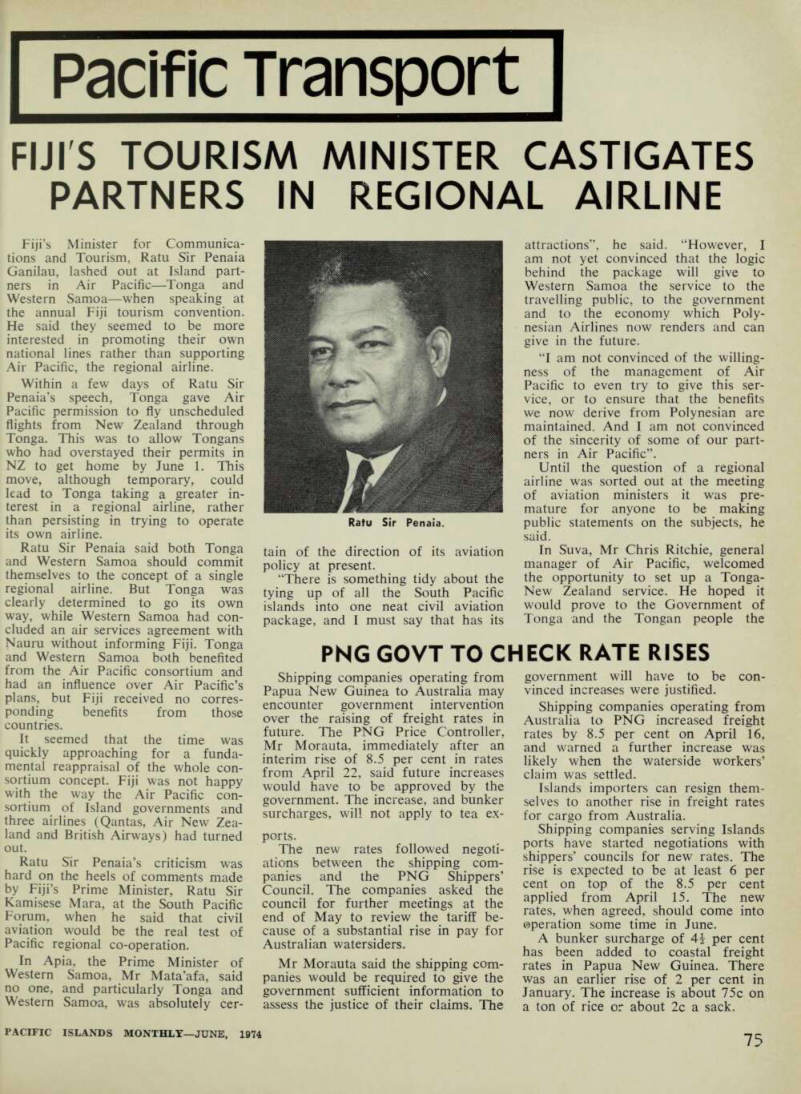

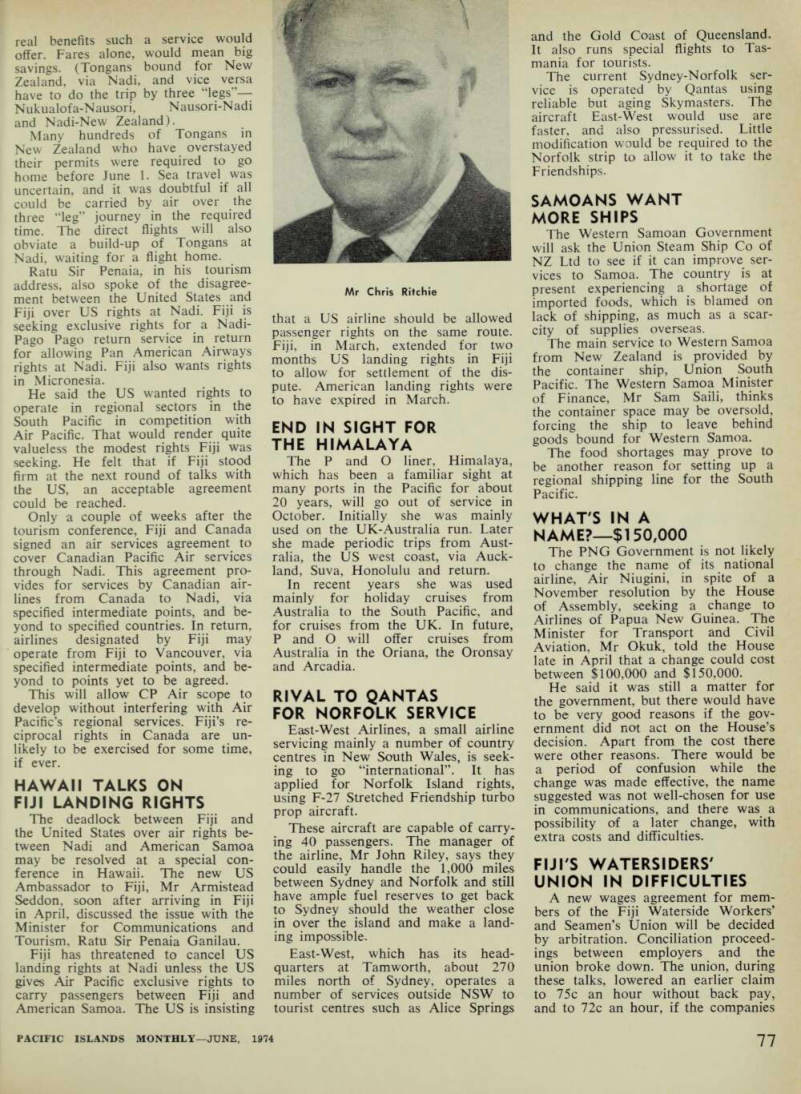

Fiji's Tourism Minister Castigates
Partners In Regional Airline
Fiji’s Minister for Communica tions and Tourism, Ratu Sir Penaia Ganilau, lashed out at Island part ners in Air Pacific—Tonga and Western Samoa—when speaking at the annual Fiji tourism convention.
He said they seemed to be more interested in promoting their own national lines rather than supporting Air Pacific, the regional airline.
Within a few days of Ratu Sir Penaia’s speech, Tonga gave Air Pacific permission to fly unscheduled flights from New Zealand through Tonga. This was to allow Tongans who had overstayed their permits in NZ to get home by June 1. This move, although temporary, could lead to Tonga taking a greater in terest in a regional airline, rather than persisting in trying to operate its own airline.
Ratu Sir Penaia said both Tonga and Western Samoa should commit themselves to the concept of a single regional airline. But Tonga was clearly determined to go its own way, while Western Samoa had con cluded an air services agreement with Nauru without informing Fiji. Tonga and Western Samoa both benefited from the Air Pacific consortium and had an influence over Air Pacific’s plans, but Fiji received no corres ponding benefits from those countries.
It seemed that the time was quickly approaching for a funda mental reappraisal of the whole con sortium concept. Fiji was not happy with the way the Air Pacific con sortium of Island governments and three airlines (Qantas, Air New Zea land and British Airways) had turned out.
Ratu Sir Penaia’s criticism was hard on the heels of comments made by Fiji’s Prime Minister, Ratu Sir Kamisese Mara, at the South Pacific Forum, when he said that civil aviation would be the real test of Pacific regional co-operation.
In Apia, the Prime Minister of Western Samoa, Mr Mata’afa, said no one, and particularly Tonga and Western Samoa, was absolutely cer-
tain of the direction of its aviation policy at present.
“There is something tidy about the tying up of all the South Pacific islands into one neat civil aviation package, and I must say that has its
attractions”, he said. “However, I am not yet convinced that the logic behind the package will give to Western Samoa the service to the travelling public, to the government and to the economy which Poly nesian Airlines now renders and can give in the future.
“I am not convinced of the willing ness of the management of Air Pacific to even try to give this ser vice, or to ensure that the benefits we now derive from Polynesian are maintained. And I am not convinced of the sincerity of some of our part ners in Air Pacific”.
Until the question of a regional airline was sorted out at the meeting of aviation ministers it was pre mature for anyone to be making public statements on the subjects, he said.
In Suva, Mr Chris Ritchie, general manager of Air Pacific, welcomed the opportunity to set up a Tonga- New Zealand service. He hoped it would prove to the Government of Tonga and the Tongan people the
Ratu Sir Penaia.
real benefits such a service would offer. Fares alone, would mean big savings. (Tongans bound for New Zealand, via Nadi, and vice versa have to do the trip by three “legs”— Nukualofa-Nausori, Nausori-Nadi and Nadi-New Zealand).
Many hundreds of Tongans in New Zealand who have overstayed their permits were required to go home before June 1. Sea travel was uncertain, and it was doubtful if all could be carried by air over the three “leg” journey in the required time. The direct flights will also obviate a build-up of Tongans at Nadi, waiting for a flight home.
Ratu Sir Penaia, in his tourism address, also spoke of the disagree ment between the United States and Fiji over US rights at Nadi. Fiji is seeking exclusive rights for a Nadi- Pago Pago return service in return for allowing Pan American Airways rights at Nadi. Fiji also wants rights in Micronesia.
He said the US wanted rights to operate in regional sectors in the South Pacific in competition with Air Pacific. That would render quite valueless the modest rights Fiji was seeking. He felt that if Fiji stood firm at the next round of talks with the US, an acceptable agreement could be reached.
Only a couple of weeks after the tourism conference, Fiji and Canada signed an air services agreement to cover Canadian Pacific Air services through Nadi. This agreement pro vides for services by Canadian air lines from Canada to Nadi, via specified intermediate points, and be yond to specified countries. In return, airlines designated by Fiji may operate from Fiji to Vancouver, via specified intermediate points, and be yond to points yet to be agreed.
This will allow CP Air scope to develop without interfering with Air Pacific’s regional services. Fiji’s re ciprocal rights in Canada are un likely to be exercised for some time, if ever.
Hawaii Talks On
Fiji Landing Rights
The deadlock between Fiji and the United States over air rights be tween Nadi and American Samoa may be resolved at a special con ference in Hawaii. The new US Ambassador to Fiji, Mr Armistead Seddon, soon after arriving in Fiji in April, discussed the issue with the Minister for Communications and Tourism, Ratu Sir Penaia Ganilau.
Fiji has threatened to cancel US landing rights at Nadi unless the US gives Air Pacific exclusive rights to carry passengers between Fiji and American Samoa. The US is insisting
that a US airline should be allowed passenger rights on the same route.
Fiji, in March, extended for two months US landing rights in Fiji to allow for settlement of the dis pute. American landing rights were to have expired in March.
End In Sight For
The Himalaya
The P and O liner, Himalaya, which has been a familiar sight at many ports in the Pacific for about 20 years, will go out of service in October, Initially she was mainly used on the UK-Australia run. Later she made periodic trips from Aust ralia, the US west coast, via Auck land, Suva, Honolulu and return.
In recent years she was used mainly for holiday cruises from Australia to the South Pacific, and for cruises from the UK. In future, P and O will offer cruises from Australia in the Oriana, the Oronsay and Arcadia.
Rival To Qantas
For Norfolk Service
East-West Airlines, a small airline servicing mainly a number of country centres in New South Wales, is seek ing to go “international”. It has applied for Norfolk Island rights, using F-27 Stretched Friendship turbo prop aircraft.
These aircraft are capable of carry ing 40 passengers. The manager of the airline, Mr John Riley, says they could easily handle the 1,000 miles between Sydney and Norfolk and still have ample fuel reserves to get back to Sydney should the weather close in over the island and make a land ing impossible.
East-West, which has its head quarters at Tamworth, about 270 miles north of Sydney, operates a number of services outside NSW to tourist centres such as Alice Springs
and the Gold Coast of Queensland.
It also runs special flights to Tas mania for tourists.
The current Sydney-Norfolk ser vice is operated by Qantas using reliable but aging Skymasters. The aircraft East-West would use are faster, and also pressurised. Little modification would be required to the Norfolk strip to allow it to take the Friendships.
Samoans Want
More Ships
The Western Samoan Government will ask the Union Steam Ship Co of NZ Ltd to see if it can improve ser vices to Samoa. The country is at present experiencing a shortage of imported foods, which is blamed on lack of shipping, as much as a scar city of supplies overseas.
The main service to Western Samoa from New Zealand is provided by the container ship, Union South Pacific. The Western Samoa Minister of Finance, Mr Sam Saili, thinks the container space may be oversold, forcing the ship to leave behind goods bound for Western Samoa.
The food shortages may prove to be another reason for setting up a regional shipping line for the South Pacific.
What's In A
Name?—Si 50,000
The PNG Government is not likely to change the name of its national airline, Air Niugini, in spite of a November resolution by the House of Assembly, seeking a change to Airlines of Papua New Guinea. The Minister for Transport and Civil Aviation, Mr Okuk, told the House late in April that a change could cost between $lOO,OOO and $150,000.
He said it was still a matter for the government, but there would have to be very good reasons if the gov ernment did not act on the House’s decision. Apart from the cost there were other reasons. There would be a period of confusion while the change was made effective, the name suggested was not well-chosen for use in communications, and there was a possibility of a later change, with extra costs and difficulties.
Fiji's Watersiders'
Union In Difficulties
A new wages agreement for mem bers of the Fiji Waterside Workers’ and Seamen’s Union will be decided by arbitration. Conciliation proceed ings between employers and the union broke down. The union, during these talks, lowered an earlier claim to 75c an hour without back pay, and to 72c an hour, if the companies
Mr Chris Ritchie
agree to back-date the claim to August, 1973.
Mr Manueli Vasea said the union, before the arbitration proceedings, would ask for $1 a hour for perma nent workers and $1.50 an hour for casuals.
The union is having financial problems. Previously employers de ducted 5c in the S from the men’s pay, and paid it to the union. They stopped doing that when the Water side Workers’ and Seamen’s Union was deregistered in 1973.
Mr Vasea said weekly deductions were about $5OO a week. Since the companies stopped deducting dues only a few members paid. Dues now raised only $4O to $5O a week, Mr Vasea said the union wanted to build up its assets to provide club houses for members in Suva and Lautoka.
Keeping Safety Men
On Their Toes
With the memory of the tragic aircraft crash at Pago Pago in January still firmly in mind, Niue Island has begun a programme to knock the rough spots out of its own emergency procedures.
Two simulated air disaster exercises have been held, and the second showed that real progress is being made. The first inevitably showed some room for improvement, but now the Health Department, the Ministry of Transport, the Police, the Public Works Department and the Radio Department are all combining to ensure minimum fuss and delay, and maximum efficiency and co ordination.
The exercises, staged at Hanan International Airport, cover three phases—standby, alert and crash— and everyone knows just what to do at any time. It is intended to hold future periodic exercises without warning . . . just to keep the ground safety organisation on its toes.
New Ship Cost
Double The Estimate
The Fiji taxpayer will have to pay more than double the estimated cost of an 80 ft fishery research ship, the Tui Ni Wasaliwa, launched in 1973.
The ship was to have cost $84,000.
The final cost was $168,755.
The higher cost was blamed on wage increases, higher costs of materials, delays in delivering equip ment ordered from overseas and de ficiencies in the estimate procedure.
The Tui Ni Wasaliwa recently figured in an incident with a Korean fishing ship, alleged to have been fishing illegally in Fiji waters. The
Korean ship escaped to the open sea.
The master was later ordered by the owners to sail to Suva to face possible court proceedings.
Micronesia Loses
76 Containers
Problems with shipping continue to plague Micronesia—the latest the loss of 76 containers. The with drawal of the Transpac charter left a pile of containers at Guam for various parts of the Trust Territory.
The receiver of Transpac, Mr John Meadows, in an effort to get the containers to Ponape, hired a tug boat, the Challenger, and a barge from the Luzon Stevedoring Co, of the Philippines.
The barge, towed by the Challenger and carrying 76 con tainers, broke up and sank in heavy seas about six miles northwest of Truk lagoon. Chances of recovering any of the containers were reckoned to be nil as the break-up was in water 7,000 fathoms deep.
Lost were 68 20 ft containers and eight 8 ft containers. Fifty-two con tainers were from the US west coast.
Thirty-four containers carried “mixed” cargo, which included food and general items, 13 were full of beverages and liquor, one carried unspecified poisons, 14 were full of rice, one held groceries, one soap, one flour, one US mail and nine chickenfeed. The chickenfeed con tainers were loaded at the special request of agriculture officials be cause of the low supply of such feed on Ponape.
Transport officials in the Trust Territory made alternative arrange ments to get food supplies into Ponape as soon as possible. They chartered the Gunners Knot, a government ship, to load cargo in Japan for Ponape.
Mr Meadows filed a claim in the Trust Territory High Court to re cover damages for the loss, estimated at between 52.5 million and $3 mil lion. The amount included the value of the containerised cargo, prepaid freight charges, lost profits, interest and cost. The claim is against the Luzon Stevedoring Co, its agent, the Marianas Maritime Corp, and other unidentified agents.
The complaint alleged several reasons for the break-up and sinking of the barge: • The cargo fittings and deck were not strong enough to allow a crawler crane and containers to be secured to the decks; • The barge did not have ade quate flooding alarms and pumps; • The tug crew was incompetent;
• The barge was abandoned by the tug; • The barge was towed at an “excessive speed”; • It was allowed to broach-to “in the normal seas for this particular time of the year”.
It was stated in the complaint: “The loss of the cargo was in no way due to the plaintiff’s fault”.
Gunboats Arrest
Chinese Catcher
Palau authorities are expected to seek the forfeiture of a Taiwanese fishing ship, the Nob Tei Sheng, over alleged illegal entry into Trust Terri tory waters and unlawful removal of marine resources from Helen Reef.
The ship is owned by Wu Kao Hen, of Kaohsiung, Taiwan.
Two US Navy gunboats, the Gallup and the Canon, while on a routine patrol arrested the ship after watching two small boats on the reef and photographing the occupants taking turtles and shellfish from the reef area. The Nob Tei Sheng was serving as a mother ship for the smaller boats.
Ships Collide,
Then Run Aground
Two ships ran aground on a reef near Matupit Island in Simpson Harbour, Rabaul on April 28 after a collision.
They were the Pacific Wealth, 3,200 tons, a Panamanian log ship, and a Japanese fishing boat, the Takatsu Maru, 66 ft. The Pacific Wealth freed itself and sailed, apparently un damaged, about five hours after the mishap.
Some of the crew of the fishing ship jumped, or were thrown, over board. The master ran the ship hard on to the reef to stop it from sinking.
The engine room was flooded. A troll net boom was put out to take up leaking oil. It was not known whether the ship would be salvaged.
The Rabaul Harbourmaster, Cap tain G. Veale, sent a message to the master of the Pacific Wealth, ordering it to return to Rabaul for an inquiry.
The master replied that his ship had “touched” a Japanese fishing ship.
There was no damage to his ship, and no one was injured.
Fiji Will Have
Port Authority
Control of ports in Fiji will come under a new body, the Port Authority of Fiji, in 1975. This move follows a commission of inquiry into Fiji marine matters. One of the commis sion’s recommendations was that a port authority be established.
The authority will probably take
control of all port operations at present handled by the Marine Department. Its responsibilities will include dredging, hydrographic sur veys, pilotage and cargo handling. The Marine Department will retain respon sibility for matters concerning the registration of ships and seamen, the survey of ships and the examination of masters, mates and engineers.
New Ships
For Micronesia
The first of eight new ships the United States is providing for the Trust Territory has been built at Pusan, Korea, and will be ready for use soon. The 225 ft ship has been named Micronesia Princess.
Mr Raymond Setik, a Truk mem ber of the TT House of Representa tives, testifying in Washington in sup port of a " $6l million budget appropriation for the TT, said TT residents were travelling between islands on outmoded ships, some of them 30 years old, Mr Setik is chair man of the Joint Committee on Pro gramme and Budget Planning.
The Micronesian delegation in Washington asked for speedy handling of a request for $1.6 million to help build new inter-island ships.
Png Govt To Check Rate Rises
Shipping companies operating from Papua New Guinea to Australia may encounter government intervention over the raising of freight rates in future. The PNG Price Controller, Mr Morauta, immediately after an interim rise of 8.5 per cent in rates from April 22, said future increases would have to be approved by the govemment. The increase, and bunker surcharges, will not apply to tea ext The new rates followed negotiations between the shipping companics and the PNG Shippers’
Council. The companies asked the council for further meetings at the end of May to review the tariff because of a substantial rise in pay for Australian watersiders.
Mr Morauta said the shipping companics would be required to give the government sufficient information to assess the justice of their claims. The
government will have to be con vinced increases were justified,
Shipping companies operating from
Australia to PNG increased freight rates by 8.5 per cent on April 16, and warned a further increase was likely when the waterside workers’ claim was settled, Islands importers can resign them selves to another rise in freight rates for cargo from Australia.
Shipping companies serving Islands
po . rts h ? ve star f ed , negotiations with fV^ ' , expected to be at least 6 per cent r f top JT r cerd apphed from April 15 The new rates when agreed, should come into ope , ra ‘ ion . some *' me . A £ unker of 4 A pe / ce " has been added to coastal freight rates in Papua New Guinea. There was an earlier rise of 2 per cent in January. The increase is about 75c on a ton of rice or about 2c a sack.
Advertisements & other items, pp. 78-82 (1 item)
To stand tall
in 118 countries
you need to
keep on your toes
Staying on top in the business world means backing a programme of continuing innovation with a sound service programme* So Otis employs some 50,000 specialists in 118 countries researching, making, installing and servicing Otis elevators, escalators and allied transportation systems.
Otis keeps moving people and things. While looking for better ways of doing it.
Otis Elevator Company Ltd., Nukuwatu Street, Lami, Suva, FIJI.
Telephone 361-248 Suva. 36372 A
Package Convenience
■ You can order complete electric set
packages from your Caterpillar Dealer.
■ Plus add-on flexibility with other ac-
cessories and options.
■ One source of responsibility. . .op-
timum economic value from your Cat-
erpillar Dealer.
vs 11 y** z » * » 4..,,
Support from Your
Caterpillar Dealer..
Final Assurance of Long-Term
Satisfaction with Cat Electric Sets
(Si
CARPENTERS
TRACTOR E- EQUIPMENT
rr« your
U CATERPILLAR
k H DEALER
FORMERLY CATERPILLAR DIV. SUVA MOTORS
SERVING THE SOUTH PACIFIC ISLANDS
TELEX: CARPTRAC FJ2190 SUVA. PHONE: 24051-4
Model 3145 3150 3160
D33OC
D33OC T
D333C T
D 334 TA
D 336 TA
D342C
D342C T
D343A T
D343A TA
D 346 TA
D 348 TA
D 349 TA
D353E TA
D 3798 TA
D 3988 TA
D 399 TA
Prime Power KW*@ RPM Cyl. 60 Hz 50 Hz 60 Hz V-8 V-8 V-8 6 6 V-8 6 6 6 6 V-8 V-12 V-16 6 V-8 V-12 V-16 50 @ 1800 60 @ 1800 75 @ 1800 55 @ 1800
90 @lBOO
135 @lBOO
175 @lBOO
190 @ 1800 115 @ 1200 160 @ 1200 185 @ 1800
275 @lBOO
360 @lBOO
550 @ 1800 720 @ 1800 330 @ 1200 440 @ 1200 665 @l2OO 875 @ 1200 40 @ 1500 50 @ 1500 60 @ 1500 45 @ 1500 75 @ 1500 110 @ 1500 150 @ 1500 130 @l5OO 100 @ 1000 130 @ 1000 155 @ 1500 225 @ 1500
280 @l5OO
445 @ 1500 605 @ 1500 265 @ 1000 330 @ 1000
535 @lOOO
705 @lOOO
125/216, 125/216, 125/216, 125/216, 125/216, 125/216, 125/216, 125/216, 125/216, 125/216, 125/216, 125/216, 125/216, 125/216, 125/216, 125/216, 125/216, 125/216, 125/216, 230-460 230-460 230-460 230-460 230-460 230-460 230-460 230-460 230-460, 2400 230-460, 2400 230-460 230-460 230-460, 2400 230-460, 2400 230-460, 2400 230-460, 2400 .230-460, 2400 230-460, 2400 230-460, 2400 115/200, 115/200, 115/200, 200-400, 200-400, 200-400, 200-400, 200-400, 200-400, 200-400, 200-400, 200-400, 200-400, 200-400, 200-400, 200-400, 200-400, 200-400, 200-400, 230/400 230/400 230/400 230-460 230-460 230-460 230-460 230-460 230-460 230-460 230-460 230-460 230-460 230-460 230-460 230-460 230-460 230-460 230-460 A 624
Laser
A simple but sophisticated boat for tough competition or just plain sailing fun.
Fibreglass hull, aluminum spars, dacron sail.
Weighs only 130 lbs, is easily car topped and rigged in minutes.
Mail to: Performance Sailcraft (N.Z.) Ltd, P.O. Box .14-408, Panmure.
Auckland, N.Z.
Please send brochure and the address of the nearest dealer.
Name..
Address
COMMERCIAL VESSELS
FOR SALE
CARGO VESSEL
Built Holland 1950; Lloyds 100 A 1; Length 150 ft. 0.A.; DWT 425 tons; Cubic Capacity 23,000; Gross 349 tons; Nett 164 tons; Single Screw Industrie Diesel 300 BMP; Vessel underwent recent complete overhaul and major renovations at special survey February, 1974.
DIESEL TUG
Built Hong Kong 1970; 100 A 1 ABS; Length 65 ft. 0.A.; Beam 17 ft 8 in.; 6 Ton Bollard Pull; Gross 46 tons; Nett 21 tons; Single Screw 6 cylinder Caterpillar 365 HP; Vessel in excellent condition.
BARGE
Built 1957; Papua New Guinea Survey: Length O.A. 68 ft.; Gross 64.18; Nett 48; DWT 40 tons; Bulk fuel capacity 5,000 gallons; Dry Hold; Capacity 40 tons DWT; Twin Gardner 6 L X 110 HP each; 1 ton Cargo Derrick; Extensive work carried out recent survey; $A35,000.
BARGE
Currently undergoing extensive work at survey including renewal of decks, plating and accommodation; Built 1948; Length 63 ft.; Gross 58 tons; Nett 13 tons; DWT 40 tons; Bulk fuel capacity 6,000 gallons; Twin GM Diesels 6 cylinder 185 BHP each.
BARGE
Papua New Guinea survey: Built 1968; Length 70 ft 0.A.; Gross 76 tons; Nett 34 tons; Bulk fuel capacity 10,000 gallons; twin Gardner 6 LX X 110 BHP each; $A55,000; Terms available.
EX FAIRCHILD LAUNCH
Reconstructed 1971; Length 39 ft. 0.A.; New Twin Cummins V 8 Diesels 1971—185 HP each; Speed 12 knots; Cruising—Presently under survey; Licensed —30 passengers; Radio, Depth Sounder, etc.; $A16,000; Terms available.
FREEZER VESSEL
Partly constructed: Lloyds specifications; Length 51 ft 0.A.; Beam 16 ft; Single Screw Caterpillar D. 333 Diesel 8 Cylinder; Approximately 27 tons freezer capacity.
For further details of listed vessels and others contact:
NEW GUINEA MARINE SURVEYS & SERVICES
(SHIP BROKERS)
P.O. Box 783, Lae, Papua New Guinea.
Telephone 42 4305 Cable: Marineserv., Lae.
stake in Saipan airport


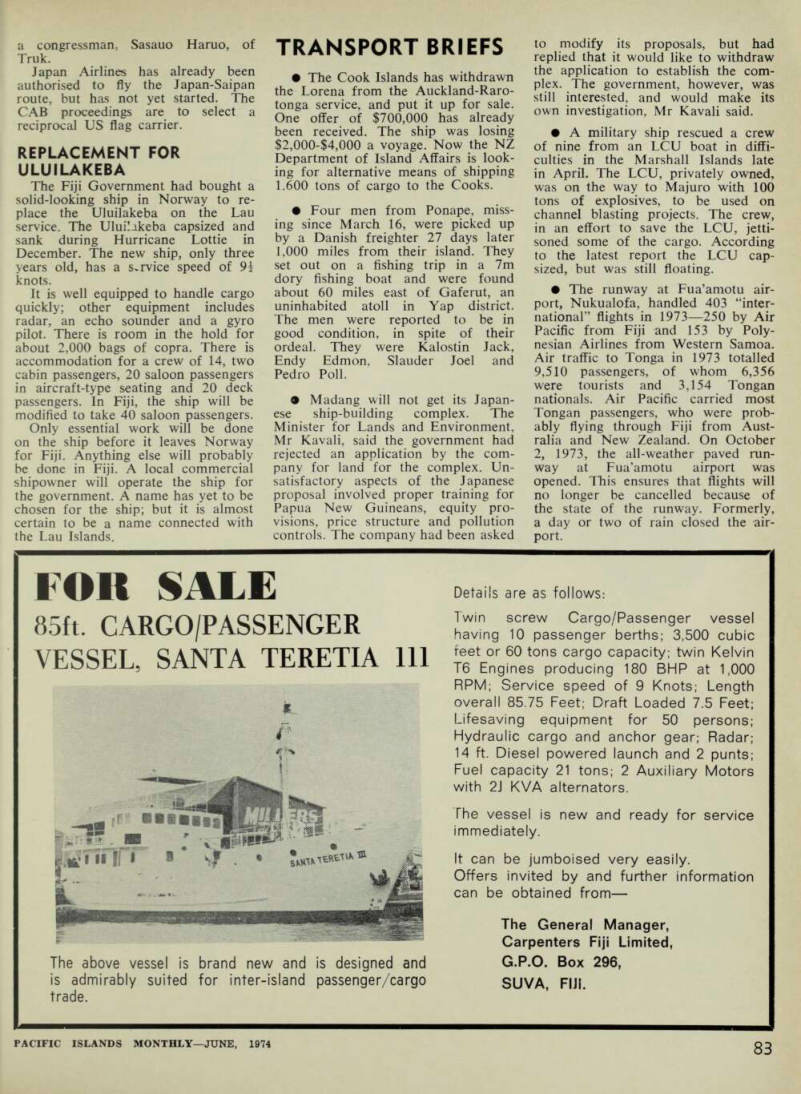
Nauru wants a $2 million stake in Saipan airport
Nauru may be a major shareholder in Saipan’s international airport which is scheduled for opening about the middle of next year.
The total cost of the project is $6 million, of which half will be spent on the terminal buildings. It will not all come from official sources. Private enterprise has offered to help and President Deßoburt of Nauru has written that the republic would like to invest S 2 million in the airport.
Mr Francisco C. Ada, Marianas District Administrator, expects most of the money to run the airport will come from a duty-free concession.
A prime concession will include restaurant, bar and duty-free shop.
Other revenue will be derived from rental of space to airlines, foreign currency exchange, rent-a-car con cession, landing fees and fuel tax.
Public wrangling over which air line should get the Saipan-Japan route should now be over. Judge Greer Murphy recently heard further evidence at reopened hearings at Saipan. He will now prepare a report
and recommendation for the US Civil Aeronautics Board which will, in turn, make a recommendation to President Nixon. President Nixon is not bound to follow the board’s advice.
The CAB, after the “final” hearings in November, 1973, in February ordered that the hearings be reopened, explaining it could not make a recom mendation without further informa tion on two matters: (1) Charges that representatives of the contending airlines were involved in improper conduct while seeking support in Micronesia, and (2) Where the people of Micronesia stood.
At earlier hearings there was a lot of mud-slinging by the major con tenders —Pan American World Air ways and Continental Air Micro nesia. The third contender for the route is Northwest Orient Airlines.
The final witnesses who gave evi dence about the Micronesians’ attitude were the Trust Territory Senate President, Tosiwo Nakayama, the House Speaker, Bethwel Henry, and
a congressman, Sasauo Haruo, of Truk.
Japan Airlines has already been authorised to fly the Japan-Saipan route, but has not yet started. The CAB proceedings are to select a reciprocal US flag carrier.
Replacement For
Uluilakeba
The Fiji Government had bought a solid-looking ship in Norway to re place the Uluilakeba on the Lau service. The Uluilakeba capsized and sank during Hurricane Lottie in December, The new ship, only three years old, has a service speed of 9i knots.
It is well equipped to handle cargo quickly; other equipment includes radar, an echo sounder and a gyro pilot. There is room in the hold for about 2,000 bags of copra. There is accommodation for a crew of 14, two cabin passengers, 20 saloon passengers in aircraft-type seating and 20 deck passengers. In Fiji, the ship will be modified to take 40 saloon passengers.
Only essential work will be done on the ship before it leaves Norway for Fiji. Anything else will probably be done in Fiji. A local commercial shipowner will operate the ship for the government. A name has yet to be chosen for the ship; but it is almost certain to be a name connected with the Lau Islands.
Advertisements & other items, pp. 83-84 (1 item)
Machinery.Inc.
YOU GET A BETTER DEAL FROM
PACIFIC MACHINERY
tv C New and Used Equipment Parts Availability Throughout the Pacific
CATERPILLAR
DEALER
PACIFIC
MACHINERY.INC.
SUBSIDIARY OF THEO. H. DAVIES & CO., LTD.
HAWAII GUAM TRUST TERRITORY OF THE AMERICAN SAMOA TLX 723397 CABLE "PAMACAT”
808- 677-9111 746-4479 PACIFIC ISLANDS
These MF distributors
NEW CALEDONIA
Pacific Motors S.A.,
BP H 5
n'oumea’cedex
TAHITI
Ets, Donald.
P.O. Box 131, PAPEETE
BRITISH SOLOMON ISLANDS
NEW HEBRIDES
CONDOMINIUM
Pentecost Pacific S.A., Santo and Port Vila
can show you
how the MF2I Blade keeps levelling
and grading costs down
No special operating skill is required with this versatile implement. You’ll be amazed at the way the MF2I handles general dirt moving, road building, ditching, back-filling, levelling, cleaning and dozens of other jobs.
The MF 21 quickly attaches to an MFI3S tractor and is depth controlled by the tractor hydraulics.
Pitch and angle of the blade are adjustable from the tractor seat and blade can be completely reversed for back-filling. Make a full 6 foot or 8 foot cut with blade extensions.
Grader wheel, side A plate and scarifier 111 kits available.
MF A
MFE 74040
MASSEY-FERGUSON... WINNER OFTWO EXPORT AWARDS
Transport Briefs
• The Cook Islands has withdrawn the Lorena from the Auckland-Raro tonga service, and put it up for sale.
One offer of $700,000 has already been received. The ship was losing $2,000-$4,000 a voyage. Now the NZ Department of Island Affairs is look ing for alternative means of shipping 1.600 tons of cargo to the Cooks. • Four men from Ponape, miss ing since March 16, were picked up by a Danish freighter 27 days later 1,000 miles from their island. They set out on a fishing trip in a 7m dory fishing boat and were found about 60 miles east of Gaferut, an uninhabited atoll in Yap district.
The men were reported to be in good condition, in spite of their ordeal. They were Kalostin Jack, Endy Edmon, Slauder Joel and Pedro Poll. 9 Madang will not get its Japan ese ship-building complex. The Minister for Lands and Environment.
Mr Kavali, said the government had rejected an application by the com pany for land for the complex. Un satisfactory aspects of the Japanese proposal involved proper training for Papua New Guineans, equity pro visions, price structure and pollution controls. The company had been asked
to modify its proposals, but had replied that it would like to withdraw the application to establish the com plex. The government, however, was still interested, and would make its own investigation, Mr Kavali said. • A military ship rescued a crew of nine from an LCU boat in diffi culties in the Marshall Islands late in April. The LCU, privately owned, was on the way to Majuro with 100 tons of explosives, to be used on channel blasting projects. The crew, in an effort to save the LCU, jetti soned some of the cargo. According to the latest report the LCU cap sized, but was still floating. • The runway at Fua’amotu air port, Nukualofa, handled 403 “inter national” flights in 1973—250 by Air Pacific from Fiji and 153 by Poly nesian Airlines from Western Samoa.
Air traffic to Tonga in 1973 totalled 9,510 passengers, of whom 6,356 were tourists and 3,154 Tongan nationals. Air Pacific carried most Tongan passengers, who were prob ably flying through Fiji from Aust ralia and New Zealand. On October 2, 1973, the all-weather paved run way at Fua’amotu airport was opened. This ensures that flights will no longer be cancelled because of the state of the runway. Formerly, a day or two of rain closed the air port.
Advertisements & other items, pp. 85-86 (1 item)
For Sale
85ft. CARGO/PASSENGER
VESSEL, SANTA TERETIA 111
Ifer
f r uiaiai iHii i * |.«:i IB The above vessel is brand new and is designed and is admirably suited for inter-island passenger/cargo trade.
Details are as follows: Twin screw Cargo/Passenger vessel having 10 passenger berths; 3,500 cubic feet or 60 tons cargo capacity; twin Kelvin T 6 Engines producing 180 BHP at 1,000 RPM; Service speed of 9 Knots; Length overall 85.75 Feet; Draft Loaded 7.5 Feet; Lifesaving equipment for 50 persons; Hydraulic cargo and anchor gear; Radar; 14 ft. Diesel powered launch and 2 punts; Fuel capacity 21 tons; 2 Auxiliary Motors with 2J KVA alternators.
The vessel is new and ready for service immediately.
It can be jumboised very easily.
Offers invited by and further information can be obtained from— The Genera! Manager, Carpenters Fiji Limited, G.P.O. Box 296,
SUVA, FIJI.
ISUZU
D 8118 m m • ■"
One ton truck.
Built in Japan.
Backed by General Motors.
And tough as they come.
All muscle when there’s work to be done.
With cabin comfort that puts many family cars to shame. That’s ISUZU KB2O acclaimed the world over as everything a one-ton truck should be. It’s built around a husky steel frame, with independent torsion-bar front suspension and hefty 6-leaf springs at rear. 4-speed column gearshift is all synchromesh.
Fuel consumption is low, performance high from an overhead valve 4-cylinder engine.
And the interior comforts include efficient flow-through ventilation that’s so important in the tropics. And don’t forget KB2O is backed by ISUZU/GM’s unbeatable warranty and world wide dealer service network.
Take a test drive at:
FIJI ISLANDS:
Burns Philp (South Sea) Co.
TONGA:
Burns Philp (South Sea) Co.
PAPUA NEW GUINEA;
New Guinea Motors Pty. Ltd.
PORTUGUESE TIMOR:
Sociedade Agricola Patria E Trabalho.
WESTERN SAMOA:
O. F. Nelson & Co. Ltd. mu
Cruising
Yachts
• SHANTOH, 10 m sloop registered at Long Beach, California, arrived at Rarotonga on April 24 with Ralph and Sally Hetzel. They spent six months in the Society Islands and visited the Marquesas, Tuamotus and Maupiti. Plans were to visit Aitutaki, Niue, Tonga, Fiji and New Zealand. • JAGA, 12 m double-ender ketch, arrived at Rarotonga on April 29 with American couple Dave and Diane Weerts.
Their cruise began from San Francisco in October, 1972, and took them to Acapulco, the Galapagos and Marquesas Islands and French Polynesia. They called at the Tuamotu Group and, in company with Shantoh, visited Maupiti. The reef pass to Maupiti's big lagoon is intricate and often dangerous, as both yacht crews soon discovered, and for that reason is seldom visited by yachtsmen.
The Weerts hope to call at Tonga and Fiji, and will "toss-up" between the Gilbert and Ellice Islands and New Zealand. • TE MOANA, 15 metre ketch-rigged motor cruiser, arrived at Rarotonga from Papeete on April 13 with Captain George A. Percy Jr, navigator Tom Doyle, cook Mary Filippone, and Gerry Couture on board. Plans were to stay in Rarotonga about a week before pro ceeding on a circumnavigation with possible next ports of call being Tonga and Western Samoa. The yacht is regis tered at Wilmington, Delaware, USA. • SPRAY, 11 metre ketch, registered at Great Yarmouth, UK, arrived at Raro tonga from Papeete on April 15 with Tony Pearce and his father-in-law, Vernon Willmen, on board. Spray left England in September 1972, called at the Bahamas then spent seven months in Florida before reaching the Pacific.
Plans were to leave for New Zealand on April 20. • TAHOLI, a 41 ft fibreglass ketch, sailed from Sydney, via the Barrier Reef to arrive in Port Moresby in mid- March. On board were Captain John Robertson, formerly captain of HMAS Melbourne, Galen Ferguson, Peter Vasey and Tim Wheller. Captain Robertson plans to charter Taholi between the Solomons and Bougainville. • DENEBOLA, a 57 ft Herroshoff ketch from Cannes, France, sailed from Port Moresby late March, for the Sepik area in Papua New Guinea then on to Indonesia.
• TIKI, a 40 ft steel ketch from Toulon, France, with Jean-Charles Troalen and crew Pierre Prost and Tony Czepczynski sailed from Noumea to arrive in Port Moresby on April 8.
After a short stay, TIKI sailed for Indo nesia, Malaysia and Thailand.
RON OF ARGYLL, 15 metre ketch, at present in Sydney, is up for sale.
Owner-skipper Larry F. Bryant, of San Francisco, had planned to continue cruis ing in her. The yacht arrived in Sydney in October, 1973, after cruising in the Pacific. • EOLUS, 218 tons black-hulled bar quentine, registered at Portsmouth, Eng land, arrived at Rarotonga from Tahiti on April 22. On board were Danish master, Anders B. Jensen and 16 crew, including a Danish stewardess, Anita Jensen. The crew includes Britishers, Americans, Australians, a Frenchman and a German chief cook. There were also 22 British, Amercian, Australian and Canadian passengers on board. The cruise had taken Eolus to Panama and Galapagos. Next ports of call are Nuku alofa, Tonga; Lord Howe Island and Sydney. The Eolus is on a world cruise expected to last 11 months. • Eight yachts are taking part in the Auckland-Rarotonga international yacht race and a ninth is acting as mother ship. The yachts competing for the Air New Zealand Line Honours Trophy are: SIRIUS, owned by Mr J. W. McKenzie, Vice-Commodore of the Royal NZ Yacht Squadron, CHARLEMAGNE, (Mr W. N.
White), ROULETTE, (Mr F. G. Andrews), EROS, (Mr D. L. Drougn), WHITE SQUALL, (Mr R. R. Chalmers), KAHU
RANG), (Messrs L. D. Nathan and W. L.
Stuhlman), TOTOLO, (Mr D. P. Winstone), and MOEROA, (Mr C. Treadgold). The mother yacht is NEREIDES.
The yachts left Auckland on May 4 (Cook Islands date) in excellent weather and expected to reach Rarotonga 10 days later. This race is the first inter national yacht race from Auckland to Avatiu Harbour, Rarotonga and is the longest yacht race ever to leave New Zealand —it is 1,634 miles between the two ports. This is the first time sponsors have taken part in a yachting event and handsome prizes, including two silver trays and two silver cups, were given by business firms. • Fourteen yachts were scheduled to take part in the Sydney-Noumea yacht race which was to start on May 30. It is the first Sydney-Noumea race since the early 60s. It was organised by the Cruis ing Yacht Club, Sydney and Cercle Nautique, Caledonia, of Noumea. All yachts are from Australia with the ex ception of the DULCINEA, of Noumea.
They range from the 9 metre HARMONY to the 22 metre HELSAL, which holds the fastest time record for the Sydney- Hobart race. An interesting entry is Hustler, sister ship of Whisper 11, which took line honours in the last Auckland-Suva race. Some of the yachts are expected to cruise in New Cale donia and New Hebrides waters after the race. The remainder will return to Australia soon after the race.
The entries, apart from those men tioned above are APOLLO, BANJO
Paterson, Sunbird, Widgeon,
Boomerang, Alcheringa, Mary
Blair, Tui Manu, Astelot, And
Four Winds 11.
Advertisements & other items, pp. 87-88 (1 item)
STuarT
TURNER
• 1i H.P. • 5 H.P.
• 10 H.P. • 12 H.P.
Write for illustrated catalogue—
KNOX SCHLAPP
PTY. ITD.,
135-139 McEVOY STREET,
ALEXANDRIA, N.S.W. 2015.
TEL.: 699-8333. TELEX:
AA20483. TELEGRAMS:
"KNOXSCHLAP", SYDNEY.
MARINE
PETROL ENGINES
DISTRIBUTOR
ENQUIRIES
INVITED.
nediiOyd Koninklijke Nedlloyd bv
REGULAR SAILINGS BY FAST, MODERN CARGO VESSELS from EUROPE via PANAMA to:
PAPEETE, NOUMEA,
APIA, SUVA, LAUTOKA,
NEW ZEALAND.
from NEW ZEALAND via PANAMA to:
EUROPE
(MEDITERRANEAN & NORTH CONTINENT)
and from AUSTRALIA to;
CENTRAL AMERICA & CARIBBEAN
INDUCEMENT SAILINGS BY CARCARRIER
heavy-lift facilities—refrigerated space—cargo deeptanks For further particulars apply to Agents: Ets. Donald Tahiti Papeete.
Agence Maritime et Aerienne Caledonienne S.A. A.M.A.C., Noumea.
Russell & Somers (Wellington) Ltd.
Wellington, N.Z.
D. F. Nelson & Co. Ltd. Island Transport Ltd.
Apia. Suva, Lautoka.
NEDLLOYD
Interocean Australia Services Pty. Ltd. General Representative Pacific Sydney, Box 194, Wellington, N.Z.
T
ill
ji M
i 11 FIJI LI m I T E D 4 MARINE & GENERAL ENGINEERS • SHIPBUILDERS IN WOOD Et STEEL - SHIP REPAIR - METALOCK CASTINGS REPAIR FOUNDRYMEN • SHEETMETAL FABRICATORS • ELECTRICAL, AIRCONDITIONING &• REFRIGERATION ENGINEERS ELECTROPLATERS • COMMERCIAL KITCHEN, COOLSTORE & BAR INSTALLATIONS• JOINERY, UPHOLSTERY & FURNITURE
MANUFACTURERS • TIMBER.PLYWOOD & STEEL SUPPLIES.
P.0.80X 296. CABLES MILLERS SUVA.TELEX 2195FJ
CARPENTERS FIJI LTD.
British pacific jet
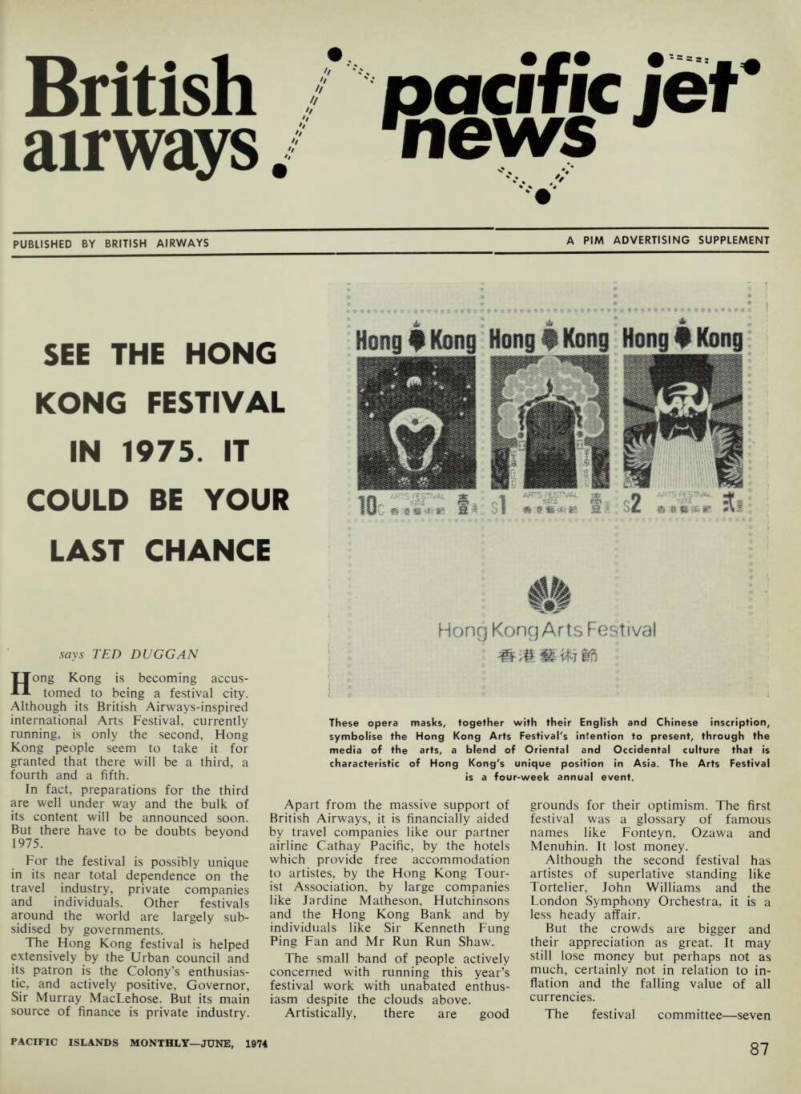
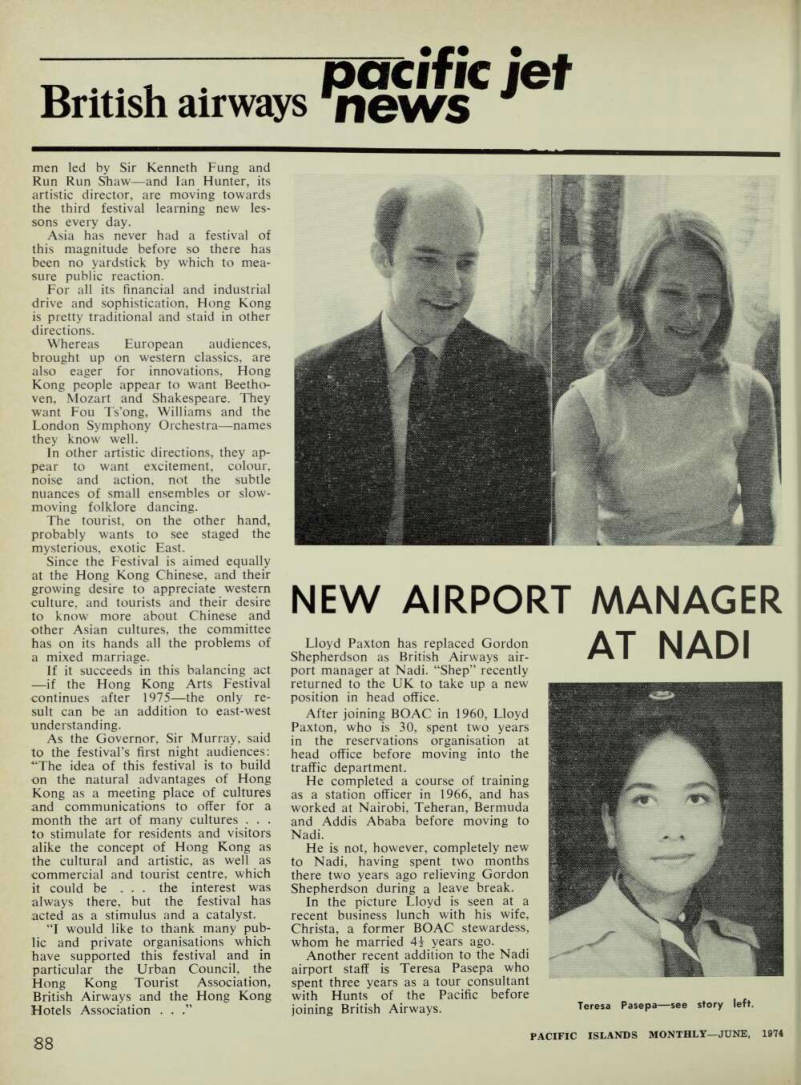
airways news
See The Hong
Kong Festival
In 1975. It
Could Be Your
Last Chance
Published By British Airways
says TED DUGGAN Hong Kong is becoming accus tomed to being a festival city.
Although its British Airways-inspired international Arts Festival, currently running, is only the second, Hong Kong people seem to take it for granted that there will be a third, a fourth and a fifth.
In fact, preparations for the third are well under way and the bulk of its content will be announced soon.
But there have to be doubts beyond 1975.
For the festival is possibly unique in its near total dependence on the travel industry, private companies and individuals. Other festivals around the world are largely sub sidised by governments.
The Hong Kong festival is helped extensively by the Urban council and its patron is the Colony’s enthusias tic, and actively positive, Governor, Sir Murray MacLehose. But its main source of finance is private industry.
Apart from the massive support of British Airways, it is financially aided by travel companies like our partner airline Cathay Pacific, by the hotels which provide free accommodation to artistes, by the Hong Kong Tour ist Association, by large companies like Jardine Matheson, Hutchinsons and the Hong Kong Bank and by individuals like Sir Kenneth Fung Ping Fan and Mr Run Run Shaw.
The small band of people actively concerned with running this year’s festival work with unabated enthus iasm despite the clouds above.
Artistically, there are good
A Pim Advertising Supplement
grounds for their optimism. The first festival was a glossary of famous names like Fonteyn, Ozawa and Menuhin. It lost money.
Although the second festival has artistes of superlative standing like Tortelier, John Williams and the London Symphony Orchestra, it is a less heady affair.
But the crowds are bigger and their appreciation as great. It may still lose money but perhaps not as much, certainly not in relation to in flation and the falling value of all currencies.
The festival committee—seven
These opera masks, together with their English and Chinese inscription, symbolise the Hong Kong Arts Festival's intention to present, through the media of the arts, a blend of Oriental and Occidental culture that is characteristic of Hong Kong's unique position in Asia. The Arts Festival is a four-week annual event.
men led by Sir Kenneth Fung and Run Run Shaw—and lan Hunter, its artistic director, are moving towards the third festival learning new les sons every day.
Asia has never had a festival of this magnitude before so there has been no yardstick by which to mea sure public reaction.
For all its financial and industrial drive and sophistication, Hong Kong is pretty traditional and staid in other directions.
Whereas European audiences, brought up on western classics, are also eager for innovations, Hong Kong people appear to want Beetho ven, Mozart and Shakespeare. They want Fou Ts’ong, Williams and the London Symphony Orchestra —names they know well.
In other artistic directions, they ap pear to want excitement, colour, noise and action, not the subtle nuances of small ensembles or slow moving folklore dancing.
The tourist, on the other hand, probably wants to see staged the mysterious, exotic East.
Since the Festival is aimed equally at the Hong Kong Chinese, and their growing desire to appreciate western culture, and tourists and their desire to know more about Chinese and other Asian cultures, the committee has on its hands all the problems of a mixed marriage.
If it succeeds in this balancing act —if the Hong Kong Arts Festival continues after 1975—the only re sult can be an addition to east-west understanding.
As the Governor, Sir Murray, said to the festival’s first night audiences: “The idea of this festival is to build on the natural advantages of Hong Kong as a meeting place of cultures and communications to offer for a month the art of many cultures . . . to stimulate for residents and visitors alike the concept of Hong Kong as the cultural and artistic, as well as commercial and tourist centre, which it could be . . . the interest was always there, but the festival has acted as a stimulus and a catalyst.
“I would like to thank many pub lic and private organisations which have supported this festival and in particular the Urban Council, the Hong Kong Tourist Association, British Airways and the Hong Kong Hotels Association . . .”
At Nadi
New Airport Manager
Lloyd Paxton has replaced Gordon Shepherdson as British Airways air port manager at Nadi. “Shep” recently returned to the UK to take up a new position in head office.
After joining BOAC in 1960, Lloyd Paxton, who is 30, spent two years in the reservations organisation at head office before moving into the traffic department.
He completed a course of training as a station officer in 1966, and has worked at Nairobi, Teheran, Bermuda and Addis Ababa before moving to Nadi.
He is not, however, completely new to Nadi, having spent two months there two years ago relieving Gordon Shepherdson during a leave break.
In the picture Lloyd is seen at a recent business lunch with his wife, Christa, a former BOAC stewardess, whom he married 4i years ago.
Another recent addition to the Nadi airport staff is Teresa Pasepa who spent three years as a tour consultant with Hunts of the Pacific before joining British Airways.
Teresa Pasepa —see story left.
Advertisements & other items, p. 90 (1 item)
British airways news
88
PACIFIC ISLANDS MONTHLY—JUNE, 1974
„ ..., . pacific jet British airways news
Summer Hols Soon Here
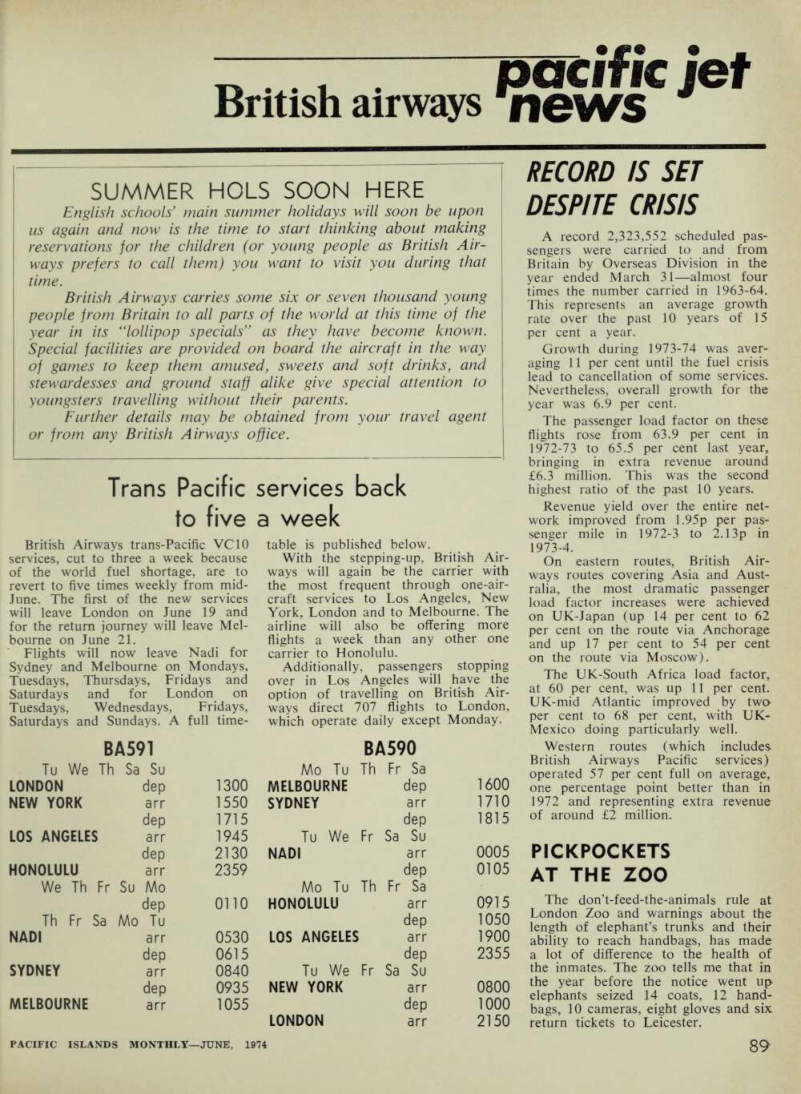
English schools' main summer holidays will soon be upon us again and now is the time to start thinking about making reservations for the children (or young people as British Air ways prefers to call them) you want to visit you during that time.
British Airways carries some six or seven thousand young people from Britain to all parts of the world at this time of the year in its “lollipop specials” as they have become known.
Special facilities are provided on board the aircraft in the way of games to keep them amused, sweets and soft drinks, and stewardesses and ground staff alike give special attention to youngsters travelling without their parents.
Further details may be obtained from your travel agent or from any British Airways office.
Trans Pacific services back
to five a week
British Airways trans-Pacific VC 10 services, cut to three a week because of the world fuel shortage, are to revert to five times weekly from mid- June. The first of the new services will leave London on June 19 and for the return journey will leave Mel bourne on June 21, Flights will now leave Nadi for Sydney and Melbourne on Mondays, Tuesdays, Thursdays, Fridays and Saturdays and for London on Tuesdays, Wednesdays, Fridays, Saturdays and Sundays. A full time
table is published below.
With the stepping-up, British Air ways will again be the carrier with the most frequent through one-air craft services to Los Angeles, New York, London and to Melbourne. The airline will also be offering more flights a week than any other one carrier to Honolulu.
Additionally, passengers stopping over in Los Angeles will have the option of travelling on British Air ways direct 707 flights to London, which operate daily except Monday.
BA591 Tu We Th Sa Su
London
dep 1300
New York
arr 1550
dep
1715
Los Angeles
arr 1945 dep 2130
Honolulu
arr 2359 We Th Fr Su Mo dep 0110 Th Fr Sa Mo Tu
Nadi
arr 0530
dep
0615
Sydney
arr 0840
dep
0935
Melbourne
arr 1055
BA590 Mo Tu Th Fr Sa
Melbourne
dep 1600
Sydney
arr 1710 dep 1815 Tu We Fr Sa Su
Nadi
arr 0005 dep 0105 Mo Tu Th Fr Sa
Honolulu
arr 0915 dep 1050
Los Angeles
arr 1900 dep 2355 Tu We Fr Sa Su
New York
arr 0800
dep
1000
London
arr 2150
Despite Crisis
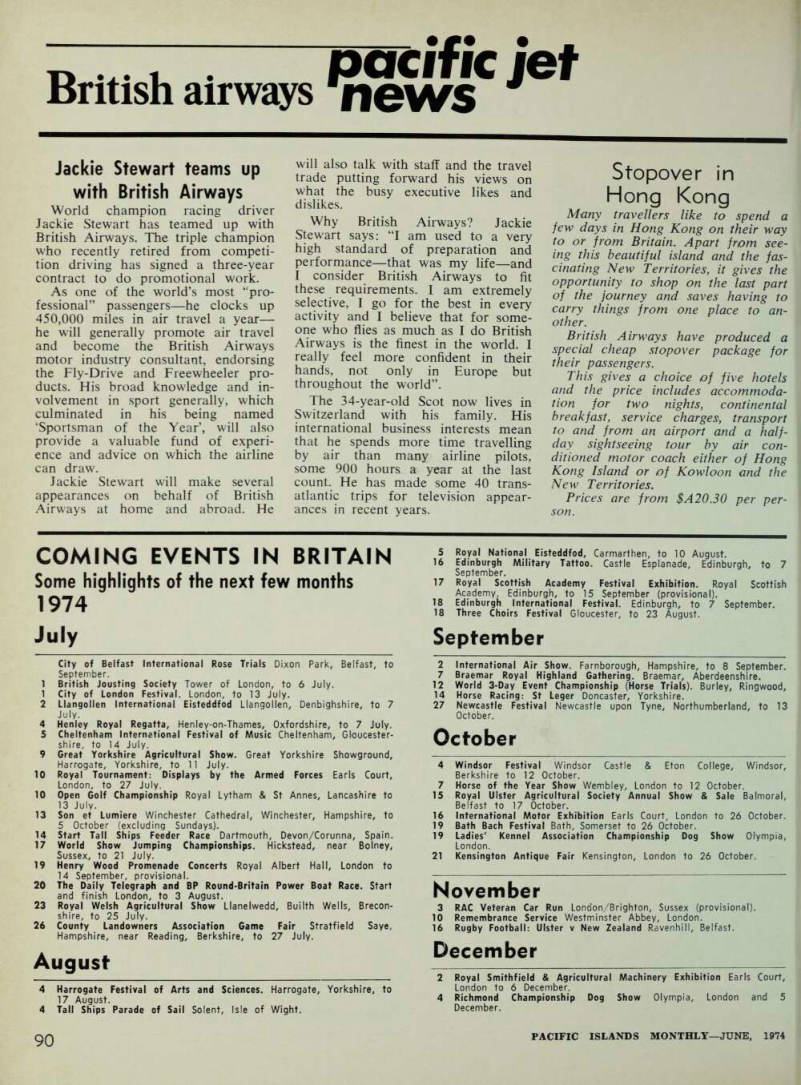
Record Set
A record 2,323,552 scheduled pas sengers were carried to and from Britain by Overseas Division in the year ended March 31—almost four times the number carried in 1963-64.
This represents an average growth rate over the past 10 years of 15 per cent a year.
Growth during 1973-74 was aver aging 11 per cent until the fuel crisis lead to cancellation of some services.
Nevertheless, overall growth for the year was 6.9 per cent.
The passenger load factor on these flights rose from 63.9 per cent in 1972- to 65.5 per cent last year, bringing in extra revenue around £6.3 million. This was the second highest ratio of the past 10 years.
Revenue yield over the entire net work improved from 1.95 p per pas senger mile in 1972-3 to 2.13 p in 1973- On eastern routes, British Air ways routes covering Asia and Aust ralia, the most dramatic passenger load factor increases were achieved on UK-Japan (up 14 per cent to 62 per cent on the route via Anchorage and up 17 per cent to 54 per cent on the route via Moscow).
The UK-South Africa load factor, at 60 per cent, was up 11 per cent.
UK-mid Atlantic improved by two per cent to 68 per cent, with UK- Mexico doing particularly well.
Western routes (which includes British Airways Pacific services) operated 57 per cent full on average, one percentage point better than in 1972 and representing extra revenue of around £2 million.
Pickpockets
At The Zoo
The don’t-feed-the-animals rule at London Zoo and warnings about the length of elephant’s trunks and their ability to reach handbags, has made a lot of difference to the health of the inmates. The zoo tells me that in the year before the notice went up elephants seized 14 coats, 12 hand bags, 10 cameras, eight gloves and six return tickets to Leicester.
Jackie Stewart teams up
with British Airways
World champion racing driver Jackie Stewart has teamed up with British Airways. The triple champion who recently retired from competi tion driving has signed a three-year contract to do promotional work.
As one of the world’s most ‘'pro fessional” passengers—he clocks up 450,000 miles in air travel a year— he will generally promote air travel and become the British Airways motor industry consultant, endorsing the Fly-Drive and Freewheeler pro ducts. His broad knowledge and in volvement in sport generally, which culminated in his being named ‘Sportsman of the Year’, will also provide a valuable fund of experi ence and advice on which the airline can draw.
Jackie Stewart will make several appearances on behalf of British Airways at home and abroad. He
will also talk with staff and the travel trade putting forward his views on what the busy executive likes and dislikes.
Why British Airways? Jackie Stewart says: “I am used to a very high standard of preparation and performance—that was my life—and I consider British Airways to fit these requirements. I am extremely selective, I go for the best in every activity and I believe that for some one who flies as much as I do British Airways is the finest in the world. I really feel more confident in their hands, not only in Europe but throughout the world”.
The 34-year-old Scot now lives in Switzerland with his family. His international business interests mean that he spends more time travelling by air than many airline pilots, some 900 hours a year at the last count. He has made some 40 trans atlantic trips for television appear ances in recent years.
Stopover in
Hong Kong
Many travellers like to spend a few days in Hong Kong on their way to or from Britain. Apart from see ing this beautiful island and the fas cinating New Territories, it gives the opportunity to shop on the last part of the journey and saves having to carry things from one place to an other.
British Airways have produced a special cheap stopover package for their passengers.
This gives a choice of five hotels and the price includes accommoda tion for two nights, continental breakfast, service charges, transport to and from an airport and a half day sightseeing tour by air con ditioned motor coach either of Hong Kong Island or of Kowloon and the New Territories.
Prices are from $A20.30 per per son.
Advertisements & other items, p. 91 (1 item)
British airways news
89
„ ... . pacific Jet British airways news
PACIFIC ISLANDS MONTHLY—JUNE, 1974
August
Coming Events In Britain
Some highlights of the next few months 1974
July
City of Belfast International Rose Trials Dixon Park, Belfast, to September. 1 British Jousting Society Tower of London, to 6 July. 1 City of London Festival. London, to 13 July. 2 Llangollen International Eisteddfod Llangollen, Denbighshire, to 7 July. 4 Henley Royal Regatta, Henley-on-Thames, Oxfordshire, to 7 July. 5 Cheltenham International Festival of Music Cheltenham, Gloucester shire, to 14 July. 9 Great Yorkshire Agricultural Show. Great Yorkshire Showground, Harrogate, Yorkshire, to 11 July. 10 Royal Tournament: Displays by the Armed Forces Earls Court, London, to 27 July. 10 Open Golf Championship Royal Lytham & St Annes, Lancashire to 13 July. 13 Son et Lumiere Winchester Cathedral, Winchester, Hampshire, to 5 October (excluding Sundays). 14 Start Tall Ships Feeder Race Dartmouth, Devon/Corunna, Spain. 17 World Show Jumping Championships. Hickstead, near Bolney, Sussex, to 21 July. 19 Henry Wood Promenade Concerts Royal Albert Hall, London to 14 September, provisional. 20 The Daily Telegraph and BP Round-Britain Power Boat Race. Start and finish London, to 3 August. 23 Royal Welsh Agricultural Show Llanelwedd, Builth Wells, Brecon shire, to 25 July. 26 County Landowners Association Game Fair Stratfield Saye, Hampshire, near Reading, Berkshire, to 27 July.
August
4 Harrogate Festival of Arts and Sciences. Harrogate, Yorkshire, to 17 August. 4 Tall Ships Parade of Sail Solent, Isle of Wight.
5 Royal National Eisteddfod, Carmarthen, to 10 August. 16 Edinburgh Military Tattoo. Castle Esplanade, Edinburgh, to 7 September. 17 Royal Scottish Academy Festival Exhibition. Royal Scottish Academy, Edinburgh, to 15 September (provisional). 18 Edinburgh International Festival. Edinburgh, to 7 September. 18 Three Choirs Festival Gloucester, to 23 August.
September
2 International Air Show. Farnborough, Hampshire, to 8 September. 7 Braemar Royal Highland Gathering. Braemar, Aberdeenshire. 12 World 3-Day Event Championship (Horse Trials). Burley, Ringwood, 14 Horse Racing: St Leger Doncaster, Yorkshire. 27 Newcastle Festival Newcastle upon Tyne, Northumberland, to 13 October.
October
4 Windsor Festival Windsor Castle & Eton College, Windsor, Berkshire to 12 October. 7 Horse of the Year Show Wembley, London to 12 October. 15 Royal Ulster Agricultural Society Annual Show & Sale Balmoral, Belfast to 17 October. 16 International Motor Exhibition Earls Court, London to 26 October. 19 Bath Bach Festival Bath, Somerset to 26 October. 19 Ladies' Kennel Association Championship Dog Show Olympia, London. 21 Kensington Antique Fair Kensington, London to 26 October.
November
3 RAC Veteran Car Run London/Brighton, Sussex (provisional). 10 Remembrance Service Westminster Abbey, London. 16 Rugby Football: Ulster v New Zealand Ravenhill, Belfast.
December
2 Royal Smithfield & Agricultural Machinery Exhibition Earls Court, London to 6 December. 4 Richmond Championship Dog Show Olympia, London and 5 December.
Advertisements & other items, pp. 93-94 (1 item)
Seiko
m n Bl
SUN
i N Lm / \ a Automatic self-winding,Water resistant Second setting device, Instant day and date setting Automatic self-winding,Water resistant^ Second setting device, Instant day and date setting
Technology of the future.
Dedication of the past.
Seiko, the quality watch of today.
Every Seiko watch is a triumphant merger of Seiko's unique microelectronic-technology and time-honored tradition of handcraftsmanship.
Add to all this Seiko's insistence on making every part of every Seiko watch, thus quality-controlling every step.
This unique merging of future technology and past dedication creates the quality watch of today: Seiko.
SEIKO
K. Hattorl & Co., Ltd., Tokyo, Japan.
Someday all watches will be made this way.
STATESMAN
• cigars on
international scene
SREG)/
1801 ns *■ * BK
STATESMAN
CORONA
5
Corona
D 585
Business and Development
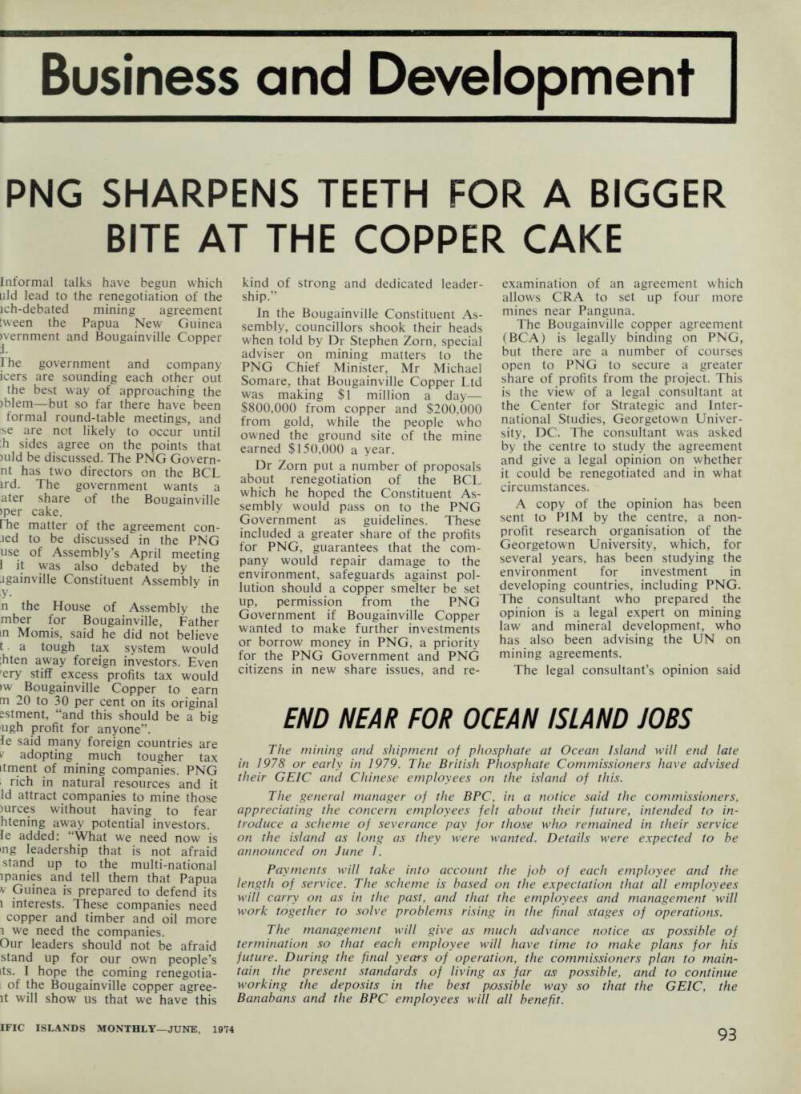
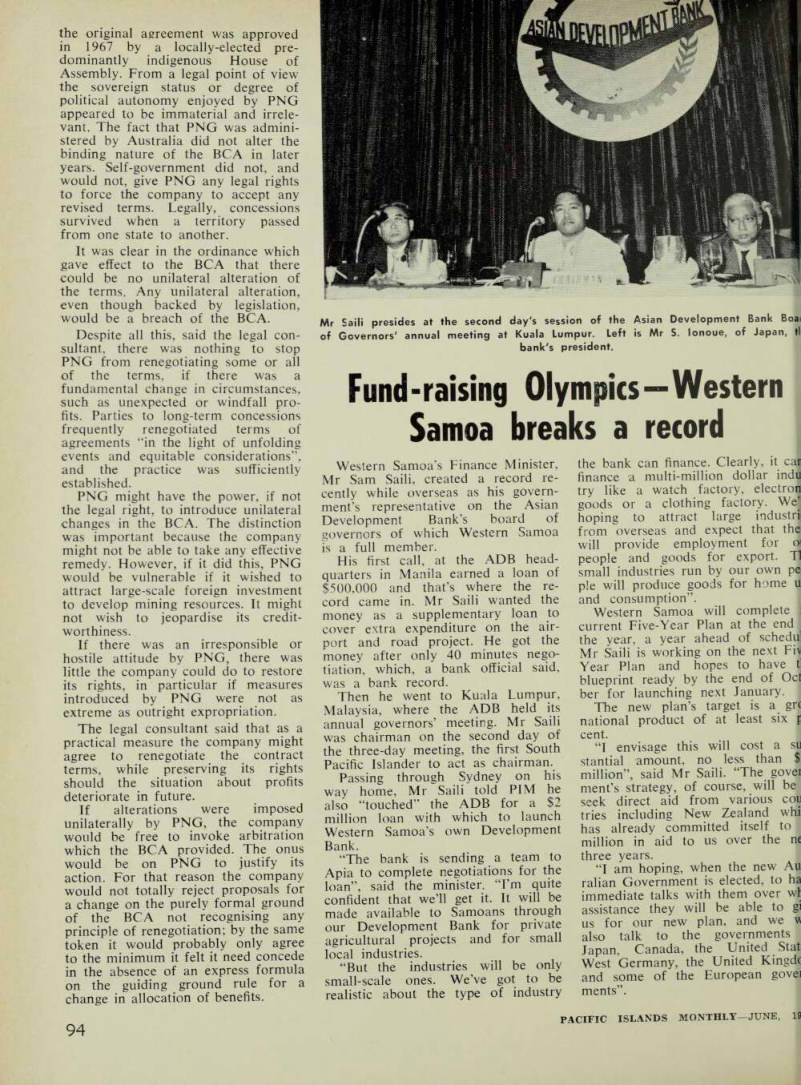
Png Sharpens Teeth For A Bigger
Bite At The Copper Cake
Informal talks have begun which Lild lead to the renegotiation of the ich-debated mining agreement tween the Papua New Guinea wernment and Bougainville Copper Ihe government and company icers are sounding each other out the best way of approaching the )blem —but so far there have been formal round-table meetings, and se are not likely to occur until :h sides agree on the points that >uld be discussed. The PNG Govern nt has two directors on the BCL ird. The government wants a ater share of the Bougainville )per cake.
Hie matter of the agreement con jed to be discussed in the PNG use of Assembly’s April meeting 1 it was also debated by the jgainville Constituent Assembly in y. n the House of Assembly the mber for Bougainville, Father m Momis, said he did not believe t. a tough tax system would ;hten away foreign investors. Even r ery stiff excess profits tax would >w Bougainville Copper to earn m 20 to 30 per cent on its original sstment, “and this should be a big ugh profit for anyone”.
Ie said many foreign countries are v adopting much tougher tax itment of mining companies. PNG rich in natural resources and it Id attract companies to mine those mrces without having to fear htening away potential investors.
Ie added: “What we need now is mg leadership that is not afraid stand up to the multi-national ipanies and tell them that Papua v Guinea is prepared to defend its i interests. These companies need copper and timber and oil more i we need the companies.
Our leaders should not be afraid stand up for our own people’s its. I hope the coming renegotia of the Bougainville copper agree it will show us that we have this
kind of strong and dedicated leadership.”
In the Bougainville Constituent Assembly, councillors shook their heads when told by Dr Stephen Zorn, special adviser on mining matters to the PNG Chief Minister, Mr Michael Somare, that Bougainville Copper Ltd was making $1 million a day— sBoo,ooo from copper and $200,000 com gold, while the people who owned the ground site of the mine earned $150,000 a year.
Dr Zorn put a number of proposals about renegotiation of the BCL which he hoped the Constituent Assembly would pass on to the PNG Government as guidelines. These included a greater share of the profits for PNG, guarantees that the company would repair damage to the environment, safeguards against pollution should a copper smelter be set up, permission from the PNG Government if Bougainville Copper wanted to make further investments or borrow money in PNG, a priority for the PNG Government and PNG citizens in new share issues, and re-
examination of an agreement which allows CRA to set up four more mines near Panguna.
The Bougainville copper agreement (BCA) is legally binding on PNG, but there are a number of courses °P en to PNG t 0 secure a greater share of profits from the project. This is the view of a legal consultant at the Center for Strategic and Inter national Studies, Georgetown Umver sity, DC. The consultant was asked by the centre to study the agreement and g " e h a legal T“° n °" het £ e J 11 . could be rene B otiated and ln what circumstances.
A copy of the opinion has been sent to PIM by the centre, a non- Profit research organisation of the Georgetown University, which, for several years, has been studying the environment for investment in
developing countries, including PNG.
The consultant who prepared the opinion is a legal expert on mining l a w and mineral development, who has also been advising the UN on mining agreements, The legal consultant’s opinion said
the original agreement was approved in 1967 by a locally-elected pre dominantly indigenous House of Assembly. From a legal point of view the sovereign status or degree of political autonomy enjoyed by PNG appeared to be immaterial and irrele vant. The fact that PNG was admini stered by Australia did not alter the binding nature of the BCA in later years. Self-government did not, and would not, give PNG any legal rights to force the company to accept any revised terms. Legally, concessions survived when a territory passed from one state to another.
It was clear in the ordinance which gave effect to the BCA that there could be no unilateral alteration of the terms. Any unilateral alteration, even though backed by legislation, would be a breach of the BCA.
Despite all this, said the legal con sultant, there was nothing to stop PNG from renegotiating some or all of the terms, if there was a fundamental change in circumstances, such as unexpected or windfall pro fits. Parties to long-term concessions frequently renegotiated terms of agreements “in the light of unfolding events and equitable considerations”, and the practice was sufficiently established.
PNG might have the power, if not the legal right, to introduce unilateral changes in the BCA. The distinction was important because the company might not be able to take any effective remedy. However, if it did this, PNG would be vulnerable if it wished to attract large-scale foreign investment to develop mining resources. It might not wish to jeopardise its credit worthiness.
If there was an irresponsible or hostile attitude by PNG, there was little the company could do to restore its rights, in particular if measures introduced by PNG were not as extreme as outright expropriation.
The legal consultant said that as a practical measure the company might agree to renegotiate the contract terms, while preserving its rights should the situation about profits deteriorate in future.
If alterations were imposed unilaterally by PNG, the company would be free to invoke arbitration which the BCA provided. The onus would be on PNG to justify its action. For that reason the company would not totally reject proposals for a change on the purely formal ground of the BCA not recognising any principle of renegotiation; by the same token it would probably only agree to the minimum it felt it need concede in the absence of an express formula on the guiding ground rule for a change in allocation of benefits.
End Near For Ocean Island Jobs
The mining and shipment of phosphate at Ocean Island will end late in 1978 or early in 1979. The British Phosphate Commissioners have advised their GEIC and Chinese employees on the island of this.
The general manager of the BPC, in a notice said the commissioners, appreciating the concern employees felt about their future, intended to in troduce a scheme of severance pay for those who remained in their service on the island as long as they were wanted. Details were expected to be announced on June 1.
Payments will take into account the job of each employee and the length of service. The scheme is based on the expectation that all employees will carry on as in the past, and that the employees and management will work together to solve problems rising in the final stages of operations.
The management will give as much advance notice as possible of termination so that each employee will have time to make plans for his future. During the final years of operation, the commissioners plan to main tain the present standards of living as far as possible, and to continue working the deposits in the best possible way so that the GEIC, the Banabans and the BPC employees will all benefit.
Advertisements & other items, p. 95 (1 item)
93
IFIC ISLANDS MONTHLY—JUNE, 1974
Fund-raising Olympics-Western
Samoa breaks a record
Western Samoa’s Finance Minister, Mr Sam Saili, created a record re cently while overseas as his govern ment’s representative on the Asian Development Bank’s board of governors of which Western Samoa is a full member.
His first call, at the ADB head quarters in Manila earned a loan of $500,000 and that’s where the re cord came in. Mr Saili wanted the money as a supplementary loan to cover extra expenditure on the air port and road project. He got the money after only 40 minutes nego tiation, which, a bank official said, was a bank record.
Then he went to Kuala Lumpur, Malaysia, where the ADB held its annual governors’ meeting. Mr Saili was chairman on the second day of the three-day meeting, the first South Pacific Islander to act as chairman.
Passing through Sydney on his way home, Mr Saili told PIM he also “touched” the ADB for a $2 million loan with which to launch Western Samoa’s own Development Bank.
“The bank is sending a team to
Apia to complete negotiations for the
loan”, said the minister. “I’m quite confident that we’ll get it. It will be made available to Samoans through our Development Bank for private agricultural projects and for small local industries.
“But the industries will be only small-scale ones. We’ve got to be realistic about the type of industry
the bank can finance. Clearly, it can finance a multi-million dollar indii try like a watch factory, electron goods or a clothing factory. Wei hoping to attract large industry from overseas and expect that thej will provide employment for 01 people and goods for export. T 1 small industries run by our own pei pie will produce goods for home ui and consumption”.
Western Samoa will complete i current Five-Year Plan at the end i the year, a year ahead of schedul Mr Saili is working on the next Fiv Year Plan and hopes to have ti blueprint ready by the end of Oct ber for launching next January.
The new plan’s target is a grc national product of at least six p cent.
“I envisage this will cost a su stantial amount, no less than $ million”, said Mr Saili. “The govei ment’s strategy, of course, will be seek direct aid from various cou tries including New Zealand whi has already committed itself to million in aid to us over the ne three years.
“I am hoping, when the new Au ralian Government is elected, to ha immediate talks with them over wt assistance they will be able to gi us for our new plan, and we v. also talk to the governments Japan, Canada, the United Stat West Germany, the United Kingdc and some of the European govei ments”.
Mr Saili presides at the second day's session of the Asian Development Bank Boa of Governors' annual meeting at Kuala Lumpur. Left is Mr S. lonoue, of Japan, t[?] bank's president.
Norfolk's Plan

For People
By a staff reporter
The future growth of the residen al population of Norfolk Island hould be geared to the tourist idustry. This is outlined in a report n future population growth by Pro ;ssor Gilbert J. Butland, Pro Vice -hancellor of the University of New England, NSW. He made the survey t the request of the Department of ic ACT, which now controls Norfolk dand.
Apart from limitation of popula on, Professor Butland also recom lends restrictions on tourist growth, le number of vehicles available for ire by tourists, no further extensions f the road network and the number f beds for tourists.
Professor Butland said it was im ossible for Norfolk Island to finance le development needed without in reased customs duties and without icome tax. The duty-free aspect at resent did little to enhance the appeal f the island. It provided a limited mount of revenue and was not a gnificant factor in luring tourists to le island. If fiscal changes phased ut duty-free shopping and introduced n airport tax, the marginal effect on mrism could easily be absorbed ithout the normal growth.
The suggested control on the umber of tourists is likely to be a otly-debated issue, and is one which mst inevitably lead to the growth of bureaucracy. There would be no ther way of allowing tourist arrivals ) grow by 60 per cent during the 974-83 decade, as recommended by rofessor Butland.
He suggested increases of 500 a ear from the present 12,500 to 0,000. To control the number of rrivals, there should be closely co rdinated co-operation between the ir carrier and the Norfolk Island burist Board, so that travel bookings 'ere related to available accommoda on. The number of beds available i 1983 should constitute the laximum figure. The same year iould see a limit of 300 of the umber of hire vehicles, cars, motor ycles and scooters available for mting by tourists.
In recommending no further ex msions to the road network, Profes jr Butland said all roads should be saled in the five-year period 1975-80. teps should be taken to ensure that lotor traffic did not leave the roads 3 encroach on reserves and commons.
The professor suggested that a 3
per cent maximum annual increase of ordinary resident population would be a slow but satisfactory progression from an economic angle. Once the maximum tourist intake of 20,000 was reached in 1983 it would be pre ferable to reduce residential popu lation growth from 3 per cent to 2 per cent. The 2 per cent would be made up of a .75 per cent annual increase and a 1.25 per cent immigra tion increase each year. Policies would have to be devised to limit residential population to a maximum of 20,000 by 1983.
Professor Butland recommended the launching of a major programme of land-use. By 1983, the whole historical area between Cemetery Bay and Watermill Valley and south of Quality Row should be developed into a well-preserved and model historical attraction, at the same time as restoration and rebuilding work was continued north of Quality Row.
New sport' tor
New Caledonians
Soaring prices and tax fears, despite possible sporting side-effects, continue to harrass Caledonians amid predic tions that this year’s rise in the cost of living index could reach 18 per cent. This is the increase workers claim actually occurred last year, although the official figure, by which wages are automatically adjusted, was only 7 per cent.
As New Caledonia’s largest unions battle for wage hikes of 15 per cent to 20 per cent the French admini stration has revealed that in the first quarter of this year the cost of living index jumped 4.5 per cent.
Critical eyes are thus strained on every item which enters into the calculation of the index, from theatre tickets to basic food items. Since 90 per cent of the island’s consumer goods are supplied from abroad, the population is extremely vulnerable to imported inflation. Main target of the authorities is the expensive bill for foodstuffs, imported mainly from Australia whose currency has risen about 30 per cent against the French Pacific Franc (CFP) since July 1973.
Over the past five years, the island’s food import bill has tripled from 1,450 million CFP in 1968 to 4,290 million CFP in 1973. Last year, Cale donians were told they could save about one-third of their SA3O-odd million food import bill if greater efforts were made in agriculture at home. Since assuming office early this year, Governor Eriau has emphasised the need to step up local production of beef and other primary products, and graziers are now being paid higher meat prices for this pur pose.
As the economic situation deter iorates, a tougher line on imports could be imposed. And, as if galloping prices are not problem enough, Governor Eriau has told the Cale donians that they cannot expect to keep holding out their hand for aid from metropolitan French taxpayers to continue paying for the territory’s investment expenditure. Speaking in mid-April, the governor underlined the island’s current budgetary prob lems and pointed out that in view of the massive infrastructure develop ments required, the present tax system of relying solely on import and export taxes to fill the territory’s coffers was no longer sufficient.
Currently, this revenue leaves only scanty funds for capital expenditure after covering the cost of a massive build-up in the public service.
As the day of reckoning draws nearer, the Caledonian spine is left shuddering at the likelihood of the Territorial Assembly being forced to vote in personal income tax, on top of the present indirect taxes. And as one French journalist painfully point ed out, the big companies have ways of getting around the system, but for the little man, his pay slip is also his tax slip.
The only bright side of the matter would be the popular metropolitan French sport this would introduce to the island in the form of “System D” wangling—the highly-refined sport of tax-dodging. But by then, there will be enough gendarmes and military helicopters to ensure that the game is played by Paris rules.
Solomons' fish
for Europe
The first shipment of Solomon- Taiyo canned fish left Honiara on the freighter Linden Bank in April, A spokesman for Solomon-Taiyo, the Taiyo Fishery Company-Solomon Islands Government joint venture, said 5,000 cartons of first grade tuna were going to Liverpool, England, and 5,750 cartons to Hamburg, West Germany. The fish would be mar keted in Europe by the Taiyo com pany.
Canning of fish began at Tulagi in the BSl’s Florida Islands, last
October, and the factory worked upj to standards necessary for overseas, markets before the end of the year.' The first shipment went to Japan. ' In May, another 15,000 cartons of half-pound cans were expected tc be shipped to Europe.
Solomon-Taiyo has made am agreement with villagers on Gelaj the main island of the Florida groups to compensate them for catching bait fish in their fishing waters.
The government Fisheries Officen arranged a three-hour meeting aftei villagers had complained. Village leaders agreed to accept a Solomon- Taiyo offer of one dollar to each village every time a boat caught bait fish offshore, and SlO a month to the Gela Local Government Council.
Each village has appointed some one to watch for the bait fishing boats.
Japanese to build
up Fiji cannery
The Pacific Fishing Co Ltd plans to build up its business at Levuka.
Fiji, with a new tuna canning factory; The company now operates a small cannery in its fish processing works producing tinned tuna flakes, light meat and white meat.
The company says very little about its affairs, but it is one of the “big ,J industries in Fiji, exporting $5 milliot to S 7 million worth of fish to the United States each year. That revenue places it as No 3 in Fiji’s industries behind sugar and tourism.
The managing director, Mr Hite Yamaguchi, said the cannery woulc provide employment for about 40( people. Experienced canners woulc go to Fiji from Japan to train loca! staff.
Many more fishing boats would be needed to catch fish for the cannery At present the company spend! $BOO,OOO to $1 million a year or fishing boats which operate out oi Levuka.
Second jet
for Nauru
Nauru was expecting the arrival oJ a second Fokker F2B jet airliner lasi month, to take place on the republic’; Constitution Day. The plane was coming from Amsterdam.
President Hammer Deßoburt alse recently announced that 11 nev positions for air hostesses with the Nauru airline, Air Nauru, had beer created. Following local advertise; ments seven girls had been recruiter and had begun training in Naun under the guidance of the chid
hostess. After this, they were ex pected to go to Melbourne for a course in emergency procedures train ing at Ansett Airlines.
President Deßoburt
calls at Saipan
Nauru’s involvement in transport in the US Trust Territory was dis cussed during a visit President Ham mer Deßoburt paid to Saipan early in May. Nauru Pacific Line was re cently given permission to serve various points in the Trust Territory after Transpac went into receiver ship.
President Deßoburt met govern ment officials, including the Director of Transportation and Communica tions, Mr Joseph Beadles, and several Saipan businessmen. He met the High Commissioner, Mr Edward E.
Johnston, before leaving for Majuro.
Tongo's share
of tourism's loot
The tourist industry earned Tonga an estimated $1.5 million in 1973.
Statistics prepared by the Tonga Visitors’ Bureau show that tourists (those who stay at least one night) brought in $744,694, while sea cruise passengers spent $690,232.
Australia provided 22,465 visitors —about 60 per cent of the total.
Most of those arrived by ship and stayed only one day. But Australians, on the average spent most time in Tonga—lB days, compared with 10 days for New Zealanders and six days for Americans.
The major cruise ship activity is between October and March, although the season is expanding and more ships are calling in the third quarter of the year.
Three powers to help
with Purari project
Consultants from Australia, Japan and the United States will work to gether in a full-scale feasibility study, scheduled to start in October, of the Purari River hydro-electricity scheme in Papua. There has been much talk of the scheme costing $l,OOO million, but in these days of inflation that figure is little better than an inspired guess.
If the study recommends a “go ahead” it could eventually mean a series of dams with more than twice the generating capacity of the Snowy Mountains scheme in Australia. The study is expected to take three years.
A start could be made on the first dam in the Wabo area late in 1977.
Japan had no intention of mono
polising the Purari scheme, the Japanese Ambassador to Australia, Mr H. Yoshida, said during a fact finding tour of PNG in May. He said that more Japanese industrial miss ions would visit the Purari area to look at potential factory sites.
Meanwhile the PNG Government has raised a loan of $7.2 million from the World Bank to finance other electricity projects. The money will be re-lent to the Electricity Commission. Some of it will be used to buy electricity distribution equip ment and pay the expatriate training officers’ wages. • More than 140 people from the Philippines have arrived in Port Moresby to take up public ser vice positions. They include doctors, tutor nurses, stenographers, en gineers, surveyors, mechanics, tech nical and secondary teachers, lino type operators and draughtsmen.
Another group is expected to arrive on June 26. • The Niue Development Board has introduced a passionfruit com petition this year to encourage higher production, and better maintenance and care of plantations. The com petition will be decided over the whole year, with NDB and Agri culture Department field officers conducting regular inspections.
Advertisements & other items, pp. 97-99 (2 items)
95
ACIFIC ISLANDS MONTHLY—JUNE, 1974
Turners and Growers
Growers
FRESH FRUIT & VEGETABLES
9828
m b
Buy and sell the world
with one phone call
Overseas trips to secure new markets or to investigate new trends may be beyond the financial resources of some companies ... yet the price of a local phone call can put you in touch with the world.
ANZ Banking Group will give you general or specific information about any country . . . it’s yours for the asking.
Get the facts on trade. Currency. Credit. Regulations and Legal Matters. Business transactions. Introductions.
Get through to the world through ANZ.
All enquiries to ANZ Bank, Administrative Headquarters, 351 Collins Street, Melbourne, Australia, 3000, telephone 62 0391, or to any ANZ branch in Fiji, Papua New Guinea, British Solomon Islands and New Hebrides.
AUSTRALIA AMO MEW ZEALAND
BAMKIMG GROUP LIMITED
DAIWA BANK SERVING YOU IN THE PACIFIC BASIN r & w Head Office : Osaka, Japan With 137 Branches throughout Japan Singapore Representative Office Suite No. 1007, 10th Floor Robina House 1 Shenton Way, Singapore 1 Republic of Singapore Cable Address: SINGDAIWA Affiliated Bank P.T BANK PERDANIA Djalan Raya Mangga Besar 7&9 Djakarta Our Correspondent \ Banks are in city— Apia, Suva, Lae, Madang Port Moresby, Rabaul, Wewak. Guam, all Principal cities in Australia and New Zealand Contact your banker or our office.
Los Angeles Agency 555 South Flower St. Suite 4040 Los Angeles, Calif. 90071 Sydney Representative Office Bth Floor Prudential Building 39-49, Martin Place, Sydney
THE DAIWA BANK LTD.
Head Office : 21. Bingomachi 2-chome, Higashi-ku, Osaka, Japan Overseas : London, New York, Los Angeles, Frankfurt, Sydney, Singapore
Produce Prices
(Unless otherwise stated, quotations are in Australian currency, Australian dollar (May 14) equals New Zealand $1.0137 (buying), $1.0096 (selling); Fiji $1.2024 (buying); Western Samoa $0.9093 (buying), $0.8953 (selling); US, $1.4900 (buying), $1.4850 (selling); UK, 61.4288 np (buying), 60.9793 np (selling); French Pacific 131.77 francs (buying), 129.90 (selling); Tonga, $T1.0258 (mid rate).
Copra
Copra industries are controlled through copra boards in PNG, the Solomons, the GEIC, both Samoas, Fiji, Tonga, the Cooks and the US Trust Territory. New Hebrides, French Polynesia and New Caledonia don't have boards and copra is either sold individually by growers to overseas buyers or used locally.
NEW GUINEA: The board, with planters' reps, directs distribution and sales and pays planters. Shipments are made to UK, European markets and to Australia and Japan, and coco nut oil mills on New Britain.
Latest prices per metric tonne, delivered main ports, were: hot-air dried, $377; FMS, $374; smoke-dried, $372.
FIJI:—The board fixes prices on Philippines copra, taking into account freight, taxes, selling costs, shrinkage, etc. Prices recently were: Ist grade, $514.50; 2nd grade, $504.50; sub standard (ss), $BO.
WESTERN SAMOA: The board makes pay ments to producers through its agents—local firms—and sells the copra on the open market with a portion to Abels Ltd, NZ. Recent prices per ton fob: Ist quality, $285; 2nd quality, $271.
TONGA: AH copra is sold to the board which sends it to Europe and the open market. Recent prices to growers were T 5344.40 Ist grade, and T 5332.40 2nd grade, per ton.
Per coconut 4.6 seniti.
SOLOMON IS:—All production through board at prices based on Philippines rates. Output goes to the UK, Japan, Australia and the rest
to the open market. Recent prices were: $224 per ton Ist grade, $212.80 per ton 2nd grade and $201.60 per ton 3rd grade.
GILBERT AND ELLICE.—4c per lb (Ist grade); 3c per lb (2nd grade).
NEW HEBRIDES: Copra sold direct by planters to France and Japan. Official market price on May 10, Marseilles, was 335 French francs (per 100 kilos).
COOK IS: Copra goes to Abels Ltd, of Auckland, who operate NZ's copra crushing mill. Prices for April-June, packed shipping weights f.o.b. were fixed at $NZ492.42 premium grade and $NZ489.67 standard grade.
NIUE: —All copra is sold to the Niue Develop ment Board which sends it to Abels Ltd, of Auckland. Prices for January-June 1974 f.o.b. per ton will be $NZ251.22, Ist grade, hot air-dried; $NZ249.49, Ist grade, sun-dried; and $NZ248.20, standard grade.
US TRUST TERRITORY:—Price per short ton SUS 182.50 (grade 1), SUS 172.50 (grade 2), SUS 162.50 (grade 3), delivered district centres; $170.00 (grade 1), $160.00 (grade 2), $150.00 (grade 3), picked up outer islands.
Other Produce
BECHE-DE-MER. Chang Sing Loong Co, Suva, quote 60c Fijian per lb (4 in. to 10 in.).
Honiara. —Best price paid is $1 per lb dried, for Ist grade; 70 cents per lb for 2nd grade.
CHILLIES.—SoIomons, Honiara, long red dried 14 cents per lb. Tabasco 22 cents per lb first grade.
'Bird's eye' (under 2 in.) sun-dried, FAQ Grade Raba Raba, up to 30 cents per lb (Eastern Papua). Other grades are Long and U/FAQ 15-19 cents per lb.
COCOA. —Islands rates are based on Ghana prices. Ghana price on May 15 was spot £stg 1143 ton, c.i.f.; UK, Continent.
May 15, in store Rabaul, export quality, $1370 per ton delivered ex wharf Sydney $l5OO.
Solomons. —Delivered to Agriculture Dept, offices in Honiara and Auki 25 cents per lb dried beans first grade, 20 cents second grade.
COFFEE. —PNG: Good quality. A grade, 52£c, per lb; B grade, 51c, C grade, 50c, Y grade, 50c (ex-store Sydney).
W. Samoa. —Recently, WSTEC ground and dried beans, 60 sene per lb wholesale.
CROCODILE SKlNS.—Honiara: $1.89 to $2.25 per inch.
GREEN SNAIL SHELL.—I 3-14 cents per lb.
LIMES.—Niue Development Board pays growers NZ3c per lb for Ist grade fruit and NZlc per lb for 2nd grade fruit.
PASSIONFRUIT.—Niue Development Board pays growers NZ6c per lb for good fruit.
PAPUAN GUM DUMAR.—Steamships Trading Co Ltd, Samarai, quotes SA2OO per long ton FOB Samarai.
PEANUTS. PNG: Sydney agents reported recently f.0.b., Lae; Kernels —white Spanish 19c lb.
PEARL SHELL. —Torres Strait Pearlshellers'] Assn has no recent quotes. Solomons. —I Honiara, mother of pearl blacklip 15c lb.
Cook Islands. —Penrhyn, 20-25 c per lb del.
Rarotonga 33-35 c per lb. French Polynesia.—] Tuamotu, Gambier she-lls, to $l,OOO per ton, Papeete. Fiji.—3sc per lb.
PYRETHRUM.—NG growers 17c lb, flowers.
RICE (Aust): —PNG: Dried brown, 25 kilo bags, $295 per metric tonne. Vitamin enriched white, 25 kilo bags, $3OO per metric tonne, all f.o.w. Sydney/Melbourne.
Pacific Islands: Calrose med. grain, white, 56 lb bags, $l7O a metric tonne. Kulu long grain white, 56 lb bags, $lB5 a metric tonne.
All prices f.o.w. Sydney/Melbourne.
RUBBER. —PNG prices are based on Singapore rates which on December 23 were: No. 1 RSS (Malayan cents a kilo f.0.b.), February, 262.50- 235.00; March, 260.00-233.50.
SANDALWOOD.—New Hebrides, landed on the beach, Vila and Santo, $lBO per ton "on consignment".
SHARKS FINS. Chang Sing Loong Co, Suva, offers 75c per lb for Ist quality, 45c for mixed quality.
TROCHUS.—BSIP 9-11 cents per lb. Fiji 8-9 cents per lb.
TURTLE SHELL—BSI; No market at present.
VANILLA BEANS. Prices recently were: White and yellow label processed standard packs, $7.50; green label $7.40, c.i.f., Sydney Tonga.—sT4.2o, f.0.b., Nukualofa; $T4.50, Mel bourne.
Uk, Us Quotes
COPRA. —LONDON, May 17, Philippines, in Bulk, SUS7SO per long ton, c.i.f.
Exchange Rates
FlJl.—Through Bank of NSW, ANZ Bank, Bank of NZ, Bank of Baroda, First National City Bank, Aust $ on Fiji $ buying $A0.8307
= Sfi.
COOK IS., NIUE.—New Zealand currency is used.
NEW HEBRIDES.—Through Bank of NSW, ANZ Bank, Commercial Bank of Australia, National Bank of A'asia, Barclays Bank, Hong Kong & Shanghai Banking Corp, Mosbert Bank. SAI = 146.70 New Hebridean francs (buying); 144.77 (selling).
WESTERN SAMOA.—Through Bank of Western Samoa, controlled from NZ, SWS. Tala 1 = SAI.OIOI (buying), $A 1.1170 (selling).
TONGA.—Tongan dollar (pa'anga) = $A0.9749.
Norfolk Is, Solomon Is, Geic, Nauru,
PAPUA NEW GUlNEA.—Australian currency used; no exchange payable in transactions with Aus tralia.
FRENCH PACIFIC COLONIES.—Pacific francs (CFP) are used in New Caledonia, Wallis and Futuna Is, and Fr Polynesia. French Bank, Sydney, on May 15, quoted: SAI = 130.40 CFP {buying), 128.69 (selling). Paris-London: £1 =a 11.58 francs (buying), 11.51 francs (selling).
Pacific franc—London: £1 = 210.62 CFP (buying), 209.40 CFP (selling). 5.50 CFP to 1 metropolitan franc.
Banks should be approached for daily quotes.
Advertisements & other items, p. 100 (1 item)
W. H. Grove & Sons Ltd.
ESTABLISHED 1896
ISLAND MERCHANTS
Exporters to the Pacific of Dairy Products and all New Zealand consumer and manufactured goods.
ENTRUST YOUR REQUIREMENTS TO THE
ESTABLISHED FIRM
P.O. Box 3718, Cables
AUCKLAND GROVE AUCKLAND
Shipping & Airways Information
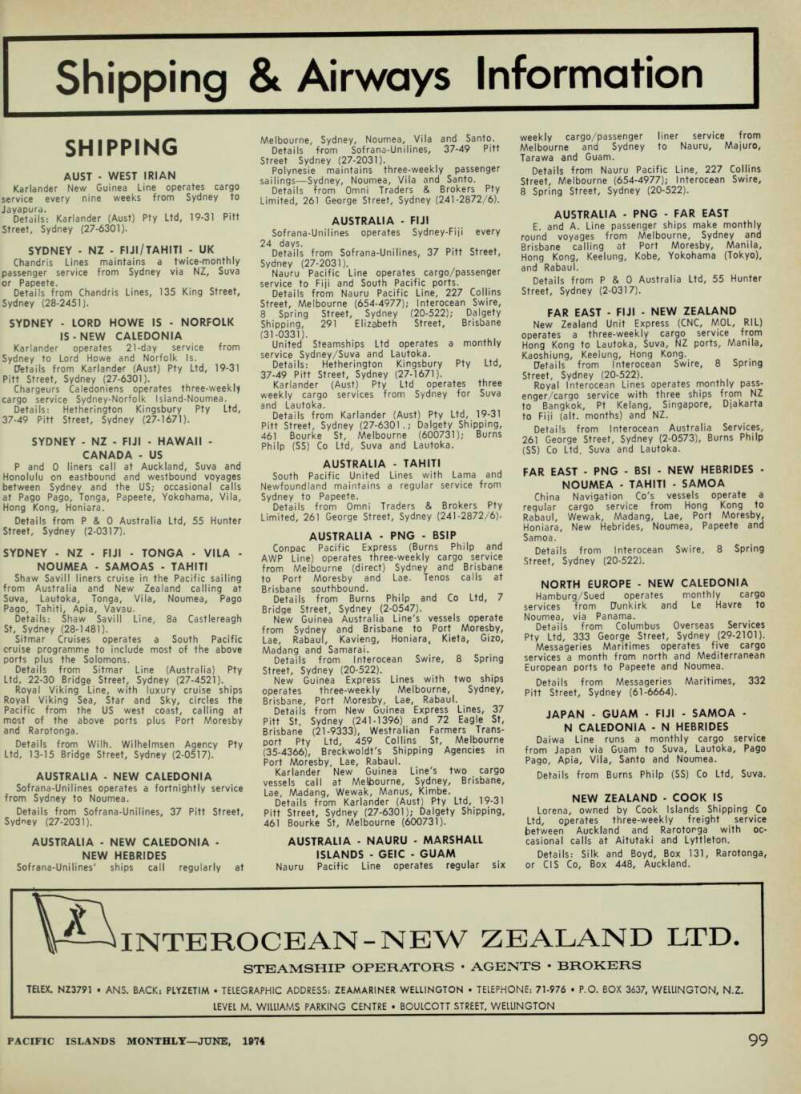
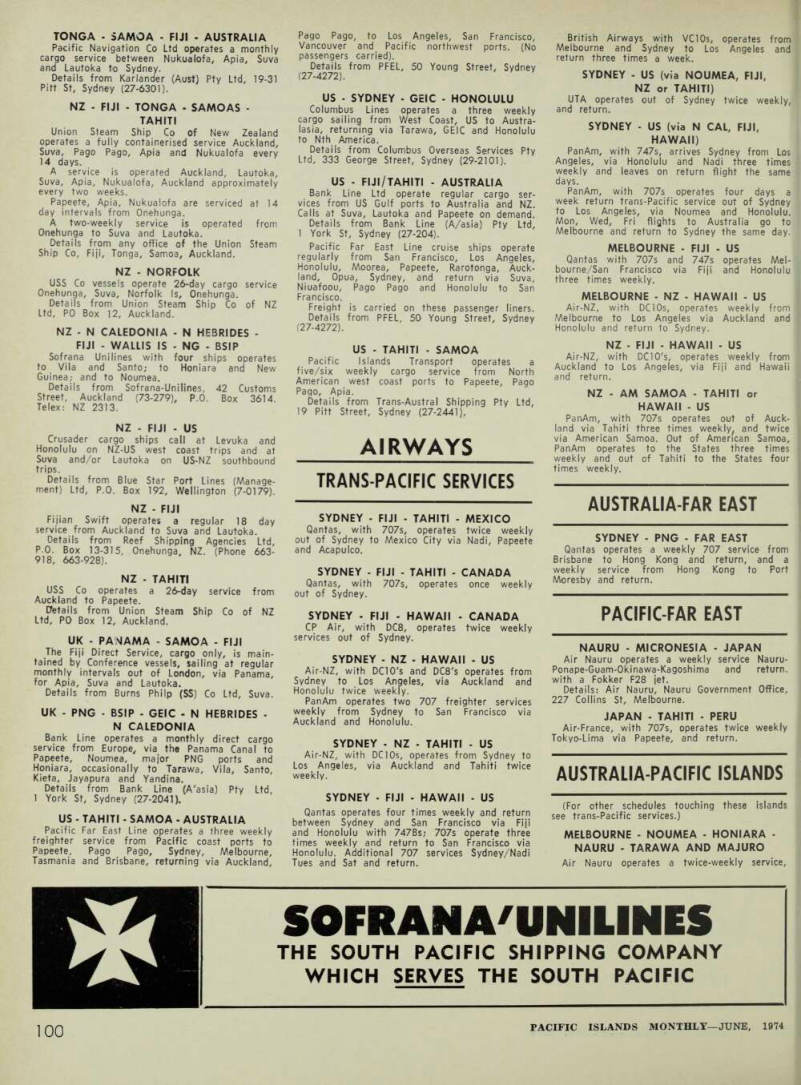
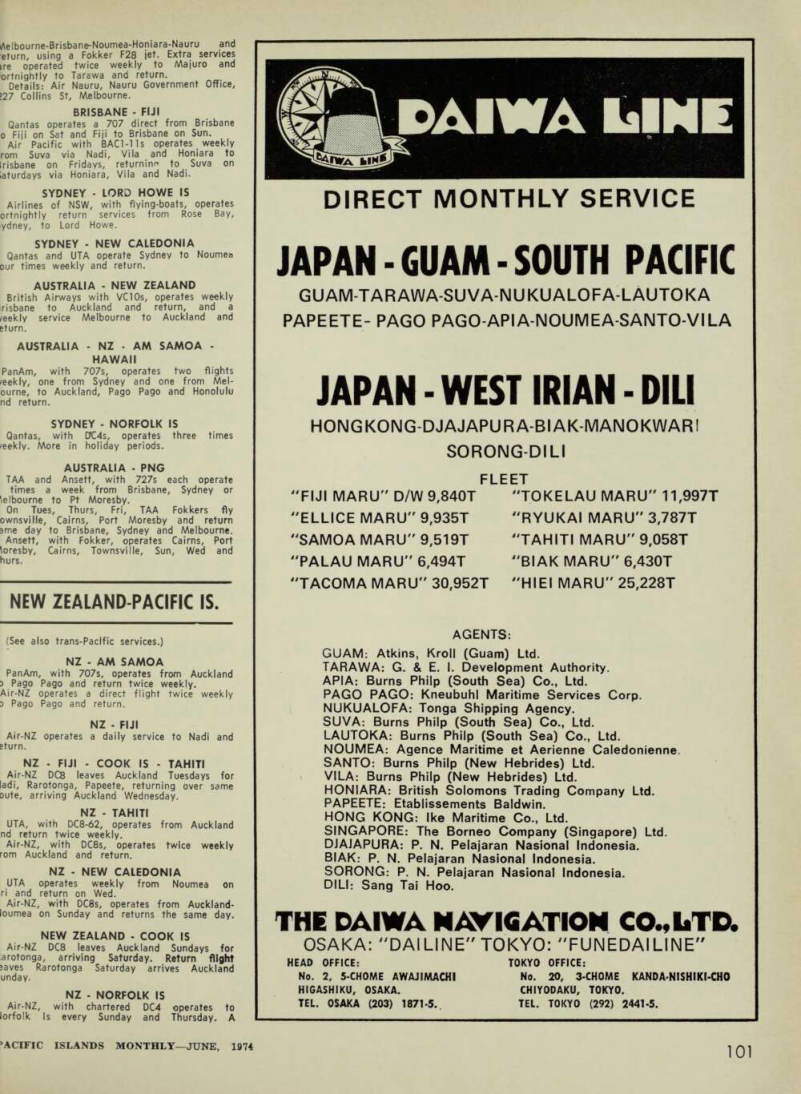
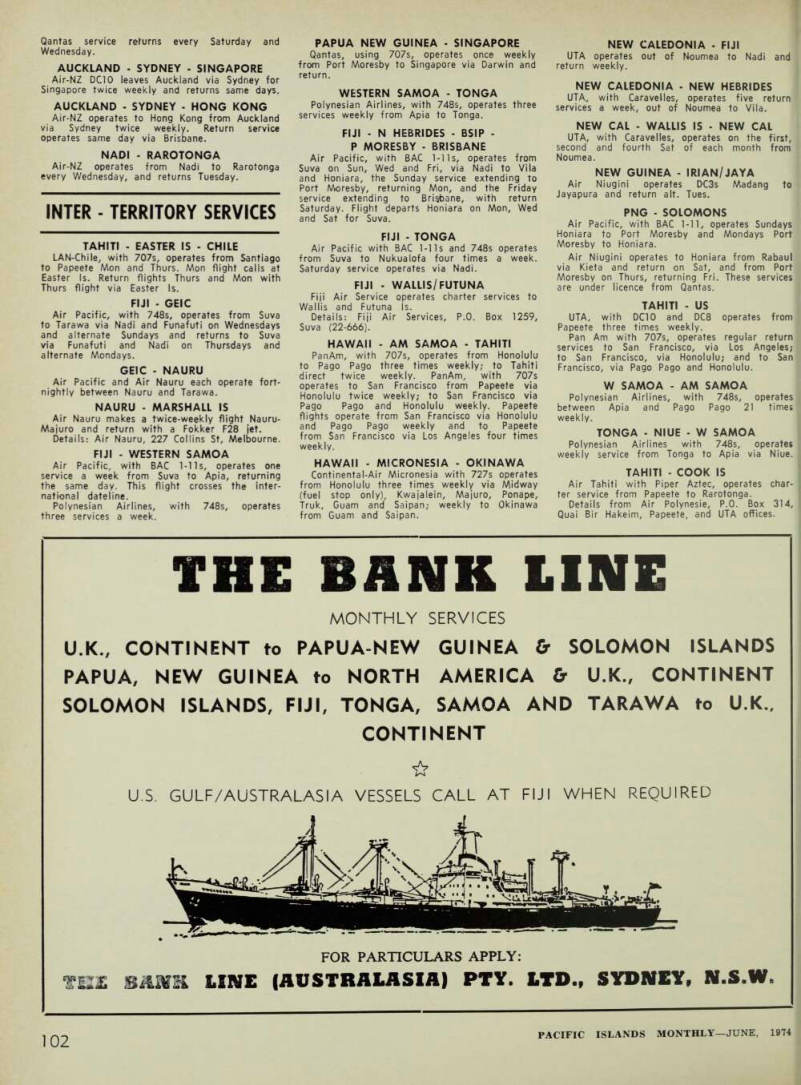
Shipping
Aust - West Irian
Karlander New Guinea Line operates cargo service every nine weeks from Sydney to Jayapura.
Details: Karlander (Aust) Pty Ltd, 19-31 Pitt Street, Sydney (27-6301).
SYDNEY - NZ - FIJI/TAHITI - UK Chandris Lines maintains a twice-monthly passenger service from Sydney via NZ, Suva or Papeete.
Details from Chandris Lines, 135 King Street, Sydney (28-2451).
SYDNEY - LORD HOWE IS - NORFOLK
Is-New Caledonia
Karlander operates 21-day service from Sydney to Lord Howe and Norfolk Is.
Details from Karlander (Aust) Pty Ltd, 19-31 Pitt Street, Sydney (27-6301).
Chargeurs Caledoniens operates three-weekly cargo service Sydney-Norfolk Island-Noumea.
Details; Hetherington Kingsbury Pty Ltd, 37-49 Pitt Street, Sydney (27-1671).
SYDNEY • NZ - FIJI - HAWAII -
Canada - Us
P and 0 liners call at Auckland, Suva and Honolulu on eastbound and westbound voyages between Sydney and the US; occasional calls at Pago Pago, Tonga, Papeete, Yokohama, Vila, Hong Kong, Honiara.
Details from P & 0 Australia Ltd, 55 Hunter Street, Sydney (2-0317).
SYDNEY - NZ - FIJI - TONGA - VILA -
Noumea - Samoas ■ Tahiti
Shaw Savill liners cruise in the Pacific sailing from Australia and New Zealand calling at Suva, Lautoka, Tonga, Vila, Noumea, Pago Pago, Tahiti, Apia, Vavau.
Details: Shaw Savill Line, 8a Castlereagh St, Sydney (28-1481).
Sitmar Cruises operates a South Pacific cruise programme to include most of the above ports plus the Solomons.
Details from Sitmar Line (Australia) Pty Ltd, 22-30 Bridge Street, Sydney (27-4521).
Royal Viking Line, with luxury cruise ships Royal Viking Sea, Star and Sky, circles the Pacific from the US west coast, calling at most of the above ports plus Port Moresby and Rarotonga.
Details from Wilh. Wilhelmsen Agency Pty Ltd, 13-15 Bridge Street, Sydney (2-0517).
Australia - New Caledonia
Sofrana-Unilines operates a fortnightly service from Sydney to Noumea.
Details from Sofrana-Unilines, 37 Pitt Street, Sydney (27-2031).
Australia - New Caledonia -
New Hebrides
Sofrana-Unilines' ships call regularly at
Melbourne, Sydney, Noumea, Vila and Santo.
Details from Sofrana-Unilines, 37-49 Pitt Street Sydney (27-2031).
Polynesie maintains three-weekly passenger sailings—Sydney, Noumea, Vila and Santo.
Details from Omni Traders & Brokers Pty Limited, 261 George Street, Sydney (241-2872/6).
Australia - Fiji
Sofrana-Unilines operates Sydney-Fiji every 24 days.
Details from Sofrana-Unilines, 37 Pitt Street, Sydney (27-2031).
Nauru Pacific Line operates cargo/passenger service to Fiji and South Pacific ports.
Details from Nauru Pacific Line, 227 Collins Street, Melbourne (654-4977); Interocean Swire, 8 Spring Street, Sydney (20-522); Dalgety Shipping, 291 Elizabeth Street, Brisbane (31-0331).
United Steamships Ltd operates a monthly service Sydney/Suva and Lautoka.
Details: Hetherington Kingsbury Pty Ltd, 37-49 Pitt Street, Sydney (27-1671).
Karlander (Aust) Pty Ltd operates three weekly cargo services from Sydney for Suva and Lautoka.
Details from Karlander (Aust) Pty Ltd, 19-31 Pitt Street, Sydney (27-6301.; Dalgety Shipping, 461 Bourke St, Melbourne (600731); Burns Philp (SS) Co Ltd, Suva and Lautoka.
Australia - Tahiti
South Pacific United Lines with Lama and Newfoundland maintains a regular service from Sydney to Papeete.
Details from Omni Traders & Brokers Pty Limited, 261 George Street, Sydney (241-2872/6).
Australia ■ Png - Bsip
Conpac Pacific Express (Burns Philp and AWP Line) operates three-weekly cargo service from Melbourne (direct) Sydney and Brisbane to Port Moresby and Lae. Tenos calls at Brisbane southbound.
Details from Burns Philp and Co Ltd, 7 Bridge Street, Sydney (2-0547).
New Guinea Australia Line's vessels operate from Sydney and Brisbane to Port Moresby, Lae, Rabaul, Kavieng, Honiara, Kieta, Gizo, Madang and Samarai.
Details from Interocean Swire, 8 Spring Street, Sydney (20-522).
New Guinea Express Lines with two ships operates three-weekly Melbourne, Sydney, Brisbane, Port Moresby, Lae, Rabaul.
Details from New Guinea Express Lines, 37 Pitt St, Sydney (241-1396) and 72 Eagle St, Brisbane (21-9333), Westralian Farmers Trans port Pty Ltd, 459 Collins St, Melbourne (35-4366), Breckwoldt's Shipping Agencies in Port Moresby, Lae, Rabaul.
Karlander New Guinea Line's two cargo vessels call at Melbourne, Sydney, Brisbane, Lae, Madang, Wewak, Manus, Kimbe.
Details from Karlander (Aust) Pty Ltd, 19-31 Pitt Street, Sydney (27-6301); Dalgety Shipping, 461 Bourke St, Melbourne (600731).
Australia - Nauru ■ Marshall
Islands ■ Geic - Guam
Nauru Pacific Line operates regular six
weekly cargo/passenger liner service from Melbourne and Sydney to Nauru, Majuro, Tarawa and Guam.
Details from Nauru Pacific Line, 227 Collins Street, Melbourne (654-4977); Interocean Swire, 8 Spring Street, Sydney (20-522).
Australia - Png - Far East
E. and A. Line passenger ships make monthly round voyages from Melbourne, Sydney and Brisbane calling at Port Moresby, Manila, Hong Kong, Keelung, Kobe, Yokohama (Tokyo), and Rabaul.
Details from P & 0 Australia Ltd, 55 Hunter Street, Sydney (2-0317).
FAR EAST - FIJI - NEW ZEALAND New Zealand Unit Express (CNC, MOL, RIL) operates a three-weekly cargo service from Hong Kong to Lautoka, Suva, NZ ports, Manila, Kaoshiung, Keelung, Hong Kong.
Details from Interocean Swire, 8 Spring Street, Sydney (20-522).
Royal Interocean Lines operates monthly pass enger/cargo service with three ships from NZ to Bangkok, Pt Kelang, Singapore, Djakarta to Fiji (alt. months) and NZ.
Details from Interocean Australia Services, 261 George Street, Sydney (2-0573), Burns Philp (SS) Co Ltd, Suva and Lautoka.
FAR EAST - PNG - BSI - NEW HEBRIDES ■
Noumea - Tahiti - Samoa
China Navigation Co's vessels operate a regular cargo service from Hong Kong to Rabaul, Wewak, Madang, Lae, Port Moresby, Honiara, New Hebrides, Noumea, Papeete and Samoa.
Details from Interocean Swire, 8 Spring Street, Sydney (20-522).
North Europe - New Caledonia
Hamburg/Sued operates monthly cargo services from Dunkirk and Le Havre to Noumea, via Panama.
Details from Columbus Overseas Services Pty Ltd, 333 George Street, Sydney (29-2101).
Messageries Maritimes operates five cargo services a month from north and Mediterranean European ports to Papeete and Noumea.
Details from Messageries Maritimes, 332 Pitt Street, Sydney (61-6664).
JAPAN - GUAM • FIJI - SAMOA -
N Caledonia - N Hebrides
Daiwa Line runs a monthly cargo service from Japan via Guam to Suva, Lautoka, Pago Pago, Apia, Vila, Santo and Noumea.
Details from Burns Philp (SS) Co Ltd, Suva.
New Zealand - Cook Is
Lorena, owned by Cook Islands Shipping Co Ltd, operates three-weekly freight service between Auckland and Rarotonga with oc casional calls at Aitutaki and Lyttleton.
Details: Silk and Boyd, Box 131, Rarotonga, or CIS Co, Box 448, Auckland.
TONGA - SAMOA - FIJI - AUSTRALIA Pacific Navigation Co Ltd operates a monthly cargo service between Nukualofa, Apia, Suva and Lautoka to Sydney.
Details from Karlander (Aust) Pty Ltd, 19-31 Pitt St, Sydney (27-6301).
NZ - FIJI - TONGA - SAMOAS -
Tahiti
Union Steam Ship Co of New Zealand operates a fully containerised service Auckland, Suva, Pago Pago, Apia and Nukualofa every 14 days.
A service is operated Auckland, Lautoka, Suva, Apia, Nukualofa, Auckland approximately every two weeks.
Papeete, Apia, Nukualofa are serviced at 14 day intervals from Onehunga.
A two-weekly service is operated from Onehunga to Suva and Lautoka.
Details from any office of the Union Steam Ship Co, Fiji, Tonga, Samoa, Auckland.
Nz - Norfolk
USS Co vessels operate 26-day cargo service Onehunga, Suva, Norfolk Is, Onehunga.
Details from Union Steam Ship Co of NZ Ltd, PO Box 12, Auckland.
NZ - N CALEDONIA - N HEBRIDES - FIJI - WALLIS IS - NG - BSIP Sofrana Unilines with four ships operates to Vila and Santo; to Honiara and New Guinea,- and to Noumea.
Details from Sofrana-Unilines, 42 Customs Street, Auckland (73-279), P.O. Box 3614.
Telex: NZ 2313.
Nz - Fiji - Us
Crusader cargo ships call at Levuka and Honolulu on NZ-US west coast trips and at Suva and/or Lautoka on US-NZ southbound trips.
Details from Blue Star Port Lines (Manage ment) Ltd, P.O. Box 192, Wellington (7-0179).
Nz - Fiji
Fijian Swift operates a regular 18 day service from Auckland to Suva and Lautoka.
Details from Reef Shipping Agencies Ltd, P.O. Box 13-315, Onehunga, NZ. (Phone 663- 918, 663-928).
Nz - Tahiti
USS Co operates a 26-day service from Auckland to Papeete.
Details from Union Steam Ship Co of NZ Ltd, PO Box 12, Auckland.
UK - PANAMA - SAMOA - FIJI The Fiji Direct Service, cargo only, is main tained by Conference vessels, sailing at regular monthly intervals out of London, via Panama, for Apia, Suva and Lautoka.
Details from Burns Philp (SS) Co Ltd, Suva.
UK - PNG - BSIP - GEIC - N HEBRIDES -
N Caledonia
Bank Line operates a monthly direct cargo service from Europe, via the Panama Canal to Papeete, Noumea, major PNG ports and Honiara, occasionally to Tarawa, Vila, Santo, Kieta, Jayapura and Yandina.
Details from Bank Line (A'asia) Pty Ltd, 1 York St, Sydney (27-2041).
US - TAHITI - SAMOA - AUSTRALIA Pacific Far East Line operates a three weekly freighter service from Pacific coast ports to Papeete, Pago Pago, Sydney, Melbourne, Tasmania and Brisbane, returning via Auckland,
Pago Pago, to Los Angeles, San Francisco, Vancouver and Pacific northwest ports. (No passengers carried).
Details from PFEL, 50 Young Street, Sydney (27-4272).
US - SYDNEY ■ GEIC - HONOLULU Columbus Lines operates a three weekly cargo sailing from West Coast, US to Austra lasia, returning via Tarawa, GEIC and Honolulu to Nth America.
Details from Columbus Overseas Services Pty Ltd, 333 George Street, Sydney (29-2101).
Us - Fiji/Tahiti ■ Australia
Bank Line Ltd operate regular cargo ser vices from US Gulf ports to Australia and NZ.
Calls at Suva, Lautoka and Papeete on demand.
Details from Bank Line (A/asia) Pty Ltd, 1 York St, Sydney (27-204).
Pacific Far East Line cruise ships operate regularly from San Francisco, Los Angeles, Honolulu, Moorea, Papeete, Rarotonga, Auck land, Opua, Sydney, and return via Suva, Niuafoou, Pago Pago and Honolulu to San Francisco.
Freight is carried on these passenger liners.
Details from PFEL, 50 Young Street, Sydney (27-4272).
Us - Tahiti - Samoa
Pacific Islands Transport operates a five/six weekly cargo service from North American west coast ports to Papeete, Pago Pago, Apia.
Details from Trans-Austral Shipping Pty Ltd, 19 Pitt Street, Sydney (27-2441),.
Airways
Trans Pacific Services
SYDNEY - FIJI ■ TAHITI - MEXICO Qantas, with 7075, operates twice weekly out of Sydney to Mexico City via Nadi, Papeete and Acapulco.
SYDNEY - FIJI - TAHITI - CANADA Qantas, with 7075, operates once weekly out of Sydney.
SYDNEY ■ FIJI - HAWAII - CANADA CP Air, with DCS, operates twice weekly services out of Sydney.
SYDNEY - NZ - HAWAII - US Air-NZ, with DCIO's and DCB's operates from Sydney to Los Angeles, via Auckland and Honolulu twice weekly.
PanAm operates two 707 freighter services weekly from Sydney to San Francisco via Auckland and Honolulu.
SYDNEY - NZ - TAHITI ■ US Air-NZ, with DC 10s, operates from Sydney to Los Angeles, via Auckland and Tahiti twice weekly.
SYDNEY - FIJI - HAWAII - US Qantas operates four times weekly and return between Sydney and San Francisco via Fiji and Honolulu with 74785; 707 s operate three times weekly and return to San Francisco via Honolulu. Additional 707 services Sydney/Nadi Tues and Sat and return.
British Airways with VClOs, operates from Melbourne and Sydney to Los Angeles and return three times a week.
Sydney - Us (Via Noumea, Fiji,
Nz Or Tahiti)
UTA operates out of Sydney twice weekly, and return.
SYDNEY - US (via N CAL, FIJI,
Hawaii)
PanAm, with 7475, arrives Sydney from Los Angeles, via Honolulu and Nadi three times weekly and leaves on return flight the same days.
PanAm, with 707 s operates four days a week return trans-Pacific service out of Sydney to Los Angeles, via Noumea and Honolulu.
Mon, Wed, Fri flights to Australia go to Melbourne and return to Sydney the same day.
Melbourne - Fiji - Us
Qantas with 707 s and 747 s operates Mel bourne/San Francisco via Fiji and Honolulu three times weekly.
MELBOURNE ■ NZ - HAWAII - US Air-NZ, with DClOs, operates weekly from Melbourne to Los Angeles via Auckland and Honolulu and return to Sydney.
NZ - FIJI - HAWAII ■ US Air-NZ, with DCIO's, operates weekly from Auckland to Los Angeles, via Fiji and Hawaii and return.
NZ - AM SAMOA - TAHITI or
Hawaii - Us
PanAm, with 707 s operates out of Auck land via Tahiti three times weekly, and twice via American Samoa. Out of American Samoa, PanAm operates to the States three times weekly and out of Tahiti to the States four times weekly.
Australia-Far East
Sydney - Png ■ Far East
Qantas operates a weekly 707 service from Brisbane to Hong Kong and return, and a weekly service from Hong Kong to Port Moresby and return.
Pacific-Far East
Nauru - Micronesia ■ Japan
Air Nauru operates a weekly service Nauru- Ponape-Guam-Okinawa-Kagoshima and return, with a Fokker F2B jet.
Details: Air Nauru, Nauru Government Office, 227 Collins St, Melbourne.
Japan - Tahiti - Peru
Air-France, with 7075, operates twice weekly Tokyo-Lima via Papeete, and return.
Australia-Pacific Islands
(For other schedules touching these islands see trans-Pacific services.)
Melbourne - Noumea - Honiara -
Nauru - Tarawa And Majuro
Air Nauru operates a twice-weekly service.
lAelbourne-Brisbane-Noumea-Honiara-Nauru and eturn, using a Fokker F2B jet. Extra services ire operated twice weekly to Majuro and ortnightly to Tarawa and return.
Details: Air Nauru, Nauru Government Office, >27 Collins St, Melbourne.
Brisbane - Fiji
Qantas operates a 707 direct from Brisbane o Fiji on Sat and Fiji to Brisbane on Sun.
Air Pacific with BACI-lls operates weekly rom Suva via Nadi, Vila and Honiara to irisbane on Fridays, returning to Suva on laturdays via Honiara, Vila and Nadi.
Sydney ■ Lord Howe Is
Airlines of NSW, with flying-boats, operates ortnightly return services from Rose Bay, ydney, to Lord Howe.
Sydney - New Caledonia
Qantas and UTA operate Sydney to Noumea our times weekly and return.
Australia - New Zealand
British Airways with VClOs, operates weekly risbane to Auckland and return, and a weekly service Melbourne to Auckland and eturn.
AUSTRALIA - NZ - AM SAMOA -
Hawaii
PanAm, with 7075, operates two flights weekly, one from Sydney and one from Mel ourne, to Auckland, Pago Pago and Honolulu nd return.
Sydney - Norfolk Is
Qantas, with DC4s, operates three times reekly. More in holiday periods.
Australia - Png
TAA and Ansett, with 727 s each operate times a week from Brisbane, Sydney or \elbourne to Pt Moresby.
On Tues, Thurs, Fri, TAA Fokkers fly ownsville, Cairns, Port Moresby and return erne day to Brisbane, Sydney and Melbourne.
Ansett, with Fokker, operates Cairns, Port loresby, Cairns, Townsville, Sun, Wed and hurs.
New Zealand-Pacific Is.
(See also trans-Padfic services.)
Nz - Am Samoa
PanAm, with 7075, operates from Auckland 3 Pago Pago and return twice weekly.
Air-NZ operates a direct flight twice weekly 3 Pago Pago and return.
Nz - Fiji
Air-NZ operates a daily service to Nadi and eturn.
NZ - FIJI ■ COOK IS - TAHITI Air-NZ DCS leaves Auckland Tuesdays for ladi, Rarotonga, Papeete, returning over same oute, arriving Auckland Wednesday.
Nz - Tahiti
UTA, with DCB-62, operates from Auckland nd return twice weekly.
Air-NZ, with DCSs, operates twice weekly rom Auckland and return.
Nz - New Caledonia
UTA operates weekly from Noumea on ri and return on Wed.
Air-NZ, with DCSs, operates from Auckland loumea on Sunday and returns the same day.
New Zealand - Cook Is
Air-NZ DCS leaves Auckland Sundays for arotonga, arriving Saturday. Return flight javes Rarotonga Saturday arrives Auckland unday.
Nz - Norfolk Is
Air-NZ, with chartered DC4 operates to lorfolk Is every Sunday and Thursday. A
Qantas service returns every Saturday and Wednesday.
Auckland - Sydney - Singapore
Air-NZ DCIO leaves Auckland via Sydney for Singapore twice weekly and returns same days.
Auckland - Sydney - Hong Kong
Air-NZ operates to Hong Kong from Auckland via Sydney twice weekly. Return service operates same day via Brisbane.
Nadi - Rarotonga
Air-NZ operates from Nadi to Rarotonga every Wednesday, and returns Tuesday.
Inter - Territory Services
Tahiti - Easter Is ■ Chile
LAN-Chile, with 7075, operates from Santiago to Papeete Mon and Thurs. Mon flight calls at Easter Is. Return flights Thurs and Mon with Thurs flight via Easter Is.
Fiji - Geic
Air Pacific, with 7485, operates from Suva to Tarawa via Nadi and Funafuti on Wednesdays and alternate Sundays and returns to Suva via Funafuti and Nadi on Thursdays and alternate Mondays.
Geic - Nauru
Air Pacific and Air Nauru each operate fort nightly between Nauru and Tarawa.
Nauru - Marshall Is
Air Nauru makes a twice-weekly flight Nauru- Majuro and return with a Fokker F2B jet.
Details: Air Nauru, 227 Collins St, Melbourne.
Fiji - Western Samoa
Air Pacific, with BAC 1-lls, operates one service a week from Suva to Apia, returning the same day. This flight crosses the inter national dateline.
Polynesian Airlines, with 7485, operates three services a week.
Papua New Guinea - Singapore
Qantas, using 7075, operates once weekly from Port Moresby to Singapore via Darwin and return.
Western Samoa - Tonga
Polynesian Airlines, with 7485, operates three services weekly from Apia to Tonga.
FIJI ■ N HEBRIDES - BSIP -
P Moresby - Brisbane
Air Pacific, with BAC 1-1 Is, operates from Suva on Sun, Wed and Fri, via Nadi to Vila and Honiara, the Sunday service extending to Port Moresby, returning Mon, and the Friday service extending to Brisbane, with return Saturday. Flight departs Honiara on Mon, Wed and Sat for Suva.
Fiji - Tonga
Air Pacific with BAC 1-lls and 748 s operates from Suva to Nukualofa four times a week.
Saturday service operates via Nadi.
Fiji - Wallis/Futuna
Fiji Air Service operates charter services to Wallis and Futuna Is.
Details: Fiji Air Services, P.O. Box 1259, Suva (22-666).
Hawaii - Am Samoa ■ Tahiti
PanAm, with 7075, operates from Honolulu to Pago Pago three times weekly; to Tahiti direct twice weekly. PanAm, with 707 s operates to San Francisco from Papeete via Honolulu twice weekly; to San Francisco via Pago Pago and Honolulu weekly. Papeete flights operate from San Francisco via Honolulu and Pago Pago weekly and to Papeete from San Francisco via Los Angeles four times weekly.
Hawaii - Micronesia - Okinawa
Continental-Air Micronesia with 727 s operates from Honolulu three times weekly via Midway (fuel stop only), Kwajalein, Majuro, Ponape, Truk, Guam and Saipan; weekly to Okinawa from Guam and Saipan.
New Caledonia - Fiji
UTA operates out of Noumea to Nadi and return weekly.
New Caledonia - New Hebrides
UTA, with Caravelles, operates five return services a week, out of Noumea to Vila.
NEW CAL ■ WALLIS IS ■ NEW CAL UTA, with Caravelles, operates on the first, second and fourth Sat of each month from Noumea.
New Guinea - Irian/Jaya
Air Niugini operates DC3s Madang to Jayapura and return alt. Tues.
Png - Solomons
Air Pacific, with BAG 1-11, operates Sundays Honiara to Port Moresby and Mondays Port Moresby to Honiara.
Air Niugini operates to Honiara from Rabaul via Kieta and return on Sat, and from Port Moresby on Thurs, returning Fri. These services are under licence from Qantas.
Tahiti - Us
UTA, with DCIO and DCS operates from Papeete three times weekly.
Pan Am with 7075, operates regular return services to San Francisco, via Los Angeles; to San Francisco, via Honolulu; and to San Francisco, via Pago Pago and Honolulu.
W Samoa - Am Samoa
Polynesian Airlines, with 7485, operates between Apia and Pago Pago 21 times weekly.
Tonga - Niue - W Samoa
Polynesian Airlines with 7485, operates weekly service from Tonga to Apia via Niue.
Tahiti • Cook Is
Air Tahiti with Piper Aztec, operates char ter service from Papeete to Rarotonga.
Details from Air Polynesie, P.O. Box 314, Quai Bir Hakeim, Papeete, and UTA offices.
Internal Services
Fiji
Air Pacific, with HS74Bs, BAC 1-1 Is and lerons operates regular services to Labasa, aveuni, Nadi, Suva and Savusavu.
Fiji Air Services, with Britten-Norman slander and Beechcraft Baron aircraft, operates ervices to Castaway and Plantation village esorts. The Fijian hotel, Korolevu Beach hotel, lagship Beachcomber hotel, Levuka, Lakeba, 'atukoula. Charter flights operate to anywhere i the Pacific.
Details: Fiji Air Services, P.O. Box 1259, uva (telephone 22-666).
French Polynesia
Air Polynesie, with Fokker F 27 Friendship, win Otters and Islanders, operates to lora Bora, Huahine, Moorea, Rangiroa, Raiatea, Aanihi, Takapoto, Hiva Oa, Ua Huka, Maupiti nd Tubuai, Rurutu.
Details from Air Polynesie, P.O. Box 314, luai Bir Hakeim, Papeete, and UTA offices.
Air Tahiti, with light aircraft operates huttle service from Papeete to Moorea and barter service to Raiatea, Bora Bora, Huahine, langiroa and Manihi.
Guam - Us Trust Territory
Continental-Air Micronesia with 727 s and >C6s operates regular service connecting Hono ulu, Okinawa and Guam with Saipan, Rota, ap, Palau, Truk, Ponape, Kwaialein and Aajuro.
Details from Air Micronesia, Saipan.
Air Pacific International Inc (not connected vith the Fiji-based Air Pacific) with Piper Javajo and a deHavilland Heron, operates egular services linking Guam, Saipan, Tinian, md Rota, and charter services are available to »ther Trust Territory islands.
Details, Air Pacific International Inc, P.O. lox 7689, Tamuning, Guam, 96911, USA.
Lagoon Aviation Inc with Grumman Wid leons, operate charter services for the Mar balls district, based on Majuro.
Gilbert And Ellice Islands
Air Pacific, with Herons, operates regular ;ervices between Tarawa, Butaritari, North fabiteuea and Abemama.
Papua New Guinea
Air Niugini, with Fokkers and DC3s, operates i -network of services between all major centres n Papua New Guinea. These services connect with Ansett and TAA's 727 Australia-PNG services.
DC3 aircraft are available for charter within
Png.
Aerial Tours operates in Central, Western, Gulf and Sepik districts. Aircraft are based at: Port Moresby, Kerema, Daru, Kiunga, Vanimo, Wewak.
T.A.L. (GV) —Territory Airlines Pty Limited operates scheduled services and charter flights from Goroka, Kundiawa, Madang, Wewak, Vanimo, Mt Hagen, Mendi to Highlands, Sepik and Coastal areas. Talco Territory Travel Ser vice of Papua New Guinea —Twin Otter Tourist flights throughout Papua New Guinea.
Further details from T.A.L., P.O. Box 108, Goroka, Papua New Guinea.
Melanesian Airline Company Pty Limited (Macair) operates throughout Papua New Guinea.
Details: PO Box 556, Lae.
Crowley Airways Pty Ltd operates through out Papua New Guinea. Details: P.O. Box 34, Lae. Offices also in Rabaul, Kieta, Kavieng, Hoskins, Port Moresby.
Bougainville Air Services operates daily throughout Bougainville. There are nine regular services Kieta-Buin. Details: Arawa, Phone 956-159; Buka, Phone 16. Box 298, PO, Kieta.
New Caledonia
Air Caledonie with Twin Otters, and Is landers operates regular services to Houal
lou. Isle of Pines, Isle Ouen, Kone, Koumac, Lifou, Mare, Noumea, Ouvea Touho, Mueo, Belep, Tiga.
Details from Air Caledonie, Noumea.
New Hebrides
Air Melanesiae with Britten-Norman Islanders and Trislander operates to Santo, Malekula Norsup and Lamap, Aoba (Walaha and Longana), Pentecost (Lonorore), Erromanga, Tongoa, Aneityum, Tanna, Epi, Sola and Vila. Direct connections are available to and from Santo for all international flights arriving in Vila.
Details from Air Melanesiae P.O. Box 72.
Solomon Islands
Solair, with Beech Barons and Islanders operates to Auki, Avu Avu, Babanakira, Bara koma, Bellona Is, Fera Is, Gizo, Honiara, Kira Kira. Marau, Munda, Parasi, Sege, Yandina,
Santa Cruz, Mono, Rennell Is, Choiseul Bay, Ballalae and Ring! Cove.
Details from Solomon Islands Airways Ltd, Box 23, Honiara, BSIP.
Tonga
Tonga Internal Air Service, with Britten-Norman Islander aircraft, operates from Fua'amotu, (air oort for Nukualofa) to Vava'u (daily except Sunday) and Eua (twice daily except Sunday).
Aircraft available for sight-seeing and regional charters.
Details from Tonga Tourist and Development Co, PO Box 91, Nukualofa, Tonga.
Cook Islands
Cook Islands Airways Ltd, with a Britten- Norman Islander, operates seven flights a week between Rarotonga and Aitutaki. Service will be extended to Atiu, Mangaia and Mitiaro when airstrips are built.
Advertisements & other items, pp. 101-105 (2 items)
Interocean-New Zealand Ltd.
STEAMSHIP OPERATORS • AGENTS • BROKERS
TELEX. NZ3791 • ANS. BACK; PLYZETIM • TELEGRAPHIC ADDRESS: ZEAMARINER WELLINGTON • TELEPHONE: 71-976 • P.O. BOX 3637, WELLINGTON, N.Z.
LEVEL M. WILLIAMS PARKING CENTRE • BOULCOTT STREET. WELLINGTON
SOFRANA'UNILIHES
THE SOUTH PACIFIC SHIPPING COMPANY
WHICH SERVES THE SOUTH PACIFIC
m ■
DAIWA LINE
DIRECT MONTHLY SERVICE
JAPAN - GUAM - SOUTH PACIFIC
GUAM-TARAWA-SUVA-NUKUALOFA-LAUTOKA
PAPEETE- PAGO PAGO-APIA-NOUMEA-SANTO-VILA
JAPAN - WEST IRIAN - DILI
HONGKONG-DJAJAPURA-BIAK-MANOKWARI
SORONG-DILI
FLEET
"FIJI MARU" D/W 9,8401
"ELLICE MARU" 9,935 T
"SAMOA MARU" 9,519 T
"PALAU MARU" 6,494 T
"TACOMA MARU" 30,952 T
"TOKELAU MARU" 11,997 T
"RYUKAI MARU" 3,787 T
"TAHITI MARU" 9,058 T
"BIAKMARU" 6,430 T
"HIEI MARU" 25,228 T
AGENTS:
GUAM: Atkins, Kroll (Guam) Ltd.
TARAWA: G. & E. I. Development Authority.
APIA; Burns Philp (South Sea) Co., Ltd.
PAGO PAGO: Kneubuhl Maritime Services Corp.
NUKUALOFA: Tonga Shipping Agency.
SUVA: Burns Philp (South Sea) Co., Ltd.
LAUTOKA: Burns Philp (South Sea) Co., Ltd.
NOUMEA: Agence Maritime et Aerienne Caledonienne.
SANTO: Burns Philp (New Hebrides) Ltd.
VILA: Burns Philp (New Hebrides) Ltd.
HONIARA: British Solomons Trading Company Ltd.
PAPEETE: Etablissements Baldwin.
HONG KONG: Ike Maritime Co., Ltd.
SINGAPORE: The Borneo Company (Singapore) Ltd.
DJAJAPURA: P. N. Pelajaran Nasional Indonesia.
BIAK: P. N. Pelajaran Nasional Indonesia.
SORONG: P. N. Pelajaran Nasional Indonesia.
DILI: Sang Tai Hoo.
THE DAIWA NAVIGATION CO.,LTD.
OSAKA: "DAI LINE" TOKYO: "FUNEDAI LINE"
HEAD OFFICE: TOKYO OFFICE:
No. 2, 5-CHOME AWAJIMACHI No. 20, 3-CHOME KANDA NISHIKI-CHO
HIGASHIKU, OSAKA. CHIYODAKU, TOKYO.
TEL. OSAKA (203) 1871-5. TEL. TOKYO (292) 2441-5.
THE BANK LINE
MONTHLY SERVICES
U.K., CONTINENT to PAPUA-NEW GUINEA & SOLOMON ISLANDS PAPUA, NEW GUINEA to NORTH AMERICA & U.K., CONTINENT SOLOMON ISLANDS, FIJI, TONGA, SAMOA AND TARAWA to U.K.,
CONTINENT
☆ US. GULF/AUSTRALASIA VESSELS CALL AT FIJI WHEN REQUIRED / &
FOR PARTICULARS APPLY:
TEE BANK LINE (AUSTRALASIA) PTY. LTD., SYDNEY, N.S.W.
PACIFIC /STANDS TRANSPORT LIM
Owners: Thor Dahls Hvalfangerselskap A/S —Sandcfjord, Norway.
MOTOR VESSEL "THORSISLE"
Regular Freight and Passenger Services between Pacific Coast Ports of U.S.A. and Canada and
TAHITI and SAMOA
GENERAL STEAMSHIP CORPORATION LTD.
General Agents 400 California Street, San Francisco, California, U.S.A.
APlA—Burns Philp (South Sea) Company. SYDNEY—Trans-Austral Shipping Pty. Ltd.
Ltd. SUVA—Burns Philp (South Sea) Company, PA na E tionale Tahitf. 9 *"'* Mant ' me lnt * r ’ LAE^ABAUL—Burns Philp (New Guinea) PAGO PAGO —6. H. C. Reid & Co. PORT VILA Comptoirs Francais de NOUMEA —Etablissements Ballande. Nouvelles Hebrides.
UNION STEAM SHIP CO. of N.Z.
LIMITED
Serving the Pacific for nearly 100 years.
Regular Sailings by Modern Vessels
From Auckland to Lautoka, Suva, Pago Pago, Apia, Niue, Vavau, Nukualofa. Also from Tauranga to Lautoka, Suva, Apia, Nukualofa. Regular sailings from Australia to New Zealand to enable transhipment of cargo to all the above ports.
Ship your cargo by a Union Company Vessel.
BRANCHES AT ALL MAIN AUSTRALIAN, NEW ZEALAND AND ISLAND PORTS.
101
’ACIFIC ISLANDS MONTHLY—JUNE, 1974
Nutshell
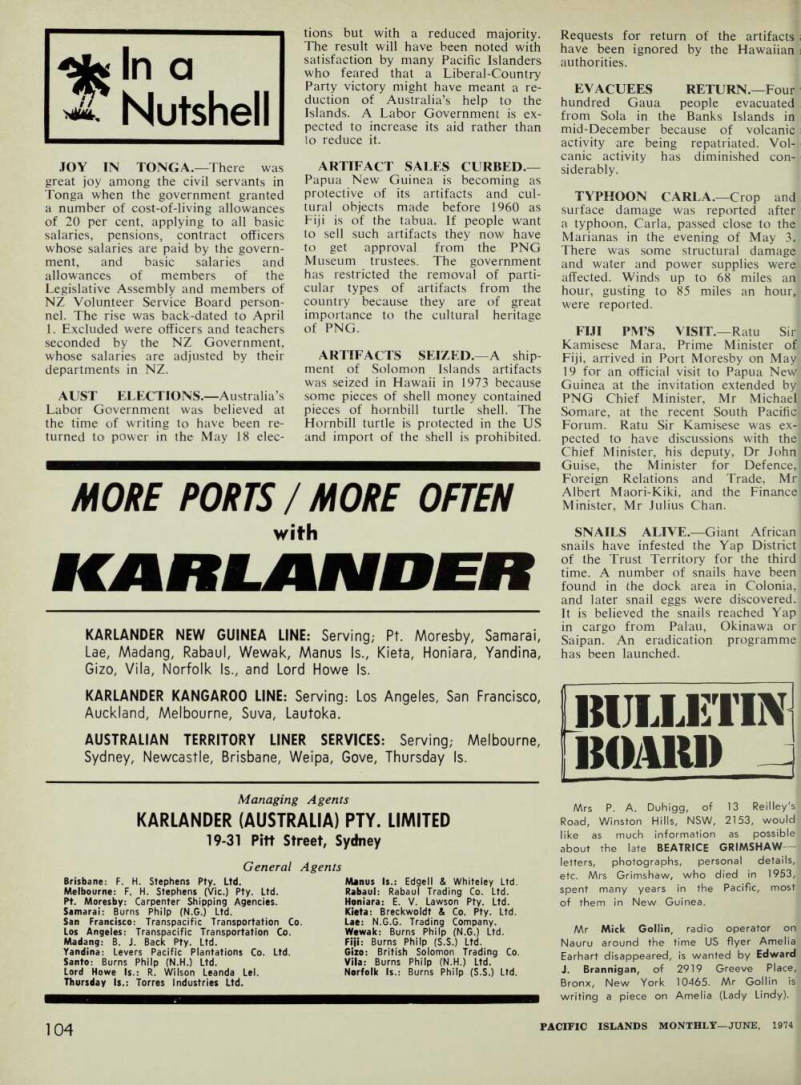
In a Nutshell
JOY IN TONGA.— There was great joy among the civil servants in Tonga when the government granted a number of cost-of-living allowances of 20 per cent, applying to all basic salaries, pensions, contract officers whose salaries are paid by the govern ment, and basic salaries and allowances of members of the Legislative Assembly and members of NZ Volunteer Service Board person nel. The rise was back-dated to April 1. Excluded were officers and teachers seconded by the NZ Government, whose salaries are adjusted by their departments in NZ.
AUST ELECTlONS.— Australia’s Labor Government was believed at the time of writing to have been re turned to power in the May 18 elec
tions but with a reduced majority.
The result will have been noted with satisfaction by many Pacific Islanders who feared that a Liberal-Country Party victory might have meant a re duction of Australia’s help to the Islands. A Labor Government is ex pected to increase its aid rather than to reduce it.
Artifact Sales Curbed.—
Papua New Guinea is becoming as protective of its artifacts and cul tural objects made before 1960 as Fiji is of the tabua. If people want to sell such artifacts they now have to get approval from the PNG Museum trustees. The government has restricted the removal of parti cular types of artifacts from the country because they are of great importance to the cultural heritage of PNG.
Artifacts Seized.— A Ship
ment of Solomon Islands artifacts was seized in Hawaii in 1973 because some pieces of shell money contained pieces of hornbill turtle shell. The Hornbill turtle is protected in the US and import of the shell is prohibited.
Requests for return of the artifacts have been ignored by the Hawaiian authorities.
Evacuees Return.— Four
hundred Gaua people evacuated from Sola in the Banks Islands in mid-December because of volcanic activity are being repatriated. VoH canic activity has diminished con siderably.
TYPHOON CARLA.— Crop and surface damage was reported after a typhoon, Carla, passed close to the Marianas in the evening of May 3.
There was some structural damage and water and power supplies were affected. Winds up to 68 miles an hour, gusting to 85 miles an hour,r were reported.
Fiji Pm’S Visit.— Ratu Sir
Kamisese Mara, Prime Minister of Fiji, arrived in Port Moresby on May 19 for an official visit to Papua New Guinea at the invitation extended by PNG Chief Minister, Mr Michael Somare, at the recent South Pacific Forum. Ratu Sir Kamisese was ex pected to have discussions with the Chief Minister, his deputy, Dr John Guise, the Minister for Defence, Foreign Relations and Trade, Mr Albert Maori-Kiki, and the Finance Minister, Mr Julius Chan.
SNAILS ALlVE. —Giant African snails have infested the Yap District of the Trust Territory for the third time. A number of snails have been found in the dock area in Colonia, and later snail eggs were discovered.
It is believed the snails reached Yap in cargo from Palau, Okinawa or Saipan. An eradication programme has been launched.
Bulletin
Board
Mrs P. A. Duhigg, of 13 Reilley's Road, Winston Hills, NSW, 2153, would like as much information as possible about the late BEATRICE GRIMSHAW — letters, photographs, personal details, etc. Mrs Grimshaw, who died in 1953, spent many years in the Pacific, most of them in New Guinea.
Mr Mick Gollin, radio operator on Nauru around the time US flyer Amelia Earhart disappeared, is wanted by Edward J. Brannigan, of 2919 Greeve Place, Bronx, New York 10465. Mr Gollin is writing a piece on Amelia (Lady Lindy).
Advertisements & other items, p. 106 (1 item)
T€A Rljuuoer
MORE PORTS / MORE OFTEN
with
KARLANDER NEW GUINEA LINE: Serving; Ft. Moresby, Samarai, Lae, Madang, Rabaul, Wewak, Manus Is., Kieta, Honiara, Yandina, Gizo, Vila, Norfolk Is., and Lord Howe Is.
KARLANDER KANGAROO LINE: Serving: Los Angeles, San Francisco,
Auckland, Melbourne, Suva, Lautoka.
AUSTRALIAN TERRITORY LINER SERVICES: Serving, Melbourne,
Sydney, Newcastle, Brisbane, Weipa, Gove, Thursday Is.
Managing Agents
KARLANDER (AUSTRALIA) PTY. LIMITED
19-31 Pitt Street, Sydney
General Agents Brisbane: F. H. Stephens Pty. Ltd.
Melbourne: F. H. Stephens (Vic.) Pty. Ltd.
Pt. Moresby: Carpenter Shipping Agencies.
Samarai: Burns Philp (N.G.) Ltd.
San Francisco; Transpacific Transportation Co.
Los Angeles: Transpacific Transportation Co.
Madang; B. J. Back Pty. Ltd.
Yandina: Levers Pacific Plantations Co. Ltd.
Santo; Burns Philp (N.H.) Ltd.
Lord Howe Is.: R. Wilson Leanda Lei.
Thursday Is.: Torres Industries Ltd.
Manus Is.: Edged & Whiteley Ltd.
Rabaul: Rabaul Trading Co. Ltd.
Honiara: E. V. Lawson Pty. Ltd.
Kieta: Breckwoldt & Co. Pty. Ltd.
Lae: N.G.G. Trading Company.
Wewak: Burns Philp (N.G.) Ltd.
Fiji: Burns Philp (S.S.) Ltd.
Gizo: British Solomon Trading Co.
Vila: Burns Philp (N.H.) Ltd.
Norfolk Is.: Burns Philp (S.S.) Ltd.
Socialists lose
reach election
Giscard d’Estaing is the new esident of France and is expected to here to most of the policies of the e President Pompidou, at least so r as overseas territories are con rned. But, had the decision been t to the New Caledonians and the ench Polynesians, Mitterand would ve become president.
The first round on May 5 gave s lead to M. Mitterand (50 per nt) among the autonomy-seeking thitians, against M. Chaban-Delmas 6 per cent) and Giscard d’Estaing 1 per cent) with 66 per cent of sctors voting.
In New Caledonia, where 64 per nt of electors voted, metropolitan ench influence is stronger and the mbined right wing came out on p—Chaban-Delmas (28 per cent), scard d’Estaing (25 per cent) out ted Mitterand (43 per cent). Cale nian autonomists campaigned for itterand, but no doubt the corn mist members of his United Left :re unpalatable to the locals.
However, voting in the second imd on May 19 in the straight fight tween d’Estaing and Mitterand, the ter won in both Polynesia and in ;w Caledonia but his narrow ijority in New Caledonia was upset the French settlers in the New whose votes are included in ; New Caledonia returns. These ve d’Estaing a win with 18,912 tes to Mitterand’s 18,711.
French Polynesia voted 19,086 1.23 per cent) for Mitterand and ,167 (48.77 per cent) for d’Estaing. allis was unashamedly for d’Estaing th 2,714 against 155 for Mitterand.
The metropolitan French were itching intently to see how French icific Islanders would vote, fearing at a vote for Mitterand could mean eir being cast adrift from France, itterand composed a special mess e for the overseas territories to tell em it was up to them to decide rat they wanted in their political itus.
Old Colonials Fade Away
From a Honiara correspondent
It might all be over by Christ mas. This is when the axe may fall on the old colonials. The last of the “African Retreads” and the “Malawi Mafia” are sadly pre paring to pack their bags and set out on the road to retirement.
This is one of the results of a recent meeting of the Permanent and Pensionable Officers Associa tion in Honiara. No fixed date was given for the disbanding of the service, but members were in general agreement that Whitehall would be giving them the Order of the Boot some time in the next few months.
The greatest impact of such a decision would undoubtedly be felt in the Solomons, which, after Hong Kong, is the largest em ployer of old colonials in Britain’s
dwindling overseas empire.
Even in the BSIP, however, there are less than 30 P & P officers still hanging on, and fore casts of their imminent departure will surprise none of them. The writing has been on the wall for some time, and the men con cerned have already received one tax-free award of £stg 11,000, “for loss of career prospects”. It is generally expected that they will be given another lump sum with which to speed their departure, to add to their generous pensions.
For most of them this is just another episode in an all-too familiar story. Many of them have already been ‘localised’ before, some more than once, as other former colonial possessions have gained their independence and got rid of—to them—their expatriate deadwood as soon as possible.
Nevertheless, any decision to disband the service will represent the end of an era. The present sedentary survivors are lineal des cendants of those colonial officers who opened up Africa and paci fied India in the golden days of empire. Even in the Solomons they can point with pride to such illustrious predecessors as the legendary C. M. Woodford, en trusted with the task of bringing the islands under control at the turn of the century while equip ped only with a whaleboat and a handful of native policemen; W.
R. Bell, murdered on Malaita in 1927, and Martin Clemens, Dis trict Officer and Coastwatcher on Guadalcanal in 1942.
It would be safe to say that these hardy characters would have had difficulty in recognising the present crop of middle-aged and disgruntled overseas civil ser vants currently bemoaning their lot. If they are chopped, they will have a great deal to moan about.
For the past few years the P & P officers in the Solomons have been fortune’s darlings. Pro motion, salary increases and ex cellent living and working con ditions have been theirs.
The word has been out in the BSIP for some time among the men at the top that the P & P officers were to be looked after.
They were the ‘professionals’, the dedicated career men, and as such were always to be given pre ference over the usually better qualified two-year contract ex patriates, and even over the in digenous officers.
As a result, for some time the old colonials have been running the protectorate, and the result, in too many cases, has been a de cade of well-meaning amateurism.
At least one important depart ment has taken such a bashing that it will need a lot of time and labour to sort it out.
The elected members in the
Governing Council/Legislative
Assembly have been growing in creasingly restless about incom petence in senior positions, and in particular over the extreme reluctance of most of the old colonials to train local successors and thus work themselves out of a job. Members and former mem bers like Solomon Mamaloni and Peter Salaka have been particu larly bitter about the long-service expatriates who, they claim, were building a paradise for themselves in the islands.
The evident desire in London to shuck off its overseas commit ments, allied to the intense dislike of the islanders for some of the more starchy of their colonial ad ministrators, means that the pre sence of the P & P officers is an embarrassment to everyone.
Advertisements & other items, p. 107 (2 items)
105
LCIFIC ISLANDS MONTHLY—JUNE, 1974
Turners
Supply Co
FRESH FRUIT & VEGETABLES
A Natural Way

for Your Skin to Look Lovelier
Today, with the advance in cosmetic chemistry it is possible to preserve your natural youth ful beauty almost indefinitely.
The evolution of a tropically moist oil blend which is com pletely compatible with the oil and moisture content of the skin, has made it possible to bring a smooth natural radiance to the complexion. When this remarkable beauty fluid is ap plied to the complexion, it rapidly sinks into the skin rather than ride ineffectively on the surface. It not only provides ideal protection to the skin, but it also assists in giving added smoothness and softness to the complexion.
Oil of Ulan moist oil blend should be smoothed on at every opportunity—in the morning, at night, and always before apply ing make-up. Ask at your phar
macy or beauty counter for Oil of Ulan today to give your skin the assistance it needs. The simple beauty treatment takes only a few minutes each day, but it will reward you with a naturally youthful complexion loveliness. * * * Your elbows are often as much exposed as your com plexion and require as much care and attention. For elbows that are smooth and pretty, mix up a little fresh lemon juice with white sugar grains. Gently rub this into your elbows in a circular motion. Leave on for a few minutes then rinse off and pat dry. To preserve the new skin, smooth on your Oil of Ulan to keep the elbows soft and free from dryness.
The desire to look pretty is a natural ex pression of femininity, so an awareness at an early age of correct beauty care will pay dividends, not only in your youth, but in the years ahead.
Islands People
Deaths of Islands People
Mr Bruce Palmer Mr Bruce Palmer, director of thej Fiji Museum from 1963 to 1973? died in Auckland on May 3 after 2 short illness. He had returned to NZ earlier this year after setting up s training course for the staff of islano museums at the East-West Centre; Honolulu.
Mr Palmer was responsible fon building the Fiji Museum into an internationally-recognised researcH institution. He did extensive researcH into Fijian archaeology and materiai culture, with emphasis on ceramics!
He also wrote extensively for scientific journals and books, he set up the museum education service, contributeo to school textbooks, and was co< author with Beth Dean of SoutH Pacific, a book covering cultures and cultural dances of the Islands.
The museum trustees recognised Mr Palmer’s work by appointing him honorary director emeritus.
He leaves a widow and three children.
Mr H. K. Uyehara Mr Harry K. Uyehara, who workec in the Trust Territory Governmen service for about 28 years, died sud denly on March 25, aged 56. He wa; TT Scholarship Officer in the Depart ment of Education. He was born ii Hawaii. Mr Uyehara is survived bj his wife and four children.
Mr S. Mahajan Mr Sukhu Mahajan, of Suva, one of the first Fiji Indians to accep l Christianity, died recently, aged 83 He was active in business, and was also interested in social work anc education.
Elder N. Olipa Elder Nathaniel Olipa, one of the best known high-ranking men o: North Ambrym, New Hebrides, diec recently, aged 45. As well as being a church elder he held several im portant positions in the community —chairman of the Ranon Priman School Committee, and a member o: the Ambrym District School Com mittee. He helped to set up the loca council of North Ambrym. Elde Olipa leaves a widow and fiv< children.
Advertisements & other items, pp. 109-110 (2 items)
107
IFIC ISLANDS MONTHLY—JUNE, 1974
InnJ
I== nJ InnJ Eie) LfinJ i i §s) InnJ 1
3007
Stay at
Aggie Grey's the
South Pacific's legendary hotel Situated right in the heart of Western Samoa. Enjoy Polynesian-style friendliness and service, in cool surroundings, superb entertainment and food. Magnificent white sand beaches only a short drive away.
Airconditioned rooms, swimming pool and full bar facilities.
Bookings through Union Steamship Company of Nz, Pan Am, Air New Zealand or direct to Aggie Grey's, Apia, Western Samoa. Cables; AGGIES, APIA.
*s*
SAMOA N HID EAW AY
BEACH RESORT HOTEL
"The real Western Samoa"
Bungalows situated on a palm-fringed carpet of sand at the mouth of a jungle stream. This is Western Samoa.
You'll be glad > ou came.
Cables: "HIDEAWAY" Apia.
P.O. Box 1191, Apia, Western Samoa.
INTERNATIONAL
DATELINE HOTEL
TONGA
Friendly Hotel" of the "Friendly Islands' Situated along the Nukualofa waterfront. Only five minutes walk from town. Single, double, family suites, airconditioning, and hot and cold water showers. Pool, bar, restaurant, duty-free shop, tour desk and boutique.
Book through your travel agent or write to International Dateline Hotel, P.O. Box 62, Nukualofa Tonga.
Cable Address; "DATELINE".
Represented Overseas by: Charles J. Henry and Associates Pty. Ltd.
Sydney and Melbourne. 97(
Primitive luxury
(Polynesian style) Nestled away in the untouched Kingdom of Tonga is new, luxurious "Port of Refuge" International resort. Here is a unique opportunity for your clients to experience the tranquil and relaxed Tongan atmosphere while they enjoy the picturesque surroundings of the new "Port of Refuge". And only a short flight from Fiji.
Reasonable tariffs from $17.50 with special concessions for children. Agents commission 10 per cent.
Tonga's
brt of Refuge
.JJV INTERNATIONAL RESORT U
Uava’u Tonga ibles: "Refuge" Tonga or "Tongatours" dney. Phone: Sydney 85-1603 or 282-472
AUTHENTIC ISLANDS
ARTIFACTS
• BASKETWARE
• CARVINGS • TEXTILES
• FIGURINES • CURIOS
FROM THE NEW GUINEA
ISLANDS AND OUTLYING
ATOLLS
Catalogue and Price List sent on requests B. F. DARCEY & COMPANY PTY. LTD.,
TONIVA BEACH,
Post Office Box 162, Kieta,
BOUGAINVILLE ISLAND,
PAPUA NEW GUINEA.
CALIFORNIA STRAWBERRIES
ALL FRESH FRUITS AND
VEGETABLES
Daily, direct, air shipments to all major cities. Specialists in air container mixers (1,000 kilos or more). Your cost: growers' prices plus airfreight and nominal service charge. Telex or cable for daily F. 0.8. or C. & F. quotes.
Write to receive our weekly market report.
GENERAL BROKERAGE COMPANY,
608 E. 9th Street, Los Angeles, Calif.
90015, U.S.A.
Tel.: (213) 627-9032 Telex: 673623.
Cable: Genbroker. (Please communicate in English language only).
>ARK VIEW MOTEL—BRISBANE
uiet location —opp. Botanic Gardens, ingle, double, family suites, all with if rig., air conditioning, phone, TV, radio. ia making facilities, from $l2. Pool and sstaurant.
Phone 31-2695—Telex 40270. frite for coloured brochure— ark View Motel, 128 Alice St, BRISBANE, Old., 4000
AT A LOSS
TO COMFORT BABY?
Those distressing symptoms that come with teething troubles —sore gums, digestive disorders, intestinal upsets, can be, if used as directed, safely and quickly soothed with Fisher's Teething Powders. You'll be delighted at what an effective and soothing aid they are to baby— and when baby's happy your upsets and nervous tension will be soothed, too. Fisher's Teething Powders are available from your chemist or store, only 30c for 20 powders. Fisher & Co., Manufacturing Chemists (Est. 1876), 17 May St., St. Peters, N.S.W. 2044.
PIM 809/72
A history and visitor's guide to Norfolk Island.
RAMBLER'S GUIDE TO NORFOLK ISLAND
AAerval Hoare.
Price: Australia and overseas, $1.50 Aust., plus 25c posted; U.S.A., $2.40 U.S. posted.
Pacific Publications (Aust.) Pty. Ltd.
Postal Address: Box 3408, G.P.0., Sydney, N.S.W. 2001.
Line Advertisements
Per line, $1.35 Aust., Minimum rate. 4 lines.
SWISS trained hotel manager (Hotel School Lausanne), international experience, strong on sales and staff training, is looking for a managerial position in one of tne Pacific Islands. At present manager of notel in large resort.
Write to: Hans Swierstra, Hotel Crystal, CH-6390 Engelberg, Switzerland.
MARKETING REPRESENTATIVE in
principal Pacific Island Market Centres, wanted by U.S. Company. Knowledge of consumer products and their sales outlets required. Furnish personal resume. Lewis, P.O. Box 253, Little Rock, Arkansas,
U.S.A., 72203.
CONCRETE BLOCK MACHINE. Makes
blocks, flags, edgings, screen-blocks, garden stools—up to 8 at once and 96 an hour. SAI3O c.i.f. main ports. Send for leaflets. Forest Farm Research, Londonderry, N.S.W., 2753.
BUTTERFLIES AND BEETLES. Catchers
wanted from all Pacific Islands. Please write in strictest confidence to: Michel Rlchez, ch. de Binche 2, Mons, Belgium.
FLEETS. Fast 66 ft. personnel boat, profess, bit. 1969, cruises 16 knots, radar, air-conditioning, radio, sounder, etc. $125,000. Also cargo vessels from 30 tons.
Fleets, Rowe’s Bldg., Edward St., Brisbane, 4000. Cable: “Fleets”, Brisbane
ALL BOOKS AND JOURNALS ON AUST-
RALASIA AND THE PACIFIC BOUGHT
AND SOLD. Catalogues issued and sent free on application. Correspondence invited. Berkelouw, 15-19 Boundary St., Rushcutters Bay, Sydney, 2011. Phone: 31-8215.
YOUNG ITALIAN MAN would appreciate friendly correspondence and, eventually, stamp exchange with residents in any independent Island. Write to: Giovanni de Santis, Casella Postale 97, 70100 Bari, Italy.
PEARL-CATS EYES wanted, in large quantities at very good prices. Send details, prices to M. Dillen, 5308 Rheinbach, Konigsberger Str. 41, Germany F.R.
WINES OF SAMOA AND HOW TO MAKE THEM. Fascinating and informative booklet from Samoa explains how to make tropical wines at home. sAustl.oo, SUSI.SO.
R. Anderson, 6112 Royalist, Huntingdon Beach, CA 92647 USA.
BROADCASTING. YOUR RADIO STATION
STAFF NEED TRAINING. I am an
Instructor with more than twenty years experience in all fields of General and Commercial Programme production and Studio operations. As a member of your staff, I can aid you in upgrading the ability of each officer from Recruit to Specialist Level. I have served in various Developing Countries, and the U.K. and Australia. If your staff need training, I will plan and conduct courses to suit their needs. Address all correspondence to: “Broadcast Trainer”, C/- Pacific Islands Monthly, G.P.O. Box 3408, Sydney, NSW, 2001, Australia.
D pua new guinea
printing co. pty. ltd.
Serving the Country from Aitape to Alotau, Manus to Moresby.
Leaders in Commercial Offset and Letterpress Printing. • Stationery • Office Supplies • Office Equipment • Rubber Stamps Self-Adhesive Labels • In Fact:— Everything For The Office.
P.O. Box 633, Port Moresby P.O. Box 759, Lae P.O. Box 1239, Rabaul
s
SOUTHERN PACIFIC INSURANCE
COMPANY LIMITED
Head Office: Equitable Life Building, 80 Alfred Street AAilsons Point, N.S.W., 2061.
Specialising in Pacific Island Insurance requirements for over 30 years. • FIRE • FIRE AND VOLCANIC ERUPTION • HOUSEHOLD COMPREHENSIVE • MOTOR VEHICLE • COMPULSORY THIRD PARTY • COMPULSORY WORKERS' COMPENSATION
• PUBLIC LIABILITY • MARINE
Enquiries invited for all classes of insurance from special representatives at: PORT MORESBY. H. A. K. McKee, Manager for Papua New Guinea, Champion Parade P.O. Box 136. RABAUL: K. J. Armstrong—Manager at Rabaul, Mango Avenue, P.O Box 123. LAE: R. H. Myer—-Manager at Lae, Kam Hong's Building, Central Avenue, P.O Box 758. SUVA-F1JI: L. M. Rolls—Manager for Fiji, McGowan's Building, Margaret Street, P.O. Box 521.
Index to Advertisers
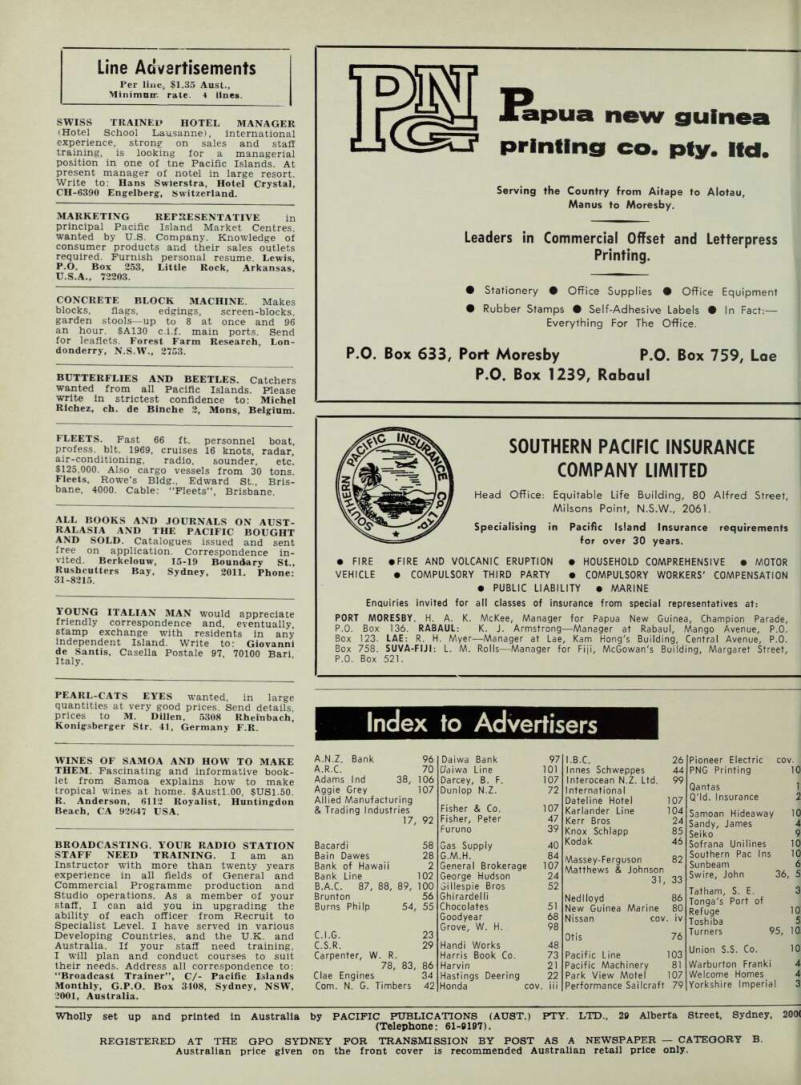
A.N.Z. Bank 96 A. 70 Adams Ind 38, 106 Aggie Grey 107 Allied Manufacturing & Trading Industries 17, 92 Bacardi 58 Bain Dawes 28 Bank of Hawaii 2 Bank Line 102 B. 87, 88, 89, 100 Brunton 56 Burns Philp 54, 55 C. 23
C.S.R. 29
Carpenter, W. R. 78, 83, 86 Clae Engines 34 Com. N. G. Timbers 42
Daiwa Bank 97 D'aiwa Line 101 Darcey, B. F. 107 Dunlop N.Z. 72 Fisher & Co. 107 Fisher, Peter 47 Furuno 39 Gas Supply 40
G.M.H. 84
General Brokerage 107 George Hudson 24 Gillespie Bros 52 Ghirardelli Chocolates 51 Goodyear 68 Grove, W. H. 98 Handi Works 48 Harris Book Co. 73 Harvin 21 Hastings Deering 22 Honda cov. iii
1.8. C. 26 Innes Schweppes 44 Interocean N.Z. Ltd. 99 International Dateline Hotel 107 Karlander Line 104 Kerr Bros 24 Knox Schlapp 85 Kodak 46 Massey-Ferguson 82 Matthews & Johnson 31, 33 Nedlloyd 86 New Guinea Marine 80 Nissan cov. iv Otis 76 Pacific Line 103 Pacific Machinery 81 Park View Motel 107 Performance Sailcraft 79
Pioneer Electric cov.
PNG Printing 10 Qantas 1 Q'ld. Insurance 2 Samoan Hideaway 10 Sandy, James 4 Seiko 9 Sofrana Unilines 10 Southern Pac Ins 10 Sunbeam 6 Swire, John 36, 5 Tatham, S. E. 3 Tonga's Port of Refuge 10 Toshiba Turners 95, 10 Union S.S. Co. 10 Warburton Franki 4 Welcome Homes 4 Yorkshire Imperial 3
Advertisements & other items, pp. 110-112 (3 items)
Wholly set up and printed in Australia by PACIFIC PUBLICATIONS (AUST.) PTY. LTD., 28 Alberta Street, Sydney. 200(
(Telephone: 61-8197).
REGISTERED AT THE GPO SYDNEY FOR TRANSMISSION BY POST AS A NEWSPAPER CATEGORY B.
Australian price given on the front cover is recommended Australian retail price only.
Cific Islands Monthly—June, 1974
The natural Choke.
It’s Honda. Anywhere there’s action. A job to be done.
Fun to be had. Safely and economically.
The snappy line-up is studded with star performers.
Easy-to-handle motorbikes that possess a big-hearted spirit.
Engineered for breezing through traffic or escaping to the country. Rugged reliability that lets you go, .go, go.
Little wonder so many people around I the world ride Honda.
It’s the all-round natural choice. v * C7v I /•'£«
sues*
«^c GU J NEA: Steamsh 'P s Trading Co.. Ltd. P.O. Box 74, Papua / U.S. TRUST TERRITORY: J.C. Tenorio Enterprise P.O. Box 137, Saipan / , Coral lsland Motors: Walu Bay Suva F 'ji Island. P.O. Box 3179 Lami/TARAWA: The Gilbert & Ellice Islands Development Authority 9 dbart & I ' Ce lslands / WESTERN SAMOA: Motor Distributors (Samoa) Ltd. P.O. Box 576, Apia / AMERICAN SAMOA: Max Haleck Inc. P O Box a 9° Pa 9° 7 TONGA: E.M. Jones Ltd. P.O. Box 34, Nukualofa / SOLOMON ISLANDS: British Solomons Trading Co.. Ltd. P.O. Box 114 Honiara / NEW CALEDONIA: Establissements Ballande, Noumea / TAHITI: Ets. COMIMPEX P.O. Box 200, Papeete/COOK ISLANDS: Cook Islands Trading Corporation Ltd. P.O. Box 92, Rarotonga / NAURU ISLAND: Nauru Cooperative Society 14th Floor, Wales Corner, 227 Collins Street Melbourne
* t m MM i 4 rv ft ♦> / A y* r ■ . j-n
sllSrfc
f ♦ #.,/ % * ytfjjt' - v .
And wherever you’ll go in over 120 nations throughout the world you’ll find proud DATSUN drivers.
Perhaps the main reason is that DATSUN was designed to meet a wide variety of conditions—mountain roads and super highways, blistering suns and freezing temperatures. DATSUN is indeed the international car that has precision engineering and a stunning string of rally victories behind it.
Its superb handling, safety features and high speed efficiency make DATSUN the choice of young and old alike. DATSUN-the car that really satisfies the world over. i'
DATSUN
NISSAN
DATSUN distributor network rovers the following areas: FiiiT.P.N.G.-W. Samoa* New CaMonia - New Hebrides* B.SJ.P.-Timor-Norfolk 1 : . , r*. . j ... I