Ancestors...
pp. 37-41 · Read in the full issue
Four Stories From Port
Moresby About Png's
Growing-Up Pains
(1) Hands Off
Ancestors...
If there’s one sort of skulduggery the modern New Guinean won’t tolerate it’s having the skulls of his ancestors smuggled out of the country as curios.
There was ill-feeling earlier this year when reports from Sydney sug gested that human skulls from PNG were being sold in a curio shop.
The “skulls” turned out to be carved wooden miniatures, and there the problem ended.
But the latest incident concerns two undoubtedly genuine skulls rest ing peacefully on a rack in Cairns, Northern Queensland.
News of the two Cairns skulls was contained in a tourist industry news paper circulating in Great Barrier Reef resorts. The newspaper de scribed a collection of PNG art and artefacts in Cairns, said to contain two human skulls which had been war trophies from a tribal battle in the Gulf of Papua.
The Director of the National Museum in PNG, Mr Dirk Smidt, was quick to react when confronted with the reports.
The museum is entrusted with the administration of recent laws which prohibit the export of objects of cultural significance, and insist on export permits for less-valuable ex hibits. Mr Smidt said the museum would never issue a permit for the export of human skulls.
The National Broadcasting Com mission in PNG managed to get a telephone interview with Mr Barry Hoare of Cairns, who laconically described the trade-shuffling match which had given him ownership of the skulls.
Mr Hoare, it seems, specialises in Sepik primitive art. (The Sepik is the area from which the PNG Chief Minister. Mr Somare, comes.) An other collector on Green Island, just
off the coast from Cairns, specialises in Papuan Gulf art and artefacts.
So, as Mr Hoare put it, “I had what he wanted, he had what I wanted, so we did an exchange and I ended up with a skull rack and skulls.”
He claimed that the two skulls had been legally exported before present restrictions were introduced.
Mr Hoare said that on earlier occasions before the restrictions were introduced, he had personally been granted permits to take skulls out of PNG.
S a UllS f °L. r , sale? “ No ’ wered quickly.
There s irony in the situation that the present deep-seated objection to the export of ancestral skulls is largely based on the effects of westernisation in PNG. And it’s western-type collectors who are in-
terested in getting the skulls, At the turn of the century religious carvings and tribal art work were far more valued—in most PNG corn munities—than human skulls were.
But now somewhat belatedly PNG has realised that its artwork, its religious carvings, its traditional artefacts and its human battle trophies have been drained from the in hu 8 e numbers over the pa si 70 years or |°- . T ° so ™ e , of the best Products S f PNG ‘ nba ' art means to visit Brisbane, London, New York or H The' Ittitude of missionaries to pagan art and the emergence of a new society has spelt the end of the skills which produced the art. That’s why PNG is taking a tougher line every month in granting permits for some art forms, and has prohibited the export of others.
(2) And bones in noses
When Mrs Tamo Diro of Port Moresby visited Europe recently she was asked “Where’s the hole in your nose to put the bone through?” And she was asked too where she had been able to get frocks instead of grass skirts to wear while travelling overseas.
Mrs Diro, whose husband is Colonel Ted Diro of the PNG Defence Force, told the story to the
Port Moresby Rotary Club.
She said she was getting fed up with the image of New Guineans which was being given to the world at large. Instead of being members
of a country on the verge of nation hood New Guineans were being pre sented far too frequently as grass skirted primitives with bones through their noses.
PNG was a country rich in its own colour and culture but that was no excuse to think of it as a land full of strange people who did not fit into modern society, Mrs Diro spoke on the need to eradicate discrimination based on sex and race, But, she said, what might look like discrimination to an outsider was not necessarily so. Many people
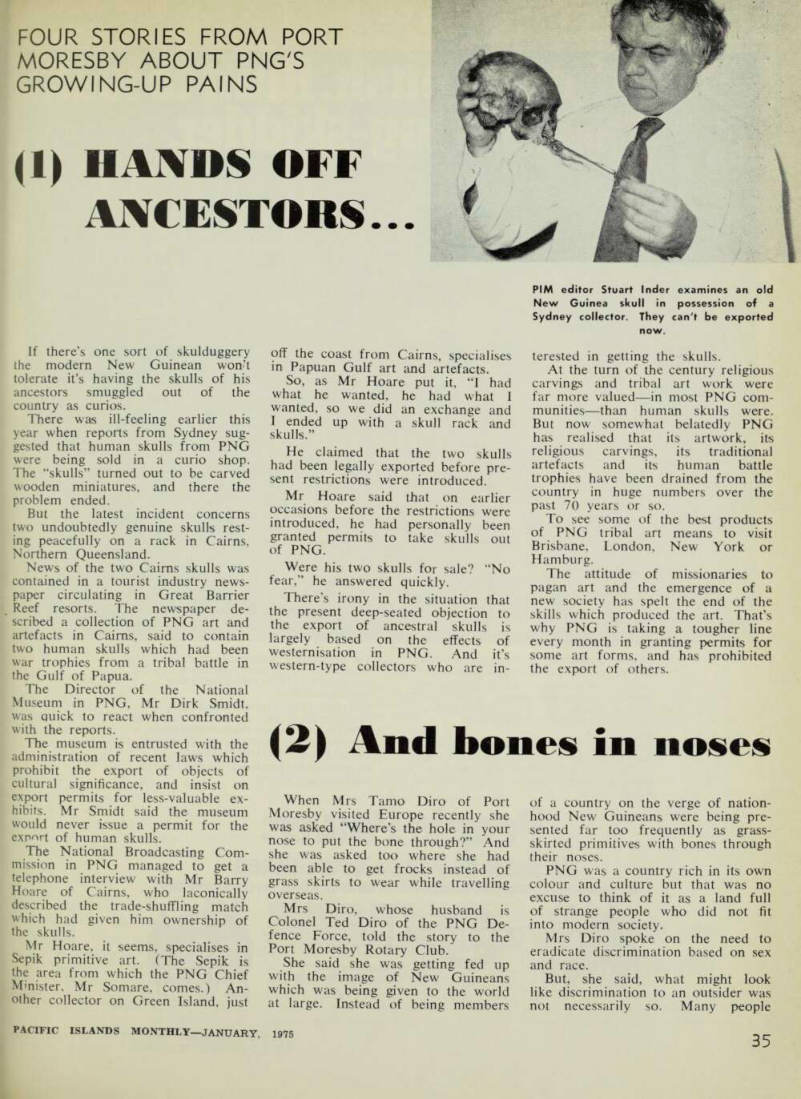
PIM editor Stuart Inder examines an old New Guinea skull in possession of a
Sydney collector. They can't be exported
now.
commented on the fact that PNG women frequently walked with a basket of household goods on one arm, a baby on the other and a load of firewood in between—while their menfolk walked ahead carrying nothing.
“But don’t criticise too much—the women are proud to do this and proud to show off their strength and abilities,” she said.
Mrs Diro stressed that one of the
biggest problems facing PNG society at present was that many men had taken their places in a larger and better-educated community. By and large, women were lagging behind in entering the wider community.
This led to stresses and tensions and the break-up of many marriages and families. She believed that a proper recognition of the abilities of the women and the removal of more subtle instances of discrimination, would overcome the problem.
(3) And let’s talk about bigger i§sne§...
Overland from Wasu on the New Guinea coast to Kabwum in the mountains northwest of Finschhafen is not far in miles, but it’s no Sunday pleasure drive.
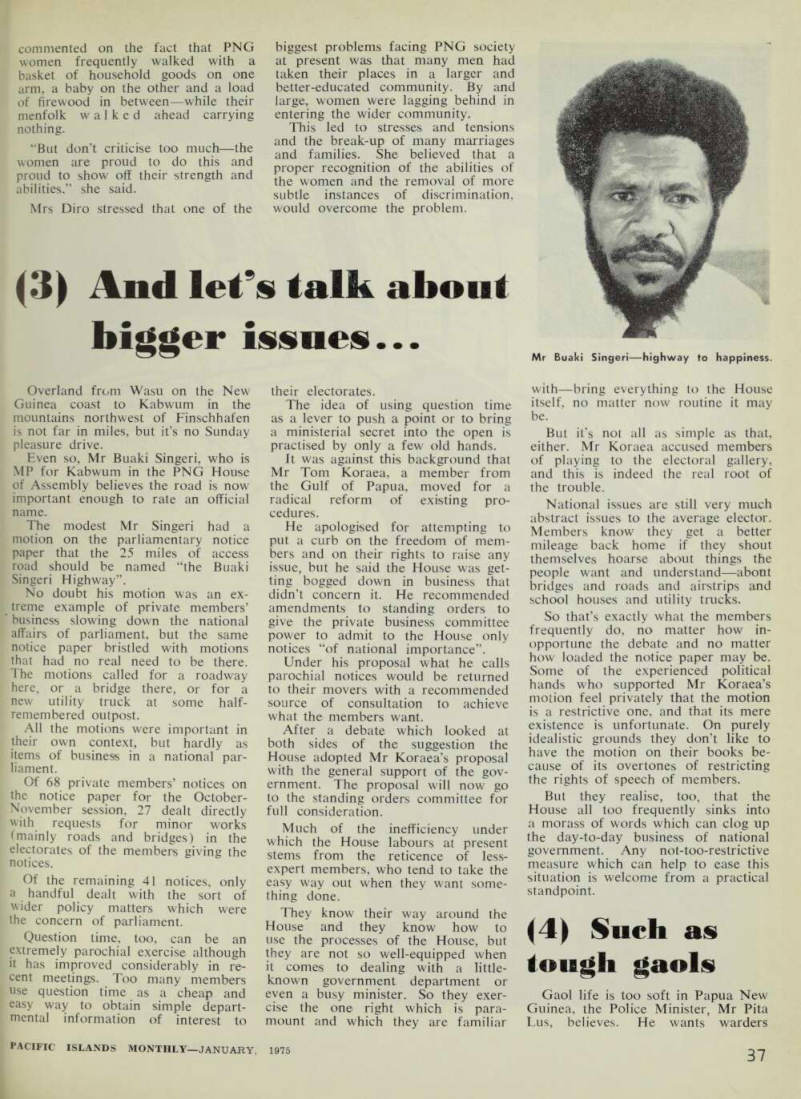
Even so, Mr Buaki Singeri, who is MP for Kabwum in the PNG House of Assembly believes the road is now important enough to rate an official name.
The modest Mr Singeri had a motion on the parliamentary notice paper that the 25 miles of access road should be named “the Buaki
Singeri Highway”.
No doubt his motion was an ex treme example of private members’ business slowing down the national affairs of parliament, but the same notice paper bristled with motions that had no real need to be there.
The motions called for a roadway here, or a bridge there, or for a new utility truck at some half remembered outpost.
All the motions were important in their own context, but hardly as items of business in a national par liament.
Of 68 private members’ notices on the notice paper for the October- November session, 27 dealt directly with requests for minor works (mainly roads and bridges) in the electorates of the members giving the notices.
Of the remaining 41 notices, only a handful dealt with the sort of wider policy matters which were the concern of parliament.
Question time, too, can be an
extremely parochial exercise although
it has improved considerably in re cent meetings. Too many members use question time as a cheap and easy way to obtain simple depart mental information of interest to
their electorates.
The idea of using question time as a lever to push a point or to bring a ministerial secret into the open is practised by only a few old hands.
It was against this background that Mr Tom Koraea, a member from the Gulf of Papua, moved for a radical reform of existing pro cedures.
He apologised for attempting to put a curb on the freedom of mem bers and on their rights to raise any issue, but he said the House was get ting bogged down in business that didn’t concern it. He recommended amendments to standing orders to give the private business committee power to admit to the House only notices “of national importance”.
Under his proposal what he calls parochial notices would be returned to their movers with a recommended source of consultation to achieve what the members want.
After a debate which looked at both sides of the suggestion the House adopted Mr Koraea’s proposal with the general support of the gov ernment. The proposal will now go to the standing orders committee for full consideration.
Much of the inefficiency under which the House labours at present stems from the reticence of less expert members, who tend to take the easy way out when they want some
thing done.
They know their way around the House and they know how to use the processes of the House, but they are not so well-equipped when it comes to dealing with a little known government department or even a busy minister. So they exer cise the one right which is para mount and which they are familiar
with—bring everything to the House itself, no matter now routine it may be.
But it's not all as simple as that, either. Mr Koraea accused members of playing to the electoral gallery, and this is indeed the real root of the trouble.
National issues are still very much abstract issues to the average elector.
Members know they get a better mileage back home if they shout themselves hoarse about things the people want and understand —about bridges and roads and airstrips and school houses and utility trucks.
So that’s exactly what the members frequently do, no matter how in opportune the debate and no matter how loaded the notice paper may be.
Some of the experienced political hands who supported Mr Koraea’s motion feel privately that the motion is a restrictive one, and that its mere existence is unfortunate. On purely idealistic grounds they don’t like to have the motion on their books be cause of its overtones of restricting the rights of speech of members.
But they realise, too, that the House all too frequently sinks into a morass of words which can clog up the day-to-day business of national government. Any not-too-restrictive measure which can help to ease this situation is welcome from a practical standpoint.
(4) Such as
tough gaols
Gaol life is too soft in Papua New Guinea, the Police Minister, Mr Pita Lus, believes. He wants warders
Mr Buaki Singeri—highway to happiness.
armed with pistols to shoot escaping prisoners on sight.
“And we don’t want any of this United Nations in our gaols,” Mr Lus told the House of Assembly in October. He said that the conditions laid down by United Nations for the treatment of prisoners were out of touch with reality.
They did not apply to PNG con ditions where there was an urgent need for gaols with tougher con ditions, not a “soft and easy life”.
Mr Lus said he planned to draw up a set of proposals for the treat ment of prisoners, and would submit them to cabinet.
Mr Lus made a number of state ments at the recent session of parlia ment calling for a harder deal all round towards punishment and treat ment of prisoners. He also supported capital punishment as a mandatory penalty for wilful murder, but the government as a whole outvoted him.
Mr Lus said he believed he could muster a sufficient amount of sup port in the cabinet for his proposals on harder treatment of prisoners.
He also advocated the extensive use of prisoners for public construc tion projects, such as road and bridge building.
“Any prisoners, short or long term, should be made to work very hard, or there is no point in sending them to gaol,” he said. “If I was minister in charge of prisons, I would make sure they worked very hard indeed.” ■Excessive overseas travel by politicians was robbing money from the people of Papua New Guinea, Mr Tom Koraea told the House.
He said, during the Budget debate, that expenditure of thousands of dollars on unnecessary travelling was no different to stealing money from the people who urgently needed it.
He accused public servants and fellow politicians of dishonest use of public funds and said that if overseas travelling brought back something worth while he would not criticise it, but he was distressed to see thousands of dollars wasted every year.
He believed the money could be better spent on small-scale industries at the village level.
He also criticised public servants for frequently clocking into work late, clocking off early, and taking excessively long tea breaks.
“A few dollars lost here and a few lost there amounts to thousands of dollars in the year when you consider the large number of public servants we have,” Mr Koraea said.
Capital punishment for wilful murder has been abolished in Papua
New Guinea. A mandatory penalty of life imprisonment has been sub stituted.
The House of Assembly in Port Moresby made the change while pro cessing its new Criminal Code Bill, the main purpose of which was to consolidate and unify the two sets of criminal codes existing in PNG.
One code was inherited from Papua and one from New Guinea, dating back to the time when two separate administrations existed.
However, the new bill also contains amendments to adapt the codes where necessary to better suit Papua New Guinea.
Crimes involving treason still carry the death penalty. Penalties for other offences will be examined by a law reform commission which is to be set up shortly.