The Editor's Mailbag
pp. 19-21 · Read in the full issue
Gogodala Dancers
Your November issue (p 15) contained an article on the Fourth Niugini Arts Festival, specifically mentioning the Gogodala Dancers, from Balimo in the Western District of Papua New Guinea. Being an ex resident of Balimo I would like to add a few comments.
As stated in your article, the dancing in this area has been re vived only in the past three years, together with the traditional carvings of these people and various other aspects of their culture including canoe racing. The person responsible for this, more than anybody, is Mr Tony Crawford who for the past three years has given himself whole heartedly to try to give back to the Gogodalas some of their culture which was mercilessly taken from them during the 1930 s and 40s as the Evangelical missions took over.
When this project was begun by Mr Crawford, who was then attached to the Commonwealth Art Advisory Board, only a handful of old men had any idea what their culture really was like and it took extensive research material collected by Mr Crawford from various parts of the world to revive their memories and
create interest among the younger men.
Despite considerable opposition
from missions in the area, the first Gogodala carvings seen for many years began to appear towards the end of 1972 and as more interest was created most of the younger men began to try their hand at the carvings of their forefathers.
The completion of the Gogodala Cultural Centre in July this year was a milestone in achievement for the Gogodala people—the centre is based on a traditional Gogodala Longhouse and the younger men had the chance to participate in the building of their traditional housing.
The centre was opened by our Chief Minister, Mr Michael Somare in August this year in the midst of what would have been the biggest display of Gogodala cultural activi ties seen for over 30 years.
With the completion of the Long house which gave the people a place to dance in traditional surroundings, Tony Crawford with the help of some of the older men then set about reviving some of the tradi tional Gogodala dances.
As Gogodala dancing had been banned since the 1930 s and therefore largely forgotten the people involved had to start from scratch learning
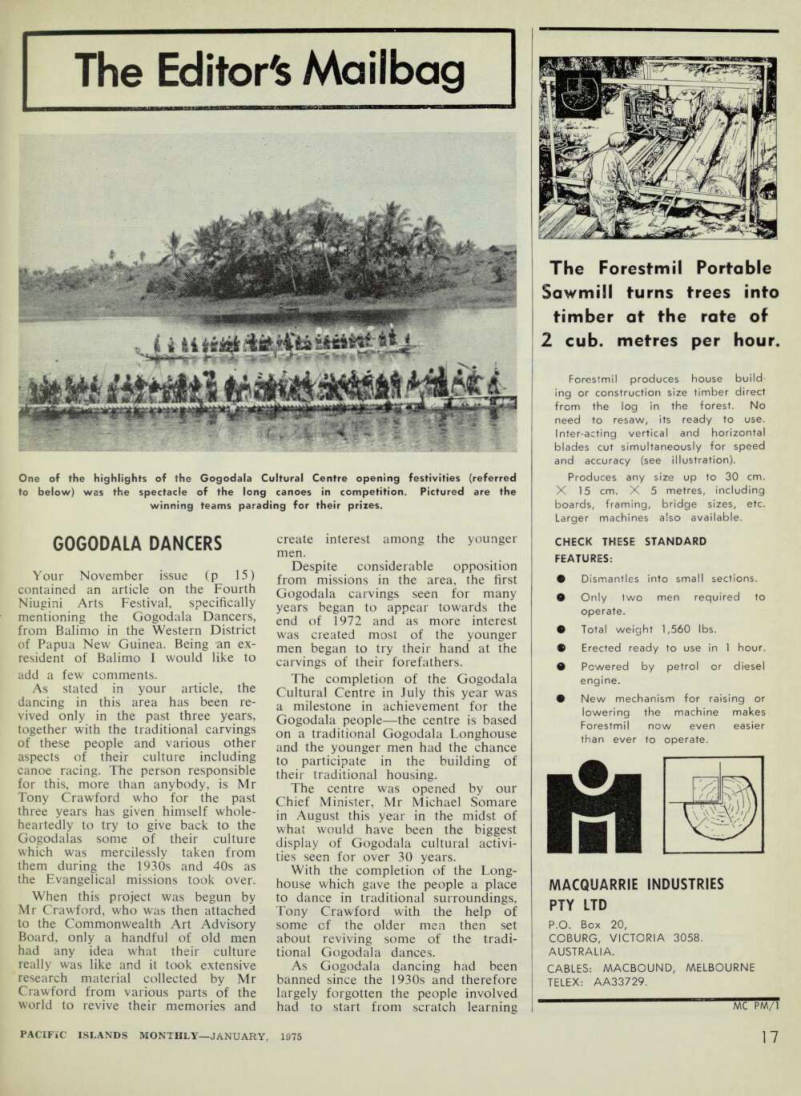
One of the highlights of the Gogodala Cultural Centre opening festivities (referred to below) was the spectacle of the long canoes in competition. Pictured are the winning teams parading for their prizes.
Letters
the basic steps from research material and some of the old men who had defied the ban on dancing.
The result of these efforts was displayed admirably at the Niugini Arts Festival in Port Moresby re cently.
Hopefully, people in other parts of New Guinea and the Pacific who have lost most of their traditions will be able to follow the example of the Gogodala people and restore some of their customs and traditions before it is too late.
They will be fortunate indeed if they can enlist the help of someone like Tony Crawford to help them achieve these goals.
Paul H. Clowes.
Port Moresby.
Percy Chatterton's
Papua
This is an unsolicited mini-review of Percy Chatterton’s Papua, Day That I Loved, a copy of which I eventually obtained from Pacific Publication’s Sydney headquarters the other day and have now read with the warm pleasure I had anti cipated.
Having been closely associated with Percy for over 40 of his 50 years in the land of his adoption, as colleague and friend, I suppose I know him as well as most and— as you will know—his writing is typical of the man.
There are plenty of quotable quotes such as would surely bring a quick dollar to whoever may be dis posed to send them to Readers Digest—or whatever. Such as, “I like simple people. I detest osten tation, pomposity and self-assertive ness. I deplore the cult of bigness.
The dinosaur died of it; it may yet turn out to be homo sapiens’ termi nal illness”.
And “In the Hebrew story of creation, an angel with a flaming sword barred the way back to the Garden of Eden. The angel who bars the way back to the Melanesian Eden grasps in his hand a transistor radio, its sword-like antenna glittering hypnotically”.
Only at one point in the book did I put a question mark in the margin, on p 121 where Percy shares a bit of his thinking on essential constitu ents of a culture—culture meaning “a way of life—the whole of it”. In this context he rejoices (as I do) in
what begins to look as if a renewed appreciation of PNG’s traditional languages is well under way. Then he goes on to ask . . . “But what of traditional religion, which, in coastal Papua at any rate, was based on a belief that the influence of the spirits of the dead is still active in the lives of the living? Is there any likelihood of its survival or revival? I rather doubt it .
I won t start up a theological debate with Percy, but, in the spirit ?/rii hro P°i OSI , St ‘ he - late F - F Wil iams, I think there is room for at least some measure of blending of cultures as affecting this Papuan culture constituent alongside Christian teaching. For if the Christian concept of immortality means anything it surely must include a recognition that the spirit of those who have gone before continues to be ■? c “ v . e o\ r i,! he hv ? s °( th e living, must it not? What a hundred 19th century Papuans included in their belief (that the influence of the spirits of the dead was still active in the lives of the living) may have been as vanous as what 100 Christians may include in their belief in immortality.
So, there may be some common ground somewhere in this category of culture.
Dr Chatterton’s rich fund of personal anecdotes is as entertaining as it is inexhaustible, and the general reader will appreciate the warm humanity running through it all, whether in the earlier missionoriented chapters or in the later political flavoured pages.
In these latter, what sticks out a mile is the prophetic content of much that the Hon Member of the House
of Assembly gave voice to in the House. Time and again, it appears, a variety of—at the time—lost causes have been resurrected at a later stage by somebody else and become ‘won causes’, two of them (p 95) during the printing of this book and after Chatterton’s retire ment from the House!
Thank you> Stuart Inder> for talk . ing Percy into writing this book. In your fore Word to his book you sur prised me by referring to “that slight trace of Lancashire accent he has even after 50 years jn Papua -. rm a , ad from Lancashire m y Se lf, and my w jf e more so, and we are agreed that whatever accent Percy may have it>s not L ancashire . i j n . c]ine t 0 beMeve that like his wr iting, j t j s p Ure p erc yi Your little write . up of the artist Ber , 81 - ownj on the backfo , d of the dust cover cou , d well have included horticulturist, for before joining up as a m i ssio nary he had raised the world record collection of tuschias and was a wor d authority on them from his London nurseries!
Perhaps some readers will put down this book conceding that some at j east of “ those bloody mission aries - didn -, do tOO bad a job one wa y an( j ano ther, and the Rev Percy Chatterton, QBE, LED, LCP, in particular.
Sydney.
Maurice Nixon.
O Rev Maurice Nixon is currently secretary of Sydney’s Pitt Street Con gregational Church, but he was with Percy Chatterton at Hanuabada in 1931 and remained as a missionary in Papua until his retirement in 1968.