These Damsels Were A
pp. 23-25 · Read in the full issue

Special Delight
From Seamus Mcelroy,
in Honiara
Marine scientists and fishermen have, in the past year, collected 40 or so previously-undescribed fish in the rich Solomons waters.
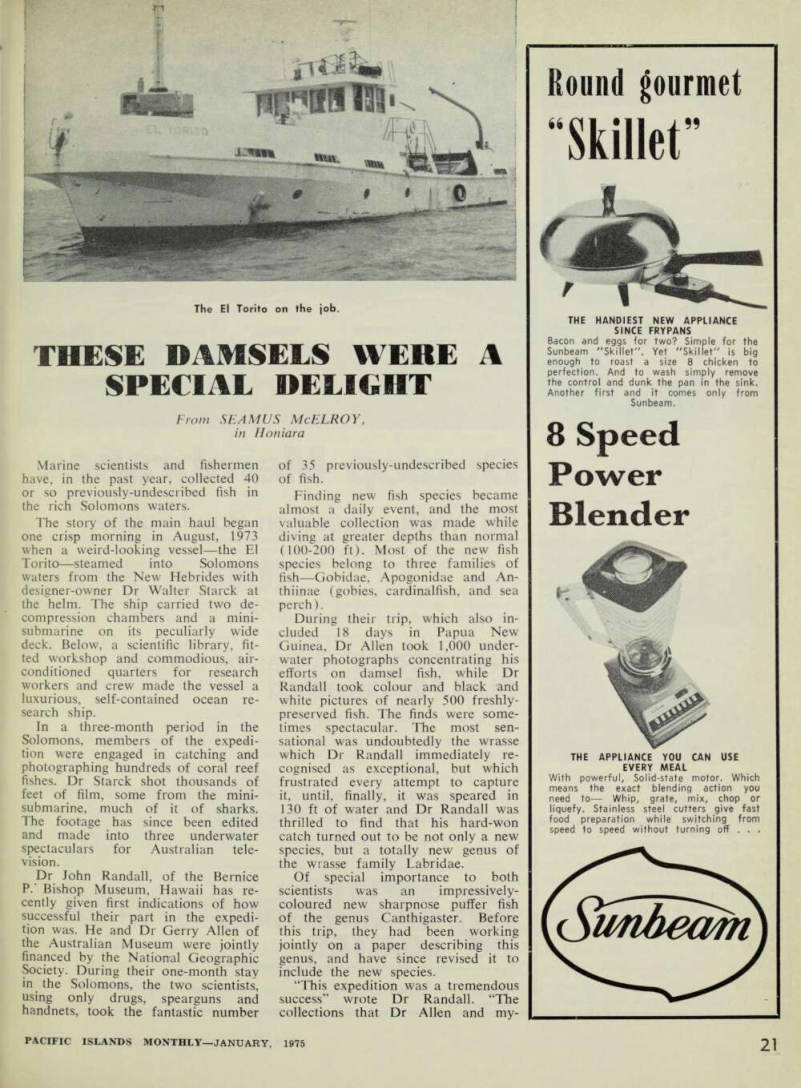
The story of the main haul began one crisp morning in August, 1973 when a weird-looking vessel—the El Torito—steamed into Solomons waters from the New Hebrides with designer-owner Dr Walter Starck at the helm. The ship carried two decompression chambers and a minisubmarine on its peculiarly wide deck. Below, a scientific library, fitted workshop and commodious, airconditioned quarters for research workers and crew made the vessel a luxurious, self-contained ocean research ship.
In a three-month period in the Solomons, members of the expedition were engaged in catching and photographing hundreds of coral reef fishes. Dr Starck shot thousands of feet of film, some from the minisubmarine, much of it of sharks.
The footage has since been edited and made into three underwater spectaculars for Australian television.
Dr John Randall, of the Bernice P. Bishop Museum, Hawaii has recently given first indications of how successful their part in the expedition was. He and Dr Gerry Allen of the Australian Museum were jointly financed by the National Geographic Society. During their one-month stay in the Solomons, the two scientists, using only drugs, spearguns and handnets, took the fantastic number
of 35 previously-undescribed species of fish.
Finding new fish species became almost a daily event, and the most valuable collection was made while diving at greater depths than normal (100-200 ft). Most of the new fish species belong to three families of fish—Gobidae, Apogonidae and An thiinae (gobies, cardinalfish, and sea perch).
During their trip, which also in eluded 18 days in Papua New Guinea, Dr Allen took 1,000 under water photographs concentrating his efforts on damsel fish, while Dr Randall took colour and black and white pictures of nearly 500 freshly preserved fish. The finds were some times spectacular. The most sen sational was undoubtedly the wrasse which Dr Randall immediately re cognised as exceptional, but which frustrated every attempt to capture it, until, finally, it was speared in 130 ft of water and Dr Randall was thrilled to find that his hard-won catch turned out to be not only a new species, but a totally new genus of the wrasse family Labridae.
Of special importance to both scientists was an impressively coloured new sharpnose puffer fish of the genus Canthigaster. Before this trip, they had been working jointly on a paper describing this genus, and have since revised it to include the new species, “This expedition was a tremendous success” wrote Dr Randall. “The collections that Dr Allen and my-
The El Torito on the job.
Delightful damsels
self made in the Solomons were ex tremely valuable. It will be many years before all the specimens will be fully reported on”.
Though their material was origin ally divided between both the Aust ralian and Bishop Museums, parts of it have since been sent across the world to experts specialising in par ticular families. The first publication to include any of their material will probably be Dr Allen’s forthcoming book Damsel Fishes of the South Pacific.
The book will include an exciting new damsel fish of the genus Chromis, which was first collected by Dr Allen off the Alite Reef near Malaita, in 150 ft of water, and has been named in his honour. Future publications of both these authors will undoubtedly draw heavily upon the material collected during this expedition, and their scientific value Dr Randall writes, “will be greatly enhanced as a result of their oppor tunity to collect in the rich Mela nesian area”.
The fish collections at the Aust ralian and Bishop Museums have also benefited considerably. More
specimens, which were first dis covered elsewhere in the Pacific, were obtained, giving new evidence to studies on the distribution and ecology of coral fish in the Pacific.
Following on closely behind the departure of this expedition, Dr Herbert Axilrod, author of a series of books on Pacific Marine Fishes, visited BSIP for a week in Novem ber. Two keen fish naturalists in the Solomons—lan Gower and Noel Gray—helped Dr Axilrod during his stay to collect five fish not previ ously known to him. It is possible that two or three of these fish will turn out to be new species.
Earlier this year, a zoology lec turer from Armidale University, NSW, organised a two-week trip to the Solomons on a Siganus (Spine feet) collecting field trip. Dr David Woodland and an assistant Mr Greg Wallace were looking for specimens
of two supposedly-different Siganid
species, each previously collected only once in the Solomons.
There was also the possibility of a third (new) species which was spotted by Dr Randall during his visit six months earlier, but was never collected. Dr Woodland, as opposed to the previous two expeditions, was trying to determine biometrically the actual number of Siganus species that
have been collected from the South Seas.
When trying to identify Siganids, colour was often used in the past as the main criterion for determining different species of this genus. How ever, Siganids can undergo several different colour or pattern changes in their lifetime, and in the past, these different stages or forms have sometimes been reported as different species.
With the aid of a computer, Dr Woodland worked out (mainly from museum material) some characteris tics other than colour which he could measure and which were con stant for a particular species. By this method, he had successfully reduced the Siganid species list for the South Seas from over 80 to about 25. In the Solomons he collected enough evidence to confirm that the two specimens previously collected only once from Solomon waters were, in fact, two different species.
When the man with undoubtedly the best first-hand knowledge of fish in the tropical Pacific, Dr Randall, says “I don’t know when I’ve had a more productive stay in the field”, one can only conclude that many more new and spectacular fish remain to be discovered, especially in deeper waters.