Tropicalities
pp. 15-17 · Read in the full issue

Per mi is
for
whites?
Whites living in Papua New Guinea after independence may have to carry work permits. The Minister for Labour, Mr Gavera Rea, fore cast this in the House of Assembly recently.
Mr Rea said one of the biggest problems facing PNG was the need to train its own nationals to skilled jobs, and to protect their rights to hold those jobs.
He believed that the right to em ployment in an independent Papua New Guinea should be a right of citizenship, not a right of long-term residents. Existing legislation restricts some classes of employment to New Guineans, but whites who have lived in the country since before the legis lation was enacted are exempt from the restriction.
Mr Rea said he did not believe this form of protection, based merely on period of residence, would fit the needs of a truly national and inde pendent Papua New Guinea.
He believed that non-citizens should be required to carry work permits setting out the special skills or attributes which entitled them to employment. He said that research was already being carried out into the type of legislation envisaged.
Was your dad
a mummy?
Hieroglyphics found in caves in West Irian have attracted the interest of a New Zealander, Professor H. B.
Bell, who is at Harvard University, Boston. He plans to have them photo graphed and exhibited. He says that research he has conducted on photo graphs and reports by German anthropologists suggest that NZ Maoris and other Polynesians des cended from an Egyptian-Libyan fleet which sailed into the South Pacific about 250 to 230 BC, and passed through West Irian.
Dr R. C. Green, professor of
anthropology at Auckland University, doubts Professor Bell’s claim. He says there is no scientific evidence that the hieroglyphics ever existed. In ad dition, Polynesian culture contrasted markedly with that of Egypt.
Money IVom
Isis studies
A forger used a photograph of a $lO note appearing in a school text book to make a forged note which turned up at a Honiara bank re cently.
The note was included in a large sum paid into the bank and was detected by a bank officer as he was checking the pile of notes. Two pic tures of the $lO note, the same size as the original, had been cut from a mathematics textbook pasted to gether and then coloured with crayons to resemble the real note.
All textbooks carrying the picture will be called in and the words “specimen copy” overprinted on the picture.
Toget luTiiess
on ilie road
Motor sport organisers in Aust ralia, New Zealand and New Cale donia officially agreed in October to co-operate in a joint South Pacific Rally Series to link three motor trials held in their respective countries.
The series will begin in 1975 to combine performances in the New Zealand Heatway Rally in July, the Southern Cross Rally in Australia in October and the Safari Caledonien trial out of Noumea in November.
The sponsorship and prizes for the series have not yet been worked out, but it is expected the agreement will result in a greater exchange of teams competing in the three South Pacific rallies.
PIM really
gets a round
Wages packet apart, the richest reward in working for PIM is the knowledge that our bon mots are
read all over the world. The proof of that is in the mail which we get on the rare occasions that the Sydney postal workers are not on strike.
F’rinstance, a few days ago, we opened a letter from Alfred Berg lund, self-described “self-learned linguist and amateurish writer, born near the Arctic Circle in the pro vince Lapland” from Forslov in Sweden. He asked us to publish an article by him on Sweden’s neglect of the Lappic nomads. Unfortunately, we can’t oblige as our parish is the Pacific only, but maybe the United Nations’ Committee of 24, who we know read PIM, can help.
We get letters from many far away places but we haven’t bragged about our world-wide readership since the time years ago when we told of the village chief in the middle of SE-Asia who gave PIM covers as rewards to villagers.
Smugglers raid
PNG’s wildlife
PNG Government rangers are mounting a huge campaign against wildlife smugglers. They want to catch operators who are smuggling out of the country rare protected butterflies, birds and their feathers and crocodile skins.
Rare plumes from some jungle birds and the colourful wings of some protected butterflies are bring ing big prices on world markets.
Patrols are going into collection areas in a search for smugglers who may be operating in a big way. They are also making spot checks of con signments through airways offices, at wharves and in post offices.
The Agriculture Minister, Dr John Guise, warned “I will do everything in my power to deport unscrupulous people who are exploiting our birds and butterflies.”
He said there was evidence that smuggling of wildlife specimens had increased during the past few months despite repeated warnings from his office.
Some overseas dealers were offer ing up to $6OO for a good specimen of some butterflies. Detection of illegal export was difficult because
packets were small enough to be sent through the mails.
Seamen calling at coastal villages were also placing orders with local people for birds and butterflies, Dr Guise said. Detection of this sort of smuggling was not so difficult, and a close watch was being kept on the activity of ships’ crews.
Agricultural inspectors believe that bigger consignments of wildlife speci mens were being smuggled out of the country labelled as personal effects.
Dr Guise said his officers had re cently confiscated 18 Birds of Para dise, and a large number of rare bird-wing butterflies collected by “so called scientists who failed to pro duce permits”.
The value of recent confiscations of butterflies and Birds of Paradise was estimated at $6,000. They in cluded seven butterfly species which entomologists believe are facing ex tinction.
■lusting guts
fur nothing
Agricultural shows—Australian style—may be on the way out in Papua New Guinea no matter how much they are adapted to the local community.
In Lae recently a New Guinean politician reflected increasing cri ticism when he described the Morobe District show there as “a place for white planters and gamblers”.
The politician, Mr Amenao Okono, called for the banning of the annual show until such time as the New Guineans of the district wanted
to run it for themselves. He claimed some people were tricked into attend ing this year’s show and that they were robbed of their money at gam bling stalls and by “those white planters on the gates”.
But Mr Okono’s attitude has dis appointed planters and businessmen who, for years, have unsuccessfully been trying to encourage greater control by New Guineans in agricul tural shows.
“Too many of them are just not interested” a member of the Papuan Agricultural Society in Port Moresby said.
He denied that the shows were the preserve of the white man, and said that agricultural shows could well be on the way out because many New Guineans were not even in terested in adapting the shows to their own requirements.
“We seem to be busting our guts for nothing these days”, he said.
About 10 major agricultural shows are held each year in Papua New Guinea. The Morobe Show in Lae has always been one of the biggest.
Mr Okono’s criticism, contained in a public statement, suggested that the $lB,OOO gate money from this year’s Morobe Show might be a “profit” for someone. “Where will the money go”, he asked.
The show society’s business coun cillor, Mr Bill Leonard, said in Lae that the statement reflected some general misunderstandings about how shows were operated voluntarily. He said $15,000 of the money was paid in prizes and awards, and the rest helped to pay off mortgages on show ground buildings.
Cook Islanders
dance in Japan
Visitors to the Namegawa Island resort about two hours train journey from Tokyo were entertained re cently by 200 trained flamingoes, a troupe of peacocks and the Cook Islands’ Betela Dance Troupe, which was visiting the luxury hotel for the sixth time.
The troupe, nine girls, five boys and musicians, left Rarotonga for Japan last March and returned home on October 22 after calling at Hong Kong, Singapore, Australia, New Zealand and Fiji.
The troupe is almost a family affair. Three of the girls and a boy are from the Jonassen family. Anne Jonassen is the team leader, her father the manager and her mother the chaperone and adviser.
The daily performance at the Namegawa Island resort was watched by between 6,000 and 10,000 visit ors, The Cook Islanders also appeared on television and, for variety, included New Zealand Maori hakas and Samoan and Gil bertese dances in the programme.
In Fiji, as PIM reported in No vember (p 12), the dancers charmed Prince Charles and each of the girl dancers managed to kiss the cheek of Britain’s future king.
Tonga looks
fur nodules
Tonga is pinning hopes on marine resources in the shape of manganese nodules and phosphate to lift the economy. Inspired by the discovery of a 300-mile wide belt of manga nese nodules in waters around the Cook Islands, Tonga will soon launch a search for similar minerals in the broad terrace on the eastern side of the Tonga Platform, about 60 miles east of Nukualofa.
The survey will be at depths of 3,000 to 4,000 metres by grab samp ling. A principal adviser in the search will be Dr Loren Kronke, of Hawaii, who is based in Suva as a UNDP marine geologist.
The search for phosphate will be in the deeper parts of the Tonga Platform and the shallower oceanic areas. Mr Sione Tongilava, superin tendent of the Lands and Survey De partment, said he felt the margins of the Tonga Trench might be a likely place for phosphoric deposits.
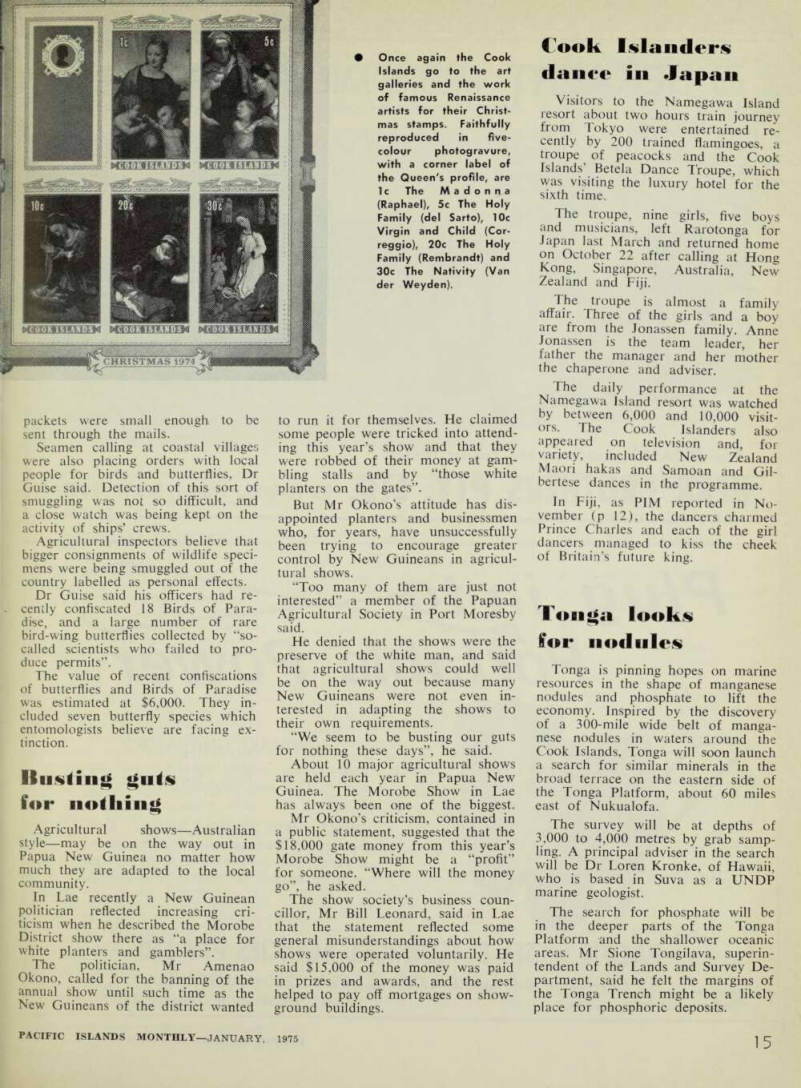
Once again the Cook Islands go to the art galleries and the work of famous Renaissance artists for their Christ mas stamps. Faithfully reproduced in five colour photogravure, with a corner label of the Queen's profile, are 1c The Madonna (Raphael), 5c The Holy Family (del Sarto), 10c Virgin and Child (Cor reggio), 20c The Holy Family (Rembrandt) and 30c The Nativity (Van der Weyden).